Father memorial diamond cost price ranges and key factors that determine the price

How Much Does a Father Memorial Diamond Cost?

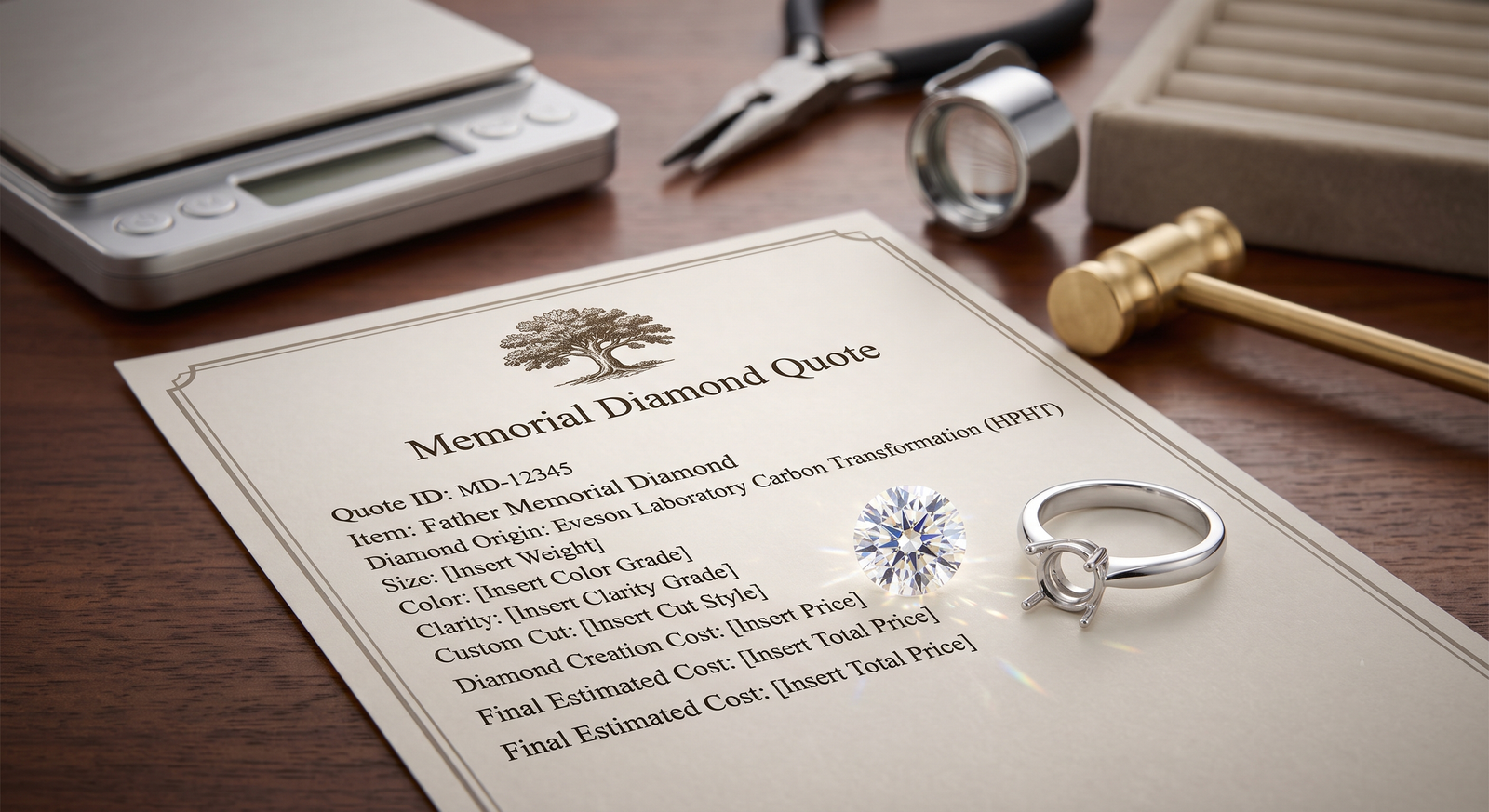
Father memorial diamond cost: a printed eight-line quote beside a loose lab-grown diamond and a plain ring mount

This is often the question a family asks second and worries about first, sometimes with a funeral already paid for and nobody wanting to be the one who raises money. So what does a father memorial diamond cost? Across the industry in 2026, roughly $1,500 to $3,500 at 0.10 to 0.25 carats, $5,000 to $15,000 at 0.5 to 1 carat, and $20,000 to $75,000 and upward at 2 to 5+ carats, figures for the loose stone alone, with the final number depending on carat, color, cut, and whether an independent grading report is included.

Those are industry wide ranges rather than Memorial Diamond’s own pricing, which is not yet published. The complete guide to father ashes diamonds sets the tiers out as a table, and the wider 2026 pricing guide covers what drives cost across the whole category. This page is about the father memorial diamond cost quote itself, what belongs in it, and when each part of it is actually paid.

Memorial Diamond is a company in this category; apply the checks below to our quote as strictly as to anyone’s.

What Does a Complete Father Memorial Diamond Cost Quote Contain?

A father memorial diamond cost quote is commonly for one object: a loose, unset stone in a box. Everything that turns that into something you can wear, insure and pass on sits somewhere else on the paperwork, or nowhere on it yet.

Line itemInside the quoted price?What decides it
The loose stoneYes, this is usually what a quote meansCarat, above all
ColorVaries; treated colors are often a premiumWhether the color is achievable from his carbon or requires post growth treatment
Cut and shapeOften included; fancy cuts frequently notThe shape chosen
Independent grading reportOften separateWhether an independent laboratory grades the stone, or it is documented in house
Setting, ring, pendant, earringsTypically separateMetal, design, and whether stones are being matched
EngravingSeparateLength and method
Shipping and insured transitSometimes separate, in both directionsDistance and declared value
Resizing, repair or resetting laterSeparate, and often years laterWear, changed circumstances, a piece being passed on
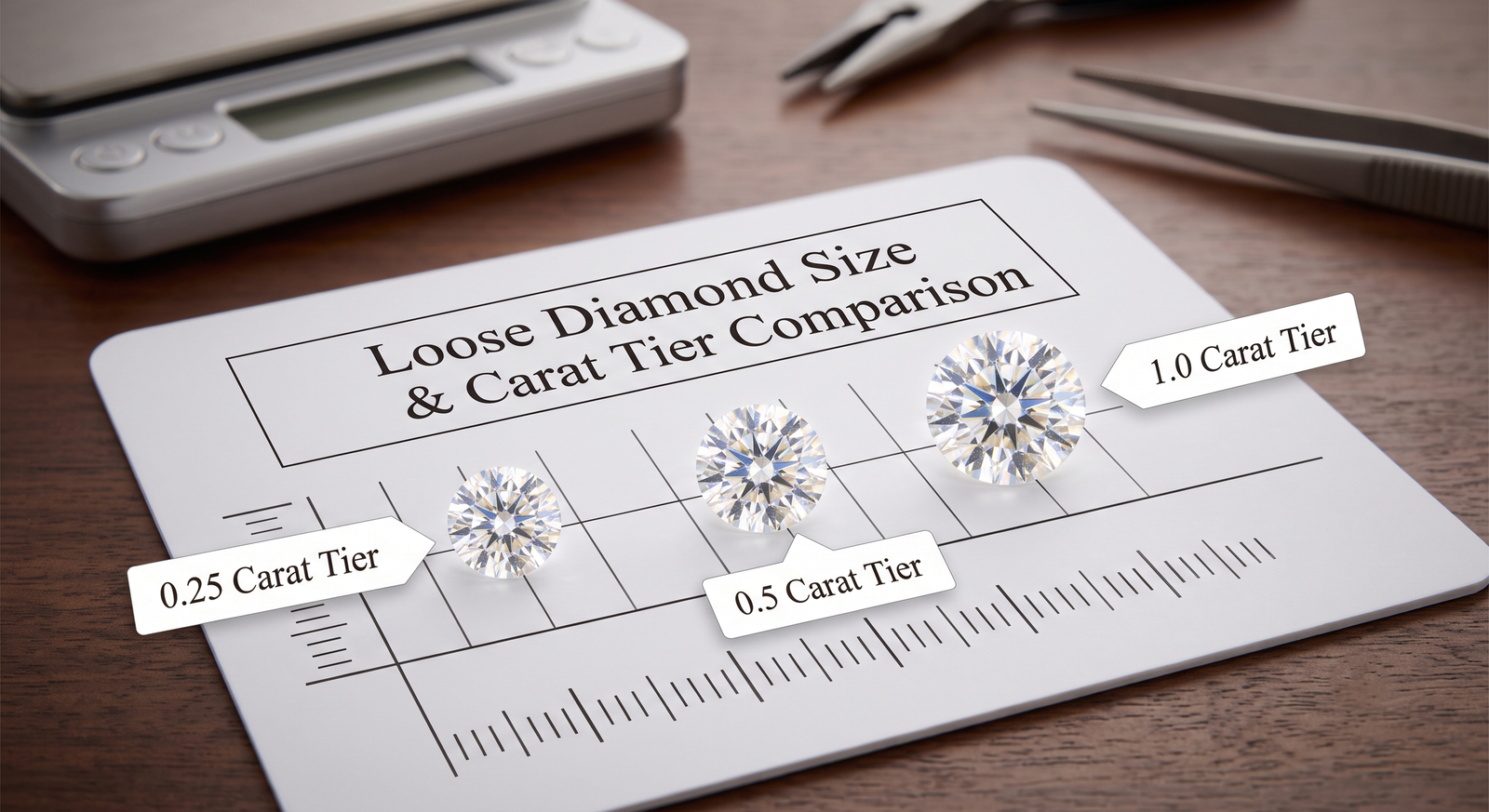
Three loose lab-grown diamonds of roughly 0.25, 0.5 and 1 carat side by side on a scale card, showing why carat drives cost

Ask for all eight named at the first conversation, even where several come back as “not applicable yet.” A father memorial diamond cost quote that names eight lines and prices four is more useful than one that names one and prices one, because the four unpriced lines are the ones that arrive later.

Why Does Carat Decide More Than Everything Else Combined?

Size is a function of growth time in the press, a larger stone occupies expensive, tightly controlled HPHT equipment for longer, with more that can go wrong. That is why father memorial diamond cost scales steeply with size, and why a larger stone takes longer as well as costing more, the same variable drives both.

Color is the second lever on father memorial diamond cost, and it runs in the direction people least expect, colorless is the expensive option rather than the default. What colors to expect for a father’s memorial diamond covers the range and the relative costs; choosing a carat size is worth reading before a number is settled rather than after.

Is Setting the Stone Into Something He Owned Its Own Line?

Yes, and it is a real one. Whether a wedding band he wore for forty years, a signet ring or a watch can take a stone at all is covered in the complete guide to father ashes diamonds. What belongs here is the cost consequence.

A modification is a jeweler’s assessment before it is a quote, and that assessment usually carries a fee of its own, ask before booking one. It is therefore a separate line from the setting line above it, and the two numbers are not comparable: one prices work on an irreplaceable object, the other does not.

Book the assessment early rather than at the end. It can be done while the stone is still growing, and it answers whether that line of the father memorial diamond cost exists at all long before the money conversation reaches it. Memorial diamond settings and jewelry ideas for a father covers the alternatives if the answer turns out to be no.
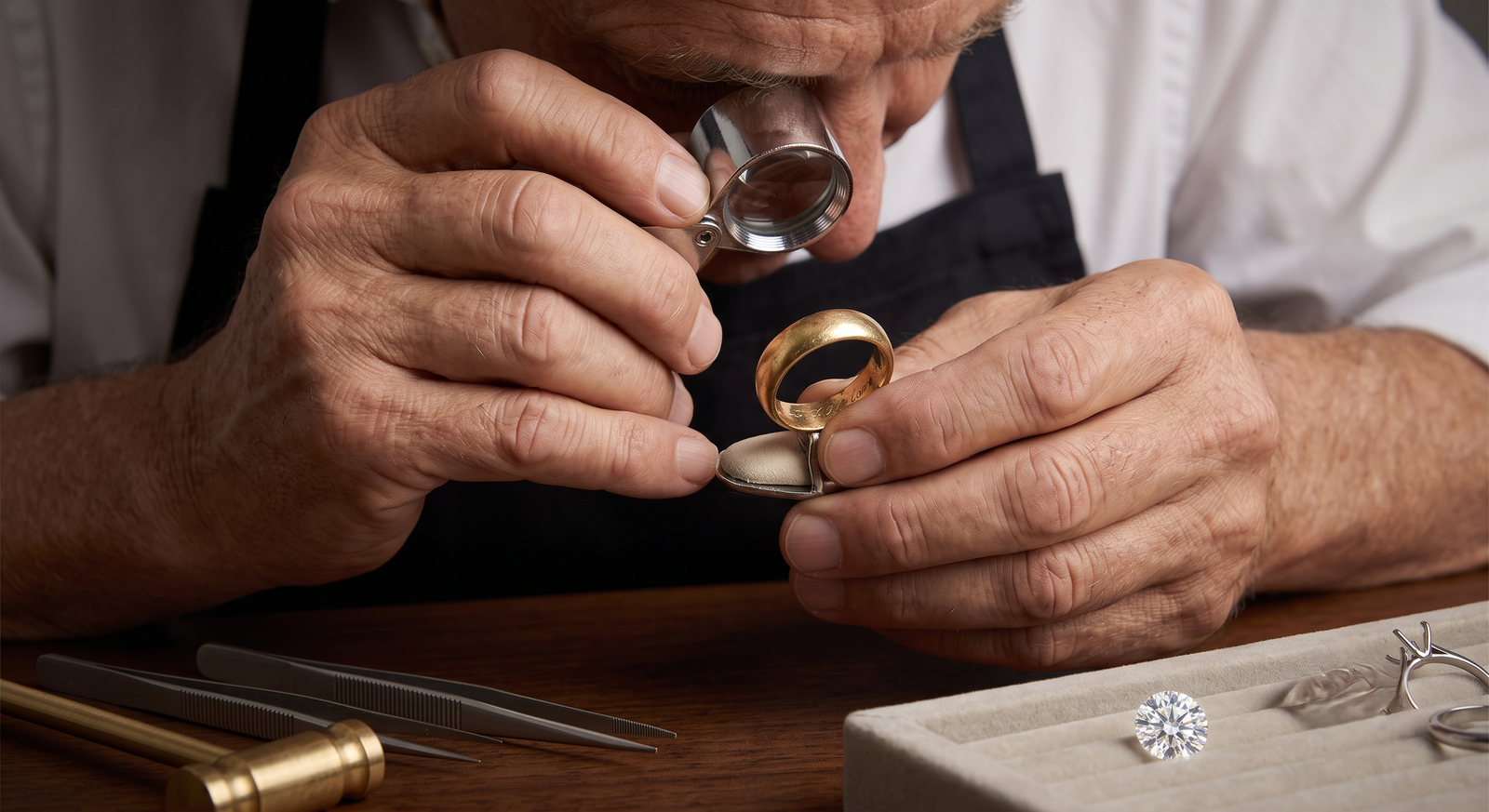
Jeweler examining a worn plain wedding band under a loupe to assess whether it can take a stone |

What Changes When He Is the Second Parent?

Where this arrives after a mother’s death rather than before it, sometimes years after, the father memorial diamond cost question comes with history attached.

Matching is a specification, not a discount on father memorial diamond cost. Where a stone already exists for a mother and a family wants a comparable one, matching color and cut is a request that can constrain the growth run. Ask what matching involves and whether it moves the father memorial diamond cost or the timeline, rather than assuming it does either.

A second stone means a second growth run. Because size is bought in press time, ask whether two stones are priced close to two singles or whether anything is genuinely shared. Whether more than one family member can get a diamond from the same father’s ashes covers how families divide that decision.

The money conversation is happening alongside an estate, and sometimes between siblings rather than inside one household. Agreeing who pays for what before a quote arrives turns that quote into a decision rather than an argument.

When Does Each Part of It Get Paid?
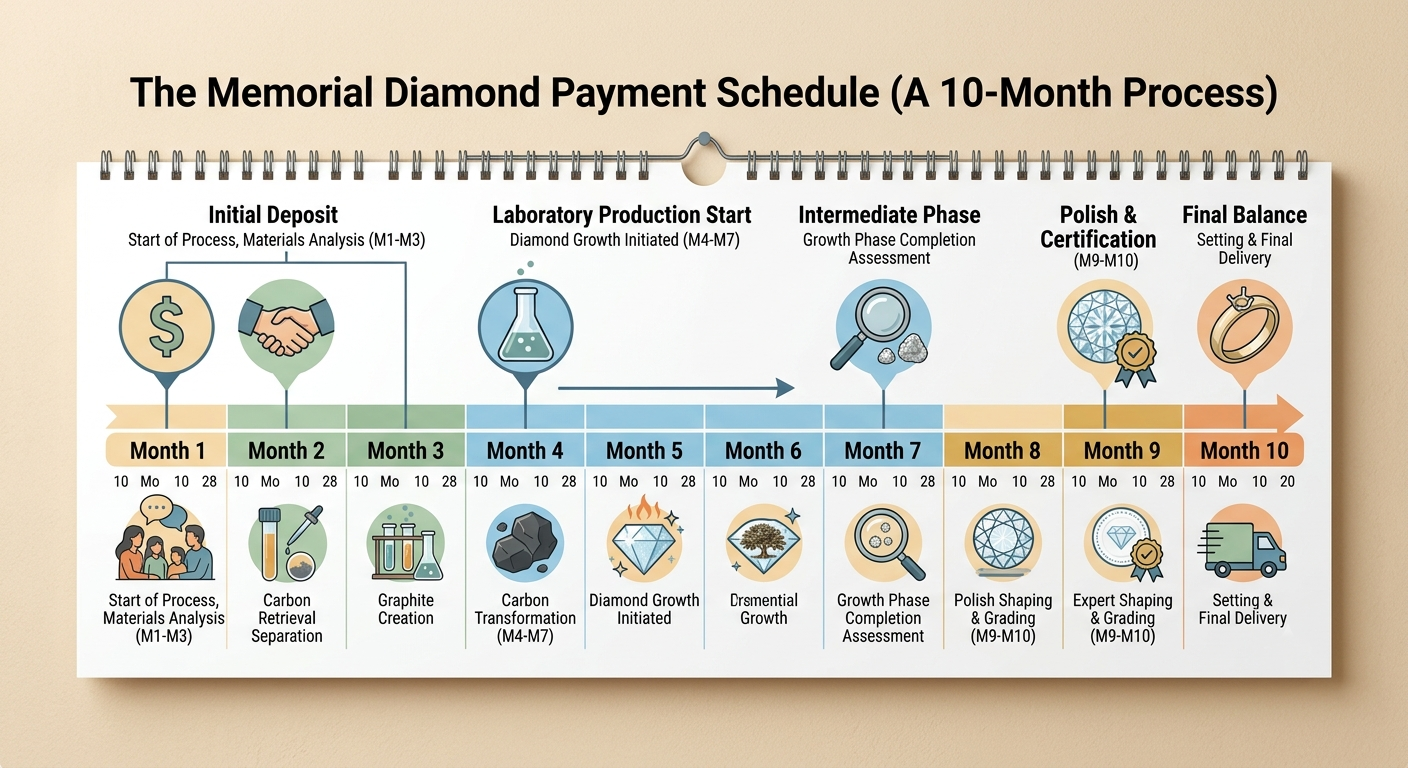
A wall calendar spanning ten months with five payment points marked from deposit to setting

The eight lines of a father memorial diamond cost do not arrive together, and the gap between the first payment and the last can run most of a year. Roughly, and worth confirming against whatever a provider actually offers:

  • At the order, commonly a deposit against the stone. Ask what proportion, and ask what it commits you to.
  • Before or during growth, the balance on the stone itself, on whatever schedule is agreed.
  • After the stone is finished, grading, if it is charged separately, and the setting.
  • At the end, engraving, insured transit, and any modification work on an existing piece.
  • Years later, resizing, repair, resetting when a piece changes hands.

Two things are worth having in writing at the start rather than in month nine: what is refundable, and up to which point, and whether a quote has a stated validity period. Neither is an awkward question. How long a father memorial diamond takes covers where each of these payments lands on the calendar.

Three Things That Probably Don’t Change the Price, Ask Anyway

Three things commonly expected to move father memorial diamond cost, each of which is worth putting to a provider directly rather than assuming.

  • How much material is sent. Sending a full urn rather than the required portion does not produce a larger, better or faster stone. Carat is bought in growth time. And because the recovered carbon is blended with lab grown carbon before any growth run, a bigger parcel does not buy a bigger share of him either, what a memorial diamond carries is a provable portion, never the whole.
  • Which material is used. Ask whether source material affects price; nothing about the growth run itself suggests it should, and what differs most between the ashes and hair routes is what the family does beforehand.
  • Whether one material or two. A combined order still produces one stone from one growth run. Ask whether preparing a second material carries a charge, but there is no second stone being paid for.

Frequently Asked Questions

Why is the range in father memorial diamond cost between the tiers so wide?

Because carat, color, cut and whether an independent grading report is included all move independently, and companies differ in what a quoted figure covers. A single price only becomes meaningful once those four are specified in writing.

Are two stones for two children cheaper than two separate orders?

Ask rather than assume, father memorial diamond cost is per growth run. Each stone occupies its own press time, so any saving comes from shared handling and documentation rather than from the stones themselves, and there may be none at all.

Does a memorial diamond cost more than an ordinary lab grown diamond of the same size?

There is no published comparison to cite for father memorial diamond cost against a standard stone, but memorial stones carry extraction, purification and chain of custody work that a standard lab grown stone does not, and the growth runs are individually handled. Any difference sits in the process.

Can a quote be held while we decide?

Ask at the point the quote arrives rather than later. There is no reason to rush this decision, and a stated validity period on a father memorial diamond cost quote is a fair thing to expect in writing.

Is the money conversation different when siblings are splitting it?

Practically, yes, the father memorial diamond cost is one number but the payers are several. Ask whether a provider can take payment from more than one person against a single order; that is a billing policy question, and agreeing the split between yourselves first makes the answer easier to act on.

What happens to the cost if the finished stone isn’t what was specified?

Ask before ordering what the procedure is if color, clarity or carat comes out differently from what was agreed, and what the remedy is. It is an uncomfortable question that is far easier asked in month one than in month ten.

Final Thoughts on What a Father Memorial Diamond Costs

A father memorial diamond cost quote is not a price until you know what it excludes. Ask for all eight lines named at the first conversation, ask what is refundable and until when, and ask how long the figure stands. On the wider money question, financing and payment plan options covers how these purchases are commonly structured. Anything to do with insurance or tax treatment is worth confirming with a qualified professional, an insurance agent or an accountant, rather than with a jewelry company, since both depend on your own circumstances and jurisdiction.

Learn More About Father Memorial Diamonds

Talk With Memorial Diamond

Memorial Diamond can talk through what a stone for your father would involve, what sits inside a father memorial diamond cost quote and what sits outside it, when each part is paid, and what documentation arrives with the stone. Start at memorialdiamond.us.
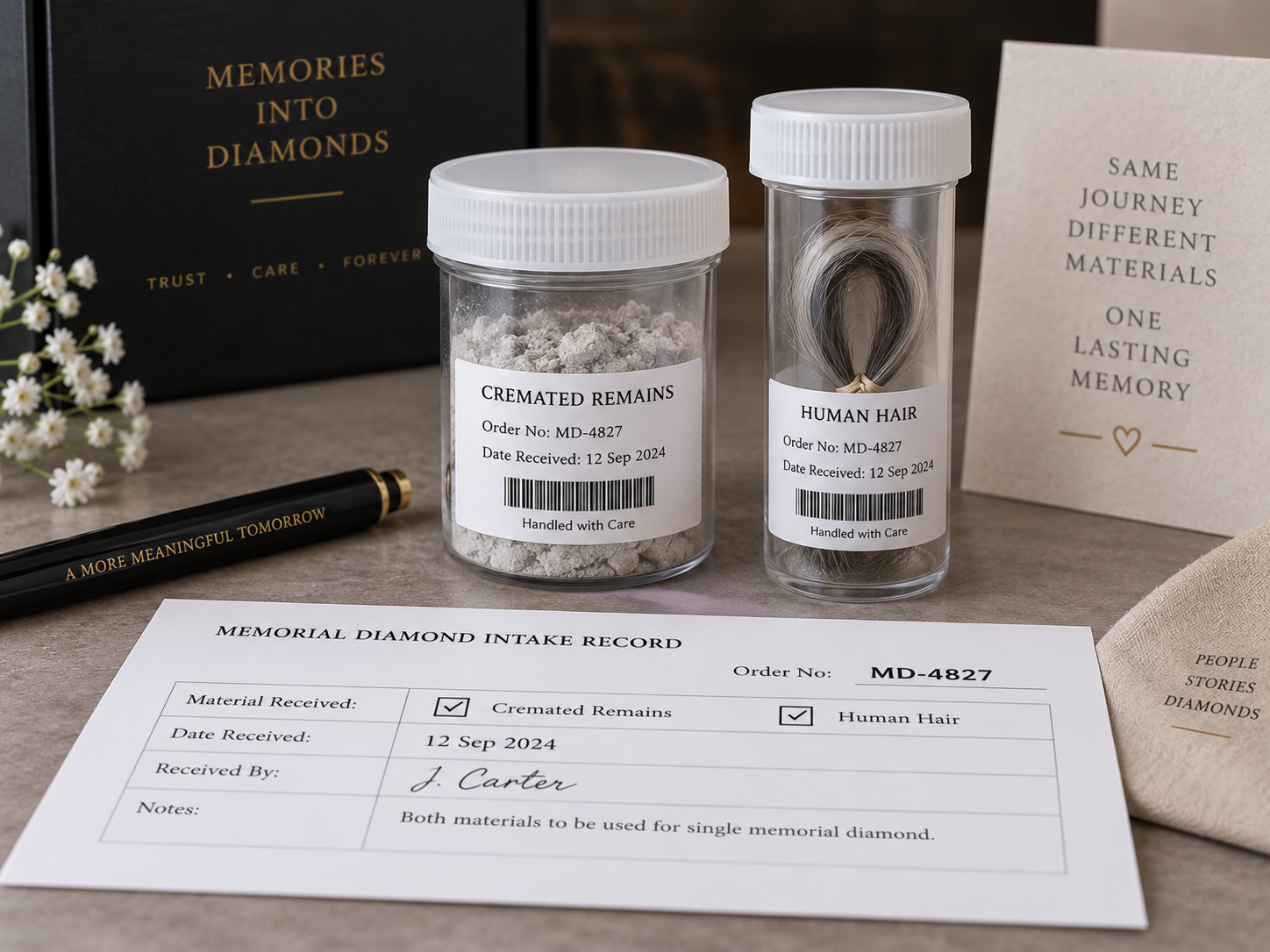
How much ash and hair a father memorial diamond needs, showing cremated ashes, a lock of hair, and a memorial diamond

How Much Ash and Hair Do You Need for a Father Memorial Diamond?

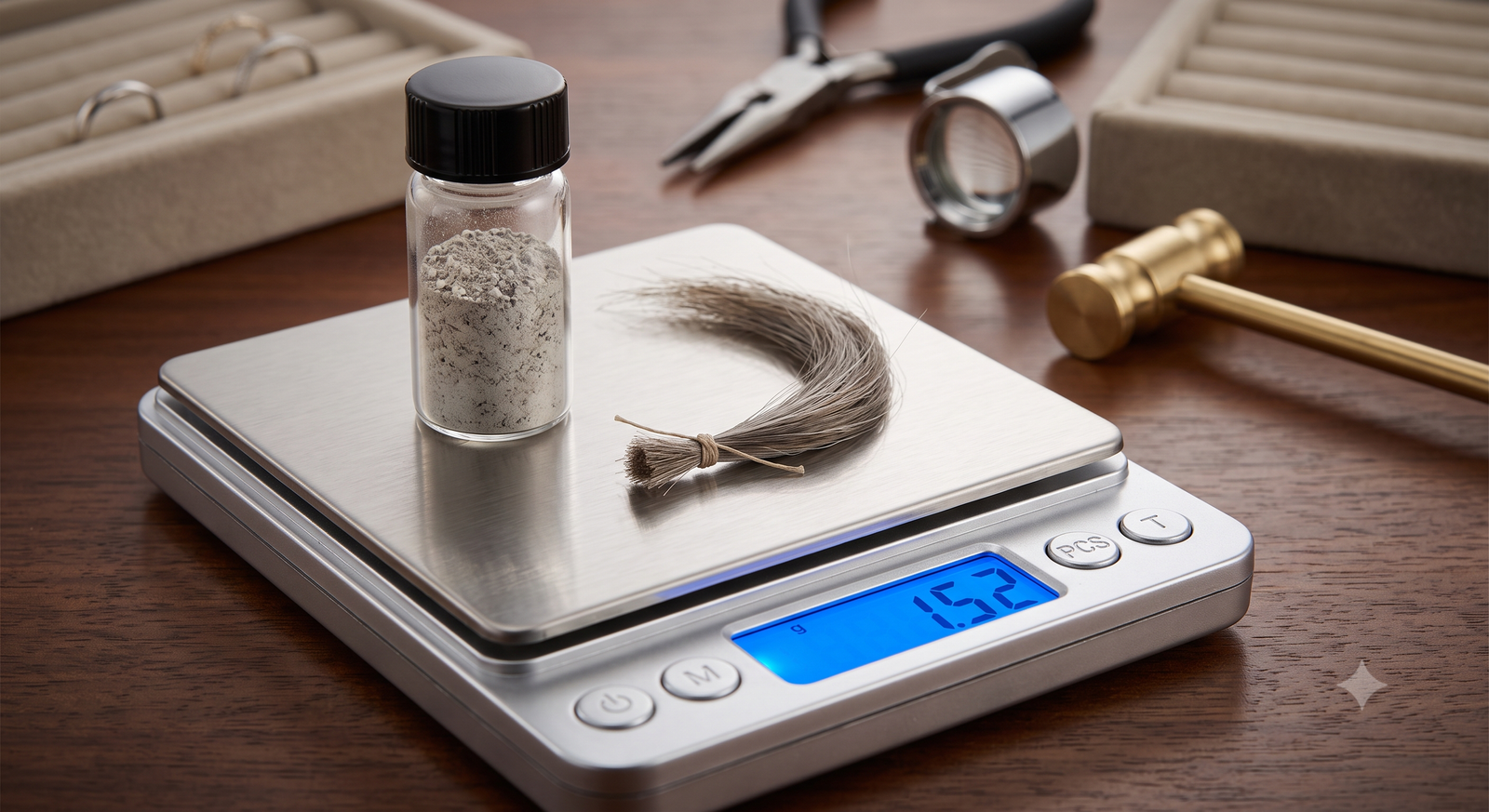
How much ash and hair a father memorial diamond needs: a small vial of cremated remains beside a tied lock of hair on a jeweler's scale

Of the two materials, there is usually one you have plenty of and one you are counting, and most people can say which before they finish reading the question. So how much ash and hair does a father memorial diamond need? Industry wide, plan on each material meeting its own figure in full: a few tablespoons up to roughly 4 oz (about 100 g) of cremated remains, and a few grams of hair, a palm sized lock. Ask before assuming that sending both lowers either number.

What matters far more than the figures is which side you are short of, because a shortfall in ashes and a shortfall in hair are not the same kind of problem. One is often recoverable. The other frequently is not.

Memorial Diamond is one of the companies that grows these stones; the questions below are meant for any of them, us included.

How Much Ash and Hair Does Each Material Have to Meet on Its Own?

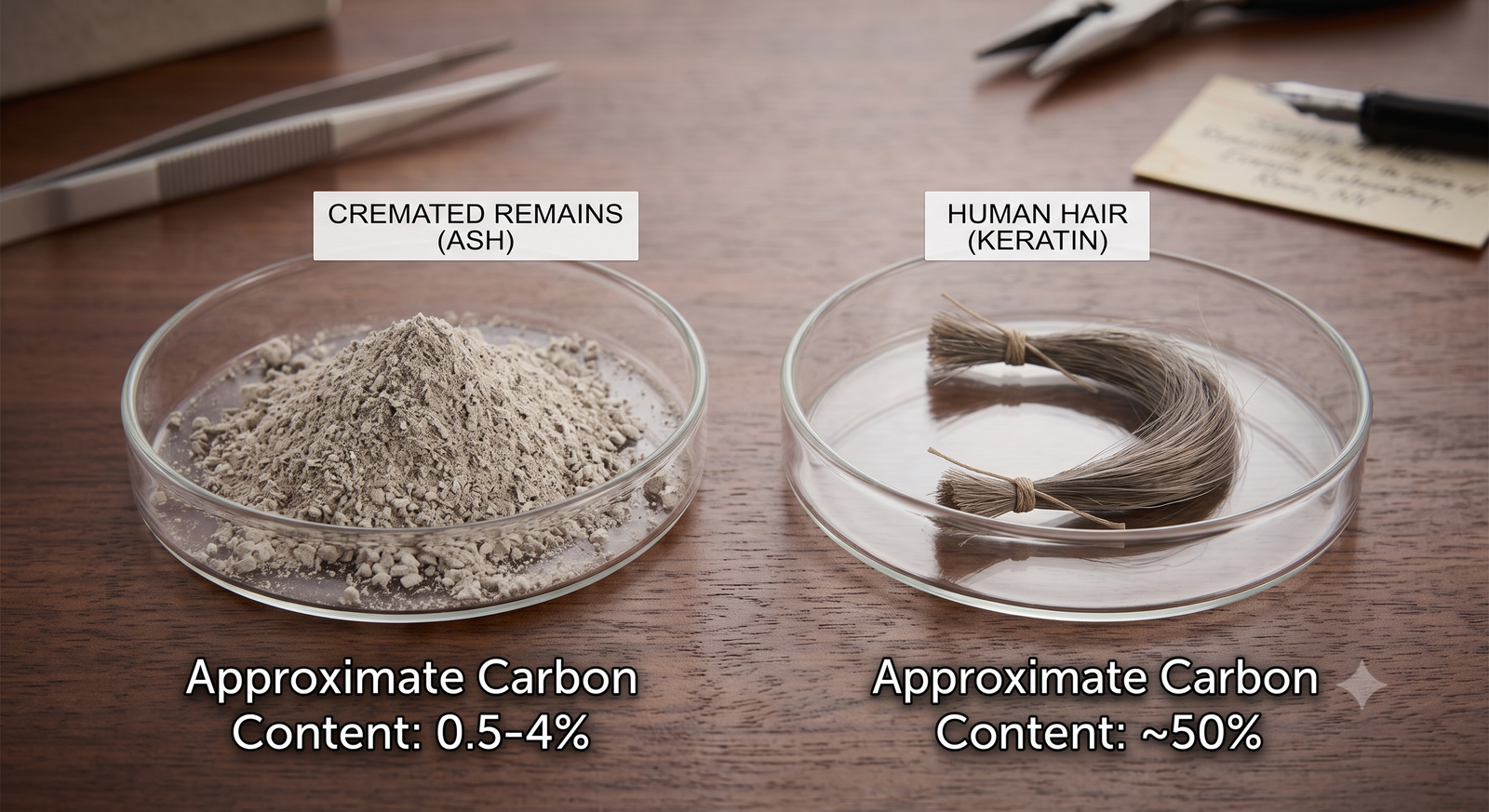
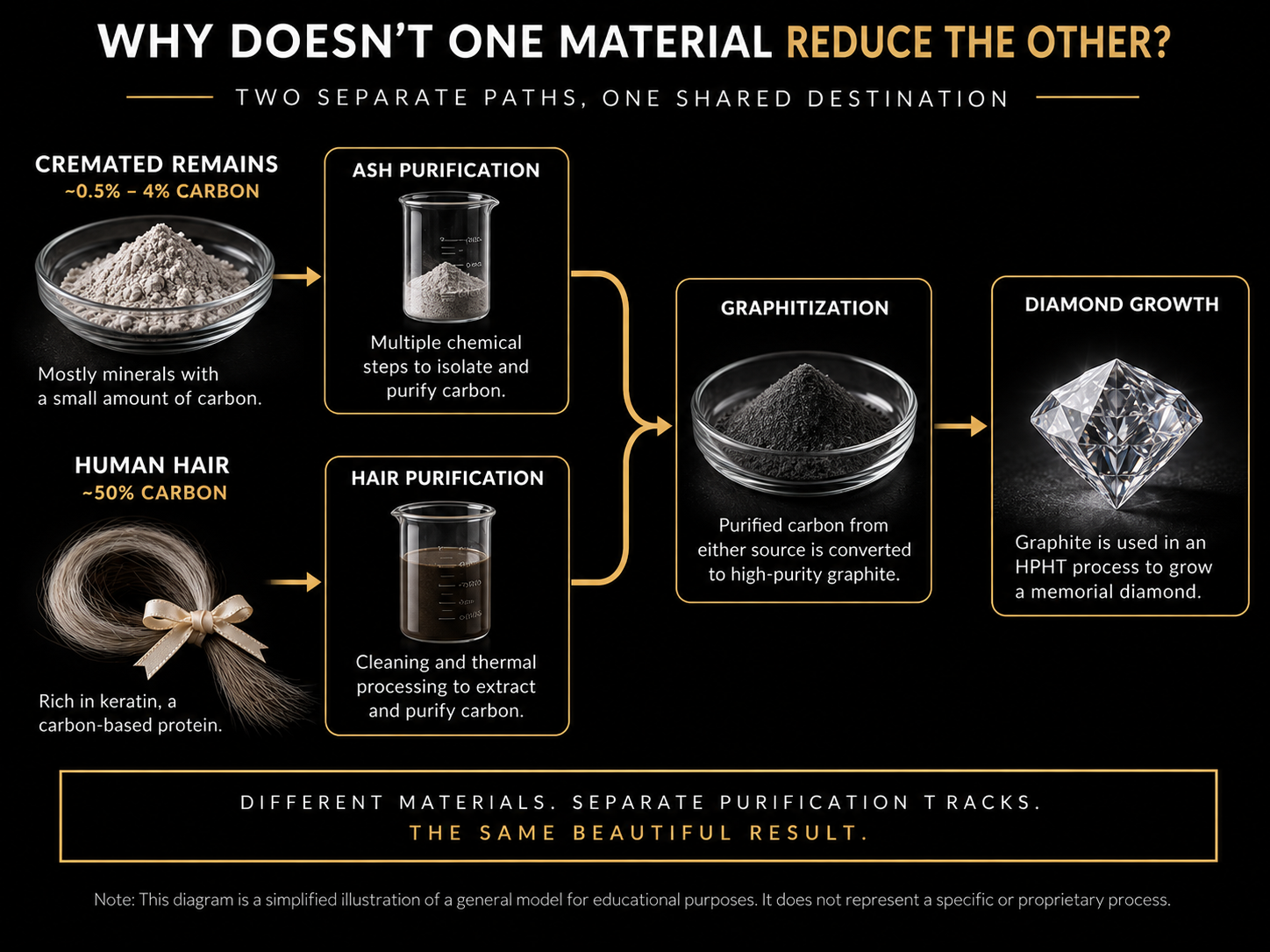
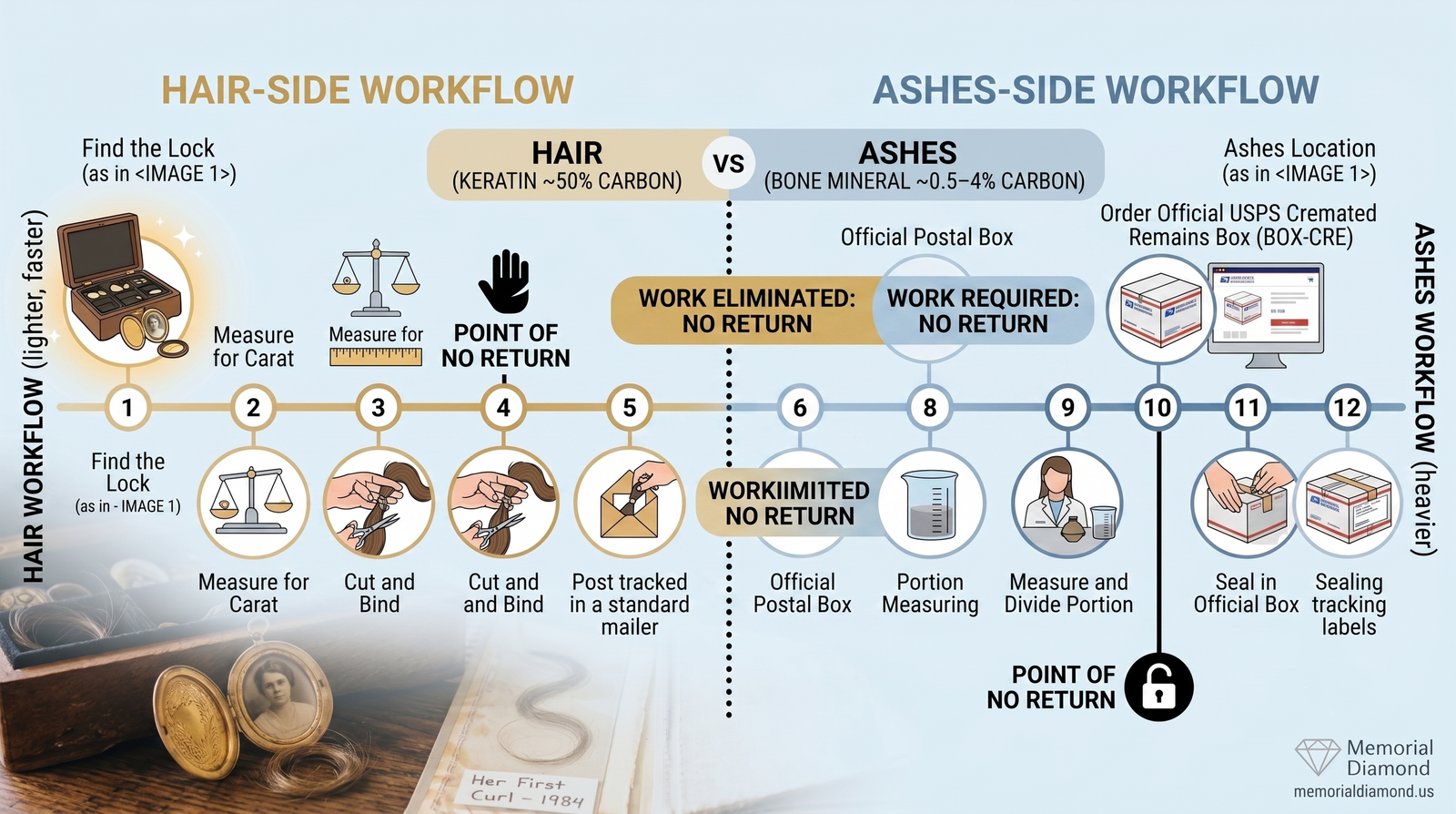
Side-by-side comparison of a dish of cremated remains and a coil of hair with their approximate carbon content noted, 0.5–4% against about 50%

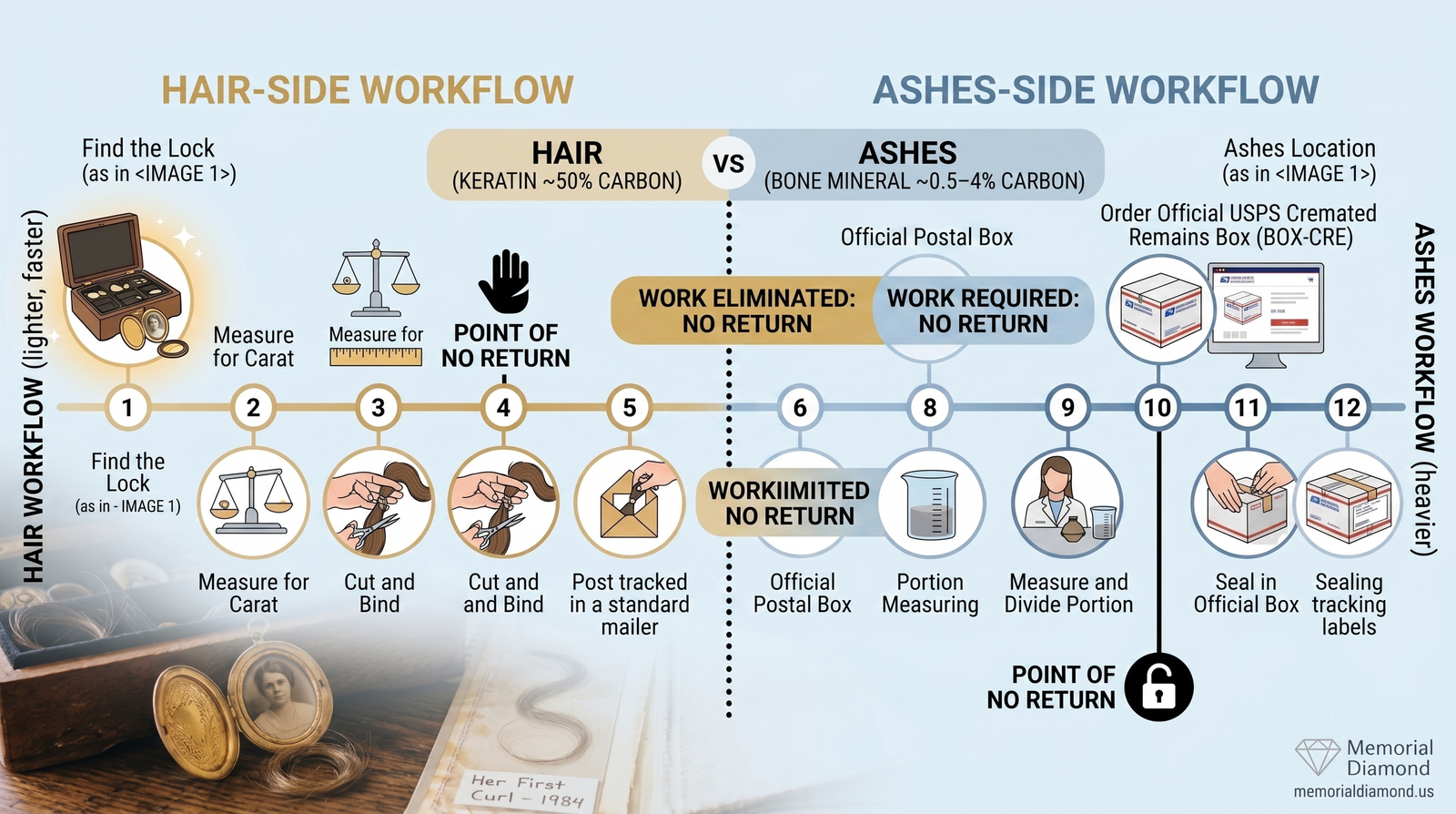
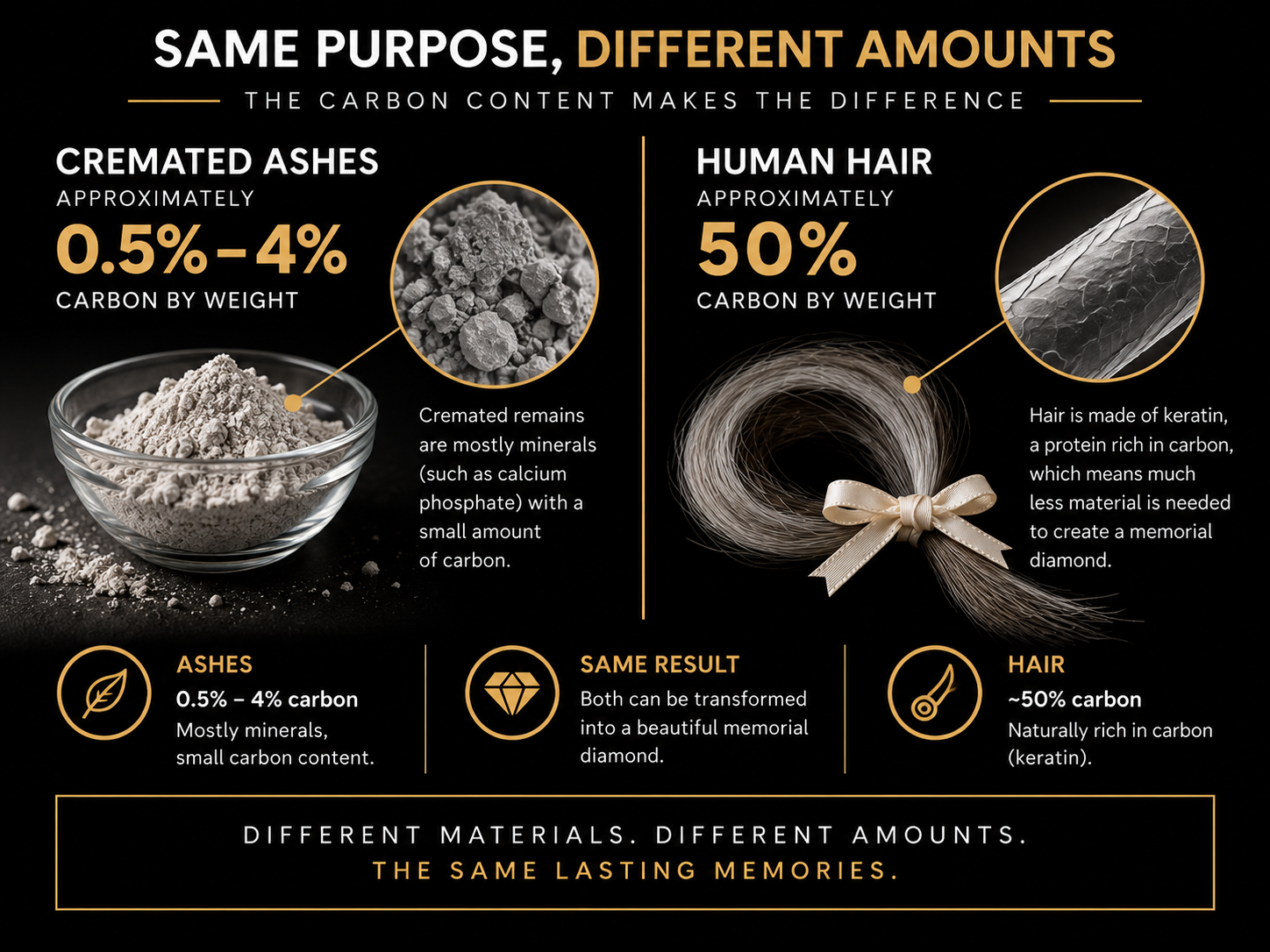
The two figures for how much ash and how much hair are quoted in different units because the two materials are chemically nothing alike.

Cremated remains are dominated by calcium phosphate, the mineral structure of bone, with usable carbon at roughly 0.5% to 4% of ash by weight. That low yield is why how much ash you need is stated in tablespoons and ounces, and why a family submitting a portion still keeps most of what they have.

Hair is roughly 50% carbon by weight, built from keratin. That is why the hair requirement is stated in grams, and why hair works at all for a father who was buried rather than cremated.

Whichever material it came from, the recovered carbon is topped up with lab grown carbon before an HPHT growth run can use it. What each of the two contributes is a provable share of him rather than the whole stone, the honest framing, and the reason a claim of total purity should be treated as a warning sign.

Neither figure is standardized across the industry, and the individual numbers belong to the posts that own them: how much ash is needed and how much hair is needed each go into the specifics. This page is about what happens when you are holding both.

Should You Expect Combining to Lower Either Threshold?

Plan on no, and ask, how much ash and hair you need is set per material.

The reason to expect independence is that the two materials do not meet until late. Providers commonly describe preparing each separately, cleaning, extraction, purification to roughly 99.9% carbon, graphitization, with the two coming together only at the growth cell. On that description each material carries its own minimum, so how much ash and hair you need is two questions rather than one. The complete guide to father ashes and hair diamonds sets out where those lanes converge and why.

The consequence for planning is worth stating flatly: plan for both figures in full, and treat any flexibility a provider offers as a concession rather than an assumption. A family that plans on halves and discovers otherwise has often already divided something irreversible.

Why Are the Two Shortfalls Different Problems?

This is the distinction that actually decides what you do next, more than how much ash or hair sits in either container.

If you are short ofCan more usually be found?What finding out costsEffect on the other material’s requirement
His ashes, still in the family’s keepingUsually yes, a submission is typically a small fraction of a full cremationA phone call to whoever holds the urnNone
His ashes, already interred or scatteredUsually no, and disinterment is a legal and family matter rather than a practical oneA conversation with the cemetery or the executorNone, but this is often the point at which hair becomes the primary route
His hair, one sample onlyOften no. A lock is finite and does not replenishA scale and ten minutesNone
His hair, several possible sourcesSometimes, a comb, a razor, a hat, a barber’s clippingsA search, plus a provider’s acceptance policyNone
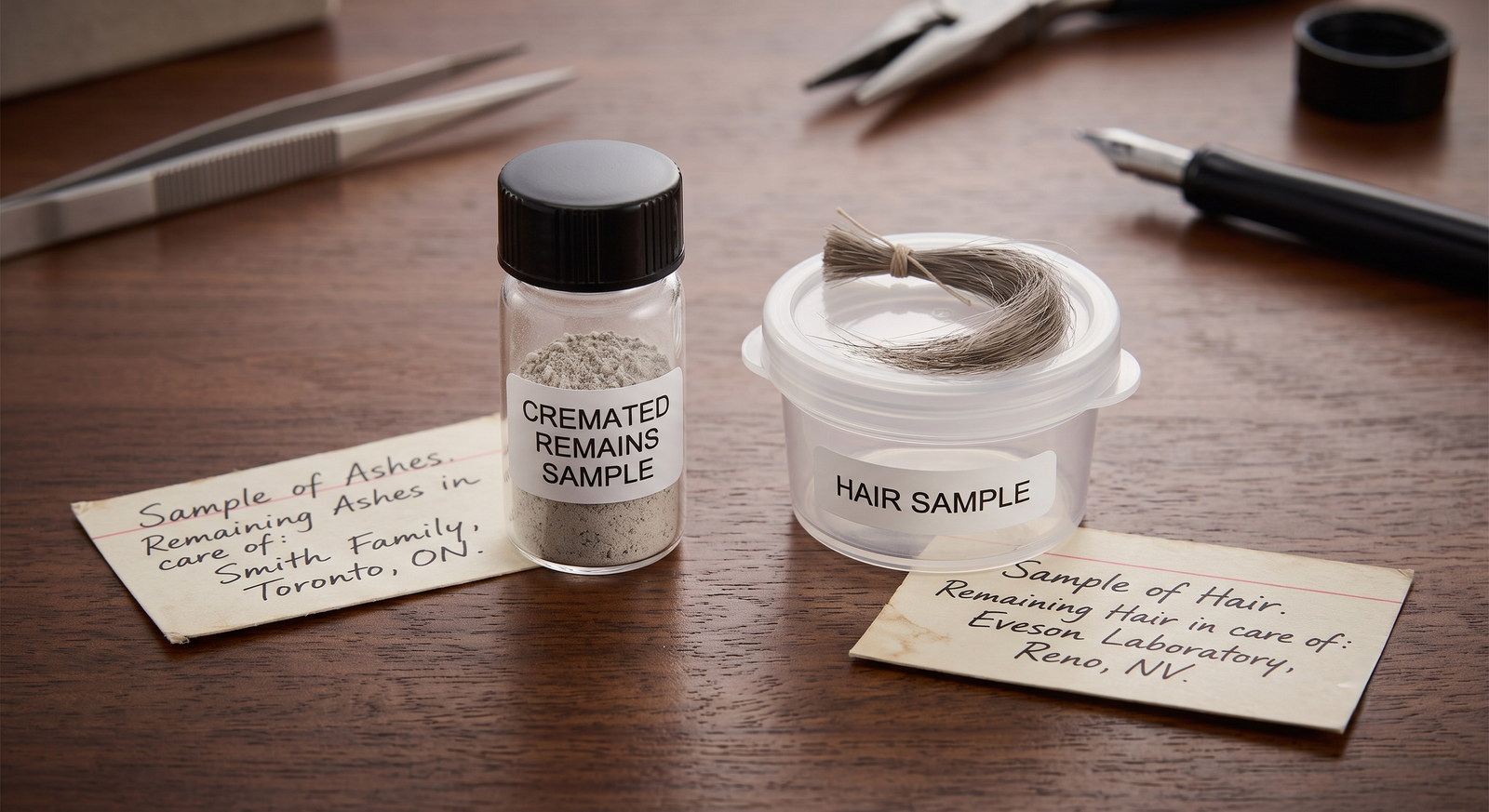
Two small labeled containers, one of cremated remains and one of hair, with a handwritten note beside each recording who holds the rest

Read the table twice for the same reason it is laid out this way, however much ash and hair you are holding: the ash rows describe a problem with a phone number attached, and the hair rows describe a problem with an ending. That asymmetry should decide the order you do things in.

Before anything is divided, opened or cut, establish these four things:

  1. Who currently holds his ashes, and how much ash is actually there. This is often not the person who assumes they know.
  2. What the hair sample weighs, on a scale that reads to a tenth of a gram, weighed in its container and subtracted.
  3. Whether any plan already exists for the remainder, a scattering, an interment, a shared plot, and whether it has a date.
  4. Whether the provider you are considering accepts combined submissions at all. It is not a given, and it is the question that makes the other three matter.

What Can Be Done if the Hair Falls Short?

Several things, in roughly this order of preference, and none of them depends on how much ash you have.

Look further before you conclude. Short clippings are not disqualified by being short, weight rather than length is what the process consumes, and the complete guide to father hair diamonds sets out where they tend to be found. Whether a given company accepts very short or mixed source clippings is a policy question that varies, so ask with a weight and a photograph rather than a description.

Ask whether a below minimum sample can be included as a supplementary contribution rather than as a lane of its own. Some providers may treat it that way; whether any given one does is not something the chemistry decides.

And if the answer is genuinely no, an ash only stone is not a lesser outcome. It is the longer established of the two routes, memorial diamonds were grown from cremated remains long before hair was offered, and the hair can stay exactly where it is. Keeping a lock is not a failed plan.

What Can Be Done if the Ashes Fall Short?

Often more than expected. How much ash a memorial diamond submission needs is a fraction of what a cremation produces, so a shortfall is more often a question of access than of how much ash exists, a sibling holding the urn, a portion already divided among family, a funeral home that still has a retained portion on file.

Where the remains have already been interred or scattered, the ash route may genuinely be closed, and that is the situation hair based options for loved ones who were not cremated exists to answer. A hair sample that seemed like an addition becomes the whole basis of the stone, and it works.

One thing that does not help either way: sending far more than the minimum. Carat size follows growth time in the press, not how much ash or hair arrived, so a fuller parcel buys nothing.

Which One Gets Assessed First?

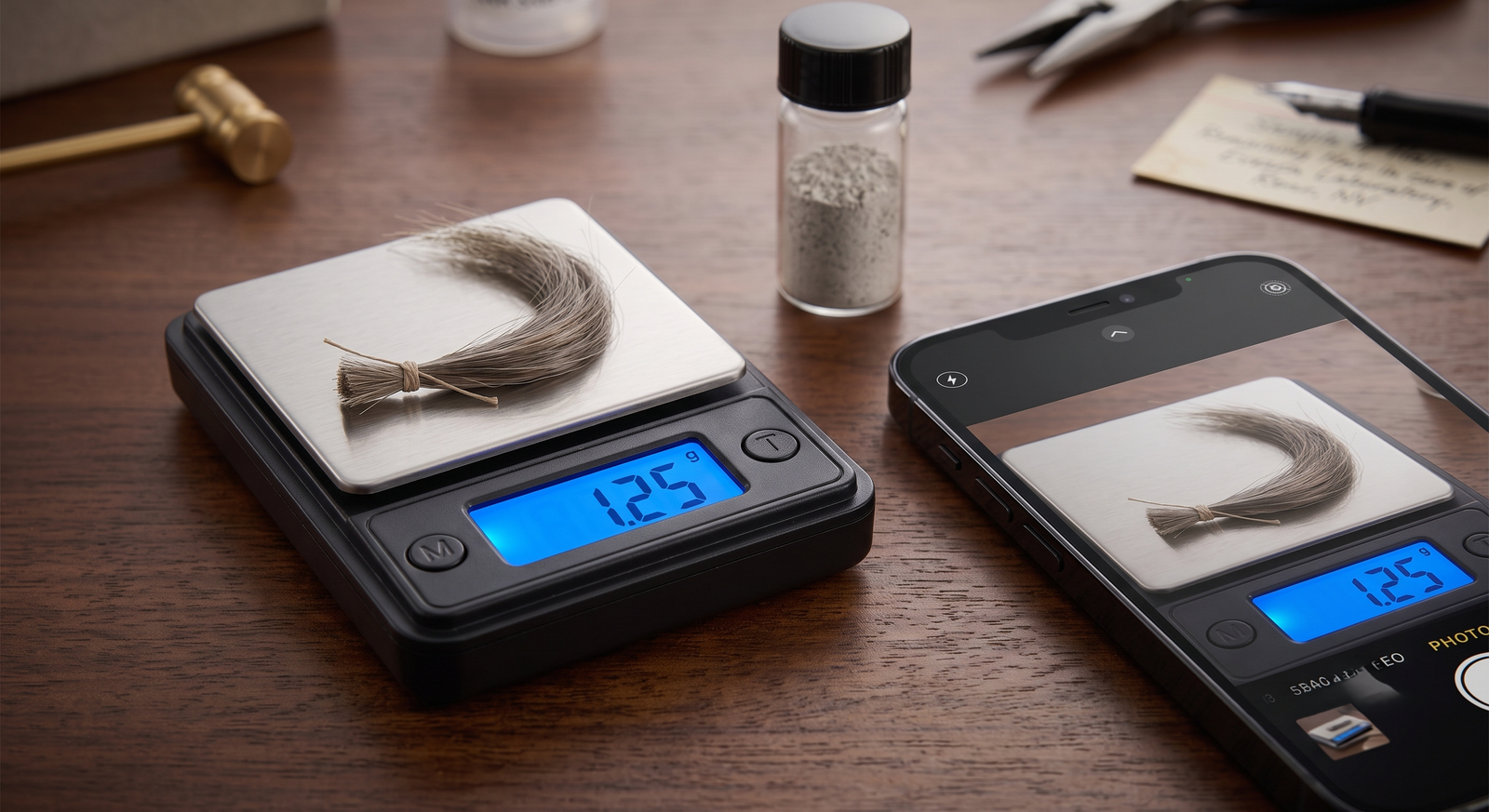
A lock of hair on a pocket scale photographed with the reading in frame, ready to send to a provider for pre-assessment

Hair, in most cases, it is the material that can fail assessment, and assessing it is quick. How much ash you have rarely decides anything at this stage.

A hair sample can often be evaluated from a stated weight and a clear photograph before anything is posted, though whether a particular provider will pre assess on that basis is worth confirming rather than assuming. Ashes are more often assessed on arrival, by volume and weight at intake.

The practical order that follows: settle the hair question first, in writing, then decide how much ash to send, then choose the carat. Questions to ask before a combined order covers what else belongs in that first email, and the step by step sequence covers where each material goes afterwards.

Frequently Asked Questions

Which Material Should Be Assessed First?

Hair, generally, it is finite, it is the one that can be judged inadequate, and a weight and a photograph can often settle it before anything is posted. Ashes are more often assessed at intake, by weight and volume.

Do the Two Figures Change if We Want a Larger Stone?

Generally not. Carat is bought in growth time rather than in how much ash and hair you submit, so a larger stone usually means more months and more money rather than more material. Confirm it, since minimums vary between companies.

Should We Weigh His Ashes, or Is a Volume Measure Enough?

Ask which the provider works in. How much ash is required is quoted both ways across the industry, in tablespoons and in ounces, and a family measuring by volume against a figure stated by weight can send materially more or less than intended.

Who Weighs and Measures Each Material, Us or the Laboratory?

Both, at different points. Weighing the hair at home tells you whether to proceed; the laboratory records its own intake figures for chain of custody purposes. Ask for those intake figures to be reported back to you in writing.

Is There Any Point Sending Much Ash or Hair Beyond What the Figure Asks For?

Not for size or speed, those follow the growth run. A little margin above a stated minimum can be sensible where a sample is marginal, but sending everything you have puts material out of your hands for no gain.

Is There Any Advantage to Sending Both if Either One Alone Would Be Enough?

Not in size, speed or cost, those follow the carat and the growth run. The reason families combine is that both materials came from him and both were kept, which is a reason about meaning rather than about the process.

Final Thoughts on How Much Ash and Hair a Father Memorial Diamond Needs

Everything on this page turns on one piece of information that costs nothing to obtain: whether the constraint in your family is the ashes or the hair. Ten minutes with a scale and one phone call to whoever holds the urn will tell you how much ash and how much hair you are actually working with, and neither commits you to anything. The figures themselves are the easy part; knowing which side is short is what decides the order everything else happens in.

Learn More About Father Memorial Diamonds

Talk With Memorial Diamond

Memorial Diamond can give you both figures for your father, how much ash and how much hair a combined stone would need, and say what happens if one of the two falls short. Nothing has to be opened, cut or posted to ask. Start at memorialdiamond.us.
How long it takes to make father memorial diamonds with a 6 to 10 month production timeline

How Long Does It Take to Make a Father Memorial Diamond?

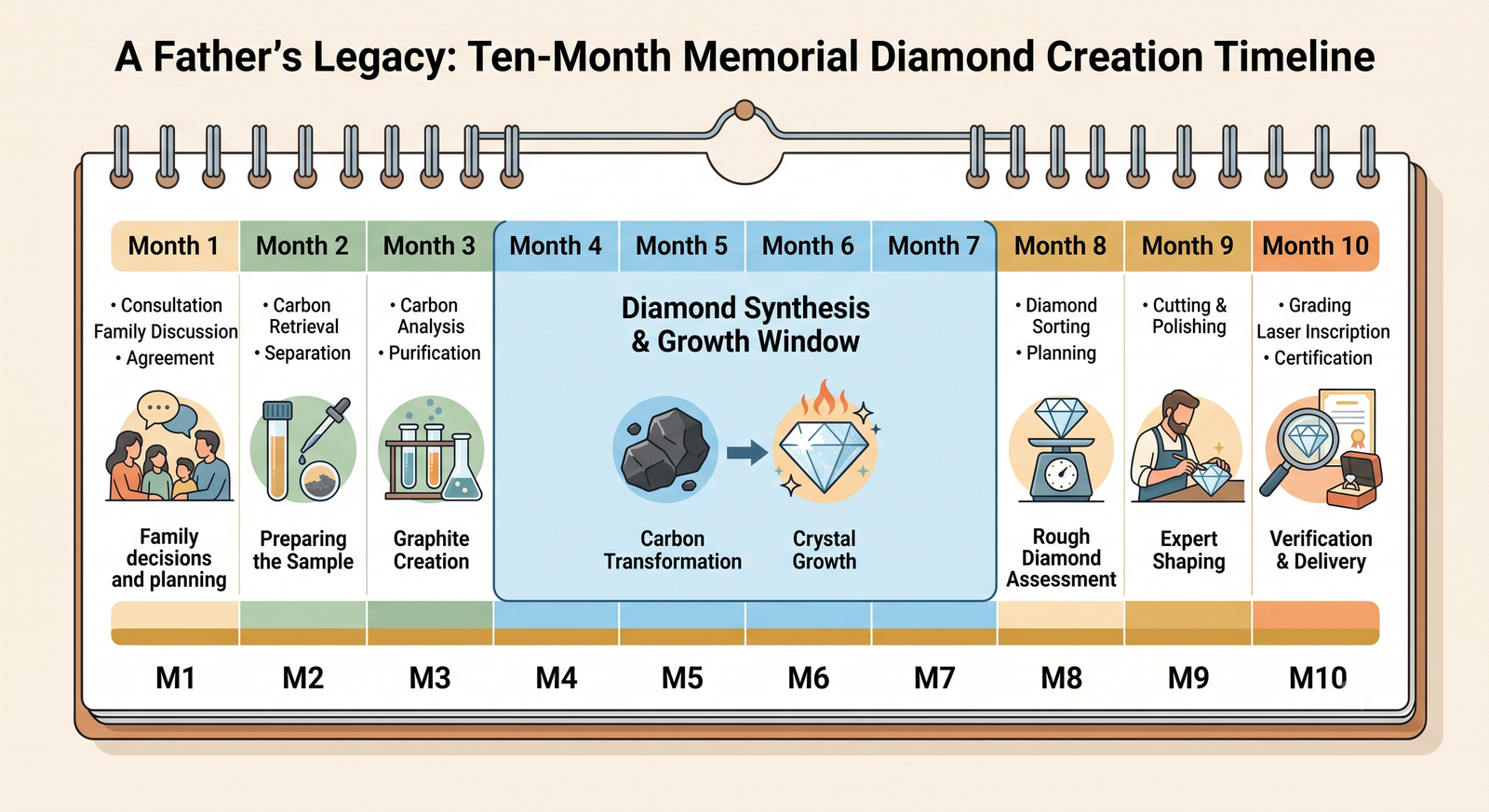
Ask two families who ordered in the same month and their answers can be months apart, and neither of them was told anything wrong. How long does it take to make father memorial diamonds? Industry wide, production typically runs 6 to 10 months from the laboratory’s intake, rising toward 12 months for stones over roughly 2 carats or in specialty colors. End to end, from the first conversation to a finished piece in your hand, a working estimate of around 8 to 14 months is reasonable, though that total is arithmetic rather than a published figure.

The interesting part of that range is where it comes from. The growth window is the most predictable stretch of the whole process to make father memorial diamonds. Most of the difference between one family finishing early and another finishing late happens either side of it.

Memorial Diamond is one of the companies that does this work. Read the checks below as ones to put to any provider, including us.

How long it takes to make father memorial diamonds: a ten-month wall calendar with the growth window marked in the middle and family decisions marked either side

How Long Does Each Part Actually Take?

The sourced industry figure is the production window: 6 to 10 months, measured from the point the laboratory logs the material in, and up to around 12 months for larger stones or treated colors. Size drives that window because carat is a function of growth time in the press rather than of how much material was submitted.

Around that sits everything else it takes to make father memorial diamonds, deciding, retrieving, shipping, grading, setting, which is where the 8 to 14 month working estimate comes from. It is arithmetic, not a service level. The complete guide to father ashes diamonds sets those phases out as a table and covers planning backwards from a date that matters.

This page is about the other question: not how long each phase takes to make father memorial diamonds, but what makes it longer or shorter than the average.

Where Does Most of the Variance Happen?

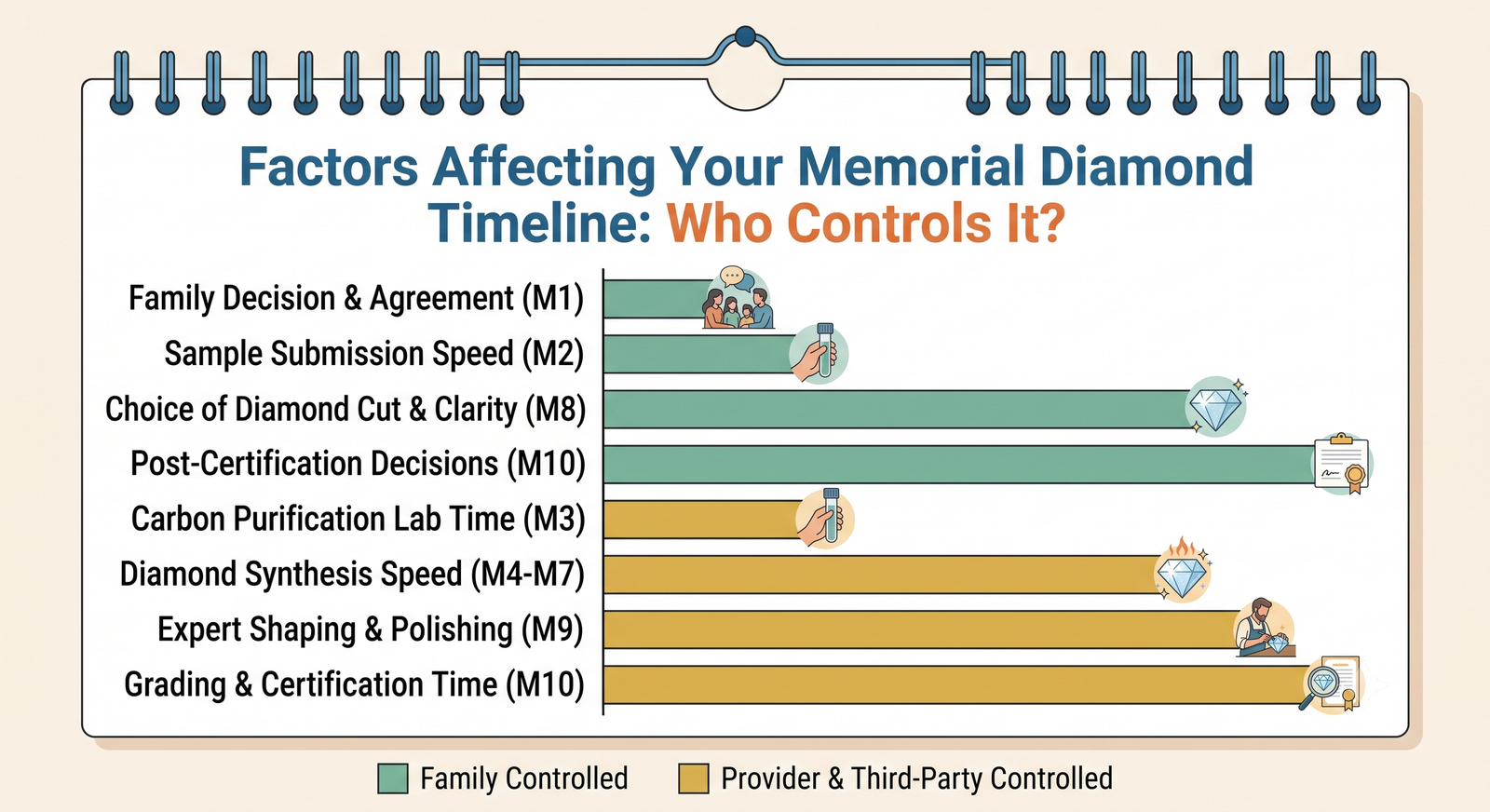
Before the laboratory sees anything, mostly, the time to make father memorial diamonds is decided largely outside the lab. The table below sorts what varies by who controls it.

What variesDirection and rough sizeWho controls it
Retrieving material, a retention request, a sibling holding the urn, a search for hairAdds days to several monthsYour family
Choosing a provider and getting answersAdds 1 to 6 weeksYour family, partly
The carat chosenMoves the growth window by months within the 6 to 12 rangeYour family
A treated or specialty colorAdds weeks to a couple of monthsProvider, once specified
A failed growth runAdds months, and is the largest single unplanned delayNobody
Grading, where an independent laboratory is usedAdds weeks after the stone is finishedA third party
Choosing a settingAdds nothing if decided early; weeks or months if decided lateYour family
A scheduled release or interment dateCompresses the front end, and cannot be movedA cemetery, a funeral home, or an estate
Simple bar chart of eight timeline factors, four colored for the family and four for providers and third parties

Read down the right hand column. Four of the eight sit with your family, which is why the most effective thing a family can do about how long it takes to make father memorial diamonds is make the early decisions early, including the one about the setting that rarely feels urgent.

What Is Genuinely Fixed When Labs Make Father Memorial Diamonds?

The laboratory stages used to make father memorial diamonds, and no amount of money changes them.

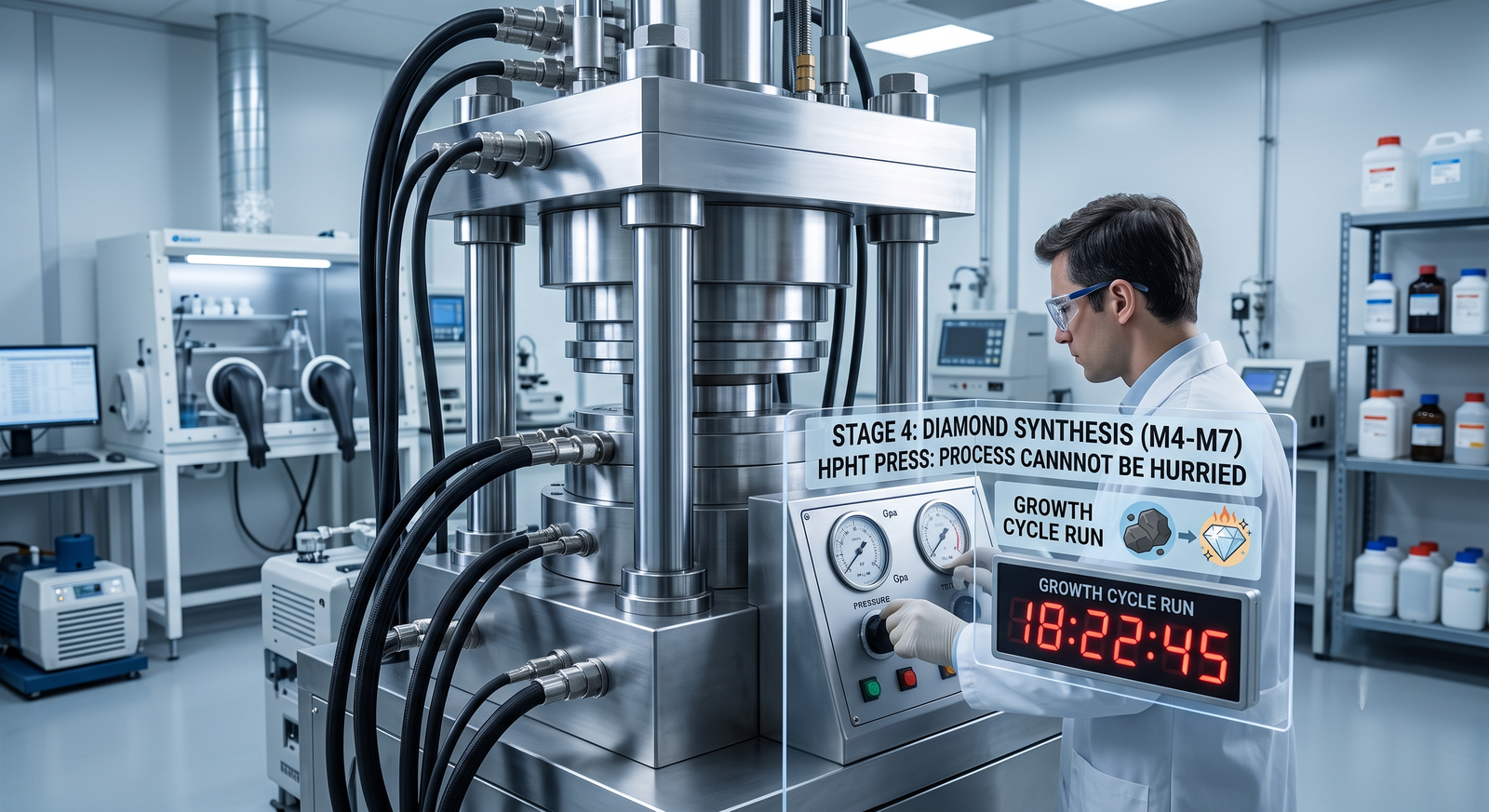
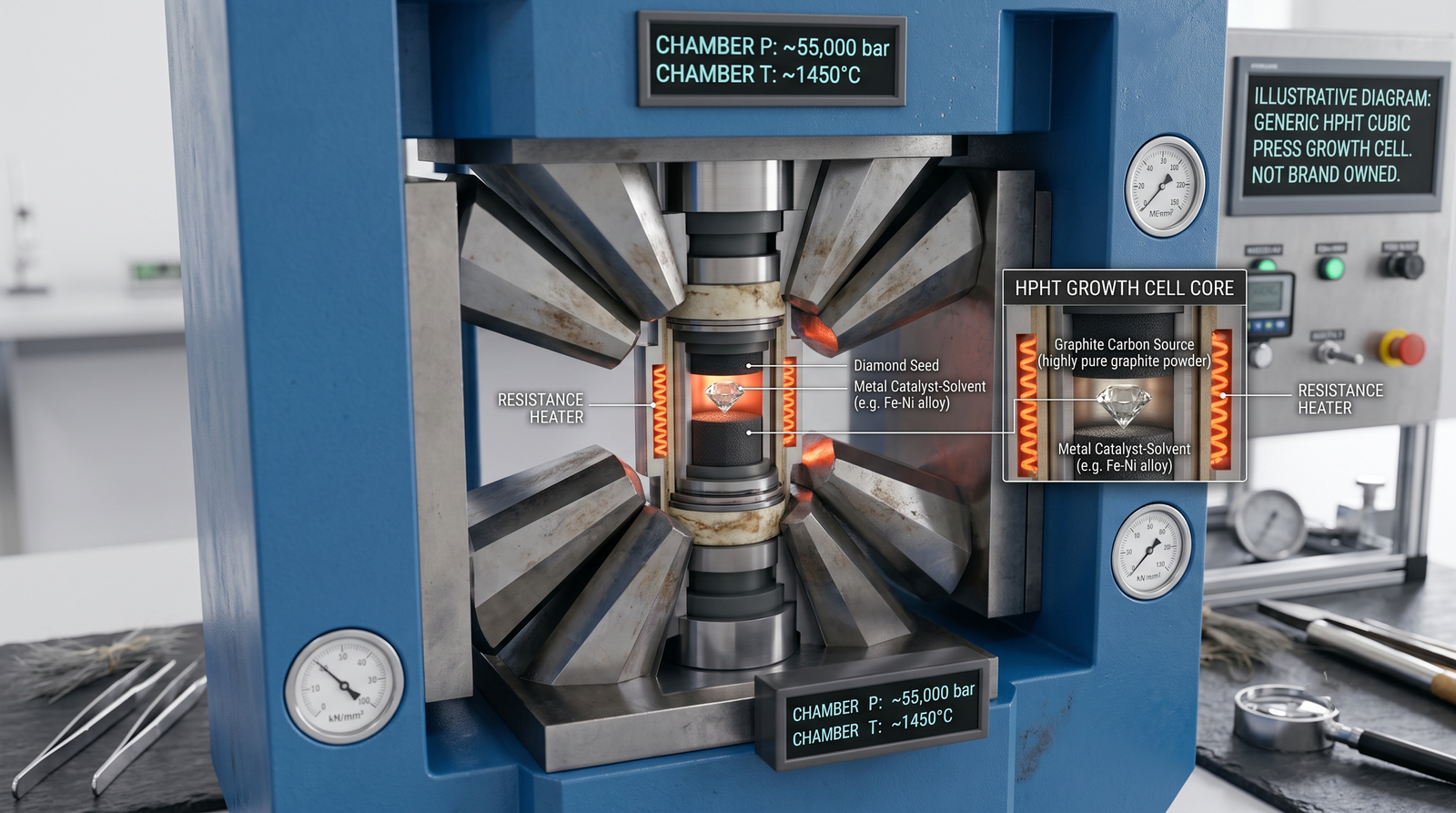
Extraction and purification take the weeks they take. Graphitization at roughly 2,500 to 2,700°C takes the days or weeks it takes. Growth in an HPHT cell at roughly 6 to 8 GPa and 1,400 to 2,500°C runs for weeks to months, and a growth run cannot be hurried without changing what comes out of it. Cutting and polishing is a gemologist’s bench work on an irreplaceable stone.

It is worth being clear about what those months are producing, because it shapes what the wait is for. The press is not growing a stone made of your father. It is growing a stone in which his carbon is a provable share, blended with lab grown carbon so there is enough feedstock for a growth run. That is the honest description of how labs make father memorial diamonds, it is the one to expect from any provider, and how a memorial diamond is made from your father’s ashes sets out the arithmetic behind it.

What that means practically: the carat decision is the timeline decision. A smaller stone finishes sooner because the press runs for less time, not because it moved up a list. Choosing a carat size is therefore worth thinking of as a two part choice, cost and calendar, rather than one. What a father memorial diamond costs covers the other half.

An HPHT press in a diamond laboratory with a growth-cycle timer visible, illustrating the fixed laboratory stages

Which Parts of the Schedule Aren’t Yours to Move?

Three situations put dates in the process to make father memorial diamonds that belong to somebody else. None of them lengthens the growth run; all of them can lengthen the total time to make father memorial diamonds.

A national or service cemetery interment. The date is set against the cemetery’s calendar, and the funeral home may release his remains directly to it. A retained portion has to be separated before that release, so the front end of the process compresses into whatever window exists between the cremation and a date the family did not choose. Honoring military service with a memorial diamond covers how that timetable works.

A shared plot or a planned interment with a spouse. Where arrangements were made years earlier, a plot bought together, a niche reserved, there is often a date attached, and a date of that kind closes the ash route rather than delaying it.

An estate still being settled. Where a decision needs several people’s agreement, or an executor’s, the calendar belongs to that process rather than to the diamond.

None of these lengthens the production window. All three can lengthen the total, and the fix in each case is the same: find out the date early, because it is the only part of the schedule that is genuinely immovable.

A columbarium wall with an engraved date plate, illustrating an interment date the family cannot move

What Happens if a Growth Run Fails?

A failed run is the largest unplanned delay that can occur when labs make father memorial diamonds, and it is worth asking about rather than waiting to be told.

A growth run can fail, it is the one step in how labs make father memorial diamonds that carries real uncertainty, and where it does, the material and the months both have to be accounted for. What varies between providers is the procedure, whether a run is repeated, what happens to the material, whether the timeline restarts and who bears the cost. How a memorial diamond is made from your father’s ashes covers what a failure actually involves at the process level.

Ask the procedure question before ordering rather than after. It costs one line in an email and it is the difference between a setback and a shock.

What Should You Settle in the First Two Weeks?

Four of the eight rows in that table on how long it takes to make father memorial diamonds sit with your family, and all four can be worked through before a provider has even been chosen.

  • Find out whether a date exists, an interment, a scattering, a cemetery booking, and what it is. It is the only immovable thing on the list.
  • Establish who holds the material and how quickly it can be retrieved.
  • Settle the carat, since it is the timeline decision as much as the price one.
  • Choose the setting, or at least narrow it. It is easy to leave until the stone exists, and it is the easiest week to save.

None of that requires a provider, a deposit or a commitment. The step by step sequence sets out where each of these lands in the wider process to make father memorial diamonds, and grading, done to the standard 4Cs on a loose stone, is the reason the setting decision can wait until the end but should not.

Frequently Asked Questions

Is there a carat size above which the timeline changes significantly?

Around 2 carats is where the industry figures to make father memorial diamonds shift, with larger stones and specialty colors running toward 12 months rather than 6 to 10. Ask a provider where their own threshold sits before settling on a size.

How much of the total is our own decision making?

More than it looks, retrieving material, choosing a provider, specifying the stone and choosing a setting are all on your side of the line. None of it is urgent, but all of it is countable against the total.

Can the setting be made while the stone is still growing?

Worth asking. Where a setting can be prepared during the growth window, the finished stone can be set within weeks rather than months. Grading is normally done on a loose stone, so setting follows it, confirm that sequence with the provider.

Does grading add time after the stone is finished?

Where an independent third party laboratory is used, yes, grading is a queue at another organization, measured in weeks. Ask whether the quoted time to make father memorial diamonds includes it or ends before it.

What is the longest realistic total we should plan for?

Plan on the upper end of an 8 to 14 month estimate to make father memorial diamonds end to end, and treat anything faster as welcome rather than expected. For a large stone, a treated color, or a family that took months to retrieve material, longer is possible.

If we are slow at our end, does that cost us a place in a queue?

Ask, because it depends entirely on how a provider schedules the growth runs that make father memorial diamonds. Ask specifically whether a delay at your end changes anything about when yours is started, and get the answer in writing.

Final Thoughts on How Long It Takes to Make Father Memorial Diamonds

Half of what moves this timeline is already in your family’s hands, and none of it needs a provider chosen first. Find the date, find the material, pick a size, narrow the setting. The laboratory’s months are fixed and the third parties’ dates are immovable; everything between them is where a family’s attention actually shortens the wait to make father memorial diamonds.

Learn More About Father Memorial Diamonds

Talk With Memorial Diamond

Memorial Diamond can set out which stages carry firm figures and which carry estimates in the time it takes to make father memorial diamonds, and what updates arrive along the way. Start the part you control first; then reach out at memorialdiamond.us.
Untitled (1568 x 1003 px) (1)

Is a Memorial Diamond Really Made From Your Father’s Ashes?

Is a memorial diamond made from father’s ashes real? Yes, but the full answer needs more detail. A memorial diamond can use carbon recovered from cremated remains during the diamond-growing process. The recovered carbon then joins additional carbon used to grow the stone.
That fact leads to three different questions. Is the finished stone a real diamond? Does it contain carbon from your father’s remains? Can anyone prove that the carbon came specifically from him?

Each question needs a different kind of evidence. This guide explains what you can check, what depends on the provider’s process, and which records you should request before you send your father’s ashes.

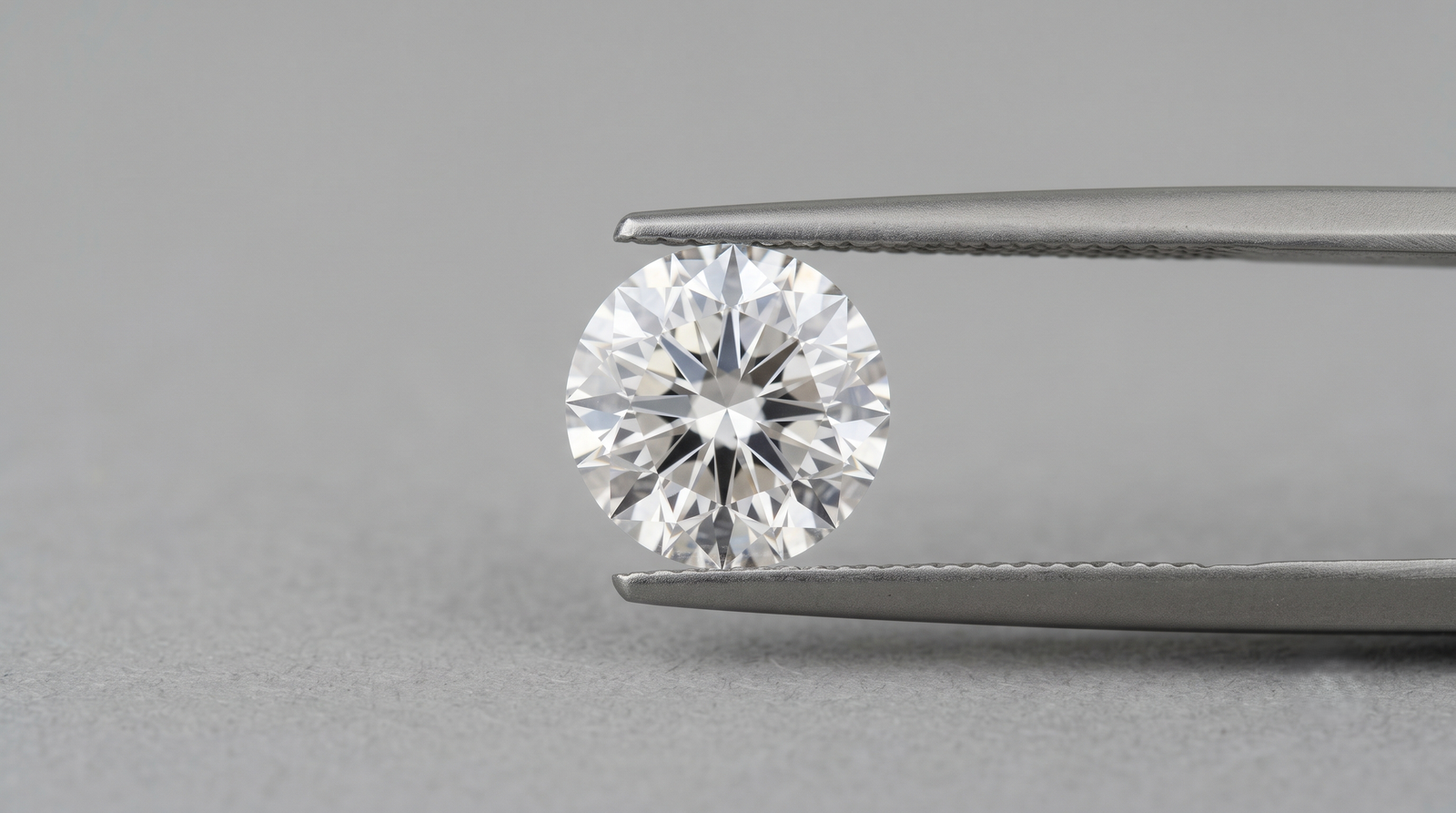
Loose lab-grown memorial diamond grown from cremated ashes held in tweezers
A memorial diamond can preserve a physical connection to a loved one through a laboratory-grown diamond.

What You Will Learn

What Does a Memorial Diamond Made From Father’s Ashes Actually Mean?

The phrase sounds simple, but it can hide several different claims. A provider can support some claims with gemological evidence. Other claims depend on the documented handling of the submitted material.

QuestionType of EvidenceCan You Check It?
Is it a genuine diamond?Gemological evidence such as crystal structure, hardness, optical properties, cut, color, clarity, and carat weight.Yes. An independent gemological laboratory or qualified gemologist can examine the stone.
Does it contain human-derived carbon?Information about extraction, purification, and the diamond-growth process.Partly. You can review the stated process and documentation, but the finished stone does not carry a simple label showing the source of each carbon atom.
Does the carbon come specifically from your father?Intake records, tracking information, and chain-of-custody documentation.The source brief identifies this as the hardest claim to verify from the finished stone alone.

This distinction matters. A diamond grading report can tell you about the stone itself. It does not automatically prove the personal origin of the carbon used during the growth process.

Is a Memorial Diamond Made From Father’s Ashes a Real Diamond?

Yes. A laboratory-grown diamond is a real diamond, not a diamond imitation.

Laboratory-grown diamonds have essentially the same chemical, physical, and optical properties as natural diamonds. GIA also explains that laboratory-grown diamonds share the same crystal structure as natural diamonds, while their growth history differs.

That difference matters when you compare a lab-grown diamond with a simulant. Cubic zirconia and moissanite can look like diamonds, but they do not have the same chemical and physical properties as diamond.

Read GIA’s explanation of natural and laboratory-grown diamonds.

For that reason, you should separate two questions: Is this a real diamond? and Is this diamond connected to my father’s submitted material? Gemological testing can address the first question. Documentation plays a much larger role in the second.

For more information about the gemological side, read Are Memorial Diamonds Real Diamonds?.

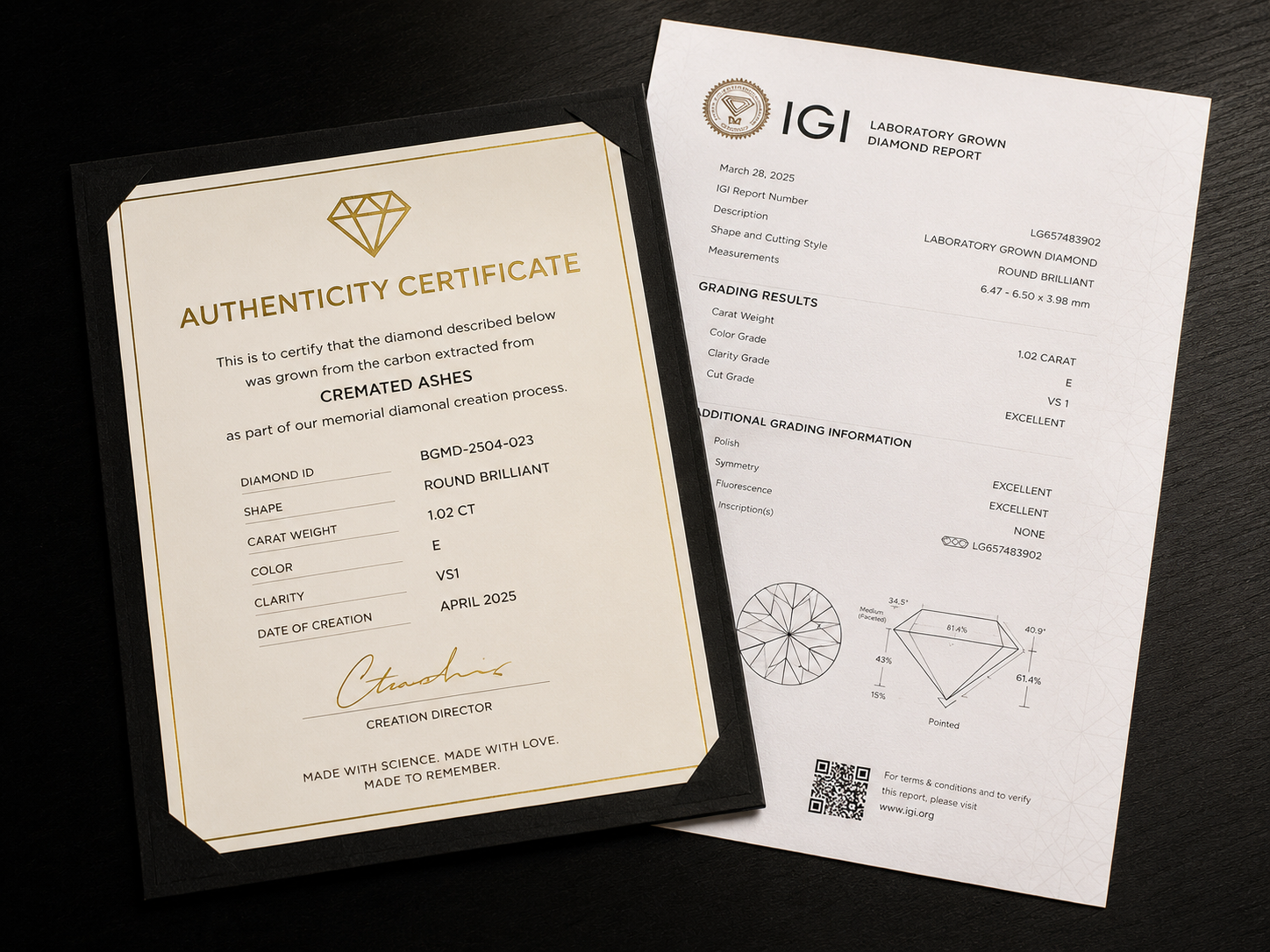
An in-house authenticity certificate and an independent diamond grading report laid side by side on a des
An independent diamond report and provider documentation answer different questions about a memorial diamond.

How Much Carbon Comes From Father’s Ashes?

A memorial diamond made from father’s ashes does not normally contain only carbon recovered from the cremated remains.

Cremated remains contain mostly mineral material associated with bone. The amount of usable carbon can vary from one set of remains to another. The source material for this article gives an industry range of roughly 0.5% to 4% of ash by weight for usable carbon.

The provider can extract and purify that carbon before the diamond-growth stage. The process then uses additional lab-sourced carbon because the available carbon from the ashes alone cannot supply the entire growth process.

The source brief gives a typical personal-carbon range of around 10–15% of the finished stone’s mass. It also notes that some providers report lower or higher figures based on factors such as the size of the stone and the amount of material submitted.

So the honest explanation does not say that the entire diamond consists of your father’s remains. Instead, it explains that carbon from his submitted material can become part of the diamond while additional carbon supports the growth process.

That distinction gives families a clearer picture than a simple “100% ashes” claim.

To understand the process in more detail, read How a Memorial Diamond Is Made From Your Father’s Ashes.

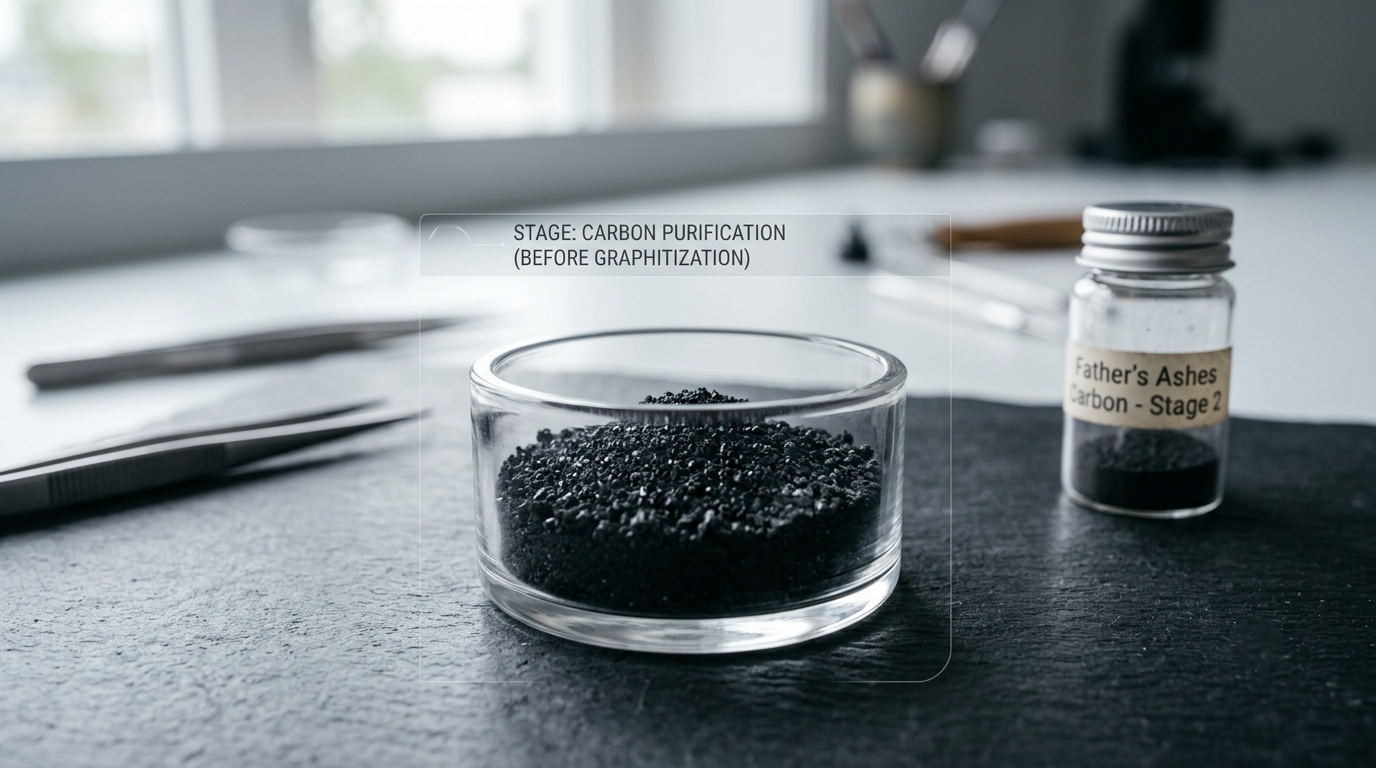
Purified carbon extracted from cremated remains in a laboratory crucible before graphitization
Carbon recovered from cremated remains goes through processing before the diamond-growth stage.

Can You Prove the Carbon Came From Your Father?

This question deserves a careful answer.

The source brief flags the claim that no consumer-accessible test can trace a finished diamond to a named person as an inference that needs expert verification before publication. :contentReference[oaicite:2]{index=2}

That means you should not rely on a simple promise that a finished diamond can prove its personal origin. Instead, ask how the provider identifies and tracks your material before, during, and after the process.

Think of the evidence as a chain. The stronger the documentation at each stage, the easier it becomes to understand how the provider handled the submitted material.

What Records Should You Ask For?

Before you order a memorial diamond made from father’s ashes, ask the provider to explain its documentation process in writing.

  1. Intake reference: Ask whether the provider gives your material a unique tracking number when it arrives.
  2. Intake confirmation: Ask for written confirmation of the material received, along with the date and other relevant details.
  3. Process tracking: Ask how the provider tracks the material during extraction and diamond growth.
  4. Origin documentation: Ask what certificate or record connects the finished stone with your submitted material.
  5. Independent grading: Ask whether an independent gemological report is available for the finished diamond.

The source brief describes these records as reasonable good practice rather than a universal industry standard. You should therefore confirm the exact process with the provider you choose. :contentReference[oaicite:3]{index=3}

Documentation cannot answer every scientific question. It can, however, show you how carefully a provider handles your material and communicates the process.

For more detail, read Memorial Diamond Chain of Custody: How Companies Track Your Loved One’s Ashes.

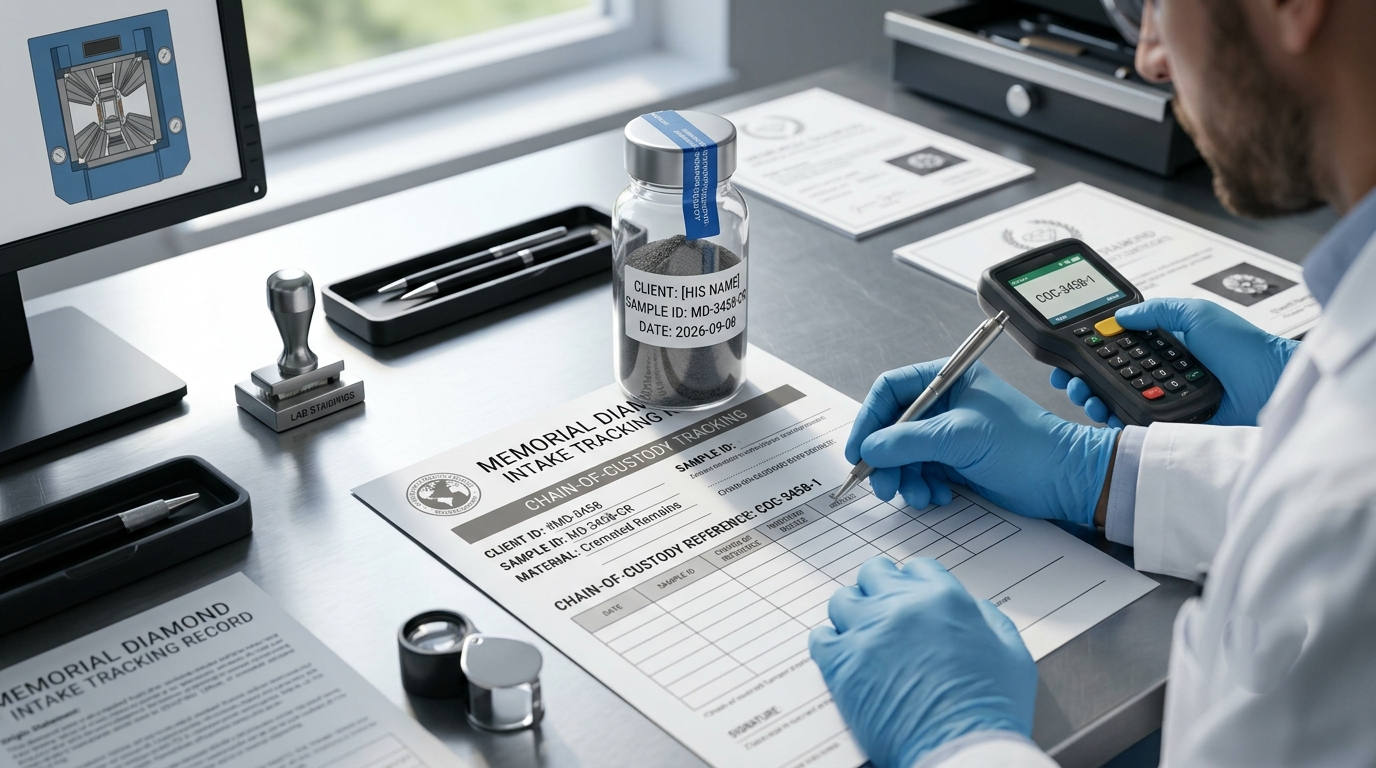
sealed and labeled container of cremated remains logged against a chain-of-custody tracking reference at intake
Clear intake records can help families understand how a provider tracks submitted memorial material.

How Much Does a Memorial Diamond Cost?

The cost of a memorial diamond made from father’s ashes can vary widely. The final price can depend on the stone size, color, cut, grading, setting, engraving, and other choices.

The source brief gives an industry-level entry figure of around $1,500 for stones of roughly 0.10–0.25 carat. It does not present that figure as BlueIceGems pricing. :contentReference[oaicite:4]{index=4}

A larger stone can require a much larger budget. You should also ask which services the quoted price includes and which services carry separate charges.

Money can also affect the decision in a very personal way. If the purchase would create financial pressure, another memorial choice may make more sense for your family.

An urn, burial, scattering ceremony, memorial jewelry, or another keepsake can hold deep meaning too. A memorial diamond does not need to replace those choices.

To explore the pricing factors in more detail, read Memorial Diamond Pricing Guide: What Actually Drives the Cost.

If your family has different opinions about the purchase, read How to Talk to Family About a Father Memorial Diamond.

Memorial Diamond Made From Father’s Ashes FAQ

Is a memorial diamond made from father’s ashes a real diamond?

Yes. When the finished stone qualifies as a laboratory-grown diamond, it is a genuine diamond. GIA explains that laboratory-grown diamonds have essentially the same chemical, physical, and optical properties as natural diamonds. Their main difference lies in how and where they grow.

Is the entire diamond made from father’s ashes?

No. The source material explains that providers combine carbon recovered from cremated remains with additional lab-sourced carbon. The personal carbon therefore represents part of the finished stone rather than 100% of its mass.

How much of a memorial diamond made from father’s ashes comes from the ashes?

The source brief gives a typical personal-carbon range of around 10–15% of the finished stone’s mass. The actual figure can vary, so you should ask the provider how it calculates and documents its stated percentage.

Can a finished diamond prove that it came from my father?

The source brief treats this as a claim that needs expert verification before publication. For that reason, families should focus on the provider’s intake records, tracking system, process documentation, and origin records rather than assuming that a finished diamond alone can establish personal identity.

Can I see my father’s ashes inside the diamond?

No. The process converts the usable material into processed carbon before diamond growth. The finished stone does not contain visible pieces of cremated remains.

What should I ask before choosing a memorial diamond company?

Ask how the company identifies your material at intake, how it tracks the material through the process, what records you receive, what happens to unused material, whether the finished diamond can receive independent grading, and what happens if the growth process does not produce the expected result.

For a practical checklist, read Questions to Ask Before Turning Your Father’s Ashes Into a Diamond.

What If Your Father Would Have Called It a Waste of Money?

That concern deserves an honest answer.

A memorial diamond can cost several thousand dollars, depending on the size and options. Some families may see that purchase as a meaningful keepsake. Others may prefer to use the money for another family need or another form of remembrance.

Neither choice makes the loss less meaningful.

If a family member questions the expense, try to separate the financial question from the question of whether the diamond is genuine. They are two different discussions.

You can also explain that a memorial diamond does not have to replace an urn, burial, scattering, or family tradition. It can simply offer another way to keep a physical reminder close.

Read How to Talk to Family About a Father Memorial Diamond for ideas on handling different family views.

Being Skeptical Can Help You Choose Better

When you consider a memorial diamond made from father’s ashes, asking difficult questions is not disrespectful. It is a sensible part of making an important purchase.

Ask how the provider tracks your material. Ask what documentation you receive. Ask which parts of the process happen in-house and which parts involve another facility. Ask what happens if the growth process fails. Ask what happens to unused material.

Most importantly, ask the provider to put important promises in writing.

The source brief makes one point especially clear: the strongest page should not rely on warm marketing language alone. It should help a family understand what evidence exists for each claim. :contentReference[oaicite:5]{index=5}

A memorial diamond made from father’s ashes raises emotional questions, scientific questions, and practical questions. When you separate those questions, you can make a decision with a much clearer understanding of the process.

Considering Your Father’s Hair Instead?

Ashes and hair involve different starting materials, so the questions do not always have the same answers.

If you are exploring hair instead of cremated remains, read Is a Memorial Diamond Really Made From Your Father’s Hair?

Untitled (1568 x 1003 px)

How a Memorial Diamond Is Made From Your Father’s Ashes

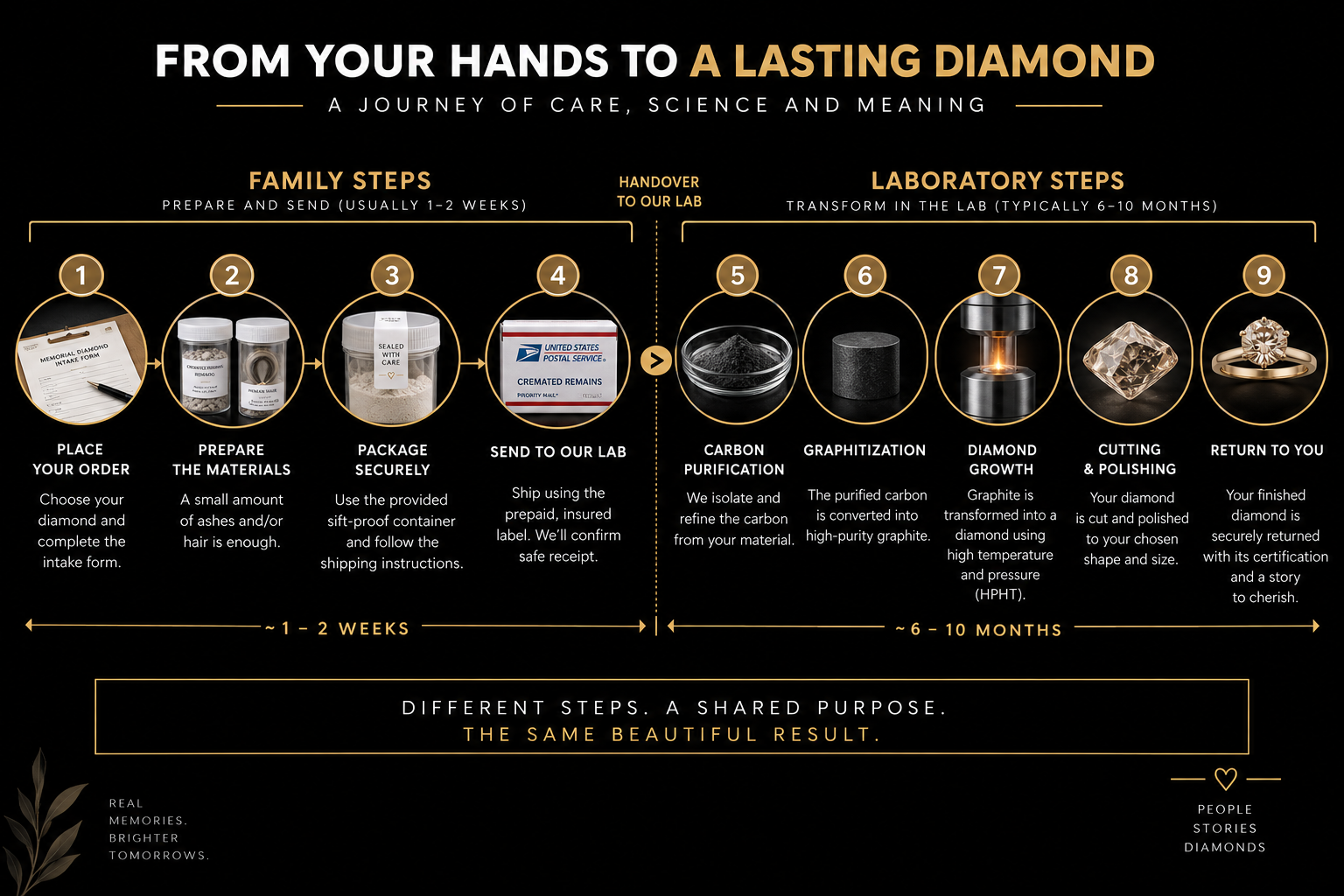
A memorial diamond made from your father’s ashes begins with a small portion of cremated remains and ends as a polished diamond that you can keep close for years to come. Between those two points, the material passes through several carefully controlled laboratory stages. The laboratory first identifies and extracts usable carbon, purifies it, converts it into graphite, and prepares it for diamond growth. After the crystal develops, the rough stone undergoes cutting, polishing, and grading.

Understanding this journey can make the process easier to understand, especially when you want to know what actually comes from your father’s remains, why additional carbon may be needed, and how the laboratory turns the recovered carbon into a genuine diamond.

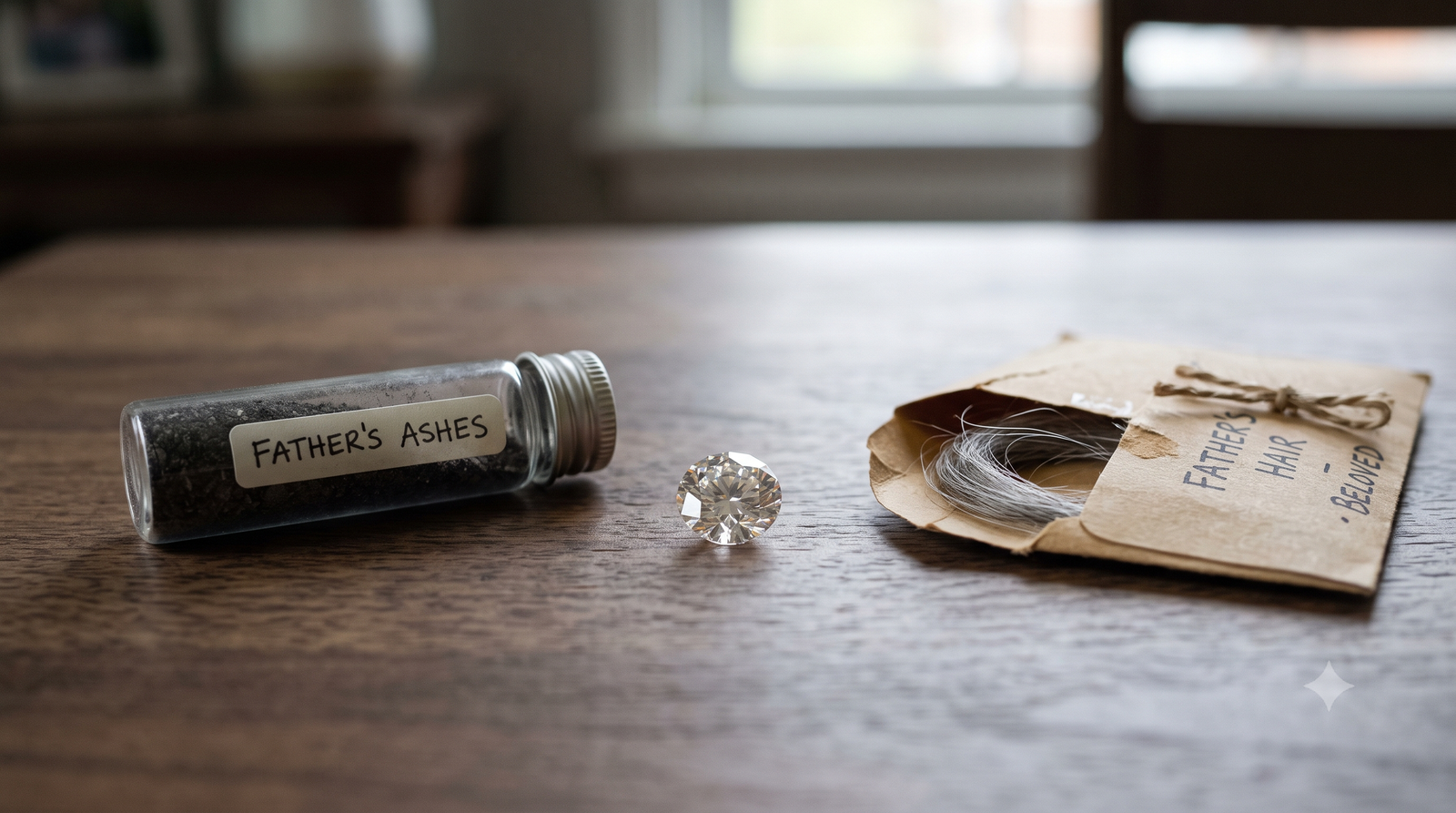
A small sealed container of cremated ashes and a paper envelope of hair side by side on a plain table, with a finished memorial diamond between them

What Is a Memorial Diamond Made From?

Before looking at how a memorial diamond grows, it helps to understand what the laboratory receives in the first place. Cremated remains are not simply loose ash like the residue left after burning wood. They consist primarily of mineral material from the bones, with calcium phosphate making up most of that material.

Carbon makes up only a small portion of cremated remains. Published industry figures commonly place usable carbon at approximately 0.5% to 4% by weight, although the amount can vary from person to person and can also depend on the cremation process.

That small amount of carbon becomes the important part of the process. Rather than trying to turn the entire container of cremated remains directly into a diamond, the laboratory first separates the carbon from the much larger amount of mineral material.

This separation is what sets the foundation for everything that follows.

How Does the Memorial Diamond Process Begin?

The process starts when the laboratory receives the cremated remains and prepares the portion selected for the diamond. At intake, the laboratory can inspect the material and remove non-biological materials that should not enter the carbon extraction process.

The laboratory then prepares the selected remains for controlled purification. At this point, the material still does not resemble the carbon feedstock required for diamond growth. The next stage therefore focuses on isolating and purifying the carbon.

This is an important distinction because the laboratory does not simply heat the remains and expect a diamond to appear. It must first create a suitable carbon source for the growth process.

How Is Carbon Extracted for a Memorial Diamond?

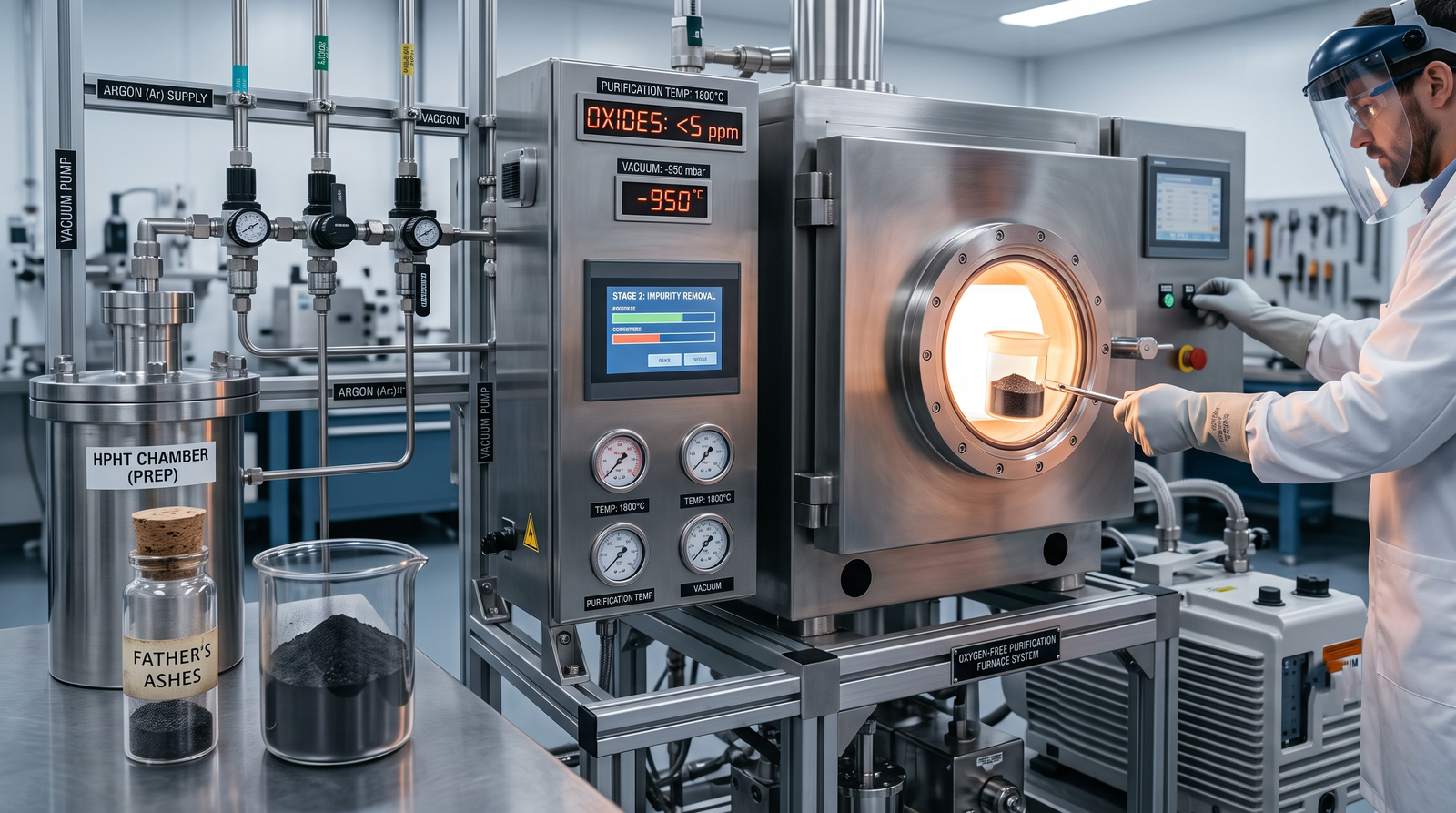
The laboratory uses controlled, oxygen-free heating to separate carbon from the mineral portion of the cremated remains. Controlling oxygen plays an important role because carbon can react with oxygen at high temperatures and leave the material as carbon dioxide.

By controlling the environment, the laboratory can retain the carbon while removing much of the unwanted mineral material. The recovered carbon then goes through additional purification before it becomes suitable for the next stage.

After purification, the recovered material can reach approximately 99.9% or higher carbon purity. The laboratory has now reduced the original cremated material to a much smaller and more useful carbon source.

However, purified carbon still needs another transformation before it can enter the diamond-growth process. The laboratory next converts it into graphite.

Why Is the Carbon Converted Into Graphite?

Graphite and diamond may look completely different, but they share the same fundamental element: carbon. Their difference comes from the way their carbon atoms arrange themselves.

During the graphitization stage, the purified carbon undergoes extremely high temperatures, generally around 2,500–2,700°C. This treatment converts the carbon into graphite, which the laboratory can then use as feedstock during diamond growth.

This stage also explains why the final stone does not contain recognizable pieces of bone, tissue, or other original biological structures. The high-temperature purification process breaks down those structures. What carries forward into the diamond-growth process is elemental carbon.

Once the laboratory has prepared the graphite, it can finally address the next question: is there enough personal carbon to grow the desired stone?

Why Is Lab Carbon Added to a Memorial Diamond?

In most cases, the answer is no. The amount of recoverable carbon in cremated remains is relatively small, while a meaningful-size diamond requires a larger amount of carbon feedstock.

For this reason, the purified carbon recovered from your father’s remains can be blended with additional laboratory-sourced carbon. This supplemental carbon provides enough feedstock for the diamond-growth process to produce the intended stone size.

The important distinction is that the additional carbon does not come from your father. The personal portion comes from the carbon recovered from the submitted cremated remains, while the supplemental portion comes from another laboratory source.

The personal carbon fraction may represent roughly 10–15% of the finished stone’s mass, depending on factors such as the size of the diamond and the amount of material submitted.

So, a responsible description should not claim that the finished stone consists entirely of your father’s remains. Instead, the more accurate explanation is that carbon atoms that were once part of his body become incorporated into the crystal structure of the diamond.

Two separate intake records for one memorial diamond order, each with its own chain-of-custody reference
A rough crystal and finished diamond represent two stages of the memorial diamond journey.

What Happens Inside the Memorial Diamond Growth Press?

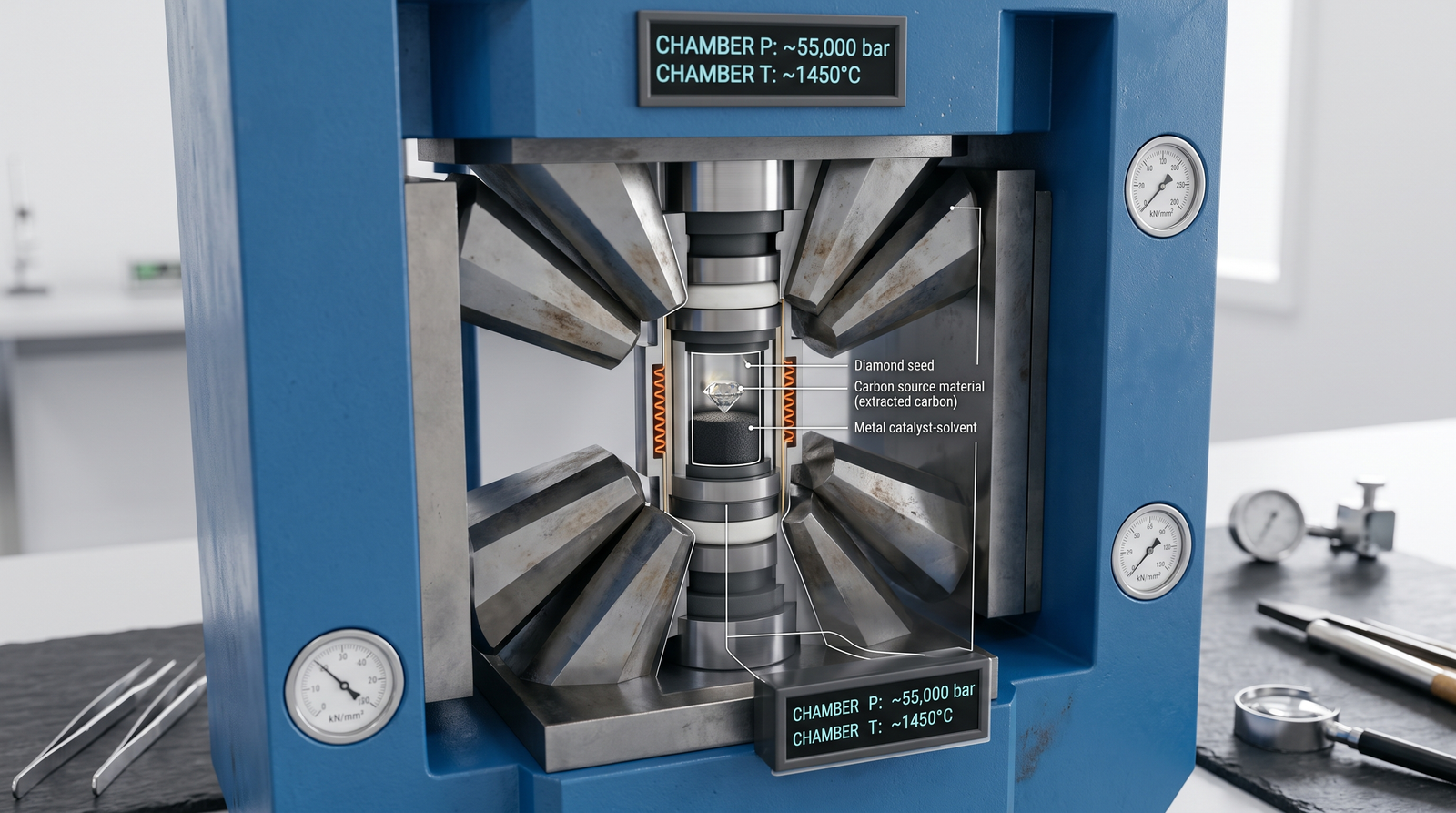
After the laboratory prepares the carbon feedstock, the material enters the stage that actually creates the diamond crystal. HPHT, or high pressure, high temperature, provides one established method for growing diamonds in a controlled laboratory environment.

The growth cell can experience pressures of approximately 6–8 GPa together with temperatures that can reach roughly 1,400–2,500°C. These conditions allow carbon to crystallize into the diamond structure.

A small diamond seed sits inside the growth cell and provides the starting structure for the new crystal. As the process continues, carbon from the prepared feedstock crystallizes around the seed and gradually develops into a rough diamond.

The growth stage can take weeks to months, depending on the growth system, target size, and other laboratory conditions.

Some laboratories use another method called CVD, or chemical vapor deposition. Instead of using the same pressure and temperature conditions as HPHT, CVD introduces a carbon-bearing gas into a controlled vacuum environment and deposits carbon onto a diamond seed.

If you want to understand these two approaches in more detail, you can read our guide to how memorial diamonds are made using HPHT and CVD.

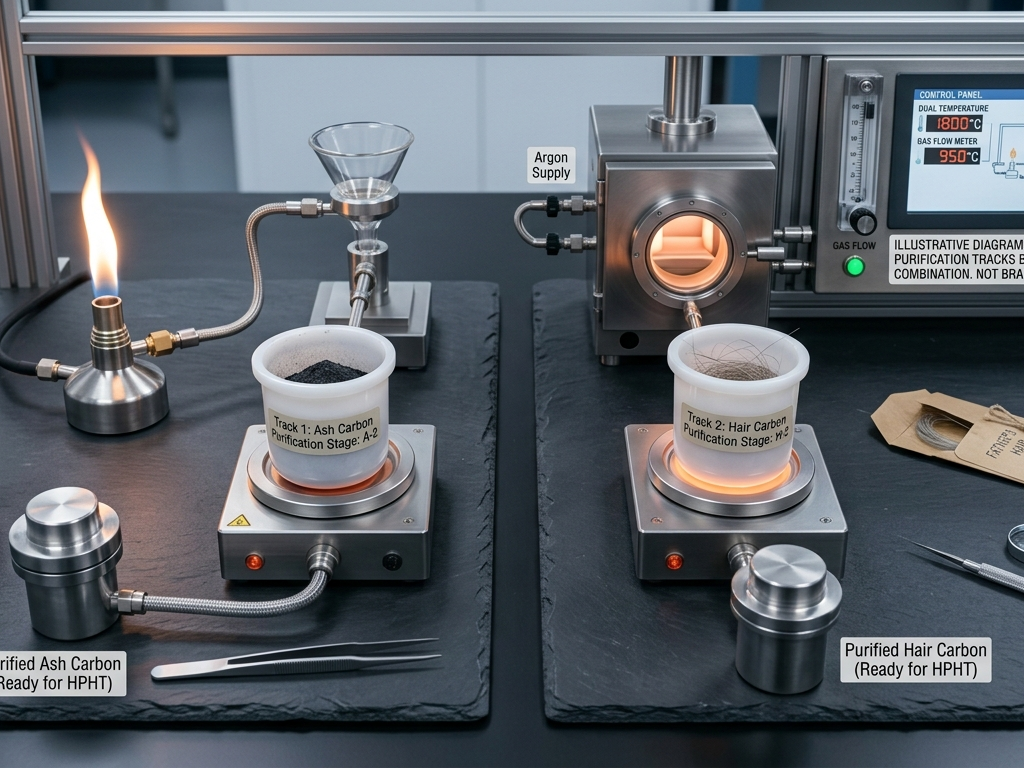
Two labeled laboratory crucibles being processed separately before their purified carbon is combined
The diamond-growth stage uses controlled pressure and temperature to develop the crystal.

How Long Does a Memorial Diamond Take to Grow?

The growth stage does not happen instantly. The laboratory must maintain controlled conditions while the carbon gradually forms the diamond crystal.

Depending on the process and the target stone, diamond growth can take weeks to months. The final carat size depends on more than the amount of cremated remains submitted. Once the laboratory has enough carbon feedstock for the growth cell, factors such as growth conditions and time influence how much diamond crystal develops.

This is also why submitting more cremated remains does not automatically mean that the finished diamond will have a proportionally larger carat weight.

If you are preparing to send your father’s remains, you can learn more about the amount typically requested in our guide to how much ash a father memorial diamond requires.

What Can Affect the Final Memorial Diamond?

Although laboratories carefully control the process, some characteristics can vary from one memorial diamond to another. The first variable appears before the growth stage even begins: the amount of usable carbon available in the submitted material.

Because cremated remains can contain different amounts of carbon, the laboratory cannot assume that every person’s remains will produce exactly the same carbon yield.

Trace elements can also influence the final diamond. Even after purification, very small amounts of remaining elements can affect the color that develops during growth.

For this reason, a provider should avoid promising an exact final color before the diamond grows. The final stone can have its own characteristics in color, clarity, and appearance.

What Happens After the Memorial Diamond Grows?

When the growth stage finishes, the laboratory has a rough diamond rather than the polished stone you ultimately receive. The rough crystal must go through another series of steps before it reaches its final appearance.

Cutting shapes the rough material and creates the facets that control how the diamond interacts with light. Polishing then smooths and refines those surfaces.

The amount of rough material removed during cutting depends on the selected shape and the characteristics of the original crystal. The finished stone can therefore weigh considerably less than the original rough crystal.

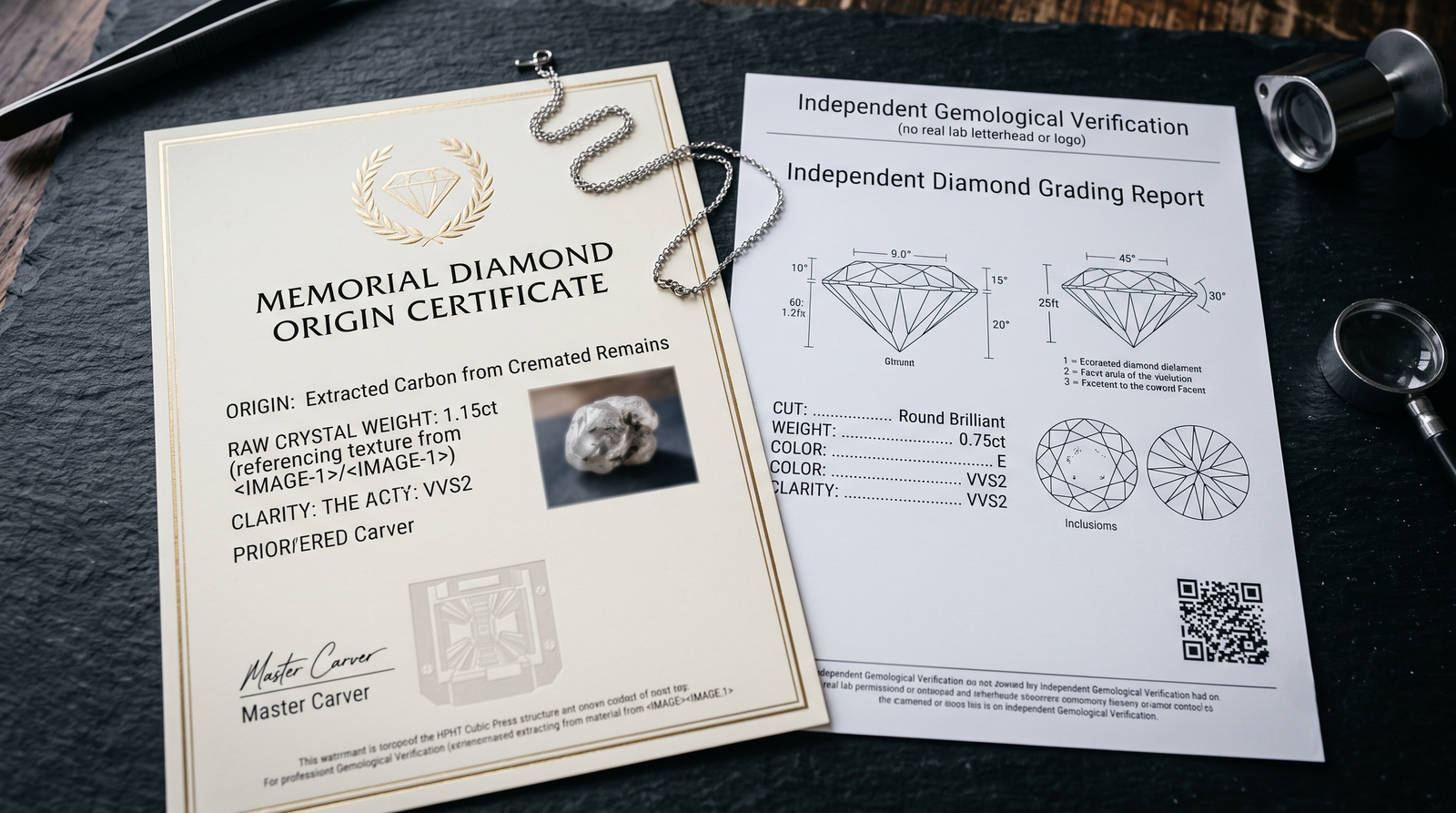
Once cutting and polishing finish, the diamond can undergo grading. A grading report can document characteristics such as carat, color, clarity, and cut.

It is useful to distinguish grading documentation from origin documentation. A grading report describes the physical characteristics of the finished diamond, while origin or authenticity documentation addresses its connection to the submitted material.

You can learn more about this distinction in our guide to how memorial diamonds are graded and certified.

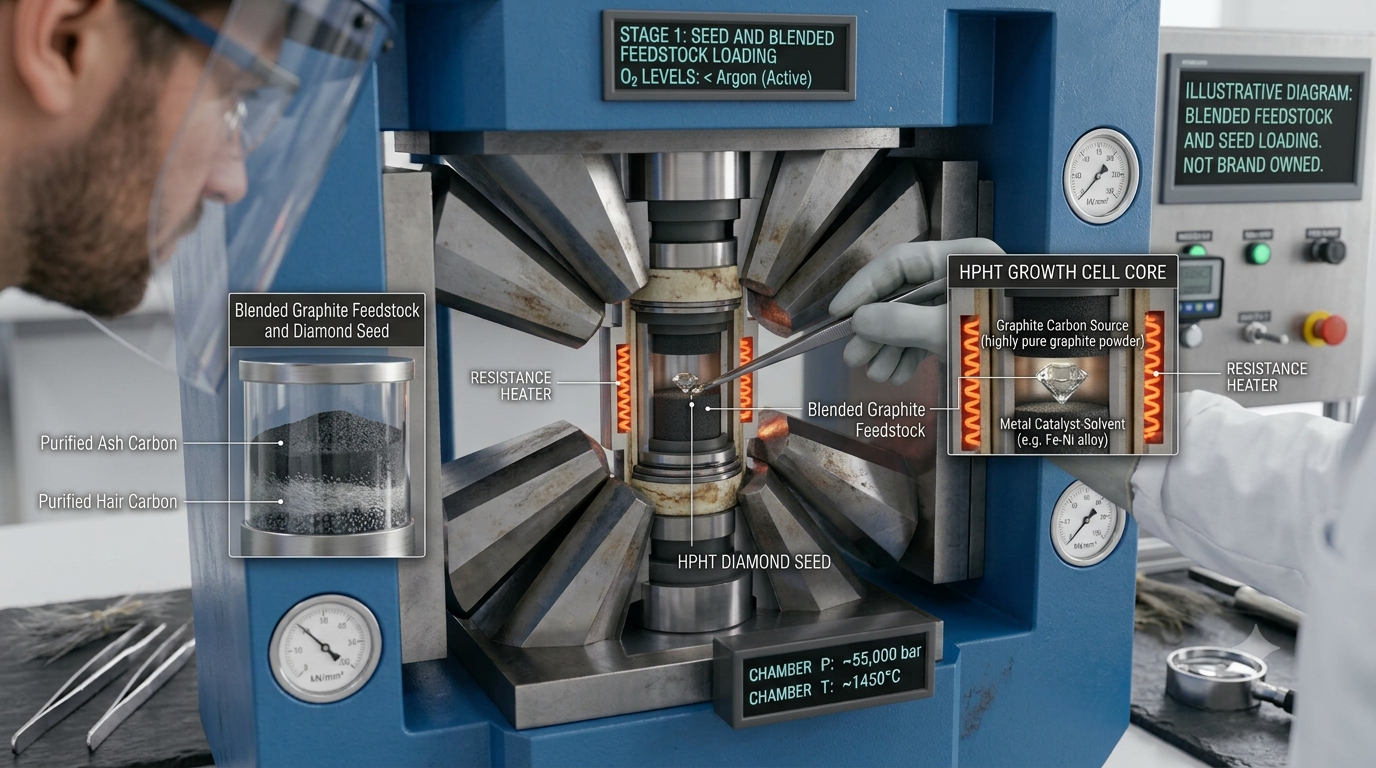
Growth cell being loaded with blended graphite feedstock and a diamond seed before an HPHT run
Origin documentation and grading documentation provide different types of information about a memorial diamond.

What Happens to the Unused Ashes?

The diamond process does not necessarily require the entire amount of cremated remains that a family submits. Depending on the laboratory’s process, some material may remain after carbon extraction.

Before sending your father’s ashes, ask the provider what happens to unused cremated remains. Some providers may return unused material, while others may follow a different policy.

Getting this information in writing before the process begins can prevent confusion later and gives your family a clearer understanding of how the laboratory handles the material you entrust to it.

How Should You Ship Ashes for a Memorial Diamond?

If you need to send cremated remains within the United States, shipping requirements deserve attention as well. The carrier you choose may have specific packaging and mailing requirements for cremated remains.

USPS provides specific guidance for shipping cremated remains domestically. You can review the current USPS requirements for packaging and shipping cremated remains before preparing your shipment.

Because postal requirements can change, check the current instructions before mailing any cremated material.

Frequently Asked Questions About Memorial Diamonds

Do Metal Implants Affect a Memorial Diamond?

Metal implants do not become part of the carbon feedstock used for diamond growth. The laboratory should separate non-biological materials during the preparation stage rather than carry them into carbon extraction.

Does It Matter How Long Ago My Father Was Cremated?

Cremated remains consist primarily of stable mineral material, so storing them for several years does not create the same type of biological deterioration associated with fresh organic material. An older set of cremated remains can therefore enter the laboratory process in essentially the same way as more recently cremated remains.

Can I Find Out How Much Carbon the Laboratory Recovered?

You can ask the provider whether it measures and documents recovered carbon yield. This information can give you a clearer understanding of how much usable carbon the laboratory extracted from the submitted material. However, not every provider publishes recovered yield as a standard part of its service.

Can the Cremation Process Affect Carbon Recovery?

It can contribute to variation. The amount of usable carbon can differ depending on the individual and the cremation process, which helps explain why laboratories cannot guarantee an identical carbon yield from every submission.

What Happens If the Diamond Growth Run Fails?

Ask this question before sending the cremated remains. A growth run can encounter problems, so you should understand whether the laboratory will make another attempt, whether it can use remaining material, how a failed run affects the timeline, and whether additional costs could apply.

Can a Memorial Diamond Use Only My Father’s Carbon?

For a meaningful-size stone, the laboratory generally needs more carbon than it can recover from a typical submitted portion of cremated remains. That is why providers may combine the recovered personal carbon with supplemental laboratory-sourced carbon.

What Should You Ask Before Choosing a Memorial Diamond Provider?

Knowing how a memorial diamond works gives you a useful starting point when comparing providers. Instead of focusing only on the finished stone, ask questions about the entire process.

  • Which diamond-growth method do you use?
  • Do you perform the growth in-house?
  • How do you track the submitted cremated remains?
  • Do you measure the amount of recovered carbon?
  • What happens to unused cremated remains?
  • What happens if a growth run fails?
  • Which origin or authenticity documents do you provide?
  • Which independent grading report accompanies the finished diamond?
  • What timeline should I expect from submission to finished stone?

A transparent provider should explain the parts of the process it controls, the factors that can vary, and the documentation it can provide. Clear answers can help you make a decision with realistic expectations.

Final Thoughts: From Your Father’s Ashes to a Memorial Diamond

Creating a memorial diamond from your father’s ashes involves a carefully controlled sequence rather than one single transformation. The laboratory begins with cremated remains, separates the small carbon fraction, purifies it, and converts it into graphite.

Because the recovered carbon generally cannot provide all the feedstock required for a meaningful-size stone, the laboratory may combine it with supplemental lab-sourced carbon. The prepared material then enters the diamond-growth stage, where controlled pressure and temperature allow a diamond crystal to develop around a seed.

After growth, the rough crystal undergoes cutting and polishing to create its finished form. Grading can then document the stone’s physical characteristics, while origin documentation can provide information about its connection to the submitted material.

The most important thing to understand is that the process changes the original material significantly. The finished diamond does not contain recognizable pieces of bone or biological tissue. Instead, carbon recovered from your father’s cremated remains becomes part of the crystal structure of the diamond.

That distinction helps explain both the science and the meaning behind the process. A memorial diamond does not preserve your father’s remains in their original physical form; it creates a lasting diamond using carbon recovered from them.

If you are continuing your research, you can also read our guide on whether a memorial diamond is really made from your father’s ashes or explore our complete guide to father ashes diamonds.

Untitled (1568 x 1003 px)

How a Memorial Diamond Is Made From His Ashes

Small bound lock of gray hair in a paper envelope beside a finished lab-grown memorial diamond on a dark wooden surface

The container from the crematorium is heavier than many people expect. Between that container and a finished diamond in a presentation case sits a carefully controlled chain of laboratory processes.

A memorial diamond made from your father’s ashes begins with a measured portion of cremated remains. The laboratory separates and purifies the carbon, converts that carbon into graphite, prepares the growth material, and creates a genuine diamond crystal under extreme pressure and temperature.

Almost every stage removes something. Understanding what leaves the material, what carries forward, and what happens during diamond growth makes the entire process easier to understand.

In This Article

What Is Actually in the Cremation Container?

Cremated remains are not ash in the campfire sense. This distinction sets up every stage that follows.

After cremation, the remains consist primarily of mineral material associated with bone, including calcium phosphate. Carbon represents only a small portion of the material that remains after the cremation process.

Industry figures place usable carbon at roughly 0.5% to 4% of cremated remains by weight. The exact amount can vary between individuals and can also vary with the cremation process.

That creates the laboratory’s first challenge. The process does not begin by manufacturing a diamond. It begins by finding and separating a small carbon fraction from a much larger amount of mineral material.

If you want to understand the amount of material families may need to submit, speak directly with the laboratory about its current requirements before sending your father’s ashes.

Which Stages Remove Something, and Which Stage Adds?

It helps to look at the process as a ledger rather than simply a timeline. Each stage has a specific job, and most stages remove material or transform what already exists.

StageWhat Is Removed or ChangedWhat Carries Forward
Intake and inspectionNon-biological material and anything that should not enter the processA measured and documented portion of the submitted material
Extraction and purificationMineral material and other unwanted componentsPurified carbon
GraphitizationOriginal molecular structuresGraphite, a crystalline form of carbon
BlendingNothing is removedPrepared carbon feedstock
Diamond growthNothing is intentionally removedA rough diamond crystal
Cutting and polishingRough materialThe finished diamond
GradingNothing from the stoneA documented assessment of diamond characteristics

The key point is that the material changes substantially before it becomes a diamond. The laboratory first separates and purifies the useful carbon, then prepares that carbon for controlled crystal growth.

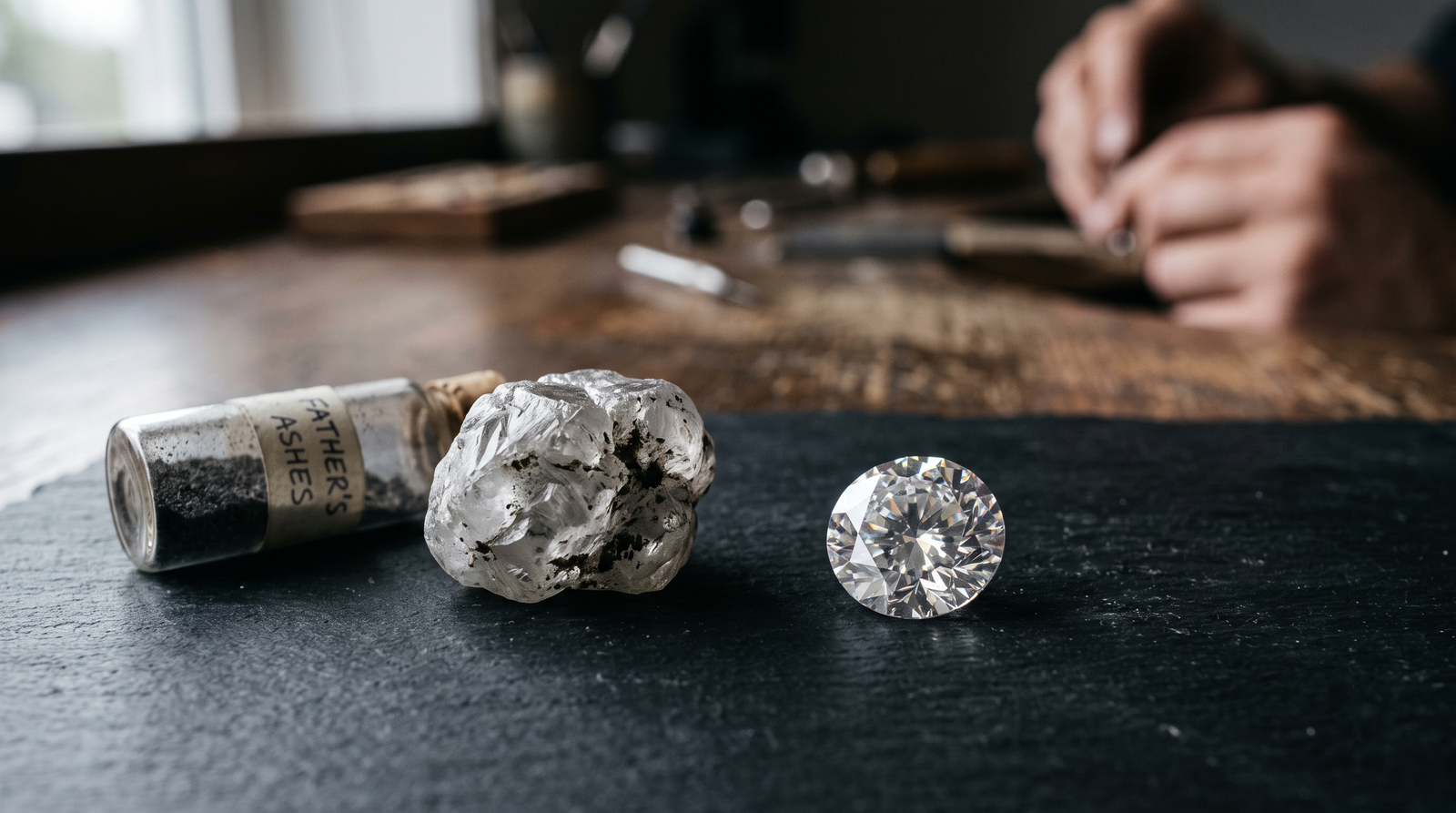
Memorial diamond rough crystal grown from carbon extracted from cremated ashes beside finished cut stone
A rough diamond crystal beside a finished cut stone illustrates the transformation involved in creating a memorial diamond.

How Is His Carbon Separated From the Bone Mineral?

Ordinary burning cannot provide the controlled conditions required for carbon recovery. When carbon reacts with oxygen at high temperatures, it can leave as carbon dioxide. The laboratory therefore needs an oxygen-free environment during the extraction process.

Controlled, sealed heating allows the laboratory to remove much of the unwanted mineral material while retaining the carbon needed for the next stage.

After extraction and purification, the recovered carbon can reach approximately 99.9% or higher carbon purity, according to the process description used for this article.

The purified carbon then moves into the graphitization stage.

At this point, the laboratory has not created a diamond. It has prepared a much purer carbon source that can enter the next stage of the process.

Sealed high-temperature furnace used to extract and purify carbon from hair in an oxygen-free process

Why Is Lab Carbon Added to His?

The amount of carbon recovered from cremated remains is relatively small. If the laboratory needs additional feedstock for a growth run, it may combine the recovered carbon with laboratory-sourced carbon.

The process brief used for this article describes the personal carbon fraction as typically representing approximately 10–15% of the finished stone’s mass, depending on factors such as stone size and the amount of material submitted.

This distinction matters when you evaluate claims about a memorial diamond. A provider should clearly explain whether it adds supplemental carbon, how it handles the personal carbon fraction, and what it can document.

The source process described for this article treats blending as the only additive stage. The carbon recovered from your father’s remains carries forward into the prepared feedstock, while any additional laboratory-sourced carbon provides the quantity required for the growth process.

Because BlueIce Gems’ current public Memorial Diamond page makes a different claim about using 100% of the loved one’s ashes or hair and not adding generic carbon, confirm the current BlueIce Gems production policy before publishing this section as a company-specific statement.

What Happens Inside the Growth Press?

The diamond-growth stage turns prepared carbon into a diamond crystal.

The process described in the source material uses HPHT, or high pressure, high temperature, technology. The growth cell creates extreme pressure and heat that allow carbon to form the diamond crystal structure.

A small diamond seed provides the starting structure. Carbon then crystallizes around that seed under carefully controlled conditions.

Growth conditions can reach approximately 6–8 GPa of pressure and roughly 1,400–2,500°C, depending on the growth system and stage of the process.

The growth itself can take weeks to months. Larger stones generally require more growth time, and a growth run can require additional processing if the intended result is not achieved on the first attempt.


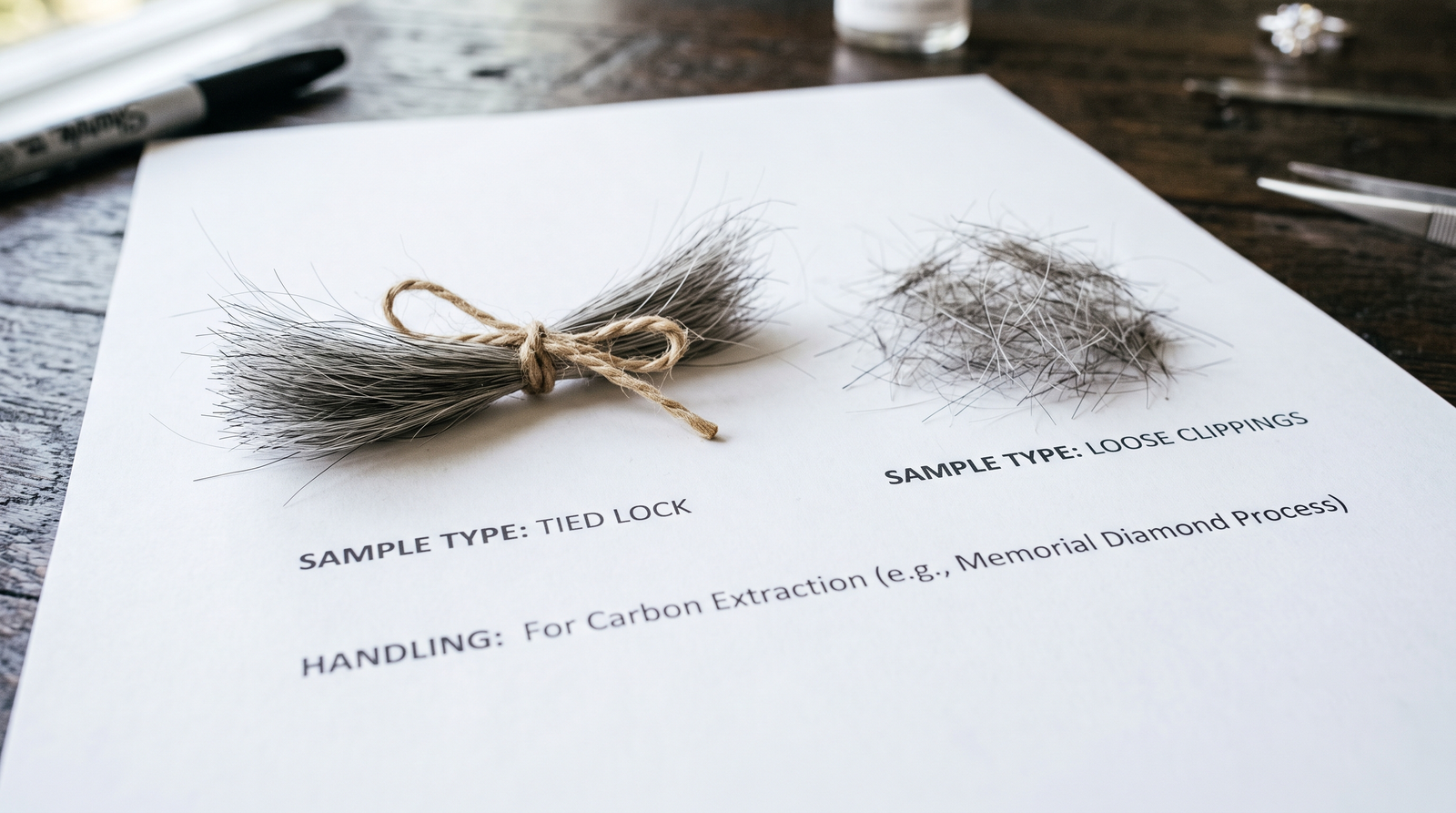
A tied lock of hair beside loose clippings on a sheet of white paper, showing the difference in how each is handled
Illustrative HPHT equipment showing the type of growth environment used to create diamond crystals.

HPHT vs. CVD

HPHT is not the only laboratory diamond-growth method. CVD, or chemical vapor deposition, grows diamond by depositing carbon from a carbon-bearing gas onto a diamond seed inside a controlled chamber.

Both technologies can create genuine diamonds. The important question for a memorial diamond is which process the provider uses and how it handles the personal carbon throughout the process.

What Varies From One Father to the Next?

Not every memorial diamond develops in exactly the same way. The source material and growth conditions can vary from one person to another.

Carbon Recovery

The amount of usable carbon can vary. Published industry figures place the recoverable carbon fraction at roughly 0.5–4% by weight, although the exact result depends on the individual and the cremation process.

Trace Elements

Trace elements can influence the final appearance and color of a diamond. This means a laboratory cannot always predict an exact final shade before the growth process begins.

Diamond Size

The target size affects the growth stage and the amount of rough material required. A larger finished stone generally requires a longer and more demanding growth process.

Cut and Shape

The rough crystal determines how the cutter approaches the final stone. Cutting removes rough material and creates the facets that control how the finished diamond interacts with light.

BlueIce Gems currently lists several memorial diamond cuts, including Brilliant, Emerald, Asscher, Princess, Radiant, and Heart. Explore the current BlueIce Gems Memorial Diamond options.

What Comes Back to You Besides the Stone?

A finished memorial diamond is only one part of the process. Documentation, communication, and the handling of unused material also matter.

Before sending your father’s ashes, ask the provider how it records the submitted material and how it maintains its chain of custody throughout the process.

You should also ask what documentation accompanies the finished diamond. A grading report and an origin or authenticity document can answer different questions, so ask the provider exactly what each document confirms.

Ask about unused cremated remains as well. Find out whether the laboratory returns unused material, stores it, or follows another documented procedure.

If you plan to wear the finished stone, you can also turn it into a custom memorial piece. Our custom pendant design guide explains how personal materials, stones, engraving, and pendant construction can work together.

High pressure high temperature press with the growth cell that holds a diamond seed during crystal growth
Origin documentation and diamond grading documentation serve different purposes.

Frequently Asked Questions

Do Metal Implants or a Pacemaker Affect What the Lab Can Use?

Metal implants do not become part of the carbon feedstock. Materials such as surgical hardware should be separated during intake rather than carried into the carbon extraction process.

Does It Matter If My Father Was Cremated Years Ago?

Cremated remains are stable mineral material, so the passage of time does not automatically make them unusable. A provider can explain its requirements for older cremated remains before you submit the material.

Will the Lab Tell Me How Much Carbon It Recovered?

Ask the provider before ordering. A recovered-yield figure can help you understand how much material the laboratory obtained and how much process information it is willing to document.

Can the Cremation Process Affect Carbon Recovery?

It can contribute to variation in the amount of usable carbon recovered. The source material places the usable carbon range at approximately 0.5–4% by weight and attributes variation to both the individual and the cremation process.

What Happens If the Diamond Growth Run Fails?

Ask the provider before sending your father’s ashes. Find out whether the laboratory makes another attempt, whether it uses remaining material for another run, how the failure affects the timeline, and who covers any additional costs.

Can a Lab Grow a Meaningful-Size Diamond From Only the Ashes?

The answer depends on the laboratory’s process and the amount of recoverable carbon. The source material used for this article states that laboratories commonly blend recovered carbon with additional laboratory-sourced carbon when the recovered amount cannot supply enough feedstock for the intended growth run.

Questions Worth Asking a Lab Directly

Before choosing a provider for a memorial diamond, ask direct questions about the process rather than relying only on marketing language.

  • How do you extract carbon from cremated remains?
  • Do you use HPHT, CVD, or another diamond-growth method?
  • Do you add supplemental laboratory carbon?
  • How much carbon do you recover from the submitted material?
  • How do you track my father’s ashes throughout the process?
  • What happens to unused cremated remains?
  • What happens if a growth run fails?
  • What documentation will I receive with the finished stone?
  • Which diamond colors and cuts can I choose?
  • How long should the complete process take?

A transparent laboratory should explain which parts of the process it controls, which characteristics can vary, and what it can document for you.

Understanding the Journey From Ashes to Diamond

Creating a memorial diamond from your father’s ashes involves much more than placing ashes into a machine and waiting for a diamond to appear.

The laboratory first prepares the cremated remains and isolates the usable carbon. It then purifies that carbon and converts it into graphite. The prepared carbon enters a controlled diamond-growth environment, where extreme pressure and temperature allow a crystal to form.

After growth, the rough crystal still needs cutting and polishing. The finished stone can then become a lasting memorial that you preserve privately or set into a ring, pendant, or another piece of jewelry.

The most important step before choosing a provider is asking exactly what happens to the material you submit. Understand the extraction process, growth technology, carbon policy, documentation, timeline, and handling of unused remains before you begin.

For more information about BlueIce Gems’ current memorial diamond process, visit the BlueIce Gems Memorial Diamonds page.

Untitled (1568 x 1003 px) (2)

How a Memorial Diamond Is Made From Your Father’s Ashes

Rough diamond crystal grown from carbon extracted from cremated ashes beside the finished cut stone on a dark surfac

The container from the crematorium feels heavier than most people expect, and a paper identification tag usually seals the lid. Between that container and a finished, sparkling gemstone lies a sophisticated sequence of scientific procedures. If you want to understand how a memorial diamond is made from your father’s ashes, the short explanation runs simply: technicians heat a measured portion of his cremated remains in an oxygen-free furnace until pure carbon remains, convert that carbon into graphite, blend it with lab-grade carbon, and grow an authentic diamond crystal inside an extreme-pressure press.

Most importantly, understanding this journey requires seeing it as a process of refinement. Almost every single stage in the laboratory removes something. In fact, exactly one stage adds material.

In this article:

What Is Actually in the Cremation Container?

Cremated remains are not soft wood ash in the campfire sense. This single chemical fact defines every subsequent laboratory stage.

Instead, what comes back from a cremation consists overwhelmingly of calcium phosphate the resilient mineral scaffolding of bone left behind after intense heat drives off water and soft tissue. Carbon, the singular element required to grow a diamond, represents a minor component. Sourced industry figures place usable carbon at roughly 0.5% to 4% of total ash weight, depending on the individual and the cremation conditions.

Therefore, the laboratory’s opening objective focuses on separation rather than manufacturing. Technicians must extract a small fraction of carbon from several ounces of mineral powder and purify it thoroughly. How much ash a father memorial diamond needs directly reflects this chemical reality.

Which Stages Remove Something, and Which Stage Adds?

Sealed high-temperature furnace used to purify carbon extracted from cremated remains in an oxygen-free process

Reading the journey as a ledger of refinement makes the science easy to visualize, while clearly answering common family questions.

StageWhat Is Taken AwayWhat Carries Forward
Intake & InspectionNon-biological material: medical hardware, metal fragmentsA logged portion assigned to a unique chain-of-custody ID
Extraction & PurificationCalcium phosphate and bulk bone minerals via oxygen-free heatingElemental carbon at approximately 99.9%+ purity
GraphitizationRemaining molecular structure at 2,500–2,700°CPure graphite ready for the growth press
BlendingNothingHis graphite combined with supplemental lab carbon
Crystal GrowthNothingA raw, uncut rough diamond crystal
Cutting & PolishingRough diamond material and outer matrixThe faceted, brilliant finished gemstone
GradingNothingA documented report verifying cut, color, clarity, and carat

Blending represents the only additive step in the entire sequence. Consequently, no honest provider describes the finished crystal as being 100% composed of your father’s remains.

How Is His Carbon Separated From the Bone Mineral?

Ordinary open-air combustion cannot accomplish this separation because oxygen destroys the very element you want to preserve. If you heat carbon in open air, it binds with oxygen and escapes up the exhaust as carbon dioxide gas.

Therefore, technicians conduct extraction inside specialized, sealed, oxygen-free vacuum furnaces. This controlled heating cycle eliminates volatile minerals while preventing carbon loss, purifying the carbon to 99.9%+ purity.

Subsequently, high-temperature furnaces heat the purified sample to roughly 2,500–2,700°C to restructure it into graphite. Graphite and diamond share the identical element carbon but carry different atomic geometry. The growth press simply transforms one molecular lattice into the other.

Nothing molecular survives these extreme thermal thresholds. Instead, the process preserves elemental carbon atoms, which step forward as the building blocks for the new gemstone.

Why Is Lab Carbon Added to His?

Laboratories blend supplemental carbon purely to provide sufficient volume inside the growth cell.

Because cremation ashes yield between 0.5% and 4% carbon by weight, the recovered personal sample remains relatively small. A standard growth cell requires a specific volumetric baseline to operate effectively. Therefore, technicians combine his purified graphite with lab-grade graphite chemically identical in every atomic respect.

As a result, your father’s carbon typically comprises roughly 10% to 15% of the final gemstone’s mass. While the diamond is not 100% personal material, carbon atoms that physically composed his body become permanently locked inside the crystalline structure. The direct answer to whether a memorial diamond is really made from your father’s ashes provides the scientific backing when discussing the process with family members.

What Happens Inside the Growth Press?

High pressure high temperature press with the growth cell that holds a diamond seed during crystal growth

The memorial diamond industry relies primarily on High Pressure High Temperature (HPHT) technology. Large multi-anvil presses (such as BARS or cubic presses) squeeze the core cell from multiple directions, maintaining conditions at roughly 6–8 GPa of pressure and 1,400–2,500°C to replicate Earth’s upper mantle.

Inside the growth core, technicians place a microscopic natural diamond seed. As heat liquifies the catalyst metal, carbon atoms migrate steadily toward the seed crystal and crystallize onto its lattice over weeks or months.

A smaller segment of the industry utilizes Chemical Vapor Deposition (CVD), where vacuum chambers deposit carbon gases onto flat substrates. While both routes yield authentic diamonds, HPHT remains the trusted benchmark for memorial stones. For a full technical comparison, explore how memorial diamonds are made, HPHT versus CVD.

Ultimately, growth duration determines carat size rather than the volume of ash supplied. Once the cell contains full feedstock, time under pressure dictates the final weight.

What Varies From One Father to the Next?

Two primary natural factors vary between individuals, and neither falls under human control:

  • Carbon Yield: Usable carbon varies across the 0.5% to 4% range due to individual bone density and the temperature profiles of the original cremation retort.
  • Trace Element Signatures: Although purification eliminates bulk minerals, microscopic trace elements (such as boron or nitrogen) carry through into the press. These natural elements influence whether his diamond develops yellow, blue, or champagne nuances.

Nevertheless, these natural variations do not alter the initial sample amount requested by the provider. For practical family logistics, how much ash a father memorial diamond needs explains sample sizes for men of different frames.

What Comes Back to You Besides the Stone?

An in-house authenticity certificate and an independent diamond grading report laid side by side on a des

When the process concludes, your provider should return three essential items:

  1. An Origin Certificate: An in-house document confirming that the laboratory synthesized the diamond using your submitted tracking number.
  2. An Independent Grading Report: A formal assessment from a recognized gemological laboratory detailing cut, color, clarity (typically SI2 to VVS), and carat weight. How memorial diamonds are graded and certified explains why you should always request both documents.
  3. Unused Cremation Ashes: Because the extraction cycle consumes only a portion of the submitted material, ethical providers return all remaining ash.

When preparing to ship, remember that regulations from the United States Postal Service (USPS Pub 139) strictly mandate Priority Mail Express with official Cremated Remains labeling. For domestic shipping guidance, review what the reader’s side of the process looks like.

Frequently Asked Questions

Do metal implants or a pacemaker affect what the lab can use?

No. Funeral directors remove pacemakers prior to cremation, and processors separate joint replacement hardware afterward. Technicians filter out any remaining microscopic metal during the intake stage before chemical extraction begins.

He was cremated eight years ago. Does the delay change anything?

No. Cremated remains consist of stable mineral compounds that do not degrade over time. An ash sample preserved in an urn for years yields the exact same carbon as a recent cremation.

Will the lab tell me how much carbon it actually recovered from his ashes?

Yes, if you ask in advance. While laboratories do not publish recovered percentages on standard certificates, reputable providers will record and share exact yield weights upon written request.

Does the crematorium he was cremated at make a difference?

Only marginally. Retort operating temperatures affect where a sample lands within the standard 0.5% to 4% carbon range, but this minor variation does not prevent successful diamond growth.

What happens if a growth run fails partway through?

Growth runs occasionally stall. Therefore, verify beforehand whether your provider maintains backup material, covers the cost of a secondary run, and guarantees project completion in writing.

Can the lab run his ashes without adding any lab carbon at all?

No. A single ash sample cannot supply enough physical carbon volume to fill an HPHT growth cell safely. Consequently, blending supplemental carbon represents an industry-wide necessity.

Questions Worth Asking a Lab Directly

Understanding the science helps you ask targeted questions before entrusting your father’s ashes to a provider. Ask whether they manage growth in-house, what specific growth method they use, and how they secure chain-of-custody tracking.

If you also have a lock of hair, the hair version of this process provides an alternative starting point. For comprehensive pricing and timelines, the complete guide to a father ashes diamond brings together all essential details.

Untitled (1568 x 1003 px)

Step-by-Step: Turning Your Mother’s Hair Into a Diamond

Here is the whole process as one numbered sequence: twelve steps from finding the lock to setting the finished stone, five of them yours and seven the lab’s, with the handover at step five. Industry-wide the lab half runs 6 to 10 months from the day your mother’s hair is received. No cremation is involved at any point, which is why this route stays open to families who buried their mother and to daughters whose mother is still alive.

Print it, work down it. For the reasoning rather than the order of operations, how to turn your mother’s hair into a diamond covers the same ground as prose.

Numbered checklist beside a thread-bound lock of hair, scissors, and a paper envelope on a linen surface

On this page:

What Do You Need Before You Start?

Short list, and most of it is already in the house.

  • The lock, or a plan for collecting one
  • Sharp scissors and a length of sewing thread to bind one end
  • A small paper envelope, not a plastic bag, inside a rigid mailer stiff enough not to fold in a sorting machine
  • Your provider’s written minimum for the carat you chose
  • A pen for her name and reference, and tracked postage ordinary mail class is fine

What you don’t need matters too: no special carrier, no official postal box, no cremation certificate, no service-class restriction. No carrier publishes a rule for human hair the way USPS publishes one for cremated remains an absence rather than a stated permission, so confirm with your provider and your carrier rather than assuming.

Steps 1–5: What Does Your Family Do?

Step 1 Find out whether a lock already exists

Start here: a lock you already have costs nothing, and one you have to take is irreversible. Saved hair turns up in a folded envelope in a jewelry box, taped into a baby book, inside a locket, or as a childhood braid. Hospice nurses and funeral directors often cut one unasked if either was involved, phone before assuming there is nothing.

Open jewelry box, a locket and a baby book on a table, showing the places a saved lock of hair is usually kept

Step 2 Choose carat and colour

Carat comes from growth time in the press, not from how much hair you send, so a bigger lock buys neither a bigger stone nor a faster one. Sizes run from about 0.10 carats to 5 and beyond, cost climbing steeply. Her own hair colour has no bearing on the stone’s see what colour to expect.

Step 3 Get the minimum in writing, for that carat

Ask your intended provider for the exact amount needed at the size you chose, by email. Industry-typical requirements are modest a small lock, a few grams, often called palm-sized because hair is roughly 50% carbon by weight. That is a range, not one company’s policy, and minimums shift with carat.

Step 4 Cut or gather the lock

Bind one end with thread first, so it stays a lock rather than loose strands. Cut, don’t pull; take it from underneath at the nape, where the gap won’t show. Keep it whole. The root isn’t needed; the carbon is in the shaft.

Section of hair bound at one end with sewing thread just above the point where it will be cut

Step 5 Package it and post it

Hair into the sealed paper envelope, name and reference on that inner envelope rather than only the outer one, then into the rigid mailer with any provider forms. Post it tracked, and tell the provider it’s coming so receipt is logged the same day.

Horizontal timeline graphic showing five family steps, a handover marker at step five, and seven laboratory steps across six to ten months

Which Step Is the Point of No Return?

Step 4 the structural difference that matters most between the hair route and the ashes route.

With ashes, the irreversible moment comes late at the seal and the handover and if you send too little there is nearly always more ash. With hair it arrives a step earlier, at your own kitchen table: a saved lock is frequently the only one that will ever exist, and a cut that falls short cannot be topped up. So the ordering of steps 3 and 4 isn’t stylistic confirm the amount, then cut, and if the answer is borderline take a smaller carat rather than a bigger cut. Questions worth asking first and how much hair you need cover the rest.

Steps 6–12: What Does the Lab Do?

Step 6 Intake and chain-of-custody logging

Your lock is checked in, weighed against the requirement, and assigned a tracking reference that follows it through every later stage. Ask for it that trail is what supports the certificate of origin.

Step 7 Carbon extraction and purification

The hair is heated in a controlled, oxygen-free, multi-stage process that strips away the non-carbon components of keratin, reaching roughly 99.9%+ carbon purity. Dyed, permed, and grey hair are generally workable, since purification removes everything that isn’t carbon.

Step 8 Graphitization

The purified carbon is heated to roughly 2,500–2,700°C and converted into graphite the crystalline form a growth press uses as feedstock. How a memorial diamond is made from your mother’s hair covers steps 7 to 11 in far more depth.

Step 9 Diamond growth

The graphite, blended with supplemental lab carbon to reach the volume a growth cell needs, goes into an HPHT press with a tiny diamond seed at roughly 6–8 GPa and 1,400–2,500°C. Longest step by a wide margin: weeks to months, set by the carat chosen at step 2. Her carbon becomes a real, verifiable part of the crystal not all of it, and no honest provider claims 100%.

Step 10 Cutting and polishing

A gemologist cuts and polishes the rough crystal into the shape selected. Memorial diamonds trend toward yellow, blue, and champagne because organic carbon carries trace elements into the growth cell; a colour the run doesn’t produce naturally needs post-growth irradiation here, adding time.

Step 11 Grading, certification, and the return of unused hair

The stone is graded on cut, colour, clarity, and carat, ideally by an independent third-party lab, while an in-house origin certificate ties it to your family’s material. Hair the process didn’t consume should come back as standard practice, not on request. The two documents answer different questions: one grades the diamond, the other ties it to your mother.

Step 12 Delivery, then the setting

It arrives loose, in a box, usually smaller than you pictured. A loose stone isn’t wearable, so one decision remains: keep it loose, or set it a pendant, a ring, her own ring reset around it. Settings and jewelry ideas covers the trade-offs.

How Long Does Each Step Take?

Durations are industry-typical, not confirmed turnaround guarantees. Both halves of this column are estimates: providers publish the 6–10 month total, not the breakdown, and the family-side figures reflect ordinary domestic logistics.

StepWhoTypical duration
1. Find the lockFamilyAn afternoon to a few phone calls
2. Choose carat and colourFamilyHours to a week
3. Get the minimum in writingFamilyA few days
4. Cut or gather the lockFamilyAbout 10 minutes — and irreversible
5. Package and post — handoverFamily → lab1–3 days transit
6. Intake and custody loggingLabDays
7. Extraction and purificationLabWeeks
8. GraphitizationLabDays to weeks
9. Diamond growthLabWeeks to months the long one
10. Cutting and polishingLabWeeks
11. Grading, certification, returnsLabWeeks
12. Delivery and settingLab → familyWeeks, if you set it
Steps 6–12 total–6–10 months; up to 12 for stones over ~2 ct or specialty colours

The 6–10 months runs from receipt, not from step 1. For a particular anniversary, count backward from receipt at step 6, then add your own steps 1 to 5 on top of it.

Where Does This Differ From the Ashes Sequence?

The lab half is identical from step 6 onward. The family half is genuinely lighter not in how many numbers it runs to, since the two posts group their steps differently, but in the work itself: hair removes three pieces of it and adds one.

  • Removed: ordering an official postal box. Cremated remains require the USPS Cremated Remains box, orderable online only, forcing days of delay before shipping is possible at all. Hair posts as ordinary mail.
  • Removed: measuring out a portion, and the family agreement gate. Nothing is divided a lock goes whole and where dividing a parent’s cremated remains usually needs everyone’s consent, a saved lock rarely carries the same weight.
  • Added: finding the lock at all. Ashes sit in a known place; hair has to be located, and sometimes doesn’t exist.
  • Moved: the point of no return. From the handover to the cut.

The same sequence for ashes runs the nine-step version, and the complete guide to a mother hair diamond covers treated hair and colour.

Side-by-side comparison of the hair and ashes family-side workflows, marking the postal box and portion-measuring work hair does not have and the point of no return in each

Frequently Asked Questions

Which step am I on if the lock has been in a drawer for twenty years?

Step 1 is done, so start at step 2. Age doesn’t degrade hair for this purpose keratin is stable, and a lock cut decades ago extracts the same as one cut last week.

Can I do step 4 before step 3?

Strongly advise against it. Confirming the minimum takes only a couple of days, while an insufficient cut may be unrecoverable if no second lock exists anywhere. If you have already cut, ask before posting rather than after.

Does the sequence change if my mother was buried rather than cremated?

No every step is identical, because no step involves cremation. That is the practical advantage of the hair route: it stays open to families who chose burial, and to those whose faith rules cremation out.

What if the lock turns out to be too small at step 6?

The lab should flag it at intake rather than growing a failed stone. Options are usually a smaller carat, or a second lock if one exists. Exactly why step 3 comes before step 4.

What if my mother is still living?

Then step 1 is a conversation instead of a search, and she can choose the carat at step 2 herself. Every step after that is unchanged, and she gets to see the finished stone.

Nothing You Do This Week Involves Scissors

Step 1 is a search of a jewelry box and step 3 is an email; between them they cost a few days and nothing else. The only step on this list that cannot be walked back is step 4, and it sits deliberately behind both of them which is the whole reason the sequence is ordered the way it is. If the search turns up nothing, or if the answer ends up being the lock left exactly where she put it, that is a whole answer too.

When you’re ready for step 3, reach out to Memorial Diamond at memorialdiamond.us and ask what amount is needed for the size you have in mind. Get it in writing first. Everything after that is reversible; the cut isn’t.

Untitled (1568 x 1003 px)

Step-by-Step: Turning Your Mother’s Ashes Into a Diamon

Six weeks after the package leaves your hands, the question can become less about what happens next and more about what you can still change.

You can think of turning your mother’s ashes into a diamond as a nine-step journey: your family completes four steps, hands over the material, and the laboratory handles the final five steps. Along the way, you reach specific points where your choices become permanent.

Most providers estimate that the laboratory stage takes 6 to 10 months from receipt, though larger stones or specialty colors often require extra time. Importantly, this timeline does not start when you make your initial decision or when you drop the ashes in the mail. It begins only when technicians log receipt of the shipment at the facility.

This guide maps the process in order and highlights where important decisions may remain open or become fixed.

What Is Still Open, and When Does Each Decision Close?

Five major decisions occur at different points in the process.

DecisionGenerally closes aroundWhat happens afterward
Whether to proceedLaboratory receipt/intakeContact the provider immediately if you wish to stop
How much ash to sendWhen the package is sealedAsk about additional material before processing begins
Carat and colourGrowth-cell loadingA change may require a new growth run
Cut shapeCutting stageThe available rough determines what can be cut
SettingNo fixed deadlineA loose diamond can be set or reset later

Important: these decision points are a practical process model rather than universal industry rules. Confirm the exact change and cancellation policies with your chosen provider before sending irreplaceable material.

Diagram of five decision gates closing in sequence across the memorial diamond process, from sealing the box to loading the growth cell

What Do You Need Before You Start?

Before beginning, gather the information and materials you will need.

  • Your mother’s ashes and an understanding of approximately how much you have
  • Written information from your provider covering minimum quantity, documentation, returns, and specification-change deadlines
  • The appropriate shipping materials for cremated remains
  • A strong, sealable and sift-proof inner container
  • A plastic bag and cushioning materials
  • A clean, dry spoon if you need to transfer the material
  • Sender and recipient details
  • Cremation documentation if your provider or carrier requires it
  • A safe place to record your tracking number and any provider reference number

If you are shipping within the United States, verify the current USPS requirements before mailing. The source data specifically identifies the USPS Priority Mail Express Cremated Remains box and related packaging requirements, but postal rules can change.

Steps 1–4: What Does Your Family Do?

Step 1 Specify the Stone in Writing

Start by deciding what kind of memorial diamond you want.

Carat size and colour can affect the expected production timeline, so ask your provider about these choices before the process begins.

More importantly, get the practical details in writing.

Ask:

  • How much material is required?
  • What documentation is needed?
  • What happens to unused ashes?
  • What is the cancellation policy?
  • When can carat or colour still be changed?
  • At what point does a specification become final?

A written answer gives your family something concrete to refer back to as the process progresses.

Step 2 Order the Shipping Box and Talk With Your Family

If your provider requires a specific cremated-remains shipping box, arrange it before you need to send the ashes.

This is also a good moment to have the family conversation.

For many families, the decision is not simply about creating a diamond. It is also about how much of your mother’s ashes should remain available for traditional memorial practices such as interment, scattering, or keeping the urn.

Taking that conversation seriously before sending anything can prevent difficult decisions later.

Step 3 Measure the Portion and Seal the Box

Once you know the amount your provider requires, prepare the portion you intend to send.

The important practical point is that sealing the package is a meaningful point of no easy return for the portion you have chosen.

Before sealing:

  1. Confirm the quantity against your provider’s written requirement.
  2. Make sure the inner container is properly sealed.
  3. Check that the packaging meets the applicable shipping rules.
  4. Confirm that you have retained the remaining ashes safely.
  5. Record the contents and tracking information.

Do not rely on a generic quantity from another provider. Use the actual requirement supplied by your chosen provider.

Sift-proof inner container being sealed on a clean table beside the official USPS Cremated Remains box

Step 4 Ship the Ashes and Notify the Provider

Once the package is ready, ship it using a carrier and service that currently permits the shipment.

For U.S. families shipping cremated remains directly, the source identifies USPS Priority Mail Express and the official Cremated Remains packaging as the relevant domestic route. Carrier restrictions should always be checked immediately before shipping because policies can change.

Notify your provider that the package is on its way.

Keep:

  • Tracking information
  • Shipping confirmation
  • The provider’s order information
  • Any chain-of-custody or reference number supplied after receipt

Step 4 Is the Handover and the Main Production Clock Has Not Started Yet

This is the point at which your mother’s ashes leave your hands.

One of the most important distinctions in the process is shipping time versus laboratory production time.

The commonly stated 6–10 month production window begins with laboratory receipt/intake, rather than with the day you first contact a provider or the day you mail the package.

That means your total calendar time can include:

Your preparation → packaging → shipping → laboratory intake → production → cutting and grading → delivery

The source specifically identifies the 6–10 month figure as an industry-typical production timeline rather than a confirmed turnaround for a specific provider.

Steps 5–9: What Does the Laboratory Do?

Step 5 Intake and Reference Number

After the material reaches the laboratory, it enters the provider’s intake process.

Ask whether the provider gives you a reference or chain-of-custody number that you can use when requesting updates.

This can make communication much easier during a process that may last many months.

At this point, confirm:

  • The material has arrived
  • Receipt has been recorded
  • Your order/reference number is correct
  • The provider can tell you how to request status updates

Step 6 Extraction, Purification and Graphitization

The supplied process description explains that the carbon-containing material undergoes processing to remove minerals and isolate carbon before graphitization.

The source describes purification to approximately 99.9%+ carbon purity, followed by conversion into graphite.

This stage is particularly important because it represents a transition from the original cremated material into material prepared for diamond growth.

Because the physical process is irreversible, confirm the provider’s policy regarding the return of unused material and the point at which cancellation is no longer possible.

Step 7 Diamond Growth

The graphite is prepared for diamond growth and placed into a growth system together with a diamond seed and additional laboratory carbon where required.

The supplied data describes HPHT growth conditions in the range of approximately 6–8 GPa and 1,400–2,500°C, with growth taking weeks to months depending on the desired stone.

This is also where carat and colour become especially important.

A larger stone generally requires a different growth run rather than simply becoming an upgrade to an already-grown stone. Therefore, if you are considering changing the size or colour, ask your provider before the growth cell is loaded.

The source also notes that personal carbon is typically only a portion of the final diamond’s mass, approximately 10–15%, rather than the finished diamond being composed entirely of the person’s original carbon.

HPHT press growth cell being loaded with graphite feedstock and a diamond seed in a laborator

Step 8 Cutting, Grading and What Comes Back

After growth, the rough diamond is cut and polished into the selected shape.

This means the final shape depends partly on what the rough stone can produce.

The source places grading and documentation after cutting and also identifies the return of unused ashes as an important point to clarify with the provider.

Before the stone is finalized, ask:

  • What cut shapes are available?
  • Who performs the grading?
  • Is the grading independent?
  • What certificate or documentation accompanies the diamond?
  • What happens to unused material?

Do not assume a particular grading laboratory or return policy unless your provider confirms it.

Step 9 Delivery and the Decision That Never Has to Be Rushed

When the diamond is delivered, it may arrive as a loose stone.

A loose diamond is not automatically a finished piece of jewelry. You can decide whether you want to place it into a ring, pendant, bracelet or another setting.

Unlike many earlier decisions, the setting does not have to be made immediately.

You can leave the diamond loose while you consider what kind of memorial jewelry feels right, and a stone can potentially be reset in the future.1

How Long Does Each Step Take?

The following is a practical planning framework rather than a guaranteed provider schedule.

StepWhoTypical planning timeframeImportant point
1. Specify and confirmFamilyA few daysNothing should be treated as final yet
2. Order materials and discuss with familyFamilySeveral business daysFamily decision
3. Measure and sealFamilyShort preparation taskQuantity becomes harder to change
4. ShipFamily → providerDepends on carrierHandover
5. IntakeLaboratoryProvider-dependentProduction clock begins
6. Extraction and graphitizationLaboratoryWeeksProcessing stage
7. Diamond growthLaboratoryWeeks to monthsLongest production stage
8. Cutting and gradingLaboratoryProvider-dependentFinal stone takes shape
9. Delivery and settingProvider → familyProvider-dependentSetting can be decided later
Steps 5–9LaboratoryTypically 6–10 monthsLonger timelines may apply to larger or specialty stones
Horizontal timeline graphic showing four family steps, a handover marker at step four, and five laboratory steps across six to ten months


The source explicitly cautions that the individual durations in this table are estimates derived from the overall production timeline, not confirmed provider figures.

Which Step Are You On Right Now?

You can use the physical evidence you have to understand approximately where you may be in the sequence:

You only have an email conversation:
You are likely still in the planning stage. Nothing needs to have closed yet.

You have a sealed package waiting to be shipped:
Your selected portion has been prepared. Review everything one last time before sending.

Tracking says the package was delivered, but you have no provider confirmation:
Contact the provider and ask whether the material has been received and logged.

You have a receipt or reference number:
The laboratory intake stage has begun or is underway. Ask what stage the material has reached.

You have been told diamond growth has started:
Carat and colour changes may no longer be practical. Ask the provider before requesting any change.

You have received the finished diamond:
The production process is complete. Your remaining major decision is how, or whether, you want to set the stone.

Frequently Asked Questions

Does the six-to-ten-month timeline include the time I spend preparing and shipping the ashes?

Usually, the stated production timeline refers to the laboratory process beginning with receipt or intake. Preparation, obtaining packaging, family discussions and shipping can add additional time before production begins. Confirm the exact start point with your provider.

Can I still change the carat size after I have shipped my mother’s ashes?

Possibly, depending on the provider and the production stage. Ask as early as possible and provide your order or reference number. Once a growth run has begun, changing the requested size may require a new production run.

I think I sent too little ash. Can I send more?

Do not assume that additional material will automatically be accepted. Ask your provider whether a supplementary shipment can be associated with the same order and exactly when additional material stops being usable.

How do I find out which stage my mother’s diamond is at?

Ask your provider for the current status using your order or chain-of-custody reference number. A provider should be able to explain which broad stage the order has reached and what remains.

Can my funeral home help ship my mother’s ashes?

A funeral professional may be able to help arrange transportation, but the exact options depend on the carrier, account and applicable rules. Ask your funeral director what they can arrange and confirm the carrier’s current requirements.

Nothing on This List Closes Today

If you are still deciding whether a memorial diamond is right for your family, your next step does not have to be a commitment.

Start by asking your chosen provider:

  • How much material do you require?
  • What documentation do you need?
  • What happens to unused ashes?
  • When can I still change the carat or colour?
  • What is your cancellation policy?
  • How will I track the order?

The most important thing is to understand where the irreversible points are before you reach them.

A memorial diamond is a deeply personal decision. Taking the time to understand the sequence, ask questions and confirm policies in writing can help your family make the decision with greater clarity.

Untitled (1568 x 1003 px) (2)

How Much Ash and Hair Do You Need for a Mother Memorial Diamond?

An urn on one shelf, an envelope in a drawer, and one stone to be grown from both. Start from this: each material still has to meet its own threshold industry-typically a few tablespoons up to roughly 4 oz of ash, and a small lock or a few grams of hair. No published figure discounts either quantity for the presence of the other.

Plan for both figures in full, ask your provider before you divide or cut anything, and treat any reduction as a bonus rather than a starting point.

Small portion of cremated ashes in a glass dish beside a ribbon-tied lock of grey hair on a pale linen surface

On this page:

Does Sending Both Mean You Need Less of Each?

Don’t assume it. Two things are genuinely unsettled here, and a family planning around a guess can end up short.

The first is whether a given provider accepts a combined submission at all one stone grown from both an ash portion and a hair portion. The second is whether, if they do, either quantity drops because the other material is present. Neither has a published industry answer, and no number on this page or any other should be treated as one.

What is solid is the shape of the safe plan: assume each material has to arrive in the quantity it would need alone. If a provider then tells you a smaller ash portion works because hair is coming too, you have gained something. Plan it the other way and be wrong, and you have already opened an urn and cut a lock for nothing.

What Does Each Material Require on Its Own?

Comparison graphic showing ash at roughly 0.5 to 4 percent carbon beside hair at roughly 50 percent carbon by weight

These are the figures each path uses independently industry-typical ranges rather than any one company’s policy, and the numbers to plan against until a provider tells you otherwise in writing.

AttributeHer ashesHer hair
Typical quantity requestedA few tablespoons up to ~4 oz (~100g)A small lock or a few grams, often described as palm-sized
Carbon content of the material~0.5–4% by weight~50% by weight
What extraction has to removeCalcium phosphate and other bone mineralsThe non-carbon components of keratin
Cremation requiredYesNo
Where it usually comes fromAn urn, or a portion already set asideA lock kept from a haircut, an illness, or childhood
Does supplying the other reduce it?Not documented ask before you assumeNot documented ask before you assume

Ash gives up its carbon reluctantly because it is mostly bone mineral; hair gives it up readily because keratin is roughly half carbon by weight. How much ash a mother memorial diamond needs and how much hair it needs go deeper on each requirement.

Why Doesn’t One Material Reduce the Other?

Diagram of two separate purification tracks  one for ash, one for hair  converging at graphitization before diamond growth

Because they are not interchangeable inputs arriving at the same door.

Purifying ash means stripping away a heavy mineral load calcium phosphate makes up almost all of cremated remains, and reaching roughly 99.9% carbon means removing all of it. Purifying hair means removing the non-carbon components of a protein. Different problems, different runs, and a batch of one does not cover a shortfall of the other.

The most defensible mental model is two separate purification tracks meeting later, when the recovered carbon is graphitized and loaded into a growth cell. That model is a reasoned inference rather than a documented standard put it to a provider as a direct question rather than assuming it.

Certain either way: whatever is recovered from both is still blended with lab-sourced carbon to reach the volume a growth cell needs. No memorial diamond is 100% the person, from one material or two. Whether a diamond is really made from her ashes and hair covers that honestly.

Does Sending Both Make a Bigger or Faster Diamond?

No. The press keeps its own schedule.

Carat size is set by how long a crystal grows under pressure industry-typically about 6 to 10 months for most stones, and up to roughly 12 for larger or specialty ones. Once the growth cell has enough feedstock to run, neither the quantity nor the variety of material shortens that clock or enlarges the result. Two materials do not double anything.

So the honest reason to send both is not size and not speed. Families do it because both things exist and both feel like her: ashes from the cremation, and a lock cut long before anyone was thinking about any of this. That needs no technical justification bolted on. Turning your mother’s ashes and hair into a diamond walks through what that order looks like.

One practical consequence is worth knowing. Because carat doesn’t depend on volume, a family with both materials often has enough for more than one stone a sibling each, or an ash-based stone and a hair-based stone kept separate rather than combined. Ask about that before assuming a single combined diamond is the only shape this can take.

What Should You Ask Before You Divide Anything?

Two labeled intake containers, one holding cremated remains and one holding a lock of hair, logged against a single order reference

Every one of these is a question to answer before an urn is opened or a lock is cut.

  1. Do you accept ashes and hair on the same order? Get a yes or no in writing before planning anything else. Some providers may treat these as separate products.
  2. If yes, does either quantity requirement change? Ask specifically whether the ash portion can be smaller because hair is included, and whether the hair requirement moves. Take “it depends” as a no until it is written down.
  3. Are they purified separately and then combined, or is one used as the primary source? This determines whether both materials genuinely end up in the stone or whether one is effectively a backup.
  4. If only one is ultimately used, which, and what happens to the other? Ask before, not after. The answer should be that unused material is returned by default.
  5. How is each material tracked? Two materials means two chains of custody meeting at one order number. Ask how they stay linked how companies track a loved one’s ashes sets out good practice.
  6. Could this be two stones instead of one? Worth asking even if it changes nothing, because it reframes the decision for a family with more than one person who wants something.
  7. What documentation arrives, and does it name both materials? An origin certificate mentioning only ashes, on a stone you supplied hair for, is a problem best discovered before ordering.

Ask all seven in one message. A provider who answers them plainly is telling you something useful; so is one who doesn’t.

Frequently Asked Questions

If I send hair too, can I send less of her ashes?

Possibly, but don’t plan on it. No published industry figure discounts one material for the presence of the other, so the safe plan is that each meets its own threshold. Ask your provider directly and get the answer in writing.

Will a diamond made from both be bigger than one made from ashes alone?

No. Two materials fill the same growth cell one would, and what happens next is measured in months rather than milligrams a combined stone reaches a given carat on exactly the schedule an ashes-only stone does.

Should I send both, or pick one?

Either is valid, and the decision is personal rather than technical. Some families combine them because both feel like her; others keep them separate so a sibling can have a hair-based stone. Ashes to diamond versus hair to diamond lays out the trade-offs.

Can I use hair if her ashes have already been scattered or interred?

Yes. Hair needs no cremation and no urn, so a kept lock works as a complete starting point on its own. That path stays open even when nothing else does including for a mother who was buried rather than cremated.

Do both materials show up on the certificate?

Ask before ordering. Documentation practice varies, and a certificate that records only one of two submitted materials is worth catching in advance. Request that both are named, and confirm what happens to anything unused.

Is it worth combining if a lock of hair is all I have?

There is no need to combine anything. A small lock of hair is a complete starting point by itself hair is roughly 50% carbon by weight, and no ash is required to make it work. Combining is an option, never a requirement.

Before You Open the Urn or Cut the Lock

Every question on this page can be answered before an urn is opened or a single strand is cut. That is the whole reason to ask them now rather than after the paperwork is reversible and the material is not.

Send them to Memorial Diamond at memorialdiamond.us before anything is divided, and ask what’s needed for each material, what comes back, and what the certificate will say. The complete guide to a mother ashes and hair diamond and what to ask before turning her ashes and hair into a diamond cover the rest.

An urn on one shelf, an envelope in a drawer, and one stone to be grown from both. Start from this: each material still has to meet its own threshold industry-typically a few tablespoons up to roughly 4 oz of ash, and a small lock or a few grams of hair. No published figure discounts either quantity for the presence of the other.

Plan for both figures in full, ask your provider before you divide or cut anything, and treat any reduction as a bonus rather than a starting point.

On this page:

Does Sending Both Mean You Need Less of Each?

Don’t assume it. Two things are genuinely unsettled here, and a family planning around a guess can end up short.

The first is whether a given provider accepts a combined submission at all one stone grown from both an ash portion and a hair portion. The second is whether, if they do, either quantity drops because the other material is present. Neither has a published industry answer, and no number on this page or any other should be treated as one.

What is solid is the shape of the safe plan: assume each material has to arrive in the quantity it would need alone. If a provider then tells you a smaller ash portion works because hair is coming too, you have gained something. Plan it the other way and be wrong, and you have already opened an urn and cut a lock for nothing.

What Does Each Material Require on Its Own?

These are the figures each path uses independently industry-typical ranges rather than any one company’s policy, and the numbers to plan against until a provider tells you otherwise in writing.

AttributeHer ashesHer hair
Typical quantity requestedA few tablespoons up to ~4 oz (~100g)A small lock or a few grams, often described as palm-sized
Carbon content of the material~0.5–4% by weight~50% by weight
What extraction has to removeCalcium phosphate and other bone mineralsThe non-carbon components of keratin
Cremation requiredYesNo
Where it usually comes fromAn urn, or a portion already set asideA lock kept from a haircut, an illness, or childhood
Does supplying the other reduce it?Not documented — ask before you assumeNot documented — ask before you assume

Ash gives up its carbon reluctantly because it is mostly bone mineral; hair gives it up readily because keratin is roughly half carbon by weight. How much ash a mother memorial diamond needs and how much hair it needs go deeper on each requirement.

Why Doesn’t One Material Reduce the Other?

Because they are not interchangeable inputs arriving at the same door.

Purifying ash means stripping away a heavy mineral load calcium phosphate makes up almost all of cremated remains, and reaching roughly 99.9% carbon means removing all of it. Purifying hair means removing the non-carbon components of a protein. Different problems, different runs, and a batch of one does not cover a shortfall of the other.

The most defensible mental model is two separate purification tracks meeting later, when the recovered carbon is graphitized and loaded into a growth cell. That model is a reasoned inference rather than a documented standard put it to a provider as a direct question rather than assuming it.

Certain either way: whatever is recovered from both is still blended with lab-sourced carbon to reach the volume a growth cell needs. No memorial diamond is 100% the person, from one material or two. Whether a diamond is really made from her ashes and hair covers that honestly.

Does Sending Both Make a Bigger or Faster Diamond?

No. The press keeps its own schedule.

Carat size is set by how long a crystal grows under pressure industry-typically about 6 to 10 months for most stones, and up to roughly 12 for larger or specialty ones. Once the growth cell has enough feedstock to run, neither the quantity nor the variety of material shortens that clock or enlarges the result. Two materials do not double anything.

So the honest reason to send both is not size and not speed. Families do it because both things exist and both feel like her: ashes from the cremation, and a lock cut long before anyone was thinking about any of this. That needs no technical justification bolted on. Turning your mother’s ashes and hair into a diamond walks through what that order looks like.

One practical consequence is worth knowing. Because carat doesn’t depend on volume, a family with both materials often has enough for more than one stone a sibling each, or an ash-based stone and a hair-based stone kept separate rather than combined. Ask about that before assuming a single combined diamond is the only shape this can take.

What Should You Ask Before You Divide Anything?

Every one of these is a question to answer before an urn is opened or a lock is cut.

  1. Do you accept ashes and hair on the same order? Get a yes or no in writing before planning anything else. Some providers may treat these as separate products.
  2. If yes, does either quantity requirement change? Ask specifically whether the ash portion can be smaller because hair is included, and whether the hair requirement moves. Take “it depends” as a no until it is written down.
  3. Are they purified separately and then combined, or is one used as the primary source? This determines whether both materials genuinely end up in the stone or whether one is effectively a backup.
  4. If only one is ultimately used, which, and what happens to the other? Ask before, not after. The answer should be that unused material is returned by default.
  5. How is each material tracked? Two materials means two chains of custody meeting at one order number. Ask how they stay linked how companies track a loved one’s ashes sets out good practice.
  6. Could this be two stones instead of one? Worth asking even if it changes nothing, because it reframes the decision for a family with more than one person who wants something.
  7. What documentation arrives, and does it name both materials? An origin certificate mentioning only ashes, on a stone you supplied hair for, is a problem best discovered before ordering.

Ask all seven in one message. A provider who answers them plainly is telling you something useful; so is one who doesn’t.

Frequently Asked Questions

If I send hair too, can I send less of her ashes?

Possibly, but don’t plan on it. No published industry figure discounts one material for the presence of the other, so the safe plan is that each meets its own threshold. Ask your provider directly and get the answer in writing.

Will a diamond made from both be bigger than one made from ashes alone?

No. Two materials fill the same growth cell one would, and what happens next is measured in months rather than milligrams a combined stone reaches a given carat on exactly the schedule an ashes-only stone does.

Should I send both, or pick one?

Either is valid, and the decision is personal rather than technical. Some families combine them because both feel like her; others keep them separate so a sibling can have a hair-based stone. Ashes to diamond versus hair to diamond lays out the trade-offs.

Can I use hair if her ashes have already been scattered or interred?

Yes. Hair needs no cremation and no urn, so a kept lock works as a complete starting point on its own. That path stays open even when nothing else does including for a mother who was buried rather than cremated.

Do both materials show up on the certificate?

Ask before ordering. Documentation practice varies, and a certificate that records only one of two submitted materials is worth catching in advance. Request that both are named, and confirm what happens to anything unused.

Is it worth combining if a lock of hair is all I have?

There is no need to combine anything. A small lock of hair is a complete starting point by itself hair is roughly 50% carbon by weight, and no ash is required to make it work. Combining is an option, never a requirement.

Before You Open the Urn or Cut the Lock

Every question on this page can be answered before an urn is opened or a single strand is cut. That is the whole reason to ask them now rather than after the paperwork is reversible and the material is not.

Send them to Memorial Diamond at memorialdiamond.us before anything is divided, and ask what’s needed for each material, what comes back, and what the certificate will say. The complete guide to a mother ashes and hair diamond and what to ask before turning her ashes and hair into a diamond cover the rest.