

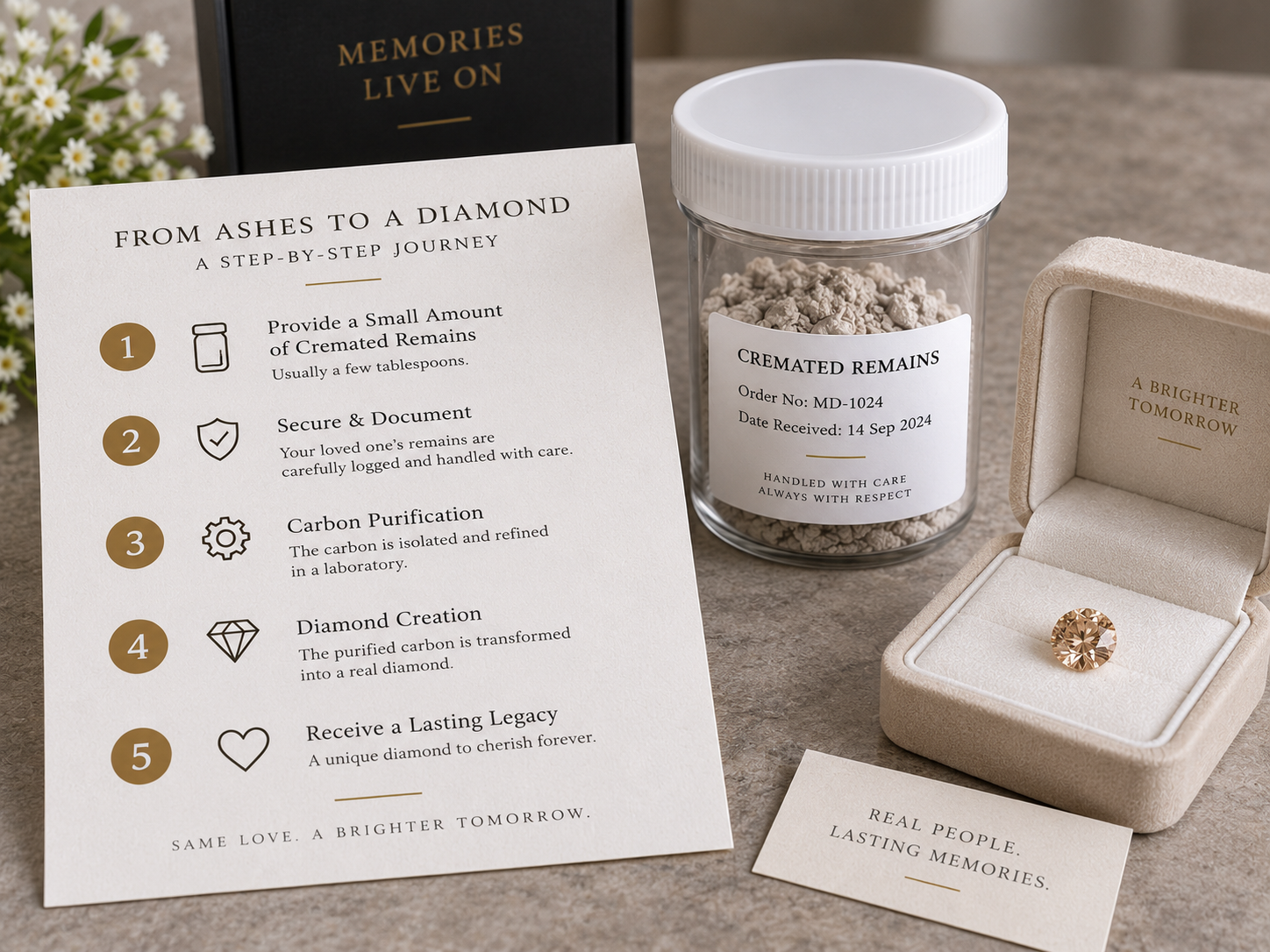
Six weeks after the package leaves your hands, the question can become less about what happens next and more about what you can still change.
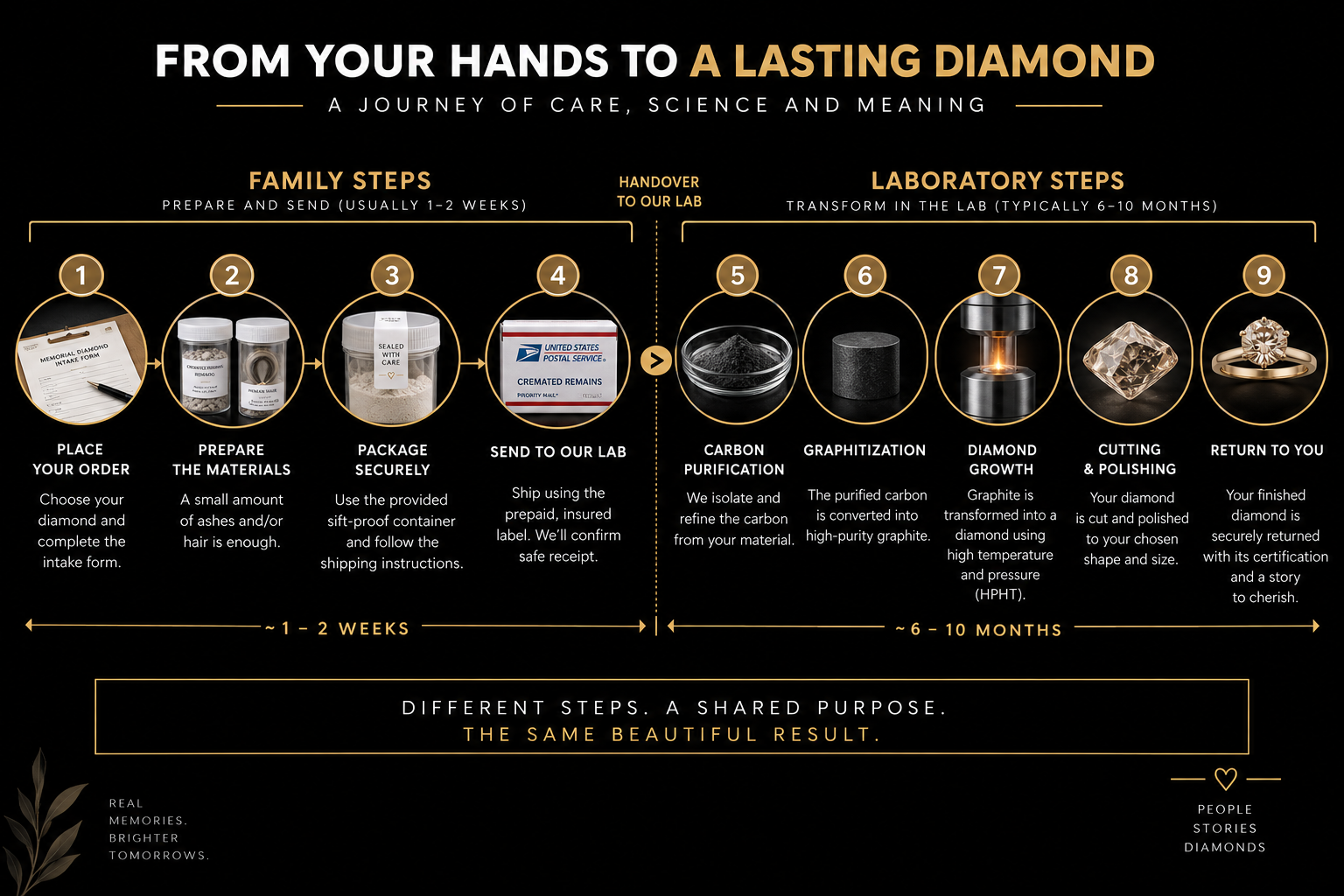
You can think of turning your mother’s ashes into a diamond as a nine-step journey: your family completes four steps, hands over the material, and the laboratory handles the final five steps. Along the way, you reach specific points where your choices become permanent.
Most providers estimate that the laboratory stage takes 6 to 10 months from receipt, though larger stones or specialty colors often require extra time. Importantly, this timeline does not start when you make your initial decision or when you drop the ashes in the mail. It begins only when technicians log receipt of the shipment at the facility.
This guide maps the process in order and highlights where important decisions may remain open or become fixed.
What Is Still Open, and When Does Each Decision Close?
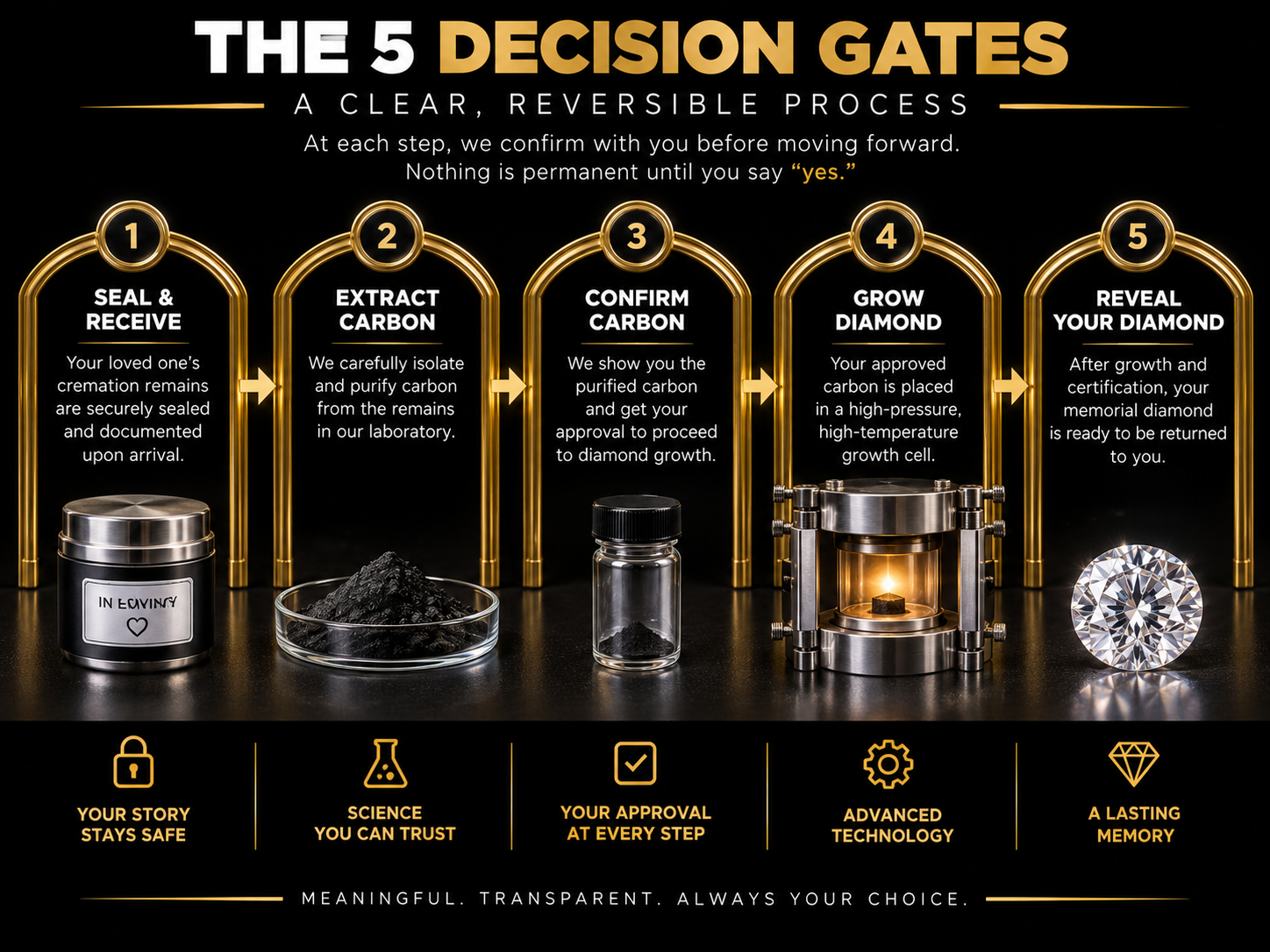
Five major decisions occur at different points in the process.
| Decision | Generally closes around | What happens afterward |
|---|---|---|
| Whether to proceed | Laboratory receipt/intake | Contact the provider immediately if you wish to stop |
| How much ash to send | When the package is sealed | Ask about additional material before processing begins |
| Carat and colour | Growth-cell loading | A change may require a new growth run |
| Cut shape | Cutting stage | The available rough determines what can be cut |
| Setting | No fixed deadline | A loose diamond can be set or reset later |
Important: these decision points are a practical process model rather than universal industry rules. Confirm the exact change and cancellation policies with your chosen provider before sending irreplaceable material.
What Do You Need Before You Start?
Before beginning, gather the information and materials you will need.
- Your mother’s ashes and an understanding of approximately how much you have
- Written information from your provider covering minimum quantity, documentation, returns, and specification-change deadlines
- The appropriate shipping materials for cremated remains
- A strong, sealable and sift-proof inner container
- A plastic bag and cushioning materials
- A clean, dry spoon if you need to transfer the material
- Sender and recipient details
- Cremation documentation if your provider or carrier requires it
- A safe place to record your tracking number and any provider reference number
If you are shipping within the United States, verify the current USPS requirements before mailing. The source data specifically identifies the USPS Priority Mail Express Cremated Remains box and related packaging requirements, but postal rules can change.
Steps 1–4: What Does Your Family Do?
Step 1 Specify the Stone in Writing
Start by deciding what kind of memorial diamond you want.
Carat size and colour can affect the expected production timeline, so ask your provider about these choices before the process begins.
More importantly, get the practical details in writing.
Ask:
- How much material is required?
- What documentation is needed?
- What happens to unused ashes?
- What is the cancellation policy?
- When can carat or colour still be changed?
- At what point does a specification become final?
A written answer gives your family something concrete to refer back to as the process progresses.
Step 2 Order the Shipping Box and Talk With Your Family
If your provider requires a specific cremated-remains shipping box, arrange it before you need to send the ashes.
This is also a good moment to have the family conversation.
For many families, the decision is not simply about creating a diamond. It is also about how much of your mother’s ashes should remain available for traditional memorial practices such as interment, scattering, or keeping the urn.
Taking that conversation seriously before sending anything can prevent difficult decisions later.
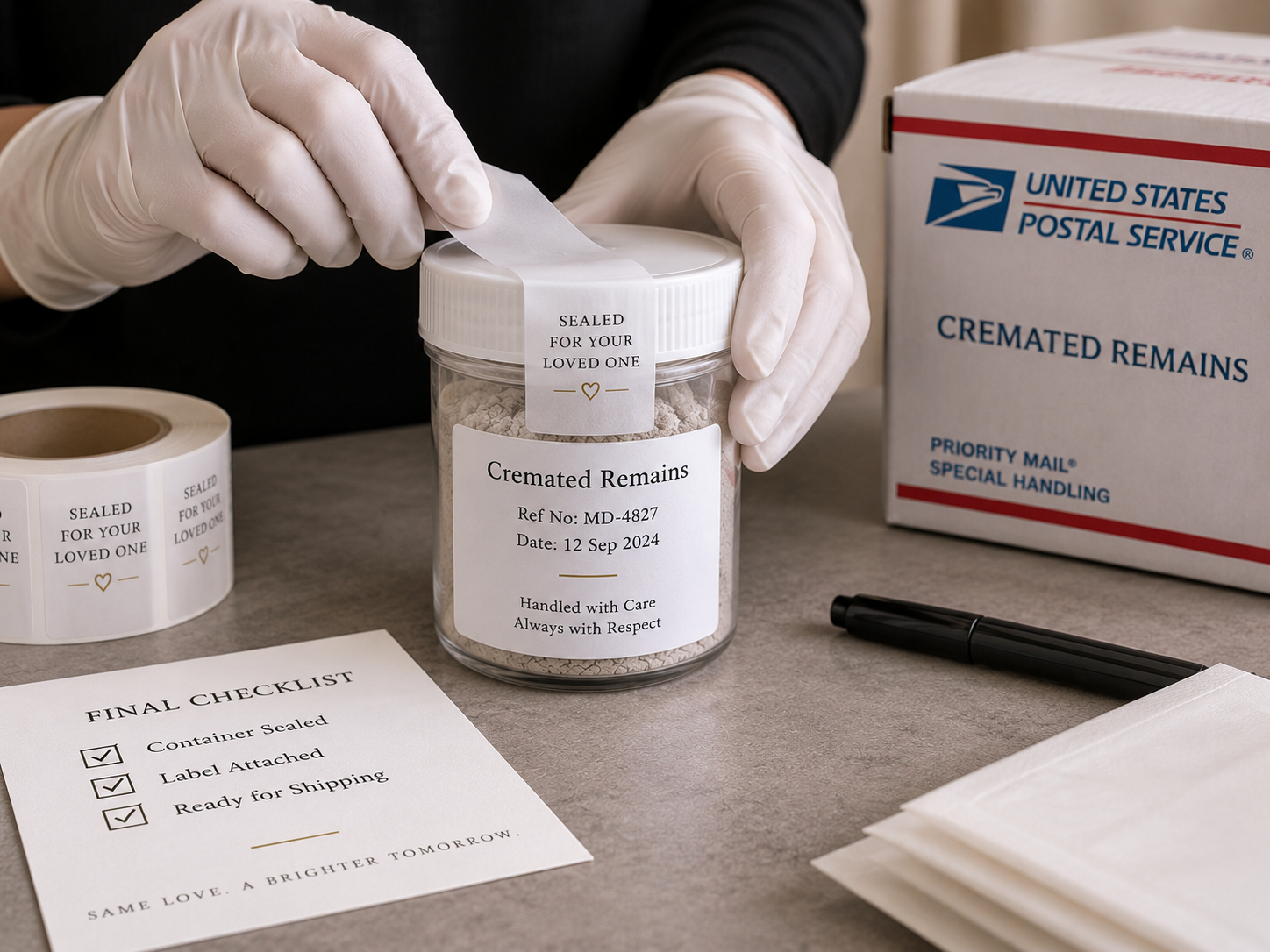
Step 3 Measure the Portion and Seal the Box
Once you know the amount your provider requires, prepare the portion you intend to send.
The important practical point is that sealing the package is a meaningful point of no easy return for the portion you have chosen.
Before sealing:
- Confirm the quantity against your provider’s written requirement.
- Make sure the inner container is properly sealed.
- Check that the packaging meets the applicable shipping rules.
- Confirm that you have retained the remaining ashes safely.
- Record the contents and tracking information.
Do not rely on a generic quantity from another provider. Use the actual requirement supplied by your chosen provider.
Step 4 Ship the Ashes and Notify the Provider
Once the package is ready, ship it using a carrier and service that currently permits the shipment.
For U.S. families shipping cremated remains directly, the source identifies USPS Priority Mail Express and the official Cremated Remains packaging as the relevant domestic route. Carrier restrictions should always be checked immediately before shipping because policies can change.
Notify your provider that the package is on its way.
Keep:
- Tracking information
- Shipping confirmation
- The provider’s order information
- Any chain-of-custody or reference number supplied after receipt
Step 4 Is the Handover and the Main Production Clock Has Not Started Yet
This is the point at which your mother’s ashes leave your hands.
One of the most important distinctions in the process is shipping time versus laboratory production time.
The commonly stated 6–10 month production window begins with laboratory receipt/intake, rather than with the day you first contact a provider or the day you mail the package.
That means your total calendar time can include:
Your preparation → packaging → shipping → laboratory intake → production → cutting and grading → delivery
The source specifically identifies the 6–10 month figure as an industry-typical production timeline rather than a confirmed turnaround for a specific provider.
Steps 5–9: What Does the Laboratory Do?
Step 5 Intake and Reference Number
After the material reaches the laboratory, it enters the provider’s intake process.
Ask whether the provider gives you a reference or chain-of-custody number that you can use when requesting updates.
This can make communication much easier during a process that may last many months.
At this point, confirm:
- The material has arrived
- Receipt has been recorded
- Your order/reference number is correct
- The provider can tell you how to request status updates
Step 6 Extraction, Purification and Graphitization
The supplied process description explains that the carbon-containing material undergoes processing to remove minerals and isolate carbon before graphitization.
The source describes purification to approximately 99.9%+ carbon purity, followed by conversion into graphite.
This stage is particularly important because it represents a transition from the original cremated material into material prepared for diamond growth.
Because the physical process is irreversible, confirm the provider’s policy regarding the return of unused material and the point at which cancellation is no longer possible.
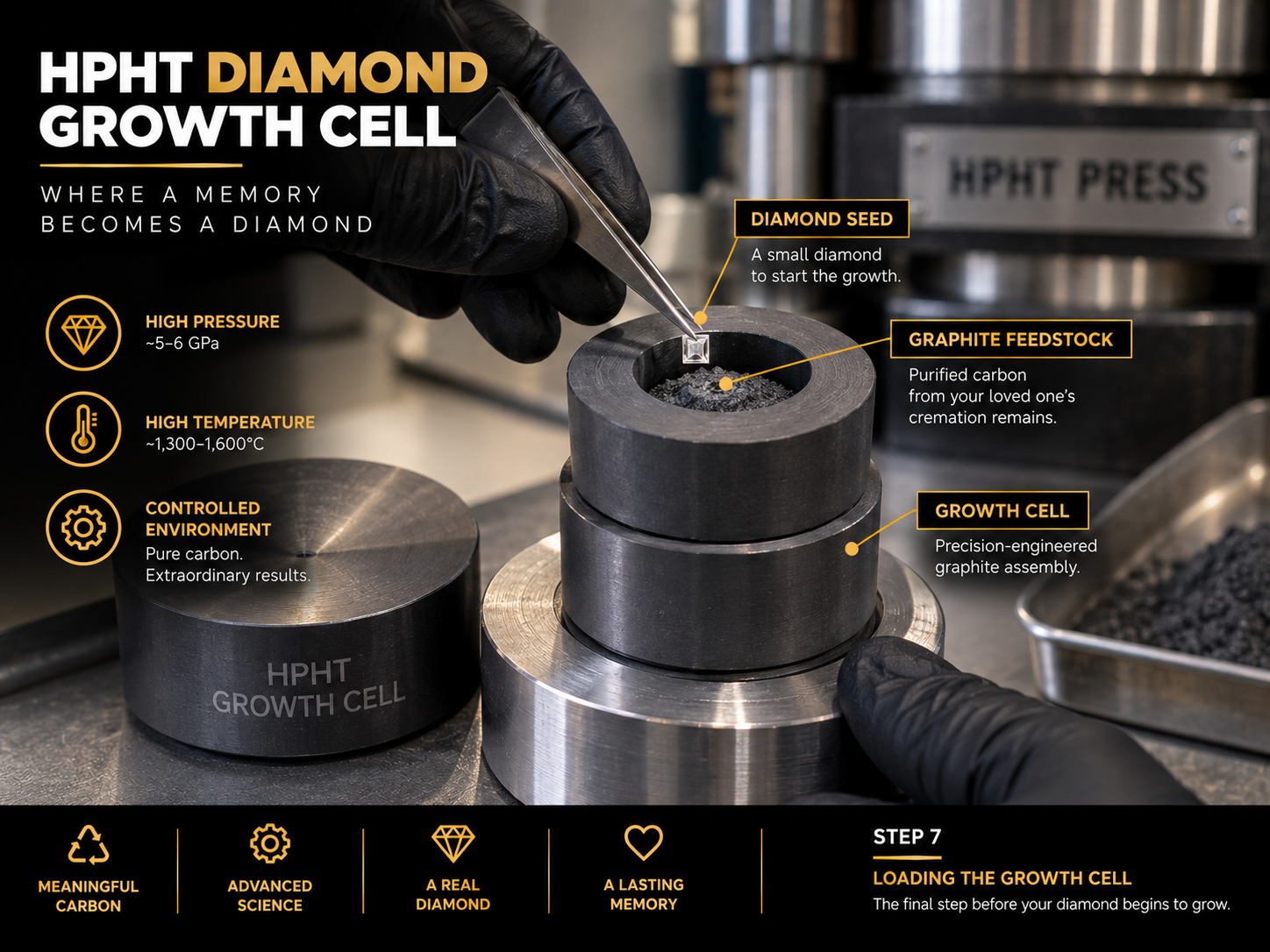
Step 7 Diamond Growth
The graphite is prepared for diamond growth and placed into a growth system together with a diamond seed and additional laboratory carbon where required.
The supplied data describes HPHT growth conditions in the range of approximately 6–8 GPa and 1,400–2,500°C, with growth taking weeks to months depending on the desired stone.
This is also where carat and colour become especially important.
A larger stone generally requires a different growth run rather than simply becoming an upgrade to an already-grown stone. Therefore, if you are considering changing the size or colour, ask your provider before the growth cell is loaded.
The source also notes that personal carbon is typically only a portion of the final diamond’s mass, approximately 10–15%, rather than the finished diamond being composed entirely of the person’s original carbon.
Step 8 Cutting, Grading and What Comes Back
After growth, the rough diamond is cut and polished into the selected shape.
This means the final shape depends partly on what the rough stone can produce.
The source places grading and documentation after cutting and also identifies the return of unused ashes as an important point to clarify with the provider.
Before the stone is finalized, ask:
- What cut shapes are available?
- Who performs the grading?
- Is the grading independent?
- What certificate or documentation accompanies the diamond?
- What happens to unused material?
Do not assume a particular grading laboratory or return policy unless your provider confirms it.
Step 9 Delivery and the Decision That Never Has to Be Rushed
When the diamond is delivered, it may arrive as a loose stone.
A loose diamond is not automatically a finished piece of jewelry. You can decide whether you want to place it into a ring, pendant, bracelet or another setting.
Unlike many earlier decisions, the setting does not have to be made immediately.
You can leave the diamond loose while you consider what kind of memorial jewelry feels right, and a stone can potentially be reset in the future.1

How Long Does Each Step Take?
The following is a practical planning framework rather than a guaranteed provider schedule.
| Step | Who | Typical planning timeframe | Important point |
|---|---|---|---|
| 1. Specify and confirm | Family | A few days | Nothing should be treated as final yet |
| 2. Order materials and discuss with family | Family | Several business days | Family decision |
| 3. Measure and seal | Family | Short preparation task | Quantity becomes harder to change |
| 4. Ship | Family → provider | Depends on carrier | Handover |
| 5. Intake | Laboratory | Provider-dependent | Production clock begins |
| 6. Extraction and graphitization | Laboratory | Weeks | Processing stage |
| 7. Diamond growth | Laboratory | Weeks to months | Longest production stage |
| 8. Cutting and grading | Laboratory | Provider-dependent | Final stone takes shape |
| 9. Delivery and setting | Provider → family | Provider-dependent | Setting can be decided later |
| Steps 5–9 | Laboratory | Typically 6–10 months | Longer timelines may apply to larger or specialty stones |
The source explicitly cautions that the individual durations in this table are estimates derived from the overall production timeline, not confirmed provider figures.
Which Step Are You On Right Now?
You can use the physical evidence you have to understand approximately where you may be in the sequence:
You only have an email conversation:
You are likely still in the planning stage. Nothing needs to have closed yet.
You have a sealed package waiting to be shipped:
Your selected portion has been prepared. Review everything one last time before sending.
Tracking says the package was delivered, but you have no provider confirmation:
Contact the provider and ask whether the material has been received and logged.
You have a receipt or reference number:
The laboratory intake stage has begun or is underway. Ask what stage the material has reached.
You have been told diamond growth has started:
Carat and colour changes may no longer be practical. Ask the provider before requesting any change.
You have received the finished diamond:
The production process is complete. Your remaining major decision is how, or whether, you want to set the stone.
Frequently Asked Questions
Does the six-to-ten-month timeline include the time I spend preparing and shipping the ashes?
Usually, the stated production timeline refers to the laboratory process beginning with receipt or intake. Preparation, obtaining packaging, family discussions and shipping can add additional time before production begins. Confirm the exact start point with your provider.
Can I still change the carat size after I have shipped my mother’s ashes?
Possibly, depending on the provider and the production stage. Ask as early as possible and provide your order or reference number. Once a growth run has begun, changing the requested size may require a new production run.
I think I sent too little ash. Can I send more?
Do not assume that additional material will automatically be accepted. Ask your provider whether a supplementary shipment can be associated with the same order and exactly when additional material stops being usable.
How do I find out which stage my mother’s diamond is at?
Ask your provider for the current status using your order or chain-of-custody reference number. A provider should be able to explain which broad stage the order has reached and what remains.
Can my funeral home help ship my mother’s ashes?
A funeral professional may be able to help arrange transportation, but the exact options depend on the carrier, account and applicable rules. Ask your funeral director what they can arrange and confirm the carrier’s current requirements.
Nothing on This List Closes Today
If you are still deciding whether a memorial diamond is right for your family, your next step does not have to be a commitment.
Start by asking your chosen provider:
- How much material do you require?
- What documentation do you need?
- What happens to unused ashes?
- When can I still change the carat or colour?
- What is your cancellation policy?
- How will I track the order?
The most important thing is to understand where the irreversible points are before you reach them.
A memorial diamond is a deeply personal decision. Taking the time to understand the sequence, ask questions and confirm policies in writing can help your family make the decision with greater clarity.