How to Turn Your Grandmother

How to Turn Your Grandmother’s Ashes and Hair Into a Diamond

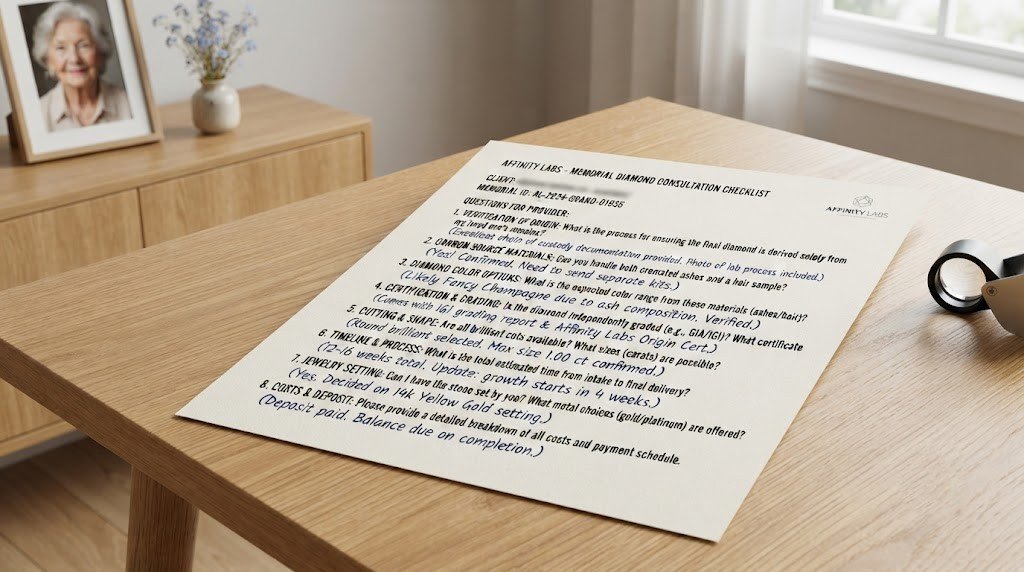
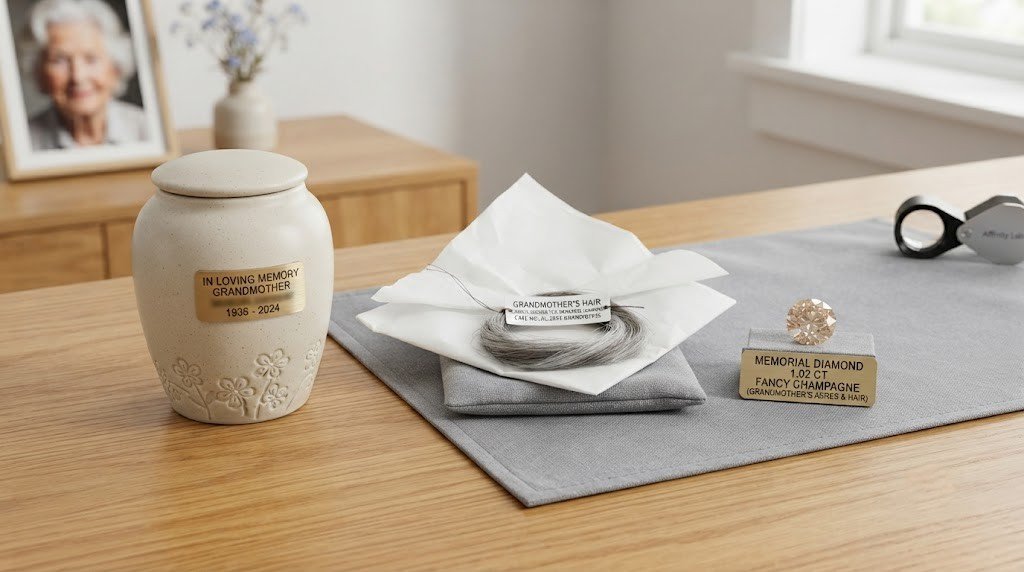
Perhaps an aunt keeps the urn on a bookshelf while a cousin still has the lock of hair saved at the funeral home, and you have been wondering whether the two could become one stone. To turn grandmother ashes and hair into a diamond, first confirm that a provider will combine both materials at all, then gather each one with the agreement of the right people, send the amounts requested, and allow roughly 6 to 10 months for the lab work once everything arrives.

Not every provider blends materials, and some suggest a separate stone from each instead. Working that out before anything is packed saves a great deal of back and forth between relatives.
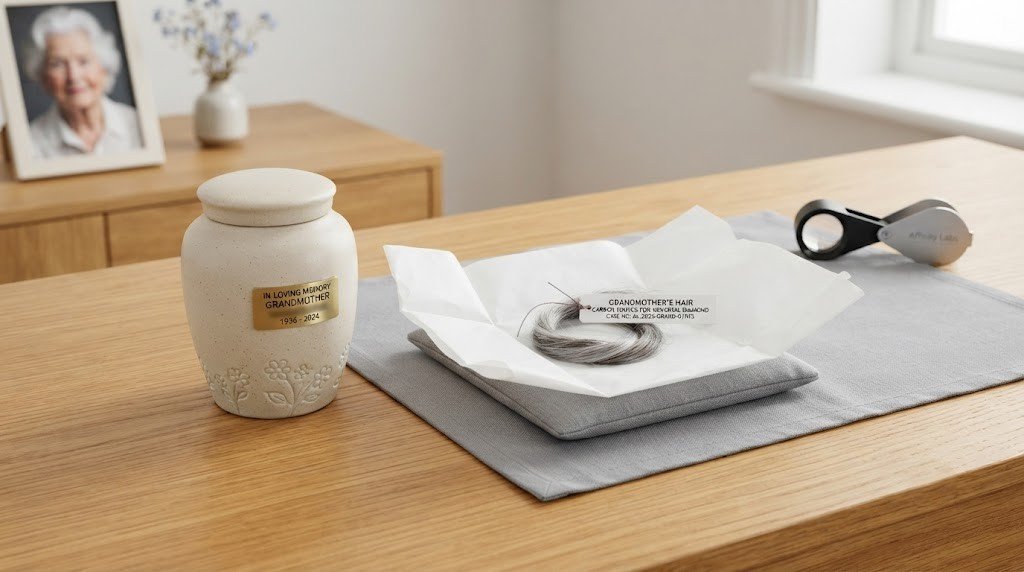
turn grandmother ashes and hair

Will a provider turn grandmother ashes and hair into one stone?

Whether anyone will turn grandmother ashes and hair into one stone is the first question to settle, because the answer shapes everything after it. Some providers may grow a single stone from more than one source material, while others may prefer to keep each source separate. Before anyone in the family opens an urn or cuts a lock, ask each provider you are considering whether it will turn grandmother ashes and hair into a single diamond, and how it handles the two materials once they arrive.

Three workable paths

OptionWhat it meansWhen families tend to consider it
One combined stoneCarbon from her ashes and her hair is grown into a single diamondWhen the meaning lies in bringing both together
Two separate stonesOne diamond from the ashes, one from the hair, often for different relativesWhen the urn and the hair sit with different branches of the family
One material onlyA stone from hair alone, or from ashes aloneWhen one material is unavailable or the family prefers to keep it intact

None of these is better than the others, and families who set out to turn grandmother ashes and hair into a keepsake sometimes change course once they hear what providers offer. A combined stone suits a family that wants one heirloom; two stones may suit relatives who live far apart or who each hold one of the materials.

Questions to put in writing

  • Do you grow combined stones from ashes and hair together?
  • If so, how are the two materials processed, and are they tracked separately?
  • If not, can you grow separate stones from each, and can they be ordered together?
  • What happens to any ashes or hair you do not use?

Get the replies by email. When you plan to turn grandmother ashes and hair into a diamond, written answers protect everyone, especially when several relatives are contributing.

For a broader overview of how combined stones differ from single-source ones, the complete guide to grandmother ashes and hair diamonds is a good starting point.

Who needs to agree before you turn grandmother ashes and hair into a diamond?

When you plan to turn grandmother ashes and hair into a single keepsake, the two materials come with different questions about who decides. Ashes are remains, and the people with authority over them are set by state law and by any written wishes she left. Hair kept at home is usually more straightforward, but it can still count as part of her estate.

Authority over her ashes

The order of who decides differs from state to state. A surviving spouse or partner, and after that her adult children, commonly hold that authority ahead of grandchildren, though her own written instructions may change the picture. If you are not sure who signed the cremation authorization, the funeral home or crematory that handled her care can usually tell you.

As a grandchild, the respectful route runs through that person: explain the idea and ask if they would be willing to release a modest amount for a stone. It can help to mention that a stone typically draws on only a small fraction of the ashes, so the rest can still be kept, scattered or interred as planned, and that you hope to turn grandmother ashes and hair into something the whole family can see.

The estate question for her hair

A lock of hair in a drawer can feel too small to matter, yet personal belongings may pass through an estate, and state rules differ. Before you turn grandmother ashes and hair over to a lab, a quick word with the executor, or whoever is handling her affairs, keeps the hair side of the plan on solid footing.

Faith and family tradition

If faith shaped how she lived or how her family mourns, it is worth a conversation with clergy before you divide the ashes. Religious bodies have not ruled on memorial diamonds specifically; what they address is cremation itself and what happens to ashes afterward. Catholic teaching permits cremation but asks that the ashes remain intact in a sacred place, allowing only a narrow exception for a small part, so dividing them may need pastoral advice. Views elsewhere vary by tradition, community and family, and a local faith leader is the right person to ask.

Where dividing the ashes is not acceptable to the family, a hair-only stone involves no cremation at all. The guide on using her hair on its own covers that route in full.

How do you gather what you need to turn grandmother ashes and hair into a stone?

Coordination is the heart of any plan to turn grandmother ashes and hair into a diamond. Her ashes may already have been divided, scattered in part, or placed with an aunt, uncle or parent, and the hair may be with someone else entirely. If she died years ago, both materials may have changed hands more than once.

Map who holds what

Start with a simple list, shared with everyone involved:

  1. Who holds her ashes now, and whether any were already divided or scattered.
  2. Who holds any of her hair, and whether it is labeled as hers.
  3. Who has authority over the ashes, and who is settling her estate.
  4. Which grandchildren, children or other relatives would like a stone.
  5. Who will be the single point of contact with the provider.

Choosing one contact person matters more than it sounds. When a family sets out to turn grandmother ashes and hair into a diamond, a single coordinator keeps the paperwork, tracking numbers and decisions in one place and makes sure nobody ships materials twice.

Respecting what has already been done

If part of her ashes was scattered at a place she loved, or interred in a family plot, that choice stands on its own. A memorial diamond can sit alongside an urn, a burial or a scattering, and nobody needs to revisit decisions already made. Work with whatever portion the person holding it is comfortable sharing; you can still turn grandmother ashes and hair into a stone using only a small part.

When one relative says no

Sometimes the person holding the urn would prefer to keep it untouched. That is their decision to make. You may still be able to turn grandmother ashes and hair into stones on different timelines, starting with the hair alone now and leaving the door open to a later conversation about the ashes.

How much should you send to turn grandmother ashes and hair into a diamond?

Each provider sets its own requirements for what it needs to turn grandmother ashes and hair into a diamond, so the figures below are general industry ranges rather than fixed rules. Ask for the exact amounts in writing, especially for a combined stone, since a provider may want a different quantity of each material when both are used.

MaterialTypical amount requestedCarbon content
Cremated ashesA few tablespoons up to roughly 4 oz (about 100 g)Usable carbon is roughly 0.5 to 4% of ash by weight
HairA small lock or a few gramsAbout 50% carbon by weight

The ashes requested are usually a small fraction of what the family holds, which is why most of them can stay where they are. Hair carries far more carbon by weight, so only a little is needed.

Sending more of either material does not produce a bigger or faster stone, because carat size depends on growth time. For measuring and dividing each one, see how much ash and hair a grandmother memorial diamond typically needs, which goes into more detail.

Packing two materials

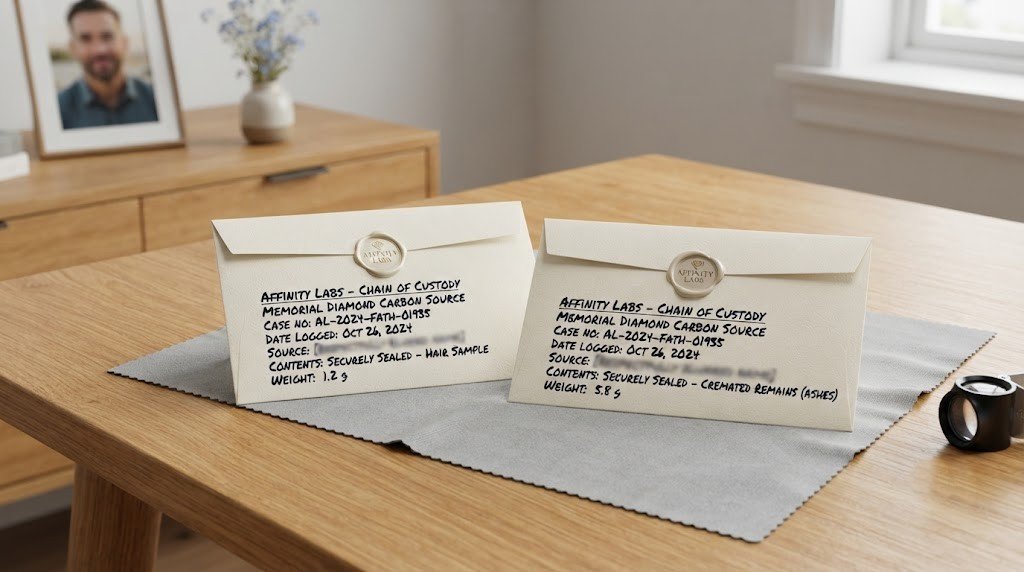
Before you turn grandmother ashes and hair over to a courier, use the provider’s kit or instructions for both, and label each container with her full name, the material and who supplied it. Ask how a provider that agrees to turn grandmother ashes and hair into one stone tracks two materials from the same person, whether you receive confirmation when each arrives, and what happens to anything not used.

How much of a blended stone is actually her carbon?
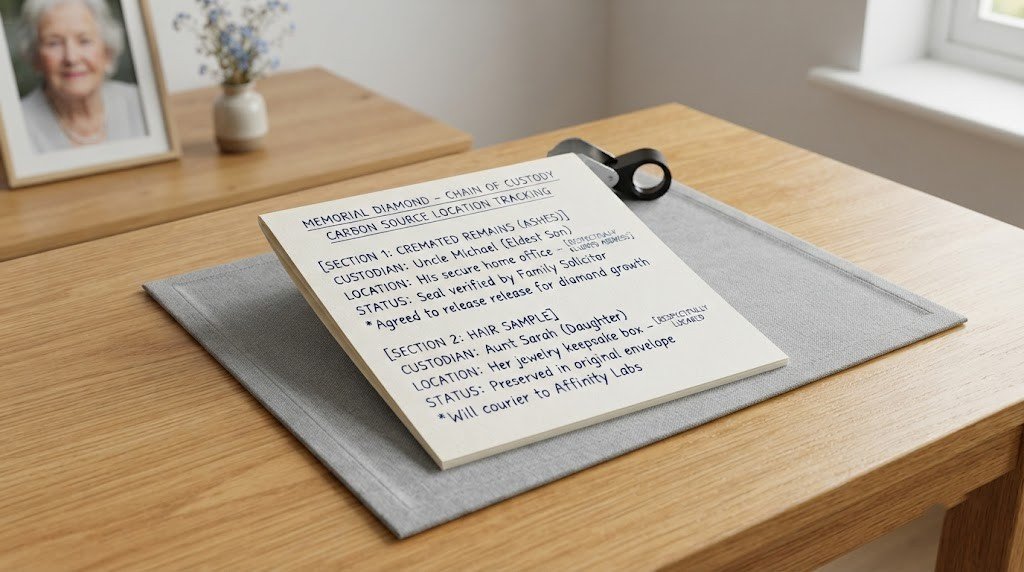
Anyone hoping to turn grandmother ashes and hair into a stone deserves a straight answer here, and that answer has limits. No memorial diamond is grown purely from a person’s remains; recovered carbon is purified to roughly 99.9% or higher and typically blended with supplemental lab carbon so the crystal can grow to a usable size.

For stones made from ashes alone, industry sources usually put the person’s own carbon at roughly 10 to 15% of the finished stone by mass, though individual providers report figures ranging from about 3% upward. That figure applies to ash-based stones only. For a stone that combines ashes and hair, no comparable finished-stone percentage has been published, so ask each provider to state its own figure in writing and explain how it was measured.

What the lab does with both

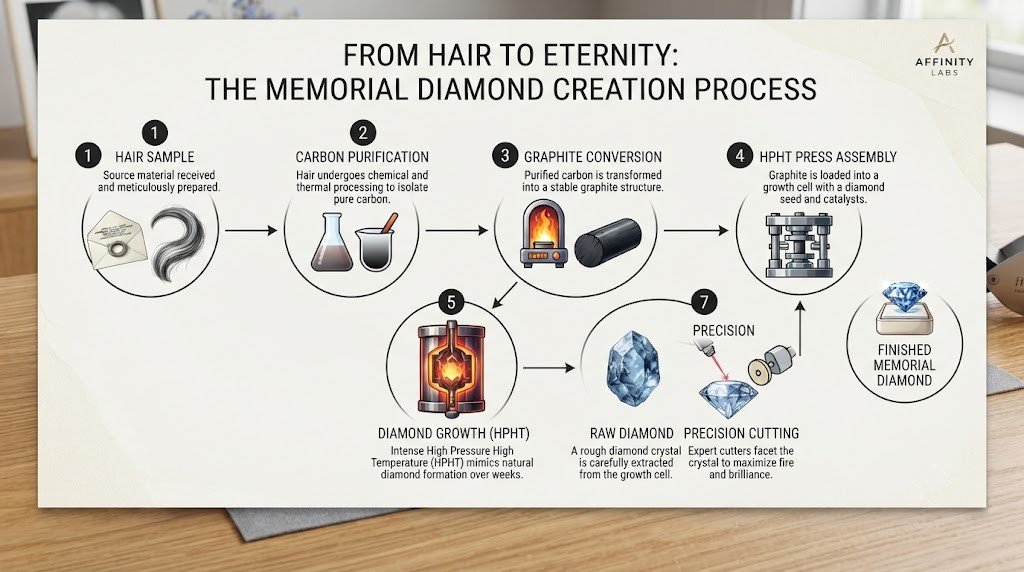
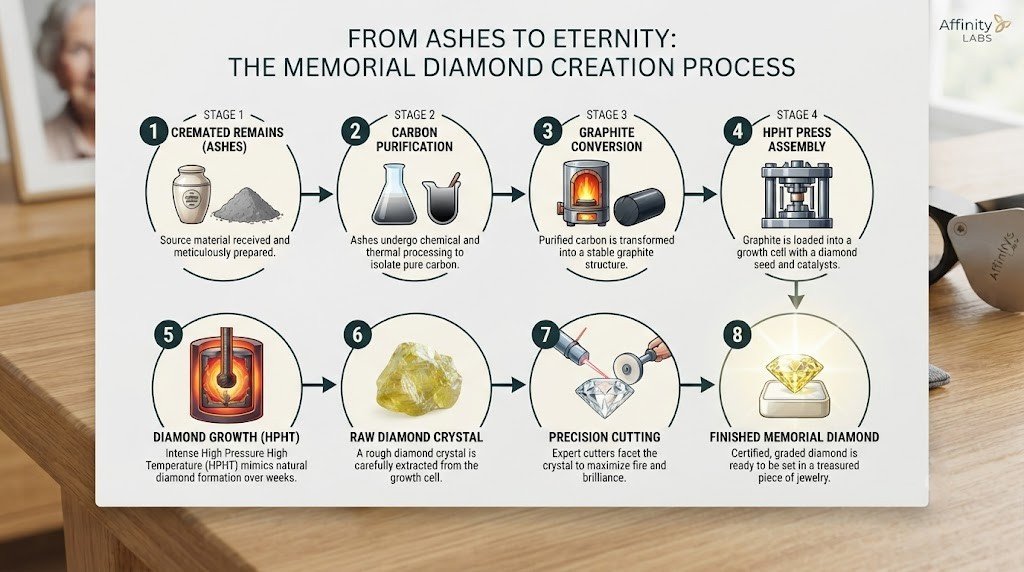
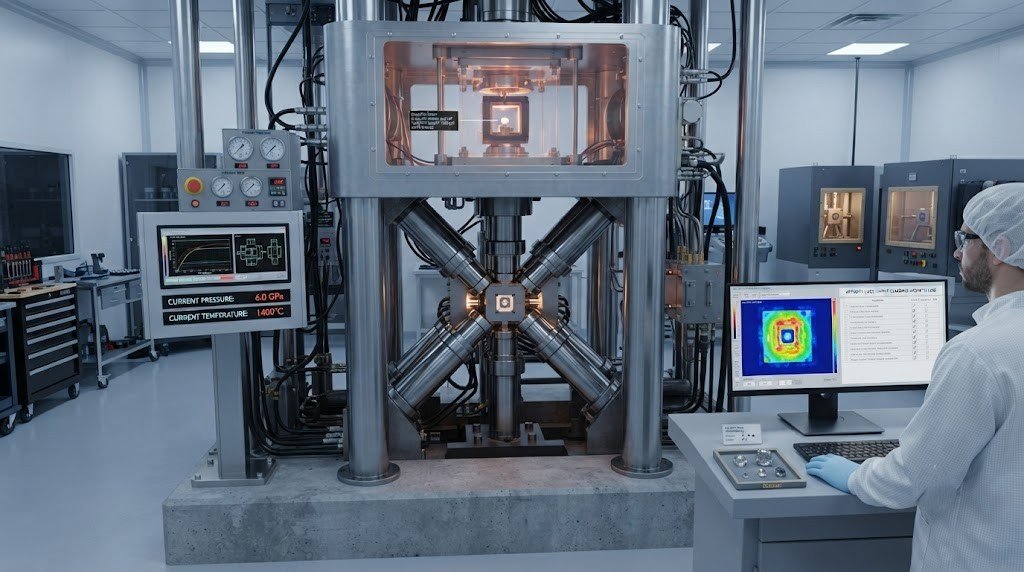
Once materials are logged, carbon is extracted and purified, converted to graphite at about 2,500 to 2,700°C, and then grown, usually by HPHT, where a press holds the cell near 6–8 GPa and 1,400–2,500°C while the crystal forms over a period of weeks or months. The stone is then cut, polished and graded. Some providers offer irradiation afterward to shift color. The general background on memorial diamonds as a category explains how this sits within lab-grown diamond production.

Whether a provider extracts carbon from the ashes and the hair separately before blending is a process question only that provider can answer. A closer look at whether a stone is truly grown from both her ashes and her hair lists the follow-up questions worth asking, and a step-by-step account of how a lab grows a combined stone covers the science more fully.

What do you choose when you order the stone?

Placing the order is when a plan to turn grandmother ashes and hair into a diamond settles into concrete details. Settle these points before anyone signs anything, and keep the decisions written down with everyone who is contributing.

Size and cost

Memorial diamonds generally run from about 0.10 carats to 5 carats or more. Across the industry in 2026, a stone of roughly 0.10 to 0.25 ct typically costs about $1,500 to $3,500; 0.5 to 1 ct runs about $5,000 to $15,000, with colorless costing meaningfully more; and 2 to 5+ ct ranges from roughly $20,000 to $75,000 or more. These are general market figures, not Memorial Diamond’s pricing. Grading reports, engraving, fancy cuts and settings are usually charged separately, and a combined stone may be priced differently from a single-source one, so ask.

Color

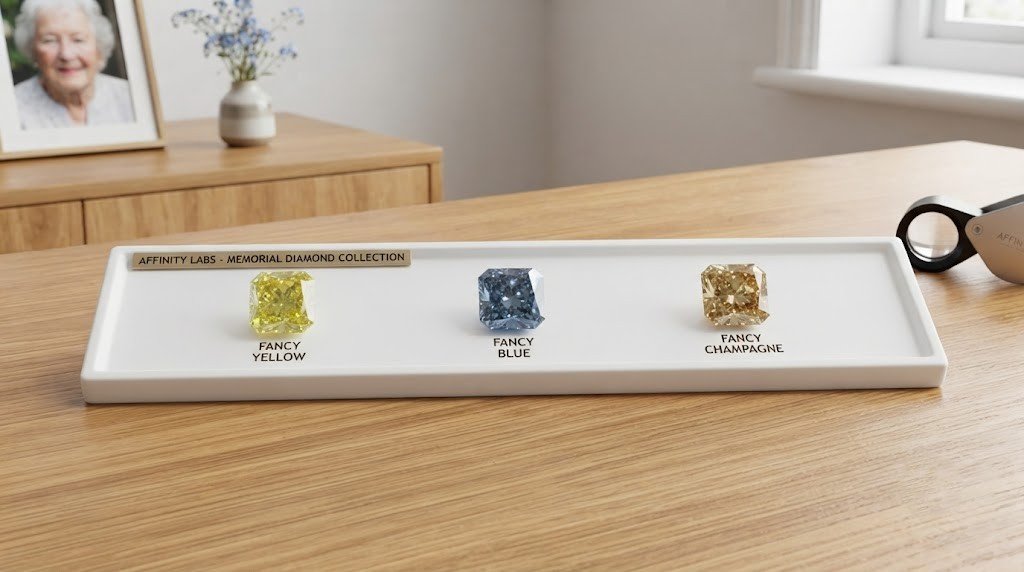
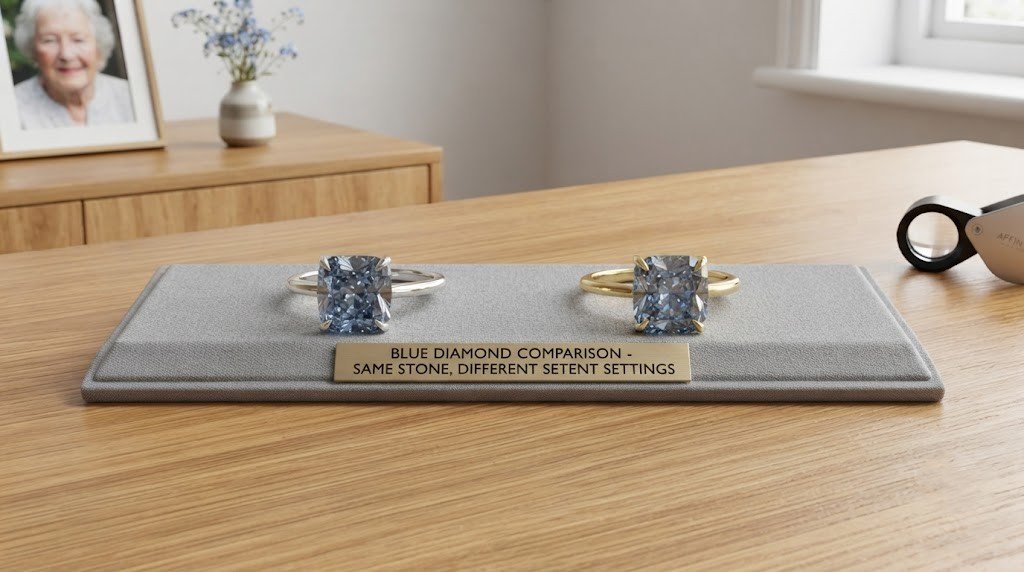
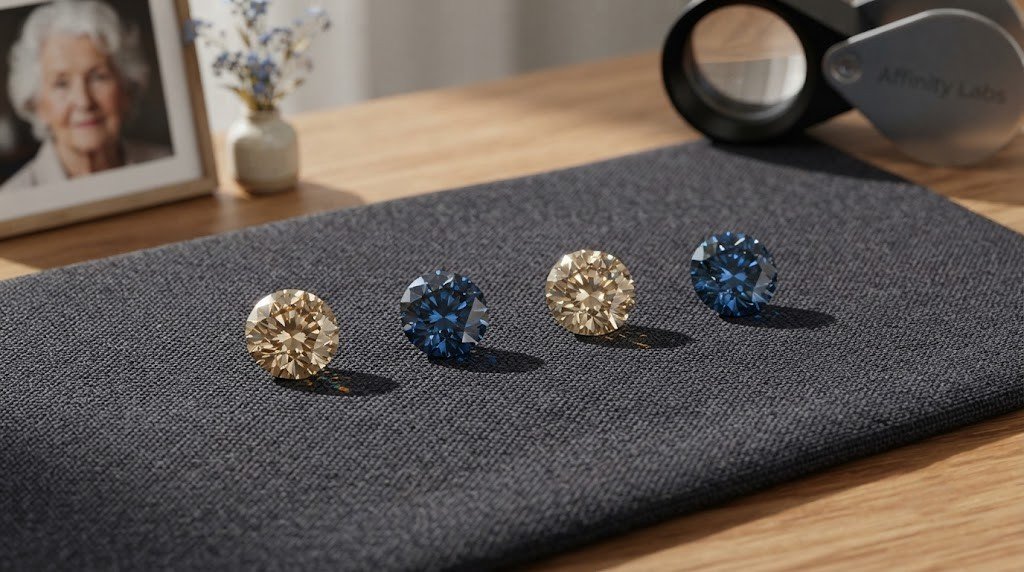
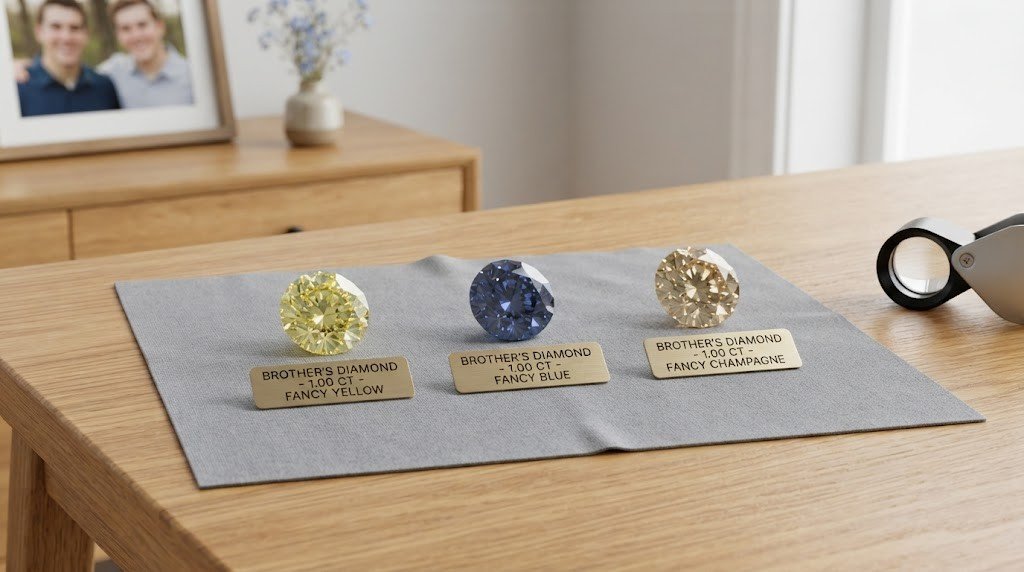
Trace elements decide color: boron gives blue, nitrogen gives yellow, and a colorless stone needs both excluded through extra processing, which typically costs more. Memorial diamonds often come out yellow, blue or champagne-brown, and some providers offer irradiation for red, pink, green or black. Choosing to turn grandmother ashes and hair into one stone does not let a family pick a precise natural shade. The guide to color in a grandmother ashes and hair diamond explains what to expect.
Grading and certificates

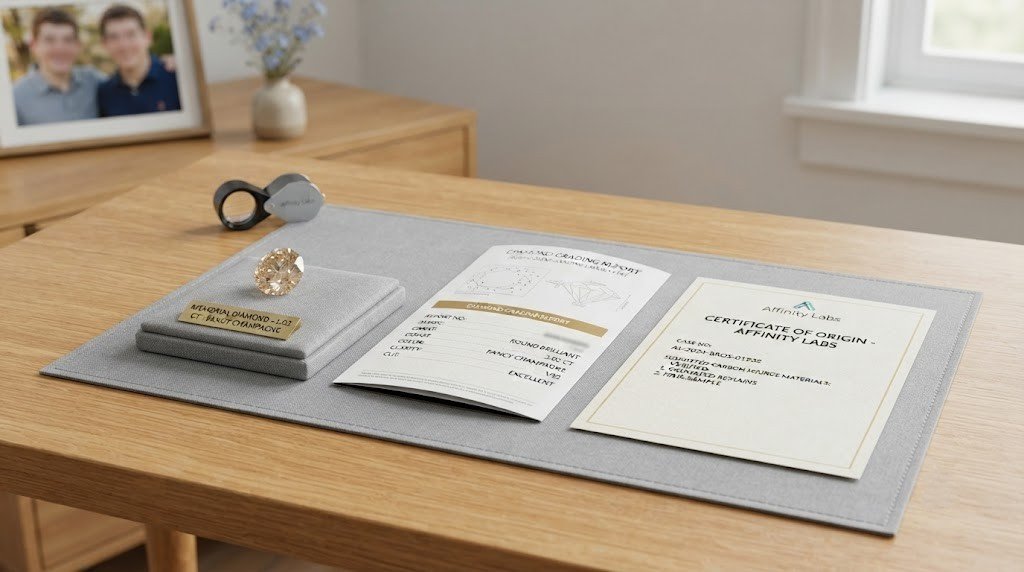
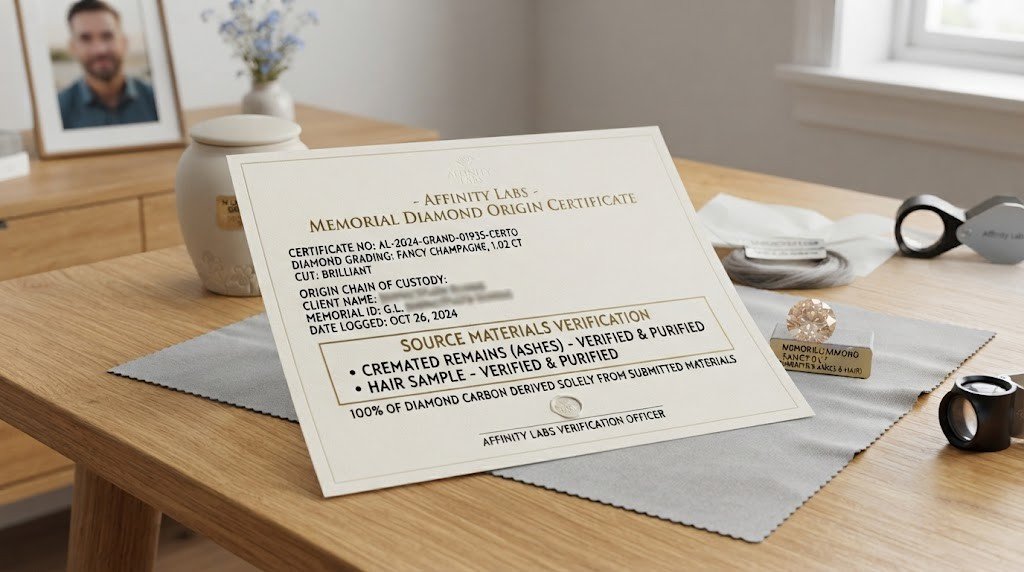
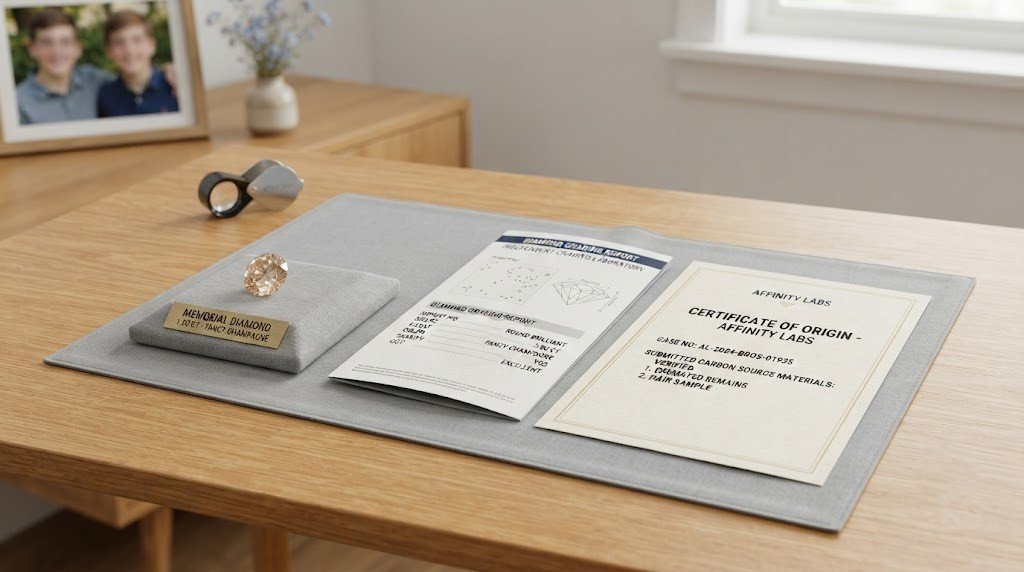
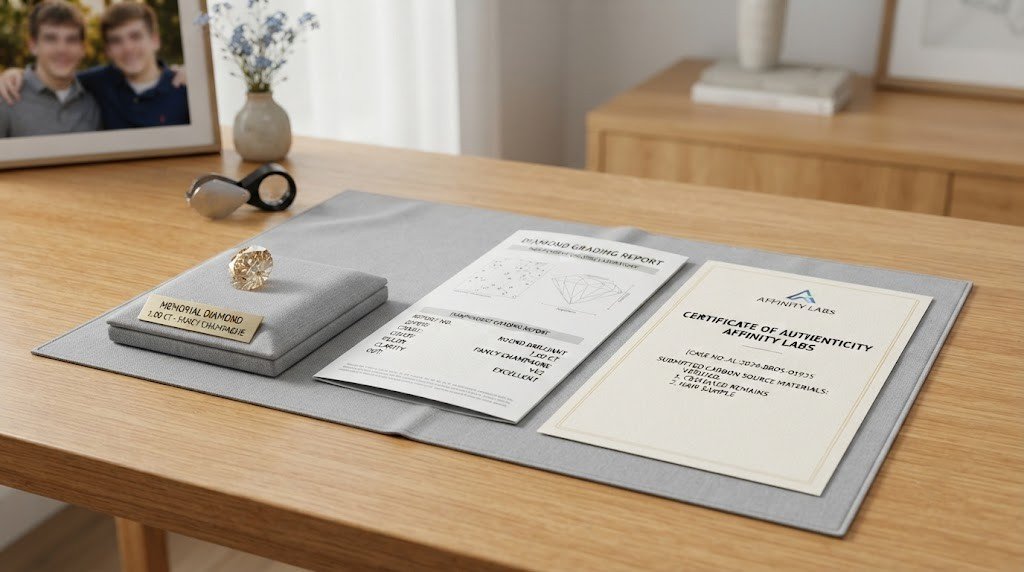
Two different documents may come with the stone. An authenticity or origin certificate, usually issued by the provider, records chain of custody. A grading report assesses the 4Cs of the stone itself; one from an independent lab carries the most weight, and most providers charge for it on top of the stone. Memorial diamonds usually grade between SI2 and VVS for clarity.

Setting

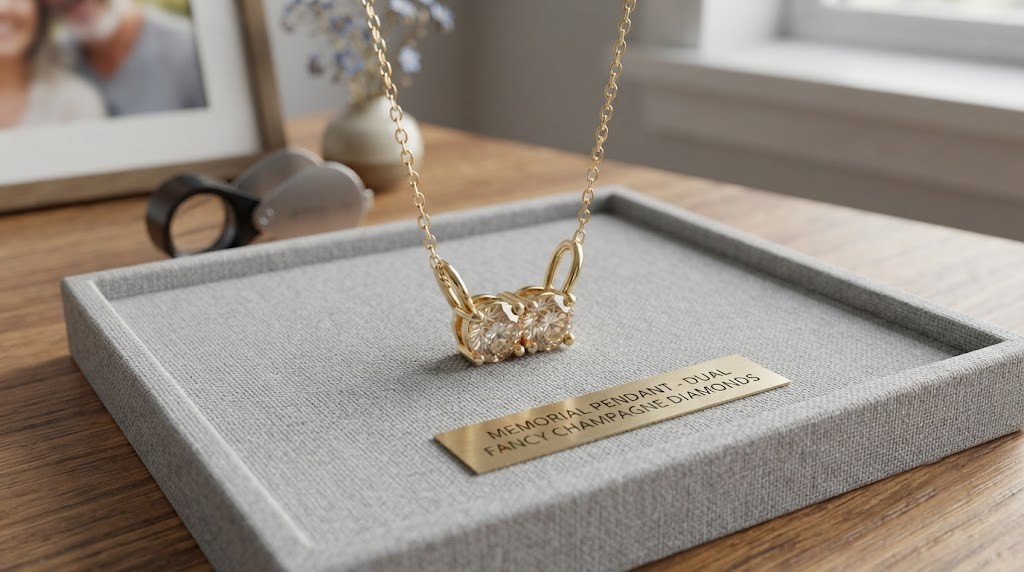
Choose a setting for the person who will wear it and for who she was, not for a generic idea of a grandmother. A ring for someone who wears rings daily, a pendant or cufflink for someone who does not, or a loose stone kept with its papers for a future generation to set are all reasonable. Diamond rates 10 on the Mohs hardness scale, though a sharp knock can still chip one, so a protective setting helps for everyday wear.

How long does it take to turn grandmother ashes and hair into a diamond?

Once a provider has the materials in hand, industry timelines usually run 6 to 10 months. A larger stone, above roughly 2 carats, or a specialty shade like black may need closer to a year.

The time before shipping is entirely yours. Gathering two materials from different relatives, waiting for an estate to settle, or giving someone room to decide about the ashes can take weeks or months, and there is no deadline on any of it. Starting a decade after her death is no obstacle: the lab work is identical whenever you turn grandmother ashes and hair into a stone.

If you turn grandmother ashes and hair into several stones in one order, ask whether they are grown at the same time or one after another, and get an estimated delivery for each in writing.

Can grandchildren and cousins each have a stone?

Often, yes. It is reasonable to ask a provider whether it can turn grandmother ashes and hair into more than one stone, and because each stone typically uses only a portion of the material, several relatives can often receive their own diamond from the same shared ashes and hair, depending on the provider. Some families choose matching small stones for each grandchild; others choose one larger stone for an aunt or a parent and smaller ones for the next generation.

Keeping it fair and calm

  • Agree early on how costs will be split, or whether each person pays for their own stone.
  • Decide whether every stone will be combined, or whether some will be hair-only or ash-only.
  • Let each person choose their own setting, even if the stones match.
  • Share provider updates with everyone, through the single coordinator.

When cousins set out to turn grandmother ashes and hair into several stones, the conversations are usually more important than the logistics. Anyone who would rather not take part can simply step back, with no pressure either way.

If the ashes route alone is the more practical choice for some branches of the family, the walkthrough on turning a grandmother’s ashes into a diamond explains that process.

Frequently Asked Questions

Do all providers combine ashes and hair in one diamond?

No. Some providers offer combined stones and others prefer separate stones from each material. Ask each provider directly whether it blends ashes and hair, how both are tracked, and whether separate stones can be ordered together, and get the answer in writing.

Who decides whether I can turn grandmother ashes and hair into a diamond?

State law and her written wishes set who holds authority, and the order varies between states. Her spouse or partner, and next her adult children, typically rank before grandchildren. Whoever handled the cremation can usually tell you whose signature is on the authorization form.

Is a combined stone made entirely from her ashes and hair?

No. Recovered carbon is purified and typically blended with supplemental lab carbon. Ash-only stones are commonly cited at around 10 to 15% personal carbon, but no figure has been published for combined stones, so ask each provider for theirs in writing.

What if her ashes were already scattered or divided?

You can work with whatever portion remains and whoever holds it agrees to share. If no ashes can be shared, a stone grown from her hair alone needs none. A provider can confirm the minimum amount of each material it requires before you plan around it.

Can I turn grandmother ashes and hair into stones for several cousins?

Often, yes, depending on the provider. Each stone typically uses only a portion of the material, so several relatives can frequently receive their own. Agree on costs, settings and a single family coordinator before anything is sent to the provider.

Does using two materials change the color of the diamond?

No published evidence shows that combining materials lets a family choose or predict a shade. Color comes from trace elements during growth, with boron producing blue and nitrogen yellow. Colorless stones need extra processing and typically cost more than yellow, blue or champagne.

How long does a combined grandmother memorial diamond take?

Across the industry, the lab stage typically takes 6 to 10 months after the provider receives the material, and up to about 12 months for stones over 2 carats or specialty colors. Gathering materials beforehand happens at your family’s own pace.

Final Thoughts on Turning Her Ashes and Hair Into One Diamond

Choosing to turn grandmother ashes and hair into a diamond is as much a family project as a technical one. The lab work follows a well-worn path; the care lies in asking the right people, respecting what has already been decided, and getting clear written answers from a provider before anything leaves home.

Some families find it meaningful to hold a stone that draws on both, while others settle on two stones or one material. Each of those choices honors her.

Learn More About Combining Your Grandmother’s Ashes and Hair

Talk With Memorial Diamond

Whether your family is still mapping out who holds her ashes and hair or is ready to compare providers, Memorial Diamond is glad to talk it through. Visit memorialdiamond.us to ask how to turn grandmother ashes and hair into a stone, or anything else on your mind, at whatever pace suits everyone involved.
How to Talk to Family About a Brother Memorial Diamond

How to Talk to Family About a Brother Memorial Diamond

Some ideas feel too tender to say out loud, especially when the people you would say them to are missing him too. If you have been quietly thinking about a brother memorial diamond, the kindest route is usually to speak first with whoever holds authority over his remains, pick an unhurried moment, describe the idea plainly, and let each person answer in their own time. Nothing has to be settled quickly, and a no can be honored without giving up on remembering him in a tangible way.

This guide covers who may be involved, what each person might feel about a brother memorial diamond, and how to handle the harder conversations about faith, money and disagreement. It assumes nothing about his age, his relationships or the shape of your family.

about a brother memorial diamond

Who Should You Speak With First About a Brother Memorial Diamond?

The first conversation is usually with whoever has the right to decide what happens to his ashes. That right flows from state law and any written wishes he left, and the priority order differs between states, so a spouse or registered partner, his adult children or his parents might each come before a sibling. The funeral home or crematory that handled his cremation can usually tell you who signed the authorization.

Going to that person first is about respect as well as practicality, because hearing a plan secondhand can feel like being overlooked. A private first talk about a brother memorial diamond also tells you early on whether ashes are still available, since they may already have been interred, scattered or set aside for another purpose.

Who might be part of the conversation

Treat this as a map of possibilities rather than a checklist. Some of these people may not exist in your brother’s life, and others not listed may matter more.

WhoTheir possible roleWhat they may care about
His spouse or partner, if he had oneMay hold authority, depending on state law and his written wishesTheir own plans for his ashes; being asked first
His adult children, if anySome states place them ahead of siblingsTheir parent’s memory; a keepsake for the next generation
His parentsMay hold authority, depending on the state and his wishesWhether the urn or grave still holds him; faith; timing
Other siblingsOften a voice only, though in some states a sibling decides when no closer relative canBeing included; fairness if several stones are made
Close friends or chosen familyRarely a formal roleBeing acknowledged in how he is remembered
Executor or estate administratorHandles his belongings and estateWhether hair or possessions belong to the estate; costs
Clergy or a community elderAdvisory onlyWhether the plan fits the family’s practice

If the decision is not yours to make

Being his sibling still gives you a voice, even when it does not give you the final say. A considerate request is to ask whoever holds authority whether a small portion could be set aside for you. The amount providers request typically runs from a few tablespoons up to around 4 oz (roughly 100 g), usually a fraction of the whole, and sharing how much of his ashes a provider might need can make your request feel concrete rather than open-ended.

Hair is another possibility, because it involves no cremation and only the small lock a provider typically asks for. Even a lock kept in a drawer can count as part of his estate, and how that works varies by state, so check first with his executor, or the relative handling his estate, before you ask anyone about a brother memorial diamond grown from hair.

When Is a Good Moment to Bring It Up, and How?

Timing often matters more than wording when you first speak about a brother memorial diamond. Funerals, anniversaries and holidays are crowded with feeling, so a quieter one-on-one moment, with time to sit together afterward, usually gives the other person room to think rather than react.

Explain what a memorial diamond actually is before asking for anyone’s view. It is a real lab-grown diamond, mostly grown by HPHT and graded on the same cut, color, clarity and carat scale as any other. In an ash-based stone, his recovered carbon is purified and typically blended with supplemental lab carbon, making up around 10–15% of the finished stone, though some providers quote as little as 3% and others more. Honesty here avoids a painful surprise later, and a plain explanation of how a stone is grown from a brother’s ashes can answer what you cannot.

A few short openers

These leave the door open without asking for an answer on the spot:

  • “I’ve come across something I’d like to share whenever you have room for it.”
  • “Nothing needs deciding now. I just didn’t want to keep it from you.”
  • “If this doesn’t feel right to you, please tell me. I’d rather know.”
  • “Could I leave you some reading and come back to it next week?”

Keep that first talk about a brother memorial diamond short, offer written information, and let the other person choose when to return to it.

How Might His Parents Feel About a Brother Memorial Diamond?

His parents may be the people you most want to protect, and the ones you feel most nervous approaching about a brother memorial diamond. A parent grieving a son can meet any new idea about his remains with fierce protectiveness, or with relief that someone is thinking of ways to keep him close. Neither first reaction tells you how the conversation will end.

Avoid assuming a single parental view. His parents may disagree with each other, live apart, be estranged from him or from you, or have died. If they are separated, speaking with each on their own is usually fairer. And if a parent holds authority over his ashes, their answer carries weight that a sibling’s preference does not.

A parent’s practical questions are sometimes emotional ones in disguise; “Will there be anything left?” can mean “Will the urn or grave still hold him?” A diamond uses only a small fraction of the ashes, so most can still be kept, interred or scattered as planned, and a diamond and an urn can sit side by side rather than competing for his memory.

When a parent asks for time

A parent who says “not yet” is giving you an answer, not a refusal. Ask whether they would like you to check back in a month or two, and then do exactly that. Being reliable about small promises builds the trust that any later decision about a brother memorial diamond will need.

What If He Had a Spouse, Partner or Children?

Some brothers leave behind a spouse, a long-term partner or children and some do not, and you know your own family’s situation far better than any article can. Where a spouse or partner exists, they may well hold authority over his ashes, and the conversation about a brother memorial diamond probably belongs with them before it reaches anyone else.

A spouse or partner may miss him in ways the rest of the family never sees. They may already have plans for his ashes, or may welcome a stone they could wear. Asking what they had in mind, before saying how you feel about a brother memorial diamond, lets their wishes lead.

Adult children may be part of the decision too, and some states place them ahead of siblings. If he had young children, any conversation runs through their surviving parent or guardian, never a grieving minor directly. A stone could one day be set aside for a child as an heirloom, but that choice belongs to the adults raising them.

Sometimes several people turn out to want a stone. That is often possible, because several relatives can each receive a stone from shared ashes, provided whoever holds authority agrees to how the material is divided.

How Do You Handle Siblings Who See It Differently?

Siblings can grieve the same person in very different ways, and no way is more correct. One sibling may find the idea beautiful; another may feel uneasy about a brother memorial diamond, finding it strange, too commercial or too soon. You may not even share the same picture of him, especially in families with half-siblings, step-siblings or long stretches apart.

Try to separate two questions that often get tangled together. The first is whether anything should change about what is already planned for his ashes. The second is whether you, personally, would like a stone. A sibling can say no to the first and still feel fine about you pursuing the second through a small agreed portion or a lock of hair.

When a group conversation keeps going wrong

When feelings run high, a short written note about a brother memorial diamond can work better than another family meeting. It lets each person read the facts privately, react without an audience and reply when ready. Keep it brief, factual and free of any hint that agreeing is the more loving choice.

It also helps to agree on what everyone already shares: that he mattered, and that nobody will act behind anyone’s back. Starting from that common ground makes a disagreement about a brother memorial diamond feel smaller than the bond it sits inside.

How Do Faith and Culture Shape Feelings About a Brother Memorial Diamond?

No religious tradition has issued an official position on memorial diamonds as such. Traditions speak to cremation and the handling of ashes, and those teachings can shape how a parent, spouse or sibling feels about a brother memorial diamond. Listening for that concern, rather than debating it, keeps the conversation respectful.

Some broad outlines, with the reminder that individual clergy and communities differ:

  • Catholic: cremation is permitted, but Church guidance asks that ashes rest undivided in a consecrated place, allowing a small portion only in narrow cases.
  • Muslim: major schools treat cremation as impermissible, so an ash stone does not arise; a hair stone involves no cremation.
  • Jewish: Orthodox and Conservative Judaism generally prohibit cremation; Reform is more permissive.
  • Hindu: ashes are traditionally immersed, and keeping a small portion is described as increasingly common, varying by family.
  • Buddhist: views on keeping remains depend on the community.
  • Protestant: most clergy have no objection, though some congregations raise concerns.
  • Secular: the choice rests on personal meaning.

If faith is part of your family’s life, suggest that anyone who feels uncertain about a brother memorial diamond speak with their own clergy or community leader. Offering to go along, or simply to wait for that conversation, shows that you take their concern seriously.

How Can Families Talk Through Money and Share Costs?

Money is one of the most awkward parts of any discussion about a brother memorial diamond, and it is better raised early than late. Across the industry in 2026, a stone of about 0.10–0.25 ct typically costs roughly 1,500–3,500; 0.5–1 ct runs roughly 5,000–15,000, with colorless meaningfully more; and 2–5+ ct can reach 20,000–75,000 or more. Independent grading, engraving, fancy cuts and settings are usually priced separately, and a full breakdown of brother memorial diamond costs helps everyone look at the same numbers.

There is no single fair way to split the cost. Some arrangements to consider:

  1. One person pays for their own stone, and nobody else is expected to contribute.
  2. Several relatives each pay for a separate smaller stone from a shared portion.
  3. A group contributes toward one stone kept by a single person, such as his spouse, partner or a parent.
  4. Costs come from his estate, if that is appropriate, which is a question for the executor and, where needed, an attorney.

Whatever you agree about a brother memorial diamond, put it in writing, even informally. A short email setting out who pays for what, and who keeps the finished stone, prevents misunderstandings long after the details have blurred.

Is There a Deadline for Deciding?

There is no deadline. Nothing about a memorial stone has to be settled by a particular date, and nobody should feel pushed by a calendar into a choice about a brother memorial diamond. The one practical exception is ashes still held by a crematory or funeral home, which may have its own policy on how long it keeps them, so ask. With the National Funeral Directors Association projecting a US cremation rate of 63.4% for 2025, cremation has become the more common choice in the US, and taking months or years to decide what to do with them is a perfectly ordinary choice.

Waiting can even help. It gives everyone time to read, to consult clergy or an attorney, and to notice how they feel about a brother memorial diamond once the first months have passed. If ashes have been stored for a long time, whether they remain workable is a question to put to each provider directly rather than assume.

Once a provider receives the material, the process typically takes 6 to 10 months, or up to around 12 for stones over about 2 ct or specialty colors. Knowing how long the making of the stone usually takes helps with a hoped-for date, but should never become a reason to hurry anyone.

What If Someone Says No?

A no deserves to be taken seriously, especially from the person who holds authority over his ashes. Thank them for being honest, avoid reopening it at the next family dinner, and never recruit others to change their mind; pressure hardens positions and strains relationships.

Sometimes a no is narrower than it first sounds. A parent may object to dividing the ashes while feeling differently about a brother memorial diamond grown from a lock of hair. A spouse may not want one now but be open to it later. A gentle clarifying question, such as “Is it the ashes, or the idea itself?”, can reveal a path that respects everyone. Hair still carries the estate question, so talk it over with the person administering his estate.

Other ways to keep him close

When the answer is a full no, other keepsakes remain: a small keepsake urn, a piece of his clothing, his handwriting engraved on a pendant, or a place beside everyone else when the ashes are interred or scattered. None of these is a lesser choice.

How Do You Keep Relationships Intact When People Disagree About a Brother Memorial Diamond?

Long after any decision about a brother memorial diamond, you will still be a family. Keeping that in view changes how you speak: less about winning, more about making sure each person feels heard.

Habits that tend to help:

  • Talk about your own wish (“I’d like…”) rather than what others ought to want.
  • Give everyone the same facts, so nobody feels misled.
  • Avoid speaking for him with certainty unless he left written wishes.
  • Ask a neutral person, such as a funeral director, clergy member or counselor, to help if talks stall.
  • Agree that nobody will act without telling the others.

If you go ahead with the agreement of whoever holds authority, think about how to share news about a brother memorial diamond with less involved relatives. Some will want to see it; others may prefer not to. Letting each person choose how involved to be is a quiet way of honoring their grief as well as your own.

Frequently Asked Questions

Does a sibling need agreement from his spouse or parents to make a stone from his ashes?

It depends on who holds authority over his remains, which state law and any written wishes decide. A spouse, partner, adult child or parent may rank ahead of a sibling. The crematory or funeral home that cared for him can usually confirm who signed.

What is a good first sentence when talking with family about a brother memorial diamond?

Something brief that asks for nothing yet, such as “I’ve been reading about something and would like to share it when you’re ready.” It signals care, gives the listener control over timing, and avoids making them respond while emotions are still close to the surface.

Can I ask about a brother memorial diamond made from hair if nobody wants his ashes divided?

Often, yes. Hair needs no cremation and only a small lock. His belongings may form part of his estate, though, and rules differ by state, so check with his executor or the family member handling his estate before sending any hair to a provider.

How do brothers and sisters usually split the cost of a memorial diamond?

There is no standard split. Some siblings each pay for their own smaller stone, others pool money for one stone kept by a single person, and some ask the executor about estate funds. Writing the agreement down, even in an email, prevents later confusion.

Is it too late to talk about a brother memorial diamond years after he died?

No. There is no deadline, and deciding long after the funeral is entirely possible. Whether ashes stored for many years are still workable is something to ask each provider directly, and the conversation with whoever holds authority can begin whenever it feels right.

What if his partner and his parents feel differently about a brother memorial diamond?

Start by learning who holds authority, since state law and his written wishes shape that. Speak with each side privately, avoid carrying messages between them, and consider asking a funeral director or clergy member to help everyone reach a decision they can live with.

Final Thoughts on Talking About a Brother Memorial Diamond

There is no perfect script for this. What usually matters most when talking about a brother memorial diamond is starting with the right person, telling the truth about what a memorial diamond is and is not, and leaving everyone room to answer in their own way. A conversation handled with patience can strengthen a family even when the answer is not the one you hoped for.

Whatever your family decides, the care in how you asked honors him.

Learn More About a Brother Memorial Diamond and Family Decisions

Talk With Memorial Diamond

If you would like help preparing for a conversation about a brother memorial diamond, or simply want accurate information to share with relatives, Memorial Diamond is glad to talk it through with you. There is no rush and no obligation.

Visit memorialdiamond.us whenever you and your family feel ready, and bring every question you have.

Is a Memorial Diamond Really Made From Your Grandmother Hair

Is a Memorial Diamond Really Made From Your Grandmother’s Hair?

Maybe a lock of her hair has been sitting in an envelope for a while, and the question you keep circling is not price but truth. Yes, a memorial diamond can be really made from grandmother hair: hair is about 50% carbon, and that carbon can be purified and grown into a genuine lab-grown diamond. What no honest provider can promise is a stone made of her carbon alone, so the useful work is knowing what to ask and what to get in writing.

This page is for whoever holds that question, whether you are her grandchild, her son or daughter handling things for the family, or someone she chose as family. It sets out what can be checked when a stone is described as really made from grandmother hair, what cannot, and which answers only a provider can give you. If hair as a source is still an open question, start with the complete guide to a grandmother hair diamond.

really made from grandmother hair

What Does It Mean for a Stone to Be Really Made From Grandmother Hair?

When a provider says a diamond is really made from grandmother hair, the truthful meaning is narrower than the sales version and still remarkable. Carbon recovered from the hair she grew is extracted, purified to roughly 99.9% or better, converted to graphite and placed in a growth cell, where it becomes part of a diamond’s crystal lattice; the stage-by-stage process for her hair walks through each step. The stone is not a symbol standing in for her. Part of it physically came from her.

What “made from” does not mean is that every atom in the finished gem was once part of her. Providers typically top up her recovered carbon with lab-sourced carbon, and how much they add, and why, is theirs to explain. That blending is ordinary across the industry, and it is the single detail to understand before deciding whether a gem is really made from grandmother hair in the sense you need.

The short version

  • Her hair supplies real carbon that ends up inside the crystal.
  • That carbon is purified and grown into a genuine diamond, graded on the same 4Cs as any other.
  • Supplemental lab carbon is typically added to reach a workable volume.
  • The share that came from her is a figure to request from each provider, in writing.

Put plainly, a family can describe a finished piece as really made from grandmother hair without stretching the truth, provided they also understand that “made from” means “made in part from.” That sentence holds up when a curious relative asks how it works.

Why Is Hair a Genuine Carbon Source for a Diamond?

Hair is built mostly from keratin, a protein rich in carbon, and it works out to about 50% carbon by weight. Cremated ashes, by comparison, are mostly calcium phosphate, with usable carbon at roughly 0.5% to 4% of their weight. That gap explains why a stone really made from grandmother hair typically needs only a small lock or a few grams.

It also means no cremation is involved. If she was buried, if her ashes were scattered long ago, or if an aunt or uncle keeps the urn and would rather it stay whole, her hair can still be the source. Where some of her ashes are also available, a stone combining her ashes and hair raises honesty questions of its own.
Where faith comes into it

Some families weigh this against religious practice. Cremation is considered impermissible across major schools of Islamic thought, so for Muslim families an ash-based stone does not arise, while a hair-based one involves no cremation at all. No tradition has issued a position on memorial diamonds as such, and your own imam, priest, rabbi, teacher or community remains the right voice on anything touching her belongings.

How Much of a Stone Really Made From Grandmother Hair Is Her Own Carbon?

This is where families expect a number and often find none. For stones grown from cremated ashes, the industry commonly cites personal carbon at around 10–15% of the finished mass, but that ash figure comes from ash chemistry and cannot be carried over to hair. The reasoning behind the ash number is explained in the companion piece on stones grown from her ashes. For hair-based stones, no equivalent finished-stone percentage is published.

That gap is not a reason for suspicion on its own. It means the figure is something you request directly before agreeing that a stone is really made from grandmother hair to the degree you were imagining. Each provider’s blend is its own, and only that provider can describe it.

What to ask, word for word

Send these by email so the answers sit on record before you pay for anything sold as really made from grandmother hair:

  1. Is supplemental lab carbon added to the carbon recovered from her hair, and roughly how much?
  2. What proportion of the finished stone, by mass, do you estimate came from her hair?
  3. Does that proportion change with the carat size I choose?
  4. Is any of her hair left over, and what happens to it afterward?
  5. Will you put your answers to these questions into the order paperwork?

A plain answer, even a rough estimate, gives you something to weigh. A change of subject tells you something too.

Why Is a “100% Her Hair” Claim a Red Flag?

Some sales language promises a gem made purely of a loved one, with nothing else in it. A stone can be really made from grandmother hair without being made only from it. Treat any claim that a stone is 100% her hair as a reason to slow down. Growing a diamond of meaningful size typically involves supplemental carbon, so a provider who denies that entirely is either running an unusual process they should be able to document in detail or overstating what they do.

The accurate framing is quieter and still meaningful: a verifiable portion of her carbon became part of a real diamond. Your family is better served by that sentence than by an impressive one that collapses at the first follow-up question. A stone really made from grandmother hair does not need exaggeration to matter.

Other phrases worth questioning

  • “Nothing else is added.” Supplemental carbon is typical; ask what the process actually involves.
  • “The color will match her hair.” Diamond color comes from trace elements during growth, and no family can choose or match an exact natural shade.
  • “Her DNA lives on in the stone.” Purification strips out everything that is not carbon, so ask the provider exactly what they mean by this.
  • Silence about who grows the stone. It is fair to ask whether growth happens in-house or at a partner lab, and where.

None of these phrases proves dishonesty by itself. Each one is a prompt to ask a follow-up, and any provider offering a piece really made from grandmother hair should be comfortable answering on paper.

How Do You Check That a Gem Is Really Made From Grandmother Hair?

No single document settles the question, and no test run on the finished gem can single out her carbon. Confidence comes from three things working together: a clean chain of custody, the right paperwork, and a believable account of how her sample stays apart from everyone else’s. Families who want to know a stone is really made from grandmother hair are, in practice, judging a provider’s records and process.

Chain of custody from envelope to finished stone

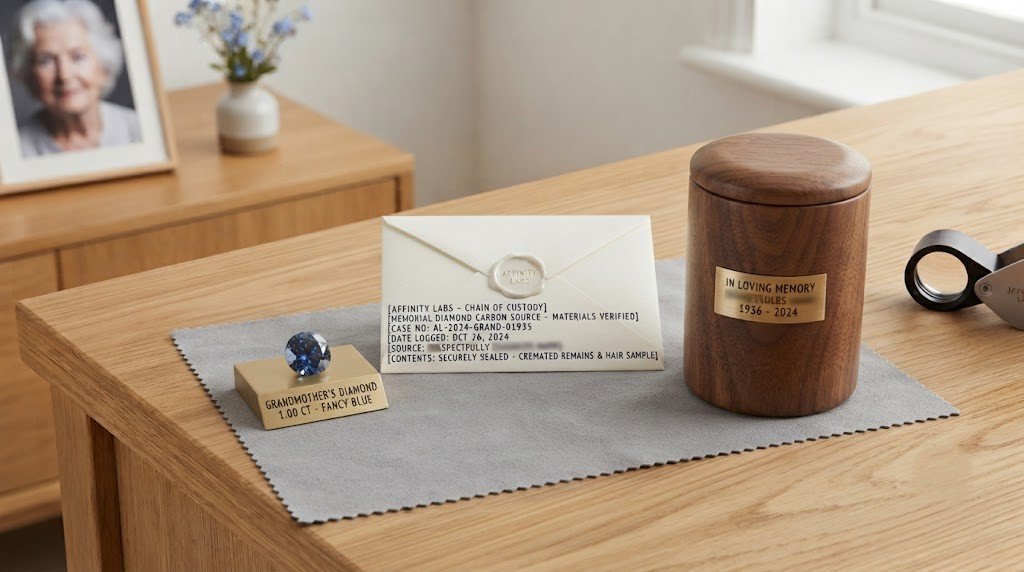
Chain of custody is the paper trail behind any claim that a stone was really made from grandmother hair, following the sample from the moment it leaves your hands. The practical steps for sending her hair cover packing and paperwork at your end. Ask how the sample is labeled on arrival, whether you receive written confirmation of receipt, who signs for it at each handoff, and whether you can request a record of each stage. Whether photos or progress updates are offered varies, so ask.

Authenticity certificate versus grading report

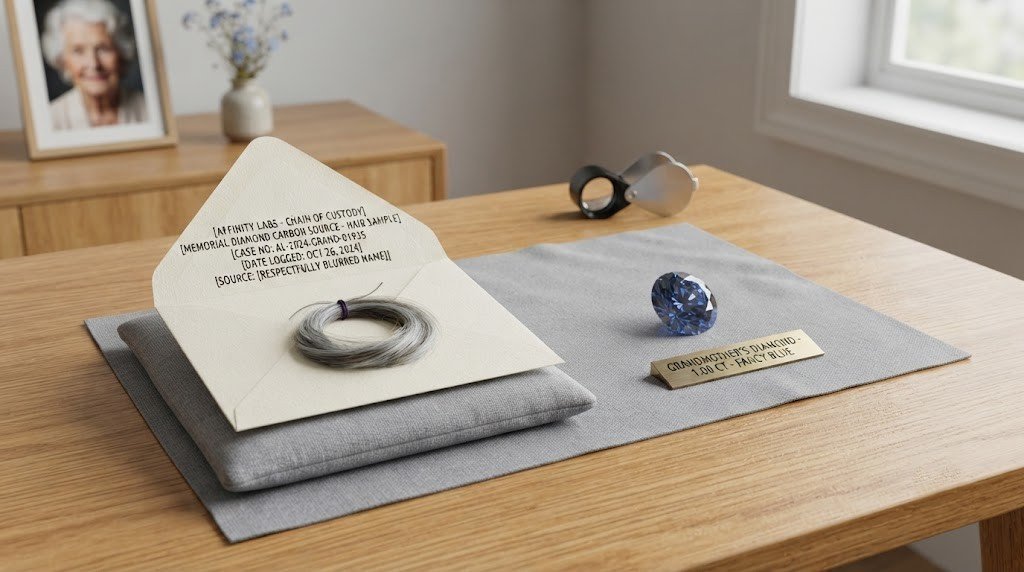
These two documents answer different questions. An authenticity or origin certificate is the paper that speaks to whether a stone was really made from grandmother hair; usually issued in-house, it records that the stone was grown from your family’s submitted material and works as a chain-of-custody document. A grading report, by contrast, rates the stone itself on the 4Cs; the most useful ones come from an outside lab that works to GIA’s diamond quality factors, and some come from IGI.

Independent grading is typically an optional add-on priced separately. It cannot confirm whose carbon is inside, but it does confirm you are holding a real diamond of the stated quality, which is half of what “really” means.

Keeping her sample separate

Ask each provider how one family’s material is kept apart from another’s. Useful questions: is each sample processed in its own batch, how is equipment cleaned between runs, how are containers labeled, and what happens if a growth run fails. Clear, specific answers here say more about whether a stone is really made from grandmother hair than any certificate design.

What Can and Cannot Be Proven About a Stone Really Made From Grandmother Hair?

Use this table as a checklist when you compare providers for a stone really made from grandmother hair.

ClaimCan it be checked?How you check it
The stone is a real diamondYesIndependent grading report, standard gemological testing
The stone is lab-grownYesGrading reports state lab-grown origin
Her hair was received and loggedYes, on paperWritten receipt, chain-of-custody records
Her carbon went into this specific stoneNot by testing the finished gemChain-of-custody records and a documented process
The share of the stone that came from herOnly as the provider’s estimateAsk in writing; no industry figure exists for hair
Her sample was never mixed with another family’sOnly through process and recordsAsk how batches are separated and labeled
Her hair will shape the stone’s colorNoColor comes from trace elements during growth

The rows marked “only” are where trust lives, so get those answers in writing before ordering.

Is a Small or Old Lock of Her Hair Enough?

Industry-wide, hair-based stones typically need a small lock or a few grams, and providers set their own requirements. Whether the particular hair you have can yield a stone really made from grandmother hair is a question for each provider: a braid saved for decades, strands from a brush, a single curl from a locket. A closer look at how much hair a grandmother memorial diamond usually takes can help you prepare. Ask whether they can assess it before you commit.

Ask what happens if the amount is too little. Do they contact you before starting, can you send more, and are any fees refundable at that point? Keep in mind that a bigger lock will not buy a bigger gem: the stone’s weight comes down to how long it stays in the press.

Whose hair is it to send?

Hair kept at home is usually a simpler practical matter than ashes. Still, keepsakes she owned may count among the things her estate has to account for, and each state handles that its own way. If an executor or another relative is settling her affairs, speak with them before sending anything. If the hair is with a parent, aunt, uncle or cousin, asking them to share a small portion is a respectful route, and several relatives can often each receive a stone from shared material, depending on the provider and how much there is.

Does Gray, Dyed or Treated Hair Change Anything?

Whether a provider accepts hair that was dyed, permed, bleached or chemically treated is that provider’s decision, so ask before you send it. Nothing published shows that her hair’s natural color, or the fact that it had gone gray or white, makes the stone lighter, darker or more predictable. Be wary of anyone who promises a color for a stone really made from grandmother hair based on how her hair looked.

Diamond color comes from trace elements present during growth. Traces of boron push a stone toward blue, and nitrogen pushes it toward yellow. Trace elements of this kind are common in a personal, organic carbon source, so memorial stones tend toward yellow, blue or champagne-to-brown shades. Keeping both out to reach a colorless result means added processing and usually a higher price. A few providers can also irradiate a finished stone to turn it red, pink, green or black.

For a gem that is really made from grandmother hair, color is something to talk through with the provider, not a portrait of her hair. Ask which colors they offer, which cost more, and whether the color you pick affects the timeline. For more on that, see the colors a stone from her hair can take.

What Do People Get Wrong About Stones Really Made From Grandmother Hair?

A few beliefs come up again and again when families first ask whether a stone can be really made from grandmother hair. Each one is worth correcting before you compare quotes.

  • “More hair makes a bigger stone.” Growth time sets carat size. Sending extra hair does not change the size or speed of the result.
  • “Hair is a weaker source than ashes.” Hair carries far more carbon by weight than ash. It is a genuine source in its own right, not a fallback.
  • “Hair makes the process faster.” The timeline is typically 6 to 10 months from receipt, and larger or specialty-color stones can take up to about 12 months, whatever the source.
  • “A certificate of authenticity is a grading report.” One tracks origin; the other measures quality. A careful buyer asks for both.
  • “A memorial diamond is unbreakable.” It ranks 10 on the Mohs hardness scale, yet a hard knock at the wrong angle can still chip any diamond.

Set these aside and the question of whether a stone is really made from grandmother hair comes down to records, process and plain answers.

What Does Verification Add to Cost and Timeline?

Across the industry in 2026, small stones of roughly 0.10 to 0.25 carat generally run about $1,500 to $3,500. Stones from 0.5 to 1 carat usually fall between about $5,000 and $15,000, with colorless costing noticeably more, and stones of 2 to 5 carats or larger can reach $20,000 to $75,000 or beyond. These are industry-wide ranges, not one company’s prices.

Verification has its own line items. An independent grading report, engraving, a fancy cut and a setting are typically priced separately from the loose stone. If confidence that the piece is really made from grandmother hair matters most to you, budget for independent grading and ask whether the origin certificate comes included.

Time is the other cost. Expect roughly 6 to 10 months from the day the provider receives her hair before a stone really made from grandmother hair is ready, and longer for large or specialty-color stones. A provider who quotes far faster should be able to explain why.

Frequently Asked Questions

Can a diamond be made from my grandmother’s hair if she was buried?

Yes. Hair needs no cremation, so a lock kept by family from her lifetime or her final days can be the source. Whether the specific hair you have is workable, and how much a provider needs, is something to confirm with each provider before you send anything.

Will a grading report say the diamond came from her hair?

No. A grading report describes cut, color, clarity and carat, and it can confirm the stone is a lab-grown diamond. Evidence that it is really made from grandmother hair comes separately, through the provider’s origin certificate and custody records.

Is a stone still really made from grandmother hair if lab carbon is added?

Yes, in the honest sense. Carbon purified from her hair becomes part of the crystal, typically blended with supplemental lab carbon. Ask each provider how much is added, and get their estimate of her share in writing.

Can a lab test prove a diamond is really made from grandmother hair?

Not in any standard way. Once carbon is purified and grown into a crystal, origin is established through records rather than testing. That is why chain of custody, labeling and the provider’s written process matter so much.

Can cousins each get a stone from the same lock of hair?

Often, yes, because only a portion of the hair is usually needed for each stone. How many stones a given lock can support depends on the provider and the amount, so ask before dividing it among relatives.

What happens to any hair the provider does not use?

That is set by each provider. Some may return it, others may store or dispose of it. Ask before ordering, request the policy in writing, and say plainly if you want every unused strand sent back to you.

Final Thoughts on Whether a Stone Is Really Made From Grandmother Hair

Asking whether a stone is really made from grandmother hair is not cynicism. It is care, the same instinct that made you keep the lock in the first place.

The honest answer has two halves. Her carbon genuinely becomes part of the diamond, and the stone is typically grown with added lab carbon as well. A provider worth trusting will say both halves out loud, put the details in writing, and let you see how her hair is tracked from the day it arrives.

Learn More About Proving a Diamond Came From Her Hair

Talk With Memorial Diamond

If you are still working out whether her hair is the right starting point, that is a fine place to begin a conversation. Memorial Diamond can walk you through what to send, what records to expect and which questions are worth putting in writing, with no obligation attached.

You can reach us at memorialdiamond.us whenever the timing feels right for you and your family.

Is a Memorial Diamond Really Made From Your Grandmother Ashes

Is a Memorial Diamond Really Made From Your Grandmother’s Ashes?

Doubt is a reasonable response when someone offers to turn a portion of her ashes into a gemstone, especially when the remains matter this much to your family. So is the stone really made from grandmother ashes? Yes, in part: carbon recovered from her ashes is purified and grown into the diamond’s crystal lattice, typically blended with lab carbon, so the finished stone holds a real share of her, not all of it.

That “in part” is where honest providers and overstated marketing part ways. Whether a particular stone is really made from grandmother ashes comes down to chemistry you can understand and records you can check before trusting anyone with her remains.

really made from grandmother ashes

Table of Contents

What Does It Mean for a Diamond to Be Really Made From Grandmother Ashes?

To see how a stone can be really made from grandmother ashes, start with what ashes are. Bone mineral, in the form of calcium phosphate, accounts for most of what comes back from cremation, and usable carbon is only about 0.5% to 4% of ash by weight. A lab extracts that small carbon fraction, purifies it to roughly 99.9% or higher, converts it to graphite, and uses it as part of the feedstock that grows into a diamond.

So when a provider says a stone is really made from grandmother ashes, the truthful version of that sentence is narrower than it first sounds. Her carbon is physically present in the crystal. It sits in the lattice alongside supplemental lab carbon, which is typically added because the carbon recovered from a few tablespoons of ash is not enough on its own to grow a stone of meaningful size.

A real diamond, with a real share of her

A gem really made from grandmother ashes is a genuine lab-grown diamond with the same hardness, 10 on the Mohs scale, and the same 4Cs grading as any other diamond. Most are grown by HPHT, using heat and pressure, and a minority by CVD. Nothing about the blend makes it a simulant or an imitation; general background on the category is collected in this overview of memorial diamonds.

The honest version can carry plenty of meaning on its own. A stone really made from grandmother ashes in part is still a stone that exists because of her, and some people find real comfort in holding something that tangible. If you want the step-by-step chemistry behind it, the article on how a diamond is grown from her ashes walks through each stage.

How Much of the Finished Diamond Is Her Carbon?

For ash-based memorial diamonds, her personal carbon typically makes up around 10–15% of the finished stone’s mass. A few providers put the figure nearer 3%, a few put it above 15%, and where a given stone lands depends partly on its carat and on the amount of ash submitted.

That range is the most important number for anyone asking whether a gem is really made from grandmother ashes. It confirms her carbon is present while making clear that most of the crystal’s mass is lab carbon. A written figure inside or near that range is at least consistent with what the industry publishes, which makes it a reasonable starting point for further questions.

Why sending more ash does not raise the share much

It is natural to assume that sending a full urn would produce a bigger stone, or one with a higher share of her. Carat size, though, follows growth time in the press rather than the weight of what you ship. Providers typically ask for somewhere between a few tablespoons and roughly 4 oz (about 100 g), and the details are theirs to set; the guide on how much ash a grandmother memorial diamond needs explains the amounts more fully.

What this figure does not cover

The 10–15% range applies to ash-based stones only. Hair is about 50% carbon and follows a different path, and no comparable finished-stone percentage has been published for hair or for combined stones. If her hair is also an option for your family, the companion piece on whether a diamond can truly come from her hair covers that question separately.

Why Should a “100%” Claim Make You Cautious?

You may come across marketing that promises a diamond made entirely from your loved one, with nothing else added. Families who want a stone really made from grandmother ashes should question that phrasing, because it does not match how the process works.

Ash carbon is a small fraction of the ash itself, and the recovered carbon is typically blended with lab carbon before growth. A claim that a stone is entirely her, with nothing added, asks you to believe something the published industry figures do not support. That does not mean the stone is not really made from grandmother ashes; it means the honest description is “in part.”

A provider that overstates this point may be loose with other details too. When a provider insists its stone is really made from grandmother ashes and nothing else, ask the provider to state in writing what share of the diamond’s mass will be her carbon. A straightforward answer is a good sign; a vague one is a reason to keep looking.

Which Provider Claims Can You Trust, and Which Need Questions?

A useful way to read any provider’s materials is to sort its statements into two piles: claims consistent with published industry facts, and claims that need a follow-up question before you rely on them. The table pairs common statements with how to treat them when deciding whether a stone is really made from grandmother ashes.

What a provider saysTrust or question?Why
“Carbon from her ashes is extracted, purified and grown into the diamond.”Generally trustworthyMatches the standard industry process
“Her carbon is blended with lab-grown carbon.”Trustworthy, and a good signBlending is typical and honest providers say so
“Personal carbon is roughly 10–15% of the stone.”Trustworthy for ash-based stonesMatches published industry figures; some cite as low as 3%
“Your diamond is 100% your grandmother.”Question itContradicts how ash carbon is recovered and grown
“A larger urn means a larger diamond.”Question itGrowth time, not ash volume, sets carat size
“The diamond contains her DNA.”Question itNo published basis for this; ask what they mean
“You will receive a certificate of authenticity.”Ask what it showsIn-house origin records differ from independent grading

A provider can sit in the first pile on most points and still deserve a question or two. Treat the table as a starting point for judging whether its stones are really made from grandmother ashes, not as a verdict.

What Can the Finished Stone Itself Not Prove?

This is the hardest part of the honesty conversation. Once purified, carbon from ash is carbon, and nothing in the finished crystal identifies which person it came from. There is no published basis for claiming that DNA survives into a diamond, so no test of the stone itself can confirm to a family that it is really made from grandmother ashes rather than other carbon.

That limit applies to every memorial diamond from every provider, even a stone that is, by every record available, really made from grandmother ashes. It is also why verification rests entirely on what happens before and during growth: the paper trail, the tracking, and how carefully a lab keeps one family’s material apart from another’s.

What a grading report can and cannot tell you

An independent grading report describes the stone’s quality using the 4Cs as GIA defines them: cut, color, clarity and carat. Typical memorial diamond clarity falls between SI2 and VVS. A grading report confirms you have a genuine diamond of a stated quality; it cannot confirm the stone was really made from grandmother ashes.

Why color is not evidence either

Yellow, blue, champagne and brown are the usual memorial diamond tones, because trace elements such as nitrogen and boron are common in organic carbon. Those tones are consistent with a personal source, but they are not proof of one, and a family cannot pick or match an exact natural shade. The post on the colors her ashes can produce explains why.

How Can Your Family Check That a Stone Is Really Made From Grandmother Ashes?

Because the stone cannot speak for itself, the checking happens through records and answers. Clear, documented explanations of the process are the best indication you can get that your diamond will be really made from grandmother ashes.

Know the two documents apart

An authenticity or origin certificate, which the provider normally produces itself, is a chain-of-custody record: it is the provider’s written statement that the stone was really made from grandmother ashes sent in by your family. A grading report, ideally from an independent third-party lab referencing GIA standards and sometimes IGI, covers the stone’s quality. Independent grading is typically an optional add-on with its own price, so ask whether it is included.

Questions to put to any provider

  • How is her material labeled and tracked from the moment it arrives?
  • How are different families’ batches kept separate throughout extraction, purification and growth?
  • What records, updates or documents will we receive during the process?
  • What percentage of the finished stone do you expect to come from her ashes, stated in writing?
  • What happens to any ash that is not used: is it returned, stored or disposed of?
  • If a growth run fails, what happens to her carbon and to our order?
  • Can a third-party lab grade the finished stone, and at what cost?

Clear, specific, written answers to those questions tell you far more about whether a gem will be really made from grandmother ashes than any marketing page. The step-by-step guide to the process shows where each of those checkpoints falls.

What Doubts and Misconceptions Come Up Most Often?

Several beliefs circulate about whether any stone is really made from grandmother ashes, and each one can make a family either too trusting or too skeptical.

“Ashes are mostly carbon, so the diamond is mostly her.”

Ash is mostly calcium phosphate. Only about 0.5% to 4% of it is usable carbon, which is why a diamond really made from grandmother ashes typically includes lab carbon too.

“If it is blended, it is not really her.”

Her carbon is physically present in the lattice. A share of 10–15%, or even 3%, is still a real part of her, and a stone really made from grandmother ashes in part is not a symbol standing in for her.

“The whole urn has to be sent.”

Usually only a small portion is needed, so the rest can stay in an urn, be scattered, or be interred as the family planned. A diamond sits alongside those choices rather than replacing them.

“A lab can test the diamond to prove whose it is.”

No published test can identify a person from a finished diamond. Proof that it was really made from grandmother ashes rests on documentation and process, not on the stone.

“Memorial diamonds are not real diamonds.”

They are real lab-grown diamonds, graded on the same 4Cs as any other. A hard knock can still chip a diamond, as with any gemstone, but it rates 10 on the Mohs scale.

Does It Matter If Her Ashes Were Divided or Kept for Years?

This question can surface months or years after a funeral. Her ashes may already be divided among relatives, partly scattered, or kept on an aunt’s or uncle’s shelf for a decade. None of that changes what it means for a diamond to be really made from grandmother ashes, but it does raise practical questions.

Whether ashes stored for many years can still yield a stone really made from grandmother ashes is something each provider decides, so ask directly rather than assuming. If only a small portion remains with your branch of the family, ask what minimum amount the provider needs; general industry ranges start at a few tablespoons.

Who gets to decide

State law sets who controls her remains, along with anything she put in writing, and each state ranks family members a little differently. Commonly a surviving spouse or partner comes first, followed by her adult children, with grandchildren further along. If you are a grandchild, a respectful approach is to ask whoever holds that authority whether a small portion could be set aside, and to bring cousins into the conversation early. If nobody is sure who that is, the crematory’s paperwork usually names the person who authorized her cremation.

When faith is part of the question

Faith traditions speak to cremation and to what is done with ashes, but none has issued an official ruling on memorial diamonds themselves. Catholic guidance, for example, asks that ashes stay intact in a sacred place, with only a narrow allowance for a small portion, which bears directly on dividing them. Orthodox and Conservative Judaism generally prohibit cremation while Reform is more permissive, and Hindu, Buddhist and Protestant views vary by community. Your own clergy, or the faith community she belonged to, can speak to your situation.

What Should You Do If a Provider Cannot Answer?

Sometimes the honest answer to “is this really made from grandmother ashes?” gets lost because a provider will not engage with the details. A brief, evasive or purely emotional reply to a technical question is information in itself.

If a provider cannot or will not answer your questions, consider these steps:

  1. Ask again in writing, listing each question separately so nothing can be skipped.
  2. Request sample copies of the origin certificate and any grading report they issue.
  3. Ask for their written policy on unused ash and on failed growth runs.
  4. Compare at least two providers’ answers side by side before choosing.
  5. Pause if anything still feels unclear; there is no deadline on remembering her.

A provider that welcomes these questions is showing you how it will treat her remains, and how seriously it takes the promise that a stone is really made from grandmother ashes. The complete guide to grandmother ashes diamonds covers the wider decision if you are still weighing whether a diamond fits your family at all.

Does Careful Verification Change the Cost or Timeline?

Asking whether a stone is really made from grandmother ashes costs nothing, but some of the documents that support verification may. Independent grading reports are typically priced separately from the stone, as are engraving, fancy cuts and settings.

Across the industry in 2026, and not as Memorial Diamond’s pricing, stones run roughly 1,500–3,500 for about 0.10–0.25 ct, roughly 5,000–15,000 for 0.5–1 ct, and roughly 20,000–75,000 or more for 2–5+ ct. Colorless stones cost meaningfully more at the same size, because keeping out nitrogen and boron takes extra processing.

On timing, expect roughly 6 to 10 months between the lab receiving her ashes and the finished stone, and larger stones over about 2 ct or specialty colors can take up to roughly 12 months. Ask whether independent grading adds time, and how you will be kept informed while a stone really made from grandmother ashes is on its way back to your family. The guide on turning her ashes into a diamond covers the practical sequence of choices.

Frequently Asked Questions

Is the diamond really made from grandmother ashes, or just inspired by them?

It is made in part from her. Carbon recovered from her ashes is purified, converted to graphite and grown into the crystal, typically blended with lab carbon. Her carbon is physically present in the finished stone, not merely represented by it.

What percentage of the stone comes from her ashes?

For ash-based memorial diamonds, personal carbon is typically around 10–15% of the finished stone’s mass. A few providers quote as little as 3%, and some quote more, with carat and the quantity of ash both playing a part. Ask each provider for its figure in writing.

Can a lab test the finished diamond to confirm it came from her?

No published test can identify a person from a finished diamond, and there is no basis for claims that DNA survives in one. Confirmation comes from chain-of-custody records, the origin certificate and a provider’s clear answers about how batches stay separate.

Is an origin certificate the same as a grading report?

No. An origin or authenticity certificate, normally produced by the provider itself, ties the stone to your family’s submitted carbon. A grading report, ideally from an independent lab, describes cut, color, clarity and carat. Keeping both gives a fuller record.

Should I avoid a provider that says its diamonds are 100% ashes?

Treat that claim as a reason to ask more questions. A stone really made from grandmother ashes still typically blends her recovered carbon with lab carbon. Ask the provider to explain, in writing, what share of the stone it expects to come from her ashes.

Can we still make a diamond if most of her ashes were scattered?

Often, yes, since the typical request is a small amount, from a few tablespoons to roughly 4 oz. Whether a small or long-stored portion is workable is the provider’s call, and whoever holds authority over her remains should agree before anything is sent.

Final Thoughts on Whether Her Diamond Is Truly Hers

The truthful answer sits between two extremes. A diamond really made from grandmother ashes holds her carbon, grown into the crystal, and shares that crystal with lab carbon. A provider that says both halves of that sentence plainly is one worth listening to.

Ask your questions, keep the answers in writing, and let the paperwork carry the proof the stone cannot. That care is part of honoring her too.

Learn More About Verifying a Grandmother Ashes Diamond

Talk With Memorial Diamond

If you have questions about how a stone can be really made from grandmother ashes, or how records and tracking should work, Memorial Diamond would be glad to answer them plainly. There is no rush, and asking commits you to nothing.

Reach out through memorialdiamond.us whenever the timing feels right for your family.

Is a Memorial Diamond Really Made From Your Grandmother Ashes and Hair

Is a Memorial Diamond Really Made From Your Grandmother’s Ashes and Hair?

Some families hold two things of hers at once: a portion of her ashes, and a curl of hair someone saved. A stone can be really made from grandmother ashes and hair, in the sense that carbon from both can be purified and grown into one genuine lab-grown diamond, typically alongside supplemental lab carbon. What nobody can honestly give you is a published figure for how much of a combined stone came from each source, so the claim rests on documentation you request.

Whether a gem is really made from grandmother ashes and hair is a question of records as much as chemistry. Below: what a provider can stand behind, what needs proof in writing, and why two separate stones can be simpler.

Table of Contents

What Can Truthfully Be Said About a Stone Really Made From Grandmother Ashes and Hair?

Start with what holds up under scrutiny. If a provider genuinely draws carbon from both her ashes and her hair, purifies it, and grows it into a crystal, then the finished gem contains carbon that came from her by two routes. Saying the piece is really made from grandmother ashes and hair is accurate as long as “made from” carries its honest meaning: made in part from her, with lab carbon typically added to reach a usable volume.

Nobody can tell you, by looking at or testing the diamond, which atoms came from ash and which came from hair. Once purified, carbon is carbon. Any provider that claims to show you a precise split inside a stone really made from grandmother ashes and hair is describing something beyond what standard gemology can do.

Three sentences you can use with family

When relatives ask whether the piece is really made from grandmother ashes and hair, these statements stay true:

  • “Carbon recovered from her ashes and from her hair was purified and grown into this diamond.”
  • “Like most memorial diamonds, it was grown with some added lab carbon as well.”
  • “The provider’s paperwork records that both of her materials went into it.”

The third depends on the provider supplying that paperwork; without it, a stone said to be really made from grandmother ashes and hair rests on trust alone.

How Does a Provider Combine Her Ashes and Hair?

The broad industry process runs in stages: collection with chain-of-custody tracking, carbon extraction and purification to roughly 99.9% or higher, graphitization at around 2,500 to 2,700°C, and growth, most often in an HPHT press holding about 6–8 GPa of pressure at somewhere between 1,400 and 2,500°C for a span of weeks or months. Cutting, polishing and grading follow. A plain overview of how lab-grown diamonds are produced covers both HPHT and the less common CVD method.

Where a stone really made from grandmother ashes and hair differs is at the start. Ash and hair behave very differently: ash is mostly calcium phosphate, with usable carbon at roughly 0.5% to 4% of its weight, while hair is about 50% carbon. How carbon is recovered from each, and when the two are brought together, is set by each company. The walkthrough of how a diamond is grown from her ashes and hair together covers that sequence.

Questions about the combining step

Whether a stone is really made from grandmother ashes and hair depends on how this step is handled, and every provider handles it its own way. Ask each one:

  • Do you extract carbon from the ashes and the hair separately, and then blend them?
  • At what stage are the two carbon sources combined?
  • Is any of either material set aside unused, and what happens to it?
  • Can you describe the process in writing for my file?

Plain answers to these four questions say a great deal about whether a provider can back up a stone really made from grandmother ashes and hair.

How Much of a Stone Really Made From Grandmother Ashes and Hair Came From Her?

For stones grown from ashes alone, industry figures put personal carbon at around 10–15% of the finished mass, with some providers citing as little as 3% and others more. That range describes ash-only stones. It does not transfer to a stone really made from grandmother ashes and hair, and it should not be quoted as if it did.

For a gem that is really made from grandmother ashes and hair, no blended finished-stone figure is published anywhere in the industry. How much of each material a provider uses, and how much lab carbon joins them, varies. The only way to get a number is to ask for it.

A written request worth sending

Before you pay for anything described as really made from grandmother ashes and hair, ask the provider to state, in writing and in plain terms:

  1. Roughly what share of the finished stone they estimate came from her carbon in total.
  2. Whether they can estimate how that share divides between ash and hair.
  3. How much supplemental lab carbon is typically added at the carat size you are considering.

A range, or a plain statement that the ash-and-hair split cannot be estimated, is an honest reply. A refusal to answer at all is worth weighing before you send anything of hers.

How Would You Know a Stone Is Really Made From Grandmother Ashes and Hair?

You would know mostly through paper. Because a finished diamond cannot be tested to show it came from her, confidence that it is really made from grandmother ashes and hair depends on how each material is received, logged and tracked through the process. Think of it as two chains of custody that must both be intact.

Seven checks before you order

These seven checks give you something concrete to compare across providers offering a stone really made from grandmother ashes and hair:

  1. Two intake records. Ask whether you will receive a separate written receipt for the ashes and for the hair.
  2. Labeling for each material. Ask how each container is labeled on arrival and at every handoff.
  3. Batch separation. Ask how her materials are kept apart from other families’ material throughout.
  4. An origin certificate naming both. Ask whether the in-house authenticity certificate will list ashes and hair specifically, not just “remains.”
  5. A written process description. Ask for the combining method in writing, so it sits in your file.
  6. What happens to leftovers. Ask what is done with unused ash or hair, and whether you can have it returned.
  7. Failed-run policy. Ask what happens, and what is communicated to you, if a growth run does not succeed.

Origin certificate versus grading report

The origin or authenticity certificate, usually produced in-house, is the document that ties a stone to your family’s submitted material; for a stone really made from grandmother ashes and hair, it is where both materials should be named. A grading report describes the diamond’s own cut, color, clarity and carat, ideally from an independent lab working to GIA’s quality standards, sometimes IGI.

Independent grading is typically an optional, separately priced add-on. It confirms that you have a genuine diamond of the stated quality. It does not, and cannot, confirm that a diamond is really made from grandmother ashes and hair.

Which Claims Need Proof, and Which Cannot Be Made at All?

Use this table to judge any description of a stone really made from grandmother ashes and hair.

Claim about a combined stoneStatusWhat supports it
It is a genuine lab-grown diamondCan be statedIndependent grading report
Carbon from her ashes went into itNeeds provider documentationAsh intake record, origin certificate naming ashes
Carbon from her hair went into itNeeds provider documentationHair intake record, origin certificate naming hair
Some lab carbon was addedTypically true; confirmProvider’s written process description
Her total share of the stoneProvider estimate onlyWritten answer; no published blended figure exists
The exact split between ash and hairGenerally cannot be shownNot measurable in the finished crystal
The stone is made entirely of herCannot be statedContradicts how memorial diamonds are typically grown

The middle rows are where your written requests do their work, and where a provider shows whether its stone is really made from grandmother ashes and hair in any checkable sense.

Would Two Separate Stones Be Easier to Describe Honestly?

really made from grandmother ashes and hair

Often, yes. A stone grown only from her ashes can be described using the ash-only figures the industry already publishes, and a stone grown only from her hair has a simpler, single chain of custody. Each one has one material, one intake record and one origin certificate. Each is easier to verify than a stone really made from grandmother ashes and hair together.

Two stones also open options: one for the relative who keeps her urn, one for whoever saved her hair, or both in one setting.

When one combined stone still makes sense

A combined stone can matter for reasons no table captures: the wish to bring both parts of her together into a single piece. If your family wants a gem really made from grandmother ashes and hair, the answer is not to avoid it but to ask for documentation that names both materials. For more on whether one source might be enough, the companion pieces on whether a stone is truly grown from her ashes and whether a stone is truly grown from her hair look at each route alone.

OptionSourcesRecords to checkEasiest to describe?
One combined stoneAshes and hairTwo intake records, certificate naming bothHardest
One ash stoneAshesOne intake recordEasier; published ash range applies
One hair stoneHairOne intake recordEasier; no cremation involved
Two separate stonesOne eachOne record per stoneClearest

Who Decides What Happens to Her Ashes and Hair?

Before any stone is really made from grandmother ashes and hair, someone has to agree to release each material, and the two can sit with different people under different rules. Authority over cremated remains is set by state law and by any wishes she left in writing, and the order of who decides varies by state. Grandchildren usually stand behind a surviving spouse or partner and then her adult children. If nobody is sure who holds that role, the crematory or funeral home that handled her cremation can usually name the person who signed for it.

If you are her grandchild, the respectful path runs through that person: a gentle request to whichever parent, aunt or uncle holds that role for a small share to be set aside for the stone. Her ashes may already have been divided, scattered or placed somewhere permanent, and her hair may be with a cousin.

Hair kept at home is usually a simpler practical matter, though her personal belongings may form part of her estate under rules that change from state to state. Before sending any, check with the executor or whoever is settling her affairs.

Faith and dividing remains

Religious teaching speaks to cremation and to what is done with ashes; none of the major traditions has ruled on memorial diamonds as such. For Catholic families, the Church accepts cremation yet wants the remains to rest whole in a consecrated place, with only limited room for setting a little apart, so splitting her ashes between an urn and a stone is worth raising with a priest. Orthodox and Conservative Judaism generally prohibit cremation, while Reform Judaism is more permissive. A hair-only stone involves no cremation. Whatever your family’s faith, its own clergy or community leaders are the ones to ask.

What Warning Signs Suggest a Combined Claim Is Overstated?

A few patterns deserve a second look before you commit to a stone described as really made from grandmother ashes and hair:

  • A claim of 100% her. Memorial diamonds are typically grown with supplemental lab carbon. A promise that nothing else is in the stone is an overstatement until proven otherwise.
  • A borrowed percentage. If a provider quotes the ash-only range as though it describes a combined stone, ask where the figure comes from.
  • A certificate that names neither material. A generic “made from remains” line does not show that both were used.
  • No answer about the combining step. If a provider cannot say when or how the two carbon sources meet, ask again in writing.
  • A promised color tied to her hair or ashes. Diamond color comes from trace elements during growth; no family can choose or match an exact natural shade.
  • Pressure to decide quickly. A careful provider gives you time.

None of these settles anything alone. Each is a reason to slow down and ask more questions.

Which Beliefs About Stones Really Made From Grandmother Ashes and Hair Do Not Hold Up?

Some assumptions about a diamond really made from grandmother ashes and hair sound reasonable but do not match how the process works.

“Adding hair makes the stone bigger.” A stone’s finished weight depends on how many weeks it spends growing, and the volume of ash or hair delivered does not change that.

“Two sources mean double the personal carbon.” No blended figure is published. Whatever share a stone really made from grandmother ashes and hair contains is something the provider has to estimate for you in writing.

“Hair gives the stone a cleaner color than ash.” Neither source has been shown to produce a lighter or more predictable color. Boron produces blue and nitrogen produces yellow, and memorial diamonds tend toward yellow, blue and champagne or brown. More on that is in the colors a stone from her ashes and hair can take.

“A stone really made from grandmother ashes and hair needs most of her ashes.” Industry-wide, ash requests typically range from a few tablespoons to roughly 4 oz, with hair typically a small lock. The guide to how much ash and hair a grandmother memorial diamond needs sets out what to expect, though each provider sets its own figures.

“Old ashes or old hair will not work.” Whether long-stored material is usable is each provider’s call, so ask.

What Does a Combined Stone Cost, and How Long Does It Take?

Industry pricing in 2026 runs roughly $1,500 to $3,500 for about 0.10 to 0.25 carat, roughly $5,000 to $15,000 for 0.5 to 1 carat with colorless costing noticeably more, and roughly $20,000 to $75,000 or more for 2 to 5 carats and up. These are ranges across providers. Whether a stone really made from grandmother ashes and hair costs more than a single-source one is a question to ask each provider.

Independent grading, engraving, fancy cuts and settings are usually priced on top of the loose stone, so budget for the grading report if you want third-party confirmation of quality.

Once her ashes and hair arrive, industry-typical lead times are 6 to 10 months, stretching to about 12 months for stones above roughly 2 carats or in specialty colors. Ask whether handling two materials affects the schedule for a stone really made from grandmother ashes and hair. The hub on a grandmother ashes and hair diamond covers planning in more depth.

Frequently Asked Questions

Can a provider prove which carbon in a stone really made from grandmother ashes and hair came from each?

Generally no. Once purified, carbon from ash and from hair is chemically identical, and the finished crystal cannot be tested to separate them. What a provider can document is that both materials were received, logged and used.

Is the 10–15% figure accurate for a stone made from both her ashes and hair?

No. That range applies to stones grown from ashes alone. No finished-stone figure is published for combined ash-and-hair stones, so ask each provider for its own written estimate of her total share at your chosen size.

Should the origin certificate name both her ashes and her hair?

It is reasonable to ask for that. An in-house authenticity certificate is the document linking the stone to your family’s material, so for a combined stone, request in advance that it list both ashes and hair by name.

Is a stone still really made from grandmother ashes and hair if lab carbon is added?

Yes, honestly described. Her carbon from both sources becomes part of the crystal, and supplemental lab carbon is typically added to reach a workable volume. Ask the provider to say in writing roughly how much is added.

Can we make one stone from her ashes and another from her hair instead?

Usually, yes, depending on the provider and how much material your family has. Each single-source stone carries just one chain of custody, which tends to make the paperwork simpler to check and the stone simpler to explain to relatives.

What if her ashes were already divided among relatives?

Ask whoever holds a portion whether a small amount could be shared for the stone. Authority depends on state law and her written wishes, so the person who signed the cremation authorization is often the right first conversation.

Final Thoughts on a Stone Really Made From Grandmother Ashes and Hair

Wanting a stone really made from grandmother ashes and hair is a natural instinct, and it can be honored truthfully. The truthful version simply has limits: her carbon from both sources is in the crystal, alongside lab carbon, in proportions that only the provider can estimate.

Ask for records that name each material, read them before you commit, and keep them with the stone. If one combined piece starts to feel harder to describe than you would like, two separate stones remain a perfectly good choice.

Learn More About Combined Ash and Hair Stones for a Grandmother

Talk With Memorial Diamond

Whether you are leaning toward one combined stone or two separate ones, a conversation can help you see what records to ask for and what each route involves. Memorial Diamond is glad to talk it through at your own pace.

When your family is ready, start at memorialdiamond.us.

How a Memorial Diamond Is Made From Your Grandmother

How a Memorial Diamond Is Made From Your Grandmother’s Hair

A folded envelope with a lock of her hair, a strand caught in a brush she used every morning: small things like these can carry a surprising amount of her. A diamond made from grandmother hair begins when a lab heats a small sample without oxygen to recover the carbon in its keratin, purifies that carbon, converts it to graphite and grows it into a real diamond under extreme pressure and heat, after which the crystal is cut, polished and graded.

What follows explains every stage of a gem made from grandmother hair for someone without a chemistry background, and points out where the answer depends on the provider rather than on science.

made from grandmother hair

Why Can Hair Become a Diamond at All?

Hair is built mostly from keratin, a tough protein, and keratin is rich in carbon. By weight, hair is roughly 50% carbon. Diamond is nothing but carbon atoms locked in a crystal, so any material with a usable share of carbon can, in principle, become the starting point for one, and that is the basic chemistry behind every stone made from grandmother hair.

That single figure explains much of what makes a diamond made from grandmother hair different from one grown from ashes. Cremated remains are mostly bone mineral, with only a small percentage of usable carbon. Her hair, by contrast, is about half carbon to begin with.

There is a second difference. Hair needs no cremation. If she was buried, or if cremation is not something your family’s faith permits, a lock of hair saved at the time of her death, from a salon visit or tucked in a keepsake box can still be the source of a stone made from grandmother hair.

Why Does a Lab Need So Little of Her Hair?

Because each strand holds so much carbon, providers typically ask for only a small lock or a few grams to grow jewelry made from grandmother hair. Some describe the amount as palm-sized or a few wisps. Exact requirements vary from lab to lab, and no single minimum applies across the industry.

Sending more hair will not make a ring or pendant made from grandmother hair any larger. Carat size is decided by how long the crystal grows, not by how much carbon arrives at the lab. A single envelope is often enough for a diamond made from grandmother hair, and sometimes enough for more than one stone, which matters when several grandchildren hope for a piece. The guide to how much hair a grandmother memorial diamond needs covers collection and packing in more practical detail.

Can you collect hair from a brush?

Loose strands gathered from a brush or a garment are a different matter from a cut lock, and providers set their own rules about what they accept. Describe exactly what you have, ask whether it is workable, and wait for a written reply before you mail anything irreplaceable.

Which Stages Turn a Lock of Hair Into a Diamond?

Seven stages separate an envelope of hair from a finished gem made from grandmother hair. No provider publishes a fixed duration for each one, and the overall timeline depends mainly on the carat size chosen, so this summary focuses on purpose rather than time.

StageLab activityMeaning for her hair
IntakeHer sample is logged under your order and labeledThe lock is tracked as hers from arrival onward
ExtractionOxygen-free, multi-stage heating removes everything that is not carbonThe other parts of keratin are driven off
PurificationThe recovered carbon is refined furtherHer carbon reaches roughly 99.9% purity or better
GraphitizationHeating to about 2,500–2,700°C converts carbon to graphiteHer carbon becomes press-ready feedstock
GrowthAn HPHT press, or for a minority of providers a CVD chamber, grows the crystalHer carbon, with any supplemental carbon, forms diamond
Cutting and polishingA gemologist shapes and facets the rough crystalThe stone gains its shape and brilliance
Grading and documentationQuality is graded, ideally by an independent lab, and origin is recordedYou receive evidence of quality and of her origin

Some providers add an optional color-treatment step after growth; it is described in the color section. Every lab orders and names these stages slightly differently, so ask yours to describe the sequence it follows for anything made from grandmother hair.

What Does the Lab Strip Away From Her Hair?

Keratin contains carbon alongside other elements, including hydrogen, oxygen, nitrogen and sulfur. Extraction is the stage of producing a stone made from grandmother hair that separates the carbon from all of those. The lab heats the hair in a controlled, oxygen-free environment, usually over several steps, so the non-carbon components are driven off while the carbon stays behind.

Removing oxygen from the chamber is essential. Heated in ordinary air, carbon would bond with oxygen and leave as a gas, taking her contribution with it. In a sealed, oxygen-free setting it remains as a solid residue that can be collected.

Purification follows until that residue is roughly 99.9% carbon or higher. Clean feedstock matters because stray elements in the growth cell can affect the finished gem. At this point, what is actually made from grandmother hair no longer resembles hair in any way; it is a small amount of nearly pure carbon.

What becomes of any hair the lab does not use?

The envelope you mail may hold more than a diamond made from grandmother hair actually consumes. Whether leftover hair is returned, stored or disposed of is a provider policy, and families feel strongly about it, so ask in advance and keep the reply.

Is Lab Carbon Added to a Stone Made From Grandmother Hair?

Often, yes. Across the industry, recovered personal carbon is typically blended with supplemental lab-sourced carbon so the growth cell has enough feedstock, and a provider may well do the same for gems made from grandmother hair. Because hair is so carbon-rich, the reasons and proportions may differ from an ash-based stone, but providers set this individually.

Here is the honest gap: no industry-wide figure is published for how much of a finished stone made from grandmother hair is her own carbon. The percentages people quote online describe ash-based stones and should not be carried over to hair. Before you order, request a written statement from every provider you are considering: roughly how much of the polished gem will be her own carbon, and does that change with carat size?

None of this makes a diamond made from grandmother hair less hers. Whatever the proportion, carbon recovered from her hair becomes part of the diamond’s crystal lattice. It is not a symbol placed beside her memory; it is a gem physically built, in part, from her. Sales claims of a stone that is entirely hair, with nothing added, describe something the chemistry does not support.

How Does Graphite Become a Diamond Crystal?

Graphite and diamond share the same element and differ only in structure. In graphite, carbon atoms form flat layers that slide over each other, which is why pencil lead is soft. In diamond, every atom is bonded tightly in three dimensions.

Most providers use HPHT growth to force that change in a stone made from grandmother hair. The graphite feedstock goes into a growth cell with a tiny diamond seed, and a press, a BARS or cubic design for example, applies roughly 6–8 GPa of pressure at around 1,400–2,500°C. Those are conditions similar to the Earth’s mantle, where natural diamonds form, and in them carbon builds outward from the seed as diamond crystal over weeks to months.

A smaller group of providers grows memorial stones by CVD instead, converting the carbon to methane and depositing it layer by layer onto a seed plate in a vacuum chamber. For a fuller account of both techniques, see the background on how lab-grown diamonds are produced. Asking which method grows a diamond made from grandmother hair at a given lab is a perfectly reasonable question.

Why growth time sets the carat

The longer a crystal made from grandmother hair stays in the press, the larger it grows. That is why carat size, which usually runs from about 0.10 to 5 carats or more, shapes both timeline and cost. The amount of hair you send does not.

What Happens After the Crystal Leaves the Press?

Fresh from the press, a crystal made from grandmother hair looks nothing like a finished gem. A gemologist studies it, decides on a shape such as round, cushion, oval or princess, and cuts and polishes the facets that will catch light. Ask whether a quoted carat weight describes the rough crystal or the polished result, because cutting removes material.

What comes out of the cutting room is a genuine diamond. It rates 10 on the Mohs hardness scale and has the same optical behavior as any other diamond, mined or lab-grown. Clarity for memorial diamonds typically falls between SI2 and VVS. Hardness is not the same as being unbreakable, though: a sharp blow at the wrong angle can chip any diamond, so a protective setting is worth discussing for a ring worn daily.

What Color Can a Diamond From Her Hair Be?

The color of a diamond made from grandmother hair forms during growth and depends on trace elements in the crystal. Boron gives blue tones. Nitrogen gives yellow. A colorless diamond requires both to be kept out, which needs extra processing and usually raises the price.

Organic, personal carbon sources tend to carry traces of these elements, so memorial diamonds generally lean toward yellow, blue, and champagne or brown shades. A stone made from grandmother hair is no exception, and its color is not a measure of her or of the hair’s quality. No provider can promise to reproduce a particular shade, and families cannot select an exact tone in advance; what you can choose is from the range of colors a provider offers.

Some providers also offer irradiation after growth to produce red, pink, green or black stones. For more on the options and their limits, read about the color range a diamond from her hair can take.

Does Gray, Dyed or Treated Hair Change Anything?

It is a natural thing to wonder, and the answer sits with the provider rather than with general science. There is no established basis for saying that gray, white, colored, permed or thinning hair produces a different gem made from grandmother hair, a different color or a less suitable sample.

What does vary is policy. Some labs may ask about dyes, treatments or products in the hair; others may not. Tell the provider plainly what you have, including any treatments you know about, and ask whether they accept it for a diamond made from grandmother hair. Get their answer in writing so there is no confusion later.

What Paperwork Proves Where the Stone Came From?

Two different documents can accompany a finished diamond made from grandmother hair, and it helps to know which is which.

A certificate of authenticity, usually issued in-house by the provider, states that the stone was grown from the carbon your family submitted. It functions as a chain-of-custody record. A grading report describes the diamond’s quality on the 4Cs: cut, color, clarity and carat. Ideally it comes from an independent gemological lab, commonly working to GIA standards and sometimes from IGI, and it is usually an optional add-on with its own fee rather than a standard inclusion.

GIA’s explanation of diamond quality factors is a helpful guide to reading a grading report.

Questions that reveal how chain of custody works

Practices differ, so a short list of direct questions tells you more than any brochure:

  • What label or code follows her hair through every stage, from intake to the finished stone made from grandmother hair?
  • Is anything handled at an outside facility, and how is her sample tracked there?
  • Can you see progress updates or photos at any point?
  • What is recorded on the authenticity certificate, and what is not?
  • If a growth run does not succeed, what happens next, and would more hair be needed?

Readers who want to test whether a stone is really made from grandmother hair can find that skepticism addressed in the piece on whether the diamond truly contains her hair.

Whose Agreement Matters Before You Send Her Hair?

Hair kept at home is usually a simpler matter than ashes when you are planning a stone made from grandmother hair, but it is not always straightforward. A person’s belongings can form part of their estate, and the rules differ by state. If her estate is still being settled, a conversation with the executor, or whoever is handling it, is a sensible first step.

Family feeling matters too. You may be a grandchild by birth, adoption, marriage or choice, and an aunt, uncle, parent or cousin may also hold strands of her hair or have hopes of their own. Because so little is needed, a single lock can sometimes supply more than one stone made from grandmother hair, which can make it easier for relatives to share.

Faith can shape the choice. No religious tradition has an official position on memorial diamonds as such; teaching addresses cremation and the handling of ashes. Across major schools of Islamic thought, cremation is considered impermissible, and a hair-based stone involves no cremation, which some families find relevant. Your own imam, rabbi, priest, pastor or community elder is the right person to consult.

If her ashes are also available, the companion explainer on the ash-based lab process describes how that route differs, and some families combine both, as covered in growing one stone from her ashes and hair together.

How Long Does a Diamond Made From Grandmother Hair Take, and How Much Does It Cost?

Industry-wide, a diamond made from grandmother hair takes about 6 to 10 months from the time a lab receives the material, with stones above roughly 2 carats or in specialty colors sometimes taking up to 12 months. Plan around the overall estimate a provider gives you, since individual stages are not published with set times.

As a general picture of 2026 pricing across the category, entry stones of about 0.10–0.25 ct run roughly $1,500 to $3,500. Stones of 0.5 to 1 ct fall roughly between $5,000 and $15,000, and colorless costs meaningfully more at the same size. Large stones from 2 to 5+ ct reach roughly $20,000 to $75,000 or beyond. An independent grading report, engraving, a fancy cut and a ring or pendant setting are typically charged on top.

For a walk-through of choosing a provider and preparing the sample, see the practical route to turning her hair into a diamond, and for every decision gathered in one place, the grandmother hair diamond guide is the fuller reference.

Frequently Asked Questions

How much of a diamond made from grandmother hair is actually her carbon?

No industry-wide percentage is published for hair-based stones, and figures quoted for ash do not apply. Supplemental lab carbon is often blended in. Put the question to each lab in writing and ask how much of a stone at your chosen carat would be her carbon.

Can hair from her hairbrush be used?

It depends on the provider. Loose strands from a brush differ from a cut lock, and labs set their own acceptance rules. Describe exactly what you have, ask whether it is workable, and wait for a written answer before posting anything irreplaceable.

Does her hair need to have been cut recently?

Providers decide what age and condition of hair they accept, so there is no universal rule. Hair saved years ago in an envelope or locket may be workable. Explain how the hair has been kept and ask the lab directly before sending it.

Will gray or dyed hair affect the color of the diamond?

There is no established basis for saying hair color or dye changes the stone. Diamond color comes from trace elements such as nitrogen and boron present during growth. Whether a provider accepts dyed or chemically treated hair is a question to ask them directly.

Can a diamond be made from grandmother hair if she was buried?

Yes, if a lock of her hair was kept. Hair-based stones need no cremation, so burial does not rule them out. The hair needs to be available and acceptable to the provider, and it is wise to check first with whoever is settling her estate.

Can one lock of her hair make stones for several grandchildren?

Sometimes. Because hair is about half carbon, a small amount goes a long way, and several stones may come from one sample. The provider can confirm what is feasible, and the family should agree on how the hair is shared first.

Final Thoughts on Her Hair Becoming a Diamond

Understanding what happens in the lab turns the idea of a diamond made from grandmother hair into a series of concrete steps you can question. You now know why her hair holds so much carbon, what the lab removes, why supplemental carbon is often part of the process, and which answers only a provider can give.

There is no deadline on this. A lock of hair kept safely in an envelope will wait while your family talks it through, and a diamond can sit alongside every other way you remember her.

Learn More About Hair-Based Grandmother Diamonds and the Lab Process

Talk With Memorial Diamond

Questions about her hair, how much you have or whether it is suitable are exactly the kind of thing worth asking early. Memorial Diamond is glad to hear from you at memorialdiamond.us, whether you are ready to begin or simply gathering information.

You set the pace, and a conversation commits you to nothing.

How a Memorial Diamond Is Made From Your Grandmothe

How a Memorial Diamond Is Made From Your Grandmother’s Ashes

Perhaps a small container of her ashes sits on a relative’s shelf, or perhaps you are the one who collected them from the crematory. If you want to know what really happens inside a lab to a diamond made from grandmother ashes, here is the plain version: a small portion of her remains is heated to recover its carbon, that carbon is purified and turned into graphite, and it is then grown into a real diamond under intense heat and pressure, typically alongside supplemental lab carbon, before being cut, polished and graded.

None of this requires a science degree. Below, each stage of a diamond made from grandmother ashes is explained in everyday terms, with the honest numbers kept in.

made from grandmother ashes

What Are Cremated Remains Made Of, Chemically?

Cremated remains are mostly bone mineral, a compound called calcium phosphate, processed after cremation into a coarse, pale powder. The heat of cremation burns off most of the body’s organic material, and that organic material is where most of a person’s carbon lived.

Industry figures put the usable carbon at roughly 0.5% to 4% of the ashes by weight, and the figure shifts with the individual and with how the cremation was carried out. So the first honest fact about anything made from grandmother ashes is that the lab begins with a material that is mostly not carbon at all.

That low share is the reason every later stage exists. Each step in producing a gem made from grandmother ashes is there either to isolate the small amount of carbon she left behind or to give that carbon a form a diamond press can use.

Does it matter how long ago she was cremated?

She may have died years ago, and her ashes may have waited in an urn or a closet ever since. Whether ashes kept for a long time can still yield a stone made from grandmother ashes, and whether storage conditions matter, is something each provider decides from its own experience. Ask the question directly, and ask for the answer in writing before you send anything.

Why Is a Stone Made From Grandmother Ashes Blended With Lab Carbon?

The answer is volume. A typical request runs from a few tablespoons of ashes up to about 4 oz, or 100 g, and only a few percent of that sample is carbon. Growing a stone of meaningful size from that alone is not practical, so the recovered carbon is typically blended with supplemental lab-sourced carbon before growth.

Industry-wide, her recovered carbon usually accounts for roughly 10–15% of the finished stone’s mass. A few providers quote a share as small as 3%, while others report more, and the figure moves with the carat size and how much ash was sent. A diamond made from grandmother ashes is therefore made partly from her, not entirely from her, and a claim of total purity does not match the chemistry.

What that share actually means

The proportion can sound small until you picture what it describes. In a diamond made from grandmother ashes, her own carbon atoms, recovered and purified, become part of the crystal lattice. The stone is not a symbol of her or a container holding her; it is physically built, in part, from material that was hers.

Before you commit, ask each provider in writing what personal-carbon share they expect in a stone made from grandmother ashes at the carat size you are considering. A clear, specific answer is a good sign about how the rest of the process will be handled.

What Happens at Each Stage of the Lab Process?

The work that turns a small sample into a diamond made from grandmother ashes moves through eight stages. Providers do not publish a set duration for each one, and the overall time depends mostly on the carat size you choose, so the table describes what happens rather than how long it takes.

StageWhat happens in the labWhat it means for her ashes
1. Receipt and trackingThe sample is logged, labeled and assigned to your orderHer remains are kept identifiable from the moment they arrive
2. Carbon extractionControlled, oxygen-free heating separates carbon from the mineralsThe calcium phosphate is stripped away, leaving her small carbon fraction
3. PurificationFurther processing removes remaining non-carbon materialHer recovered carbon reaches roughly 99.9% purity or higher
4. GraphitizationPurified carbon is heated to about 2,500–2,700°C and becomes graphiteHer carbon takes the form a growth press can use as feedstock
5. Crystal growthHPHT (or, for a few providers, CVD) grows diamond around a seedHer carbon, typically blended with lab carbon, becomes crystal
6. Cutting and polishingA gemologist shapes the rough crystal into a finished cutThe rough stone becomes a gem you can wear or set
7. Optional irradiationSome providers treat the stone after growth to shift its colorOffered for red, pink, green or black, if you want it
8. Grading and certificationThe stone is graded, ideally by an independent lab, and documentedYou receive proof of quality and a record of her origin

The table is a map, not any one provider’s workflow. Ask each provider to describe its own sequence for a stone made from grandmother ashes, including any steps handled at a partner facility.

How Is Carbon Pulled Out of Her Ashes and Purified?

Extraction is a controlled heating process carried out without oxygen, usually in several steps. Oxygen is kept out because carbon heated in open air combines with oxygen and escapes as a gas, which would destroy the very thing the lab is trying to keep. Within that sealed environment, the mineral content, chiefly the calcium phosphate, is separated and removed.

Purification then continues until the remaining material is roughly 99.9% carbon or better. That level matters because a diamond grows best from clean feedstock, and stray elements can affect both clarity and color. By the end of purification, the material bears no resemblance to ash; it is a small quantity of nearly pure carbon, and the raw ingredient of a gem made from grandmother ashes.

What happens to the remains that are not used?

Only part of what you send ends up in a diamond made from grandmother ashes, and sometimes much less than you send. Whether the unused portion comes back to you, how it is packaged, and when it ships are all provider decisions. Ask before you send, and keep the answer with your paperwork.

What Does Graphitization Do to the Purified Carbon?

Graphite and diamond are both pure carbon; the difference is how the atoms are arranged: in graphite they sit in flat, stacked sheets, and in diamond they lock into a rigid three-dimensional framework. Graphitization converts the purified carbon into graphite by heating it to roughly 2,500–2,700°C.

The reason is practical: diamond-growth presses use graphite as their feedstock, so carbon made from grandmother ashes has to pass through this form before it can become a gem.

How Does a Press Grow the Crystal?

Most diamonds made from grandmother ashes, like most memorial diamonds generally, are grown by HPHT, short for high pressure, high temperature. The graphite, typically blended with supplemental lab carbon, is loaded into a growth cell with a tiny diamond seed. A press, such as a BARS or cubic press, then recreates the conditions found deep in the Earth’s mantle: roughly 6–8 GPa of pressure and temperatures of about 1,400–2,500°C.

Under those conditions, carbon arranges itself into diamond’s crystal structure around the seed, over weeks to months depending on the target size.

Where does CVD fit in?

A minority of providers use CVD, or chemical vapor deposition, instead. In that method the carbon is converted to methane gas, and carbon from the gas deposits layer by layer onto a seed plate inside a vacuum chamber. The result is the same material, and the Wikipedia overview of synthetic diamond production methods covers both techniques. Ask your provider which method grows a stone made from grandmother ashes in their lab, and why.

Why does growth time, not quantity, set the carat?

Sending more of her ashes does not produce a larger or quicker gem made from grandmother ashes. Size depends on how long the crystal grows in the press. A full urn does not change the outcome.

Memorial diamonds are generally offered from about 0.10 carats to 5 carats or more. The size you choose sets the growth time, which in turn shapes the overall timeline and the price. That is why the carat decision belongs early in any conversation about a diamond made from grandmother ashes.

How Is the Rough Crystal Cut and Polished?

A freshly grown diamond made from grandmother ashes does not look like jewelry yet. It leaves the press as a rough crystal with a frosted, irregular surface. A gemologist then plans the cut, shapes the stone into a finished form such as a round, princess or cushion, and polishes the facets that give a diamond its sparkle.

The finished gem is a real diamond, with a hardness of 10 on the Mohs scale of mineral hardness and the same optical properties as any other diamond. That hardness makes it well suited to everyday wear, although a hard knock at the wrong angle can still chip any diamond, so a protective setting is worth discussing for a ring.

Clarity in a stone made from grandmother ashes typically falls in the SI2 to VVS range, as it does for memorial diamonds generally. When a provider quotes a carat size, ask whether it refers to the rough crystal or the polished stone.

Why Will Her Diamond Probably Have Color?

Diamond color comes from trace elements present while the crystal grows. Nitrogen produces yellow tones, and boron produces blue. A colorless stone made from grandmother ashes needs both elements excluded, which takes extra processing and typically costs more.

Carbon from a personal, organic source tends to carry traces of these elements, so stones made from grandmother ashes often grow in yellow, blue or champagne-to-brown shades rather than colorless. That variation reflects the source; it is not a defect. A provider can tell you which colors it offers, but no lab can promise to match an exact shade, and families cannot pick a precise tone in advance.

Some providers also offer optional irradiation after growth, which can shift a stone toward red, pink, green or black. If color is an important part of the decision, the guide to the colors her ashes can produce in a diamond goes further into what to expect.

Grading Report or Certificate of Authenticity: Which Is Which?

Two documents often travel with a diamond made from grandmother ashes, and they answer different questions.

  • Certificate of authenticity (origin): usually issued in-house by the provider, it records that the diamond was grown from your family’s submitted carbon. It is essentially a chain-of-custody document.
  • Grading report: ideally issued by an independent third-party gemological lab, often referencing GIA standards and sometimes IGI, it records the stone’s cut, color, clarity and carat, exactly as it would for any diamond.

The first speaks to origin; the second to quality. Independent grading is typically an optional add-on priced separately, so ask whether it is included. GIA’s own page on how the 4Cs of diamond quality work is a useful primer before you read any report.

How Do You Know a Diamond Made From Grandmother Ashes Came From Her?

Trust rests on chain of custody: the record showing her remains stayed identified and separate from receipt to finished stone. Practices differ, so ask specific questions and get the answers in writing.

  1. How is her sample labeled and logged on arrival?
  2. How is it kept separate from other families’ material at every stage, including any outside facility?
  3. Are updates or photos of the process available, and at which points?
  4. What exactly does the certificate of authenticity record?
  5. What happens if a growth run fails, and is more of her material needed?
  6. What happens to any portion that is not used?

If you are weighing whether a stone is genuinely made from grandmother ashes rather than lab carbon alone, the explainer on whether the diamond really contains her ashes works through that doubt in detail.

Who Decides Whether Her Ashes Go to a Lab?

Control of her remains follows the law of the state involved, together with anything she put in writing, and states rank relatives differently. In many places a surviving spouse or partner sits at the top, her grown children next, and grandchildren behind them. A quick call to the crematory or funeral home that handled her cremation will usually reveal whose signature appears on the authorization form, a sensible place to begin.

If you are a grandchild, including a step-, adopted or chosen grandchild, a respectful route is to ask whoever holds the ashes whether a small portion could be set aside for a stone made from grandmother ashes. Her remains may already have been divided, scattered or kept by an aunt, uncle or parent, and cousins may have their own hopes, so talk together before anyone contacts a lab.

Where her ashes are no longer available, a lock of her hair may be another path, and the hair-based version of this process explains how it differs. Personal belongings such as hair can count as part of her estate, and state rules on that vary, so a quick word with the executor is sensible. If faith matters to your family, be aware that Catholic teaching permits cremation yet asks that the ashes be kept whole in a consecrated resting place, allowing only a very limited exception for a small part; your own priest, pastor or community leader is the right person to ask.

How Long Does a Stone Made From Grandmother Ashes Take, and What Does It Cost?

Across the industry, a diamond made from grandmother ashes typically takes 6 to 10 months from the day a lab receives the material. Larger stones, roughly those over 2 carats, and specialty colors can take up to about 12 months.

General 2026 industry price ranges look like this:

  • Around 0.10–0.25 ct: roughly 1,500–3,500
  • Around 0.5–1 ct: roughly 5,000–15,000, with colorless meaningfully higher
  • Around 2–5+ ct: roughly 20,000–75,000 or more

Expect separate charges for extras such as an independent grading report, engraving, a fancy cut or a setting. For how much of her remains a lab tends to request, see how much ash a grandmother memorial diamond needs. For the full picture from first conversation to finished piece, the complete guide to grandmother ashes diamonds brings the decisions together.

Can more than one person receive a stone?

Because only a portion of the ashes is used, several family members can often each receive their own ring or pendant made from grandmother ashes, drawn from the same shared remains. Whether that is possible from the amount your family holds is a provider question. Families who also kept a lock of hair can read about combining her ashes and hair in one stone.

Frequently Asked Questions

Can a diamond be made from grandmother ashes that have been stored for many years?

Often the question is not whether ashes are old but whether the provider considers them workable. Acceptance rules are set by each lab and are not uniform. Tell the provider how and where the ashes have been kept, then ask for its decision in writing.

Does sending more of her ashes give a bigger diamond?

No. The finished size comes from the length of the growing period, not from the volume of ash a lab receives. A full urn will not create a larger or faster stone. You choose the size, and that choice shapes both the timeline and the price.

Is the supplemental carbon from another person?

Supplemental carbon is lab-sourced material, not remains from other families, and it is typically added to a diamond made from grandmother ashes because her remains hold only a small carbon fraction. Ask each provider how they keep her sample separate throughout processing, and request that description in writing.

Is a stone made from grandmother ashes a real diamond?

Yes. It is a genuine lab-grown diamond with the same crystal structure, hardness of 10 on the Mohs scale and optical properties as any other diamond. It can be graded on cut, color, clarity and carat like a mined stone.

Can my cousins and I each have a diamond from her ashes?

Often, yes. Because each stone made from grandmother ashes uses only a portion of the remains, several relatives can sometimes receive their own diamond from one shared amount. Whoever holds authority over her ashes should agree first, and the provider will confirm what is feasible.

Can we choose the exact color of her diamond?

Not precisely. Trace nitrogen tends toward yellow and boron toward blue, and providers offer a range of color options, sometimes including irradiation. No lab can match an exact shade, so ask to see real examples of each color they produce.

Final Thoughts on How Her Ashes Become a Diamond

Knowing the chemistry does not make the decision for you, but it can make the family conversation about a diamond made from grandmother ashes easier. You now know what her ashes are made of, why lab carbon is involved in anything made from grandmother ashes, and what each stage of the work is for, which means you can ask providers precise questions and judge their answers.

Take your time and include the people who share her memory. A diamond can sit alongside an urn, a scattering place or a grave; it does not have to replace any of them.

Learn More About the Science Behind Grandmother Memorial Diamonds

Talk With Memorial Diamond

If you would like to talk through any stage of this process, or put your questions about her ashes to someone familiar with how these stones are made, you can reach Memorial Diamond at memorialdiamond.us. Nothing needs to be decided before you get in touch.

We will answer what we can plainly, tell you where an answer depends on your family’s circumstances, and leave the timing entirely to you.

How a Memorial Diamond Is Made From Your Grandmother

How a Memorial Diamond Is Made From Your Grandmother’s Ashes and Hair

Perhaps a relative kept a portion of her cremated remains, and you still have a curl of her hair folded inside a card she once mailed you. A diamond made from grandmother ashes and hair is a real lab-grown diamond whose carbon comes partly from both keepsakes: each is purified, converted to graphite, typically blended with supplemental lab carbon, and grown under heat and pressure over weeks to months.

For anyone picturing a pendant or ring made from grandmother ashes and hair, the first surprise is how different the two materials are as starting points. That difference shapes almost every stage of the work, from intake to the certificate.

made from grandmother ashes and hair

Why Do Ash and Hair Behave So Differently in the Lab?

Cremated remains are mostly calcium phosphate, the mineral that gives bone its structure. Industry figures put the usable carbon in ash at roughly 0.5% to 4% by weight, depending on the person and on how the cremation was carried out. Most of an ash sample is mineral the lab has to remove.

Hair sits at the opposite end. It is built from keratin, a protein that is roughly 50% carbon by weight, and saving it never involved cremation. A lab preparing a stone made from grandmother ashes and hair is therefore handling one carbon-poor material and one carbon-rich one.

FactorCremated ashHair
Main substanceCalcium phosphate (bone mineral)Keratin (a protein)
Carbon by weightRoughly 0.5–4%Roughly 50%
Amount typically sentA few tablespoons up to about 4 oz (~100 g), varies by providerA small lock or a few grams, varies by provider
Cremation involvedYesNo
What purification removesCalcium phosphate and other mineralsThe non-carbon parts of keratin
Published personal-carbon share in a finished stoneAround 10–15% for ash-based stones, some cite as low as 3%Nothing published for hair or for a blend

Neither column makes one material “better” for the finished diamond. In a gem made from grandmother ashes and hair, the ash portion simply needs heavy refining, while the hair portion needs very little starting material.

What Are the Seven Stages From Keepsake to Diamond?

Every diamond made from grandmother ashes and hair passes through the same broad sequence as any memorial diamond. Only the front end changes, because two materials must be received, recorded and refined.

  1. Collection and logging. Both keepsakes are recorded under chain-of-custody tracking, ideally as two labeled items.
  2. Extraction and purification. Oxygen-free, multi-stage heating strips out everything but carbon, to roughly 99.9% purity or higher.
  3. Graphitization. Further heating, in the 2,500–2,700°C range, converts the purified carbon into graphite.
  4. Growth. The graphite, typically blended with lab carbon, grows around a diamond seed over weeks to months.
  5. Cutting and polishing. A gemologist shapes the rough crystal.
  6. Optional irradiation. Some providers offer post-growth color treatment.
  7. Grading and documentation. The stone is graded, ideally independently, and its origin recorded.

No dependable public source breaks down how long each stage takes for a stone made from grandmother ashes and hair, so treat any stage-by-stage calendar as a question for the provider. A family-facing version of this sequence appears in the guide on turning her ashes and hair into a diamond, which focuses on decisions rather than chemistry.

How Is Carbon Pulled Out of Ash and Out of Hair?

Before any stone made from grandmother ashes and hair can grow, each keepsake has to give up its carbon. The method is the same in principle for both, controlled heat without oxygen, but the work looks different because the materials are so different.

Refining cremated ash

With carbon at only 0.5% to 4% of the ash, the lab is mostly separating a small amount of carbon from a large amount of calcium phosphate and other minerals. The multi-stage heating drives off those non-carbon components until what remains is carbon at roughly 99.9% purity or better. The ash-only version of this process goes deeper into that side on its own.

What becomes of the mineral residue, and of any ash not used, is a provider decision. Ask whether unused ash is returned, stored or disposed of, and get the answer in writing.

Refining hair

Hair needs much less material because about half of keratin’s weight is carbon. The same oxygen-free heating removes the protein’s non-carbon parts, leaving purified carbon ready for the next stage. If you want the single-material picture, the hair-only route is covered separately.

Whether dyed, permed or otherwise chemically treated hair is accepted is something each provider decides, so ask before you cut or send anything. Her hair color, texture or thickness is not a reason to assume it will or will not work.

Where the two paths meet

Once purified, carbon from ash and carbon from hair are the same element. Nothing in the carbon itself labels which keepsake it came from, which is why record-keeping matters so much for a diamond made from grandmother ashes and hair.

Does a Provider Combine Both Materials in One Stone?

This is the point where honest information gets thin. Whether a provider purifies ash and hair separately, merges their carbon before growth, or handles them some other way depends entirely on that provider’s process, and there is no industry-wide method to describe. Any claim about how a diamond made from grandmother ashes and hair is blended should come from the provider directly, in writing.

Families who want a stone made from grandmother ashes and hair have different reasons. Sometimes the ashes were already divided among relatives and the hair is what a grandchild holds personally; sometimes two keepsakes in one stone simply feels right.

Questions worth asking before any keepsake is shipped for a diamond made from grandmother ashes and hair:

  • Do you purify ash and hair separately, or together?
  • Is carbon from both materials combined into one feedstock before growth, and in roughly what proportion?
  • Can our family request a particular balance between ash and hair, or does your process set it?
  • How much supplemental lab carbon is added relative to the personal carbon?
  • If only part of either material is used, what happens to the rest?

For the wider decision about whether a combined stone suits your family at all, the complete guide to ash-and-hair diamonds for a grandmother sets out the options side by side.

What Happens During Graphitization and Growth?

After purification, the carbon destined for a diamond made from grandmother ashes and hair is heated further, to roughly 2,500–2,700°C, and becomes graphite. Graphite is the crystalline form of carbon that diamond presses can work with.

Most memorial diamonds are then grown by HPHT (high pressure, high temperature). The graphite, typically blended with supplemental lab carbon to reach a workable volume, sits in a growth cell around a small diamond seed, under roughly 6–8 GPa of pressure and 1,400–2,500°C. A minority of providers use CVD instead, converting the carbon to a gas that deposits onto a seed plate. Both are the same lab diamond-growth methods used across the wider industry.

Why more material does not mean a bigger stone

Growth time, not the quantity of ash or hair sent, sets the carat size. A full urn would not produce a larger or faster diamond, and neither would an extra lock of hair. Carat is a choice the family makes, and that choice sets how long the stone stays in the press.

That matters for anyone weighing a diamond made from grandmother ashes and hair: you do not need everything she left. A modest portion of each keepsake is usually enough, and the rest can stay with the family.

How Much of Her Carbon Ends Up in the Finished Stone?

For ash-based memorial diamonds, the personal carbon usually makes up somewhere around 10–15% of the finished stone’s mass, with some providers citing figures as low as 3% and others higher, depending on stone size and how much ash was sent. That figure belongs to the ash route only.

For hair, and for any stone made from grandmother ashes and hair together, no equivalent finished-stone percentage has been published. It would be easy to borrow the ash figure or to assume hair’s higher carbon content pushes the share up, but neither assumption is backed by public data. The honest answer is that you need to ask each provider, in writing, what share of the finished stone they expect to come from her ash, her hair and lab carbon.

What can be said plainly is that a crystal made from grandmother ashes and hair holds a real, physical portion of her carbon, grown into the lattice alongside lab carbon. It is not a symbol of her, and it is not made entirely of her either. The sibling article on whether such a stone is truly made from her works through that doubt in more detail, and it is the right next read if a stone made from grandmother ashes and hair still feels hard to believe.

Where Does the Color of a Diamond Made From Grandmother Ashes and Hair Come From?

Diamond color comes from trace elements present while the crystal grows. Boron produces blue tones, nitrogen produces yellow, and a colorless stone requires keeping both out, which takes extra processing and typically costs more. Because the carbon comes from organic, personal sources rather than a controlled feedstock, memorial diamonds tend toward yellow, blue and champagne or brown tones.

There is no evidence that hair gives a lighter, cleaner or more predictable color than ash, or the reverse. Nor can a family pick an exact natural shade for a stone made from grandmother ashes and hair; a provider can describe the range it typically produces, and that is the honest limit. Some providers also offer post-growth irradiation for red, pink, green or black stones.

If color is a big part of how you picture a diamond made from grandmother ashes and hair, read about what color to expect from a combined stone before you talk with providers. Then ask each one which colors it offers for combined material and whether colorless carries a higher price.

What Should the Paperwork for a Stone Made From Grandmother Ashes and Hair Say?

Two different documents usually accompany a memorial diamond, and they answer two different questions.

An authenticity or origin certificate, typically issued in-house, records that the stone was grown from carbon your family submitted. It is essentially a chain-of-custody document. For a diamond made from grandmother ashes and hair, ask whether that certificate names both materials, rather than describing the source in general terms.

A grading report describes the stone itself: cut, color, clarity and carat, the same 4Cs as GIA describes them for any diamond. Ideally it comes from an independent third-party lab, often referencing GIA standards and sometimes IGI. Independent grading is typically an optional, separately priced add-on, so ask whether it is included. Typical clarity for memorial diamonds falls in the SI2 to VVS range.

A grading report cannot tell you that a stone was made from grandmother ashes and hair, and an origin certificate cannot tell you its quality. Keeping both together gives the next generation a complete record if the stone is ever passed down.

How Do You Keep Track of Two Materials at Once?

Chain of custody means a documented trail from the moment a keepsake leaves your hands to the moment the finished stone arrives. With one material, that trail is a single line. With two, it is two lines that may or may not merge partway through, which is why it deserves its own questions.

Tracking for a diamond made from grandmother ashes and hair starts at home. Follow the provider’s packing instructions for each material, keep the hair and the ashes clearly labeled and apart unless told otherwise, and write down what you sent and when.

Then ask the provider:

  • Does each material get its own intake record and identifier?
  • At what point, if any, do the two records merge into one?
  • How are batches from different families kept apart in the lab?
  • What records or updates will we receive as the work progresses?

Clear answers to those questions are what make a stone made from grandmother ashes and hair trustworthy. If her ashes were already divided, note which relative’s portion you are drawing from, so the family record stays straight too.

Who Can Say Yes to Using Her Ashes and Her Hair?

Before anyone orders a diamond made from grandmother ashes and hair, the right person has to agree. Who holds authority over her remains is decided by state law and by any written wishes she left, and the order is not the same in every state. A surviving spouse or partner commonly comes first, then her adult children, with grandchildren usually further down. The funeral home or crematory that handled her cremation can often tell you who signed the authorization.

If you are a grandchild, the respectful route is to ask whoever holds authority whether a small portion of her ashes could be set aside. Cousins may want to be part of that conversation, and it often helps to agree as a family before anyone contacts a provider. Several relatives can often each receive a stone from shared material, which can turn a request into a family plan.

Hair kept at home is usually the simpler practical question. Even so, her belongings can form part of her estate, and the rules differ by state, so a quiet word with the executor or whoever is settling her affairs is sensible.

How Long Does It Take, and What Does It Cost?

Across the industry, a memorial diamond typically takes 6 to 10 months from the day the lab receives the material to the finished stone. Larger stones, over roughly 2 carats, and specialty colors can take up to about 12 months. Those totals apply to a stone made from grandmother ashes and hair as well; no reliable figures exist for how a second material affects the schedule, so ask.

General 2026 industry price ranges, not Memorial Diamond’s own prices, look like this:

  • About 0.10–0.25 ct: roughly 1,500–3,500
  • 0.5–1 ct: roughly 5,000–15,000, with colorless meaningfully higher
  • 2–5+ ct: roughly 20,000–75,000 or more

Grading reports, engraving, fancy cuts and settings are usually priced separately. Ask whether a stone made from grandmother ashes and hair costs more than a single-material one, and check how much ash and hair a provider usually asks for before deciding how much of each to set aside.

Frequently Asked Questions

Why would a family send both her ashes and her hair instead of one?

Sometimes the ashes were divided among relatives and a grandchild holds only her hair; sometimes both keepsakes simply feel right together. Providers differ on whether they will grow one stone made from grandmother ashes and hair together, so confirm that before planning around it.

Is a stone made from grandmother ashes and hair larger because there is more carbon?

No. Carat size depends on how long the crystal grows in the press, not on how much material arrives. Sending both keepsakes does not make the diamond bigger or faster, and the family chooses the carat size, which then shapes the timeline.

Does hair make the diamond purer than ash does?

Both materials are refined to roughly 99.9% carbon or higher before growth, so the carbon in a diamond made from grandmother ashes and hair is the same element either way. Hair needs less starting material, but that does not make the stone purer.

Can I find out exactly how much of the diamond is her hair versus her ash?

No published figure exists for the hair share or for a blended stone. The commonly quoted 10–15% applies to ash-based stones only. Ask each provider in writing what proportion of ash carbon, hair carbon and lab carbon it expects for your stone.

Will the origin certificate list both of her keepsakes?

That depends on the provider, which is why it is worth asking before you send anything. A clear certificate for a stone made from grandmother ashes and hair should name both keepsakes, so the record matches what your family actually entrusted to the lab.

Can a diamond made from grandmother ashes and hair be passed down later?

Yes. With a hardness of 10 on the Mohs scale, a diamond holds up well to daily wear, though a hard knock can still chip one. Keep the origin certificate and any grading report with the stone so the next generation inherits its full story.

Final Thoughts on How Her Ashes and Hair Become a Diamond

In a diamond made from grandmother ashes and hair, two keepsakes that could not be more different end up as the same purified carbon, grown into one crystal. Knowing the real chemistry, including the parts no provider has put a public number on, lets you ask sharper questions.

Take your time with the family conversations and the paperwork. The stone can wait until everyone who matters has had a say.

Learn More About Grandmother Ash-and-Hair Diamond Science

Talk With Memorial Diamond

If you are holding both her ashes and her hair and wondering whether a diamond made from grandmother ashes and hair is possible, Memorial Diamond is glad to talk it through with you, at whatever pace suits your family. Bring your questions about blending, records and timing, and we will answer as plainly as we can.

You can start the conversation at memorialdiamond.us whenever you feel ready.

Word count: 3,110 words · Reading time: about 16 minutes

Memorial Diamond Colors for a Brother What to Expect

Memorial Diamond Colors for a Brother: What to Expect

You may already have a picture in your head of how his stone should look, and it can feel strange to learn that the final color is not entirely yours to set. Memorial diamond colors for a brother follow the same chemistry as any memorial stone: most grow in yellow, blue or champagne-to-brown tones because trace nitrogen and boron tint the crystal. Colorless is achievable with extra processing and typically costs more, and some providers irradiate stones afterward for red, pink, green or black. You pick a color route; the exact shade is settled during growth.

Below, you will find where memorial diamond colors for a brother come from, how a grading report records them, and how to weigh color against who he was and who will wear the stone.

memorial diamond colors for a brother

What Memorial Diamond Colors for a Brother Should You Expect?

The honest answer is a range rather than a single result. Memorial diamond colors for a brother are the same colors available for anyone, because color is set by chemistry and by the provider’s process, not by the relationship or by anything about his personality.

Stones grown in part from a person’s own carbon tend to settle into a handful of color families:

  • Yellow, from nitrogen caught in the crystal as it grows
  • Blue, from boron caught in the same way
  • Champagne to brown, warm tones linked to the trace elements an organic, personal source tends to carry
  • Colorless, reached only when nitrogen and boron are deliberately kept out
  • Red, pink, green or black, offered by some providers through irradiation once the stone has grown

Within each family, depth and tone vary, and two stones grown along the same route can look slightly different side by side. That is normal, not a fault. If you are still deciding whether a stone suits your family at all, the complete guide to a diamond made from your brother’s ashes covers the whole picture.

Why Do Memorial Diamond Colors for a Brother Lean Yellow, Blue or Champagne?

Diamond is carbon locked into a tight crystal lattice. When even tiny amounts of another element slip into that lattice during growth, the stone absorbs part of the light passing through it and shows color. Nitrogen produces yellow, boron produces blue, and a stone needs the near-absence of both to look colorless.

Lab diamonds for the general jewelry trade usually start from a tightly controlled feedstock. A memorial stone starts with carbon recovered from a person, purified to roughly 99.9 percent or better and converted to graphite at around 2,500–2,700°C. Its organic origin still means trace elements are common, which is why memorial diamond colors for a brother so often land in warm or blue tones instead of icy white.

What happens inside the press

Most providers grow memorial stones by HPHT, recreating roughly 6–8 GPa of pressure and 1,400–2,500°C of heat over weeks to months; a minority use CVD, where carbon is deposited layer by layer from a gas. This overview of how synthetic diamonds are grown explains both methods in more depth. The practical point for a family is that the provider’s growth conditions, and not only the material, help decide where memorial diamond colors for a brother end up.

Can His Memorial Diamond Be Colorless, and What Does It Cost?

A colorless stone is achievable, but it is not the default. Getting there means keeping nitrogen and boron out during growth, which takes additional processing. Across the industry in 2026, a stone of 0.5 to 1 carat typically runs roughly $5,000 to $15,000, and colorless sits meaningfully above blue, yellow or champagne at the same size.

Small stones of about 0.10 to 0.25 carats generally run roughly $1,500 to $3,500, and stones of 2 to 5 carats or more roughly $20,000 to $75,000 and up. These are industry ranges, not Memorial Diamond’s prices; grading, engraving, fancy cuts and settings are usually extra. Pricing two or three memorial diamond colors for a brother at one carat size shows the real gap. A fuller breakdown of what a brother memorial diamond can cost walks through each factor.

Is colorless the right choice?

Some families lean toward colorless because it looks like a classic diamond and sits easily with any metal. Others feel a tinted stone is a truer record of where the carbon came from. Both are reasonable. If colorless matters to you, ask what happens when a stone grown on a colorless route still shows a faint tint, because policies on that point vary.

How Do Providers Create Red, Pink, Green or Black Stones?

Irradiation widens memorial diamond colors for a brother beyond the natural tones. Some providers offer this treatment after growth and cutting to shift or deepen a stone’s color, typically toward red, pink, green or black, though any one provider’s list may be shorter. Specialty colors can stretch the schedule: most memorial stones take about 6 to 10 months from the day material arrives, while specialty colors such as black, and stones over roughly 2 carats, can take up to about 12 months.

Questions worth asking a provider that offers treated colors:

  1. Which treated colors do you offer, and at what carat sizes?
  2. Will the treatment be stated on the grading report?
  3. How much does the step add to cost and to the schedule?

For some families, treated memorial diamond colors for a brother feel more personal, such as a deep green tied to the woods he hiked or a black stone that suits how a sibling dresses. They are a choice, not an upgrade; a natural-tone stone is just as real a diamond.

Do His Ashes, His Hair or Both Change Memorial Diamond Colors for a Brother?

Many people hope one source will give a lighter or more predictable result, but ashes, hair and a combination all draw on the same memorial diamond colors for a brother. There is no published basis for saying hair produces a cleaner color than ashes, or the reverse, and the same holds for stones that combine the two. The trace content of the recovered carbon and the provider’s purification and growth process shape the outcome, so the useful question is how a particular provider handles your material.

The material does change other things:

  • Ashes are mostly calcium phosphate, with around 0.5 to 4 percent of their weight usable carbon. That carbon is purified and typically blended with supplemental lab carbon, and in ash-based stones his own carbon usually makes up somewhere around 10 to 15 percent of the finished mass, with some providers citing as little as 3 percent and others more.
  • Hair is roughly half carbon by weight, which means a modest lock or a few grams usually suffices and cremation plays no part. No comparable finished-stone percentage is published for hair.
  • Ashes and hair together have no published finished-stone figure either, so ask each provider to state in writing how much of the stone would come from his material.

By source, read about what color to expect from a stone made with his ashes, how color works when his hair is the source, and color in a stone that combines his ashes and hair.

Why Can’t You Pick an Exact Shade?

When families talk through memorial diamond colors for a brother, matching something specific often comes up: his eyes, a jacket he wore everywhere, the paint on a room he decorated, a lake he went back to each summer. A provider can steer toward a color family, but no one can promise a precise natural shade or match a sample you send in.

The final tone depends on how much nitrogen or boron the crystal actually takes up, which varies with the material and from one run to the next. In general gemology, size and cut also change how a color reads, because light travels a different path through a larger or differently shaped stone.

What you can usually choose

  • The color route: natural tone, colorless, or a treated color where offered
  • The carat size, from about 0.10 to 5+ carats across the industry
  • The cut and shape, which affects how the color shows

The exact hue is the one thing left open. Some families come to see that as part of the stone’s character, the tone his carbon and the process produced together, and setting expectations early keeps the arrival from feeling like a letdown.

What Causes Each of the Memorial Diamond Colors for a Brother?

This table sets out memorial diamond colors for a brother side by side, with the cause of each and how it is typically reached.

ColorWhat causes itHow it is typically reachedCost and timing notes
YellowNitrogen in the crystalNatural growth; a common outcomeStandard industry range for its size
BlueBoron in the crystalNatural growth; a common outcomeStandard industry range for its size
Champagne to brownTrace elements from an organic sourceNatural growth; a common outcomeStandard industry range for its size
ColorlessNitrogen and boron kept outExtra processing during growthTypically costs meaningfully more
RedPost-growth treatmentIrradiation, offered by some providersAsk about added cost and time
PinkPost-growth treatmentIrradiation, offered by some providersAsk about added cost and time
GreenPost-growth treatmentIrradiation, offered by some providersAsk about added cost and time
BlackPost-growth treatmentIrradiation, offered by some providersSpecialty colors can take up to about 12 months

Read it as a map of possibilities rather than a menu with fixed results. Depth and warmth vary within any row, and a provider should say which of these memorial diamond colors for a brother they actually offer.

How Is Color Recorded on a Grading Report?

Once a stone is finished, where it sits among the memorial diamond colors for a brother is written down on a grading report, one of two documents that often arrive with it. They do different jobs. The provider’s own authenticity or origin certificate is a chain-of-custody document: it ties this particular stone to the material your family sent. A grading report records the diamond’s own qualities: color, cut, clarity and carat.

An independent third-party lab gives the more neutral view. Most reference standards set by the Gemological Institute of America, and some use IGI; GIA’s guide to the four diamond quality factors is a clear primer. Independent grading is typically an optional add-on priced separately, so check whether a quote includes it.

Two ways color gets described

In general gemology, colorless and near-colorless stones are graded on a letter scale from D toward Z, while distinctly colored diamonds are described in fancy-color terms covering hue and strength. Ask which description his stone would get and whether any treatment would be noted. Clarity for memorial stones typically falls between SI2 and VVS. A report puts memorial diamond colors for a brother into neutral, standard language, which makes quotes much easier to compare.

How Can Color Reflect Who He Was and Who Will Wear It?

Memorial diamond colors for a brother work best when they start from the person, not from assumptions about what a man is supposed to like. A brother who wore bright colors, one who only wore black, one who painted, fished or cooked for everyone: none of that dictates a color, but it gives your family something real to talk about. Some choose blue because it was his favorite; others prefer whatever natural tone emerges.

Thinking about the wearer

Whoever will wear the stone deserves as much say in memorial diamond colors for a brother as the memory of him does. The stone might be worn by a sibling, by a partner or children if he had them, by a parent, or by a friend who was family to him. Consider:

  • Who will wear it, and how often
  • Whether they favor warm metals, cool metals or little jewelry at all
  • Whether they want something noticeable or quietly understated
  • Whether several people want stones, and whether those should match

When more than one person wants a stone

Several stones can often be grown from shared material, and each may follow its own color route; whether that works, and how it affects price, is a provider question. Decisions about his ashes rest with whoever holds authority under your state’s law or his written wishes, which may be a spouse or partner, adult children or parents before a sibling. If that is not you, a gentle request to them for a small portion is a respectful start. His hair kept at home can be simpler, though his belongings may be part of his estate, so check with whoever is settling it. The post on several family members sharing one brother’s ashes covers the practical steps.

How Do Stone Color and Setting Metal Work Together?

Metal changes how memorial diamond colors for a brother read once a stone is set. In broad terms, white metals such as platinum or white gold keep a stone looking cooler and can make a faint tint more visible, while yellow or rose gold warms the look and can soften a yellow or champagne tone. These are tendencies, not rules, and a jeweler can show the same stone against different metals before anything is made.

Treat color and metal as one conversation. A blue stone may look one way in a white bezel and quite another in yellow gold, so bring the grading report or the provider’s color description and ask to see examples in more than one metal. For protective settings and daily-wear trade-offs, the post on choosing a setting for his memorial diamond explains the options.

What Should You Ask a Provider About Memorial Diamond Colors for a Brother?

A short written list keeps conversations about memorial diamond colors for a brother focused:

  1. Which color routes do you offer, and which is your default?
  2. Can you show the range of tones your memorial stones have come out in?
  3. Is colorless available, and how much more does it cost at our carat size?
  4. Do you offer irradiation, and is it noted on the report?
  5. Does your process differ for ashes, hair or both?
  6. What happens if the color is far from what we expected, or if a growth run fails?
  7. Is independent grading included, and which lab grades your stones?
  8. How do you track his material from arrival to finished stone?

Ask for answers in writing and compare them side by side. A fuller checklist covering custody, unused material and refunds is in the post on questions to ask before his ashes become a diamond.

Frequently Asked Questions

Are memorial diamond colors for a brother different from colors for anyone else?

No. Memorial diamond colors for a brother depend on chemistry and each provider’s process, not on the relationship. A stone made for him draws on the same yellow, blue, champagne, colorless and treated options as one made for anyone else, with the same natural variation.

Can we ask for blue because it was his favorite color?

You can ask whether a provider offers a route toward blue, since boron produces blue tones in diamond. What no provider can promise is a particular shade of blue, so expect some variation in depth and tone, and get their description of likely results in writing first.

Will a stone grown from his hair be lighter than one grown from his ashes?

There is no published basis for that claim. Neither hair nor ashes is known to give a lighter or more predictable color than the other. The trace content of the recovered carbon and the provider’s process shape the result, so ask each provider how they handle your material.

Does a colorless memorial diamond cost more than a blue or yellow one?

Typically, yes. Excluding nitrogen and boron requires extra processing, so colorless usually costs more than the other untreated memorial diamond colors for a brother at the same carat size. Ask each provider for quotes on several color routes at one size to see the real difference.

Will an irradiated color be listed on the grading report?

Ask before you commit. Find out whether the stone will be graded independently, which lab will grade it, and whether any post-growth treatment such as irradiation will be stated on the report. Clear disclosure helps if the stone is later appraised, insured or passed down.

Can each sibling choose a different color from the same material?

Often several stones can be grown from shared material, each following its own route among the memorial diamond colors for a brother, but that depends on the provider. Whoever holds authority over his ashes under state law or his written wishes should be part of dividing them.

Final Thoughts on Choosing a Color for Your Brother’s Diamond

Color is one of the few parts of a memorial stone that stays a little uncertain until the end. You can choose a route, set a budget and ask good questions, and then the stone arrives in the tone his carbon and the process produced. For some families that small surprise becomes part of what makes it feel like his.

Whatever memorial diamond colors for a brother you lean toward, start with the person who will wear the stone and the brother you are remembering.

Learn More About Color and Design Choices for a Brother’s Diamond

Talk With Memorial Diamond

If you would like to think out loud about memorial diamond colors for a brother, or about whether a stone suits your family at all, you are welcome to reach out to Memorial Diamond at memorialdiamond.us. There is no need to have decided anything first.

Bring whatever you have: a color he loved, a question about his ashes or hair, or simply the wish to understand the options before you talk with anyone else in the family.

How Much Hair Do You Need for a Grandmother Memorial Diamond

How Much Hair Do You Need for a Grandmother Memorial Diamond?

Perhaps it is a soft curl folded into tissue paper, or a lock someone thought to save before the funeral. If you are wondering whether you have enough hair for a grandmother memorial diamond, the answer is usually reassuring: providers typically ask for a small lock or a few grams. Hair is about 50% carbon, so far less material is needed than with ashes, though each provider sets its own exact requirement.

The harder questions tend to sit around that small amount: where the hair came from, whether a provider will work with it, and who else in the family should be part of the decision. Each of those questions about hair for a grandmother memorial diamond has a practical answer, and none of them requires rushing.

hair for a grandmother memorial diamond

What Amount of Hair Do Providers Typically Ask For?

Across the industry, the usual request for hair for a grandmother memorial diamond is a small lock or a few grams. Providers sometimes describe it as palm-sized, or as a few wisps gathered together. That is a modest amount compared with what many people picture, and it may be less than your family already has tucked away.

The reason is chemistry. Hair is built mostly from keratin, a protein that is roughly 50% carbon by weight, so a little of it holds a meaningful amount of the element every diamond is made from. Cremated ashes, by contrast, are mostly calcium phosphate and yield only about 0.5% to 4% usable carbon, which is why ash requests are measured in tablespoons or ounces while hair for a grandmother memorial diamond is measured in grams.

Treat any figure you read as a general guide rather than a rule. Each provider sets its own minimum for hair for a grandmother memorial diamond, and some may ask for extra so they have a margin if a step needs repeating. Get the requirement in writing before you send anything, and ask whether it changes with the carat size you choose.

What you’re wonderingTypical industry answerWho actually decides
How much hair is usually needed?A small lock or a few gramsEach provider
Does more hair mean a bigger stone?No; growth time sets carat sizeThe carat size you order
Will saved or keepsake hair work?Varies; describe it to the provider firstEach provider
Is dyed, permed or chemically treated hair accepted?Not settled across the industryEach provider
Is her carbon blended with lab carbon?Typically, yesEach provider (ask for its process)
Is a personal-carbon share published for hair?NoAsk each provider in writing

Why Doesn’t Sending More Hair Make a Bigger Diamond?

It feels logical that a thicker lock of hair for a grandmother memorial diamond would produce a larger stone, but carat size is set by how long the diamond grows, not by how much hair arrives. Most memorial diamonds are grown with HPHT (high pressure, high temperature), which recreates roughly 6 to 8 GPa of pressure and temperatures of about 1,400 to 2,500°C around a tiny diamond seed. A larger stone simply stays in that environment longer.

Before growth, the carbon recovered from her hair is purified to roughly 99.9% carbon or higher, converted to graphite at around 2,500 to 2,700°C, and then, in the usual case, mixed with lab-sourced carbon until the press has what it needs for your chosen carat weight. Mailing a second envelope does not shorten that process or change the carat weight on the order.

What extra hair can do is give a provider room to work. If some of it ends up held in reserve, ask what happens to it once your stone is finished: whether it comes back to you, stays in storage, or is disposed of, and on what terms. Policies on leftover hair for a grandmother memorial diamond vary, so that answer belongs in writing too.

Where Can Hair for a Grandmother Memorial Diamond Come From?

Families find hair for a grandmother memorial diamond in all sorts of places, and the source matters mostly because it can affect whether a provider will take it. Every source in this section is something to raise with the provider rather than something to assume.

Locks saved on purpose

A lock cut and kept deliberately is often the simplest source of hair for a grandmother memorial diamond. That might be one a funeral director trimmed at the family’s request, one saved from a haircut years ago, or one she set aside herself. Write down what you know about when and how it was cut, since a provider may ask.

Hair inside keepsakes

Lockets, memory boxes, old envelopes and scrapbooks sometimes hold a few strands. If the hair has been glued, laminated or mixed with other materials, ask whether it can be used and whether you should remove it yourself or send the keepsake whole. Leave anything fragile intact until you have that answer.

Hair collected before burial or cremation

If her funeral is still being arranged, ask the funeral home whether staff can set aside a small lock of hair for a grandmother memorial diamond before burial or cremation. Because no cremation is involved in a hair-based stone, this route stays open if she was buried, and also if her ashes were scattered or divided long ago. Ask the funeral home how the lock will be labeled and who it can be released to.

Brushes, combs and clothing

Loose strands on a hairbrush or a favorite coat feel deeply personal, and it is natural to wonder about them. Whether a provider accepts brush strands as hair for a grandmother memorial diamond at all, and how much it would need, is a question to ask directly. Keep those items untouched until you hear back, so nothing is lost while you wait.

Does Short, Thinning, Gray, Dyed or Permed Hair Matter?

Her hair might have been cropped very short, colored for decades, permed, thinned, or gone gray. None of that automatically rules out hair for a grandmother memorial diamond, and none of it means the hair will be accepted, either. These are provider questions, and the answers are not uniform across the industry.

Useful questions to put to any provider:

  • Do you accept hair for a grandmother memorial diamond that has been dyed, bleached or permed, and does it need any preparation first?
  • Is there a minimum length, or can very short hair be gathered and weighed instead?
  • If her hair was fine or thin, what total weight would you need?
  • Does the condition or treatment of the hair change anything about your process or price?

Set expectations about color separately. A memorial diamond’s color comes from trace elements present during growth: boron tints a stone blue and nitrogen tints it yellow. Getting a colorless result means excluding both elements, an extra processing effort that usually raises the price. Memorial stones tend toward yellow, blue and champagne tones, and a family cannot choose or match an exact natural shade. The guide to what color a diamond grown from her hair may be covers those options in more depth.

What If Only a Little Hair for a Grandmother Memorial Diamond Survives?

Sometimes all that is left is a few strands in a locket, or a lock divided among relatives long ago. Before deciding you have too little hair for a grandmother memorial diamond, describe exactly what you have to a provider: approximate length, roughly how much it weighs if you have a small kitchen scale, and whether it was treated or stored alongside anything else. A provider can tell you whether that amount is workable for them.

If it falls short on its own, ask what else is possible. Relatives who each kept a little may be able to pool what they have into enough hair for a grandmother memorial diamond. Where her ashes are available and the family is comfortable, a stone using both materials is another path, and it brings its own planning questions, which the post on how much ash and hair for a grandmother memorial diamond you may need works through.

Choosing not to send a tiny lock is also a sound decision. A few strands kept in a frame or a locket are a memorial in their own right, and a diamond is one option among several, not a replacement for what you already treasure.

Who Should You Talk With Before Using Hair Kept at Home?

Hair saved in a drawer or a jewelry box is usually a simpler matter than ashes, since no cremation paperwork is involved. Even so, the things a person leaves behind can be part of their estate, and how that is handled differs from one state to another. If someone is serving as executor or otherwise settling her affairs, a short conversation with them before you mail any hair for a grandmother memorial diamond can prevent misunderstandings later.
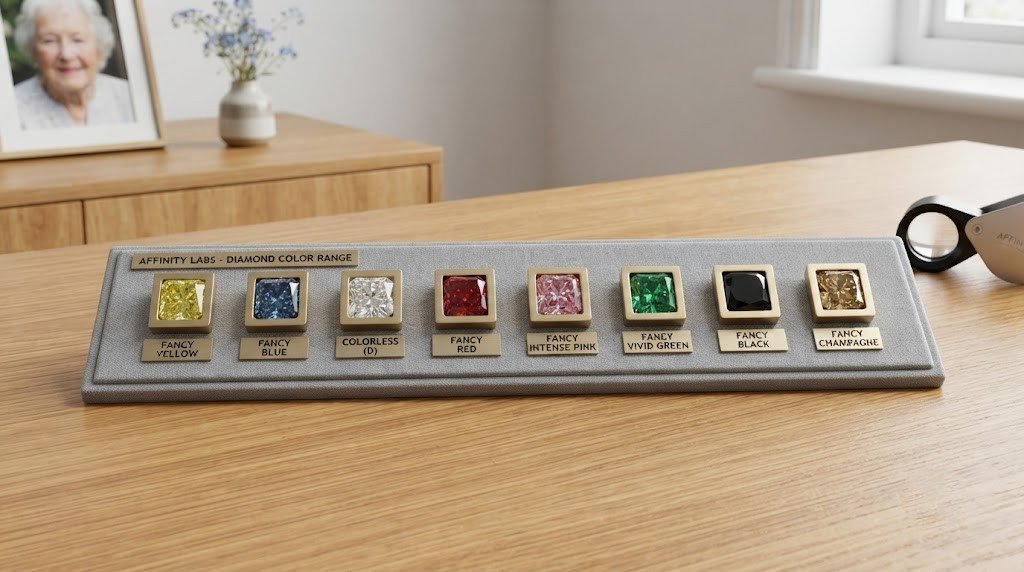
The people worth including early often go beyond the paperwork:

  • The executor, or whoever is settling her estate
  • Her surviving spouse or partner, if she had one
  • Her adult children, including your own parent if they are living
  • Cousins, siblings or step-relatives who might also want a stone

If a funeral home collected the lock, ask staff there who they are able to release it to, because each funeral home sets its own practice on that. And if anyone in the family objects or the question becomes contested, a local estate attorney can explain how your state treats personal belongings. Saving hair for a grandmother memorial diamond works best when nobody learns about it after the fact.

Can One Lock Be Shared Among Several Grandchildren?

Often, yes. Because each stone needs only a small amount, a single generous lock of hair for a grandmother memorial diamond may stretch to more than one stone, and several family members can sometimes each receive a stone from the same shared material. Whether your lock goes that far depends on how much there is and on each provider’s requirement per stone.

A simple way to organize it:

  1. Agree on one person to hold the hair until it is sent.
  2. Ask the provider how much hair for a grandmother memorial diamond is needed per stone and whether several stones can be grown from one submission.
  3. Decide whether each grandchild orders separately or one person coordinates for everyone.
  4. Ask how each stone is tracked, so every recipient gets documentation tied to their own diamond.
  5. Settle what should happen to any leftover hair before the package goes out.

A stone grown from her hair can also be passed down, perhaps to a child or grandchild of your own. Its worth as an heirloom lies in the story it carries; questions about appraisal or insurance value are best taken to a qualified appraiser rather than assumed. The broader guide to a grandmother hair diamond covers settings and sharing ideas in more detail.

How Do You Store and Send Hair for a Grandmother Memorial Diamond?

Until you are ready to send it, keep hair for a grandmother memorial diamond dry and clean, in a paper envelope or folded tissue, away from heat, damp and direct sunlight. Avoid sealing it in plastic while it might hold any moisture. Label the envelope with her name and a note about where the lock came from, and do not wash, trim or treat the hair unless a provider asks you to.

When it is time to send hair for a grandmother memorial diamond, follow the provider’s intake instructions rather than improvising. Ask whether it supplies a kit, how the package should be labeled, which shipping method it recommends, and whether you should insure the parcel. Before sealing anything, photograph the lock and note its weight if you can.

Chain of custody deserves its own questions. Ask how the hair is logged when it arrives, how it is tracked through extraction, purification and growth, and what records you receive at the end. Whether hair kept for many years is still workable is another point for the provider; there is usually no reason to hurry the decision itself. The step-by-step account of how to turn her hair into a diamond explains what happens once the package arrives.

How Much of the Finished Stone Comes From Her Hair?

This is the question to ask every provider directly. A figure exists only for ash-based stones: personal carbon is often put at roughly 10 to 15% of what the finished diamond weighs, though individual providers quote numbers ranging down to 3% and up past 15%. No equivalent finished-stone figure is published for hair, so the ash numbers should not be carried over.

What is known is this: hair is about 50% carbon, the recovered carbon is purified to roughly 99.9% or higher, and it is typically blended with supplemental lab carbon before growth. The result is a real lab-grown diamond, graded on the same 4Cs of diamond quality as any other and rated 10 on the Mohs hardness scale. If a provider describes a stone as made entirely of a loved one’s hair, ask how that fits with the blending the industry describes.

When you send hair for a grandmother memorial diamond, ask each provider in writing what share of the finished stone it accounts for and how that is documented. Also ask what paperwork comes with the stone. An authenticity or origin certificate, usually issued in-house, records chain of custody; a grading report, ideally from an independent lab referencing GIA standards and sometimes IGI, records the 4Cs and is typically an optional, separately priced add-on. The explainer on whether a stone is really made from her hair goes further into that honesty point, and the account of how a diamond is made from her hair walks through each stage.

What Does a Hair-Based Stone Cost, and How Long Does It Take?

Price follows carat, color, cut and add-ons, not the amount of hair for a grandmother memorial diamond you send. These are general 2026 industry ranges, not Memorial Diamond’s prices, which are not yet published:

Stone sizeTypical 2026 industry range
About 0.10 to 0.25 ctRoughly $1,500 to $3,500
0.5 to 1 ctRoughly $5,000 to $15,000 (colorless meaningfully more)
2 to 5+ ctRoughly $20,000 to $75,000+

Grading reports, engraving, fancy cuts and jewelry settings are usually priced separately. Memorial diamonds are generally offered from about 0.10 ct up to 5 ct and beyond, with typical clarity between SI2 and VVS.

On timing, the industry norm is about 6 to 10 months from the day a provider receives hair for a grandmother memorial diamond, and stones over roughly 2 ct or in specialty colors can take up to around 12 months. Ask each provider for its own estimate and what could change it.

Frequently Asked Questions

Is a lock from her locket enough hair for a grandmother memorial diamond?

It might be. Providers typically ask for a small lock or a few grams, so even locket hair can sometimes be enough. Describe its length and approximate weight to the provider, and ask for its minimum in writing before you open or disturb the locket.

Can strands from her hairbrush be used?

That depends entirely on the provider. Some may accept brush strands as hair for a grandmother memorial diamond and others may not, and the amount needed can differ. Ask directly before relying on it, and keep the brush untouched in the meantime so nothing is lost.

Does it matter that her hair was dyed or permed for years?

Acceptance of dyed, bleached or permed hair is a provider decision, not an industry standard. Ask each provider whether treated hair is accepted and whether it needs preparation. Do not expect her hair’s shade to determine the diamond’s color, which comes from growth conditions.

Can my cousins and I each get a stone from the same lock?

Often several stones can come from one shared source, because each needs only a small amount. Whether your lock stretches that far depends on how much there is and the provider’s per-stone requirement. Agree beforehand who holds the hair and who places each order.

Should I check with anyone before using hair she left at home?

Yes, it is wise to. What she left behind may count toward her estate, and states treat that differently. Talk with the executor or whoever is settling her affairs, and include her surviving spouse or partner and her adult children where that applies.

Will sending extra hair make the diamond larger or faster?

No. Carat size depends on how long the diamond grows, and the timeline follows the size and color you choose. Extra hair for a grandmother memorial diamond may simply be held in reserve, so ask what happens to any unused hair afterward.

Final Thoughts on Saving Her Hair for a Diamond

The amount of hair for a grandmother memorial diamond is small, and that often surprises people. The more meaningful work lies in knowing where her hair came from, asking each provider plainly what it accepts, and bringing the right relatives into the conversation before anything is mailed.

If you are still deciding, there is no pressure to choose now. A lock kept safely in a labeled envelope will wait while you gather answers, talk with family, and decide whether a diamond feels right for you.

Learn More About Hair-Based Diamonds for a Grandmother

Talk With Memorial Diamond

If you have saved hair for a grandmother memorial diamond and are not sure what to do next, we would be glad to talk it through with you. Bring your questions about amounts, sources and family logistics, and we will answer them plainly.

You can reach us any time through memorialdiamond.us. There is no deadline, and taking time to decide is completely fine.