
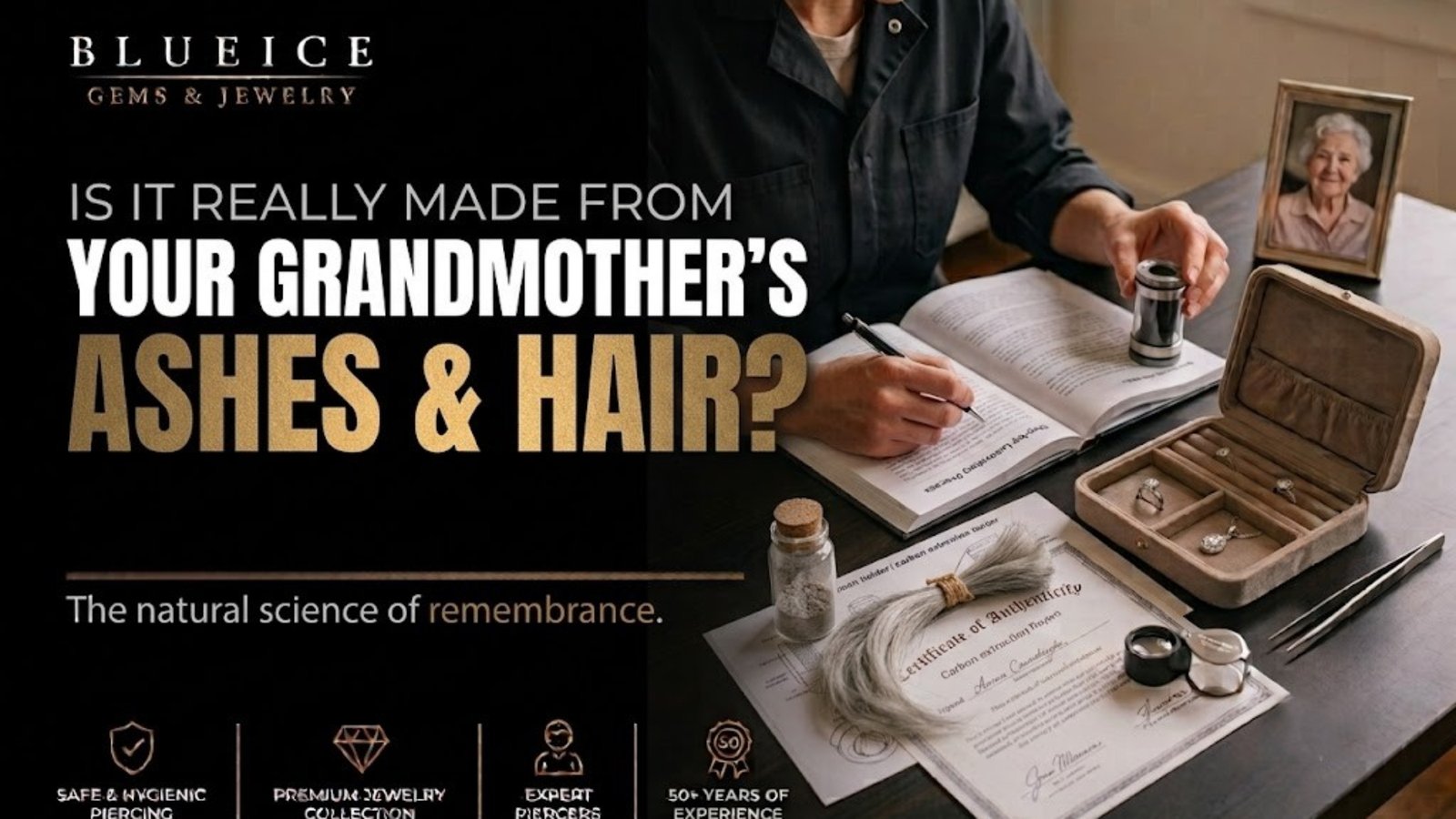
Some families hold two things of hers at once: a portion of her ashes, and a curl of hair someone saved. A stone can be really made from grandmother ashes and hair, in the sense that carbon from both can be purified and grown into one genuine lab-grown diamond, typically alongside supplemental lab carbon. What nobody can honestly give you is a published figure for how much of a combined stone came from each source, so the claim rests on documentation you request.
Whether a gem is really made from grandmother ashes and hair is a question of records as much as chemistry. Below: what a provider can stand behind, what needs proof in writing, and why two separate stones can be simpler.
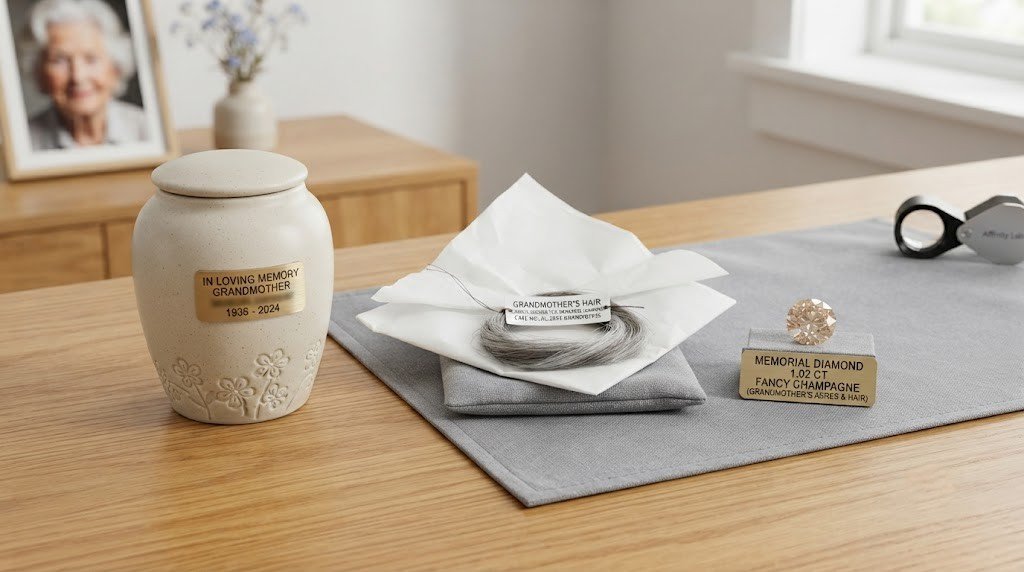
Table of Contents
What Can Truthfully Be Said About a Stone Really Made From Grandmother Ashes and Hair?
Start with what holds up under scrutiny. If a provider genuinely draws carbon from both her ashes and her hair, purifies it, and grows it into a crystal, then the finished gem contains carbon that came from her by two routes. Saying the piece is really made from grandmother ashes and hair is accurate as long as “made from” carries its honest meaning: made in part from her, with lab carbon typically added to reach a usable volume.
Nobody can tell you, by looking at or testing the diamond, which atoms came from ash and which came from hair. Once purified, carbon is carbon. Any provider that claims to show you a precise split inside a stone really made from grandmother ashes and hair is describing something beyond what standard gemology can do.
Three sentences you can use with family
When relatives ask whether the piece is really made from grandmother ashes and hair, these statements stay true:
- “Carbon recovered from her ashes and from her hair was purified and grown into this diamond.”
- “Like most memorial diamonds, it was grown with some added lab carbon as well.”
- “The provider’s paperwork records that both of her materials went into it.”
The third depends on the provider supplying that paperwork; without it, a stone said to be really made from grandmother ashes and hair rests on trust alone.
How Does a Provider Combine Her Ashes and Hair?
The broad industry process runs in stages: collection with chain-of-custody tracking, carbon extraction and purification to roughly 99.9% or higher, graphitization at around 2,500 to 2,700°C, and growth, most often in an HPHT press holding about 6–8 GPa of pressure at somewhere between 1,400 and 2,500°C for a span of weeks or months. Cutting, polishing and grading follow. A plain overview of how lab-grown diamonds are produced covers both HPHT and the less common CVD method.
Where a stone really made from grandmother ashes and hair differs is at the start. Ash and hair behave very differently: ash is mostly calcium phosphate, with usable carbon at roughly 0.5% to 4% of its weight, while hair is about 50% carbon. How carbon is recovered from each, and when the two are brought together, is set by each company. The walkthrough of how a diamond is grown from her ashes and hair together covers that sequence.
Questions about the combining step
Whether a stone is really made from grandmother ashes and hair depends on how this step is handled, and every provider handles it its own way. Ask each one:
- Do you extract carbon from the ashes and the hair separately, and then blend them?
- At what stage are the two carbon sources combined?
- Is any of either material set aside unused, and what happens to it?
- Can you describe the process in writing for my file?
Plain answers to these four questions say a great deal about whether a provider can back up a stone really made from grandmother ashes and hair.
How Much of a Stone Really Made From Grandmother Ashes and Hair Came From Her?
For stones grown from ashes alone, industry figures put personal carbon at around 10–15% of the finished mass, with some providers citing as little as 3% and others more. That range describes ash-only stones. It does not transfer to a stone really made from grandmother ashes and hair, and it should not be quoted as if it did.
For a gem that is really made from grandmother ashes and hair, no blended finished-stone figure is published anywhere in the industry. How much of each material a provider uses, and how much lab carbon joins them, varies. The only way to get a number is to ask for it.
A written request worth sending
Before you pay for anything described as really made from grandmother ashes and hair, ask the provider to state, in writing and in plain terms:
- Roughly what share of the finished stone they estimate came from her carbon in total.
- Whether they can estimate how that share divides between ash and hair.
- How much supplemental lab carbon is typically added at the carat size you are considering.
A range, or a plain statement that the ash-and-hair split cannot be estimated, is an honest reply. A refusal to answer at all is worth weighing before you send anything of hers.
How Would You Know a Stone Is Really Made From Grandmother Ashes and Hair?
You would know mostly through paper. Because a finished diamond cannot be tested to show it came from her, confidence that it is really made from grandmother ashes and hair depends on how each material is received, logged and tracked through the process. Think of it as two chains of custody that must both be intact.
Seven checks before you order
These seven checks give you something concrete to compare across providers offering a stone really made from grandmother ashes and hair:
- Two intake records. Ask whether you will receive a separate written receipt for the ashes and for the hair.
- Labeling for each material. Ask how each container is labeled on arrival and at every handoff.
- Batch separation. Ask how her materials are kept apart from other families’ material throughout.
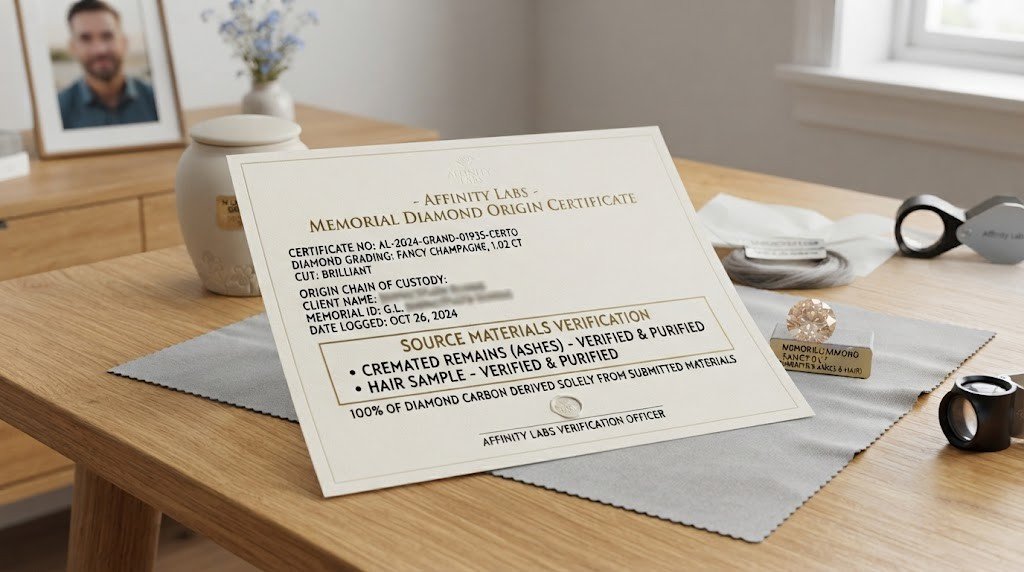
- An origin certificate naming both. Ask whether the in-house authenticity certificate will list ashes and hair specifically, not just “remains.”
- A written process description. Ask for the combining method in writing, so it sits in your file.
- What happens to leftovers. Ask what is done with unused ash or hair, and whether you can have it returned.
- Failed-run policy. Ask what happens, and what is communicated to you, if a growth run does not succeed.
Origin certificate versus grading report
The origin or authenticity certificate, usually produced in-house, is the document that ties a stone to your family’s submitted material; for a stone really made from grandmother ashes and hair, it is where both materials should be named. A grading report describes the diamond’s own cut, color, clarity and carat, ideally from an independent lab working to GIA’s quality standards, sometimes IGI.
Independent grading is typically an optional, separately priced add-on. It confirms that you have a genuine diamond of the stated quality. It does not, and cannot, confirm that a diamond is really made from grandmother ashes and hair.
Which Claims Need Proof, and Which Cannot Be Made at All?
Use this table to judge any description of a stone really made from grandmother ashes and hair.
| Claim about a combined stone | Status | What supports it |
|---|---|---|
| It is a genuine lab-grown diamond | Can be stated | Independent grading report |
| Carbon from her ashes went into it | Needs provider documentation | Ash intake record, origin certificate naming ashes |
| Carbon from her hair went into it | Needs provider documentation | Hair intake record, origin certificate naming hair |
| Some lab carbon was added | Typically true; confirm | Provider’s written process description |
| Her total share of the stone | Provider estimate only | Written answer; no published blended figure exists |
| The exact split between ash and hair | Generally cannot be shown | Not measurable in the finished crystal |
| The stone is made entirely of her | Cannot be stated | Contradicts how memorial diamonds are typically grown |
The middle rows are where your written requests do their work, and where a provider shows whether its stone is really made from grandmother ashes and hair in any checkable sense.
Would Two Separate Stones Be Easier to Describe Honestly?
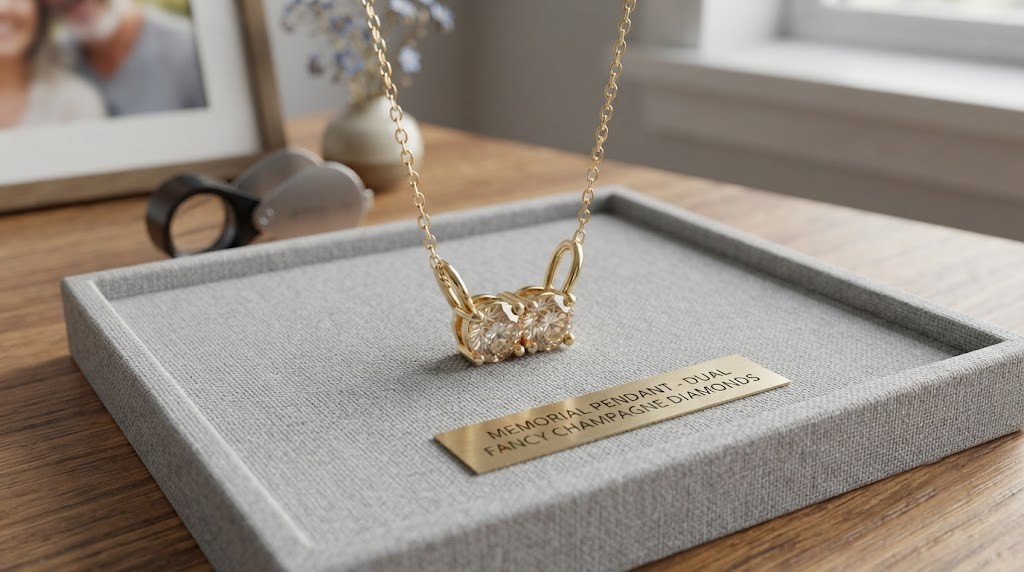
Often, yes. A stone grown only from her ashes can be described using the ash-only figures the industry already publishes, and a stone grown only from her hair has a simpler, single chain of custody. Each one has one material, one intake record and one origin certificate. Each is easier to verify than a stone really made from grandmother ashes and hair together.
Two stones also open options: one for the relative who keeps her urn, one for whoever saved her hair, or both in one setting.
When one combined stone still makes sense
A combined stone can matter for reasons no table captures: the wish to bring both parts of her together into a single piece. If your family wants a gem really made from grandmother ashes and hair, the answer is not to avoid it but to ask for documentation that names both materials. For more on whether one source might be enough, the companion pieces on whether a stone is truly grown from her ashes and whether a stone is truly grown from her hair look at each route alone.
| Option | Sources | Records to check | Easiest to describe? |
|---|---|---|---|
| One combined stone | Ashes and hair | Two intake records, certificate naming both | Hardest |
| One ash stone | Ashes | One intake record | Easier; published ash range applies |
| One hair stone | Hair | One intake record | Easier; no cremation involved |
| Two separate stones | One each | One record per stone | Clearest |
Who Decides What Happens to Her Ashes and Hair?
Before any stone is really made from grandmother ashes and hair, someone has to agree to release each material, and the two can sit with different people under different rules. Authority over cremated remains is set by state law and by any wishes she left in writing, and the order of who decides varies by state. Grandchildren usually stand behind a surviving spouse or partner and then her adult children. If nobody is sure who holds that role, the crematory or funeral home that handled her cremation can usually name the person who signed for it.
If you are her grandchild, the respectful path runs through that person: a gentle request to whichever parent, aunt or uncle holds that role for a small share to be set aside for the stone. Her ashes may already have been divided, scattered or placed somewhere permanent, and her hair may be with a cousin.
Hair kept at home is usually a simpler practical matter, though her personal belongings may form part of her estate under rules that change from state to state. Before sending any, check with the executor or whoever is settling her affairs.
Faith and dividing remains
Religious teaching speaks to cremation and to what is done with ashes; none of the major traditions has ruled on memorial diamonds as such. For Catholic families, the Church accepts cremation yet wants the remains to rest whole in a consecrated place, with only limited room for setting a little apart, so splitting her ashes between an urn and a stone is worth raising with a priest. Orthodox and Conservative Judaism generally prohibit cremation, while Reform Judaism is more permissive. A hair-only stone involves no cremation. Whatever your family’s faith, its own clergy or community leaders are the ones to ask.
What Warning Signs Suggest a Combined Claim Is Overstated?
A few patterns deserve a second look before you commit to a stone described as really made from grandmother ashes and hair:
- A claim of 100% her. Memorial diamonds are typically grown with supplemental lab carbon. A promise that nothing else is in the stone is an overstatement until proven otherwise.
- A borrowed percentage. If a provider quotes the ash-only range as though it describes a combined stone, ask where the figure comes from.
- A certificate that names neither material. A generic “made from remains” line does not show that both were used.
- No answer about the combining step. If a provider cannot say when or how the two carbon sources meet, ask again in writing.
- A promised color tied to her hair or ashes. Diamond color comes from trace elements during growth; no family can choose or match an exact natural shade.
- Pressure to decide quickly. A careful provider gives you time.
None of these settles anything alone. Each is a reason to slow down and ask more questions.
Which Beliefs About Stones Really Made From Grandmother Ashes and Hair Do Not Hold Up?
Some assumptions about a diamond really made from grandmother ashes and hair sound reasonable but do not match how the process works.
“Adding hair makes the stone bigger.” A stone’s finished weight depends on how many weeks it spends growing, and the volume of ash or hair delivered does not change that.
“Two sources mean double the personal carbon.” No blended figure is published. Whatever share a stone really made from grandmother ashes and hair contains is something the provider has to estimate for you in writing.
“Hair gives the stone a cleaner color than ash.” Neither source has been shown to produce a lighter or more predictable color. Boron produces blue and nitrogen produces yellow, and memorial diamonds tend toward yellow, blue and champagne or brown. More on that is in the colors a stone from her ashes and hair can take.
“A stone really made from grandmother ashes and hair needs most of her ashes.” Industry-wide, ash requests typically range from a few tablespoons to roughly 4 oz, with hair typically a small lock. The guide to how much ash and hair a grandmother memorial diamond needs sets out what to expect, though each provider sets its own figures.
“Old ashes or old hair will not work.” Whether long-stored material is usable is each provider’s call, so ask.
What Does a Combined Stone Cost, and How Long Does It Take?
Industry pricing in 2026 runs roughly $1,500 to $3,500 for about 0.10 to 0.25 carat, roughly $5,000 to $15,000 for 0.5 to 1 carat with colorless costing noticeably more, and roughly $20,000 to $75,000 or more for 2 to 5 carats and up. These are ranges across providers. Whether a stone really made from grandmother ashes and hair costs more than a single-source one is a question to ask each provider.
Independent grading, engraving, fancy cuts and settings are usually priced on top of the loose stone, so budget for the grading report if you want third-party confirmation of quality.
Once her ashes and hair arrive, industry-typical lead times are 6 to 10 months, stretching to about 12 months for stones above roughly 2 carats or in specialty colors. Ask whether handling two materials affects the schedule for a stone really made from grandmother ashes and hair. The hub on a grandmother ashes and hair diamond covers planning in more depth.
Frequently Asked Questions
Can a provider prove which carbon in a stone really made from grandmother ashes and hair came from each?
Generally no. Once purified, carbon from ash and from hair is chemically identical, and the finished crystal cannot be tested to separate them. What a provider can document is that both materials were received, logged and used.
Is the 10–15% figure accurate for a stone made from both her ashes and hair?
No. That range applies to stones grown from ashes alone. No finished-stone figure is published for combined ash-and-hair stones, so ask each provider for its own written estimate of her total share at your chosen size.
Should the origin certificate name both her ashes and her hair?
It is reasonable to ask for that. An in-house authenticity certificate is the document linking the stone to your family’s material, so for a combined stone, request in advance that it list both ashes and hair by name.
Is a stone still really made from grandmother ashes and hair if lab carbon is added?
Yes, honestly described. Her carbon from both sources becomes part of the crystal, and supplemental lab carbon is typically added to reach a workable volume. Ask the provider to say in writing roughly how much is added.
Can we make one stone from her ashes and another from her hair instead?
Usually, yes, depending on the provider and how much material your family has. Each single-source stone carries just one chain of custody, which tends to make the paperwork simpler to check and the stone simpler to explain to relatives.
What if her ashes were already divided among relatives?
Ask whoever holds a portion whether a small amount could be shared for the stone. Authority depends on state law and her written wishes, so the person who signed the cremation authorization is often the right first conversation.
Final Thoughts on a Stone Really Made From Grandmother Ashes and Hair
Wanting a stone really made from grandmother ashes and hair is a natural instinct, and it can be honored truthfully. The truthful version simply has limits: her carbon from both sources is in the crystal, alongside lab carbon, in proportions that only the provider can estimate.
Ask for records that name each material, read them before you commit, and keep them with the stone. If one combined piece starts to feel harder to describe than you would like, two separate stones remain a perfectly good choice.
Learn More About Combined Ash and Hair Stones for a Grandmother
- Grandmother Ashes and Hair Diamond: The Complete Guide the wider decision, from first questions to setting
- How to Turn Your Grandmother’s Ashes and Hair Into a Diamond first steps for gathering both materials
- How Much Ash and Hair Do You Need for a Grandmother Memorial Diamond? what families usually send of each, and how relatives can shar
- Is a Memorial Diamond Really Made From Your Grandmother’s Hair? the verification questions for a hair-only stone
Talk With Memorial Diamond
Whether you are leaning toward one combined stone or two separate ones, a conversation can help you see what records to ask for and what each route involves. Memorial Diamond is glad to talk it through at your own pace.
When your family is ready, start at memorialdiamond.us.
Leave A Comment