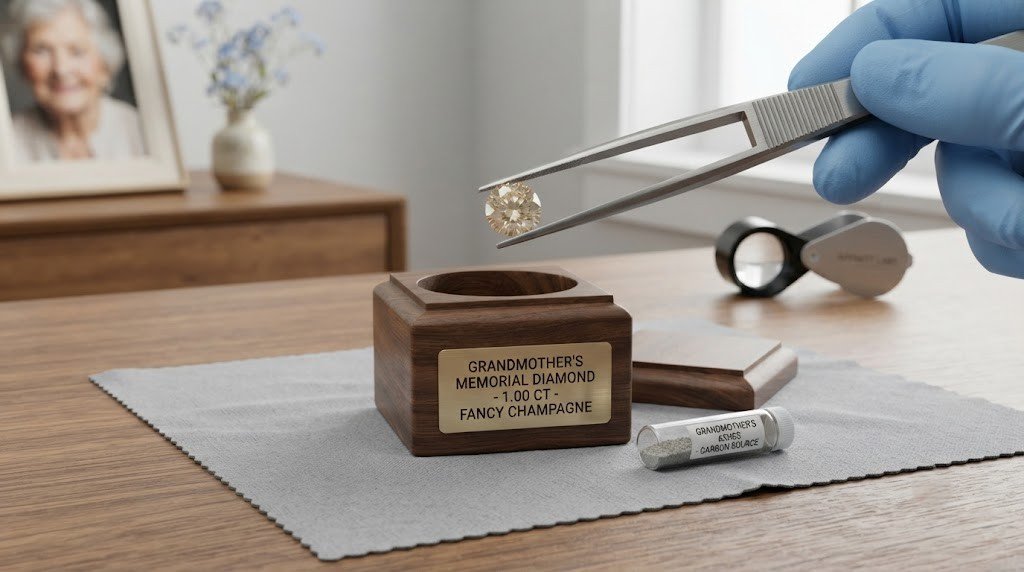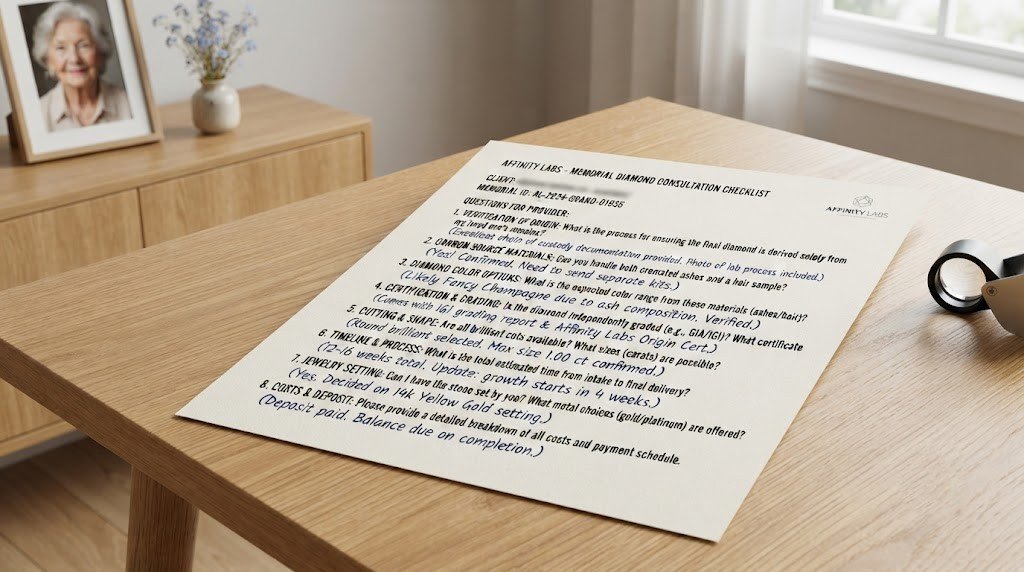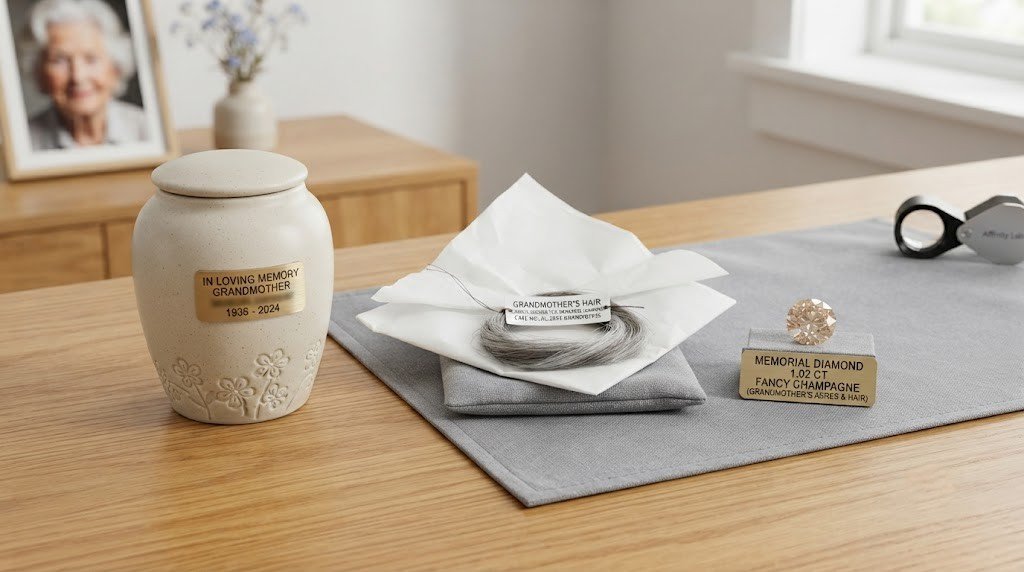
Is a Memorial Diamond Really Made From Your Grandmother Hair

Is a Memorial Diamond Really Made From Your Grandmother’s Hair?

Maybe a lock of her hair has been sitting in an envelope for a while, and the question you keep circling is not price but truth. Yes, a memorial diamond can be really made from grandmother hair: hair is about 50% carbon, and that carbon can be purified and grown into a genuine lab-grown diamond. What no honest provider can promise is a stone made of her carbon alone, so the useful work is knowing what to ask and what to get in writing.

This page is for whoever holds that question, whether you are her grandchild, her son or daughter handling things for the family, or someone she chose as family. It sets out what can be checked when a stone is described as really made from grandmother hair, what cannot, and which answers only a provider can give you. If hair as a source is still an open question, start with the complete guide to a grandmother hair diamond.
really made from grandmother hair

What Does It Mean for a Stone to Be Really Made From Grandmother Hair?

When a provider says a diamond is really made from grandmother hair, the truthful meaning is narrower than the sales version and still remarkable. Carbon recovered from the hair she grew is extracted, purified to roughly 99.9% or better, converted to graphite and placed in a growth cell, where it becomes part of a diamond’s crystal lattice; the stage-by-stage process for her hair walks through each step. The stone is not a symbol standing in for her. Part of it physically came from her.

What “made from” does not mean is that every atom in the finished gem was once part of her. Providers typically top up her recovered carbon with lab-sourced carbon, and how much they add, and why, is theirs to explain. That blending is ordinary across the industry, and it is the single detail to understand before deciding whether a gem is really made from grandmother hair in the sense you need.

The short version

  • Her hair supplies real carbon that ends up inside the crystal.
  • That carbon is purified and grown into a genuine diamond, graded on the same 4Cs as any other.
  • Supplemental lab carbon is typically added to reach a workable volume.
  • The share that came from her is a figure to request from each provider, in writing.

Put plainly, a family can describe a finished piece as really made from grandmother hair without stretching the truth, provided they also understand that “made from” means “made in part from.” That sentence holds up when a curious relative asks how it works.

Why Is Hair a Genuine Carbon Source for a Diamond?

Hair is built mostly from keratin, a protein rich in carbon, and it works out to about 50% carbon by weight. Cremated ashes, by comparison, are mostly calcium phosphate, with usable carbon at roughly 0.5% to 4% of their weight. That gap explains why a stone really made from grandmother hair typically needs only a small lock or a few grams.

It also means no cremation is involved. If she was buried, if her ashes were scattered long ago, or if an aunt or uncle keeps the urn and would rather it stay whole, her hair can still be the source. Where some of her ashes are also available, a stone combining her ashes and hair raises honesty questions of its own.

Where faith comes into it

Some families weigh this against religious practice. Cremation is considered impermissible across major schools of Islamic thought, so for Muslim families an ash-based stone does not arise, while a hair-based one involves no cremation at all. No tradition has issued a position on memorial diamonds as such, and your own imam, priest, rabbi, teacher or community remains the right voice on anything touching her belongings.

How Much of a Stone Really Made From Grandmother Hair Is Her Own Carbon?

This is where families expect a number and often find none. For stones grown from cremated ashes, the industry commonly cites personal carbon at around 10–15% of the finished mass, but that ash figure comes from ash chemistry and cannot be carried over to hair. The reasoning behind the ash number is explained in the companion piece on stones grown from her ashes. For hair-based stones, no equivalent finished-stone percentage is published.

That gap is not a reason for suspicion on its own. It means the figure is something you request directly before agreeing that a stone is really made from grandmother hair to the degree you were imagining. Each provider’s blend is its own, and only that provider can describe it.

What to ask, word for word

Send these by email so the answers sit on record before you pay for anything sold as really made from grandmother hair:

  1. Is supplemental lab carbon added to the carbon recovered from her hair, and roughly how much?
  2. What proportion of the finished stone, by mass, do you estimate came from her hair?
  3. Does that proportion change with the carat size I choose?
  4. Is any of her hair left over, and what happens to it afterward?
  5. Will you put your answers to these questions into the order paperwork?

A plain answer, even a rough estimate, gives you something to weigh. A change of subject tells you something too.

Why Is a “100% Her Hair” Claim a Red Flag?
Some sales language promises a gem made purely of a loved one, with nothing else in it. A stone can be really made from grandmother hair without being made only from it. Treat any claim that a stone is 100% her hair as a reason to slow down. Growing a diamond of meaningful size typically involves supplemental carbon, so a provider who denies that entirely is either running an unusual process they should be able to document in detail or overstating what they do.

The accurate framing is quieter and still meaningful: a verifiable portion of her carbon became part of a real diamond. Your family is better served by that sentence than by an impressive one that collapses at the first follow-up question. A stone really made from grandmother hair does not need exaggeration to matter.

Other phrases worth questioning

  • “Nothing else is added.” Supplemental carbon is typical; ask what the process actually involves.
  • “The color will match her hair.” Diamond color comes from trace elements during growth, and no family can choose or match an exact natural shade.
  • “Her DNA lives on in the stone.” Purification strips out everything that is not carbon, so ask the provider exactly what they mean by this.
  • Silence about who grows the stone. It is fair to ask whether growth happens in-house or at a partner lab, and where.

None of these phrases proves dishonesty by itself. Each one is a prompt to ask a follow-up, and any provider offering a piece really made from grandmother hair should be comfortable answering on paper.

How Do You Check That a Gem Is Really Made From Grandmother Hair?

No single document settles the question, and no test run on the finished gem can single out her carbon. Confidence comes from three things working together: a clean chain of custody, the right paperwork, and a believable account of how her sample stays apart from everyone else’s. Families who want to know a stone is really made from grandmother hair are, in practice, judging a provider’s records and process.

Chain of custody from envelope to finished stone

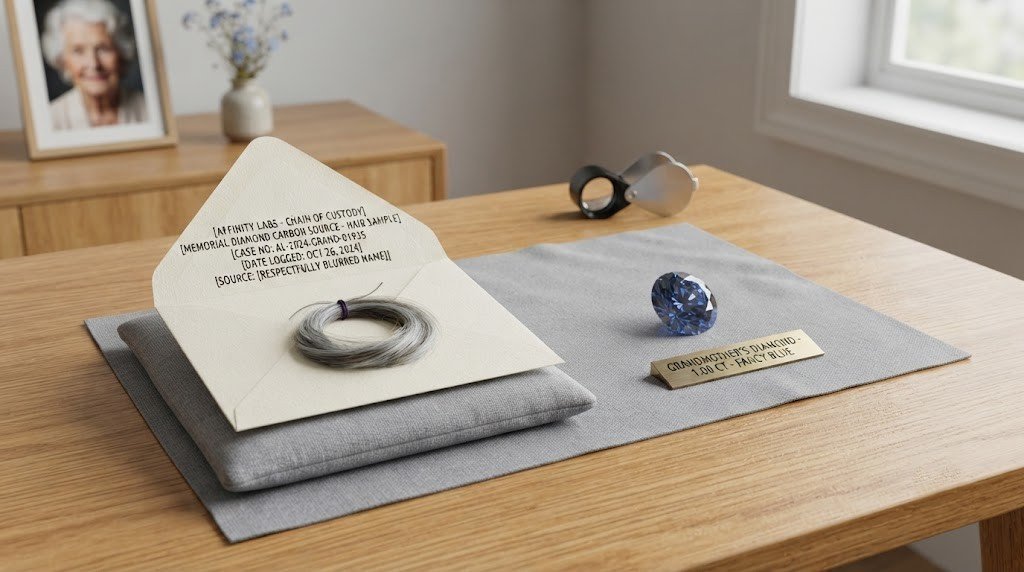
Chain of custody is the paper trail behind any claim that a stone was really made from grandmother hair, following the sample from the moment it leaves your hands. The practical steps for sending her hair cover packing and paperwork at your end. Ask how the sample is labeled on arrival, whether you receive written confirmation of receipt, who signs for it at each handoff, and whether you can request a record of each stage. Whether photos or progress updates are offered varies, so ask.

Authenticity certificate versus grading report

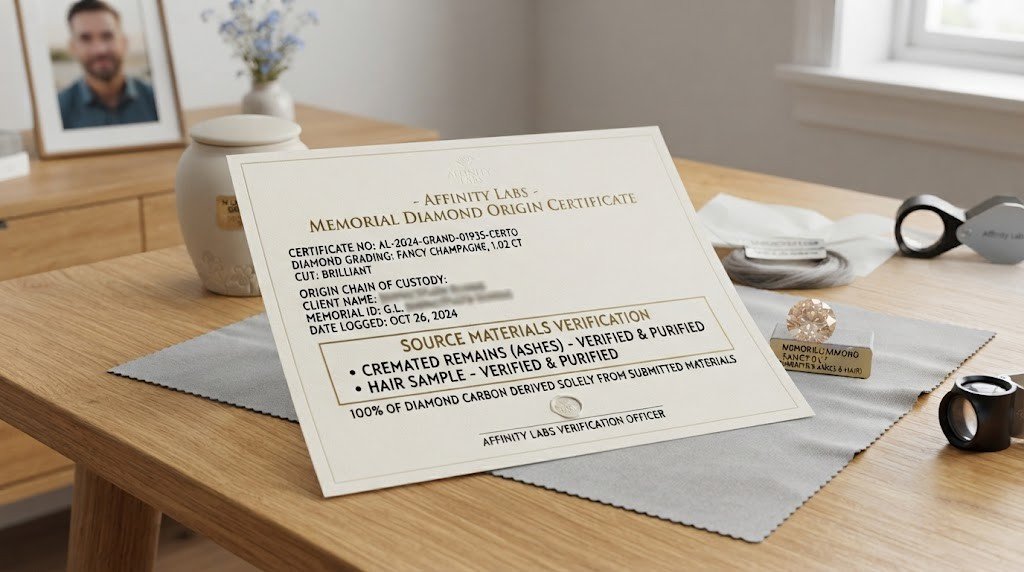
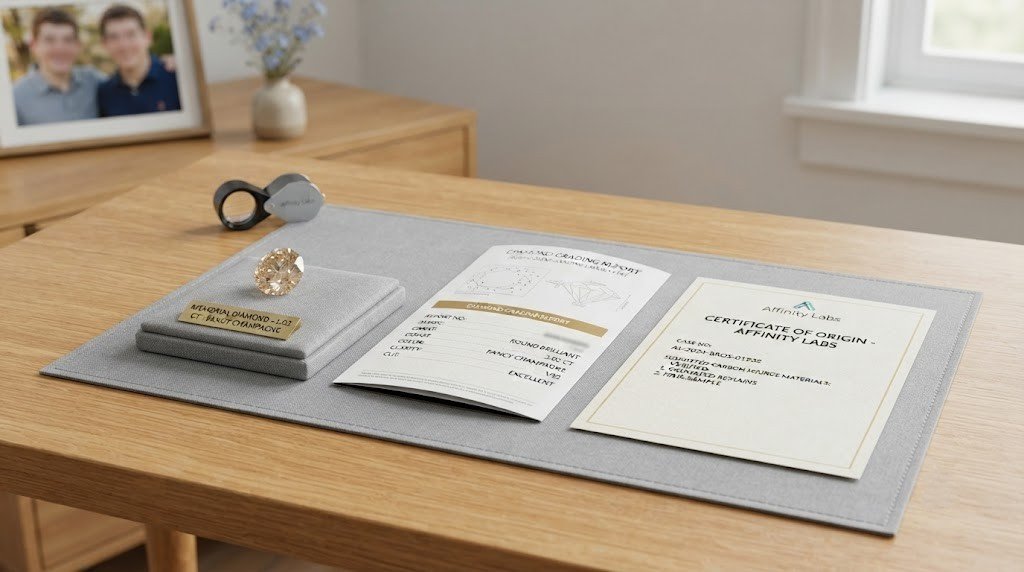
These two documents answer different questions. An authenticity or origin certificate is the paper that speaks to whether a stone was really made from grandmother hair; usually issued in-house, it records that the stone was grown from your family’s submitted material and works as a chain-of-custody document. A grading report, by contrast, rates the stone itself on the 4Cs; the most useful ones come from an outside lab that works to GIA’s diamond quality factors, and some come from IGI.

Independent grading is typically an optional add-on priced separately. It cannot confirm whose carbon is inside, but it does confirm you are holding a real diamond of the stated quality, which is half of what “really” means.

Keeping her sample separate

Ask each provider how one family’s material is kept apart from another’s. Useful questions: is each sample processed in its own batch, how is equipment cleaned between runs, how are containers labeled, and what happens if a growth run fails. Clear, specific answers here say more about whether a stone is really made from grandmother hair than any certificate design.

What Can and Cannot Be Proven About a Stone Really Made From Grandmother Hair?

Use this table as a checklist when you compare providers for a stone really made from grandmother hair.

ClaimCan it be checked?How you check it
The stone is a real diamondYesIndependent grading report, standard gemological testing
The stone is lab-grownYesGrading reports state lab-grown origin
Her hair was received and loggedYes, on paperWritten receipt, chain-of-custody records
Her carbon went into this specific stoneNot by testing the finished gemChain-of-custody records and a documented process
The share of the stone that came from herOnly as the provider’s estimateAsk in writing; no industry figure exists for hair
Her sample was never mixed with another family’sOnly through process and recordsAsk how batches are separated and labeled
Her hair will shape the stone’s colorNoColor comes from trace elements during growth

The rows marked “only” are where trust lives, so get those answers in writing before ordering.

Is a Small or Old Lock of Her Hair Enough?
Industry-wide, hair-based stones typically need a small lock or a few grams, and providers set their own requirements. Whether the particular hair you have can yield a stone really made from grandmother hair is a question for each provider: a braid saved for decades, strands from a brush, a single curl from a locket. A closer look at how much hair a grandmother memorial diamond usually takes can help you prepare. Ask whether they can assess it before you commit.

Ask what happens if the amount is too little. Do they contact you before starting, can you send more, and are any fees refundable at that point? Keep in mind that a bigger lock will not buy a bigger gem: the stone’s weight comes down to how long it stays in the press.

Whose hair is it to send?

Hair kept at home is usually a simpler practical matter than ashes. Still, keepsakes she owned may count among the things her estate has to account for, and each state handles that its own way. If an executor or another relative is settling her affairs, speak with them before sending anything. If the hair is with a parent, aunt, uncle or cousin, asking them to share a small portion is a respectful route, and several relatives can often each receive a stone from shared material, depending on the provider and how much there is.

Does Gray, Dyed or Treated Hair Change Anything?

Whether a provider accepts hair that was dyed, permed, bleached or chemically treated is that provider’s decision, so ask before you send it. Nothing published shows that her hair’s natural color, or the fact that it had gone gray or white, makes the stone lighter, darker or more predictable. Be wary of anyone who promises a color for a stone really made from grandmother hair based on how her hair looked.

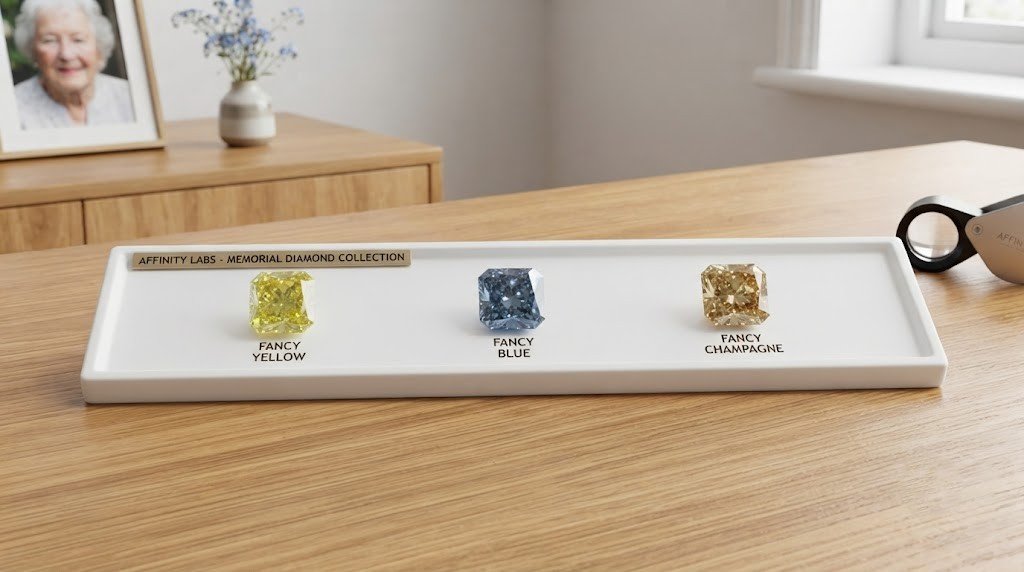
Diamond color comes from trace elements present during growth. Traces of boron push a stone toward blue, and nitrogen pushes it toward yellow. Trace elements of this kind are common in a personal, organic carbon source, so memorial stones tend toward yellow, blue or champagne-to-brown shades. Keeping both out to reach a colorless result means added processing and usually a higher price. A few providers can also irradiate a finished stone to turn it red, pink, green or black.

For a gem that is really made from grandmother hair, color is something to talk through with the provider, not a portrait of her hair. Ask which colors they offer, which cost more, and whether the color you pick affects the timeline. For more on that, see the colors a stone from her hair can take.

What Do People Get Wrong About Stones Really Made From Grandmother Hair?

A few beliefs come up again and again when families first ask whether a stone can be really made from grandmother hair. Each one is worth correcting before you compare quotes.

  • “More hair makes a bigger stone.” Growth time sets carat size. Sending extra hair does not change the size or speed of the result.
  • “Hair is a weaker source than ashes.” Hair carries far more carbon by weight than ash. It is a genuine source in its own right, not a fallback.
  • “Hair makes the process faster.” The timeline is typically 6 to 10 months from receipt, and larger or specialty-color stones can take up to about 12 months, whatever the source.
  • “A certificate of authenticity is a grading report.” One tracks origin; the other measures quality. A careful buyer asks for both.
  • “A memorial diamond is unbreakable.” It ranks 10 on the Mohs hardness scale, yet a hard knock at the wrong angle can still chip any diamond.

Set these aside and the question of whether a stone is really made from grandmother hair comes down to records, process and plain answers.

What Does Verification Add to Cost and Timeline?

Across the industry in 2026, small stones of roughly 0.10 to 0.25 carat generally run about $1,500 to $3,500. Stones from 0.5 to 1 carat usually fall between about $5,000 and $15,000, with colorless costing noticeably more, and stones of 2 to 5 carats or larger can reach $20,000 to $75,000 or beyond. These are industry-wide ranges, not one company’s prices.

Verification has its own line items. An independent grading report, engraving, a fancy cut and a setting are typically priced separately from the loose stone. If confidence that the piece is really made from grandmother hair matters most to you, budget for independent grading and ask whether the origin certificate comes included.

Time is the other cost. Expect roughly 6 to 10 months from the day the provider receives her hair before a stone really made from grandmother hair is ready, and longer for large or specialty-color stones. A provider who quotes far faster should be able to explain why.

Frequently Asked Questions

Can a diamond be made from my grandmother’s hair if she was buried?

Yes. Hair needs no cremation, so a lock kept by family from her lifetime or her final days can be the source. Whether the specific hair you have is workable, and how much a provider needs, is something to confirm with each provider before you send anything.

Will a grading report say the diamond came from her hair?

No. A grading report describes cut, color, clarity and carat, and it can confirm the stone is a lab-grown diamond. Evidence that it is really made from grandmother hair comes separately, through the provider’s origin certificate and custody records.

Is a stone still really made from grandmother hair if lab carbon is added?

Yes, in the honest sense. Carbon purified from her hair becomes part of the crystal, typically blended with supplemental lab carbon. Ask each provider how much is added, and get their estimate of her share in writing.

Can a lab test prove a diamond is really made from grandmother hair?

Not in any standard way. Once carbon is purified and grown into a crystal, origin is established through records rather than testing. That is why chain of custody, labeling and the provider’s written process matter so much.

Can cousins each get a stone from the same lock of hair?

Often, yes, because only a portion of the hair is usually needed for each stone. How many stones a given lock can support depends on the provider and the amount, so ask before dividing it among relatives.

What happens to any hair the provider does not use?

That is set by each provider. Some may return it, others may store or dispose of it. Ask before ordering, request the policy in writing, and say plainly if you want every unused strand sent back to you.

Final Thoughts on Whether a Stone Is Really Made From Grandmother Hair

Asking whether a stone is really made from grandmother hair is not cynicism. It is care, the same instinct that made you keep the lock in the first place.

The honest answer has two halves. Her carbon genuinely becomes part of the diamond, and the stone is typically grown with added lab carbon as well. A provider worth trusting will say both halves out loud, put the details in writing, and let you see how her hair is tracked from the day it arrives.

Learn More About Proving a Diamond Came From Her Hair

Talk With Memorial Diamond

If you are still working out whether her hair is the right starting point, that is a fine place to begin a conversation. Memorial Diamond can walk you through what to send, what records to expect and which questions are worth putting in writing, with no obligation attached.

You can reach us at memorialdiamond.us whenever the timing feels right for you and your family.
Is a Memorial Diamond Really Made From Your Grandmother Ashes

Is a Memorial Diamond Really Made From Your Grandmother’s Ashes?

Doubt is a reasonable response when someone offers to turn a portion of her ashes into a gemstone, especially when the remains matter this much to your family. So is the stone really made from grandmother ashes? Yes, in part: carbon recovered from her ashes is purified and grown into the diamond’s crystal lattice, typically blended with lab carbon, so the finished stone holds a real share of her, not all of it.

That “in part” is where honest providers and overstated marketing part ways. Whether a particular stone is really made from grandmother ashes comes down to chemistry you can understand and records you can check before trusting anyone with her remains.

really made from grandmother ashes

Table of Contents

What Does It Mean for a Diamond to Be Really Made From Grandmother Ashes?

To see how a stone can be really made from grandmother ashes, start with what ashes are. Bone mineral, in the form of calcium phosphate, accounts for most of what comes back from cremation, and usable carbon is only about 0.5% to 4% of ash by weight. A lab extracts that small carbon fraction, purifies it to roughly 99.9% or higher, converts it to graphite, and uses it as part of the feedstock that grows into a diamond.

So when a provider says a stone is really made from grandmother ashes, the truthful version of that sentence is narrower than it first sounds. Her carbon is physically present in the crystal. It sits in the lattice alongside supplemental lab carbon, which is typically added because the carbon recovered from a few tablespoons of ash is not enough on its own to grow a stone of meaningful size.

A real diamond, with a real share of her

A gem really made from grandmother ashes is a genuine lab-grown diamond with the same hardness, 10 on the Mohs scale, and the same 4Cs grading as any other diamond. Most are grown by HPHT, using heat and pressure, and a minority by CVD. Nothing about the blend makes it a simulant or an imitation; general background on the category is collected in this overview of memorial diamonds.

The honest version can carry plenty of meaning on its own. A stone really made from grandmother ashes in part is still a stone that exists because of her, and some people find real comfort in holding something that tangible. If you want the step-by-step chemistry behind it, the article on how a diamond is grown from her ashes walks through each stage.

How Much of the Finished Diamond Is Her Carbon?

For ash-based memorial diamonds, her personal carbon typically makes up around 10–15% of the finished stone’s mass. A few providers put the figure nearer 3%, a few put it above 15%, and where a given stone lands depends partly on its carat and on the amount of ash submitted.

That range is the most important number for anyone asking whether a gem is really made from grandmother ashes. It confirms her carbon is present while making clear that most of the crystal’s mass is lab carbon. A written figure inside or near that range is at least consistent with what the industry publishes, which makes it a reasonable starting point for further questions.

Why sending more ash does not raise the share much

It is natural to assume that sending a full urn would produce a bigger stone, or one with a higher share of her. Carat size, though, follows growth time in the press rather than the weight of what you ship. Providers typically ask for somewhere between a few tablespoons and roughly 4 oz (about 100 g), and the details are theirs to set; the guide on how much ash a grandmother memorial diamond needs explains the amounts more fully.

What this figure does not cover

The 10–15% range applies to ash-based stones only. Hair is about 50% carbon and follows a different path, and no comparable finished-stone percentage has been published for hair or for combined stones. If her hair is also an option for your family, the companion piece on whether a diamond can truly come from her hair covers that question separately.

Why Should a “100%” Claim Make You Cautious?

You may come across marketing that promises a diamond made entirely from your loved one, with nothing else added. Families who want a stone really made from grandmother ashes should question that phrasing, because it does not match how the process works.

Ash carbon is a small fraction of the ash itself, and the recovered carbon is typically blended with lab carbon before growth. A claim that a stone is entirely her, with nothing added, asks you to believe something the published industry figures do not support. That does not mean the stone is not really made from grandmother ashes; it means the honest description is “in part.”

A provider that overstates this point may be loose with other details too. When a provider insists its stone is really made from grandmother ashes and nothing else, ask the provider to state in writing what share of the diamond’s mass will be her carbon. A straightforward answer is a good sign; a vague one is a reason to keep looking.

Which Provider Claims Can You Trust, and Which Need Questions?

A useful way to read any provider’s materials is to sort its statements into two piles: claims consistent with published industry facts, and claims that need a follow-up question before you rely on them. The table pairs common statements with how to treat them when deciding whether a stone is really made from grandmother ashes.

What a provider saysTrust or question?Why
“Carbon from her ashes is extracted, purified and grown into the diamond.”Generally trustworthyMatches the standard industry process
“Her carbon is blended with lab-grown carbon.”Trustworthy, and a good signBlending is typical and honest providers say so
“Personal carbon is roughly 10–15% of the stone.”Trustworthy for ash-based stonesMatches published industry figures; some cite as low as 3%
“Your diamond is 100% your grandmother.”Question itContradicts how ash carbon is recovered and grown
“A larger urn means a larger diamond.”Question itGrowth time, not ash volume, sets carat size
“The diamond contains her DNA.”Question itNo published basis for this; ask what they mean
“You will receive a certificate of authenticity.”Ask what it showsIn-house origin records differ from independent grading

A provider can sit in the first pile on most points and still deserve a question or two. Treat the table as a starting point for judging whether its stones are really made from grandmother ashes, not as a verdict.

What Can the Finished Stone Itself Not Prove?

This is the hardest part of the honesty conversation. Once purified, carbon from ash is carbon, and nothing in the finished crystal identifies which person it came from. There is no published basis for claiming that DNA survives into a diamond, so no test of the stone itself can confirm to a family that it is really made from grandmother ashes rather than other carbon.

That limit applies to every memorial diamond from every provider, even a stone that is, by every record available, really made from grandmother ashes. It is also why verification rests entirely on what happens before and during growth: the paper trail, the tracking, and how carefully a lab keeps one family’s material apart from another’s.

What a grading report can and cannot tell you

An independent grading report describes the stone’s quality using the 4Cs as GIA defines them: cut, color, clarity and carat. Typical memorial diamond clarity falls between SI2 and VVS. A grading report confirms you have a genuine diamond of a stated quality; it cannot confirm the stone was really made from grandmother ashes.

Why color is not evidence either

Yellow, blue, champagne and brown are the usual memorial diamond tones, because trace elements such as nitrogen and boron are common in organic carbon. Those tones are consistent with a personal source, but they are not proof of one, and a family cannot pick or match an exact natural shade. The post on the colors her ashes can produce explains why.

How Can Your Family Check That a Stone Is Really Made From Grandmother Ashes?

Because the stone cannot speak for itself, the checking happens through records and answers. Clear, documented explanations of the process are the best indication you can get that your diamond will be really made from grandmother ashes.

Know the two documents apart

An authenticity or origin certificate, which the provider normally produces itself, is a chain-of-custody record: it is the provider’s written statement that the stone was really made from grandmother ashes sent in by your family. A grading report, ideally from an independent third-party lab referencing GIA standards and sometimes IGI, covers the stone’s quality. Independent grading is typically an optional add-on with its own price, so ask whether it is included.

Questions to put to any provider

  • How is her material labeled and tracked from the moment it arrives?
  • How are different families’ batches kept separate throughout extraction, purification and growth?
  • What records, updates or documents will we receive during the process?
  • What percentage of the finished stone do you expect to come from her ashes, stated in writing?
  • What happens to any ash that is not used: is it returned, stored or disposed of?
  • If a growth run fails, what happens to her carbon and to our order?
  • Can a third-party lab grade the finished stone, and at what cost?

Clear, specific, written answers to those questions tell you far more about whether a gem will be really made from grandmother ashes than any marketing page. The step-by-step guide to the process shows where each of those checkpoints falls.

What Doubts and Misconceptions Come Up Most Often?

Several beliefs circulate about whether any stone is really made from grandmother ashes, and each one can make a family either too trusting or too skeptical.

“Ashes are mostly carbon, so the diamond is mostly her.”

Ash is mostly calcium phosphate. Only about 0.5% to 4% of it is usable carbon, which is why a diamond really made from grandmother ashes typically includes lab carbon too.

“If it is blended, it is not really her.”

Her carbon is physically present in the lattice. A share of 10–15%, or even 3%, is still a real part of her, and a stone really made from grandmother ashes in part is not a symbol standing in for her.

“The whole urn has to be sent.”

Usually only a small portion is needed, so the rest can stay in an urn, be scattered, or be interred as the family planned. A diamond sits alongside those choices rather than replacing them.

“A lab can test the diamond to prove whose it is.”

No published test can identify a person from a finished diamond. Proof that it was really made from grandmother ashes rests on documentation and process, not on the stone.

“Memorial diamonds are not real diamonds.”

They are real lab-grown diamonds, graded on the same 4Cs as any other. A hard knock can still chip a diamond, as with any gemstone, but it rates 10 on the Mohs scale.

Does It Matter If Her Ashes Were Divided or Kept for Years?

This question can surface months or years after a funeral. Her ashes may already be divided among relatives, partly scattered, or kept on an aunt’s or uncle’s shelf for a decade. None of that changes what it means for a diamond to be really made from grandmother ashes, but it does raise practical questions.

Whether ashes stored for many years can still yield a stone really made from grandmother ashes is something each provider decides, so ask directly rather than assuming. If only a small portion remains with your branch of the family, ask what minimum amount the provider needs; general industry ranges start at a few tablespoons.

Who gets to decide

State law sets who controls her remains, along with anything she put in writing, and each state ranks family members a little differently. Commonly a surviving spouse or partner comes first, followed by her adult children, with grandchildren further along. If you are a grandchild, a respectful approach is to ask whoever holds that authority whether a small portion could be set aside, and to bring cousins into the conversation early. If nobody is sure who that is, the crematory’s paperwork usually names the person who authorized her cremation.

When faith is part of the question

Faith traditions speak to cremation and to what is done with ashes, but none has issued an official ruling on memorial diamonds themselves. Catholic guidance, for example, asks that ashes stay intact in a sacred place, with only a narrow allowance for a small portion, which bears directly on dividing them. Orthodox and Conservative Judaism generally prohibit cremation while Reform is more permissive, and Hindu, Buddhist and Protestant views vary by community. Your own clergy, or the faith community she belonged to, can speak to your situation.

What Should You Do If a Provider Cannot Answer?

Sometimes the honest answer to “is this really made from grandmother ashes?” gets lost because a provider will not engage with the details. A brief, evasive or purely emotional reply to a technical question is information in itself.

If a provider cannot or will not answer your questions, consider these steps:

  1. Ask again in writing, listing each question separately so nothing can be skipped.
  2. Request sample copies of the origin certificate and any grading report they issue.
  3. Ask for their written policy on unused ash and on failed growth runs.
  4. Compare at least two providers’ answers side by side before choosing.
  5. Pause if anything still feels unclear; there is no deadline on remembering her.

A provider that welcomes these questions is showing you how it will treat her remains, and how seriously it takes the promise that a stone is really made from grandmother ashes. The complete guide to grandmother ashes diamonds covers the wider decision if you are still weighing whether a diamond fits your family at all.

Does Careful Verification Change the Cost or Timeline?

Asking whether a stone is really made from grandmother ashes costs nothing, but some of the documents that support verification may. Independent grading reports are typically priced separately from the stone, as are engraving, fancy cuts and settings.

Across the industry in 2026, and not as Memorial Diamond’s pricing, stones run roughly 1,500–3,500 for about 0.10–0.25 ct, roughly 5,000–15,000 for 0.5–1 ct, and roughly 20,000–75,000 or more for 2–5+ ct. Colorless stones cost meaningfully more at the same size, because keeping out nitrogen and boron takes extra processing.

On timing, expect roughly 6 to 10 months between the lab receiving her ashes and the finished stone, and larger stones over about 2 ct or specialty colors can take up to roughly 12 months. Ask whether independent grading adds time, and how you will be kept informed while a stone really made from grandmother ashes is on its way back to your family. The guide on turning her ashes into a diamond covers the practical sequence of choices.

Frequently Asked Questions

Is the diamond really made from grandmother ashes, or just inspired by them?

It is made in part from her. Carbon recovered from her ashes is purified, converted to graphite and grown into the crystal, typically blended with lab carbon. Her carbon is physically present in the finished stone, not merely represented by it.

What percentage of the stone comes from her ashes?

For ash-based memorial diamonds, personal carbon is typically around 10–15% of the finished stone’s mass. A few providers quote as little as 3%, and some quote more, with carat and the quantity of ash both playing a part. Ask each provider for its figure in writing.

Can a lab test the finished diamond to confirm it came from her?

No published test can identify a person from a finished diamond, and there is no basis for claims that DNA survives in one. Confirmation comes from chain-of-custody records, the origin certificate and a provider’s clear answers about how batches stay separate.

Is an origin certificate the same as a grading report?

No. An origin or authenticity certificate, normally produced by the provider itself, ties the stone to your family’s submitted carbon. A grading report, ideally from an independent lab, describes cut, color, clarity and carat. Keeping both gives a fuller record.

Should I avoid a provider that says its diamonds are 100% ashes?

Treat that claim as a reason to ask more questions. A stone really made from grandmother ashes still typically blends her recovered carbon with lab carbon. Ask the provider to explain, in writing, what share of the stone it expects to come from her ashes.

Can we still make a diamond if most of her ashes were scattered?

Often, yes, since the typical request is a small amount, from a few tablespoons to roughly 4 oz. Whether a small or long-stored portion is workable is the provider’s call, and whoever holds authority over her remains should agree before anything is sent.

Final Thoughts on Whether Her Diamond Is Truly Hers

The truthful answer sits between two extremes. A diamond really made from grandmother ashes holds her carbon, grown into the crystal, and shares that crystal with lab carbon. A provider that says both halves of that sentence plainly is one worth listening to.

Ask your questions, keep the answers in writing, and let the paperwork carry the proof the stone cannot. That care is part of honoring her too.

Learn More About Verifying a Grandmother Ashes Diamond

Talk With Memorial Diamond

If you have questions about how a stone can be really made from grandmother ashes, or how records and tracking should work, Memorial Diamond would be glad to answer them plainly. There is no rush, and asking commits you to nothing.

Reach out through memorialdiamond.us whenever the timing feels right for your family.

Is a Memorial Diamond Really Made From Your Grandmother Ashes and Hair

Is a Memorial Diamond Really Made From Your Grandmother’s Ashes and Hair?

Some families hold two things of hers at once: a portion of her ashes, and a curl of hair someone saved. A stone can be really made from grandmother ashes and hair, in the sense that carbon from both can be purified and grown into one genuine lab-grown diamond, typically alongside supplemental lab carbon. What nobody can honestly give you is a published figure for how much of a combined stone came from each source, so the claim rests on documentation you request.

Whether a gem is really made from grandmother ashes and hair is a question of records as much as chemistry. Below: what a provider can stand behind, what needs proof in writing, and why two separate stones can be simpler.

Table of Contents

What Can Truthfully Be Said About a Stone Really Made From Grandmother Ashes and Hair?

Start with what holds up under scrutiny. If a provider genuinely draws carbon from both her ashes and her hair, purifies it, and grows it into a crystal, then the finished gem contains carbon that came from her by two routes. Saying the piece is really made from grandmother ashes and hair is accurate as long as “made from” carries its honest meaning: made in part from her, with lab carbon typically added to reach a usable volume.

Nobody can tell you, by looking at or testing the diamond, which atoms came from ash and which came from hair. Once purified, carbon is carbon. Any provider that claims to show you a precise split inside a stone really made from grandmother ashes and hair is describing something beyond what standard gemology can do.

Three sentences you can use with family

When relatives ask whether the piece is really made from grandmother ashes and hair, these statements stay true:

  • “Carbon recovered from her ashes and from her hair was purified and grown into this diamond.”
  • “Like most memorial diamonds, it was grown with some added lab carbon as well.”
  • “The provider’s paperwork records that both of her materials went into it.”

The third depends on the provider supplying that paperwork; without it, a stone said to be really made from grandmother ashes and hair rests on trust alone.

How Does a Provider Combine Her Ashes and Hair?

The broad industry process runs in stages: collection with chain-of-custody tracking, carbon extraction and purification to roughly 99.9% or higher, graphitization at around 2,500 to 2,700°C, and growth, most often in an HPHT press holding about 6–8 GPa of pressure at somewhere between 1,400 and 2,500°C for a span of weeks or months. Cutting, polishing and grading follow. A plain overview of how lab-grown diamonds are produced covers both HPHT and the less common CVD method.

Where a stone really made from grandmother ashes and hair differs is at the start. Ash and hair behave very differently: ash is mostly calcium phosphate, with usable carbon at roughly 0.5% to 4% of its weight, while hair is about 50% carbon. How carbon is recovered from each, and when the two are brought together, is set by each company. The walkthrough of how a diamond is grown from her ashes and hair together covers that sequence.

Questions about the combining step

Whether a stone is really made from grandmother ashes and hair depends on how this step is handled, and every provider handles it its own way. Ask each one:

  • Do you extract carbon from the ashes and the hair separately, and then blend them?
  • At what stage are the two carbon sources combined?
  • Is any of either material set aside unused, and what happens to it?
  • Can you describe the process in writing for my file?

Plain answers to these four questions say a great deal about whether a provider can back up a stone really made from grandmother ashes and hair.

How Much of a Stone Really Made From Grandmother Ashes and Hair Came From Her?

For stones grown from ashes alone, industry figures put personal carbon at around 10–15% of the finished mass, with some providers citing as little as 3% and others more. That range describes ash-only stones. It does not transfer to a stone really made from grandmother ashes and hair, and it should not be quoted as if it did.

For a gem that is really made from grandmother ashes and hair, no blended finished-stone figure is published anywhere in the industry. How much of each material a provider uses, and how much lab carbon joins them, varies. The only way to get a number is to ask for it.

A written request worth sending

Before you pay for anything described as really made from grandmother ashes and hair, ask the provider to state, in writing and in plain terms:

  1. Roughly what share of the finished stone they estimate came from her carbon in total.
  2. Whether they can estimate how that share divides between ash and hair.
  3. How much supplemental lab carbon is typically added at the carat size you are considering.

A range, or a plain statement that the ash-and-hair split cannot be estimated, is an honest reply. A refusal to answer at all is worth weighing before you send anything of hers.

How Would You Know a Stone Is Really Made From Grandmother Ashes and Hair?

You would know mostly through paper. Because a finished diamond cannot be tested to show it came from her, confidence that it is really made from grandmother ashes and hair depends on how each material is received, logged and tracked through the process. Think of it as two chains of custody that must both be intact.

Seven checks before you order

These seven checks give you something concrete to compare across providers offering a stone really made from grandmother ashes and hair:

  1. Two intake records. Ask whether you will receive a separate written receipt for the ashes and for the hair.
  2. Labeling for each material. Ask how each container is labeled on arrival and at every handoff.
  3. Batch separation. Ask how her materials are kept apart from other families’ material throughout.
  4. An origin certificate naming both. Ask whether the in-house authenticity certificate will list ashes and hair specifically, not just “remains.”
  5. A written process description. Ask for the combining method in writing, so it sits in your file.
  6. What happens to leftovers. Ask what is done with unused ash or hair, and whether you can have it returned.
  7. Failed-run policy. Ask what happens, and what is communicated to you, if a growth run does not succeed.

Origin certificate versus grading report

The origin or authenticity certificate, usually produced in-house, is the document that ties a stone to your family’s submitted material; for a stone really made from grandmother ashes and hair, it is where both materials should be named. A grading report describes the diamond’s own cut, color, clarity and carat, ideally from an independent lab working to GIA’s quality standards, sometimes IGI.

Independent grading is typically an optional, separately priced add-on. It confirms that you have a genuine diamond of the stated quality. It does not, and cannot, confirm that a diamond is really made from grandmother ashes and hair.

Which Claims Need Proof, and Which Cannot Be Made at All?

Use this table to judge any description of a stone really made from grandmother ashes and hair.

Claim about a combined stoneStatusWhat supports it
It is a genuine lab-grown diamondCan be statedIndependent grading report
Carbon from her ashes went into itNeeds provider documentationAsh intake record, origin certificate naming ashes
Carbon from her hair went into itNeeds provider documentationHair intake record, origin certificate naming hair
Some lab carbon was addedTypically true; confirmProvider’s written process description
Her total share of the stoneProvider estimate onlyWritten answer; no published blended figure exists
The exact split between ash and hairGenerally cannot be shownNot measurable in the finished crystal
The stone is made entirely of herCannot be statedContradicts how memorial diamonds are typically grown

The middle rows are where your written requests do their work, and where a provider shows whether its stone is really made from grandmother ashes and hair in any checkable sense.

Would Two Separate Stones Be Easier to Describe Honestly?

really made from grandmother ashes and hair

Often, yes. A stone grown only from her ashes can be described using the ash-only figures the industry already publishes, and a stone grown only from her hair has a simpler, single chain of custody. Each one has one material, one intake record and one origin certificate. Each is easier to verify than a stone really made from grandmother ashes and hair together.

Two stones also open options: one for the relative who keeps her urn, one for whoever saved her hair, or both in one setting.

When one combined stone still makes sense

A combined stone can matter for reasons no table captures: the wish to bring both parts of her together into a single piece. If your family wants a gem really made from grandmother ashes and hair, the answer is not to avoid it but to ask for documentation that names both materials. For more on whether one source might be enough, the companion pieces on whether a stone is truly grown from her ashes and whether a stone is truly grown from her hair look at each route alone.

OptionSourcesRecords to checkEasiest to describe?
One combined stoneAshes and hairTwo intake records, certificate naming bothHardest
One ash stoneAshesOne intake recordEasier; published ash range applies
One hair stoneHairOne intake recordEasier; no cremation involved
Two separate stonesOne eachOne record per stoneClearest

Who Decides What Happens to Her Ashes and Hair?

Before any stone is really made from grandmother ashes and hair, someone has to agree to release each material, and the two can sit with different people under different rules. Authority over cremated remains is set by state law and by any wishes she left in writing, and the order of who decides varies by state. Grandchildren usually stand behind a surviving spouse or partner and then her adult children. If nobody is sure who holds that role, the crematory or funeral home that handled her cremation can usually name the person who signed for it.

If you are her grandchild, the respectful path runs through that person: a gentle request to whichever parent, aunt or uncle holds that role for a small share to be set aside for the stone. Her ashes may already have been divided, scattered or placed somewhere permanent, and her hair may be with a cousin.

Hair kept at home is usually a simpler practical matter, though her personal belongings may form part of her estate under rules that change from state to state. Before sending any, check with the executor or whoever is settling her affairs.

Faith and dividing remains

Religious teaching speaks to cremation and to what is done with ashes; none of the major traditions has ruled on memorial diamonds as such. For Catholic families, the Church accepts cremation yet wants the remains to rest whole in a consecrated place, with only limited room for setting a little apart, so splitting her ashes between an urn and a stone is worth raising with a priest. Orthodox and Conservative Judaism generally prohibit cremation, while Reform Judaism is more permissive. A hair-only stone involves no cremation. Whatever your family’s faith, its own clergy or community leaders are the ones to ask.

What Warning Signs Suggest a Combined Claim Is Overstated?

A few patterns deserve a second look before you commit to a stone described as really made from grandmother ashes and hair:

  • A claim of 100% her. Memorial diamonds are typically grown with supplemental lab carbon. A promise that nothing else is in the stone is an overstatement until proven otherwise.
  • A borrowed percentage. If a provider quotes the ash-only range as though it describes a combined stone, ask where the figure comes from.
  • A certificate that names neither material. A generic “made from remains” line does not show that both were used.
  • No answer about the combining step. If a provider cannot say when or how the two carbon sources meet, ask again in writing.
  • A promised color tied to her hair or ashes. Diamond color comes from trace elements during growth; no family can choose or match an exact natural shade.
  • Pressure to decide quickly. A careful provider gives you time.

None of these settles anything alone. Each is a reason to slow down and ask more questions.

Which Beliefs About Stones Really Made From Grandmother Ashes and Hair Do Not Hold Up?

Some assumptions about a diamond really made from grandmother ashes and hair sound reasonable but do not match how the process works.

“Adding hair makes the stone bigger.” A stone’s finished weight depends on how many weeks it spends growing, and the volume of ash or hair delivered does not change that.

“Two sources mean double the personal carbon.” No blended figure is published. Whatever share a stone really made from grandmother ashes and hair contains is something the provider has to estimate for you in writing.

“Hair gives the stone a cleaner color than ash.” Neither source has been shown to produce a lighter or more predictable color. Boron produces blue and nitrogen produces yellow, and memorial diamonds tend toward yellow, blue and champagne or brown. More on that is in the colors a stone from her ashes and hair can take.

“A stone really made from grandmother ashes and hair needs most of her ashes.” Industry-wide, ash requests typically range from a few tablespoons to roughly 4 oz, with hair typically a small lock. The guide to how much ash and hair a grandmother memorial diamond needs sets out what to expect, though each provider sets its own figures.

“Old ashes or old hair will not work.” Whether long-stored material is usable is each provider’s call, so ask.

What Does a Combined Stone Cost, and How Long Does It Take?

Industry pricing in 2026 runs roughly $1,500 to $3,500 for about 0.10 to 0.25 carat, roughly $5,000 to $15,000 for 0.5 to 1 carat with colorless costing noticeably more, and roughly $20,000 to $75,000 or more for 2 to 5 carats and up. These are ranges across providers. Whether a stone really made from grandmother ashes and hair costs more than a single-source one is a question to ask each provider.

Independent grading, engraving, fancy cuts and settings are usually priced on top of the loose stone, so budget for the grading report if you want third-party confirmation of quality.

Once her ashes and hair arrive, industry-typical lead times are 6 to 10 months, stretching to about 12 months for stones above roughly 2 carats or in specialty colors. Ask whether handling two materials affects the schedule for a stone really made from grandmother ashes and hair. The hub on a grandmother ashes and hair diamond covers planning in more depth.

Frequently Asked Questions

Can a provider prove which carbon in a stone really made from grandmother ashes and hair came from each?

Generally no. Once purified, carbon from ash and from hair is chemically identical, and the finished crystal cannot be tested to separate them. What a provider can document is that both materials were received, logged and used.

Is the 10–15% figure accurate for a stone made from both her ashes and hair?

No. That range applies to stones grown from ashes alone. No finished-stone figure is published for combined ash-and-hair stones, so ask each provider for its own written estimate of her total share at your chosen size.

Should the origin certificate name both her ashes and her hair?

It is reasonable to ask for that. An in-house authenticity certificate is the document linking the stone to your family’s material, so for a combined stone, request in advance that it list both ashes and hair by name.

Is a stone still really made from grandmother ashes and hair if lab carbon is added?

Yes, honestly described. Her carbon from both sources becomes part of the crystal, and supplemental lab carbon is typically added to reach a workable volume. Ask the provider to say in writing roughly how much is added.

Can we make one stone from her ashes and another from her hair instead?

Usually, yes, depending on the provider and how much material your family has. Each single-source stone carries just one chain of custody, which tends to make the paperwork simpler to check and the stone simpler to explain to relatives.

What if her ashes were already divided among relatives?

Ask whoever holds a portion whether a small amount could be shared for the stone. Authority depends on state law and her written wishes, so the person who signed the cremation authorization is often the right first conversation.

Final Thoughts on a Stone Really Made From Grandmother Ashes and Hair

Wanting a stone really made from grandmother ashes and hair is a natural instinct, and it can be honored truthfully. The truthful version simply has limits: her carbon from both sources is in the crystal, alongside lab carbon, in proportions that only the provider can estimate.

Ask for records that name each material, read them before you commit, and keep them with the stone. If one combined piece starts to feel harder to describe than you would like, two separate stones remain a perfectly good choice.

Learn More About Combined Ash and Hair Stones for a Grandmother

Talk With Memorial Diamond

Whether you are leaning toward one combined stone or two separate ones, a conversation can help you see what records to ask for and what each route involves. Memorial Diamond is glad to talk it through at your own pace.

When your family is ready, start at memorialdiamond.us.

hero

Is a Memorial Diamond Really Made From Your Mother’s Ashes?

Someone has probably already said it to you a brother, an aunt, or perhaps your own voice at two in the morning:

“You know that’s not really her, right?”

The honest answer is yes, with one important qualification.

Carbon extracted from your mother’s cremated remains can genuinely become part of the finished diamond crystal. However, it is not the only carbon in that crystal. Personal carbon is blended with additional lab-sourced carbon required during the diamond-growing process.

Anyone claiming that a memorial diamond is made 100% from one person’s ashes is overstating the reality.

That does not mean the memorial diamond is merely symbolic. Carbon from your mother’s remains can become physically incorporated into the crystal lattice of the finished diamond.

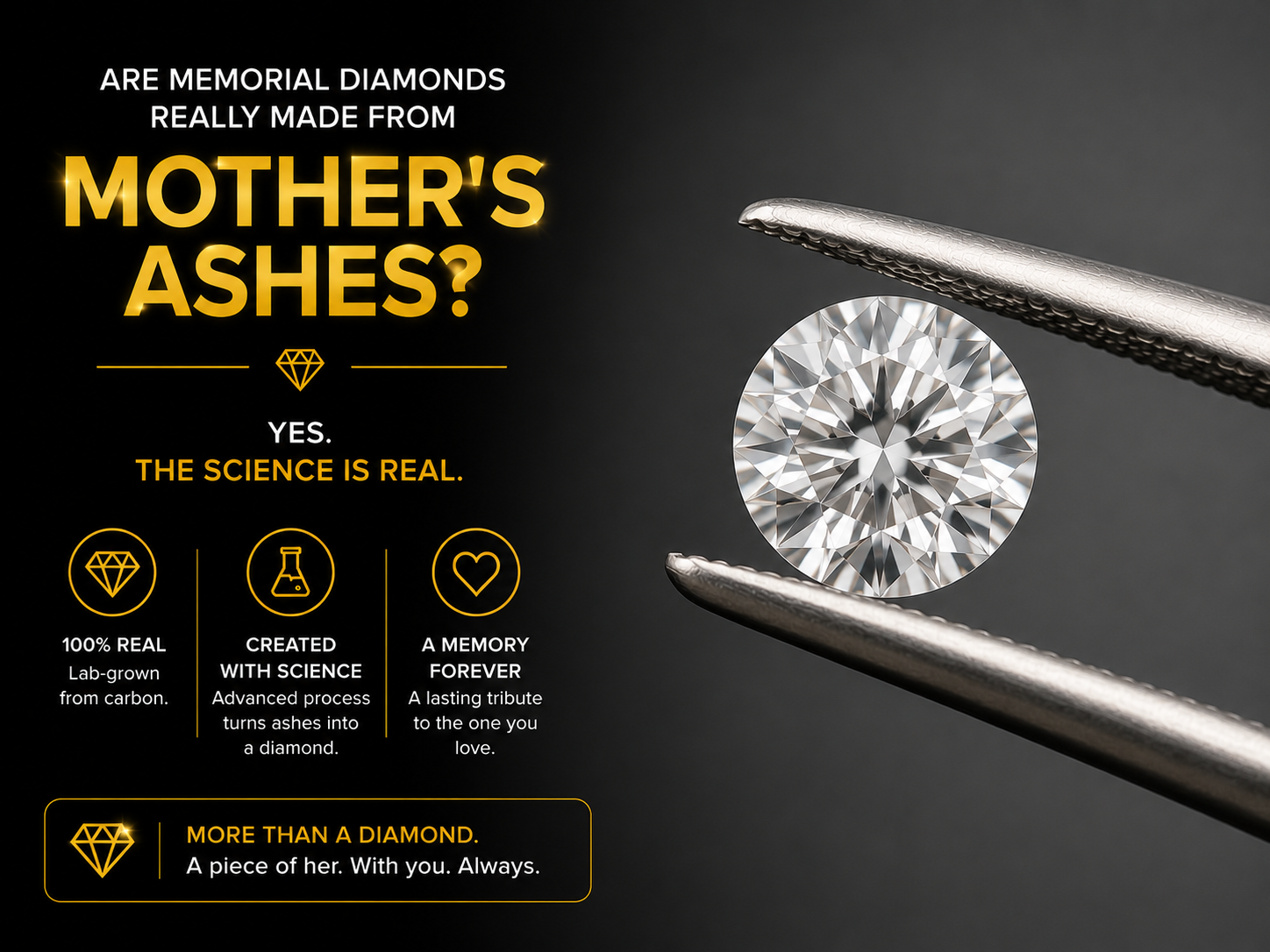
Loose lab-grown memorial diamond grown from a mother's cremated ashes, held in tweezers against a plain gray background

On This Page

  • How much of the diamond comes from your mother?
  • Why lab carbon is added
  • What you are actually buying
  • What a family can verify
  • Questions to ask a provider
  • Frequently asked questions

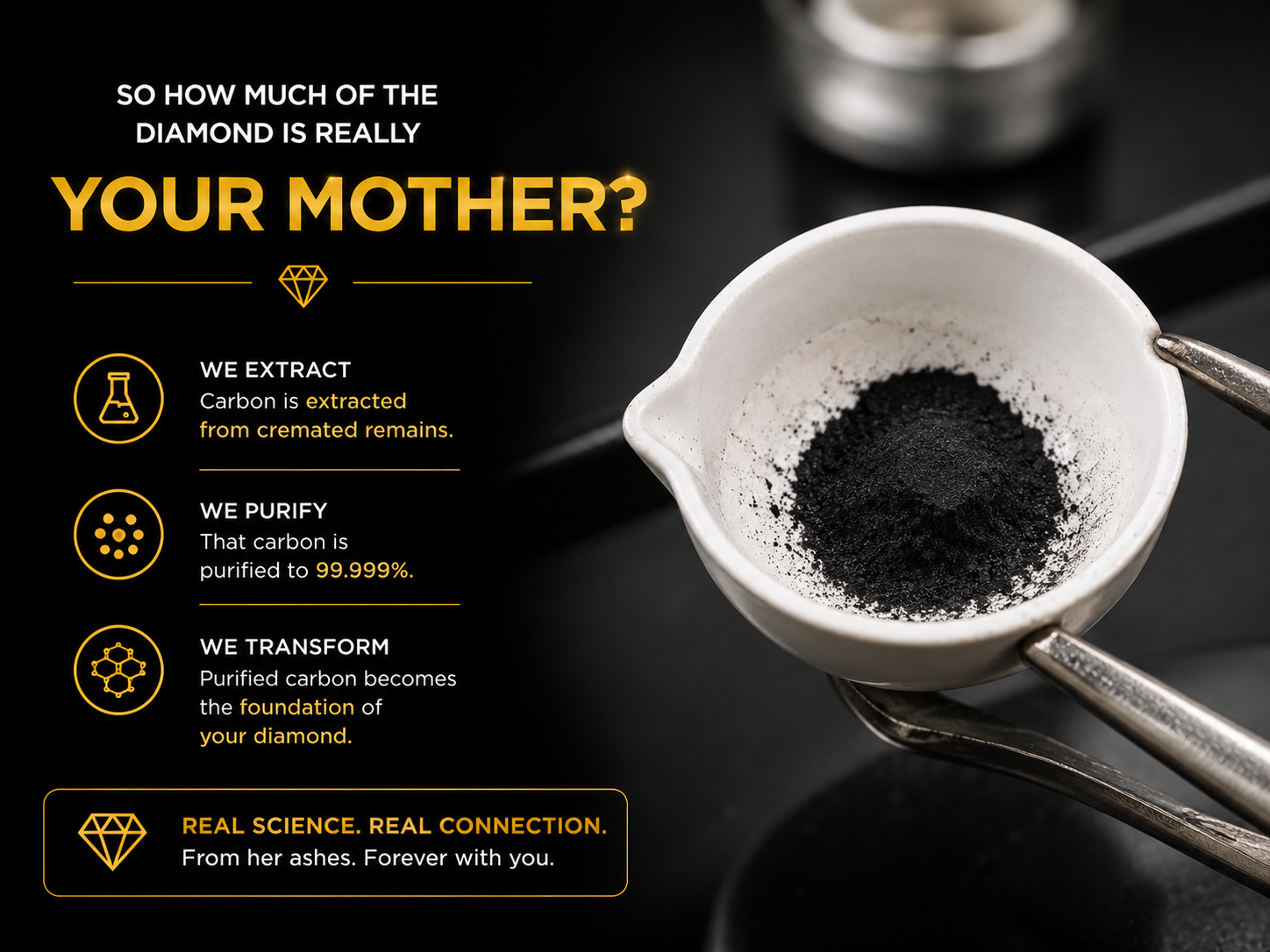
So How Much of the Diamond Is Really Your Mother?

Cremated remains are not the same as the ash left behind by a campfire.

Instead, they consist primarily of mineral material, especially calcium phosphate from bone. Carbon makes up only a relatively small portion of cremated remains, and the amount can vary depending on the individual and the cremation process.

First, the recoverable carbon undergoes extraction and purification before the laboratory prepares it for diamond growth.

However, because a diamond-growth cell requires enough carbon feedstock, the provider generally combines the personal carbon with additional laboratory-sourced carbon.

Industry figures commonly describe personal carbon as making up only a portion of the finished stone rather than the entire diamond.

So the skeptical relative is only partly right.

They may be wrong to say that none of her is in the diamond, but they are also right to question claims suggesting that the entire stone consists exclusively of her remains.

That distinction matters.


Why Can’t the Stone Be Grown From Her Ashes Alone?

The reason is primarily about the composition of cremated remains and the physical requirements of diamond growth.

An HPHT diamond-growth process requires a sufficient quantity of purified carbon material. Cremated remains simply do not contain enough recoverable carbon to provide all of the feedstock necessary to grow a meaningful diamond crystal.

Adding more ashes does not necessarily mean that a larger diamond can be created.

Diamond size depends on factors such as the growth process and growth time, rather than simply on the quantity of ashes you submit.

As a result, most of your mother’s cremated remains can remain available to your family for other purposes, including keeping them in an urn, burial, or scattering.

However, you should not automatically view supplemental carbon as a replacement for your mother’s material.

Instead, the laboratory uses supplemental carbon as part of the physical process required to grow the diamond.


So What Are You Actually Buying?

Here is the most accurate way to describe a memorial diamond:

A laboratory can extract and purify carbon that was once part of your mother’s body and incorporate that carbon into the crystal structure of a diamond grown through a controlled laboratory process.

This process differs from simply creating a piece of jewelry in her memory.

At the same time, you should not describe the entire diamond as physically made only from her remains.

Instead, the finished diamond can serve as a genuine physical object that contains material derived from the person you remember.

For many families, that distinction is meaningful.

A memorial diamond is still a personal choice. It does not replace an urn, burial, scattering, or any other way of remembering someone.

It is simply another option.


What Can a Family Actually Verify?

This is one of the most important questions to ask before choosing a memorial diamond provider.

The strongest evidence generally comes from documentation and chain-of-custody procedures, rather than from a test performed on the finished diamond.

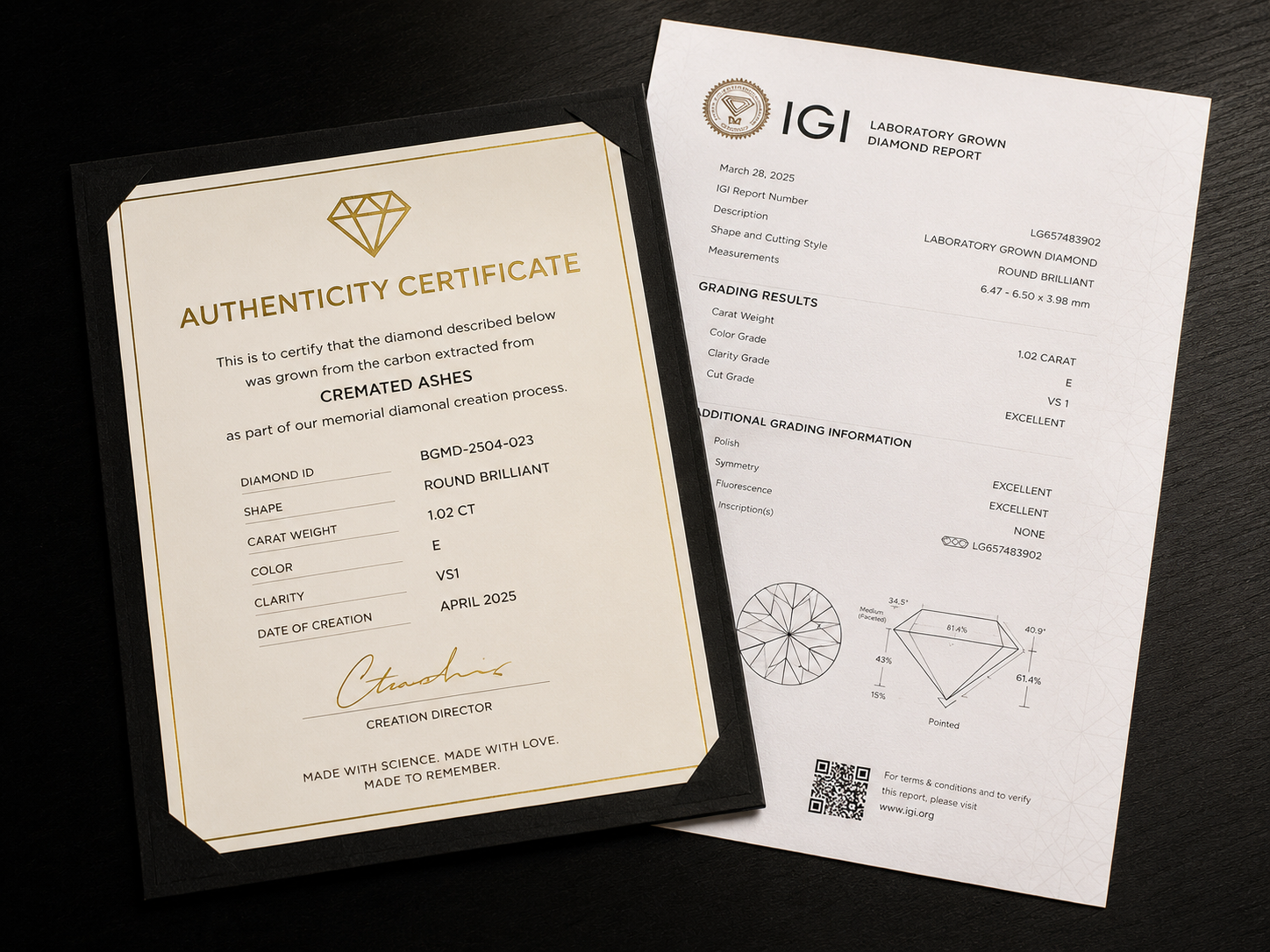
Two types of documentation may be relevant.

DocumentWhat It EstablishesWhat It Does Not EstablishWho Issues It
Authenticity or origin certificateDocuments the submitted material and production history associated with the memorial diamondThe independent quality of the diamondThe provider
Independent grading reportDocuments characteristics such as cut, color, clarity, and carat weightThe origin of the carbon usedA gemological laboratory

Why Chain of Custody Matters

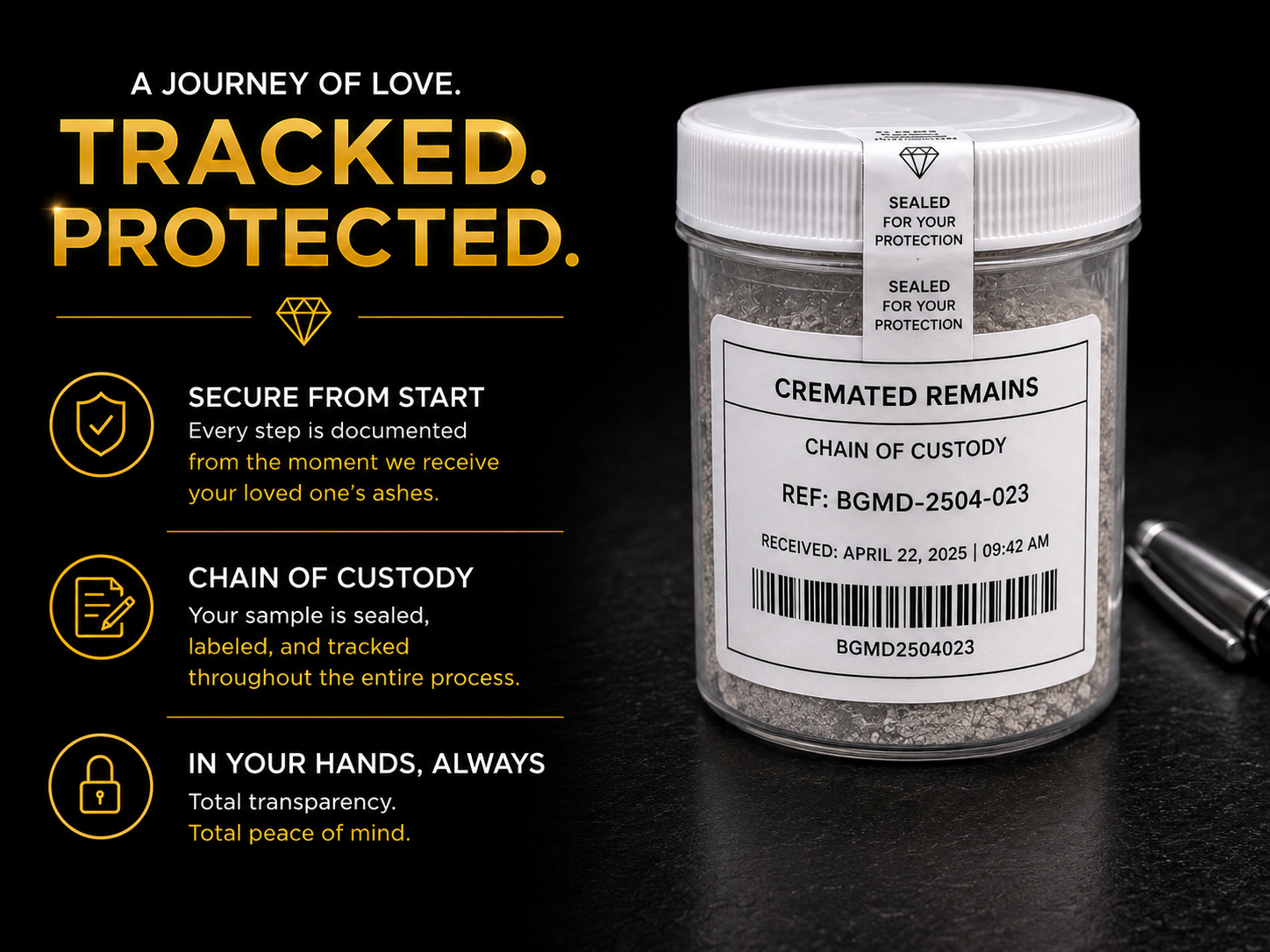
A provider may assign a tracking or chain-of-custody reference when the family submits its material.

This reference can help the provider track the material through stages such as processing, carbon preparation, diamond growth, and the handling of any remaining material.

The provider should maintain clear documentation because you cannot determine the source of a finished diamond through visual inspection alone.

Therefore, before placing an order, ask the provider which records it provides and which stages it documents.


Which Questions Expose a Provider Who Can’t Back This Up?

A transparent provider should answer clear questions about its process and explain how it handles your material.

1. What Tracking Reference Will I Receive?

Ask the provider whether it assigns a unique tracking reference to your submitted material and when it records that reference during the process.

Also, ask what documentation the provider will give you when it completes the process.

2. Is Carbon Extraction Done In-House?

Ask the provider whether its team handles carbon extraction and preparation directly or uses another facility.

If the provider uses another facility, ask how it tracks your material during the transfer.

3. What Happens to the Material That Is Not Used?

Ask the provider whether it returns unused material to your family and what procedure it follows.

In addition, make sure the provider clearly explains this process before you send any material.

4. What Documentation Comes With the Diamond?

Ask whether you will receive:

  • An authenticity or origin certificate
  • An independent diamond grading report
  • Both

Also ask which organization performs any independent grading.

5. What Happens if a Growth Run Fails?

Diamond growth is a technical process, and families should understand what happens if a particular growth attempt does not produce the intended result.

Ask about the timeline, available material, and the provider’s process for handling a re-growth.


Frequently Asked Questions

Can Anyone Prove the Diamond Came From My Mother’s Specific Ashes?

Purified carbon extracted from cremated remains in a laboratory crucible before graphitization

The strongest evidence generally comes from documented handling and chain-of-custody records.

Purified carbon becomes chemically similar regardless of its original source, which is why documentation about the handling and production process is so important.

Before ordering, ask exactly what evidence and records the provider can provide.


Do Providers Ever Just Use Lab Carbon Instead?

This is exactly why transparency matters.

Families should ask about the provider’s tracking procedures, extraction process, documentation, and chain of custody before submitting any personal material.

A detailed and clearly documented process provides more confidence than marketing claims alone.


Is It a Real Diamond or a Substitute?

A memorial diamond can be a real diamond.

Lab-grown diamonds have the same fundamental crystal structure and chemical composition as diamonds formed naturally in the Earth.

They are not the same thing as simulants such as cubic zirconia or resin.

Like other diamonds, a laboratory-grown diamond can be evaluated using characteristics such as cut, color, clarity, and carat weight.


Will I Be Able to See the Ashes Inside the Diamond?

No.

The carbon derived from cremated remains is processed at the material level before the diamond is grown.

You should not expect to see visible ash particles or flecks inside a finished memorial diamond.

The finished stone is a diamond crystal rather than a container holding visible ashes.


What Should I Do if a Provider Doesn’t Deliver What Was Promised?

Before sending cremated remains or making a payment, make sure important promises are documented.

This can include:

  • The expected process
  • Documentation provided
  • Treatment of unused material
  • Estimated timeline
  • Diamond specifications
  • Terms and conditions

Keep copies of the written information provided during the purchase process.

Clear written documentation is generally more useful than relying only on verbal assurances.

Sealed and labeled container of cremated remains logged with a chain-of-custody tracking reference at intake

If You’re Still Unsure

Being skeptical is reasonable.

Choosing what to do with a mother’s cremated remains is deeply personal, and there is no requirement to make a decision immediately.

Take the time to understand the process.

Ask how the material is handled.

Ask what documentation you will receive.

Ask what happens to unused ashes.

Ask how the provider tracks the material throughout the process.

A trustworthy decision should be based on clear answers rather than emotional pressure.

A memorial diamond may contain carbon derived from your mother’s remains, but understanding exactly what that means is important before choosing one.

When you are ready, ask the provider directly about the documentation and process used for a diamond created from your mother’s ashes.