long take make husband memorial diamond

How Long Does It Take to Make a Husband Memorial Diamond?

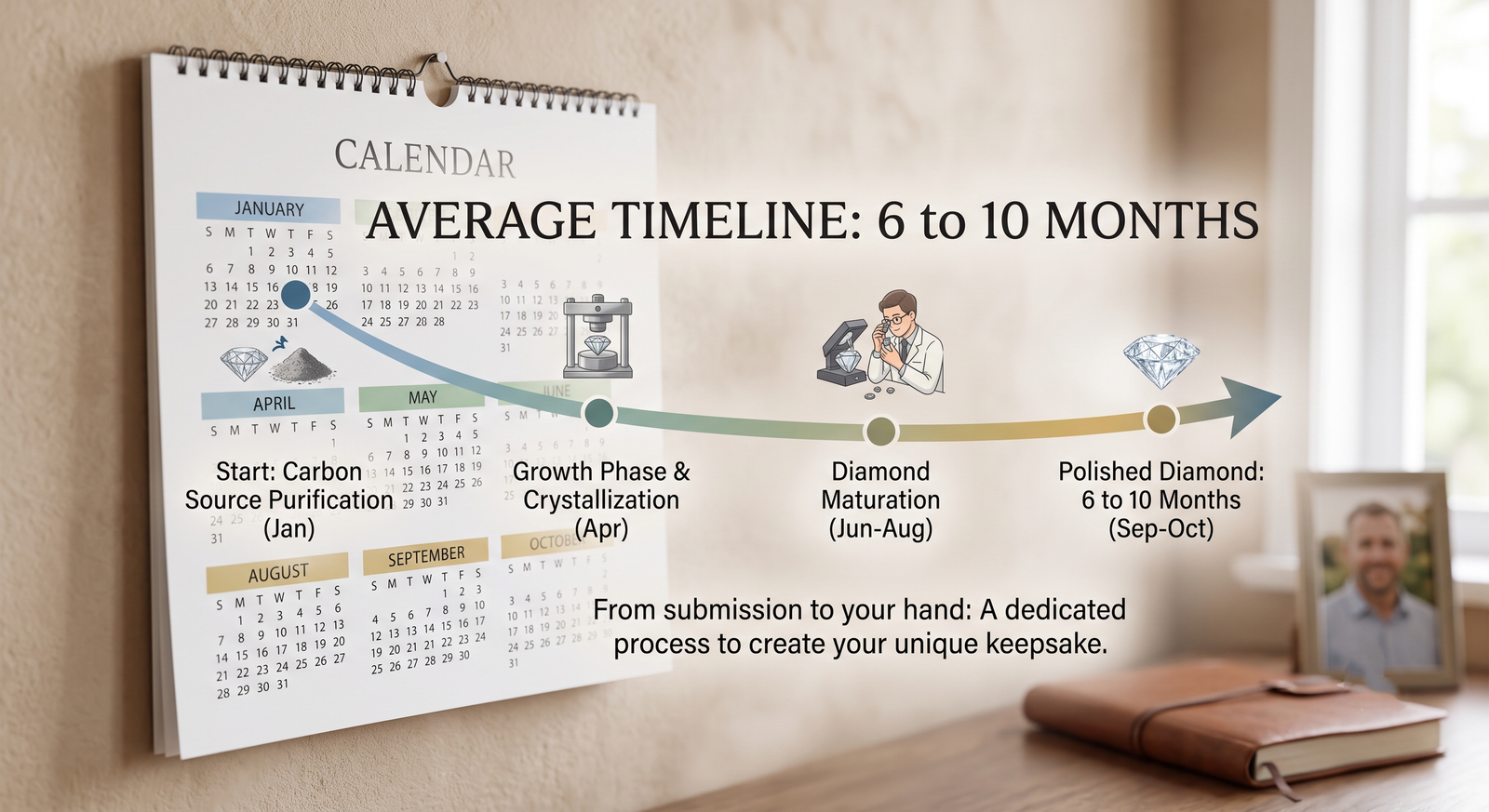
Calendar marked with a six to ten month husband memorial diamond growth timeline | Stock acceptable short-term long take make husband memorial diamond

The Short Answer

Families often ask how much of a long take make husband memorial diamond orders require. Across the professional industry, the process typically spans 6 to 10 months from the day your husband’s cremated ashes or hair clippings arrive safely at the laboratory to the day the certified gemstone is ready for delivery. For larger carat weights or specialty colors such as deep blue or black, the long take make husband memorial diamond journey can occasionally extend up to 12 months.

This timeline is determined almost entirely by the physics of crystal growth and chosen carat weight, not by the amount of ash or hair you send. If you are deciding whether to begin now or wait, knowing the long take make husband memorial diamond timetable provides a realistic schedule to plan around.

The Long Take Make Husband Memorial Diamond Timeline, Stage by Stage

To understand why a long take make husband memorial diamond timeline requires several months, it is helpful to examine the six distinct scientific and artisanal phases involved in transforming biological material into an authentic gemstone.

StageTechnical Procedures InvolvedTypical Duration
1. Intake and Chain of CustodyAshes or hair are received, weighed, inspected, and logged with a unique tracking identifier3 to 7 Days
2. Carbon Extraction and PurificationMaterial undergoes chemical and thermal processing in a vacuum environment to isolate carbon at 99.99 percent purity2 to 4 Weeks
3. GraphitizationPurified carbon is heated to approximately 2,500 to 2,700 degrees Celsius to convert amorphous carbon into crystal graphite1 to 2 Weeks
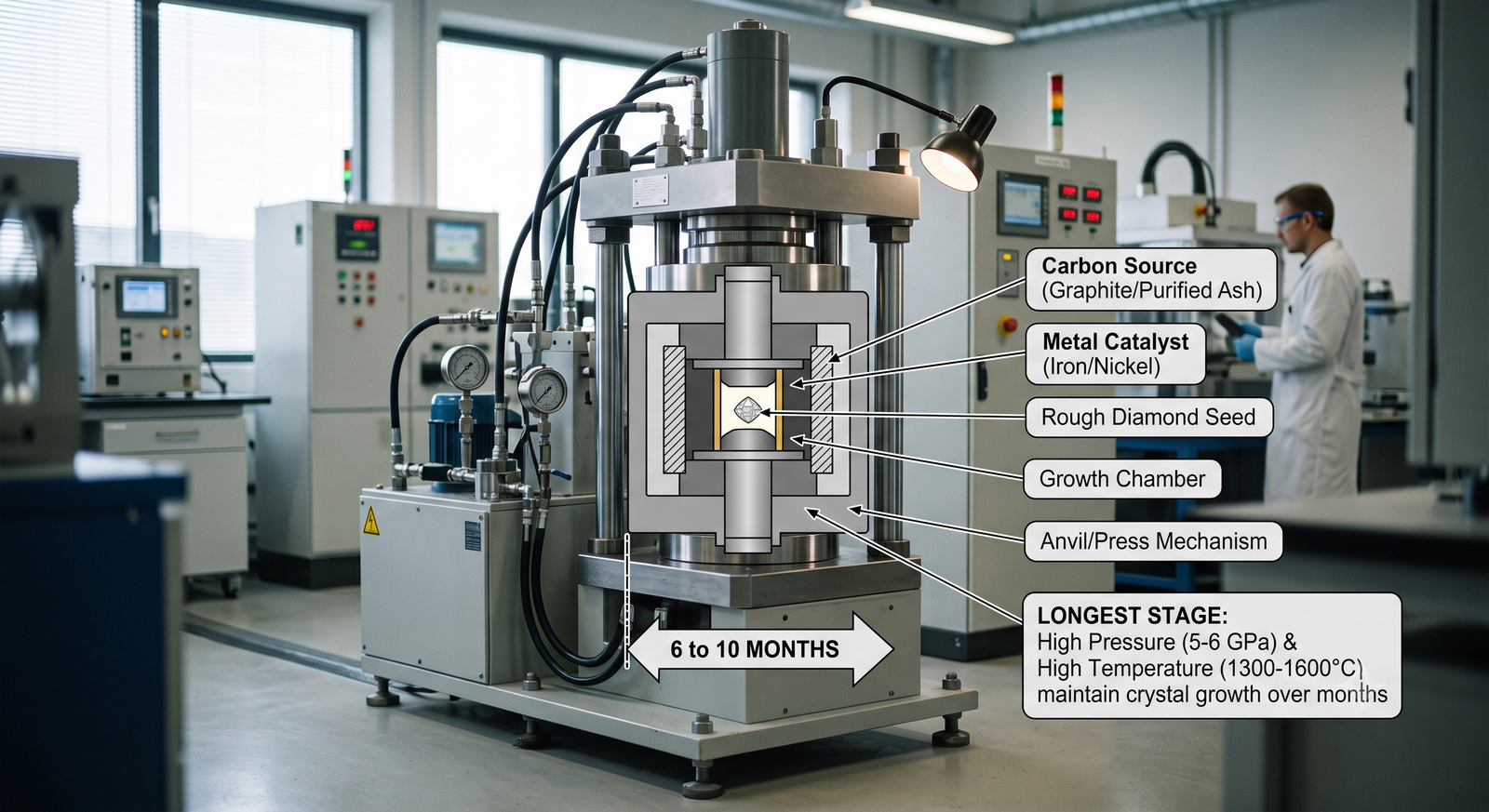
4. High Pressure Diamond GrowthGraphite and seed crystals undergo sustained High Pressure High Temperature (HPHT) pressing2 to 6 Months (Longest Phase)
5. Precision Cutting and FacetingMaster gem cutters inspect the rough stone, plan facet geometry, and cut and polish the diamond2 to 4 Weeks
6. Gemological Certification and DispatchThe loose stone is verified by an independent gemological laboratory (such as IGI or GIA) and packaged securely2 to 3 Weeks
Total Estimated TimelineComplete sequence from intake to finished gemstone delivery6 to 10 Months (Up to 12 Months for Complex Orders)
HPHT diamond growth cell where the longest stage of the process takes place | Stock acceptable

Stage 4 represents the heart of the process. While chemical purification and laser cutting require days or weeks, the actual crystallization in the growth press is an atomic process that cannot be accelerated without risking structural defects.

What Actually Determines 6 Months Versus 12 Months

When evaluating how much of a long take make husband memorial diamond orders represent, two primary factors govern where your stone falls within the 6 to 12 month window:

1. Target Carat Weight

In laboratory diamond synthesis, crystal growth occurs layer by atomic layer. A smaller accent stone (such as 0.20 to 0.40 carat) requires far fewer hours under sustained pressure than a large centerpiece stone (such as 1.50 to 2.00+ carats). To achieve larger carat sizes, the growth cell must remain undisturbed under extreme temperatures and pressures for several additional weeks or months.

2. Desired Color Complexity

The chemical profile of your diamond also affects the overall schedule:

  • Warm Yellow and Amber: These shades naturally incorporate trace nitrogen from the biological carbon and often grow with high consistency and efficiency.
  • Pure Colorless (White): Achieving pure white clarity requires total removal of trace nitrogen and the introduction of specialized chemical getters, demanding exceptional precision and steady growth conditions.
  • Blue and Specialty Colors: Infusing trace boron or performing specialized post growth thermal enhancement to create specific colors adds dedicated stages to the laboratory queue.

It is important to emphasize what does not change the timeline: the total volume of ash or hair submitted. A laboratory requires only a small sample (about one half cup of ash or 2 to 10 grams of hair). Submitting an entire urn does not accelerate crystallization.

Dates Already in Your Calendar and Backward Planning

Surviving spouses frequently commission memorial jewelry in anticipation of meaningful calendar milestones, such as an upcoming wedding anniversary, his birthday, a scheduled family gathering, or the anniversary of his passing. Because the long take make husband memorial diamond process spans multiple seasons, working backward from your target date is essential.

If you hope to hold the finished stone by a specific date, establish a timeline buffer of at least 8 to 12 weeks. Laboratory growth parameters must account for natural crystallization variability. Ordering against an immovable, tight deadline can create unnecessary emotional stress during an already delicate period.
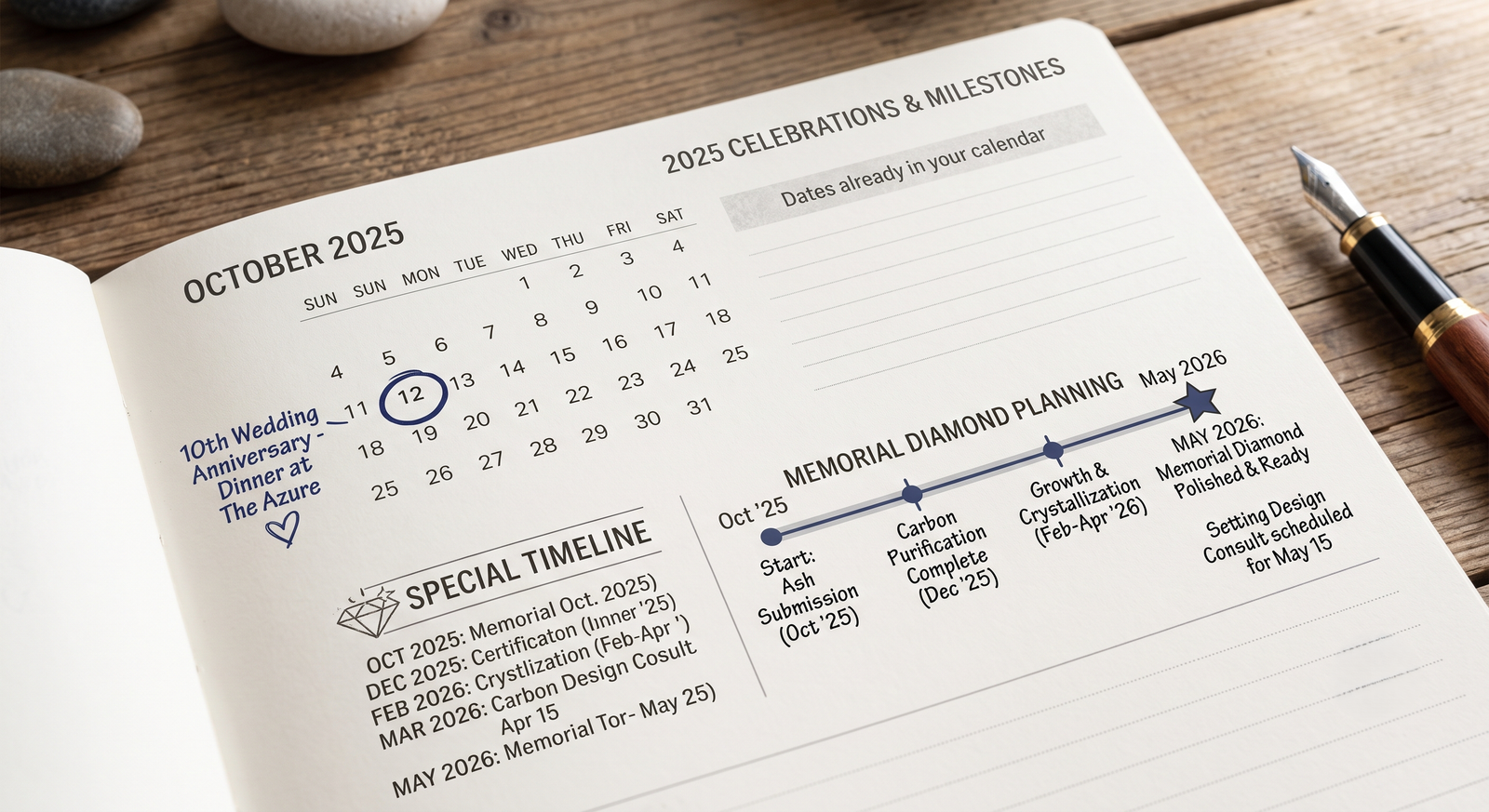
Calendar page with an anniversary date circled alongside a memorial diamond timeline note

What Does Not Speed Up the Growth Process

Understanding the boundaries of diamond manufacturing prevents unrealistic expectations regarding rush turnarounds:

  • Submitting Larger Quantities of Material: Providing excess ash does not reduce press time. The rate of atomic lattice formation remains identical regardless of source material volume.
  • Attempting to Over Heat the Growth Cell: Elevating temperatures beyond optimal HPHT thresholds causes graphite degradation rather than diamond crystal formation.
  • Switching Carat Size Mid Process: Once carbon has been graphitized and loaded into an HPHT core with a dedicated seed crystal, the parameters are locked. Altering specifications requires restarting the purification sequence.

The Physics and Science of Diamond Crystallization

To appreciate why a long take make husband memorial diamond timeline unfolds over months, it is valuable to explore how HPHT and CVD diamond growth actually works in modern material science.

In nature, diamonds form over millions of years at depths greater than 100 miles beneath the Earth crust, where temperatures exceed 2,000 degrees Fahrenheit and pressures top 725,000 pounds per square inch. High Pressure High Temperature (HPHT) presses recreate this geological environment inside a controlled laboratory chamber.

Inside the growth press, purified carbon from your husband’s ashes is dissolved into a molten metallic catalyst alloy (typically iron, nickel, or cobalt). The molten metal transports dissolved carbon atoms toward a tiny natural diamond seed crystal placed at the cooler base of the cell. As carbon precipitates onto the seed, a three dimensional tetrahedral crystal lattice forms. Growing a flawless, gem quality crystal requires uninterrupted equilibrium over hundreds of hours.

Timeline Considerations When Combining Ashes and Hair

Many families choose to submit both cremated remains and preserved locks of hair. While combining these elements creates a profoundly meaningful tribute, families often wonder whether this dual material approach doubles the preparation timeline.

Because hair requires specialized chemical washing and solvent extraction to strip away oils and keratin proteins before carbon isolation, front end preparation involves two distinct extraction procedures. However, once both streams of carbon are purified and combined during graphitization, they enter the HPHT growth press as a unified graphite core. Consequently, combining ashes and hair only adds a few days to the initial intake and purification phase without extending the multi month growth window.

Post Growth Jewelry Mounting Timelines

Once your diamond completes growth, precision cutting, and gemological certification, you may choose to set the stone into custom jewelry : such as an engagement ring restyle, a halo pendant, or classic stud earrings.

Custom jewelry design introduces its own distinct bench timeline:

  • Selecting Ready Made Mountings: Setting a certified stone into a standard fine jewelry mounting generally requires 1 to 2 weeks.
  • Custom CAD Design and Casting: Creating a one of a kind ring or pendant from scratch (including 3D CAD modeling, wax printing, metal casting in platinum or gold, and hand prong setting) typically takes 3 to 5 weeks.
  • Reworking Existing Wedding Bands: Melting down and repurposing metal from his original wedding band requires specialized goldsmith repair work, which often adds 3 to 4 weeks to the final presentation.

Frequently Asked Questions

Is 6 to 10 months the long take make husband memorial diamond timeline for every carat size?
Six to ten months represents the standard industry average for modest and mid size stones (roughly 0.25 to 1.00 carat). Larger diamonds above 1.50 carats or rare color configurations can take up to 12 months due to extended time in the growth press.

Does the timeline begin the day I mail the collection kit or when it arrives?
The official timeline begins once the laboratory receives, weighs, and logs the material into their tracking system, not the date the collection kit is dispatched in the mail.

Can the growth process be rushed for an upcoming memorial service?
True HPHT crystallization cannot be rushed artificially without sacrificing clarity and structural stability. If you have an imminent date, some providers offer commemorative presentation kits to share during the event while the diamond continues growing.

Does a combined ashes and hair submission take longer to process?
Intake and purification require separate initial steps for each material, adding roughly a week to the front end. However, the primary growth phase remains identical in length.

What updates will I receive during the multi month waiting period?
Most established laboratories provide periodic milestone notifications : confirming successful carbon purification, the start of HPHT growth, rough crystal harvest, cutting and faceting, and final certification.

Can the setting be chosen while the diamond is still growing?
Yes. While the stone is in the growth press, you can collaborate with jewelers to finalize metal choices, ring sizing, or pendant designs so the mounting is ready when the certified gem arrives.

Final Thoughts on the Husband Memorial Diamond Timeline

Waiting several months for a memorial gemstone requires patience, but it also reflects the profound care and scientific craftsmanship involved in transforming his memory into an enduring heirloom. The long take make husband memorial diamond journey rewards careful planning and thoughtful reflection.

Take solace in knowing that each passing week brings his physical presence closer to becoming a radiant, permanent keepsake that you and future generations will treasure forever.

Learn More About Husband Memorial Diamonds

Talk With Memorial Diamond

If you have a meaningful date in mind or want to learn more about the long take make husband memorial diamond process, reach out to Memorial Diamond. Our compassionate team is available to assist you at every step.
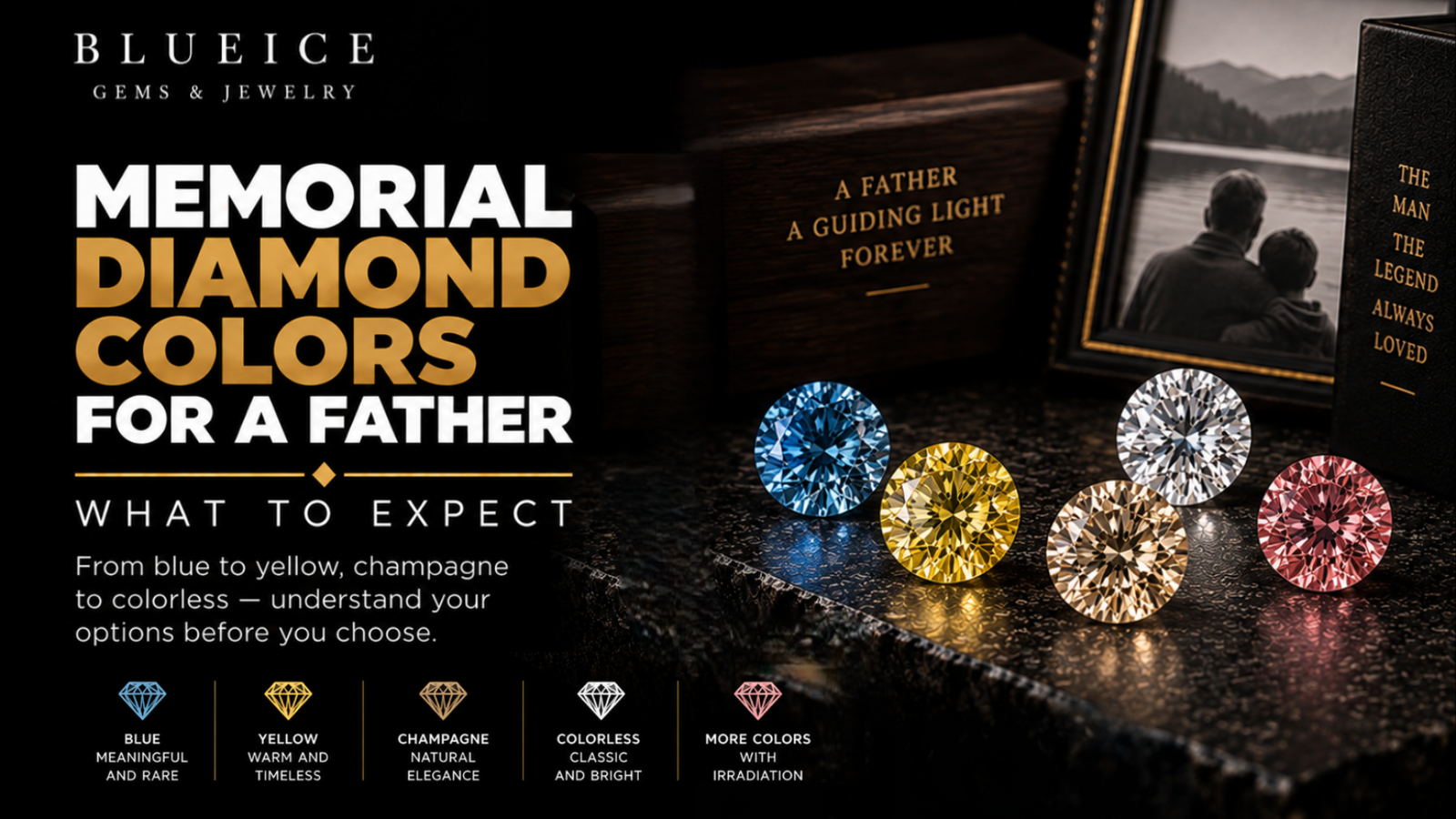
Memorial diamond colors for a father featuring blue, yellow, champagne, colorless, and pink diamonds with a father's keepsake box

Memorial Diamond Colors for a Father: What to Expect

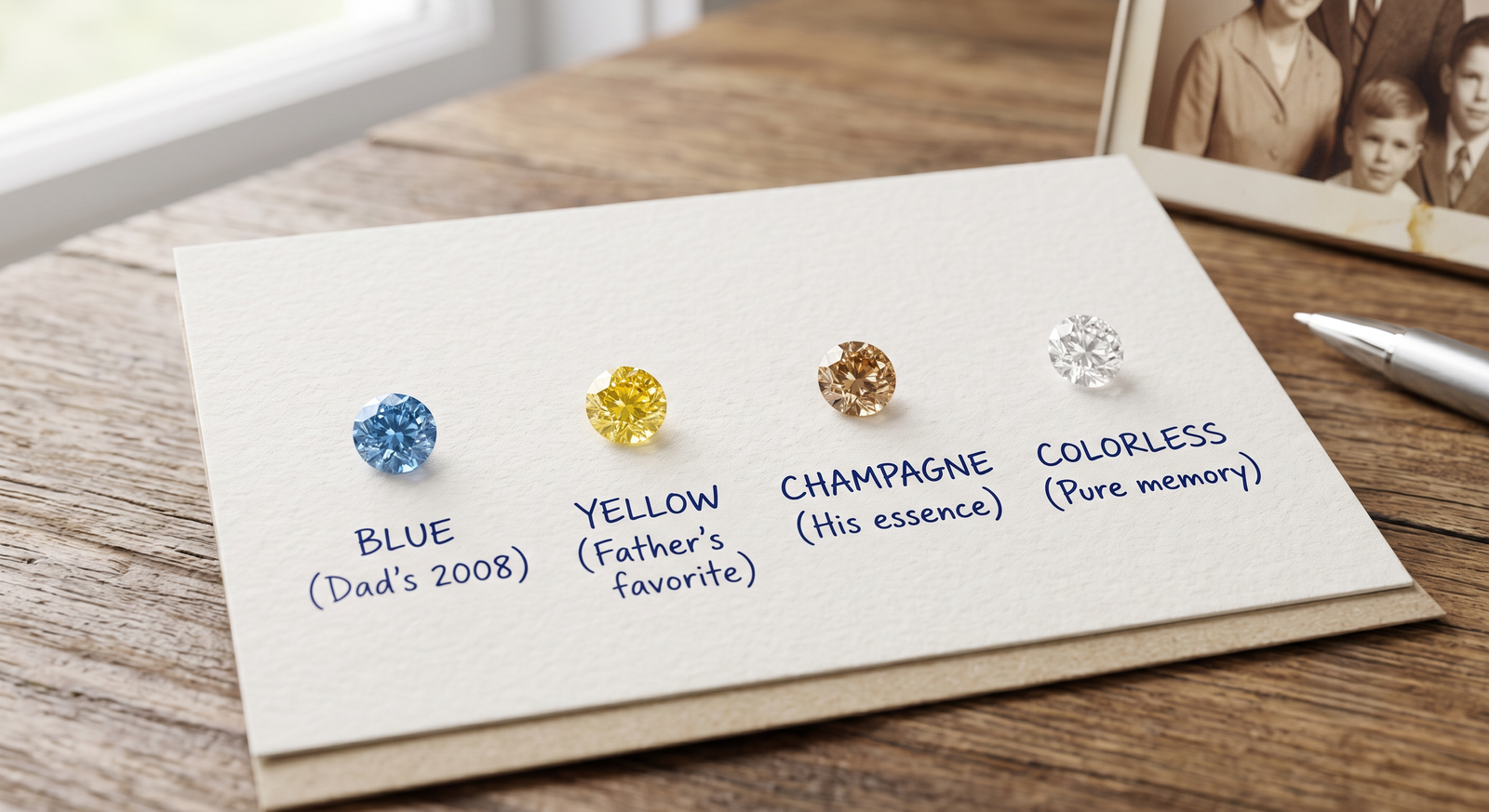
The order form asks for a color months before there is anything to look at. So here is what memorial diamond colors for a father come down to: you can specify a color family, blue, yellow, champagne, colorless, or a color applied after growth, with an agreed range around it. What you cannot specify is a shade. Write the family and the range into the order, and settle who decides whether the finished stone sits inside it.

One disclosure first: Memorial Diamond grows and sells memorial diamonds, which makes us one of the providers this page tells you to pin down. Read the recourse section as something to put to us in writing as readily as to anyone else.

Memorial diamond colors: four small lab-grown stones in blue, yellow, champagne and colorless laid in a row on white card, each above a handwritten label

What Can You Actually Specify About Memorial Diamond Colors?

Memorial diamond colors are agreed in words, held for months, then checked once at the end against an object nobody has yet seen.

What you can specifyWhat you cannotWhat to put in writing
A color family, blue, yellow, champagne or colorlessWhich shade inside it arrivesThe family, plus the range you will accept
Whether the color is grown in or applied by irradiation afterwardsWhether an organic source cooperates first timeThat these are different products, and which you are buying
That the stone reads warm or coolThe exact depth of tone at the carat chosenThe carat and the color on one line, since a tint reads differently at different sizes
That a color grade appears on a grading reportWhat your eye will make of that gradeWhich laboratory grades it, on which scale, and that the report travels with the stone
That two stones ordered together carry one specificationThat two separately grown stones will matchThat you want a shared specification, not a matched pair
Who signs the finished color offThat everyone agrees at first sightThe named person who accepts or declines, and what follows
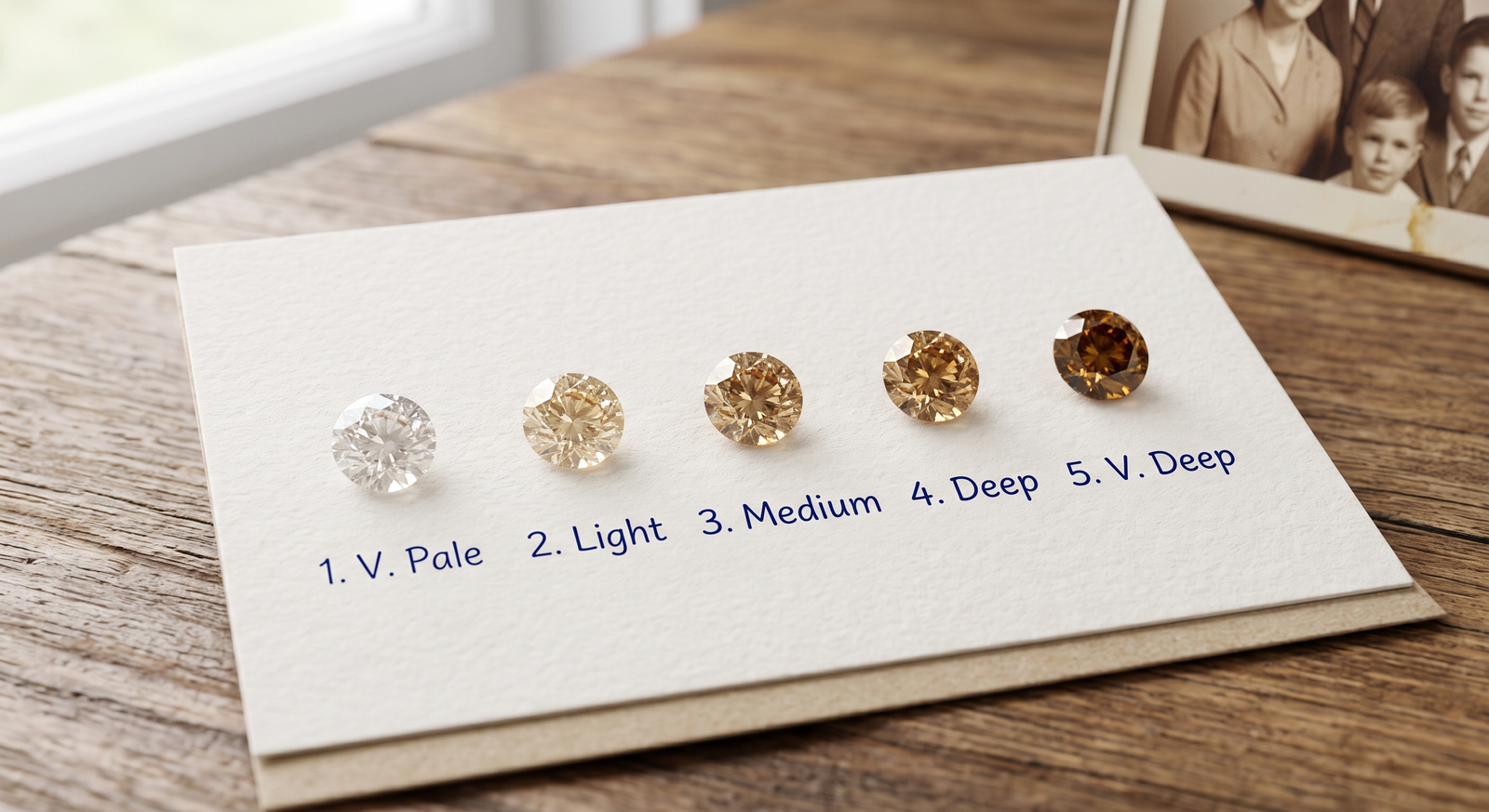
Five champagne-toned diamonds arranged from palest to deepest to show one color family's range

Which Memorial Diamond Colors Exist, and What Puts Them There

Color comes from trace elements present while the crystal grows. Boron produces blue. Nitrogen produces yellow. A colorless stone requires the near total absence of both which an industrial feedstock is manufactured to deliver, and which an organic source can reach only with additional processing to exclude those trace elements, at meaningfully higher cost. Some providers also offer post growth irradiation, applied to a finished crystal, for red, pink, green or black.

The memorial diamond colors you agree apply to a crystal only partly his. Carbon recovered from ash or hair is purified to around 99.9%, then combined with lab sourced carbon to reach the volume a growth run needs, the published figure for ash derived stones puts his share at roughly 10–15% of the finished mass, with no equivalent figure published for hair.

What a particular submission tends to produce is a separate question: the ashes version, the hair version, which also covers why the color his hair went has no bearing, and the combined version. Why memorial diamonds are rarely colorless has the chemistry.

A Color Word Is Not a Color Specification

“Champagne” is a family, not a shade, and so are “blue” and “yellow.” Each spans a range of grades, and stones at either end of that range are recognizably different objects under one word. Memorial diamond colors are described in family names because that is the honest level of precision before growth.

That matters because of when memorial diamond colors get named. You say it in month one, to someone who works with that color family routinely and has a working average in mind. Neither of you has said what would count as too pale or too dark. The missing half is the tolerance, the range nobody has written down, and the thing there is no agreed answer to point at when a box is opened eight months later.

Three things narrow it before the order is placed:

  • Ask what vocabulary the provider works in. A named grading scale, in house color names, sample stones, photographs, these are not equivalent, and the order should record which one it is judged against.
  • Ask to see the extremes rather than the middle. One representative image shows the average; the pale end and the deep end show what you are agreeing to.
  • Ask what carat those references were. A tint barely visible in a small stone is unmistakable in a larger one, so a reference at the wrong size is not a reference.

How Do You Write a Color Down So Two People Mean the Same Thing?

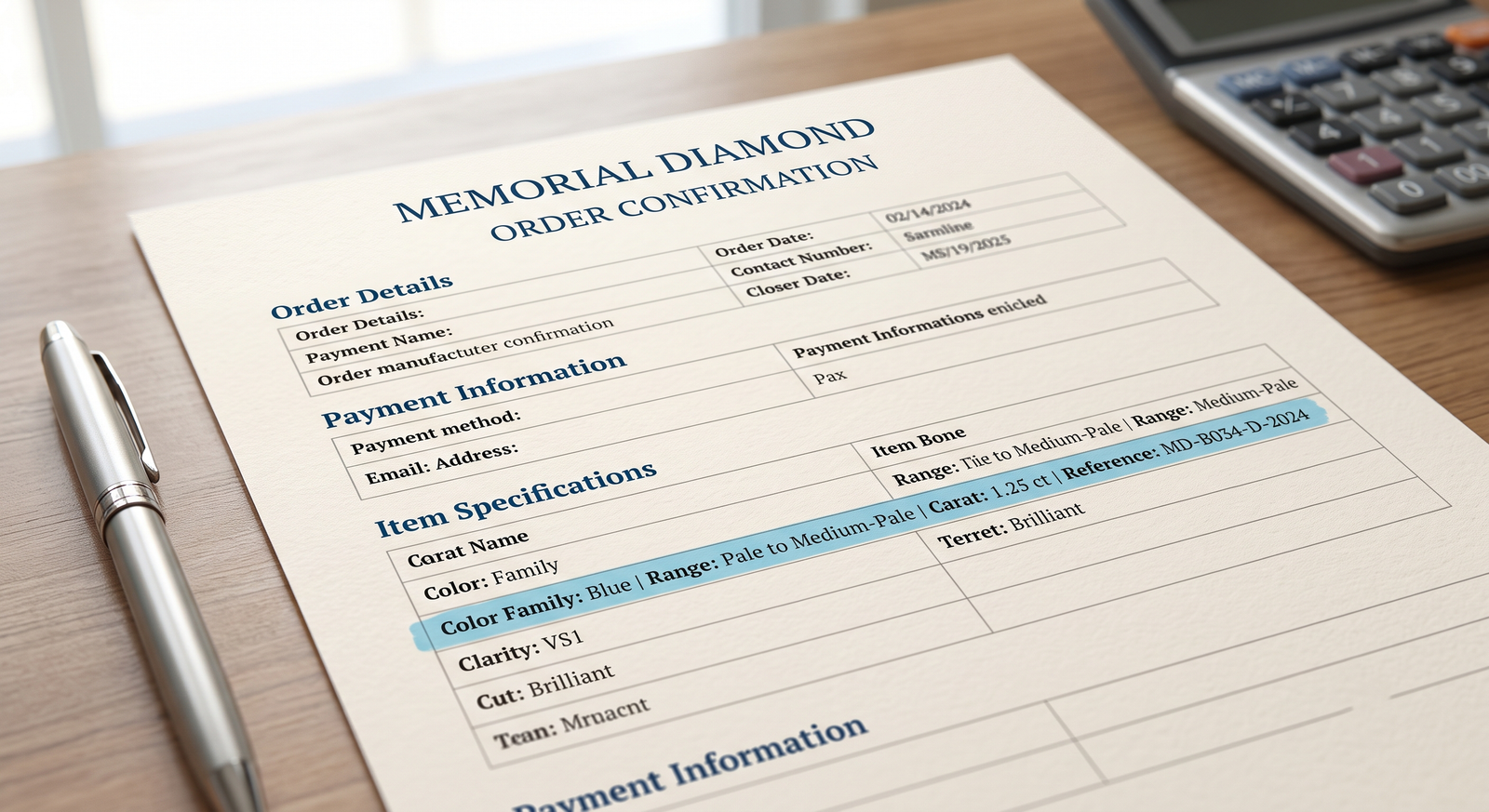
 An order confirmation with a single highlighted line naming color family, range, carat and reference

A line describing memorial diamond colors should survive being read by someone who was not in the conversation. Six things put memorial diamond colors in that state:

  1. The color family, in the provider’s vocabulary as well as your own words.
  2. The acceptable range, expressed the way that provider grades color.
  3. Whether the color is grown in or applied after growth, different products, priced differently.
  4. The reference being used, a named scale, a sample stone, a photograph, and who holds it.
  5. The carat it applies to, on the same line, because the two move together.
  6. The date, and the person on each side who agreed it.

Ask for that line to appear in the order confirmation itself, not only in the email thread that produced it.

What memorial diamond colors do to the price sits in what a father memorial diamond costs; what a setting metal does to the color you see sits in memorial diamond settings and jewelry ideas for a father.

What a Grading Report Says About Color, and What It Does Not

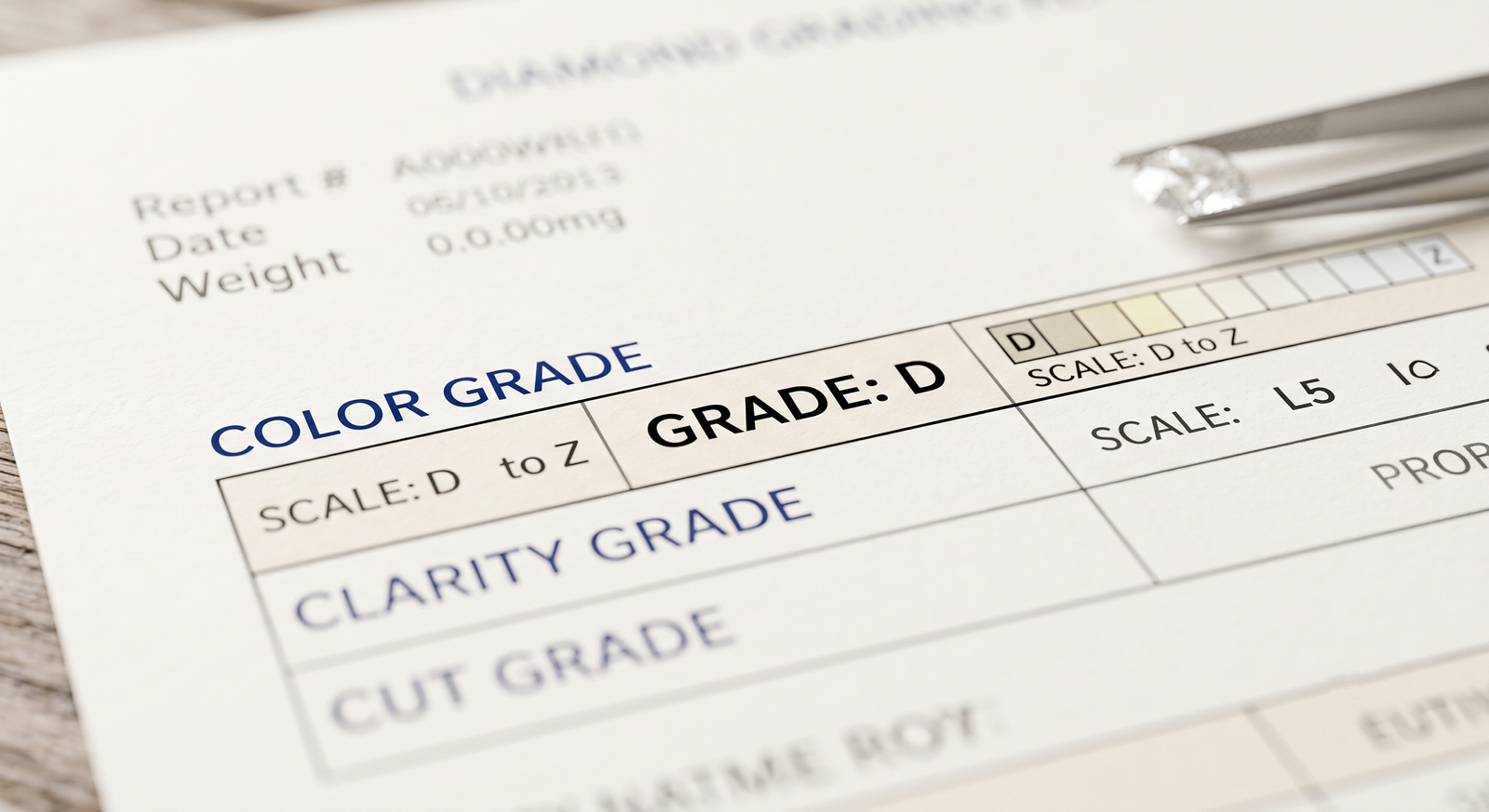
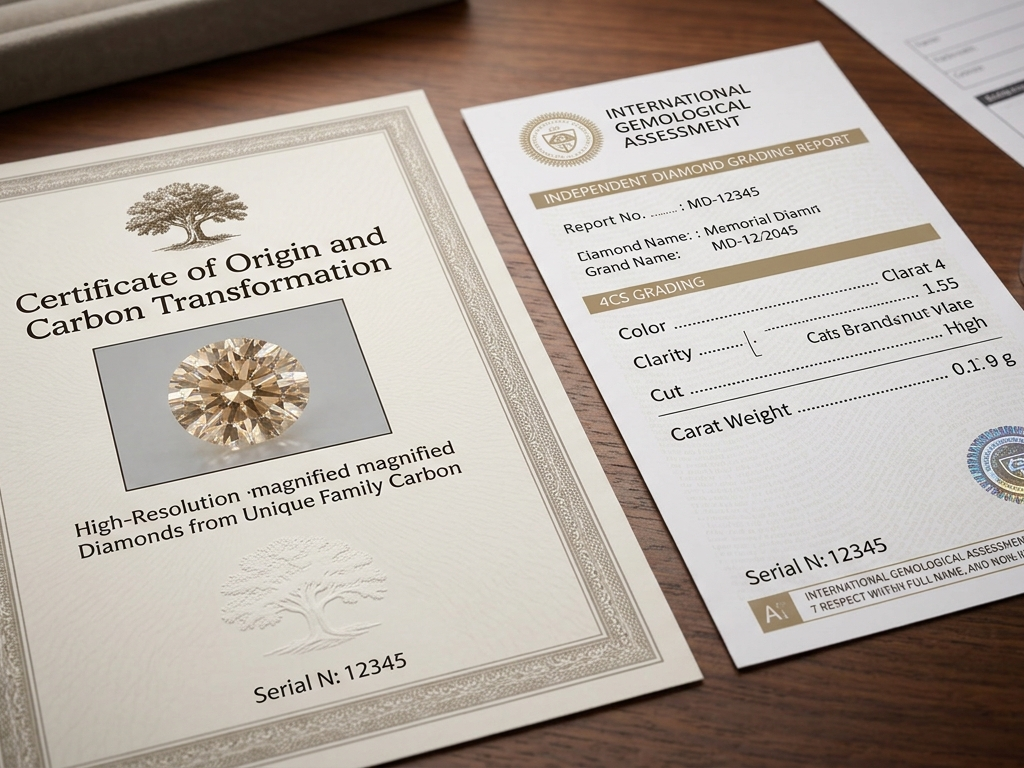
A grading report is the diamond’s own quality document: cut, color, clarity and carat, against a stated scale, ideally from an independent third party laboratory. It is not the in house origin certificate, which records whose carbon the stone was grown from and says nothing about how it looks. How memorial diamonds are graded and certified sets out what each establishes.

Three limits are worth knowing about how a report handles memorial diamond colors. It is issued after the stone exists, so it verifies rather than commissions. A grade is a band rather than a point, so two stones can share a grade and not look alike. And it is assessed under controlled conditions, not on a hand at a kitchen window, so a report and an eye can honestly disagree.

That makes the report a check on the memorial diamond colors you specified rather than a substitute for the specification. Ask early whether the stone is graded independently or in house, and on which scale.

 Close-up of a diamond grading report with the color grade line in focus

What Should You Ask About Recourse?

Nothing published about this category establishes a standard procedure for a stone that arrives outside an agreed color range, no norm, no default remedy, no assumed sequence. Which is why it is worth asking before ordering, and treating the answer as a term of the order. Six questions for an email about memorial diamond colors:

  • Who judges whether the stone is inside the agreed range, you, the provider, or the report?
  • What happens if those three disagree, and who breaks the tie?
  • Is color reviewed before the rough is cut, and does the family see it?
  • Is any outcome available other than accepting the stone, and what is it?
  • If an outcome involves growing again, what does that mean for his material, is more needed, and where does the timeline restart?
  • How long do we have to raise it after the stone arrives?

Write the answers down beside the specification and the reference. No procedure is described here because none is settled, only that the answer is cheaper to obtain in month one than to look for in month ten. The wider question list for a father memorial diamond sorts the rest by who can answer them.

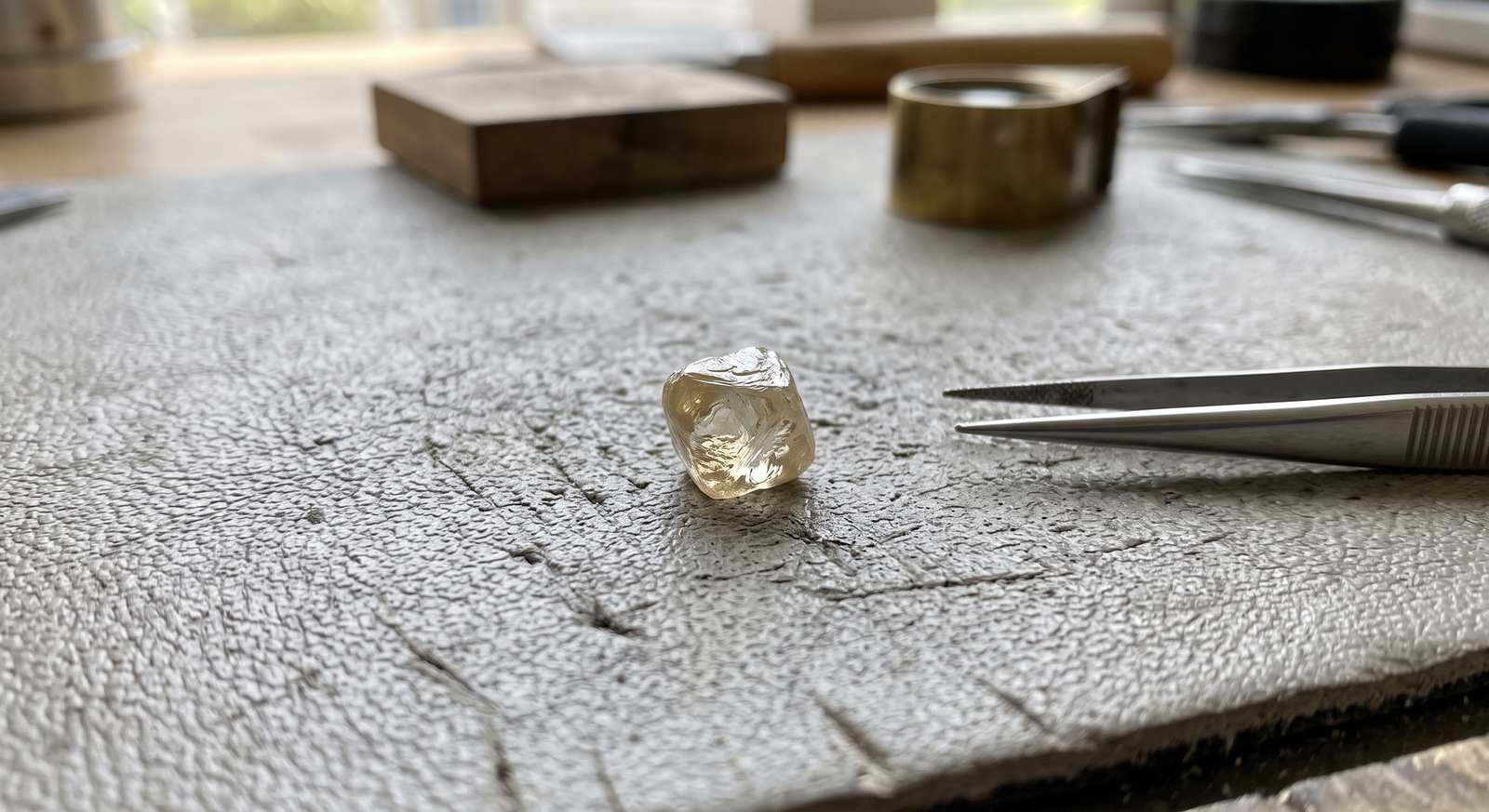
 Rough diamond crystal on a bench mat before cutting, showing its tint

Frequently Asked Questions

Is “champagne” a specification for memorial diamond colors?

Not on its own. It names a family of warm tones spanning several grades, so two people can use the word and picture different stones. It becomes a specification once the acceptable range and the reference are written beside it.

Should memorial diamond colors be agreed before the carat is settled?

Agree them together. The same tint reads differently at a quarter carat and at a carat and a half, so a color line that does not name its carat is only half written. Settle both on one line.

Who decides whether a finished stone is inside the agreed color range?

Ask before ordering, because nothing published about this category settles it. Establish whether the judgment rests with you, with the provider, or with an independent grading report, and what happens if the three disagree.

Can I ask to see a comparison stone before the color is signed off?

Ask. Whether a provider can show a comparable finished stone, a sample set or photographs varies by company, and it is worth knowing which your order is judged against. Record the reference agreed.

Does a grading report settle a disagreement about memorial diamond colors?

Only partly. A report records a color grade under controlled conditions on a stated scale, not how the stone reads in daylight in your hand. Agree in advance whether the grade or the eye governs.

Can two of us specify matching memorial diamond colors on separate orders?

You can specify the same family and range for both. Separate growth runs are separate events, so expect a family resemblance rather than a match. Say at the order that a shared specification is what you want.

Final Thoughts on Memorial Diamond Colors for a Father

With memorial diamond colors, the word is the easy part. The range, the reference, the carat it applies to, who signs it off and what happens if it lands outside, those take one email, and they are the difference between a specification and a hope. Write them down before the deposit. It costs nothing, delays nothing, and it is the leverage you have on a decision you cannot inspect until it is finished.

Learn More About Father Memorial Diamonds

Talk With Memorial Diamond

Reach out to Memorial Diamond at memorialdiamond.us to talk through which memorial diamond colors are realistic for his material, what a written specification looks like, and what to ask us, in writing, about what happens if the stone does not match it. The same questions are worth putting, in the same words, to anyone else you are weighing up.
Word count: 1,852 · Reading time: about 9 minutes

Memorial diamond settings for a father: a man's watch, a signet ring and a pair of cufflinks resting in a small dish on a chest of drawers

Memorial Diamond Settings and Jewelry Ideas for a Father

His watch came off every night and went in the same place, a dish on the chest of drawers everyone in the house knew about. That habit is the whole subject of memorial diamond settings for a father. A memorial diamond will outlast whatever holds it. The realistic way one disappears is removal: a piece taken off during the day and set down out of place. So the settings question has two halves: what holds the stone, and whether the piece comes off at all.

Declared interest: Memorial Diamond is itself a memorial diamond company, so weigh every mounting recommendation below against the fact that we sell the stone it holds.

What Actually Happens to a Memorial Diamond That Goes Missing?

Two things can go wrong with a set stone, and only one is recoverable.

Damage is the recoverable one. At 10 on the Mohs scale nothing in ordinary life will scratch the stone, though a sharp knock at the wrong angle can chip a diamond at the girdle, and you still have the stone afterwards, in your hand, with options.

Separation is not. A stone that works loose from a claw on a Tuesday and is gone by Thursday, or a piece left in a hotel room, does not come back. Memorial diamond settings should be designed against that, not against breakage.

Worth being plain about what the mount is holding. A memorial diamond is not ash in a capsule: carbon taken from him is cleaned to roughly 99.9% purity and grown into the crystal alongside supplemental lab carbon, which leaves his own contribution at something like 10% to 15% of the stone’s finished mass industry wide. That fraction is why this page is about retention rather than repair.

Which piece to make, and who for, is answered in father memorial diamond ideas. This page is the mechanics of memorial diamond settings.

Pieces That Come Off, and What to Do About Them

The memorial diamond settings men actually wear are the ones that leave the body. A father’s stone can easily end up in something that leaves the body during the day: cufflinks, a tie bar, a watch, or a ring pulled off for gloves or at a sink. That is not an argument against those pieces, but for deciding, before the piece is made, where it goes when it is not being worn.

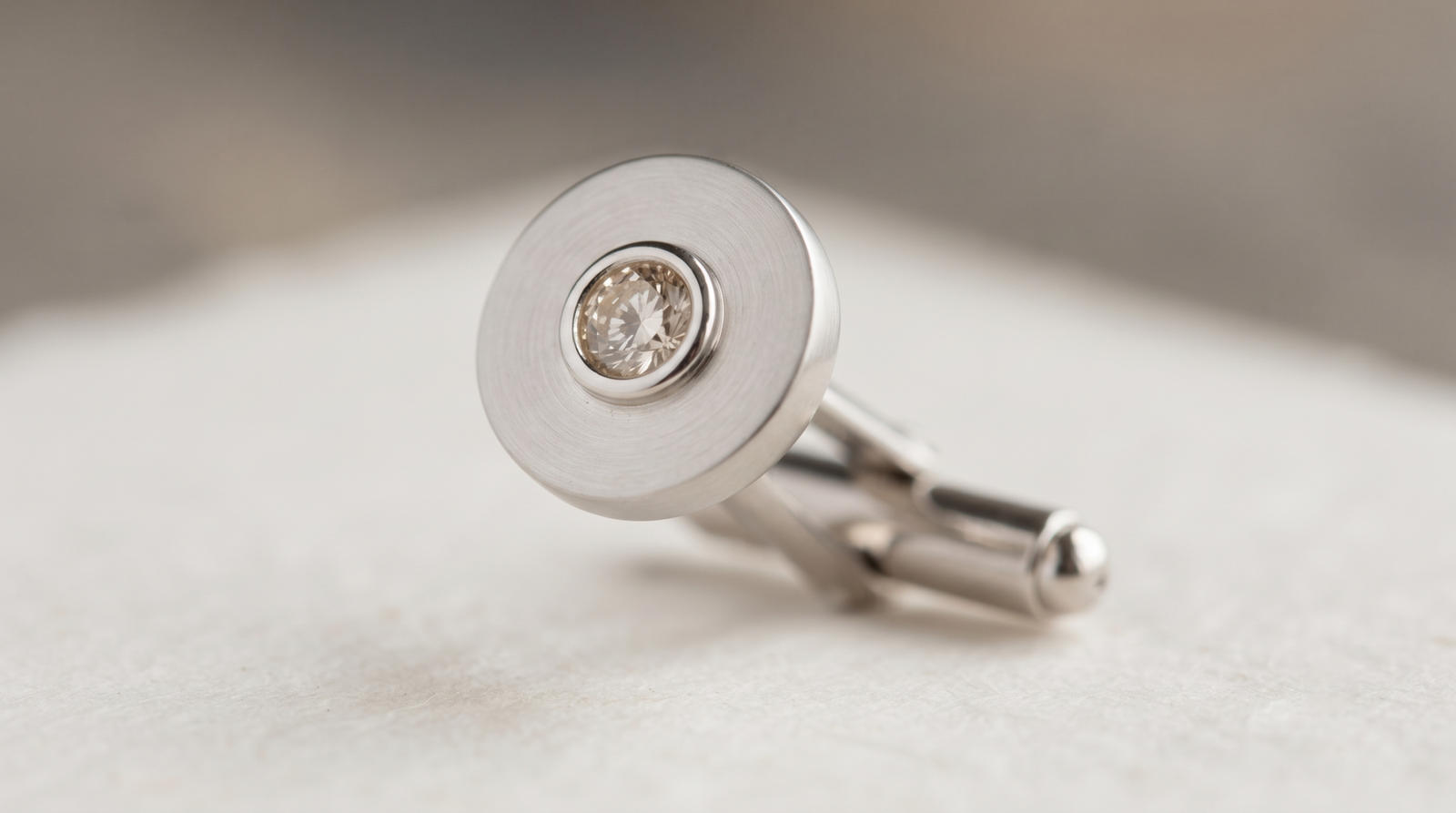
Close-up of a small diamond held in a collet on a cufflink face, back swivel visible
  • Give it one named place, where the piece actually comes off rather than where it ought to. A dish by the sink beats a box in an unused bedroom.
  • Never a pocket. Pockets are turned out, sat on, and emptied into washing machines.
  • On the move, it goes in the case, not the room. Changing rooms and hotel rooms are where small pieces get left behind.
  • Treat a daily removal as a design input. If you cannot say where the piece lives overnight, that is the decision still to make, not the metal.

How Memorial Diamond Settings Hold the Stone, Piece by Piece

PieceHow the stone is heldHow this piece actually gets lostWhat to ask the jeweler
CufflinksCollet or bezel in the face; the back swivels or chainsLeft in a shirt at the dry cleaner, or in a changing roomIs the swivel riveted rather than glued, and replaceable?
Tie bar or pinStone in the bar face; the bar clips to the tieThe clip loses tension and the bar drops off unnoticedHow tight is the clip, and will it be re tensioned?
WatchStone in the case back, dial or crown, in a fitted colletThe watch is sold on without anyone knowing what is in itDoes mounting breach the seal, and will it still service?
Signet or seal ringStone sunk into the shoulder or shank, sitting flushComes off a working hand and never goes back onHow proud does the stone sit, and can the seat be checked in place?
PendantClaws or a bezel in a fitting hung from a bailLifted off over a shirt collar and left on a hotel dresserIs the jump ring soldered, and the clasp rated for the weight?
An object he usedCollet in a drilled seat, or set into the materialThe object gets used: knocked, dropped, lent outWill the seat weaken it, and does the object still work?

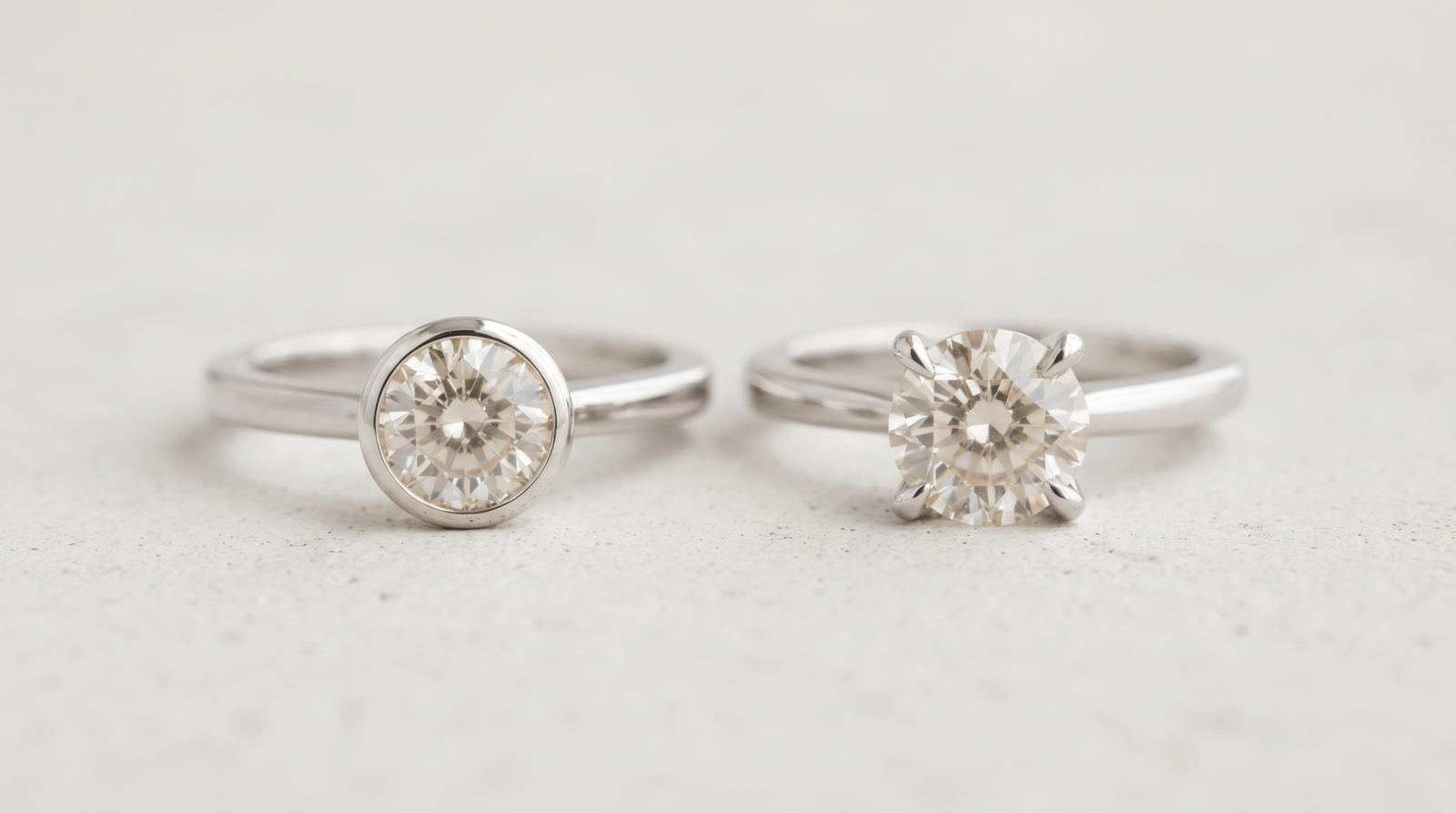
Bezel and claw both appear in the second column deliberately. A rim captures the girdle, claws grip it at points, but across all memorial diamond settings, the third column decides more than the second.

Two rings side by side, one with a flush bezel-set stone and one with a raised claw-set stone

Can a Stone Go Into Something That Was Never Made to Hold One?

Sometimes, and for these memorial diamond settings it is a bench assessment rather than a design preference. A jeweler mounting a stone into a watch, a pen, a knife handle or a box lid is working out four things.

  1. Material. Can it be cut cold, or does it need heat? Some plastics and resins craze, hardened steel resists cutting, and thin plated metal tears rather than holds.
  2. Depth. Is there material behind the face to seat a stone without going through it? A seat that breaks the far side is not a setting.
  3. Function. Does the object still have to work? A watch has to stay sealed, a knife has to flex without a stress riser, a pen has to screw together.
  4. Fixing. A collet fitted into a drilled seat, or the stone cut straight into the object’s own material? A collet keeps the cutting away from the structure, and it is the removable answer.

Things that cannot safely take memorial diamond settings: thin pressed metal with nothing behind it, anything that flexes or springs under load, anything sealed that would leak once drilled, and anything structural.

Two points before work starts on memorial diamond settings in an object. This is not always one trade. A watchmaker opens the watch, a jeweler makes the collet, so ask who does which part. And cutting into something he owned cannot be undone. If the object matters to somebody else, that conversation comes first. Setting the stone into a band he already wore has its own constraints, covered in the father ashes diamond complete guide.

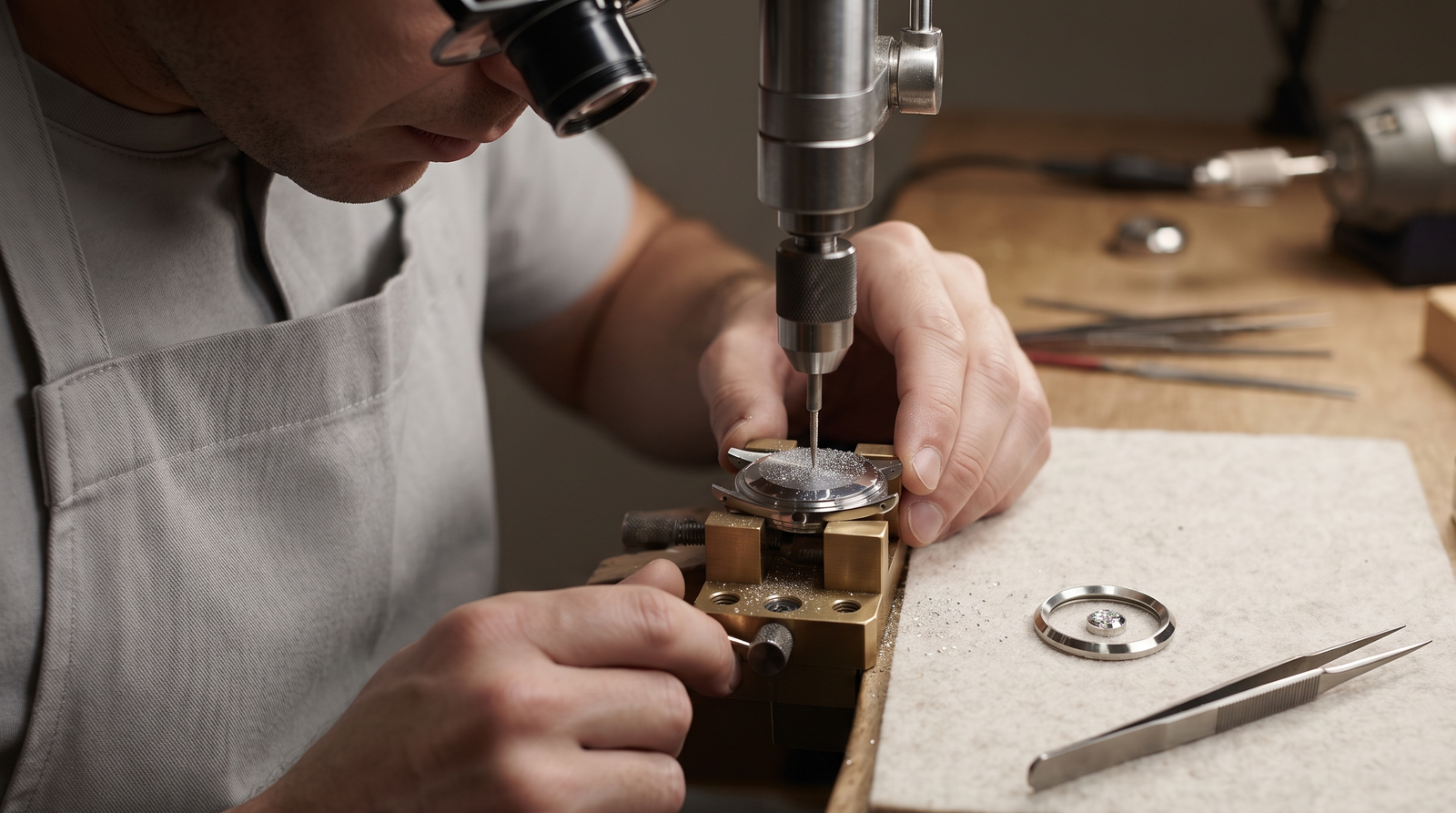
Jeweler at a bench drilling a seat into a watch case back with a collet beside it | **Priority for original photography

Metal and Wear on a Hand That Works

On a hand that lifts, grips and scrapes, height matters more than metal in memorial diamond settings.

  • How proud the stone sits decides how much it catches. A flush or sunk stone clears door frames, toolboxes and gloves. A raised claw head finds them.
  • Claw tips wear from the outside in. Gloves, tool handles and a steering wheel all press the same few points, and a claw thinned that way lets go without ever catching on anything.
  • Plated finishes wear through first at the contact points, the underside of the band above all.
  • A ring is not the only answer. If his hands worked and yours do too, a pendant under a shirt takes none of that punishment.

The metal shifts how a stone’s color reads, warmer inside a yellow mount, cooler inside a white one, so choose the mount against the finished stone rather than a description (memorial diamond colors for a father). Cleaning a set piece belongs to memorial diamond aftercare, and words on the metal to engraving and personalizing the setting.

What Size Should a Piece Be If It May Pass Between Two People?

Ask how many sizes a design can move before choosing it, because some memorial diamond settings cannot move at all. A piece that must be remade to change hands will not change hands.

  • Sidestep sizing where you can. A pendant, cufflinks, a tie bar or a watch fit anybody.
  • If it has to be a ring, ask the bench its sizing range with the stone in place.
  • Size it to whoever wears it now, not to a compromise. A ring that fits neither is the one that comes off in a glove.

Frequently Asked Questions

Mechanically, yes. A collet in the face holds a stone as securely as a ring does. The risk is the routine, not the mount: cufflinks come off in hotel and changing rooms, so decide where the pair lives first.

What does a jeweler check before memorial diamond settings go into something he owned?

Whether the material can be cut without cracking, whether there is depth behind the face to seat a stone, whether the object still has to function, and whether heat is needed nearby. Any one can rule it out.

Which memorial diamond settings suit a hand that works?

For retention on a working hand, a stone sunk into the metal sits lower and catches less than raised claws. The trade is that a sunk stone shows less light, so ask to see both profiles against your hand.

What should happen to a piece each time it comes off during the day?

It should go to one named place, not the nearest flat surface. Put a dish where the piece is actually removed rather than where you think it should be, and never on a basin rim or in a pocket.

If memorial diamond settings may pass from me to my brother, how should the piece be sized?

Ask how many sizes the design can move before choosing it, because some cannot move at all. If it has to change hands, a pendant, cufflinks or a tie bar sidesteps sizing and needs no bench work.

Are there memorial diamond settings a stone genuinely cannot go into?

Yes. Thin pressed metal with nothing behind it, anything that flexes or springs under load, anything sealed that would leak once drilled, and anything structural. A jeweler ruling an object out is stating a mechanical limit.

Final Thoughts on Memorial Diamond Settings for a Father

Decide where the finished piece lives when it is not being worn, and let that answer choose among memorial diamond settings. Put the jeweler’s questions to a bench before anything is cut. Production runs 6 to 10 months from receipt of material, longer for larger or specialty stones, time enough to decide this before the stone exists. Settings are quoted separately from the stone (what a father memorial diamond costs), so the mount is a decision you can take at your own pace.

Learn More About Memorial Diamond Settings

Talk With Memorial Diamond

If you have an object of his in mind and want to know whether it can take a stone, that is a question for a bench, and a conversation Memorial Diamond can help you frame. Reach out at memorialdiamond.us to talk through memorial diamond settings, from a plain pendant to the watch he wore.

Word count: 1,889. Reading time: about 9 minutes.

One family member's hands holding a closed urn while three small lab-grown memorial diamonds sit on the table in front of it

More Than One Family Member, One Father: 7 Easy Answers

You can do the arithmetic in an afternoon. Three of you, a portion each, and the question of whether there is enough. Yes, more than one family member can have a diamond grown from the same father’s ashes, because a single stone uses only a small portion of a cremation’s remains. The quantity is not what settles it. What settles it is which one family member holds his ashes, whether that person is one of the people asking, and how many people the arrangement has to satisfy.

A note on where this comes from: Memorial Diamond makes memorial diamonds and would be one of the providers you might approach. Nothing on this page is written to steer that.

Which One Family Member Actually Controls His Ashes?

Cremated remains are generally released to the person who arranged and authorized the cremation, confirm locally rather than assuming. That is a name on a document: a surviving spouse, an executor, or whichever relative signed the paperwork at the funeral home. It may not be yours.

Two things are bundled inside the word control. The first is possession: one family member physically has the container. The second is authority over disposition: who decides what happens to the remains. In many jurisdictions that sits with a surviving spouse ahead of adult children, but it varies by state and can be displaced by written instructions he left.

Here is the asymmetry specific to a father. The people who want stones are not automatically the one family member with control. A widow holds the urn; three adult children want three diamonds. The arithmetic stays easy; the request still has to travel to the person who can say yes. Raising it with that person has its own shape: how to talk to family about a father memorial diamond handles it.

What the Material Allows

Industry practice puts one stone’s requirement between a few tablespoons and roughly 4 oz, about 100g, of cremated remains. A full cremation yields substantially more, so three or four portions is unremarkable, and the rest can still be interred, scattered or kept as intended. How much ash you need for a father memorial diamond covers the figures properly.

Be precise about what each portion becomes. Carbon recovered from ashes is refined to around 99.9% purity, but ash carries only about 0.5% to 4% carbon by weight, so one portion yields far less than the volume a growth cell has to be charged with; lab sourced carbon makes up the rest. Industry figures put the personal fraction at roughly 10% to 15% of a finished stone’s mass, a per stone figure, not a pooled one. Each stone is grown to the same ratio, so four stones do not divide him four ways. Every one of them is a real lab grown diamond, grown by the same HPHT or CVD method as any other.

Two consequences follow:

  • The stones will differ from each other. Color comes from trace elements present at growth, and separate growth runs are separate events: memorial diamond colors for a father covers how a color is specified before anyone sees it.
  • Four stones are four orders. Price follows the number of stones and the carat of each, not the volume of ash. What a father memorial diamond costs sets out the ranges.

Where the Friction Sits, Arrangement by Arrangement

Family arrangementWho controls the materialWhere the friction sits
Widow surviving, adult children of that marriageHis widow, who arranged the cremationThe children are asking for a portion of something in her house that is, to her, still his
Widow surviving, adult children of an earlier marriageHis widowWhether they are asking her or the estate, and whether anyone has established which
No surviving spouse, several adult children, one has the urnThe sibling it went home withPossession was an accident of who had space; it now reads as authority
No surviving spouse, an executor appointedThe executor, while the estate is openEstate timelines, and any written instruction, which may already settle it
Second marriage, adult step children on both sidesHis widow, then her executor“Family member” is the contested word; the count is settled before any stone is
A portion already retained by several relativesEach holder of a portionAlready decentralized; more than one family member may be able to order independently
Already interred, scattered, or committed to a booked dateNobody, once it is doneThe ash route is closed; hair, if any was kept, is a separate question

Read the middle column: in four of these seven rows, the one family member with control is not the one doing the asking. If your question is about supply, the answer is easy. If it is about permission, that is the harder half.

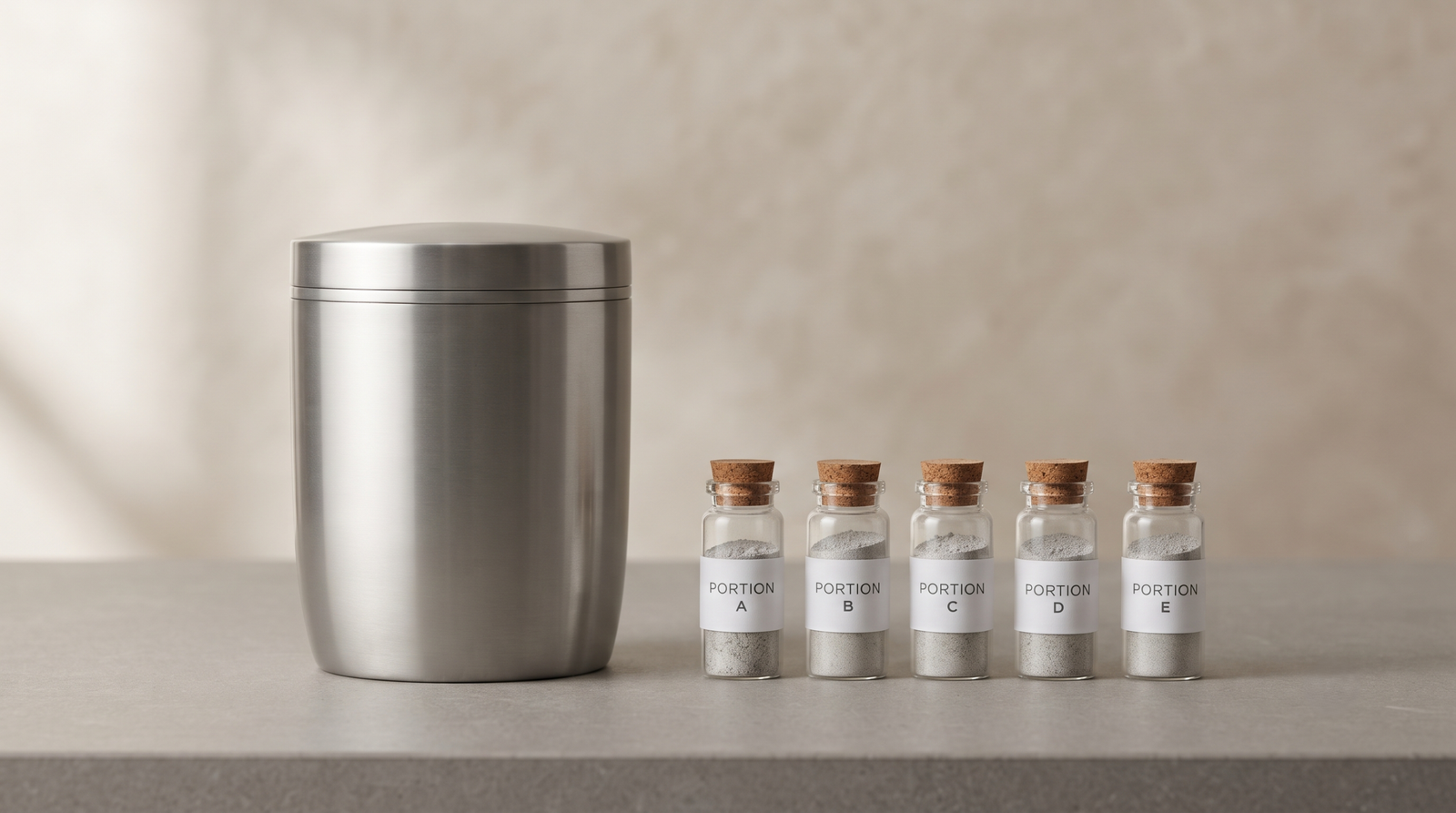
Small labeled sample containers beside a larger urn, each holding a measured portion of cremated remains

One Person Orders; Several People Receive

Even where four people each end up with a stone, the order usually sits with one named account holder: one submission of material, one chain of custody record, one counterparty making the decisions the laboratory needs. That structure works. It fails when people do not know they are inside it.

Whoever signs is the one family member a provider comes back to, on the laboratory’s timetable rather than the family’s, settling carat and color for each stone, carrying payment across all of them, and agreeing what happens if somebody withdraws after material has gone. Ask before ordering whether each recipient is named on the origin documentation, and what becomes of material submitted and not used. Questions to ask before turning your father’s ashes into a diamond collects the wider set.

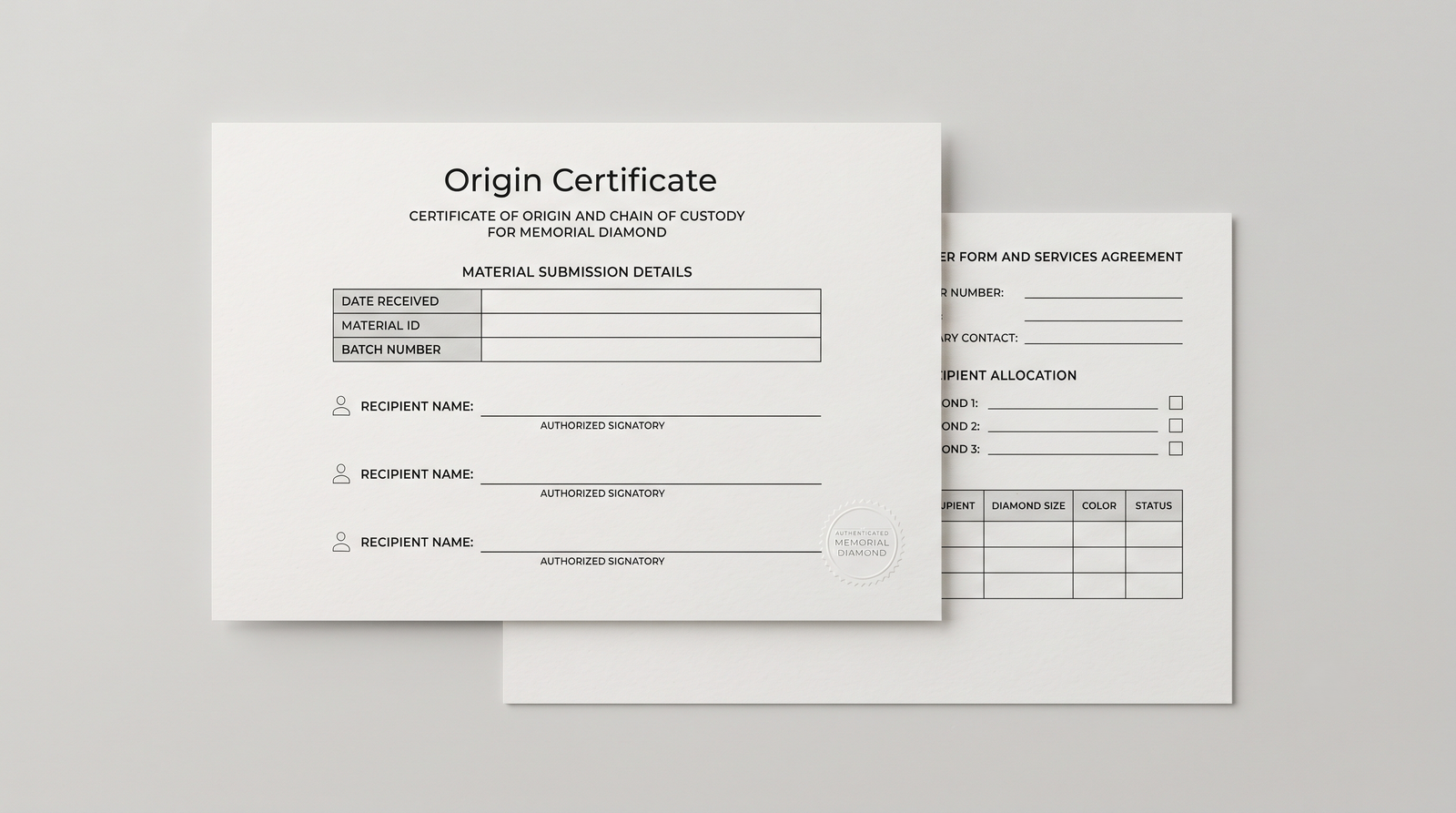
Order paperwork and an origin certificate laid out with three named recipient lines

Frequently Asked Questions

My stepmother has his ashes and I have not raised it with her yet. Does that change what is possible?

Not what is physically possible: the quantity involved is small. It changes who the request goes to. She is the one family member holding the remains, so the practical answer is hers to give, whatever the wider family thinks.

Will retained ashes still be usable if we order a second stone years from now?

Cremated remains are chemically stable and do not degrade in ordinary storage, so a later order is workable in principle. Confirm storage and handling requirements with a provider rather than assuming a particular portion will be accepted.

If he left no instructions, can one family member decide alone?

They hold the material, so any request goes through them, and a provider would treat them as the customer. Whether they decide alone is then an arrangement inside the family: anyone who would want a say is better asked first.

Can one of us have a hair diamond while the others have ash diamonds?

Yes, where hair was kept. Hair is roughly 50% carbon against ash’s 0.5% to 4%, so far less material is needed, and it is a separate submission with its own order rather than a variation on the ash one.

Does more than one family member have to be on the contract?

Usually not; providers typically need one customer of record. Ask whether several recipients can be named on the origin certificate, and whether payment can be split across people, before anything is posted.

What if a sibling was never asked?

Another stone cannot fix it. If material remains and the holder agrees, a later stone can be grown; being left out of the decision is not recoverable the same way. Write down who was told, when, and what they said.

Final Thoughts on Sharing a Father’s Ashes Diamond

The supply question is the easy one, and most families settle it in a sentence. The harder one is that one family member holds his ashes and everyone else is asking. Get that conversation right, agree who signs and who receives, and the number of stones takes care of itself.

Learn More About Father Memorial Diamonds

Talk With Memorial Diamond

If several of you want a stone from the same ashes, the useful first conversation is about who holds them and who signs. Reach out to Memorial Diamond at memorialdiamond.us to talk through what one submission can become for more than one family member.

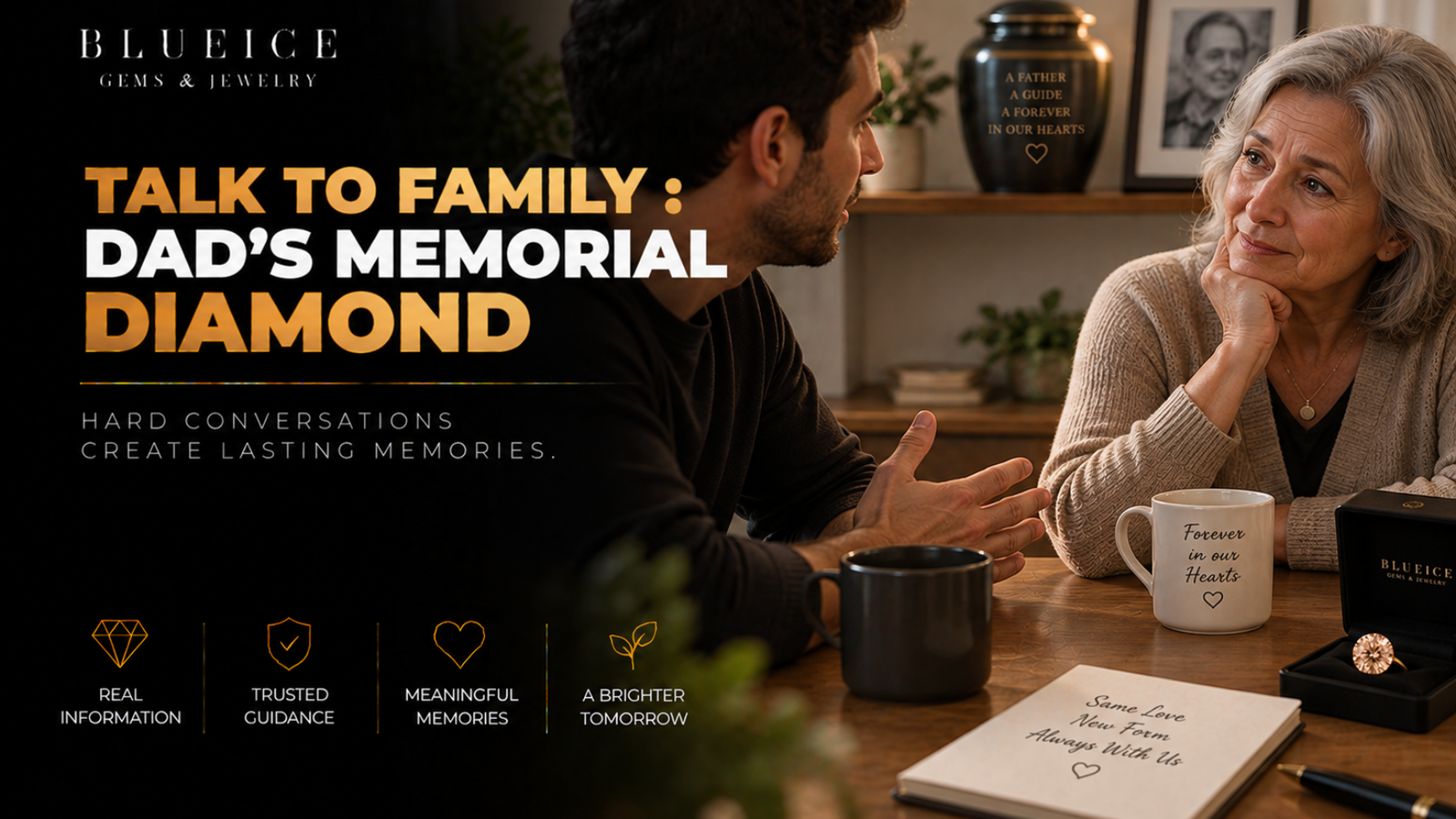
How to talk to family about a father memorial diamond: an adult son and his mother at a kitchen table, one listening, an urn out of focus on a shelf behind

How to Talk to Family About a Father Memorial Diamond

You have had the sentence ready for a week and not said it. Not because you expect a refusal, but because you cannot tell whether you are asking permission or handing over a decision. Here is how to talk to family about a father memorial diamond: treat it as one conversation, not a family meeting. Where his widow is living, the decision turns on her agreement; everyone else is being told. The move that does real work is a question, not a case: ask what she wants to do with his ashes before saying what you want.

Disclosure, plainly: Memorial Diamond sells the thing this page helps you ask about, a reason to check what follows against other sources, not a reason to skip it.

One Conversation Is a Request; the Rest Are Announcements

There is a difference between the people who need to know and the person who needs to agree. Both matter; only one can end it. When you talk to family, keep that distinction in front of you.

Where his widow is living, his remains will ordinarily have been released to her, they sit in her house, and the decision commonly runs through her. Commonly rather than always: authority over disposition varies by jurisdiction and by whatever he set down in writing. That conversation is a genuine request: she can say no, and in practice that ends it. Everything else is an announcement, siblings, step siblings, adult grandchildren, the daughter who lives abroad, owed the information, not asked to approve it.

Confusing the two fails in both directions. Run an announcement as a request and you have convened a vote nobody needed: opinions on a decision that was never theirs, and his widow reduced to one voice among six. Run a request as an announcement and it is worse: telling her what you have decided about something in her house is not information sharing but a fait accompli.

What Are You Actually Asking Her For?

Three things get said in the same breath when people talk to family about this, and they are not the same ask.

Asking permission means you have decided and would like her not to object. Asking her to decide hands her a choice she did not raise. Asking whether she is open to it leaves room: it invites a reaction rather than a ruling. That distinction lives in the sentence you use when you talk to family.

The sentence you were going to sayWhat it actually asks forSay this instead
“I want to have Dad made into a diamond.”His remains, for a decision already taken“Have you thought about what you want to do with Dad’s ashes?”
“It’s only a small amount; you’d hardly notice.”Agreement that the loss is negligible, hers to judge“It uses a portion rather than all of it. How would you feel about that?”
“Dad would have loved it.”That she contradict him in order to say no“I don’t know what he’d have made of it. What do you think?”
“You don’t have to decide now.”Sounds like a concession; lands as a deadline she carries“There’s no date on this. If you’d rather not talk about it, that’s an answer.”

Two things are worth having ready before you talk to family.

The first is what happens to the material. Carbon recovered from the ashes is purified, then combined with lab grown carbon until there is enough for a growth run; on industry figures his own share of the finished stone comes to roughly 10% to 15%, ash being about 0.5% to 4% carbon to begin with. What comes out is a real diamond, grown by HPHT or CVD, not a keepsake with ash sealed inside. Say it yourself rather than let somebody else look it up; how a memorial diamond is made from your father’s ashes has the rest.

The second is what you will do with a no. A refusal is an answer, not a stage in a negotiation, and where she holds his remains it is in practice the answer. Going around it is not available: not a portion she did not agree to, not silence read as consent. Hair, if any was kept, is a separate route rather than a workaround, with its own yes, turning your father’s hair into a diamond covers it. A no can also be a no for now.

A short handwritten list of first names beside a phone | Stock acceptable; names illegible

Ask What She Wants to Do With His Ashes First

This is the highest leverage move on the page, and it is a listening one.

Before you say what you want, ask what she wants, not as a technique but as the actual first question, with room for her to answer at length or not at all. Three things happen when you talk to family in that order.

You find out whether the route is open. An interment already booked or a scattering planned changes what is possible, and you learn it beforehand.

You find out what she has been carrying. She may have a plan she never said out loud because nobody asked, or no plan and no wish to be asked for one.

You change the shape of your own request. Asked afterwards it is a proposal inside a plan she is already making, not a claim on his remains.

If she asks how much would be used, have the figure: a small portion of a cremation rather than the whole, with ranges in how much ash you need for a father memorial diamond. Do not open with it; a quantity answers a question she has not asked.

calendar-with-one-date-circ

When Should You Talk to Family About It?

Not against the funeral, and not against the fortnight after it, that is the wrong time to talk to family about anything that can wait. The clock that matters belongs to the estate and to any disposition already arranged.

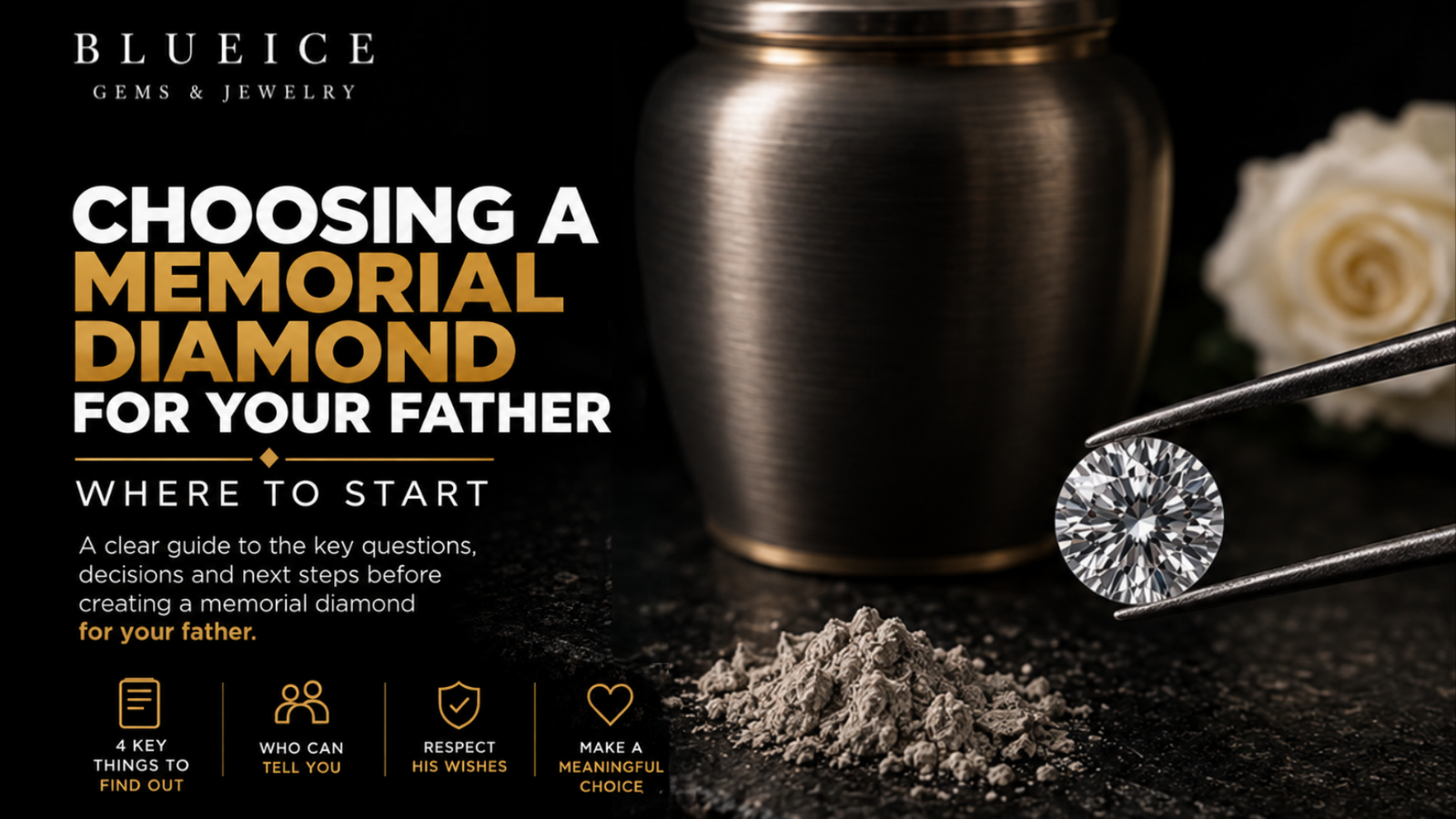
There is one genuine deadline here and it is not the diamond. It is whatever has been booked for his remains: an interment date, a service cemetery’s calendar, a scattering. A portion has to be separated before that happens; afterwards the ash route is closed. If an executor is administering the estate, find out whether he left written instructions about his remains; that may have settled it. Choosing a memorial diamond for your father: where to start sets out what to establish before you talk to family at all.

Everything else waits at no cost. Production runs to about 6 to 10 months from the point a laboratory receives material, and that clock does not start until material is sent, a month spent not raising it costs a month, not an outcome. How long a father memorial diamond takes sets out where the time goes.

Telling Everyone Else

One rule governs the moment you talk to family beyond her: nobody hears it before she does. If it reaches her second hand she is no longer being asked, whatever words follow.

After that, when you talk to family more widely, order matters less than completeness. Tell the people who would be hurt to find out late. Say it as information: “This is what we’re doing, and I wanted you to hear it from me” is a complete sentence; adding “what do you think?” turns it back into a request.

phone-call-list-of-family-names

Then there is the sibling who neither agrees nor objects. Silence is genuinely ambiguous: disagreement, distance, or nothing at all. Reading it as consent is how people end up excluded from something they cared about. Name it once, without accusation, and accept the answer.

Whether other relatives can each have a stone is a separate question, whether more than one family member can get a diamond from the same father’s ashes handles how the stones and the money work.

What If You Are the One Being Asked?

If you are his widow and a child of his has raised this, the advice about how to talk to family is addressed to the asker, not to you.

You are not obliged to talk to family on their timetable: “I need to think about it” is a complete response, not a soft no. Two questions inside the request can be separated: whether a portion of him being used is something you are comfortable with at all, and who it would be for. Answering the first while leaving the second open stops a yes being heard as a yes to everything. And wanting his ashes to stay where they are for another year is an answer with a date in it, not a refusal.

Frequently Asked Questions

My mother is his ex wife, not his widow. Do I need to talk to family that includes her?

Usually not as a request. Control of disposition ordinarily rests with a surviving spouse or an executor rather than a former one, though that varies by jurisdiction and by any written instruction he left. Whether she is told is a separate, purely relational question.

Should I talk to family, my siblings, before or after I speak to her?

After. If she hears it from a sibling first she is no longer being asked, and nothing said afterwards fully repairs that. Speak to her, then tell everyone else within days rather than weeks.

She said yes when I first tried to talk to family, then went quiet. What do I do with that?

Check before acting rather than proceeding on the original yes. A short message naming what would happen next, and when, gives her an easy opportunity to revise it. Quiet agreement is worth confirming once.

What if two of us want to talk to family and we disagree about how?

Settle it between you first. Two versions of this request reaching her separately reads as pressure regardless of intent. One person raises it, the other is named as also involved, and neither follows up until she answers.

She asked what it costs and I do not want money to become the subject. How do I answer?

Answer plainly and move on, because evasion makes the figure larger than it is. Industry ranges start around $1,500 to $3,500 for the smallest stones. Who pays is a separate matter from whose agreement is needed.

Is there a wrong time to talk to family about this?

The week of the funeral, and the fortnight after it. The only real deadline is a booked interment or scattering; everything else waits at no cost, so there is no reason to raise it while everyone is still standing in the aftermath.

Final Thoughts on How to Talk to Family About a Father Memorial Diamond

This comes down to sequence. Ask what she wants to do with his ashes. Listen properly, including the parts that make your request harder. Then say what you would like, once, in a sentence that leaves her somewhere to stand. Everyone else is told afterwards, not asked. That is the whole of how to talk to family about it, one request, several announcements, in that order.

Learn More About Father Memorial Diamonds

Talk With Memorial Diamond

Once the conversation has happened, whichever way it went, Memorial Diamond can talk through what a provider would need and when. Reach out at memorialdiamond.us. If you are still working out how to talk to family first, that is the harder part, and there is no hurry on our side.

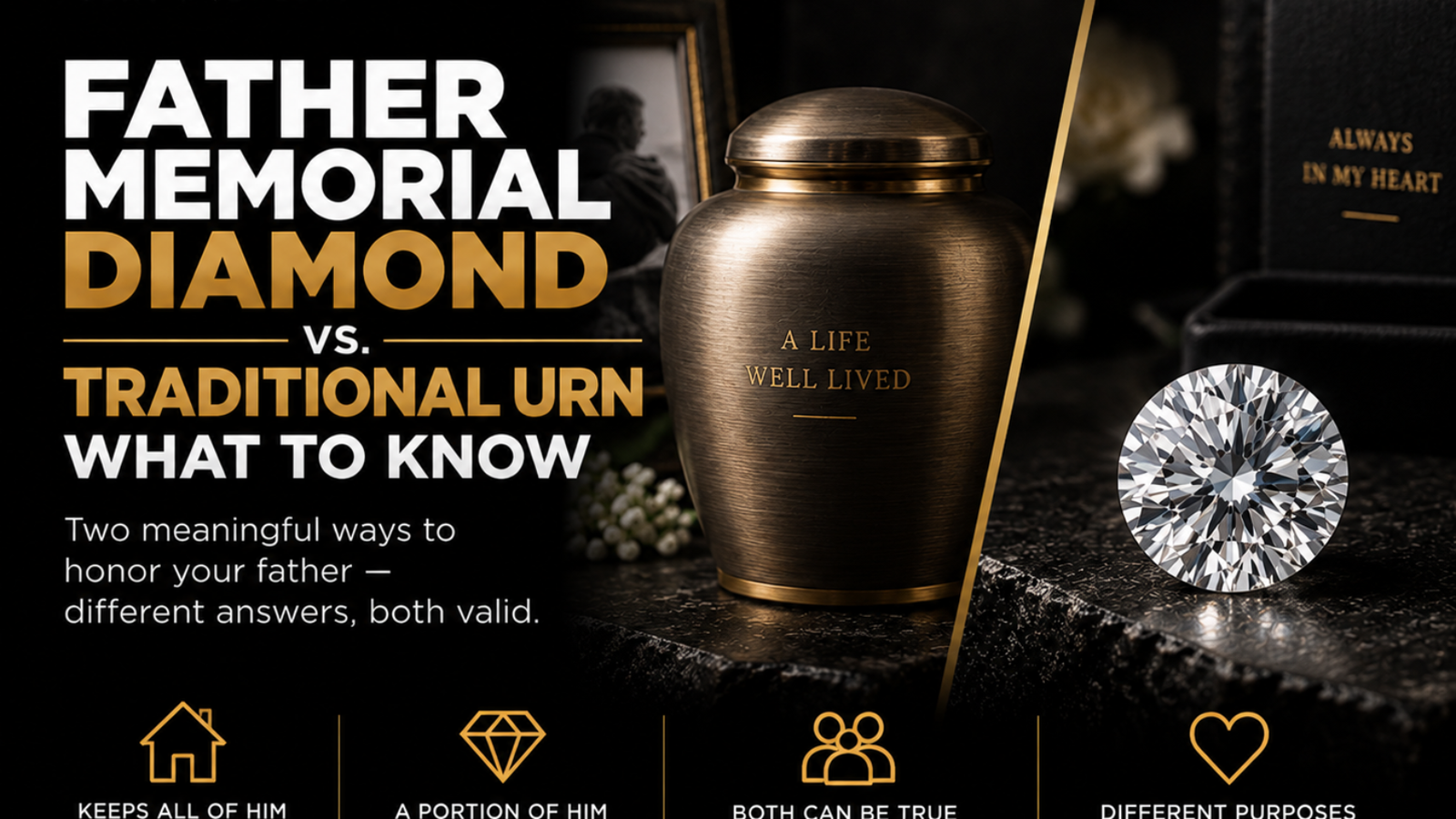
Father memorial diamond compared with a traditional urn showing two meaningful ways to honor a father

Blog Title: Father Memorial Diamond vs. Traditional Urn: What to Know

His urn has been in the same room since the week after the funeral, dusted around rather than moved, in a spot somebody chose quickly. So the live question is not which to buy. A memorial diamond and a traditional urn answer different questions. The urn keeps all of him in one place a household looks after; a diamond grown from a small portion of that same ash becomes a single person’s to carry. Both can be true in the same family, and this page is written for the family where the urn already exists.

Before you read further: Memorial Diamond grows memorial diamonds, so this comparison is published by a business with money riding on one side of it. The sections arguing for the urn are the ones we had the least commercial reason to write, and they are written straight.

If you are earlier than an urn, the complete guide to a father ashes diamond covers that sequence.

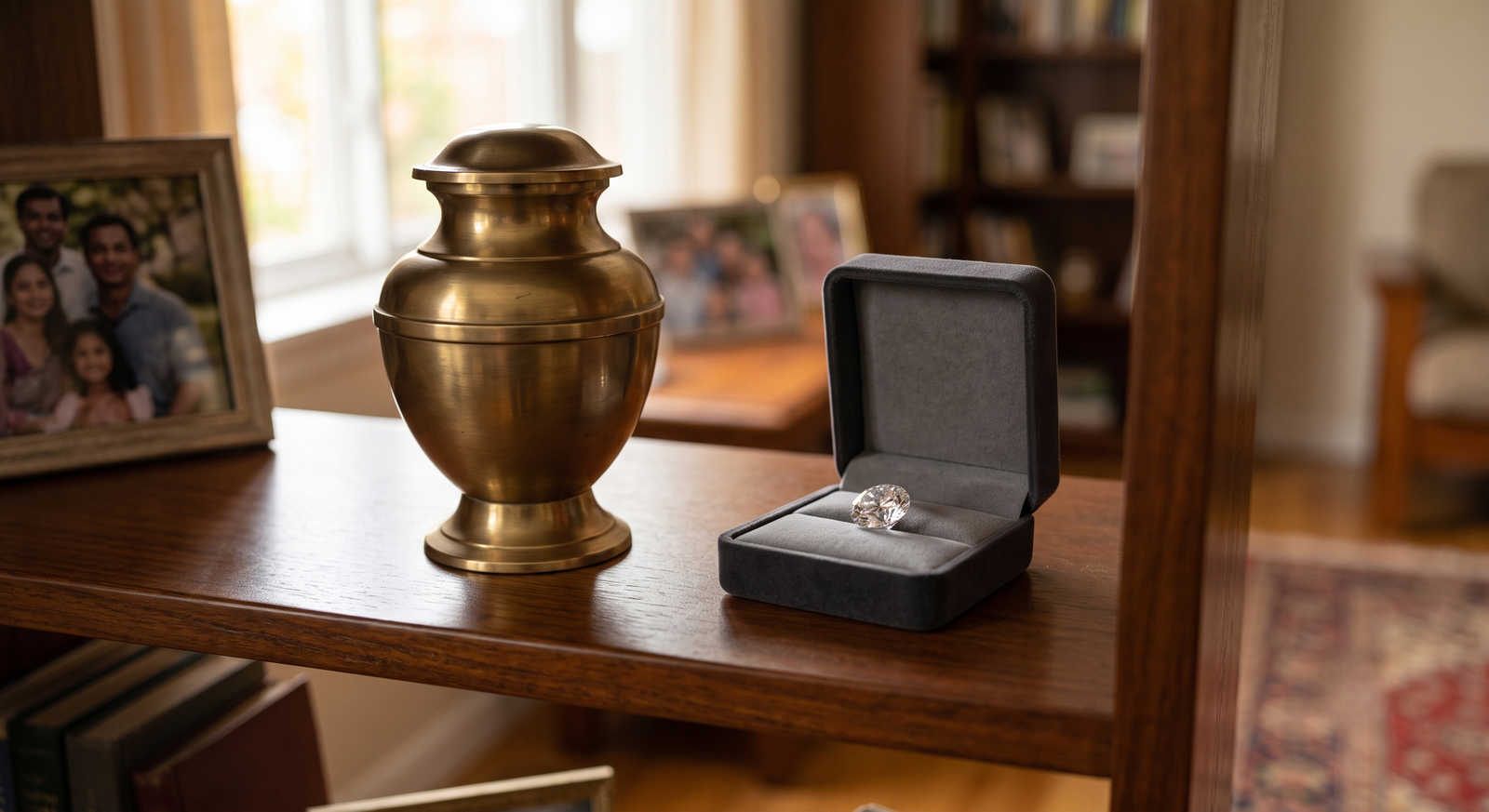
A traditional urn on a living-room shelf beside a small open case holding a lab-grown memorial diamond

What Changes If the Traditional Urn Stays and a Stone Joins It?

Less than the comparison implies. A portion of ash leaves the traditional urn, the rest stays put, and a second object exists doing a job the urn was never doing. The amount a growth run needs is small, industry guidance puts it between a few tablespoons and roughly 4 oz, worked through in how much ash you need for a father memorial diamond.

Be exact about what that second object is. The urn holds every gram the crematorium returned. A stone holds a measured fraction of it, roughly 10 15% of its finished mass across the industry, because a portion of ash carries too little carbon to charge a growth cell on its own, and supplemental lab sourced carbon makes up the balance. His carbon is cleaned to around 99.9% purity first, and what comes back is a small, real part of him, permanently, in a crystal that rates a 10 on the Mohs hardness scale.

An Urn Belongs to a Household. A Diamond Belongs to a Person.

That difference drives the rest of this comparison.

A traditional urn has an address. Whoever lives in the house it sits on becomes responsible for it, not because anybody decided, but because of where it happens to be. It cannot be in two places at once.

A memorial diamond has an owner instead. It is ordered by one person, kept by them, and named in a will if it is meant to go on. Nobody is left working out whose it is. That is not a superiority claim. It is a different object with a different failure mode: a traditional urn can be orphaned, and a small worn stone can be lost.

The Question You Are Actually Asking

Underneath the comparison sits a practical worry, and the two objects answer different ones.

The question you are actually askingWhat the traditional urn answersWhat a memorial diamond answers
“Where is he now?”A named place in a room, or a numbered niche.Nowhere fixed, wherever the owner happens to be.
“Who is responsible for him?”Whoever’s house it is in, by default rather than decision.One named person, chosen when the order is placed.
“What happens when this house is sold?”A decision somebody has to make under time pressure.It moves in a coat pocket. Nothing is settled.
“Can several of us have something of him?”One object, one place. People come to it.A portion can grow into several stones, one per person.
“How do I mark the day he died?”It gives you somewhere to stand.It gives you something to put on.
“Is it finished?”Yes, the afternoon you buy it.No, 6 10 months of production after the laboratory receives material.
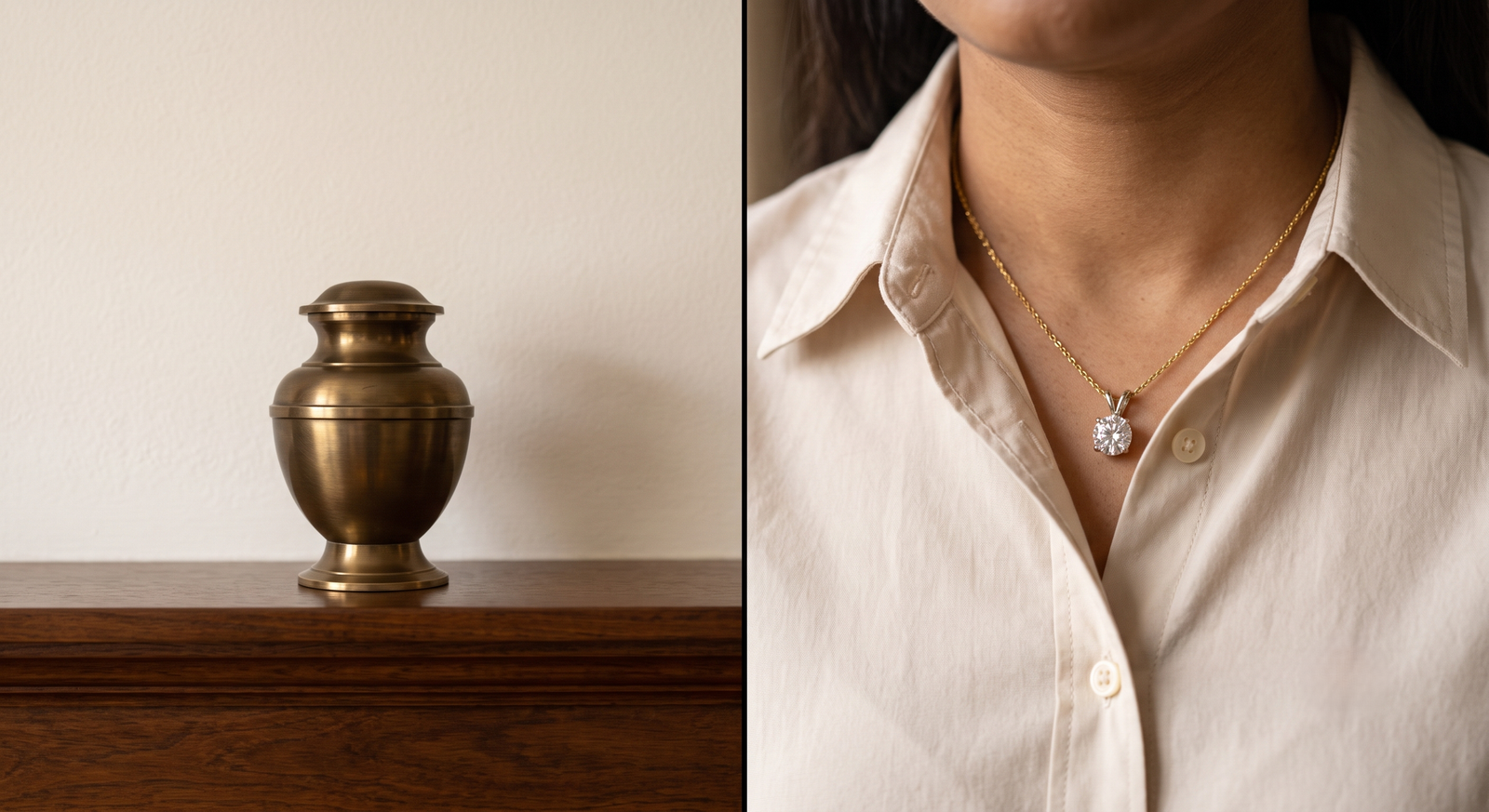
Split image: an urn on a mantel in an empty room, and a pendant diamond worn under a shirt colla

What Happens When the Household Changes?

If the urn is in a house that may one day be sold or downsized out of, this is the part that matters.

A traditional urn is only as stable as the household it belongs to. His widow downsizes and the shelf it stood on no longer exists. The house is sold and the urn is packed by whoever is packing the kitchen. Adult children each quietly assume a sibling will take it.

None of that is negligence. It is what happens to an object whose place in the world is a place rather than a person. If the urn is in your mother’s house, where it goes next is hers to lead, and how to raise a memorial diamond with the family is a better starting point than a proposal.

A diamond does not solve this. It sidesteps it by attaching to a person rather than a room, which turns the open question of where an object should live into the ordinary one of who it belongs to next.

What a Traditional Urn Does Better

Argued on its own terms, not as courtesy:

  • It holds him whole. No portion of him is anywhere else, in anyone else’s keeping.
  • It stays reversible. Ash in a traditional urn can still be scattered, interred or divided years from now. Diamond growth is one way: that portion of carbon is a crystal permanently.
  • It exists now. An urn is a purchase you complete in an afternoon. A memorial diamond takes 6 10 months of production from the date a laboratory receives the material.
  • It is shared. Several people can stand in front of one urn at once. A worn stone is with one person, by design.
  • It asks nothing of anyone. Nobody has to agree to it, insure it, resize it or decide who inherits it.
  • It costs what a container costs. A memorial diamond is a decision in the low thousands at the entry tier and climbs steeply with carat, see the cost of a father memorial diamond.

If the traditional urn is doing all six of those things and nobody is unsettled, there is no problem here to solve. With cremation now the majority choice in the US, 63.4% projected for 2025 by the NFDA, a great many families are in exactly this position, and most of them keep the urn and add nothing.

When an Interment Turns the Urn Into a Place

Interment changes the comparison more than anything else.

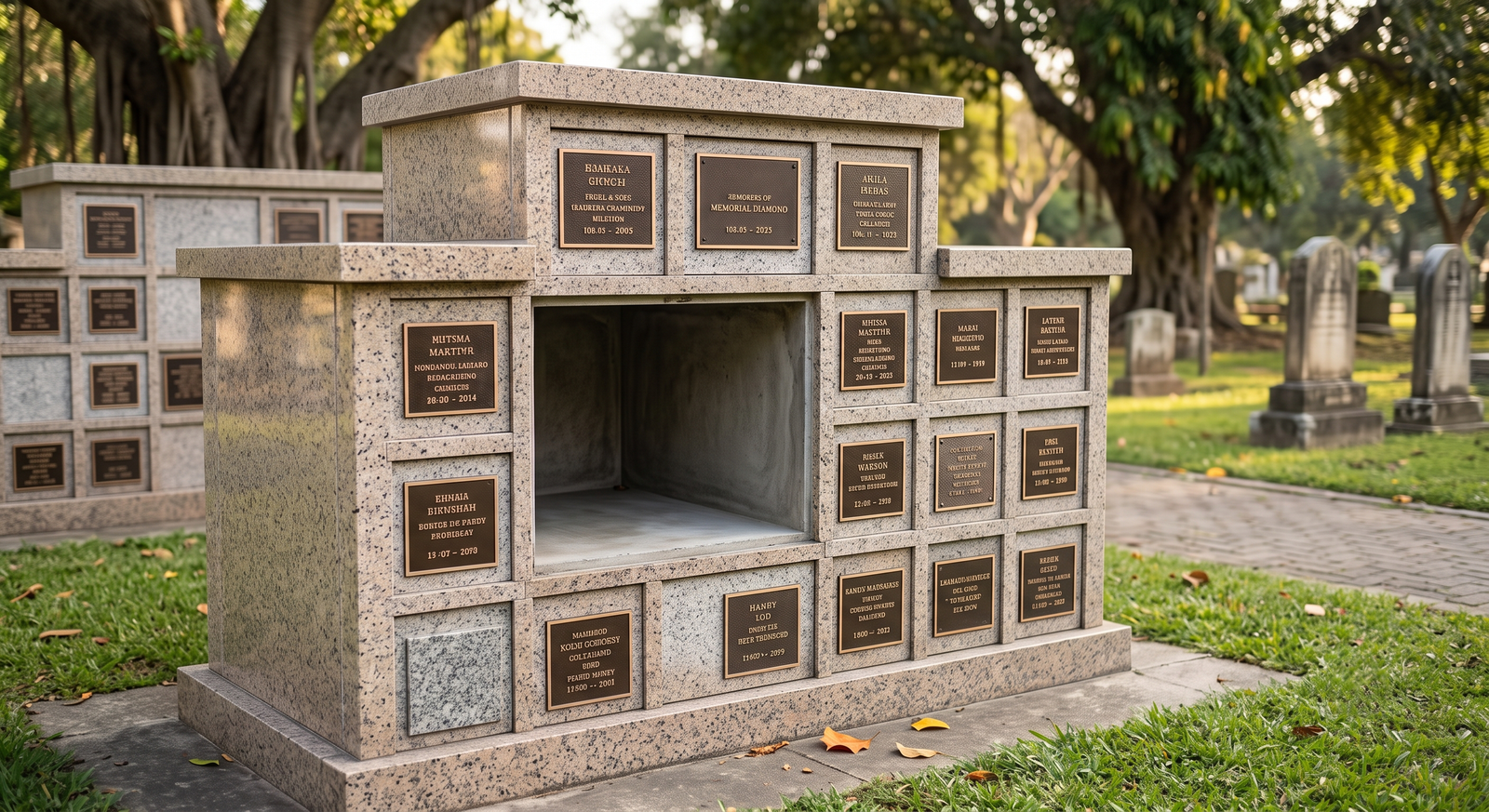
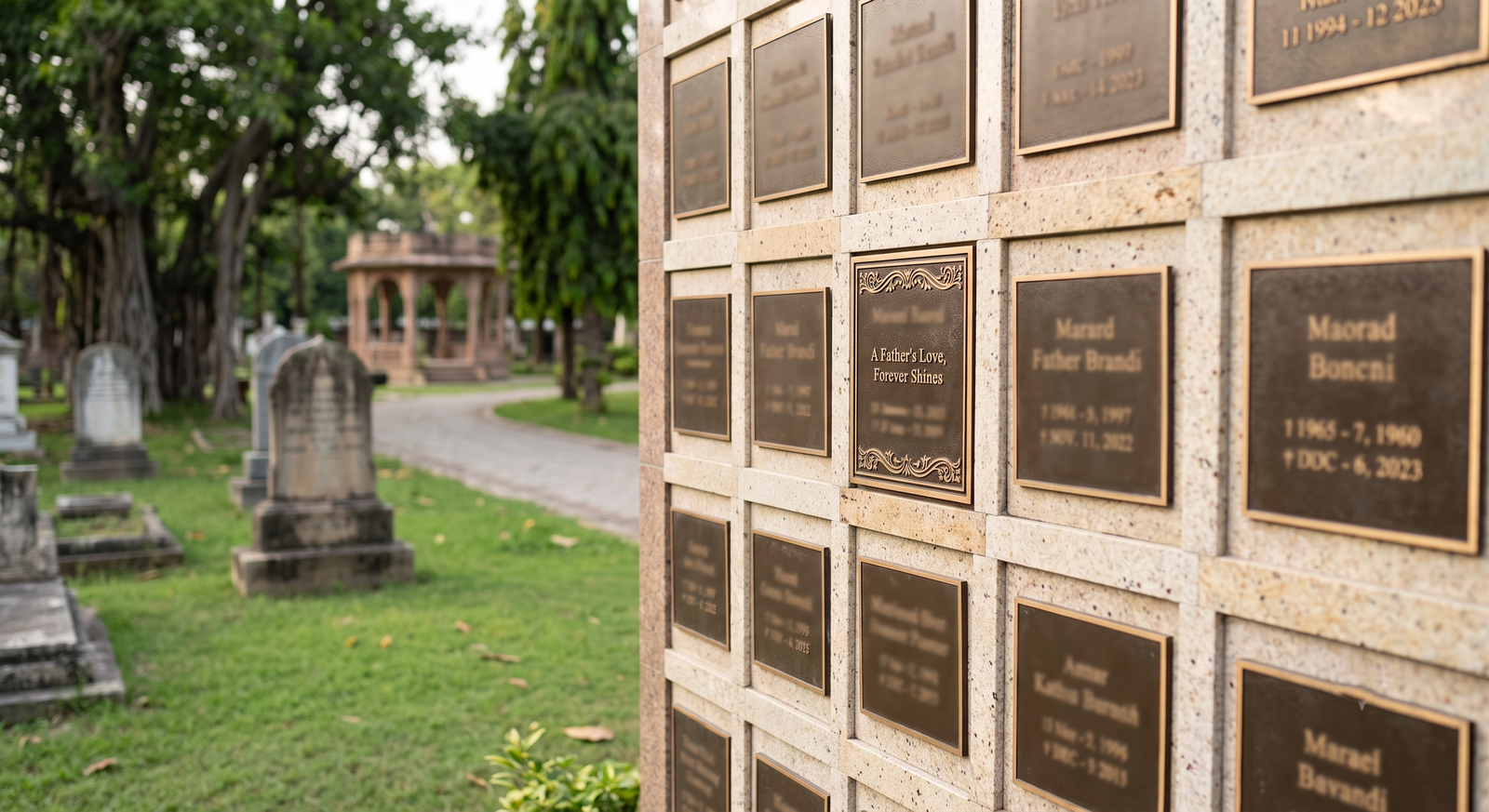
Once his traditional urn is placed in a columbarium niche, a family plot or a national or service cemetery, it stops being an object in a house and becomes a fixed location, with an address, opening hours and rules that are not yours. The comparison is no longer “urn or stone.” It is visit a place, or carry a thing, and those two are not rivals.

The practical consequence is timing: if an interment is booked and you want a portion set aside, the funeral director and the cemetery office are the people to ask before the urn is placed, and whether anything can be lifted afterwards is theirs to answer too. If that door is closed, turning your father’s hair into a diamond starts from material that was never in the urn.

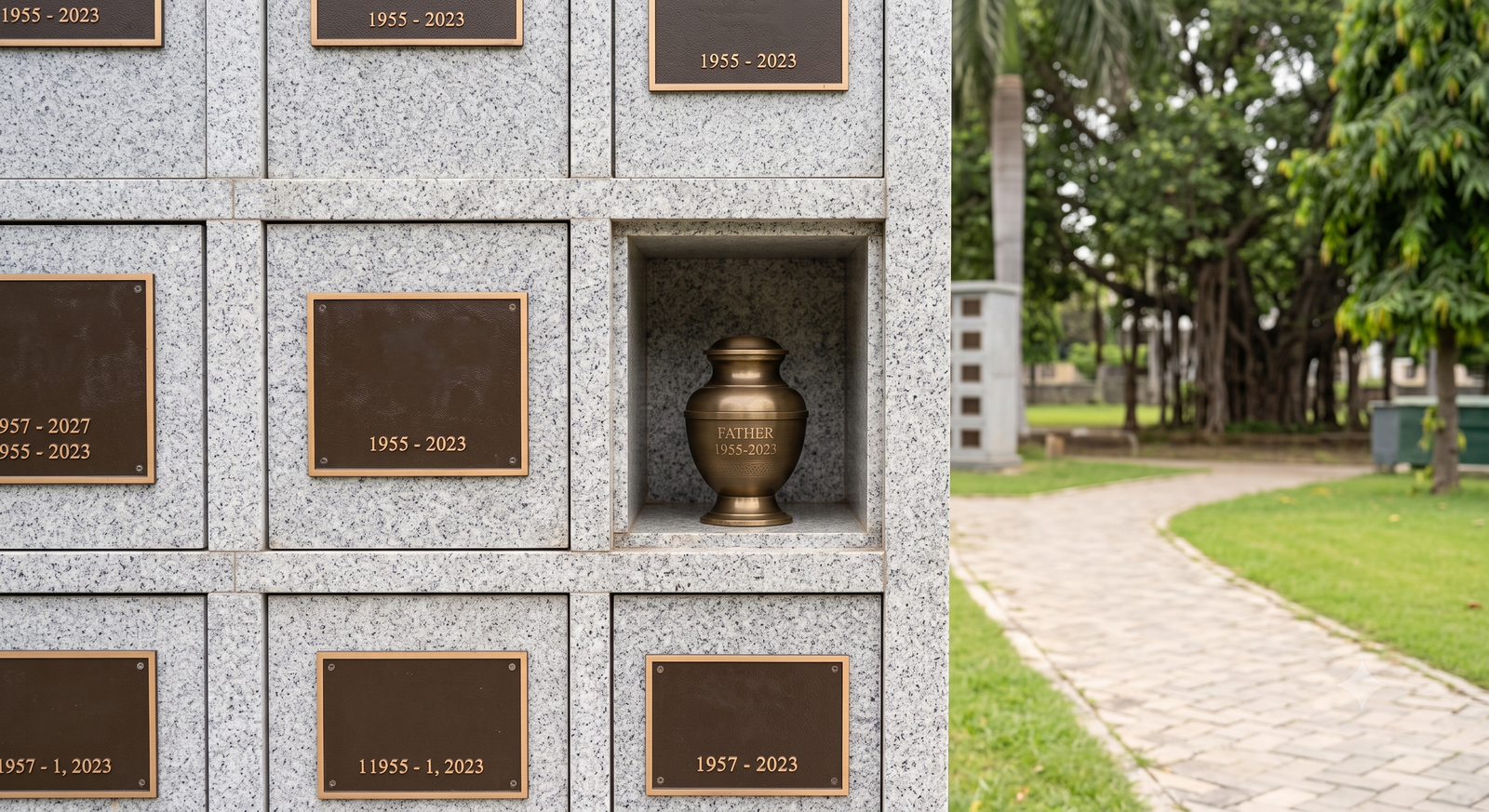
Row of columbarium niches with one open niche holding an engraved urn

Does Any Faith Settle This?

No tradition has an official position on memorial diamonds specifically; religious guidance addresses cremation and the handling of ashes, and stops there. Where it reaches this comparison at all it tends to reach the traditional urn first, current Catholic guidance permits cremation but directs that ashes be kept intact in a sacred, church approved place rather than divided or kept at home, while Islamic teaching objects to cremation itself rather than to what follows it, which is why the hair route sits outside that objection altogether. Views differ by denomination, community and clergy, so ask your own, what different faiths say about cremation and ashes covers each tradition in turn.

Frequently Asked Questions

Does removing a portion make his traditional urn look noticeably emptier?

A memorial diamond uses only part of a full cremation, industry guidance ranges from a few tablespoons to around 4 oz. The portion taken is a small fraction of what the urn holds, and the rest can still be scattered or interred.

His urn is at my mother’s house. Do I need it in my own hands to arrange a stone?

You need her agreement and access to a portion, not custody of the urn. It can stay exactly where it is. What a provider needs is the material itself, sent by whoever holds it, with whatever paperwork the laboratory asks for.

If we take a portion out now, can the rest still be interred at a veterans’ cemetery later?

That is a question for the cemetery rather than for us. Eligibility and paperwork are set by the cemetery and the relevant authority, and removing a portion beforehand does not automatically affect them. Confirm current requirements directly before doing either.

What happens to a traditional urn when the house it has been living in is sold?

Somebody has to decide, at a moment when a great deal else is already being decided. That is the weakness of an object tied to a place rather than a person, and it is worth raising before the move, not during it.

Do we need everybody’s agreement before opening his urn?

Legally it depends on who holds the right to control his remains, a question answered by state law and by any written instruction he left, so check both. Practically, anyone who would be upset to hear it afterwards should be told beforehand, veto or no veto.

Is a memorial diamond a replacement for a traditional urn?

No. It uses a small portion and leaves the rest where it was. Families who order a stone almost always keep the urn, scatter, or inter as originally planned; the diamond is an addition, not an alternative.

Final Thoughts on a Father Memorial Diamond vs a Traditional Urn

If the urn is settled and the household is stable, the comparison may be over before it starts, and that is a fine outcome. The moment it becomes worth thinking about is when the household is going to change, or when more than one person wants something of him that lives with them rather than in one room. A traditional urn answers “where is he”; a diamond answers “who carries him.” A family can want both answers at once.

Learn More About Father Memorial Diamonds

Talk With Memorial Diamond

If the urn is staying where it is and you are weighing whether a stone should join it, that is exactly the conversation to have early. Reach out to Memorial Diamond at memorialdiamond.us to talk through what a small portion of his ashes could become, with no pressure to decide either way.

Father memorial diamond ideas featuring rings, pendants, cufflinks, a watch, and meaningful keepsakes

Father Memorial Diamond Ideas: Rings, Pendants, and Keepsakes

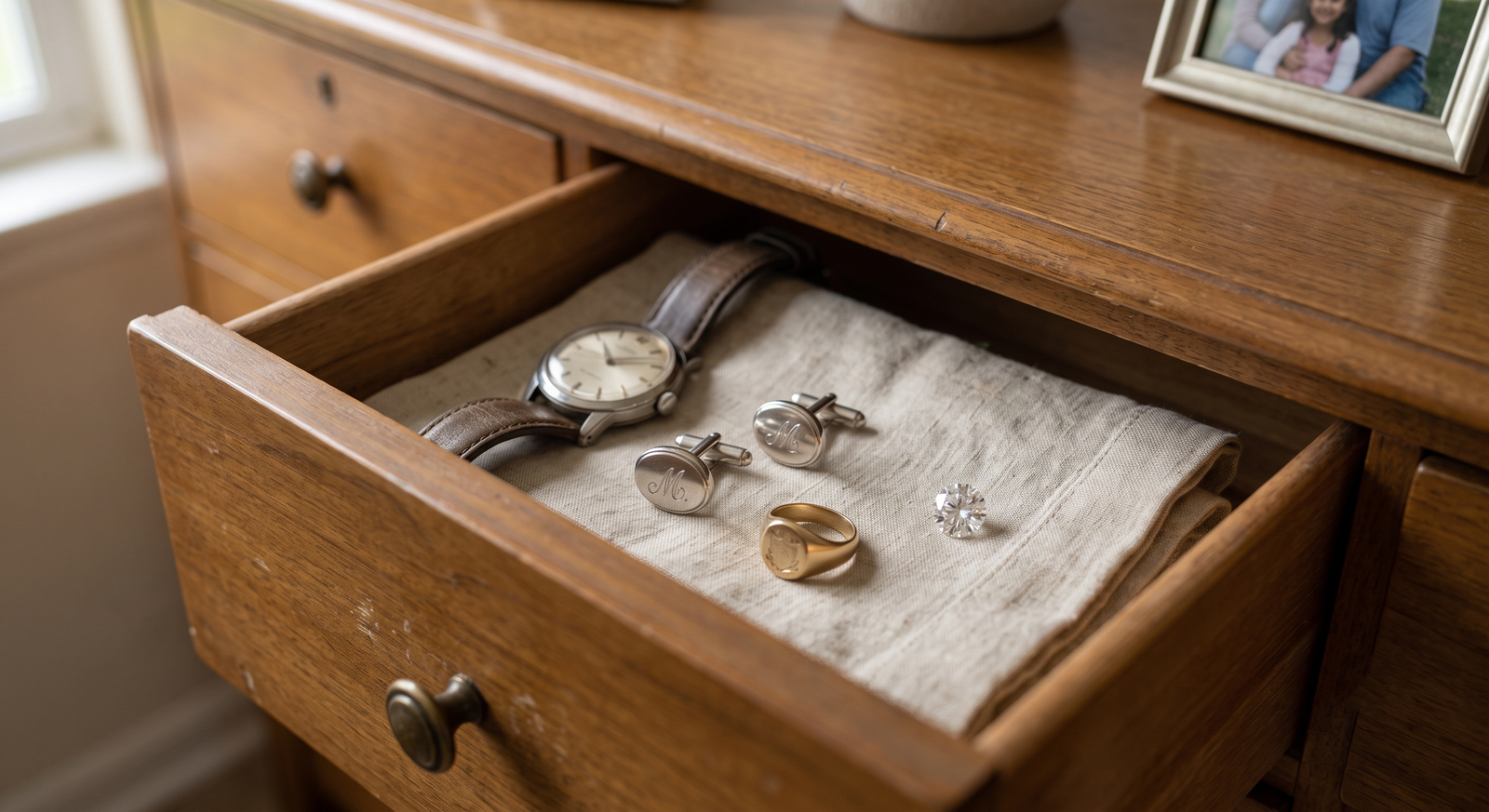
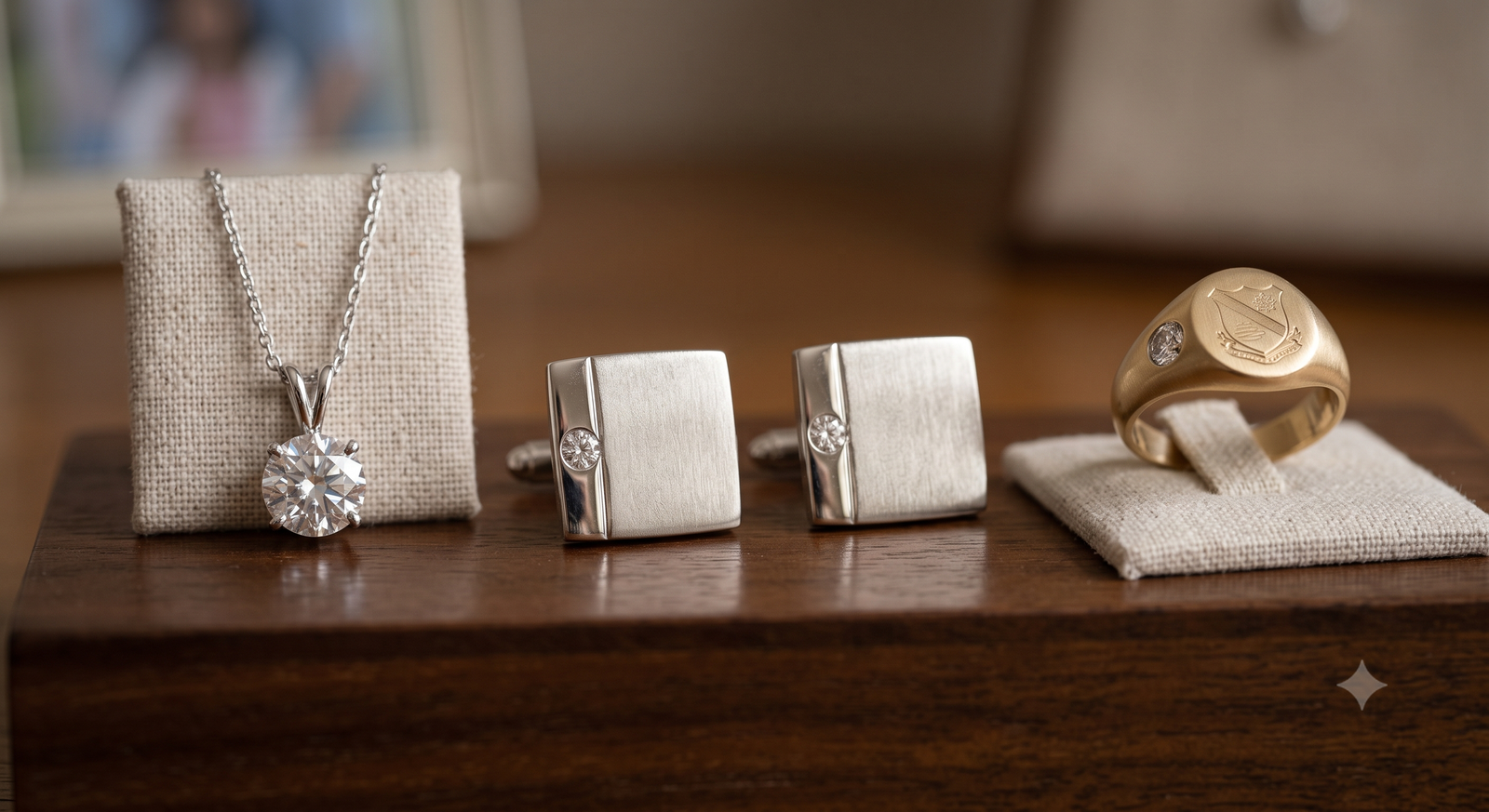
Somewhere in the house there is a drawer with his watch in it, a pair of cufflinks he wore twice, and a signet ring that fits nobody. Nobody wears any of it; nobody can throw it out either. The most useful father memorial diamond ideas start from that drawer, not from a catalog. A stone grown from his ashes or his hair can become a ring, a pendant, cufflinks, a tie bar, a stone set into something he used, several small stones, or nothing yet. The question that sorts that list is who it is for, not what it is. This page walks the five answers to that question, in order.

Where this comes from: Memorial Diamond grows memorial diamonds for a living, so read what follows as a maker’s list rather than an impartial survey of the field.

ather memorial diamond ideas: an open drawer holding a man's wristwatch, cufflinks and a signet ring, with a small loose lab-grown diamond beside them

Who Is the Stone Actually For?

Start there, because ordering a father’s stone and wearing it can easily fall to two different people, an adult child arranging one for a mother who would never have arranged it herself, or two siblings paying for a piece only one of them can wear. A piece chosen for somebody else has to survive their taste and their feelings about being handed something they did not ask for. Every one of the memorial diamond ideas here belongs to one row of the table below.

Who it is forFather memorial diamond ideas that suit themWhat to settle before ordering
YouA pendant, a plain ring, or a stone in something you already ownYour honest answer about whether you will wear it
His widow or partnerA pendant, or a stone added to a ring she wears dailyAsk her first, including whether she wants one. Altering her ring is her decision, not a surprise
Another adult childA small stone in a simple mount they can wear or shelve without commentWho it belongs to afterwards, and whether they want the obligation
The family jointlySeveral small stones, or one stone documented as an heirloomWhere it lives, who holds it, what happens at the next generation
Nobody yetThe stone loose in its case with its paperworkWhere it is kept, and who else knows it exists
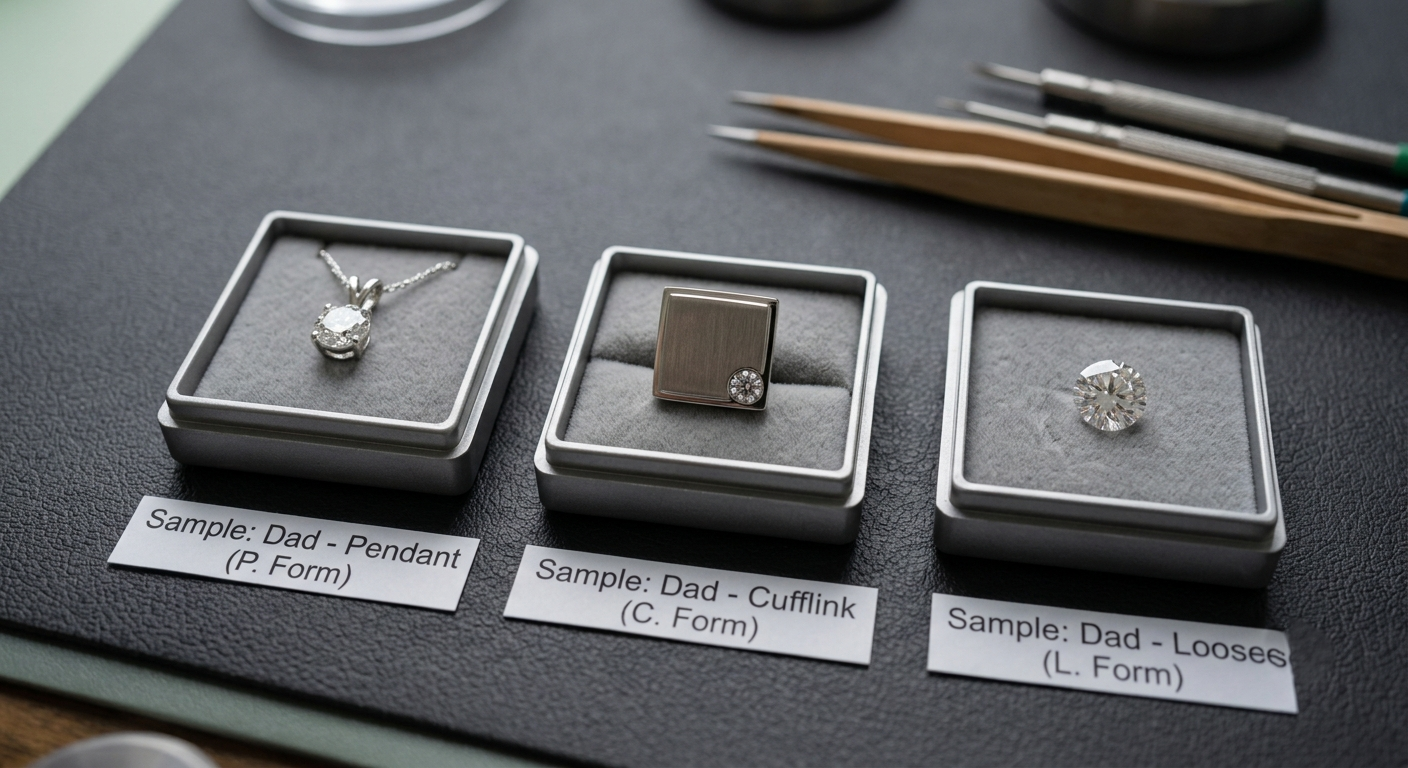
Memorial diamond shown three ways as a pendant, as a pair of cufflinks and set into a signet ring shoulder

One fact sits underneath every row. The stone in each of these pieces is grown from carbon drawn out of his ashes or hair, purified to about 99.9% and then brought up to a workable volume with lab sourced carbon, because a growth run needs more feedstock than a submitted portion supplies on its own. Industry figures put his own share at roughly 10–15% of the finished stone’s mass. A stone offered to you as entirely him is described wrongly. It is still a real diamond, the hardest known natural mineral, graded like any other, which is what makes every idea below workable.

The rule this page is built on: if the piece is for someone else, ask them before the order goes in, not when it arrives. How to raise it with a surviving parent is worked through in how to talk to family about a father memorial diamond.

Father Memorial Diamond Ideas for Something You Keep Yourself

The easiest category, because nobody else has to agree with you.

  • A pendant you put on and forget. It stays under a collar and needs no explaining.
  • A ring worn on a named day, his birthday, the anniversary, and kept in a box between.
  • Cufflinks or a tie bar, if the occasions that put you in a suit are the ones where he comes up.
  • The stone in the watch you wear, so the object you check all day is his too.
  • The stone loose, in a desk drawer. Wanting the stone and wanting to wear it are two different wants.

Which of those memorial diamond ideas actually keeps hold of a stone is a separate, mechanical question, and it belongs to memorial diamond settings and jewelry ideas for a father. This page is what to make; that one is how a piece holds it.

Ideas for a Piece Made for His Widow

Here the person ordering and the person receiving are two different people, which makes sequence matter more than design. The father memorial diamond ideas that work for a widow are the ones that leave her the most room.

  • A pendant. Of all the memorial diamond ideas for a widow, the least demanding thing to be given: worn daily, worn on his birthday, or kept in a drawer without anyone auditing which of the three.
  • A stone added to a ring she already wears, an engagement ring, an eternity band, a dress ring she has had for decades. The metal is already hers; the stone is new.
  • A stone kept loose, handed over with its case and certificate, so the decision about a setting stays hers.

Two cautions on these memorial diamond ideas. Reworking a ring she wears every day is irreversible and is her call alone. And “she would like it” is a guess until she has been asked.

Putting the stone into a band he wore is a different idea, worked out in the father ashes diamond complete guide.

 Older woman's hand wearing a gold band with a small additional stone set beside the original

What If Neither of You Is a Jewelry Person?

Then the non jewelry options are the answer, not the consolation prize. Some of the people who want a father’s stone do not wear rings and never have, and a list of father memorial diamond ideas that runs pendant, ring, earrings, repeat is written for someone else.

Things that hold a stone without being jewelry:

  • A watch, case back, dial, or crown.
  • A signet ring, if he had one, the face keeps his initials, and the stone goes into the band beside it.
  • A pen, in the cap or the barrel end.
  • The handle of a knife, a fishing rod, a plane or a chisel he used.
  • The lid of the box his things are kept in, so the stone lives with the rest of him.

Non jewelry memorial diamond ideas need a second opinion, though. Whether a particular object can take a stone safely, whether there is depth behind a dial, whether opening a watch case ruins its seal, whether a handle can be drilled without splitting, is a jeweler’s or watchmaker’s assessment, not a design preference.

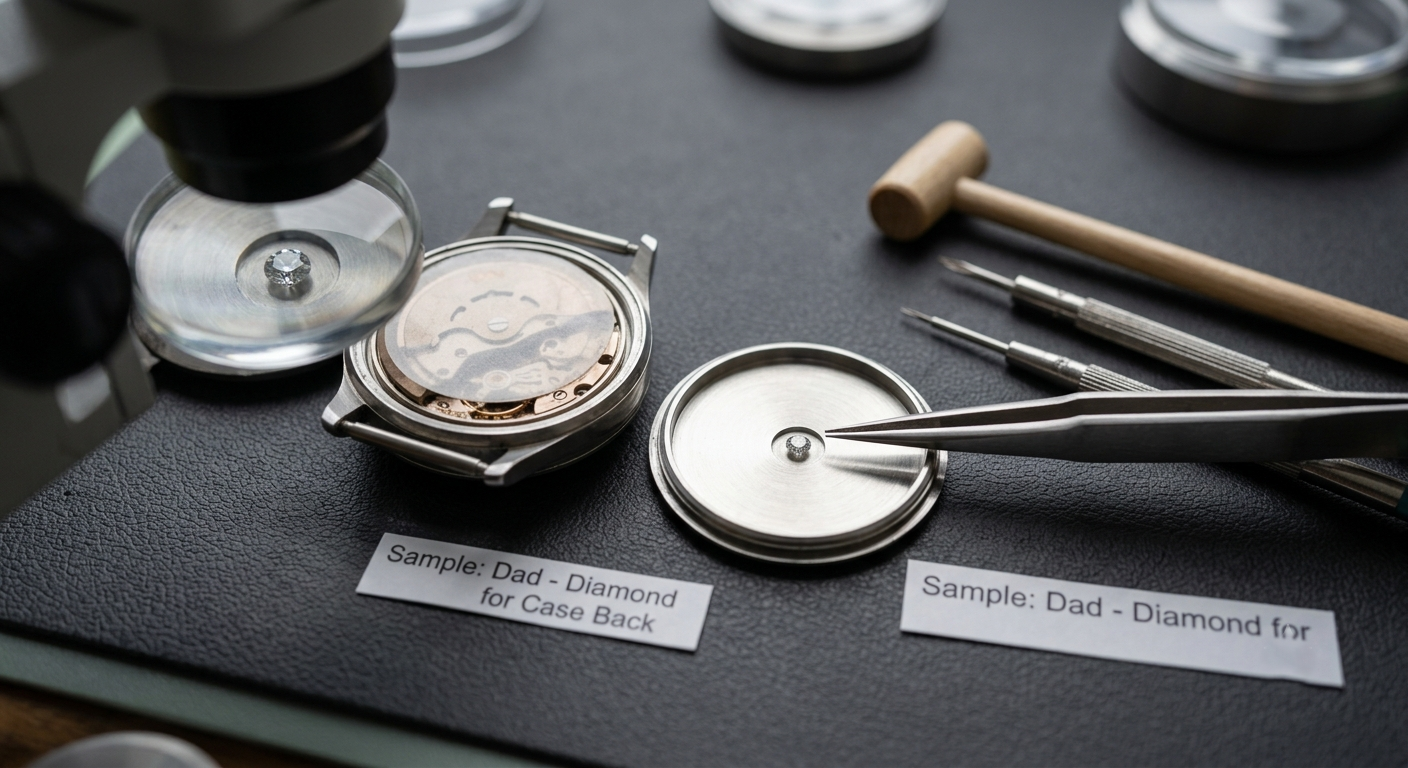
Watch case back opened on a bench mat with a small diamond positioned for mounting

Memorial Diamond Ideas the Family Shares

Because only a portion of the material is used, one submission can yield more than one stone, which changes what is worth making. The memorial diamond ideas below assume more than one person wants something.

  • One piece each, in whatever form that person uses, a pendant for one, cufflinks for another, a loose stone for the brother who wears nothing.
  • One piece, held by one person, with the occasion it passes on written down rather than left to be worked out (memorial diamonds as a family heirloom).
  • Several stones set into one object of his, a box lid or a clock case, so it stays in one house.

Whether several stones are possible, who has to agree, and whose name the order goes in are worked through in whether more than one family member can get a diamond from the same father’s ashes. They will not match closely, because color comes from trace elements present as each crystal grows (memorial diamond colors for a father).

Three memorial diamonds of slightly different tones, one hung as a pendant, one set in a cufflink and one loose in its case

What Does “For Nobody Yet” Honestly Mean?

A finished stone in its case, with its grading report and origin certificate, and no decision made about a setting. It is a legitimate outcome, not an unfinished one, and it is on every honest list of father memorial diamond ideas because a lot of families land there. It does require three things.

  1. A place it lives that is not a drawer somebody else will clear out.
  2. The paperwork with it. The origin certificate is the only thing that ties the stone to him. Nothing about the stone itself records where it came from.
  3. Somebody who knows it exists, and a line in a will if it is meant for a particular person eventually.

Among memorial diamond ideas, this is the only one with no design step at all, which is exactly its appeal. A stone in its case is not the part that degrades. What decays is other people’s knowledge of what it is.

oose memorial diamond in a presentation case beside a folded grading report and origin certificate

Settle It Before You Order, Not After

Four things to say out loud before the order goes in, whichever of the father memorial diamond ideas above you land on.

  • Who the piece belongs to once it exists, rather than assumed.
  • Whether the recipient has agreed to receive it, and to keep it.
  • Whether an existing piece is being altered, and who else has an interest in it.
  • Whether anything is engraved, since words go on the metal rather than the stone (engraving and personalizing the setting).

To browse memorial diamond ideas by form rather than by recipient, the memorial diamond settings pillar lists what a stone can be put into.

Frequently Asked Questions

Can I order a father memorial diamond for my mother as a surprise?

Better offered than sprung. She may have her own intentions for his ashes, and a finished piece arriving unannounced asks her to react in front of the person who arranged it. Ask before the order goes in, not after.

What are the best father memorial diamond ideas for someone who never wears jewelry?

A watch with the stone set into the case back or dial, a signet ring, a pen, a money clip, a knife or tool handle, or a box lid. Whether a particular object can take a stone safely is a jeweler’s assessment, not a design preference.

Can his stone be set into the watch he wore?

Sometimes. It depends on the watch, whether there is depth behind the dial or case back, and whether opening it compromises water resistance or the movement. Price it with a watchmaker rather than assuming.

Who should the finished piece belong to if several of us paid for it?

Whoever you agree on before ordering, said plainly. Shared payment does not settle ownership by itself, and a piece that arrives with the question still open leaves it to be answered in front of everybody.

How long can a stone stay unset before it becomes a problem?

Indefinitely, as an object. The risk is the record rather than the stone: keep the origin certificate and grading report with it, and make sure one other person knows what it is and where.

Are there memorial diamond ideas that let two of us have pieces that match?

Not closely, if the stones come from separate growth runs, color varies with the trace elements present as each crystal grows. Ask whether two stones can be grown together, and design around the difference if they cannot.

Final Thoughts on Father Memorial Diamond Ideas

Decide who the stone is for, ask them if it is not you, and only then start on pendants and cufflinks and whether his watch could take it. If the honest answer is “I don’t know yet,” that is a real answer, and a stone in its case is where it waits. The father memorial diamond ideas that go wrong are almost never the wrong object. They are the right object handed to someone who was never asked.

Learn More About Father Memorial Diamonds

Talk With Memorial Diamond

If you have a person in mind and an object in the drawer, that is enough to start a conversation. Reach out to Memorial Diamond at memorialdiamond.us to talk through what is possible with his ashes or his hair, including the memorial diamond ideas on this page that need a jeweler’s judgment before they become a plan.

Father memorial diamond FAQ featuring a diamond, remembrance photo, and questions about the memorial diamond process

Father Memorial Diamond FAQ: Everything Families Ask

Somewhere there is a folder with his death certificate in it, and a list of questions that has been growing for a fortnight. This father memorial diamond FAQ exists to sort that list. Every question below has an owner. A few are settled facts, answered on this page; the rest belong to the provider, the funeral director or cemetery, the estate, or your family. Sorting a question by who holds its answer is what stops a week being spent waiting on a party that was never in a position to reply.

Said plainly at the top: Memorial Diamond grows and sells these stones. The provider group below is a list of things we should have to answer too, on the same terms as anyone you are weighing us against.

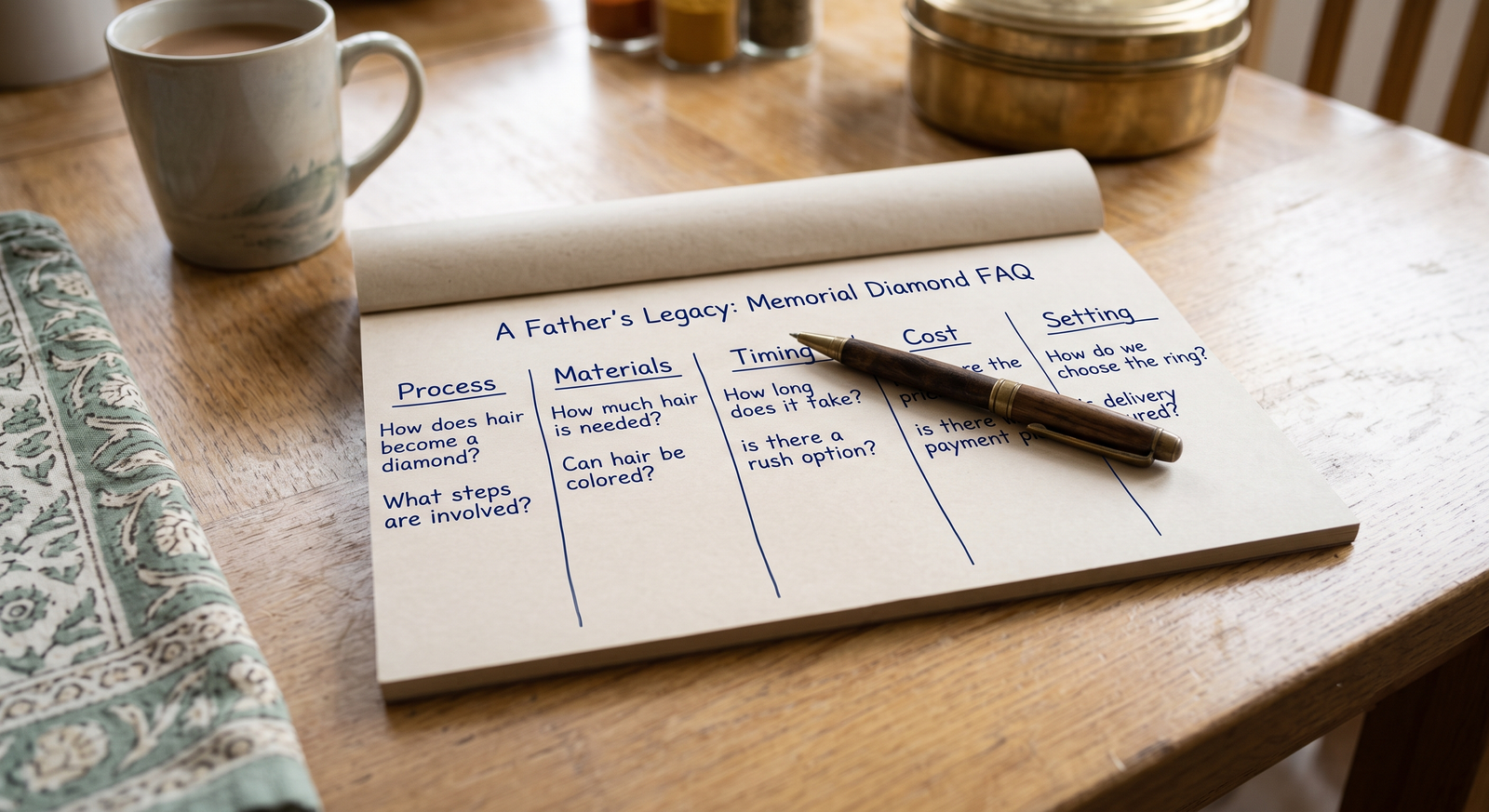
ather memorial diamond FAQ: a handwritten list of questions on a kitchen table, sorted into five columns with a pen resting on it

Table of Contents

Sorting a Question Before You Ask It

Five parties hold every answer in this father memorial diamond FAQ between them. The right hand column is what to come away with.

Answered byTypical questionsWhat you need from them
Settled facts, this pageWhat the stone is, what share of it is his, what sets the color, how long growth runsNothing. Read it and move on
The providerWhat is required, what documentation arrives, what comes back, what a failed run meansThe answers in writing, before anything is posted
The funeral director, crematorium or cemeteryWhether a portion can still be separated, what records exist, what a release date meansTheir procedure, and the date any window closes
The estate or executorWho holds authority over his remains, whether he left instructions, whether the estate can paySight of the paperwork, and one named decision maker
Your familyWhose decision this is, who receives the stone, what the rest of him is for, who has not been toldA conversation, before anything is ordered

Read the right hand column first. Where a question has sat unanswered for weeks, check that it went to the party that owns it.

Father Memorial Diamond FAQ: What Is Already Settled

These answers are the same wherever you order, and whoever he was.

Is a memorial diamond chemically the same thing as any other diamond?

Yes, and this is the one father memorial diamond FAQ answer nobody should hedge. It is a lab grown diamond, the same carbon lattice, a 10 on the Mohs scale, graded on the same cut, color, clarity and carat as a mined stone. Not a simulant, and not a stone with something suspended in it. Whether it is really made from his ashes is a separate question with a separate kind of evidence behind it.

How much of the stone comes from him, and how much from the laboratory?

Two carbons go into the press, and his is the smaller. Ash is only roughly 0.5 to 4% carbon by weight, not enough to fill a growth cell alone. What is recovered is purified to roughly 99.9%, then brought up to volume with lab sourced carbon. Industry wide, the personal share of an ash derived stone lands at around 10 to 15% of finished mass. A stone that is all him is not something the chemistry allows. What the laboratory does with his ashes walks the stages.

Does the amount he left behind change what is possible?

No, and this is the father memorial diamond FAQ entry sons and daughters of a slight man most often ask. Industry wide the ash requirement runs from a few tablespoons up to roughly 4 oz, about 100g, and hair from a small lock of a few grams, whatever his build. Carat comes from time under pressure rather than volume submitted. How much ash is needed and how much hair give both ranges.

What sets the color of the finished stone?

Of everything in a father memorial diamond FAQ, this is the answer that surprises people. Whatever trace elements happen to be in the growth cell as the lattice forms. Boron in the mix tints a stone blue; nitrogen tints it yellow; only the near total absence of both leaves it colorless, and an organic source rarely arrives that clean, which is why these stones trend away from white. Some providers also offer post growth irradiation for red, pink, green or black. What you can and cannot specify about color covers the part you decide.

How long does the growth stage run for?

Industry wide, 6 to 10 months from the laboratory logging his material in, rising toward 12 for stones past roughly 2 carats or for specialty colors. Adding your own front end and the finishing work is arithmetic rather than a published figure; as an editorial estimate, this father memorial diamond FAQ plans on 8 to 14 months end to end. How long a father memorial diamond takes separates what is fixed from what moves.

What Can Only the Provider Answer?

 An origin certificate and an independent grading report side by side on a desk

Operating choices each company makes for itself, which is why a general father memorial diamond FAQ cannot settle them and a company can.

What does the paperwork that comes with the stone actually say?

Two documents do two jobs, and no father memorial diamond FAQ written by a provider should blur them. An origin or authenticity certificate, issued in house, records that the stone was grown from your family’s submitted carbon. A grading report, ideally from an independent laboratory, records the diamond’s own quality and says nothing about where the carbon came from. Ask which you are getting, and whether it names him.

Which of the two materials, raw ash or purified carbon, comes back, and to whom?

Two different things can be left over: raw ash or hair that extraction never touched, and purified carbon prepared but never grown into a stone. Ask which returns as a matter of course, which only on request, and to which named person, since the sender and the recipient need not be the same. Get the answer in writing before the parcel leaves you.

What does the provider owe you if a run fails while an interment date is approaching?

Runs can fail, and nothing published settles what a company then owes. Ask for the sequence in writing: whether the run is repeated, whether further material is needed, who carries the cost, and where the timeline restarts. Say at the order whether an interment or a scattering is already booked around the expected return date; a restart moves it.

Can one person pay while a different person is the named recipient?

A billing and identity question rather than a laboratory one. Ask who the provider treats as the customer of record, whether payment can be taken from more than one person against a single order, and whose instructions they act on if two people send different ones. Whether more than one family member can have a stone from the same ashes covers the family side of that arrangement.

What is inside the quoted price, and what sits outside it?

The most asked father memorial diamond FAQ question, and the one a general page can least settle. Ask for every line named at the first conversation, including the ones that come back as not applicable yet: the stone, color, cut, grading, setting, engraving, transit and insurance, and resizing years later. What a father memorial diamond costs sets out the 2026 industry ranges and which lines sit outside a quoted figure.

What Has to Come From the Crematorium or the Cemetery

Columbarium wall in cemetery grounds with one niche open and empty

These father memorial diamond FAQ entries carry a date, which makes them the first calls to make. A diamond provider has no visibility of any of them.

Can a portion still be separated if the funeral has already happened?

The first call in any father memorial diamond FAQ. Ask the funeral home what their procedure is rather than whether it is possible; asking for a procedure is a more useful question than asking for a yes. Practice differs between firms. Bring a quantity so the request is specific. The full question list for the ashes route covers what else belongs on that call.

Will the crematorium package and label a portion for posting?

Ask, because the answer decides who handles the material and how it is documented. Ask as well what record they keep of what was separated, and request a copy. Requirements for transporting cremated remains vary by jurisdiction and by carrier; confirm the current ones directly rather than from a summary.

His ashes are already in a plot or a niche. Whose agreement would opening it need?

The cemetery’s policy and state or local law decide this, not a provider. Expect a permit, and in some places documented next of kin consent or a court order. Ask the cemetery which consents they require, and in whose name. Where the answer is no, hair is the remaining route if any was kept.

What changes if a national or service cemetery is involved?

The interment date belongs to the cemetery’s calendar rather than to your family, and the funeral home may release his remains directly to it. Anything kept back has to be separated before that release. Ask the funeral director when they release, and work backwards. Honoring military service with a memorial diamond covers that timetable.

What Does the Estate Actually Control?

A will, a prepaid funeral plan folder and a handwritten letter laid out together

Where an estate is open it carries its own paperwork, timetable and decision maker, none of which is visible to a laboratory or a funeral home. This part of the father memorial diamond FAQ is the one to hand to the executor.

Where would his written wishes be recorded, if he left any?

A father memorial diamond FAQ cannot answer this; his paperwork can. In a will, in a prepaid funeral plan, in a letter of wishes kept with the will, or in a funeral home’s file if arrangements were made in advance. Ask the executor to look in all four. What he wrote about cremation and disposition is not a ruling on a diamond, but it is the closest thing to his own answer.

Who holds authority over his remains while the estate is open?

Authority over a parent’s remains varies by state and by what he left in writing, and it is not something a jewelry company can advise on. What can be said plainly is that it is worth establishing from the paperwork rather than from assumption, and worth establishing before a provider is contacted. Choosing a memorial diamond for your father: where to start sets out that sequence.

Can the estate pay for it?

A father memorial diamond FAQ from a jewelry company is the wrong place for this answer. Ask the executor, and the attorney or accountant handling the estate, not a provider. Whether this reads as an estate expense or a personal one depends on the estate’s terms and the jurisdiction. Treat it as a real question rather than an awkward one, because it changes who has to agree to the spend.

Does a second marriage change who decides?

It can, and it is better established early than discovered late. Where there is a surviving spouse and adult children from an earlier marriage, the person with control of the remains and the people asking about a stone may not be the same, and “family member” is itself the contested word. Ask the executor who holds control.

Where the Answer Sits With Your Family and Nowhere Else

Three adults at a kitchen table, one listening, mugs between them

Nobody outside your family can answer these father memorial diamond FAQ entries. They cost nothing, they have no deadline, and they are the ones that stall a decision for months.

Is this your decision, or his widow’s?

The father memorial diamond FAQ question with no expert. If your mother is living, this is her decision to be part of before it is yours to make, whatever the paperwork says about authority. How to talk to family about a father memorial diamond covers what to ask her, and in what order.

Who ends up holding it?

Settle it before ordering rather than after. A stone that arrives with no agreed home becomes a question at a kitchen table with everyone present, which is a far harder version of the same conversation. Name who receives it, and say out loud what happens to it after them, father memorial diamond ideas is sorted by exactly that question.

What is the rest of him for?

A father memorial diamond FAQ should say this plainly: the quantity used is a fraction of a cremation, so an urn on a shelf, a plot, an interment or a scattering somewhere he liked can all still go ahead. None of those is a lesser choice than a stone, and a stone replaces none of them. Decide what the remainder is for, and say so.

Who has not been told yet?

Write the list down before the order rather than after it. A sibling who hears about this once it is under way has a different conversation available to them than one who heard beforehand. Decide who makes each of those calls.

Frequently Asked Questions

Which father memorial diamond FAQ questions can be answered in a single phone call?

The funeral home’s. Whether a portion can still be separated, what their procedure is, and by when, those three fit into one call, and none of them commits you to anything. The provider and estate lists can wait a week without cost.

Is there anything in this father memorial diamond FAQ that cannot be undone later?

One thing: a scattering or an interment that goes ahead before a portion has been separated. Everything else here, the provider, the price, the carat, the color, the setting, the timing, stays open while you decide.

Does any of this father memorial diamond FAQ work differently if he died overseas?

Very likely, and it is the parties that change rather than the principle. Repatriation, the local cremation authority and the receiving country’s rules all sit outside a provider’s knowledge. Ask the funeral director handling the repatriation, and confirm carrier and customs requirements directly.

My father is still living and has raised this himself, does this father memorial diamond FAQ still apply?

The provider and family lists do; the funeral home and estate lists do not yet. Hair can be collected from someone living, which removes the cremation question entirely and makes this a conversation with him rather than one about him.

Do I have to contact all five father memorial diamond FAQ parties myself?

No, and it is easier if one person carries the whole list than if three people each call the funeral home. Agree who that is before the first call, and have them copy the others in on whatever comes back.

My question is not on any of these lists. Where does it go?

Ask who would have to know for the answer to be true. If it concerns his remains before they reached you, it is a funeral home question. If it concerns the stone, it is a provider one. If it concerns people, it is yours.

Final Thoughts on This Father Memorial Diamond FAQ

The five lists are not equally urgent and they are not equally hard. The funeral home’s carries the only real deadline, so make that call this week and get the procedure in your own words. The list that holds a decision still for months is the last one, and it has no deadline, no expert and nobody to chase, only people who have not spoken about it yet. Start there. A father memorial diamond FAQ can sort the questions; it cannot have the conversation for you.

Learn More About Father Memorial Diamonds

Talk With Memorial Diamond

Bring the provider list to Memorial Diamond at memorialdiamond.us, what is required, what returns, what documentation arrives, what a failed run means, and put the same list to anyone else you are weighing up, on identical terms. The questions in this father memorial diamond FAQ are the ones any provider should be able to answer in writing.

Choosing a memorial diamond for your father with an urn, ashes, and diamond in tweezers

Choosing a Memorial Diamond for Your Father: Where to Start

Somebody in the family has his ashes, and it may not be you. So choosing a memorial diamond for your father does not begin with a size, a color or a company. It begins with finding out four things: where his remains are and in whose keeping, whether an interment or scattering is already arranged, what his estate says about who decides, and whether a decision has already been taken and not announced. Those four answers set the boundaries; everything inside them can be chosen slowly.

A plain statement of interest: Memorial Diamond makes memorial diamonds, so nothing here is impartial counsel about whether to have one. It is written to be equally useful if you end up deciding against it.

 Choosing a memorial diamond for your father: a handwritten list of four questions on a notepad beside a phone and house keys on a kitchen table

What Do You Need to Find Out Before a Memorial Diamond for Your Father Is Your Decision?

Four things, and a diamond company can tell you none of them.

For a father, choice may not be the obstacle at all. Authority and access come first. Ashes are held by one person, released by the crematorium to one named person, and sometimes committed by arrangements made in the fortnight after the death. So treat this stage as information gathering: nothing below asks you to commit, spend, or tell anybody what you are considering.

One fact worth carrying into those conversations, because a relative will ask: a memorial diamond for your father, grown from ashes, is part him and part laboratory. His carbon is drawn out and purified to roughly 99.9%, but ash holds only about 0.5% to 4% carbon by weight, so the growth cell is filled out with carbon bought in.

Published figures for the industry place the personal fraction at 10% to 15% of an ash grown stone’s finished mass. The finished crystal is still a genuine lab grown diamond, grown by the same HPHT or CVD process as any other. Nobody can supply a stone made only of him, and that lands better said by you than discovered by somebody else.

The Four Things to Establish, and Who Can Tell You

Find outWho can tell youWhy it comes before choosing a memorial diamond for your father
Where his remains physically are, and in whose keepingThe crematorium or funeral home that released them, and whoever signedMaterial can only be sent by somebody who can reach it
Whether an interment, burial or scattering is already arrangedThe funeral director, the cemetery or columbarium office, and whoever booked itAn interment or scattering can close the ashes route; the hair route does not depend on it
Who is entitled to decideHis written instructions, the executor, and where unclear the attorney handling the estateWho may decide is set locally, and anything he set down in writing can shift it
Whether a decision has already been taken and not announcedOnly the person who took it, if that is his widow, only herWeeks of planning can be spent around a decision somebody quietly made months ago
A funeral director talking across a desk with an adult son, paperwork between them

Start With Whoever Has His Remains

The first step toward a memorial diamond for your father is a phone call. Call the crematorium or funeral home first, even if you think you know the answer.

Three questions cover it: who collected the remains, what was released and in what container, and whether anything is still held there. Funeral homes keep this on file.

Whoever signed for them is your first conversation, whether or not they are the person entitled to decide. That call is a request for information, not for the ashes: ask where he is, and do not ask for a portion on the same call. If you want to know what a laboratory actually receives before you raise a memorial diamond for your father with anyone, how a memorial diamond is made from your father’s ashes walks through it.

What Is Already Booked, Scattered or Interred

If an interment is already booked, this is the item that closes doors on a memorial diamond for your father.

A committal at a national or service cemetery, a columbarium niche, a scattering date, a burial of the urn in a family grave, any of these may have been arranged in the weeks after the funeral and not mentioned since. Ask the funeral director, and the cemetery office directly rather than a relative’s memory.

If a portion is to be set aside, it has to happen before an interment. Where one has already taken place, ask the cemetery office whether anything may still be taken out: some sites allow it, some do not, and the law where the site sits governs as well. Do not assume either answer from the outside. If the urn is staying put regardless, what changes if the urn stays and a stone joins it is the more useful comparison.

A closed ashes route does not close the question of a memorial diamond for your father. Hair can be submitted whether or not there was a cremation, and a committal already made has no bearing on it, turning your father’s hair into a diamond covers that route, and how much hair is needed sets out the quantities.

A columbarium wall in cemetery grounds with a single niche plaque in focus

What the Estate Says About a Memorial Diamond for Your Father

Look for three documents before assuming anybody has a free hand: any written disposition instructions, a prepaid funeral or cremation contract, and the will.

Authority here is not uniform across the country: each jurisdiction sets its own order of priority, and a written direction from him can outrank it. The executor is the person to ask, and where the estate is with an attorney, they can say who is authorized.

At the ordering stage of a memorial diamond for your father, a provider will need one named customer on the account, so settle who that would be before anybody is asked to pay, whether more than one family member can have a diamond from the same ashes covers how those arrangements are put together.

Has Someone Already Decided and Not Said So?

Ask early: this is the cheapest thing on the list to find out and the most expensive to get wrong.

A surviving parent may have settled in her own mind what she wants done with his ashes, with or without a memorial diamond for your father in mind, and never raised it, not secrecy, just not a subject people volunteer over dinner. A sibling may have told the funeral director something on the day. An adult child abroad may assume the urn is coming to them.

None of that is necessarily final, but planning a memorial diamond for your father around an assumption is wasted effort. Opening that conversation is its own subject, how to talk to family about a father memorial diamond is written for it. This page only asks you to establish whether a decision exists.

What Can You Settle Without Asking Anybody?

A man's comb and electric shaver on a bathroom shelf beside a folded towel

Several things about a memorial diamond for your father need nobody’s agreement:

  • Whether you want a memorial diamond for your father at all. Reading is not commitment; no material has to move for you to carry on.
  • Who the stone would be for, yourself, his widow, or something shared. That one answer later settles size, setting and most of the specification.
  • Roughly what you would spend on a memorial diamond for your father. Work from the number outwards; what a father memorial diamond costs sets out general 2026 industry ranges.
  • How long you are willing to wait, a real constraint if a date matters, how long a father memorial diamond takes covers production time.
  • Whether hair exists anywhere in the house. A shaver, a comb, a cap, a lock somebody kept. Looking closes nothing.
  • Which questions you will ask a provider, questions to ask before turning your father’s ashes into a diamond is the list, worth having written before the first call.

Establishing where his remains are, what is booked and who decides all need somebody else. Nothing in this list does, and working through it while you wait is how the early weeks of choosing a memorial diamond for your father stop feeling stuck.

A small champagne-toned lab-grown memorial diamond held between finger and thumb in daylight

Frequently Asked Questions

Who is legally entitled to decide on a memorial diamond for your father?

Nobody, directly, the law governs his ashes, not the diamond. There is no single national answer on the ashes: each state sets its own rule, and a written instruction can take precedence over it. A surviving spouse or the named executor commonly holds the right; the funeral director or the estate’s attorney can confirm which applies.

The funeral home still has his ashes. Who are they allowed to release them to?

Typically the person named on the cremation authorization or their written nominee, but specifics vary by state and by the funeral home’s policy. Call them and ask what they hold, who signed, and what release requires.

Can I look into a memorial diamond for your father without committing to anything?

Yes. Every question on this page is a request for information from people who already hold the answer. Nothing has to be sent, paid for or announced, and learning a route is open does not oblige you to take it.

His will says nothing about his ashes. Does that change who decides?

It shifts the question onto your jurisdiction’s default order of priority, which the executor or an estate attorney can identify. Silence in a will is not an obstacle in itself, it means the law rather than the document decides.

He was buried rather than cremated. Is there anything left to look into?

Yes. The hair route needs no cremation, so a burial closes the ashes option without touching it. What matters is whether any hair was kept, in the house, or by a barber, a question for whoever cleared his things.

What should I have written down before I contact a provider about a memorial diamond for your father?

Who holds the remains, whether anything is booked, who is entitled to decide, who the stone is for, your rough budget, and any date that matters. Six lines on paper make the first conversation useful.

Final Thoughts on Choosing a Memorial Diamond for Your Father

Two calls change what is possible: the funeral home that carried out the cremation, and whoever signed for his remains. Ask what was released, to whom, and whether anything is already arranged. Write it down. Then read for whichever route those answers leave open. A memorial diamond for your father is a decision you can take slowly once you know what is yours to decide, and it may turn out that the most useful thing this page does is tell you that it isn’t.

Learn More About Father Memorial Diamonds

Talk With Memorial Diamond

When you have the four answers and want to talk through what they leave open, including the possibility that they leave nothing, reach out to Memorial Diamond at memorialdiamond.us. Bring the list, not a decision.

Word count: 1,944 · Reading time: about 10 minutes

Step by step father's hair diamond guide showing a hair sample, 6.1 gram weight, and finished diamond

Step by Step: Turning Your Father’s Hair Into a Diamond

The first step here has no laboratory in it, no cost and no deadline. It is a search, and for a father it often decides whether there is going to be a stone at all. Turning your father’s hair into a diamond, a father’s hair diamond, in the shorthand this page uses, runs to roughly twelve steps: a search, five belonging to your family, then six laboratory and finishing stages. Production typically takes 6 to 10 months from intake, and because hair requires no cremation, this route stays open for a father who was buried.

This sequence begins one step earlier than a process description usually does, before there is a lock in hand at all, because for a father that is frequently where a family is standing.

Memorial Diamond is a provider in this category, so treat what follows as a description of how the route works generally and as questions to ask any company, this one included.

Father's hair diamond sequence: a small tied lock of hair on a scale, a written note of the weight, and a loose lab-grown diamond laid out in order

Where Does a Hair Diamond Sequence Actually Begin?

With a search, and it counts as a step because it has an output: a candidate sample and a number on a scale.

Treating it as a step rather than as a precondition changes how it gets done. A precondition is something you either have or don’t, so a family that assumes it doesn’t can stop looking within an afternoon. A step is something you work through, and it has a defined end.

The complete guide to father hair diamonds covers where a father’s hair tends to turn up, the places are not the obvious ones, and short clippings count. What that guide does not cover is when to stop looking.

How Do You Know When the Search Is Finished?

A bedside drawer open with a hairbrush, a wallet and a flat cap laid out — the ordinary places a father's hair is found

The search is finished when one of three things is true. Not before, and there is no value in continuing after.

  1. You have a sample and a weight. Weigh it in its container, subtract the container, and photograph it beside the scale reading. A number ends the search whether or not the number turns out to be enough, how much hair is needed covers what to do with the figure once you have it.
  2. Everyone who might have kept something has been asked. A widow, a sibling, an adult child, a barber of twenty years, whoever cleared the house. This is the condition most easily skipped, and it is often where a sample turns up.
  3. The places have been checked and there is nothing. A wallet, a bedside drawer, a shaving cabinet, a hat, a hairbrush, a car headrest, a workshop bench. If those come up empty, they come up empty, and that is a finished search rather than a failed one.

If the search ends at condition three, his ashes remain a route, and the sequence in step by step: turning your father’s ashes into a diamond picks up from there. Nothing about ending a hair diamond search this way is a lesser outcome.

What Does the Whole Sequence Look Like?

StepWhose handsTypical durationWhat it produces
1. Search for a sampleYour familyAn afternoon to a few weeksA candidate sample
2. Weigh and photograph it, without dividing itYour familyTen minutesA weight, in grams
3. Ask a provider whether that sample is acceptableYour family and the providerDaysAn answer, ideally in writing
4. Choose a provider; specify carat, color and cutYour family1 to 4 weeksAn order reference
5. Cut or separate only what is being sent, and document itYour familyAn hourThe submission, and a record of it
6. Package and shipYour family, then a carrier1 to 3 days in transitA tracking number
7. Intake, weighing, logging, chain of custody referenceLaboratoryDays, the clock starts hereA reference number you can quote
8. Pre cleaning: product, oils, dust and debris removedLaboratoryDaysClean keratin, at a lower weight
9. Carbon extraction and purification to roughly 99.9%LaboratoryWeeksPurified carbon
10. Graphitization at roughly 2,500 to 2,700°CLaboratoryDays to weeksGraphite feedstock
11. Growth in an HPHT cell, blended with supplemental lab carbonLaboratoryWeeks to monthsA rough crystal
12. Cutting, polishing, optional color treatment, grading, settingLaboratory, then setterWeeksThe finished hair diamond
 Laboratory technician cleaning a small hair sample in a glass dish before carbon extraction

The durations in the table are estimates, there to make the shape visible; the only sourced figure is 6 to 10 months of production from step 7, which is why step 6 is worth doing promptly and steps 1 to 5 are not worth rushing.

Steps 1 to 6: From a Drawer to a Mailbox

Only three of these six involve touching anything. The rest are questions, and the order they are asked in is what separates a comfortable hair diamond process from an anxious one.

Step 3 comes before step 5. Ask whether the sample is acceptable before anything is cut, separated or divided. A lock is finite, and the answer costs nothing but a few days. Send the weight and the photograph rather than a description: “6.1 grams of beard clippings, collected in two sittings” is a question a provider can answer; “a bit of his beard” is not.

Step 5 is the only irreversible act in the family’s half of the sequence. Everything before it, the search, the weighing, the inquiry, the order, can be undone, paused or abandoned. Cutting cannot.

Step 6 has fewer constraints than the ashes route does. Hair is not cremated remains and does not carry the shipping restrictions that go with them. Package it dry, sealed, cushioned and labeled with the order reference, and keep a photograph of the sealed package. How to turn your father’s hair into a diamond covers the documentation your family creates around that parcel, which for a hair diamond has no institutional substitute.

Steps 7 to 12: What Does the Laboratory Do With a Few Grams?

Each laboratory stage between intake and a finished hair diamond is described in how a memorial diamond is made from your father’s hair. Three things about that half matter for the sequence.

Step 7, intake, starts the clock. The sample is logged, weighed and given a chain of custody reference. Ask for both the reference and the intake weight in writing.

Step 8 has no equivalent on the ash side. Providers commonly describe a preparation stage in which product, oils, dust and anything that is not hair are removed before extraction begins, so the weight entering step 9 is lower than the weight that arrived. Ask what theirs removes.

Steps 9 to 12 are the laboratory’s and are fixed. Extraction and purification to roughly 99.9% carbon, hair is roughly 50% carbon by weight, against ash’s 0.5% to 4%, then graphitization at roughly 2,500 to 2,700°C, then a growth run of weeks to months in an HPHT cell, then cutting, optional color treatment, grading on the standard 4Cs and setting. Before any of it can be grown, the recovered carbon is topped up with lab grown carbon to reach a usable volume, so a finished hair diamond holds a provable share of him rather than the whole of him. Any provider claiming otherwise is describing something the process does not do.

What emerges from graphitization is carbon rather than hair, so a hair diamond’s color comes from trace elements present during growth rather than from the color his hair was, what color a diamond made from your father’s hair will be covers that.

Why Does a Hair Diamond Have No Cremation in It, and No Deadline Either?

This is the structural difference between the two routes, and it is worth being precise about this.

The ashes route has a door that closes: once a father’s remains are interred or scattered, that option is generally closed, and the retention request has to be made before release. The hair diamond route has no equivalent. Hair is stable in storage, which is why a lock kept in 1998 is generally still usable and a sample found next year works as well as one found this week, worth confirming with a provider rather than assuming, but it is not the ash route’s kind of deadline.

That does not make the hair diamond sequence entirely reversible. Step 5, the cut, is permanent, and a sample sent is a sample out of your hands. But the pressure that sits over an ashes decision does not sit over this one, and a family under time pressure elsewhere in their lives should know that.

An old envelope dated by hand with a lock of hair inside, illustrating that stored hair stays usable for decades

Frequently Asked Questions

Where in the sequence should a provider first be contacted?

At step 3, before anything is cut. An acceptance answer based on a stated weight and a photograph costs a few days and protects a sample you cannot replace. Choosing a company for the hair diamond can wait until after that answer.

Can the search be done by someone else in the family?

Yes, and there is a case for it. The person clearing a house may see things the person grieving hardest does not. Give them the weight target and ask them to photograph rather than collect anything they find.

How long does the family half of the sequence usually take?

Anywhere from a week to a few months, and none of it is on a clock. Steps 1 to 5 have no external deadline at all, only step 6 onward runs against the production timeline of a hair diamond.

If a provider says the sample is acceptable, how long is that answer good for?

Ask, because it varies. An acceptance based on a photograph and a stated weight is a provisional answer; a definitive one normally follows intake. Get the provisional answer in writing anyway, so the definitive one can be compared against it.

Can the pre cleaning step reject a sample outright?

Ask what their preparation stage removes and what happens if it takes a marginal sample below a usable weight. It is the reason to send a hair diamond sample with margin rather than exactly at a stated minimum.

Does anything here need to happen before a funeral or memorial service?

No. Unlike the ashes route, nothing in a hair diamond sequence is closed by a burial, cremation or interment. Collecting hair is simpler before a service than after, but nothing is lost if that moment has passed.

Final Thoughts on the Hair Diamond Sequence

Step 1 costs nothing, involves nobody outside your family, and has no deadline attached to it. It is also the only step that can turn a hypothetical into a decision, which is why it is worth doing before anything else on this page, and why it is worth finishing properly, with one of the three end conditions actually met, rather than letting it trail off. A hair diamond that never happens because the search stopped early is a different thing from one that never happens because there was nothing to find.

Learn More About Father Memorial Diamonds

Talk With Memorial Diamond

Once there is a weight and a photograph, Memorial Diamond can say whether that sample works for a hair diamond and what happens to it at each stage. If the search has not started yet, it can start this afternoon. Reach out at memorialdiamond.us.