
The container from the crematorium feels heavier than most people expect, and a paper identification tag usually seals the lid. Between that container and a finished, sparkling gemstone lies a sophisticated sequence of scientific procedures. If you want to understand how a memorial diamond is made from your father’s ashes, the short explanation runs simply: technicians heat a measured portion of his cremated remains in an oxygen-free furnace until pure carbon remains, convert that carbon into graphite, blend it with lab-grade carbon, and grow an authentic diamond crystal inside an extreme-pressure press.
Most importantly, understanding this journey requires seeing it as a process of refinement. Almost every single stage in the laboratory removes something. In fact, exactly one stage adds material.
In this article:
- What Is Actually in the Cremation Container?
- Which Stages Remove Something, and Which Stage Adds?
- How Is His Carbon Separated From the Bone Mineral?
- Why Is Lab Carbon Added to His?
- What Happens Inside the Growth Press?
- What Varies From One Father to the Next?
- What Comes Back to You Besides the Stone?
- Frequently Asked Questions
- Questions Worth Asking a Lab Directly
What Is Actually in the Cremation Container?
Cremated remains are not soft wood ash in the campfire sense. This single chemical fact defines every subsequent laboratory stage.
Instead, what comes back from a cremation consists overwhelmingly of calcium phosphate the resilient mineral scaffolding of bone left behind after intense heat drives off water and soft tissue. Carbon, the singular element required to grow a diamond, represents a minor component. Sourced industry figures place usable carbon at roughly 0.5% to 4% of total ash weight, depending on the individual and the cremation conditions.
Therefore, the laboratory’s opening objective focuses on separation rather than manufacturing. Technicians must extract a small fraction of carbon from several ounces of mineral powder and purify it thoroughly. How much ash a father memorial diamond needs directly reflects this chemical reality.
Which Stages Remove Something, and Which Stage Adds?
Reading the journey as a ledger of refinement makes the science easy to visualize, while clearly answering common family questions.
| Stage | What Is Taken Away | What Carries Forward |
|---|---|---|
| Intake & Inspection | Non-biological material: medical hardware, metal fragments | A logged portion assigned to a unique chain-of-custody ID |
| Extraction & Purification | Calcium phosphate and bulk bone minerals via oxygen-free heating | Elemental carbon at approximately 99.9%+ purity |
| Graphitization | Remaining molecular structure at 2,500–2,700°C | Pure graphite ready for the growth press |
| Blending | Nothing | His graphite combined with supplemental lab carbon |
| Crystal Growth | Nothing | A raw, uncut rough diamond crystal |
| Cutting & Polishing | Rough diamond material and outer matrix | The faceted, brilliant finished gemstone |
| Grading | Nothing | A documented report verifying cut, color, clarity, and carat |
Blending represents the only additive step in the entire sequence. Consequently, no honest provider describes the finished crystal as being 100% composed of your father’s remains.
How Is His Carbon Separated From the Bone Mineral?
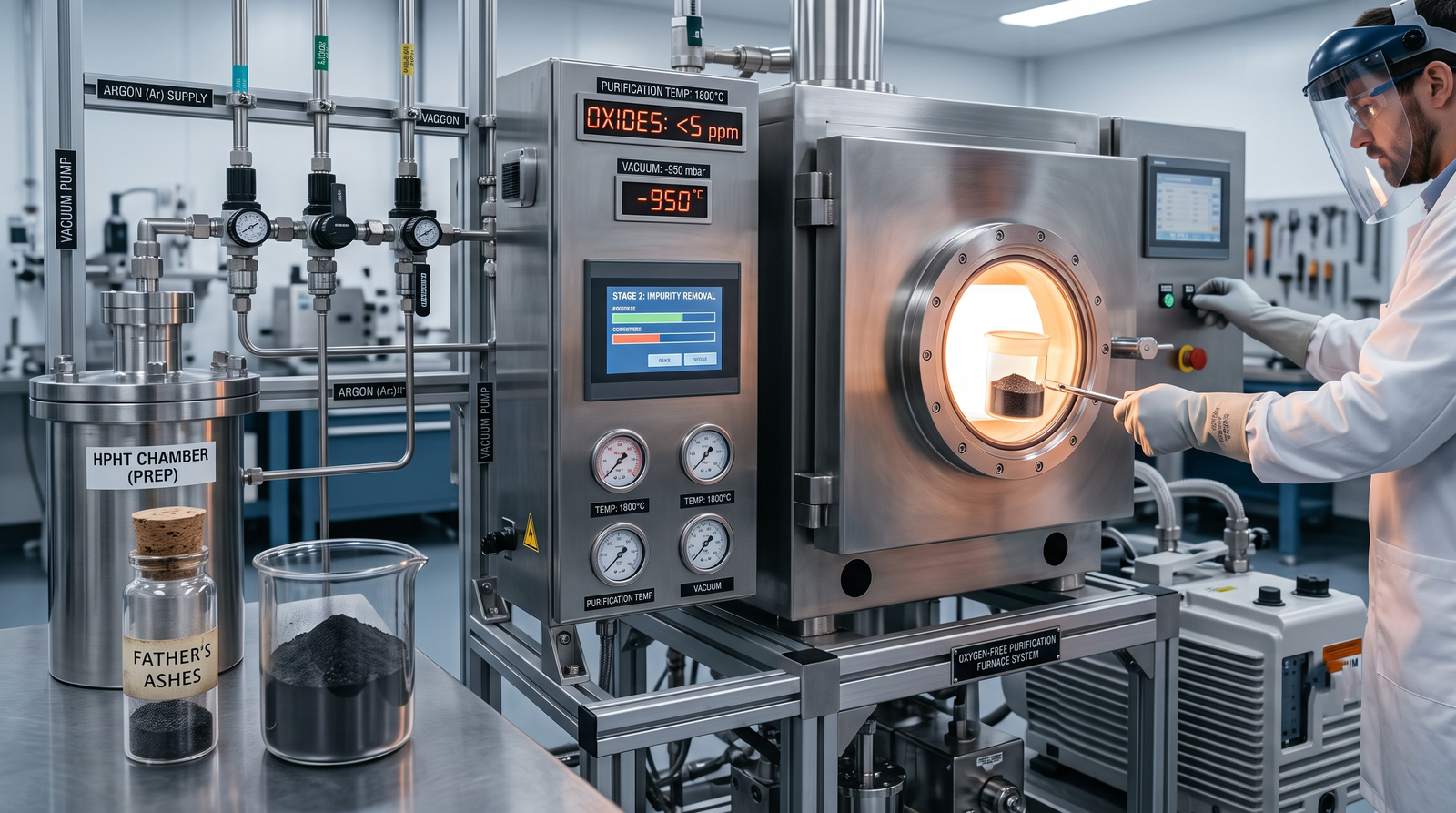
Ordinary open-air combustion cannot accomplish this separation because oxygen destroys the very element you want to preserve. If you heat carbon in open air, it binds with oxygen and escapes up the exhaust as carbon dioxide gas.
Therefore, technicians conduct extraction inside specialized, sealed, oxygen-free vacuum furnaces. This controlled heating cycle eliminates volatile minerals while preventing carbon loss, purifying the carbon to 99.9%+ purity.
Subsequently, high-temperature furnaces heat the purified sample to roughly 2,500–2,700°C to restructure it into graphite. Graphite and diamond share the identical element carbon but carry different atomic geometry. The growth press simply transforms one molecular lattice into the other.
Nothing molecular survives these extreme thermal thresholds. Instead, the process preserves elemental carbon atoms, which step forward as the building blocks for the new gemstone.
Why Is Lab Carbon Added to His?
Laboratories blend supplemental carbon purely to provide sufficient volume inside the growth cell.
Because cremation ashes yield between 0.5% and 4% carbon by weight, the recovered personal sample remains relatively small. A standard growth cell requires a specific volumetric baseline to operate effectively. Therefore, technicians combine his purified graphite with lab-grade graphite chemically identical in every atomic respect.
As a result, your father’s carbon typically comprises roughly 10% to 15% of the final gemstone’s mass. While the diamond is not 100% personal material, carbon atoms that physically composed his body become permanently locked inside the crystalline structure. The direct answer to whether a memorial diamond is really made from your father’s ashes provides the scientific backing when discussing the process with family members.
What Happens Inside the Growth Press?
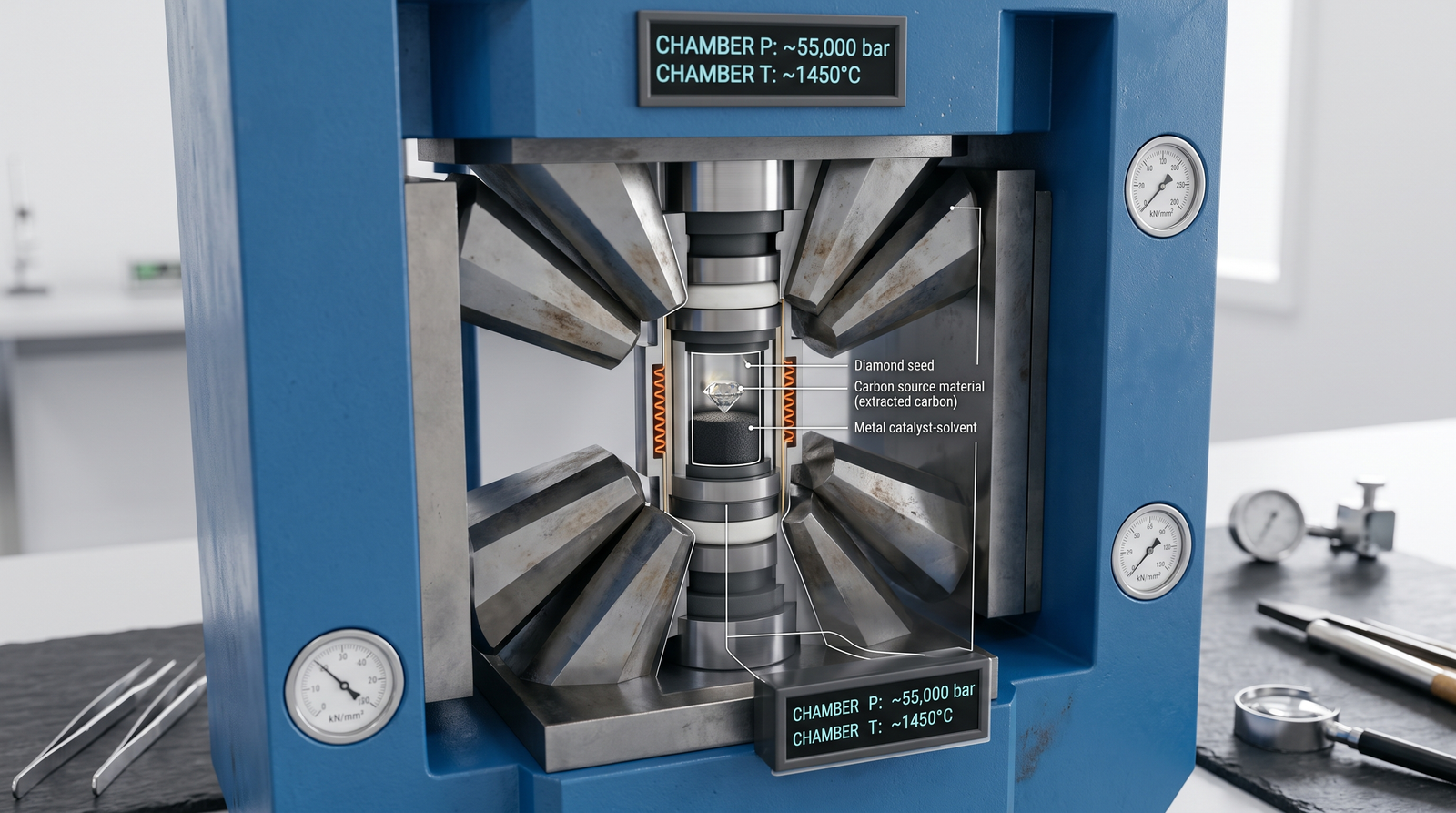
The memorial diamond industry relies primarily on High Pressure High Temperature (HPHT) technology. Large multi-anvil presses (such as BARS or cubic presses) squeeze the core cell from multiple directions, maintaining conditions at roughly 6–8 GPa of pressure and 1,400–2,500°C to replicate Earth’s upper mantle.
Inside the growth core, technicians place a microscopic natural diamond seed. As heat liquifies the catalyst metal, carbon atoms migrate steadily toward the seed crystal and crystallize onto its lattice over weeks or months.
A smaller segment of the industry utilizes Chemical Vapor Deposition (CVD), where vacuum chambers deposit carbon gases onto flat substrates. While both routes yield authentic diamonds, HPHT remains the trusted benchmark for memorial stones. For a full technical comparison, explore how memorial diamonds are made, HPHT versus CVD.
Ultimately, growth duration determines carat size rather than the volume of ash supplied. Once the cell contains full feedstock, time under pressure dictates the final weight.
What Varies From One Father to the Next?
Two primary natural factors vary between individuals, and neither falls under human control:
- Carbon Yield: Usable carbon varies across the 0.5% to 4% range due to individual bone density and the temperature profiles of the original cremation retort.
- Trace Element Signatures: Although purification eliminates bulk minerals, microscopic trace elements (such as boron or nitrogen) carry through into the press. These natural elements influence whether his diamond develops yellow, blue, or champagne nuances.
Nevertheless, these natural variations do not alter the initial sample amount requested by the provider. For practical family logistics, how much ash a father memorial diamond needs explains sample sizes for men of different frames.
What Comes Back to You Besides the Stone?
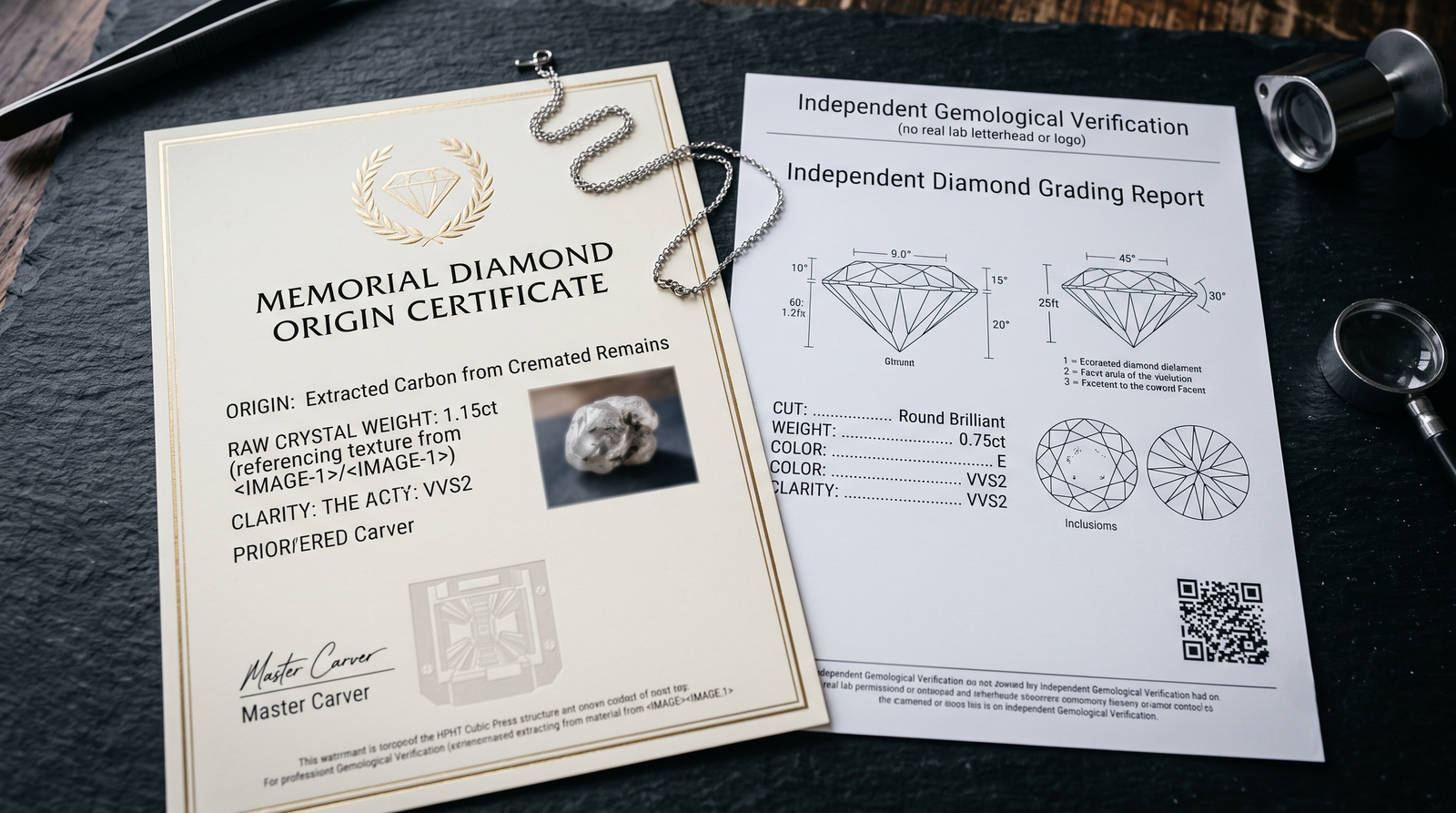
When the process concludes, your provider should return three essential items:
- An Origin Certificate: An in-house document confirming that the laboratory synthesized the diamond using your submitted tracking number.
- An Independent Grading Report: A formal assessment from a recognized gemological laboratory detailing cut, color, clarity (typically SI2 to VVS), and carat weight. How memorial diamonds are graded and certified explains why you should always request both documents.
- Unused Cremation Ashes: Because the extraction cycle consumes only a portion of the submitted material, ethical providers return all remaining ash.
When preparing to ship, remember that regulations from the United States Postal Service (USPS Pub 139) strictly mandate Priority Mail Express with official Cremated Remains labeling. For domestic shipping guidance, review what the reader’s side of the process looks like.
Frequently Asked Questions
Do metal implants or a pacemaker affect what the lab can use?
No. Funeral directors remove pacemakers prior to cremation, and processors separate joint replacement hardware afterward. Technicians filter out any remaining microscopic metal during the intake stage before chemical extraction begins.
He was cremated eight years ago. Does the delay change anything?
No. Cremated remains consist of stable mineral compounds that do not degrade over time. An ash sample preserved in an urn for years yields the exact same carbon as a recent cremation.
Will the lab tell me how much carbon it actually recovered from his ashes?
Yes, if you ask in advance. While laboratories do not publish recovered percentages on standard certificates, reputable providers will record and share exact yield weights upon written request.
Does the crematorium he was cremated at make a difference?
Only marginally. Retort operating temperatures affect where a sample lands within the standard 0.5% to 4% carbon range, but this minor variation does not prevent successful diamond growth.
What happens if a growth run fails partway through?
Growth runs occasionally stall. Therefore, verify beforehand whether your provider maintains backup material, covers the cost of a secondary run, and guarantees project completion in writing.
Can the lab run his ashes without adding any lab carbon at all?
No. A single ash sample cannot supply enough physical carbon volume to fill an HPHT growth cell safely. Consequently, blending supplemental carbon represents an industry-wide necessity.
Questions Worth Asking a Lab Directly
Understanding the science helps you ask targeted questions before entrusting your father’s ashes to a provider. Ask whether they manage growth in-house, what specific growth method they use, and how they secure chain-of-custody tracking.
If you also have a lock of hair, the hair version of this process provides an alternative starting point. For comprehensive pricing and timelines, the complete guide to a father ashes diamond brings together all essential details.