
His watch came off every night and went in the same place, a dish on the chest of drawers everyone in the house knew about. That habit is the whole subject of memorial diamond settings for a father. A memorial diamond will outlast whatever holds it. The realistic way one disappears is removal: a piece taken off during the day and set down out of place. So the settings question has two halves: what holds the stone, and whether the piece comes off at all.
Declared interest: Memorial Diamond is itself a memorial diamond company, so weigh every mounting recommendation below against the fact that we sell the stone it holds.
Table of Contents
What Actually Happens to a Memorial Diamond That Goes Missing?
Two things can go wrong with a set stone, and only one is recoverable.
Damage is the recoverable one. At 10 on the Mohs scale nothing in ordinary life will scratch the stone, though a sharp knock at the wrong angle can chip a diamond at the girdle, and you still have the stone afterwards, in your hand, with options.
Separation is not. A stone that works loose from a claw on a Tuesday and is gone by Thursday, or a piece left in a hotel room, does not come back. Memorial diamond settings should be designed against that, not against breakage.
Worth being plain about what the mount is holding. A memorial diamond is not ash in a capsule: carbon taken from him is cleaned to roughly 99.9% purity and grown into the crystal alongside supplemental lab carbon, which leaves his own contribution at something like 10% to 15% of the stone’s finished mass industry wide. That fraction is why this page is about retention rather than repair.
Which piece to make, and who for, is answered in father memorial diamond ideas. This page is the mechanics of memorial diamond settings.
Pieces That Come Off, and What to Do About Them
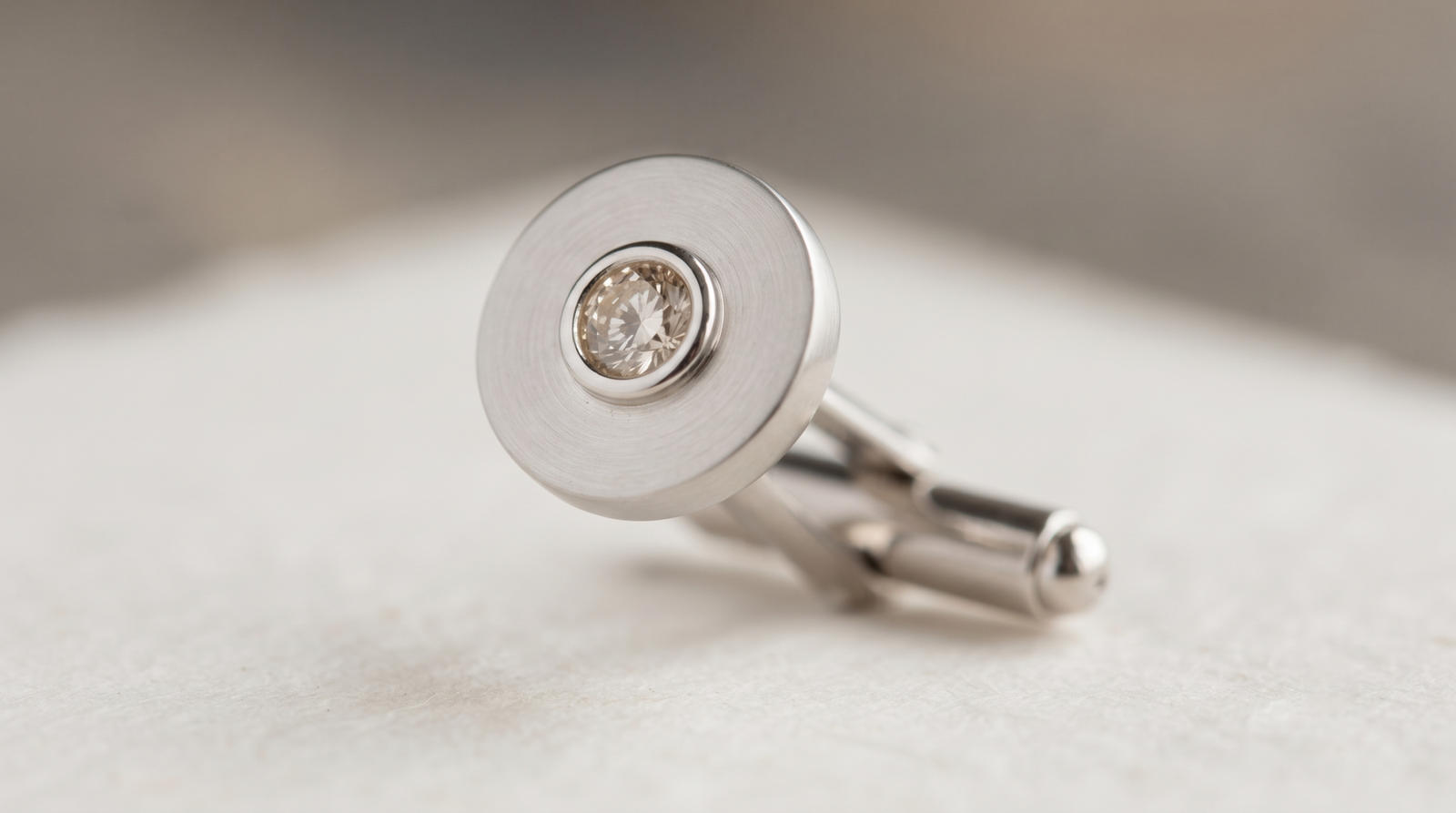
The memorial diamond settings men actually wear are the ones that leave the body. A father’s stone can easily end up in something that leaves the body during the day: cufflinks, a tie bar, a watch, or a ring pulled off for gloves or at a sink. That is not an argument against those pieces, but for deciding, before the piece is made, where it goes when it is not being worn.
- Give it one named place, where the piece actually comes off rather than where it ought to. A dish by the sink beats a box in an unused bedroom.
- Never a pocket. Pockets are turned out, sat on, and emptied into washing machines.
- On the move, it goes in the case, not the room. Changing rooms and hotel rooms are where small pieces get left behind.
- Treat a daily removal as a design input. If you cannot say where the piece lives overnight, that is the decision still to make, not the metal.
How Memorial Diamond Settings Hold the Stone, Piece by Piece
| Piece | How the stone is held | How this piece actually gets lost | What to ask the jeweler |
|---|---|---|---|
| Cufflinks | Collet or bezel in the face; the back swivels or chains | Left in a shirt at the dry cleaner, or in a changing room | Is the swivel riveted rather than glued, and replaceable? |
| Tie bar or pin | Stone in the bar face; the bar clips to the tie | The clip loses tension and the bar drops off unnoticed | How tight is the clip, and will it be re tensioned? |
| Watch | Stone in the case back, dial or crown, in a fitted collet | The watch is sold on without anyone knowing what is in it | Does mounting breach the seal, and will it still service? |
| Signet or seal ring | Stone sunk into the shoulder or shank, sitting flush | Comes off a working hand and never goes back on | How proud does the stone sit, and can the seat be checked in place? |
| Pendant | Claws or a bezel in a fitting hung from a bail | Lifted off over a shirt collar and left on a hotel dresser | Is the jump ring soldered, and the clasp rated for the weight? |
| An object he used | Collet in a drilled seat, or set into the material | The object gets used: knocked, dropped, lent out | Will the seat weaken it, and does the object still work? |
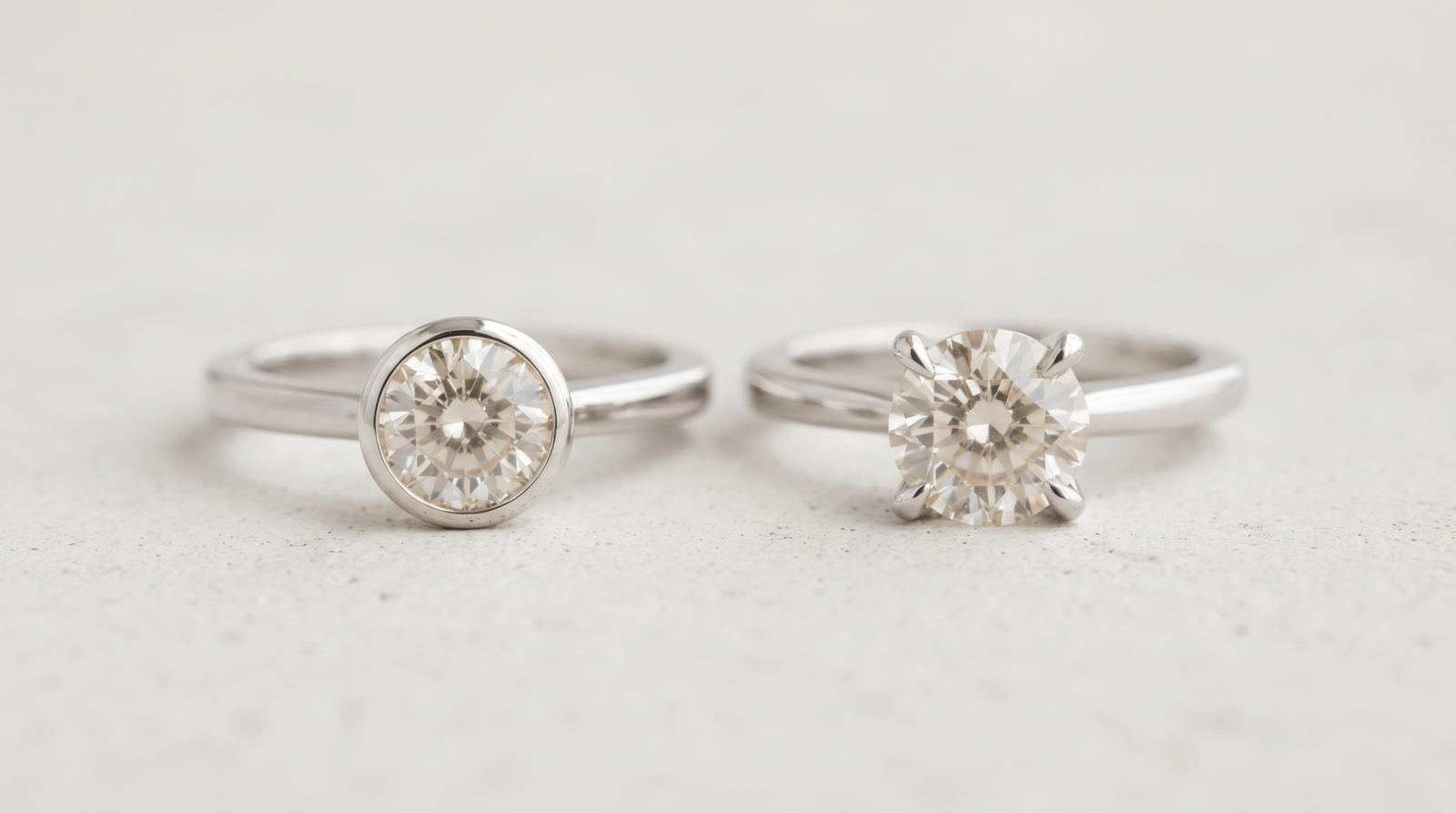
Bezel and claw both appear in the second column deliberately. A rim captures the girdle, claws grip it at points, but across all memorial diamond settings, the third column decides more than the second.
Can a Stone Go Into Something That Was Never Made to Hold One?
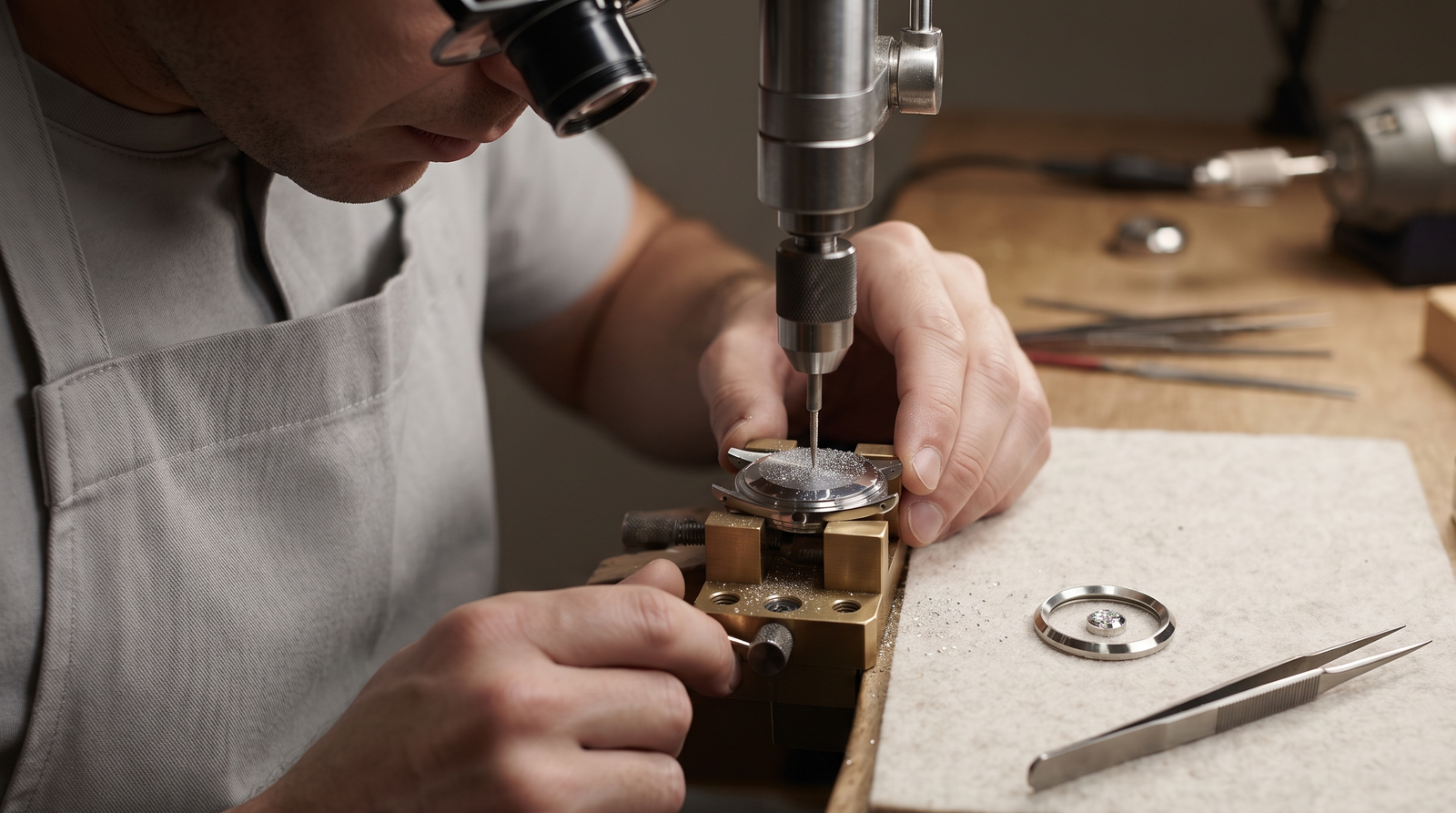
Sometimes, and for these memorial diamond settings it is a bench assessment rather than a design preference. A jeweler mounting a stone into a watch, a pen, a knife handle or a box lid is working out four things.
- Material. Can it be cut cold, or does it need heat? Some plastics and resins craze, hardened steel resists cutting, and thin plated metal tears rather than holds.
- Depth. Is there material behind the face to seat a stone without going through it? A seat that breaks the far side is not a setting.
- Function. Does the object still have to work? A watch has to stay sealed, a knife has to flex without a stress riser, a pen has to screw together.
- Fixing. A collet fitted into a drilled seat, or the stone cut straight into the object’s own material? A collet keeps the cutting away from the structure, and it is the removable answer.
Things that cannot safely take memorial diamond settings: thin pressed metal with nothing behind it, anything that flexes or springs under load, anything sealed that would leak once drilled, and anything structural.
Two points before work starts on memorial diamond settings in an object. This is not always one trade. A watchmaker opens the watch, a jeweler makes the collet, so ask who does which part. And cutting into something he owned cannot be undone. If the object matters to somebody else, that conversation comes first. Setting the stone into a band he already wore has its own constraints, covered in the father ashes diamond complete guide.
Metal and Wear on a Hand That Works
On a hand that lifts, grips and scrapes, height matters more than metal in memorial diamond settings.
- How proud the stone sits decides how much it catches. A flush or sunk stone clears door frames, toolboxes and gloves. A raised claw head finds them.
- Claw tips wear from the outside in. Gloves, tool handles and a steering wheel all press the same few points, and a claw thinned that way lets go without ever catching on anything.
- Plated finishes wear through first at the contact points, the underside of the band above all.
- A ring is not the only answer. If his hands worked and yours do too, a pendant under a shirt takes none of that punishment.
The metal shifts how a stone’s color reads, warmer inside a yellow mount, cooler inside a white one, so choose the mount against the finished stone rather than a description (memorial diamond colors for a father). Cleaning a set piece belongs to memorial diamond aftercare, and words on the metal to engraving and personalizing the setting.
What Size Should a Piece Be If It May Pass Between Two People?
Ask how many sizes a design can move before choosing it, because some memorial diamond settings cannot move at all. A piece that must be remade to change hands will not change hands.
- Sidestep sizing where you can. A pendant, cufflinks, a tie bar or a watch fit anybody.
- If it has to be a ring, ask the bench its sizing range with the stone in place.
- Size it to whoever wears it now, not to a compromise. A ring that fits neither is the one that comes off in a glove.
Frequently Asked Questions
Are cufflinks a safe place for a stone that cannot be replaced?
Mechanically, yes. A collet in the face holds a stone as securely as a ring does. The risk is the routine, not the mount: cufflinks come off in hotel and changing rooms, so decide where the pair lives first.
What does a jeweler check before memorial diamond settings go into something he owned?
Whether the material can be cut without cracking, whether there is depth behind the face to seat a stone, whether the object still has to function, and whether heat is needed nearby. Any one can rule it out.
Which memorial diamond settings suit a hand that works?
For retention on a working hand, a stone sunk into the metal sits lower and catches less than raised claws. The trade is that a sunk stone shows less light, so ask to see both profiles against your hand.
What should happen to a piece each time it comes off during the day?
It should go to one named place, not the nearest flat surface. Put a dish where the piece is actually removed rather than where you think it should be, and never on a basin rim or in a pocket.
If memorial diamond settings may pass from me to my brother, how should the piece be sized?
Ask how many sizes the design can move before choosing it, because some cannot move at all. If it has to change hands, a pendant, cufflinks or a tie bar sidesteps sizing and needs no bench work.
Are there memorial diamond settings a stone genuinely cannot go into?
Yes. Thin pressed metal with nothing behind it, anything that flexes or springs under load, anything sealed that would leak once drilled, and anything structural. A jeweler ruling an object out is stating a mechanical limit.
Final Thoughts on Memorial Diamond Settings for a Father
Decide where the finished piece lives when it is not being worn, and let that answer choose among memorial diamond settings. Put the jeweler’s questions to a bench before anything is cut. Production runs 6 to 10 months from receipt of material, longer for larger or specialty stones, time enough to decide this before the stone exists. Settings are quoted separately from the stone (what a father memorial diamond costs), so the mount is a decision you can take at your own pace.
Learn More About Memorial Diamond Settings
- Memorial Diamond Settings: Rings, Pendants, Earrings, and Cufflinks — the full menu of memorial diamond settings
- Father Memorial Diamond Ideas: Rings, Pendants, and Keepsakes — what to make, and who for
- Memorial Diamond Colors for a Father: What to Expect
- Memorial Diamond Engraving: Personalizing Your Setting
- Memorial Diamond Aftercare: Cleaning and Caring for Your Stone
Talk With Memorial Diamond
If you have an object of his in mind and want to know whether it can take a stone, that is a question for a bench, and a conversation Memorial Diamond can help you frame. Reach out at memorialdiamond.us to talk through memorial diamond settings, from a plain pendant to the watch he wore.
Word count: 1,889. Reading time: about 9 minutes.
Leave A Comment