
Doubt is a reasonable response when someone offers to turn a portion of her ashes into a gemstone, especially when the remains matter this much to your family. So is the stone really made from grandmother ashes? Yes, in part: carbon recovered from her ashes is purified and grown into the diamond’s crystal lattice, typically blended with lab carbon, so the finished stone holds a real share of her, not all of it.
That “in part” is where honest providers and overstated marketing part ways. Whether a particular stone is really made from grandmother ashes comes down to chemistry you can understand and records you can check before trusting anyone with her remains.
Table of Contents
What Does It Mean for a Diamond to Be Really Made From Grandmother Ashes?
To see how a stone can be really made from grandmother ashes, start with what ashes are. Bone mineral, in the form of calcium phosphate, accounts for most of what comes back from cremation, and usable carbon is only about 0.5% to 4% of ash by weight. A lab extracts that small carbon fraction, purifies it to roughly 99.9% or higher, converts it to graphite, and uses it as part of the feedstock that grows into a diamond.
So when a provider says a stone is really made from grandmother ashes, the truthful version of that sentence is narrower than it first sounds. Her carbon is physically present in the crystal. It sits in the lattice alongside supplemental lab carbon, which is typically added because the carbon recovered from a few tablespoons of ash is not enough on its own to grow a stone of meaningful size.
A real diamond, with a real share of her
A gem really made from grandmother ashes is a genuine lab-grown diamond with the same hardness, 10 on the Mohs scale, and the same 4Cs grading as any other diamond. Most are grown by HPHT, using heat and pressure, and a minority by CVD. Nothing about the blend makes it a simulant or an imitation; general background on the category is collected in this overview of memorial diamonds.
The honest version can carry plenty of meaning on its own. A stone really made from grandmother ashes in part is still a stone that exists because of her, and some people find real comfort in holding something that tangible. If you want the step-by-step chemistry behind it, the article on how a diamond is grown from her ashes walks through each stage.
How Much of the Finished Diamond Is Her Carbon?
For ash-based memorial diamonds, her personal carbon typically makes up around 10–15% of the finished stone’s mass. A few providers put the figure nearer 3%, a few put it above 15%, and where a given stone lands depends partly on its carat and on the amount of ash submitted.
That range is the most important number for anyone asking whether a gem is really made from grandmother ashes. It confirms her carbon is present while making clear that most of the crystal’s mass is lab carbon. A written figure inside or near that range is at least consistent with what the industry publishes, which makes it a reasonable starting point for further questions.
Why sending more ash does not raise the share much
It is natural to assume that sending a full urn would produce a bigger stone, or one with a higher share of her. Carat size, though, follows growth time in the press rather than the weight of what you ship. Providers typically ask for somewhere between a few tablespoons and roughly 4 oz (about 100 g), and the details are theirs to set; the guide on how much ash a grandmother memorial diamond needs explains the amounts more fully.
What this figure does not cover
The 10–15% range applies to ash-based stones only. Hair is about 50% carbon and follows a different path, and no comparable finished-stone percentage has been published for hair or for combined stones. If her hair is also an option for your family, the companion piece on whether a diamond can truly come from her hair covers that question separately.
Why Should a “100%” Claim Make You Cautious?
You may come across marketing that promises a diamond made entirely from your loved one, with nothing else added. Families who want a stone really made from grandmother ashes should question that phrasing, because it does not match how the process works.
Ash carbon is a small fraction of the ash itself, and the recovered carbon is typically blended with lab carbon before growth. A claim that a stone is entirely her, with nothing added, asks you to believe something the published industry figures do not support. That does not mean the stone is not really made from grandmother ashes; it means the honest description is “in part.”
A provider that overstates this point may be loose with other details too. When a provider insists its stone is really made from grandmother ashes and nothing else, ask the provider to state in writing what share of the diamond’s mass will be her carbon. A straightforward answer is a good sign; a vague one is a reason to keep looking.
Which Provider Claims Can You Trust, and Which Need Questions?
A useful way to read any provider’s materials is to sort its statements into two piles: claims consistent with published industry facts, and claims that need a follow-up question before you rely on them. The table pairs common statements with how to treat them when deciding whether a stone is really made from grandmother ashes.
| What a provider says | Trust or question? | Why |
|---|---|---|
| “Carbon from her ashes is extracted, purified and grown into the diamond.” | Generally trustworthy | Matches the standard industry process |
| “Her carbon is blended with lab-grown carbon.” | Trustworthy, and a good sign | Blending is typical and honest providers say so |
| “Personal carbon is roughly 10–15% of the stone.” | Trustworthy for ash-based stones | Matches published industry figures; some cite as low as 3% |
| “Your diamond is 100% your grandmother.” | Question it | Contradicts how ash carbon is recovered and grown |
| “A larger urn means a larger diamond.” | Question it | Growth time, not ash volume, sets carat size |
| “The diamond contains her DNA.” | Question it | No published basis for this; ask what they mean |
| “You will receive a certificate of authenticity.” | Ask what it shows | In-house origin records differ from independent grading |
A provider can sit in the first pile on most points and still deserve a question or two. Treat the table as a starting point for judging whether its stones are really made from grandmother ashes, not as a verdict.
What Can the Finished Stone Itself Not Prove?
This is the hardest part of the honesty conversation. Once purified, carbon from ash is carbon, and nothing in the finished crystal identifies which person it came from. There is no published basis for claiming that DNA survives into a diamond, so no test of the stone itself can confirm to a family that it is really made from grandmother ashes rather than other carbon.
That limit applies to every memorial diamond from every provider, even a stone that is, by every record available, really made from grandmother ashes. It is also why verification rests entirely on what happens before and during growth: the paper trail, the tracking, and how carefully a lab keeps one family’s material apart from another’s.
What a grading report can and cannot tell you
An independent grading report describes the stone’s quality using the 4Cs as GIA defines them: cut, color, clarity and carat. Typical memorial diamond clarity falls between SI2 and VVS. A grading report confirms you have a genuine diamond of a stated quality; it cannot confirm the stone was really made from grandmother ashes.
Why color is not evidence either
Yellow, blue, champagne and brown are the usual memorial diamond tones, because trace elements such as nitrogen and boron are common in organic carbon. Those tones are consistent with a personal source, but they are not proof of one, and a family cannot pick or match an exact natural shade. The post on the colors her ashes can produce explains why.
How Can Your Family Check That a Stone Is Really Made From Grandmother Ashes?
Because the stone cannot speak for itself, the checking happens through records and answers. Clear, documented explanations of the process are the best indication you can get that your diamond will be really made from grandmother ashes.
Know the two documents apart
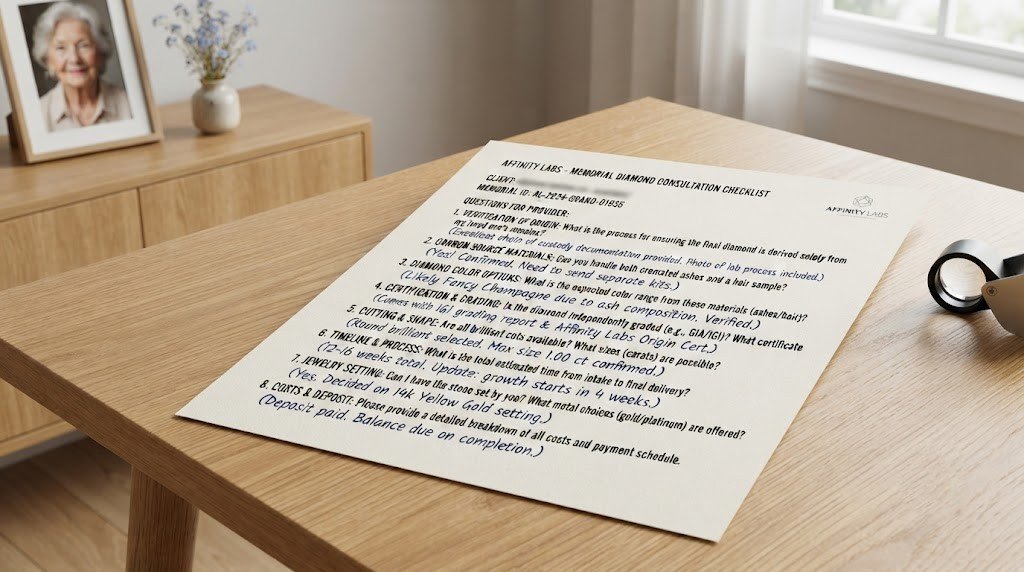
An authenticity or origin certificate, which the provider normally produces itself, is a chain-of-custody record: it is the provider’s written statement that the stone was really made from grandmother ashes sent in by your family. A grading report, ideally from an independent third-party lab referencing GIA standards and sometimes IGI, covers the stone’s quality. Independent grading is typically an optional add-on with its own price, so ask whether it is included.
Questions to put to any provider
- How is her material labeled and tracked from the moment it arrives?
- How are different families’ batches kept separate throughout extraction, purification and growth?
- What records, updates or documents will we receive during the process?
- What percentage of the finished stone do you expect to come from her ashes, stated in writing?
- What happens to any ash that is not used: is it returned, stored or disposed of?
- If a growth run fails, what happens to her carbon and to our order?
- Can a third-party lab grade the finished stone, and at what cost?
Clear, specific, written answers to those questions tell you far more about whether a gem will be really made from grandmother ashes than any marketing page. The step-by-step guide to the process shows where each of those checkpoints falls.
What Doubts and Misconceptions Come Up Most Often?
Several beliefs circulate about whether any stone is really made from grandmother ashes, and each one can make a family either too trusting or too skeptical.
“Ashes are mostly carbon, so the diamond is mostly her.”
Ash is mostly calcium phosphate. Only about 0.5% to 4% of it is usable carbon, which is why a diamond really made from grandmother ashes typically includes lab carbon too.
“If it is blended, it is not really her.”
Her carbon is physically present in the lattice. A share of 10–15%, or even 3%, is still a real part of her, and a stone really made from grandmother ashes in part is not a symbol standing in for her.
“The whole urn has to be sent.”
Usually only a small portion is needed, so the rest can stay in an urn, be scattered, or be interred as the family planned. A diamond sits alongside those choices rather than replacing them.
“A lab can test the diamond to prove whose it is.”
No published test can identify a person from a finished diamond. Proof that it was really made from grandmother ashes rests on documentation and process, not on the stone.
“Memorial diamonds are not real diamonds.”
They are real lab-grown diamonds, graded on the same 4Cs as any other. A hard knock can still chip a diamond, as with any gemstone, but it rates 10 on the Mohs scale.
Does It Matter If Her Ashes Were Divided or Kept for Years?
This question can surface months or years after a funeral. Her ashes may already be divided among relatives, partly scattered, or kept on an aunt’s or uncle’s shelf for a decade. None of that changes what it means for a diamond to be really made from grandmother ashes, but it does raise practical questions.
Whether ashes stored for many years can still yield a stone really made from grandmother ashes is something each provider decides, so ask directly rather than assuming. If only a small portion remains with your branch of the family, ask what minimum amount the provider needs; general industry ranges start at a few tablespoons.
Who gets to decide
State law sets who controls her remains, along with anything she put in writing, and each state ranks family members a little differently. Commonly a surviving spouse or partner comes first, followed by her adult children, with grandchildren further along. If you are a grandchild, a respectful approach is to ask whoever holds that authority whether a small portion could be set aside, and to bring cousins into the conversation early. If nobody is sure who that is, the crematory’s paperwork usually names the person who authorized her cremation.
When faith is part of the question
Faith traditions speak to cremation and to what is done with ashes, but none has issued an official ruling on memorial diamonds themselves. Catholic guidance, for example, asks that ashes stay intact in a sacred place, with only a narrow allowance for a small portion, which bears directly on dividing them. Orthodox and Conservative Judaism generally prohibit cremation while Reform is more permissive, and Hindu, Buddhist and Protestant views vary by community. Your own clergy, or the faith community she belonged to, can speak to your situation.
What Should You Do If a Provider Cannot Answer?
Sometimes the honest answer to “is this really made from grandmother ashes?” gets lost because a provider will not engage with the details. A brief, evasive or purely emotional reply to a technical question is information in itself.
If a provider cannot or will not answer your questions, consider these steps:
- Ask again in writing, listing each question separately so nothing can be skipped.
- Request sample copies of the origin certificate and any grading report they issue.
- Ask for their written policy on unused ash and on failed growth runs.
- Compare at least two providers’ answers side by side before choosing.
- Pause if anything still feels unclear; there is no deadline on remembering her.
A provider that welcomes these questions is showing you how it will treat her remains, and how seriously it takes the promise that a stone is really made from grandmother ashes. The complete guide to grandmother ashes diamonds covers the wider decision if you are still weighing whether a diamond fits your family at all.
Does Careful Verification Change the Cost or Timeline?
Asking whether a stone is really made from grandmother ashes costs nothing, but some of the documents that support verification may. Independent grading reports are typically priced separately from the stone, as are engraving, fancy cuts and settings.
Across the industry in 2026, and not as Memorial Diamond’s pricing, stones run roughly 1,500–3,500 for about 0.10–0.25 ct, roughly 5,000–15,000 for 0.5–1 ct, and roughly 20,000–75,000 or more for 2–5+ ct. Colorless stones cost meaningfully more at the same size, because keeping out nitrogen and boron takes extra processing.
On timing, expect roughly 6 to 10 months between the lab receiving her ashes and the finished stone, and larger stones over about 2 ct or specialty colors can take up to roughly 12 months. Ask whether independent grading adds time, and how you will be kept informed while a stone really made from grandmother ashes is on its way back to your family. The guide on turning her ashes into a diamond covers the practical sequence of choices.
Frequently Asked Questions
Is the diamond really made from grandmother ashes, or just inspired by them?
It is made in part from her. Carbon recovered from her ashes is purified, converted to graphite and grown into the crystal, typically blended with lab carbon. Her carbon is physically present in the finished stone, not merely represented by it.
What percentage of the stone comes from her ashes?
For ash-based memorial diamonds, personal carbon is typically around 10–15% of the finished stone’s mass. A few providers quote as little as 3%, and some quote more, with carat and the quantity of ash both playing a part. Ask each provider for its figure in writing.
Can a lab test the finished diamond to confirm it came from her?
No published test can identify a person from a finished diamond, and there is no basis for claims that DNA survives in one. Confirmation comes from chain-of-custody records, the origin certificate and a provider’s clear answers about how batches stay separate.
Is an origin certificate the same as a grading report?
No. An origin or authenticity certificate, normally produced by the provider itself, ties the stone to your family’s submitted carbon. A grading report, ideally from an independent lab, describes cut, color, clarity and carat. Keeping both gives a fuller record.
Should I avoid a provider that says its diamonds are 100% ashes?
Treat that claim as a reason to ask more questions. A stone really made from grandmother ashes still typically blends her recovered carbon with lab carbon. Ask the provider to explain, in writing, what share of the stone it expects to come from her ashes.
Can we still make a diamond if most of her ashes were scattered?
Often, yes, since the typical request is a small amount, from a few tablespoons to roughly 4 oz. Whether a small or long-stored portion is workable is the provider’s call, and whoever holds authority over her remains should agree before anything is sent.
Final Thoughts on Whether Her Diamond Is Truly Hers
The truthful answer sits between two extremes. A diamond really made from grandmother ashes holds her carbon, grown into the crystal, and shares that crystal with lab carbon. A provider that says both halves of that sentence plainly is one worth listening to.
Ask your questions, keep the answers in writing, and let the paperwork carry the proof the stone cannot. That care is part of honoring her too.
Learn More About Verifying a Grandmother Ashes Diamond
- How a Memorial Diamond Is Made From Your Grandmother’s Ashes the lab process from intake to grading
- Step-by-Step: Turning Your Grandmother’s Ashes Into a Diamond where each checkpoint falls
- Is a Memorial Diamond Really Made From Your Grandmother’s Ashes and Hair? the same question for a combined stone
- How a Memorial Diamond Is Made From Your Grandmother’s Ashes and Hair how two materials are handled
Talk With Memorial Diamond
If you have questions about how a stone can be really made from grandmother ashes, or how records and tracking should work, Memorial Diamond would be glad to answer them plainly. There is no rush, and asking commits you to nothing.
Reach out through memorialdiamond.us whenever the timing feels right for your family.
Leave A Comment