Is a Memorial Diamond Really Made From Your Grandmother Ashes

Is a Memorial Diamond Really Made From Your Grandmother’s Ashes?

Doubt is a reasonable response when someone offers to turn a portion of her ashes into a gemstone, especially when the remains matter this much to your family. So is the stone really made from grandmother ashes? Yes, in part: carbon recovered from her ashes is purified and grown into the diamond’s crystal lattice, typically blended with lab carbon, so the finished stone holds a real share of her, not all of it.

That “in part” is where honest providers and overstated marketing part ways. Whether a particular stone is really made from grandmother ashes comes down to chemistry you can understand and records you can check before trusting anyone with her remains.
really made from grandmother ashes

Table of Contents

What Does It Mean for a Diamond to Be Really Made From Grandmother Ashes?

To see how a stone can be really made from grandmother ashes, start with what ashes are. Bone mineral, in the form of calcium phosphate, accounts for most of what comes back from cremation, and usable carbon is only about 0.5% to 4% of ash by weight. A lab extracts that small carbon fraction, purifies it to roughly 99.9% or higher, converts it to graphite, and uses it as part of the feedstock that grows into a diamond.

So when a provider says a stone is really made from grandmother ashes, the truthful version of that sentence is narrower than it first sounds. Her carbon is physically present in the crystal. It sits in the lattice alongside supplemental lab carbon, which is typically added because the carbon recovered from a few tablespoons of ash is not enough on its own to grow a stone of meaningful size.

A real diamond, with a real share of her

A gem really made from grandmother ashes is a genuine lab-grown diamond with the same hardness, 10 on the Mohs scale, and the same 4Cs grading as any other diamond. Most are grown by HPHT, using heat and pressure, and a minority by CVD. Nothing about the blend makes it a simulant or an imitation; general background on the category is collected in this overview of memorial diamonds.

The honest version can carry plenty of meaning on its own. A stone really made from grandmother ashes in part is still a stone that exists because of her, and some people find real comfort in holding something that tangible. If you want the step-by-step chemistry behind it, the article on how a diamond is grown from her ashes walks through each stage.

How Much of the Finished Diamond Is Her Carbon?

For ash-based memorial diamonds, her personal carbon typically makes up around 10–15% of the finished stone’s mass. A few providers put the figure nearer 3%, a few put it above 15%, and where a given stone lands depends partly on its carat and on the amount of ash submitted.

That range is the most important number for anyone asking whether a gem is really made from grandmother ashes. It confirms her carbon is present while making clear that most of the crystal’s mass is lab carbon. A written figure inside or near that range is at least consistent with what the industry publishes, which makes it a reasonable starting point for further questions.

Why sending more ash does not raise the share much

It is natural to assume that sending a full urn would produce a bigger stone, or one with a higher share of her. Carat size, though, follows growth time in the press rather than the weight of what you ship. Providers typically ask for somewhere between a few tablespoons and roughly 4 oz (about 100 g), and the details are theirs to set; the guide on how much ash a grandmother memorial diamond needs explains the amounts more fully.

What this figure does not cover

The 10–15% range applies to ash-based stones only. Hair is about 50% carbon and follows a different path, and no comparable finished-stone percentage has been published for hair or for combined stones. If her hair is also an option for your family, the companion piece on whether a diamond can truly come from her hair covers that question separately.

Why Should a “100%” Claim Make You Cautious?
You may come across marketing that promises a diamond made entirely from your loved one, with nothing else added. Families who want a stone really made from grandmother ashes should question that phrasing, because it does not match how the process works.

Ash carbon is a small fraction of the ash itself, and the recovered carbon is typically blended with lab carbon before growth. A claim that a stone is entirely her, with nothing added, asks you to believe something the published industry figures do not support. That does not mean the stone is not really made from grandmother ashes; it means the honest description is “in part.”

A provider that overstates this point may be loose with other details too. When a provider insists its stone is really made from grandmother ashes and nothing else, ask the provider to state in writing what share of the diamond’s mass will be her carbon. A straightforward answer is a good sign; a vague one is a reason to keep looking.

Which Provider Claims Can You Trust, and Which Need Questions?

A useful way to read any provider’s materials is to sort its statements into two piles: claims consistent with published industry facts, and claims that need a follow-up question before you rely on them. The table pairs common statements with how to treat them when deciding whether a stone is really made from grandmother ashes.

What a provider saysTrust or question?Why
“Carbon from her ashes is extracted, purified and grown into the diamond.”Generally trustworthyMatches the standard industry process
“Her carbon is blended with lab-grown carbon.”Trustworthy, and a good signBlending is typical and honest providers say so
“Personal carbon is roughly 10–15% of the stone.”Trustworthy for ash-based stonesMatches published industry figures; some cite as low as 3%
“Your diamond is 100% your grandmother.”Question itContradicts how ash carbon is recovered and grown
“A larger urn means a larger diamond.”Question itGrowth time, not ash volume, sets carat size
“The diamond contains her DNA.”Question itNo published basis for this; ask what they mean
“You will receive a certificate of authenticity.”Ask what it showsIn-house origin records differ from independent grading

A provider can sit in the first pile on most points and still deserve a question or two. Treat the table as a starting point for judging whether its stones are really made from grandmother ashes, not as a verdict.

What Can the Finished Stone Itself Not Prove?

This is the hardest part of the honesty conversation. Once purified, carbon from ash is carbon, and nothing in the finished crystal identifies which person it came from. There is no published basis for claiming that DNA survives into a diamond, so no test of the stone itself can confirm to a family that it is really made from grandmother ashes rather than other carbon.

That limit applies to every memorial diamond from every provider, even a stone that is, by every record available, really made from grandmother ashes. It is also why verification rests entirely on what happens before and during growth: the paper trail, the tracking, and how carefully a lab keeps one family’s material apart from another’s.

What a grading report can and cannot tell you

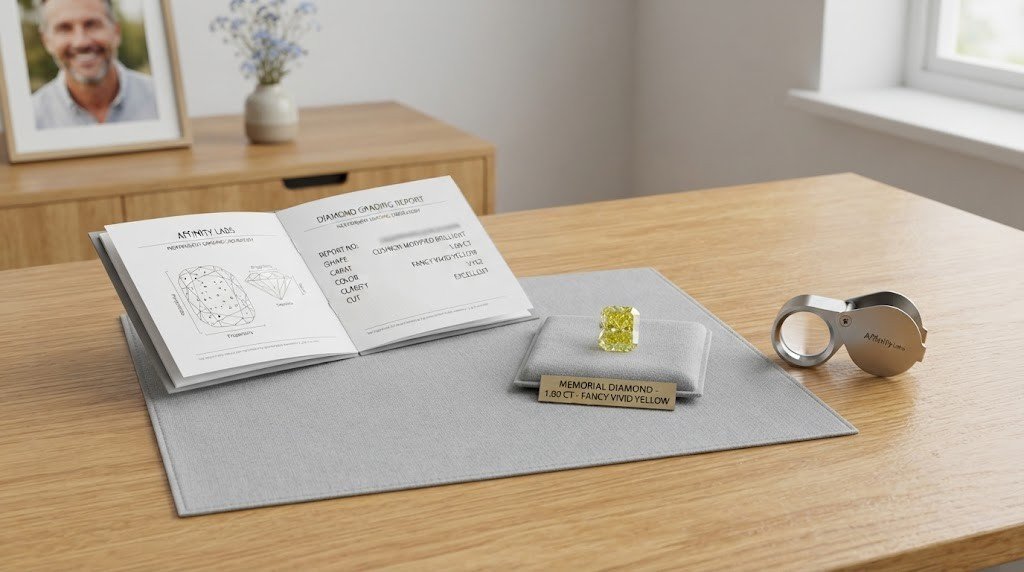
An independent grading report describes the stone’s quality using the 4Cs as GIA defines them: cut, color, clarity and carat. Typical memorial diamond clarity falls between SI2 and VVS. A grading report confirms you have a genuine diamond of a stated quality; it cannot confirm the stone was really made from grandmother ashes.

Why color is not evidence either

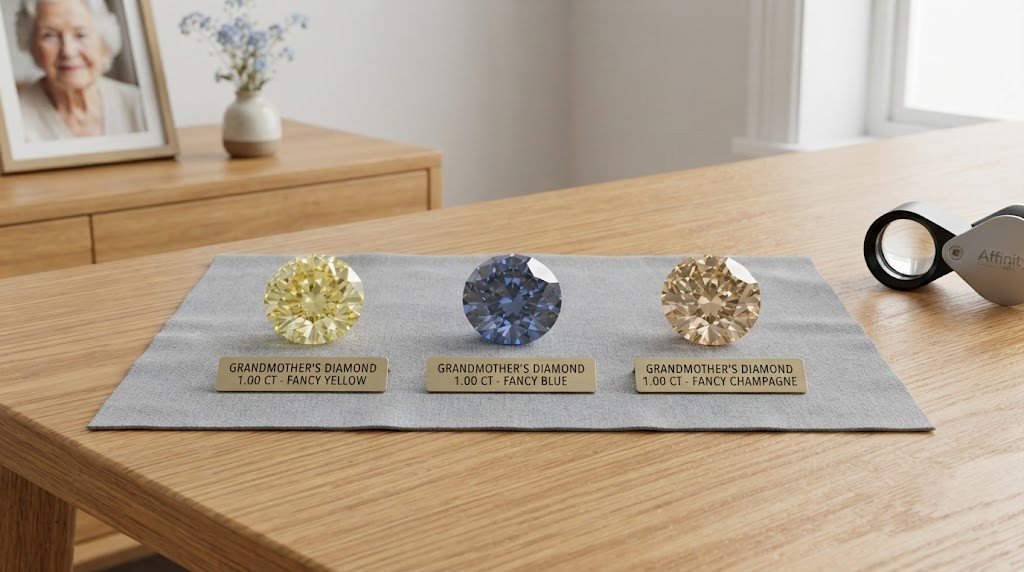
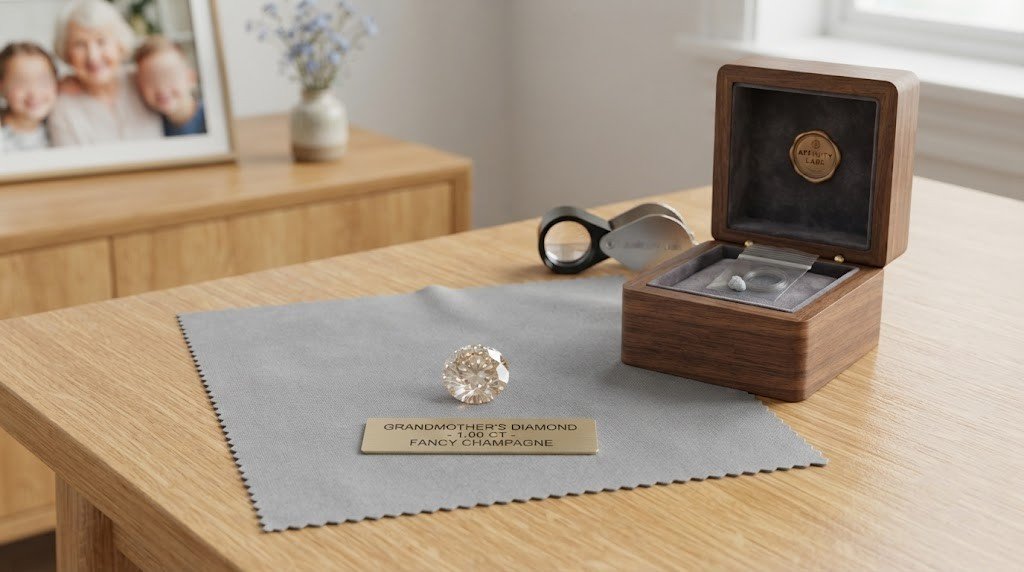
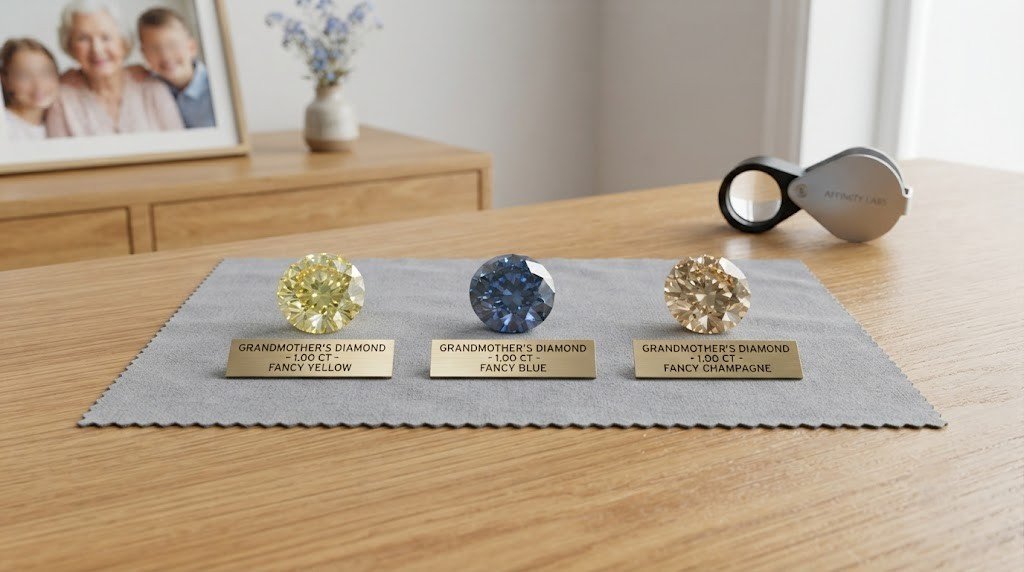
Yellow, blue, champagne and brown are the usual memorial diamond tones, because trace elements such as nitrogen and boron are common in organic carbon. Those tones are consistent with a personal source, but they are not proof of one, and a family cannot pick or match an exact natural shade. The post on the colors her ashes can produce explains why.

How Can Your Family Check That a Stone Is Really Made From Grandmother Ashes?
Because the stone cannot speak for itself, the checking happens through records and answers. Clear, documented explanations of the process are the best indication you can get that your diamond will be really made from grandmother ashes.

Know the two documents apart

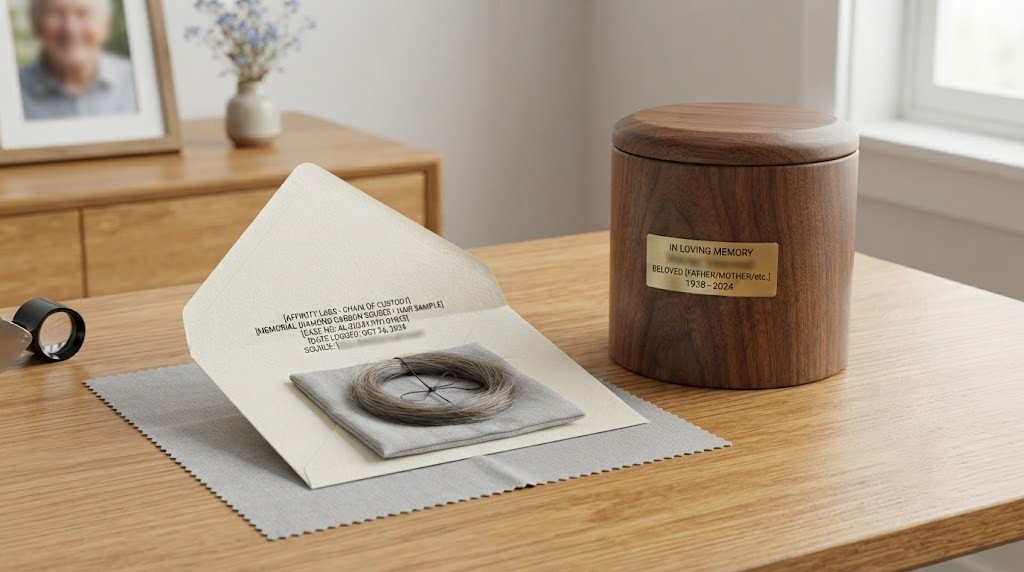
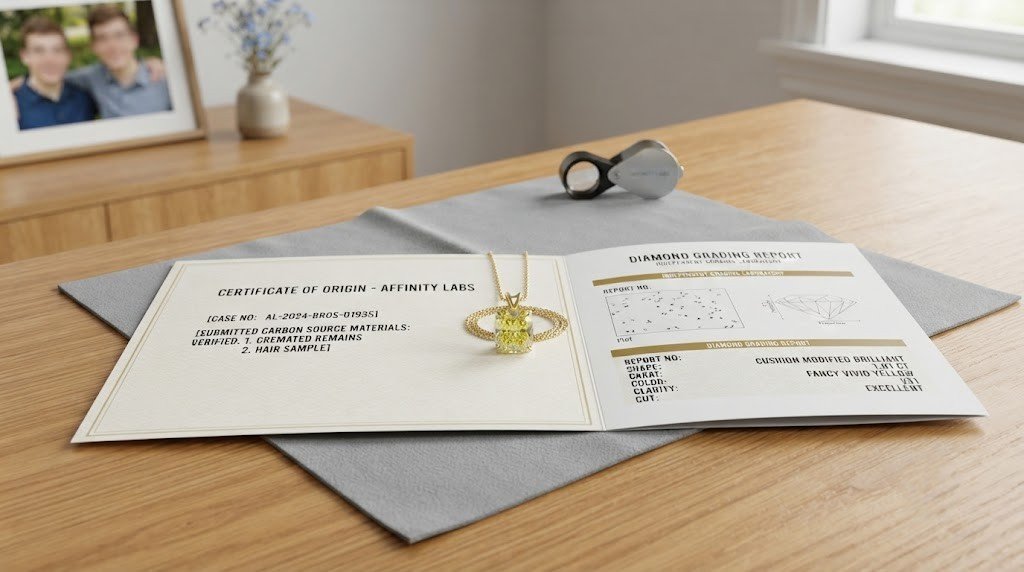
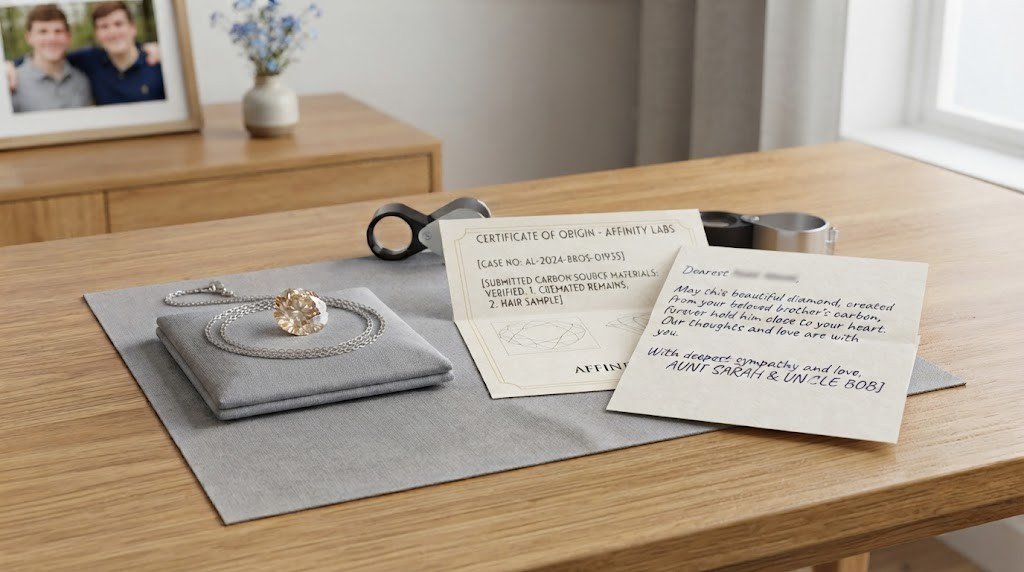
An authenticity or origin certificate, which the provider normally produces itself, is a chain-of-custody record: it is the provider’s written statement that the stone was really made from grandmother ashes sent in by your family. A grading report, ideally from an independent third-party lab referencing GIA standards and sometimes IGI, covers the stone’s quality. Independent grading is typically an optional add-on with its own price, so ask whether it is included.

Questions to put to any provider

  • How is her material labeled and tracked from the moment it arrives?
  • How are different families’ batches kept separate throughout extraction, purification and growth?
  • What records, updates or documents will we receive during the process?
  • What percentage of the finished stone do you expect to come from her ashes, stated in writing?
  • What happens to any ash that is not used: is it returned, stored or disposed of?
  • If a growth run fails, what happens to her carbon and to our order?
  • Can a third-party lab grade the finished stone, and at what cost?

Clear, specific, written answers to those questions tell you far more about whether a gem will be really made from grandmother ashes than any marketing page. The step-by-step guide to the process shows where each of those checkpoints falls.

What Doubts and Misconceptions Come Up Most Often?

Several beliefs circulate about whether any stone is really made from grandmother ashes, and each one can make a family either too trusting or too skeptical.

“Ashes are mostly carbon, so the diamond is mostly her.”

Ash is mostly calcium phosphate. Only about 0.5% to 4% of it is usable carbon, which is why a diamond really made from grandmother ashes typically includes lab carbon too.

“If it is blended, it is not really her.”

Her carbon is physically present in the lattice. A share of 10–15%, or even 3%, is still a real part of her, and a stone really made from grandmother ashes in part is not a symbol standing in for her.

“The whole urn has to be sent.”

Usually only a small portion is needed, so the rest can stay in an urn, be scattered, or be interred as the family planned. A diamond sits alongside those choices rather than replacing them.

“A lab can test the diamond to prove whose it is.”

No published test can identify a person from a finished diamond. Proof that it was really made from grandmother ashes rests on documentation and process, not on the stone.

“Memorial diamonds are not real diamonds.”

They are real lab-grown diamonds, graded on the same 4Cs as any other. A hard knock can still chip a diamond, as with any gemstone, but it rates 10 on the Mohs scale.

Does It Matter If Her Ashes Were Divided or Kept for Years?

This question can surface months or years after a funeral. Her ashes may already be divided among relatives, partly scattered, or kept on an aunt’s or uncle’s shelf for a decade. None of that changes what it means for a diamond to be really made from grandmother ashes, but it does raise practical questions.

Whether ashes stored for many years can still yield a stone really made from grandmother ashes is something each provider decides, so ask directly rather than assuming. If only a small portion remains with your branch of the family, ask what minimum amount the provider needs; general industry ranges start at a few tablespoons.

Who gets to decide

State law sets who controls her remains, along with anything she put in writing, and each state ranks family members a little differently. Commonly a surviving spouse or partner comes first, followed by her adult children, with grandchildren further along. If you are a grandchild, a respectful approach is to ask whoever holds that authority whether a small portion could be set aside, and to bring cousins into the conversation early. If nobody is sure who that is, the crematory’s paperwork usually names the person who authorized her cremation.

When faith is part of the question

Faith traditions speak to cremation and to what is done with ashes, but none has issued an official ruling on memorial diamonds themselves. Catholic guidance, for example, asks that ashes stay intact in a sacred place, with only a narrow allowance for a small portion, which bears directly on dividing them. Orthodox and Conservative Judaism generally prohibit cremation while Reform is more permissive, and Hindu, Buddhist and Protestant views vary by community. Your own clergy, or the faith community she belonged to, can speak to your situation.

What Should You Do If a Provider Cannot Answer?

Sometimes the honest answer to “is this really made from grandmother ashes?” gets lost because a provider will not engage with the details. A brief, evasive or purely emotional reply to a technical question is information in itself.

If a provider cannot or will not answer your questions, consider these steps:

  1. Ask again in writing, listing each question separately so nothing can be skipped.
  2. Request sample copies of the origin certificate and any grading report they issue.
  3. Ask for their written policy on unused ash and on failed growth runs.
  4. Compare at least two providers’ answers side by side before choosing.
  5. Pause if anything still feels unclear; there is no deadline on remembering her.

A provider that welcomes these questions is showing you how it will treat her remains, and how seriously it takes the promise that a stone is really made from grandmother ashes. The complete guide to grandmother ashes diamonds covers the wider decision if you are still weighing whether a diamond fits your family at all.

Does Careful Verification Change the Cost or Timeline?

Asking whether a stone is really made from grandmother ashes costs nothing, but some of the documents that support verification may. Independent grading reports are typically priced separately from the stone, as are engraving, fancy cuts and settings.

Across the industry in 2026, and not as Memorial Diamond’s pricing, stones run roughly 1,500–3,500 for about 0.10–0.25 ct, roughly 5,000–15,000 for 0.5–1 ct, and roughly 20,000–75,000 or more for 2–5+ ct. Colorless stones cost meaningfully more at the same size, because keeping out nitrogen and boron takes extra processing.

On timing, expect roughly 6 to 10 months between the lab receiving her ashes and the finished stone, and larger stones over about 2 ct or specialty colors can take up to roughly 12 months. Ask whether independent grading adds time, and how you will be kept informed while a stone really made from grandmother ashes is on its way back to your family. The guide on turning her ashes into a diamond covers the practical sequence of choices.

Frequently Asked Questions

Is the diamond really made from grandmother ashes, or just inspired by them?

It is made in part from her. Carbon recovered from her ashes is purified, converted to graphite and grown into the crystal, typically blended with lab carbon. Her carbon is physically present in the finished stone, not merely represented by it.

What percentage of the stone comes from her ashes?

For ash-based memorial diamonds, personal carbon is typically around 10–15% of the finished stone’s mass. A few providers quote as little as 3%, and some quote more, with carat and the quantity of ash both playing a part. Ask each provider for its figure in writing.

Can a lab test the finished diamond to confirm it came from her?

No published test can identify a person from a finished diamond, and there is no basis for claims that DNA survives in one. Confirmation comes from chain-of-custody records, the origin certificate and a provider’s clear answers about how batches stay separate.

Is an origin certificate the same as a grading report?

No. An origin or authenticity certificate, normally produced by the provider itself, ties the stone to your family’s submitted carbon. A grading report, ideally from an independent lab, describes cut, color, clarity and carat. Keeping both gives a fuller record.

Should I avoid a provider that says its diamonds are 100% ashes?

Treat that claim as a reason to ask more questions. A stone really made from grandmother ashes still typically blends her recovered carbon with lab carbon. Ask the provider to explain, in writing, what share of the stone it expects to come from her ashes.

Can we still make a diamond if most of her ashes were scattered?

Often, yes, since the typical request is a small amount, from a few tablespoons to roughly 4 oz. Whether a small or long-stored portion is workable is the provider’s call, and whoever holds authority over her remains should agree before anything is sent.

Final Thoughts on Whether Her Diamond Is Truly Hers

The truthful answer sits between two extremes. A diamond really made from grandmother ashes holds her carbon, grown into the crystal, and shares that crystal with lab carbon. A provider that says both halves of that sentence plainly is one worth listening to.

Ask your questions, keep the answers in writing, and let the paperwork carry the proof the stone cannot. That care is part of honoring her too.

Learn More About Verifying a Grandmother Ashes Diamond

Talk With Memorial Diamond

If you have questions about how a stone can be really made from grandmother ashes, or how records and tracking should work, Memorial Diamond would be glad to answer them plainly. There is no rush, and asking commits you to nothing.

Reach out through memorialdiamond.us whenever the timing feels right for your family.
The Complete Guide genrate thamnail

Grandmother Ashes and Hair Diamond: The Complete Guide

Some families end up holding two things after a grandmother dies: a share of her cremated remains, and a lock of hair someone saved. A grandmother ashes hair diamond is a lab-grown diamond grown partly from carbon recovered from both, but only some providers will combine the two materials in one stone. Where they do, you get a real, gradable diamond; where they do not, two separate stones are the usual alternative.

This guide walks through what is actually known about a grandmother ashes hair diamond, what nobody has published yet, who gets a say, and what to put in writing before anything is shipped.

grandmother ashes hair diamond

What is a grandmother ashes hair diamond?

A grandmother ashes hair diamond is a lab-grown diamond whose starting carbon includes some recovered from her cremated remains and some recovered from her hair. It is not glass, resin or a simulant. It is grown with the same methods used across the lab-grown industry, most often HPHT and occasionally CVD, and it is graded on cut, color, clarity and carat like any other diamond.

The finished grandmother ashes hair diamond sits at 10 on the Mohs scale of hardness, which makes it practical for a ring worn every day. Hardness is not the same as toughness, though. A hard blow against a door frame or countertop can chip a diamond, which is why a bezel or other guarded mount makes sense for a stone worn daily.

How is the stone made from two materials?

The broad sequence is the same one used for single-material stones. Each material is received and logged with chain-of-custody tracking, then heated in an oxygen-free process that strips away everything that is not carbon. The recovered carbon is purified to roughly 99.9% or better, converted to graphite at around 2,500–2,700°C, and grown in a press at roughly 6–8 GPa and 1,400–2,500°C over weeks to months.

Cutting, polishing and grading follow. If you want the lab science in more depth, a separate walkthrough of how a stone is grown from both her ashes and her hair covers each stage. The step that differs between providers, and the one that decides whether a grandmother ashes hair diamond is possible at all, is whether the two recovered carbons ever share a growth cell.

Why would a family want her ashes and her hair in one stone?

The reasons are usually personal rather than technical. For some families, a grandmother ashes hair diamond feels like the most complete way to keep both kinds of keepsake together, especially when the hair was saved years before she died and the ashes came later. Others simply have both on hand and do not want to choose between them.

There can also be practical motives. Hair is roughly 50% carbon by weight, while ash holds only a small amount, so a family might hope that adding hair raises the share of her own carbon in a grandmother ashes hair diamond. Whether that hope holds up depends on the provider’s method, and there is no published number to confirm it, so treat it as a question rather than an expectation.

Some families decide against blending once they learn more. A grandmother ashes hair diamond is one option among several, and keeping the urn, scattering most of the ashes, or framing the lock of hair are all equally sound ways to remember her.

Will a provider combine both materials into a grandmother ashes hair diamond?

This is the first thing to find out, because the answer varies. Some providers in the industry describe accepting both materials for one stone; others work with one source per diamond and will suggest two separate stones instead. Nothing about the basic chemistry rules a blend out, since carbon purified from either source ends up as graphite, but each lab sets its own process rules.

If you are hoping for a grandmother ashes hair diamond, ask early and ask in writing. A useful framing is: “If we send both her ashes and her hair, will carbon from both go into the same growth run, and how will you document that?” A clear written answer tells you far more than a sales page.

What a clear answer usually covers

A provider that does make a grandmother ashes hair diamond should be able to explain how each material is logged separately on arrival, whether the two are processed together or apart before growth, and how the certificate of origin will name both sources. If an answer is vague, that is a reason to keep asking, not a reason to assume.

How much of the finished stone is really her carbon?

Honesty matters most here, because this is where marketing tends to overreach. By weight, ash is overwhelmingly calcium phosphate from bone, and the carbon a lab can actually use amounts to roughly 0.5% to 4% of it. Because that yield is so small, providers typically top it up with supplemental lab carbon before growth.

For ash-only stones, the personal carbon is commonly cited at around 10–15% of the finished mass, with some providers quoting figures as low as 3% and others higher. That range describes the ash route only. No equivalent finished-stone figure has been published for hair-only stones, and none has been published for a grandmother ashes hair diamond that blends the two.

So the honest position is that hair’s higher carbon content might change the picture, but nobody can tell you by how much without seeing a specific provider’s method. Ask each provider, in writing, what share of the finished grandmother ashes hair diamond they expect to come from her carbon, and how they arrive at the figure. A claim that the stone is “100% her” is not how the process works.

RouteCarbon in the raw materialPublished personal share of the finished stoneCremation involved
Ashes onlyAbout 0.5–4% of ash weightAround 10–15% (some cite 3%, some higher)Yes
Hair onlyAbout 50% of hair weightNo published figure; ask the providerNo
Ashes and hair blendedVaries with how much of each is usedNo published figure; ask the providerYes, for the ash portion

A grandmother ashes hair diamond is still physically, verifiably grown in part from her. That is a meaningful thing on its own terms, and it does not need exaggerating.

Would two separate stones suit your family better than a grandmother ashes hair diamond?

When a provider will not blend, or when the family is unsure, two stones are a common alternative: one grown from a portion of her ashes and one grown from her hair. Some families like the separation, because each stone keeps a single clear origin on its certificate, something a grandmother ashes hair diamond cannot offer.

Here are the trade-offs worth weighing:

  • Cost: each stone is quoted and grown on its own, so compare the two quotes together against one larger stone; because price climbs steeply with carat size, the answer is not always what you expect.
  • Documentation: each stone carries its own origin record, which some families find simpler to explain later.
  • Who wears what: a pair can be split between two relatives, or set together in one piece, such as a pendant with two settings.
  • Material: the hair-only stone needs no cremated remains, which matters for relatives who would rather the ashes stay intact.
  • Timeline: two runs may proceed in parallel or one after another; ask the provider which.

The ash-based route on its own is covered in detail in the complete guide to a grandmother ashes diamond, and the hair-only route has a companion guide built around her hair alone.

How much ash and hair does a provider usually ask for?

Requests differ by provider, so treat any number as general rather than a rule. On the ash side, the amounts providers mention run from a few tablespoons to around 4 oz (roughly 100 g). Against a full set of cremated remains that is modest, so the bulk of her ashes can still go to the urn, a plot or a scattering.

For hair, a small lock or a few grams is the usual request, because so much of hair’s weight is carbon. A combined grandmother ashes hair diamond may call for less of one material when more of the other is supplied, but only the provider can say how they balance it. Specific numbers for each side of the blend are worth reading about in the guide to how much ash and hair a combined stone needs.

One fact surprises many people: sending more material does not make a larger stone. Carat size comes from how long the diamond grows in the press, so a full urn does not buy a bigger or faster grandmother ashes hair diamond.

Is her hair still usable if it was colored or permed?

Hair that was dyed, permed, or chemically treated may or may not be accepted, and that is a provider decision rather than a general rule. Do not assume the hair’s natural or treated color will change the stone’s color. Ask whether treated hair is accepted, and whether hair from a brush or an old keepsake envelope is workable.

Who has the right to decide about her ashes and her hair?

Two things settle who decides about her ashes: the law of the state involved and anything she put in writing. States do not rank relatives identically, but a surviving spouse or partner, and after them her adult children, commonly stand ahead of grandchildren. A short call to the crematory or funeral home can usually confirm whose signature is on the cremation paperwork.

If you are a grandchild, the respectful route is to speak with whoever holds that authority and ask whether a small portion could be set aside. If the ashes are with an aunt, an uncle or your parent, or were divided years ago, the same conversation applies to whoever now keeps each share.

Before any grandmother ashes hair diamond is ordered, the hair needs its own thought. Hair kept at home is often the simpler practical question, but it is not automatically free of rules. Her belongings can form part of her estate, and how that works depends on the state, so a quiet word with the executor or the person settling her affairs avoids misunderstandings later. A grandmother ashes hair diamond touches both questions at once, which is one more reason to talk before ordering.

What if faith shapes the decision?

No religious tradition has an official position on memorial diamonds as such; the guidance that exists concerns cremation and the handling of ashes. Catholic guidance permits cremation but asks that ashes be kept whole in a sacred place, with only narrow room for a small portion. Major schools of Islamic thought regard cremation as impermissible, so an ash-based stone would not arise, though a hair-based stone involves no cremation. Orthodox and Conservative Judaism generally prohibit cremation, while Reform Judaism is more permissive.

Hindu families traditionally immerse ashes, and keeping a small portion is described as increasingly common but varies. Most Protestant clergy raise no objection, though some congregations do, while Buddhist views depend on the teacher and community; secular families decide by personal meaning. For a family weighing a grandmother ashes hair diamond, her own clergy or community is the right place to ask.

What color might a grandmother ashes hair diamond be?

Whatever trace elements sit in the growth cell decide the hue. A little boron tints the crystal blue and a little nitrogen tints it yellow; getting a colorless result means shutting both out, an extra processing effort that generally raises the price. Memorial stones in general lean toward yellow, blue and champagne or brown tones.

Neither material reliably gives a grandmother ashes hair diamond a lighter, cleaner or more predictable color than the other would, and a family cannot choose an exact shade or match a natural one. Some providers also offer post-growth irradiation to reach red, pink, green or black. The color question for a blended stone is explored further in what color a stone grown from both her ashes and hair might be.

Grading is separate from the certificate of origin. An in-house certificate records where the carbon came from, while a grading report from an independent lab, usually referencing the GIA’s diamond quality factors, records cut, color, clarity and carat. Independent grading is typically an optional add-on with its own fee.

What does a grandmother ashes hair diamond cost?

Prices below are general 2026 industry ranges, not Memorial Diamond’s own prices, which are not yet published. Size and color drive the cost far more than which materials are used.

SizeTypical industry range (2026)Notes
About 0.10–0.25 ctRoughly 1,500–3,500A common size for a pendant or a pair of small stones
About 0.5–1 ctRoughly 5,000–15,000A colorless stone of this size is priced well above a tinted one
About 2–5+ ctRoughly 20,000–75,000+Longer growth and closer process control

Grading reports, engraving, fancy cuts and settings are usually priced separately. Whether combining two materials adds any fee to a grandmother ashes hair diamond is a question for each provider. Clarity in memorial stones commonly falls between SI2 and VVS, and sizes run from about 0.10 to more than 5 carats.

How long does a grandmother ashes hair diamond take to make?

Industry-wide, expect roughly 6 to 10 months between the lab logging her ashes and hair and the stone being ready. Larger stones over about 2 carats, and specialty colors, can take up to around 12 months. Building that window into family plans, such as a gathering or an anniversary, avoids disappointment.

Can grandchildren and cousins each have a stone?

Often, yes. Because each stone uses only a portion of the material, several relatives can usually each receive their own diamond from the same shared source, subject to the provider’s rules. That can mean one grandmother ashes hair diamond for each branch of the family, or a mix of blended and single-material stones.

Coordination is the hard part, not the chemistry. Cousins may live far apart, have different budgets, and feel differently about the ashes. A single point of contact, one shared order, and an agreed note on who receives what tend to keep things calm. Families planning several stones can learn more about the practical steps for turning her ashes and hair into a diamond.

A grandmother ashes hair diamond can also become an heirloom, passed from one generation to the next. That is a family meaning, not a financial one, and no claim about resale or investment value should shape the decision.

What should you ask a provider in writing?

Written answers protect everyone, especially when several relatives are involved. Before sending anything, ask for clear replies to these questions:

  1. Will carbon from her ashes and her hair go into the same growth run, or do you only make separate stones?
  2. Roughly what proportion of the finished grandmother ashes hair diamond will be her own carbon, and what is that estimate based on?
  3. How much of each material do you need, and do you accept dyed, permed or long-stored hair?
  4. How is each material tracked from arrival to finished stone, and what does the certificate of origin name?
  5. What happens to any material you do not use, and can it be returned?
  6. What happens if a growth run fails, and what are your refund terms?
  7. Is independent grading included, or is it a separate fee?
  8. Which colors do you offer, and do any involve irradiation?

If you want to test whether a provider’s claims hold up, a guide to checking whether a blended stone really contains her carbon sets out what evidence to request.

Frequently Asked Questions

Can her ashes and her hair go into one diamond?

Sometimes. Some providers will place carbon recovered from both materials into a single growth run, while others only make one stone per material. Ask directly, and get the answer in writing, before you send any of her ashes or hair.

Does adding her hair raise the share of her carbon in the stone?

Possibly, since hair is about half carbon by weight, but no provider-independent figure has been published for a blended stone. The 10–15% share often quoted applies to ash-only stones, not to a grandmother ashes hair diamond. Ask each provider what share they expect.

Do the grandchildren need permission to use her ashes?

Usually someone else decides. State law and her written wishes set who holds authority, and a surviving spouse or partner or her adult children often come first. Ask whoever holds that authority for a small portion, and coordinate with any cousins who share the ashes.

Is hair from her hairbrush enough for the hair portion?

It may be, but acceptance depends on the provider. A small lock or a few grams is the usual request. Ask whether loose hair from a brush, an old envelope, or hair that was colored or permed can be used.

Will a blended stone take longer than an ash-only stone?

Across the industry, most stones take 6 to 10 months from receipt, and larger or specialty-color stones up to about 12. Whether processing two materials adds time depends on the provider, so ask them for their expected window.

Can each cousin have a stone from the same ashes and hair?

Often, because each stone uses only part of the material. Several relatives can usually receive their own diamonds from shared ashes and hair. The provider sets the limits, so agree as a family on who receives what before placing a combined order.

Final Thoughts on a Diamond From Both Her Ashes and Her Hair

Choosing a grandmother ashes hair diamond is a personal decision, and so is choosing two stones, or none. What helps most is plain information: what the carbon share is known to be, what is still unpublished, and who in the family has a say.

Take the questions to providers, get the answers on paper, and let the people who will wear the stone guide the choices about size, color and setting.

Learn More About Ashes-and-Hair Memorial Stones for a Grandmother

Talk With Memorial Diamond

If you are weighing a grandmother ashes hair diamond, or a stone from just one material, Memorial Diamond is glad to talk through what is possible and what questions to settle first. There is no rush, and nothing to decide on a first conversation.

You can reach us at memorialdiamond.us whenever the family is ready.

Word count: 3,271 words · Reading time: about 16 minutes

What Color Will a Diamond Made From Your GrandmotherAshes and Hair Be

What Color Will a Diamond Made From Your Grandmother’s Ashes and Hair Be?

Maybe a small envelope of her hair has been tucked beside her urn for a while, and now you are picturing what a stone grown from both might look like. If you are wondering about grandmother ashes hair diamond color, the plain answer is that the stone will most likely settle into a yellow, blue or champagne-brown tone, and no provider can predict the exact shade ahead of time. Combining her ashes with her hair does not make the stone lighter or more predictable, and a colorless result is possible only with extra processing that typically costs more.

What follows explains where grandmother ashes hair diamond color comes from, what you can ask for, and how color moves the price. Where the answer depends on a particular company, it is framed as a question to put to that company in writing.

grandmother ashes hair diamond color

What Grandmother Ashes Hair Diamond Color Should You Expect?

Memorial diamonds as a group lean toward three families of tone: yellow, blue, and champagne or brown. A stone that draws on both her ashes and her hair follows the same pattern, because grandmother ashes hair diamond color is shaped by the same chemistry as every other lab-grown memorial stone.

Inside each family the shade can run from faint to deep, from pale straw to a fuller gold, or from barely tinted to clearly sky-blue. Where yours lands cannot be promised, and a provider worth trusting will say so plainly instead of showing a single sample photo as though it were a forecast of your grandmother ashes hair diamond color.

Color outcomeWhat usually causes itHow it is reachedCost compared with other colors at the same size
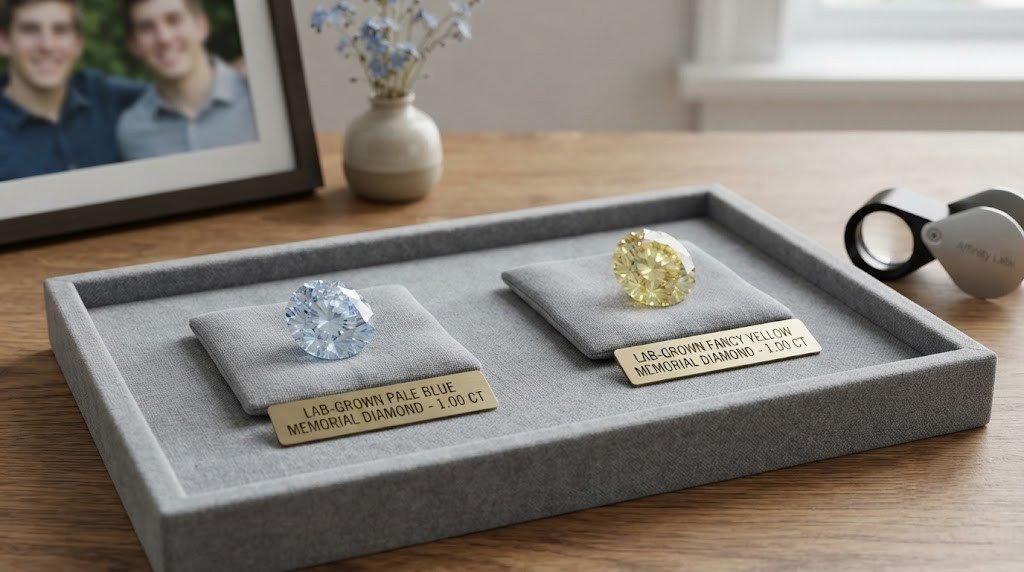
YellowNitrogen present during growthArises on its own during growthTypically below colorless
BlueBoron present during growthArises on its own during growthTypically below colorless
Champagne or brownTrace elements common in an organic carbon sourceArises on its own during growthTypically below colorless
Colorless (white)Nitrogen and boron both kept outExtra processing to exclude trace elementsTypically meaningfully higher
Red, pink, green or blackPost-growth treatmentIrradiation, offered by some providers onlySet by each provider; may lengthen the timeline

Read the table as a map of possibilities rather than a menu. The first three rows happen without intervention; the last two are outcomes a provider works toward on purpose. Talking through grandmother ashes hair diamond color with relatives or a provider goes more smoothly when everyone starts from that distinction.

Why Do Trace Elements Decide the Color, Not the Material?

Diamond is carbon locked into a tight crystal lattice, and carbon with nothing else in it grows colorless. Color appears when other atoms slip into that lattice while the crystal forms. Nitrogen gives yellow tones, boron gives blue, and a colorless stone needs both kept out of the growth environment.

Before any of that happens, the carbon recovered from her ashes and her hair goes through an oxygen-free, multi-stage purification that brings it to roughly 99.9% carbon or higher. It is then converted to graphite at about 2,500–2,700°C. So the stone is not tinted by ash minerals or by hair pigment in any direct way. Trace elements are common when carbon comes from an organic, personal source, which is why memorial diamonds lean toward these tones. Beyond that, grandmother ashes hair diamond color depends on which trace elements end up in the growth cell and how the press is run, and those conditions sit with the provider’s process.

Where her carbon fits in the finished stone

The purified carbon is typically blended with supplemental lab carbon so there is enough volume to grow a stone of useful size. Industry figures for ash-only stones put her personal carbon at roughly 10–15% of the finished stone’s mass; a few providers cite 3%, and some cite more. For hair, and for stones that combine ashes and hair, no comparable finished-stone figure has been published, so ask each provider to state its own number in writing. If that question weighs on you, read about whether the stone genuinely holds carbon from her ashes and hair.

The growth science is the same across the industry, and the general background on how lab-grown diamonds form under heat and pressure is a useful primer. HPHT presses, the method most memorial providers use, run at about 6–8 GPa and 1,400–2,500°C and need weeks to months to grow a crystal, while a minority of providers use CVD. Neither method changes what to expect for grandmother ashes hair diamond color: yellow, blue and champagne remain the common outcomes.

Does Combining Her Ashes and Hair Change the Color?

No. Some families hope that adding hair will “clean up” the color, and others worry that ash will darken it. Neither idea holds. Putting the two materials together does not make the stone lighter, and it does not make grandmother ashes hair diamond color any easier to predict. No published evidence shows one material steering the result more than the other, so treat a claim in either direction with caution and ask the person making it where it comes from.

The reason is the purification step. By the time carbon from either source reaches the press, it has been stripped down to carbon. Put simply, grandmother ashes hair diamond color is settled during growth, not by which envelope the carbon came out of.

Is the shade of her hair a preview of the stone?

It is not. Whatever shade her hair was near the end, and whether it had been colored, permed or cut short, it does not work as a preview of the finished stone. Predicting grandmother ashes hair diamond color from a lock of hair simply does not work.

A separate, practical question is whether a provider will accept hair that was dyed or chemically treated at all. Policies differ, so ask before you send anything, and keep a small reserve of hair back in case a second sample is requested.

Will a Provider Combine Both Materials or Grow Two Stones?

That depends entirely on the company. Some may merge carbon from her ashes and her hair into a single growth run. Others may prefer to keep the two sources apart and grow one stone from each. There is no single industry practice to point to, so this is the first thing to ask about grandmother ashes hair diamond color when both materials are on the table.

If two stones are grown, each growth run is its own event, so grandmother ashes hair diamond color may differ between them even when both are yellow or both are blue. That matters if you picture a matching pair, such as two earrings, or a ring for one cousin and a pendant for another. Ask whether a provider can aim for similar tones and what it does if the results differ noticeably.

Useful questions to send by email, so the answers come back in writing:

  • Do you combine carbon from ashes and hair into one stone, or keep the two separate?
  • If combined, how do you document that both materials were used, and what share of the finished stone comes from her?
  • If kept separate, can the two stones be grown toward a similar tone, and what happens if they differ?
  • How do you write down a family’s wishes on grandmother ashes hair diamond color, and what happens if the result falls outside them?
  • Do you accept hair that was dyed, permed or otherwise treated?
  • What happens to any ashes or hair you do not use?

Each stage of a combined order is laid out in the explainer on how a stone is grown from both her ashes and her hair. Quantities are a separate topic, set out in how much ash and hair a combined stone usually needs, and the amount you send has no bearing on grandmother ashes hair diamond color.

Can You Request a Colorless Stone or a Particular Shade?

You can usually state a preference. What you cannot do is choose or match an exact shade, because the growth environment, not an order form, settles the final tone. Seeing grandmother ashes hair diamond color as a direction you can lean toward, rather than a swatch you can pick, keeps expectations steady before you commit.

Colorless takes extra work

A colorless memorial diamond is achievable, but it requires additional processing to keep nitrogen and boron out of the growth cell. That extra work is why colorless stones typically cost more than yellow, blue or champagne stones of the same size. If your hope for grandmother ashes hair diamond color is a colorless stone, ask what the provider does when a colorless attempt comes out with a faint tint.

Irradiated colors

Some providers offer post-growth irradiation to produce red, pink, green or black stones. Not every company does this, and those that do set their own prices and timelines. When irradiation is part of your plan for grandmother ashes hair diamond color, ask whether the treated tone is permanent under normal wear and whether the treatment is noted on the stone’s paperwork.

A preference is not a promise

Families sometimes hope to match her eye color, a gem she wore, or a shade from a favorite photograph. A provider can note the wish, but no one can match a natural shade on demand. When the stone arrives, the tone it carries is the result of her carbon in that particular growth run, and that individuality is something a family may come to value.

How Is Grandmother Ashes Hair Diamond Color Graded?

Two different documents can come with a memorial diamond, and they answer different questions. An authenticity or origin certificate, which the provider normally issues itself, ties the stone to the carbon your family supplied. It is a chain-of-custody record. A grading report describes the stone itself: cut, color, clarity and carat.

Grading is ideally done by an independent third-party lab working to GIA standards, and sometimes by IGI. Independent grading is typically an optional add-on with its own fee. If you want to understand what the color line on such a report means, GIA’s overview of how diamond color and the other quality factors are assessed is a clear starting point.

For a colored stone, a report generally records grandmother ashes hair diamond color as hue and intensity instead of a letter grade from the scale used for near-colorless diamonds. Memorial diamonds typically grade in the SI2 to VVS clarity range. Ask whether a report is included or extra, and which lab issues it, since that document is where grandmother ashes hair diamond color gets recorded in independent terms.

How Does Grandmother Ashes Hair Diamond Color Affect the Cost?

Size drives most of the price, and grandmother ashes hair diamond color adjusts it. These are broad 2026 figures for the industry as a whole; Memorial Diamond has not yet published prices of its own.

Carat bandBroad 2026 industry rangeWhere color pushes the price
About 0.10–0.25 ctRoughly 1,500–3,500Ask each provider how colorless or treated colors are priced at this size
0.5–1 ctRoughly 5,000–15,000Expect colorless to sit well above yellow, blue or champagne of equal size
2–5+ ctRoughly 20,000–75,000+Larger and specialty-color stones may also take longer to grow

A grading report, engraving, a fancy cut and a jewelry setting are usually priced on top of the loose stone. When you compare quotes, ask each provider to separate those items so the effect of grandmother ashes hair diamond color on the total is visible.

Does Grandmother Ashes Hair Diamond Color Change the Timeline?

Industry-wide, most memorial diamonds are finished 6 to 10 months after a provider receives the material. Larger stones, above roughly 2 carats, and specialty colors such as black can take up to about 12 months.

Time in the press, rather than the quantity of ash or hair supplied, is what determines carat size. Colorless or an irradiated shade may add time, so when you raise grandmother ashes hair diamond color with a provider, ask for a written estimate that reflects the specific color and size you have in mind.

How Can a Family Agree on a Color Together?

Before color comes up at all, it helps to know who is entitled to decide about her ashes. That turns on state law and on any written wishes she left, and the order of priority differs from one state to the next. A surviving spouse or partner often comes first, with her adult children next and grandchildren after them, but treat that as a common pattern to confirm rather than a rule. Whoever signed the cremation authorization is usually on record with the funeral home or crematory, and staff there can often tell you.

Hair kept at home tends to be the simpler practical matter. Even so, her belongings can count as part of her estate, and the rules vary by state, so a short conversation with the executor or whoever is settling her affairs makes sense before any hair is sent.

Letting the color follow who she was

Once the right people are involved, grandmother ashes hair diamond color becomes a more personal conversation. Some families lean toward a tone that echoes something about her, such as a color she wore often. Others let the person who will wear the stone decide. If cousins are each considering a stone, agreeing on whether every stone should share a color family avoids surprises later.

If the stone may pass down a generation, the next wearer’s taste can be part of the discussion. For the wider picture, the complete guide to an ashes-and-hair diamond for your grandmother brings every topic together, while color expectations for a stone from her ashes alone and what a stone from her hair alone tends to look like help when the family is weighing a single material.

Which Color Myths Are Worth Setting Aside?

A few ideas about grandmother ashes hair diamond color come up again and again in family conversations.

  1. “More hair will make it lighter.” Hair is roughly 50% carbon, far richer than ash, which is why so little is needed. That carbon content says nothing about color.
  2. “A full urn gives a deeper or bigger stone.” Growth time sets carat size. Sending more material changes neither size nor shade.
  3. “Yellow or brown means lower quality.” Tone is a description, not a verdict. A yellow memorial diamond is a real diamond, 10 on the Mohs scale, graded on the same 4Cs as any other.
  4. “Colorless proves more of her is in it.” A colorless stone reflects extra processing to exclude trace elements, not a larger personal carbon share.
  5. “Two stones from the same material will match.” Separate growth runs can produce different tones, so ask before assuming a pair will look alike.

Setting these aside makes it easier to compare providers on what actually matters about grandmother ashes hair diamond color: documentation, written answers and honest estimates.

Frequently Asked Questions

Will adding her hair make the diamond lighter than her ashes alone would?

No. Combining hair with ashes does not lighten the stone or make grandmother ashes hair diamond color easier to predict. Carbon from both sources is purified before growth, and color depends on trace elements such as nitrogen and boron in the growth environment.

Can the stone be made to match her eye color or a gem she wore?

A provider can note the wish, but nobody can match an exact natural shade. You can usually state a preferred direction, such as colorless or a blue tone, and some providers offer irradiation for red, pink, green or black, each priced and timed separately.

If her ashes and hair become two separate stones, will they match?

Not necessarily. Each growth run is a separate event, so two stones can come out in different tones. If you want a matched pair, ask the provider in writing whether it aims for similar tones and what it does when the results differ noticeably.

Is a yellow or champagne memorial diamond lower in quality?

No. When it comes to grandmother ashes hair diamond color, yellow, blue and champagne are the most common outcomes and say nothing negative about the stone. It is still a real diamond, graded on cut, color, clarity and carat, with hardness of 10 on the Mohs scale.

Does a colorless stone from her ashes and hair cost more?

Typically, yes. A colorless result needs extra processing to keep nitrogen and boron out during growth. In the 0.5 to 1 carat range, where industry prices run roughly $5,000 to $15,000, colorless usually costs meaningfully more than yellow, blue or champagne.

Where does grandmother ashes hair diamond color appear on the paperwork?

It appears on a grading report, which describes cut, color, clarity and carat. An in-house authenticity certificate records origin and chain of custody instead. Independent grading is typically an optional add-on, so ask which lab issues the report and whether it is included.

Final Thoughts on the Color of Her Ashes-and-Hair Diamond

The color of a stone grown from her ashes and hair will be its own, settled in the press rather than chosen from a chart. Yellow, blue and champagne are the usual results for grandmother ashes hair diamond color, colorless and treated shades take extra steps, and combining the two materials does not tip the outcome either way.

What you can shape is the quality of the answers you gather. Ask each provider how it handles both materials, what it records, and what happens if the tone surprises you, then keep those answers in writing alongside her paperwork.

Learn More About Ashes-and-Hair Stones for Your Grandmother

Talk With Memorial Diamond

If you are still turning over what color her stone might be, or whether to use her ashes, her hair or both, you are welcome to talk it through with us. We can explain grandmother ashes hair diamond color in plain terms and help you sort out which questions matter for your family.
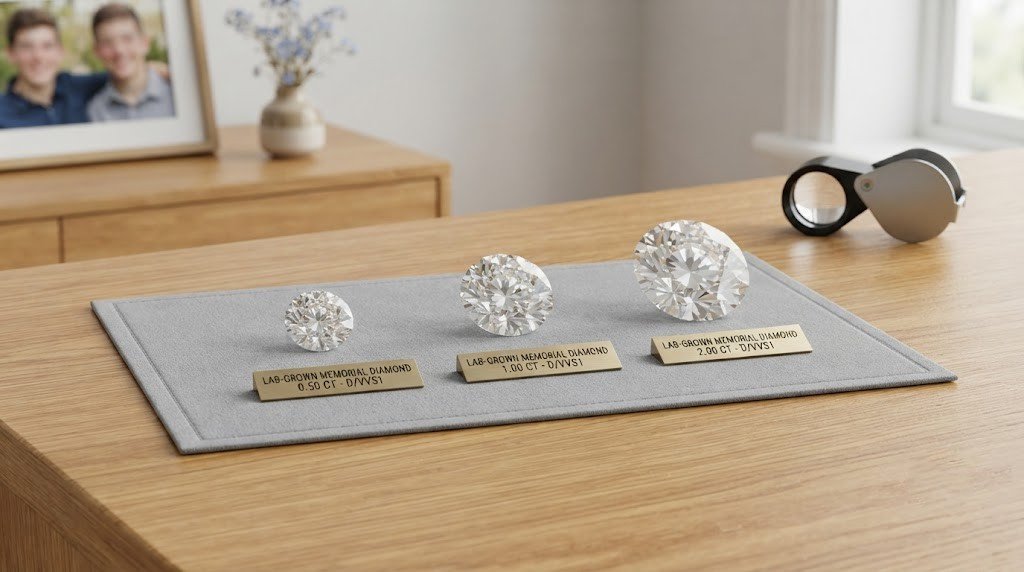
Visit memorialdiamond.us whenever you are ready. There is no deadline, and asking questions commits you to nothing.

Turning Your Grandmothers Ashes Into a Diamond

Step-by-Step: Turning Your Grandmother’s Ashes Into a Diamond

Holding a small portion of her ashes and wondering what could become of it is a quiet, serious moment. The grandmother ashes diamond steps run in a clear order: agree as a family, choose a provider, send a portion with tracking, then let a lab extract and purify her carbon, grow it into a real diamond, cut, grade and set it. Across the industry, the whole journey typically takes 6 to 10 months.

Nothing about the grandmother ashes diamond steps has to be rushed, and much of the work happens out of your hands once her ashes leave home. Knowing what each stage involves, who carries it out and where your family makes a choice can make the wait feel less uncertain.

grandmother ashes diamond steps

Table of Contents

What Are the Grandmother Ashes Diamond Steps, in Order?

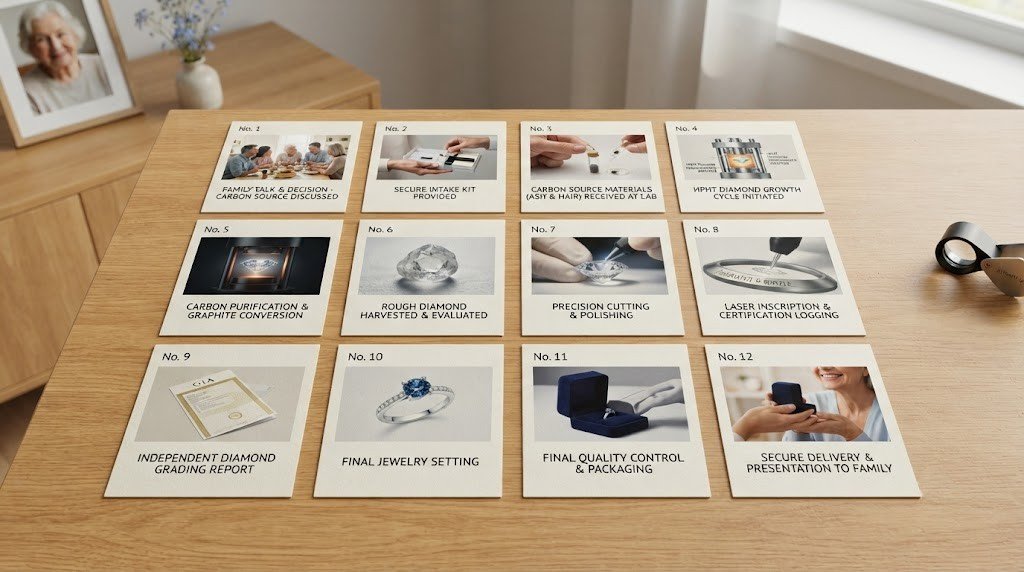
Twelve stages take her ashes from an urn to a finished stone: the first five belong mostly to your family, the next five happen in a lab, and the last two bring the diamond home.

  1. Talk with whoever holds authority, and with relatives.
  2. Choose a provider; ask questions in writing.
  3. Decide carat, color option, cut and grading.
  4. Receive a collection kit and portion her ashes.
  5. Ship the portion with tracking.
  6. Extraction and purification of her carbon.
  7. Graphitization.
  8. Diamond growth.
  9. Cutting and polishing.
  10. Optional irradiation for color.
  11. Grading and an authenticity certificate.
  12. Setting and delivery.

The table summarizes the grandmother ashes diamond steps: what happens, who handles it and what your family decides.

StepWhat happensWho does itWhat the family decides
1. Family conversationAgreement on whether to proceed and how much of her ashes to useYour family, led by whoever holds authorityWhether to go ahead; who receives a stone
2. Choose a providerComparing companies and getting answers in writingYour familyWhich provider to trust
3. Stone detailsSize, color option, cut and grading are selectedYour family, guided by the providerCarat, color, shape, independent grading
4. Collection kitA container and instructions arrive; a portion is measured outYour family, sometimes with a funeral home’s helpHow much to send, within provider guidance
5. ShippingThe portion travels to the lab with trackingYour family and the carrierShipping method the provider recommends
6. Extraction and purificationCarbon is separated from minerals and purifiedThe provider’s labNone
7. GraphitizationPurified carbon is heated into graphiteThe provider’s labNone
8. GrowthGraphite is grown into a diamond crystalThe provider’s labAlready set by carat choice
9. Cutting and polishingThe rough crystal is shapedA cutter or gemologistShape, chosen earlier
10. Optional irradiationColor is altered after growthSome providers onlyWhether to use it at all
11. Grading and certificateQuality is assessed; origin is documentedLab or independent graderWhether to pay for independent grading
12. Setting and deliveryStone is mounted and sent homeJeweler and providerRing, pendant, loose stone or other

For a broader look at the whole subject beyond the sequence itself, the complete guide to a diamond from your grandmother’s ashes covers color, cost and family questions in one place.

Who Should You Talk With Before Anything Is Sent?

Step 1: Talk with whoever holds authority, and with relatives

Before any of the other grandmother ashes diamond steps, the people who have a say need to agree. Who decides about her remains depends on state law and on any wishes she put in writing, and the ranking varies from state to state. Commonly a surviving spouse or partner comes first, followed by her adult children, which can mean your parent, aunt or uncle has the deciding voice rather than you. If nobody is sure, the funeral home or crematory involved can often say whose name is on the cremation paperwork.

You can still begin the conversation as a grandchild. A respectful approach is to ask whoever holds authority whether a small portion might be set aside, and to explain that most of her ashes can stay where the family intended. Her ashes may already be divided between households, scattered in part, or kept by one relative; any of these simply shapes what is available to work with.

Cousins and other relatives may want a voice in the grandmother ashes diamond steps, or a stone of their own. Raising the idea openly, rather than arranging it quietly, tends to protect relationships. If several people are interested, more than one stone can often come from shared material, though each provider sets its own terms, so ask about that early.

If faith shapes your family’s choices

No religious tradition has issued a ruling on memorial diamonds themselves; teachings address cremation and what is done with ashes. Catholic guidance, for example, asks that ashes be kept together in a sacred place, with only limited room for a small portion, which bears directly on dividing them. Practice differs widely among other faiths and communities, so anyone with a concern about the grandmother ashes diamond steps should talk it through with their own clergy or community leader.

If ashes are not an option for your family, a stone grown from hair is a separate route with no cremation involved; the guide to a diamond grown from your grandmother’s hair explains it. Her belongings, a saved lock of hair included, can count as part of her estate under rules that change between states, so speak first with the executor or whoever is handling her affairs.

How Do You Choose a Provider, and What Should You Ask?

Step 2: Compare providers and get answers in writing

The second of the grandmother ashes diamond steps is choosing who will make the stone. Companies vary in the growth method they use (HPHT for most, CVD for a minority), in how they document chain of custody, and in what they put in writing. Asking the same questions of each one makes a fair comparison possible.

Questions worth sending to every provider before the grandmother ashes diamond steps begin:

  • How do you track her ashes from the moment they arrive until the stone ships back?
  • What share of the finished stone is her carbon, and is it blended with supplemental lab carbon?
  • What happens to any portion of her ashes you do not use, and can it be returned?
  • What happens if a growth run does not succeed?
  • Is independent grading available, and what does it cost?
  • What are your refund and cancellation terms?
  • Do you share photos or updates during the process?

On the carbon question, honest answers matter. Ash is mostly calcium phosphate, with usable carbon typically around 0.5–4% by weight. That carbon is purified and usually combined with lab carbon, so her personal carbon commonly makes up about 10–15% of the finished stone, though some providers cite figures as low as 3% and others higher. Any claim that a stone holds nothing but her carbon deserves a follow-up question, and an honest look at whether the stone is really made from her ashes walks through why.

Step 3: Decide on size, color, cut and grading

Carat is the choice in the grandmother ashes diamond steps that is easiest to get wrong without the right facts. Size depends on time in the growth press, so a full urn yields neither a larger nor a quicker stone. Memorial diamonds are generally offered from about 0.10 ct to more than 5 ct, and larger sizes take longer and cost more.

Trace elements decide color. Boron tints a stone blue and nitrogen tints it yellow; colorless means excluding both, an extra layer of processing that generally raises the price. Memorial diamonds often lean toward yellow, blue or champagne tones. A provider will list the color options it offers, but nobody can promise to match an exact shade, and what color a stone from her ashes may turn out is worth reading before you choose.

Shape and grading are settled here too; independent grading is usually an optional add-on.

How Are Her Ashes Collected, Portioned and Shipped?

Step 4: Receive the collection kit and portion her ashes

The fourth of the grandmother ashes diamond steps usually begins with a collection kit, if the provider supplies one; ask what it contains, since kits differ, and follow its instructions exactly, because each provider sets its own requirements for how much to send and how to package it.

The amount requested commonly ranges from a few tablespoons to roughly 4 oz (about 100 g), usually a small fraction of the whole. The guide to how much ash a grandmother memorial diamond needs covers this in more depth. If measuring out her ashes yourself feels like too much, ask whether the funeral home that handled the cremation can help with that part of the grandmother ashes diamond steps.

Step 5: Ship the portion with tracking

Shipping is the point in the grandmother ashes diamond steps where her ashes leave your care. Use the method the provider recommends, and keep the tracking number somewhere safe. Rules for sending cremated remains depend on the carrier and route, so confirm them with the provider and the carrier directly rather than assuming. Ask the provider to confirm in writing when the package arrives, and how its own chain-of-custody records will follow her ashes through the lab.

What Happens to Her Ashes Inside the Lab?

The middle stretch of the grandmother ashes diamond steps happens entirely in the provider’s facility.

Step 6: Carbon extraction and purification

Extraction opens the lab portion of the grandmother ashes diamond steps. Her ashes are heated in a controlled, oxygen-free, multi-stage process that strips away the calcium phosphate and other minerals. What remains is carbon, refined to roughly 99.9% purity or higher.

Step 7: Graphitization

Within the grandmother ashes diamond steps, graphitization is the bridge between purified carbon and growth. The carbon is heated further, to roughly 2,500–2,700°C, which converts it into graphite. Graphite is the crystalline form of carbon that growth presses use as their feedstock, so this step prepares her carbon to become part of a diamond.

Step 8: Diamond growth

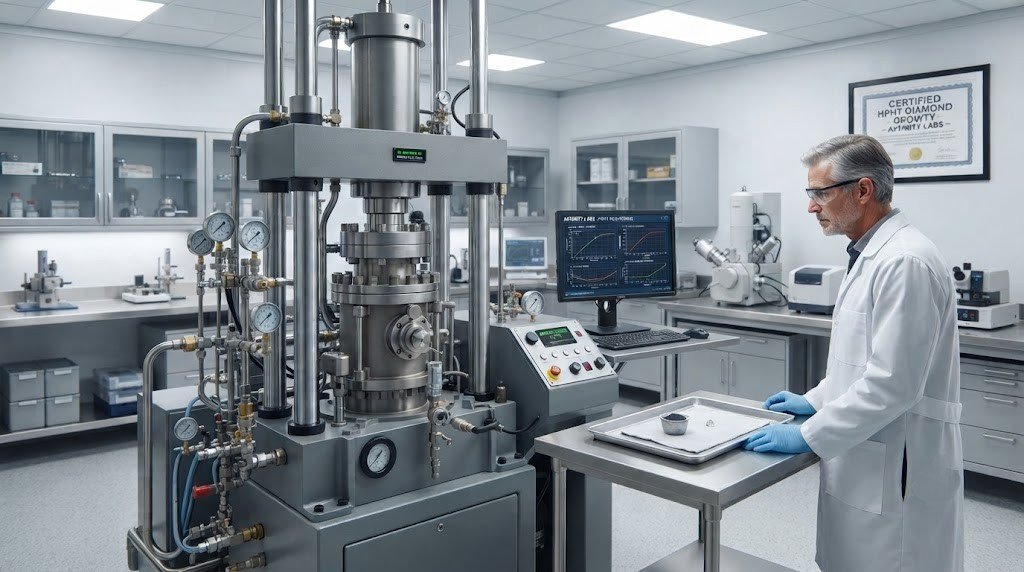
Growth is where the grandmother ashes diamond steps turn carbon into crystal. Most providers grow memorial diamonds by HPHT, recreating pressures of roughly 6–8 GPa and temperatures of about 1,400–2,500°C around a tiny diamond seed. A minority use CVD instead, depositing carbon from a gas onto a seed plate. Either way, the result is a real lab-grown diamond with the same hardness and optical properties as any other. If you want a deeper explanation of this stage, how a memorial diamond is made from her ashes goes further into the science.

How Is the Rough Diamond Finished, Graded and Certified?

Step 9: Cutting and polishing

Cutting is the first of the grandmother ashes diamond steps where the stone starts to resemble jewelry, since a rough diamond leaves the press looking nothing like a finished gem. A cutter or gemologist shapes it into the cut your family chose, then polishes the facets so it catches light.

Step 10: Optional irradiation

Irradiation is an optional extra among the grandmother ashes diamond steps. Some providers use it after growth to shift a stone toward red, pink, green or black; it is a choice, not every company offers it, and specialty colors can lengthen the overall timeline.

Step 11: Grading and the authenticity certificate

Two documents can come with the stone, and they do different jobs. An authenticity or origin certificate, usually issued by the provider, records that the diamond was grown from your family’s submitted material; in effect it is a chain-of-custody record. The other document, a grading report, assesses the 4Cs and is best issued by a third-party laboratory referencing standards such as GIA’s diamond quality factors.

Independent grading is typically a separately priced option. Clarity for memorial diamonds usually falls between SI2 and VVS. Among the grandmother ashes diamond steps, this is the one that gives you documents you can keep and show a jeweler or insurer.

How Does the Finished Stone Reach Your Family?

Step 12: Setting and delivery

The final stage of the grandmother ashes diamond steps is getting the stone into your hands. Some families take the diamond loose and choose a setting later; others have it set before it ships. Settings, engraving and fancy cuts are usually priced separately from the stone. Choose a design that suits whoever will wear it and reflects who she actually was, whether that is a simple pendant, a ring or a stone kept in a small box for a future generation.

When the stone arrives, check it against whatever paperwork came with it, keep those documents together, and ask the provider how delivery is insured and tracked. A diamond rates 10 on the Mohs hardness scale, yet a hard knock can still chip one, so a protective setting is worth discussing if it will be worn daily.

How Long Do the Grandmother Ashes Diamond Steps Take Altogether?

Across the industry, the grandmother ashes diamond steps typically take 6 to 10 months from the day a provider receives her ashes to a finished stone. Larger diamonds, roughly over 2 ct, and specialty colors can take up to about 12 months.

Because growth time decides carat size, a bigger stone simply needs more time in the press. Sending more ash does not shorten the wait. The family conversation and provider research that come first have no set length at all, and taking your time with them is entirely reasonable.

If you hope to have the stone by a particular date, tell the provider before you order and ask whether it is achievable. Providers set their own schedules, so ask each one for its current estimate of the grandmother ashes diamond steps as a whole rather than assuming any single stage will move at a particular pace.

What Do the Grandmother Ashes Diamond Steps Typically Cost?

What a family pays to complete the grandmother ashes diamond steps in 2026 generally follows size and color. The figures below are industry-wide ranges, not Memorial Diamond’s prices, which are not yet published.

SizeTypical industry range
Small: 0.10 to 0.25 caratAround $1,500 to $3,500
Medium: half a carat to 1 caratAround $5,000 to $15,000; colorless costs noticeably more
Large: 2 carats to over 5Around $20,000 to $75,000 and up

Independent grading, engraving, fancy cuts and settings usually add to the total. When several relatives want stones, ask whether separate orders from the same portion change the price, and agree in writing who pays for what. Cost can also shape how the grandmother ashes diamond steps unfold, since choosing a smaller size or a non-colorless tone can bring the total down.

What Happens to the Rest of Her Ashes?

Only a portion of her ashes passes through the grandmother ashes diamond steps, so the rest can remain in an urn, be interred, be scattered, or stay with whichever relative has been keeping them. A diamond can sit alongside any of those choices rather than replacing them.

What a provider does with any ash it receives but does not use is a policy each company sets for itself. Before shipping, ask:

  • Will unused ash be returned, and how?
  • Is any material stored, and for how long?
  • Can material be kept for a second stone later?
  • Will you confirm in writing what happened to every part of what we sent?

Getting those answers in writing before the grandmother ashes diamond steps begin gives your family a clear record of where each part went.

Frequently Asked Questions

Can a grandchild start the grandmother ashes diamond steps without the family’s agreement?

It depends on who holds authority, which state law and her written wishes decide. Often a surviving spouse or partner, then her adult children, come ahead of grandchildren. Asking that person for a small portion is the respectful way to begin.

Do the grandmother ashes diamond steps use all of her ashes?

No. Providers typically ask for between a few tablespoons and roughly 4 oz, usually a small fraction of the total. The rest can stay in an urn, be interred or be scattered as the family already planned, alongside the stone.

Can several cousins each get a stone from the same portion?

Often, yes, because only part of the ashes is used for each stone. Whoever holds authority needs to agree to how the material is shared, and each provider sets its own requirements, so ask about multiple stones before you ship anything.

Which of the grandmother ashes diamond steps can the family control?

Your family controls the early decisions: whether to proceed, which provider, carat, color option, cut, independent grading and setting. Extraction, graphitization, growth and cutting happen in the lab, where your influence comes through the questions you ask beforehand.

Can her ashes still be used if she died many years ago?

Whether ashes kept for a long time are still workable is a question to ask each provider directly. Explain how and where they have been stored, and request a written answer before ordering, since policies and processes differ between companies.

Is the authenticity certificate the same as a grading report?

No. An authenticity certificate, usually issued in-house, documents that the stone came from your family’s submitted ashes. A grading report describes cut, color, clarity and carat, ideally from an independent lab, and is typically an optional, separately priced add-on.

Final Thoughts on the Grandmother Ashes Diamond Steps

Most of this journey asks patience rather than effort. Your family’s part comes at the start, in careful conversations, and at the end, when the stone arrives.

Taking each of the grandmother ashes diamond steps in order, with answers in writing, gives your family a clearer picture of where her ashes are and what is being done with them at each stage.

Talk With Memorial Diamond

If you are weighing the grandmother ashes diamond steps for your family and want a clear answer to any of them, Memorial Diamond is happy to talk it through at whatever pace suits you.

You can reach us through memorialdiamond.us whenever you are ready.

Word count: 3,189 words · Reading time: about 16 minutes

Grandmother Ashes Diamond The Complete Guide

Grandmother Ashes Diamond: The Complete Guide

Maybe her urn sits on a shelf at your aunt’s house, or maybe you are the one who was handed it. A grandmother ashes diamond is a real lab-grown diamond grown partly from carbon recovered from a small portion of her cremated remains, then cut, polished and graded like any other diamond. It is possible for a grandchild to arrange one, though who can release her ashes, how much of the stone is truly hers and what it costs are worth understanding first.

This guide covers every part of a grandmother ashes diamond in plain language, from the science to the family conversations, so you can decide calmly whether it suits your family.
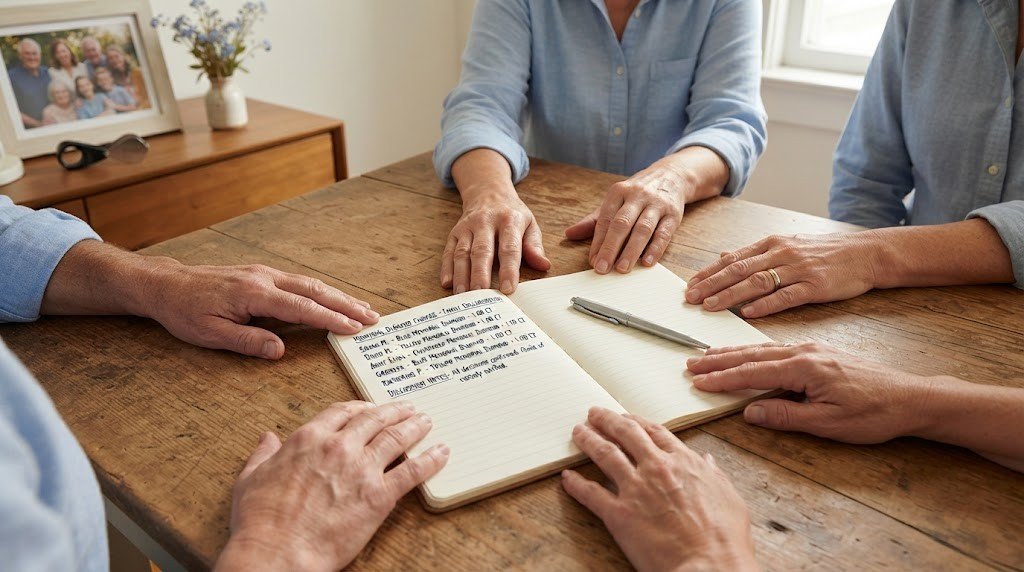
grandmother ashes diamond

What is a grandmother ashes diamond, and what is it not?

A grandmother ashes diamond is a genuine diamond, grown in a laboratory, in which part of the carbon came from her cremated remains. It has the same crystal structure, the same hardness and the same grading scale as any diamond you would see in a jeweler’s case. Because chemically it is simply diamond, nothing in its appearance reveals whose carbon a grandmother ashes diamond holds, which is why the provider’s chain-of-custody paperwork carries so much weight.

It is not glass, resin or crystal with ashes sealed inside. Those keepsakes exist and some families treasure them, but they work differently: the ashes sit inside a clear material as a visible inclusion. In a grandmother ashes diamond, nothing of the ash is visible, because the carbon has become part of the crystal lattice itself.

A grandmother ashes diamond is also not a stone made only from her. That point matters enough to have its own section, because the honest answer shapes how you talk about the stone with the rest of the family.

Why families choose it

Some grandchildren want something of hers they can wear rather than visit; some families are dividing ashes anyway; others like that a diamond is durable enough to hand down. None of these requires giving up an urn, a burial plot or a scattering.

How much of a grandmother ashes diamond is actually her carbon?

Cremated remains are mostly calcium phosphate, the mineral that gives bone its structure. Only a small share is carbon, roughly 0.5% to 4% of the ash by weight, depending on the person and the cremation itself. That carbon is extracted and purified to around 99.9% or higher before any growing begins.

Because so little carbon survives cremation, providers typically blend her purified carbon with supplemental lab carbon to reach the volume a growth press needs. Across the industry, her personal carbon in a grandmother ashes diamond usually makes up around 10–15% of the finished diamond’s mass. Some providers cite figures as low as 3%, and others cite higher ones, depending on stone size and how much ash was sent.

So the truthful description is this: a real, measurable portion of her carbon is locked into a grandmother ashes diamond, alongside carbon from another source. Any company claiming a stone is “100% her ashes” is overstating what the chemistry allows.

What you might hearWhat is accurate
“The diamond is pure ashes”Ash is mostly mineral; only a small carbon share can be recovered
“Every bit of carbon is hers”Her carbon is typically blended with lab carbon
“Her share is a fixed number”Industry figures run around 10–15%, sometimes lower or higher
“You can see the ashes inside”Nothing is visible; her carbon is part of the crystal itself

Ask any provider to state, in writing, the approximate share of personal carbon they expect in a grandmother ashes diamond of the size you are considering.

How is a diamond made from her ashes?

Making a grandmother ashes diamond follows the same broad sequence at most providers. Here is the overview; the full detail on each stage is in our explanation of how a memorial diamond is made from your grandmother’s ashes.

  1. Collection. The ashes are received and logged with chain-of-custody tracking.
  2. Extraction and purification. Heat in an oxygen-free, multi-stage process strips away the minerals, leaving carbon of roughly 99.9% purity or higher.
  3. Graphitization. The carbon is heated to roughly 2,500–2,700°C and converted to graphite.
  4. Growth. The graphite is placed with a tiny diamond seed in an HPHT press at roughly 6–8 GPa and 1,400–2,500°C, and the crystal grows over weeks to months. A minority of providers use CVD instead.
  5. Cutting and polishing. A cutter shapes the rough crystal into the chosen cut.
  6. Optional color treatment. Some providers offer post-growth irradiation for certain colors.
  7. Grading. The stone is graded, ideally by an independent lab.

If you prefer to follow the journey from the family’s side, with paperwork and shipping in order, the practical steps for turning her ashes into a diamond cover that sequence. For background on the growth methods themselves, the overview of synthetic diamond production is a reliable general reference.

How much ash is needed, and what happens to the rest?

The usual request across the industry runs from a few tablespoons of her remains up to about 4 ounces, which is close to 100 grams. That is usually a small fraction of what a cremation returns, which means most of her ashes can stay in the urn, go to a cemetery niche or be scattered exactly as the family planned. The precise amount varies by company, so treat any figure you see as typical rather than fixed.

A full urn does not produce a bigger or faster grandmother ashes diamond. Carat size depends on how long the crystal grows in the press, so the size is something you choose rather than something the volume of ash decides.

Questions to put to any provider

Whatever is left over once the carbon for a grandmother ashes diamond has been extracted is handled according to each company’s own policy, so ask before you send anything:

  • Will unused ashes be returned, and how are they packaged and shipped?
  • How long is material stored, and where?
  • How is her material tracked from arrival to finished stone?
  • What happens if a growth run does not succeed?

You can read more about quantities in our article on how much ash a grandmother memorial diamond needs.

Can a grandchild request a diamond from her ashes?

Yes, a grandchild can start the process for a grandmother ashes diamond, but releasing a portion of her ashes is usually not a grandchild’s decision alone. Who has the right to direct what happens to cremated remains is set by the law of the relevant state and by any written wishes she left, and the order of priority differs between states. Commonly, a surviving spouse or partner is first in line, with her adult children next, which often places grandchildren behind her sons and daughters.

The funeral home or crematory that handled her cremation can usually tell you who signed the cremation authorization. That person, or whoever now holds the urn, is the natural first conversation. A funeral director or attorney in her state can explain how the rules apply there.

A respectful way to ask

Coming to the family with a small, specific request tends to go better than coming with a plan already in motion. You might:

  • Ask whoever holds authority whether a few tablespoons could be set aside, rather than asking for the urn.
  • Explain that most of her ashes would stay exactly where the family wants them.
  • Offer to involve cousins, so it does not feel like one branch of the family is acting alone.
  • Accept a “not now” gracefully; some families need time before dividing anything.

If her ashes are not available to you, hair she left behind may be another route. The complete guide to a grandmother hair diamond explains how that works, including why hair kept at home may still be part of her estate.

What if she died years ago or her ashes were already divided?

The years since her death do not, on their own, rule out a grandmother ashes diamond. Whether a provider can work with ashes that have sat in an urn or a closet for a long time is a judgment each company makes for itself, so describe how they were kept and ask before arranging anything.

Scattered ashes cannot be recovered, and that is simply part of how some families chose to say goodbye. If her ashes were divided among relatives, an aunt, uncle or parent may still keep a portion in a smaller urn or keepsake. A gentle question to them may be all it takes, and the same authority considerations apply to that portion.

Describe exactly what you have, including whether the ashes were ever mixed with anything else, and let the provider tell you what is workable. If the ashes were interred in a cemetery, removing them involves permits and cemetery rules, so talk with the cemetery and a funeral director first.

Can several grandchildren or cousins each receive a grandmother ashes diamond?

Often, yes. Because each grandmother ashes diamond needs only a small portion of ash, several stones can usually be grown from the same shared material, one for each grandchild, cousin or branch of the family. Whether a provider can split one submission into multiple stones, or prefers separate submissions, is something to confirm with them.

Agree early on who will make the request, who holds the paperwork and how costs will be shared. Grandchildren may also want different things: one might want a small stone in a pendant, another a larger one for a ring, and a third might prefer nothing at all. A grandmother ashes diamond for each person who wants one, at the size each person chooses, is a perfectly reasonable outcome.

When cousins disagree

Not everyone will feel the same way about a grandmother ashes diamond, and that is fine. A cousin who prefers the urn stay whole is expressing something real. Keeping the request small, letting those with authority decide and leaving room for different choices can keep a family conversation from becoming a family rift.

What color will a grandmother ashes diamond be?

Whatever tint a diamond carries is set during growth by tiny amounts of other elements in the crystal. Traces of boron lean a stone blue, traces of nitrogen lean it yellow, and only when both are kept out does it come out colorless. Because her carbon comes from an organic source, a grandmother ashes diamond tends toward yellow, blue and champagne or brown tones.

Colorless stones are achievable but need extra processing and typically cost more. Some providers also offer post-growth irradiation to create red, pink, green or black stones. No provider can promise to match a particular shade to a memory of her, such as the color of her eyes, so treat color as a range you choose from rather than an exact result.

Some families choose a color for a grandmother ashes diamond that suits the person who will wear it, or one that simply feels like her. Our article on what color a diamond from your grandmother’s ashes will be goes further into each option.

How much does a grandmother ashes diamond cost?

The price of a grandmother ashes diamond is driven mostly by carat size, then by color, cut and whether an independent grading report is included. The ranges below are general 2026 industry figures, not Memorial Diamond’s own prices, which have not been published.

Size tierTypical industry rangeNotes
Entry (about 0.10–0.25 ct)roughly 1,500–3,500A common choice when several cousins each want a stone
Mid (0.5–1 ct)roughly 5,000–15,000Colorless costs meaningfully more than blue, yellow or champagne
Large (2–5+ ct)roughly 20,000–75,000+Longer growth time, often a longer wait

Independent grading, engraving, fancy cuts and jewelry settings are usually priced separately from the loose stone. When several grandchildren share costs, it helps to get a written quote that separates the stone, the setting and any grading, so each person knows what they are paying for.

Grading and certificates are different things

An authenticity or origin certificate, usually issued in-house, documents that the diamond was grown from your family’s submitted material. A grading report, by contrast, assesses the stone itself on the 4Cs. The most useful ones come from an independent lab working to the scale behind GIA’s diamond quality factors, and that independent report is typically an optional add-on with its own fee. Typical clarity for memorial diamonds falls in the SI2 to VVS range. Ask which documents come with a grandmother ashes diamond and which cost extra.

How long does a grandmother ashes diamond take to make?

Across the industry, a grandmother ashes diamond typically takes 6 to 10 months from the time the provider receives the ashes. Stones over about 2 carats, or specialty colors, can take up to around 12 months, because growth time is what sets the size.

If you are hoping to give a stone for a particular date, such as a birthday she shared with a grandchild or the anniversary of her death, mention it at the start and ask the provider whether that date is achievable, without assuming they can promise it.

Does her faith or yours affect this choice?

No religious tradition has an official position on memorial diamonds as such. What traditions do address is cremation and how ashes are handled, and those views can bear on this decision.

  • Catholic: The Church allows cremation. Its present guidance, though, wants the remains kept together and laid to rest somewhere sacred, permitting only a minimal part to be set aside under limited conditions, which matters a great deal if a portion would leave the urn.
  • Muslim: Every major school of Islamic law treats cremation as not permitted, which means ashes usually never exist to be used. Hair, which requires no cremation, is the route some Muslim families ask about instead.

Catholic and Muslim teaching raise the most direct questions for an ash-based stone. The traditions listed next vary more by movement, community or household.

  • Jewish: Practice depends on the movement. Orthodox and Conservative communities generally do not permit cremation; Reform communities are more open and tend to leave the matter to the family and their rabbi.
  • Hindu: Tradition calls for ashes to be given to a sacred river. Holding back a small amount for a keepsake is reported to be more common now than it once was, yet customs differ widely between families and regions.
  • Buddhist: Whether keeping remains fits with practice is answered differently from one teacher or sangha to the next.
  • Protestant: Few pastors object, although individual congregations sometimes voice unease about splitting ashes.
  • Secular: The decision rests on what feels meaningful to her and to you.

Her beliefs and yours may not match, and other relatives may hold different views again.

Taking the question to clergy

Her own clergy or faith community, or yours, is the right place to take a specific question.

How can you wear or keep it, including as an heirloom?

Let the setting for a grandmother ashes diamond follow who she actually was and who will wear the stone. A grandchild who works with their hands might want a low-profile bezel ring; another might prefer a pendant kept close or a stud worn daily. Some families keep the loose stone in a small case and choose a setting later.

Diamond sits at 10 on the Mohs scale of hardness, which suits everyday wear, though a hard knock against an edge can still chip any diamond. A protective setting helps if the stone will be worn daily.

Passing it down a generation

A grandmother ashes diamond can be handed to a grandchild’s own children one day, so that something of her carries on to people she may never have met. If that is the plan, keep the authenticity certificate and any grading report with the stone, and write a short note about whose carbon it holds and why it was made. Treat it as a family keepsake rather than an investment; nothing about a memorial stone’s resale value should be assumed.

Some families also choose a stone made from both ashes and hair. The complete guide to an ashes and hair diamond for a grandmother explains when combining the two makes sense.

Frequently Asked Questions

Can I get a grandmother ashes diamond if my parent holds her urn?

Yes, if your parent, or whoever holds authority over her remains, agrees to release a small portion. A kind, specific request for a few tablespoons, with the rest staying where the family wants it, is usually the easiest place to begin that conversation.

Is it disrespectful to divide my grandmother’s ashes for a diamond?

That depends on her wishes, your family’s views and any faith tradition involved. Some families divide ashes for keepsakes, while others prefer to keep them whole. Talking with relatives and, where relevant, clergy is the best way to judge what feels respectful.

Will my grandmother’s diamond look different from other diamonds?

Not in kind. A grandmother ashes diamond is a real diamond graded on the same scale as any other. Memorial stones often have yellow, blue or champagne tones because of trace elements, and colorless versions take extra processing and typically cost more.

Can each grandchild choose a different size or color?

Usually, yes. Because each stone uses only a small portion of the shared ashes, cousins can often order different carat sizes, colors and settings. Confirm with the provider how they handle several stones grown from one family’s material and how each order is tracked.

What if her ashes were scattered years ago?

Scattered ashes cannot be gathered back, but a relative may have kept a small portion, and saved hair is another possible source. Ask family members gently what was kept, then describe it to a provider so they can explain what is workable.

Does a bigger portion of ashes make a bigger diamond?

No. Carat size is set mainly by how long the crystal grows in the press, not by how much ash is sent. Extra ash does not produce a larger or faster stone, so most of her ashes can stay with the family.

Final Thoughts on a Diamond Grown From Her Ashes

Deciding what to do with a grandmother’s ashes can involve more people than any other part of the process, whether that means her children, a surviving partner, cousins or sometimes clergy. The grandmother ashes diamond itself is the simpler part. It is a real stone with a real, if modest, share of her carbon, made over several months, at a size and color your family chooses.

If the conversations feel right and the people who hold authority agree, it can sit alongside whatever else the family has chosen for her, whether an urn, a niche or a scattering. There is no need to hurry any of it.

Learn More About Ashes Diamonds for a Grandmother

Talk With Memorial Diamond

If you are weighing whether a grandmother ashes diamond is right for your family, we are glad to talk it through, including the conversations with relatives that often come first. There is no rush and no obligation.

Visit memorialdiamond.us whenever you are ready to ask questions.

Word count: 3,393 words · Reading time: about 17 minutes

What Color Will a Diamond Made From Your Grandmother Ashes Be

What Color Will a Diamond Made From Your Grandmother’s Ashes Be?

Whether her ashes rest with you, with an aunt or uncle, or in a place the family has not yet settled on, it is natural to picture the stone they could become before anyone commits to anything. The most likely grandmother ashes diamond color is a yellow, blue, or champagne-to-brown tone, and no provider can tell you the exact shade until the crystal has finished growing. A colorless stone is achievable with extra processing, usually at a higher price, and some providers also offer treated colors such as pink or black.

That short answer leaves real questions open about grandmother ashes diamond color: why the tones fall where they do, what a grading report will say, and whether color changes the cost or the wait. Each section stands on its own, so go straight to the part you need.

grandmother ashes diamond color

What grandmother ashes diamond color is most likely?

Across the memorial diamond industry, grandmother ashes diamond color, like the color of any stone grown from cremated remains, trends toward three families of tone: yellow, blue, and champagne or brown. Any of the three is a normal result. A stone in one of these shades is a real diamond, graded on the same four Cs (cut, color, clarity, carat) as a mined one.

Which of the three appears depends mostly on trace elements present while the crystal grows. Think of grandmother ashes diamond color as an outcome of chemistry and process choices rather than a menu item. A provider can tell you which tones their natural, untreated stones usually come out in, and that is a fair first question to ask.

Here is how the main possibilities for grandmother ashes diamond color compare:

Grandmother ashes diamond colorWhat usually produces itNatural or treatedRelative cost at the same size
YellowNitrogen present during growthNatural resultLower to middle of the range
BlueBoron present during growthNatural resultLower to middle of the range
Champagne or brownA warm tone common in stones grown from an organic sourceNatural resultLower to middle of the range
Colorless (white)Extra processing that keeps both nitrogen and boron outNatural result, controlled processMeaningfully higher
Red, pink, green, or blackPost-growth irradiation, offered by some providersTreatedVaries by provider; ask for a quote

Why do trace elements shape grandmother ashes diamond color?

Diamond is carbon arranged in a tight crystal lattice. When a few atoms of another element slip into that lattice during growth, the stone absorbs some light and shows a tint. Nitrogen produces yellow tones. Boron produces blue tones. A stone with neither shows no body color at all.

That is the whole basis of grandmother ashes diamond color: carbon recovered from ashes comes from an organic, personal source rather than a carefully controlled lab feedstock. After the crematory, most of what remains is calcium phosphate, the mineral of bone, and only roughly 0.5% to 4% of the ash by weight is usable carbon. That carbon is purified to around 99.9% or better, but trace elements are still common in this kind of source, which is why tinted results are the norm.

How much of the stone is her carbon?

For a stone grown from ashes, the recovered carbon is typically blended with supplemental lab carbon so there is enough to grow a stone of useful size. Industry figures put her share near 10% to 15% of the finished mass. A few providers quote figures closer to 3%, others go higher, and stone size and the amount of ash sent both play a part. Any claim that the stone is made entirely from ashes does not match how the process works.

Knowing that blend is part of the picture helps explain why grandmother ashes diamond color cannot be read off the ashes themselves. The final hue reflects the purified carbon, the supplemental carbon, the growth conditions, and any steps the provider takes to include or exclude particular elements. You can read more about how her ashes become a finished stone, from purification through growth and polishing.

Can a stone from her ashes be colorless?

Yes, a colorless result is an achievable grandmother ashes diamond color. Getting there means the provider has to keep both nitrogen and boron out of the growing crystal, which takes additional processing and closer control in the press. That extra work is the main reason colorless stones typically cost more than tinted ones of the same carat weight.

Some families want colorless because it matches jewelry already in the family, or because the wearer simply prefers a white stone. Others feel a natural grandmother ashes diamond color is closer to the point of the whole thing. Neither choice is more respectful than the other.

If colorless matters to you, ask each provider three things in writing: whether colorless is offered for ash-based stones, how the price compares with their natural tones at the same size, and what happens if a colorless run does not reach the intended result. That last answer is entirely provider-dependent, so get it on paper before you send anything.

What are the treated colors, like pink, red, green, or black?

Some providers offer post-growth irradiation, a treatment applied after the crystal has formed that shifts or deepens grandmother ashes diamond color. Red, pink, green, and black are the shades usually produced this way. These are still real diamonds; the treatment changes how the lattice absorbs light rather than adding a coating.

Irradiated colors are not offered everywhere. A specialty grandmother ashes diamond color, black among them, can also add time, with some stones taking up to about 12 months in total.

Questions worth asking before choosing a treated shade:

  • Is the treatment disclosed on the grading report, and in what words?
  • Which treated colors does the provider offer for stones grown from ashes?
  • How much does the treatment add to the price and to the timeline?
  • Does the provider describe the treated color as stable under normal wear?

Why can’t a family pick or match an exact natural shade?

Natural color in a memorial diamond comes from whatever trace elements end up in the lattice, and that is shaped by an organic source no lab can fully predict. A provider can steer toward colorless by excluding nitrogen and boron, or shift the color afterward with irradiation. What nobody can honestly promise is a particular untreated shade, such as the exact blue of a photograph or a paint chip.

That uncertainty is easier to live with when it is expected from the start. A useful way to frame grandmother ashes diamond color is as something you find out rather than specify. Some families come to value that, since the tone emerged from this one growth run rather than from a catalog.

If you are comparing quotes, be cautious about any promise of an exact grandmother ashes diamond color. Ask the provider to explain, in plain terms, what is and is not under their control, and keep that explanation with your paperwork. The step-by-step process for a stone grown from her ashes shows where in the sequence color is actually decided.

How is grandmother ashes diamond color graded on a report?

Two different documents often arrive with a memorial diamond, and only one of them records grandmother ashes diamond color. An authenticity or origin certificate, usually issued in-house, documents the chain of custody: that this stone was grown from carbon recovered from the ashes your family sent. A grading report describes the stone’s own quality, covering cut, color, clarity, and carat.

Grading is ideally done by an independent lab, most commonly referencing GIA standards and sometimes IGI, and is typically an optional, separately priced add-on. GIA’s overview of the diamond quality factors is a clear plain-language introduction to what the four Cs mean.

What the color line on a report usually says

In general gemology, colorless and near-colorless diamonds are placed on a letter scale, while yellow, blue, and other tinted stones are described by their hue plus an intensity term such as “fancy light” or “fancy intense.” Independent reports also commonly note whether a color comes from treatment. Exact wording varies by lab, so ask to see a sample report before you choose.

Typical clarity for memorial diamonds falls in the SI2 to VVS range, listed beside grandmother ashes diamond color on the same report. If your family wants a grading report, ask about it at the quoting stage so the cost is clear from the start.

Do carat size and cut change how the color looks?

In general, yes, though the effect is about how grandmother ashes diamond color appears, not the underlying chemistry. A larger stone gives light a longer path through the crystal, so a tint can look a little stronger in a bigger diamond than in a small one with the same composition. Memorial diamonds run from about 0.10 carat to more than 5 carats, so that range covers very different looks.

Cut shape plays a part too. Brilliant-style cuts scatter light in a way that can soften how a tint reads, while some step cuts and elongated shapes show body color more openly. Ask the provider for examples of the same tone in different shapes.

Setting metal matters as well: white metals can make a pale tint look cooler, and yellow or rose metals warm it up. If grandmother ashes diamond color is one of your main concerns, ask to see photos of finished stones in a few cuts and settings before deciding.

How does grandmother ashes diamond color affect the price?

Size drives most of the price, and grandmother ashes diamond color comes second. These are general 2026 industry ranges, not quotes from Memorial Diamond, and the final figure depends on carat, color, cut, and whether an independent grading report is included.

Size tierTypical industry rangeWhere grandmother ashes diamond color fits
About 0.10 to 0.25 caratRoughly $1,500 to $3,500Natural tones usually at the lower end
0.5 to 1 caratRoughly $5,000 to $15,000Colorless costs meaningfully more than yellow, blue, or champagne
2 to 5+ caratsRoughly $20,000 to $75,000+Longer growth; colorless and treated colors add further

Engraving, fancy cuts, settings such as a ring or pendant, and an independent grading report are usually priced separately from the loose stone. When grandmother ashes diamond color is a deciding factor in the budget, ask for side-by-side quotes at one carat weight so the difference between a natural tone and colorless is plain.

Does grandmother ashes diamond color change the timeline or ash needed?

Grandmother ashes diamond color can affect the timeline. Across the industry, the full process typically takes about 6 to 10 months from the day the provider receives the ashes. Larger stones, roughly those over 2 carats, and specialty-color stones can take up to about 12 months.

The amount of ash is a separate question. Providers typically ask for somewhere between a few tablespoons and roughly 4 ounces, about 100 grams, which is usually a small fraction of the full remains. Growth time in the press, not the volume sent, sets carat size, so a full urn does not produce a bigger or faster stone.

Sending more ash is also not a way to steer grandmother ashes diamond color toward a particular tone. Color comes from trace elements and from the provider’s process choices. What a larger portion can sometimes allow is more than one stone, so that several relatives each receive one; the guide to how much ash a grandmother memorial diamond needs covers that in more depth.

What to ask about leftover ash

What happens to unused ash is decided by each company. Ask in writing before you ship, and ask how the ashes are tracked from arrival to finished stone.

Who in the family weighs in on the color and the ashes?

Settling on a grandmother ashes diamond color can feel like a small, personal decision, yet it often sits on top of a bigger one: who has the right to decide what happens to her remains. Two things answer that: the law of the state involved, and whatever she put in writing. States rank relatives differently, so no single national order applies. Commonly, a surviving spouse or partner ranks first, followed by her adult children, with grandchildren further down.

If you are a grandchild, the respectful route is usually to ask whoever holds that authority for a small portion. The funeral home or crematory can often tell you who signed the cremation authorization, which is a good starting point. Her ashes may already have been divided, scattered, or kept by an aunt, an uncle, or one of your parents, and she may have died some years ago; a conversation is still possible in each case.

When cousins want different colors

When several grandchildren are involved, grandmother ashes diamond color is worth talking through early. One cousin may want colorless to match an engagement ring, while another prefers whatever natural tone appears. Since a modest portion of ash can often support more than one stone, each person may be able to choose separately; confirm that with the provider. The complete guide to a grandmother ashes diamond walks through the wider family side in detail.

Faith can shape these conversations as well. Religious teaching speaks to cremation and to keeping or dividing ashes; none of the major traditions has ruled on memorial diamonds as such. If faith matters in your family, her clergy or community is the right place to ask.

How do families tie grandmother ashes diamond color to who she was?

For some people, grandmother ashes diamond color is where the stone starts to feel like hers. A blue result might call to mind the lake town she grew up in, or the uniform she wore through her working years. A champagne tone might bring back the desert roads she loved, or the color of a jacket she reached for again and again.

Those links come from your own memories, not from any rule about what suits a grandmother. She may have been bold or reserved, a traveler or a homebody. The stone will also be worn by a particular person, maybe you, a cousin, or one of her children, and their taste deserves equal weight.

Some families wait to see the natural result and build the meaning around it. Others choose colorless or a treated shade to suit how the wearer dresses. Both approaches are sound. If you are still deciding whether hair might be an option alongside or instead of ashes, the post on what color a stone from her hair might be answers the same question for that route.

A note on stones grown from more than one source

Some families combine ash and hair in one stone. The same principles behind grandmother ashes diamond color apply, and the outcome is no more predictable. The page on color for a stone grown from her ashes and hair together looks at that combined route specifically.

Frequently Asked Questions

Can grandmother ashes diamond color be clear like an engagement ring?

Probably not unless you request it. Stones grown from ashes usually come out yellow, blue, or champagne to brown. A colorless result is achievable when the provider excludes nitrogen and boron during growth, which takes extra processing and typically raises the price at the same carat weight.

Can I choose blue for a stone grown from her ashes?

You can tell the provider you hope for blue, but an exact natural shade cannot be promised. Blue comes from boron in the lattice, and an organic source is unpredictable. Ask whether the provider’s process tends toward blue and what happens if the result differs.

Does grandmother ashes diamond color reveal anything about her health or habits?

No reliable link of that kind has been published. Grandmother ashes diamond color depends on trace elements such as nitrogen and boron, the supplemental lab carbon blended in, and the provider’s process. Treat claims that a hue reflects personality, diet, or health as unsupported.

Is a treated pink or black stone from her ashes still a real diamond?

Yes. Irradiation, offered by some providers, changes how the crystal absorbs light after growth; it does not coat or replace the diamond. An independent grading report usually notes that a color is treated, so ask to see how the lab you choose words that disclosure.

If my cousins and I each get a stone, will they all match?

Not necessarily. Grandmother ashes diamond color can differ between stones grown separately from the same ashes, because each growth run is its own process. If matching matters, ask whether every stone can be grown colorless, or accept that slight differences are part of having several stones.

Can her ashes still be used if they were cremated many years ago?

Ashes kept for years raise a fair question. Whether older ashes are workable, and whether storage conditions matter, is a question for each provider. Ask in writing before shipping, and ask whether the age of the ashes affects color, yield, or timeline in their experience.

Final Thoughts on Your Grandmother’s Diamond Color

Grandmother ashes diamond color is one of the few parts of the process that stays a little uncertain right up to the end. For some families, that turns out to be fine. A yellow, blue, or champagne stone is a normal and honest result, and colorless or treated shades remain on the table if they suit the person who will wear it.

The most useful step now is asking clear questions and keeping the answers in writing.

Learn More About Color and Her Ashes

Talk With Memorial Diamond

If you would like to think through color, size, or how to approach your family about a portion of her ashes, Memorial Diamond is glad to talk it over with you. There is no rush and no obligation; questions are welcome at any stage.

You can start whenever it feels right at memorialdiamond.us.

Word count: 3,195 words · Reading time: about 16 minutes

How Much Ash Do You Need for a Grandmother Memorial Diamond

How Much Ash Do You Need for a Grandmother Memorial Diamond?

Opening an urn, even just to think about a spoonful of what is inside, can feel like a bigger step than anyone warns you about. If you are weighing how much ash for a grandmother memorial diamond a provider will want, the usual answer is somewhere between a few tablespoons and roughly 4 oz (about 100 g). Every company sets its own figure, and the amount is normally a small fraction of her ashes, so most of what the family holds stays where it is.

That leaves plenty of room to keep, scatter or inter the rest as planned. The sections below explain why so little is needed, why extra ash does not grow a larger stone, and what to sort out with relatives before anything is measured.

ash for a grandmother memorial diamond


How Much Ash for a Grandmother Memorial Diamond Do Providers Request?

Across the industry, the amount of ash for a grandmother memorial diamond typically falls between a few tablespoons and roughly 4 oz, which is about 100 g. Where a particular company sits in that range depends on its own extraction process and how much margin it likes to keep. No single number applies everywhere, so treat any figure you see online as a starting point and ask each provider for its requirement in writing.

QuantityWhat it usually meansWhat to ask the provider
A few tablespoonsThe lower end of what providers commonly requestIs this enough for the carat size we want, or do you need more as a reserve?
Up to roughly 4 oz (about 100 g)The upper end of typical requestsWhy this amount, and is any of it returned?
More than a provider requestsDoes not produce a bigger or faster stoneWill you accept only what you need and leave the rest with us?
A full urnFar more than any provider normally needsIs there any reason to send it all? (Usually there is none.)
Several measured portionsOne portion per stone when relatives each want oneCan you grow several stones, and does each need its own portion?

The table describes general patterns, not Memorial Diamond’s own requirements, which have not been published yet. Ask every provider you consider to state its own figure for ash for a grandmother memorial diamond, and whether that figure includes a reserve. What it shows is that the amount of ash for a grandmother memorial diamond is modest, and that sending extra rarely helps.

Why do provider figures differ?

Requirements vary because extraction methods vary. One company may recover carbon efficiently enough to work from a few tablespoons, while another may ask for more ash for a grandmother memorial diamond so it has a reserve in case a step needs repeating. Neither approach is wrong, but the reason behind a number is worth asking about, and a clear answer is a good sign of a transparent process.

Why Is So Little Ash for a Grandmother Memorial Diamond Needed?

Most of what sits in an urn is calcium phosphate, the mineral left behind from bone. Only about 0.5% to 4% of that ash, by weight, is carbon, and the exact share varies from one person and one cremation to another. A provider is after that carbon and nothing else, which is why the amount of ash for a grandmother memorial diamond can stay so modest.

To recover it, the ash is heated in a controlled, oxygen-free process run in several stages, which strips away the minerals and leaves carbon at roughly 99.9% purity or higher. That carbon is then turned into graphite at around 2,500–2,700°C, ready for the growth press. The general background on memorial diamonds describes the same broad route.

Her share of the finished stone

With so little carbon to work with, providers typically top up her purified carbon with supplemental lab carbon before growth begins, so the crystal can reach a useful size. Industry figures put her personal carbon at around 10–15% of the finished stone’s mass, with some providers citing as little as 3% and others higher. If that percentage matters to your family, ask for it in writing, and read more on whether the stone truly contains carbon from her ashes.

So the amount of ash for a grandmother memorial diamond is set by what the extraction process needs to recover enough of her carbon, not by the size of the stone you hope for.

Will Sending More Ash Make the Diamond Bigger?

No, though that can come as a surprise. Carat size comes from how long the crystal grows in the press, not from how much ash for a grandmother memorial diamond went in at the start. A family that sends a full urn does not receive a larger stone, nor a faster one, than a family that sends a few tablespoons.

Most memorial diamonds come from HPHT presses working at about 6–8 GPa and somewhere between 1,400 and 2,500°C, and a crystal needs weeks to months to grow. A minority of providers use CVD instead. Either way, carat is something you choose, and that choice then shapes the timeline and the price. Stones are commonly offered from about 0.10 carats up to 5 carats or more.

Knowing this can take some pressure off. Setting aside ash for a grandmother memorial diamond does not mean giving up a large share of her, and holding more back does not shrink the stone.

Who Should Agree Before a Portion of Her Ashes Is Taken?

Decisions about her remains belong to whoever holds that authority under the law of the state involved and under any written instructions she left. The order is not identical from state to state. Very often a surviving spouse or partner is first in line and her adult children follow, both ahead of grandchildren, though that pattern is something to confirm locally rather than assume.

If you are a grandchild, a respectful route usually works well: ask whoever holds authority whether a small portion of ash for a grandmother memorial diamond could be set aside. The crematory or funeral home can usually say who signed the cremation authorization, which is a good clue to who should be asked. If an aunt, uncle or your own parent is keeping the urn, they are often the natural first conversation.

When faith is part of the decision

Religious teaching speaks to cremation and to how ashes are kept, but no tradition has issued a ruling on memorial diamonds themselves. Catholic guidance, for example, permits cremation but asks that ashes be kept together in a sacred place, allowing only a narrow exception for a minimal portion, which bears directly on taking ash for a grandmother memorial diamond. In Hindu practice, ashes are traditionally immersed in a river; holding back a small amount is reportedly becoming more common, though families and regions differ. Views within other traditions differ by community, so the family’s own clergy or community leaders are the right people to ask.

What If Her Ashes Were Already Divided or Partly Scattered?

Ashes are sometimes divided long before anyone asks how much ash for a grandmother memorial diamond a provider would need. Her children may each hold a share, some may have been scattered at a place she loved, or a portion may have been interred. None of that rules out a stone, because the amount of ash for a grandmother memorial diamond is small enough that a single share may well be sufficient.

If ashes have been divided, talk with whoever holds each portion before anything is decided. One relative might be glad to contribute part of their share, or several might each give a little so the ash for a grandmother memorial diamond comes from the whole family. If she died years ago and the ashes have been kept since, ask a provider whether ashes stored for a long time are workable for them; the answer is theirs to give.

When nearly everything has already been scattered or interred, the remaining options depend on what is left. A provider can tell you whether a smaller amount of ash for a grandmother memorial diamond than usual can still be used, and hair kept at home may offer another path.

Can Several Grandchildren Each Have a Stone From Her Ashes?

Often, yes. Because each stone needs only a modest portion, several relatives can frequently each receive a diamond from the same shared ashes, with the ash for a grandmother memorial diamond measured out once per stone or drawn from one portion, depending on the provider. Cousins sometimes coordinate so that every branch of the family has a stone, or a parent arranges one for each grandchild.

Ask a provider whether each stone needs its own measured portion of ash for a grandmother memorial diamond, or whether one portion can supply several stones. Ask too whether stones grown in separate runs might differ in color, since memorial diamonds tend toward yellow, blue and champagne tones and each growth run is its own event. If color is a question for your family, read about what color a diamond from her ashes is likely to be.

A short list helps cousins plan together:

  • Agree who holds authority over the ashes and get their blessing first.
  • Decide how many stones are wanted, and whether sizes should match.
  • Ask the provider how much ash for a grandmother memorial diamond each stone requires.
  • Confirm how portions are labeled and tracked so each stone traces back correctly.
  • Settle how costs will be split before an order is placed.

What Happens to Leftover Ash for a Grandmother Memorial Diamond?

Whatever is left over after the provider has taken its ash for a grandmother memorial diamond is governed by that provider’s policy, so get the answer in writing before you send anything. Some families want every unused grain returned. Others are comfortable with a respectful disposal method the provider describes. What a company actually does with leftover material is its policy, not a general rule.

Useful questions include whether unused ash is returned and how, how long it is stored before return, and whether it is kept separate from other families’ material throughout. Chain-of-custody tracking matters here; ask how the provider labels and logs your grandmother’s ashes from arrival to return. Ask as well what happens if a growth run fails: whether more ash would be needed, and whether the company keeps a reserve from your original portion for that reason.

The ashes that stay with your family can be kept in her urn, scattered, interred, or divided among relatives, exactly as originally planned. A diamond sits alongside those choices rather than replacing them, and cremation is now the more common path in the US, with the NFDA’s 2025 report projecting a 63.4% cremation rate against 31.6% for burial.

How Do You Measure and Send Ash for a Grandmother Memorial Diamond?

Follow the provider’s instructions to the letter, since packaging and shipping requirements differ from one company to another. Many supply a collection kit. The steps below describe a general order of events, not any company’s official procedure.

  1. Get the requirement in writing. Confirm the exact amount of ash for a grandmother memorial diamond that the provider wants, and whether it includes a reserve.
  2. Agree within the family. Make sure whoever holds authority has approved the portion being taken.
  3. Use the provider’s container. If a kit is supplied, use it; if not, ask what kind of sealed container they accept.
  4. Measure gently. A clean spoon over a tray makes it easier to transfer a few tablespoons without spills. If you would rather not do this yourself, ask a funeral director whether help is available.
  5. Label clearly. Add her name and any reference number the provider gives, so the portion is traceable from the start.
  6. Ship by the stated method. Ask the provider which carriers and services it accepts for cremated remains, since carrier rules apply.
  7. Keep records. Save the tracking number, photographs of the sealed package, and every email.

If transferring ash yourself feels like too much, that is understandable, and nobody has to handle her ashes alone. Ask the funeral home or crematory whether it offers to measure out the ash for a grandmother memorial diamond on your behalf, since some do and practices vary.

Does the Amount of Ash for a Grandmother Memorial Diamond Affect Cost or Timing?

Price depends on carat, color, cut and whether an independent grading report is included. The amount of ash for a grandmother memorial diamond does not move the price on its own. As general 2026 industry ranges, not Memorial Diamond’s own pricing:

  • Entry sizes of about 0.10–0.25 ct: in the region of 1,500–3,500
  • Mid sizes of 0.5–1 ct: in the region of 5,000–15,000, and more again for colorless
  • Large stones of 2–5+ ct: in the region of 20,000–75,000+

Grading reports, engraving, fancy cuts and jewelry settings are usually extra. An in-house authenticity certificate documents chain of custody, while a grading report, ideally from an independent lab, describes the 4Cs. Memorial diamonds typically grade between SI2 and VVS clarity.

Timing works the same way: the quantity of ash for a grandmother memorial diamond does not speed anything up. The full process typically takes 6 to 10 months from the day a provider receives the ashes. A stone above about 2 carats, or one in a specialty color, may need as long as 12 months. For the sequence from first contact onward, see each step of turning her ashes into a diamond, and for the bigger picture, the complete guide to a diamond made from your grandmother’s ashes.

Is Her Hair an Option if Very Little Ash Remains?

Sometimes it is. When too little ash for a grandmother memorial diamond remains, hair can be another route. Hair is about 50% carbon, so far less material is needed, typically a small lock or a few grams, and no cremation is involved. If her ashes have mostly been scattered or interred, a lock of hair kept by the family may make a stone possible.

Whether hair that was colored or permed is accepted is a provider question. Hair kept at home is usually easier to arrange than ashes, but her belongings can form part of her estate and the rules vary by state, so check with the executor or whoever is handling her affairs. The guide to how much of her hair a stone usually needs covers this route, and some families combine both sources, explained in the quantities for a combined ash-and-hair stone.

Frequently Asked Questions

Is a few tablespoons of her ashes really enough for a diamond?

Often, yes. Some providers can work from a few tablespoons of ash for a grandmother memorial diamond, while others ask for up to roughly 4 oz, about 100 g. Because only the carbon is extracted and growth time sets carat size, a modest portion can be enough.

Will a bigger portion of her ashes give a bigger diamond?

No. The press decides size: a stone grows larger the longer it stays in growth, whatever quantity of ash was sent. Sending a full urn does not produce a larger or faster stone, and most of her ashes can stay with the family.

Can her ashes be used if they were divided among her children years ago?

Often they can. Because a stone needs only a small portion, one relative’s share may be enough. Talk first with whoever holds each share, and ask the provider directly whether ashes kept for many years are workable for its process.

Do I need my aunt’s or uncle’s agreement to take a portion?

That turns on who has authority over her remains, which is settled by state law and anything she put in writing. A surviving spouse or partner and then her adult children often come before grandchildren. The funeral home or crematory can usually say who signed the cremation authorization.

How many stones can come from one grandmother’s ashes?

Several relatives can often each receive a stone from shared ashes, because each needs only a modest portion. Ask the provider how much each stone requires, whether portions must be separate, and whether stones from different growth runs might vary in color.

What if most of her ashes have already been scattered?

A stone may still be possible from what remains, so ask a provider whether a smaller amount can work. A lock of her hair is another route, since hair is about 50 percent carbon and needs no cremation.

Does sending more ash for a grandmother memorial diamond change the price?

No. Price reflects carat, color, cut and extras such as a grading report or setting. As a general industry range, stones of about 0.10 to 0.25 carats run roughly $1,500 to $3,500, with larger and colorless stones costing more.

Final Thoughts on Setting Aside Her Ashes for a Diamond

The portion of ash for a grandmother memorial diamond is small, usually a few tablespoons to about 4 oz, and the size of the stone comes from time in the press rather than from what you send. That leaves her ashes largely where the family has chosen to keep them.

The most useful work happens before anything is measured: agreeing with the relatives who hold authority, asking each provider for its numbers and policies in writing, and deciding together what happens to anything left over.

Learn More About Using Your Grandmother’s Ashes for a Diamond

Talk With Memorial Diamond

Whether you are still deciding or simply want to understand what would be involved, Memorial Diamond is glad to talk it through. We can walk you through quantities, questions to raise with your family, and what to expect at each stage.

You can reach us through memorialdiamond.us at whatever pace suits you. Asking a question is just that, a question.

Word count: 3,164 words · Reading time: about 16 minutes

How Much Ash and Hair Do You Need for a Grandmother Memorial Diamond

How Much Ash and Hair Do You Need for a Grandmother Memorial Diamond?

Maybe an aunt keeps part of her ashes, and you have a lock of her hair in a drawer. To gather ash and hair for a grandmother memorial diamond, you typically need only a little of each: a few tablespoons up to roughly 4 oz (about 100 g) of ashes, plus a small lock or a few grams of hair. Every figure is provider-dependent, and the first thing to confirm is whether a provider combines the two at all.

A combined stone brings two materials, often two households, and sometimes two sets of decision-makers into one plan. Knowing what collecting ash and hair for a grandmother memorial diamond involves makes the conversations with family and providers far easier.

ash and hair for a grandmother memorial diamond

Will a Provider Combine Her Ashes and Hair in One Diamond?

Not necessarily. A provider may offer to recover carbon from ash and hair for a grandmother memorial diamond and grow a single stone from the combined result. Others may prefer to work with one material per stone, or may offer to grow two separate diamonds: one from her ashes and one from her hair. The only reliable answer comes from the provider you are considering.

Asking this before anyone portions out ash and hair for a grandmother memorial diamond saves a great deal of effort. If a provider will not blend, there is no point coordinating ash and hair for a grandmother memorial diamond into one shipment. You might instead choose a single material, or plan two smaller stones that sit together in one setting or go to different relatives.

When a provider does offer a combined stone, ask how it handles ash and hair for a grandmother memorial diamond during extraction. Are they processed together or separately and then joined before growth? How is each one logged? The answers shape what documentation you receive at the end, and they tell you how carefully the provider thinks about chain of custody.

How Much Ash and Hair for a Grandmother Memorial Diamond Is Usually Requested?

The industry gives broad ranges for ash and hair for a grandmother memorial diamond rather than a single number, and the two figures differ sharply. Ashes are mostly calcium phosphate, the mineral of bone, with usable carbon at only around 0.5% to 4% by weight. Hair is built from keratin, which is about 50% carbon. That gap explains why a request for ash and hair for a grandmother memorial diamond may be tablespoons of one and only grams of the other.

MaterialTypical request across the industryApproximate carbon contentCremation involved?
Cremated ashesA few tablespoons up to roughly 4 oz (about 100 g)Roughly 0.5% to 4% usable carbonYes
HairA small lock or a few gramsAbout 50% carbonNo
Both togetherProvider sets the amount of eachNot published for a blended stoneOnly for the ash portion

These are guides, not minimums. A provider asking for ash and hair for a grandmother memorial diamond may want a different amount of each than it would for a single-material stone, or a margin in case a step needs repeating. Ask for both quantities in writing, and ask whether they change with the carat size you choose.

When families set aside ash and hair for a grandmother memorial diamond, the ash portion is usually a small fraction of what the crematory returned. That leaves most of her ashes free for the urn, burial plot, niche or scattering place the family already chose, and it means a diamond can sit beside those plans rather than replacing any of them.

Does Sending Extra Ash or Hair Change the Carat Size?

No. A diamond grows larger the longer it stays in the growth press, so carat size is a choice you make when ordering rather than a result of how much material you send. Doubling the ash and hair for a grandmother memorial diamond, whether a full urn or a thick envelope of hair, will not produce a bigger or quicker stone than the provider’s standard amounts.

Most memorial stones are grown by HPHT, which subjects a small diamond seed to roughly 6 to 8 GPa of pressure and about 1,400 to 2,500°C. A minority of providers use CVD instead, depositing carbon from a gas onto a seed plate. Before either method, carbon recovered from the ash and hair for a grandmother memorial diamond is refined to about 99.9% purity or better and turned into graphite at roughly 2,500 to 2,700°C. Lab-sourced carbon is then typically added to make up the volume a given carat weight requires.

Because extra material does not translate into extra carats, limiting the ash and hair for a grandmother memorial diamond to what is requested is usually the gentler path. It leaves more of her ashes where the family intended and more of her hair in the keepsakes relatives already treasure. If a provider keeps some material in reserve, ask whether the unused portion of each is returned, stored or disposed of, and what that costs.

Who Has the Say Over Her Ashes, and Who Over Her Hair?

The ash and hair for a grandmother memorial diamond can sit under different kinds of decision. With ashes, the right to decide flows from state law and from anything she put in writing, and each state ranks family members in its own way. Grandchildren frequently come after a surviving spouse or partner and then her adult children, but not in every case. A practical first step is to ask the crematory or funeral home whose signature is on the cremation paperwork.

Hair is often more straightforward, since no cremation paperwork is involved. Still, the belongings someone leaves behind may be treated as part of the estate, and states handle that differently. Before sending ash and hair for a grandmother memorial diamond, have a brief word with whoever is acting as executor or otherwise settling her affairs about the hair as well as the ashes.

If you are a grandchild without that authority, there is still a respectful way to request ash and hair for a grandmother memorial diamond. Approach whoever holds it, whether that turns out to be your mother, your father, an aunt or an uncle, and ask if they would be open to setting aside a modest share of the ashes for a stone. Where an estate question becomes contested, a local estate attorney is the right person to explain how your state treats it.

How Can Relatives Holding Different Materials Work Together?

Pulling together ash and hair for a grandmother memorial diamond often means that one relative holds the ashes and another holds the hair. Cousins, siblings, step-relatives and her children may all have a stake, and some may want a stone of their own. A little structure keeps the process kind.

Points worth settling together:

  • Who will speak with the provider and place the order, or whether each person orders separately
  • How much ash and hair for a grandmother memorial diamond each household is willing to contribute
  • Whether everyone wants a combined stone, or whether some would rather have ash-only or hair-only diamonds
  • How costs will be divided, if they are shared
  • What should happen to any material the provider does not use

Several stones can often be grown from one shared source, because each requires only a portion. That makes it possible for more than one grandchild to receive a diamond, provided the material stretches and the provider agrees. Ask how it tracks each stone separately so every recipient gets paperwork tied to their own diamond.

If relatives disagree about sharing ash and hair for a grandmother memorial diamond, there is no need to push the decision through. A pause while everyone thinks it over costs nothing, and the decision can wait until the family is ready.

What Is Published About the Carbon in a Blended Stone?

The only published estimate of personal carbon applies to ash-only diamonds, where it commonly sits near 10 to 15% of the finished weight; certain providers quote lower numbers, some as low as 3%, while others quote more. Nothing equivalent exists for hair-only stones, and nothing exists for a diamond grown from a blend of ash and hair.

So the honest position is this: a stone grown from ash and hair for a grandmother memorial diamond contains carbon recovered from her, purified and typically mixed with supplemental lab carbon, but the share of the finished diamond that came from her is something each provider must answer for itself. Ask in writing how much of the finished stone comes from the ash and hair for a grandmother memorial diamond you send, and how that is measured and recorded. Be cautious of any description of the stone as entirely her, since that does not match how the industry says these diamonds are grown.

The finished piece is a genuine lab-grown diamond: it scores 10 for hardness on the Mohs scale and is assessed for cut, color, clarity and carat exactly like a mined one; the general background on memorial diamonds covers the category’s history. The explainer on whether a stone is really made from her ashes and hair goes deeper into that honesty question, and the walk-through of how a diamond is grown from both materials explains each stage.

Paperwork matters here too. An authenticity or origin certificate, typically issued in-house, documents chain of custody. A grading report, ideally from an independent lab working to GIA standards and sometimes IGI, describes cut, color, clarity and carat, and is usually an optional add-on with its own price.

What If Her Ashes Were Scattered, Buried or Already Divided?

Families arrive at this question at very different points. She may have died years ago, her ashes may have been scattered somewhere meaningful, or they may already sit in several homes. Cremation is now the more common choice in the United States: the NFDA’s 2025 report projects a 63.4% cremation rate against 31.6% for burial, which means many families have ashes somewhere in the picture, though not always within reach.

If combining ash and hair for a grandmother memorial diamond is off the table because none of her ashes can be gathered, a hair-only stone needs no cremation at all, so it stays possible whether she was buried or her ashes were scattered or interred, provided a lock of her hair was kept. The companion piece on how much hair alone a provider may need explains that route. If ashes are available but hair is not, an ash-only stone is the other option, and the post on how much of her ashes a provider may ask for covers the amounts.

When faith is part of the decision

Religious teaching speaks to cremation and what happens to ashes afterward; none of the major traditions has ruled on memorial diamonds themselves. Catholic guidance accepts cremation yet asks for the ashes to be kept whole in a consecrated resting place, with only a tightly limited allowance for a minimal portion, a point that matters whenever ashes would be split. Islamic schools of thought broadly consider cremation impermissible, so a stone using ashes would not arise, while a hair-only stone involves no cremation. Orthodox and Conservative Judaism generally prohibit cremation, and Reform practice is more open. If faith matters to your family, talk with your own clergy or faith community before setting aside ash and hair for a grandmother memorial diamond.

Which Questions Should You Put to a Provider Before Sending Both?

Writing your questions down before calling makes it easier to compare how providers treat ash and hair for a grandmother memorial diamond. The list below focuses on what changes when two materials travel in one order rather than one.

About the materials themselves

  1. Do you grow a single stone from both materials, or separate stones from each?
  2. How much ash and hair for a grandmother memorial diamond do you need for the carat size we want?
  3. Do you accept hair that has been dyed, permed or otherwise treated, and very short hair?
  4. Are ashes that have been stored for many years still workable for you?

About tracking, outcomes and paperwork

  1. What share of the finished stone comes from the material we send, and how is that documented?
  2. How do you track each material from arrival through growth?
  3. What happens to unused ashes and hair afterward?
  4. If a growth run fails, what happens next, and who bears the cost?
  5. Is an independent grading report included, or is it an extra?

Keep the answers about ash and hair for a grandmother memorial diamond in writing. They make comparison simpler, and they give the whole family a shared record of what was agreed. The complete guide to a grandmother ashes and hair diamond covers settings, color and family planning beyond these questions.

What Will a Combined Stone Cost, and When Will It Be Ready?

Cost is driven by carat, color, cut and extras, not by how much ash and hair for a grandmother memorial diamond you supply. Memorial Diamond has not yet published its own prices, so the figures below are general industry ranges for 2026:

Size tierApproximate caratTypical industry price range
Entry0.10 to 0.25 ctAbout $1,500 to $3,500
Mid0.5 to 1 ctAbout $5,000 to $15,000, with colorless costing meaningfully more
Large2 to 5+ ctAbout $20,000 to $75,000 or more

Independent grading, engraving, fancy cuts and jewelry settings are usually charged on top. Color has its own logic: boron produces blue, nitrogen produces yellow, and colorless stones require keeping both out, which adds processing and cost. Memorial stones commonly land in yellow, blue and champagne tones, with some providers offering post-growth irradiation for other colors. The guide to the color a stone from her ashes and hair may take goes into the options.

For timing, the industry typically quotes 6 to 10 months from the date the provider receives the material, rising to around 12 months for stones above roughly 2 ct or in specialty colors. A stone grown from ash and hair for a grandmother memorial diamond follows the same general window, but ask each provider whether handling two materials changes its estimate.

Frequently Asked Questions

Can a provider make one diamond from both her ashes and her hair?

Some providers do, and others prefer one material per stone or offer two separate diamonds. Ask directly before gathering ash and hair for a grandmother memorial diamond, since the answer decides whether the materials need to be coordinated and shipped together at all.

How much of each material is typically needed?

Industry guidance on ash and hair for a grandmother memorial diamond is usually a few tablespoons up to roughly 4 oz of ashes, plus a small lock or a few grams of hair. Providers set their own amounts, so get both in writing.

Will combining her ashes and hair make the stone larger?

No. Carat size depends on how long the diamond grows in the press, not on how much ash and hair for a grandmother memorial diamond arrives. Adding hair to ashes, or sending extra of either, does not increase the size or shorten the timeline of the finished stone.

What share of a combined stone comes from her?

No industry figure is published for stones blending ash and hair. The 10 to 15% range often quoted applies to ash-only stones. Ask each provider in writing what share of the finished diamond comes from her material and how that is documented.

My aunt holds her ashes and I have her hair. Who decides?

Authority over ashes depends on state law and any written wishes, and a surviving spouse or her adult children often come first. Hair kept at home is usually simpler, but talk with whoever is settling the estate and agree a plan together.

Can several grandchildren each receive a combined stone?

Often several stones can come from shared material, since each uses only a portion. Whether there is enough for combined stones for everyone depends on how much of each material exists and the provider’s per-stone requirements, so ask before promising anyone a diamond.

What if her ashes were scattered years ago?

A hair-only stone involves no cremation, so it remains possible if a saved lock of her hair exists. Ask a provider whether the amount you have, and the way it has been stored, is workable before deciding which route to take.

Final Thoughts on Combining Her Ashes and Hair

The quantities of ash and hair for a grandmother memorial diamond are rarely what holds families back. More often it is the coordination: who keeps what, who has the say, and whether a provider will blend the two at all. Settling those questions in writing, and in conversation with the relatives involved, tends to make everything after it simpler.

A combined stone is one choice among several. A hair-only or ash-only diamond, a portion kept in an urn, or no diamond at all are all reasonable outcomes, and the right one is whatever fits your family and who she was.

Learn More About Diamonds Grown From a Grandmother’s Ashes and Hair

Talk With Memorial Diamond

If your family is setting aside ash and hair for a grandmother memorial diamond, Memorial Diamond is happy to help you think through amounts, family arrangements and the questions above. We will give you straight answers, including the ones that are still provider-dependent.

Whenever you are ready, you can reach us at memorialdiamond.us. There is no timeline to keep, and you are welcome to take as long as you need.

Word count: 3,120 words · Reading time: about 16 minutes