
Some families end up holding two things after a grandmother dies: a share of her cremated remains, and a lock of hair someone saved. A grandmother ashes hair diamond is a lab-grown diamond grown partly from carbon recovered from both, but only some providers will combine the two materials in one stone. Where they do, you get a real, gradable diamond; where they do not, two separate stones are the usual alternative.
This guide walks through what is actually known about a grandmother ashes hair diamond, what nobody has published yet, who gets a say, and what to put in writing before anything is shipped.
Table of Contents
What is a grandmother ashes hair diamond?
A grandmother ashes hair diamond is a lab-grown diamond whose starting carbon includes some recovered from her cremated remains and some recovered from her hair. It is not glass, resin or a simulant. It is grown with the same methods used across the lab-grown industry, most often HPHT and occasionally CVD, and it is graded on cut, color, clarity and carat like any other diamond.
The finished grandmother ashes hair diamond sits at 10 on the Mohs scale of hardness, which makes it practical for a ring worn every day. Hardness is not the same as toughness, though. A hard blow against a door frame or countertop can chip a diamond, which is why a bezel or other guarded mount makes sense for a stone worn daily.
How is the stone made from two materials?
The broad sequence is the same one used for single-material stones. Each material is received and logged with chain-of-custody tracking, then heated in an oxygen-free process that strips away everything that is not carbon. The recovered carbon is purified to roughly 99.9% or better, converted to graphite at around 2,500–2,700°C, and grown in a press at roughly 6–8 GPa and 1,400–2,500°C over weeks to months.
Cutting, polishing and grading follow. If you want the lab science in more depth, a separate walkthrough of how a stone is grown from both her ashes and her hair covers each stage. The step that differs between providers, and the one that decides whether a grandmother ashes hair diamond is possible at all, is whether the two recovered carbons ever share a growth cell.
Why would a family want her ashes and her hair in one stone?
The reasons are usually personal rather than technical. For some families, a grandmother ashes hair diamond feels like the most complete way to keep both kinds of keepsake together, especially when the hair was saved years before she died and the ashes came later. Others simply have both on hand and do not want to choose between them.
There can also be practical motives. Hair is roughly 50% carbon by weight, while ash holds only a small amount, so a family might hope that adding hair raises the share of her own carbon in a grandmother ashes hair diamond. Whether that hope holds up depends on the provider’s method, and there is no published number to confirm it, so treat it as a question rather than an expectation.
Some families decide against blending once they learn more. A grandmother ashes hair diamond is one option among several, and keeping the urn, scattering most of the ashes, or framing the lock of hair are all equally sound ways to remember her.
Will a provider combine both materials into a grandmother ashes hair diamond?
This is the first thing to find out, because the answer varies. Some providers in the industry describe accepting both materials for one stone; others work with one source per diamond and will suggest two separate stones instead. Nothing about the basic chemistry rules a blend out, since carbon purified from either source ends up as graphite, but each lab sets its own process rules.
If you are hoping for a grandmother ashes hair diamond, ask early and ask in writing. A useful framing is: “If we send both her ashes and her hair, will carbon from both go into the same growth run, and how will you document that?” A clear written answer tells you far more than a sales page.
What a clear answer usually covers
A provider that does make a grandmother ashes hair diamond should be able to explain how each material is logged separately on arrival, whether the two are processed together or apart before growth, and how the certificate of origin will name both sources. If an answer is vague, that is a reason to keep asking, not a reason to assume.
How much of the finished stone is really her carbon?
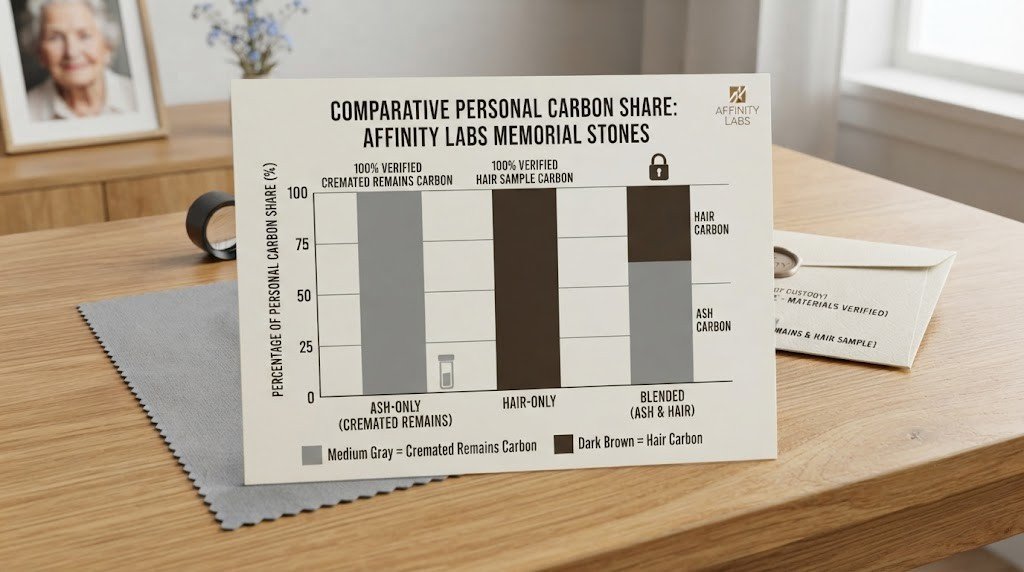
Honesty matters most here, because this is where marketing tends to overreach. By weight, ash is overwhelmingly calcium phosphate from bone, and the carbon a lab can actually use amounts to roughly 0.5% to 4% of it. Because that yield is so small, providers typically top it up with supplemental lab carbon before growth.
For ash-only stones, the personal carbon is commonly cited at around 10–15% of the finished mass, with some providers quoting figures as low as 3% and others higher. That range describes the ash route only. No equivalent finished-stone figure has been published for hair-only stones, and none has been published for a grandmother ashes hair diamond that blends the two.
So the honest position is that hair’s higher carbon content might change the picture, but nobody can tell you by how much without seeing a specific provider’s method. Ask each provider, in writing, what share of the finished grandmother ashes hair diamond they expect to come from her carbon, and how they arrive at the figure. A claim that the stone is “100% her” is not how the process works.
| Route | Carbon in the raw material | Published personal share of the finished stone | Cremation involved |
|---|---|---|---|
| Ashes only | About 0.5–4% of ash weight | Around 10–15% (some cite 3%, some higher) | Yes |
| Hair only | About 50% of hair weight | No published figure; ask the provider | No |
| Ashes and hair blended | Varies with how much of each is used | No published figure; ask the provider | Yes, for the ash portion |
A grandmother ashes hair diamond is still physically, verifiably grown in part from her. That is a meaningful thing on its own terms, and it does not need exaggerating.
Would two separate stones suit your family better than a grandmother ashes hair diamond?
When a provider will not blend, or when the family is unsure, two stones are a common alternative: one grown from a portion of her ashes and one grown from her hair. Some families like the separation, because each stone keeps a single clear origin on its certificate, something a grandmother ashes hair diamond cannot offer.
Here are the trade-offs worth weighing:
- Cost: each stone is quoted and grown on its own, so compare the two quotes together against one larger stone; because price climbs steeply with carat size, the answer is not always what you expect.
- Documentation: each stone carries its own origin record, which some families find simpler to explain later.
- Who wears what: a pair can be split between two relatives, or set together in one piece, such as a pendant with two settings.
- Material: the hair-only stone needs no cremated remains, which matters for relatives who would rather the ashes stay intact.
- Timeline: two runs may proceed in parallel or one after another; ask the provider which.
The ash-based route on its own is covered in detail in the complete guide to a grandmother ashes diamond, and the hair-only route has a companion guide built around her hair alone.
How much ash and hair does a provider usually ask for?
Requests differ by provider, so treat any number as general rather than a rule. On the ash side, the amounts providers mention run from a few tablespoons to around 4 oz (roughly 100 g). Against a full set of cremated remains that is modest, so the bulk of her ashes can still go to the urn, a plot or a scattering.
For hair, a small lock or a few grams is the usual request, because so much of hair’s weight is carbon. A combined grandmother ashes hair diamond may call for less of one material when more of the other is supplied, but only the provider can say how they balance it. Specific numbers for each side of the blend are worth reading about in the guide to how much ash and hair a combined stone needs.
One fact surprises many people: sending more material does not make a larger stone. Carat size comes from how long the diamond grows in the press, so a full urn does not buy a bigger or faster grandmother ashes hair diamond.
Is her hair still usable if it was colored or permed?
Hair that was dyed, permed, or chemically treated may or may not be accepted, and that is a provider decision rather than a general rule. Do not assume the hair’s natural or treated color will change the stone’s color. Ask whether treated hair is accepted, and whether hair from a brush or an old keepsake envelope is workable.
Who has the right to decide about her ashes and her hair?
Two things settle who decides about her ashes: the law of the state involved and anything she put in writing. States do not rank relatives identically, but a surviving spouse or partner, and after them her adult children, commonly stand ahead of grandchildren. A short call to the crematory or funeral home can usually confirm whose signature is on the cremation paperwork.
If you are a grandchild, the respectful route is to speak with whoever holds that authority and ask whether a small portion could be set aside. If the ashes are with an aunt, an uncle or your parent, or were divided years ago, the same conversation applies to whoever now keeps each share.
Before any grandmother ashes hair diamond is ordered, the hair needs its own thought. Hair kept at home is often the simpler practical question, but it is not automatically free of rules. Her belongings can form part of her estate, and how that works depends on the state, so a quiet word with the executor or the person settling her affairs avoids misunderstandings later. A grandmother ashes hair diamond touches both questions at once, which is one more reason to talk before ordering.
What if faith shapes the decision?
No religious tradition has an official position on memorial diamonds as such; the guidance that exists concerns cremation and the handling of ashes. Catholic guidance permits cremation but asks that ashes be kept whole in a sacred place, with only narrow room for a small portion. Major schools of Islamic thought regard cremation as impermissible, so an ash-based stone would not arise, though a hair-based stone involves no cremation. Orthodox and Conservative Judaism generally prohibit cremation, while Reform Judaism is more permissive.
Hindu families traditionally immerse ashes, and keeping a small portion is described as increasingly common but varies. Most Protestant clergy raise no objection, though some congregations do, while Buddhist views depend on the teacher and community; secular families decide by personal meaning. For a family weighing a grandmother ashes hair diamond, her own clergy or community is the right place to ask.
What color might a grandmother ashes hair diamond be?
Whatever trace elements sit in the growth cell decide the hue. A little boron tints the crystal blue and a little nitrogen tints it yellow; getting a colorless result means shutting both out, an extra processing effort that generally raises the price. Memorial stones in general lean toward yellow, blue and champagne or brown tones.
Neither material reliably gives a grandmother ashes hair diamond a lighter, cleaner or more predictable color than the other would, and a family cannot choose an exact shade or match a natural one. Some providers also offer post-growth irradiation to reach red, pink, green or black. The color question for a blended stone is explored further in what color a stone grown from both her ashes and hair might be.
Grading is separate from the certificate of origin. An in-house certificate records where the carbon came from, while a grading report from an independent lab, usually referencing the GIA’s diamond quality factors, records cut, color, clarity and carat. Independent grading is typically an optional add-on with its own fee.
What does a grandmother ashes hair diamond cost?
Prices below are general 2026 industry ranges, not Memorial Diamond’s own prices, which are not yet published. Size and color drive the cost far more than which materials are used.
| Size | Typical industry range (2026) | Notes |
|---|---|---|
| About 0.10–0.25 ct | Roughly 1,500–3,500 | A common size for a pendant or a pair of small stones |
| About 0.5–1 ct | Roughly 5,000–15,000 | A colorless stone of this size is priced well above a tinted one |
| About 2–5+ ct | Roughly 20,000–75,000+ | Longer growth and closer process control |
Grading reports, engraving, fancy cuts and settings are usually priced separately. Whether combining two materials adds any fee to a grandmother ashes hair diamond is a question for each provider. Clarity in memorial stones commonly falls between SI2 and VVS, and sizes run from about 0.10 to more than 5 carats.
How long does a grandmother ashes hair diamond take to make?
Industry-wide, expect roughly 6 to 10 months between the lab logging her ashes and hair and the stone being ready. Larger stones over about 2 carats, and specialty colors, can take up to around 12 months. Building that window into family plans, such as a gathering or an anniversary, avoids disappointment.
Can grandchildren and cousins each have a stone?
Often, yes. Because each stone uses only a portion of the material, several relatives can usually each receive their own diamond from the same shared source, subject to the provider’s rules. That can mean one grandmother ashes hair diamond for each branch of the family, or a mix of blended and single-material stones.
Coordination is the hard part, not the chemistry. Cousins may live far apart, have different budgets, and feel differently about the ashes. A single point of contact, one shared order, and an agreed note on who receives what tend to keep things calm. Families planning several stones can learn more about the practical steps for turning her ashes and hair into a diamond.
A grandmother ashes hair diamond can also become an heirloom, passed from one generation to the next. That is a family meaning, not a financial one, and no claim about resale or investment value should shape the decision.
What should you ask a provider in writing?
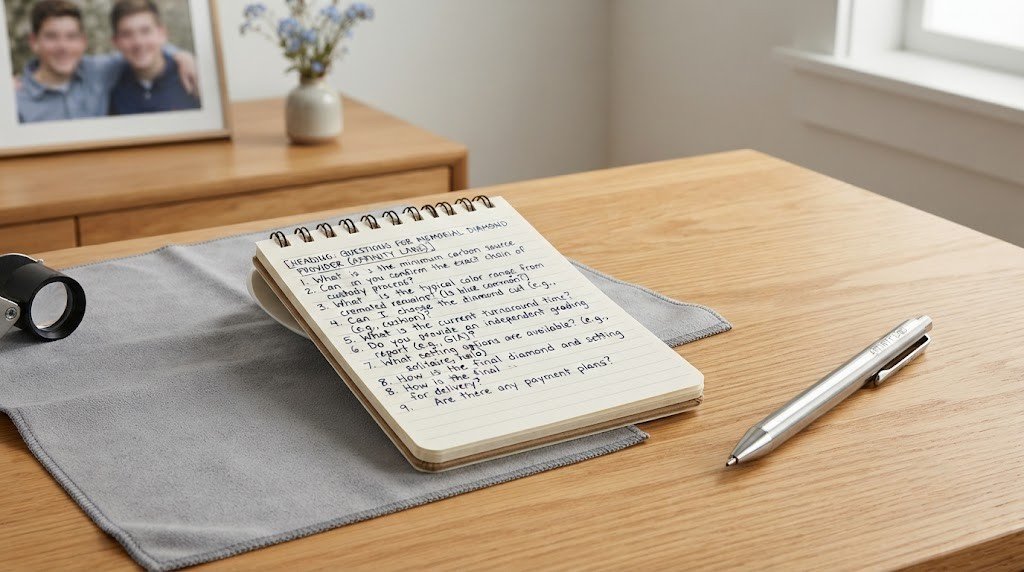
Written answers protect everyone, especially when several relatives are involved. Before sending anything, ask for clear replies to these questions:
- Will carbon from her ashes and her hair go into the same growth run, or do you only make separate stones?
- Roughly what proportion of the finished grandmother ashes hair diamond will be her own carbon, and what is that estimate based on?
- How much of each material do you need, and do you accept dyed, permed or long-stored hair?
- How is each material tracked from arrival to finished stone, and what does the certificate of origin name?
- What happens to any material you do not use, and can it be returned?
- What happens if a growth run fails, and what are your refund terms?
- Is independent grading included, or is it a separate fee?
- Which colors do you offer, and do any involve irradiation?
If you want to test whether a provider’s claims hold up, a guide to checking whether a blended stone really contains her carbon sets out what evidence to request.
Frequently Asked Questions
Can her ashes and her hair go into one diamond?
Sometimes. Some providers will place carbon recovered from both materials into a single growth run, while others only make one stone per material. Ask directly, and get the answer in writing, before you send any of her ashes or hair.
Does adding her hair raise the share of her carbon in the stone?
Possibly, since hair is about half carbon by weight, but no provider-independent figure has been published for a blended stone. The 10–15% share often quoted applies to ash-only stones, not to a grandmother ashes hair diamond. Ask each provider what share they expect.
Do the grandchildren need permission to use her ashes?
Usually someone else decides. State law and her written wishes set who holds authority, and a surviving spouse or partner or her adult children often come first. Ask whoever holds that authority for a small portion, and coordinate with any cousins who share the ashes.
Is hair from her hairbrush enough for the hair portion?
It may be, but acceptance depends on the provider. A small lock or a few grams is the usual request. Ask whether loose hair from a brush, an old envelope, or hair that was colored or permed can be used.
Will a blended stone take longer than an ash-only stone?
Across the industry, most stones take 6 to 10 months from receipt, and larger or specialty-color stones up to about 12. Whether processing two materials adds time depends on the provider, so ask them for their expected window.
Can each cousin have a stone from the same ashes and hair?
Often, because each stone uses only part of the material. Several relatives can usually receive their own diamonds from shared ashes and hair. The provider sets the limits, so agree as a family on who receives what before placing a combined order.
Final Thoughts on a Diamond From Both Her Ashes and Her Hair
Choosing a grandmother ashes hair diamond is a personal decision, and so is choosing two stones, or none. What helps most is plain information: what the carbon share is known to be, what is still unpublished, and who in the family has a say.
Take the questions to providers, get the answers on paper, and let the people who will wear the stone guide the choices about size, color and setting.
Learn More About Ashes-and-Hair Memorial Stones for a Grandmother
- How to turn your grandmother’s ashes into a diamond the decisions and actions in order
- Grandmother hair diamond: the complete guide the hair-only route in depth
- How much ash and hair a grandmother memorial diamond needs quantities for each material
- What color a stone from her ashes and hair might be trace elements and color options
Talk With Memorial Diamond
If you are weighing a grandmother ashes hair diamond, or a stone from just one material, Memorial Diamond is glad to talk through what is possible and what questions to settle first. There is no rush, and nothing to decide on a first conversation.
You can reach us at memorialdiamond.us whenever the family is ready.
Word count: 3,271 words · Reading time: about 16 minutes
Leave A Comment