
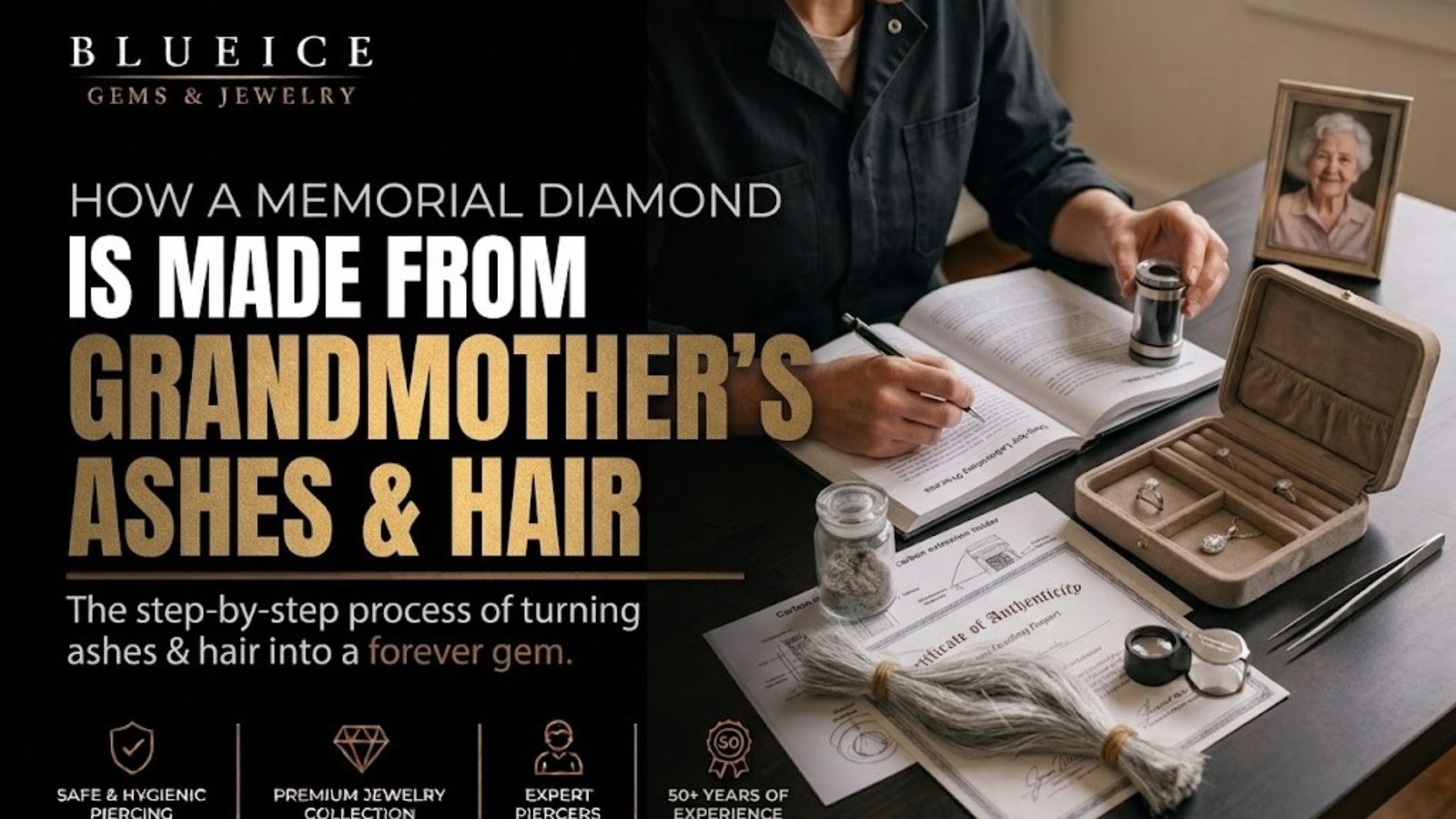
Perhaps a relative kept a portion of her cremated remains, and you still have a curl of her hair folded inside a card she once mailed you. A diamond made from grandmother ashes and hair is a real lab-grown diamond whose carbon comes partly from both keepsakes: each is purified, converted to graphite, typically blended with supplemental lab carbon, and grown under heat and pressure over weeks to months.
For anyone picturing a pendant or ring made from grandmother ashes and hair, the first surprise is how different the two materials are as starting points. That difference shapes almost every stage of the work, from intake to the certificate.
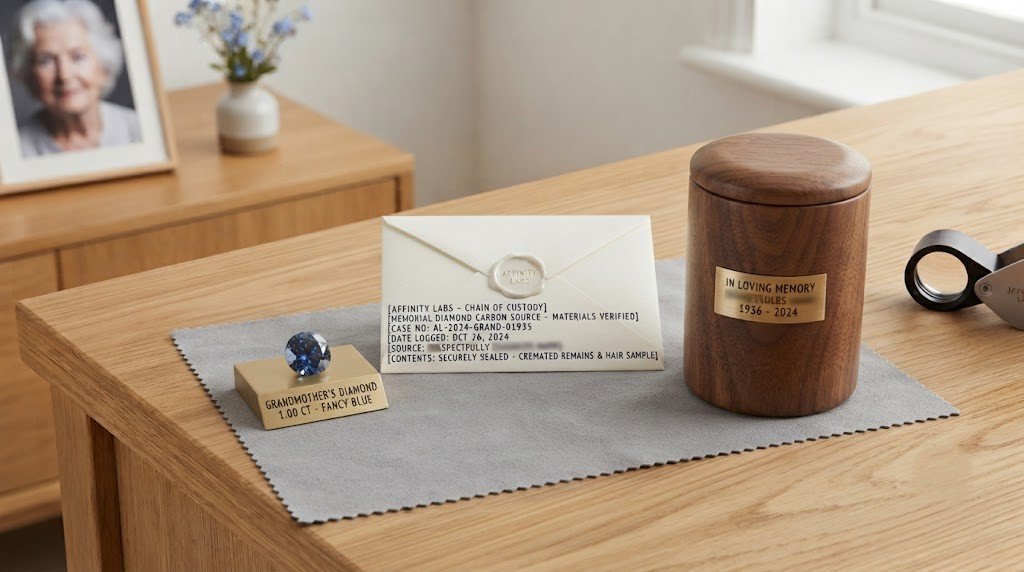
Table of Contents
Why Do Ash and Hair Behave So Differently in the Lab?
Cremated remains are mostly calcium phosphate, the mineral that gives bone its structure. Industry figures put the usable carbon in ash at roughly 0.5% to 4% by weight, depending on the person and on how the cremation was carried out. Most of an ash sample is mineral the lab has to remove.
Hair sits at the opposite end. It is built from keratin, a protein that is roughly 50% carbon by weight, and saving it never involved cremation. A lab preparing a stone made from grandmother ashes and hair is therefore handling one carbon-poor material and one carbon-rich one.
| Factor | Cremated ash | Hair |
|---|---|---|
| Main substance | Calcium phosphate (bone mineral) | Keratin (a protein) |
| Carbon by weight | Roughly 0.5–4% | Roughly 50% |
| Amount typically sent | A few tablespoons up to about 4 oz (~100 g), varies by provider | A small lock or a few grams, varies by provider |
| Cremation involved | Yes | No |
| What purification removes | Calcium phosphate and other minerals | The non-carbon parts of keratin |
| Published personal-carbon share in a finished stone | Around 10–15% for ash-based stones, some cite as low as 3% | Nothing published for hair or for a blend |
Neither column makes one material “better” for the finished diamond. In a gem made from grandmother ashes and hair, the ash portion simply needs heavy refining, while the hair portion needs very little starting material.
What Are the Seven Stages From Keepsake to Diamond?
Every diamond made from grandmother ashes and hair passes through the same broad sequence as any memorial diamond. Only the front end changes, because two materials must be received, recorded and refined.
- Collection and logging. Both keepsakes are recorded under chain-of-custody tracking, ideally as two labeled items.
- Extraction and purification. Oxygen-free, multi-stage heating strips out everything but carbon, to roughly 99.9% purity or higher.
- Graphitization. Further heating, in the 2,500–2,700°C range, converts the purified carbon into graphite.
- Growth. The graphite, typically blended with lab carbon, grows around a diamond seed over weeks to months.
- Cutting and polishing. A gemologist shapes the rough crystal.
- Optional irradiation. Some providers offer post-growth color treatment.
- Grading and documentation. The stone is graded, ideally independently, and its origin recorded.
No dependable public source breaks down how long each stage takes for a stone made from grandmother ashes and hair, so treat any stage-by-stage calendar as a question for the provider. A family-facing version of this sequence appears in the guide on turning her ashes and hair into a diamond, which focuses on decisions rather than chemistry.
How Is Carbon Pulled Out of Ash and Out of Hair?
Before any stone made from grandmother ashes and hair can grow, each keepsake has to give up its carbon. The method is the same in principle for both, controlled heat without oxygen, but the work looks different because the materials are so different.
Refining cremated ash
With carbon at only 0.5% to 4% of the ash, the lab is mostly separating a small amount of carbon from a large amount of calcium phosphate and other minerals. The multi-stage heating drives off those non-carbon components until what remains is carbon at roughly 99.9% purity or better. The ash-only version of this process goes deeper into that side on its own.
What becomes of the mineral residue, and of any ash not used, is a provider decision. Ask whether unused ash is returned, stored or disposed of, and get the answer in writing.
Refining hair
Hair needs much less material because about half of keratin’s weight is carbon. The same oxygen-free heating removes the protein’s non-carbon parts, leaving purified carbon ready for the next stage. If you want the single-material picture, the hair-only route is covered separately.
Whether dyed, permed or otherwise chemically treated hair is accepted is something each provider decides, so ask before you cut or send anything. Her hair color, texture or thickness is not a reason to assume it will or will not work.
Where the two paths meet
Once purified, carbon from ash and carbon from hair are the same element. Nothing in the carbon itself labels which keepsake it came from, which is why record-keeping matters so much for a diamond made from grandmother ashes and hair.
Does a Provider Combine Both Materials in One Stone?
This is the point where honest information gets thin. Whether a provider purifies ash and hair separately, merges their carbon before growth, or handles them some other way depends entirely on that provider’s process, and there is no industry-wide method to describe. Any claim about how a diamond made from grandmother ashes and hair is blended should come from the provider directly, in writing.
Families who want a stone made from grandmother ashes and hair have different reasons. Sometimes the ashes were already divided among relatives and the hair is what a grandchild holds personally; sometimes two keepsakes in one stone simply feels right.
Questions worth asking before any keepsake is shipped for a diamond made from grandmother ashes and hair:
- Do you purify ash and hair separately, or together?
- Is carbon from both materials combined into one feedstock before growth, and in roughly what proportion?
- Can our family request a particular balance between ash and hair, or does your process set it?
- How much supplemental lab carbon is added relative to the personal carbon?
- If only part of either material is used, what happens to the rest?
For the wider decision about whether a combined stone suits your family at all, the complete guide to ash-and-hair diamonds for a grandmother sets out the options side by side.
What Happens During Graphitization and Growth?
After purification, the carbon destined for a diamond made from grandmother ashes and hair is heated further, to roughly 2,500–2,700°C, and becomes graphite. Graphite is the crystalline form of carbon that diamond presses can work with.
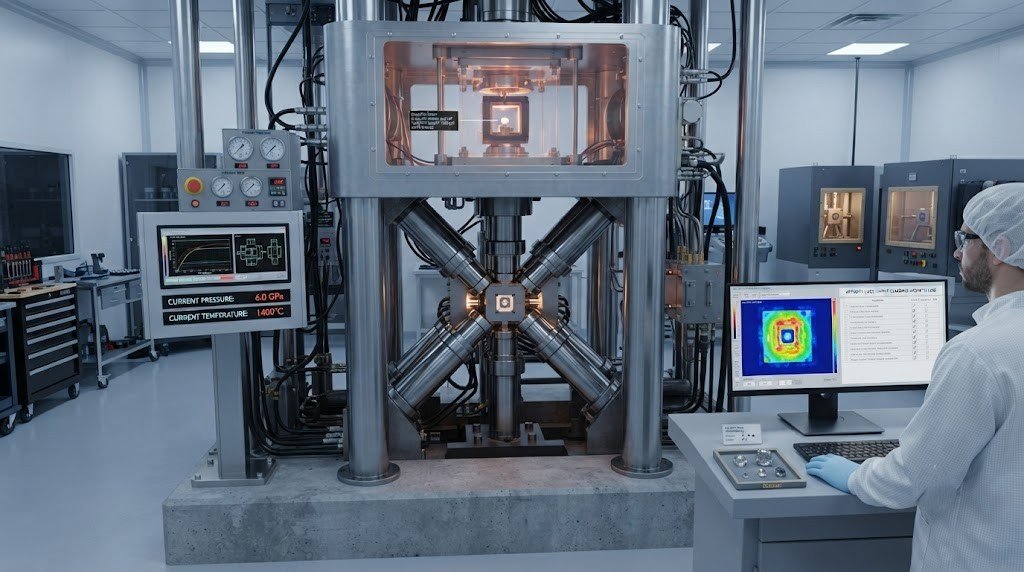
Most memorial diamonds are then grown by HPHT (high pressure, high temperature). The graphite, typically blended with supplemental lab carbon to reach a workable volume, sits in a growth cell around a small diamond seed, under roughly 6–8 GPa of pressure and 1,400–2,500°C. A minority of providers use CVD instead, converting the carbon to a gas that deposits onto a seed plate. Both are the same lab diamond-growth methods used across the wider industry.
Why more material does not mean a bigger stone
Growth time, not the quantity of ash or hair sent, sets the carat size. A full urn would not produce a larger or faster diamond, and neither would an extra lock of hair. Carat is a choice the family makes, and that choice sets how long the stone stays in the press.
That matters for anyone weighing a diamond made from grandmother ashes and hair: you do not need everything she left. A modest portion of each keepsake is usually enough, and the rest can stay with the family.
How Much of Her Carbon Ends Up in the Finished Stone?
For ash-based memorial diamonds, the personal carbon usually makes up somewhere around 10–15% of the finished stone’s mass, with some providers citing figures as low as 3% and others higher, depending on stone size and how much ash was sent. That figure belongs to the ash route only.
For hair, and for any stone made from grandmother ashes and hair together, no equivalent finished-stone percentage has been published. It would be easy to borrow the ash figure or to assume hair’s higher carbon content pushes the share up, but neither assumption is backed by public data. The honest answer is that you need to ask each provider, in writing, what share of the finished stone they expect to come from her ash, her hair and lab carbon.
What can be said plainly is that a crystal made from grandmother ashes and hair holds a real, physical portion of her carbon, grown into the lattice alongside lab carbon. It is not a symbol of her, and it is not made entirely of her either. The sibling article on whether such a stone is truly made from her works through that doubt in more detail, and it is the right next read if a stone made from grandmother ashes and hair still feels hard to believe.
Where Does the Color of a Diamond Made From Grandmother Ashes and Hair Come From?
Diamond color comes from trace elements present while the crystal grows. Boron produces blue tones, nitrogen produces yellow, and a colorless stone requires keeping both out, which takes extra processing and typically costs more. Because the carbon comes from organic, personal sources rather than a controlled feedstock, memorial diamonds tend toward yellow, blue and champagne or brown tones.
There is no evidence that hair gives a lighter, cleaner or more predictable color than ash, or the reverse. Nor can a family pick an exact natural shade for a stone made from grandmother ashes and hair; a provider can describe the range it typically produces, and that is the honest limit. Some providers also offer post-growth irradiation for red, pink, green or black stones.
If color is a big part of how you picture a diamond made from grandmother ashes and hair, read about what color to expect from a combined stone before you talk with providers. Then ask each one which colors it offers for combined material and whether colorless carries a higher price.
What Should the Paperwork for a Stone Made From Grandmother Ashes and Hair Say?
Two different documents usually accompany a memorial diamond, and they answer two different questions.
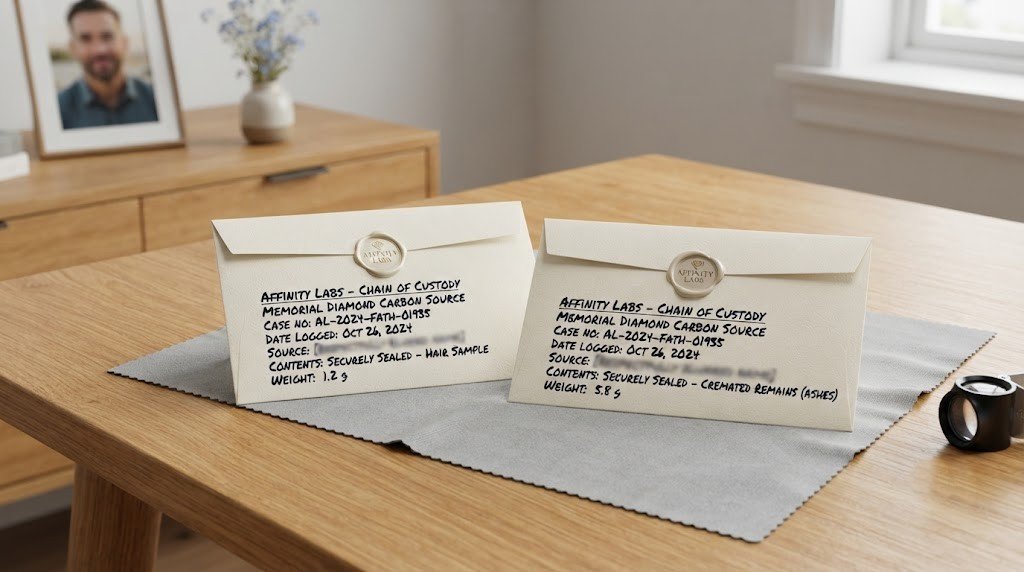
An authenticity or origin certificate, typically issued in-house, records that the stone was grown from carbon your family submitted. It is essentially a chain-of-custody document. For a diamond made from grandmother ashes and hair, ask whether that certificate names both materials, rather than describing the source in general terms.
A grading report describes the stone itself: cut, color, clarity and carat, the same 4Cs as GIA describes them for any diamond. Ideally it comes from an independent third-party lab, often referencing GIA standards and sometimes IGI. Independent grading is typically an optional, separately priced add-on, so ask whether it is included. Typical clarity for memorial diamonds falls in the SI2 to VVS range.
A grading report cannot tell you that a stone was made from grandmother ashes and hair, and an origin certificate cannot tell you its quality. Keeping both together gives the next generation a complete record if the stone is ever passed down.
How Do You Keep Track of Two Materials at Once?
Chain of custody means a documented trail from the moment a keepsake leaves your hands to the moment the finished stone arrives. With one material, that trail is a single line. With two, it is two lines that may or may not merge partway through, which is why it deserves its own questions.
Tracking for a diamond made from grandmother ashes and hair starts at home. Follow the provider’s packing instructions for each material, keep the hair and the ashes clearly labeled and apart unless told otherwise, and write down what you sent and when.
Then ask the provider:
- Does each material get its own intake record and identifier?
- At what point, if any, do the two records merge into one?
- How are batches from different families kept apart in the lab?
- What records or updates will we receive as the work progresses?
Clear answers to those questions are what make a stone made from grandmother ashes and hair trustworthy. If her ashes were already divided, note which relative’s portion you are drawing from, so the family record stays straight too.
Who Can Say Yes to Using Her Ashes and Her Hair?
Before anyone orders a diamond made from grandmother ashes and hair, the right person has to agree. Who holds authority over her remains is decided by state law and by any written wishes she left, and the order is not the same in every state. A surviving spouse or partner commonly comes first, then her adult children, with grandchildren usually further down. The funeral home or crematory that handled her cremation can often tell you who signed the authorization.
If you are a grandchild, the respectful route is to ask whoever holds authority whether a small portion of her ashes could be set aside. Cousins may want to be part of that conversation, and it often helps to agree as a family before anyone contacts a provider. Several relatives can often each receive a stone from shared material, which can turn a request into a family plan.
Hair kept at home is usually the simpler practical question. Even so, her belongings can form part of her estate, and the rules differ by state, so a quiet word with the executor or whoever is settling her affairs is sensible.
How Long Does It Take, and What Does It Cost?
Across the industry, a memorial diamond typically takes 6 to 10 months from the day the lab receives the material to the finished stone. Larger stones, over roughly 2 carats, and specialty colors can take up to about 12 months. Those totals apply to a stone made from grandmother ashes and hair as well; no reliable figures exist for how a second material affects the schedule, so ask.
General 2026 industry price ranges, not Memorial Diamond’s own prices, look like this:
- About 0.10–0.25 ct: roughly 1,500–3,500
- 0.5–1 ct: roughly 5,000–15,000, with colorless meaningfully higher
- 2–5+ ct: roughly 20,000–75,000 or more
Grading reports, engraving, fancy cuts and settings are usually priced separately. Ask whether a stone made from grandmother ashes and hair costs more than a single-material one, and check how much ash and hair a provider usually asks for before deciding how much of each to set aside.
Frequently Asked Questions
Why would a family send both her ashes and her hair instead of one?
Sometimes the ashes were divided among relatives and a grandchild holds only her hair; sometimes both keepsakes simply feel right together. Providers differ on whether they will grow one stone made from grandmother ashes and hair together, so confirm that before planning around it.
Is a stone made from grandmother ashes and hair larger because there is more carbon?
No. Carat size depends on how long the crystal grows in the press, not on how much material arrives. Sending both keepsakes does not make the diamond bigger or faster, and the family chooses the carat size, which then shapes the timeline.
Does hair make the diamond purer than ash does?
Both materials are refined to roughly 99.9% carbon or higher before growth, so the carbon in a diamond made from grandmother ashes and hair is the same element either way. Hair needs less starting material, but that does not make the stone purer.
Can I find out exactly how much of the diamond is her hair versus her ash?
No published figure exists for the hair share or for a blended stone. The commonly quoted 10–15% applies to ash-based stones only. Ask each provider in writing what proportion of ash carbon, hair carbon and lab carbon it expects for your stone.
Will the origin certificate list both of her keepsakes?
That depends on the provider, which is why it is worth asking before you send anything. A clear certificate for a stone made from grandmother ashes and hair should name both keepsakes, so the record matches what your family actually entrusted to the lab.
Can a diamond made from grandmother ashes and hair be passed down later?
Yes. With a hardness of 10 on the Mohs scale, a diamond holds up well to daily wear, though a hard knock can still chip one. Keep the origin certificate and any grading report with the stone so the next generation inherits its full story.
Final Thoughts on How Her Ashes and Hair Become a Diamond
In a diamond made from grandmother ashes and hair, two keepsakes that could not be more different end up as the same purified carbon, grown into one crystal. Knowing the real chemistry, including the parts no provider has put a public number on, lets you ask sharper questions.
Take your time with the family conversations and the paperwork. The stone can wait until everyone who matters has had a say.
Learn More About Grandmother Ash-and-Hair Diamond Science
- Grandmother Ashes and Hair Diamond: The Complete Guide every option for a combined stone in one place
- How to Turn Your Grandmother’s Ashes and Hair Into a Diamond the family decisions, step by step
- What Color Will a Diamond Made From Your Grandmother’s Ashes and Hair Be? trace elements and likely tones
- Is a Memorial Diamond Really Made From Your Grandmother’s Ashes? how to check what a provider claims
Talk With Memorial Diamond
If you are holding both her ashes and her hair and wondering whether a diamond made from grandmother ashes and hair is possible, Memorial Diamond is glad to talk it through with you, at whatever pace suits your family. Bring your questions about blending, records and timing, and we will answer as plainly as we can.
You can start the conversation at memorialdiamond.us whenever you feel ready.
Word count: 3,110 words · Reading time: about 16 minutes
Leave A Comment