
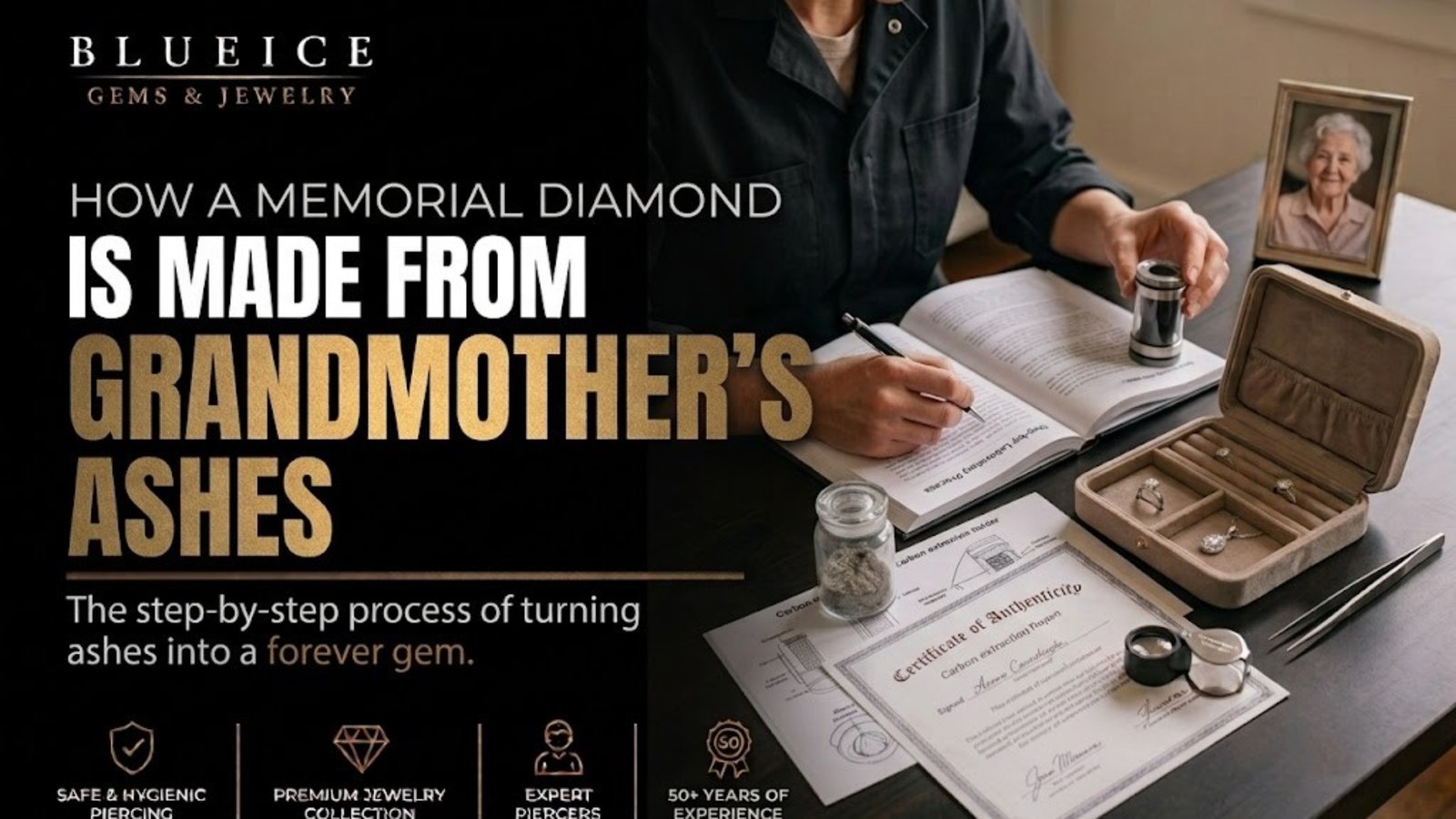
Perhaps a small container of her ashes sits on a relative’s shelf, or perhaps you are the one who collected them from the crematory. If you want to know what really happens inside a lab to a diamond made from grandmother ashes, here is the plain version: a small portion of her remains is heated to recover its carbon, that carbon is purified and turned into graphite, and it is then grown into a real diamond under intense heat and pressure, typically alongside supplemental lab carbon, before being cut, polished and graded.
None of this requires a science degree. Below, each stage of a diamond made from grandmother ashes is explained in everyday terms, with the honest numbers kept in.
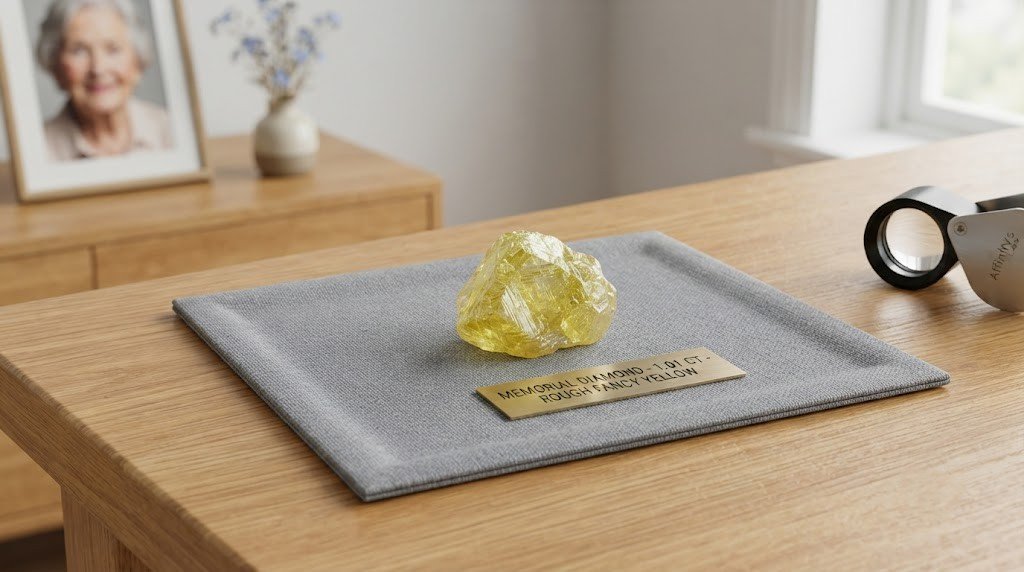
Table of Contents
What Are Cremated Remains Made Of, Chemically?
Cremated remains are mostly bone mineral, a compound called calcium phosphate, processed after cremation into a coarse, pale powder. The heat of cremation burns off most of the body’s organic material, and that organic material is where most of a person’s carbon lived.
Industry figures put the usable carbon at roughly 0.5% to 4% of the ashes by weight, and the figure shifts with the individual and with how the cremation was carried out. So the first honest fact about anything made from grandmother ashes is that the lab begins with a material that is mostly not carbon at all.
That low share is the reason every later stage exists. Each step in producing a gem made from grandmother ashes is there either to isolate the small amount of carbon she left behind or to give that carbon a form a diamond press can use.
Does it matter how long ago she was cremated?
She may have died years ago, and her ashes may have waited in an urn or a closet ever since. Whether ashes kept for a long time can still yield a stone made from grandmother ashes, and whether storage conditions matter, is something each provider decides from its own experience. Ask the question directly, and ask for the answer in writing before you send anything.
Why Is a Stone Made From Grandmother Ashes Blended With Lab Carbon?
The answer is volume. A typical request runs from a few tablespoons of ashes up to about 4 oz, or 100 g, and only a few percent of that sample is carbon. Growing a stone of meaningful size from that alone is not practical, so the recovered carbon is typically blended with supplemental lab-sourced carbon before growth.
Industry-wide, her recovered carbon usually accounts for roughly 10–15% of the finished stone’s mass. A few providers quote a share as small as 3%, while others report more, and the figure moves with the carat size and how much ash was sent. A diamond made from grandmother ashes is therefore made partly from her, not entirely from her, and a claim of total purity does not match the chemistry.
What that share actually means
The proportion can sound small until you picture what it describes. In a diamond made from grandmother ashes, her own carbon atoms, recovered and purified, become part of the crystal lattice. The stone is not a symbol of her or a container holding her; it is physically built, in part, from material that was hers.
Before you commit, ask each provider in writing what personal-carbon share they expect in a stone made from grandmother ashes at the carat size you are considering. A clear, specific answer is a good sign about how the rest of the process will be handled.
What Happens at Each Stage of the Lab Process?
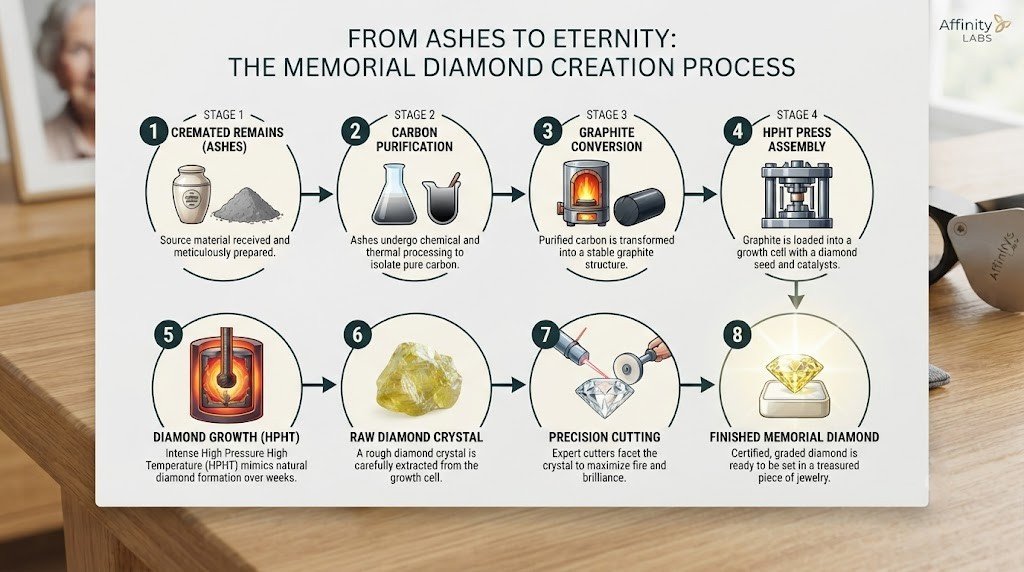
The work that turns a small sample into a diamond made from grandmother ashes moves through eight stages. Providers do not publish a set duration for each one, and the overall time depends mostly on the carat size you choose, so the table describes what happens rather than how long it takes.
| Stage | What happens in the lab | What it means for her ashes |
|---|---|---|
| 1. Receipt and tracking | The sample is logged, labeled and assigned to your order | Her remains are kept identifiable from the moment they arrive |
| 2. Carbon extraction | Controlled, oxygen-free heating separates carbon from the minerals | The calcium phosphate is stripped away, leaving her small carbon fraction |
| 3. Purification | Further processing removes remaining non-carbon material | Her recovered carbon reaches roughly 99.9% purity or higher |
| 4. Graphitization | Purified carbon is heated to about 2,500–2,700°C and becomes graphite | Her carbon takes the form a growth press can use as feedstock |
| 5. Crystal growth | HPHT (or, for a few providers, CVD) grows diamond around a seed | Her carbon, typically blended with lab carbon, becomes crystal |
| 6. Cutting and polishing | A gemologist shapes the rough crystal into a finished cut | The rough stone becomes a gem you can wear or set |
| 7. Optional irradiation | Some providers treat the stone after growth to shift its color | Offered for red, pink, green or black, if you want it |
| 8. Grading and certification | The stone is graded, ideally by an independent lab, and documented | You receive proof of quality and a record of her origin |
The table is a map, not any one provider’s workflow. Ask each provider to describe its own sequence for a stone made from grandmother ashes, including any steps handled at a partner facility.
How Is Carbon Pulled Out of Her Ashes and Purified?
Extraction is a controlled heating process carried out without oxygen, usually in several steps. Oxygen is kept out because carbon heated in open air combines with oxygen and escapes as a gas, which would destroy the very thing the lab is trying to keep. Within that sealed environment, the mineral content, chiefly the calcium phosphate, is separated and removed.
Purification then continues until the remaining material is roughly 99.9% carbon or better. That level matters because a diamond grows best from clean feedstock, and stray elements can affect both clarity and color. By the end of purification, the material bears no resemblance to ash; it is a small quantity of nearly pure carbon, and the raw ingredient of a gem made from grandmother ashes.
What happens to the remains that are not used?
Only part of what you send ends up in a diamond made from grandmother ashes, and sometimes much less than you send. Whether the unused portion comes back to you, how it is packaged, and when it ships are all provider decisions. Ask before you send, and keep the answer with your paperwork.
What Does Graphitization Do to the Purified Carbon?
Graphite and diamond are both pure carbon; the difference is how the atoms are arranged: in graphite they sit in flat, stacked sheets, and in diamond they lock into a rigid three-dimensional framework. Graphitization converts the purified carbon into graphite by heating it to roughly 2,500–2,700°C.
The reason is practical: diamond-growth presses use graphite as their feedstock, so carbon made from grandmother ashes has to pass through this form before it can become a gem.
How Does a Press Grow the Crystal?
Most diamonds made from grandmother ashes, like most memorial diamonds generally, are grown by HPHT, short for high pressure, high temperature. The graphite, typically blended with supplemental lab carbon, is loaded into a growth cell with a tiny diamond seed. A press, such as a BARS or cubic press, then recreates the conditions found deep in the Earth’s mantle: roughly 6–8 GPa of pressure and temperatures of about 1,400–2,500°C.
Under those conditions, carbon arranges itself into diamond’s crystal structure around the seed, over weeks to months depending on the target size.
Where does CVD fit in?
A minority of providers use CVD, or chemical vapor deposition, instead. In that method the carbon is converted to methane gas, and carbon from the gas deposits layer by layer onto a seed plate inside a vacuum chamber. The result is the same material, and the Wikipedia overview of synthetic diamond production methods covers both techniques. Ask your provider which method grows a stone made from grandmother ashes in their lab, and why.
Why does growth time, not quantity, set the carat?
Sending more of her ashes does not produce a larger or quicker gem made from grandmother ashes. Size depends on how long the crystal grows in the press. A full urn does not change the outcome.
Memorial diamonds are generally offered from about 0.10 carats to 5 carats or more. The size you choose sets the growth time, which in turn shapes the overall timeline and the price. That is why the carat decision belongs early in any conversation about a diamond made from grandmother ashes.
How Is the Rough Crystal Cut and Polished?
A freshly grown diamond made from grandmother ashes does not look like jewelry yet. It leaves the press as a rough crystal with a frosted, irregular surface. A gemologist then plans the cut, shapes the stone into a finished form such as a round, princess or cushion, and polishes the facets that give a diamond its sparkle.
The finished gem is a real diamond, with a hardness of 10 on the Mohs scale of mineral hardness and the same optical properties as any other diamond. That hardness makes it well suited to everyday wear, although a hard knock at the wrong angle can still chip any diamond, so a protective setting is worth discussing for a ring.
Clarity in a stone made from grandmother ashes typically falls in the SI2 to VVS range, as it does for memorial diamonds generally. When a provider quotes a carat size, ask whether it refers to the rough crystal or the polished stone.
Why Will Her Diamond Probably Have Color?
Diamond color comes from trace elements present while the crystal grows. Nitrogen produces yellow tones, and boron produces blue. A colorless stone made from grandmother ashes needs both elements excluded, which takes extra processing and typically costs more.
Carbon from a personal, organic source tends to carry traces of these elements, so stones made from grandmother ashes often grow in yellow, blue or champagne-to-brown shades rather than colorless. That variation reflects the source; it is not a defect. A provider can tell you which colors it offers, but no lab can promise to match an exact shade, and families cannot pick a precise tone in advance.
Some providers also offer optional irradiation after growth, which can shift a stone toward red, pink, green or black. If color is an important part of the decision, the guide to the colors her ashes can produce in a diamond goes further into what to expect.
Grading Report or Certificate of Authenticity: Which Is Which?
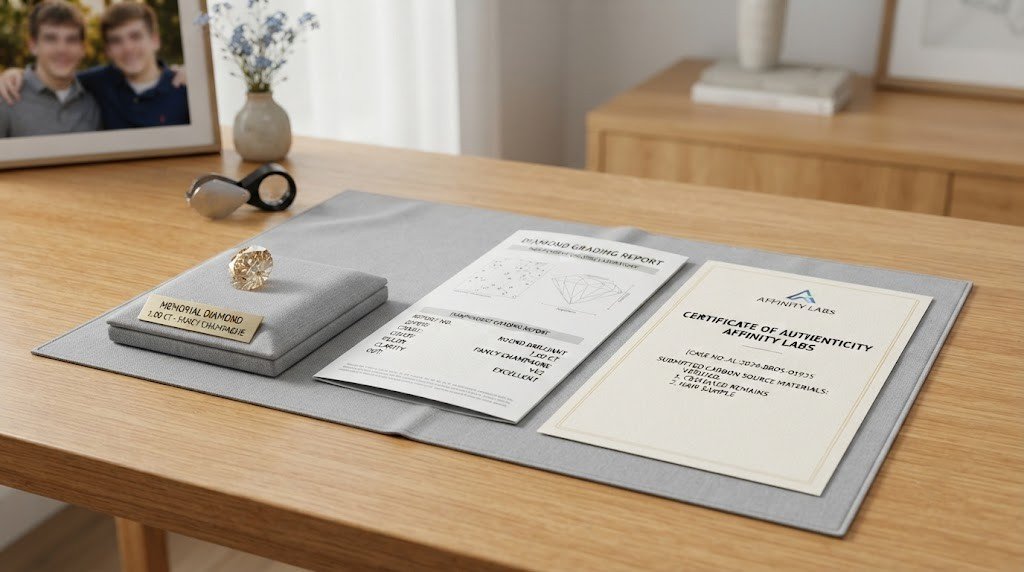
Two documents often travel with a diamond made from grandmother ashes, and they answer different questions.
- Certificate of authenticity (origin): usually issued in-house by the provider, it records that the diamond was grown from your family’s submitted carbon. It is essentially a chain-of-custody document.
- Grading report: ideally issued by an independent third-party gemological lab, often referencing GIA standards and sometimes IGI, it records the stone’s cut, color, clarity and carat, exactly as it would for any diamond.
The first speaks to origin; the second to quality. Independent grading is typically an optional add-on priced separately, so ask whether it is included. GIA’s own page on how the 4Cs of diamond quality work is a useful primer before you read any report.
How Do You Know a Diamond Made From Grandmother Ashes Came From Her?
Trust rests on chain of custody: the record showing her remains stayed identified and separate from receipt to finished stone. Practices differ, so ask specific questions and get the answers in writing.
- How is her sample labeled and logged on arrival?
- How is it kept separate from other families’ material at every stage, including any outside facility?
- Are updates or photos of the process available, and at which points?
- What exactly does the certificate of authenticity record?
- What happens if a growth run fails, and is more of her material needed?
- What happens to any portion that is not used?
If you are weighing whether a stone is genuinely made from grandmother ashes rather than lab carbon alone, the explainer on whether the diamond really contains her ashes works through that doubt in detail.
Who Decides Whether Her Ashes Go to a Lab?
Control of her remains follows the law of the state involved, together with anything she put in writing, and states rank relatives differently. In many places a surviving spouse or partner sits at the top, her grown children next, and grandchildren behind them. A quick call to the crematory or funeral home that handled her cremation will usually reveal whose signature appears on the authorization form, a sensible place to begin.
If you are a grandchild, including a step-, adopted or chosen grandchild, a respectful route is to ask whoever holds the ashes whether a small portion could be set aside for a stone made from grandmother ashes. Her remains may already have been divided, scattered or kept by an aunt, uncle or parent, and cousins may have their own hopes, so talk together before anyone contacts a lab.
Where her ashes are no longer available, a lock of her hair may be another path, and the hair-based version of this process explains how it differs. Personal belongings such as hair can count as part of her estate, and state rules on that vary, so a quick word with the executor is sensible. If faith matters to your family, be aware that Catholic teaching permits cremation yet asks that the ashes be kept whole in a consecrated resting place, allowing only a very limited exception for a small part; your own priest, pastor or community leader is the right person to ask.
How Long Does a Stone Made From Grandmother Ashes Take, and What Does It Cost?
Across the industry, a diamond made from grandmother ashes typically takes 6 to 10 months from the day a lab receives the material. Larger stones, roughly those over 2 carats, and specialty colors can take up to about 12 months.
General 2026 industry price ranges look like this:
- Around 0.10–0.25 ct: roughly 1,500–3,500
- Around 0.5–1 ct: roughly 5,000–15,000, with colorless meaningfully higher
- Around 2–5+ ct: roughly 20,000–75,000 or more
Expect separate charges for extras such as an independent grading report, engraving, a fancy cut or a setting. For how much of her remains a lab tends to request, see how much ash a grandmother memorial diamond needs. For the full picture from first conversation to finished piece, the complete guide to grandmother ashes diamonds brings the decisions together.
Can more than one person receive a stone?
Because only a portion of the ashes is used, several family members can often each receive their own ring or pendant made from grandmother ashes, drawn from the same shared remains. Whether that is possible from the amount your family holds is a provider question. Families who also kept a lock of hair can read about combining her ashes and hair in one stone.
Frequently Asked Questions
Can a diamond be made from grandmother ashes that have been stored for many years?
Often the question is not whether ashes are old but whether the provider considers them workable. Acceptance rules are set by each lab and are not uniform. Tell the provider how and where the ashes have been kept, then ask for its decision in writing.
Does sending more of her ashes give a bigger diamond?
No. The finished size comes from the length of the growing period, not from the volume of ash a lab receives. A full urn will not create a larger or faster stone. You choose the size, and that choice shapes both the timeline and the price.
Is the supplemental carbon from another person?
Supplemental carbon is lab-sourced material, not remains from other families, and it is typically added to a diamond made from grandmother ashes because her remains hold only a small carbon fraction. Ask each provider how they keep her sample separate throughout processing, and request that description in writing.
Is a stone made from grandmother ashes a real diamond?
Yes. It is a genuine lab-grown diamond with the same crystal structure, hardness of 10 on the Mohs scale and optical properties as any other diamond. It can be graded on cut, color, clarity and carat like a mined stone.
Can my cousins and I each have a diamond from her ashes?
Often, yes. Because each stone made from grandmother ashes uses only a portion of the remains, several relatives can sometimes receive their own diamond from one shared amount. Whoever holds authority over her ashes should agree first, and the provider will confirm what is feasible.
Can we choose the exact color of her diamond?
Not precisely. Trace nitrogen tends toward yellow and boron toward blue, and providers offer a range of color options, sometimes including irradiation. No lab can match an exact shade, so ask to see real examples of each color they produce.
Final Thoughts on How Her Ashes Become a Diamond
Knowing the chemistry does not make the decision for you, but it can make the family conversation about a diamond made from grandmother ashes easier. You now know what her ashes are made of, why lab carbon is involved in anything made from grandmother ashes, and what each stage of the work is for, which means you can ask providers precise questions and judge their answers.
Take your time and include the people who share her memory. A diamond can sit alongside an urn, a scattering place or a grave; it does not have to replace any of them.
Learn More About the Science Behind Grandmother Memorial Diamonds
- Step-by-Step: Turning Your Grandmother’s Ashes Into a Diamond the practical sequence from first call to delivery
- How to Turn Your Grandmother’s Ashes Into a Diamond choosing a provider and preparing the family
- Is a Memorial Diamond Really Made From Your Grandmother’s Ashes? the honest carbon question
- Grandmother Ashes Diamond: The Complete Guide every decision in one place
Talk With Memorial Diamond
If you would like to talk through any stage of this process, or put your questions about her ashes to someone familiar with how these stones are made, you can reach Memorial Diamond at memorialdiamond.us. Nothing needs to be decided before you get in touch.
We will answer what we can plainly, tell you where an answer depends on your family’s circumstances, and leave the timing entirely to you.
Leave A Comment