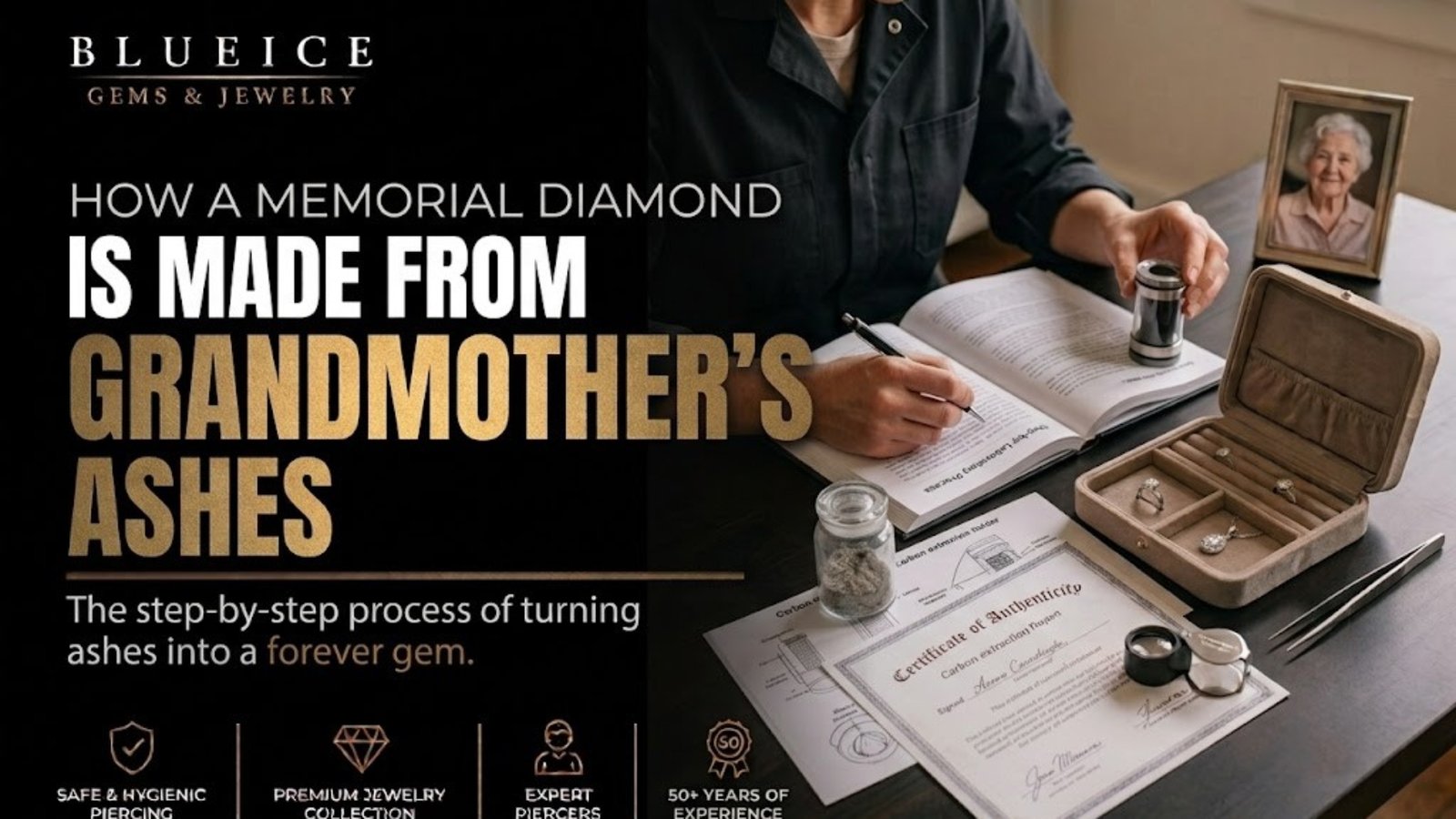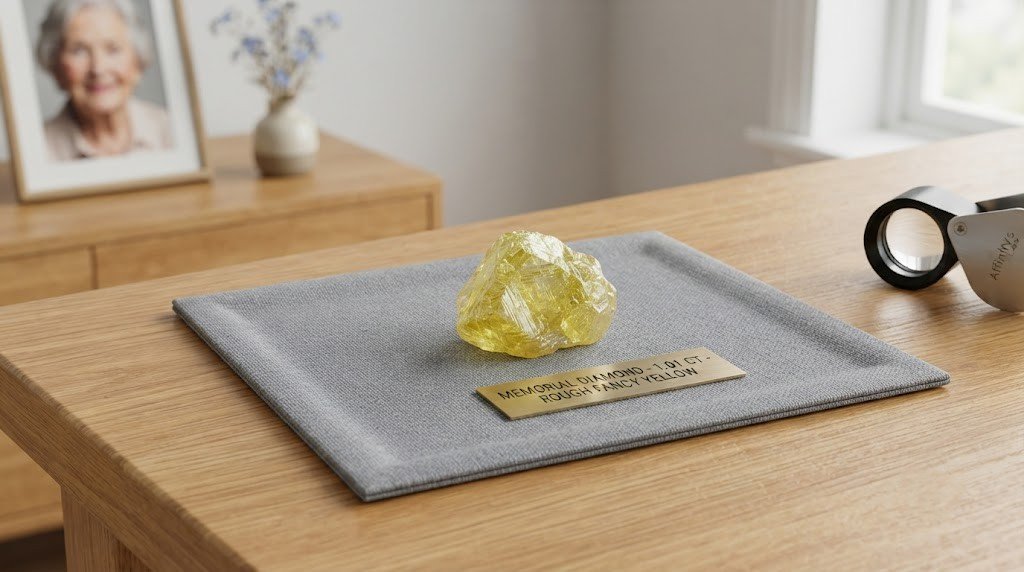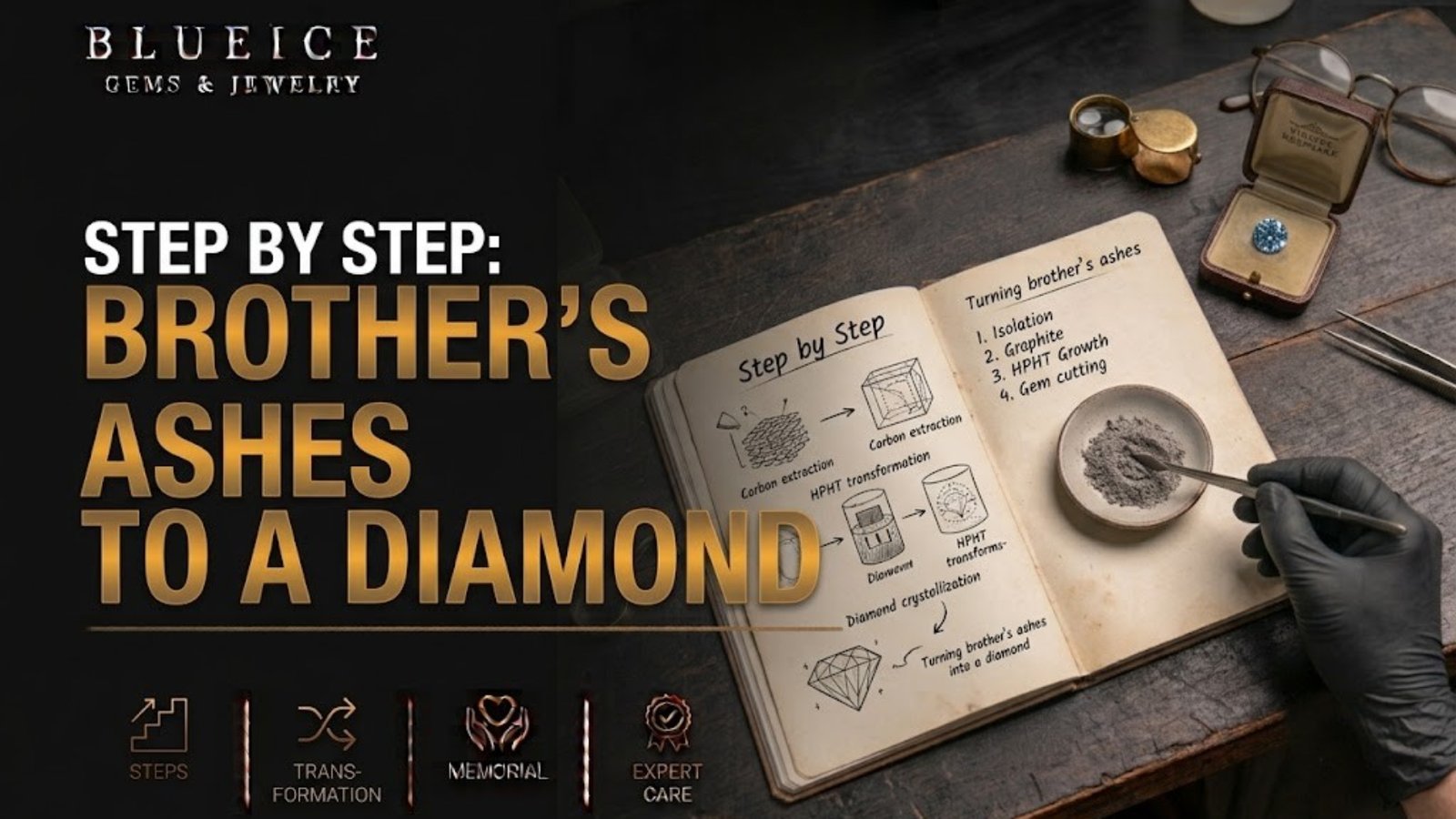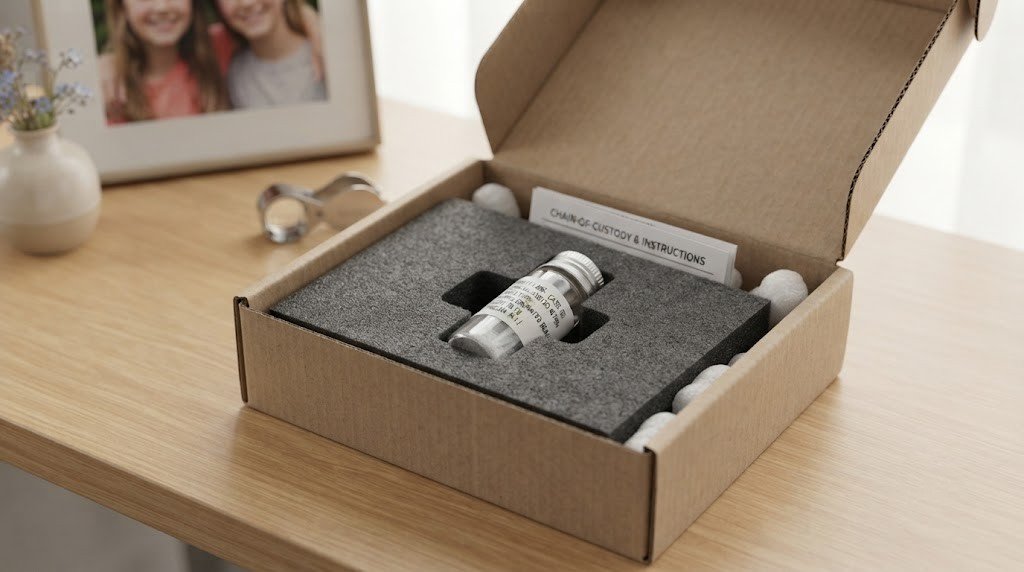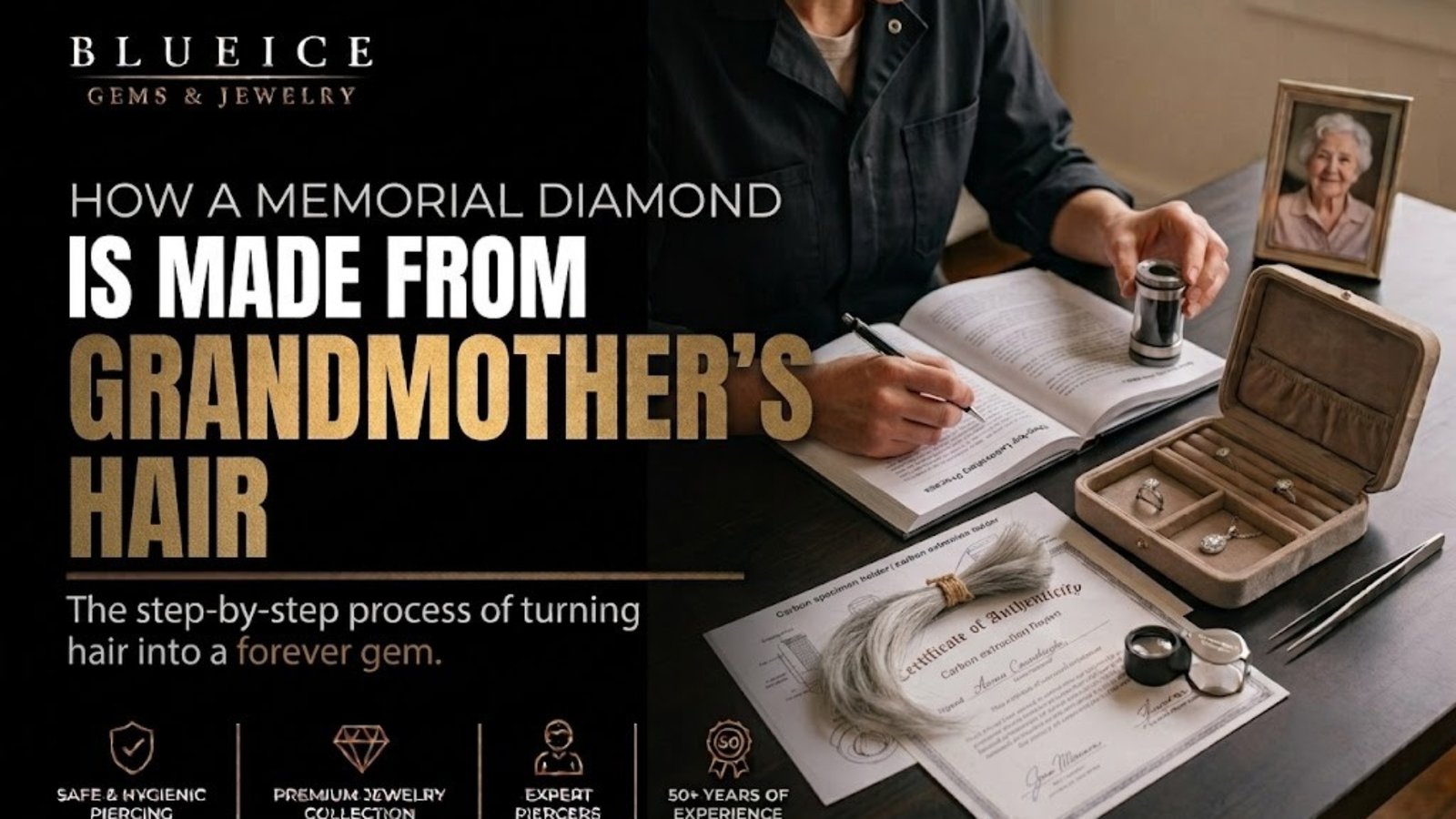
A folded envelope with a lock of her hair, a strand caught in a brush she used every morning: small things like these can carry a surprising amount of her. A diamond made from grandmother hair begins when a lab heats a small sample without oxygen to recover the carbon in its keratin, purifies that carbon, converts it to graphite and grows it into a real diamond under extreme pressure and heat, after which the crystal is cut, polished and graded.
What follows explains every stage of a gem made from grandmother hair for someone without a chemistry background, and points out where the answer depends on the provider rather than on science.
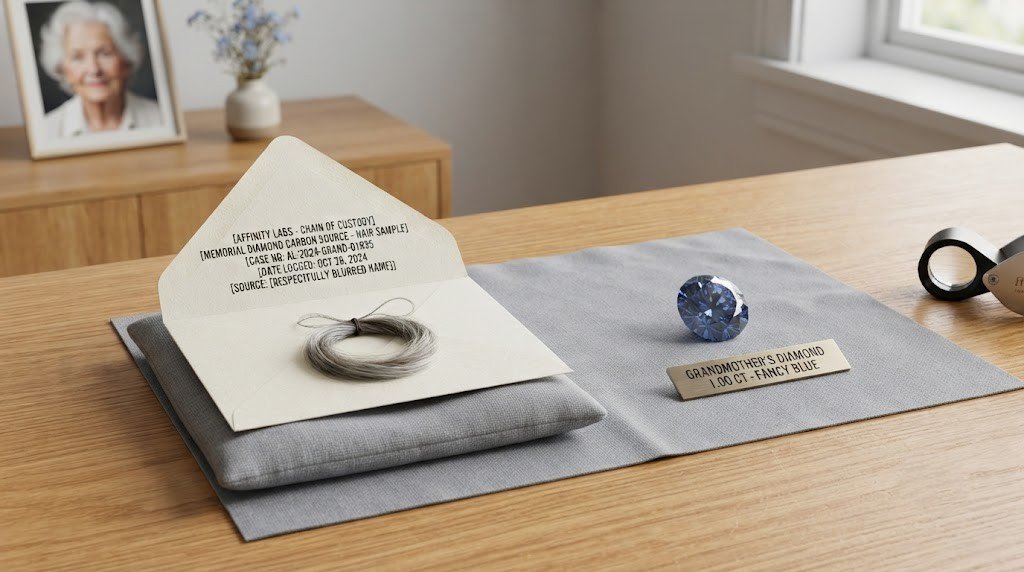
Table of Contents
Why Can Hair Become a Diamond at All?
Hair is built mostly from keratin, a tough protein, and keratin is rich in carbon. By weight, hair is roughly 50% carbon. Diamond is nothing but carbon atoms locked in a crystal, so any material with a usable share of carbon can, in principle, become the starting point for one, and that is the basic chemistry behind every stone made from grandmother hair.
That single figure explains much of what makes a diamond made from grandmother hair different from one grown from ashes. Cremated remains are mostly bone mineral, with only a small percentage of usable carbon. Her hair, by contrast, is about half carbon to begin with.
There is a second difference. Hair needs no cremation. If she was buried, or if cremation is not something your family’s faith permits, a lock of hair saved at the time of her death, from a salon visit or tucked in a keepsake box can still be the source of a stone made from grandmother hair.
Why Does a Lab Need So Little of Her Hair?
Because each strand holds so much carbon, providers typically ask for only a small lock or a few grams to grow jewelry made from grandmother hair. Some describe the amount as palm-sized or a few wisps. Exact requirements vary from lab to lab, and no single minimum applies across the industry.
Sending more hair will not make a ring or pendant made from grandmother hair any larger. Carat size is decided by how long the crystal grows, not by how much carbon arrives at the lab. A single envelope is often enough for a diamond made from grandmother hair, and sometimes enough for more than one stone, which matters when several grandchildren hope for a piece. The guide to how much hair a grandmother memorial diamond needs covers collection and packing in more practical detail.
Can you collect hair from a brush?
Loose strands gathered from a brush or a garment are a different matter from a cut lock, and providers set their own rules about what they accept. Describe exactly what you have, ask whether it is workable, and wait for a written reply before you mail anything irreplaceable.
Which Stages Turn a Lock of Hair Into a Diamond?
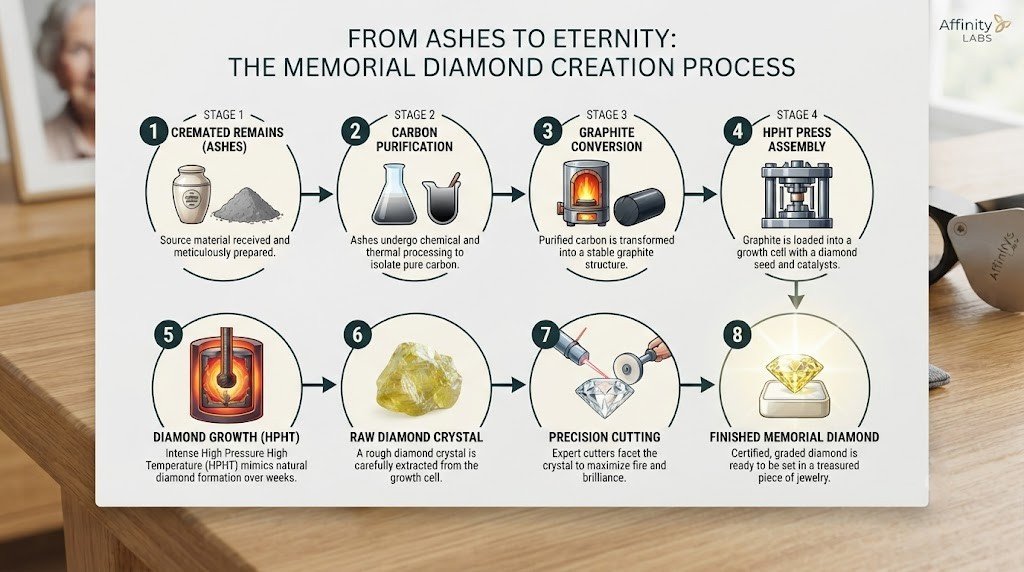
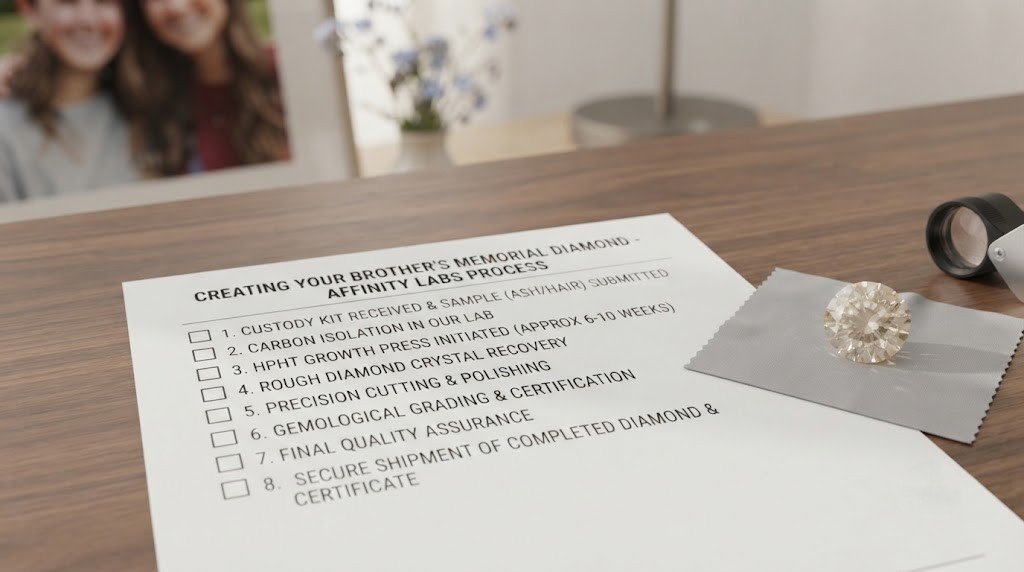
Seven stages separate an envelope of hair from a finished gem made from grandmother hair. No provider publishes a fixed duration for each one, and the overall timeline depends mainly on the carat size chosen, so this summary focuses on purpose rather than time.
| Stage | Lab activity | Meaning for her hair |
|---|---|---|
| Intake | Her sample is logged under your order and labeled | The lock is tracked as hers from arrival onward |
| Extraction | Oxygen-free, multi-stage heating removes everything that is not carbon | The other parts of keratin are driven off |
| Purification | The recovered carbon is refined further | Her carbon reaches roughly 99.9% purity or better |
| Graphitization | Heating to about 2,500–2,700°C converts carbon to graphite | Her carbon becomes press-ready feedstock |
| Growth | An HPHT press, or for a minority of providers a CVD chamber, grows the crystal | Her carbon, with any supplemental carbon, forms diamond |
| Cutting and polishing | A gemologist shapes and facets the rough crystal | The stone gains its shape and brilliance |
| Grading and documentation | Quality is graded, ideally by an independent lab, and origin is recorded | You receive evidence of quality and of her origin |
Some providers add an optional color-treatment step after growth; it is described in the color section. Every lab orders and names these stages slightly differently, so ask yours to describe the sequence it follows for anything made from grandmother hair.
What Does the Lab Strip Away From Her Hair?
Keratin contains carbon alongside other elements, including hydrogen, oxygen, nitrogen and sulfur. Extraction is the stage of producing a stone made from grandmother hair that separates the carbon from all of those. The lab heats the hair in a controlled, oxygen-free environment, usually over several steps, so the non-carbon components are driven off while the carbon stays behind.
Removing oxygen from the chamber is essential. Heated in ordinary air, carbon would bond with oxygen and leave as a gas, taking her contribution with it. In a sealed, oxygen-free setting it remains as a solid residue that can be collected.
Purification follows until that residue is roughly 99.9% carbon or higher. Clean feedstock matters because stray elements in the growth cell can affect the finished gem. At this point, what is actually made from grandmother hair no longer resembles hair in any way; it is a small amount of nearly pure carbon.
What becomes of any hair the lab does not use?
The envelope you mail may hold more than a diamond made from grandmother hair actually consumes. Whether leftover hair is returned, stored or disposed of is a provider policy, and families feel strongly about it, so ask in advance and keep the reply.
Is Lab Carbon Added to a Stone Made From Grandmother Hair?
Often, yes. Across the industry, recovered personal carbon is typically blended with supplemental lab-sourced carbon so the growth cell has enough feedstock, and a provider may well do the same for gems made from grandmother hair. Because hair is so carbon-rich, the reasons and proportions may differ from an ash-based stone, but providers set this individually.
Here is the honest gap: no industry-wide figure is published for how much of a finished stone made from grandmother hair is her own carbon. The percentages people quote online describe ash-based stones and should not be carried over to hair. Before you order, request a written statement from every provider you are considering: roughly how much of the polished gem will be her own carbon, and does that change with carat size?
None of this makes a diamond made from grandmother hair less hers. Whatever the proportion, carbon recovered from her hair becomes part of the diamond’s crystal lattice. It is not a symbol placed beside her memory; it is a gem physically built, in part, from her. Sales claims of a stone that is entirely hair, with nothing added, describe something the chemistry does not support.
How Does Graphite Become a Diamond Crystal?
Graphite and diamond share the same element and differ only in structure. In graphite, carbon atoms form flat layers that slide over each other, which is why pencil lead is soft. In diamond, every atom is bonded tightly in three dimensions.
Most providers use HPHT growth to force that change in a stone made from grandmother hair. The graphite feedstock goes into a growth cell with a tiny diamond seed, and a press, a BARS or cubic design for example, applies roughly 6–8 GPa of pressure at around 1,400–2,500°C. Those are conditions similar to the Earth’s mantle, where natural diamonds form, and in them carbon builds outward from the seed as diamond crystal over weeks to months.
A smaller group of providers grows memorial stones by CVD instead, converting the carbon to methane and depositing it layer by layer onto a seed plate in a vacuum chamber. For a fuller account of both techniques, see the background on how lab-grown diamonds are produced. Asking which method grows a diamond made from grandmother hair at a given lab is a perfectly reasonable question.
Why growth time sets the carat
The longer a crystal made from grandmother hair stays in the press, the larger it grows. That is why carat size, which usually runs from about 0.10 to 5 carats or more, shapes both timeline and cost. The amount of hair you send does not.
What Happens After the Crystal Leaves the Press?
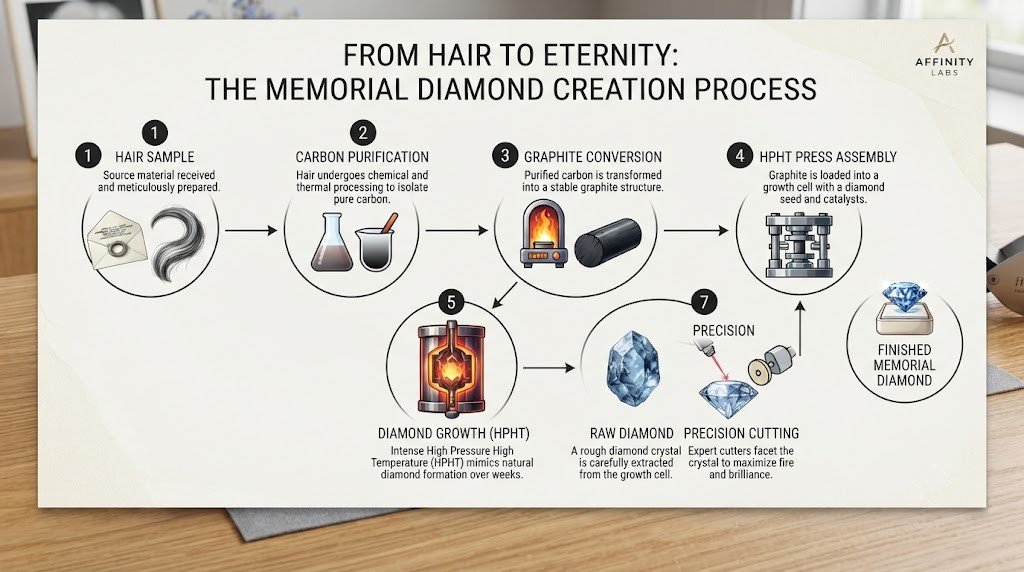
Fresh from the press, a crystal made from grandmother hair looks nothing like a finished gem. A gemologist studies it, decides on a shape such as round, cushion, oval or princess, and cuts and polishes the facets that will catch light. Ask whether a quoted carat weight describes the rough crystal or the polished result, because cutting removes material.
What comes out of the cutting room is a genuine diamond. It rates 10 on the Mohs hardness scale and has the same optical behavior as any other diamond, mined or lab-grown. Clarity for memorial diamonds typically falls between SI2 and VVS. Hardness is not the same as being unbreakable, though: a sharp blow at the wrong angle can chip any diamond, so a protective setting is worth discussing for a ring worn daily.
What Color Can a Diamond From Her Hair Be?
The color of a diamond made from grandmother hair forms during growth and depends on trace elements in the crystal. Boron gives blue tones. Nitrogen gives yellow. A colorless diamond requires both to be kept out, which needs extra processing and usually raises the price.
Organic, personal carbon sources tend to carry traces of these elements, so memorial diamonds generally lean toward yellow, blue, and champagne or brown shades. A stone made from grandmother hair is no exception, and its color is not a measure of her or of the hair’s quality. No provider can promise to reproduce a particular shade, and families cannot select an exact tone in advance; what you can choose is from the range of colors a provider offers.
Some providers also offer irradiation after growth to produce red, pink, green or black stones. For more on the options and their limits, read about the color range a diamond from her hair can take.
Does Gray, Dyed or Treated Hair Change Anything?
It is a natural thing to wonder, and the answer sits with the provider rather than with general science. There is no established basis for saying that gray, white, colored, permed or thinning hair produces a different gem made from grandmother hair, a different color or a less suitable sample.
What does vary is policy. Some labs may ask about dyes, treatments or products in the hair; others may not. Tell the provider plainly what you have, including any treatments you know about, and ask whether they accept it for a diamond made from grandmother hair. Get their answer in writing so there is no confusion later.
What Paperwork Proves Where the Stone Came From?
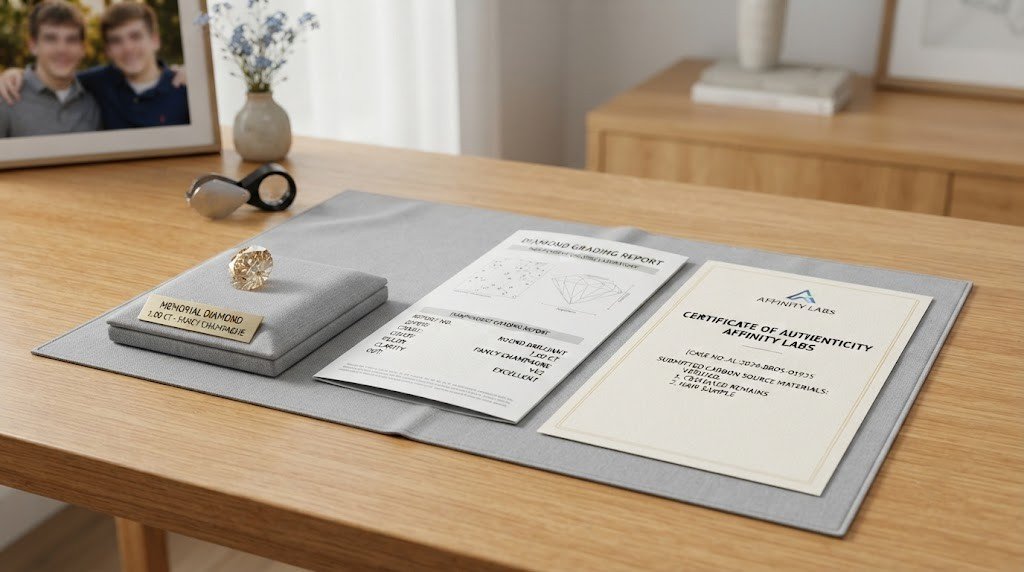
Two different documents can accompany a finished diamond made from grandmother hair, and it helps to know which is which.
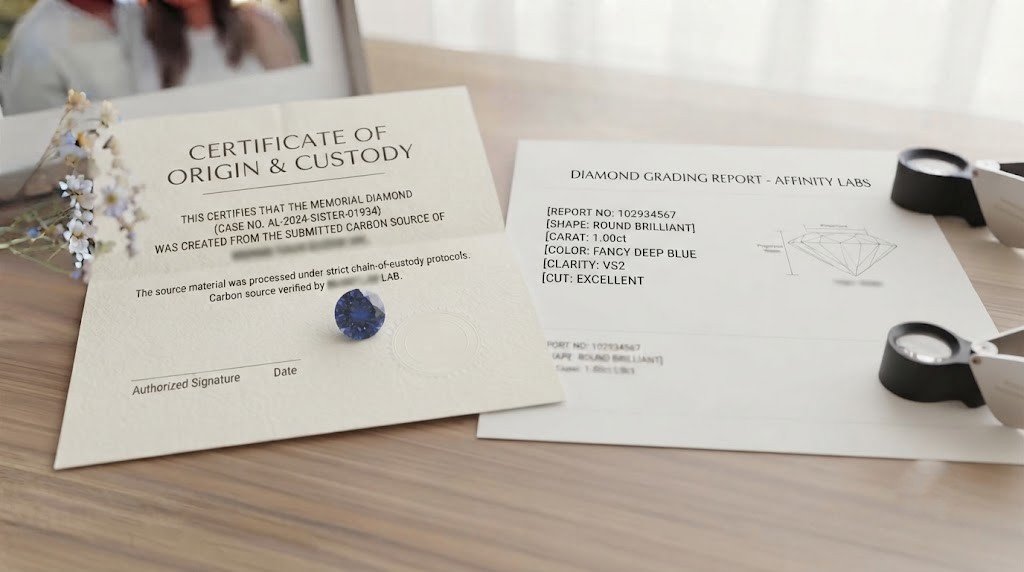
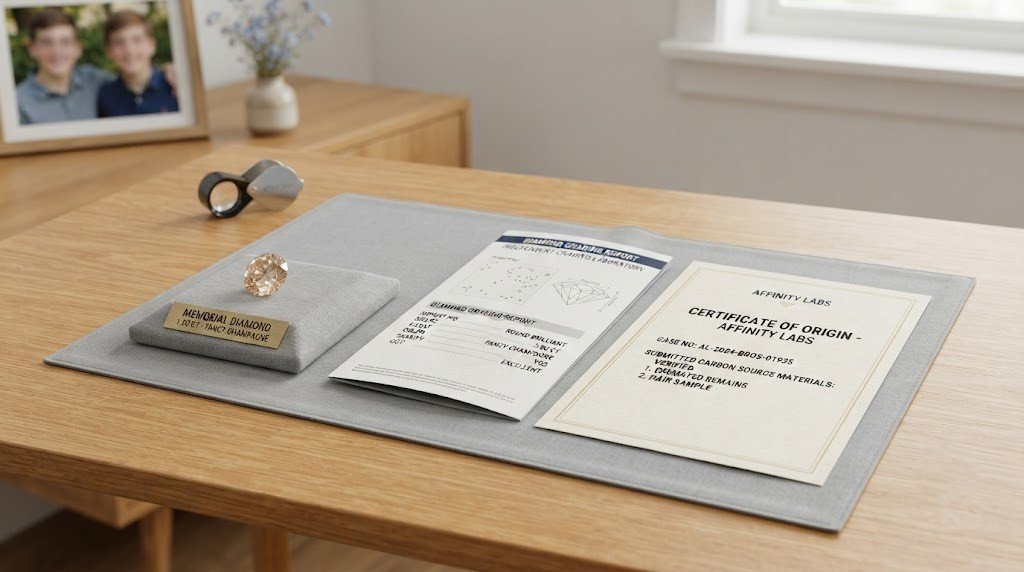
A certificate of authenticity, usually issued in-house by the provider, states that the stone was grown from the carbon your family submitted. It functions as a chain-of-custody record. A grading report describes the diamond’s quality on the 4Cs: cut, color, clarity and carat. Ideally it comes from an independent gemological lab, commonly working to GIA standards and sometimes from IGI, and it is usually an optional add-on with its own fee rather than a standard inclusion.
GIA’s explanation of diamond quality factors is a helpful guide to reading a grading report.
Questions that reveal how chain of custody works
Practices differ, so a short list of direct questions tells you more than any brochure:
- What label or code follows her hair through every stage, from intake to the finished stone made from grandmother hair?
- Is anything handled at an outside facility, and how is her sample tracked there?
- Can you see progress updates or photos at any point?
- What is recorded on the authenticity certificate, and what is not?
- If a growth run does not succeed, what happens next, and would more hair be needed?
Readers who want to test whether a stone is really made from grandmother hair can find that skepticism addressed in the piece on whether the diamond truly contains her hair.
Whose Agreement Matters Before You Send Her Hair?
Hair kept at home is usually a simpler matter than ashes when you are planning a stone made from grandmother hair, but it is not always straightforward. A person’s belongings can form part of their estate, and the rules differ by state. If her estate is still being settled, a conversation with the executor, or whoever is handling it, is a sensible first step.
Family feeling matters too. You may be a grandchild by birth, adoption, marriage or choice, and an aunt, uncle, parent or cousin may also hold strands of her hair or have hopes of their own. Because so little is needed, a single lock can sometimes supply more than one stone made from grandmother hair, which can make it easier for relatives to share.
Faith can shape the choice. No religious tradition has an official position on memorial diamonds as such; teaching addresses cremation and the handling of ashes. Across major schools of Islamic thought, cremation is considered impermissible, and a hair-based stone involves no cremation, which some families find relevant. Your own imam, rabbi, priest, pastor or community elder is the right person to consult.
If her ashes are also available, the companion explainer on the ash-based lab process describes how that route differs, and some families combine both, as covered in growing one stone from her ashes and hair together.
How Long Does a Diamond Made From Grandmother Hair Take, and How Much Does It Cost?
Industry-wide, a diamond made from grandmother hair takes about 6 to 10 months from the time a lab receives the material, with stones above roughly 2 carats or in specialty colors sometimes taking up to 12 months. Plan around the overall estimate a provider gives you, since individual stages are not published with set times.
As a general picture of 2026 pricing across the category, entry stones of about 0.10–0.25 ct run roughly $1,500 to $3,500. Stones of 0.5 to 1 ct fall roughly between $5,000 and $15,000, and colorless costs meaningfully more at the same size. Large stones from 2 to 5+ ct reach roughly $20,000 to $75,000 or beyond. An independent grading report, engraving, a fancy cut and a ring or pendant setting are typically charged on top.
For a walk-through of choosing a provider and preparing the sample, see the practical route to turning her hair into a diamond, and for every decision gathered in one place, the grandmother hair diamond guide is the fuller reference.
Frequently Asked Questions
How much of a diamond made from grandmother hair is actually her carbon?
No industry-wide percentage is published for hair-based stones, and figures quoted for ash do not apply. Supplemental lab carbon is often blended in. Put the question to each lab in writing and ask how much of a stone at your chosen carat would be her carbon.
Can hair from her hairbrush be used?
It depends on the provider. Loose strands from a brush differ from a cut lock, and labs set their own acceptance rules. Describe exactly what you have, ask whether it is workable, and wait for a written answer before posting anything irreplaceable.
Does her hair need to have been cut recently?
Providers decide what age and condition of hair they accept, so there is no universal rule. Hair saved years ago in an envelope or locket may be workable. Explain how the hair has been kept and ask the lab directly before sending it.
Will gray or dyed hair affect the color of the diamond?
There is no established basis for saying hair color or dye changes the stone. Diamond color comes from trace elements such as nitrogen and boron present during growth. Whether a provider accepts dyed or chemically treated hair is a question to ask them directly.
Can a diamond be made from grandmother hair if she was buried?
Yes, if a lock of her hair was kept. Hair-based stones need no cremation, so burial does not rule them out. The hair needs to be available and acceptable to the provider, and it is wise to check first with whoever is settling her estate.
Can one lock of her hair make stones for several grandchildren?
Sometimes. Because hair is about half carbon, a small amount goes a long way, and several stones may come from one sample. The provider can confirm what is feasible, and the family should agree on how the hair is shared first.
Final Thoughts on Her Hair Becoming a Diamond
Understanding what happens in the lab turns the idea of a diamond made from grandmother hair into a series of concrete steps you can question. You now know why her hair holds so much carbon, what the lab removes, why supplemental carbon is often part of the process, and which answers only a provider can give.
There is no deadline on this. A lock of hair kept safely in an envelope will wait while your family talks it through, and a diamond can sit alongside every other way you remember her.
Learn More About Hair-Based Grandmother Diamonds and the Lab Process
- Is a Memorial Diamond Really Made From Your Grandmother’s Hair? the honest answer about her carbon
- How Much Hair Do You Need for a Grandmother Memorial Diamond? sample size and packing
- What Color Will a Diamond Made From Your Grandmother’s Hair Be? color formation and options
- Grandmother Hair Diamond: The Complete Guide the full decision guide
Talk With Memorial Diamond
Questions about her hair, how much you have or whether it is suitable are exactly the kind of thing worth asking early. Memorial Diamond is glad to hear from you at memorialdiamond.us, whether you are ready to begin or simply gathering information.
You set the pace, and a conversation commits you to nothing.