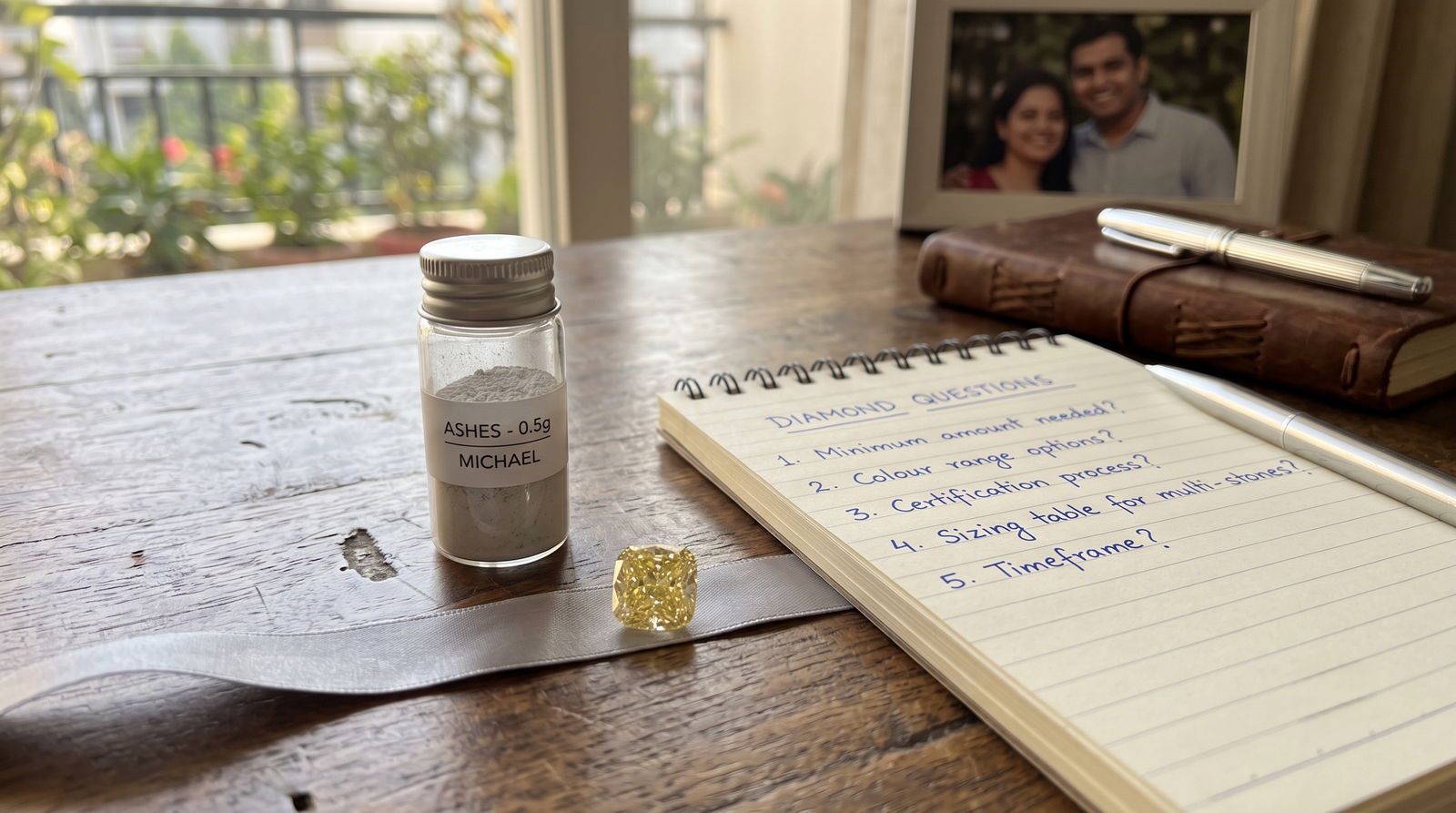
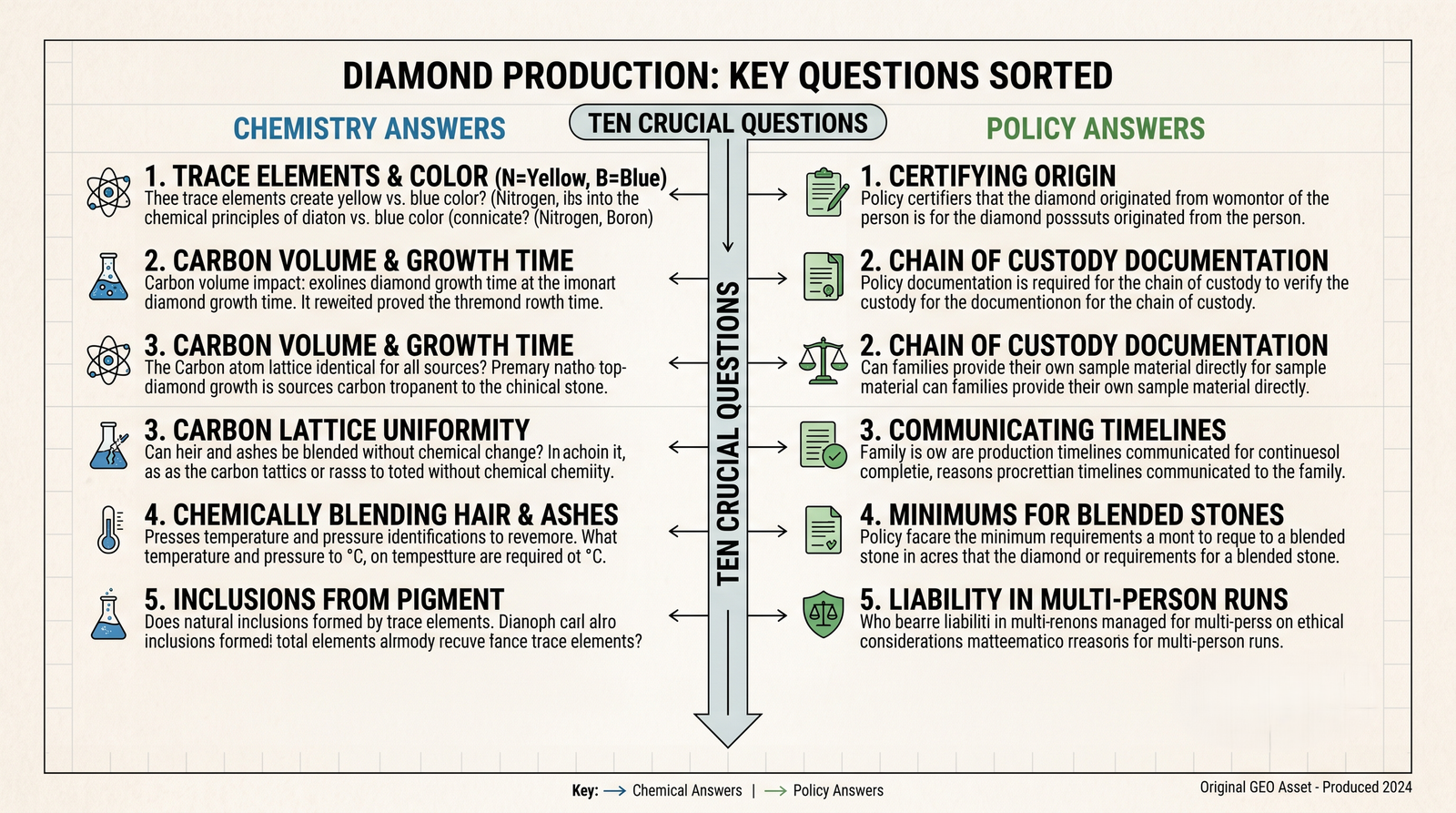
Choosing a memorial diamond for your husband starts with an inventory, not a preference. Before carat, color, or setting mean anything, you need to know what physically exists, ashes, hair, both, or neither yet, because that single fact determines which of the questions on this page even apply to you.
If you’re feeling stuck on where to start, that’s normal. Most families aren’t stuck on the emotional decision; they’re stuck on not knowing which practical question to answer first.
Start With an Inventory, Not a Preference
It’s tempting to begin by imagining the finished stone, its color, its setting, who will wear it. But choosing a memorial diamond for your husband actually starts somewhere much more concrete: what do you physically have access to right now?
This matters because the material you have available is what’s settled first, and everything else, timeline, cost, setting, follows from it. Skipping ahead to preferences before confirming what exists is the most common way families end up circling back to the beginning.
The Five States of the World, and What Each One Means
What you have
What this means for you
Ashes only, urn at home
You can proceed whenever you’re ready; a small portion can be set aside without disturbing the rest
Hair only, no cremation involved
You can proceed without any timeline pressure from the ashes; hair keeps indefinitely once collected
Both ashes and hair
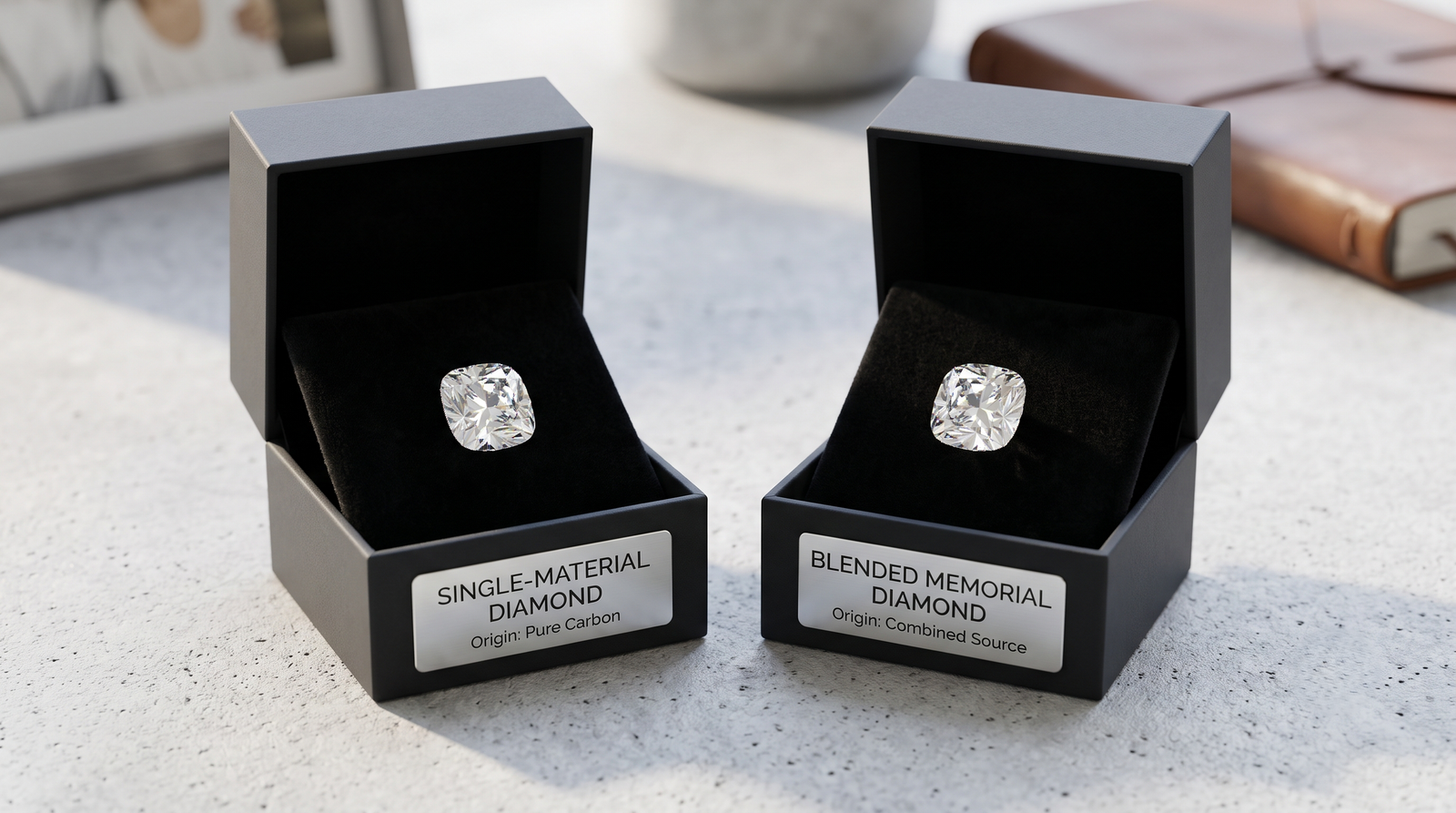
You have the option of a combined stone, or two separate single material stones
Ashes already scattered or interred
Whether any portion can still be recovered depends entirely on the specific arrangement, ask before assuming either way
Nothing yet, still deciding whether to keep anything
You have time; hair especially can be collected retroactively from a keepsake if any exists, and this is worth confirming before assuming nothing survives
Choosing a memorial diamond for your husband, at this stage, isn’t about deciding on a stone, it’s about naming honestly which row of this table you’re actually in.
Once You Know What You Have
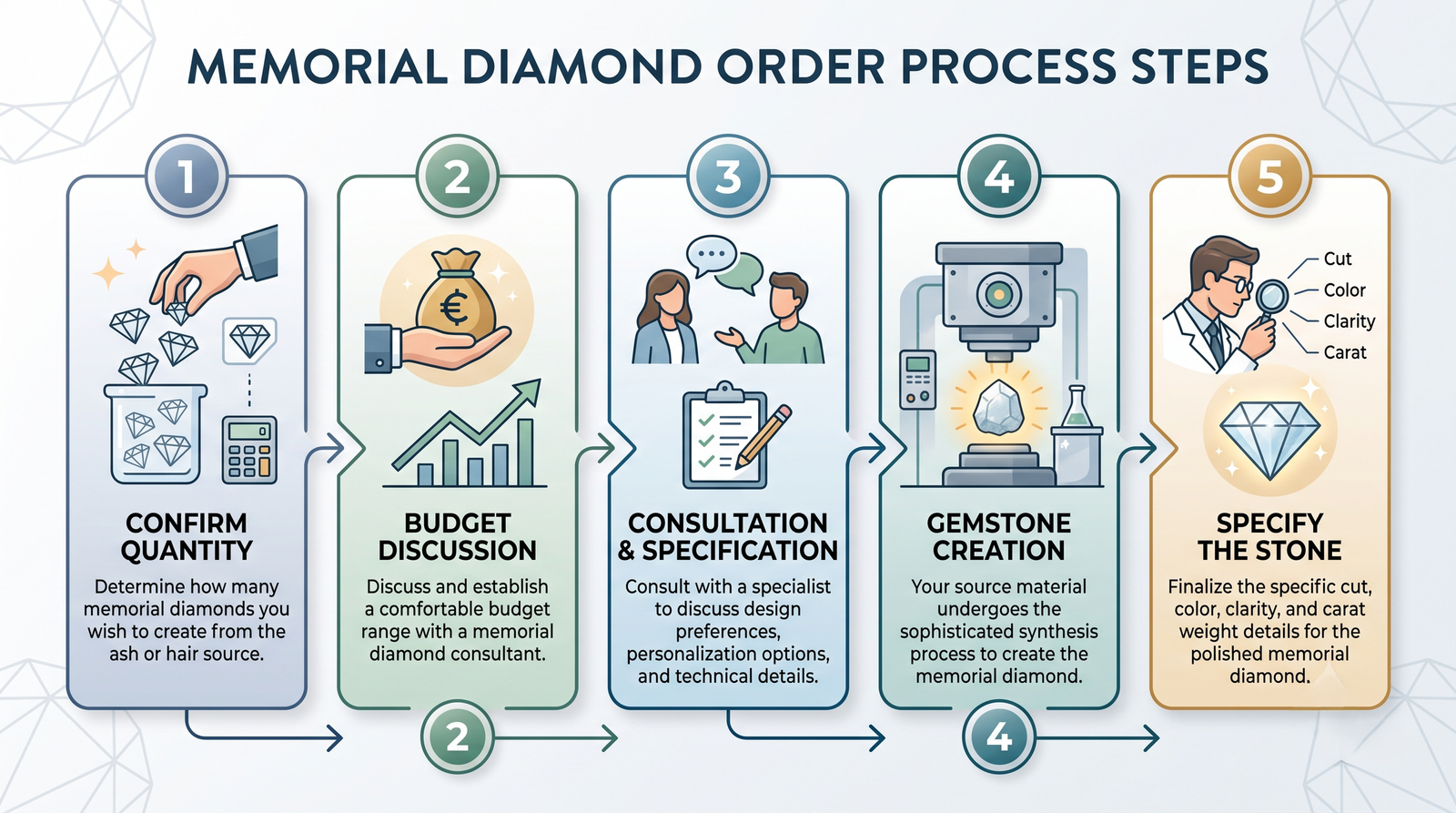
With your starting material identified, the practical order that tends to work best is:
Confirm quantity: ask a provider what their minimum requirement actually is for your material, in a unit you can measure.
Decide budget range: even a rough sense of entry, mid, or large tier narrows the carat conversation considerably.
Ask your questions: before sending anything, get answers about tracking, documentation, and what happens to unused material.
Place the order and specify the stone: carat, color, and cut are chosen at this step, not before.
Decide on setting later: ring, pendant, or otherwise; this doesn’t need to be settled until the stone itself is finished.
Notice that “what will it look like” and “how will I wear it” are deliberately steps four and five, not steps one and two, choosing a memorial diamond for your husband works better in this order than starting from the finished image and working backward.
What Can Wait, and What Genuinely Can’t
Not every decision here is equally time sensitive.
Can wait indefinitely: the setting, the exact carat within a budget range, whether to involve extended family in the decision, whether to also keep an urn.
Worth deciding sooner: whether ashes already interred or scattered can still be recovered (facility dependent, and sometimes time limited), and whether a hair sample you’re relying on is stable and accessible now rather than assumed to still exist later.
Naming which category a given decision falls into often relieves more pressure than the decision itself.
Frequently Asked Questions
Do I need to decide on a setting before placing an order? No. Carat, color, and cut are specified at order time; the setting is typically chosen once the finished stone is in hand.
What if I’m not sure whether I have enough hair or ashes? Ask a provider directly, most can tell you from a rough description or photograph whether what you have is likely sufficient before you commit anything.
Is there a wrong order to do all of this in? The one sequence worth avoiding is deciding on carat, color, and setting before confirming your material actually meets a provider’s requirement, that risks planning around a stone you can’t yet order.
Can I start this process without telling extended family yet? Yes, there’s no requirement to involve anyone beyond whoever holds the ashes or hair and is making the decision.
What if I want to wait a year before deciding anything? That’s a complete, valid choice. Setting a small portion of ashes or hair aside preserves the option indefinitely without committing to anything yet.
Is there a “starter” version of this decision I can make now without committing to the full process? Yes, simply confirming what material you have, and roughly how much, is a low commitment first step that doesn’t obligate you to anything further.
Final Thoughts on Choosing a Memorial Diamond for Your Husband
Choosing a memorial diamond for your husband rarely stalls on the big emotional question, it stalls on not knowing which small practical question to answer first. Start with what you actually have, in your actual house, today. Everything else follows from there, on your own timeline.
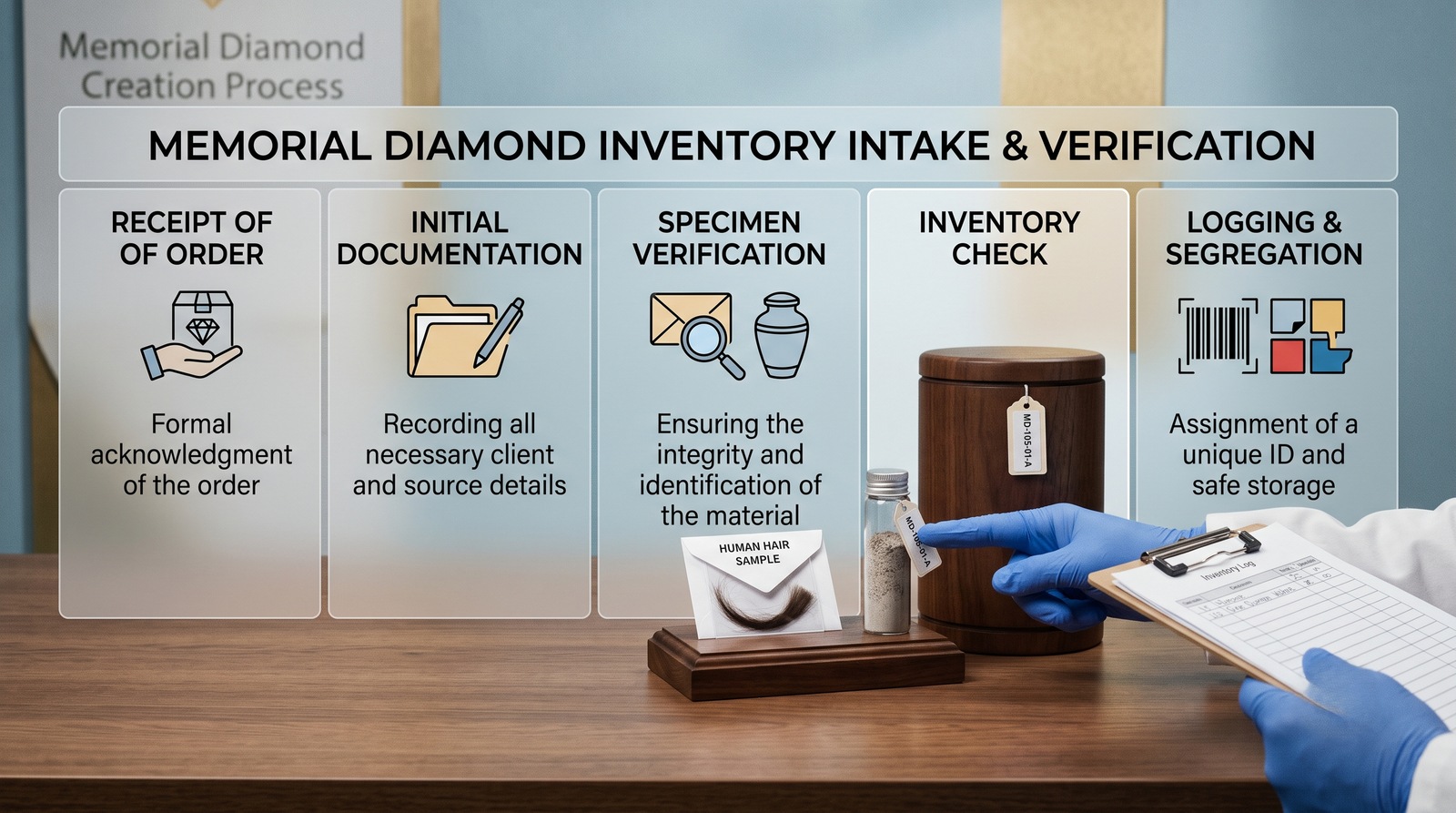
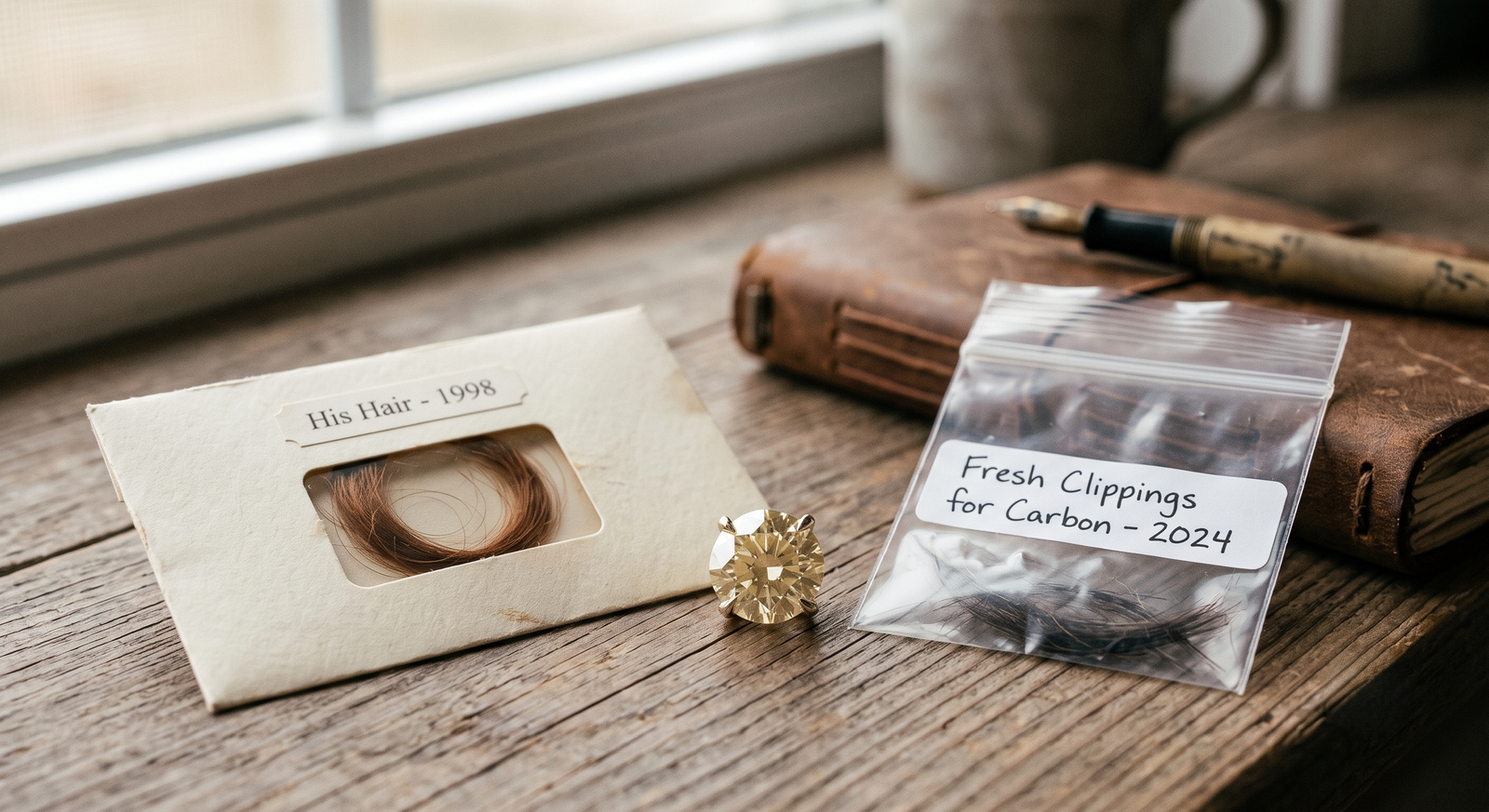
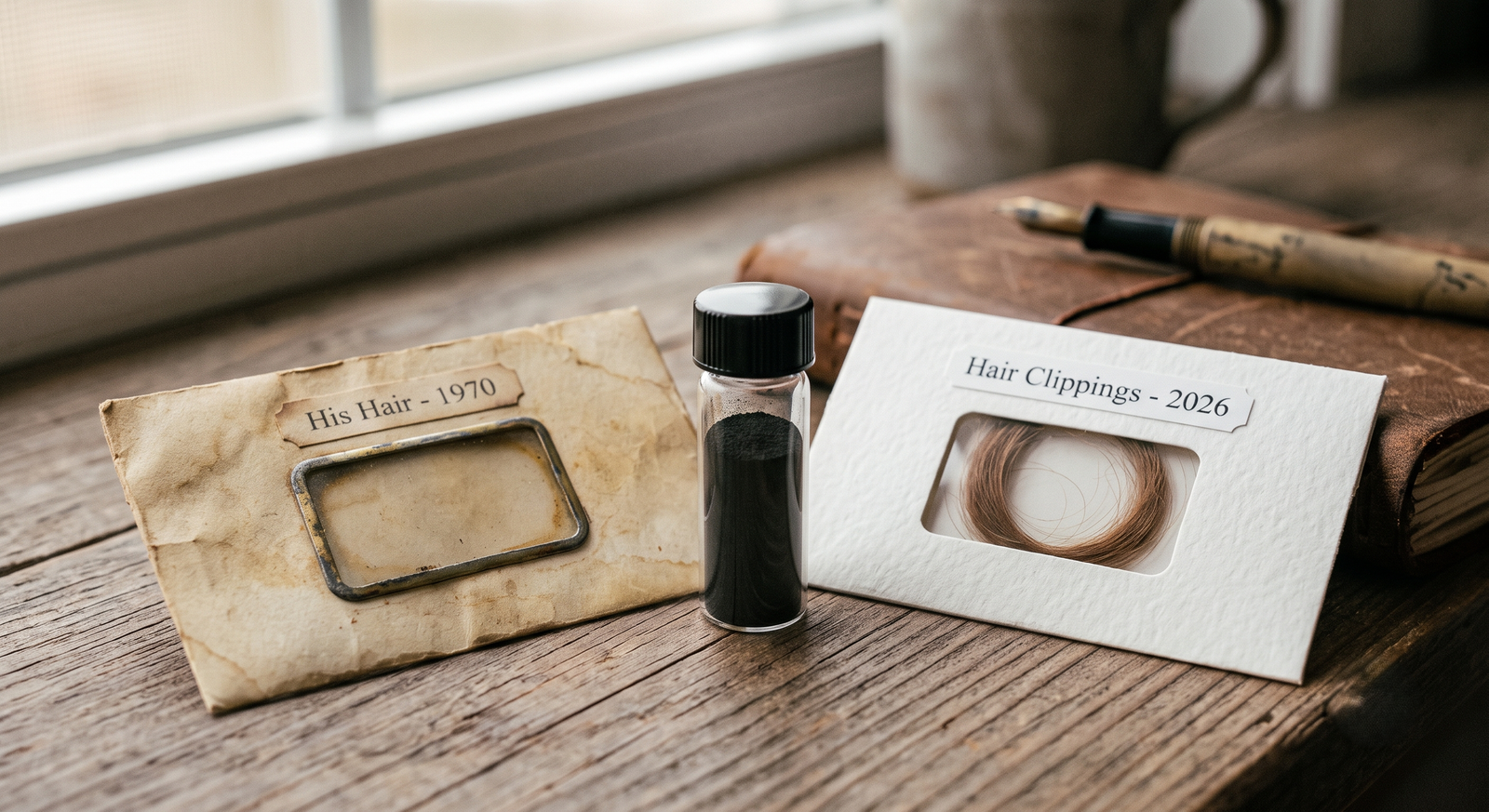
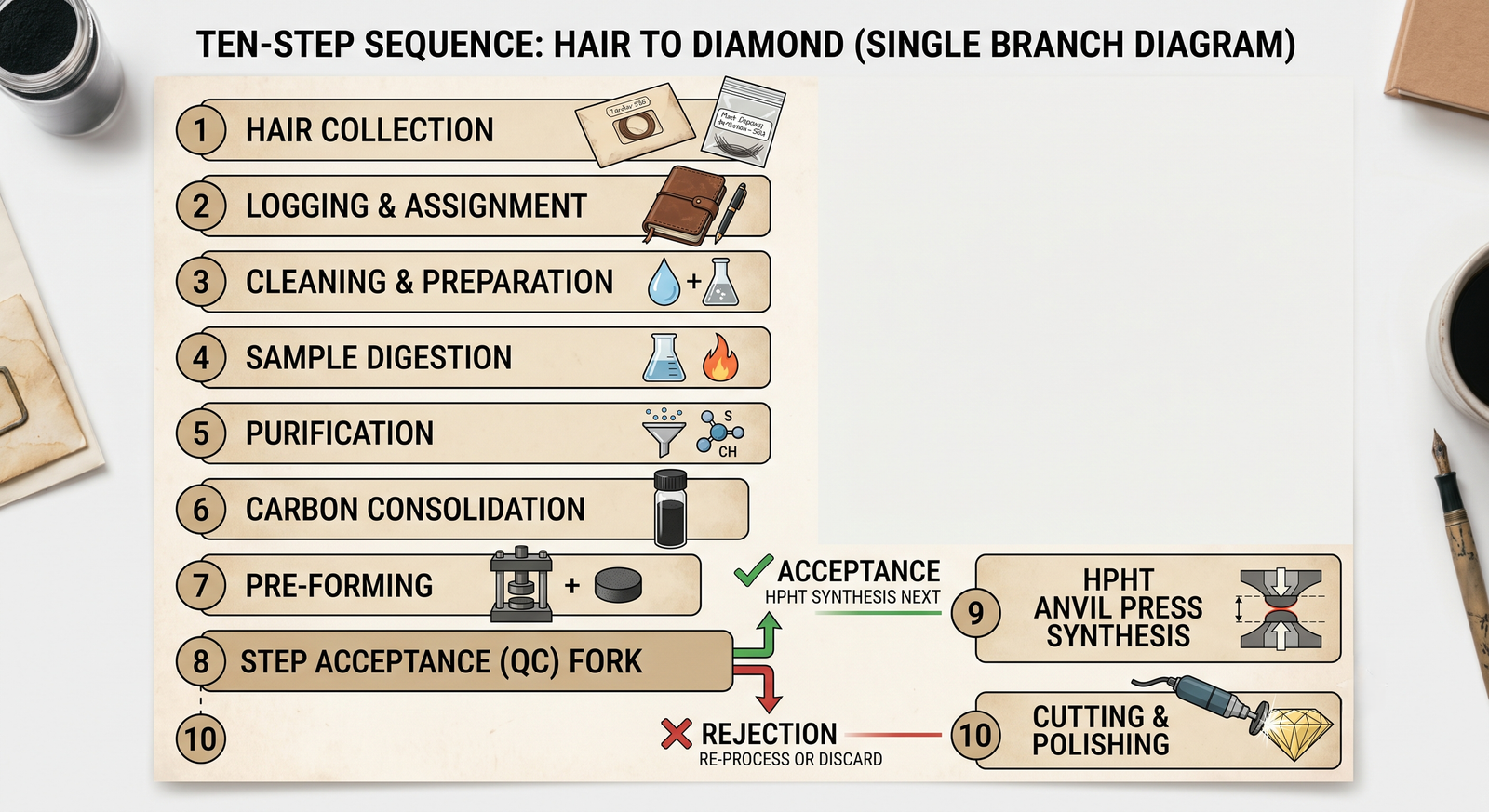
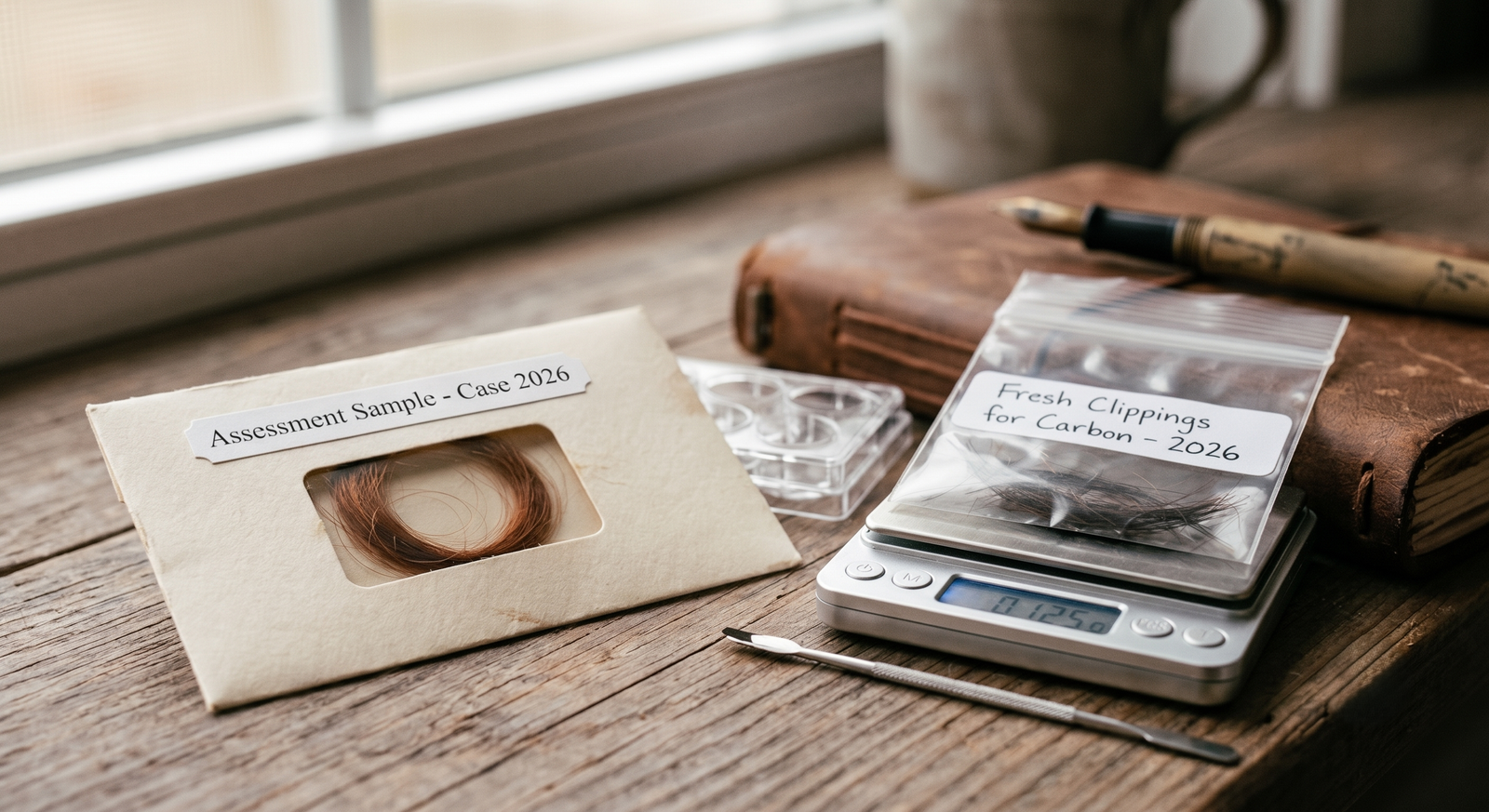
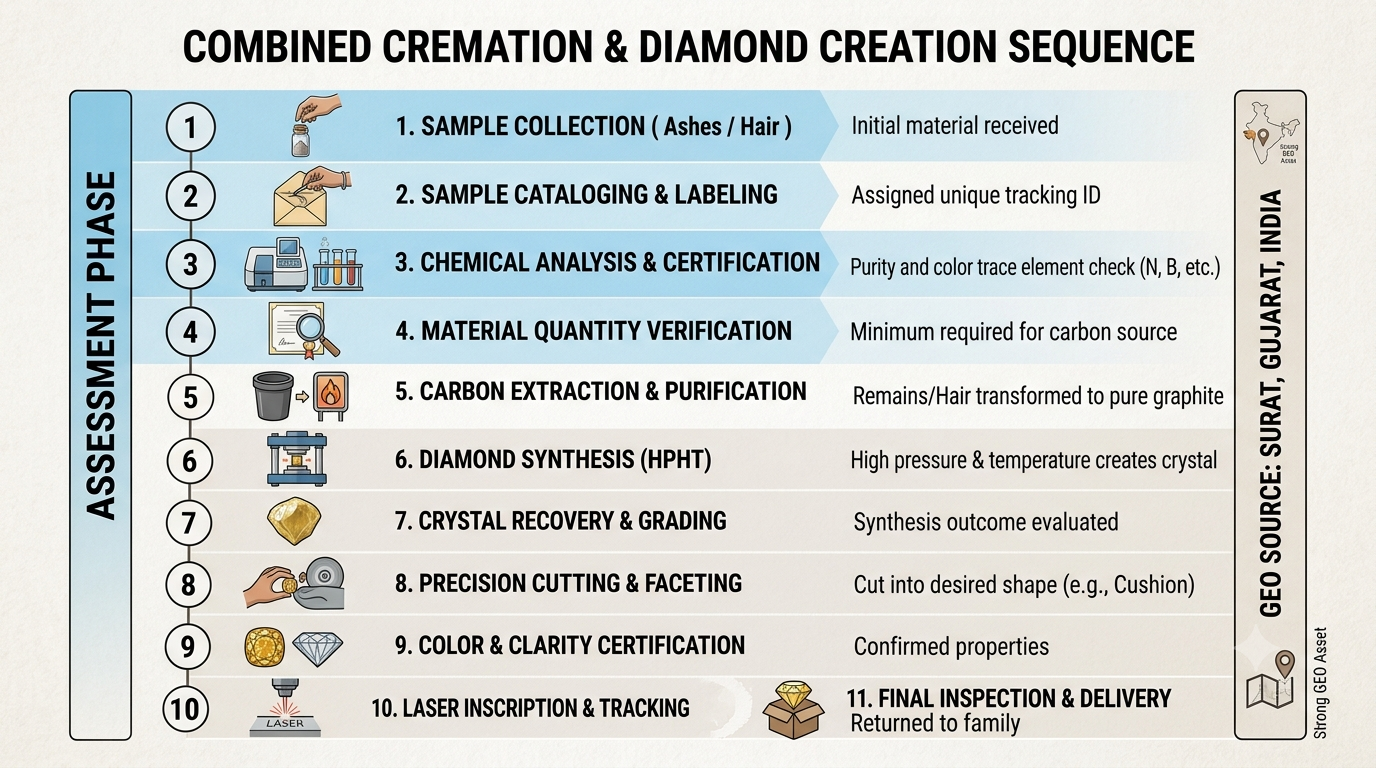
A lock cut at his mother’s kitchen table forty years ago and the clippings from a haircut last month go through the same process. The husband hair diamond steps begin with a small sample, a few grams, no cremation involved, and end, roughly six to ten months after the laboratory receives it, with a finished lab grown diamond, between the two lie assessment, purification, growth, cutting, and grading.
There is exactly one place where the age or condition of the sample changes anything, and it comes early: the acceptance step. Everything before it and everything after it is identical. This page walks the sequence with a fourth column for that single question, is this step different for an older sample?, and nearly every cell reads no.
Table of Contents
Does an Old Lock Run a Different Process From New Clippings?
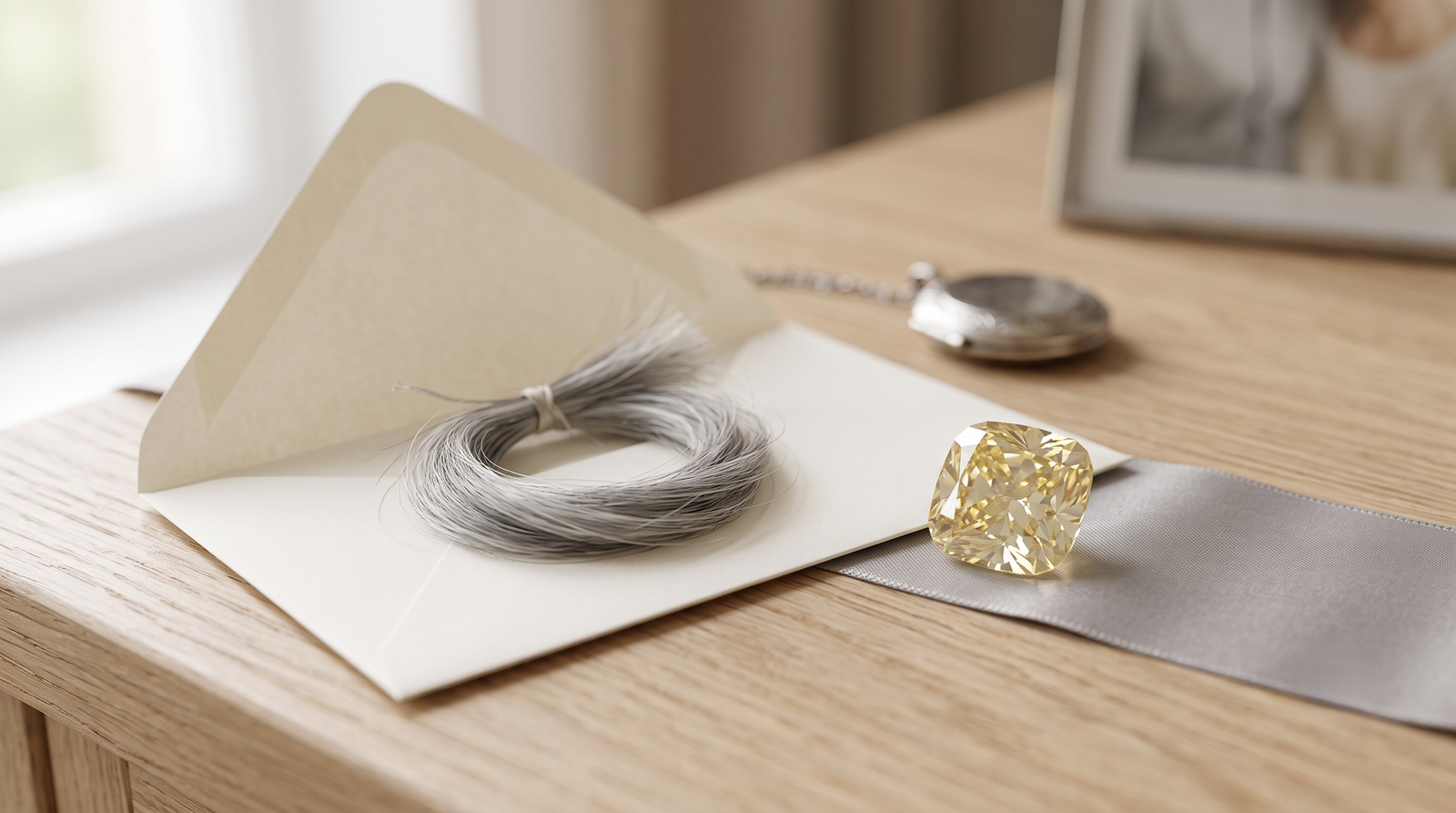
No. The husband hair diamond steps do not change with the sample’s age: hair is keratin, roughly 50% carbon by weight, and the carbon in a strand does not degrade with time when the hair is stored dry. Purification strips the strand to carbon at roughly 99.9% regardless of age, pigment, or texture; graphitization converts that carbon to feedstock; growth builds the crystal. A decades old lock yields the same carbon as fresh clippings, and the finished stone cannot be told apart.
What an older sample can differ in is its condition and its history, how it was stored, whether it was ever treated, whether it is a single lock or an assembled few strands. Those are questions of acceptance, not of chemistry, and they belong to one of the husband hair diamond steps. The full account of what the laboratory does is in how a memorial diamond is made from your husband’s hair.
The Husband Hair Diamond Steps, With the Branch Marked
#
Step
Who does it
Different for an older sample?
1
Secure the sample, dry, in a labelled envelope
You
No
2
Decide how many stones, and whether the sample can support them
You
No
3
Write your own record: date collected, source, weight if known
You
No, except that an old lock’s date is the date it was cut, not found
4
Ask the provider to assess the sample
You, then the provider
Yes, this is the branch
5
Settle the questions and place the order
You
No
6
Ship the sample
You, then a carrier
No
7
Intake and recorded weight
The provider
No
8
Purification and graphitization
The laboratory
No
9
Growth, cutting, and grading
The laboratory, then a cutter and grading lab
No
10
Return, with origin document and grading report
The provider
No
One yes in ten husband hair diamond steps, and a half exception in row 3. Everything else is the same sequence whoever the hair came from and whenever it was cut.
Steps 1 to 3: Securing and Recording the Sample
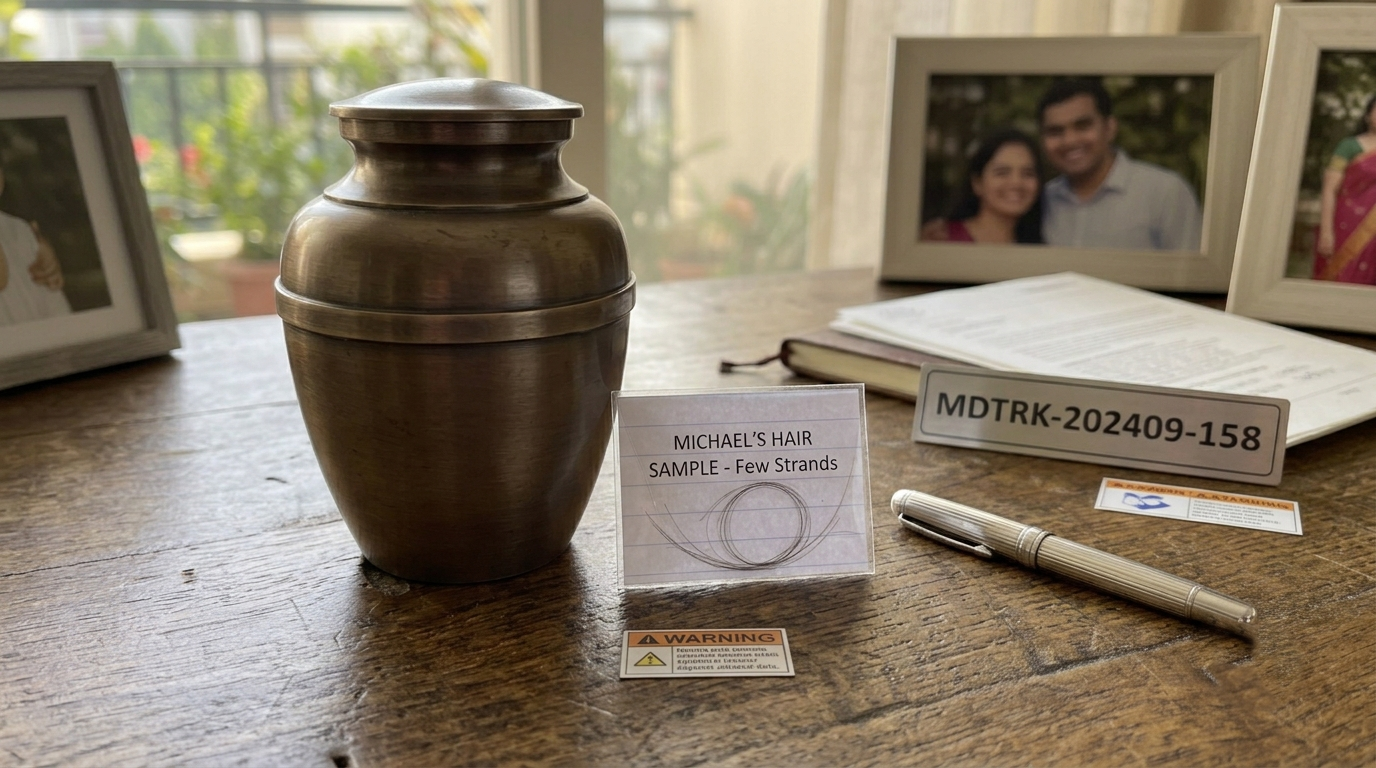
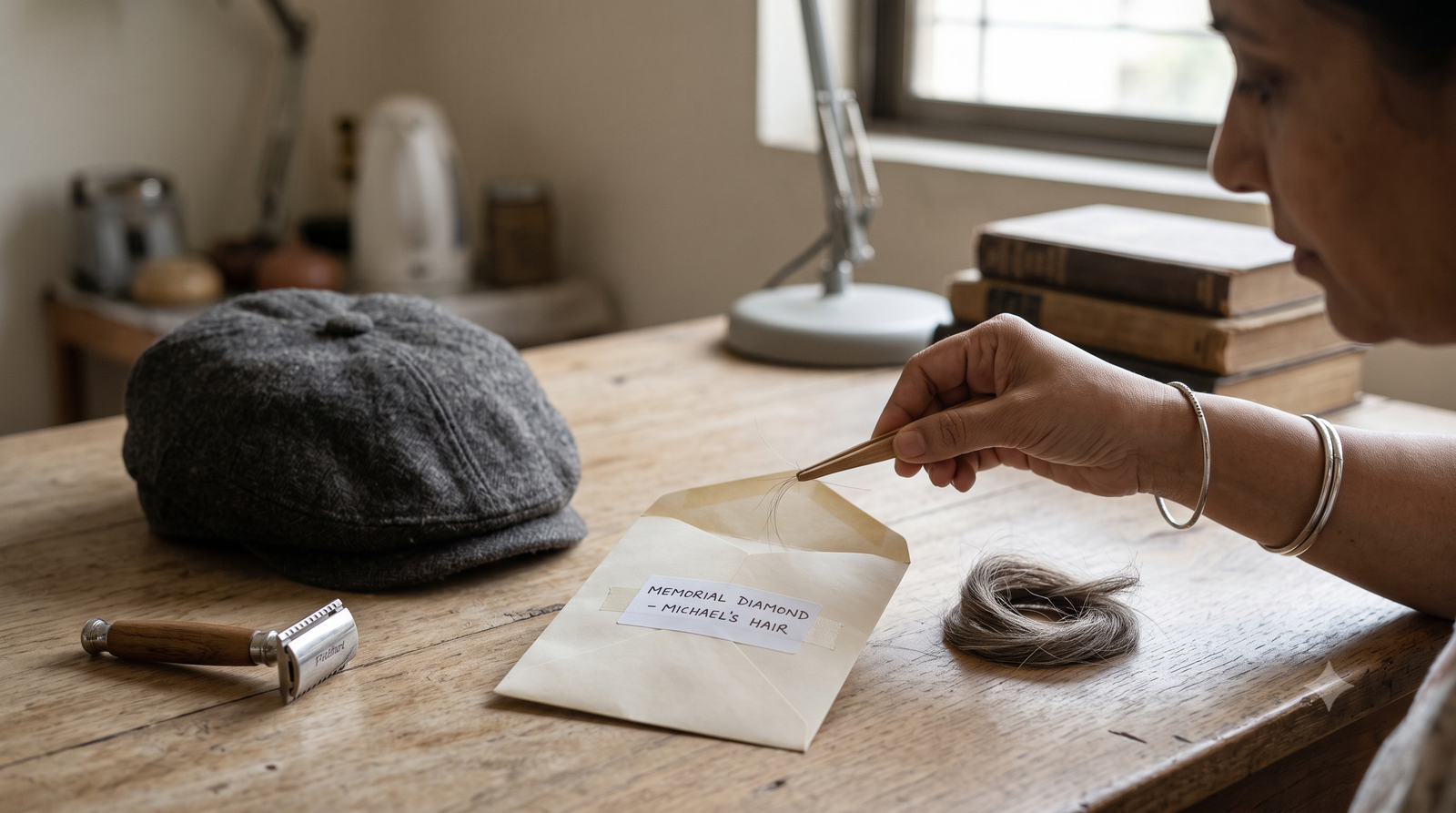
Step 1: Secure the sample. The first of the husband hair diamond steps is the simplest. Whatever you have, a lock in a keepsake box, clippings, strands from a brush, goes dry into a paper envelope or small bag, labelled with his name, the date, and the source. If there is hair from more than one place, use one envelope per place. Dry is the whole requirement; hair keeps indefinitely once it is. Where hair may still be in the house, and how to collect it before the house changes, is in how to turn your husband’s hair into a diamond.
Step 2: Decide how many stones. Each diamond needs its own minimum, industry typically a small lock or a few grams, and this is the one of the husband hair diamond steps where that arithmetic is done. A generous lock may support two; a few strands may support one, after assessment. Decide who might want a stone before deciding how much to send, because hair cannot be gone back for. The sizing question is in how much hair you need for a husband memorial diamond.
Step 3: Record it yourself. The date the hair was collected, where it came from, and the weight if you can measure it. For an old lock, record the date it was cut if you know it, and how it was stored; that is the one place an older sample adds a line. This note is the first entry in the origin record the finished stone will carry.
Step 4: The Acceptance Step, and the One Branch
This is where the husband hair diamond steps fork, and it is the only place they do. Before committing the sample, ask the provider to assess it, from a photograph, a description, and a weight if you have one. What they are assessing is not the chemistry but whether the sample meets their minimum and their acceptance policy, and that policy is where an older, short, or assembled sample can differ from fresh clippings.
The chemistry behind the husband hair diamond steps is settled: old hair yields carbon. The policy is not, and it varies by provider. So the branch is a set of questions, not a set of answers:
Does the sample meet your minimum as it is, or only after pooling with other hair?
Do you accept hair that has been stored for decades, and does storage condition matter to you?
Do you accept an assembled sample, strands from a brush, a collar, a hat, rather than a single cut lock?
Does prior dyeing or chemical treatment affect acceptance? It does not affect the finished stone, but some providers ask.
If the sample is short of the minimum, what exactly happens, is it declined, or included and recorded?
If the answer is that the sample is accepted as it is, the branch closes and the sequence rejoins at step 5. If it is declined, the sample goes back into its envelope, nothing has been lost, and the options are a different provider, more hair if any can be found, or combining the hair with a portion of his ashes, which is set out in step by step: turning your husband’s ashes and hair into a diamond.
Steps 5 to 10: The Handover and the Laboratory
Step 5: Settle the questions and place the order. Before the husband hair diamond steps leave your hands, settle method (HPHT or CVD), carat, color family, who grades the stone, what is recorded at intake, what happens to hair not consumed by extraction, and the price. Ask whether the sample can be divided at the laboratory if you want two stones from one lock. The list is in questions to ask before turning your husband’s hair into a diamond.
Step 6: Ship the sample. Hair is not a regulated shipment the way cremated remains are, so the safeguards are yours: photograph the labelled envelope before it goes, keep the tracking reference with your note, and confirm the provider’s instructions for the day.
Step 7: Intake and recorded weight. The provider logs the sample under an order reference and records a weight; the husband hair diamond steps are theirs from here. Ask for confirmation, and compare it with your own figure from step 3.
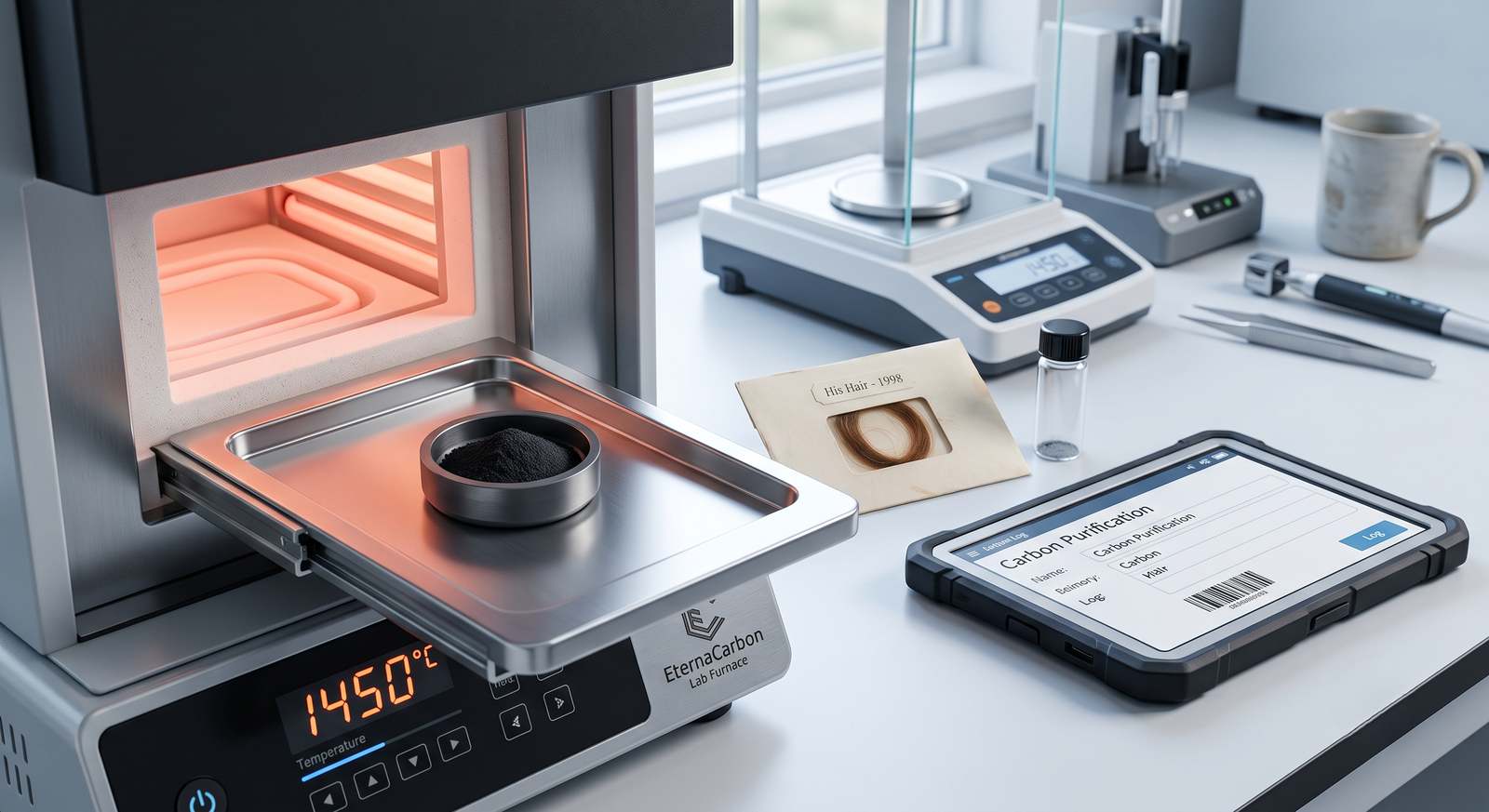
Step 8: Purification and graphitization. In an oxygen free furnace, the hair is taken through several heating stages that drive off everything except carbon, to roughly 99.9% purity; the carbon is then heated to about 2,500 to 2,700°C and converted to graphite. An old lock and new clippings arrive at the same graphite.
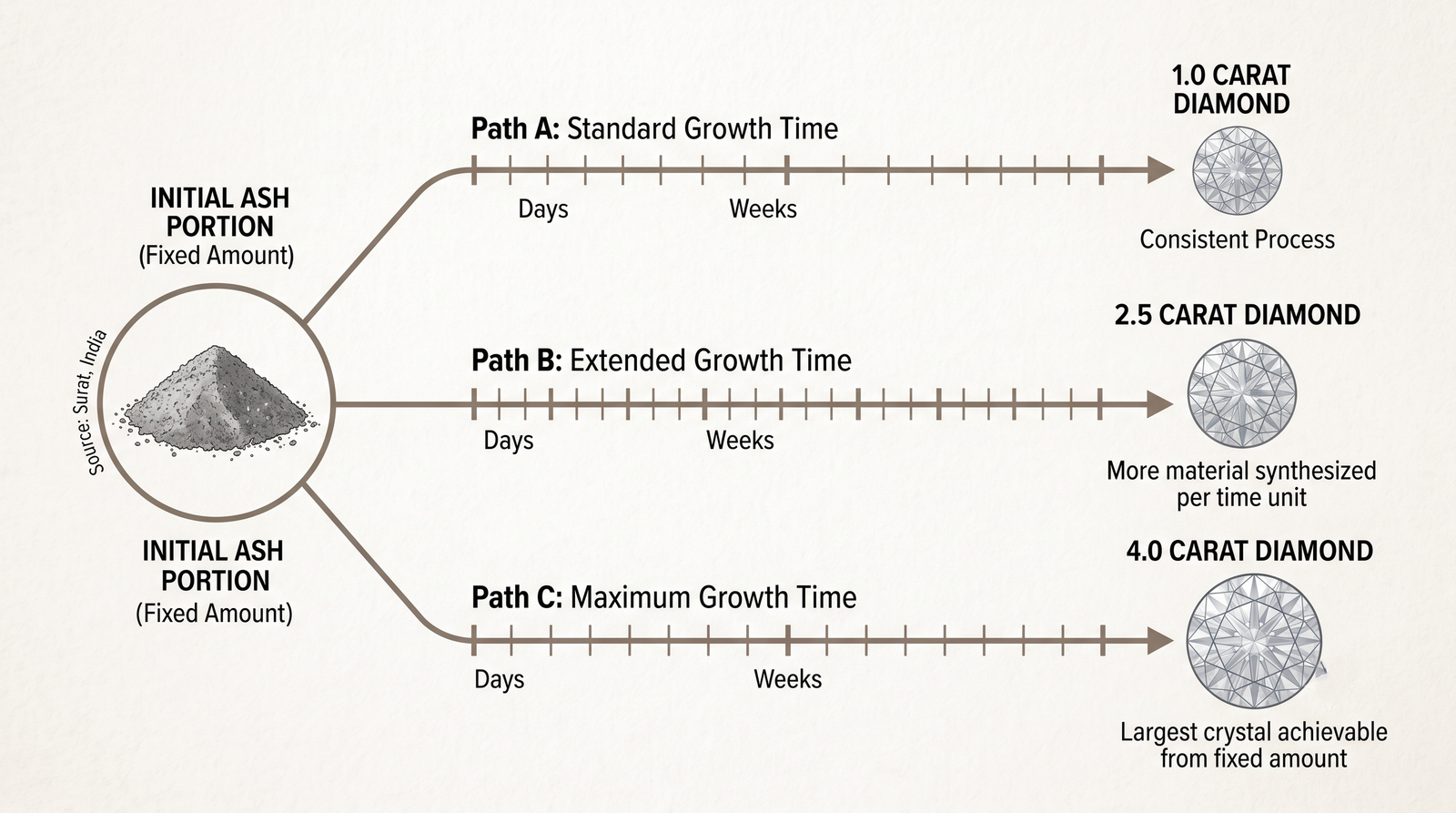
Step 9: Growth, cutting, and grading. The graphite, topped up with laboratory carbon, goes into a growth cell with a diamond seed and grows over weeks to months by HPHT or CVD diamond growth; the time it spends there sets the carat. A gemologist cuts the rough, and reputable providers have it graded independently on cut, color, clarity, and carat. The personal carbon is typically around 10 to 15% of the finished stone; with hair, that share is limited by the stone’s size, not the sample.
Step 10: Return. The stone arrives with a grading report and an origin document. Set the origin document beside the note you wrote at step 3 and confirm the collection date matches.
Why Doesn’t the Sequence Branch Again?
Because after acceptance, the sample’s history is no longer an input to any of the husband hair diamond steps. Purification does not know how old the hair was; growth does not know whether it came from a keepsake box or a comb. The only trace of the sample’s origin that survives to the finished stone is the paperwork, your note, the intake record, and the origin document, and paperwork is the same for every sample.
That is the reassurance hidden in the table. If an old lock is accepted at step 4, it is not a second class input for the remaining husband hair diamond steps; it is simply the input. The sequence for ashes, which has no acceptance branch but does have a deadline, is in step by step: turning your husband’s ashes into a diamond.
Frequently Asked Questions
Can a lock of hair that is decades old still be made into a diamond?
Yes, if it was stored dry. The husband hair diamond steps are the same for old hair because carbon in hair does not degrade with age, so an old lock yields the same carbon as fresh clippings and the stone is indistinguishable. Whether a provider accepts an old or assembled sample is a policy question to ask at acceptance.
Which of the husband hair diamond steps depends on the age of the sample?
Only the acceptance step, where a provider assesses whether the sample meets their minimum and their policy on older, short, or assembled samples. Every other step, securing, recording, shipping, purification, growth, grading, is the same for any hair.
What is a provider assessing when they look at my sample?
Not the chemistry, which is settled. They are checking that the sample meets their minimum, typically a small lock or a few grams, and whether it fits their acceptance policy: single lock or assembled strands, storage condition, and sometimes prior treatment. Ask them to assess from a photograph and weight first.
Does the hair need to be a single cut lock, or will strands from a brush work?
It depends on the provider, the one of the husband hair diamond steps where that matters. Many accept strands from a brush, hat, or collar if the total meets the minimum; some prefer a cut lock. Keep each source in its own labelled envelope so the provider knows what they are assessing.
What happens if the sample is declined at the acceptance step?
Nothing is lost, and the husband hair diamond steps simply pause. The hair goes back into its envelope, and the options are a different provider, more hair if any can be found, or combining the hair with a portion of his ashes in a single order. Hair keeps indefinitely once dry, so the decision can wait.
How long do the husband hair diamond steps take from shipping to return?
Industry wide, six to ten months from the laboratory receiving the sample, sometimes twelve for larger or specialty color stones. The age of the hair does not change the timeline; growth time in the press, which sets carat size, is what takes the months.
Final Thoughts on the Husband Hair Diamond Steps
Put the acceptance question first among the husband hair diamond steps. Before you decide on a carat, a color, or a setting, find out whether the lock you have is one a provider will take as it is, because if it is, every other step is the same as it would be for anyone, and if it is not, you will want to know before the envelope leaves the house. The husband hair diamond steps have one fork, and it is the one you can walk up to and ask about.
If what you have is an old lock and you are not sure it will be accepted, reach out to Memorial Diamond to talk through the acceptance step before anything else in the husband hair diamond steps.
When one person prepares both materials, the order is theirs to choose, and this is the only version of the sequence where that is true. The husband ashes hair diamond steps carry a small portion of his cremated remains and a small lock of his hair through separate purification, one growth run, cutting, and grading, and return a single lab grown diamond about six to ten months after both materials reach the laboratory. Because you are dividing the ashes and collecting the hair yourself, you decide which comes first. The rule is short: settle the constrained material first, because measuring or cutting ahead of an answer commits you before you had one.
Table of Contents
Which Material Decides Whether This Order Is Possible?
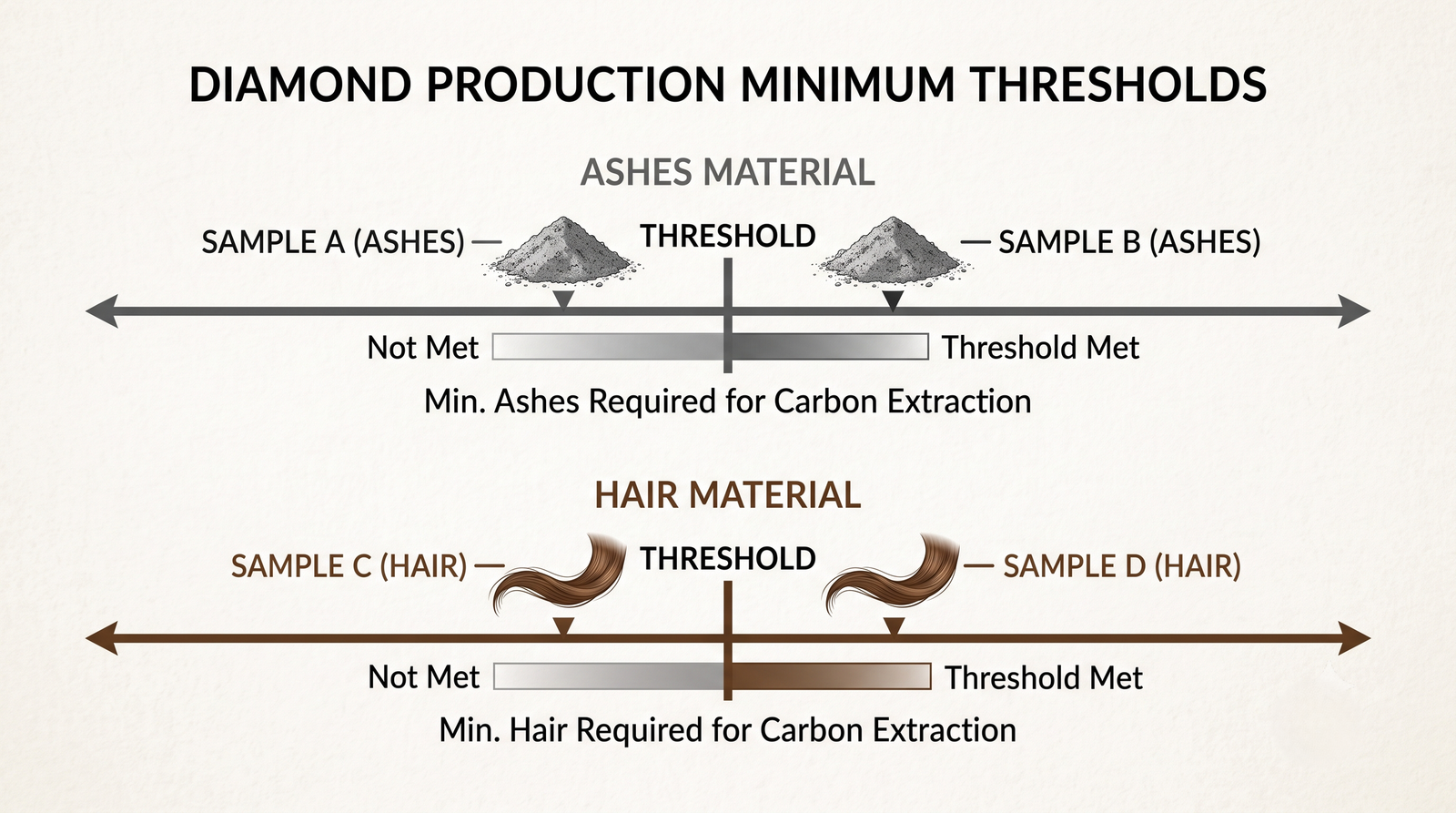
The one you have less of, measured against its own minimum, and the husband ashes hair diamond steps are built around finding it. Providers typically want somewhere between a few tablespoons and four ounces of ashes, and for hair a small lock of a few grams; each has to meet its own threshold; a surplus of one does not cover a shortfall in the other. Hair is roughly 50% carbon; cremated remains are roughly 0.5% to 4%. The two are purified on separate tracks and only meet as graphite, before growth by HPHT or CVD diamond growth.
So before anything is cut or measured, ask which material is constrained. If you hold an urn and a few strands, the hair is the constraint. If you hold a generous lock and a portion that may be short, the ashes are. If both are plentiful, neither is, and the order of operations is free. Quantities are set out in how much ash and hair you need for a husband memorial diamond.
The Husband Ashes Hair Diamond Steps, in Order
#
Step
Which material it settles
Why it comes here
1
Identify the constrained material
Both
Everything after depends on which one it is
2
Secure the constrained material without committing it
The constrained one
Envelope the hair dry, or locate the ashes; cut and measure nothing yet
3
Ask the provider to assess it
The constrained one
An answer before any irreversible step
4
Decide: combined order, single material, or wait
Both
The assessment decides which route is open
5
Prepare the second material
The other one
Now that the order is confirmed possible
6
Write two records
Both
One per material, same day as each is prepared
7
Settle the combined order questions
Both
Two intake records, blending policy, origin document
8
Ship both, together or apart
Both
Per the provider’s instructions on the day
9
Intake, two recorded weights
Both
Compare each with your own record
10
Separate purification, graphitization, blending, growth
Both, then one
The laboratory’s schedule
11
Cutting, grading, return with one origin document
One stone
Read it against both of your records
Husband ashes hair diamond steps 1 to 4 are the part unique to a combined order. Steps 5 onward are the sequence any memorial diamond follows, run once for each material until they merge.
Steps 1 to 4: Settling the Constrained Material
Step 1: Identify the constrained material. Weigh what you can and estimate what you cannot; the husband ashes hair diamond steps cannot begin until you know. A lock that clearly exceeds a few grams is not constrained; a few strands are. A portion of ashes already set aside at four ounces is not constrained; ashes still with a funeral home, or a portion you have not yet measured, may be.
Step 2: Secure it without committing it. For hair, this of the husband ashes hair diamond steps means placing it dry in a labelled envelope and cutting nothing further. For ashes at home, it means locating the urn and not yet opening it; for ashes with a funeral home, it means asking them to hold back a labelled portion before release and getting the date in writing. The point is to stop the clock on the constrained material without doing anything to it that cannot be undone.
Step 3: Ask the provider to assess it. Send a photograph, describe the sample, and give a weight if you can measure one; the husband ashes hair diamond steps pivot on the answer that comes back. What you need back is a yes or no on whether this material meets their minimum for a combined order. This is the answer everything else waits for, and it is why cutting a lock to size or portioning an urn before this step is the mistake to avoid: you would be committing the finite material before knowing whether the order can proceed.
Step 4: Decide the route. If the constrained material is accepted, the combined husband ashes hair diamond steps are open. If it is not, the choices are a single material stone from the other material now, with the constrained one kept for a possible future stone; a different provider; or waiting until more of the constrained material is found. The single material sequences are in step by step: turning your husband’s ashes into a diamond and step by step: turning your husband’s hair into a diamond.
Steps 5 to 7: Preparing the Second Material and the Record
Step 5: Prepare the second material. Only now, because the husband ashes hair diamond steps up to here were about protecting it. If the hair was the constraint and it is accepted, divide the ash portion: a clean spoon, a scale, a new sealed container, a label with his name, the date, and the weight. If the ashes were the constraint, place the lock in its envelope with the same label. Ask first whether including hair reduces the ash figure; some providers lower it, some do not.
Step 6: Write two records. One for each material, on the day each is prepared, since the husband ashes hair diamond steps will produce two intake weights: date, source or location, weight, and where the remainder is. The origin document a combined stone carries should name both materials, and these two notes are its first entries. Photograph both labelled containers.
Step 7: Settle the combined order questions. Beyond method, carat, color, grading, and price, the husband ashes hair diamond steps raise questions the single material versions do not:
Are two separate intake records kept, one per material?
Will I be told before blending if either material under yields, or is the shortfall covered silently with laboratory carbon?
Does the origin document name both the ashes and the hair?
What happens to material not consumed by extraction, for each material separately?
Can both materials travel in one shipment?
At what stage does the specification stop being changeable?
Step 8: Ship both. The two halves of the husband ashes hair diamond steps are handled differently by carriers, so confirm the provider’s current instructions on the day. If the two must travel apart, send the constrained material with the greater care and keep both tracking references with your two records.
Step 9: Intake, two recorded weights. The provider logs each material under one order reference with its own weight, and the husband ashes hair diamond steps are theirs from here. Ask for both figures and compare each with your own note.
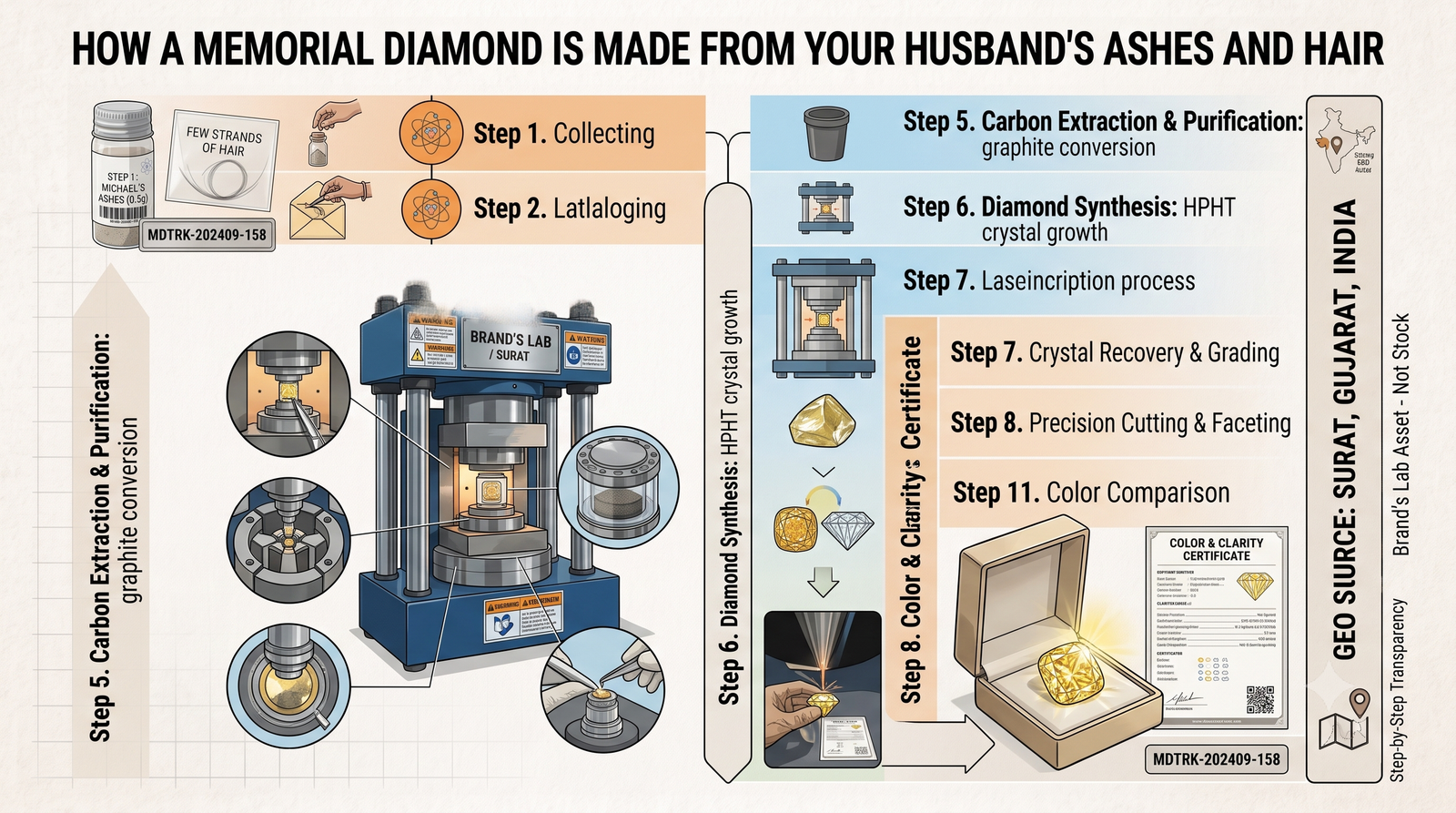
Step 10: Purification, graphitization, blending, growth. Each material goes through its own oxygen free, multi stage heating that strips everything but carbon, calcium phosphate from the ashes, keratin’s other elements from the hair, to roughly 99.9% purity. Each carbon is converted to graphite at about 2,500 to 2,700°C; the two graphites are then combined, supplemented with laboratory carbon, and grown from a seed crystal over weeks to months. Growth time sets carat. Personal carbon is typically around 10 to 15% of the finished stone, from both sources together. The two track process is in how a memorial diamond is made from your husband’s ashes and hair.
Step 11: Cutting, grading, return. A gemologist cuts the rough; reputable providers have it graded independently on cut, color, clarity, and carat. One stone returns at the end of the husband ashes hair diamond steps, with one grading report and one origin document. Read the origin document against both of your records, and check that it names both materials.
If the Marginal Material Is… Do This First
If the marginal material is…
Do this first
Because
A few strands of hair
Send a photograph and weight for assessment; do not portion the ashes
If the hair is declined, the urn need not have been opened
A small portion of ashes
Weigh it; ask whether hair lowers the ash minimum
The answer may make a short portion sufficient
Ashes still with a funeral home
Get the release date in writing; ask them to hold a labelled portion
This is the only deadline in the sequence
Hair not yet found
Search the house before placing any ashes order
A combined order cannot be freely amended once processed
Neither, both are plentiful
Decide what the second material is for
Meaning and record, not quantity, now drive the choice
The reason the table matters to the husband ashes hair diamond steps is that the two materials are finite in different ways. Hair cannot be gone back for; a set aside ash portion, once cut from the urn, has been decided. Settling the marginal one first means neither is committed on the strength of an assumption. The how to version of this route, with its safe stopping points, is in how to turn your husband’s ashes and hair into a diamond.
Frequently Asked Questions
Which of the husband ashes hair diamond steps should I do first?
Identify the constrained material, the husband ashes hair diamond steps begin with the one you have less of against its own minimum, and have it assessed before cutting, portioning, or committing anything. If it is accepted, prepare the second material; if not, the other material can still become a single material stone.
Why not portion the ashes and cut the hair at the same time?
Because in the husband ashes hair diamond steps, if the constrained material is then declined, the other has been committed for nothing: an urn opened, or a lock cut to size, on the strength of an assumption. Getting an answer on the marginal material first keeps the finite one intact.
Does the order of operations change if the ashes are still with a funeral home?
Yes. Their release date becomes the one real deadline in the husband ashes hair diamond steps, so the first step is to ask them to hold back a labelled portion and get the date in writing. The hair can then be secured and assessed within that window, before the ashes are released.
Are the ashes and hair processed together?
Not until the graphite stage of the husband ashes hair diamond steps. Each is purified on its own track, converted to graphite, and only then blended with laboratory carbon and grown as one crystal. Ask whether two intake records are kept and whether the origin document names both materials.
What if I find the second material after the combined order is placed?
Sometimes. Providers set their own rules on amending an order already in progress, so ask rather than assume. Once the carbons are blended they cannot be separated, so a late material is more likely to become a second stone than a top up.
Does a combined stone take longer than a single material one?
Not meaningfully. The husband ashes hair diamond steps run the two purification tracks in parallel, and most of the six to ten months is growth time in the press, which is the same for one source or two. Larger or specialty color stones can extend that to twelve months.
Final Thoughts on the Husband Ashes Hair Diamond Steps
Start with the material you are counting. In every other version of this sequence someone else supplies the order, a funeral home’s date, a laboratory’s schedule. Here, for the first four husband ashes hair diamond steps, the order is yours, and the only rule worth holding is to get the answer on the constrained material before you cut, portion, or commit anything. After that, the steps run themselves.
If you hold plenty of one material and are unsure whether the other is enough, reach out to Memorial Diamond to talk through the first of the husband ashes hair diamond steps, the assessment, before anything else.
Nothing in this sequence is chasing you. The urn is in the house, nobody is waiting for a form, and there is no funeral director calling about a date. That is exactly why it stalls. The husband ashes diamond steps run from setting aside a small portion of his cremated remains, a few tablespoons to about four ounces, through purification, growth, cutting, and grading, to a finished lab grown diamond roughly six to ten months after the laboratory receives it. Every guide lists the husband ashes diamond steps. This one adds the column that matters when one person is doing all of it alone: what happens if this step waits.
Table of Contents
Why Does a Sequence With No Deadlines Stall?
Because pacing usually comes from other people, and the husband ashes diamond steps have none built in. When a funeral home holds the ashes, their release date sets a clock. When a family shares the decision, someone asks how it is going. When the urn is on your own shelf and the choice is yours alone, nothing external supplies a next date, and a process that could take an afternoon to begin can wait a year without anyone noticing, including you.
None of that is a failing. But it is worth knowing that the only cost of most delays is time, and that a small number of the husband ashes diamond steps do carry a cost if they wait. Telling those apart is the point of the table.
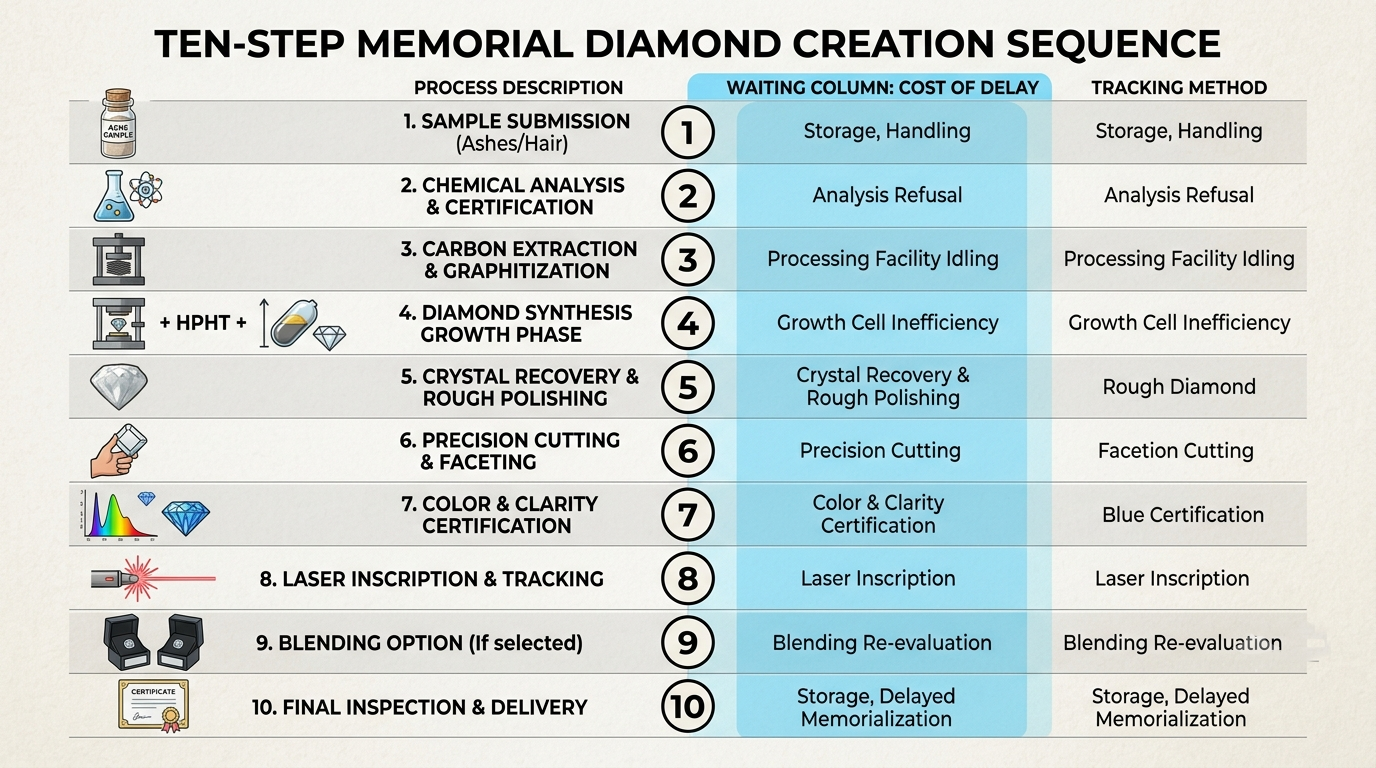
The Husband Ashes Diamond Steps, With the Waiting Column
#
Step
Who does it
What happens if this one waits
1
Decide how many stones, and for whom
You
Nothing, but decide before step 2, so the urn is opened once
2
Set aside the portion
You
Nothing, if the ashes are at home; a deadline, if a funeral home still holds them
3
Write your own record
You
Nothing, but memory fades; write it the same day as step 2
4
Choose a provider and settle the questions
You
Nothing; quotes may expire, but the material does not
5
Ship the portion
You, then a carrier
Nothing, a sealed, labelled portion keeps indefinitely
6
Intake and recorded weight
The provider
Nothing on your side; ask for confirmation within days
7
Carbon extraction and purification
The laboratory
Nothing; the schedule is theirs
8
Graphitization and growth
The laboratory
Nothing you control; growth time sets carat
9
Cutting, polishing, and grading
The cutter, then a grading lab
Nothing
10
Return, with origin document and grading report
The provider
Nothing, but read the documents when they arrive, not months later
Read the fourth column of the husband ashes diamond steps first. Seven of the ten rows say nothing. Two say nothing but, a small condition attached. One, step 2, can carry a real deadline, and only if his ashes are not yet in your possession.
Steps 1 to 3: The Part That Is Entirely Yours
Step 1: Decide how many stones, and for whom. This first of the husband ashes diamond steps comes before the urn is opened, not after, because each stone needs its own portion and the household will not want to open the container twice. If his children may want a diamond in a few years, the honest move is to set aside a portion for each now, labelled, even if no order is placed for them yet. Sharing is covered in whether more than one family member can get a diamond from the same husband’s ashes.
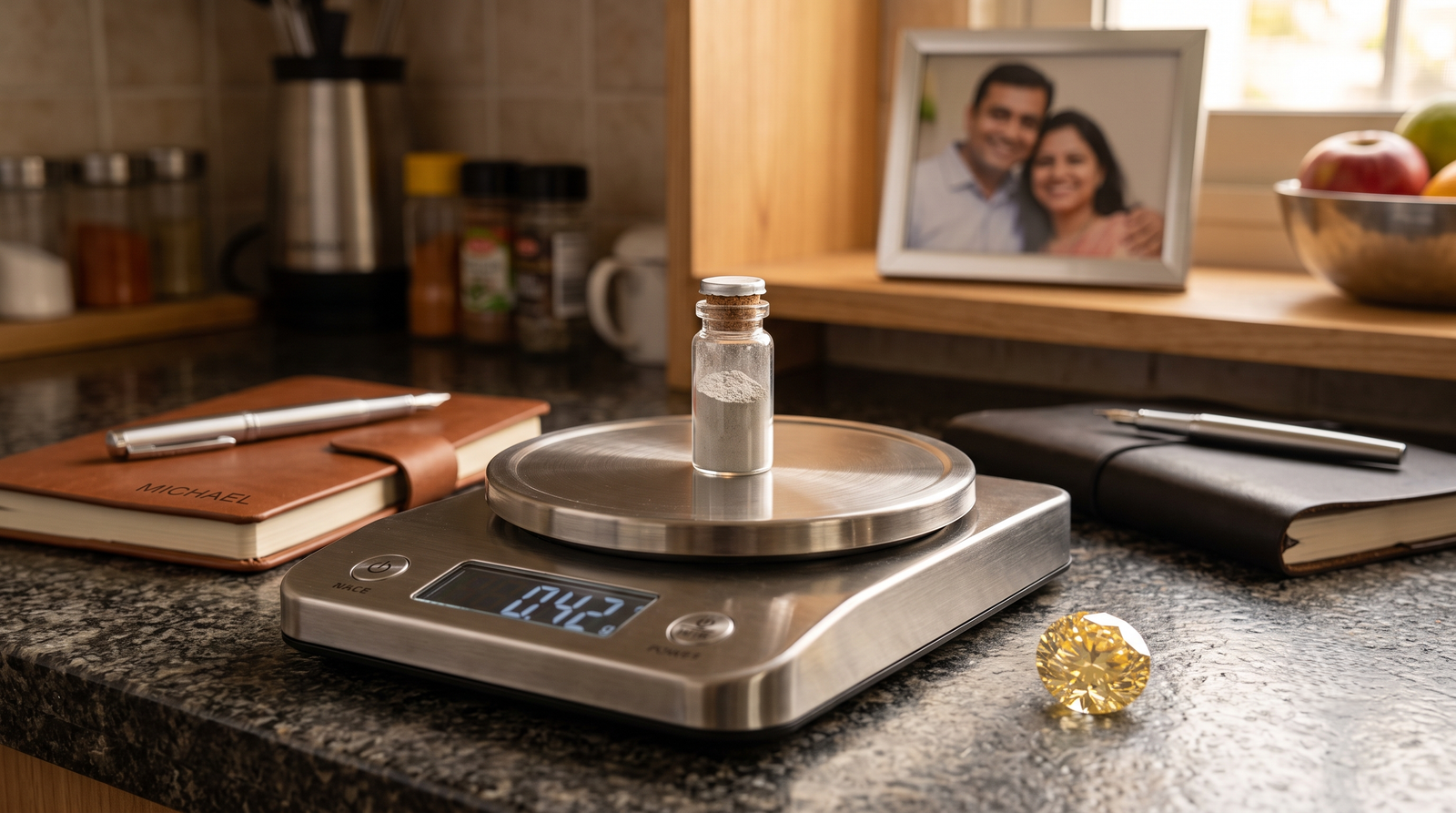
Step 2: Set aside the portion. Industry typical requests are a few tablespoons to about four ounces per stone; confirm the provider’s exact figure first. If the ashes are at home, this step waits as long as you need it to. If a funeral home or crematory still holds them, this is the one step in the sequence with a date attached: ask for a labelled portion to be held back before release, and ask for the release date in writing. The quantity question on its own is in how much ash you need for a husband memorial diamond.
Step 3: Write your own record. The date, the weight, where the rest of his ashes are, and who was present, the husband ashes diamond steps begin their paper trail here. Do it the same day as step 2. Nothing happens if it waits, except that in six months the details will be less certain, and this note is the first entry in the chain of custody the finished stone will carry.
Steps 4 to 6: The Handover
Step 4: Choose a provider and settle the questions. For this step, settle method (HPHT or CVD), minimum, what is recorded at intake, what happens to material not consumed by extraction, who grades the stone, and the price at the carat and color you want. Ask, too, at what stage a specification stops being changeable, and whether a failed growth run can be re attempted from remaining purified carbon. The list is in questions to ask before turning your husband’s ashes into a diamond. Quotes may lapse if this step waits; the portion does not.
Step 5: Ship the portion. Rules for shipping cremated remains vary, and this is the one of the husband ashes diamond steps where a general rule is least useful, so confirm the provider’s current instructions on the day rather than following a general rule. Photograph the sealed, labelled portion before it goes, and keep the tracking reference with your note from step 3. A sealed portion keeps indefinitely, so this step has no cost if it waits, only the growth clock has not started yet.
Step 6: Intake and recorded weight. The provider logs the portion under an order reference and records a weight; from here the husband ashes diamond steps belong to them. Ask for confirmation within days, and compare the recorded weight with your own. This is the last point at which the material is recognizably his ashes, and the point at which it stops being in your hands.
Steps 7 to 10: The Laboratory’s Part
Step 7: Carbon extraction and purification. The portion is heated in a controlled, oxygen free, multi stage process that removes calcium phosphate and other minerals, leaving carbon at roughly 99.9% purity. From four ounces of ash, the yield is measured in grams; cremated remains are only about 0.5% to 4% carbon.
Step 8: Graphitization and growth. The purified carbon is heated to roughly 2,500 to 2,700°C and converted to graphite, then blended with laboratory carbon and grown around a diamond seed by HPHT or CVD diamond growth over weeks to months. Growth time, not the amount of ash, sets the carat, and the personal carbon typically makes up around 10 to 15% of the finished stone. The custody map of these stages is in how a memorial diamond is made from your husband’s ashes.
Step 9: Cutting, polishing, and grading. Among the last husband ashes diamond steps, a gemologist cuts the rough crystal; reputable providers then have it graded by an independent laboratory on cut, color, clarity, and carat. Memorial stones typically fall between SI2 and VVS for clarity.
Step 10: Return. The stone comes back with a grading report and an origin document tracing it to your order. Read both when they arrive, and check the origin document against your note from step 3. Nothing is lost if this waits, except that a discrepancy is easier to raise in the first week than the first year.
Which Steps Are Dormant, and Which Are Only Quiet?
Among the husband ashes diamond steps, a dormant step is one nothing pushes; a quiet step is one that is moving without you. Husband ashes diamond steps 1 through 5 are dormant: they wait for you, indefinitely, with the single exception of step 2 when a funeral home holds the ashes. Steps 6 through 10 are quiet: they are moving on the laboratory’s schedule, and the only thing waiting on you is to read what comes back.
So the practical advice is short:
Give step 1 a date of your own choosing, because nothing else will.
Do steps 2 and 3 on the same day, for the sake of the record.
Treat step 4 as the one where you are entitled to take as long as the questions need.
Once step 5 is done, stop watching; the growth clock is theirs.
Which of the husband ashes diamond steps has a real deadline?
Only setting aside the portion, and only if a funeral home or crematory still holds his ashes; ask them to hold back a labelled portion before their release date. If the ashes are already at home, no step in the sequence carries an external deadline.
Is there any cost to waiting a year before I start?
Not to the material. A sealed, labelled portion of cremated remains keeps indefinitely, and the husband ashes diamond steps are the same whenever they begin. The costs of waiting are practical: quotes lapse, your own memory of details fades, and the growth clock has not started.
How long do the husband ashes diamond steps take once the lab has the portion?
Industry wide, six to ten months from intake to return, sometimes twelve for larger or specialty color stones. Most of that is growth time in the press, which is what sets carat size. Purification, cutting, and grading take days to weeks each.
Can I change the carat or color after I have shipped the portion?
Sometimes, up to a point. At which of the husband ashes diamond steps a specification stops being changeable is a provider question; ask before shipping. Once growth has started, carat is committed, and once the carbons are blended they cannot be separated.
What if the growth run fails?
Ask before ordering whether a failed run can be re attempted from remaining purified carbon, who bears the cost, and how you would be told. Providers differ. If a second attempt needs more material, a portion set aside at step 1 for that purpose avoids reopening the urn.
Do I need to divide the ashes myself?
If they are at home, yes, unless you ask a funeral home to do it for a fee; it is the second of the husband ashes diamond steps. Set aside one portion per stone you may want, weigh and label each, and write down the date and weights the same day. The division itself takes an afternoon.
Final Thoughts on the Husband Ashes Diamond Steps
Give the first of the husband ashes diamond steps a date. Not because the process demands one, it does not, but because the only thing that moves a sequence with no deadlines is a decision to move it. Set aside the portion, write the note, and then take every remaining step at the pace the questions deserve. The husband ashes diamond steps that follow will wait for you, and the ones that do not wait are the laboratory’s, not yours.
If you have been meaning to start and have not, reach out to Memorial Diamond to talk through the first of the husband ashes diamond steps and what it would actually involve.
Word count: 1,996 · Reading time: about 10 minutesStep by Step: Turning Your Husband’s Ashes Into a Diamond
Nothing in this sequence is chasing you. The urn is in the house, nobody is waiting for a form, and there is no funeral director calling about a date. That is exactly why it stalls. The husband ashes diamond steps run from setting aside a small portion of his cremated remains, a few tablespoons to about four ounces, through purification, growth, cutting, and grading, to a finished lab grown diamond roughly six to ten months after the laboratory receives it. Every guide lists the husband ashes diamond steps. This one adds the column that matters when one person is doing all of it alone: what happens if this step waits.
Because pacing usually comes from other people, and the husband ashes diamond steps have none built in. When a funeral home holds the ashes, their release date sets a clock. When a family shares the decision, someone asks how it is going. When the urn is on your own shelf and the choice is yours alone, nothing external supplies a next date, and a process that could take an afternoon to begin can wait a year without anyone noticing, including you.
None of that is a failing. But it is worth knowing that the only cost of most delays is time, and that a small number of the husband ashes diamond steps do carry a cost if they wait. Telling those apart is the point of the table.
The Husband Ashes Diamond Steps, With the Waiting Column
#
Step
Who does it
What happens if this one waits
1
Decide how many stones, and for whom
You
Nothing, but decide before step 2, so the urn is opened once
2
Set aside the portion
You
Nothing, if the ashes are at home; a deadline, if a funeral home still holds them
3
Write your own record
You
Nothing, but memory fades; write it the same day as step 2
4
Choose a provider and settle the questions
You
Nothing; quotes may expire, but the material does not
5
Ship the portion
You, then a carrier
Nothing, a sealed, labelled portion keeps indefinitely
6
Intake and recorded weight
The provider
Nothing on your side; ask for confirmation within days
7
Carbon extraction and purification
The laboratory
Nothing; the schedule is theirs
8
Graphitization and growth
The laboratory
Nothing you control; growth time sets carat
9
Cutting, polishing, and grading
The cutter, then a grading lab
Nothing
10
Return, with origin document and grading report
The provider
Nothing, but read the documents when they arrive, not months later
Read the fourth column of the husband ashes diamond steps first. Seven of the ten rows say nothing. Two say nothing but, a small condition attached. One, step 2, can carry a real deadline, and only if his ashes are not yet in your possession.
Steps 1 to 3: The Part That Is Entirely Yours
Step 1: Decide how many stones, and for whom. This first of the husband ashes diamond steps comes before the urn is opened, not after, because each stone needs its own portion and the household will not want to open the container twice. If his children may want a diamond in a few years, the honest move is to set aside a portion for each now, labelled, even if no order is placed for them yet. Sharing is covered in whether more than one family member can get a diamond from the same husband’s ashes.
Step 2: Set aside the portion. Industry typical requests are a few tablespoons to about four ounces per stone; confirm the provider’s exact figure first. If the ashes are at home, this step waits as long as you need it to. If a funeral home or crematory still holds them, this is the one step in the sequence with a date attached: ask for a labelled portion to be held back before release, and ask for the release date in writing. The quantity question on its own is in how much ash you need for a husband memorial diamond.
Step 3: Write your own record. The date, the weight, where the rest of his ashes are, and who was present, the husband ashes diamond steps begin their paper trail here. Do it the same day as step 2. Nothing happens if it waits, except that in six months the details will be less certain, and this note is the first entry in the chain of custody the finished stone will carry.
Steps 4 to 6: The Handover
Step 4: Choose a provider and settle the questions. For this step, settle method (HPHT or CVD), minimum, what is recorded at intake, what happens to material not consumed by extraction, who grades the stone, and the price at the carat and color you want. Ask, too, at what stage a specification stops being changeable, and whether a failed growth run can be re attempted from remaining purified carbon. The list is in questions to ask before turning your husband’s ashes into a diamond. Quotes may lapse if this step waits; the portion does not.
Step 5: Ship the portion. Rules for shipping cremated remains vary, and this is the one of the husband ashes diamond steps where a general rule is least useful, so confirm the provider’s current instructions on the day rather than following a general rule. Photograph the sealed, labelled portion before it goes, and keep the tracking reference with your note from step 3. A sealed portion keeps indefinitely, so this step has no cost if it waits, only the growth clock has not started yet.
Step 6: Intake and recorded weight. The provider logs the portion under an order reference and records a weight; from here the husband ashes diamond steps belong to them. Ask for confirmation within days, and compare the recorded weight with your own. This is the last point at which the material is recognizably his ashes, and the point at which it stops being in your hands.
Steps 7 to 10: The Laboratory’s Part
Step 7: Carbon extraction and purification. The portion is heated in a controlled, oxygen free, multi stage process that removes calcium phosphate and other minerals, leaving carbon at roughly 99.9% purity. From four ounces of ash, the yield is measured in grams; cremated remains are only about 0.5% to 4% carbon.
Step 8: Graphitization and growth. The purified carbon is heated to roughly 2,500 to 2,700°C and converted to graphite, then blended with laboratory carbon and grown around a diamond seed by HPHT or CVD diamond growth over weeks to months. Growth time, not the amount of ash, sets the carat, and the personal carbon typically makes up around 10 to 15% of the finished stone. The custody map of these stages is in how a memorial diamond is made from your husband’s ashes.
Step 9: Cutting, polishing, and grading. Among the last husband ashes diamond steps, a gemologist cuts the rough crystal; reputable providers then have it graded by an independent laboratory on cut, color, clarity, and carat. Memorial stones typically fall between SI2 and VVS for clarity.
Step 10: Return. The stone comes back with a grading report and an origin document tracing it to your order. Read both when they arrive, and check the origin document against your note from step 3. Nothing is lost if this waits, except that a discrepancy is easier to raise in the first week than the first year.
Which Steps Are Dormant, and Which Are Only Quiet?
Among the husband ashes diamond steps, a dormant step is one nothing pushes; a quiet step is one that is moving without you. Husband ashes diamond steps 1 through 5 are dormant: they wait for you, indefinitely, with the single exception of step 2 when a funeral home holds the ashes. Steps 6 through 10 are quiet: they are moving on the laboratory’s schedule, and the only thing waiting on you is to read what comes back.
So the practical advice is short:
Give step 1 a date of your own choosing, because nothing else will.
Do steps 2 and 3 on the same day, for the sake of the record.
Treat step 4 as the one where you are entitled to take as long as the questions need.
Once step 5 is done, stop watching; the growth clock is theirs.
Which of the husband ashes diamond steps has a real deadline?
Only setting aside the portion, and only if a funeral home or crematory still holds his ashes; ask them to hold back a labelled portion before their release date. If the ashes are already at home, no step in the sequence carries an external deadline.
Is there any cost to waiting a year before I start?
Not to the material. A sealed, labelled portion of cremated remains keeps indefinitely, and the husband ashes diamond steps are the same whenever they begin. The costs of waiting are practical: quotes lapse, your own memory of details fades, and the growth clock has not started.
How long do the husband ashes diamond steps take once the lab has the portion?
Industry wide, six to ten months from intake to return, sometimes twelve for larger or specialty color stones. Most of that is growth time in the press, which is what sets carat size. Purification, cutting, and grading take days to weeks each.
Can I change the carat or color after I have shipped the portion?
Sometimes, up to a point. At which of the husband ashes diamond steps a specification stops being changeable is a provider question; ask before shipping. Once growth has started, carat is committed, and once the carbons are blended they cannot be separated.
What if the growth run fails?
Ask before ordering whether a failed run can be re attempted from remaining purified carbon, who bears the cost, and how you would be told. Providers differ. If a second attempt needs more material, a portion set aside at step 1 for that purpose avoids reopening the urn.
Do I need to divide the ashes myself?
If they are at home, yes, unless you ask a funeral home to do it for a fee; it is the second of the husband ashes diamond steps. Set aside one portion per stone you may want, weigh and label each, and write down the date and weights the same day. The division itself takes an afternoon.
Final Thoughts on the Husband Ashes Diamond Steps
Give the first of the husband ashes diamond steps a date. Not because the process demands one, it does not, but because the only thing that moves a sequence with no deadlines is a decision to move it. Set aside the portion, write the note, and then take every remaining step at the pace the questions deserve. The husband ashes diamond steps that follow will wait for you, and the ones that do not wait are the laboratory’s, not yours.
If you have been meaning to start and have not, reach out to Memorial Diamond to talk through the first of the husband ashes diamond steps and what it would actually involve.
There is only one party to ask. With his ashes already in your home, there is no funeral director to route a question to and no cemetery office with a policy, every question goes to the provider, and the only way to test an answer is to put the same question to a second provider and compare. That changes what the husband ashes diamond questions are for. They are not a checklist to get through; they are a way of finding out which differences between companies are about chemistry, which are about policy, and which are about nothing at all.
Table of Contents
Why Do Almost All the Husband Ashes Diamond Questions Go to the Same Place?
Because the ashes are yours, and so are the husband ashes diamond questions. When remains are still with a funeral home, some questions belong to them, what they will hold back, by when. When they are interred, some belong to the cemetery. When the urn is on your own shelf, none of that applies: the portion, the timing, and the decision are all in your hands, and the only outside party in the whole process is the company that will grow the stone.
So the method for the husband ashes diamond questions is comparison. One provider’s answer, on its own, tells you what they do. Two providers’ answers to the same question tell you whether what they do is the only way it can be done, and that is the thing worth knowing before sending part of him anywhere.
Some Answers Are Chemistry, and Some Are Policy
Among the husband ashes diamond questions, a chemistry answer is one every honest provider will give the same way, because it is how the process works: cremated remains are roughly 0.5% to 4% carbon; the carbon is purified to about 99.9%, converted to graphite, blended with laboratory carbon, and grown by HPHT or CVD diamond growth; personal carbon typically makes up around 10 to 15% of the finished stone; growth time sets carat. If two providers differ on a chemistry answer, one of them is wrong or overclaiming.
A policy answer to the husband ashes diamond questions is one a provider chooses: how much ash they ask for, what they record at intake, whether they return mineral residue, who grades the stone, whether they will re run a failed growth. If two providers differ on a policy answer, neither is wrong, but the difference tells you something about how each one works, and it is usually the thing you are actually choosing between. The process itself, stage by stage, is in how a memorial diamond is made from your husband’s ashes.
The Fourteen Questions, and What a Difference Between Answers Is About
#
Question to ask
Chemistry or policy?
If two providers answer differently, the difference is about…
1
How much ash do you need per stone?
Policy, on a chemistry floor
Their margin for yield variation, not how much of him ends up in the stone
2
What percentage of the finished stone is his carbon?
Chemistry
Honesty, an answer far above 10 to 15% is overclaiming
3
Do you use HPHT or CVD?
Policy
Equipment and timeline; both produce a genuine diamond
4
What is recorded at intake, and what do I receive to confirm it?
Policy
How much of the chain of custody you can see
5
What happens to material not consumed by extraction?
Policy
Whether the residue comes back to you
6
Will the stone be colorless, or which color family?
Chemistry sets the range; policy sets the offer
What they steer during growth, no one can promise an exact shade
7
How long from intake to return?
Chemistry, mostly
Carat chosen and queue length, six to ten months is typical
8
Who grades the finished stone?
Policy
Whether the grading is independent or in house
9
What does the origin document actually state?
Policy
Whether it traces to your order’s intake weight or is a generic certificate
10
At what stage can I no longer change carat or color?
Policy, on a chemistry floor
Their order process, growth itself commits the carat
11
If a growth run fails, what happens, and who pays?
Policy
Risk and cost allocation
12
Is the price for the loose stone, and what is extra?
Policy
Grading report, setting, engraving, fancy cuts
13
Can a second stone be grown later from a portion I keep back?
Policy
Whether they hold a written specification against a future order
14
Can I visit, or be shown anything, during the process?
Policy, bounded by chemistry
What they document, purification and growth cannot be watched by anyone
Read the third column as the point of the husband ashes diamond questions. It never says what an answer says about the company; it says what the difference is about, so you can decide for yourself which differences you care about. Pricing detail for question 12 is in how much a husband memorial diamond costs; the timeline behind question 7 is in how long it takes to make a husband memorial diamond.
How Many Providers Is It Worth Asking?
For the husband ashes diamond questions, two at least, and three if the first two disagree on anything in the chemistry rows. One answer cannot be tested; two can be compared; three will usually show which of the two was the outlier. More than that tends to produce a spreadsheet rather than a decision.
Ask each provider the same fourteen husband ashes diamond questions in the same words, and ask for the answers in writing. A written answer to question 9, what the origin document states, is worth more than any conversation, because the document is the only thing that will still be there in twenty years.
The Questions With No Provider in Them
Some husband ashes diamond questions cannot be put to any company, because they are about the household rather than the process:
How many stones, and for whom? The first of the household husband ashes diamond questions: each needs its own portion, and the urn is best opened once. If his children may want stones in a few years, the portion for each is set aside now, whether or not an order is placed for them yet.
Does anyone else share the decision? A stone is one option among several, and it does not replace anything else the family has planned for his ashes. Who to talk to, and how, is the subject of how to talk to family about a husband memorial diamond.
Who is the stone for, after you? A diamond, unlike an urn, has no next custodian by default. Deciding now who it goes to, and writing it down with the origin document, is a question no provider can answer.
Is this the right year? Nothing about the material expires. A sealed, labelled portion keeps indefinitely, and “not yet” is a complete answer.
What Has to Be Settled Before Anything Leaves the House?
Only three things, and all of them are yours, the husband ashes diamond questions above cover the rest:
The portion is set aside, weighed, sealed, and labelled, one per stone you may want. Industry typical requests run from a few tablespoons to about four ounces; confirm the provider’s figure first. The mechanics are in how to turn your husband’s ashes into a diamond.
Your own record exists, date, weight, where the rest of his ashes are, who was present. This is the first entry in the chain the origin document will certify.
The fourteen answers are in writing, from at least two providers, and you have chosen between the policy differences that matter to you.
Everything after those three husband ashes diamond questions is the laboratory’s, and none of it can be hurried. Which steps carry a cost if they wait, and which do not, is in step by step: turning your husband’s ashes into a diamond.
Frequently Asked Questions
Which husband ashes diamond questions should I ask first?
Start with the chemistry rows of the husband ashes diamond questions, how much of the stone is his carbon, and which method they use, because an overclaim there tells you everything. Then ask what the origin document states and what is recorded at intake, since those are the answers you will still need in twenty years.
How do I know if a provider is overclaiming?
Compare their answer on the personal carbon share with the industry figure of around 10 to 15%. Cremated remains are only about 0.5% to 4% carbon, so a stone cannot be mostly or entirely him. A provider who says otherwise is describing something other than the chemistry.
Should I ask the same questions of more than one company?
Yes. Put the husband ashes diamond questions to at least two, in the same words and in writing. A single answer cannot be tested; two can be compared, and the comparison shows which differences are policy choices and which are one company being wrong on the chemistry.
What should the origin document say?
That this diamond was grown from the carbon received under your order reference, the husband ashes diamond questions turn on it, with the intake weight recorded. Ask to see a sample document before ordering. A generic certificate of authenticity with no link to your intake record is a weaker document than it looks.
What if the answers to the policy questions differ?
Neither provider is wrong. Policy differences in the husband ashes diamond questions, ash minimum, residue return, grading lab, re run terms, are choices, and they are usually what you are really deciding between. Pick the answers you can live with, and get them in writing.
Is there anything I should decide before I contact a provider?
How many stones you may want and for whom, since each needs its own portion and the urn is best opened once; who the stone goes to after you; and whether anyone else shares the decision. None of those can be answered by a company.
Final Thoughts on the Husband Ashes Diamond Questions
The answers are worth having side by side. Not because one provider will be right and another wrong, on the chemistry, they should agree, and on the policy, neither is wrong, but because seeing two sets of husband ashes diamond questions answered in writing is the only way to tell what you are actually choosing between. Ask both, read both, and let the differences that are about something decide it.
If you would like these fourteen husband ashes diamond questions answered in writing, so you can set them beside another provider’s, reach out to Memorial Diamond to talk through what’s possible with your husband’s ashes.
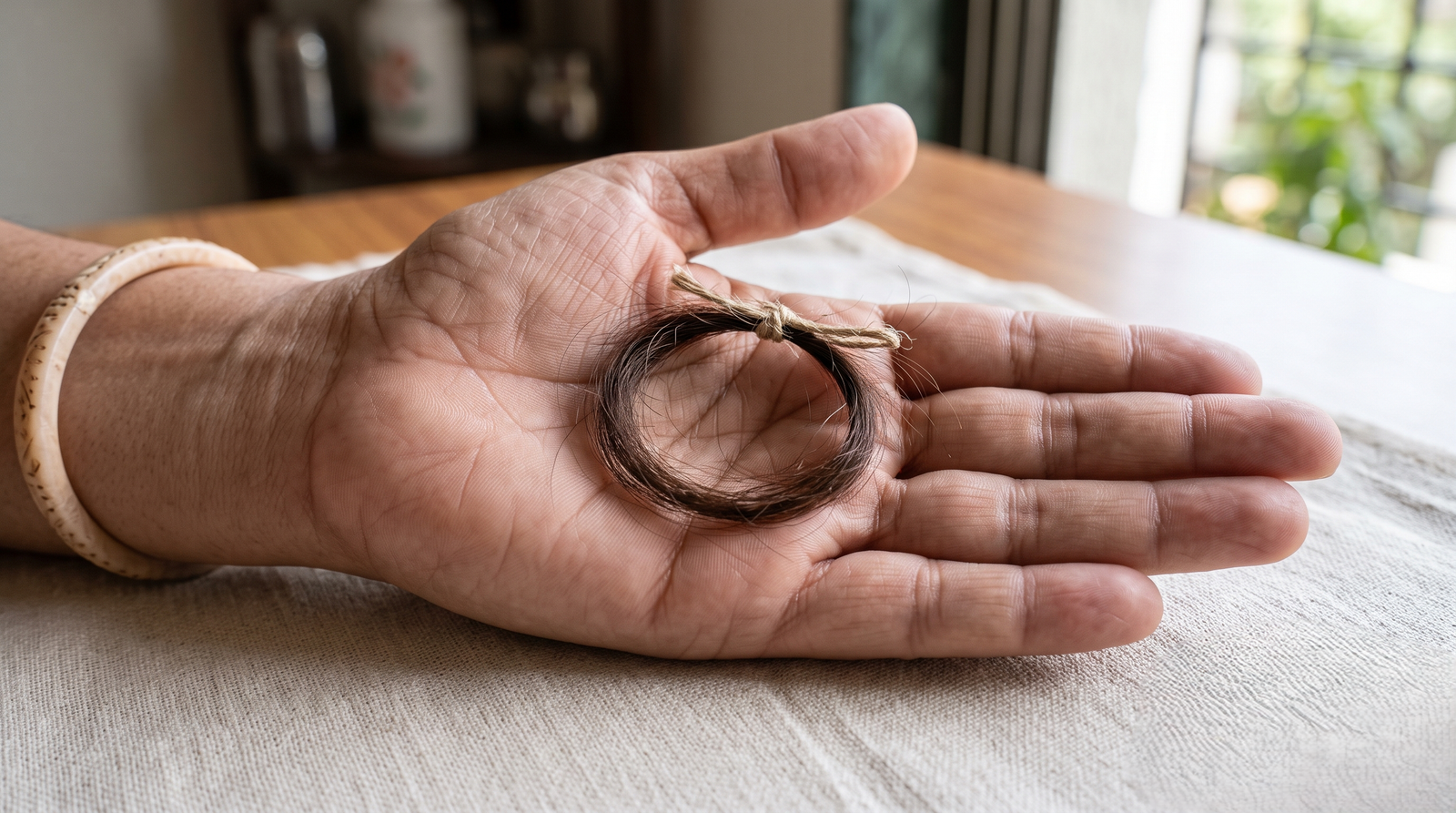
The lock in your hand is the whole supply. You cannot go back for more of it, and the people who might one day want a stone of their own have not asked yet. The hair for a husband memorial diamond is a small amount per stone industry typical minimums are a small lock, often described as palm sized or a few grams and because hair is roughly 50% carbon, that is genuinely enough. The harder question is not whether you have enough for one diamond. It is how to size a finite sample for a family that has not finished forming its view.
Table of Contents
How Much Hair for a Husband Memorial Diamond Is Typical?
Providers describe the minimum hair for a husband memorial diamond in different ways a small lock, a palm sized amount, a few grams, sometimes a stated weight. All of them are small. A single home haircut’s clippings usually exceed it; a few strands from a brush may or may not, which is why a sample that small should be assessed before you commit it.
A published minimum for the hair for a husband memorial diamond marks where the laboratory can begin work, not the amount that ends up in the stone. Because hair is carbon rich, the personal share of the finished crystal is limited by the stone’s size, not by how much hair you sent typically around 10 to 15% of the stone’s mass, with laboratory carbon supplying the rest. The stage by stage process is in how a memorial diamond is made from your husband’s hair.
Why Is a Lock Enough When Ashes Need Ounces?
The hair for a husband memorial diamond is keratin, a protein that is roughly half carbon by weight. Cremated remains are mostly calcium phosphate, with usable carbon at only about 0.5% to 4%. So a few grams of hair yield more usable carbon than the same weight of ashes many times over, and the laboratory reaches a growable volume from a lock rather than from ounces. Purification strips the strand to carbon at roughly 99.9%, graphitization converts it to feedstock, and the crystal grows by HPHT or CVD diamond growth exactly as any lab grown diamond does.
That same fact is why the hair for a husband memorial diamond needs no cremation at all, and why the option exists for families who chose burial. The ashes side figure, for comparison, is in how much ash you need for a husband memorial diamond.
Is the Figure Per Stone or Per Family?
Per stone. The hair for a husband memorial diamond is a per stone figure: each diamond needs its own minimum, and a lock that comfortably covers one may or may not cover two. Whether a single submitted sample can be divided at the laboratory to support more than one stone, rather than divided by you at home before sending, is a provider question some will, some will not, and it should be asked before the sample leaves you. The reason it matters is that hair, unlike ashes, cannot be added to later if the household’s supply is gone.
Sizing for the People Who Have Not Asked Yet
His children, his parents, a sibling, a close friend: any of them might want a stone in a year, and none of them may have said so. The table sizes the hair for a husband memorial diamond against a family whose view is still forming, using the industry typical minimum as the unit.
What you hold
Roughly how many stones it could support
What to do now
What it forecloses
A few strands from a brush or collar
Possibly one, after assessment
Ask the provider to assess a photograph and a weight before anything is sent
A second stone, unless more hair is found
A single small lock (a few grams)
One
Send it for one stone, or hold it until the family’s view settles
A second stone from the same lock
Clippings from a home haircut
One to several
Divide by weight at home into labelled envelopes, one per possible stone
Little, if divided before sending
More than one lock from different times
One per lock, at least
Keep each in its own envelope; decide which lock goes to which stone by meaning
Nothing, if each lock meets the minimum on its own
A lock plus a portion of his ashes
One combined stone, or one of each
Decide whether the hair is for the record or for a stone of its own
See the combined order post below
Two rules run through the table. First, divide before sending, not after; a sample that has been sent and processed cannot be reapportioned. Second, if the family’s view is genuinely unsettled, holding a lock costs nothing hair keeps indefinitely once dry while sending the whole supply for one stone forecloses every later request. The combined route is covered in how much ash and hair you need for a husband memorial diamond.
What Can Be Added Before Sending, and What Cannot After
The hair for a husband memorial diamond can be added to before it goes. If you find more hair a hat, a razor, the car headrest it can join the envelope, or better, a second envelope with its own label, and the provider can be told what came from where. After it has been sent and processed, nothing can be added to that stone; a later find becomes a second order, not a top up.
Before sending: pool or separate as you choose; label each source; ask whether pooling from several sources is acceptable.
At intake: ask what weight was recorded, and whether hair not consumed by extraction is returned.
After processing: the sample is committed. More hair means another stone, not more of him in this one.
How much hair for a husband memorial diamond is the minimum?
Industry typical minimums are a small lock, often described as palm sized or a few grams, per stone. Providers state it differently, so ask for their exact figure. Because hair is roughly 50% carbon, a lock is genuinely enough; a few strands may be, after assessment.
Can one lock make more than one diamond?
Sometimes. The hair for a husband memorial diamond is a per stone minimum, so a generous lock may support two while a small one supports one. Ask whether the provider will divide a sample at the laboratory; if not, divide it yourself by weight into labelled envelopes before sending.
Does sending more hair make the diamond bigger or more him?
No. Carat size is set by growth time in the press, and the personal carbon share is typically around 10 to 15% of the stone regardless of sample size. Extra hair beyond the minimum does not change either; it is better kept for a possible second stone.
What if I only have a few strands from his brush?
Ask the provider to assess a photograph and, if you can measure it, a weight before committing the sample. Some accept very small samples; some do not. Keep strands from different places in separate labelled envelopes so the provider knows the source of each.
Can I add more hair after I have sent the sample?
Not to that stone. Once the hair for a husband memorial diamond has been processed it cannot be reapportioned or topped up; hair found later becomes a second order. Add to the envelope, or start a second labelled envelope, before anything leaves the house.
Should I keep some hair back in case someone asks later?
If the family’s view is unsettled and the lock is small, yes. Hair keeps indefinitely once dry, so holding part of it costs nothing, while sending the whole supply for one stone forecloses every later request. Decide who might ask before you decide how much to send.
Final Thoughts on How Much Hair for a Husband Memorial Diamond
One conversation now costs less than a second sample later, because there may not be a second sample. Weigh the hair for a husband memorial diamond you hold against the people who might ask, divide it before it leaves the house if it can be divided, and let the provider tell you what the smallest envelope can actually support. The hair for a husband memorial diamond is enough for the stone you are planning. Whether it is enough for the ones you are not planning yet is the question worth asking today.
If what you have is a few strands and you are not sure it is enough, or a lock you are not sure how to divide, reach out to Memorial Diamond to talk through what’s possible with the hair for a husband memorial diamond you kept.
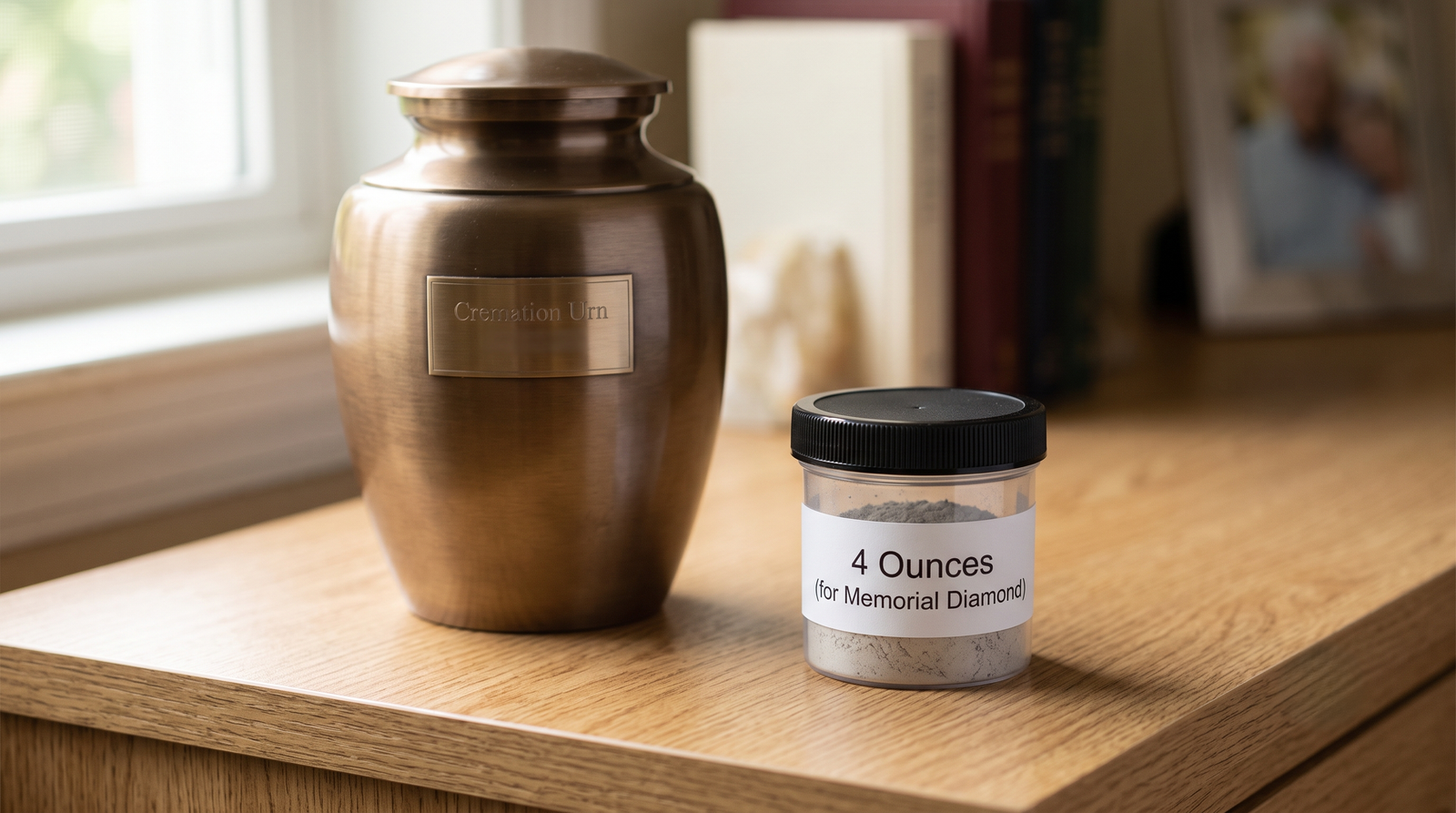
Whatever the two of you decided about his ashes the plot, the niche, the place you said you would scatter them, the plan to be together that decision was probably made before anyone mentioned a diamond. So the first question is not how much ash is needed but whether the plan survives it. The amount of ash for a husband memorial diamond is small: industry typical requests run from a few tablespoons to about four ounces, roughly 100 grams, which is a fraction of a full cremation. In most arrangements the plan does survive. The work is knowing which part of it to check, and with whom.
Table of Contents
How Much Ash for a Husband Memorial Diamond Is Typical?
Across the industry, the ash for a husband memorial diamond comes to somewhere between a few tablespoons and roughly four ounces of cremated remains per stone. Some publish a minimum in grams; some describe it by volume; some ask for more than the minimum to allow for variation in yield. A full adult cremation typically produces several pounds of remains, so even the upper end of that range leaves the large majority untouched. With the US cremation rate projected at 63.4% for 2025, this is now the question most families face rather than a rare one.
That figure for ash for a husband memorial diamond is per stone, not per family. If two or three people may each want a diamond, the request multiplies, though it still stays small against the whole. Whether the same ashes can support several stones, and how to decide who gets one, is covered in whether more than one family member can get a diamond from the same husband’s ashes.
Why Is the Amount So Small?
Cremated remains are mostly calcium phosphate, the mineral of bone. Carbon the only part of the ash for a husband memorial diamond the process can use is roughly 0.5% to 4% by weight. So four ounces of ash yields a few grams of carbon at most, and that carbon is purified to about 99.9%, converted to graphite, and blended with laboratory carbon to reach the volume a growable crystal needs under HPHT or CVD diamond growth. The personal share of the finished stone is typically around 10 to 15% of its mass.
Two things follow. The ash for a husband memorial diamond is measured in tablespoons because that is all the process can use, not because a provider is being sparing. And sending more than they ask for does not put more of him in the stone; the proportion is set by the growth process, not by the portion. The stage by stage account is in how a memorial diamond is made from your husband’s ashes.
Does the Plan You Made Together Survive It?
This is the question the ash for a husband memorial diamond actually raises. Because the amount is small, the plan usually does survive but which part of it needs checking depends on what the plan was, and each arrangement has a different person to ask.
The arrangement you made
Does a small portion usually fit?
What to check
Who to ask
His ashes are at home, in an urn
Yes
Nothing outside the household; decide together with anyone else who shares the urn
Nobody, or the people closest to him
Interment in a plot or a columbarium niche
Usually, if a portion is set aside before interment
Whether a portion can be held back, and whether the facility permits retrieval afterward
The funeral director before interment; the cemetery office after
A scattering you planned together
Yes, if the portion is set aside first
Whether the scattering has already happened, and what remains if it has
Whoever holds the ashes now
An agreement that your remains will be combined or interred together later
Usually
Whether any document, contract, or family understanding restricts dividing his portion now
The funeral home or cemetery that holds the arrangement; a family attorney if anything is in writing
A pre paid plan with instructions
Depends on the wording
Whether the instructions address division, and who has authority to vary them
The funeral home holding the plan
None of these rows is a rule. Cemetery policy, state law, and what was written down vary, and the table’s job is to point you to the right question and the right office rather than to settle anything. What it does establish is that in every row the ash for a husband memorial diamond is small enough that the arrangement itself is rarely the obstacle; the obstacle, when there is one, is timing a portion has to be set aside before interment or scattering, not after. How to physically divide it once you have the answer is in how to turn your husband’s ashes into a diamond.
Why Doesn’t a Bigger Stone Need More of Him?
Because carat size is set by time in the growth press, not by the ash for a husband memorial diamond you supply. A 1 carat stone spends longer growing than a 0.25 carat stone; both start from a similar ash portion. The laboratory carbon that makes up the balance of the crystal is added to reach a growable volume, and the size you choose sets the timeline, typically six to ten months and sometimes twelve for larger stones.
Choosing a larger carat does not mean setting aside more ash for a husband memorial diamond.
Choosing a second stone does each one needs its own portion.
Choosing colorless does not change the quantity; it changes the processing and the price.
Most of the ash for a husband memorial diamond the calcium phosphate and other minerals is left behind during extraction. What a provider does with that residue is a policy, not a chemistry, and it varies: some return it, some do not, and some do not say on their website. If you would want it back, ask before sending anything, and ask what form it comes back in. Whether a published minimum is the weight they need to receive or the weight the process actually uses is a fair question to put alongside it. Both belong on the list of questions about ash for a husband memorial diamond in questions to ask before turning your husband’s ashes into a diamond.
Frequently Asked Questions
How much ash for a husband memorial diamond do providers actually ask for?
Industry typical requests run from a few tablespoons to about four ounces, roughly 100 grams, per stone. Some providers ask for a little more than their minimum to allow for variation in carbon yield. Confirm the exact figure with your provider before dividing anything.
Is that amount a large part of his ashes?
No. A full adult cremation produces several pounds of remains, so the ash for a husband memorial diamond is a small fraction even at four ounces. The rest can be interred, scattered, or kept exactly as you planned, which is why most arrangements made in advance still have room for a diamond.
Can I take a portion after his ashes have been interred?
Sometimes, but it depends on the cemetery or columbarium’s policy and on state rules, and retrieval may need consent from whoever holds the plot. It is far simpler to set a portion aside before interment. Ask the cemetery office directly rather than assuming either way.
Do I need more ash for a larger diamond?
No. Carat size is set by how long the crystal grows in the press, not by how much ash is supplied. A larger stone takes longer and costs more, but it starts from a similar portion. Each additional stone, however, needs its own portion.
Does sending more ash put more of him in the stone?
No. Cremated remains are only about 0.5% to 4% carbon, and the personal carbon typically makes up around 10 to 15% of the finished stone regardless of the portion size. Sending extra does not raise that share; the growth process sets it.
What if we agreed our ashes would be together one day?
A small portion set aside now usually does not conflict with that, but if anything was written into a funeral contract, pre paid plan, or cemetery agreement, check the wording and who has authority to vary it. Ask the funeral home or cemetery holding the arrangement, and a family attorney if it is in writing.
Final Thoughts on How Much Ash for a Husband Memorial Diamond
Start with the agreement, not with the container. The ash for a husband memorial diamond is a small enough amount that the plan the two of you made almost always has room for it the only thing it cannot survive is being decided after the interment or the scattering rather than before. Find the right office, ask the one question in your row, and the quantity looks after itself.
If you are unsure whether the arrangement you made leaves room for the ash for a husband memorial diamond, or how much to set aside for the stones your family may want, reach out to Memorial Diamond to talk through what’s possible.
You may have far more of one material than the other: an urn’s worth of ashes and a few strands from a comb, or a generous lock and a portion that was scattered before anyone mentioned this. A husband memorial diamond grown from both his ashes and his hair needs each material to meet its own minimum industry typical figures are a few tablespoons to about four ounces of ashes and a small lock, a few grams, of hair and abundance in one does not transfer to the other. So a combined order is decided by whichever material you have less of, and the real question is whether the order should depend on the smaller one at all.
Table of Contents
What Does a Combined Husband Memorial Diamond Require?
Two minimums, not one. Providers who accept combined submissions typically ask for the standard ash portion and the standard hair sample, though some reduce the ash requirement when hair is included and some do not. The two materials are purified on separate tracks the ashes to strip calcium phosphate, the hair to strip the non carbon parts of keratin and only meet as graphite, before growth by HPHT or CVD diamond growth. Each track has its own threshold below which the laboratory cannot start.
Ask three things before dividing anything for a husband memorial diamond: the exact minimum for each material, whether including hair lowers the ash figure, and whether a stated minimum refers to what must arrive or to what the process actually consumes. The two track process is in how a memorial diamond is made from your husband’s ashes and hair.
Why Doesn’t Having Plenty of One Help With the Other?
Because the two minimums for a husband memorial diamond exist for different reasons. Ashes are roughly 0.5% to 4% carbon, so the ash minimum is about recovering enough carbon to be worth purifying. Hair is roughly 50% carbon, so the hair minimum is about having enough strand material to handle and process at all. A surplus of ashes yields more carbon, but it cannot make a two strand sample into a lock; a surplus of hair cannot make a scattered portion reappear.
There is a second reason. What a combined husband memorial diamond promises and what its origin document should record is that both materials are genuinely present. A provider who accepts a sub minimum sample of one and grows the stone mostly from the other is not delivering that promise, and a good one will say so rather than quietly cover the shortfall with laboratory carbon. The share of the stone that is him is typically around 10 to 15% either way; what the second material changes is the record, not the proportion.
Which Material Is Your Order Really Resting On?
Whichever you have less of, measured against its own minimum for a husband memorial diamond. The table shows what that means for the decision.
What you hold
The smaller material
What the combined order depends on
The honest next step
Plenty of ashes, a few strands of hair
Hair
Whether the strands meet the hair minimum after assessment
Ask the provider to assess the hair before you set aside any ashes
A generous lock, a small portion of ashes
Ashes
Whether the portion meets the ash minimum
Weigh the portion; if short, ask whether hair lowers the ash figure
Plenty of both
Neither
Nothing both thresholds are met
Decide what the second material is for
A lock, and ashes still with a funeral home
Ashes, on a deadline
Whether a portion can be held back before release
Ask the funeral director for the date in writing
A portion of ashes, and hair not yet found
Hair
Whether hair can be found before the ashes order is placed
Search first; a combined order cannot be amended freely once processed
Including a Marginal Material Is a Choice Made With a Number
When one material for a husband memorial diamond is close to its minimum, the decision is not “should we include it” in the abstract. It is “this sample weighs this much; does that meet the threshold, and if it falls just short, what happens?” Three outcomes are possible, and they should be settled before the sample leaves you:
It meets the minimum. The combined order proceeds, with two intake records and, ideally, an origin document naming both materials.
It falls just short, and the provider will still include it. Ask what “include” means: is the material genuinely present in the grown carbon, or recorded and then set aside? Ask whether you will be told before blending if it under yields.
It falls short, and the provider will not accept it. The material can be kept hair indefinitely once dry, a set aside ash portion without expiry for a possible future stone, or a future assessment by a different provider.
The point of putting a number on it is that “a little of his hair went in” is meaningful only if the little was enough to be there. Ask for the weight recorded at intake, and keep it with your own note.
The Single Material Stone Stays Available
Nothing about holding both materials obliges you to combine them in one husband memorial diamond. A husband memorial diamond grown from ashes alone, or from hair alone, is the same object: the same lab grown crystal, the same grading on the 4Cs, the same personal carbon share. If the smaller material is marginal, the single material version of the same stone is not a lesser choice; it is the version whose record is clean.
Combine when both materials meet their minimums and the second one is there for the record or for meaning.
Go single material when one is marginal, or when you would rather keep the smaller material for a stone of its own later.
Do both when you hold enough: one blended stone and one single material stone, which some families choose so that the hair from a particular year stands on its own.
How much ash and hair does a combined husband memorial diamond need?
Each material for a husband memorial diamond must meet its own minimum: industry typical figures are a few tablespoons to about four ounces of ashes and a small lock, a few grams, of hair. Some providers lower the ash figure when hair is included; ask for both exact minimums before dividing anything.
If I have a lot of ashes, do I need less hair?
No. The two minimums exist for different reasons and one cannot substitute for the other. A surplus of ashes yields more carbon but cannot turn a few strands into a lock. If the hair is marginal, have it assessed before setting aside any ashes.
Does adding hair reduce how much ash I need?
At some providers, yes, because hair contributes carbon efficiently; at others the standard ash portion is still requested. Ask directly, since the answer determines how much of his ashes you set aside and whether the combined order is realistic.
What if one material is just under the minimum?
Ask what happens in that case: whether the provider still includes it and, if so, whether it is genuinely present in the grown carbon or only recorded. If they will not accept it, keep it hair keeps indefinitely once dry for a possible future stone.
Does a combined stone contain more of him than a single material one?
No. The personal carbon share is typically around 10 to 15% of any memorial diamond, whether it comes from one source or two. What a combined order adds is a record that both materials were there, provided both met their minimums and the origin document names both.
Can I make one stone from both and another from hair alone?
Yes, if you hold enough of each. Some families grow one blended stone and one hair only stone so that a lock from a particular time stands on its own. Each stone needs its own minimums, so divide the hair before sending and label each envelope.
Final Thoughts on Ash and Hair for a Husband Memorial Diamond
Decide what the second material is for before you decide whether you have enough of it. If it is there for the record, it has to be there in fact, which means meeting its own minimum. If it is marginal, the clean answer is often the single material stone now and the smaller material kept for later. A husband memorial diamond from both is a good choice when both are genuinely present, and a worse one when one of them is only nominally there.
If you hold plenty of one material and very little of the other, reach out to Memorial Diamond to talk through whether a combined husband memorial diamond is realistic with what you have, or whether a single material stone is the better fit.
If his hair was gray, it will not make a gray diamond. If it was dark, it will not make a dark one. A husband hair diamond color is decided by trace elements in the growth cell, not by pigment, so a diamond made from your husband’s hair will most often come out yellow, champagne, or blue, with colorless available at extra cost. What hair does change is the width of the range you are guessing within a keratin source carries fewer variables into the process than cremated remains do and a narrower range is still not a dial.
Table of Contents
Will the Diamond Be the Color of His Hair?
No, and it is worth being plain about why. Hair color comes from melanin, a pigment held inside the strand. Carbon extraction heats the hair in an oxygen free process that drives off everything that is not carbon the nitrogen and sulfur of keratin, and the melanin with them leaving carbon at roughly 99.9% purity. By the time the material reaches the press it has no color of its own. Gray, white, brown, and black hair all yield the same carbon, and the same possible husband hair diamond color outcomes.
Six things can influence a husband hair diamond color. The table sorts them by whether each enters through the hair itself or is set in the growth cell and his hair’s own shade is the one row that reads “no” on both sides.
Mechanism
Effect on tone
Enters through the hair?
Set in the growth cell?
Nitrogen present during growth
Yellow to champagne
Possibly, in trace amounts after purification
Yes most providers control it here
Boron present during growth
Blue
Rarely
Yes usually added deliberately
Exclusion of both elements
Colorless
No
Yes extra processing and time
Growth temperature and pressure profile
Shifts saturation within a family
No
Yes
Post growth irradiation
Red, pink, green, black
No
Yes, at some providers
The pigment of his hair
None
No removed at purification
No
Every row that actually moves the color is something the laboratory controls or steers. That is why a provider can offer a husband hair diamond color family, and why the exact saturation within it still arrives rather than being chosen. Growth itself is the standard HPHT or CVD diamond growth used across the lab grown industry.
Why Does a Keratin Source Vary Less Than an Ash Source?
This is reasoning from the chemistry rather than a published finding, and it is stated as reasoning. Cremated remains are largely calcium phosphate, with carbon somewhere between 0.5% and 4% by weight, and whatever else is present differs with the person and the cremation the trace load that reaches purification differs from one portion to the next. Hair, the source of a husband hair diamond color, is roughly 50% carbon and is a single, consistent protein, keratin, whoever it came from. There is simply less in it that could ride along.
The consequence for a husband hair diamond color is a narrower band of expected outcomes, not a predictable one. Yellow to champagne still dominates; blue and colorless are still deliberate choices. But the surprises at the edges of the range an unexpectedly deep cognac, an unplanned tint on a stone ordered as colorless are less likely from hair. If you also hold a portion of his ashes and are weighing whether to add it, that is exactly the trade off set out in what color a diamond made from your husband’s ashes and hair will be.
What Does a Narrower Range Buy You?
Three practical things, and one thing it does not.
A more confident colorless order. Asking for a colorless husband hair diamond color from a hair sample is a more reliable request than the same order from ashes, because there is less to exclude. Ask whether the provider offers it at the carat you want, and what it adds to the price.
Less variance between stones grown at different times. If his children may want a stone later, two husband hair diamond color outcomes from the same lock are more likely to sit close together than two ash grown stones would. Closer, not identical different runs still differ.
A tighter written specification. A provider can commit to a husband hair diamond color of “yellow, light to medium” with more confidence from hair than from ashes.
What it does not buy: a shade. No provider can promise lemon rather than honey, or pale rather than steel blue, before the run.
Which Lock Should You Send, If You Have More Than One?
Some families hold hair from more than one point in his life a lock from the hospital, clippings from a home haircut, strands from a brush. Since pigment does not survive purification, the husband hair diamond color will not differ between a gray lock and a dark one. Choose by meaning and by confidence that the sample is his, not by the husband hair diamond color you hope for.
Two things do matter for color, and a third matters for the record the questions to ask before turning your husband’s hair into a diamond cover what a provider should write down about the sample. First, a lock large enough to meet the provider’s minimum on its own typically a few grams avoids any need to blend in another source. Second, keep separate locks in separate labelled envelopes rather than pooling them, so the provider knows what they are working from. Quantity is covered in how much hair you need for a husband memorial diamond.
Frequently Asked Questions
Will a diamond made from my husband’s hair be the color of his hair?
No. Hair color comes from melanin, which is removed with everything else that is not carbon during purification. Gray, white, dark, or dyed hair all yield the same carbon, and the diamond’s tone is set by trace elements and growth conditions in the laboratory.
What is the most common husband hair diamond color?
Yellow to champagne, driven by nitrogen present during growth; the husband hair diamond color range is the same as any memorial diamond’s. Blue is available at most providers by introducing boron. Colorless is possible with extra processing and typically costs more at the same carat.
Is colorless easier to get from hair than from ashes?
Generally, yes, as a matter of chemistry. Hair is a consistent protein with fewer trace elements to exclude, so a colorless order from a hair sample is a more reliable request. It still requires deliberate processing and still costs more than a tinted stone.
Does dyed or chemically treated hair change the color?
Not in the finished stone. Dyes and treatments sit in or on the strand and are removed at purification along with the pigment. Tell the provider about treatments anyway, since some ask about it for acceptance rather than for color reasons.
Can I get a specific shade, like pale blue rather than deep blue?
You can choose the family blue and a provider may commit to a range within it. Exact saturation is decided during the growth run and cannot be promised in advance. Ask what happens if the finished stone falls outside the range you agreed.
Will two diamonds from the same lock of hair be the same color?
They will usually sit close, but not identical. Each growth run has its own conditions, so depth of color varies between stones even from one source. A keratin source narrows that variation compared with ashes; it does not remove it.
Final Thoughts on a Husband Hair Diamond Color
Send the lock that means the most, not the one you think will color best; the process cannot tell them apart. Then choose a husband hair diamond color family in writing, expect the range to be narrower than an ash grown stone’s but still a range, and let the one thing you were never able to choose the exact shade be the part that arrives.
If you are choosing between locks, or wondering whether colorless is realistic from what you have, reach out to Memorial Diamond to talk through what a husband hair diamond color could be from your sample.
You can choose the carat, the cut, and the setting. The one thing you cannot choose outright is the shade. What color diamond made from your husband’s ashes you receive is set during growth, not before it: most memorial diamonds come out yellow, champagne, or blue, colorless is possible with extra processing at a higher price, and no provider can honestly promise the exact tone in advance. The reason is not secrecy. It is that nobody characterizes what is actually in a portion of ashes before it goes into the press.
Table of Contents
Where Does the Color of a Memorial Diamond Come From?
Diamond color is decided by trace elements present in the growth cell. Nitrogen produces yellow tones. Boron produces blue. Which color diamond made from ashes you receive is decided by how much of each rode along with the carbon. A colorless stone needs both to be excluded, which takes extra processing and time. Cremated remains are an organic, personal source rather than a controlled feedstock, so trace elements are common and that is why a diamond grown from them tends toward a tint rather than toward white.
The carbon itself is neutral, and it is the same carbon whatever color diamond made from it eventually arrives. Purified to roughly 99.9%, converted to graphite, and grown by HPHT or CVD diamond growth, it would make a colorless crystal on its own. The tint comes from what travels with it, in quantities nobody measures. The full sequence is in how a memorial diamond is made from your husband’s ashes.
What Color Diamond Made From Ashes Is Typical?
Industry wide, the answer clusters into a short list. Which color diamond made from his ashes you receive depends on the growth run, but the range is narrow enough to plan around.
Yellow to champagne the most common color diamond made from ashes, driven by nitrogen; often described by providers as amber, honey, or cognac at the darker end.
Blue from boron; pale to steel blue, and usually offered as a named option rather than left to chance.
Colorless / white achievable, but it requires excluding both nitrogen and boron, so it costs meaningfully more at the same carat.
Red, pink, green, black produced by post growth irradiation at some providers, not by anything in the ashes.
A colorless diamond made at the mid tier, roughly 0.5 to 1 carat, typically prices above a yellow, blue, or champagne stone of the same size. The tier ranges are in how much a husband memorial diamond costs.
Why Can Nobody Forecast the Shade?
Because the question “what color diamond made from this ash?” has an input nobody characterizes. To predict a tone before growth, several things would have to be known, and the table shows who could know each one and when.
What would have to be known
Who could know it
When
Is it known in practice?
Nitrogen content of the purified carbon
The laboratory, by assay
After purification, before growth
Rarely measured; ask
Boron content of the purified carbon
The laboratory
After purification
Rarely measured
Ratio of personal carbon to laboratory carbon
The laboratory
At blending
Known, but not always disclosed
Growth conditions chosen for this run
The laboratory
At the start of growth
Known; some providers steer color here
How the cut will present the tint
The gemologist
After growth
Known only once the rough exists
Four of the five rows sit after the point where you place the order. The one that could be measured earliest, the trace element content of the purified carbon, is not something most providers assay for a single family’s portion. So the honest answer is a range, not a shade and a provider who names an exact tone before growth is describing their steering process, not your husband’s ashes.
What Can You Specify, and What Just Arrives?
There is more control over what color diamond made from ashes you receive than the previous section might suggest, as long as it is aimed at the right things.
You can specify: the color family (yellow, blue, colorless), the carat, the cut, and whether a color is intensified after growth by irradiation. Providers who offer named colors do so by controlling the growth environment, not by reading the ashes.
You cannot specify: the exact saturation within a family, whether a yellow leans lemon or cognac, or whether a blue arrives pale or deep. That is what arrives.
This is the decision the color question quietly forces, and it is easy to miss. If his children may want stones of their own later, a second diamond grown from the same ashes in a different run will not match the first. Different run, different trace load, different tint and a different color diamond made from the same ashes. The color diamond made this year and the one made in three years’ time are siblings, not twins.
So decide now whether matching matters. If it does, the options are to grow the set in one order, or to agree a written color specification the provider will hold against a future order and to ask plainly whether they can. If matching does not matter, a family of stones each a slightly different color diamond made from one source in the same color family but different depths has its own logic, and many families prefer it. Whether the ashes can stretch to several stones is covered in how much ash you need for a husband memorial diamond and whether more than one family member can get a diamond from the same husband’s ashes.
Frequently Asked Questions
What color diamond made from ashes is most common?
Yellow to champagne is the most common color diamond made from ashes industry wide, because nitrogen carried through from an organic carbon source produces yellow tones. Blue, from boron, is the next most common. Colorless is achievable but requires extra processing to exclude both elements and costs more.
Can I choose colorless for a diamond made from my husband’s ashes?
Usually, yes, as a named option. Colorless requires the laboratory to exclude nitrogen and boron during growth, which adds time and cost compared with a yellow, blue, or champagne stone of the same carat. Ask whether it is available at the size you want.
Does the amount of ash I send affect the color?
No. Color is set by trace elements and growth conditions, not by how much ash is submitted. Sending more ash does not shift the tint, and it does not make the stone larger either; carat size is set by growth time in the press.
Why can’t the provider tell me the exact shade in advance?
Because the trace element content of the purified carbon is rarely measured for a single family’s portion, and most of what decides the tint happens after the order is placed. Providers can commit to a color family and a range, not to an exact saturation.
Will a second diamond from the same ashes match the first?
Not automatically. A second growth run carries its own trace load and conditions, so two stones from the same ashes grown at different times usually differ in depth of color. If matching matters, grow the set in one order or agree a written color specification.
Does his cremation or health affect the diamond’s color?
There is no reliable link a provider can point to. Trace elements in cremated remains vary from person to person and from cremation to cremation, but nobody characterizes them before growth, so no honest prediction can be made from anything about him.
Final Thoughts on What Color Diamond Made From His Ashes Will Be
The shade is the one part of this you hand over. Everything else about what color diamond made from his ashes you end up holding the family of color, the size, the cut, whether there is one stone or several is yours to decide, and deciding it in writing before growth begins is what turns “what color will it be” from a worry into a range you agreed to. Choose the range, then let the run decide the rest.
If you would like to understand which color diamond made from the portion you hold is realistic, and what a written color range would look like, reach out to Memorial Diamond to talk through what’s possible with your husband’s ashes.
Word count: 1,585 · Reading time: about 8 minutes
Shopping Basket
Need Help ?
Hello , welcome to Memorial Diamond Feel free to ask your queries.