
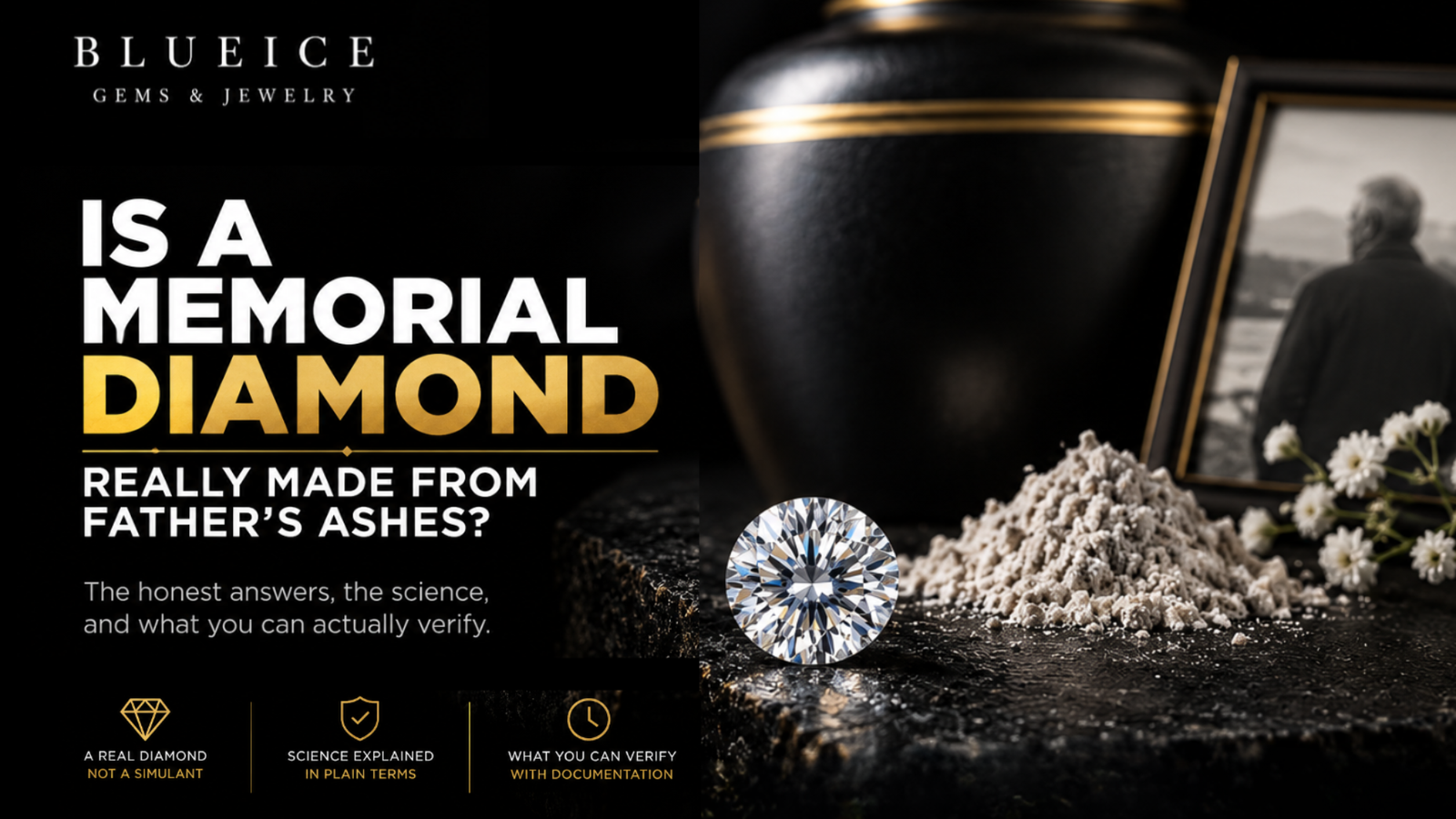
Is a memorial diamond made from father’s ashes real? Yes, but the full answer needs more detail. A memorial diamond can use carbon recovered from cremated remains during the diamond-growing process. The recovered carbon then joins additional carbon used to grow the stone.
That fact leads to three different questions. Is the finished stone a real diamond? Does it contain carbon from your father’s remains? Can anyone prove that the carbon came specifically from him?
Each question needs a different kind of evidence. This guide explains what you can check, what depends on the provider’s process, and which records you should request before you send your father’s ashes.
What You Will Learn
- What Does a Memorial Diamond Made From Father’s Ashes Actually Mean?
- Is a Memorial Diamond Made From Father’s Ashes a Real Diamond?
- How Much Carbon Comes From Father’s Ashes?
- Can You Prove the Carbon Came From Your Father?
- What Records Should You Ask For?
- How Much Does a Memorial Diamond Cost?
- Memorial Diamond Made From Father’s Ashes FAQ
What Does a Memorial Diamond Made From Father’s Ashes Actually Mean?
The phrase sounds simple, but it can hide several different claims. A provider can support some claims with gemological evidence. Other claims depend on the documented handling of the submitted material.
| Question | Type of Evidence | Can You Check It? |
|---|---|---|
| Is it a genuine diamond? | Gemological evidence such as crystal structure, hardness, optical properties, cut, color, clarity, and carat weight. | Yes. An independent gemological laboratory or qualified gemologist can examine the stone. |
| Does it contain human-derived carbon? | Information about extraction, purification, and the diamond-growth process. | Partly. You can review the stated process and documentation, but the finished stone does not carry a simple label showing the source of each carbon atom. |
| Does the carbon come specifically from your father? | Intake records, tracking information, and chain-of-custody documentation. | The source brief identifies this as the hardest claim to verify from the finished stone alone. |
This distinction matters. A diamond grading report can tell you about the stone itself. It does not automatically prove the personal origin of the carbon used during the growth process.
Is a Memorial Diamond Made From Father’s Ashes a Real Diamond?
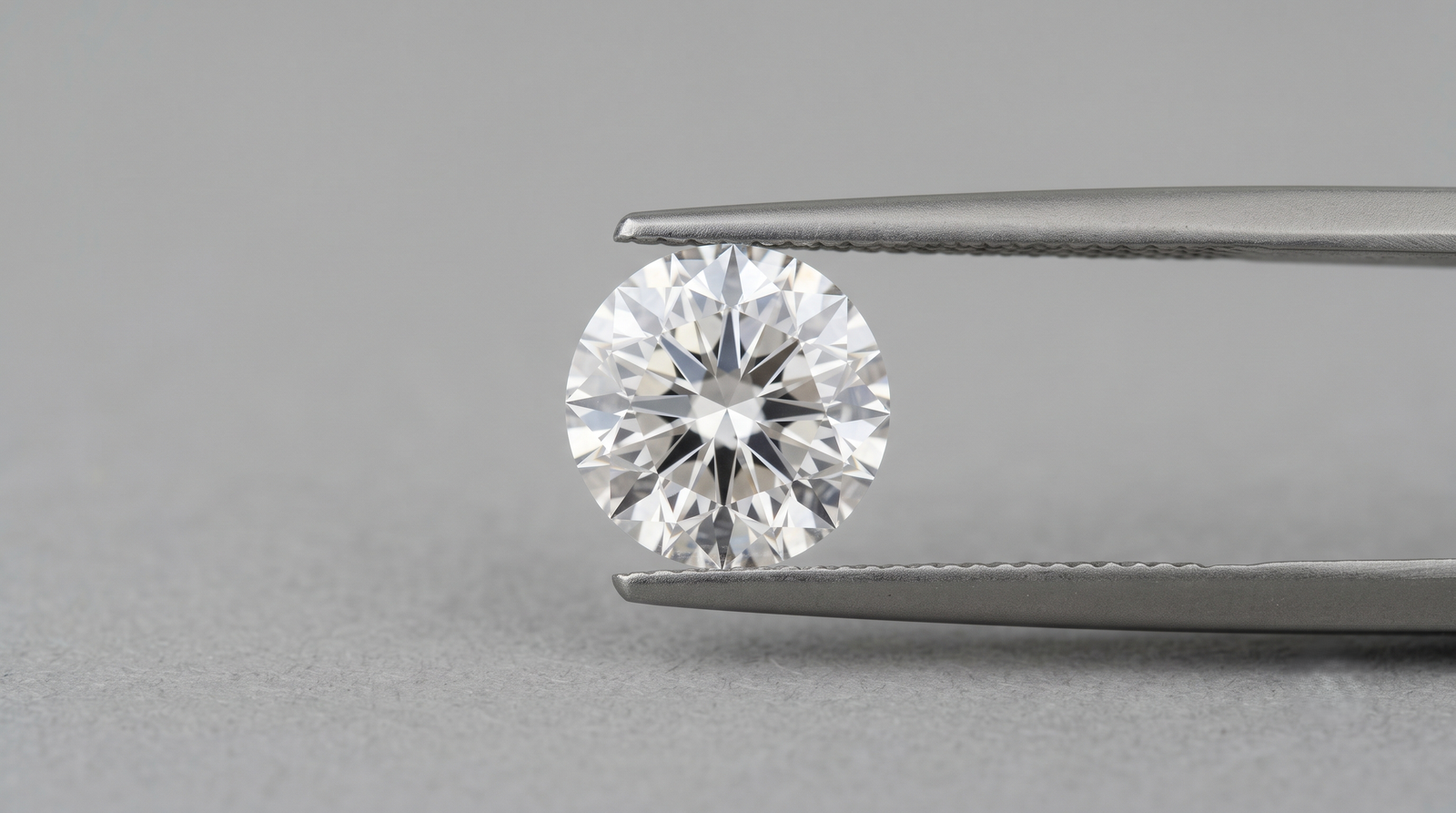
Yes. A laboratory-grown diamond is a real diamond, not a diamond imitation.
Laboratory-grown diamonds have essentially the same chemical, physical, and optical properties as natural diamonds. GIA also explains that laboratory-grown diamonds share the same crystal structure as natural diamonds, while their growth history differs.
That difference matters when you compare a lab-grown diamond with a simulant. Cubic zirconia and moissanite can look like diamonds, but they do not have the same chemical and physical properties as diamond.
Read GIA’s explanation of natural and laboratory-grown diamonds.
For that reason, you should separate two questions: Is this a real diamond? and Is this diamond connected to my father’s submitted material? Gemological testing can address the first question. Documentation plays a much larger role in the second.
For more information about the gemological side, read Are Memorial Diamonds Real Diamonds?.
How Much Carbon Comes From Father’s Ashes?
A memorial diamond made from father’s ashes does not normally contain only carbon recovered from the cremated remains.
Cremated remains contain mostly mineral material associated with bone. The amount of usable carbon can vary from one set of remains to another. The source material for this article gives an industry range of roughly 0.5% to 4% of ash by weight for usable carbon.
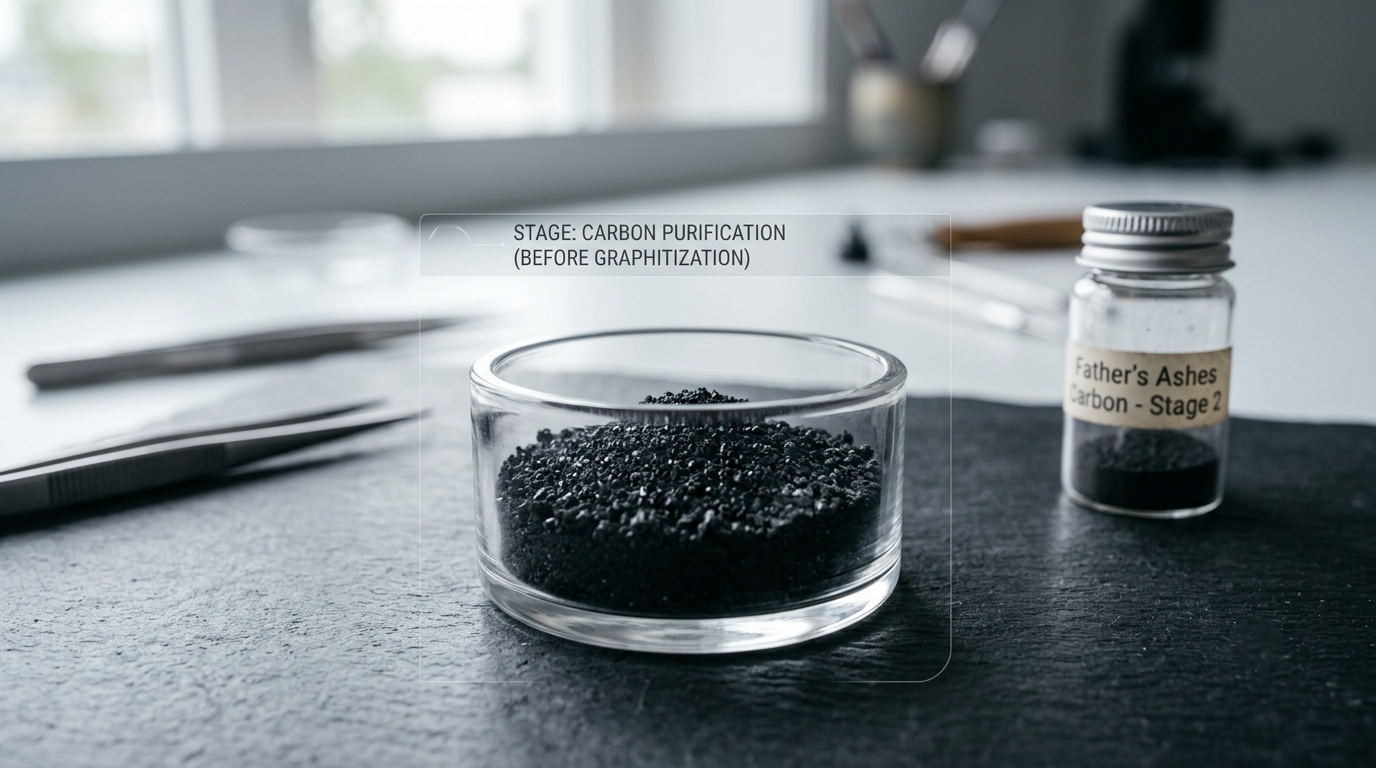
The provider can extract and purify that carbon before the diamond-growth stage. The process then uses additional lab-sourced carbon because the available carbon from the ashes alone cannot supply the entire growth process.
The source brief gives a typical personal-carbon range of around 10–15% of the finished stone’s mass. It also notes that some providers report lower or higher figures based on factors such as the size of the stone and the amount of material submitted.
So the honest explanation does not say that the entire diamond consists of your father’s remains. Instead, it explains that carbon from his submitted material can become part of the diamond while additional carbon supports the growth process.
That distinction gives families a clearer picture than a simple “100% ashes” claim.
To understand the process in more detail, read How a Memorial Diamond Is Made From Your Father’s Ashes.
Can You Prove the Carbon Came From Your Father?
This question deserves a careful answer.
The source brief flags the claim that no consumer-accessible test can trace a finished diamond to a named person as an inference that needs expert verification before publication. :contentReference[oaicite:2]{index=2}
That means you should not rely on a simple promise that a finished diamond can prove its personal origin. Instead, ask how the provider identifies and tracks your material before, during, and after the process.
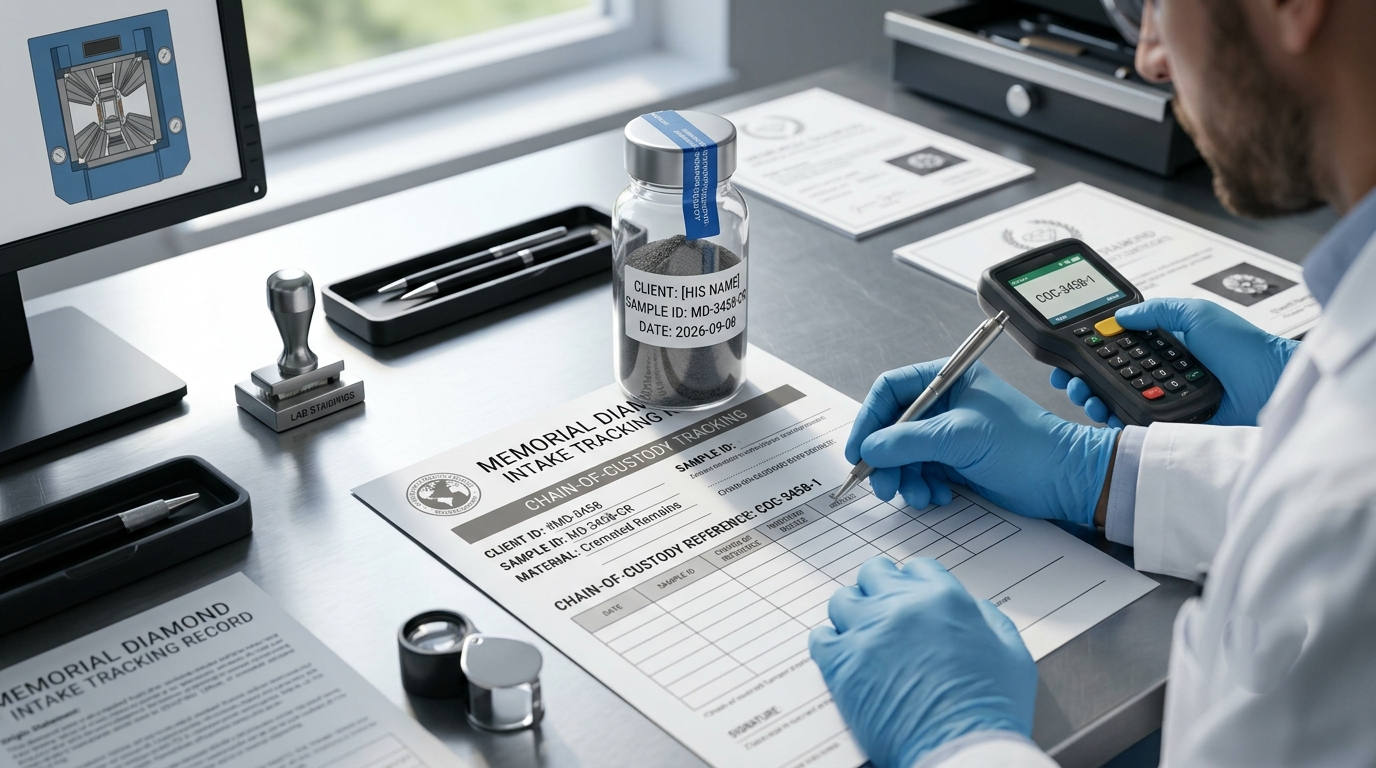
Think of the evidence as a chain. The stronger the documentation at each stage, the easier it becomes to understand how the provider handled the submitted material.
What Records Should You Ask For?
Before you order a memorial diamond made from father’s ashes, ask the provider to explain its documentation process in writing.
- Intake reference: Ask whether the provider gives your material a unique tracking number when it arrives.
- Intake confirmation: Ask for written confirmation of the material received, along with the date and other relevant details.
- Process tracking: Ask how the provider tracks the material during extraction and diamond growth.
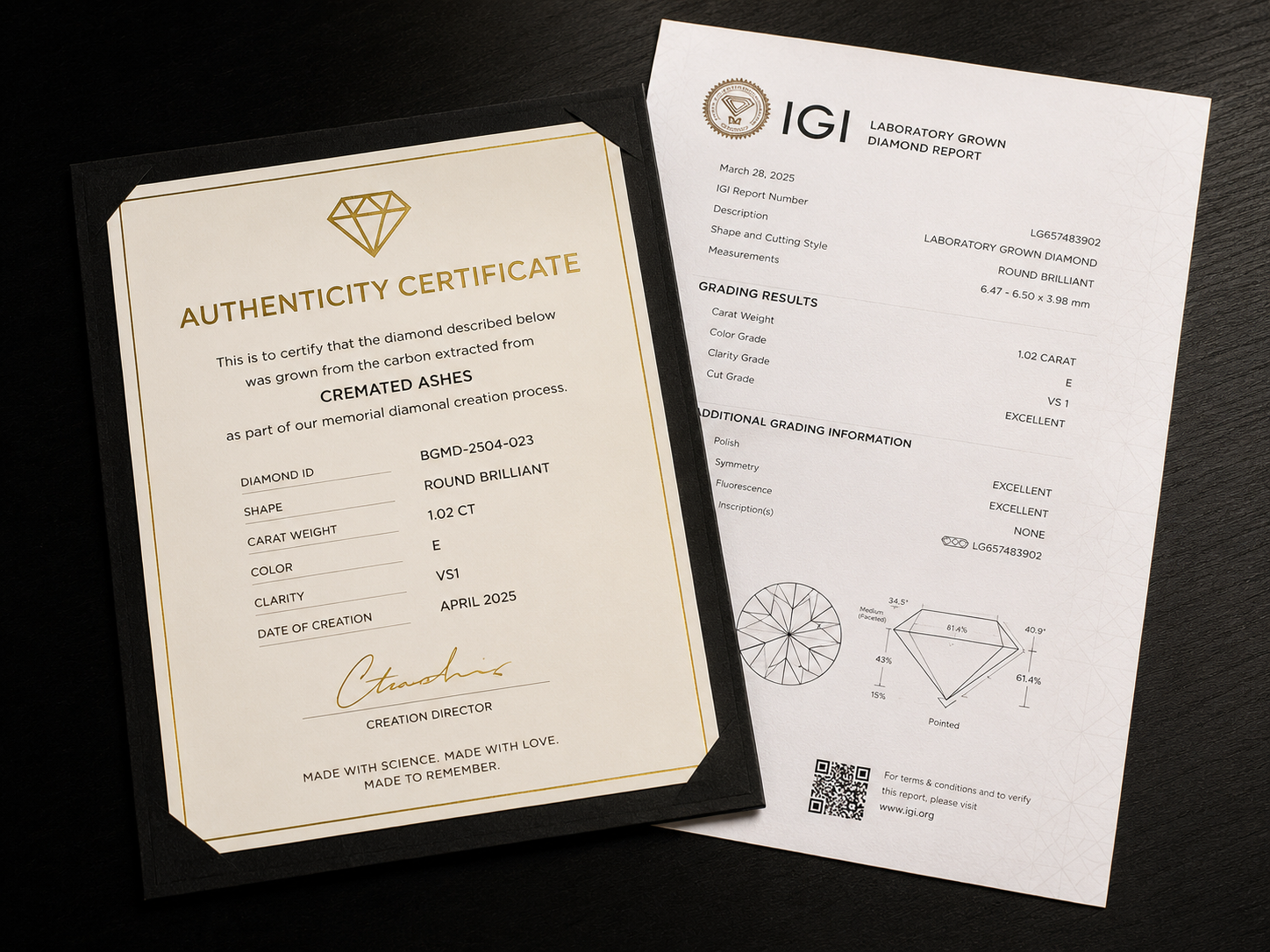
- Origin documentation: Ask what certificate or record connects the finished stone with your submitted material.
- Independent grading: Ask whether an independent gemological report is available for the finished diamond.
The source brief describes these records as reasonable good practice rather than a universal industry standard. You should therefore confirm the exact process with the provider you choose. :contentReference[oaicite:3]{index=3}
Documentation cannot answer every scientific question. It can, however, show you how carefully a provider handles your material and communicates the process.
For more detail, read Memorial Diamond Chain of Custody: How Companies Track Your Loved One’s Ashes.
How Much Does a Memorial Diamond Cost?
The cost of a memorial diamond made from father’s ashes can vary widely. The final price can depend on the stone size, color, cut, grading, setting, engraving, and other choices.
The source brief gives an industry-level entry figure of around $1,500 for stones of roughly 0.10–0.25 carat. It does not present that figure as BlueIceGems pricing. :contentReference[oaicite:4]{index=4}
A larger stone can require a much larger budget. You should also ask which services the quoted price includes and which services carry separate charges.
Money can also affect the decision in a very personal way. If the purchase would create financial pressure, another memorial choice may make more sense for your family.
An urn, burial, scattering ceremony, memorial jewelry, or another keepsake can hold deep meaning too. A memorial diamond does not need to replace those choices.
To explore the pricing factors in more detail, read Memorial Diamond Pricing Guide: What Actually Drives the Cost.
If your family has different opinions about the purchase, read How to Talk to Family About a Father Memorial Diamond.
Memorial Diamond Made From Father’s Ashes FAQ
Is a memorial diamond made from father’s ashes a real diamond?
Yes. When the finished stone qualifies as a laboratory-grown diamond, it is a genuine diamond. GIA explains that laboratory-grown diamonds have essentially the same chemical, physical, and optical properties as natural diamonds. Their main difference lies in how and where they grow.
Is the entire diamond made from father’s ashes?
No. The source material explains that providers combine carbon recovered from cremated remains with additional lab-sourced carbon. The personal carbon therefore represents part of the finished stone rather than 100% of its mass.
How much of a memorial diamond made from father’s ashes comes from the ashes?
The source brief gives a typical personal-carbon range of around 10–15% of the finished stone’s mass. The actual figure can vary, so you should ask the provider how it calculates and documents its stated percentage.
Can a finished diamond prove that it came from my father?
The source brief treats this as a claim that needs expert verification before publication. For that reason, families should focus on the provider’s intake records, tracking system, process documentation, and origin records rather than assuming that a finished diamond alone can establish personal identity.
Can I see my father’s ashes inside the diamond?
No. The process converts the usable material into processed carbon before diamond growth. The finished stone does not contain visible pieces of cremated remains.
What should I ask before choosing a memorial diamond company?
Ask how the company identifies your material at intake, how it tracks the material through the process, what records you receive, what happens to unused material, whether the finished diamond can receive independent grading, and what happens if the growth process does not produce the expected result.
For a practical checklist, read Questions to Ask Before Turning Your Father’s Ashes Into a Diamond.
What If Your Father Would Have Called It a Waste of Money?
That concern deserves an honest answer.
A memorial diamond can cost several thousand dollars, depending on the size and options. Some families may see that purchase as a meaningful keepsake. Others may prefer to use the money for another family need or another form of remembrance.
Neither choice makes the loss less meaningful.
If a family member questions the expense, try to separate the financial question from the question of whether the diamond is genuine. They are two different discussions.
You can also explain that a memorial diamond does not have to replace an urn, burial, scattering, or family tradition. It can simply offer another way to keep a physical reminder close.
Read How to Talk to Family About a Father Memorial Diamond for ideas on handling different family views.
Being Skeptical Can Help You Choose Better
When you consider a memorial diamond made from father’s ashes, asking difficult questions is not disrespectful. It is a sensible part of making an important purchase.
Ask how the provider tracks your material. Ask what documentation you receive. Ask which parts of the process happen in-house and which parts involve another facility. Ask what happens if the growth process fails. Ask what happens to unused material.
Most importantly, ask the provider to put important promises in writing.
The source brief makes one point especially clear: the strongest page should not rely on warm marketing language alone. It should help a family understand what evidence exists for each claim. :contentReference[oaicite:5]{index=5}
A memorial diamond made from father’s ashes raises emotional questions, scientific questions, and practical questions. When you separate those questions, you can make a decision with a much clearer understanding of the process.
Considering Your Father’s Hair Instead?
Ashes and hair involve different starting materials, so the questions do not always have the same answers.
If you are exploring hair instead of cremated remains, read Is a Memorial Diamond Really Made From Your Father’s Hair?