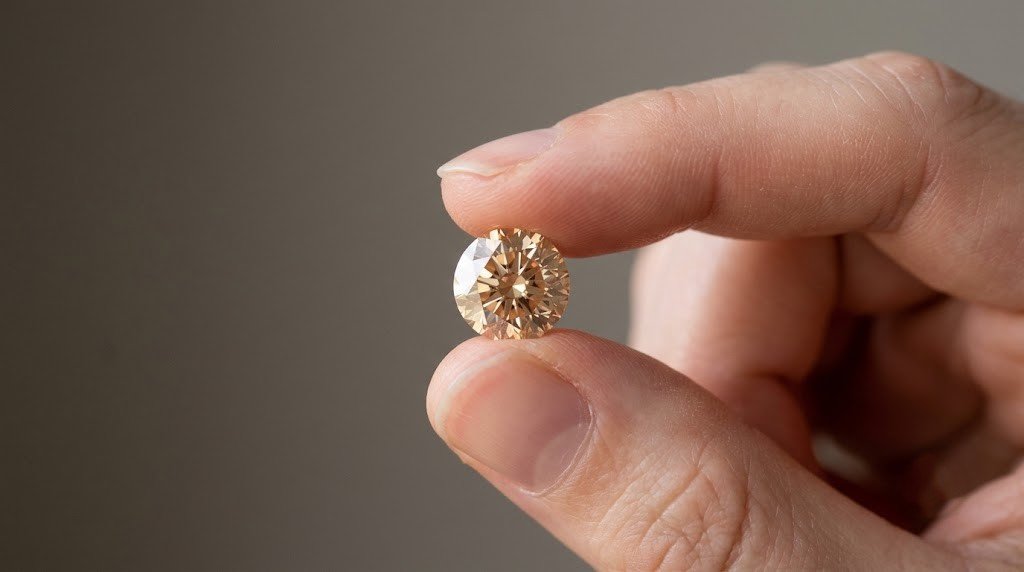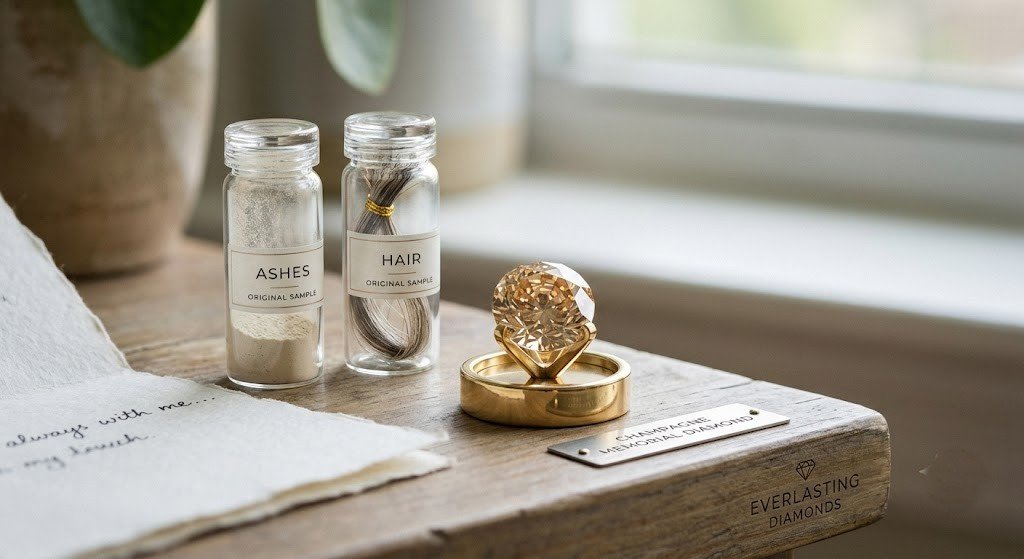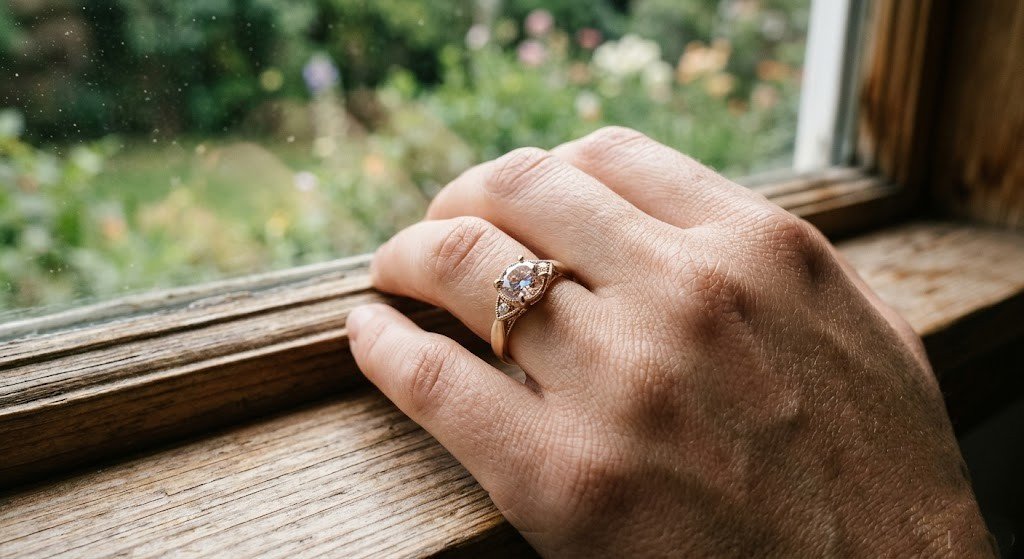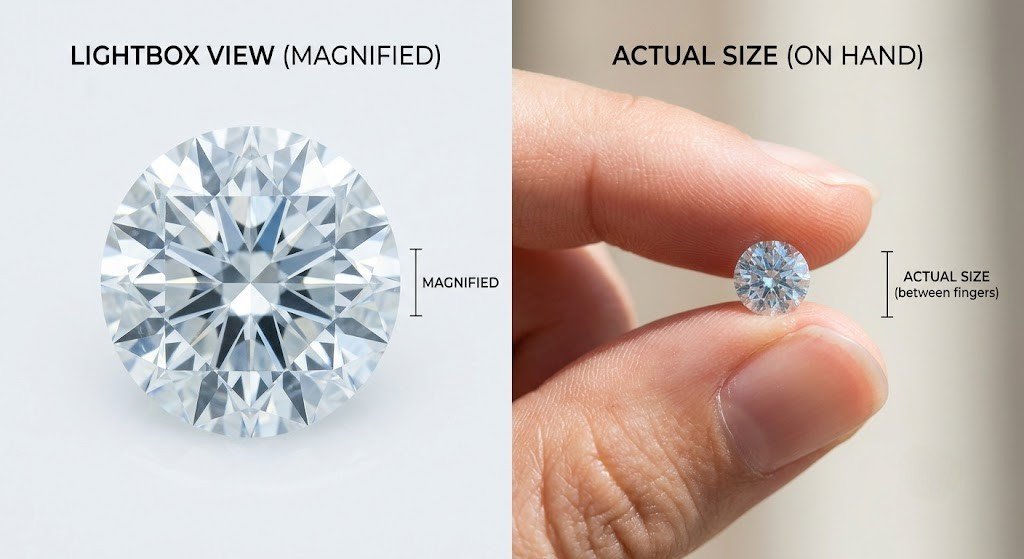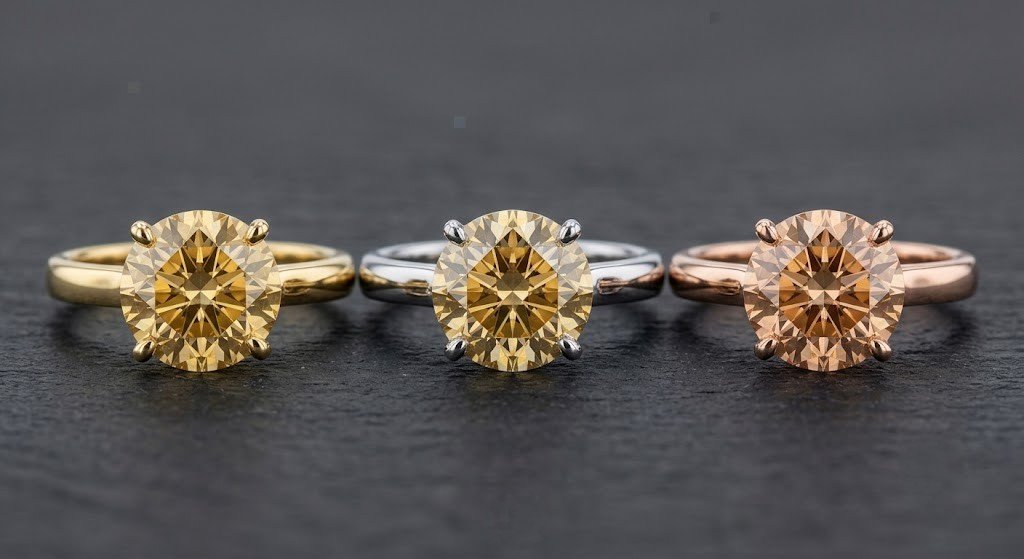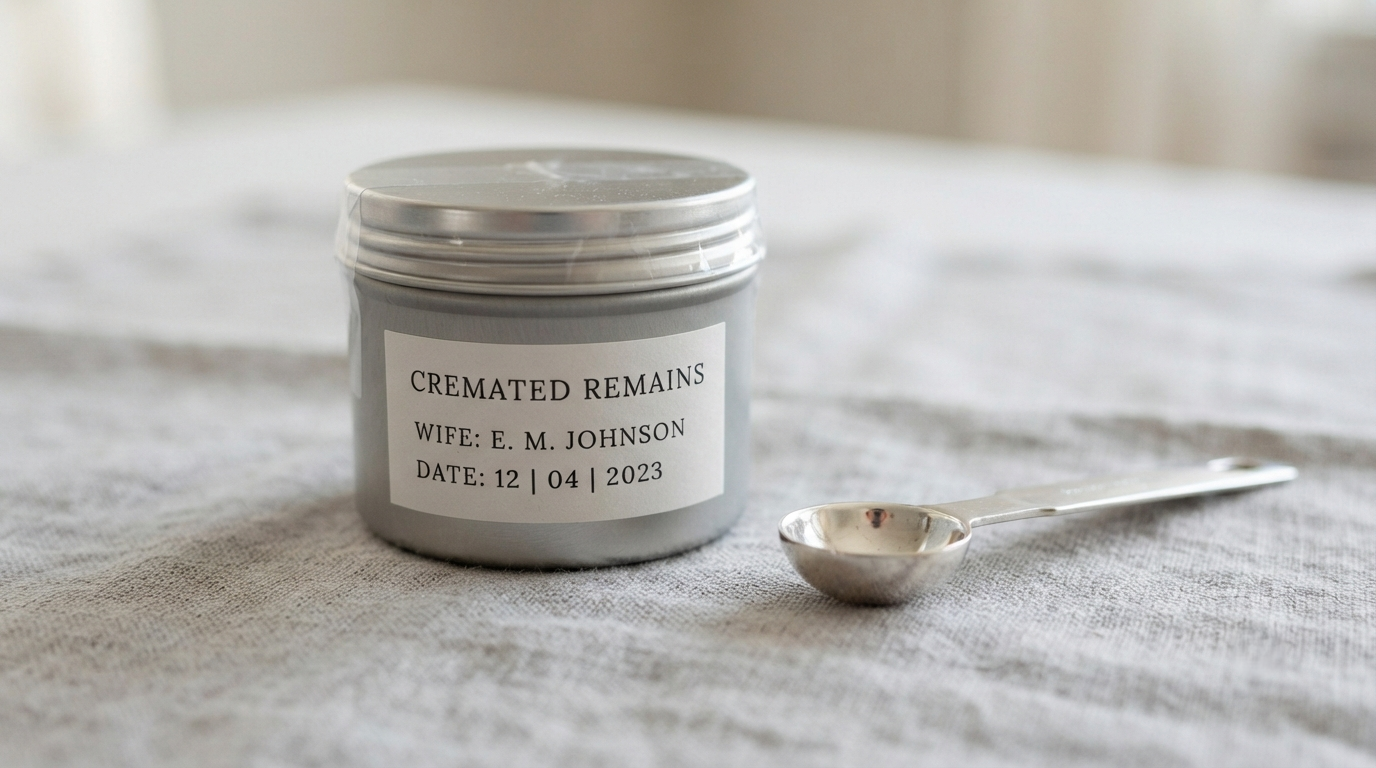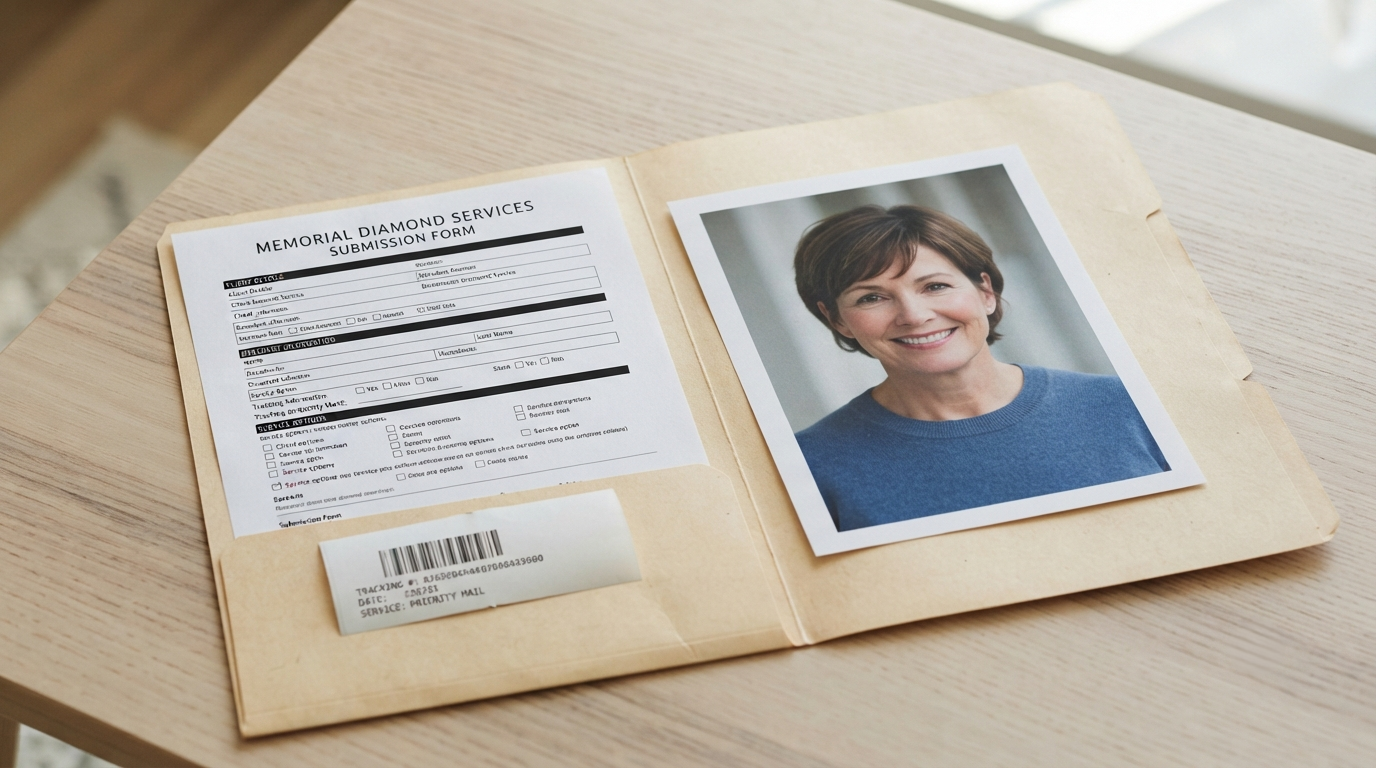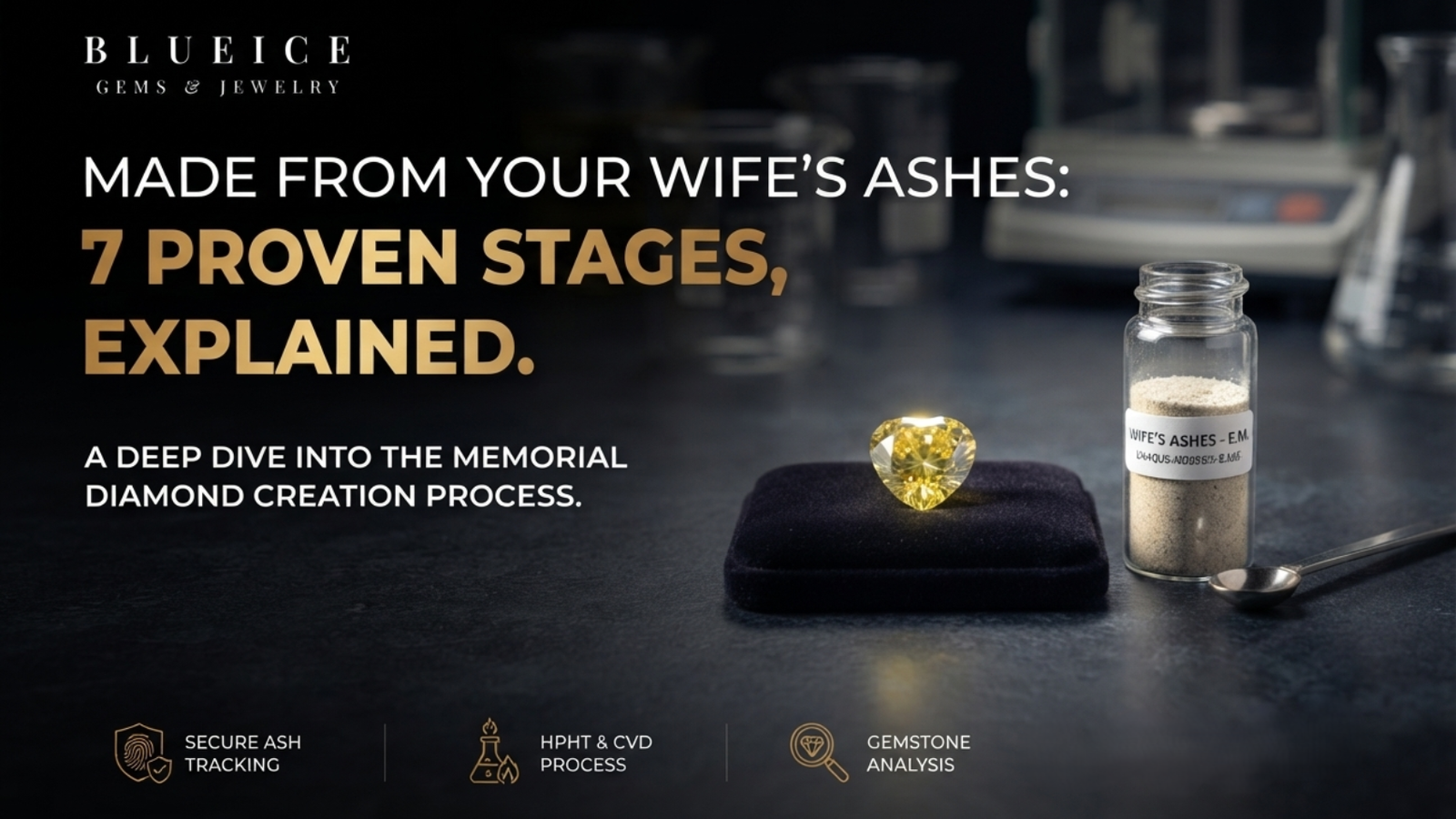
A memorial diamond made from your wife's ashes: a small yellow lab-grown diamond beside a sealed, labeled ash container on a laboratory bench

How a Memorial Diamond Is Made From Your Wife’s Ashes

The hardest part of this decision is not the money or the wait. It is handing a portion of her to strangers and trusting what comes back. A memorial diamond made from your wife’s ashes is produced in seven stages collection, carbon extraction, graphitization, diamond growth, cutting, optional irradiation, and grading and at every one of those stages a reputable laboratory can show you a record of where her material was and what was done to it. This page follows her ashes through all seven: what physically happens to them, what is removed, and what evidence you can ask for.

What “Made From Your Wife’s Ashes” Means in Practice

A diamond made from your wife’s ashes is a genuine lab grown diamond same crystal lattice, same optics, hardness 10 on the Mohs scale whose carbon includes a purified portion recovered from her cremated remains.

Two qualifiers belong in that sentence. First, it is not made from all of her ashes; a laboratory typically needs between a few tablespoons and roughly 4 oz (about 100 g), and the remainder stays with you. Second, it is not made only from her ashes. Because so little carbon survives cremation, her recovered carbon is blended with supplemental lab carbon to reach the volume a stone needs. Industry wide, the personal carbon in a stone made from your wife’s ashes is roughly 10 to 15% of the finished mass, with some providers citing figures as low as 3%.

That is the reason the chain of custody matters: the question is never “is the whole stone her” the physics rules that out but “can this laboratory prove the personal carbon in this stone was made from your wife’s ashes and no one else’s.” Wife Ashes Diamond: The Complete Guide covers what the stone contains and costs; this page stays with the process.

Why Her Ashes Are Mostly Calcium Phosphate, and Why That Matters

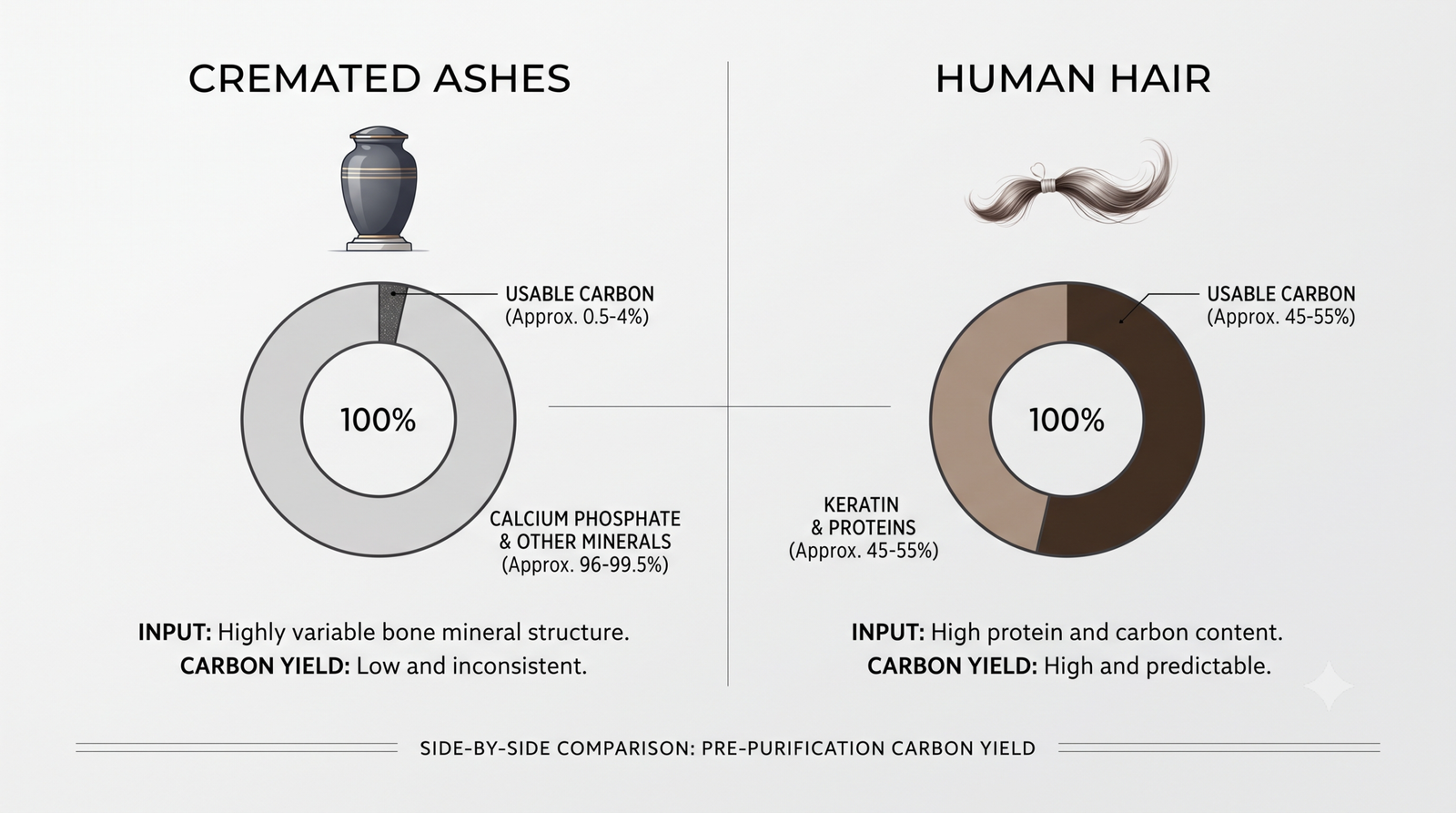
Cremation burns away nearly everything organic, and with it most of the body’s carbon. What remains is the mineral structure of bone: calcium phosphate, plus small amounts of other minerals, processed into the coarse powder you were handed.

Usable carbon in that powder is roughly 0.5% to 4% by weight, depending on the person and the cremation. That single fact shapes the whole process of a diamond made from your wife’s ashes:

  • It is why stage 2 exists a small carbon fraction has to be separated from a large mineral one.
  • It is why lab carbon enters at stage 4 a few grams of ash do not contain enough carbon to grow a diamond alone.
  • It is why sending more ash does not help growth time, not carbon supply, is the limit.
  • It is why the custody record matters the carbon is too small a quantity to identify by eye, so paperwork ties it to her.

The same chemistry applies to every memorial diamond made from anyone’s ashes. A provider who says otherwise is describing a less honest process, not a better one.

The Seven Stages as a Chain of Custody

Below is the whole process of a diamond made from your wife’s ashes as one table what happens to her ashes at each stage, what physically leaves, and what a well run laboratory can show you.

StageWhat happens to her ashesWhat leaves the processWhat you can ask to see
1. CollectionHer ashes are received, weighed, sealed, and assigned a submission referenceNothing; any unused portion is set aside for returnReceipt confirmation with weight and reference number
2. Carbon extractionAsh is heated in a controlled, oxygen free, multi stage process that strips out the mineralsThe mineral fraction most of the ash by weightLog entry with dates and recovered carbon weight
3. GraphitizationPurified carbon is heated to roughly 2,500 to 2,700°C and converted to graphiteRemaining trace impurities; the carbon reaches 99.9%+ purityLog entry for the run; some labs photograph the graphite
4. Diamond growthHer graphite, blended with lab carbon, grows around a seed under HPHT or CVD conditionsNothing of hers; lab carbon enters hereGrowth log with dates; photo of the rough crystal
5. Cutting and polishingThe rough crystal is cut to the shape you choseOffcuts of the rough, which some labs return on requestRough weight versus finished weight
6. Optional irradiationColor is shifted or intensified if you chose red, pink, green, or blackNothing; treatment alters color centers, not massTreatment disclosure in writing
7. Grading and certificationThe finished stone is graded and issued an origin certificateNothingOrigin certificate and, ideally, an independent grading report

Read down the third column: after stage 3, nothing of hers leaves. What is removed at stages 2 and 3 is mineral and impurity; her carbon stays in the process from extraction to the finished stone made from your wife’s ashes.

Stage 1 What Happens When Her Ashes Arrive?

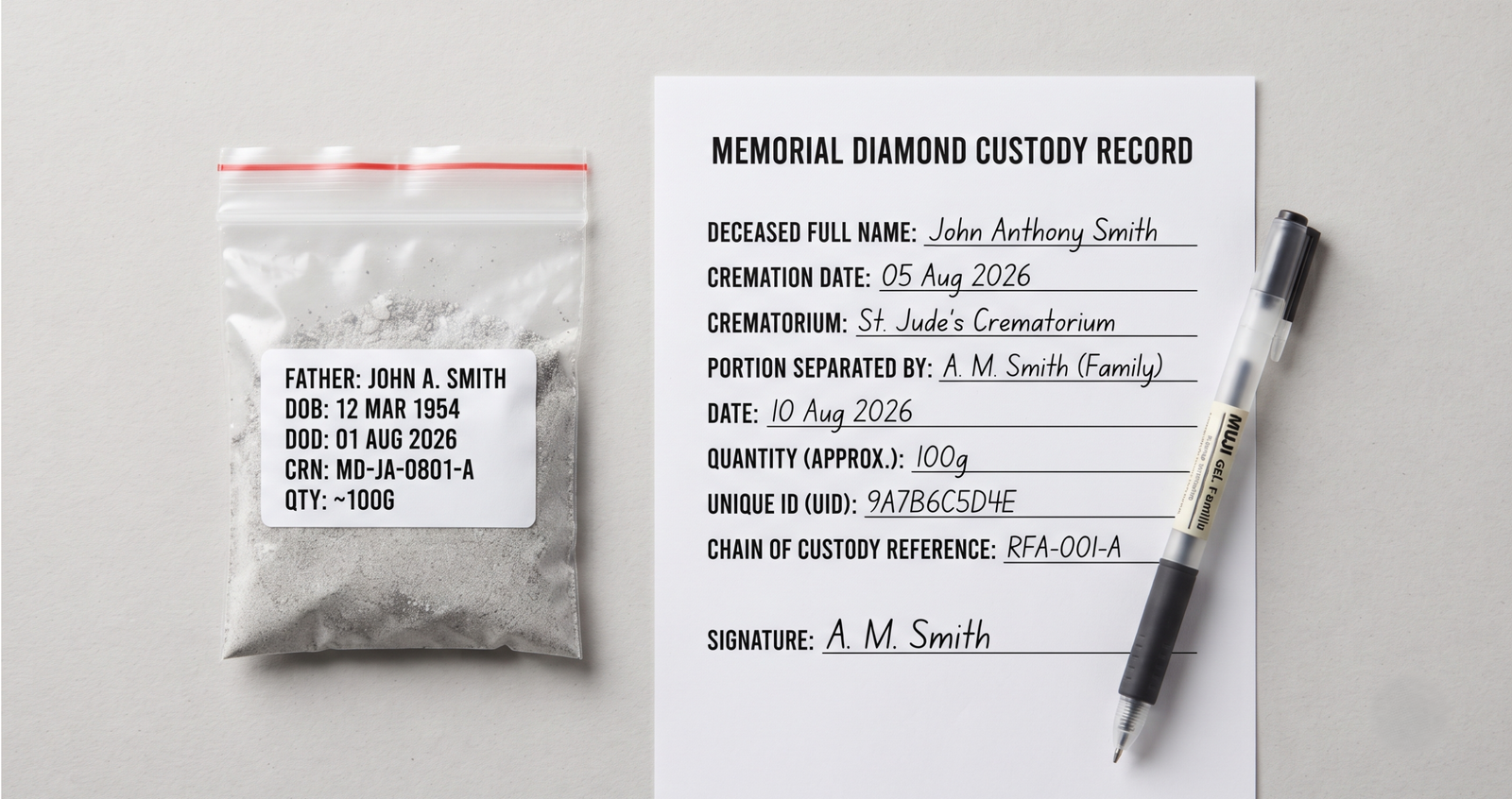
A diamond made from your wife’s ashes begins with a package on a receiving bench. The laboratory opens it, weighs the ashes, records the weight against a submission reference, and seals the container again. From this point on, that reference number not her name travels with the material through every stage; it is how two families’ submissions are kept apart.
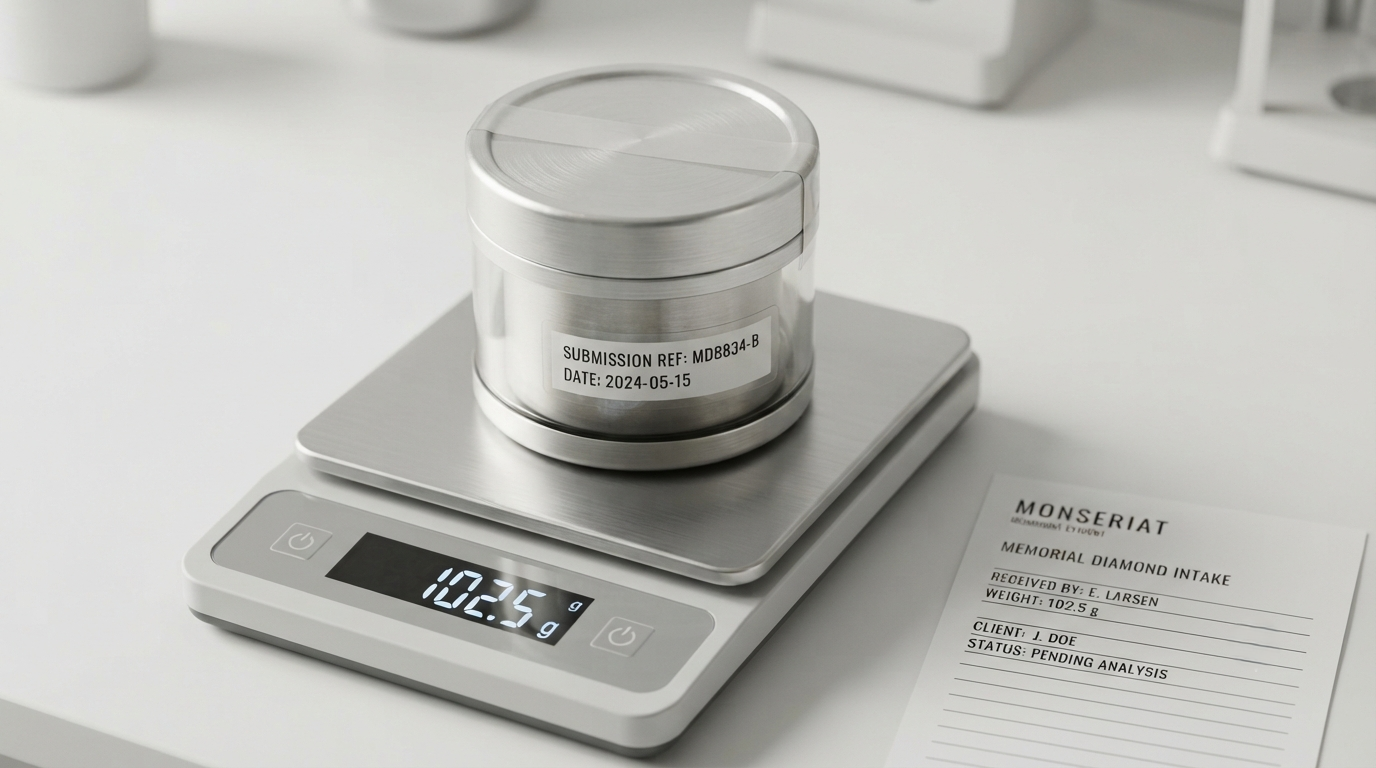
A sealed ash container on a scale, with a submission reference label and a receipt form in view

Ask for written confirmation that her ashes arrived, the weight, and the reference assigned. A provider who confirms “your package arrived” but cannot give the weight has started a mailroom log, not a custody record. The step by step for turning your wife’s ashes into a diamond covers how to measure, label, and photograph the portion you send, so your own record begins before theirs.

Stage 2 How Is Carbon Extracted From Her Ashes?

This is the stage most families picture for a diamond made from your wife’s ashes, and the one where the most material leaves.

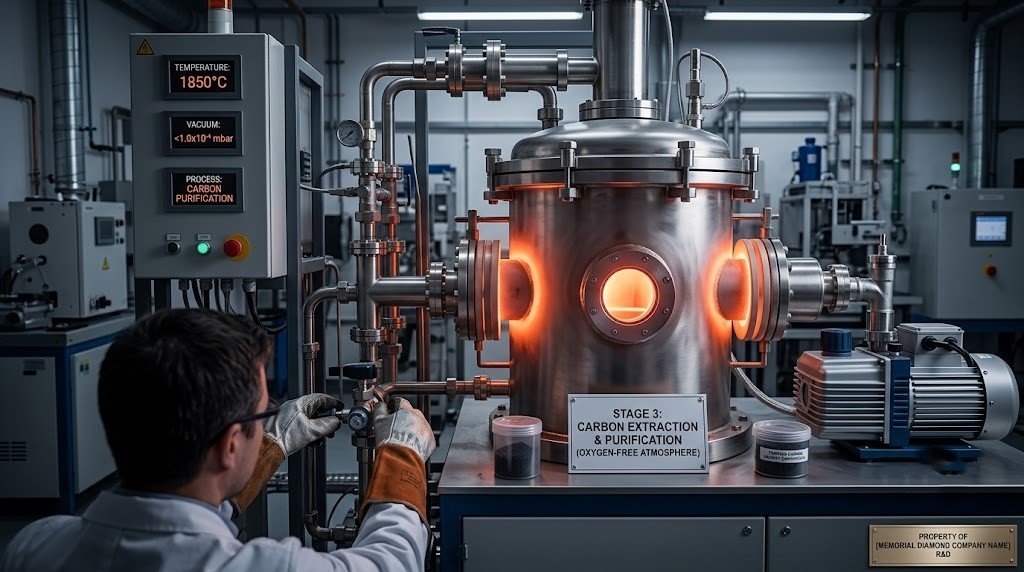
The ash is placed in a crucible and heated in a controlled, oxygen free atmosphere oxygen would burn the carbon away, as the cremation already did to most of it. Over several stages, the calcium phosphate and other minerals are separated out and the carbon concentrated. A few tablespoons of pale powder become a much smaller quantity of dark carbon that will be made from your wife’s ashes and nothing else.
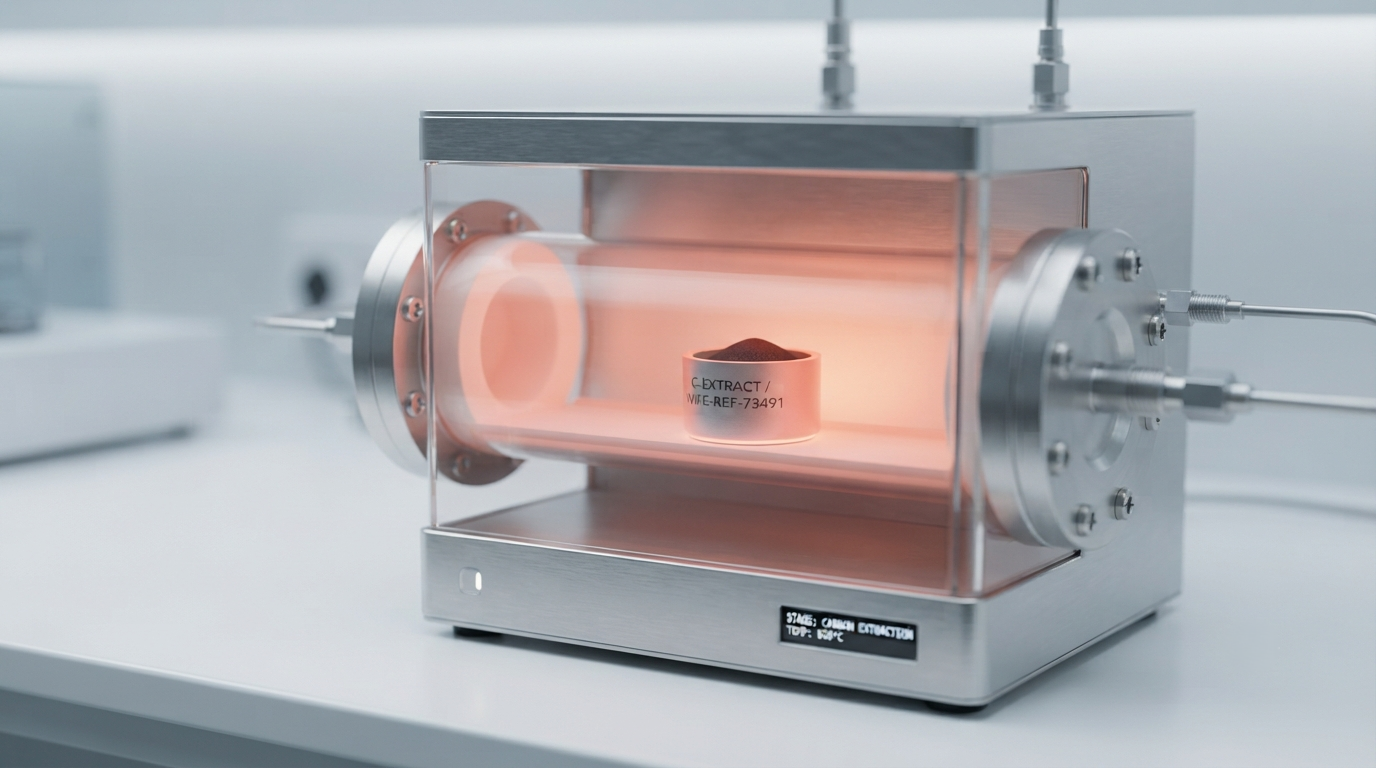
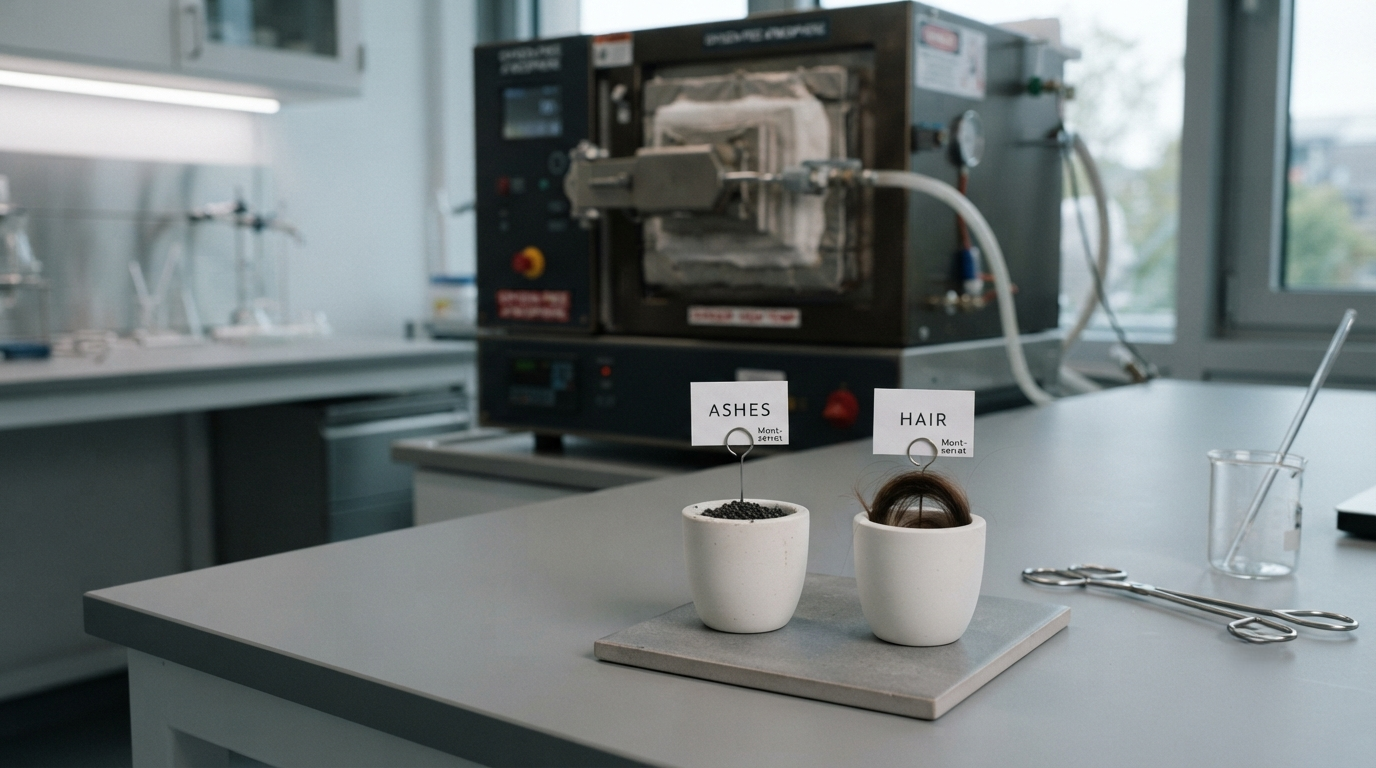
A labeled crucible inside an oxygen-free laboratory furnace during carbon extraction
  1. The mineral that leaves is not “her” in any sense the carbon is not. Calcium phosphate is bone mineral; it is what an urn holds and what you would scatter or inter.
  2. The recovered weight is the number that ties the rest of the process to her. Ask for that figure. It is small, and it should be; a large figure from a small ash sample would suggest something other than her ashes was in the crucible.

Extraction is where a diamond made from your wife’s ashes differs most from one made from hair, which is roughly half carbon by weight and yields far more per gram. How a memorial diamond is made from your wife’s hair covers that version of this stage.

Stage 3 Why Does the Carbon Become Graphite First?

Diamond and graphite are both pure carbon, arranged differently. Growth presses take graphite as feedstock, so the carbon recovered from her ashes is heated further to roughly 2,500 to 2,700°C and converted into graphite.

Two things happen in this run for a diamond made from your wife’s ashes. The crystalline structure changes, and the last trace impurities are driven off, bringing purity to 99.9% or higher. The graphite that leaves stage 3 is essentially all carbon, and the personal share of it is entirely hers.

Ask for the log entry for this run. Some laboratories photograph the graphite against the reference number; not all do.

Stage 4 Where Does Lab Carbon Enter, and Why?

Here is the center of how a memorial diamond is made from your wife’s ashes.

Her graphite perhaps a fraction of a gram is combined with supplemental lab carbon to reach the mass a growth cell needs. That is why a stone made from your wife’s ashes is roughly 10 to 15% personal carbon rather than all of it. The lab carbon is a necessity: even a 0.25 carat diamond needs more carbon than several tablespoons of ash contain.
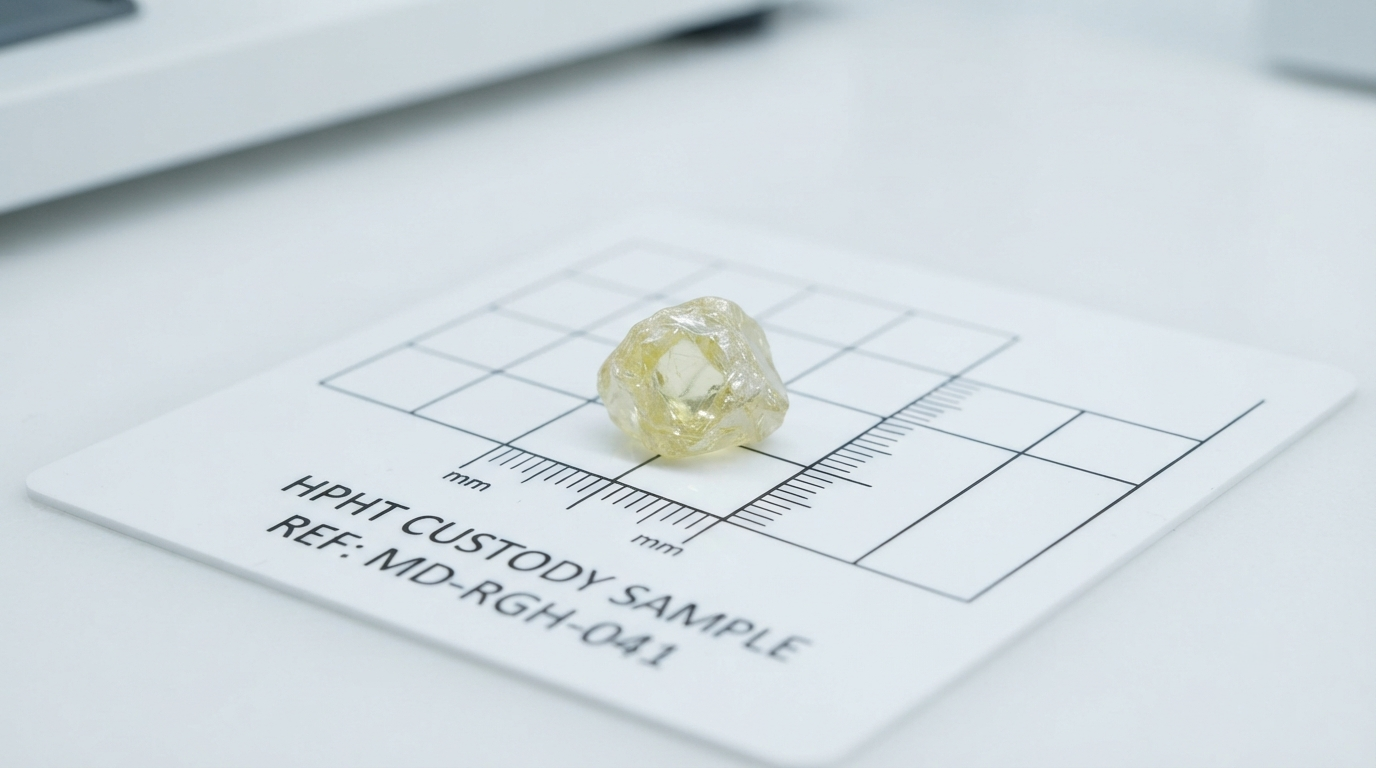
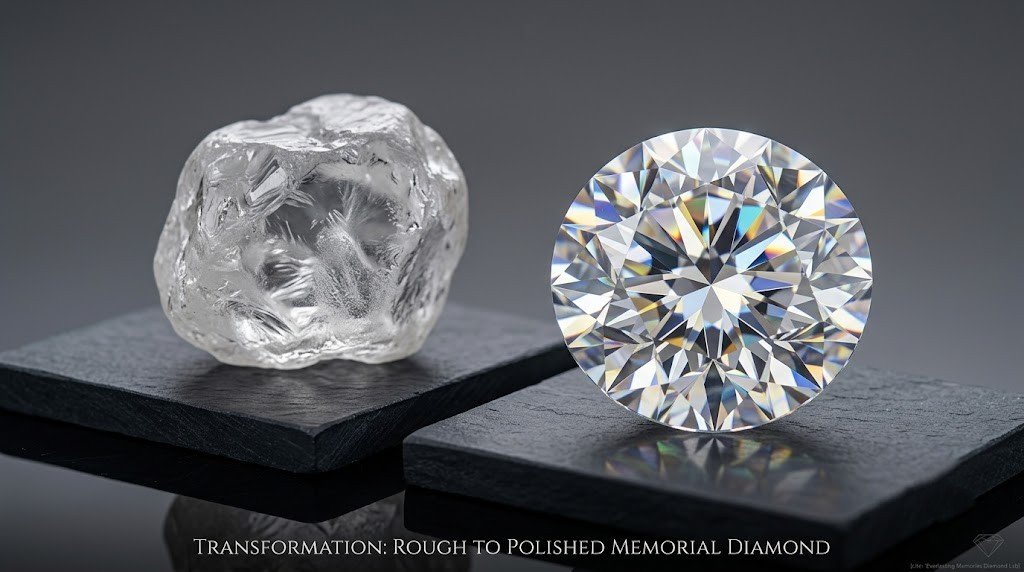
A rough, uncut yellowish diamond crystal photographed against a reference card after removal from an HPHT growth cell

The blended carbon is grown by one of two methods, both described on the synthetic diamond page:

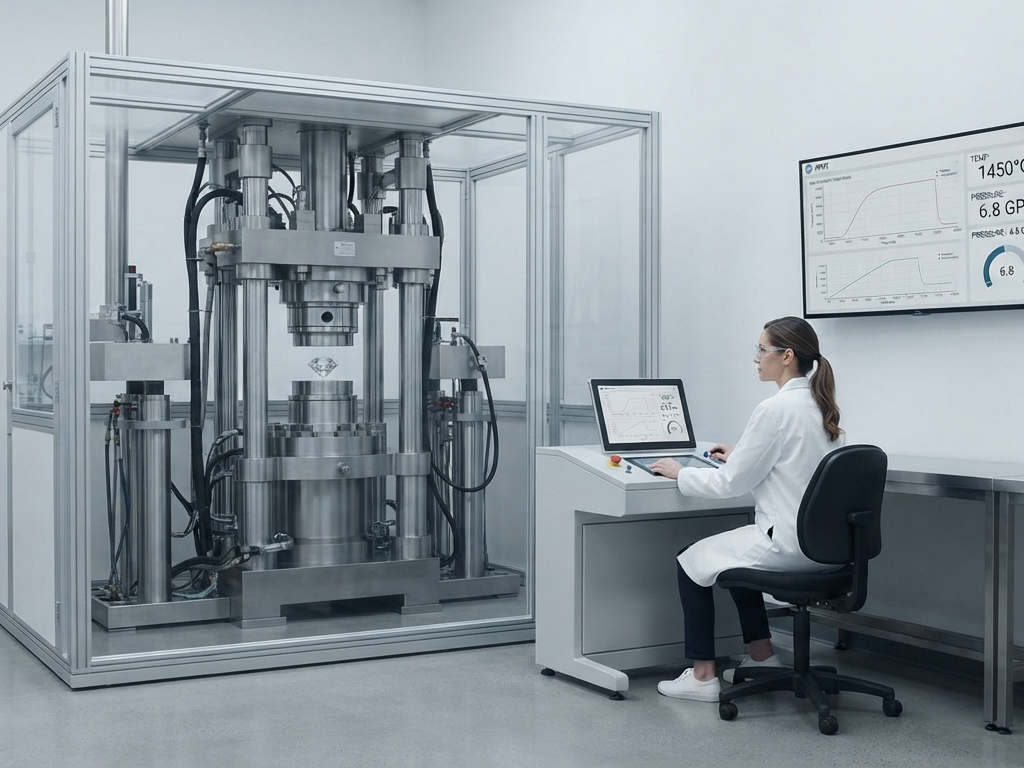
  • HPHT (High Pressure High Temperature) the industry standard for memorial stones. The carbon and a tiny diamond seed go into a growth cell inside a press at roughly 6 to 8 GPa and 1,400 to 2,500°C; carbon atoms migrate to the seed and the crystal grows outward.
  • CVD (Chemical Vapor Deposition) used by a minority of providers. The carbon is converted to a carbon bearing gas and deposited layer by layer onto a seed plate in a vacuum chamber.

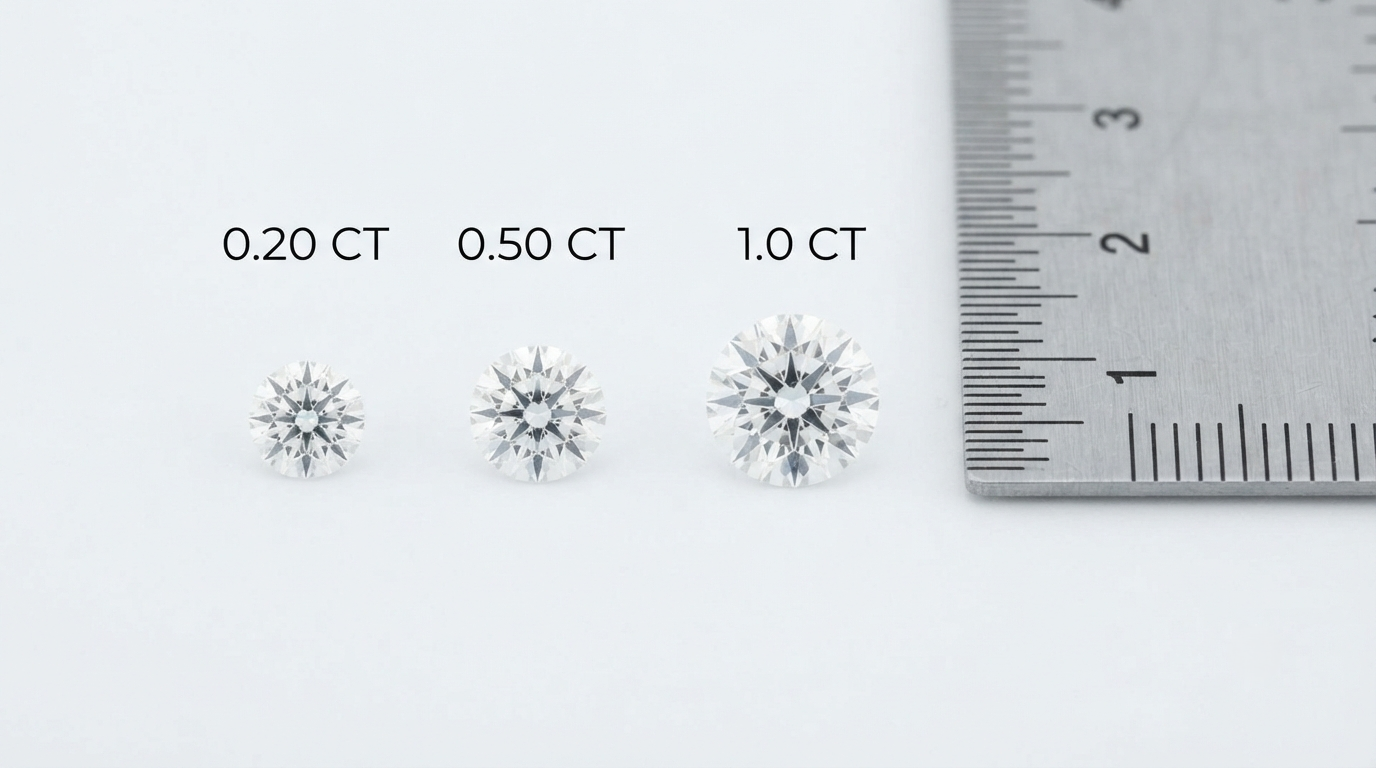
Either way, the growth stage of a diamond made from your wife’s ashes runs for weeks to months, and it sets carat. A 0.25 ct stone needs less time than a 1 ct stone; a 2 ct stone needs longer still. Ash quantity has nothing to do with it. How long it takes to make a wife memorial diamond works through the 6 to 10 month timeline.

Ask for the growth log with start and end dates, and a photograph of the rough crystal. The rough is unglamorous small, often yellowish or bluish and that is why the photograph is worth having. It is the first moment the diamond made from your wife’s ashes exists as an object.

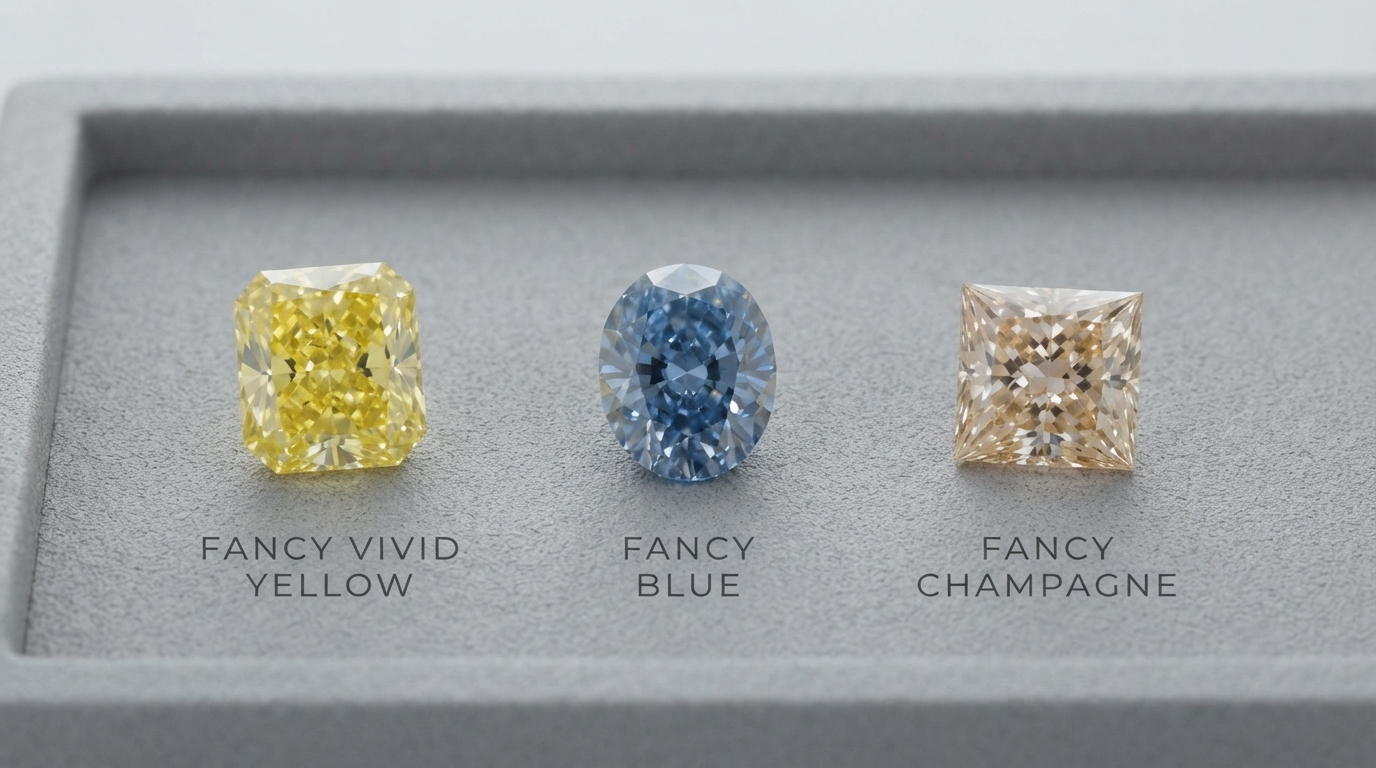
Color is decided here too. Trace nitrogen produces yellow to champagne tones; trace boron produces blue. Because her carbon came from an organic source, trace elements are typical, which is why colorless stones need extra processing and cost more. What color a diamond made from your wife’s ashes will be explains the choice.

Stages 5 to 7 Cutting, Irradiation, and Grading

Stage 5 Cutting and polishing. A gemologist cuts the rough into the shape you chose round, princess, cushion and polishes the facets. Some rough is lost as offcuts; a finished diamond made from your wife’s ashes weighs less than its rough. Ask for both weights, and ask before cutting whether offcuts can be returned.

Stage 6 Optional irradiation. If you chose red, pink, green, or black, the cut stone is irradiated to shift or intensify its color. Nothing is added or removed; the treatment alters color centers within the lattice. A reputable provider discloses it in writing. Otherwise this stage is skipped.

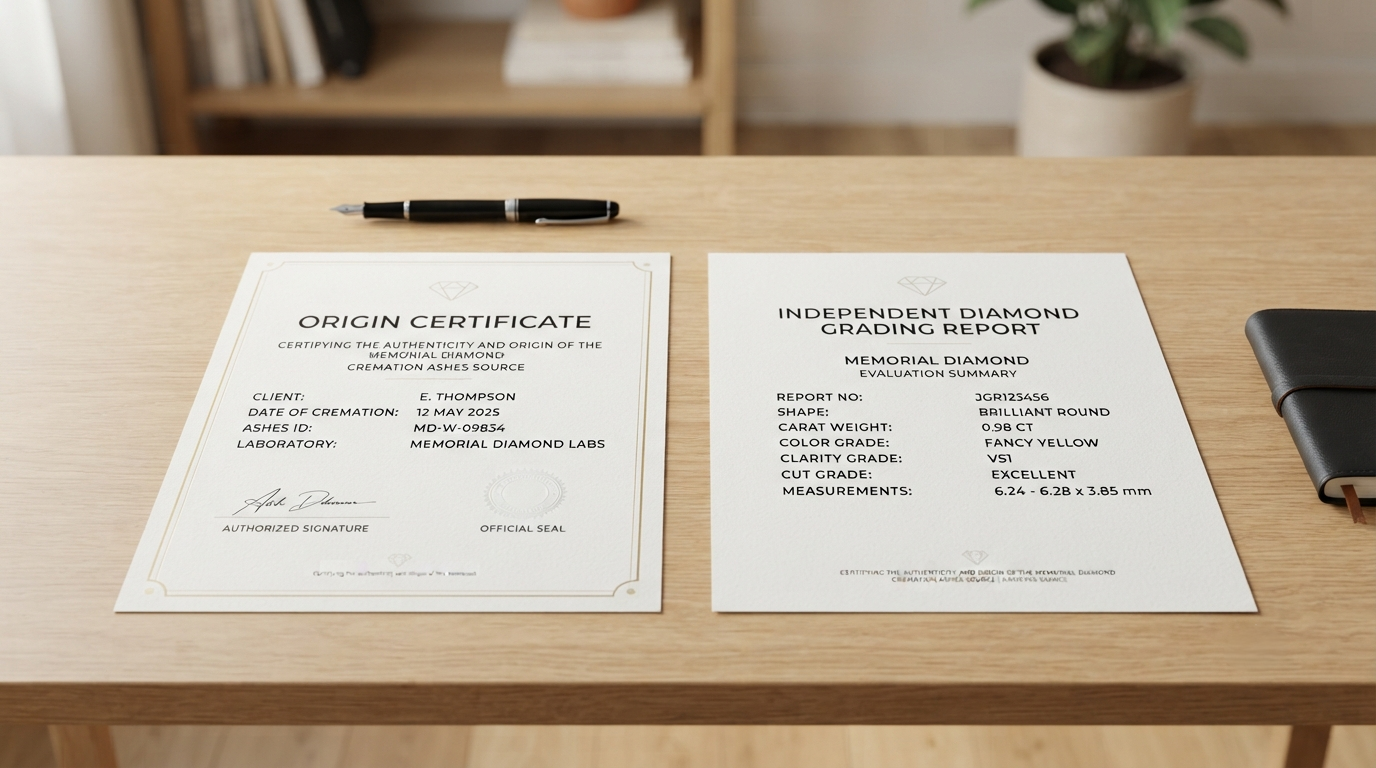
Stage 7 Grading and certification. Two documents close the process, answering different questions:

DocumentWho issues itWhat it answers
Origin (authenticity) certificateThe provider, in houseWas this stone grown from the submission logged under your reference?
Grading reportIdeally an independent gemological laboratoryWhat is this stone’s cut, color, clarity, and carat?

The origin certificate ends the custody record it says this stone made from your wife’s ashes is the one that started at stage 1. The grading report assesses it as a diamond, using the cut, color, clarity, and carat standards GIA describes; typical clarity lands between SI2 and VVS. A provider who offers only one document is answering only one question.

What Evidence Can You Ask For at Each Stage?

Not every family wants to follow a diamond made from your wife’s ashes this closely, and nobody should feel obliged to. If you do, this is the list. Ask before sending anything which of these the provider produces as a matter of course, which are on request, and which they cannot supply.

  1. Receipt confirmation reference number and weight (stage 1).
  2. Extraction log dates and recovered carbon weight (stage 2).
  3. Graphitization log dates, with a photograph if taken (stage 3).
  4. Growth log method, start and end dates (stage 4).
  5. Rough crystal photograph against the reference number (stage 4).
  6. Rough and finished weights and whether offcuts return (stage 5).
  7. Treatment disclosure in writing, even if “none” (stage 6).
  8. Origin certificate and grading report both (stage 7).
  9. Return of unused ashes confirmed in writing at the start.

A provider who can supply most of this list has a real chain of custody. One who can supply none of it may still make a genuine diamond, but you will be taking their word that it was made from your wife’s ashes rather than seeing the record. Is a memorial diamond really made from your wife’s ashes takes the skeptic’s question head on, and the questions to ask before turning your wife’s ashes into a diamond puts this list beside the ones about cost and timing.

Frequently Asked Questions

How much of the finished diamond is actually her carbon?

Industry wide, roughly 10 to 15% of a stone made from your wife’s ashes is personal carbon recovered from her cremated remains; some providers cite as low as 3%. The rest is supplemental lab carbon added at the growth stage because ash contains only 0.5 to 4% usable carbon by weight.

Why can’t the whole diamond be made from her ashes alone?

Cremation burns away most of the body’s carbon, leaving calcium phosphate. A few tablespoons of ash yield a fraction of a gram of carbon, far less than a growth cell needs for even a small stone. Lab carbon supplies the volume; her carbon is grown into the same lattice.

Does sending more of her ashes make a bigger diamond?

No. Carat is set by how long the crystal grows in the press, not by how much ash was submitted. Once enough carbon is present to fill the growth cell, additional ash is simply unused. Send the provider’s stated minimum and keep the rest.

What is removed from her ashes during the process?

At stage 2 the calcium phosphate and other bone minerals most of the ash by weight are separated out. At stage 3 remaining trace impurities leave as the carbon reaches 99.9%+ purity. After that, nothing of hers is removed; only cutting offcuts leave at stage 5.

How do I know the carbon in the stone came from her ashes and not someone else’s?

Through the custody record: a submission reference assigned at receipt, log entries at extraction, graphitization, and growth, and an origin certificate tying the finished stone to that reference. Ask which of these the provider supplies before you send anything.

Is a diamond made from your wife’s ashes a real diamond?

Yes. It is grown by HPHT or CVD, the same methods used across the lab grown diamond industry, and it has the same crystal structure, optical properties, and hardness of 10 on the Mohs scale. An independent grading report assesses it exactly as it would any other diamond.

How long do the seven stages take altogether?

Across the industry, 6 to 10 months from receipt of her ashes to a finished, graded stone, with larger stones and some colors black in particular taking up to 12 months. The growth stage is the longest and is the one that varies with carat.

Final Thoughts on a Diamond Made From Your Wife’s Ashes

Seven stages, and only two remove anything: the mineral at extraction and the last impurities at graphitization. What is left is a small quantity of carbon that was hers, grown into a lattice alongside carbon that was not, and cut into a stone you can hold. Knowing that a diamond made from your wife’s ashes is roughly 10 to 15% her carbon rather than all of it does not make it less hers. It makes the record that ties that carbon to her the thing worth asking about and a laboratory that keeps a good record of a diamond made from your wife’s ashes will not mind being asked.

Learn More About Wife Memorial Diamonds

Talk With Memorial Diamond

If you want to know which of the nine pieces of evidence above to expect before her ashes leave the house, reach out to Memorial Diamond the custody record, the extraction weight, and what the origin certificate will say are all answerable in advance.

Word count: 2,885 · Reading time: about 14 minutes
A memorial diamond made from your wife's ashes and hair: a small champagne lab-grown diamond between a sealed ash container and a tied lock of hair, both labeled with the same reference number

How a Memorial Diamond Is Made From Your Wife’s Ashes and Hair

A memorial diamond made from your wife’s ashes and hair goes through the same seven stages as a single material stone, and combining the two materials adds exactly five things to the process: a choice between separate and joint purification, a defined point where the two carbons meet, an honest accounting of which material supplied most of her carbon, a single custody record covering both, and an origin certificate that names both. Collection, graphitization, growth, cutting, irradiation, and grading are unchanged and covered stage by stage in how a memorial diamond is made from your wife’s ashes and how a memorial diamond is made from your wife’s hair. This page covers only the five additions.

What Combining Actually Adds to the Process

Most of the process of a diamond made from your wife’s ashes and hair is not specific to combining. The table below sorts the seven stages of a diamond made from your wife’s ashes and hair into what is unchanged, where it is covered, and what the two material submission adds.

StageUnchanged for a combined stone?Where it is coveredWhat combining adds
1. CollectionMostlyAshes post, stage 1; hair post, stage 1Both materials logged under one reference: Addition 4
2. Carbon extractionNoAshes post, stage 2; hair post, stage 2Separate vs joint purification: Addition 1; the yield imbalance: Addition 3
3. GraphitizationMostlyAshes post, stage 3The two carbons meet before this run: Addition 2
4. Diamond growthYesAshes post, stage 4Nothing; one blended feedstock enters the press
5. Cutting and polishingYesAshes post, stages 5 to 7Nothing
6. Optional irradiationYesAshes post, stages 5 to 7Nothing
7. Grading and certificationMostlyAshes post, stages 5 to 7Certificate must name both: Addition 5

Four of the seven stages of a diamond made from your wife’s ashes and hair are untouched. The additions cluster around stages 2 and 3, the chemistry, and at the two ends of the paper trail, stages 1 and 7. Wife Ashes and Hair Diamond: The Complete Guide covers whether a diamond made from your wife’s ashes and hair is right for you at all; this page assumes you have decided and want to know what the laboratory does differently.

Addition 1: Separate or Joint Purification?

The first thing a laboratory decides when a stone is made from your wife’s ashes and hair is whether to purify the two materials in one run or two. Both approaches are used across the industry, and both produce the 99.9%+ pure carbon a diamond made from your wife’s ashes and hair needs. They differ in what you can learn along the way.

Separate purification means her ashes go through the oxygen free, multi stage heating on their own, minerals stripped out, a small carbon fraction recovered, and her hair goes through its own run, with the non carbon components of keratin driven off. Two crucibles, two log entries, two recovered carbon weights.

Joint purification means both go in together. One run, one log entry, one recovered carbon weight.

Two labeled crucibles — one marked ashes, one marked hair — on a laboratory bench before an oxygen-free furnace

Neither is wrong for a diamond made from your wife’s ashes and hair. The case for separate runs is information: a carbon weight for the ashes and a carbon weight for the hair, which is the only way to answer Addition 3 with a number rather than an estimate.

The case for a joint run is simplicity. For a diamond made from your wife’s ashes and hair, the question to ask is “which do you do, and can you tell me the recovered weight from each?” A provider who purifies jointly and cannot give per material weights is not doing anything improper, but they cannot then tell you what share of the personal carbon in a diamond made from your wife’s ashes and hair came from which material, and you should know that before you send anything.

Addition 2: Where Do the Two Carbons Meet?

In a diamond made from your wife’s ashes and hair, the two carbons meet after purification and before graphitization. That timing is not arbitrary, and it rules out the two alternatives families sometimes imagine.

  1. Not before extraction. Ash is mineral; hair is protein. Their extraction chemistries differ enough that running raw ash and raw hair together from the start risks the ash minerals contaminating the hair’s much richer carbon yield.
  2. After purification, before graphitization. Once both are 99.9%+ carbon, they are chemically the same substance. Combining them here means a single graphitization run, heating to roughly 2,500 to 2,700°C to convert the carbon to graphite, produces one uniform feedstock. That is the meeting point in a well run process.
  3. Not after growth. A diamond cannot be “added to.” Once the crystal has grown around its seed, no carbon from any source can be introduced. A stone grown from her ashes now cannot have her hair added later.
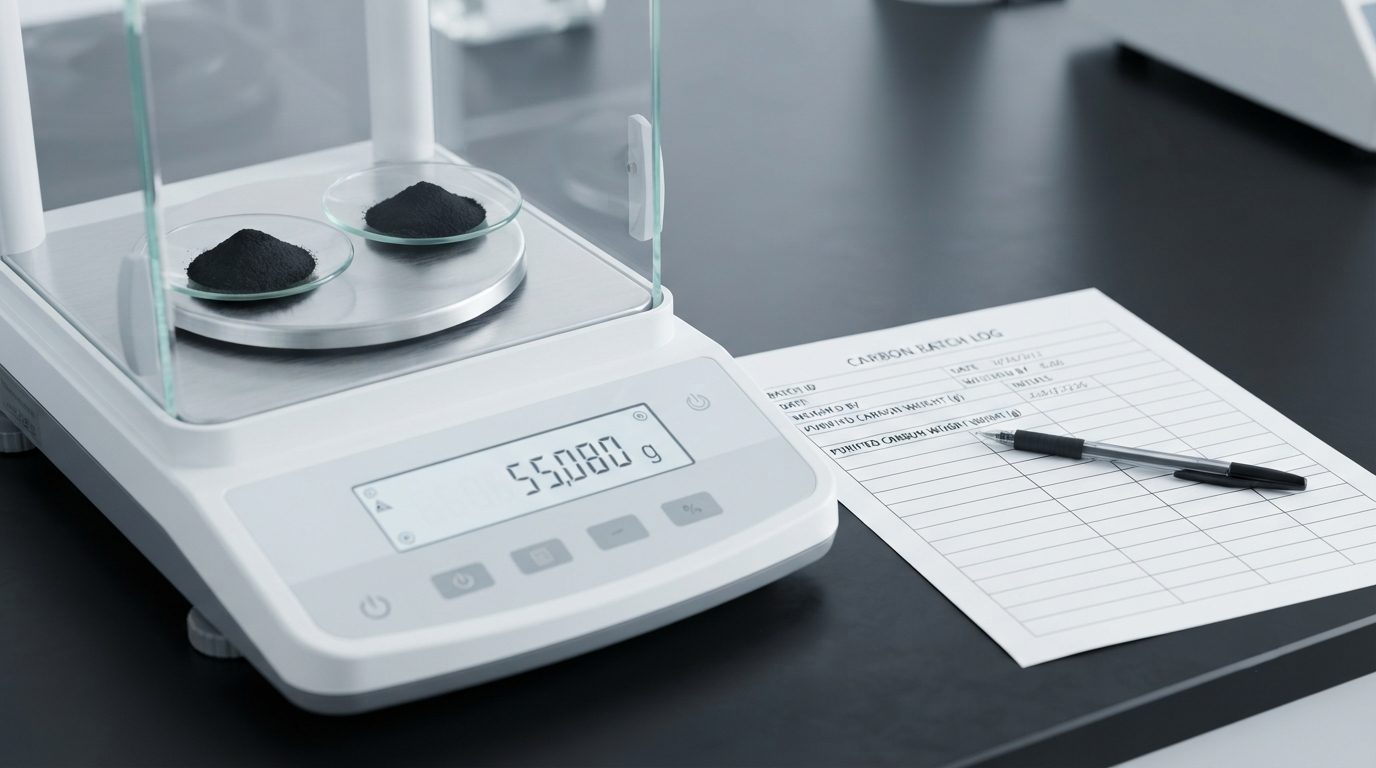
Two small dishes of purified black carbon being weighed together on a laboratory scale beside a log sheet

The practical consequence is that the moment the two carbons become one is a moment in the log. Ask that it be recorded: the date the purified ash carbon and hair carbon were combined, and the combined weight going into graphitization. From that point, a diamond made from your wife’s ashes and hair is chemically indistinguishable from any other memorial diamond entering the press, growth by HPHT at roughly 6 to 8 GPa and 1,400 to 2,500°C, or by CVD with a minority of providers, is described on the synthetic diamond page and does not know there were two sources.

Addition 3: Why the Hair Supplies Most of the Personal Carbon

This is the honesty a diamond made from your wife’s ashes and hair turns on, and it is better stated in numbers than in reassurance. Hair is roughly 50% carbon by weight. Ashes are almost entirely calcium phosphate, with usable carbon at roughly 0.5% to 4%. Put typical submission quantities next to each other:

MaterialTypical amount submittedCarbon contentApproximate carbon recovered
HairA few grams, say 3 g~50%Roughly 1.5 g
AshesA few tablespoons to ~4 oz, say 30 to 100 g0.5% to 4%Roughly 0.15 to 4 g, most often at the lower end

The figures are illustrative, not a provider’s promise, yields vary with the person, the cremation, and the process. But the shape is consistent: a few grams of hair contribute as much or more personal carbon than a much larger quantity of ashes. In a diamond made from your wife’s ashes and hair, the hair usually does most of the carbon work.

Three things follow, and none is a reason not to combine:

  • Combining does not raise the personal share of the stone. Industry wide, the personal carbon in a finished memorial diamond is typically around 10% to 15% of its mass, some providers cite as low as 3%. Two sources are still blended with supplemental lab carbon to reach growth volume. A diamond made from your wife’s ashes and hair is not “more her” than a single material stone; it is her from two directions.
  • The ashes are not a token. A smaller share is still a real, verifiable share. Carbon that was in her bones is in the lattice.
  • The reason to combine is meaning, not chemistry. Hair is carbon she grew while alive; ashes are what remained. Some families want both in one crystal, and that is reason enough. Is a memorial diamond really made from your wife’s ashes and hair takes the skeptic’s version of this question seriously.

Ask the provider directly: “Roughly what proportion of the personal carbon will have come from the hair, and what from the ashes?” A provider who has made a diamond made from your wife’s ashes and hair before, or anyone’s, gives a range and explains that it depends on the amounts. “About half and half” describes a symmetry the chemistry does not support.

Addition 4: How a Good Lab Logs Both Materials as One Record

A chain of custody record is the logged, traceable trail from receipt to finished stone. For a diamond made from your wife’s ashes and hair, the risk is that two materials produce two records that are never firmly tied together, and at the end, the provider cannot show that both went into the same stone. A well kept two material record looks like this:

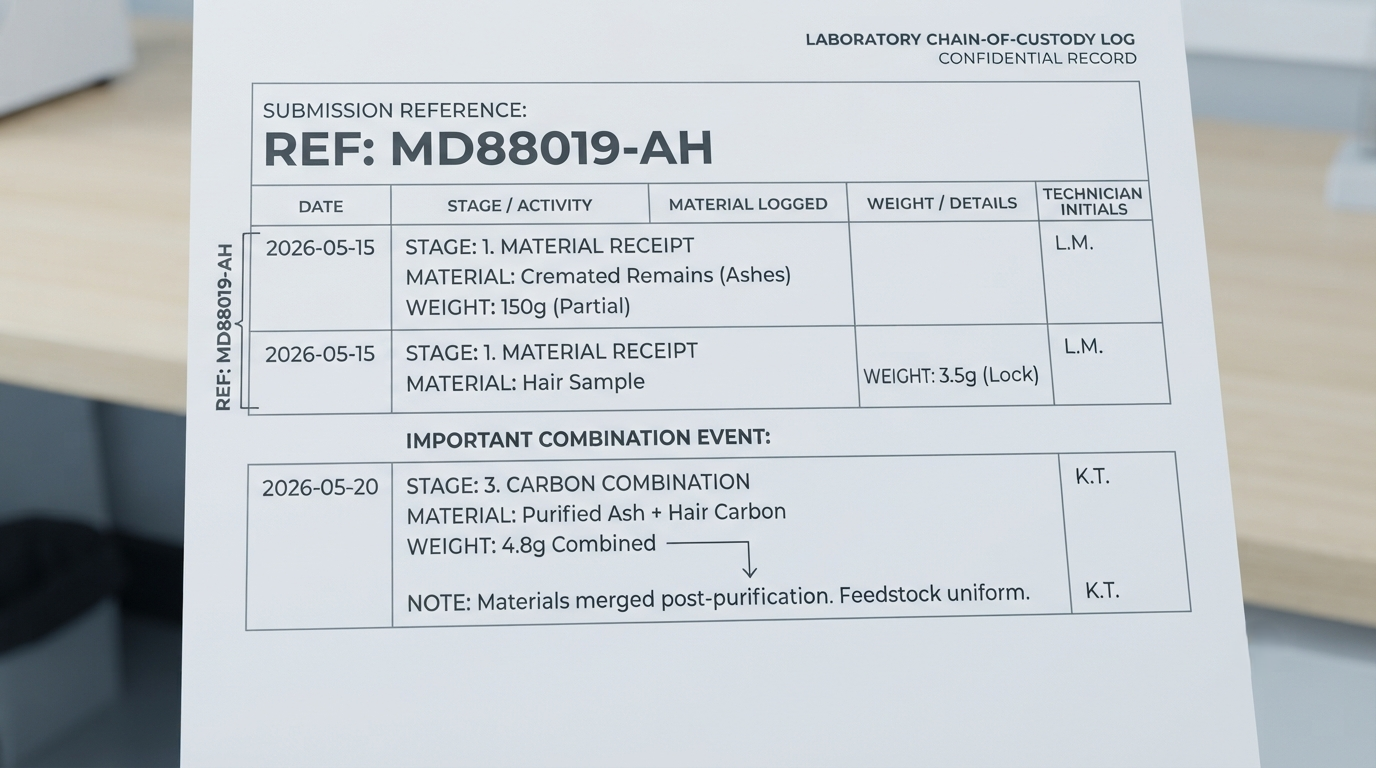
A custody log page showing one submission reference with two receipt lines and a combination entry
  1. One submission reference, assigned at receipt, covering both materials.
  2. Two receipt entries under that reference, ashes: weight received, container sealed; hair: weight received, envelope sealed.
  3. Extraction entries for each material, or one entry for a joint run, stating both went in, with recovered carbon weight.
  4. A combination entry, the date the two purified carbons were merged, and the combined weight, as described in Addition 2.
  5. A single graphitization entry, a single growth entry, and a single cutting entry from that point on, because there is now one feedstock and one crystal.
  6. Return of unused material of both kinds, logged, if you asked for it.

A poorly kept record logs “ashes, job 4471” and “hair, job 4472” and matches them up later from a spreadsheet. That is not fraud; it is a process built for single material stones being stretched to cover two. But it means the provider cannot prove, from the record alone, that your diamond made from your wife’s ashes and hair contains carbon from both submissions.

Before sending anything, ask: “Is a two material submission logged as one record or two, and is the combination step recorded?” The answer you want is one reference, two receipt lines, one combination entry. How to turn your wife’s ashes and hair into a diamond covers labeling and packaging both so the record starts cleanly from your form.

Addition 5: What the Origin Certificate Should Say

Two documents close every memorial diamond. The grading report, ideally from an independent laboratory using the cut, color, clarity, and carat standards GIA describes, assesses the stone as a diamond and does not care how many sources the carbon had. The origin certificate, issued by the provider, ends the custody record: it attests that this stone was grown from this submission.

For a diamond made from your wife’s ashes and hair, the origin certificate has to say so. At minimum it should carry:

  • Her name, or the submission reference that ties to her name.
  • Both materials, named, “cremated remains and hair,” not “cremated remains” alone with the hair implied.
  • The submission reference that appears on both receipt entries.
  • The date of receipt and the date of completion.
  • Where the provider offers it, the approximate proportion of personal carbon from each source.

A certificate that names only the ashes does not record what you sent. This is easy to prevent and hard to fix: ask for the certificate’s wording in writing before either material leaves the house. If the provider’s template has one material line, ask for a two line certificate. Most will oblige; a provider who will not is telling you their process does not really distinguish a diamond made from your wife’s ashes and hair from a single material one, which is worth knowing before you commit two irreplaceable things.

Good Provider Answers vs Poor Ones, for a Diamond Made From Your Wife’s Ashes and Hair

Every addition on this page is a process question you can ask before sending anything. This table shows what an answer from a provider who understands a diamond made from your wife’s ashes and hair sounds like, against one that should prompt more questions.

Process questionAn answer that shows they understand a combined stoneAn answer that should prompt more questions
Separate or joint purification?“Separate, so we can give you the recovered carbon weight from each.” Or: “Joint; we can’t give per material weights but we log both going in.”“It all goes in the furnace together.” (No weights, no logging)
Where do the two carbons meet?“After both are purified, before graphitization. The combination is a logged step with a date and weight.”“Somewhere in the process, it doesn’t really matter.”
Which material supplies most of the carbon?“Usually the hair, by a wide margin, hair is about half carbon, ash a few percent at most. We can give a range once we have the weights.”“About half and half.” Or: “The diamond is 100% her.”
How is the submission logged?“One reference, two receipt entries, one combination entry, then a single record through growth.”“Two jobs; we match them up at the end.”
What will the certificate say?“It names both materials and the submission reference. Here is the wording.”“It says cremated remains; the hair is understood.”
What happens to unused material?“Returned, both kinds, logged. Tell us at the start.”“We use what you send.”

None of the right hand answers is disqualifying on its own. Two or three together mean the provider has not thought about what a diamond made from your wife’s ashes and hair needs that a single material stone does not. Questions to ask before turning your wife’s ashes and hair into a diamond puts these six beside the questions about cost, timing, and family.

What Combining Does Not Change

It is worth being explicit, because families sometimes hope otherwise. A diamond made from your wife’s ashes and hair matches a single material stone in all of these:

  • Carat. Set by growth time in the press, not by the amount or number of materials. Two sources do not make a larger stone.
  • Color. Trace nitrogen produces yellow to champagne; trace boron produces blue; colorless needs extra processing and costs more; red, pink, green, and black come from irradiation. Two sources do not shift the odds predictably. What color a diamond made from your wife’s ashes and hair will be covers the choice.
  • Timeline. 6 to 10 months across the industry, up to 12 for large or black stones. A second extraction run adds days at most.
  • Cost. Most providers price by carat, color, cut, and grading rather than by material. Some add a modest processing fee for two extraction runs; ask for it as a separate line. General 2026 industry ranges, not Memorial Diamond’s published pricing, run roughly $1,500 to $3,500 for 0.10 to 0.25 ct, $5,000 to $15,000 for 0.5 to 1 ct, and $20,000 to $75,000+ above 2 ct.

One thing a diamond made from your wife’s ashes and hair does change, outside the laboratory: you are sending two irreplaceable things at once. The ashes can usually be partly kept because they exist in quantity; the lock may be the only hair of hers you have. Divide it before it goes. How much ash and hair you need for a wife memorial diamond covers the combined minimum, which is often less of each than the two standalone figures.

Frequently Asked Questions

At what point in the process are her ashes and hair combined?

After each has been purified to 99.9%+ carbon and before graphitization. Combining them there means one graphitization run produces a single uniform graphite feedstock for the press. A good laboratory logs the combination as a dated step with the combined weight recorded.

Should the ashes and hair be purified together or separately?

Either produces the same purity. Separate runs give you a recovered carbon weight for each material, which is the only way to know what share of the personal carbon came from the hair versus the ashes. Ask which the provider does and whether per material weights are available.

Does a diamond made from your wife’s ashes and hair contain more of her than a single material stone?

No. The personal carbon in any memorial diamond is typically around 10% to 15% of the stone, blended with lab carbon to reach growth volume. Combining two sources does not raise that share; it means the personal carbon came from two places rather than one.

Which material contributes more carbon?

Almost always the hair. Hair is roughly 50% carbon by weight; ashes are 0.5% to 4%. A few grams of hair typically recovers as much or more carbon than a much larger quantity of ashes. A provider who has done this can give you a range once the weights are known.

How should a two material submission be logged?

Under one submission reference, with separate receipt entries for the ashes and the hair, extraction entries with recovered weights, a dated combination entry, and a single record from graphitization onward. Two unrelated job numbers matched up later is the pattern to avoid.

What should the origin certificate say?

It should name both materials, cremated remains and hair, alongside the submission reference and dates, and, where the provider offers it, the approximate proportion of personal carbon from each. Ask for the certificate’s wording in writing before either material leaves the house.

Final Thoughts on a Diamond Made From Your Wife’s Ashes and Hair

Five additions, and every one is answerable before anything is shipped: how the two are purified, where they meet, which did most of the work, how the record is kept, and what the certificate will say. None changes the stone. A diamond made from your wife’s ashes and hair is the same carat, color, timeline, and cost as one made from either alone, what changes is that carbon she grew while living and carbon that remained afterward sit in one lattice, and that you have a record proving both are there. Ask the five questions, keep some of each, and the rest of the process is the same patient wait it always is.

Learn More About Wife Memorial Diamonds

Talk With Memorial Diamond

If you hold both materials and want the five process answers above, how the two are purified, where they meet, the likely proportion from each, how the record is kept, and the certificate wording, reach out to Memorial Diamond before either leaves the house.

Word count: 3,180 · Reading time: about 16 minutes
memorial-diamond-made-from-partner-ashes

How a Memorial Diamond Is Made From Your Partner’s Ashes

The paperwork runs out eventually, and then the decisions that are genuinely yours begin.

A memorial diamond made from partner ashes is real. The small fraction of carbon inside cremated remains, roughly 0.5% to 4% of ash by weight, is extracted, purified to around 99.9% carbon, converted to graphite at about 2,500 to 2,700°C, and grown into a diamond crystal under something like 6 to 8 GPa of pressure. Seven stages, typically six to ten months industry wide.

What follows is what physically happens to a memorial diamond made from partner ashes at each of those stages, and the part most descriptions skip, exactly where the step sits that cannot be taken back.

Champagne-toned lab-grown memorial diamond made from partner ashes, held between fingertips against a plain background

What Is Actually in the Ashes You Would Be Sending?

Cremated remains are not ash in the campfire sense. What survives a cremation is mostly bone mineral, calcium phosphate, ground to a uniform grit. The soft tissue, and with it most of the body’s carbon, leaves as gas during the cremation itself.

That is why every honest description of a diamond made from partner ashes starts with a percentage rather than a promise. Industry figures put the usable carbon in cremated remains at roughly 0.5% to 4% of the ash by weight, varying with the individual and with how the cremation was run. A few tablespoons of remains contain a genuinely small quantity of recoverable carbon, and that quantity is the raw material a diamond made from partner ashes has to be built from.

This single number explains almost everything else about the process. It explains why a lab asks for a measured portion rather than a pinch. It explains why the extraction stage is long and fussy. And it explains why a stone made from partner ashes is never grown from that carbon alone.

None of that makes the carbon less real. It was in your partner, and it was recovered from what remained of them. But knowing the scale now is better than finding it on a forum in month four.

The Seven Stages of a Memorial Diamond Made From Partner Ashes

The chain is the same across the industry, whatever the marketing language around it. A memorial diamond made from partner ashes passes through these seven stages, in this order.

1. Intake and identification. The portion of ashes arrives, is weighed, and is assigned an identifier that travels with the material through every later stage. Ask what that identifier is and how it is recorded. This is the document that ties the finished stone back to what you sent, and the backbone of any later claim that the stone was made from partner ashes rather than from something substituted along the way.

2. Carbon extraction. The remains are heated in a controlled, oxygen free environment so the carbon can be separated without simply burning away. Because a diamond made from partner ashes starts from a material that is only a few percent carbon by weight, this is the stage where most of the submitted mass is removed as mineral residue rather than kept.

3. Purification. The extracted carbon is refined through further stages until it reaches roughly 99.9% or higher carbon purity. Anything left behind at this stage, such as stray minerals or metals from an implant or a casket fitting, will otherwise show up as an inclusion or a color cast in the crystal.

4. Graphitization. The purified carbon is heated to roughly 2,500 to 2,700°C and rearranged into graphite, the crystalline form of carbon that a diamond press can actually use as feedstock. The material that goes into the press for a diamond made from partner ashes is graphite, not ash.

5. Growth. The graphite, combined with supplemental lab grown carbon, is loaded into an HPHT growth cell around a tiny diamond seed and held at roughly 6 to 8 GPa and 1,400 to 2,500°C for weeks to months. Carat size is a function of how long the cell runs, not how much ash you sent.

6. Cutting, polishing, and optional treatment. The rough crystal is cut and polished to a chosen shape. Some providers offer post growth irradiation to shift or intensify color. Ask whether that is being done and whether it will be disclosed on the paperwork.

7. Grading. The finished stone is measured against the same cut, color, clarity, and carat standards used for any diamond, ideally by an independent third party laboratory rather than in house. A stone made from partner ashes is assessed on exactly the same scale as any other diamond, with no separate or softer standard.

High-temperature oxygen-free furnace used to extract and purify carbon before graphitization

Where Is the Point of No Return?

This is the question worth sitting with. For a diamond made from partner ashes the honest answer is that there are two of them, one physical and one domestic, and the domestic one comes first.

The physical point of no return is the extraction furnace, stage two. Up to the moment that furnace is sealed, what a lab holds is still cremated remains. They can be weighed, sealed, and sent back. Once extraction begins, the calcium phosphate is separated off and the carbon is chemically committed. There is no process that reverses a diamond made from partner ashes back into ash. Everything after stage two, including purification, graphitization, growth, and cutting, is refinement of a decision already made.

The domestic point of no return is earlier and quieter. It is the afternoon you open the container and measure a portion out. That act is not reversible either, and it happens at a kitchen table rather than in a lab, usually without anyone present to say “are you sure.” A lab can return an unopened portion. Nobody can return the specific handful you scooped.

So the practical sequence is this. Decide who is involved and whether anyone else in your partner’s life would want to be asked before anything is divided. Decide the carat and the color, because those are cheap to change on paper and impossible to change once a growth run has started. Decide what happens to the ashes that are not used, since a diamond made from partner ashes typically consumes only a fraction of a full cremation. Then portion.

A third, softer boundary sits at stage five. Once the growth cell is sealed, the size you chose is the size that is growing, and changing your mind means starting over. Ask when the specification locks. That timing varies.

What You Can Still Change at Each Stage

StageWhat Is Physically HappeningReversible?What You Can Still Change
1. IntakePortion weighed, logged, identifiedYes. Unprocessed material can be returnedEverything, including carat, color, shape, and whether to proceed
2. ExtractionCarbon separated from bone mineralNo. This is the physical point of no returnCarat, color, shape, setting
3. PurificationCarbon refined to approximately 99.9% or higherNoCarat, color, shape, setting
4. GraphitizationCarbon converted to graphite at 2,500 to 2,700°CNoCarat and color, if not yet locked. Ask when the lock happens
5. GrowthCrystal built around a seed at 6 to 8 GPaNo. The run is committed once sealedShape, polish, setting, engraving
6. CuttingRough crystal shaped and polishedShape choices are one way once cutSetting, engraving, whether to set it at all
7. GradingIndependent assessment of the 4CsNot applicableNothing about the stone. Only what you do with it

Read that table as a calendar for a diamond made from partner ashes rather than as a warning. Nearly every decision that costs money or changes the stone’s appearance is open for the first two stages and closed after the fourth. It is a narrow window, earlier than most people expect.

Why Lab Carbon Is Added to a Diamond Made From Partner Ashes

No stone is grown from ash carbon alone, and any description that implies otherwise is describing something that does not exist. What comes out of purification is a small quantity of carbon, real and really your partner’s, which is then topped up with lab grown carbon until the growth cell holds the volume a crystal of the chosen size actually needs.

That is arithmetic, not a policy any one company invented. A gram or two of recovered carbon cannot become a one carat crystal, so the feedstock charge is made up to volume.

The framing that survives scrutiny is the accurate one. A diamond made from partner ashes is not a symbol of your partner and it is not a stone that is entirely them. It is a crystal that contains, verifiably, carbon that was part of a person, grown into a lattice that exists because they did. That claim holds up to a skeptical relative, a jeweler, and a gemologist, and it is the reason these stones are genuine diamonds rather than lookalikes. “One hundred percent pure” does not.

Every honest account of a diamond made from partner ashes carries that qualification somewhere in it. If a provider will not put the blend in writing, that is worth noticing. The honesty of the answer to this question is a reasonable proxy for how the rest of the work is done.

How Long Does Each Stage Take?

Rough memorial diamond crystal beside the same stone after cutting and polishing

Industry wide, the full sequence for a diamond made from partner ashes typically runs six to ten months, with larger stones or specialty colors sometimes reaching twelve. The stages are wildly uneven in length, which is why the wait feels longer than the number suggests.

Intake, extraction, purification, and graphitization are usually measured in weeks. Growth is the long part, with weeks to months in the press, because carat size is bought as time under pressure, not as a quantity of ash. Cutting, polishing, and grading add several more weeks, and an independent laboratory has its own queue.

Two things make a stone made from partner ashes take longer than a quoted range. One is size. Larger crystals need proportionally longer runs and are more likely to fail during a run and need restarting. The other is a color specification that requires the trace elements to be engineered out rather than accepted.

Ask for the stage you are currently in rather than a completion date. A provider that can tell you “purification finished, cell loading next week” is telling you something real. A provider that only repeats the original estimate is telling you nothing.

Can a Diamond Be Made From Partner Ashes Years Later?

Yes, and this is more common than the timing of most bereavement content suggests. Cremated remains do not decay, spoil, or lose their carbon on a shelf. A portion kept in a closet since 2014 is chemically the same material it was the week it came home, and a diamond made from partner ashes that have sat for a decade goes through the same seven stages as one started the month after the funeral.

That matters for a very ordinary reason. The first year after a death is a terrible time to make a permanent decision, and plenty of people only arrive at this question once the urgent part is over. Nothing has been lost by waiting.

There are two practical differences worth knowing. The first is contamination. Remains that have been transferred between containers, stored somewhere damp, or opened repeatedly can pick up material that was never part of your partner, and purification removes non carbon contaminants rather than sorting one person’s carbon from another’s. Ask what the intake check looks for, and mention the storage history honestly.

The second is interment. If the remains were buried, entombed, or scattered, a diamond made from partner ashes may no longer be open to you. Disinterment rules vary by state and by cemetery. Hair is worth asking about instead, since it needs no cremation and a lock kept in an envelope is frequently still usable.

One thing time does not change is standing. Whoever had authority over the remains still has it. Keeping the urn for eight years does not confer it.

What to Settle Before the Ashes Leave Your Hands

These are the items that become expensive or impossible to revisit once stage two begins.

  • Who has standing to authorize this. There is no single national rule here. The state you are in sets who may direct what happens to a person’s remains, and written instructions your partner left behind can move that authority somewhere else again. Being someone’s partner does not by itself put you in that position. Sort this before you divide anything. An order for a diamond made from partner ashes is far easier to place than to unpick.
  • Whether anyone else should be asked first. Not consulted, necessarily. Asked. This is a social decision with a physical deadline attached.
  • How much of the remains you are prepared to commit. Requirements vary by provider, but a memorial diamond typically uses only a fraction of a full cremation, which means the rest can still be buried, scattered, or kept exactly as planned.
  • Carat and color, chosen deliberately. Both are locked early and both drive cost and timeline more than anything else.
  • Whether a second stone might be wanted later. Growing two from one shared portion is usually far simpler than reopening the question in three years.
  • What documentation you want to exist. An identifier at intake, a record at each handover, and a clear statement of what is being returned to you at the end.

If you are still deciding between materials, it is worth knowing that hair does not require cremation at all and carries far more carbon by weight. It is a different route to the same kind of stone, and one that stays open even if the remains are already interred.

Frequently Asked Questions About a Memorial Diamond Made From Partner Ashes

How much of the finished stone is actually my partner?

A real but minority portion. A diamond made from partner ashes contains carbon recovered from the remains, purified and then combined with lab grown carbon to reach a workable volume, so the personal fraction is meaningful and verifiable rather than total. Ask for that split in writing.

Can the process be stopped once the ashes have been sent?

Until extraction begins, yes. Unprocessed remains can be returned. After the extraction furnace is sealed, the carbon is chemically committed and nothing reverses it. That stage is the true point of no return, and it comes early.

Does sending more ashes make a bigger diamond?

No. The size of a diamond made from partner ashes is set by how long the crystal grows in the press, not by how much material you submitted. Sending a full urn does not produce a larger stone or a faster result. It only commits more of the remains.

What color will it be?

Most stones made from partner ashes trend yellow, blue, or champagne, because nitrogen and boron traces come with an organic carbon source. Colorless requires engineering both out and typically costs more. Nobody can forecast a precise shade in advance.

Will it be certified as a real diamond?

A memorial diamond is chemically and optically a genuine diamond and can be graded on the same 4Cs as any other. Ask whether grading is done by an independent third party laboratory and whether that report is included or priced separately.

Can two people each have a stone from the same ashes?

Often yes, because only a portion of the remains is used for any one stone. Deciding that before submitting is far easier than revisiting it later, when a second portion may mean opening the container again.

Final Thoughts on a Memorial Diamond Made From Partner Ashes

The chain that produces a memorial diamond made from partner ashes is genuinely impressive, but it is not the part that matters most on the day you have to choose. What matters is knowing that the reversible part of this is short, that it sits at the beginning, and that the decisions inside it are yours to take slowly.

Ask the percentage question. Ask when the specification locks. Ask what comes back to you at the end. A provider comfortable answering all three plainly is showing you something more useful than any photograph of a finished stone.

Learn More About Partner Memorial Diamonds

Talk With Memorial Diamond

If you want to understand what is possible with the ashes you have, reach out to Memorial Diamond and ask about the process, the documentation, and the timeline before committing to anything. Nothing here has to be rushed.

: Memorial diamond made from partner ashes and hair, featuring a diamond, cremated ashes, and a lock of hair.

How a Memorial Diamond Is Made From Your Partner’s Ashes and Hair

Some people end up with both because of how the year went, a lock kept early, a portion of remains later.

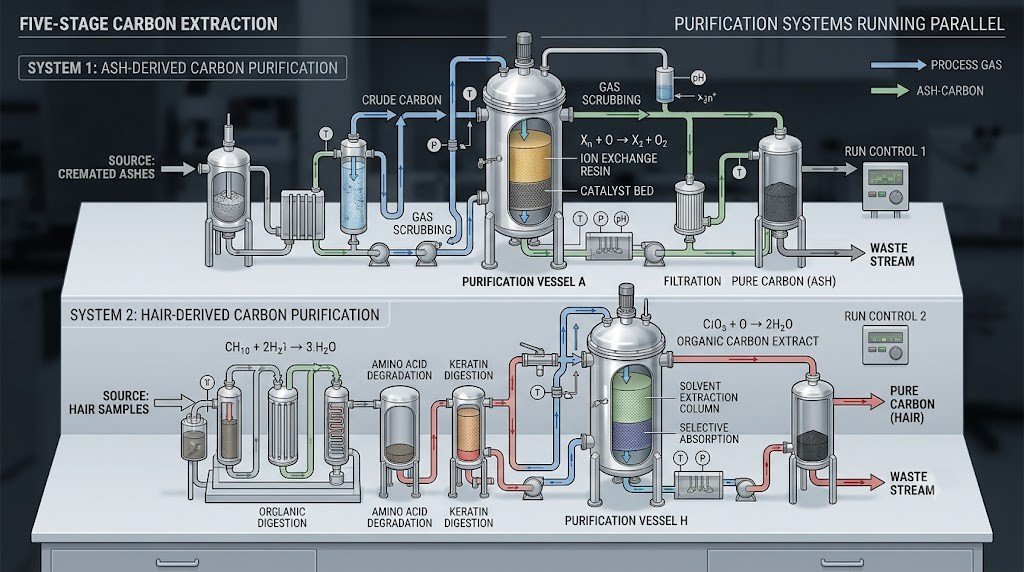
A memorial diamond made from partner ashes and hair is not one process. Each material is purified on its own track, ash to recover the 0.5% to 4% carbon it holds, hair to recover roughly half its weight in carbon, and each is graphitized separately at about 2,500 to 2,700°C. The two tracks meet only when both charges enter a single HPHT growth cell at roughly 6 to 8 GPa. Five stages in total.

That meeting point is the whole story of a memorial diamond made from partner ashes and hair. Everything that can be separately evidenced about the two materials happens before it, and nothing can be after.

Single champagne-toned memorial diamond made from partner ashes and hair, photographed beside two small sealed sample containers

Why Two Materials Means Two Separate Tracks

Ash and hair are not the same chemical problem, and nothing in the making of a diamond made from partner ashes and hair pretends they are.

Cremated remains are mostly calcium phosphate, which is bone mineral. The usable carbon inside that comes to roughly 0.5% to 4% of ash by weight, which means extraction is a long subtraction. Most of what you send is removed as mineral residue. Hair is keratin, roughly 50% carbon by weight, so extraction there is comparatively quick and far less lossy.

Two materials with yields that differ by more than an order of magnitude cannot be purified in the same vessel on the same settings. So a memorial diamond made from partner ashes and hair begins as two parallel operations that happen to be running for the same person, and for the same stone, at the same time.

That is not a complication to be apologized for. It is the reason a diamond made from partner ashes and hair can have its two materials separately weighed, separately logged, and separately accounted for right up to the moment they are combined. This provides more evidence, not less, than a single material stone can offer.

The Five Stages of a Memorial Diamond Made From Partner Ashes and Hair

1. Two intakes. The portion of ashes and the lock of hair arrive and are logged independently. This means separate weights, separate identifiers, and ideally separate dated photographs. Ask for two records rather than one combined receipt. This is where a diamond made from partner ashes and hair gains the documentation that makes it different from a single source stone.

2. Two purifications. Each material is heated in a controlled, oxygen free process that strips away everything that is not carbon, reaching roughly 99.9% or higher purity. The ash track loses the overwhelming majority of its submitted mass. The hair track loses roughly half. Two batches of purified carbon come out, still separate. At this stage a diamond made from partner ashes and hair still has two independently verifiable histories.

3. Two graphitizations. Each purified batch is heated to about 2,500 to 2,700°C and converted into graphite, the feedstock form a diamond press can use. There are now two graphite charges, still distinguishable because they are still in different containers, not because anything about them is chemically different.

4. One growth cell. Both charges, combined with supplemental lab grown carbon, are loaded into a single HPHT growth cell around a tiny diamond seed and held at roughly 6 to 8 GPa and 1,400 to 2,500°C for weeks to months. This is the convergence point, and it is the only one.

5. One stone, cut and graded. The rough crystal is cut and polished, then assessed against the same cut, color, clarity, and carat standards used for any diamond, ideally by an independent third party laboratory. One stone comes out. A diamond made from partner ashes and hair has no ash half and no hair half.

Where Do the Two Tracks Actually Converge?

For a diamond made from partner ashes and hair, convergence happens at stage four. Both graphite charges are weighed into the growth cell alongside the supplemental lab carbon, and the cell is sealed.

Up to that moment, everything is separable. Two weights at intake. Two purification runs with two batch records. Two graphite charges sitting in two containers with two identifiers. A memorial diamond made from partner ashes and hair has, at that point, a paper trail with two distinct branches, each traceable back to a different material and a different day.

The instant the cell is sealed and pressurized, those branches end. Carbon purified from ash and carbon purified from hair are the same element in the same form. Graphite is graphite, whatever it used to be part of. They do not layer, settle, or occupy separate regions of the crystal. They dissolve into the same molten metal flux and deposit onto the same seed, atom by atom, in no particular order.

StageAsh TrackHair TrackWhat Can Be Separately Evidenced
1. IntakePortion weighed, logged, identifiedLock weighed, logged, identifiedTwo weights, two dates, two identifiers
2. PurificationLong subtraction. Most mass removed as mineralShorter run. Roughly half the mass retainedTwo batch records, two yields
3. GraphitizationAsh derived carbon to graphite at 2,500 to 2,700°CHair derived carbon to graphite at 2,500 to 2,700°CTwo charges, two container records
4. Growth CellCharge loaded with lab carbonCharge loaded with lab carbonNothing after this point. The cell is sealed.
5. Cutting and GradingOne stoneOne stoneThe stone’s own 4Cs, and nothing about origin
two separate purification vessels processing ash-derived and hair-derived carbon on parallel runs


After Convergence, Can Anyone Tell the Two Apart?

No. This is the part of a diamond made from partner ashes and hair worth stating plainly, because a reader who suspects it and is never told clearly may assume the worst.

Once both charges are in the growth cell, no test performed on the finished diamond can identify which carbon came from the ashes, which came from the hair, and which came from the supplemental lab feedstock. A grading report will not show it. A gemologist with a loupe will not see it. There is no analysis of a diamond made from partner ashes and hair that separates the sources, because after purification there is nothing left to separate. There are only carbon atoms, chemically identical regardless of what they used to be part of.

That also means nobody can verify a stated proportion after the fact. If a stone is described as using both, the honest meaning of that statement is that both entered the process and both are recorded as having done so. It does not mean both are measurable in the finished crystal.

Two consequences follow for anyone considering a diamond made from partner ashes and hair, and they are the practical reason to read this before starting rather than after.

The first is that the value of the two track structure in a diamond made from partner ashes and hair is entirely upstream. Insist on the separate records while the tracks are still separate, because the window closes at stage four and does not reopen.

The second is that any provider claiming to demonstrate the split in a finished stone is claiming something that is not physically available. That is a useful test of how the rest of their answers should be read.

So What Can Be Documented About a Diamond Made From Partner Ashes and Hair?

Quite a lot, as long as you ask for it in the right window. What can be documented is every fact created before the cell was sealed.

  • Two intake records, each with its own date, weight, identifier, and ideally a photograph of the material as received.
  • Two purification batch records, tying each identifier to a specific run rather than to a general statement that material was processed.
  • Two graphitization records, confirming both charges existed as separate feedstock before loading.
  • A cell loading record naming both identifiers and the supplemental lab carbon added. This is the single most important document for a memorial diamond made from partner ashes and hair, because it is the last one that mentions two sources.
  • An origin or authenticity document that names both submissions explicitly, rather than referring vaguely to submitted material.
  • A grading report, which describes the stone’s quality and says nothing at all about origin. The two documents answer different questions and neither substitutes for the other.
Neither track yields the volume a growth run consumes, not separately and not added together. Both purified batches are made up with lab grown carbon before the cell is sealed, which means the personal carbon in a diamond made from partner ashes and hair is real, traceable to two named submissions, and still a minority of the crystal’s mass. Any description that implies otherwise is describing a stone that does not exist.

Does Using Both Materials Change the Stone Itself?

Not in a way anyone can see, and it is better to know that now.

Color. Trace elements drive color. Nitrogen can contribute toward yellow, boron can contribute toward blue, and colorless material requires the absence of both. Both ash and hair are organic sources that bring trace elements with them, so a memorial diamond made from partner ashes and hair sits in the same realistic range as a single material stone. Yellow, blue, or champagne are possible, while colorless material can require more process control and typically costs more. Nobody can forecast a precise shade from either material or from the combination.

Size. For a diamond made from partner ashes and hair, carat is bought as growth time, not as quantity of material. Submitting two materials instead of one does not produce a larger stone, and does not shorten the run.

Timeline. Industry wide, the whole sequence typically runs six to ten months, sometimes twelve for larger or specialty color stones. Two purification tracks can add a little at the front end if they are run sequentially rather than in parallel. The press is where almost all of the months live, and the press does not care how many sources fed it.

Quality. A diamond made from partner ashes and hair is graded on exactly the same 4Cs as any other stone. There is no separate scale, no allowance, and no penalty.

Can the Two Tracks Become Two Separate Stones Instead?

Two finished memorial diamonds of similar size displayed separately rather than set together

Yes, and this is the option most people do not realize they have until someone says it out loud.

If the two materials never enter the same growth cell, they never converge. This means they stay separately evidenced permanently. An ash grown stone and a hair grown stone, each with its own intake record, its own batch history, and its own origin document, preserve a distinction that a diamond made from partner ashes and hair gives up at stage four by design.

There are real trade offs, and they run in both directions.

  • Two stones cost more than one. Each needs its own growth run, and growth time is the dominant cost in every memorial diamond. Two half carat stones will not cost what one half carat stone costs.
  • Two stones take the same time, not twice as long, if the runs happen in parallel. Sequential runs would change that answer considerably.
  • Two stones can go to two people. This is often the deciding factor. One stone has to live somewhere. Two can be shared without anyone having to give anything up.
  • One stone concentrates everything. For many people that is precisely the point, and the loss of separability is a price they are glad to pay.
  • You can also do one of each and keep the rest. A memorial diamond typically uses only a portion of the available material, so choosing one route now rarely forecloses the other later.

The question to sit with is not which option is more meaningful. Both follow the same physics. The question is whether the distinction between the two materials is something you want to be able to point at in ten years. If it is, a diamond made from partner ashes and hair is the wrong shape for it, and two stones are the right one. If it is not, one stone is simpler and cheaper.

Why Families Choose Both Anyway

Knowing that the combination is invisible in the finished stone does not make a diamond made from partner ashes and hair pointless, and it is worth being clear about why.

The reason for a diamond made from partner ashes and hair is usually circumstantial rather than symbolic. A lock of hair was kept at some point, from a haircut before an illness, from a hospital stay, or from a drawer nobody had cleared. A portion of ashes became available later. Using both is less a decision than an acknowledgment that both exist and neither felt right to leave out.

Sometimes it is about standing. Who controls a person’s remains is settled state by state rather than by any nationwide statute, and a written direction left by your partner can shift it again on top of that. The standing does not attach to a partner as a matter of course, and it attaches least reliably where the relationship had no recognition in law or was not known to everyone. Hair may be the material you can act on without permission. Ashes may become available only later, or only partly. A diamond made from partner ashes and hair sometimes reflects that sequence rather than a plan.

And sometimes it is simply that the two materials represent different periods, one from when your partner was alive, one from after. That is a real reason. It does not need to be measurable in the crystal to be true.

What matters is that the reason is yours, and that the record describes what actually happened.

Frequently Asked Questions About a Memorial Diamond Made From Partner Ashes and Hair

Are the ashes and hair processed together?

No. In a diamond made from partner ashes and hair, each material is purified and graphitized on its own track, because their carbon yields differ by more than an order of magnitude. The two only meet when both graphite charges are loaded into a single growth cell.

Can a lab prove both materials were used?

Not from the finished stone. Proof exists only as records created before the growth cell was sealed. These include two intake logs, two batch records, and a cell loading document naming both identifiers. Ask for those specifically.

Can I choose the proportion of each material?

You can specify how much of each is submitted and have those weights recorded. What you cannot do is verify a proportion in the finished crystal, because purified carbon carries no marker of its origin.

Does using both materials make the diamond more genuinely my partner’s?

Not measurably. A diamond made from partner ashes and hair draws real personal carbon from both sources, and both are blended with lab grown carbon to reach a viable volume. What changes is the documentation, which traces two submissions instead of one.

Will it cost more than a single material stone?

A diamond made from partner ashes and hair can add process steps, and some providers price that separately. Size, color, and whether an independent grading report is included drive cost far more than the number of source materials.

What if one material turns out to be unusable?

Ask what happens before you send anything, whether the run proceeds on the remaining material, whether you are told first, and what is recorded. This is a question to settle in advance, not one to discover partway through.

Final Thoughts on a Memorial Diamond Made From Partner Ashes and Hair

The honest shape of a memorial diamond made from partner ashes and hair is two lines that run parallel for four fifths of their length and then become one line permanently. Almost everything you might want proven about the two materials is provable while those lines are apart, and none of it is provable afterward.

So the useful work happens early. Two records at intake, two batch records, and one loading record that names them both. Ask for those while asking still changes something. After the cell is sealed, the only honest answer anyone can give you about which carbon came from where is that the paperwork says so, which is a good answer, provided the paperwork exists.

Learn More About Partner Memorial Diamonds

Talk With Memorial Diamond

If you have both materials and want to understand how each would be handled, reach out to Memorial Diamond and ask what gets recorded at each intake and what the cell loading document will say. Those are the questions worth asking while the two tracks are still separate.

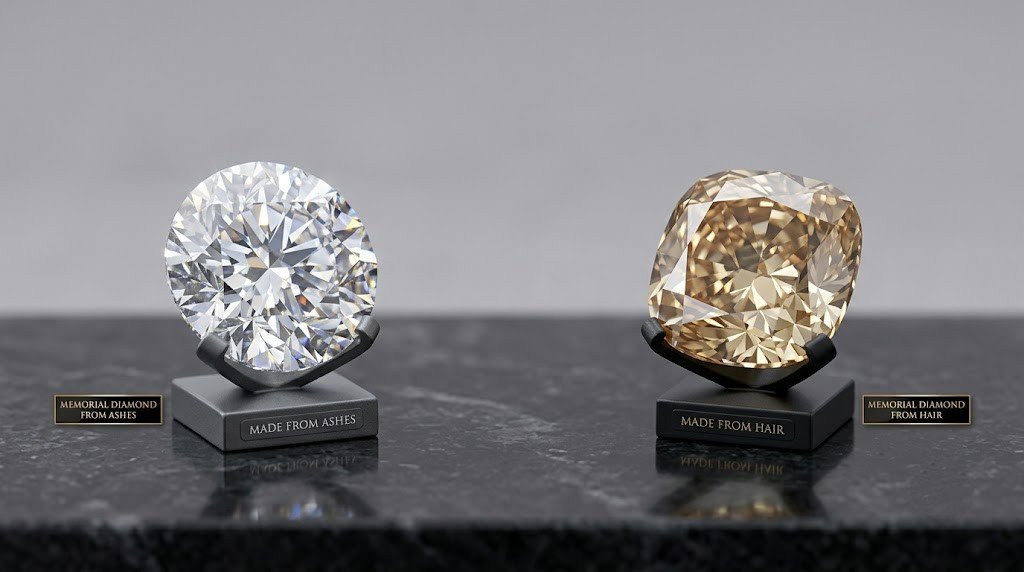
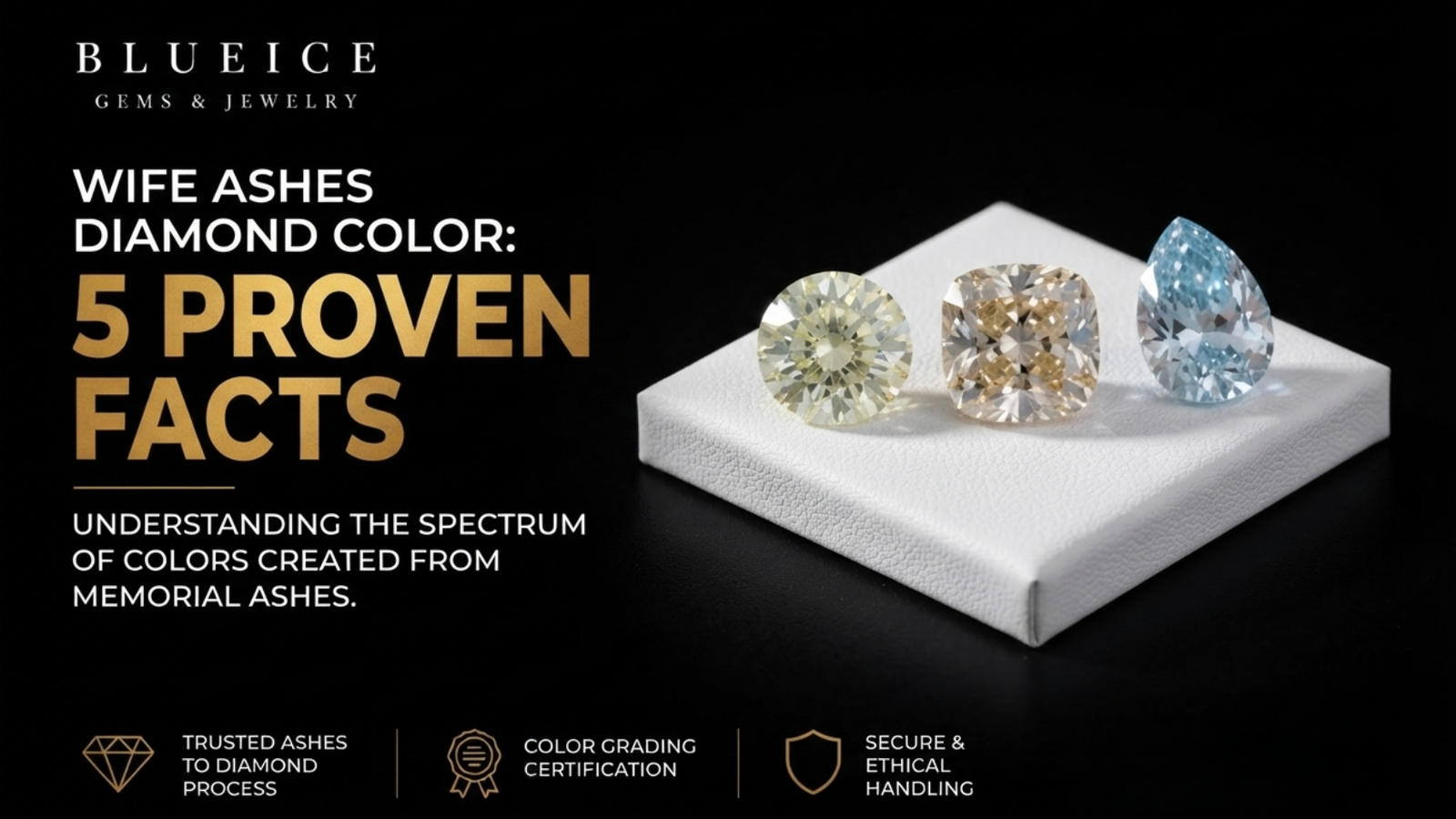
Wife ashes diamond color: three loose lab-grown memorial diamonds — pale yellow, champagne, and light blue — on a white grading tray

What Color Will a Diamond Made From Your Wife’s Ashes Be?

You may have already pictured it on your hand, or on a chain you never take off, and the picture is probably colorless, because that is what the word “diamond” has always meant. The honest wife ashes diamond color answer is that the stone will most likely be yellow, champagne, or blue rather than colorless, because trace nitrogen or boron carried in personal carbon tints the crystal as it grows; colorless is achievable with extra processing and costs more, and red, pink, green, and black come from post growth irradiation.

Why Is a Wife Ashes Diamond Color Usually Not Colorless?

A diamond is carbon atoms locked in a lattice. Color enters through the atoms that are not carbon, trace elements in the growth cell that get built into the crystal. Three cases cover almost everything:

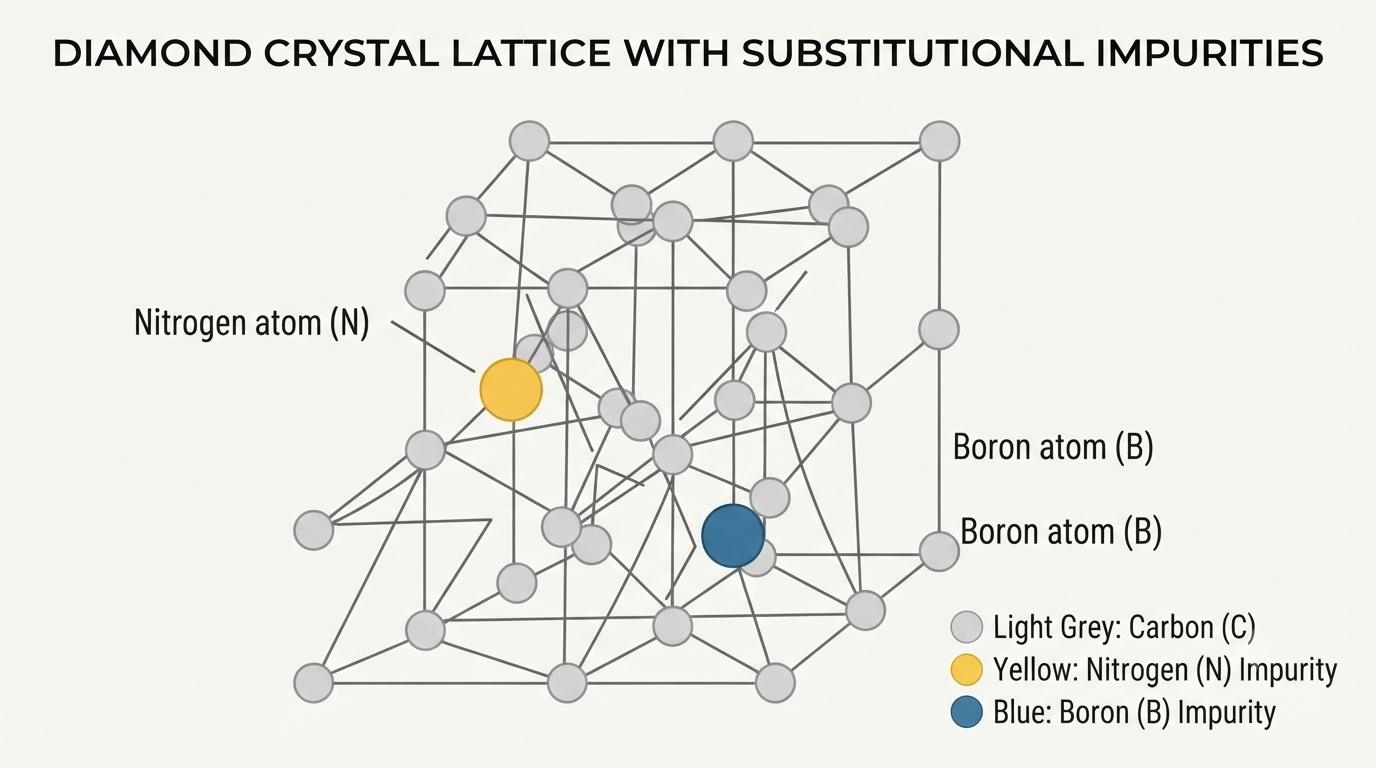
  • Nitrogen in the lattice absorbs blue light, and the stone reads yellow. In heavier concentrations, or in certain lattice arrangements, the yellow deepens toward champagne and brown.
  • Boron absorbs red light, and the stone reads blue.
  • The absence of both is what a colorless diamond requires, nothing in the lattice but carbon.
Simple diagram of a diamond crystal lattice with a nitrogen atom and a boron atom marked in the carbon structure

Now consider where the carbon behind a wife ashes diamond color comes from. Cremated remains are almost entirely calcium phosphate, with only about 0.5 to 4% usable carbon. A laboratory extracts that carbon, purifies it to 99.9%+, and converts it to graphite at roughly 2,500 to 2,700°C. Purification is very good, not perfect; the residual fraction of a percent is where nitrogen, present in every protein in a body, tends to survive. Boron is rarer but present.

The personal carbon, typically around 10 to 15% of the finished stone’s mass once blended with supplemental lab carbon, is then grown around a seed in an HPHT press at roughly 6 to 8 GPa and 1,400 to 2,500°C. A minority of providers use CVD; both methods are described on the synthetic diamond page.

That is the whole mechanism behind the wife ashes diamond color question. A commercial lab grown diamond can be grown colorless because its feedstock is nothing but carbon. A memorial diamond starts with organic, personal carbon, and organic carbon carries passengers. The yellow, champagne, blue tendency is the source material being what it is.

The five facts in one place

If you read nothing else about wife ashes diamond color, these five hold up across the industry:

  1. Color comes from trace nitrogen or boron during growth, not from her, and not from how the ashes look.
  2. The natural wife ashes diamond color tendency is yellow, champagne, or blue.
  3. Colorless requires additional processing to exclude trace elements and costs more at every carat.
  4. Red, pink, green, and black are produced after growth by irradiation, not by anything in the ashes.
  5. Two stones grown from the same ashes can, and often do, come out different colors.

What Is on the Wife Ashes Diamond Color Menu?

The table below is the wife ashes diamond color range as the industry generally offers it, with the cause, the usual effect on price, and the metals that flatter each tone.

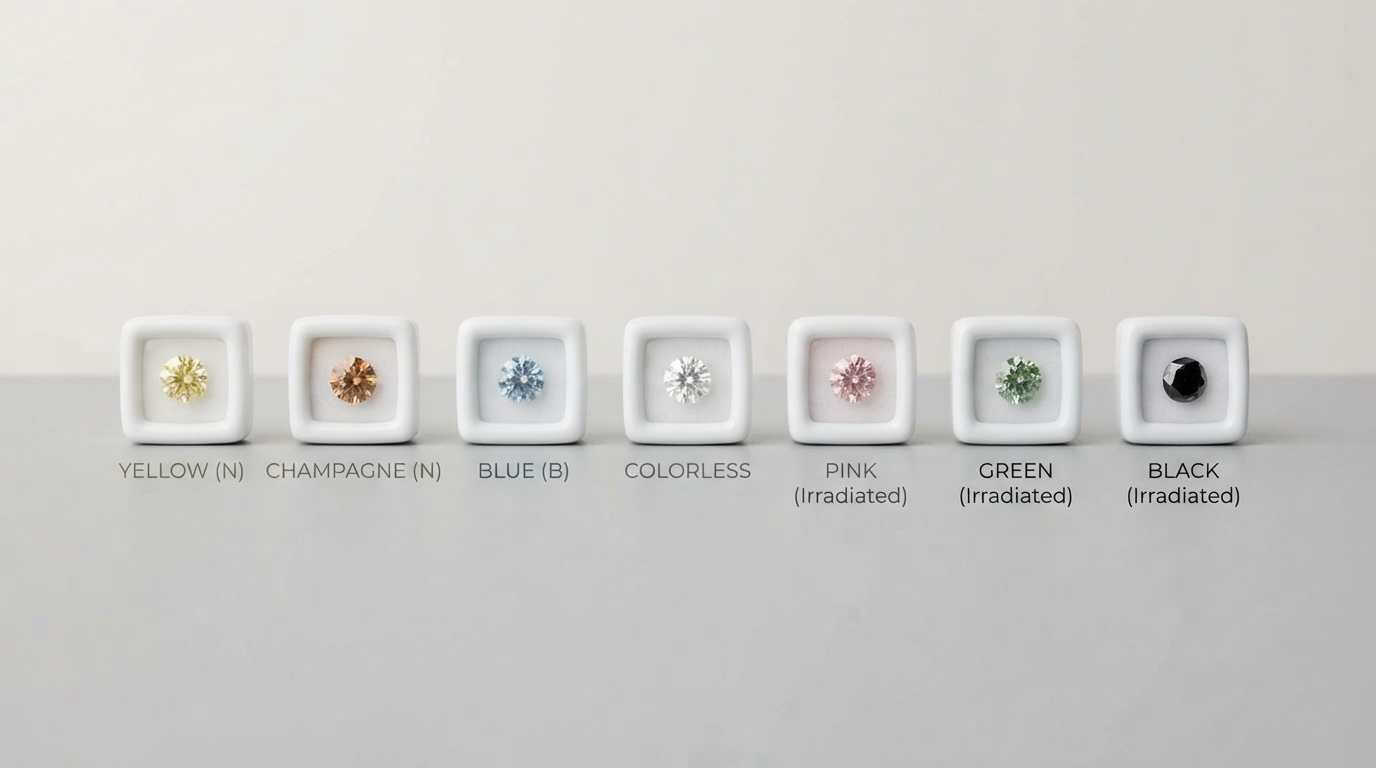
ColorCauseTypical cost effectMetals that flatter
YellowTrace nitrogen in the lattice during growthBaseline, usually the least expensive option at a given caratYellow gold deepens it; white metals make it read brighter and more obviously yellow
Champagne / brownHeavier nitrogen, or particular nitrogen arrangementsBaseline, sometimes slightly below yellowRose gold and yellow gold, warm tone against warm metal
BlueTrace boron in the latticeBaseline to modestly above; varies by providerWhite gold and platinum; the cool metal keeps the blue clean
Colorless / near colorlessExtra processing to exclude nitrogen and boronHighest of the grown colors, meaningfully more than yellow, champagne, or blue at the same sizePlatinum and white gold for an icy look; yellow gold for contrast
Red / pinkPost growth irradiationAdd on above the grown colorRose gold and platinum
GreenPost growth irradiationAdd on above the grown colorYellow gold and platinum
BlackPost growth irradiation, sometimes with longer growthAdd on; can extend the timeline to around 12 monthsAny metal; black reads strongly against white and yellow gold alike
Seven small diamonds in a row — yellow, champagne, blue, colorless, pink, green, black — beside their labels

Two things the menu does not say. “Yellow” on a price list is a family of tones, from pale straw to deep gold, and you will not know where a particular wife ashes diamond color lands in it until the stone is out of the press. And an irradiated wife ashes diamond color is a real, permanent color of a real diamond, the process rearranges the lattice, but the lab chose it rather than the carbon producing it. Either is fine, as long as you know which you are buying.

How Does a Grading Report Describe Color, and What Will It Look Like on a Hand?

An independent grading report describes a wife ashes diamond color in one of two languages, and neither is quite the same as what you see.

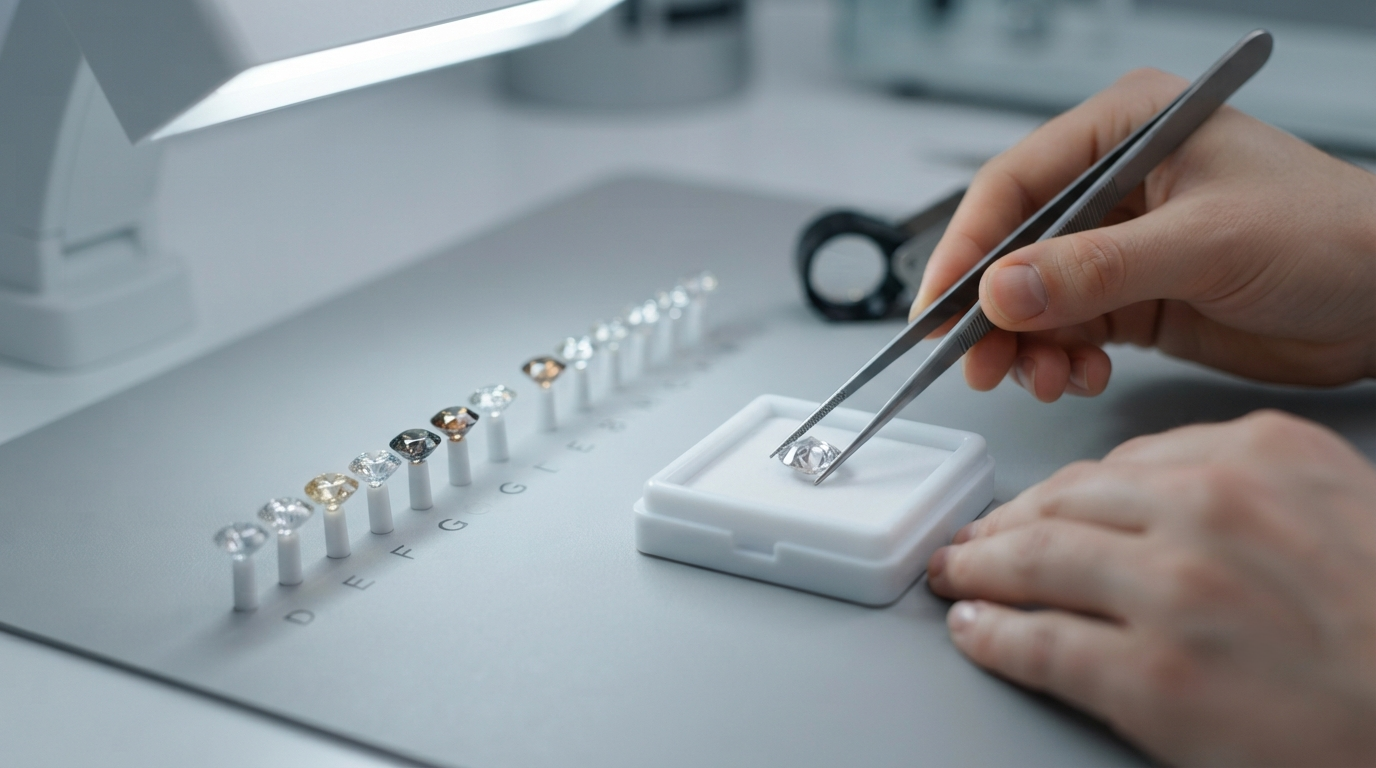
For near colorless and faintly tinted stones, gemologists use the GIA D to Z color scale: D is completely colorless, and each letter toward Z carries slightly more visible yellow or brown. A stone at K or M on that scale would be described as “faint” or “very light” yellow, and, set in yellow gold, would look warm rather than obviously colored. Grades are assigned face down against white, under controlled light, deliberately not how anyone looks at a ring.

Gemologist comparing a loose diamond face-down against a row of master stones under a daylight lamp

For stones with more color than Z, most blues, deeper yellows, champagne, and every irradiated stone, the report switches to the fancy color vocabulary: hue, tone, and saturation, from “Fancy Light” through “Fancy,” “Fancy Intense,” and “Fancy Vivid.” Here, more color is not a lower grade. It is a description.

On a hand: a stone in the lower D to Z letters looks warm, not yellow, at arm’s length, especially in yellow or rose gold; a “Fancy Light Blue” is a clear, soft blue, not sapphire; champagne stones photograph darker than they wear and read as warm honey in daylight. Ask to see the stone under ordinary light before you accept it, and read the report as a controlled measurement, not a verdict on whether you will like the wife ashes diamond color on your hand.

How Does Color Interact With Carat and Cost?

Color, carat, and cost move together.

Carat is set by growth time in the press, not by how much ash you send, and cost rises steeply with size. Wife ashes diamond color enters that equation in two ways. Colorless requires the extra processing that excludes trace elements, and that premium applies at every carat, a 1 carat colorless costs meaningfully more than a 1 carat yellow from the same provider. And larger stones show color more visibly: the faint tint that vanishes in a 0.25 carat stone is easy to see across a 1.5 carat table. A large stone that reads colorless is paying for both the size and the exclusion process, and the two compound.

As general 2026 industry ranges, not Memorial Diamond’s published pricing, memorial diamonds run roughly:

  • $1,500 to $3,500 for 0.10 to 0.25 ct
  • $5,000 to $15,000 for 0.5 to 1 ct, with colorless costing meaningfully more than blue, yellow, or champagne at the same size
  • $20,000 to $75,000+ for 2 to 5+ ct

Irradiated colors add to the grown color; grading, engraving, and the setting are usually priced separately. If budget is the constraint, the least expensive path to a wife ashes diamond color you will love is usually to accept the natural tendency at the carat you want and let the metal do the rest. How much a wife memorial diamond costs breaks the tiers down in more detail.

Which Metal Should Hold Each Color?

Choose the setting after the stone exists, pick the metal for the wife ashes diamond color that actually arrived, not the one you hoped for. A few principles hold across jewelers:

  • Warm stone, warm metal hides tint. Yellow gold around a faint yellow stone makes the piece read as one warm object rather than a slightly off white diamond.
  • Warm stone, cool metal shows tint. A faint yellow in platinum looks more yellow, because the white metal gives the eye a reference, the pairing to choose if you want a deliberate yellow diamond.
  • Blue in white metal stays clean; yellow gold can make a light blue look grayish.
  • Colorless in white metal is the traditional icy look, and also where any residual tint shows most. Near the bottom of the near colorless range, yellow gold can be the kinder choice.
  • Irradiated colors are saturated enough that metal is taste, not correction.

If the piece will sit against a wedding band, hold the stone next to that band’s metal first. Memorial diamond settings and jewelry ideas for a wife covers the setting families themselves.

What Should You Specify in Writing Before Growth Begins?

The wife ashes diamond color you receive is chemistry; what you were promised is paperwork. Growth takes 6 to 10 months, and a verbal understanding from month one is hard to reconstruct in month nine. Before the ashes leave the house, get the following in writing on the order:

  1. The color you are ordering, named the way the provider names it, “natural, as grown,” “blue,” “colorless,” “irradiated red,” and so on.
  2. The range that counts as delivered, a band on the fancy scale or a span of D to Z letters. “Yellow” alone is not a specification; “Fancy Light to Fancy Yellow” is.
  3. What happens if the stone falls outside that range, regrow, recolor, discount, or refund, and who pays.
  4. Whether the color will be independently graded, by whom, and whether the report is included in the price.
  5. Whether irradiation is applied by default if the natural color disappoints, or only on your instruction.
  6. The timeline for that color, black and some large stones run to around 12 months.

A provider comfortable with the wife ashes diamond color question will have answers to all six. “It will be beautiful, don’t worry” is not wrong, exactly, but it is not a specification. The questions to ask before turning your wife’s ashes into a diamond include these six among the rest.

What Recourse Do You Have if the Stone Is Outside the Promised Range?

No lab can redo a wife ashes diamond color once the crystal has grown; the nitrogen or boron is in the lattice. What a provider can do is grow a second stone, if enough submitted carbon, or additional ashes, remain, irradiate the stone into a different color family, adjust the price, or refund. Which of those is on offer, and at whose cost, is what item 3 above pins down.

Recourse also depends on evidence: the range has to have been written down, and the stone graded against it. An independent grading report is what makes “you promised Fancy Light Blue and this is Very Light Blue” a fact rather than an opinion.

Finally, keep some of the ashes. A stone typically needs only a few tablespoons to roughly 4 oz, about 100 g, and a family that kept the remainder has the option of a second stone; a family that sent everything does not. Wife Ashes Diamond: The Complete Guide covers what to keep, and why.

Why Do Two Stones From the Same Ashes Come Out Different?

Families who order more than one stone from the same submission are sometimes surprised when the stones do not match. Wife ashes diamond color is not a property of the ashes; it is a property of each growth run.

Each stone grows in its own cell, around its own seed, for its own length of time. The carbon blend in each cell is not identical to the atom, and each run’s pressure and temperature profile is close but not the same. Nitrogen distributes unevenly through a growing crystal. Two runs from one purified batch can therefore give a pale yellow and a warm champagne, or a light blue and a near colorless, and neither wife ashes diamond color is the “wrong” one.

If matching matters, a pair of earrings, stones for two sisters, say so in writing, ask what the provider can do to narrow the spread, and accept that “similar” is a more honest promise than “identical.” Others feel each stone being its own wife ashes diamond color is the point. More than one family member getting a diamond from the same wife’s ashes covers multiple stones. If you also hold a lock of her hair, what color a diamond made from your wife’s hair will be answers the one question hair adds, and the ashes and hair color page covers a combined stone.

Frequently Asked Questions

Will the diamond be colorless like a traditional diamond?

Probably not by default. Personal carbon carries trace nitrogen or boron that survives purification and tints the crystal yellow, champagne, or blue as it grows. Colorless is achievable with additional processing that excludes those elements, and it costs meaningfully more than the natural tones at the same carat.

Does the wife ashes diamond color say anything about her?

No, not her personality, her health, or anything else. The color comes from trace elements built into the lattice during growth and from the conditions of that growth run. Treat it as the stone’s own character rather than a message; it would differ on a different day.

Can I choose the color in advance?

You can specify a wife ashes diamond color family, natural as grown, blue, colorless, or irradiated red, pink, green, or black, and a provider grows or treats toward it. The exact shade within a grown family is not controllable. Put the family and range in writing before growth.

Why does colorless cost more?

Because it requires excluding the trace nitrogen and boron that personal carbon naturally carries, which means additional processing and tighter control during growth. That premium applies at every carat, and it compounds with size, since larger stones show faint tint more visibly than small ones do.

Are irradiated colors real, or a coating?

Real and permanent. Irradiation rearranges the diamond’s lattice to produce red, pink, green, or black; there is no coating to wear off. The distinction is that the lab chose the color rather than the carbon producing it, worth knowing, but not a mark against the stone.

What does a grading report’s color grade actually mean?

For near colorless stones, a D to Z letter assigned face down under controlled light against master stones; for more saturated stones, a fancy color description of hue, tone, and saturation. Both are measurements, not predictions of how the stone looks face up on a hand in daylight.

What if the stone is not the color I was promised?

Once grown, a wife ashes diamond color cannot be undone, but a provider can regrow, irradiate to a different color family, discount, or refund. Which applies should be written into the order before growth, and an independent grading report is what proves the stone fell outside the promised range.

Final Thoughts on the Wife Ashes Diamond Color Question

The picture in your head is probably colorless, and the stone that arrives will probably not be. That gap is worth closing now rather than at the end of ten months. A wife ashes diamond color is the record of one growth run around carbon that came from her, yellow if nitrogen rode along, blue if boron did, colorless if the lab was asked to exclude both. Decide which you want, write the range down, keep some of the ashes, and choose the metal after the stone exists. Then whatever wife ashes diamond color turns up will be the one you asked for.

Learn More About Wife Memorial Diamonds

Talk With Memorial Diamond

If you would rather ask the color question before the ashes leave the house than after the stone arrives, reach out to Memorial Diamond, which wife ashes diamond color families are offered, how the range is written into an order, and what happens if a stone falls outside it can all be settled first.

Memorial diamond colors for a wife, showing a champagne-toned memorial diamond ring with yellow, champagne, blue, and colorless diamond color options.

Memorial Diamond Colors for a Wife: What to Expect

Memorial diamond colors for a wife shown on a champagne-toned ring worn on a hand in ordinary window daylight

Why Do Memorial Diamond Colors for a Wife Lean Warm Rather Than Colorless?

Three trace elements decide almost everything about memorial diamond colors for a wife. Nitrogen in the growing crystal reads as yellow. Boron reads as blue. A diamond reads as colorless only when neither is present at all colorless is an absence, not an ingredient, which is why colorless sits at the far end of the memorial diamond colors for a wife that families are actually offered.

That single fact explains the whole category. The memorial diamond colors for a wife that families are most often handed sit in the yellow, champagne, and brown band, with blue appearing less often, because the feedstock did not begin life as a clean synthetic powder. It began as a person, and organic material brings trace elements along with it.

Her carbon also does not make the whole crystal by itself. What is recovered from the ashes is purified and then loaded into the growth cell alongside lab-grown carbon, because a growth run needs more feedstock than any personal source supplies. Ash is roughly 0.5% to 4% carbon by weight to begin with, which is why the volume has to be made up. That blending does not wash out the trace elements, so the memorial diamond colors for a wife that result still come from an organic starting point.

None of that predicts a specific shade, and this page does not try to. Forecasting is a different question, answered in what color a diamond made from her ashes will be and in the hair version of the same question. The broader category picture sits in why memorial diamonds are rarely colorless.

What is left over, once forecasting is handed off, is the part nobody prepares you for: memorial diamond colors for a wife do not behave like paint chips. They move. Not the stone the stone is fixed the moment it comes out of the press but what you see when you look at it.

What Changes Between the Photograph and Your Hand?

A product photograph does not record a stone. It records what one lighting rig did to a stone on one afternoon. That gap matters more for memorial diamond colors for a wife than for anything in a shop window, because you are being asked to picture an object that does not exist yet.

A stone shot for a website is usually sitting in a lightbox: diffuse, even, color-corrected light, a white or black background chosen to flatter, and a lens close enough to make a five-millimeter object fill a laptop screen. None of those conditions exist in your kitchen. So the memorial diamond colors for a wife that you saw on a screen were accurate and also not transferable.

Scale changes. A half-carat round stone is about five millimeters across. On a product page it is nine hundred pixels wide. Color reads more intensely at nine hundred pixels than at five millimeters, and memorial diamond colors for a wife are usually first judged at the larger of those two sizes.

Background changes. A lightbox background is neutral by design; your hand is not. Skin is warm, and a warm background pushes a warm stone warmer and makes a near-colorless stone look less white than it did against white card. Memorial diamond colors for a wife are almost always seen against skin in the end.

Light changes, constantly. This is the big one, and it does more to memorial diamond colors for a wife than the other two put together.

Worth asking for, then, rather than a better photograph: the same stone photographed twice under two named light sources, and one frame with a hand in it for scale. How a memorial diamond is made from her ashes covers what happens before that frame is ever shot

The same loose memorial diamond shown twice, once magnified in a lightbox and once at actual size between finger and thumb

Why Does the Stone Look Different in the Kitchen Than at the Bedside?

No. This is the most useful physical fact on the page about memorial diamond colors for a wife, because it is the one that surprises people after delivery rather than before.

Grading happens under controlled laboratory lighting, chosen because it does not vary. That is what makes a grade comparable, and also what makes it unlike your house. Real rooms are full of light with a color temperature, and that temperature pushes a stone around. Six lights cover almost every room a piece will be worn in, and memorial diamond colors for a wife behave differently in each of them. Memorial diamond colors for a wife are not a single reading; they are a range across the lights you actually live in.

Light you actually live inWhat it does to a warm stoneWhat it does to a near-colorless stoneWhere you meet it
Warm incandescent or 2700K bulbDeepens the yellow or champagne; honey and amber notes come forwardLends a faint warmth it does not have on paperBedside lamps, living rooms, most older fittings
Cool LED around 5000KThins the warmth; champagne can read almost grayReads cleanest and whitest hereKitchens, bathrooms, task lighting, car interiors
North-facing indirect daylightThe most neutral reading you will get at homeReads close to its graded positionA window seat on an overcast day
Direct sunlightBrightness swamps tone; the stone looks paler and more sparkling than it isLooks whiter still; contrast hides everythingOutdoors, mid-morning, on the back of your hand
Candlelight or very low lightStrongly warm; even a blue stone loses its coolnessPicks up the warmest cast it will ever showDinner, evenings, anywhere with one soft source
Fluorescent tube or screen glowSlightly green-cool; warm stones look muddierCan look faintly gray rather than whiteOffices, supermarkets, a face lit by a monitor

The same stone can be honey-warm at a bedside lamp and almost pale under the kitchen downlights four hours later, and neither reading is the wrong one. Memorial diamond colors for a wife are a band, not a point.

The practical consequence is small and it works: do not settle your impression of the memorial diamond colors for a wife on the first evening. Give it a week of ordinary use instead worn to work, sat under a lamp, taken outside once. You are mapping a band, not reaching a verdict.

How Much Does the Metal Around It Change the Color?

More than most people expect, and in two different ways at once. Metal is the second half of what governs memorial diamond colors for a wife once the stone exists.

The first way is contrast. Set a warm stone in white metal and the eye compares the two: the stone looks warmer than it did loose, because there is something colder next to it. Set the same stone in yellow gold and the contrast collapses — the warmth stops looking like a property of the stone and starts looking like a property of the whole piece.

The second way is reflection. A diamond is transparent, and light that reaches it off the mount comes back out carrying some of the mount with it. A yellow gold basket under a near-colorless stone can lend it a faint warmth that no grading report would ever record. That is not a fault in the stone or the setting; it is what happens when you put a clear object on a colored one, and it is why memorial diamond colors for a wife are partly a jewelry decision rather than purely a laboratory one.

How much metal touches the stone matters too. A bezel wraps the girdle in a continuous rim and puts a great deal of metal against the stone; four slim prongs put very little. So two identical stones, one bezel-set in yellow gold and one prong-set in platinum, will not read as the same memorial diamond colors for a wife, even with identical grading lines.

  • Yellow gold flatters a warm stone and warms a near-colorless one. It is the forgiving choice if the shade is unknown.
  • Rose gold does the same thing more strongly, and pushes champagne toward a pinkish brown.
  • White gold is almost always rhodium plated. Rhodium is bright white and wears off over years, so the piece can read cooler when new and warmer once the plating thins and then cooler again after replating.
  • Platinum is naturally white, does not need plating, and holds its reading for decades.
  • A band she already wore has already decided this question for you, which is a reason to talk about the stone’s shade before the stone exists rather than afterward.

Which mount holds the stone, and how much of it touches, belongs to the wife memorial diamond settings question rather than this one.

What Colorless Actually Costs, and Why

Colorless is expensive because of what it is defined as, and it is the one point on the scale of memorial diamond colors for a wife that cannot be reached by adding anything.

Every other shade is something present. Colorless is two things absent no nitrogen, no boron which means it cannot be added at the end. It has to be engineered out at the front, with tighter control over the feedstock and the growth environment, and that shows up industry-wide as a meaningfully higher price at the same carat weight rather than as a surcharge on a line item. How gemologists assess and record that position is set out in the four factors used to grade any diamond, and the way those factors are recorded is covered in how memorial diamonds are graded and certified.

Some providers also offer post-growth irradiation to produce red, pink, green, or black stones. That is color added after growth rather than grown in, and it is worth knowing which of the two you are being offered when a color is named, because they are different processes with different implications for the report. Both routes appear in conversations about memorial diamond colors for a wife, often without the difference being spelled out. The mechanics of growth itself are described in the general literature on high-pressure high-temperature and vapor-deposition diamond growth.

Where that lands on an invoice belongs to what a wife memorial diamond costs. The color point to carry forward is narrower: when someone quotes a price difference between shades of memorial diamond colors for a wife, the difference is describing how hard the absence was to achieve, not how rare the color is.

Deciding the Metal Before You Know the Stone

Here is the sequencing problem nobody warns families about. The stone takes months. The setting is usually chosen alongside or before it. So most people pick a metal for memorial diamond colors for a wife that do not yet exist.

There are five sensible ways to handle that, and none of them requires knowing the shade in advance. All five are ways of keeping a decision about memorial diamond colors for a wife open for as long as possible.

  1. Ask whether the stone can be returned loose and set later. If it can, the whole problem disappears: you see the shade, then you choose the metal. Ask what that adds in time, and who does the setting.
  2. If the metal has to be chosen first, choose the forgiving one. Yellow gold sits well with almost anything the growth cell is likely to produce. It is the low-regret answer when the shade is genuinely unknown.
  3. Ask whether any white gold in the design is rhodium plated. Plating is not a flaw, but it means the piece drifts in appearance and is then restored, on a cycle, for as long as it is worn.
  4. Ask to see the stone against a physical metal sample before anything is set. A sample card of yellow, white, and rose beside the actual stone settles the question of memorial diamond colors for a wife in ten seconds, where a rendering cannot settle it at all.
  5. If it is going into a band she already wore, treat the metal as fixed and talk about the stone instead. That constraint is worth naming early rather than late.

None of the five requires you to guess a shade. All five simply buy time.

Living With a Color Nobody Could Forecast

The stone does not change after it leaves the press. What changes is how practiced you are at looking at it, which is the last thing worth saying about memorial diamond colors for a wife.

For the first weeks you will check the color constantly, and every light will feel like new information. After that it settles into being simply what the stone looks like. That is not a loss of interest; it is the ordinary way a worn object stops being an event, and memorial diamond colors for a wife stop being news faster than people expect.

Strangers will ask about it, too a jeweler cleaning it, a colleague who notices it, someone at a till who likes the look of it. You are never obliged to reach for the grading language in those moments, and in practice a plain description lands better than a technical one.

And a color arriving that you did not pick is not a defect. It is the direct consequence of the thing that makes the stone worth having: the carbon came from a person rather than a controlled feedstock, and people are not uniform. The whole decision, from material to finished piece, is laid out in the complete guide to a wife ashes diamond.

A white gold band photographed showing rhodium plating worn thin on the underside | Stock acceptable; the worn area must be visible or the image makes no point

Frequently Asked Questions

What are the most common memorial diamond colors for a wife?

Yellow, champagne, and brown tones are the usual range for memorial diamond colors for a wife, with blue appearing less often and colorless least of all. Nitrogen present during growth reads yellow, boron reads blue, and a colorless stone requires the absence of both.

Can I choose the color before the stone is grown?

Some providers offer named color options, so you may be able to state a target. Ask what that name has meant for memorial diamond colors for a wife in finished stones, and whether the color is grown in or added afterward by irradiation.

Why do memorial diamond colors for a wife look different in photographs?

Product photographs are taken in diffuse, color-corrected lightbox conditions against neutral backgrounds, at magnifications that make a five-millimeter stone fill a screen. Your hand is warm, your rooms are not color-corrected, and scale alone changes how strongly a tone reads.

Does the metal the stone is set in really change its color?

Yes, in two ways. White metal makes a warm stone look warmer by contrast, and a colored mount reflects light back through a transparent stone. A bezel touches far more of the stone than four slim prongs, so it transfers more.

Will the color of the stone fade or change over time?

No. Memorial diamond colors for a wife come from trace elements locked in the crystal lattice during growth, and they are permanent. What can change is the setting around it rhodium plating on white gold wears and is replaced, which alters how the stone reads.

What if the color that arrives is not the one I pictured?

Give it a full week before concluding anything, since one evening under one lamp is not enough to judge by. Then fall back on what you settled about metal, and on the fact that memorial diamond colors for a wife come from a person rather than a catalog.

Final Thoughts on Memorial Diamond Colors for a Wife

The honest summary is that memorial diamond colors for a wife cannot be promised and can be prepared for. The shade is decided in the growth cell by trace elements nobody controls precisely. What you see afterward is decided by light and by metal, and both of those are yours to choose, ask about, and settle before anything is cut or set.

So do the small things early: two lights, a hand for scale, and a straight answer about what the mount will actually touch.

Learn More About Wife Memorial Diamonds

Talk With Memorial Diamond

If a shade has been named to you and you want it turned into something you can actually picture, Memorial Diamond is one place to have that conversation memorialdiamond.us.

Wife ashes diamond: a champagne-toned lab-grown memorial diamond in a bezel pendant on a plain linen background

Wife Ashes Diamond: The Complete Guide

There is a version of your house that still expects her. Her side of the closet, the mug that was hers, the way you still buy two of something. A wife ashes diamond is a real, lab grown diamond containing a purified portion of your wife’s own carbon, extracted from a small amount of her cremated remains and grown over roughly 6 to 10 months into a stone that can be set in a ring, a pendant, or kept loose.

It is not all of her ashes, and it is not a symbol standing in for her. It is a diamond that physically exists because of her. This guide covers the eight things that decide whether it is right for you: what the stone contains, how much ash is used, the process, the colors, carat and cost, the timeline, what to ask before sending anything, and who else in the family the decision touches.

What a Wife Ashes Diamond Actually Contains

Start with the fact about a wife ashes diamond most people quietly doubt, because everything else rests on it.

Cremated remains are almost entirely calcium phosphate, the mineral structure of bone. Carbon, the element a diamond is made of, is a small fraction of ash by weight: industry figures put usable carbon at roughly 0.5% to 4%, depending on the person and on how the cremation was carried out. A laboratory extracts that carbon, purifies it to 99.9%+ purity, and then blends it with additional lab sourced carbon to reach the volume a diamond of meaningful size needs.

The result is that in a wife ashes diamond, the personal carbon recovered from her ashes typically makes up somewhere around 10% to 15% of the finished stone’s mass. Some providers cite figures as low as 3%, others higher, depending on the carat and how much ash was submitted. The rest is lab carbon that was never part of her.

That sentence is the one to hold onto. A wife ashes diamond is not “100% her,” and any provider who tells you otherwise is describing physics that does not exist. What it is: a genuine diamond in which a real, verifiable portion of the carbon that was in her body now sits inside a crystal lattice. Chemically, optically, and by hardness, 10 on the Mohs scale, it is indistinguishable from any other diamond.

How Much of Her Ashes Is Used?

Far less than most people fear. Requirements vary by provider, but across the industry a wife ashes diamond typically needs somewhere between a few tablespoons and roughly 4 oz, about 100 g, of cremated remains, a small fraction of the ashes a full cremation produces.

That has two consequences worth stating plainly:

  • Everything else you planned for her still happens. The scattering at the beach she loved, the interment beside her parents, the urn that stays on the shelf, none of it is cancelled. The diamond takes a portion; the plan takes the rest.
  • More than one stone is often possible. Because so little is used per wife ashes diamond, a second stone for a daughter, a son, or her sister can usually be grown from the same submission. How much ash is needed for a wife memorial diamond covers the quantities in detail, including what happens if the ashes were already divided at the crematorium.

Sending more ash does not produce a bigger wife ashes diamond. Size is a function of growth time in the press, not of how much material went in, so a family that sends a full urn does not get a larger stone, only an unnecessary loss of ashes they could have kept.

How Is a Wife Ashes Diamond Made?

The process is the same one the broader lab grown diamond industry uses, with a personal carbon source at the front of it. Seven stages, in order:

StageWhat happensTypical duration
1. CollectionHer ashes are received with chain of custody tracking, a labeled, logged, traceable record from arrival to finished stoneDays
2. Carbon extractionThe ash is heated in a controlled, oxygen free, multi stage process that strips away the calcium phosphate and other minerals, leaving carbon at 99.9%+ purityWeeks
3. GraphitizationThe purified carbon is heated to roughly 2,500 to 2,700°C and converted to graphite, the crystalline form presses use as feedstockDays to weeks
4. Diamond growthThe graphite, blended with supplemental lab carbon, goes into an HPHT press with a tiny diamond seed at roughly 6 to 8 GPa and 1,400 to 2,500°C, or, with some providers, is converted to gas for CVD growthWeeks to months, this stage sets the carat
5. Cutting and polishingA gemologist cuts the rough crystal into round, princess, cushion, or another shapeWeeks
6. Optional irradiationSome providers shift or intensify color post growth for red, pink, green, or blackDays
7. Grading and certificationThe stone is graded, ideally by an independent lab, and issued an origin certificateWeeks
Industrial HPHT press in a laboratory with a technician checking readouts

HPHT is the standard method for memorial stones; a minority of providers use CVD. Both produce a genuine diamond. The technical detail of both methods is on the synthetic diamond page, if you want to read past what a provider tells you.

The step in making a wife ashes diamond most families ask about is the second one, how anyone can be sure the carbon that comes out was hers. The honest answer is the chain of custody record: a reputable provider logs the sample at every stage, and the origin certificate at the end documents that this specific stone was grown from this specific submission. How a memorial diamond is made from your wife’s ashes goes through each stage in more detail, and whether it is really made from her ashes takes the skeptic’s question seriously.

What Color Will It Be?

Probably not colorless, and that is worth knowing before you picture it.

Diamond color comes from trace elements present during growth. Nitrogen produces yellow tones; boron produces blue. Because the carbon in a wife ashes diamond comes from an organic, personal source rather than a controlled synthetic feedstock, trace elements are common, which is why memorial diamonds naturally trend toward yellow, blue, and champagne or amber brown tones.

Three loose memorial diamonds yellow, blue, and champagne on a gray grading tray
ColorWhat produces itWhat it typically means for cost
Yellow to champagneTrace nitrogen, the most common natural outcomeThe baseline; usually the most accessible tier
BlueTrace boronSimilar to yellow; some providers price it higher
Colorless / whiteAdditional processing to exclude trace elementsMeaningfully more at the same carat
Red, pink, green, blackPost growth irradiationProvider specific; black often takes longer

The color of a wife ashes diamond is a feature of the individuality of the source, not a flaw. Two stones grown from the same ashes can differ slightly. If she had a favorite color, or if you already know the ring you want will be yellow gold or platinum, that is a reasonable thing to steer by, but the stone’s own tendency is the starting point, and colorless is a choice that costs more, not the default. What color a diamond made from your wife’s ashes will be covers the choice in full.

Carat, Cost, and What Drives the Price

A wife ashes diamond is generally offered from about 0.10 carats up to 5 carats or more, and cost scales steeply with size because larger stones need much longer in the press.

The ranges below are general industry figures for 2026, not Memorial Diamond’s published prices, and every provider prices differently. Final cost depends on carat, color, cut, and whether an independent grading report is included.

Loose diamonds at 0.20, 0.50, and 1.0 carat beside a ruler for scale
TierApproximate caratTypical industry rangeNotes
Entry0.10 to 0.25 ctRoughly $1,500 to $3,500Reads well in a bezel ring or a small pendant
Mid0.5 to 1 ctRoughly $5,000 to $15,000Colorless costs meaningfully more than yellow, blue, or champagne at the same size
Large / rare2 to 5+ ctRoughly $20,000 to $75,000+Growth time drives both price and timeline

Settings, a ring, pendant, or pair of earrings, are almost always priced separately from the loose stone, as are engraving, fancy cuts, and an independent grading report. A wife ashes diamond at the entry tier, set simply in gold, is the realistic floor for most families; the ceiling is wherever carat and platinum take it. How much a wife memorial diamond costs works through a full quote line by line.

One non financial note on carat: a small wife ashes diamond is not a small gesture. A 0.20 ct diamond in a bezel is worn every day by people who would never have worn a solitaire. Choose the size for the piece you will actually wear.

How Long Does It Take?

Across the industry, a wife ashes diamond typically takes 6 to 10 months from receipt of her ashes to a finished stone. Larger stones and some specialty colors, black in particular, or anything over roughly 2 carats, can take up to 12 months.

An origin certificate and an independent grading report side by side on a desk

The timeline for a wife ashes diamond is driven by growth time, which is driven by carat. It is not driven by how much ash you sent, and it is not something a provider can meaningfully rush. If there is a date you are hoping to have the stone by, an anniversary, a child’s wedding, count back from it and add a margin, and be honest with yourself about whether missing that date would be bearable. Ordering against a date you cannot bear to miss is the one piece of timing advice that matters. How long it takes to make a wife memorial diamond covers reverse planning against a calendar.

Questions to Settle Before Anything Is Sent

A wife ashes diamond is a decision you make once, with material you cannot get back. These are the questions worth answering before her ashes leave the house, most of them are for you, a few are for the provider.

  1. Do you control the ashes? If you are her spouse and she left no written instructions, prepaid plan, or will naming someone else, in most US states the answer is yes. If any of those documents exist, read them first.
  2. Have the ashes already been divided? If a portion went to her mother or her sister at the crematorium, that portion is theirs. You send from what you hold.
  3. How much does this provider need, and what happens to any excess? Ask whether unused material is returned.
  4. What chain of custody documentation do they provide? You want a logged, traceable record, not just a certificate at the end.
  5. Is grading independent or in house? An in house authenticity certificate documents origin; an independent grading report documents quality. They are different documents, and reputable providers offer both. How gemologists grade cut, color, clarity, and carat is the same standard for a memorial stone as for any other.
  6. What is the realistic timeline for a wife ashes diamond at the carat you want? Get it in writing.
  7. What is the full price, including the setting? Ask for the loose stone price and the set price separately.
  8. Who else expects a stone, and have you told them? The next section.

Questions to ask before turning your wife’s ashes into a diamond expands each of these into what a good provider answer sounds like.

Who Else This Decision Touches

A wife ashes diamond touches her parents, if they are living. Her siblings. Your children, whatever their age. In most cases none of them has a legal say, but all of them have a stake, and telling them before the material is sent goes far better than telling them after.

Three things families find useful to say early: only a small portion is used, everything else planned for her still happens, and there is often enough for more than one stone if someone wants their own. Whether more than one family member can get a diamond from the same wife’s ashes covers the cost and the mechanics before you offer.

If her family holds a religious view on cremation or on dividing ashes, note that no tradition has an official position on memorial diamonds specifically, only on cremation and ash handling in general, and that views vary by denomination and by individual clergy. The cremation has already happened; the live question is usually about dividing what remains, which is a narrower concern with a narrower answer.

Frequently Asked Questions

Is a wife ashes diamond a real diamond?

Yes. It is a lab grown diamond with the same chemical composition, optical properties, and hardness, 10 on the Mohs scale, as any other diamond, graded by the same cut, color, clarity, and carat standards. It differs only in where part of its carbon came from.

How much of the finished diamond is actually her?

Typically around 10% to 15% of the stone’s mass is carbon recovered from her ashes, with the rest supplemental lab carbon added to reach a workable size. Some providers cite lower or higher figures depending on carat. No memorial diamond is 100% personal carbon; any provider claiming that is overstating.

Can I still scatter or bury the rest of her ashes?

Yes. A wife ashes diamond needs only a small portion, typically a few tablespoons to around 4 oz, so the scattering, interment, or urn you already planned still happens with the rest. The diamond is an addition to that plan, not a replacement for it.

Will the diamond be colorless?

Usually not by default. Trace nitrogen from an organic carbon source tends to produce yellow or champagne tones, and boron produces blue. Colorless is achievable with additional processing and typically costs more at the same carat. Many families choose the natural color as a feature of the stone’s individuality.

How long does a wife ashes diamond take?

Typically 6 to 10 months from receipt of ashes to finished stone across the industry, with larger stones or specialty colors such as black sometimes taking up to 12 months. Growth time depends on carat, not on how much ash was sent, and cannot meaningfully be rushed.

Can our children each have a diamond from her ashes too?

Often, yes. Because only a small portion is used per stone, several diamonds can typically be grown from one submission. Each stone is priced and grown separately, and stones from the same ashes can differ slightly in color. Tell the family before the material is sent.

What documents should come with the finished stone?

Two: an origin or authenticity certificate documenting that this diamond was grown from her submitted carbon, and a grading report, ideally from an independent lab, documenting cut, color, clarity, and carat. Keep both with the receipt for any setting.

Final Thoughts on a Wife Ashes Diamond

Nothing on this page has to be decided this month. Her ashes do not change, the process does not change, and a provider will be there when you are ready. What a wife ashes diamond offers is narrow and real: a stone that exists because a portion of her carbon is inside it, that you can wear or keep or hand to a child, and that is a genuine diamond by every test a jeweler can run. Whether that is the right thing for you is not something a guide can settle. What it can do is make sure that if you choose it, you choose it knowing exactly what it is.

Learn More About Wife Memorial Diamonds

Talk With Memorial Diamond

If you are weighing a wife ashes diamond and want to know what is possible with the amount of ashes you hold, what carat is realistic for your budget, or how a second stone for a child would work, reach out to Memorial Diamond to talk it through. There is no deadline on any of it.

Wife's ashes diamond: a small yellow lab-grown diamond in its grading box beside a closed ceramic urn on a wooden shelf

How to Turn Your Wife’s Ashes Into a Diamond

The urn has been on the shelf long enough that you have stopped noticing it, and then one day you notice it again. A wife’s ashes diamond is made in seven steps: confirm you have the right to decide, measure out a small portion of her ashes, choose a provider and a carat, send the portion with a documented chain of custody, wait roughly 6 to 10 months while the carbon is extracted and grown into a real lab grown diamond, receive the graded stone, and decide what it becomes.

Only a few tablespoons are needed, so everything else you planned for her ashes still happens. This is the practical version of the process, what you do, in what order, and what to keep a copy of, rather than the science, which lives in the guides linked along the way.

Before Step One: What a Wife’s Ashes Diamond Is and Is Not

A wife’s ashes diamond is a real, lab grown diamond, same crystal structure, same optics, same hardness at 10 on the Mohs scale as any diamond, grown around carbon that was extracted from her cremated remains.

It is not “100% her.” Cremated remains are almost entirely calcium phosphate; usable carbon is only about 0.5% to 4% of ash by weight. That carbon is extracted, purified to 99.9%+, and blended with supplemental lab carbon to reach the volume a diamond needs. The personal carbon typically ends up around 10% to 15% of the finished stone’s mass, though providers cite figures from roughly 3% upward depending on carat. Any provider who tells you the stone is entirely her ashes is describing physics that does not exist. What is true is stronger: a verifiable portion of the carbon that was in her body is now inside a diamond’s crystal lattice.

That is the whole of the science a wife’s ashes diamond needs before you start. Wife Ashes Diamond: The Complete Guide has the rest.

Step 1: Confirm You Can Decide

Most surviving spouses can arrange a wife’s ashes diamond, but check rather than assume.

In most US states, the right to control a person’s remains passes to the surviving spouse first, unless she left written instructions, a prepaid funeral plan, or a will naming someone else. If none of those exist, the decision about a wife’s ashes diamond is yours. If any of them exist, read the document before doing anything else; it may name a different person, or it may say what she wanted done with her ashes.

Two further checks:

  • Were the ashes already divided? If a portion went to her mother, her sister, or a child at the crematorium, that portion is theirs. You send from what you hold.
  • Who expects to be told? Her parents, her siblings, your children. None of them usually has a legal say; all of them have a stake. Telling them before the ashes leave the house goes far better than telling them after. How to talk to family about a wife memorial diamond covers the conversations person by person.

If her family holds a religious view on dividing ashes, note that no tradition has an official position on memorial diamonds specifically, only on cremation and ash handling generally, and views vary by denomination and by individual clergy.

Step 2: Measure Out the Portion

A wife’s ashes diamond needs far less than you think, and sending more does not help.

Across the industry, a wife’s ashes diamond typically requires somewhere between a few tablespoons and roughly 4 oz, about 100 g, of cremated remains, a small fraction of what a full cremation produces. The exact minimum varies by provider; ask for it before opening the urn.

A small sealed container of cremated remains, labeled and dated, next to a measuring spoon on a clean cloth
What to doWhy
Ask the provider for their minimum in grams or ounces, in writingMinimums vary; do not guess
Measure out only that amount, plus a small margin if the provider suggests oneSending more does not produce a larger diamond, carat is set by growth time, not by material volume
Use a clean, dry, sealable container the provider specifies or suppliesAshes must arrive dry and uncontaminated
Label it with her name and your submission referenceChain of custody begins at your kitchen table
Photograph the container, sealed and labeled, with the date visibleYour own record, independent of the provider’s
Return the rest of the ashes to the urnThe scattering, interment, or shelf you planned still happens

If you hold very little, a keepsake vial rather than an urn, a wife’s ashes diamond may still be possible; tell the provider the amount. Some accept less than their standard minimum; some can combine a small amount of ashes with a lock of her hair. How much ash you need for a wife memorial diamond covers the edge cases.

Step 3: Choose a Provider and a Carat

For a wife’s ashes diamond these two decisions come together, because carat sets both the price and the timeline, and the provider sets what is realistic.

Choosing the provider. Ask every candidate the same questions and compare the answers:

  1. What chain of custody documentation do you provide, and can I see where her ashes are at each stage?
  2. What proportion of the finished stone’s carbon is typically from the submitted ashes, at the carat I want?
  3. Is grading independent or in house? An origin certificate, usually in house, documents that the stone came from her ashes; a grading report, ideally from an independent lab using GIA’s cut, color, clarity, and carat standards, documents quality. You want both.
  4. What is the realistic timeline for this carat, in writing?
  5. What is the loose stone price, and what is the setting price, as separate lines?
  6. What happens to unused ashes, and what happens if you cannot complete the stone?

Choosing the carat. A wife’s ashes diamond is generally offered from about 0.10 ct to 5+ ct. Growth time, and therefore cost and timeline, scales steeply with size. General 2026 industry ranges, not Memorial Diamond’s published pricing:

TierCaratTypical rangeTypical timeline
Entry0.10 to 0.25 ctRoughly $1,500 to $3,5006 to 8 months
Mid0.5 to 1 ctRoughly $5,000 to $15,0008 to 10 months
Large / rare2 to 5+ ctRoughly $20,000 to $75,000+Up to 12 months

Colorless costs meaningfully more than yellow, blue, or champagne at the same size. A small stone in a bezel is worn every day by people who would never wear a solitaire, choose the size for the piece you will actually wear. How much a wife memorial diamond costs works through a full quote.

Choosing the color can wait, and often should. A wife’s ashes diamond naturally trends toward yellow, champagne, or blue because the organic carbon source carries trace nitrogen or boron; colorless requires extra processing. Decide whether you want the natural outcome or a specified color before the growth stage begins, the provider will tell you the deadline.

Step 4: Send It With a Paper Trail

This is the step in making a wife’s ashes diamond where a small amount of care prevents the only problems that cannot be undone.

Submission form, tracking receipt, and a printed photograph laid together in a folder
  • Complete the provider’s submission form and keep a copy, paper or scanned, before it leaves your hands.
  • Package the sealed container as the provider instructs, with the form inside.
  • Use tracked, insured shipping and keep the tracking number with your copy of the form. Do not use a service that cannot tell you where the package is.
  • Confirm receipt. A reputable provider will acknowledge arrival and log your submission under a reference number. If you have not heard within the window they gave you, ask.
  • Ask for the chain of custody record’s format in advance, what you will be able to see, and when.

Keep in one place: your copy of the form, the tracking record, your dated photograph of the sealed container, and the provider’s acknowledgement. That folder is the proof, if any question ever arises, that the wife’s ashes diamond came from her.

Step 5: What Happens During the 6 to 10 Months

You do nothing for most of a year while a wife’s ashes diamond grows, and it helps to know what is happening while you wait.

  1. Carbon extraction and purification, weeks. Her ashes are heated in a controlled, oxygen free, multi stage process that strips away the calcium phosphate and other minerals, leaving carbon at 99.9%+ purity.
  2. Graphitization, days to weeks. The purified carbon is heated to roughly 2,500 to 2,700°C and converted to graphite, the feedstock diamond presses use.
  3. Diamond growth, weeks to months. The graphite, blended with supplemental lab carbon, goes into an HPHT press with a tiny diamond seed at roughly 6 to 8 GPa and 1,400 to 2,500°C, or, with some providers, is converted to gas for CVD growth. This is the stage that sets carat and takes most of the time. Both methods are described on the synthetic diamond page.
  4. Cutting and polishing, weeks. A gemologist cuts the rough crystal into the chosen shape.
  5. Optional irradiation, days, only if a red, pink, green, or black stone was specified.
  6. Grading and certification, weeks.
HPHT press in a laboratory with a technician monitoring readouts

Ask the provider at the start whether they send progress updates on a wife’s ashes diamond and at what stages. Some send a photograph of the rough crystal; some send nothing until the stone is finished. Neither is wrong, but knowing which to expect prevents months of wondering. How a memorial diamond is made from your wife’s ashes covers each stage in more depth, and how long a wife memorial diamond takes covers planning against a date.

Step 6: Receive and Check the Stone

When the wife’s ashes diamond arrives, check four things before you do anything else.

CheckWhat you are looking for
The origin certificateHer name or your submission reference, the material submitted, and the provider’s attestation that this stone was grown from it
The grading reportCarat, color grade, clarity grade, cut, and whether it is from an independent lab or in house
The stone against the reportCarat matches; color is within the range you were told to expect
The carat you orderedIf you ordered 0.50 ct and the report says 0.48, that is within normal cutting variance; if it says 0.30, ask

The color will probably not be what you pictured, and that is normal. Yellow, champagne, and blue are the natural outcomes; two stones from the same ashes can differ. If you specified a color and the stone is outside the range you were promised, this is the moment to raise it, with the report in hand.

Then put the wife’s ashes diamond certificate, the grading report, your submission folder, and the receipt together. Whoever holds this stone after you should be able to prove what it is.

Step 7: Decide What It Becomes

This step has no deadline. A loose wife’s ashes diamond in its grading box loses nothing by waiting a year.

When you are ready: a bezel ring for daily wear, a pendant if your hands are already full, her own wedding ring re set around the stone if the metal allows, a piece for a child, or a loose stone kept and displayed. Metal follows color, yellow gold flatters yellow and champagne, white metals flatter blue. Settings are priced separately from the stone. Wife memorial diamond ideas, rings, pendants, and keepsakes walks through the options.

Frequently Asked Questions

How much of my wife’s ashes do I need to send?

Typically a few tablespoons to roughly 4 oz, about 100 g, though minimums vary by provider, ask for theirs in writing before opening the urn. Sending more does not produce a larger diamond, because carat is set by growth time. Everything else you planned for her ashes still happens.

Can I make a wife’s ashes diamond if her ashes were already scattered?

A wife’s ashes diamond is possible only if a portion was kept, a keepsake vial, a small container, a share held by a family member willing to contribute. If nothing was retained, ashes are not an option; a lock of her hair, if one exists, is the alternative route to a memorial diamond.

How long does it take?

Typically 6 to 10 months from the provider receiving the ashes to a finished stone, with larger sizes or specialty colors such as black sometimes taking up to 12 months. The timeline is set by growth time in the press, which is set by carat, and cannot meaningfully be rushed.

What should I keep a copy of?

Your submission form, the shipping tracking record, a dated photograph of the sealed and labeled container, and the provider’s acknowledgement of receipt. When the stone arrives, add the origin certificate and the grading report. Together, that folder proves the diamond came from her.

Will the diamond be colorless?

Usually not by default. Carbon from an organic source carries trace nitrogen or boron, which produce yellow and blue tones respectively; champagne is also common. Colorless is achievable with additional processing and typically costs more at the same carat. Decide before growth begins whether you want the natural outcome.

Do I have to choose the ring before I send the ashes?

No. Choose carat and, if you want to specify it, color before growth begins. The setting can wait until the stone arrives, many families wait to see the actual color before choosing metal. A loose diamond in its box loses nothing by waiting.

Final Thoughts on Making a Wife’s Ashes Diamond

Seven steps to a wife’s ashes diamond, and only two of them, measuring out the portion and sending it, involve doing anything to her ashes. The rest is paperwork, patience, and a decision at the end that can wait as long as you need. A wife’s ashes diamond is not a complicated thing to arrange. It is a small, careful thing, done once, with a little of her, that produces a real diamond you can hold. If you are not ready for step one, nothing is lost by waiting; the urn will still be on the shelf, and the process will still be there.

Learn More About Wife Memorial Diamonds

Talk With Memorial Diamond

If you are at step one and want to know what a wife’s ashes diamond would need from the amount you hold, what carat is realistic, or how the chain of custody is documented, reach out to Memorial Diamond. Nothing has to leave the house until you are sure a wife’s ashes diamond is what you want.

Memorial diamond made from a father's ashes and hair: a single champagne-toned lab-grown stone beside two small labeled sample containers

Is a Memorial Diamond Really Made From Your Father’s Ashes and Hair?

Two containers left the house, and one stone is coming back. If you are asking whether a memorial diamond made from your father’s ashes and hair really holds both, the answer is yes: carbon is extracted from each material separately, purified, blended together with lab sourced carbon, and grown into a single lab grown diamond. The personal carbon is a real, physical part of the crystal, though it is a minority of the finished stone’s mass, never all of it.

What the finished diamond cannot do is show you that both went in. Purified carbon from ash and purified carbon from hair are the same element in the same form. So the question worth asking about a memorial diamond made from both is not “did they really use both?” but “what can I see on paper that proves each one was handled?” That question has four answers, and they exist before the stone does.

Does a Memorial Diamond Made From Both Materials Really Contain Both?

Yes, assuming the provider did what it said. The two materials arrive with very different amounts of usable carbon in them, which is why they are processed on separate tracks before they ever meet.

Cremated ashesHair
What it is mostly made ofCalcium phosphate (the mineral of bone)Keratin, a carbon rich protein
Usable carbon by weightRoughly 0.5% to 4%Roughly 50%
Typical amount neededA few tablespoons to about 4 oz (100 g)A small lock, a few grams
Predictability of yieldLow; an eightfold published rangeHigh; a single published figure
Requires cremationYesNo
Side-by-side graphic comparing carbon yield from cremated ashes and from hair before purification

Each material is heated in a controlled, oxygen free process that strips away everything except carbon, reaching roughly 99.9% purity. The two purified carbons are then combined with each other and with supplemental lab sourced carbon, converted to graphite at roughly 2,500 to 2,700°C, and grown into one crystal in a single growth run using HPHT or CVD synthesis. In the finished stone, your father’s carbon is typically a minority share of the mass; no honest provider describes a memorial diamond made this way as 100% him. How the two materials are actually processed and merged walks the full sequence.

Why Can’t the Finished Stone Prove Both Were Used?

Because after purification there is no difference left to detect, and a memorial diamond made from two sources looks like any other.

Ash derived carbon and hair derived carbon are indistinguishable once they are graphite. There is no seam in the crystal, no two tone effect, no layer that came from one and a layer from the other, and no gemological test that recovers the ratio. A grading report from a laboratory such as the GIA documents cut, color, clarity, and carat; it cannot tell you where the carbon came from, or whether it came from two places.

That cuts both ways. A provider who claims the finished stone can be tested to confirm both inputs is claiming more than the science supports. A skeptical relative who says the stone “proves nothing” is, strictly, correct. Neither of them is talking about the evidence that does exist.

What Are the Four Things You Can Actually Verify?

The proof that both materials were used lives in the paperwork, not the stone. For a combined order, these four items are the ones to ask for, and any provider serious about chain of custody should be able to produce them:

  1. Two separate intake records, one for the ashes and one for the hair, each with its own reference number, rather than a single line reading “father, combined.”
  2. A recorded carbon yield for each material before blending, so you know what each one contributed rather than a single blended total.
  3. A written shortfall procedure, stating in advance what happens if one material yields less than planned, and confirmation afterward that it was followed.
  4. Unused material returned separately, the remaining ashes and the remaining hair each coming back in its own container.
Two separate intake record sheets and sample containers, one for ashes and one for hair, on a lab bench

Those are documentary questions with checkable answers, and the good ones are answered before the parcel is sent, not after the stone arrives. A memorial diamond made from two materials is only as verifiable as the records kept on the way in. Questions to ask before turning your father’s ashes and hair into a diamond covers the wider conversation, and the single material versions of this question are answered in Is a memorial diamond really made from your father’s ashes? and Is a memorial diamond really made from your father’s hair?.

What Happens in the Window Before the Two Are Blended?

There is a moment in every memorial diamond made from two materials when the lab knows exactly what each material produced and nothing irreversible has happened yet. It sits after extraction and before blending, and it is the point a family never sees unless they asked about it.

Ash is the less predictable of the two inputs. Its carbon content is published as a range from 0.5% to 4% by weight, against a single published figure of about 50% for hair, so the ash portion is the one more likely to land somewhere other than where the plan assumed. When that happens, someone decides what to do: proceed with a smaller ash contribution, ask you for more material, or proceed on the hair plus additional lab carbon.

Those are three different outcomes, and the third one produces a stone the family will describe for the rest of their lives as made from his ashes and his hair. Nothing about that is sinister. It is a decision made inside a window you were not in, and the only way to be in the room is to have asked, in writing, what the procedure is before anything ships. How much ash and hair you need for a father memorial diamond explains what “enough” means for each material.

Frequently Asked Questions

Can a memorial diamond made from ashes and hair be tested to confirm it contains both?

No. Once both materials are purified to carbon and graphitized, they are chemically identical, and no gemological test can tell them apart or recover the ratio. Verification comes from intake records, per material yield figures, and returned material, not from the finished stone.

Does adding hair to my father’s ashes put more of him in the diamond?

Only marginally, depending on quantities. Hair contributes carbon far more efficiently than ash, so a lock can add meaningful personal carbon, but a memorial diamond made with both still needs supplemental lab carbon to reach a growable size. The personal share stays a minority of the mass either way.

Is the diamond a real diamond?

Yes. A memorial diamond made by HPHT or CVD is a genuine lab grown diamond with the same crystal structure and hardness as a mined one. Independent labs grade it on the same cut, color, clarity, and carat scale as any other diamond.

Why does the ash matter more than the hair for a combined order?

Because ash yield is unpredictable. Usable carbon in cremated remains ranges roughly eightfold, from 0.5% to 4% by weight, while hair sits near 50%. If one material falls short of plan, it is far more likely to be the ash, which is why a written shortfall procedure matters.

What should I ask for in writing before sending both materials?

Ask for separate intake records with individual reference numbers, a recorded yield for each material, the provider’s procedure if one material yields less than expected, and confirmation that unused ashes and hair come back separately. Get all four before shipping anything.

Will my father’s remaining ashes and hair come back?

Typically yes. Only a small portion of the ashes is needed, and only a lock of hair, so most providers return unused material. For a combined order, confirm they come back in separate containers so you know each one was handled on its own.

Final Thoughts on a Diamond Made From Both Ashes and Hair

The fear underneath “did they really use both?” is a fear of being told a story instead of the truth. The stone cannot settle that, and it was never going to. What can settle it is a provider willing to show you two intake records, two yields, one shortfall rule, and two containers coming home. If those exist, a memorial diamond made from both is what you were told it is, and you can stop asking the stone to prove something only paper can.

Learn More About Father Memorial Diamonds

Talk With Memorial Diamond

If you are holding both his ashes and a lock of his hair and want to know what a memorial diamond made from both would actually involve, and what you would be able to see in writing along the way, reach out to Memorial Diamond. Bring the four questions above; the conversation is better when you do.

Desk with a phone, a notepad and a closed cremation urn set to one side, the notepad in use

How to Turn Your Father’s Ashes Into a Diamond

The first practical act is not opening the urn. It is making a phone call to whoever holds your father’s remains or arranges what happens to them and asking that person to set aside a small portion.

Turning your father’s ashes into a diamond involves four acts: retaining a portion, choosing a provider, specifying the carat, and posting the material. Only the first act has a deadline that you cannot move, and that deadline often arrives before you know which provider you want to use.

This guide explains that timing problem and shows what you can still fix when the four acts happen out of order.

The Four Acts and Which of Them You Can Undo

The sensible order does not always match the order a family can manage. The important question involves which acts you can reverse and which ones you cannot.

ActWhat you need firstCost of doing it lateCan you reverse it?
Retain a portionAccess to the remains before interment or scatteringThe ashes route closesNo
Choose a providerKnowledge of what you hold and what you want to makeNone while the portion remains safeYes
Specify carat and colourThe provider’s available options and intake rulesA growth run may follow a specification you later changeUntil the growth run begins
Post the materialProvider, specification, intake instructions, and order referenceMaterial can arrive at a laboratory without a live orderNo
Four-stage diagram showing retention, provider selection, carat specification and shipment, with the first and last stages marked one-way

The two one way acts sit at opposite ends of the process. The two reversible decisions sit between them.

Carat also affects the rest of your planning. A memorial diamond grows to its chosen size inside a press rather than starting as a larger diamond and receiving a simple cut down to size. Growth time therefore affects both carat and cost.

Read choosing a carat size before you finalize your preferred stone size.

The Retention Deadline Arrives Before You Choose a Provider

Here is where the sequence creates trouble. A committal, interment into a shared plot, or agreed scattering can happen within weeks of a death. Once the family places or scatters the ashes, you cannot retain a portion for an ashes based diamond.

Provider research can take much longer. You may want to compare intake rules, pricing, growth options, documentation, family preferences, and production times before you choose a company.

That creates an unusual situation. The irreversible decision can arrive before the slower commercial decision.

The solution does not require a provider, price, carat, or colour. You can ask whoever holds the remains to retain a portion before the family completes the other decisions.

For the broader process, read The complete guide to a father ashes diamond.

If a funeral service or veterans interment affects the timing, ask the funeral professional about the point at which the remains leave their custody. Raise the retention question before that handover whenever possible.

Can You Retain a Portion Before Choosing a Provider?

Yes. Retaining a portion gives you time to research the provider and make the other decisions carefully.

Retention represents a physical step rather than a commercial one. You need a suitable sealed container, a clear label, and a written record. A provider does not need to supply those items for you to retain the portion.

Quantity represents the decision that deserves attention because you cannot return later for more ashes. Industry typical requirements range from a few tablespoons to roughly 4 oz, or about 100g. That amount represents a small share of a full cremation.

Read how much ash a father memorial diamond needs before deciding how much material your family should retain.

Small sealed and labelled bag of cremated remains beside a handwritten record sheet and a pen

When someone separates the portion, record the following information:

  • Who separated the portion
  • The date of separation
  • Your father’s full name exactly as it appears on the cremation paperwork
  • The approximate quantity retained
  • Where the portion remains stored
  • Who knows about the retained portion

This record creates the family’s side of a custody history.

Read how providers track a loved one’s ashes to understand the other side of that record once the material reaches a provider.

If several family members contribute money toward the diamond, agree beforehand about who will own the finished stone and who will hold it. Ownership can vary according to jurisdiction and the way the family places the order.

What Has to Be Settled Before the Package Leaves?

Posting represents the second irreversible act. Families can rush this step because they already have the material and want to move forward.

Settle these points before you send anything:

  • Choose the provider. Get the intake instructions in writing, including quantity, packaging, labelling, and delivery information.
  • Agree on the specification. Confirm the carat and colour so the material arrives against a live order.
  • Record the order reference. Put the reference on the package according to the provider’s instructions so the laboratory can connect the material with the correct file.
  • Ask about unused material. Get a written answer about whether the provider returns material that remains after extraction or preparation.

Do not assume that a provider will receive and hold material while your family continues to decide the carat. That remains a provider policy question. Ask before you send anything.

You can also review what has to be settled before the package leaves for additional questions to ask your provider.

Shipping Is Decided by Carrier Policy, Not by Law

People often treat shipping cremated remains as a broad legal question. The practical issue also involves carrier policy.

There is no general legal obstacle to the concept of turning ashes into a diamond. Specific rules can apply to handling remains, documentation, and transportation. Carrier policies determine which shipping options an individual family can use.

USPS Priority Mail Express parcel carrying the required cremated-remains label, cushioning visible inside

UPS, FedEx, and DHL restrict shipment of cremated remains by individual customers. For a family member shipping domestically, USPS provides the realistic direct shipping route described in this guide.

Who sends the materialPossible routeWhat you should confirm
A family member within the United StatesUSPS Priority Mail Express with the appropriate cremated remains labellingCurrent USPS packaging and service requirements
A funeral directorThe funeral professional’s business shipping arrangementsWhether they can ship the material for the family
A family member delivering in personHand deliveryWhether the provider accepts public drop offs and records receipt

USPS supplies a free Cremated Remains kit that customers can order online. Confirm current USPS requirements before you choose packaging because postal rules can change.

If you use your own packaging, ask USPS whether your sift proof and cushioned packaging meets the current requirements. Photograph the sealed package and its label before it leaves your possession. Then tell the provider that the material is on its way.

Read the legal position on turning ashes into a diamond for a more detailed discussion of the legal and handling questions.

If your father’s ashes have already gone to burial or scattering, the hair route can remain available. Turning your father’s hair into a diamond does not require the shipment of cremated remains.

What Can You Fix If the Acts Already Happened Out of Order?

Most sequence problems still have an answer. The important point involves identifying what has already become irreversible.

  • The interment happened and nobody retained a portion. The ashes route has closed. A hair route can remain available because it does not require cremation.
  • You chose and paid a provider before telling the family. If no material has moved, ask the provider whether it can pause the order before receiving the material.
  • You retained more material than the provider needs. Keep the surplus with the family. Extra material gives you more flexibility than a shortfall.
  • You retained less than the provider’s stated minimum. Ask whether the provider can work with the smaller quantity at a smaller carat. Treat this as a provider decision rather than a fixed chemical rule.
  • You posted the parcel before agreeing on the specification. Ask the provider about its intake hold policy and whether it can connect the material with the order while you finalize the specification.
  • You found a portion that someone set aside years ago without a record. Ask the provider what documentation it needs when the material has no clear cremation paperwork. The main issue becomes provenance rather than age.
Printed checklist on a kitchen table with several lines ticked and one left blank

If the sequence has already broken, do not guess what the provider will do. Ask for the answer in writing.

Read the step by step process for turning your father’s ashes into a diamond for the practical sequence from start to finish.

What Happens Once the Parcel Is Out of Your Hands?

Your part of the sequence changes once the laboratory receives the material.

The production clock that providers quote generally starts when the laboratory logs the material into its intake process rather than when you place the parcel in the mail.

Ask the provider what intake confirmation looks like and how the provider sends that confirmation to you. Write down the receipt date because that date gives you a clear reference point for the production timeline.

Industry information places production around 6 to 10 months from laboratory receipt. Large stones and specialty colours can require around 12 months. The complete process can take around 8 to 14 months when you include planning, shipping, production, and final jewellery work.

Read how long a father memorial diamond takes for a closer look at the timeline.

Gloved technician logging a received sample into a laboratory intake record

One important point can help set expectations. Cremated remains contain only around 0.5% to 4% carbon by weight. Providers therefore blend recovered personal carbon with supplemental laboratory carbon to create enough material for diamond growth.

Industry information places the personal carbon contribution at roughly 10% to 15% of the finished stone’s mass. Sending more ashes does not automatically create a larger diamond or shorten the production time.

Before the parcel leaves, ask how often the provider expects to update you during production. Knowing the communication process in advance can make the waiting period easier to manage.

Frequently Asked Questions

Which comes first, choosing a provider or asking for a portion to be held back?

Ask for the portion first. Retention represents the only step with a deadline that cannot move. It does not require a provider, price, carat, or colour decision. You can choose the provider after the family safely retains the portion.

Can we send the portion before deciding the carat?

Usually, the specification should come first because a growth run follows the selected carat. Whether a provider will hold material while your family makes that decision remains a provider policy question. Confirm the policy before posting anything.

Do we have to order the free USPS Cremated Remains kit before we can post?

USPS supplies a free Cremated Remains kit that customers can order online. Confirm the current USPS requirements before posting because you may have another compliant packaging option. Waiting for a kit can also affect your timing.

Can a funeral director post my father’s ashes to the laboratory?

Often, a funeral professional can provide shipping arrangements that differ from those available to an individual customer. Ask the funeral director whether they can handle the shipment while they still hold the remains. Raise that question alongside your request to retain a portion.

A portion was set aside years ago and nobody recorded what it was. Can it still be used?

Ask the provider. The material itself can remain stable, but the missing documentation creates a provenance question. Tell the provider exactly what you know and ask what documentation it needs before accepting the material.

Does the growth clock start when we post the parcel or when the laboratory receives it?

The industry timeline starts at laboratory receipt. Transit time, any intake hold, and documentation discussions sit outside the quoted production period. Write down the date when the laboratory confirms receipt.

Get the Sequence Right Before You Choose the Stone

The order matters more than most families expect. Retain a portion before an irreversible interment or scattering closes the ashes route. Then take your time choosing a provider, carat, colour, and final jewellery design.

Memorial Diamond can help you understand what you need to hold, what you should settle before posting, and which questions deserve an answer before your father’s material leaves your hands.

If a committal, interment, or scattering already has a date, make the retention call first. Ask for a portion to be held back, record who separated it and when, and let the remaining decisions take the time they deserve.