
A memorial diamond made from your wife’s ashes and hair goes through the same seven stages as a single material stone, and combining the two materials adds exactly five things to the process: a choice between separate and joint purification, a defined point where the two carbons meet, an honest accounting of which material supplied most of her carbon, a single custody record covering both, and an origin certificate that names both. Collection, graphitization, growth, cutting, irradiation, and grading are unchanged and covered stage by stage in how a memorial diamond is made from your wife’s ashes and how a memorial diamond is made from your wife’s hair. This page covers only the five additions.
Table of Contents
What Combining Actually Adds to the Process
Most of the process of a diamond made from your wife’s ashes and hair is not specific to combining. The table below sorts the seven stages of a diamond made from your wife’s ashes and hair into what is unchanged, where it is covered, and what the two material submission adds.
| Stage | Unchanged for a combined stone? | Where it is covered | What combining adds |
|---|---|---|---|
| 1. Collection | Mostly | Ashes post, stage 1; hair post, stage 1 | Both materials logged under one reference: Addition 4 |
| 2. Carbon extraction | No | Ashes post, stage 2; hair post, stage 2 | Separate vs joint purification: Addition 1; the yield imbalance: Addition 3 |
| 3. Graphitization | Mostly | Ashes post, stage 3 | The two carbons meet before this run: Addition 2 |
| 4. Diamond growth | Yes | Ashes post, stage 4 | Nothing; one blended feedstock enters the press |
| 5. Cutting and polishing | Yes | Ashes post, stages 5 to 7 | Nothing |
| 6. Optional irradiation | Yes | Ashes post, stages 5 to 7 | Nothing |
| 7. Grading and certification | Mostly | Ashes post, stages 5 to 7 | Certificate must name both: Addition 5 |
Four of the seven stages of a diamond made from your wife’s ashes and hair are untouched. The additions cluster around stages 2 and 3, the chemistry, and at the two ends of the paper trail, stages 1 and 7. Wife Ashes and Hair Diamond: The Complete Guide covers whether a diamond made from your wife’s ashes and hair is right for you at all; this page assumes you have decided and want to know what the laboratory does differently.
Addition 1: Separate or Joint Purification?
The first thing a laboratory decides when a stone is made from your wife’s ashes and hair is whether to purify the two materials in one run or two. Both approaches are used across the industry, and both produce the 99.9%+ pure carbon a diamond made from your wife’s ashes and hair needs. They differ in what you can learn along the way.
Separate purification means her ashes go through the oxygen free, multi stage heating on their own, minerals stripped out, a small carbon fraction recovered, and her hair goes through its own run, with the non carbon components of keratin driven off. Two crucibles, two log entries, two recovered carbon weights.
Joint purification means both go in together. One run, one log entry, one recovered carbon weight.
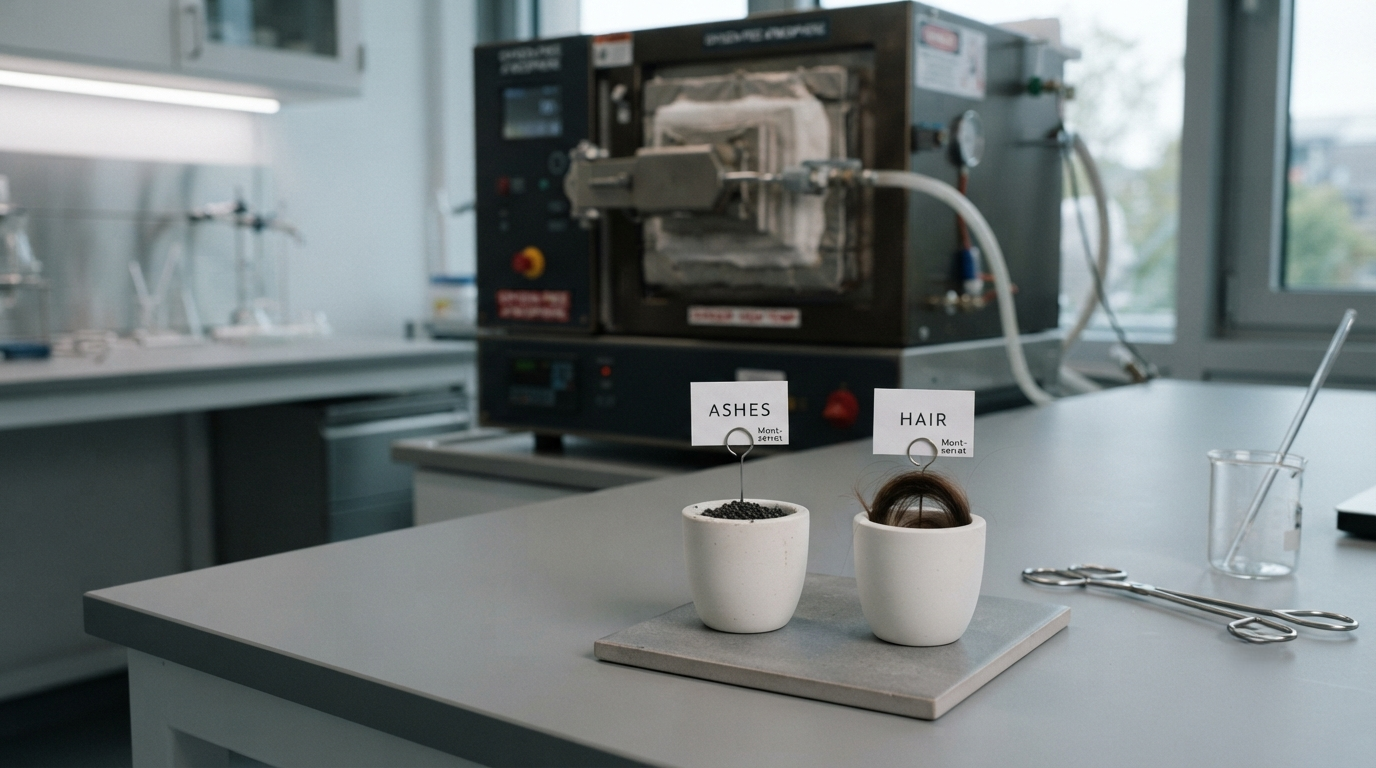
Neither is wrong for a diamond made from your wife’s ashes and hair. The case for separate runs is information: a carbon weight for the ashes and a carbon weight for the hair, which is the only way to answer Addition 3 with a number rather than an estimate.
The case for a joint run is simplicity. For a diamond made from your wife’s ashes and hair, the question to ask is “which do you do, and can you tell me the recovered weight from each?” A provider who purifies jointly and cannot give per material weights is not doing anything improper, but they cannot then tell you what share of the personal carbon in a diamond made from your wife’s ashes and hair came from which material, and you should know that before you send anything.
Addition 2: Where Do the Two Carbons Meet?
In a diamond made from your wife’s ashes and hair, the two carbons meet after purification and before graphitization. That timing is not arbitrary, and it rules out the two alternatives families sometimes imagine.
- Not before extraction. Ash is mineral; hair is protein. Their extraction chemistries differ enough that running raw ash and raw hair together from the start risks the ash minerals contaminating the hair’s much richer carbon yield.
- After purification, before graphitization. Once both are 99.9%+ carbon, they are chemically the same substance. Combining them here means a single graphitization run, heating to roughly 2,500 to 2,700°C to convert the carbon to graphite, produces one uniform feedstock. That is the meeting point in a well run process.
- Not after growth. A diamond cannot be “added to.” Once the crystal has grown around its seed, no carbon from any source can be introduced. A stone grown from her ashes now cannot have her hair added later.
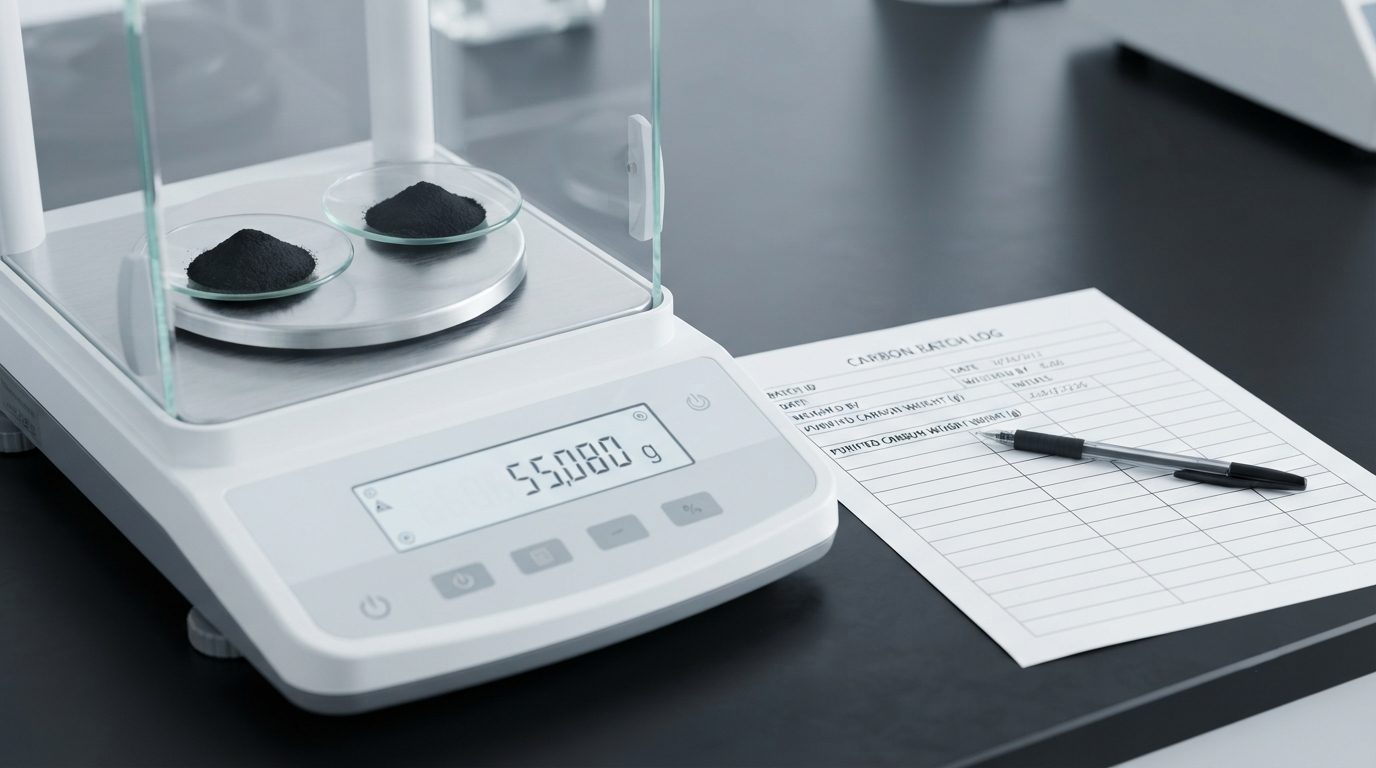
The practical consequence is that the moment the two carbons become one is a moment in the log. Ask that it be recorded: the date the purified ash carbon and hair carbon were combined, and the combined weight going into graphitization. From that point, a diamond made from your wife’s ashes and hair is chemically indistinguishable from any other memorial diamond entering the press, growth by HPHT at roughly 6 to 8 GPa and 1,400 to 2,500°C, or by CVD with a minority of providers, is described on the synthetic diamond page and does not know there were two sources.
Addition 3: Why the Hair Supplies Most of the Personal Carbon
This is the honesty a diamond made from your wife’s ashes and hair turns on, and it is better stated in numbers than in reassurance. Hair is roughly 50% carbon by weight. Ashes are almost entirely calcium phosphate, with usable carbon at roughly 0.5% to 4%. Put typical submission quantities next to each other:
| Material | Typical amount submitted | Carbon content | Approximate carbon recovered |
|---|---|---|---|
| Hair | A few grams, say 3 g | ~50% | Roughly 1.5 g |
| Ashes | A few tablespoons to ~4 oz, say 30 to 100 g | 0.5% to 4% | Roughly 0.15 to 4 g, most often at the lower end |
The figures are illustrative, not a provider’s promise, yields vary with the person, the cremation, and the process. But the shape is consistent: a few grams of hair contribute as much or more personal carbon than a much larger quantity of ashes. In a diamond made from your wife’s ashes and hair, the hair usually does most of the carbon work.
Three things follow, and none is a reason not to combine:
- Combining does not raise the personal share of the stone. Industry wide, the personal carbon in a finished memorial diamond is typically around 10% to 15% of its mass, some providers cite as low as 3%. Two sources are still blended with supplemental lab carbon to reach growth volume. A diamond made from your wife’s ashes and hair is not “more her” than a single material stone; it is her from two directions.
- The ashes are not a token. A smaller share is still a real, verifiable share. Carbon that was in her bones is in the lattice.
- The reason to combine is meaning, not chemistry. Hair is carbon she grew while alive; ashes are what remained. Some families want both in one crystal, and that is reason enough. Is a memorial diamond really made from your wife’s ashes and hair takes the skeptic’s version of this question seriously.
Ask the provider directly: “Roughly what proportion of the personal carbon will have come from the hair, and what from the ashes?” A provider who has made a diamond made from your wife’s ashes and hair before, or anyone’s, gives a range and explains that it depends on the amounts. “About half and half” describes a symmetry the chemistry does not support.
Addition 4: How a Good Lab Logs Both Materials as One Record
A chain of custody record is the logged, traceable trail from receipt to finished stone. For a diamond made from your wife’s ashes and hair, the risk is that two materials produce two records that are never firmly tied together, and at the end, the provider cannot show that both went into the same stone. A well kept two material record looks like this:
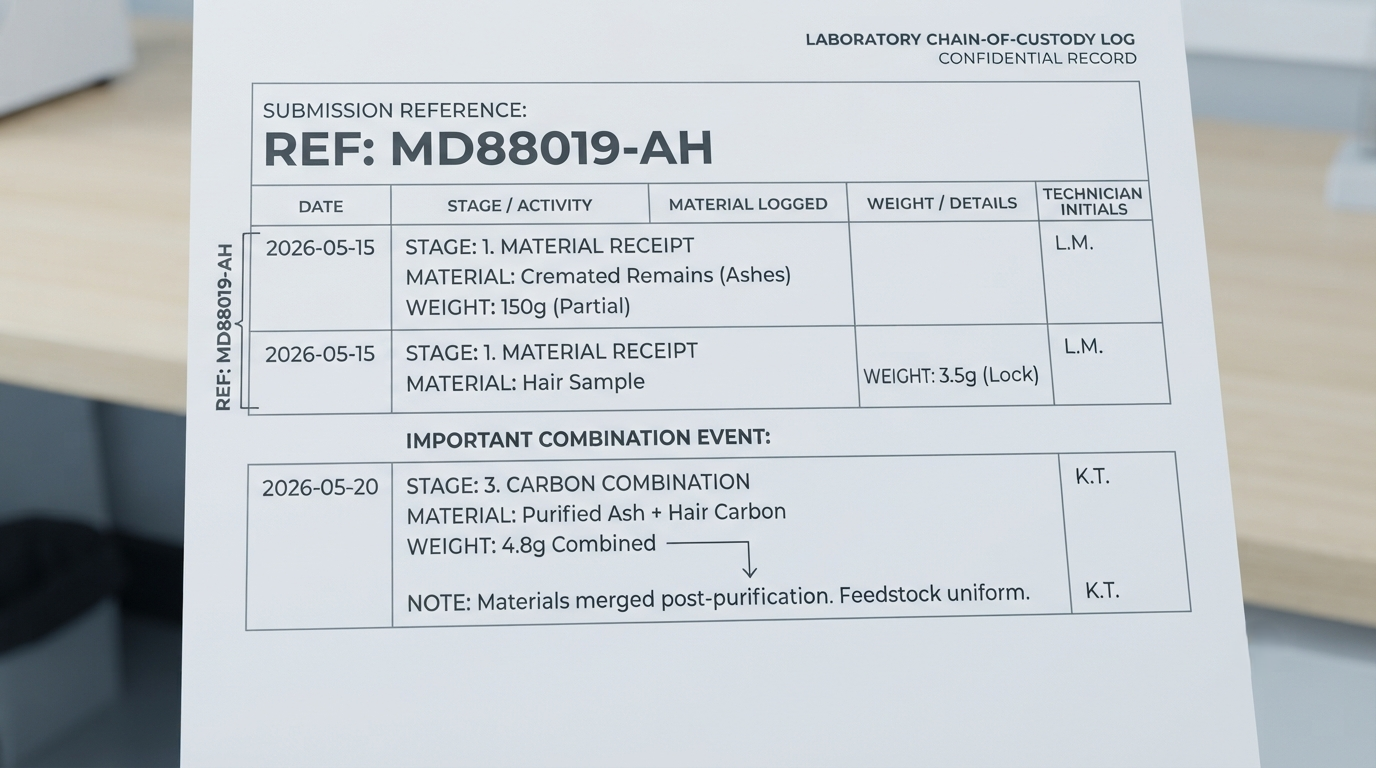
- One submission reference, assigned at receipt, covering both materials.
- Two receipt entries under that reference, ashes: weight received, container sealed; hair: weight received, envelope sealed.
- Extraction entries for each material, or one entry for a joint run, stating both went in, with recovered carbon weight.
- A combination entry, the date the two purified carbons were merged, and the combined weight, as described in Addition 2.
- A single graphitization entry, a single growth entry, and a single cutting entry from that point on, because there is now one feedstock and one crystal.
- Return of unused material of both kinds, logged, if you asked for it.
A poorly kept record logs “ashes, job 4471” and “hair, job 4472” and matches them up later from a spreadsheet. That is not fraud; it is a process built for single material stones being stretched to cover two. But it means the provider cannot prove, from the record alone, that your diamond made from your wife’s ashes and hair contains carbon from both submissions.
Before sending anything, ask: “Is a two material submission logged as one record or two, and is the combination step recorded?” The answer you want is one reference, two receipt lines, one combination entry. How to turn your wife’s ashes and hair into a diamond covers labeling and packaging both so the record starts cleanly from your form.
Addition 5: What the Origin Certificate Should Say
Two documents close every memorial diamond. The grading report, ideally from an independent laboratory using the cut, color, clarity, and carat standards GIA describes, assesses the stone as a diamond and does not care how many sources the carbon had. The origin certificate, issued by the provider, ends the custody record: it attests that this stone was grown from this submission.
For a diamond made from your wife’s ashes and hair, the origin certificate has to say so. At minimum it should carry:
- Her name, or the submission reference that ties to her name.
- Both materials, named, “cremated remains and hair,” not “cremated remains” alone with the hair implied.
- The submission reference that appears on both receipt entries.
- The date of receipt and the date of completion.
- Where the provider offers it, the approximate proportion of personal carbon from each source.
A certificate that names only the ashes does not record what you sent. This is easy to prevent and hard to fix: ask for the certificate’s wording in writing before either material leaves the house. If the provider’s template has one material line, ask for a two line certificate. Most will oblige; a provider who will not is telling you their process does not really distinguish a diamond made from your wife’s ashes and hair from a single material one, which is worth knowing before you commit two irreplaceable things.
Good Provider Answers vs Poor Ones, for a Diamond Made From Your Wife’s Ashes and Hair
Every addition on this page is a process question you can ask before sending anything. This table shows what an answer from a provider who understands a diamond made from your wife’s ashes and hair sounds like, against one that should prompt more questions.
| Process question | An answer that shows they understand a combined stone | An answer that should prompt more questions |
|---|---|---|
| Separate or joint purification? | “Separate, so we can give you the recovered carbon weight from each.” Or: “Joint; we can’t give per material weights but we log both going in.” | “It all goes in the furnace together.” (No weights, no logging) |
| Where do the two carbons meet? | “After both are purified, before graphitization. The combination is a logged step with a date and weight.” | “Somewhere in the process, it doesn’t really matter.” |
| Which material supplies most of the carbon? | “Usually the hair, by a wide margin, hair is about half carbon, ash a few percent at most. We can give a range once we have the weights.” | “About half and half.” Or: “The diamond is 100% her.” |
| How is the submission logged? | “One reference, two receipt entries, one combination entry, then a single record through growth.” | “Two jobs; we match them up at the end.” |
| What will the certificate say? | “It names both materials and the submission reference. Here is the wording.” | “It says cremated remains; the hair is understood.” |
| What happens to unused material? | “Returned, both kinds, logged. Tell us at the start.” | “We use what you send.” |
None of the right hand answers is disqualifying on its own. Two or three together mean the provider has not thought about what a diamond made from your wife’s ashes and hair needs that a single material stone does not. Questions to ask before turning your wife’s ashes and hair into a diamond puts these six beside the questions about cost, timing, and family.
What Combining Does Not Change
It is worth being explicit, because families sometimes hope otherwise. A diamond made from your wife’s ashes and hair matches a single material stone in all of these:
- Carat. Set by growth time in the press, not by the amount or number of materials. Two sources do not make a larger stone.
- Color. Trace nitrogen produces yellow to champagne; trace boron produces blue; colorless needs extra processing and costs more; red, pink, green, and black come from irradiation. Two sources do not shift the odds predictably. What color a diamond made from your wife’s ashes and hair will be covers the choice.
- Timeline. 6 to 10 months across the industry, up to 12 for large or black stones. A second extraction run adds days at most.
- Cost. Most providers price by carat, color, cut, and grading rather than by material. Some add a modest processing fee for two extraction runs; ask for it as a separate line. General 2026 industry ranges, not Memorial Diamond’s published pricing, run roughly $1,500 to $3,500 for 0.10 to 0.25 ct, $5,000 to $15,000 for 0.5 to 1 ct, and $20,000 to $75,000+ above 2 ct.
One thing a diamond made from your wife’s ashes and hair does change, outside the laboratory: you are sending two irreplaceable things at once. The ashes can usually be partly kept because they exist in quantity; the lock may be the only hair of hers you have. Divide it before it goes. How much ash and hair you need for a wife memorial diamond covers the combined minimum, which is often less of each than the two standalone figures.
Frequently Asked Questions
At what point in the process are her ashes and hair combined?
After each has been purified to 99.9%+ carbon and before graphitization. Combining them there means one graphitization run produces a single uniform graphite feedstock for the press. A good laboratory logs the combination as a dated step with the combined weight recorded.
Should the ashes and hair be purified together or separately?
Either produces the same purity. Separate runs give you a recovered carbon weight for each material, which is the only way to know what share of the personal carbon came from the hair versus the ashes. Ask which the provider does and whether per material weights are available.
Does a diamond made from your wife’s ashes and hair contain more of her than a single material stone?
No. The personal carbon in any memorial diamond is typically around 10% to 15% of the stone, blended with lab carbon to reach growth volume. Combining two sources does not raise that share; it means the personal carbon came from two places rather than one.
Which material contributes more carbon?
Almost always the hair. Hair is roughly 50% carbon by weight; ashes are 0.5% to 4%. A few grams of hair typically recovers as much or more carbon than a much larger quantity of ashes. A provider who has done this can give you a range once the weights are known.
How should a two material submission be logged?
Under one submission reference, with separate receipt entries for the ashes and the hair, extraction entries with recovered weights, a dated combination entry, and a single record from graphitization onward. Two unrelated job numbers matched up later is the pattern to avoid.
What should the origin certificate say?
It should name both materials, cremated remains and hair, alongside the submission reference and dates, and, where the provider offers it, the approximate proportion of personal carbon from each. Ask for the certificate’s wording in writing before either material leaves the house.
Final Thoughts on a Diamond Made From Your Wife’s Ashes and Hair
Five additions, and every one is answerable before anything is shipped: how the two are purified, where they meet, which did most of the work, how the record is kept, and what the certificate will say. None changes the stone. A diamond made from your wife’s ashes and hair is the same carat, color, timeline, and cost as one made from either alone, what changes is that carbon she grew while living and carbon that remained afterward sit in one lattice, and that you have a record proving both are there. Ask the five questions, keep some of each, and the rest of the process is the same patient wait it always is.
Learn More About Wife Memorial Diamonds
- Wife Ashes and Hair Diamond: The Complete Guide
- How a Memorial Diamond Is Made From Your Wife’s Ashes
- How a Memorial Diamond Is Made From Your Wife’s Hair
- How to Turn Your Wife’s Ashes and Hair Into a Diamond
- Is a Memorial Diamond Really Made From Your Wife’s Ashes and Hair?
Talk With Memorial Diamond
If you hold both materials and want the five process answers above, how the two are purified, where they meet, the likely proportion from each, how the record is kept, and the certificate wording, reach out to Memorial Diamond before either leaves the house.
Word count: 3,180 · Reading time: about 16 minutes
Leave A Comment