Sister Hair Diamond  Discover 14 Reassuring Checks

Questions to Ask Before Turning Your Sister’s Hair Into a Diamond

It might be a lock tied with thread or strands still caught in the brush she used every morning. The sister hair diamond questions to ask before that hair becomes a stone cover three important areas: the hair itself, the people who have a say over her belongings, and the provider. You need to understand what hair the provider accepts, how it tracks and processes the sample, what it can document about the carbon used, and which records you will receive.
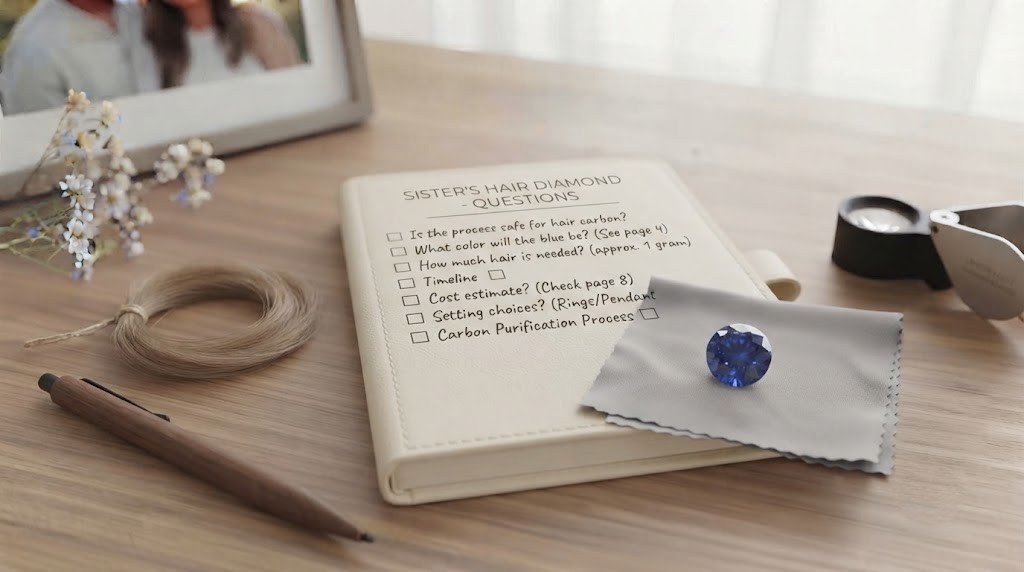
sister hair diamond questions

Table of Contents

Why Do Sister Hair Diamond Questions Begin With the Hair Itself?

Hair is a different starting point from ashes in several practical ways. It is made primarily of keratin and is often described as roughly 50% carbon by weight. Providers may need only a small lock or a few grams, although the amount varies by company and process.

Hair also does not require cremation. A hair based memorial diamond may therefore be an option whether your sister was cremated or buried.

That flexibility makes the first sister hair diamond questions especially important. Where did the hair come from? Are you certain it belonged to her? Who else may feel connected to it? Those answers should come before the sample reaches a laboratory.

For a broader introduction to memorial diamonds, or the complete picture of a sister hair diamond from start to finish, explore those guides first. This article focuses on the questions that help you evaluate the decision and the provider.

Which Sister Hair Diamond Questions Should You Settle Before Calling Anyone?

These first three questions are about the hair and your own expectations. A laboratory cannot make these decisions for you.

1. Am I Certain This Hair Is Hers?

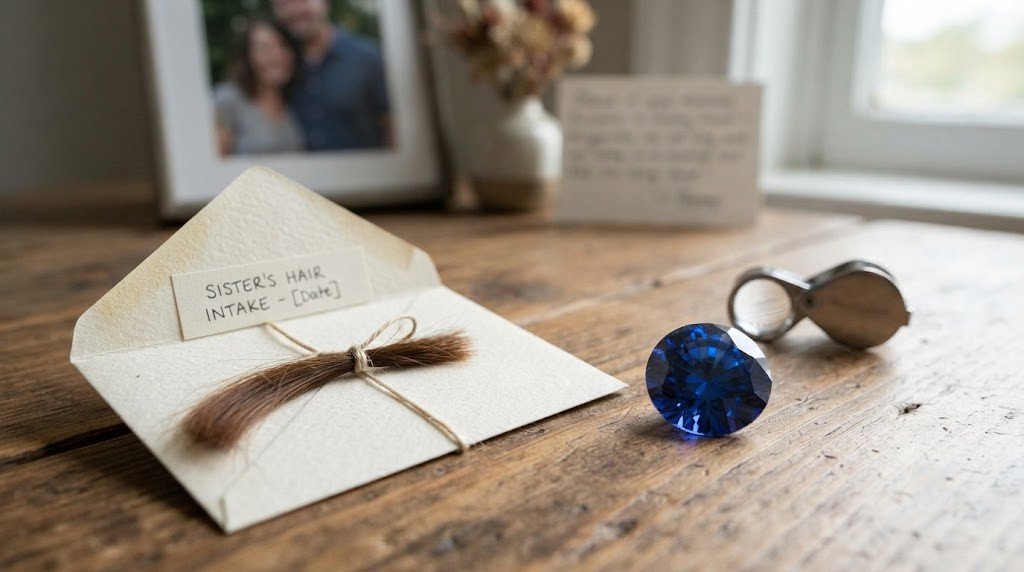
A saved lock or braid may have a clear history. Hair collected from a brush, hat, or pillowcase can be less certain, particularly if other people used the same items.

If the hair came from another person, its carbon would not be exclusively from your sister. Establishing its source is therefore an important first step.

A reassuring answer: “This lock was collected at the funeral home and has been stored in a labeled envelope.”

An unclear answer: “It was in the bathroom drawer, so it is probably hers.”

If the source is uncertain, ask the provider whether the sample is suitable before sending anything.

2. How Much Hair Do I Have, and How Much Do I Want to Keep?

Providers set their own sample requirements. Some request a small lock, while others specify a quantity by weight. Check the requirements before packaging the hair.

If the lock is irreplaceable, consider how much you want to preserve untouched. You do not necessarily need to send the entire keepsake.

Read how much hair a sister memorial diamond may need for more information.

A reassuring answer: “I will send the amount the provider requests and keep the rest of the braid.”

An unclear answer: “I will send everything and decide later.”

Sending more hair does not automatically make a diamond larger or shorten its growth time.

3. What Do I Want the Stone to Be, and What Can I Spend?

Think about how you would like to keep the diamond. You might want a small stone for a ring, a pendant, a shared family keepsake, or a loose stone to preserve safely.

Your preferred use will help guide the size, setting, and budget. Setting a spending limit before contacting providers can also make comparisons easier.

A reassuring answer: “I want a small stone for a ring, and I have a firm budget.”

An unclear answer: “I will decide after seeing whatever options are offered.”

It is fine to remain undecided, but ask for a clear explanation of the choices and costs before committing.

Who Should Hear Your Sister Hair Diamond Questions About Her Belongings?
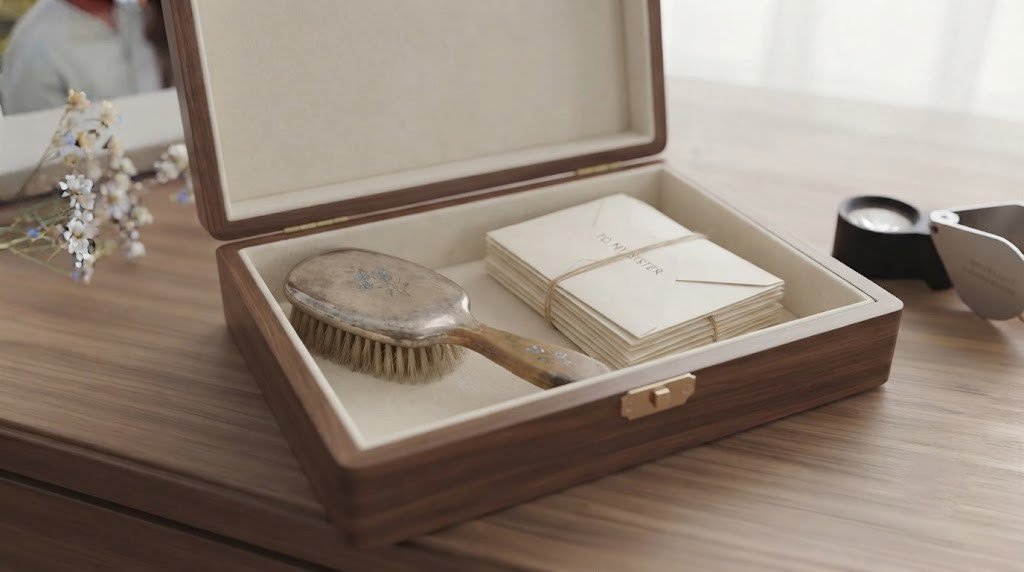
Hair often comes without formal paperwork, which can make this part easy to overlook. However, hair, a brush, or a keepsake box may be considered part of a person’s belongings or estate. The applicable rules vary by location and circumstance.

Speaking with the executor or the person responsible for your sister’s affairs before sending the hair is a considerate approach. If the situation is unclear, a qualified local legal professional can help clarify the relevant requirements.

4. Who Is Handling Her Estate, and Are They Comfortable With This?

The appropriate person may be a spouse or partner, an adult child, a parent, a sibling, or someone your sister named in writing. Do not assume that you automatically have authority, or that you do not.

Begin with a respectful conversation and explain why you want to use the hair.

A reassuring answer: “I spoke with the estate representative, and they agreed that I could use the saved lock.”

An unclear answer: “Nobody will mind.”

Getting agreement early helps protect family relationships and prevents misunderstandings later.

5. Does Anyone Else Want to Keep the Hair or Have a Stone of Their Own?

A small lock may sometimes be enough for more than one order, depending on the provider’s requirements. However, some relatives may prefer that the hair remain untouched.

Discuss these possibilities before sending the sample. If several relatives want to share a diamond, agree on ownership and future arrangements in writing.

A reassuring answer: “We agreed that I can send part of the lock and that the remaining hair will stay in the keepsake box.”

An unclear answer: “I will tell everyone after the diamond is finished.”

It is generally easier to discuss the plan before ordering than to explain a completed stone to someone who was never consulted.

Does Using Hair Change the Conversation About Cremation?

It can. Hair can be collected without cremation, so a hair based memorial diamond may be considered by families whose sister was buried or whose beliefs or preferences ruled out cremation.

Religious views about cremation, remains, and keepsakes differ across traditions and individual circumstances. Using hair avoids the cremation step, but it does not automatically resolve every religious or family concern about transforming a person’s hair into a diamond.

If faith is important to your family, consider speaking with your own faith leader before making the decision.

If your family also has your sister’s ashes and would like both materials included in one stone, read the questions for a sister ashes and hair diamond. For a process focused on ashes alone, see the sister ashes diamond questions guide.

Which Sister Hair Diamond Questions Should a Provider Answer in Writing?

The following nine questions are for the company that may grow your diamond. Request written answers before sending hair or paying for an order.

For a step by step overview, read how to turn your sister’s hair into a diamond.

6. What Hair Do You Accept, and How Much Do You Need?

Providers may have different requirements for cut locks, loose strands, or hair collected from a brush. They may also ask about dye, perms, styling products, or other treatments.

Ask the provider to specify the accepted sample type, quantity, condition, and what happens if the sample does not meet its requirements.

A reassuring answer: A written explanation of the accepted hair, required amount, and procedure for insufficient samples.

An unclear answer: “Just send whatever you have.”

Asking first can help protect a keepsake that cannot easily be replaced.

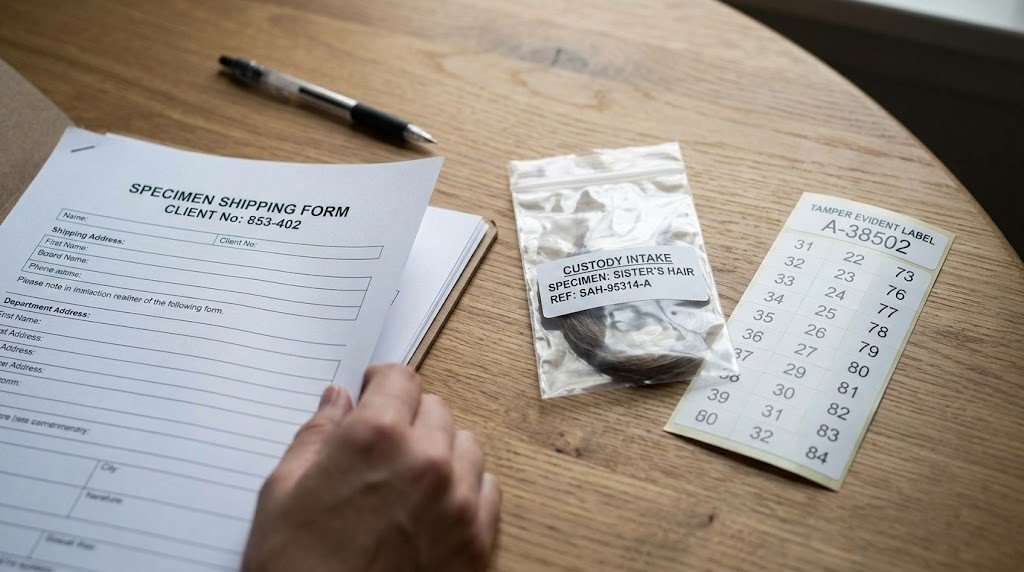
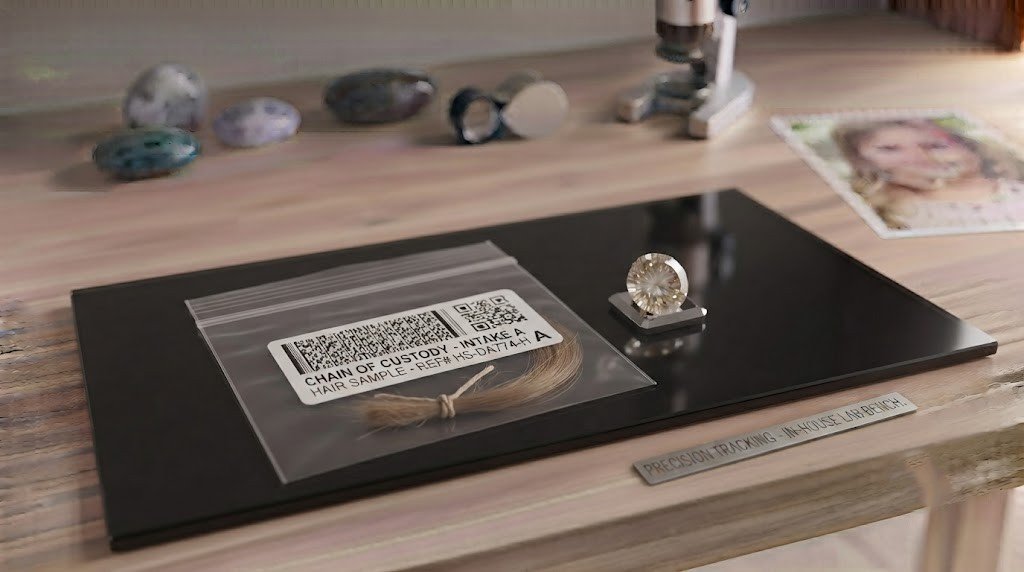
7. How Will Her Hair Be Labeled and Tracked From Arrival Onward?

A small sample can be difficult to identify if the provider does not have a clear intake procedure. Ask how the sample is labeled when it arrives and how its identity is maintained through each stage.

A reassuring answer: The provider explains its intake reference, record keeping, and how it confirms receipt.

An unclear answer: “We are a small team, so nothing gets lost.”

Questions about sample tracking deserve the same care as questions about the finished diamond.

8. Will Her Hair Be Processed Separately From Other Customers’ Samples?

Tracking and processing separation are two different safeguards. A sample might be labeled correctly while still being processed alongside material from other customers.

Ask the provider to explain whether hair is purified in a dedicated run or handled through another process. Also ask what procedures it uses to prevent sample mix ups.

A reassuring answer: A specific explanation of its processing arrangements and contamination controls.

An unclear answer: “We handle everything carefully.”

The important thing is to understand the actual procedure rather than relying only on general reassurance.

9. What Share of the Stone Do You Expect to Be Her Carbon, and How Will You Verify It?

Hair contains carbon, but the amount of usable carbon recovered depends on the preparation process. Providers may supplement the recovered carbon with laboratory carbon to obtain enough material for growth.

There is no universally published percentage establishing how much of a finished hair based diamond comes from the original hair by mass. Figures sometimes quoted for ash based diamonds should not automatically be applied to hair.

Ask what the provider expects for your chosen stone and what records it can supply. Useful details may include the weight of hair received, the carbon recovered, and whether supplemental carbon is used.

A reassuring answer: A clear explanation of what can be measured and documented, with an expected range if the provider can substantiate one.

An unclear answer: “The diamond is basically all her.”

For more detail about the process, read how a memorial diamond is made from your sister’s hair.

10. Will the Color Come From Growth or Treatment, and Will You Tell Me Which?
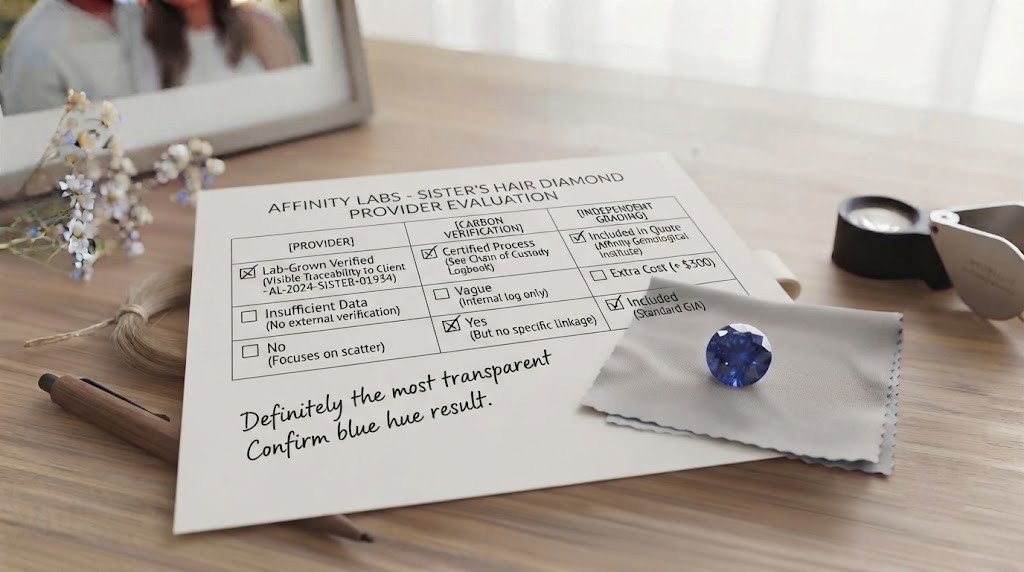
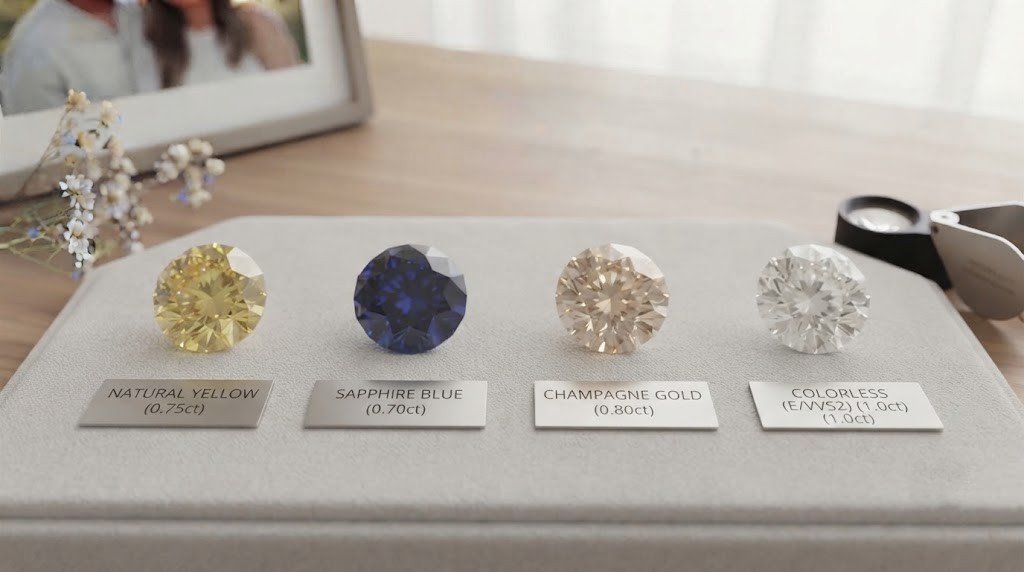
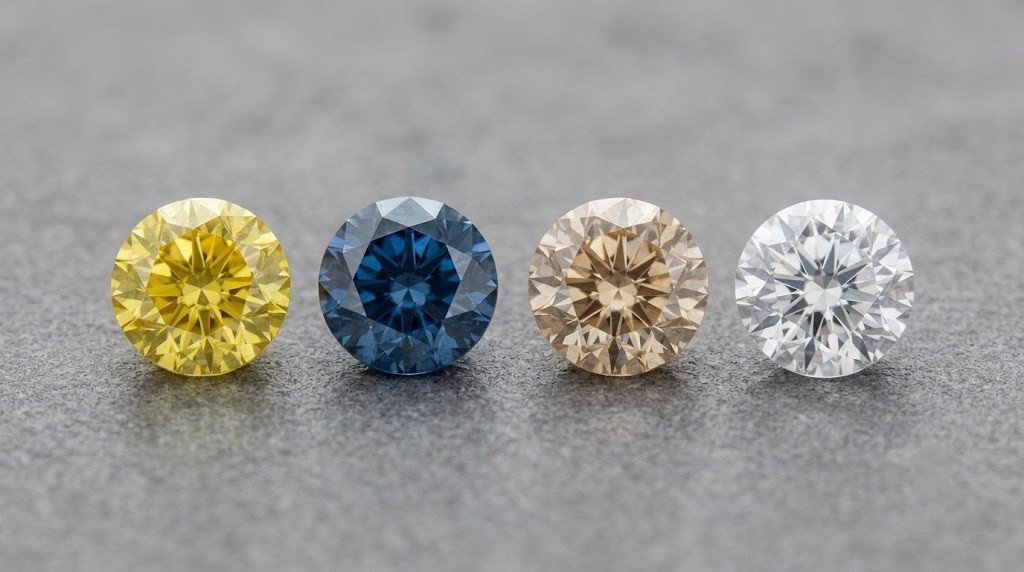
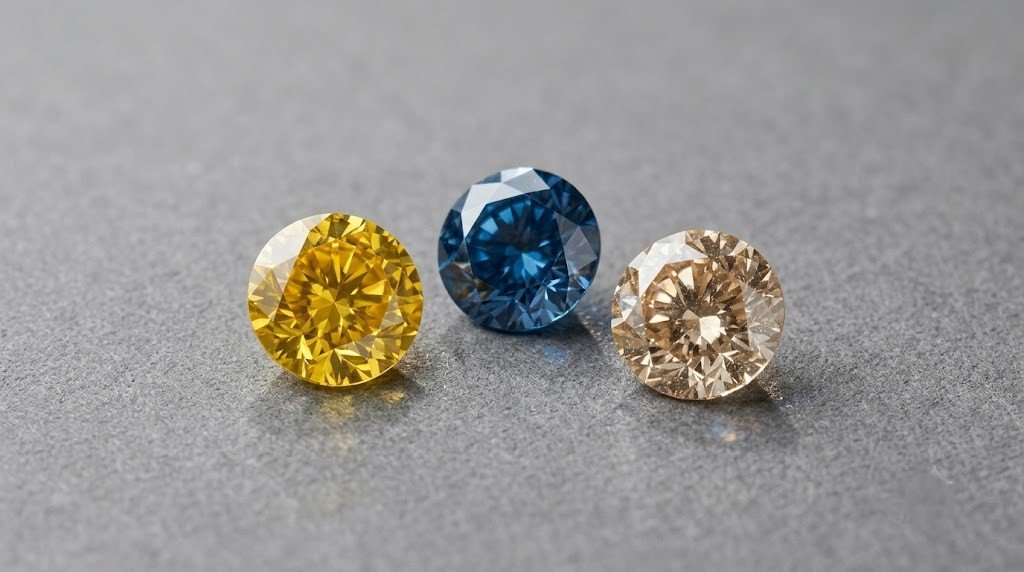
Trace elements and growth conditions can influence a diamond’s color. Nitrogen can contribute to yellow coloration, while boron can produce blue coloration. Some providers offer post growth treatments that can change a stone’s appearance.

Ask the provider to explain which colors may occur naturally through its process, whether it offers treatments, and how any treatment will be disclosed.

A reassuring answer: The provider distinguishes natural growth color from treated color and explains how the distinction will appear in the paperwork.

An unclear answer: “Hair produces a softer, lighter color.”

The finished color cannot be reliably predicted from the shade of your sister’s hair. It also does not tell you anything about her personality.

Read what color a diamond from your sister’s hair might be for more information.

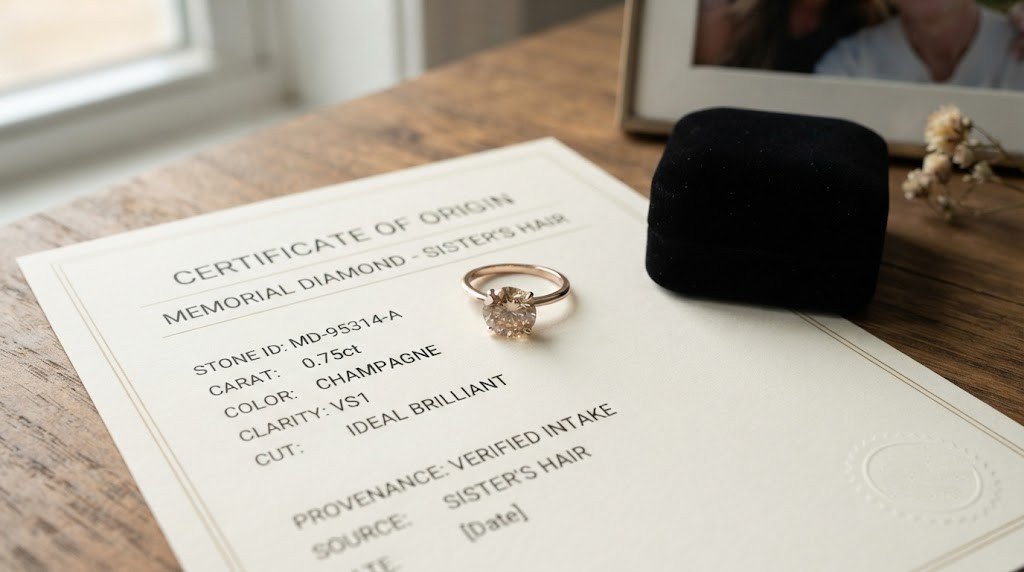
11. Do I Receive an Origin Certificate, an Independent Grading Report, or Both?

An origin certificate is generally intended to connect the diamond with the submitted material and order. Its scope depends on the provider.

An independent grading report evaluates characteristics of the diamond itself, which may include cut, color, clarity, and carat.

These documents serve different purposes. Ask which documents are included, which organization prepares any independent report, and whether additional fees apply.

A reassuring answer: The provider names the report or laboratory and lists any extra charge in the quote.

An unclear answer: “All our stones come certified.”

Ask to see a sample document before ordering so you understand exactly what it establishes.

12. If a Growth Run Fails or the Stone Fractures During Cutting, What Happens Next?

Diamond growth and cutting involve technical processes, and a provider should explain its policy for problems that may arise.

Because the hair sample may be irreplaceable, ask whether any source carbon is reserved, whether another growth attempt is possible, what it costs, and how the timeline might change.

A reassuring answer: A written policy explaining the possible next steps, costs, and treatment of any remaining material.

An unclear answer: “We have never had a problem.”

Asking about a failure policy is a practical way to understand the terms before you commit.

13. What Happens to Any Hair You Do Not Use?

Unused hair may be personally important, especially if it is the last keepsake available. Decide whether you want it returned, stored for a specified period, or handled another way.

Ask how the provider will carry out your preference and whether any return or storage fees apply.

A reassuring answer: A written policy specifying how unused hair is returned or stored.

An unclear answer: “Leftovers are handled responsibly.”

Make sure you understand the arrangement before sending the sample.

14. Can I Have a Full Written Quote, and When Exactly Does the Timeline Start?

The price of a memorial diamond depends on the size, color, cut, provider, and additional services. These broad 2026 industry estimates are for planning purposes only and are not confirmed prices from Memorial Diamond:

  • 0.10 to 0.25 carat: approximately $1,500 to $3,500.
  • 0.50 to 1.00 carat: approximately $5,000 to $15,000.
  • 2 to 5 carats or larger: approximately $20,000 to $75,000 or more.

Colorless processing may cost more than a naturally tinted option. Independent grading, engraving, special cuts, and jewelry settings may also be charged separately.

A broad industry timeline is approximately six to ten months after the provider receives the required material. Larger stones and specialty colors may take longer. These estimates are not delivery promises.

A reassuring answer: An itemized quote that lists the total cost, additional fees, the event that starts the timeline, and an estimated completion date.

An unclear answer: “Prices start at $1,500, and it usually takes about six months.”

Read the quote carefully before signing or paying.

Which Answers to Sister Hair Diamond Questions Should Make You Wary?

One unclear answer does not automatically prove that a provider is dishonest. However, these warning signs deserve follow up questions and written clarification.

  1. The provider claims the stone contains only your sister’s hair carbon without explaining its process.
  2. It applies a percentage quoted for ash based diamonds to hair based diamonds without evidence.
  3. It has no clear procedure for checking whether hair from a brush belongs exclusively to your sister.
  4. It promises a specific or lighter color based on her hair shade.
  5. It cannot explain whether samples are processed separately or how mix ups are prevented.
  6. It presents an origin certificate as though it were an independent grading report.
  7. It has no written policy for failed growth, damaged stones, or unused hair.
  8. It pressures you to decide quickly or uses guilt to encourage a purchase.
  9. It avoids providing an itemized quote or a clear timeline.

A trustworthy provider should be willing to explain its process, acknowledge what cannot be guaranteed, and document important terms.

What Does a Good Answer to Sister Hair Diamond Questions Look Like?

Use this comparison table while speaking with providers. Record the answers and compare them before making a decision.

QuestionWhy it mattersA useful answer includesA vague answer sounds like
What hair do you accept?Requirements varyAccepted type, quantity, and condition“Send whatever you have”
How is the sample tracked?Small samples can be difficult to identifyIntake reference and record keeping“Nothing gets lost here”
Is the hair processed separately?Labels alone do not explain processingA clear process and safeguards“We are careful”
What share is her carbon?No universal finished stone percentage exists for hairWhat can be measured and documented“It is basically all her”
How is color handled?Natural and treated colors differProcess explanation and written disclosure“Hair gives lighter colors”
What documents are supplied?Origin and grading reports differDocument names and applicable fees“Fully certified”
What if growth or cutting fails?The sample may be irreplaceableWritten policy and possible costs“It has never happened”
What happens to unused hair?It may be a valuable keepsakeReturn or storage arrangements“Handled responsibly”
What is the total cost and timeline?Extras and start dates varyItemized quote and estimated completion“From $1,500, about six months”

Frequently Asked Questions

Can Hair That Was Cut Years Ago Still Be Used?

It may be possible, but the provider should confirm whether the sample is suitable. Keep it dry, labeled, and away from direct sunlight while you decide. Tell the provider how long it has been stored and whether you know of any products or treatments on it.

Can a Lock Be Saved at the Funeral Home Before Burial or Cremation?

You can ask the funeral director before the service. Whether a lock can be collected depends on the circumstances, the funeral home’s procedures, and the appropriate person’s permission. Ask how it would be labeled and returned to you.

Do I Need Her Hair if I Already Have Her Ashes?

No. Depending on the provider, a memorial diamond may be made using ashes, hair, or a combination of materials. Hair may be an option for families who prefer not to use ashes or whose sister was buried rather than cremated.

Should I Send All the Hair I Have?

Not necessarily. Send only the amount the provider requests and consider keeping the rest as a keepsake. More hair does not automatically create a larger or faster growing diamond.

How Should I Store Her Hair While I Decide?

Keep it dry in a clean, labeled envelope or container, away from direct sunlight and moisture. Avoid washing or treating it unless the provider specifically instructs you to do so. Ask the provider whether it has any additional storage recommendations.

Final Thoughts on Asking About Her Hair

Her hair may weigh only a few grams, but the decision to turn it into a diamond can carry considerable meaning. Taking your sister hair diamond questions slowly is a way to respect that meaning.

Start by confirming the source of the hair and considering what you want to preserve. Speak with the appropriate family or estate representative, then ask the provider to explain its process, documentation, costs, and policies in writing.

If the answers reassure you, you can move forward with a clearer understanding of what you are choosing. If they do not, keeping the lock exactly as it is remains a meaningful way to remember your sister.

Learn More About Sister Memorial Diamonds

Talk With Memorial Diamond

If you have your sister’s hair and want to understand the possibilities, visit Memorial Diamond. Before placing an order, ask about accepted samples, documentation, color, costs, and the handling of unused material. Take the time you need to make a decision that feels right for you and your family.
What Color Will a Diamond Made From Your

What Color Will a Diamond Made From Your Sister’s Hair Be?

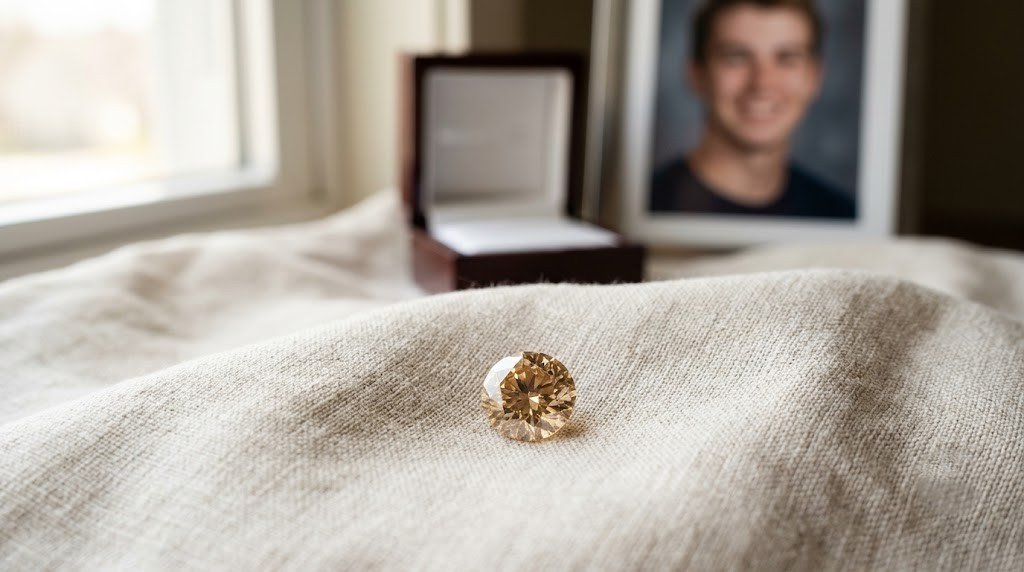
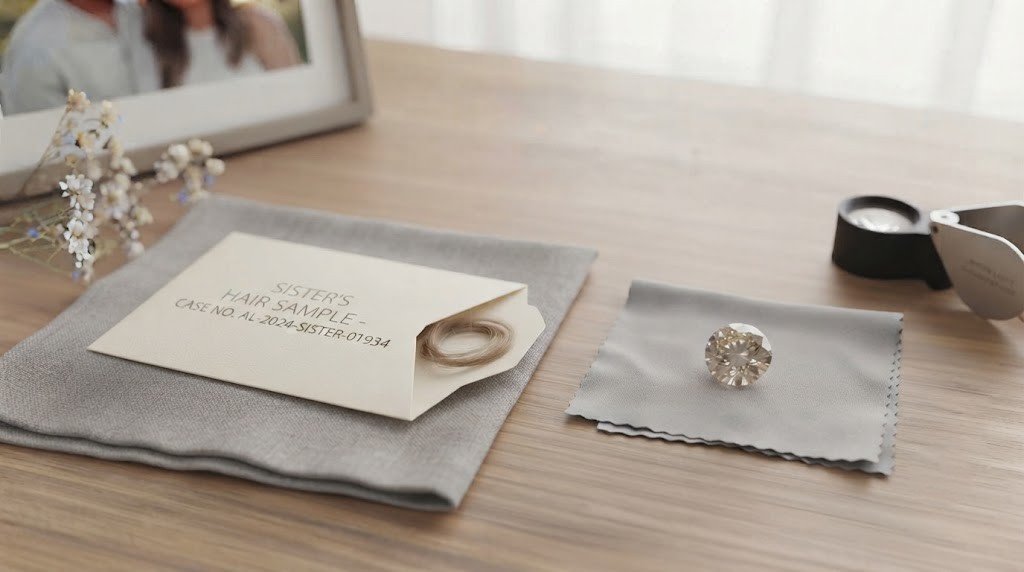
Perhaps it is a lock tucked into an envelope, or a cutting someone thought to save after she died. The sister hair diamond color you end up with cannot be predicted with certainty. The tint forms during crystal growth, so a stone grown using carbon from her hair may turn yellow, blue, or champagne. A colorless result may be possible with additional processing. The shade of her hair does not determine the diamond’s final color.

sister hair diamond color

Is There Any Way to Know the Sister Hair Diamond Color Before Growth?

No. A lock of hair cannot reliably tell you the exact color of the finished diamond. The sister hair diamond color develops as the crystal grows, and trace elements can influence the result.

Nitrogen can contribute to a yellow tint, while boron can produce blue coloration. When coloring impurities are sufficiently limited, a diamond may appear colorless. The outcome depends on the growth process, the carbon preparation, and the conditions inside the growth system.

A responsible provider should explain the possibilities without promising a specific shade before the stone has been grown. If a company guarantees an exact color based only on the appearance of your sister’s hair, ask for the scientific basis and written terms behind that claim.

Remember that the finished color is not a portrait of your sister’s personality. A blue diamond does not mean she was calm, and a yellow diamond does not represent a particular character trait. Its meaning comes from your memories of her, not from a color chart.

Does Her Hair Shade Set the Sister Hair Diamond Color?

The short answer is no. Red, black, blonde, gray, or salon colored hair does not determine the diamond’s final tint.

During preparation, hair is processed to obtain carbon suitable for diamond growth. The original hair pigment does not simply carry over into the finished stone. The sister hair diamond color develops later, during the growth process.

There is also no reliable basis for claiming that hair automatically produces a lighter, whiter, or more predictable diamond than ashes. The final appearance depends on the growth process and the provider’s methods, not simply on whether the starting material was hair or cremated remains.

If your sister’s hair was dyed, permed, or chemically straightened, tell the provider before sending it. Companies may have different rules for treated hair and may request additional preparation or a different sample. Ask for the provider’s requirements in writing.

Where Can the Hair Come From, and Who Should Agree to Its Use?

Hair does not require cremation. Depending on the provider’s requirements, a saved lock or a cutting collected before burial may be suitable. This can be an option for families who did not cremate their sister or who have already made separate arrangements for her ashes.

Possible sources include:

  • A lock saved after a haircut.
  • Hair preserved by a family member.
  • A small cutting collected before burial or cremation, if arrangements allow.
  • Loose hair from a brush or comb, if the provider accepts it.

Providers may request a small lock or a few grams, but the exact quantity varies. Read how much hair a sister’s diamond may need for more information.

It is also important to establish who can authorize the use of the hair. If it is among your sister’s belongings, it may be subject to estate arrangements and applicable local rules. Speak with the executor or the person responsible for her affairs when appropriate. If a relative has kept the hair, discuss its intended use directly with them.

Taking care of permission first allows the later conversation about sister hair diamond color to focus on the stone itself.

If faith is important to your family, consider asking a trusted faith leader about any concerns involving keepsakes or memorial practices. Views can differ across traditions, denominations, and individuals.

How Does Keratin Become the Carbon That Takes On Color?

Hair is made primarily of keratin, a protein containing carbon. Hair is often described as roughly 50% carbon by weight, although its exact composition can vary. This carbon content helps explain why a relatively small amount of hair may be sufficient for a provider’s process.

The provider processes the material to obtain carbon suitable for diamond growth. The preparation may involve high temperatures and controlled conditions to remove other substances. The resulting carbon can then be prepared for the growth process.

Providers may combine the prepared carbon with supplemental laboratory carbon to obtain enough material for the selected diamond. There is no universal published percentage that establishes how much of every hair grown diamond comes from the original hair by mass. Ask the provider what it can document about the source material and its process.

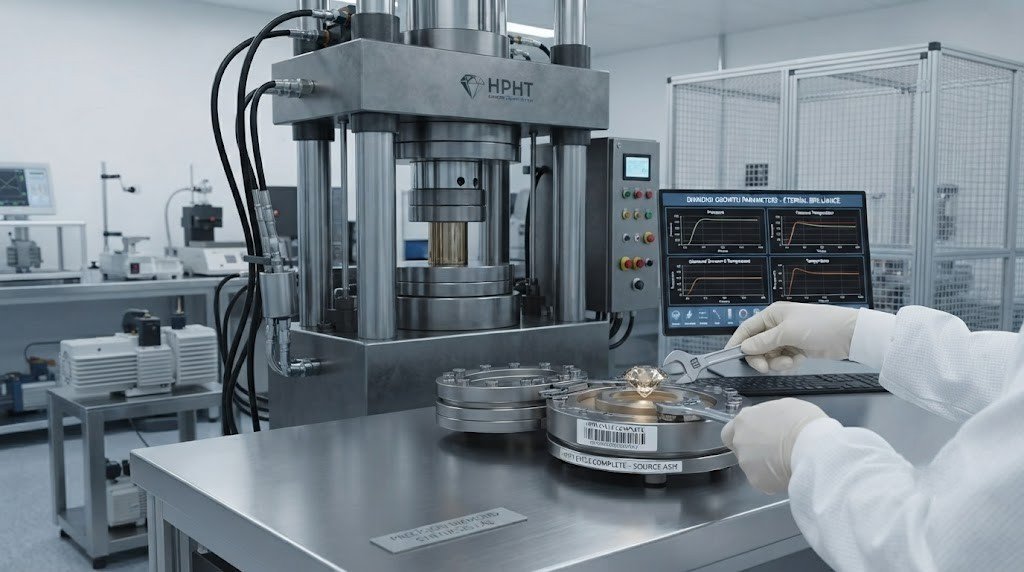
Laboratory grown diamonds can be produced using methods such as high pressure high temperature, known as HPHT, or chemical vapor deposition, known as CVD. The method used depends on the provider.

For a fuller explanation, read the complete guide to a sister hair diamond.

The key point is that the original hair shade does not determine the sister hair diamond color. The tint develops during the diamond growth process.

Which Tints Turn Up, and What Causes Each One?

Memorial diamonds may appear in a range of colors. The exact outcome cannot be predicted reliably from the source material alone.

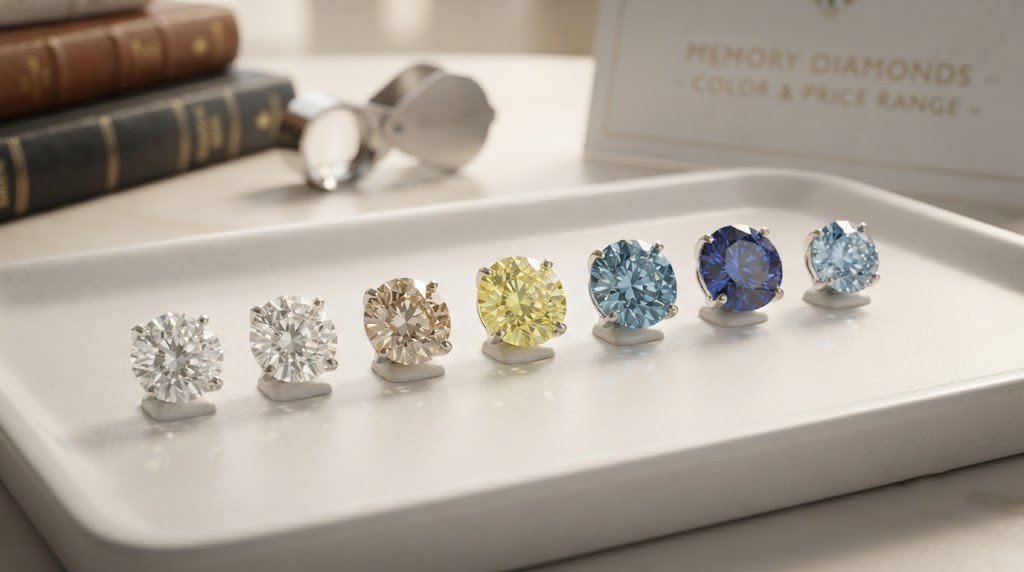
Possible colorGeneral explanationWhat to know
YellowNitrogen can contribute to yellow colorationThe intensity can vary
BlueBoron can contribute to blue colorationThe shade is not something to assume in advance
Champagne or brownTrace elements and growth conditions may influence warm tonesNatural shades can vary in depth
ColorlessAchieving a colorless result may require more controlled processingIt can cost more
Red, pink, green, or blackSome providers offer post growth color treatmentTreatment should be disclosed in writing

A natural tint is not automatically a flaw. What matters is whether you understand the available options and choose a result that feels meaningful to you.

See memorial diamond colors for a sister for more information about natural and treated shades.

If your family is also considering ashes, read what color a diamond made from your sister’s ashes might be.

Should You Pay Extra for Colorless Over a Natural Sister Hair Diamond Color?

That depends on your preferences and budget. Some families prefer a classic colorless appearance, while others appreciate the possibility of a natural yellow, blue, or champagne tint.

A colorless diamond may require additional processing and can cost more than a tinted stone of comparable size. The difference depends on the provider, the diamond specifications, and the services included in the quote.

The following figures are broad industry estimates for planning purposes, not confirmed prices from Memorial Diamond:

  • About 0.10 to 0.25 carat: approximately $1,500 to $3,500.
  • About 0.50 to 1.00 carat: approximately $5,000 to $15,000.
  • About 2 to 5 carats or larger: approximately $20,000 to $75,000 or more.

Colorless processing may increase the price, and independent grading, engraving, special cuts, and jewelry settings may cost extra. Ask the provider for a current, itemized quote for your chosen size and color preference.

The production timeline also varies. A broad industry estimate is six to ten months after the required material is received, with some larger stones or specialty color requests taking longer. Confirm the expected timeline directly with the provider.

You can also read how much a sister memorial diamond costs to compare size, color, and setting considerations.

There is no universally correct choice. You may prefer the classic look of a colorless stone, or you may feel connected to a natural tint. Either can become a meaningful keepsake.

Can Irradiation Change a Sister Hair Diamond Color?

Some providers offer post growth irradiation, a treatment that can alter a diamond’s color. Depending on the process, treated stones may appear red, pink, green, or black.

The treatment changes the way the crystal interacts with light. It does not change where the original carbon came from.

If a provider offers treated colors, ask for written disclosure explaining the treatment. Confirm how it will appear on the invoice and any grading documentation.

You should also ask whether the treatment has any implications for future jewelry repairs or resizing, particularly when heat may be involved. A qualified jeweler can explain any precautions relevant to the specific stone.

Do not assume every provider offers every treated color or that a particular shade can be guaranteed.

Which Papers Record the Color, and Which Prove the Hair Was Hers?

Two types of documents may serve different purposes.

Origin or authenticity documentation

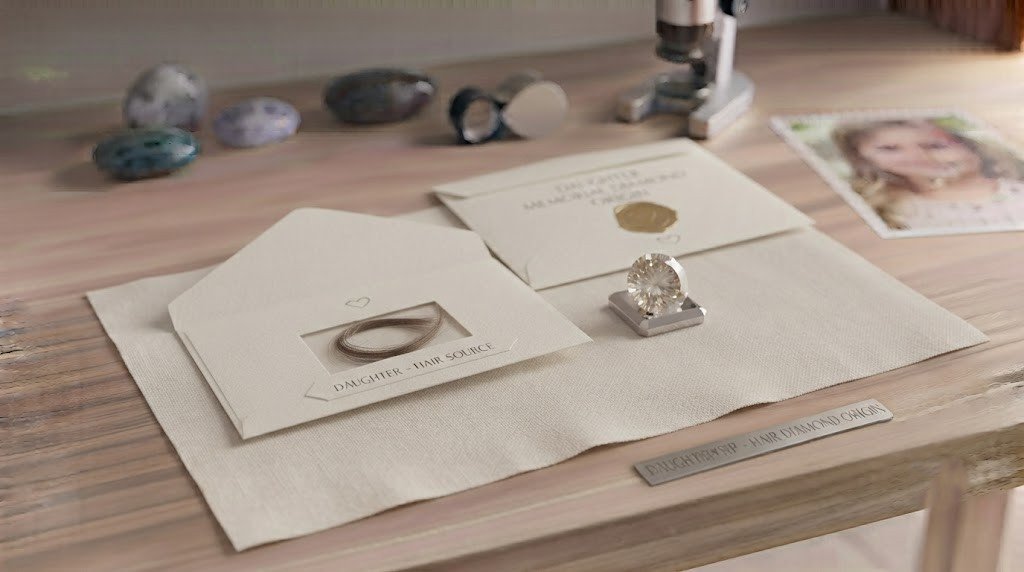
This document may be issued by the provider and is intended to connect the finished diamond with the submitted material and order. Ask whether it will identify your sister’s hair, the order reference, and the relevant intake records.

An origin document does not necessarily provide an independent assessment of the diamond’s quality or color.

Independent grading report

A grading report evaluates characteristics of the diamond, which may include carat weight, color, clarity, and cut. The exact format and terminology depend on the grading laboratory and the service selected.

Learn more about how the four diamond quality factors are judged.

Independent grading may be optional and may involve an additional fee. If you want the sister hair diamond color described by an independent laboratory rather than only by the company that grew it, ask whether an independent report is available and request an example before ordering.

Confirm how any color treatment will be disclosed. Keep the origin documentation, grading report if supplied, and order confirmation together.

If Several Siblings Order Stones From Her Hair, Will They Match?

They might look similar, but matching colors cannot be guaranteed. Each diamond’s appearance depends on its individual growth conditions, even when the source carbon comes from the same lock of hair.

Before placing separate orders, discuss the possibility that the stones may have different shades. This can help avoid disappointment if one diamond looks warmer or cooler than another.

Siblings and families have different preferences. Some may want a stone, while others may not. Both choices deserve respect.

Ask the provider whether it can grow stones under comparable conditions, but treat any answer as an explanation of its process rather than a promise that the finished stones will match.

If the family is considering one shared stone instead, agree on ownership and future arrangements before ordering. The guide on how to talk to family about a sister memorial diamond may help you begin that conversation.

What Can Your Family Still Shape?

Although you cannot reliably select the natural color in advance, you can make several important choices.

You can discuss:

  • Whether to request a natural tint or ask about colorless processing.
  • Whether a provider offers treated colors.
  • The shape and cut of the finished stone.
  • The metal and style of the jewelry setting.
  • Whether independent grading is worth the additional cost.
  • How the stone will be cared for and stored.
  • What documentation the provider will supply.

A jeweler may recommend waiting until the loose diamond arrives before finalizing the setting. Metal color and lighting can affect how a diamond’s tint appears, so ask to see the stone against different metals before making a final decision.

Diamond ranks 10 on the Mohs scale of mineral hardness, but hardness does not make it impossible to chip. A qualified jeweler can advise on a protective setting for everyday wear. Ask your insurer about coverage if the stone will be valuable or worn regularly.

A ring, pendant, pair of studs, or loose stone kept safely in a box can all be meaningful choices. Explore memorial diamond settings and jewelry ideas for a sister for inspiration.

How Can You Ask About Color So the Answers Are Useful?

Specific questions can help you compare providers fairly. Consider asking:

  1. Which natural colors have you produced from hair based material?
  2. Can you show unretouched photographs of real stones under different lighting?
  3. How do you handle dyed or chemically treated hair?
  4. What is the price difference between a tinted and colorless stone of my chosen size?
  5. Do you offer irradiation, and how is it disclosed?
  6. Is independent grading included or charged separately?
  7. What happens if a growth cycle fails or the stone is damaged during cutting?
  8. What happens to any unused hair?
  9. What origin documentation will you provide?
  10. Can you explain what is known and unknown about the source carbon used in the finished stone?

Keep the responses in writing. A provider that clearly explains what it cannot predict, what it charges, and how it documents treatments gives you a better basis for making a decision.

If your family is considering ashes and hair together, read what color a diamond made from your sister’s ashes and hair might be.

Frequently Asked Questions

Will a diamond grown from her gray or white hair be colorless?

Not necessarily. The original hair shade does not determine the final diamond color. The tint develops during growth, and a colorless result may require additional processing regardless of whether her hair was gray, white, blonde, or dark.

Can dyed or chemically treated hair still be used?

Possibly, but each provider has its own requirements. Disclose any dye, perm, or straightening treatment before sending the sample. Ask whether the provider accepts it and whether any additional preparation is required.

Does hair produce a lighter colored diamond than ashes?

There is no reliable basis for treating hair as a guarantee of a lighter or more predictable color. The outcome depends on the growth process and the provider’s methods, not simply on the source material.

How much of a hair grown diamond is actually her carbon?

There is no universal published finished stone percentage for diamonds grown using hair. Ask the provider what it can document about the source carbon and whether supplemental laboratory carbon is used.

Can hair be used if she was buried rather than cremated?

A saved lock or a cutting collected before burial may be an option if the provider accepts it. Confirm the provider’s requirements and establish that you have the appropriate permission to use the hair.

Will the diamond look like the photos on a provider’s website?

Not necessarily. Lighting, photography, and image editing can change how a diamond’s color appears. Request unretouched examples of actual stones under different lighting and remember that your own stone’s final color cannot be known with certainty beforehand.

Can the color be changed if your family does not like it?

Some providers offer post growth treatments that alter color. Availability, cost, disclosure, and the possible effect on future jewelry work vary. Ask about these options before placing the order rather than assuming a finished stone can be changed.

Final Thoughts on the Color of a Diamond From Her Hair

There is something meaningful about allowing the stone to become what it becomes. You cannot select its natural shade in advance, just as you cannot reduce your sister’s life to one color or one memory.

The sister hair diamond color that arrives will reflect the conditions of its particular growth process. What you can choose are the details within your control: the size, cut, setting, documentation, and whether to explore colorless processing or a disclosed treatment.

Take your time, ask clear questions, and keep the answers in writing. Whatever color the stone becomes, its personal meaning comes from the sister you remember and the memories you continue to carry.

How to Turn Your Sisters Hair Into a Diamond

How to Turn Your Sister’s Hair Into a Diamond

Sometimes the most personal thing a sibling still has is a few strands of her: a braid tucked in a drawer, a lock the funeral home set aside, or a curl someone saved from a haircut years ago. To turn sister hair into a diamond, you find a usable lock, check with whoever is handling her estate, choose a provider, mail the hair with tracking, decide size and color, then wait roughly six to ten months for a real lab made stone.

turn sister hair

Why Do Siblings Turn Sister Hair Into a Diamond Instead of Using Ashes?

Often because hair is the material within reach. Her ashes may be with a spouse, a partner, her adult children or a parent. They may already be scattered or interred. She may have been buried, so there were never ashes at all. Hair sidesteps every one of those situations because nothing about it depends on cremation. Where some ashes are within reach as well, the combined ashes and hair guide covers both materials together.

There is also a chemical reason. Keratin, the protein hair is made of, carries roughly half its weight as carbon, while cremated ash holds only around 0.5% to 4%. That is why a laboratory can turn sister hair into a diamond from a small lock rather than tablespoons of remains.

For some families the choice is about faith or personal conviction rather than logistics. Where cremation itself is a concern, choosing to turn sister hair into a stone avoids that question entirely, though anyone weighing it on religious grounds is best guided by their own tradition and clergy.

And sometimes the reason is simply that the hair was hers in a way nothing else is. A braid she cut off and kept, or a lock tucked in a card she once sent you, can carry its own history. That history is reason enough for some siblings to turn sister hair into a stone.

What Are the Eight Steps to Turn Sister Hair Into a Diamond?

In order, the route to turn sister hair into a finished stone looks like this:

  1. Find hair that will work. A saved lock, a braid, or a funeral home keepsake.
  2. Tell the right people. Whoever is handling her estate and, ideally, close family.
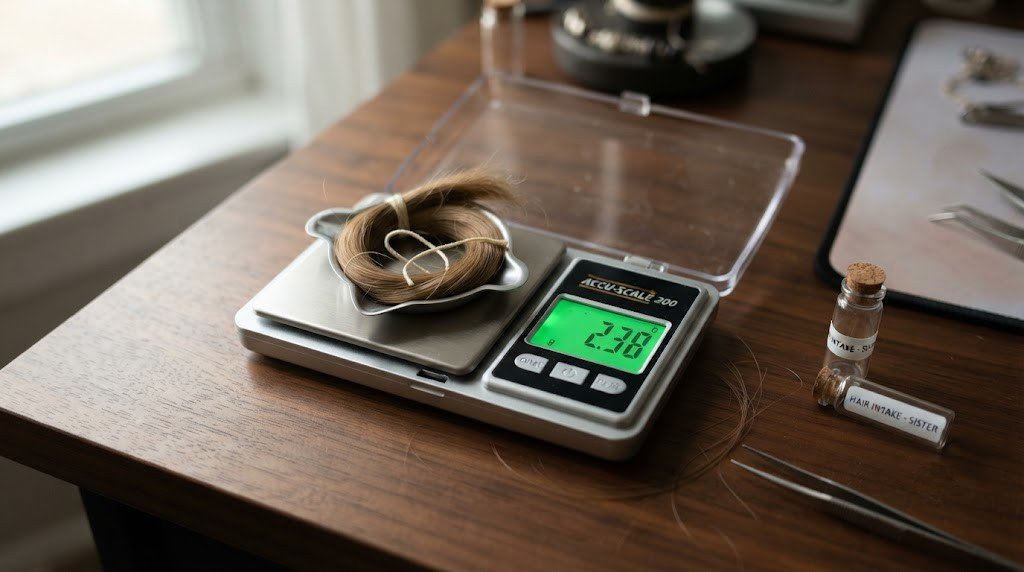
  3. Measure the lock and keep some back. Providers need only a few grams.
  4. Choose a provider in writing. Ask hair specific questions and get answers on paper.
  5. Package and mail it. Follow the provider’s kit, with tracking and insurance.
  6. Decide size, color, cut and setting. These are usually chosen when you order.
  7. Wait while the laboratory works. Typically six to ten months.
  8. Receive, check and insure the stone. Then decide how you will wear or keep it.

None of it has a deadline. Hair stored dry and away from sunlight keeps well, so it is entirely possible to turn sister hair into a diamond years from now if that is when you feel ready.

Step 1: Where Can You Find Hair That Will Work?

Before you can turn sister hair into a diamond, you need hair that is unmistakably hers. Look first at what was deliberately saved, then at what was simply left behind. The table below is a general guide. The provider has the final word on what it accepts.

SourceOften workable?What to check
A lock or braid cut and kept on purposeUsually, if there are a few gramsThat it is dry and stored in paper or a sealed bag
Hair the funeral home trimmed before servicesUsuallyWho requested it and who holds it now
Hair in her brush or combSometimesWhether the provider accepts loose strands and whether anyone else used the brush
A lock a parent saved from childhoodOften, if enough remainsWhether the family wants it used or kept as it is
Strands on clothing or beddingRarely enoughUsually too little and possibly mixed with other hair

If services have not yet taken place and you hope to turn sister hair into a keepsake stone, you can ask whoever is arranging them whether the funeral director could trim a small lock first. That request goes through the person with authority over her remains, not directly to the funeral home.

A brush that anyone else in her household also used is worth thinking about honestly. A provider cannot separate one person’s hair from another’s, so the plan to turn sister hair into a diamond works best with hair you are confident was hers alone.

Step 2: Who Should Know Before You Use Her Hair?

Hair that sits among her belongings may form part of her estate, and how that works varies by state. In practice, that means the executor, administrator or next of kin handling her things is the person to speak with before you turn sister hair into a stone, even when the lock is already in your home.

Who that is depends on her circumstances and anything she put in writing. In many states a spouse or registered partner comes first, followed by adult children and then parents, with siblings further along. Her own instructions can change that order. This post is not legal advice, and a local probate attorney can tell you how it applies to her estate.

Some situations are simpler. If she handed you a lock herself while she was living, it may be considered yours, though rules differ and telling her family is still considerate. If the funeral home trimmed hair at the request of the person holding authority, that person decides what happens to it.

Whatever the paperwork says, a short conversation usually helps. Other siblings, parents, or a partner if she had one may also want to turn sister hair into stones of their own. It is far easier to hear that before you send anything than after. Whether you shared one parent with her or both, grew up together or found each other later, everyone’s wish to remember her is legitimate.

Step 3: How Much Hair Does It Take to Turn Sister Hair Into a Diamond?

Less than you might imagine. Each provider sets its own minimum, yet a small lock, a few grams, is the usual request, sometimes described as a pinch held between finger and thumb. Because keratin is so carbon rich, the volume needed to turn sister hair into a diamond is a tiny fraction of what an ashes order asks for.

The amount does not set the carat size. A larger stone needs more time in the growth press, not more hair, so sending a whole braid will not produce a bigger diamond than sending a modest lock.

That leaves room for two good habits. First, ask the provider for its minimum in writing and send only that, plus whatever margin it recommends. Second, keep part of the lock back. If you later want to turn sister hair into a second stone for another sibling, or simply want something of her hair to remain as it is, you will still have it.

Before measuring, ask whether the provider wants the hair cleaned or left exactly as it is, and do not treat it with anything until you know.

Step 4: What Should You Ask a Company That Will Turn Sister Hair Into a Diamond?

Pick two or three companies and send each the same short email. Hair raises its own questions, so a generic ashes checklist misses things. Ask:

  • What is your minimum amount of hair, and do you accept loose strands from a brush?
  • Does dyed, permed or chemically treated hair affect extraction or the result?
  • Is her hair processed on its own, or ever alongside another family’s material?
  • What share of the finished stone’s mass will be carbon recovered from her hair?
  • Which document confirms the stone’s origin, and is independent grading included or extra?
  • What does the total come to, with setting, engraving, grading and insured return shipping?
  • What happens if a growth run fails, and what are the cancellation terms?
  • Will any unused hair be returned to me?

That fourth question matters. No published industry figure exists for how much of a finished stone comes from hair, so the only reliable number is the one a provider commits to in writing. A company ready to turn sister hair into a diamond for you should reply with specifics rather than reassurance. The sister hair diamond guide sets out the wider background if you want it before choosing.

Step 5: How Do You Package and Mail Her Hair?

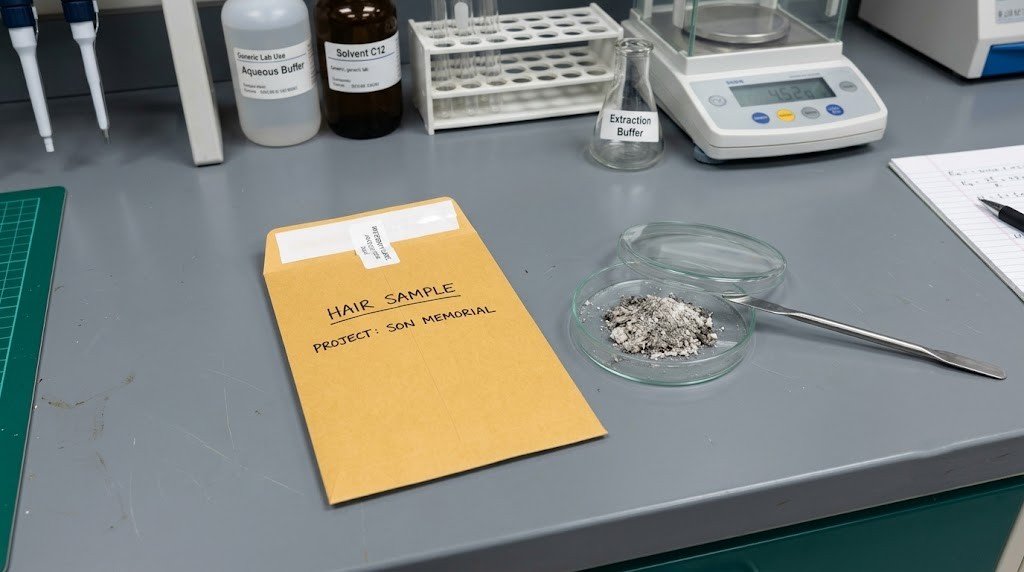
Use the provider’s kit if it sends one. Laboratories that turn sister hair into diamonds design those kits around their own intake process, so follow them over anything you read elsewhere. A typical approach is to place the lock in a clean paper envelope or small sealed bag, label it with the order reference the provider gives you, and add the signed intake form.

Avoid taping strands down or wrapping them in plastic film unless asked to. Photograph the hair beside its label before sealing, and keep copies of every form you sign.

Hair is not cremated remains, so the special mailing rules for ashes generally do not apply. Ask the provider which carrier and service it prefers anyway, choose one with tracking, and insure the parcel. When it is delivered, ask for written confirmation. When you turn sister hair into a diamond, that small email matters because it marks the moment her hair is accounted for again.

Step 6: How Do You Decide on Size, Color, Cut and Setting?

Most of these choices are made when you place the order.

Size. Choosing size is largely a budget decision when you turn sister hair into a stone because memorial diamonds generally range from about 0.10 carats to 5 carats or more and the price climbs steeply with size. As a general 2026 industry guide, roughly 0.10 to 0.25 carats runs about $1,500 to $3,500. Half a carat to one carat is about $5,000 to $15,000. Two carats and up can start around $20,000 and reach $75,000 or beyond. Grading, engraving, fancy cuts and settings are usually extra. These are not any single company’s prices.

Color. Trace nitrogen yields yellow. Trace boron yields blue. Colorless requires both to be absent and costs more to achieve. Memorial stones tend toward yellow, blue and champagne, and some providers offer irradiation for colors such as red, green or black. Color cannot be chosen, matched or predicted from her hair, and hair does not narrow the range or make a lighter stone more likely. Anyone planning to turn sister hair into a diamond of one exact shade should hear that clearly before ordering.

Cut. Round, oval, cushion, emerald and other shapes are commonly offered.

Setting. A ring, pendant, cufflinks, a tie bar or a loose stone in a small case all work. Let the choice follow how you will live with it, not any notion of what a sister’s memorial is meant to look like.

Step 7: What Happens to Her Hair at the Laboratory?

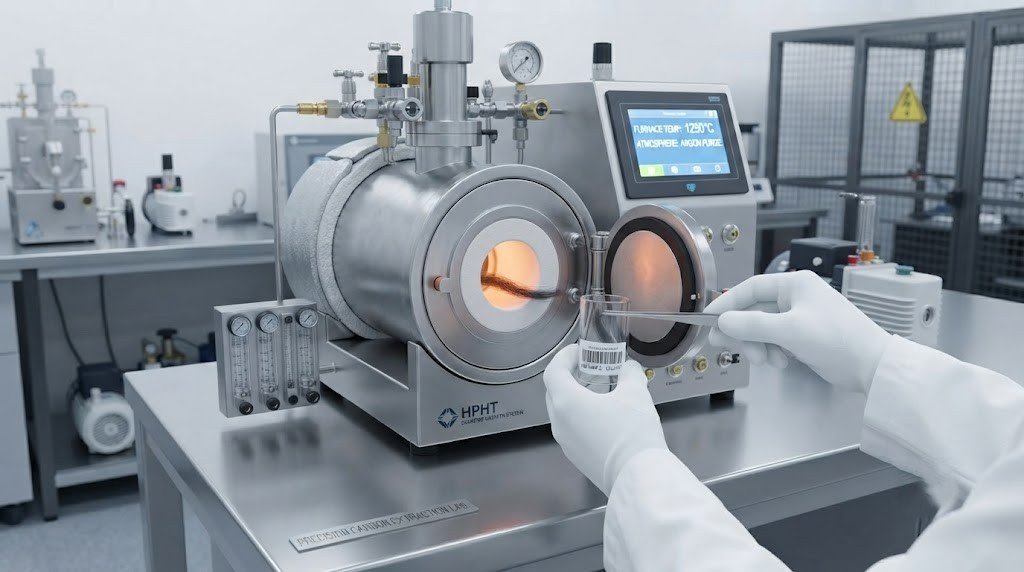
To turn sister hair into a diamond, the laboratory first heats the hair in a controlled, oxygen free process that removes everything except carbon, refining it to roughly 99.9% purity. That carbon is turned into graphite at around 2,500 to 2,700°C, typically combined with supplemental lab carbon, and placed in a press with a small diamond seed.

Most providers use high pressure, high temperature growth at roughly 6 to 8 GPa. A minority use chemical vapor deposition instead.

Growth takes weeks to months, then the rough crystal is cut, polished and graded. All told, the industry norm is six to ten months from start to finish, nearer twelve for stones above about 2 carats or specialty colors. How the stone is made from her hair walks through each stage in more depth.

Ask before you send how often you will hear from the provider during those months, and who to contact if you have not. A named contact can make the quiet stretch easier for anyone who has chosen to turn sister hair into a finished stone.

Step 8: What Do You Do When the Diamond Comes Home?

Open the parcel when you have time and quiet, and read before you wear. Confirm the order reference matches your form, that the origin certificate names her and describes this stone, and that any independent grading report you paid for matches what you hold. Grading reports describe a stone by the 4Cs used for every diamond, not by its origin.

Then think about care. Diamond sits at 10 on the Mohs hardness scale, so it resists scratching, but a setting can loosen and a stone can chip from a hard knock. Have prongs checked occasionally and add the piece to your home or jewelry insurance.

If you kept part of her lock back, store it somewhere dry and dark. Some siblings later turn sister hair into a second stone for someone else in the family. Others keep the remaining strands just as they are.

Is the Finished Stone Really Made From Her Hair?

Yes, in part, and the honest version is worth knowing. Her hair supplies real carbon, recovered and purified from her own keratin, which becomes part of the crystal lattice. Supplemental lab carbon is typically blended in, so the diamond is not made solely from her hair.

How much of the final mass comes from her is a figure the industry has not published for hair. The commonly cited 10% to 15% applies to ashes, not hair, so do not assume it carries over. Ask your provider to state its own number in writing before you decide to turn sister hair into a stone.

For some siblings who turn sister hair into a diamond, that honesty is part of what makes the result meaningful: the stone exists because her carbon was there. Whether the stone is truly made from her hair explores that question in full.

If her ashes are also available to you, the ashes route, step by step and a stone grown from her ashes and hair together are worth comparing.

Frequently Asked Questions

Can I turn sister hair into a diamond if she was buried?

Yes. Hair needs no cremation, so burial does not rule it out. You need hair saved before burial, such as a lock trimmed by the funeral home or one kept at home, and agreement from whoever holds authority over her remains or is handling her belongings.

Is hair from her hairbrush enough?

Sometimes. Some providers accept loose strands, others prefer a cut lock, and a brush someone else also used can mix hair from more than one person. Ask the provider what it accepts and how much it needs before you send anything.

Do I need anyone’s agreement to use hair I already have?

Possibly. Her belongings may form part of her estate, and rules vary by state, so talk with the executor or whoever is handling her affairs. Even when the lock was a gift from her, telling close family first can prevent hurt later.

Does dyed or gray hair change the diamond?

Ask the provider whether treatments affect extraction. Hair color itself does not decide the stone’s color. That depends on trace elements such as nitrogen and boron during growth, and it cannot be predicted or chosen from her hair.

How long does it take to turn sister hair into a diamond?

Typically six to ten months across the industry from the day the laboratory receives her hair, and up to about twelve for stones larger than roughly 2 carats or specialty colors. Carat size, set by growth time, drives most of the wait.

Can two siblings each get a diamond from one lock?

Often, if there is enough hair. A few grams per stone is typical, so a generous lock or braid may let you turn sister hair into more than one stone. Ask the provider for its per stone minimum and agree within the family before dividing anything.

Can I turn sister hair into a diamond as a gift for someone else?

Yes, though it is usually kinder to ask first. Some relatives would rather choose size, color and setting themselves, and a surprise can land hard in the early months. A quiet question about whether they would want one tends to work better.

Final Thoughts on Turning Her Hair Into a Diamond

A lock of hair is small enough to hold in one hand, and that is part of why this route can suit a sibling well: it asks little of anyone else and nothing of her ashes.

If you decide to turn sister hair into a diamond, take each step at your own speed, ask your questions on paper, and keep a little of her hair just as it is. The stone that comes back will be a real diamond with her carbon inside it, and the meaning you give it is entirely yours.

Learn More About a Diamond Grown From Her Hair

Talk With Memorial Diamond

If you have a lock of her hair and want to talk through how to turn sister hair into a diamond, Memorial Diamond is reachable at memorialdiamond.us. Ask about amounts, packaging or timing. You are welcome to simply gather information for now.

Sister Hair Diamond

Sister Hair Diamond: The Complete Guide

Sometimes what a sister leaves within reach is very ordinary: a hairbrush on a bathroom shelf, a braid folded into a drawer, a lock someone thought to save. A sister hair diamond is a genuine lab grown stone carrying carbon drawn from a few grams of her hair, usually combined with lab carbon in the growth press. It needs no cremation, and six to ten months from the laboratory’s receipt of the hair is a typical wait.

sister hair diamond

Why Does Hair Work So Well as a Carbon Source?

Hair is built from keratin, a protein dense with carbon. By weight, it is roughly half carbon, which is a dramatically richer starting point than cremated remains, where carbon makes up only a few percent at most.

For a sibling considering a sister hair diamond, that chemistry has three practical consequences. First, only a small amount of material is needed. Second, cremation is not required, so hair can come from a sister who was buried, from one whose ashes went elsewhere, or from a keepsake saved long before anyone imagined this use. Third, the hair you are thinking of may already be in your home.

None of this makes a sister hair diamond better or worse than one grown with ashes. It simply opens a door that ash cannot always open, especially for a brother or sister who does not hold authority over her remains.

A finished sister hair diamond is a diamond in every physical sense. It has the same carbon lattice as a mined diamond and sits at 10, the top of the scale used to rank mineral hardness, which is part of why it suits everyday wear.

How Is a Sister Hair Diamond Different From One Made With Ashes?

The growth process is largely shared. What differs is the material going in and the questions surrounding it. The comparison below sets the two side by side.

Point of comparisonHairCremated ashes
Carbon content of the materialRoughly 50% by weightRoughly 0.5 to 4% by weight
Typical amount requestedA small lock or a few gramsA few tablespoons to about 4 oz or 100 g
Cremation needed?NoYes
Who may need to agreePossibly her executor or whoever holds authority, depending on where the hair is and state rulesWhoever holds legal authority over her remains
Published share of her carbon in the finished stoneNone published. Ask the provider in writingAround 10 to 15% of the stone’s mass for ash, with some providers citing as low as 3%
Supplemental lab carbonTypically blended inTypically blended in
Color predictable from the material?NoNo

For a sister hair diamond, the row worth pausing on is the published share. Industry figures exist for ash. For hair, no published finished stone percentage exists. That is not a reason for suspicion, but it is a reason to ask any provider for their figure in writing.

If her ashes are available to you as well, the full guide to a stone grown from her ashes covers that route and its authorization questions in detail.

Where Might Her Hair Come From?

Siblings are sometimes surprised by how many places a usable sample can turn up. Possible sources include:

  • A lock saved at the funeral home. Some funeral homes can cut a small lock before burial or cremation, at the request or with the agreement of the person directing her arrangements.
  • A hairbrush or comb she used. Strands caught in bristles can sometimes be gathered, although a provider may want to assess how much is there.
  • A keepsake lock or braid. Hair saved from a haircut, a celebration or a change of style, kept in an envelope or a box.
  • Hair saved by a stylist or salon. Rare, but worth mentioning if she donated or cut a length shortly before her death.
  • Hair already held by another relative. A parent, a partner or another sibling may have kept a lock without mentioning it.

Ask a provider whether dyed, permed or chemically treated hair is acceptable, and whether brush strands are enough on their own. Practice varies, and any provider asked to grow a sister hair diamond should tell you plainly what it can work with rather than accepting anything by default.

Who Should Agree Before Her Hair Is Used?

It is tempting to assume that hair sitting in your own drawer is simply yours to use. Sometimes it may be, but the answer depends on where the hair came from and on the rules in your state.

If the hair is still part of her body, or is to be collected at the funeral home, the person with legal authority over her remains will generally need to agree. State law often places a spouse or partner first, followed by adult children and parents, and only then siblings. The order varies by state, and her own written wishes can change it.

If the hair was already separated, such as in a brush or a saved lock, it may count among her personal belongings. Belongings can form part of an estate, and how they pass varies by state and by any will she left. Before a sister hair diamond is ordered, a short conversation with her executor, or with whoever is settling her affairs, is a sensible step.

In practice, the respectful route is also the simple one. Tell the people closest to the decision what you are planning, how little hair is involved, and whether they would like a stone too. A sister hair diamond made openly may sit more easily in a family than one made quietly.

Faith can matter here as well. For families whose tradition objects to cremation itself, a hair based stone involves no cremation, though it is still worth asking a faith leader rather than assuming.

How Much Hair Does a Sister Hair Diamond Need?

Very little. Requirements vary by provider, but a small lock or a few grams is the typical request, often described as a palm sized bundle.

Length matters less than total weight. A short lock can be enough if it is dense. Scattered brush strands may need gathering from several sources to reach a provider’s minimum. Ask exactly what weight the laboratory needs for the carat size you are considering, and whether that minimum changes for a larger stone.

What hair quantity does not decide is size. As with any memorial stone, carat weight comes from how long the crystal grows in the press, not from how much material arrives. Sending extra hair will not make a sister hair diamond larger, so you can keep the rest of any lock she left exactly where it is.

If you would like more detail on preparing the sample itself, the practical route to turn sister hair into a diamond walks through collection, labeling and the first call.

How Should Her Hair Be Stored and Sent?

Until a provider gives you its own instructions for a sister hair diamond, the general aim is to keep the hair dry, clean of loose debris, and clearly labeled. A paper envelope inside a sealed bag, kept out of humidity and direct sunlight, is a reasonable way to hold it while you decide.

Follow the provider’s packing directions exactly once you have them. Some supply a collection kit with a container and a reference number, and that number begins the chain of custody for a sister hair diamond.

A few things worth confirming before the parcel leaves:

  1. The reference number written on both the container and the paperwork.
  2. An insured, tracked shipping method, with a signature required on delivery.
  3. A written note of what you sent, including an approximate weight and a photograph.
  4. Whether any unused hair will be returned, and to whom.

Keep a small portion back if you can. Holding onto some of her hair costs nothing and leaves options open later.

What Are the 6 Stages of Making a Sister Hair Diamond?

Equipment and timing vary between laboratories, but the sequence below describes how her hair typically becomes a finished sister hair diamond.

StageWhat happensWorth knowing
1. Receipt and loggingThe hair arrives, is weighed, and receives an identifier that stays with itAsk whether you will be given the identifier
2. Carbon extraction and purificationNon carbon parts of the keratin are driven off in a controlled, oxygen free process, leaving carbon refined to about 99.9% or higherHair’s high carbon content means less material is needed at this stage
3. GraphitizationThe purified carbon is heated to around 2,500 to 2,700°C and converted into graphiteGraphite is the feedstock a growth press uses
4. GrowthHer graphite, typically blended with lab carbon, grows around a small diamond seedMost memorial stones are grown by HPHT, with pressures near 6 to 8 GPa and temperatures of 1,400 to 2,500°C. A minority of providers use CVD
5. Cutting and polishingThe rough crystal is shaped and faceted into the chosen cutThe cut is the family’s choice. Ask what the finished weight is likely to be once the rough crystal is shaped
6. Documentation and gradingAn in house origin certificate records where the carbon came from. A separate independent grading report can be orderedIndependent grading tends to be an optional extra, billed on its own

Some providers also offer post growth irradiation for certain colors. It is not a required stage, and it should be disclosed on the paperwork whenever it is used.

For the general science behind lab grown diamond production, HPHT and CVD work the same way whether the carbon began as hair, ash or an industrial feedstock. A closer look at how a memorial diamond is made from her hair goes through each laboratory step at a slower pace.

How Much of a Sister Hair Diamond Is Her Carbon?

Here the honest answer is that there is no published figure for hair. Providers describe a personal carbon share for ash based stones, but no equivalent industry percentage has been published for a sister hair diamond or any other hair based stone.

What is clear is that her carbon is genuinely present in a sister hair diamond. It is extracted, purified and grown into the crystal, typically together with supplemental lab carbon. The stone is not a token representing her. It physically holds carbon that was once part of her.

What is not accurate is any claim that the diamond consists of her hair and nothing else, or that no outside carbon was used. Supplemental carbon is typically part of the process, so a provider claiming none was added should be able to explain exactly how.

So ask, and ask in writing: what share of the finished stone’s mass do you expect to come from her hair? A provider with a documented process will either give you a figure or explain clearly why it cannot. If you would like the evidence weighed in full, whether the stone is really made from her hair is answered on its own page.

Can Anyone Predict the Color in Advance?

No, and a sister hair diamond is no exception. The shade is decided inside the press, by whatever trace elements are present while the crystal forms. Nitrogen brings out yellow, boron brings out blue, and keeping both out to produce a colorless stone takes additional processing and adds to the price.

Memorial diamonds tend toward yellow, blue and champagne shades because their carbon has a personal, organic origin rather than a tightly controlled industrial one. Some providers also offer irradiation after growth to produce red, green or black stones.

Hair does not narrow the range or lighten the result. Her hair color, whether dark, fair, gray or dyed, has no predictable link to the shade of the finished stone, and the color cannot be chosen or matched from the hair itself.

If you are choosing a treated color, cut or setting for a sister hair diamond, let it rest on what she enjoyed and what you will wear, not on any idea of what suits a sister.

What Does a Sister Hair Diamond Cost, and How Long Does It Take?

The cost of a sister hair diamond follows carat weight and color far more than the source material. As a rough guide, here is how broad 2026 industry pricing breaks down by size. These figures describe the market, not one company:

  • Entry sizes, roughly 0.10 to 0.25 ct: about $1,500 to $3,500.
  • Between half a carat and one carat: about $5,000 to $15,000. A colorless result adds noticeably to the price compared with yellow, blue or champagne tones.
  • Two carats to five or more: from around $20,000 to $75,000 and beyond.
  • Usually extra: independent grading, engraving, fancy cuts, and any setting such as a ring, pendant or cufflinks.

Timing follows the same logic. Six to ten months is typical from the laboratory’s receipt of the hair, and larger stones over about two carats, or specialty colors, can take up to roughly twelve months.

Because no cremation is involved and the material may already be in hand, a sister hair diamond can sometimes begin sooner than an ash based stone. The laboratory stages themselves take as long either way.

Can Each Sibling Have a Stone Grown From Her Hair?

Often, yes, provided there is enough hair and the people who need to agree are comfortable with it. Because each sister hair diamond needs only a few grams, one saved braid or lock can sometimes serve several stones.

Sibling groups vary widely. There may be two of you or six, a twin among you, or half and step siblings who each knew her in their own way. No one needs to rank their claim, and nobody is obliged to want a stone at all.

When more than one order comes from one source, ask the provider:

  • Whether each portion is weighed, logged and grown separately.
  • Whether stones can be ordered at different times.
  • How unused hair is returned and to whom.

Some families combine hair held by one sibling with a small portion of ash held by someone else. Bringing both materials into one stone has its own documentation questions, which are worth reading before deciding.

What Should You Ask Before Sending Anything?

When choosing who will make a sister hair diamond, a short written list protects you better than a long phone call. Put these to any provider and keep the replies:

  1. What minimum weight of hair do you need, and can you work with brush strands or treated hair?
  2. What reference number travels with her hair, and who signs for it at each step?
  3. Is her hair ever processed alongside another family’s material?
  4. What share of the finished stone do you expect to come from her hair?
  5. What happens to hair you do not use?
  6. Will an independent lab grade the stone, and is that in the quote or extra?
  7. What happens, contractually, if growth fails or the stone fractures in cutting?

A provider that answers these specifically, in writing, has told you a great deal about how it will handle a sister hair diamond. For siblings planning to combine her hair with ashes in the same stone, the same questions apply to each material separately.

Frequently Asked Questions

Does a sister hair diamond require cremation?

No. Hair is roughly half carbon by weight, so a laboratory can extract enough from a small lock without any cremation. That makes hair an option when she was buried, or when her ashes are held by someone else or already scattered.

How much of her hair is needed?

Typically a small lock or a few grams, though each provider sets its own minimum. Ask for the exact weight in writing, and whether brush strands alone are enough, before you gather or send anything to the laboratory.

Can a sister hair diamond be made from her hairbrush?

Possibly, if there is enough and the provider accepts brush strands. Because her belongings may pass through her estate, and state rules differ, speak with her executor or whoever is settling her affairs before sending any of it.

How much of a sister hair diamond is actually her?

No published industry figure exists for the share of hair carbon in a finished stone. Her carbon is genuinely present, typically blended with lab carbon. Ask each provider for its expected percentage in writing before you commit to an order.

Will her hair color affect the diamond’s color?

No. However dark or light her hair was, the stone’s tint comes from stray nitrogen or boron atoms caught in the crystal as it grows. Memorial stones tend toward yellow, blue and champagne, and the result cannot be chosen, matched or predicted from the hair.

Can several siblings each have a stone from one lock?

Sometimes, if the lock holds enough material for each order and the people who need to agree are comfortable. Ask the provider to weigh, log and grow every portion separately, with its own documentation for each sibling.

Final Thoughts on a Sister Hair Diamond

Hair is easy to overlook because it is so ordinary, and that is part of what makes it meaningful. A brush she reached for every morning, a lock someone saved without quite knowing why: these are small, real traces of her daily life.

A sister hair diamond turns one of those traces into something durable, without asking anyone to divide her ashes and without requiring cremation at all. The practical work is modest: confirm who should agree, gather a few grams, and get every answer about custody and carbon in writing.

Take it at whatever pace suits you. The hair will keep, and so will the decision.

Learn More About Sister Memorial Diamonds

Talk With Memorial Diamond

Whether you already have a saved lock in hand or are still deciding if a sister hair diamond is right, Memorial Diamond is happy to talk it through. Visit memorialdiamond.us to ask about quantities, packing and who should be part of the decision. There is no obligation and no rush.

Daughter Hair Diamond Questions: 10 Proven, Gently Asked

Questions to Ask Before Turning Your Daughter’s Hair Into a Diamond

A lock of your daughter’s hair may be one of the few things of hers you can still hold in your hand, which makes sending it anywhere a bigger step than it looks. The daughter hair diamond questions worth asking first concern whose agreement you need, where the hair should come from, how much gets used and what comes back, how a provider tracks something so small, and what it will state in writing about her share of the finished stone.

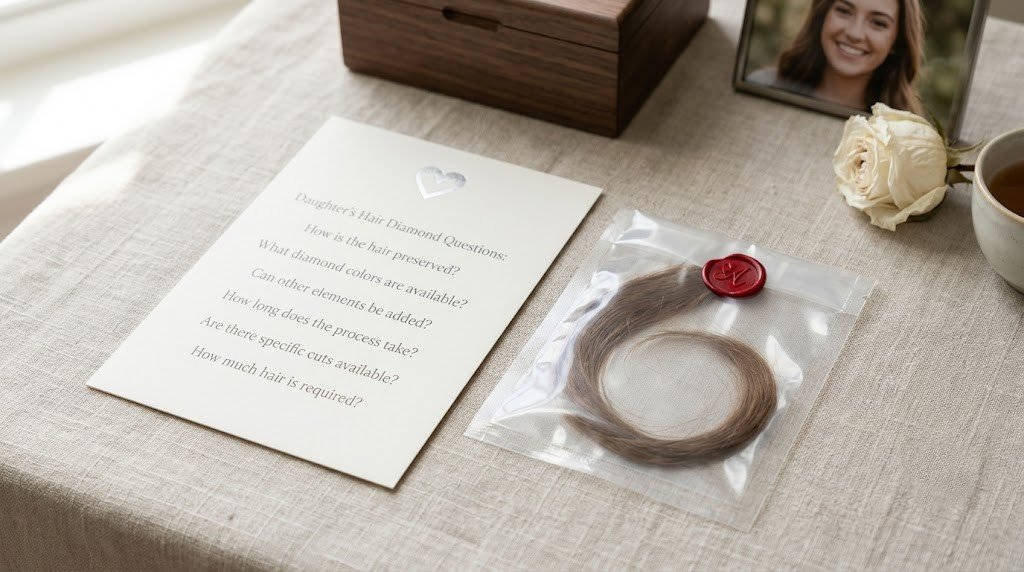
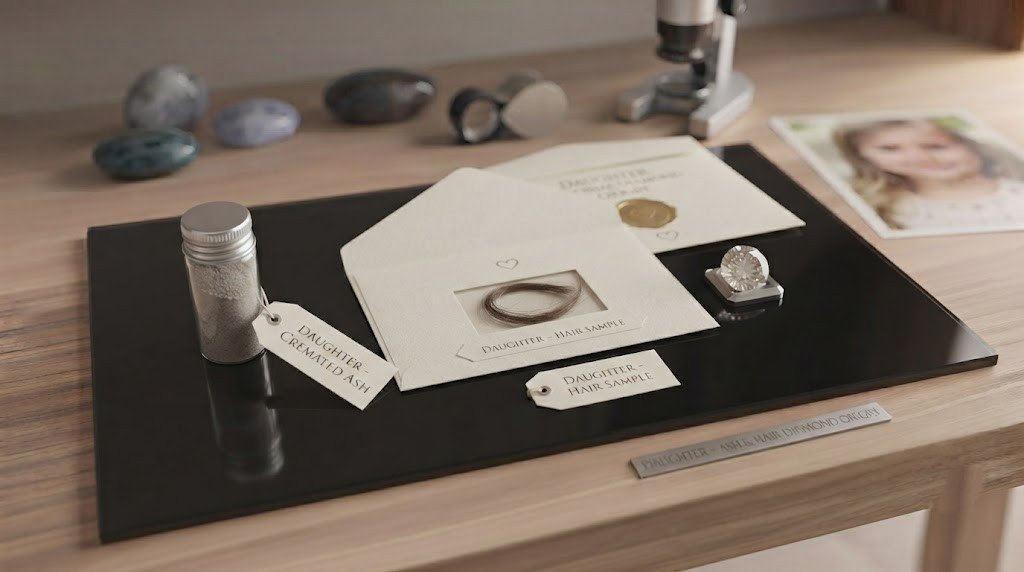
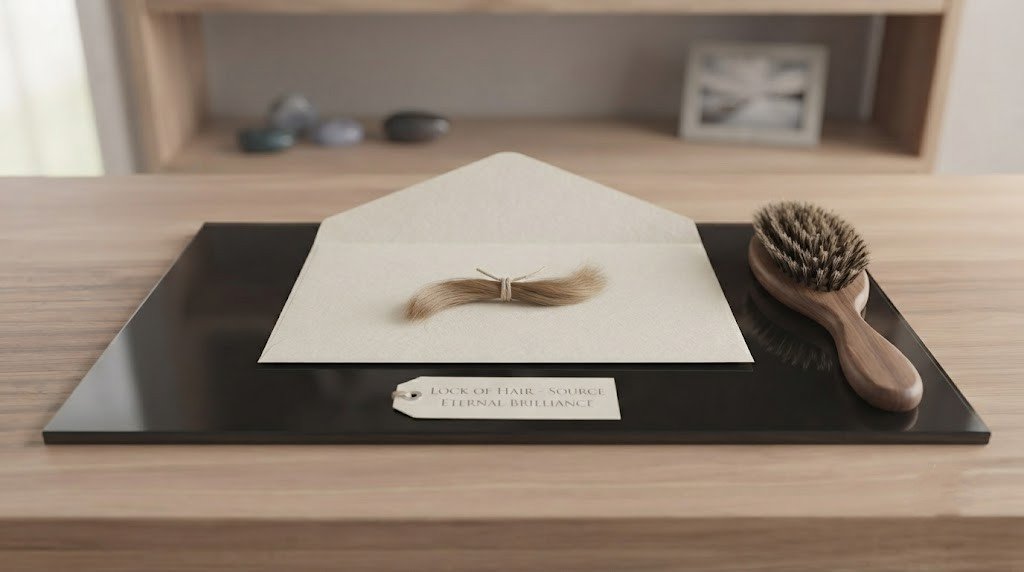
Daughter hair diamond questions listed on a card beside a small lock of hair in a clear sealed bag

Why Do Daughter Hair Diamond Questions Differ From Ash Questions?

Because hair behaves differently at almost every stage. Hair is roughly 50% carbon by weight, built mostly from the protein keratin, while cremated remains are mostly bone mineral with very little carbon left in them. That one difference means a provider needs far less hair than ash, and no cremation is involved at all.

It also moves the risks around. With hair, the harder daughter hair diamond questions concern provenance: is every strand hers, is the lock you hold the only one that exists, and will any of it come back?

If her ashes are part of your plans as well, the questions to ask about her ashes cover custody and authority from that side. This page stays with hair, so the daughter hair diamond questions below assume a small, irreplaceable amount and a provider you have not yet chosen.

What Are the 10 Daughter Hair Diamond Questions to Send?

Ten questions, written so a provider can answer each one with a fact rather than a feeling. Copy them into a single email and send the same version to every company you are considering.

#QuestionWhy Hair Makes It Matter
1Whose consent do you require before accepting her hair?Hair kept at home can still be part of her estate
2How much hair do you need, and in what form?A lock, brush strands and clippings are not interchangeable
3Do dye, bleach, treatments or very short length affect suitability?Some hair has been through a lot of chemistry
4If the hair came from a brush, how do you handle strands that may not be hers?Brushes can be shared
5Will the whole sample be used, and can any unused hair be returned?You may want part of the lock kept
6How is her hair logged and kept apart from other orders?Small samples are easy to misplace
7What will you state in writing about how much of the stone is her carbon?No published finished stone percentage exists for hair
8What supplemental carbon is used, and why?Lab carbon is typically blended in
9Which documents come back, and who issues each one?Origin and quality are recorded separately
10What is the full cost, and what do your terms say if growth fails or I cancel?Hair can rarely be resent

A provider that answers every one of these daughter hair diamond questions plainly has given you a fair basis for comparison. One that answers half has given you a reason to write again.

It is tempting to assume that hair already in your keeping is simply yours to send. It may not be that simple. A person’s belongings can form part of her estate, and rules about who decides vary by state. Depending on the state, her spouse or partner, or any adult sons or daughters she had, could be entitled to decide before her parents are, and her own written instructions may also count.

Hair not yet collected raises a different point. If a funeral home is to cut a lock before burial or cremation, that request normally goes through whoever holds authority over her remains, which state law and her written wishes decide.

So the first daughter hair diamond questions to send ask what consent the provider requires and in what form. If there is doubt within your family, talk to the people closest to her before you mail anything. Separated parents, a partner who saved a lock, or siblings who each hold a few strands can each create a different situation. Each is easier to settle before the parcel leaves, and an estate attorney can help if the answer is not clear.

Where Should the Hair Come From?

Hair you might send usually comes from one of three places, and each raises its own daughter hair diamond questions.

  • A saved lock: From a haircut, a keepsake envelope, or one taken by the funeral home. Usually the clearest source, because you know whose it is.
  • A hairbrush or comb: Sometimes the only source available. Ask whether the provider accepts brush hair and how it handles the chance that a few strands belong to someone else who used the brush.
  • Clippings or very short hair: Sometimes all that remains. Ask whether short pieces are workable before you send them.

Whatever the source, ask how the provider wants it packed. Instructions differ, and following them exactly protects the sample. Label the envelope with her name and the source, and photograph it before sealing so you have your own record of what you sent.

If you hold more than one source, such as a lock and a brush, add a line to your daughter hair diamond questions asking which the provider prefers. Sending the clearest sample and keeping the rest at home is worth discussing.

How Much Hair Is Enough, and Will Any Come Back?

Probably less than you picture. Because hair is so rich in carbon, providers typically ask for a small lock or a few grams, sometimes described as a palm sized bundle. Exact requirements differ between companies, so treat any number you read as a general guide. How much hair a provider usually needs is worth checking against the amount you actually have.

The more important daughter hair diamond questions here are about what happens to the rest. Will the provider use the whole sample, or only what it needs? If there is a surplus, will it be returned, kept or disposed of? Can you ask in advance for part of the lock to be held back and mailed home with the finished stone?

If your family has only one small curl, say so at the start; a provider may be able to advise whether it is enough to share with a relative who also wants to keep some. Sending more hair will not produce a larger diamond, because size is set by how long the crystal grows. Daughter hair diamond questions about quantity are really questions about what your family keeps.

Which Daughter Hair Diamond Questions Cover Dye, Products and Length?

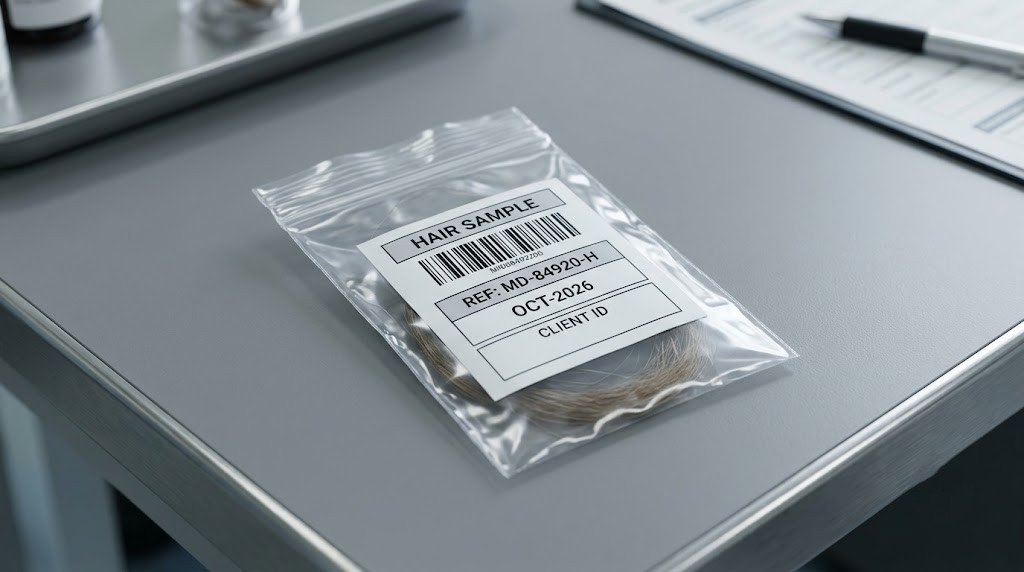
A small sealed hair sample bag with a printed reference label on a laboratory bench

Her hair may have been colored, bleached, permed, straightened or treated, and some of it may carry traces of styling products. Whether any of that matters is a question for the provider, not something to guess at home. Put it plainly among your daughter hair diamond questions: does chemical treatment, color or residue affect whether the sample is usable, and does it change anything about processing?

Length matters for a different reason: very short hair is lighter, so the same weight takes more strands. Ask whether the provider sets a minimum length or only a minimum weight.

Ask, too, whether the company assesses a sample before charging the full price, and what your options are if it proves unsuitable. Avoid washing or trimming the hair yourself unless the provider’s instructions say to.

How Will Something So Small Be Tracked?

A few grams of hair is easy to lose track of, which makes custody questions more pointed than they are for ashes. Ask what identifier is attached when her sample arrives, whether it goes on the sealed bag itself or only into a database, and whether you will receive a dated confirmation of receipt.

Then ask whether her hair is ever processed in a batch with other families’ samples, or kept separate through extraction, purification and growth. Ask whether one growth cell holds one family’s carbon. Ask what record follows the rough crystal into cutting and how its reference connects back to the number issued at intake.

None of these daughter hair diamond questions implies distrust. A provider that handles human hair regularly should already have a written answer for each. If the reply is slow or vague, send your daughter hair diamond questions about custody a second time before you decide.

How Much of the Finished Stone Comes From Her Hair?

This is the most revealing of the daughter hair diamond questions, and the answer may surprise you. Hair’s high carbon content means the provider has much more of her carbon to work with than it would from a similar weight of ash. Even so, purified personal carbon is typically blended with supplemental laboratory carbon to reach the amount needed to grow a stone.

What is missing is a figure. The often quoted range of roughly 10% to 15% of a finished stone’s mass applies to ash, not to hair, and no published finished stone percentage exists for hair. So make it one of your daughter hair diamond questions: what will each provider state in writing for her stone, how does it calculate that, and what is the supplemental carbon?

Be wary of any reply calling the diamond pure or claiming nothing else was added. The true account, that a real portion of her carbon is part of the crystal, is meaningful without exaggeration. Whether the stone is really made from her hair is a fair question to put to anyone selling one.

What Happens to Her Hair in the Laboratory?

Understanding the stages lets you ask where things can go wrong. In general terms across the industry:

  1. Intake and logging: The sample is assigned an identifier.
  2. Carbon extraction and purification: The hair is heated without oxygen to strip away everything that is not carbon, reaching roughly 99.9% purity or better.
  3. Graphitization: The carbon is converted to graphite at around 2,500 to 2,700°C.
  4. Growth: Usually by HPHT at roughly 6 to 8 GPa and 1,400 to 2,500°C, occasionally by CVD. Supplemental laboratory carbon is typically added here.
  5. Cutting and polishing: The crystal is cut into the chosen shape.
  6. Optional irradiation: Some providers offer this to alter color. It is never a required step.
  7. Grading: An independent report is usually optional and extra.

Daughter hair diamond questions about the lab should ask which stages the provider performs itself and which it sends elsewhere, because every transfer is another custody point. How a diamond is made from her hair walks through each stage in more depth.

Which Daughter Hair Diamond Questions Cover Color, Size and Durability?

Three loose memorial diamonds in yellow, blue and champagne tones on a gray background

Color is decided during growth by trace elements: nitrogen tends toward yellow, boron toward blue, and colorless requires the absence of both, which takes extra processing and usually costs more. Memorial stones tend toward yellow, blue and champagne. No provider can choose, match or predict a shade from her hair, and starting from hair rather than ash does not narrow or lighten the outcome. What color a stone from her hair may be explains why.

Ask which outcomes are plausible, how much more a colorless stone would cost, and whether the company offers post growth irradiation for red, green or black, and if so, whether that treatment appears on the paperwork.

Size is a choice, generally from about 0.10 carats to 5 carats or more, and it depends on growth time rather than the amount of hair. Clarity typically falls between SI2 and VVS. If the stone will be worn daily in a ring, durability matters too: diamond sits at 10, the top of the Mohs scale of mineral hardness, though settings still need care. Add these daughter hair diamond questions to the same email so the answers sit together.

What Paperwork Should Name Her Hair as the Source?

Two documents serve two purposes. An origin or authenticity certificate, generally issued in house, records that this stone was grown from the hair your family sent. A grading report, ideally from an independent gemological laboratory, assesses the stone’s cut, color, clarity and carat weight. Neither replaces the other, and the grading report is usually optional and billed separately.

Ask whether the origin certificate states that hair, rather than ash, was the source material, whether it carries her name, and whether you see the wording before it is final. Ask for a sample certificate with another family’s details removed.

File the documents with the replies to your daughter hair diamond questions. Together they form the record a sibling or grandparent may one day want to read.

Which Daughter Hair Diamond Questions Concern Cost?

Treat the following as general 2026 industry ranges rather than any single company’s prices. A small stone of a tenth to a quarter of a carat tends to land between $1,500 and $3,500. A half carat to one carat stone generally falls between $5,000 and $15,000, with colorless at the upper end. Stones of two carats or larger start near $20,000 and can pass $75,000.

Independent grading, engraving, fancy cuts and the setting itself are usually extra. Ask for an itemized total, the deposit and payment schedule, and what is refundable at each stage. Ask also whether hair is priced any differently from ash, since companies differ; these daughter hair diamond questions are simple to ask and easy to compare. What drives a daughter memorial diamond’s price is useful context before quotes arrive.

How Long Does It Take, and What If Growth Fails?

Across the industry, six to ten months from receipt of material is typical, and up to about twelve for stones over two carats or specialty colors. Ask the provider’s own estimate, what it is measured from, and how often you will hear from them during the long middle stretch. The full sequence from sample to stone helps the wait make sense.

Then ask the harder daughter hair diamond questions. If a growth cycle fails, is there enough of her hair left to try again, and who pays? If the stone cracks during cutting, is it regrown, recut or refunded? If you cancel, what happens to her hair and to the money already paid? Ask for the clause, not a paraphrase. With a small, irreplaceable sample, these terms carry real weight.

When Might Hair Be the Right Starting Point?

Hair can be the natural choice in several situations. She may have been buried rather than cremated. Her ashes may already have been scattered or interred. A family’s faith or personal convictions may raise concerns about cremation or dividing ashes, and because hair involves no cremation, some families find it sits more comfortably; a faith leader is the right person to confirm that for your tradition. Or a lock may simply have been kept for years and feel like the obvious thing to use.

None of these makes hair better than ashes; they are different materials with different practicalities. Some families use both, which adds questions about how two materials are tracked and combined beyond the daughter hair diamond questions here.

Frequently Asked Questions

Can I Use Hair From Her Hairbrush?

Sometimes, but ask first. Some providers accept brush hair, yet strands from anyone else who used the brush can be mixed in. Include it in your daughter hair diamond questions: does the provider accept it, and how does it handle that risk?

Do I Need Anyone’s Permission to Send Hair I Already Have?

Possibly. Belongings can form part of her estate, and rules vary by state. If she had a spouse, partner or adult children, or left written wishes, check with them, and with an estate attorney if unsure, before mailing it.

Will Dyed or Treated Hair Still Work?

Ask the provider. Whether color, bleach, perms or styling residue affect suitability is something each company should answer in writing, and some assess a sample before you pay in full. Include it among your daughter hair diamond questions rather than guessing.

Is a Hair Diamond Made Only From Her Hair?

No. Hair is roughly half carbon, but purified personal carbon is typically blended with laboratory carbon to grow the stone. No published finished stone percentage exists for hair, so ask in your daughter hair diamond questions what each provider will state in writing.

Will Her Hair Produce a Lighter or More Predictable Color?

No. Color comes from trace elements such as nitrogen and boron during growth, and it cannot be chosen, matched or predicted from her hair. Memorial stones tend toward yellow, blue and champagne regardless of the source.

Can Part of the Lock Be Returned to Us?

Ask before sending. You may want to keep some of the hair, and providers differ on whether surplus is returned, retained or disposed of. Request a written answer, and ask whether part can be held back from the start.

Final Thoughts on Asking Before You Send Her Hair

A few grams of hair can carry a great deal of meaning, and it is reasonable to be careful with it. The daughter hair diamond questions on this page are not meant to make you suspicious of every provider. They exist so that you know, before anything leaves your hands, exactly what will happen to it and what will come back.

If you only send a few daughter hair diamond questions, ask about consent, what share of the stone the company will state in writing, whether any hair returns, and what happens if growth fails. Then, if the answers are clear, let the decision rest. The complete guide to daughter hair diamonds is there whenever you want the wider picture.

Learn More About Hair Diamonds for a Daughter

Talk With Memorial Diamond

Working through daughter hair diamond questions alone can be tiring. Memorial Diamond can be reached at memorialdiamond.us whenever you would like to talk them over. Bring a lock, a brush or simply a question, and decide nothing until you feel ready.

Really Made From Daughter Hair 7 Expert, Reassuring Answers

Is a Memorial Diamond Really Made From Your Daughter’s Hair?

You may be holding a small envelope and doubting that anything so light could honestly become a gem. Asked plainly, is the stone really made from daughter hair? The answer is yes, in part: carbon from her hair is extracted, purified and grown into a genuine lab grown diamond, alongside supplemental laboratory carbon. What nobody can do is test the finished stone and point to her carbon inside it, so the proof you receive is a paper trail, and this page explains how to judge one.

A loose memorial diamond really made from daughter hair beside the small paper envelope the lock was sent in

Is a Diamond Really Made From Daughter Hair, or Is That Marketing?

It is a real process, and doubting it is sensible. The question usually arrives in its bluntest form, is this thing really made from daughter hair, or is it a nice story? It deserves a blunt reply.

Three statements are true together. Her carbon genuinely enters the crystal. The crystal is genuinely diamond. And the stone is not hair alone, because providers across the industry supplement personal carbon with laboratory carbon to reach a size worth growing.

Trouble starts when marketing keeps the first two statements and drops the third. A page promising a gem that is “100% her” describes something the physics does not allow. Any accurate account of a stone really made from daughter hair includes the blend.

Whether she was a little girl or a grown woman, the answer stays the same; what varies is how much you can verify, and that depends on the provider. The complete guide to a daughter hair diamond sets out the wider decision around it.

Why Is Hair Such a Rich Source of Carbon?

Hair is made mostly of keratin, a protein built on a carbon backbone, which puts it at roughly 50% carbon by weight. Cremated remains are a different substance altogether: mostly calcium phosphate, the mineral of bone, with usable carbon at only around 0.5% to 4% of their weight.

That contrast explains why so little is requested: typically a small lock or a few grams of hair, against a few tablespoons to about 4 oz of ash. A gem really made from daughter hair begins with material that is, gram for gram, far richer.

Hair also removes cremation from the picture. A family that chose burial, or whose tradition does not permit cremation, can still pursue a stone really made from daughter hair, provided some of her hair was kept somewhere.

Hold on to one distinction, though. The 50% figure describes what sits in the envelope, not how much of a diamond really made from daughter hair is hers. How much hair a laboratory typically asks for covers quantities and collection.

If Hair Is Half Carbon, Why Is Lab Carbon Added?

 A gemologist examining a lab-grown diamond under magnification at a testing bench

A growth cell needs a certain volume of graphite feedstock, and a lock of hair, even at half carbon, rarely supplies enough by itself. Providers therefore top up the purified personal carbon with supplemental laboratory carbon so the press can build a crystal of the size that was ordered.

The work runs in stages. Heating without oxygen drives off the non carbon parts of keratin and leaves carbon at about 99.9% purity or better. That carbon becomes graphite at roughly 2,500 to 2,700°C, then, blended with lab carbon, goes into an HPHT cell beside a tiny seed at around 6 to 8 GPa and 1,400 to 2,500°C; a minority of providers use CVD.

Carat weight is decided by time in the press, not by the weight of hair posted, so sending more does not produce a bigger or quicker stone.

In physical terms, then, a diamond really made from daughter hair is her carbon plus laboratory carbon locked into one continuous crystal lattice. How the stone is grown from her hair, stage by stage follows the material through each step in more depth.

What Share of a Stone Really Made From Daughter Hair Is Hers?

Nobody has published an answer for the share of a stone really made from daughter hair that is personal carbon. That is the honest position.

For cremated remains an industry figure does circulate: personal carbon is commonly put at around 10% to 15% of the finished stone, with some providers quoting less. That number belongs to ash. It was never established for hair, and lending it to a gem really made from daughter hair would be guesswork dressed up as fact. The final share hinges on stone size, recovery and each laboratory’s method. The same question asked about her ashes shows how differently the two routes are documented.

So the only figure worth relying on is one the provider commits to on paper. Ask what share they expect to be her carbon at your chosen carat, whether that is measured or estimated, and whether more hair changes it. Keep the reply.

A clear answer with its basis explained is a good sign. The ash figure repeated for something really made from daughter hair is not.

Can Any Test on the Finished Diamond Prove It Is Hers?

No. No test on the finished stone can show it was really made from daughter hair, or link it to any particular person. DNA does not survive purification, and carbon atoms carry no record of their source.

Gemological testing can identify a diamond as laboratory grown and can often tell the HPHT and CVD growth methods apart. That confirms a genuine grown diamond, nothing more.

This moves the whole question of trust from the stone to the process. Evidence that a gem is really made from daughter hair lives in records created while the work happens: the intake log, the custody trail through each stage, and the origin certificate at the end. If those records are thin, nothing done to the diamond afterward can make up for it.

An independent grading report answers a separate question: it describes quality. Only the chain of custody shows whether a diamond is really made from daughter hair.

Honest Claims Versus Overclaims: How Can You Tell Them Apart?

Most statements you will meet fall into one of two columns. The table below pairs common claims about a stone really made from daughter hair with the accurate version of each.

TopicThe overclaimThe honest version
Purity“100% her, nothing added”Her carbon blended with supplemental lab carbon
Her share of the stoneThe ash route 10% to 15% applied to hairNo published hair figure; the provider’s own estimate, in writing
Proof of origin“We can test the diamond to show it is her”No finished stone test identifies a person; trust rests on chain of custody
Hair’s carbon“Half the diamond is her, since hair is 50% carbon”50% describes the starting hair, not the finished stone
Color“Hair diamonds always come out lighter”Color follows trace elements during growth; nothing is guaranteed
Certificate“Fully certified,” with no detailIn house origin certificate named separately from optional independent grading
Size“Send more hair for a bigger stone”Carat is set by growth time, not by quantity sent

Warm language is fine. The test is whether each claim about a gem really made from daughter hair survives a polite follow up question.

Which Documents Should You Ask For?

Ask before anything is posted, and ask to see sample copies. A company confident that its stones are really made from daughter hair will happily show you what its paperwork looks like.

  • Written quote and terms: carat, color approach, price and expected timeline, stated as the company’s own estimate.
  • Intake confirmation: a record that the hair arrived, logged against a unique reference on the day it was received.
  • Chain of custody log: how the sample is labeled and tracked through purification, graphitization and growth, and whether it is processed on its own rather than beside other families’ material.
  • Personal carbon statement: the provider’s written estimate of her share of the finished stone, with how it was reached.
  • Origin or authenticity certificate: the in house document tying the finished diamond to your submission.
  • Independent grading report: a third party assessment of the stone’s quality, ordered separately if you want one.
  • Leftover material and failed run policy: what happens to unused hair, and what happens if a growth run does not succeed.

Before posting, photograph the hair and keep every email in one folder. A step by step outline of the hair route shows where each document appears.

What Red Flags Should Make You Pause?

None of these proves wrongdoing alone, but each weakens the case that a stone is really made from daughter hair.

  • A promise that the diamond is pure hair, or “entirely her.”
  • A percentage quoted for hair that turns out to be the ash route figure.
  • A claim that a lab can test whether the finished diamond is really made from daughter hair.
  • No written description of how your sample is labeled and kept separate.
  • The word “certificate” used without saying who issues it or what it covers.
  • Pressure to decide quickly, or discounts that vanish within days.
  • Silence on what becomes of hair that is not used.

Raising any of these is fair. A good provider explains; a poor one only reassures.

What About Hair That Is Old, Dyed or Chemically Treated?

Discuss it with the provider before sending, every time. Keratin is durable, so hair kept dry for many years may well remain workable, but only the laboratory can say how condition affects recovery for a stone really made from daughter hair.

Dye, bleach, perms, relaxers, henna and styling products all introduce other substances. Much of that may be driven off during purification, yet some treatments could reduce usable carbon or mean more hair is requested. Describe its approximate age, storage, any coloring or treatment, and whether brush hair is mixed with dust or other people’s strands.

Do not wash or tidy it first; cleaning can lose fine strands. If you hold very little, say so at the outset.

An accurate description helps more than a perfect sample. Turning her hair into a diamond, from collection to shipping covers the practical handling in more detail.

Who Should Agree Before Her Hair Is Sent?

That depends on your family and your state, so check rather than assume. Rules on who controls a person’s remains are set state by state, and there is no single national rule describing how they apply to hair kept at home.

Hair in your possession is often simpler than cremated remains, yet not automatically outside every rule: belongings can form part of an estate. Where your daughter had a spouse or partner, or adult children of her own, they may hold a stronger say than her parents, and anything she left in writing, a directive, a will provision or a pre arrangement, may shape what is appropriate.

Parents may disagree, or one may be arranging everything alone; both are common. If someone else holds the hair or an estate is unsettled, a funeral director or local attorney can help, and it keeps a stone really made from daughter hair from becoming a source of friction.

Does Hair Change the Color, Price or Timeline?

Several memorial diamonds in yellow, blue, champagne and colorless tones arranged in a row

Not in any predictable way. Diamond color is governed by trace elements in the growth chamber: nitrogen pulls the stone yellow, boron gives it a blue cast, and colorless requires that neither is present. A cleaner, carbon rich starting material does not make color predictable, and hair grown stones are not automatically lighter than ash grown ones. Colorless usually costs more, and irradiation to produce red, pink, green or black is optional. What color a diamond from her hair may turn out to be explores this closely.

Price follows carat and color rather than source material. As general 2026 industry ranges, not any single company’s rates:

  • About 0.10 to 0.25 ct: roughly $1,500 to $3,500
  • Half a carat to one carat: roughly $5,000 to $15,000
  • 2 ct to 5 ct and beyond: roughly $20,000 to $75,000 or more
  • Priced separately: settings, engraving, fancy cuts and an optional independent grading report against GIA’s cut, color, clarity and carat standards

Clarity typically lands between SI2 and VVS, and the usual wait is six to ten months, up to twelve for larger or specialty color stones. These are industry figures, not Memorial Diamond’s own, offered to help you read any quote for a diamond really made from daughter hair.

What Happens to the Hair That Is Not Used?

That depends on the provider, so ask before sending. Some return unused hair, some keep it for a possible second diamond, and some dispose of it. When what you hold is limited, that answer matters.

Ask too whether one submission could support more than one diamond. Two stones usually mean two growth runs and two prices. It is one more detail about a stone really made from daughter hair that belongs in writing.

Frequently Asked Questions

Is there any DNA in a diamond made from her hair?

No. Purification and graphitization at extremely high temperatures destroy DNA, and a finished diamond is carbon in a crystal lattice with nothing that identifies an individual. Whether a stone is really made from daughter hair is shown by the records kept during processing, not by any later test.

Could a provider substitute other carbon without anyone knowing?

A test on the finished stone could not reveal a substitution, so the custody record is what shows a diamond is really made from daughter hair. Ask how your sample is labeled, whether it is processed on its own, and which records you receive at each stage. Specific, detailed answers are your strongest protection.

How much hair does a laboratory usually need?

Typically a small lock or a few grams, often described as palm sized. Requirements vary between providers and with the stone you want, so confirm the exact amount before cutting or posting anything, particularly if the hair you hold is limited or means a great deal as it is.

Can hair from a hairbrush be used?

Often, if the provider accepts it. Hair gathered from a brush, comb or pillow still carries her carbon. Tell the provider where it came from, since dust, product residue or strands from other people in the household can affect how much usable material is recovered and whether a little more is needed.

Is a stone really made from daughter hair a genuine diamond?

Yes. It is a chemically genuine lab grown diamond with the same hardness and optical properties as a mined stone, not a simulant or resin. Testing will identify it as laboratory grown, which is an accurate description of how it formed rather than a mark against it.

Does it matter how many years ago the hair was cut?

Age alone is rarely the main concern, since keratin is durable. Storage conditions tend to matter more, because damp, mold or contamination can affect a sample. Tell the provider roughly when the hair was cut and how it has been kept, and let the laboratory judge whether it is workable.

Should every answer about a diamond really made from daughter hair be in writing?

Yes. Ask for the personal carbon estimate, the custody process, the certificate details, the failed run policy and the leftover hair policy by email or in the contract. Written answers are easier to compare between companies and far easier to rely on months later, when the finished stone arrives.

Final Thoughts on Whether the Diamond Is Truly Her Hair

The doubt that brought you here is fair. Her carbon is genuinely in the stone, the stone is genuinely diamond, and the proportion is a blend nobody has published for hair.

Nor can any test settle it after the fact. Whether a gem is really made from daughter hair is decided by how carefully the sample is handled and recorded from the day it arrives, which is why the paperwork deserves as much of your attention as the stone.

None of that is a reason to step back, only to ask specific questions about a stone really made from daughter hair and keep the answers. Whatever you decide, there is no deadline.

Learn More About Daughter Memorial Diamonds

Talk With Memorial Diamond

If you want a straight answer about the hair you have, Memorial Diamond is glad to talk. Reach out through memorialdiamond.us with questions about samples, paperwork, or how a stone really made from daughter hair is documented. There is no obligation in asking.

Made From Daughter Hair 8 Expert Stages, Clearly Explained

How a Memorial Diamond Is Made From Your Daughter’s Hair

Maybe the lock of hair is folded in tissue paper, or tucked in an envelope you have not opened in a while, and it seems far too small to become anything at all. Put simply, a diamond made from daughter hair starts with a laboratory removing everything from her hair except its carbon, purifying that carbon, turning it into graphite and growing it under immense pressure into a real diamond, which across the industry usually takes six to ten months. Supplemental lab carbon joins hers along the way, and the rough crystal is then cut, polished and documented back to her submission.

A diamond made from daughter hair resting beside a small lock of hair in an open envelope

What Happens When a Diamond Is Made From Daughter Hair?

Eight stages, and almost none of them ask anything of the family once the envelope has left your hands. The lab side of a stone made from daughter hair is a sequence of heat, refinement and pressure, followed by the craft work every diamond needs.

Here is the usual sequence, seen from the material’s side:

StageWhat happens to her hairTypical conditions or time
1. IntakeThe hair is logged, weighed, photographed and given its own tracking numberOn arrival
2. ExtractionOxygen free heating drives off the non carbon parts of the keratinEarly in the process
3. PurificationThe recovered carbon is refined furtherTo roughly 99.9% carbon or higher
4. GraphitizationPurified carbon is converted into graphiteRoughly 2,500 to 2,700°C
5. GrowthGraphite, blended with supplemental carbon, grows on a diamond seedRoughly 6 to 8 GPa and 1,400 to 2,500°C, for weeks to months
6. CuttingThe rough crystal is shaped and polishedAfter growth is complete
7. Optional finishingIrradiation for color, independent gradingOnly if you choose them
8. ReturnThe stone ships with its origin paperworkAt the end

Providers label and group these stages differently, but every diamond made from daughter hair passes through some version of these stages, with stage 7 only if you choose it. What varies more is the paperwork around them.

For the family side, meaning what gets signed, packed and decided, the step by step walkthrough for a daughter hair diamond sets those tasks out in order.

 A sealed laboratory furnace used to heat material in an oxygen-free environment

Why Is Her Hair Such a Rich Source of Carbon?

Because hair is built almost entirely from keratin, a tough, fibrous protein, and roughly half of hair’s weight is carbon. That is an unusually high proportion for anything a family might keep, and it is the reason a diamond made from daughter hair can begin from a very small sample.

That 50% is a property of the hair going in, not a measurement of the diamond coming out. Proteins also carry hydrogen, oxygen, nitrogen and sulfur, and all of that has to go before carbon can be grown into a crystal.

Hair has a second quality that matters to many families: it does not depend on cremation. A lock can come from someone who was buried, from a keepsake saved long ago, or from hair set aside by a funeral home. Whether that lock dates from when she was a little girl or from her life as a grown woman, the chemistry of a stone made from daughter hair is the same.

Kept dry and away from heat, hair is remarkably stable, so age alone is rarely a concern; just describe any unusual storage to the provider. The full guide to a daughter hair diamond covers collection and storage in more depth.

How Does the Lab Strip Away Everything That Is Not Carbon?

By heating the hair in a sealed, oxygen free environment across several stages, so that the non carbon parts of the keratin are driven off while the carbon stays behind. Oxygen is kept out on purpose, since carbon heated in open air simply burns away as gas.

This is where a stone made from daughter hair stops looking like hair at all; what remains is a dark carbon residue.

Purification follows directly. The carbon is refined until it reaches roughly 99.9% purity or better, which removes the leftover traces that could otherwise interfere with growth. Some providers call extraction and purification one step, others two; what matters is that they will explain it plainly.

A lock often holds more than a diamond made from daughter hair requires, so ask before sending whether unused hair comes back to you, is kept on file, or is disposed of respectfully. Policies vary.

What Does Graphitization Do to Her Carbon?

It converts the purified carbon into graphite, the orderly, layered form of carbon that diamond growth equipment accepts as feedstock. The material is heated again, this time to somewhere around 2,500 to 2,700°C, and its atoms settle into that stacked arrangement.

Graphite and diamond are both pure carbon; they differ only in how the atoms are bonded. Graphite’s flat sheets slide over one another, which is why pencil lead is soft. Diamond’s atoms lock into a rigid three dimensional lattice, which is why a finished stone sits at 10 on the hardness scale. Growing a stone made from daughter hair means forcing one arrangement into the other.

For a diamond made from daughter hair, graphitization is the quiet hinge of the process, turning a personal, irregular starting material into a consistent input a press can work with.

How Is a Stone Made From Daughter Hair Actually Grown?

A labeled, sealed hair sample bag with a printed reference number on an intake bench

Most often by high pressure, high temperature growth, usually shortened to HPHT. Her graphite, made up to a workable volume with supplemental lab carbon, is loaded into a growth cell alongside a tiny diamond seed and held at roughly 6 to 8 GPa and between 1,400 and 2,500°C, conditions that imitate the deep Earth where natural diamonds form.

Under that pressure the carbon migrates onto the seed and builds outward, atom by atom, into a single crystal. A minority of providers use chemical vapor deposition instead, in which carbon is converted to a gas and deposited in thin layers onto a seed plate. Both are established techniques within lab grown diamond production, HPHT and CVD alike, and both produce a chemically genuine diamond.

The length of the growth run is what decides size. A larger carat means a longer run and more careful control, which is why a stone made from daughter hair does not get bigger because more hair was sent. Carat is a choice you make; the timeline follows from it.

Color is settled here too. Trace nitrogen present during growth pushes a crystal toward yellow, trace boron pushes it toward blue, and a colorless result needs both to be absent, which generally costs more. A cleaner looking starting material does not make the outcome predictable, and a diamond made from daughter hair is not automatically lighter than one grown from ashes. What color a diamond grown from her hair is likely to be looks at that question on its own.

How Much of a Diamond Made From Daughter Hair Is Her Own Carbon?

No published industry figure gives the finished stone share for a diamond made from daughter hair, so the honest answer is to ask your provider and get the reply in writing. Hair’s roughly 50% carbon content describes the raw material, not the proportion of a finished diamond that came from her.

Supplemental lab carbon is typically part of a memorial stone, because growing a crystal of useful size needs more carbon than a personal sample reliably yields. The percentages sometimes quoted for ash based stones describe the ash route, and they should not be borrowed to describe a diamond made from daughter hair.

None of this makes the stone less hers. Her carbon, recovered and purified, becomes part of the crystal lattice itself; it is not a coating or an inclusion sitting inside a separate gem. What the stone is not, and what no honest provider will claim, is 100% her carbon with nothing added.

Ask precisely: roughly what share of the finished stone is her carbon, and is that an estimate or a measurement? For a closer look at the evidence, whether a memorial diamond is really made from your daughter’s hair goes through it carefully.

Why Does Hair Need So Much Less Material Than Ash?

Because carbon makes up about half of hair but only a sliver of ash, which is why a stone made from daughter hair can begin from a pinch of material. Cremated remains are mostly calcium phosphate, the mineral of bone, and usable carbon typically accounts for roughly 0.5% to 4% of ash by weight.

That difference shows up directly in what providers ask for:

  • Hair: usually a small lock, or a few grams, which many providers describe as roughly palm sized
  • Ashes: typically a few tablespoons up to about 4 oz, roughly 100 grams
  • Both routes: size is set by growth time, so a larger parcel does not produce a larger stone, and the unused remainder can stay with the family

For a family whose daughter was cremated, that can open a choice between the two materials, or a decision to use both. How a memorial diamond is made from your daughter’s ashes explains the ash route for comparison, and how much hair you need for a daughter memorial diamond covers quantities in detail.

Before cutting a lock for a diamond made from daughter hair, confirm the provider’s exact requirement in writing. The figures above are industry typical, not any one company’s rule.

How Is a Stone Made From Daughter Hair Kept Traceable?

Through chain of custody, the documented trail that follows a submission from the moment it arrives until the finished stone ships. It is the only thing that lets a provider show, afterward, that a stone made from daughter hair came from her hair and nobody else’s.

A sound custody process usually includes several habits:

  • Logging and photographing the sample on arrival, with a unique reference number
  • Recording its weight before any processing begins
  • Keeping the material labeled and physically separate through extraction and purification
  • Carrying that reference number onto the growth run and the rough crystal
  • Issuing an origin or authenticity certificate that ties the finished stone back to the submission

Ask what records you will receive and when; some providers report at each stage, while others only confirm receipt and dispatch.

What Happens After the Rough Crystal Leaves the Press?

The rough crystal of a diamond made from daughter hair is assessed, then cut and polished into the shape you chose, just as a mined stone would be. Round, oval, cushion, princess and emerald cuts are all possible.

Two finishing options come next, and both are optional:

Irradiation. Some providers offer post growth treatment to shift or deepen color, producing reds, pinks, greens or blacks. It adds cost and time. Plenty of families decline it and keep the color the crystal grew with; others choose a treated color for reasons entirely their own.

Independent grading. A third party gemological lab can assess the finished stone against the recognized cut, color, clarity and carat standards. Memorial diamonds typically land somewhere between SI2 and VVS clarity. A grading report describes the stone’s quality; it is a separate document from the origin certificate, which describes where the carbon came from. Only the grading report comes from outside the provider.

Choose shape and color for your own reasons. There is no correct shape or color for a stone made from daughter hair, only the one that fits your family.
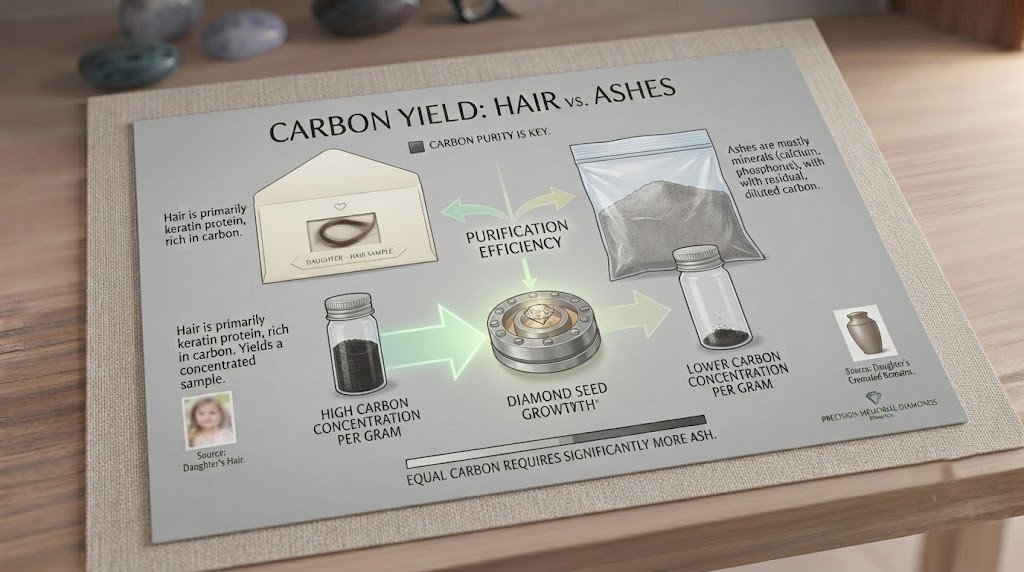
How Long Does a Diamond Made From Daughter Hair Take, and What Does It Cost?

Across the industry, a diamond made from daughter hair typically takes six to ten months from the day the material is received, stretching to around twelve for larger stones or specialty colors. Growth accounts for most of that time; intake, extraction and cutting take comparatively little.

As general 2026 industry ranges, not any single company’s pricing:

SizeTypical range
About 0.10 to 0.25 ct$1,500 to $3,500
About 0.5 to 1 ct$5,000 to $15,000
About 2 to 5+ ct$20,000 to $75,000 or more

Colorless usually costs more than yellow, blue or champagne tones at the same weight, and settings, engraving, fancy cuts and an optional grading report are normally priced apart from the loose stone.

For the family side sequence of arranging a diamond made from daughter hair, from first inquiry to the parcel arriving, see how to turn your daughter’s hair into a diamond.

What Should You Ask Before Sending Her Hair Anywhere?

Start with permission, because hair can feel like a private keepsake even when it is not entirely yours to decide about. Belongings can form part of an estate, the rules differ from state to state, and it is worth thinking through whose agreement is appropriate before anything is posted.

Where she was married or had a partner, that person may have a strong claim to be consulted, and so may her own adult children, sometimes ahead of her parents. Anything she left in writing, such as a will or a pre arrangement, can change the picture entirely. Parents do not always agree on this, and one parent handling it alone is common. Where the position is unclear, a funeral director or an attorney can explain how it works locally.

Then put a short list of questions to any provider, and ask for the answers by email:

  • How much hair do you require, and in what condition?
  • Where do extraction and growth physically take place?
  • Approximately what share of the finished stone will be her carbon?
  • What happens to any hair you do not use?
  • Is independent grading included, optional, or unavailable?
  • What are the terms if something goes wrong or we need to cancel?

A provider that answers these clearly, in writing, is showing you how it will handle every later stage of a stone made from daughter hair.

Frequently Asked Questions

Can a diamond be made from hair that was cut many years ago?

Usually, yes. Hair is a stable material when it has been kept dry and away from heat, and its carbon does not disappear with time. Tell the provider roughly how old the sample is and how it has been stored, since unusual storage can matter more than age itself.

Does my daughter need to have been cremated for this to work?

No. Hair is a separate starting material from ashes and needs no cremation at all, so it can come from someone who was buried or from a lock saved long before her death. Ask a funeral home early if you want hair collected before burial arrangements are finalized.

Is the finished stone a real diamond or a lookalike?

It is a real diamond. A stone made from daughter hair, grown by HPHT or CVD, has the same carbon lattice as a mined stone, with the same hardness, optical behavior and grading scale. It is lab grown, which describes where the crystal formed, not whether it is genuine.

Why is lab carbon added if hair is already about half carbon?

Because growing a crystal of useful size needs more carbon than a small personal sample reliably provides once extraction and purification are complete. The supplemental carbon makes up the working volume. No published figure gives the finished stone share for a diamond made from daughter hair, so ask your provider for theirs in writing.

Will a diamond grown from her hair come out lighter than one from ashes?

Not automatically. Color depends on trace nitrogen and boron during growth, and a cleaner starting material does not make the result predictable. A stone made from daughter hair can be yellow, blue or near colorless, and a colorless result generally costs more whichever material is used.

Can more than one diamond come from the same lock of hair?

Often, yes, because a single stone usually uses only part of the lock you send. Each stone still has its own growth run, timeline and price. Ask the provider whether one submission can cover several stones before dividing the hair yourself.

How can I be sure the stone came from her hair?

Through chain of custody: intake records, a unique reference number carried through each stage, and an origin certificate linking the finished stone to your submission. Ask to see what that documentation looks like before you send anything, and keep copies of every record you receive.

Final Thoughts on How Her Hair Becomes a Diamond

A great deal happens to the small lock behind a diamond made from daughter hair: extreme heat, then extreme pressure, then the patient work of a cutter. Knowing each stage does not shorten the months, but it makes them less mysterious.

The parts that deserve your care are the ones only you can do. Settle whose agreement matters, get the requirements and the carbon question answered in writing, and ask what happens to hair that is not used. The chemistry, by comparison, is well understood.

What comes back at the end is a real diamond, with a documented line to her. That is not the same as having her here, and nothing is. It is simply something solid that exists because of her.

Learn More About Daughter Memorial Diamonds

Talk With Memorial Diamond

If any stage still feels unclear, asking a person may be easier than reading another page. Memorial Diamond can be reached at memorialdiamond.us to talk through how a diamond made from daughter hair would be handled at each stage. There is no obligation in asking.

hair-for-a-daughter-memorial-diamond

How Much Hair Do You Need for a Daughter Memorial Diamond?

Many parents ask this while holding something small: an envelope from a first haircut, a braid trimmed years ago, a brush left on a dresser. The hair for a daughter memorial diamond is usually modest, and industry wide most providers ask for a small lock or a few grams. Because hair is roughly half carbon, far less is needed than with ashes, and no cremation is involved at all.

A small lock of hair for a daughter memorial diamond resting in an open paper envelope beside a finished lab-grown stone

How Much Hair for a Daughter Memorial Diamond Do Providers Ask For?

A small lock, or a few grams by weight, is the figure most often quoted across the industry. Some providers call the right amount roughly palm sized; others speak of a few wisps. None of it is a universal rule, and each company sets its own minimum.

One laboratory may be comfortable with a single thin curl, while another wants a fuller cutting as a margin for loss during purification. The only dependable way to learn the requirement for hair for a daughter memorial diamond is to ask the specific provider you are considering, and to keep its answer in writing.

Quantity and stone size are separate questions. The quantity of hair for a daughter memorial diamond decides whether a stone is possible, while the carat you choose decides how long it grows and what it costs.

Whether she was a little girl whose first curls you saved or a grown woman whose hair you never thought to keep, the answer about hair for a daughter memorial diamond is usually gentler than parents fear.

What Does a Few Grams of Her Hair Look Like?

Less than most people picture: often a lock a finger’s width thick and a few inches long, or a loose gathering from several cuttings.

Families rarely hold neatly weighed samples, so think about the sources parents actually find. The table sets out common ones and how they tend to fit as hair for a daughter memorial diamond, as a general guide rather than any provider’s policy.

Where the hair comes fromWhat it often looks likeHow it tends to fit
A saved childhood lock or first haircutA single curl or small bundle, often fineEnough for some providers; ask about the minimum
A braid or ponytail cut in later yearsA thick, long lengthUsually ample, often with plenty left over
A lock taken by the funeral homeA clean, deliberate cuttingOften the easiest to work with, if still possible
Strands from her brush or combLoose, sometimes tangledPossible for some, but may mix with others’ hair
Clippings from a recent haircutShort pieces, variable amountsDepends on quantity and how they were kept

If you are unsure what you have, a kitchen scale that reads to a tenth of a gram gives a rough weight. A photograph beside a coin, sent to the provider, often settles the matter faster than a description of the hair for a daughter memorial diamond ever could.

Why Does Hair Need So Much Less Than Ashes?

ide-by-side illustration comparing a small hair sample with a larger portion of cremated remains and their carbon content

Chemistry, mostly. Hair is built from keratin, a protein that is roughly 50% carbon by weight, and carbon is the only element a diamond contains.

Cremated remains are a different material, mostly calcium phosphate from bone, with usable carbon typically only about 0.5% to 4% of their weight. That is why ash requests run from a few tablespoons to about 4 oz, near 100 grams, while hair for a daughter memorial diamond is counted in grams and travels in an envelope rather than a jar. How much ash a daughter memorial diamond needs sets out that side in full.

The richer starting material does not shorten the process. Extracted carbon is purified to roughly 99.9% or better, heated to about 2,500 to 2,700°C to form graphite, then grown at around 6 to 8 GPa and 1,400 to 2,500°C in the same HPHT method used across lab grown diamond production. A minority of providers use chemical vapor deposition instead. How a memorial diamond is made from her hair follows each stage.

What If You Only Have a Little of Her Hair?

Ask before assuming it is not enough. Some providers can work with very little; others set a firm floor and will say so. Neither answer is a judgment on what you kept.

A parent might have one curl in a baby book, or a few strands found in a coat pocket. Describe exactly what you have and ask three things: whether that quantity of hair for a daughter memorial diamond meets the minimum, what happens if purification yields less carbon than expected, and whether the hair comes back untouched if they cannot proceed.

Look again, too. Hair turns up in more places than families expect:

  • A keepsake envelope or baby book from an early haircut
  • A brush, comb or hair tie in a bag, car or drawer
  • A braid or cutting she kept herself
  • A lock a sibling, partner or friend saved
  • A lock the funeral home can take, if burial or cremation has not yet happened

If one provider turns down a small amount of hair for a daughter memorial diamond, another may accept it. And if no one can, a stone grown from ashes and hair together is another path; how much ash and hair a combined stone needs explains that option.

Will the Whole Keepsake Lock Be Used?

Ask directly, because practice varies. Some providers take only what they need and return the rest; others consume everything sent. You are entitled to know which before a single strand leaves home.

For many families, deciding how much hair for a daughter memorial diamond to part with is the question that matters most. A lock saved since she was small can feel irreplaceable in its own right, and wanting part of it to stay in the envelope where it has always lived is entirely reasonable.

The simplest safeguard is to divide it yourself. Keep back a portion you are sure of, and send only the hair for a daughter memorial diamond that the provider has confirmed it needs.

Ask as well what happens to any unused material after extraction: whether it is returned, retained or disposed of, and how. Hearing that answer beforehand is far better than wondering afterward.

Does Dyed or Treated Hair Still Work?

Usually, yes, but mention it up front. Dye, bleach, perms, relaxers and styling products leave non carbon residues, and purification exists to strip away everything that is not carbon.

Treatment mostly changes the practicalities. A provider may want slightly more treated hair for a daughter memorial diamond to allow for loss, may prefer an untreated section if one exists, or may simply want its technicians to know.

Dyed hair will not steer the color of the stone. Color comes from trace elements during growth: nitrogen tends toward yellow, boron toward blue, and colorless needs the absence of both, which usually costs more. A hair grown stone is not automatically lighter than an ash grown one, and a cleaner starting material does not make color predictable. What color a diamond grown from her hair will be covers this in depth. Some providers also offer optional irradiation for red, pink, green or black.

Her natural shade, length or texture does not decide the result either; it all reaches the press as carbon.

How Should You Store and Package Hair for a Daughter Memorial Diamond?

Dry, clean, labeled and sealed. Hair stays stable for years away from damp and heat, so a lock saved long ago is often still perfectly usable.

Until you are ready, keep the hair for a daughter memorial diamond in a paper envelope or acid free bag rather than a damp plastic pouch, somewhere dark and dry. Avoid taping the strands, washing them or treating them; a provider would rather receive the hair as it is.

Most providers supply a kit for sending hair for a daughter memorial diamond. If yours does not, a sensible routine is:

  • Place the hair in a small clean envelope or sealable bag
  • Label it with her name and the date you prepared it
  • Put that inside a sturdier outer envelope or small box
  • Include the provider’s signed forms inside the parcel
  • Photograph the sealed package before it goes
  • Use a tracked, insured service and note the tracking number

Ask how chain of custody paperwork proves the stone grew from the hair you sent. The step by step guide to turning her hair into a diamond walks through sending and receiving in order.

Whose Agreement Is Worth Having First?

That depends on your circumstances, and it deserves a moment before any hair for a daughter memorial diamond is cut or posted. Hair is not always handled like cremated remains, but it would be wrong to say no one else could ever have a say.

Rules vary by state, and no single national standard exists. A lock kept at home for years may feel plainly yours, yet a daughter’s belongings can form part of her estate. If she was an adult, a spouse or partner, or her own adult children, may rank ahead of her parents on decisions about her remains, and her own written wishes, whether in a will, a directive or a funeral pre arrangement, can override the usual order.

Where a funeral home is to take the hair for a daughter memorial diamond before burial or cremation, the person holding authority over her remains will usually need to agree. That is not automatically a parent.

Parents do not always agree, and sometimes one parent arranges it alone. A funeral director or attorney can explain local rules.

Can One Lock Be Shared Among Several Stones?

Often, yes. Because each stone needs so little, one generous lock of hair for a daughter memorial diamond can sometimes supply two or more stones, for each parent or her siblings.

Each stone grows separately, with its own timeline and price. Ask whether one submission of hair for a daughter memorial diamond can be divided between orders, or whether the provider wants a separate portion per stone. Some relatives may want a stone, others part of the lock kept as it is, and others no involvement at all; none of those needs ranking.

Does Sending More Hair Change Size, Cost or Timing?

No. Across the industry, stone size is set by growth time in the press, not by how much material arrives. Extra hair for a daughter memorial diamond does not buy a bigger, faster or cheaper stone.

Price follows the stone you choose. As general 2026 industry ranges, not any single company’s pricing:

TierCarat weightIndustry typical price, 2026
EntryA tenth to a quarter carat$1,500 up to $3,500
MidHalf a carat to one carat$5,000 up to $15,000
LargeTwo carats to five and beyondFrom $20,000, sometimes past $75,000

At equal weight a colorless stone is generally the priciest option, while settings, engraving, fancy cuts and an optional independent grading report are quoted separately. Stones generally run from about a tenth of a carat past five, with clarity commonly SI2 to VVS.

Timing works the same way. Providers generally quote six to ten months once material arrives, stretching toward a year for big stones or specialty colors. Once the hair for a daughter memorial diamond clears a provider’s minimum, quantity plays no further part in the calendar.

How Much of the Finished Stone Is Her Carbon?

hpht-press-memorial-diamond-growth-lab

No finished stone percentage has been published for hair, and a trustworthy provider will say so plainly.

For ash grown stones, some providers describe personal carbon as around 10% to 15% of the finished diamond, with a few citing as little as about 3%. That estimate belongs to the ash route alone. Borrowing it for hair for a daughter memorial diamond would be misleading, and so would assuming hair’s richer carbon means a larger share.

What is consistent is that her carbon is extracted, purified and grown into the crystal, blended with supplemental lab carbon so the stone reaches a workable size. It is never a stone made only of her. Ask each provider what share it can document for hair, in writing, and ask whether an independent grading report is available as an optional extra; that report assesses cut, color, clarity and carat, while the in house origin certificate records which submission the stone came from. Whether a memorial diamond is really made from her hair examines the evidence further.

For the whole hair route in one place, see everything families ask about a daughter hair diamond, or how to turn your daughter’s hair into a diamond when you are ready to act.

Frequently Asked Questions

Is one curl from a baby book enough hair for a diamond?

Sometimes. Industry requests for hair for a daughter memorial diamond usually sit at a small lock or a few grams, and a single fine curl may fall below some providers’ minimums while meeting others’. Weigh it if you can, photograph it beside a coin, and ask each provider whether that specific amount is enough before sending anything.

Can hair from her hairbrush be used?

Often, if there is enough and it is clearly hers. Loose strands from a brush can serve as hair for a daughter memorial diamond, but a shared brush may hold someone else’s hair too. Tell the provider where the hair came from, and ask whether it accepts brush hair and how much it would need.

Will the provider return any hair that is not used?

Policies differ. Some return unused hair, some retain it, and some consume the whole submission during purification. Ask before posting anything, and if part of a keepsake lock matters to you, divide it yourself and keep that portion at home rather than relying on a return.

Does dyed or permed hair make a difference?

It rarely stops the process, because purification removes everything that is not carbon. A provider may ask for a little more treated hair to allow for loss, or prefer an untreated section if one exists. Mention any dye, bleach or perm when you first make contact.

How long can hair be stored before it is too old to use?

Hair kept dry and away from heat stays stable for many years, so a lock saved since she was small often still works as hair for a daughter memorial diamond. Paper envelopes or acid free bags suit long storage better than sealed plastic. Tell the provider roughly how old the hair is and how it has been kept.

Does more hair produce a bigger diamond?

No. Stone size depends on how long the crystal grows in the press, which follows the carat you choose. Once the hair for a daughter memorial diamond meets a provider’s minimum, sending more changes neither the size, the timeline nor the typical price, which is quoted by carat and color.

Can one lock make diamonds for both parents?

Often, since each stone needs only a small amount of hair for a daughter memorial diamond. A generous lock or braid may supply two or more diamonds, each grown on its own schedule and priced separately. Ask whether one submission can be split between orders or whether the provider wants separate portions for each stone.

Final Thoughts on How Much Hair a Daughter Memorial Diamond Needs

The amount is small, and that is often the first relief. What sits in an envelope or a drawer may well be enough hair for a daughter memorial diamond, and if one provider says no, another may say yes.

The questions that deserve care surround the quantity rather than the quantity itself: whether part of the lock should stay home, who belongs in the decision, and what a provider will commit to in writing. Settle those and the hair becomes the simplest part of the whole undertaking.

A stone is one way to carry that lock forward, not the only one.

Learn More About Daughter Memorial Diamonds

Talk With Memorial Diamond

If you would like to talk through hair for a daughter memorial diamond, what you have and what might be possible, Memorial Diamond is glad to help at memorialdiamond.us. There is no obligation, and no question about her hair is too small to ask.

Daughter Hair Diamond Steps 9 Proven Stages, Calmly Told

Step by Step: Turning Your Daughter’s Hair Into a Diamond

A lock of her hair may be sitting in an envelope, a brush or a keepsake box, and you may not know what to do with it. The daughter hair diamond steps come to nine: find and collect the hair, check whose agreement is needed, pick a provider, confirm the amount and its condition, choose the stone, pack and ship it, wait out the growth, make the finishing calls, and receive the diamond. Industry wide, that usually spans six to ten months.

The daughter hair diamond steps in one frame: a small sealed lock of hair, a submission form and a finished loose memorial diamond

What Are the Daughter Hair Diamond Steps, in Order?

Nine, counted from the family’s side of the table. Laboratory write ups list what happens inside the building; the daughter hair diamond steps below cover what you handle, how long each part lasts, and where it can trip you up.

#Your taskTypical durationMost common snag
1Find or collect her hairAn hour to a few daysHair stored loose and mixed with someone else’s
2Check whose agreement is appropriateDays to a couple of weeksAssuming a parent decides alone
3Pick a provider and get terms in writingOne to two weeksChoosing on tone rather than written answers
4Confirm the amount and the condition of the hairA few daysToo little, or treated hair not flagged
5Choose carat, color and cutYour own paceExpecting a colorless stone by default
6Pack and ship it with trackingA few daysPaperwork sent separately from the parcel
7Wait while the stone is grownUsually 6 to 10 monthsSilence mistaken for a problem
8Confirm cut, any irradiation, any gradingA few weeksRushing a choice you cannot undo
9Receive it and decide on a settingYour own paceFeeling pressure to set it immediately

Only the seventh of the daughter hair diamond steps is long; the active work before it usually fits inside a month. For the wider picture, the complete daughter hair diamond guide is the background reading.

The daughter hair diamond steps hold whether she was a little girl or a grown woman. Age changes little about the process, though it can change who has a say in it.

Step 1: Where Can Her Hair Be Found or Collected?

Usually closer than you think. The first of the daughter hair diamond steps is locating hair that is unmistakably hers.

Places worth checking:

  • A saved lock or first haircut envelope, if one was kept at any point in her life
  • Her own hairbrush or comb, provided nobody else used it
  • The funeral home, which can often cut a small lock before burial or cremation if asked in time

The funeral home is the only source with a deadline. If she has not yet been buried or cremated, a short request to the funeral director is the place to start, with the agreement of whoever holds authority over her remains; cutting a discreet lock is a request many funeral homes are used to. After cremation, the other sources become the options, and the daughter hair diamond steps simply begin from whatever was saved.

What can go wrong is mixing: strands from a shared brush may belong to a sibling, a partner or a pet. Choose a smaller amount you are certain of over a larger one you are not. How to turn your daughter’s hair into a diamond goes further into finding and storing hair before any of this begins.

A small lock of hair resting on a paper keepsake envelope beside a wooden hairbrush

Step 2: Whose Agreement Should You Check First?

Anyone who might reasonably expect to be asked. This is the most human of the daughter hair diamond steps, and the one most worth doing slowly, over a few days to a couple of weeks.

Hair kept at home is not always handled like cremated remains, but that does not put it outside every rule. Belongings can form part of an estate, rules vary by state, and no single national standard decides this. Check whose permission is appropriate before anything is posted.

In practice, think about who else was close to her. A spouse or partner may hold rights, or at least a strong claim to be consulted, ahead of her parents, and so may her own adult children. Anything she put in writing, a will provision, an advance directive, a funeral pre arrangement, can shape the answer as well.

Parents are not always of one mind, and sometimes one parent arranges it alone. None of that has to block the daughter hair diamond steps, but a conversation now beats a surprise later. Where it feels unclear, a short call to an estate attorney or the funeral director usually settles it.

Step 3: How Do You Pick a Provider You Can Trust?

By asking specific questions and reading the written replies, a stage of the daughter hair diamond steps that typically takes a week or two. Among all the daughter hair diamond steps, this is where an hour of skepticism does the most good.

Before committing, ask each company to confirm by email:

  • the minimum amount of hair it accepts, and whether dyed or chemically treated hair is a problem
  • how the stone will be traced back to your submission, and what document proves it
  • what happens to any hair left over after extraction
  • what share of the finished stone is expected to be her carbon

That last question matters more for hair than for ashes. No finished stone percentage is published industry wide for hair grown diamonds, so the only reliable figure is the one a provider puts in writing. Hair is roughly half carbon by weight, but that describes the starting material; the finished diamond also contains supplemental lab carbon.

It is also fair to ask whether growth happens in house or at a partner laboratory. Either can be fine; evasiveness is the warning sign. A provider that answers vaguely at this point in the daughter hair diamond steps rarely becomes clearer later.

Step 4: Is There Enough Hair, and Is It Usable?

Very often, yes, and far less is needed than people assume. Across the industry, a small lock or a few grams is the usual request, sometimes described as roughly palm sized. That is the reason the daughter hair diamond steps work even when no cremation took place.

Quantity does not decide size. Growth time in the press does, so a thicker lock buys no larger stone. How much hair a daughter memorial diamond needs sets out the quantities in more detail.

Condition is the other half. Tell the provider honestly about:

  • Dye, bleach or perm treatments, since some laboratories want to know
  • Any hair products you know were used shortly before it was cut
  • Storage history, a sealed envelope, a drawer, a damp basement

Nothing listed rules the hair out; it lets the laboratory decide how to handle it. This check takes a few days at most, and it is the part of the daughter hair diamond steps where honesty saves the most trouble.

Step 5: Which Stone Should You Ask For?

The one that suits the person who will keep it, chosen before anything is shipped. These three decisions, carat, color and cut, sit early in the daughter hair diamond steps because they fix both the cost and the length of the wait.

Carat has the biggest consequences. Stones are generally offered from about a tenth of a carat to five carats and beyond, and a bigger stone means more months in the press, not more hair in the envelope.

Color is only partly yours to pick. Trace nitrogen during growth pushes a stone toward yellow; trace boron pushes it toward blue; a colorless result needs the near absence of both and usually costs more. Hair being a cleaner source does not make the result predictable, and hair does not automatically yield a paler stone than ashes would. What color a diamond made from your daughter’s hair will be explains why.

Nothing here should rest on assumptions about what a daughter would have wanted. Choose what fits her as you knew her, or the person who will wear it. Cut, round, oval, cushion, emerald, is the same menu any diamond offers, and settling it now keeps the later daughter hair diamond steps simple.

Step 6: How Should the Hair Be Packed and Sent?

Dry, sealed, labeled, tracked, with the forms inside the parcel, a few days’ work. This is the shortest of the daughter hair diamond steps and the easiest to get right if you follow the provider’s kit.

Most providers supply a collection pack: a sealed bag or vial, a label and a submission form. Place the hair inside with minimal handling, seal it, label it with her name and your order reference, and photograph the sealed pack.

A few practical points:

  • Keep the hair dry; a paper envelope inside a zip bag works if no kit arrives
  • Ask whether part of the lock can stay with you
  • Use a tracked, signed for service
  • Wait for written confirmation that the parcel was logged

That confirmation is the handover point. Up to it, the daughter hair diamond steps are yours to manage; after it, the laboratory’s chain of custody records link the finished stone to her.

Step 7: What Is the Laboratory Doing While You Wait?

A sequence of heat, pressure and patience. This stage of the daughter hair diamond steps needs nothing from you. Of all the daughter hair diamond steps, it is where most of the calendar goes, and it is typically six to ten months, sometimes up to twelve for larger or specialty color stones.

First, extraction. The hair is heated in a controlled, oxygen free process that drives off everything in keratin that is not carbon, leaving carbon purified to roughly 99.9% or better.

Second, graphitization. A further stage at around 2,500 to 2,700°C converts that carbon into graphite, the form a growth press can use.

Third, growth. The graphite, topped up with supplemental lab carbon, is loaded into a high pressure, high temperature press beside a tiny diamond seed and held for weeks to months at roughly 6 to 8 GPa and 1,400 to 2,500°C. Some providers, though fewer, use chemical vapor deposition, the other lab growth method, instead. How a memorial diamond is made from your daughter’s hair walks through that chemistry in plain terms.

Silence during these months is normal, and it is not a sign that the daughter hair diamond steps have stalled. If regular updates matter to you, ask at step three what the provider sends and how often.

A high-pressure, high-temperature diamond growth press in a laboratory

Step 8: Which Finishing Decisions Land Back With You?

Usually three, arriving once a rough crystal exists, and they typically take a few weeks. This is the only point in the daughter hair diamond steps where you may be asked something mid process.

The cut. A gemologist shapes and polishes the rough. Occasionally the crystal suits a different shape better, and a careful provider will say so before cutting.

Irradiation. Some providers offer post growth treatment that shifts color toward red, pink, green or black. It is entirely optional and priced separately. Leaving the stone as it grew is an equally sound choice.

Independent grading. Having an outside lab assess the four quality measures is optional, not automatic. It differs from the in house certificate of origin: one speaks to quality, the other to provenance.

Clarity typically lands between SI2 and VVS. Once the cut is done, it is done, so take your time over this stage of the daughter hair diamond steps.

Step 9: What Arrives at the End?

A loose diamond, in most cases, with its paperwork. Expect the stone, an origin or authenticity certificate, and a grading report if you ordered one.

The final one of the daughter hair diamond steps can feel strangely quiet after so many months. Some families open the package together, some alone, some not for a while. There is no correct way to receive it.

The stone is physically durable, which takes the pressure off the last of the daughter hair diamond steps. Diamond sits at 10 on the Mohs scale of mineral hardness, the top of the scale, so a loose stone kept safely in its box can wait for years while you decide on a ring, a pendant, earrings or nothing at all.

Before you close the file, confirm in writing what happened to any unused hair; that question properly ends the daughter hair diamond steps.

How Long Do the Daughter Hair Diamond Steps Take, and What Do They Cost?

From the day her hair is received, typically six to ten months, and up to twelve for stones over about two carats or specialty colors. The daughter hair diamond steps you handle yourself, steps one to six, usually take a few weeks in total.

On price, these are general 2026 industry ranges, not any one company’s published list:

Stone sizeTypical price rangeWhat moves it
About 0.10 to 0.25 ct$1,500 to $3,500Color choice, cut
About 0.5 to 1 ct$5,000 to $15,000Colorless costs meaningfully more
About 2 to 5+ ct$20,000 to $75,000+Growth time, specialty color

Settings, engraving, fancy cuts and optional grading are usually quoted on top. More hair changes neither the price nor the timeline of the daughter hair diamond steps; both follow from the stone chosen at step five.

If you are weighing a stone that combines her hair with a portion of her ashes, the sequence changes in a few places, and the steps for a combined ashes and hair stone lay those differences out.

Which of the Daughter Hair Diamond Steps Tend to Go Wrong?

Mostly the early, human ones. The chemistry of the daughter hair diamond steps is well established; the snags are about certainty, communication and timing.

The first is uncertain hair, a shared brush or strands from a sweater leave doubt about whose carbon is in the parcel.

The second is an unspoken disagreement: a partner, a grown child or the other parent learns afterward and feels left out. An early conversation prevents most of it.

The third is expectation: assuming a hair stone will be purer, lighter or faster than an ashes stone. None of that is guaranteed. If you want to test the claims you have read, whether a memorial diamond is really made from your daughter’s hair examines them one by one.

Frequently Asked Questions

Can hair from her hairbrush be used for a memorial diamond?

Often, yes, provided you are confident nobody else used the brush. Strands from a brush are usually thinner and more scattered than a cut lock, so gather carefully and ask the provider whether the amount you have is enough before you ship anything to the laboratory.

Does her hair need to have been cut while she was alive?

No. Hair saved during her lifetime, hair cut by the funeral home before burial or cremation, and strands collected later from her belongings can all work. What matters most is that it is clearly hers, stored dry, and sufficient in quantity for the provider you choose.

Is dyed or chemically treated hair a problem?

It depends on the laboratory. Some accept treated hair routinely, while others want to know in advance so they can adjust how it is processed. Tell the provider honestly about dye, bleach or perms at the quantity check stage rather than leaving it for them to discover later.

How much of the finished diamond is her own carbon?

No finished stone percentage is published industry wide for hair grown diamonds. Hair starts at roughly half carbon by weight, but the finished stone also contains supplemental lab carbon added for growth. Ask any provider for its own figure in writing before you commit, and keep that reply with your records.

Can more than one diamond be grown from the same lock of hair?

Sometimes. Because only a small amount is typically needed, one generous lock may be enough for two stones. Each diamond is grown separately, though, so expect a separate timeline and a separate price for each, and confirm the quantity required before you divide anything.

What happens to the hair that is not used?

Policies differ between providers. Some return unused hair with the finished diamond, some dispose of it respectfully, and some hold it for a set period before deciding. Ask which applies before you ship, and request the answer in writing so there is no confusion at the end.

Can the order be canceled once the hair has been sent?

Ask this at the provider selection stage, not afterward. Cancellation terms vary widely, and once extraction has begun the hair cannot be returned in its original form. Get the policy in writing, including any fees or partial refunds, before the parcel leaves your hands.

Final Thoughts on the Steps of Turning Her Hair Into a Diamond

Set out in a list, the daughter hair diamond steps look like a lot of administration. Most are small, and most of the time is waiting rather than doing.

Of the daughter hair diamond steps, the first two deserve your full attention: being certain the hair is hers, and making sure the people with a genuine stake have been heard. Get those right, get the provider’s answers in writing, and the rest of the daughter hair diamond steps tend to move forward quietly.

What comes back at the end is a real diamond grown in part from her own carbon, with a paper trail that connects it to the lock you sent.

Learn More About Daughter Memorial Diamonds

Talk With Memorial Diamond

If you would like to talk any of this through with a person, Memorial Diamond is available at memorialdiamond.us to go over the daughter hair diamond steps with you and answer questions about the hair you have. Asking carries no obligation.

turn-son-ashes-and-hair-into-a-diamond

How to Turn Your Son’s Ashes and Hair Into a Diamond

There is often a box on a shelf and an envelope in a drawer, and no obvious instruction for what to do with either. If you want to turn son ashes and hair into a diamond, the plain version is this: a laboratory pulls carbon out of both samples, purifies it past 99.9%, converts that carbon to graphite, and grows the graphite into a genuine lab grown diamond over roughly six to ten months. Parents who turn son ashes and hair into one stone are not buying a symbol of him. They are commissioning a gem that physically contains carbon that was his.

 Parents turn son ashes and hair into a diamond: a champagne-toned lab-grown memorial stone resting on pale linen

Why Would You Turn Son Ashes and Hair Into One Diamond?

Most parents who turn son ashes and hair into a single diamond do it because they happen to hold both, and neither one feels like something to set aside. The hair may have come from a hairbrush nobody emptied, a barber’s envelope, a hospital bag, or a lock cut before the funeral. The ash came later.

The reason to turn son ashes and hair into one gem rather than two is usually not sentimental arithmetic. It is that a single object can be worn, carried, and eventually passed on, while two half portions tend to sit in two boxes. If you are still weighing that, the ash only version of this process and working from hair alone each cover the single source route in full.

There is also a quieter reason parents mention. Hair is frequently the older of the two samples it may predate an illness, an accident, or a long decline and combining it with ash lets both versions of him contribute to the same crystal, whether your son was six or sixty when he died.

Deciding to turn son ashes and hair into a single piece also settles a practical question early: you are commissioning one stone, on one timeline, at one price, rather than managing two parallel orders. And because labs work from a small portion of what you send, you can turn son ashes and hair into one stone and still keep the great majority of both exactly where they are now.

Who Can Legally Decide to Turn Son Ashes and Hair Into a Memorial Stone?

This is the part parents are most often surprised by, and it is worth settling before you turn son ashes and hair into anything. If your son was married, his surviving spouse may hold the legal right to direct what happens to his remains ahead of you. If he had adult children of his own, they may sit ahead of you as well.

Most states set out a statutory order of priority for who may authorize the disposition of a decedent’s remains, and parents typically appear on that list after a spouse and after adult children. Anything your son left in writing a will, a funeral directive, a pre need contract, a designated agent form can rearrange that order entirely. The details genuinely vary from state to state, so this is a question for the funeral home that handled the cremation, or for a local attorney, rather than something to settle from a blog post.

Hair sits in a slightly different place. Rules about disposition are written about the remains themselves, so a lock you already have in your own home is usually the simpler question in practice but a decedent’s personal belongings can still fall to his estate, the treatment varies by state, and if the hair is in someone else’s keeping, retrieving it is a conversation rather than a decision.

The honest summary: a parent arranging this alone may well be able to turn son ashes and hair into a diamond without difficulty, and many do. But parents who press ahead without first speaking to whoever else has standing sometimes discover the problem painfully late. Ask early, in writing where you can.

Parents are not always of one mind about this, and one parent quite often arranges the whole thing alone after a separation, after a disagreement about cremation itself, or simply because one of you can face the phone calls and the other cannot. Providers encounter that constantly and it is not an obstacle. What governs the outcome is who holds authority, not whether the household agrees.

What Do You Need to Gather Before You Begin?

What you need in hand before you turn son ashes and hair into a diamond is less than most parents expect. Providers differ, so treat the figures below as industry typical rather than any single company’s published rule, and see how much of each sample a lab needs for the quantities in more depth.

What you sendIndustry typical amountPractical notes
Cremated remainsA few tablespoons up to roughly 4 oz (about 100 g)A small fraction of a full cremation; the rest stays with you
HairA small lock, often described as a few grams or a palm sized amountCut hair is fine; length matters less than total weight
Identification of the materialWhatever the provider’s intake form asks forPart of chain of custody documentation
Written authorisationVaries by provider and stateTies back to the authority question above

Labs that turn son ashes and hair into one crystal usually ask for hair in a clean, sealed paper envelope rather than plastic, and for ash in whatever sealed container the crematorium supplied or one the provider sends you. You do not need a full urn to end up with a wearable gem, and you should be cautious of anyone who implies otherwise.

If the hair is short, thin, chemically treated, or came from a very young child, say so at intake rather than hoping. It is a normal question, and the answer affects how much the lab asks for.

What Are the Seven Steps to Turn Son Ashes and Hair Into a Diamond?

Stripped of marketing language, the seven steps below are what it actually takes to turn son ashes and hair into a finished diamond.

  1. Collection and chain of custody. Step one in any attempt to turn son ashes and hair into a diamond is intake: both samples are logged, assigned an identifier, and tracked from that point forward. Every laboratory that will turn son ashes and hair into a gem should be able to describe this process to you in concrete terms.
  2. Carbon extraction and purification. Each sample is heated in a controlled, oxygen free, multi stage process that strips out everything that is not carbon the calcium phosphate that dominates ash, the non carbon components of keratin in hair until the recovered material reaches roughly 99.9%+ carbon purity.
  3. Graphitization. The purified carbon is heated further, to somewhere around 2,500 to 2,700°C, and converted into graphite: the crystalline form of carbon a growth press can actually use as feedstock.
  4. Loading the growth cell. The graphite, blended with supplemental lab sourced carbon to reach workable volume, is placed in a growth cell with a tiny diamond seed. This is the growth cell where the decision to turn son ashes and hair into one crystal finally becomes physical.
  5. Growth. In the HPHT method that dominates this category, the cell is held at roughly 6 to 8 gigapascals of pressure and temperatures in the 1,400 to 2,500°C band for weeks to months. A minority of providers use CVD instead, depositing carbon from gas onto a seed plate in a vacuum chamber. Nothing about the finished size depends on the volume you send growth time sets carat size, not sample size.
  6. Cutting and polishing. Once you turn son ashes and hair into rough crystal, a gem cutter takes over and shapes it into a round, cushion, princess, or other finished cut, exactly as with any other diamond.
  7. Optional irradiation and optional independent grading. Some providers offer post growth irradiation to shift or intensify color. Many families also request a grading report from an independent third party laboratory, documenting the usual cut, color, clarity and carat measures. Both are optional, and both are worth asking about before you commit rather than after.

How Much of the Finished Gem Is Actually His?

Sealed sample envelope of hair beside a small portion of cremated remains on a laboratory bench

Parents ask how much of the finished gem is really his when they turn son ashes and hair into one stone, and they deserve a straight answer rather than a comforting one.

For the ash route specifically, industry figures put usable carbon at roughly 0.5% to 4% of cremated remains by weight. Of the finished stone’s mass, roughly 10 to 15% typically traces back to carbon drawn from ashes a share some providers put as low as 3%, since it moves with stone size and the volume of ash submitted. Hair is a much richer starting material roughly 50% carbon by weight, because keratin is a carbon rich protein but that is a fact about the input, not about the finished stone.

Published figures for the ash route exist. For a charge where you turn son ashes and hair into a blended feedstock, no equivalent published percentage exists at all, and nobody should quote you one as though it were settled. Ask any provider who offers to turn son ashes and hair into a diamond to put their own figure, and their method for arriving at it, in writing.

What is honest to say is this: when you turn son ashes and hair into one crystal, a real, verifiable portion of his own carbon is inside the lattice, blended with supplemental lab carbon to reach a growable volume. No memorial diamond from any source material is 100% personal carbon, and a provider claiming otherwise is describing something physics does not do.

What Color Will the Stone Come Out?

Color is the part of the plan to turn son ashes and hair into a diamond that families least expect to be surprised by, and it is where the individuality of the source material shows up most visibly.

Nitrogen left in the feedstock pushes a crystal toward yellow. Boron pushes it toward blue. A colorless diamond requires the near total absence of both, which is why memorial stones trend toward yellow, blue, and champagne or brown tones rather than white organic source material carries trace elements that a purely synthetic feedstock would not.

When you turn son ashes and hair into a blended charge, both samples bring their own trace elements to the same growth run, which is one more reason no reputable lab will promise you a precise shade before a growth run has actually happened. Colorless is achievable with extra processing and typically costs more; irradiation after growth can produce red, pink, green, or black.

One further point worth knowing: irradiation is a post growth treatment rather than a dye, and an independent grading report will normally disclose that it was applied. If it matters to you whether the color arose from the material itself or was introduced afterwards, say so before growth begins rather than after the stone is cut.

It helps to decide in advance whether you want a specific color or whether you would rather accept whatever the material gives you. Many parents find they prefer the second once it is framed honestly the shade is a consequence of him, not a defect. There is more on what color a combined stone tends to come out if that is the deciding factor for you.

How Long Does It Take and What Does It Cost?

The time it takes to turn son ashes and hair into a finished stone is governed by growth, not by paperwork. Across the industry, six to ten months from receipt of material to finished diamond is the typical span, with larger stones beyond roughly two carats or specialty colors such as black sometimes running to twelve.

Cost, when you turn son ashes and hair into a diamond, tracks carat, color, cut, and whether an independent grading report is included. These are general industry ranges for 2026, not any single provider’s published price list:

Size tierTypical industry rangeNotes
0.10 to 0.25 ctAbout $1,500 to $3,500The usual entry point
0.5 to 1.0 ctAbout $5,000 to $15,000Colorless costs meaningfully more than yellow, blue or champagne at the same size
2 to 5+ ctAbout $20,000 to $75,000+Longest growth times

Nothing about choosing to turn son ashes and hair into one gem rather than two changes which tier you land in the tier is set by the size you choose. Budget for the extras too when you turn son ashes and hair into something wearable: settings, engraving, fancy cuts and grading reports are usually priced separately from the loose stone. If cost is the deciding factor, what a son memorial diamond costs goes into the tiers in more detail, and how long the whole thing takes covers the calendar.

Memorial diamond set in a simple gold band worn on an older woman's hand

What Should You Ask Before You Send Anything?

Ask these before you agree to turn son ashes and hair into a diamond, and ask for answers you can keep:

  • How will you turn son ashes and hair into a documented, traceable batch what identifier is used, and can I see the log?
  • What happens if a lab cannot turn son ashes and hair into a viable crystal on the first run? Is there a second attempt, and does it cost more?
  • What percentage of the finished stone do you estimate will be his carbon, and how did you arrive at that estimate?
  • Do you return any unused ash or hair, and in what form?
  • Is independent third party grading available, and is it included or extra?
  • What exactly does your authenticity or origin documentation state?
  • Can a second stone be grown later from the material I still hold?

Written answers matter more than reassuring phone calls here, for the same reason chain of custody matters: this is a months long process involving something irreplaceable. If you want a longer version of this list, questions worth asking before you commit expands each one.

Frequently Asked Questions

Can a lab turn son ashes and hair into more than one diamond?

Often yes, because only a portion of what you send is used. Several stones can frequently be grown from one shared submission, either in the same run or from reserved material later. Confirm the specific provider’s policy, and the cost of each additional stone, in writing first.

Does hair have to be from before he died?

No. Hair collected at any point works the same way chemically, whether it was cut years earlier, kept from a childhood haircut, taken by a barber, or collected after death. Keratin’s carbon content does not change with time, and properly stored hair keeps indefinitely.

Does it cost more to turn son ashes and hair into one diamond than ash alone?

Providers price by carat, color, cut and optional extras rather than by how many source materials you submit, so a combined submission does not usually carry its own surcharge. Ask directly, though pricing structures differ, and you want that answer before intake, not after.

What if my son’s spouse and I disagree about doing this?

Then it is a legal question before it is a family one, because a surviving spouse may hold authority over his remains ahead of his parents in your state. Talk to the funeral home or a local attorney about who may authorize disposition before any material is shipped.

Will anyone be able to tell the diamond was made this way?

Not by looking. A memorial diamond is chemically and optically a genuine diamond, with the same hardness and the same cut, color, clarity and carat grading as any other. Laboratory grown origin is identifiable through gemological testing, but not to the eye.

Can we still bury or scatter the rest of him?

Yes, and many families do exactly that. A typical submission is a small fraction of a full cremation, so burial, interment, scattering, or keeping an urn all remain entirely available alongside the diamond. None of those choices is diminished by this one.

Final Thoughts on Turning Your Son’s Ashes and Hair Into a Diamond

Choosing to turn son ashes and hair into a diamond is not a way of finishing anything, and it should not be sold to you as one. It is a way of taking material you already have and making it into an object you can keep on your hand instead of on a shelf.

Some parents do this within a year. Some do it after five, or ten, or after a second loss makes the shelf feel heavier. Neither timing is late, and neither is wrong.

Whatever else is true, the decision to turn son ashes and hair into one stone belongs to whoever has the standing to make it, and it should be made slowly, with written answers from the lab, and with the people who also loved him in the room.

Learn More About Son Memorial Diamonds

Talk With Memorial Diamond

If you are weighing this and want to talk it through rather than fill in a form, reach out to Memorial Diamond at memorialdiamond.us to discuss what is possible with the ash and hair you have. There is no obligation in asking, and no schedule you are behind on.

Word count: 2,934 words · Reading time: about 15 minutes