
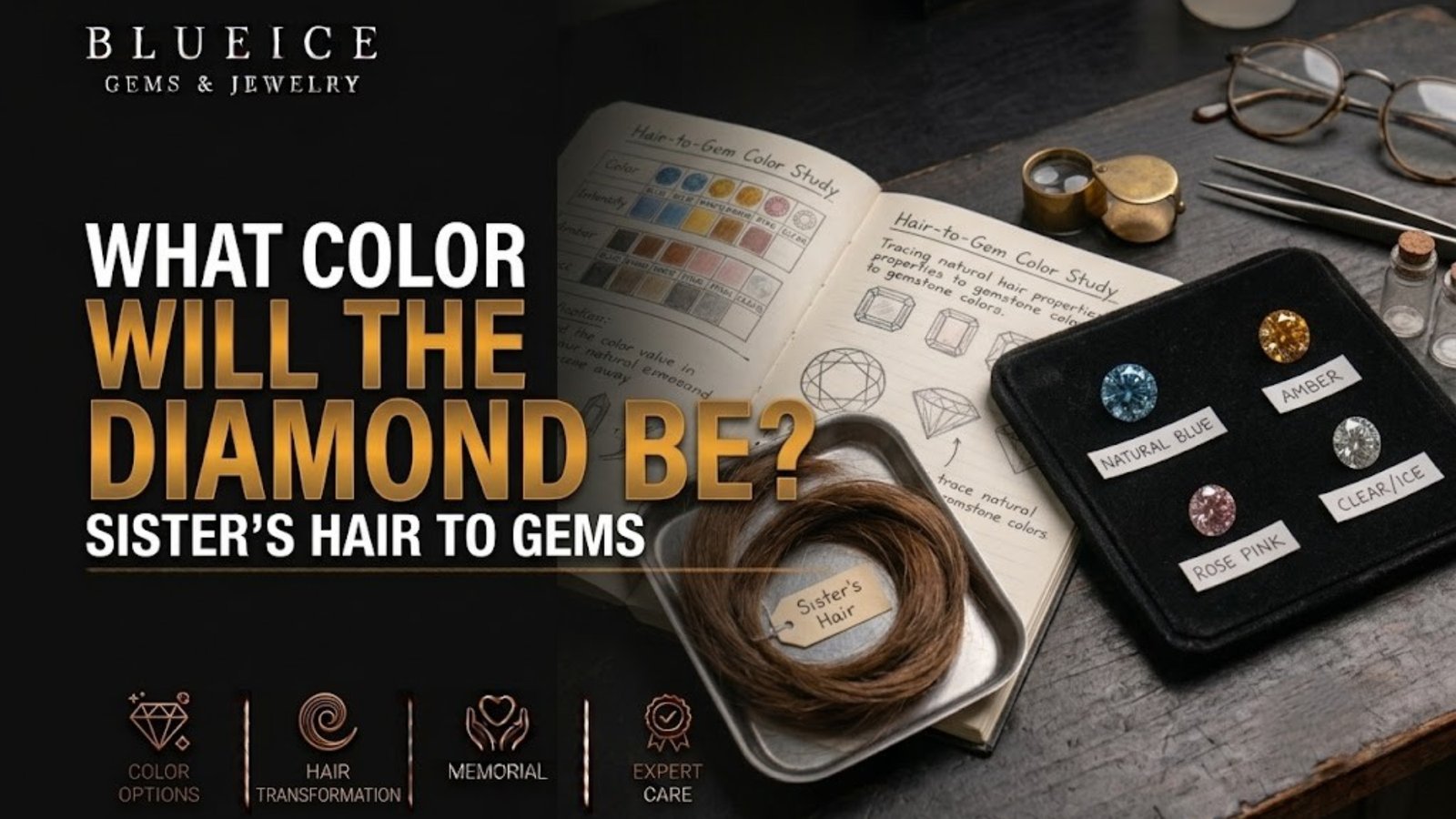
Perhaps it is a lock tucked into an envelope, or a cutting someone thought to save after she died. The sister hair diamond color you end up with cannot be predicted with certainty. The tint forms during crystal growth, so a stone grown using carbon from her hair may turn yellow, blue, or champagne. A colorless result may be possible with additional processing. The shade of her hair does not determine the diamond’s final color.
Table of Contents
Is There Any Way to Know the Sister Hair Diamond Color Before Growth?
No. A lock of hair cannot reliably tell you the exact color of the finished diamond. The sister hair diamond color develops as the crystal grows, and trace elements can influence the result.
Nitrogen can contribute to a yellow tint, while boron can produce blue coloration. When coloring impurities are sufficiently limited, a diamond may appear colorless. The outcome depends on the growth process, the carbon preparation, and the conditions inside the growth system.
A responsible provider should explain the possibilities without promising a specific shade before the stone has been grown. If a company guarantees an exact color based only on the appearance of your sister’s hair, ask for the scientific basis and written terms behind that claim.
Remember that the finished color is not a portrait of your sister’s personality. A blue diamond does not mean she was calm, and a yellow diamond does not represent a particular character trait. Its meaning comes from your memories of her, not from a color chart.
Does Her Hair Shade Set the Sister Hair Diamond Color?
The short answer is no. Red, black, blonde, gray, or salon colored hair does not determine the diamond’s final tint.
During preparation, hair is processed to obtain carbon suitable for diamond growth. The original hair pigment does not simply carry over into the finished stone. The sister hair diamond color develops later, during the growth process.
There is also no reliable basis for claiming that hair automatically produces a lighter, whiter, or more predictable diamond than ashes. The final appearance depends on the growth process and the provider’s methods, not simply on whether the starting material was hair or cremated remains.
If your sister’s hair was dyed, permed, or chemically straightened, tell the provider before sending it. Companies may have different rules for treated hair and may request additional preparation or a different sample. Ask for the provider’s requirements in writing.
Where Can the Hair Come From, and Who Should Agree to Its Use?
Hair does not require cremation. Depending on the provider’s requirements, a saved lock or a cutting collected before burial may be suitable. This can be an option for families who did not cremate their sister or who have already made separate arrangements for her ashes.
Possible sources include:
- A lock saved after a haircut.
- Hair preserved by a family member.
- A small cutting collected before burial or cremation, if arrangements allow.
- Loose hair from a brush or comb, if the provider accepts it.
Providers may request a small lock or a few grams, but the exact quantity varies. Read how much hair a sister’s diamond may need for more information.
It is also important to establish who can authorize the use of the hair. If it is among your sister’s belongings, it may be subject to estate arrangements and applicable local rules. Speak with the executor or the person responsible for her affairs when appropriate. If a relative has kept the hair, discuss its intended use directly with them.
Taking care of permission first allows the later conversation about sister hair diamond color to focus on the stone itself.
If faith is important to your family, consider asking a trusted faith leader about any concerns involving keepsakes or memorial practices. Views can differ across traditions, denominations, and individuals.
How Does Keratin Become the Carbon That Takes On Color?
Hair is made primarily of keratin, a protein containing carbon. Hair is often described as roughly 50% carbon by weight, although its exact composition can vary. This carbon content helps explain why a relatively small amount of hair may be sufficient for a provider’s process.
The provider processes the material to obtain carbon suitable for diamond growth. The preparation may involve high temperatures and controlled conditions to remove other substances. The resulting carbon can then be prepared for the growth process.
Providers may combine the prepared carbon with supplemental laboratory carbon to obtain enough material for the selected diamond. There is no universal published percentage that establishes how much of every hair grown diamond comes from the original hair by mass. Ask the provider what it can document about the source material and its process.
Laboratory grown diamonds can be produced using methods such as high pressure high temperature, known as HPHT, or chemical vapor deposition, known as CVD. The method used depends on the provider.
For a fuller explanation, read the complete guide to a sister hair diamond.
The key point is that the original hair shade does not determine the sister hair diamond color. The tint develops during the diamond growth process.
Which Tints Turn Up, and What Causes Each One?
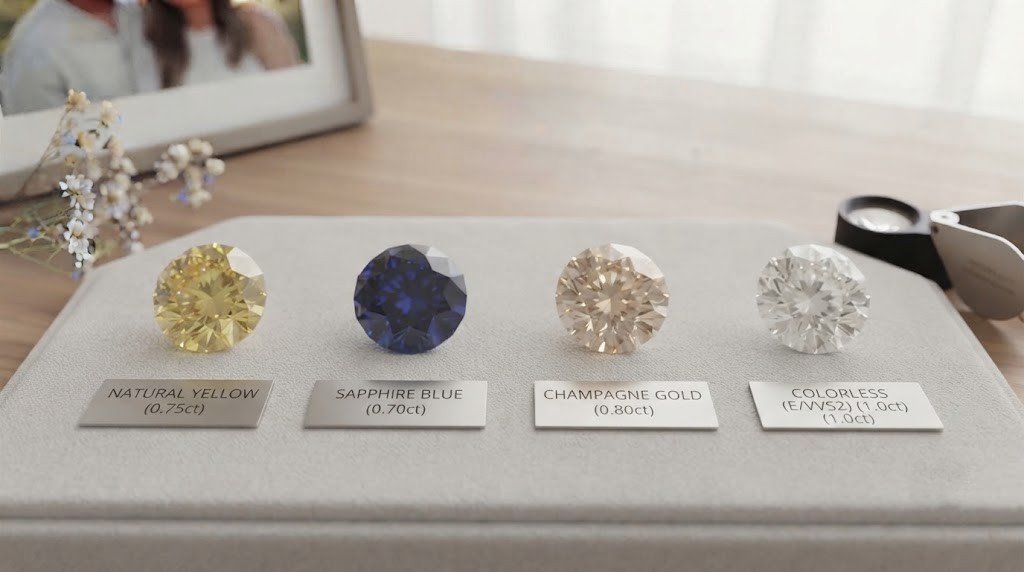
Memorial diamonds may appear in a range of colors. The exact outcome cannot be predicted reliably from the source material alone.
| Possible color | General explanation | What to know |
|---|---|---|
| Yellow | Nitrogen can contribute to yellow coloration | The intensity can vary |
| Blue | Boron can contribute to blue coloration | The shade is not something to assume in advance |
| Champagne or brown | Trace elements and growth conditions may influence warm tones | Natural shades can vary in depth |
| Colorless | Achieving a colorless result may require more controlled processing | It can cost more |
| Red, pink, green, or black | Some providers offer post growth color treatment | Treatment should be disclosed in writing |
A natural tint is not automatically a flaw. What matters is whether you understand the available options and choose a result that feels meaningful to you.
See memorial diamond colors for a sister for more information about natural and treated shades.
If your family is also considering ashes, read what color a diamond made from your sister’s ashes might be.
Should You Pay Extra for Colorless Over a Natural Sister Hair Diamond Color?
That depends on your preferences and budget. Some families prefer a classic colorless appearance, while others appreciate the possibility of a natural yellow, blue, or champagne tint.
A colorless diamond may require additional processing and can cost more than a tinted stone of comparable size. The difference depends on the provider, the diamond specifications, and the services included in the quote.
The following figures are broad industry estimates for planning purposes, not confirmed prices from Memorial Diamond:
- About 0.10 to 0.25 carat: approximately $1,500 to $3,500.
- About 0.50 to 1.00 carat: approximately $5,000 to $15,000.
- About 2 to 5 carats or larger: approximately $20,000 to $75,000 or more.
Colorless processing may increase the price, and independent grading, engraving, special cuts, and jewelry settings may cost extra. Ask the provider for a current, itemized quote for your chosen size and color preference.
The production timeline also varies. A broad industry estimate is six to ten months after the required material is received, with some larger stones or specialty color requests taking longer. Confirm the expected timeline directly with the provider.
You can also read how much a sister memorial diamond costs to compare size, color, and setting considerations.
There is no universally correct choice. You may prefer the classic look of a colorless stone, or you may feel connected to a natural tint. Either can become a meaningful keepsake.
Can Irradiation Change a Sister Hair Diamond Color?
Some providers offer post growth irradiation, a treatment that can alter a diamond’s color. Depending on the process, treated stones may appear red, pink, green, or black.
The treatment changes the way the crystal interacts with light. It does not change where the original carbon came from.
If a provider offers treated colors, ask for written disclosure explaining the treatment. Confirm how it will appear on the invoice and any grading documentation.
You should also ask whether the treatment has any implications for future jewelry repairs or resizing, particularly when heat may be involved. A qualified jeweler can explain any precautions relevant to the specific stone.
Do not assume every provider offers every treated color or that a particular shade can be guaranteed.
Which Papers Record the Color, and Which Prove the Hair Was Hers?
Two types of documents may serve different purposes.
Origin or authenticity documentation
This document may be issued by the provider and is intended to connect the finished diamond with the submitted material and order. Ask whether it will identify your sister’s hair, the order reference, and the relevant intake records.
An origin document does not necessarily provide an independent assessment of the diamond’s quality or color.
Independent grading report
A grading report evaluates characteristics of the diamond, which may include carat weight, color, clarity, and cut. The exact format and terminology depend on the grading laboratory and the service selected.
Learn more about how the four diamond quality factors are judged.
Independent grading may be optional and may involve an additional fee. If you want the sister hair diamond color described by an independent laboratory rather than only by the company that grew it, ask whether an independent report is available and request an example before ordering.
Confirm how any color treatment will be disclosed. Keep the origin documentation, grading report if supplied, and order confirmation together.
If Several Siblings Order Stones From Her Hair, Will They Match?
They might look similar, but matching colors cannot be guaranteed. Each diamond’s appearance depends on its individual growth conditions, even when the source carbon comes from the same lock of hair.
Before placing separate orders, discuss the possibility that the stones may have different shades. This can help avoid disappointment if one diamond looks warmer or cooler than another.
Siblings and families have different preferences. Some may want a stone, while others may not. Both choices deserve respect.
Ask the provider whether it can grow stones under comparable conditions, but treat any answer as an explanation of its process rather than a promise that the finished stones will match.
If the family is considering one shared stone instead, agree on ownership and future arrangements before ordering. The guide on how to talk to family about a sister memorial diamond may help you begin that conversation.
What Can Your Family Still Shape?
Although you cannot reliably select the natural color in advance, you can make several important choices.
You can discuss:
- Whether to request a natural tint or ask about colorless processing.
- Whether a provider offers treated colors.
- The shape and cut of the finished stone.
- The metal and style of the jewelry setting.
- Whether independent grading is worth the additional cost.
- How the stone will be cared for and stored.
- What documentation the provider will supply.
A jeweler may recommend waiting until the loose diamond arrives before finalizing the setting. Metal color and lighting can affect how a diamond’s tint appears, so ask to see the stone against different metals before making a final decision.
Diamond ranks 10 on the Mohs scale of mineral hardness, but hardness does not make it impossible to chip. A qualified jeweler can advise on a protective setting for everyday wear. Ask your insurer about coverage if the stone will be valuable or worn regularly.
A ring, pendant, pair of studs, or loose stone kept safely in a box can all be meaningful choices. Explore memorial diamond settings and jewelry ideas for a sister for inspiration.
How Can You Ask About Color So the Answers Are Useful?
Specific questions can help you compare providers fairly. Consider asking:
- Which natural colors have you produced from hair based material?
- Can you show unretouched photographs of real stones under different lighting?
- How do you handle dyed or chemically treated hair?
- What is the price difference between a tinted and colorless stone of my chosen size?
- Do you offer irradiation, and how is it disclosed?
- Is independent grading included or charged separately?
- What happens if a growth cycle fails or the stone is damaged during cutting?
- What happens to any unused hair?
- What origin documentation will you provide?
- Can you explain what is known and unknown about the source carbon used in the finished stone?
Keep the responses in writing. A provider that clearly explains what it cannot predict, what it charges, and how it documents treatments gives you a better basis for making a decision.
If your family is considering ashes and hair together, read what color a diamond made from your sister’s ashes and hair might be.
Frequently Asked Questions
Will a diamond grown from her gray or white hair be colorless?
Not necessarily. The original hair shade does not determine the final diamond color. The tint develops during growth, and a colorless result may require additional processing regardless of whether her hair was gray, white, blonde, or dark.
Can dyed or chemically treated hair still be used?
Possibly, but each provider has its own requirements. Disclose any dye, perm, or straightening treatment before sending the sample. Ask whether the provider accepts it and whether any additional preparation is required.
Does hair produce a lighter colored diamond than ashes?
There is no reliable basis for treating hair as a guarantee of a lighter or more predictable color. The outcome depends on the growth process and the provider’s methods, not simply on the source material.
How much of a hair grown diamond is actually her carbon?
There is no universal published finished stone percentage for diamonds grown using hair. Ask the provider what it can document about the source carbon and whether supplemental laboratory carbon is used.
Can hair be used if she was buried rather than cremated?
A saved lock or a cutting collected before burial may be an option if the provider accepts it. Confirm the provider’s requirements and establish that you have the appropriate permission to use the hair.
Will the diamond look like the photos on a provider’s website?
Not necessarily. Lighting, photography, and image editing can change how a diamond’s color appears. Request unretouched examples of actual stones under different lighting and remember that your own stone’s final color cannot be known with certainty beforehand.
Can the color be changed if your family does not like it?
Some providers offer post growth treatments that alter color. Availability, cost, disclosure, and the possible effect on future jewelry work vary. Ask about these options before placing the order rather than assuming a finished stone can be changed.
Final Thoughts on the Color of a Diamond From Her Hair
There is something meaningful about allowing the stone to become what it becomes. You cannot select its natural shade in advance, just as you cannot reduce your sister’s life to one color or one memory.
The sister hair diamond color that arrives will reflect the conditions of its particular growth process. What you can choose are the details within your control: the size, cut, setting, documentation, and whether to explore colorless processing or a disclosed treatment.
Take your time, ask clear questions, and keep the answers in writing. Whatever color the stone becomes, its personal meaning comes from the sister you remember and the memories you continue to carry.
Leave A Comment