How to Talk to Family About a Sister Memorial Diamond1

How to Talk to Family About a Sister Memorial Diamond

Raising the idea with her family can feel harder than deciding you want it. The first conversation about a sister memorial diamond is usually with whoever has authority over her remains, and that is often not a sibling. Start there, explain why it matters to you, ask for something small and specific, such as a few tablespoons of ashes or a lock of hair, share the provider’s custody paperwork, and write down what everyone agrees.
about a sister memorial diamond

Why Does Talking About a Sister Memorial Diamond Involve So Many People?

When a sister dies, the people who loved her often fill several roles. She may have had a spouse or partner, children, living parents, and brothers and sisters of her own, including half siblings, step siblings or adopted siblings. Each of them may feel a claim on how she is remembered, and none of those claims cancels another.

A memorial diamond also involves her physical remains. A provider needs a portion of her ashes or some of her hair, and that material has to be released by someone with the right to release it. That is why a decision about a sister memorial diamond rarely belongs to one person alone.

None of this means your wish counts for less. It means the path to it runs through other people. If you are still at the beginning, our guide on where to begin with the whole decision explains the wider choices.

Who Has the Final Say Over Her Remains?

Authority over remains comes from state rules and from any wishes she put in writing, so there is no single national answer. Before any discussion about a sister memorial diamond, it helps to understand how your state approaches it. A typical default in many states starts with a spouse or registered partner, moves to adult children, then to parents, and reaches siblings after that.

States do not all use that default, and an agent she designated or a declaration she signed can change the situation. A sibling often is not the person who decides, but that does not leave you without a voice. Siblings can ask, offer and take part, and in some situations a sibling does hold authority.

A call to the funeral home or crematory is often enough to learn whose signature is on her cremation paperwork. If the picture is still unclear, a local attorney can explain how your state handles it.

If she left hair at home, in a brush or in a keepsake, those belongings can form part of her estate, and the rules differ from state to state. Speak with the executor or whoever holds authority before collecting it, so nobody feels something was taken without asking.

Who Might You Need to Talk With, and What Are They Weighing?

The people involved differ in every family. This table can help you think through each conversation about a sister memorial diamond before it happens. It is not a list of people you must approach.

PersonRole they may haveWhat they may be weighingA respectful way to begin
Her spouse or partnerCommonly first in many states, although rules varyTheir plans for her ashes and how public a memorial feelsAsk privately and early, and make clear that their decision matters
Her adult childrenCan hold authority in some states, especially if there is no spouseTheir own wish for a keepsake and protecting their parent’s memoryOffer to include them and ask what they would want
Her parentsMay hold authority or simply carry deep feelingsGrief, faith and possibly different views from each otherSpeak with each parent in the way that suits them
Other siblingsShare your relationship with herWhether they want a stone and what feels fairAsk what they want rather than assuming
Relatives with faith concernsMay or may not hold authority, but can be influentialTeachings on cremation and dividing remainsListen first and suggest speaking with their own faith leader
The executorManages her estate, including belongingsHair or jewelry that may belong to the estateCheck before collecting anything she owned

Thinking through these relationships can show you who to speak with first and who should hear the plan from you directly. Any conversation about a sister memorial diamond is easier when the people closest to the decision are not caught by surprise.

What Are Six Steps for Talking About a Sister Memorial Diamond?

No script fits every family, but a simple order helps. These six steps keep a talk about a sister memorial diamond focused and respectful.

  1. Find out who has authority. Ask the funeral home or crematory who signed the paperwork, or ask the family directly, before planning anything else.
  2. Choose a calm time. Avoid the funeral, the reading of a will, or a crowded holiday table.
  3. Lead with her, not the product. Explain what the idea means to you before describing how it works.
  4. Make a small, specific request. Ask whether a few tablespoons of ashes or a small lock of hair could be used rather than making a vague request for some of her remains.
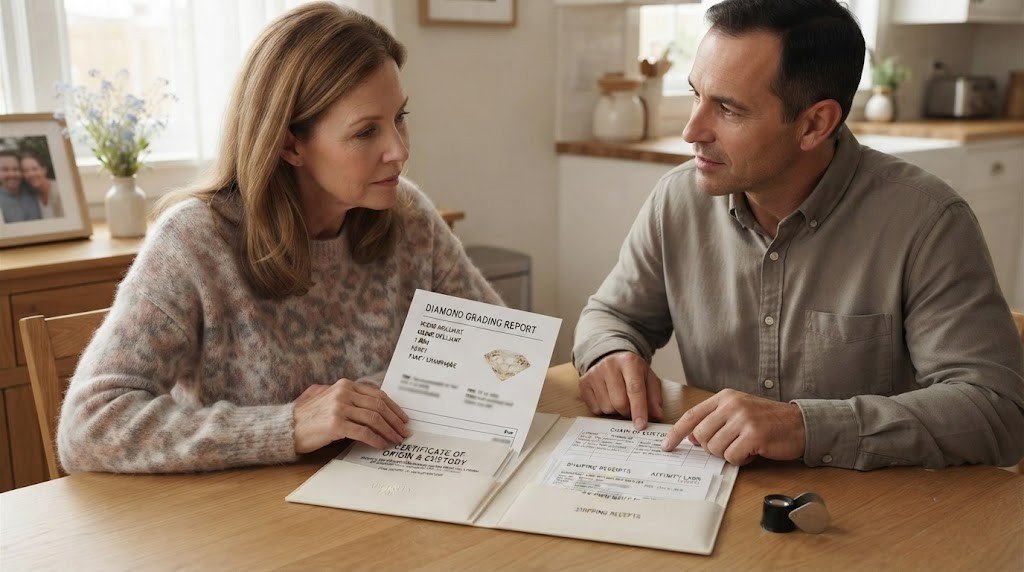
  5. Share the provider’s paperwork. Show how the material would be tracked, used and, where possible, returned.
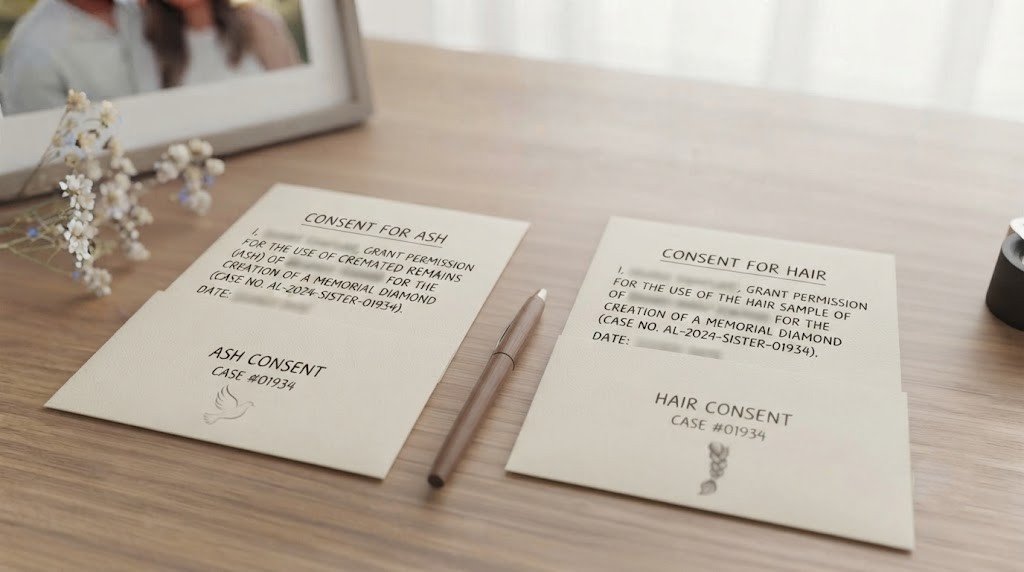
  6. Write down what everyone agrees. Record who gave permission, what material was shared, who owns each stone and who pays.

Each step gives your family space to understand the idea and ask questions before making a decision.

When Should You Start Talking About a Sister Memorial Diamond?

There is rarely a perfect moment, but some moments are harder than others. The days around the funeral are full of logistics, and a new idea can feel like one more demand. Raising it during a dispute over belongings or a will can make it sound like another claim.

A memorial diamond typically takes six to ten months to complete once the provider receives the material, although the actual timeline depends on the provider and the order. The stone itself does not set a deadline for starting. If her ashes are going to be scattered, buried or placed in a niche, however, the conversation needs to happen before that. You can explain the timing clearly without pressuring anyone.

A private conversation, in person or by phone, often works better than a group message because it gives the other person room to react and think. A question about a sister memorial diamond dropped into a family group chat can force everyone to answer publicly before they have had time to consider it.

What Should You Say First About a Sister Memorial Diamond?

Start with her. A relative who hears that you want to make a diamond from her ashes may picture something they are not ready for. A relative who first hears that you are looking for a way to keep her close in everyday life can understand your feelings before considering the product.

Then explain the request clearly. You might say that you would like to ask whether a small portion of her ashes or a little of her hair could be set aside for a memorial stone. Explain that you will share information about how the material would be handled and documented.

Plain words in your own voice work better than a polished speech. Give your relative time to respond and do not expect an immediate answer.

Expect questions you cannot answer on the spot. Saying you will find out is better than guessing. Relatives with practical questions about a sister memorial diamond deserve accurate answers, and a wrong answer given to smooth the moment can damage trust later.

How Do You Answer the Question, Is It Really Her?

A skeptical relative may ask this first, and an honest answer is the most reassuring one. A memorial diamond is a real diamond grown in a laboratory, usually using a method also used for other lab grown diamonds. Carbon is extracted from ashes or hair, purified and used during the crystal growth process. Supplemental laboratory carbon may also be used to provide enough material for growth.

For ashes, usable carbon is only roughly 0.5 to 4 percent of the ash by weight. The share of the finished stone’s mass attributed to the person’s carbon varies by provider and process. Some providers cite figures around 10 to 15 percent, while others cite lower figures. Ask the provider to explain its process and what it can document for your order.

Hair contains a substantial amount of carbon by weight, but the finished stone’s precise carbon contribution depends on the process. Ask the provider directly rather than relying on a general estimate. Our article on whether a memorial diamond is really made from her ashes explains this subject in more detail.

Relatives may also worry that a diamond would use most of her ashes. Providers often request an amount ranging from a few tablespoons to around four ounces, approximately 100 grams, although requirements vary. Hair based orders usually require a small lock or another specified amount.

That can leave most of her ashes available for whatever the family has already planned. Our guide to how much ash a sister’s stone usually needs explains the range to discuss before making a decision.

How Do You Talk With Parents Who Are Grieving Differently?

If both her parents are living, they may respond very differently. One may want a stone while the other finds the idea painful. They may be divorced or remarried, and she may have had a step parent who raised her. Treat each relationship on its own terms.

Speak to each parent separately if they are not on the same page, and avoid asking one to persuade the other. If a parent holds legal authority, their role generally depends on the rules that apply to the situation and any written wishes your sister left. If a parent does not hold that authority, they may still deserve to hear your thoughts before anything happens.

Resist comparing who is grieving more. A parent’s loss and a sibling’s loss are different experiences, and both deserve room. Conversations about a sister memorial diamond go better when everyone’s feelings are allowed to be real at the same time.

What If Other Siblings Want a Stone, or Do Not?
Siblings may each want a stone, want to share one, or want nothing to do with the idea. Every one of those choices is valid. One sibling who would rather keep a photograph and another who wants a ring are both remembering her.

Because only a portion of ashes or hair may be needed, more than one stone can sometimes be made from the same source. What is possible depends on the provider, the available material and the requirements for each order. Our guide to more than one relative receiving a diamond from her ashes explains how families can approach this question.

Be careful not to assume who counts as a sibling when discussing a sister memorial diamond. Half siblings, step siblings and adopted siblings may feel the same connection, and leaving someone out by accident can hurt more than an open disagreement.

Cost belongs in the family conversation, too. As an illustrative industry range for 2026, smaller stones of roughly 0.10 to 0.25 carats may cost around $1,500 to $3,500. Settings, engraving and grading may cost extra. Prices vary by provider, size, color and other options, so request a written quote before agreeing to an order.

Decide early whether each person will pay for their own stone or whether costs will be shared. Clear expectations can prevent misunderstandings later.

How Do You Handle Faith Questions About a Sister Memorial Diamond?

Some relatives will have religious concerns about cremation, dividing remains or keeping remains at home. Practices differ by faith, denomination and individual faith leader. Religious teachings often address cremation and the care of ashes, while a family’s questions about memorial diamonds may require a conversation about those broader teachings.

Listen before responding, and do not try to argue anyone out of a belief. Suggest that the relative speak with their own faith leader, or offer to go with them. If cremation itself is the concern, a diamond grown from hair does not require cremation. That distinction may matter to some families. Our complete guide to a diamond grown from her hair explains how that option works.

Respecting a faith concern about a sister memorial diamond does not always mean dropping the idea. It may mean waiting, considering hair instead of ashes, or keeping the stone private. The right decision is one the family can approach with care and understanding.

What Can the Provider’s Paperwork Show Your Family?

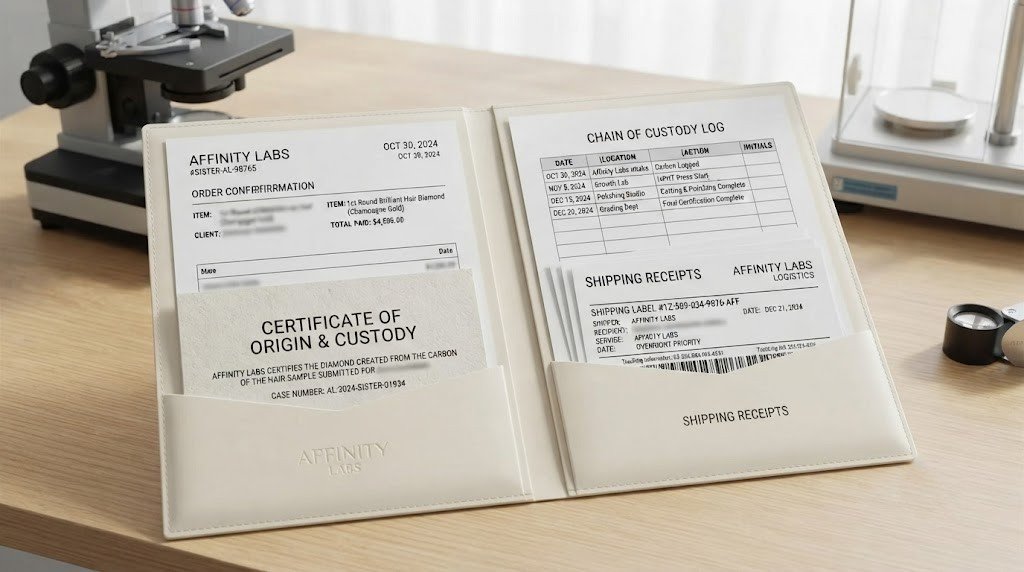
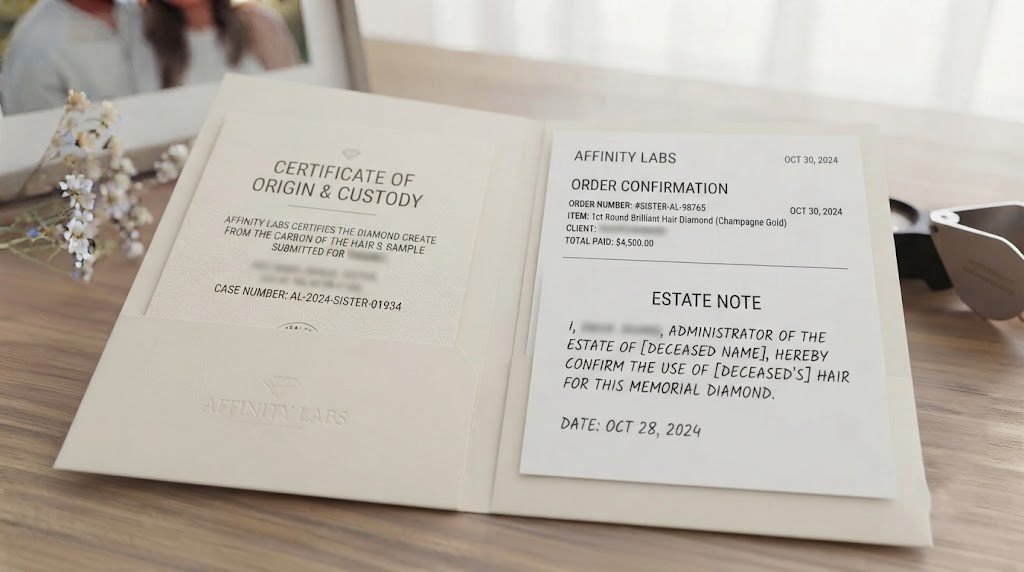
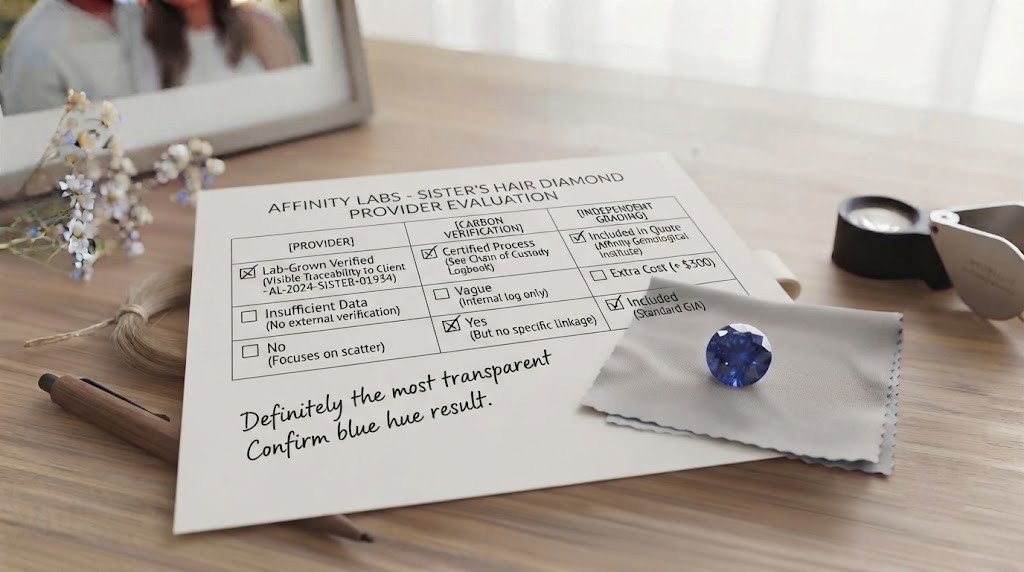
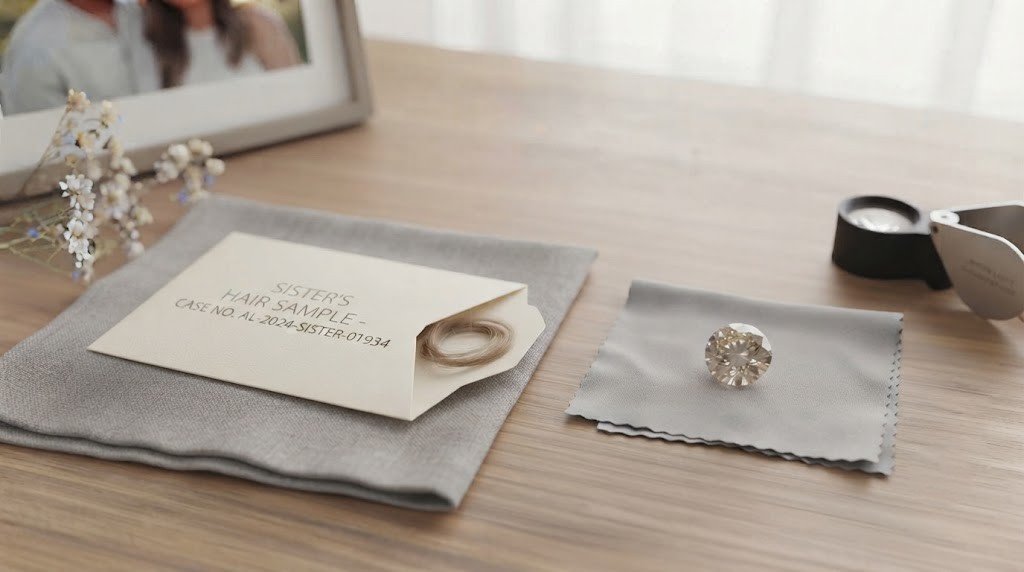
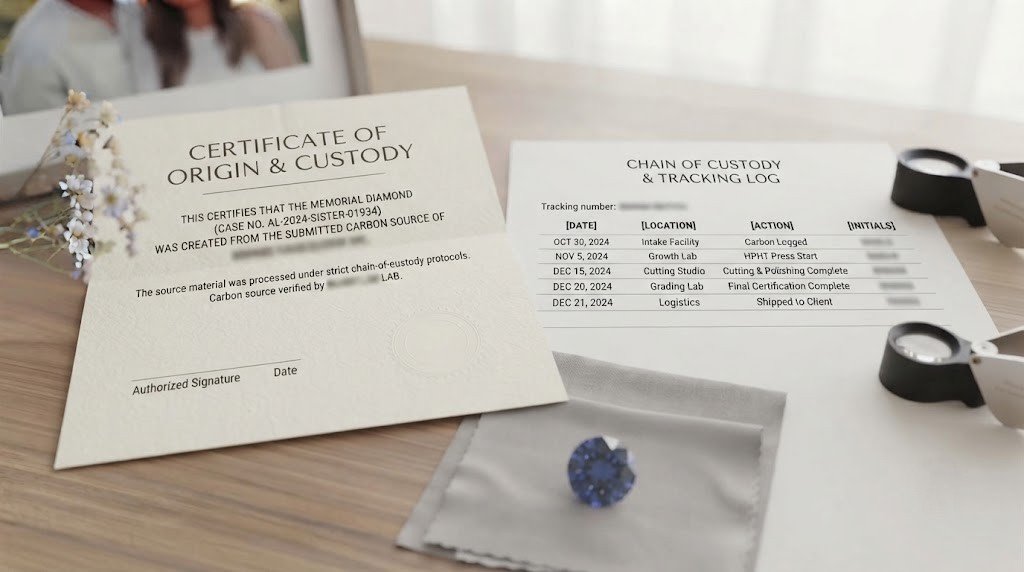
Handing over a portion of someone’s remains takes trust. Ask the provider how it tracks the material from arrival through the finished stone and what documentation it supplies. A certificate of origin or authenticity may record details about the diamond and its stated source. The exact documentation depends on the provider, so review it before committing.

Before the conversation, ask the provider to explain or send written answers to these questions.

  • How is the material labeled and tracked at each stage?
  • What happens to ashes or hair that are not used, and can unused material be returned?
  • What happens if the diamond does not grow as planned or is damaged during cutting?
  • What information appears on the origin certificate?
  • Is an independent grading report available, and what does it cover?

Our list of questions to ask a provider before sending her ashes covers more ground. Sharing written answers lets relatives read at their own pace. Clear documents can address concerns about a sister memorial diamond more effectively than reassurance offered in the moment.

What If the Answer About a Sister Memorial Diamond Is No or Not Yet?

A not yet is a real answer, and it may be temporary. Someone who cannot face the idea early on may feel differently later. Thank them for being honest and ask whether you may raise the subject again at a time they choose.

A firm no from the person with authority over her remains is harder to hear. It is fair to ask gently whether a particular part of the idea is the obstacle, such as using ashes, wearing jewelry, the cost or the timing. Sometimes a different approach, such as using hair or having another relative keep the stone, may address the concern. If it does not, respecting the answer can help protect your relationship.

If you believe a decision is unfair, a local attorney can explain the rules that apply in your state. Formal disputes over remains can place lasting strain on family relationships. Other ways of keeping her close remain possible whatever the answer. Our comparison of a memorial diamond and a traditional urn may help if the family prefers an urn.

How Do You Put Agreements About a Sister Memorial Diamond in Writing?

Writing things down is not a sign of mistrust. It protects everyone from remembering the same conversation differently years later. A short email that each person replies to can provide a useful record. Whether a more formal agreement is appropriate, especially when money or estate property is involved, is a question for a local attorney.

A written note should answer these questions.

  • Who gave permission for the material to be used?
  • What amount of ashes or hair was shared, and with whom?
  • How many stones will be made?
  • Who owns each stone?
  • Who will pay for the process, settings and any additional services?
  • What happens to unused material?
  • Who will keep the origin certificate and related paperwork?
  • If two people share a stone, where will it be kept and what happens to it later?

Keep copies with the provider’s paperwork, and consult a local attorney if estate questions are involved. An agreement about a sister memorial diamond written while everyone is calm is easier to understand and follow than one pieced together after a misunderstanding.
Frequently Asked Questions

Do I need permission to use my sister’s ashes for a diamond?

You will generally need agreement from whoever has authority over her remains. Who holds that authority depends on state rules and anything she put in writing. It may be a spouse, adult children or parents. The funeral home or crematory can help identify the person who signed the paperwork, and a local attorney can explain the applicable rules.

Can I ask for a lock of her hair instead of ashes?

Yes. Some families find this a gentler request. Hair does not require cremation, and providers typically request only a small amount. Hair she left at home may belong to her estate, so check with the executor or whoever has authority before collecting it.

What if her spouse and her parents disagree?

Where relatives disagree, the person with authority under the applicable rules and her written wishes generally has the deciding role. Speak with each side separately, avoid taking sides and explore an option everyone can accept, such as using a small portion of material or considering a hair based stone.

Should I contact a provider before telling the family?

Gathering information about a sister memorial diamond first is reasonable because it helps you answer questions accurately. Avoid committing to an order or sending material until the person with authority has agreed. This helps the family understand that the decision is not being made without them.

Can a relative who said no change their mind later?

Yes. Feelings about a sister memorial diamond can change over months or years. If ashes or hair are kept safely and the material remains suitable, it may be possible to use them later. Leave the conversation open, ask whether you may raise the idea again and let the relative choose when.

Who should keep the origin certificate if a stone is shared?

Agree on this in writing before the stone is made. The person who keeps the stone may hold the original certificate, while other family members keep copies. Keeping the documentation with the stone can be helpful if it is reset or passed down in the future.

Final Thoughts on Raising It With Her Family

The wish to carry something of your sister with you is ordinary and human, and so is the worry about how her family will feel about a sister memorial diamond. Neither makes you wrong for asking.

Go gently, ask clearly and accept that the answer may take time. Give your family accurate information, respect the person who has authority over her remains, and write down any agreement. A conversation handled with patience can help protect family relationships, whatever is decided in the end.

Learn More About Sister Memorial Diamonds

Talk With Memorial Diamond

If you are preparing to talk with family about a sister memorial diamond and want accurate answers to bring to that conversation, visit Memorial Diamond. Learn more about how memorial diamonds are made and what questions to ask before deciding, at a pace that suits you and your family.

Sister Memorial Diamond vs. Traditional Urn

Sister Memorial Diamond vs. Traditional Urn: What to Know

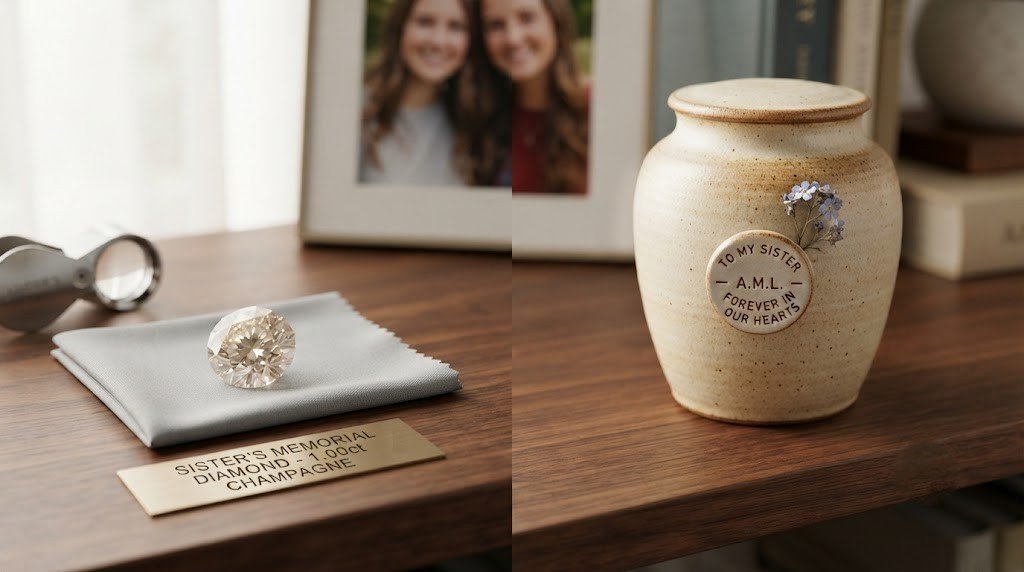
Whether your sister’s ashes already rest in an urn or the decision is still ahead, you might wonder whether a diamond would let you carry her memory differently. A sister memorial diamond vs urn decision is rarely an either-or choice. An urn keeps her cremated remains together in one place, while a memorial diamond is a real lab-grown diamond created using carbon recovered from a small portion of the ashes. The two can exist side by side.

Both options offer meaningful ways to remember someone you love. The right choice depends on your family’s wishes, your beliefs, your budget and how you would like to keep her memory close. Understanding the differences can help you make a thoughtful decision without feeling that one option is more meaningful than the other.

sister memorial diamond vs urn

What Does Each Option Actually Keep of Her?

An urn holds her cremated remains as they are. Nothing needs to be extracted or transformed. The ashes returned by the crematory are placed in a container chosen by the family. The urn may remain at home, rest in a columbarium niche or be buried, depending on family preferences, applicable rules and religious or cultural practices.

Urns are available in many materials, including metal, wood, stone, ceramic, glass and biodegradable materials. They also come in different sizes, from full-size urns to small keepsake containers that hold a portion of the ashes.

The diamond side of the sister memorial diamond vs urn comparison preserves something different: carbon recovered from a portion of the ashes. Cremated remains consist largely of mineral material from bone, and the amount of usable carbon varies. The provider extracts and purifies the available carbon before preparing it for diamond growth. Providers may also combine personal carbon with supplemental laboratory carbon, depending on their process.

A memorial diamond is a real diamond, typically grown using high-pressure, high-temperature (HPHT) technology. Some providers use chemical vapor deposition (CVD). The resulting diamond can be cut and polished into a chosen shape and kept as a loose stone or set into jewelry.

The important distinction in a sister memorial diamond vs urn decision is that the urn keeps her cremated remains together, while the diamond carries some of the recovered carbon in a new form. A diamond should not be described as containing all her ashes, and an urn is not a less meaningful memorial simply because its contents remain unchanged.

How Does a Sister Memorial Diamond vs Urn Comparison Look Side by Side?

Comparing the practical differences can help you decide which option suits your needs. The table below covers eight considerations, including what each option preserves, cost, portability, ownership, durability, timing and religious concerns.

Point of ComparisonTraditional UrnSister Memorial Diamond
What it preservesHer cremated remains, kept together and unchanged.Carbon recovered from a portion of the ashes, potentially combined with laboratory carbon.
Typical costVaries widely by material, size, design and maker.General industry estimates range from about $1,500 to $3,500 for 0.10 to 0.25 carats, with larger stones costing substantially more.
PortabilityUsually kept in one place, such as a home, niche or grave.Can be worn as jewelry or carried as a loose stone.
Who keeps itOften the person authorized to receive or manage the remains, subject to applicable rules.May be kept by the person who orders it, with appropriate authorization for the material used.
DurabilityDepends on the urn’s material and storage conditions. Some biodegradable urns are designed to break down.Diamond ranks 10 on the Mohs hardness scale, but a hard impact can still chip it.
TimingGenerally available once the remains are returned and the urn is selected.Typically takes months to produce, with general estimates of 6 to 10 months from receipt of the material.
Religious considerationsMay fit traditions that permit cremation, although some traditions specify how ashes should be kept or laid to rest.Involves setting aside a portion of ashes, and religious views on this practice vary.
Long-term optionsCan remain in one place or be moved between homes, depending on the family’s wishes.Can be kept as a loose stone, set in jewelry or passed on to another person.

Think of these differences as trade-offs rather than a scorecard. In a sister memorial diamond vs urn comparison, an urn offers an immediate way to keep her remains together. A diamond offers portability and the possibility of carrying a personal keepsake, but it generally involves a longer wait and a larger financial commitment.

Budget may influence your decision. Memorial diamond prices vary according to carat size, color, cut and provider. Settings, engraving and independent grading may also be quoted separately. The figures above are general industry estimates, not confirmed Memorial Diamond prices. For more detail, read our sister memorial diamond cost breakdown.

Why Does the Urn Often Stay With Whoever Holds Authority?

This is an important part of the sister memorial diamond vs urn decision for siblings. The person who wants to keep the urn may not be the same person who feels most connected to the memory of the person who passed away.

Practices and legal requirements vary by state and crematory. The remains are generally released to the person authorized to receive them or someone that person designates. That individual may then decide where the urn is kept, subject to applicable law and any relevant instructions.

In some states, a spouse or registered partner, adult children or parents may have priority over siblings when decisions about remains must be made. There is no single national rule that applies to every situation. Your sister’s written wishes, any appointed representative and the applicable state law may affect who has authority.

As a result, the urn may remain with her spouse, partner, adult child or parent, while you visit it rather than keep it yourself. That arrangement does not measure the strength of your relationship with her. It reflects the practical responsibilities and rules surrounding her remains.

For some siblings, part of the appeal of a sister memorial diamond vs urn decision is that a diamond may offer a personal keepsake they can keep close, even if they do not hold the urn. However, using a portion of the ashes still requires appropriate authorization.

If you are unsure who signed the cremation authorization, the funeral home or crematory may be able to clarify the records. A local attorney can explain how your state’s requirements apply. If you need to ask a family member for a small portion of the ashes, a specific and respectful conversation can help. Our guide to talking with family about a sister memorial diamond offers additional guidance.

Can a Stone and an Urn Coexist?

Yes. This may be the most helpful way to think about the sister memorial diamond vs urn question. Choosing a memorial diamond does not necessarily mean giving up the urn or using all the ashes.

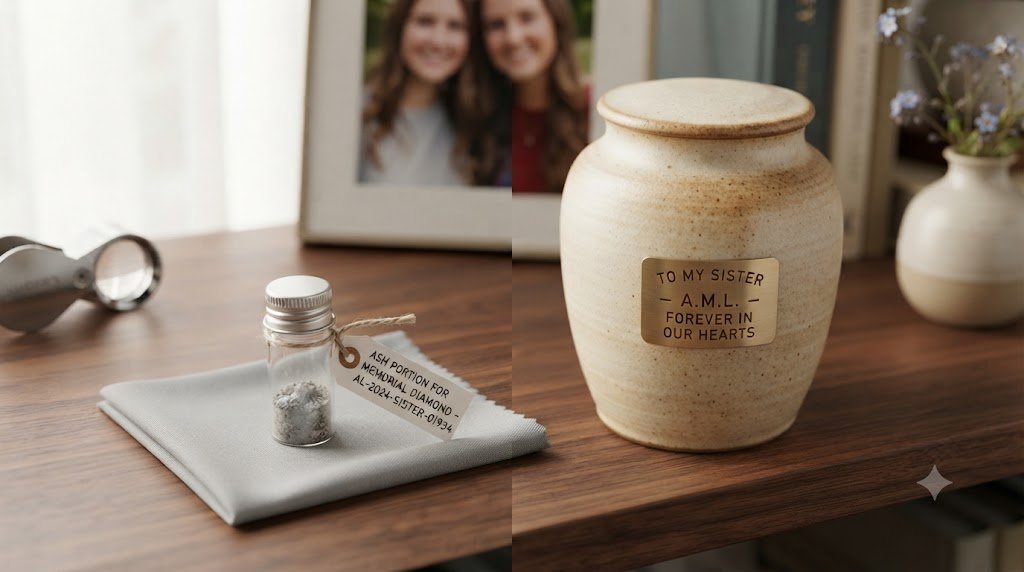
Providers have different material requirements. Some request a few tablespoons of ashes, while others may request a larger amount, potentially up to about 4 ounces or 100 grams. The quantity depends on the provider’s process and should always be confirmed before sending anything.

For many families, setting aside an authorized portion allows most of the ashes to remain in the urn. The urn can stay in its existing place while a diamond is created from the portion provided. You do not need to empty the urn to explore both options.

Sending more ashes does not automatically make a larger or faster-growing diamond. The final carat size depends on the growth process and other production factors, so provide only the amount the provider requests.

If your family chooses both a diamond and an urn, consider these steps:

  1. Agree on the portion. Discuss the amount with the person authorized to make decisions about the remains and obtain the necessary permission.
  2. Arrange careful handling. Ask the funeral home or an authorized family member to help transfer the portion into an appropriate sealed container.
  3. Document the arrangement. Record the date, the amount and who the portion is intended for.
  4. Keep the urn in its chosen place. The remaining ashes can stay in the urn, whether it is kept at home, in a niche or elsewhere.
  5. Follow the provider’s shipping instructions. Use the approved packaging and shipping method rather than improvising.

Several relatives may be able to receive individual stones from one source, depending on the amount of usable material and the provider’s process. Our guide to sharing her ashes among several relatives covers authorization, separate records and written agreements.

Where Do Keepsake Urns and Other Options Fit In?

Thinking only in terms of a sister memorial diamond vs urn choice can overlook useful alternatives. A keepsake urn, for example, is a smaller container designed to hold a portion of cremated remains. It lets more than one family member keep some of her ashes unchanged, provided the arrangement is authorized and acceptable to the family.

For someone who values keeping actual ashes rather than carbon in a new form, a keepsake urn may be a better fit than a diamond. Its cost depends on the material, size, design and maker.

Other possibilities include:

  • A memorial pendant with a sealed chamber: Some pendants can hold a small portion of ashes while keeping them in their original form.
  • Scattering ashes: Some families choose a place that mattered to their loved one, subject to local rules and permission.
  • Burial of the urn: A family plot or cemetery may provide a dedicated place to visit and remember her.
  • A hair-based memorial diamond: If suitable hair was kept, a provider may be able to use it without using cremated remains. Confirm the requirements and any necessary authorization first.

None of these options is inherently better than another. Each meets a different need: having a place to visit, carrying a keepsake, keeping ashes unchanged or creating something new. Families can combine options when their wishes and circumstances allow.

How Do Cost and Care Compare Over the Years?

A sister memorial diamond vs urn comparison should include the total cost, not just the initial purchase price. Both can involve a one-time purchase, but additional services and placement arrangements may affect the final amount.

For a memorial diamond, ask whether the quote includes the finished stone, cutting and polishing, independent grading, engraving, the jewelry setting and shipping. Each provider structures its pricing differently, so request an itemized quote before committing.

Urn prices also vary considerably according to material, craftsmanship and design. If the urn will be placed in a columbarium or cemetery, ask about placement, opening, maintenance or other applicable fees. These costs depend on the facility and arrangement.

Day-to-day care is different for each option. Diamond ranks 10 on the Mohs scale of mineral hardness, which means it resists scratching very well. However, hardness does not make it impossible to damage. A hard impact at the wrong angle can chip a diamond, and a jewelry setting can loosen over time. Ask a jeweler to recommend suitable inspections and care.

An urn kept at home needs a stable location away from accidental knocks, pets and other hazards. An urn placed in a niche may require little day-to-day attention, although any maintenance or access arrangements depend on the facility.

Insurance is another point worth checking. Ask an insurer whether a memorial diamond or a valuable urn can be covered, what documentation or appraisal is required, and how the item would be assessed under your policy. Coverage varies, so do not assume either item is automatically insured.

Over time, both items may be passed to another family member or trusted person. A ring or pendant can be inherited, while an urn may move between households as family circumstances change. Writing down your wishes about who should eventually receive each item can help prevent uncertainty later.

Does Faith Change the Sister Memorial Diamond vs Urn Decision?

Religious beliefs may be an important part of a sister memorial diamond vs urn decision. Views on cremation, dividing ashes and keeping remains vary across faiths, denominations, communities and individual families. General teachings about cremation do not necessarily answer every question about memorial diamonds specifically.

The following overview is general information, not a substitute for guidance from your own religious leader. If faith is central to your decision, ask someone familiar with your tradition and your family’s circumstances.

  • Catholic: Catholic guidance permits cremation under specified conditions and generally directs that cremated remains be kept together in a sacred, approved place rather than divided among relatives or kept privately at home. Specific questions about setting aside a small portion for a diamond should be discussed with a knowledgeable Catholic clergy member.
  • Jewish: Views and practices differ among Jewish movements and communities. Orthodox and Conservative traditions generally oppose cremation, while Reform communities may approach the issue differently. Ask your rabbi about your family’s circumstances and any concerns about dividing or transforming remains.
  • Muslim: Cremation is generally prohibited in mainstream Islamic practice. A diamond made from hair raises a different question from one made using cremated remains, but religious guidance should still be sought for your particular situation.
  • Hindu: Cremation is a traditional funeral practice, and immersion of ashes in sacred waters is customary in many communities. Whether a portion may be retained for a keepsake or memorial diamond depends on family, regional and community practices.
  • Buddhist: Cremation is practiced in many Buddhist traditions, although customs vary. Views on keeping remains or turning them into a keepsake may differ among teachers and communities.
  • Protestant: Practices vary by congregation and denomination. Some communities accept cremation without concern about dividing ashes, while others may have specific views about how remains should be treated.
  • Secular or non-religious: The choice is generally guided by personal meaning, family agreement and any wishes expressed by the person who passed away.

If dividing the ashes is not acceptable to your family, the sister memorial diamond vs urn decision does not necessarily have to end there. A hair-based memorial diamond may be an alternative if suitable hair is available and its use is authorized. Read our sister hair diamond guide for more information. Before using hair kept at home, check with the executor or person responsible for the belongings, as ownership and estate rules can vary.

Which Questions Help You Decide?

There is no universal right answer to the sister memorial diamond vs urn question. The goal is to choose an option that respects your sister, fits your family’s circumstances and feels right to you.

These questions may help you clarify your priorities:

  1. Who is authorized to make decisions about her remains, and what do they want?
  2. Did your sister express her wishes verbally or in writing?
  3. Would you prefer to keep her remains unchanged or carry a portion of the recovered carbon in a new form?
  4. Would you wear a memorial stone regularly, or would you prefer to keep it somewhere safe?
  5. What can you comfortably spend, and would it be better to make the decision later?
  6. Do your religious beliefs or family traditions call for the ashes to remain together?
  7. If using ashes is not suitable, would a hair-based memorial diamond be an option?
  8. Who will care for the urn and any memorial jewelry in the years ahead?

If your answers point toward a diamond, our guide to choosing a memorial diamond for your sister explains where to begin. If you prefer to keep the ashes together, an urn can be a complete and meaningful choice in its own right.

Where Does Memorial Diamond Stand in This Comparison?

Memorial Diamond offers memorial diamonds, so we have a direct interest in one side of the sister memorial diamond vs urn comparison. It is important to say that openly. A traditional urn is a complete and dignified memorial, and this guide is not intended to suggest otherwise.

The two options preserve different things and serve different preferences. An urn keeps cremated remains together, while a memorial diamond offers another way to keep a part of a loved one close. Some families may prefer one option, while others may choose both.

If you are exploring the process for the first time, our complete guide to sister ashes diamonds explains the broader journey from source material to finished stone.

Take time to compare the process, current pricing, material requirements and expected production timeline before making a decision. The best choice is the one that fits your circumstances, your family’s wishes and the way you want to remember your sister.

Frequently Asked Questions

Is a memorial diamond more respectful than keeping her in an urn?

No. A sister memorial diamond vs urn decision is not a test of devotion. An urn keeps her cremated remains together, while a memorial diamond carries a portion of recovered carbon in a new form. Respect comes from honoring her wishes, considering your family’s circumstances and making a thoughtful decision. Either option can be meaningful.

Can I still get a diamond if the urn is already in a niche or buried?

Possibly, but accessing an urn in a niche or cemetery may require permission from the responsible person and the facility. There may also be fees or additional procedures. A memorial diamond made from suitable hair may be an alternative, provided its use is appropriate and authorized.

Will taking ashes for a diamond leave the urn noticeably emptier?

Usually, the quantity requested is only a portion of the remains, but the exact amount varies by provider. Ask the provider how much material is required, and agree on the portion with the person authorized to make decisions about the ashes before anything is removed.

Can ashes kept in an urn for years still be used for a diamond?

They may be suitable, even after years of storage, but each provider has its own material requirements. Keep the urn appropriately sealed and stored, and ask the provider whether the age and storage conditions of the ashes affect its process.

What if her spouse keeps the urn and I would like a stone?

You can ask her spouse respectfully whether they would consider allowing a small portion of ashes to be used. If they hold the relevant authority, their approval may be required. A funeral director or local attorney can help clarify the applicable rules if the situation is complicated.

Which costs more over time, an urn or a memorial diamond?

The answer depends on the choices involved. Memorial diamonds can cost substantially more than many urns, particularly as carat size increases or when optional services are added. Urn costs also vary, and cemetery or columbarium fees may apply. Compare the full quoted costs, including any setting, grading, placement and maintenance charges.

Final Thoughts on Diamonds, Urns and Your Sister

Sometimes, the sister memorial diamond vs urn comparison becomes easier once you realize that the two options do not have to compete. The urn can remain where it is, keeping her remains together, while a small authorized portion is used to create a diamond you can carry. Other families decide that the urn is exactly what they want, and that decision is complete in itself.

There is no need to choose a diamond to prove how much you loved your sister. Nor do you need to keep every part of her remains in one place to honor her memory. Think about her wishes, your family, your beliefs and what will bring you comfort over time.

Whatever you choose, let the decision come from what feels right for your family rather than from the idea that one option demonstrates more love than another.

Learn More About Sister Memorial Diamonds

Talk With Memorial Diamond

If you are weighing a sister memorial diamond vs urn decision or wondering whether both could work for your family, visit Memorial Diamond. You can ask questions about material requirements, authorization, timing and available options before deciding. Take the time you need to choose an approach that feels right for you and your family.
timeline

How Long Does It Take to Make a Sister Memorial Diamond?

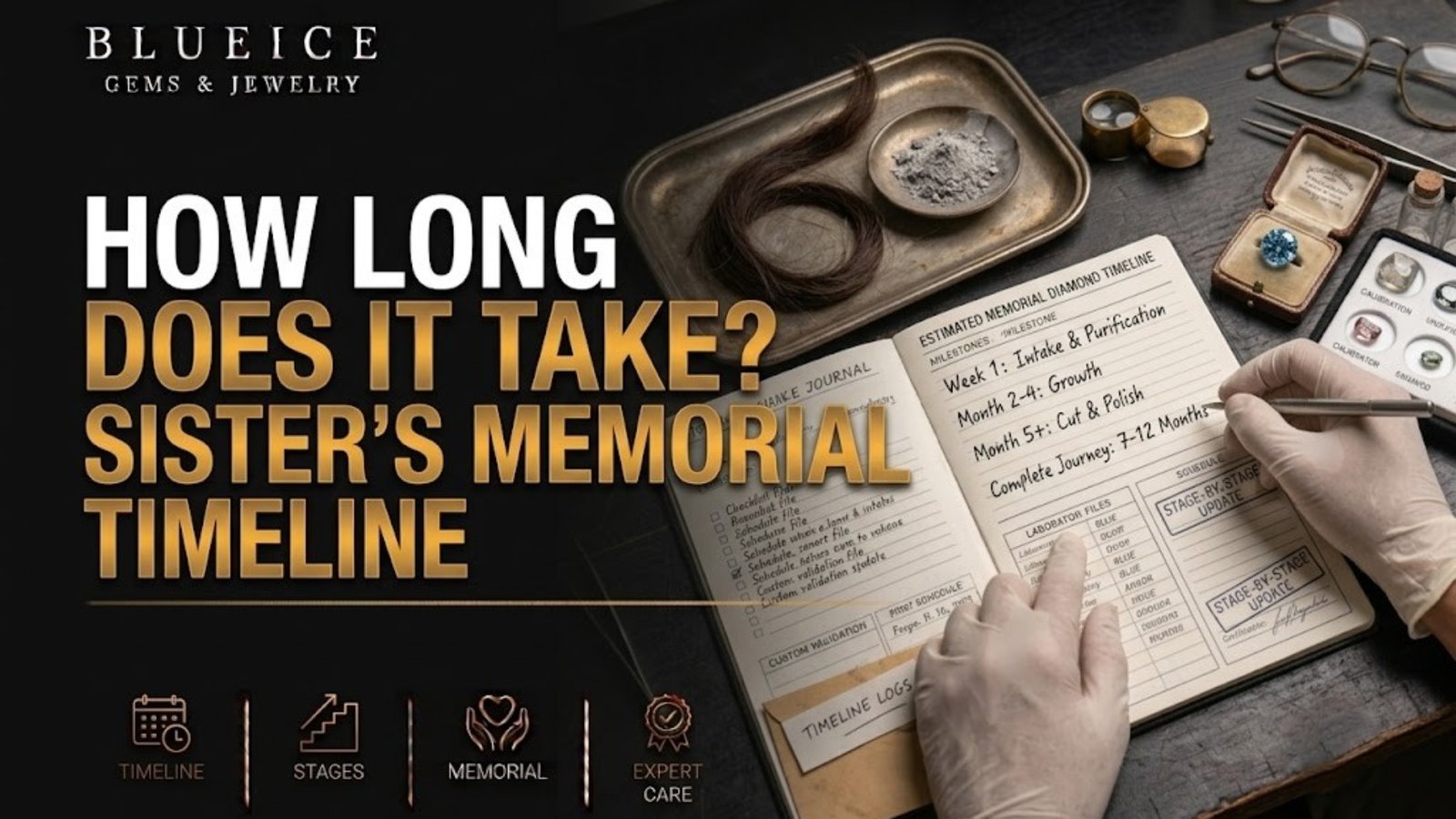
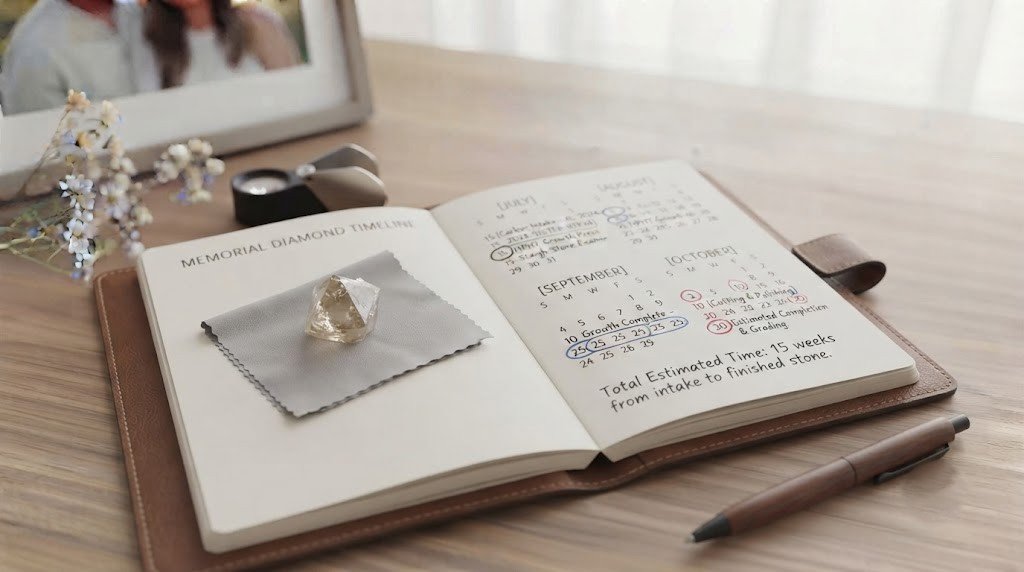
Waiting is its own kind of hard when what you are waiting for is connected to your sister. A typical sister memorial diamond timeline runs about 6 to 10 months from the day a provider receives her ashes or hair. A stone larger than about 2 carats, or one in a specialty color, may take up to approximately 12 months. Time spent on family conversations, permissions, paperwork and shipping comes on top of that estimate.

These are general industry estimates, not a confirmed production timeline from Memorial Diamond. Every provider may have a different process, starting point and schedule. Understanding each stage can help you prepare, know what questions to ask and plan around a meaningful date without placing unnecessary pressure on yourself or your family.

sister memorial diamond timeline

What Does a Sister Memorial Diamond Timeline Look Like Stage by Stage?

The sister memorial diamond timeline can be understood in seven stages. The first two happen before the material reaches the laboratory. The remaining stages take place through the provider and, if you choose jewelry, the jeweler.

StageWhat HappensTypical Timing
1. Family preparationDiscussing the decision, choosing the material, agreeing on the number of stones and deciding who will keep them.Days to months, depending on the family
2. Paperwork and shippingCompleting the order and consent forms, documenting the material and arranging tracked shipping.Varies by provider and family
3. Receipt and loggingThe provider receives and records the material, ideally with a documented chain of custody.Ask the provider for its intake estimate
4. Carbon extraction and preparationCarbon is separated and purified, then prepared for the diamond growth process.Included in the overall production window
5. Diamond growthCarbon is used to grow a crystal around a seed under controlled laboratory conditions.Weeks to months, depending on size and color
6. Cutting, polishing and gradingThe rough crystal is shaped and polished. Optional independent grading may be arranged.Varies by shape, services and laboratory availability
7. Setting and deliveryThe finished stone is placed in jewelry if requested and then prepared for delivery.Depends on the jeweler, design and shipping

From receipt of the material to completion of the diamond, stages three through six typically fall within the general 6 to 10 month estimate. Larger stones and specialty colors may extend the process to approximately 12 months. Jewelry setting and delivery may add more time.

Two things are especially important: the growth stage has a major influence on the overall sister memorial diamond timeline, and family preparation is the part you can manage most directly. Giving both stages realistic attention can make the experience easier to navigate.

For a closer look at the process, read our guides to turning a sister’s ashes into a diamond step by step and the hair based memorial diamond process.

Why Does Carat Size Set the Sister Memorial Diamond Timeline?

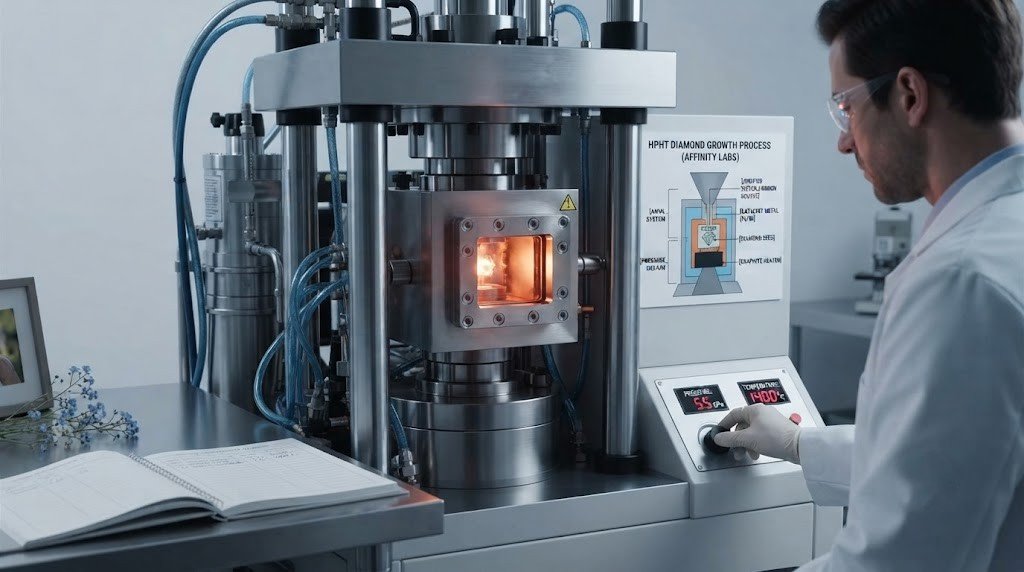
A diamond grows atom by atom. In the high pressure, high temperature method, commonly known as HPHT, equipment creates the conditions needed for carbon to build onto a small seed crystal. Some providers use chemical vapor deposition, or CVD, which grows a crystal layer by layer from a carbon bearing gas.

Both approaches are described in the general overview of how lab grown diamonds are made. The exact method used depends on the provider.

A larger diamond needs more growth time than a smaller one. This is why the size you choose can influence your sister memorial diamond timeline more than many other decisions.

Another detail that may surprise families is that sending more ashes or hair does not automatically produce a larger diamond or shorten the waiting period. Providers have different material requirements and may combine recovered personal carbon with supplemental laboratory carbon. The finished size depends on the growth process, not simply on the quantity of material in the package.

Color can also affect timing. Trace elements such as nitrogen and boron can influence a diamond’s color. Producing a particular appearance may involve additional processing, depending on the provider and method. Specialty colors may therefore take longer. If color matters to you, read our guide to the colors a sister’s memorial diamond may display and ask the provider how your preference affects its estimate.

What Happens Before the Lab Ever Sees the Material?

For siblings, the time before laboratory processing can be emotionally and practically significant. This part of the sister memorial diamond timeline may not appear in a provider’s production estimate, but it deserves room of its own.

Permission to use cremated remains may depend on who has legal authority over them. The rules differ by state and circumstances, and your sister’s written instructions may also matter. If you are unsure who can authorize the use of her ashes, ask the funeral home or crematory about the authorization records. A local attorney can explain the applicable rules when needed.

Hair requires similar care. Hair she kept at home, in a brush or in a keepsake may raise questions about ownership or estate administration. Before sending it, speak with the executor or the person who has authority over the material so that the decision is understood and agreed upon.

Family conversations may involve several questions:

  • Who would like a memorial diamond, and who would prefer not to have one?
  • Does each person want an individual stone, or would the family prefer one shared diamond?
  • If a single stone will be shared, who will keep it and how will that arrangement be documented?
  • Will the provider use ashes, hair or a combination of both?
  • If several relatives contribute to the cost, how will payment be organized?

Siblings can have different relationships, memories and preferences. Nobody needs to be rushed into a decision. If you find it difficult to begin the conversation, our guide on how to talk to family about a sister memorial diamond may help you approach it thoughtfully.

Once the family has agreed on the arrangements and the necessary authorization is in place, paperwork and shipping can move forward. Depending on the provider, this may involve an order form, consent documents, information about the source material, a collection kit and a tracked shipment. Include these steps when estimating the full timeline.

Does the Sister Memorial Diamond Timeline Start at Payment or at Receipt?

The sister memorial diamond timeline is often quoted from the day the provider receives the ashes or hair rather than the day you pay or place the order. However, providers may use different starting milestones, so it is important to confirm the details.

For example, the estimate may exclude the time needed for a collection kit to arrive, forms to be signed, permissions to be confirmed and the package to reach the provider. These steps can add weeks or longer before the main production period begins.

Ask the provider to confirm the following in writing:

  • The exact event that starts the production clock.
  • The estimated production range and what it includes.
  • Whether cutting, polishing and independent grading are included.
  • Whether jewelry setting and delivery are part of the estimate or handled separately.
  • How you will be notified if the expected completion date changes.

A written estimate makes it easier to compare providers fairly. It also helps you understand whether the quoted time refers to a loose finished diamond or a completed piece of memorial jewelry ready to wear.

Do Ashes, Hair or a Blend Change the Sister Memorial Diamond Timeline?

The main laboratory stages of a sister memorial diamond timeline broadly follow the same sequence for different source materials: carbon preparation, diamond growth, cutting and polishing. Size, color and the provider’s process influence the production period. The source material may affect preparation, collection and documentation before laboratory work begins.

Using ashes

Cremated remains are already available after cremation, but the family may need to confirm permission and decide how much material to provide. The amount requested varies by provider. Some providers request a few tablespoons, while others may ask for a larger quantity, potentially around 4 ounces or 100 grams, depending on their process.

The amount of carbon recovered from ashes varies. Providers may describe different estimates for how much personal carbon contributes to a finished diamond, so ask how the process works and what the provider can document. Do not assume that the entire diamond consists exclusively of carbon recovered from the submitted ashes.

Using hair

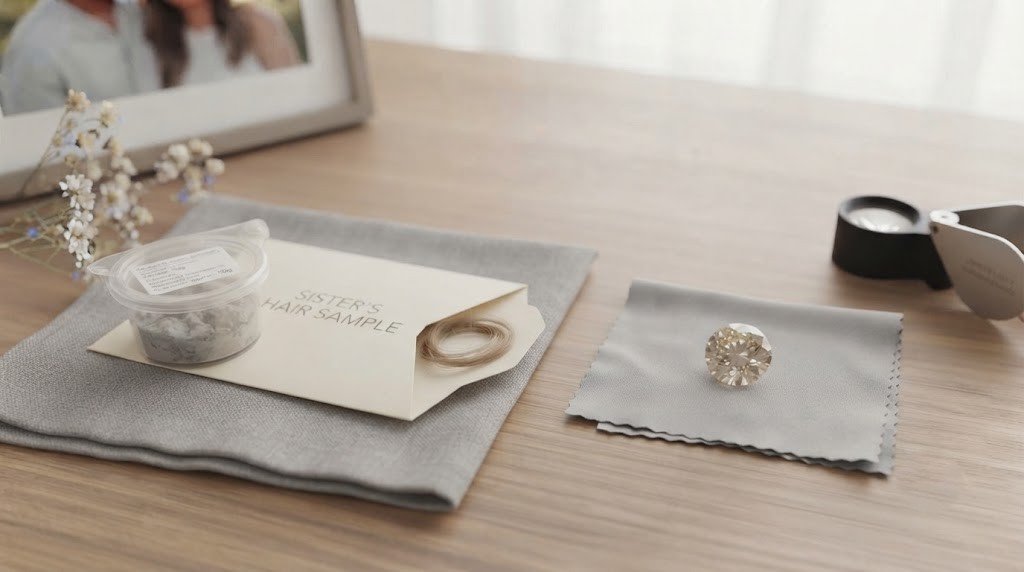
Hair may be suitable whether or not your sister was cremated. Providers often request a small lock or a few grams, but requirements vary. Ask for the exact amount and preparation instructions before collecting or shipping anything.

The practical challenge may be locating hair that clearly belonged to her and confirming that it can be used. If the material is held by another family member or forms part of a keepsake, make sure the necessary agreement is in place before sending it.

Using a blend of ashes and hair

Combining ashes and hair may involve coordinating material held by different relatives. This can extend the preparation stage even if the laboratory’s main process follows a similar sequence. Ask the provider how it documents each source, how the materials are combined and whether the estimated production period differs.

There is no single published industry timeline that applies to every provider and every material combination. For the most accurate sister memorial diamond timeline, request an estimate specific to the provider’s process and your chosen diamond.

Can You Plan a Sister Memorial Diamond Timeline Around a Birthday or Anniversary?

You may hope to receive your sister’s memorial diamond before her birthday, the anniversary of her passing, a family wedding or a holiday she loved. Planning around a meaningful date can be comforting, but the finished stone cannot be guaranteed for a specific day. Diamond growth and finishing are technical processes, and delays can occur.

Working backward from the date can help you prepare:

  1. Choose the meaningful date. For a larger stone or a specialty color, consider allowing around 12 months or more. For a smaller stone in a more common color, the general production estimate may be around 6 to 10 months from receipt.
  2. Allow time before production. Include family discussions, permissions, paperwork, collection and shipping.
  3. Include jewelry preparation. If you want the stone set in a ring or pendant, ask how much additional time the jeweler will need.
  4. Discuss your goal with the provider. Ask how your desired date compares with its current estimate and how changes will be communicated.
  5. Have a gentle alternative. If the diamond is not ready, you could mark the date with family time, a photograph or another meaningful remembrance, then celebrate the finished stone when it arrives.

A sister memorial diamond timeline that extends beyond your hoped for date does not mean the process has failed. The meaning of the diamond does not depend on arriving by a particular anniversary. Give yourself and your family permission to remember her in the way that feels right, whenever the stone is ready.

What Can Slow the Sister Memorial Diamond Timeline Down, and What Can Help?

Some delays come from laboratory work, while others happen during everyday planning. Knowing the difference can help you manage expectations and avoid unnecessary frustration.

Things that may extend the timeline

  • Choosing a diamond larger than about 2 carats.
  • Requesting a specialty color or a colorless result that requires additional processing.
  • A growth cycle that needs to be repeated.
  • A rough crystal that fractures during cutting or polishing.
  • Waiting for independent grading or other optional services.
  • Requesting a complex custom jewelry setting.
  • Unresolved family decisions or permissions.
  • Missing paperwork or incomplete authorization documents.

Things you can do to help the process move smoothly

  • Discuss the decision with siblings and document the agreed arrangement before placing the order.
  • Confirm who can authorize the release and use of the material.
  • Complete forms carefully and return them promptly.
  • Use tracked shipping and follow the provider’s packaging instructions.
  • Choose a size and color that suit your priorities and budget rather than assuming the largest stone is always best.
  • Discuss the jewelry setting while the diamond is growing so the jeweler can plan ahead.

There is no reliable shortcut through the laboratory growth process itself. If a provider promises an unusually short sister memorial diamond timeline for a large or specialty-color stone, ask what the estimate includes, how it is calculated and whether it is guaranteed or simply expected.

What Happens if Something Goes Wrong Partway Through?

Diamond growth does not always succeed on the first attempt, and a rough crystal can sometimes fracture during cutting. These possibilities may affect the sister memorial diamond timeline, so it is sensible to ask about them before ordering.

Consider asking the provider these questions:

  • If a growth cycle fails, will another attempt be made, and how could that affect the timeline?
  • If a stone fractures during cutting, what options are available and who is responsible for any additional costs?
  • Will enough material remain for another attempt, or could more material be required?
  • What happens to unused ashes or hair after the process is completed?
  • Will unused material be returned, stored or handled in another way?

Policies differ between providers, so do not assume that regrowth, replacement, refunds or the return of unused material are guaranteed. Request written answers before sending material. Knowing the provider’s procedures in advance can make an unexpected delay easier to understand.

How Do You Stay Informed While You Wait?

Several months can feel like a long time when you are waiting for something connected to someone you love. Some providers offer updates at key milestones, while others may provide only confirmation of receipt and notice when the diamond is complete. Communication practices are not the same across the industry.

Before ordering, ask for:

  • A written production estimate with a clearly defined starting point.
  • Confirmation that the material has been received and logged.
  • Information about available updates during preparation, growth and finishing.
  • A named contact for questions about your order.
  • Prompt communication if the expected sister memorial diamond timeline changes.

Keep one paper or digital folder with your order confirmation, consent forms, shipping receipts and provider updates. If several siblings are involved, agree on who will receive updates and share them with the family. This can help everyone stay informed without having to contact the provider separately.

For answers to more common questions, visit our sister memorial diamond FAQ guide. If budget is part of your planning, read what a sister’s memorial diamond typically costs. You can also explore memorial diamond settings for a sister while you wait for the finished stone.

Frequently Asked Questions

Can a memorial diamond for my sister be ready in time for her funeral or memorial service?

Usually not. General production estimates are around 6 to 10 months from receipt of the material, which is much longer than the time available before most funeral or memorial services. You might instead share your intention to create a diamond at the service or arrange a later family gathering when it is ready.

Why do some providers quote a longer sister memorial diamond timeline than others?

Providers may use different starting points, offer different sizes and colors, and include different services in their estimates. Laboratory capacity, cutting, grading and jewelry setting can also affect the total wait. Ask each provider what its estimate covers so you can compare equivalent services.

Does choosing a colorless memorial diamond add time?

It may. Producing a colorless result can require additional processing, depending on the method used. Specialty colors and diamonds larger than about 2 carats may also fall toward the longer end of the general timeline. Ask the provider how your preferred color affects its current estimate.

Is there a deadline for sending my sister’s ashes or hair?

There is no single deadline that applies to every provider. Ashes and hair that have been stored appropriately may remain usable for an extended period, but each provider has its own requirements for material condition, quantity and packaging. Ask for instructions before sending anything. It is reasonable to take the time your family needs to make the decision.

Can several siblings’ memorial diamonds be made at the same time?

It may be possible to create several stones from one source, but the approach depends on the provider and the amount of usable material available. Ask whether multiple orders can be processed together or must be completed separately, and how that affects the overall timeline.

Will I hear from the provider during the months of waiting?

That depends on the provider. Some offer milestone updates or photographs, while others mainly confirm receipt and completion. Before ordering, ask what updates are available, how often you can expect communication and who you should contact if you have questions.

Final Thoughts on a Sister Memorial Diamond Timeline

The months between sending something that belonged to your sister and receiving the finished diamond can feel long. For some families, that waiting period becomes a quiet time to remember her, share stories and consider how the finished stone will be kept or worn.

Give family discussions the time they need, confirm permissions before sending the material, and ask the provider for a written estimate with a clear starting point. Leave extra room around any date that matters to you, especially if you want a larger stone, a specialty color or a custom setting.

A clear sister memorial diamond timeline will not remove every uncertainty, but it can help you understand what happens at each stage and what questions to ask along the way. The most important thing is to choose a process that feels right for your family and gives you space to remember your sister in your own way.

Learn More About Sister Memorial Diamonds

Talk With Memorial Diamond

If you are planning a memorial diamond for your sister and want to understand the process, timing, available sizes or color options, visit Memorial Diamond. Ask questions, confirm the current production estimate and take the time you need to make a decision that feels right for you and your family.
Memorial Diamond Settings and Jewelry Ideas for a Sister

Memorial Diamond Settings and Jewelry Ideas for a Sister

You might already picture the piece she would have worn without a second thought, or you might have no picture at all yet. Sister memorial diamond settings come down to three practical decisions: how the metal holds the stone (bezel, prong, halo, flush or tension), which metal surrounds it, and how often it will be worn. For a small stone worn every day, bezel and flush settings offer more protection; prongs and halos favor sparkle and visibility.

sister memorial diamond settings

Which Sister Memorial Diamond Settings Hold a Small Stone Securely?

Before comparing sister memorial diamond settings, it helps to know what a setting actually does. It is the part of a ring, pendant or earring that grips the diamond, and it determines how much of the stone meets light, how much is exposed to knocks, and how easily the piece catches on sweaters, hair or bag straps. These details matter for a memorial stone because replacing it may not be possible in the same personal sense as replacing an ordinary piece of jewelry.

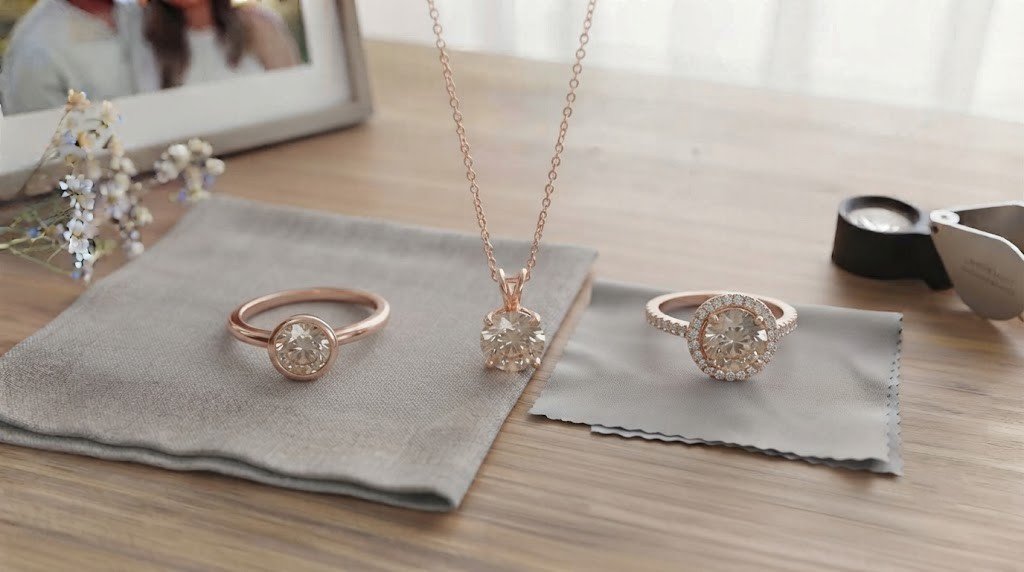
Five styles cover nearly all the sister memorial diamond settings you are likely to encounter:

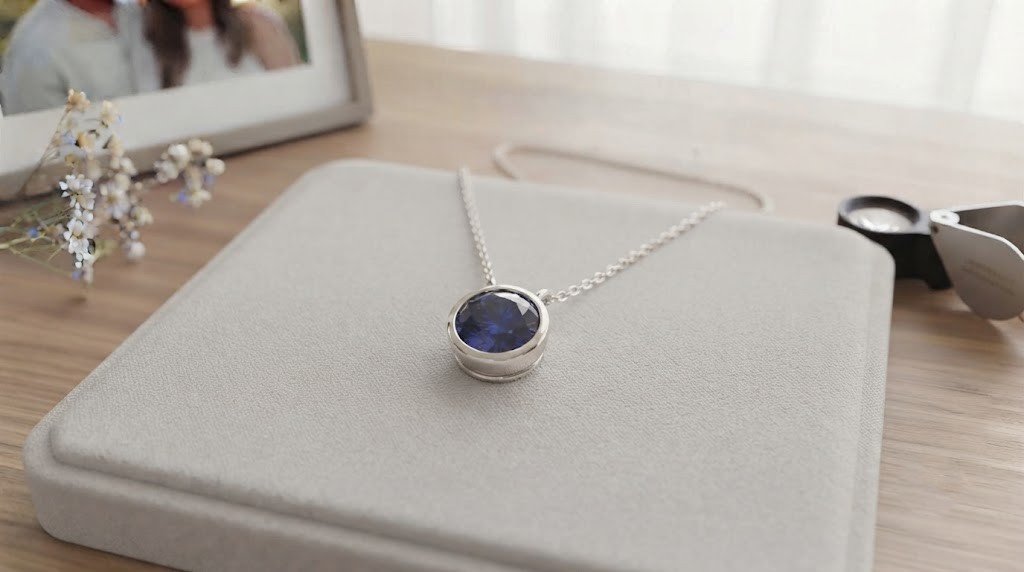
  • Bezel setting: A thin rim of metal wraps around the entire edge of the stone.
  • Prong setting: Small metal claws, usually four or six, rise up and hold the stone at several points.
  • Halo setting: A ring of smaller accent stones circles the center diamond, which itself sits in prongs or a bezel.
  • Flush setting, sometimes called gypsy setting: The stone is sunk into a prepared seat so its top sits level with the surrounding metal surface.
  • Tension setting: The band’s pressure holds the stone between two ends of metal without traditional claws.

None of these settings is the right answer for every family. The best of the sister memorial diamond settings for you is the one that matches how you will live with the piece. Someone who wears a ring every day and has busy hands needs different protection from someone who plans to wear a pendant on anniversaries and keep it safely stored the rest of the year.

How Do the Five Sister Memorial Diamond Settings Compare?

The table below compares five common sister memorial diamond settings against the questions jewelers usually hear first. Treat it as the start of a conversation rather than a final verdict. Craftsmanship, metal thickness, stone shape and the quality of the setting can change the result for an individual piece.

SettingHow It Holds the StoneProtection From KnocksLight and SparkleSnag RiskFit for a 0.10–0.25 Carat Stone
BezelA continuous metal rim surrounds the edge.High; the edge is covered by metal.Less light enters from the sides, but the top remains visible.Very lowA strong option; the rim can make a small stone look larger.
ProngFour or six claws grip the stone at points.Moderate; the edges and claws remain exposed.High; light can enter from many angles.Moderate to highGood when the prongs are fine and low profile.
HaloAccent stones circle the center stone, which is held separately.Moderate; the accent stones add their own small risks.High; the surrounding stones add sparkle.ModerateGood for visibility, although the center stone shares attention.
FlushThe stone sits level with the metal surface.Very high; very little sticks out.Lower; mostly the top of the stone catches light.Very lowGood for a wider band; it may be less visible on a narrow band.
TensionThe band holds the stone between two ends through carefully engineered pressure.Variable; it depends heavily on precise design and fit.High; open sides allow light through.Low to moderateMore challenging; small stones require precise engineering.

Across these five sister memorial diamond settings, one pattern stands out. Styles that show off a diamond’s light tend to expose more of its edge, while styles that protect the edge may hide some light. The choice involves a trade-off, and only you know which side matters more for her stone.

Which Metals Suit Sister Memorial Diamond Settings Best?

Metal influences sister memorial diamond settings as much as the setting style does because it affects durability, comfort, color and cost. Common choices include platinum, white gold, yellow gold and rose gold, with sterling silver and titanium appearing in some designs.

Platinum is dense and tends to wear slowly, which is one reason jewelers often suggest it for prongs in everyday jewelry. White gold is gold alloyed with whiter metals and is commonly plated with rhodium. That finish may need renewing over time. Yellow gold and rose gold offer warmer tones. Higher-purity gold is softer than lower-purity gold, so ask how the recommended karat will perform with your expected daily wear.

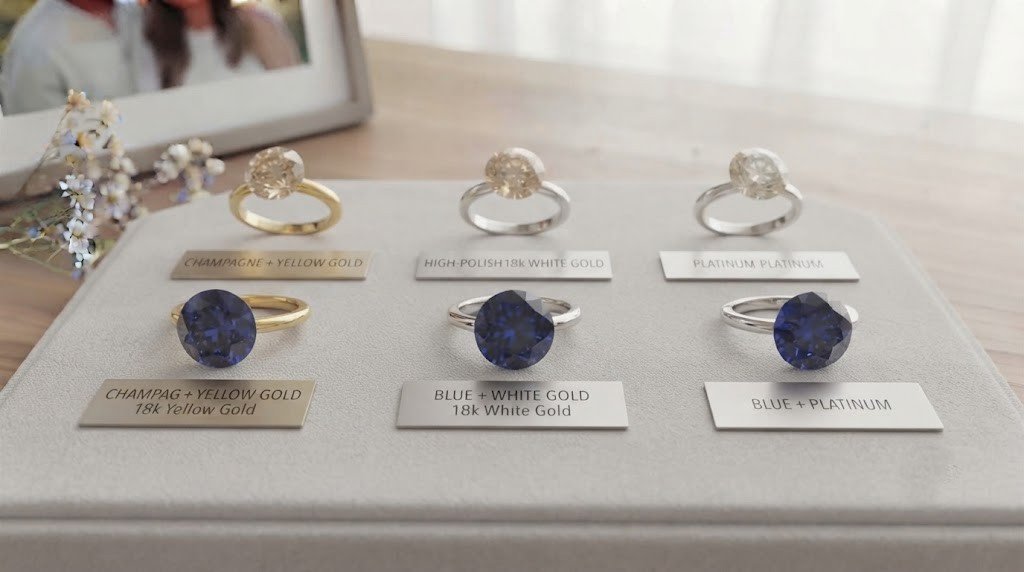
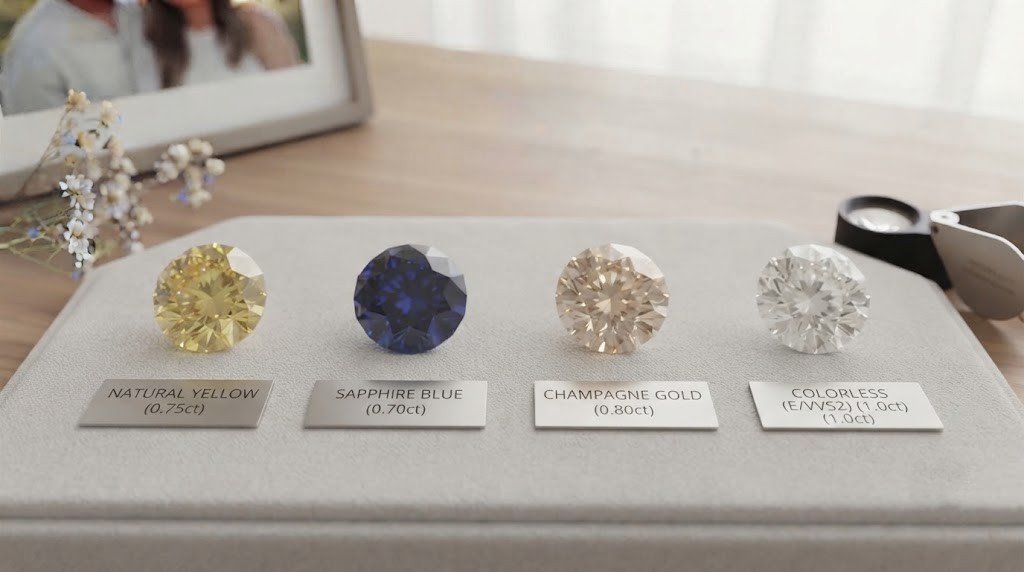
The stone’s color is the other half of the pairing. Memorial diamonds may finish with a yellow, blue or champagne tint rather than a colorless appearance. The final color cannot reliably be determined from the source material alone. Our guide to the colors a sister’s stone can come out explains more about these possibilities, while this section focuses on the metal.

Once the finished color is known, you can choose a metal that complements it. Some people like yellow gold beside a yellow or champagne stone for a warm, unified look. Others prefer a white metal beside a blue stone. Holding the finished diamond against several sample bands is a practical way to see which pairing you prefer.

If you are choosing sister memorial diamond settings before the stone is finished, ask whether the jeweler can wait to confirm the metal until the diamond arrives. A short wait may help you choose a combination you will be happy with for years.

How Should Sister Memorial Diamond Settings Fit a 0.10–0.25 Carat Stone?

Memorial diamonds are offered in a range of sizes, from around 0.10 carats to more than 5 carats in some industry offerings. Smaller stones can be a suitable starting point. Entry-size stones of roughly 0.10–0.25 carats may cost around $1,500–$3,500 as an industry range, with settings, engraving and grading potentially priced separately. These figures are general estimates, not a quote or published price from Memorial Diamond. Confirm current prices and available sizes directly with the provider.

A small stone is no less meaningful, but its size affects how the mount should be designed. When comparing sister memorial diamond settings for a smaller stone, consider the following points:

  1. Keep the metal proportionate. Heavy prongs or a thick bezel can overwhelm a small stone. Ask about fine, tapered prongs or a thin, polished bezel rim.
  2. Use the setting to frame, not hide. A slim bezel or delicate halo can help the stone appear more prominent without increasing its carat weight.
  3. Mind the height. A low-profile mount offers more protection and catches less often on clothing. A taller mount may allow more light in but leaves the stone more exposed.
  4. Match the band width to the style. Flush settings need enough metal around the stone, so they often suit wider bands. Prongs and bezels can work well on finer bands.
  5. Think about the cut. Round stones are generally straightforward to set securely at small sizes. Shapes with pointed ends, such as pear or marquise, need suitable protection at those points.

That is why slim bezels and fine halos deserve a close look among sister memorial diamond settings for smaller stones. When thoughtfully designed, a small memorial diamond can look deliberate and refined rather than understated. The setting should complement the stone instead of competing with it.

Will the Piece Be Worn Every Day or Kept for Certain Days?

How often you plan to wear a piece is one of the clearest ways to narrow down sister memorial diamond settings. Diamond ranks 10 on the Mohs scale of mineral hardness, the top of that scale, which means it resists scratching from everyday materials better than any other gemstone. Hardness, however, is not the same as toughness. A sharp blow at the wrong angle, such as a ring striking the edge of a countertop, can still chip a diamond, particularly near a thin edge or pointed tip.

Expected wear should therefore influence your choice:

  • Everyday rings: Rings experience frequent impacts. Bezel and flush styles are often more protective options. If you prefer prongs, ask a jeweler whether six prongs and a lower profile would suit the stone.
  • Everyday pendants: Pendants generally sit away from many direct knocks, making prong and halo designs practical options to discuss with a jeweler.
  • Earrings: Earrings may catch on hair and clothing more often than they experience hard impacts. Bezel-set studs can be a simple, secure choice.
  • Occasional jewelry: A piece worn on her birthday, at family gatherings or on other meaningful days can use a more open setting if you are comfortable with its protection needs. It will spend more time stored safely when not worn.

Some families choose two pieces: one sturdy design for everyday wear and another more open, sparkling design for special occasions. Whether more than one stone can be grown from the available material, and who each stone will belong to, are questions worth discussing early. Our article on several relatives receiving a stone from one sister explains considerations around sharing.

Can the Diamond Go Into a Piece of Jewelry She Owned?

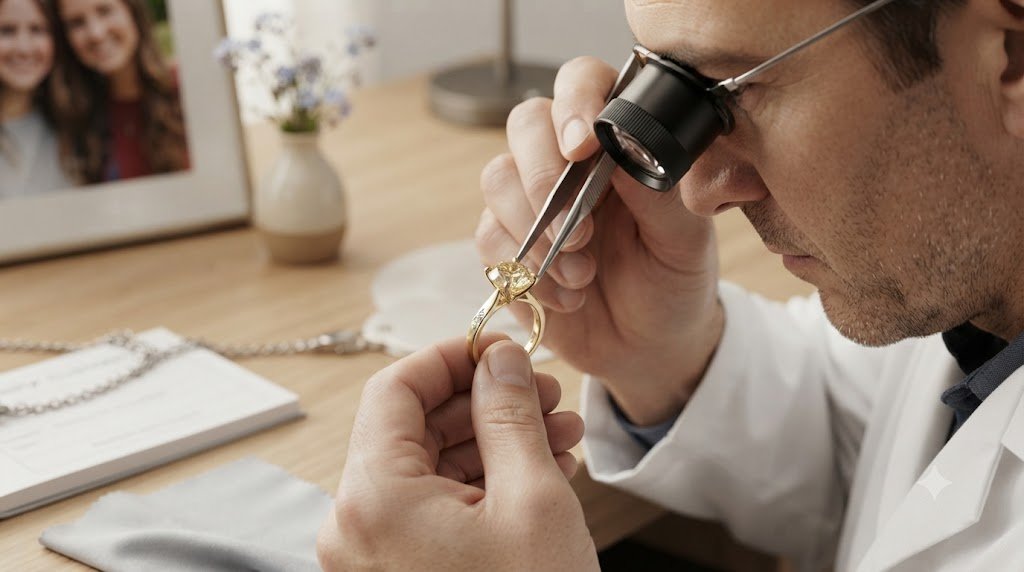
Among the many sister memorial diamond settings you could consider, one of the most personal options is a piece she already wore. Her ring, locket or pendant might be reworked to hold the new stone. A skilled bench jeweler can often assess whether this is possible, although the jewelry may need a new setting head, a new bezel or a reworked seat. Older or thin metal may need repair first.

Before taking her jewelry to a workshop, check who currently owns or holds it. Jewelry she owned may form part of her estate, and rules vary by location. The executor or person managing her affairs should agree before the piece is altered. A conversation in advance can prevent a more difficult disagreement later, especially if several relatives feel connected to the same item.

If the original stone is removed to make room for the memorial diamond, decide in advance what should happen to it. It could be reset in another piece, returned to the person who holds the jewelry, or kept with the memorial diamond’s paperwork.

Can Sister Memorial Diamond Settings Be Changed Later?

In most cases, a memorial diamond can be removed from one setting and reset into another, just like other diamonds. That means your first choice does not necessarily have to be permanent. A pendant chosen today might become a ring for another family member decades from now, depending on the design and the stone.

Some sister memorial diamond settings are easier to change than others. Prong mounts are often relatively straightforward for a qualified jeweler to open and close. Bezels may be carefully worked to release the stone. Flush settings involve metal shaped around the stone and can require more care. Tension bands depend on precise fit and engineering, so a stone from one design may not fit another.

If you decide to reset the diamond, follow three practical steps:

  • Ask the jeweler how the stone will be documented and tracked while it is outside the setting. Ask whether you can be present during the process.
  • Keep the provider’s origin certificate and any grading report with the stone’s records rather than relying on the old mount to identify it.
  • Ask for the stone to be examined under magnification before and after the work so any existing marks or damage can be recorded.

What Can Be Engraved, and Where Does It Go?

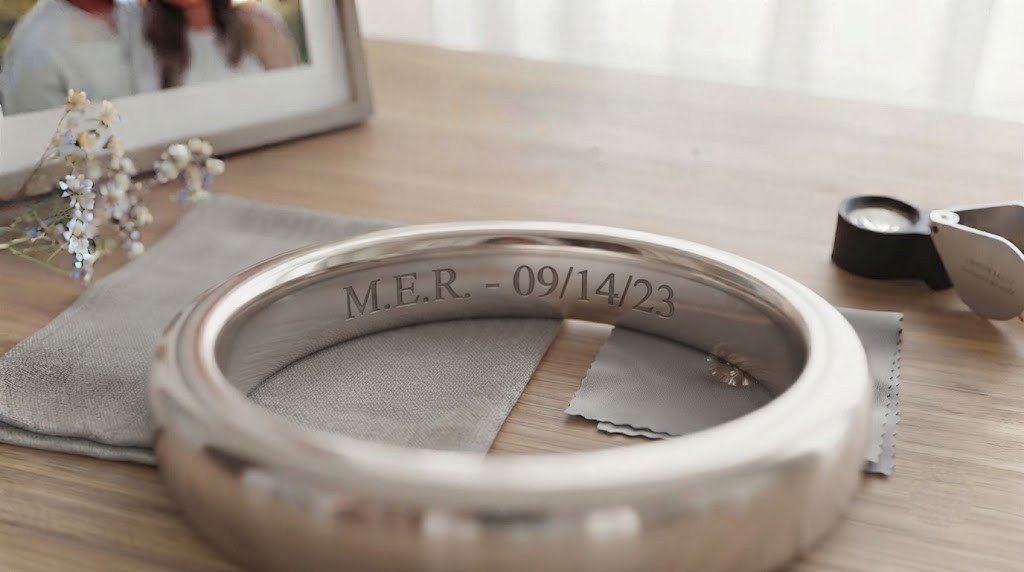
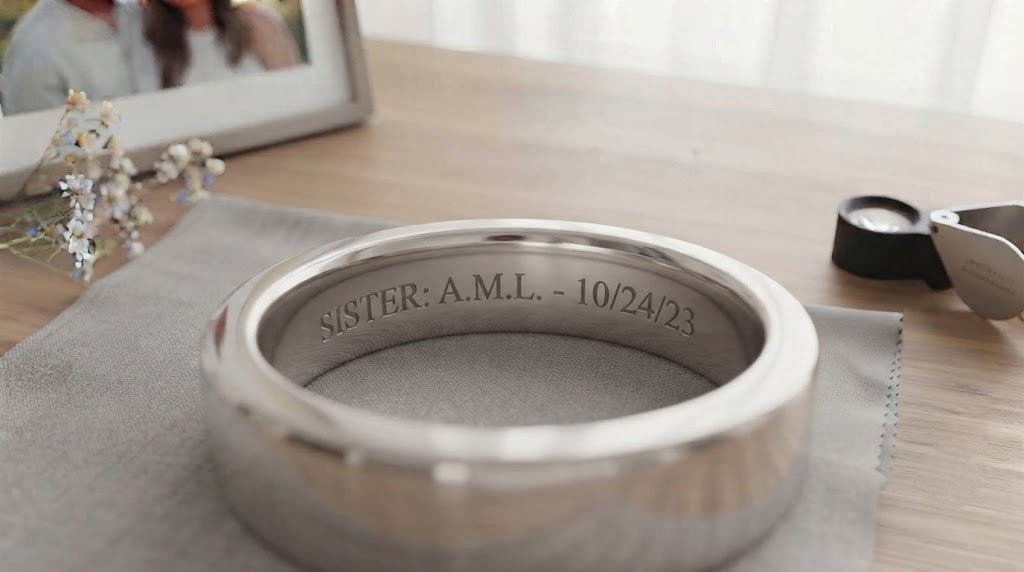
Engraving can be added to many sister memorial diamond settings, but the available space depends on the design. Common locations include the inside of a ring band, the back of a pendant, the area beneath a bezel cup, and the inner face of a locket. These surfaces can be small and curved, so the setting influences how many characters will remain readable.

Hand engraving and laser engraving create different appearances, and some fonts remain easier to read as metal wears. Ask to see a sample at its actual size before committing. Some providers may also offer a small laser inscription, such as a reference number, on the diamond’s girdle. Whether that service is available and what it costs are questions to ask the provider rather than assume.

A thoughtful engraving can complement a quiet design. For example, a plain, sturdy bezel ring with her initials inside can feel personal without drawing attention from strangers. That may be the right choice for someone who prefers to keep the meaning of the jewelry private.

What Should You Ask a Jeweler and an Insurer First?

A good jeweler should welcome questions, and a memorial stone deserves careful handling. Bring this checklist to any consultation about sister memorial diamond settings:

  1. Have you set memorial or lab-grown diamonds before, and can I see examples of your work?
  2. Which setting would you suggest for a stone of this size and shape, considering how it will be worn?
  3. How will you identify, hold and track the stone while it is in your workshop?
  4. Who is responsible if the stone is damaged during the setting process?
  5. What maintenance do you recommend, and how often should prongs or the bezel be checked?
  6. Can the piece be resized or reset later, and what risks would that involve?

Insurance is a separate conversation. A memorial diamond may have a market value, but its personal meaning cannot be replaced. Policies differ, so ask your insurer whether a memorial stone can be listed on a policy or rider, what type of appraisal is required, and whether the jewelry setting and stone are assessed together or separately.

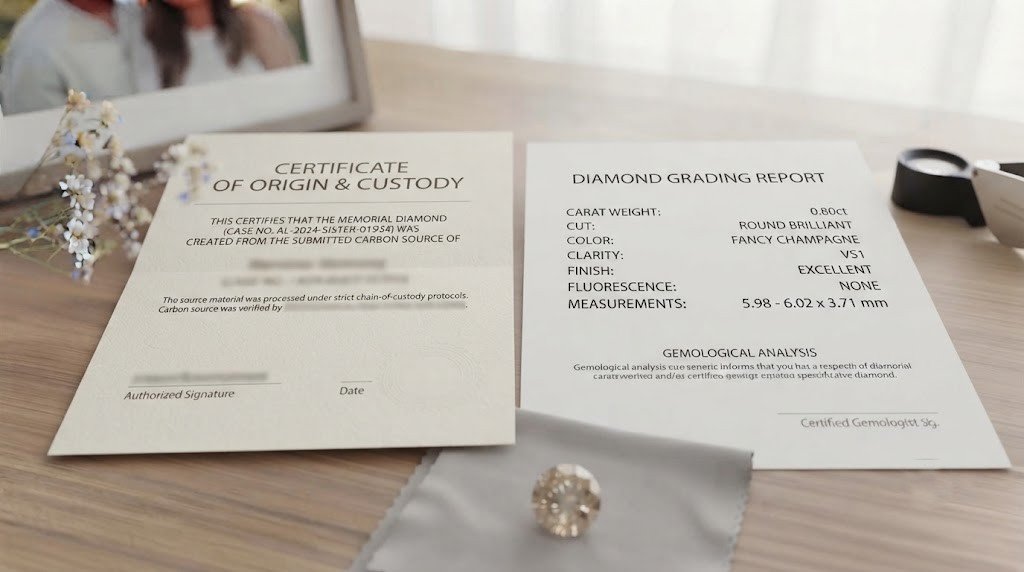
Ask how a loss or chip would be handled, too. An independent grading report that references GIA’s diamond quality factors may be optional and priced separately, but an appraiser or insurer could ask for documentation. A licensed insurance agent can explain the terms and limits of your particular policy.

When Should You Start Planning the Setting?

Growing a memorial diamond typically takes around 6–10 months after a provider receives the material, with some stones taking up to about 12 months, particularly larger stones or specialty colors. These are general industry timelines rather than a guaranteed Memorial Diamond turnaround. Ask your chosen provider for its current schedule and process.

This timeline gives you room to plan without rushing. It can make sense to narrow down your preferred sister memorial diamond settings early and finalize specific details later.

At the beginning, decide on the form, such as a ring, pendant, earrings or another keepsake, along with the broad setting style and budget. Once the finished stone arrives with its exact color, shape and measurements, the jeweler can confirm the metal, seat dimensions and engraving options. To understand the stages involved, read the timeline for a sister’s memorial diamond.

If you are still weighing jewelry styles, our guide to ideas for rings, pendants and keepsakes made with her stone explores more options. If you have not yet chosen a provider, begin with where to begin when choosing a memorial diamond for your sister. For a broader look at size and budget, read what a sister memorial diamond typically costs.

Whatever you choose, sister memorial diamond settings are not a test with one correct answer. They are a way of deciding how close to keep her stone and how you want to carry it.

Frequently Asked Questions

Can a local jeweler set a memorial diamond that was grown by a different company?

Usually, yes. A memorial diamond is a real diamond, so an experienced bench jeweler can assess and set it. Bring the origin certificate, ask how the stone will be tracked in the workshop, and confirm who is responsible if anything goes wrong during setting.

Does a lab-grown memorial diamond need a different kind of setting from a mined one?

No. A memorial diamond is a real diamond, so a jeweler can use setting styles suitable for other diamonds. What differs for many families is the personal importance of the stone and the difficulty of replacing it with another stone that carries the same meaning. That makes protective choices and careful workshop tracking worth discussing.

Can siblings choose different settings for stones grown from her ashes or hair?

Yes. Sister memorial diamond settings can differ from one piece to another. One sibling might prefer a bezel ring, while another chooses a prong pendant. Agreeing in writing who owns each stone before it is grown can help avoid confusion later.

Should the origin certificate stay with the jewelry?

Keep the provider’s origin certificate with the jewelry’s important records, along with any grading report and appraisal. If the stone is reset or passed down, the paperwork should travel with it so the records remain together.

How often should a memorial diamond setting be checked?

There is no single schedule that suits every piece, so ask your jeweler what they recommend for the specific design and how often you wear it. Daily-wear rings may need closer attention than occasional jewelry. Have a piece examined promptly if a prong feels rough, catches on fabric, or the stone appears to move.

Is a bezel too plain for a memorial diamond?

Not at all. Among sister memorial diamond settings, a bezel can be slim, polished, textured or scalloped. It frames a small stone and may make it appear larger. Some people choose it precisely because it feels calm, secure and quietly personal.

Final Thoughts on Choosing a Setting for Her Stone

There is no single correct way to wear a diamond grown in part from the material of someone you love. A plain bezel ring worn every day and a sparkling halo pendant brought out on her birthday can both honor her, just in different ways.

If you weigh protection against light, think honestly about daily wear, and leave room to reset the stone later, the sister memorial diamond settings you choose can fit your life and your preferences. That fit matters more than any trend.

Learn More About Sister Memorial Diamonds

Talk With Memorial Diamond

If you are thinking about how her stone might be set, or want to talk through which sister memorial diamond settings may suit the way you plan to wear it, visit Memorial Diamond. You can explore the available information and ask questions at whatever pace feels right for you.

Sister Memorial Diamond Ideas

Sister Memorial Diamond Ideas: Rings, Pendants, and Keepsakes

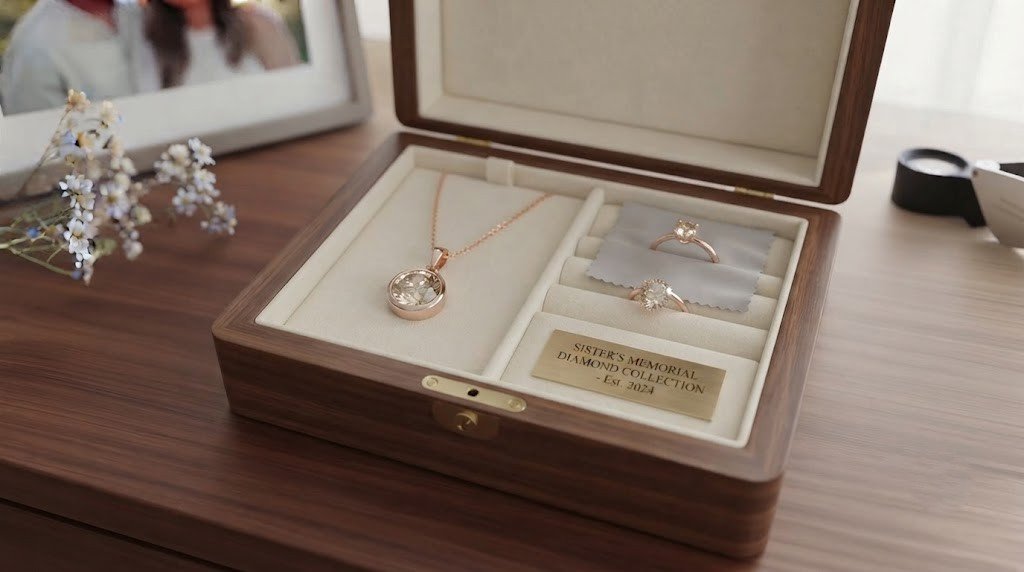
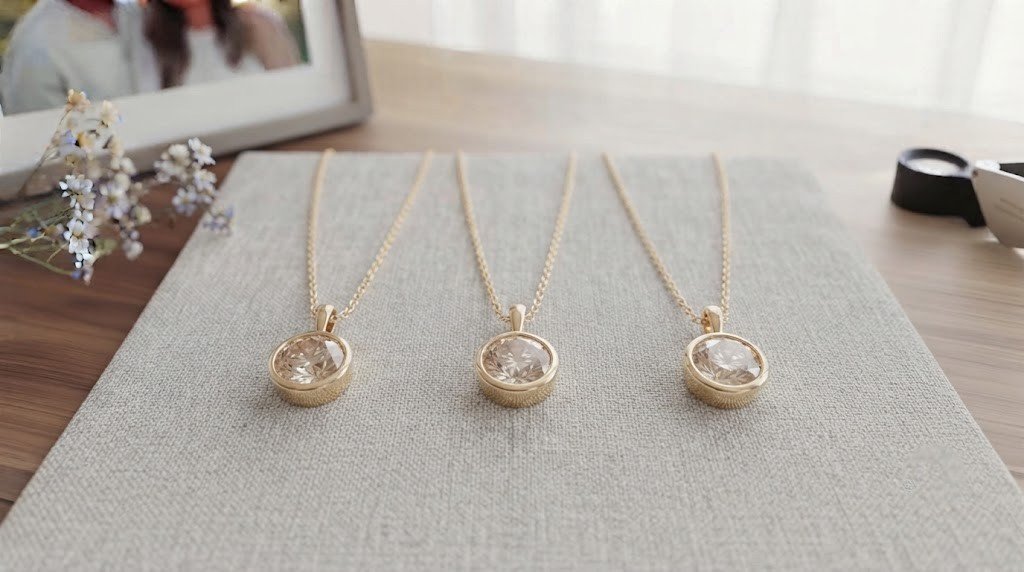
Some people know at once how they want to carry their sister with them, and others need to see the options laid out before anything feels right. The most practical sister memorial diamond ideas include a pendant, a ring on any finger, earrings, a bracelet, cufflinks or a tie pin, a lapel pin, a loose stone kept in a keepsake box, a stone set into an heirloom, coordinated stones for several siblings, and engraving on any of these.

Each of these sister memorial diamond ideas suits a different way of living with a memorial stone. Below, they are grouped by how often the piece would be worn, followed by a side by side comparison, notes on keeping a small diamond safe, and a few thoughts on choosing, especially when siblings want different things.

Which Sister Memorial Diamond Ideas Suit Everyday Wear?

If you want her close through ordinary days, these four sister memorial diamond ideas are built for regular wear. Memorial stones are offered from about 0.10 carat up to 5 carats or more, and every piece below can work with a stone from the entry tier of roughly 0.10 to 0.25 carat.

1. A Pendant Worn Close

A pendant is one of the gentlest ways to wear a memorial diamond. It sits against the chest or at the collarbone, is less exposed to knocks than a ring, and works with almost any stone size.

A protective mount such as a bezel suits a pendant that will be worn most days, while a single stone on a fine chain is quieter still. Some people choose a pendant that can be tucked under clothing on days when they would rather keep her memory private and worn openly on others.

2. A Ring on Any Finger

A ring keeps the stone in view every time you look at your hands. It can be worn on any finger, including a little finger or a thumb, and on either hand. There is no rule about which finger a memorial ring belongs on.

Rings take more knocks than many other types of jewelry, so ask a jeweler for a low, protective mount rather than a tall one. Hands change size with the seasons and over the years, so it is worth choosing a design a jeweler can resize later.

3. Earrings

Studs are a natural fit for small stones. A pair needs two diamonds, though, and that brings a practical question: memorial stones grown from the same source can still differ slightly in tone because color comes from trace elements during growth. Ask a provider whether a closely matched pair is possible, or embrace a pair that is gently different.

Another option is a single stone worn in one ear, paired with a plain stud in the other.

4. A Bracelet

A bracelet with a single bezel set stone, or a small stone on a fine chain, is a subtle everyday choice. Wrists brush against desks, door frames, and car doors, so a protective setting is wise. A rigid bangle with the stone set low into the metal is one of the sturdier versions.

These four sister memorial diamond ideas share one practical point: the more often a piece is worn, the more its setting needs to protect the stone.

Which Sister Memorial Diamond Ideas Work for Occasional or Formal Wear?

Not every one of the sister memorial diamond ideas needs to be worn daily. For some people, the meaning sits in bringing the piece out for particular days, such as a wedding, graduation, anniversary, or her birthday.

Cufflinks with a small memorial stone set into one or both faces suit anyone who wears French cuffs. A tie pin or tie bar carries a single stone neatly. Both are worn only occasionally, which reduces everyday exposure to wear and tear, and both can be passed from one person to another for different occasions.

6. A Lapel Pin

A lapel pin or brooch can be worn on a jacket, coat, scarf, or bag strap. It is a flexible idea because it moves from outfit to outfit and sits at heart height.

Pins can come loose, so choose a secure locking back. Some people pair a lapel pin with a small engraving on the reverse that only they will ever see.

These occasional pieces are some of the more adaptable sister memorial diamond ideas because they can be shared or worn in turn among siblings without anyone needing to own one outright.

What Are Sister Memorial Diamond Ideas for Keeping Rather Than Wearing?

Not all sister memorial diamond ideas involve jewelry. Some of the most personal choices keep the stone somewhere safe, to be seen whenever you choose.

7. A Loose Stone in a Keepsake Box

A loose diamond in a small box, perhaps lined in a fabric that meant something to you, is a complete and meaningful choice. It can sit on a shelf, in a drawer, or beside a photograph, and it can be held whenever you want.

Keeping the stone loose also leaves every option open. A setting can be added later, months or years on, if you decide you would like to wear it. Keep the origin certificate with the box so the stone’s history stays with it.

8. A Stone Set Into an Heirloom

If your sister left jewelry, or the family has a piece with history, a memorial stone can sometimes be set into it: a ring she wore, a locket, or a brooch from a grandparent. The appeal is that two kinds of memory meet in one object, the piece she touched and the stone grown in part from her.

If the heirloom was hers, it may count as part of her estate, and how that works differs from state to state. Talk with the executor, or whoever is handling her affairs, before anything is altered.

Both of these sister memorial diamond ideas suit people who find daily wear too much, or who want the stone to stay in the family rather than with one person.

How Can Several Siblings Create Matching or Coordinated Stones?

9. Matching or Coordinated Stones for Several Siblings

Because only a portion of the source material goes into each stone, several diamonds can often be grown from one shared source. That opens up a set of sister memorial diamond ideas for siblings who want to stay connected through her memory.

A few approaches include:

  • Matching pieces: Each sibling wears the same design, such as identical pendants, in whatever metal they prefer.
  • Coordinated pieces: The stones come from the same source, but each person chooses their own form. One may choose a ring, another a pendant, and another a loose stone.
  • One shared heirloom: A single piece is kept by one sibling or moves between households for particular days, with ownership agreed in writing.

A set of stones depends on someone being able to release the material, and that person may not be you. Siblings frequently sit further down the line of authority over remains. In many states, the order may run from a spouse or registered partner to adult children and parents before reaching brothers and sisters. That order is not national; it changes from state to state. If she named an agent or left a signed declaration, her written wishes may affect who decides.

To find out who holds authority, ask the funeral home or crematory who signed for the cremation. A local attorney can explain how your state handles it. A gentle request to that person for a small share is usually where siblings start. Hair kept at her home may belong to her estate as well, so speak with the executor before using any.

The guide to how more than one relative can receive a stone from one source explains the practical side in more depth. Half siblings, step siblings, adopted siblings, and twins are all siblings, and any of them may want a stone, or not.

What Can Engraving Add to Any of These Sister Memorial Diamond Ideas?

10. Engraving

Engraving adds words to any of the other nine sister memorial diamond ideas. Most of the available space is on the metal, and some providers can also laser a few characters onto the diamond’s girdle, its thin outer edge. The harder part is usually deciding what to say.

What people choose to engrave varies widely:

  • Her name, initials, or a nickname.
  • A date, such as her birthday or another day that mattered.
  • Map coordinates of a place she loved.
  • A short phrase she used, or something only siblings would understand.
  • Her handwriting, reproduced from a card or letter, where the jeweler offers it.

Engraving is usually priced separately from the stone. Short wording tends to stay legible longest, and a phrase that means nothing to strangers can be a comfort in itself because it stays between you and her.

How Do These Sister Memorial Diamond Ideas Compare at a Glance?

This table sets the ten sister memorial diamond ideas side by side, so you can see how each one fits into everyday life.

IdeaHow often wornExposure to knocksProtective setting optionsGood to know
PendantDaily or oftenLowBezel, half bezel, solitaireCan be tucked under clothing
Ring on any fingerDaily or oftenHighBezel, low profile, flushChoose a design that can be resized
EarringsDaily or oftenLow to moderateBezel studs, secure backsA pair needs two stones; tones may differ
BraceletDaily or oftenModerate to highFlush set bangle, bezelWrists brush hard surfaces often
Cufflinks or tie pinOccasionallyLowFlush or bezel facesEasy to share between siblings
Lapel pinOccasionallyLow to moderateBezel, locking pin backMoves between outfits and bags
Loose stone in a boxKept, not wornVery lowNone neededLeaves every future option open
Set into an heirloomVariesVariesDepends on the existing mountCheck estate questions first
Sibling setVariesVariesAny of the aboveAgree ownership in writing
EngravingWith any pieceNone addedNot applicableUsually priced separately

This table only hints at how each piece holds its stone. The range of setting styles for a sister’s stone compares bezel, prong, halo, flush, and tension mounts, along with the metals around them, in detail.

How Do You Keep a Small Memorial Stone Safe Day to Day?

A memorial diamond is a genuine lab grown diamond, as this overview of memorial diamonds describes, so it has many of the same everyday considerations as any small stone. Scratches are rarely the main worry. Losing it is, and a hard knock can still chip even a diamond.

A few habits help, whichever of these sister memorial diamond ideas you choose:

  1. Choose a protective setting for anything worn daily, especially rings and bracelets.
  2. Take rings and bracelets off for gardening, the gym, moving furniture, and heavy cleaning.
  3. Store pieces separately so diamonds cannot scratch other jewelry or each other.
  4. Check the setting occasionally. A jeweler can confirm that prongs and bezels are secure.
  5. Clean gently with warm water, mild soap, and a soft brush.
  6. Keep paperwork together, including the origin certificate and any independent grading report.
  7. Ask your insurer whether the piece can be covered and what documentation it needs.

Small stones can go missing quietly, which is why the clasp, earring back, and pin lock deserve as much attention as the stone. Whichever of these sister memorial diamond ideas you settle on, a secure fastening is worth the extra effort.

How Do You Choose Between Sister Memorial Diamond Ideas?

sister memorial diamond ideas

There is no single right answer among sister memorial diamond ideas, only the one that fits how you want to live with her memory. A few questions can help narrow the field:

  • How do you picture it? On your hand, at your throat, or in a drawer you open on hard days?
  • How active is your life? Daily physical work may favor a pendant or a loose stone over a ring.
  • Would she have liked it? Some people choose something she would have worn; others choose something that suits them.
  • Do you want it seen? Some memorial pieces are private, while others invite questions you may or may not want.
  • What fits your budget? Settings are usually priced separately from the stone, and the guide to what a sister’s stone typically costs breaks down those extras.

Color can influence the choice of piece, too. Some people want a tinted stone on a hand, where they will see it often; others would rather it sit quietly at the collarbone. The shade cannot be picked from her ashes or hair, so it helps to read about the tones memorial stones tend to show before committing to a design.

Whether her stone begins with ash, hair, or both makes no difference to which of these pieces it can go into. Her carbon is usually combined with lab carbon so there is enough to grow a stone. For ash, providers commonly describe her share of the finished diamond’s mass as somewhere near 10 to 15 percent, and some quote figures nearer 3 percent. No equivalent finished stone percentage has been published for hair. If you are gathering hair, how much hair a sister’s stone usually needs covers quantities.

Timing may matter if you want the piece for a particular date. A stone typically takes six to ten months from receipt, although timelines vary by provider and stone specifications. The stage by stage timeline shows where a setting fits.

What If Siblings Prefer Different Sister Memorial Diamond Ideas?

Siblings may picture very different sister memorial diamond ideas. One may want a ring worn every day, another a loose stone in a box, and another nothing at all. Each of those is a valid way to remember her.

A few ways to leave room for everyone:

  • Let each sibling choose their own piece from the same source rather than agreeing on one design.
  • Accept that some siblings may decide later, or never. A stone may be possible years later if suitable material has been kept safely and a provider accepts it.
  • If one stone is shared, write down who keeps it and what happens next before it exists.
  • Avoid treating any choice as a measure of love. Choosing not to have a stone is not a lesser goodbye.

Grief does not move on one schedule. Giving each person space to choose in their own time often matters more than the jewelry itself. If you are still finding your bearings, the overview on where to begin choosing a stone for your sister lays out the first decisions in order.

Frequently Asked Questions

Can a memorial ring be worn alongside rings I already wear?

Usually, yes. Tell the jeweler which rings it will sit beside so the band width and height can be planned to reduce metal rubbing against the stone. A low mount tends to stack more comfortably, and matching metals may help the rings wear at a similar rate.

What size memorial diamond suits a pair of earrings?

Smaller stones, often around 0.10 to 0.25 carat each, suit studs well. A pair needs two diamonds, and tones can differ slightly even from one source. Ask the provider whether a closely matched pair is possible or plan for gentle differences.

Is a ring or a pendant more practical for a memorial diamond worn every day?

A pendant is usually the more forgiving choice because it takes fewer knocks than a ring. A ring can work well too if it has a protective setting such as a bezel and you remove it for heavy work, sport, or gardening.

Can sister memorial diamond ideas be combined, such as a pendant now and a ring later?

Yes. A diamond can be taken out of one piece and set into another, so starting with a pendant or a loose stone does not close any doors. Keep the origin certificate with the stone, not the old mount, each time it moves.

Can a memorial piece be passed down to another relative later?

It can. Writing down who should receive it next and keeping the certificate and any grading report with the piece makes the handover simpler. If you want it named in a will, an estate attorney can explain how that works where you live.

Can a memorial diamond hang on a chain or bracelet I already own?

Often, yes. A jeweler can mount the stone as a small charm or slide pendant sized for a chain you already wear. Ask them to check the chain’s clasp and links first, since an older chain may need repair before it carries something irreplaceable.

Final Thoughts on Sister Memorial Diamond Ideas

The right piece is the one you will be glad to reach for, whether that means wearing it every morning or opening a small box once a year. None of these sister memorial diamond ideas is more meaningful than another; they are simply different ways of keeping her near.

Take your time with these sister memorial diamond ideas, let each sibling choose for themselves, and remember that a loose stone can always become something else later.

Learn More About Sister Memorial Diamonds

Talk With Memorial Diamond

If one of these sister memorial diamond ideas has stayed with you, or you would like help weighing a few of them, reach out to Memorial Diamond at memorialdiamond.us. You are welcome to start with a question as simple as which piece might suit the life you lead.

Sister Memorial Diamond FAQ Everything Families Ask

Sister Memorial Diamond FAQ: Everything Families Ask

A hair brush on sister memorial diamond her dresser, a braid saved from a haircut years ago, a lock someone thought to keep: any of these small things may be where a diamond begins. The sister hair diamond steps begin with finding her hair and agreeing, with whoever has a say over her belongings, how it will be used. You then send a small lock to a provider, settle size and color, and wait roughly 6–10 months while the lab purifies, grows, cuts, and grades the stone. No cremation is needed.

sister memorial diamond

How Do the Sister Hair Diamond Steps Differ From the Ash Route?

Hair changes the order of things. Because hair is roughly 50% carbon by weight, a small lock or a few grams is typically enough, and nothing about the process depends on cremation. That means the sister hair diamond steps can begin whether she was cremated or buried, and whether she passed last month or a decade ago, provided some of her hair was kept.

It also changes the paperwork. There is no portion of remains to request, but hair left among her things can form part of her estate, so a conversation with whoever is handling it still belongs near the start. If you are weighing both materials, the ash checklist shows how different the opening stages become.

Here are all ten sister hair diamond steps in one view:

StepWhat you doWho’s involvedWhat you hold afterwardTiming
1Talk it over with familyYou, other siblings, close relativesNotes on who knows and how they feelYour own pace
2Search for her hairYou and anyone who may have kept someA list of where hair was foundYour own pace
3Check who has a say over her belongingsExecutor or whoever handles her estateA written note agreeing to the useDepends on the estate
4Gather and protect the hairYouLabeled, sealed envelopes and photosYour own pace
5Choose a provider and get answers in writingYou and any co-fundersWritten answers and a dated quoteAs long as you need
6Settle carat, color, cut, and budgetYou and any co-fundersA signed order confirmationAs long as you need
7Send the hair and confirm intakeYou, carrier, providerTracking number and intake IDCarrier-dependent; lab clock starts
8Purification and graphitizationProvider’s labAn update, if offeredAsk your provider
9Growth, cutting, and gradingProvider’s lab, optional outside graderOrigin certificate, optional grading reportGrowth takes weeks to months
10Receive, inspect, and keep or set the stoneYou, a jeweler, your insurerThe stone and a complete fileYour own pace

Where Might Her Hair Be, and Who Decides How It Is Used?

Step 1: Talk it over with family

The first of the sister hair diamond steps is a conversation, not a search. Before you go looking, say the idea out loud to the people closest to her. A relative may have kept a lock from her childhood that you never knew about. Another sibling, whether full, half-, step-, or adopted, may want a stone too, or may prefer that her hair stay exactly where it is.

Before you move on: you know who else cares about her hair and whether anyone holds some already.

Step 2: Search for her hair

Of all the sister hair diamond steps, this one is the most personal, and it can take longer than expected. Places worth checking include:

  • a hairbrush or comb she used regularly
  • a braid, ponytail, or lock saved after a haircut
  • a keepsake envelope a relative tucked away
  • a lock a funeral home clipped before services, if anyone asked for one

If services have not yet happened, it may be possible to ask the funeral director to clip a small lock now; policies differ, and the request may need to come from whoever holds authority over her remains. Brushes can be harder, since they may hold other people’s hair; acceptance varies by provider, so ask before relying on one.

Before you move on: you have a written list of every source you found and who currently has it.

Step 3: Check who has a say over her belongings

This is the point in the sister hair diamond steps where permission matters most. Hair kept in her home can count as part of her estate, and the rules vary by state. Speak with the executor, or whoever holds authority over her affairs, before taking hair from among her things. The conversation may be brief, but a written note avoids misunderstandings later.

Before you move on: you hold a dated note or email agreeing that her hair may be used for a memorial diamond.

How Should You Gather and Protect Her Hair?

Step 4: Gather and protect the hair

Careful handling here protects every later stage of the sister hair diamond steps, so touch the hair as little as possible. Place it, dry and untreated, in a clean paper envelope or the bag your provider supplies, and keep each source separate. Label every envelope with where the hair came from and the date you gathered it, then photograph each one.

Requested amounts are provider-variable, typically a small lock or a few grams. The post on how much hair providers usually ask for covers this in detail. Sending more will not make the stone larger or faster, because growth time sets carat size. If you have very little, ask whether the provider uses all of it before you send everything.

Before you move on: each envelope is sealed, labeled, and photographed, and you know exactly what you are sending.

Which Details Should You Settle With a Provider First?

Step 5: Choose a provider and get answers in writing

These sister hair diamond steps go more smoothly when every answer is written down. A fuller set of hair-specific provider questions exists, but cover at least these:

  • Do you accept hair from a brush, or only cut locks?
  • How is her hair tracked from arrival to finished stone?
  • Is her carbon blended with supplemental lab carbon, and what share of the stone do you expect it to make up?
  • If the stone cracks while it is being cut, or a growth run does not succeed, what do you do next, and at whose cost?
  • Do you send back hair you did not use, store it, or dispose of it?

Before you move on: every answer exists in an email or document, alongside a dated quote.

Step 6: Settle carat, color, cut, and budget

Size is the choice in the sister hair diamond steps that most shapes cost and time. A stone meant for a slim pendant or small ring, around 0.100.25 ct, sits at roughly $1,500$3,500 in 2026 industry pricing. Moving up to half a carat or a full carat lifts that to roughly $5,000$15,000, and asking for colorless at that size pushes it meaningfully higher than a yellow, blue, or champagne stone. A larger stone of 25+ ct runs roughly $20,000$75,000+.

Those are category-wide figures rather than anything Memorial Diamond has published. Budget separately for grading, engraving, a fancy cut, or a setting, since providers usually quote those on top.

Color comes from trace elements during growth: nitrogen gives yellow, boron gives blue, and colorless needs the absence of both. There is no basis for expecting hair to give a lighter or more predictable shade than ash, and no shade says anything about who she was.

Before you move on: you have a signed order confirmation, and if more than one person is paying, ownership of the stone is agreed in writing.

Which Sister Hair Diamond Steps Happen Once Her Hair Reaches the Lab?

Step 7: Send the hair and confirm intake

Ship with signature tracking, using whatever method your provider specifies for this stage of the sister hair diamond steps. Wait for an email confirming arrival and assigning an intake or batch ID. The 610 month clock for the remaining sister hair diamond steps typically starts at this point.

Before you move on: the intake ID is filed with your order confirmation and the estate note.

Step 8: Purification and graphitization

Hair is built from keratin, a carbon-rich protein. The lab heats it in an oxygen-free, multi-stage process that removes the non-carbon components, reaching roughly 99.9% carbon purity or higher. The carbon is then heated to roughly 2,5002,700°C and converted to graphite, which a growth press can use. For a closer look, read what the lab does with her hair, in more depth.

Providers commonly blend personal carbon with supplemental lab carbon to reach the volume a stone needs. There is no published percentage for how much of a hair-grown stone’s mass comes from the hair itself, so ask your provider what it expects for your order.

Before you move on: you have the provider’s own description of how her carbon is used, in writing.

Step 9: Growth, cutting, and grading

These are the longest of the sister hair diamond steps. The usual method is HPHT: a press squeezes the graphite at roughly 68 GPa while holding it somewhere between 1,400 and 2,500°C, and a diamond crystal forms on a small seed. A minority of providers use CVD instead. Growth takes weeks to months, and the carat you chose, not the amount of hair, sets the duration. A gemologist then cuts and polishes the rough crystal; some providers offer disclosed post-growth irradiation for red, pink, green, or black.

You may receive two documents. An origin certificate, usually issued in-house, ties the stone to her submitted hair. An independent grading report, usually optional and extra, describes cut, color, clarity, and carat, most often against the 4Cs as GIA defines them, sometimes against IGI’s. Memorial clarity typically falls between SI2 and VVS.

Before you move on: you know what the provider would do if a growth cycle failed or the stone fractured in cutting.

What Should You Check When the Stone Comes Home?

Step 10: Receive, inspect, and keep or set the stone

The last of the sister hair diamond steps happens in your hands. Check the stone against the origin certificate and your order confirmation: carat, color, shape, and any inscription.

Diamonds sit at 10 on the Mohs hardness scale, yet a sharp knock can still chip one, so a protective setting is worth discussing with a jeweler. Whether and how it can be insured is a question for your insurer.

Before you move on: your paper trail is complete, and you know whether any unused hair is coming back.

How Long Do the Sister Hair Diamond Steps Take From Start to Finish?

The honest answer has two parts. The steps before shipping run on your family’s timetable, with no clock attached. The lab portion is where the industry figure applies: from the day her hair arrives, expect about six to ten months, and closer to a year for a stone above roughly 2 ct or in a specialty color.

How those months divide between purification, growth, and cutting is something each provider schedules in its own way, so ask yours for a stage-by-stage estimate rather than relying on a general one.

PhaseWhere the sister hair diamond steps standYour one task in this phase
Before shippingSteps 14: talk, search, estate check, gatherGet the estate note in writing
Ordering and intakeSteps 57: provider, order, shippingFile the intake ID
Early lab workStep 8: purification and graphitizationAsk for an update if none arrives
The long middleStep 9: growth in the pressKeep the failure policy handy
FinishingStep 9: cutting, polishing, gradingDecide on independent grading
DeliveryStep 10: receiving and settingCheck every detail against your order

Unless you are asking a funeral home to keep a lock before services, hair needs nothing from a crematory or funeral home, so the early sister hair diamond steps can move entirely at your family’s pace.

What Paper Trail Should the Sister Hair Diamond Steps Leave You?

By the time the stone arrives, these sister hair diamond steps should have left you with a folder you could hand to a relative years from now:

  • Your list of where her hair was found and who had it (Step 2)
  • The dated note from the executor or estate contact (Step 3)
  • Photos of each labeled envelope (Step 4)
  • The provider’s written answers and quote (Step 5)
  • The signed order confirmation (Step 6)
  • Tracking number and intake receipt (Step 7)
  • The provider’s written description of how her carbon is used (Step 8)
  • Origin certificate and, if ordered, an independent grading report (Step 9)
  • Any appraisal or insurance note (Step 10)

Keep one set with the stone and a copy somewhere separate, so the record of the sister hair diamond steps outlives any single drawer.

What Can’t the Sister Hair Diamond Steps Promise?

An honest checklist names its limits. Following every one of the sister hair diamond steps carefully still will not:

  • Tell you exactly how much of the stone is her. No published finished-stone figure exists for hair, and the ash percentages often quoted elsewhere do not transfer.
  • Let you choose color from the hair itself. Trace elements during growth decide the shade, not her hair color.
  • Speed things up with more hair. Growth time, set by carat, is the limit.
  • Ensure the first growth cycle succeeds. Ask what happens if it does not.

If she was also cremated and you would like both materials in one stone, combining her hair with a portion of ashes adds coordination but follows a similar path. The conversational guide to turning her hair into a diamond suits readers who want the story rather than the checklist, and the complete guide to hair diamonds for a sister covers the wider picture.

Frequently Asked Questions

Can I follow these steps if she was buried rather than cremated?

Yes, provided some of her hair was kept, whether a lock clipped before the burial or hair left among her belongings. Hair needs no cremation, so the sister hair diamond steps work the same either way. Check with her estate contact before using hair from her home.

Will hair from her hairbrush work?

It may. Brushes can hold other people’s hair, and providers differ on whether they accept brush hair or only cut locks. Describe the source honestly when you ask, and if you also have a saved lock, mention both so the provider can advise.

Should I wash or trim her hair before sending it?

Hold off on washing, trimming, or treating it until your provider tells you what it wants. At this stage of the sister hair diamond steps, send it dry and as you found it, in a clean paper envelope or the provider’s bag, each source labeled.

Is a lock that was cut many years ago still usable?

Each provider decides for itself whether saved hair is usable. Describe its age, how it has been stored, and roughly how much there is when you ask. If it has been kept dry and sealed, say so, since that detail helps a provider judge it.

What if another relative has the only lock of her hair?

Ask whether they would share a small part; a few grams is typically all a provider asks for once the sister hair diamond steps reach the lab. Keeping the whole lock is their choice to make. If it came from her estate, the executor may need to agree.

Will any of her hair come back after the stone is made?

That depends on the provider and on how much you send. Ask before shipping whether unused hair is returned, and get the answer in writing. If you have only a little, keep a few strands back before the sister hair diamond steps begin.

Final Thoughts on Turning Your Sister’s Hair Into a Diamond

There is something quietly hopeful in the fact that hair, one of the most ordinary things a person leaves behind, carries enough of her carbon to begin a diamond. The sister hair diamond steps exist so that hope rests on something solid: agreement from the right people, careful handling, and paper you can keep.

None of the sister hair diamond steps has a deadline. Look for her hair when you feel ready, and move to the next step only when the last checkpoint feels settled.

Learn More About Sister Memorial Diamonds

Talk With Memorial Diamond

If you have found some of her hair and are wondering what comes next, or you are still deciding whether to look, reach out to Memorial Diamond at memorialdiamond.us. We are happy to talk through the sister hair diamond steps with you and what may be possible with what she left.

 Sister Hair Diamond Steps Discover 10 Reassuring Stages

Step by Step: Turning Your Sister’s Hair Into a Diamond

A hairbrush on her dresser, a braid saved from a haircut years ago, a lock someone thought to keep: any of these small things may be where a diamond begins. The sister hair diamond steps begin with finding her hair and agreeing, with whoever has a say over her belongings, how it will be used. You then send a small lock to a provider, settle size and color, and wait roughly 6–10 months while the lab purifies, grows, cuts, and grades the stone. No cremation is needed.

sister hair diamond steps

How Do the Sister Hair Diamond Steps Differ From the Ash Route?

Hair changes the order of things. Because hair is roughly 50% carbon by weight, a small lock or a few grams is typically enough, and nothing about the process depends on cremation. That means the sister hair diamond steps can begin whether she was cremated or buried, and whether she passed last month or a decade ago, provided some of her hair was kept.

It also changes the paperwork. There is no portion of remains to request, but hair left among her things can form part of her estate, so a conversation with whoever is handling it still belongs near the start. If you are weighing both materials, the ash checklist shows how different the opening stages become.

Here are all ten sister hair diamond steps in one view:

StepWhat you doWho’s involvedWhat you hold afterwardTiming
1Talk it over with familyYou, other siblings, close relativesNotes on who knows and how they feelYour own pace
2Search for her hairYou and anyone who may have kept someA list of where hair was foundYour own pace
3Check who has a say over her belongingsExecutor or whoever handles her estateA written note agreeing to the useDepends on the estate
4Gather and protect the hairYouLabeled, sealed envelopes and photosYour own pace
5Choose a provider and get answers in writingYou and any co-fundersWritten answers and a dated quoteAs long as you need
6Settle carat, color, cut, and budgetYou and any co-fundersA signed order confirmationAs long as you need
7Send the hair and confirm intakeYou, carrier, providerTracking number and intake IDCarrier-dependent; lab clock starts
8Purification and graphitizationProvider’s labAn update, if offeredAsk your provider
9Growth, cutting, and gradingProvider’s lab, optional outside graderOrigin certificate, optional grading reportGrowth takes weeks to months
10Receive, inspect, and keep or set the stoneYou, a jeweler, your insurerThe stone and a complete fileYour own pace

Where Might Her Hair Be, and Who Decides How It Is Used?

Step 1: Talk it over with family

The first of the sister hair diamond steps is a conversation, not a search. Before you go looking, say the idea out loud to the people closest to her. A relative may have kept a lock from her childhood that you never knew about. Another sibling, whether full, half-, step-, or adopted, may want a stone too, or may prefer that her hair stay exactly where it is.

Before you move on: you know who else cares about her hair and whether anyone holds some already.

Step 2: Search for her hair

Of all the sister hair diamond steps, this one is the most personal, and it can take longer than expected. Places worth checking include:

  • a hairbrush or comb she used regularly
  • a braid, ponytail, or lock saved after a haircut
  • a keepsake envelope a relative tucked away
  • a lock a funeral home clipped before services, if anyone asked for one

If services have not yet happened, it may be possible to ask the funeral director to clip a small lock now; policies differ, and the request may need to come from whoever holds authority over her remains. Brushes can be harder, since they may hold other people’s hair; acceptance varies by provider, so ask before relying on one.

Before you move on: you have a written list of every source you found and who currently has it.

Step 3: Check who has a say over her belongings

This is the point in the sister hair diamond steps where permission matters most. Hair kept in her home can count as part of her estate, and the rules vary by state. Speak with the executor, or whoever holds authority over her affairs, before taking hair from among her things. The conversation may be brief, but a written note avoids misunderstandings later.

Before you move on: you hold a dated note or email agreeing that her hair may be used for a memorial diamond.

How Should You Gather and Protect Her Hair?

Step 4: Gather and protect the hair

Careful handling here protects every later stage of the sister hair diamond steps, so touch the hair as little as possible. Place it, dry and untreated, in a clean paper envelope or the bag your provider supplies, and keep each source separate. Label every envelope with where the hair came from and the date you gathered it, then photograph each one.

Requested amounts are provider-variable, typically a small lock or a few grams. The post on how much hair providers usually ask for covers this in detail. Sending more will not make the stone larger or faster, because growth time sets carat size. If you have very little, ask whether the provider uses all of it before you send everything.

Before you move on: each envelope is sealed, labeled, and photographed, and you know exactly what you are sending.

Which Details Should You Settle With a Provider First?

Step 5: Choose a provider and get answers in writing

These sister hair diamond steps go more smoothly when every answer is written down. A fuller set of hair-specific provider questions exists, but cover at least these:

  • Do you accept hair from a brush, or only cut locks?
  • How is her hair tracked from arrival to finished stone?
  • Is her carbon blended with supplemental lab carbon, and what share of the stone do you expect it to make up?
  • If the stone cracks while it is being cut, or a growth run does not succeed, what do you do next, and at whose cost?
  • Do you send back hair you did not use, store it, or dispose of it?

Before you move on: every answer exists in an email or document, alongside a dated quote.

Step 6: Settle carat, color, cut, and budget

Size is the choice in the sister hair diamond steps that most shapes cost and time. A stone meant for a slim pendant or small ring, around 0.100.25 ct, sits at roughly $1,500$3,500 in 2026 industry pricing. Moving up to half a carat or a full carat lifts that to roughly $5,000$15,000, and asking for colorless at that size pushes it meaningfully higher than a yellow, blue, or champagne stone. A larger stone of 25+ ct runs roughly $20,000$75,000+.

Those are category-wide figures rather than anything Memorial Diamond has published. Budget separately for grading, engraving, a fancy cut, or a setting, since providers usually quote those on top.

Color comes from trace elements during growth: nitrogen gives yellow, boron gives blue, and colorless needs the absence of both. There is no basis for expecting hair to give a lighter or more predictable shade than ash, and no shade says anything about who she was.

Before you move on: you have a signed order confirmation, and if more than one person is paying, ownership of the stone is agreed in writing.

Which Sister Hair Diamond Steps Happen Once Her Hair Reaches the Lab?

Step 7: Send the hair and confirm intake

Ship with signature tracking, using whatever method your provider specifies for this stage of the sister hair diamond steps. Wait for an email confirming arrival and assigning an intake or batch ID. The 610 month clock for the remaining sister hair diamond steps typically starts at this point.

Before you move on: the intake ID is filed with your order confirmation and the estate note.

Step 8: Purification and graphitization

Hair is built from keratin, a carbon-rich protein. The lab heats it in an oxygen-free, multi-stage process that removes the non-carbon components, reaching roughly 99.9% carbon purity or higher. The carbon is then heated to roughly 2,5002,700°C and converted to graphite, which a growth press can use. For a closer look, read what the lab does with her hair, in more depth.

Providers commonly blend personal carbon with supplemental lab carbon to reach the volume a stone needs. There is no published percentage for how much of a hair-grown stone’s mass comes from the hair itself, so ask your provider what it expects for your order.

Before you move on: you have the provider’s own description of how her carbon is used, in writing.

Step 9: Growth, cutting, and grading

These are the longest of the sister hair diamond steps. The usual method is HPHT: a press squeezes the graphite at roughly 68 GPa while holding it somewhere between 1,400 and 2,500°C, and a diamond crystal forms on a small seed. A minority of providers use CVD instead. Growth takes weeks to months, and the carat you chose, not the amount of hair, sets the duration. A gemologist then cuts and polishes the rough crystal; some providers offer disclosed post-growth irradiation for red, pink, green, or black.

You may receive two documents. An origin certificate, usually issued in-house, ties the stone to her submitted hair. An independent grading report, usually optional and extra, describes cut, color, clarity, and carat, most often against the 4Cs as GIA defines them, sometimes against IGI’s. Memorial clarity typically falls between SI2 and VVS.

Before you move on: you know what the provider would do if a growth cycle failed or the stone fractured in cutting.

What Should You Check When the Stone Comes Home?

Step 10: Receive, inspect, and keep or set the stone

The last of the sister hair diamond steps happens in your hands. Check the stone against the origin certificate and your order confirmation: carat, color, shape, and any inscription.

Diamonds sit at 10 on the Mohs hardness scale, yet a sharp knock can still chip one, so a protective setting is worth discussing with a jeweler. Whether and how it can be insured is a question for your insurer.

Before you move on: your paper trail is complete, and you know whether any unused hair is coming back.

How Long Do the Sister Hair Diamond Steps Take From Start to Finish?

The honest answer has two parts. The steps before shipping run on your family’s timetable, with no clock attached. The lab portion is where the industry figure applies: from the day her hair arrives, expect about six to ten months, and closer to a year for a stone above roughly 2 ct or in a specialty color.

How those months divide between purification, growth, and cutting is something each provider schedules in its own way, so ask yours for a stage-by-stage estimate rather than relying on a general one.

PhaseWhere the sister hair diamond steps standYour one task in this phase
Before shippingSteps 14: talk, search, estate check, gatherGet the estate note in writing
Ordering and intakeSteps 57: provider, order, shippingFile the intake ID
Early lab workStep 8: purification and graphitizationAsk for an update if none arrives
The long middleStep 9: growth in the pressKeep the failure policy handy
FinishingStep 9: cutting, polishing, gradingDecide on independent grading
DeliveryStep 10: receiving and settingCheck every detail against your order

Unless you are asking a funeral home to keep a lock before services, hair needs nothing from a crematory or funeral home, so the early sister hair diamond steps can move entirely at your family’s pace.

What Paper Trail Should the Sister Hair Diamond Steps Leave You?

By the time the stone arrives, these sister hair diamond steps should have left you with a folder you could hand to a relative years from now:

  • Your list of where her hair was found and who had it (Step 2)
  • The dated note from the executor or estate contact (Step 3)
  • Photos of each labeled envelope (Step 4)
  • The provider’s written answers and quote (Step 5)
  • The signed order confirmation (Step 6)
  • Tracking number and intake receipt (Step 7)
  • The provider’s written description of how her carbon is used (Step 8)
  • Origin certificate and, if ordered, an independent grading report (Step 9)
  • Any appraisal or insurance note (Step 10)

Keep one set with the stone and a copy somewhere separate, so the record of the sister hair diamond steps outlives any single drawer.

What Can’t the Sister Hair Diamond Steps Promise?

An honest checklist names its limits. Following every one of the sister hair diamond steps carefully still will not:

  • Tell you exactly how much of the stone is her. No published finished-stone figure exists for hair, and the ash percentages often quoted elsewhere do not transfer.
  • Let you choose color from the hair itself. Trace elements during growth decide the shade, not her hair color.
  • Speed things up with more hair. Growth time, set by carat, is the limit.
  • Ensure the first growth cycle succeeds. Ask what happens if it does not.

If she was also cremated and you would like both materials in one stone, combining her hair with a portion of ashes adds coordination but follows a similar path. The conversational guide to turning her hair into a diamond suits readers who want the story rather than the checklist, and the complete guide to hair diamonds for a sister covers the wider picture.

Frequently Asked Questions

Can I follow these steps if she was buried rather than cremated?

Yes, provided some of her hair was kept, whether a lock clipped before the burial or hair left among her belongings. Hair needs no cremation, so the sister hair diamond steps work the same either way. Check with her estate contact before using hair from her home.

Will hair from her hairbrush work?

It may. Brushes can hold other people’s hair, and providers differ on whether they accept brush hair or only cut locks. Describe the source honestly when you ask, and if you also have a saved lock, mention both so the provider can advise.

Should I wash or trim her hair before sending it?

Hold off on washing, trimming, or treating it until your provider tells you what it wants. At this stage of the sister hair diamond steps, send it dry and as you found it, in a clean paper envelope or the provider’s bag, each source labeled.

Is a lock that was cut many years ago still usable?

Each provider decides for itself whether saved hair is usable. Describe its age, how it has been stored, and roughly how much there is when you ask. If it has been kept dry and sealed, say so, since that detail helps a provider judge it.

What if another relative has the only lock of her hair?

Ask whether they would share a small part; a few grams is typically all a provider asks for once the sister hair diamond steps reach the lab. Keeping the whole lock is their choice to make. If it came from her estate, the executor may need to agree.

Will any of her hair come back after the stone is made?

That depends on the provider and on how much you send. Ask before shipping whether unused hair is returned, and get the answer in writing. If you have only a little, keep a few strands back before the sister hair diamond steps begin.

Final Thoughts on Turning Your Sister’s Hair Into a Diamond

There is something quietly hopeful in the fact that hair, one of the most ordinary things a person leaves behind, carries enough of her carbon to begin a diamond. The sister hair diamond steps exist so that hope rests on something solid: agreement from the right people, careful handling, and paper you can keep.

None of the sister hair diamond steps has a deadline. Look for her hair when you feel ready, and move to the next step only when the last checkpoint feels settled.

Learn More About Sister Memorial Diamonds

Talk With Memorial Diamond

If you have found some of her hair and are wondering what comes next, or you are still deciding whether to look, reach out to Memorial Diamond at memorialdiamond.us. We are happy to talk through the sister hair diamond steps with you and what may be possible with what she left.

Word count: 2,954 words · Reading time: about 15 minutes

Sister Hair Diamond  Discover 14 Reassuring Checks

Questions to Ask Before Turning Your Sister’s Hair Into a Diamond

It might be a lock tied with thread or strands still caught in the brush she used every morning. The sister hair diamond questions to ask before that hair becomes a stone cover three important areas: the hair itself, the people who have a say over her belongings, and the provider. You need to understand what hair the provider accepts, how it tracks and processes the sample, what it can document about the carbon used, and which records you will receive.

sister hair diamond questions

Table of Contents

Why Do Sister Hair Diamond Questions Begin With the Hair Itself?

Hair is a different starting point from ashes in several practical ways. It is made primarily of keratin and is often described as roughly 50% carbon by weight. Providers may need only a small lock or a few grams, although the amount varies by company and process.

Hair also does not require cremation. A hair based memorial diamond may therefore be an option whether your sister was cremated or buried.

That flexibility makes the first sister hair diamond questions especially important. Where did the hair come from? Are you certain it belonged to her? Who else may feel connected to it? Those answers should come before the sample reaches a laboratory.

For a broader introduction to memorial diamonds, or the complete picture of a sister hair diamond from start to finish, explore those guides first. This article focuses on the questions that help you evaluate the decision and the provider.

Which Sister Hair Diamond Questions Should You Settle Before Calling Anyone?

These first three questions are about the hair and your own expectations. A laboratory cannot make these decisions for you.

1. Am I Certain This Hair Is Hers?

A saved lock or braid may have a clear history. Hair collected from a brush, hat, or pillowcase can be less certain, particularly if other people used the same items.

If the hair came from another person, its carbon would not be exclusively from your sister. Establishing its source is therefore an important first step.

A reassuring answer: “This lock was collected at the funeral home and has been stored in a labeled envelope.”

An unclear answer: “It was in the bathroom drawer, so it is probably hers.”

If the source is uncertain, ask the provider whether the sample is suitable before sending anything.

2. How Much Hair Do I Have, and How Much Do I Want to Keep?

Providers set their own sample requirements. Some request a small lock, while others specify a quantity by weight. Check the requirements before packaging the hair.

If the lock is irreplaceable, consider how much you want to preserve untouched. You do not necessarily need to send the entire keepsake.

Read how much hair a sister memorial diamond may need for more information.

A reassuring answer: “I will send the amount the provider requests and keep the rest of the braid.”

An unclear answer: “I will send everything and decide later.”

Sending more hair does not automatically make a diamond larger or shorten its growth time.

3. What Do I Want the Stone to Be, and What Can I Spend?

Think about how you would like to keep the diamond. You might want a small stone for a ring, a pendant, a shared family keepsake, or a loose stone to preserve safely.

Your preferred use will help guide the size, setting, and budget. Setting a spending limit before contacting providers can also make comparisons easier.

A reassuring answer: “I want a small stone for a ring, and I have a firm budget.”

An unclear answer: “I will decide after seeing whatever options are offered.”

It is fine to remain undecided, but ask for a clear explanation of the choices and costs before committing.

Who Should Hear Your Sister Hair Diamond Questions About Her Belongings?

Hair often comes without formal paperwork, which can make this part easy to overlook. However, hair, a brush, or a keepsake box may be considered part of a person’s belongings or estate. The applicable rules vary by location and circumstance.

Speaking with the executor or the person responsible for your sister’s affairs before sending the hair is a considerate approach. If the situation is unclear, a qualified local legal professional can help clarify the relevant requirements.

4. Who Is Handling Her Estate, and Are They Comfortable With This?

The appropriate person may be a spouse or partner, an adult child, a parent, a sibling, or someone your sister named in writing. Do not assume that you automatically have authority, or that you do not.

Begin with a respectful conversation and explain why you want to use the hair.

A reassuring answer: “I spoke with the estate representative, and they agreed that I could use the saved lock.”

An unclear answer: “Nobody will mind.”

Getting agreement early helps protect family relationships and prevents misunderstandings later.

5. Does Anyone Else Want to Keep the Hair or Have a Stone of Their Own?

A small lock may sometimes be enough for more than one order, depending on the provider’s requirements. However, some relatives may prefer that the hair remain untouched.

Discuss these possibilities before sending the sample. If several relatives want to share a diamond, agree on ownership and future arrangements in writing.

A reassuring answer: “We agreed that I can send part of the lock and that the remaining hair will stay in the keepsake box.”

An unclear answer: “I will tell everyone after the diamond is finished.”

It is generally easier to discuss the plan before ordering than to explain a completed stone to someone who was never consulted.

Does Using Hair Change the Conversation About Cremation?

It can. Hair can be collected without cremation, so a hair based memorial diamond may be considered by families whose sister was buried or whose beliefs or preferences ruled out cremation.

Religious views about cremation, remains, and keepsakes differ across traditions and individual circumstances. Using hair avoids the cremation step, but it does not automatically resolve every religious or family concern about transforming a person’s hair into a diamond.

If faith is important to your family, consider speaking with your own faith leader before making the decision.

If your family also has your sister’s ashes and would like both materials included in one stone, read the questions for a sister ashes and hair diamond. For a process focused on ashes alone, see the sister ashes diamond questions guide.

Which Sister Hair Diamond Questions Should a Provider Answer in Writing?

The following nine questions are for the company that may grow your diamond. Request written answers before sending hair or paying for an order.

For a step by step overview, read how to turn your sister’s hair into a diamond.

6. What Hair Do You Accept, and How Much Do You Need?

Providers may have different requirements for cut locks, loose strands, or hair collected from a brush. They may also ask about dye, perms, styling products, or other treatments.

Ask the provider to specify the accepted sample type, quantity, condition, and what happens if the sample does not meet its requirements.

A reassuring answer: A written explanation of the accepted hair, required amount, and procedure for insufficient samples.

An unclear answer: “Just send whatever you have.”

Asking first can help protect a keepsake that cannot easily be replaced.

7. How Will Her Hair Be Labeled and Tracked From Arrival Onward?

A small sample can be difficult to identify if the provider does not have a clear intake procedure. Ask how the sample is labeled when it arrives and how its identity is maintained through each stage.

A reassuring answer: The provider explains its intake reference, record keeping, and how it confirms receipt.

An unclear answer: “We are a small team, so nothing gets lost.”

Questions about sample tracking deserve the same care as questions about the finished diamond.

8. Will Her Hair Be Processed Separately From Other Customers’ Samples?

Tracking and processing separation are two different safeguards. A sample might be labeled correctly while still being processed alongside material from other customers.

Ask the provider to explain whether hair is purified in a dedicated run or handled through another process. Also ask what procedures it uses to prevent sample mix ups.

A reassuring answer: A specific explanation of its processing arrangements and contamination controls.

An unclear answer: “We handle everything carefully.”

The important thing is to understand the actual procedure rather than relying only on general reassurance.

9. What Share of the Stone Do You Expect to Be Her Carbon, and How Will You Verify It?

Hair contains carbon, but the amount of usable carbon recovered depends on the preparation process. Providers may supplement the recovered carbon with laboratory carbon to obtain enough material for growth.

There is no universally published percentage establishing how much of a finished hair based diamond comes from the original hair by mass. Figures sometimes quoted for ash based diamonds should not automatically be applied to hair.

Ask what the provider expects for your chosen stone and what records it can supply. Useful details may include the weight of hair received, the carbon recovered, and whether supplemental carbon is used.

A reassuring answer: A clear explanation of what can be measured and documented, with an expected range if the provider can substantiate one.

An unclear answer: “The diamond is basically all her.”

For more detail about the process, read how a memorial diamond is made from your sister’s hair.

10. Will the Color Come From Growth or Treatment, and Will You Tell Me Which?

Trace elements and growth conditions can influence a diamond’s color. Nitrogen can contribute to yellow coloration, while boron can produce blue coloration. Some providers offer post growth treatments that can change a stone’s appearance.

Ask the provider to explain which colors may occur naturally through its process, whether it offers treatments, and how any treatment will be disclosed.

A reassuring answer: The provider distinguishes natural growth color from treated color and explains how the distinction will appear in the paperwork.

An unclear answer: “Hair produces a softer, lighter color.”

The finished color cannot be reliably predicted from the shade of your sister’s hair. It also does not tell you anything about her personality.

Read what color a diamond from your sister’s hair might be for more information.

11. Do I Receive an Origin Certificate, an Independent Grading Report, or Both?

An origin certificate is generally intended to connect the diamond with the submitted material and order. Its scope depends on the provider.

An independent grading report evaluates characteristics of the diamond itself, which may include cut, color, clarity, and carat.

These documents serve different purposes. Ask which documents are included, which organization prepares any independent report, and whether additional fees apply.

A reassuring answer: The provider names the report or laboratory and lists any extra charge in the quote.

An unclear answer: “All our stones come certified.”

Ask to see a sample document before ordering so you understand exactly what it establishes.

12. If a Growth Run Fails or the Stone Fractures During Cutting, What Happens Next?

Diamond growth and cutting involve technical processes, and a provider should explain its policy for problems that may arise.

Because the hair sample may be irreplaceable, ask whether any source carbon is reserved, whether another growth attempt is possible, what it costs, and how the timeline might change.

A reassuring answer: A written policy explaining the possible next steps, costs, and treatment of any remaining material.

An unclear answer: “We have never had a problem.”

Asking about a failure policy is a practical way to understand the terms before you commit.

13. What Happens to Any Hair You Do Not Use?

Unused hair may be personally important, especially if it is the last keepsake available. Decide whether you want it returned, stored for a specified period, or handled another way.

Ask how the provider will carry out your preference and whether any return or storage fees apply.

A reassuring answer: A written policy specifying how unused hair is returned or stored.

An unclear answer: “Leftovers are handled responsibly.”

Make sure you understand the arrangement before sending the sample.

14. Can I Have a Full Written Quote, and When Exactly Does the Timeline Start?

The price of a memorial diamond depends on the size, color, cut, provider, and additional services. These broad 2026 industry estimates are for planning purposes only and are not confirmed prices from Memorial Diamond:

  • 0.10 to 0.25 carat: approximately $1,500 to $3,500.
  • 0.50 to 1.00 carat: approximately $5,000 to $15,000.
  • 2 to 5 carats or larger: approximately $20,000 to $75,000 or more.

Colorless processing may cost more than a naturally tinted option. Independent grading, engraving, special cuts, and jewelry settings may also be charged separately.

A broad industry timeline is approximately six to ten months after the provider receives the required material. Larger stones and specialty colors may take longer. These estimates are not delivery promises.

A reassuring answer: An itemized quote that lists the total cost, additional fees, the event that starts the timeline, and an estimated completion date.

An unclear answer: “Prices start at $1,500, and it usually takes about six months.”

Read the quote carefully before signing or paying.

Which Answers to Sister Hair Diamond Questions Should Make You Wary?

One unclear answer does not automatically prove that a provider is dishonest. However, these warning signs deserve follow up questions and written clarification.

  1. The provider claims the stone contains only your sister’s hair carbon without explaining its process.
  2. It applies a percentage quoted for ash based diamonds to hair based diamonds without evidence.
  3. It has no clear procedure for checking whether hair from a brush belongs exclusively to your sister.
  4. It promises a specific or lighter color based on her hair shade.
  5. It cannot explain whether samples are processed separately or how mix ups are prevented.
  6. It presents an origin certificate as though it were an independent grading report.
  7. It has no written policy for failed growth, damaged stones, or unused hair.
  8. It pressures you to decide quickly or uses guilt to encourage a purchase.
  9. It avoids providing an itemized quote or a clear timeline.

A trustworthy provider should be willing to explain its process, acknowledge what cannot be guaranteed, and document important terms.

What Does a Good Answer to Sister Hair Diamond Questions Look Like?

Use this comparison table while speaking with providers. Record the answers and compare them before making a decision.

QuestionWhy it mattersA useful answer includesA vague answer sounds like
What hair do you accept?Requirements varyAccepted type, quantity, and condition“Send whatever you have”
How is the sample tracked?Small samples can be difficult to identifyIntake reference and record keeping“Nothing gets lost here”
Is the hair processed separately?Labels alone do not explain processingA clear process and safeguards“We are careful”
What share is her carbon?No universal finished stone percentage exists for hairWhat can be measured and documented“It is basically all her”
How is color handled?Natural and treated colors differProcess explanation and written disclosure“Hair gives lighter colors”
What documents are supplied?Origin and grading reports differDocument names and applicable fees“Fully certified”
What if growth or cutting fails?The sample may be irreplaceableWritten policy and possible costs“It has never happened”
What happens to unused hair?It may be a valuable keepsakeReturn or storage arrangements“Handled responsibly”
What is the total cost and timeline?Extras and start dates varyItemized quote and estimated completion“From $1,500, about six months”

Frequently Asked Questions

Can Hair That Was Cut Years Ago Still Be Used?

It may be possible, but the provider should confirm whether the sample is suitable. Keep it dry, labeled, and away from direct sunlight while you decide. Tell the provider how long it has been stored and whether you know of any products or treatments on it.

Can a Lock Be Saved at the Funeral Home Before Burial or Cremation?

You can ask the funeral director before the service. Whether a lock can be collected depends on the circumstances, the funeral home’s procedures, and the appropriate person’s permission. Ask how it would be labeled and returned to you.

Do I Need Her Hair if I Already Have Her Ashes?

No. Depending on the provider, a memorial diamond may be made using ashes, hair, or a combination of materials. Hair may be an option for families who prefer not to use ashes or whose sister was buried rather than cremated.

Should I Send All the Hair I Have?

Not necessarily. Send only the amount the provider requests and consider keeping the rest as a keepsake. More hair does not automatically create a larger or faster growing diamond.

How Should I Store Her Hair While I Decide?

Keep it dry in a clean, labeled envelope or container, away from direct sunlight and moisture. Avoid washing or treating it unless the provider specifically instructs you to do so. Ask the provider whether it has any additional storage recommendations.

Final Thoughts on Asking About Her Hair

Her hair may weigh only a few grams, but the decision to turn it into a diamond can carry considerable meaning. Taking your sister hair diamond questions slowly is a way to respect that meaning.

Start by confirming the source of the hair and considering what you want to preserve. Speak with the appropriate family or estate representative, then ask the provider to explain its process, documentation, costs, and policies in writing.

If the answers reassure you, you can move forward with a clearer understanding of what you are choosing. If they do not, keeping the lock exactly as it is remains a meaningful way to remember your sister.

Learn More About Sister Memorial Diamonds

Talk With Memorial Diamond

If you have your sister’s hair and want to understand the possibilities, visit Memorial Diamond. Before placing an order, ask about accepted samples, documentation, color, costs, and the handling of unused material. Take the time you need to make a decision that feels right for you and your family.
What Color Will a Diamond Made From Your

What Color Will a Diamond Made From Your Sister’s Hair Be?

Perhaps it is a lock tucked into an envelope, or a cutting someone thought to save after she died. The sister hair diamond color you end up with cannot be predicted with certainty. The tint forms during crystal growth, so a stone grown using carbon from her hair may turn yellow, blue, or champagne. A colorless result may be possible with additional processing. The shade of her hair does not determine the diamond’s final color.

sister hair diamond color

Is There Any Way to Know the Sister Hair Diamond Color Before Growth?

No. A lock of hair cannot reliably tell you the exact color of the finished diamond. The sister hair diamond color develops as the crystal grows, and trace elements can influence the result.

Nitrogen can contribute to a yellow tint, while boron can produce blue coloration. When coloring impurities are sufficiently limited, a diamond may appear colorless. The outcome depends on the growth process, the carbon preparation, and the conditions inside the growth system.

A responsible provider should explain the possibilities without promising a specific shade before the stone has been grown. If a company guarantees an exact color based only on the appearance of your sister’s hair, ask for the scientific basis and written terms behind that claim.

Remember that the finished color is not a portrait of your sister’s personality. A blue diamond does not mean she was calm, and a yellow diamond does not represent a particular character trait. Its meaning comes from your memories of her, not from a color chart.

Does Her Hair Shade Set the Sister Hair Diamond Color?

The short answer is no. Red, black, blonde, gray, or salon colored hair does not determine the diamond’s final tint.

During preparation, hair is processed to obtain carbon suitable for diamond growth. The original hair pigment does not simply carry over into the finished stone. The sister hair diamond color develops later, during the growth process.

There is also no reliable basis for claiming that hair automatically produces a lighter, whiter, or more predictable diamond than ashes. The final appearance depends on the growth process and the provider’s methods, not simply on whether the starting material was hair or cremated remains.

If your sister’s hair was dyed, permed, or chemically straightened, tell the provider before sending it. Companies may have different rules for treated hair and may request additional preparation or a different sample. Ask for the provider’s requirements in writing.

Where Can the Hair Come From, and Who Should Agree to Its Use?

Hair does not require cremation. Depending on the provider’s requirements, a saved lock or a cutting collected before burial may be suitable. This can be an option for families who did not cremate their sister or who have already made separate arrangements for her ashes.

Possible sources include:

  • A lock saved after a haircut.
  • Hair preserved by a family member.
  • A small cutting collected before burial or cremation, if arrangements allow.
  • Loose hair from a brush or comb, if the provider accepts it.

Providers may request a small lock or a few grams, but the exact quantity varies. Read how much hair a sister’s diamond may need for more information.

It is also important to establish who can authorize the use of the hair. If it is among your sister’s belongings, it may be subject to estate arrangements and applicable local rules. Speak with the executor or the person responsible for her affairs when appropriate. If a relative has kept the hair, discuss its intended use directly with them.

Taking care of permission first allows the later conversation about sister hair diamond color to focus on the stone itself.

If faith is important to your family, consider asking a trusted faith leader about any concerns involving keepsakes or memorial practices. Views can differ across traditions, denominations, and individuals.

How Does Keratin Become the Carbon That Takes On Color?

Hair is made primarily of keratin, a protein containing carbon. Hair is often described as roughly 50% carbon by weight, although its exact composition can vary. This carbon content helps explain why a relatively small amount of hair may be sufficient for a provider’s process.

The provider processes the material to obtain carbon suitable for diamond growth. The preparation may involve high temperatures and controlled conditions to remove other substances. The resulting carbon can then be prepared for the growth process.

Providers may combine the prepared carbon with supplemental laboratory carbon to obtain enough material for the selected diamond. There is no universal published percentage that establishes how much of every hair grown diamond comes from the original hair by mass. Ask the provider what it can document about the source material and its process.

Laboratory grown diamonds can be produced using methods such as high pressure high temperature, known as HPHT, or chemical vapor deposition, known as CVD. The method used depends on the provider.

For a fuller explanation, read the complete guide to a sister hair diamond.

The key point is that the original hair shade does not determine the sister hair diamond color. The tint develops during the diamond growth process.

Which Tints Turn Up, and What Causes Each One?

Memorial diamonds may appear in a range of colors. The exact outcome cannot be predicted reliably from the source material alone.

Possible colorGeneral explanationWhat to know
YellowNitrogen can contribute to yellow colorationThe intensity can vary
BlueBoron can contribute to blue colorationThe shade is not something to assume in advance
Champagne or brownTrace elements and growth conditions may influence warm tonesNatural shades can vary in depth
ColorlessAchieving a colorless result may require more controlled processingIt can cost more
Red, pink, green, or blackSome providers offer post growth color treatmentTreatment should be disclosed in writing

A natural tint is not automatically a flaw. What matters is whether you understand the available options and choose a result that feels meaningful to you.

See memorial diamond colors for a sister for more information about natural and treated shades.

If your family is also considering ashes, read what color a diamond made from your sister’s ashes might be.

Should You Pay Extra for Colorless Over a Natural Sister Hair Diamond Color?

That depends on your preferences and budget. Some families prefer a classic colorless appearance, while others appreciate the possibility of a natural yellow, blue, or champagne tint.

A colorless diamond may require additional processing and can cost more than a tinted stone of comparable size. The difference depends on the provider, the diamond specifications, and the services included in the quote.

The following figures are broad industry estimates for planning purposes, not confirmed prices from Memorial Diamond:

  • About 0.10 to 0.25 carat: approximately $1,500 to $3,500.
  • About 0.50 to 1.00 carat: approximately $5,000 to $15,000.
  • About 2 to 5 carats or larger: approximately $20,000 to $75,000 or more.

Colorless processing may increase the price, and independent grading, engraving, special cuts, and jewelry settings may cost extra. Ask the provider for a current, itemized quote for your chosen size and color preference.

The production timeline also varies. A broad industry estimate is six to ten months after the required material is received, with some larger stones or specialty color requests taking longer. Confirm the expected timeline directly with the provider.

You can also read how much a sister memorial diamond costs to compare size, color, and setting considerations.

There is no universally correct choice. You may prefer the classic look of a colorless stone, or you may feel connected to a natural tint. Either can become a meaningful keepsake.

Can Irradiation Change a Sister Hair Diamond Color?

Some providers offer post growth irradiation, a treatment that can alter a diamond’s color. Depending on the process, treated stones may appear red, pink, green, or black.

The treatment changes the way the crystal interacts with light. It does not change where the original carbon came from.

If a provider offers treated colors, ask for written disclosure explaining the treatment. Confirm how it will appear on the invoice and any grading documentation.

You should also ask whether the treatment has any implications for future jewelry repairs or resizing, particularly when heat may be involved. A qualified jeweler can explain any precautions relevant to the specific stone.

Do not assume every provider offers every treated color or that a particular shade can be guaranteed.

Which Papers Record the Color, and Which Prove the Hair Was Hers?

Two types of documents may serve different purposes.

Origin or authenticity documentation

This document may be issued by the provider and is intended to connect the finished diamond with the submitted material and order. Ask whether it will identify your sister’s hair, the order reference, and the relevant intake records.

An origin document does not necessarily provide an independent assessment of the diamond’s quality or color.

Independent grading report

A grading report evaluates characteristics of the diamond, which may include carat weight, color, clarity, and cut. The exact format and terminology depend on the grading laboratory and the service selected.

Learn more about how the four diamond quality factors are judged.

Independent grading may be optional and may involve an additional fee. If you want the sister hair diamond color described by an independent laboratory rather than only by the company that grew it, ask whether an independent report is available and request an example before ordering.

Confirm how any color treatment will be disclosed. Keep the origin documentation, grading report if supplied, and order confirmation together.

If Several Siblings Order Stones From Her Hair, Will They Match?

They might look similar, but matching colors cannot be guaranteed. Each diamond’s appearance depends on its individual growth conditions, even when the source carbon comes from the same lock of hair.

Before placing separate orders, discuss the possibility that the stones may have different shades. This can help avoid disappointment if one diamond looks warmer or cooler than another.

Siblings and families have different preferences. Some may want a stone, while others may not. Both choices deserve respect.

Ask the provider whether it can grow stones under comparable conditions, but treat any answer as an explanation of its process rather than a promise that the finished stones will match.

If the family is considering one shared stone instead, agree on ownership and future arrangements before ordering. The guide on how to talk to family about a sister memorial diamond may help you begin that conversation.

What Can Your Family Still Shape?

Although you cannot reliably select the natural color in advance, you can make several important choices.

You can discuss:

  • Whether to request a natural tint or ask about colorless processing.
  • Whether a provider offers treated colors.
  • The shape and cut of the finished stone.
  • The metal and style of the jewelry setting.
  • Whether independent grading is worth the additional cost.
  • How the stone will be cared for and stored.
  • What documentation the provider will supply.

A jeweler may recommend waiting until the loose diamond arrives before finalizing the setting. Metal color and lighting can affect how a diamond’s tint appears, so ask to see the stone against different metals before making a final decision.

Diamond ranks 10 on the Mohs scale of mineral hardness, but hardness does not make it impossible to chip. A qualified jeweler can advise on a protective setting for everyday wear. Ask your insurer about coverage if the stone will be valuable or worn regularly.

A ring, pendant, pair of studs, or loose stone kept safely in a box can all be meaningful choices. Explore memorial diamond settings and jewelry ideas for a sister for inspiration.

How Can You Ask About Color So the Answers Are Useful?

Specific questions can help you compare providers fairly. Consider asking:

  1. Which natural colors have you produced from hair based material?
  2. Can you show unretouched photographs of real stones under different lighting?
  3. How do you handle dyed or chemically treated hair?
  4. What is the price difference between a tinted and colorless stone of my chosen size?
  5. Do you offer irradiation, and how is it disclosed?
  6. Is independent grading included or charged separately?
  7. What happens if a growth cycle fails or the stone is damaged during cutting?
  8. What happens to any unused hair?
  9. What origin documentation will you provide?
  10. Can you explain what is known and unknown about the source carbon used in the finished stone?

Keep the responses in writing. A provider that clearly explains what it cannot predict, what it charges, and how it documents treatments gives you a better basis for making a decision.

If your family is considering ashes and hair together, read what color a diamond made from your sister’s ashes and hair might be.

Frequently Asked Questions

Will a diamond grown from her gray or white hair be colorless?

Not necessarily. The original hair shade does not determine the final diamond color. The tint develops during growth, and a colorless result may require additional processing regardless of whether her hair was gray, white, blonde, or dark.

Can dyed or chemically treated hair still be used?

Possibly, but each provider has its own requirements. Disclose any dye, perm, or straightening treatment before sending the sample. Ask whether the provider accepts it and whether any additional preparation is required.

Does hair produce a lighter colored diamond than ashes?

There is no reliable basis for treating hair as a guarantee of a lighter or more predictable color. The outcome depends on the growth process and the provider’s methods, not simply on the source material.

How much of a hair grown diamond is actually her carbon?

There is no universal published finished stone percentage for diamonds grown using hair. Ask the provider what it can document about the source carbon and whether supplemental laboratory carbon is used.

Can hair be used if she was buried rather than cremated?

A saved lock or a cutting collected before burial may be an option if the provider accepts it. Confirm the provider’s requirements and establish that you have the appropriate permission to use the hair.

Will the diamond look like the photos on a provider’s website?

Not necessarily. Lighting, photography, and image editing can change how a diamond’s color appears. Request unretouched examples of actual stones under different lighting and remember that your own stone’s final color cannot be known with certainty beforehand.

Can the color be changed if your family does not like it?

Some providers offer post growth treatments that alter color. Availability, cost, disclosure, and the possible effect on future jewelry work vary. Ask about these options before placing the order rather than assuming a finished stone can be changed.

Final Thoughts on the Color of a Diamond From Her Hair

There is something meaningful about allowing the stone to become what it becomes. You cannot select its natural shade in advance, just as you cannot reduce your sister’s life to one color or one memory.

The sister hair diamond color that arrives will reflect the conditions of its particular growth process. What you can choose are the details within your control: the size, cut, setting, documentation, and whether to explore colorless processing or a disclosed treatment.

Take your time, ask clear questions, and keep the answers in writing. Whatever color the stone becomes, its personal meaning comes from the sister you remember and the memories you continue to carry.

16 steps

Step by Step: Turning Your Sister’s Ashes and Hair Into a Diamond

Sometimes what remains of a sister is spread across more than one home. Her ashes may be with one relative, while a braid of her hair is kept by another. The sister ashes hair diamond steps help bring these two materials together through careful planning, separate permissions, organized shipping, and clear documentation.

You will need to confirm who holds each material, obtain written permission, choose a provider that accepts both ashes and hair, and send the samples with matching paperwork. The laboratory process may take approximately six to ten months after the required materials arrive, although the actual timeline depends on the provider and the stone ordered.

sister ashes hair diamond steps

Table of Contents

Why Do the Sister Ashes Hair Diamond Steps Run on Two Tracks?

A blended memorial diamond involves two different materials, and they may be held by different people. That is why the sister ashes hair diamond steps begin with two parallel tracks, one for ashes and one for hair. The tracks come together when the provider receives and identifies both samples.

DetailAshesHair
Possible holderA relative responsible for the cremated remainsA relative who saved a lock or the estate contact
Permission to confirmAuthority to release a portion of the remainsAgreement from the appropriate holder or estate representative
Typical quantityProvider dependent, sometimes a few tablespoons or moreProvider dependent, often a small lock
Carbon contentRelatively low usable carbon contentHair contains carbon as part of its keratin structure
Finished diamond contributionAsk the provider for its specific process and expected contributionAsk the provider for its specific process and expected contribution

The quantities and carbon figures reported by different providers can vary. Figures for ash only diamonds should not automatically be applied to a blended stone. Ask the provider what it can document about the contribution from each material.

If one material becomes unavailable, you can consider a single material option instead. Read the ash only checklist or the hair only checklist to understand those alternatives.

Who Holds Each Material, and Who Speaks for the Family?

Step 1: Decide Together That a Blend Is What You Want

Begin by discussing why you want both ashes and hair included in one diamond. Some families value the idea of bringing both materials together. Others may feel that one material is enough.

There is no single right choice. Give everyone involved time to understand the plan before sending anything to a provider.

Who is involved: You, your siblings, and other close relatives who wish to participate.

What to record: A shared understanding of whether the family wants one blended stone.

Checkpoint: Everyone who needs to be consulted understands the plan.

Step 2: Map Who Holds Each Material

Write down where your sister’s ashes are kept and who has responsibility for them. Then identify anyone who may have saved a lock of her hair.

These materials might be in different homes. Keeping a simple record helps you avoid confusion when arranging permission and shipping.

Who is involved: You, the relatives who hold the materials, and the funeral home or crematory if needed.

What to record: The ash holder, the hair holder, and their contact details.

Checkpoint: You know where both materials are and whom to contact.

Step 3: Choose One Coordinator and Agree on Ownership

Choose one person to coordinate communication between the family and the provider. This person can keep the paperwork, confirm both shipments, and request progress updates.

If multiple relatives are contributing financially or providing materials, discuss who will own the finished diamond. Put the agreement in writing before ordering.

Who is involved: The coordinator and anyone contributing money or material.

What to record: The coordinator’s name and the agreed ownership arrangement.

Checkpoint: Everyone understands who will manage the process and who will receive the finished stone.

How Do You Secure Permission for Both Materials?

Each material needs its own permission process. Consent to use ashes does not automatically establish permission to use hair, and permission for hair does not establish authority over cremated remains.

First, confirm who has the legal authority to release some of your sister’s ashes. The applicable rules can vary by location and circumstances. Written wishes, cremation authorization documents, and other relevant records may affect who can make the decision.

The funeral home or crematory may help clarify the documentation associated with the remains. If authority is unclear, seek advice from a qualified local legal professional.

Ask the authorized person to provide written consent that identifies the intended use and the amount being released.

Who is involved: You and the person authorized to make decisions about the remains.

What to keep: A dated email or signed consent note.

Checkpoint: The permission clearly states that a portion of the ashes may be used for a memorial diamond.

Step 5: Confirm That the Hair Can Be Used

Next, establish who has the right to share the hair. A saved lock may be held personally by a relative, while hair found among your sister’s belongings may raise questions about estate authority.

Start by speaking with the person who holds the hair. If it is part of her belongings, the executor or estate representative may be an appropriate person to consult. The rules depend on the circumstances and applicable law.

Who is involved: You, the hair holder, and the estate contact if needed.

What to keep: Written agreement allowing the hair to be used.

Checkpoint: Permission for both materials is documented before the order proceeds.

If faith is important to your family, consider discussing any concerns with a trusted faith leader. Views on cremation and the division of ashes vary across traditions and individuals. Questions about memorial diamonds may also be best discussed in the context of your family’s own beliefs.

Which Provider Questions Do the Sister Ashes Hair Diamond Steps Add?

Step 6: Choose a Provider That Accepts Both Materials

Not every memorial diamond provider handles combined ashes and hair in the same way. Before sending either sample, ask how the company handles blended materials and documents their origins.

Important questions include:

  1. Are both ashes and hair accepted for the same diamond order?
  2. Are the materials purified separately before the carbon is combined, or handled another way?
  3. Can the provider explain the expected contribution from each material?
  4. Will the origin certificate name both sources and their intake references?
  5. What happens if one sample produces less usable carbon than expected?
  6. What happens if the growth process fails or the stone fractures during cutting?
  7. Can unused ashes and hair be returned to their respective holders?
  8. What is included in the quote, and which services cost extra?

Request written answers and an itemized quote. Avoid relying only on verbal assurances for details that matter to your family.
Checkpoint: You have confirmed the provider’s process, documentation, costs, and handling arrangements in writing.

Step 7: Settle Carat, Color, Cut, and Budget

Choose the size and appearance that suit your budget and the jewelry you have in mind. A smaller diamond may be appropriate for a pendant, while a larger stone may suit a ring or another setting.

The following are broad industry estimates provided for planning purposes, not confirmed prices from Memorial Diamond:

Approximate diamond sizeIllustrative industry price range
0.10 to 0.25 carat$1,500 to $3,500
0.50 to 1.00 carat$5,000 to $15,000
2 to 5 carats or larger$20,000 to $75,000 or more

Actual prices vary by provider, size, color, cut, grading, setting, and other services. Ask whether using two materials affects the price.

Discuss the color options available and whether any treatment may be used to achieve a requested shade. Do not assume that adding hair makes the finished diamond lighter or more predictable in color.

Who is involved: You and any relatives contributing to the purchase.

What to keep: A written order confirmation identifying both materials, the selected specifications, and the total cost.

Checkpoint: The order reflects what your family agreed to purchase.

How Should Two Samples Be Prepared and Sent?

These practical sister ashes hair diamond steps require careful identification. If the samples are held in different homes, ask whether the provider can send separate collection or shipping instructions to each person.

Step 8: Measure and Seal the Ash Portion

Follow the provider’s exact instructions for the amount and container required. Transfer only the agreed portion, seal the container securely, and label it as instructed.

The label should match the order details. Ask the provider whether it requires the person’s name, order reference, or other identifying information.

A funeral director may be able to help with handling if the family prefers assistance and the provider permits it.

What to keep: A photograph of the sealed container and its tracking details.

Checkpoint: The sample is correctly labeled and matches the order.

Step 9: Gather and Seal the Hair Sample

Follow the provider’s instructions for collecting and packaging the hair. Keep it dry and use the specified envelope or container. Do not mix the hair and ashes in one package unless the provider explicitly instructs you to do so.

If the hair was collected from a brush, ask whether the provider accepts it and whether its source affects the process.

For more guidance on sample quantities, read how much ash and hair a provider may request.

What to keep: A photograph of the sealed hair sample and its identifying details.

Checkpoint: The hair is packaged separately and labeled according to the provider’s instructions.

Step 10: Ship Both Samples and Confirm Intake

Ask whether the provider prefers the two samples to arrive together or separately. Follow its shipping instructions and use a service with tracking where available.

Keep the tracking details for both packages. When they arrive, request confirmation that each material has been received and linked to the same order.

Ask whether the production timeline begins when the first sample arrives or only after both samples have been received and accepted.

What to keep: Tracking details and intake confirmations for both materials.

Checkpoint: The provider confirms that both samples are accounted for under the correct order.

How Do Laboratories Combine Ash and Hair Carbon?

The next stages happen in the laboratory. The precise method depends on the provider, so use the following overview as a general explanation rather than a guarantee of any company’s process.

For more information, read how a laboratory handles ash and hair carbon together.

Step 11: Purify, Combine, and Prepare the Carbon

Memorial diamond production involves processing source material to obtain carbon suitable for diamond growth. Ashes and hair differ in composition, so the amount of usable carbon obtained from each can vary considerably.

Providers may use different procedures to prepare the materials. Ask whether the carbon is purified separately before being combined and whether supplemental laboratory carbon may be used.

The provider should explain what it can document about the materials used and how it records the connection between the incoming samples and the finished diamond.

Your role: Request written confirmation of the provider’s process and the records it maintains.

Checkpoint: You understand what the provider can and cannot verify about the contribution of both materials.

Step 12: Grow, Cut, and Grade the Diamond

Laboratory grown diamonds can be produced using methods such as high pressure high temperature, commonly called HPHT, or chemical vapor deposition, known as CVD. The method used for a memorial diamond depends on the provider.

Learn more about methods for growing diamond in a laboratory.

Once growth is complete, the rough stone may be cut and polished. Ask the provider what happens if a growth cycle does not succeed or if the stone is damaged during cutting.

Two different types of documentation may be available:

Origin documentation: This may identify the submitted materials and connect them with the order. Ask whether it will specifically name both ashes and hair.

Independent grading report: Depending on the provider and the service selected, an independent report may document characteristics such as carat weight, color, clarity, and cut. Review the diamond quality factors published by GIA to understand common grading terminology.

Your role: Confirm the documentation offered, whether independent grading is available, and whether extra fees apply.

Checkpoint: You receive the promised origin documentation and any grading report included in your order.

What Should Happen When the Diamond Arrives?

Step 13: Receive the Stone and Close Both Tracks

When the diamond arrives, compare it with the order confirmation and the documentation supplied by the provider. Check the stone’s stated specifications and confirm that the origin paperwork records both source materials as agreed.

If the diamond will be set into jewelry, discuss the design with a qualified jeweler. Although diamond ranks at 10 on the Mohs hardness scale, hardness does not mean it cannot chip under a sharp impact. Ask about suitable settings, care, and insurance.

Also confirm what happened to any unused ashes or hair. The provider should follow the arrangements agreed upon before production.

What to keep: The diamond, order confirmation, origin documentation, grading report if supplied, and records of any unused material.

Checkpoint: Both material holders know the process is complete, and all agreed documentation and handling arrangements have been resolved.

If several relatives hope to receive a stone, read what happens when more than one family member wants a diamond before dividing the materials or placing multiple orders.

You can also read the story style guide to combining ashes and hair or the complete guide to a sister ashes and hair diamond.

How Long Do the Sister Ashes Hair Diamond Steps Take?

The laboratory process is often estimated at six to ten months after the required materials are received. Some larger stones or specialty color requests may take longer. These are general industry estimates, not a guaranteed delivery date.

The family coordination stage has no fixed duration. It may take time to locate both materials, discuss the plan, obtain permission, and agree on costs.

PhaseAsh trackHair trackShared work
Before intakeIdentify the holder and obtain permissionIdentify the holder and obtain permissionAgree on the plan and select a provider
Preparing samplesSeal and label the agreed portionSeal and label the agreed lockConfirm packaging and shipping instructions
IntakeTrack the ash shipmentTrack the hair shipmentConfirm both samples are linked to one order
Laboratory workProvider handles the submitted materialProvider handles the submitted materialCarbon preparation, diamond growth, cutting, and documentation
DeliveryResolve the agreed return or storage arrangementResolve the agreed return or storage arrangementCheck the stone and complete the paperwork

The two tracks do not have to begin on the same day. If the hair is ready before permission for the ashes is finalized, ask the provider how to store and submit the hair safely. Do not ship it early unless the provider confirms that it can accept and hold the sample.

Which Documents Prove Both Sources?

A clear paper trail helps your family understand how the materials were handled. Before considering the process complete, check that you have the relevant records.

From the Ash Side

  1. Available cremation or funeral home documentation identifying the appropriate authority.
  2. Written permission to release the agreed portion of ashes.
  3. A record of the sealed sample and its tracking details.

From the Hair Side

  1. Written agreement from the appropriate holder or estate representative, where required.
  2. A record of the hair’s source and who supplied it.
  3. A record of the sealed sample and its tracking details.

From the Provider and Coordinator

  1. The coordinator and ownership agreement.
  2. Written answers to the provider questions.
  3. The signed order identifying both materials.
  4. Intake confirmations for both samples.
  5. The origin documentation naming both sources, if promised.
  6. Any independent grading report included in the order.
  7. Written instructions for unused ashes or hair.

Keep copies in a secure place and consider giving a copy to another trusted family member.

Frequently Asked Questions

Do her ashes and hair have to come from the same relative?

No. They may be held by different relatives. The important step is to establish the appropriate permission for each material and ensure the provider can link both samples to the same order.

Can I send her hair now and add ashes later?

That depends on the provider. Some may prefer to receive both materials together, while others may agree to hold one sample until the second arrives. Get the arrangement confirmed in writing before shipping.

Does adding hair to ashes make the diamond larger?

Not necessarily. Diamond size depends on the growth process and the specifications ordered, not simply on the amount of source material submitted. Ask the provider how it determines the achievable size.
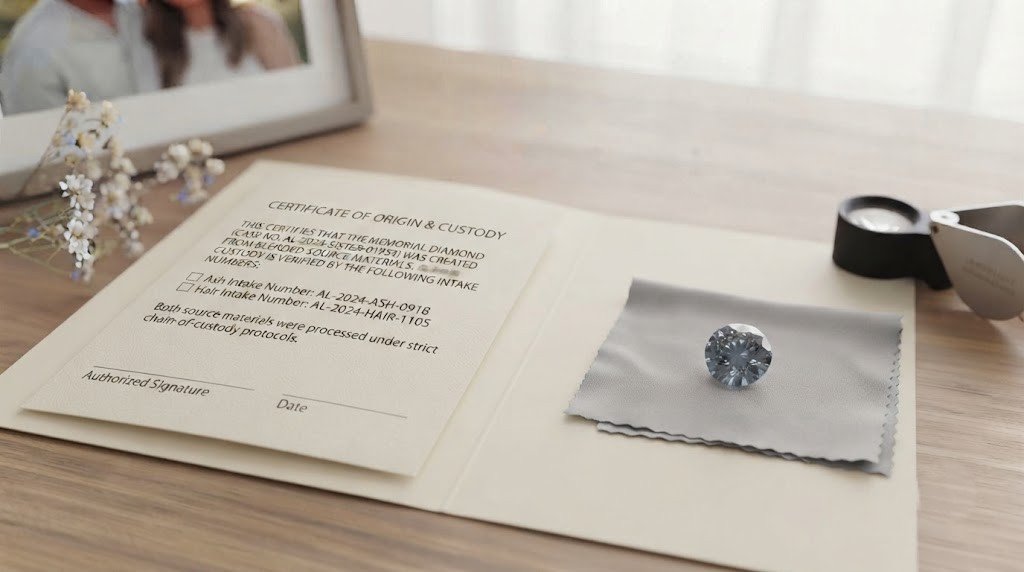
Will the certificate mention both her ashes and her hair?

Ask before ordering. Request written confirmation that the origin documentation will identify both materials and, where possible, their respective intake references.

What if the relative holding her ashes agrees but the person holding her hair declines?

Respect the decision. You may consider an ashes only memorial diamond or wait until the family is ready to revisit the idea. A blended stone should not depend on pressuring someone to contribute.

Does a blended diamond cost more than a single material diamond?

Pricing varies by provider. Cost may depend on size, color, cut, grading, setting, and other services. Ask for an itemized quote and confirm whether handling two materials adds a fee.

Final Thoughts on Turning Your Sister’s Ashes and Hair Into a Diamond

Bringing two parts of your sister’s life together in one memorial diamond can also bring family members into a shared decision. When the ashes and hair are held by different relatives, the process calls for patience, clear communication, and careful records.

Move through the sister ashes hair diamond steps at a pace that respects everyone involved. Confirm permission before sending either material, ask the provider to explain its process, and keep the paperwork organized from intake through delivery.

The goal is not simply to complete an order. It is to create a meaningful keepsake while treating your sister’s memory and your family’s wishes with care.

Learn More About Sister Memorial Diamonds

Talk With Memorial Diamond

If your sister’s ashes and hair are held by different relatives and you are unsure where to begin, visit Memorial Diamond. You can discuss how to coordinate both materials, which questions to ask, and what documentation to request before moving forward.