
Wanting a piece of her you can wear, hold, or press into your palm on a hard day is a natural thing for a sibling to want. To turn sister ashes into a diamond, you confirm who holds authority over her remains, ask for a small portion, choose a provider, mail the ashes with tracking, settle size and color, then wait roughly six to ten months while her recovered carbon is purified and grown into a real lab made diamond.
Table of Contents
Can a Sibling Turn Sister Ashes Into a Diamond?
Yes, though a sibling is often not the person with the final word over her remains. Plenty of people who set out to turn sister ashes into a diamond learn this only when a provider’s form asks for an authorizing signature. In many states the right to direct what happens after a death passes first to a spouse or registered partner, then to adult children, then to parents, with siblings further down the list. The order is set state by state, and anything she put in writing such as a designated agent, a pre arranged plan, or a clause in a will can change it.
None of that measures how close the two of you were. It simply means the practical route for a sibling who wants to turn sister ashes into a lasting stone runs through someone else’s agreement: her spouse, her adult children, a parent, or whoever the funeral home released the ashes to.
If you are that person, you can proceed on your own authority, though telling the rest of the family is still a kindness. If you are not, the steps below open with a respectful request rather than a decision, and that request is usually smaller than people fear.
What Are the Nine Steps to Turn Sister Ashes Into a Diamond?
Here is the whole sequence a sibling follows to turn sister ashes into a finished stone. The time column is a rough industry typical guide, not any single company’s schedule.
| Step | What you do | Who is usually involved | Rough time |
|---|---|---|---|
| 1 | Learn who holds authority over her ashes | You, the funeral home, her family | A few days |
| 2 | Ask for, and receive, a small portion | You and the authority holder | Days to weeks |
| 3 | Check whether other siblings or relatives want a stone | Family | One or two conversations |
| 4 | Compare providers and get answers in writing | You | One to three weeks |
| 5 | Prepare the portion and sign the paperwork | You, possibly the authority holder | An afternoon |
| 6 | Mail the ashes with tracking and insurance | You | A few days in transit |
| 7 | Decide carat, color, cut and setting | You, with the provider | Often settled at ordering |
| 8 | Wait while carbon is extracted and the diamond grows | The provider | About six to ten months |
| 9 | Receive the diamond and check every document | You | One delivery |
Nothing obliges you to hurry. Cremated remains are stable mineral material. If you would rather turn sister ashes into a diamond next year than next month, that is a perfectly workable plan.
How Do You Ask for a Portion of Her Ashes?
Step 1: Find out who must agree before you turn sister ashes into a stone
The funeral home or crematory that cared for her will know who signed the cremation authorization and to whom the ashes were released. That person is generally your first point of contact. Before you try to turn sister ashes into anything, check too whether she left written instructions or named someone to carry out her wishes. When the picture is murky, such as no will or relatives spread across several states, a short consultation with a local probate attorney costs far less than a dispute later.
Step 2: Ask for a small portion
The amount needed to turn sister ashes into a diamond is smaller than you might expect. A typical request runs from a few tablespoons up to roughly 4 ounces, which is about 100 grams, and everything else stays wherever the family chooses, in an urn, scattered, or interred. Say that plainly when you ask.
A few things tend to make the conversation easier:
- Offer to cover the cost and handle the forms yourself.
- Bring the provider’s written material requirement, so the amount is concrete.
- Ask whether the person would prefer to measure out and seal the portion themselves.
- Give them time. A request made a week after a funeral may land very differently three months on.
If the answer is no, or not yet, that answer is theirs to give. Some siblings in that position look at the hair route instead, which does not touch her ashes at all. Others return to the question later. Whichever way it goes, the relationship is worth protecting too.
Should Other Siblings Be Asked Before You Turn Sister Ashes Into a Stone?
Step 3: Talk to the rest of the family
Each stone uses only a fraction of the ashes, so several relatives can often receive their own diamond from the same remains. Coordinating once can be easier than arranging several separate requests over several years.
Families differ enormously here. You might have one other sibling or six. You may have shared both parents with her, or one. You may have grown up under one roof or met as adults. A twin, a half sibling and a stepsibling can each want something tangible, and none of those bonds needs defending.
Questions worth putting on the table:
- Does anyone else want to turn sister ashes into a stone of their own, now or later?
- Should each person choose their own size, color and setting, or keep things matching?
- Who pays for what, and does anyone need more time?
- Is the authority holder comfortable releasing more than one portion?
If you go ahead alone and others join later, ask the provider whether a second order can be placed from a separate portion. Policies vary.
How Do You Choose a Provider to Turn Sister Ashes Into a Diamond?
Step 4: Compare providers in writing
This choice decides who handles her ashes for most of a year. Before you let anyone turn sister ashes into a diamond, send the same written questions to two or three providers and lay the replies side by side. Numbers and documents tell you more than warm phrasing.
Ask each one:
- How is her portion labeled and tracked from arrival to finished stone, and may I see that log?
- Is her carbon ever processed alongside another family’s material?
- What share of the finished diamond’s mass will be carbon recovered from her ashes?
- Which document confirms origin, and is an independent grading report included or extra?
- What is the full price, including grading, engraving, setting and return shipping?
- What happens if a growth run fails or the stone fractures in cutting?
- Can unused ashes be returned to me, and at whose cost?
- What are the cancellation terms once growth has begun?
Any company prepared to turn sister ashes into a diamond on your behalf should answer every one of these without strain. A vague reply is not proof of bad practice, but it is a reason to ask again. For broader background, the sister ashes diamond guide goes deeper into each topic.
How Do You Prepare and Mail Her Ashes?
Step 5: Prepare the portion and the paperwork
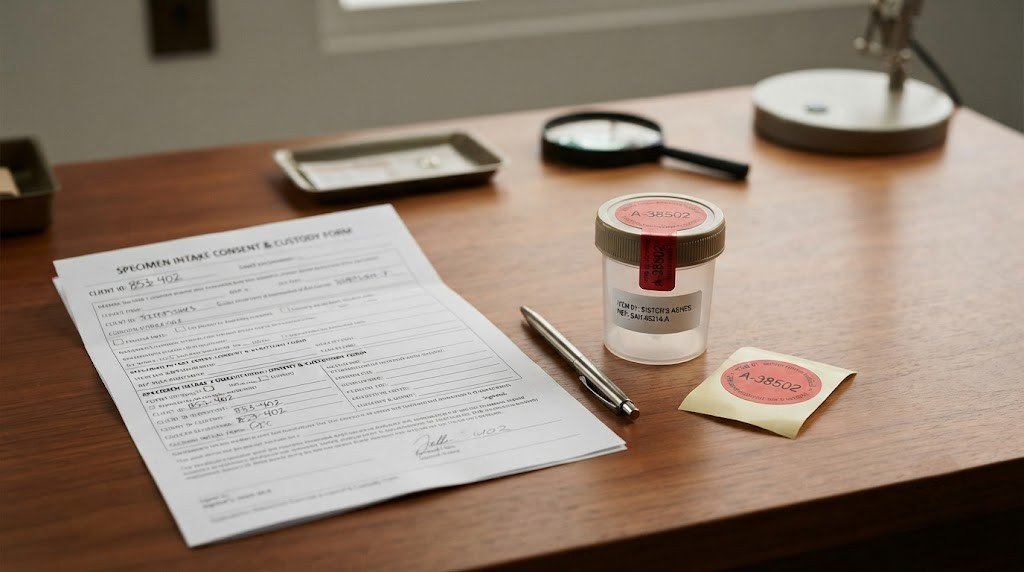
Expect the provider to send an intake kit, or ask for one: a small inner container, a seal or tag carrying an order reference, and a form recording her name, your details and often the authority holder’s signature. Laboratories that turn sister ashes into diamonds rely on that reference to keep her portion separate from every other order, so follow the kit exactly rather than improvising with household containers.
Before you close the outer box, photograph the filled, labeled container and keep a copy of every form. That record does not depend on anyone else’s system.
Step 6: Mail it with tracking and insurance
Of everything you do to turn sister ashes into a diamond, shipping is the one moment when nobody has hands on the parcel, so plan it carefully. Ask the provider which carrier and service it requires. In the United States the Postal Service has its own packaging and labeling rules for cremated remains, and providers generally build their kits around them. Keep the tracking number somewhere safe and ask for an email confirming receipt the day the parcel lands.
Which Choices About Size, Color, Cut and Setting Come Next?
Step 7: Make the design decisions
These are usually settled at ordering, though some providers let you confirm the cut or setting later.
Carat size. Memorial diamonds are generally offered from about 0.10 carats to more than 5 carats. Size depends on how long the crystal grows, not on how much ash you send, so choosing to turn sister ashes into a larger stone means a longer wait rather than a larger portion.
Color. Nitrogen and boron are the elements that tint a growing crystal, toward yellow and blue respectively. Carbon from a person tends to carry those traces, so memorial stones lean yellow, blue or champagne, while colorless needs extra processing and costs more. Some providers offer post growth irradiation for red, green or black. Nobody can predict the exact shade from her ashes, so treat any sample photo as a range rather than a promise.
Cut. Round, cushion, oval, emerald and other shapes are typically available. Fancy cuts can add cost.
Setting. A pendant, a ring, cufflinks, a lapel pin or a loose stone kept in a box are all reasonable. Choose for the way you will live with it, something that suited her, something you will wear daily, or simply what feels right.
Typical 2026 industry price ranges help frame the size decision:
| Carat range | Typical industry price | Notes |
|---|---|---|
| About 0.10 to 0.25 ct | $1,500 to $3,500 | Entry tier |
| About 0.5 to 1 ct | $5,000 to $15,000 | Colorless sits toward the top |
| About 2 to 5 plus ct | $20,000 to $75,000 plus | Longest growth times |
Grading, engraving, fancy cuts and settings are usually billed on top. These are general industry figures, not any one company’s price list.
What Happens During the Months of Waiting?
Step 8: Let the laboratory work
Once her ashes arrive, carbon is extracted from the ash, which is mostly calcium phosphate, the mineral of bone, and purified to roughly 99.9% carbon or better. That carbon is converted to graphite at around 2,500 to 2,700°C, then placed in a growth press, usually by the HPHT method at roughly 6 to 8 GPa, typically together with supplemental lab carbon. The months it takes to turn sister ashes into a diamond are mostly spent in that press. Afterward the rough crystal is cut, polished and graded.
Across the industry the sequence typically runs six to ten months, sometimes nearer twelve for stones above about 2 carats or specialty colors. Each production stage in detail is worth reading if you like knowing where her ashes are at any point.
Ask in advance what updates you will receive and whom to call if weeks pass without news. Some providers send photographs of the rough crystal. Others stay quiet until the end.
What Should You Check When the Diamond Arrives?
Step 9: Receive it, and read everything
This is the last step for anyone who sets out to turn sister ashes into a diamond, and it deserves an unhurried hour somewhere calm. Check that:
- The order reference on the paperwork matches the one on your intake form.
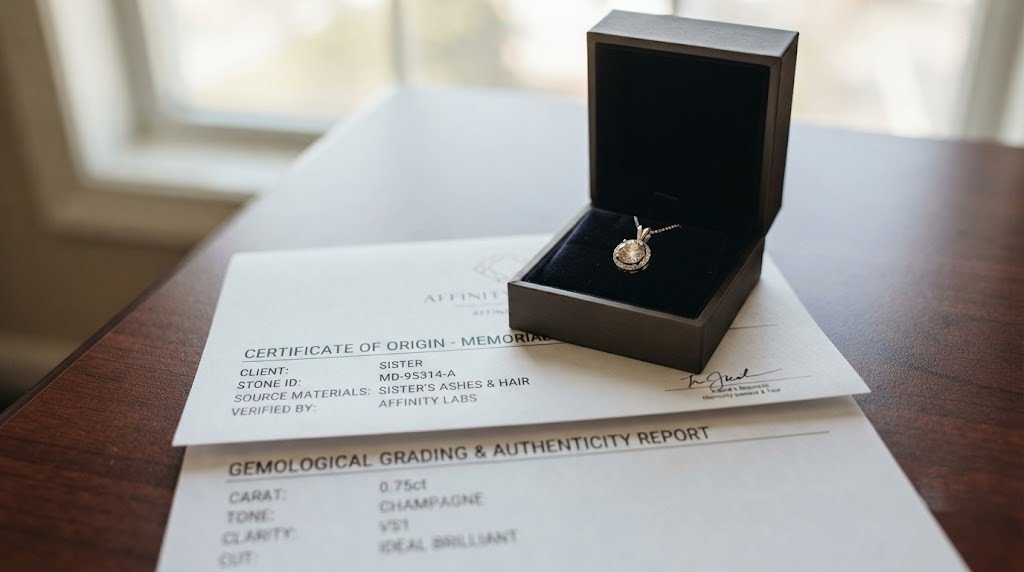
- The origin certificate names her and describes the stone you ordered.
- Any independent grading report you paid for is present, and its carat, color and clarity match the stone. Such reports use the same 4Cs applied to every diamond.
- The setting is secure and any engraving reads exactly as you approved it.
- What happened to unused ashes, returned, retained or disposed of, matches what you agreed.
Memorial diamonds typically land between SI2 and VVS in clarity and rate 10 on the Mohs hardness scale, so the stone is built for daily wear. If anything does not match, write to the provider straight away. Families who turn sister ashes into a diamond deserve paperwork that agrees with the stone.
How Much of the Finished Diamond Is Really Her?
Settle this honestly before you decide to turn sister ashes into a diamond, because the answer shapes what the stone will mean to you. Ash contains very little carbon, roughly 0.5% to 4% by weight. That recovered carbon is real and it is hers, but there is not enough of it to grow a diamond alone, so supplemental lab carbon is typically blended in.
Industry wide, carbon recovered from ashes usually accounts for roughly 10% to 15% of a finished stone’s mass. A few providers quote numbers nearer 3%. Ask your provider for its own figure in writing. Asking is not doubting anyone. It is how families who turn sister ashes into stones know exactly what they hold. A claim that the diamond contains nothing but her carbon is not supported by the chemistry.
For some families that changes nothing essential: a traceable portion of her own carbon sits inside the crystal lattice, and the stone exists because of her. Whether the stone is genuinely made from her ashes is explored at length if you want the fuller answer.
What If Her Ashes Have Already Been Scattered or Buried?
Sometimes it is no longer possible to turn sister ashes into a diamond because she was buried rather than cremated, or because her ashes were scattered or interred before anyone raised the idea. For siblings who cannot turn sister ashes into a stone, hair is often the practical alternative. It is roughly 50% carbon by weight, needs only a small lock or a few grams, and involves no cremation at all. The sister hair diamond guide covers which kinds of saved hair tend to work.
Saved locks, a braid kept from a haircut, or hair the funeral home trimmed before services can all be candidates. Hair trimmed by the funeral home is generally released by whoever holds authority over her remains, and hair kept among her belongings may form part of her estate, so check with whoever is handling it. Rules vary by state.
If some ashes remain alongside saved hair, combining ashes and hair in a single stone is something certain providers offer. And if only part of her ashes was scattered, a small remainder may still be enough, so ask before assuming the door has closed.
Frequently Asked Questions
Do I need permission to turn sister ashes into a diamond?
Usually you need a yes from the person with authority over her remains. In many states that is a spouse, adult children or parents, ahead of a sibling. State law and her written wishes decide the order, so check with the funeral home or a local attorney.
How much of her ashes does a diamond use?
To turn sister ashes into a single diamond, anywhere from a few tablespoons to roughly 4 ounces, around 100 grams, is the usual industry range. That is generally a small share of the total, so the rest can stay in an urn, be scattered or be interred.
Can more than one sibling get a diamond from her ashes?
Often, yes. Families can frequently turn sister ashes into several stones because each one uses only a portion. Agree on amounts with whoever holds authority, and ask the provider how it handles multiple orders from one family.
How long does it take to turn sister ashes into a diamond?
Across the industry, expect about six to ten months from the day her ashes reach the laboratory, and up to around twelve for stones above roughly 2 carats or specialty colors. Carat size, not ash quantity, mainly sets that timeline.
Will the diamond’s color say anything about her?
No. Tint depends on whether traces of nitrogen or boron were in the growth cell, and it cannot be chosen, matched or predicted from her ashes. Memorial stones tend toward yellow, blue or champagne. Colorless requires extra processing and cost.
What if whoever holds her ashes says no?
That decision belongs to them, even when it hurts. Some siblings who hoped to turn sister ashes into a diamond ask again once the first months have passed, and others explore a hair based stone from a saved lock, after checking who holds her belongings.
Can I turn sister ashes into a diamond years after she died?
Yes. Cremated remains are stable mineral material, so ashes kept sealed for years can generally still be used. Ask the provider whether it applies any age or storage requirement before you mail anything, and get that answer in writing.
Final Thoughts on Turning Her Ashes Into a Diamond
Most of this is paperwork, patience and a few careful conversations. The part that matters is quieter: wanting to carry something of her, in a way that respects everyone who shares the loss.
If you decide to turn sister ashes into a diamond, go at whatever pace feels right. Put your questions in writing, keep copies, and let the waiting be what it is. When the stone arrives it will be a real diamond grown in part from her carbon, and what it means will be yours to decide.
Learn More About Turning Her Ashes Into a Diamond
- How a memorial diamond is made from her ashes for each production stage explained.
- Sister Ashes Diamond: The Complete Guide for every part of the ashes route in one read.
- Is the stone really made from her ashes? for the carbon question answered plainly.
- How to turn her hair into a diamond for the route that needs no ashes.
- Sister Ashes and Hair Diamond: The Complete Guide for combining both materials.
Talk With Memorial Diamond
If you would like to talk through how to turn sister ashes into a diamond with a person rather than a page, Memorial Diamond can be reached at memorialdiamond.us. Bring your questions about authority, portions and paperwork, and take whatever time you need afterward to decide.
Leave A Comment