
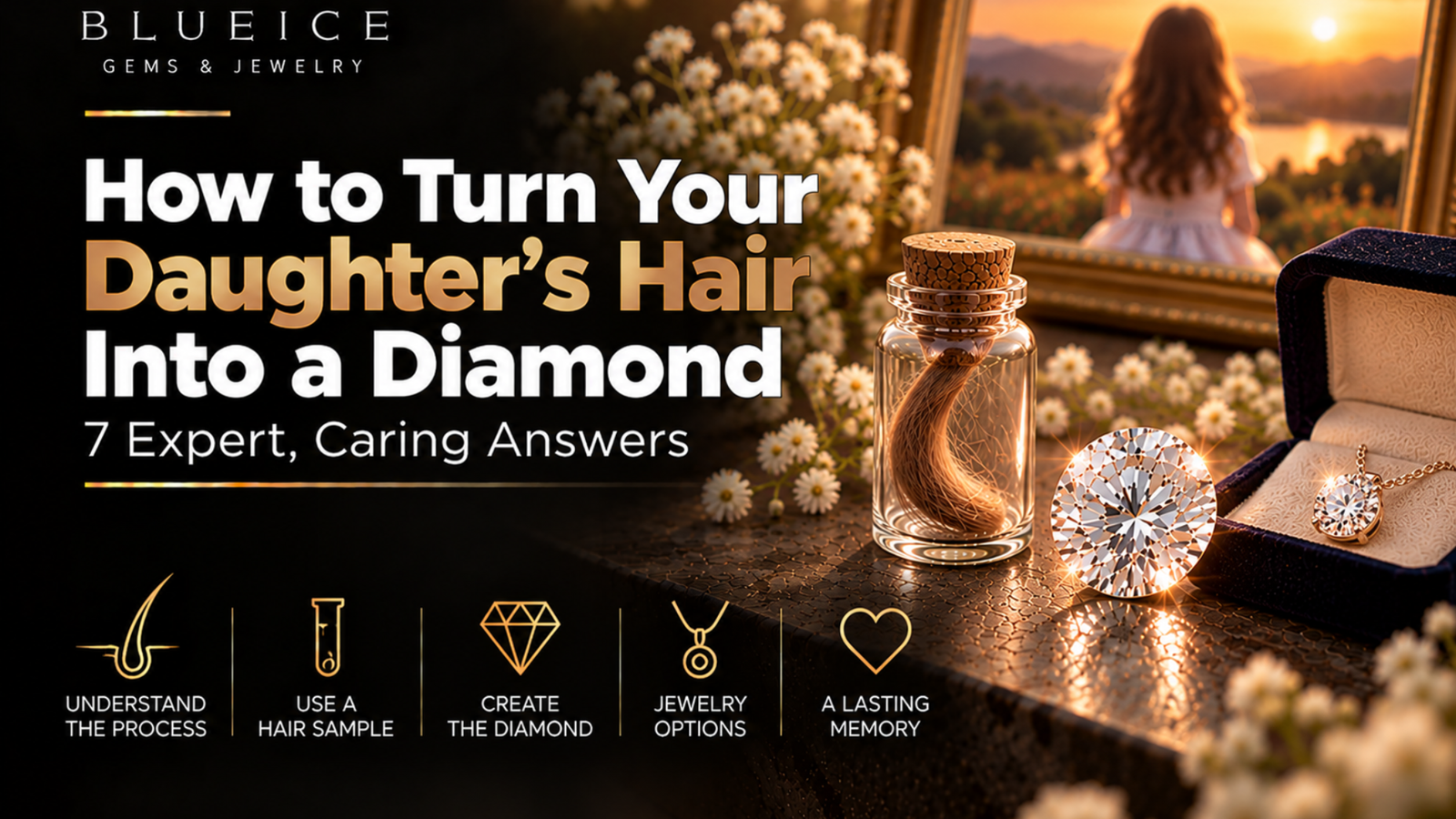
It usually begins with something small: a lock tucked into an envelope years ago, a hairbrush still on her dresser, or a quiet request to the funeral director before the service. Learning how to turn daughter hair into a diamond comes down to six decisions: where the hair comes from, whether it can still be collected in time, how it is kept, whose agreement matters, which provider you trust, and what kind of stone you want back. None of them has to be rushed except one, and that one is explained below.
The numbered checklist and the laboratory chemistry each have their own page, linked below where they help.
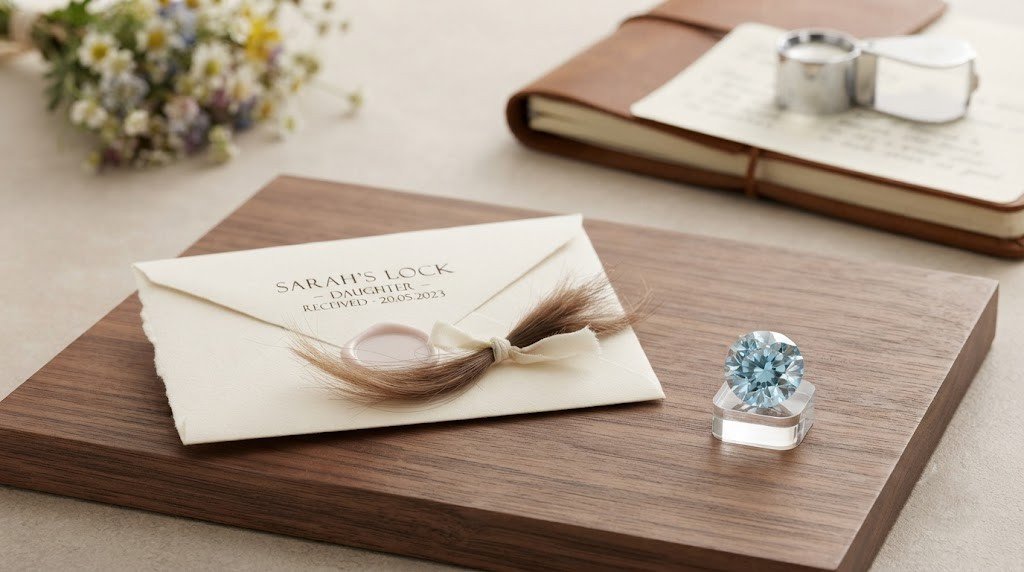
Table of Contents
What Does It Take to Turn Daughter Hair Into a Diamond?
The process used to turn daughter hair into a diamond needs less material than most parents expect, and more patience. Hair is built mostly from keratin, a protein that is roughly 50% carbon by weight, which is why providers typically ask for only a small lock or a few grams. No cremation is needed, so this route is open whether she was buried or cremated, provided some hair was kept.
What it does take, if you plan to turn daughter hair into a diamond, is a handful of clear decisions:
| Decision | What You Are Settling | Where It Tends to Go Wrong |
|---|---|---|
| Source | A saved lock, a brush, or hair taken by the funeral home | Hair from a shared brush that may not be only hers |
| Timing | Whether hair can still be collected | Asking the funeral home after the service has already happened |
| Storage | Keeping it dry, clean and labeled | Sealing damp hair or losing track of which envelope is which |
| Agreement | Who should be consulted, and who may need to sign | Assuming a parent automatically decides |
| Provider | Terms, documentation, what happens to leftovers | Choosing on a website’s tone instead of written answers |
| The stone | Carat, color, cut, optional extras | Expecting hair to guarantee a pale or colorless result |
Most of the effort sits in the first four rows. When you decide to turn daughter hair into a diamond, the part you personally handle is usually measured in weeks, not months. The complete guide to a daughter hair diamond covers the wider background if you are starting from nothing.
Where Might Her Hair Still Be Found?
Often in more places than a parent first thinks of, at whatever age she died.
The cleanest source when you set out to turn daughter hair into a diamond is a lock that was deliberately cut and saved, for a haircut, a donation, or simply to remember. A cut lock is easy to identify as hers and is usually free of dust and loose debris.
A hairbrush or comb is the next most common source. It can work, but it raises a practical question worth thinking through before you turn daughter hair into a diamond from what sits in the bristles: was the brush only ever hers? A brush shared with a sister, a partner or a roommate may hold more than one person’s hair, and no one can sort those strands by eye. Some providers accept brush hair and some prefer a cut lock, so ask rather than assume.
A hat she wore often, a hair tie or a pillowcase may hold a few strands each, but treat these as a supplement rather than a plan.
Before you gather anything to turn daughter hair into a diamond, it helps to know roughly how much you are aiming for. How much hair a daughter memorial diamond needs sets out the quantities providers usually describe.
Can the Funeral Home Collect Hair Before Burial or Cremation?
In most cases, yes, but only if someone asks in time. For anyone hoping to turn daughter hair into a diamond, this is the one decision with a genuine deadline. Cremation leaves no hair behind, and once a burial has taken place, retrieving hair is not a realistic option for most families.
A small cutting can usually be taken discreetly, often from the nape of the neck where it will not show, and handed to the family in a sealed, labeled envelope. Asking costs nothing, and many funeral homes will do it even if you are still unsure whether you plan to turn daughter hair into a diamond at all. Hair kept now leaves the choice open; hair not kept closes it.
If you are the person arranging the service, mention it at the first meeting. If someone else is arranging it, her spouse, her partner, or one of her own adult children, a gentle word with them first is kinder than going to the funeral home yourself.
If the service has already happened and nothing was kept, the hair at home becomes the whole picture. A single saved lock or a well used brush is often enough. Should both hair and ashes turn out to be available, combining ashes and hair in one stone is a separate route with its own considerations.
How Should Her Hair Be Stored and Packed?
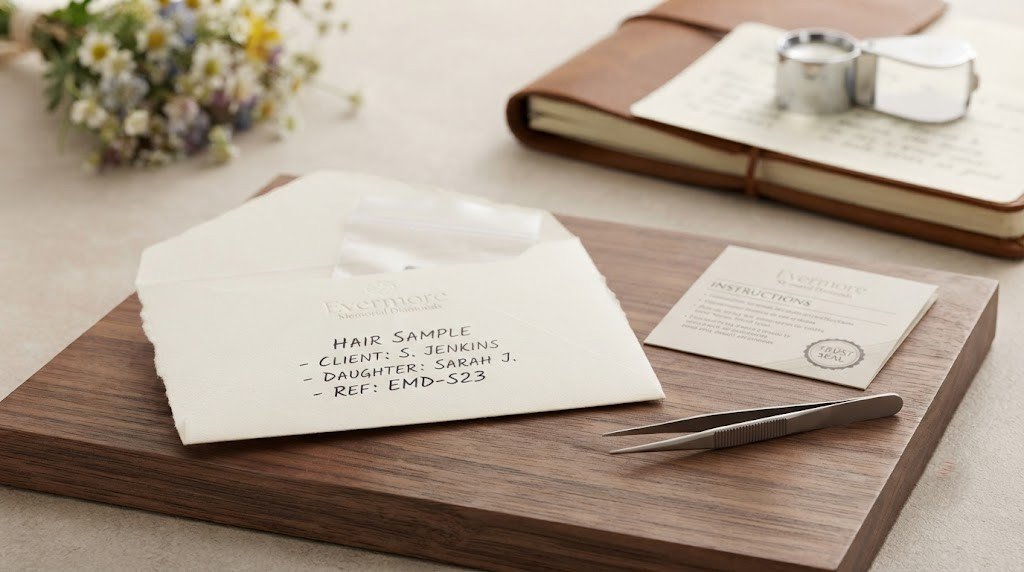
Dry, clean, and clearly labeled, in whatever container your provider specifies. When you plan to turn daughter hair into a diamond, the aim is to keep the hair unchanged and unmistakably hers until it reaches the laboratory.
A few habits help, unless a provider tells you otherwise:
- Keep it dry. Let anything damp air dry fully before it is sealed.
- Leave it as it is. Do not wash it, trim it or add anything to it. Ask the provider before removing any hair tie or clip.
- Use a clean envelope or container. A plain paper envelope inside a sealed bag, or the container a provider supplies in its kit, keeps it protected.
- Label every portion. Write her name, where the hair came from, and the date it was collected. If you gathered from several sources, keep them apart.
- Photograph it. A picture of the labeled, sealed package is a useful record.
- Keep some back if you can. If there is more than a provider needs, holding a portion at home keeps other options open for later.
Store it at room temperature, out of direct sunlight and away from a bathroom or kitchen. The shipping sequence for anyone ready to turn daughter hair into a diamond is set out in the step by step guide for a daughter hair diamond.
Whose Agreement Matters Before You Turn Daughter Hair Into a Diamond?
It depends on her circumstances and on where you live, and it is worth thinking about before anything is posted. There is no single national rule, and it is not safe to assume that a parent automatically decides.
Hair taken by a funeral home sits close to the wider question of authority over remains, which each state sets out in its own law. A surviving spouse or registered partner is often first in that order. If your daughter had adult children of her own, they may rank ahead of her parents. And anything she left in writing, a directive, a provision in a will, a prearranged funeral plan, can change the order entirely.
Hair kept at home is often treated as a personal keepsake, but it is better not to assume nobody else has a say. Her belongings can form part of her estate, the rules vary by state, and a partner or adult child may feel strongly about what happens to something of hers. Talking it through before you turn daughter hair into a diamond is gentler than a disagreement later.
Parents do not always see this the same way, and one parent arranging everything alone is common. If there is doubt, the funeral director who handled her arrangements usually knows how the local rules work, and a short consultation with an attorney can settle it. If you are unsure how to turn daughter hair into a diamond without upsetting anyone, confirming whose permission is appropriate is the place to start, even if the answer turns out to be simply yours.
How Do You Judge a Provider Before You Turn Daughter Hair Into a Diamond?
By what it will state in writing, not by photography or tone. The differences show up in how directly a company answers specific questions.
Questions worth sending by email before you ask anyone to turn daughter hair into a diamond:
- How much hair do you need, and do you accept hair from a brush or only a cut lock?
- What share of the finished stone comes from her carbon? Ask for this in writing, because no standard finished stone percentage is published for hair.
- What chain of custody records connect the stone to the hair I send?
- What happens to any unused hair: is it returned, retained, or disposed of?
- Where is the stone actually grown: in house or at a partner laboratory?
- What are the cancellation terms at each stage?
That second question deserves a moment. On the ashes route, a personal carbon share of roughly 10% to 15% of the finished stone is commonly cited. That figure belongs to ashes and does not carry over to hair. Hair begins far richer in carbon, but no equivalent published figure exists for how much of a hair grown stone is hers, so the only reliable answer is the one a provider gives you in writing. Every memorial stone is made up to a workable size with supplemental laboratory carbon, and none is purely one person’s carbon.
A provider that answers these plainly is showing you how it operates. If you want to press harder on whether the stone is genuinely hers, whether a diamond is really made from your daughter’s hair looks at the verification question directly.
Which Stone Choices Come First When You Turn Daughter Hair Into a Diamond?
Carat and color, because together they set both the price and the length of the wait.
Carat is the largest lever when you turn daughter hair into a diamond. Stones are typically offered from about a tenth of a carat to beyond five, and size depends on how long the crystal grows rather than on how much hair you send. As general 2026 industry ranges, not any one company’s pricing, here is how cost tends to scale:
| Stone Size | Typical Industry Range |
|---|---|
| About 0.10 to 0.25 ct | $1,500 to $3,500 |
| 0.5 to 1 ct | $5,000 to $15,000 |
| 2 ct to 5+ ct | $20,000 to $75,000+ |
Settings, engraving, fancy cuts and an optional independent grading report are usually priced separately from the stone.
Color is partly chosen and partly chemistry. Nitrogen in the growth environment tints a stone yellow and boron tints it blue; only by excluding both can a grower reach colorless, which is why colorless usually costs more. Hair does not change that: a hair grown diamond is not automatically lighter, and a cleaner starting material does not make the final color predictable. Irradiation to reach red, pink, green or black is an optional extra some providers offer, not a default. What color a diamond from your daughter’s hair will be explains the range in more depth.
Choose from what you knew of her and what you want to carry, rather than from any convention about what suits a daughter. Clarity for memorial stones typically lands between SI2 and VVS, and the cut is the same range of shapes offered for any diamond.
What Comes Back to You at the End?
A finished diamond, usually loose, along with paperwork. Across the industry, the time it takes to turn daughter hair into a diamond typically runs six to ten months from the day the hair is received, and larger stones or specialty colors can take up to twelve.
During those months, the laboratory work needed to turn daughter hair into a diamond runs in stages: carbon from her hair is purified to roughly 99.9% or higher, converted to graphite at around 2,500 to 2,700°C, and grown into a crystal under high pressure, high temperature conditions of about 6 to 8 GPa and 1,400 to 2,500°C, although a minority of providers use chemical vapor deposition. How a diamond is made from your daughter’s hair follows that chemistry properly.
Expect two kinds of document. An origin or authenticity certificate, usually issued by the provider itself, traces the stone back to what you sent. An independent grading report, assessing the stone against the cut, color, clarity and carat standards, is optional and has to be requested; it describes quality, not origin.
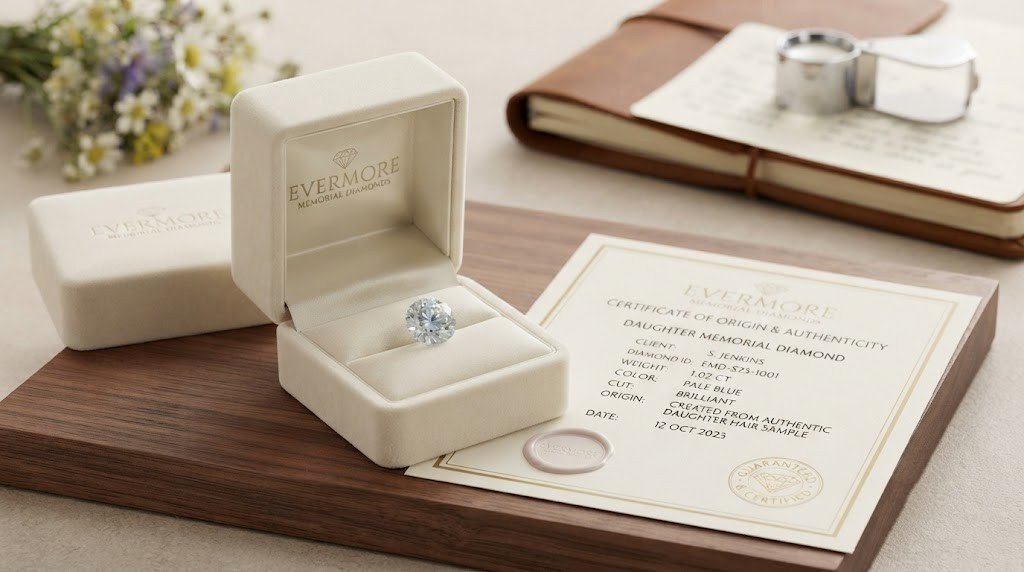
Ask one last question before the parcel arrives: what has happened to any hair that was not used? And give yourself room with the setting. A loose stone keeps indefinitely, and there is no deadline for deciding whether it becomes a ring, a pendant, or something that stays in its box for a while. Some parents open it the day it comes; others wait. Either is fine when you turn daughter hair into something you can hold.
Frequently Asked Questions
Is there enough hair on a hairbrush to make a diamond?
Sometimes. Providers typically ask for a small lock or a few grams, and a well used brush can hold that much. The concern is whether every strand is hers, since shared brushes mix hair. Some providers accept brush hair and some prefer a cut lock, so ask before sending anything.
How long do I have to ask the funeral home for her hair?
Until the burial or cremation takes place, and ideally at your first meeting with them. Cremation leaves no hair behind, and hair is not realistically recoverable after burial. Asking early costs nothing and keeps the option open even if you have not yet decided whether to turn daughter hair into a diamond.
Does it matter how old the saved hair is?
Generally not in itself. A lock kept dry and clean for many years is usually still workable, because what the laboratory needs is the carbon. How the hair was stored matters more than how long ago it was cut, so describe its age and storage when you first ask a provider to turn daughter hair into a diamond.
How much of the finished diamond will be her carbon?
No standard finished stone percentage is published for hair. Hair starts at roughly 50% carbon, but that describes the raw material, not the diamond. The 10% to 15% figure often quoted applies to ashes only. Every stone includes supplemental laboratory carbon, so ask each provider to state its own figure in writing.
Can more than one diamond come from the same lock of hair?
Often, if there is enough hair, since each stone uses only part of what is sent. Each diamond is grown separately, so two stones mean two prices and two timelines. Ask the provider whether one submission can cover several stones, and whether siblings or other relatives can each order one.
Is it still possible to turn daughter hair into a diamond if she was buried?
Yes, as long as some of her hair was kept before the burial, whether at home or by the funeral home. That is one of the main reasons families choose hair over ashes. If nothing was saved, check her belongings carefully, since a brush, a hat or an old keepsake may still hold enough.
Will a diamond made from her hair be colorless?
Not necessarily. Color depends on trace elements such as nitrogen and boron during growth, not on whether the carbon came from hair or ashes. Hair grown stones are not automatically lighter. A colorless stone is possible but usually costs more, and some providers offer optional irradiation for other colors.
Final Thoughts on Turning Her Hair Into a Diamond
When you turn daughter hair into a diamond, most of what matters happens near the beginning: finding the hair, keeping it well, and talking to the people who should be part of the decision. If her funeral has not yet taken place, the single most useful thing you can do today is ask for a small cutting to be kept. Everything else can wait.
Before you turn daughter hair into a diamond, get the provider’s answers in writing: quantity, carbon share, chain of custody, leftover hair, cancellation. After that the process is mostly a matter of time. What comes back is a real diamond with a documented connection to her, and what you do with it is entirely yours to decide.
Learn More About Daughter Memorial Diamonds
- Daughter Hair Diamond: The Complete Guide the full background on the hair route
- Step by step: turning your daughter’s hair into a diamond the numbered sequence to follow once you decide to turn daughter hair into a diamond
- How a memorial diamond is made from her hair the laboratory science in plain terms
- How much hair you need for a daughter memorial diamond amounts to send and what to hold back
- How to turn your daughter’s ashes into a diamond the ashes route, if cremation took place
Talk With Memorial Diamond
If you would find it easier to talk this through with a person, Memorial Diamond can be reached at memorialdiamond.us. We can explain how to turn daughter hair into a diamond, what documentation to expect and which questions to settle first. Asking carries no obligation.
Leave A Comment