How to Talk to Family About a Daughter Memorial Diamond

How to Talk to Family About a Daughter Memorial Diamond

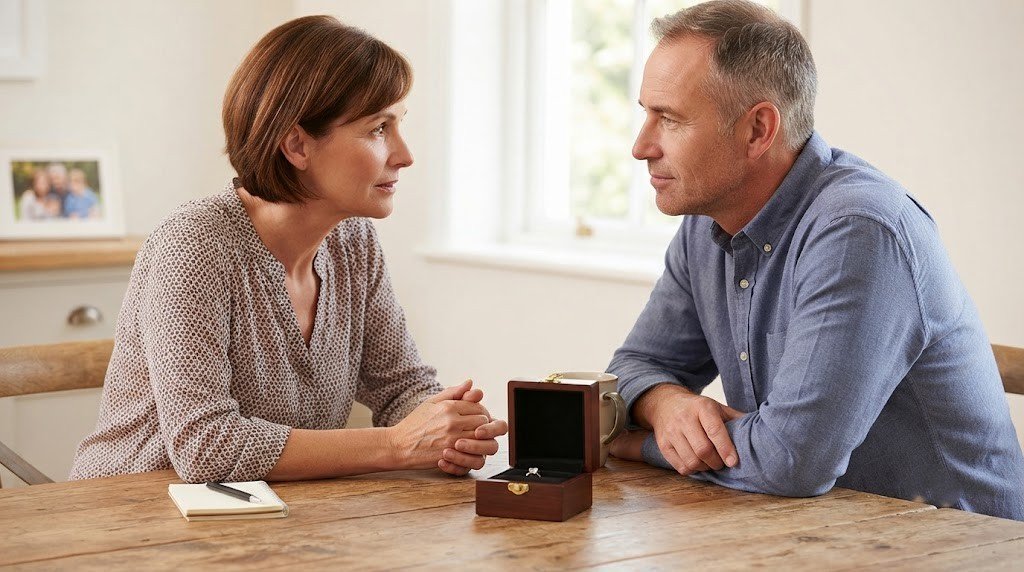
Raising the idea of a diamond while everyone is still grieving her can feel like speaking into a room that has gone very quiet. Talking to family about a daughter memorial diamond goes best when you begin with whoever may hold legal authority over her remains, speak privately before any group conversation, explain plainly what the process does and does not involve, and let each relative decide whether they want any part in it.
about a daughter memorial diamond

Why Does Talking About a Daughter Memorial Diamond Feel So Hard?

Partly because it arrives amid everything else. Arrangements, paperwork and the weight of losing her leave little room for a new idea, and on first hearing a diamond can sound more like a jewelry advertisement than a way of remembering someone.

Partly because each person grieves her differently. One relative may long for something to hold; another may find the thought of dividing her ashes unbearable. Neither reaction is wrong, and a conversation about a daughter memorial diamond tends to bring those differences to the surface quickly.

And partly because of who she was to each of them. To you she may be a daughter; to someone else she was a wife, a partner, a mother, a sister or a granddaughter. None of those relationships outranks the others emotionally, even when the law gives one person the final say.

Knowing this in advance helps. Much of the difficulty in talking about a daughter memorial diamond has little to do with the stone. It is about people needing to feel consulted, respected and free to say what they actually feel.

Who Might Hold Authority Over Her Remains?

Before the first family conversation about a daughter memorial diamond, find out who actually holds this decision. It may not be you.

In many states, the right to direct what happens to a person’s remains follows an order set by statute: often a surviving spouse or registered partner first, then adult children, then parents, then siblings. That order is not national. It varies by state, and anything she put in writing, such as a designated agent form, a will provision or signed funeral instructions, can change it. If she was married or had adult children, they may hold authority ahead of her parents.

The funeral home or crematory that handled her arrangements will know who signed the cremation authorization and can usually explain how your state treats the question. An attorney can confirm it if things are complicated.

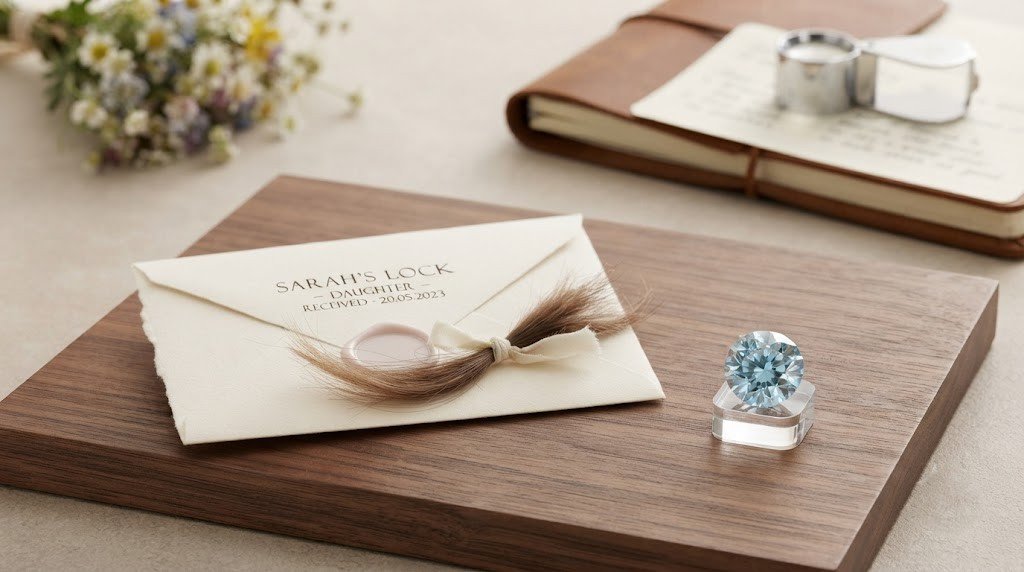
Hair raises its own question. A lock kept at home can feel like yours alone to decide about, but personal belongings can form part of an estate, and the rules differ by state. Before using hair for a stone, check with whoever is administering her estate, and tell the person with authority over her remains in any case.

None of this measures love. A rule about who signs a form says nothing about who grieves her most. If the person with authority is not you, the respectful route is to ask them about a daughter memorial diamond directly rather than working around them.

Who Should Hear About a Daughter Memorial Diamond First?

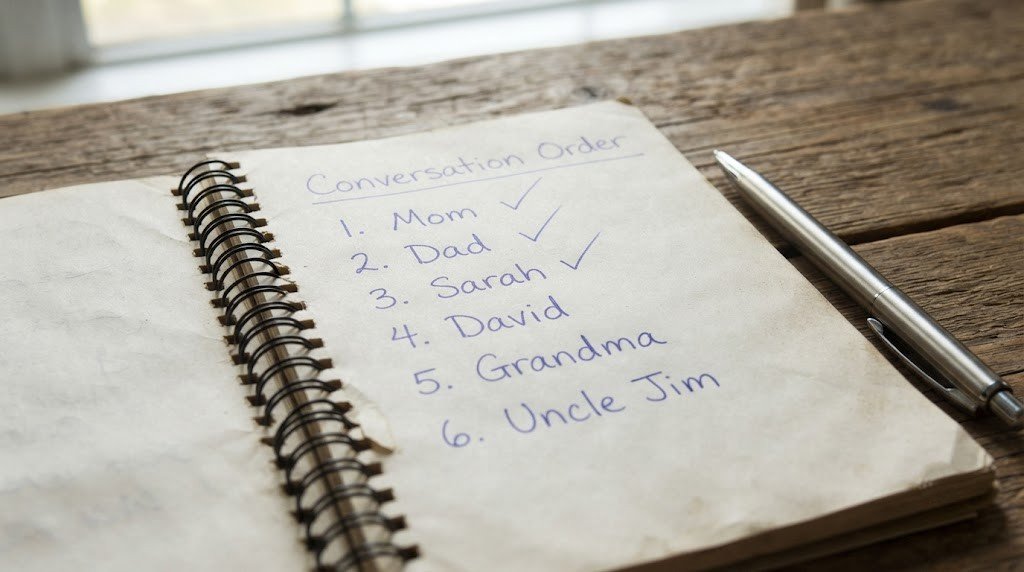
There is no single correct order, but this sequence keeps the people with the most at stake from hearing secondhand:

  1. Confirm who holds authority. Check state rules, her written wishes and the cremation paperwork before raising anything with anyone else.
  2. Speak privately with that person first. If it is her spouse or partner, or her adult children, go to them before anyone else, alone and without a provider’s brochure in hand.
  3. Talk with her other parent. Whether you are together, separated or rarely in touch, a parent who learns about a daughter memorial diamond from someone else may feel shut out for years.
  4. Include any brothers or sisters, and her adult children if she had them. Offer each one the choice of a stone, a different keepsake or nothing at all.
  5. Bring in grandparents and close relatives. Some will want a voice in decisions about a daughter memorial diamond; some only want to know.
  6. Write down what was agreed. A short email to everyone involved, and later to the provider, prevents confusion about portions, stones and who decided what.

Real families bend this order. If you hold authority yourself, start with whoever shared her daily life most closely. What matters is that nobody central learns about a daughter memorial diamond from a social media post or a passing remark at a gathering.

What If Her Parents Disagree or Live Apart?

Parents do not always grieve in step or share a household. One may be ready within weeks while the other needs a year; one may be arranging everything alone while the other stays at a distance.

If you are the parent raising the subject, begin a talk about a daughter memorial diamond with what you share rather than what you want. “I’ve been thinking about ways to keep something of her close, and I’d like to know what you think” leaves far more room than “I’ve found a company.”

Disagreement about a daughter memorial diamond does not have to end in a single verdict. Providers typically use only a small portion of ashes, from a few tablespoons up to roughly 4 ounces, depending on the provider. So one parent can choose a stone while the other keeps their share in an urn, or scatters or buries it. Knowing how much ash a provider usually asks for can turn an either or argument into an arrangement that holds both wishes.

Where neither parent holds legal authority, perhaps because she was married, both may need to approach her spouse or partner. A difference of opinion about a daughter memorial diamond is easier for a spouse to hear when it is presented honestly rather than as competing requests.

If the disagreement is sharp, a funeral director, a friend both parents trust or a professional mediator can help find a path neither parent could see alone.

How Do You Bring Siblings and Grandparents In?
If she had brothers or sisters, they knew her in ways nobody else did, and they deserve to be asked about a daughter memorial diamond rather than simply informed. Some will want a stone of their own, some a different keepsake, and some only want to know what is happening.

Several stones can often be grown from one portion of ashes or hair, so offering siblings their own piece is usually a practical possibility rather than only a gesture. Whether several relatives can each receive a stone depends on the provider and the material available, so check before making an offer you cannot keep.

Grandparents may come from a generation, or a faith, in which cremation itself was uncommon, and a diamond may sound stranger still. Give them time and plain information. Some are reassured once they understand what the stone is; others stay uneasy about a daughter memorial diamond, and that unease can be respected without changing anyone else’s plans.

If she had adult children, their wishes carry particular weight, both because they may hold legal authority and because a stone may one day pass to them. Ask them directly, separately and early. Aunts, uncles, cousins and close friends can usually hear about a daughter memorial diamond once the immediate family has agreed, which spares them a decision that is not theirs to make.

What Should You Say About a Daughter Memorial Diamond, and What Should You Leave Out?

A conversation about a daughter memorial diamond is rarely finished in one sitting. Say what you came to say, then stop and listen. These phrases tend to open the door:

  • “I’d like to hear what you think before anything is decided.”
  • “Only a small portion of her ashes would be used; the rest stays where we planned.”
  • “You don’t have to want one. It’s completely fine to say no.”
  • “Can I send you some information to read in your own time?”
  • “This isn’t instead of anything else we’re doing for her.”

These, even when meant kindly, tend to close it:

  • Anything suggesting that someone who truly loved her would want a stone.
  • Any promise that the diamond will make anyone feel better.
  • Claims that the stone is made wholly of her carbon. It is not, and someone will check.
  • Pressure about deadlines, discounts or acting before it is too late.
  • Comparisons of who was closest to her or who is grieving most.

Timing matters as much as wording. A quiet phone call or a walk usually goes better than a crowded room after the service. You can also be honest about your own feelings without making them anyone else’s obligation: “This matters to me” is a complete sentence when you speak about a daughter memorial diamond.

How Do You Explain What the Stone Actually Is?

Some relatives will never have heard of memorial diamonds, and their first questions may be skeptical. When people ask hard questions about a daughter memorial diamond, plain numbers reassure more than enthusiasm, and anyone who prefers to read independently can start with general background on memorial diamonds.

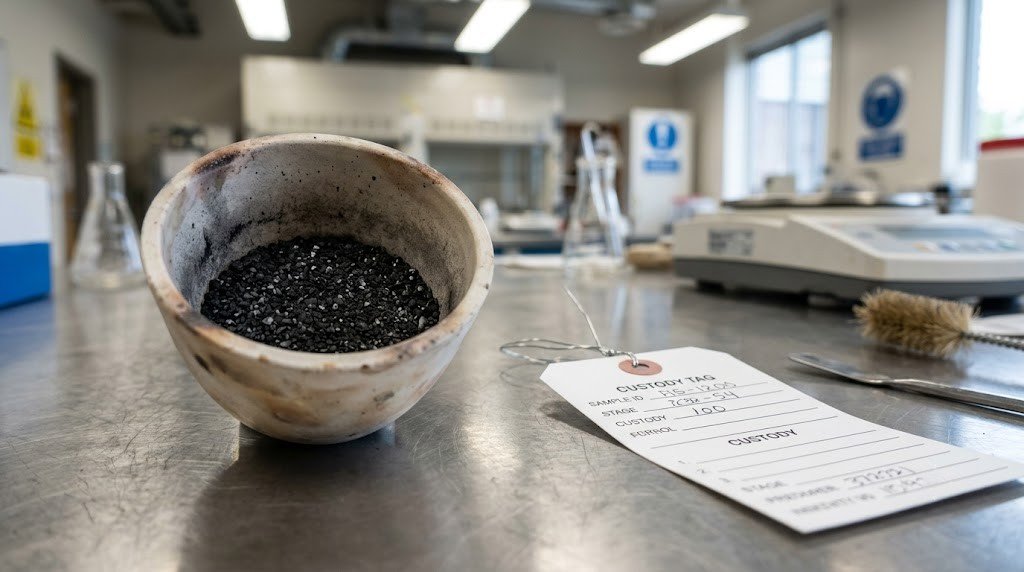
The essentials are brief. It is a real, lab grown diamond, rated 10 on the Mohs hardness scale like any other diamond. Carbon is extracted from a portion of her ashes or a lock of her hair, purified, converted to graphite and grown in a high pressure press, with supplemental lab carbon typically blended in.

On how much of it is her, honesty is the strongest answer. For a stone grown from ashes, carbon recovered from her typically makes up around 10 to 15% of the finished stone’s mass, and some providers cite as low as 3%. For hair, or a blend of hair and ashes, no published percentage exists, so ask the provider to state theirs in writing. Whether the stone is really made from her ashes is a useful page to share with a doubtful relative.

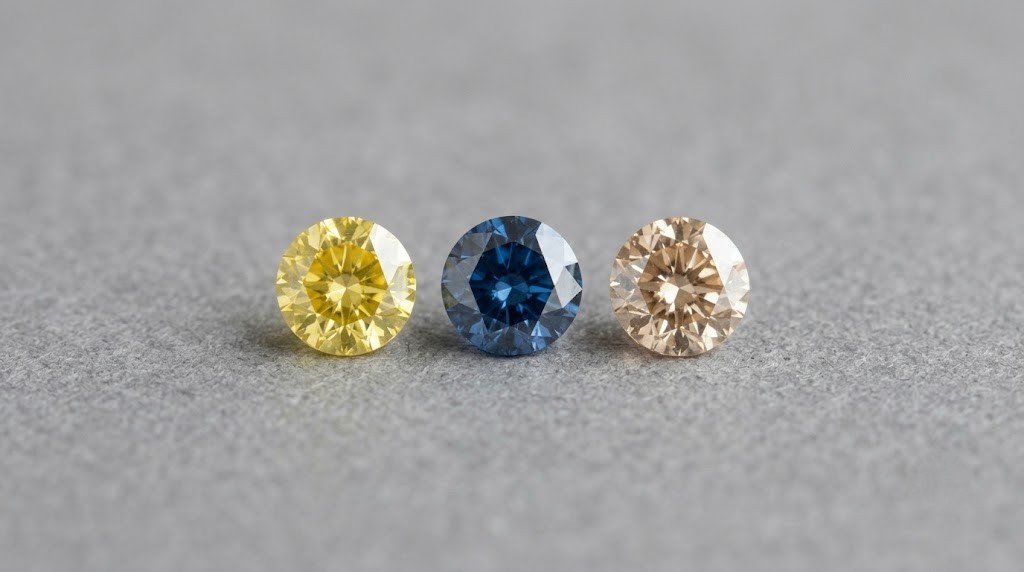
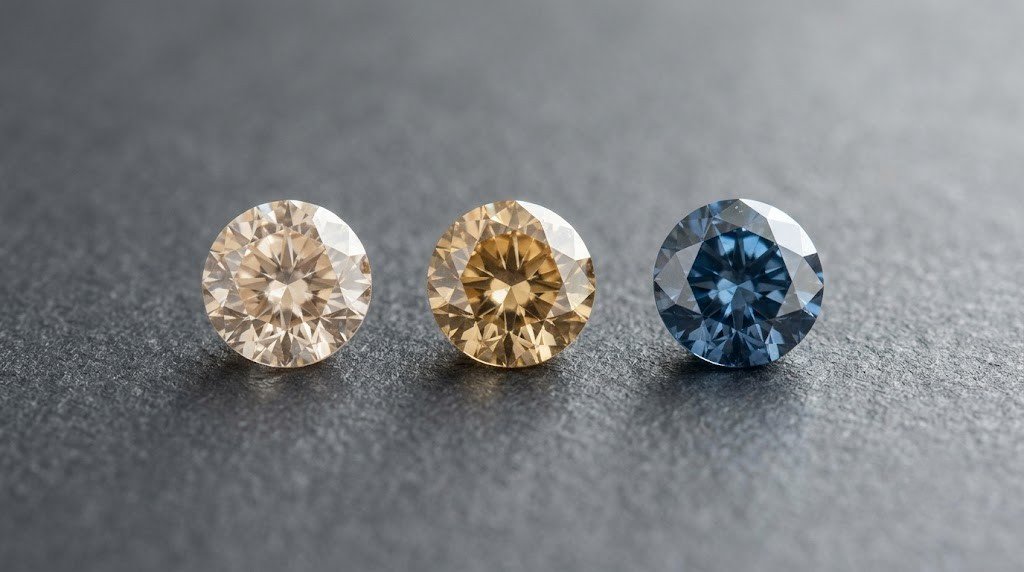
A few other facts settle common worries about a daughter memorial diamond. Nobody can choose or predict the color from the source material; memorial stones tend toward yellow, blue and champagne. The process typically takes six to ten months, up to about a year for larger or specialty color stones. General industry prices start around $1,500 to $3,500 for 0.10 to 0.25 carats and rise steeply with size. What moves the price matters if anyone fears being asked to contribute.

What Reactions Might You Hear About a Daughter Memorial Diamond?

Reactions to news about a daughter memorial diamond usually carry something underneath the words. Responding to that, rather than debating the surface, keeps the conversation open.

What you might hearWhat may sit underneathA respectful response
“It feels like turning her into jewelry.”Fear of trivializing her“I understand. For me it’s about keeping part of her close; you don’t have to feel the same.”
“Her ashes should stay together.”A sense of what is fitting, sometimes a faith teaching“Only a small portion would be used. Let’s talk about how to honor what matters to you.”
“Is it really her, or just marketing?”Distrust of the industry“Some of the carbon is hers, and lab carbon is typically added to it. Here’s the provider’s written answer.”
“It’s far too soon.”Not ready for any decisions“There’s no deadline. We can come back to this whenever you like.”
“Isn’t that a lot of money?”Worry about cost, or about being expected to pay“Nobody is expected to pay for a stone they don’t want.”
“Our faith doesn’t allow this.”Religious conviction“Thank you for telling me. Would it help to ask your own faith leader?”
“Why wasn’t I asked?”Feeling excluded“You’re right to raise it. I want your view now, before anything is final.”
“I don’t want one, but go ahead.”Real acceptance, or quiet hurt“Thank you. If you ever change your mind, that’s fine too.”

None of these reactions needs to be argued down. Someone who feels heard about a daughter memorial diamond may find a family decision easier to live with than someone who feels outvoted, even when the outcome is identical.

How Do You Handle Religious Concerns Respectfully?
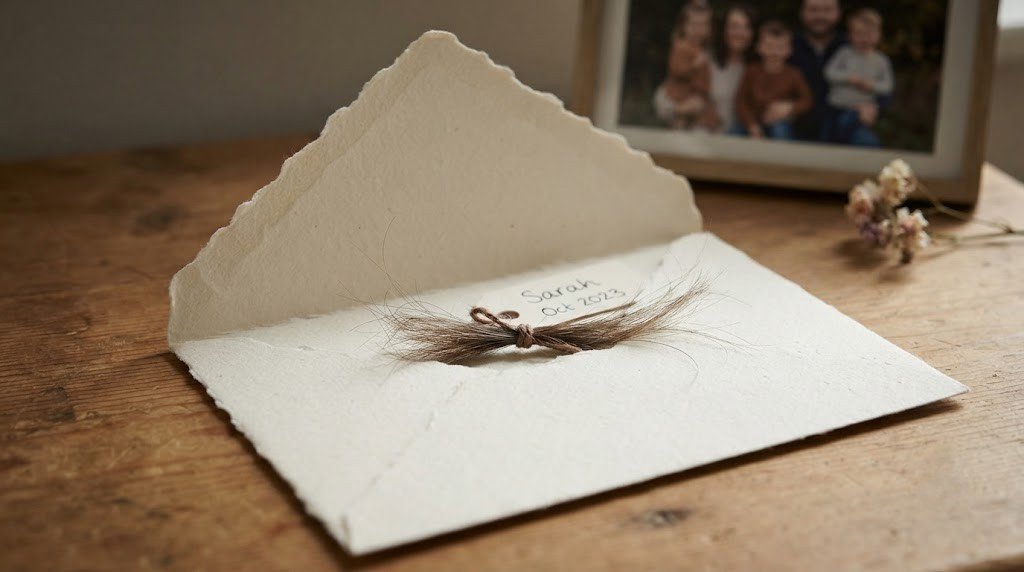
Faith can sit underneath some of the strongest objections about a daughter memorial diamond, and it deserves to be taken at its word. No religious tradition has an official position on memorial diamonds specifically. The guidance that exists concerns cremation and the handling of ashes, and it varies by faith, denomination and individual clergy.

A few examples show the range. Current Catholic guidance permits cremation but asks families to keep the ashes whole and in a sacred place, not shared out among relatives or held at home, allowing a small portion only under narrow conditions, so a Catholic relative’s hesitation reflects real teaching and a parish priest is the right person to ask.

Across the major schools of Islamic thought, cremation itself is considered impermissible in ordinary circumstances. A stone grown from hair involves no cremation at all, which is why the hair route is worth knowing about. Orthodox and Conservative Judaism generally prohibit cremation, while Reform Judaism leaves more to rabbis and families. Hindu, Buddhist and Protestant families vary by community, teacher and congregation.

Never try to argue anyone out of a religious concern. Suggest they speak with their own faith leader. A relative who is uneasy about a daughter memorial diamond on religious grounds may decline a stone while remaining comfortable with others choosing one, or may not. The conviction is theirs to hold.

What If the Answer Is No, or Not Yet?

If the person with legal authority says no, that answer stands, at least for now. Pressing harder rarely changes a grieving person’s mind. Thank them, and ask whether they would be open to talking about a daughter memorial diamond again later.

“Not yet” is a reasonable answer too. Nothing about the process requires a decision in the first weeks or months. Families who keep everything in an urn, bury or scatter her ashes, or choose no keepsake at all are making equally valid choices, and how a diamond and an urn compare can help a hesitant relative see the options side by side.

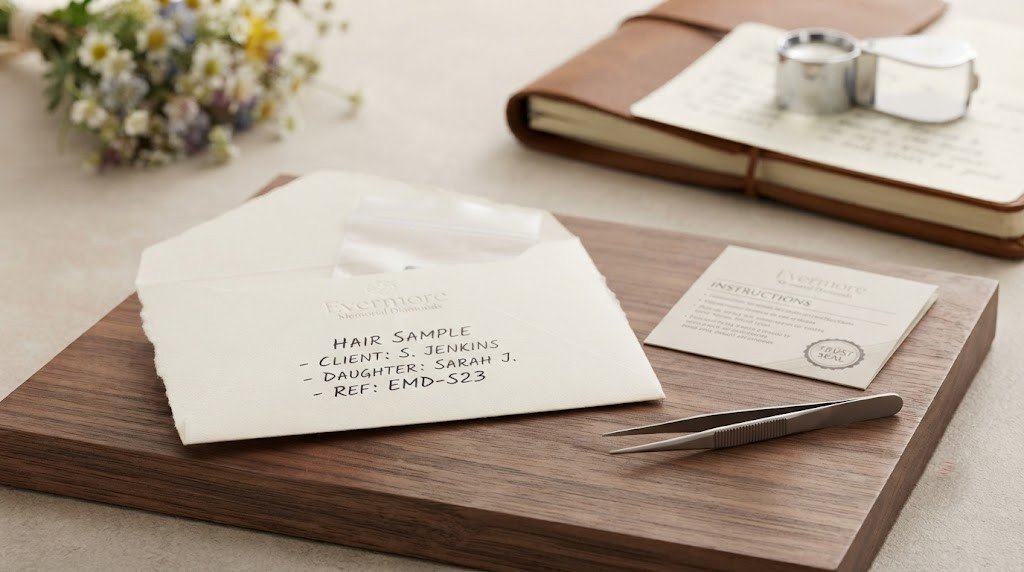
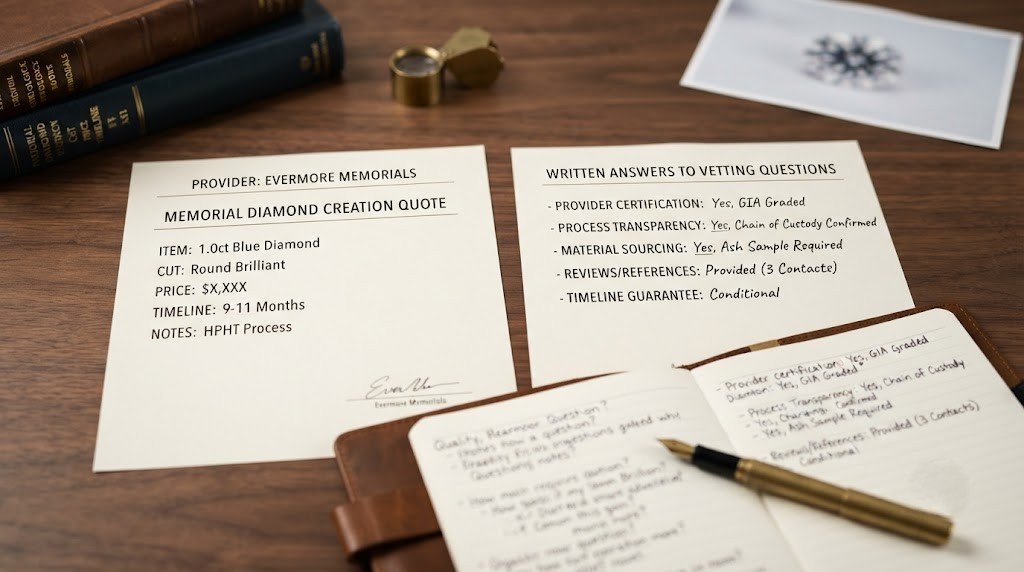
If the family does agree, gather the provider’s answers before anything is sent. The questions worth putting to a provider in writing cover custody, documentation and terms, and sharing those written answers is a simple way to keep everyone informed about a daughter memorial diamond from start to finish.

Frequently Asked Questions

Do I need my family’s agreement to make a diamond from my daughter’s ashes?

It depends on who holds legal authority over her remains, which varies by state and by anything she put in writing. Her spouse, partner or adult children may hold it ahead of her parents. Agreement from everyone else is not always required, but it is worth seeking.

What if her spouse or partner does not want a diamond made?

If they hold authority over her remains, their decision generally stands. Ask whether they would revisit it later, and whether a different keepsake might be acceptable. Pressing harder rarely helps and can strain a relationship that matters to everyone who loved her.

Should I talk to family before or after contacting a provider?

Gathering general information quietly is reasonable, but talk with the person who holds authority, and with close family, before committing to anything about a daughter memorial diamond or sending material. Arriving with a signed contract can make relatives feel left out.

How do I raise it with a relative whose faith discourages cremation?

Gently, and without trying to change their view. No tradition has an official position on memorial diamonds specifically. Suggest they consult their own faith leader, and mention that a stone grown from hair involves no cremation, which may matter to them.

Can each of her siblings have a stone of their own?

Often, yes. Because only a portion of ashes or a small amount of hair is needed, several stones can frequently be grown from one source. Availability depends on the provider and the material, so confirm before offering stones to anyone.

What if relatives say it is too soon to talk about this?

Respect that and set the conversation aside. Nothing about the process requires a quick decision, so tell them you will not raise the subject of a stone again until they are ready, and then keep that promise for as long as it takes.

Is it all right to go ahead if not everyone agrees?

If you hold authority and have listened carefully, you may still proceed; full agreement about a daughter memorial diamond is not always possible. Tell those who disagreed plainly and kindly, make clear nobody must take part, and keep the decision private if they prefer.

Final Thoughts on Talking With Family About Her Diamond

There is no script that makes this conversation easy, and no order of operations that ensures everyone will agree. What you can control is how people feel treated as they hear about a daughter memorial diamond: asked rather than told, given time rather than deadlines, offered facts rather than promises.

Families that talk well about a daughter memorial diamond do not always reach the same answer for everyone. Some relatives will wear a stone, some will keep a portion of her ashes, and some will choose nothing physical at all. That variety is not a sign the conversation failed. If you are still at the beginning, a guide on where to start choosing can help you prepare.

Learn More About Daughter Memorial Diamonds

Talk With Memorial Diamond

If it would help to have plain answers in hand before you talk with family about a daughter memorial diamond, Memorial Diamond is glad to talk things through at memorialdiamond.us. You can ask anything, share the answers with whoever needs them, and decide nothing until your family is ready.
Diamond Cost

How Much Does a Daughter Memorial Diamond Cost?

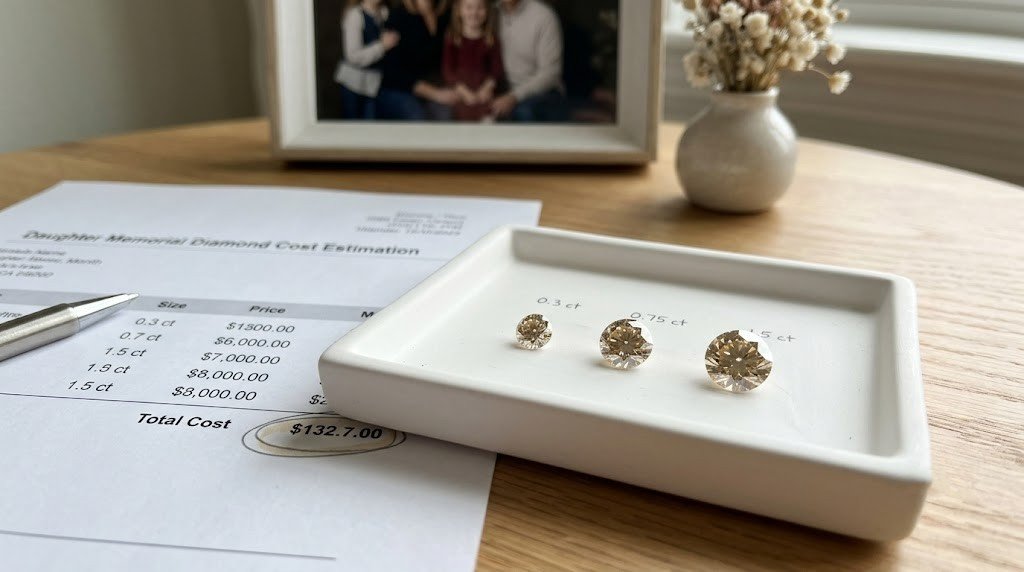
Somewhere between the first search and the first phone call, the question of money arrives, and it can feel strange to set a figure beside her name. Across the industry, a daughter memorial diamond cost typically runs from about $1,500 to $3,500 for a small 0.10 to 0.25 carat stone, to $5,000 to $15,000 for a half carat to one carat stone, and from roughly $20,000 to $75,000 or more above two carats, before any setting, engraving or independent grading is added.

daughter memorial diamond cost

What Is the Typical Daughter Memorial Diamond Cost by Size?

Carat weight is the single largest lever on any daughter memorial diamond cost. The figures below are general 2026 ranges gathered across the category. They are not a price list from Memorial Diamond or from any one company, and each assumes a loose, finished stone with nothing attached to it yet.

TierApproximate carat weightTypical industry rangeWhat tends to sit on top
Entry0.10 to 0.25 ct$1,500 to $3,500A setting, engraving, an optional grading report
Mid0.5 to 1 ct$5,000 to $15,000, with colorless costing meaningfully moreA setting, optional grading, a fancy cut
Large or rare2 to 5+ ct$20,000 to $75,000+A setting, grading, a longer production schedule, insurance

Stones that fall between the bands, a 0.35 carat stone, for example, or one at 1.5 carats, are quoted individually, and the daughter memorial diamond cost tends to land somewhere between the neighboring ranges.

Read any table of daughter memorial diamond cost figures as a map of where the conversation begins rather than where it ends. Two families asking for the same weight can receive quite different quotes, because color, cut, paperwork and the setting all move the total independently of size.

It also helps to separate two numbers in your head from the start: the price of the stone itself, and the price of everything that turns a loose stone into something a person can wear or keep. Providers do not always present those two numbers the same way, and the second one is where surprises tend to live.

Why Does Carat Size Drive the Daughter Memorial Diamond Cost?

Not because more of her is used. This point runs against intuition, so it is worth stating plainly: the size of the finished stone is set by how long the crystal is allowed to grow, not by how much ash or hair you send.

A laboratory places purified carbon, converted to graphite, into a growth cell with a tiny diamond seed and keeps it under roughly 6 to 8 GPa while temperatures sit somewhere between 1,400 and 2,500°C. Lab grown diamond production leans on this high pressure, high temperature approach, and the crystal adds weight slowly over weeks to months.

A larger stone means more weeks of press time, tighter control throughout, and more opportunity for a growth run to fail and need repeating. Each of those carries a real expense for the laboratory, and that expense flows into the daughter memorial diamond cost you are quoted.

The same mechanism explains why bigger stones take longer. A stone above about two carats, or one in a specialty color, can push the schedule toward twelve months instead of the six to ten that is typical, and how the months break down stage by stage is worth understanding before you settle on a size.

Sending a larger quantity of her ashes does not shorten the queue or lower the daughter memorial diamond cost. A laboratory needs enough material to recover usable carbon; beyond that, extra ash does nothing for size, and what happens to any surplus depends on the provider’s return terms. How much of her ashes a laboratory typically asks for is a separate question from what the stone will weigh.

Carat size is one of the strongest factors affecting memorial diamond pricing.

How Does Color Change the Daughter Memorial Diamond Cost?

After size, color is the next biggest influence on a daughter memorial diamond cost, and it works in a way you might not expect.

Trace elements present while the crystal grows decide its tone. Nitrogen pulls a stone toward yellow. Boron pulls it toward blue. A colorless stone needs the near total absence of both, which means extra processing to strip those elements out, and that processing is why colorless sits at the higher end of any given size band.

Carbon recovered from a person is not a controlled industrial feedstock. It carries traces of whatever was present, and so memorial stones tend toward yellow, blue and champagne tones rather than white. Across the industry, accepting whatever tone the growth produces is the simplest way to keep a daughter memorial diamond cost lower.

Some providers also offer post growth irradiation to produce red, green or black stones. Where it is available, it is an option layered on top of the base price rather than a standard stage, and it should be disclosed on the paperwork.

Here is the part that matters most for budgeting. The color of the finished stone cannot be chosen, matched or predicted from her ashes or hair. What you pay for is a process aimed at a range of outcomes, not a promised shade. So ask what happens to the daughter memorial diamond cost if the finished tone differs from the sample you were shown, and whether any part of the fee is adjusted. What to expect from memorial diamond colors for a daughter covers the full range in more depth.

Do Ashes, Hair, or Both Change the Daughter Memorial Diamond Cost?

Less than you might expect, though it is still worth asking each provider directly.

The chemistry differs a great deal between the two materials. Cremated remains are mostly calcium phosphate, the mineral of bone, and the usable carbon inside them is roughly 0.5% to 4% of the ash by weight. Hair is built from keratin and is around 50% carbon, so far less of it is needed, and it requires no cremation at all.

On the ash route, her recovered carbon typically accounts for roughly 10 to 15% of the finished stone by mass, and a few providers quote as little as 3%. The rest is supplemental lab carbon, typically blended in so the crystal has enough feedstock to grow. For hair, or for a blend of ashes and hair, no published finished stone percentage exists, so ask the provider to state their own figure in writing.

None of that chemistry changes the main drivers of a daughter memorial diamond cost, which remain carat, color, cut and paperwork. Where the source can affect the daughter memorial diamond cost is in handling. Some providers price extraction the same way regardless of material; others may itemize hair processing or the combining of two sources differently. Ask for the quote to name any material specific charge on its own line.

If you are weighing hair because cremation was not chosen, or because you already hold a lock of it, the complete guide to a daughter hair diamond walks through that route from start to finish.

What Sits Outside the Quoted Daughter Memorial Diamond Cost?

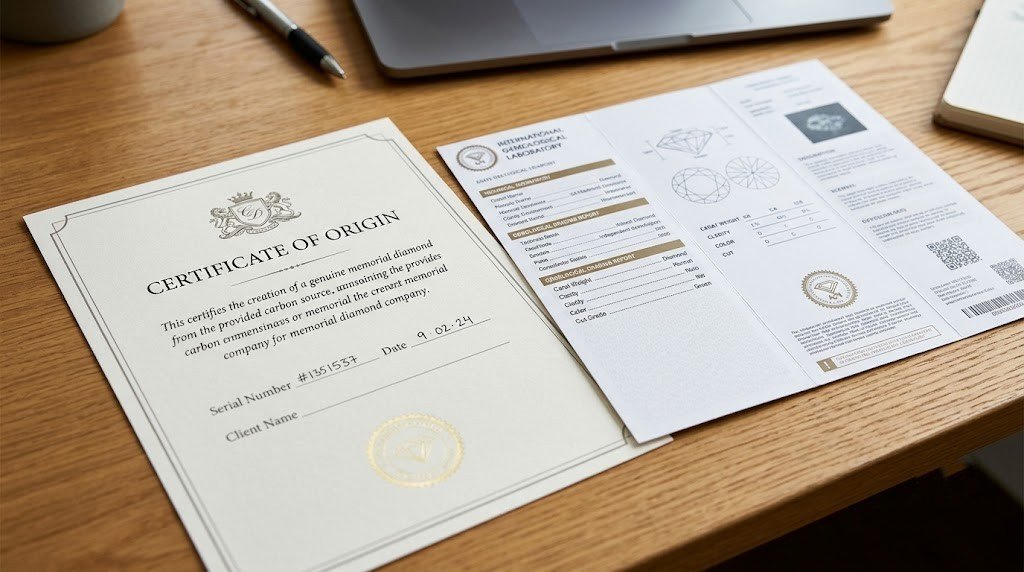
A headline daughter memorial diamond cost generally covers the loose, cut stone; ask whether an in house origin certificate is included too. Much of what a family pictures when they imagine the finished piece sits outside it. Across the category, these items are commonly priced on their own:

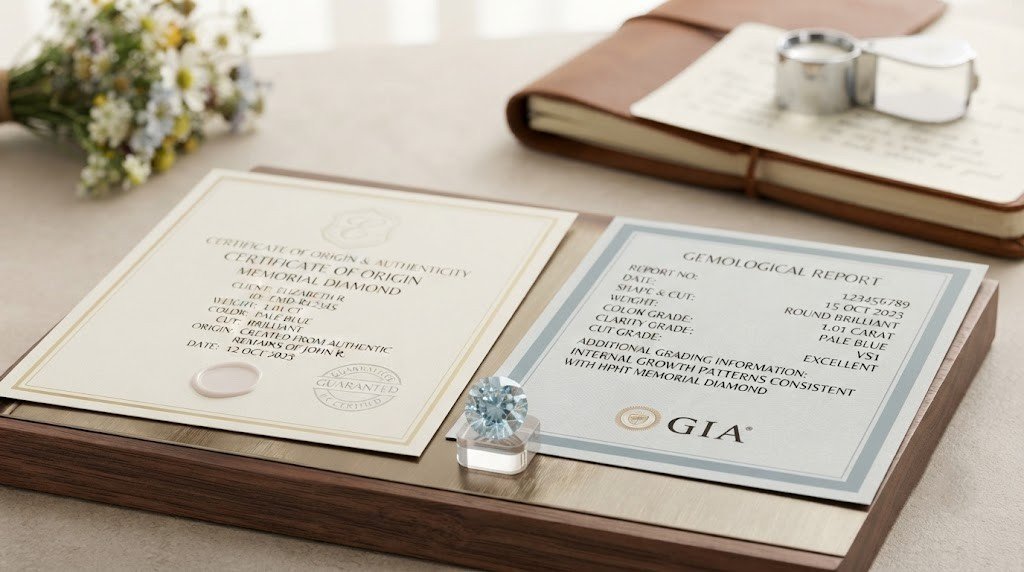
  • An independent grading report. This is a third party assessment of the stone’s cut, color, clarity and carat, using the same quality factors any gemological lab applies. It is optional across the industry, and it is not the same document as an origin certificate, which records provenance rather than quality.
  • A fancy cut. Round may be the base shape in a quote; shapes such as cushion, oval, emerald or pear can add cutting time and cost.
  • Engraving or inscription. A laser inscription on the stone’s edge, or engraving on the inside of a band, is often itemized separately.
  • The setting. A ring, pendant, earrings or cufflinks involve metal, labor and design work, and the choice of metal alone can shift the total noticeably. The practical side of daughter memorial diamond settings covers metals, protection and wear.
  • Collection kits and insured shipping. Ask whether insured transport in each direction is included or billed.
  • Optional color treatment. Where irradiation is offered, it is an add on.
  • Additional stones. Each extra stone from the same source is priced as a stone in its own right.

Insuring the finished piece once it is home is a separate household matter, usually arranged through a homeowner’s or renter’s policy or a jewelry rider. An insurance agent is the right person to ask about that.

A quote that looks lower than another may simply leave more of this list out. That is why a fair comparison of daughter memorial diamond cost estimates always starts by lining up what each one includes.

Grading, settings and other extras can sit outside the headline stone price.

Which Payment Questions Should You Ask Before Signing?

A daughter memorial diamond cost may not be paid all at once; the commitment runs for many months, and the money moves in stages. Put these questions to any provider by email and keep the replies:

  1. How large is the deposit, and is it refundable before her ashes or hair leave your hands?
  2. When does the balance fall due, at the start of growth, after cutting, or before the stone ships?
  3. What happens to money already paid if the family decides to stop after growth has begun?
  4. If a growth run fails, is a second attempt included, charged, or dependent on how much material remains?
  5. Is the quoted daughter memorial diamond cost fixed at signing, or can it change during production?
  6. Is financing offered, through whom, and on what terms?
  7. Is sales tax included, and does it depend on the state the finished piece ships to?

On financing, read the terms as carefully as you would for any loan, and ask a financial professional if anything is unclear. On tax, personal memorial purchases are generally not deductible, but individual situations differ, so an accountant is the right person to confirm it.

If you would like a fuller set of questions that covers custody and documentation as well as money, the list of questions to ask before turning your daughter’s ashes into a diamond is designed to be sent as an email.

How Can a Family Share the Daughter Memorial Diamond Cost?

Because a laboratory only uses a portion of the ashes or hair, more than one stone can often be grown from the same source. That opens several ways to divide the daughter memorial diamond cost, and none of them is the right one for every family.

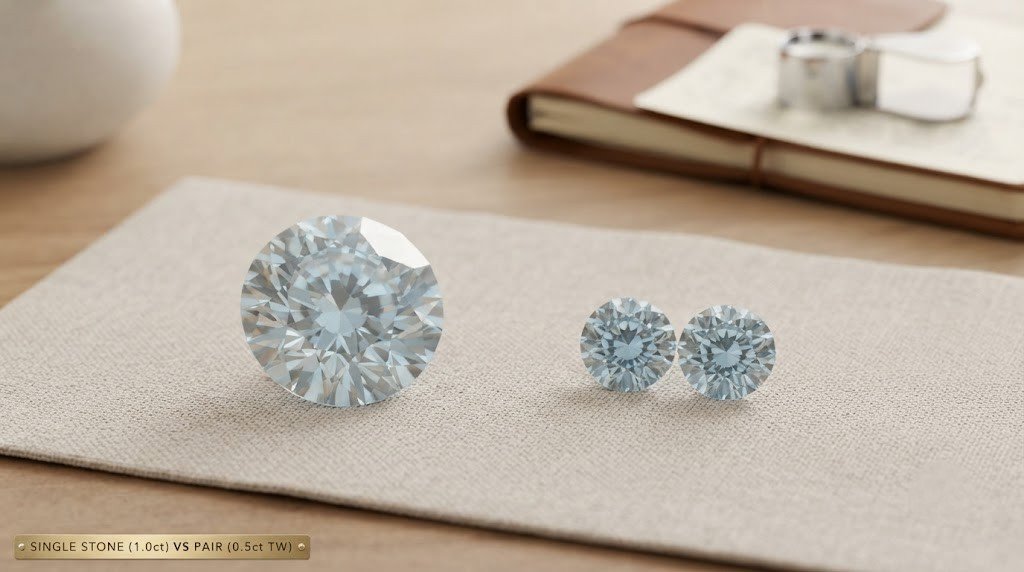
Some families pool money toward a single larger stone that one person wears or keeps. Others choose several smaller stones, so that a parent, a sibling, her partner or a grandparent each holds their own. Several 0.10 to 0.25 carat stones can add up to a total similar to one larger stone, so it is worth asking for both options to be quoted side by side.

Families are rarely arranged as neatly as a pricing page assumes. Parents may be separated, may disagree, or one parent may be arranging everything alone. Siblings may want to contribute unevenly, or not at all. None of that is unusual, and a provider used to this work should be able to invoice more than one person or ship to more than one address.

One point deserves care. The person paying is not necessarily the person with authority over her remains. Her spouse or partner, or any adult children she had, can rank ahead of her parents for that purpose, depending on state law and anything she set out in writing. Settle who signs the release before anyone settles who pays.

Whatever you agree, write it down: who is contributing what, who receives which stone, and what happens to unused material. How sharing a daughter memorial diamond works between several relatives explores the practical and family side of that decision.

How Do You Compare Two Quotes Line by Line?

The fairest comparison puts each quote on the same grid. A daughter memorial diamond cost quoted as a single number tells you very little; the same figure broken into lines tells you almost everything.

Line itemWhat to ask each providerWhy it moves the total
Carat weightIs the quoted weight a target or a minimum?Growth time sets size, and size sets most of the price
ColorIs colorless an option, and at what premium?Removing trace elements adds processing
CutWhich shapes are included at the quoted price?Fancy cuts can add cutting time
Origin certificateIs it included, and what does it state?Records provenance, not quality
Independent gradingIncluded, optional, or not offered?Usually an added fee
SettingIs any setting included, or is the stone loose?Metal and labor can rival a small stone’s price
Shipping and insuranceIs insured transport covered both ways?Sometimes billed separately
Failed growthWho pays for a second run?Protects you from an unplanned second bill
Payment scheduleDeposit, stages, refund terms?Affects how much is at risk if plans change

Fill in the middle column for each provider before you compare the final figures. Once the rows match, each daughter memorial diamond cost can be judged on equal terms.

Two printed provider quotes side by side on a kitchen table with a pen and a highlighter
Comparing quotes line by line can reveal differences hidden behind similar headline prices.

How Can a Family Lower the Daughter Memorial Diamond Cost Thoughtfully?

Every family’s budget is its own, and a smaller figure is not a smaller love. If you are looking for room to move, these are the choices that tend to lower a daughter memorial diamond cost without touching the parts that protect you:

  • A smaller stone. An entry tier stone of 0.10 to 0.25 carats, set with care, is visible and wearable every day.
  • The natural tone. Accepting yellow, blue or champagne rather than requesting colorless avoids the premium for extra processing.
  • A round cut. Where round is a provider’s base shape, it may carry no added cutting charge.
  • A delayed setting. Keep the loose stone until you know who will wear it and how; there is no deadline on that decision.
  • Resetting something she owned. A jeweler can sometimes set the stone into a ring, pendant or watch she wore, which can cost less than starting from new metal.
  • A deliberate choice about grading. Some families value an independent report; others feel the origin certificate is the document that matters. Either is reasonable once you know what each one records.

The one place not to economize is custody. Clear tracking, documented handovers and written terms are what make the stone verifiably hers, and they should never be the line item a family is asked to give up.

If you are still deciding whether a stone is right at all, choosing a memorial diamond for your daughter is a gentle place to start.

Frequently Asked Questions

Is a daughter memorial diamond cost different from the cost of any other memorial diamond?

No. Pricing follows the stone itself, carat weight, color, cut, grading and setting, rather than the relationship. A stone grown from a daughter’s ashes or hair is priced on the same industry basis as any other memorial diamond of the same size and specification.

Does sending more of her ashes make the diamond bigger or cheaper?

Neither. Size comes from the length of time the crystal spends growing, not from the quantity of material submitted. A laboratory needs enough to recover usable carbon; beyond that, extra ash does not change the size, the schedule or the price.

Why does a colorless stone cost more?

Nitrogen tints a growing diamond yellow and boron tints it blue. A colorless stone needs both removed, which takes extra processing. Personal carbon often carries trace elements, so accepting the tone the growth produces is the less expensive route across the industry.

Is an independent grading report worth the extra expense?

It depends on what matters to you. A grading report assesses quality, cut, color, clarity and carat, while an origin certificate records that the stone came from your family’s material. Some families want both; others feel the origin document is enough.

Can we pay for a memorial diamond in installments?

Some providers offer staged payments or third party financing, and terms differ widely. Ask how large the deposit is, when the balance is due, and what happens to money already paid if you stop. Read any financing agreement carefully before signing.

Can two parents who live apart each order a stone?

Often, yes. Each stone draws on just part of the ashes or hair, so a single source can often supply more than one, and some providers invoice each order separately. Confirm first who holds authority over her remains, since that may not be either parent.

Is a daughter memorial diamond cost tax deductible?

Generally not, because personal memorial purchases are usually treated as personal expenses. Tax rules depend on your circumstances and where you live, so confirm with an accountant rather than relying on a general answer from a jeweler or a website.

Final Thoughts on What a Memorial Diamond for Your Daughter Costs

There is no correct amount to spend on remembering her. A small stone chosen carefully, worn every day, carries exactly as much meaning as a large one, and a family that decides a diamond is not right for them at all has made an equally loving choice.

What helps most is clarity. Know the industry ranges, know which lines are added on top, ask the payment questions before signing, and agree within the family who pays for what. Do those four things and the daughter memorial diamond cost stops being a source of worry and becomes one more decision you can make calmly, at your own pace.

Learn More About Daughter Memorial Diamonds

Talk With Memorial Diamond

If you would like help turning these ranges into a daughter memorial diamond cost that fits your family, Memorial Diamond is glad to talk it through. You can reach the team at memorialdiamond.us to ask about sizes, colors, what is included and how payments are staged, with no commitment expected on your side.

Daughter Memorial Diamond Timeline 7 Stages, Expert Care

How Long Does It Take to Make a Daughter Memorial Diamond?

Once the decision is made, the waiting begins, and it helps to know in advance roughly how long it may last. Across the industry, the daughter memorial diamond timeline usually runs six to ten months from the day her ashes or hair reach the laboratory to the day a finished stone is ready, and it can stretch toward twelve months for stones above about two carats or specialty colors, because growth time, not the amount of material, sets the pace.

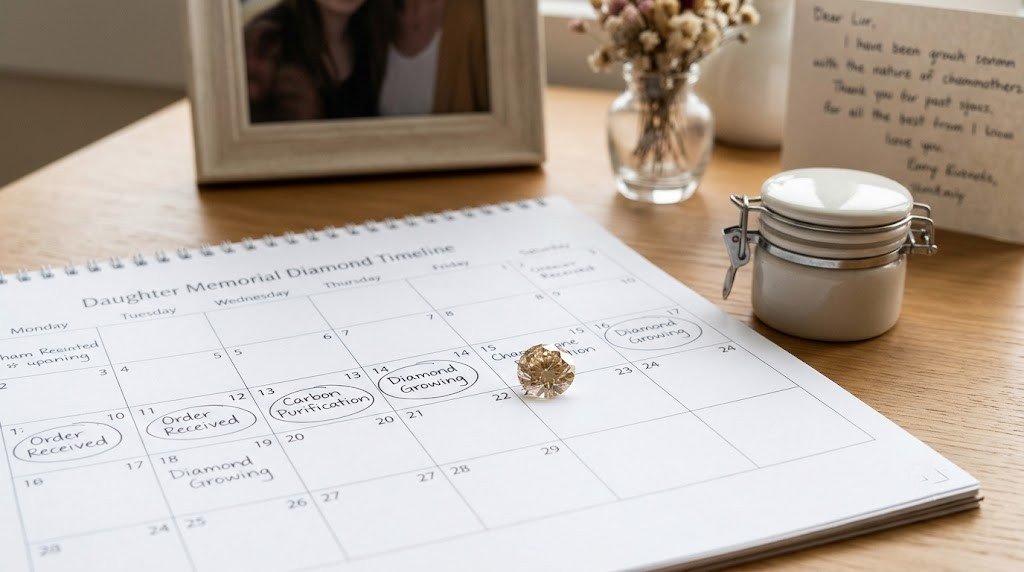
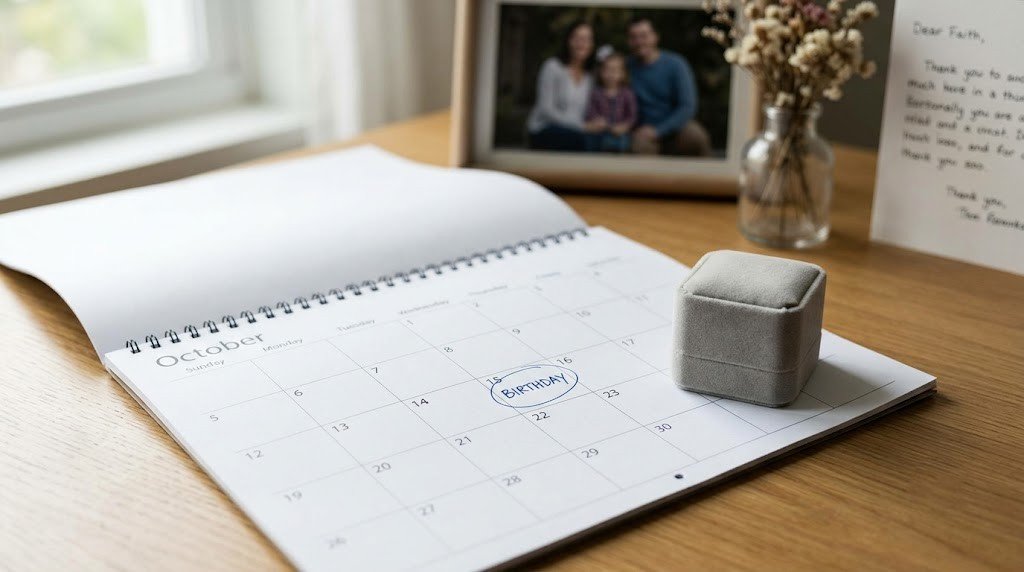
 Daughter memorial diamond timeline shown as a wall calendar with a loose champagne diamond resting on one month | **Focus Keyword in alt text.** Stock acceptable short-term; **prioritize for brand photography

What Does the Daughter Memorial Diamond Timeline Look Like Overall?

Think of the daughter memorial diamond timeline as three phases of very unequal length. A short opening phase in which her material is received, logged and purified. A long middle phase in which a crystal slowly grows. And a closing phase in which that crystal is cut, documented and, if you choose, set into jewelry.

A few facts shape the whole daughter memorial diamond timeline:

  • The typical range is six to ten months, measured from the laboratory’s receipt of material rather than from the first phone call.
  • Larger and specialty stones take longer. A stone above roughly two carats, or one in a less common color, can approach twelve months.
  • Carat size is a choice that sets the daughter memorial diamond timeline. A bigger stone needs more time in the press, so the size you request largely decides how long you wait.
  • Sending more material does not speed anything up. A full urn and a few tablespoons of ash produce the same schedule for the same stone.
  • Every figure here is industry typical. Each provider runs its own queue, and only a written estimate from them describes your daughter memorial diamond timeline specifically.

Those five points answer most questions about the daughter memorial diamond timeline. The sections below explain where the months actually go.

What Happens at Each Stage of the Daughter Memorial Diamond Timeline?

The table sketches the daughter memorial diamond timeline as seven stages against a rough calendar. The month windows are a general illustration built around the industry’s six to ten month norm, not a schedule published by Memorial Diamond or by any single laboratory, and stages often overlap.

#StageWhat happensApproximate durationRoughly when
1ArrangementsChoosing a provider, confirming who may authorize, receiving a collection kitDays to several weeks, set by the familyBefore the clock starts
2Collection and arrivalHer ashes or hair are sealed, shipped, received and logged under a tracking referenceOne to three weeksMonth 0 to 1
3Extraction and purificationEverything that isn’t carbon is removed until the carbon is roughly 99.9% pure or betterSeveral weeksMonths 1 to 2
4GraphitizationAt roughly 2,500 to 2,700°C, the purified carbon converts to graphite, the feedstock a press usesUsually grouped with stage 3Months 1 to 2
5GrowthGraphite, typically blended with supplemental lab carbon, grows around a diamond seed in a pressWeeks to several months, depending on target sizeMonths 2 to 7
6Cutting and polishingA gemologist shapes and polishes the rough crystalA few weeksMonths 6 to 8
7Documentation and deliveryOrigin certificate, optional independent grading, any setting work, insured shippingA few weeks to two monthsMonths 7 to 10

Two optional steps can extend the daughter memorial diamond timeline between stages 6 and 7. Some providers offer post growth irradiation to shift the stone’s color, and where a family requests an independent grading report, the stone travels to an outside laboratory and back. Neither is mandatory, and each adds time.

For a closer look at the chemistry inside stages 3 to 5, how a memorial diamond is made from your daughter’s ashes goes through the process in detail.

When Does the Daughter Memorial Diamond Timeline Actually Start?

Usually on the day her material arrives at the laboratory, not on the day you first ask about it, though wording varies between providers. Ask which date their estimate is measured from, because the difference can be several weeks.

Before that point, there is a stretch the family controls. It includes choosing a provider, reading the terms, deciding on size and whether to pursue colorless, and arranging collection. For ashes, it can mean retrieving them from a funeral home or crematory, or deciding what portion to send from an urn already at home.

Authorization is one early step that can slow things down. Who may direct what happens to her remains depends on state law and on anything she put in writing. Where she was married or in a committed partnership, or where she had adult children, those relatives may rank ahead of her parents. Where parents are separated, or one is arranging everything alone, the provider may want written consent from more than one person. Sorting this out early keeps the daughter memorial diamond timeline from stalling before it has properly begun.

None of these early weeks needs rushing. There is no deadline on deciding, and a family that takes six months before sending anything has lost nothing. The daughter memorial diamond timeline starts when you are ready, not before.

If you want a sense of the full sequence from first conversation to finished stone, the step by step path for your daughter’s ashes lays it out in order.

Why Does Growth Take Up Most of the Daughter Memorial Diamond Timeline?

Because diamond forms slowly, even in a machine designed to make it form as fast as physics allows.

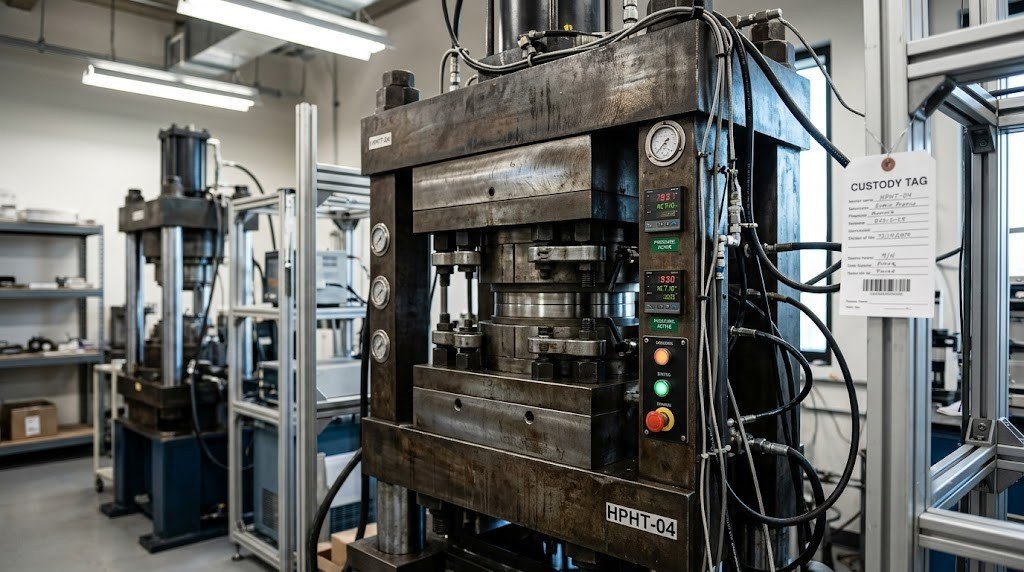
Most memorial stones are grown by the high pressure, high temperature method, in which a press recreates conditions found deep in the Earth’s mantle. Inside the growth cell, carbon dissolves and redeposits onto a tiny seed crystal, building the diamond one layer of atoms at a time. A minority of providers use chemical vapor deposition instead, where carbon from a gas settles onto a seed plate in a vacuum chamber; both approaches are described in the general account of how lab grown diamonds are produced.

Either way, the crystal adds weight gradually. A small stone of 0.10 to 0.25 carats might need a few weeks in the press; a stone of one carat or more needs considerably longer, and the conditions have to be held steady the entire time. Push the process too hard and the crystal can develop flaws or fail outright.

This is also why the amount of material you send has so little effect on the daughter memorial diamond timeline. Her carbon is recovered, purified and blended with supplemental lab carbon so that the crystal has enough feedstock to grow. Once that feedstock exists, the clock is governed by growth rate and target size. How size affects the price as well as the schedule is worth reading alongside this section.

What Can Stretch the Daughter Memorial Diamond Timeline?

An estimate is an estimate, and a responsible provider will tell you so. These are the factors that tend to lengthen the daughter memorial diamond timeline across the industry:

  1. A larger stone. Above roughly two carats, schedules can approach twelve months.
  2. A colorless request. Removing the trace elements that tint a stone yellow or blue takes extra processing, which can add time.
  3. A specialty color. Where irradiation is offered for red, green or black stones, it is an added step.
  4. A failed growth run. Crystals sometimes fracture or stop growing properly, and a second attempt restarts the longest stage.
  5. Recutting. If an inclusion or chip appears during cutting, reshaping the stone can add weeks.
  6. Independent grading. Sending the stone to be assessed against an outside gemological laboratory’s grading standards adds a round trip and that lab’s own queue.
  7. Custom settings and engraving. Bespoke metalwork follows its own schedule once the stone exists.
  8. Authorization questions. Unresolved consent between family members can hold material before processing begins.
  9. Several stones at once. Orders for multiple stones from the same source may be grown in sequence rather than together; ask how your provider handles it.

Color deserves a special note. The finished tone cannot be chosen or predicted from her ashes or hair, so if the first result is not what a family hoped for, any further treatment adds time as well as cost. What to expect from memorial diamond colors for a daughter explains why tones vary.

Ask any provider, in writing, how they communicate an overrun and whether their terms say anything about it. A clear answer to that question is worth more than a short estimate.

Does the Daughter Memorial Diamond Timeline Differ for Ashes, Hair, or Both?

Less than you might expect, because the longest stage, growth, is the same regardless of where the carbon came from.

The materials do differ in what they contain. Ash is largely bone mineral, and only about 0.5 to 4% of its weight is carbon a laboratory can use. Hair, a keratin protein, comes in near 50% carbon, which is why so little of it is needed. Neither difference changes how long a crystal takes to grow once purified carbon exists.

Where hair can change the daughter memorial diamond timeline is at the front end. It requires no cremation, so a family holding a lock of her hair does not need to wait for remains to be returned from a crematory. Some families keep hair from a brush, a saved haircut or a keepsake envelope, and it can be sent whenever they are ready, subject to any estate or family considerations that apply where you live.

For a blend of ashes and hair, ask the provider whether the two materials are processed together or separately, and whether combining them adds any time. No published industry figure covers that, so their written answer is the one to rely on. If you are considering hair alone, the step by step path for your daughter’s hair shows how it differs.

Can the Daughter Memorial Diamond Timeline Be Shortened?

Not by much, and it is worth being wary of anyone who says otherwise.

The physics of crystal growth does not compress well. Forcing a stone to grow faster raises the risk of inclusions, fractures or a failed run, any of which would ultimately lengthen the wait rather than shorten it. Most of what a family can do to keep the daughter memorial diamond timeline moving happens before the material is sent:

  • Settle authorization and consent among family members first.
  • Choose the stone’s size and decide whether to pursue colorless before signing.
  • Decide early whether you want an independent grading report.
  • If a setting is planned, choose the style while the stone is growing rather than after it arrives.
  • Return paperwork and the collection kit promptly once you are ready.

If a provider offers an expedited option, ask exactly which stage it shortens and what trade off it involves. A faster queue for cutting or shipping is plausible; a dramatically faster growth stage deserves careful questions.

What Can the Family Do While the Stone Is Growing?

The middle months of the daughter memorial diamond timeline can feel strangely empty. Nothing visible happens, updates may be sparse, and the stone exists only as a promise. Some families find it helps to give that time a shape; others prefer to set the whole thing aside until it arrives. Both are reasonable.

If you would like something to do, these are practical uses of the wait:

  • Agree on an update rhythm. Ask the provider how often they report progress, whether they share photos of the rough crystal, and who to call if weeks pass in silence.
  • Choose one family contact. A single person receiving updates avoids confusion, especially when parents live apart or siblings are spread out.
  • Think about the setting. Ring, pendant, cufflinks or a loose stone kept in a box, the practical side of daughter memorial diamond settings covers metals, protection and wear.
  • Decide on engraving. Her name, a date, a phrase she used, or nothing at all.
  • Plan for the remaining ashes. Most of her ashes are not needed for the stone, and keeping, scattering or interring the rest is a separate decision with its own timing.
  • Keep the documents together. Contracts, tracking references and correspondence in one folder save stress later.

Conversations with relatives often happen during this stretch too, especially if more than one person hopes for a stone. How to talk to family about a daughter memorial diamond offers gentle ways to begin.

Should You Plan Around a Date That Matters?

You may have a date in mind: her birthday, the anniversary of her death, a holiday the family always kept, a sibling’s wedding, a graduation, or a gathering planned in her memory. It is natural to want the stone in hand by then.

The honest answer is that no provider can promise a finished stone by a specific day, because growth is not fully predictable. What a family can do is give the daughter memorial diamond timeline generous room and keep a gentle fallback ready.

The dateWhen to start talking to a providerIf the stone isn’t ready
Her birthdayAt least 12 months ahead, longer for a stone above one caratMark the day with the origin paperwork or a photo of the rough crystal, if offered
The anniversary of her death12 months or more aheadShare the plan with family on the day and let the stone arrive when it arrives
A family wedding or graduation12 months or more aheadWear an empty setting, or carry a card naming the stone that is on its way
A holiday12 months or more aheadGive a handwritten note describing what is being made
A memorial gatheringPlan the gathering around the stone, not the reverseHold the gathering anyway; the stone can be shared later

The first anniversary deserves a particular word. If a family begins several months after her death, a finished stone by that first anniversary may not be achievable. That is not a failure of planning. The stone will still mean what it means when it arrives.

Tell the provider about any date that matters when you first discuss the daughter memorial diamond timeline. They cannot promise it, but they can tell you honestly whether it is plausible.

Frequently Asked Questions

How long is the daughter memorial diamond timeline from start to finish?

Across the industry, six to ten months from the day her ashes or hair reach the laboratory, and up to about twelve for stones above two carats or in specialty colors. The weeks the family spends deciding come before that clock starts.

Is the daughter memorial diamond timeline shorter if we use her hair?

Not much, because growth takes the same time whatever the carbon source. Hair can help at the front end, since no cremation is involved and a lock you already hold can be sent whenever you are ready. Ask each provider for their own estimate.

Can the diamond be ready for her birthday?

No provider can promise a specific date, because crystal growth is not fully predictable. Starting at least a year ahead improves the odds. Mention the date at the first conversation and ask whether it is achievable for the size you want.

Why does a larger stone take longer to make?

Carat size depends on how long the crystal grows in the press. A bigger stone needs more weeks under steady pressure and heat, and more time in the press also means more chance a growth run must be repeated.

Will we hear anything while the stone is growing?

That varies by provider. Some send scheduled updates or photos of the rough crystal; others contact you only near the end. Ask before signing how often you will hear from them and who to call if you have not.

What happens to the schedule if a growth run fails?

A failed run usually means growing the stone again, which restarts the longest stage and can add months. Whether the repeat is included, and whether enough material remains, depends on the provider’s terms, so ask before sending anything.

Final Thoughts on the Daughter Memorial Diamond Timeline

Months are a long time to wait for something you already feel you have waited too long for. There is no way to make the daughter memorial diamond timeline feel short, but there are ways to make it feel steady: a clear written estimate, an agreed rhythm of updates, and a family that knows what is happening and when.

Give the schedule room, especially around the dates that matter. Let the early decisions take as long as they need. And when the stone does arrive, whether that is in six months or twelve, it will be no less hers for the time it took.

Learn More About Daughter Memorial Diamonds

Talk With Memorial Diamond

If you would like an honest sense of the daughter memorial diamond timeline for the stone you have in mind, Memorial Diamond can talk it through with you. Reach the team at memorialdiamond.us to ask about schedules, updates and any date that matters to your family, without any obligation to go further.

Memorial Diamond Settings and Jewelry Ideas for a Daughter

Memorial Diamond Settings and Jewelry Ideas for a Daughter

A loose memorial stone resting in its box can feel like a sentence left unfinished. Daughter memorial diamond settings finish it, and the choice is mostly mechanical: bezel and flush settings guard the stone’s edge best for daily wear, prongs let in more light but leave more exposed, platinum and 14k gold hold up longest, and almost any piece can be reset later for another relative.

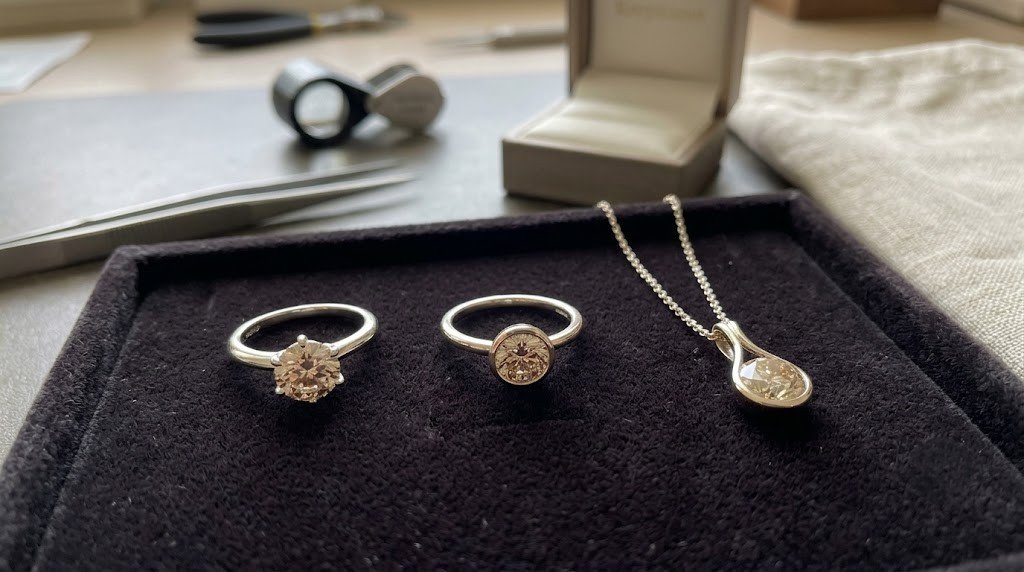
Daughter memorial diamond settings laid out on a jeweler's tray: a bezel ring, a six-prong ring and a pendant, each holding a champagne-toned stone

Why Do Daughter Memorial Diamond Settings Matter More Than Style?

A jeweler can replace a chipped stone in an ordinary engagement ring with one phone call. Nobody can do that here. The carbon recovered from her ashes or hair went into one particular crystal, and any replacement would be a different stone. That is why daughter memorial diamond settings deserve more thought than appearance alone.

Style still matters; it simply comes later. Security and edge protection come first, then whether the piece can change with its wearer.

Once the mechanics are settled, the rest, shape, metal color, chain or finger, becomes something a family can enjoy deciding rather than dread. The broader menu, from rings to keepsake boxes, lives in a separate guide to rings, pendants and keepsakes. This page stays with how daughter memorial diamond settings actually hold, protect and age.

Nothing here assumes anything about who she was or what she liked to wear. Good daughter memorial diamond settings are chosen for the person who will wear the piece, whether that is her mother, her father, her partner, a sibling or her own adult child.

Bezel or Prong: Which Protects a Memorial Stone Better?

A bezel protects better; prongs show more of the stone. For anyone weighing daughter memorial diamond settings, that short answer may settle the question on its own.

Diamond is rated 10 on the Mohs scale of mineral hardness, so very little will scratch it. Hardness is not toughness, though: diamond can split along cleavage planes if struck sharply at the wrong angle, and chips usually start at the girdle, the thin outer rim of a cut stone. A doorframe or countertop is the classic culprit.

A full bezel wraps a continuous band of metal around that girdle, so a blow lands on metal instead of crystal and the stone sits lower. A half bezel covers two sides and leaves the other two open, trading a little protection for a little more light.

Prongs grip the stone at four or six points, letting in more light so it looks larger and livelier. The cost is exposure: the girdle is open between the claws, which can bend or thin over years of ring wear. Six prongs spread the load and keep the stone seated if one fails; four show more diamond but leave less margin.

The wearer decides this more than the stone does. Among daughter memorial diamond settings, a bezel or flush mount usually suits someone who works with their hands, lifts weights, gardens or simply wants to forget the ring is there. Where daughter memorial diamond settings use prongs, they make more sense for a pendant worn under a collar, or a ring kept mostly for occasions.

How Do Seven Common Setting Styles Compare?

Seven styles cover nearly everything a jeweler will suggest for a single memorial stone. Use the table to narrow daughter memorial diamond settings to two or three candidates before you start looking at finished designs.

Setting styleHow it holds the stoneEdge protectionLight and visibilityResizing or resetting laterOften suits
Four prongFour metal claws over the girdleLowHighestStone releases easily; worn claws can be retippedPendants, occasional wear rings
Six prongSix claws spreading the loadLow to moderateHighReleases easily; more claws to inspectRings worn often, larger stones
Full bezelContinuous metal rim around the girdleHighestModerate; stone sits lowerResetting takes more bench workDaily wear rings, active wearers
Half bezelMetal on two sides, open on twoModerate to highGoodModerate effortRings and bracelets needing balance
Flush or gypsyStone sunk into a drilled seat, level with the surfaceHighestLower; mainly the top showsHarder; surrounding metal must be reworkedBands, signet rings, cufflinks
TensionStone held by spring pressure between two metal endsModerateVery highUsually cannot be resizedContemporary designs, careful wearers
HaloCenter stone ringed by small accent stonesModerateVery high; stone reads largerModerate; accents need checkingSmaller stones wanting more presence

Edge protection means the memorial stone itself; halo accents can be replaced without the same weight. Resetting is always possible in principle. What differs between daughter memorial diamond settings is bench time and cost. Ask about both before you commit to any of the daughter memorial diamond settings that would be hard to undo.

Which Metals Hold Up Best in Daughter Memorial Diamond Settings?

The metal carries the stone, absorbs every knock and decides how often the piece needs a jeweler’s attention. Here is how the usual options behave in daughter memorial diamond settings:

  • Platinum dense, naturally white and very durable; scratched metal is displaced rather than lost, so prongs keep their mass. Heavier and generally pricier.
  • 14k gold a harder wearing alloy than higher karat gold and a frequent choice for rings worn every day, in yellow, white or rose.
  • 18k gold richer color and higher gold content, but softer, so claws and thin bands wear faster.
  • White gold usually plated with rhodium for brightness; the plating wears through and is typically redone every year or two.
  • Palladium a lighter member of the platinum family, white all the way through, though fewer jewelers work with it routinely.
  • Sterling silver affordable and handsome for pendants, but soft and prone to tarnish, with prongs that bend readily.

A practical rule for daughter memorial diamond settings is to put the strongest metal where the wear is. A ring takes far more punishment than a pendant, so platinum or 14k gold earns its price there, while a pendant worn under clothing can sit comfortably in 18k gold, or even silver, inside a sturdy bezel.

Chains matter too: a thin one is an easy way to lose a pendant, so ask for a cable or wheat chain with a lobster clasp and have it checked with the setting.

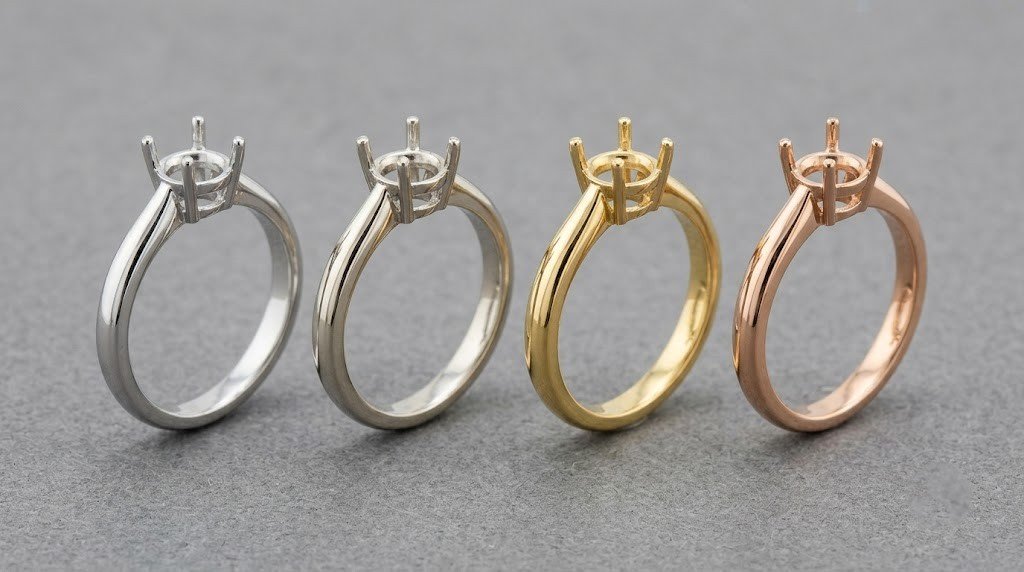
Four plain ring mounts in platinum, white gold, yellow gold and rose gold lined up side by side | Stock acceptabl

How Do Stone Size and Color Shape the Choice?

Size and color are the two things a family cannot fully control in advance, and both affect which daughter memorial diamond settings will flatter the finished stone.

Size. Memorial diamonds are generally offered from about 0.10 carats to 5 carats and beyond, and growth time in the press, not the quantity of ash or hair, determines carat weight. A round stone of 0.10 to 0.25 carats measures roughly 3 to 4 millimeters across, and it often looks best in daughter memorial diamond settings that add presence, such as a bezel or a halo. Half carat to one carat stones suit prongs, a bezel or a flush band equally well. Larger stones sit higher and catch on fabric, so a lower profile helps. Price climbs steeply with size, and how carat, color and grading move the total is worth understanding before a setting is added on top.

Color. Trace elements present during growth set the tone: nitrogen leans yellow, boron leans blue, and a colorless stone needs both absent plus extra processing. Memorial stones tend toward yellow, blue and champagne, and nobody can tell from the source material which one will come back. That is the strongest argument for choosing the metal after the stone exists.

Once you can see it, a few general pairings hold. White metals tend to keep a blue stone cool and a near colorless stone bright; yellow gold warms whatever it holds, deepening yellow or champagne; rose gold sits in between. A closed back bezel can darken a stone slightly by blocking light from beneath.

None of this is about her; it is about the actual stone and the person who will wear it. What range of color to expect has its own guide. When you finally compare daughter memorial diamond settings against the finished diamond, ask the jeweler to hold it against each metal in daylight.

Which Daughter Memorial Diamond Settings Work for Everyday Wear?

Most can, provided the setting is chosen with daily life in mind and the piece is looked after. These seven habits keep a set memorial stone safe for the long run:

  1. Choose a protective mount for rings. Of the daughter memorial diamond settings available, bezel, half bezel and flush mounts shrug off knocks far better than tall prongs.
  2. Take rings off for heavy work. Weights, gardening and moving furniture are classic ways to chip a stone or bend a claw.
  3. Keep it away from chlorine. Pool and hot tub water, and household bleach, can weaken gold alloys over time.
  4. Have the setting checked at least once a year. A jeweler can test prongs and inspect a bezel in minutes; every six months suits a ring worn constantly.
  5. Clean it gently. Warm water, mild soap and a soft brush are enough; ask before using an ultrasonic cleaner, since vibration can loosen a worn mount.
  6. Store it on its own. Diamond scratches other jewelry, so a soft pouch or lined compartment keeps everything intact.
  7. Keep the paperwork with the piece. The origin certificate, any grading report and the jeweler’s receipt belong together, where another family member could find them.

None of this should make the piece too precious to wear. Some families describe the daily contact, a thumb turning a ring, as the part they value most, and well chosen daughter memorial diamond settings let that continue for decades.

Should the Finished Piece Be Appraised and Insured?

Usually it is worth doing, though for a different reason than ordinary jewelry. Insurance can pay money or fund a comparable stone; it cannot return her carbon. A policy on daughter memorial diamond settings and the stones they hold can cover the financial value; whether it would also fund a new stone from retained material is for the agent and provider to answer. Ask the provider, in writing, whether anything you sent is retained and on what terms.

Two options worth asking about are a scheduled item on a homeowner’s or renter’s policy and a standalone jewelry policy. Insurers usually want a recent appraisal and, ideally, an independent grading report; how gemologists describe cut, color, clarity and carat is the vocabulary an appraiser will use. An in house origin certificate records where the carbon came from and says nothing about quality.

Questions to put to an insurance agent rather than a jeweler:

  • Does the policy pay replacement cost or actual cash value?
  • Is there a deductible on jewelry claims?
  • Is unexplained loss, often called mysterious disappearance, covered?
  • How often should the appraisal be updated?

Terms vary by insurer and state. Photograph the piece and keep copies of the paperwork outside the house.

Can a Ring Be Resized or the Stone Reset Later?

Usually, yes, and that flexibility is a good reason to treat daughter memorial diamond settings as something that can change. The stone will outlast any one mount, and quite possibly any one wearer.

Resizing. Most plain gold and platinum bands can be taken up or down a size or two. Eternity bands with stones all the way around, tension designs that depend on the band’s spring, and some patterned shanks resist it. If the ring may be handed on someday, a plain or partly set band keeps the door open.

Resetting. A memorial stone can move from a pendant into a ring, or from a parent’s ring into a younger relative’s pendant decades later. Among daughter memorial diamond settings, prong styles release a stone most easily; bezels and flush mounts take more bench work, because metal has to be opened, but a skilled jeweler can manage both.

A note about heat. Jewelers often use a torch for sizing and repair. If the stone’s color was produced by post growth irradiation, which some providers offer for colors such as red, green or black, strong heat can alter some treated colors. Tell the jeweler what the stone is and how its color came about, and ask that it be removed before any torch work.

Whatever daughter memorial diamond settings the stone passes through over the years, keep the provider’s documentation with it, and ask each jeweler to note on the receipt that a memorial diamond was handled.

Which Daughter Memorial Diamond Settings Suit Each Family Member?

When more than one stone is grown, it is often possible to divide one source of ashes or hair between several relatives. Each person may want something different. Daughter memorial diamond settings chosen for each wearer’s real life get worn; ones chosen only so everything matches can end up in a drawer.

WearerPieces worth consideringSetting points to weigh
A parent who wears a ring dailySolitaire or bandBezel or flush; platinum or 14k gold
A parent who prefers not to wear ringsPendant, lapel pin or keepsake charmBezel pendant on a sturdy chain
Her spouse or partner, if she had oneRing worn beside or instead of a wedding band, or a pendantLow profile that sits next to an existing band
A siblingPendant, cufflinks, signet ring or braceletFlush or bezel for daily wear
Her adult child, if she had childrenPendant now, ring laterProng mount that resets easily
A grandparentPendant or broochLightweight metal, secure clasp

Families sorting out daughter memorial diamond settings for several people sometimes settle on one shared detail, the same metal, or an engraved date inside each band, and let everything else differ.

A pair of earrings needs two stones, and two stones grown separately may not match in tone, since color cannot be predicted from the source; a jeweler can design around a slight difference. Stones for several relatives may also finish at different times, so how long each one is likely to take is worth knowing before anyone plans to hand them out together.

What Should You Ask a Jeweler Before the Stone Is Set?

Memorial Diamond Settings and Jewelry Ideas for a Daughter

Some providers set the stone themselves; other families take the loose diamond to a local jeweler they already trust. Either works if whoever handles it knows it cannot be replaced.

Before any of the daughter memorial diamond settings you are considering is made, ask whether the work happens on the premises, who handles the diamond and whether it is insured while there. Ask them to measure the stone in front of you, and what warranty covers their workmanship.

If you are still comparing providers, a guide on where to start covers that decision first. Choosing daughter memorial diamond settings goes more smoothly once the stone itself is real and in your hands.

Frequently Asked Questions

What is the most protective setting for a memorial diamond?

Among daughter memorial diamond settings, a full bezel or a flush mount gives the most protection, because metal covers the girdle where chips usually begin. Both suit rings worn every day. Prongs show more of the stone but leave its edge exposed, so they suit pendants better.

Should the metal be chosen before the diamond is finished?

It is safer to wait. Color cannot be predicted from her ashes or hair, and a yellow, blue or champagne stone can look quite different against white or yellow metal. Decide on the setting style early if you like, then confirm the metal once the stone exists.

Can a memorial diamond chip or crack?

Yes, although it is uncommon. Diamond resists scratching better than any natural material, but a sharp blow at the wrong angle can chip it, usually along the girdle. Picking daughter memorial diamond settings with protection in mind, such as a bezel or flush mount, reduces that risk.

Is sterling silver strong enough for a memorial ring?

Silver is soft and tarnishes, and silver prongs bend more readily than gold or platinum ones. It works well for a pendant inside a sturdy bezel. For a ring worn daily and holding an irreplaceable stone, platinum or 14k gold is the more durable choice.

Can her stone be moved into a different piece later?

Usually, yes. Prong mounts release a stone easily, while bezels and flush settings take more bench work. Tell the jeweler it is a memorial diamond, mention whether its color was produced by irradiation, and ask that it be removed before any torch work begins.

Does a memorial diamond need its own insurance?

It is worth discussing with an insurance agent. A scheduled item on a homeowner’s or renter’s policy, or a standalone jewelry policy, is common. Insurers usually want an appraisal and ideally a grading report. Coverage terms vary by insurer and state, so confirm the details directly.

Can two stones from the same source become matching earrings?

They can be set as a pair, but they may not match exactly. Each stone’s color is set by trace elements during its own growth, so two stones from the same source can differ in tone. A thoughtful jeweler can design the pair so any difference looks intentional.

Final Thoughts on Choosing a Setting for Her Stone

It can feel strange to think about claws and karats when what you are holding is part of someone you love. The mechanical questions turn out to be a kindness: once the stone is protected and the mount can change with its wearer, you are free to choose the rest with your heart.

The best daughter memorial diamond settings are rarely the most elaborate. They are the ones that let the stone be worn, checked, cleaned and eventually passed on without anyone holding their breath. If the family is still at the beginning, the complete guide to a daughter ashes diamond covers the steps that come before choosing daughter memorial diamond settings at all.

Learn More About Daughter Memorial Diamond Jewelry

Talk With Memorial Diamond

If you would like to talk through daughter memorial diamond settings with someone before deciding, Memorial Diamond is glad to help at memorialdiamond.us. A conversation about metals, mounts and what might suit each person in your family is simply that: a conversation, with nothing expected afterward.

Daughter Memorial Diamond Ideas Rings, Pendants, and Keepsakes

Daughter Memorial Diamond Ideas: Rings, Pendants, and Keepsakes

A stone grown in part from her carbon will spend its life somewhere, on a hand, under a collar, on a bookshelf, or in a drawer opened on the harder days. The most fitting daughter memorial diamond ideas start from two people, the person she was and the person who will hold the stone, and from there a ring, pendant, cufflink, reset heirloom or display keepsake can be matched to whichever parent, sibling, partner or child of hers will wear or keep it.

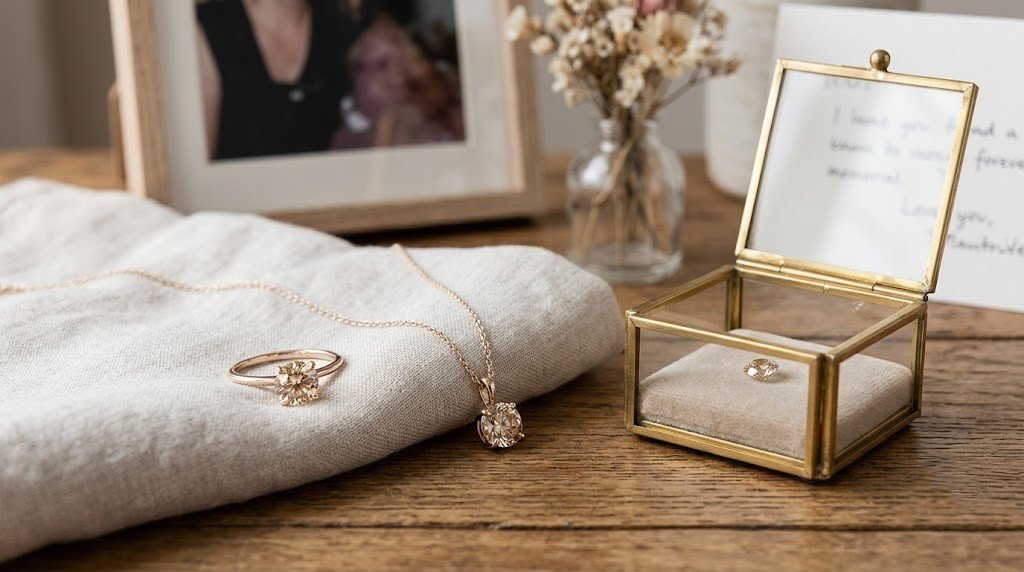
Daughter memorial diamond ideas shown as a ring, a pendant and a small display box arranged on a wooden table

Where Do Good Daughter Memorial Diamond Ideas Begin?

Good daughter memorial diamond ideas begin with her, and then with whoever will keep the stone. Jewelry catalogs start with styles; this decision works better the other way round.

Begin by thinking about the person she was rather than about what memorial jewelry is supposed to look like. A few questions can loosen things up:

  • What did she do with her hands, build, cook, write, play, repair, paint, climb?
  • Did she wear anything every single day, such as a watch, a ring or a chain?
  • Was there a place, a phrase, a date or a piece of music the family links with her?
  • Was her style bold, plain, practical, playful, or simply hers in a way nobody else could copy?

Then think about the keeper. Some people wear jewelry daily and would forget a pendant was there within a week. Others have never worn a ring and never will. Someone who works with their hands needs different daughter memorial diamond ideas from someone who sits at a desk, and a person who travels constantly may prefer a piece that lives safely at home.

Put the two sets of answers side by side and the daughter memorial diamond ideas on your list usually narrow quickly. A stone that suits her but sits unworn in a drawer can still be precious; a stone that suits the keeper but says nothing about her can feel oddly hollow. The daughter memorial diamond ideas that last tend to honor both.

What Are 12 Daughter Memorial Diamond Ideas Worth Considering?

Here are daughter memorial diamond ideas across a broad range, from the familiar to the less expected. None is linked to her being a daughter in any particular way; each is simply a form a stone can take, matched to the kind of person who might keep it.

#IdeaWorn or keptOften suits someone whoWorth knowing
1Solitaire ringWornWants to see the stone every dayRings take the most knocks; a protective mount helps
2Flush set bandWornWorks with their handsThe stone sits level with the metal, so little can catch
3Pendant on a chainWornPrefers to keep it close but out of viewCan sit under clothing; a sturdy chain matters more than a fine one
4Engraved locket or medallionWornWants words or an image beside the stoneEngraving and photo inserts are priced on their own
5Single stud or a pair of studsWornAlready wears earringsTwo stones from one source can still differ in tone
6Cufflinks, tie bar or lapel pinWorn on occasionsDresses up for work, ceremonies or eventsWorn less often, so it wears less
7Signet ringWornLikes a bolder, flat topped ringRoom on the face or shoulders for engraving
8A piece she wore, resetWornWants her own ring, chain or watch to carry itA jeweler must confirm the piece can take a stone
9Bracelet or bangleWornWants it visible at the wristWrists meet desks and doorframes; choose a protective mount
10Loose stone in a display boxKeptDoes not wear jewelryKeep the origin certificate in the same box
11Stone set into a keepsake objectKeptWants it on a desk, shelf or bedside tableFeasibility depends on the object and the craftsperson
12A family set from one sourceBothSeveral relatives each want a pieceEach stone is priced separately and tones may vary

These daughter memorial diamond ideas are starting points rather than a menu. A jeweler can combine them: a pendant that converts to a brooch, a ring with a hidden inscription, a display box with room for a photograph. The best result often comes from describing her to the jeweler and letting the design follow.

How Can Daughter Memorial Diamond Ideas Reflect the Person She Was?

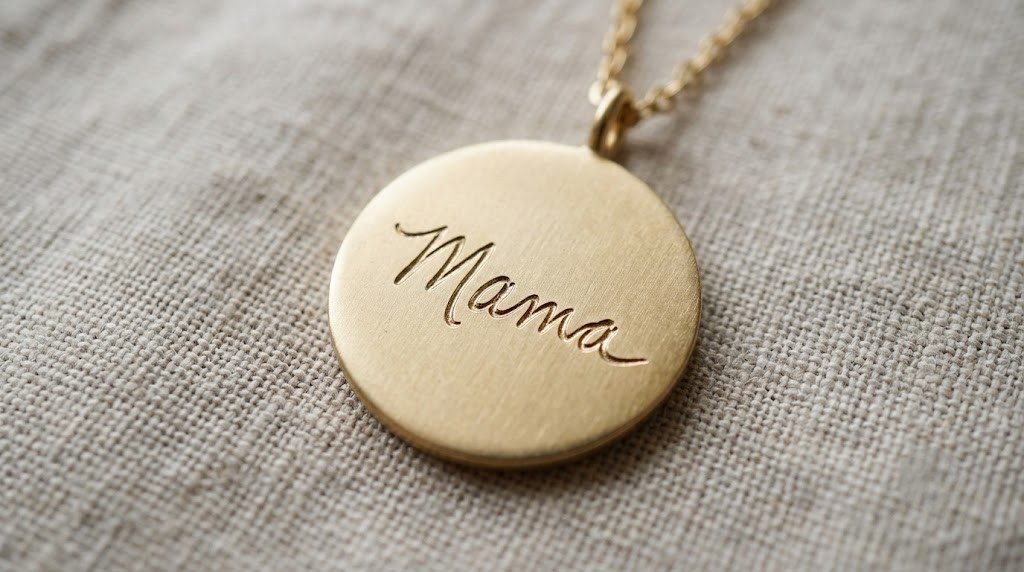
 The back of a gold pendant engraved with a single handwritten word

The details that make a piece feel like hers rarely come from the stone itself. They come from the setting, the engraving and the choices made around it. Some examples of daughter memorial diamond ideas drawn from a life, rather than from a catalog:

If she was always outdoors

A low profile pendant worn under a jacket, or a flush set band with nothing to snag, suits a keeper who hikes, gardens or climbs in her memory. Engraved coordinates of a trail, a summit or a favorite stretch of coast can sit on the back of the pendant.

If music was part of her

A few bars of a melody she loved can be engraved around the inside of a band, or the title of a song on the back of a pendant. Cufflinks or a lapel pin can be kept for nights at concerts.

If she made or fixed things

A sturdy signet ring in a hard wearing metal, or a stone set into a small object connected to her work, can feel more like her than anything polished. For a keeper who also works with their hands, a flush setting keeps the stone protected.

If she wrote, drew or doodled

Many engravers can reproduce handwriting from a card, a note or a sketch. A single word in her hand, a signature, or a small drawing she made can go on a pendant back, inside a band, or on the lid of a display box.

If she wore one thing every day

Resetting the stone into her own watch, ring or chain keeps her presence in an object people already connect with her. A jeweler needs to inspect the piece first, since not every item can safely take a new stone.

If she loved a particular place or date

A date, a city, or a short phrase she used can be inscribed on the stone’s edge or on the setting. Some daughter memorial diamond ideas need no visual reference at all; a few words are enough.

None of these daughter memorial diamond ideas depends on her age, her gender or what anyone expects a memorial piece to look like. They depend on her.

Which Daughter Memorial Diamond Ideas Suit Each Keeper?

The person who holds the stone shapes the piece as much as she does. Here are daughter memorial diamond ideas for each of the people who might be that keeper.

For a parent

A parent may want daughter memorial diamond ideas they can carry without having to explain them. A pendant worn under clothing, a band on the right hand, or a stone kept in a box beside the bed would each fit that wish. If both parents want a stone and live apart, two smaller stones from the same source can let each keep one; how sharing a daughter memorial diamond between relatives works covers the practical side.

For a sibling

A sibling may want something that matches how they live now rather than a traditional memorial style, cufflinks for someone who wears a suit to work, a flush band for someone who lifts or builds, a pin for a jacket. Several siblings can each choose a different piece from the same source material.

For her spouse or partner

A partner may want to wear the stone alongside, or instead of, a ring they already have. Some partners add the stone to an existing band; others keep it separate. If she had a spouse or partner, that person may also hold authority over her remains ahead of her parents, depending on state law and anything she put in writing, so their wishes about the stone deserve early weight.

For her children

If she had children, they may want a stone now, or one held for them until they are ready to choose. A loose stone kept with its paperwork leaves every option open, and a piece can be designed later by the person who will actually wear it. Adult children may also hold authority over her remains, again depending on state law and her written wishes.

For grandparents and others

Grandparents, close friends or a godparent sometimes ask too. A small stone in a pendant or a display box suits someone who wants a quiet keepsake rather than everyday jewelry.

Whoever the keeper is, daughter memorial diamond ideas work best when that person helps choose. A piece chosen for someone, without them, can miss in ways that are hard to fix afterward.

Which Daughter Memorial Diamond Ideas Work Without Wearing Jewelry?

Plenty of people who want a stone do not wear jewelry, and some of the most personal daughter memorial diamond ideas never leave the house.

  1. A display box. A loose stone sits in a small case, ideally beside its origin certificate and perhaps a photograph of her.
  2. A shadow box. The stone is mounted in a shallow frame alongside something of hers, a ticket, a note, a patch, a pressed flower from a place she loved.
  3. A keepsake object. A craftsperson sets the stone into the lid of a wooden box, the face of a small sculpture, or the case of a pocket watch. Ask whether the setting can be removed later if someone wants to wear it.
  4. A desk or bedside piece. A small block of glass or stone with a recessed setting keeps it visible without needing to be worn.
  5. A shared stone that travels. Some families pass a single stone between relatives for a month or a season at a time, with an agreed keeper in between.

The main practical point for non wearable daughter memorial diamond ideas is security. A loose diamond is very small, and a stone of 0.10 to 0.25 carats can be lost easily if a box is knocked over. A setting, even a simple one inside a case, makes it far harder to misplace.

How Do Engraving and Small Details Make It Hers?

Small additions often carry more of her than the stone’s size or shape ever could. Here are details worth weighing when shaping daughter memorial diamond ideas, with a note on where each one goes:

  • A laser inscription on the stone’s edge. The girdle of a diamond can carry a tiny reference number, initials or a short word, readable under magnification.
  • Engraving inside a band. Her name, a date, coordinates, or a phrase she always used.
  • Her handwriting. Engravers can trace a signature or a word from a card or note and transfer it to metal.
  • A fingerprint impression. If the funeral home took a fingerprint impression, some jewelers can engrave it onto a pendant back or a band.
  • A meaningful metal choice. Yellow gold, white gold, platinum, silver or a darker metal can each reflect her taste rather than a convention.

One detail is worth saving until later: the stone’s color. It cannot be chosen, matched or predicted from her ashes or hair, and memorial stones tend toward yellow, blue and champagne tones. Picking the metal after the finished stone arrives lets you choose what genuinely complements it. Why memorial diamond colors for a daughter vary so widely is covered in its own guide.

What Practical Limits Should Shape Daughter Memorial Diamond Ideas?

A beautiful idea needs to survive daily life. A few practical facts help sort the daughter memorial diamond ideas that will last from the ones that need more protection.

Hardness is not the same as toughness. Diamond rates 10 on the scale gemologists use to measure scratch resistance, the highest of any natural mineral, so it resists scratching superbly. A sharp knock at the wrong angle can still chip an edge, which is why rings and bracelets benefit from a protective mount.

Small stones suit low settings. Memorial stones are offered from about 0.10 carat upward, and an entry size stone of 0.10 to 0.25 carats is very small in the hand. A bezel or flush setting protects a small stone well and keeps it secure.

Clarity is usually good but not flawless. Memorial stones typically fall between SI2 and VVS on the standard clarity scale. If you want an outside assessment of the finished stone, an independent report grades it against the same quality factors used for any diamond.

Settings are usually priced separately. Across the industry, the setting, engraving and any fancy cut are typically added to the price of the loose stone. How much a daughter memorial diamond costs, and what is billed on top sets out general ranges.

Settings have their own schedule. The stone itself typically takes six to ten months, and design work often happens alongside that. How long the whole process takes explains where the months go.

For the mechanics of each setting style, the choice of metal, resizing and everyday wear, the guide to daughter memorial diamond settings goes into more detail than this page does.

Three small memorial diamonds in slightly different champagne and blue tones resting side by side

Can One Source Become Several Pieces?

Often, yes. A laboratory uses only a portion of the ashes or hair to grow a stone, so the same source material can frequently supply more than one. That makes room for daughter memorial diamond ideas that span a whole family: a pendant for one parent, cufflinks for a sibling, a loose stone held for her child.

For ashes, providers typically ask for anywhere from a few tablespoons to around 4 oz. Hair needs much less, often a small lock or a few grams, because it is roughly 50% carbon. How much hair a laboratory usually asks for explains the quantities in more depth.

Three practical points apply to any family set:

  • Tones may not match. Each stone grows separately, and stones from the same source can come out in different shades.
  • Each stone is priced on its own. A family set costs the sum of its separate stones, so ask for the set and a single larger stone to be quoted side by side.
  • Agreement comes first. Who receives which piece, who pays, and who signs the authorization are easier to settle before anything is sent.

If the family has not yet agreed, how to talk to family about a daughter memorial diamond has some starting points for that conversation.

Frequently Asked Questions

There is no published industry ranking, so popularity is hard to state honestly. Rings and pendants are the classic wearable forms, and a loose stone in a display box suits people who never wear jewelry; the right choice depends on her and on its keeper.

Can her diamond be set into a ring she already owned?

Often, if a jeweler confirms the ring can safely hold a new stone of that size. Older or worn pieces may need repair first. Bring the ring to a jeweler before the memorial stone is finished so the setting can be planned.

Should we choose the setting before the diamond is made?

You can sketch ideas early, but choosing the metal after the stone arrives is wise, because its color cannot be predicted from her ashes or hair. One sensible pattern is to settle the style during the wait and the metal at the end.

Can several family members each have a different piece?

Usually, yes. A laboratory draws on just part of the ashes or hair for each stone, so one source can often supply several, and each can go into a different piece. Agree first on who holds authority and who receives which stone.

Are daughter memorial diamond ideas different for a son or another relative?

Not really. The ideas here come from the person she was and from the keeper’s life, not from her gender. A flush band, a pendant or a display box suits anyone whose habits and taste point that way.

What if the person keeping it never wears jewelry?

A loose stone in a display box, a shadow box with her photo or handwriting, or a stone set into a keepsake object all work well. Ask the jeweler whether any setting could be adapted for wear later, in case that changes.

Final Thoughts on Daughter Memorial Diamond Ideas

There is no single right answer among daughter memorial diamond ideas. A ring worn every day, a pendant tucked out of sight, a box on a shelf that nobody else knows the meaning of, each can hold her equally well.

The daughter memorial diamond ideas that last tend to share one quality: they were chosen by thinking about her and about the person who will hold the stone, rather than about what memorial jewelry is supposed to be. Take your time over that. The stone takes months to grow, and the right idea can grow alongside it.

Learn More About Daughter Memorial Diamonds

Talk With Memorial Diamond

When you are ready to test daughter memorial diamond ideas against what is practical, Memorial Diamond is happy to help. Reach the team at memorialdiamond.us to ask about stone sizes, settings and keepsake options. Asking commits you to nothing, and every decision stays with your family.

faq

Daughter Memorial Diamond FAQ: Everything Families Ask

Anyone who lands on a page like this may be holding a dozen questions at once, and a few of them can feel strange to say out loud. A daughter memorial diamond is a real lab grown diamond grown partly from carbon recovered from her ashes or hair and usually blended with lab carbon; it generally takes six to ten months and costs from about $1,500 into five figures, depending on size and color.

 A daughter memorial diamond in champagne tone resting on a folded linen cloth beside a small sealed keepsake container

What Is a Daughter Memorial Diamond, Exactly?

It is a diamond in every physical sense. A daughter memorial diamond shares its crystal structure, its hardness and its optical behavior with a stone mined from the earth; what sets it apart is where part of its carbon came from. It is grown in a laboratory by the same methods as other lab grown diamonds, and the memorial diamond category has a documented history of its own.

It is not glass, resin or a simulant with ash suspended inside. Those keepsakes exist too, and some families treasure them, but they are different objects. A daughter memorial diamond is a crystal a gemologist would examine with the same instruments used on any stone in a jeweler’s case.

Each row of this table has a fuller answer in its own section of this page.

QuestionThe Short Answer
What is it made from?Carbon recovered from her ashes or hair, typically blended with lab sourced carbon
How long does it take?Typically 6 to 10 months; up to about 12 for large or specialty color stones
What does it cost?Roughly $1,500 at the smallest sizes, rising past $75,000 for the largest
What color will it be?Usually yellow, blue or champagne; colorless costs more; the exact tone cannot be selected
How durable is it?10 on the Mohs hardness scale, the same as any diamond
Can there be more than one?Often, since only a portion of the material is used

If her ashes are your starting point, the complete guide to turning a daughter’s ashes into a diamond walks through that route in far more depth.

Is the Stone Really Made From Her?

Yes, in part, and the “in part” deserves a plain explanation rather than a soft one.

Cremated remains are mostly calcium phosphate, the mineral that gives bone its structure. Usable carbon is a small fraction, roughly 0.5% to 4% of the ash by weight. A laboratory extracts that carbon, purifies it, and typically blends it with lab sourced carbon so there is enough volume to grow a stone. On the ash route, the personal carbon in a daughter memorial diamond usually ends up around 10% to 15% of the finished diamond’s mass, and some providers cite figures as low as 3%.

Hair is a different material. It is about 50% carbon by weight, so far less is needed, and no cremation is involved at all. What does not exist is a published industry figure for how much of a finished stone grown from hair, or from a blend of ashes and hair, is personal carbon. If you are weighing either route, ask the provider for their figure in writing. How the hair route works for a daughter is explained on its own page.

So a daughter memorial diamond is not made entirely of her carbon, and any company implying otherwise has overstated the chemistry. What is true is quieter and still remarkable: a real, traceable portion of her own carbon sits inside the crystal lattice, permanently. For some parents, that is the whole point.

How Much of Her Ashes or Hair Is Needed?

A daughter memorial diamond needs less material than people tend to imagine. Requirements vary by provider, but as a general industry guide:

  • Ashes: anywhere from a few tablespoons up to roughly 4 ounces, about 100 grams, a small fraction of what a cremation returns
  • Hair: a small lock, often only a few grams, because hair carries so much more carbon than ash does
  • Ashes and hair together: smaller amounts of each, with the split decided by the provider

The rest of her ashes can stay exactly where you meant them to stay. An urn on a shelf, a scattering somewhere she loved, or a burial plot can all remain part of your plans. Choosing a daughter memorial diamond does not have to change any of those plans, because the laboratory only needs a portion.

Quantity does not set size, either. Sending more ash does not produce a bigger stone; carat weight depends on how long the crystal is grown, and that is something you choose when you order.

If the hair you have was kept at home, such as a lock saved after a haircut or strands gathered from her brush, ask the provider what condition and amount they accept. Her belongings may also form part of her estate, and the rules on who decides about them vary by state, so a word with whoever is handling her affairs is sensible before anything is mailed.

Who Has the Authority to Decide on a Daughter Memorial Diamond?

Before a daughter memorial diamond can be ordered, someone has to authorize releasing a portion of her ashes, and that question catches some parents off guard.

Authority over a person’s remains is set by state law, and it can be changed by anything she put in writing. A spouse or partner of hers, or her own adult children, may rank ahead of her parents in directing what happens to her ashes. In other situations the parents hold it, sometimes jointly. There is no single national rule, and the answer says nothing about who loved her most.

Families arrive at this in every possible shape. Parents may be separated and see things differently. One parent may be arranging everything alone while the other keeps a distance. Her partner may welcome the idea or want more time. Brothers, sisters and grandparents may feel strongly without holding any formal say.

Start by asking the funeral home or crematory who signed the original cremation authorization; that person may hold, or know who holds, the right to release a portion. Then ask the provider whose signature they require and what they do when relatives disagree. If things are tangled, a short consultation with an estate attorney in her state can help clarify it.

Raising a daughter memorial diamond with whoever holds that authority, before you contact a laboratory, tends to spare everyone a good deal of strain later.

How Is a Daughter Memorial Diamond Made?

In seven stages, though only one or two are visible from the outside:

  1. Collection and custody. Her ashes or hair arrive and are logged under a tracking reference that follows them through every handover.
  2. Extraction and purification. The material is heated in an oxygen free, multi stage process that strips out everything except carbon, reaching roughly 99.9% purity or higher.
  3. Graphitization. The purified carbon is heated again, to around 2,500 to 2,700°C, and converted into graphite, the feedstock a growth press uses.
  4. Growth. In the HPHT method, which most memorial providers use, the graphite is typically blended with supplemental lab carbon and placed with a tiny diamond seed under roughly 6 to 8 GPa of pressure at 1,400 to 2,500°C. A minority of providers use CVD instead.
  5. Cutting and polishing. A cutter shapes the rough crystal into a round, cushion, oval or other shape.
  6. Optional irradiation. Some providers offer a post growth treatment that shifts color. It is a choice some families make, never a required stage.
  7. Grading. The finished stone may be graded; an independent report is usually optional and billed separately.

Growth takes the longest, measured in weeks to months. The first stage can feel the most fraught, because it is where the material leaves the family’s hands. The full chemistry of how her ashes become a diamond goes through each step in more detail.

Every daughter memorial diamond passes through the same physics, whichever company grows it. What differs between providers is care, tracking and candor about what happens at each stage.

How Long Does the Whole Process Take?

Across the industry, a daughter memorial diamond takes six to ten months from the day the laboratory receives her material to the day a finished stone is ready. Stones over about two carats, and specialty colors, can stretch toward twelve.
Those months are not spread evenly. Intake and paperwork take days or weeks. Purification and graphitization move fairly quickly. Growth is the long stretch, and it is long on purpose, because carat weight follows growth time rather than the amount of ash or hair sent. Cutting, any optional treatment, grading and setting each add their own time at the end.

If a particular date matters, such as her birthday, an anniversary or a family gathering, tell the provider at the very start. A reputable one will say honestly whether it is achievable and will not commit to a delivery date it cannot control. Ask what kind of updates arrive during the quiet months, too, and whom to call if several weeks pass without word.

What fills each month of the timeline is laid out for anyone planning around a date. A daughter memorial diamond is not a fast purchase, and for some families the waiting becomes part of remembering her rather than an obstacle to it.

 Laboratory crucible of purified carbon beside a labeled custody tag on a steel bench

What Color Will a Daughter Memorial Diamond Be?

Color in any diamond comes from trace elements present while the crystal forms. Nitrogen tints a stone yellow. Boron tints it blue. A colorless result requires the near absence of both.

Because the carbon in a daughter memorial diamond comes partly from a person rather than from a controlled industrial feedstock, trace elements are normal. That is why these stones lean toward yellow, blue and champagne tones. Colorless is achievable, but it needs additional processing to keep those elements out and costs meaningfully more. Some providers also offer post growth irradiation for other colors, such as red, green or black.

What nobody can do is select the exact shade, match it to her eyes or a favorite color, or predict it from her ashes or hair. Hair does not yield a lighter or narrower range than ash, and no color is more fitting for a daughter than any other. What to expect from the color, in detail has its own page.

How Much Does a Daughter Memorial Diamond Cost?

Price depends mostly on carat weight and color, then on cut, grading and setting. These are general 2026 industry ranges, not any single company’s prices:

SizeTypical Industry RangeWhat Usually Moves the Price
0.10 to 0.25 ctAbout $1,500 to $3,500Color, cut style, whether grading is added
0.5 to 1 ctAbout $5,000 to $15,000Colorless costs meaningfully more than yellow, blue or champagne
2 to 5+ ctAbout $20,000 to $75,000+Longer growth time, specialty colors, independent grading

A quote often covers the loose stone only. Independent grading, engraving, fancy cuts and a setting are commonly priced separately, and insured return shipping sometimes is too.

Ask for the full figure in writing, plus the payment schedule and the refund terms if your family decides to stop partway. If more than one relative wants a stone, each daughter memorial diamond is priced on its own, so a family plan can add up quickly. What moves the number up or down is broken down tier by tier.

A small stone carries the same origin as a large one. Size changes the price, not what the diamond is.

Can Several Family Members Each Have a Stone?

Often, yes. Because each stone uses only a portion of her ashes or hair, one source can frequently supply more than one. Her parents, her brothers and sisters, her grandparents, her partner or her own children may each want something to hold.

A few things make it smoother:

  • Decide who wants a stone before anything is sent, so the provider can plan material for every order together.
  • Ask whether one shipment can supply several growth runs or whether each needs its own portion.
  • Agree whether the stones should match in size and cut or reflect each person’s own choices.
  • Remember that each daughter memorial diamond is priced as a separate order.

Stones grown from the same source may not match in color, since trace elements and growth conditions can differ from one run to the next. Some relatives find that meaningful; either way, say it aloud before orders are placed. How families share one source between several stones covers the practical detail.

What Kinds of Jewelry Can It Become?

A daughter memorial diamond can become anything a mined or lab grown diamond can: a ring, pendant, earrings, a bracelet, cufflinks, a tie bar, a brooch, or a loose stone kept in a small case and brought out on particular days. Some parents want something to wear every day; others want an object to keep rather than wear.

Choose for the person who will wear it and the life they lead, not for any idea of what suits a daughter’s memory. A parent who gardens or works with their hands may want a low profile bezel setting that guards the stone’s edge; someone who wears jewelry only on occasions may prefer something more open. Diamond rates 10 on the Mohs hardness scale, the top of it, yet a sharp knock at the wrong angle can still chip an edge, so the setting matters.

Some families have a daughter memorial diamond appraised once it is set and add it to a home insurance policy or a separate jewelry rider. An insurance agent can explain what that involves for you.

What Paperwork Should Come Back With a Daughter Memorial Diamond?

Two documents tend to arrive with a daughter memorial diamond, and they are easily confused because they do different jobs.

An authenticity or origin certificate is usually issued in house by the provider. It records provenance: that this stone was grown from the material your family sent. Think of it as the final page of the custody record.

A grading report describes the stone itself, using the cut, color, clarity and carat standards gemologists apply to every diamond. When it comes from an independent gemological laboratory, it is a third party assessment rather than the provider’s own description. Across this industry an independent report is usually optional and costs extra, and it says nothing about origin. Typical clarity for memorial stones lands between SI2 and VVS.

Alongside those, ask for an itemized invoice, any custody log the provider keeps, written disclosure if the color was treated, and an appraisal if you plan to insure it. A daughter memorial diamond with a clear paper trail is far simpler to insure, resize, reset or pass on later.

An in-house origin certificate placed next to an independent gemological grading report on a desk

How Do You Choose a Provider You Can Trust?

By how specifically they answer, not by how warmly. What separates one company from another is whether a direct question gets a number, a written term or only a reassurance.

Before committing to a daughter memorial diamond, send the same short list to two or three providers by email and compare the replies:

  1. What percentage of the finished stone will be her carbon, and what is the supplemental carbon?
  2. How is her material tracked, and is it ever processed alongside another family’s?
  3. Which documents come back, who issues them, and is independent grading included?
  4. What is the full price, including grading, cutting, setting and shipping?
  5. What happens if a growth run fails or the stone fractures while being cut?
  6. Whose authorization do you need, and how do you handle relatives who disagree?

A daughter memorial diamond is a long commitment made at a hard time, and taking a few weeks over this choice is entirely reasonable. Where to begin when choosing a memorial diamond for your daughter sets out the first decisions in order.

Frequently Asked Questions

Can a Daughter Memorial Diamond Be Made Years After She Was Cremated?

Yes. Cremated remains are largely mineral and change little in storage, so ashes kept in an urn for years can still be used, and the same generally holds for hair stored dry. Ask the provider about their own requirements, but time since her passing is seldom the obstacle.

What If She Was Buried and We Have No Ashes?

Hair can still make a daughter memorial diamond possible in that case. A lock kept from a haircut, or hair saved from a brush or keepsake, may be enough. Check the provider’s requirements, and remember her belongings may form part of her estate, with rules that vary by state.

Do We Need to Send All of Her Ashes?

No. Laboratories typically ask for somewhere between a few tablespoons and about four ounces, a small fraction of the whole. The remaining ashes can stay in an urn, be scattered or be buried exactly as your family planned.

Can We Order One Stone Now and Another Later?

Sometimes. It depends on whether material remains and on the provider’s policy for storing or returning unused portions. If a second stone is even a possibility, say so before the first order, so a portion can be set aside.

Can Her Name Be Inscribed on the Diamond Itself?

Some providers offer laser inscription on the girdle, the thin outer edge of the stone, usually as an extra. Ask how many characters fit, whether a date can be added, and whether the inscription is recorded on the paperwork as well.

Is a Memorial Diamond as Durable as Other Diamonds?

Yes. It rates 10 on the Mohs hardness scale, like any diamond, and resists scratching from everyday wear. It can still chip if struck hard at an edge, so a protective setting is worth considering for something worn daily.

Does Choosing a Diamond Mean Giving Up an Urn or a Burial?

Not at all. Because only a portion is needed, a daughter memorial diamond can sit alongside an urn, a scattering or a burial. Combining them is a perfectly valid choice, and none of those options cancels the others.

Final Thoughts on a Daughter Memorial Diamond

Nobody reads a page like this for pleasure. You came with questions you probably never expected to ask, and some of the answers are more technical than anything about her deserves to be.

The facts about a daughter memorial diamond still matter, because they are what let you trust the people you hand her ashes or hair to. A real portion of her carbon, an honest percentage, a clear record of custody, a believable schedule and a price you understand: those are the foundations. Everything else, the shape, the setting, who wears it and when, is yours to decide slowly, and to change your mind about.

There is no deadline on any of it, and no obligation to do it at all.

Learn More About Daughter Memorial Diamonds

Talk With Memorial Diamond

If you would rather talk a daughter memorial diamond through with a person, that is a perfectly good place to start. Memorial Diamond can be reached at memorialdiamond.us to talk through what is possible with her ashes or hair, at whatever pace suits your family. Reaching out carries no obligation of any kind.

Turn Daughter Hair Into a Diamond 7 Expert, Caring Answers

How to Turn Your Daughter’s Hair Into a Diamond

It usually begins with something small: a lock tucked into an envelope years ago, a hairbrush still on her dresser, or a quiet request to the funeral director before the service. Learning how to turn daughter hair into a diamond comes down to six decisions: where the hair comes from, whether it can still be collected in time, how it is kept, whose agreement matters, which provider you trust, and what kind of stone you want back. None of them has to be rushed except one, and that one is explained below.

The numbered checklist and the laboratory chemistry each have their own page, linked below where they help.

How to turn daughter hair into a diamond: a small saved lock of hair in a labeled envelope beside a finished loose memorial diamond

What Does It Take to Turn Daughter Hair Into a Diamond?

The process used to turn daughter hair into a diamond needs less material than most parents expect, and more patience. Hair is built mostly from keratin, a protein that is roughly 50% carbon by weight, which is why providers typically ask for only a small lock or a few grams. No cremation is needed, so this route is open whether she was buried or cremated, provided some hair was kept.

What it does take, if you plan to turn daughter hair into a diamond, is a handful of clear decisions:

DecisionWhat You Are SettlingWhere It Tends to Go Wrong
SourceA saved lock, a brush, or hair taken by the funeral homeHair from a shared brush that may not be only hers
TimingWhether hair can still be collectedAsking the funeral home after the service has already happened
StorageKeeping it dry, clean and labeledSealing damp hair or losing track of which envelope is which
AgreementWho should be consulted, and who may need to signAssuming a parent automatically decides
ProviderTerms, documentation, what happens to leftoversChoosing on a website’s tone instead of written answers
The stoneCarat, color, cut, optional extrasExpecting hair to guarantee a pale or colorless result

Most of the effort sits in the first four rows. When you decide to turn daughter hair into a diamond, the part you personally handle is usually measured in weeks, not months. The complete guide to a daughter hair diamond covers the wider background if you are starting from nothing.

Where Might Her Hair Still Be Found?

Often in more places than a parent first thinks of, at whatever age she died.

The cleanest source when you set out to turn daughter hair into a diamond is a lock that was deliberately cut and saved, for a haircut, a donation, or simply to remember. A cut lock is easy to identify as hers and is usually free of dust and loose debris.

A hairbrush or comb is the next most common source. It can work, but it raises a practical question worth thinking through before you turn daughter hair into a diamond from what sits in the bristles: was the brush only ever hers? A brush shared with a sister, a partner or a roommate may hold more than one person’s hair, and no one can sort those strands by eye. Some providers accept brush hair and some prefer a cut lock, so ask rather than assume.

A hat she wore often, a hair tie or a pillowcase may hold a few strands each, but treat these as a supplement rather than a plan.

Before you gather anything to turn daughter hair into a diamond, it helps to know roughly how much you are aiming for. How much hair a daughter memorial diamond needs sets out the quantities providers usually describe.

Can the Funeral Home Collect Hair Before Burial or Cremation?

In most cases, yes, but only if someone asks in time. For anyone hoping to turn daughter hair into a diamond, this is the one decision with a genuine deadline. Cremation leaves no hair behind, and once a burial has taken place, retrieving hair is not a realistic option for most families.

A small cutting can usually be taken discreetly, often from the nape of the neck where it will not show, and handed to the family in a sealed, labeled envelope. Asking costs nothing, and many funeral homes will do it even if you are still unsure whether you plan to turn daughter hair into a diamond at all. Hair kept now leaves the choice open; hair not kept closes it.

If you are the person arranging the service, mention it at the first meeting. If someone else is arranging it, her spouse, her partner, or one of her own adult children, a gentle word with them first is kinder than going to the funeral home yourself.

If the service has already happened and nothing was kept, the hair at home becomes the whole picture. A single saved lock or a well used brush is often enough. Should both hair and ashes turn out to be available, combining ashes and hair in one stone is a separate route with its own considerations.

 A hair collection kit with a paper envelope, sealable bag and handwritten label laid out on a table

How Should Her Hair Be Stored and Packed?

Dry, clean, and clearly labeled, in whatever container your provider specifies. When you plan to turn daughter hair into a diamond, the aim is to keep the hair unchanged and unmistakably hers until it reaches the laboratory.

A few habits help, unless a provider tells you otherwise:

  • Keep it dry. Let anything damp air dry fully before it is sealed.
  • Leave it as it is. Do not wash it, trim it or add anything to it. Ask the provider before removing any hair tie or clip.
  • Use a clean envelope or container. A plain paper envelope inside a sealed bag, or the container a provider supplies in its kit, keeps it protected.
  • Label every portion. Write her name, where the hair came from, and the date it was collected. If you gathered from several sources, keep them apart.
  • Photograph it. A picture of the labeled, sealed package is a useful record.
  • Keep some back if you can. If there is more than a provider needs, holding a portion at home keeps other options open for later.

Store it at room temperature, out of direct sunlight and away from a bathroom or kitchen. The shipping sequence for anyone ready to turn daughter hair into a diamond is set out in the step by step guide for a daughter hair diamond.

Whose Agreement Matters Before You Turn Daughter Hair Into a Diamond?

It depends on her circumstances and on where you live, and it is worth thinking about before anything is posted. There is no single national rule, and it is not safe to assume that a parent automatically decides.

Hair taken by a funeral home sits close to the wider question of authority over remains, which each state sets out in its own law. A surviving spouse or registered partner is often first in that order. If your daughter had adult children of her own, they may rank ahead of her parents. And anything she left in writing, a directive, a provision in a will, a prearranged funeral plan, can change the order entirely.

Hair kept at home is often treated as a personal keepsake, but it is better not to assume nobody else has a say. Her belongings can form part of her estate, the rules vary by state, and a partner or adult child may feel strongly about what happens to something of hers. Talking it through before you turn daughter hair into a diamond is gentler than a disagreement later.

Parents do not always see this the same way, and one parent arranging everything alone is common. If there is doubt, the funeral director who handled her arrangements usually knows how the local rules work, and a short consultation with an attorney can settle it. If you are unsure how to turn daughter hair into a diamond without upsetting anyone, confirming whose permission is appropriate is the place to start, even if the answer turns out to be simply yours.

How Do You Judge a Provider Before You Turn Daughter Hair Into a Diamond?

By what it will state in writing, not by photography or tone. The differences show up in how directly a company answers specific questions.

Questions worth sending by email before you ask anyone to turn daughter hair into a diamond:

  • How much hair do you need, and do you accept hair from a brush or only a cut lock?
  • What share of the finished stone comes from her carbon? Ask for this in writing, because no standard finished stone percentage is published for hair.
  • What chain of custody records connect the stone to the hair I send?
  • What happens to any unused hair: is it returned, retained, or disposed of?
  • Where is the stone actually grown: in house or at a partner laboratory?
  • What are the cancellation terms at each stage?

That second question deserves a moment. On the ashes route, a personal carbon share of roughly 10% to 15% of the finished stone is commonly cited. That figure belongs to ashes and does not carry over to hair. Hair begins far richer in carbon, but no equivalent published figure exists for how much of a hair grown stone is hers, so the only reliable answer is the one a provider gives you in writing. Every memorial stone is made up to a workable size with supplemental laboratory carbon, and none is purely one person’s carbon.

A provider that answers these plainly is showing you how it operates. If you want to press harder on whether the stone is genuinely hers, whether a diamond is really made from your daughter’s hair looks at the verification question directly.

Which Stone Choices Come First When You Turn Daughter Hair Into a Diamond?

Carat and color, because together they set both the price and the length of the wait.

Carat is the largest lever when you turn daughter hair into a diamond. Stones are typically offered from about a tenth of a carat to beyond five, and size depends on how long the crystal grows rather than on how much hair you send. As general 2026 industry ranges, not any one company’s pricing, here is how cost tends to scale:

Stone SizeTypical Industry Range
About 0.10 to 0.25 ct$1,500 to $3,500
0.5 to 1 ct$5,000 to $15,000
2 ct to 5+ ct$20,000 to $75,000+

Settings, engraving, fancy cuts and an optional independent grading report are usually priced separately from the stone.

Color is partly chosen and partly chemistry. Nitrogen in the growth environment tints a stone yellow and boron tints it blue; only by excluding both can a grower reach colorless, which is why colorless usually costs more. Hair does not change that: a hair grown diamond is not automatically lighter, and a cleaner starting material does not make the final color predictable. Irradiation to reach red, pink, green or black is an optional extra some providers offer, not a default. What color a diamond from your daughter’s hair will be explains the range in more depth.

Choose from what you knew of her and what you want to carry, rather than from any convention about what suits a daughter. Clarity for memorial stones typically lands between SI2 and VVS, and the cut is the same range of shapes offered for any diamond.

What Comes Back to You at the End?

A finished diamond, usually loose, along with paperwork. Across the industry, the time it takes to turn daughter hair into a diamond typically runs six to ten months from the day the hair is received, and larger stones or specialty colors can take up to twelve.

During those months, the laboratory work needed to turn daughter hair into a diamond runs in stages: carbon from her hair is purified to roughly 99.9% or higher, converted to graphite at around 2,500 to 2,700°C, and grown into a crystal under high pressure, high temperature conditions of about 6 to 8 GPa and 1,400 to 2,500°C, although a minority of providers use chemical vapor deposition. How a diamond is made from your daughter’s hair follows that chemistry properly.

Expect two kinds of document. An origin or authenticity certificate, usually issued by the provider itself, traces the stone back to what you sent. An independent grading report, assessing the stone against the cut, color, clarity and carat standards, is optional and has to be requested; it describes quality, not origin.

A loose memorial diamond in an open presentation box next to its origin certificate

Ask one last question before the parcel arrives: what has happened to any hair that was not used? And give yourself room with the setting. A loose stone keeps indefinitely, and there is no deadline for deciding whether it becomes a ring, a pendant, or something that stays in its box for a while. Some parents open it the day it comes; others wait. Either is fine when you turn daughter hair into something you can hold.

Frequently Asked Questions

Is there enough hair on a hairbrush to make a diamond?

Sometimes. Providers typically ask for a small lock or a few grams, and a well used brush can hold that much. The concern is whether every strand is hers, since shared brushes mix hair. Some providers accept brush hair and some prefer a cut lock, so ask before sending anything.

How long do I have to ask the funeral home for her hair?

Until the burial or cremation takes place, and ideally at your first meeting with them. Cremation leaves no hair behind, and hair is not realistically recoverable after burial. Asking early costs nothing and keeps the option open even if you have not yet decided whether to turn daughter hair into a diamond.

Does it matter how old the saved hair is?

Generally not in itself. A lock kept dry and clean for many years is usually still workable, because what the laboratory needs is the carbon. How the hair was stored matters more than how long ago it was cut, so describe its age and storage when you first ask a provider to turn daughter hair into a diamond.

How much of the finished diamond will be her carbon?

No standard finished stone percentage is published for hair. Hair starts at roughly 50% carbon, but that describes the raw material, not the diamond. The 10% to 15% figure often quoted applies to ashes only. Every stone includes supplemental laboratory carbon, so ask each provider to state its own figure in writing.

Can more than one diamond come from the same lock of hair?

Often, if there is enough hair, since each stone uses only part of what is sent. Each diamond is grown separately, so two stones mean two prices and two timelines. Ask the provider whether one submission can cover several stones, and whether siblings or other relatives can each order one.

Is it still possible to turn daughter hair into a diamond if she was buried?

Yes, as long as some of her hair was kept before the burial, whether at home or by the funeral home. That is one of the main reasons families choose hair over ashes. If nothing was saved, check her belongings carefully, since a brush, a hat or an old keepsake may still hold enough.

Will a diamond made from her hair be colorless?

Not necessarily. Color depends on trace elements such as nitrogen and boron during growth, not on whether the carbon came from hair or ashes. Hair grown stones are not automatically lighter. A colorless stone is possible but usually costs more, and some providers offer optional irradiation for other colors.

Final Thoughts on Turning Her Hair Into a Diamond

When you turn daughter hair into a diamond, most of what matters happens near the beginning: finding the hair, keeping it well, and talking to the people who should be part of the decision. If her funeral has not yet taken place, the single most useful thing you can do today is ask for a small cutting to be kept. Everything else can wait.

Before you turn daughter hair into a diamond, get the provider’s answers in writing: quantity, carbon share, chain of custody, leftover hair, cancellation. After that the process is mostly a matter of time. What comes back is a real diamond with a documented connection to her, and what you do with it is entirely yours to decide.

Learn More About Daughter Memorial Diamonds

Talk With Memorial Diamond

If you would find it easier to talk this through with a person, Memorial Diamond can be reached at memorialdiamond.us. We can explain how to turn daughter hair into a diamond, what documentation to expect and which questions to settle first. Asking carries no obligation.

Turn Daughter Ashes 7 Expert Choices, Gently Explained

How to Turn Your Daughter’s Ashes Into a Diamond

Most families reach this idea slowly, often months after the service, sitting with an urn and a question they are not sure how to phrase. To turn daughter ashes into a diamond, you make seven decisions in a sensible order: who can authorize it, which provider to trust, what stone to request, how to take a portion from the urn, how to send it, which finishing options to accept, and what becomes of anything unused. After that, a laboratory typically needs six to ten months.

This page is about the choices involved in deciding how to turn daughter ashes into a diamond, and the mistakes that tend to sit beside each of them. It is written for the adults making the arrangements, whether she was a small girl, a teenager or a grown woman with a life of her own.

How to turn daughter ashes into a diamond: a sealed transfer container, a signed release form and a finished memorial stone on a table

What Decisions Come Up When You Turn Daughter Ashes Into a Diamond?

Seven, and when you turn daughter ashes into a diamond the order matters more than any single one. Each choice narrows the next, so a family that settles them front to back rarely has to undo anything.

NumberDecisionWhy it sits hereThe usual pitfall
1Who can authorize the releaseNothing else can proceed without itAssuming a parent automatically signs
2Which provider to useIts terms shape every later stepChoosing on tone rather than written answers
3Carat, color and cutThese set price and waiting timeExpecting a guaranteed color
4Taking a portion from the urnQuantity must match the provider’s figureSending too little and stalling the order
5Sending the ashesThe formal handover pointPaperwork traveling separately from the parcel
6Finishing choicesCut, optional treatment, optional gradingConfusing a grading report with an origin certificate
7Unused materialDecided before anything leaves homeNever asking, then wondering later

When families set out to turn daughter ashes into a diamond, the first two decisions carry most of the risk. The middle three are practical and quick. The last two feel minor until a family discovers it did not ask about them.

If you want the strict numbered sequence rather than the reasoning behind each choice, the step by step order for a daughter’s ashes lays it out stage by stage. What follows here is the thinking a family does before it is ready to turn daughter ashes into a stone at all.

Who Has the Authority to Turn Daughter Ashes Into a Diamond?

It depends on your state, her circumstances and anything she put in writing, and it is not always her parents. Settle it before you contact any provider or make plans to turn daughter ashes into a stone, because the release form is the one document nobody can sign on someone else’s behalf.

Each state sets its own order of priority for who controls a person’s remains, and there is no single national rule. If your daughter was an adult, a husband, wife or registered partner may rank ahead of you. So may her own grown children. A directive, a will provision or a prearranged plan she left can override the default order entirely.

Where she died young, the decision usually falls to her parents, but how the rules treat two parents who disagree still varies from state to state. Parents who are separated or divorced sometimes need both signatures; sometimes only one. The funeral home that handled the cremation generally knows how this works locally, and a short call to an attorney can confirm it.

Two things are worth saying plainly. Families are not always in agreement about this, and that does not make anyone wrong. One parent arranging everything alone is also common, and nothing about the process assumes a united household.

The pitfall is timing. A family that decides to turn daughter ashes into a diamond and only then learns that her spouse holds the authority may lose weeks waiting on a signature that could have been requested on day one.

How Do You Vet a Provider Before You Commit?

A printed provider quote and a list of written answers laid beside a notebook and pen | Stock acceptable

By what it will confirm in writing, not by how its website makes you feel. Gentle language costs nothing to produce; specific written answers are what separate one company from another.

Before you agree to let anyone turn daughter ashes into a stone, ask each provider you are considering for these answers by email:

  • The exact quantity of ash it needs, stated as a number
  • What document links the finished stone to your specific submission
  • Whether the growth happens in house or at a partner laboratory
  • What happens if a growth run fails, and whether that costs you anything
  • Its cancellation terms once material has been received
  • Whether unused ash is returned, held or disposed of, and how

A company that answers all six plainly is showing you how it will behave during the months it takes to turn daughter ashes into a finished diamond. Evasion at this stage rarely improves later.

Keep the quote and the answers together; months later, when you want to check what was promised before you turn daughter ashes over for good, you will be glad of it. The complete guide to a daughter ashes diamond covers the wider background if you are still deciding whether this is right for your family.

Which Carat, Color and Cut Should You Ask For?

Choose these before you turn daughter ashes over to a laboratory, because they fix both the price and the length of the wait. Of the three, carat has the biggest effect on each.

Memorial stones are generally offered from about a tenth of a carat up to five carats and beyond. A larger stone is not produced by sending more ash; it is produced by keeping the crystal in the press for longer. So if you plan to turn daughter ashes into something substantial, expect the calendar and the invoice to stretch together.

Color is only partly yours to choose when you turn daughter ashes into a diamond. Trace elements present while the crystal grows decide much of it: nitrogen tends to give yellow, boron tends to give blue, and a truly colorless stone needs almost none of either, which is why it usually costs more. Because the carbon comes from a personal, organic source, warm and blue tones are common. Even a carefully purified starting material does not make the outcome predictable, so treat any color as a likely result rather than a promise. What color a stone from her ashes is likely to be explains this in more depth.

Choose a color for your own reasons, never simply because she was a daughter. Some families pick a shade tied to something she loved, whether that was the ocean, a team, a season or nothing anyone else would guess; others simply accept whatever the chemistry produces.

Cut is the most familiar choice: round, princess, cushion, oval or emerald. Clarity usually lands between SI2 and VVS.

How Is a Portion Taken From the Urn?

Carefully, over a tray, in good light, and ideally with someone else in the room. Only a small share is needed to turn daughter ashes into a diamond; the industry typical request runs from a few tablespoons up to roughly 4 oz, or about 100 grams.

Most providers send a collection kit with a sealed container, a scoop and labels. If the urn is sealed or difficult to open, a funeral home can often open it, measure the portion and reseal it. There is no expectation that a parent must do this personally, and many choose not to.

Cremated remains are mostly bone mineral, closer to coarse sand than powder. Work slowly, check the quantity against the provider’s written figure, and photograph the sealed container before it is packed.

The pitfall here is quantity. A parcel that arrives short of what the laboratory needs pauses everything while a second portion is arranged. How much ash a daughter memorial diamond needs covers the figures and what they mean for the rest of the urn, and it is worth reading before you decide how to turn daughter ashes into a stone of any size.

What Is the Safest Way to Send Her Ashes?

Tracked, insured, and with the provider’s paperwork inside the parcel rather than following it. Take the courier option the provider recommends; this is the one part of the effort to turn daughter ashes into a diamond where saving a few dollars is not worth the worry.

Keep the tracking number handy, and do not assume the parcel arrived until the laboratory confirms it in writing.

That receipt is the handover point. Everything before it was yours to manage; everything after it belongs to the laboratory’s chain of custody process, which is the document trail showing that the stone grew from your submission and nobody else’s. Ask to see a sample of that paperwork before you agree to turn daughter ashes into a stone, not after. Whether the stone is really made from her ashes explains what that trail can and cannot prove.

Which Finishing Choices Come Back to You?

 An origin certificate and a separate independent grading report placed side by side with a loose diamond

Usually three, and they arrive together once a rough crystal exists. This is the only point in the waiting months that asks anything of you.

The first is confirming the cut. A gemologist shapes and polishes the rough, and a careful provider will tell you if the crystal would suit a different shape better than the one you chose.

The second is irradiation. When you turn daughter ashes into a diamond, you may be offered post growth treatment that can produce red, pink, green or black stones. It is optional, it adds cost, and many families decline it because they would rather keep the color the stone grew with.

The third is independent grading, which is also optional. A third party gemological laboratory can assess the finished stone against the standard cut, color, clarity and carat measures used for any diamond. That report describes quality. It is a different document from the origin or authenticity certificate issued by the provider, which records that the stone came from your specific submission. Knowing the difference before you turn daughter ashes into a stone saves confusion when the paperwork arrives.

What Happens to the Ashes That Are Not Used?

Ask before you agree to turn daughter ashes into a diamond, because policies genuinely differ. Some providers return unused material, some hold it for a period, and some dispose of it respectfully unless told otherwise.

Extraction consumes only part of what you send, and families sometimes assume leftovers come back automatically. If returning them is important to you, get that commitment in writing alongside the quote.

It is also worth deciding what happens to the rest of the urn. Most of her ashes stay with you, so burial, scattering, keeping them at home or dividing them among relatives all remain open. A diamond is one way to hold on to a part of her; it does not need to replace anything else the family has planned. Some families also add a lock of her hair, and combining her ashes and hair in one stone covers that route.

How Long Does It Take, and What Does It Cost, to Turn Daughter Ashes Into a Finished Stone?

Across the industry, expect six to ten months from the day material is received, and up to twelve for larger stones or specialty colors. The decisions you make yourself rarely take more than a few weeks; almost all of the calendar is laboratory time.

During that stretch the ash is heated without oxygen to strip away the calcium phosphate, since usable carbon makes up only around 0.5% to 4% of ash by weight. What remains is purified to about 99.9% carbon or better, converted to graphite at roughly 2,500 to 2,700°C, and grown in a press at about 6 to 8 GPa and 1,400 to 2,500°C. That high pressure method, one of the two used for lab grown diamond generally, is standard for memorial stones; a minority of providers use vapor deposition instead. How the stone is made from her ashes walks through the science properly.

Stone sizeGeneral 2026 industry range
0.10 to 0.25 carat$1,500 to $3,500
0.5 to 1 carat$5,000 to $15,000
2 carats and above$20,000 to $75,000 or more

These are general 2026 industry ranges rather than any one company’s rates. Settings, engraving, fancy cuts and an optional grading report are normally priced separately, and colorless typically costs more than a yellow or blue stone of the same size.

What Mistakes Should You Avoid Before You Turn Daughter Ashes Into a Stone?

Most problems families meet when they turn daughter ashes into a diamond are administrative rather than scientific. The ones that catch families most often are predictable, which makes them easy to prevent:

  • Starting with the provider instead of the signature. Confirm who holds authority first; everything else waits on it.
  • Accepting verbal answers. Quantities, cancellation terms and unused material policies belong in writing.
  • Expecting a fixed color. Chemistry has a vote, and no provider can guarantee the outcome.
  • Sending more ash to get a bigger stone. Size comes from growth time, not quantity.
  • Mixing up the two certificates. An origin document and a grading report do different jobs.
  • Skipping the family conversation. Other relatives may want a stone too, and one submission can often serve several.

None of these is a disaster on its own. Together they account for most of the delays and disappointments families describe when they look back on the months it took to turn daughter ashes into something they could hold.

Frequently Asked Questions

Is it too late to turn daughter ashes into a diamond years after the cremation?

No. Cremated remains are mineral and chemically stable, so time alone does not rule anything out. When you first contact a provider, mention how long the ashes have been stored and in what kind of container, since storage conditions can matter more than the number of years. Ask them to confirm in writing that the material is suitable before you send it.

How much of the finished diamond is actually her?

On the ash route, personal carbon typically makes up about 10% to 15% of the finished stone’s mass, and some providers publish figures as low as 3%. The rest is supplemental lab carbon added so the crystal can reach a workable size. The stone is still grown in part from her own carbon, which is the honest and meaningful claim; nobody can truthfully promise a stone that is entirely her.

Do we need to send all of her ashes?

No. Providers typically ask for somewhere between a few tablespoons and about 4 oz, which is a small share of a full cremation. The remainder stays with the family for burial, scattering, an urn at home or dividing among relatives. Confirm the exact figure with your provider in writing so the parcel is neither short nor unnecessarily large.

Can her brothers and sisters each have a stone from the same ashes?

Often, yes, because each diamond uses only a portion of the remains. Each stone goes through its own growth run, so two or three diamonds mean separate timelines and separate prices. Ask whether one submission can cover several orders, and agree within the family who is arranging each one before anything is sent to the laboratory.

What if her other parent does not want to turn daughter ashes into a diamond?

Pause until the question of authority is clear. Depending on your state and her circumstances, one parent, both parents, or a spouse or adult child of hers may need to sign. A provider cannot resolve a family disagreement, and it is kinder to talk it through first. A funeral director or attorney can explain who holds the decision where you live.

Can we choose a color that meant something to her?

You can request one, but the result is not guaranteed. Nitrogen tends toward yellow and boron toward blue, and colorless stones need the absence of both, usually at extra cost. Optional irradiation can produce red, pink, green or black. Choose a shade for reasons tied to who she was, and treat the finished color as likely rather than certain.

Final Thoughts on Turning Her Ashes Into a Diamond

Seven decisions sounds like a great deal to ask of a family that is already carrying so much. In practice, most of them take an afternoon each, and two of them, authority and the choice of provider, account for nearly all of the risk.

Before you turn daughter ashes into a diamond, settle who signs, get the provider’s answers in writing, and ask about the unused ash before anything leaves your hands. The rest becomes a question of patience. When the stone does arrive, it carries a documented line back to her, at whatever age she was taken from you.

Learn More About Daughter Memorial Diamonds

Talk With Memorial Diamond

If you would rather talk the decisions through with a person, Memorial Diamond can be reached at memorialdiamond.us. Ask about authority, quantities, timelines or anything else it takes to turn daughter ashes into a stone. There is no obligation in asking, and no decision needs to be made on that first conversation.

urn Daughter Ashes and Hair 9 Proven Steps, Gently Guided

How to Turn Your Daughter’s Ashes and Hair Into a Diamond

Some families end up keeping two things for her: the ashes that came back from the crematory, and a lock of hair saved in an envelope or a small box. If you want to turn daughter ashes and hair into a single diamond, it can be done, but it rests on nine decisions taken roughly in order, beginning with whether your provider accepts both materials in one order.

The laboratory work that follows typically runs six to ten months.

How to turn daughter ashes and hair into a diamond: a sealed ash container and a labeled hair envelope beside a finished blue-toned memorial stone

What Does It Take to Turn Daughter Ashes and Hair Into One Diamond?

Nine decisions, and most are made before anything leaves your home. The laboratory science barely changes between ash, hair, or both. What changes when you decide to turn daughter ashes and hair into one stone is the planning around it.

For the stage by stage mechanics once a parcel is on its way, the step by step walkthrough for ashes and hair picks up where these decisions end.

StepThe DecisionWho Is Involved
1Does the provider accept a blended submission?You and the provider
2Who can authorize releasing her ashes?Whoever holds authority
3Whose agreement is needed for her hair?Close family, case by case
4How much ash and hair to gatherYou
5Keeping and labeling them separatelyYou, perhaps a funeral home
6One combined stone or twoYou and family
7Carat, color and cutYou
8Sending bothYou and a courier
9Finishing choicesYou and the provider

Only the first three steps involve other people. Once those are settled, you can decide how to turn daughter ashes and hair into a finished stone at whatever pace feels manageable, whether that is weeks after her death or many years later.

Parents, partners, siblings, and adult children all arrange memorial diamonds, and your daughter may have been a little girl or a grown woman with a household of her own. The decisions hold at whatever age she died. What differs is who else has a say when you turn daughter ashes and hair into something permanent.

Step 1: Will a Provider Agree to Turn Daughter Ashes and Hair Into One Stone?

Not every provider offers this. Some laboratories grow each stone from one source material and will ask you to pick. Others accept a combined submission, extract carbon from each material separately, and blend the purified result into one growth charge.

Make the question specific and get the reply in writing: how exactly do they plan to turn daughter ashes and hair into one crystal, and what documentation links both materials to your order?

A few follow up questions can separate clear providers from unclear ones:

  • Is a combined stone priced differently from a single source stone of the same size?
  • If one material yields less carbon than expected, what happens next?
  • Will leftover ash and hair be returned, held for a later stone, or disposed of, and how?

Get that last answer before you send anything, since policies on unused material differ across the industry.

If the provider you prefer works from one source only, turning her ashes alone into a diamond and growing a stone from her hair alone each cover that route.

Step 2: Who Holds Authority Over Her Ashes?

Not automatically her parents. Who may decide about a person’s remains is fixed by each state’s own law, with no nationwide standard to fall back on.

A husband, wife, or registered partner is frequently at the top, and if your daughter left adult children, their say can come before yours as well.

Anything she put in writing can reshape that order, including a funeral directive, a clause in her will, or a plan arranged in advance with a funeral home.

So the person arranging the diamond is not always the one who signs. A mother or father may handle every detail and still need a partner’s signature, and learning that early is far gentler than learning it late.

Parents may see this differently, or one may be arranging it alone. If authority is unclear, the funeral home that handled the cremation usually knows how it works locally, and a brief call with an attorney can confirm it before you decide to turn daughter ashes and hair into a diamond.

Step 3: Whose Agreement Matters for Her Hair?

Usually fewer people’s than for her ashes, though the honest answer is not nobody’s. Rules on remains are written mostly with bodies and cremated remains in mind, and a lock kept at home often raises a simpler question in practice. Simpler is not the same as outside every rule.

A person’s belongings can form part of her estate, and how that applies varies by state. If your daughter had a spouse, a partner, or adult children, it is considerate, and sometimes necessary, to check that they are comfortable with her hair being used.

If the hair is in someone else’s keeping, using it is a conversation rather than a decision.

Many families cover both questions in one conversation. When you plan to turn daughter ashes and hair into one stone, a single written agreement naming both materials saves a second round of asking. Check that the provider’s own authorization form names both.

Step 4: How Much of Each Material Should You Gather?

Less than most families expect when they first plan to turn daughter ashes and hair into a diamond. Providers typically ask for between a few tablespoons and about 4 oz, roughly 100 g, of cremated remains, plus a small lock or a few grams of hair.

Requirements vary, so confirm the figures with your own provider.

MaterialIndustry Typical AmountWorth Knowing
Cremated remainsA few tablespoons to about 4 oz, approximately 100 gUsable carbon is only around 0.5 to 4 percent of ash by weight
HairA small lock, a few gramsRoughly half carbon by weight
PaperworkDeath or cremation certificate, ID, signed authorizationVaries by provider and state

Quantity does not decide size. Carat is set by growth time, so extra ash or a thicker lock will not buy a bigger diamond when you turn daughter ashes and hair into a stone. It only leaves more unused material.

How much ash and hair a daughter memorial diamond needs goes into the amounts more closely.

Hair from a brush, a saved braid, or a lock cut at the funeral home can all work. Note its source and any dye. Choosing to turn daughter ashes and hair into a diamond still leaves most of what you hold with you.

Step 5: Why Keep the Ashes and Hair Apart and Labeled?

Because a combined stone still begins as two materials, and the laboratory purifies each by its own route before blending. Keeping them apart protects the chain of custody, the record showing the finished stone grew from what you sent.

Before you turn daughter ashes and hair into one stone, a simple routine keeps them distinct:

  • Put the ash portion in the sealed container the provider or funeral home supplies.
  • Place the hair in a clean paper envelope, not plastic, and seal it.
  • Label each with her full name, the material, the date, and your order reference.
  • Photograph both, with labels visible, before packing.

Never mix the two yourself. Ash is mostly bone mineral and hair mostly protein, and a laboratory cannot cleanly separate them once combined at home.

Anyone ready to turn daughter ashes and hair into one stone should hand them over apart and let the laboratory do the blending.

If the urn is sealed, a funeral home can open it, portion out what is needed, and reseal it. Nobody has to do this alone, and asking a sibling or friend to sit with you is entirely reasonable.

Step 6: Is It Better to Turn Daughter Ashes and Hair Into One Stone or Two?

Neither is better in general. It depends on what the stone is meant to hold.

A combined stone blends carbon from both materials into one crystal. Two stones, one from ashes and one from hair, keep each source distinct.

One Combined StoneTwo Separate Stones
CostOne stone’s priceEach priced on its own
TimelineOne growth runTwo runs, possibly finishing apart
What It HoldsBoth materials togetherEach material in its own stone
SharingOne piece, kept or passed onTwo people can each keep one
Provider NeedsMust accept a blended submissionAny provider offering both routes

Some families decide to turn daughter ashes and hair into one stone because it gathers everything they saved into one object. Others prefer two because the materials came from different chapters of her life.

Sharing can also settle the decision. If her partner and her parents each want something, two stones, or two combined stones from one submission where allowed, may suit better.

The complete guide to a daughter ashes and hair diamond looks at these arrangements.

Unsure? Ask whether material can be reserved so you can turn daughter ashes and hair into a second stone later.

How to turn daughter ashes and hair into a diamond: a sealed ash container and a labeled hair envelope beside a finished blue-toned memorial stone

Step 7: Which Carat, Color and Cut Suit a Blended Stone?

Carat drives both price and wait. Memorial stones generally run from about 0.10 carat to beyond 5 carats, and larger sizes grow for longer.

Color is part choice and part chemistry. Nitrogen during growth pushes a crystal toward yellow, boron toward blue, and colorless needs close to none of either and usually costs more.

Adding hair does not make a stone automatically lighter, and a cleaner looking starting material does not make the shade predictable.

What color a diamond from her ashes and hair may be explains why.

Cut means the standard shapes, from round to emerald. Choose for how and by whom the stone will be worn or kept, not from any assumption about what a daughter should have.

Then comes the honest question of how much is her. On the ash route, providers commonly describe roughly 10 to 15 percent of a finished stone’s mass as personal carbon, with some as low as 3 percent.

For hair, or for a blended charge, nobody publishes a comparable figure for the finished stone. Hair’s roughly 50 percent carbon describes the input, not the diamond.

Before you turn daughter ashes and hair into a blended charge, ask the provider for its own figure and method in writing.

No memorial diamond is 100 percent personal carbon. Supplemental lab carbon makes up a growable volume around a real portion of hers.

Whether the stone is really made from her ashes and hair examines that claim closely.

Step 8: How Do You Send Both Materials Safely?

Tracked, insured where possible, with paperwork inside. Most providers send a kit with containers, labels, and often a prepaid courier label.

Pack the ash container and hair envelope so neither can open, include the signed authorization and intake form, and note the tracking number.

Rules on shipping cremated remains differ by carrier and country, so ask what the provider recommends.

Expect an acknowledgment confirming both materials arrived and were logged separately. This is where the plan to turn daughter ashes and hair into a diamond leaves your hands.

From there the work is the laboratory’s. Each material is purified to roughly 99.9 percent carbon or better, graphitized at around 2,500 to 2,700 degrees Celsius, and grown, usually by HPHT at about 6 to 8 GPa and 1,400 to 2,500 degrees Celsius, with a minority of providers using CVD.

How the laboratory grows a stone from her ashes and hair follows that science.

Step 9: Which Finishing Choices Come Back to You?

Usually three, once the rough crystal exists.

First, the cut is confirmed against what the rough can yield. A provider suggesting a different shape should explain why.

Second, color treatment. Some providers offer post growth irradiation for red, pink, green, or black. It is optional and priced separately, and many families leave the stone as it grew.

Third, independent grading. A third party report on cut, color, clarity, and carat is optional, and it differs from the provider’s certificate of origin, which traces the stone to your submission.

Memorial stones typically grade between SI2 and VVS in clarity.

The stone usually arrives loose. Diamond sits at 10 on the Mohs scale of mineral hardness, so it suits daily wear.

Ask again what became of any unused ash and hair once you turn daughter ashes and hair into a finished diamond.

 A loose memorial diamond in an open presentation box beside its certificate of origin

What Does It Cost to Turn Daughter Ashes and Hair Into a Diamond?

When you set out to turn daughter ashes and hair into a diamond, price follows the stone you choose, not the materials you send.

Six to ten months is the usual industry span from receipt, with larger stones or specialty colors sometimes taking up to twelve months.

These are general 2026 industry ranges, not any one company’s pricing:

  • About 0.10 to 0.25 carat: roughly $1,500 to $3,500
  • About 0.5 to 1 carat: roughly $5,000 to $15,000, with colorless costing noticeably more than yellow, blue, or champagne
  • About 2 to 5 plus carats: roughly $20,000 to $75,000 and upward
  • Extras: settings, engraving, fancy cuts, and an optional grading report are quoted separately

If you turn daughter ashes and hair into two stones rather than one, expect two prices and possibly two timelines.

Ask whether a combined submission carries any surcharge, and get the full quote in writing.

Frequently Asked Questions

Can I send her hair and ashes at different times?

Many providers can work with that, but ask first. A laboratory needs both materials in hand before it can begin to turn daughter ashes and hair into a crystal, so a late second parcel usually pauses the order.

Confirm how the two parcels are linked.

Does adding hair make the diamond lighter in color?

Not automatically. Color comes from trace elements such as nitrogen and boron present during growth, and neither ash nor hair guarantees a shade.

If a specific color matters when you turn daughter ashes and hair into a diamond, discuss colorless processing or optional irradiation beforehand.

How much of a combined stone actually comes from her?

No published finished stone percentage exists for a blended charge. The widely quoted 10 to 15 percent figure, with some providers citing 3 percent, applies to the ash route only.

Hair’s roughly 50 percent carbon describes the raw material. Ask your provider for its own estimate and method in writing.

What if my preferred provider only accepts one material?

Then you can choose which material to send, or ask another provider to turn daughter ashes and hair into one stone.

Some families send the ashes and keep the lock as it is. Others do the reverse, choosing by what they want the stone to hold.

Can hair from a hairbrush be used?

Often, yes, if enough can be gathered and it clearly came from her. Tell the provider its source, since brush hair may need cleaning and can include other people’s hair in a shared home.

A lock that was cut and kept is usually simpler.

Can her partner and her parents each have a stone from the same materials?

Frequently, because only a portion of the ashes and hair is used, and several stones can often come from one submission.

Whoever holds authority over her ashes should agree to the arrangement before you turn daughter ashes and hair into more than one stone.

Will the unused ashes and hair be sent back?

That depends on the provider, so ask before anything is shipped. Some return leftover material, some hold it for a possible future stone, and some dispose of it respectfully.

Ask which applies, how it is recorded, and whether the choice is yours.

Final Thoughts on Turning Her Ashes and Hair Into a Diamond

Nine steps look like a lot on paper. Most of the real effort sits in the first three: a provider that accepts both materials, and clarity on who needs to agree.

There is no deadline. Ashes and hair both keep indefinitely, and waiting a year, or ten, before you turn daughter ashes and hair into a diamond is as valid as starting next week.

Whatever you decide, what comes back is a real diamond with a documented line to her, made in part from carbon that was hers.

Learn More About Daughter Memorial Diamonds

Talk With Memorial Diamond

If you would rather talk it through with a person, Memorial Diamond can be reached at memorialdiamond.us to discuss how to turn daughter ashes and hair into one stone, or two, and what each step involves.

Asking carries no obligation, and there is no timetable to keep.

Made From Daughter Hair 8 Expert Stages, Clearly Explained

How a Memorial Diamond Is Made From Your Daughter’s Hair

Maybe the lock of hair is folded in tissue paper, or tucked in an envelope you have not opened in a while, and it seems far too small to become anything at all. Put simply, a diamond made from daughter hair starts with a laboratory removing everything from her hair except its carbon, purifying that carbon, turning it into graphite and growing it under immense pressure into a real diamond, which across the industry usually takes six to ten months. Supplemental lab carbon joins hers along the way, and the rough crystal is then cut, polished and documented back to her submission.

A diamond made from daughter hair resting beside a small lock of hair in an open envelope

What Happens When a Diamond Is Made From Daughter Hair?

Eight stages, and almost none of them ask anything of the family once the envelope has left your hands. The lab side of a stone made from daughter hair is a sequence of heat, refinement and pressure, followed by the craft work every diamond needs.

Here is the usual sequence, seen from the material’s side:

StageWhat happens to her hairTypical conditions or time
1. IntakeThe hair is logged, weighed, photographed and given its own tracking numberOn arrival
2. ExtractionOxygen free heating drives off the non carbon parts of the keratinEarly in the process
3. PurificationThe recovered carbon is refined furtherTo roughly 99.9% carbon or higher
4. GraphitizationPurified carbon is converted into graphiteRoughly 2,500 to 2,700°C
5. GrowthGraphite, blended with supplemental carbon, grows on a diamond seedRoughly 6 to 8 GPa and 1,400 to 2,500°C, for weeks to months
6. CuttingThe rough crystal is shaped and polishedAfter growth is complete
7. Optional finishingIrradiation for color, independent gradingOnly if you choose them
8. ReturnThe stone ships with its origin paperworkAt the end

Providers label and group these stages differently, but every diamond made from daughter hair passes through some version of these stages, with stage 7 only if you choose it. What varies more is the paperwork around them.

For the family side, meaning what gets signed, packed and decided, the step by step walkthrough for a daughter hair diamond sets those tasks out in order.

 A sealed laboratory furnace used to heat material in an oxygen-free environment

Why Is Her Hair Such a Rich Source of Carbon?

Because hair is built almost entirely from keratin, a tough, fibrous protein, and roughly half of hair’s weight is carbon. That is an unusually high proportion for anything a family might keep, and it is the reason a diamond made from daughter hair can begin from a very small sample.

That 50% is a property of the hair going in, not a measurement of the diamond coming out. Proteins also carry hydrogen, oxygen, nitrogen and sulfur, and all of that has to go before carbon can be grown into a crystal.

Hair has a second quality that matters to many families: it does not depend on cremation. A lock can come from someone who was buried, from a keepsake saved long ago, or from hair set aside by a funeral home. Whether that lock dates from when she was a little girl or from her life as a grown woman, the chemistry of a stone made from daughter hair is the same.

Kept dry and away from heat, hair is remarkably stable, so age alone is rarely a concern; just describe any unusual storage to the provider. The full guide to a daughter hair diamond covers collection and storage in more depth.

How Does the Lab Strip Away Everything That Is Not Carbon?

By heating the hair in a sealed, oxygen free environment across several stages, so that the non carbon parts of the keratin are driven off while the carbon stays behind. Oxygen is kept out on purpose, since carbon heated in open air simply burns away as gas.

This is where a stone made from daughter hair stops looking like hair at all; what remains is a dark carbon residue.

Purification follows directly. The carbon is refined until it reaches roughly 99.9% purity or better, which removes the leftover traces that could otherwise interfere with growth. Some providers call extraction and purification one step, others two; what matters is that they will explain it plainly.

A lock often holds more than a diamond made from daughter hair requires, so ask before sending whether unused hair comes back to you, is kept on file, or is disposed of respectfully. Policies vary.

What Does Graphitization Do to Her Carbon?

It converts the purified carbon into graphite, the orderly, layered form of carbon that diamond growth equipment accepts as feedstock. The material is heated again, this time to somewhere around 2,500 to 2,700°C, and its atoms settle into that stacked arrangement.

Graphite and diamond are both pure carbon; they differ only in how the atoms are bonded. Graphite’s flat sheets slide over one another, which is why pencil lead is soft. Diamond’s atoms lock into a rigid three dimensional lattice, which is why a finished stone sits at 10 on the hardness scale. Growing a stone made from daughter hair means forcing one arrangement into the other.

For a diamond made from daughter hair, graphitization is the quiet hinge of the process, turning a personal, irregular starting material into a consistent input a press can work with.

How Is a Stone Made From Daughter Hair Actually Grown?

A labeled, sealed hair sample bag with a printed reference number on an intake bench

Most often by high pressure, high temperature growth, usually shortened to HPHT. Her graphite, made up to a workable volume with supplemental lab carbon, is loaded into a growth cell alongside a tiny diamond seed and held at roughly 6 to 8 GPa and between 1,400 and 2,500°C, conditions that imitate the deep Earth where natural diamonds form.

Under that pressure the carbon migrates onto the seed and builds outward, atom by atom, into a single crystal. A minority of providers use chemical vapor deposition instead, in which carbon is converted to a gas and deposited in thin layers onto a seed plate. Both are established techniques within lab grown diamond production, HPHT and CVD alike, and both produce a chemically genuine diamond.

The length of the growth run is what decides size. A larger carat means a longer run and more careful control, which is why a stone made from daughter hair does not get bigger because more hair was sent. Carat is a choice you make; the timeline follows from it.

Color is settled here too. Trace nitrogen present during growth pushes a crystal toward yellow, trace boron pushes it toward blue, and a colorless result needs both to be absent, which generally costs more. A cleaner looking starting material does not make the outcome predictable, and a diamond made from daughter hair is not automatically lighter than one grown from ashes. What color a diamond grown from her hair is likely to be looks at that question on its own.

How Much of a Diamond Made From Daughter Hair Is Her Own Carbon?

No published industry figure gives the finished stone share for a diamond made from daughter hair, so the honest answer is to ask your provider and get the reply in writing. Hair’s roughly 50% carbon content describes the raw material, not the proportion of a finished diamond that came from her.

Supplemental lab carbon is typically part of a memorial stone, because growing a crystal of useful size needs more carbon than a personal sample reliably yields. The percentages sometimes quoted for ash based stones describe the ash route, and they should not be borrowed to describe a diamond made from daughter hair.

None of this makes the stone less hers. Her carbon, recovered and purified, becomes part of the crystal lattice itself; it is not a coating or an inclusion sitting inside a separate gem. What the stone is not, and what no honest provider will claim, is 100% her carbon with nothing added.

Ask precisely: roughly what share of the finished stone is her carbon, and is that an estimate or a measurement? For a closer look at the evidence, whether a memorial diamond is really made from your daughter’s hair goes through it carefully.

Why Does Hair Need So Much Less Material Than Ash?

Because carbon makes up about half of hair but only a sliver of ash, which is why a stone made from daughter hair can begin from a pinch of material. Cremated remains are mostly calcium phosphate, the mineral of bone, and usable carbon typically accounts for roughly 0.5% to 4% of ash by weight.

That difference shows up directly in what providers ask for:

  • Hair: usually a small lock, or a few grams, which many providers describe as roughly palm sized
  • Ashes: typically a few tablespoons up to about 4 oz, roughly 100 grams
  • Both routes: size is set by growth time, so a larger parcel does not produce a larger stone, and the unused remainder can stay with the family

For a family whose daughter was cremated, that can open a choice between the two materials, or a decision to use both. How a memorial diamond is made from your daughter’s ashes explains the ash route for comparison, and how much hair you need for a daughter memorial diamond covers quantities in detail.

Before cutting a lock for a diamond made from daughter hair, confirm the provider’s exact requirement in writing. The figures above are industry typical, not any one company’s rule.

How Is a Stone Made From Daughter Hair Kept Traceable?

Through chain of custody, the documented trail that follows a submission from the moment it arrives until the finished stone ships. It is the only thing that lets a provider show, afterward, that a stone made from daughter hair came from her hair and nobody else’s.

A sound custody process usually includes several habits:

  • Logging and photographing the sample on arrival, with a unique reference number
  • Recording its weight before any processing begins
  • Keeping the material labeled and physically separate through extraction and purification
  • Carrying that reference number onto the growth run and the rough crystal
  • Issuing an origin or authenticity certificate that ties the finished stone back to the submission

Ask what records you will receive and when; some providers report at each stage, while others only confirm receipt and dispatch.

What Happens After the Rough Crystal Leaves the Press?

The rough crystal of a diamond made from daughter hair is assessed, then cut and polished into the shape you chose, just as a mined stone would be. Round, oval, cushion, princess and emerald cuts are all possible.

Two finishing options come next, and both are optional:

Irradiation. Some providers offer post growth treatment to shift or deepen color, producing reds, pinks, greens or blacks. It adds cost and time. Plenty of families decline it and keep the color the crystal grew with; others choose a treated color for reasons entirely their own.

Independent grading. A third party gemological lab can assess the finished stone against the recognized cut, color, clarity and carat standards. Memorial diamonds typically land somewhere between SI2 and VVS clarity. A grading report describes the stone’s quality; it is a separate document from the origin certificate, which describes where the carbon came from. Only the grading report comes from outside the provider.

Choose shape and color for your own reasons. There is no correct shape or color for a stone made from daughter hair, only the one that fits your family.

How Long Does a Diamond Made From Daughter Hair Take, and What Does It Cost?

Across the industry, a diamond made from daughter hair typically takes six to ten months from the day the material is received, stretching to around twelve for larger stones or specialty colors. Growth accounts for most of that time; intake, extraction and cutting take comparatively little.

As general 2026 industry ranges, not any single company’s pricing:

SizeTypical range
About 0.10 to 0.25 ct$1,500 to $3,500
About 0.5 to 1 ct$5,000 to $15,000
About 2 to 5+ ct$20,000 to $75,000 or more

Colorless usually costs more than yellow, blue or champagne tones at the same weight, and settings, engraving, fancy cuts and an optional grading report are normally priced apart from the loose stone.

For the family side sequence of arranging a diamond made from daughter hair, from first inquiry to the parcel arriving, see how to turn your daughter’s hair into a diamond.

What Should You Ask Before Sending Her Hair Anywhere?

Start with permission, because hair can feel like a private keepsake even when it is not entirely yours to decide about. Belongings can form part of an estate, the rules differ from state to state, and it is worth thinking through whose agreement is appropriate before anything is posted.

Where she was married or had a partner, that person may have a strong claim to be consulted, and so may her own adult children, sometimes ahead of her parents. Anything she left in writing, such as a will or a pre arrangement, can change the picture entirely. Parents do not always agree on this, and one parent handling it alone is common. Where the position is unclear, a funeral director or an attorney can explain how it works locally.

Then put a short list of questions to any provider, and ask for the answers by email:

  • How much hair do you require, and in what condition?
  • Where do extraction and growth physically take place?
  • Approximately what share of the finished stone will be her carbon?
  • What happens to any hair you do not use?
  • Is independent grading included, optional, or unavailable?
  • What are the terms if something goes wrong or we need to cancel?

A provider that answers these clearly, in writing, is showing you how it will handle every later stage of a stone made from daughter hair.

Frequently Asked Questions

Can a diamond be made from hair that was cut many years ago?

Usually, yes. Hair is a stable material when it has been kept dry and away from heat, and its carbon does not disappear with time. Tell the provider roughly how old the sample is and how it has been stored, since unusual storage can matter more than age itself.

Does my daughter need to have been cremated for this to work?

No. Hair is a separate starting material from ashes and needs no cremation at all, so it can come from someone who was buried or from a lock saved long before her death. Ask a funeral home early if you want hair collected before burial arrangements are finalized.

Is the finished stone a real diamond or a lookalike?

It is a real diamond. A stone made from daughter hair, grown by HPHT or CVD, has the same carbon lattice as a mined stone, with the same hardness, optical behavior and grading scale. It is lab grown, which describes where the crystal formed, not whether it is genuine.

Why is lab carbon added if hair is already about half carbon?

Because growing a crystal of useful size needs more carbon than a small personal sample reliably provides once extraction and purification are complete. The supplemental carbon makes up the working volume. No published figure gives the finished stone share for a diamond made from daughter hair, so ask your provider for theirs in writing.

Will a diamond grown from her hair come out lighter than one from ashes?

Not automatically. Color depends on trace nitrogen and boron during growth, and a cleaner starting material does not make the result predictable. A stone made from daughter hair can be yellow, blue or near colorless, and a colorless result generally costs more whichever material is used.

Can more than one diamond come from the same lock of hair?

Often, yes, because a single stone usually uses only part of the lock you send. Each stone still has its own growth run, timeline and price. Ask the provider whether one submission can cover several stones before dividing the hair yourself.

How can I be sure the stone came from her hair?

Through chain of custody: intake records, a unique reference number carried through each stage, and an origin certificate linking the finished stone to your submission. Ask to see what that documentation looks like before you send anything, and keep copies of every record you receive.

Final Thoughts on How Her Hair Becomes a Diamond

A great deal happens to the small lock behind a diamond made from daughter hair: extreme heat, then extreme pressure, then the patient work of a cutter. Knowing each stage does not shorten the months, but it makes them less mysterious.

The parts that deserve your care are the ones only you can do. Settle whose agreement matters, get the requirements and the carbon question answered in writing, and ask what happens to hair that is not used. The chemistry, by comparison, is well understood.

What comes back at the end is a real diamond, with a documented line to her. That is not the same as having her here, and nothing is. It is simply something solid that exists because of her.

Learn More About Daughter Memorial Diamonds

Talk With Memorial Diamond

If any stage still feels unclear, asking a person may be easier than reading another page. Memorial Diamond can be reached at memorialdiamond.us to talk through how a diamond made from daughter hair would be handled at each stage. There is no obligation in asking.