
Most families reach this idea slowly, often months after the service, sitting with an urn and a question they are not sure how to phrase. To turn daughter ashes into a diamond, you make seven decisions in a sensible order: who can authorize it, which provider to trust, what stone to request, how to take a portion from the urn, how to send it, which finishing options to accept, and what becomes of anything unused. After that, a laboratory typically needs six to ten months.
This page is about the choices involved in deciding how to turn daughter ashes into a diamond, and the mistakes that tend to sit beside each of them. It is written for the adults making the arrangements, whether she was a small girl, a teenager or a grown woman with a life of her own.
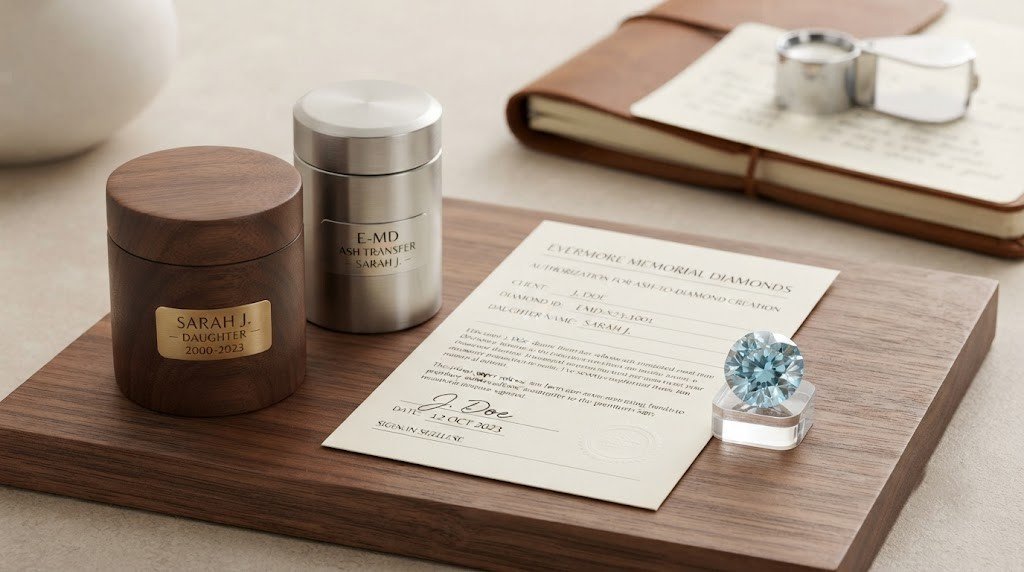
Table of Contents
What Decisions Come Up When You Turn Daughter Ashes Into a Diamond?
Seven, and when you turn daughter ashes into a diamond the order matters more than any single one. Each choice narrows the next, so a family that settles them front to back rarely has to undo anything.
| Number | Decision | Why it sits here | The usual pitfall |
|---|---|---|---|
| 1 | Who can authorize the release | Nothing else can proceed without it | Assuming a parent automatically signs |
| 2 | Which provider to use | Its terms shape every later step | Choosing on tone rather than written answers |
| 3 | Carat, color and cut | These set price and waiting time | Expecting a guaranteed color |
| 4 | Taking a portion from the urn | Quantity must match the provider’s figure | Sending too little and stalling the order |
| 5 | Sending the ashes | The formal handover point | Paperwork traveling separately from the parcel |
| 6 | Finishing choices | Cut, optional treatment, optional grading | Confusing a grading report with an origin certificate |
| 7 | Unused material | Decided before anything leaves home | Never asking, then wondering later |
When families set out to turn daughter ashes into a diamond, the first two decisions carry most of the risk. The middle three are practical and quick. The last two feel minor until a family discovers it did not ask about them.
If you want the strict numbered sequence rather than the reasoning behind each choice, the step by step order for a daughter’s ashes lays it out stage by stage. What follows here is the thinking a family does before it is ready to turn daughter ashes into a stone at all.
Who Has the Authority to Turn Daughter Ashes Into a Diamond?
It depends on your state, her circumstances and anything she put in writing, and it is not always her parents. Settle it before you contact any provider or make plans to turn daughter ashes into a stone, because the release form is the one document nobody can sign on someone else’s behalf.
Each state sets its own order of priority for who controls a person’s remains, and there is no single national rule. If your daughter was an adult, a husband, wife or registered partner may rank ahead of you. So may her own grown children. A directive, a will provision or a prearranged plan she left can override the default order entirely.
Where she died young, the decision usually falls to her parents, but how the rules treat two parents who disagree still varies from state to state. Parents who are separated or divorced sometimes need both signatures; sometimes only one. The funeral home that handled the cremation generally knows how this works locally, and a short call to an attorney can confirm it.
Two things are worth saying plainly. Families are not always in agreement about this, and that does not make anyone wrong. One parent arranging everything alone is also common, and nothing about the process assumes a united household.
The pitfall is timing. A family that decides to turn daughter ashes into a diamond and only then learns that her spouse holds the authority may lose weeks waiting on a signature that could have been requested on day one.
How Do You Vet a Provider Before You Commit?
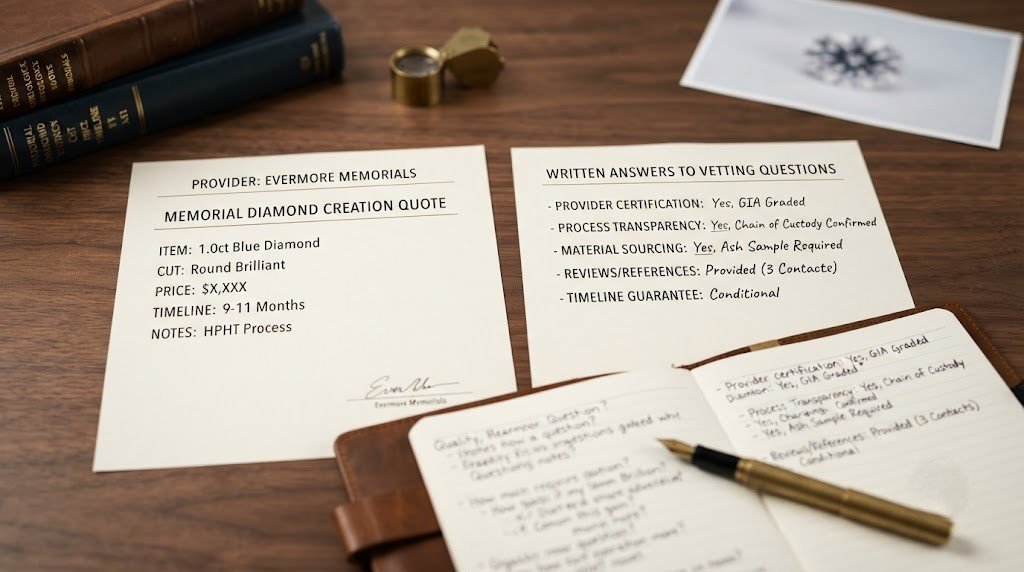
By what it will confirm in writing, not by how its website makes you feel. Gentle language costs nothing to produce; specific written answers are what separate one company from another.
Before you agree to let anyone turn daughter ashes into a stone, ask each provider you are considering for these answers by email:
- The exact quantity of ash it needs, stated as a number
- What document links the finished stone to your specific submission
- Whether the growth happens in house or at a partner laboratory
- What happens if a growth run fails, and whether that costs you anything
- Its cancellation terms once material has been received
- Whether unused ash is returned, held or disposed of, and how
A company that answers all six plainly is showing you how it will behave during the months it takes to turn daughter ashes into a finished diamond. Evasion at this stage rarely improves later.
Keep the quote and the answers together; months later, when you want to check what was promised before you turn daughter ashes over for good, you will be glad of it. The complete guide to a daughter ashes diamond covers the wider background if you are still deciding whether this is right for your family.
Which Carat, Color and Cut Should You Ask For?
Choose these before you turn daughter ashes over to a laboratory, because they fix both the price and the length of the wait. Of the three, carat has the biggest effect on each.
Memorial stones are generally offered from about a tenth of a carat up to five carats and beyond. A larger stone is not produced by sending more ash; it is produced by keeping the crystal in the press for longer. So if you plan to turn daughter ashes into something substantial, expect the calendar and the invoice to stretch together.
Color is only partly yours to choose when you turn daughter ashes into a diamond. Trace elements present while the crystal grows decide much of it: nitrogen tends to give yellow, boron tends to give blue, and a truly colorless stone needs almost none of either, which is why it usually costs more. Because the carbon comes from a personal, organic source, warm and blue tones are common. Even a carefully purified starting material does not make the outcome predictable, so treat any color as a likely result rather than a promise. What color a stone from her ashes is likely to be explains this in more depth.
Choose a color for your own reasons, never simply because she was a daughter. Some families pick a shade tied to something she loved, whether that was the ocean, a team, a season or nothing anyone else would guess; others simply accept whatever the chemistry produces.
Cut is the most familiar choice: round, princess, cushion, oval or emerald. Clarity usually lands between SI2 and VVS.
How Is a Portion Taken From the Urn?
Carefully, over a tray, in good light, and ideally with someone else in the room. Only a small share is needed to turn daughter ashes into a diamond; the industry typical request runs from a few tablespoons up to roughly 4 oz, or about 100 grams.
Most providers send a collection kit with a sealed container, a scoop and labels. If the urn is sealed or difficult to open, a funeral home can often open it, measure the portion and reseal it. There is no expectation that a parent must do this personally, and many choose not to.
Cremated remains are mostly bone mineral, closer to coarse sand than powder. Work slowly, check the quantity against the provider’s written figure, and photograph the sealed container before it is packed.
The pitfall here is quantity. A parcel that arrives short of what the laboratory needs pauses everything while a second portion is arranged. How much ash a daughter memorial diamond needs covers the figures and what they mean for the rest of the urn, and it is worth reading before you decide how to turn daughter ashes into a stone of any size.
What Is the Safest Way to Send Her Ashes?
Tracked, insured, and with the provider’s paperwork inside the parcel rather than following it. Take the courier option the provider recommends; this is the one part of the effort to turn daughter ashes into a diamond where saving a few dollars is not worth the worry.
Keep the tracking number handy, and do not assume the parcel arrived until the laboratory confirms it in writing.
That receipt is the handover point. Everything before it was yours to manage; everything after it belongs to the laboratory’s chain of custody process, which is the document trail showing that the stone grew from your submission and nobody else’s. Ask to see a sample of that paperwork before you agree to turn daughter ashes into a stone, not after. Whether the stone is really made from her ashes explains what that trail can and cannot prove.
Which Finishing Choices Come Back to You?
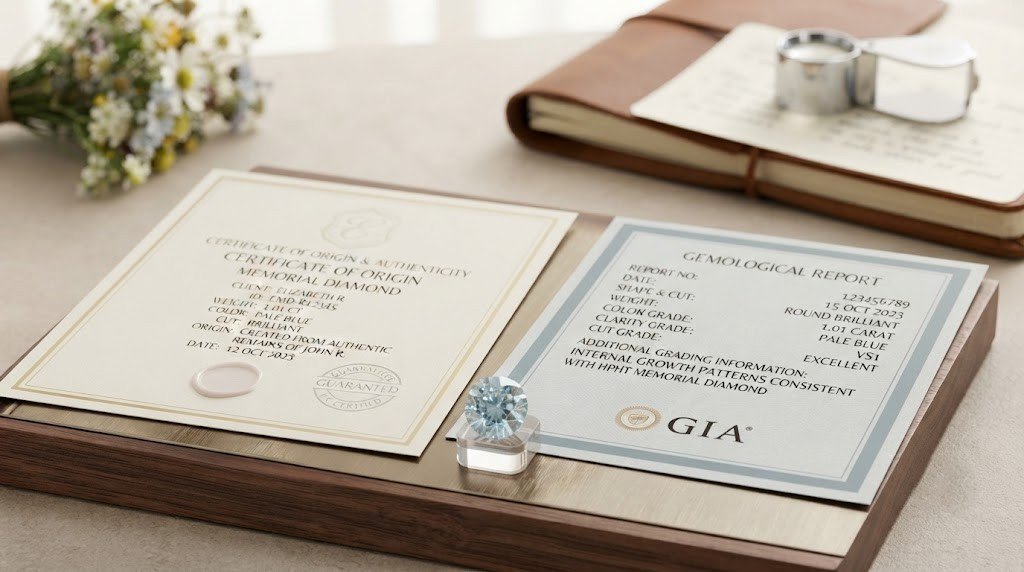
Usually three, and they arrive together once a rough crystal exists. This is the only point in the waiting months that asks anything of you.
The first is confirming the cut. A gemologist shapes and polishes the rough, and a careful provider will tell you if the crystal would suit a different shape better than the one you chose.
The second is irradiation. When you turn daughter ashes into a diamond, you may be offered post growth treatment that can produce red, pink, green or black stones. It is optional, it adds cost, and many families decline it because they would rather keep the color the stone grew with.
The third is independent grading, which is also optional. A third party gemological laboratory can assess the finished stone against the standard cut, color, clarity and carat measures used for any diamond. That report describes quality. It is a different document from the origin or authenticity certificate issued by the provider, which records that the stone came from your specific submission. Knowing the difference before you turn daughter ashes into a stone saves confusion when the paperwork arrives.
What Happens to the Ashes That Are Not Used?
Ask before you agree to turn daughter ashes into a diamond, because policies genuinely differ. Some providers return unused material, some hold it for a period, and some dispose of it respectfully unless told otherwise.
Extraction consumes only part of what you send, and families sometimes assume leftovers come back automatically. If returning them is important to you, get that commitment in writing alongside the quote.
It is also worth deciding what happens to the rest of the urn. Most of her ashes stay with you, so burial, scattering, keeping them at home or dividing them among relatives all remain open. A diamond is one way to hold on to a part of her; it does not need to replace anything else the family has planned. Some families also add a lock of her hair, and combining her ashes and hair in one stone covers that route.
How Long Does It Take, and What Does It Cost, to Turn Daughter Ashes Into a Finished Stone?
Across the industry, expect six to ten months from the day material is received, and up to twelve for larger stones or specialty colors. The decisions you make yourself rarely take more than a few weeks; almost all of the calendar is laboratory time.
During that stretch the ash is heated without oxygen to strip away the calcium phosphate, since usable carbon makes up only around 0.5% to 4% of ash by weight. What remains is purified to about 99.9% carbon or better, converted to graphite at roughly 2,500 to 2,700°C, and grown in a press at about 6 to 8 GPa and 1,400 to 2,500°C. That high pressure method, one of the two used for lab grown diamond generally, is standard for memorial stones; a minority of providers use vapor deposition instead. How the stone is made from her ashes walks through the science properly.
| Stone size | General 2026 industry range |
|---|---|
| 0.10 to 0.25 carat | $1,500 to $3,500 |
| 0.5 to 1 carat | $5,000 to $15,000 |
| 2 carats and above | $20,000 to $75,000 or more |
These are general 2026 industry ranges rather than any one company’s rates. Settings, engraving, fancy cuts and an optional grading report are normally priced separately, and colorless typically costs more than a yellow or blue stone of the same size.
What Mistakes Should You Avoid Before You Turn Daughter Ashes Into a Stone?
Most problems families meet when they turn daughter ashes into a diamond are administrative rather than scientific. The ones that catch families most often are predictable, which makes them easy to prevent:
- Starting with the provider instead of the signature. Confirm who holds authority first; everything else waits on it.
- Accepting verbal answers. Quantities, cancellation terms and unused material policies belong in writing.
- Expecting a fixed color. Chemistry has a vote, and no provider can guarantee the outcome.
- Sending more ash to get a bigger stone. Size comes from growth time, not quantity.
- Mixing up the two certificates. An origin document and a grading report do different jobs.
- Skipping the family conversation. Other relatives may want a stone too, and one submission can often serve several.
None of these is a disaster on its own. Together they account for most of the delays and disappointments families describe when they look back on the months it took to turn daughter ashes into something they could hold.
Frequently Asked Questions
Is it too late to turn daughter ashes into a diamond years after the cremation?
No. Cremated remains are mineral and chemically stable, so time alone does not rule anything out. When you first contact a provider, mention how long the ashes have been stored and in what kind of container, since storage conditions can matter more than the number of years. Ask them to confirm in writing that the material is suitable before you send it.
How much of the finished diamond is actually her?
On the ash route, personal carbon typically makes up about 10% to 15% of the finished stone’s mass, and some providers publish figures as low as 3%. The rest is supplemental lab carbon added so the crystal can reach a workable size. The stone is still grown in part from her own carbon, which is the honest and meaningful claim; nobody can truthfully promise a stone that is entirely her.
Do we need to send all of her ashes?
No. Providers typically ask for somewhere between a few tablespoons and about 4 oz, which is a small share of a full cremation. The remainder stays with the family for burial, scattering, an urn at home or dividing among relatives. Confirm the exact figure with your provider in writing so the parcel is neither short nor unnecessarily large.
Can her brothers and sisters each have a stone from the same ashes?
Often, yes, because each diamond uses only a portion of the remains. Each stone goes through its own growth run, so two or three diamonds mean separate timelines and separate prices. Ask whether one submission can cover several orders, and agree within the family who is arranging each one before anything is sent to the laboratory.
What if her other parent does not want to turn daughter ashes into a diamond?
Pause until the question of authority is clear. Depending on your state and her circumstances, one parent, both parents, or a spouse or adult child of hers may need to sign. A provider cannot resolve a family disagreement, and it is kinder to talk it through first. A funeral director or attorney can explain who holds the decision where you live.
Can we choose a color that meant something to her?
You can request one, but the result is not guaranteed. Nitrogen tends toward yellow and boron toward blue, and colorless stones need the absence of both, usually at extra cost. Optional irradiation can produce red, pink, green or black. Choose a shade for reasons tied to who she was, and treat the finished color as likely rather than certain.
Final Thoughts on Turning Her Ashes Into a Diamond
Seven decisions sounds like a great deal to ask of a family that is already carrying so much. In practice, most of them take an afternoon each, and two of them, authority and the choice of provider, account for nearly all of the risk.
Before you turn daughter ashes into a diamond, settle who signs, get the provider’s answers in writing, and ask about the unused ash before anything leaves your hands. The rest becomes a question of patience. When the stone does arrive, it carries a documented line back to her, at whatever age she was taken from you.
Learn More About Daughter Memorial Diamonds
- Everything to know about a diamond from her ashes the full background in one place
- Each stage in strict order the numbered sequence from release to arrival
- How the diamond is grown from her ashes the laboratory science, plainly explained
- Whether the stone is really made from her carbon, chain of custody and honest limits
- Combining her ashes with a lock of hair when families send both
Talk With Memorial Diamond
If you would rather talk the decisions through with a person, Memorial Diamond can be reached at memorialdiamond.us. Ask about authority, quantities, timelines or anything else it takes to turn daughter ashes into a stone. There is no obligation in asking, and no decision needs to be made on that first conversation.
Leave A Comment