
Somewhere between the funeral paperwork and the first quiet week at home, the question of where her ashes will rest starts to feel very real. The daughter memorial diamond vs urn decision is less a contest than a question of form: an urn keeps her remains whole and in one place, while a memorial diamond is a lab grown stone made with carbon from a small portion of them. Because the stone uses so little, families can keep both.
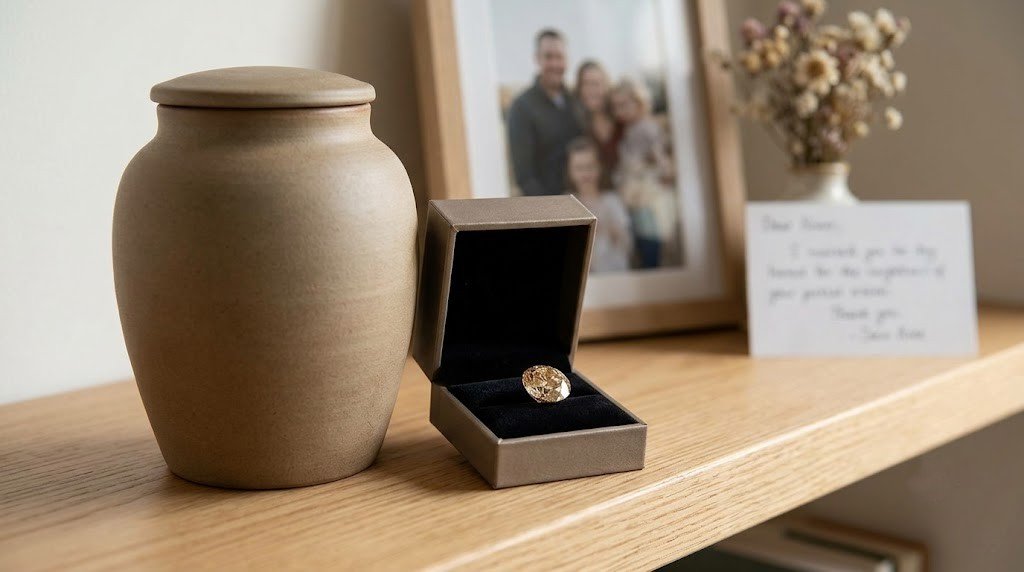
Table of Contents
What Is Actually Being Compared?
In the daughter memorial diamond vs urn comparison, the urn is a vessel. It holds cremated remains, either all of them or a share, and it leaves those remains exactly as they came back from the crematory.
Urns are made in wood, metal, ceramic, stone and glass. Some are designed to break down naturally when buried in earth or placed in water. Smaller keepsake urns hold only a little. An urn might sit on a shelf at home, rest in a columbarium niche, be buried in a cemetery plot, or simply hold her ashes until the family decides on scattering.
The diamond side of a daughter memorial diamond vs urn decision involves a transformation rather than a container. Carbon is extracted from a portion of her ashes, purified, converted to graphite, typically blended with supplemental lab carbon and grown into a real diamond, usually in a high pressure, high temperature press.
The finished stone is chemically a diamond, the same material as any other, and it is part of a category of memorial that now has its own history.
So the daughter memorial diamond vs urn comparison is not two versions of the same thing. One keeps her remains as they are. The other makes something new from a small part of them. Understanding that difference first makes every later question easier to answer.
How Do the Daughter Memorial Diamond vs Urn Options Line Up?
The table below sets the two formats next to each other. Read it as a description, not a scorecard. The daughter memorial diamond vs urn question has no winning column.
| What you might weigh | Traditional urn | Memorial diamond |
|---|---|---|
| What it is | A vessel holding her cremated remains | A lab grown diamond made partly with carbon from her ashes |
| How much of her ashes | All of them, or a share in a keepsake urn | Typically a few tablespoons up to about 4 oz, approximately 100 g, depending on the provider |
| What happens to the ashes | Kept unchanged | A portion is transformed; the rest remains |
| Where it lives | A home, a niche, a cemetery plot, or until scattering | Worn, carried, or kept loose |
| Travels with you | Possible, with carrier rules to check | Easily, as jewelry or a loose stone |
| Durability | Depends on the material chosen | Hardness of 10, though a hard knock can chip it |
| When it is ready | Days or weeks | Typically 6 to 10 months, up to about 12 |
| Cost | Varies widely by material and maker | Roughly $1,500 to $75,000 or more by size and color, based on general industry ranges |
| Can be shared among relatives | Through keepsake urns or division | Through separate stones from separate portions |
| Can the choice change later | Yes; ashes stay available | The stone cannot be undone; remaining ashes stay available |
Two rows in this daughter memorial diamond vs urn table deserve a second look. The first is what happens to the ashes. The second is whether the choice can change later.
Every other consideration is mainly about preference, budget and daily life, which only your family can weigh.
Why Is the Daughter Memorial Diamond vs Urn Choice Rarely Either Or?
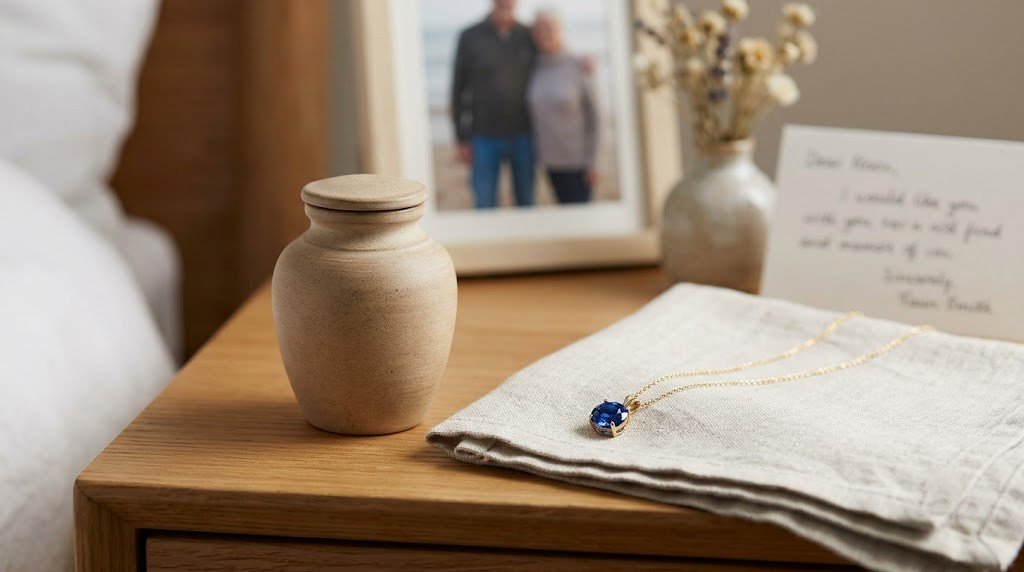
Because the diamond needs so little. Requirements vary between providers, but a typical ash based order uses a few tablespoons to roughly four ounces, which is usually a small fraction of what a crematory returns.
The remainder can go into an urn exactly as planned. This is why a family weighing the daughter memorial diamond vs urn question can end up choosing both.
How much ash a laboratory typically requests explains the range and what stays behind.
A few combinations a family might consider include:
- A full urn at home, with one pendant worn by a parent
- An urn placed in a columbarium niche, with a ring made for her partner
- Most of her ashes scattered somewhere she loved, a small keepsake urn kept, and a single stone
- An urn held for now, with the diamond decision left open for later
None of these needs to be settled in the first weeks. Ashes usually come back from the crematory in a temporary container, and an urn can hold them while the family takes whatever time it needs.
There is something quietly reassuring in this. The daughter memorial diamond vs urn decision does not ask anyone to give up a place to visit in exchange for something to wear, or the reverse.
What Does Each Option Ask of Her Ashes?
In the daughter memorial diamond vs urn comparison, an urn asks nothing of her ashes. Her remains stay exactly as they are, and every future option, from scattering to burial to dividing a portion later, stays open.
A memorial diamond asks for a portion and changes it permanently.
Cremated remains are mostly calcium phosphate, the mineral of bone, and only about 0.5% to 4% of their weight is usable carbon. That carbon is isolated and refined to roughly 99.9% purity, turned into graphite at temperatures near 2,500 to 2,700°C, and then grown into a crystal.
Most providers use high pressure, high temperature presses working at around 6 to 8 GPa. Fewer use chemical vapor deposition. Cutting, polishing and grading follow, with irradiation offered by some providers for certain colors.
Because the recovered carbon is small, it is typically blended with supplemental lab carbon. Industry figures for ash based stones put her share of the finished mass at roughly one part in ten to around 15%, while a few providers report as little as 3%.
The stone is never purely her. It is a real diamond that physically contains carbon that was hers, which is a different and still meaningful thing.
Whether the stone is really made from her ashes goes further into that distinction.
This is the one asymmetry in the daughter memorial diamond vs urn comparison worth sitting with. Choosing an urn today closes off nothing. Choosing a diamond uses a portion that cannot be returned to ash. Neither fact is a reason to choose one way. It is simply a reason not to rush.
Where Does Each One Live Day to Day?
On the daily life side of a daughter memorial diamond vs urn decision, an urn gives her a place.
Some people find steadiness in a fixed spot they can visit: a shelf they pass each morning, a niche they drive to on her birthday, or a plot where the family gathers.
Moving house means moving the urn with care, and traveling with cremated remains involves carrier and security rules that are worth checking well in advance.
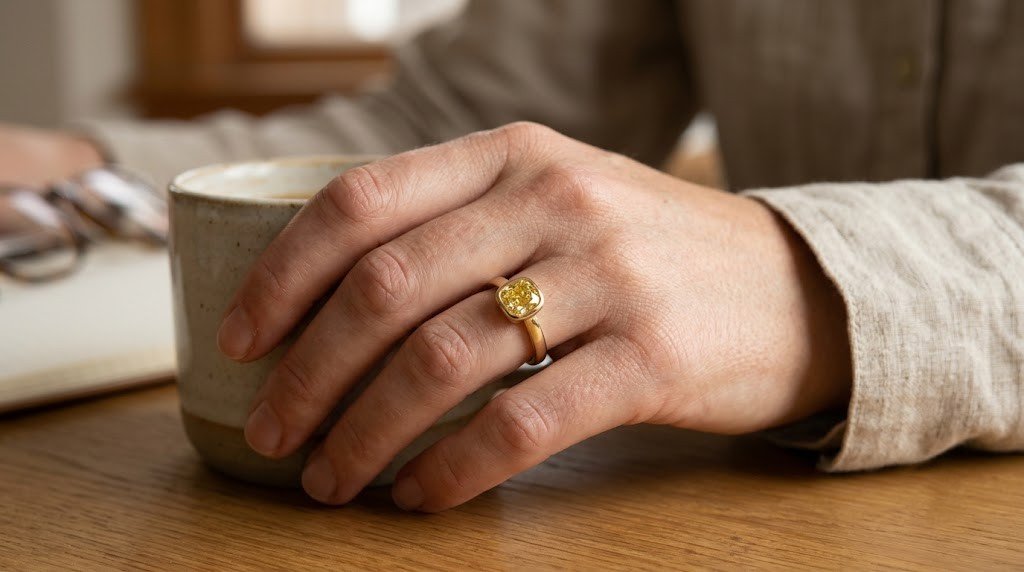
A diamond goes where you go. It can be set in a ring, a pendant or a bracelet, or kept as a loose stone in a small box.
It rates 10 on the scale gemologists use for scratch resistance, so everyday wear does not scratch it, though a hard knock at the wrong angle can still chip any diamond.
A protective setting and jewelry insurance are sensible. How settings protect a stone worn every day covers metals, mounts and resizing.
People differ on this, and the daughter memorial diamond vs urn conversation often turns here.
One parent may want somewhere to go. Another may want something to hold. A sibling may want neither, or both. Those preferences say nothing about how much anyone loved her.
How Do Cost and Time Compare?
Cost and timing are where the daughter memorial diamond vs urn gap is widest.
An urn can usually be in place within days or weeks, and prices vary widely depending on material, size and maker. A funeral home or urn retailer can give current figures for the styles you are considering.
A memorial diamond takes longer and costs more. Expect something in the region of six to ten months once the laboratory has her ashes, and up to a year for a stone larger than about two carats or in a specialty color.
Carat size is set by growth time, not by how much ash is sent.
| Price band, industry wide | What it generally buys |
|---|---|
| $1,500 up to $3,500 | A small stone, roughly a tenth to a quarter carat |
| $5,000 up to $15,000 | Half a carat to a full carat; colorless sits higher |
| $20,000 to beyond $75,000 | Two carats and larger |
Important: These are general 2026 industry ranges, not Memorial Diamond pricing.
Independent grading, engraving, fancy cuts and settings are usually extra.
What drives the cost of a daughter memorial diamond breaks those variables down, while where the months of production go explains the waiting period.
For the daughter memorial diamond vs urn decision, the practical takeaway is sequencing. The urn can come first and serve immediately. A stone, if the family wants one, can follow whenever budget and readiness allow.
How Might Faith and Tradition Shape the Choice?
No religious tradition has an official position on memorial diamonds specifically. What traditions address is cremation and how ashes are handled, and those positions can shape a daughter memorial diamond vs urn decision more than any price or timeline.
Current Catholic guidance permits cremation but directs that ashes be kept intact in a sacred place rather than divided or kept at home, with a narrow allowance for a small portion under specific conditions. That bears directly on taking a portion for a stone, so a Catholic family may want to speak with their priest first.
Across Islamic schools of thought, cremation itself is generally considered impermissible, which means an ash based stone does not arise, though a hair based one involves no cremation.
Jewish movements differ widely on cremation.
In Hindu practice, ashes are traditionally immersed in a sacred river, and keeping a small portion is described as increasingly common, though it varies by family and community.
If faith matters to your family, the daughter memorial diamond vs urn question is best brought to your own clergy or community, who know your tradition and your circumstances. A memorial company is not the right authority on it.
Who Gets a Say in the Daughter Memorial Diamond vs Urn Decision?
Whoever holds legal authority over her remains, and that is not always a parent.
State law sets a default order, and it differs between states. Her husband, wife or partner may outrank her parents, and so may any grown children she had. Anything she put in writing about her remains can change the order entirely.
The funeral home or crematory can usually tell you who signed the cremation authorization.
Families also carry their own differences. Separated parents, or one parent arranging everything while the other keeps a distance, may land on different sides of the daughter memorial diamond vs urn question.
Because a stone uses only a portion, there is often room for both wishes, but dividing her ashes still requires agreement from the person with authority.
Relatives beyond the parents may have views on a daughter memorial diamond vs urn plan, too: siblings, grandparents and close friends.
How several relatives can each receive a stone explains the practical side, while raising the idea gently with family covers the conversation.
What If She Was Buried Rather Than Cremated?
Then the daughter memorial diamond vs urn comparison changes shape, because there are no ashes to place in an urn.
A memorial diamond is still possible if a lock of her hair was kept.
Because about half of hair’s weight is carbon, a lock weighing only a few grams may be all a laboratory asks for, and no cremation is involved at all.
Two honest caveats apply to this version of the daughter memorial diamond vs urn question.
No published figure exists for what share of a finished hair based stone is personal carbon, so ask any provider to state theirs in writing.
And a lock kept at home may count as part of her estate. State rules differ, so speak with the executor or whoever is settling her affairs before mailing it.
A diamond grown from her hair is explained in full elsewhere.
Which Questions Can Help Your Family Decide?
There is no formula for a daughter memorial diamond vs urn decision, but a few questions tend to bring a family’s own answer into focus:
- Does anyone want a fixed place to visit, and does anyone want something to carry?
- Did she ever say anything about her ashes, even in passing?
- Is anyone uncomfortable with dividing her remains, and why?
- Does faith or tradition shape what feels right?
- What does the budget allow now, and what might it allow later?
- Would an urn and a stone serve different people in the family?
- Is there any real reason to decide quickly?
Talking through these can make the daughter memorial diamond vs urn decision feel less like a verdict and more like a plan.
The answers may point to an urn alone, a stone alone, or both. Each is a complete and loving way to keep her.
Frequently Asked Questions
Is a memorial diamond better than an urn for our daughter?
Neither is better. An urn keeps her remains whole and gives the family a place. A diamond is something that can be worn or carried. The daughter memorial diamond vs urn choice depends on what your family wants day to day, not on which honors her more.
Can we keep her ashes in an urn and still have a diamond made?
Yes. A stone typically uses a few tablespoons to about four ounces of ashes, depending on the provider, which is usually a small share of the total. The remainder can stay in an urn, be buried or be scattered as planned.
What share of the diamond would be her own carbon?
For an ash based stone, industry figures suggest her carbon forms roughly one tenth to 15% of the finished mass, and a few providers report as low as 3%. Supplemental lab carbon makes up the remainder. Ask for each provider’s figure in writing.
Can we choose an urn now and decide about a diamond later?
Yes, as long as some of her ashes remain accessible. Choosing an urn first closes off nothing, and a family may find it easier to decide about a stone once the first months have passed.
Is a memorial diamond more expensive than an urn?
Generally, yes, and cost is one of the clearest daughter memorial diamond vs urn differences. Industry wide, memorial diamonds range from roughly $1,500 for small stones to $75,000 or more for large ones, while urn prices vary widely by material. Grading, engraving and settings usually add to a diamond’s cost.
Does making a diamond rule out scattering or burial?
No. Because the diamond uses only a portion, the rest of her ashes remain available for scattering, burial in a cemetery plot, a columbarium niche or an urn at home. A stone can sit alongside any of these.
What if her parents disagree about the urn and the diamond?
A stone uses only a portion, so both wishes can often be honored. Dividing her ashes still needs agreement from whoever holds authority over her remains. That varies by state and her written wishes, and may be her spouse, partner or adult children.
Final Thoughts on the Daughter Memorial Diamond vs Urn Choice
Seen clearly, the daughter memorial diamond vs urn choice comes down to two different needs.
One gives her a resting place. The other gives you something to carry into ordinary days.
Families who keep both are not hedging, and families who choose only one have not missed anything.
If there is a single piece of practical advice in the daughter memorial diamond vs urn comparison, it is this: the urn can come first, and nothing about it closes the door on a stone later.
Take the time you need.
Learn More About Daughter Memorial Diamonds
- Daughter Ashes Diamond: The Complete Guide explains the ash route.
- What color a diamond from her ashes may be explains why the shade cannot be chosen.
- Step by step from her ashes to a stone explains the sequence in order.
- Choosing a memorial diamond for your daughter explains where to begin.
- Daughter memorial diamond FAQ answers common family questions.
Talk With Memorial Diamond
If the daughter memorial diamond vs urn question is still open for your family, Memorial Diamond is happy to talk through what a stone would involve, including how little of her ashes it uses.
Reach us at memorialdiamond.us. There is no pressure and no deadline.
Leave A Comment