Sister Memorial Diamond Ideas

Sister Memorial Diamond Ideas: Rings, Pendants, and Keepsakes

Some people know at once how they want to carry their sister with them, and others need to see the options laid out before anything feels right. The most practical sister memorial diamond ideas include a pendant, a ring on any finger, earrings, a bracelet, cufflinks or a tie pin, a lapel pin, a loose stone kept in a keepsake box, a stone set into an heirloom, coordinated stones for several siblings, and engraving on any of these.

Each of these sister memorial diamond ideas suits a different way of living with a memorial stone. Below, they are grouped by how often the piece would be worn, followed by a side by side comparison, notes on keeping a small diamond safe, and a few thoughts on choosing, especially when siblings want different things.
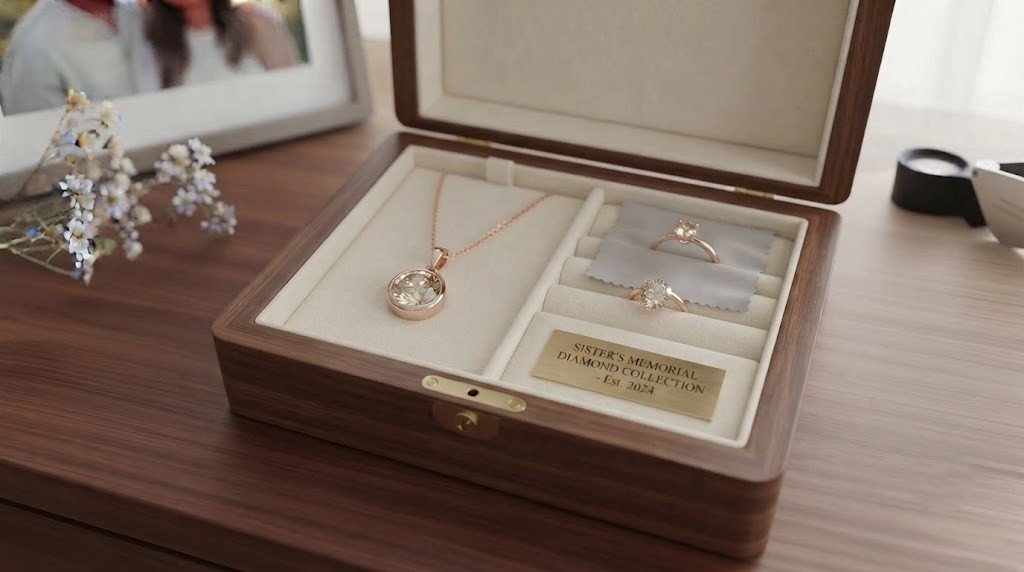
Which Sister Memorial Diamond Ideas Suit Everyday Wear?

If you want her close through ordinary days, these four sister memorial diamond ideas are built for regular wear. Memorial stones are offered from about 0.10 carat up to 5 carats or more, and every piece below can work with a stone from the entry tier of roughly 0.10 to 0.25 carat.

1. A Pendant Worn Close
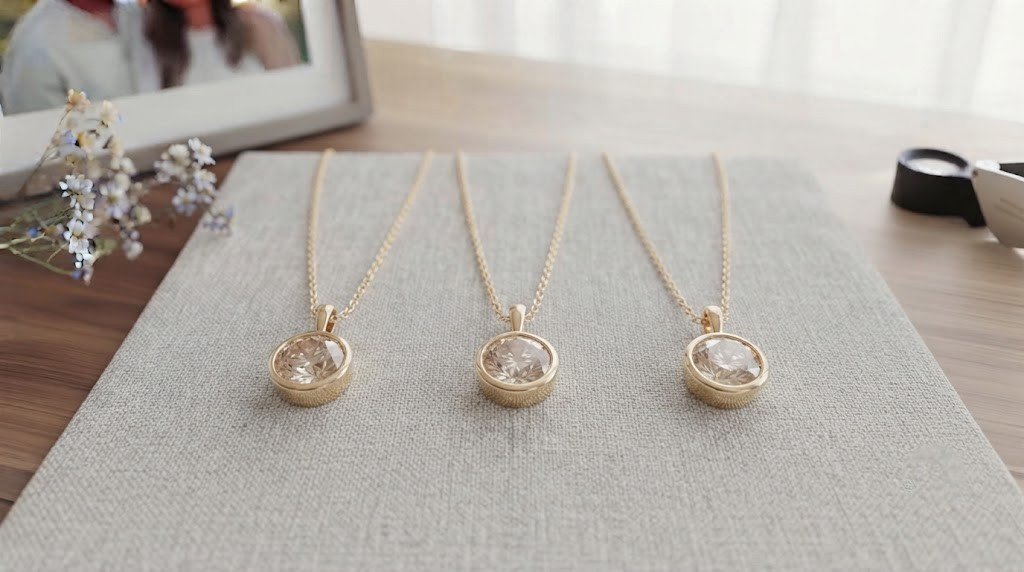
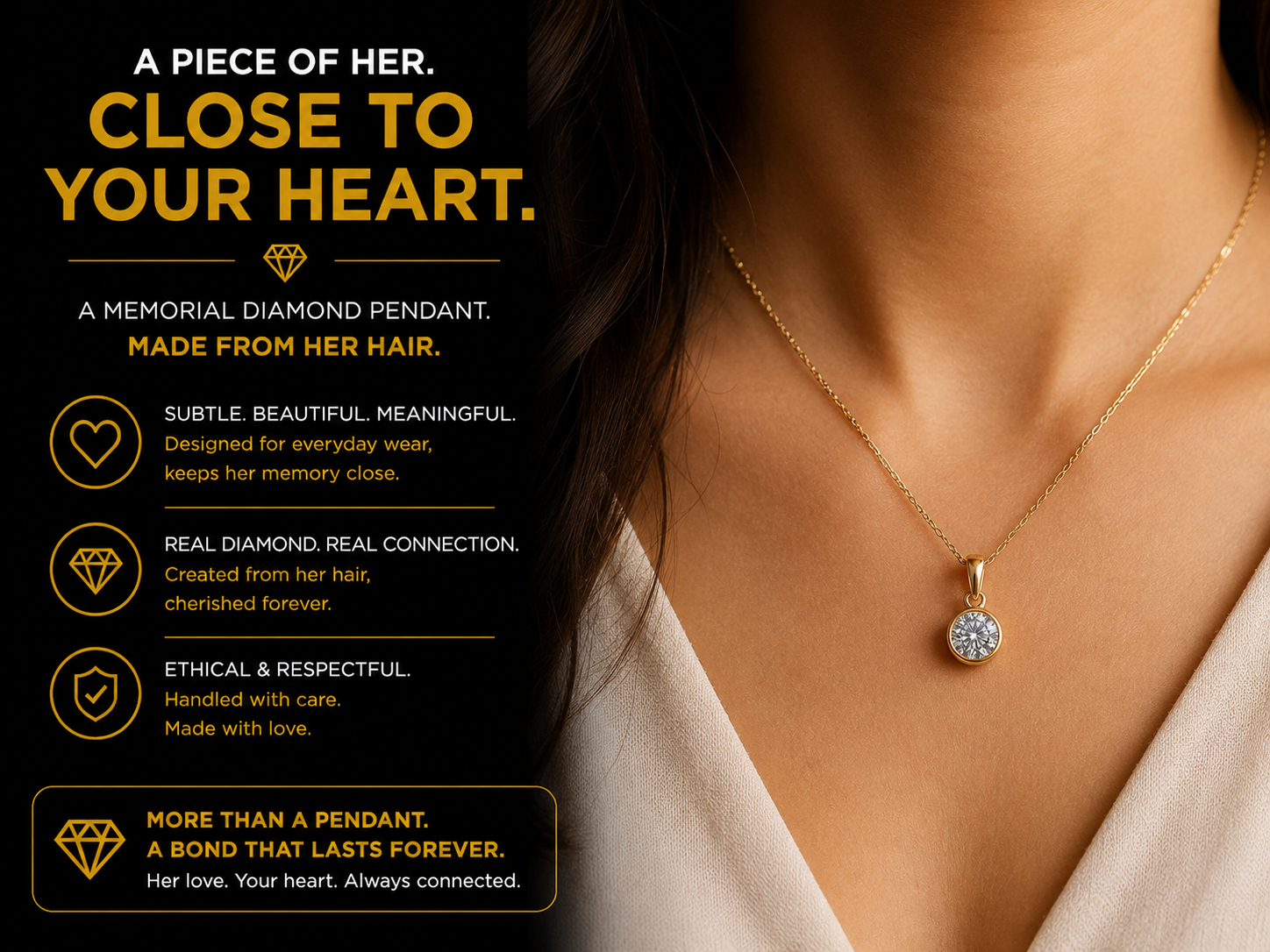
A pendant is one of the gentlest ways to wear a memorial diamond. It sits against the chest or at the collarbone, is less exposed to knocks than a ring, and works with almost any stone size.

A protective mount such as a bezel suits a pendant that will be worn most days, while a single stone on a fine chain is quieter still. Some people choose a pendant that can be tucked under clothing on days when they would rather keep her memory private and worn openly on others.

2. A Ring on Any Finger

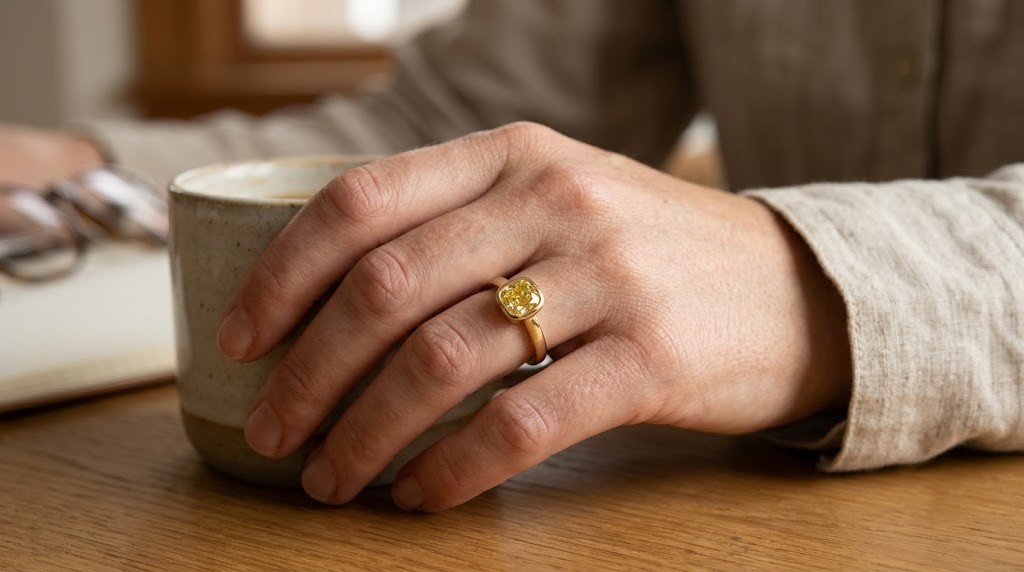
A ring keeps the stone in view every time you look at your hands. It can be worn on any finger, including a little finger or a thumb, and on either hand. There is no rule about which finger a memorial ring belongs on.

Rings take more knocks than many other types of jewelry, so ask a jeweler for a low, protective mount rather than a tall one. Hands change size with the seasons and over the years, so it is worth choosing a design a jeweler can resize later.

3. Earrings

Studs are a natural fit for small stones. A pair needs two diamonds, though, and that brings a practical question: memorial stones grown from the same source can still differ slightly in tone because color comes from trace elements during growth. Ask a provider whether a closely matched pair is possible, or embrace a pair that is gently different.

Another option is a single stone worn in one ear, paired with a plain stud in the other.

4. A Bracelet

A bracelet with a single bezel set stone, or a small stone on a fine chain, is a subtle everyday choice. Wrists brush against desks, door frames, and car doors, so a protective setting is wise. A rigid bangle with the stone set low into the metal is one of the sturdier versions.

These four sister memorial diamond ideas share one practical point: the more often a piece is worn, the more its setting needs to protect the stone.

Which Sister Memorial Diamond Ideas Work for Occasional or Formal Wear?

Not every one of the sister memorial diamond ideas needs to be worn daily. For some people, the meaning sits in bringing the piece out for particular days, such as a wedding, graduation, anniversary, or her birthday.

Cufflinks with a small memorial stone set into one or both faces suit anyone who wears French cuffs. A tie pin or tie bar carries a single stone neatly. Both are worn only occasionally, which reduces everyday exposure to wear and tear, and both can be passed from one person to another for different occasions.

6. A Lapel Pin

A lapel pin or brooch can be worn on a jacket, coat, scarf, or bag strap. It is a flexible idea because it moves from outfit to outfit and sits at heart height.

Pins can come loose, so choose a secure locking back. Some people pair a lapel pin with a small engraving on the reverse that only they will ever see.

These occasional pieces are some of the more adaptable sister memorial diamond ideas because they can be shared or worn in turn among siblings without anyone needing to own one outright.

What Are Sister Memorial Diamond Ideas for Keeping Rather Than Wearing?

Not all sister memorial diamond ideas involve jewelry. Some of the most personal choices keep the stone somewhere safe, to be seen whenever you choose.

7. A Loose Stone in a Keepsake Box

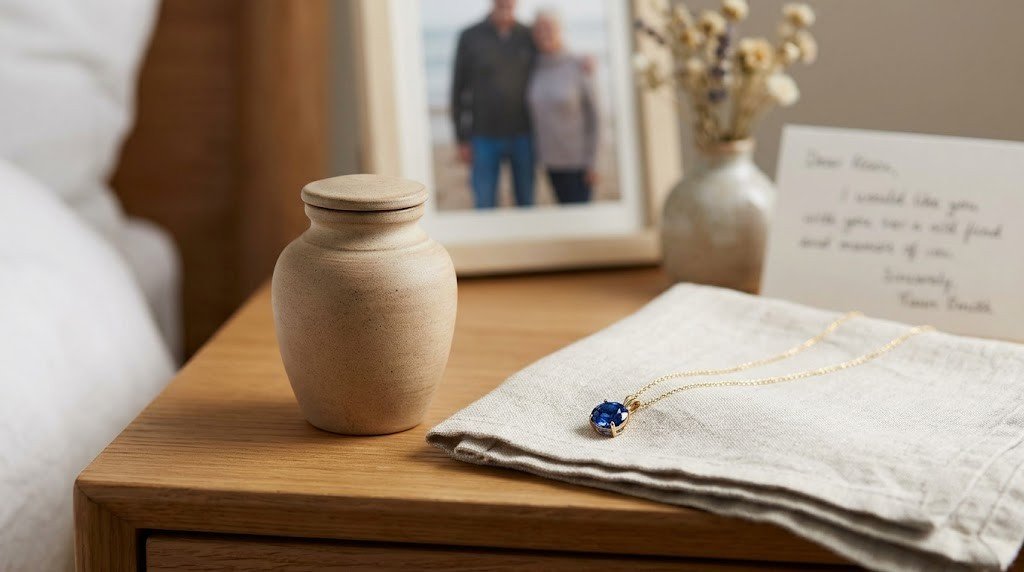
A loose diamond in a small box, perhaps lined in a fabric that meant something to you, is a complete and meaningful choice. It can sit on a shelf, in a drawer, or beside a photograph, and it can be held whenever you want.

Keeping the stone loose also leaves every option open. A setting can be added later, months or years on, if you decide you would like to wear it. Keep the origin certificate with the box so the stone’s history stays with it.

8. A Stone Set Into an Heirloom

If your sister left jewelry, or the family has a piece with history, a memorial stone can sometimes be set into it: a ring she wore, a locket, or a brooch from a grandparent. The appeal is that two kinds of memory meet in one object, the piece she touched and the stone grown in part from her.

If the heirloom was hers, it may count as part of her estate, and how that works differs from state to state. Talk with the executor, or whoever is handling her affairs, before anything is altered.

Both of these sister memorial diamond ideas suit people who find daily wear too much, or who want the stone to stay in the family rather than with one person.

How Can Several Siblings Create Matching or Coordinated Stones?

9. Matching or Coordinated Stones for Several Siblings

Because only a portion of the source material goes into each stone, several diamonds can often be grown from one shared source. That opens up a set of sister memorial diamond ideas for siblings who want to stay connected through her memory.

A few approaches include:

  • Matching pieces: Each sibling wears the same design, such as identical pendants, in whatever metal they prefer.
  • Coordinated pieces: The stones come from the same source, but each person chooses their own form. One may choose a ring, another a pendant, and another a loose stone.
  • One shared heirloom: A single piece is kept by one sibling or moves between households for particular days, with ownership agreed in writing.

A set of stones depends on someone being able to release the material, and that person may not be you. Siblings frequently sit further down the line of authority over remains. In many states, the order may run from a spouse or registered partner to adult children and parents before reaching brothers and sisters. That order is not national; it changes from state to state. If she named an agent or left a signed declaration, her written wishes may affect who decides.

To find out who holds authority, ask the funeral home or crematory who signed for the cremation. A local attorney can explain how your state handles it. A gentle request to that person for a small share is usually where siblings start. Hair kept at her home may belong to her estate as well, so speak with the executor before using any.

The guide to how more than one relative can receive a stone from one source explains the practical side in more depth. Half siblings, step siblings, adopted siblings, and twins are all siblings, and any of them may want a stone, or not.

What Can Engraving Add to Any of These Sister Memorial Diamond Ideas?

10. Engraving

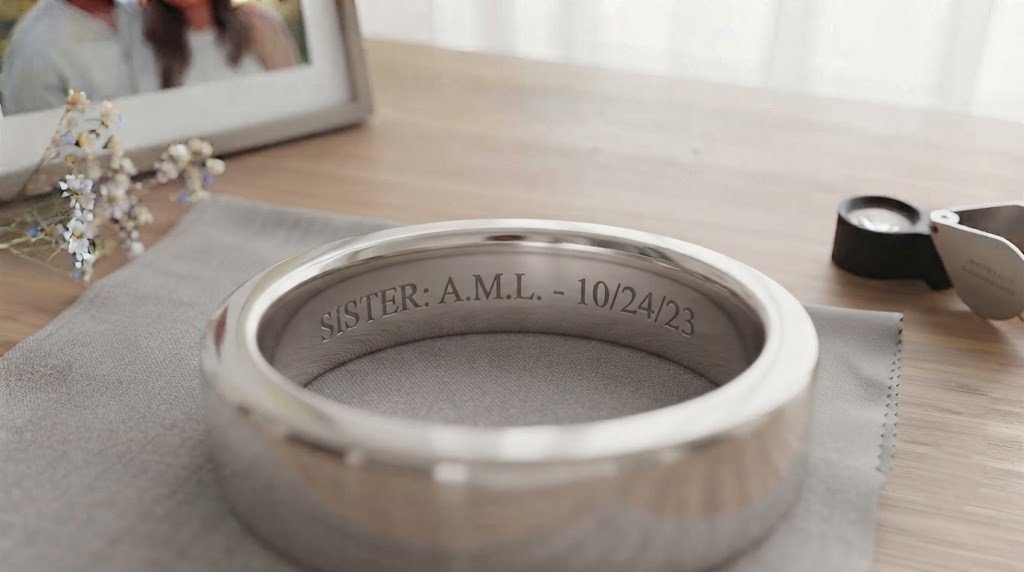
Engraving adds words to any of the other nine sister memorial diamond ideas. Most of the available space is on the metal, and some providers can also laser a few characters onto the diamond’s girdle, its thin outer edge. The harder part is usually deciding what to say.

What people choose to engrave varies widely:

  • Her name, initials, or a nickname.
  • A date, such as her birthday or another day that mattered.
  • Map coordinates of a place she loved.
  • A short phrase she used, or something only siblings would understand.
  • Her handwriting, reproduced from a card or letter, where the jeweler offers it.

Engraving is usually priced separately from the stone. Short wording tends to stay legible longest, and a phrase that means nothing to strangers can be a comfort in itself because it stays between you and her.

How Do These Sister Memorial Diamond Ideas Compare at a Glance?

This table sets the ten sister memorial diamond ideas side by side, so you can see how each one fits into everyday life.

IdeaHow often wornExposure to knocksProtective setting optionsGood to know
PendantDaily or oftenLowBezel, half bezel, solitaireCan be tucked under clothing
Ring on any fingerDaily or oftenHighBezel, low profile, flushChoose a design that can be resized
EarringsDaily or oftenLow to moderateBezel studs, secure backsA pair needs two stones; tones may differ
BraceletDaily or oftenModerate to highFlush set bangle, bezelWrists brush hard surfaces often
Cufflinks or tie pinOccasionallyLowFlush or bezel facesEasy to share between siblings
Lapel pinOccasionallyLow to moderateBezel, locking pin backMoves between outfits and bags
Loose stone in a boxKept, not wornVery lowNone neededLeaves every future option open
Set into an heirloomVariesVariesDepends on the existing mountCheck estate questions first
Sibling setVariesVariesAny of the aboveAgree ownership in writing
EngravingWith any pieceNone addedNot applicableUsually priced separately

This table only hints at how each piece holds its stone. The range of setting styles for a sister’s stone compares bezel, prong, halo, flush, and tension mounts, along with the metals around them, in detail.

How Do You Keep a Small Memorial Stone Safe Day to Day?

A memorial diamond is a genuine lab grown diamond, as this overview of memorial diamonds describes, so it has many of the same everyday considerations as any small stone. Scratches are rarely the main worry. Losing it is, and a hard knock can still chip even a diamond.

A few habits help, whichever of these sister memorial diamond ideas you choose:

  1. Choose a protective setting for anything worn daily, especially rings and bracelets.
  2. Take rings and bracelets off for gardening, the gym, moving furniture, and heavy cleaning.
  3. Store pieces separately so diamonds cannot scratch other jewelry or each other.
  4. Check the setting occasionally. A jeweler can confirm that prongs and bezels are secure.
  5. Clean gently with warm water, mild soap, and a soft brush.
  6. Keep paperwork together, including the origin certificate and any independent grading report.
  7. Ask your insurer whether the piece can be covered and what documentation it needs.

Small stones can go missing quietly, which is why the clasp, earring back, and pin lock deserve as much attention as the stone. Whichever of these sister memorial diamond ideas you settle on, a secure fastening is worth the extra effort.

How Do You Choose Between Sister Memorial Diamond Ideas?
sister memorial diamond ideas

There is no single right answer among sister memorial diamond ideas, only the one that fits how you want to live with her memory. A few questions can help narrow the field:

  • How do you picture it? On your hand, at your throat, or in a drawer you open on hard days?
  • How active is your life? Daily physical work may favor a pendant or a loose stone over a ring.
  • Would she have liked it? Some people choose something she would have worn; others choose something that suits them.
  • Do you want it seen? Some memorial pieces are private, while others invite questions you may or may not want.
  • What fits your budget? Settings are usually priced separately from the stone, and the guide to what a sister’s stone typically costs breaks down those extras.

Color can influence the choice of piece, too. Some people want a tinted stone on a hand, where they will see it often; others would rather it sit quietly at the collarbone. The shade cannot be picked from her ashes or hair, so it helps to read about the tones memorial stones tend to show before committing to a design.

Whether her stone begins with ash, hair, or both makes no difference to which of these pieces it can go into. Her carbon is usually combined with lab carbon so there is enough to grow a stone. For ash, providers commonly describe her share of the finished diamond’s mass as somewhere near 10 to 15 percent, and some quote figures nearer 3 percent. No equivalent finished stone percentage has been published for hair. If you are gathering hair, how much hair a sister’s stone usually needs covers quantities.

Timing may matter if you want the piece for a particular date. A stone typically takes six to ten months from receipt, although timelines vary by provider and stone specifications. The stage by stage timeline shows where a setting fits.

What If Siblings Prefer Different Sister Memorial Diamond Ideas?

Siblings may picture very different sister memorial diamond ideas. One may want a ring worn every day, another a loose stone in a box, and another nothing at all. Each of those is a valid way to remember her.

A few ways to leave room for everyone:

  • Let each sibling choose their own piece from the same source rather than agreeing on one design.
  • Accept that some siblings may decide later, or never. A stone may be possible years later if suitable material has been kept safely and a provider accepts it.
  • If one stone is shared, write down who keeps it and what happens next before it exists.
  • Avoid treating any choice as a measure of love. Choosing not to have a stone is not a lesser goodbye.

Grief does not move on one schedule. Giving each person space to choose in their own time often matters more than the jewelry itself. If you are still finding your bearings, the overview on where to begin choosing a stone for your sister lays out the first decisions in order.

Frequently Asked Questions

Can a memorial ring be worn alongside rings I already wear?

Usually, yes. Tell the jeweler which rings it will sit beside so the band width and height can be planned to reduce metal rubbing against the stone. A low mount tends to stack more comfortably, and matching metals may help the rings wear at a similar rate.

What size memorial diamond suits a pair of earrings?

Smaller stones, often around 0.10 to 0.25 carat each, suit studs well. A pair needs two diamonds, and tones can differ slightly even from one source. Ask the provider whether a closely matched pair is possible or plan for gentle differences.

Is a ring or a pendant more practical for a memorial diamond worn every day?

A pendant is usually the more forgiving choice because it takes fewer knocks than a ring. A ring can work well too if it has a protective setting such as a bezel and you remove it for heavy work, sport, or gardening.

Can sister memorial diamond ideas be combined, such as a pendant now and a ring later?

Yes. A diamond can be taken out of one piece and set into another, so starting with a pendant or a loose stone does not close any doors. Keep the origin certificate with the stone, not the old mount, each time it moves.

Can a memorial piece be passed down to another relative later?

It can. Writing down who should receive it next and keeping the certificate and any grading report with the piece makes the handover simpler. If you want it named in a will, an estate attorney can explain how that works where you live.

Can a memorial diamond hang on a chain or bracelet I already own?

Often, yes. A jeweler can mount the stone as a small charm or slide pendant sized for a chain you already wear. Ask them to check the chain’s clasp and links first, since an older chain may need repair before it carries something irreplaceable.

Final Thoughts on Sister Memorial Diamond Ideas

The right piece is the one you will be glad to reach for, whether that means wearing it every morning or opening a small box once a year. None of these sister memorial diamond ideas is more meaningful than another; they are simply different ways of keeping her near.

Take your time with these sister memorial diamond ideas, let each sibling choose for themselves, and remember that a loose stone can always become something else later.

Learn More About Sister Memorial Diamonds

Talk With Memorial Diamond

If one of these sister memorial diamond ideas has stayed with you, or you would like help weighing a few of them, reach out to Memorial Diamond at memorialdiamond.us. You are welcome to start with a question as simple as which piece might suit the life you lead.
Made From Sister

How a Memorial Diamond Is Made From Your Sister’s Hair

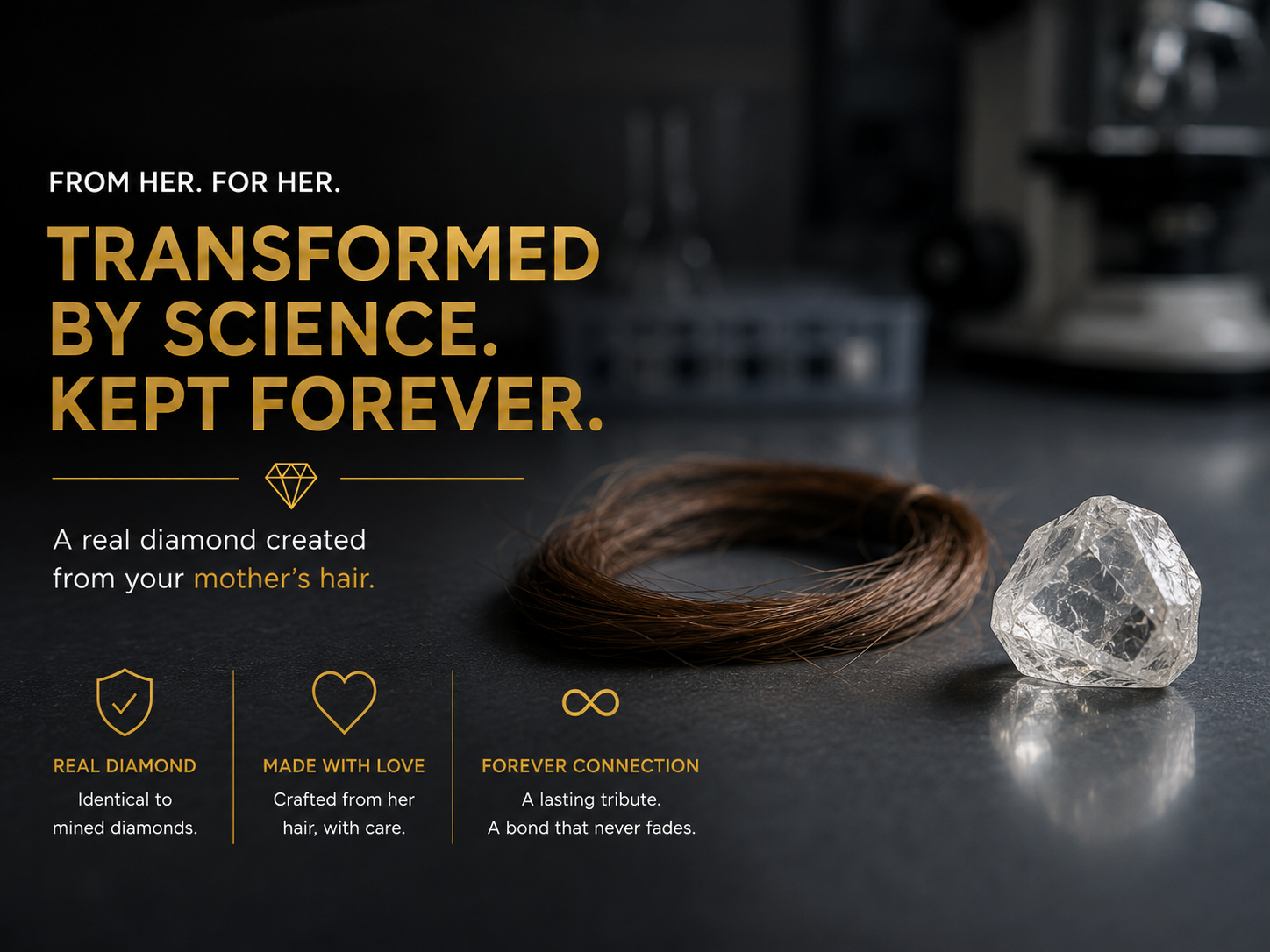
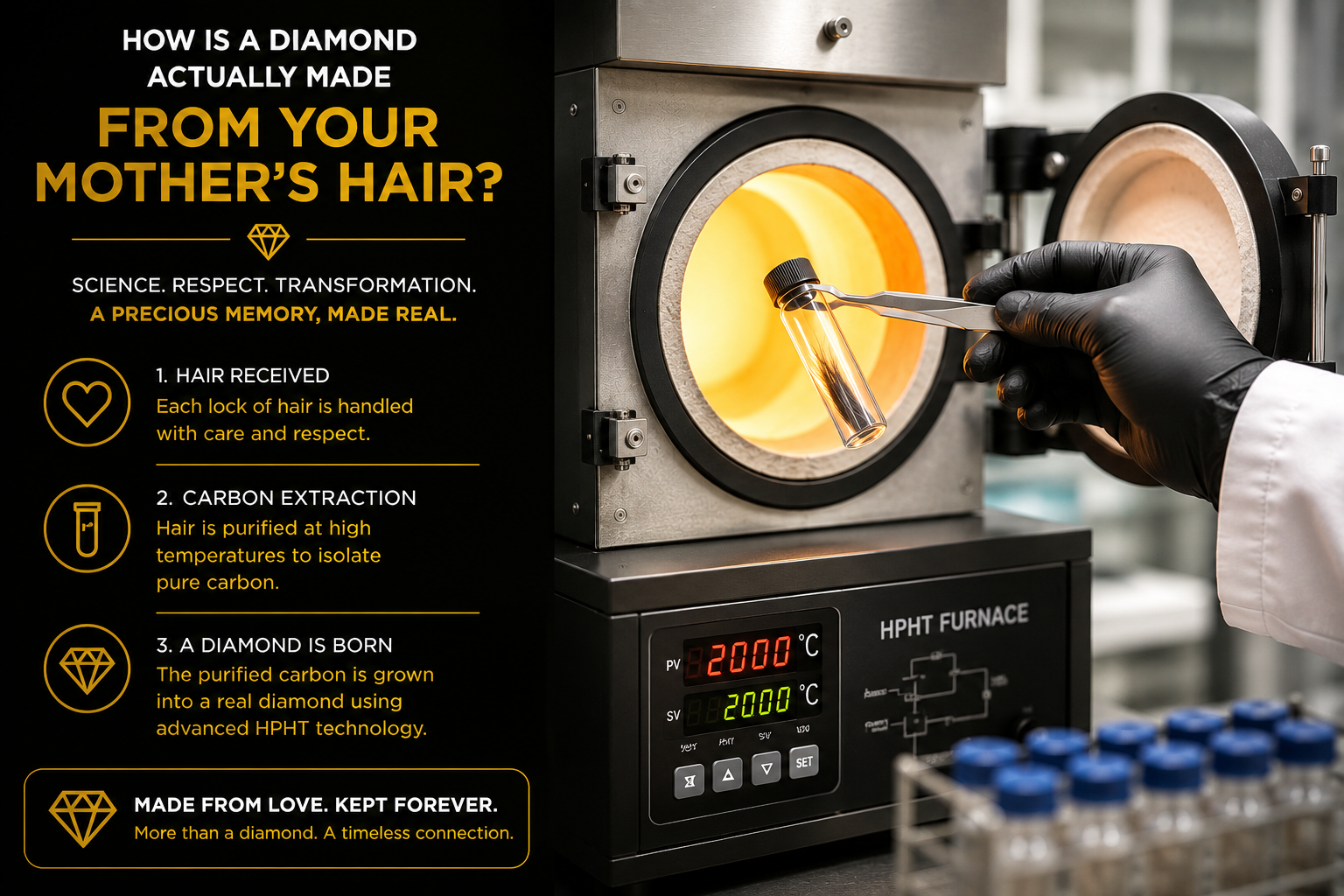
Sometimes what you have left of her is very small: a lock saved after a haircut, a braid someone thought to keep, a few strands folded inside a card. A diamond made from sister hair usually begins with a lock of a few grams, roughly half of it carbon by weight; that carbon is extracted, purified to about 99.9%, turned into graphite, typically blended with lab carbon, grown under heat and pressure, then cut and graded, typically within six to ten months.

made from sister hair

Why Can Hair Become a Diamond at All?

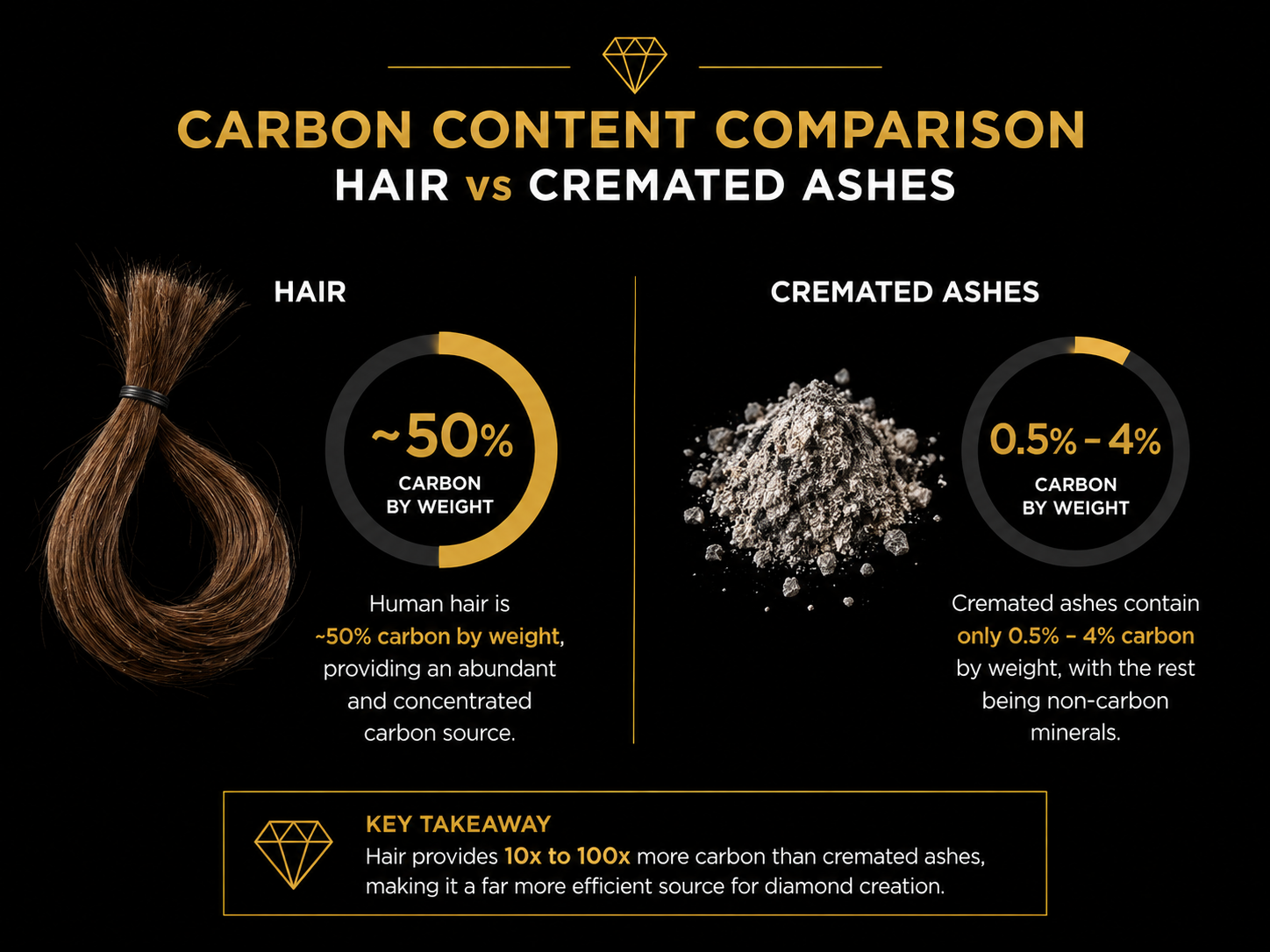
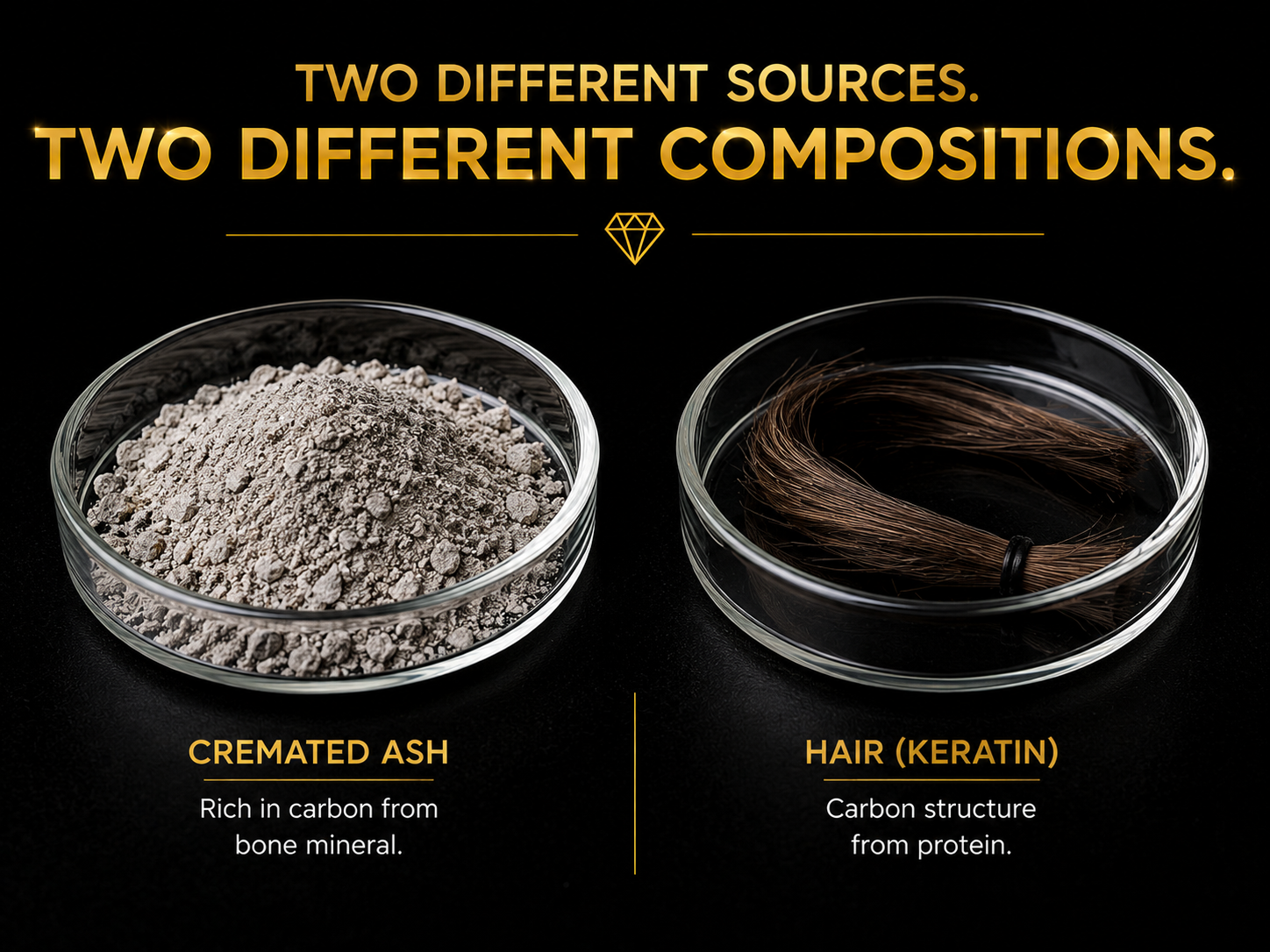
Because hair is mostly protein, and protein is built around carbon. Each strand is largely keratin, and by weight hair is roughly 50% carbon. Cremated ash, by comparison, holds only about 0.5% to 4% usable carbon, since cremation has already burned most of it away.

That difference changes almost everything about the starting point. A laboratory needs far less hair than ash, usually a small lock or a few grams, and no cremation is involved at any stage. A stone made from sister hair is therefore possible whether she was cremated, buried, or laid to rest in some other way, provided a lock was kept.

For some families hair is the only workable route: her ashes may have been scattered or interred whole, or her faith or her own wishes meant burial.

None of this makes a diamond made from sister hair a better or more meaningful choice than one from ashes. It is simply a different material with different chemistry, and the ash based version of this process works through the same laboratory stages from a much leaner starting point.

What Are the Six Stages of a Diamond Made From Sister Hair?

Six core stages take every diamond made from sister hair from a sealed packet to a finished, documented stone. A color treatment can be added by some providers, but it is optional and sits outside this core sequence.

Timings are approximate industry wide ranges; every provider runs its own schedule.

StageWhat happens to her hairApproximate durationWhat reaches you
1. Receiving and loggingThe lock is checked, weighed if required, and given a reference numberDays to two weeks, mostly transitA kit, then an arrival notice
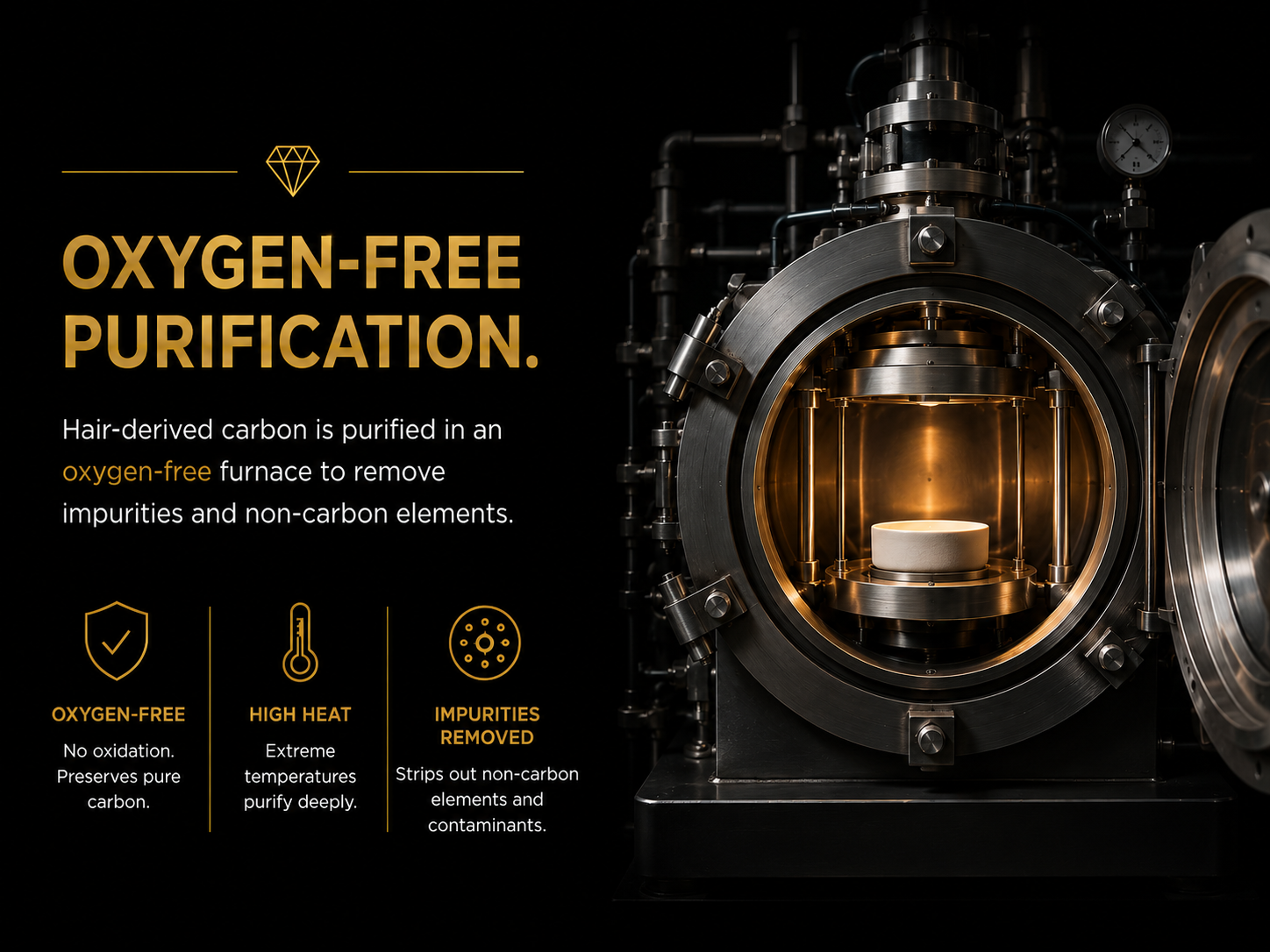
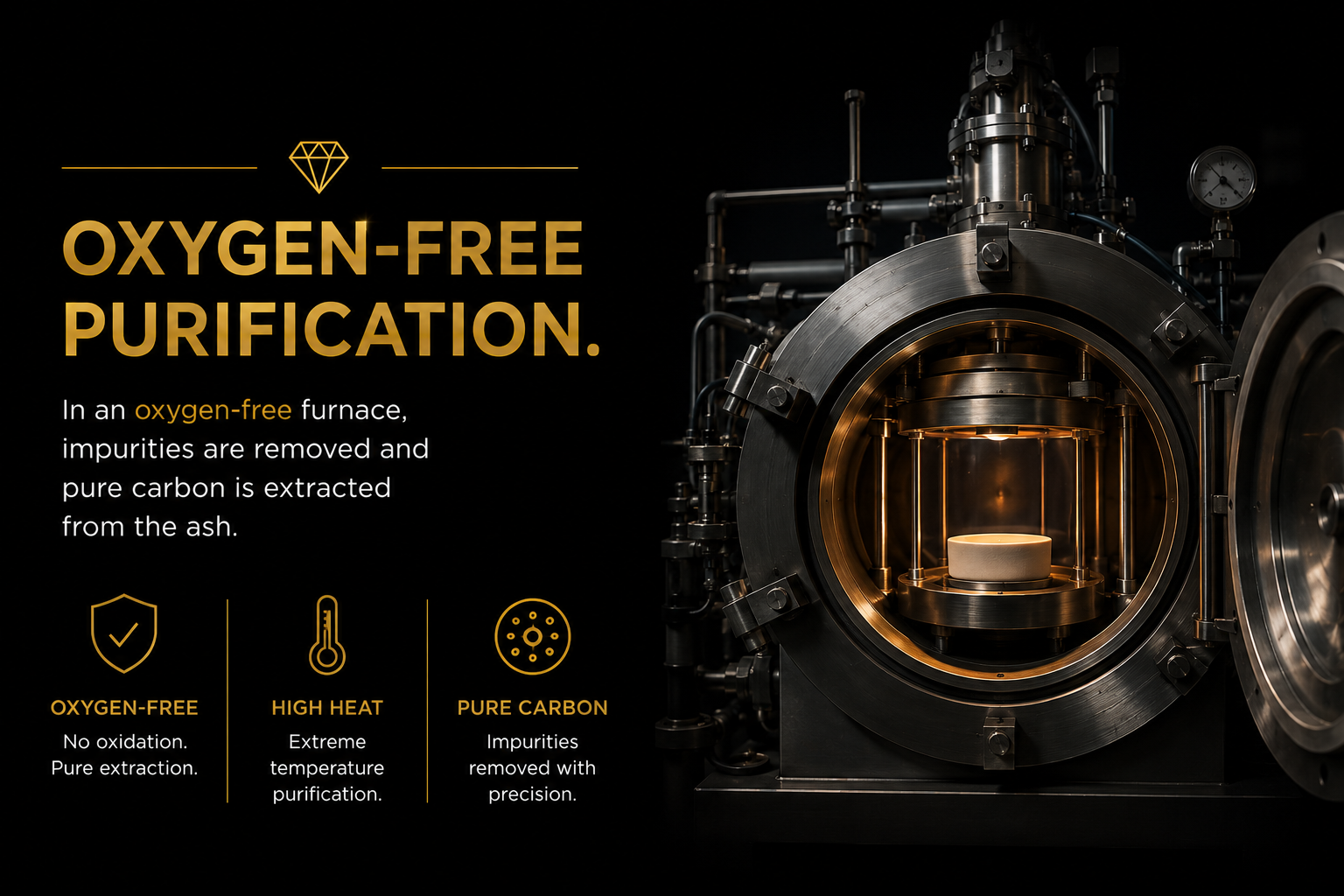
2. Extraction and purificationOxygen free heating removes the non carbon parts of keratin, leaving carbon of about 99.9% purityTypically a few weeksOften silence
3. GraphitizationPurified carbon is heated to roughly 2,500 to 2,700°C and becomes graphiteBrief relative to growthSeldom any update
4. GrowthHer graphite, typically blended with lab carbon, crystallizes on a diamond seed by HPHT or, less often, CVDWeeks to months, the longest stageThe quietest period; some providers send a rough crystal photo
5. Cutting and polishingThe rough crystal is faceted into your chosen shape and polishedUsually a few weeksSometimes images to review
6. Grading and documentationOrigin records are finalized; an independent grading report may be orderedA few weeks when an outside lab is usedThe finished stone and its documents

Six to ten months is the usual span from arrival to delivery across this industry, and larger stones or specialty colors can stretch toward twelve. A diamond made from sister hair does not move faster because hair is carbon rich; growth time still governs the calendar.

Where Does a Usable Lock of Her Hair Come From?

Usually from something already kept, since a stone made from sister hair depends on a lock someone saved. Usable hair tends to turn up in a few familiar places:

  • A haircut keepsake: a lock or braid set aside at some point in her life, sometimes years earlier.
  • The funeral home: if arrangements are still underway, you can ask whether they are able to take a small lock before burial or cremation, with the agreement of whoever is making those arrangements.
  • Her own belongings: a brush or comb may hold loose strands, though whether loose hair is accepted varies, so ask the provider first.
  • Another relative: a parent, partner or another sibling may already hold a lock and be willing to share part of it.

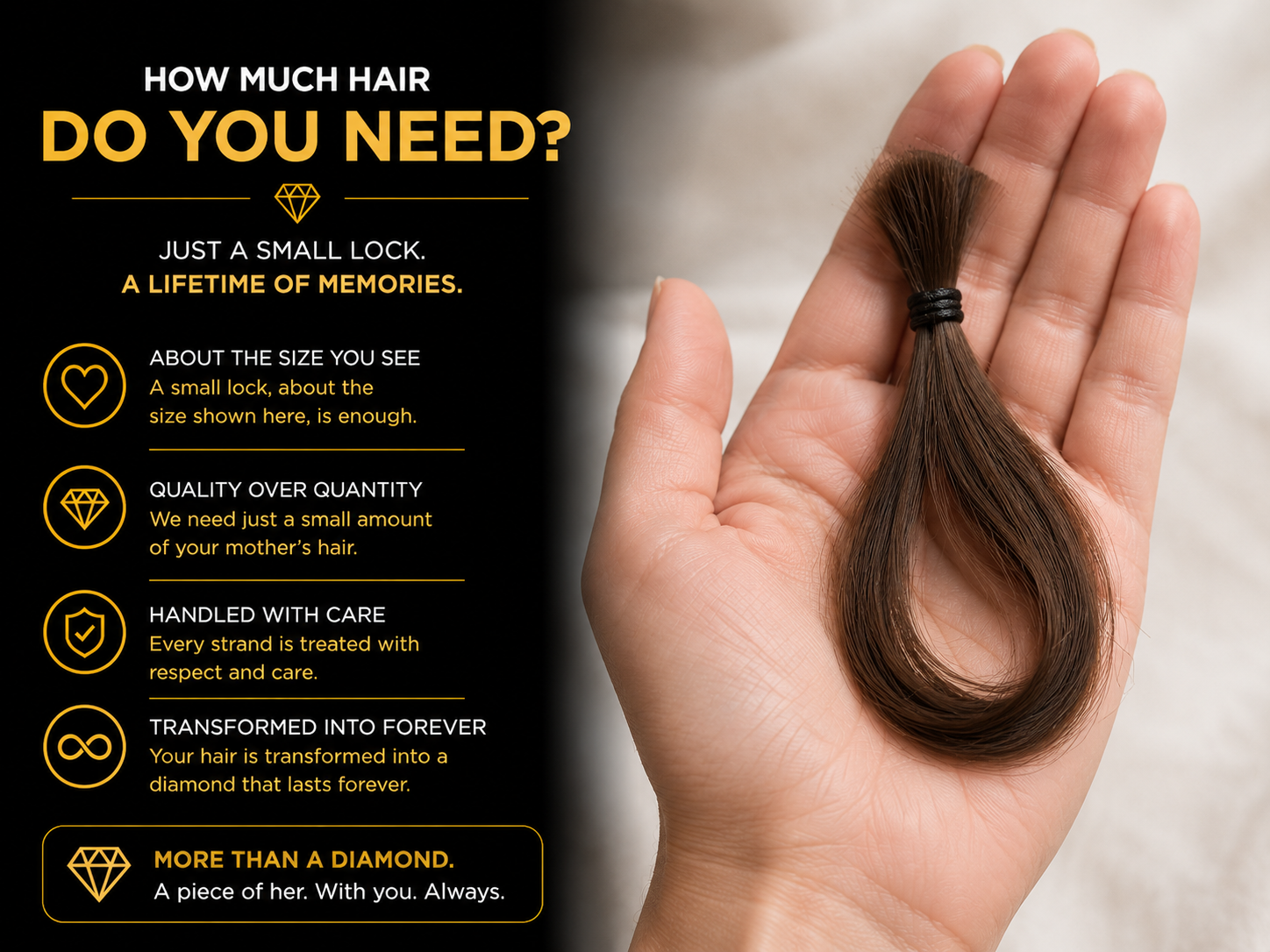
Quantity is usually modest. Requirements differ by provider, but a small lock or a few grams is a typical range, well short of what most people picture. Ask for the provider’s own minimum before you cut or divide anything, since a lock cannot be uncut.

Condition is still worth asking about. Should the hair be dry, unwashed or loose? Does dye or chemical treatment affect whether it is accepted? Only the provider can answer for its own process, and those answers belong in writing before a stone made from sister hair is ordered.

Keep the lock dry and protected while you decide.

Who Should Agree Before Her Hair Is Sent?

It depends on where the hair is and how it came to you. A lock you have held privately for years may feel entirely yours. Even so, a person’s belongings can form part of her estate, and the rules on what counts and who decides vary by state. If anyone is administering her estate, talk with them first.

Hair taken at a funeral home is different. That usually happens at the request of whoever holds authority over her remains, which in many states means a spouse or partner, then adult children, then parents, with siblings later in the order. Her own written wishes can change that sequence, and the details vary by state, so treat it as a question to check rather than a rule to assume.

If a sibling does not hold that authority, the respectful path is to ask the person who does, plainly and without pressure. Something like: you would like a small lock, cut discreetly, for a diamond made from sister hair, and you understand if they need time. Providers often ask for a signed authorization, too.

Several siblings may each want a diamond made from sister hair. Whether one lock can supply more than one stone depends on its size and on the provider’s minimum, so ask before dividing it. Twins, half siblings and step siblings may all feel part of this. The full walk through for turning her hair into a diamond sets out the calls and forms in order.

How Is Carbon Drawn Out of a Lock of Hair?

With heat, in stages, in the absence of oxygen. Controlled heating without oxygen breaks keratin down, driving off its non carbon portions while the carbon, unable to burn away as gas, remains.

The goal is carbon of roughly 99.9% purity or higher. Trace leftovers would disrupt crystal growth, so this stage is about thoroughness. What began as a soft, recognizable lock ends as a small quantity of black carbon that looks nothing like her hair.

The color of her hair does not determine the final color of the memorial diamond.

By this point, carbon made from sister hair carries no visible link to the strands you packed, which is why the reference number assigned at intake matters so much. Ask how that number follows her carbon from one step to the next, and who signs when it moves.

Two practical questions about a diamond made from sister hair belong here as well. Will any unused hair be returned to you, or is the whole lock consumed? And is her material ever processed in a shared batch with another family’s? Practices vary, and both answers are reasonable to request in writing.

What Happens Between Graphite and a Rough Crystal?

Two transformations, one brief and one long. First, purified carbon is heated to roughly 2,500 to 2,700°C and reorganized into graphite, the layered form a growth press uses as feedstock. Around this point, or as the press is loaded, supplemental lab carbon is typically added to reach the volume growth requires.

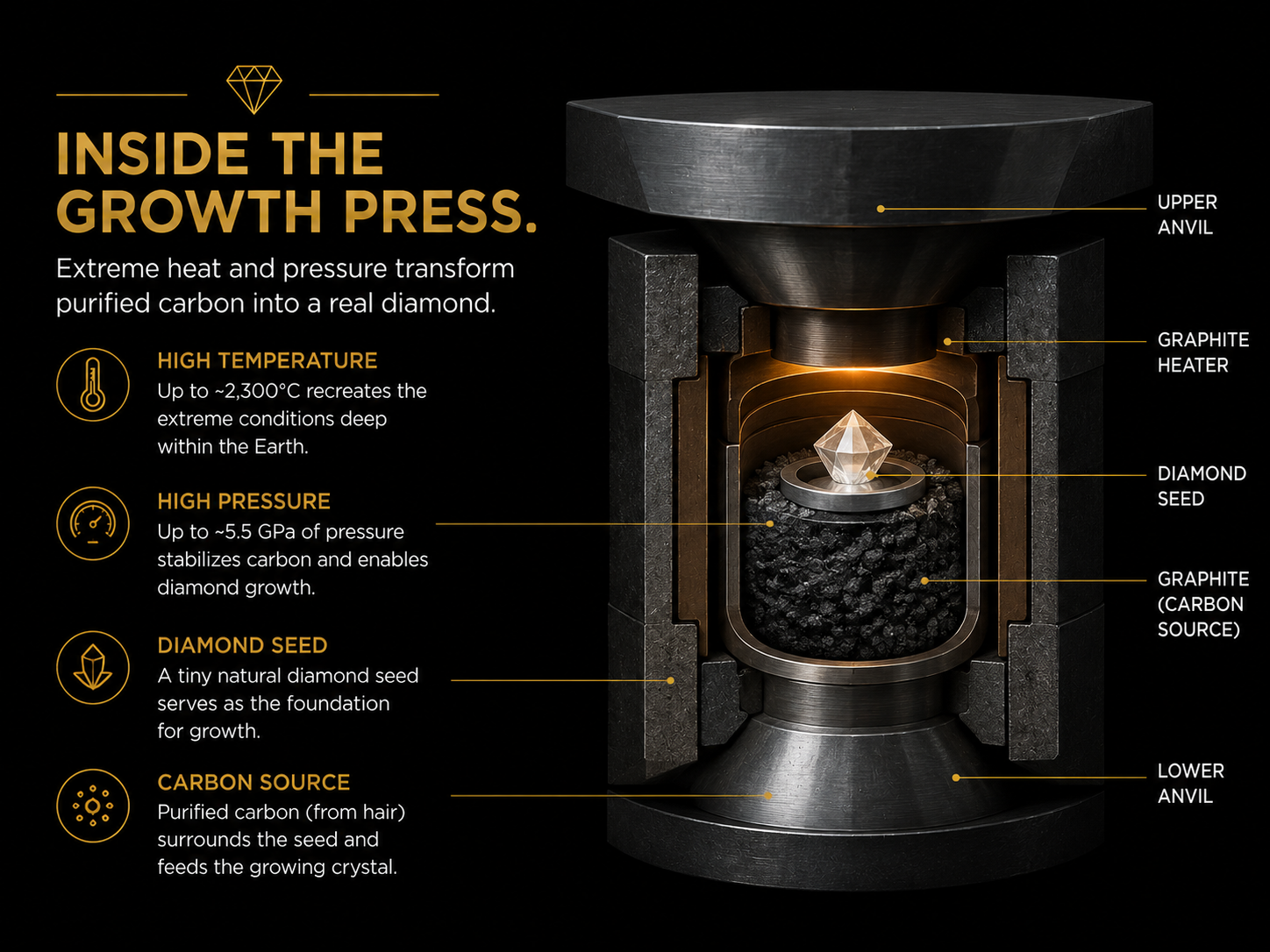
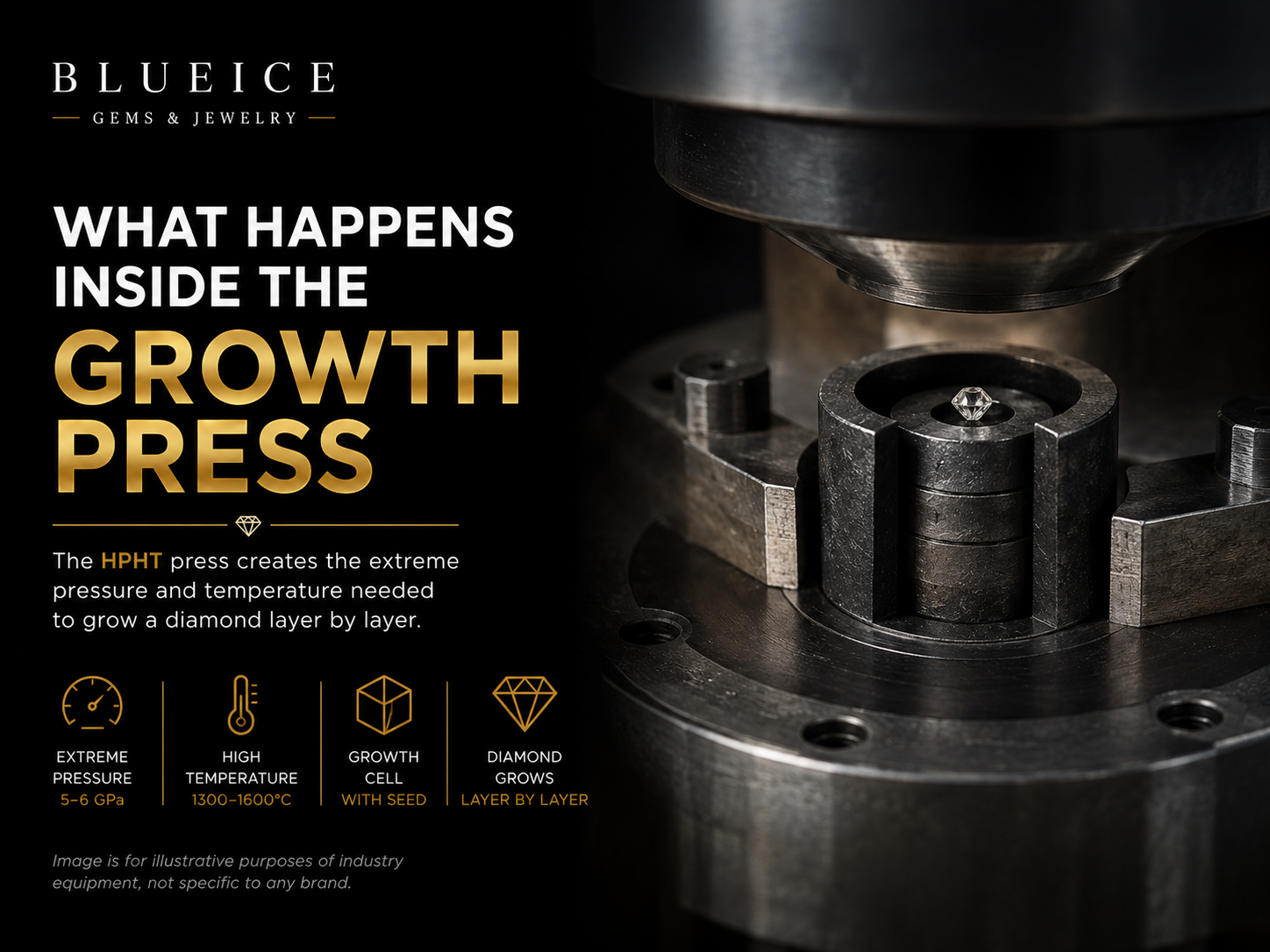
Most providers then grow the crystal by HPHT, high pressure high temperature: a press holds a small cell at around 6 to 8 gigapascals and somewhere between 1,400 and 2,500°C, and carbon crystallizes, slowly, onto a tiny diamond seed. A minority use CVD, in which the carbon is converted into a gas such as methane and deposited layer by layer onto a seed plate. Both methods yield a real lab grown diamond, the same mineral as a mined stone.

Growth runs for weeks to months, and its length decides carat size. A modest lock does not cap how large a stone made from sister hair can be, because a bigger diamond depends on a longer, steadier run rather than a bigger envelope of hair.

Runs can fail. A crystal made from sister hair may grow with flaws or stall, and some providers say a cycle occasionally has to be repeated. Ask whether any of her carbon is held back for that possibility, and what happens if it is not.

How Much of a Stone Made From Sister Hair Is Her Carbon?

Nobody has published a finished stone share for hair, so anyone quoting a figure should be asked where it came from. The 10 to 15% share you may have seen describes stones grown from cremated ashes. That is an ash figure only. It describes a different material with a different carbon yield, and it should not be borrowed for hair.

Hair starts far richer in carbon than ash, so a small lock can supply a meaningful amount. Her share of the finished crystal then depends on how much of that the provider uses and how much lab carbon is blended in, both of which vary by provider and stone size.

So ask, in writing, for the specific stone you are considering:

  1. How much of her hair will be used, and how much carbon do you expect to recover from it?
  2. How much supplemental lab carbon will be added, and where is it sourced?
  3. What share of a finished stone made from sister hair do you estimate is her carbon?
  4. Is her carbon ever combined with another family’s at any stage?

A stone made from sister hair is physically built in part from her own carbon. That is the honest claim, and it does not need inflating. If a provider tells you the whole stone is her carbon, that is a reason for more questions, and the evidence for what is truly hers is worth reading first.

Does Her Hair Color Affect a Stone Made From Sister Hair?

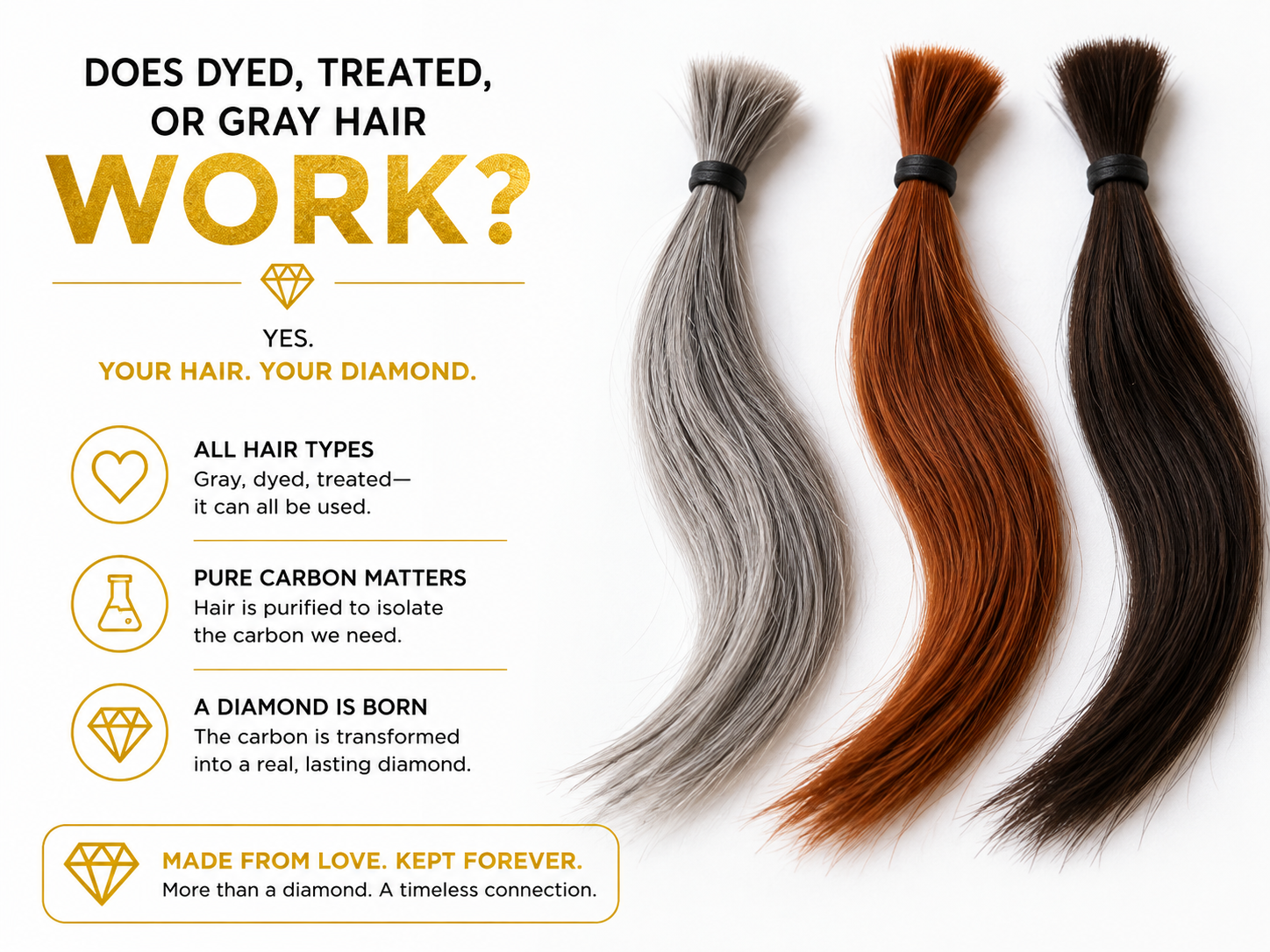
No. Her hair color, whether dark, light, gray, red or dyed, does not carry through into the stone. Pigment is broken down during purification, and only carbon remains.

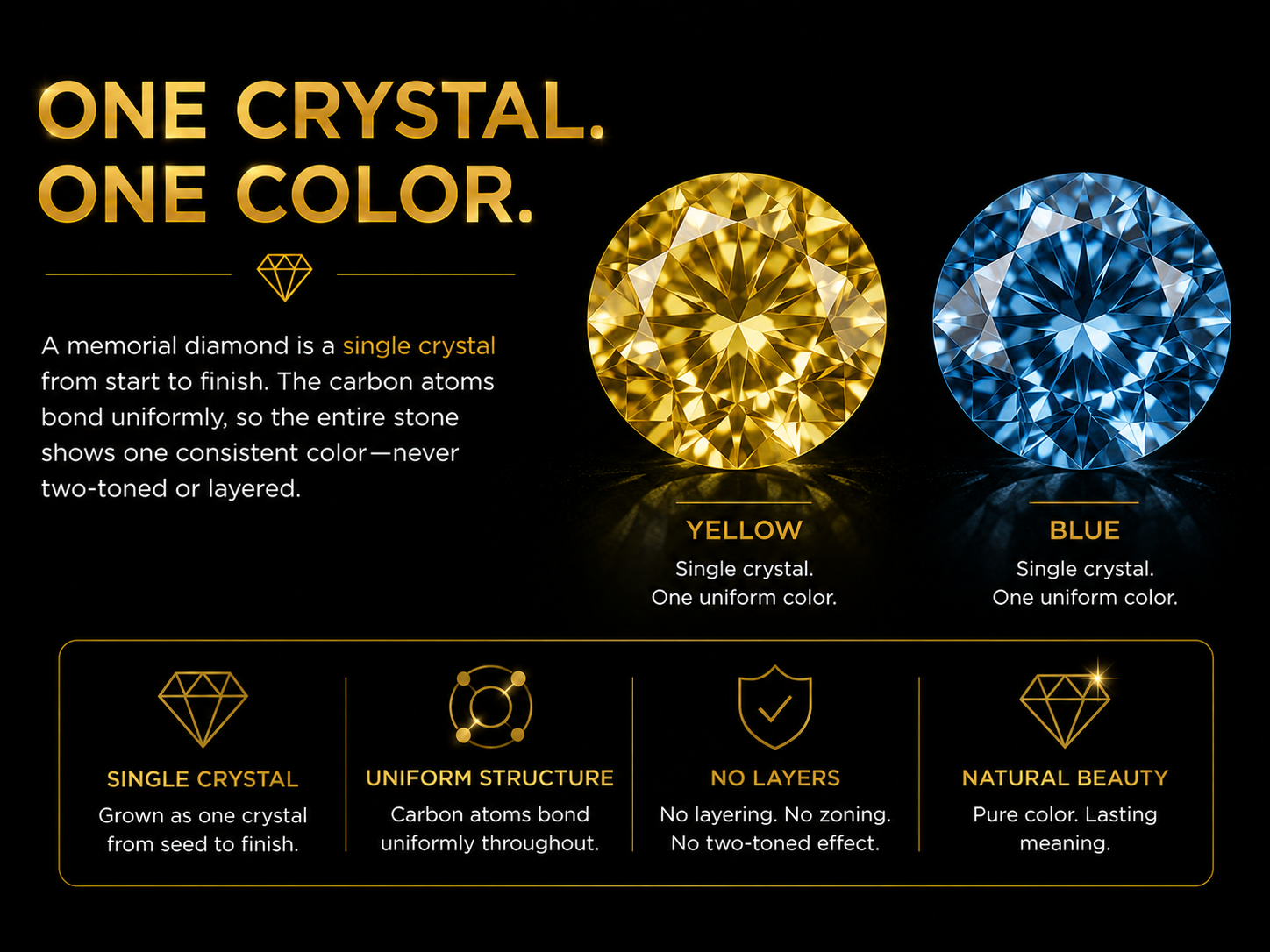
What tints a diamond is chemistry inside the growth cell: stray nitrogen atoms caught in the lattice lean the crystal yellow, stray boron leans it blue, and a stone with neither shows no color at all. Shutting both out calls for extra processing, so colorless results usually cost more. As a group, memorial diamonds lean toward yellow, blue and champagne.

Some providers also offer post growth irradiation for shades such as red, green or black, which is optional and should be disclosed on the paperwork. What nobody can do is choose, match or predict the final shade of a diamond made from sister hair from the hair itself. A provider can describe the color options it offers and the process behind each; it cannot promise an exact tone.

What Records Show a Diamond Was Made From Sister Hair?

A sequence of documents, each covering a different moment. Ask which of these a provider issues before you commit:

  • A signed authorization naming who released the hair and what was ordered.
  • An intake confirmation with a reference number, ideally noting the weight or condition of the lock on arrival.
  • A stage or custody log recording each handover as her material moves through the laboratory.
  • An origin or authenticity certificate, usually issued in house, stating that the stone was grown from the carbon your family supplied.
  • An optional independent grading report describing cut, color, clarity and carat.
Keeping intake and custody records helps connect the finished stone to the material supplied by the family.

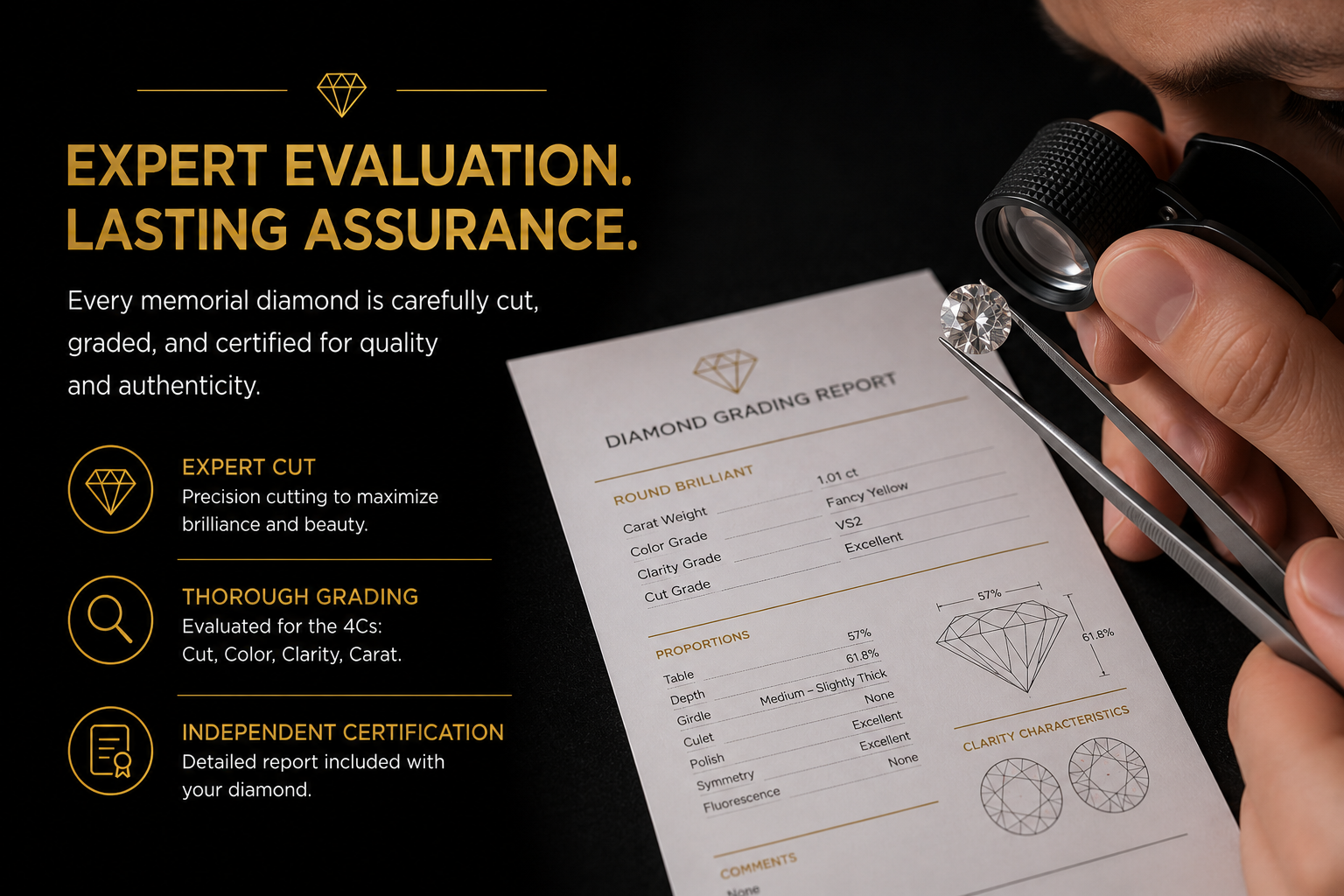
The last two are often confused. An origin certificate is a custody document; it is what ties the stone to her. A grading report, from an outside gemological lab, assesses quality the way it would for any diamond and says nothing about origin. Across this industry, independent grading is generally optional and costs extra.

Ask to see a sample custody log with another family’s details removed. For a gem made from sister hair, the origin certificate only means something when the records behind it exist and can be shown.

What Does a Sibling Experience From Start to Finish?

The beginning is busy: family conversations, choosing a lock, a kit, a form and a sealed packet. Write down the reference number; it is your thread through what follows.

Then the middle goes quiet. Purification and graphitization rarely generate news, and growth can run for weeks or months without an update. Some providers send a photo of the rough crystal; others wait until the stone is cut. Ask in advance which approach yours takes and whom you can reach if you start to worry about a diamond made from sister hair you have not heard about in a while.

The end returns to something you can hold. Cutting gives the stone its shape, and some providers share images before final approval or setting. A finished diamond rates 10 on the Mohs scale of mineral hardness, so it can be worn daily in a ring, pendant or earrings. Typical clarity for memorial stones lands between SI2 and VVS.

Delivery brings the stone made from sister hair and its papers together. You might keep the origin certificate with the envelope the lock once lived in, or file it with her other papers.

What Will a Diamond Made From Sister Hair Cost?

The price of a stone made from sister hair follows carat size and color far more than the source material. Across the industry in 2026, and not as any one company’s price list, a small stone in the 0.10 to 0.25 carat band generally lands between $1,500 and $3,500. Moving up to somewhere between half a carat and a full carat brings the range to about $5,000 to $15,000, while two carats and upward, past five, can reach $20,000 to $75,000 or more. Colorless costs meaningfully more than yellow, blue or champagne at the same size.

Several items are usually priced on top of the loose stone: independent grading, engraving, fancy cuts and any setting. Insured return shipping may be billed separately too, so request a full written total rather than a starting figure.

For a broader view of the options, timelines and decisions involved, the complete guide to a sister hair diamond covers them together. If your family also holds a portion of her ashes, how a diamond is made from both her ashes and hair explains how the two are combined, and the complete guide to using ashes and hair together sets out the wider choices.

Frequently Asked Questions

How much hair is needed for a diamond made from sister hair?

Requirements vary by provider, but a small lock or a few grams is typical. Because hair is roughly half carbon by weight, far less is needed than with ashes. Ask for the provider’s minimum before cutting or dividing any lock you hold.

Can hair from her hairbrush be used?

Possibly. Some providers accept loose strands gathered from a brush or comb, while others prefer a cut lock. Ask the specific provider what it accepts and in what quantity, and confirm it in writing before sending anything you cannot replace.

Can a stone be made from sister hair if she was buried, not cremated?

Yes, provided a lock of her hair was kept. Hair needs no cremation, which is one reason it is chosen by families whose sister was buried, or whose ashes are held elsewhere and cannot easily be divided.

Will her whole lock be used up?

That depends on the lock’s size and the provider’s process. Purification consumes whatever hair goes into a stone made from sister hair, so ask beforehand how much will be needed and whether any unused strands are returned, kept or disposed of afterward.

Does dyed or gray hair change the finished diamond?

Her hair color does not carry into the stone, because pigment is removed with everything else during purification. Ask the provider whether dyed or chemically treated hair affects acceptance, since requirements on treated hair vary between laboratories.

Can two siblings share one lock of her hair?

Sometimes. It depends on how large the lock is and how much each provider requires per stone made from sister hair. Ask before dividing it, and agree among yourselves, and with anyone administering her estate, before anything is cut or sent.

Final Thoughts on How Her Hair Becomes a Diamond

A lock of hair is one of the smallest things a person leaves behind, and it can feel unlikely that anything as solid as a diamond could begin there. The chemistry says otherwise: the carbon in a crystal made from sister hair is freed from the keratin, purified, rearranged into graphite and grown slowly into a crystal alongside lab carbon, then cut and documented.

What makes the result trustworthy is not the story told about it but the records kept along the way. A diamond made from sister hair is a real diamond that contains a real share of her carbon, and it is reasonable to ask a provider to show you, in writing, how they know.

Learn More About Sister Memorial Diamonds

Talk With Memorial Diamond

If you are holding a lock of her hair and wondering whether a diamond made from sister hair is possible, Memorial Diamond is glad to talk it through at memorialdiamond.us, from how much hair is needed to which records you would receive. Asking questions places you under no obligation.

Daughter Memorial

Daughter Memorial Diamond vs. Traditional Urn: What to Know

Somewhere between the funeral paperwork and the first quiet week at home, the question of where her ashes will rest starts to feel very real. The daughter memorial diamond vs urn decision is less a contest than a question of form: an urn keeps her remains whole and in one place, while a memorial diamond is a lab grown stone made with carbon from a small portion of them. Because the stone uses so little, families can keep both.

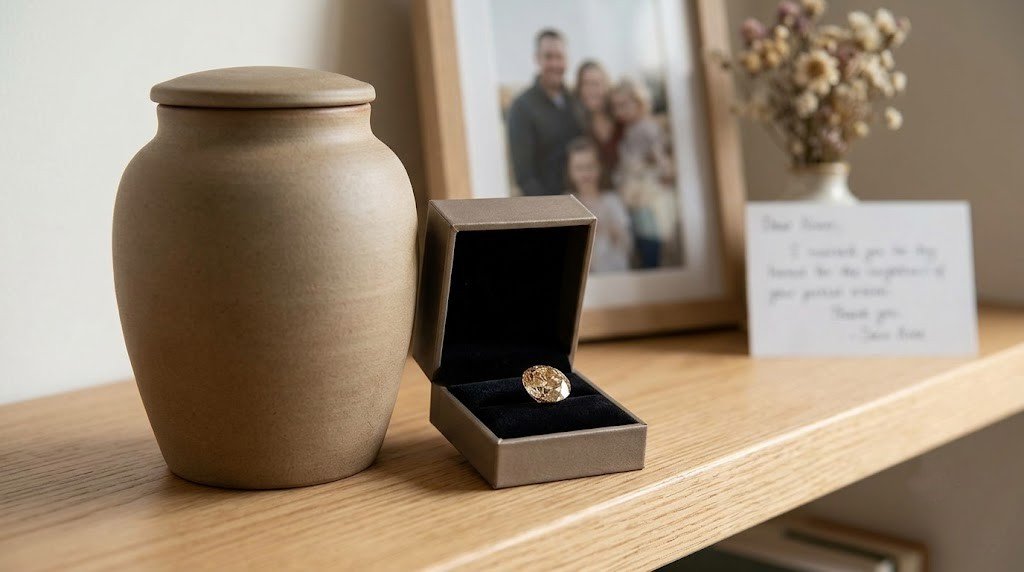
Daughter memorial diamond vs urn: a simple ceramic urn on a shelf beside a small open box holding a champagne-toned memorial diamond

What Is Actually Being Compared?

In the daughter memorial diamond vs urn comparison, the urn is a vessel. It holds cremated remains, either all of them or a share, and it leaves those remains exactly as they came back from the crematory.

Urns are made in wood, metal, ceramic, stone and glass. Some are designed to break down naturally when buried in earth or placed in water. Smaller keepsake urns hold only a little. An urn might sit on a shelf at home, rest in a columbarium niche, be buried in a cemetery plot, or simply hold her ashes until the family decides on scattering.

The diamond side of a daughter memorial diamond vs urn decision involves a transformation rather than a container. Carbon is extracted from a portion of her ashes, purified, converted to graphite, typically blended with supplemental lab carbon and grown into a real diamond, usually in a high pressure, high temperature press.

The finished stone is chemically a diamond, the same material as any other, and it is part of a category of memorial that now has its own history.

So the daughter memorial diamond vs urn comparison is not two versions of the same thing. One keeps her remains as they are. The other makes something new from a small part of them. Understanding that difference first makes every later question easier to answer.

How Do the Daughter Memorial Diamond vs Urn Options Line Up?

The table below sets the two formats next to each other. Read it as a description, not a scorecard. The daughter memorial diamond vs urn question has no winning column.

What you might weighTraditional urnMemorial diamond
What it isA vessel holding her cremated remainsA lab grown diamond made partly with carbon from her ashes
How much of her ashesAll of them, or a share in a keepsake urnTypically a few tablespoons up to about 4 oz, approximately 100 g, depending on the provider
What happens to the ashesKept unchangedA portion is transformed; the rest remains
Where it livesA home, a niche, a cemetery plot, or until scatteringWorn, carried, or kept loose
Travels with youPossible, with carrier rules to checkEasily, as jewelry or a loose stone
DurabilityDepends on the material chosenHardness of 10, though a hard knock can chip it
When it is readyDays or weeksTypically 6 to 10 months, up to about 12
CostVaries widely by material and makerRoughly $1,500 to $75,000 or more by size and color, based on general industry ranges
Can be shared among relativesThrough keepsake urns or divisionThrough separate stones from separate portions
Can the choice change laterYes; ashes stay availableThe stone cannot be undone; remaining ashes stay available

Two rows in this daughter memorial diamond vs urn table deserve a second look. The first is what happens to the ashes. The second is whether the choice can change later.

Every other consideration is mainly about preference, budget and daily life, which only your family can weigh.

Why Is the Daughter Memorial Diamond vs Urn Choice Rarely Either Or?

Because the diamond needs so little. Requirements vary between providers, but a typical ash based order uses a few tablespoons to roughly four ounces, which is usually a small fraction of what a crematory returns.

The remainder can go into an urn exactly as planned. This is why a family weighing the daughter memorial diamond vs urn question can end up choosing both.

How much ash a laboratory typically requests explains the range and what stays behind.

A few combinations a family might consider include:

  • A full urn at home, with one pendant worn by a parent
  • An urn placed in a columbarium niche, with a ring made for her partner
  • Most of her ashes scattered somewhere she loved, a small keepsake urn kept, and a single stone
  • An urn held for now, with the diamond decision left open for later

None of these needs to be settled in the first weeks. Ashes usually come back from the crematory in a temporary container, and an urn can hold them while the family takes whatever time it needs.

There is something quietly reassuring in this. The daughter memorial diamond vs urn decision does not ask anyone to give up a place to visit in exchange for something to wear, or the reverse.

What Does Each Option Ask of Her Ashes?

In the daughter memorial diamond vs urn comparison, an urn asks nothing of her ashes. Her remains stay exactly as they are, and every future option, from scattering to burial to dividing a portion later, stays open.

A memorial diamond asks for a portion and changes it permanently.

Cremated remains are mostly calcium phosphate, the mineral of bone, and only about 0.5% to 4% of their weight is usable carbon. That carbon is isolated and refined to roughly 99.9% purity, turned into graphite at temperatures near 2,500 to 2,700°C, and then grown into a crystal.

Most providers use high pressure, high temperature presses working at around 6 to 8 GPa. Fewer use chemical vapor deposition. Cutting, polishing and grading follow, with irradiation offered by some providers for certain colors.

Because the recovered carbon is small, it is typically blended with supplemental lab carbon. Industry figures for ash based stones put her share of the finished mass at roughly one part in ten to around 15%, while a few providers report as little as 3%.

The stone is never purely her. It is a real diamond that physically contains carbon that was hers, which is a different and still meaningful thing.

Whether the stone is really made from her ashes goes further into that distinction.

This is the one asymmetry in the daughter memorial diamond vs urn comparison worth sitting with. Choosing an urn today closes off nothing. Choosing a diamond uses a portion that cannot be returned to ash. Neither fact is a reason to choose one way. It is simply a reason not to rush.

Where Does Each One Live Day to Day?

On the daily life side of a daughter memorial diamond vs urn decision, an urn gives her a place.

Some people find steadiness in a fixed spot they can visit: a shelf they pass each morning, a niche they drive to on her birthday, or a plot where the family gathers.

Moving house means moving the urn with care, and traveling with cremated remains involves carrier and security rules that are worth checking well in advance.

A diamond goes where you go. It can be set in a ring, a pendant or a bracelet, or kept as a loose stone in a small box.

It rates 10 on the scale gemologists use for scratch resistance, so everyday wear does not scratch it, though a hard knock at the wrong angle can still chip any diamond.

A protective setting and jewelry insurance are sensible. How settings protect a stone worn every day covers metals, mounts and resizing.

People differ on this, and the daughter memorial diamond vs urn conversation often turns here.

One parent may want somewhere to go. Another may want something to hold. A sibling may want neither, or both. Those preferences say nothing about how much anyone loved her.

How Do Cost and Time Compare?

Cost and timing are where the daughter memorial diamond vs urn gap is widest.

An urn can usually be in place within days or weeks, and prices vary widely depending on material, size and maker. A funeral home or urn retailer can give current figures for the styles you are considering.

A memorial diamond takes longer and costs more. Expect something in the region of six to ten months once the laboratory has her ashes, and up to a year for a stone larger than about two carats or in a specialty color.

Carat size is set by growth time, not by how much ash is sent.

Price band, industry wideWhat it generally buys
$1,500 up to $3,500A small stone, roughly a tenth to a quarter carat
$5,000 up to $15,000Half a carat to a full carat; colorless sits higher
$20,000 to beyond $75,000Two carats and larger

Important: These are general 2026 industry ranges, not Memorial Diamond pricing.

Independent grading, engraving, fancy cuts and settings are usually extra.

What drives the cost of a daughter memorial diamond breaks those variables down, while where the months of production go explains the waiting period.

For the daughter memorial diamond vs urn decision, the practical takeaway is sequencing. The urn can come first and serve immediately. A stone, if the family wants one, can follow whenever budget and readiness allow.

How Might Faith and Tradition Shape the Choice?

No religious tradition has an official position on memorial diamonds specifically. What traditions address is cremation and how ashes are handled, and those positions can shape a daughter memorial diamond vs urn decision more than any price or timeline.

Current Catholic guidance permits cremation but directs that ashes be kept intact in a sacred place rather than divided or kept at home, with a narrow allowance for a small portion under specific conditions. That bears directly on taking a portion for a stone, so a Catholic family may want to speak with their priest first.

Across Islamic schools of thought, cremation itself is generally considered impermissible, which means an ash based stone does not arise, though a hair based one involves no cremation.

Jewish movements differ widely on cremation.

In Hindu practice, ashes are traditionally immersed in a sacred river, and keeping a small portion is described as increasingly common, though it varies by family and community.

If faith matters to your family, the daughter memorial diamond vs urn question is best brought to your own clergy or community, who know your tradition and your circumstances. A memorial company is not the right authority on it.

Who Gets a Say in the Daughter Memorial Diamond vs Urn Decision?

Whoever holds legal authority over her remains, and that is not always a parent.

State law sets a default order, and it differs between states. Her husband, wife or partner may outrank her parents, and so may any grown children she had. Anything she put in writing about her remains can change the order entirely.

The funeral home or crematory can usually tell you who signed the cremation authorization.

Families also carry their own differences. Separated parents, or one parent arranging everything while the other keeps a distance, may land on different sides of the daughter memorial diamond vs urn question.

Because a stone uses only a portion, there is often room for both wishes, but dividing her ashes still requires agreement from the person with authority.

Relatives beyond the parents may have views on a daughter memorial diamond vs urn plan, too: siblings, grandparents and close friends.

How several relatives can each receive a stone explains the practical side, while raising the idea gently with family covers the conversation.

What If She Was Buried Rather Than Cremated?

Then the daughter memorial diamond vs urn comparison changes shape, because there are no ashes to place in an urn.

A memorial diamond is still possible if a lock of her hair was kept.

Because about half of hair’s weight is carbon, a lock weighing only a few grams may be all a laboratory asks for, and no cremation is involved at all.

Two honest caveats apply to this version of the daughter memorial diamond vs urn question.

No published figure exists for what share of a finished hair based stone is personal carbon, so ask any provider to state theirs in writing.

And a lock kept at home may count as part of her estate. State rules differ, so speak with the executor or whoever is settling her affairs before mailing it.

A diamond grown from her hair is explained in full elsewhere.

Which Questions Can Help Your Family Decide?

There is no formula for a daughter memorial diamond vs urn decision, but a few questions tend to bring a family’s own answer into focus:

  1. Does anyone want a fixed place to visit, and does anyone want something to carry?
  2. Did she ever say anything about her ashes, even in passing?
  3. Is anyone uncomfortable with dividing her remains, and why?
  4. Does faith or tradition shape what feels right?
  5. What does the budget allow now, and what might it allow later?
  6. Would an urn and a stone serve different people in the family?
  7. Is there any real reason to decide quickly?

Talking through these can make the daughter memorial diamond vs urn decision feel less like a verdict and more like a plan.

The answers may point to an urn alone, a stone alone, or both. Each is a complete and loving way to keep her.

Frequently Asked Questions

Is a memorial diamond better than an urn for our daughter?

Neither is better. An urn keeps her remains whole and gives the family a place. A diamond is something that can be worn or carried. The daughter memorial diamond vs urn choice depends on what your family wants day to day, not on which honors her more.

Can we keep her ashes in an urn and still have a diamond made?

Yes. A stone typically uses a few tablespoons to about four ounces of ashes, depending on the provider, which is usually a small share of the total. The remainder can stay in an urn, be buried or be scattered as planned.

What share of the diamond would be her own carbon?

For an ash based stone, industry figures suggest her carbon forms roughly one tenth to 15% of the finished mass, and a few providers report as low as 3%. Supplemental lab carbon makes up the remainder. Ask for each provider’s figure in writing.

Can we choose an urn now and decide about a diamond later?

Yes, as long as some of her ashes remain accessible. Choosing an urn first closes off nothing, and a family may find it easier to decide about a stone once the first months have passed.

Is a memorial diamond more expensive than an urn?

Generally, yes, and cost is one of the clearest daughter memorial diamond vs urn differences. Industry wide, memorial diamonds range from roughly $1,500 for small stones to $75,000 or more for large ones, while urn prices vary widely by material. Grading, engraving and settings usually add to a diamond’s cost.

Does making a diamond rule out scattering or burial?

No. Because the diamond uses only a portion, the rest of her ashes remain available for scattering, burial in a cemetery plot, a columbarium niche or an urn at home. A stone can sit alongside any of these.

What if her parents disagree about the urn and the diamond?

A stone uses only a portion, so both wishes can often be honored. Dividing her ashes still needs agreement from whoever holds authority over her remains. That varies by state and her written wishes, and may be her spouse, partner or adult children.

Final Thoughts on the Daughter Memorial Diamond vs Urn Choice

Seen clearly, the daughter memorial diamond vs urn choice comes down to two different needs.

One gives her a resting place. The other gives you something to carry into ordinary days.

Families who keep both are not hedging, and families who choose only one have not missed anything.

If there is a single piece of practical advice in the daughter memorial diamond vs urn comparison, it is this: the urn can come first, and nothing about it closes the door on a stone later.

Take the time you need.

Learn More About Daughter Memorial Diamonds

Talk With Memorial Diamond

If the daughter memorial diamond vs urn question is still open for your family, Memorial Diamond is happy to talk through what a stone would involve, including how little of her ashes it uses.

Reach us at memorialdiamond.us. There is no pressure and no deadline.

Daughter Hair Diamond Questions: 10 Proven, Gently Asked

Questions to Ask Before Turning Your Daughter’s Hair Into a Diamond

A lock of your daughter’s hair may be one of the few things of hers you can still hold in your hand, which makes sending it anywhere a bigger step than it looks. The daughter hair diamond questions worth asking first concern whose agreement you need, where the hair should come from, how much gets used and what comes back, how a provider tracks something so small, and what it will state in writing about her share of the finished stone.

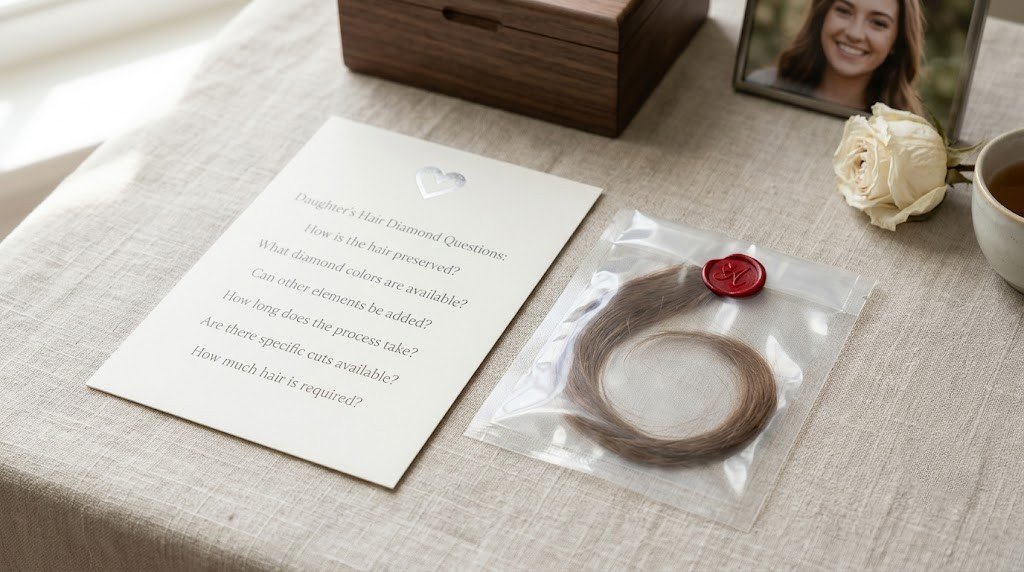
Daughter hair diamond questions listed on a card beside a small lock of hair in a clear sealed bag

Why Do Daughter Hair Diamond Questions Differ From Ash Questions?

Because hair behaves differently at almost every stage. Hair is roughly 50% carbon by weight, built mostly from the protein keratin, while cremated remains are mostly bone mineral with very little carbon left in them. That one difference means a provider needs far less hair than ash, and no cremation is involved at all.

It also moves the risks around. With hair, the harder daughter hair diamond questions concern provenance: is every strand hers, is the lock you hold the only one that exists, and will any of it come back?

If her ashes are part of your plans as well, the questions to ask about her ashes cover custody and authority from that side. This page stays with hair, so the daughter hair diamond questions below assume a small, irreplaceable amount and a provider you have not yet chosen.

What Are the 10 Daughter Hair Diamond Questions to Send?

Ten questions, written so a provider can answer each one with a fact rather than a feeling. Copy them into a single email and send the same version to every company you are considering.

#QuestionWhy Hair Makes It Matter
1Whose consent do you require before accepting her hair?Hair kept at home can still be part of her estate
2How much hair do you need, and in what form?A lock, brush strands and clippings are not interchangeable
3Do dye, bleach, treatments or very short length affect suitability?Some hair has been through a lot of chemistry
4If the hair came from a brush, how do you handle strands that may not be hers?Brushes can be shared
5Will the whole sample be used, and can any unused hair be returned?You may want part of the lock kept
6How is her hair logged and kept apart from other orders?Small samples are easy to misplace
7What will you state in writing about how much of the stone is her carbon?No published finished stone percentage exists for hair
8What supplemental carbon is used, and why?Lab carbon is typically blended in
9Which documents come back, and who issues each one?Origin and quality are recorded separately
10What is the full cost, and what do your terms say if growth fails or I cancel?Hair can rarely be resent

A provider that answers every one of these daughter hair diamond questions plainly has given you a fair basis for comparison. One that answers half has given you a reason to write again.

It is tempting to assume that hair already in your keeping is simply yours to send. It may not be that simple. A person’s belongings can form part of her estate, and rules about who decides vary by state. Depending on the state, her spouse or partner, or any adult sons or daughters she had, could be entitled to decide before her parents are, and her own written instructions may also count.

Hair not yet collected raises a different point. If a funeral home is to cut a lock before burial or cremation, that request normally goes through whoever holds authority over her remains, which state law and her written wishes decide.

So the first daughter hair diamond questions to send ask what consent the provider requires and in what form. If there is doubt within your family, talk to the people closest to her before you mail anything. Separated parents, a partner who saved a lock, or siblings who each hold a few strands can each create a different situation. Each is easier to settle before the parcel leaves, and an estate attorney can help if the answer is not clear.

Where Should the Hair Come From?

Hair you might send usually comes from one of three places, and each raises its own daughter hair diamond questions.

  • A saved lock: From a haircut, a keepsake envelope, or one taken by the funeral home. Usually the clearest source, because you know whose it is.
  • A hairbrush or comb: Sometimes the only source available. Ask whether the provider accepts brush hair and how it handles the chance that a few strands belong to someone else who used the brush.
  • Clippings or very short hair: Sometimes all that remains. Ask whether short pieces are workable before you send them.

Whatever the source, ask how the provider wants it packed. Instructions differ, and following them exactly protects the sample. Label the envelope with her name and the source, and photograph it before sealing so you have your own record of what you sent.

If you hold more than one source, such as a lock and a brush, add a line to your daughter hair diamond questions asking which the provider prefers. Sending the clearest sample and keeping the rest at home is worth discussing.

How Much Hair Is Enough, and Will Any Come Back?

Probably less than you picture. Because hair is so rich in carbon, providers typically ask for a small lock or a few grams, sometimes described as a palm sized bundle. Exact requirements differ between companies, so treat any number you read as a general guide. How much hair a provider usually needs is worth checking against the amount you actually have.

The more important daughter hair diamond questions here are about what happens to the rest. Will the provider use the whole sample, or only what it needs? If there is a surplus, will it be returned, kept or disposed of? Can you ask in advance for part of the lock to be held back and mailed home with the finished stone?

If your family has only one small curl, say so at the start; a provider may be able to advise whether it is enough to share with a relative who also wants to keep some. Sending more hair will not produce a larger diamond, because size is set by how long the crystal grows. Daughter hair diamond questions about quantity are really questions about what your family keeps.

Which Daughter Hair Diamond Questions Cover Dye, Products and Length?

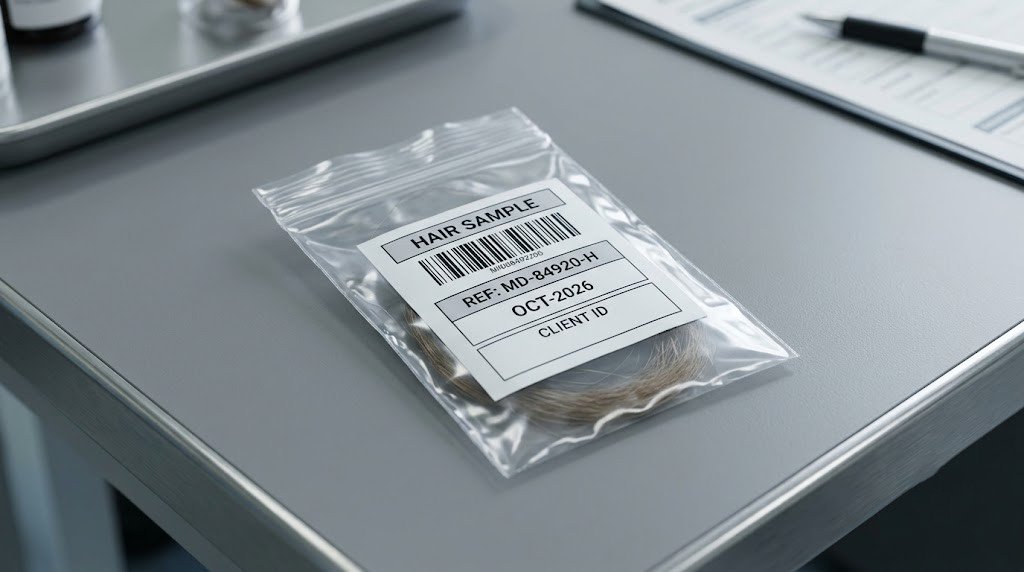
A small sealed hair sample bag with a printed reference label on a laboratory bench

Her hair may have been colored, bleached, permed, straightened or treated, and some of it may carry traces of styling products. Whether any of that matters is a question for the provider, not something to guess at home. Put it plainly among your daughter hair diamond questions: does chemical treatment, color or residue affect whether the sample is usable, and does it change anything about processing?

Length matters for a different reason: very short hair is lighter, so the same weight takes more strands. Ask whether the provider sets a minimum length or only a minimum weight.

Ask, too, whether the company assesses a sample before charging the full price, and what your options are if it proves unsuitable. Avoid washing or trimming the hair yourself unless the provider’s instructions say to.

How Will Something So Small Be Tracked?

A few grams of hair is easy to lose track of, which makes custody questions more pointed than they are for ashes. Ask what identifier is attached when her sample arrives, whether it goes on the sealed bag itself or only into a database, and whether you will receive a dated confirmation of receipt.

Then ask whether her hair is ever processed in a batch with other families’ samples, or kept separate through extraction, purification and growth. Ask whether one growth cell holds one family’s carbon. Ask what record follows the rough crystal into cutting and how its reference connects back to the number issued at intake.

None of these daughter hair diamond questions implies distrust. A provider that handles human hair regularly should already have a written answer for each. If the reply is slow or vague, send your daughter hair diamond questions about custody a second time before you decide.

How Much of the Finished Stone Comes From Her Hair?

This is the most revealing of the daughter hair diamond questions, and the answer may surprise you. Hair’s high carbon content means the provider has much more of her carbon to work with than it would from a similar weight of ash. Even so, purified personal carbon is typically blended with supplemental laboratory carbon to reach the amount needed to grow a stone.

What is missing is a figure. The often quoted range of roughly 10% to 15% of a finished stone’s mass applies to ash, not to hair, and no published finished stone percentage exists for hair. So make it one of your daughter hair diamond questions: what will each provider state in writing for her stone, how does it calculate that, and what is the supplemental carbon?

Be wary of any reply calling the diamond pure or claiming nothing else was added. The true account, that a real portion of her carbon is part of the crystal, is meaningful without exaggeration. Whether the stone is really made from her hair is a fair question to put to anyone selling one.

What Happens to Her Hair in the Laboratory?

Understanding the stages lets you ask where things can go wrong. In general terms across the industry:

  1. Intake and logging: The sample is assigned an identifier.
  2. Carbon extraction and purification: The hair is heated without oxygen to strip away everything that is not carbon, reaching roughly 99.9% purity or better.
  3. Graphitization: The carbon is converted to graphite at around 2,500 to 2,700°C.
  4. Growth: Usually by HPHT at roughly 6 to 8 GPa and 1,400 to 2,500°C, occasionally by CVD. Supplemental laboratory carbon is typically added here.
  5. Cutting and polishing: The crystal is cut into the chosen shape.
  6. Optional irradiation: Some providers offer this to alter color. It is never a required step.
  7. Grading: An independent report is usually optional and extra.

Daughter hair diamond questions about the lab should ask which stages the provider performs itself and which it sends elsewhere, because every transfer is another custody point. How a diamond is made from her hair walks through each stage in more depth.

Which Daughter Hair Diamond Questions Cover Color, Size and Durability?

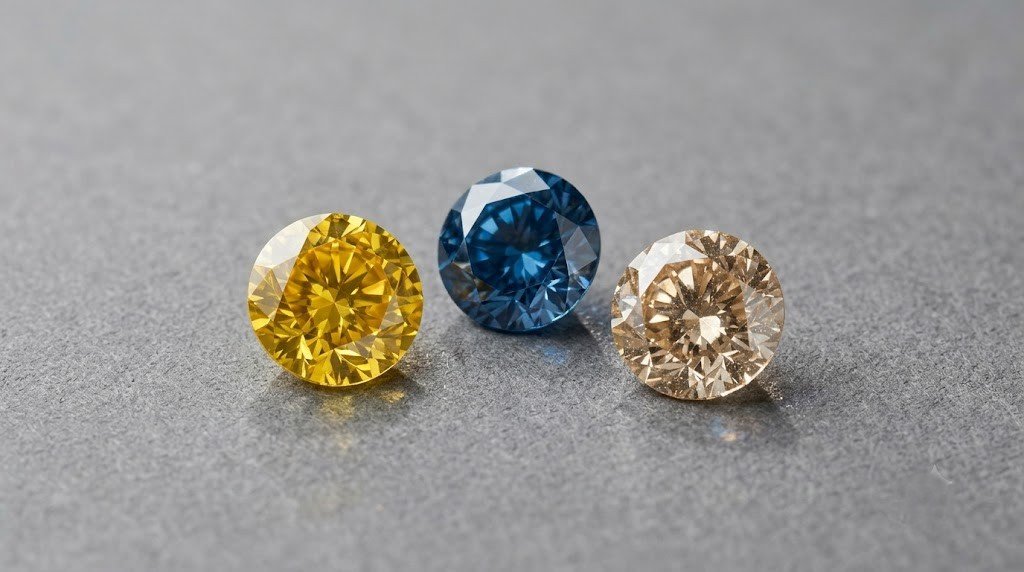
Three loose memorial diamonds in yellow, blue and champagne tones on a gray background

Color is decided during growth by trace elements: nitrogen tends toward yellow, boron toward blue, and colorless requires the absence of both, which takes extra processing and usually costs more. Memorial stones tend toward yellow, blue and champagne. No provider can choose, match or predict a shade from her hair, and starting from hair rather than ash does not narrow or lighten the outcome. What color a stone from her hair may be explains why.

Ask which outcomes are plausible, how much more a colorless stone would cost, and whether the company offers post growth irradiation for red, green or black, and if so, whether that treatment appears on the paperwork.

Size is a choice, generally from about 0.10 carats to 5 carats or more, and it depends on growth time rather than the amount of hair. Clarity typically falls between SI2 and VVS. If the stone will be worn daily in a ring, durability matters too: diamond sits at 10, the top of the Mohs scale of mineral hardness, though settings still need care. Add these daughter hair diamond questions to the same email so the answers sit together.

What Paperwork Should Name Her Hair as the Source?

Two documents serve two purposes. An origin or authenticity certificate, generally issued in house, records that this stone was grown from the hair your family sent. A grading report, ideally from an independent gemological laboratory, assesses the stone’s cut, color, clarity and carat weight. Neither replaces the other, and the grading report is usually optional and billed separately.

Ask whether the origin certificate states that hair, rather than ash, was the source material, whether it carries her name, and whether you see the wording before it is final. Ask for a sample certificate with another family’s details removed.

File the documents with the replies to your daughter hair diamond questions. Together they form the record a sibling or grandparent may one day want to read.
Which Daughter Hair Diamond Questions Concern Cost?

Treat the following as general 2026 industry ranges rather than any single company’s prices. A small stone of a tenth to a quarter of a carat tends to land between $1,500 and $3,500. A half carat to one carat stone generally falls between $5,000 and $15,000, with colorless at the upper end. Stones of two carats or larger start near $20,000 and can pass $75,000.
Independent grading, engraving, fancy cuts and the setting itself are usually extra. Ask for an itemized total, the deposit and payment schedule, and what is refundable at each stage. Ask also whether hair is priced any differently from ash, since companies differ; these daughter hair diamond questions are simple to ask and easy to compare. What drives a daughter memorial diamond’s price is useful context before quotes arrive.

How Long Does It Take, and What If Growth Fails?

Across the industry, six to ten months from receipt of material is typical, and up to about twelve for stones over two carats or specialty colors. Ask the provider’s own estimate, what it is measured from, and how often you will hear from them during the long middle stretch. The full sequence from sample to stone helps the wait make sense.

Then ask the harder daughter hair diamond questions. If a growth cycle fails, is there enough of her hair left to try again, and who pays? If the stone cracks during cutting, is it regrown, recut or refunded? If you cancel, what happens to her hair and to the money already paid? Ask for the clause, not a paraphrase. With a small, irreplaceable sample, these terms carry real weight.

When Might Hair Be the Right Starting Point?

Hair can be the natural choice in several situations. She may have been buried rather than cremated. Her ashes may already have been scattered or interred. A family’s faith or personal convictions may raise concerns about cremation or dividing ashes, and because hair involves no cremation, some families find it sits more comfortably; a faith leader is the right person to confirm that for your tradition. Or a lock may simply have been kept for years and feel like the obvious thing to use.

None of these makes hair better than ashes; they are different materials with different practicalities. Some families use both, which adds questions about how two materials are tracked and combined beyond the daughter hair diamond questions here.

Frequently Asked Questions

Can I Use Hair From Her Hairbrush?

Sometimes, but ask first. Some providers accept brush hair, yet strands from anyone else who used the brush can be mixed in. Include it in your daughter hair diamond questions: does the provider accept it, and how does it handle that risk?

Do I Need Anyone’s Permission to Send Hair I Already Have?

Possibly. Belongings can form part of her estate, and rules vary by state. If she had a spouse, partner or adult children, or left written wishes, check with them, and with an estate attorney if unsure, before mailing it.

Will Dyed or Treated Hair Still Work?

Ask the provider. Whether color, bleach, perms or styling residue affect suitability is something each company should answer in writing, and some assess a sample before you pay in full. Include it among your daughter hair diamond questions rather than guessing.

Is a Hair Diamond Made Only From Her Hair?

No. Hair is roughly half carbon, but purified personal carbon is typically blended with laboratory carbon to grow the stone. No published finished stone percentage exists for hair, so ask in your daughter hair diamond questions what each provider will state in writing.

Will Her Hair Produce a Lighter or More Predictable Color?

No. Color comes from trace elements such as nitrogen and boron during growth, and it cannot be chosen, matched or predicted from her hair. Memorial stones tend toward yellow, blue and champagne regardless of the source.

Can Part of the Lock Be Returned to Us?

Ask before sending. You may want to keep some of the hair, and providers differ on whether surplus is returned, retained or disposed of. Request a written answer, and ask whether part can be held back from the start.

Final Thoughts on Asking Before You Send Her Hair

A few grams of hair can carry a great deal of meaning, and it is reasonable to be careful with it. The daughter hair diamond questions on this page are not meant to make you suspicious of every provider. They exist so that you know, before anything leaves your hands, exactly what will happen to it and what will come back.

If you only send a few daughter hair diamond questions, ask about consent, what share of the stone the company will state in writing, whether any hair returns, and what happens if growth fails. Then, if the answers are clear, let the decision rest. The complete guide to daughter hair diamonds is there whenever you want the wider picture.

Learn More About Hair Diamonds for a Daughter

Talk With Memorial Diamond

Working through daughter hair diamond questions alone can be tiring. Memorial Diamond can be reached at memorialdiamond.us whenever you would like to talk them over. Bring a lock, a brush or simply a question, and decide nothing until you feel ready.

Desk with a phone, a notepad and a closed cremation urn set to one side, the notepad in use

Turn Your Father’s Ashes Into a Diamond: Order of Steps

The first practical act is not opening the urn. It is a phone call to whoever holds his remains or arranges what happens to them, asking that a small portion stay aside.

Turning your father’s ashes into a diamond takes four acts: retaining a portion, choosing a provider, specifying the carat, and posting the material. Only the first act has a deadline that cannot move, and that deadline often arrives before you know which provider you want.

This guide explains the correct order, why families often face the steps in the wrong sequence, and what you can still fix after the steps have already happened.

The Four Acts, and Which of Them Can Be Undone

The sensible order does not always match the order available to a family. The important question concerns which acts you can reverse.

ActPreconditionCost of doing it lateReversible?
Retain a portionAccess to the remains and no interment or scattering yetThe ashes route closesNo
Choose a providerYou know what you hold and what you want madeNone if the portion remains safeYes
Specify carat and colourThe provider’s options and intake rulesA growth run may follow a specification you later changeUsually, until the run starts
Post the materialProvider, specification, intake instructions, and order referenceThe material reaches a laboratory without a confirmed orderNo
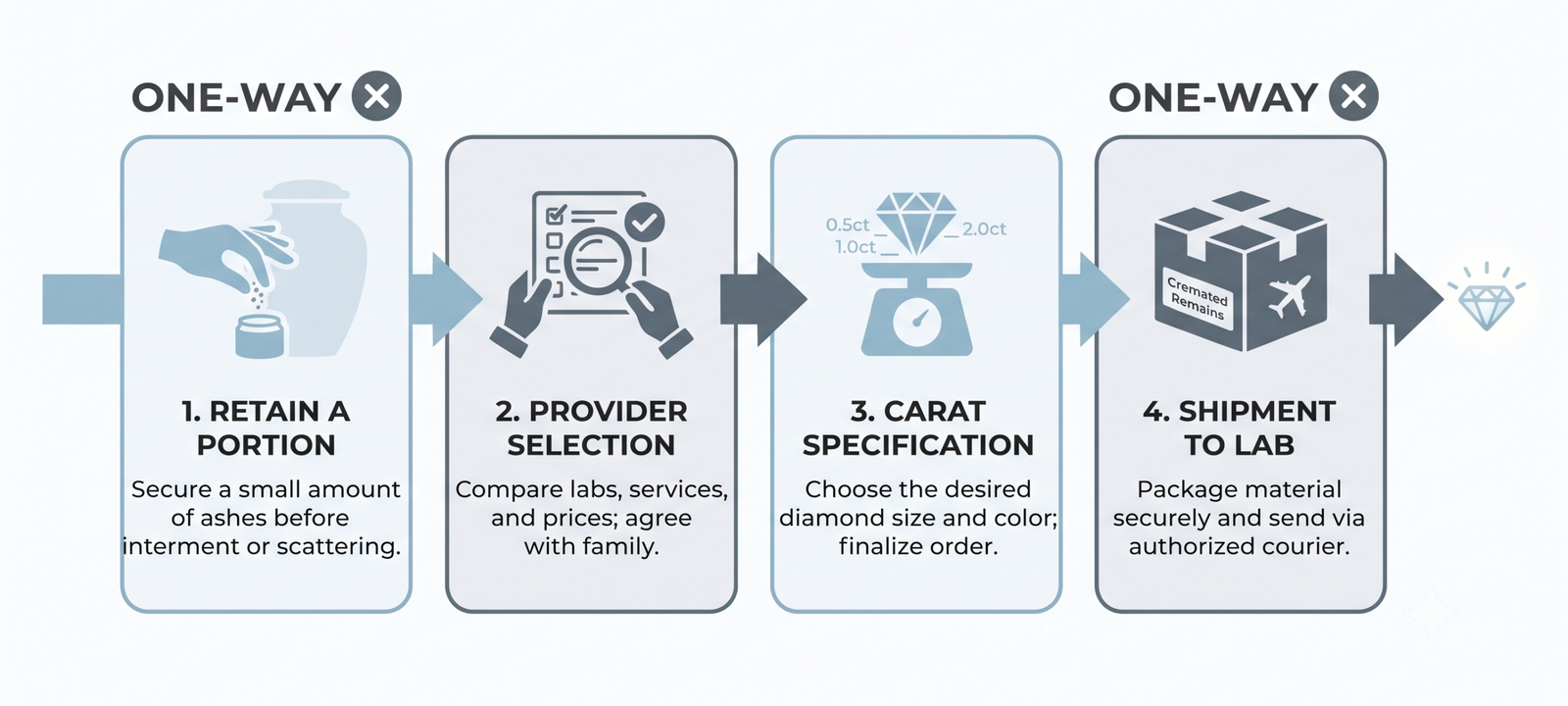
Four-stage diagram showing retention, provider selection, carat specification and shipment, with the first and last stages marked one-way

The two one way acts sit at opposite ends of the sequence. The reversible decisions sit between them.

Carat affects the rest because a laboratory grows a memorial diamond to size inside a growth press. The laboratory does not cut a larger diamond down to your chosen size. Carat therefore affects growth time and cost. Read more about choosing a carat size before you make that decision.

The Retention Deadline Arrives Before the Provider Is Chosen

Here is where the sequence often breaks.

A committal, an interment into a shared plot, or an agreed scattering can happen within weeks of a death. After that event, the family cannot simply retain a portion from the ashes.

Choosing a provider can take much longer. You may need to compare intake rules, costs, production methods, grading, chain of custody, and family preferences.

The calendar therefore places an irreversible act before a slower decision.

The solution remains simple. Retention does not require a provider, price, carat, or colour. You can ask the funeral director to retain a portion before you decide which company will receive it.

The complete guide to a father ashes diamond explains the retention deadline and the wider process in more detail.

Can You Retain a Portion Before You Have Chosen a Provider?

Yes. Retaining a portion gives you time to make the commercial decisions later.

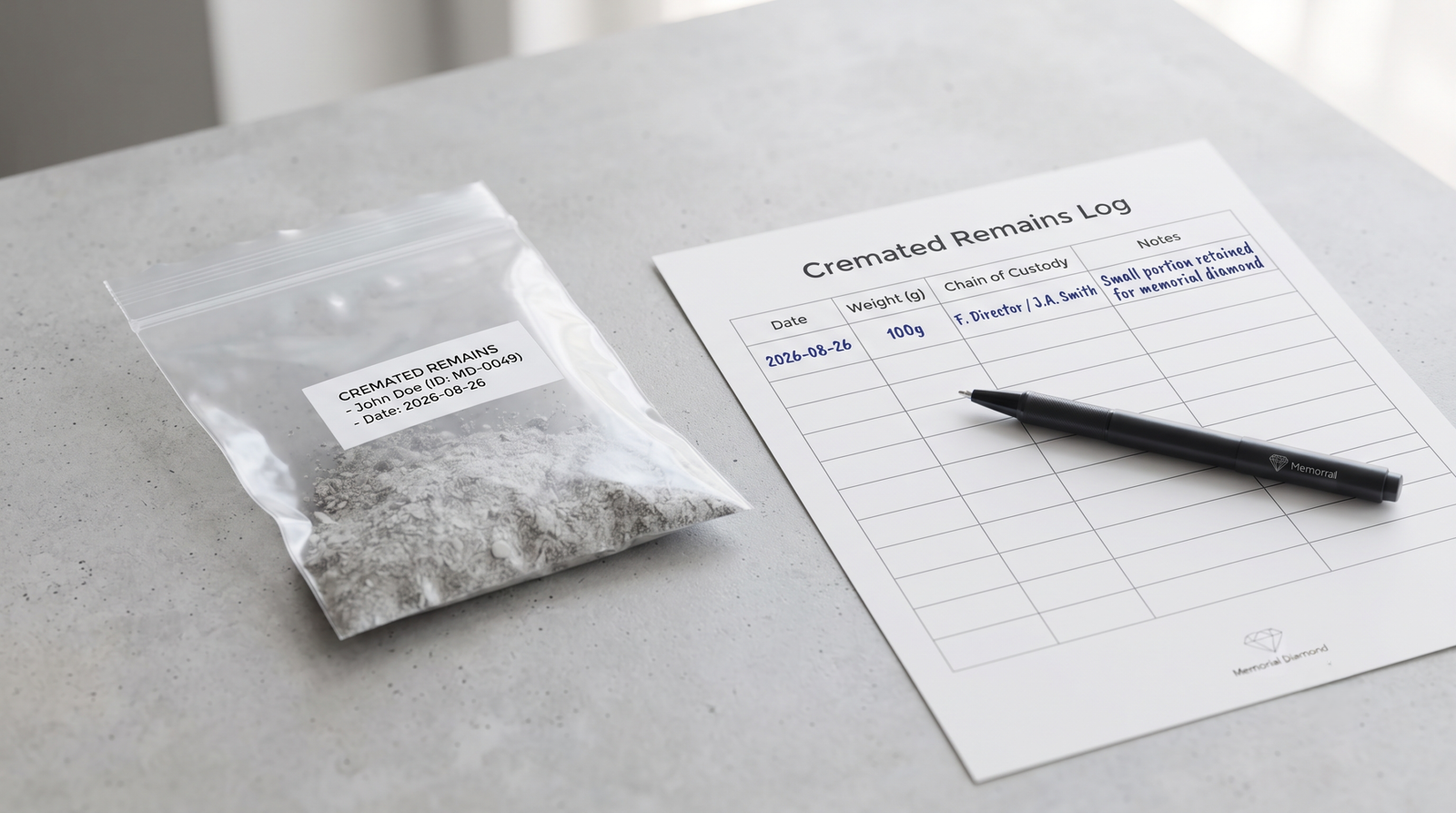
Retention concerns the physical material rather than a purchase. You need a sealed container, a clear label, and a written record.

Small sealed and labelled bag of cremated remains beside a handwritten record sheet and a pen

Quantity represents the decision that needs attention before you move on. Industry typical requirements range from a few tablespoons to roughly 4 oz, or about 100 grams. A full cremation produces much more material, so retaining a reasonable portion gives you room to choose later.

Read how much ash a father memorial diamond needs before you decide how much material to retain.

Record the following information when the portion leaves the main container:

  • Who separated the portion and the date of separation.
  • His full name exactly as it appears on the cremation paperwork.
  • The approximate quantity retained.
  • Where the portion remains stored.
  • Who knows about the retained portion.

This record gives your family a useful starting point for its own chain of custody. How providers track a loved one’s ashes explains the provider side of that process.

If several family members contribute money, agree in advance about who will own the finished diamond and who will hold it. Ownership can vary by jurisdiction and by the way the family places the order.

What Has to Be Settled Before the Package Leaves?

Posting the material creates the second one way act. Settle the important details before the package leaves your hands.

  • Choose a provider. Get its intake instructions in writing, including quantity, packaging, labelling, and delivery details.
  • Agree on the specification. Confirm carat and colour before the material travels so the laboratory receives it against an active order.
  • Record the order reference. Put the correct reference on the package so the provider can match the material with the correct file.
  • Ask about unused material. Confirm whether the provider returns unused material automatically or only after a request.

Some providers may accept material before the family finalises the carat. Others may require a complete specification first. Treat this as provider policy and ask before you send anything.

If you want a practical checklist of questions to settle before shipping, review your provider’s intake requirements and keep every answer with the order record.

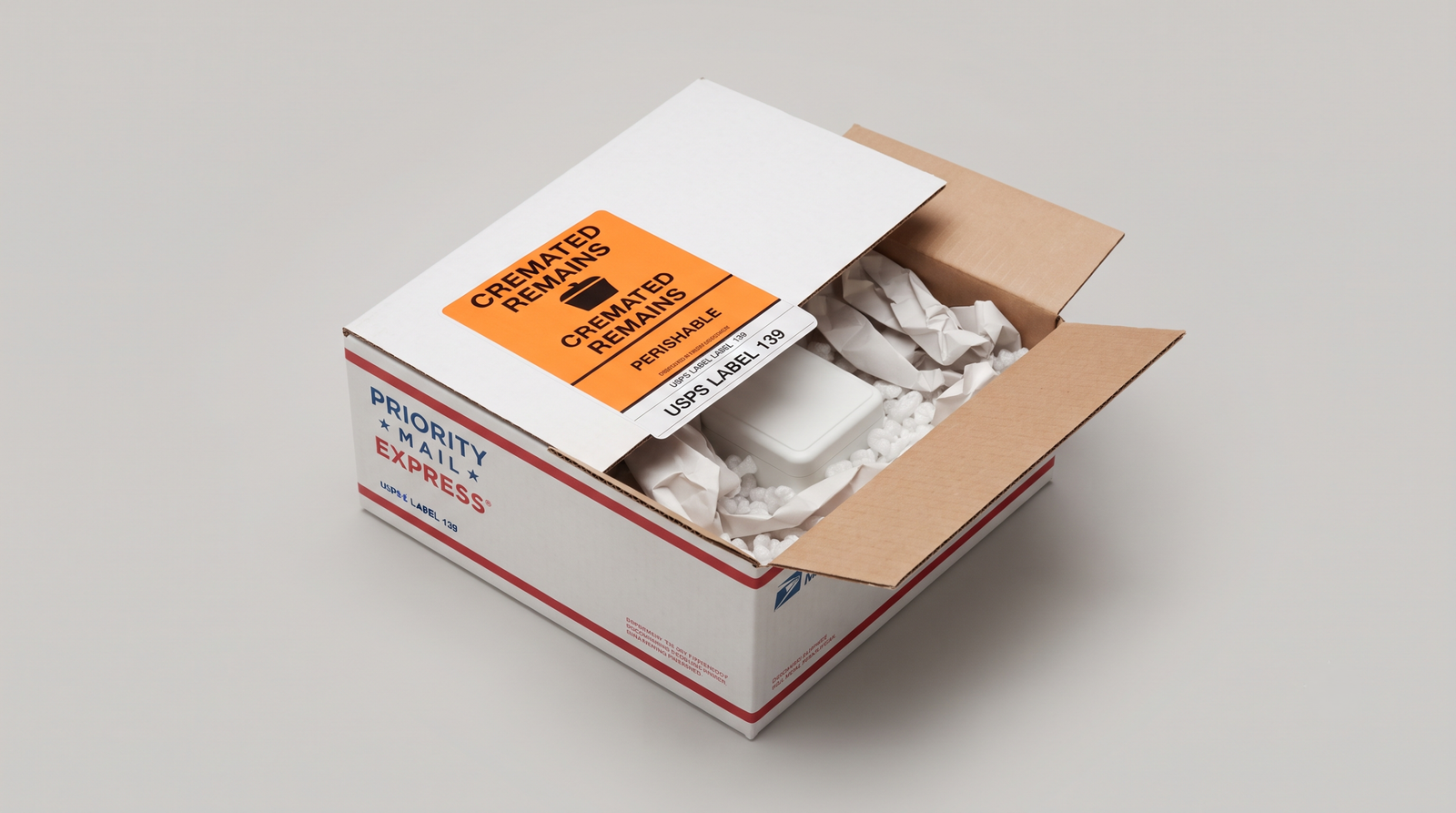
USPS Priority Mail Express parcel carrying the required cremated-remains label, cushioning visible inside

Shipping Is Decided by Carrier Policy, Not by Law

Families often frame this as a legal question. The practical issue involves carrier rules.

Carrier policies can restrict individual customers from shipping cremated remains. The source material identifies UPS, FedEx, and DHL as carriers that bar cremated remains from shipment by individual customers, leaving USPS as the realistic direct domestic route under the described rules.

Always confirm the current requirements with the carrier before shipping because carrier policies can change.

Who is sending itAvailable routeWhat it adds to the sequence
A family member shipping domesticallyUSPS Priority Mail Express with the required cremated remains labelConfirm current packaging and service requirements before choosing the posting date
A funeral directorTheir own business shipping arrangementsOften simpler while the funeral director still holds the remains
Someone carrying the material personallyHand deliveryConfirm that the provider accepts public hand delivery and records receipt

USPS supplies a free Cremated Remains kit that customers can order online. Confirm current USPS requirements before you depend on the kit or your own packaging.

The source recommends checking whether your own sift proof and cushioned packaging qualifies, since waiting for a kit can add time. Photograph the sealed package and its label before it leaves, then tell the provider that the material is on its way.

For the broader legal question, read the legal position on turning ashes into a diamond.

If your father’s ashes have already gone into an interment or scattering, another material route may remain. Turning your father’s hair into a diamond does not require cremated remains.

What Can Be Fixed If the Acts Already Fell Out of Order?

Not every mistake closes the process. The outcome depends on what already happened.

What happenedWhat you can do now
The interment happened and nobody retained a portionThe ashes route closes. The hair route remains available if you have suitable hair.
You chose and paid a provider before telling the familyIf no material has moved, ask the provider whether you can pause the order.
You retained more material than you needKeep the surplus with the family unless the provider gives you another instruction.
You retained less than the provider’s stated minimumAsk whether the provider can work with a smaller quantity and a smaller carat.
You shipped the material before agreeing on a specificationAsk the provider whether it can place the material on an intake hold.
You set aside a portion years ago without recording itThe material may remain usable, but the provider may need additional documentation.
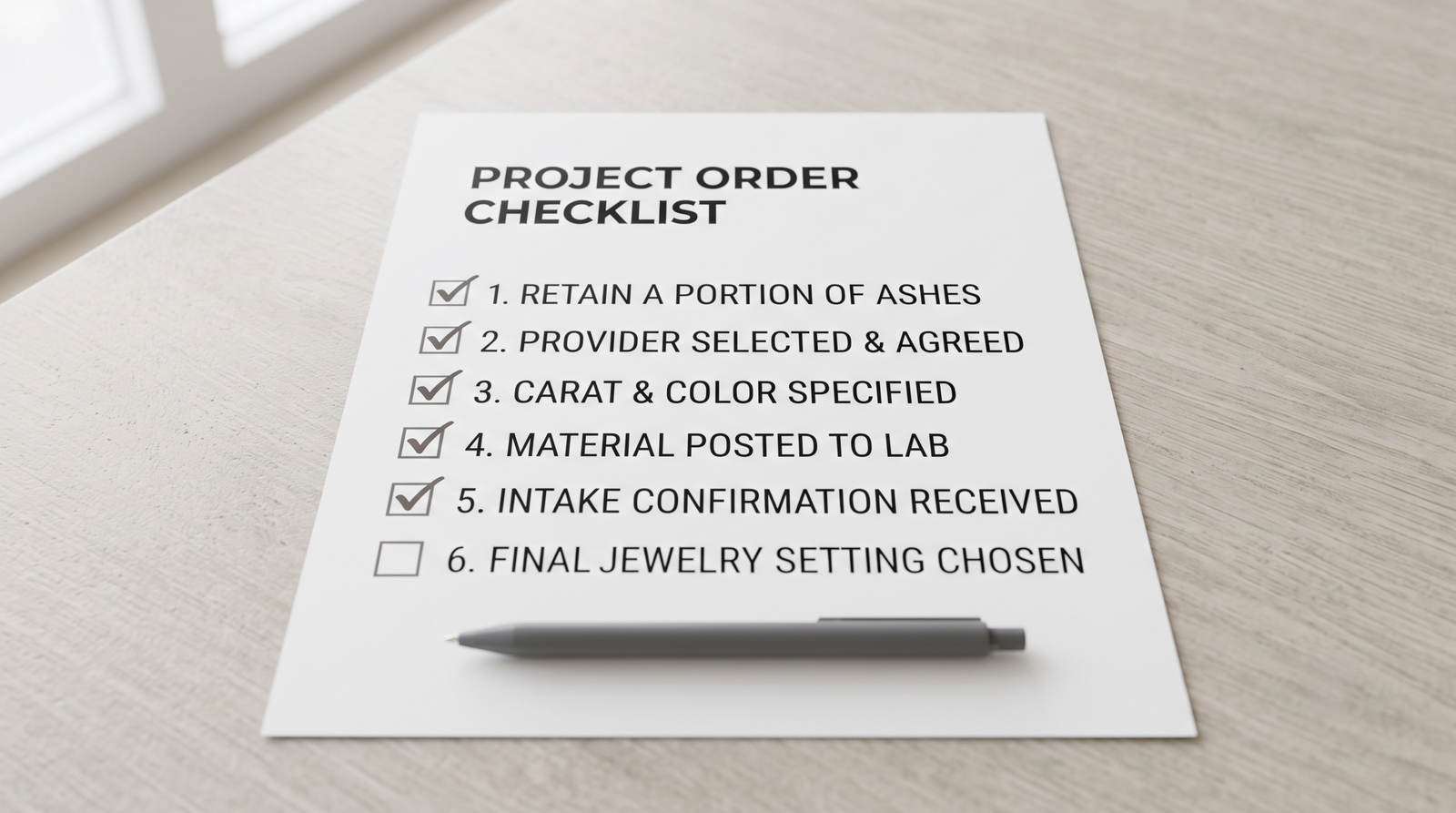
Printed checklist on a kitchen table with several lines ticked and one left blank

Do not assume that a provider can pause an order, accept a smaller quantity, or return unused material. Ask for its policy before relying on any of those options.

If the steps already happened in the wrong order, the right response starts with identifying exactly where the material sits now and what the provider has recorded.

What Happens Once the Parcel Is Out of Your Hands?

The sequence changes once the laboratory receives the parcel. The production clock starts from laboratory intake rather than the moment you hand the package to the carrier.

Ask the provider what its intake confirmation looks like and when you should expect it. Write down the date when the laboratory logs the material.

Industry production commonly takes 6 to 10 months from laboratory receipt. Large stones and specialty colours can take around 12 months. From the first decision through family discussions, shipping, laboratory production, grading, and jewellery setting, an 8 to 14 month journey can make sense.

Gloved technician logging a received sample into a laboratory intake record

Read how long a father memorial diamond takes for the timeline in more detail.

One important point deserves attention before you send the material. Cremated remains contain roughly 0.5% to 4% carbon by weight. The laboratory therefore blends purified personal carbon with supplemental laboratory carbon to reach the required feedstock volume. Industry information places the personal carbon contribution around 10% to 15% of the finished stone’s mass.

Sending more ash does not make the diamond larger or make the laboratory work faster. Carat depends on growth time.

Ask the provider how often it will update you during production and what milestones it will report.

Frequently Asked Questions

Which comes first, choosing a provider or asking for a portion to be held back?

Ask for the portion first. Retention carries the deadline that cannot move, and you do not need a provider, price, or specification to make that request. You can compare providers after you secure the material.

Can we send the portion before we have decided the carat?

Usually, you should settle the specification first because a laboratory sets up the growth run around the selected carat. Some providers may accept material while you decide. Ask about that policy before shipping.

Do we have to order the free USPS Cremated Remains kit before we can post?

USPS supplies a free Cremated Remains kit. Confirm current USPS rules before you decide whether you need that kit or whether your own approved packaging qualifies. Do not let a packaging assumption create an avoidable delay.

Can a funeral director post his ashes to the laboratory for us?

Often, a funeral director can arrange shipment through business shipping procedures. Ask the funeral director while they still hold the remains. This approach may simplify the process for a family that wants to retain a portion before release.

A portion was set aside years ago and nobody recorded what it was. Can it still be used?

The age of the material may not create the main problem. Documentation creates the larger question. Ask the provider what evidence it needs and reconstruct the history of the material as accurately as possible.

Does the growth clock start when we post the parcel or when the laboratory receives it?

The quoted production period starts at laboratory receipt. Shipping time, intake holds, specification changes, and documentation discussions sit outside that production period. Record the laboratory intake confirmation date.

Get the Sequence Right Before You Choose the Stone

The first question concerns the material, not the diamond. If an interment or scattering already has a date, ask for a portion to stay aside before the remains leave the funeral director’s control.

After that step, you can take your time. Compare providers, choose the carat, decide on colour, review the intake process, and settle the shipping requirements.

The important thing is to avoid turning a time sensitive retention decision into a purchase decision. Secure the option first. Make the rest of the decisions when you have enough information.

When you are ready to discuss the process, Memorial Diamond can help you understand the next steps.

Champagne-toned lab-grown memorial diamond grown from a father's cremated ashes, resting on a dark wooden surface in low daylight

Father Ashes Diamond: Complete Guide for Families

The container is probably still where someone put it. A shelf in the spare room, the back of a wardrobe, or the boot of a car nobody has finished unpacking.

A father ashes diamond gives that material another place to go. A laboratory grows a genuine lab grown diamond in part from carbon extracted from your father’s cremated remains. The finished diamond has the same crystal structure and hardness as other diamonds and can receive grading against the same four Cs.

Production typically takes six to ten months. The process uses only a small portion of a cremation.

That last fact matters more than it may seem. The rest of those ashes may already have a date attached to them. Establishing whether a date exists comes before choosing carat, colour, or cost.

Is There a Deadline on This Decision?

In principle, no. Cremated remains do not degrade in a way that affects carbon extraction. Ashes kept for twenty years can still provide material just as ashes kept for five weeks can.

In practice, one deadline can make the decision urgent.

If a portion of your father’s ashes will go into the ground, into a columbarium niche, or to a chosen scattering location on a specific date, the ashes stop being available after that event. An interment requires a formal disinterment process to reverse. A scattering cannot be undone.

Sealed cremation urn on a shelf at home ahead of a scheduled interment

When a father dies after a mother, the family may already have a plan. Perhaps they bought a shared plot decades ago. Although they chose a shared niche. Perhaps your parents selected a place where the family will scatter their ashes.

That plan does not need to compete with a memorial diamond. You only need to work backwards from the date and retain a small portion before the remains leave your control.

  • Find out whether a date exists. Ask whoever holds the remains and whoever arranges the interment. Those people may not be the same person.
  • Raise the subject before the date arrives. You can ask about retaining a portion rather than asking the family to give up his ashes. Read how to raise it with your family.
  • Retain the portion before release. Ask the funeral director about their procedure before the remains go to the cemetery, crematorium, or scattering location.
  • Let the original plan continue. A diamond and an interment or scattering do not need to become competing choices.

If the date has already passed, or your father had a burial rather than a cremation, the ashes route may no longer remain available. A hair based route can provide another option. Read the hair route that does not depend on cremation.

What Exactly Is a Father Ashes Diamond, and How Much of It Is Him?

A father ashes diamond is not a simulant or a diamond look alike stone. A laboratory grows a real diamond from purified carbon and supplemental laboratory carbon.

Diamond has a Mohs hardness of 10, the highest value on the Mohs scale. A lab grown memorial diamond has the same fundamental crystal structure and optical properties as other diamonds.

The important qualification concerns the amount of personal carbon.

Cremated remains consist mainly of calcium phosphate and other mineral material from bone. Carbon makes up a small share of the total ash. Industry information places the carbon content of cremated remains around 0.5% to 4% by weight.

The provider extracts that carbon and purifies it to roughly 99.9% carbon. The laboratory converts the purified carbon into graphite and blends it with supplemental laboratory carbon to reach the volume required for diamond growth.

Industry information places the personal carbon contribution at around 10% to 15% of the finished stone’s mass.

No honest provider should describe the finished stone as 100% your father. The accurate explanation carries more meaning. Carbon atoms that once formed part of his body become part of the crystal lattice of a genuine diamond.

For the broader explanation, read the complete guide to what a memorial diamond is.

How Much of His Ashes Does This Actually Take?

Industry typical requirements range from a few tablespoons to about 4 oz, roughly 100 grams.

A full cremation produces far more material than this amount, which allows the family to retain a portion for a diamond while continuing with an interment, scattering, or other memorial plan.

  1. Speak with the funeral director before release. Explain that you want to retain a portion for a memorial diamond and ask about the funeral home’s procedure.
  2. Use a clean, sealed and labelled container. Include your father’s full name and the cremation date and ask the funeral home to record the separation in its paperwork.
  3. Confirm the provider’s actual minimum. Industry ranges can guide your planning, but the provider’s requirement determines how much you should send.
  4. Ask about unused material. Find out whether the provider returns unused ashes or requires a specific request.

Memorial Diamond has not published its own material requirement in the supplied source. Treat the figures above as industry typical and confirm the actual requirement before measuring anything.

Read the step by step logistics of retaining, packaging, and sending a portion before you prepare the material.

The Ash Is Consumed Early in the Process

The process uses industrial chemistry and a chain of custody. The important practical question concerns the point at which the original ash no longer exists in its original form.

StageWhat happens to the materialIs the original material still intact?
Collection and loggingThe provider receives, weighs, and logs the ashes under a chain of custody reference.Yes
Extraction and purificationA controlled oxygen free process removes mineral material and leaves purified carbon.No
GraphitizationThe purified carbon reaches roughly 2,500 to 2,700°C and converts into graphite.No
GrowthThe graphite combines with supplemental laboratory carbon inside an HPHT growth system around a diamond seed.No
Cutting and polishingA gemologist cuts and polishes the rough crystal into the selected shape.No
Grading and certificationThe finished stone receives grading for cut, colour, clarity, and carat.No
Technician handling purified carbon extracted from cremated remains inside a laboratory furnace enclosure

Only the collection stage leaves the original material physically recoverable. Whether a provider can pause or return the material at that point depends on its own policy.

Ask about cancellation, unused material, failed growth runs, and chain of custody before you send anything.

One point deserves special attention. The amount of ash does not determine the finished carat size. Growth time determines the size of the diamond.

How Long Does the Whole Thing Take?

The six to ten month production period represents only the laboratory production stage. Your complete journey can take longer.

PhaseTypical duration
Deciding, discussing with family, and choosing a provider1 to 2 months
Retaining the portion and sending it to the laboratory2 to 4 weeks
Production from laboratory receipt to finished graded stone6 to 10 months
Setting the stone into jewellery2 to 6 weeks
Total from decision to wearing itRoughly 8 to 14 months
HPHT growth cell of the kind used to grow a memorial diamond from ash-derived carbon

Large stones and specialty colours can extend the production period. A stone around 2 carats or larger, or a specialty colour such as black, can push laboratory production toward 12 months.

If you hope to have the finished jewellery for a first anniversary or another meaningful date, work backwards from that date.

What Colour Will His Diamond Be?

Diamond colour comes from trace elements present during crystal growth.

Nitrogen can produce yellow. Boron can produce blue. A colourless stone requires the near total absence of both elements.

Because memorial diamond production uses carbon from an organic personal source, trace elements can remain present. That makes yellow, blue, and champagne or brown tones common outcomes.

Some providers also offer post growth irradiation for colours such as red, pink, green, or black.

No provider can honestly promise one exact natural shade before the stone grows. The source material and growth conditions influence the final colour.

Read what to expect from the colour of a diamond made from your father’s ashes for a more detailed explanation.

What Does a Father Ashes Diamond Cost?

The following figures represent general 2026 industry ranges rather than Memorial Diamond’s published prices.

Size tierTypical caratTypical industry price range
Entry0.10 to 0.25 caratsApproximately $1,500 to $3,500
Mid0.5 to 1 caratApproximately $5,000 to $15,000
Large or rare2 to 5 carats or moreApproximately $20,000 to $75,000 or more

Carat, colour, cut, and independent grading can affect the final price. A setting and engraving usually create additional costs.

Read what actually drives the cost of a father memorial diamond for a more detailed pricing breakdown.

A Military or Service Interment Leaves Less Slack

A military or service interment often follows its own ceremony, schedule, and custody process. The funeral home may release the remains directly to a national or service cemetery.

The practical consequence remains simple. Retain the portion before the funeral home releases the remains.

Ask the funeral director rather than waiting until the cemetery receives the ashes. Raise the subject early and explain exactly what you want to retain.

Read memorial diamonds for a veteran for more information about the service specific considerations.

The Stone Can Go Into a Ring He Already Wore

A finished father memorial diamond does not have to go into a completely new piece of jewellery.

If your father left a wedding band, signet ring, or another suitable piece, a jeweller may be able to set the finished diamond into something he already wore.

This approach can reduce the cost of commissioning a completely new piece. More importantly, it can give the finished memorial a direct connection to something that already belonged to him.

Memorial diamond set flush into a worn men's wedding band held in an open palm

The jeweller needs to examine the existing piece first. An older ring may have a worn shank or insufficient metal for a new seat. Cutting a new seat into a weak band could create another structural problem.

Because you cannot replace the memorial diamond if you lose it, choose security over appearance when the two conflict.

Read settings and jewellery options for a father memorial diamond before selecting the final design.

What Should You Decide, and in What Order?

Some decisions have deadlines. Others can wait.

  1. Find out whether a date exists for the rest of his ashes. This decision comes first because an interment or scattering can close the ashes route.
  2. Decide who needs to participate. Consider whoever holds the remains, whoever arranges the interment, and anyone whose plans will change.
  3. Choose the material. You may consider ashes, hair, or both together when your provider accepts the relevant route.
  4. Choose the carat. Carat affects both production time and most of the cost.
  5. Choose colour and cut. Consider whether a specialty colour justifies additional time and cost.
  6. Ask the provider the difficult questions. Discuss chain of custody, unused material, HPHT or CVD growth, independent grading, failed growth runs, cancellation, and timelines.

The first two decisions carry the most urgency. The remaining decisions can take the time you need.

Frequently Asked Questions

How soon before a scheduled interment do we need to decide?

Raise the subject before the funeral home releases the remains to the cemetery or the person carrying out the scattering. Ask the funeral director when that release will happen.

You do not need to commit to a provider immediately. Retaining a portion can keep the option open while your family continues with the rest of its plans.

Can a funeral home hold back a portion of his ashes?

Ask the funeral director in writing before release. Ask about their procedure for separating, labelling, and documenting the portion.

Once an urn reaches a cemetery, the conversation becomes considerably more difficult.

Can we still bury or scatter the rest of his ashes?

Yes. A memorial diamond generally uses only a portion of the cremated remains. Industry typical requirements range from a few tablespoons to around 4 oz.

The family can therefore continue with an interment, scattering, or other plan for the remaining ashes.

What if his ashes have already been interred or scattered?

The ashes route may have closed, but a hair based route can remain available. Hair contains roughly 50% carbon by weight and does not require cremation.

A lock of hair, beard trim, or barber cut can provide another material route when the provider accepts it.

Will the stone be a real diamond or a substitute?

A memorial diamond is a real lab grown diamond. It has the same fundamental crystal structure, a Mohs hardness of 10, and the optical properties associated with diamond.

Lab grown describes where the diamond grows. It does not describe a substitute material.

Can the diamond go into a ring he already owned?

Often, yes. A jeweller needs to inspect the existing ring before cutting a seat for the new stone.

The jeweller should check the shank, the available metal, the condition of the ring, and the security of the final setting.

Can more than one family member have a stone from the same ashes?

Often, yes. Each stone uses only a portion of the available material, so one submission can potentially support multiple stones.

Ask your provider whether it accepts multiple stones from one submission. Ordering them together can avoid repeating the retention and shipping process years later.

Each stone grows independently, so stones from the same source can still differ in colour and clarity.

Ask the Funeral Director Before the Remains Are Released

If an interment or scattering is approaching, one phone call can matter more than another month of research.

Find out whether a date exists. Ask the funeral director about the procedure for retaining a portion. Then let the rest of your family’s plan continue exactly as arranged.

Once you secure the material, you can take your time with the rest. Decide on the carat, colour, cut, and whether the finished stone should go into a new piece or something your father already wore.

When you are ready, bring those decisions and your provider questions to Memorial Diamond.

Lock of hair beside a rough lab-grown memorial diamond crystal on a laboratory bench

How a Mother Hair Diamond Is Actually Made in the Lab

How Scientists Create a Memorial Diamond from Your Mother’s Hair

Families tend to ask the emotional questions first and the technical ones later. Eventually, however, an important practical question appears: what does a laboratory actually do with a lock of your mother’s hair to turn it into a diamond?

The process begins by extracting carbon from the hair.Technicians heat the material under controlled, oxygen-free conditions to remove all non-carbon components.. The remaining carbon is purified, converted into graphite at extremely high temperatures, and then placed inside a diamond-growth environment with a small diamond seed.

Under intense pressure and heat, carbon atoms gradually attach to that seed and form a new diamond crystal.

The interesting part is that the process unique to hair happens mainly at the beginning. Once the process converts the purified carbon into graphite, the remaining steps closely mirror how scientists create memorial diamonds from cremated remains.

In This Guide

What Makes Up Your Mother’s Hair, and Why Does a Lab Need It?

Here are the Active Voice conversions for that sentence:

keratin, a strong structural protein, primarily forms human hair. Hair contains roughly 50% carbon by weight, which makes it a comparatively carbon-rich starting material for creating a memorial diamond.

Cremated remains are very different.Mineral material from bone particularly calcium phosphate largely constitutes ashes, while usable carbon represents only about 0.5% to 4% of the material.

This difference explains why only a relatively small amount of hair may be useful as a carbon source compared with the larger volume generally associated with cremated remains.

It also means cremation is not necessary. A memorial diamond can potentially be created using hair collected from a loved one.

What Does Purification Have to Remove From Your Mother’s Hair?

Sealed high-temperature furnace used to purify hair-derived carbon in an oxygen-free chamber

This is one of the main stages where creating a diamond from hair differs from creating one from ashes.

When cremated remains are processed, the laboratory must separate usable carbon from substantial quantities of mineral material.

With hair, the laboratory instead processes the keratin structure and removes non-carbon material while preserving the carbon that will eventually be used in the diamond-growth process.

The general process involves several important principles:

  • Controlled heating: The material is processed through carefully controlled temperature stages.
  • An oxygen-free environment: The goal is to preserve the carbon rather than allowing it to be lost through ordinary combustion.
  • High carbon purity: The target before later processing is approximately 99.9%+ carbon purity.

After purification, the material no longer looks like hair. What remains is a small amount of highly purified carbon.

Which Stages Differ From the Ashes Route, and Which Are the Same?

The difference between creating a memorial diamond from hair and creating one from cremated remains is smaller than many people assume.

StageFrom HairFrom Cremated AshesDifferent?
Starting materialKeratin, approximately 50% carbon by weightMineral-rich ash with approximately 0.5–4% usable carbonYes
PurificationRemoves non-carbon components from hairSeparates carbon from bone mineralsYes
Starting quantityRelatively small amount of hairGenerally a larger quantity of cremated remainsYes
Carbon purity targetApproximately 99.9%+Approximately 99.9%+No
GraphitizationApproximately 2,500–2,700°CApproximately 2,500–2,700°CNo
Additional carbonMay be blended into the growth materialMay be blended into the growth materialNo
Diamond growthHPHT or CVD processHPHT or CVD processNo
Growth periodWeeks to months depending on the target diamondWeeks to months depending on the target diamondNo
Cutting and polishingFinished like another diamondFinished like another diamondNo
Diagram comparing carbon content of hair at around 50% by weight with cremated ashes at 0.5


If Hair Contains So Much Carbon, Why Is Additional Laboratory Carbon Used?

A common misunderstanding is that the entire finished diamond must consist exclusively of carbon extracted from the submitted hair.

Diamond-growth equipment requires an appropriate volume of carbon feedstock to maintain the conditions necessary for crystal growth. Even though hair is carbon rich, the amount of purified personal carbon obtained from a lock of hair may not provide all the material required inside the growth cell.

For that reason, purified personal carbon may be blended with additional laboratory carbon during the diamond-growth process.

This is an important distinction when evaluating memorial diamond providers. Families should understand exactly how the submitted material is processed and how it contributes to the finished stone.

What Actually Happens Inside the Diamond Growth Press?

 Cutaway of an HPHT growth cell showing a diamond seed surrounded by graphite feedstock

After purification, the carbon is transformed into graphite at temperatures of approximately 2,500–2,700°C.

The graphite is then prepared for diamond growth.

In an HPHT — High Pressure High Temperature process, the carbon material is placed inside a specialized growth cell together with a tiny diamond seed.

The growth environment can reach approximately:

  • 6–8 GPa of pressure
  • 1,400–2,500°C

These extreme conditions allow carbon atoms to migrate toward the diamond seed and arrange themselves into diamond’s crystal structure.

Layer by layer, the crystal grows over a period that can extend from weeks to months.

Some laboratory-grown diamonds can also be created using CVD, or Chemical Vapor Deposition. In that process, carbon-containing gas is deposited onto a diamond seed inside a controlled chamber.

Both methods can create genuine laboratory-grown diamond crystals.

Why Does Growth Time, Not the Size of the Lock of Hair, Determine the Carat?

Providing more hair does not automatically create a larger diamond.

Diamond crystals grow gradually as carbon atoms are added to the crystal structure. The eventual size of the stone therefore depends significantly on the target carat weight and the amount of time the crystal is allowed to grow under controlled conditions.

A longer lock of hair does not necessarily make the diamond grow faster.

Instead, the desired diamond size is selected first, and the growth process is managed accordingly.

Industry timelines for memorial diamonds can commonly extend to approximately 6 to 10 months, while larger stones or certain specialized color requirements may require longer.

What Determines the Color of a Memorial Diamond Made From Hair?

The natural color of your mother’s hair does not determine the color of the finished memorial diamond.

During purification and graphitization, the original biological structure of the hair is completely transformed.

Diamond color is instead influenced by trace elements present during crystal growth.

For example:

  • Boron can contribute to blue tones.
  • Nitrogen can contribute to yellow tones.
  • Reducing these trace elements can help create a more colorless appearance.

Memorial diamonds may therefore appear in shades such as yellow, blue, champagne, brown, or near-colorless depending on the growth process and trace-element environment.

Some providers may also use post-growth treatments to create additional colors.

What Happens After the Diamond Crystal Comes Out of the Press?

Gemologist examining a rough memorial diamond crystal under a loupe before cutting

The material that comes out of the growth environment is a rough diamond crystal, not yet the polished gemstone seen in finished jewelry.

A diamond specialist examines the rough crystal and determines how it can best be cut while balancing its shape, internal characteristics, and final carat weight.

The diamond can then be fashioned into popular shapes such as:

  • Round
  • Princess
  • Cushion
  • Emerald
  • Other available shapes depending on the rough crystal

After cutting, the facets are polished to create the brilliance associated with a finished diamond.

Memorial Diamond Certificate vs. Diamond Grading Report

Two different documents may accompany a memorial diamond, and they should not be confused.

An authenticity or origin certificate may document the submitted material and the provider’s chain-of-custody process.

A diamond grading report evaluates the physical characteristics of the finished stone.

Diamond grading commonly considers the traditional 4Cs:

  • Cut
  • Color
  • Clarity
  • Carat weight

Families considering a memorial diamond should ask the provider exactly what documentation accompanies the finished gemstone and whether independent gemological grading is available.

What Does the Memorial Diamond Process Require From You?

For the family, most of the work happens at the beginning.

You generally need to:

  1. Collect the required amount of hair.
  2. Follow the provider’s packaging instructions.
  3. Submit the material using the recommended shipping process.
  4. Confirm the chosen diamond size, shape, and other available options.

Once the material has been received and documented, the laboratory handles purification, carbon preparation, crystal growth, cutting, polishing, and any grading or certification steps included with the service.

Before sending something as irreplaceable as a loved one’s hair, ask the provider how submissions are identified, tracked, stored, and handled throughout the process.

From a Lock of Hair to a Lasting Diamond

The transformation from hair to diamond sounds extraordinary because the materials look completely unrelated.

But at the chemical level, the connection is carbon.

Your mother’s hair contains carbon. The laboratory isolates and purifies that carbon, converts it into a form suitable for diamond growth, and places it into an environment where carbon atoms can become part of a diamond crystal.

Understanding that process can make a memorial diamond easier to evaluate because you know exactly what happens between submitting the hair and receiving the finished stone.

If you are considering creating a memorial diamond from your mother’s hair, talk with Memorial Diamond about the amount of hair you have, the diamond size you are considering, available colors and shapes, the expected timeline, and the documentation provided with the finished stone.

Frequently Asked Questions About Mother Hair Diamonds

Can a diamond really be made from my mother’s hair?

Hair contains a significant amount of carbon. A memorial diamond process can extract and purify carbon from submitted hair before preparing it for laboratory diamond growth.

Does the laboratory burn the hair?

Not in the ordinary meaning of burning. The hair is processed using controlled heating under conditions designed to preserve carbon rather than allowing it to disappear through normal combustion.

Can you see the hair inside the finished diamond?

No. Once the material has gone through purification, it no longer retains the visible structure of hair. The carbon becomes part of the diamond crystal at an atomic level.

Is a diamond made from hair different from one made using cremated ashes?

The initial carbon-extraction process differs because hair and cremated remains have very different compositions. After the material has been purified and prepared for diamond growth, the later stages are broadly similar.

How hot does the memorial diamond process get?

Graphitization can involve temperatures around 2,500–2,700°C. HPHT diamond growth can occur at approximately 1,400–2,500°C combined with roughly 6–8 GPa of pressure.

Does more hair produce a bigger diamond?

Not necessarily. Finished carat weight depends primarily on the selected diamond size and the controlled crystal-growth process, rather than simply on the length or quantity of the submitted hair.

Will my mother’s hair color determine the diamond color?

No. The original hair color does not survive the purification and high-temperature processing stages. Diamond color is instead affected primarily by trace elements and growth conditions.

How long does it take to make a memorial diamond from hair?

The complete process can take several months. Industry timelines are commonly around 6 to 10 months, although the actual turnaround depends on the provider, diamond size, color, growth conditions, cutting, and certification requirements.

How does a laboratory keep one family’s hair separate from another’s?

Providers should use a documented identification and chain-of-custody system from receipt through processing and diamond production. Ask the company to explain its exact tracking procedure before submitting irreplaceable material.

Is a memorial diamond a real diamond?

A properly grown memorial diamond is a laboratory-grown diamond crystal. Like other lab-grown diamonds, its quality can be evaluated using characteristics such as cut, color, clarity, and carat weight.

asses to dimond

How a Memorial Diamond Is Made From Your Mother’s Ashes

You measure out a portion of your mother’s ashes, hand it over, and months later a finished diamond comes back. What happens in between is where most families’ understanding stops.

Her cremated remains go through a process designed to recover usable carbon. The carbon is purified, prepared for diamond growth, combined with supplemental laboratory carbon when required, and grown into a genuine diamond crystal under extremely high pressure and heat.

Industrial chemistry, not alchemy and every stage is part of the journey from ashes to a finished memorial diamond.

 Rough diamond crystal grown from ash-derived carbon resting beside a finished champagne-toned cut stone

In This Article

What Are Your Mother’s Ashes Actually Made Of?

Understanding what cremated remains contain explains why creating a memorial diamond involves several different stages.

Cremated remains are not ash in the same sense as the material left behind by an ordinary fire. They consist largely of mineral material associated with bone, including calcium phosphate. Carbon is only a relatively small portion of the material.

That means the first challenge is not immediately growing a diamond. The laboratory must first recover usable carbon from the cremated remains and prepare it for the later stages of the process.

Because the amount of recoverable carbon can vary, the amount of ashes submitted is not directly equal to the final size of the diamond.

Learn more about how much ash may be needed for a mother memorial diamond.

What Are the Stages From Ash to Finished Diamond?

StageWhat Happens
1. Material IntakeThe cremated remains enter the preparation and processing stage.
2. Carbon Extraction and PurificationThe material is processed to separate usable carbon from minerals and other non-carbon material.
3. GraphitizationThe recovered carbon is prepared in a form suitable for diamond growth.
4. Carbon PreparationPersonal carbon may be combined with supplemental laboratory carbon when additional feedstock is required.
5. Diamond GrowthThe prepared carbon is placed into a controlled high-pressure and high-temperature growth environment.
6. Cutting and PolishingThe rough crystal is shaped and polished into the selected diamond cut.
7. Grading and DocumentationThe finished diamond can be evaluated according to cut, color, clarity and carat.

How Is Her Carbon Separated From the Rest of the Ash?

The purpose of the purification stage is to recover carbon while separating it from the much larger amount of mineral material contained in cremated remains.

The material goes through controlled processing designed to remove non-carbon components and leave behind purified carbon suitable for the next stages.

After purification, the laboratory can further prepare the carbon through graphitization. This process converts the purified carbon into graphite, another form of the same element.

The laboratory can then use this graphite as part of the carbon feedstock for the diamond-growing process.

Graphite and diamond are both forms of carbon. The difference is how the carbon atoms are arranged. The diamond growth process creates the crystal structure that gives diamond its distinctive physical and optical properties.

Why Is Laboratory Carbon Added to Your Mother’s Carbon?

 Sealed high-temperature furnace used to purify carbon extracted from cremated remains in an oxygen-free process

This is one of the most important parts of understanding how a memorial diamond is made.

Cremated remains contain only a limited amount of recoverable carbon. Depending on the selected diamond and the requirements of the growth process, the personal carbon may not provide all the feedstock needed to grow the finished crystal.

Therefore, the laboratory may combine supplemental carbon with the carbon recovered from your mother’s ashes.

However, that does not mean the personal carbon disappears. Carbon recovered from your mother’s remains can still become part of the diamond’s crystal structure. The laboratory creates the finished stone using both the recovered personal carbon and additional laboratory carbon when necessary.

For this reason, no provider should claim that a memorial diamond contains only personal carbon when the process also uses supplemental carbon.

Read the direct answer to whether a memorial diamond is really made from your mother’s ashes.

What Happens Inside the Growth Process?

High pressure high temperature press with the growth cell that holds a diamond seed during crystal growth

After the carbon has been prepared, the next stage is diamond growth.

One common method used in the laboratory-grown diamond industry is HPHT, meaning high pressure and high temperature. The process recreates conditions capable of allowing carbon to form a diamond crystal.

A small diamond seed can act as the starting point for crystal growth. Under controlled conditions, carbon becomes part of the growing crystal structure over time.

The growth process can take weeks or months depending on the characteristics and size of the diamond being created.

Another laboratory diamond-growing method is CVD, or chemical vapor deposition. Both HPHT and CVD can produce genuine diamonds, although the processes are different.

Learn more about how memorial diamonds are made using HPHT versus CVD.

Why Does Growth Time, Not the Amount of Ash, Decide the Carat?

One common misconception is that sending more ashes automatically creates a larger diamond.

That is not how the process works.

  • More ashes do not automatically create a bigger diamond.
  • More ashes do not automatically make the process faster.
  • The desired diamond size is determined before the growth process.
  • Larger diamonds generally require more time for crystal growth.

Only a portion of cremated remains may be required for the memorial diamond process, allowing the rest of the ashes to remain with the family or be used according to their wishes.

Learn why a mother memorial diamond can take months to create.

Why Is the Finished Diamond Usually Not Colorless?

 Three memorial diamonds in blue, yellow, and champagne tones arranged on a pale gray surface to show typical color range

Diamond color can be influenced by trace elements and conditions present during crystal growth.

For example, certain trace elements can contribute to blue or yellow coloration. The specific characteristics of the carbon source and the growth environment can influence the final appearance of the diamond.

Memorial diamonds may appear in colors including yellow, blue, champagne or brown tones. Each diamond can have its own appearance, and an exact color cannot always be predicted in advance.

The color is part of the character of the finished stone and can make each memorial diamond feel unique.

Discover what color a diamond made from your mother’s ashes may be.

How Is the Finished Stone Cut, Graded and Certified?

Gemologist examining a polished memorial diamond with a loupe beside a printed grading report

What leaves the growth process is a rough diamond crystal, not a finished piece of jewelry.

The rough crystal must be carefully cut and polished into the selected shape. Depending on the available options, this may include shapes such as round, cushion or emerald.

After cutting and polishing, the finished diamond can be evaluated according to the traditional diamond characteristics known as the 4Cs:

  • Cut
  • Color
  • Clarity
  • Carat

It is also important to understand the difference between origin documentation and a diamond grading report.

An origin or authenticity document relates to the memorial process and the submitted material. A grading report evaluates the physical characteristics and quality of the finished diamond.

These documents answer different questions, and families should understand what documentation is provided for their specific memorial diamond.

Learn more about how memorial diamonds are graded and certified.

What Does Any of This Ask of You?

Your role in the process is much shorter than the laboratory side.

You choose the memorial diamond you want, arrange the required material, and submit a portion of your mother’s ashes for processing. The laboratory then handles the carbon recovery, preparation, diamond growth, cutting and finishing stages.

The decision itself is often the most important part for families. Understanding what happens inside the laboratory can help make that decision more informed.

Learn how to turn your mother’s ashes into a diamond step by step.

Frequently Asked Questions

Does anything of my mother physically remain after the process?

The memorial process is based on recovering carbon from the submitted material. Molecular structures change during purification and diamond growth, while recovered carbon can become incorporated into the structure of the finished diamond.

Why can’t the laboratory use only her carbon?

Cremated remains contain a limited amount of recoverable carbon. Depending on the diamond being created, supplemental laboratory carbon may be required to provide enough feedstock for the growth process.

Is a memorial diamond a real diamond?

Yes. A properly grown laboratory diamond has the crystal structure and physical characteristics of diamond. It is not a simulant, resin or imitation stone.

Will there be visible ashes inside the diamond?

No. The purpose of the purification process is to recover and prepare carbon rather than place visible ash particles inside the finished diamond.

Can the Exact Diamond Color Be Predicted in Advance?

Not always. Trace elements and growth conditions can influence the final diamond color. Therefore, the laboratory may not be able to predict the exact shade before the growth process begins.

What Clarity Should I Expect?

The clarity of a finished memorial diamond can vary. Like other diamonds, laboratories evaluate clarity by examining the internal and external characteristics of the finished stone.. It is the result of multiple stages, beginning with the recovery of usable carbon from cremated remains and ending with a carefully finished diamond.

The journey includes carbon purification, preparation for growth, crystal formation, cutting, polishing and evaluation.

Understanding the science behind the process does not make the emotional decision for a family, but it can make the process easier to understand and the right questions easier to ask.

A memorial diamond can become a lasting physical connection to someone deeply loved created through a process that transforms carbon recovered from their remains into part of a genuine diamond crystal.

Talk About Creating a Memorial Diamond

If you are considering creating a memorial diamond from your mother’s ashes, take time to understand the process, the available options and the documentation provided.

Knowing what happens at every stage can help you make a decision with greater confidence and understanding.

memorial-diamond-made-mothers-ashes-hair

How a Memorial Diamond Is Made From Your Mother’s Ashes and Hair

Families who send both usually picture the two going into the same vessel. That isn’t what happens.

A memorial diamond made from your mother’s ashes and hair is grown from carbon purified from each material separately. Ash nd hair carry entirely different non-carbon contaminants, so each requires its own purification process before the recovered carbon is combined into a single feedstock.

The result is one diamond crystal containing carbon from both sources not a stone divided into halves.

In This Post

Why Can’t Her Ashes and Her Hair Be Purified Together?

Because they arrive at the laboratory with very different challenges.

Cremated remains are primarily made of calcium phosphate, the mineral structure associated with bone. Carbon is only a small component of cremated remains, so recovering usable carbon requires separating it from a large amount of mineral material.

Hair is very different. It is primarily made of keratin, a carbon-rich protein containing a much higher proportion of carbon. The purification process must instead remove non-carbon elements such as nitrogen, oxygen, hydrogen and sulfur.

Different source materials require different purification targets. For that reason, ashes and hair are processed separately before the recovered carbon is prepared for diamond growth.

Cremated ash and a cut lock of hair shown side by side in separate labeled laboratory dishes

Where Do the Two Tracks Converge?

The two materials converge once usable carbon has been recovered and purified.

After purification, carbon recovered from hair and carbon recovered from cremated remains are both elemental carbon. The two purified carbon sources can then be combined into a single feedstock before the diamond-growing process begins.

StageHer AshesHer Hair
What it mostly containsCalcium phosphate and bone mineralKeratin, a carbon-rich protein
Approximate carbon contentLower carbon contentHigher carbon content
Purification removesMineral materialNon-carbon protein components
After purificationRecovered carbon can be combined into one feedstock
GraphitizationShared conversion into graphite
Diamond growthOne growth environment and one crystal
Final diamondOne finished stone
Oxygen-free purification furnace used to strip non-carbon material from ash and hair before diamond growth


Using both materials follows the same basic principle as creating a diamond from ashes alone or a diamond from hair alone.

How Much of the Finished Stone Is Genuinely Her?

A real and measurable portion of the diamond can originate from the carbon recovered from the materials you provide. However, the exact percentage can depend on the amount and quality of the available carbon, the size of the diamond, and the requirements of the growth process.

Hair generally contains significantly more carbon by weight than cremated remains. Because of this, hair can contribute a substantial amount of the personal carbon recovered when both materials are submitted together.

The important point is that a memorial diamond is not honestly described as being made entirely from personal carbon alone. Supplemental laboratory carbon may be required during the growth process.

That does not change the meaning of the memorial diamond. Carbon originating from your mother’s ashes and hair can become part of the crystal lattice of the diamond created in her memory.

For more information about this question, read whether a memorial diamond is really made from her ashes and hair.

What Happens Once the Two Carbons Are Combined?

 HPHT growth cell holding a diamond seed crystal surrounded by graphite feedstock | Stock acceptable |

Once the carbon sources are combined, the process becomes the same type of diamond-growing process used for other memorial diamonds.

The carbon feedstock is prepared for diamond growth and may be converted into graphite. The graphite can then be placed into a high-pressure, high-temperature environment with a small diamond seed.

Under controlled laboratory conditions, carbon atoms gradually form around the seed and develop into a diamond crystal. Crystal growth can take weeks or months depending on the process and the desired result.

One important point is that submitting more material does not automatically produce a larger diamond. The final size depends on the selected diamond and the growth process rather than simply on the amount of ashes or hair submitted.

After growth, the rough diamond is cut, polished and evaluated according to characteristics such as cut, color, clarity and carat.

Learn more about the difference between HPHT and CVD diamond growth.

Will a Stone Made From Two Materials Be Two-Toned?

Two memorial diamonds, one yellow and one blue, each an evenly colored single crystal

No. The finished memorial diamond grows as one crystal.

It is understandable to imagine that using two different materials could create separate areas or layers inside the diamond. However, after the carbon has been purified and prepared for growth, the finished crystal does not divide itself according to whether individual carbon atoms originally came from ashes or hair.

The color of a diamond is influenced by conditions and trace elements involved during crystal growth rather than by visible separation between the original source materials.

This means a memorial diamond made using both ashes and hair is still one crystal with one overall appearance.

You can learn more about possible colors in what color a diamond made from your mother’s ashes and hair may be.

Where Does Your Part of This End?

Your part of the process begins with deciding what materials you would like to use and ends once they have been safely submitted for processing.

You may need to consider how much ash and hair you have available, discuss the decision with family members, and choose the memorial diamond that feels right for you.

After the materials enter the laboratory process, the purification and diamond-growing stages are handled over the following months.

For the complete process, read how to turn your mother’s ashes and hair into a diamond.

You can also explore the complete guide to a mother ashes and hair diamond and learn how much ash and hair may be needed for a memorial diamond.

Frequently Asked Questions

Are her ashes and her hair processed at the same time?

Because cremated remains and hair contain different materials, they may require different purification approaches. The goal is to recover usable carbon before preparing the material for the diamond-growing process.

Can a lab tell which carbon in the finished stone came from her hair?

Once carbon has been purified and incorporated into a growing diamond crystal, individual carbon atoms are chemically the same element. The finished diamond does not visibly identify the original source of each carbon atom.

Does adding hair to an ashes submission mean more of her is in the stone?

Hair generally contains more carbon by weight than cremated remains, so including hair can increase the amount of personal carbon available for recovery. The exact contribution to a finished diamond can vary.

Will the finished diamond have visible layers, streaks or two colors?

No. The diamond grows as a single crystal. Using two source materials does not mean the finished stone will be divided into visible sections based on ashes and hair.

Does using two materials make the process take longer?

The overall timeline is generally driven more by diamond growth, cutting and finishing than by the number of source materials used. Processing requirements can vary depending on the individual order.

Thinking About Creating a Memorial Diamond?

Understanding how ashes and hair can be prepared for diamond creation can make an emotional decision easier to understand.

Using both materials creates a way to include different physical connections to the person you love in one memorial piece. Her ashes and her hair maHow a Memorial Diamond Is Made From Your Mother’s Ashes and Hair.

mother-hair-diamond-complete-guide

Keeping Her Close: The Beautiful Reality of Creating a Memorial Diamond from Hair Alone

There is often a small envelope somewhere in a jewelry box, taped into a baby book, tucked at the back of a drawer. Or just her hairbrush, which nobody has been able to throw away. A mother hair diamond is a real, lab-grown diamond created in part from carbon extracted from her hair, and hair is roughly 50% carbon by weight dramatically more than cremated ashes. That means no cremation is needed at all, only a small lock is required, and the process works just as well if she was buried, or if she is still here.

That last part catches people off guard. This is the one memorial hair diamond option that doesn’t require a loss to have happened yet.

mother hair diamond

In This Guide

Why Would You Choose Hair Rather Than Ashes?

Sometimes it isn’t a choice at all it’s the only option available, and families are relieved to learn it exists.

Hair is the route for four situations in particular:

  • She was buried, not cremated. Burial forecloses an ashes-based diamond entirely. A saved lock of hair doesn’t.
  • Her ashes were scattered or interred whole. If the urn went into the ground or the ashes went into the sea years ago, nothing has been lost a lock in a keepsake box is still workable material.
  • The family can’t agree about the ashes. Dividing a parent’s remains is a genuinely hard conversation, and in some families it’s a non-starter. Hair sidesteps it; taking a lock takes nothing away from anyone.
  • She is still alive. Hair can be collected from someone living, which turns the whole thing from a memorial into something closer to a gift. There’s a full guide to mother hair diamonds as a living memorial if that’s your situation.

None of this makes hair superior to ashes. If you have both available, submitting her ashes and a lock of her hair together is also possible, and the ashes-based version of this guide covers that route in full.

How Is a Diamond Actually Made From Your Mother’s Hair?

Technician placing a sealed sample of hair into a high-temperature purification furnace

Structurally the process is the same as any memorial diamond. What changes is the first stage, because keratin is a much richer starting material than bone ash.

StepWhat Happens With Hair Specifically
1. CollectionThe lock is received and logged under a chain-of-custody reference that follows it through every stage.
2. Carbon extraction & purificationHair is heated in a controlled, oxygen-free process that strips away the non-carbon components of keratin, reaching roughly 99.9%+ carbon purity.
3. GraphitizationThe purified carbon is heated to roughly 2,500–2,700°C and converted into graphite, the feedstock diamond presses use.
4. GrowthThe graphite goes into an HPHT press with a diamond seed at roughly 6–8 GPa and 1,400–2,500°C, and a crystal grows around it over weeks to months.
5. Cutting & polishingA gemologist cuts the rough crystal into the chosen shape.
6. Grading & certificationThe finished stone is graded on cut, color, clarity and carat, ideally by an independent lab.

The important thing to take from that: the size of the stone is set by how long it grows in the press, not by how much hair you send. A larger lock does not produce a larger diamond or a faster one. You choose the carat; that choice sets the timeline.

How Much of the Diamond Is Genuinely Your Mother?

Small palm-sized lock of hair held in an open hand to show the amount typically required

Straight answer: a real, measurable portion and more of it, proportionally, than an ashes-based stone would contain.

Cremated remains are mostly calcium phosphate, with usable carbon at only about 0.5% to 4% of ash by weight. Hair is around 50% carbon. So a lock the size of a coin yields far more usable personal carbon than a comparable weight of ash.

What hair does not do is remove the need for supplemental carbon altogether. Growing a diamond of any meaningful size requires a certain volume of feedstock in the growth cell, and personal carbon is blended with additional lab-sourced carbon to reach it. No honest provider will tell you the finished stone is 100% your mother not from hair, and certainly not from ashes.

The accurate framing is better than the overclaim anyway: carbon atoms that grew out of your mother’s own body are extracted, purified, and built into the crystal lattice of a stone that exists because she did. It isn’t a symbol of her. It’s partly made of her, and that holds up when someone asks.

How Much Hair Do You Need, and Where Do You Find It?

Industry-typical requirements are small often described as a lock, a few grams, or a palm-sized amount. Compared with the several tablespoons to ~4 oz of ashes an ash-based diamond needs, it’s a very modest ask.

Common sources families actually use:

  • A lock saved from a haircut, often kept in an envelope or a locket
  • A braid cut and kept years earlier
  • Hair from a baby book hers, saved by her mother, which makes for a particularly resonant stone
  • A hairbrush or comb
  • Hair kept after a funeral home cut a lock at the family’s request

One practical caution about brushes: a shared hairbrush may hold more than one person’s hair, and there’s no way to sort that out later in a lab. A clean cut lock is always preferable where one exists. If a brush is genuinely all you have, say so when you inquire rather than assuming.

Age is not a problem. Hair kept for thirty years in an envelope is chemically the same starting material as hair cut last week. How much hair you need for a mother memorial diamond goes into the specifics; confirm the exact minimum with whoever you commission, since it varies by provider.

Does Dyed, Treated, or Gray Hair Work?

Three locks of hair — gray, dyed auburn and dark brown — arranged side by side on a white background

Generally yes, and the reason is worth understanding rather than just taking on faith.

The purification stage is designed to strip out everything that is not carbon. Dye molecules, product residue, bleach and styling treatments are non-carbon material, which is precisely what that stage removes. The keratin underneath is unchanged by having been colored.

Gray hair is likewise no obstacle. Graying is a loss of melanin pigment it doesn’t alter the carbon content of the hair. And a point that surprises almost everyone: your mother’s hair color has no bearing on the color of the diamond. Diamond color comes from trace elements present during crystal growth, not from the appearance of the source material. Dark hair does not make a dark stone.

Heavily bleached or chemically stripped hair is the one case worth flagging to a provider directly, since requirements differ between companies. Ask before you mail anything.

What Color Will the Diamond Be?

Color in any diamond comes from trace elements in the growth cell. Boron produces blue tones. Nitrogen produces yellow. A colorless stone requires the near-total absence of both.

Memorial diamonds trend toward yellow, blue, and champagne or brown tones because the carbon comes from an organic, personal, imperfect source rather than a tightly controlled synthetic feedstock, and trace elements come along with it. Colorless is achievable but takes extra processing to exclude those elements, and typically costs meaningfully more. Some providers also offer post-growth irradiation to produce red, pink, green or black stones.

There’s a fuller breakdown in what color a diamond made from your mother’s hair will be.

How Long Does It Take, and What Does It Cost?

Industry-wide, expect 6 to 10 months from receipt of material to finished stone, extending to roughly 12 months for larger stones (about 2 carats and up) or specialty colors such as black. Hair doesn’t shorten this extraction is a small part of a timeline dominated by growth.

The ranges below are general 2026 industry figures, not Memorial Diamond’s published prices. Ours aren’t set yet, and no one should quote you a number they can’t stand behind:

Size TierTypical CaratTypical Industry Price Range
Entry0.10–0.25 ct~$1,500–$3,500
Mid0.5–1 ct~$5,000–$15,000
Large / rare2–5+ ct~$20,000–$75,000+

Price turns on carat, color, cut, and whether an independent grading report is included colorless costs meaningfully more than blue, yellow or champagne at the same carat. Settings and engraving are usually priced separately from the loose stone. What drives the cost of a mother memorial diamond breaks the variables down further.

Memorial diamond pendant worn at the collarbone, showing the everyday scale of the stone

What If Your Mother Is Still Living?

Then this stops being a memorial and becomes something else: a diamond grown from a lock she can hand you herself.

Families do this around milestones a seventieth birthday, a move into a smaller house, a wedding where she’s present. Some tell her; some plan it as a surprise. The practical advantage is not subtle: she can choose the carat, see the stone, and wear it herself if she wants to.

Some people find the idea uncomfortable at first, which is a fair reaction and worth talking through rather than talking yourself out of. Whether a living memorial diamond for a mother is morbid addresses that question directly.

What Should You Ask Before You Send Her Hair Anywhere?

A lock of hair is irreplaceable in a way an urn full of ashes isn’t there is often only one, and there will not be another. Ask these before it goes in the mail:

  1. What is the chain of custody, and what tracking reference do I get?
  2. What happens to hair that isn’t used, and is it returned by default?
  3. Is my exact amount sufficient, given my chosen carat? Confirm before cutting or sending, not after.
  4. Is the hair treated, dyed or bleached and does that change anything for you?
  5. What grading report comes with the stone, and from which lab? An independent third-party grading report and an in-house certificate of authenticity are different documents: one grades the diamond’s quality, the other documents that it was grown from your family’s submitted carbon. Ask for both.
  6. What happens if a growth run fails? Crystal growth isn’t guaranteed to succeed first time ask what a re-grow means for your timeline and, critically, for your remaining material.

The full list of questions worth asking before turning your mother’s hair into a diamond covers the rest, and it applies to us as much as to anyone else.

Frequently Asked Questions

Can a diamond really be made from hair, without any ashes?

Yes. Hair is roughly 50% carbon by weight far more than cremated ashes, which are mostly calcium phosphate. No cremation is needed at any point, which is why hair works for mothers who were buried or whose ashes have already been scattered.

How old can the hair be?

Effectively any age. Hair kept in an envelope, locket or baby book for decades is chemically the same starting material as hair cut this morning. Storage conditions don’t meaningfully affect the carbon that extraction is after.

Does her hair color affect the diamond’s color?

No. Diamond color comes from trace elements such as boron and nitrogen present during crystal growth, not from the appearance of the source material. Dark hair doesn’t produce a dark stone, and gray hair doesn’t produce a pale one.

Will dyed or permed hair still work?

Generally yes. Purification is designed to strip out everything that isn’t carbon, and dye, bleach and styling products are non-carbon material. Heavily bleached hair is worth flagging to a provider first, since requirements vary between companies.

How much hair is actually needed?

Typically a small lock a few grams, often described as palm-sized. Requirements vary by provider, so confirm before cutting anything, particularly if the lock you have is the only one that exists.

Can several siblings each have a diamond from the same hair?

Often yes, depending on how much hair there is and the carat sizes chosen. Because each stone needs only a small amount, one substantial lock can sometimes supply more than one diamond. Ask before dividing anything yourself.

Is a hair diamond acceptable if cremation is against our faith?

This is the genuinely useful point for families in that position: since a hair diamond involves no cremation whatsoever, a cremation-specific religious objection doesn’t apply to it. Views on memorial jewelry itself vary, so ask your own clergy directly.

Where to Start

If the lock already exists, the decision isn’t urgent. Hair keeps indefinitely, and so does the option.

The sensible first step is a conversation rather than a purchase what you have, whether it’s enough for the carat you’re imagining, whether a sibling wants one too, and whether her hair has been treated in a way worth mentioning.

Reach out to Memorial Diamond to talk through what’s possible with your mother’s hair, and bring the questions above with you.