
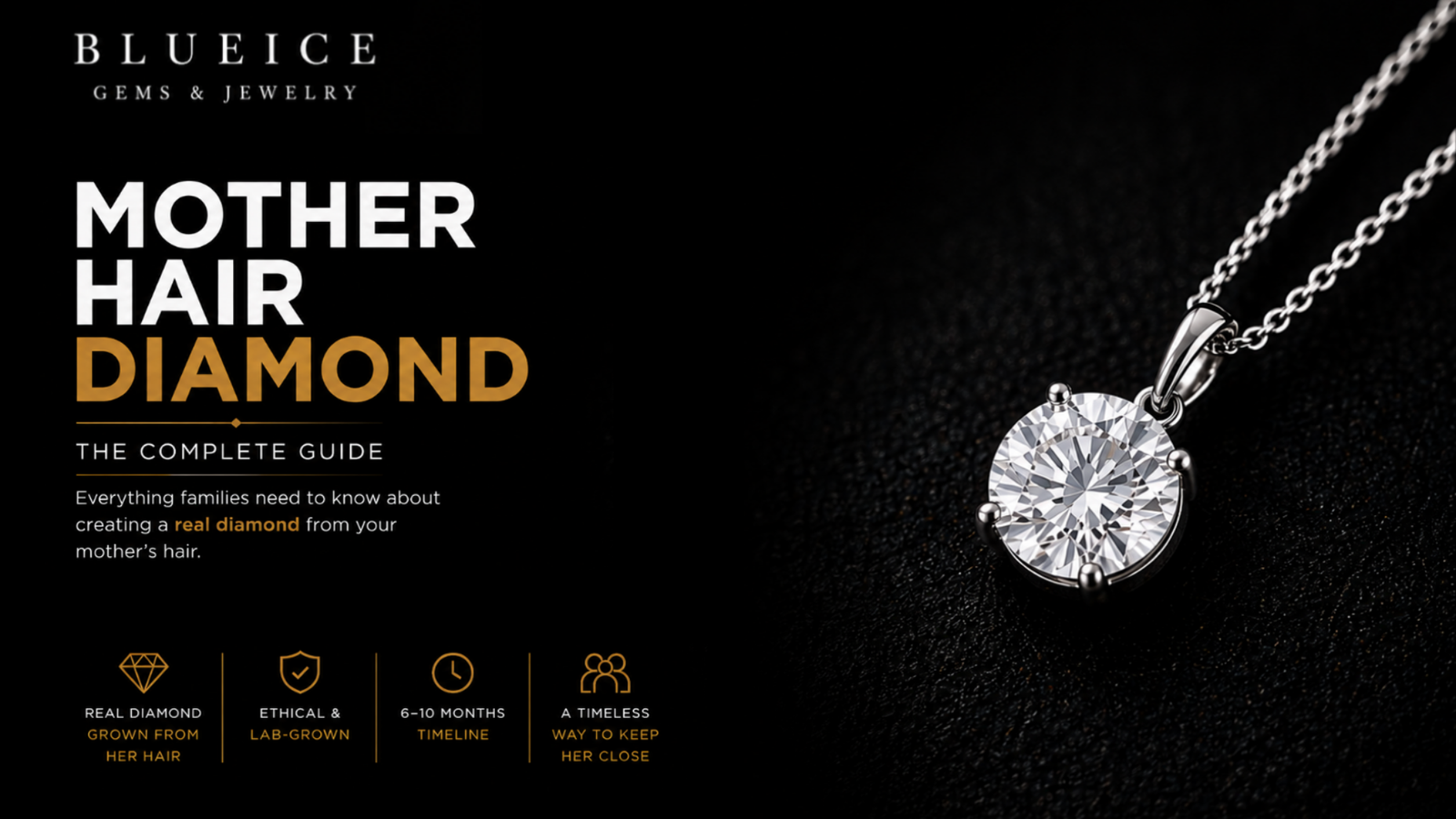
There is often a small envelope somewhere in a jewelry box, taped into a baby book, tucked at the back of a drawer. Or just her hairbrush, which nobody has been able to throw away. A mother hair diamond is a real, lab-grown diamond created in part from carbon extracted from her hair, and hair is roughly 50% carbon by weight dramatically more than cremated ashes. That means no cremation is needed at all, only a small lock is required, and the process works just as well if she was buried, or if she is still here.
That last part catches people off guard. This is the one memorial hair diamond option that doesn’t require a loss to have happened yet.
In This Guide
- Why hair rather than ashes
- How a diamond is made from hair
- How much of the stone is genuinely her
- How much hair you need, and where to find it
- Does dyed, treated, or gray hair work?
- What color the diamond will be
- Timeline and cost
- Hair from a mother who is still living
- What to ask before you send it
- FAQ
Why Would You Choose Hair Rather Than Ashes?
Sometimes it isn’t a choice at all it’s the only option available, and families are relieved to learn it exists.
Hair is the route for four situations in particular:
- She was buried, not cremated. Burial forecloses an ashes-based diamond entirely. A saved lock of hair doesn’t.
- Her ashes were scattered or interred whole. If the urn went into the ground or the ashes went into the sea years ago, nothing has been lost a lock in a keepsake box is still workable material.
- The family can’t agree about the ashes. Dividing a parent’s remains is a genuinely hard conversation, and in some families it’s a non-starter. Hair sidesteps it; taking a lock takes nothing away from anyone.
- She is still alive. Hair can be collected from someone living, which turns the whole thing from a memorial into something closer to a gift. There’s a full guide to mother hair diamonds as a living memorial if that’s your situation.
None of this makes hair superior to ashes. If you have both available, submitting her ashes and a lock of her hair together is also possible, and the ashes-based version of this guide covers that route in full.
How Is a Diamond Actually Made From Your Mother’s Hair?
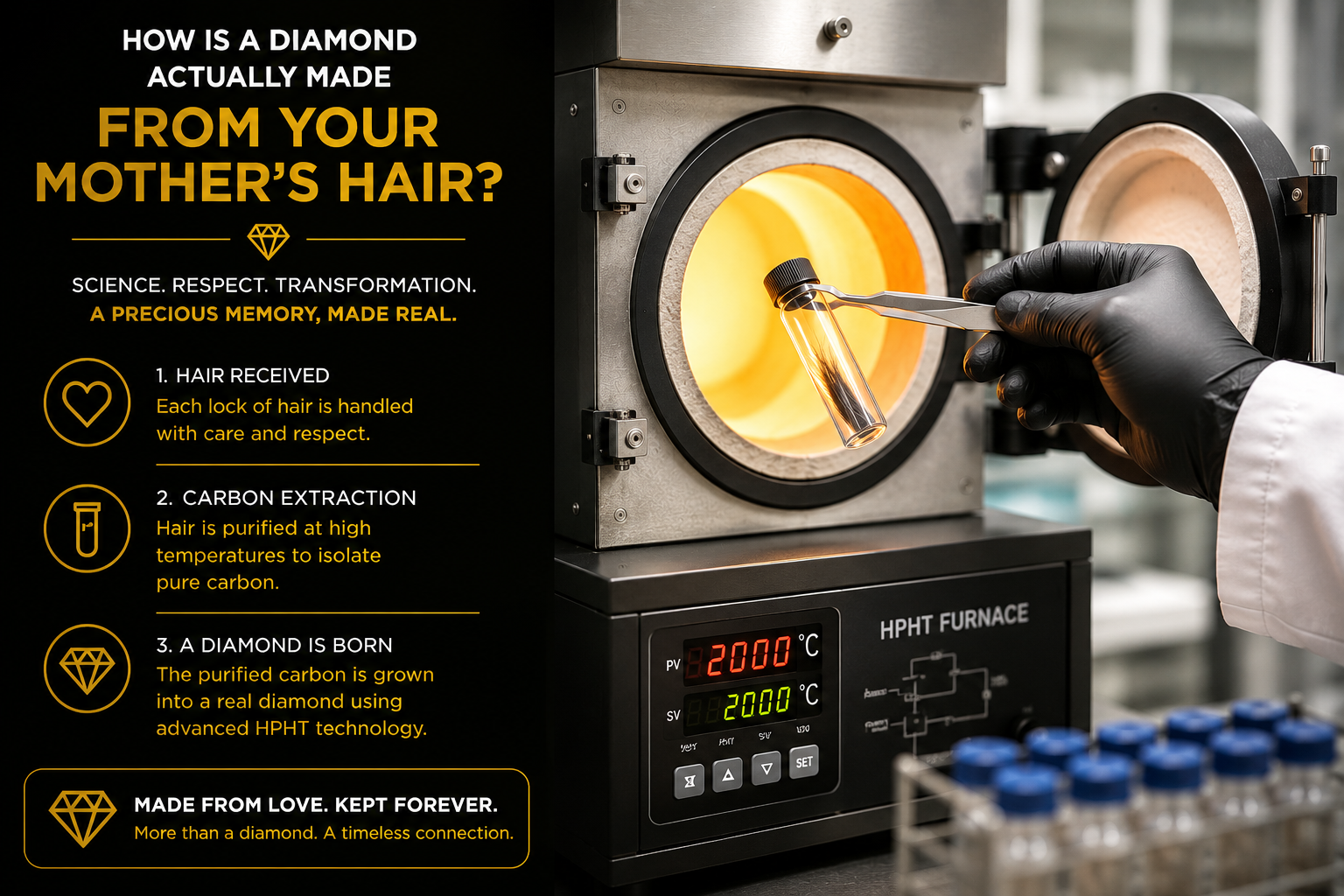
Structurally the process is the same as any memorial diamond. What changes is the first stage, because keratin is a much richer starting material than bone ash.
| Step | What Happens With Hair Specifically |
|---|---|
| 1. Collection | The lock is received and logged under a chain-of-custody reference that follows it through every stage. |
| 2. Carbon extraction & purification | Hair is heated in a controlled, oxygen-free process that strips away the non-carbon components of keratin, reaching roughly 99.9%+ carbon purity. |
| 3. Graphitization | The purified carbon is heated to roughly 2,500–2,700°C and converted into graphite, the feedstock diamond presses use. |
| 4. Growth | The graphite goes into an HPHT press with a diamond seed at roughly 6–8 GPa and 1,400–2,500°C, and a crystal grows around it over weeks to months. |
| 5. Cutting & polishing | A gemologist cuts the rough crystal into the chosen shape. |
| 6. Grading & certification | The finished stone is graded on cut, color, clarity and carat, ideally by an independent lab. |
The important thing to take from that: the size of the stone is set by how long it grows in the press, not by how much hair you send. A larger lock does not produce a larger diamond or a faster one. You choose the carat; that choice sets the timeline.
How Much of the Diamond Is Genuinely Your Mother?
Straight answer: a real, measurable portion and more of it, proportionally, than an ashes-based stone would contain.
Cremated remains are mostly calcium phosphate, with usable carbon at only about 0.5% to 4% of ash by weight. Hair is around 50% carbon. So a lock the size of a coin yields far more usable personal carbon than a comparable weight of ash.
What hair does not do is remove the need for supplemental carbon altogether. Growing a diamond of any meaningful size requires a certain volume of feedstock in the growth cell, and personal carbon is blended with additional lab-sourced carbon to reach it. No honest provider will tell you the finished stone is 100% your mother not from hair, and certainly not from ashes.
The accurate framing is better than the overclaim anyway: carbon atoms that grew out of your mother’s own body are extracted, purified, and built into the crystal lattice of a stone that exists because she did. It isn’t a symbol of her. It’s partly made of her, and that holds up when someone asks.
How Much Hair Do You Need, and Where Do You Find It?
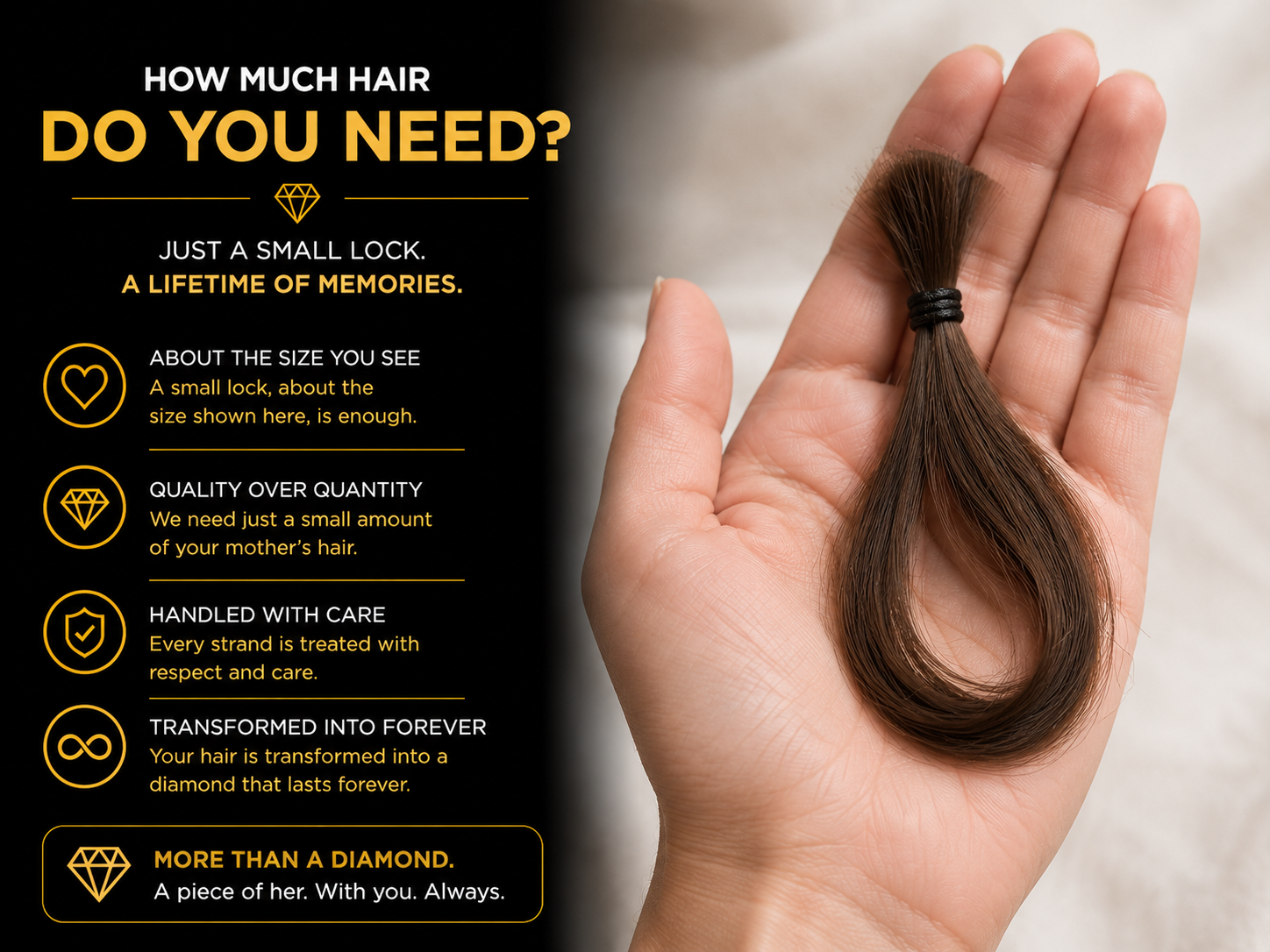
Industry-typical requirements are small often described as a lock, a few grams, or a palm-sized amount. Compared with the several tablespoons to ~4 oz of ashes an ash-based diamond needs, it’s a very modest ask.
Common sources families actually use:
- A lock saved from a haircut, often kept in an envelope or a locket
- A braid cut and kept years earlier
- Hair from a baby book hers, saved by her mother, which makes for a particularly resonant stone
- A hairbrush or comb
- Hair kept after a funeral home cut a lock at the family’s request
One practical caution about brushes: a shared hairbrush may hold more than one person’s hair, and there’s no way to sort that out later in a lab. A clean cut lock is always preferable where one exists. If a brush is genuinely all you have, say so when you inquire rather than assuming.
Age is not a problem. Hair kept for thirty years in an envelope is chemically the same starting material as hair cut last week. How much hair you need for a mother memorial diamond goes into the specifics; confirm the exact minimum with whoever you commission, since it varies by provider.
Does Dyed, Treated, or Gray Hair Work?
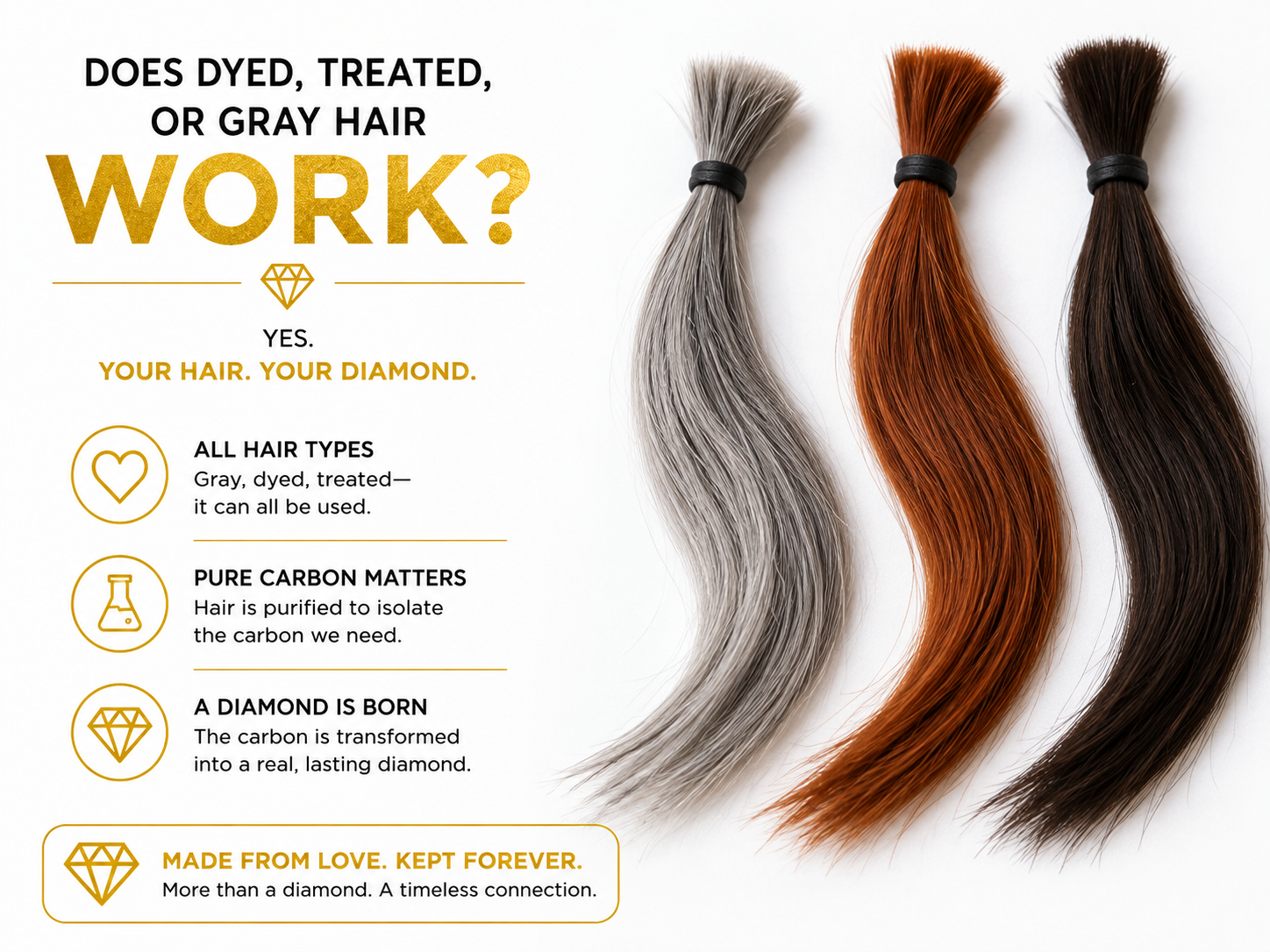
Generally yes, and the reason is worth understanding rather than just taking on faith.
The purification stage is designed to strip out everything that is not carbon. Dye molecules, product residue, bleach and styling treatments are non-carbon material, which is precisely what that stage removes. The keratin underneath is unchanged by having been colored.
Gray hair is likewise no obstacle. Graying is a loss of melanin pigment it doesn’t alter the carbon content of the hair. And a point that surprises almost everyone: your mother’s hair color has no bearing on the color of the diamond. Diamond color comes from trace elements present during crystal growth, not from the appearance of the source material. Dark hair does not make a dark stone.
Heavily bleached or chemically stripped hair is the one case worth flagging to a provider directly, since requirements differ between companies. Ask before you mail anything.
What Color Will the Diamond Be?
Color in any diamond comes from trace elements in the growth cell. Boron produces blue tones. Nitrogen produces yellow. A colorless stone requires the near-total absence of both.
Memorial diamonds trend toward yellow, blue, and champagne or brown tones because the carbon comes from an organic, personal, imperfect source rather than a tightly controlled synthetic feedstock, and trace elements come along with it. Colorless is achievable but takes extra processing to exclude those elements, and typically costs meaningfully more. Some providers also offer post-growth irradiation to produce red, pink, green or black stones.
There’s a fuller breakdown in what color a diamond made from your mother’s hair will be.
How Long Does It Take, and What Does It Cost?
Industry-wide, expect 6 to 10 months from receipt of material to finished stone, extending to roughly 12 months for larger stones (about 2 carats and up) or specialty colors such as black. Hair doesn’t shorten this extraction is a small part of a timeline dominated by growth.
The ranges below are general 2026 industry figures, not Memorial Diamond’s published prices. Ours aren’t set yet, and no one should quote you a number they can’t stand behind:
| Size Tier | Typical Carat | Typical Industry Price Range |
|---|---|---|
| Entry | 0.10–0.25 ct | ~$1,500–$3,500 |
| Mid | 0.5–1 ct | ~$5,000–$15,000 |
| Large / rare | 2–5+ ct | ~$20,000–$75,000+ |
Price turns on carat, color, cut, and whether an independent grading report is included colorless costs meaningfully more than blue, yellow or champagne at the same carat. Settings and engraving are usually priced separately from the loose stone. What drives the cost of a mother memorial diamond breaks the variables down further.
What If Your Mother Is Still Living?
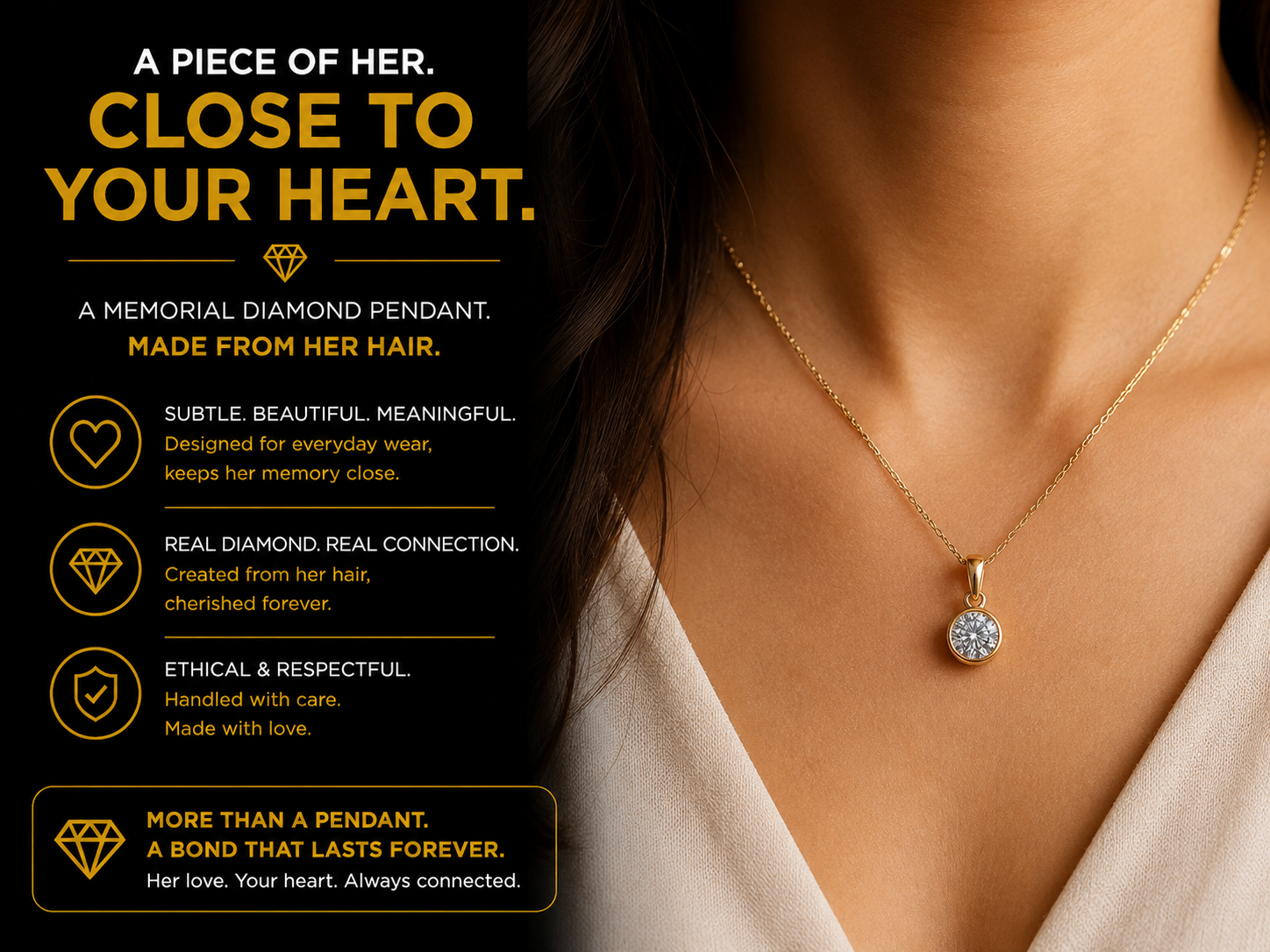
Then this stops being a memorial and becomes something else: a diamond grown from a lock she can hand you herself.
Families do this around milestones a seventieth birthday, a move into a smaller house, a wedding where she’s present. Some tell her; some plan it as a surprise. The practical advantage is not subtle: she can choose the carat, see the stone, and wear it herself if she wants to.
Some people find the idea uncomfortable at first, which is a fair reaction and worth talking through rather than talking yourself out of. Whether a living memorial diamond for a mother is morbid addresses that question directly.
What Should You Ask Before You Send Her Hair Anywhere?
A lock of hair is irreplaceable in a way an urn full of ashes isn’t there is often only one, and there will not be another. Ask these before it goes in the mail:
- What is the chain of custody, and what tracking reference do I get?
- What happens to hair that isn’t used, and is it returned by default?
- Is my exact amount sufficient, given my chosen carat? Confirm before cutting or sending, not after.
- Is the hair treated, dyed or bleached and does that change anything for you?
- What grading report comes with the stone, and from which lab? An independent third-party grading report and an in-house certificate of authenticity are different documents: one grades the diamond’s quality, the other documents that it was grown from your family’s submitted carbon. Ask for both.
- What happens if a growth run fails? Crystal growth isn’t guaranteed to succeed first time ask what a re-grow means for your timeline and, critically, for your remaining material.
The full list of questions worth asking before turning your mother’s hair into a diamond covers the rest, and it applies to us as much as to anyone else.
Frequently Asked Questions
Can a diamond really be made from hair, without any ashes?
Yes. Hair is roughly 50% carbon by weight far more than cremated ashes, which are mostly calcium phosphate. No cremation is needed at any point, which is why hair works for mothers who were buried or whose ashes have already been scattered.
How old can the hair be?
Effectively any age. Hair kept in an envelope, locket or baby book for decades is chemically the same starting material as hair cut this morning. Storage conditions don’t meaningfully affect the carbon that extraction is after.
Does her hair color affect the diamond’s color?
No. Diamond color comes from trace elements such as boron and nitrogen present during crystal growth, not from the appearance of the source material. Dark hair doesn’t produce a dark stone, and gray hair doesn’t produce a pale one.
Will dyed or permed hair still work?
Generally yes. Purification is designed to strip out everything that isn’t carbon, and dye, bleach and styling products are non-carbon material. Heavily bleached hair is worth flagging to a provider first, since requirements vary between companies.
How much hair is actually needed?
Typically a small lock a few grams, often described as palm-sized. Requirements vary by provider, so confirm before cutting anything, particularly if the lock you have is the only one that exists.
Can several siblings each have a diamond from the same hair?
Often yes, depending on how much hair there is and the carat sizes chosen. Because each stone needs only a small amount, one substantial lock can sometimes supply more than one diamond. Ask before dividing anything yourself.
Is a hair diamond acceptable if cremation is against our faith?
This is the genuinely useful point for families in that position: since a hair diamond involves no cremation whatsoever, a cremation-specific religious objection doesn’t apply to it. Views on memorial jewelry itself vary, so ask your own clergy directly.
Where to Start
If the lock already exists, the decision isn’t urgent. Hair keeps indefinitely, and so does the option.
The sensible first step is a conversation rather than a purchase what you have, whether it’s enough for the carat you’re imagining, whether a sibling wants one too, and whether her hair has been treated in a way worth mentioning.
Reach out to Memorial Diamond to talk through what’s possible with your mother’s hair, and bring the questions above with you.