
Sometimes what you have left of her is very small: a lock saved after a haircut, a braid someone thought to keep, a few strands folded inside a card. A diamond made from sister hair usually begins with a lock of a few grams, roughly half of it carbon by weight; that carbon is extracted, purified to about 99.9%, turned into graphite, typically blended with lab carbon, grown under heat and pressure, then cut and graded, typically within six to ten months.
Table of Contents
Why Can Hair Become a Diamond at All?
Because hair is mostly protein, and protein is built around carbon. Each strand is largely keratin, and by weight hair is roughly 50% carbon. Cremated ash, by comparison, holds only about 0.5% to 4% usable carbon, since cremation has already burned most of it away.
That difference changes almost everything about the starting point. A laboratory needs far less hair than ash, usually a small lock or a few grams, and no cremation is involved at any stage. A stone made from sister hair is therefore possible whether she was cremated, buried, or laid to rest in some other way, provided a lock was kept.
For some families hair is the only workable route: her ashes may have been scattered or interred whole, or her faith or her own wishes meant burial.
None of this makes a diamond made from sister hair a better or more meaningful choice than one from ashes. It is simply a different material with different chemistry, and the ash based version of this process works through the same laboratory stages from a much leaner starting point.
What Are the Six Stages of a Diamond Made From Sister Hair?
Six core stages take every diamond made from sister hair from a sealed packet to a finished, documented stone. A color treatment can be added by some providers, but it is optional and sits outside this core sequence.
Timings are approximate industry wide ranges; every provider runs its own schedule.
| Stage | What happens to her hair | Approximate duration | What reaches you |
|---|---|---|---|
| 1. Receiving and logging | The lock is checked, weighed if required, and given a reference number | Days to two weeks, mostly transit | A kit, then an arrival notice |
| 2. Extraction and purification | Oxygen free heating removes the non carbon parts of keratin, leaving carbon of about 99.9% purity | Typically a few weeks | Often silence |
| 3. Graphitization | Purified carbon is heated to roughly 2,500 to 2,700°C and becomes graphite | Brief relative to growth | Seldom any update |
| 4. Growth | Her graphite, typically blended with lab carbon, crystallizes on a diamond seed by HPHT or, less often, CVD | Weeks to months, the longest stage | The quietest period; some providers send a rough crystal photo |
| 5. Cutting and polishing | The rough crystal is faceted into your chosen shape and polished | Usually a few weeks | Sometimes images to review |
| 6. Grading and documentation | Origin records are finalized; an independent grading report may be ordered | A few weeks when an outside lab is used | The finished stone and its documents |
Six to ten months is the usual span from arrival to delivery across this industry, and larger stones or specialty colors can stretch toward twelve. A diamond made from sister hair does not move faster because hair is carbon rich; growth time still governs the calendar.
Where Does a Usable Lock of Her Hair Come From?
Usually from something already kept, since a stone made from sister hair depends on a lock someone saved. Usable hair tends to turn up in a few familiar places:
- A haircut keepsake: a lock or braid set aside at some point in her life, sometimes years earlier.
- The funeral home: if arrangements are still underway, you can ask whether they are able to take a small lock before burial or cremation, with the agreement of whoever is making those arrangements.
- Her own belongings: a brush or comb may hold loose strands, though whether loose hair is accepted varies, so ask the provider first.
- Another relative: a parent, partner or another sibling may already hold a lock and be willing to share part of it.
Quantity is usually modest. Requirements differ by provider, but a small lock or a few grams is a typical range, well short of what most people picture. Ask for the provider’s own minimum before you cut or divide anything, since a lock cannot be uncut.
Condition is still worth asking about. Should the hair be dry, unwashed or loose? Does dye or chemical treatment affect whether it is accepted? Only the provider can answer for its own process, and those answers belong in writing before a stone made from sister hair is ordered.
Keep the lock dry and protected while you decide.
Who Should Agree Before Her Hair Is Sent?
It depends on where the hair is and how it came to you. A lock you have held privately for years may feel entirely yours. Even so, a person’s belongings can form part of her estate, and the rules on what counts and who decides vary by state. If anyone is administering her estate, talk with them first.
Hair taken at a funeral home is different. That usually happens at the request of whoever holds authority over her remains, which in many states means a spouse or partner, then adult children, then parents, with siblings later in the order. Her own written wishes can change that sequence, and the details vary by state, so treat it as a question to check rather than a rule to assume.
If a sibling does not hold that authority, the respectful path is to ask the person who does, plainly and without pressure. Something like: you would like a small lock, cut discreetly, for a diamond made from sister hair, and you understand if they need time. Providers often ask for a signed authorization, too.
Several siblings may each want a diamond made from sister hair. Whether one lock can supply more than one stone depends on its size and on the provider’s minimum, so ask before dividing it. Twins, half siblings and step siblings may all feel part of this. The full walk through for turning her hair into a diamond sets out the calls and forms in order.
How Is Carbon Drawn Out of a Lock of Hair?
With heat, in stages, in the absence of oxygen. Controlled heating without oxygen breaks keratin down, driving off its non carbon portions while the carbon, unable to burn away as gas, remains.
The goal is carbon of roughly 99.9% purity or higher. Trace leftovers would disrupt crystal growth, so this stage is about thoroughness. What began as a soft, recognizable lock ends as a small quantity of black carbon that looks nothing like her hair.
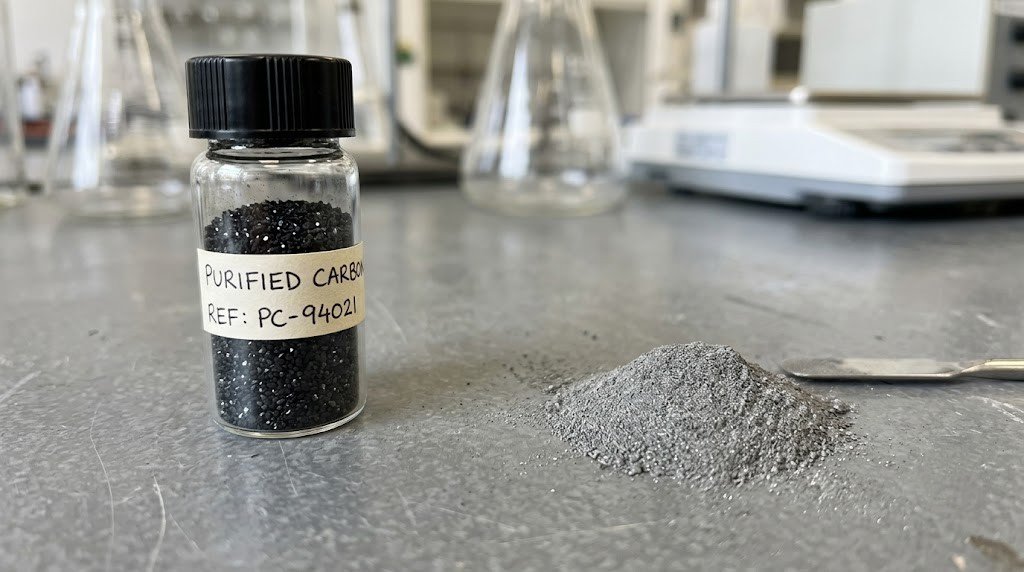
By this point, carbon made from sister hair carries no visible link to the strands you packed, which is why the reference number assigned at intake matters so much. Ask how that number follows her carbon from one step to the next, and who signs when it moves.
Two practical questions about a diamond made from sister hair belong here as well. Will any unused hair be returned to you, or is the whole lock consumed? And is her material ever processed in a shared batch with another family’s? Practices vary, and both answers are reasonable to request in writing.
What Happens Between Graphite and a Rough Crystal?
Two transformations, one brief and one long. First, purified carbon is heated to roughly 2,500 to 2,700°C and reorganized into graphite, the layered form a growth press uses as feedstock. Around this point, or as the press is loaded, supplemental lab carbon is typically added to reach the volume growth requires.
Most providers then grow the crystal by HPHT, high pressure high temperature: a press holds a small cell at around 6 to 8 gigapascals and somewhere between 1,400 and 2,500°C, and carbon crystallizes, slowly, onto a tiny diamond seed. A minority use CVD, in which the carbon is converted into a gas such as methane and deposited layer by layer onto a seed plate. Both methods yield a real lab grown diamond, the same mineral as a mined stone.
Growth runs for weeks to months, and its length decides carat size. A modest lock does not cap how large a stone made from sister hair can be, because a bigger diamond depends on a longer, steadier run rather than a bigger envelope of hair.
Runs can fail. A crystal made from sister hair may grow with flaws or stall, and some providers say a cycle occasionally has to be repeated. Ask whether any of her carbon is held back for that possibility, and what happens if it is not.
How Much of a Stone Made From Sister Hair Is Her Carbon?
Nobody has published a finished stone share for hair, so anyone quoting a figure should be asked where it came from. The 10 to 15% share you may have seen describes stones grown from cremated ashes. That is an ash figure only. It describes a different material with a different carbon yield, and it should not be borrowed for hair.
Hair starts far richer in carbon than ash, so a small lock can supply a meaningful amount. Her share of the finished crystal then depends on how much of that the provider uses and how much lab carbon is blended in, both of which vary by provider and stone size.
So ask, in writing, for the specific stone you are considering:
- How much of her hair will be used, and how much carbon do you expect to recover from it?
- How much supplemental lab carbon will be added, and where is it sourced?
- What share of a finished stone made from sister hair do you estimate is her carbon?
- Is her carbon ever combined with another family’s at any stage?
A stone made from sister hair is physically built in part from her own carbon. That is the honest claim, and it does not need inflating. If a provider tells you the whole stone is her carbon, that is a reason for more questions, and the evidence for what is truly hers is worth reading first.
Does Her Hair Color Affect a Stone Made From Sister Hair?
No. Her hair color, whether dark, light, gray, red or dyed, does not carry through into the stone. Pigment is broken down during purification, and only carbon remains.
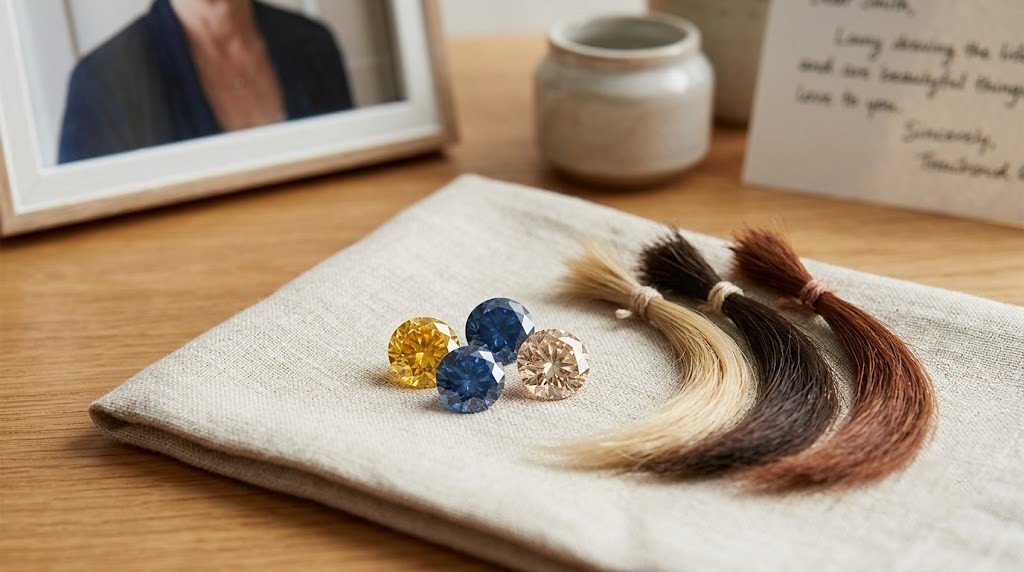
What tints a diamond is chemistry inside the growth cell: stray nitrogen atoms caught in the lattice lean the crystal yellow, stray boron leans it blue, and a stone with neither shows no color at all. Shutting both out calls for extra processing, so colorless results usually cost more. As a group, memorial diamonds lean toward yellow, blue and champagne.
Some providers also offer post growth irradiation for shades such as red, green or black, which is optional and should be disclosed on the paperwork. What nobody can do is choose, match or predict the final shade of a diamond made from sister hair from the hair itself. A provider can describe the color options it offers and the process behind each; it cannot promise an exact tone.
What Records Show a Diamond Was Made From Sister Hair?
A sequence of documents, each covering a different moment. Ask which of these a provider issues before you commit:
- A signed authorization naming who released the hair and what was ordered.
- An intake confirmation with a reference number, ideally noting the weight or condition of the lock on arrival.
- A stage or custody log recording each handover as her material moves through the laboratory.
- An origin or authenticity certificate, usually issued in house, stating that the stone was grown from the carbon your family supplied.
- An optional independent grading report describing cut, color, clarity and carat.
The last two are often confused. An origin certificate is a custody document; it is what ties the stone to her. A grading report, from an outside gemological lab, assesses quality the way it would for any diamond and says nothing about origin. Across this industry, independent grading is generally optional and costs extra.
Ask to see a sample custody log with another family’s details removed. For a gem made from sister hair, the origin certificate only means something when the records behind it exist and can be shown.
What Does a Sibling Experience From Start to Finish?
The beginning is busy: family conversations, choosing a lock, a kit, a form and a sealed packet. Write down the reference number; it is your thread through what follows.
Then the middle goes quiet. Purification and graphitization rarely generate news, and growth can run for weeks or months without an update. Some providers send a photo of the rough crystal; others wait until the stone is cut. Ask in advance which approach yours takes and whom you can reach if you start to worry about a diamond made from sister hair you have not heard about in a while.
The end returns to something you can hold. Cutting gives the stone its shape, and some providers share images before final approval or setting. A finished diamond rates 10 on the Mohs scale of mineral hardness, so it can be worn daily in a ring, pendant or earrings. Typical clarity for memorial stones lands between SI2 and VVS.
Delivery brings the stone made from sister hair and its papers together. You might keep the origin certificate with the envelope the lock once lived in, or file it with her other papers.
What Will a Diamond Made From Sister Hair Cost?
The price of a stone made from sister hair follows carat size and color far more than the source material. Across the industry in 2026, and not as any one company’s price list, a small stone in the 0.10 to 0.25 carat band generally lands between $1,500 and $3,500. Moving up to somewhere between half a carat and a full carat brings the range to about $5,000 to $15,000, while two carats and upward, past five, can reach $20,000 to $75,000 or more. Colorless costs meaningfully more than yellow, blue or champagne at the same size.
Several items are usually priced on top of the loose stone: independent grading, engraving, fancy cuts and any setting. Insured return shipping may be billed separately too, so request a full written total rather than a starting figure.
For a broader view of the options, timelines and decisions involved, the complete guide to a sister hair diamond covers them together. If your family also holds a portion of her ashes, how a diamond is made from both her ashes and hair explains how the two are combined, and the complete guide to using ashes and hair together sets out the wider choices.
Frequently Asked Questions
How much hair is needed for a diamond made from sister hair?
Requirements vary by provider, but a small lock or a few grams is typical. Because hair is roughly half carbon by weight, far less is needed than with ashes. Ask for the provider’s minimum before cutting or dividing any lock you hold.
Can hair from her hairbrush be used?
Possibly. Some providers accept loose strands gathered from a brush or comb, while others prefer a cut lock. Ask the specific provider what it accepts and in what quantity, and confirm it in writing before sending anything you cannot replace.
Can a stone be made from sister hair if she was buried, not cremated?
Yes, provided a lock of her hair was kept. Hair needs no cremation, which is one reason it is chosen by families whose sister was buried, or whose ashes are held elsewhere and cannot easily be divided.
Will her whole lock be used up?
That depends on the lock’s size and the provider’s process. Purification consumes whatever hair goes into a stone made from sister hair, so ask beforehand how much will be needed and whether any unused strands are returned, kept or disposed of afterward.
Does dyed or gray hair change the finished diamond?
Her hair color does not carry into the stone, because pigment is removed with everything else during purification. Ask the provider whether dyed or chemically treated hair affects acceptance, since requirements on treated hair vary between laboratories.
Can two siblings share one lock of her hair?
Sometimes. It depends on how large the lock is and how much each provider requires per stone made from sister hair. Ask before dividing it, and agree among yourselves, and with anyone administering her estate, before anything is cut or sent.
Final Thoughts on How Her Hair Becomes a Diamond
A lock of hair is one of the smallest things a person leaves behind, and it can feel unlikely that anything as solid as a diamond could begin there. The chemistry says otherwise: the carbon in a crystal made from sister hair is freed from the keratin, purified, rearranged into graphite and grown slowly into a crystal alongside lab carbon, then cut and documented.
What makes the result trustworthy is not the story told about it but the records kept along the way. A diamond made from sister hair is a real diamond that contains a real share of her carbon, and it is reasonable to ask a provider to show you, in writing, how they know.
Learn More About Sister Memorial Diamonds
- Sister Hair Diamond: The Complete Guide covers everything about a diamond from her hair.
- How to Turn Your Sister’s Hair Into a Diamond explains the practical steps from kit to delivery.
- Is the Stone Really Made From Her Hair? examines what the evidence can and cannot show.
- How a Memorial Diamond Is Made From Her Ashes explains the ash route stage by stage.
- Combining Her Ashes and Hair in One Memorial Diamond explains how the two materials are processed together.
Talk With Memorial Diamond
If you are holding a lock of her hair and wondering whether a diamond made from sister hair is possible, Memorial Diamond is glad to talk it through at memorialdiamond.us, from how much hair is needed to which records you would receive. Asking questions places you under no obligation.
Leave A Comment