Memorial Diamond Colors for a Sister What to Expect

Memorial Diamond Colors for a Sister: What to Expect

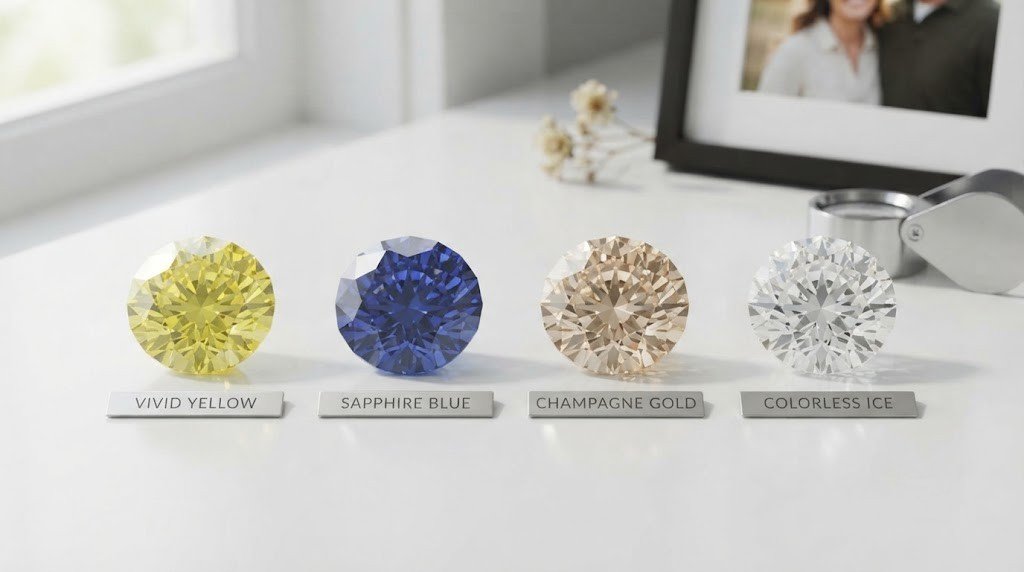
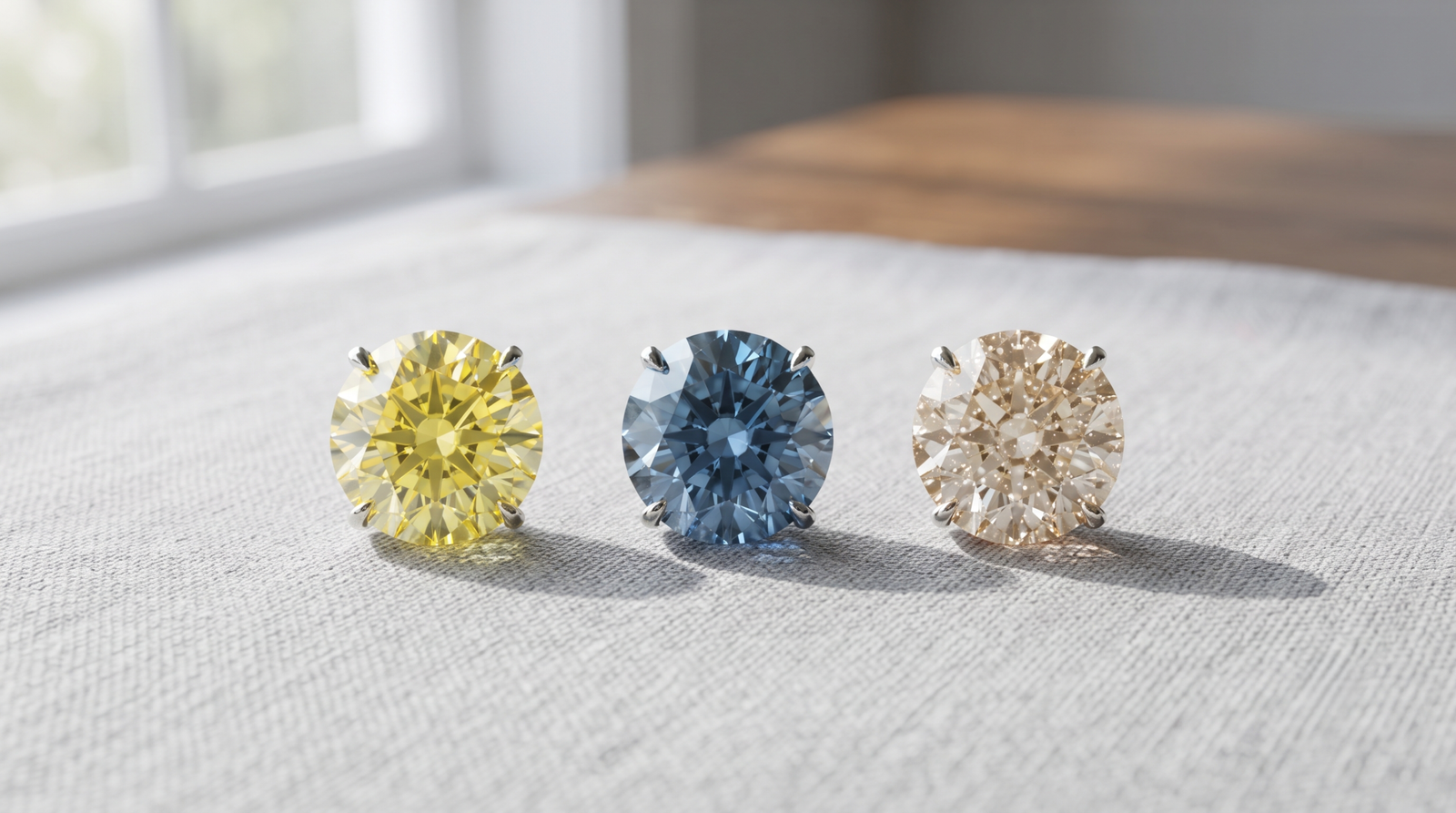
Before carat size or jewelry setting, color is often the detail people picture first. Memorial diamond colors for a sister commonly include yellow, blue, champagne, and brown. These shades can be influenced by trace elements such as nitrogen and boron during diamond growth. Colorless stones may be possible with additional processing and typically cost more, while some providers offer pink, red, green, or black through disclosed post-growth treatments.

Choosing a color can feel personal, especially when the diamond is intended to honor someone you love. You might prefer a shade that matches her favorite jewelry, reminds you of a special place, or simply looks beautiful in a ring or pendant. There is no single correct choice. Understanding the options can help you compare providers and make a decision with confidence.
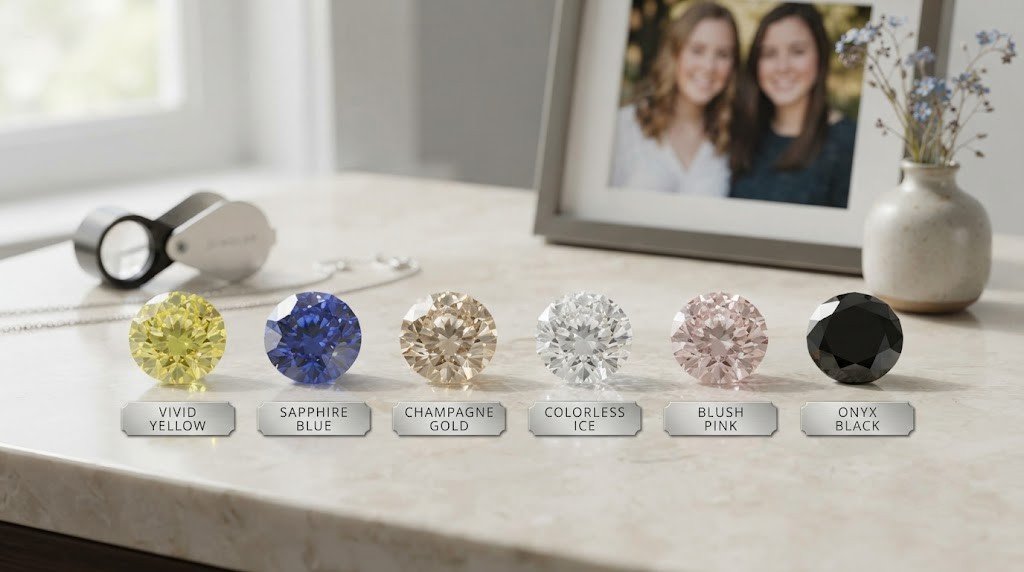
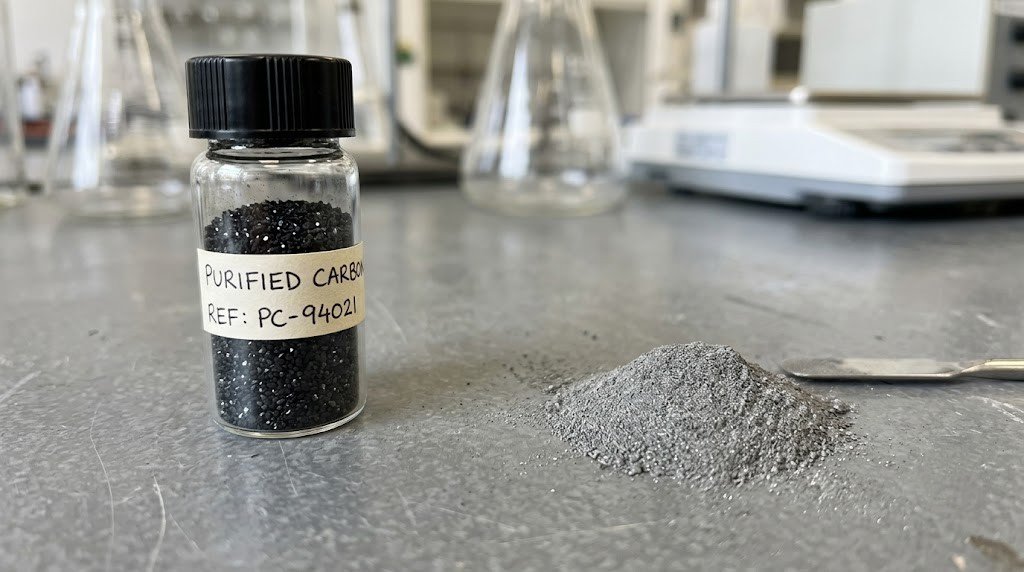
memorial diamond colors for a sister

Which Memorial Diamond Colors for a Sister Occur Naturally?

Several color families cover most of the memorial diamond colors for a sister you may be offered. Some colors develop during the diamond-growth process, while others can be created or intensified through treatment after growth. Understanding this distinction helps you know what questions to ask before placing an order.

Color familyWhere the color may come fromNatural growth color or treated?Cost considerations
YellowTrace nitrogen in the growing crystalGrowth colorAsk for a quote at your chosen carat size
BlueTrace boron in the growing crystalGrowth colorAsk for a quote at your chosen carat size
Champagne and brownTrace elements and growth conditionsGrowth colorAvailability and pricing vary
ColorlessRequires careful control of unwanted trace elementsExtra processing may be neededTypically costs more
Pink and redMay be produced through post-growth irradiationTreatedAsk about treatment and additional cost
Green and blackMay be produced through post-growth irradiationTreatedAsk about treatment and additional cost

Yellow, blue, and champagne are common options discussed when exploring memorial diamond colors for a sister. The carbon used for a memorial stone begins with a personal source, and trace elements and laboratory growth conditions can influence the finished color. These differences are part of the material and process, not automatically a sign of a defect.

Shades within the same color family can vary, too. One yellow diamond may memorial diamond colors for a sister look pale and lemon-like, while another appears warmer and closer to honey. A blue stone may look light and icy or deeper and more intense.

When providers show memorial diamond colors for a sister in photographs, ask to see several examples of each available shade. Also ask whether the photographs show finished diamonds, what their carat sizes are, and whether the colors have been treated. A single promotional image may not represent the full range you could receive.

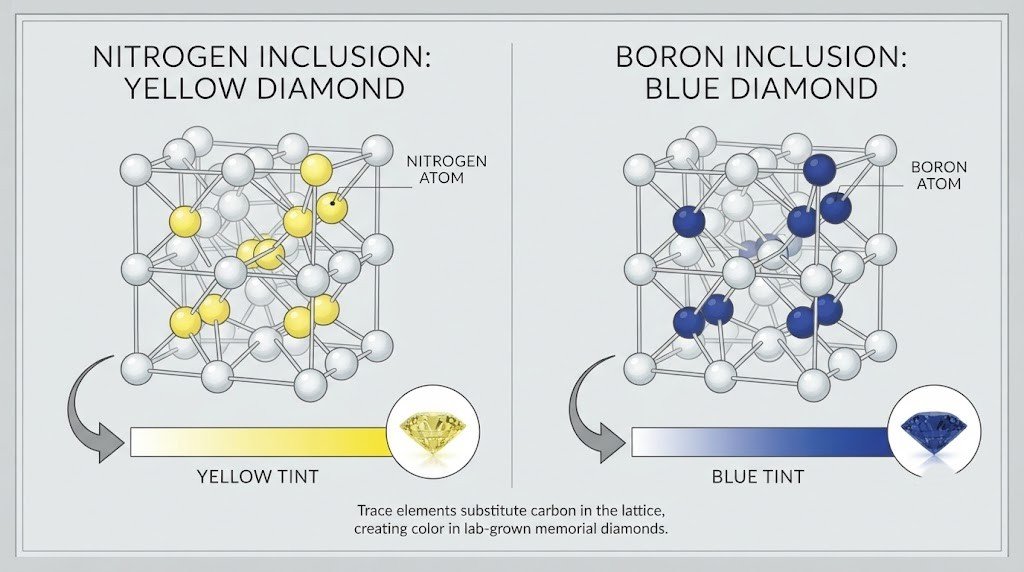
Why Do Nitrogen and Boron Set the Shade?

A diamond is made primarily of carbon atoms arranged in a crystal structure. When trace amounts of other elements become incorporated into that structure during growth, they can affect how the stone interacts with light. Nitrogen is associated with yellow tones, while boron can produce blue coloration.

This helps explain two of the most familiar memorial diamond colors for a sister: yellow and blue.

The starting material and the growth process both matter. Purification aims to memorial diamond colors for a sister produce carbon suitable for diamond growth, but the final result can still depend on trace elements and the conditions used in the laboratory. The visible tint is a result of the stone’s composition and growth—not a hidden message about the person being remembered.

Understanding this mechanism can take some pressure off your decision. Memorial diamond colors for a sister do not reveal her personality, emotions, or character. The science explains the shade; the meaning comes from your connection to her.

Most memorial diamonds are associated with high-pressure, high-temperature (HPHT) growth, although some providers may use chemical vapor deposition (CVD). You can read a general overview of how lab-grown diamonds are produced to learn more about laboratory diamond growth.

When comparing providers, ask them to explain which process they use and how it relates to the colors they offer. Do not assume that every provider can produce every shade or that every source material will produce the same result.

What Does a Colorless Stone Involve?
Among memorial diamond colors for a sister, colorless is often the option people picture when they want a traditional white-diamond appearance. Achieving a colorless result may require careful control of trace memorial diamond colors for a sister elements such as nitrogen and boron during growth, along with additional processing.

That additional work can affect the price. Across the industry, colorless memorial memorial diamond colors for a sister diamonds typically cost more than yellow, blue, or champagne stones of the same size. The difference depends on the provider, the carat size, the growth process, and the services included in the quote.

Colorless is not more authentic, more respectful, or more meaningful than any other shade. It is simply the appearance some people prefer. It may match jewelry they already own or suit a classic engagement-ring or pendant design.

If you are considering a colorless stone, ask the provider these three questions:

  • Is a colorless diamond available in the carat size I want?
  • How much does the color choice add to the total price, itemized separately?
  • Is independent grading available to document the finished diamond’s characteristics?

Also ask to see examples that are similar in size and cut to the diamond memorial diamond colors for a sister you are considering. A small colorless stone can look different from a larger one, especially when viewed in different lighting conditions.

Compare the full quote rather than the color alone. A provider may include some services in its price while another charges separately for grading, cutting, setting, or shipping.

What Are Treated Colors, and Should They Be Disclosed?

Some providers offer post-growth treatments that alter or intensify a diamond’s color after the crystal has grown. Irradiation is one method that may be used to produce certain shades, including pink, red, green, or black.

These specialty memorial diamond colors for a sister may appeal to people who want something distinctive. However, you should understand whether a color develops during growth or is created through a treatment afterward.

Treatment does not mean a stone is no longer a diamond. However, the treatment should be disclosed clearly in the provider’s documentation. Anyone who later appraises, insures, repairs, or resets the stone may need to know how its color was produced.

If a provider offers a vivid pink, deep green, or black stone, ask directly:

  • Was the color produced during growth or through post-growth treatment?
  • Will the treatment be disclosed in writing?
  • Is the treatment described in any available grading documentation?
  • Does the treatment affect the price, timeline, or care instructions?

Disclosure is especially important when comparing memorial diamond colors for a sister across different providers. Two stones that appear similar in photographs may have been produced through different processes.

Specialty colors can also affect production time. Some providers quote approximately six to ten months for a typical process, while larger stones or specialty colors may take longer. These are general industry estimates, not a guaranteed timeline for every laboratory.

Ask for a written schedule and find out when the provider considers the color choice final. If your material has already entered production, changing the desired shade may not be possible.

Can Her Ashes or Hair Tell You the Color in Advance?

No. Memorial diamond colors for a sister cannot reliably be predicted from the memorial diamond colors for a sister appearance of her ashes, hair, or other source material. The finished color depends on the laboratory process, the material, trace elements, and the conditions under which the diamond grows.

Two people’s source materials may produce stones of similar colors. Material from the same person may also lead to different results in separate growth runs. A provider should explain what it can reasonably predict and what remains uncertain.

Color also says nothing about who your sister was. A blue stone does not prove that she was calm, and a yellow one does not mean she was cheerful. Treat suggestions that a particular shade reveals her personality as symbolism or personal interpretation, not scientific fact.

If you want to explore this question for a specific source material, these related guides may help:

The key point remains the same: no source material lets you choose or accurately predict every detail of the finished diamond’s shade.

How Is Color Graded and Written Up?

When comparing memorial diamond colors for a sister, you may encounter two different types of documentation: an origin or authenticity certificate and an independent grading report. They serve different purposes.

An origin certificate is generally issued by the provider. It may document the chain of custody and connect the submitted material to the finished stone. The provider may also describe the stone’s color, but the certificate’s main purpose is usually to document origin and provenance.

An independent grading report focuses on the diamond’s characteristics, which may include color, cut, clarity, and carat weight. Some reports use established grading terminology and standards. Ask which grading laboratory is available and request a sample report before paying for this service.

The Gemological Institute of America’s overview of diamond quality factors explains the characteristics commonly used to assess diamond quality.

Independent grading is usually an optional service and may cost extra. If precise documentation of memorial diamond colors for a sister matters to you—for example, for insurance or future resale documentation ask what report is available and what it will actually confirm.

Keep in mind that a grading report and an origin certificate are not interchangeable. One describes the diamond’s characteristics; the other may document its claimed connection to the submitted material.

Before ordering, ask:

  • Who issues the origin certificate?
  • Is independent grading available?
  • Which laboratory would assess the diamond?
  • What is the additional fee?
  • Will the report describe the color and any treatment?
  • When will the documentation be provided?

Clear answers can help you compare providers and understand exactly what you will receive.

How Does Color Change the Price?
Carat size is an important price factor, while the chosen color and the memorial diamond colors for a sister process needed to produce it may also affect the quote. When comparing memorial diamond colors for a sister, evaluate size and color together rather than comparing two stones with different specifications.

The following figures are general industry estimates for 2026, not prices from a specific provider. Actual prices can vary considerably.

Size tierGeneral estimated industry rangeColor considerations
About 0.10–0.25 ct$1,500–$3,500Confirm which colors are available at this size
0.5–1 ct$5,000–$15,000Colorless stones may carry a meaningful premium
Roughly 2 ct to 5+ ct$20,000–$75,000+Larger stones may require longer growth times; specialty colors may cost more

These figures may not include additional services. A quote could list a grading report, engraving, a specialty cut, a jewelry setting, or shipping separately.

When comparing memorial diamond colors for a sister, ask for itemized quotes that specify the carat size, color, cut, treatment if any, and all additional fees. A lower price for a yellow diamond and a higher price for a colorless diamond of the same size may reflect different processing requirements, so compare like with like.

The complete cost guide for a sister memorial diamond offers more information about the factors that can influence the overall cost.

Do not rely on a general industry range as a final budget. Request current memorial diamond colors for a sister pricing directly from the provider and confirm whether the quoted amount includes the finished stone, documentation, setting, and delivery.

How Do You Choose a Color You Will Want to Wear?

Choosing a color is a personal decision. You do not need to assign a symbolic meaning to it or feel that one shade is more appropriate than another. Some people start with a color their sister loved; others begin with the type of jewelry they want to wear every day.

Both approaches are valid ways to narrow the memorial diamond colors for a sister to one or two options.

Consider these questions:

  • Was there a color she often wore, chose for her jewelry, or used in her home?
  • Is there a place connected to her, such as a coastline, garden, or favorite travel destination, that inspires a color?
  • Do you usually wear yellow gold, white metals, or rose gold?
  • Will you wear the stone every day or reserve it for special occasions?
  • Do you prefer a traditional white-diamond appearance or a visibly colored stone?
  • Would you like the stone to blend into your existing jewelry or stand out as a distinctive piece?

There is no wrong answer. Choosing blue because it reminds you of her favorite place is a perfectly good reason. Choosing champagne because it works with your wardrobe is equally reasonable.

The connection to your sister comes from the meaning you give the piece, not the shade alone. Memorial diamond colors for a sister are a design decision, and you are allowed to choose what feels right to you.

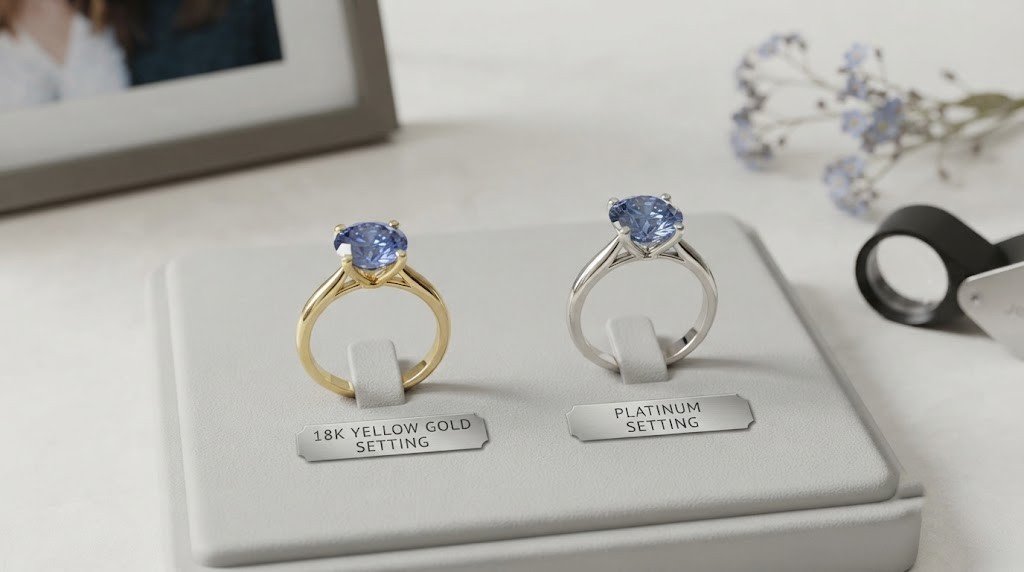
Before making a final decision, look at actual examples in different lighting. If possible, compare the stone against the metal you plan to use for the ring or pendant.

What If Siblings Want Different Colors?

Siblings choosing different memorial diamond colors for a sister is entirely memorial diamond colors for a sister workable when the provider can produce separate stones from the available material. One sibling may prefer blue, while another may want a colorless or champagne stone.

Each stone is grown separately, so two diamonds requested in the same color will not necessarily memorial diamond colors for a sister look identical. If matching tones matter to your family, ask the provider how closely it can align the appearance of separate stones.

Talk openly about expectations if several relatives are involved. Full siblings, half-siblings, step-siblings, adopted siblings, and twins may all have different memories and preferences. No single color choice needs to represent everyone’s relationship in the same way.

Before ordering more than one stone, ask:

  • Can the available material support the number of stones requested?
  • Does each stone require a separate quantity of material?
  • Can different colors be requested from the same source?
  • Will separate stones have separate certificates or records?
  • How closely can the provider match the color of multiple stones?
  • What happens if the material is insufficient for every requested stone?

If two people plan to share one stone rather than receive separate pieces, agree in writing who will own it before production begins. Clear expectations can prevent misunderstandings later.

The choice of memorial diamond colors for a sister should support remembrance rather than become a competition between family members. Different preferences can coexist, and everyone should have room to choose a meaningful keepsake.

Will the Color Look the Same Once It Is Cut, Set, and Worn?

Not always. The way a diamond appears can be affected by its size, cut, lighting, and the metal surrounding it. These are viewing factors to examine with real samples, rather than guarantees that every stone will look a particular way.

Size and shape matter when comparing examples. A shade shown in a large stone or a fancy cut may not appear the same in a smaller diamond. When you compare memorial diamond colors for a sister in photographs, check the carat weight and cut of each example.

Lighting also matters. A sample seen only under a showroom lamp or on a phone screen may look different from one viewed in daylight or under ordinary indoor lighting. If possible, look at the same sample in more than one environment.

The setting can influence the overall appearance. The metal around a diamond may change the contrast you see between the stone and the jewelry. Compare the shade against the metal you plan to wear rather than relying only on a photograph of a loose diamond.

Before settling on one of the memorial diamond colors for a sister, use this checklist:

  • Ask for photos or samples close to your intended carat size and cut.
  • View the examples in daylight and ordinary indoor light.
  • Compare them with the metal you wear most often.
  • Ask whether the photographs show treated or untreated colors.
  • Keep a written note of the color you selected.
  • Confirm when the color choice becomes final.

The guide to settings and jewelry ideas for a sister’s stone covers how different metals can be paired with memorial diamonds.

If you are still deciding between a ring, pendant, or another keepsake, explore these ring, pendant, and keepsake ideas to picture how a colored stone might look in different jewelry styles.

Frequently Asked Questions

Can a memorial diamond change color over time?

Ask the provider for written care guidance for your particular stone. A color formed during growth and a color created through a separate treatment are different processes. Keep the documentation and share any care instructions with a jeweler who repairs or resets the piece.

Is a yellow memorial diamond lower quality than a colorless one?

No. Yellow, blue, and champagne are color options, not automatic indicators of poor quality. Colorless diamonds may cost more because they require additional processing, not because they carry greater emotional meaning. Cut, clarity, and carat are assessed separately.

Can I ask for a black or pink diamond for my sister?

Some providers offer black, pink, red, or green stones through post-growth treatment. Confirm that your provider offers the shade you want, ask for the treatment to be disclosed in writing, and check whether the specialty color affects the price or production schedule.

Will two stones grown from her ashes match each other?

Not necessarily. Each stone is produced in a separate growth run, so the final tones may vary even when the same source material and requested color are used. If matching is important, ask the provider how closely it can align the stones before placing multiple orders.

Does a grading report describe the color precisely?

An independent grading report may describe the diamond’s color alongside cut, clarity, and carat. An in-house origin certificate generally focuses on the stone’s documented connection to the submitted material. Independent grading is usually optional, so confirm the report’s scope and cost before ordering.

Can I change my mind about the color after growth starts?

Color decisions generally need to be made before growth or treatment begins, but each provider sets its own policies. Ask when the choice becomes final and whether changes are possible after the material enters production. Get the answer in writing before you approve the order.

Final Thoughts on Memorial Diamond Colors for a Sister

Color is one of the parts of this process where you can make a choice based on your own taste. The science influences which shades are possible, while you decide what you would like to see on your hand, around your neck, or in another piece of jewelry.

Memorial diamond colors for a sister are not a test with one right answer. Yellow, blue, champagne, and colorless stones can all be meaningful choices, and some providers offer additional treated shades.

If you are uncertain between two options, take your time. Compare real samples in daylight, view them against the metal you wear most, and ask the provider about treatment, documentation, cost, and timing.

The stone’s color does not determine the value of your memories or your relationship. Choose the shade you feel comfortable wearing or keeping, and make sure you understand the process before committing to an order.

Learn More About Sister Memorial Diamonds

Explore these related guides for more information:

Talk With Memorial Diamond

Questions about memorial diamond colors for a sister are welcome, whether you already have a shade in mind or are only beginning to explore the options.

Visit MemorialDiamond.us when you are ready to learn more. Take the time you need, ask clear questions, and choose the option that feels right for you and your family.

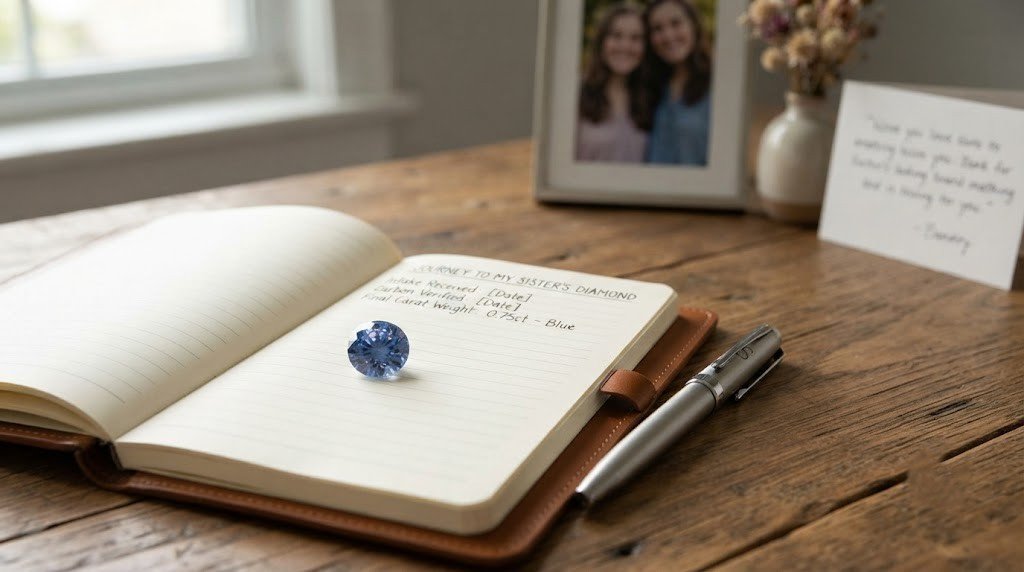
Choosing a Memorial Diamond for Your Sister

Choosing a Memorial Diamond for Your Sister: Where to Start

If you have only just begun exploring this idea, you are in the right place. Nothing needs to be decided today. Choosing a memorial diamond for your sister can feel overwhelming at first, especially when you are trying to make a meaningful decision while remembering someone you love.

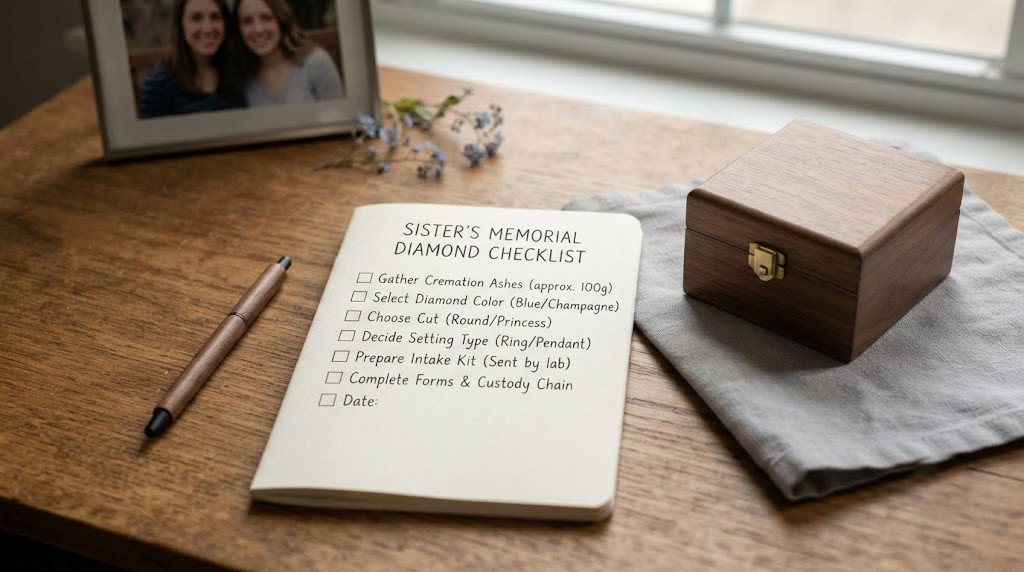
The process becomes easier when you break it into six practical decisions: what material your family has, who can authorize its use, your budget, your preferred timeline, your expectations about color, and whether you want to wear the diamond or keep it as a loose stone.

This guide will help you understand those decisions at your own pace, with links to more detailed resources whenever you are ready to explore further.

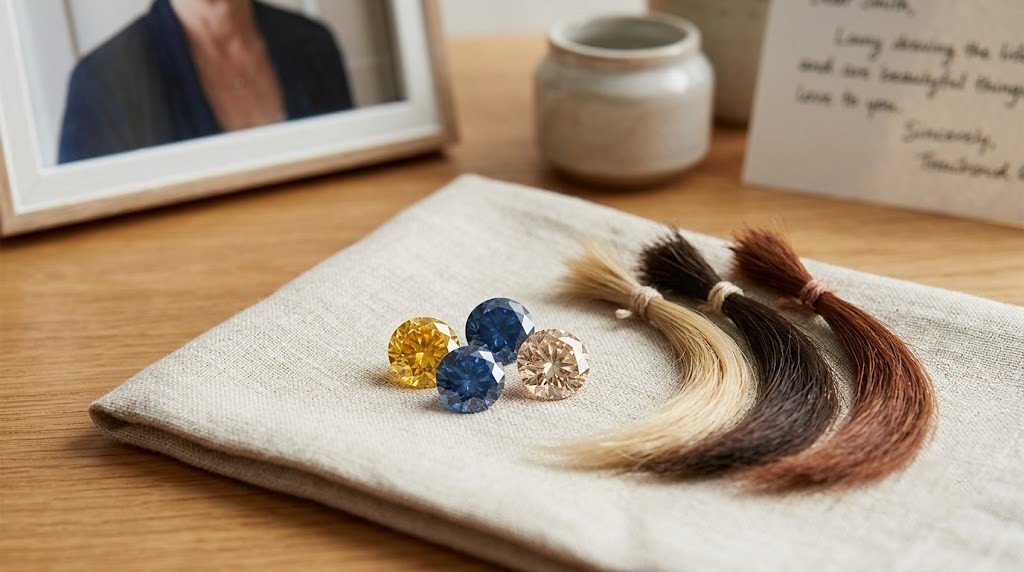
memorial diamond for your sister

What Is a Memorial Diamond for Your Sister?

A memorial diamond for your sister is a lab-grown diamond created using carbon recovered from a person’s cremation ashes, hair, or both, depending on the provider’s process. It is a real diamond rather than glass, resin, or a diamond look-alike.

The finished stone has the characteristic hardness and optical properties of diamond. Like other diamonds, it can be evaluated using factors such as carat weight, cut, color, and clarity. You can read more about the category in this history and background of memorial diamonds.

The process generally involves recovering carbon from the supplied material, purifying it, preparing it for diamond growth, and growing a crystal under controlled laboratory conditions. High-pressure, high-temperature technology is commonly used, although some providers use chemical vapor deposition. The resulting crystal is cut and polished into the desired shape.

One important detail deserves attention: the finished diamond is not necessarily made entirely from your sister’s carbon. Providers may use supplemental laboratory carbon during production. Ask how the company documents the origin of the carbon and what evidence it provides about the finished stone.

A memorial diamond for your sister is a personal keepsake, and families can have different reasons for choosing one. Some want a stone they can wear every day. Others prefer a loose diamond that can be passed down or set into jewelry later.

The six steps below are intended to help you understand your options. You do not need to complete them all at once.

Step 1: What Material Does Your Family Have?

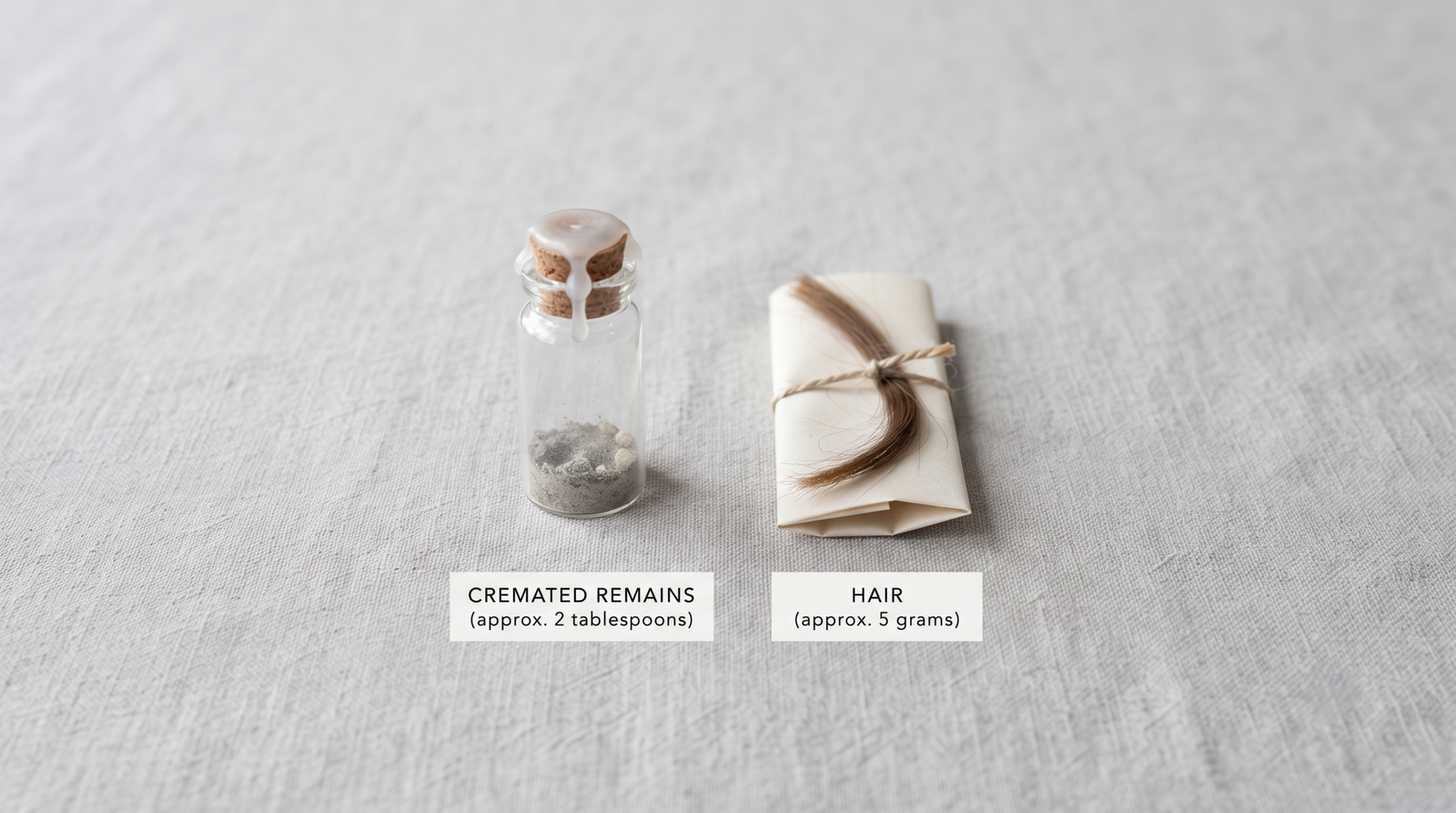
The first decision is whether ashes, hair, or both are available. The type memorial diamond for your sister and amount of material influence which providers and processes may be suitable.

MaterialGeneral carbon informationCremation required?Typical amount
AshesCarbon content varies; some estimates are around 0.5–4% by weightYesA few tablespoons to approximately 4 oz (100 g), depending on the provider
HairApproximately 50% carbon by weightNoA small lock or a few grams
BothDepends on the materials and the provider’s processOnly for the ash portionConfirm requirements with the provider

These are general estimates, not universal requirements. Always follow the specific collection and shipping instructions provided by the company you choose.

If You Have Her Ashes

A small portion of cremation ashes may be sufficient for a memorial diamond for your sister. You may not need to use all the ashes, and the remaining material can stay with your family according to your wishes and applicable requirements.

Before sending anything, confirm who has authority to approve its use and how much the provider needs.

Read the complete guide to sister ashes diamonds for more information about using cremation ashes.

If You Have Her Hair

Hair may be an option for families who do not have ashes or who prefer not to use them. A small lock of hair, a keepsake envelope, or a saved salon trimming might be a starting point, depending on its condition and the provider’s requirements.

Keep the material safely stored until you receive instructions. Before using hair for a memorial diamond for your sister, check whether you have the authority to use it, especially if it forms part of her estate.

Explore the sister hair diamond guide for more details.

If You Have Both Ashes and Hair

Some providers may be able to combine memorial diamond for your sister ashes and hair in a single diamond. However, not every company offers this option, and the process for documenting and processing each source can vary.

Ask the provider whether blending is available, how the materials will be handled, and what documentation you will receive.

You can learn more in the guide to sister ashes and hair diamonds.

Step 2: Who Can Authorize the Material’s Use?

Before ordering a memorial diamond for your sister, establish who can authorize the use of her ashes or hair. This is particularly important when several relatives are involved or family members have different wishes.

Rules governing cremated remains vary by state and jurisdiction. A spouse or partner, adult memorial diamond for your sister children, parents, siblings, or a person named in written arrangements may have different rights depending on the circumstances. There is no single priority order that applies everywhere.

If your sister was cremated, the funeral home or crematory may be able to tell you who signed the cremation authorization. For a question about legal authority, consult a local attorney or the relevant funeral professional.

If you are not the person authorized to make decisions about the ashes, you may still be able to arrange a memorial diamond for your sister with the appropriate person’s permission.

Hair also deserves care. Hair left at home may form part of an estate, depending on memorial diamond for your sister the circumstances and local law. If there is an executor or another person responsible for managing the estate, ask them before sending it to a provider.

A calm conversation can help avoid misunderstandings. Explain why the keepsake matters to you, what amount of material is requested, and what will happen to anything that remains.

If you need help approaching relatives, read how to talk to family about a sister memorial diamond.

Step 3: What Budget Feels Right?

The cost of a memorial diamond for your sister depends on several factors, including carat weight, color, production requirements, grading, and the final jewelry setting.

The following are illustrative 2026 industry price ranges, not quoted prices from Memorial Diamond or any specific provider:

  • Approximately 0.10–0.25 carats: $1,500–$3,500.
  • Approximately 0.5–1 carat: $5,000–$15,000, with colorless stones often costing more.
  • Approximately 2–5+ carats: $20,000–$75,000 or more.

Prices can differ significantly between providers. Treat these figures as starting points for research, not a memorial diamond for your sister guarantee of what you will pay.

Additional costs may include independent grading reports, engraving, specialist cuts, jewelry design, and memorial diamond for your sister the setting. Ask for an itemized quote so you can compare providers on the same basis.

A smaller memorial diamond for your sister can still carry deep personal meaning. You might choose a modest stone in a setting you will wear regularly, or purchase a loose stone and decide on the jewelry later.

If several relatives are sharing the expense, discuss the contribution from each person before placing an order. It is also wise to agree in writing who will own the finished stone and who will keep any documentation.

For more information about estimated expenses, read the sister memorial diamond cost guide.

Step 4: How Long Will It Take?

Memorial diamond production is a specialist process, so it is important to plan for a substantial wait.

General industry estimates suggest that a memorial diamond for your sister may take around 6–10 months from the provider’s receipt of the material. Larger stones or specialty colors may take up to approximately 12 months, depending on the company and the order.

These are estimates rather than guaranteed delivery dates. Ask the provider for its current timeline and whether the estimate includes material processing, crystal growth, cutting, polishing, grading, and jewelry setting.

Sending more ashes or hair does not automatically make the finished diamond larger or shorten production time. Carat weight is related to crystal growth and the production process, not simply to the quantity of material sent.

If you hope to have the diamond ready for a birthday, anniversary, or family event, ask the provider whether that date is realistic. Leave extra time for unexpected delays.

There is also no deadline for beginning. Some families explore their options soon after a memorial diamond for your sister loss, while others wait months or years before making a decision.

Before committing to a memorial diamond for your sister, ask two questions in writing:

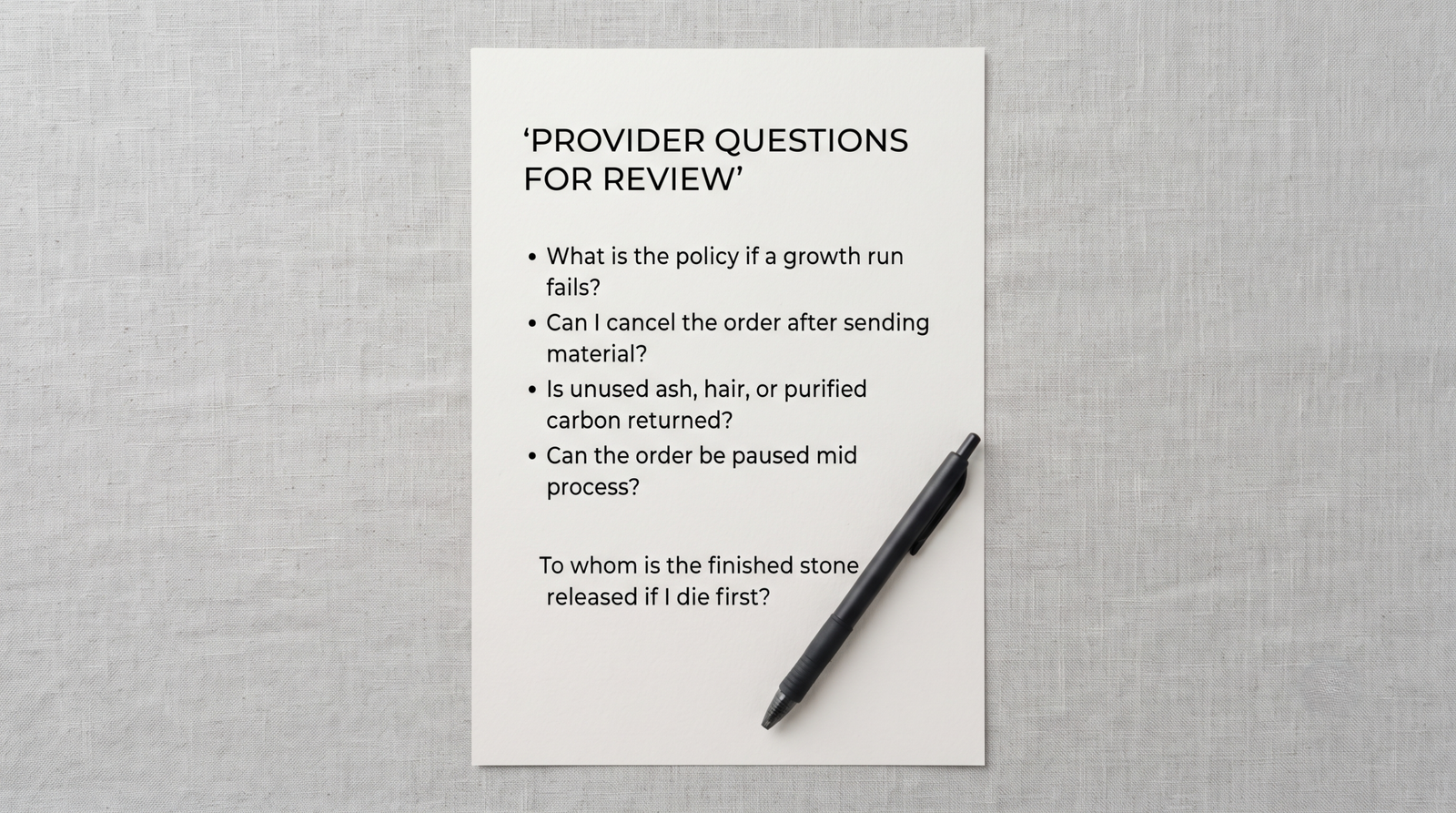
  • What happens if a growth cycle fails or the stone is damaged during cutting?
  • What happens to any supplied material that is not used?

The answers can differ by provider, so review the terms carefully before sending anything.

Read the sister memorial diamond timeline for more details.

Step 5: What Should You Know About Diamond Color?

Color is one of the most important expectations to discuss before ordering a memorial diamond for your sister memorial diamond for your sister.

Diamond color is influenced by factors such as trace elements and the conditions under which the crystal grows. Nitrogen can contribute to yellow tones, while boron can contribute to blue. Colorless diamonds require different conditions and may involve additional processing.

Memorial diamonds can come in shades such as yellow, blue, champagne, or brown. Some providers also offer colors such as pink, green, red, or black through specialized processes, which may include post-growth treatment.

Ask the company which colors it offers, whether a particular color can be requested, and whether any treatment is used to achieve it. A provider should explain the limitations clearly rather than promise an exact result without qualification.

The color of a memorial diamond for your sister cannot reliably be predicted just by looking at her ashes or hair. The resulting color is a matter of chemistry and production conditions; it does not represent her personality or the significance of your relationship.

Colorless stones may cost more, while other shades may be available at different price points. Compare the available options and ask whether color affects the estimated timeline.

Clarity and overall quality also matter. If you want an independent assessment, ask whether the finished diamond can be submitted for an independent grading report. The Gemological Institute of America explains the main diamond quality factors, including cut, color, clarity, and carat weight.

For a closer look at available shades, visit memorial diamond colors for a sister.

Step 6: Should You Wear the Diamond or Keep It Loose?

There is no single correct way to keep a memorial diamond memorial diamond for your sister for your sister. The best choice is the one that feels right for you and the way you want to remember her.

Here are some possibilities:

  • Pendant: A necklace can keep the stone close to you, and a discreet design can be worn beneath clothing.
  • Ring: A solitaire or a design with smaller accent stones can make the diamond part of everyday jewelry.
  • Stud or drop earrings: If two stones are created, a matching pair may be an option.
  • Cufflink, tie pin, or brooch: These can suit someone who prefers a less conventional piece of jewelry.
  • Loose diamond: Keeping the stone in a small box gives you time to decide on a setting later.

Consider who will wear the jewelry, how often it will be worn, and what style is comfortable. You do not have to memorial diamond for your sister memorial diamond for your sister choose a setting immediately if the provider allows the stone to be supplied loose.

Diamond is highly scratch-resistant, but it can still chip if struck at the wrong angle. If you intend to wear a memorial diamond for your sister daily, ask a jeweler about protective settings, including bezel settings, and suitable care.

If the diamond is valuable, speak with your insurer about whether it can be covered and what documentation may be required.

For ideas about jewelry styles and protection, see settings and jewelry ideas for a sister.

Common First-Step Mistakes to Avoid

A few practical precautions can make the process clearer and help prevent avoidable problems.

1. Moving ashes before confirming authorization.
Check who has authority over the remains and obtain the necessary approval before removing or sending any portion.

2. Sending more material than requested.
Follow the provider’s written instructions. Additional material does not automatically create a larger diamond or make production faster.

3. Assuming you can choose an exact color.
Ask what colors the provider can offer and what limitations apply. Do not rely on an unsupported promise about the final result.

4. Comparing quotes without checking what is included.
One quote may include a grading report or jewelry setting, while another may charge for these separately. Compare itemized prices.

5. Forgetting to ask about problems during production.
Ask what happens if a growth cycle fails, if a stone fractures during cutting, or if the finished result differs from expectations.

6. Assuming unused material will automatically be returned.
Confirm the company’s policy for unused ashes or hair, including whether return shipping or additional fees apply.

7. Overlooking ownership arrangements.
If relatives contribute money or expect to share the keepsake, agree on ownership and future arrangements before ordering.

Taking these steps before choosing a memorial diamond for your sister can make conversations with providers more focused and help you compare their answers fairly.

Different families have different first questions. Use the guides below memorial diamond for your sister to explore the subject that matters most to you.

Your questionRecommended guide
Is a diamond from her ashes really possible?Sister Ashes Diamond: The Complete Guide
Can hair be used instead of ashes?Sister Hair Diamond: The Complete Guide
Can both materials be used?Sister Ashes and Hair Diamond: The Complete Guide
How can I discuss this with relatives?How to Talk to Family About a Sister Memorial Diamond
What might it cost?How Much Does a Sister Memorial Diamond Cost?
How long does production take?Sister Memorial Diamond Timeline
What colors are available?Memorial Diamond Colors for a Sister
What jewelry settings can I choose?Memorial Diamond Settings and Jewelry Ideas for a Sister

Reading two or three relevant guides before contacting a provider can help you prepare questions and understand what to expect.

What Should You Prepare Before Contacting a Provider?

You do not need every detail settled before asking for information. A few notes can simply memorial diamond for your sister make the first conversation easier.

Before discussing a memorial diamond for your sister, consider gathering:

  1. Available material: Whether you have ashes, hair, or both, and an approximate quantity.
  2. Authorization: Who is responsible for approving the material’s use and whether they agree in principle.
  3. Budget: A comfortable spending range, including the setting if you want jewelry.
  4. Timeline: Whether you have a particular date in mind or are happy to wait.
  5. Color preferences: Whether you prefer a particular shade and whether you are open to treated colors.
  6. Grading: Whether you want to ask about an independent grading report.
  7. Production policies: What happens if growth fails, the stone is damaged, or material remains unused.
  8. Ownership: Who will own and keep the finished diamond if other relatives are involved.

You can use this list as a starting point rather than a set of requirements. Preparing it does not commit you to an order.

Frequently Asked Questions

Can I choose a memorial diamond if my sister and I were estranged?

Yes, you can explore the option regardless of whether your relationship was straightforward or complicated. Grief and remembrance are personal. The practical issue is whether you have the necessary authority or approval to use the material. If approaching relatives feels difficult, a funeral professional or local attorney may help clarify the next step.

Should the whole family agree before I order a stone?

The necessary approval depends on who has legal authority over the remains and the rules that apply where you live. Even when unanimous agreement is not legally required, speaking with relatives can prevent misunderstandings. If several people want keepsakes, discuss portions, costs, and ownership before ordering.

Is it too soon to start planning a memorial diamond?

There is no universally right time. You can research a memorial diamond for your sister without committing to a purchase. If you decide to wait, keep ashes or hair stored safely and follow appropriate storage guidance from a funeral professional or prospective provider.

Do I need to tell the provider about her life or personality?

No. The technical process depends on the material and the conditions used to grow the diamond, not on personal details about your sister. However, you may choose to use a meaningful date, engraving, or jewelry design to make the finished keepsake more personal.

Can a memorial diamond be a gift to her children or partner?

It may be possible, provided the material’s use is properly authorized and the provider can accommodate the request. Discuss who will own the finished stone and who will be responsible for it in the future, particularly if several relatives are involved.

What if I cannot afford a memorial diamond right now?

That is completely understandable. You do not have to make the purchase immediately. If the appropriate person agrees, you may be able to set aside a suitable portion of material while you consider your options. Smaller stones may cost less than larger ones, but prices vary, so request a current quote and ask what is included.

A meaningful remembrance does not have to follow a particular timeline or budget.

Final Thoughts: Where to Begin

Choosing a memorial diamond for your sister can feel like a major decision because it is connected to someone who matters to you. Breaking the process into smaller questions can make it easier to approach without feeling rushed.

Start with two practical points: what material is available and who can authorize its use. Once those are clear, you can explore budget, timing, color, and the kind of keepsake you would like.

You can take one step today and leave the others for later. There is no need to make every decision at once, and researching your options does not mean you have committed to an order.

Learn More About Sister Memorial Diamonds

Talk With Memorial Diamond

When you feel ready to ask questions about a memorial diamond for your sister, you can begin by discussing available materials, authorization, production timelines, colors, and pricing with a provider.

Visit Memorial Diamond to explore the subject further and find a starting point that feels comfortable for you. You do not have to make a decision before you are ready.

Made From Sister

How a Memorial Diamond Is Made From Your Sister’s Hair

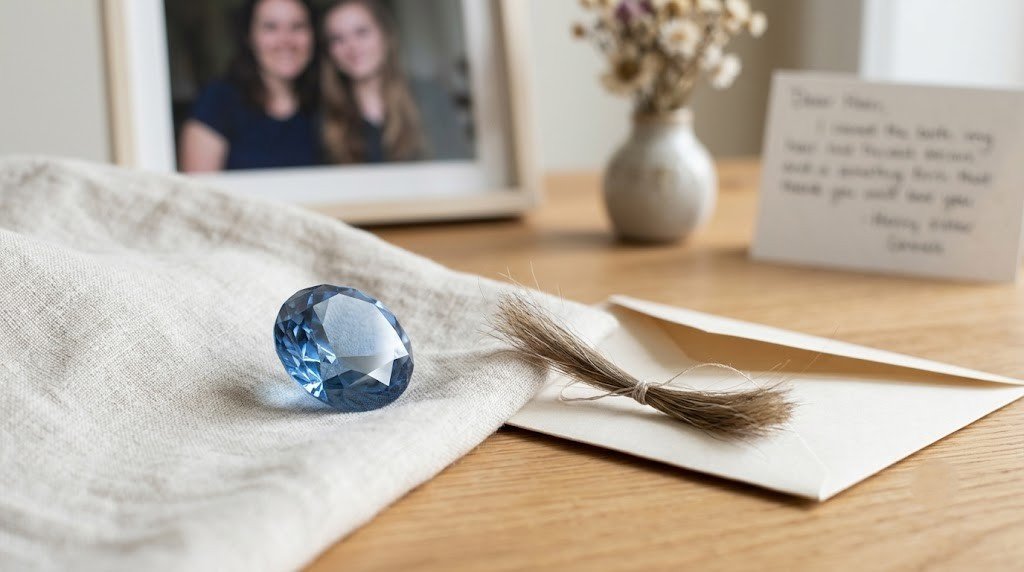
Sometimes what you have left of her is very small: a lock saved after a haircut, a braid someone thought to keep, a few strands folded inside a card. A diamond made from sister hair usually begins with a lock of a few grams, roughly half of it carbon by weight; that carbon is extracted, purified to about 99.9%, turned into graphite, typically blended with lab carbon, grown under heat and pressure, then cut and graded, typically within six to ten months.

made from sister hair

Why Can Hair Become a Diamond at All?

Because hair is mostly protein, and protein is built around carbon. Each strand is largely keratin, and by weight hair is roughly 50% carbon. Cremated ash, by comparison, holds only about 0.5% to 4% usable carbon, since cremation has already burned most of it away.

That difference changes almost everything about the starting point. A laboratory needs far less hair than ash, usually a small lock or a few grams, and no cremation is involved at any stage. A stone made from sister hair is therefore possible whether she was cremated, buried, or laid to rest in some other way, provided a lock was kept.

For some families hair is the only workable route: her ashes may have been scattered or interred whole, or her faith or her own wishes meant burial.

None of this makes a diamond made from sister hair a better or more meaningful choice than one from ashes. It is simply a different material with different chemistry, and the ash based version of this process works through the same laboratory stages from a much leaner starting point.

What Are the Six Stages of a Diamond Made From Sister Hair?

Six core stages take every diamond made from sister hair from a sealed packet to a finished, documented stone. A color treatment can be added by some providers, but it is optional and sits outside this core sequence.

Timings are approximate industry wide ranges; every provider runs its own schedule.

StageWhat happens to her hairApproximate durationWhat reaches you
1. Receiving and loggingThe lock is checked, weighed if required, and given a reference numberDays to two weeks, mostly transitA kit, then an arrival notice
2. Extraction and purificationOxygen free heating removes the non carbon parts of keratin, leaving carbon of about 99.9% purityTypically a few weeksOften silence
3. GraphitizationPurified carbon is heated to roughly 2,500 to 2,700°C and becomes graphiteBrief relative to growthSeldom any update
4. GrowthHer graphite, typically blended with lab carbon, crystallizes on a diamond seed by HPHT or, less often, CVDWeeks to months, the longest stageThe quietest period; some providers send a rough crystal photo
5. Cutting and polishingThe rough crystal is faceted into your chosen shape and polishedUsually a few weeksSometimes images to review
6. Grading and documentationOrigin records are finalized; an independent grading report may be orderedA few weeks when an outside lab is usedThe finished stone and its documents

Six to ten months is the usual span from arrival to delivery across this industry, and larger stones or specialty colors can stretch toward twelve. A diamond made from sister hair does not move faster because hair is carbon rich; growth time still governs the calendar.

Where Does a Usable Lock of Her Hair Come From?

Usually from something already kept, since a stone made from sister hair depends on a lock someone saved. Usable hair tends to turn up in a few familiar places:

  • A haircut keepsake: a lock or braid set aside at some point in her life, sometimes years earlier.
  • The funeral home: if arrangements are still underway, you can ask whether they are able to take a small lock before burial or cremation, with the agreement of whoever is making those arrangements.
  • Her own belongings: a brush or comb may hold loose strands, though whether loose hair is accepted varies, so ask the provider first.
  • Another relative: a parent, partner or another sibling may already hold a lock and be willing to share part of it.

Quantity is usually modest. Requirements differ by provider, but a small lock or a few grams is a typical range, well short of what most people picture. Ask for the provider’s own minimum before you cut or divide anything, since a lock cannot be uncut.

Condition is still worth asking about. Should the hair be dry, unwashed or loose? Does dye or chemical treatment affect whether it is accepted? Only the provider can answer for its own process, and those answers belong in writing before a stone made from sister hair is ordered.

Keep the lock dry and protected while you decide.

Who Should Agree Before Her Hair Is Sent?

It depends on where the hair is and how it came to you. A lock you have held privately for years may feel entirely yours. Even so, a person’s belongings can form part of her estate, and the rules on what counts and who decides vary by state. If anyone is administering her estate, talk with them first.

Hair taken at a funeral home is different. That usually happens at the request of whoever holds authority over her remains, which in many states means a spouse or partner, then adult children, then parents, with siblings later in the order. Her own written wishes can change that sequence, and the details vary by state, so treat it as a question to check rather than a rule to assume.

If a sibling does not hold that authority, the respectful path is to ask the person who does, plainly and without pressure. Something like: you would like a small lock, cut discreetly, for a diamond made from sister hair, and you understand if they need time. Providers often ask for a signed authorization, too.

Several siblings may each want a diamond made from sister hair. Whether one lock can supply more than one stone depends on its size and on the provider’s minimum, so ask before dividing it. Twins, half siblings and step siblings may all feel part of this. The full walk through for turning her hair into a diamond sets out the calls and forms in order.

How Is Carbon Drawn Out of a Lock of Hair?

With heat, in stages, in the absence of oxygen. Controlled heating without oxygen breaks keratin down, driving off its non carbon portions while the carbon, unable to burn away as gas, remains.

The goal is carbon of roughly 99.9% purity or higher. Trace leftovers would disrupt crystal growth, so this stage is about thoroughness. What began as a soft, recognizable lock ends as a small quantity of black carbon that looks nothing like her hair.

The color of her hair does not determine the final color of the memorial diamond.

By this point, carbon made from sister hair carries no visible link to the strands you packed, which is why the reference number assigned at intake matters so much. Ask how that number follows her carbon from one step to the next, and who signs when it moves.

Two practical questions about a diamond made from sister hair belong here as well. Will any unused hair be returned to you, or is the whole lock consumed? And is her material ever processed in a shared batch with another family’s? Practices vary, and both answers are reasonable to request in writing.

What Happens Between Graphite and a Rough Crystal?

Two transformations, one brief and one long. First, purified carbon is heated to roughly 2,500 to 2,700°C and reorganized into graphite, the layered form a growth press uses as feedstock. Around this point, or as the press is loaded, supplemental lab carbon is typically added to reach the volume growth requires.

Most providers then grow the crystal by HPHT, high pressure high temperature: a press holds a small cell at around 6 to 8 gigapascals and somewhere between 1,400 and 2,500°C, and carbon crystallizes, slowly, onto a tiny diamond seed. A minority use CVD, in which the carbon is converted into a gas such as methane and deposited layer by layer onto a seed plate. Both methods yield a real lab grown diamond, the same mineral as a mined stone.

Growth runs for weeks to months, and its length decides carat size. A modest lock does not cap how large a stone made from sister hair can be, because a bigger diamond depends on a longer, steadier run rather than a bigger envelope of hair.

Runs can fail. A crystal made from sister hair may grow with flaws or stall, and some providers say a cycle occasionally has to be repeated. Ask whether any of her carbon is held back for that possibility, and what happens if it is not.

How Much of a Stone Made From Sister Hair Is Her Carbon?

Nobody has published a finished stone share for hair, so anyone quoting a figure should be asked where it came from. The 10 to 15% share you may have seen describes stones grown from cremated ashes. That is an ash figure only. It describes a different material with a different carbon yield, and it should not be borrowed for hair.

Hair starts far richer in carbon than ash, so a small lock can supply a meaningful amount. Her share of the finished crystal then depends on how much of that the provider uses and how much lab carbon is blended in, both of which vary by provider and stone size.

So ask, in writing, for the specific stone you are considering:

  1. How much of her hair will be used, and how much carbon do you expect to recover from it?
  2. How much supplemental lab carbon will be added, and where is it sourced?
  3. What share of a finished stone made from sister hair do you estimate is her carbon?
  4. Is her carbon ever combined with another family’s at any stage?

A stone made from sister hair is physically built in part from her own carbon. That is the honest claim, and it does not need inflating. If a provider tells you the whole stone is her carbon, that is a reason for more questions, and the evidence for what is truly hers is worth reading first.

Does Her Hair Color Affect a Stone Made From Sister Hair?

No. Her hair color, whether dark, light, gray, red or dyed, does not carry through into the stone. Pigment is broken down during purification, and only carbon remains.

What tints a diamond is chemistry inside the growth cell: stray nitrogen atoms caught in the lattice lean the crystal yellow, stray boron leans it blue, and a stone with neither shows no color at all. Shutting both out calls for extra processing, so colorless results usually cost more. As a group, memorial diamonds lean toward yellow, blue and champagne.

Some providers also offer post growth irradiation for shades such as red, green or black, which is optional and should be disclosed on the paperwork. What nobody can do is choose, match or predict the final shade of a diamond made from sister hair from the hair itself. A provider can describe the color options it offers and the process behind each; it cannot promise an exact tone.

What Records Show a Diamond Was Made From Sister Hair?

A sequence of documents, each covering a different moment. Ask which of these a provider issues before you commit:

  • A signed authorization naming who released the hair and what was ordered.
  • An intake confirmation with a reference number, ideally noting the weight or condition of the lock on arrival.
  • A stage or custody log recording each handover as her material moves through the laboratory.
  • An origin or authenticity certificate, usually issued in house, stating that the stone was grown from the carbon your family supplied.
  • An optional independent grading report describing cut, color, clarity and carat.
Keeping intake and custody records helps connect the finished stone to the material supplied by the family.

The last two are often confused. An origin certificate is a custody document; it is what ties the stone to her. A grading report, from an outside gemological lab, assesses quality the way it would for any diamond and says nothing about origin. Across this industry, independent grading is generally optional and costs extra.

Ask to see a sample custody log with another family’s details removed. For a gem made from sister hair, the origin certificate only means something when the records behind it exist and can be shown.

What Does a Sibling Experience From Start to Finish?

The beginning is busy: family conversations, choosing a lock, a kit, a form and a sealed packet. Write down the reference number; it is your thread through what follows.

Then the middle goes quiet. Purification and graphitization rarely generate news, and growth can run for weeks or months without an update. Some providers send a photo of the rough crystal; others wait until the stone is cut. Ask in advance which approach yours takes and whom you can reach if you start to worry about a diamond made from sister hair you have not heard about in a while.

The end returns to something you can hold. Cutting gives the stone its shape, and some providers share images before final approval or setting. A finished diamond rates 10 on the Mohs scale of mineral hardness, so it can be worn daily in a ring, pendant or earrings. Typical clarity for memorial stones lands between SI2 and VVS.

Delivery brings the stone made from sister hair and its papers together. You might keep the origin certificate with the envelope the lock once lived in, or file it with her other papers.

What Will a Diamond Made From Sister Hair Cost?

The price of a stone made from sister hair follows carat size and color far more than the source material. Across the industry in 2026, and not as any one company’s price list, a small stone in the 0.10 to 0.25 carat band generally lands between $1,500 and $3,500. Moving up to somewhere between half a carat and a full carat brings the range to about $5,000 to $15,000, while two carats and upward, past five, can reach $20,000 to $75,000 or more. Colorless costs meaningfully more than yellow, blue or champagne at the same size.

Several items are usually priced on top of the loose stone: independent grading, engraving, fancy cuts and any setting. Insured return shipping may be billed separately too, so request a full written total rather than a starting figure.

For a broader view of the options, timelines and decisions involved, the complete guide to a sister hair diamond covers them together. If your family also holds a portion of her ashes, how a diamond is made from both her ashes and hair explains how the two are combined, and the complete guide to using ashes and hair together sets out the wider choices.

Frequently Asked Questions

How much hair is needed for a diamond made from sister hair?

Requirements vary by provider, but a small lock or a few grams is typical. Because hair is roughly half carbon by weight, far less is needed than with ashes. Ask for the provider’s minimum before cutting or dividing any lock you hold.

Can hair from her hairbrush be used?

Possibly. Some providers accept loose strands gathered from a brush or comb, while others prefer a cut lock. Ask the specific provider what it accepts and in what quantity, and confirm it in writing before sending anything you cannot replace.

Can a stone be made from sister hair if she was buried, not cremated?

Yes, provided a lock of her hair was kept. Hair needs no cremation, which is one reason it is chosen by families whose sister was buried, or whose ashes are held elsewhere and cannot easily be divided.

Will her whole lock be used up?

That depends on the lock’s size and the provider’s process. Purification consumes whatever hair goes into a stone made from sister hair, so ask beforehand how much will be needed and whether any unused strands are returned, kept or disposed of afterward.

Does dyed or gray hair change the finished diamond?

Her hair color does not carry into the stone, because pigment is removed with everything else during purification. Ask the provider whether dyed or chemically treated hair affects acceptance, since requirements on treated hair vary between laboratories.

Can two siblings share one lock of her hair?

Sometimes. It depends on how large the lock is and how much each provider requires per stone made from sister hair. Ask before dividing it, and agree among yourselves, and with anyone administering her estate, before anything is cut or sent.

Final Thoughts on How Her Hair Becomes a Diamond

A lock of hair is one of the smallest things a person leaves behind, and it can feel unlikely that anything as solid as a diamond could begin there. The chemistry says otherwise: the carbon in a crystal made from sister hair is freed from the keratin, purified, rearranged into graphite and grown slowly into a crystal alongside lab carbon, then cut and documented.

What makes the result trustworthy is not the story told about it but the records kept along the way. A diamond made from sister hair is a real diamond that contains a real share of her carbon, and it is reasonable to ask a provider to show you, in writing, how they know.

Learn More About Sister Memorial Diamonds

Talk With Memorial Diamond

If you are holding a lock of her hair and wondering whether a diamond made from sister hair is possible, Memorial Diamond is glad to talk it through at memorialdiamond.us, from how much hair is needed to which records you would receive. Asking questions places you under no obligation.

Daughter Memorial Diamond Ideas Rings, Pendants, and Keepsakes

Daughter Memorial Diamond Ideas: Rings, Pendants, and Keepsakes

A stone grown in part from her carbon will spend its life somewhere, on a hand, under a collar, on a bookshelf, or in a drawer opened on the harder days. The most fitting daughter memorial diamond ideas start from two people, the person she was and the person who will hold the stone, and from there a ring, pendant, cufflink, reset heirloom or display keepsake can be matched to whichever parent, sibling, partner or child of hers will wear or keep it.

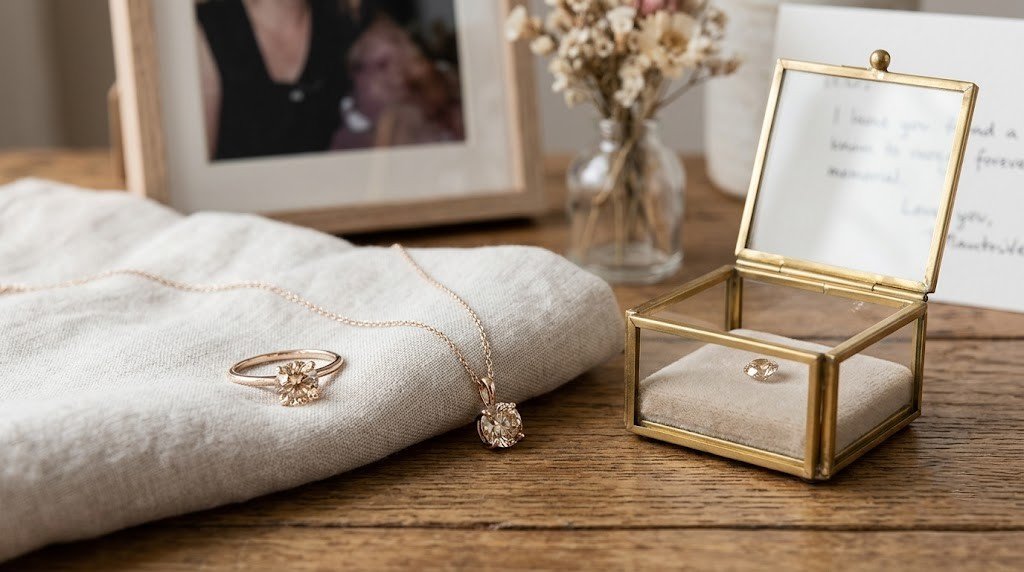
Daughter memorial diamond ideas shown as a ring, a pendant and a small display box arranged on a wooden table

Where Do Good Daughter Memorial Diamond Ideas Begin?

Good daughter memorial diamond ideas begin with her, and then with whoever will keep the stone. Jewelry catalogs start with styles; this decision works better the other way round.

Begin by thinking about the person she was rather than about what memorial jewelry is supposed to look like. A few questions can loosen things up:

  • What did she do with her hands, build, cook, write, play, repair, paint, climb?
  • Did she wear anything every single day, such as a watch, a ring or a chain?
  • Was there a place, a phrase, a date or a piece of music the family links with her?
  • Was her style bold, plain, practical, playful, or simply hers in a way nobody else could copy?

Then think about the keeper. Some people wear jewelry daily and would forget a pendant was there within a week. Others have never worn a ring and never will. Someone who works with their hands needs different daughter memorial diamond ideas from someone who sits at a desk, and a person who travels constantly may prefer a piece that lives safely at home.

Put the two sets of answers side by side and the daughter memorial diamond ideas on your list usually narrow quickly. A stone that suits her but sits unworn in a drawer can still be precious; a stone that suits the keeper but says nothing about her can feel oddly hollow. The daughter memorial diamond ideas that last tend to honor both.

What Are 12 Daughter Memorial Diamond Ideas Worth Considering?

Here are daughter memorial diamond ideas across a broad range, from the familiar to the less expected. None is linked to her being a daughter in any particular way; each is simply a form a stone can take, matched to the kind of person who might keep it.

#IdeaWorn or keptOften suits someone whoWorth knowing
1Solitaire ringWornWants to see the stone every dayRings take the most knocks; a protective mount helps
2Flush set bandWornWorks with their handsThe stone sits level with the metal, so little can catch
3Pendant on a chainWornPrefers to keep it close but out of viewCan sit under clothing; a sturdy chain matters more than a fine one
4Engraved locket or medallionWornWants words or an image beside the stoneEngraving and photo inserts are priced on their own
5Single stud or a pair of studsWornAlready wears earringsTwo stones from one source can still differ in tone
6Cufflinks, tie bar or lapel pinWorn on occasionsDresses up for work, ceremonies or eventsWorn less often, so it wears less
7Signet ringWornLikes a bolder, flat topped ringRoom on the face or shoulders for engraving
8A piece she wore, resetWornWants her own ring, chain or watch to carry itA jeweler must confirm the piece can take a stone
9Bracelet or bangleWornWants it visible at the wristWrists meet desks and doorframes; choose a protective mount
10Loose stone in a display boxKeptDoes not wear jewelryKeep the origin certificate in the same box
11Stone set into a keepsake objectKeptWants it on a desk, shelf or bedside tableFeasibility depends on the object and the craftsperson
12A family set from one sourceBothSeveral relatives each want a pieceEach stone is priced separately and tones may vary

These daughter memorial diamond ideas are starting points rather than a menu. A jeweler can combine them: a pendant that converts to a brooch, a ring with a hidden inscription, a display box with room for a photograph. The best result often comes from describing her to the jeweler and letting the design follow.

How Can Daughter Memorial Diamond Ideas Reflect the Person She Was?

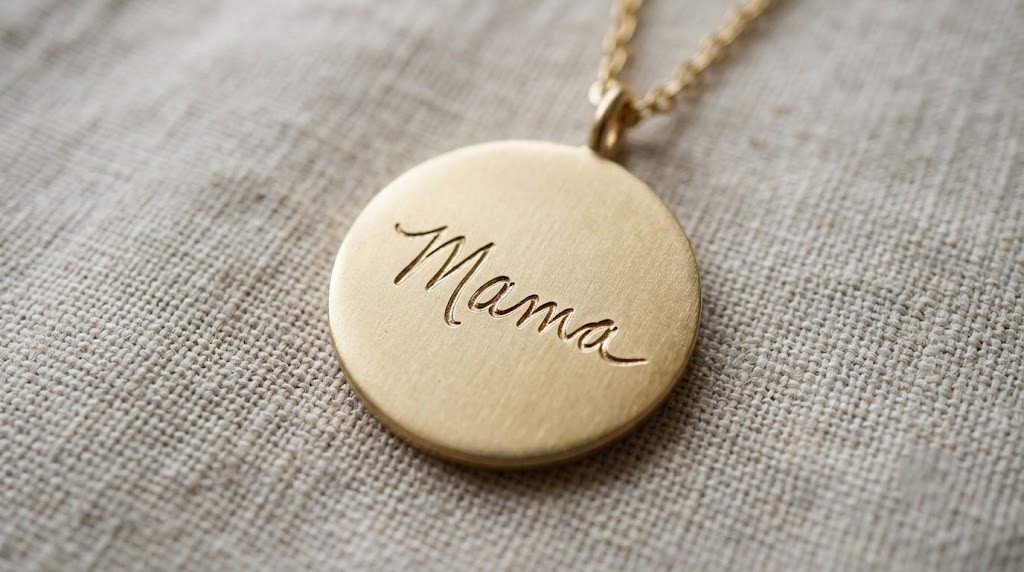
 The back of a gold pendant engraved with a single handwritten word

The details that make a piece feel like hers rarely come from the stone itself. They come from the setting, the engraving and the choices made around it. Some examples of daughter memorial diamond ideas drawn from a life, rather than from a catalog:

If she was always outdoors

A low profile pendant worn under a jacket, or a flush set band with nothing to snag, suits a keeper who hikes, gardens or climbs in her memory. Engraved coordinates of a trail, a summit or a favorite stretch of coast can sit on the back of the pendant.

If music was part of her

A few bars of a melody she loved can be engraved around the inside of a band, or the title of a song on the back of a pendant. Cufflinks or a lapel pin can be kept for nights at concerts.

If she made or fixed things

A sturdy signet ring in a hard wearing metal, or a stone set into a small object connected to her work, can feel more like her than anything polished. For a keeper who also works with their hands, a flush setting keeps the stone protected.

If she wrote, drew or doodled

Many engravers can reproduce handwriting from a card, a note or a sketch. A single word in her hand, a signature, or a small drawing she made can go on a pendant back, inside a band, or on the lid of a display box.

If she wore one thing every day

Resetting the stone into her own watch, ring or chain keeps her presence in an object people already connect with her. A jeweler needs to inspect the piece first, since not every item can safely take a new stone.

If she loved a particular place or date

A date, a city, or a short phrase she used can be inscribed on the stone’s edge or on the setting. Some daughter memorial diamond ideas need no visual reference at all; a few words are enough.

None of these daughter memorial diamond ideas depends on her age, her gender or what anyone expects a memorial piece to look like. They depend on her.

Which Daughter Memorial Diamond Ideas Suit Each Keeper?

The person who holds the stone shapes the piece as much as she does. Here are daughter memorial diamond ideas for each of the people who might be that keeper.

For a parent

A parent may want daughter memorial diamond ideas they can carry without having to explain them. A pendant worn under clothing, a band on the right hand, or a stone kept in a box beside the bed would each fit that wish. If both parents want a stone and live apart, two smaller stones from the same source can let each keep one; how sharing a daughter memorial diamond between relatives works covers the practical side.

For a sibling

A sibling may want something that matches how they live now rather than a traditional memorial style, cufflinks for someone who wears a suit to work, a flush band for someone who lifts or builds, a pin for a jacket. Several siblings can each choose a different piece from the same source material.

For her spouse or partner

A partner may want to wear the stone alongside, or instead of, a ring they already have. Some partners add the stone to an existing band; others keep it separate. If she had a spouse or partner, that person may also hold authority over her remains ahead of her parents, depending on state law and anything she put in writing, so their wishes about the stone deserve early weight.

For her children

If she had children, they may want a stone now, or one held for them until they are ready to choose. A loose stone kept with its paperwork leaves every option open, and a piece can be designed later by the person who will actually wear it. Adult children may also hold authority over her remains, again depending on state law and her written wishes.

For grandparents and others

Grandparents, close friends or a godparent sometimes ask too. A small stone in a pendant or a display box suits someone who wants a quiet keepsake rather than everyday jewelry.

Whoever the keeper is, daughter memorial diamond ideas work best when that person helps choose. A piece chosen for someone, without them, can miss in ways that are hard to fix afterward.

Which Daughter Memorial Diamond Ideas Work Without Wearing Jewelry?

Plenty of people who want a stone do not wear jewelry, and some of the most personal daughter memorial diamond ideas never leave the house.

  1. A display box. A loose stone sits in a small case, ideally beside its origin certificate and perhaps a photograph of her.
  2. A shadow box. The stone is mounted in a shallow frame alongside something of hers, a ticket, a note, a patch, a pressed flower from a place she loved.
  3. A keepsake object. A craftsperson sets the stone into the lid of a wooden box, the face of a small sculpture, or the case of a pocket watch. Ask whether the setting can be removed later if someone wants to wear it.
  4. A desk or bedside piece. A small block of glass or stone with a recessed setting keeps it visible without needing to be worn.
  5. A shared stone that travels. Some families pass a single stone between relatives for a month or a season at a time, with an agreed keeper in between.

The main practical point for non wearable daughter memorial diamond ideas is security. A loose diamond is very small, and a stone of 0.10 to 0.25 carats can be lost easily if a box is knocked over. A setting, even a simple one inside a case, makes it far harder to misplace.

How Do Engraving and Small Details Make It Hers?

Small additions often carry more of her than the stone’s size or shape ever could. Here are details worth weighing when shaping daughter memorial diamond ideas, with a note on where each one goes:

  • A laser inscription on the stone’s edge. The girdle of a diamond can carry a tiny reference number, initials or a short word, readable under magnification.
  • Engraving inside a band. Her name, a date, coordinates, or a phrase she always used.
  • Her handwriting. Engravers can trace a signature or a word from a card or note and transfer it to metal.
  • A fingerprint impression. If the funeral home took a fingerprint impression, some jewelers can engrave it onto a pendant back or a band.
  • A meaningful metal choice. Yellow gold, white gold, platinum, silver or a darker metal can each reflect her taste rather than a convention.

One detail is worth saving until later: the stone’s color. It cannot be chosen, matched or predicted from her ashes or hair, and memorial stones tend toward yellow, blue and champagne tones. Picking the metal after the finished stone arrives lets you choose what genuinely complements it. Why memorial diamond colors for a daughter vary so widely is covered in its own guide.

What Practical Limits Should Shape Daughter Memorial Diamond Ideas?

A beautiful idea needs to survive daily life. A few practical facts help sort the daughter memorial diamond ideas that will last from the ones that need more protection.

Hardness is not the same as toughness. Diamond rates 10 on the scale gemologists use to measure scratch resistance, the highest of any natural mineral, so it resists scratching superbly. A sharp knock at the wrong angle can still chip an edge, which is why rings and bracelets benefit from a protective mount.

Small stones suit low settings. Memorial stones are offered from about 0.10 carat upward, and an entry size stone of 0.10 to 0.25 carats is very small in the hand. A bezel or flush setting protects a small stone well and keeps it secure.

Clarity is usually good but not flawless. Memorial stones typically fall between SI2 and VVS on the standard clarity scale. If you want an outside assessment of the finished stone, an independent report grades it against the same quality factors used for any diamond.

Settings are usually priced separately. Across the industry, the setting, engraving and any fancy cut are typically added to the price of the loose stone. How much a daughter memorial diamond costs, and what is billed on top sets out general ranges.

Settings have their own schedule. The stone itself typically takes six to ten months, and design work often happens alongside that. How long the whole process takes explains where the months go.

For the mechanics of each setting style, the choice of metal, resizing and everyday wear, the guide to daughter memorial diamond settings goes into more detail than this page does.

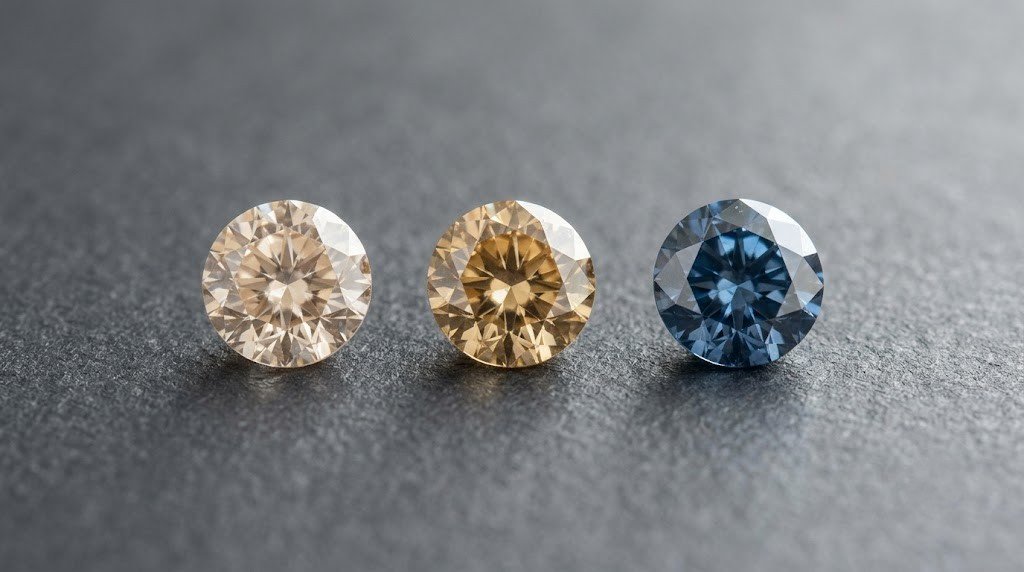
Three small memorial diamonds in slightly different champagne and blue tones resting side by side

Can One Source Become Several Pieces?

Often, yes. A laboratory uses only a portion of the ashes or hair to grow a stone, so the same source material can frequently supply more than one. That makes room for daughter memorial diamond ideas that span a whole family: a pendant for one parent, cufflinks for a sibling, a loose stone held for her child.

For ashes, providers typically ask for anywhere from a few tablespoons to around 4 oz. Hair needs much less, often a small lock or a few grams, because it is roughly 50% carbon. How much hair a laboratory usually asks for explains the quantities in more depth.

Three practical points apply to any family set:

  • Tones may not match. Each stone grows separately, and stones from the same source can come out in different shades.
  • Each stone is priced on its own. A family set costs the sum of its separate stones, so ask for the set and a single larger stone to be quoted side by side.
  • Agreement comes first. Who receives which piece, who pays, and who signs the authorization are easier to settle before anything is sent.

If the family has not yet agreed, how to talk to family about a daughter memorial diamond has some starting points for that conversation.

Frequently Asked Questions

There is no published industry ranking, so popularity is hard to state honestly. Rings and pendants are the classic wearable forms, and a loose stone in a display box suits people who never wear jewelry; the right choice depends on her and on its keeper.

Can her diamond be set into a ring she already owned?

Often, if a jeweler confirms the ring can safely hold a new stone of that size. Older or worn pieces may need repair first. Bring the ring to a jeweler before the memorial stone is finished so the setting can be planned.

Should we choose the setting before the diamond is made?

You can sketch ideas early, but choosing the metal after the stone arrives is wise, because its color cannot be predicted from her ashes or hair. One sensible pattern is to settle the style during the wait and the metal at the end.

Can several family members each have a different piece?

Usually, yes. A laboratory draws on just part of the ashes or hair for each stone, so one source can often supply several, and each can go into a different piece. Agree first on who holds authority and who receives which stone.

Are daughter memorial diamond ideas different for a son or another relative?

Not really. The ideas here come from the person she was and from the keeper’s life, not from her gender. A flush band, a pendant or a display box suits anyone whose habits and taste point that way.

What if the person keeping it never wears jewelry?

A loose stone in a display box, a shadow box with her photo or handwriting, or a stone set into a keepsake object all work well. Ask the jeweler whether any setting could be adapted for wear later, in case that changes.

Final Thoughts on Daughter Memorial Diamond Ideas

There is no single right answer among daughter memorial diamond ideas. A ring worn every day, a pendant tucked out of sight, a box on a shelf that nobody else knows the meaning of, each can hold her equally well.

The daughter memorial diamond ideas that last tend to share one quality: they were chosen by thinking about her and about the person who will hold the stone, rather than about what memorial jewelry is supposed to be. Take your time over that. The stone takes months to grow, and the right idea can grow alongside it.

Learn More About Daughter Memorial Diamonds

Talk With Memorial Diamond

When you are ready to test daughter memorial diamond ideas against what is practical, Memorial Diamond is happy to help. Reach the team at memorialdiamond.us to ask about stone sizes, settings and keepsake options. Asking commits you to nothing, and every decision stays with your family.

Loose champagne-toned memorial diamond beside a notebook of handwritten questions on a kitchen table

Mother Memorial Diamond FAQ: Everything Families Ask

Choosing a mother memorial diamond can bring many questions. Families often want to know whether the diamond is genuine, what it may look like, how much material they need to provide, how much the process costs, how long production takes, and whether several family members can receive their own diamond.

Families also ask questions that deserve more attention. What happens if a growth run fails? Can you change your mind after sending ashes or hair? Does unused material come back? Who owns the diamond when several people contribute? What happens to the order if the person who placed it dies before completion?

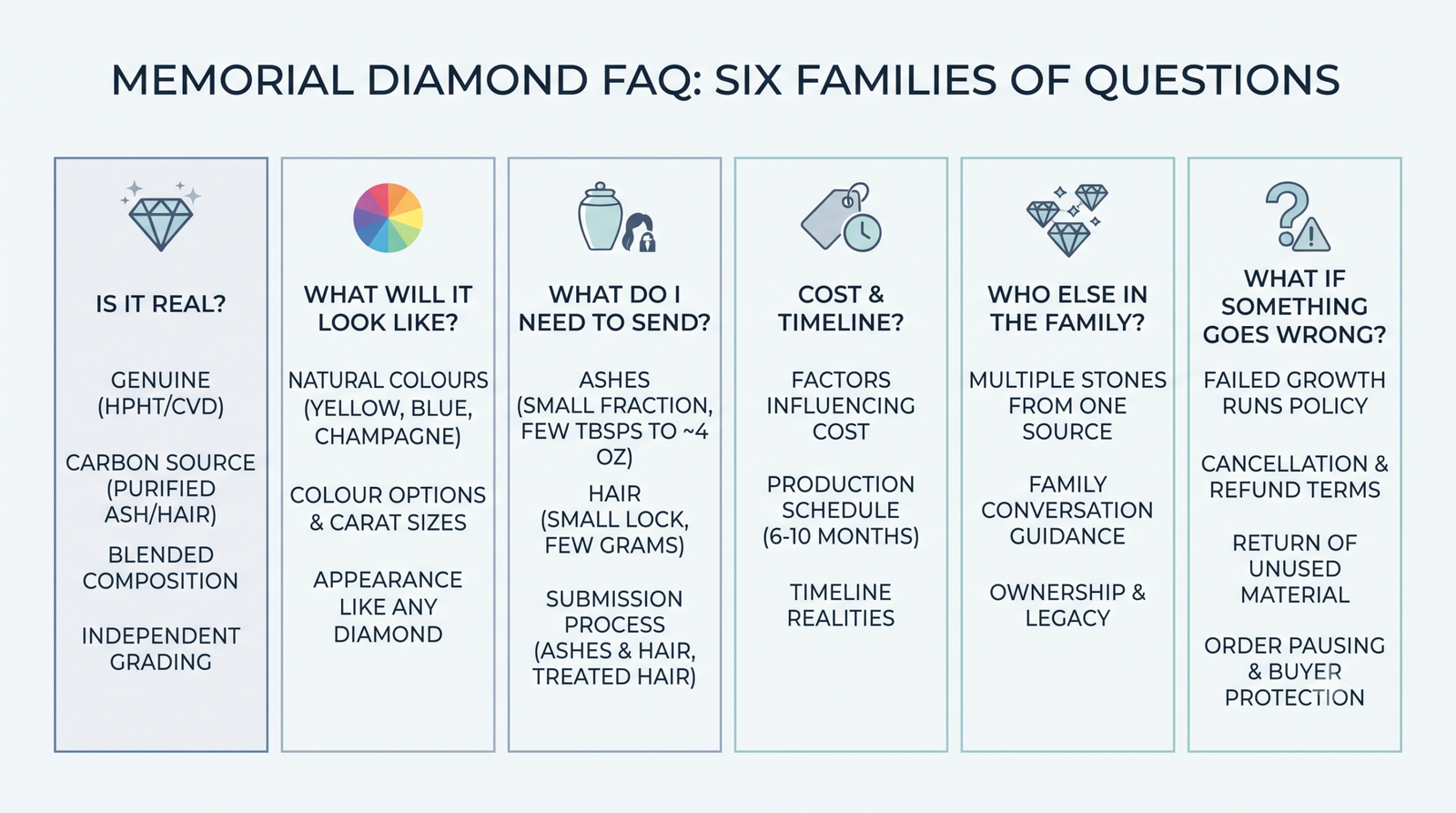
This guide groups the most common questions into six areas so you can find clear answers quickly.

The Six Main Question Groups

Question groupShort answer
Is it real?A mother memorial diamond uses the lab grown diamond process and can contain purified carbon from her ashes or hair.
What will it look like?Many memorial diamonds develop yellow, blue, or champagne tones rather than appearing completely colorless.
What do I need to send?Providers commonly request a small portion of ashes or a small lock of hair.
What does it cost and how long does it take?Industry pricing varies greatly by carat and color, while production commonly takes several months.
Can several family members have one?One source can often provide material for more than one diamond.
What happens if something goes wrong?Providers set their own policies for failed growth runs, cancellation, unused material, and other situations.
Diagram grouping common memorial diamond questions into six families, from "is it real" through "what if something goes wrong"

Is a Mother Memorial Diamond Really a Diamond?

Is it a real diamond or a look alike stone?

It is a real diamond. Memorial diamond providers use the same fundamental laboratory diamond methods that produce other lab grown diamonds. The industry uses HPHT, which stands for high pressure high temperature, and some providers use CVD, which stands for chemical vapor deposition.

The finished stone has the chemical and optical characteristics of diamond. Diamond reaches 10 on the Mohs hardness scale, and laboratories can evaluate it through the same four Cs used for other diamonds.

Is it really made from my mother’s ashes or hair?

Providers extract carbon from the submitted material, purify it, convert it into a suitable carbon form, and use it during diamond growth. The personal carbon becomes part of the crystal growth process.

The process does not mean that the finished diamond contains only carbon from your mother. Providers typically combine personal carbon with supplemental laboratory carbon because the growth process requires a workable quantity of material.

How much of the finished diamond comes from her?

The personal carbon represents a real portion of the finished stone. Industry information places the typical personal carbon contribution around 10 percent to 15 percent of the finished stone mass, although the figure can vary by provider, stone size, and the amount of submitted material.

This distinction matters when you evaluate memorial diamond claims. A provider should explain the role of personal carbon clearly rather than suggest that the entire stone consists only of carbon from your mother.

Is it legal to turn ashes into a diamond?

Families can generally choose different ways to handle cremated remains, but the exact requirements can depend on location and circumstances. Funeral homes, memorial diamond providers, shipping services, and border authorities may require specific documents when remains travel between countries.

Ask your provider about the paperwork and chain of custody before you send any material. For detailed legal considerations, read the legal question in more detail.

Will the diamond have a grading report?

Ask the provider which independent gemological laboratory will evaluate the finished diamond. Industry references commonly discuss laboratories such as GIA and IGI. A provider may also issue an internal certificate that connects the finished diamond with the submitted material.

An independent grading report and an internal certificate serve different purposes. Ask whether your order includes both and request the name of the grading laboratory before you commit.

What Will Her Diamond Actually Look Like?

What color will a mother memorial diamond have?

Many memorial diamonds do not appear completely colorless. Trace elements associated with organic carbon can influence the final color. Nitrogen can contribute to yellow tones, while boron can contribute to blue tones.

Some memorial diamonds develop champagne tones. The source material influences the result, so a provider cannot promise an exact naturally occurring shade before growth.

For a deeper explanation, read what color a diamond made from her ashes will be.

Three memorial diamonds in yellow, blue and champagne tones photographed side by side in daylight

Can I choose the color?

You may have some color choices, depending on the provider and the available process. Colorless diamonds can cost more at the same carat size. Some providers also offer treatments that can create colors such as red, pink, green, or black after growth.

You cannot reliably request an exact natural shade because the source material influences the result. Read which colors are actually offered and what each costs before choosing.

What carat sizes can a memorial diamond reach?

Memorial diamond providers offer a wide range of sizes. Industry references place the range around 0.10 carats through 5 carats and beyond.

The amount of ashes does not directly determine the final carat size. Growth time plays a major role in determining the size of the finished crystal, which also makes carat one of the main factors that influences price and production time.

Read how to choose a carat size if you need help deciding what size suits your needs.

Can people tell that it is a memorial diamond?

A finished memorial diamond looks like a diamond with the same color and cut. Nothing on the stone itself announces its origin.

Families can make the meaning more visible through the jewelry setting, an engraving, or the story they choose to share. Explore settings and jewelry ideas and engraving options for ways to personalize the piece.

What Do I Need to Send?

How much of my mother’s ashes do I need?

Industry typical requirements range from a few tablespoons to around 4 ounces of ashes, depending on the provider and the order. This amount represents only a small portion of a full cremation.

You do not need to surrender an entire urn for a memorial diamond. Families can often keep the remaining ashes for an urn, interment, scattering, or another memorial plan.

Read how much ash you actually need before preparing your material.

How much of her hair do I need?

Hair requires much less material than ashes. Hair contains a higher proportion of carbon by weight, while cremated remains contain a much smaller carbon percentage.

Providers commonly request a small lock or a few grams of hair. Weight matters more than length. Keep the hair whole and dry, and follow your provider’s packaging instructions before shipping it.

Learn how much hair you need for the process.

Small sealed container of cremated remains beside a lock of hair wrapped in paper, showing how little material is required

What if my mother was buried or we already scattered her ashes?

Hair may provide another option if you have a lock that you kept while she was alive. A small lock stored in a keepsake box, locket, baby book, or jewelry box may provide enough material for the process.

If you have no ashes and no preserved hair, you may not have a material route available for a memorial diamond. Read the hair route from start to finish to understand how this option works.

Can I send ashes and hair together?

Some providers may accept both ashes and hair, but you should confirm this before sending anything. The two materials require separate extraction steps before the provider combines the resulting carbon during the growth process.

Combining materials can also make the final color less predictable. Read the combined route explained before choosing this approach.

Can dyed, permed, or gray hair still work?

The extraction process reduces hair to carbon, so the original hair color does not remain in the finished diamond. Dye, bleach, perm treatments, and natural pigment do not determine the visible hair color of the finished stone.

Provider acceptance policies can differ, especially when hair has undergone heavy chemical treatment. Ask your provider before you send treated hair.

What Does It Cost and How Long Does It Take?

How much does a mother memorial diamond cost?

Industry pricing in 2026 varies significantly according to carat size and color. Smaller stones around 0.10 to 0.25 carats can fall around $1,500 to $3,500. Half carat to one carat stones can range around $5,000 to $15,000. Stones around 2 to 5 carats can reach $20,000 to $75,000 or more.

Color can also affect the price. Colorless diamonds can cost more at the same size. Jewelry settings, engraving, and grading may add separate costs.

These figures represent category ranges rather than BlueiceGems pricing. Read what a mother memorial diamond costs and explore the 2026 pricing picture across the category.

How long does the whole process take?

Production commonly takes around 6 to 10 months after a laboratory receives and logs the material. Large stones or specialty colors can require up to 12 months.

The complete journey can take longer because families need time to make decisions, prepare material, arrange shipping, complete production, receive the diamond, and choose the final jewelry setting. An overall period of around 8 to 14 months can provide a realistic planning window.

Read the timeline broken down for a closer look at the process.

Does sending more ashes make the diamond bigger?

No. The amount of submitted ashes does not directly determine the carat size. The growth process determines the size of the finished crystal.

Sending an entire urn does not automatically produce a larger diamond or shorten the production period. Providers typically need only a portion of the available material.

For the complete process, read the step by step version of this decision.

Can Several Family Members Have a Diamond?

Can several family members each have their own diamond?

Often, yes. One source can often provide enough material for more than one diamond because each stone uses only a portion of the available material.

Each diamond still requires its own growth process and pricing. If you decide to add another diamond later, the provider may need to begin another growth run, which can create another production period.

Read whether more than one family member can have one before placing an order.

Who should I tell before using my mother’s ashes?

Start with the people who hold the remains, the people your mother named in her wishes, and anyone who may have a legitimate role in decisions about the remaining ashes.

Explain how much material the process requires. A small portion may feel easier for family members to understand than the idea of using an entire urn.

If you expect disagreement, read how to have that conversation.

Who owns the diamond when several people pay for it?

Do not assume that everyone who contributes money automatically receives ownership rights. Ownership can depend on the jurisdiction and the way the order was placed.

When several family members contribute, write down the arrangement before ordering. Decide who owns the finished diamond, who holds it, and what should happen to it later.

Read how families can pass a memorial diamond down.

What Happens If Something Goes Wrong?

This section deserves special attention because providers do not share one universal policy for every situation. Ask your provider for written answers before you send ashes or hair.

Question to askWhat you need to know
What happens if the growth run fails?Ask whether the provider will run the material again, request additional material, offer another specification, or provide a refund.
Can I cancel after sending material?Ask when cancellation becomes impossible and what material the provider can return before that point.
Do I receive unused material?Ask separately about unused ashes or hair and unused purified carbon.
Can the order pause?Ask whether the provider can pause production if your family needs time to resolve a disagreement.
Who receives the diamond if I die before completion?Ask whether the provider can record another named contact and what documentation an estate would need.

What happens if the growth run fails?

A growth run can fail or produce a diamond that does not meet the agreed specification. Providers can handle these situations differently.

Ask whether the provider will use remaining material for another growth run, request additional material, refund your payment, or offer another solution. Get the answer in writing before you send your material.

Read the return and guarantee policies to look for.

Printed list of provider questions with a pen resting on it, ready to send

Can I change my mind after sending my mother’s ashes or hair?

Ask this question before you ship anything. The extraction process changes the original material, and a provider may reach a point where the material cannot return in its original form.

Ask exactly when cancellation stops being possible and what the provider can return before that stage.

Do I get unused material back?

Ask two separate questions. First, ask what happens to ashes or hair that the provider does not need. Second, ask what happens to purified carbon that the provider extracts but does not use.

These materials can follow different handling procedures. Request a written commitment and ask the provider to connect the material to its chain of custody documentation.

Learn how chain of custody works.

What if another family member objects after the order starts?

Ask whether the provider can pause an order rather than cancel it. Also ask whether the provider can return material during a dispute.

Discuss these possibilities before you place the order. A family conversation can become much harder after the provider begins processing the material.

Can I change the jewelry setting later?

Yes. A jeweler can often move a memorial diamond into another safe setting later. You may choose a pendant today and a ring years from now.

Recutting requires more care because the jeweler removes material from the diamond. Recutting can reduce the carat weight, so consider that decision carefully when the diamond carries irreplaceable personal meaning.

What happens if the person who placed the order dies before the diamond finishes?

Production can take many months, so discuss this possibility before placing the order. Ask the provider who can receive the finished diamond, what documents an estate must provide, and whether you can name another contact when you begin the order.

Frequently Asked Questions

How do I explain a memorial diamond to a young child?

Use simple and physical language. You can explain that a small part of Granny’s ashes helped create a diamond through a process that uses heat and pressure. A child can connect the explanation with the physical diamond more easily than with an abstract idea.

Can I arrange a memorial diamond before someone dies?

Yes. Hair can provide an option without cremation. A family can preserve a lock of hair while a loved one lives and keep it for future use.

Planning ahead can also prevent the ashes route from disappearing after scattering or interment.

Are lab grown memorial diamonds better for the environment than mined diamonds?

Memorial diamonds avoid the mining process, but diamond growth requires energy. The environmental impact therefore depends partly on the energy source that powers the growth equipment.

Ask your provider about its energy sources instead of relying only on general claims about lab grown diamonds.

What happens to the memorial diamond after I die?

You can decide what happens to it. A memorial diamond functions as personal property, so you can include clear instructions in your estate planning.

Because the diamond may carry unique personal meaning, name it specifically rather than placing it inside a general reference to jewelry.

I have not decided anything yet. Where should I start?

Start with the material rather than the diamond catalogue. Determine what you have available and whether any upcoming decision could close one of your options.

You can decide the color, cut, setting, and provider after you understand your material options. Read where to start when choosing a memorial diamond for your mother.

Ask the One Question That Is Holding You Back

You do not need to answer every question today. Most families have one or two concerns that matter more than everything else.

Maybe you want to know what color your mother’s diamond may have. Maybe you need to understand how much ash or hair you should provide. Perhaps your biggest concern involves cost, production time, family approval, unused material, or what happens if the growth run fails.

Write down that question in your own words and ask your provider for a direct answer. Ask for provider policies in writing when the answer depends on the company’s process rather than on diamond science.

A thoughtful memorial decision starts with clear information. When you understand the material requirements, expected appearance, cost factors, production timeline, family considerations, and provider policies, you can move forward at your own pace.

For a broader introduction, explore the complete guide to memorial diamonds.