
Sometimes the most personal thing a sibling still has is a few strands of her: a braid tucked in a drawer, a lock the funeral home set aside, or a curl someone saved from a haircut years ago. To turn sister hair into a diamond, you find a usable lock, check with whoever is handling her estate, choose a provider, mail the hair with tracking, decide size and color, then wait roughly six to ten months for a real lab made stone.
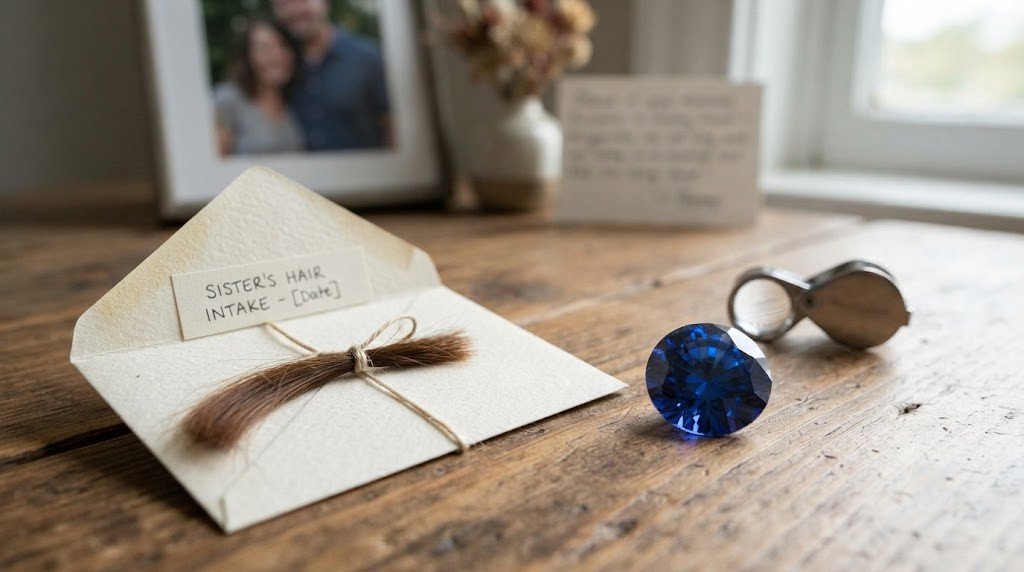
Table of Contents
Why Do Siblings Turn Sister Hair Into a Diamond Instead of Using Ashes?
Often because hair is the material within reach. Her ashes may be with a spouse, a partner, her adult children or a parent. They may already be scattered or interred. She may have been buried, so there were never ashes at all. Hair sidesteps every one of those situations because nothing about it depends on cremation. Where some ashes are within reach as well, the combined ashes and hair guide covers both materials together.
There is also a chemical reason. Keratin, the protein hair is made of, carries roughly half its weight as carbon, while cremated ash holds only around 0.5% to 4%. That is why a laboratory can turn sister hair into a diamond from a small lock rather than tablespoons of remains.
For some families the choice is about faith or personal conviction rather than logistics. Where cremation itself is a concern, choosing to turn sister hair into a stone avoids that question entirely, though anyone weighing it on religious grounds is best guided by their own tradition and clergy.
And sometimes the reason is simply that the hair was hers in a way nothing else is. A braid she cut off and kept, or a lock tucked in a card she once sent you, can carry its own history. That history is reason enough for some siblings to turn sister hair into a stone.
What Are the Eight Steps to Turn Sister Hair Into a Diamond?
In order, the route to turn sister hair into a finished stone looks like this:
- Find hair that will work. A saved lock, a braid, or a funeral home keepsake.
- Tell the right people. Whoever is handling her estate and, ideally, close family.
- Measure the lock and keep some back. Providers need only a few grams.
- Choose a provider in writing. Ask hair specific questions and get answers on paper.
- Package and mail it. Follow the provider’s kit, with tracking and insurance.
- Decide size, color, cut and setting. These are usually chosen when you order.
- Wait while the laboratory works. Typically six to ten months.
- Receive, check and insure the stone. Then decide how you will wear or keep it.
None of it has a deadline. Hair stored dry and away from sunlight keeps well, so it is entirely possible to turn sister hair into a diamond years from now if that is when you feel ready.
Step 1: Where Can You Find Hair That Will Work?
Before you can turn sister hair into a diamond, you need hair that is unmistakably hers. Look first at what was deliberately saved, then at what was simply left behind. The table below is a general guide. The provider has the final word on what it accepts.
| Source | Often workable? | What to check |
|---|---|---|
| A lock or braid cut and kept on purpose | Usually, if there are a few grams | That it is dry and stored in paper or a sealed bag |
| Hair the funeral home trimmed before services | Usually | Who requested it and who holds it now |
| Hair in her brush or comb | Sometimes | Whether the provider accepts loose strands and whether anyone else used the brush |
| A lock a parent saved from childhood | Often, if enough remains | Whether the family wants it used or kept as it is |
| Strands on clothing or bedding | Rarely enough | Usually too little and possibly mixed with other hair |
If services have not yet taken place and you hope to turn sister hair into a keepsake stone, you can ask whoever is arranging them whether the funeral director could trim a small lock first. That request goes through the person with authority over her remains, not directly to the funeral home.
A brush that anyone else in her household also used is worth thinking about honestly. A provider cannot separate one person’s hair from another’s, so the plan to turn sister hair into a diamond works best with hair you are confident was hers alone.
Step 2: Who Should Know Before You Use Her Hair?
Hair that sits among her belongings may form part of her estate, and how that works varies by state. In practice, that means the executor, administrator or next of kin handling her things is the person to speak with before you turn sister hair into a stone, even when the lock is already in your home.
Who that is depends on her circumstances and anything she put in writing. In many states a spouse or registered partner comes first, followed by adult children and then parents, with siblings further along. Her own instructions can change that order. This post is not legal advice, and a local probate attorney can tell you how it applies to her estate.
Some situations are simpler. If she handed you a lock herself while she was living, it may be considered yours, though rules differ and telling her family is still considerate. If the funeral home trimmed hair at the request of the person holding authority, that person decides what happens to it.
Whatever the paperwork says, a short conversation usually helps. Other siblings, parents, or a partner if she had one may also want to turn sister hair into stones of their own. It is far easier to hear that before you send anything than after. Whether you shared one parent with her or both, grew up together or found each other later, everyone’s wish to remember her is legitimate.
Step 3: How Much Hair Does It Take to Turn Sister Hair Into a Diamond?
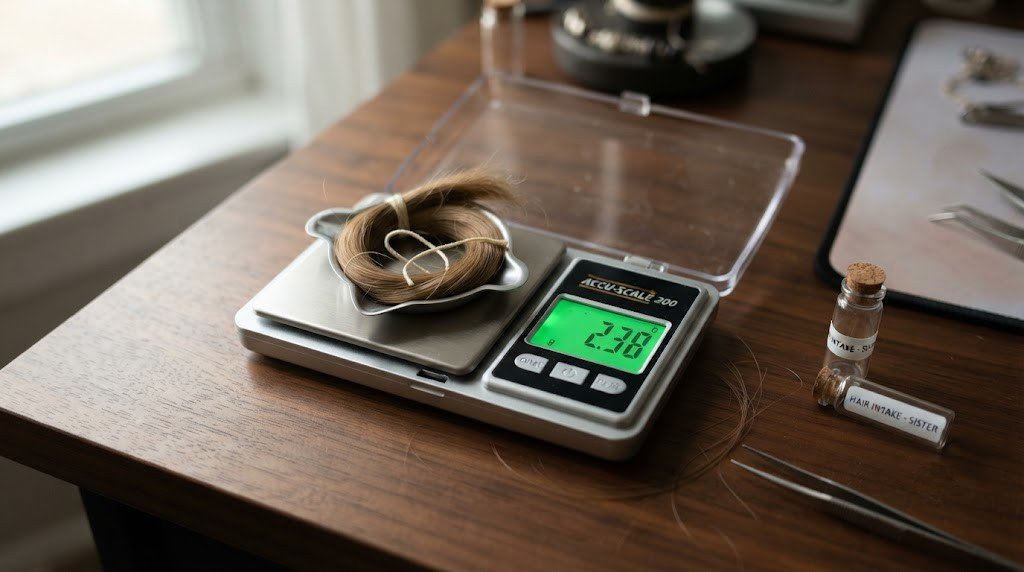
Less than you might imagine. Each provider sets its own minimum, yet a small lock, a few grams, is the usual request, sometimes described as a pinch held between finger and thumb. Because keratin is so carbon rich, the volume needed to turn sister hair into a diamond is a tiny fraction of what an ashes order asks for.
The amount does not set the carat size. A larger stone needs more time in the growth press, not more hair, so sending a whole braid will not produce a bigger diamond than sending a modest lock.
That leaves room for two good habits. First, ask the provider for its minimum in writing and send only that, plus whatever margin it recommends. Second, keep part of the lock back. If you later want to turn sister hair into a second stone for another sibling, or simply want something of her hair to remain as it is, you will still have it.
Before measuring, ask whether the provider wants the hair cleaned or left exactly as it is, and do not treat it with anything until you know.
Step 4: What Should You Ask a Company That Will Turn Sister Hair Into a Diamond?
Pick two or three companies and send each the same short email. Hair raises its own questions, so a generic ashes checklist misses things. Ask:
- What is your minimum amount of hair, and do you accept loose strands from a brush?
- Does dyed, permed or chemically treated hair affect extraction or the result?
- Is her hair processed on its own, or ever alongside another family’s material?
- What share of the finished stone’s mass will be carbon recovered from her hair?
- Which document confirms the stone’s origin, and is independent grading included or extra?
- What does the total come to, with setting, engraving, grading and insured return shipping?
- What happens if a growth run fails, and what are the cancellation terms?
- Will any unused hair be returned to me?
That fourth question matters. No published industry figure exists for how much of a finished stone comes from hair, so the only reliable number is the one a provider commits to in writing. A company ready to turn sister hair into a diamond for you should reply with specifics rather than reassurance. The sister hair diamond guide sets out the wider background if you want it before choosing.
Step 5: How Do You Package and Mail Her Hair?
Use the provider’s kit if it sends one. Laboratories that turn sister hair into diamonds design those kits around their own intake process, so follow them over anything you read elsewhere. A typical approach is to place the lock in a clean paper envelope or small sealed bag, label it with the order reference the provider gives you, and add the signed intake form.
Avoid taping strands down or wrapping them in plastic film unless asked to. Photograph the hair beside its label before sealing, and keep copies of every form you sign.
Hair is not cremated remains, so the special mailing rules for ashes generally do not apply. Ask the provider which carrier and service it prefers anyway, choose one with tracking, and insure the parcel. When it is delivered, ask for written confirmation. When you turn sister hair into a diamond, that small email matters because it marks the moment her hair is accounted for again.
Step 6: How Do You Decide on Size, Color, Cut and Setting?
Most of these choices are made when you place the order.
Size. Choosing size is largely a budget decision when you turn sister hair into a stone because memorial diamonds generally range from about 0.10 carats to 5 carats or more and the price climbs steeply with size. As a general 2026 industry guide, roughly 0.10 to 0.25 carats runs about $1,500 to $3,500. Half a carat to one carat is about $5,000 to $15,000. Two carats and up can start around $20,000 and reach $75,000 or beyond. Grading, engraving, fancy cuts and settings are usually extra. These are not any single company’s prices.
Color. Trace nitrogen yields yellow. Trace boron yields blue. Colorless requires both to be absent and costs more to achieve. Memorial stones tend toward yellow, blue and champagne, and some providers offer irradiation for colors such as red, green or black. Color cannot be chosen, matched or predicted from her hair, and hair does not narrow the range or make a lighter stone more likely. Anyone planning to turn sister hair into a diamond of one exact shade should hear that clearly before ordering.
Cut. Round, oval, cushion, emerald and other shapes are commonly offered.
Setting. A ring, pendant, cufflinks, a tie bar or a loose stone in a small case all work. Let the choice follow how you will live with it, not any notion of what a sister’s memorial is meant to look like.
Step 7: What Happens to Her Hair at the Laboratory?
To turn sister hair into a diamond, the laboratory first heats the hair in a controlled, oxygen free process that removes everything except carbon, refining it to roughly 99.9% purity. That carbon is turned into graphite at around 2,500 to 2,700°C, typically combined with supplemental lab carbon, and placed in a press with a small diamond seed.
Most providers use high pressure, high temperature growth at roughly 6 to 8 GPa. A minority use chemical vapor deposition instead.
Growth takes weeks to months, then the rough crystal is cut, polished and graded. All told, the industry norm is six to ten months from start to finish, nearer twelve for stones above about 2 carats or specialty colors. How the stone is made from her hair walks through each stage in more depth.
Ask before you send how often you will hear from the provider during those months, and who to contact if you have not. A named contact can make the quiet stretch easier for anyone who has chosen to turn sister hair into a finished stone.
Step 8: What Do You Do When the Diamond Comes Home?
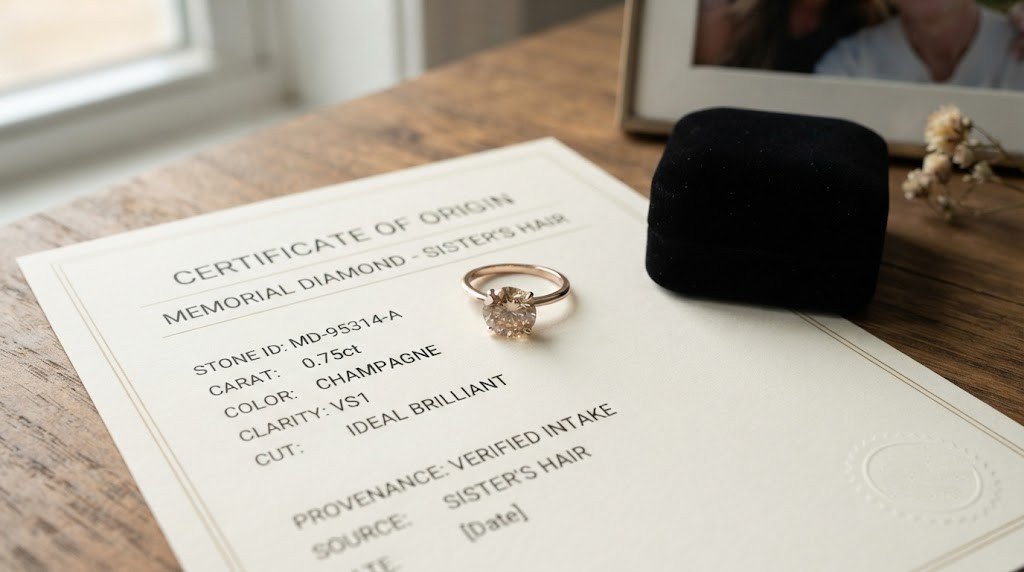
Open the parcel when you have time and quiet, and read before you wear. Confirm the order reference matches your form, that the origin certificate names her and describes this stone, and that any independent grading report you paid for matches what you hold. Grading reports describe a stone by the 4Cs used for every diamond, not by its origin.
Then think about care. Diamond sits at 10 on the Mohs hardness scale, so it resists scratching, but a setting can loosen and a stone can chip from a hard knock. Have prongs checked occasionally and add the piece to your home or jewelry insurance.
If you kept part of her lock back, store it somewhere dry and dark. Some siblings later turn sister hair into a second stone for someone else in the family. Others keep the remaining strands just as they are.
Is the Finished Stone Really Made From Her Hair?
Yes, in part, and the honest version is worth knowing. Her hair supplies real carbon, recovered and purified from her own keratin, which becomes part of the crystal lattice. Supplemental lab carbon is typically blended in, so the diamond is not made solely from her hair.
How much of the final mass comes from her is a figure the industry has not published for hair. The commonly cited 10% to 15% applies to ashes, not hair, so do not assume it carries over. Ask your provider to state its own number in writing before you decide to turn sister hair into a stone.
For some siblings who turn sister hair into a diamond, that honesty is part of what makes the result meaningful: the stone exists because her carbon was there. Whether the stone is truly made from her hair explores that question in full.
If her ashes are also available to you, the ashes route, step by step and a stone grown from her ashes and hair together are worth comparing.
Frequently Asked Questions
Can I turn sister hair into a diamond if she was buried?
Yes. Hair needs no cremation, so burial does not rule it out. You need hair saved before burial, such as a lock trimmed by the funeral home or one kept at home, and agreement from whoever holds authority over her remains or is handling her belongings.
Is hair from her hairbrush enough?
Sometimes. Some providers accept loose strands, others prefer a cut lock, and a brush someone else also used can mix hair from more than one person. Ask the provider what it accepts and how much it needs before you send anything.
Do I need anyone’s agreement to use hair I already have?
Possibly. Her belongings may form part of her estate, and rules vary by state, so talk with the executor or whoever is handling her affairs. Even when the lock was a gift from her, telling close family first can prevent hurt later.
Does dyed or gray hair change the diamond?
Ask the provider whether treatments affect extraction. Hair color itself does not decide the stone’s color. That depends on trace elements such as nitrogen and boron during growth, and it cannot be predicted or chosen from her hair.
How long does it take to turn sister hair into a diamond?
Typically six to ten months across the industry from the day the laboratory receives her hair, and up to about twelve for stones larger than roughly 2 carats or specialty colors. Carat size, set by growth time, drives most of the wait.
Can two siblings each get a diamond from one lock?
Often, if there is enough hair. A few grams per stone is typical, so a generous lock or braid may let you turn sister hair into more than one stone. Ask the provider for its per stone minimum and agree within the family before dividing anything.
Can I turn sister hair into a diamond as a gift for someone else?
Yes, though it is usually kinder to ask first. Some relatives would rather choose size, color and setting themselves, and a surprise can land hard in the early months. A quiet question about whether they would want one tends to work better.
Final Thoughts on Turning Her Hair Into a Diamond
A lock of hair is small enough to hold in one hand, and that is part of why this route can suit a sibling well: it asks little of anyone else and nothing of her ashes.
If you decide to turn sister hair into a diamond, take each step at your own speed, ask your questions on paper, and keep a little of her hair just as it is. The stone that comes back will be a real diamond with her carbon inside it, and the meaning you give it is entirely yours.
Learn More About a Diamond Grown From Her Hair
- How a memorial diamond is made from her hair for the process from keratin to crystal.
- Sister Hair Diamond: The Complete Guide for everything about the hair route in one place.
- Is it really made from her hair? for what the carbon question means for hair.
- How to turn her ashes into a diamond for the route through her ashes.
- Sister Ashes and Hair Diamond: The Complete Guide for when both materials are available.
Talk With Memorial Diamond
If you have a lock of her hair and want to talk through how to turn sister hair into a diamond, Memorial Diamond is reachable at memorialdiamond.us. Ask about amounts, packaging or timing. You are welcome to simply gather information for now.
Leave A Comment