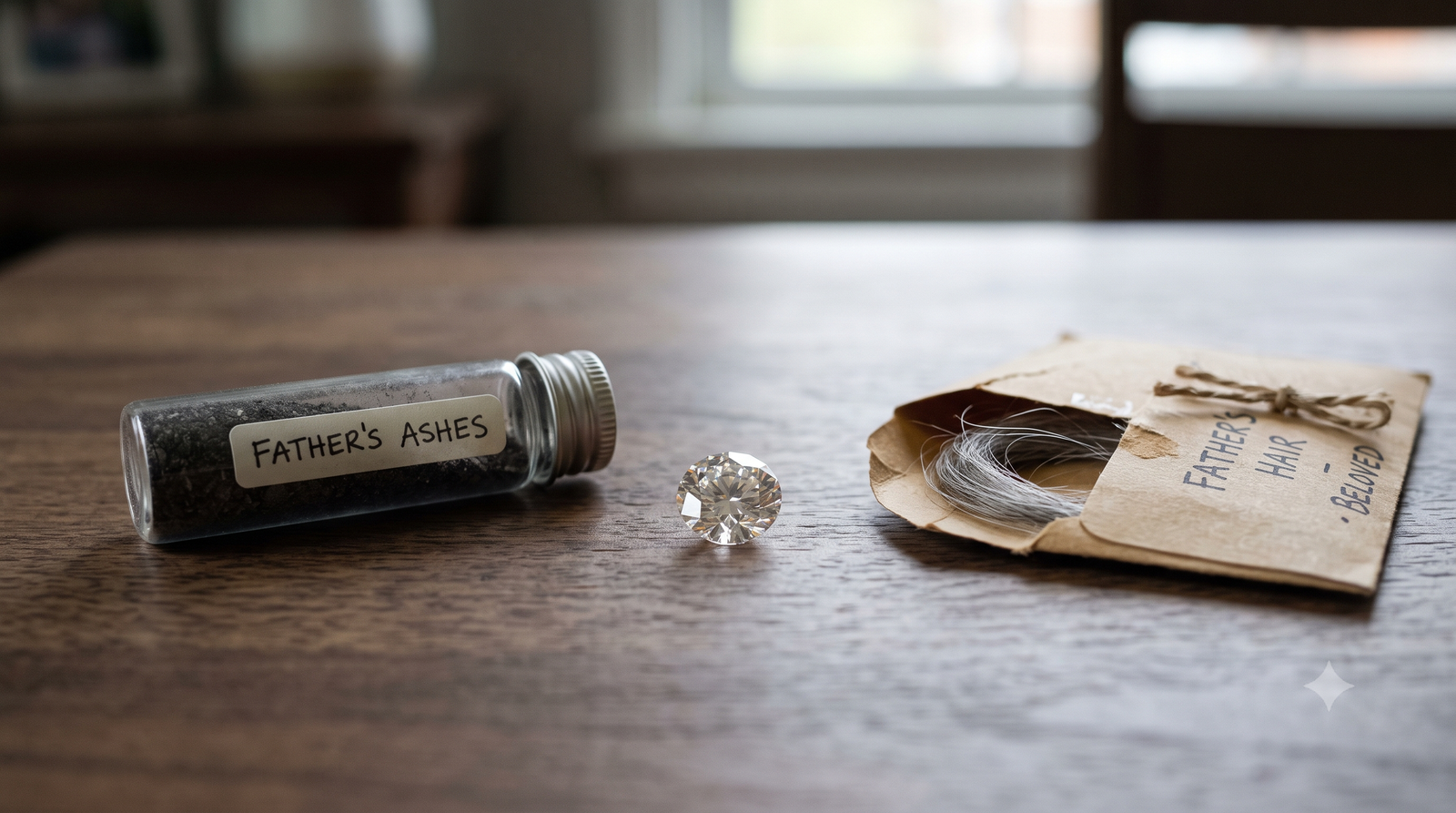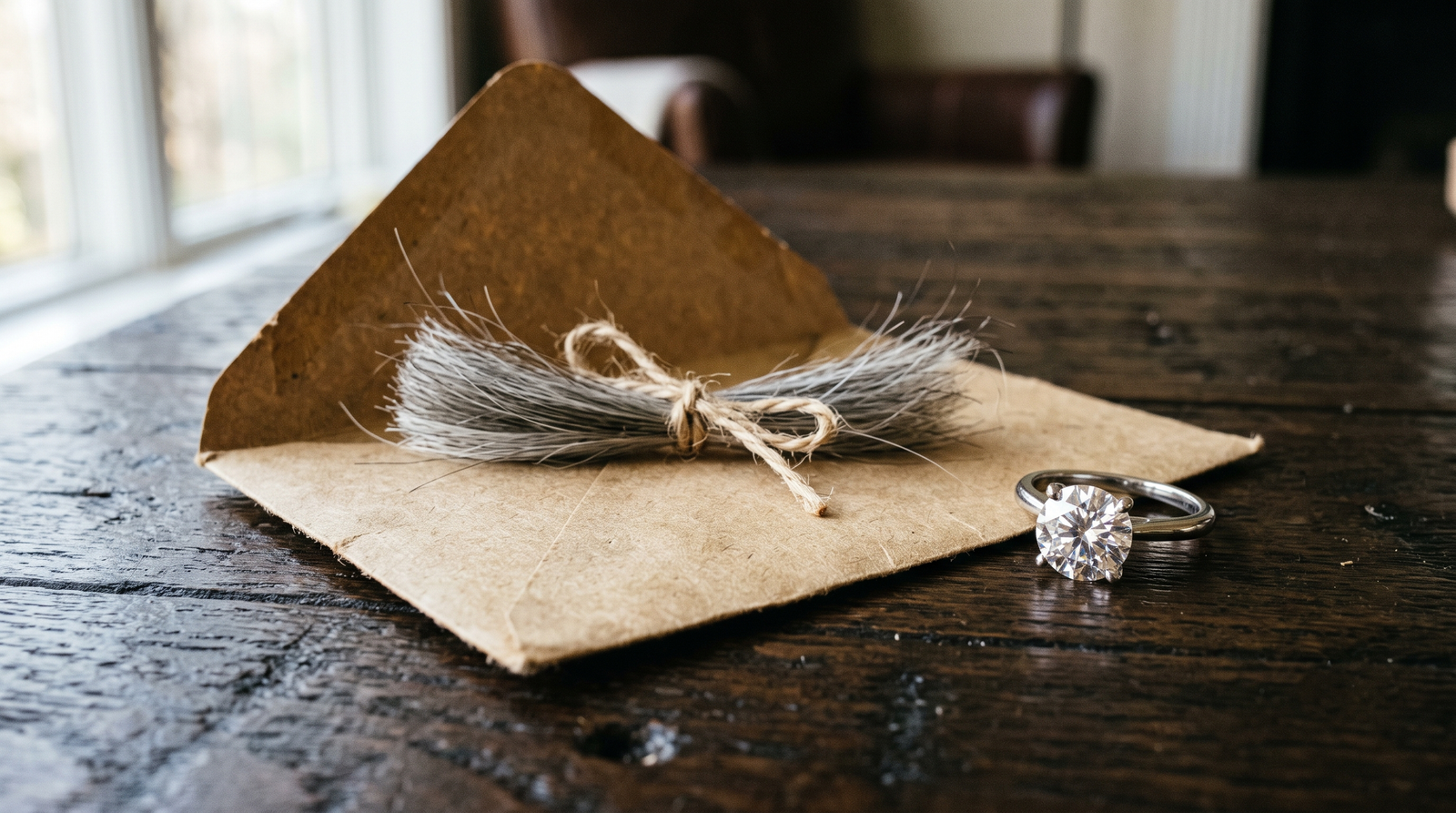
A closed urn on a shelf beside a sealed paper envelope, the two forms ash and hair for a partner memorial diamond arrive in

How Much Ash and Hair Do You Need for a Partner Memorial Diamond?

The two things are almost never in the same room. The urn sits somewhere deliberate, a shelf, a sideboard, a spot chosen carefully. The hair is in an envelope in a drawer, if any was cut at all. Ash and hair for a partner memorial diamond are measured against two separate figures: typically a few tablespoons up to roughly 4 oz of cremated remains, or a small lock of a few grams of hair.

Read the “or” in that sentence carefully, because it is the whole post. Submitting both does not add the two allowances together into something larger. A combined order is not a double order.

Memorial Diamond grows these stones, so treat this page as interested rather than neutral, and every number on it as an industry wide range rather than our published requirement. What follows is mostly about what a second source changes, less than people assume, and about the one genuinely new decision it creates.

What a Second Source Actually Changes

Start with the shorter list, which is the list of things a second source does not do.

Sending both ash and hair for a partner memorial diamond does not make a bigger diamond. It does not shorten the wait. It does not raise the proportion of the finished stone that came from your partner. It does not halve either requirement, and it does not let a short quantity of one material be topped up by the other. People arrive at ash and hair for a partner memorial diamond expecting an additive answer and there isn’t one.

What it does change is real, though, and worth the trouble:

  • Redundancy. If one half of the ash and hair for a partner memorial diamond you hold disappoints on assessment, the order does not necessarily end.
  • Access. Authority over ash and hair for a partner memorial diamond rarely rests with one person. Sometimes the ashes are controlled by someone else and the hair is not, or the reverse.
  • Meaning. Some people simply want both included, and that is a sufficient reason on its own without technical justification.
  • Timing. The ash and hair for a partner memorial diamond can often be committed at different moments rather than together.

That last one is the decision this page exists for. Everything else about ash and hair for a partner memorial diamond is already settled by the two single material figures. Sequencing is the part nobody tells you about in advance.

How Much Ash and Hair for a Partner Memorial Diamond Does a Combined Order Take?

The ash and hair for a partner memorial diamond are assessed against separate bands, independently of one another.

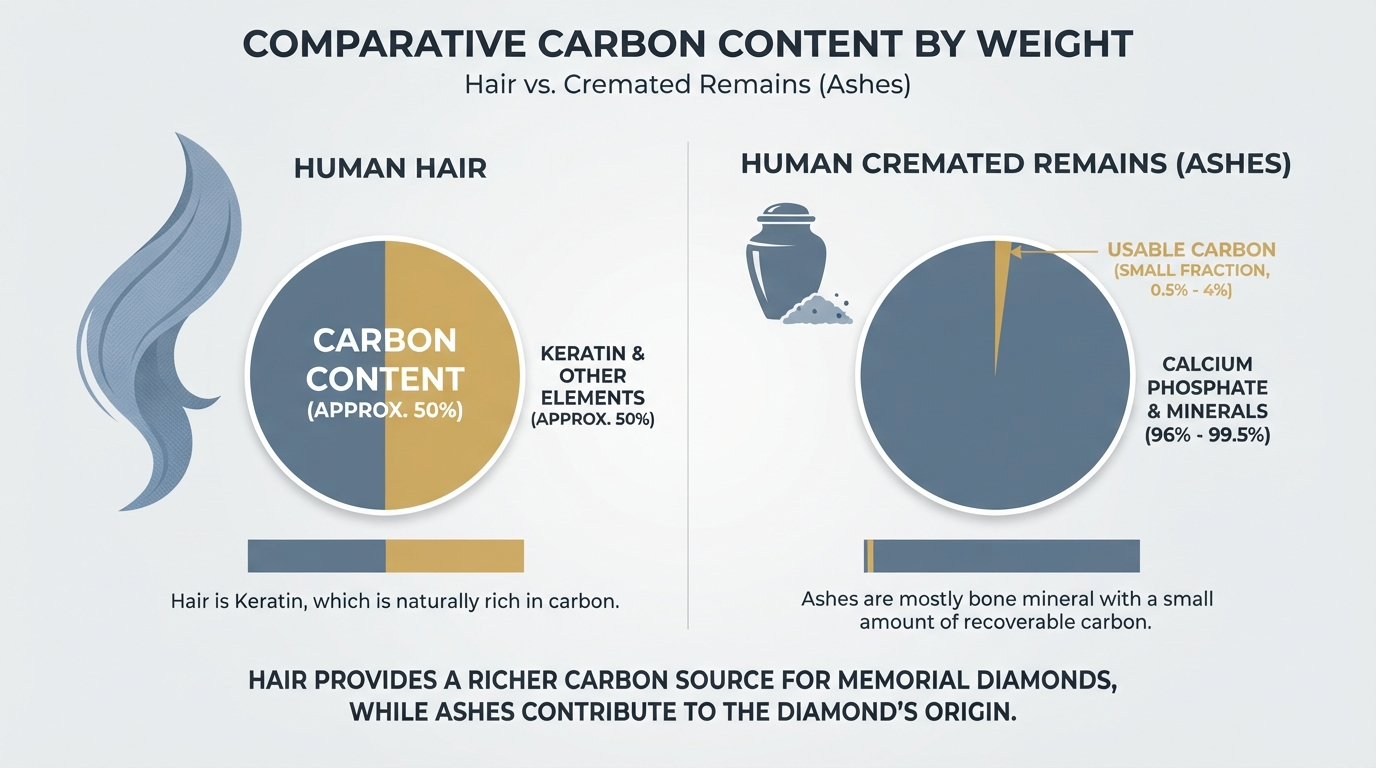
For cremated remains, the industry typical requirement runs from a few tablespoons up to roughly 4 oz (about 100 g). For hair, it is typically a small lock, a few grams. The reason the two halves of ash and hair for a partner memorial diamond carry such different figures is carbon content: hair is roughly 50% carbon by weight, while cremated remains yield only about 0.5% to 4%, because ash is overwhelmingly calcium phosphate rather than carbon.
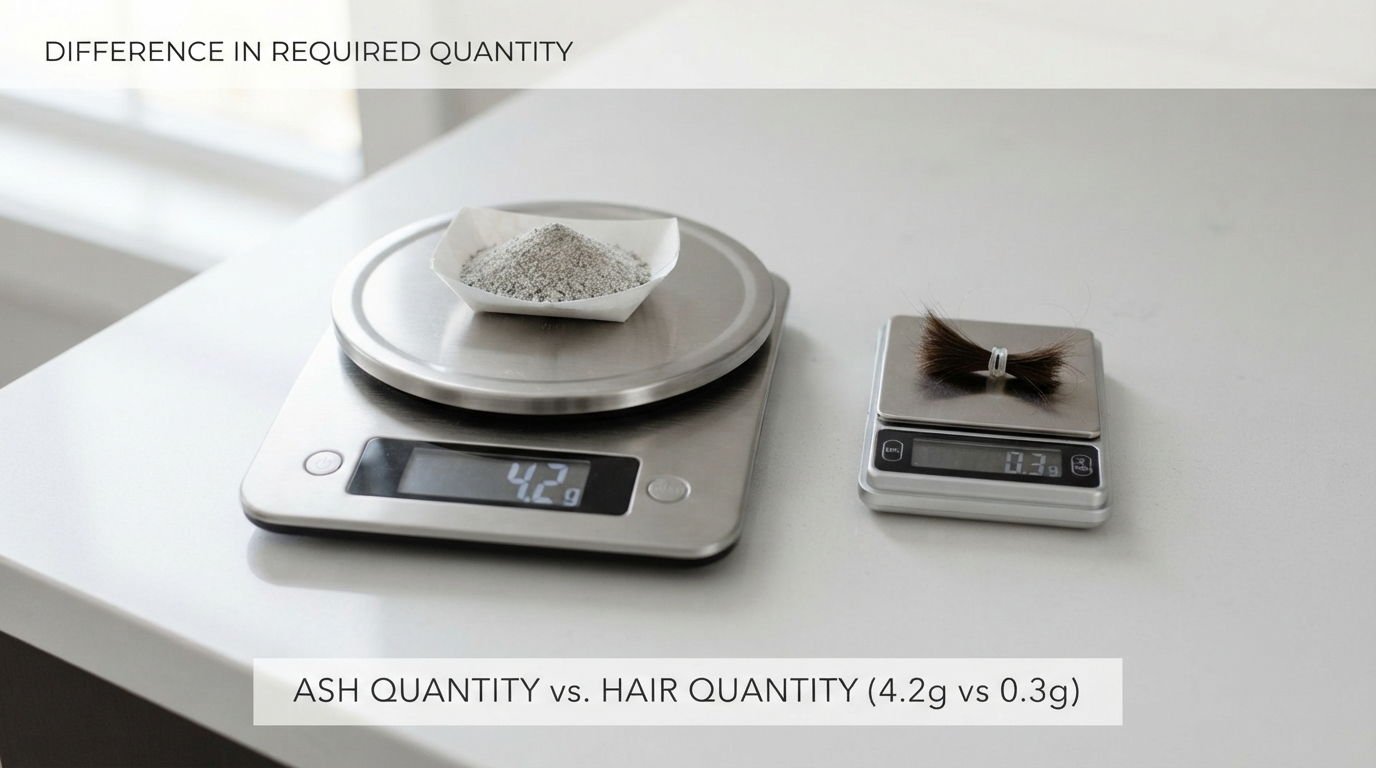
A kitchen scale holding a small portion of cremated remains next to a far smaller lock of hair, showing the difference in required quantity

Any provider you approach will have its own numbers inside those bands, so the specific quantity of ash and hair for a partner memorial diamond you are asked for is a figure to get in writing from them, not something to infer from a page like this one. Ask three things about the ash and hair for a partner memorial diamond when you do:

  1. Is each figure a received weight or a usable weight? Processing removes whatever is not carbon, and two companies may answer it differently without either of them being wrong.
  2. Are the ash and hair for a partner memorial diamond assessed separately or as one submission? This determines whether a shortfall in one is fatal to the order.
  3. Does submitting ash and hair for a partner memorial diamond together change the required quantity of either? The honest expectation is no, but it is a policy question, not a chemical one.

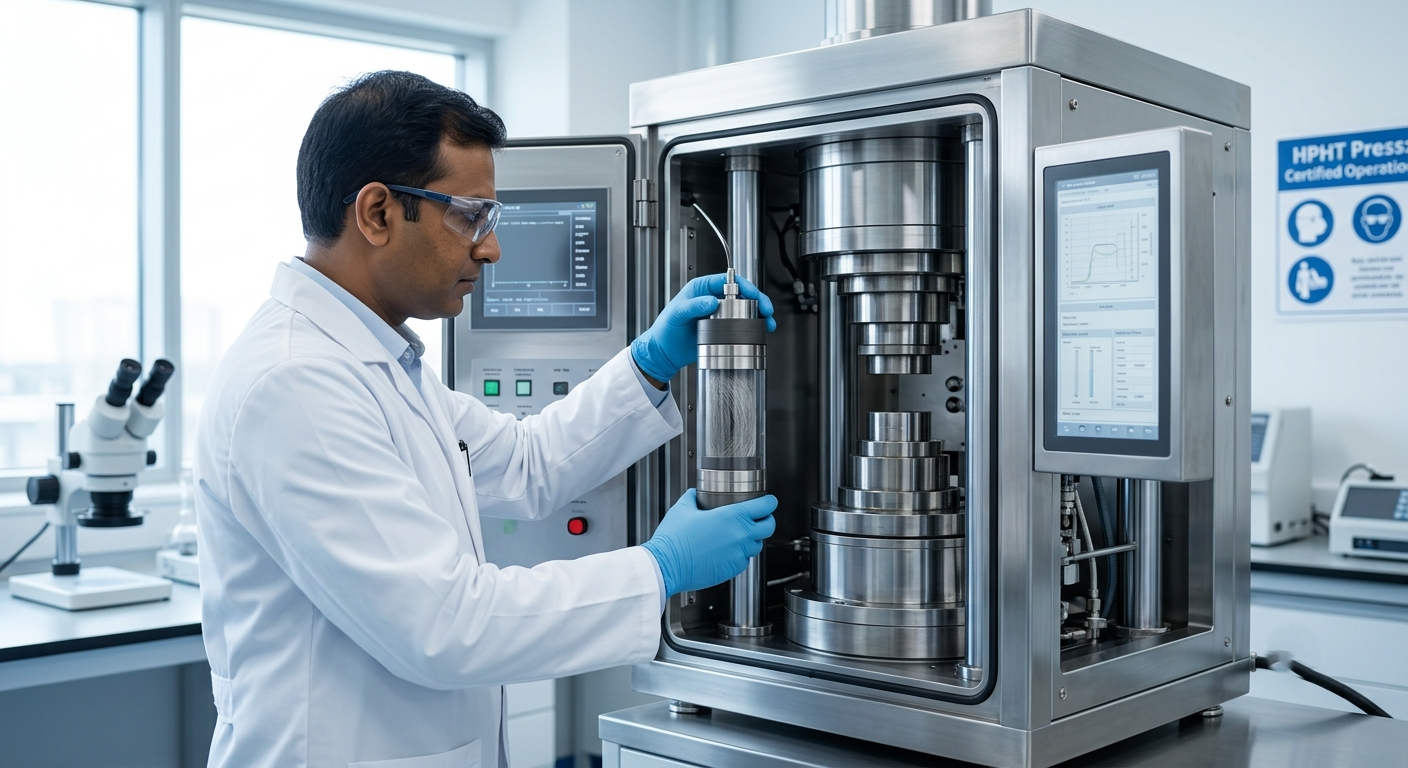
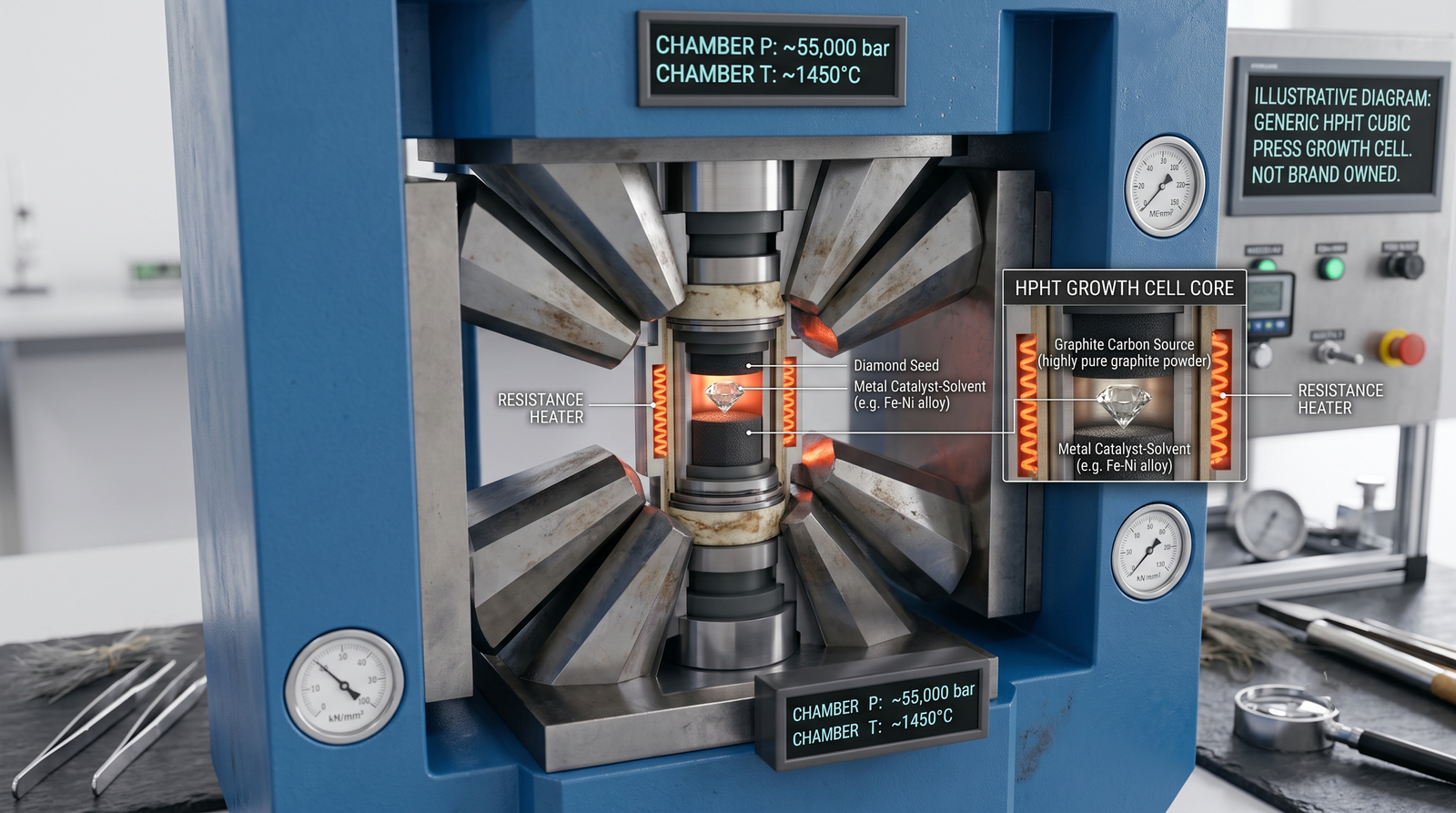
Beyond those figures, the quantity of ash and hair for a partner memorial diamond stops mattering. Carat comes from time in an HPHT growth cell, which runs at 1,400 to 2,500°C under something like 6 to 8 GPa for weeks or months on end, as documented in the general literature on diamond growth methods. Stones run from about 0.10 ct to 5+ ct, and the industry typical timeline is 6 to 10 months, stretching toward 12 for larger or specialty color work. None of those numbers moves because you sent ash and hair for a partner memorial diamond instead of one material. The full sequence for a combined submission covers what happens once both have been accepted.

Does Using Both Make the Stone More of Your Partner?

No, and this deserves a direct answer rather than a tactful one, because it is the reason many people submit both in the first place.

The carbon recovered from ash and hair for a partner memorial diamond is a minority of the finished stone. Industry figures for the ash route put that personal fraction at something like 10 to 15% of the stone’s mass, some providers as low as 3%, and no published figure covers a blended charge of the two materials. Whatever is recovered gets purified to roughly 99.9%+, converted to graphite, and then topped up with lab grown carbon until there is enough feedstock to fill a growth cell. Sending ash and hair for a partner memorial diamond puts two personal inputs into that same recovered fraction. It does not enlarge the fraction.
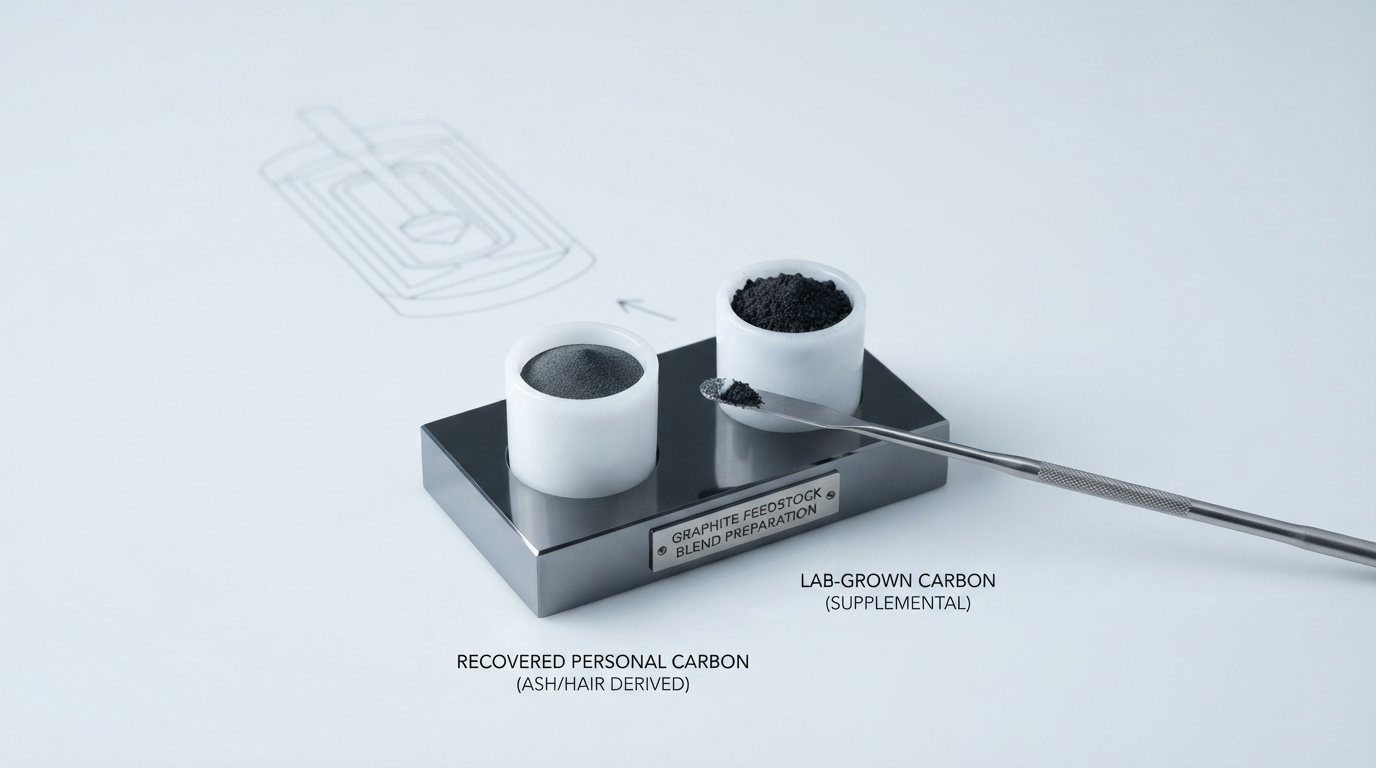
Purified graphite feedstock prepared for a diamond growth cell, where recovered personal carbon is blended with lab-grown carbon

There is a subtler version of the same hope: the idea that hair from life plus ash from after captures more of a person than either alone. That is a real feeling and nobody should argue anyone out of it. But it is a feeling about meaning, not a claim about material, and the two should not be confused when money is involved. A single source stone and one grown from ash and hair for a partner memorial diamond are, in every measurable respect, the same object.

What is true, and is plenty: a verifiable portion of your partner’s own carbon sits permanently inside the crystal lattice of a real diamond, graded against the same 4Cs as any other stone. Color, incidentally, is not something a second source lets you steer either. Nitrogen present during growth reads yellow, boron reads blue, and colorless requires the absence of both. What color a combined stone is likely to be covers why that remains a probability rather than a choice.

Which Material Gets Committed First?

Here is the decision that ash and hair for a partner memorial diamond forces on you and a single source order never does.

The two halves of ash and hair for a partner memorial diamond carry different risks. Ash is usually the larger, more contested, more irreversible thing to part with, and frequently it is not exclusively yours to send. Hair is small, often already in your possession, and rarely subject to anyone else’s permission. Sending ash and hair for a partner memorial diamond at once means committing the harder material before you know whether the process works for you.

The decision in front of youWhat to settle before anything is postedWho actually answers it
Whether to send the ash and hair for a partner memorial diamond together or one at a timeWhether the provider accepts a staged submission, and whether a second material can be added after an order opensThe provider, in writing, before payment
Which material is more exposedWhether the ashes are yours to divide at all, given the law of the state and anything your partner left in writingA funeral director, and whoever holds legal authority over the remains
Whether a sample that may fall short is worth sendingWhether that material gets returned, kept, or quietly absorbed if it fails assessmentThe provider’s written policy on unused material
Whether to hold hair back deliberatelyWhether anyone else may want a stone later, since a second order needs its own materialYou, and anyone else in the family who may ask
Whether the order is time sensitiveWhether a scattering, interment or family handover is already scheduled for the ashesWhoever is organizing it
What “committed” actually meansAt what point material stops being returnable, on receipt, on assessment, or at graphitizationThe provider, and this is the single most useful question on this page
 person at a desk with an urn, an envelope and a written list of questions, deciding which material to send first

The last row is the one to send as an email today. Once material is graphitized it is not coming back in any recognizable form, and knowing exactly where that line falls is what lets you decide the order in which to cross it. The questions worth asking before anything is arranged is the fuller list to work through.

What If One Source Turns Out to Be Short?

This is where ash and hair for a partner memorial diamond earns its keep, and the answer depends entirely on a policy question you can settle in advance.

If the ash and hair for a partner memorial diamond are assessed separately, a shortfall in one does not automatically end the order. The other can usually proceed on its own. If they are treated as a single pooled submission, a shortfall may stall everything. That difference is not chemistry and it is not standardized, so ask before you post anything.

Three common shortfalls and what typically happens next:

  • Not enough ash, plenty of hair. The most survivable case. Hair carries roughly 50% carbon against ash’s 0.5 to 4%, so a few grams does the work of several ounces, and the order usually continues as a hair based one. The hair figure taken on its own sets out what that looks like.
  • Plenty of ash, no usable hair. Equally workable, and common where a partner was cremated without anyone thinking to cut a lock. The ash figure on its own covers the requirement and why it is what it is.
  • Both short. Rarer, and the one case where ash and hair for a partner memorial diamond is genuinely a stop rather than a detour. Ask whether a partial assessment is possible before committing, and ask what happens to material already sent.

Nothing about a shortfall is a judgment on what you kept. Plenty of people hold a keepsake urn given at a funeral, or a few strands from a brush, and were never told either might matter later. Getting ash and hair for a partner memorial diamond assessed early, before any plan is built on it, is the cheapest way to find out where you stand.

Two Materials, Two Sets of Rules

The final thing ash and hair for a partner memorial diamond introduces is that the two sit under different kinds of authority, and people are frequently surprised by which one causes trouble.

Cremated remains sit inside a chain of control that differs from state to state and can be overridden by anything your partner set down in writing. Where a relationship was legally recognized, that is usually straightforward. Where it was not, no marriage, no civil partnership, a family that never acknowledged the relationship, a spouse from an earlier marriage still named on the paperwork, the urn may be controlled by someone who is not you. That has to be established before money moves, not after.

The rules covering cremated remains are generally aimed at the remains themselves, so hair already sitting in your own home is usually a simpler question in practice. That is practice rather than settled law. A person’s personal effects can fall to their estate, and this varies by state, so three qualifications matter:

  • If the hair is in someone else’s keepsake box, it is theirs to share or refuse, regardless of what the law says about remains.
  • If a funeral home holds a cut lock, they will release it to whoever is on record as authorized, which may not be you.
  • If personal effects were named in a will, a lock kept in a locket may fall under it.

So an order built on ash and hair for a partner memorial diamond can genuinely be easier or harder than a single material one depending on which is contested. Where the ashes are out of reach and the hair is not, the practical answer is often to proceed with hair alone rather than to fight for a portion you may not be entitled to. The complete guide to a partner ashes and hair diamond works through both routes in full.

Frequently Asked Questions

Does sending both materials produce a larger diamond?

No. Carat is set by growth time in the press, not by how much material arrives, so a combined submission and a single source one at the same carat take the same months and cost the same. Two sources buy redundancy and meaning, not size.

If the ashes fall short, does the hair make up the difference?

Only if the provider assesses the two separately rather than as one pooled submission. When they are assessed separately, a hair only order usually proceeds. Ask which model applies before you send anything, and get the answer in writing.

Which should I commit first if I only want to risk one?

Usually hair, because it is smaller, generally already in your possession, and rarely subject to anyone else’s permission. That lets you see how a provider actually handles your material before the ashes, the harder, more contested thing, are committed.

Does a dual source stone contain more of my partner than a single source one?

No. Industry figures for the ash route put the personal carbon near 10 to 15% of the finished stone’s mass, and no published figure covers a blended charge. Either way, a second input shares that fraction rather than enlarging it. Send both for meaning and redundancy, not proportion.

Can the two materials be grown into two separate diamonds instead?

Frequently yes, since each meets its own minimum independently, one stone from ashes, one from hair. That is a genuinely different order with its own cost and its own timeline, so ask for it to be quoted separately rather than assumed.

The hair is mine to give but the ashes are not. What then?

Then proceed with what is actually yours, and treat the ashes as a separate conversation with whoever holds authority. A hair only order is not a compromise version. It is the same process, the same stone, and the same grading.

Final Thoughts on Ash and Hair for a Partner Memorial Diamond

Most of the work here turns out to be subtraction. Two sources do not double the allowance, do not enlarge the personal fraction, do not speed anything up, and do not give you a bigger stone. Once all of that is cleared away, what remains is small enough to act on.

Six things are worth acting on, in this order:

  1. Get both figures for ash and hair for a partner memorial diamond in writing, stated separately.
  2. Ask whether each is a received or a usable weight, since the two are not the same number.
  3. Ask whether the materials are assessed separately or pooled, because that answer decides what a shortfall costs you.
  4. Find out where the point of no return sits, receipt, assessment, or graphitization.
  5. Settle who controls the ashes before money moves, and ask who holds any cut lock.
  6. Commit the easier material first, usually the hair, and the contested one second.

Handled in that order, ash and hair for a partner memorial diamond stops being a question about quantity and becomes what it actually is, a question about which thing you are willing to send while you still have the option of changing your mind.

Learn More About Partner Memorial Diamonds

Talk With Memorial Diamond

If you are holding both materials and unsure which to commit, that is a question worth asking out loud before anything is packed. Describe what you have, how much, how it has been stored, whether all of it is yours to send, and ask for an assessment rather than an order.

Four questions get you a usable picture of any provider: what quantity of ash and hair for a partner memorial diamond is required for each material, whether those are received or usable weights, whether the two are assessed separately or pooled, and at what exact point material stops being returnable. memorialdiamond.us will answer all four before you decide anything, and so should anyone else you are weighing up.
memorial-diamond-made-from-partner-ashes

How a Memorial Diamond Is Made From Your Partner’s Ashes

The paperwork runs out eventually, and then the decisions that are genuinely yours begin.

A memorial diamond made from partner ashes is real. The small fraction of carbon inside cremated remains, roughly 0.5% to 4% of ash by weight, is extracted, purified to around 99.9% carbon, converted to graphite at about 2,500 to 2,700°C, and grown into a diamond crystal under something like 6 to 8 GPa of pressure. Seven stages, typically six to ten months industry wide.

What follows is what physically happens to a memorial diamond made from partner ashes at each of those stages, and the part most descriptions skip, exactly where the step sits that cannot be taken back.

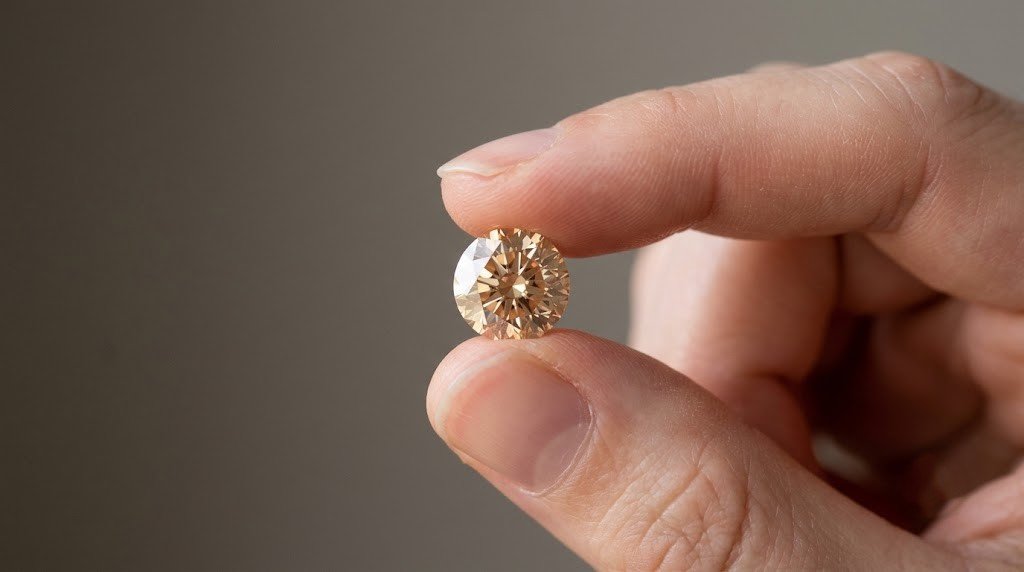
Champagne-toned lab-grown memorial diamond made from partner ashes, held between fingertips against a plain background

What Is Actually in the Ashes You Would Be Sending?

Cremated remains are not ash in the campfire sense. What survives a cremation is mostly bone mineral, calcium phosphate, ground to a uniform grit. The soft tissue, and with it most of the body’s carbon, leaves as gas during the cremation itself.

That is why every honest description of a diamond made from partner ashes starts with a percentage rather than a promise. Industry figures put the usable carbon in cremated remains at roughly 0.5% to 4% of the ash by weight, varying with the individual and with how the cremation was run. A few tablespoons of remains contain a genuinely small quantity of recoverable carbon, and that quantity is the raw material a diamond made from partner ashes has to be built from.

This single number explains almost everything else about the process. It explains why a lab asks for a measured portion rather than a pinch. It explains why the extraction stage is long and fussy. And it explains why a stone made from partner ashes is never grown from that carbon alone.

None of that makes the carbon less real. It was in your partner, and it was recovered from what remained of them. But knowing the scale now is better than finding it on a forum in month four.

The Seven Stages of a Memorial Diamond Made From Partner Ashes

The chain is the same across the industry, whatever the marketing language around it. A memorial diamond made from partner ashes passes through these seven stages, in this order.

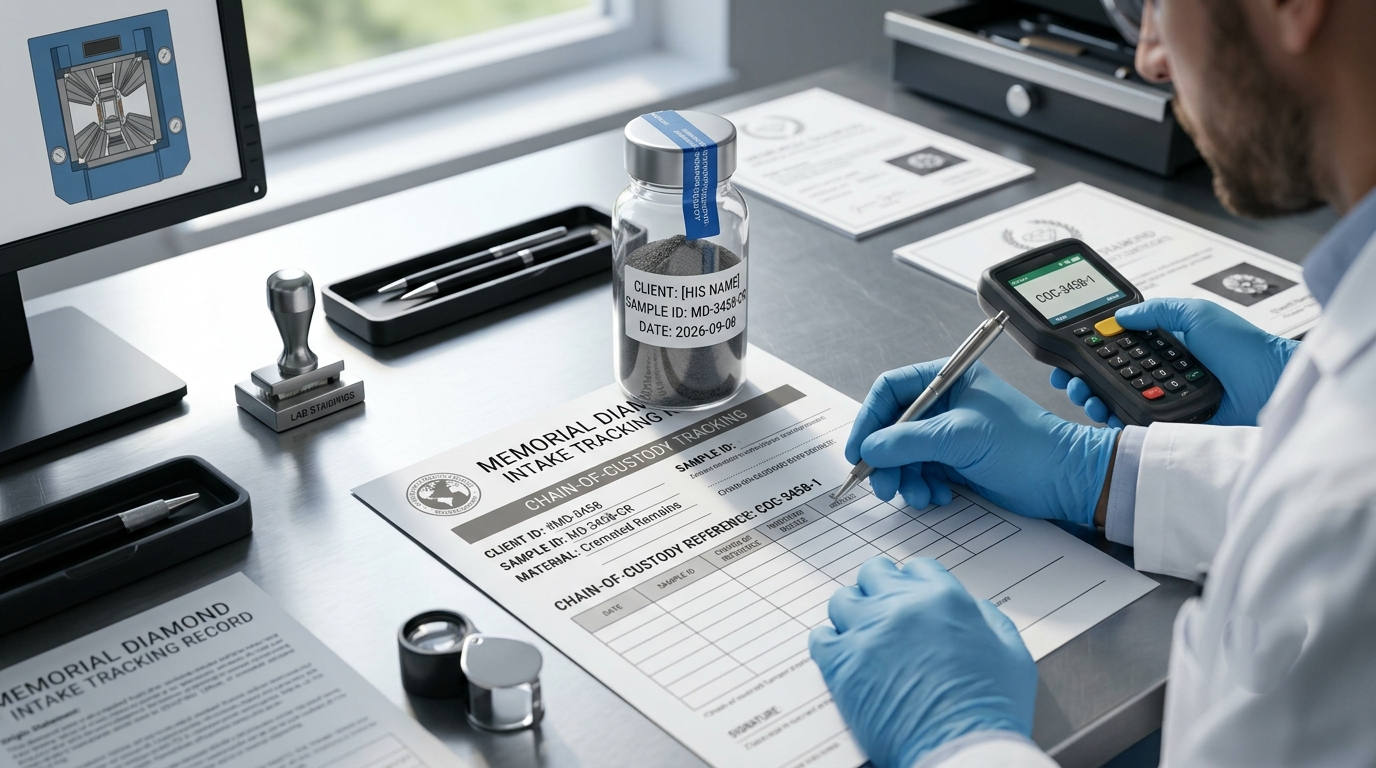
1. Intake and identification. The portion of ashes arrives, is weighed, and is assigned an identifier that travels with the material through every later stage. Ask what that identifier is and how it is recorded. This is the document that ties the finished stone back to what you sent, and the backbone of any later claim that the stone was made from partner ashes rather than from something substituted along the way.

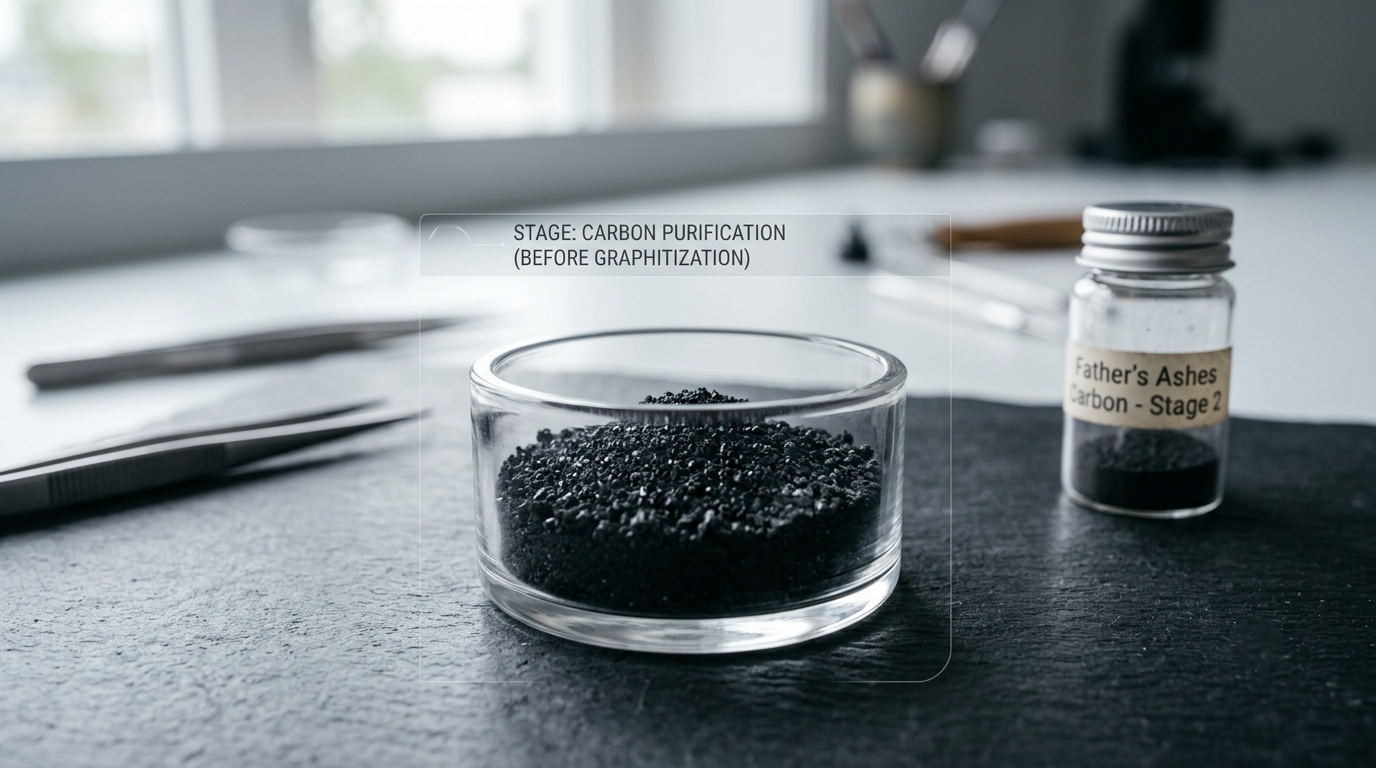
2. Carbon extraction. The remains are heated in a controlled, oxygen free environment so the carbon can be separated without simply burning away. Because a diamond made from partner ashes starts from a material that is only a few percent carbon by weight, this is the stage where most of the submitted mass is removed as mineral residue rather than kept.

3. Purification. The extracted carbon is refined through further stages until it reaches roughly 99.9% or higher carbon purity. Anything left behind at this stage, such as stray minerals or metals from an implant or a casket fitting, will otherwise show up as an inclusion or a color cast in the crystal.

4. Graphitization. The purified carbon is heated to roughly 2,500 to 2,700°C and rearranged into graphite, the crystalline form of carbon that a diamond press can actually use as feedstock. The material that goes into the press for a diamond made from partner ashes is graphite, not ash.

5. Growth. The graphite, combined with supplemental lab grown carbon, is loaded into an HPHT growth cell around a tiny diamond seed and held at roughly 6 to 8 GPa and 1,400 to 2,500°C for weeks to months. Carat size is a function of how long the cell runs, not how much ash you sent.

6. Cutting, polishing, and optional treatment. The rough crystal is cut and polished to a chosen shape. Some providers offer post growth irradiation to shift or intensify color. Ask whether that is being done and whether it will be disclosed on the paperwork.

7. Grading. The finished stone is measured against the same cut, color, clarity, and carat standards used for any diamond, ideally by an independent third party laboratory rather than in house. A stone made from partner ashes is assessed on exactly the same scale as any other diamond, with no separate or softer standard.

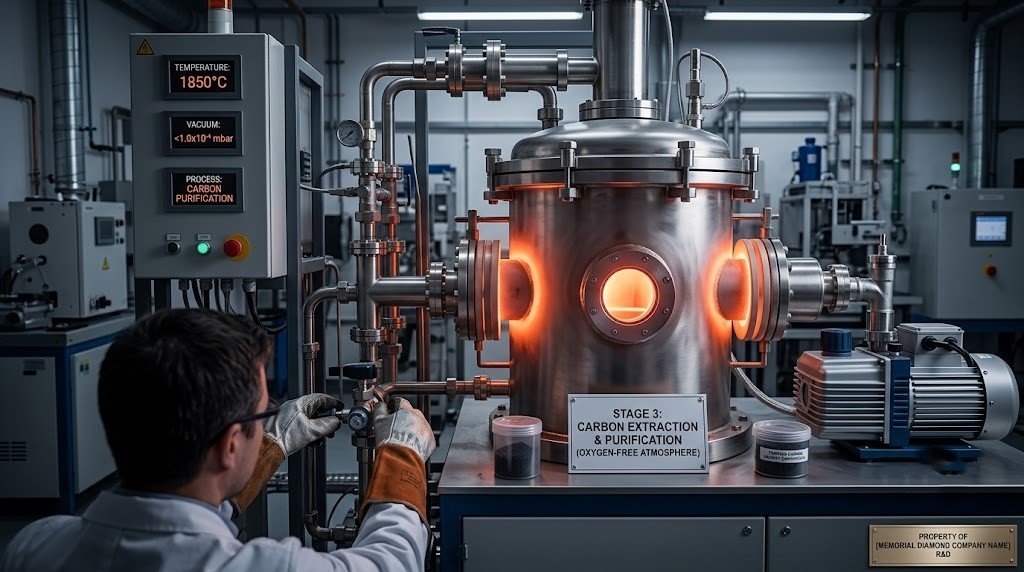
High-temperature oxygen-free furnace used to extract and purify carbon before graphitization

Where Is the Point of No Return?

This is the question worth sitting with. For a diamond made from partner ashes the honest answer is that there are two of them, one physical and one domestic, and the domestic one comes first.

The physical point of no return is the extraction furnace, stage two. Up to the moment that furnace is sealed, what a lab holds is still cremated remains. They can be weighed, sealed, and sent back. Once extraction begins, the calcium phosphate is separated off and the carbon is chemically committed. There is no process that reverses a diamond made from partner ashes back into ash. Everything after stage two, including purification, graphitization, growth, and cutting, is refinement of a decision already made.

The domestic point of no return is earlier and quieter. It is the afternoon you open the container and measure a portion out. That act is not reversible either, and it happens at a kitchen table rather than in a lab, usually without anyone present to say “are you sure.” A lab can return an unopened portion. Nobody can return the specific handful you scooped.

So the practical sequence is this. Decide who is involved and whether anyone else in your partner’s life would want to be asked before anything is divided. Decide the carat and the color, because those are cheap to change on paper and impossible to change once a growth run has started. Decide what happens to the ashes that are not used, since a diamond made from partner ashes typically consumes only a fraction of a full cremation. Then portion.

A third, softer boundary sits at stage five. Once the growth cell is sealed, the size you chose is the size that is growing, and changing your mind means starting over. Ask when the specification locks. That timing varies.

What You Can Still Change at Each Stage

StageWhat Is Physically HappeningReversible?What You Can Still Change
1. IntakePortion weighed, logged, identifiedYes. Unprocessed material can be returnedEverything, including carat, color, shape, and whether to proceed
2. ExtractionCarbon separated from bone mineralNo. This is the physical point of no returnCarat, color, shape, setting
3. PurificationCarbon refined to approximately 99.9% or higherNoCarat, color, shape, setting
4. GraphitizationCarbon converted to graphite at 2,500 to 2,700°CNoCarat and color, if not yet locked. Ask when the lock happens
5. GrowthCrystal built around a seed at 6 to 8 GPaNo. The run is committed once sealedShape, polish, setting, engraving
6. CuttingRough crystal shaped and polishedShape choices are one way once cutSetting, engraving, whether to set it at all
7. GradingIndependent assessment of the 4CsNot applicableNothing about the stone. Only what you do with it

Read that table as a calendar for a diamond made from partner ashes rather than as a warning. Nearly every decision that costs money or changes the stone’s appearance is open for the first two stages and closed after the fourth. It is a narrow window, earlier than most people expect.

Why Lab Carbon Is Added to a Diamond Made From Partner Ashes

No stone is grown from ash carbon alone, and any description that implies otherwise is describing something that does not exist. What comes out of purification is a small quantity of carbon, real and really your partner’s, which is then topped up with lab grown carbon until the growth cell holds the volume a crystal of the chosen size actually needs.

That is arithmetic, not a policy any one company invented. A gram or two of recovered carbon cannot become a one carat crystal, so the feedstock charge is made up to volume.

The framing that survives scrutiny is the accurate one. A diamond made from partner ashes is not a symbol of your partner and it is not a stone that is entirely them. It is a crystal that contains, verifiably, carbon that was part of a person, grown into a lattice that exists because they did. That claim holds up to a skeptical relative, a jeweler, and a gemologist, and it is the reason these stones are genuine diamonds rather than lookalikes. “One hundred percent pure” does not.

Every honest account of a diamond made from partner ashes carries that qualification somewhere in it. If a provider will not put the blend in writing, that is worth noticing. The honesty of the answer to this question is a reasonable proxy for how the rest of the work is done.

How Long Does Each Stage Take?

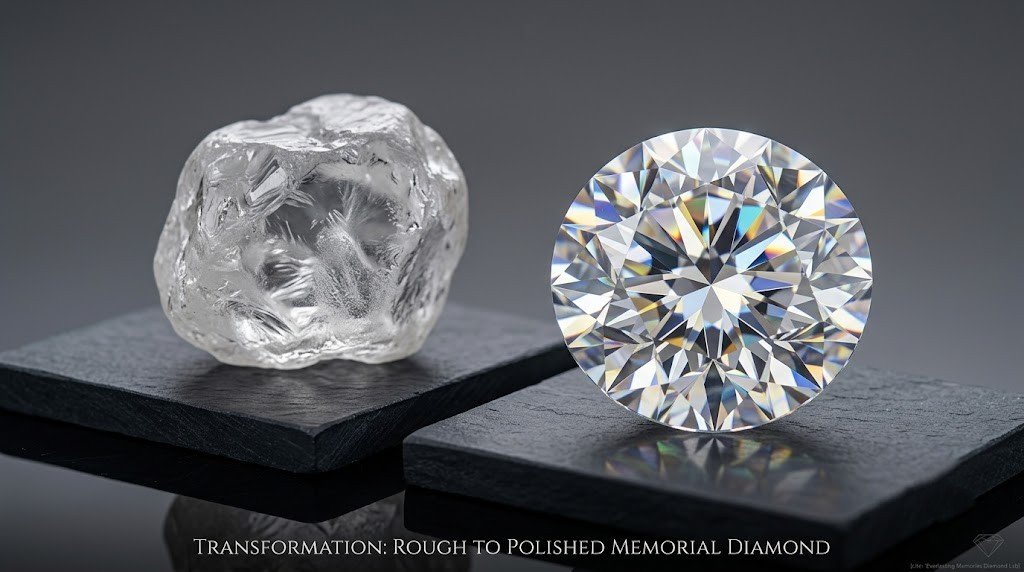
Rough memorial diamond crystal beside the same stone after cutting and polishing

Industry wide, the full sequence for a diamond made from partner ashes typically runs six to ten months, with larger stones or specialty colors sometimes reaching twelve. The stages are wildly uneven in length, which is why the wait feels longer than the number suggests.

Intake, extraction, purification, and graphitization are usually measured in weeks. Growth is the long part, with weeks to months in the press, because carat size is bought as time under pressure, not as a quantity of ash. Cutting, polishing, and grading add several more weeks, and an independent laboratory has its own queue.

Two things make a stone made from partner ashes take longer than a quoted range. One is size. Larger crystals need proportionally longer runs and are more likely to fail during a run and need restarting. The other is a color specification that requires the trace elements to be engineered out rather than accepted.

Ask for the stage you are currently in rather than a completion date. A provider that can tell you “purification finished, cell loading next week” is telling you something real. A provider that only repeats the original estimate is telling you nothing.

Can a Diamond Be Made From Partner Ashes Years Later?

Yes, and this is more common than the timing of most bereavement content suggests. Cremated remains do not decay, spoil, or lose their carbon on a shelf. A portion kept in a closet since 2014 is chemically the same material it was the week it came home, and a diamond made from partner ashes that have sat for a decade goes through the same seven stages as one started the month after the funeral.

That matters for a very ordinary reason. The first year after a death is a terrible time to make a permanent decision, and plenty of people only arrive at this question once the urgent part is over. Nothing has been lost by waiting.

There are two practical differences worth knowing. The first is contamination. Remains that have been transferred between containers, stored somewhere damp, or opened repeatedly can pick up material that was never part of your partner, and purification removes non carbon contaminants rather than sorting one person’s carbon from another’s. Ask what the intake check looks for, and mention the storage history honestly.

The second is interment. If the remains were buried, entombed, or scattered, a diamond made from partner ashes may no longer be open to you. Disinterment rules vary by state and by cemetery. Hair is worth asking about instead, since it needs no cremation and a lock kept in an envelope is frequently still usable.

One thing time does not change is standing. Whoever had authority over the remains still has it. Keeping the urn for eight years does not confer it.

What to Settle Before the Ashes Leave Your Hands

These are the items that become expensive or impossible to revisit once stage two begins.

  • Who has standing to authorize this. There is no single national rule here. The state you are in sets who may direct what happens to a person’s remains, and written instructions your partner left behind can move that authority somewhere else again. Being someone’s partner does not by itself put you in that position. Sort this before you divide anything. An order for a diamond made from partner ashes is far easier to place than to unpick.
  • Whether anyone else should be asked first. Not consulted, necessarily. Asked. This is a social decision with a physical deadline attached.
  • How much of the remains you are prepared to commit. Requirements vary by provider, but a memorial diamond typically uses only a fraction of a full cremation, which means the rest can still be buried, scattered, or kept exactly as planned.
  • Carat and color, chosen deliberately. Both are locked early and both drive cost and timeline more than anything else.
  • Whether a second stone might be wanted later. Growing two from one shared portion is usually far simpler than reopening the question in three years.
  • What documentation you want to exist. An identifier at intake, a record at each handover, and a clear statement of what is being returned to you at the end.

If you are still deciding between materials, it is worth knowing that hair does not require cremation at all and carries far more carbon by weight. It is a different route to the same kind of stone, and one that stays open even if the remains are already interred.

Frequently Asked Questions About a Memorial Diamond Made From Partner Ashes

How much of the finished stone is actually my partner?

A real but minority portion. A diamond made from partner ashes contains carbon recovered from the remains, purified and then combined with lab grown carbon to reach a workable volume, so the personal fraction is meaningful and verifiable rather than total. Ask for that split in writing.

Can the process be stopped once the ashes have been sent?

Until extraction begins, yes. Unprocessed remains can be returned. After the extraction furnace is sealed, the carbon is chemically committed and nothing reverses it. That stage is the true point of no return, and it comes early.

Does sending more ashes make a bigger diamond?

No. The size of a diamond made from partner ashes is set by how long the crystal grows in the press, not by how much material you submitted. Sending a full urn does not produce a larger stone or a faster result. It only commits more of the remains.

What color will it be?

Most stones made from partner ashes trend yellow, blue, or champagne, because nitrogen and boron traces come with an organic carbon source. Colorless requires engineering both out and typically costs more. Nobody can forecast a precise shade in advance.

Will it be certified as a real diamond?

A memorial diamond is chemically and optically a genuine diamond and can be graded on the same 4Cs as any other. Ask whether grading is done by an independent third party laboratory and whether that report is included or priced separately.

Can two people each have a stone from the same ashes?

Often yes, because only a portion of the remains is used for any one stone. Deciding that before submitting is far easier than revisiting it later, when a second portion may mean opening the container again.

Final Thoughts on a Memorial Diamond Made From Partner Ashes

The chain that produces a memorial diamond made from partner ashes is genuinely impressive, but it is not the part that matters most on the day you have to choose. What matters is knowing that the reversible part of this is short, that it sits at the beginning, and that the decisions inside it are yours to take slowly.

Ask the percentage question. Ask when the specification locks. Ask what comes back to you at the end. A provider comfortable answering all three plainly is showing you something more useful than any photograph of a finished stone.

Learn More About Partner Memorial Diamonds

Talk With Memorial Diamond

If you want to understand what is possible with the ashes you have, reach out to Memorial Diamond and ask about the process, the documentation, and the timeline before committing to anything. Nothing here has to be rushed.

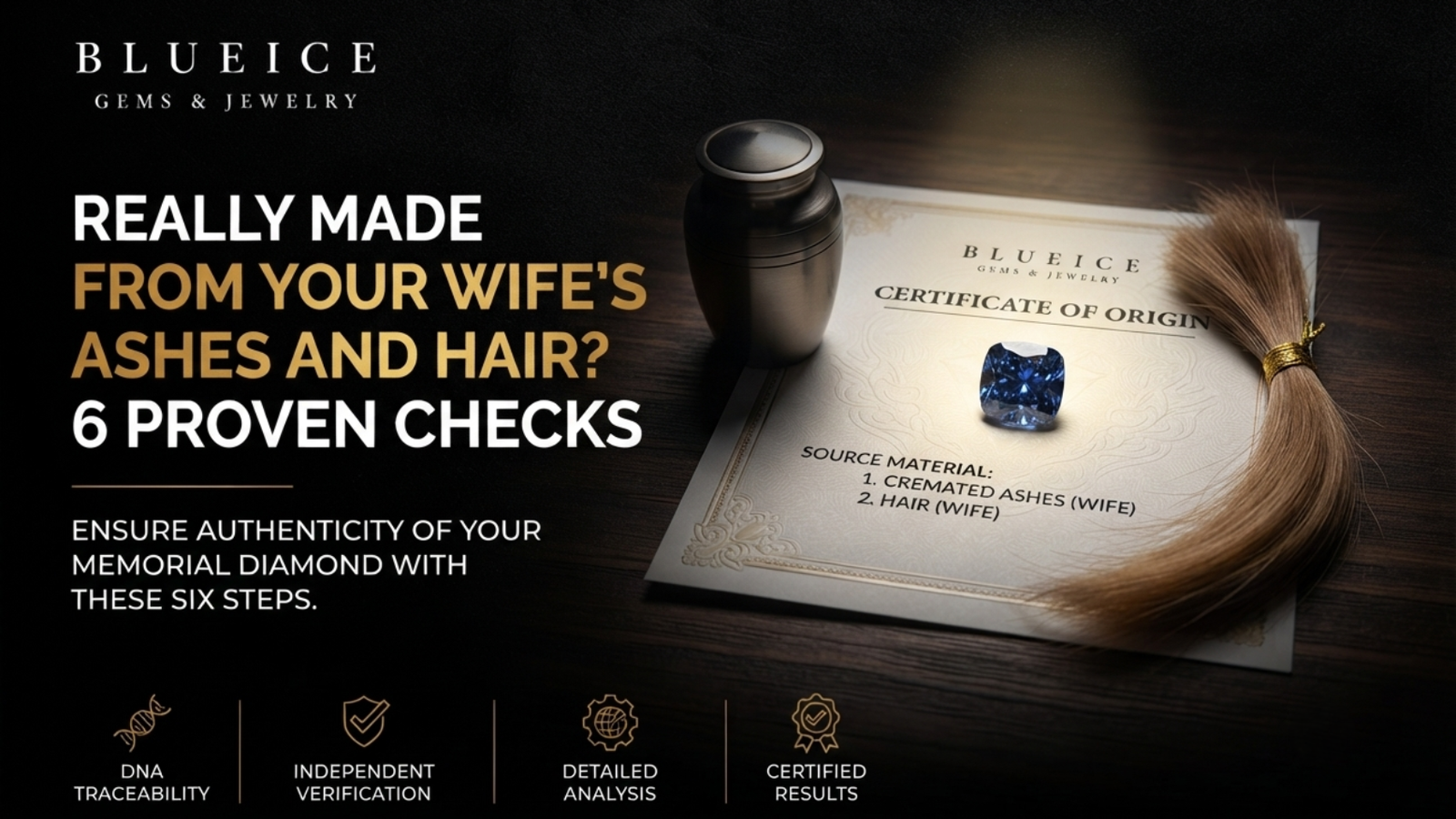
Really made from your wife's ashes and hair: a small blue lab-grown memorial diamond on an origin certificate listing two material lines, beside a sealed ash container and a tied lock of hair

Is a Memorial Diamond Really Made From Your Wife’s Ashes and Hair?

If you are sending both, you have probably already worked through whether a diamond can be made from her ashes at all, and whether a lock of hair is enough. The doubt that remains is narrower and sharper: did both of them actually go into the stone, or did only one? A memorial diamond is really made from your wife’s ashes and hair when carbon from both materials is extracted, purified, combined before growth, and grown into one genuine diamond, but the hair supplies most of the personal carbon, the ashes a real but smaller share, and the only proof that both went in is the provider’s single custody record and an origin certificate that names both materials.

This page covers only that combined doubt, whether a stone is really made from your wife’s ashes and hair, or only one of them. The general “is it really her” evidence, the chemistry, the 10 to 15% personal carbon share, why no lab test can identify whose carbon it is, is in whether it is really made from your wife’s ashes and whether it is really made from your wife’s hair.

What This Page Covers, and What the Other Two Already Answer

Most of the doubt about whether a stone is really made from your wife’s ashes and hair is not specific to combining at all. The table below sorts it, so this page can spend its length on the one doubt that is.

The doubtSpecific to a combined stone?Where it is answered
Is there enough carbon in ashes to make a diamond?NoThe ashes post, roughly 0.5 to 4% usable carbon, and yes
Is a lock of hair really enough of her?NoThe hair post, hair is approximately 50% carbon, so yes, comfortably
How much of the stone is actually her?NoBoth posts, typically around 10 to 15%, blended with lab carbon; never 100%
Can a test prove whose carbon it is?NoBoth posts, no; the proof is procedural
Does dye or gray hair matter?NoThe hair post, removed at purification
Did both materials actually go into this one stone, or only one?YesThis page
How much of the personal carbon came from each?YesThis page
What must the custody record and certificate show for two materials?YesThis page

If you have not read the two single material posts, read them first; they carry most of the evidence that a stone is really made from your wife’s ashes or her hair. The question of whether a stone is really made from your wife’s ashes and hair rests on the same procedural proof as either material alone, with one extra thing to check: that the proof covers both.

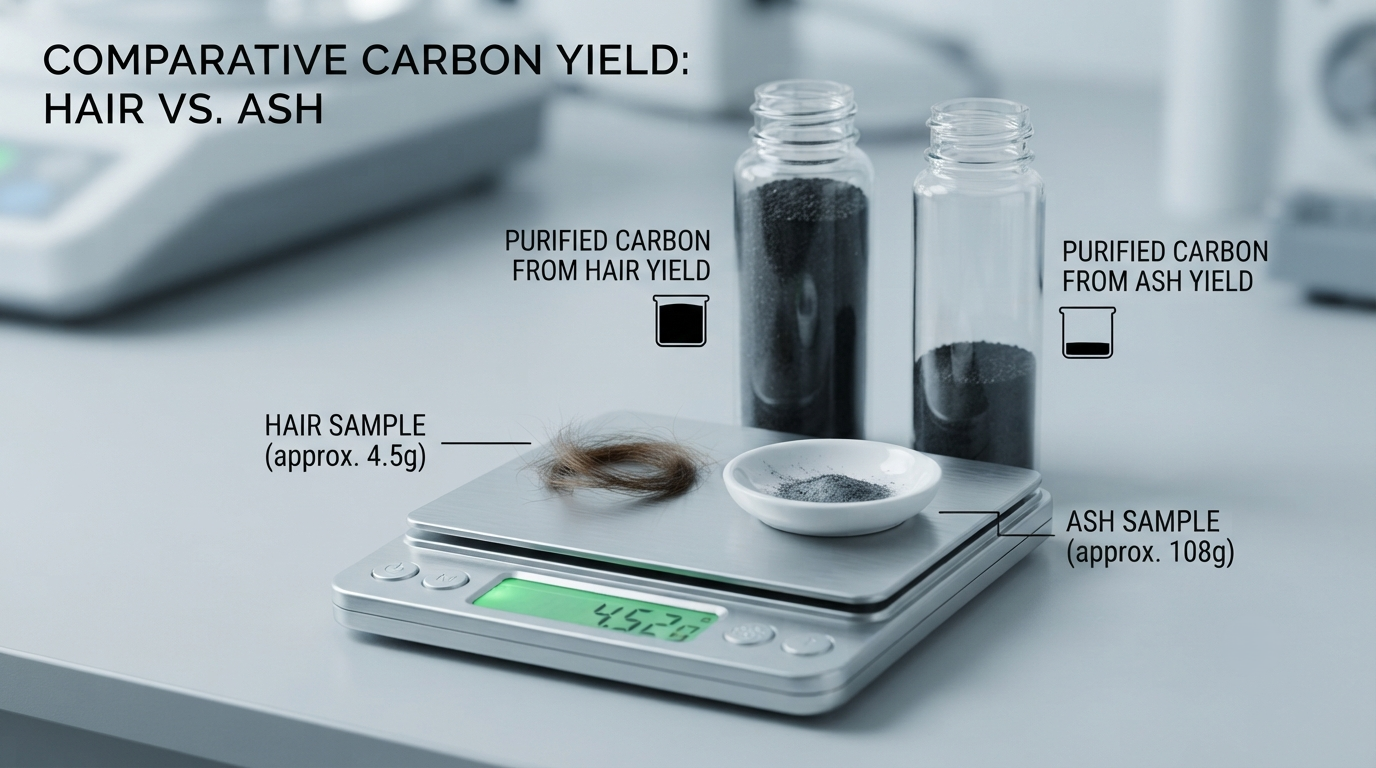
A few grams of hair and a small dish of ash on a scale, with two labeled vials showing very different amounts of purified carbon

Did Both Actually Go In? The Doubt Specific to a Combined Stone

Here is the worry about whether a stone is really made from your wife’s ashes and hair, stated plainly. You send a sealed container of ashes and an envelope of hair. Months later, one diamond arrives. Nothing about the stone tells you whether the provider used both, used the hair and set the ashes aside, or used the ashes and lost the envelope. Was the diamond really made from your wife’s ashes and hair, or from one of them with the other returned quietly to a drawer?

It is a fair worry, and the answer to whether a stone is really made from your wife’s ashes and hair is not “trust us.” The answer is that a stone really made from your wife’s ashes and hair leaves a specific paper trail that a single material stone does not, and that trail is checkable before you send anything, not just after.

Three things make the case that a stone is really made from your wife’s ashes and hair different from a single material one:

  • There are two intake events, not one. Each material should be weighed, photographed, and logged separately at arrival, and then tied to a single submission reference.
  • There are two extraction runs, or one run with two inputs. Either way, the carbon recovered from each should be recorded, because the two yields are very different sizes.
  • There is a combination step. At some point before growth, the two purified carbons are merged. That step is the one that makes the stone a combined stone, and it should be logged.

If a provider’s process has all three, the diamond is really made from your wife’s ashes and hair in a way they can show you. If it has only one intake line and no combination step, the provider may be doing everything right and simply not recording it, but you cannot know that, and neither can whoever inherits the stone.

Why Does the Hair Supply Most of the Personal Carbon?

Because of the chemistry, and a stone really made from your wife’s ashes and hair is lopsided in a way it is better to know before a provider implies otherwise.

MaterialCarbon by weightTypical amount submittedShare of the personal carbon in a combined stone
Her hairRoughly 50% (keratin)A small lock, a few gramsThe majority, usually by a wide margin
Her ashesRoughly 0.5 to 4% (the rest is calcium phosphate)A few tablespoons to about 4 oz (approximately 100 g)A real but smaller share

In a diamond really made from your wife’s ashes and hair, a few grams of hair at 50% carbon yields more purified carbon than a few tablespoons of ash at under 4%. In most combined submissions, the hair supplies the majority of the personal carbon and the ashes a minority. The ashes’ contribution is real, carbon that was in her body is in the crystal lattice, but it is smaller, and a stone really made from your wife’s ashes and hair is, by mass, mostly a hair stone with an ashes contribution, blended with lab carbon as every memorial diamond is.

Two honest consequences:

  1. A provider who implies that a stone really made from your wife’s ashes and hair drew equally on both is wrong. The chemistry does not support symmetry. Ask: “Roughly what share of the personal carbon came from the ashes, and what from the hair?” A confident provider gives a lopsided range. A provider who says “half and half” has not measured it.
  2. Neither material makes the stone bigger. Carat is set by growth time in the press. Combining changes what is in the stone, not its size, color, cost, or timeline. The reason to combine is meaning, the hair is carbon she grew while alive and the ashes are what remained, not chemistry. Wife Ashes and Hair Diamond: The Complete Guide covers when that meaning is worth the extra care and when a single material is simpler.
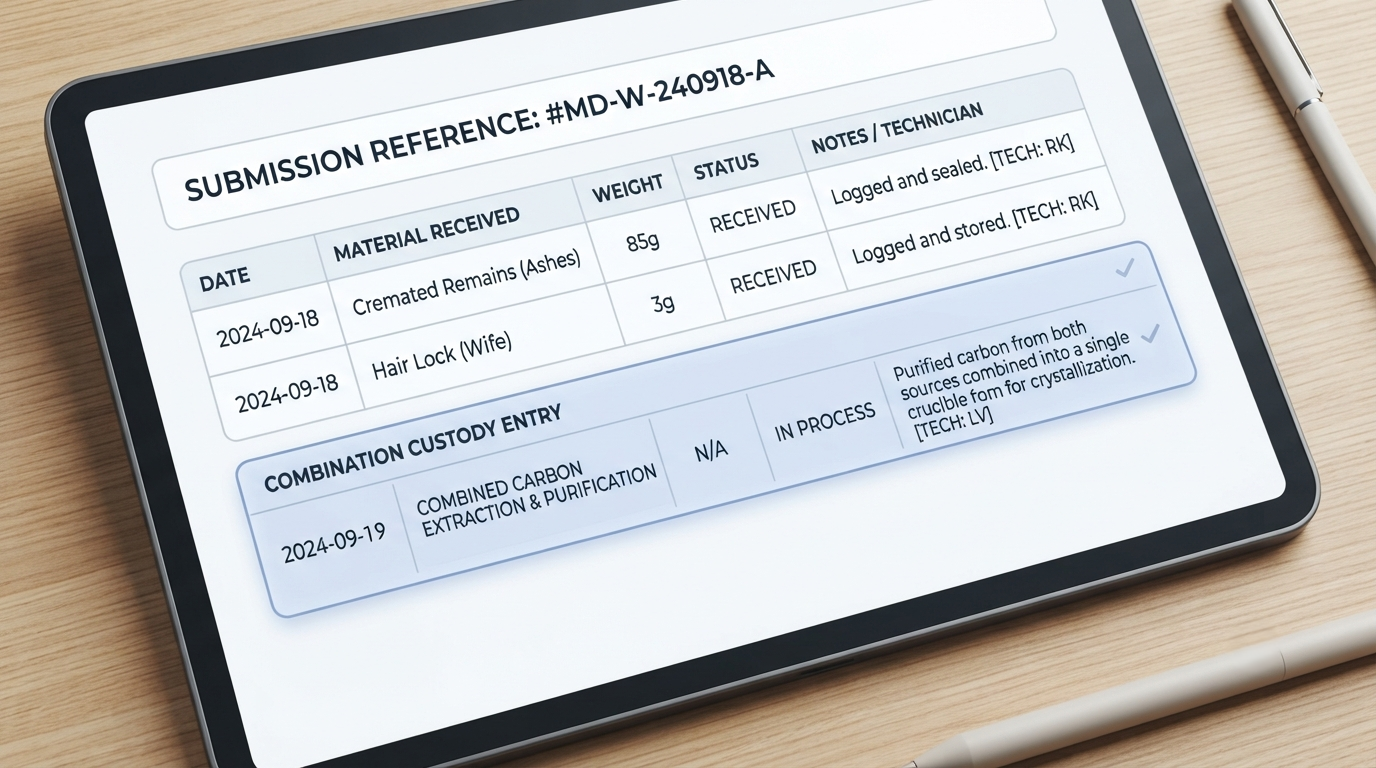
A custody log with one reference number, two intake lines, and a dated combination entry highlighted

How Do You Verify Both Were Logged Under One Record?

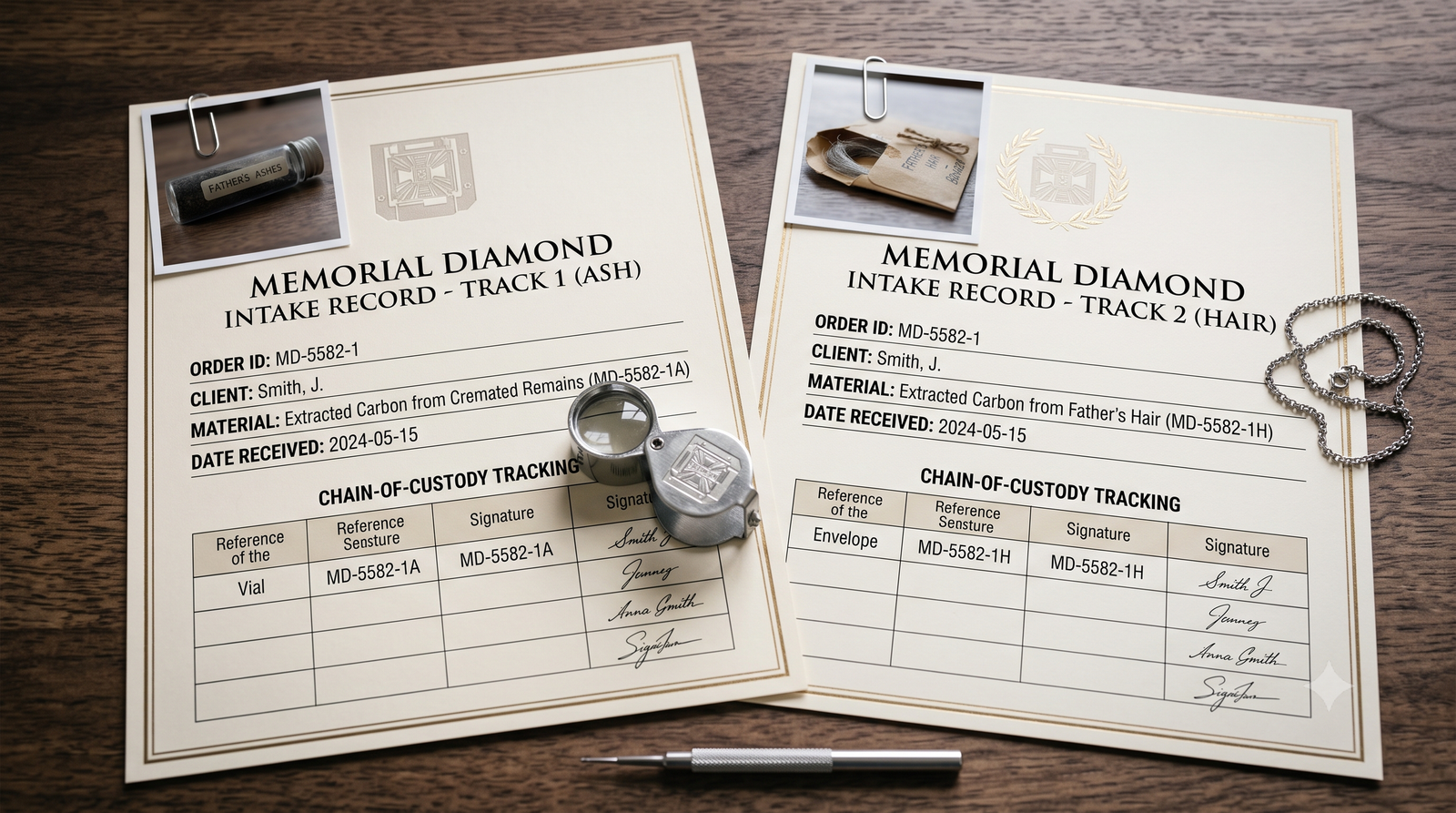
A chain of custody record for a diamond really made from your wife’s ashes and hair should have one reference number and two material lines under it. That is the whole test of whether a stone will be really made from your wife’s ashes and hair, and you can apply it before sending by asking to see a sample record.

What one record for a stone really made from your wife’s ashes and hair looks like:

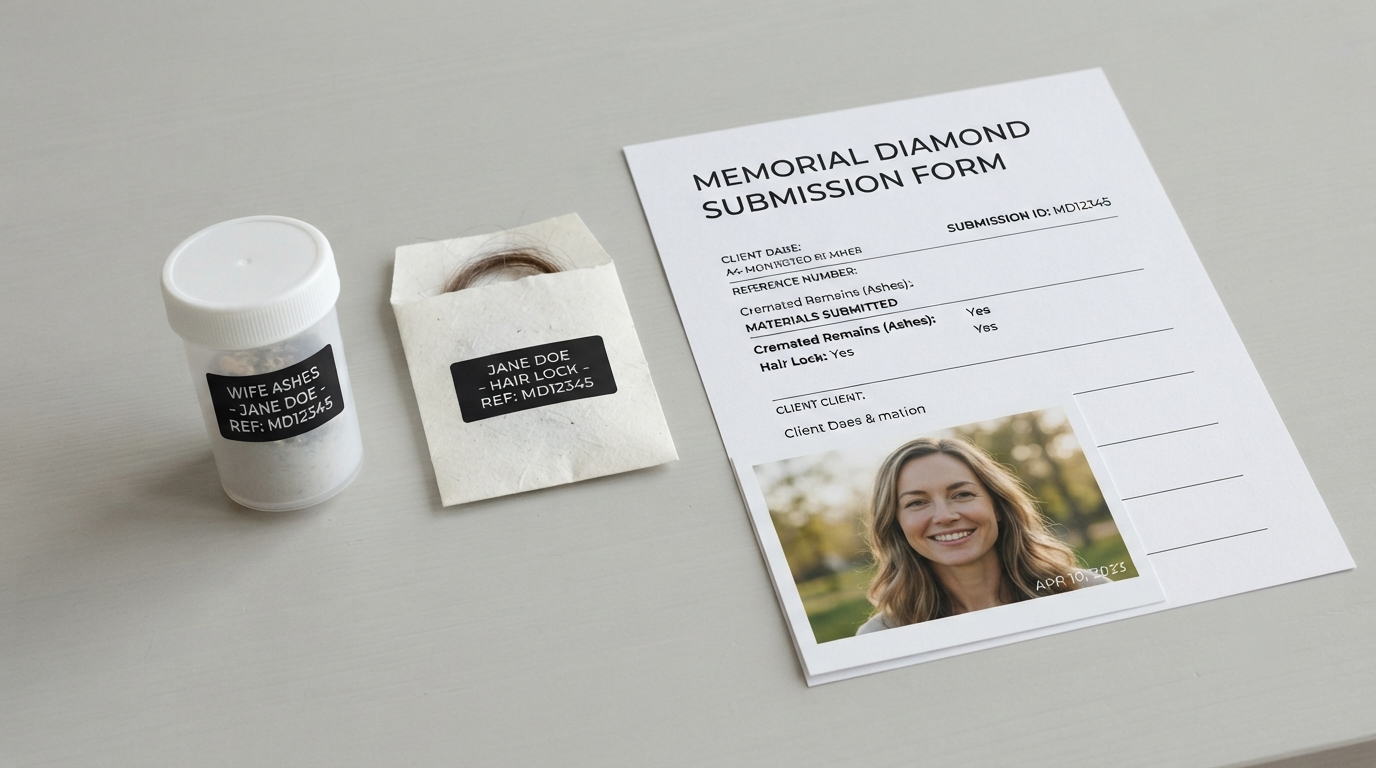
  1. One submission reference assigned at intake, printed on the ash container’s label, the hair envelope’s label, and the submission form.
  2. Two intake lines under that reference, ashes weighed and photographed; hair weighed and photographed, each dated.
  3. Two extraction entries, or one entry listing both inputs, each with the carbon recovered.
  4. One combination entry stating that the two purified carbons were merged, with a date, before graphitization or growth.
  5. One growth cell entry carrying the same reference through cutting, grading, and shipping.

The failure modes for a stone really made from your wife’s ashes and hair are specific. Two separate references with no line tying them together means the provider cannot later prove both went into one stone. One reference with a single intake line, “material received,” means the provider did not distinguish the two at arrival, and cannot show that the hair was not simply used alone. Neither proves dishonesty; both mean a stone really made from your wife’s ashes and hair cannot be demonstrated to be one.

Your own record of a stone really made from your wife’s ashes and hair matters too. Before shipping, photograph the labeled ash container, the labeled hair envelope, and the submission form together with the date visible. Confirm receipt of both materials by name, “ashes and hair received,” not “your package arrived.” How to turn your wife’s ashes and hair into a diamond covers the packaging and the confirmation step by step; how much ash and hair you need for a wife memorial diamond covers the combined minimum, which is often less of each than the two standalone figures.

What Must the Origin Certificate Say?

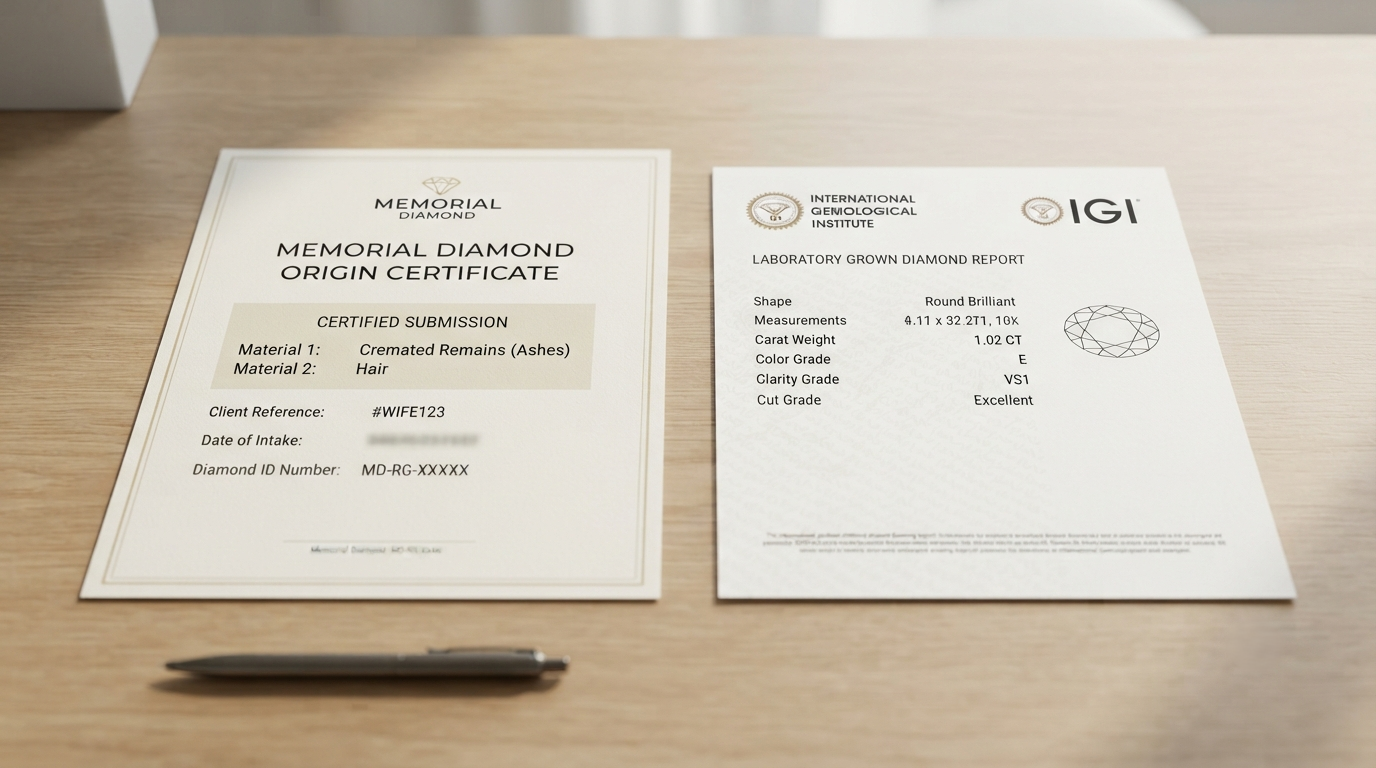
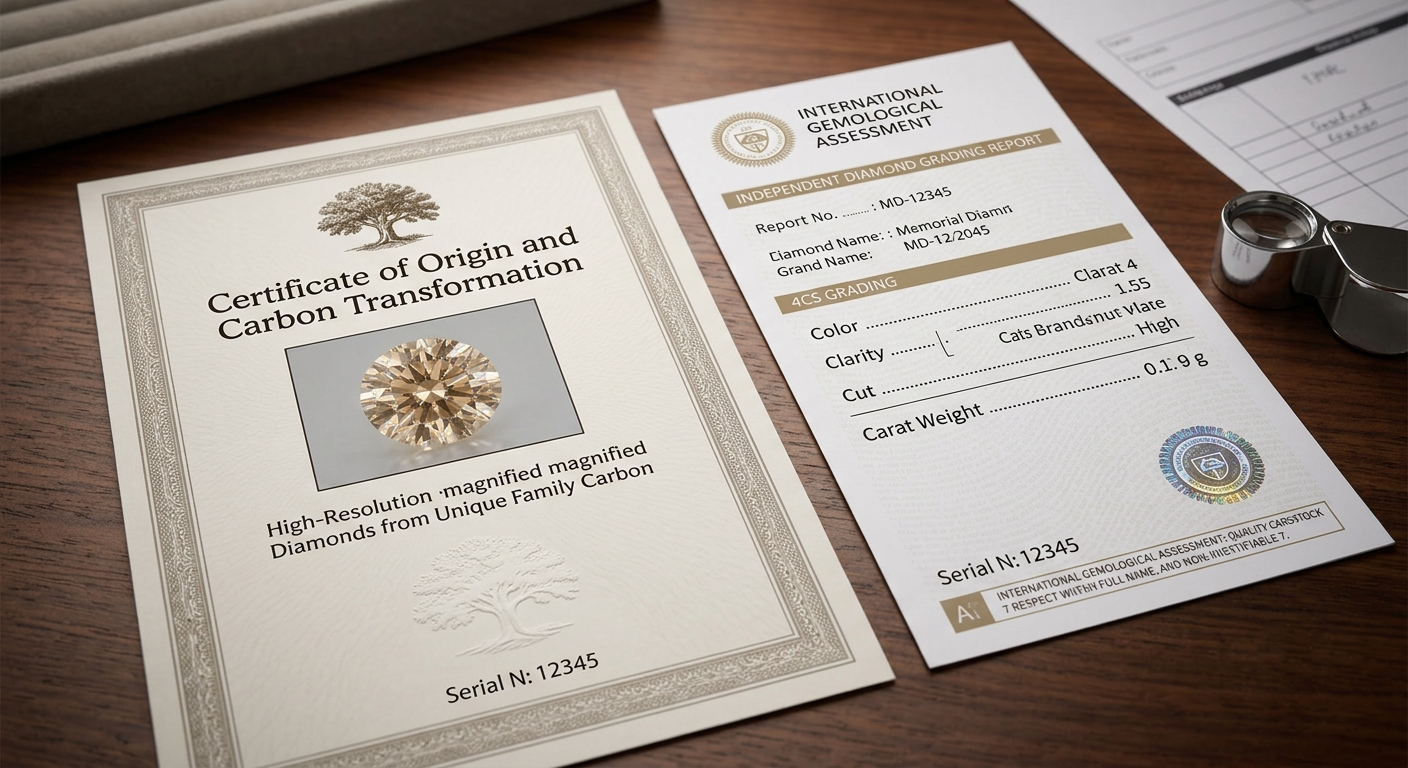
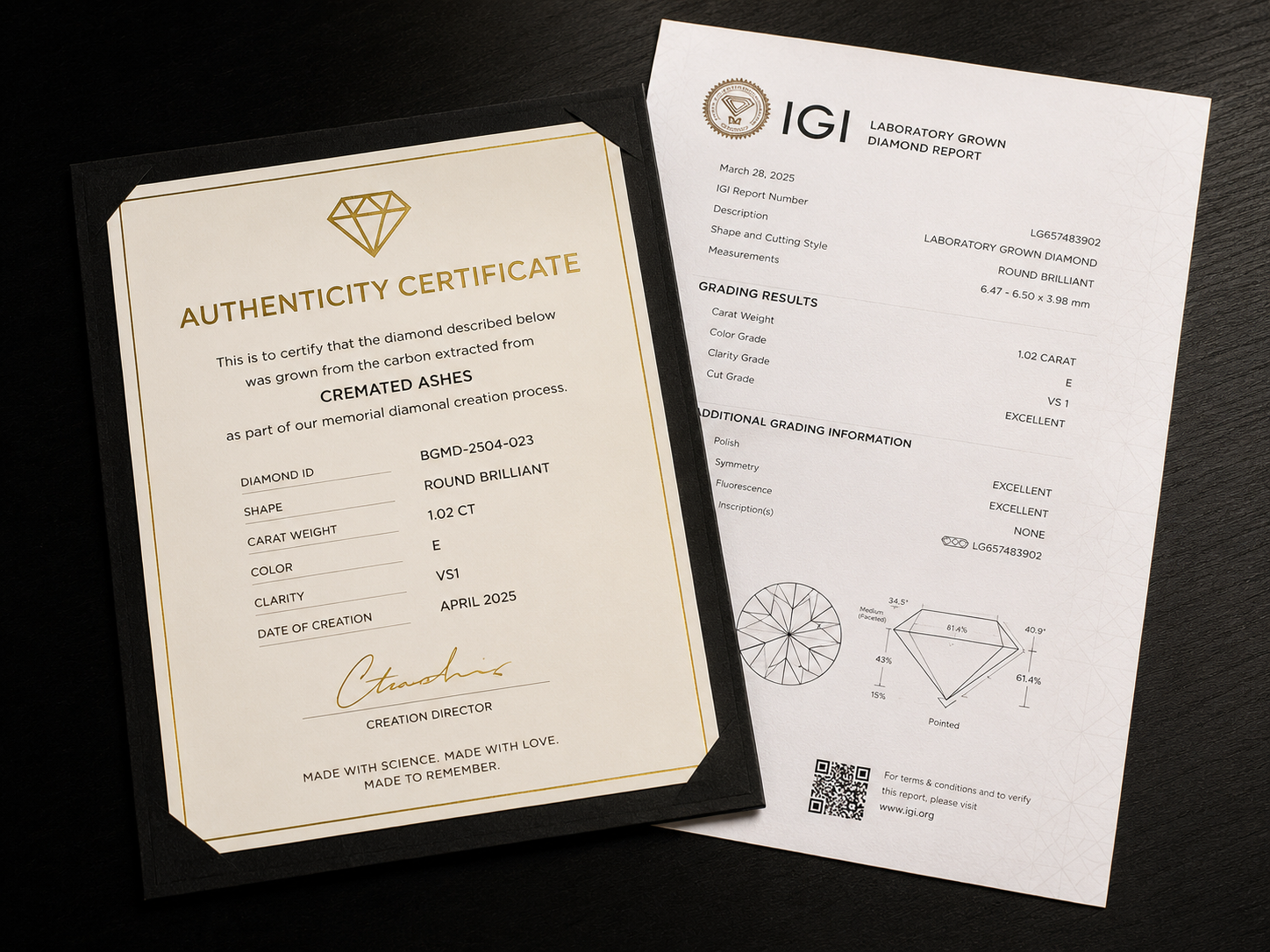
An origin, or authenticity, certificate is the provider’s attestation that this specific stone was grown from this specific submission. It is the summary of the custody record, and for a stone really made from your wife’s ashes and hair it must name both materials.

A certificate that reads “grown from the cremated remains of…” and never mentions hair does not record what you sent. Neither does one that says “from the hair of…” alone. For a diamond really made from your wife’s ashes and hair, the certificate should carry:

  • your submission reference number, matching your intake paperwork;
  • both materials, named, “cremated remains and hair” or equivalent;
  • the date of intake and the date of completion;
  • the carat and, ideally, the stone’s inscription number if the girdle is inscribed.

Ask for the exact wording that will certify a stone really made from your wife’s ashes and hair before the material leaves the house. Providers who have made combined stones before will have a two material template and will show it to you. Providers who have not may only have a one material template, and you want to know that now, not in ten months.

One document the certificate is not: the grading report. A grading report, ideally from an independent lab applying GIA’s cut, color, clarity, and carat standards, documents the diamond’s quality. It is silent on origin and does not know or care how many materials the carbon came from. Both documents should arrive; only the certificate speaks to whether the stone is really made from your wife’s ashes and hair.

An origin certificate on a desk with two material lines visible, next to an independent grading report

Can the Finished Stone Be Tested to Show Two Sources?

No. A stone really made from your wife’s ashes and hair cannot be tested for that, for the same reason no memorial diamond can be tested for its source at all.

Carbon atoms from her ashes, carbon atoms from her hair, and carbon atoms from a lab feedstock are identical. Once they are in a crystal lattice together, no instrument can sort them, count them, or attribute them. A jeweler can confirm the stone is a real diamond. An independent lab can grade it and identify it as lab grown. Neither can tell you whether one source or two went in, or in what proportion. The same limit applies to every stone in the memorial diamond category, whatever it was grown from.

This is why the proof for a diamond really made from your wife’s ashes and hair is entirely procedural, the one record, the combination entry, the two material certificate, and why the checks on this page happen before sending, not after receiving. After the stone arrives, the record is all there is. There is no test to fall back on if the record is vague, and no way to establish later that the ashes were included if the provider did not log it at the time.

If that sounds like a reason to be careful about a stone really made from your wife’s ashes and hair, it is. It is not a reason to distrust the category. A provider who logs both materials and shows you the record has given you everything that can exist as proof.

The Two Irreplaceable Things Risk

A single material stone sends one irreplaceable thing out of the house. A stone really made from your wife’s ashes and hair sends two at once, and the precaution that follows costs nothing.

Keep part of both. Ashes can usually be divided, a combined submission typically needs only a portion, and the rest stays for the scattering, the interment, or the urn you already planned. Hair cannot be topped up once it is gone: if the lock is the only one you have, divide it and keep some before sending. This is the single most important practical point about a combined stone, and it is worth more than any question you ask the provider.

Three reasons the risk is worth naming:

  • Shipping. Two materials in one package means one loss event takes both. Ship tracked and insured, and keep the tracking number with your copy of the submission form.
  • The record. If the provider’s record turns out not to distinguish the two, and you kept part of each, you still hold what you started with. If you sent everything, you do not.
  • A second stone later. If a child or her sibling later wants their own stone, the kept portions make it possible. Questions to ask before turning your wife’s ashes and hair into a diamond covers how to raise this with the family before the material is divided.

None of this is unique to a diamond really made from your wife’s ashes and hair in kind, only in count. Two things are going at once; keep some of each.

Six Checks Before Anything Is Sent

Every check on this page is a question you can ask before either material leaves the house. In order:

  1. “How is a two material submission logged, one reference or two?” You want one reference with two intake lines.
  2. “Is the combination step recorded?” You want a dated entry showing when the two purified carbons were merged.
  3. “Roughly what share of the personal carbon will come from the ashes, and what from the hair?” You want a lopsided range and a reason, not “equal.”
  4. “Can I see a sample chain of custody record for a combined stone?” You want a document, not a sentence.
  5. “What will the origin certificate say?” You want both materials named and your reference number on it, in writing, before sending.
  6. “Will you confirm receipt of both materials by name?” You want “ashes and hair received,” not “package arrived.”

A provider who has made a stone really made from your wife’s ashes and hair before will answer all six without hesitation. A provider who has not may still do the work well, but will need to build the record as they go, and you should decide in advance whether you are comfortable being the submission they learn on. How a memorial diamond is made from your wife’s ashes and hair walks through where each of these six sits in the seven stage process.

Frequently Asked Questions

Is a memorial diamond really made from your wife’s ashes and hair, or just one of them?

It is really made from your wife’s ashes and hair when both are logged under one submission reference, both are extracted, and the purified carbons are combined before growth. The only proof is the provider’s custody record and an origin certificate naming both materials; no test on the stone can show two sources.

Which material contributes more of her carbon?

The hair, usually by a wide margin. Hair is roughly 50% carbon by weight; ashes are under 4%. In most combined submissions the hair supplies the majority of the personal carbon and the ashes a real but smaller share. A provider implying an equal contribution is describing a symmetry the chemistry does not support.

Can the diamond be tested to prove both went in?

No. Carbon atoms from ashes, hair, and lab feedstock are identical once in the crystal lattice, and no instrument can attribute or count them by source. A jeweler can confirm it is a real diamond and a lab can grade it. Proof of two sources is entirely procedural, the record and the certificate.

What should the origin certificate say for a combined stone?

Both materials by name, cremated remains and hair, plus your submission reference, intake and completion dates, and the carat. A certificate that mentions only one material does not record what you sent. Ask for the exact wording before the materials leave the house.

Does combining make the stone bigger, a different color, or more expensive?

No. Carat is set by growth time in the press, not by material. Color depends on trace nitrogen or boron as with any memorial diamond. Most providers price by carat, color, cut, and grading; a few add a modest fee because extraction runs twice. Combining changes meaning, not the stone’s specifications.

Should I keep part of the ashes and the hair?

Yes, both. A combined submission needs only a portion of the ashes, and the rest stays for whatever you planned. Hair cannot be topped up once sent, so divide the lock and keep some. Keeping part of each protects you against loss in shipping and against a record that turns out to be vague.

Final Thoughts on Whether It Is Really Made From Your Wife’s Ashes and Hair

The general question of whether a memorial diamond is real has a settled answer, and the two single material posts give it. The combined question is smaller and entirely about paperwork: one reference, two intake lines, a logged combination step, a certificate that names both.

A diamond really made from your wife’s ashes and hair is not harder to make than a single material stone, it is a stone whose proof has one more line in it, and whose provider should be able to show you that line before you send anything. Ask the six questions, keep part of both, and the stone that comes back will be what it says: partly her, from both of the two things you chose to send, and honestly recorded.

Learn More About Wife Memorial Diamonds

Talk With Memorial Diamond

If you hold both her ashes and a lock of her hair and want the six answers on this page, how a two material submission is logged, what share each contributes, and what the certificate will say, before either leaves the house, reach out to Memorial Diamond. Keep part of both in the meantime; there is no deadline on the rest.

: Memorial diamond made from partner ashes and hair, featuring a diamond, cremated ashes, and a lock of hair.

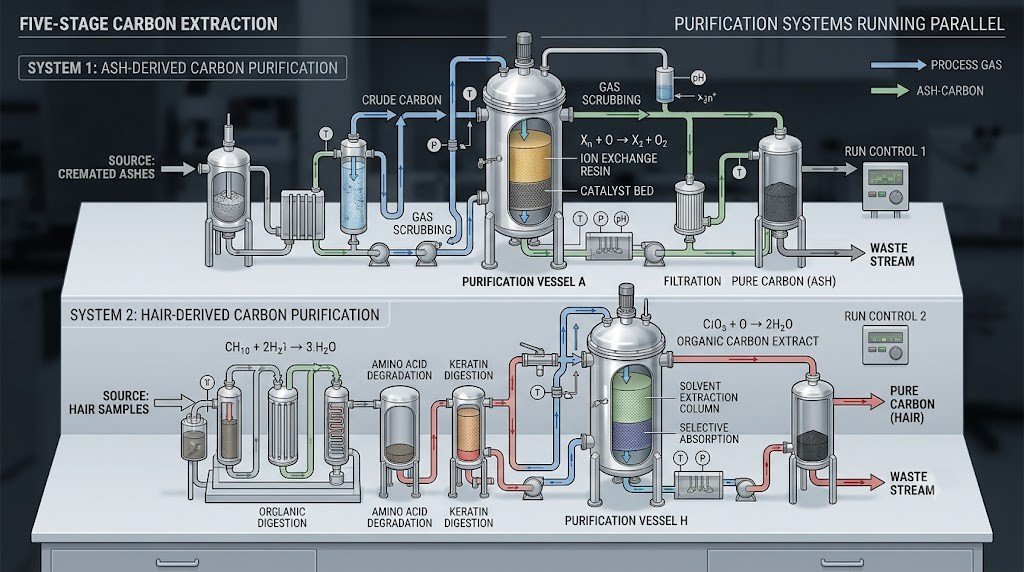
How a Memorial Diamond Is Made From Your Partner’s Ashes and Hair

Some people end up with both because of how the year went, a lock kept early, a portion of remains later.

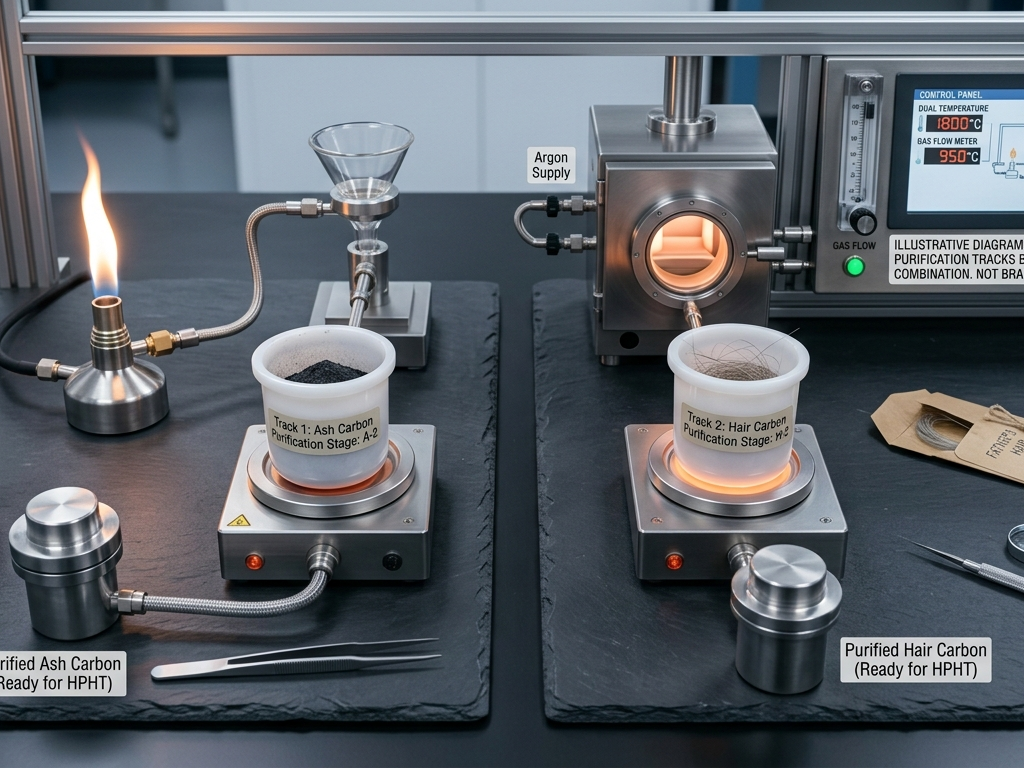
A memorial diamond made from partner ashes and hair is not one process. Each material is purified on its own track, ash to recover the 0.5% to 4% carbon it holds, hair to recover roughly half its weight in carbon, and each is graphitized separately at about 2,500 to 2,700°C. The two tracks meet only when both charges enter a single HPHT growth cell at roughly 6 to 8 GPa. Five stages in total.

That meeting point is the whole story of a memorial diamond made from partner ashes and hair. Everything that can be separately evidenced about the two materials happens before it, and nothing can be after.

Single champagne-toned memorial diamond made from partner ashes and hair, photographed beside two small sealed sample containers

Why Two Materials Means Two Separate Tracks

Ash and hair are not the same chemical problem, and nothing in the making of a diamond made from partner ashes and hair pretends they are.

Cremated remains are mostly calcium phosphate, which is bone mineral. The usable carbon inside that comes to roughly 0.5% to 4% of ash by weight, which means extraction is a long subtraction. Most of what you send is removed as mineral residue. Hair is keratin, roughly 50% carbon by weight, so extraction there is comparatively quick and far less lossy.

Two materials with yields that differ by more than an order of magnitude cannot be purified in the same vessel on the same settings. So a memorial diamond made from partner ashes and hair begins as two parallel operations that happen to be running for the same person, and for the same stone, at the same time.

That is not a complication to be apologized for. It is the reason a diamond made from partner ashes and hair can have its two materials separately weighed, separately logged, and separately accounted for right up to the moment they are combined. This provides more evidence, not less, than a single material stone can offer.

The Five Stages of a Memorial Diamond Made From Partner Ashes and Hair

1. Two intakes. The portion of ashes and the lock of hair arrive and are logged independently. This means separate weights, separate identifiers, and ideally separate dated photographs. Ask for two records rather than one combined receipt. This is where a diamond made from partner ashes and hair gains the documentation that makes it different from a single source stone.

2. Two purifications. Each material is heated in a controlled, oxygen free process that strips away everything that is not carbon, reaching roughly 99.9% or higher purity. The ash track loses the overwhelming majority of its submitted mass. The hair track loses roughly half. Two batches of purified carbon come out, still separate. At this stage a diamond made from partner ashes and hair still has two independently verifiable histories.

3. Two graphitizations. Each purified batch is heated to about 2,500 to 2,700°C and converted into graphite, the feedstock form a diamond press can use. There are now two graphite charges, still distinguishable because they are still in different containers, not because anything about them is chemically different.

4. One growth cell. Both charges, combined with supplemental lab grown carbon, are loaded into a single HPHT growth cell around a tiny diamond seed and held at roughly 6 to 8 GPa and 1,400 to 2,500°C for weeks to months. This is the convergence point, and it is the only one.

5. One stone, cut and graded. The rough crystal is cut and polished, then assessed against the same cut, color, clarity, and carat standards used for any diamond, ideally by an independent third party laboratory. One stone comes out. A diamond made from partner ashes and hair has no ash half and no hair half.

Where Do the Two Tracks Actually Converge?

For a diamond made from partner ashes and hair, convergence happens at stage four. Both graphite charges are weighed into the growth cell alongside the supplemental lab carbon, and the cell is sealed.

Up to that moment, everything is separable. Two weights at intake. Two purification runs with two batch records. Two graphite charges sitting in two containers with two identifiers. A memorial diamond made from partner ashes and hair has, at that point, a paper trail with two distinct branches, each traceable back to a different material and a different day.

The instant the cell is sealed and pressurized, those branches end. Carbon purified from ash and carbon purified from hair are the same element in the same form. Graphite is graphite, whatever it used to be part of. They do not layer, settle, or occupy separate regions of the crystal. They dissolve into the same molten metal flux and deposit onto the same seed, atom by atom, in no particular order.

StageAsh TrackHair TrackWhat Can Be Separately Evidenced
1. IntakePortion weighed, logged, identifiedLock weighed, logged, identifiedTwo weights, two dates, two identifiers
2. PurificationLong subtraction. Most mass removed as mineralShorter run. Roughly half the mass retainedTwo batch records, two yields
3. GraphitizationAsh derived carbon to graphite at 2,500 to 2,700°CHair derived carbon to graphite at 2,500 to 2,700°CTwo charges, two container records
4. Growth CellCharge loaded with lab carbonCharge loaded with lab carbonNothing after this point. The cell is sealed.
5. Cutting and GradingOne stoneOne stoneThe stone’s own 4Cs, and nothing about origin
two separate purification vessels processing ash-derived and hair-derived carbon on parallel runs


After Convergence, Can Anyone Tell the Two Apart?

No. This is the part of a diamond made from partner ashes and hair worth stating plainly, because a reader who suspects it and is never told clearly may assume the worst.

Once both charges are in the growth cell, no test performed on the finished diamond can identify which carbon came from the ashes, which came from the hair, and which came from the supplemental lab feedstock. A grading report will not show it. A gemologist with a loupe will not see it. There is no analysis of a diamond made from partner ashes and hair that separates the sources, because after purification there is nothing left to separate. There are only carbon atoms, chemically identical regardless of what they used to be part of.

That also means nobody can verify a stated proportion after the fact. If a stone is described as using both, the honest meaning of that statement is that both entered the process and both are recorded as having done so. It does not mean both are measurable in the finished crystal.

Two consequences follow for anyone considering a diamond made from partner ashes and hair, and they are the practical reason to read this before starting rather than after.

The first is that the value of the two track structure in a diamond made from partner ashes and hair is entirely upstream. Insist on the separate records while the tracks are still separate, because the window closes at stage four and does not reopen.

The second is that any provider claiming to demonstrate the split in a finished stone is claiming something that is not physically available. That is a useful test of how the rest of their answers should be read.

So What Can Be Documented About a Diamond Made From Partner Ashes and Hair?

Quite a lot, as long as you ask for it in the right window. What can be documented is every fact created before the cell was sealed.

  • Two intake records, each with its own date, weight, identifier, and ideally a photograph of the material as received.
  • Two purification batch records, tying each identifier to a specific run rather than to a general statement that material was processed.
  • Two graphitization records, confirming both charges existed as separate feedstock before loading.
  • A cell loading record naming both identifiers and the supplemental lab carbon added. This is the single most important document for a memorial diamond made from partner ashes and hair, because it is the last one that mentions two sources.
  • An origin or authenticity document that names both submissions explicitly, rather than referring vaguely to submitted material.
  • A grading report, which describes the stone’s quality and says nothing at all about origin. The two documents answer different questions and neither substitutes for the other.

Neither track yields the volume a growth run consumes, not separately and not added together. Both purified batches are made up with lab grown carbon before the cell is sealed, which means the personal carbon in a diamond made from partner ashes and hair is real, traceable to two named submissions, and still a minority of the crystal’s mass. Any description that implies otherwise is describing a stone that does not exist.

Does Using Both Materials Change the Stone Itself?

Not in a way anyone can see, and it is better to know that now.

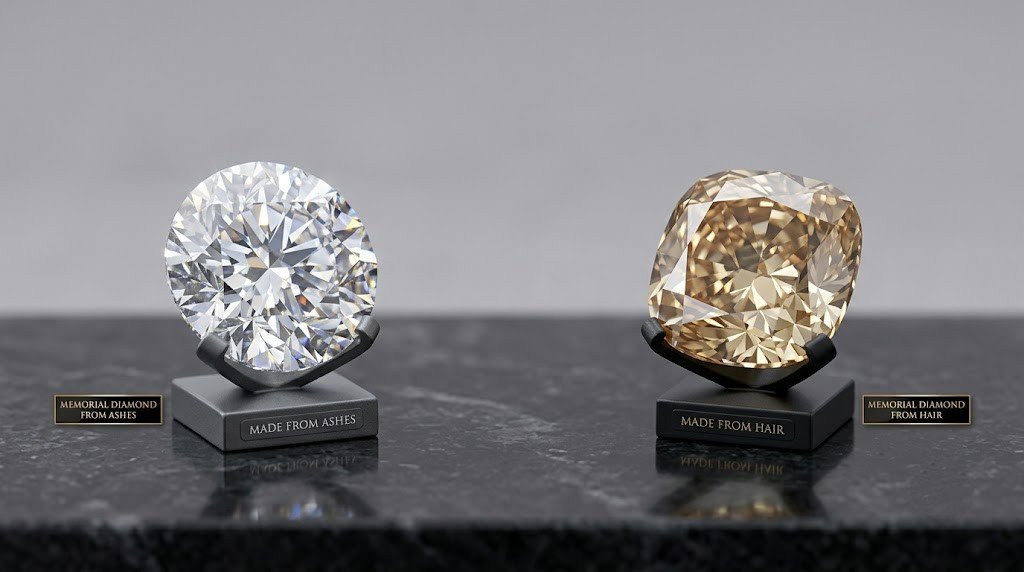
Color. Trace elements drive color. Nitrogen can contribute toward yellow, boron can contribute toward blue, and colorless material requires the absence of both. Both ash and hair are organic sources that bring trace elements with them, so a memorial diamond made from partner ashes and hair sits in the same realistic range as a single material stone. Yellow, blue, or champagne are possible, while colorless material can require more process control and typically costs more. Nobody can forecast a precise shade from either material or from the combination.

Size. For a diamond made from partner ashes and hair, carat is bought as growth time, not as quantity of material. Submitting two materials instead of one does not produce a larger stone, and does not shorten the run.

Timeline. Industry wide, the whole sequence typically runs six to ten months, sometimes twelve for larger or specialty color stones. Two purification tracks can add a little at the front end if they are run sequentially rather than in parallel. The press is where almost all of the months live, and the press does not care how many sources fed it.

Quality. A diamond made from partner ashes and hair is graded on exactly the same 4Cs as any other stone. There is no separate scale, no allowance, and no penalty.

Can the Two Tracks Become Two Separate Stones Instead?

Two finished memorial diamonds of similar size displayed separately rather than set together

Yes, and this is the option most people do not realize they have until someone says it out loud.

If the two materials never enter the same growth cell, they never converge. This means they stay separately evidenced permanently. An ash grown stone and a hair grown stone, each with its own intake record, its own batch history, and its own origin document, preserve a distinction that a diamond made from partner ashes and hair gives up at stage four by design.

There are real trade offs, and they run in both directions.

  • Two stones cost more than one. Each needs its own growth run, and growth time is the dominant cost in every memorial diamond. Two half carat stones will not cost what one half carat stone costs.
  • Two stones take the same time, not twice as long, if the runs happen in parallel. Sequential runs would change that answer considerably.
  • Two stones can go to two people. This is often the deciding factor. One stone has to live somewhere. Two can be shared without anyone having to give anything up.
  • One stone concentrates everything. For many people that is precisely the point, and the loss of separability is a price they are glad to pay.
  • You can also do one of each and keep the rest. A memorial diamond typically uses only a portion of the available material, so choosing one route now rarely forecloses the other later.

The question to sit with is not which option is more meaningful. Both follow the same physics. The question is whether the distinction between the two materials is something you want to be able to point at in ten years. If it is, a diamond made from partner ashes and hair is the wrong shape for it, and two stones are the right one. If it is not, one stone is simpler and cheaper.

Why Families Choose Both Anyway

Knowing that the combination is invisible in the finished stone does not make a diamond made from partner ashes and hair pointless, and it is worth being clear about why.

The reason for a diamond made from partner ashes and hair is usually circumstantial rather than symbolic. A lock of hair was kept at some point, from a haircut before an illness, from a hospital stay, or from a drawer nobody had cleared. A portion of ashes became available later. Using both is less a decision than an acknowledgment that both exist and neither felt right to leave out.

Sometimes it is about standing. Who controls a person’s remains is settled state by state rather than by any nationwide statute, and a written direction left by your partner can shift it again on top of that. The standing does not attach to a partner as a matter of course, and it attaches least reliably where the relationship had no recognition in law or was not known to everyone. Hair may be the material you can act on without permission. Ashes may become available only later, or only partly. A diamond made from partner ashes and hair sometimes reflects that sequence rather than a plan.

And sometimes it is simply that the two materials represent different periods, one from when your partner was alive, one from after. That is a real reason. It does not need to be measurable in the crystal to be true.

What matters is that the reason is yours, and that the record describes what actually happened.

Frequently Asked Questions About a Memorial Diamond Made From Partner Ashes and Hair

Are the ashes and hair processed together?

No. In a diamond made from partner ashes and hair, each material is purified and graphitized on its own track, because their carbon yields differ by more than an order of magnitude. The two only meet when both graphite charges are loaded into a single growth cell.

Can a lab prove both materials were used?

Not from the finished stone. Proof exists only as records created before the growth cell was sealed. These include two intake logs, two batch records, and a cell loading document naming both identifiers. Ask for those specifically.

Can I choose the proportion of each material?

You can specify how much of each is submitted and have those weights recorded. What you cannot do is verify a proportion in the finished crystal, because purified carbon carries no marker of its origin.

Does using both materials make the diamond more genuinely my partner’s?

Not measurably. A diamond made from partner ashes and hair draws real personal carbon from both sources, and both are blended with lab grown carbon to reach a viable volume. What changes is the documentation, which traces two submissions instead of one.

Will it cost more than a single material stone?

A diamond made from partner ashes and hair can add process steps, and some providers price that separately. Size, color, and whether an independent grading report is included drive cost far more than the number of source materials.

What if one material turns out to be unusable?

Ask what happens before you send anything, whether the run proceeds on the remaining material, whether you are told first, and what is recorded. This is a question to settle in advance, not one to discover partway through.

Final Thoughts on a Memorial Diamond Made From Partner Ashes and Hair

The honest shape of a memorial diamond made from partner ashes and hair is two lines that run parallel for four fifths of their length and then become one line permanently. Almost everything you might want proven about the two materials is provable while those lines are apart, and none of it is provable afterward.

So the useful work happens early. Two records at intake, two batch records, and one loading record that names them both. Ask for those while asking still changes something. After the cell is sealed, the only honest answer anyone can give you about which carbon came from where is that the paperwork says so, which is a good answer, provided the paperwork exists.

Learn More About Partner Memorial Diamonds

Talk With Memorial Diamond

If you have both materials and want to understand how each would be handled, reach out to Memorial Diamond and ask what gets recorded at each intake and what the cell loading document will say. Those are the questions worth asking while the two tracks are still separate.

Memorial diamond colors for a wife, showing a champagne-toned memorial diamond ring with yellow, champagne, blue, and colorless diamond color options.

Memorial Diamond Colors for a Wife: What to Expect

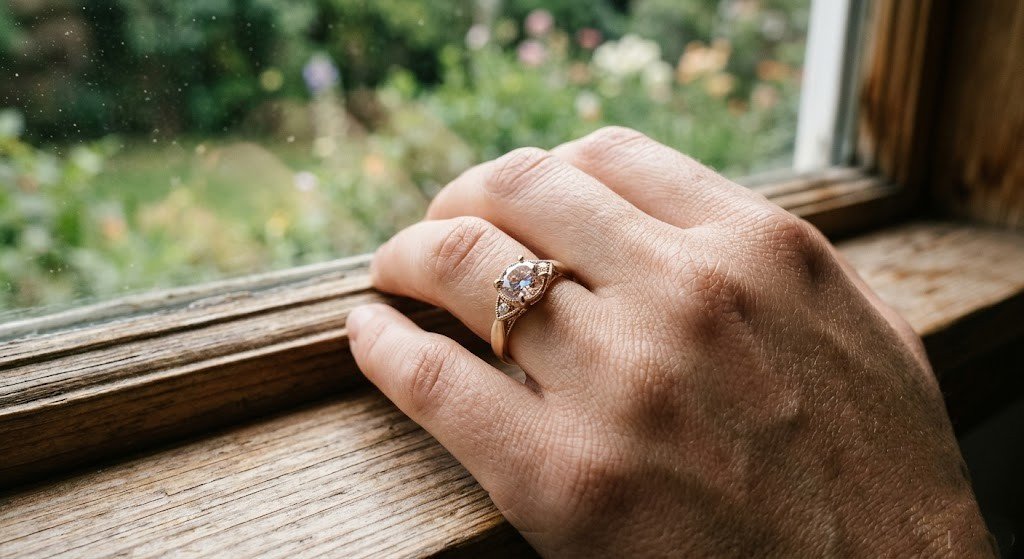
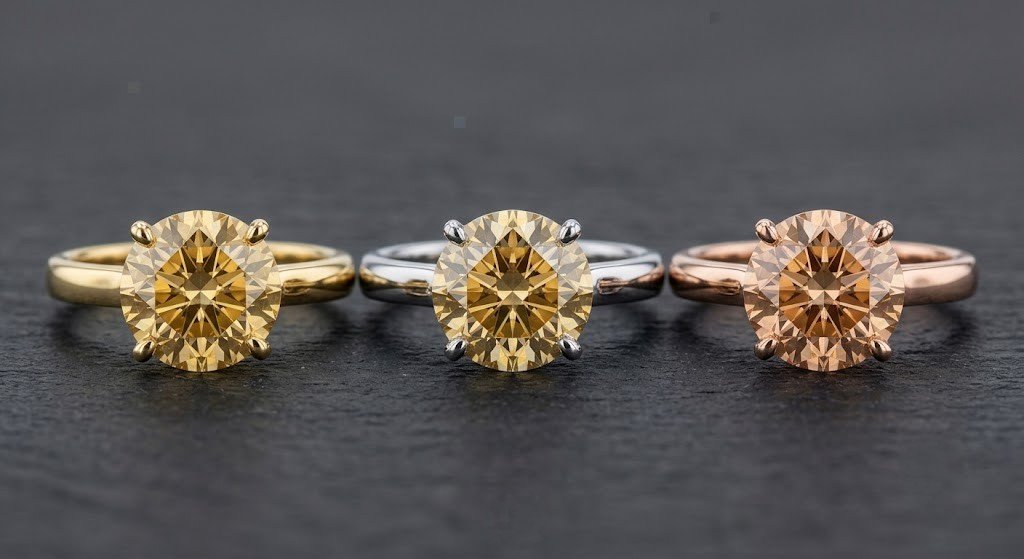
Memorial diamond colors for a wife shown on a champagne-toned ring worn on a hand in ordinary window daylight

Why Do Memorial Diamond Colors for a Wife Lean Warm Rather Than Colorless?

Three trace elements decide almost everything about memorial diamond colors for a wife. Nitrogen in the growing crystal reads as yellow. Boron reads as blue. A diamond reads as colorless only when neither is present at all colorless is an absence, not an ingredient, which is why colorless sits at the far end of the memorial diamond colors for a wife that families are actually offered.

That single fact explains the whole category. The memorial diamond colors for a wife that families are most often handed sit in the yellow, champagne, and brown band, with blue appearing less often, because the feedstock did not begin life as a clean synthetic powder. It began as a person, and organic material brings trace elements along with it.

Her carbon also does not make the whole crystal by itself. What is recovered from the ashes is purified and then loaded into the growth cell alongside lab-grown carbon, because a growth run needs more feedstock than any personal source supplies. Ash is roughly 0.5% to 4% carbon by weight to begin with, which is why the volume has to be made up. That blending does not wash out the trace elements, so the memorial diamond colors for a wife that result still come from an organic starting point.
None of that predicts a specific shade, and this page does not try to. Forecasting is a different question, answered in what color a diamond made from her ashes will be and in the hair version of the same question. The broader category picture sits in why memorial diamonds are rarely colorless.

What is left over, once forecasting is handed off, is the part nobody prepares you for: memorial diamond colors for a wife do not behave like paint chips. They move. Not the stone the stone is fixed the moment it comes out of the press but what you see when you look at it.

What Changes Between the Photograph and Your Hand?

A product photograph does not record a stone. It records what one lighting rig did to a stone on one afternoon. That gap matters more for memorial diamond colors for a wife than for anything in a shop window, because you are being asked to picture an object that does not exist yet.

A stone shot for a website is usually sitting in a lightbox: diffuse, even, color-corrected light, a white or black background chosen to flatter, and a lens close enough to make a five-millimeter object fill a laptop screen. None of those conditions exist in your kitchen. So the memorial diamond colors for a wife that you saw on a screen were accurate and also not transferable.

Scale changes. A half-carat round stone is about five millimeters across. On a product page it is nine hundred pixels wide. Color reads more intensely at nine hundred pixels than at five millimeters, and memorial diamond colors for a wife are usually first judged at the larger of those two sizes.

Background changes. A lightbox background is neutral by design; your hand is not. Skin is warm, and a warm background pushes a warm stone warmer and makes a near-colorless stone look less white than it did against white card. Memorial diamond colors for a wife are almost always seen against skin in the end.

Light changes, constantly. This is the big one, and it does more to memorial diamond colors for a wife than the other two put together.

Worth asking for, then, rather than a better photograph: the same stone photographed twice under two named light sources, and one frame with a hand in it for scale. How a memorial diamond is made from her ashes covers what happens before that frame is ever shot

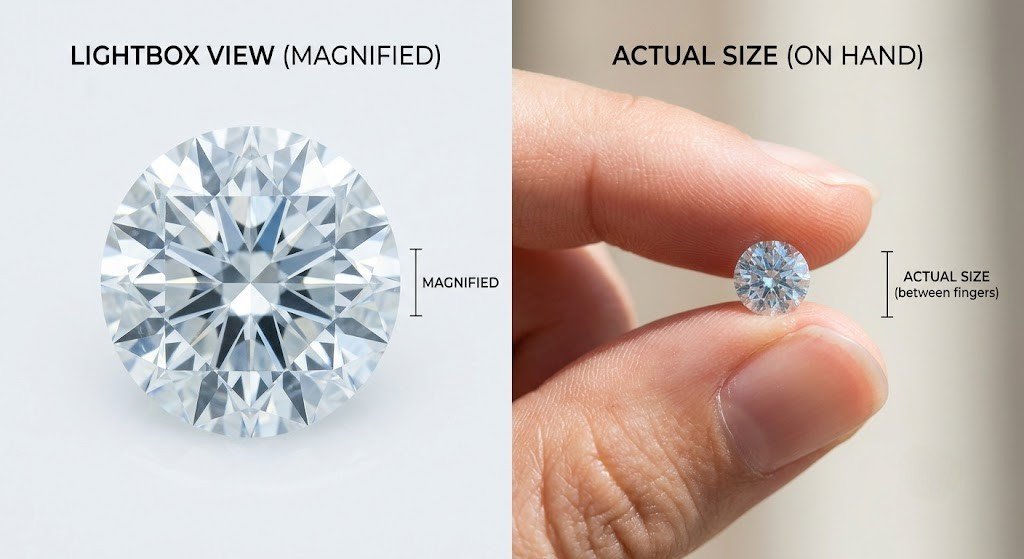
The same loose memorial diamond shown twice, once magnified in a lightbox and once at actual size between finger and thumb

Why Does the Stone Look Different in the Kitchen Than at the Bedside?

No. This is the most useful physical fact on the page about memorial diamond colors for a wife, because it is the one that surprises people after delivery rather than before.

Grading happens under controlled laboratory lighting, chosen because it does not vary. That is what makes a grade comparable, and also what makes it unlike your house. Real rooms are full of light with a color temperature, and that temperature pushes a stone around. Six lights cover almost every room a piece will be worn in, and memorial diamond colors for a wife behave differently in each of them. Memorial diamond colors for a wife are not a single reading; they are a range across the lights you actually live in.

Light you actually live inWhat it does to a warm stoneWhat it does to a near-colorless stoneWhere you meet it
Warm incandescent or 2700K bulbDeepens the yellow or champagne; honey and amber notes come forwardLends a faint warmth it does not have on paperBedside lamps, living rooms, most older fittings
Cool LED around 5000KThins the warmth; champagne can read almost grayReads cleanest and whitest hereKitchens, bathrooms, task lighting, car interiors
North-facing indirect daylightThe most neutral reading you will get at homeReads close to its graded positionA window seat on an overcast day
Direct sunlightBrightness swamps tone; the stone looks paler and more sparkling than it isLooks whiter still; contrast hides everythingOutdoors, mid-morning, on the back of your hand
Candlelight or very low lightStrongly warm; even a blue stone loses its coolnessPicks up the warmest cast it will ever showDinner, evenings, anywhere with one soft source
Fluorescent tube or screen glowSlightly green-cool; warm stones look muddierCan look faintly gray rather than whiteOffices, supermarkets, a face lit by a monitor

The same stone can be honey-warm at a bedside lamp and almost pale under the kitchen downlights four hours later, and neither reading is the wrong one. Memorial diamond colors for a wife are a band, not a point.

The practical consequence is small and it works: do not settle your impression of the memorial diamond colors for a wife on the first evening. Give it a week of ordinary use instead worn to work, sat under a lamp, taken outside once. You are mapping a band, not reaching a verdict.

How Much Does the Metal Around It Change the Color?

More than most people expect, and in two different ways at once. Metal is the second half of what governs memorial diamond colors for a wife once the stone exists.

The first way is contrast. Set a warm stone in white metal and the eye compares the two: the stone looks warmer than it did loose, because there is something colder next to it. Set the same stone in yellow gold and the contrast collapses — the warmth stops looking like a property of the stone and starts looking like a property of the whole piece.

The second way is reflection. A diamond is transparent, and light that reaches it off the mount comes back out carrying some of the mount with it. A yellow gold basket under a near-colorless stone can lend it a faint warmth that no grading report would ever record. That is not a fault in the stone or the setting; it is what happens when you put a clear object on a colored one, and it is why memorial diamond colors for a wife are partly a jewelry decision rather than purely a laboratory one.

How much metal touches the stone matters too. A bezel wraps the girdle in a continuous rim and puts a great deal of metal against the stone; four slim prongs put very little. So two identical stones, one bezel-set in yellow gold and one prong-set in platinum, will not read as the same memorial diamond colors for a wife, even with identical grading lines.

  • Yellow gold flatters a warm stone and warms a near-colorless one. It is the forgiving choice if the shade is unknown.
  • Rose gold does the same thing more strongly, and pushes champagne toward a pinkish brown.
  • White gold is almost always rhodium plated. Rhodium is bright white and wears off over years, so the piece can read cooler when new and warmer once the plating thins and then cooler again after replating.
  • Platinum is naturally white, does not need plating, and holds its reading for decades.
  • A band she already wore has already decided this question for you, which is a reason to talk about the stone’s shade before the stone exists rather than afterward.

Which mount holds the stone, and how much of it touches, belongs to the wife memorial diamond settings question rather than this one.

What Colorless Actually Costs, and Why

Colorless is expensive because of what it is defined as, and it is the one point on the scale of memorial diamond colors for a wife that cannot be reached by adding anything.

Every other shade is something present. Colorless is two things absent no nitrogen, no boron which means it cannot be added at the end. It has to be engineered out at the front, with tighter control over the feedstock and the growth environment, and that shows up industry-wide as a meaningfully higher price at the same carat weight rather than as a surcharge on a line item. How gemologists assess and record that position is set out in the four factors used to grade any diamond, and the way those factors are recorded is covered in how memorial diamonds are graded and certified.

Some providers also offer post-growth irradiation to produce red, pink, green, or black stones. That is color added after growth rather than grown in, and it is worth knowing which of the two you are being offered when a color is named, because they are different processes with different implications for the report. Both routes appear in conversations about memorial diamond colors for a wife, often without the difference being spelled out. The mechanics of growth itself are described in the general literature on high-pressure high-temperature and vapor-deposition diamond growth.

Where that lands on an invoice belongs to what a wife memorial diamond costs. The color point to carry forward is narrower: when someone quotes a price difference between shades of memorial diamond colors for a wife, the difference is describing how hard the absence was to achieve, not how rare the color is.

Deciding the Metal Before You Know the Stone

Here is the sequencing problem nobody warns families about. The stone takes months. The setting is usually chosen alongside or before it. So most people pick a metal for memorial diamond colors for a wife that do not yet exist.

There are five sensible ways to handle that, and none of them requires knowing the shade in advance. All five are ways of keeping a decision about memorial diamond colors for a wife open for as long as possible.

  1. Ask whether the stone can be returned loose and set later. If it can, the whole problem disappears: you see the shade, then you choose the metal. Ask what that adds in time, and who does the setting.
  2. If the metal has to be chosen first, choose the forgiving one. Yellow gold sits well with almost anything the growth cell is likely to produce. It is the low-regret answer when the shade is genuinely unknown.
  3. Ask whether any white gold in the design is rhodium plated. Plating is not a flaw, but it means the piece drifts in appearance and is then restored, on a cycle, for as long as it is worn.
  4. Ask to see the stone against a physical metal sample before anything is set. A sample card of yellow, white, and rose beside the actual stone settles the question of memorial diamond colors for a wife in ten seconds, where a rendering cannot settle it at all.
  5. If it is going into a band she already wore, treat the metal as fixed and talk about the stone instead. That constraint is worth naming early rather than late.

None of the five requires you to guess a shade. All five simply buy time.

Living With a Color Nobody Could Forecast

The stone does not change after it leaves the press. What changes is how practiced you are at looking at it, which is the last thing worth saying about memorial diamond colors for a wife.

For the first weeks you will check the color constantly, and every light will feel like new information. After that it settles into being simply what the stone looks like. That is not a loss of interest; it is the ordinary way a worn object stops being an event, and memorial diamond colors for a wife stop being news faster than people expect.

Strangers will ask about it, too a jeweler cleaning it, a colleague who notices it, someone at a till who likes the look of it. You are never obliged to reach for the grading language in those moments, and in practice a plain description lands better than a technical one.

And a color arriving that you did not pick is not a defect. It is the direct consequence of the thing that makes the stone worth having: the carbon came from a person rather than a controlled feedstock, and people are not uniform. The whole decision, from material to finished piece, is laid out in the complete guide to a wife ashes diamond.

A white gold band photographed showing rhodium plating worn thin on the underside | Stock acceptable; the worn area must be visible or the image makes no point

Frequently Asked Questions

What are the most common memorial diamond colors for a wife?

Yellow, champagne, and brown tones are the usual range for memorial diamond colors for a wife, with blue appearing less often and colorless least of all. Nitrogen present during growth reads yellow, boron reads blue, and a colorless stone requires the absence of both.

Can I choose the color before the stone is grown?

Some providers offer named color options, so you may be able to state a target. Ask what that name has meant for memorial diamond colors for a wife in finished stones, and whether the color is grown in or added afterward by irradiation.

Why do memorial diamond colors for a wife look different in photographs?

Product photographs are taken in diffuse, color-corrected lightbox conditions against neutral backgrounds, at magnifications that make a five-millimeter stone fill a screen. Your hand is warm, your rooms are not color-corrected, and scale alone changes how strongly a tone reads.

Does the metal the stone is set in really change its color?

Yes, in two ways. White metal makes a warm stone look warmer by contrast, and a colored mount reflects light back through a transparent stone. A bezel touches far more of the stone than four slim prongs, so it transfers more.

Will the color of the stone fade or change over time?

No. Memorial diamond colors for a wife come from trace elements locked in the crystal lattice during growth, and they are permanent. What can change is the setting around it rhodium plating on white gold wears and is replaced, which alters how the stone reads.

What if the color that arrives is not the one I pictured?

Give it a full week before concluding anything, since one evening under one lamp is not enough to judge by. Then fall back on what you settled about metal, and on the fact that memorial diamond colors for a wife come from a person rather than a catalog.

Final Thoughts on Memorial Diamond Colors for a Wife

The honest summary is that memorial diamond colors for a wife cannot be promised and can be prepared for. The shade is decided in the growth cell by trace elements nobody controls precisely. What you see afterward is decided by light and by metal, and both of those are yours to choose, ask about, and settle before anything is cut or set.

So do the small things early: two lights, a hand for scale, and a straight answer about what the mount will actually touch.

Learn More About Wife Memorial Diamonds

Talk With Memorial Diamond

If a shade has been named to you and you want it turned into something you can actually picture, Memorial Diamond is one place to have that conversation memorialdiamond.us.

Ash and hair for a wife memorial diamond: a small sealed ash container and a tied lock of hair in a paper envelope, both labeled with the same reference, beside a loose champagne lab-grown diamond

How Much Ash and Hair Do You Need for a Wife Memorial Diamond?

You have a small amount of her ashes set aside and a lock of her hair in an envelope, and you are trying to work out whether both together is enough or whether you are about to send too much of two things you cannot get back. The ash and hair for a wife memorial diamond usually add up to less of each than the two standalone minimums, because hair is roughly 50% carbon and carries most of the load. So the number to ask a provider for is the combined minimum, not the sum of two separate figures.

This page covers only what changes when both materials go together, the quantity of ash and hair for a wife memorial diamond sent as one submission. The standalone quantities are on their own pages: how much ash you need and how much hair you need.

Why Is the Combined Minimum Less Than Two Standalone Figures?

Because the two materials are not equal contributors, and a provider who understands that does not need the full amount of both.

Hair is keratin, roughly 50% carbon by weight. Cremated remains are almost entirely calcium phosphate, with only about 0.5% to 4% usable carbon. A standalone ash minimum, typically a few tablespoons to roughly 4 oz, is sized to recover enough carbon from a poor source. A standalone hair minimum, a small lock, a few grams, is sized to recover the same carbon from a rich one.

Put the two together and the hair does most of the work. A small lock alone usually clears the carbon requirement for a growth run. The ashes then contribute a smaller share, and the provider needs less of them than the standalone figure implies. That is why the ash and hair for a wife memorial diamond, quoted as a combined submission, is often “less ash than usual plus a small lock”, not the two standalone figures side by side.

Simple diagram comparing carbon content by weight: hair at roughly half, cremated remains at a small fraction

What the ash and hair for a wife memorial diamond do not do together is change the stone. All of the personal carbon, from both sources, is purified to 99.9%+ and blended with supplemental lab carbon, and it typically makes up around 10% to 15% of the finished diamond regardless of how many materials it came from. The stone is not “100% her” with one material and not more so with two. Wife Ashes and Hair Diamond: The Complete Guide covers when combining makes sense and when one material is simpler.

Why Ask for the Combined Minimum Instead of Adding Two Numbers?

Because adding two numbers is what a price list does, and it can cost you material you wanted to keep.

A provider’s published figures are usually written per material. Ask “how much ash” and “how much hair” as two questions and you will get two answers, and may send both in full when the provider would have accepted less of each. The ash and hair for a wife memorial diamond should be quoted as one figure for one submission at one carat. Ask, in writing:

  1. “For a combined ashes and hair submission at [carat], how much of each do you need?”
  2. “If I hold less ash than your standard minimum, does the hair make up the difference, and how much less?”
  3. “If I hold only a few strands of hair, does the ash make up the difference?”
  4. “Do you return unused material of either kind?”

The answer you want to the first question is specific to both materials and smaller than the two standalone minimums. A provider who says “send the full amount of each to be safe” is telling you they have not thought about how the ash and hair for a wife memorial diamond interact, worth knowing before two irreplaceable things leave the house. A provider who has handled ash and hair for a wife memorial diamond before will give you a figure for each without being pushed. Questions to ask before turning your wife’s ashes and hair into a diamond lists the rest of what to settle beforehand.

When Does Combining Ash and Hair Rescue a Submission?

Most families who combine do it for meaning. But there are four situations where sending ash and hair for a wife memorial diamond together is what makes the stone possible at all, and people in them often assume they have nothing.

1. You kept very little ash

A keepsake vial, a small pendant’s worth, or what was recovered after a scattering may fall short of a standalone ash minimum. Add a lock of her hair, from a brush, a hairband, a saved envelope, and the combined submission usually clears the carbon requirement. The ashes still go into the stone; they simply stop being the material it depends on.

2. You hold only a few strands of hair

The reverse case. A few strands from a pillowcase or a comb may not be enough hair on their own. If you also hold her ashes, even a share portion, the ash and hair for a wife memorial diamond together can be enough where neither would be. Tell the provider exactly what you have of each, by weight if you can.

3. Two people hold one material each

Her sister has the lock she saved decades ago; you hold the ashes. Neither of you wants to give up what you have, and neither amount alone is comfortably enough. Sending the ash and hair for a wife memorial diamond as one submission lets both go into one stone under one reference, and both people keep part of what they hold. This is one of the more common ways a family arrives at combining without having set out to.

4. You want both moments in one stone

Hair is carbon she grew while she was alive. Ashes are what remained. Some families want both in one crystal lattice, and that is a good reason with no chemistry behind it. The quantity question here is simplest: send the combined minimum of ash and hair for a wife memorial diamond and keep the rest of both.

In all four, the practical step for working out the ash and hair for a wife memorial diamond is the same: ask for the combined minimum, state what you hold of each, and get the answer in writing.

Should You Combine, or Send One Material?

The table below works the decision through by what you are holding of ash and hair for a wife memorial diamond. It assumes general industry minimums, a few tablespoons to about 4 oz of ash, a small lock or a few grams of hair, and every row still needs the provider’s own figure to confirm.

What you hold of eachCombine, or single material?Why
Full urn + generous lockEither, decide on meaningBoth clear their standalone minimums; combining changes only what the certificate names
Full urn + a few strandsAsh alone, or combine for meaningThe ash carries it; the strands add meaning, not margin
Keepsake vial + generous lockCombineThe hair clears the carbon requirement; the vial joins it instead of falling short alone
Keepsake vial + a few strandsCombine, and ask carefullyTogether may be enough where neither is; state both by weight and ask about a smaller carat
No ash, buried, or fully scattered, + any lockHair aloneNothing to combine; the hair route stands on its own
Ash only, no hair anywhereAsh aloneCheck brushes, hats, and pillowcases first; if there is truly none, the ash minimum is the figure
Two households, one material eachCombine under one referenceBoth keep part; one stone carries both; one custody record ties them
Enough of both, but you want two stonesTwo single material or two combined stonesAsk whether one combined submission can yield two; each is grown and priced separately
A keepsake vial of ashes and a small lock of hair side by side on a plain table

The right hand column is the whole answer to how much ash and hair for a wife memorial diamond you need: the hair sets the floor, the ash adds to it, and a shortfall in one is usually covered by the other. Where both are generous, the ash and hair for a wife memorial diamond are a choice about meaning, not quantity.

How Do You Package Ash and Hair for a Wife Memorial Diamond Under One Reference?

Separately inside one shipment, both labeled with the same reference. The risk specific to sending ash and hair for a wife memorial diamond is that the two get logged as two jobs, and the link between them is lost somewhere between arrival and the growth cell.

  • Ashes go in the sealed, dry, rigid container the provider specifies, labeled with her full name, the word “ashes”, and the submission reference.
  • Hair goes in a paper envelope, not plastic, tied with thread, labeled with her name, the word “hair”, the source, and the same submission reference.
  • One submission form lists both materials and the amount of each. This form is where the provider’s chain of custody record starts.
  • One photograph shows both items, labeled, beside the form, with the date visible, your own record of the ash and hair for a wife memorial diamond that left the house.
  • One tracked, insured shipment. Keep the tracking number with your copy of the form.
  • Confirm receipt of both. Not “your package arrived”, ask the provider to acknowledge the ashes and the hair by name and amount.

Then ask one more question before anything ships: “At what stage are the two purified carbons combined, and is that step recorded?” Some providers process both together from the start; others purify separately and combine before graphitization at roughly 2,500 to 2,700°C. Either produces the same result. A provider who can tell you which, and show you the log entry, has done this before. How to turn your wife’s ashes and hair into a diamond covers the one custody record question and the certificate that should name both materials.

Why Keep Part of Each?

Because a combined submission takes two irreplaceable things from the house at once, and the two fail in different ways.

Hair cannot be topped up. Once extraction begins, the lock is consumed, and if it was the only one there is no second lock, no later stone, no strands for a locket. Ashes cannot be recovered either, but families usually hold the majority by default; the danger with the ash and hair for a wife memorial diamond is sending all of the hair, and more of the ash than the combined minimum required.
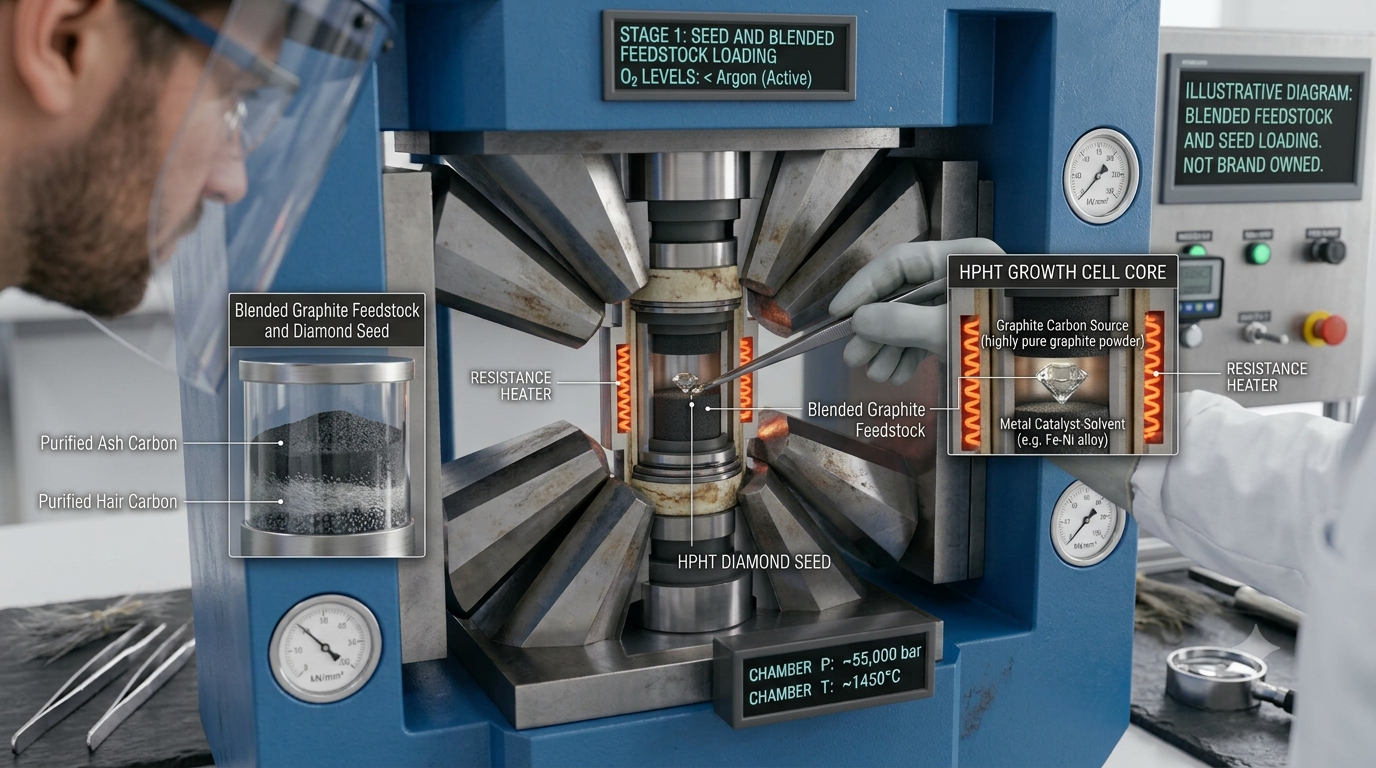
So before you measure the ash and hair for a wife memorial diamond:

  1. Divide the lock. Send what the provider asked for in the combined figure; keep the rest in a labeled paper envelope somewhere dry.
  2. Measure the ash to the combined figure, not the standalone one. If the provider said “about half our usual ash amount plus a small lock”, send half, not the full standalone minimum out of caution.
  3. Keep a small portion of each that stays what it is. A few strands and a small vial of ash, kept with the finished stone’s certificates, are what the next person to hold the diamond will use to understand it.
  4. If two people each hold one material, each keeps part of their own before sending. Neither should hand over everything so the other feels confident about the submission.
Labeled ash container, labeled hair envelope, and one submission form listing both, arranged beside a dated photograph

Sending more of either does not change the stone. Carat is set by growth time in the press, the crystal grows around a seed at roughly 6 to 8 GPa and 1,400 to 2,500°C over weeks to months, and the synthetic diamond process runs identically whether the carbon came from one material or two. Extra ash and hair for a wife memorial diamond is simply material you no longer have.

What Does Not Change When You Combine?

Almost everything about the ash and hair for a wife memorial diamond once they are in the press, and it is worth having the list so no one sells you a difference that does not exist.

PropertyCombined submissionSingle material
Carat rangeAbout 0.10 to 5+ ct, set by growth timeSame
ColorTrace nitrogen gives yellow, boron gives blue; colorless needs extra processing and costs more; irradiation for red, pink, green, blackSame
Personal carbon shareTypically around 10% to 15% of the stoneSame
Timeline6 to 10 months, up to 12 for large or black stonesSame
CostPriced by carat, color, cut, and grading; a few providers add a modest fee because extraction runs twiceSame, without the fee
GradingIdeally by an independent lab against GIA’s cut, color, clarity, and carat standardsSame

General 2026 industry ranges, not Memorial Diamond’s published pricing, run roughly $1,500 to $3,500 for 0.10 to 0.25 ct, $5,000 to $15,000 for 0.5 to 1 ct, and $20,000 to $75,000+ above 2 ct, and they apply to a combined stone exactly as to a single material one. The only lines that change are the origin certificate, which should name both materials, and the quantity of ash and hair for a wife memorial diamond you send, the reason this page exists. What color a diamond made from your wife’s ashes and hair will be covers color; combining does not make it predictable.

Frequently Asked Questions

How much ash and hair for a wife memorial diamond do providers ask for together?

Usually less of each than the two standalone minimums, often described as a reduced ash amount plus a small lock, because the hair carries most of the carbon. The exact combined figure varies by provider, so ask for it as one number for one submission at one carat.

Does combining ash and hair for a wife memorial diamond make it bigger or purer?

No. Carat is set by growth time in the press, and the personal carbon from both sources is blended with lab carbon to typically around 10% to 15% of the stone, the same as a single material diamond. Combining changes what the certificate names and what the stone means, not its size, color, or timeline.

What if I have only a keepsake vial of ash?

Add a lock of her hair, if you hold any. Hair is roughly 50% carbon, and a small lock usually clears the carbon requirement on its own, so a combined submission of a keepsake vial plus a lock is often enough where the vial alone would not be. Tell the provider both amounts.

What if I have only a few strands of hair?

Combine them with her ashes, if you hold any. A few strands may fall short of a hair minimum alone, but ash and hair for a wife memorial diamond together can be enough where neither is. State both amounts by weight, and ask whether a smaller carat is possible if the total is marginal.

Should the ashes and hair be packaged together?

No, separately, under one reference. Ashes go in the provider’s sealed rigid container; hair goes in a tied paper envelope. Both carry her name, the material, and the same submission reference, listed together on one form. Photograph both beside the form, and confirm the provider received each by name.

Why should I keep part of both?

Because a combined submission takes two irreplaceable things at once. Hair cannot be topped up after extraction; ashes cannot be recovered. Divide the lock, measure the ash to the combined figure rather than the standalone one, and keep a small portion of each with the finished stone’s certificates.

Final Thoughts on Ash and Hair for a Wife Memorial Diamond

Two envelopes on the table, and the quantity question is smaller than it looks. The ash and hair for a wife memorial diamond come to less of each than you would send on their own, because a lock of her hair does most of the carbon work and the ashes join it rather than carry it. Ask for the combined minimum as one number, measure to that and not to two standalone figures, package both under one reference, and keep a little of each at home. What comes back months later is a single real diamond grown around carbon from both, and the part of each you kept is still exactly what it was.

Learn More About Wife Memorial Diamonds

Talk With Memorial Diamond

If you hold some of each and want the combined minimum before anything is measured or divided, reach out to Memorial Diamond. How much ash and hair for a wife memorial diamond you actually need, for the carat you have in mind, from the amounts you actually hold, is answerable before either leaves the house.

Father memorial diamond FAQ featuring a diamond, remembrance photo, and questions about the memorial diamond process

Father Memorial Diamond FAQ: Everything Families Ask

Somewhere there is a folder with his death certificate in it, and a list of questions that has been growing for a fortnight. This father memorial diamond FAQ exists to sort that list. Every question below has an owner. A few are settled facts, answered on this page; the rest belong to the provider, the funeral director or cemetery, the estate, or your family. Sorting a question by who holds its answer is what stops a week being spent waiting on a party that was never in a position to reply.

Said plainly at the top: Memorial Diamond grows and sells these stones. The provider group below is a list of things we should have to answer too, on the same terms as anyone you are weighing us against.

ather memorial diamond FAQ: a handwritten list of questions on a kitchen table, sorted into five columns with a pen resting on it

Table of Contents

Sorting a Question Before You Ask It

Five parties hold every answer in this father memorial diamond FAQ between them. The right hand column is what to come away with.

Answered byTypical questionsWhat you need from them
Settled facts, this pageWhat the stone is, what share of it is his, what sets the color, how long growth runsNothing. Read it and move on
The providerWhat is required, what documentation arrives, what comes back, what a failed run meansThe answers in writing, before anything is posted
The funeral director, crematorium or cemeteryWhether a portion can still be separated, what records exist, what a release date meansTheir procedure, and the date any window closes
The estate or executorWho holds authority over his remains, whether he left instructions, whether the estate can paySight of the paperwork, and one named decision maker
Your familyWhose decision this is, who receives the stone, what the rest of him is for, who has not been toldA conversation, before anything is ordered

Read the right hand column first. Where a question has sat unanswered for weeks, check that it went to the party that owns it.

Father Memorial Diamond FAQ: What Is Already Settled

These answers are the same wherever you order, and whoever he was.

Is a memorial diamond chemically the same thing as any other diamond?

Yes, and this is the one father memorial diamond FAQ answer nobody should hedge. It is a lab grown diamond, the same carbon lattice, a 10 on the Mohs scale, graded on the same cut, color, clarity and carat as a mined stone. Not a simulant, and not a stone with something suspended in it. Whether it is really made from his ashes is a separate question with a separate kind of evidence behind it.

How much of the stone comes from him, and how much from the laboratory?

Two carbons go into the press, and his is the smaller. Ash is only roughly 0.5 to 4% carbon by weight, not enough to fill a growth cell alone. What is recovered is purified to roughly 99.9%, then brought up to volume with lab sourced carbon. Industry wide, the personal share of an ash derived stone lands at around 10 to 15% of finished mass. A stone that is all him is not something the chemistry allows. What the laboratory does with his ashes walks the stages.

Does the amount he left behind change what is possible?

No, and this is the father memorial diamond FAQ entry sons and daughters of a slight man most often ask. Industry wide the ash requirement runs from a few tablespoons up to roughly 4 oz, about 100g, and hair from a small lock of a few grams, whatever his build. Carat comes from time under pressure rather than volume submitted. How much ash is needed and how much hair give both ranges.

What sets the color of the finished stone?

Of everything in a father memorial diamond FAQ, this is the answer that surprises people. Whatever trace elements happen to be in the growth cell as the lattice forms. Boron in the mix tints a stone blue; nitrogen tints it yellow; only the near total absence of both leaves it colorless, and an organic source rarely arrives that clean, which is why these stones trend away from white. Some providers also offer post growth irradiation for red, pink, green or black. What you can and cannot specify about color covers the part you decide.

How long does the growth stage run for?

Industry wide, 6 to 10 months from the laboratory logging his material in, rising toward 12 for stones past roughly 2 carats or for specialty colors. Adding your own front end and the finishing work is arithmetic rather than a published figure; as an editorial estimate, this father memorial diamond FAQ plans on 8 to 14 months end to end. How long a father memorial diamond takes separates what is fixed from what moves.

What Can Only the Provider Answer?

 An origin certificate and an independent grading report side by side on a desk

Operating choices each company makes for itself, which is why a general father memorial diamond FAQ cannot settle them and a company can.

What does the paperwork that comes with the stone actually say?

Two documents do two jobs, and no father memorial diamond FAQ written by a provider should blur them. An origin or authenticity certificate, issued in house, records that the stone was grown from your family’s submitted carbon. A grading report, ideally from an independent laboratory, records the diamond’s own quality and says nothing about where the carbon came from. Ask which you are getting, and whether it names him.

Which of the two materials, raw ash or purified carbon, comes back, and to whom?

Two different things can be left over: raw ash or hair that extraction never touched, and purified carbon prepared but never grown into a stone. Ask which returns as a matter of course, which only on request, and to which named person, since the sender and the recipient need not be the same. Get the answer in writing before the parcel leaves you.

What does the provider owe you if a run fails while an interment date is approaching?

Runs can fail, and nothing published settles what a company then owes. Ask for the sequence in writing: whether the run is repeated, whether further material is needed, who carries the cost, and where the timeline restarts. Say at the order whether an interment or a scattering is already booked around the expected return date; a restart moves it.

Can one person pay while a different person is the named recipient?

A billing and identity question rather than a laboratory one. Ask who the provider treats as the customer of record, whether payment can be taken from more than one person against a single order, and whose instructions they act on if two people send different ones. Whether more than one family member can have a stone from the same ashes covers the family side of that arrangement.

What is inside the quoted price, and what sits outside it?

The most asked father memorial diamond FAQ question, and the one a general page can least settle. Ask for every line named at the first conversation, including the ones that come back as not applicable yet: the stone, color, cut, grading, setting, engraving, transit and insurance, and resizing years later. What a father memorial diamond costs sets out the 2026 industry ranges and which lines sit outside a quoted figure.

What Has to Come From the Crematorium or the Cemetery

Columbarium wall in cemetery grounds with one niche open and empty

These father memorial diamond FAQ entries carry a date, which makes them the first calls to make. A diamond provider has no visibility of any of them.

Can a portion still be separated if the funeral has already happened?

The first call in any father memorial diamond FAQ. Ask the funeral home what their procedure is rather than whether it is possible; asking for a procedure is a more useful question than asking for a yes. Practice differs between firms. Bring a quantity so the request is specific. The full question list for the ashes route covers what else belongs on that call.

Will the crematorium package and label a portion for posting?

Ask, because the answer decides who handles the material and how it is documented. Ask as well what record they keep of what was separated, and request a copy. Requirements for transporting cremated remains vary by jurisdiction and by carrier; confirm the current ones directly rather than from a summary.

His ashes are already in a plot or a niche. Whose agreement would opening it need?

The cemetery’s policy and state or local law decide this, not a provider. Expect a permit, and in some places documented next of kin consent or a court order. Ask the cemetery which consents they require, and in whose name. Where the answer is no, hair is the remaining route if any was kept.

What changes if a national or service cemetery is involved?

The interment date belongs to the cemetery’s calendar rather than to your family, and the funeral home may release his remains directly to it. Anything kept back has to be separated before that release. Ask the funeral director when they release, and work backwards. Honoring military service with a memorial diamond covers that timetable.

What Does the Estate Actually Control?

A will, a prepaid funeral plan folder and a handwritten letter laid out together

Where an estate is open it carries its own paperwork, timetable and decision maker, none of which is visible to a laboratory or a funeral home. This part of the father memorial diamond FAQ is the one to hand to the executor.

Where would his written wishes be recorded, if he left any?

A father memorial diamond FAQ cannot answer this; his paperwork can. In a will, in a prepaid funeral plan, in a letter of wishes kept with the will, or in a funeral home’s file if arrangements were made in advance. Ask the executor to look in all four. What he wrote about cremation and disposition is not a ruling on a diamond, but it is the closest thing to his own answer.

Who holds authority over his remains while the estate is open?

Authority over a parent’s remains varies by state and by what he left in writing, and it is not something a jewelry company can advise on. What can be said plainly is that it is worth establishing from the paperwork rather than from assumption, and worth establishing before a provider is contacted. Choosing a memorial diamond for your father: where to start sets out that sequence.

Can the estate pay for it?

A father memorial diamond FAQ from a jewelry company is the wrong place for this answer. Ask the executor, and the attorney or accountant handling the estate, not a provider. Whether this reads as an estate expense or a personal one depends on the estate’s terms and the jurisdiction. Treat it as a real question rather than an awkward one, because it changes who has to agree to the spend.

Does a second marriage change who decides?

It can, and it is better established early than discovered late. Where there is a surviving spouse and adult children from an earlier marriage, the person with control of the remains and the people asking about a stone may not be the same, and “family member” is itself the contested word. Ask the executor who holds control.

Where the Answer Sits With Your Family and Nowhere Else

Three adults at a kitchen table, one listening, mugs between them

Nobody outside your family can answer these father memorial diamond FAQ entries. They cost nothing, they have no deadline, and they are the ones that stall a decision for months.

Is this your decision, or his widow’s?

The father memorial diamond FAQ question with no expert. If your mother is living, this is her decision to be part of before it is yours to make, whatever the paperwork says about authority. How to talk to family about a father memorial diamond covers what to ask her, and in what order.

Who ends up holding it?

Settle it before ordering rather than after. A stone that arrives with no agreed home becomes a question at a kitchen table with everyone present, which is a far harder version of the same conversation. Name who receives it, and say out loud what happens to it after them, father memorial diamond ideas is sorted by exactly that question.

What is the rest of him for?

A father memorial diamond FAQ should say this plainly: the quantity used is a fraction of a cremation, so an urn on a shelf, a plot, an interment or a scattering somewhere he liked can all still go ahead. None of those is a lesser choice than a stone, and a stone replaces none of them. Decide what the remainder is for, and say so.

Who has not been told yet?

Write the list down before the order rather than after it. A sibling who hears about this once it is under way has a different conversation available to them than one who heard beforehand. Decide who makes each of those calls.

Frequently Asked Questions

Which father memorial diamond FAQ questions can be answered in a single phone call?

The funeral home’s. Whether a portion can still be separated, what their procedure is, and by when, those three fit into one call, and none of them commits you to anything. The provider and estate lists can wait a week without cost.

Is there anything in this father memorial diamond FAQ that cannot be undone later?

One thing: a scattering or an interment that goes ahead before a portion has been separated. Everything else here, the provider, the price, the carat, the color, the setting, the timing, stays open while you decide.

Does any of this father memorial diamond FAQ work differently if he died overseas?

Very likely, and it is the parties that change rather than the principle. Repatriation, the local cremation authority and the receiving country’s rules all sit outside a provider’s knowledge. Ask the funeral director handling the repatriation, and confirm carrier and customs requirements directly.

My father is still living and has raised this himself, does this father memorial diamond FAQ still apply?

The provider and family lists do; the funeral home and estate lists do not yet. Hair can be collected from someone living, which removes the cremation question entirely and makes this a conversation with him rather than one about him.

Do I have to contact all five father memorial diamond FAQ parties myself?

No, and it is easier if one person carries the whole list than if three people each call the funeral home. Agree who that is before the first call, and have them copy the others in on whatever comes back.

My question is not on any of these lists. Where does it go?

Ask who would have to know for the answer to be true. If it concerns his remains before they reached you, it is a funeral home question. If it concerns the stone, it is a provider one. If it concerns people, it is yours.

Final Thoughts on This Father Memorial Diamond FAQ

The five lists are not equally urgent and they are not equally hard. The funeral home’s carries the only real deadline, so make that call this week and get the procedure in your own words. The list that holds a decision still for months is the last one, and it has no deadline, no expert and nobody to chase, only people who have not spoken about it yet. Start there. A father memorial diamond FAQ can sort the questions; it cannot have the conversation for you.

Learn More About Father Memorial Diamonds

Talk With Memorial Diamond

Bring the provider list to Memorial Diamond at memorialdiamond.us, what is required, what returns, what documentation arrives, what a failed run means, and put the same list to anyone else you are weighing up, on identical terms. The questions in this father memorial diamond FAQ are the ones any provider should be able to answer in writing.

Untitled (1568 x 1003 px) (1)

Is a Memorial Diamond Really Made From Your Father’s Ashes?

Is a memorial diamond made from father’s ashes real? Yes, but the full answer needs more detail. A memorial diamond can use carbon recovered from cremated remains during the diamond-growing process. The recovered carbon then joins additional carbon used to grow the stone.

That fact leads to three different questions. Is the finished stone a real diamond? Does it contain carbon from your father’s remains? Can anyone prove that the carbon came specifically from him?

Each question needs a different kind of evidence. This guide explains what you can check, what depends on the provider’s process, and which records you should request before you send your father’s ashes.

Loose lab-grown memorial diamond grown from cremated ashes held in tweezers
A memorial diamond can preserve a physical connection to a loved one through a laboratory-grown diamond.

What You Will Learn

What Does a Memorial Diamond Made From Father’s Ashes Actually Mean?

The phrase sounds simple, but it can hide several different claims. A provider can support some claims with gemological evidence. Other claims depend on the documented handling of the submitted material.

QuestionType of EvidenceCan You Check It?
Is it a genuine diamond?Gemological evidence such as crystal structure, hardness, optical properties, cut, color, clarity, and carat weight.Yes. An independent gemological laboratory or qualified gemologist can examine the stone.
Does it contain human-derived carbon?Information about extraction, purification, and the diamond-growth process.Partly. You can review the stated process and documentation, but the finished stone does not carry a simple label showing the source of each carbon atom.
Does the carbon come specifically from your father?Intake records, tracking information, and chain-of-custody documentation.The source brief identifies this as the hardest claim to verify from the finished stone alone.

This distinction matters. A diamond grading report can tell you about the stone itself. It does not automatically prove the personal origin of the carbon used during the growth process.

Is a Memorial Diamond Made From Father’s Ashes a Real Diamond?

Yes. A laboratory-grown diamond is a real diamond, not a diamond imitation.

Laboratory-grown diamonds have essentially the same chemical, physical, and optical properties as natural diamonds. GIA also explains that laboratory-grown diamonds share the same crystal structure as natural diamonds, while their growth history differs.

That difference matters when you compare a lab-grown diamond with a simulant. Cubic zirconia and moissanite can look like diamonds, but they do not have the same chemical and physical properties as diamond.

Read GIA’s explanation of natural and laboratory-grown diamonds.

For that reason, you should separate two questions: Is this a real diamond? and Is this diamond connected to my father’s submitted material? Gemological testing can address the first question. Documentation plays a much larger role in the second.

For more information about the gemological side, read Are Memorial Diamonds Real Diamonds?.

An in-house authenticity certificate and an independent diamond grading report laid side by side on a des
An independent diamond report and provider documentation answer different questions about a memorial diamond.

How Much Carbon Comes From Father’s Ashes?

A memorial diamond made from father’s ashes does not normally contain only carbon recovered from the cremated remains.

Cremated remains contain mostly mineral material associated with bone. The amount of usable carbon can vary from one set of remains to another. The source material for this article gives an industry range of roughly 0.5% to 4% of ash by weight for usable carbon.

The provider can extract and purify that carbon before the diamond-growth stage. The process then uses additional lab-sourced carbon because the available carbon from the ashes alone cannot supply the entire growth process.

The source brief gives a typical personal-carbon range of around 10–15% of the finished stone’s mass. It also notes that some providers report lower or higher figures based on factors such as the size of the stone and the amount of material submitted.

So the honest explanation does not say that the entire diamond consists of your father’s remains. Instead, it explains that carbon from his submitted material can become part of the diamond while additional carbon supports the growth process.

That distinction gives families a clearer picture than a simple “100% ashes” claim.

To understand the process in more detail, read How a Memorial Diamond Is Made From Your Father’s Ashes.

Purified carbon extracted from cremated remains in a laboratory crucible before graphitization
Carbon recovered from cremated remains goes through processing before the diamond-growth stage.

Can You Prove the Carbon Came From Your Father?

This question deserves a careful answer.

The source brief flags the claim that no consumer-accessible test can trace a finished diamond to a named person as an inference that needs expert verification before publication. :contentReference[oaicite:2]{index=2}

That means you should not rely on a simple promise that a finished diamond can prove its personal origin. Instead, ask how the provider identifies and tracks your material before, during, and after the process.

Think of the evidence as a chain. The stronger the documentation at each stage, the easier it becomes to understand how the provider handled the submitted material.

What Records Should You Ask For?

Before you order a memorial diamond made from father’s ashes, ask the provider to explain its documentation process in writing.

  1. Intake reference: Ask whether the provider gives your material a unique tracking number when it arrives.
  2. Intake confirmation: Ask for written confirmation of the material received, along with the date and other relevant details.
  3. Process tracking: Ask how the provider tracks the material during extraction and diamond growth.
  4. Origin documentation: Ask what certificate or record connects the finished stone with your submitted material.
  5. Independent grading: Ask whether an independent gemological report is available for the finished diamond.

The source brief describes these records as reasonable good practice rather than a universal industry standard. You should therefore confirm the exact process with the provider you choose. :contentReference[oaicite:3]{index=3}

Documentation cannot answer every scientific question. It can, however, show you how carefully a provider handles your material and communicates the process.

For more detail, read Memorial Diamond Chain of Custody: How Companies Track Your Loved One’s Ashes.

sealed and labeled container of cremated remains logged against a chain-of-custody tracking reference at intake
Clear intake records can help families understand how a provider tracks submitted memorial material.

How Much Does a Memorial Diamond Cost?

The cost of a memorial diamond made from father’s ashes can vary widely. The final price can depend on the stone size, color, cut, grading, setting, engraving, and other choices.

The source brief gives an industry-level entry figure of around $1,500 for stones of roughly 0.10–0.25 carat. It does not present that figure as BlueIceGems pricing. :contentReference[oaicite:4]{index=4}

A larger stone can require a much larger budget. You should also ask which services the quoted price includes and which services carry separate charges.

Money can also affect the decision in a very personal way. If the purchase would create financial pressure, another memorial choice may make more sense for your family.

An urn, burial, scattering ceremony, memorial jewelry, or another keepsake can hold deep meaning too. A memorial diamond does not need to replace those choices.

To explore the pricing factors in more detail, read Memorial Diamond Pricing Guide: What Actually Drives the Cost.

If your family has different opinions about the purchase, read How to Talk to Family About a Father Memorial Diamond.

Memorial Diamond Made From Father’s Ashes FAQ

Is a memorial diamond made from father’s ashes a real diamond?

Yes. When the finished stone qualifies as a laboratory-grown diamond, it is a genuine diamond. GIA explains that laboratory-grown diamonds have essentially the same chemical, physical, and optical properties as natural diamonds. Their main difference lies in how and where they grow.

Is the entire diamond made from father’s ashes?

No. The source material explains that providers combine carbon recovered from cremated remains with additional lab-sourced carbon. The personal carbon therefore represents part of the finished stone rather than 100% of its mass.

How much of a memorial diamond made from father’s ashes comes from the ashes?

The source brief gives a typical personal-carbon range of around 10–15% of the finished stone’s mass. The actual figure can vary, so you should ask the provider how it calculates and documents its stated percentage.

Can a finished diamond prove that it came from my father?

The source brief treats this as a claim that needs expert verification before publication. For that reason, families should focus on the provider’s intake records, tracking system, process documentation, and origin records rather than assuming that a finished diamond alone can establish personal identity.

Can I see my father’s ashes inside the diamond?

No. The process converts the usable material into processed carbon before diamond growth. The finished stone does not contain visible pieces of cremated remains.

What should I ask before choosing a memorial diamond company?

Ask how the company identifies your material at intake, how it tracks the material through the process, what records you receive, what happens to unused material, whether the finished diamond can receive independent grading, and what happens if the growth process does not produce the expected result.

For a practical checklist, read Questions to Ask Before Turning Your Father’s Ashes Into a Diamond.

What If Your Father Would Have Called It a Waste of Money?

That concern deserves an honest answer.

A memorial diamond can cost several thousand dollars, depending on the size and options. Some families may see that purchase as a meaningful keepsake. Others may prefer to use the money for another family need or another form of remembrance.

Neither choice makes the loss less meaningful.

If a family member questions the expense, try to separate the financial question from the question of whether the diamond is genuine. They are two different discussions.

You can also explain that a memorial diamond does not have to replace an urn, burial, scattering, or family tradition. It can simply offer another way to keep a physical reminder close.

Read How to Talk to Family About a Father Memorial Diamond for ideas on handling different family views.

Being Skeptical Can Help You Choose Better

When you consider a memorial diamond made from father’s ashes, asking difficult questions is not disrespectful. It is a sensible part of making an important purchase.

Ask how the provider tracks your material. Ask what documentation you receive. Ask which parts of the process happen in-house and which parts involve another facility. Ask what happens if the growth process fails. Ask what happens to unused material.

Most importantly, ask the provider to put important promises in writing.

The source brief makes one point especially clear: the strongest page should not rely on warm marketing language alone. It should help a family understand what evidence exists for each claim. :contentReference[oaicite:5]{index=5}

A memorial diamond made from father’s ashes raises emotional questions, scientific questions, and practical questions. When you separate those questions, you can make a decision with a much clearer understanding of the process.

Considering Your Father’s Hair Instead?

Ashes and hair involve different starting materials, so the questions do not always have the same answers.

If you are exploring hair instead of cremated remains, read Is a Memorial Diamond Really Made From Your Father’s Hair?

Untitled (1568 x 1003 px)

How a Memorial Diamond Is Made From Your Father’s Ashes

A memorial diamond made from your father’s ashes begins with a small portion of cremated remains and ends as a polished diamond that you can keep close for years to come. Between those two points, the material passes through several carefully controlled laboratory stages. The laboratory first identifies and extracts usable carbon, purifies it, converts it into graphite, and prepares it for diamond growth. After the crystal develops, the rough stone undergoes cutting, polishing, and grading.

Understanding this journey can make the process easier to understand, especially when you want to know what actually comes from your father’s remains, why additional carbon may be needed, and how the laboratory turns the recovered carbon into a genuine diamond.

A small sealed container of cremated ashes and a paper envelope of hair side by side on a plain table, with a finished memorial diamond between them

What Is a Memorial Diamond Made From?

Before looking at how a memorial diamond grows, it helps to understand what the laboratory receives in the first place. Cremated remains are not simply loose ash like the residue left after burning wood. They consist primarily of mineral material from the bones, with calcium phosphate making up most of that material.

Carbon makes up only a small portion of cremated remains. Published industry figures commonly place usable carbon at approximately 0.5% to 4% by weight, although the amount can vary from person to person and can also depend on the cremation process.

That small amount of carbon becomes the important part of the process. Rather than trying to turn the entire container of cremated remains directly into a diamond, the laboratory first separates the carbon from the much larger amount of mineral material.

This separation is what sets the foundation for everything that follows.

How Does the Memorial Diamond Process Begin?

The process starts when the laboratory receives the cremated remains and prepares the portion selected for the diamond. At intake, the laboratory can inspect the material and remove non-biological materials that should not enter the carbon extraction process.

The laboratory then prepares the selected remains for controlled purification. At this point, the material still does not resemble the carbon feedstock required for diamond growth. The next stage therefore focuses on isolating and purifying the carbon.

This is an important distinction because the laboratory does not simply heat the remains and expect a diamond to appear. It must first create a suitable carbon source for the growth process.

How Is Carbon Extracted for a Memorial Diamond?

The laboratory uses controlled, oxygen-free heating to separate carbon from the mineral portion of the cremated remains. Controlling oxygen plays an important role because carbon can react with oxygen at high temperatures and leave the material as carbon dioxide.

By controlling the environment, the laboratory can retain the carbon while removing much of the unwanted mineral material. The recovered carbon then goes through additional purification before it becomes suitable for the next stage.

After purification, the recovered material can reach approximately 99.9% or higher carbon purity. The laboratory has now reduced the original cremated material to a much smaller and more useful carbon source.

However, purified carbon still needs another transformation before it can enter the diamond-growth process. The laboratory next converts it into graphite.

Why Is the Carbon Converted Into Graphite?

Graphite and diamond may look completely different, but they share the same fundamental element: carbon. Their difference comes from the way their carbon atoms arrange themselves.

During the graphitization stage, the purified carbon undergoes extremely high temperatures, generally around 2,500–2,700°C. This treatment converts the carbon into graphite, which the laboratory can then use as feedstock during diamond growth.

This stage also explains why the final stone does not contain recognizable pieces of bone, tissue, or other original biological structures. The high-temperature purification process breaks down those structures. What carries forward into the diamond-growth process is elemental carbon.

Once the laboratory has prepared the graphite, it can finally address the next question: is there enough personal carbon to grow the desired stone?

Why Is Lab Carbon Added to a Memorial Diamond?

In most cases, the answer is no. The amount of recoverable carbon in cremated remains is relatively small, while a meaningful-size diamond requires a larger amount of carbon feedstock.

For this reason, the purified carbon recovered from your father’s remains can be blended with additional laboratory-sourced carbon. This supplemental carbon provides enough feedstock for the diamond-growth process to produce the intended stone size.

The important distinction is that the additional carbon does not come from your father. The personal portion comes from the carbon recovered from the submitted cremated remains, while the supplemental portion comes from another laboratory source.

The personal carbon fraction may represent roughly 10–15% of the finished stone’s mass, depending on factors such as the size of the diamond and the amount of material submitted.

So, a responsible description should not claim that the finished stone consists entirely of your father’s remains. Instead, the more accurate explanation is that carbon atoms that were once part of his body become incorporated into the crystal structure of the diamond.

Two separate intake records for one memorial diamond order, each with its own chain-of-custody reference
A rough crystal and finished diamond represent two stages of the memorial diamond journey.

What Happens Inside the Memorial Diamond Growth Press?

After the laboratory prepares the carbon feedstock, the material enters the stage that actually creates the diamond crystal. HPHT, or high pressure, high temperature, provides one established method for growing diamonds in a controlled laboratory environment.

The growth cell can experience pressures of approximately 6–8 GPa together with temperatures that can reach roughly 1,400–2,500°C. These conditions allow carbon to crystallize into the diamond structure.

A small diamond seed sits inside the growth cell and provides the starting structure for the new crystal. As the process continues, carbon from the prepared feedstock crystallizes around the seed and gradually develops into a rough diamond.

The growth stage can take weeks to months, depending on the growth system, target size, and other laboratory conditions.

Some laboratories use another method called CVD, or chemical vapor deposition. Instead of using the same pressure and temperature conditions as HPHT, CVD introduces a carbon-bearing gas into a controlled vacuum environment and deposits carbon onto a diamond seed.

If you want to understand these two approaches in more detail, you can read our guide to how memorial diamonds are made using HPHT and CVD.

Two labeled laboratory crucibles being processed separately before their purified carbon is combined
The diamond-growth stage uses controlled pressure and temperature to develop the crystal.

How Long Does a Memorial Diamond Take to Grow?

The growth stage does not happen instantly. The laboratory must maintain controlled conditions while the carbon gradually forms the diamond crystal.

Depending on the process and the target stone, diamond growth can take weeks to months. The final carat size depends on more than the amount of cremated remains submitted. Once the laboratory has enough carbon feedstock for the growth cell, factors such as growth conditions and time influence how much diamond crystal develops.

This is also why submitting more cremated remains does not automatically mean that the finished diamond will have a proportionally larger carat weight.

If you are preparing to send your father’s remains, you can learn more about the amount typically requested in our guide to how much ash a father memorial diamond requires.

What Can Affect the Final Memorial Diamond?

Although laboratories carefully control the process, some characteristics can vary from one memorial diamond to another. The first variable appears before the growth stage even begins: the amount of usable carbon available in the submitted material.

Because cremated remains can contain different amounts of carbon, the laboratory cannot assume that every person’s remains will produce exactly the same carbon yield.

Trace elements can also influence the final diamond. Even after purification, very small amounts of remaining elements can affect the color that develops during growth.

For this reason, a provider should avoid promising an exact final color before the diamond grows. The final stone can have its own characteristics in color, clarity, and appearance.

What Happens After the Memorial Diamond Grows?

When the growth stage finishes, the laboratory has a rough diamond rather than the polished stone you ultimately receive. The rough crystal must go through another series of steps before it reaches its final appearance.

Cutting shapes the rough material and creates the facets that control how the diamond interacts with light. Polishing then smooths and refines those surfaces.

The amount of rough material removed during cutting depends on the selected shape and the characteristics of the original crystal. The finished stone can therefore weigh considerably less than the original rough crystal.

Once cutting and polishing finish, the diamond can undergo grading. A grading report can document characteristics such as carat, color, clarity, and cut.

It is useful to distinguish grading documentation from origin documentation. A grading report describes the physical characteristics of the finished diamond, while origin or authenticity documentation addresses its connection to the submitted material.

You can learn more about this distinction in our guide to how memorial diamonds are graded and certified.

Growth cell being loaded with blended graphite feedstock and a diamond seed before an HPHT run
Origin documentation and grading documentation provide different types of information about a memorial diamond.

What Happens to the Unused Ashes?

The diamond process does not necessarily require the entire amount of cremated remains that a family submits. Depending on the laboratory’s process, some material may remain after carbon extraction.

Before sending your father’s ashes, ask the provider what happens to unused cremated remains. Some providers may return unused material, while others may follow a different policy.

Getting this information in writing before the process begins can prevent confusion later and gives your family a clearer understanding of how the laboratory handles the material you entrust to it.

How Should You Ship Ashes for a Memorial Diamond?

If you need to send cremated remains within the United States, shipping requirements deserve attention as well. The carrier you choose may have specific packaging and mailing requirements for cremated remains.

USPS provides specific guidance for shipping cremated remains domestically. You can review the current USPS requirements for packaging and shipping cremated remains before preparing your shipment.

Because postal requirements can change, check the current instructions before mailing any cremated material.

Frequently Asked Questions About Memorial Diamonds

Do Metal Implants Affect a Memorial Diamond?

Metal implants do not become part of the carbon feedstock used for diamond growth. The laboratory should separate non-biological materials during the preparation stage rather than carry them into carbon extraction.

Does It Matter How Long Ago My Father Was Cremated?

Cremated remains consist primarily of stable mineral material, so storing them for several years does not create the same type of biological deterioration associated with fresh organic material. An older set of cremated remains can therefore enter the laboratory process in essentially the same way as more recently cremated remains.

Can I Find Out How Much Carbon the Laboratory Recovered?

You can ask the provider whether it measures and documents recovered carbon yield. This information can give you a clearer understanding of how much usable carbon the laboratory extracted from the submitted material. However, not every provider publishes recovered yield as a standard part of its service.

Can the Cremation Process Affect Carbon Recovery?

It can contribute to variation. The amount of usable carbon can differ depending on the individual and the cremation process, which helps explain why laboratories cannot guarantee an identical carbon yield from every submission.

What Happens If the Diamond Growth Run Fails?

Ask this question before sending the cremated remains. A growth run can encounter problems, so you should understand whether the laboratory will make another attempt, whether it can use remaining material, how a failed run affects the timeline, and whether additional costs could apply.

Can a Memorial Diamond Use Only My Father’s Carbon?

For a meaningful-size stone, the laboratory generally needs more carbon than it can recover from a typical submitted portion of cremated remains. That is why providers may combine the recovered personal carbon with supplemental laboratory-sourced carbon.

What Should You Ask Before Choosing a Memorial Diamond Provider?

Knowing how a memorial diamond works gives you a useful starting point when comparing providers. Instead of focusing only on the finished stone, ask questions about the entire process.

  • Which diamond-growth method do you use?
  • Do you perform the growth in-house?
  • How do you track the submitted cremated remains?
  • Do you measure the amount of recovered carbon?
  • What happens to unused cremated remains?
  • What happens if a growth run fails?
  • Which origin or authenticity documents do you provide?
  • Which independent grading report accompanies the finished diamond?
  • What timeline should I expect from submission to finished stone?

A transparent provider should explain the parts of the process it controls, the factors that can vary, and the documentation it can provide. Clear answers can help you make a decision with realistic expectations.

Final Thoughts: From Your Father’s Ashes to a Memorial Diamond

Creating a memorial diamond from your father’s ashes involves a carefully controlled sequence rather than one single transformation. The laboratory begins with cremated remains, separates the small carbon fraction, purifies it, and converts it into graphite.

Because the recovered carbon generally cannot provide all the feedstock required for a meaningful-size stone, the laboratory may combine it with supplemental lab-sourced carbon. The prepared material then enters the diamond-growth stage, where controlled pressure and temperature allow a diamond crystal to develop around a seed.

After growth, the rough crystal undergoes cutting and polishing to create its finished form. Grading can then document the stone’s physical characteristics, while origin documentation can provide information about its connection to the submitted material.

The most important thing to understand is that the process changes the original material significantly. The finished diamond does not contain recognizable pieces of bone or biological tissue. Instead, carbon recovered from your father’s cremated remains becomes part of the crystal structure of the diamond.

That distinction helps explain both the science and the meaning behind the process. A memorial diamond does not preserve your father’s remains in their original physical form; it creates a lasting diamond using carbon recovered from them.

If you are continuing your research, you can also read our guide on whether a memorial diamond is really made from your father’s ashes or explore our complete guide to father ashes diamonds.

Untitled (1568 x 1003 px)

How a Memorial Diamond Is Made From His Ashes

Small bound lock of gray hair in a paper envelope beside a finished lab-grown memorial diamond on a dark wooden surface

The container from the crematorium is heavier than many people expect. Between that container and a finished diamond in a presentation case sits a carefully controlled chain of laboratory processes.

A memorial diamond made from your father’s ashes begins with a measured portion of cremated remains. The laboratory separates and purifies the carbon, converts that carbon into graphite, prepares the growth material, and creates a genuine diamond crystal under extreme pressure and temperature.

Almost every stage removes something. Understanding what leaves the material, what carries forward, and what happens during diamond growth makes the entire process easier to understand.

In This Article

What Is Actually in the Cremation Container?

Cremated remains are not ash in the campfire sense. This distinction sets up every stage that follows.

After cremation, the remains consist primarily of mineral material associated with bone, including calcium phosphate. Carbon represents only a small portion of the material that remains after the cremation process.

Industry figures place usable carbon at roughly 0.5% to 4% of cremated remains by weight. The exact amount can vary between individuals and can also vary with the cremation process.

That creates the laboratory’s first challenge. The process does not begin by manufacturing a diamond. It begins by finding and separating a small carbon fraction from a much larger amount of mineral material.

If you want to understand the amount of material families may need to submit, speak directly with the laboratory about its current requirements before sending your father’s ashes.

Which Stages Remove Something, and Which Stage Adds?

It helps to look at the process as a ledger rather than simply a timeline. Each stage has a specific job, and most stages remove material or transform what already exists.

StageWhat Is Removed or ChangedWhat Carries Forward
Intake and inspectionNon-biological material and anything that should not enter the processA measured and documented portion of the submitted material
Extraction and purificationMineral material and other unwanted componentsPurified carbon
GraphitizationOriginal molecular structuresGraphite, a crystalline form of carbon
BlendingNothing is removedPrepared carbon feedstock
Diamond growthNothing is intentionally removedA rough diamond crystal
Cutting and polishingRough materialThe finished diamond
GradingNothing from the stoneA documented assessment of diamond characteristics

The key point is that the material changes substantially before it becomes a diamond. The laboratory first separates and purifies the useful carbon, then prepares that carbon for controlled crystal growth.

Memorial diamond rough crystal grown from carbon extracted from cremated ashes beside finished cut stone
A rough diamond crystal beside a finished cut stone illustrates the transformation involved in creating a memorial diamond.

How Is His Carbon Separated From the Bone Mineral?

Ordinary burning cannot provide the controlled conditions required for carbon recovery. When carbon reacts with oxygen at high temperatures, it can leave as carbon dioxide. The laboratory therefore needs an oxygen-free environment during the extraction process.

Controlled, sealed heating allows the laboratory to remove much of the unwanted mineral material while retaining the carbon needed for the next stage.

After extraction and purification, the recovered carbon can reach approximately 99.9% or higher carbon purity, according to the process description used for this article.

The purified carbon then moves into the graphitization stage.

At this point, the laboratory has not created a diamond. It has prepared a much purer carbon source that can enter the next stage of the process.

Sealed high-temperature furnace used to extract and purify carbon from hair in an oxygen-free process

Why Is Lab Carbon Added to His?

The amount of carbon recovered from cremated remains is relatively small. If the laboratory needs additional feedstock for a growth run, it may combine the recovered carbon with laboratory-sourced carbon.

The process brief used for this article describes the personal carbon fraction as typically representing approximately 10–15% of the finished stone’s mass, depending on factors such as stone size and the amount of material submitted.

This distinction matters when you evaluate claims about a memorial diamond. A provider should clearly explain whether it adds supplemental carbon, how it handles the personal carbon fraction, and what it can document.

The source process described for this article treats blending as the only additive stage. The carbon recovered from your father’s remains carries forward into the prepared feedstock, while any additional laboratory-sourced carbon provides the quantity required for the growth process.

Because BlueIce Gems’ current public Memorial Diamond page makes a different claim about using 100% of the loved one’s ashes or hair and not adding generic carbon, confirm the current BlueIce Gems production policy before publishing this section as a company-specific statement.

What Happens Inside the Growth Press?

The diamond-growth stage turns prepared carbon into a diamond crystal.

The process described in the source material uses HPHT, or high pressure, high temperature, technology. The growth cell creates extreme pressure and heat that allow carbon to form the diamond crystal structure.

A small diamond seed provides the starting structure. Carbon then crystallizes around that seed under carefully controlled conditions.

Growth conditions can reach approximately 6–8 GPa of pressure and roughly 1,400–2,500°C, depending on the growth system and stage of the process.

The growth itself can take weeks to months. Larger stones generally require more growth time, and a growth run can require additional processing if the intended result is not achieved on the first attempt.


A tied lock of hair beside loose clippings on a sheet of white paper, showing the difference in how each is handled
Illustrative HPHT equipment showing the type of growth environment used to create diamond crystals.

HPHT vs. CVD

HPHT is not the only laboratory diamond-growth method. CVD, or chemical vapor deposition, grows diamond by depositing carbon from a carbon-bearing gas onto a diamond seed inside a controlled chamber.

Both technologies can create genuine diamonds. The important question for a memorial diamond is which process the provider uses and how it handles the personal carbon throughout the process.

What Varies From One Father to the Next?

Not every memorial diamond develops in exactly the same way. The source material and growth conditions can vary from one person to another.

Carbon Recovery

The amount of usable carbon can vary. Published industry figures place the recoverable carbon fraction at roughly 0.5–4% by weight, although the exact result depends on the individual and the cremation process.

Trace Elements

Trace elements can influence the final appearance and color of a diamond. This means a laboratory cannot always predict an exact final shade before the growth process begins.

Diamond Size

The target size affects the growth stage and the amount of rough material required. A larger finished stone generally requires a longer and more demanding growth process.

Cut and Shape

The rough crystal determines how the cutter approaches the final stone. Cutting removes rough material and creates the facets that control how the finished diamond interacts with light.

BlueIce Gems currently lists several memorial diamond cuts, including Brilliant, Emerald, Asscher, Princess, Radiant, and Heart. Explore the current BlueIce Gems Memorial Diamond options.

What Comes Back to You Besides the Stone?

A finished memorial diamond is only one part of the process. Documentation, communication, and the handling of unused material also matter.

Before sending your father’s ashes, ask the provider how it records the submitted material and how it maintains its chain of custody throughout the process.

You should also ask what documentation accompanies the finished diamond. A grading report and an origin or authenticity document can answer different questions, so ask the provider exactly what each document confirms.

Ask about unused cremated remains as well. Find out whether the laboratory returns unused material, stores it, or follows another documented procedure.

If you plan to wear the finished stone, you can also turn it into a custom memorial piece. Our custom pendant design guide explains how personal materials, stones, engraving, and pendant construction can work together.

High pressure high temperature press with the growth cell that holds a diamond seed during crystal growth
Origin documentation and diamond grading documentation serve different purposes.

Frequently Asked Questions

Do Metal Implants or a Pacemaker Affect What the Lab Can Use?

Metal implants do not become part of the carbon feedstock. Materials such as surgical hardware should be separated during intake rather than carried into the carbon extraction process.

Does It Matter If My Father Was Cremated Years Ago?

Cremated remains are stable mineral material, so the passage of time does not automatically make them unusable. A provider can explain its requirements for older cremated remains before you submit the material.

Will the Lab Tell Me How Much Carbon It Recovered?

Ask the provider before ordering. A recovered-yield figure can help you understand how much material the laboratory obtained and how much process information it is willing to document.

Can the Cremation Process Affect Carbon Recovery?

It can contribute to variation in the amount of usable carbon recovered. The source material places the usable carbon range at approximately 0.5–4% by weight and attributes variation to both the individual and the cremation process.

What Happens If the Diamond Growth Run Fails?

Ask the provider before sending your father’s ashes. Find out whether the laboratory makes another attempt, whether it uses remaining material for another run, how the failure affects the timeline, and who covers any additional costs.

Can a Lab Grow a Meaningful-Size Diamond From Only the Ashes?

The answer depends on the laboratory’s process and the amount of recoverable carbon. The source material used for this article states that laboratories commonly blend recovered carbon with additional laboratory-sourced carbon when the recovered amount cannot supply enough feedstock for the intended growth run.

Questions Worth Asking a Lab Directly

Before choosing a provider for a memorial diamond, ask direct questions about the process rather than relying only on marketing language.

  • How do you extract carbon from cremated remains?
  • Do you use HPHT, CVD, or another diamond-growth method?
  • Do you add supplemental laboratory carbon?
  • How much carbon do you recover from the submitted material?
  • How do you track my father’s ashes throughout the process?
  • What happens to unused cremated remains?
  • What happens if a growth run fails?
  • What documentation will I receive with the finished stone?
  • Which diamond colors and cuts can I choose?
  • How long should the complete process take?

A transparent laboratory should explain which parts of the process it controls, which characteristics can vary, and what it can document for you.

Understanding the Journey From Ashes to Diamond

Creating a memorial diamond from your father’s ashes involves much more than placing ashes into a machine and waiting for a diamond to appear.

The laboratory first prepares the cremated remains and isolates the usable carbon. It then purifies that carbon and converts it into graphite. The prepared carbon enters a controlled diamond-growth environment, where extreme pressure and temperature allow a crystal to form.

After growth, the rough crystal still needs cutting and polishing. The finished stone can then become a lasting memorial that you preserve privately or set into a ring, pendant, or another piece of jewelry.

The most important step before choosing a provider is asking exactly what happens to the material you submit. Understand the extraction process, growth technology, carbon policy, documentation, timeline, and handling of unused remains before you begin.

For more information about BlueIce Gems’ current memorial diamond process, visit the BlueIce Gems Memorial Diamonds page.