
You have two things, and they are not the same kind of thing. One sits in a container that still holds far more than any laboratory will ask for. The other is a single lock in an envelope, and there is no more of it anywhere in the world. The partner ashes hair diamond questions that actually decide how this goes are questions of reconciliation: whether each source is assessed on its own, which one is committed first, what happens when one fails and the other does not, and what the certificate ends up naming.
Memorial Diamond grows these stones, so read this page as an interested source rather than a neutral one. Figures below are industry wide bands, not our published requirements. And one of the partner ashes hair diamond questions has a reassuring answer: combining two sources does not change the diamond itself at all.
Table of Contents
Two Sources, Two Different Risks
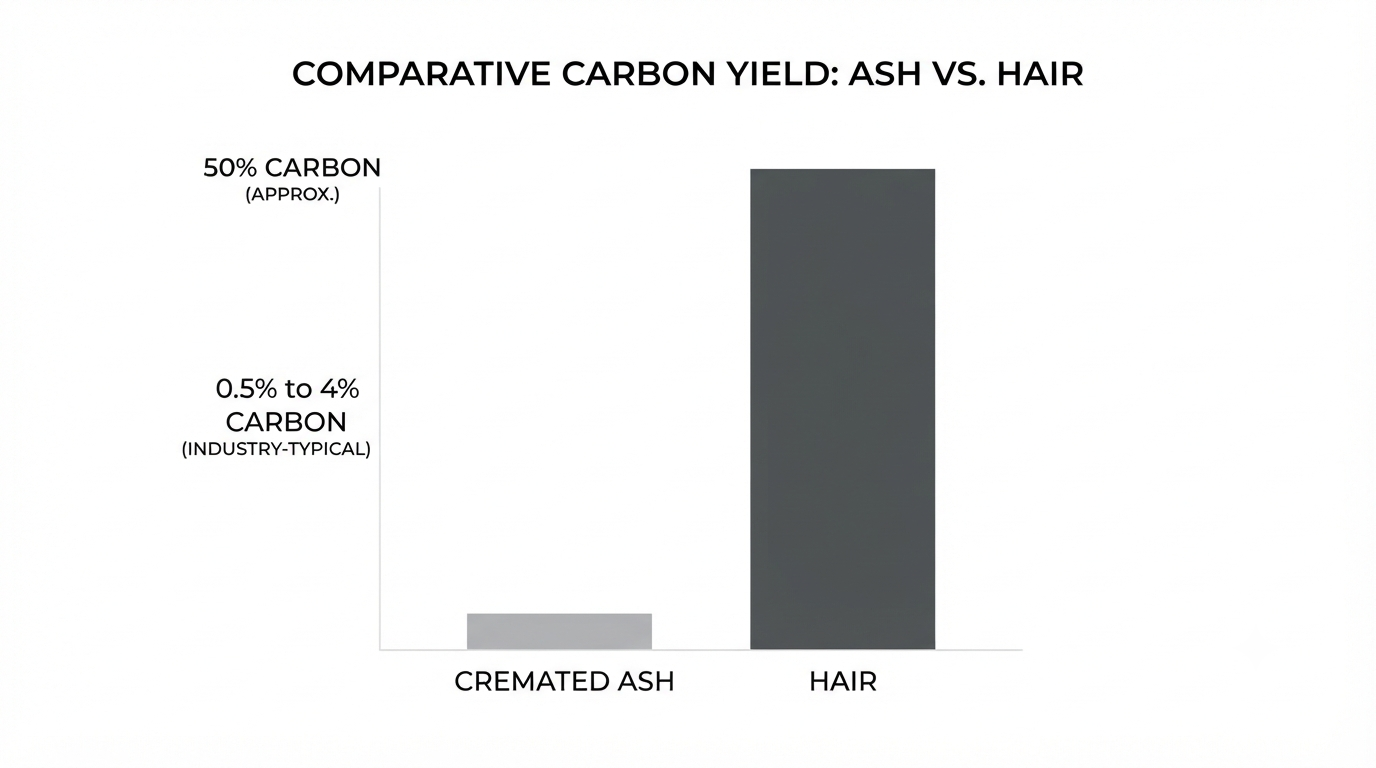
Start with why the partner ashes hair diamond questions are not two sets of single source questions stapled together. Cremated remains are mostly calcium phosphate, which is why the carbon a laboratory can recover from them sits somewhere between 0.5% and 4% of their weight. Hair runs at roughly 50% carbon, because keratin is a carbon rich protein. A few grams of hair can therefore carry more usable carbon than a generous scoop of ash.
That difference produces two entirely separate failure modes, which is the practical root of most partner ashes hair diamond questions. Ash fails quietly, at the yield stage, when a portion that looked ample gives up less carbon than expected. Hair fails at the scale, before anything else happens, when a lock that looked generous weighs under a gram.
They also differ in replaceability, and this is the asymmetry that should drive your planning:
- Ash is usually re portionable. If a first portion underperforms, another can often be taken from the same container, assuming the person who authorized the first will authorize a second.
- Hair is not. A lock is a fixed object with a fixed weight, and there will be no second one.
- Ash may not be yours to divide. Authority over cremated remains is set state by state and by anything your partner left in writing, and for an unregistered relationship it can rest with a parent, an adult child or a former spouse.
- Hair is usually the simpler question. What the law regulates here is cremated remains, not mementos, which is why hair you already keep is ordinarily the less obstructed route. It is not a free pass. An estate can take in a person’s belongings, states do not agree, and hair in another household is something to raise rather than assume. Verify it if the answer would change your plan.
Hold those four facts in mind and most of the partner ashes hair diamond questions below answer themselves in a particular direction.
Are Both Sources Assessed Before You Commit to Either?
This is where a combined submission either becomes safer than a single source one or considerably riskier, depending entirely on how the provider works. Among the partner ashes hair diamond questions, this one is the fork.
1. Will each source be weighed and evaluated separately?
Ask for two assessments, not one verdict: the first of the partner ashes hair diamond questions to put in writing. The chemistry, the risks and the thresholds are different for each material, so a single yes covering both tells you almost nothing about which of the two is actually carrying the submission.
What you want to hear is a stated weight for the ash, a stated weight for the hair, and a view on each against the provider’s own figures. Of all the partner ashes hair diamond questions, this is the one that most often gets a vague reply, and vagueness here means you will not learn which source was marginal until after both have gone. For the underlying numbers, how much ash and hair a partner memorial diamond actually needs sets out the typical bands for each.
2. Do you need both, or is one of them already sufficient?
This is one of the partner ashes hair diamond questions that saves people material they did not have to send. If the hair alone meets the threshold, sending ash as well is a choice about meaning rather than a technical necessity, and plenty of families make that choice deliberately, wanting both represented.
But it should be a decision, not a default. Ask plainly whether either source would suffice on its own. If the answer is that the hair carries the submission and the ash is supplementary, you may decide to keep the ash portion where it is.
Which Partner Ashes Hair Diamond Questions Are About Sequence?
Order matters more than most people expect, and these partner ashes hair diamond questions exist because the two materials are not equally recoverable.
3. Which source is committed first, and can one be held back?
In most processes each material is purified to roughly 99.9% carbon, converted to graphite at around 2,500 to 2,700°C, and only then loaded into a growth cell. That means there is a window during which the two carbon streams exist separately, and what a provider does in that window is worth knowing.
The protective arrangement, where a provider will allow it, is to commit the replaceable source first and hold the irreplaceable one until the first stage has gone well. Ash, which can usually be re portioned, is the natural candidate to go first. Hair, which cannot be replaced at all, is the natural candidate to hold. Whether a provider can work that way is among the partner ashes hair diamond questions most worth asking early, because it costs nothing to arrange in advance and cannot be arranged at all afterwards.
4. What happens if one source fails and the other is fine?
Get this answered before either leaves your house. Few partner ashes hair diamond questions age as badly. The table below sets out the four outcome combinations, plus two rows that turn on when the sources are blended, and the decision each one forces, so you can decide now rather than under pressure later.
| Ash outcome | Hair outcome | What you are left with | Settle in advance |
|---|---|---|---|
| Sufficient | Sufficient | A normal combined submission | Nothing further |
| Sufficient | Under weight | Ash carries the stone; hair may be returned or added anyway | Do you still want the hair included, or kept intact? |
| Short yield | Sufficient | Hair carries the stone; more ash may be requested | Can a second ash portion be authorized, and by whom? |
| Short yield | Under weight | Neither source is sufficient alone | Is combining them enough, and who decides? |
| Either | Either, after blending | Both consumed in one failed run | Is a re grow attempted from recovered carbon? |
| Either | Either, before blending | Only the committed source is lost | Can the uncommitted source be returned? |
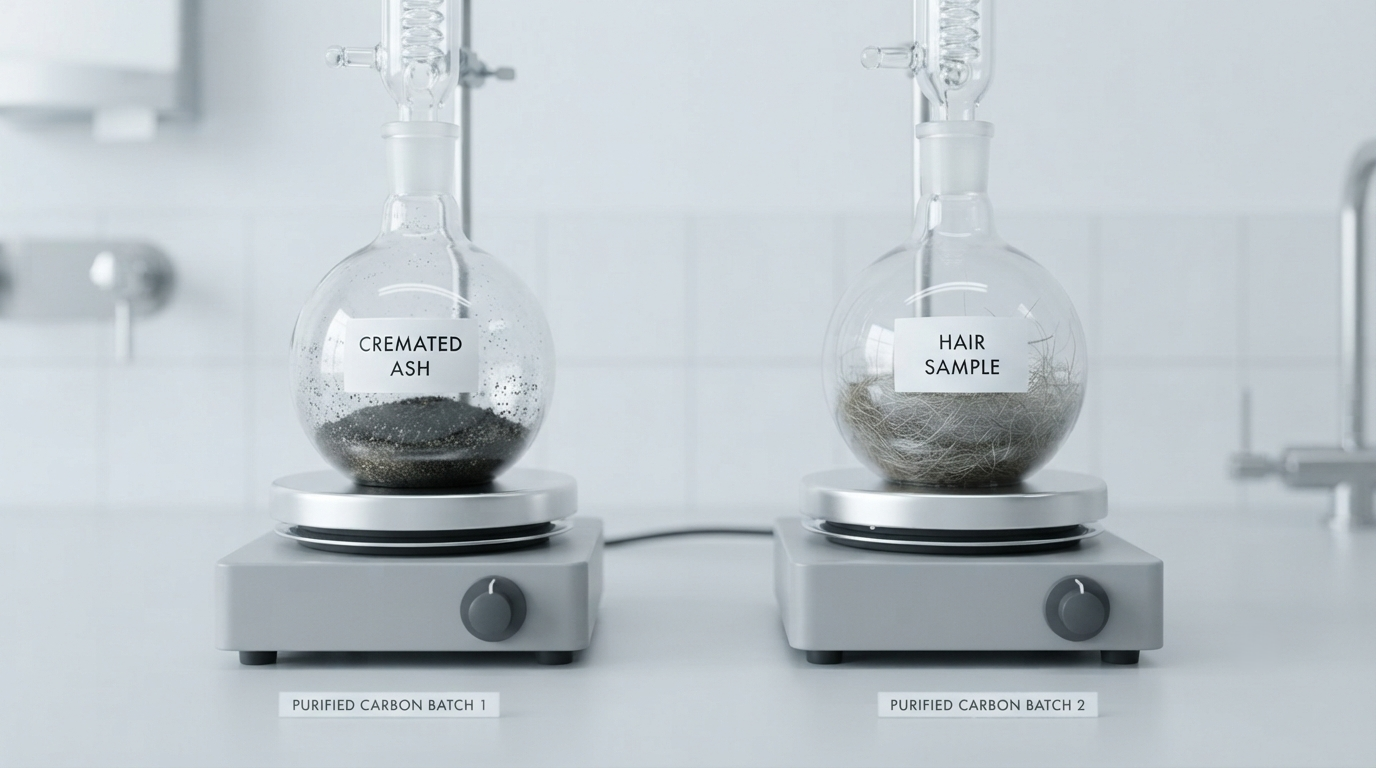
The bottom two rows are the ones people skip, and they are the reason the sequencing question matters. Once two carbon streams are blended and loaded, a failed run takes both. Kept separate until the last moment, a failure takes only what was committed. What actually happens to each material inside the laboratory makes the timing of that decision much easier to picture.
The follow up: are the two carbon streams blended, or kept as separate batches?
Related but distinct, and it sits beneath several of the partner ashes hair diamond questions above. Some providers purify both materials and combine the carbon before growth. Some may be able to grow from one and hold the other. The answer determines everything in that table, and it is a straightforward operational fact any provider should be able to state.
Ask it as a process question rather than a preference, and ask when the point of no return falls. These are the partner ashes hair diamond questions with the shortest useful shelf life: after blending, none of them can be acted on.
Does Combining Two Sources Change the Finished Stone?
Here is the reassuring part of the partner ashes hair diamond questions, and it deserves stating flatly.
5. Is a two source diamond different from a single source one?
No. Once carbon is purified to 99.9% plus, its origin is no longer chemically legible. Carbon from keratin and carbon from cremated remains are the same element, entering the same lattice. The finished stone is a real diamond by every measure: 10 on the Mohs scale like any other, graded on the same four Cs GIA applies to every diamond, with clarity for memorial stones typically landing between SI2 and VVS.
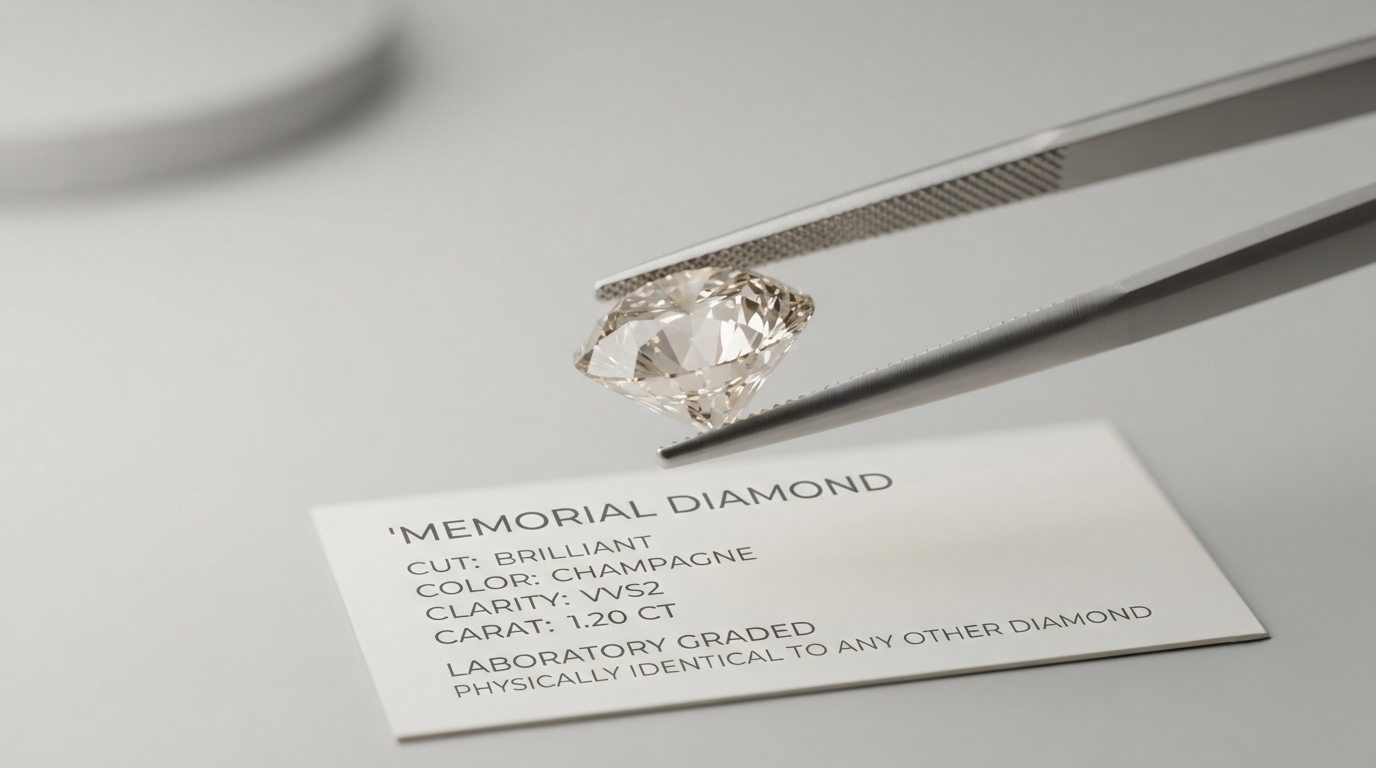
Color is worth a word, because it drives more partner ashes hair diamond questions than anything else and people assume blending must muddy it. It does not work that way. A diamond’s color comes from trace elements present during growth: nitrogen producing yellow tones, boron producing blue, the absence of both being what makes a stone colorless. Those traces come from whatever survives purification, so a combined submission can shift the odds slightly, but there is no blending effect that makes a two source stone look different in kind. What color to expect from a combined submission goes further into the mechanism.
One honest caveat belongs here, and it is the same one that applies to every memorial diamond. Sending two sources does not raise the proportion of your partner that ends up in the stone. The figure usually cited, something around 10 to 15% of a finished stone’s mass, with some providers citing as low as 3%, describes the ash route, and no published figure covers a blended ash and hair charge.
Laboratory carbon makes up the balance either way, so the crystal can reach a viable size. Ask what share your provider expects your own samples to contribute. A real and permanent part of your partner is in that lattice either way. Two sources means both are represented, not that the fraction doubles, and among the partner ashes hair diamond questions this is the one most often answered dishonestly by people selling something.
6. Will the certificate name both sources?
Ask to see the wording before you commit. Of the partner ashes hair diamond questions this is the quietest, and the certificate is the only place the combination is ever recorded. A stone made from two sources looks identical to one made from either, so the document is the entire distinction.
Good wording names both materials and the date each was received. Weaker wording refers only to “personal carbon” and leaves the specifics out, which is not dishonest but does erase exactly the thing you went to the trouble of doing. For a relationship that may not be documented elsewhere, that certificate may become the formal record that names you both, which is a reason to care about a sentence nobody else will ever read closely.
One Stone From Both, or Two Stones From One Each?
A fork in the road that is easy to miss, which is why it belongs among the partner ashes hair diamond questions: a quote will usually answer only the option you asked about.
7. Should this be one diamond or two?
One stone from both sources is a single object in which the two materials are permanently indistinguishable. That is the point, for many people. It is also, practically, one thing, which matters if more than one person may eventually want to inherit it, since a diamond cannot be divided.
Two stones, each from a single source, keeps the materials separate and gives you two objects. They will be smaller at the same total cost, because price scales steeply with carat, and each carries its own growth time. Neither answer is better. But deciding deliberately is far better than discovering at the certificate stage that you chose without noticing. If inheritance is part of your thinking, whether several people can have stones from the same source is the next thing to read.
8. If the ashes are contested, can the hair go ahead alone?
Yes, and of all the partner ashes hair diamond questions this one has the most useful answer. The hair route needs no cremation and no crematorium’s authorization file, so in practice a lock already in your own home does not usually raise the same custody question as a container of ashes. Check rather than assume, since personal effects can fall to an estate and that varies by state.
If authority over the remains rests with someone who has not agreed, or has not yet been asked, a hair only submission proceeds while that conversation continues, and ash can often be added to a later stone. Treat it as a live fallback, not a consolation. The ashes specific custody questions and the hair specific provenance questions cover each route in its own right.
The Partner Ashes Hair Diamond Questions About Cost and Time
The last of the partner ashes hair diamond questions, and the one with the most counterintuitive answer.
9. Does a two source submission cost more or take longer?
Growth time is set by the carat you choose, not by how many materials you sent. A stone takes what it takes: six to ten months across the industry, occasionally up to twelve for larger or specialty color stones, whether the carbon came from one source or two. Two intake and purification runs may add handling at the front end, so ask whether that is priced separately.
Ask the question in that shape: what does the second source add to the invoice, and what does it add to the calendar? A clear answer to both is easy for an organized provider to give. Money and months are the partner ashes hair diamond questions people ask first and should ask last. If you want the sequence laid out end to end before you ask, the step by step for a combined submission covers it.
Frequently Asked Questions
Do the two materials have to be sent at the same time?
Not necessarily, and sending them separately can be an advantage. Ask whether the provider will receive, log and assess one while the other stays with you. That is the arrangement that protects the irreplaceable source until the first stage has gone well.
Can we tell afterwards which carbon came from where?
No. After purification and growth the carbon is chemically the same element regardless of which sample it started in, and providers do not generally offer any test that separates it by origin, worth asking about directly rather than assuming either way. What records the combination is the paperwork, which is why the certificate wording is worth checking in advance.
Does adding hair make the stone more likely to be colorless?
Not reliably. Color depends on trace elements surviving purification, and while hair and ash carry different trace profiles, neither guarantees an outcome. Ask instead whether the provider offers a color choice and what that involves.
If we send both, can we still keep some of each?
Usually, and it is worth stating up front. Only a portion of the ashes is needed, and a lock can often be divided so part remains with you. Ask for both to be confirmed in writing before anything is posted.
Is a combined stone harder to insure or value?
It is valued like any other diamond, on cut, color, clarity and carat. An independent grading report, if you order one, is what an insurer will want, and the origin certificate is a separate document that speaks to provenance rather than market value.
Could a second diamond be made later from what is left?
Often, if material remains. Ash portions are frequently large enough to support more than one stone, and a divided lock leaves the option open. Ask before the first submission, because the answer may change what you send.
Final Thoughts on Partner Ashes Hair Diamond Questions
None of the partner ashes hair diamond questions here is about whether a combined diamond is worth having. It is about the fact that you are handing over two objects with different risks, different legal footing and, crucially, different chances of ever being replaced.
Asked in advance, the partner ashes hair diamond questions here mostly resolve into one instruction: protect the hair. Assess both separately, commit the ash first if a provider will allow it, keep the sources apart for as long as the process permits, and get the certificate wording before rather than after.
The stone itself will be a diamond like any other, identical in hardness, graded on the same scale, indistinguishable from a single source stone by any instrument. What the partner ashes hair diamond questions protect is not the stone. It is the envelope in the drawer that has to survive the process intact if anything goes wrong.
Learn More About Combined Partner Memorial Diamonds
- Partner Ashes and Hair Diamond: The Complete Guide
- How Much Ash and Hair Do You Need for a Partner Memorial Diamond?
- Questions to Ask Before Turning Your Partner’s Ashes Into a Diamond
- Questions to Ask Before Turning Your Partner’s Hair Into a Diamond
- How Long Does It Take to Make a Partner Memorial Diamond?
Talk With Memorial Diamond
If you want the partner ashes hair diamond questions above answered for your two specific sources rather than in general, reach out to Memorial Diamond at memorialdiamond.us. Bring the weight of the ash portion you hold, the weight of the lock in grams, and any uncertainty about who controls the remains.
Ask for two assessments rather than one, ask whether the hair can be held back, and ask what the certificate would say. The partner ashes hair diamond questions cost nothing to put in an email. Nothing has to be decided in a first conversation, and nothing should be posted before one.
Leave A Comment