
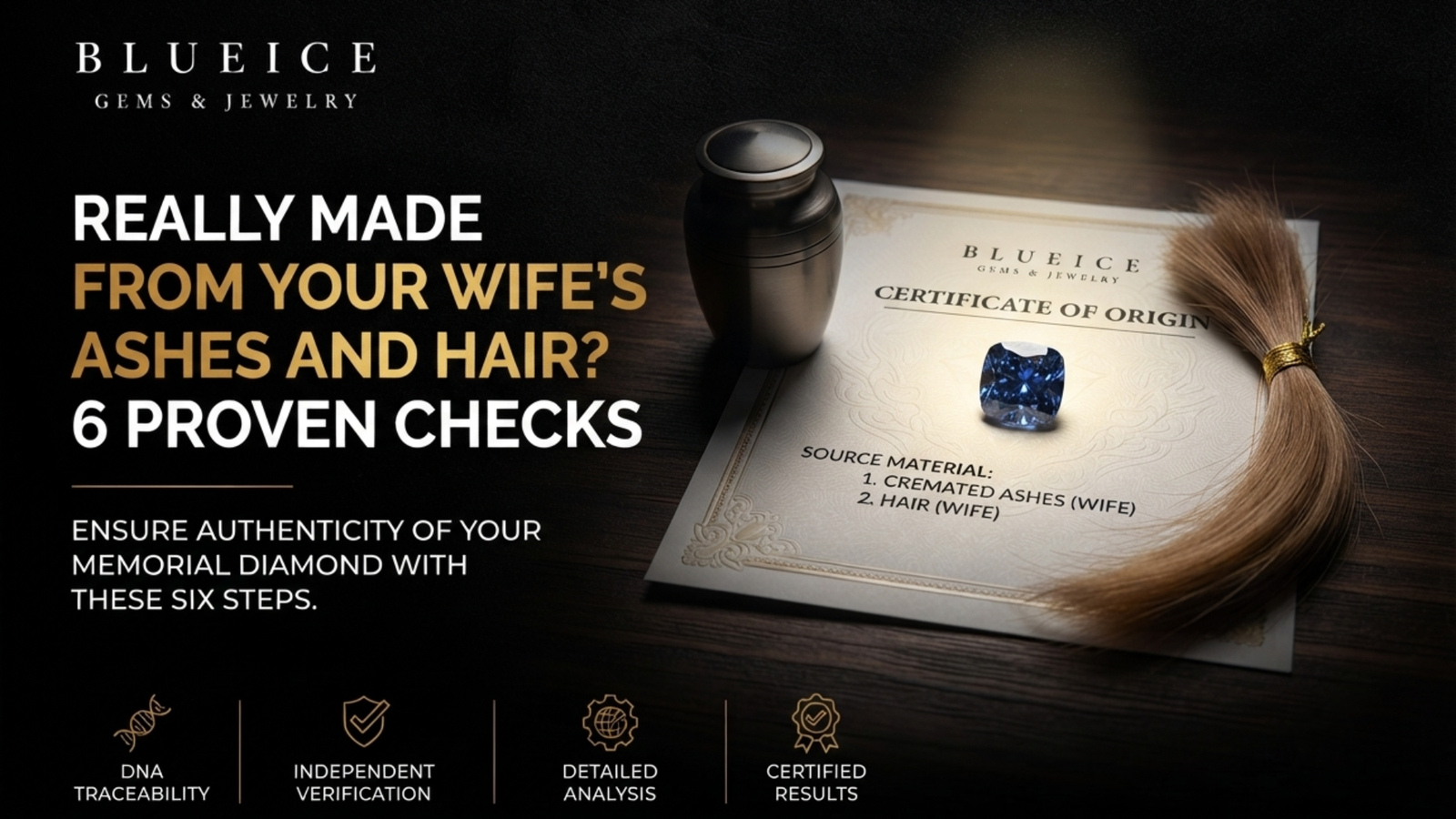
If you are sending both, you have probably already worked through whether a diamond can be made from her ashes at all, and whether a lock of hair is enough. The doubt that remains is narrower and sharper: did both of them actually go into the stone, or did only one? A memorial diamond is really made from your wife’s ashes and hair when carbon from both materials is extracted, purified, combined before growth, and grown into one genuine diamond, but the hair supplies most of the personal carbon, the ashes a real but smaller share, and the only proof that both went in is the provider’s single custody record and an origin certificate that names both materials.
This page covers only that combined doubt, whether a stone is really made from your wife’s ashes and hair, or only one of them. The general “is it really her” evidence, the chemistry, the 10 to 15% personal carbon share, why no lab test can identify whose carbon it is, is in whether it is really made from your wife’s ashes and whether it is really made from your wife’s hair.
Table of Contents
What This Page Covers, and What the Other Two Already Answer
Most of the doubt about whether a stone is really made from your wife’s ashes and hair is not specific to combining at all. The table below sorts it, so this page can spend its length on the one doubt that is.
| The doubt | Specific to a combined stone? | Where it is answered |
|---|---|---|
| Is there enough carbon in ashes to make a diamond? | No | The ashes post, roughly 0.5 to 4% usable carbon, and yes |
| Is a lock of hair really enough of her? | No | The hair post, hair is approximately 50% carbon, so yes, comfortably |
| How much of the stone is actually her? | No | Both posts, typically around 10 to 15%, blended with lab carbon; never 100% |
| Can a test prove whose carbon it is? | No | Both posts, no; the proof is procedural |
| Does dye or gray hair matter? | No | The hair post, removed at purification |
| Did both materials actually go into this one stone, or only one? | Yes | This page |
| How much of the personal carbon came from each? | Yes | This page |
| What must the custody record and certificate show for two materials? | Yes | This page |
If you have not read the two single material posts, read them first; they carry most of the evidence that a stone is really made from your wife’s ashes or her hair. The question of whether a stone is really made from your wife’s ashes and hair rests on the same procedural proof as either material alone, with one extra thing to check: that the proof covers both.
Did Both Actually Go In? The Doubt Specific to a Combined Stone
Here is the worry about whether a stone is really made from your wife’s ashes and hair, stated plainly. You send a sealed container of ashes and an envelope of hair. Months later, one diamond arrives. Nothing about the stone tells you whether the provider used both, used the hair and set the ashes aside, or used the ashes and lost the envelope. Was the diamond really made from your wife’s ashes and hair, or from one of them with the other returned quietly to a drawer?
It is a fair worry, and the answer to whether a stone is really made from your wife’s ashes and hair is not “trust us.” The answer is that a stone really made from your wife’s ashes and hair leaves a specific paper trail that a single material stone does not, and that trail is checkable before you send anything, not just after.
Three things make the case that a stone is really made from your wife’s ashes and hair different from a single material one:
- There are two intake events, not one. Each material should be weighed, photographed, and logged separately at arrival, and then tied to a single submission reference.
- There are two extraction runs, or one run with two inputs. Either way, the carbon recovered from each should be recorded, because the two yields are very different sizes.
- There is a combination step. At some point before growth, the two purified carbons are merged. That step is the one that makes the stone a combined stone, and it should be logged.
If a provider’s process has all three, the diamond is really made from your wife’s ashes and hair in a way they can show you. If it has only one intake line and no combination step, the provider may be doing everything right and simply not recording it, but you cannot know that, and neither can whoever inherits the stone.
Why Does the Hair Supply Most of the Personal Carbon?
Because of the chemistry, and a stone really made from your wife’s ashes and hair is lopsided in a way it is better to know before a provider implies otherwise.
| Material | Carbon by weight | Typical amount submitted | Share of the personal carbon in a combined stone |
|---|---|---|---|
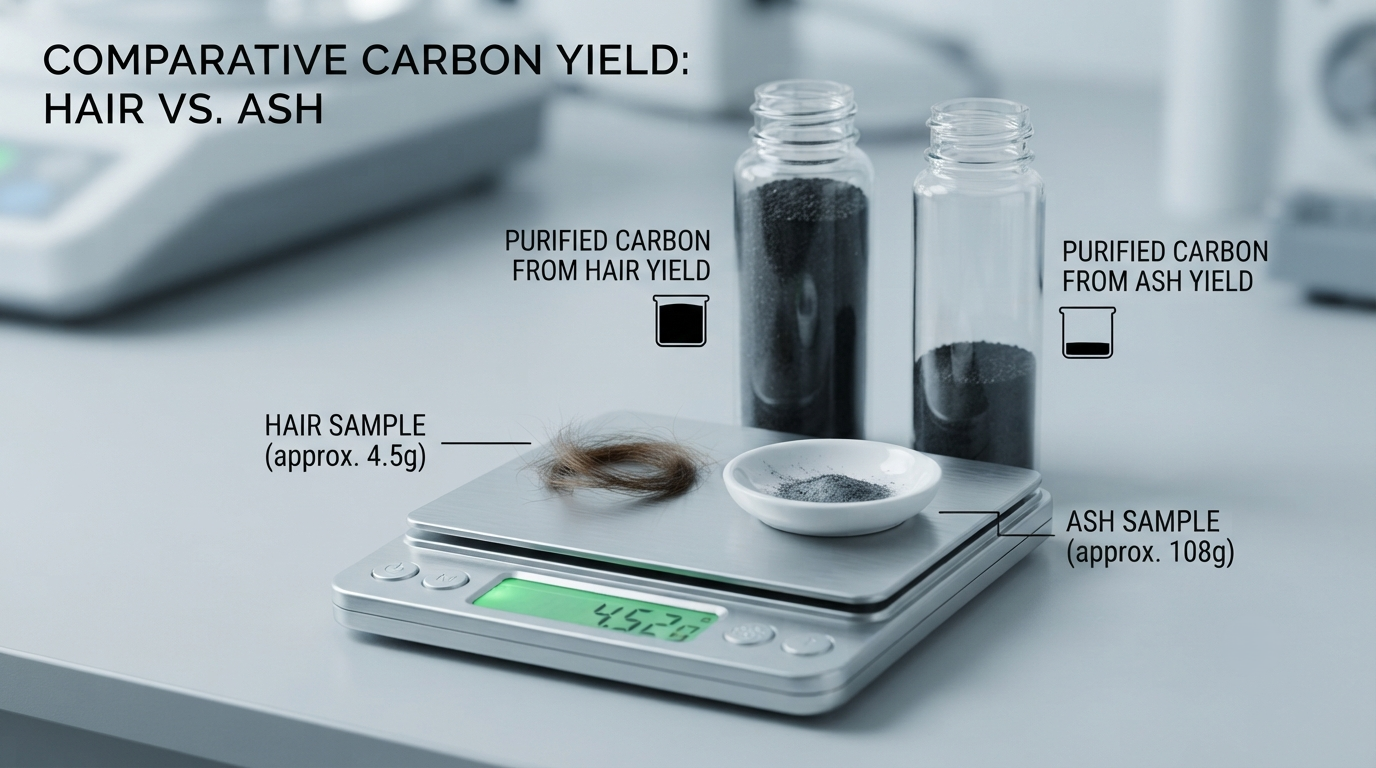
| Her hair | Roughly 50% (keratin) | A small lock, a few grams | The majority, usually by a wide margin |
| Her ashes | Roughly 0.5 to 4% (the rest is calcium phosphate) | A few tablespoons to about 4 oz (approximately 100 g) | A real but smaller share |
In a diamond really made from your wife’s ashes and hair, a few grams of hair at 50% carbon yields more purified carbon than a few tablespoons of ash at under 4%. In most combined submissions, the hair supplies the majority of the personal carbon and the ashes a minority. The ashes’ contribution is real, carbon that was in her body is in the crystal lattice, but it is smaller, and a stone really made from your wife’s ashes and hair is, by mass, mostly a hair stone with an ashes contribution, blended with lab carbon as every memorial diamond is.
Two honest consequences:
- A provider who implies that a stone really made from your wife’s ashes and hair drew equally on both is wrong. The chemistry does not support symmetry. Ask: “Roughly what share of the personal carbon came from the ashes, and what from the hair?” A confident provider gives a lopsided range. A provider who says “half and half” has not measured it.
- Neither material makes the stone bigger. Carat is set by growth time in the press. Combining changes what is in the stone, not its size, color, cost, or timeline. The reason to combine is meaning, the hair is carbon she grew while alive and the ashes are what remained, not chemistry. Wife Ashes and Hair Diamond: The Complete Guide covers when that meaning is worth the extra care and when a single material is simpler.
How Do You Verify Both Were Logged Under One Record?
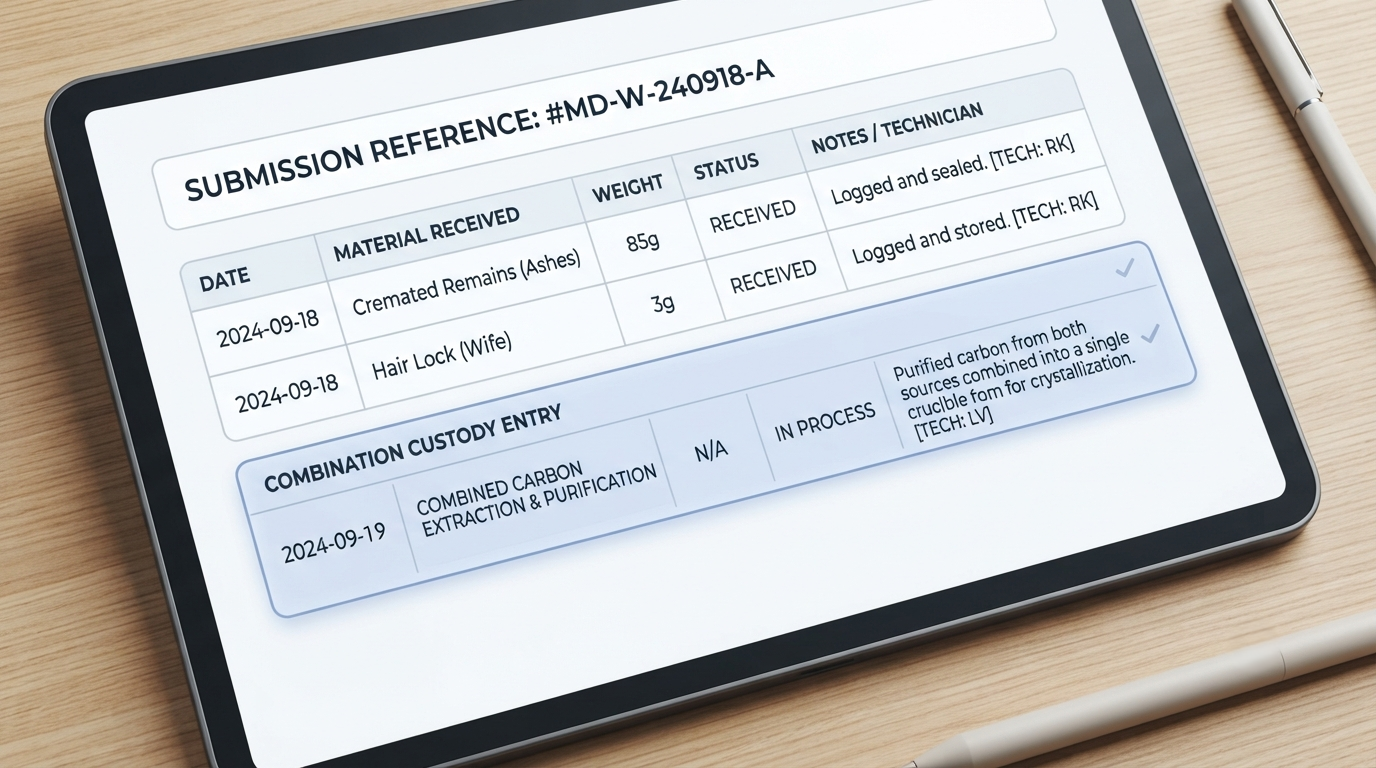
A chain of custody record for a diamond really made from your wife’s ashes and hair should have one reference number and two material lines under it. That is the whole test of whether a stone will be really made from your wife’s ashes and hair, and you can apply it before sending by asking to see a sample record.
What one record for a stone really made from your wife’s ashes and hair looks like:
- One submission reference assigned at intake, printed on the ash container’s label, the hair envelope’s label, and the submission form.
- Two intake lines under that reference, ashes weighed and photographed; hair weighed and photographed, each dated.
- Two extraction entries, or one entry listing both inputs, each with the carbon recovered.
- One combination entry stating that the two purified carbons were merged, with a date, before graphitization or growth.
- One growth cell entry carrying the same reference through cutting, grading, and shipping.
The failure modes for a stone really made from your wife’s ashes and hair are specific. Two separate references with no line tying them together means the provider cannot later prove both went into one stone. One reference with a single intake line, “material received,” means the provider did not distinguish the two at arrival, and cannot show that the hair was not simply used alone. Neither proves dishonesty; both mean a stone really made from your wife’s ashes and hair cannot be demonstrated to be one.
Your own record of a stone really made from your wife’s ashes and hair matters too. Before shipping, photograph the labeled ash container, the labeled hair envelope, and the submission form together with the date visible. Confirm receipt of both materials by name, “ashes and hair received,” not “your package arrived.” How to turn your wife’s ashes and hair into a diamond covers the packaging and the confirmation step by step; how much ash and hair you need for a wife memorial diamond covers the combined minimum, which is often less of each than the two standalone figures.
What Must the Origin Certificate Say?
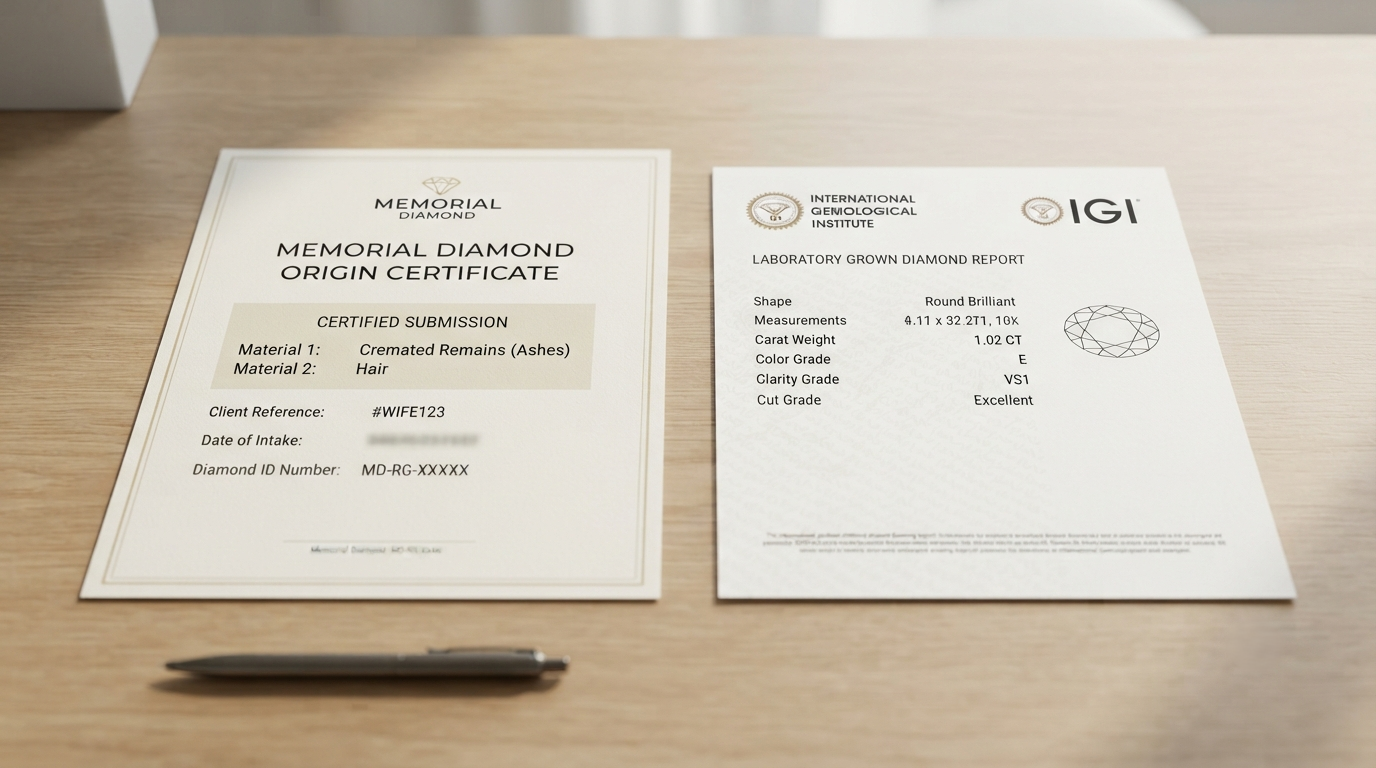
An origin, or authenticity, certificate is the provider’s attestation that this specific stone was grown from this specific submission. It is the summary of the custody record, and for a stone really made from your wife’s ashes and hair it must name both materials.
A certificate that reads “grown from the cremated remains of…” and never mentions hair does not record what you sent. Neither does one that says “from the hair of…” alone. For a diamond really made from your wife’s ashes and hair, the certificate should carry:
- your submission reference number, matching your intake paperwork;
- both materials, named, “cremated remains and hair” or equivalent;
- the date of intake and the date of completion;
- the carat and, ideally, the stone’s inscription number if the girdle is inscribed.
Ask for the exact wording that will certify a stone really made from your wife’s ashes and hair before the material leaves the house. Providers who have made combined stones before will have a two material template and will show it to you. Providers who have not may only have a one material template, and you want to know that now, not in ten months.
One document the certificate is not: the grading report. A grading report, ideally from an independent lab applying GIA’s cut, color, clarity, and carat standards, documents the diamond’s quality. It is silent on origin and does not know or care how many materials the carbon came from. Both documents should arrive; only the certificate speaks to whether the stone is really made from your wife’s ashes and hair.
Can the Finished Stone Be Tested to Show Two Sources?
No. A stone really made from your wife’s ashes and hair cannot be tested for that, for the same reason no memorial diamond can be tested for its source at all.
Carbon atoms from her ashes, carbon atoms from her hair, and carbon atoms from a lab feedstock are identical. Once they are in a crystal lattice together, no instrument can sort them, count them, or attribute them. A jeweler can confirm the stone is a real diamond. An independent lab can grade it and identify it as lab grown. Neither can tell you whether one source or two went in, or in what proportion. The same limit applies to every stone in the memorial diamond category, whatever it was grown from.
This is why the proof for a diamond really made from your wife’s ashes and hair is entirely procedural, the one record, the combination entry, the two material certificate, and why the checks on this page happen before sending, not after receiving. After the stone arrives, the record is all there is. There is no test to fall back on if the record is vague, and no way to establish later that the ashes were included if the provider did not log it at the time.
If that sounds like a reason to be careful about a stone really made from your wife’s ashes and hair, it is. It is not a reason to distrust the category. A provider who logs both materials and shows you the record has given you everything that can exist as proof.
The Two Irreplaceable Things Risk
A single material stone sends one irreplaceable thing out of the house. A stone really made from your wife’s ashes and hair sends two at once, and the precaution that follows costs nothing.
Keep part of both. Ashes can usually be divided, a combined submission typically needs only a portion, and the rest stays for the scattering, the interment, or the urn you already planned. Hair cannot be topped up once it is gone: if the lock is the only one you have, divide it and keep some before sending. This is the single most important practical point about a combined stone, and it is worth more than any question you ask the provider.
Three reasons the risk is worth naming:
- Shipping. Two materials in one package means one loss event takes both. Ship tracked and insured, and keep the tracking number with your copy of the submission form.
- The record. If the provider’s record turns out not to distinguish the two, and you kept part of each, you still hold what you started with. If you sent everything, you do not.
- A second stone later. If a child or her sibling later wants their own stone, the kept portions make it possible. Questions to ask before turning your wife’s ashes and hair into a diamond covers how to raise this with the family before the material is divided.
None of this is unique to a diamond really made from your wife’s ashes and hair in kind, only in count. Two things are going at once; keep some of each.
Six Checks Before Anything Is Sent
Every check on this page is a question you can ask before either material leaves the house. In order:
- “How is a two material submission logged, one reference or two?” You want one reference with two intake lines.
- “Is the combination step recorded?” You want a dated entry showing when the two purified carbons were merged.
- “Roughly what share of the personal carbon will come from the ashes, and what from the hair?” You want a lopsided range and a reason, not “equal.”
- “Can I see a sample chain of custody record for a combined stone?” You want a document, not a sentence.
- “What will the origin certificate say?” You want both materials named and your reference number on it, in writing, before sending.
- “Will you confirm receipt of both materials by name?” You want “ashes and hair received,” not “package arrived.”
A provider who has made a stone really made from your wife’s ashes and hair before will answer all six without hesitation. A provider who has not may still do the work well, but will need to build the record as they go, and you should decide in advance whether you are comfortable being the submission they learn on. How a memorial diamond is made from your wife’s ashes and hair walks through where each of these six sits in the seven stage process.
Frequently Asked Questions
Is a memorial diamond really made from your wife’s ashes and hair, or just one of them?
It is really made from your wife’s ashes and hair when both are logged under one submission reference, both are extracted, and the purified carbons are combined before growth. The only proof is the provider’s custody record and an origin certificate naming both materials; no test on the stone can show two sources.
Which material contributes more of her carbon?
The hair, usually by a wide margin. Hair is roughly 50% carbon by weight; ashes are under 4%. In most combined submissions the hair supplies the majority of the personal carbon and the ashes a real but smaller share. A provider implying an equal contribution is describing a symmetry the chemistry does not support.
Can the diamond be tested to prove both went in?
No. Carbon atoms from ashes, hair, and lab feedstock are identical once in the crystal lattice, and no instrument can attribute or count them by source. A jeweler can confirm it is a real diamond and a lab can grade it. Proof of two sources is entirely procedural, the record and the certificate.
What should the origin certificate say for a combined stone?
Both materials by name, cremated remains and hair, plus your submission reference, intake and completion dates, and the carat. A certificate that mentions only one material does not record what you sent. Ask for the exact wording before the materials leave the house.
Does combining make the stone bigger, a different color, or more expensive?
No. Carat is set by growth time in the press, not by material. Color depends on trace nitrogen or boron as with any memorial diamond. Most providers price by carat, color, cut, and grading; a few add a modest fee because extraction runs twice. Combining changes meaning, not the stone’s specifications.
Should I keep part of the ashes and the hair?
Yes, both. A combined submission needs only a portion of the ashes, and the rest stays for whatever you planned. Hair cannot be topped up once sent, so divide the lock and keep some. Keeping part of each protects you against loss in shipping and against a record that turns out to be vague.
Final Thoughts on Whether It Is Really Made From Your Wife’s Ashes and Hair
The general question of whether a memorial diamond is real has a settled answer, and the two single material posts give it. The combined question is smaller and entirely about paperwork: one reference, two intake lines, a logged combination step, a certificate that names both.
A diamond really made from your wife’s ashes and hair is not harder to make than a single material stone, it is a stone whose proof has one more line in it, and whose provider should be able to show you that line before you send anything. Ask the six questions, keep part of both, and the stone that comes back will be what it says: partly her, from both of the two things you chose to send, and honestly recorded.
Learn More About Wife Memorial Diamonds
- Wife Ashes and Hair Diamond: The Complete Guide
- How a Memorial Diamond Is Made From Your Wife’s Ashes and Hair
- Is a Memorial Diamond Really Made From Your Wife’s Ashes?
- Is a Memorial Diamond Really Made From Your Wife’s Hair?
- How to Turn Your Wife’s Ashes and Hair Into a Diamond
Talk With Memorial Diamond
If you hold both her ashes and a lock of her hair and want the six answers on this page, how a two material submission is logged, what share each contributes, and what the certificate will say, before either leaves the house, reach out to Memorial Diamond. Keep part of both in the meantime; there is no deadline on the rest.
Leave A Comment