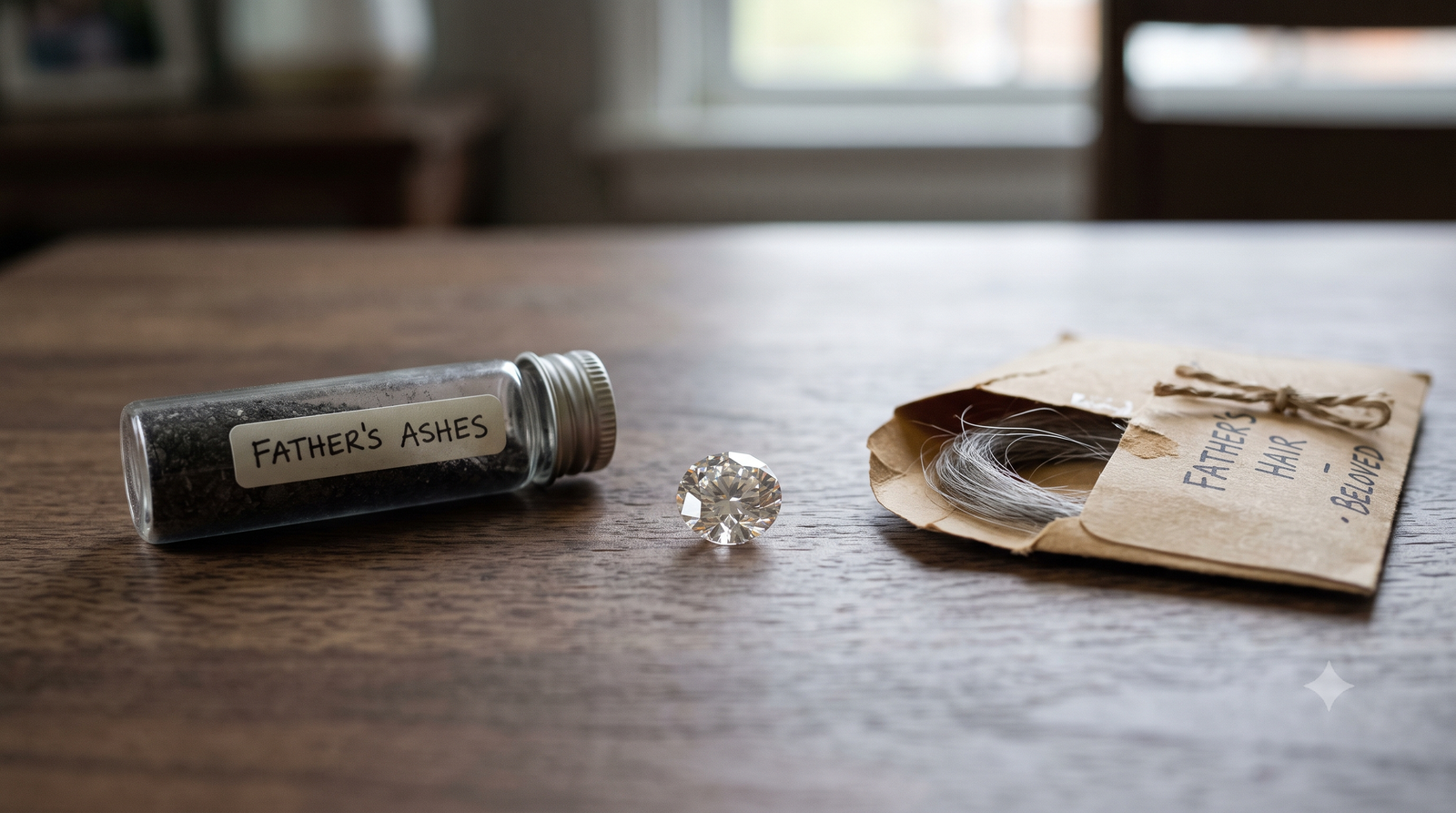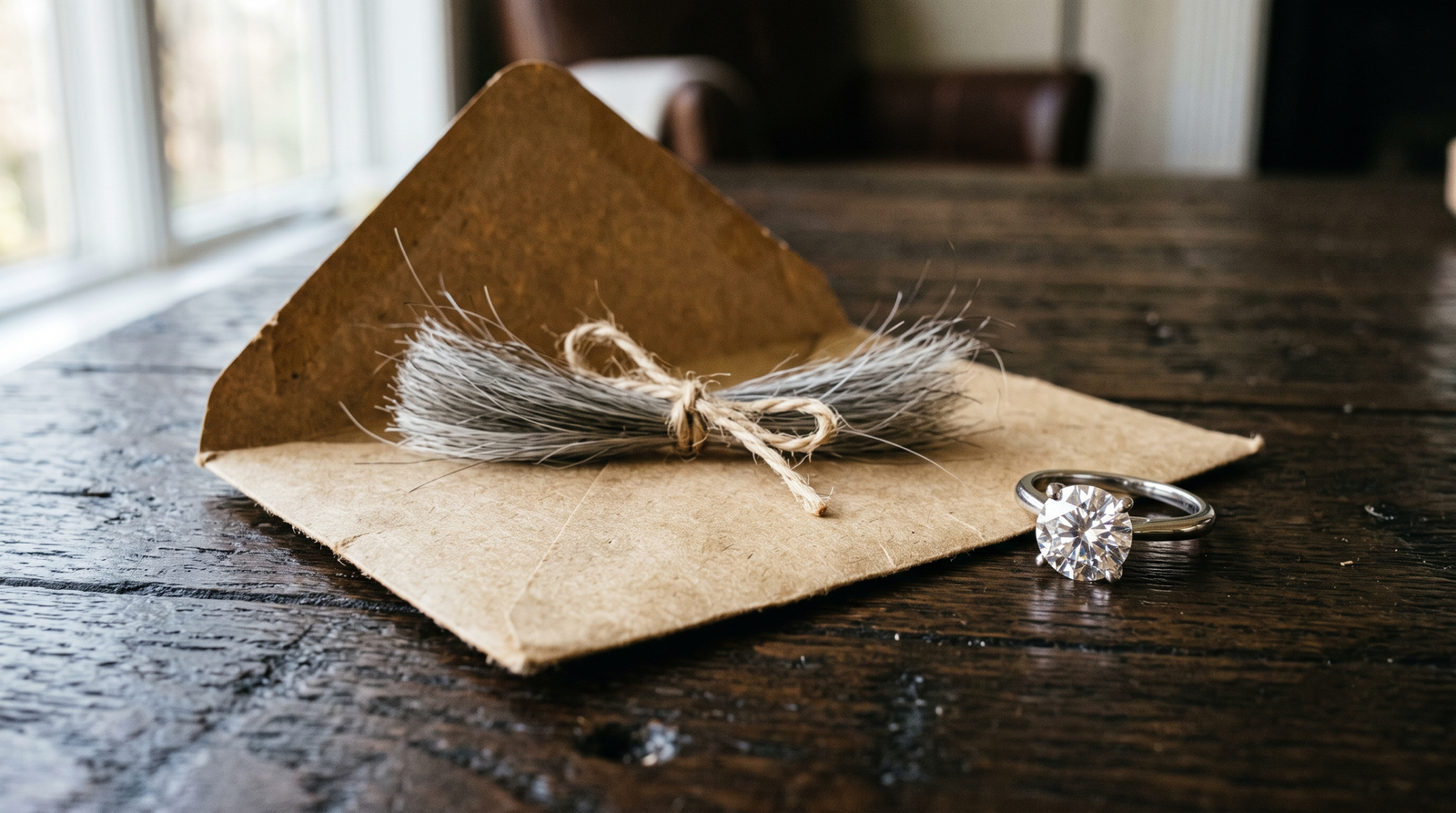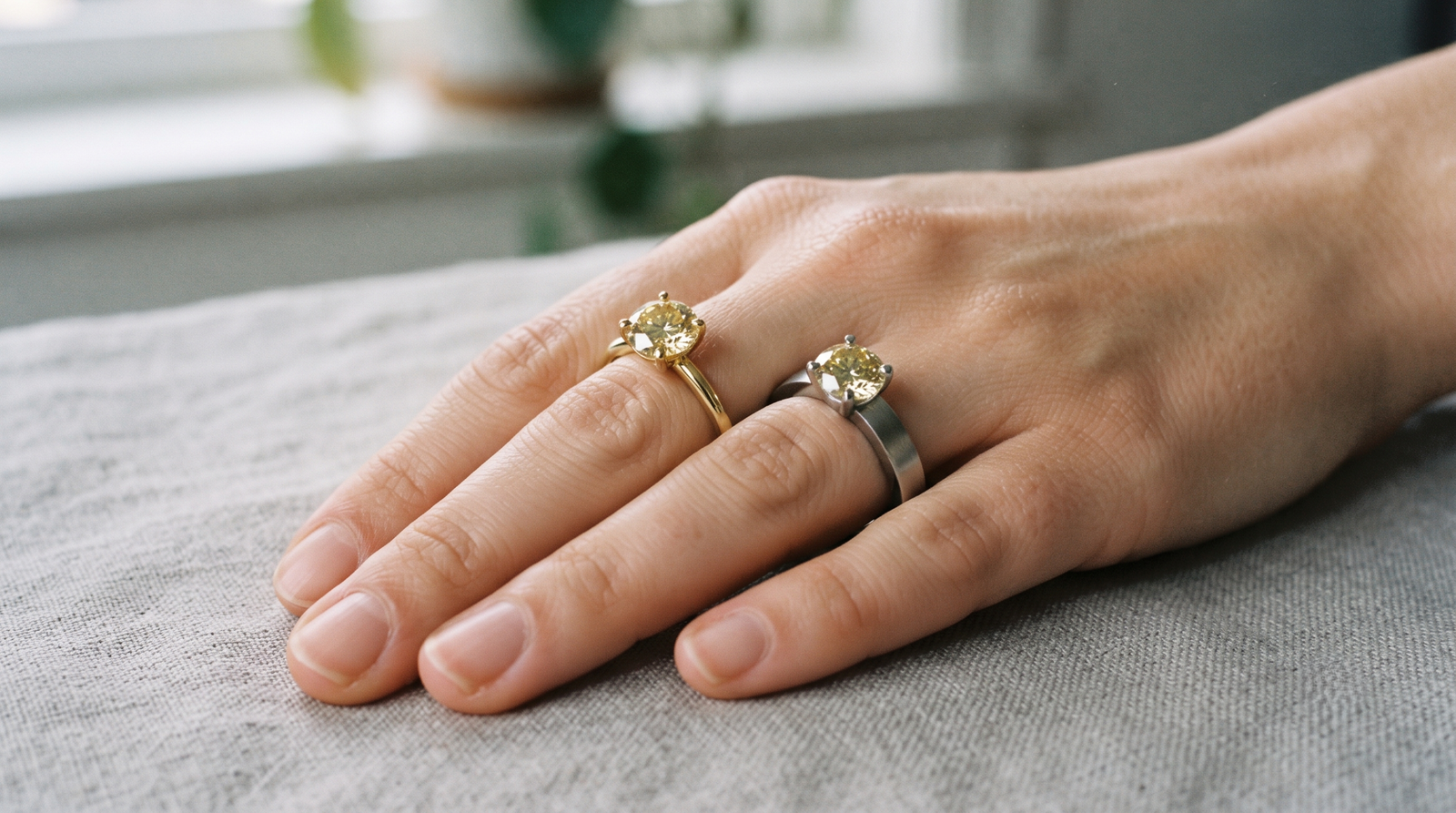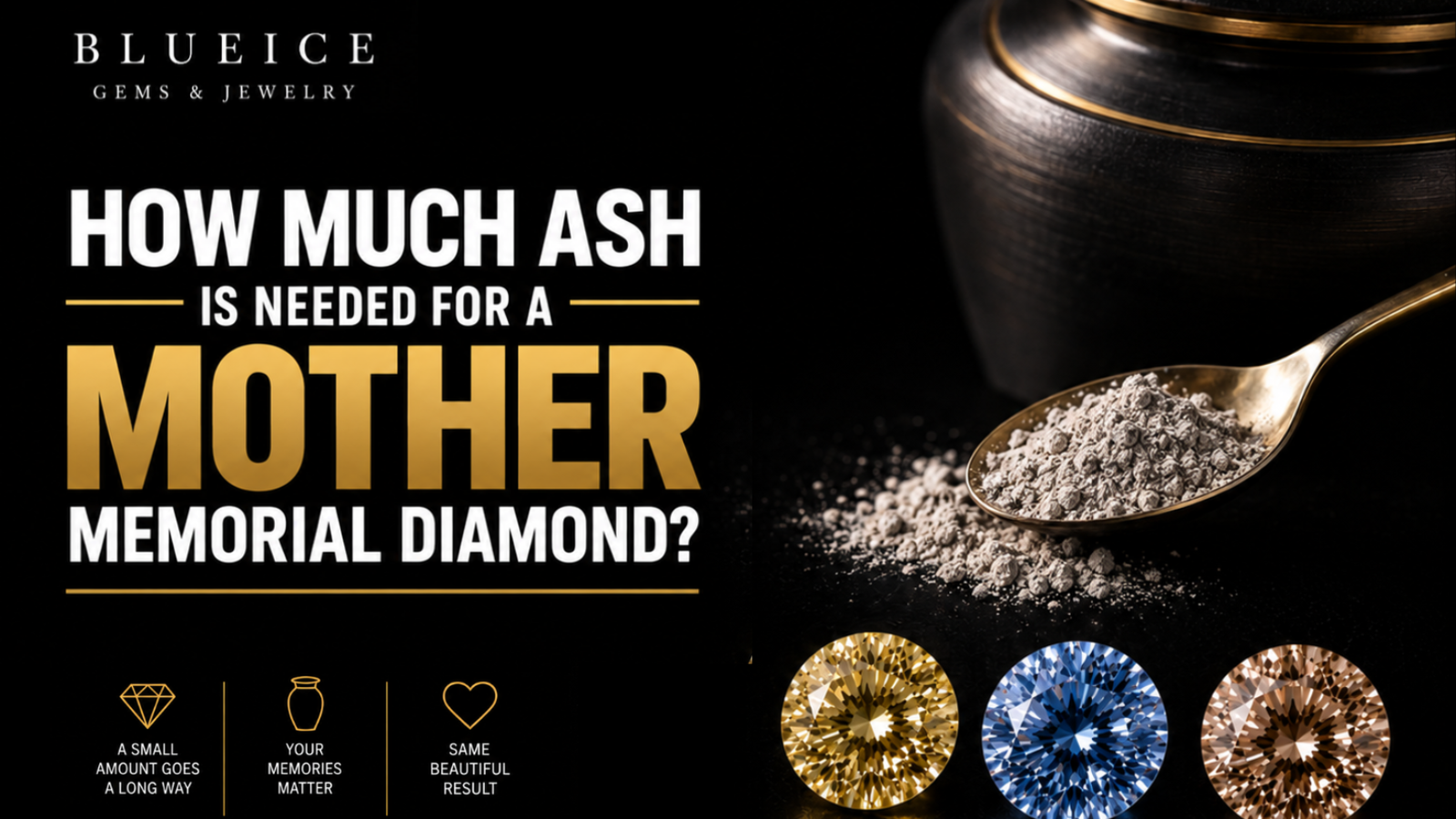
Memorial diamond made from a father's ashes and hair: a single champagne-toned lab-grown stone beside two small labeled sample containers

Is a Memorial Diamond Really Made From Your Father’s Ashes and Hair?

Two containers left the house, and one stone is coming back. If you are asking whether a memorial diamond made from your father’s ashes and hair really holds both, the answer is yes: carbon is extracted from each material separately, purified, blended together with lab sourced carbon, and grown into a single lab grown diamond. The personal carbon is a real, physical part of the crystal, though it is a minority of the finished stone’s mass, never all of it.

What the finished diamond cannot do is show you that both went in. Purified carbon from ash and purified carbon from hair are the same element in the same form. So the question worth asking about a memorial diamond made from both is not “did they really use both?” but “what can I see on paper that proves each one was handled?” That question has four answers, and they exist before the stone does.

Does a Memorial Diamond Made From Both Materials Really Contain Both?

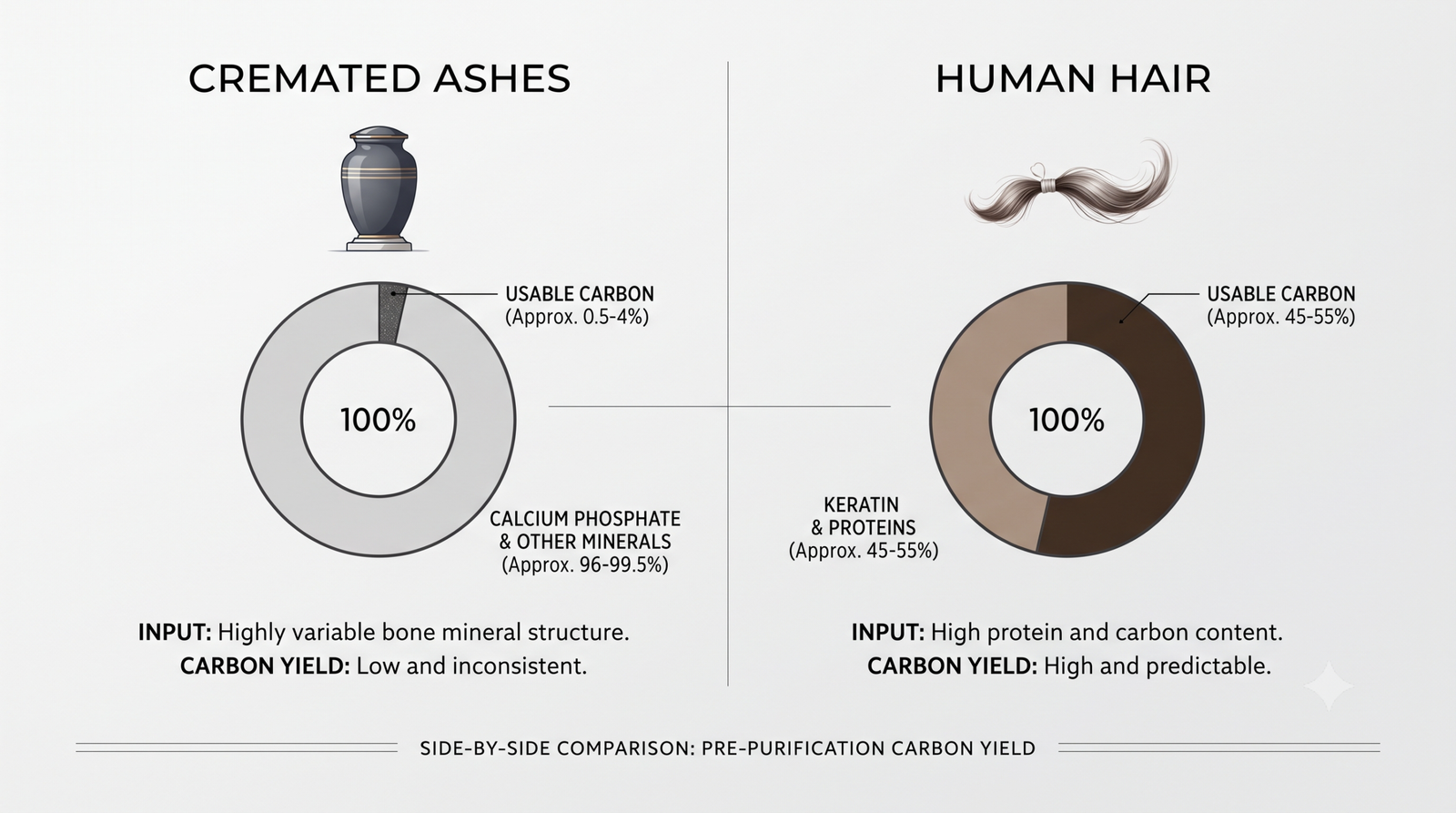
Yes, assuming the provider did what it said. The two materials arrive with very different amounts of usable carbon in them, which is why they are processed on separate tracks before they ever meet.

Cremated ashesHair
What it is mostly made ofCalcium phosphate (the mineral of bone)Keratin, a carbon rich protein
Usable carbon by weightRoughly 0.5% to 4%Roughly 50%
Typical amount neededA few tablespoons to about 4 oz (100 g)A small lock, a few grams
Predictability of yieldLow; an eightfold published rangeHigh; a single published figure
Requires cremationYesNo
Side-by-side graphic comparing carbon yield from cremated ashes and from hair before purification

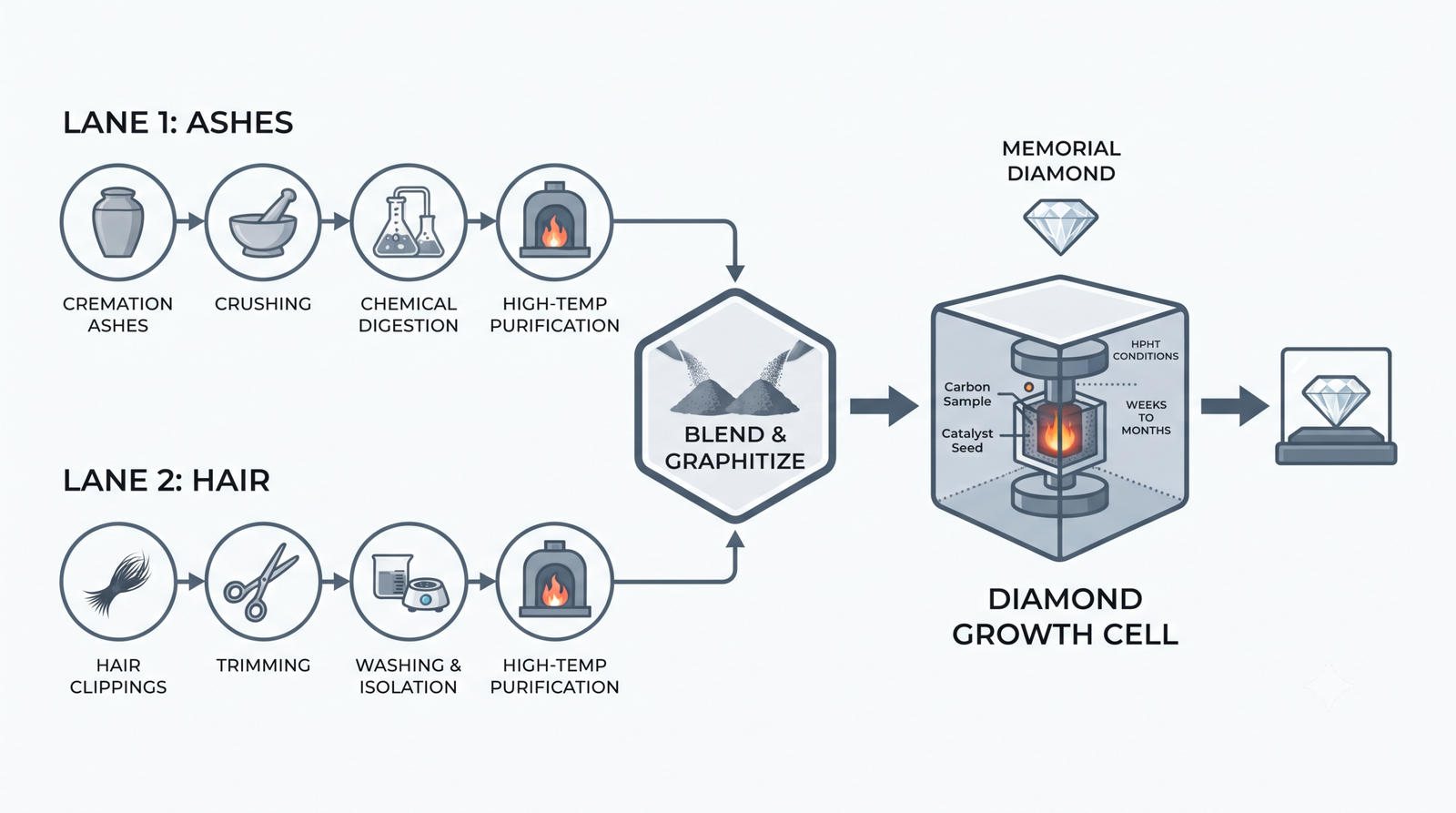
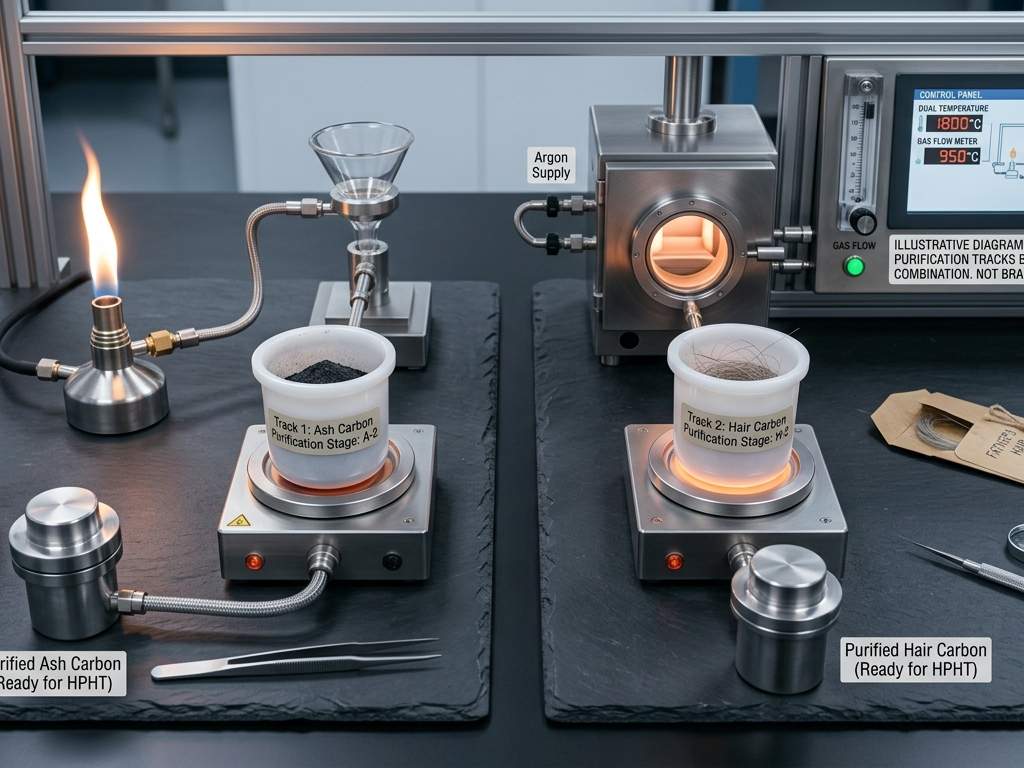
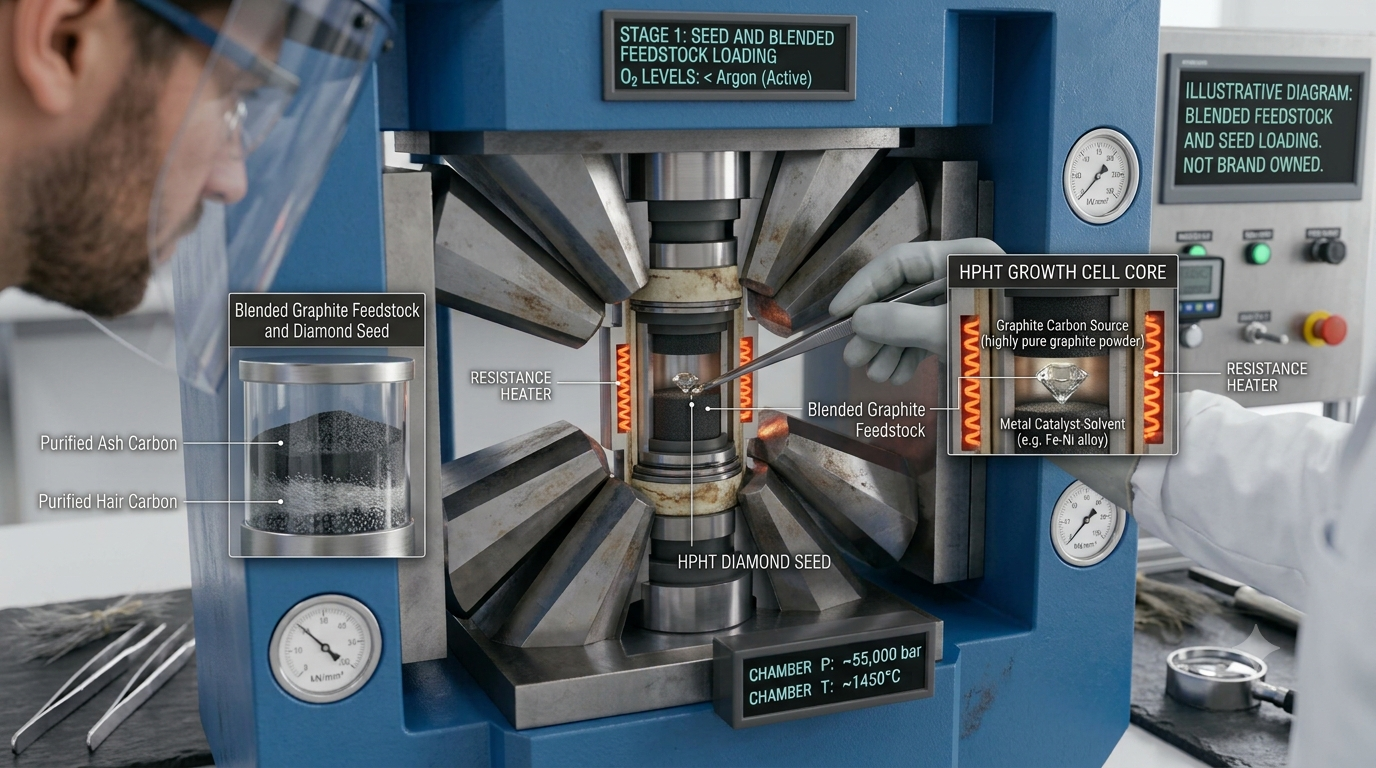
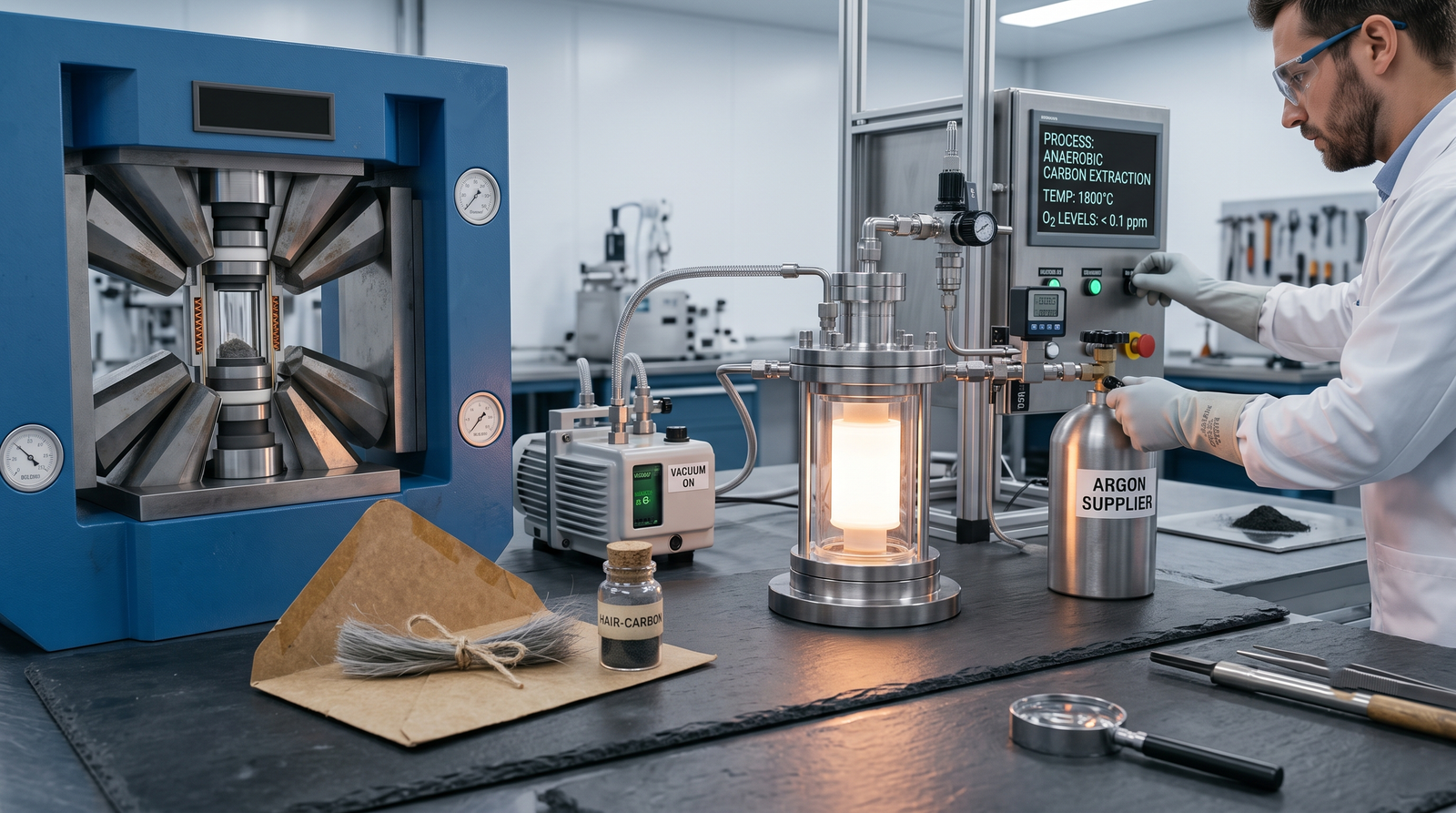
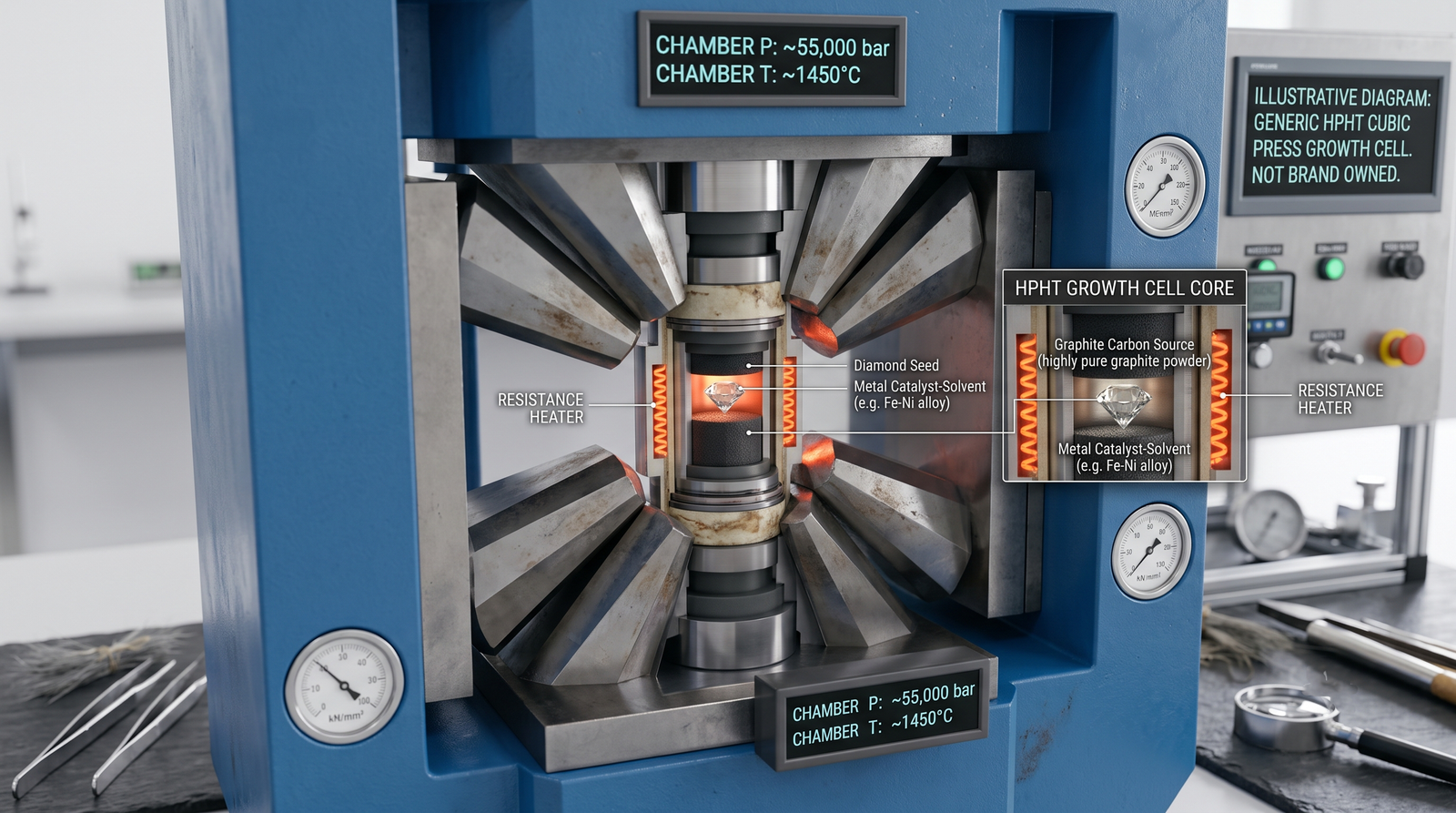
Each material is heated in a controlled, oxygen free process that strips away everything except carbon, reaching roughly 99.9% purity. The two purified carbons are then combined with each other and with supplemental lab sourced carbon, converted to graphite at roughly 2,500 to 2,700°C, and grown into one crystal in a single growth run using HPHT or CVD synthesis. In the finished stone, your father’s carbon is typically a minority share of the mass; no honest provider describes a memorial diamond made this way as 100% him. How the two materials are actually processed and merged walks the full sequence.

Why Can’t the Finished Stone Prove Both Were Used?

Because after purification there is no difference left to detect, and a memorial diamond made from two sources looks like any other.

Ash derived carbon and hair derived carbon are indistinguishable once they are graphite. There is no seam in the crystal, no two tone effect, no layer that came from one and a layer from the other, and no gemological test that recovers the ratio. A grading report from a laboratory such as the GIA documents cut, color, clarity, and carat; it cannot tell you where the carbon came from, or whether it came from two places.

That cuts both ways. A provider who claims the finished stone can be tested to confirm both inputs is claiming more than the science supports. A skeptical relative who says the stone “proves nothing” is, strictly, correct. Neither of them is talking about the evidence that does exist.

What Are the Four Things You Can Actually Verify?

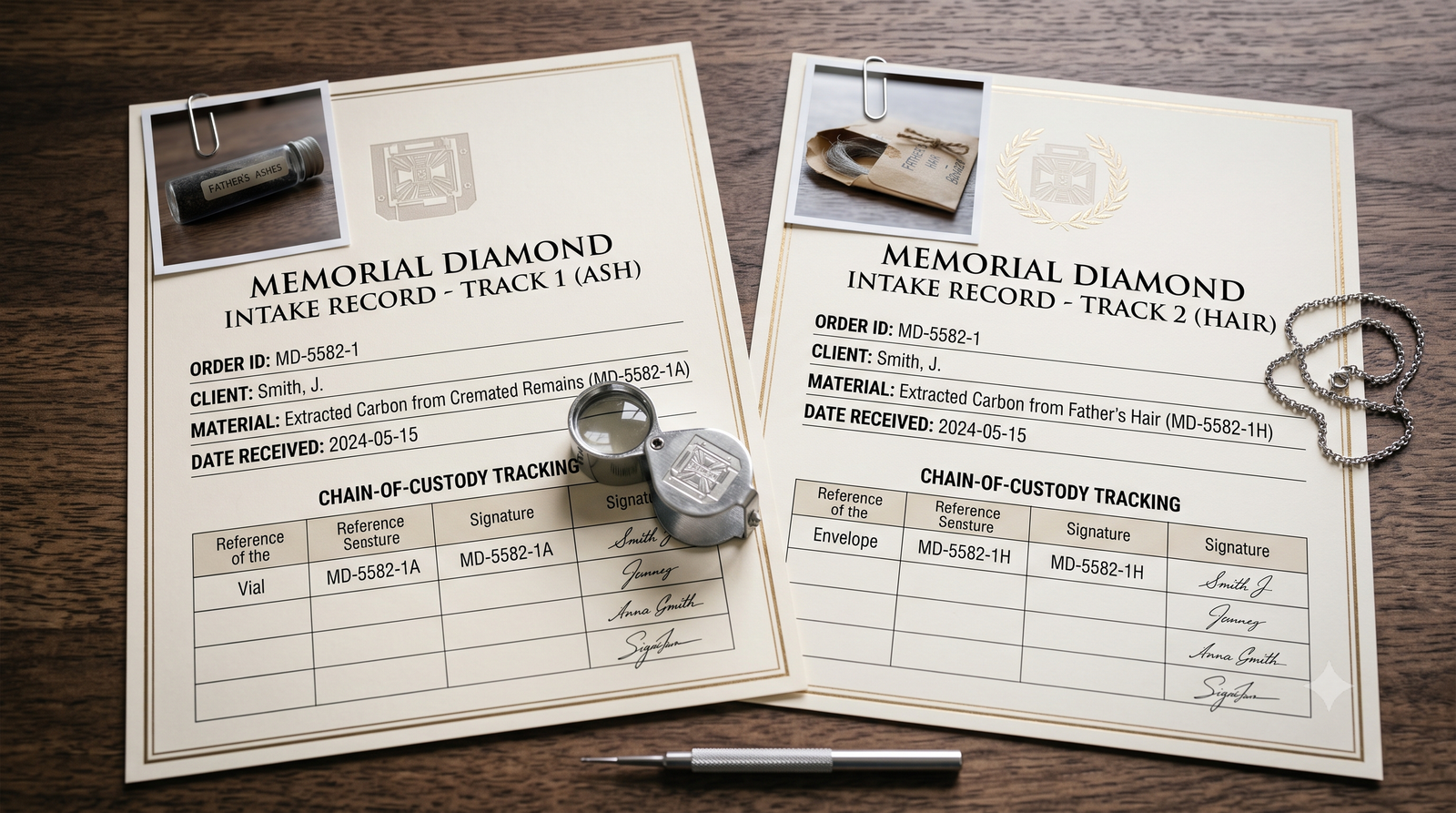
The proof that both materials were used lives in the paperwork, not the stone. For a combined order, these four items are the ones to ask for, and any provider serious about chain of custody should be able to produce them:

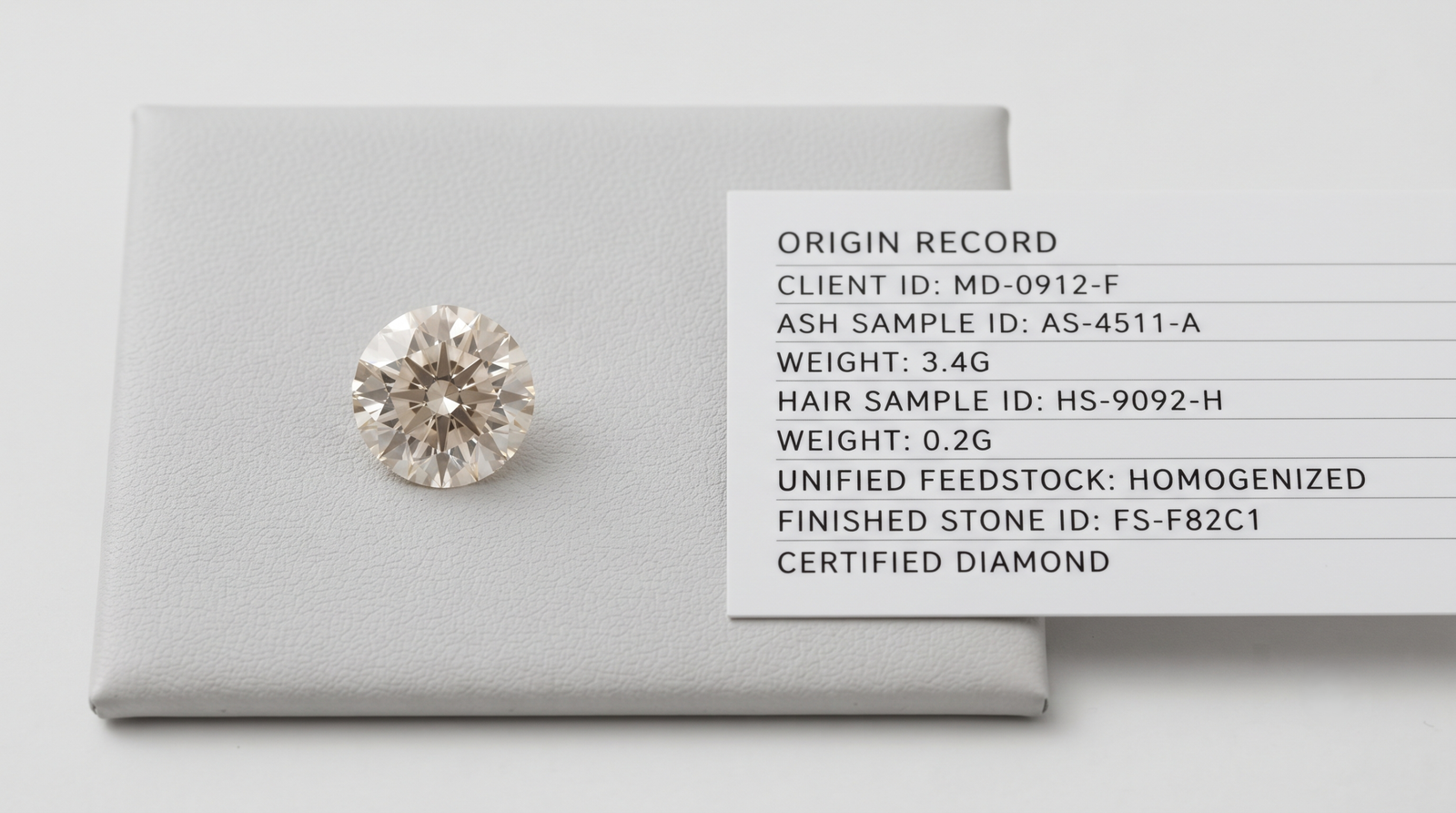
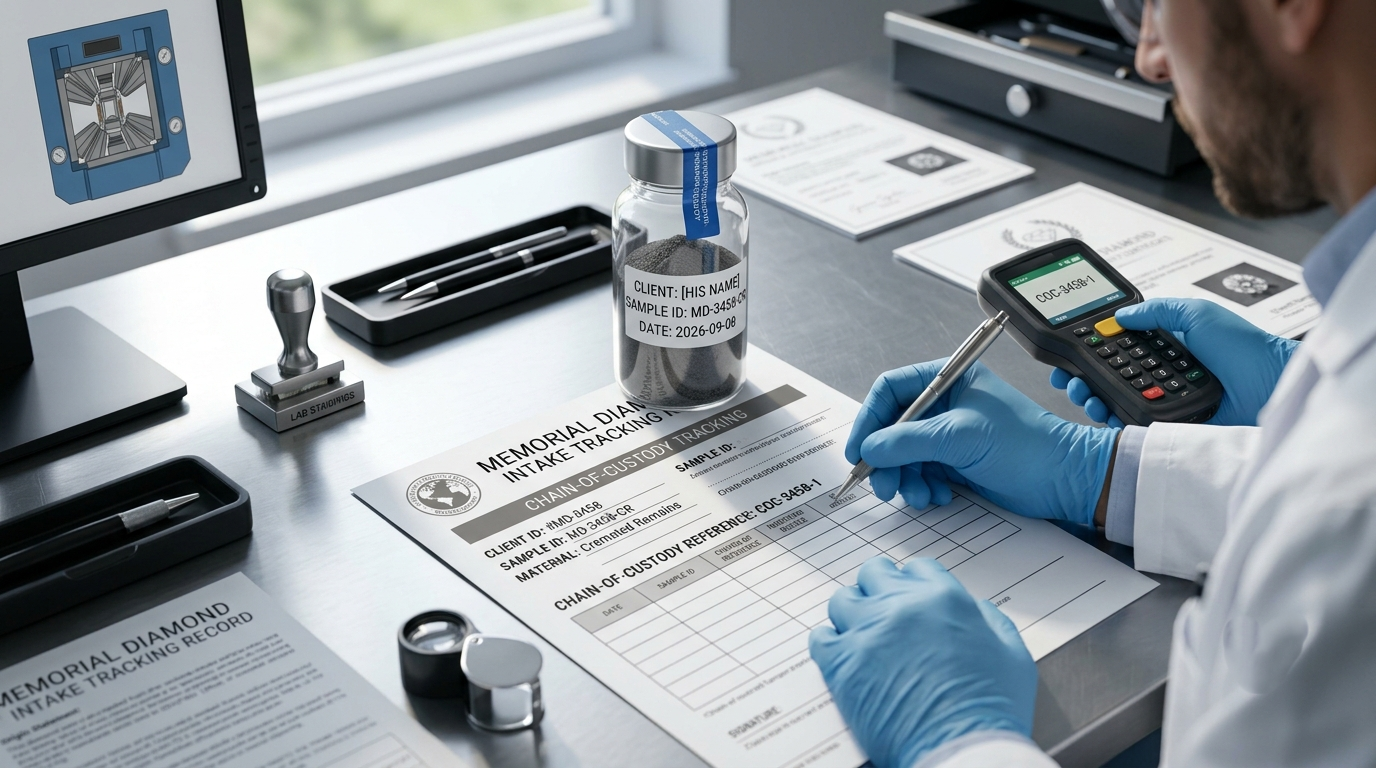
  1. Two separate intake records, one for the ashes and one for the hair, each with its own reference number, rather than a single line reading “father, combined.”
  2. A recorded carbon yield for each material before blending, so you know what each one contributed rather than a single blended total.
  3. A written shortfall procedure, stating in advance what happens if one material yields less than planned, and confirmation afterward that it was followed.
  4. Unused material returned separately, the remaining ashes and the remaining hair each coming back in its own container.
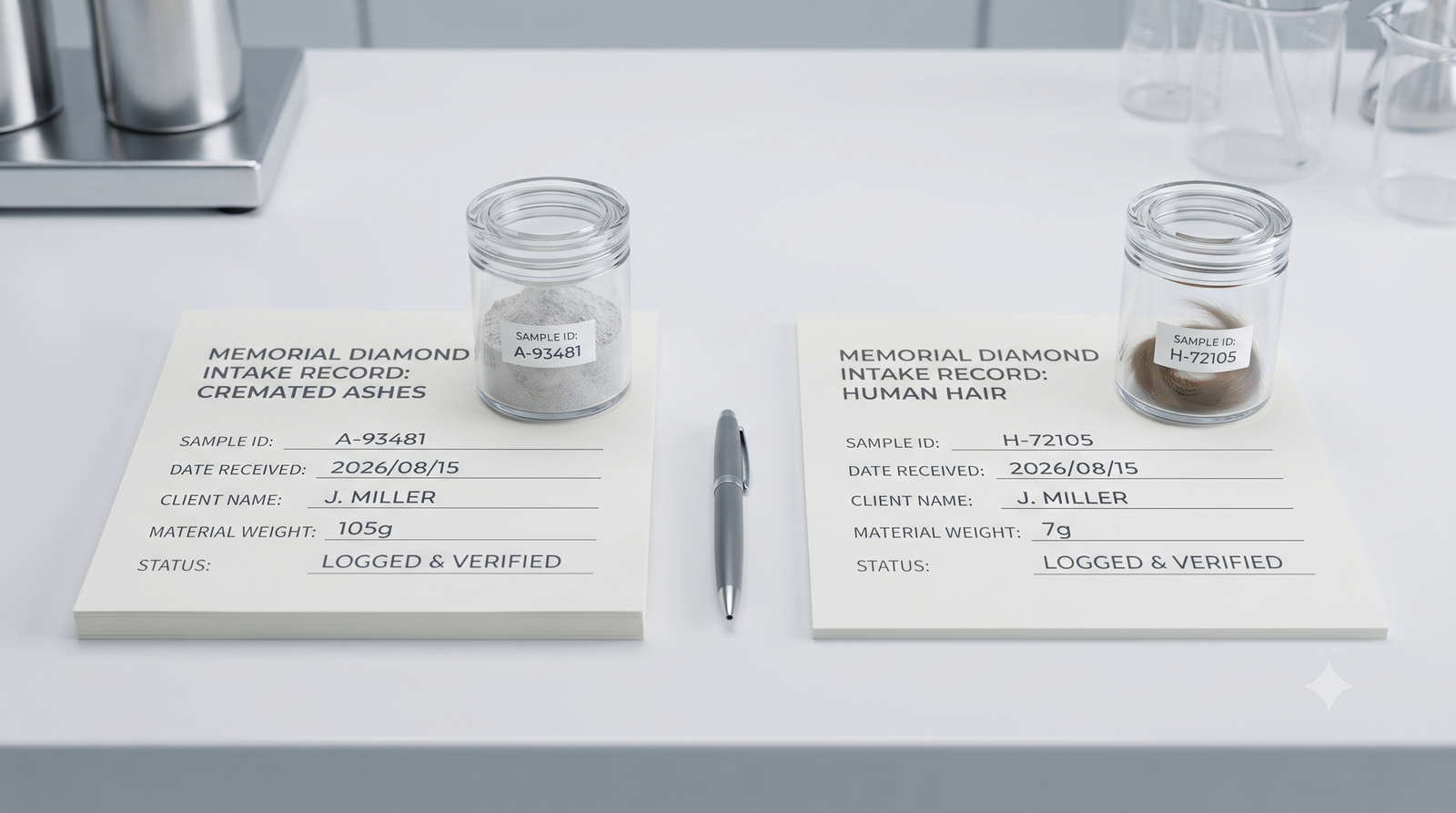
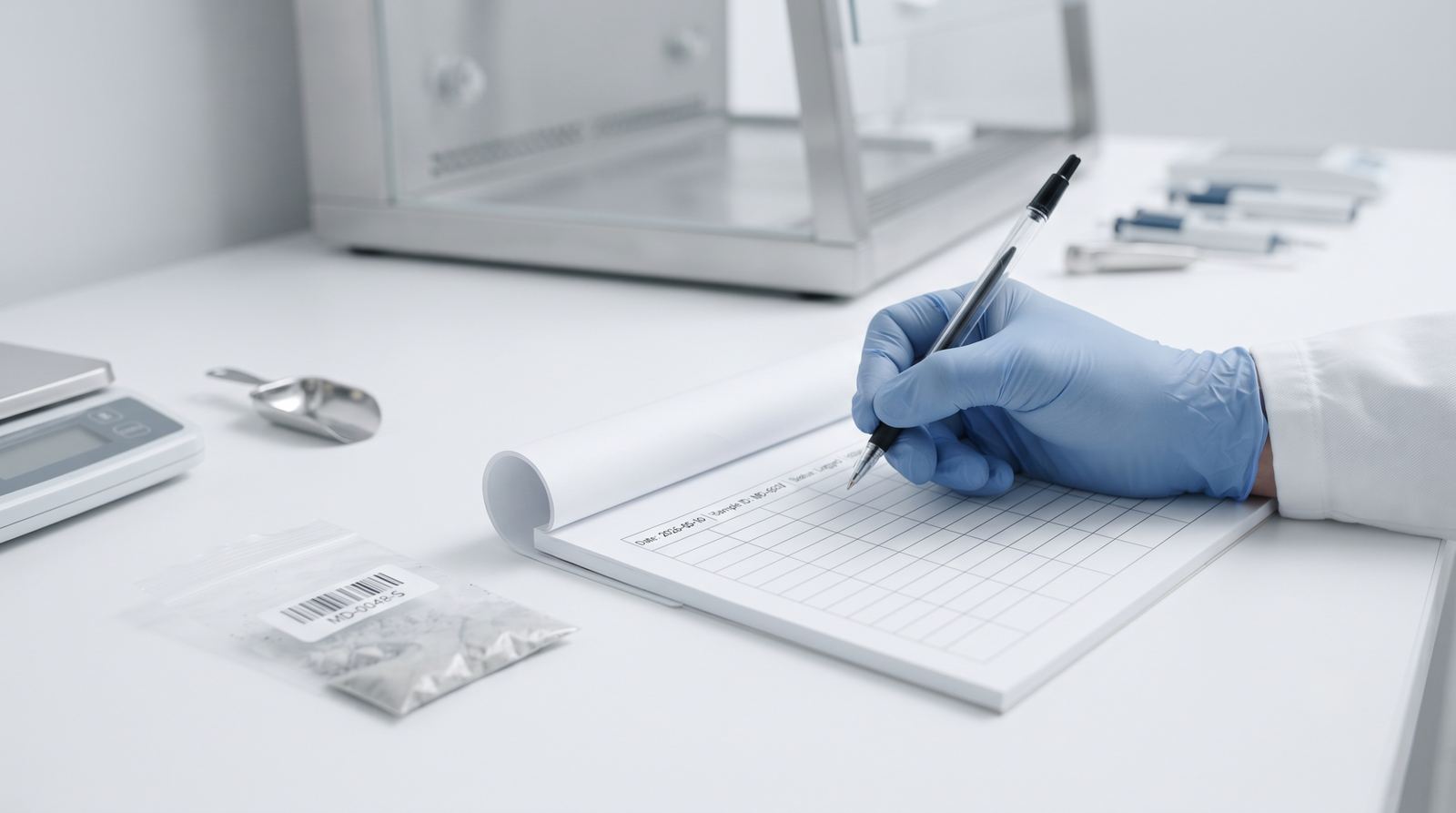
Two separate intake record sheets and sample containers, one for ashes and one for hair, on a lab bench

Those are documentary questions with checkable answers, and the good ones are answered before the parcel is sent, not after the stone arrives. A memorial diamond made from two materials is only as verifiable as the records kept on the way in. Questions to ask before turning your father’s ashes and hair into a diamond covers the wider conversation, and the single material versions of this question are answered in Is a memorial diamond really made from your father’s ashes? and Is a memorial diamond really made from your father’s hair?.

What Happens in the Window Before the Two Are Blended?

There is a moment in every memorial diamond made from two materials when the lab knows exactly what each material produced and nothing irreversible has happened yet. It sits after extraction and before blending, and it is the point a family never sees unless they asked about it.

Ash is the less predictable of the two inputs. Its carbon content is published as a range from 0.5% to 4% by weight, against a single published figure of about 50% for hair, so the ash portion is the one more likely to land somewhere other than where the plan assumed. When that happens, someone decides what to do: proceed with a smaller ash contribution, ask you for more material, or proceed on the hair plus additional lab carbon.

Those are three different outcomes, and the third one produces a stone the family will describe for the rest of their lives as made from his ashes and his hair. Nothing about that is sinister. It is a decision made inside a window you were not in, and the only way to be in the room is to have asked, in writing, what the procedure is before anything ships. How much ash and hair you need for a father memorial diamond explains what “enough” means for each material.

Frequently Asked Questions

Can a memorial diamond made from ashes and hair be tested to confirm it contains both?

No. Once both materials are purified to carbon and graphitized, they are chemically identical, and no gemological test can tell them apart or recover the ratio. Verification comes from intake records, per material yield figures, and returned material, not from the finished stone.

Does adding hair to my father’s ashes put more of him in the diamond?

Only marginally, depending on quantities. Hair contributes carbon far more efficiently than ash, so a lock can add meaningful personal carbon, but a memorial diamond made with both still needs supplemental lab carbon to reach a growable size. The personal share stays a minority of the mass either way.

Is the diamond a real diamond?

Yes. A memorial diamond made by HPHT or CVD is a genuine lab grown diamond with the same crystal structure and hardness as a mined one. Independent labs grade it on the same cut, color, clarity, and carat scale as any other diamond.

Why does the ash matter more than the hair for a combined order?

Because ash yield is unpredictable. Usable carbon in cremated remains ranges roughly eightfold, from 0.5% to 4% by weight, while hair sits near 50%. If one material falls short of plan, it is far more likely to be the ash, which is why a written shortfall procedure matters.

What should I ask for in writing before sending both materials?

Ask for separate intake records with individual reference numbers, a recorded yield for each material, the provider’s procedure if one material yields less than expected, and confirmation that unused ashes and hair come back separately. Get all four before shipping anything.

Will my father’s remaining ashes and hair come back?

Typically yes. Only a small portion of the ashes is needed, and only a lock of hair, so most providers return unused material. For a combined order, confirm they come back in separate containers so you know each one was handled on its own.

Final Thoughts on a Diamond Made From Both Ashes and Hair

The fear underneath “did they really use both?” is a fear of being told a story instead of the truth. The stone cannot settle that, and it was never going to. What can settle it is a provider willing to show you two intake records, two yields, one shortfall rule, and two containers coming home. If those exist, a memorial diamond made from both is what you were told it is, and you can stop asking the stone to prove something only paper can.

Learn More About Father Memorial Diamonds

Talk With Memorial Diamond

If you are holding both his ashes and a lock of his hair and want to know what a memorial diamond made from both would actually involve, and what you would be able to see in writing along the way, reach out to Memorial Diamond. Bring the four questions above; the conversation is better when you do.
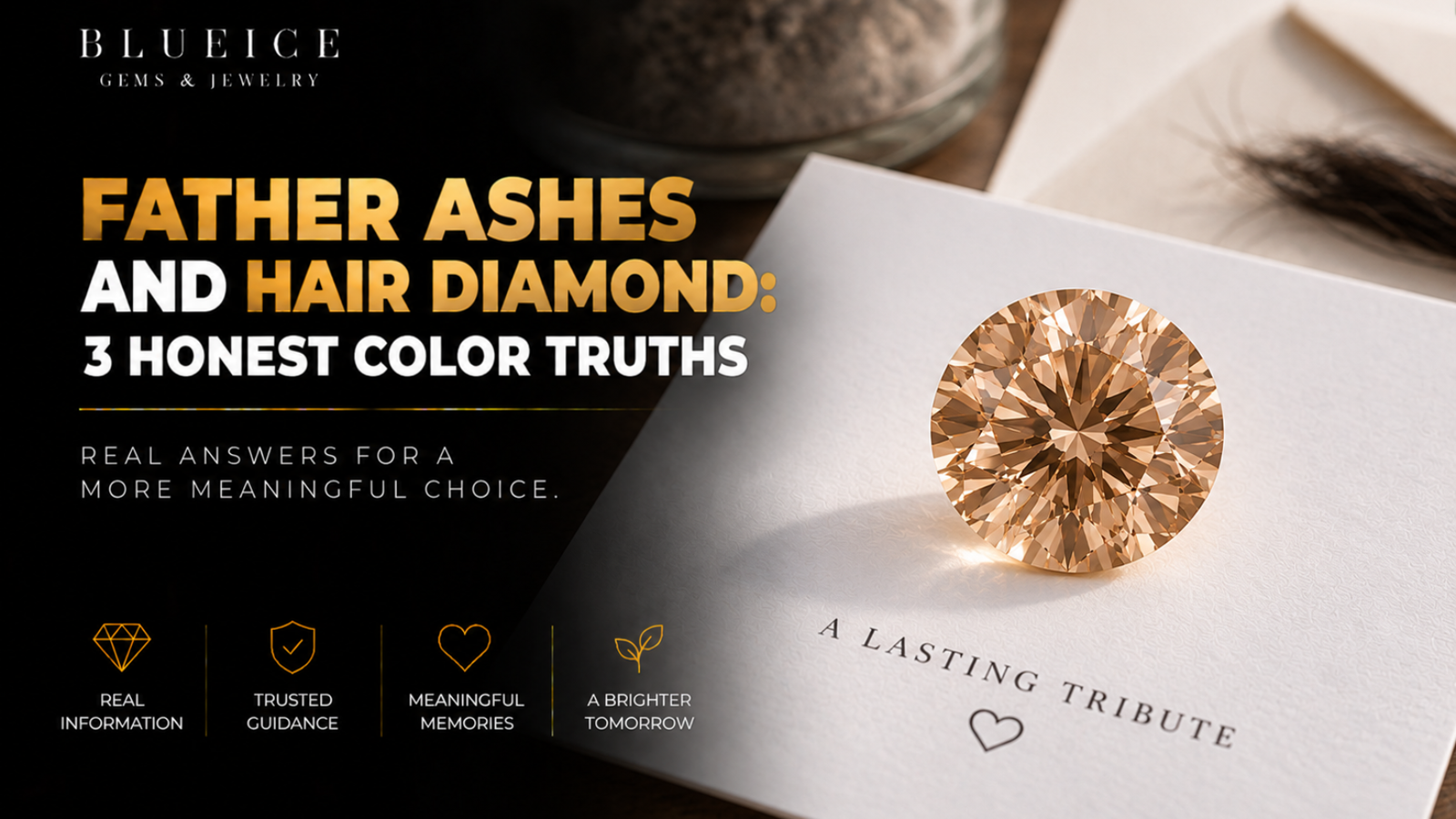
Father ashes and hair diamond in an even champagne tone, shown loose on a white card with no visible variation across the stone

What Color Will a Diamond Made From Your Father’s Ashes and Hair Be?

Two materials going into one stone invites a picture: a boundary, a swirl, two tones meeting somewhere in the middle. The stone that comes back has none of that.

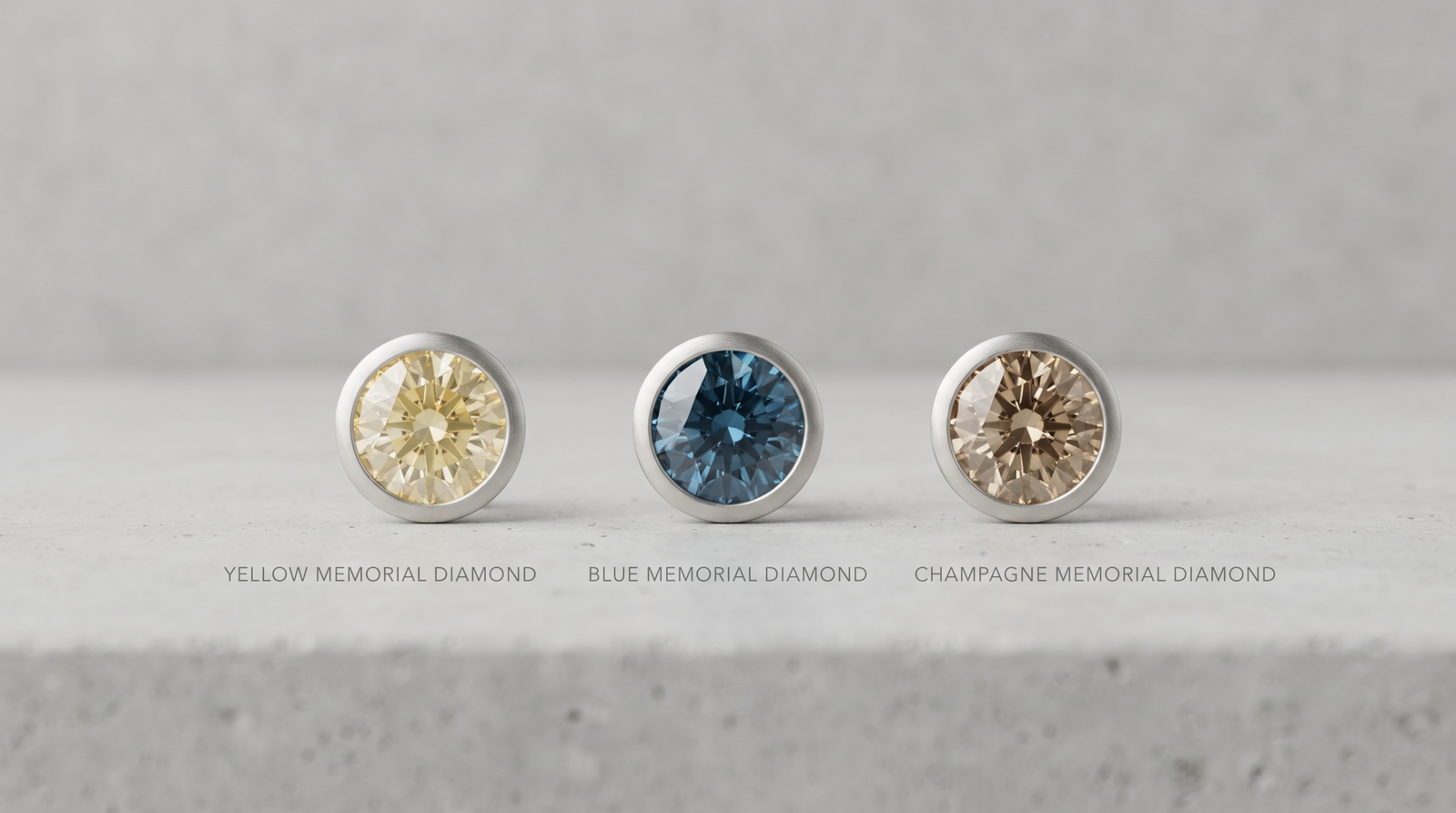
A father ashes and hair diamond is a single crystal in a single color, most often yellow, champagne, or blue, or colorless with extra processing. It is not an average of an “ashes color” and a “hair color,” because neither material has one. Both materials are reduced to pigment free carbon before growth, and the stone’s color is set by trace nitrogen or boron in the growth cell, exactly as it would be for either material alone.

Memorial Diamond takes combined ashes and hair orders, so this is a seller explaining a seller’s product. That is the reason to read skeptically, and the reason it tries to earn the read.

What Does a Father Ashes and Hair Diamond Actually Look Like?

Like any other memorial diamond. One even tone throughout, no seam, no gradient, no visible sign that two sources were used. Under a loupe a gemologist will see inclusions and growth features the way they would in any lab grown stone, and nothing that says “ashes here, hair there.”

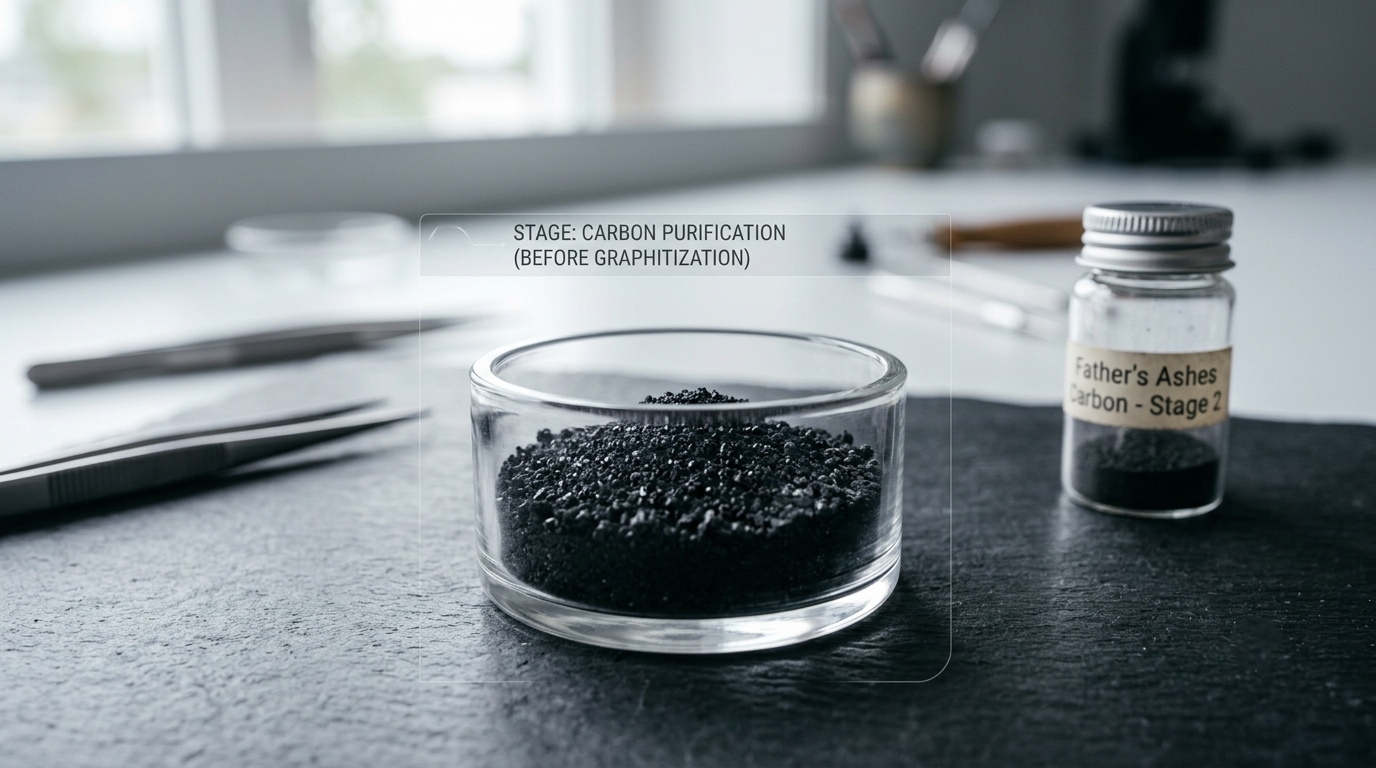
That is because the two materials stop being two materials before growth begins. Cremated remains go through extraction to remove calcium phosphate and everything else that is not carbon. Hair goes through extraction to remove the non carbon parts of keratin. Each ends as carbon at roughly 99.9% purity. Whatever the two materials contribute, supplemental lab carbon makes up the balance of the growth feedstock, and the finished crystal is genuinely, partially his rather than purely so.

Once blended and grown, every carbon atom in the lattice is the same element in the same structure, whichever container it came from. A father ashes and hair diamond therefore does not display separate visual sections for the two sources.

The three colors most families end up with, yellow, champagne, blue, and the one they can pay extra for, colorless, are the same four available for a father ashes and hair diamond as for any single source stone.

Why the Color Is Not an Average of the Two

An average needs two values to average. Neither ashes nor hair has a “color” in the sense that matters here.

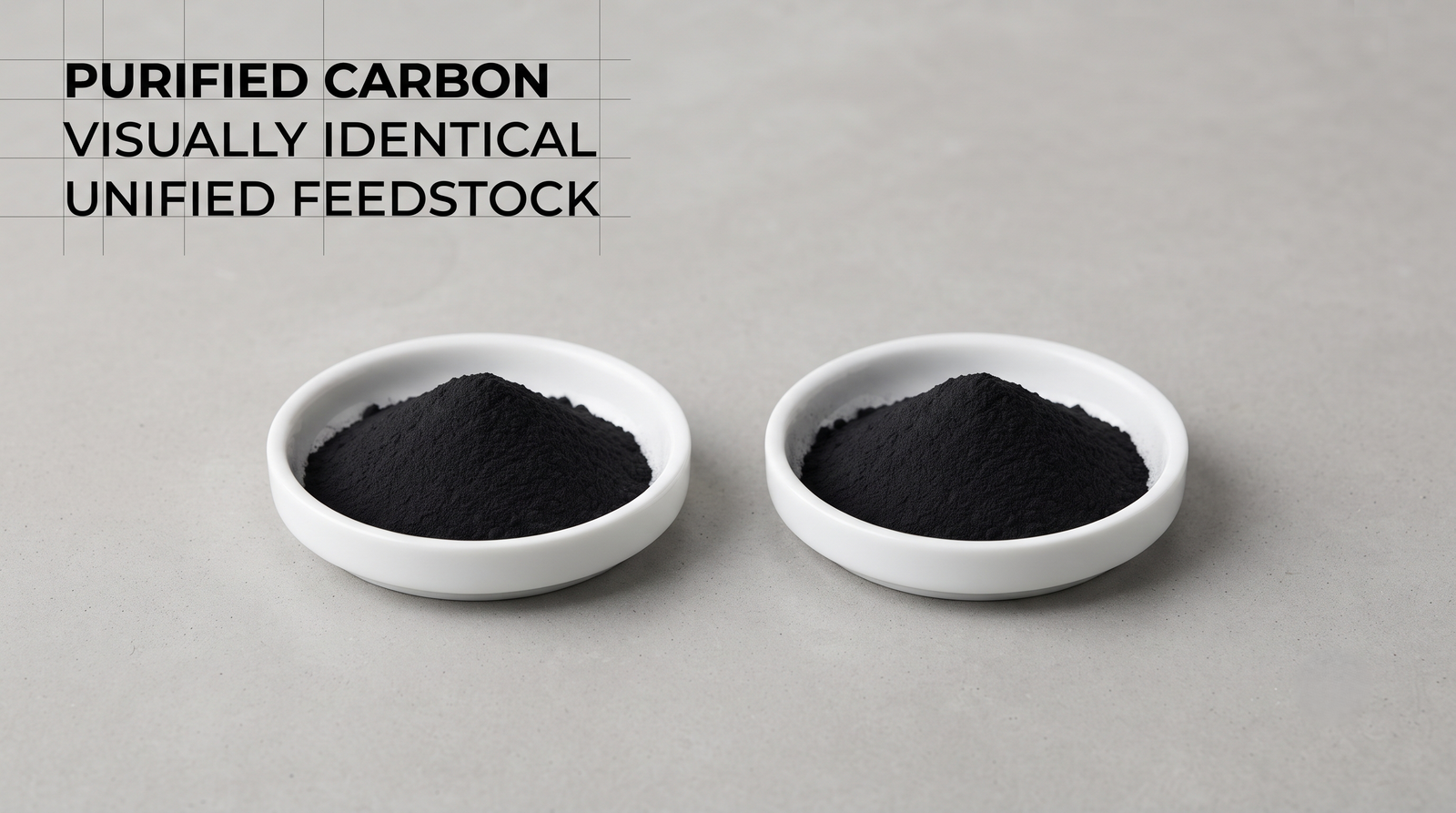
Ashes are gray because of minerals that are removed in extraction. Hair is brown or gray because of melanin, which is also removed. By the time either material is carbon, it is black powder with no pigment, and black carbon powder from ash and black carbon powder from hair are indistinguishable. There is nothing for the stone to split the difference between.

Two small dishes of purified black carbon powder side by side, visually identical

What sets the color is what was in the growth cell besides carbon: nitrogen tints yellow, boron tints blue, and neither gives colorless. Carbon recovered from organic sources tends to carry a little nitrogen along, which is why the whole category leans warm. A combined feedstock is not more or less prone to that than a single one; the chemistry does not know the carbon had two origins.

This means a father ashes and hair diamond does not become a mixture of two visible colors. The final color comes from the growth environment and trace elements rather than the original appearance of the ashes or hair.

For additional information about how diamond quality and grading work, see the GIA Diamond Quality Factors.

Which of the Two Actually Contributes More?

By carbon, hair, by a wide margin per gram. Hair is roughly 50% carbon by weight. Cremated remains yield somewhere between 0.5% and 4%. A lock the size of a fingertip can outweigh, in usable carbon, a considerably larger quantity of ash.

MaterialApproximate carbon yieldWhat that means in a combined order
HairAbout 50% by weightSmall samples yield a lot; usually the larger carbon contributor
AshesAbout 0.5% to 4% by weightLarger samples yield little; usually the smaller contributor
Lab carbonAdded to reach growth volumeMakes up the balance; the finished stone is typically 10% to 15% personal carbon or less

None of this shows in the color, and this is the point families sometimes want and cannot have: a father ashes and hair diamond does not come out “more hair colored” because more of its personal carbon came from hair.

The contribution ratio lives in the provider’s records, if they itemize it, and nowhere else. Ask whether they do; it is a fair question and not every provider answers it the same way.

Printed origin record listing two sample IDs with weights, beside a finished stone

Does Combining Make the Shade Harder to Predict?

No harder than usual, and “usual” already includes some uncertainty. No provider can promise an exact tone before growth for any memorial diamond; trace element levels vary run to run, and two stones ordered as “yellow” can differ in depth.

Combining does not add to that variance in any meaningful way, because the feedstock is homogenized before it goes into the press.

What combining does add is a second record to check. If exact shade matters, such as a match to an existing family piece, or two sibling stones that need to sit together, say so before growth, and ask how the provider handles it.

Selection from a run is the usual method; guaranteed identical shade in advance is not something an honest provider offers.

The colors page for a father goes into what a provider’s color words do and do not promise.

What to Settle Before You Order

Three decisions, and none of them is about the ashes or the hair:

  1. Who keeps the stone and what it goes into. Metal shifts every tint: a yellow stone deepens in yellow gold and reads faintly off white against platinum, while blue and colorless hold steady in any setting. Decide the piece before the shade.
  2. Grown color or treated color. Yellow, champagne, blue, and colorless are grown; red, pink, green, and black are typically post growth irradiation. Ask which is which on the provider’s menu, and know that a treated color is a treatment, not a reflection of either material.
  3. What you want written down. For a combined order, ask whether the origin record itemizes each material’s contribution and whether the color is described using a standardized grading scale or the provider’s own words. A father ashes and hair diamond has two chains of custody; make sure the paperwork reflects both.

Frequently Asked Questions

Could the Stone Come Out Two Toned, or Show a Boundary?

No. The ash derived and hair derived carbons are blended into one feedstock before growth, and the crystal grows as a single, uniform lattice. There is no boundary because there is nothing left to mark one; a combined stone looks exactly like a single source stone of the same color.

Would Sending More of One and Less of the Other Change the Color?

No. The proportions change what the provider’s records say about contribution, not the tint. Color is set by trace nitrogen or boron in the growth cell, and the feedstock is homogenized before growth, so the ratio of ash carbon to hair carbon has no visible effect on a father ashes and hair diamond.

Does His Hair Color Affect It, If the Hair Went Gray?

No. Melanin, the pigment that makes hair brown, black, or red, is removed during carbon extraction along with everything else that is not carbon. Gray hair has less melanin, not less carbon, so a gray lock contributes the same pigment free carbon a dark one would.

Is a Combined Stone More Likely to Be Colorless?

No. A colorless crystal needs a growth cell free of nitrogen and boron, and keeping them out is a separate processing step whatever the carbon’s origin. Two organic sources neither help nor hurt that; if you want colorless, order it explicitly and expect it to cost more at the same carat.

Can Two Combined Stones for Two Siblings Be Matched?

Approximately, and only by asking before growth. Trace element levels vary between runs, so two stones ordered in the same color can differ slightly in depth. Providers who match siblings typically select from the same run; ask what the provider can and cannot promise in writing.

Does the Color Say Anything About Which Material Contributed More?

Nothing at all. Hair contributes far more carbon per gram than ashes, but that ratio is invisible in the finished stone. If knowing the contribution matters to you, it has to come from the provider’s origin record. Ask whether they itemize it, because a father ashes and hair diamond will not tell you by its shade.

Final Thoughts on the Color of a Father Ashes and Hair Diamond

The picture of two tones meeting is a natural one, and letting it go is part of understanding what the stone actually is.

A father ashes and hair diamond is one crystal, one color, grown from carbon that no longer remembers which container it arrived in.

The color will suit the ring or the pendant, or it will not, and that is decided by the metal and the person who wears it, not by the ashes, not by the lock.

Where the two sources still exist as two is in the paperwork, and that is worth asking for. The combined question about whether the diamond is really made from both sources is where that record is described.

Learn More About Father Memorial Diamonds

Talk With Memorial Diamond

If you are planning a combined order and want to know what color is realistic for the piece you have in mind, reach out to Memorial Diamond.

Ask which colors are grown and which are treated, and whether the origin record for a father ashes and hair diamond will itemize both materials.

Desk with a phone, a notepad and a closed cremation urn set to one side, the notepad in use

How to Turn Your Father’s Ashes Into a Diamond

The first practical act is not opening the urn. It is making a phone call to whoever holds your father’s remains or arranges what happens to them and asking that person to set aside a small portion.

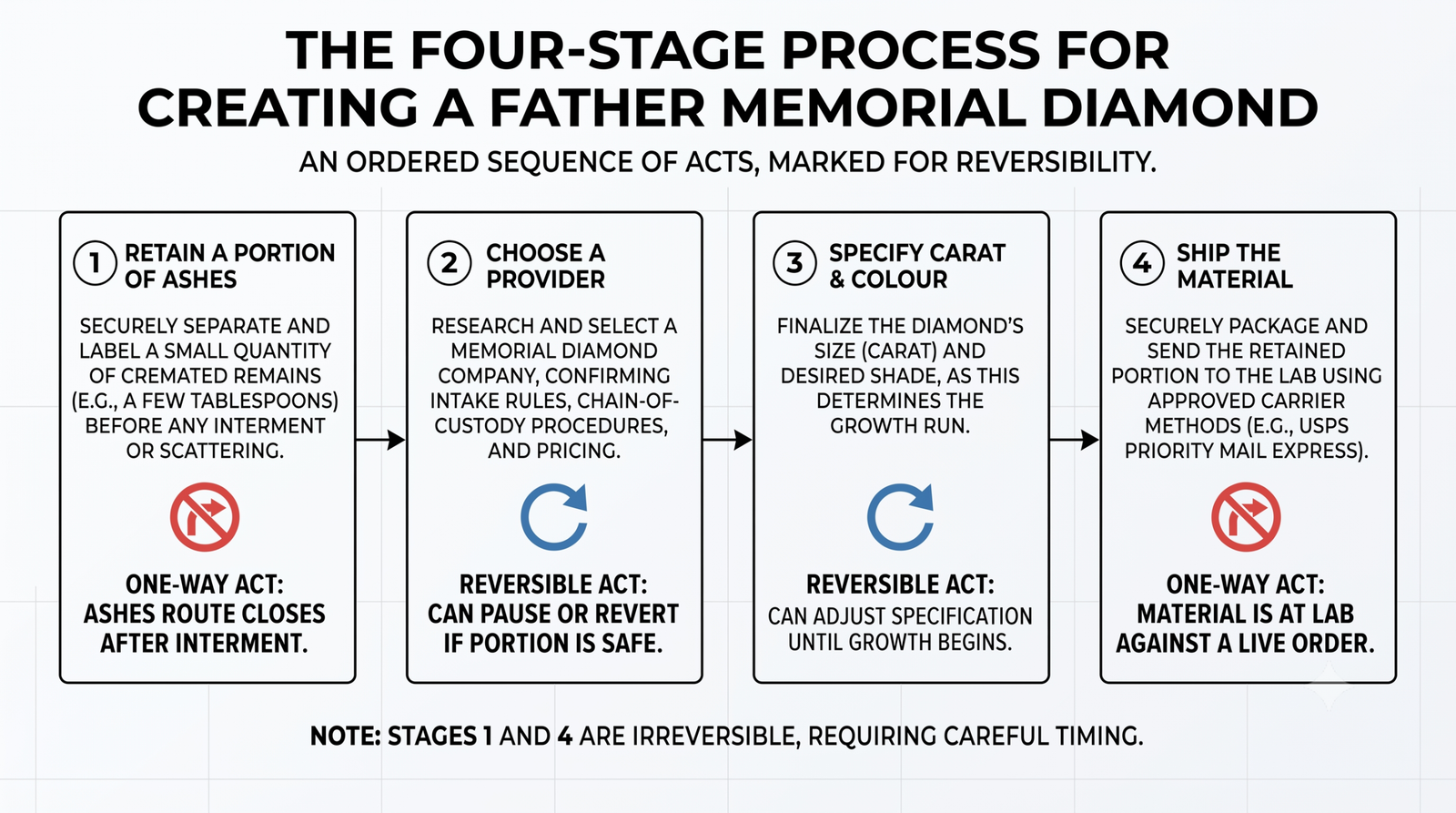
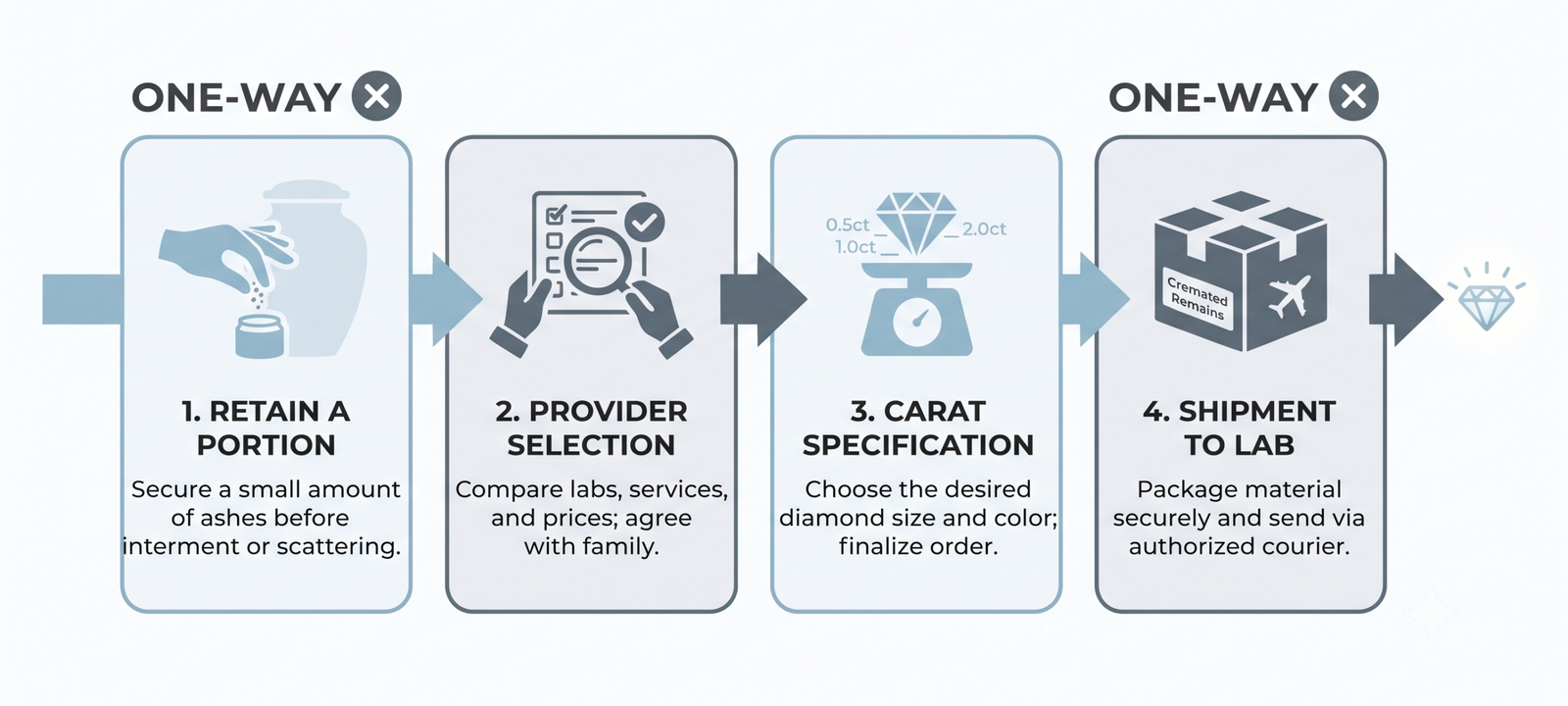
Turning your father’s ashes into a diamond involves four acts: retaining a portion, choosing a provider, specifying the carat, and posting the material. Only the first act has a deadline that you cannot move, and that deadline often arrives before you know which provider you want to use.

This guide explains that timing problem and shows what you can still fix when the four acts happen out of order.

The Four Acts and Which of Them You Can Undo

The sensible order does not always match the order a family can manage. The important question involves which acts you can reverse and which ones you cannot.

ActWhat you need firstCost of doing it lateCan you reverse it?
Retain a portionAccess to the remains before interment or scatteringThe ashes route closesNo
Choose a providerKnowledge of what you hold and what you want to makeNone while the portion remains safeYes
Specify carat and colourThe provider’s available options and intake rulesA growth run may follow a specification you later changeUntil the growth run begins
Post the materialProvider, specification, intake instructions, and order referenceMaterial can arrive at a laboratory without a live orderNo
Four-stage diagram showing retention, provider selection, carat specification and shipment, with the first and last stages marked one-way

The two one way acts sit at opposite ends of the process. The two reversible decisions sit between them.

Carat also affects the rest of your planning. A memorial diamond grows to its chosen size inside a press rather than starting as a larger diamond and receiving a simple cut down to size. Growth time therefore affects both carat and cost.

Read choosing a carat size before you finalize your preferred stone size.

The Retention Deadline Arrives Before You Choose a Provider

Here is where the sequence creates trouble. A committal, interment into a shared plot, or agreed scattering can happen within weeks of a death. Once the family places or scatters the ashes, you cannot retain a portion for an ashes based diamond.

Provider research can take much longer. You may want to compare intake rules, pricing, growth options, documentation, family preferences, and production times before you choose a company.

That creates an unusual situation. The irreversible decision can arrive before the slower commercial decision.

The solution does not require a provider, price, carat, or colour. You can ask whoever holds the remains to retain a portion before the family completes the other decisions.

For the broader process, read The complete guide to a father ashes diamond.

If a funeral service or veterans interment affects the timing, ask the funeral professional about the point at which the remains leave their custody. Raise the retention question before that handover whenever possible.

Can You Retain a Portion Before Choosing a Provider?

Yes. Retaining a portion gives you time to research the provider and make the other decisions carefully.

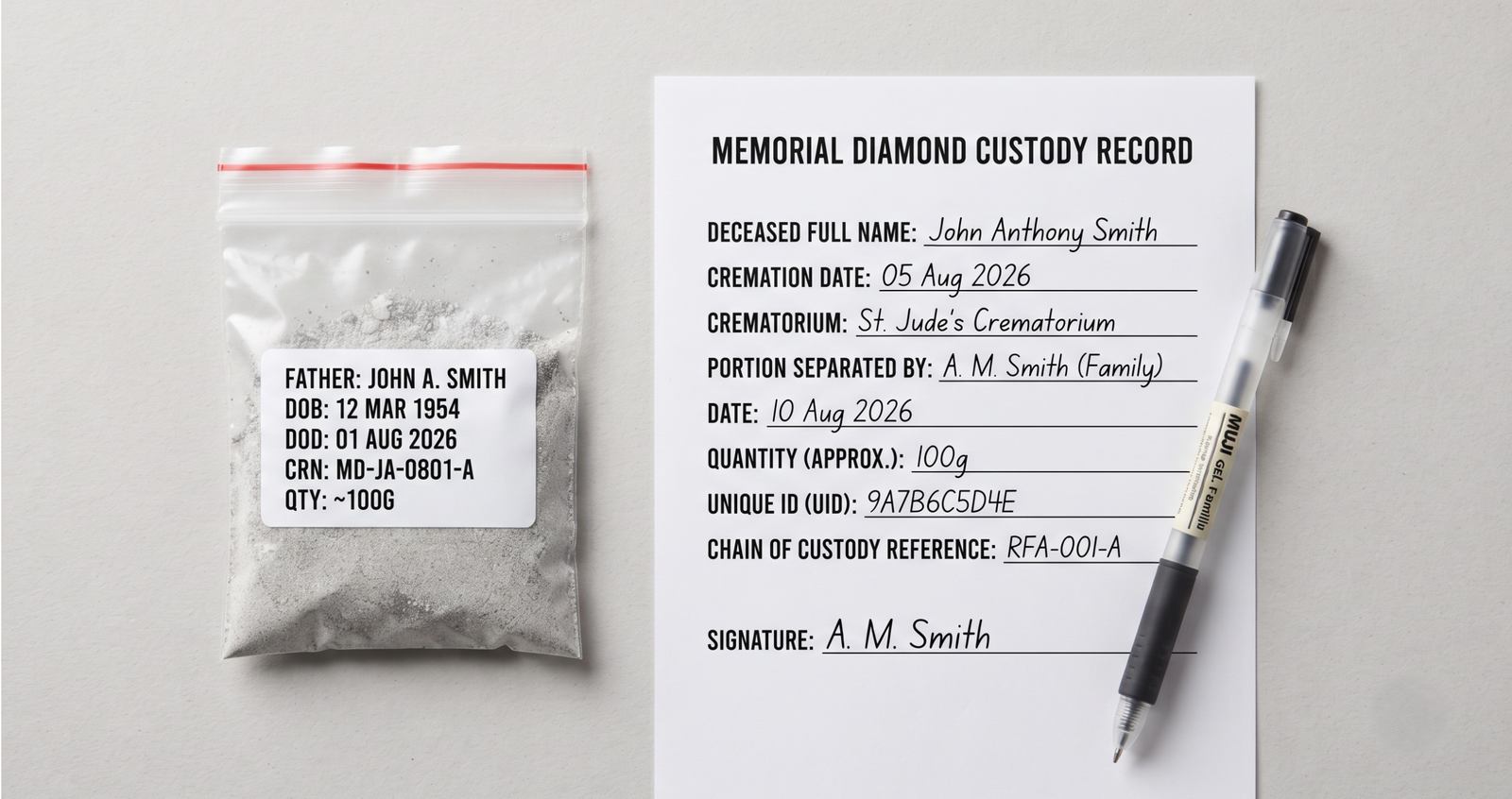
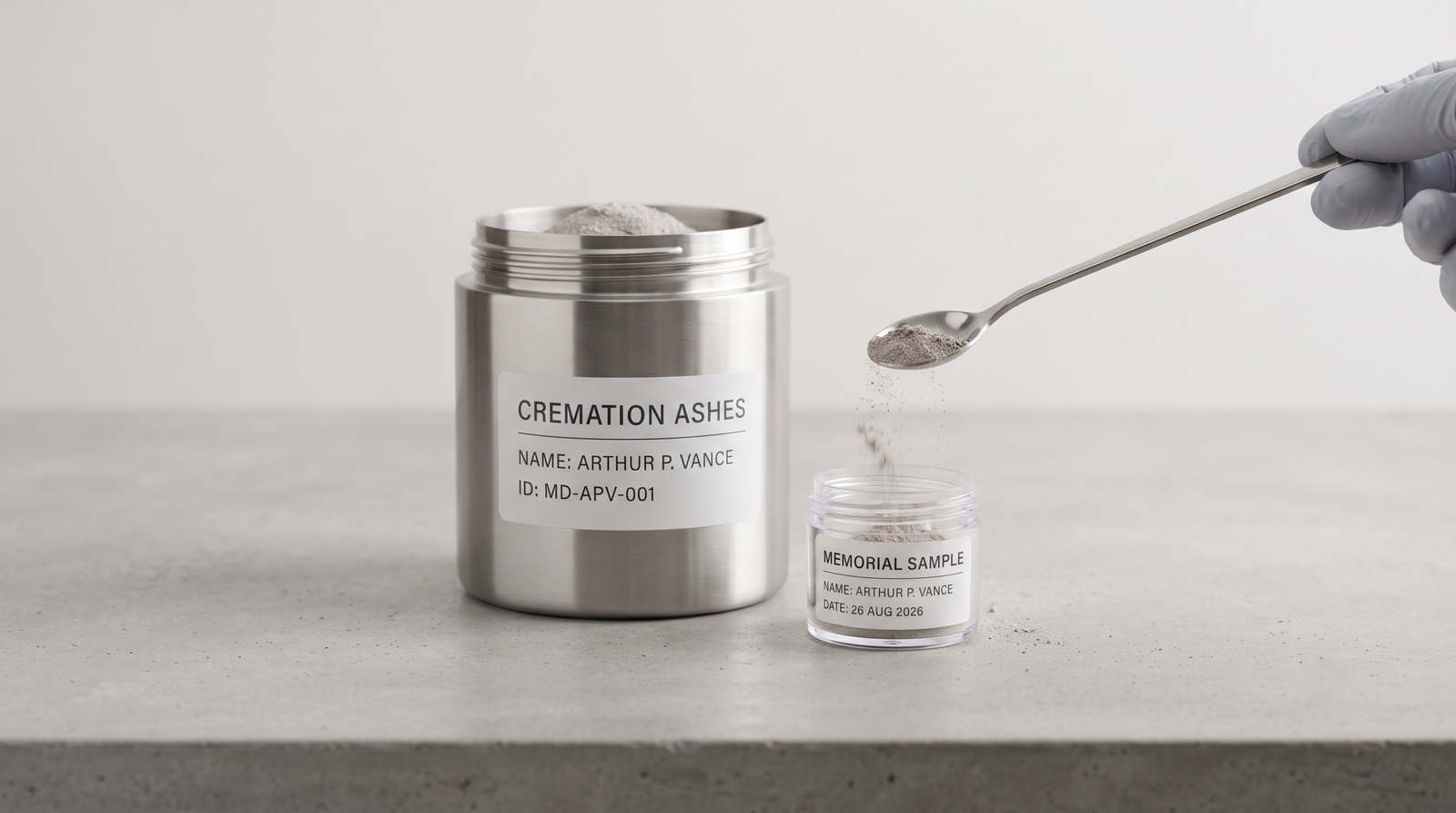
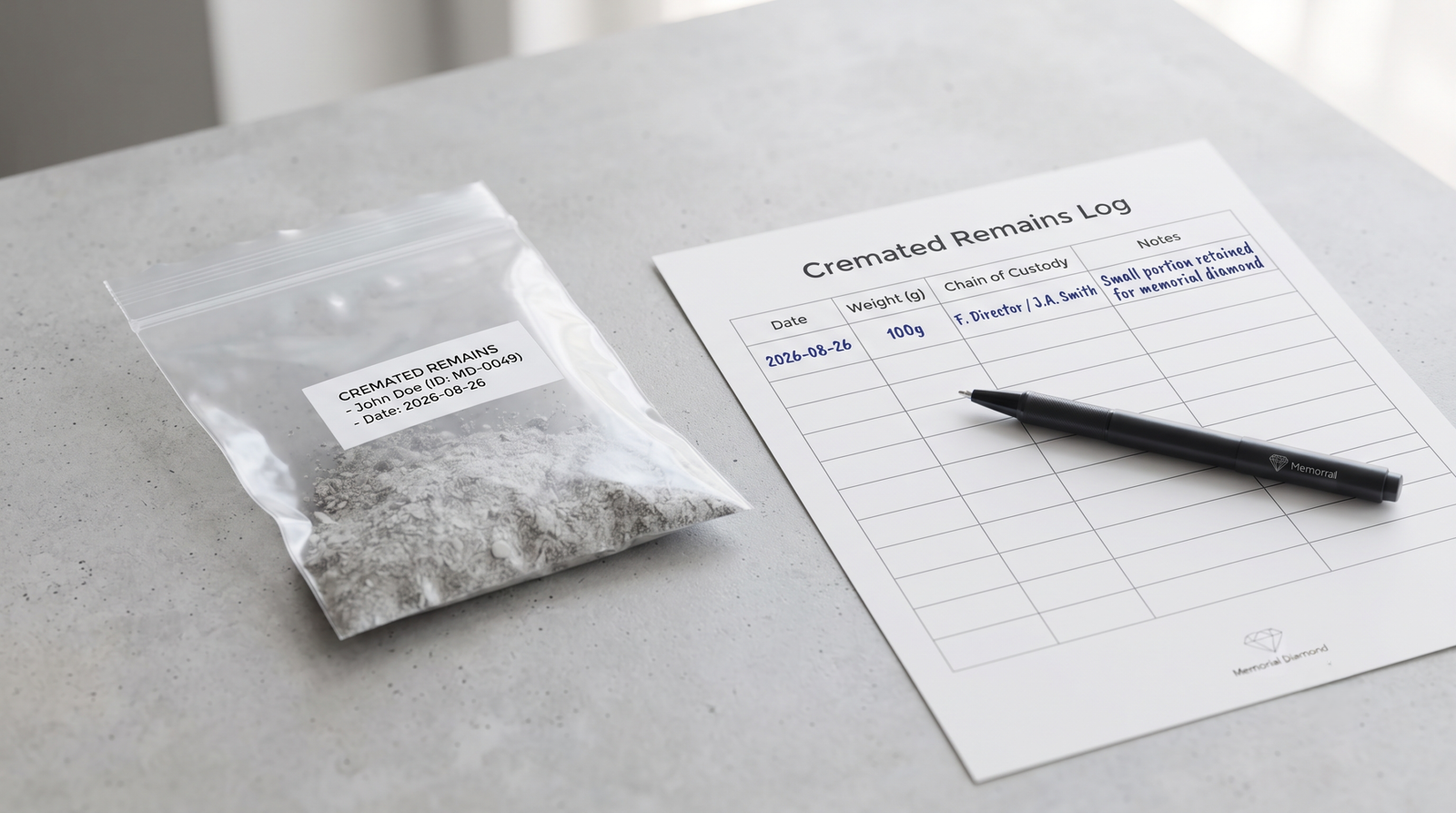
Retention represents a physical step rather than a commercial one. You need a suitable sealed container, a clear label, and a written record. A provider does not need to supply those items for you to retain the portion.

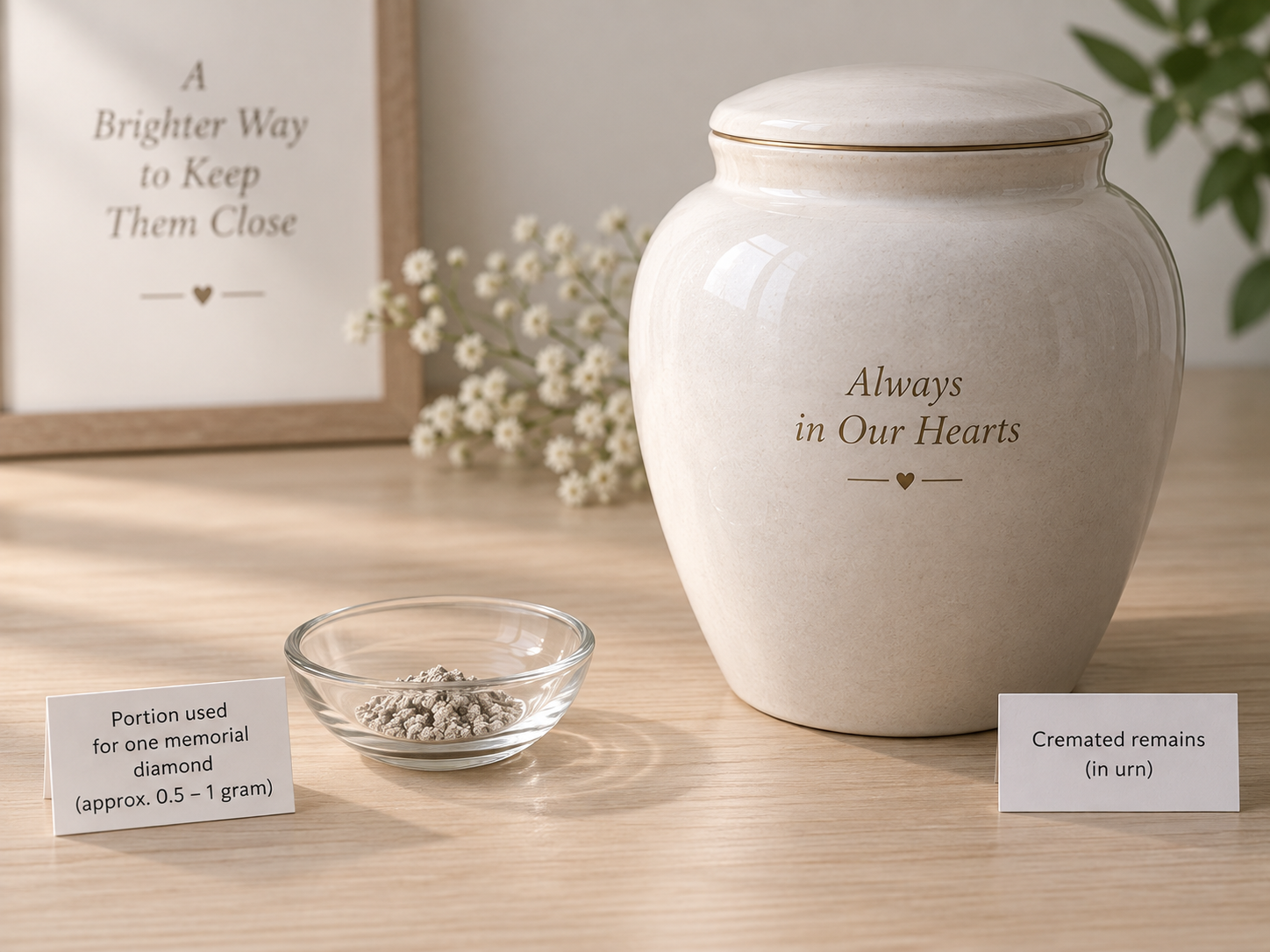
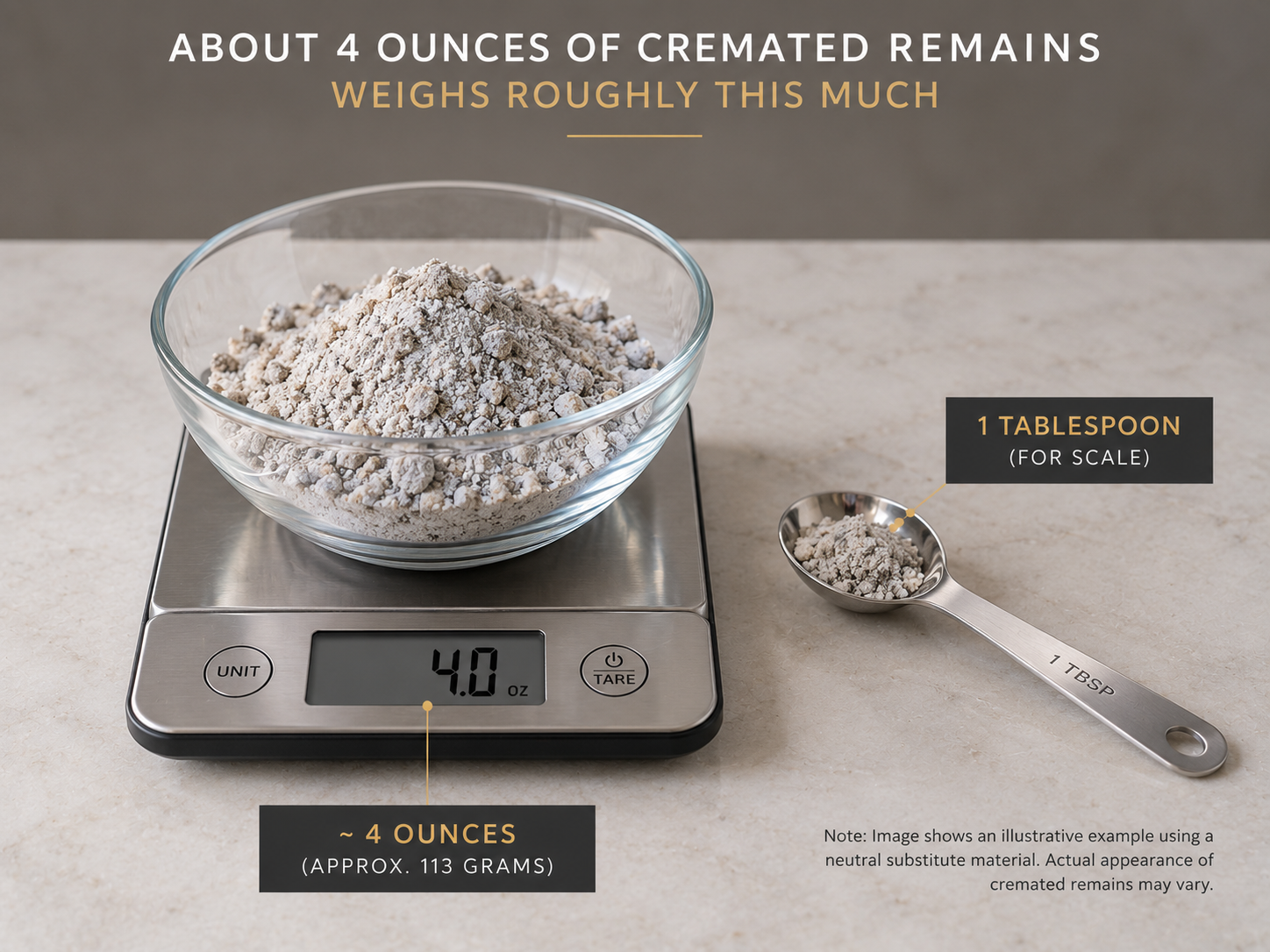
Quantity represents the decision that deserves attention because you cannot return later for more ashes. Industry typical requirements range from a few tablespoons to roughly 4 oz, or about 100g. That amount represents a small share of a full cremation.

Read how much ash a father memorial diamond needs before deciding how much material your family should retain.

Small sealed and labelled bag of cremated remains beside a handwritten record sheet and a pen

When someone separates the portion, record the following information:

  • Who separated the portion
  • The date of separation
  • Your father’s full name exactly as it appears on the cremation paperwork
  • The approximate quantity retained
  • Where the portion remains stored
  • Who knows about the retained portion

This record creates the family’s side of a custody history.

Read how providers track a loved one’s ashes to understand the other side of that record once the material reaches a provider.

If several family members contribute money toward the diamond, agree beforehand about who will own the finished stone and who will hold it. Ownership can vary according to jurisdiction and the way the family places the order.

What Has to Be Settled Before the Package Leaves?

Posting represents the second irreversible act. Families can rush this step because they already have the material and want to move forward.

Settle these points before you send anything:

  • Choose the provider. Get the intake instructions in writing, including quantity, packaging, labelling, and delivery information.
  • Agree on the specification. Confirm the carat and colour so the material arrives against a live order.
  • Record the order reference. Put the reference on the package according to the provider’s instructions so the laboratory can connect the material with the correct file.
  • Ask about unused material. Get a written answer about whether the provider returns material that remains after extraction or preparation.

Do not assume that a provider will receive and hold material while your family continues to decide the carat. That remains a provider policy question. Ask before you send anything.

You can also review what has to be settled before the package leaves for additional questions to ask your provider.

Shipping Is Decided by Carrier Policy, Not by Law

People often treat shipping cremated remains as a broad legal question. The practical issue also involves carrier policy.

There is no general legal obstacle to the concept of turning ashes into a diamond. Specific rules can apply to handling remains, documentation, and transportation. Carrier policies determine which shipping options an individual family can use.

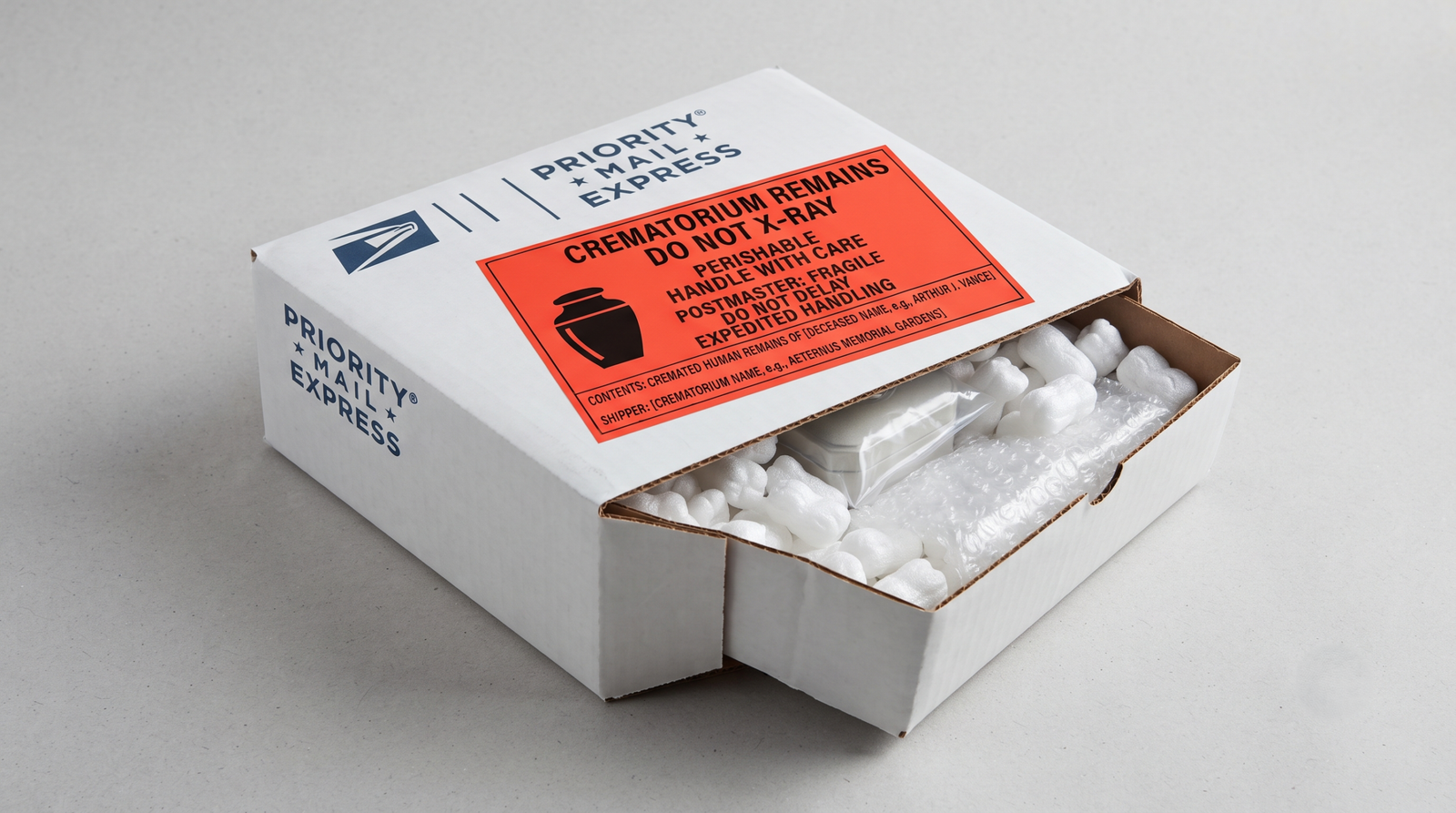
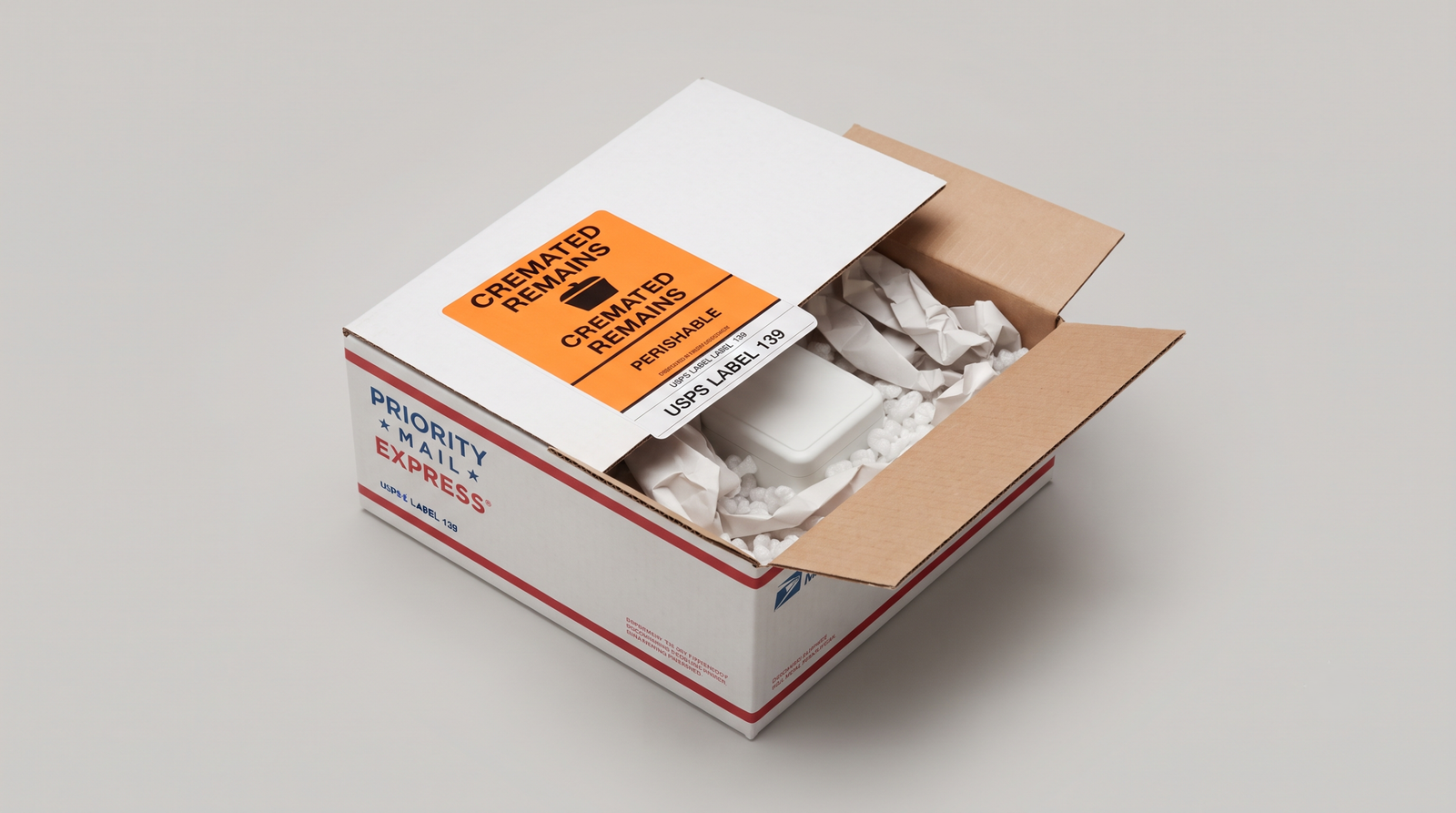
USPS Priority Mail Express parcel carrying the required cremated-remains label, cushioning visible inside

UPS, FedEx, and DHL restrict shipment of cremated remains by individual customers. For a family member shipping domestically, USPS provides the realistic direct shipping route described in this guide.

Who sends the materialPossible routeWhat you should confirm
A family member within the United StatesUSPS Priority Mail Express with the appropriate cremated remains labellingCurrent USPS packaging and service requirements
A funeral directorThe funeral professional’s business shipping arrangementsWhether they can ship the material for the family
A family member delivering in personHand deliveryWhether the provider accepts public drop offs and records receipt

USPS supplies a free Cremated Remains kit that customers can order online. Confirm current USPS requirements before you choose packaging because postal rules can change.

If you use your own packaging, ask USPS whether your sift proof and cushioned packaging meets the current requirements. Photograph the sealed package and its label before it leaves your possession. Then tell the provider that the material is on its way.

Read the legal position on turning ashes into a diamond for a more detailed discussion of the legal and handling questions.

If your father’s ashes have already gone to burial or scattering, the hair route can remain available. Turning your father’s hair into a diamond does not require the shipment of cremated remains.

What Can You Fix If the Acts Already Happened Out of Order?

Most sequence problems still have an answer. The important point involves identifying what has already become irreversible.

  • The interment happened and nobody retained a portion. The ashes route has closed. A hair route can remain available because it does not require cremation.
  • You chose and paid a provider before telling the family. If no material has moved, ask the provider whether it can pause the order before receiving the material.
  • You retained more material than the provider needs. Keep the surplus with the family. Extra material gives you more flexibility than a shortfall.
  • You retained less than the provider’s stated minimum. Ask whether the provider can work with the smaller quantity at a smaller carat. Treat this as a provider decision rather than a fixed chemical rule.
  • You posted the parcel before agreeing on the specification. Ask the provider about its intake hold policy and whether it can connect the material with the order while you finalize the specification.
  • You found a portion that someone set aside years ago without a record. Ask the provider what documentation it needs when the material has no clear cremation paperwork. The main issue becomes provenance rather than age.
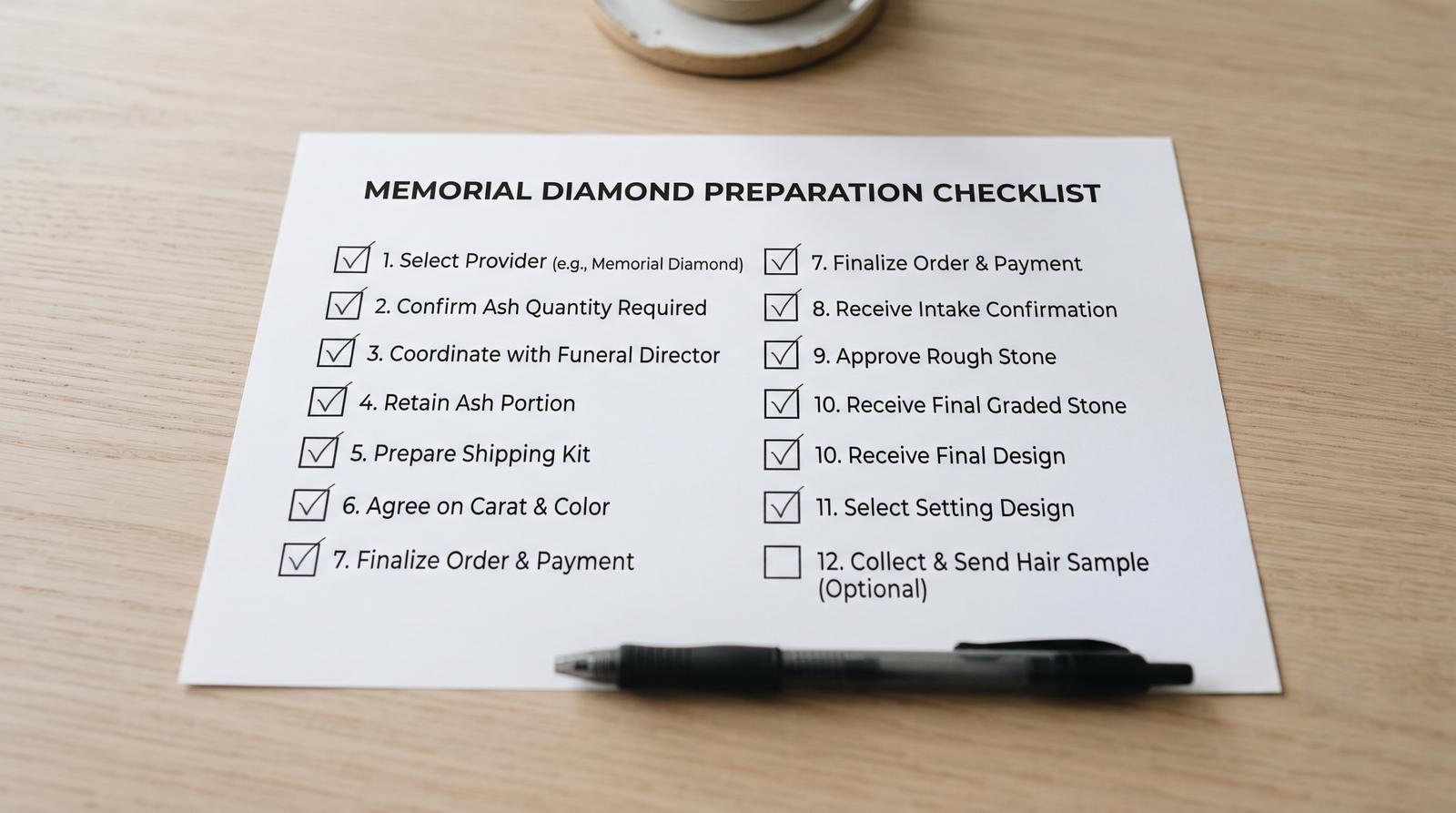
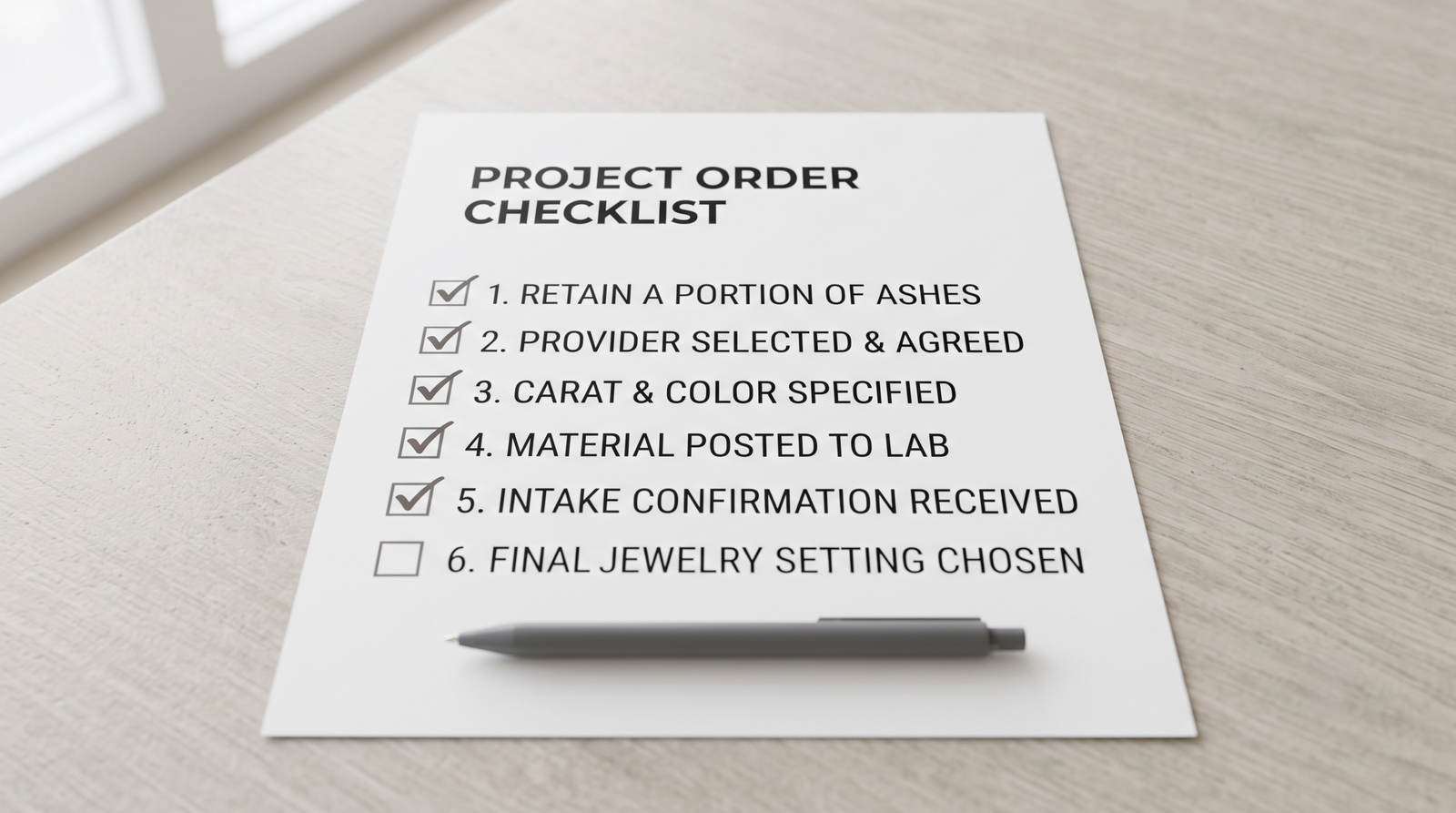
Printed checklist on a kitchen table with several lines ticked and one left blank

If the sequence has already broken, do not guess what the provider will do. Ask for the answer in writing.
Read the step by step process for turning your father’s ashes into a diamond for the practical sequence from start to finish.

What Happens Once the Parcel Is Out of Your Hands?

Your part of the sequence changes once the laboratory receives the material.

The production clock that providers quote generally starts when the laboratory logs the material into its intake process rather than when you place the parcel in the mail.

Ask the provider what intake confirmation looks like and how the provider sends that confirmation to you. Write down the receipt date because that date gives you a clear reference point for the production timeline.

Industry information places production around 6 to 10 months from laboratory receipt. Large stones and specialty colours can require around 12 months. The complete process can take around 8 to 14 months when you include planning, shipping, production, and final jewellery work.

Read how long a father memorial diamond takes for a closer look at the timeline.

Gloved technician logging a received sample into a laboratory intake record

One important point can help set expectations. Cremated remains contain only around 0.5% to 4% carbon by weight. Providers therefore blend recovered personal carbon with supplemental laboratory carbon to create enough material for diamond growth.

Industry information places the personal carbon contribution at roughly 10% to 15% of the finished stone’s mass. Sending more ashes does not automatically create a larger diamond or shorten the production time.

Before the parcel leaves, ask how often the provider expects to update you during production. Knowing the communication process in advance can make the waiting period easier to manage.

Frequently Asked Questions

Which comes first, choosing a provider or asking for a portion to be held back?

Ask for the portion first. Retention represents the only step with a deadline that cannot move. It does not require a provider, price, carat, or colour decision. You can choose the provider after the family safely retains the portion.

Can we send the portion before deciding the carat?

Usually, the specification should come first because a growth run follows the selected carat. Whether a provider will hold material while your family makes that decision remains a provider policy question. Confirm the policy before posting anything.

Do we have to order the free USPS Cremated Remains kit before we can post?

USPS supplies a free Cremated Remains kit that customers can order online. Confirm the current USPS requirements before posting because you may have another compliant packaging option. Waiting for a kit can also affect your timing.

Can a funeral director post my father’s ashes to the laboratory?

Often, a funeral professional can provide shipping arrangements that differ from those available to an individual customer. Ask the funeral director whether they can handle the shipment while they still hold the remains. Raise that question alongside your request to retain a portion.

A portion was set aside years ago and nobody recorded what it was. Can it still be used?

Ask the provider. The material itself can remain stable, but the missing documentation creates a provenance question. Tell the provider exactly what you know and ask what documentation it needs before accepting the material.

Does the growth clock start when we post the parcel or when the laboratory receives it?

The industry timeline starts at laboratory receipt. Transit time, any intake hold, and documentation discussions sit outside the quoted production period. Write down the date when the laboratory confirms receipt.

Get the Sequence Right Before You Choose the Stone

The order matters more than most families expect. Retain a portion before an irreversible interment or scattering closes the ashes route. Then take your time choosing a provider, carat, colour, and final jewellery design.

Memorial Diamond can help you understand what you need to hold, what you should settle before posting, and which questions deserve an answer before your father’s material leaves your hands.

If a committal, interment, or scattering already has a date, make the retention call first. Ask for a portion to be held back, record who separated it and when, and let the remaining decisions take the time they deserve.

Sealed portion of cremated ashes beside a small envelope of short hair clippings and a pale champagne memorial diamond on a dark linen surface

Father Ashes and Hair Diamond: The Complete Guide

The decision in front of you is probably not which material means more. It is whether the hair you found can contribute enough on its own. A father ashes and hair diamond is a genuine lab grown diamond grown from carbon extracted from both his cremated remains and his hair. The two materials follow separate purification routes before they join one feedstock for growth. Hair contains roughly 50% carbon by weight, while ash contains roughly 0.5% to 4%. That difference means a small amount of hair can contribute meaningful carbon when you combine both materials.

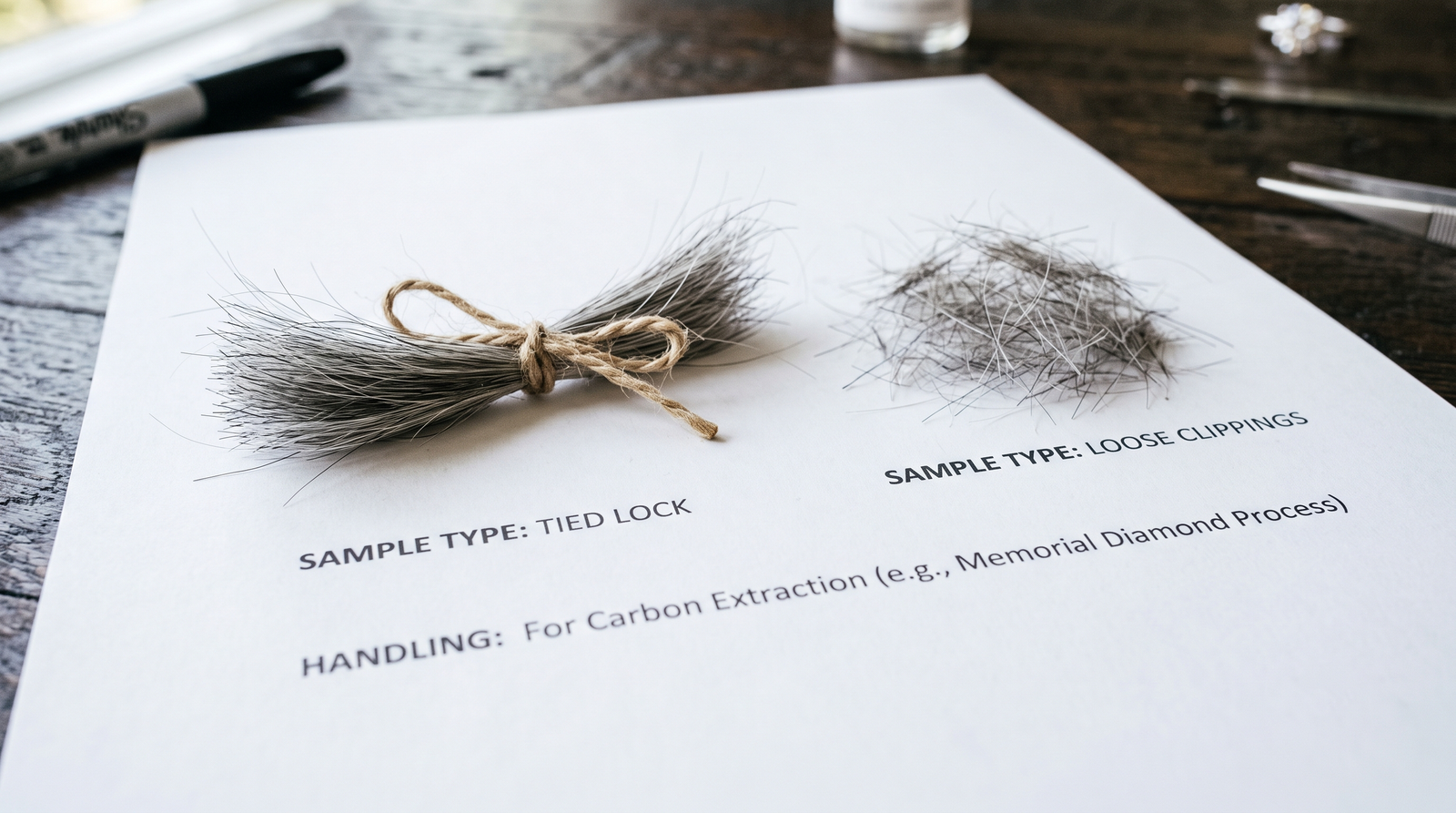
That is the practical reason this route can matter when the hair you found amounts to a beard trim, shaver contents, or a few short clippings rather than a complete lock.

The Decision Is Not Really Ashes or Hair

The two materials arrive under different conditions, and that difference creates the real decision. His ashes are usually easy to identify and measure because a container holds them. You can retain a portion while the family’s wider plan continues. His hair creates more uncertainty. You may have a complete lock, a childhood keepsake, or only a few short clippings.

If the hair you found cannot meet a hair only requirement, combining it with his ashes may still allow that material to contribute carbon. The two materials follow separate extraction routes, so each material contributes according to its own characteristics.

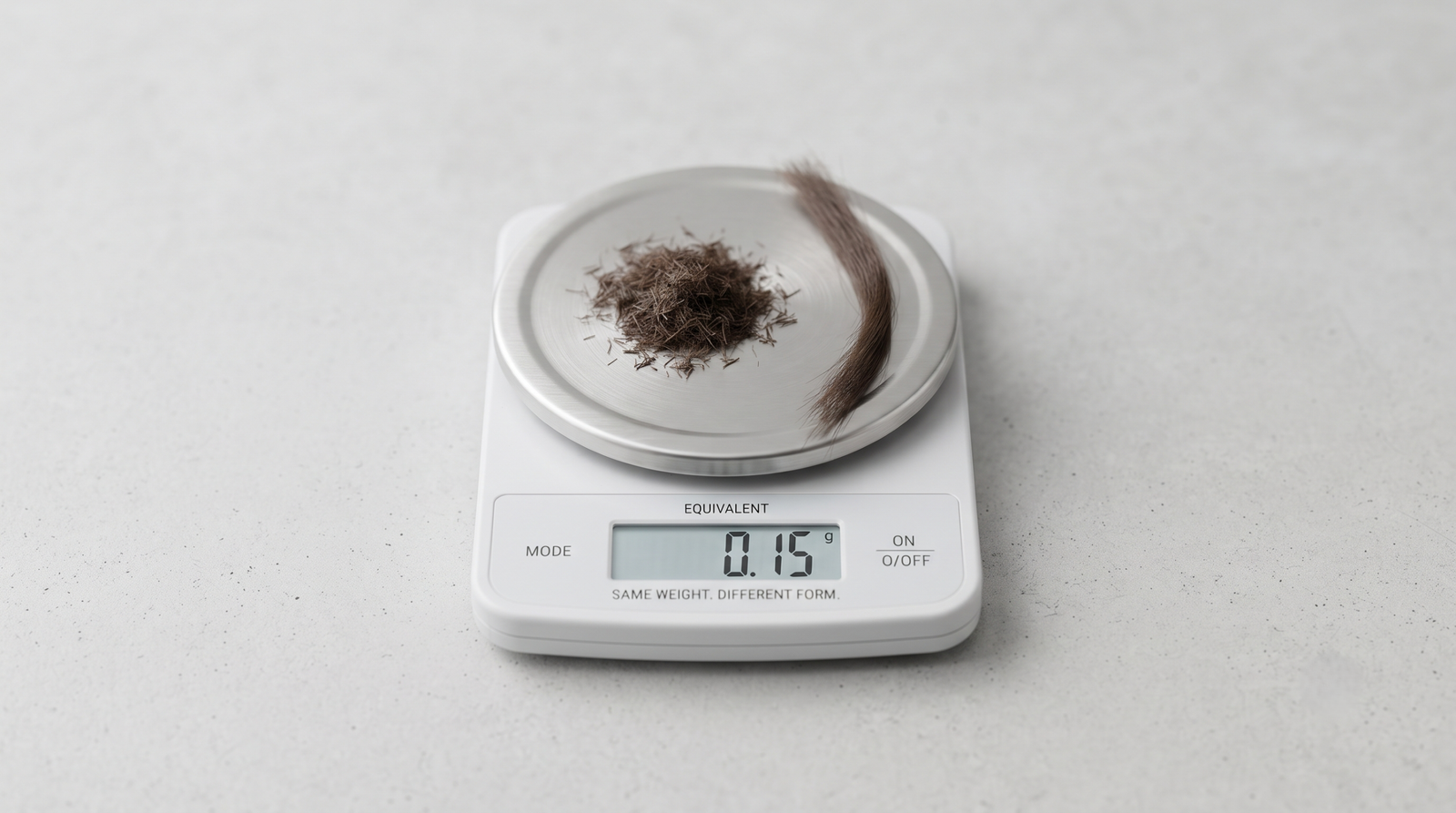
Small pile of short beard clippings on a jeweller's scale beside a longer lock of the same weight

One important rule deserves attention before you speak with a provider. Combining the materials does not automatically lower either material’s own minimum. A combined order does not turn two half portions into one qualifying portion. Ask for the ash minimum and the hair minimum as separate numbers.

For typical material quantities, read how much ash and hair you need for a father memorial diamond.

What you have of his hairWhat combining changesWhat remains open
A full kept lockHis ashes become a second carbon source while both individual routes remain possibleOrdinary provider and process questions
A beard trim or shaver clippingsHis hair contributes carbon without carrying the entire order aloneConfirm whether the provider accepts very short clippings
Hair from a shared brush or razorCombining does not establish whose hair the material containsProvenance and provider acceptance
A childhood keepsake lockA small keepsake can join his ashes instead of serving as the only materialWhether you want to use an irreplaceable keepsake

Why a Beard Trim Is the Real Reason to Combine

Combining makes particular sense when the hair you found is a beard trim rather than a long lock.

Beard, chest, and body hair contain keratin. From a carbon perspective, keratin provides the same basic material as scalp hair. Weight matters more than length. A short pile of beard clippings and a long lock with the same weight contain a comparable amount of carbon.

This distinction matters for fathers who experienced male pattern hair loss. A bald or thinning head does not automatically close the hair route. A beard trim, grooming cut, or other confirmed source may still provide usable material.

Chemistry does not create the main uncertainty here. Provider policy does. A provider may accept short clippings, or it may require a specific minimum. Ask for the answer in writing before you send the material.

Provenance also matters. Hair from a shared brush or razor may contain material from more than one person. No later laboratory step can tell you which person’s keratin entered the sample. The household must establish that history.

If you want to understand the hair only route, read the hair only guide for a father memorial diamond.

How Much of the Stone Is Actually Him?

Enough to make the connection real, but not enough to call the entire stone his carbon.

Cremated remains consist mainly of calcium phosphate, the mineral structure associated with bone. Usable carbon represents roughly 0.5% to 4% of ash by weight. Hair contains roughly 50% carbon by weight.

The laboratory purifies the recovered carbon to around 99.9% or higher before further processing. A diamond of meaningful size needs a workable feedstock volume, so the personal carbon joins supplemental laboratory carbon. Industry wide figures place ash derived personal carbon around 10% to 15% of the finished stone’s mass.

Adding hair can increase the personal carbon contribution, but it does not remove the need for supplemental carbon. The strongest description remains simple: carbon recovered from two different tissues becomes part of one diamond crystal.

For the broader explanation of the category, read what a memorial diamond is.

What Does a Lab Actually Do With Two Materials at Once?

A combined order does not mean that the laboratory throws ashes and hair into the same treatment process. The two materials require separate preparation routes before they meet.

Ash contains bone minerals that require removal. Hair contains keratin and may contain treatment residues that require removal. The laboratory processes each material separately in a controlled oxygen free environment until it reaches the required carbon purity.

Diagram of two separate purification lanes for ashes and hair converging once into a single diamond growth cell

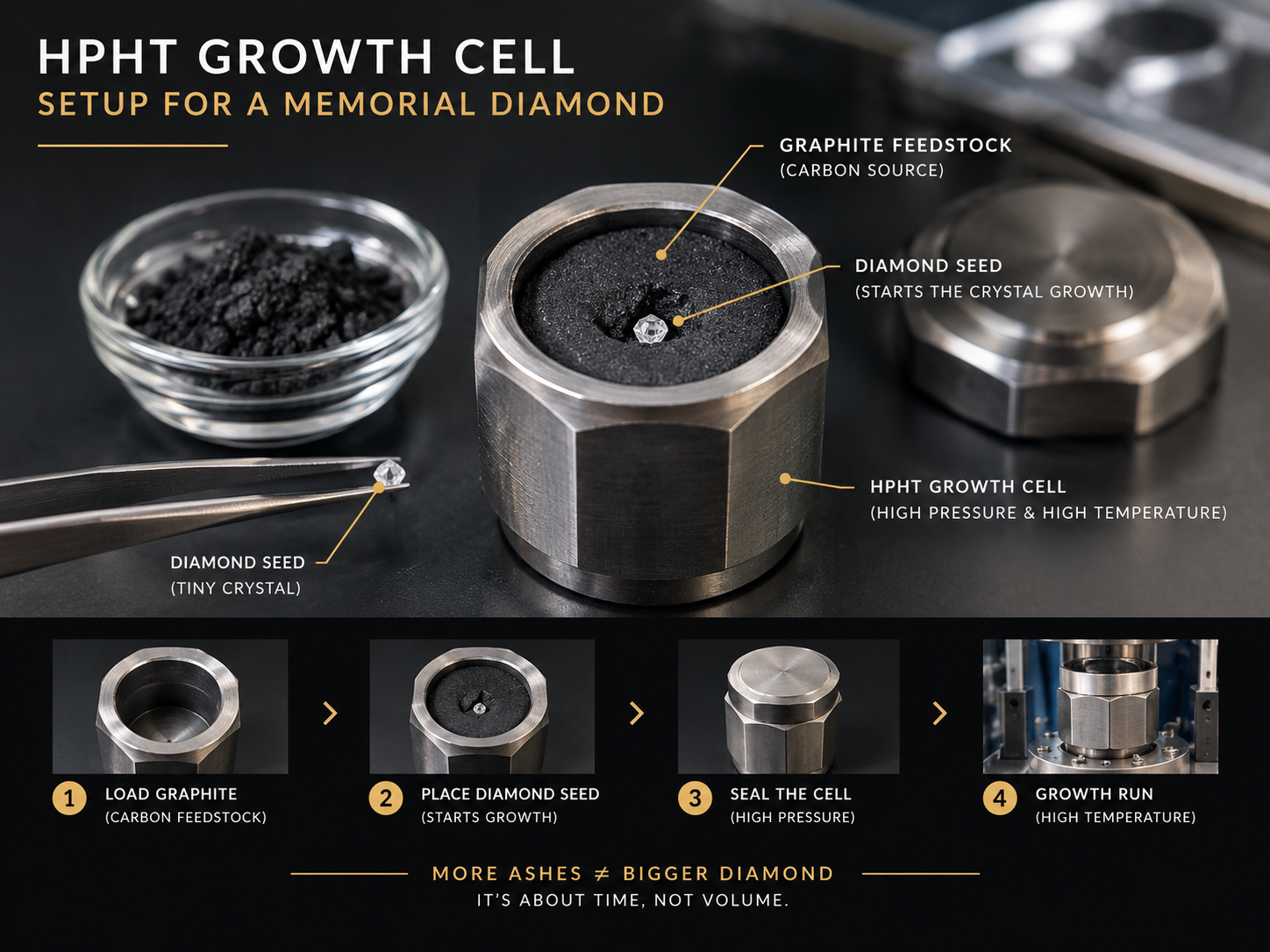
The purified carbon then undergoes graphitization at roughly 2,500 to 2,700°C. After that stage, the two graphite sources can meet in the feedstock used for diamond growth.

The growth stage can use an HPHT press around a diamond seed. Some providers use CVD instead. Industry information describes HPHT as the standard method for memorial work and CVD as a minority route.

Once both materials enter the same growth cell, the process creates one crystal. The finished stone receives one cut, one colour, one carat measurement, and one grading result.

What stays separateWhat follows for you
Two material intakesAsk how the provider records each material
Two arrival dates when you ship separatelyAsk how the provider handles the production clock
Two material minimumsNeither minimum automatically disappears because you combine materials
Two extraction yieldsAsk what happens if one material produces less usable carbon than expected
One merged feedstock and one growth runThe finished stone becomes one crystal with one grading result

Put the under yield question in writing before anything leaves your hands. Ask whether the provider pauses the order and consults you, requests additional material, or follows another procedure.

For the detailed process of turning both materials into a diamond, read how to turn your father’s ashes and hair into a diamond.

Combining Makes the Colour Less Predictable, Not More

That trade deserves a clear explanation.

Trace elements present during diamond growth influence colour. Boron can produce blue tones, while nitrogen can produce yellow tones. Colourless growth requires very low levels of those elements.

Memorial diamonds commonly show yellow, blue, and champagne tones because organic carbon sources can carry different trace element profiles. A combined order brings two personal organic sources into the same growth process. Each source can carry its own trace element profile, so the final colour can become less predictable.

Three lab-grown memorial diamonds in yellow, blue and champagne tones side by side under even daylight

No provider should promise an exact natural colour before growth. You can choose from the colour options that a provider offers, but the exact result depends on the growth conditions and available carbon.

Read what colour a diamond made from your father’s ashes and hair can be for more detail.

How Long Does It Take, and What Will It Cost?

Industry wide production commonly takes about 6 to 10 months from laboratory receipt of the material. Large stones and specialty colours can take longer, with some projects reaching around 12 months. From the first family decision through material collection, shipping, production, grading, and jewellery setting, an overall period of roughly 8 to 14 months can make sense.

Combining two materials does not automatically make the diamond larger or faster to grow. Carat depends on growth time inside the growth equipment rather than simply on how much personal material you provide.

Industry pricing in 2026 commonly falls around $1,500 to $3,500 for 0.10 to 0.25 carats, $5,000 to $15,000 for 0.5 to 1 carat, and $20,000 to $75,000 or more for 2 to 5 carats. These figures represent general industry ranges rather than Memorial Diamond pricing.

Carat, colour, cut, and grading can influence the price. A second material may also require another intake and purification process. Ask the provider whether it charges an additional fee for the second material.

For the cost factors behind a father memorial diamond, read what actually drives the cost of a father memorial diamond.

Settle These Before You Commit, in This Order

Settle thisWhy it sits here
Whether the provider accepts combined submissionsA negative answer changes the entire plan
Both material minimums separatelyYou need two numbers rather than one combined assumption
Whether his hair clears its own minimumIf it does not, ask whether the provider accepts it as a secondary contribution
What happens if the ash lane produces less carbon than expectedYou need to know when and how the provider will consult you
Whether both materials travel togetherSeparate shipments can affect the timing of the combined order
Carat and colourThese decisions can wait until the material and provider questions have clear answers
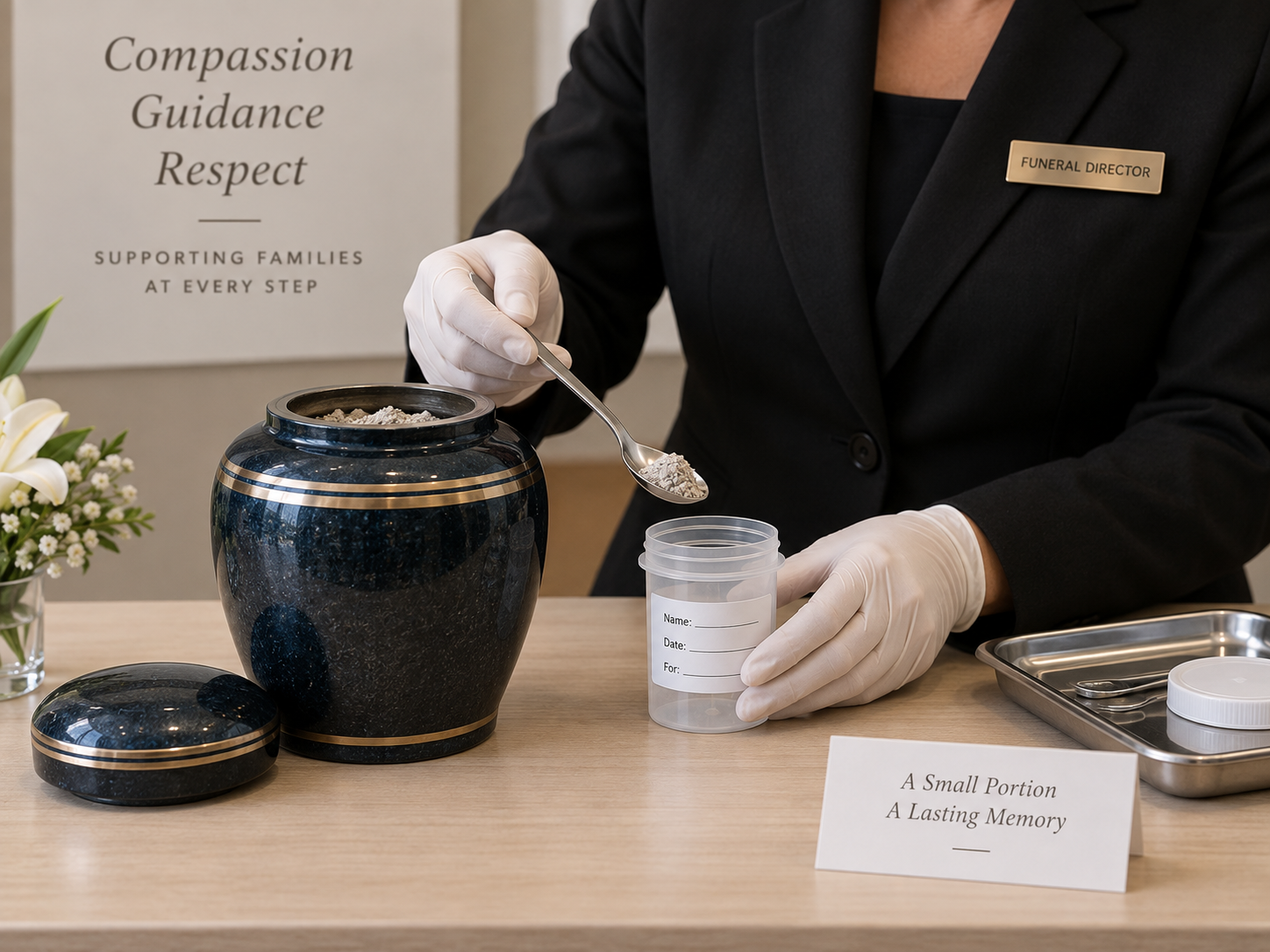
Small labelled sift-proof container being filled from a larger urn with a clean spoon on a plain surface

One deadline can override the normal order. If the family has scheduled an interment or scattering, retain the ash portion before that event. Once the ashes enter that final arrangement, the ashes route can close.

Read the ashes only guide for a father memorial diamond for the retention issue.

Frequently Asked Questions

What if the clippings we found weigh less than the stated hair minimum?

Combining does not automatically lower either material threshold. Ask for the hair minimum and ash minimum separately. Then ask whether the provider can accept a smaller hair quantity as a secondary contribution. Confirm the answer before you send anything.

Do we decide how much of each material goes in, or does the lab?

Ask the provider because no universal practice settles this question. The laboratory controls the blend it can process. Whether you can request a particular ratio or simply receive the laboratory’s final process depends on provider policy.

If his ashes yield less carbon than expected, does the order still go ahead?

Ask this before shipping. Cremated remains can produce different carbon yields. A provider may pause the order, request more material, or follow another procedure. The provider should explain its process before you commit the material.

Does using both materials cost more than using one?

Ask for the combined order as a clear line item. Industry pricing usually follows factors such as carat, colour, cut, and grading. A second material also creates another intake and purification stage, so the provider must confirm whether that adds a fee.

Could the two materials become two separate stones instead of one?

That depends on whether each material meets its own minimum without assistance. If both materials qualify independently, you can ask about two separate growth runs. That creates two stones, two reports, and potentially different colours.

Will the grading report record that two materials were used?

A grading report normally describes the finished diamond through characteristics such as carat, colour, clarity, and cut. After the materials merge, the finished crystal does not provide a simple way to identify which atom came from which source. Ask the provider how its chain of custody records the two materials.

Ask What Happens If His Hair Weighs Less Than They Need

This question can reveal how seriously a provider handles a combined order. Ask for the hair minimum, the ash minimum, and the procedure for a hair quantity that falls below the stated threshold.

A clear answer should give you specific numbers and a specific process. If the answer only says that the laboratory can work with the material without explaining the minimum or the next step, ask again.

You can also ask how the provider handles your father’s ashes and hair throughout intake, purification, growth, grading, and return. Those answers help you understand what happens to both materials once they leave your hands.

If you want to understand how a combined stone fits into the final jewellery piece, explore memorial diamond settings and jewellery ideas for a father.

Using His Ashes and Hair in One Memorial Diamond

A combined father memorial diamond can make sense when the ashes provide one source of personal carbon and the hair you found provides another. The strongest reason to consider the option often comes from the hair itself. A small beard trim or short clipping may not meet a hair only requirement, yet it can still represent a meaningful part of what you found.

The important step comes before you choose a carat or colour. Confirm that the provider accepts combined material. Then ask for the ash minimum and hair minimum separately. Confirm how the provider handles short hair, under yield, separate shipments, unused material, and the final records.

Once those questions have clear answers, you can decide whether using both materials in a single stone feels right for your family. The goal is not to use every material simply because you have it. The goal is to create a memorial that carries a genuine physical connection to your father and feels right for the people who will keep it.

Desk with a phone, a notepad and a closed cremation urn set to one side, the notepad in use

Turn Your Father’s Ashes Into a Diamond: Order of Steps

The first practical act is not opening the urn. It is a phone call to whoever holds his remains or arranges what happens to them, asking that a small portion stay aside.

Turning your father’s ashes into a diamond takes four acts: retaining a portion, choosing a provider, specifying the carat, and posting the material. Only the first act has a deadline that cannot move, and that deadline often arrives before you know which provider you want.

This guide explains the correct order, why families often face the steps in the wrong sequence, and what you can still fix after the steps have already happened.

The Four Acts, and Which of Them Can Be Undone

The sensible order does not always match the order available to a family. The important question concerns which acts you can reverse.

ActPreconditionCost of doing it lateReversible?
Retain a portionAccess to the remains and no interment or scattering yetThe ashes route closesNo
Choose a providerYou know what you hold and what you want madeNone if the portion remains safeYes
Specify carat and colourThe provider’s options and intake rulesA growth run may follow a specification you later changeUsually, until the run starts
Post the materialProvider, specification, intake instructions, and order referenceThe material reaches a laboratory without a confirmed orderNo
Four-stage diagram showing retention, provider selection, carat specification and shipment, with the first and last stages marked one-way

The two one way acts sit at opposite ends of the sequence. The reversible decisions sit between them.

Carat affects the rest because a laboratory grows a memorial diamond to size inside a growth press. The laboratory does not cut a larger diamond down to your chosen size. Carat therefore affects growth time and cost. Read more about choosing a carat size before you make that decision.

The Retention Deadline Arrives Before the Provider Is Chosen

Here is where the sequence often breaks.

A committal, an interment into a shared plot, or an agreed scattering can happen within weeks of a death. After that event, the family cannot simply retain a portion from the ashes.

Choosing a provider can take much longer. You may need to compare intake rules, costs, production methods, grading, chain of custody, and family preferences.

The calendar therefore places an irreversible act before a slower decision.

The solution remains simple. Retention does not require a provider, price, carat, or colour. You can ask the funeral director to retain a portion before you decide which company will receive it.

The complete guide to a father ashes diamond explains the retention deadline and the wider process in more detail.

Can You Retain a Portion Before You Have Chosen a Provider?

Yes. Retaining a portion gives you time to make the commercial decisions later.

Retention concerns the physical material rather than a purchase. You need a sealed container, a clear label, and a written record.

Small sealed and labelled bag of cremated remains beside a handwritten record sheet and a pen

Quantity represents the decision that needs attention before you move on. Industry typical requirements range from a few tablespoons to roughly 4 oz, or about 100 grams. A full cremation produces much more material, so retaining a reasonable portion gives you room to choose later.

Read how much ash a father memorial diamond needs before you decide how much material to retain.

Record the following information when the portion leaves the main container:

  • Who separated the portion and the date of separation.
  • His full name exactly as it appears on the cremation paperwork.
  • The approximate quantity retained.
  • Where the portion remains stored.
  • Who knows about the retained portion.

This record gives your family a useful starting point for its own chain of custody. How providers track a loved one’s ashes explains the provider side of that process.

If several family members contribute money, agree in advance about who will own the finished diamond and who will hold it. Ownership can vary by jurisdiction and by the way the family places the order.

What Has to Be Settled Before the Package Leaves?

Posting the material creates the second one way act. Settle the important details before the package leaves your hands.

  • Choose a provider. Get its intake instructions in writing, including quantity, packaging, labelling, and delivery details.
  • Agree on the specification. Confirm carat and colour before the material travels so the laboratory receives it against an active order.
  • Record the order reference. Put the correct reference on the package so the provider can match the material with the correct file.
  • Ask about unused material. Confirm whether the provider returns unused material automatically or only after a request.

Some providers may accept material before the family finalises the carat. Others may require a complete specification first. Treat this as provider policy and ask before you send anything.

If you want a practical checklist of questions to settle before shipping, review your provider’s intake requirements and keep every answer with the order record.

USPS Priority Mail Express parcel carrying the required cremated-remains label, cushioning visible inside

Shipping Is Decided by Carrier Policy, Not by Law

Families often frame this as a legal question. The practical issue involves carrier rules.

Carrier policies can restrict individual customers from shipping cremated remains. The source material identifies UPS, FedEx, and DHL as carriers that bar cremated remains from shipment by individual customers, leaving USPS as the realistic direct domestic route under the described rules.

Always confirm the current requirements with the carrier before shipping because carrier policies can change.

Who is sending itAvailable routeWhat it adds to the sequence
A family member shipping domesticallyUSPS Priority Mail Express with the required cremated remains labelConfirm current packaging and service requirements before choosing the posting date
A funeral directorTheir own business shipping arrangementsOften simpler while the funeral director still holds the remains
Someone carrying the material personallyHand deliveryConfirm that the provider accepts public hand delivery and records receipt

USPS supplies a free Cremated Remains kit that customers can order online. Confirm current USPS requirements before you depend on the kit or your own packaging.

The source recommends checking whether your own sift proof and cushioned packaging qualifies, since waiting for a kit can add time. Photograph the sealed package and its label before it leaves, then tell the provider that the material is on its way.

For the broader legal question, read the legal position on turning ashes into a diamond.

If your father’s ashes have already gone into an interment or scattering, another material route may remain. Turning your father’s hair into a diamond does not require cremated remains.

What Can Be Fixed If the Acts Already Fell Out of Order?

Not every mistake closes the process. The outcome depends on what already happened.

What happenedWhat you can do now
The interment happened and nobody retained a portionThe ashes route closes. The hair route remains available if you have suitable hair.
You chose and paid a provider before telling the familyIf no material has moved, ask the provider whether you can pause the order.
You retained more material than you needKeep the surplus with the family unless the provider gives you another instruction.
You retained less than the provider’s stated minimumAsk whether the provider can work with a smaller quantity and a smaller carat.
You shipped the material before agreeing on a specificationAsk the provider whether it can place the material on an intake hold.
You set aside a portion years ago without recording itThe material may remain usable, but the provider may need additional documentation.
Printed checklist on a kitchen table with several lines ticked and one left blank

Do not assume that a provider can pause an order, accept a smaller quantity, or return unused material. Ask for its policy before relying on any of those options.

If the steps already happened in the wrong order, the right response starts with identifying exactly where the material sits now and what the provider has recorded.

What Happens Once the Parcel Is Out of Your Hands?

The sequence changes once the laboratory receives the parcel. The production clock starts from laboratory intake rather than the moment you hand the package to the carrier.

Ask the provider what its intake confirmation looks like and when you should expect it. Write down the date when the laboratory logs the material.

Industry production commonly takes 6 to 10 months from laboratory receipt. Large stones and specialty colours can take around 12 months. From the first decision through family discussions, shipping, laboratory production, grading, and jewellery setting, an 8 to 14 month journey can make sense.

Gloved technician logging a received sample into a laboratory intake record

Read how long a father memorial diamond takes for the timeline in more detail.

One important point deserves attention before you send the material. Cremated remains contain roughly 0.5% to 4% carbon by weight. The laboratory therefore blends purified personal carbon with supplemental laboratory carbon to reach the required feedstock volume. Industry information places the personal carbon contribution around 10% to 15% of the finished stone’s mass.

Sending more ash does not make the diamond larger or make the laboratory work faster. Carat depends on growth time.

Ask the provider how often it will update you during production and what milestones it will report.

Frequently Asked Questions

Which comes first, choosing a provider or asking for a portion to be held back?

Ask for the portion first. Retention carries the deadline that cannot move, and you do not need a provider, price, or specification to make that request. You can compare providers after you secure the material.

Can we send the portion before we have decided the carat?

Usually, you should settle the specification first because a laboratory sets up the growth run around the selected carat. Some providers may accept material while you decide. Ask about that policy before shipping.

Do we have to order the free USPS Cremated Remains kit before we can post?

USPS supplies a free Cremated Remains kit. Confirm current USPS rules before you decide whether you need that kit or whether your own approved packaging qualifies. Do not let a packaging assumption create an avoidable delay.

Can a funeral director post his ashes to the laboratory for us?

Often, a funeral director can arrange shipment through business shipping procedures. Ask the funeral director while they still hold the remains. This approach may simplify the process for a family that wants to retain a portion before release.

A portion was set aside years ago and nobody recorded what it was. Can it still be used?

The age of the material may not create the main problem. Documentation creates the larger question. Ask the provider what evidence it needs and reconstruct the history of the material as accurately as possible.

Does the growth clock start when we post the parcel or when the laboratory receives it?

The quoted production period starts at laboratory receipt. Shipping time, intake holds, specification changes, and documentation discussions sit outside that production period. Record the laboratory intake confirmation date.

Get the Sequence Right Before You Choose the Stone

The first question concerns the material, not the diamond. If an interment or scattering already has a date, ask for a portion to stay aside before the remains leave the funeral director’s control.

After that step, you can take your time. Compare providers, choose the carat, decide on colour, review the intake process, and settle the shipping requirements.

The important thing is to avoid turning a time sensitive retention decision into a purchase decision. Secure the option first. Make the rest of the decisions when you have enough information.

When you are ready to discuss the process, Memorial Diamond can help you understand the next steps.

Untitled (1568 x 1003 px) (1)

Is a Memorial Diamond Really Made From Your Father’s Ashes?

Is a memorial diamond made from father’s ashes real? Yes, but the full answer needs more detail. A memorial diamond can use carbon recovered from cremated remains during the diamond-growing process. The recovered carbon then joins additional carbon used to grow the stone.

That fact leads to three different questions. Is the finished stone a real diamond? Does it contain carbon from your father’s remains? Can anyone prove that the carbon came specifically from him?

Each question needs a different kind of evidence. This guide explains what you can check, what depends on the provider’s process, and which records you should request before you send your father’s ashes.

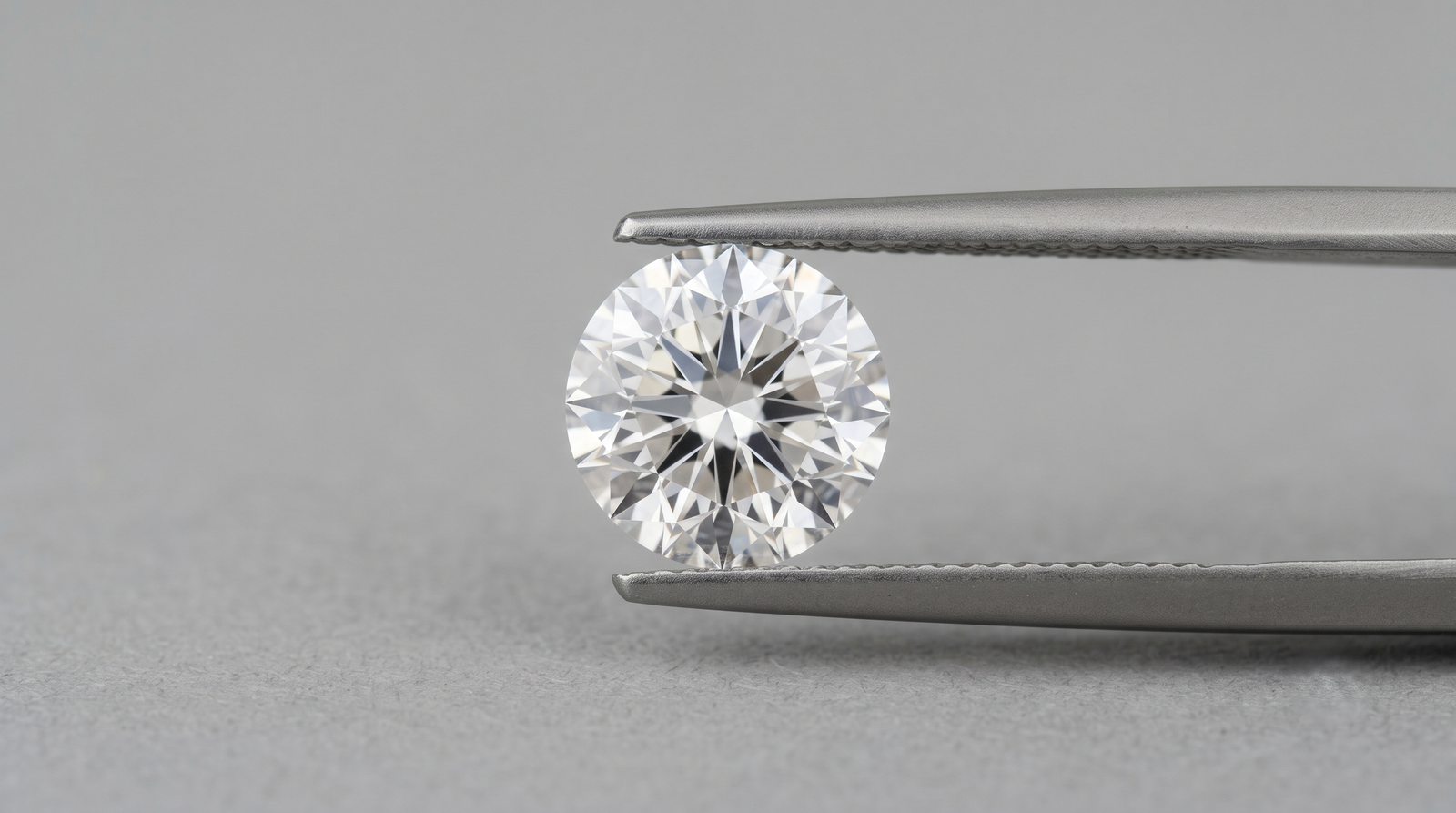
Loose lab-grown memorial diamond grown from cremated ashes held in tweezers
A memorial diamond can preserve a physical connection to a loved one through a laboratory-grown diamond.

What You Will Learn

What Does a Memorial Diamond Made From Father’s Ashes Actually Mean?

The phrase sounds simple, but it can hide several different claims. A provider can support some claims with gemological evidence. Other claims depend on the documented handling of the submitted material.

QuestionType of EvidenceCan You Check It?
Is it a genuine diamond?Gemological evidence such as crystal structure, hardness, optical properties, cut, color, clarity, and carat weight.Yes. An independent gemological laboratory or qualified gemologist can examine the stone.
Does it contain human-derived carbon?Information about extraction, purification, and the diamond-growth process.Partly. You can review the stated process and documentation, but the finished stone does not carry a simple label showing the source of each carbon atom.
Does the carbon come specifically from your father?Intake records, tracking information, and chain-of-custody documentation.The source brief identifies this as the hardest claim to verify from the finished stone alone.

This distinction matters. A diamond grading report can tell you about the stone itself. It does not automatically prove the personal origin of the carbon used during the growth process.

Is a Memorial Diamond Made From Father’s Ashes a Real Diamond?

Yes. A laboratory-grown diamond is a real diamond, not a diamond imitation.

Laboratory-grown diamonds have essentially the same chemical, physical, and optical properties as natural diamonds. GIA also explains that laboratory-grown diamonds share the same crystal structure as natural diamonds, while their growth history differs.

That difference matters when you compare a lab-grown diamond with a simulant. Cubic zirconia and moissanite can look like diamonds, but they do not have the same chemical and physical properties as diamond.

Read GIA’s explanation of natural and laboratory-grown diamonds.

For that reason, you should separate two questions: Is this a real diamond? and Is this diamond connected to my father’s submitted material? Gemological testing can address the first question. Documentation plays a much larger role in the second.

For more information about the gemological side, read Are Memorial Diamonds Real Diamonds?.

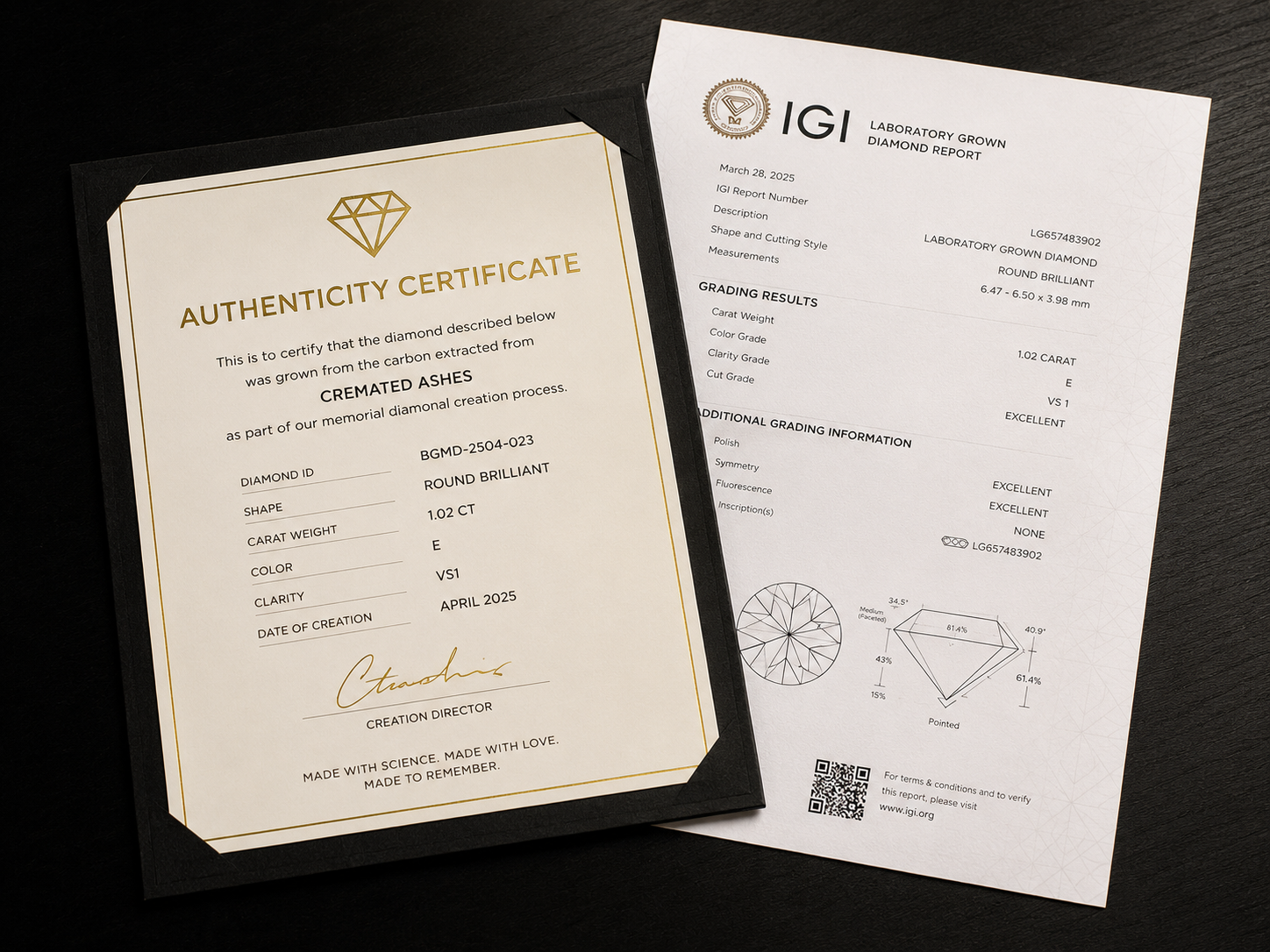
An in-house authenticity certificate and an independent diamond grading report laid side by side on a des
An independent diamond report and provider documentation answer different questions about a memorial diamond.

How Much Carbon Comes From Father’s Ashes?

A memorial diamond made from father’s ashes does not normally contain only carbon recovered from the cremated remains.

Cremated remains contain mostly mineral material associated with bone. The amount of usable carbon can vary from one set of remains to another. The source material for this article gives an industry range of roughly 0.5% to 4% of ash by weight for usable carbon.

The provider can extract and purify that carbon before the diamond-growth stage. The process then uses additional lab-sourced carbon because the available carbon from the ashes alone cannot supply the entire growth process.

The source brief gives a typical personal-carbon range of around 10–15% of the finished stone’s mass. It also notes that some providers report lower or higher figures based on factors such as the size of the stone and the amount of material submitted.

So the honest explanation does not say that the entire diamond consists of your father’s remains. Instead, it explains that carbon from his submitted material can become part of the diamond while additional carbon supports the growth process.

That distinction gives families a clearer picture than a simple “100% ashes” claim.

To understand the process in more detail, read How a Memorial Diamond Is Made From Your Father’s Ashes.

Purified carbon extracted from cremated remains in a laboratory crucible before graphitization
Carbon recovered from cremated remains goes through processing before the diamond-growth stage.

Can You Prove the Carbon Came From Your Father?

This question deserves a careful answer.

The source brief flags the claim that no consumer-accessible test can trace a finished diamond to a named person as an inference that needs expert verification before publication. :contentReference[oaicite:2]{index=2}

That means you should not rely on a simple promise that a finished diamond can prove its personal origin. Instead, ask how the provider identifies and tracks your material before, during, and after the process.

Think of the evidence as a chain. The stronger the documentation at each stage, the easier it becomes to understand how the provider handled the submitted material.

What Records Should You Ask For?

Before you order a memorial diamond made from father’s ashes, ask the provider to explain its documentation process in writing.

  1. Intake reference: Ask whether the provider gives your material a unique tracking number when it arrives.
  2. Intake confirmation: Ask for written confirmation of the material received, along with the date and other relevant details.
  3. Process tracking: Ask how the provider tracks the material during extraction and diamond growth.
  4. Origin documentation: Ask what certificate or record connects the finished stone with your submitted material.
  5. Independent grading: Ask whether an independent gemological report is available for the finished diamond.

The source brief describes these records as reasonable good practice rather than a universal industry standard. You should therefore confirm the exact process with the provider you choose. :contentReference[oaicite:3]{index=3}

Documentation cannot answer every scientific question. It can, however, show you how carefully a provider handles your material and communicates the process.

For more detail, read Memorial Diamond Chain of Custody: How Companies Track Your Loved One’s Ashes.

sealed and labeled container of cremated remains logged against a chain-of-custody tracking reference at intake
Clear intake records can help families understand how a provider tracks submitted memorial material.

How Much Does a Memorial Diamond Cost?

The cost of a memorial diamond made from father’s ashes can vary widely. The final price can depend on the stone size, color, cut, grading, setting, engraving, and other choices.

The source brief gives an industry-level entry figure of around $1,500 for stones of roughly 0.10–0.25 carat. It does not present that figure as BlueIceGems pricing. :contentReference[oaicite:4]{index=4}

A larger stone can require a much larger budget. You should also ask which services the quoted price includes and which services carry separate charges.

Money can also affect the decision in a very personal way. If the purchase would create financial pressure, another memorial choice may make more sense for your family.

An urn, burial, scattering ceremony, memorial jewelry, or another keepsake can hold deep meaning too. A memorial diamond does not need to replace those choices.

To explore the pricing factors in more detail, read Memorial Diamond Pricing Guide: What Actually Drives the Cost.

If your family has different opinions about the purchase, read How to Talk to Family About a Father Memorial Diamond.

Memorial Diamond Made From Father’s Ashes FAQ

Is a memorial diamond made from father’s ashes a real diamond?

Yes. When the finished stone qualifies as a laboratory-grown diamond, it is a genuine diamond. GIA explains that laboratory-grown diamonds have essentially the same chemical, physical, and optical properties as natural diamonds. Their main difference lies in how and where they grow.

Is the entire diamond made from father’s ashes?

No. The source material explains that providers combine carbon recovered from cremated remains with additional lab-sourced carbon. The personal carbon therefore represents part of the finished stone rather than 100% of its mass.

How much of a memorial diamond made from father’s ashes comes from the ashes?

The source brief gives a typical personal-carbon range of around 10–15% of the finished stone’s mass. The actual figure can vary, so you should ask the provider how it calculates and documents its stated percentage.

Can a finished diamond prove that it came from my father?

The source brief treats this as a claim that needs expert verification before publication. For that reason, families should focus on the provider’s intake records, tracking system, process documentation, and origin records rather than assuming that a finished diamond alone can establish personal identity.

Can I see my father’s ashes inside the diamond?

No. The process converts the usable material into processed carbon before diamond growth. The finished stone does not contain visible pieces of cremated remains.

What should I ask before choosing a memorial diamond company?

Ask how the company identifies your material at intake, how it tracks the material through the process, what records you receive, what happens to unused material, whether the finished diamond can receive independent grading, and what happens if the growth process does not produce the expected result.

For a practical checklist, read Questions to Ask Before Turning Your Father’s Ashes Into a Diamond.

What If Your Father Would Have Called It a Waste of Money?

That concern deserves an honest answer.

A memorial diamond can cost several thousand dollars, depending on the size and options. Some families may see that purchase as a meaningful keepsake. Others may prefer to use the money for another family need or another form of remembrance.

Neither choice makes the loss less meaningful.

If a family member questions the expense, try to separate the financial question from the question of whether the diamond is genuine. They are two different discussions.

You can also explain that a memorial diamond does not have to replace an urn, burial, scattering, or family tradition. It can simply offer another way to keep a physical reminder close.

Read How to Talk to Family About a Father Memorial Diamond for ideas on handling different family views.

Being Skeptical Can Help You Choose Better

When you consider a memorial diamond made from father’s ashes, asking difficult questions is not disrespectful. It is a sensible part of making an important purchase.

Ask how the provider tracks your material. Ask what documentation you receive. Ask which parts of the process happen in-house and which parts involve another facility. Ask what happens if the growth process fails. Ask what happens to unused material.

Most importantly, ask the provider to put important promises in writing.

The source brief makes one point especially clear: the strongest page should not rely on warm marketing language alone. It should help a family understand what evidence exists for each claim. :contentReference[oaicite:5]{index=5}

A memorial diamond made from father’s ashes raises emotional questions, scientific questions, and practical questions. When you separate those questions, you can make a decision with a much clearer understanding of the process.

Considering Your Father’s Hair Instead?

Ashes and hair involve different starting materials, so the questions do not always have the same answers.

If you are exploring hair instead of cremated remains, read Is a Memorial Diamond Really Made From Your Father’s Hair?

Untitled (1568 x 1003 px)

How a Memorial Diamond Is Made From Your Father’s Ashes

A memorial diamond made from your father’s ashes begins with a small portion of cremated remains and ends as a polished diamond that you can keep close for years to come. Between those two points, the material passes through several carefully controlled laboratory stages. The laboratory first identifies and extracts usable carbon, purifies it, converts it into graphite, and prepares it for diamond growth. After the crystal develops, the rough stone undergoes cutting, polishing, and grading.

Understanding this journey can make the process easier to understand, especially when you want to know what actually comes from your father’s remains, why additional carbon may be needed, and how the laboratory turns the recovered carbon into a genuine diamond.

A small sealed container of cremated ashes and a paper envelope of hair side by side on a plain table, with a finished memorial diamond between them

What Is a Memorial Diamond Made From?

Before looking at how a memorial diamond grows, it helps to understand what the laboratory receives in the first place. Cremated remains are not simply loose ash like the residue left after burning wood. They consist primarily of mineral material from the bones, with calcium phosphate making up most of that material.

Carbon makes up only a small portion of cremated remains. Published industry figures commonly place usable carbon at approximately 0.5% to 4% by weight, although the amount can vary from person to person and can also depend on the cremation process.

That small amount of carbon becomes the important part of the process. Rather than trying to turn the entire container of cremated remains directly into a diamond, the laboratory first separates the carbon from the much larger amount of mineral material.

This separation is what sets the foundation for everything that follows.

How Does the Memorial Diamond Process Begin?

The process starts when the laboratory receives the cremated remains and prepares the portion selected for the diamond. At intake, the laboratory can inspect the material and remove non-biological materials that should not enter the carbon extraction process.

The laboratory then prepares the selected remains for controlled purification. At this point, the material still does not resemble the carbon feedstock required for diamond growth. The next stage therefore focuses on isolating and purifying the carbon.

This is an important distinction because the laboratory does not simply heat the remains and expect a diamond to appear. It must first create a suitable carbon source for the growth process.

How Is Carbon Extracted for a Memorial Diamond?

The laboratory uses controlled, oxygen-free heating to separate carbon from the mineral portion of the cremated remains. Controlling oxygen plays an important role because carbon can react with oxygen at high temperatures and leave the material as carbon dioxide.

By controlling the environment, the laboratory can retain the carbon while removing much of the unwanted mineral material. The recovered carbon then goes through additional purification before it becomes suitable for the next stage.

After purification, the recovered material can reach approximately 99.9% or higher carbon purity. The laboratory has now reduced the original cremated material to a much smaller and more useful carbon source.

However, purified carbon still needs another transformation before it can enter the diamond-growth process. The laboratory next converts it into graphite.

Why Is the Carbon Converted Into Graphite?

Graphite and diamond may look completely different, but they share the same fundamental element: carbon. Their difference comes from the way their carbon atoms arrange themselves.

During the graphitization stage, the purified carbon undergoes extremely high temperatures, generally around 2,500–2,700°C. This treatment converts the carbon into graphite, which the laboratory can then use as feedstock during diamond growth.

This stage also explains why the final stone does not contain recognizable pieces of bone, tissue, or other original biological structures. The high-temperature purification process breaks down those structures. What carries forward into the diamond-growth process is elemental carbon.

Once the laboratory has prepared the graphite, it can finally address the next question: is there enough personal carbon to grow the desired stone?

Why Is Lab Carbon Added to a Memorial Diamond?

In most cases, the answer is no. The amount of recoverable carbon in cremated remains is relatively small, while a meaningful-size diamond requires a larger amount of carbon feedstock.

For this reason, the purified carbon recovered from your father’s remains can be blended with additional laboratory-sourced carbon. This supplemental carbon provides enough feedstock for the diamond-growth process to produce the intended stone size.

The important distinction is that the additional carbon does not come from your father. The personal portion comes from the carbon recovered from the submitted cremated remains, while the supplemental portion comes from another laboratory source.

The personal carbon fraction may represent roughly 10–15% of the finished stone’s mass, depending on factors such as the size of the diamond and the amount of material submitted.

So, a responsible description should not claim that the finished stone consists entirely of your father’s remains. Instead, the more accurate explanation is that carbon atoms that were once part of his body become incorporated into the crystal structure of the diamond.

Two separate intake records for one memorial diamond order, each with its own chain-of-custody reference
A rough crystal and finished diamond represent two stages of the memorial diamond journey.

What Happens Inside the Memorial Diamond Growth Press?

After the laboratory prepares the carbon feedstock, the material enters the stage that actually creates the diamond crystal. HPHT, or high pressure, high temperature, provides one established method for growing diamonds in a controlled laboratory environment.

The growth cell can experience pressures of approximately 6–8 GPa together with temperatures that can reach roughly 1,400–2,500°C. These conditions allow carbon to crystallize into the diamond structure.

A small diamond seed sits inside the growth cell and provides the starting structure for the new crystal. As the process continues, carbon from the prepared feedstock crystallizes around the seed and gradually develops into a rough diamond.

The growth stage can take weeks to months, depending on the growth system, target size, and other laboratory conditions.

Some laboratories use another method called CVD, or chemical vapor deposition. Instead of using the same pressure and temperature conditions as HPHT, CVD introduces a carbon-bearing gas into a controlled vacuum environment and deposits carbon onto a diamond seed.

If you want to understand these two approaches in more detail, you can read our guide to how memorial diamonds are made using HPHT and CVD.

Two labeled laboratory crucibles being processed separately before their purified carbon is combined
The diamond-growth stage uses controlled pressure and temperature to develop the crystal.

How Long Does a Memorial Diamond Take to Grow?

The growth stage does not happen instantly. The laboratory must maintain controlled conditions while the carbon gradually forms the diamond crystal.

Depending on the process and the target stone, diamond growth can take weeks to months. The final carat size depends on more than the amount of cremated remains submitted. Once the laboratory has enough carbon feedstock for the growth cell, factors such as growth conditions and time influence how much diamond crystal develops.

This is also why submitting more cremated remains does not automatically mean that the finished diamond will have a proportionally larger carat weight.

If you are preparing to send your father’s remains, you can learn more about the amount typically requested in our guide to how much ash a father memorial diamond requires.

What Can Affect the Final Memorial Diamond?

Although laboratories carefully control the process, some characteristics can vary from one memorial diamond to another. The first variable appears before the growth stage even begins: the amount of usable carbon available in the submitted material.

Because cremated remains can contain different amounts of carbon, the laboratory cannot assume that every person’s remains will produce exactly the same carbon yield.

Trace elements can also influence the final diamond. Even after purification, very small amounts of remaining elements can affect the color that develops during growth.

For this reason, a provider should avoid promising an exact final color before the diamond grows. The final stone can have its own characteristics in color, clarity, and appearance.

What Happens After the Memorial Diamond Grows?

When the growth stage finishes, the laboratory has a rough diamond rather than the polished stone you ultimately receive. The rough crystal must go through another series of steps before it reaches its final appearance.

Cutting shapes the rough material and creates the facets that control how the diamond interacts with light. Polishing then smooths and refines those surfaces.

The amount of rough material removed during cutting depends on the selected shape and the characteristics of the original crystal. The finished stone can therefore weigh considerably less than the original rough crystal.

Once cutting and polishing finish, the diamond can undergo grading. A grading report can document characteristics such as carat, color, clarity, and cut.

It is useful to distinguish grading documentation from origin documentation. A grading report describes the physical characteristics of the finished diamond, while origin or authenticity documentation addresses its connection to the submitted material.

You can learn more about this distinction in our guide to how memorial diamonds are graded and certified.

Growth cell being loaded with blended graphite feedstock and a diamond seed before an HPHT run
Origin documentation and grading documentation provide different types of information about a memorial diamond.

What Happens to the Unused Ashes?

The diamond process does not necessarily require the entire amount of cremated remains that a family submits. Depending on the laboratory’s process, some material may remain after carbon extraction.

Before sending your father’s ashes, ask the provider what happens to unused cremated remains. Some providers may return unused material, while others may follow a different policy.

Getting this information in writing before the process begins can prevent confusion later and gives your family a clearer understanding of how the laboratory handles the material you entrust to it.

How Should You Ship Ashes for a Memorial Diamond?

If you need to send cremated remains within the United States, shipping requirements deserve attention as well. The carrier you choose may have specific packaging and mailing requirements for cremated remains.

USPS provides specific guidance for shipping cremated remains domestically. You can review the current USPS requirements for packaging and shipping cremated remains before preparing your shipment.

Because postal requirements can change, check the current instructions before mailing any cremated material.

Frequently Asked Questions About Memorial Diamonds

Do Metal Implants Affect a Memorial Diamond?

Metal implants do not become part of the carbon feedstock used for diamond growth. The laboratory should separate non-biological materials during the preparation stage rather than carry them into carbon extraction.

Does It Matter How Long Ago My Father Was Cremated?

Cremated remains consist primarily of stable mineral material, so storing them for several years does not create the same type of biological deterioration associated with fresh organic material. An older set of cremated remains can therefore enter the laboratory process in essentially the same way as more recently cremated remains.

Can I Find Out How Much Carbon the Laboratory Recovered?

You can ask the provider whether it measures and documents recovered carbon yield. This information can give you a clearer understanding of how much usable carbon the laboratory extracted from the submitted material. However, not every provider publishes recovered yield as a standard part of its service.

Can the Cremation Process Affect Carbon Recovery?

It can contribute to variation. The amount of usable carbon can differ depending on the individual and the cremation process, which helps explain why laboratories cannot guarantee an identical carbon yield from every submission.

What Happens If the Diamond Growth Run Fails?

Ask this question before sending the cremated remains. A growth run can encounter problems, so you should understand whether the laboratory will make another attempt, whether it can use remaining material, how a failed run affects the timeline, and whether additional costs could apply.

Can a Memorial Diamond Use Only My Father’s Carbon?

For a meaningful-size stone, the laboratory generally needs more carbon than it can recover from a typical submitted portion of cremated remains. That is why providers may combine the recovered personal carbon with supplemental laboratory-sourced carbon.

What Should You Ask Before Choosing a Memorial Diamond Provider?

Knowing how a memorial diamond works gives you a useful starting point when comparing providers. Instead of focusing only on the finished stone, ask questions about the entire process.

  • Which diamond-growth method do you use?
  • Do you perform the growth in-house?
  • How do you track the submitted cremated remains?
  • Do you measure the amount of recovered carbon?
  • What happens to unused cremated remains?
  • What happens if a growth run fails?
  • Which origin or authenticity documents do you provide?
  • Which independent grading report accompanies the finished diamond?
  • What timeline should I expect from submission to finished stone?

A transparent provider should explain the parts of the process it controls, the factors that can vary, and the documentation it can provide. Clear answers can help you make a decision with realistic expectations.

Final Thoughts: From Your Father’s Ashes to a Memorial Diamond

Creating a memorial diamond from your father’s ashes involves a carefully controlled sequence rather than one single transformation. The laboratory begins with cremated remains, separates the small carbon fraction, purifies it, and converts it into graphite.

Because the recovered carbon generally cannot provide all the feedstock required for a meaningful-size stone, the laboratory may combine it with supplemental lab-sourced carbon. The prepared material then enters the diamond-growth stage, where controlled pressure and temperature allow a diamond crystal to develop around a seed.

After growth, the rough crystal undergoes cutting and polishing to create its finished form. Grading can then document the stone’s physical characteristics, while origin documentation can provide information about its connection to the submitted material.

The most important thing to understand is that the process changes the original material significantly. The finished diamond does not contain recognizable pieces of bone or biological tissue. Instead, carbon recovered from your father’s cremated remains becomes part of the crystal structure of the diamond.

That distinction helps explain both the science and the meaning behind the process. A memorial diamond does not preserve your father’s remains in their original physical form; it creates a lasting diamond using carbon recovered from them.

If you are continuing your research, you can also read our guide on whether a memorial diamond is really made from your father’s ashes or explore our complete guide to father ashes diamonds.

Untitled (1568 x 1003 px)

How a Memorial Diamond Is Made From His Ashes

Small bound lock of gray hair in a paper envelope beside a finished lab-grown memorial diamond on a dark wooden surface

The container from the crematorium is heavier than many people expect. Between that container and a finished diamond in a presentation case sits a carefully controlled chain of laboratory processes.

A memorial diamond made from your father’s ashes begins with a measured portion of cremated remains. The laboratory separates and purifies the carbon, converts that carbon into graphite, prepares the growth material, and creates a genuine diamond crystal under extreme pressure and temperature.

Almost every stage removes something. Understanding what leaves the material, what carries forward, and what happens during diamond growth makes the entire process easier to understand.

In This Article

What Is Actually in the Cremation Container?

Cremated remains are not ash in the campfire sense. This distinction sets up every stage that follows.

After cremation, the remains consist primarily of mineral material associated with bone, including calcium phosphate. Carbon represents only a small portion of the material that remains after the cremation process.

Industry figures place usable carbon at roughly 0.5% to 4% of cremated remains by weight. The exact amount can vary between individuals and can also vary with the cremation process.

That creates the laboratory’s first challenge. The process does not begin by manufacturing a diamond. It begins by finding and separating a small carbon fraction from a much larger amount of mineral material.

If you want to understand the amount of material families may need to submit, speak directly with the laboratory about its current requirements before sending your father’s ashes.

Which Stages Remove Something, and Which Stage Adds?

It helps to look at the process as a ledger rather than simply a timeline. Each stage has a specific job, and most stages remove material or transform what already exists.

StageWhat Is Removed or ChangedWhat Carries Forward
Intake and inspectionNon-biological material and anything that should not enter the processA measured and documented portion of the submitted material
Extraction and purificationMineral material and other unwanted componentsPurified carbon
GraphitizationOriginal molecular structuresGraphite, a crystalline form of carbon
BlendingNothing is removedPrepared carbon feedstock
Diamond growthNothing is intentionally removedA rough diamond crystal
Cutting and polishingRough materialThe finished diamond
GradingNothing from the stoneA documented assessment of diamond characteristics

The key point is that the material changes substantially before it becomes a diamond. The laboratory first separates and purifies the useful carbon, then prepares that carbon for controlled crystal growth.

Memorial diamond rough crystal grown from carbon extracted from cremated ashes beside finished cut stone
A rough diamond crystal beside a finished cut stone illustrates the transformation involved in creating a memorial diamond.

How Is His Carbon Separated From the Bone Mineral?

Ordinary burning cannot provide the controlled conditions required for carbon recovery. When carbon reacts with oxygen at high temperatures, it can leave as carbon dioxide. The laboratory therefore needs an oxygen-free environment during the extraction process.

Controlled, sealed heating allows the laboratory to remove much of the unwanted mineral material while retaining the carbon needed for the next stage.

After extraction and purification, the recovered carbon can reach approximately 99.9% or higher carbon purity, according to the process description used for this article.

The purified carbon then moves into the graphitization stage.

At this point, the laboratory has not created a diamond. It has prepared a much purer carbon source that can enter the next stage of the process.

Sealed high-temperature furnace used to extract and purify carbon from hair in an oxygen-free process

Why Is Lab Carbon Added to His?

The amount of carbon recovered from cremated remains is relatively small. If the laboratory needs additional feedstock for a growth run, it may combine the recovered carbon with laboratory-sourced carbon.

The process brief used for this article describes the personal carbon fraction as typically representing approximately 10–15% of the finished stone’s mass, depending on factors such as stone size and the amount of material submitted.

This distinction matters when you evaluate claims about a memorial diamond. A provider should clearly explain whether it adds supplemental carbon, how it handles the personal carbon fraction, and what it can document.

The source process described for this article treats blending as the only additive stage. The carbon recovered from your father’s remains carries forward into the prepared feedstock, while any additional laboratory-sourced carbon provides the quantity required for the growth process.

Because BlueIce Gems’ current public Memorial Diamond page makes a different claim about using 100% of the loved one’s ashes or hair and not adding generic carbon, confirm the current BlueIce Gems production policy before publishing this section as a company-specific statement.

What Happens Inside the Growth Press?

The diamond-growth stage turns prepared carbon into a diamond crystal.

The process described in the source material uses HPHT, or high pressure, high temperature, technology. The growth cell creates extreme pressure and heat that allow carbon to form the diamond crystal structure.

A small diamond seed provides the starting structure. Carbon then crystallizes around that seed under carefully controlled conditions.

Growth conditions can reach approximately 6–8 GPa of pressure and roughly 1,400–2,500°C, depending on the growth system and stage of the process.

The growth itself can take weeks to months. Larger stones generally require more growth time, and a growth run can require additional processing if the intended result is not achieved on the first attempt.


A tied lock of hair beside loose clippings on a sheet of white paper, showing the difference in how each is handled
Illustrative HPHT equipment showing the type of growth environment used to create diamond crystals.

HPHT vs. CVD

HPHT is not the only laboratory diamond-growth method. CVD, or chemical vapor deposition, grows diamond by depositing carbon from a carbon-bearing gas onto a diamond seed inside a controlled chamber.

Both technologies can create genuine diamonds. The important question for a memorial diamond is which process the provider uses and how it handles the personal carbon throughout the process.

What Varies From One Father to the Next?

Not every memorial diamond develops in exactly the same way. The source material and growth conditions can vary from one person to another.

Carbon Recovery

The amount of usable carbon can vary. Published industry figures place the recoverable carbon fraction at roughly 0.5–4% by weight, although the exact result depends on the individual and the cremation process.

Trace Elements

Trace elements can influence the final appearance and color of a diamond. This means a laboratory cannot always predict an exact final shade before the growth process begins.

Diamond Size

The target size affects the growth stage and the amount of rough material required. A larger finished stone generally requires a longer and more demanding growth process.

Cut and Shape

The rough crystal determines how the cutter approaches the final stone. Cutting removes rough material and creates the facets that control how the finished diamond interacts with light.

BlueIce Gems currently lists several memorial diamond cuts, including Brilliant, Emerald, Asscher, Princess, Radiant, and Heart. Explore the current BlueIce Gems Memorial Diamond options.

What Comes Back to You Besides the Stone?

A finished memorial diamond is only one part of the process. Documentation, communication, and the handling of unused material also matter.

Before sending your father’s ashes, ask the provider how it records the submitted material and how it maintains its chain of custody throughout the process.

You should also ask what documentation accompanies the finished diamond. A grading report and an origin or authenticity document can answer different questions, so ask the provider exactly what each document confirms.

Ask about unused cremated remains as well. Find out whether the laboratory returns unused material, stores it, or follows another documented procedure.

If you plan to wear the finished stone, you can also turn it into a custom memorial piece. Our custom pendant design guide explains how personal materials, stones, engraving, and pendant construction can work together.

High pressure high temperature press with the growth cell that holds a diamond seed during crystal growth
Origin documentation and diamond grading documentation serve different purposes.

Frequently Asked Questions

Do Metal Implants or a Pacemaker Affect What the Lab Can Use?

Metal implants do not become part of the carbon feedstock. Materials such as surgical hardware should be separated during intake rather than carried into the carbon extraction process.

Does It Matter If My Father Was Cremated Years Ago?

Cremated remains are stable mineral material, so the passage of time does not automatically make them unusable. A provider can explain its requirements for older cremated remains before you submit the material.

Will the Lab Tell Me How Much Carbon It Recovered?

Ask the provider before ordering. A recovered-yield figure can help you understand how much material the laboratory obtained and how much process information it is willing to document.

Can the Cremation Process Affect Carbon Recovery?

It can contribute to variation in the amount of usable carbon recovered. The source material places the usable carbon range at approximately 0.5–4% by weight and attributes variation to both the individual and the cremation process.

What Happens If the Diamond Growth Run Fails?

Ask the provider before sending your father’s ashes. Find out whether the laboratory makes another attempt, whether it uses remaining material for another run, how the failure affects the timeline, and who covers any additional costs.

Can a Lab Grow a Meaningful-Size Diamond From Only the Ashes?

The answer depends on the laboratory’s process and the amount of recoverable carbon. The source material used for this article states that laboratories commonly blend recovered carbon with additional laboratory-sourced carbon when the recovered amount cannot supply enough feedstock for the intended growth run.

Questions Worth Asking a Lab Directly

Before choosing a provider for a memorial diamond, ask direct questions about the process rather than relying only on marketing language.

  • How do you extract carbon from cremated remains?
  • Do you use HPHT, CVD, or another diamond-growth method?
  • Do you add supplemental laboratory carbon?
  • How much carbon do you recover from the submitted material?
  • How do you track my father’s ashes throughout the process?
  • What happens to unused cremated remains?
  • What happens if a growth run fails?
  • What documentation will I receive with the finished stone?
  • Which diamond colors and cuts can I choose?
  • How long should the complete process take?

A transparent laboratory should explain which parts of the process it controls, which characteristics can vary, and what it can document for you.

Understanding the Journey From Ashes to Diamond

Creating a memorial diamond from your father’s ashes involves much more than placing ashes into a machine and waiting for a diamond to appear.

The laboratory first prepares the cremated remains and isolates the usable carbon. It then purifies that carbon and converts it into graphite. The prepared carbon enters a controlled diamond-growth environment, where extreme pressure and temperature allow a crystal to form.

After growth, the rough crystal still needs cutting and polishing. The finished stone can then become a lasting memorial that you preserve privately or set into a ring, pendant, or another piece of jewelry.

The most important step before choosing a provider is asking exactly what happens to the material you submit. Understand the extraction process, growth technology, carbon policy, documentation, timeline, and handling of unused remains before you begin.

For more information about BlueIce Gems’ current memorial diamond process, visit the BlueIce Gems Memorial Diamonds page.

The same champagne-toned memorial diamond photographed twice side by side, once in cool daylight and once under warm lamplight

Memorial Diamond Colors for a Mother: What to Expect

Hold a champagne memorial diamond near a kitchen window and you may see a warm, faintly golden brown tone. Move the same diamond beneath a warm dining room lamp and the stone may appear more amber. The diamond stays exactly the same. The surrounding light changes how your eyes see its color.

When families explore memorial diamond colors for a mother, they usually want to know which colors exist, what creates each color, how much each option costs, and which color will continue to feel right years from now.

Memorial diamond colors generally fall into several groups. Yellow, blue, and champagne or brown represent common natural color outcomes. Colorless diamonds require the near total absence of the trace elements that create other colors and can cost more at the same carat size. Some providers also offer red, pink, green, or black through post growth irradiation.

This guide focuses on the colors you can consider when choosing a mother’s memorial diamond. If you want to understand what color a specific portion of her ashes or hair may produce, explore our guides about the ashes version, the hair version, and the version for both together.

Which Colors Can You Actually Choose From?

Five main color families give families the starting point for a memorial diamond. The crystal growth process determines the natural color through trace elements present during growth.

Nitrogen produces yellow. Boron produces blue. Champagne and brown tones can develop when an organic carbon source carries a mixture of trace elements. Colorless growth requires the near total absence of nitrogen and boron.

Four loose memorial diamonds in yellow, blue, champagne and colourless tones arranged in a row on a neutral grey surface

The carbon preparation also matters. Providers purify personal carbon and blend it with supplemental laboratory carbon to create the material needed for diamond growth. Industry information places the personal carbon contribution for ash derived stones at roughly 10 percent to 15 percent of the finished stone mass.

ColorWhat creates itRelative cost at the same caratAvailability
YellowNitrogen during growthLower price rangeStandard option
BlueBoron during growthLower price rangeStandard option
Champagne or brownA mixture of trace elements in an organic carbon sourceLower price rangeStandard option
Colorless or whiteNear total absence of nitrogen and boronMeaningfully higher than the three colors aboveConfirm availability at your chosen carat
Red, pink, green or blackPost growth irradiationAdditional treatment can increase the priceSome providers offer these colors

For a deeper explanation of why colorless memorial diamonds remain less common, read why memorial diamonds are rarely colorless.

What Does Post Growth Irradiation Do to Her Stone?

Post growth irradiation changes how a finished diamond absorbs light. It does not change what the crystal consists of.

Irradiation takes place after diamond growth. Controlled exposure alters color centers inside the crystal structure and can shift the appearance toward red, pink, green, or black.

The diamond remains a diamond. Its hardness remains 10 on the Mohs scale, the same hardness associated with other diamonds.

The treatment also creates an important documentation difference. A grading report can identify a treated color rather than presenting that color as the diamond’s original growth color.

Irradiation also does not change the personal carbon contribution. Providers establish that contribution during the material preparation and blending process before diamond growth begins.

If you consider an irradiated color, ask your provider how the treatment appears on the grading documentation and whether the provider offers any policy for future color changes.

Color Reads Differently as the Stone Gets Bigger

Body color appears through the depth of a diamond. As the stone grows, the same tint can become easier to see.

A subtle champagne tone may appear understated in a 0.25 carat stone and much more noticeable in a larger stone. Consider your preferred level of color before you choose the size.

  • If you want the color to stand out, a larger stone can make the tone easier to notice.
  • If you want the color to remain subtle, a smaller stone can create a quieter appearance.
  • If you want a colorless stone, the higher price can become more significant as the carat size increases.
Three champagne memorial diamonds of increasing carat size photographed together, showing the tint reading more strongly as the stone grows

Carat size depends on diamond growth time rather than the amount of material you send. Read how to choose a carat size before you finalize the stone size.

Production commonly takes around 6 to 10 months from the laboratory receiving the material. Large stones and specialty colors can require up to 12 months. Your complete planning period can reach around 8 to 14 months when you include preparation, shipping, decisions, and jewelry work.

Read what actually drives the timeline for a closer look at each stage.

The Setting Metal Decides What You Actually See

The diamond keeps its own color, but the jewelry metal around it can change how your eyes perceive that color.

Yellow gold creates a warm combination with yellow and champagne stones. The similar tones can make the diamond color feel softer and more coordinated.

Platinum and white gold create a cooler contrast. That contrast can make a warm diamond appear more noticeable while making a near colorless stone appear whiter.

Rose gold can add another layer of warmth to a champagne diamond and can make the overall combination appear more pink.

A yellow-toned memorial diamond shown set in yellow gold beside an identical stone set in platinum, on a hand

White gold commonly uses rhodium plating to create its bright white surface. Normal wear can reduce that plating and reveal the warmer metal underneath. A jeweler can restore the bright surface through replating.

For that reason, consider your jewelry metal at the same time as your diamond color. Explore settings and jewelry ideas for a mother’s stone before you make your final selection.

Ask to see your preferred diamond color against both warm and cool metals. That simple comparison can help you understand how the finished jewelry may look on your hand.

What Does Color Add to the Price?

Carat size usually creates the largest difference in price. Color then moves the price within the relevant carat range.

Industry pricing information for 2026 places a 0.10 to 0.25 carat memorial diamond around $1,500 to $3,500. A 0.5 to 1 carat stone can range around $5,000 to $15,000. A 2 to 5 carat stone can reach approximately $20,000 to $75,000 or more.

Colorless diamonds can cost meaningfully more than yellow, blue, or champagne diamonds at the same carat size. Irradiated colors can create another treatment cost.

Grading, engraving, fancy cuts, and jewelry settings can also add separate costs.

These figures represent general industry ranges rather than Memorial Diamond pricing. Always ask for the current price of your chosen carat and color combination.

Read what a mother memorial diamond actually costs for a deeper look at pricing.

How Do You Choose a Color You Will Still Like in Twenty Years?

Choose for the jewelry itself as well as the story behind it. A color can carry a beautiful connection to your mother, but you also want a stone that you genuinely enjoy wearing.

Blue may remind you of her love for the ocean. Yellow may remind you of her warmth. Champagne may match the jewelry she wore every day. Those personal connections can guide your decision, but your own style matters too.

An order specification on a desk with a colour range noted beside a loose memorial diamond and a loupe

Look at What You Already Wear

Look at your everyday jewelry rather than a piece you wear only on special occasions. If you normally wear yellow gold, a yellow or champagne diamond may fit naturally into your collection.

If you prefer platinum or white gold, a blue or colorless diamond may complement your usual style.

Ask for a Color Family

Ask your provider to describe the expected color family rather than promising one exact shade.

Organic source material can create natural variation, so a provider cannot honestly promise one precise natural tone in advance. A clear color family with an agreed range gives you a more useful expectation.

Think About a Future Setting

You may eventually move your diamond from one piece of jewelry to another. A pendant today could become a ring years from now.

Consider how your chosen color will work with different jewelry styles. An unusual treated color may require more thought when you choose another setting in the future.

Think About the Person Who May Inherit It

Your memorial diamond may eventually become a family heirloom. Someone who receives it may never have met your mother.

Choose a stone that looks beautiful on its own while still carrying the personal meaning behind it. That approach can help the diamond remain meaningful across generations.

Frequently Asked Questions

Can I choose the color, or is one assigned to me?

You can choose from the colors your provider offers and specify your preference during the ordering process. You cannot expect a provider to guarantee one exact natural shade from organic source material. Ask for a realistic color family and an agreed tolerance instead.

Does a colorless memorial diamond mean less of her is in it?

No. The personal carbon contribution depends on the material preparation and blending process rather than the final color. Industry information places the personal carbon contribution for ash derived stones around 10 percent to 15 percent of the finished stone mass.

Colorless growth focuses on limiting nitrogen and boron. It does not remove the personal carbon contribution.

Is an irradiated pink or black stone still a real diamond?

Yes. Irradiation changes the color centers inside a diamond that already exists. The treatment does not turn the stone into another material, and the diamond retains its hardness.

Ask your provider how the treatment appears on the grading documentation.

Will the color fade over the years?

Diamond color comes from the crystal itself rather than a surface coating that ordinary wear can remove. Normal wear therefore does not fade the structural color.

If you choose an irradiated color, ask your jeweler about heat exposure during future repairs, resizing, or other jewelry work.

Can the color be changed after the stone is finished?

Irradiation can create color after diamond growth, so additional treatment can exist as a technical option. Whether your provider accepts a finished memorial diamond for another treatment depends on that provider’s policy.

Ask about this possibility before ordering if you think your color preference could change later.

Which color gives me the most stone for the money?

Yellow, blue, and champagne generally sit toward the lower part of the price range at the same carat size. Colorless diamonds can cost more at the same size. Irradiated colors can add another treatment charge.

Compare the complete price for your preferred carat and color combination rather than comparing color alone.

Does choosing a specialty color make the wait longer?

It can. Production commonly takes around 6 to 10 months from the laboratory receiving the material. Large stones and specialty colors can require additional time.

Ask your provider for the expected production period for your specific carat and color before ordering.

Pick the Color You Would Wear on an Ordinary Tuesday

Choosing a memorial diamond color becomes easier when you make the decisions in the right order.

Start with carat size because it affects your budget and how strongly the color may appear. Consider the jewelry metal alongside the color because the surrounding metal can change the way your eyes perceive the stone.

Then choose the color you would genuinely enjoy wearing on an ordinary day.

Ask your provider which colors they currently offer at your preferred carat size. Ask what color range they can realistically provide and whether they can record that range in your order documentation.

Your mother’s memorial diamond should feel meaningful when you first receive it and continue to feel right years later. Take the time to choose a color that connects with her memory while also fitting naturally into your own life.

how much ash you need

How Much Ash Do You Need for a Mother Memorial Diamond?

A few tablespoons, measured out of the urn with a clean dry spoon. That is where the industry range starts, and it runs up to roughly 4 oz about 100g of cremated remains for one memorial diamond. Either way it is a small fraction of what a cremation produces: the rest stays with you, for whatever you had already planned. Handing over more would not make the finished stone any bigger.

Carat size is bought with time in the growth press, not with volume of ash.

Small measured portion of cremated ashes in a clean glass dish beside a closed ceramic urn on a pale wooden table

On This Page

How Much of Her Ashes Does the Process Actually Use?

The industry figure runs from a few tablespoons at the low end to about 4 oz (100g) at the high end. Providers set their own requirement inside that band, so the number that matters is the one your provider publishes.

Ash is a demanding starting material, which is why the requirement isn’t smaller still. Cremated remains are mostly calcium phosphate, the mineral structure of bone; usable carbon is only about 0.5% to 4% of ash by weight. Recovering a workable quantity means starting with a spoonable amount, not a pinch.

Roughly four ounces of cremated remains weighed on a small kitchen scale next to a tablespoon for scale
What’s Being MeasuredIndustry-Typical FigureWhat It Means for Your Urn
Ash a provider asks forA few tablespoons to ~4 oz (~100g)A small fraction of a full cremation’s remains
Usable carbon in that ash~0.5–4% by weightAsh is mostly bone mineral, not carbon
Purity after extraction~99.9%+ carbonEverything non-carbon is stripped away
Her carbon in the finished stoneTypically ~10–15% of its massBlended with lab carbon — never 100% ash
Carat sizes generally offered~0.10 ct to 5+ ctChosen by you, then grown to that size
Growth time to get there~6–10 months, up to ~12 for large or specialty stonesThe actual lever on size

The important point is that her carbon is genuinely in the crystal, but it is not the only carbon in it. Any provider claiming a stone is 100% her ashes is describing something the physics does not allow. Read the honest version of that claim before you commit to anyone.

Does Sending More Ash Make a Bigger Diamond?

No, and this is the piece most competitor content quietly gets wrong.

A growth cell needs enough graphite feedstock to run, and once it has that, the size of the crystal is a function of how many weeks it stays under pressure. Ash volume buys nothing in carat terms. A family submitting a full urn and one submitting four ounces are on the same schedule for the same stone.

It works the other way too, which reassures anyone who kept only a little: a small submission does not mean a small diamond. The carat is chosen at ordering, and that choice sets the timeline roughly 6 to 10 months, sometimes up to 12 for larger stones. Choosing a carat size is a decision about budget and how you plan to wear it, not about how much of her you are willing to part with.

Sending extra has one real effect: more of her leaves your house than had to.

What Happens to the Ashes You Don’t Send?

They stay yours, and available for whatever you had already planned.

A burial plot, a niche in a columbarium, a scattering at a place she loved, or the urn staying exactly where it is none of that has to change to make room for a diamond. The requirement is small enough that the two sit alongside each other. A family who has already interred most of her ashes and kept a small portion back is often still well inside the workable range.

An urn on a shelf is not a lesser choice than a stone on your hand. They are different objects doing different jobs, and plenty of families end up with both.

Get two things in writing before anything is posted: the quantity actually needed, and whether unused material comes back by default rather than on request.

What the lab does with the ash once it arrives and how providers track it through the process are both worth reading first.

How Do You Measure Out a Few Tablespoons From an Urn?

Funeral director portioning a small amount of cremated remains into a labeled container at a service desk

Nobody warns you about this part, and it is often harder than the paperwork. Some people find it steadying. Some cannot do it at all. Both are ordinary.

  1. Ask first, open second. Get the required quantity and the preferred container in writing before the urn is touched. Doing this once, correctly, beats doing it twice.
  2. Set up somewhere calm and flat. Good light, a clear table, paper or a tray underneath spilled ash lifts off paper and never off carpet.
  3. Check how the urn is closed. Some are simply lidded; others are secured with adhesive or a threaded ring, and some are meant never to be reopened. If yours is sealed, ask rather than pry.
  4. Expect an inner bag. Remains are frequently supplied in a sealed bag inside the urn, usually with an identification tag. Keep that tag with the remainder.
  5. Use a clean, dry spoon. Use a dedicated spoon, dried thoroughly and kept for this purpose. Moisture makes ash clump.
  6. Take from more than one spot. Cremated remains aren’t uniform in texture, so a representative scoop beats digging one hole.
  7. Reseal, relabel, note the date. Whoever handles the urn in twenty years should be able to tell what was taken and when.
  8. Ask for help if this isn’t something you can do. A funeral director, or the crematorium that carried out the cremation, can usually portion and package a small amount for you. So can a sibling. Asking is not a failure of nerve.
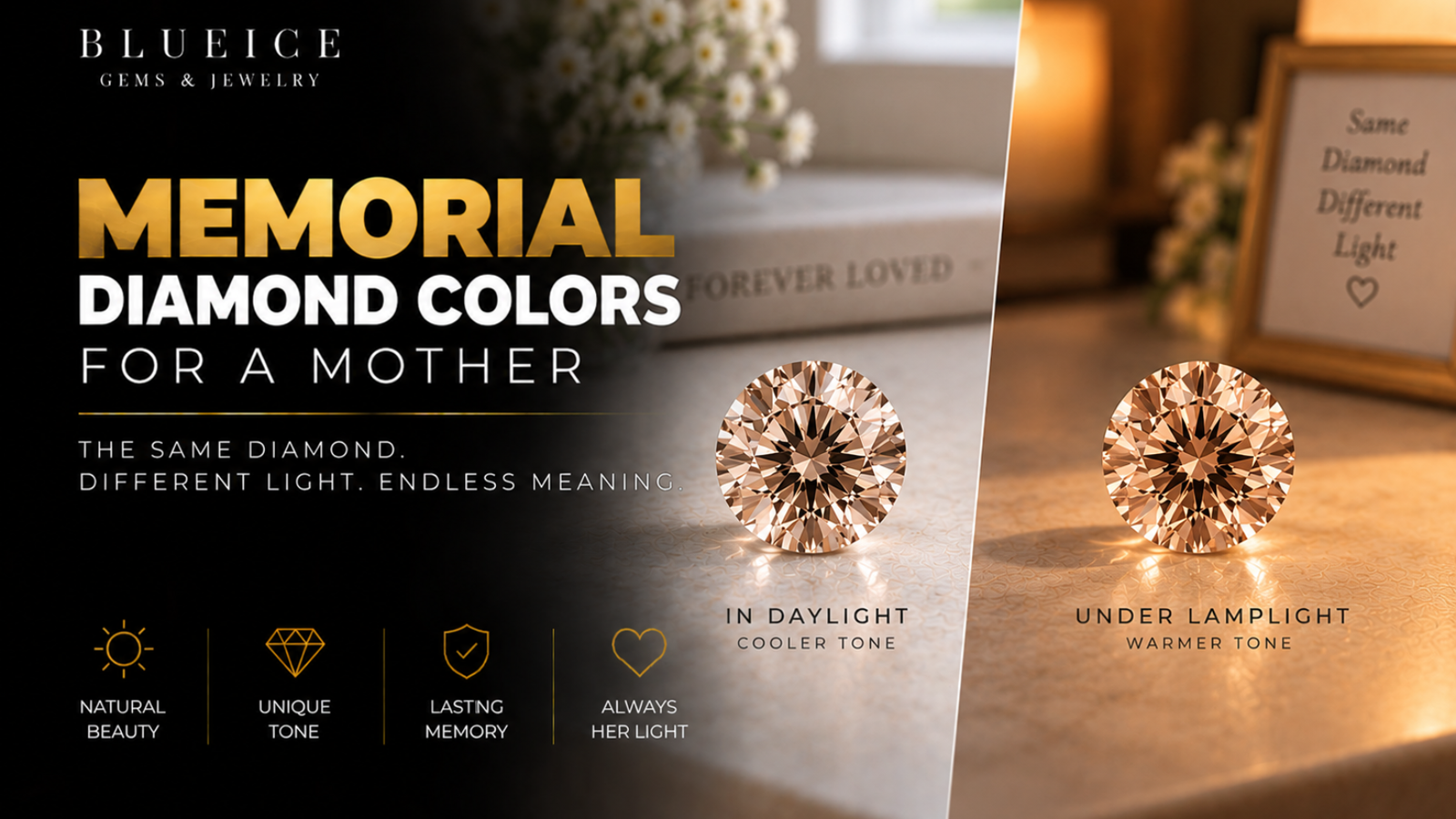
If the funeral home sealed the urn, go back to them they closed it, they can reopen and reclose it properly.

Can One Portion of Ash Supply Diamonds for More Than One Sibling?

Often, yes. Because the requirement is a fraction of the whole, several family members can each receive their own stone from the same starting material and because each is grown separately, the color, the cut and the setting can differ from sibling to sibling.

Raise it early. Agreeing on three stones before the first order is placed is far simpler than returning to an urn a second and third time, and it turns who gets her into what do we each want.

Whether more than one family member can get a diamond from the same ashes covers how families split the cost and the decision. Ask how a provider handles multi-stone orders one submission split at intake, or a separate submission per stone before assuming either.

Frequently Asked Questions

Is a few tablespoons genuinely enough for a one-carat stone?

Yes. A press turns weeks into carats, not spoonfuls. Once there is enough feedstock to run a growth cell, the quantity of ash requested stays the same at 0.25 ct as at 2 ct the larger stone simply spends longer growing.

What if most of her ashes have already been scattered or buried?

A small kept portion is frequently still workable, since requirements start at a few tablespoons. Send the provider an honest description of how much you have before ordering, and let them tell you rather than guessing.

Do the ashes I don’t use come back to me?

Ask before sending, and get the answer in writing. Returning unused remains by default is the standard families should expect, but it is a provider policy rather than a legal guarantee treat any vagueness on this point as a warning.

Does more ash make the diamond a deeper color?

No. Color comes from trace elements present during growth boron gives blue tones, nitrogen gives yellow not from volume. What color a diamond from her ashes will be explains why memorial stones rarely come out colorless.
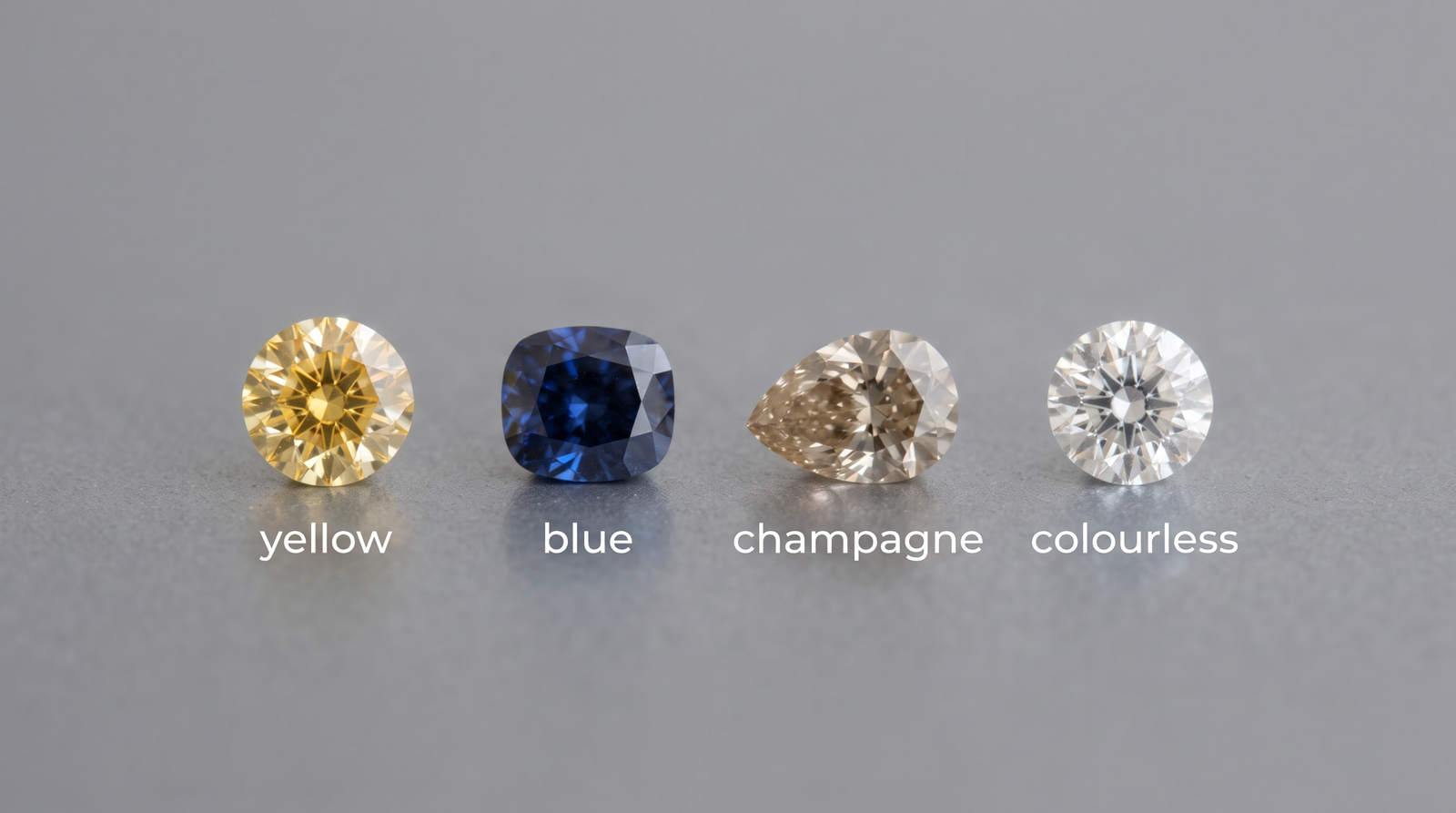
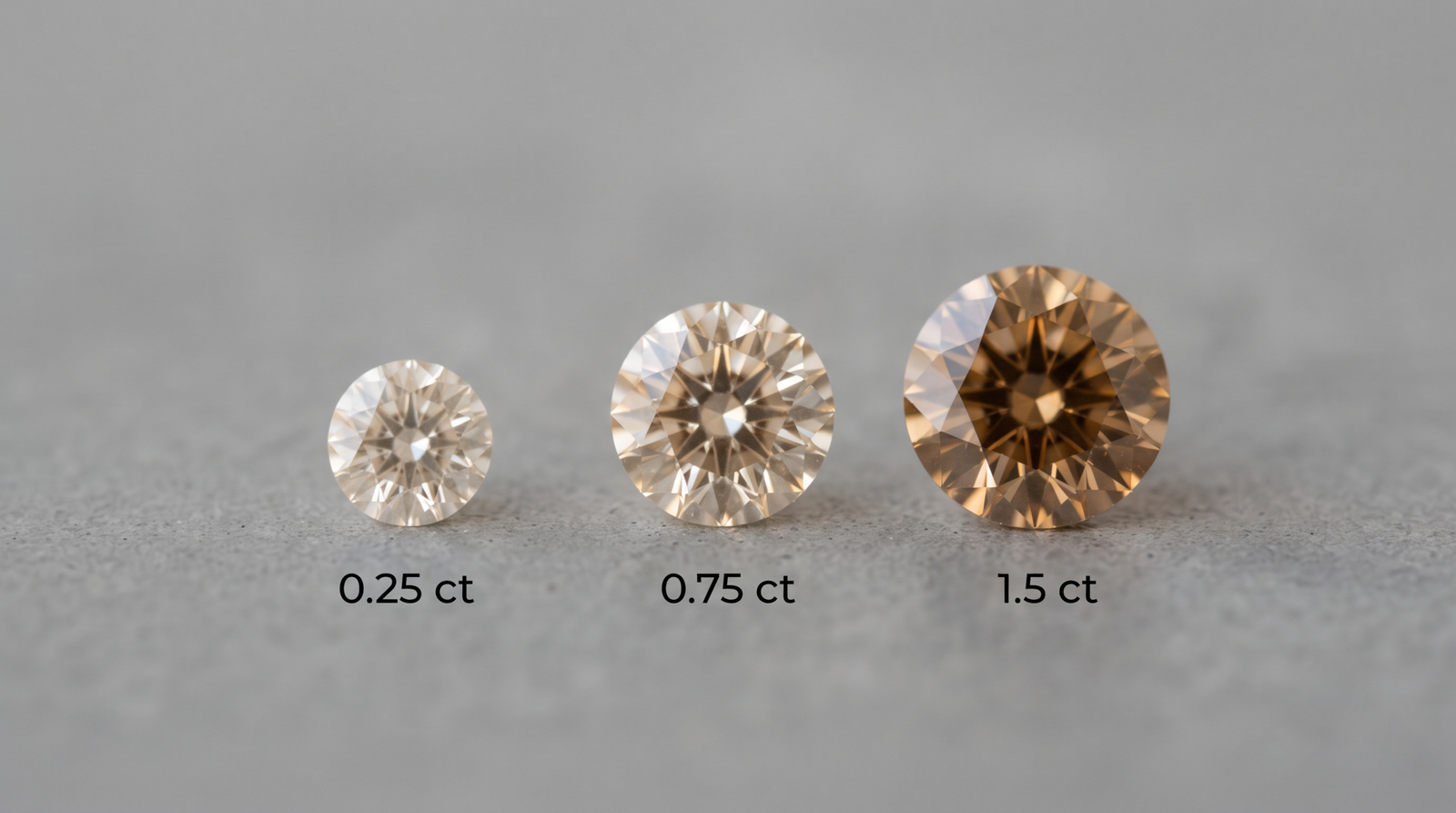
Can I send ash from a cremation that happened years ago?

Yes. Cremated remains are chemically stable mineral material and do not degrade on a shelf, so a cremation from decades ago is no different at intake than a recent one. Time changes nothing about the carbon.

Would her hair need a different amount?

Considerably less hair is roughly 50% carbon by weight, so a small lock goes a long way. How much hair a mother memorial diamond needs covers that path, including for a mother who was buried rather than cremated.

Before You Open Anything

The order of operations matters more than the timing: ask first, open the urn second. A year from now the same few tablespoons will do exactly the same work, but a portion measured out against the wrong figure has to be measured out twice.

When you are ready, reach out to your memorial diamond provider and ask what quantity is needed, what comes back to you, and what documentation arrives with the finished stone.

The complete guide to a mother ashes diamond covers timeline, color and cost in one place if you would rather read further first.