
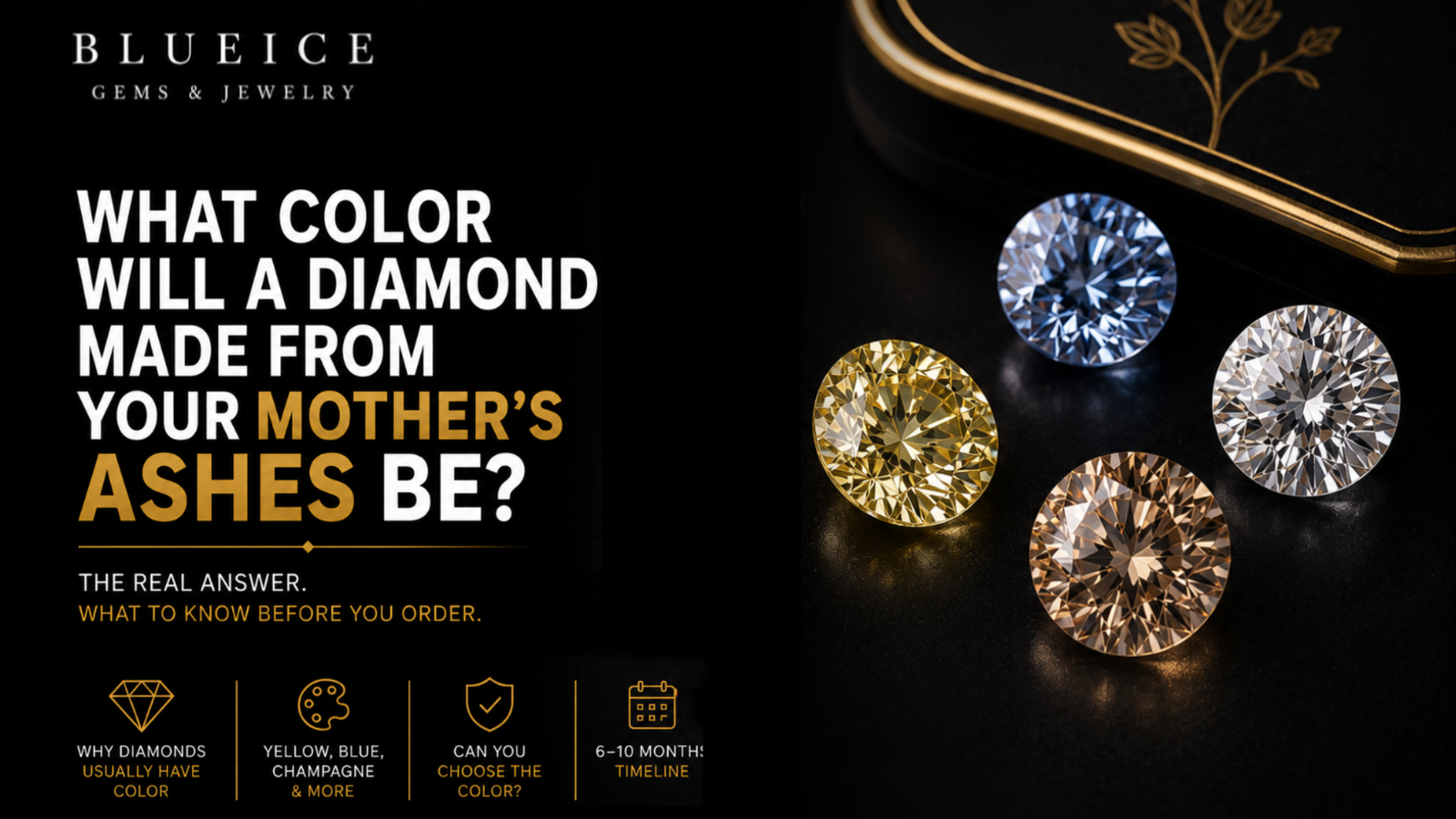
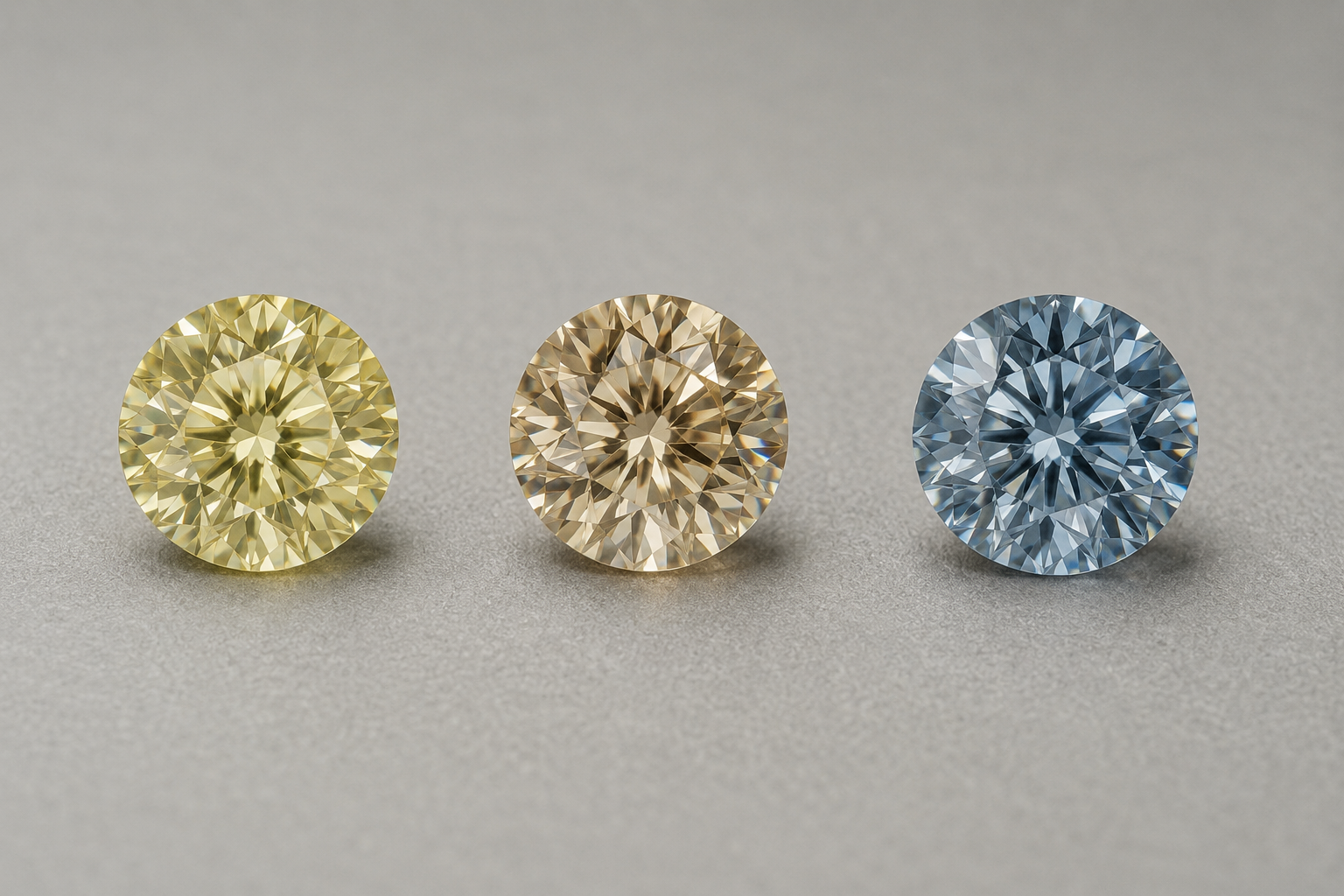
A diamond grown from your mother’s cremated ashes will most likely have color in it yellow, champagne, or blue rather than white. Colorless is achievable, but it takes additional processing and costs more. Better to know that now than in month eight, standing at a kitchen table with the box open.
A tinted stone is not a defect, a downgrade, or a mistake. It is what happens when part of the feedstock is a person instead of a barrel of industrial graphite and unlike most of what makes a memorial diamond meaningful, that part is visible.
Why Won’t the Diamond Be Clear?
Diamond color is not a coating or a setting choice. It comes from trace elements caught in the crystal lattice while the stone is growing. Boron produces blue tones. Nitrogen produces yellow tones. A colorless diamond requires the near-total absence of both.
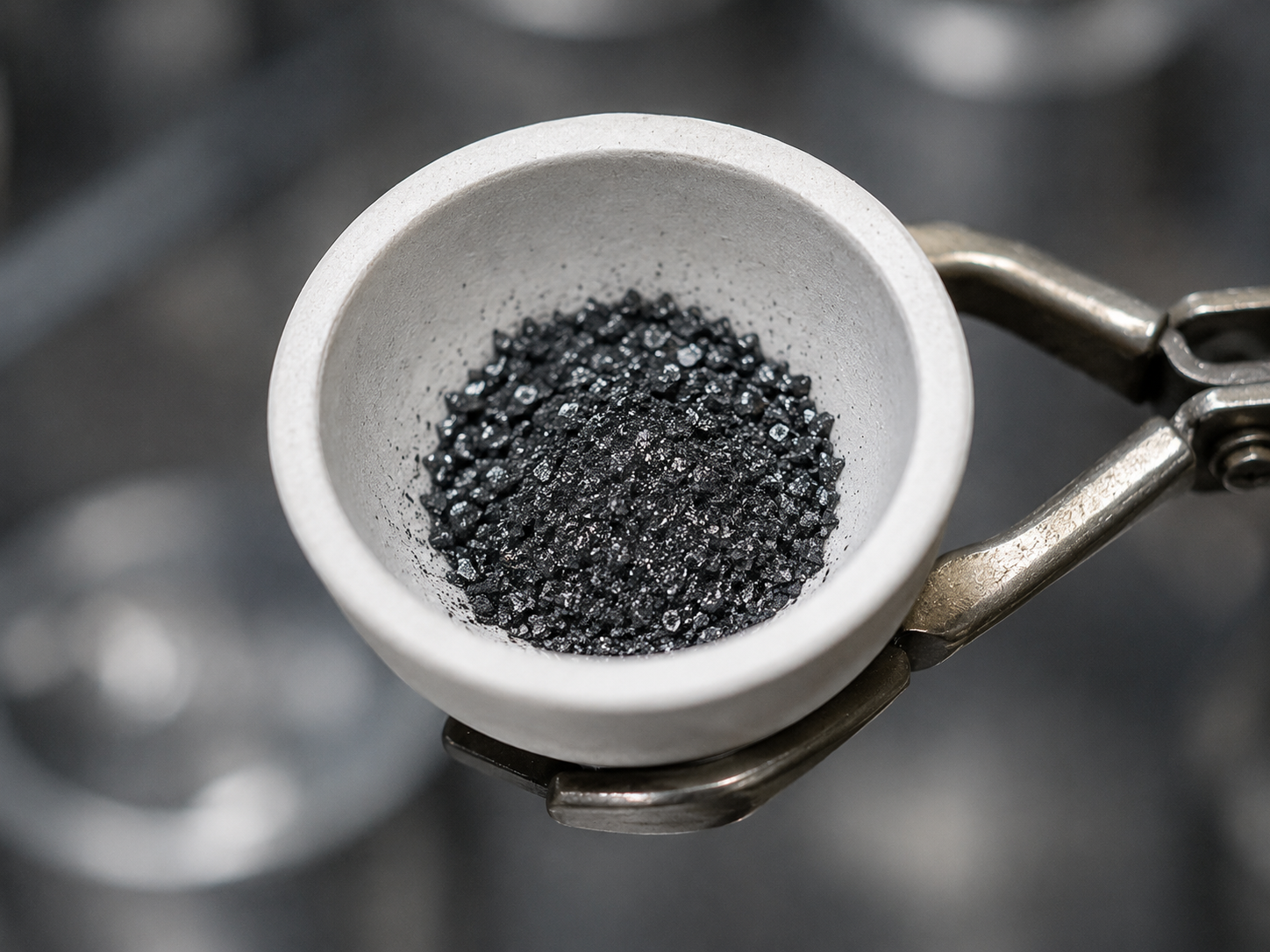
Manufacturers produce synthetic industrial feedstock to contain almost pure carbon, which allows standard lab-grown diamonds to emerge completely colorless. In contrast, cremated remains present the opposite reality. Calcium phosphate—the mineral structure of bone—dominates cremated remains, leaving usable carbon at only about 0.5% to 4% of total ash by weight. Technicians extract that small carbon fraction from the mineral-heavy matrix and purify it to roughly 99.9%+ purity.
This purification process achieves exceptional results, though it never achieves absolute purity by design. At 99.9%+ purity, microscopic trace elements remain, and this residue can directly influence the diamond’s final color. Furthermore, the carbon endures intense conditions during cremation: the high heat of the retort, the holding container, and any surrounding elements. As a result, carbon extracted from ashes carries a unique trace-element signature that standard synthetic feedstock lacks.
Many articles on this topic overlook a crucial fact: her carbon does not fill the growth press alone. Technicians blend her extracted carbon with supplemental lab-grade carbon to achieve the volume the press requires. Consequently, her personal carbon typically accounts for roughly 10% to 15% of the finished diamond’s total mass. The accurate reality does not pit pure ash feedstock against synthetic carbon; instead, controlled synthetic carbon forms most of the gemstone, while her carbon acts as a meaningful minority partner.
The color can still move. Trace elements present during growth can influence the appearance of the crystal, which is why memorial diamonds can trend toward yellow, blue, and champagne or brown tones. The tint is not evidence that the stone is entirely her. It is evidence that personal carbon contributed to the growth process.
For a deeper explanation, see why memorial diamonds are rarely colorless and what the lab does with her ashes.
What Colors Are Actually Possible From Her Ashes?
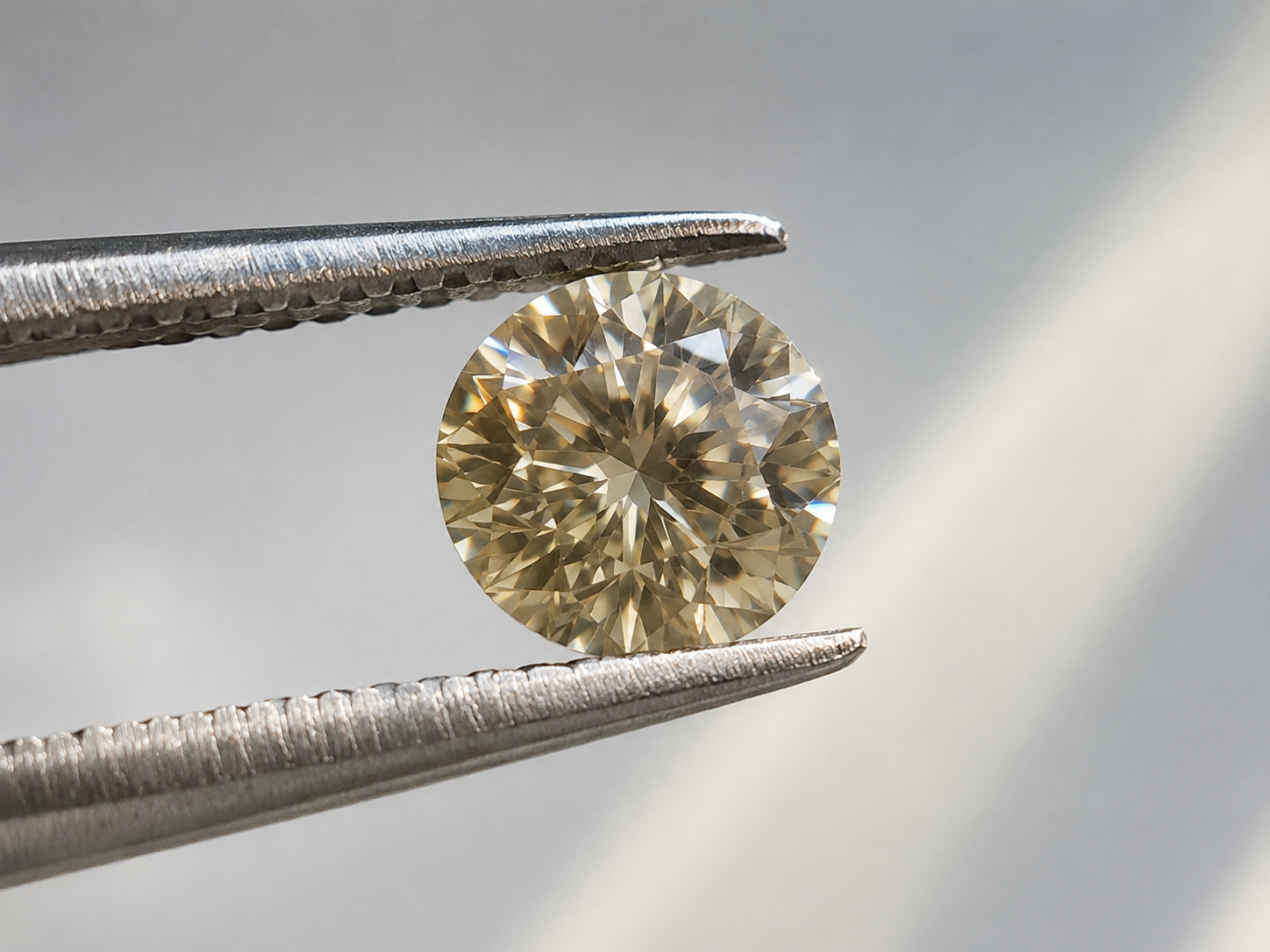
These are industry-typical outcomes and industry-typical cost relationships, not a fixed price list or a promise about a specific stone.
| Color | What Causes It | What an Ash-Derived Source Means | Cost Note |
|---|---|---|---|
| Yellow | Nitrogen present during growth | A common memorial-diamond color associated with nitrogen during growth | Generally sits toward the lower end for a given carat |
| Champagne / Brown | Several trace elements acting together | Can result from the combination of trace elements present during growth | Generally comparable with yellow at matching carat |
| Blue | Boron present during growth | Blue is generally a targeted color rather than something reliably supplied by one person’s ashes | Typically below colorless at the same carat |
| Colorless / White | Near-complete absence of boron and nitrogen | The most demanding outcome because the source must undergo additional processing | Typically carries a significant premium |
| Red, Pink, Green, Black | Post-growth treatment such as irradiation | Color is applied after the crystal has already been grown | Usually treated as an additional option |
For scale on the underlying numbers, entry-tier memorial diamonds of roughly 0.10–0.25 ct run about $1,500–$3,500 industry-wide, while 0.5–1 ct stones can run roughly $5,000–$15,000. Color is only one of several factors affecting the final cost.
See what actually drives memorial diamond cost for the other major price factors.
Can You Choose the Color, or Do Her Ashes Decide?
Both, but in different ways.
You choose the target. Providers can offer color as an option at order time, with the process directed toward the selected result.
Her ashes influence the result. The trace-element profile of carbon recovered from cremated remains can vary, meaning the exact shade can have some natural variability. A provider can aim for a color, but the source material still matters.
Colorless is the outcome where the material presents the greatest challenge because it requires additional processing to reduce the elements associated with coloration. Irradiated colors such as red, pink, green, or black are different because the color is introduced after growth.
Does the Color Mean Anything About Your Mother?
Not in the way it is sometimes marketed. The shade does not encode her personality, eye color, health, or character. Anyone selling you that interpretation is attaching symbolism to something that cannot establish it.
What is true is narrower and, honestly, better. The tint exists because personal carbon contributed to the growth process rather than the stone being produced entirely from controlled industrial carbon. That is a physical fact, not a symbolic one.
None of this requires committing all of her ashes. Only a small fraction is used, so burial, scattering, or keeping an urn can remain open alongside the diamond.
Which Questions Should You Ask About Color Before Ordering?
Color is the part of an order most easily left vague at the start and most obvious on delivery. These five questions help close that gap while it is still possible to make an informed choice.
- What color range does my order actually commit me to? Ask whether you are buying a named color or a color family, and what variation within it is considered normal.
- What happens if the finished stone falls outside that range? Ask what the provider’s process is before you need it whether that means a re-grow, adjustment, or another remedy.
- Is the color from growth or from irradiation? Both are legitimate approaches, but they produce different products and should be explained clearly.
- What does colorless cost at my carat size, and what does it add to the timeline? Ask for the comparison against yellow or blue at the same size, preferably in writing.
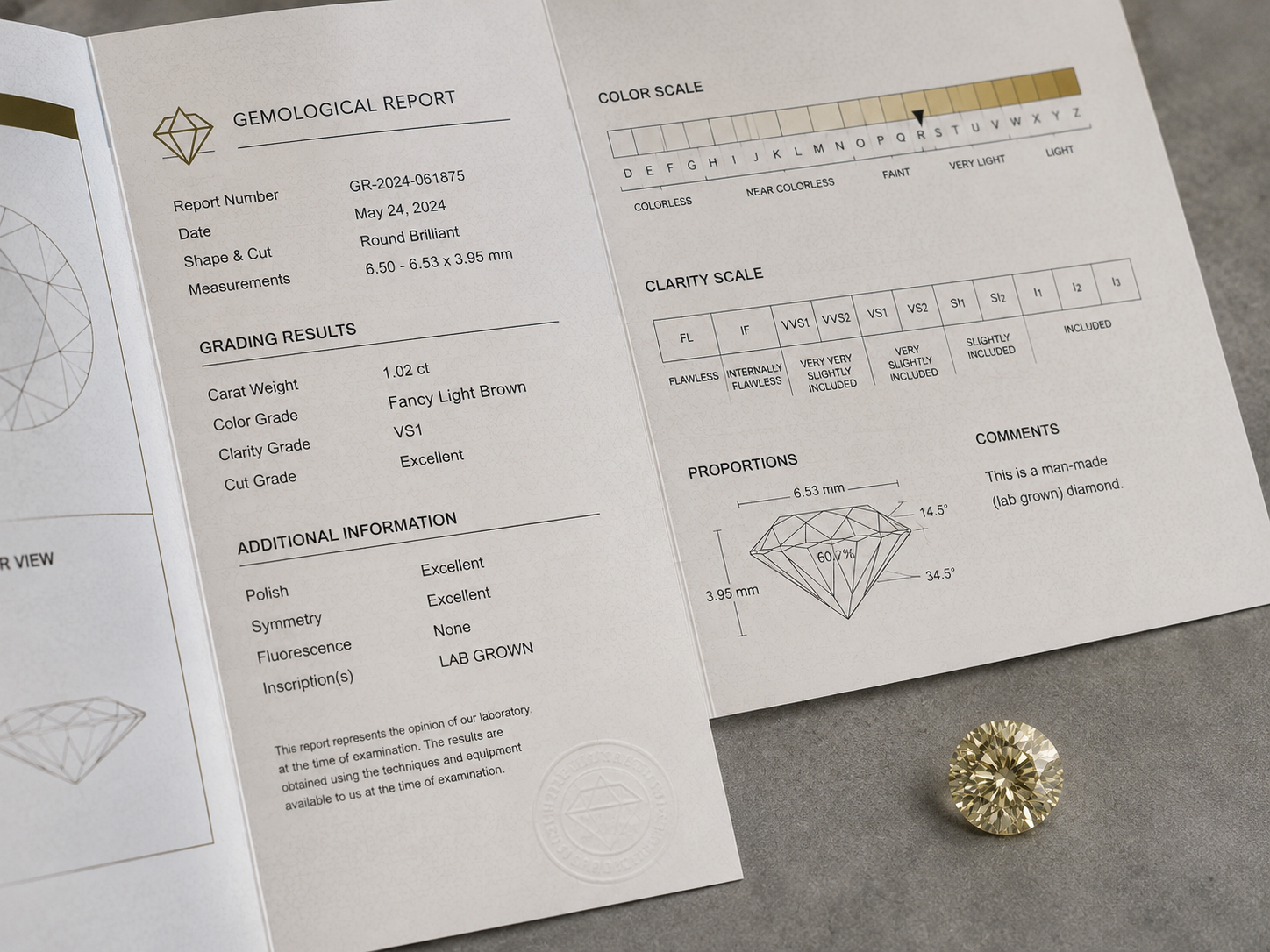
- What color will the grading report list? An independent grading report can document the diamond’s characteristics. See how memorial diamonds are graded and certified.
Frequently Asked Questions
Will the diamond be gray because ashes are gray?
No. The visible color of cremated remains has no bearing on the finished stone. Ash color comes largely from mineral content that is removed during purification. Diamond color comes from trace elements present during crystal growth, which is a separate stage.
Can I get a truly colorless diamond from my mother’s ashes?
Yes, but it is the hardest outcome to produce. It requires additional processing to reduce the elements associated with coloration, and it typically costs more than a yellow, champagne, or blue stone of the same carat weight.
Does submitting more ashes change the color?
No. Material quantity does not directly determine color, and it does not determine size either. Carat is primarily a function of growth time in the press. As a general industry guide, requirements can range from a few tablespoons to roughly 4 oz, but individual providers set their own requirements.
Will the color fade or change over the years?
No. The color is structural, existing within the crystal rather than sitting on the surface. Diamond is also a 10 on the Mohs hardness scale. Ordinary wear, cleaning, and sunlight do not simply remove a structural color.
Can two diamonds from the same ashes come out different colors?
Yes, separate growth runs can produce variation. Families ordering multiple stones from one shared source should ask the provider how closely matching colors can be expected if consistency between stones matters.
Is a colored memorial diamond worth less than a colorless one?
Production cost and personal value are different questions. A colored memorial diamond may cost less to produce than a colorless one, but that does not make it less meaningful. In this category, the color can simply be part of the physical result of the growth process.
Before You Choose a Color
One practical suggestion before anything else: stop reading color words and go look at stones. “Champagne” on an order form and a champagne diamond turning under a lamp are not the same experience, and a color ruled out on paper has often never been seen in person.
When you want the specifics rather than the general case, reach out to Memorial Diamond at memorialdiamond.us to talk through what color is realistic for your mother’s ashes, what colorless would actually involve, and to put the five questions above to a person rather than a page.
The same question about her hair has a different answer, while sending both ashes and hair changes the discussion again. You can also explore the wider range of colors families choose for a mother and the complete guide to a mother ashes diamond.