much-son-memorial-diamond-cost

How Much Does a Son Memorial Diamond Cost?

Somewhere between the paperwork and the phone calls, a question arrives that a lot of parents feel awkward saying out loud: what does this actually take, financially? Industry wide, son memorial diamond cost sits in three broad bands, roughly $1,500 to $3,500 for a small stone of about 0.10 to 0.25 carats, roughly $5,000 to $15,000 once you reach half a carat through a full carat, and $20,000 to $75,000 or more beyond two carats. Carat, color, cut and grading decide where any quote lands.
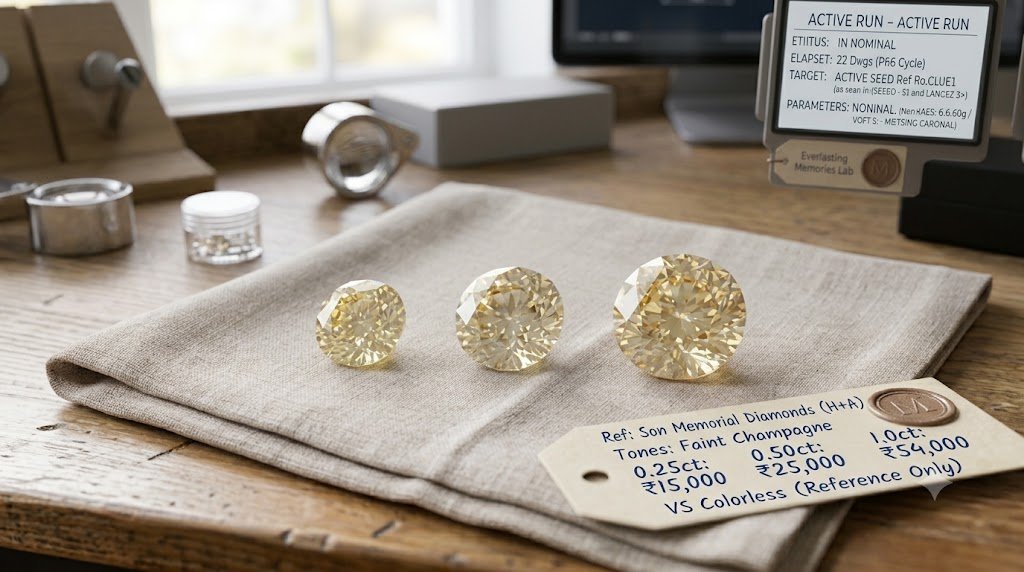
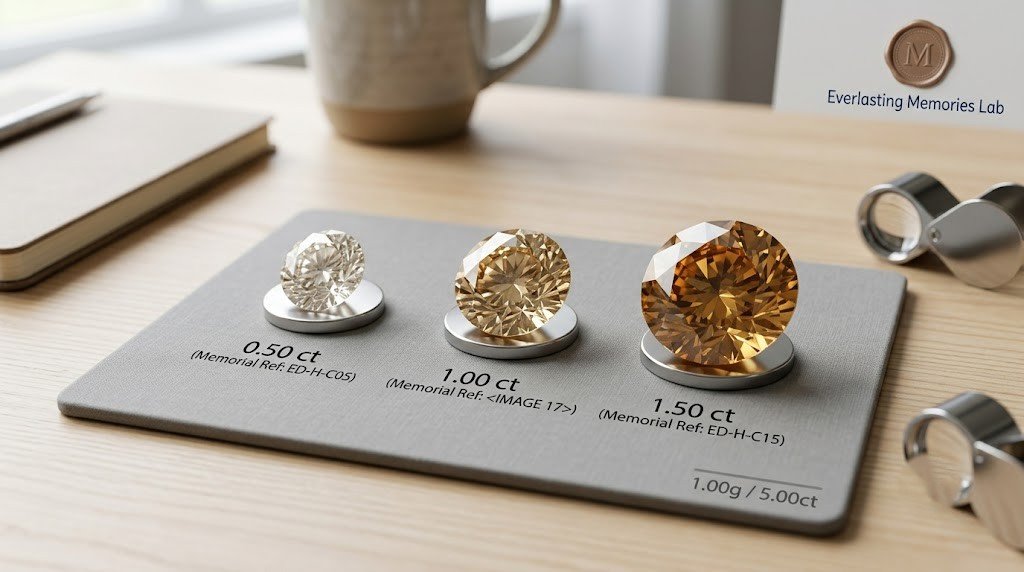
Son memorial diamond cost compared across three loose memorial diamonds of increasing carat size on a neutral surface

What Does It Cost Across the Industry?

The figures above come from the wider memorial diamond field, not from any single company’s rate card. Memorial Diamond has not published pricing of its own, so read them as a map of what is ordinary rather than a quote anyone can be held to.

What moves a quote inside those bands is a short list: how large the finished stone will be, what color it turns out, how it is cut, and whether an independent grading report is part of the order. Each is a decision, which means son memorial diamond cost is mostly the sum of choices you make rather than a rate you are handed.

One thing is worth saying before any of the detail. A price band says nothing about how much your son mattered, whether he was six or sixty. A quarter carat stone and a three carat stone come from the same person by the same process, and no son memorial diamond cost figure makes the smaller one a lesser tribute.

Why Do Two Quotes for the Same Stone Differ So Much?

Because “the same stone” rarely means the same thing twice. Two quotes that both say one carat can describe different colors, different cuts, different levels of documentation and different growth methods.

Colorless runs meaningfully higher than blue, yellow or champagne at the same carat weight, because keeping trace elements out of the growth cell takes extra process control. A fancy shape consumes more rough than a round does. Independent grading is optional almost everywhere it is offered, and a quote including it reads higher than one that leaves it out.

So when two numbers look far apart, the useful move is not to assume somebody is overcharging. Line the quotes up item by item. A good share of the apparent spread in son memorial diamond cost disappears the moment you do.

Ask for the breakdown in writing. A single round number is the hardest kind of son memorial diamond cost to compare. Questions worth asking before you commission anything covers what else belongs on that call.

What Do the Three Son Memorial Diamond Cost Tiers Look Like?

Laid out side by side, the three son memorial diamond cost tiers make the shape of the decision clearer than any single figure can.

TierTypical Carat RangeIndustry Typical PriceWhat Drives the Number
EntryApproximately 0.10 to 0.25 ctApproximately $1,500 to $3,500Shortest growth time in the press; fancy shades far more common than colorless at this size
Mid0.5 to 1 ctApproximately $5,000 to $15,000Longer growth; colorless costs meaningfully more than blue, yellow or champagne at the same weight
Large or rare2 to 5+ ctApproximately $20,000 to $75,000+Much longer growth, tighter process control, more risk across a long run

Read down the right hand column and the pattern is plain: these son memorial diamond cost tiers are really time tiers. Bigger stones are not made from more of him. They are made over more weeks and months inside the press.

That is also why the step from mid tier to large tier is steeper than the step from entry to mid. A laboratory holds a growth cell at extreme conditions far longer, with more that can go wrong.

Does Sending More Ash Lower the Son Memorial Diamond Cost?

No, and this is the single most useful thing a parent can know before the first conversation. Carat size is a function of growth time in the press, not of how much material you send. Submitting a fuller portion of his ashes buys no extra size, no faster result, and no reduction in the son memorial diamond cost.

That cuts mostly in your favor: you never have to weigh a larger diamond against keeping most of his ashes where you intended. Providers typically work from a modest portion, so burial, scattering or an urn at home can still go ahead as planned. How much ash a memorial stone actually needs sets out the usual quantities.

It also reframes the whole question. Choosing a larger stone is what raises the son memorial diamond cost, and that same choice is what lengthens the wait. Size, price and time are one decision wearing three faces.

Be wary of any pitch implying otherwise. If someone suggests sending more will get you more stone for the money, that is not how growth works.

How Much Does Color Move the Son Memorial Diamond Cost?
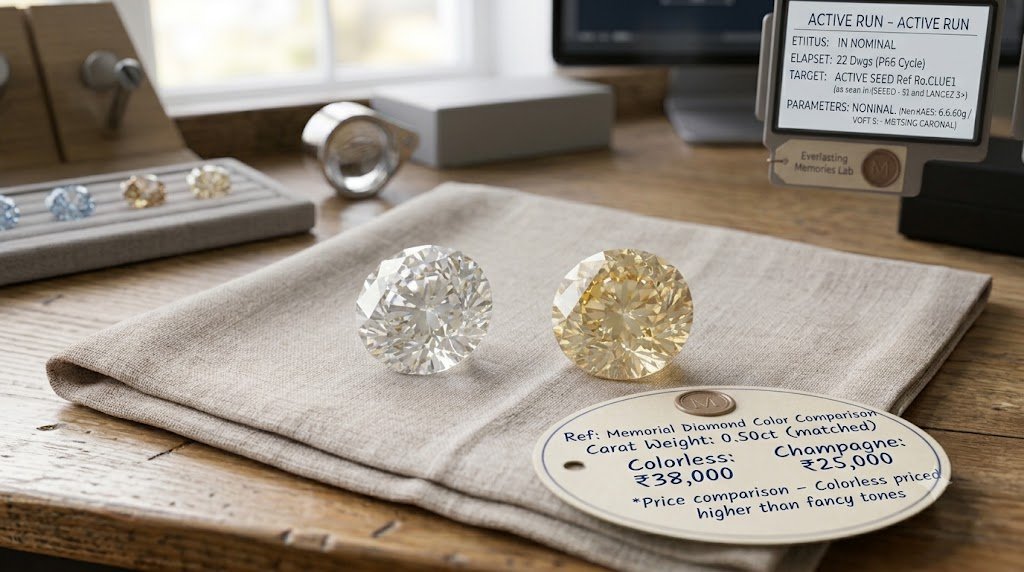
 colorless memorial diamond beside a champagne-toned one of the same carat weight for price comparison

More than most parents expect. At the same carat weight, colorless stones cost meaningfully more than blue, yellow or champagne ones, because a colorless result means excluding the trace elements that give a diamond its tint.

The mechanics are simple. Nitrogen caught in the crystal produces yellow tones. Boron produces blue ones. A stone reads colorless only when neither is present. Carbon drawn from a person is organic rather than industrially uniform, so trace elements are common and warm tones are the ordinary outcome.

Pushing against that tendency is extra work, and extra work shows up in the son memorial diamond cost. Some providers also offer post growth irradiation for red, pink, green or black stones. Where that exists it is priced separately again and can stretch the schedule.

If budget is the binding constraint, color is the first place to find room. A yellow or champagne stone sits lower in the son memorial diamond cost range than a colorless one at the same size. What color to expect from his ashes goes through the shades.

What Is Billed Outside the Quoted Son Memorial Diamond Cost?

A quoted son memorial diamond cost usually describes a finished loose stone and nothing else. Across the industry, these are typically priced separately:

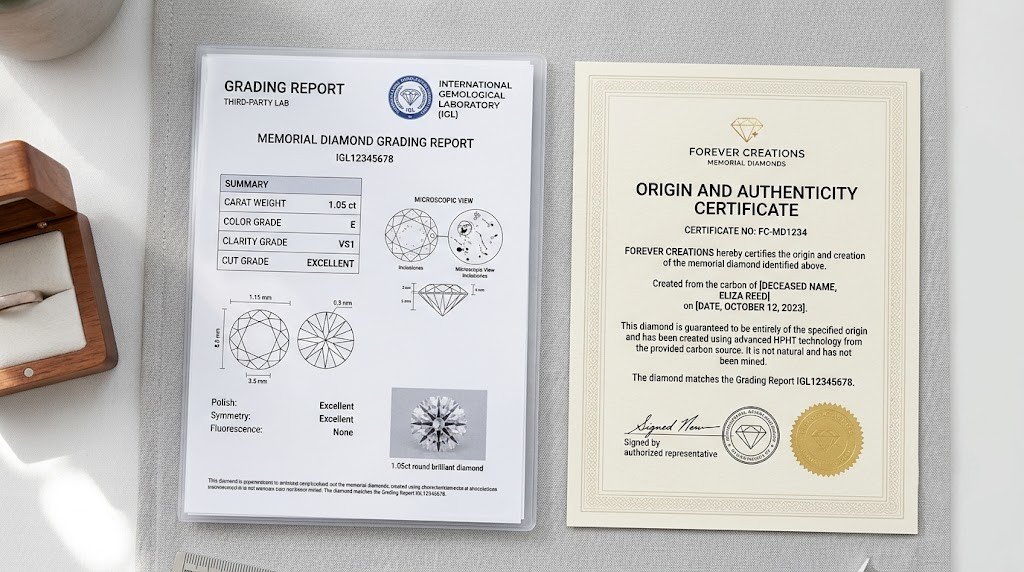
  • An independent grading report Optional everywhere it is offered, documenting cut, color, clarity and carat through a third party laboratory rather than the grower.
  • Engraving A name, a date or initials on the stone or setting, usually an add on rather than an inclusion.
  • Fancy cuts Princess, cushion, emerald and similar shapes, which generally carry a premium over a standard round.
  • Jewelry settings A ring, pendant or pair of earrings is its own purchase, with metal choice moving the number as much as design does.
  • Shipping, insurance and secure return Worth confirming rather than assuming, in both directions.

None of these are hidden charges when a provider names them upfront. They become a problem only when a headline figure is compared against a rival quote that silently bundles two of them in. So ask every provider the same thing: what is inside this number, and what arrives as a separate line later? What a finished stone can be set into covers the setting side of that bill.

Is the Son Memorial Diamond Cost Different for Ashes and Hair?

Headline figures are generally driven by the finished stone rather than by which material it started from, so published tiers tend to look similar either way. What differs is what each route asks of you before growing begins.

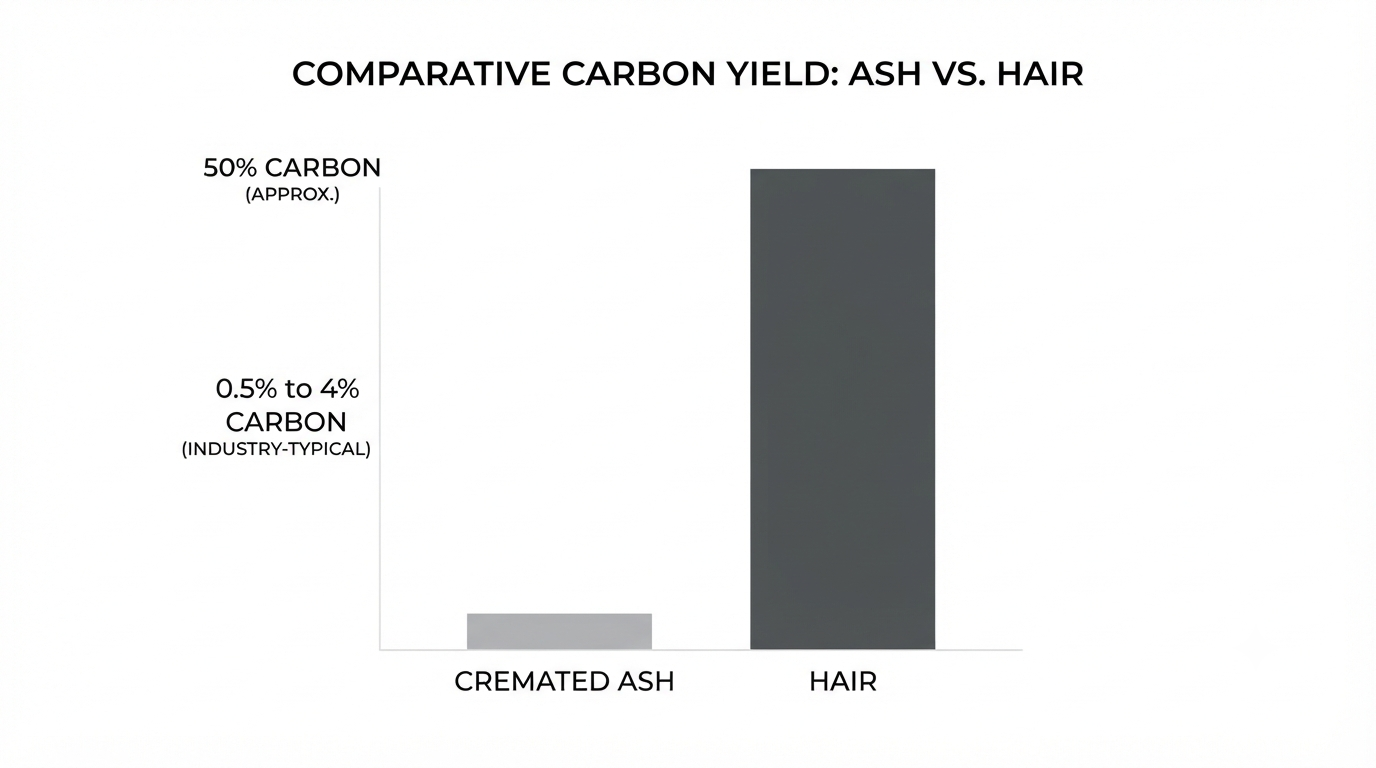
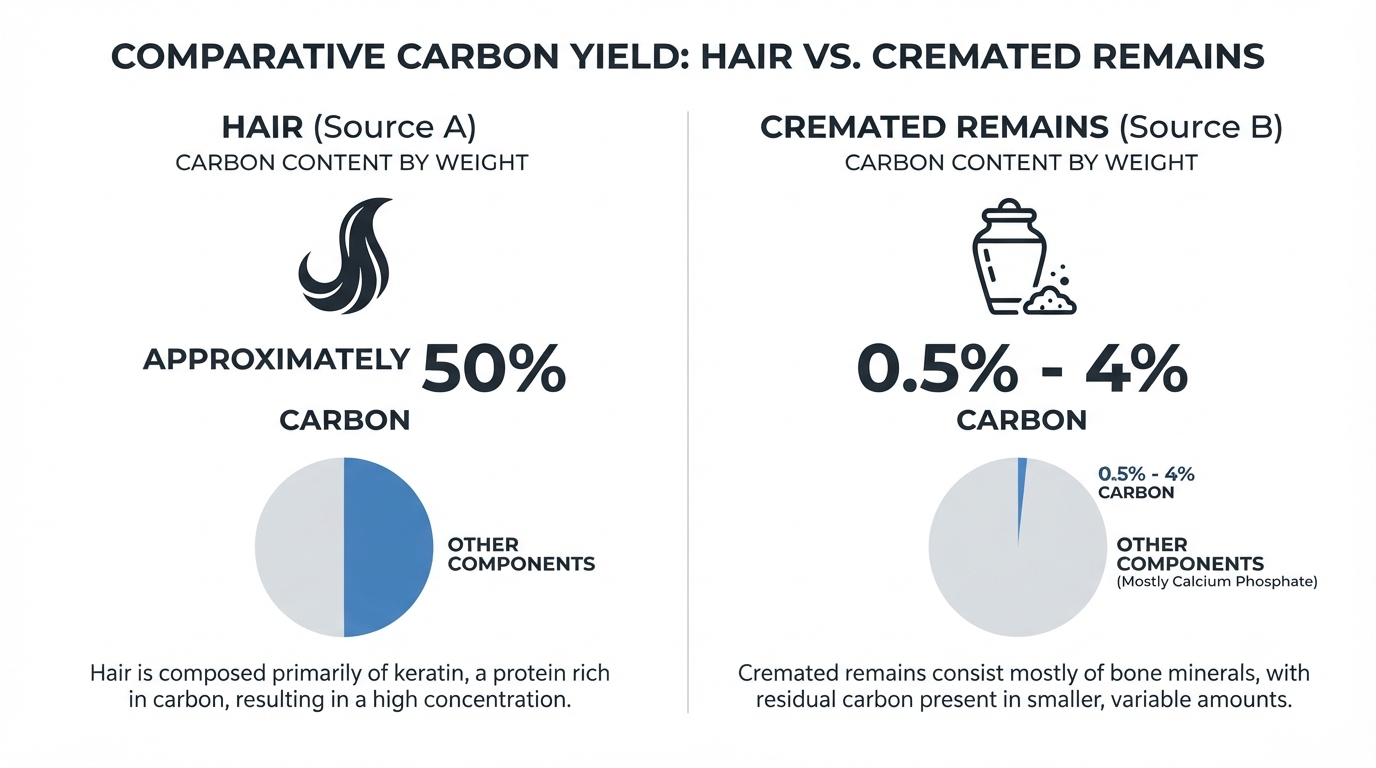
Ashes are mostly calcium phosphate, and industry figures put usable carbon at roughly 0.5% to 4% of ash by weight. After purification and blending with supplemental lab carbon to reach a workable volume, the personal carbon from ashes typically makes up something in the region of 10% to 15% of what the finished stone weighs, and a few providers publish figures down at 3%.

Hair is a different starting material, roughly 50% carbon by weight, which is why a small lock can be enough and why cremation is not needed. That is a starting material fact, not a finished stone percentage: no equivalent published figure exists for hair, or for a blended ash and hair charge. Ask a provider for theirs in writing. How much of his hair a stone needs sets out the usual amounts.

Where the routes genuinely differ on son memorial diamond cost is in the practical handling around them, so ask each provider to quote your actual material rather than a category.

Who Has to Agree Before You Can Commission Anything?

This is the part parents are least often warned about, and it can stop an order before the son memorial diamond cost is even relevant. Being his mother or his father does not automatically place you first in line where his remains are concerned.

If your son was married or had a registered partner, or left adult children of his own, one of them may hold the legal say over his remains ahead of you, depending on your state and on anything he set down in writing. Instructions in a will, a prearrangement with a funeral home, or a designated agent for disposition can outrank the order you might expect.

None of that is a reason to abandon the idea. It is a reason to find out early who signs, because a provider needs a release from whoever holds that authority before any material is processed, whatever the son memorial diamond cost turns out to be.

The funeral director who handled the cremation is usually the fastest source of a straight answer, and an attorney licensed in your state can settle anything contested. Hair you already hold at home is often the simpler question in practice, though a decedent’s belongings can fall to an estate, and a sample somebody else keeps is a conversation rather than a decision.

Which Questions Pull the Real Son Memorial Diamond Cost Into the Open?

A quote becomes comparable the moment you ask the same handful of things of everyone. These are the ones that tend to move the son memorial diamond cost:

  1. What carat, color and cut is this figure based on, and what happens if any of the three changes?
  2. Is an independent grading report included, or optional and billed separately?
  3. Is a setting included, or is this the loose stone alone?
  4. What is charged if the first growth run does not produce a usable crystal?
  5. What are the payment stages, and what is refundable at each one?
  6. What happens to any material not used, and is it returned?

Write the answers down as you get them. Six answers in a row on one page make the true son memorial diamond cost obvious in a way that six separate phone calls never do.

If a provider resists itemizing, treat that as information about the provider rather than about the price.

What If Two Parents Disagree About the Son Memorial Diamond Cost?

It happens often, and it is rarely about money. One parent wants the largest stone they can manage because size feels like the measure of the gesture. The other flinches at the figure and cannot say so without sounding as though they care less.

Some parents are arranging this alone, divorced, widowed, estranged, or simply the one who could face making calls. If that is you, you are not obliged to build a consensus that does not exist. Where there are two of you, it helps to separate what to spend from what the spending is meant to say.

One reframing tends to unlock it. Since only a portion of the material is used, more than one stone can often be grown from a single submission. Two smaller diamonds can total less than one large one, and each parent ends up with something of their own. Whether more than one family member can each have a stone covers how that works.

Whatever you land on, set a son memorial diamond cost you are genuinely comfortable with rather than one that sounds impressive to anyone else.

Is a Son Memorial Diamond Cost Tax Deductible or Insurable?

Honestly: it depends on your individual situation, and this is not a question a jewelry brand can answer for you. Tax treatment varies by jurisdiction and circumstance, and personal expenses generally are not deductible, but whether that holds in your case belongs to an accountant, not to a blog post.

Insurance is a similar story with a clearer path. A finished stone is an item of value like any other fine jewelry, and many households insure it under a homeowner’s or renter’s policy, sometimes through a scheduled rider. An independent grading report makes that conversation easier, because it gives an insurer something third party to work from.

What you can do is prepare. Keep the documentation you receive, keep the invoices showing the son memorial diamond cost you actually paid, and keep any grading paperwork together with them.

Then ask a qualified professional about your own circumstances. Nobody should be asserting a confident answer on your behalf.

How Does Waiting Time Interact With Son Memorial Diamond Cost?

Directly, because both are driven by the same thing. Growth in the press determines carat, so the stone that costs more is almost without exception the stone that takes longer.

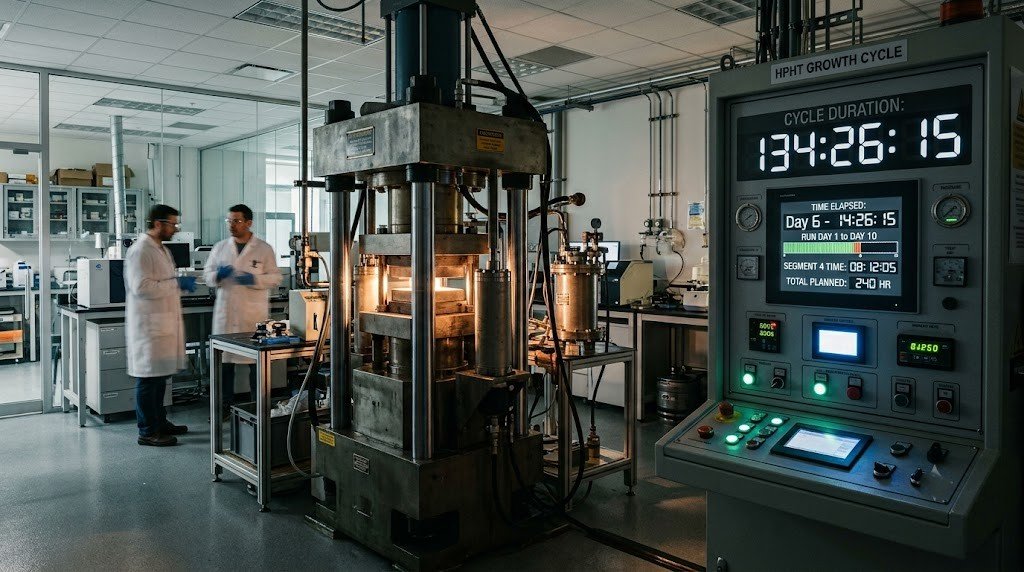
Across the industry, the full sequence from receipt of material to finished stone typically runs six to ten months, with larger stones and specialty colors sometimes reaching twelve. A small entry tier stone sits at the shorter end. A two carat commission sits at the longer end, and the son memorial diamond cost reflects the extra months a laboratory spends on it.

That trade is worth making consciously. If a date matters to you, a birthday, the anniversary of his death, a family gathering, say so before choosing a size, because the size choice quietly sets the calendar. How long the whole process takes, stage by stage walks through where the months go.

Ask, too, what happens if a run fails and has to restart. Knowing whether that means a delay, a fresh charge, or both is fair to establish while you are still discussing the son memorial diamond cost.

How Do Parents Decide What Is Reasonable to Spend?
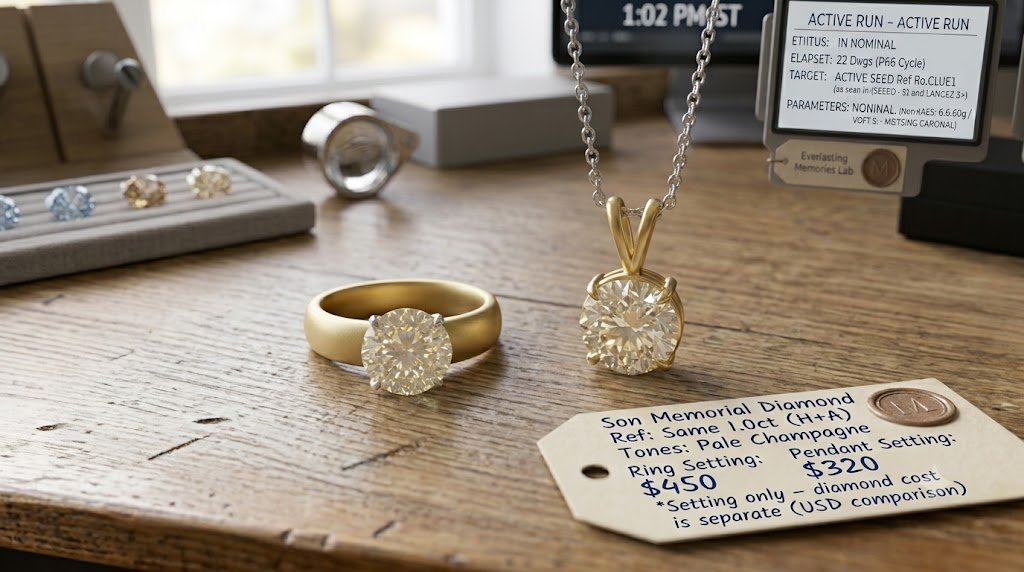
The same memorial diamond shown set in a plain band and in a pendant to illustrate separately priced settings

There is no correct figure, and anyone implying otherwise is selling rather than advising. A few questions do make the decision quieter.

Start with what you want the stone to do. Something worn daily can be modest and still be with you constantly. Something kept in a box and taken out on particular days is judged differently. Answering that honestly narrows the son memorial diamond cost range faster than any price list.

Then check the figure against the rest of your life rather than against grief. Bereavement makes large numbers feel weightless, and a decision made in the first weeks can look different a year on. Nothing needs settling quickly. Ashes and hair keep indefinitely.

And it remains one option among several valid ones. Burial, scattering and keeping an urn are not lesser choices. Where to begin if you are still deciding is a gentler starting point than a quote.

Frequently Asked Questions

Why does a bigger stone cost so much more?

Because size comes from time. Carat is set by how long the crystal grows under pressure, so a two carat stone occupies a press far longer than a quarter carat one, with more process control and more risk across the run. The price follows the months, not the material.

Can I pay in stages rather than upfront?

Many providers structure payment across milestones such as intake, growth and delivery, but terms vary widely and nothing here should be read as a standard. Ask for the schedule in writing, including what is refundable at each stage, before you commit to anything.

Does the price include a certificate?

Usually not by default. An in house authenticity or chain of custody document is often included, while an independent third party grading report is optional and billed separately almost everywhere it is offered. Ask which of the two a quote covers, since the words sound similar and mean different things.

Is a stone made from hair cheaper than one from ashes?

Not reliably. Published tiers are generally built around the finished stone rather than the source material, so headline figures tend to look similar. What differs is the preparation each route requires, which is why it is worth asking for a quote on your actual material.

What happens to the money if the growth run fails?

That depends entirely on the provider’s own policy, and it is one of the most important things to settle in advance. Ask directly whether a failed run means a repeat attempt at no charge, a delay, a partial refund, or a fresh invoice.

Can I have the stone valued for insurance?

Yes, and an independent grading report makes it considerably easier, because it gives an insurer a third party description of cut, color, clarity and carat. Keep your invoices and grading paperwork together, then speak to your own insurer about scheduling the piece.

Final Thoughts on Son Memorial Diamond Cost

The number that matters is not the one at the top of the industry range. It is the one you can pay without strain, from a provider willing to tell you what sits inside the figure.

Every part of the son memorial diamond cost traces back to the same five choices, how big, what color, what cut, what documentation, what setting. Understand those and you can read any quote you are handed.

There is also no deadline on the decision. His ashes and his hair will keep, and the son memorial diamond cost you are quoted next year will describe the same stone as the one quoted today.

Learn More About Son Memorial Diamonds

Talk With Memorial Diamond

If you are weighing what this would mean for your family, you are welcome to talk it through without committing to anything. Reach out to Memorial Diamond at memorialdiamond.us and ask whatever you need to, including the questions about money that are hard to put into words.
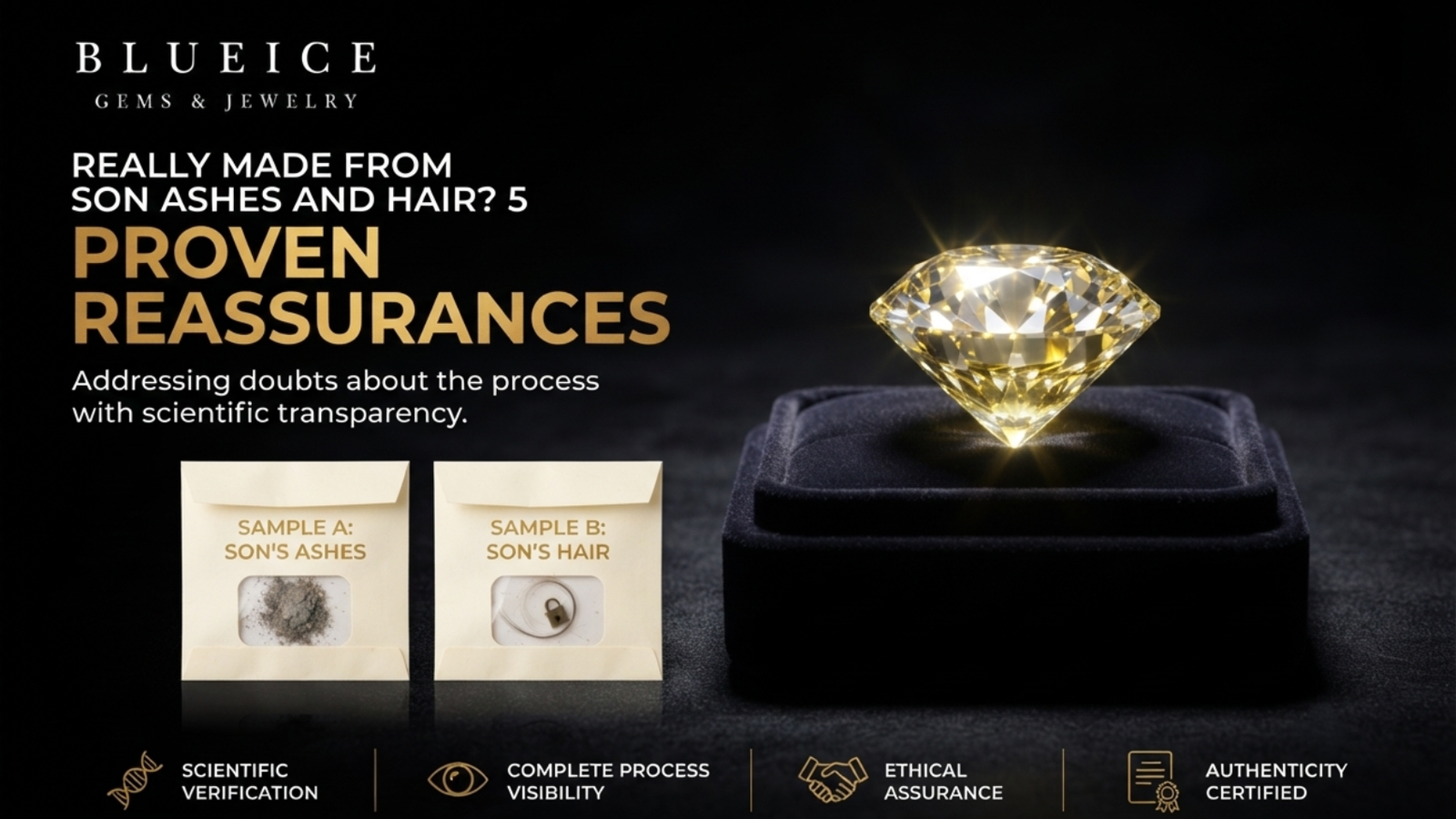
A memorial diamond really made from son ashes and hair displayed beside two labeled sample envelopes

Is a Memorial Diamond Really Made From Your Son’s Ashes and Hair?

Families who kept a lock from before the cremation often want both to go, and then wonder whether that changes anything. It does not change the honest answer: a stone really made from son ashes and hair genuinely contains carbon extracted from both materials, purified and grown into a chemically real laboratory diamond, blended with supplemental laboratory carbon to reach a usable volume. Sending both does not make a diamond really made from son ashes and hair purer, it changes what the paperwork has to account for.

What Does Submitting Both Materials Actually Mean?

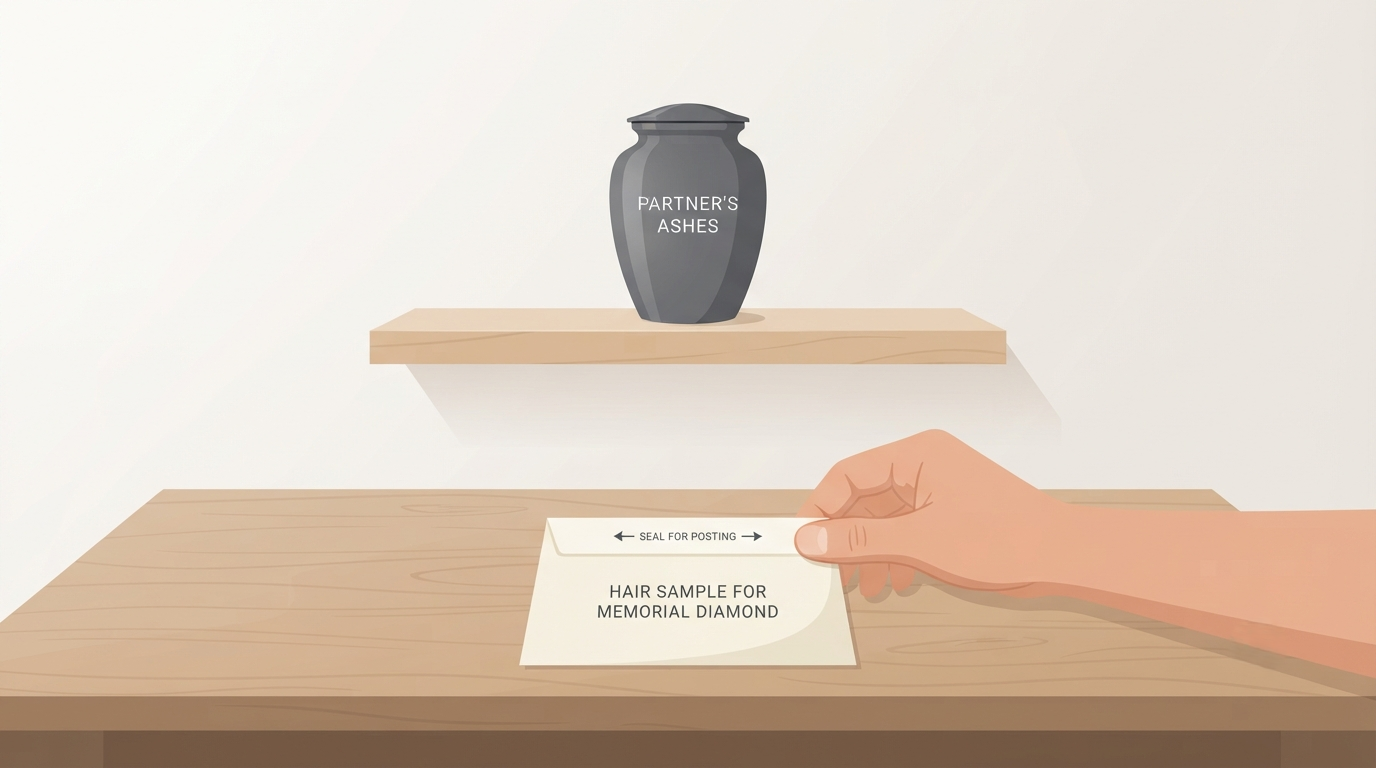
At the simplest level, a commission really made from son ashes and hair means two envelopes instead of one, logged separately at intake and tracked separately until the point where they meet.

Most families reach this point for a reason rather than by accident. A lock cut at a hospital, a first haircut kept in a drawer since childhood, a few strands from a hairbrush nobody could bring themselves to clean, and then, later, cremated remains. Both feel like him, and choosing one over the other feels like ranking them.

You do not have to. Providers across this industry accept mixed submissions, and there is no chemical reason two carbon sources cannot feed one growth run.

What matters is that you understand what happens after they arrive, because a gem really made from son ashes and hair is not two stones fused together or a stone with layers. It is one crystal grown from a combined feedstock. The complete guide to a son ashes and hair diamond sets out the wider decision.

Are the Two Combined, or Grown Separately?

This is the question to put to a provider first, because the answer is not standardized and it changes what you are buying.

Two arrangements are common. In the first, carbon recovered from both samples is pooled into a single charge, and one crystal is grown from the mixture, a single diamond really made from son ashes and hair, with both materials present throughout. In the second, each sample is processed separately and each grows its own stone.

Ask which one a company does by default, and whether the alternative is available. Ask it in writing. A provider that has genuinely thought about work really made from son ashes and hair will have a settled answer and be able to describe how the two intake records stay linked through processing.

Neither arrangement is better for a stone really made from son ashes and hair, there is only the one that suits your family. A single pooled stone keeps everything in one object; separate stones let two people each hold something. How to turn his ashes and hair into a diamond walks through the practical choice.

Does the Hair Disappear Beside the Ash?

Parents preparing a gem really made from son ashes and hair worry about this specifically, and the underlying chemistry is worth knowing, because the two materials are nothing alike as starting points.

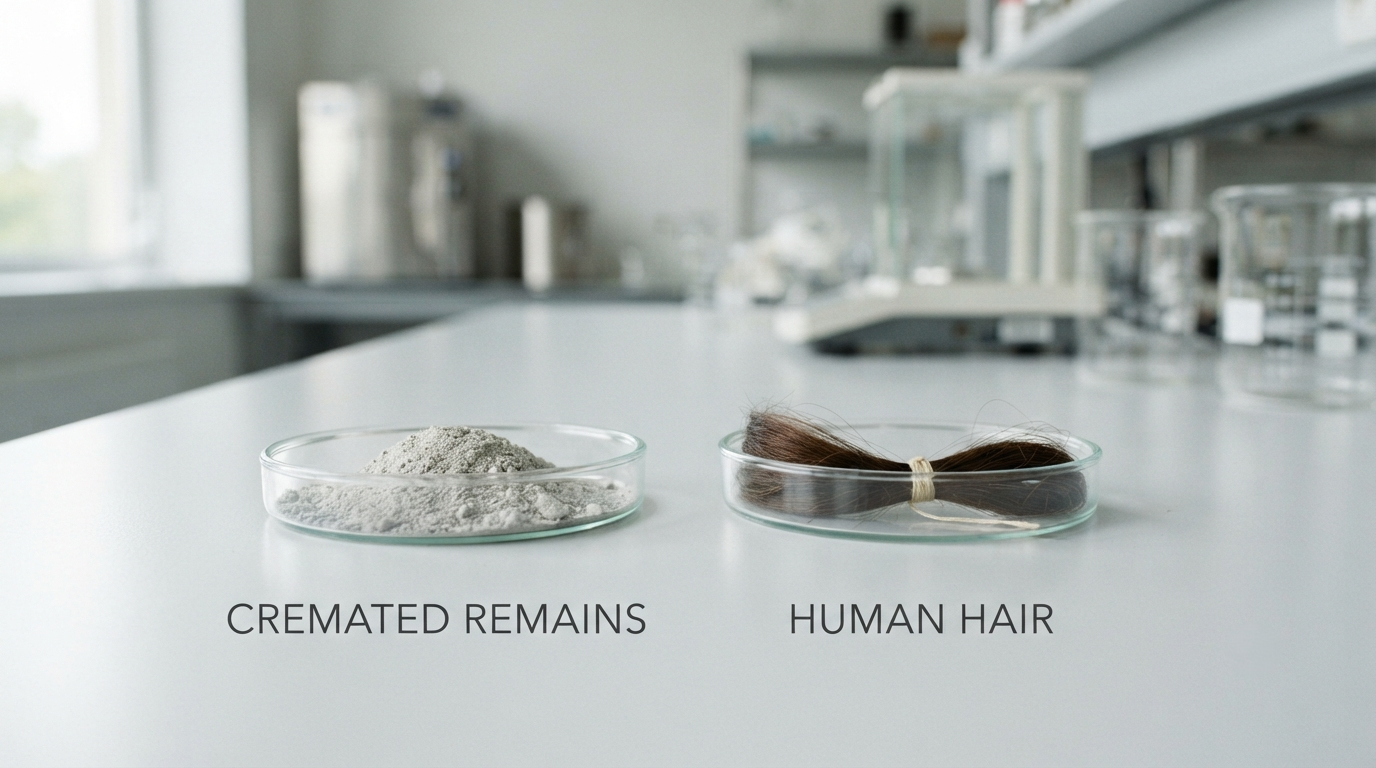
Cremated remainsHair
Main compositionCalcium phosphate, bone mineralKeratin, a carbon rich protein
Carbon as starting materialRoughly 0.5 to 4% of ash by weightRoughly 50% carbon by weight
Typical quantity requestedA few tablespoons up to about 4 ozA small lock, or a few grams
Requires cremation?Yes, by definitionNo
Recovery after purificationA small fraction of what you sendA much higher proportion of what you send
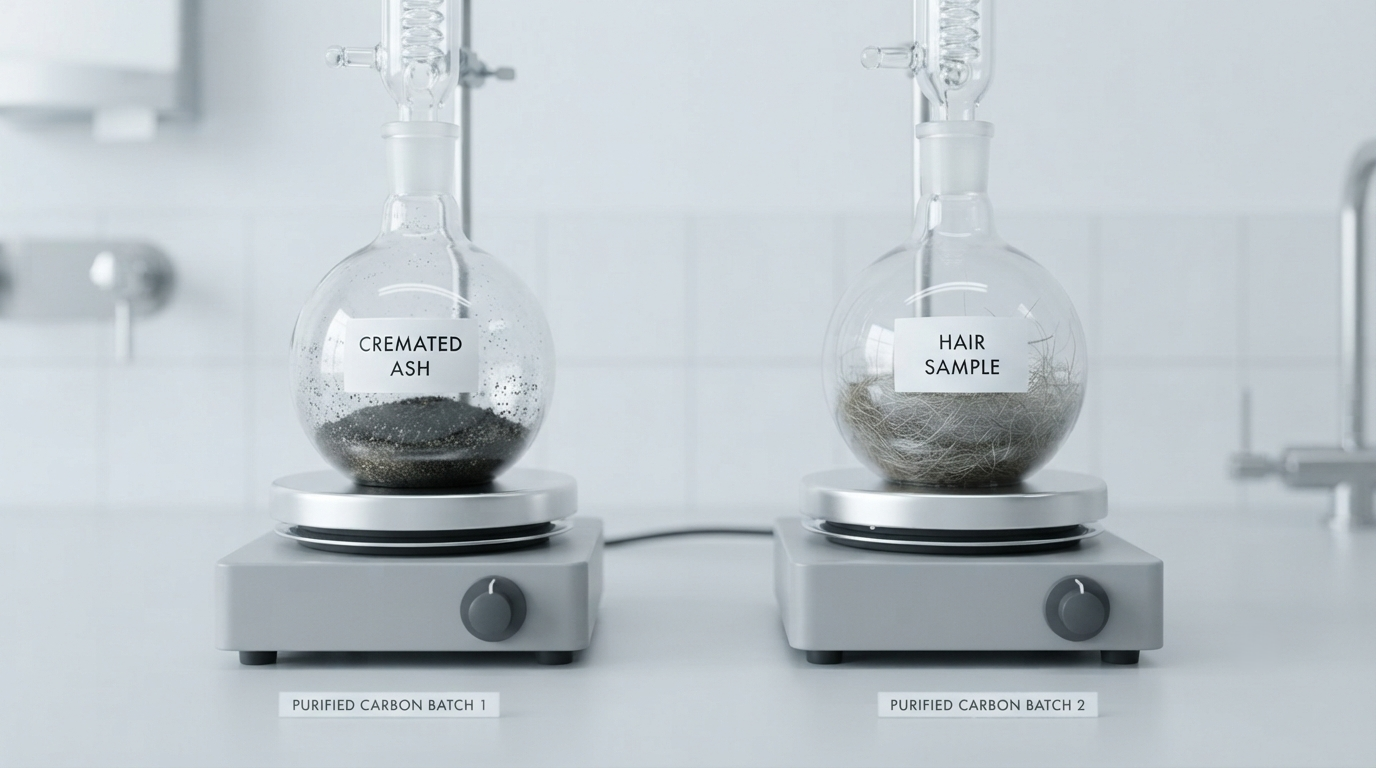
Side-by-side sample of cremated remains and a small lock of hair on a laboratory bench

Read the second row carefully, because it explains the whole question. Gram for gram, hair is a far richer carbon source, so a modest lock can contribute a meaningful share of the personal carbon in something really made from son ashes and hair, it is not a token addition swamped by the ash.

What the table cannot tell you is the resulting ratio inside your specific stone, since that depends on quantities submitted and on how a particular laboratory runs its process. Anyone quoting you a precise split for a jewel really made from son ashes and hair without asking what you are sending is guessing.

What Share Is Really Made From Son Ashes and Hair?

Here the honest answer involves naming a gap rather than filling it. No published industry figure describes the personal carbon share of a blended ash and hair charge. A figure exists for the ash route on its own. Nothing equivalent has been published for hair alone, and nothing at all has been published for the two combined.

So be skeptical of any page that applies an ash route percentage to a stone really made from son ashes and hair as though the blend behaved identically. It may not, and nobody has published the work that would settle it.

What holds regardless of route is the structure of the answer. Personal carbon from both of your submissions is genuinely inside the crystal lattice, and supplemental laboratory carbon is added because the recovered quantity alone cannot fill a growth cell. Every diamond really made from son ashes and hair is a blend of personal and laboratory carbon, and a company telling you otherwise is overclaiming.

Purified carbon feedstock being loaded into an HPHT growth cell around a diamond seed

Turn that gap into a request before commissioning anything really made from son ashes and hair. Ask what percentage of the finished stone the provider expects to be his carbon at your chosen carat, ask how a mixed submission changes that estimate, and ask for both answers in writing. Keep the reply, it is the only figure that will ever apply specifically to your stone.

Is the Finished Stone a Real Diamond?

Yes, in the full technical sense. A piece really made from son ashes and hair is carbon in diamond structure, graded on the same terms as any other diamond, and it is neither a simulant nor ash suspended in something clear.

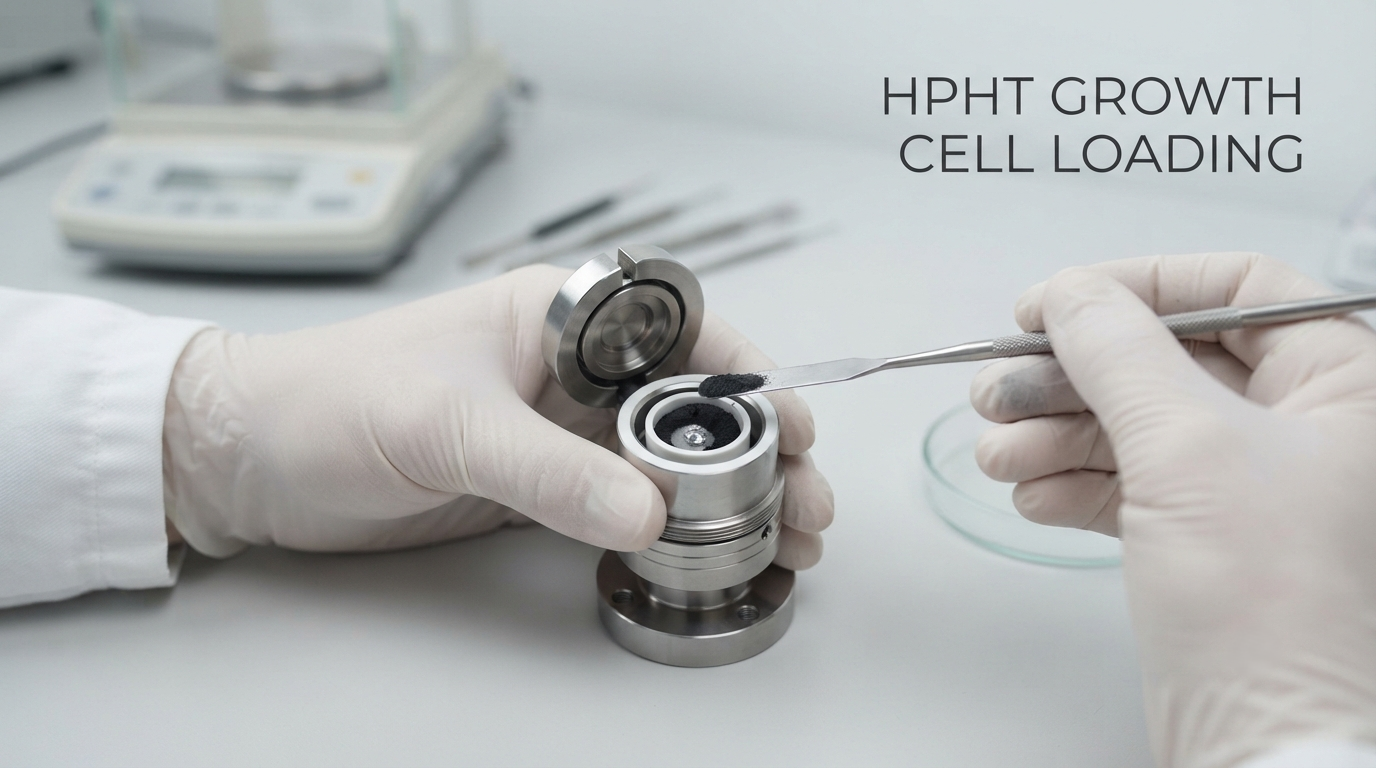
Growth uses the methods the whole lab grown memorial diamond category relies on. HPHT is the common route: a press squeezes the growth cell to roughly 6 to 8 gigapascals while the temperature is held between about 1,400 and 2,500 degrees Celsius. CVD, used by a minority of providers, deposits carbon from a gas onto a seed plate in a vacuum instead.

Hardness comes out at 10 on the standard mineral hardness scale, meaning a gem really made from son ashes and hair can be worn daily, set in a ring, and treated as ordinary jewelry rather than something fragile.

Laboratory testing will correctly report a stone really made from son ashes and hair as grown rather than mined. That is a statement about method, not about legitimacy, and it applies equally to every laboratory diamond on the market.

What Should the Paperwork Itemise for Two Materials?

More than a single material submission would, and this is where a mixed commission is genuinely different. Documentation for something really made from son ashes and hair has to account for two arrivals, not one.

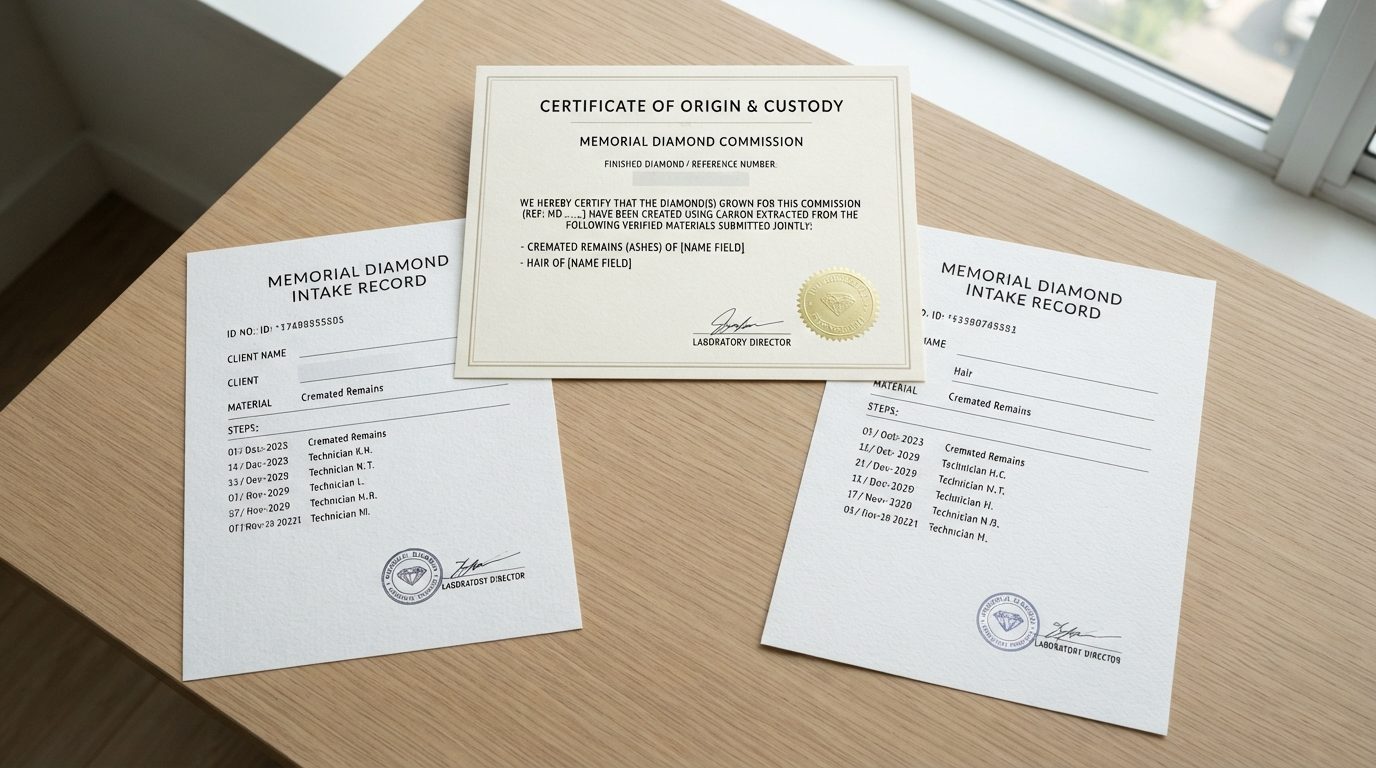
  • Two intake records, each with its own unique identifier, dated and described separately.
  • A custody trail for each, tracking both samples through processing up to the point they are pooled.
  • A written statement of the pooling step, when the two were combined, or confirmation that they were not.
  • The provider’s own percentage estimate, given in writing, since no published figure covers a blended charge.
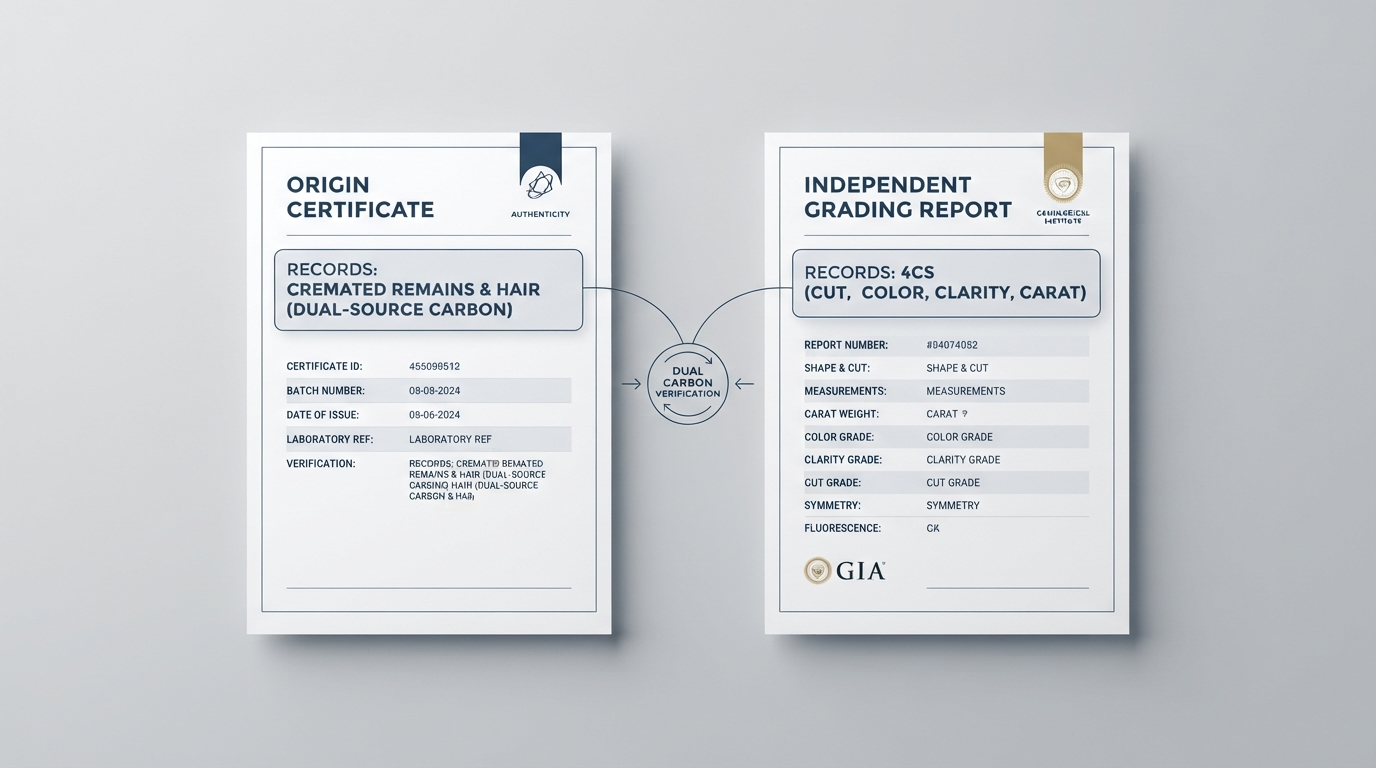
  • An authenticity or origin certificate, normally an in house document naming both materials.
  • An optional independent grading report, which assesses the stone itself rather than its origin.
  • A stated policy on leftovers, covering unused ash and unused hair separately, since a submission really made from son ashes and hair generates two kinds of surplus.
Two separate intake records and a shared origin certificate laid out on a desk

That sixth point is the one families most often misread. An independent grading report judges the stone’s cut, color, clarity and carat against the standards applied to any diamond, it cannot confirm that a stone is really made from son ashes and hair, because no third party laboratory witnessed the growth cell being loaded. Only the custody documentation speaks to origin. Questions to ask before you commit puts these on a single checklist.

Could You Have One Stone From Each Instead?

Often, yes. Splitting a commission really made from son ashes and hair resolves a disagreement that a single pooled stone would not.

Because only a portion of a cremation is ever used, and because hair needs so little to begin with, a submission of both materials can frequently support more than one diamond. That opens options a single commission really made from son ashes and hair does not: one stone for each parent, or a stone from the ash for one person and a stone from the hair for another.

It also matters when parents are separated, or when a family is quietly divided about the whole idea. Two smaller stones can be easier to agree on than one larger one that must eventually live in a single house.

Ask three things before deciding: whether your quantities support multiple stones, whether they would be grown in the same run or separate ones, and how each is documented. Growing two of anything really made from son ashes and hair costs more than growing one, so ask for pricing on both shapes of the plan. Whether siblings can each have a stone covers the family side of that question.

What If Only One of the Two Is Usable?

It happens, and it is better to know the policy in advance than to discover it mid process. A sample can arrive too small, too contaminated, or too degraded to yield workable carbon.

Hair is the more common casualty. A lock stored somewhere damp for years, or a few strands so fine they barely register on a scale, may not survive purification in a usable quantity. Ash is more forgiving, since remains are chemically stable in storage, though a very small portion submitted for a piece really made from son ashes and hair can still fall below what a growth run needs.

Ask three things before you post anything. What happens if one sample proves unusable, does the run continue on the other material alone, with your agreement? Are you told before that decision is made, or afterwards? And is any part of the fee adjusted?

The answers matter emotionally as well as practically. A parent who sent both materials because both mattered should not learn after the fact that only one made it into the crystal. Good providers stop and telephone; the arrangement for something really made from son ashes and hair should say so in writing.

Get that in the same email as the percentage estimate, so everything you were promised about a stone really made from son ashes and hair sits in one place you can find again.

Is Either Sample Identity Checked?

Parents reasonably assume somebody verifies that both samples came from the same person. In honesty, no public account of how this sector operates settles whether identity or genetic verification is performed on what families send, so treat a confident claim either way, a flat denial included, with care.

That makes it something to ask rather than something to look up. Ask whether any verification step exists in their process for a commission really made from son ashes and hair, at which stage it happens, and what record of it you receive.

With two materials there is a second, more practical version of the question. For anything really made from son ashes and hair, does the laboratory confirm that both envelopes belong to the same commission before pooling them? That is a workflow question a competent provider can answer immediately.

Who Signs Off, and Is It the Same Person for Both?

Not necessarily, and families arranging something really made from son ashes and hair are often surprised by it. The two materials can sit under different considerations.

For cremated remains, most states set a statutory order of priority over the disposition of a decedent’s remains. A surviving spouse or partner is commonly at or near the front of that order, and your son’s own adult children may rank ahead of his parents. Anything he put in writing can rearrange that order, and the rules differ from one state to another, so authority over the ash portion of anything really made from son ashes and hair is worth confirming rather than assuming.

Hair is a different conversation. Those statutory rules are aimed at the remains themselves, so a lock already in your possession is usually the simpler question in practice, though belongings can fall within an estate, the position varies by state, and a sample held by someone else is something to discuss with them rather than decide for them.

Where the two answers point to different people, that is worth knowing before anything ships rather than afterwards. A funeral director or a local attorney will settle it quickly. How a memorial diamond is made from both covers what happens once the material is on its way.

What Does a Diamond Really Made From Son Ashes and Hair Cost?

Submitting two materials rather than one does not itself change the price. What drives cost is carat weight, color and any extras, and using general 2026 industry ranges rather than a specific company’s rates, a stone of about 0.10 to 0.25 ct sits near $1,500 to $3,500, a half carat to one carat stone near $5,000 to $15,000, and anything from two carats upward from $20,000 to $75,000 or beyond.

Colorless commands a premium over yellow, blue or champagne at the same weight, because keeping trace elements out takes more process control. Settings, engraving, fancy cuts and an independent grading report are normally quoted on top of the stone.

On timing, the usual industry span is six to ten months from receipt, reaching about twelve for large stones or specialty colors such as black. Growth time sets the size, so a commission really made from son ashes and hair takes no longer simply because two materials were submitted. What a son memorial diamond costs goes tier by tier.

Frequently Asked Questions

Do we have to send both at the same time?

Usually not, but ask first. Some providers prefer both samples in hand before processing begins so they can be logged against one commission; others accept a second material later. Confirm the sequence before you post anything, since it affects the documentation.

Does adding hair mean less ash is needed?

Possibly, and it is worth asking directly. Because hair carries a far higher proportion of carbon than cremated remains do, some laboratories may adjust the ash quantity requested when hair is included. Requirements vary between providers, so get your own answer confirmed.

Can the two materials be identified separately in the finished stone?

No. Once the carbon from both is purified and pooled, nothing distinguishes one source from the other inside the crystal, carbon atoms carry no origin marker. What identifies the submission is the paperwork trail, not anything visible or testable in the stone.

Will using two materials change the color?

No color can be predicted or promised for a stone really made from son ashes and hair. Trace elements decide the outcome, and a cleaner or mixed starting material does not make the result controllable. Discuss color preferences early and ask what the provider can genuinely influence.

What if we only have a very small amount of each?

Say so when you inquire rather than sending everything and hoping. A laboratory can tell you in advance whether your combined quantities support the stone size you want, or whether a smaller carat would be the realistic option instead.

Can the rest of his ashes still be buried or scattered?

Yes. Only a portion is used, so interment, scattering, keeping an urn at home, or dividing the remainder among relatives all stay open to you. Choosing a diamond does not close off or diminish any other plan the family has made.

Final Thoughts on Sending Both Ashes and Hair

Families who send both are usually trying to leave nothing of him behind, and that instinct deserves a truthful reply rather than a comforting one. Both materials genuinely contribute carbon to a stone really made from son ashes and hair. Both are genuinely inside it. Neither makes it pure, and no published figure yet describes what the combined share works out to be.

So the work in front of you is narrow: get the provider’s own percentage estimate in writing, find out whether they pool or grow separately, and check that the documentation accounts for two arrivals rather than one.

If you go ahead with a diamond really made from son ashes and hair, settle the authority question for the ash and the conversation about the lock before anything ships, and take as long over the decision as you need. Nothing in the material degrades while you think.

Learn More About Son Memorial Diamonds

Talk With Memorial Diamond

Two materials raise questions one material does not. Memorial Diamond is at memorialdiamond.us if you would like to hear how each of yours would be logged, processed and documented. The reply should describe your own submission, not a general case.

Word count: 2,915 words
Reading time: about 15 minutes

A closed ceramic urn and a small finished diamond on the same shelf, framing partner memorial diamond vs urn as two things that coexist rather than compete

Partner Memorial Diamond vs. Traditional Urn: What to Know

The urn is usually already in the house by the time anyone reads a page like this, sitting somewhere you have not decided about. Read partner memorial diamond vs. urn as a fork in the road and you will get the decision wrong, because only a small portion of cremated remains is ever used for a stone. Most families do both. The rest is kept, interred, or scattered exactly as planned, which is why partner memorial diamond vs. urn is so often a false choice.

Now the disclosure this page cannot do without: Memorial Diamond grows memorial diamonds. We sell one of the two things being compared here, so this is not a neutral referee, and you should read every line below knowing that. What we can do is keep the comparison factual, keep the industry figures labeled as such, and not pretend an urn is a lesser choice. It is not. For many families it is the whole answer.

Why This Is Rarely a Straight Either/Or

The arithmetic dissolves most of the conflict in partner memorial diamond vs. urn before the values question even starts.

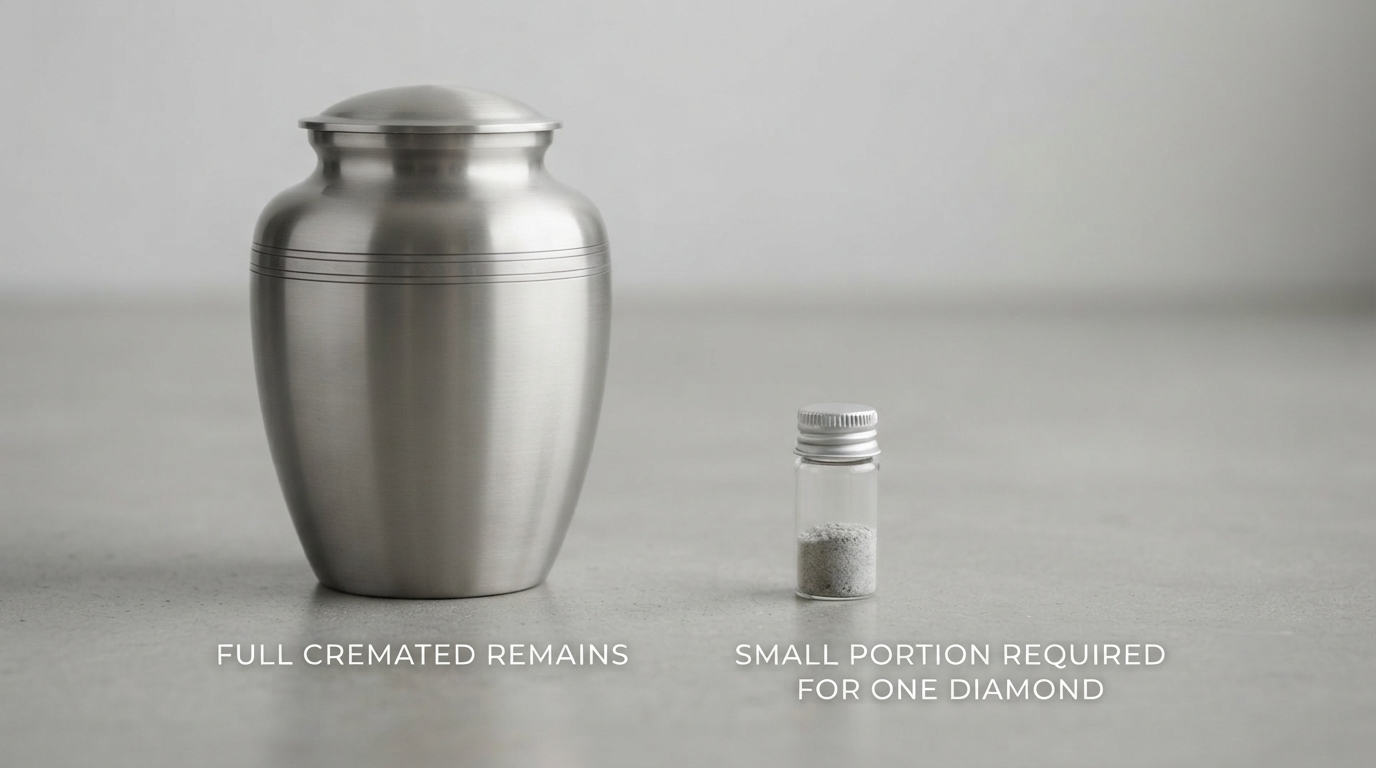
A cremation produces remains measured in pounds. What a laboratory asks for is a few tablespoons up to roughly 4 oz, about 100 g, industry wide. Set them side by side and the framing collapses: a stone takes a jar’s worth, and the urn stays on the shelf, or goes into the ground, or goes out over the water in spring. The full arithmetic on how much ash a stone actually needs sets out why the figure is as small as it is.

A single small sealed vial of cremated remains beside a full urn, showing the proportion a stone actually requires

So the practical shape of partner memorial diamond vs. urn, for families who take both paths, looks like this:

  • A portion leaves a small, measurable amount, set aside and documented.
  • The remainder stays in whatever vessel or place was already chosen.
  • Both plans proceed. An interment date does not move; a scattering is not canceled.
  • More than one person can be served several stones usually come from one shared source, one per person, as this post on sharing one set of ashes explains.

There is a version of partner memorial diamond vs. urn that genuinely is either or: where the family holds only a keepsake portion, or where the person with authority over the remains will permit one thing and not the other. That is a permissions problem rather than a material one, addressed further down.

Cremation is now the majority path in the US. The NFDA’s 2025 cremation and burial report puts the projected 2025 rate at 63.4% against 31.6% for burial. That is why this comparison arises now and did not two generations ago.

What Each Option Actually Is

Set both things out plainly first, since partner memorial diamond vs. urn is often argued without either side being defined. Half the confusion in partner memorial diamond vs. urn comes from comparing a vessel to a process.

A traditional urn, the first half of partner memorial diamond vs. urn, is a container. Ceramic, metal, wood, biodegradable, or a niche in a columbarium. It holds the remains whole, it can be opened, its contents can later be divided, scattered, interred, or moved. It costs what the vessel costs, exists the day the remains are released, and asks nothing afterwards except a place to be.

A memorial diamond, the other half of partner memorial diamond vs. urn, is a real lab grown diamond containing carbon recovered from a portion of those remains. The carbon is extracted and purified to around 99.9%, converted to graphite at roughly 2,500 to 2,700°C, then grown into a crystal under about 6 to 8 GPa at 1,400 to 2,500°C. Because cremated remains are overwhelmingly calcium phosphate rather than carbon, usable carbon sits at roughly 0.5% to 4% of ash by weight, the recovered material is blended with supplemental lab carbon to reach a workable volume.

That figure matters in a partner memorial diamond vs. urn comparison and gets glossed over constantly. An urn holds all of what was returned to you. A diamond holds a real, traceable, verifiable fraction. A stone described as entirely the person is describing something the chemistry does not do. The honest claim, a genuine share of their carbon, permanently inside a crystal lattice, is remarkable enough.

Partner Memorial Diamond vs Urn: The Side by Side

The seven dimensions below are the ones that actually decide partner memorial diamond vs. urn. Cost is only one of them, and it is rarely the one that settles it.

DimensionMemorial diamondTraditional urnWhat tends to decide it
PortabilityWearable or pocketable; travels through airports and house movesFixed by weight and by where it sits; a niche cannot move at allWhether your address or your access may change
DivisibilitySeveral stones can be grown from one shared source, one per personDivisible, but dividing an urn is a visible, sometimes contested actHow many people feel they have a claim
ReversibilityNone once carbon is extracted and grownHigh. Ashes can be moved, divided, interred or scattered laterHow settled the family is right now
CostIndustry typical $1,500 to $3,500 at 0.10 to 0.25 ct; $5,000 to $15,000 at 0.5 to 1 ct; $20,000 to $75,000+ at 2 to 5+ ctTypically the least costly option; a columbarium niche adds one off or ongoing feesBudget, but also whether a niche carries recurring costs
Time to receiveIndustry typical 6 to 10 months, up to 12 for large or specialty color stonesImmediate, at release from the crematoryWhether a date, an anniversary, a service, is driving this
What happens to the remainderUnaffected; the remainder stays with whatever plan existsIs the remainder, by definitionAlmost nothing, which is the point of this row
What it asks of the next generationNo upkeep, but it needs an explanation and a named recipientA place, a decision, sometimes a renewal fee, often deferred to whoever survives youWhether anyone will be there to decide, and whether you want them to have to
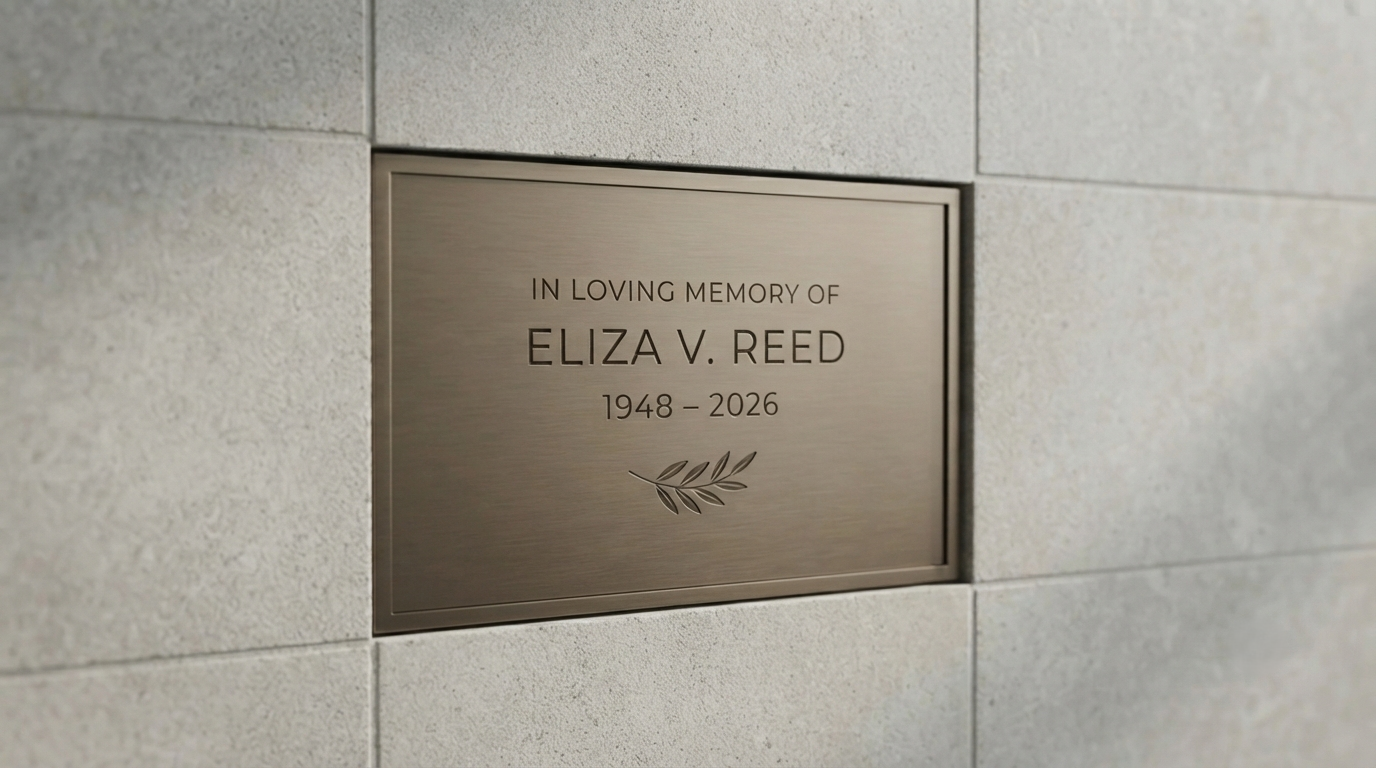
A columbarium niche with an engraved name plate, one of the traditional options compared on this page

Two rows in that grid do more work than the rest. Reversibility is the one people underestimate. Partner memorial diamond vs. urn is not a symmetrical choice, because an urn keeps every option open and a growth run closes one permanently. And the last row is the one nobody raises at the funeral home, though it is often what the decision is really about.

Which One Travels, and Which One Stays?

This is where partner memorial diamond vs. urn stops being general and becomes specific to your situation, because partners are more likely than most to face a question about where an urn is allowed to live.

You may not own the home the urn sits in, or be the person the crematory released the remains to. If a relationship was not legally recognized, or not recognized by one or both families, the urn may be in a house you no longer have standing to enter. None of that is unusual, and all of it is worth facing before money is spent, because it can settle partner memorial diamond vs. urn on your behalf.

Who controls cremated remains has no nationwide answer. It is a matter of state law, modified by whatever your partner left in writing, a will, a disposition directive, a form signed at the funeral home. With legal recognition, the person who has the urn is generally also the person who may decide about it. Without it, that right can sit with an adult child, a parent, a sibling, or a former spouse.

This belongs in a partner memorial diamond vs. urn comparison rather than a legal footnote because it changes which option is even available to you:

  • If the urn is yours, partner memorial diamond vs. urn is open in both directions, and doing both costs you nothing but a portion.
  • If the urn is not yours, a portion set aside for a stone may be the only part of this you can hold, a far smaller ask than requesting the urn itself.
  • If the urn will be interred or scattered, timing matters: once remains are in a niche or on the water, retrieval becomes a permissions question answered differently everywhere.
  • If nobody has decided yet, that is the easiest position.

How to raise this with a family that may not see the relationship as you do covers the wording, which matters more in this conversation than in almost any other.

Can the Decision Be Undone?

One can, one cannot, and this asymmetry is the strongest practical argument in any honest partner memorial diamond vs. urn discussion.

An urn is the reversible side of partner memorial diamond vs. urn, in almost every direction. Remains can be moved, divided years later, interred, scattered, or split between people who did not speak at the funeral and do now. Nothing about keeping an urn forecloses anything, including a diamond later, and cremated remains are stable while a family works out what it wants.

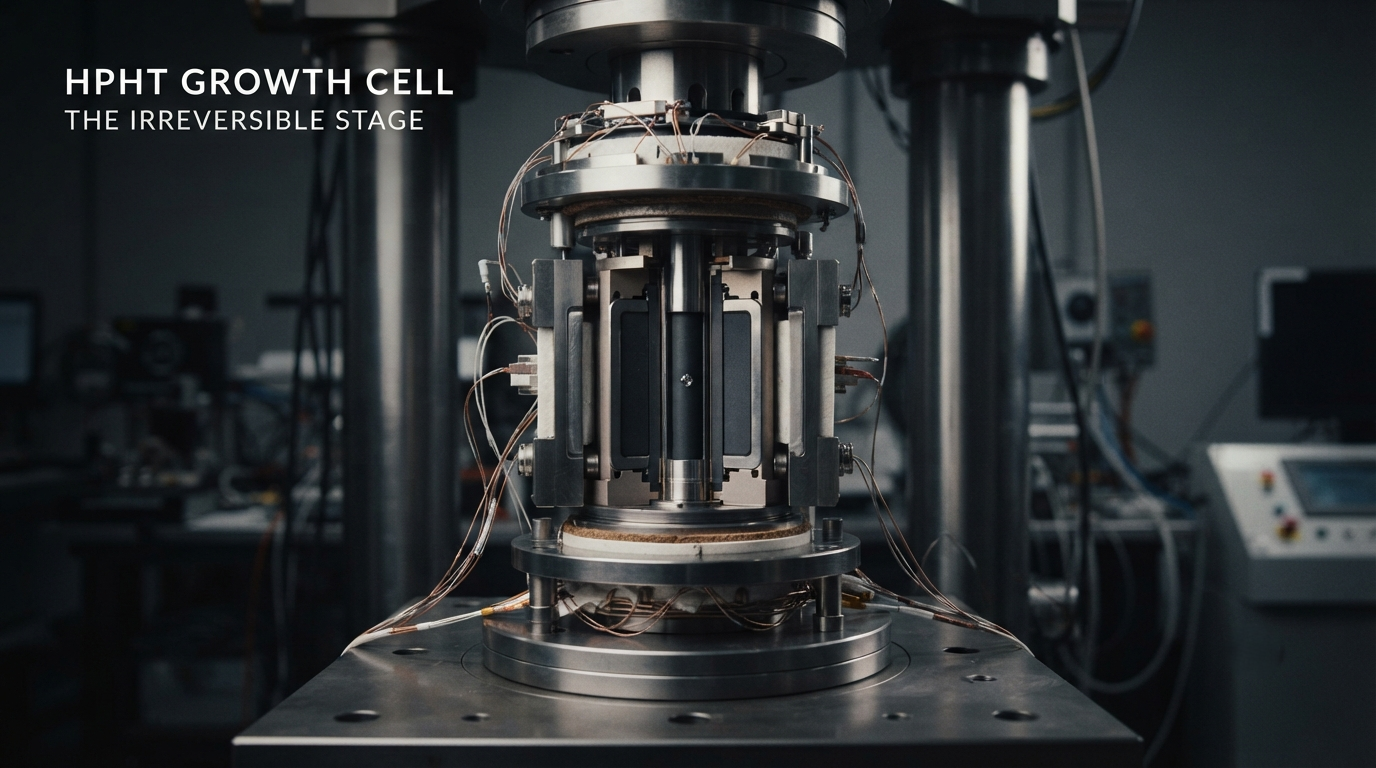
The interior of an HPHT growth cell, the irreversible stage of the memorial diamond process

A memorial diamond, the other side of partner memorial diamond vs. urn, is not reversible. Extraction is chemical: once a portion has been purified and graphitized, it no longer exists as remains. That is the fact that should slow anyone deciding inside the first weeks after a death.

So the sequencing advice that falls out of partner memorial diamond vs. urn, stated plainly:

  1. Keep the remains intact while anything is unresolved. There is no deadline.
  2. Decide who has authority before you decide what to do, not after.
  3. Take the reversible step first if you are unsure. That is the urn, and it costs nothing in options.
  4. Commission the stone when the answer has stopped moving for many families, past the first year.

The one genuine counter pressure in partner memorial diamond vs. urn is timing rather than urgency: the industry typical wait is 6 to 10 months, up to 12 for larger or specialty color stones, so a family aiming at a particular anniversary works backwards from it. How the timeline breaks down stage by stage is the place to check that before promising anyone a date.

What Does Each One Ask of the Next Generation?

Most partner memorial diamond vs. urn comparisons stop at cost. This row is the one families wish they had thought about, and it cuts both ways.

An urn asks for a place. Someone has to house it, pay for the niche, or decide what happens when the person who chose the shelf is no longer there. In practice that often lands on someone who never knew your partner. Not a criticism of urns, simply what a physical object in a home becomes.

A diamond asks something different, and this is the least discussed row in partner memorial diamond vs. urn. It needs no upkeep: nothing scores above diamond on the Mohs scale of mineral hardness, where it sits at 10, and the stone outlasts every setting it is ever mounted in. But a small, unlabeled stone means nothing to anyone who does not know what it is. Three things make the difference:

  • Name a recipient, in writing. A stone with no named destination ends up in an estate sale.
  • Keep the paperwork with the piece. An origin or authenticity document, plus any grading report, is what turns a gem into a record.
  • Tell at least one other person what it is. The object does not carry its own story.

Those three habits are the difference between an heirloom and a puzzle, and they cost nothing, which is why this row of partner memorial diamond vs. urn rarely turns on money. What to have the stone set in, and which settings can be changed later matters here, since a piece meant to be handed on is designed differently from one worn daily.

Where Memorial Diamond Fits, and Why We Are Not a Neutral Voice

Stated once more, plainly, because it belongs in the body of a comparison and not in small print: Memorial Diamond grows memorial diamonds. This page runs partner memorial diamond vs. urn as a comparison between our own product and an alternative we do not sell. That is a structural conflict of interest, and the appropriate response is to weigh the factual claims and discount the framing.

What can be said without conflict:

  • An urn is a complete and honorable answer, and nothing in partner memorial diamond vs. urn changes that. So is burial. So is scattering. None of them is a lesser choice, and no reader should take anything on this page as an argument otherwise.
  • The figures above are industry wide bands, not Memorial Diamond’s own price list. What drives the price of a single stone breaks the variables down.
  • The honest case for a diamond in partner memorial diamond vs. urn is narrow and specific: it is portable, it is divisible among several people, it requires no maintenance, and it takes only a portion. That case does not require an urn to be worse.
  • The honest case against is equally specific: it costs more, takes most of a year, and cannot be undone.

For the full route rather than the comparison, the complete guide to a partner ashes diamond covers every stage; where to start if the decision is still open is the better first read in the early weeks.

Frequently Asked Questions

Do I have to choose between an urn and a diamond at all?

Usually not. A stone takes a few tablespoons up to roughly 4 oz, so the urn, the interment or the scattering all still go ahead. Partner memorial diamond vs. urn is an either or only when you hold a keepsake portion.

Is a diamond more permanent than an urn?

On permanence, partner memorial diamond vs. urn is not really a hardness question. The stone is harder, at 10 on the Mohs scale, but permanence here is social. A ceramic urn in a stable family outlasts a diamond nobody can identify. Naming a recipient matters more.

Which costs less overall?

An urn, almost always, and often by a wide margin. A columbarium niche can carry recurring or renewal fees worth asking about, but nothing in the diamond tiers competes with a vessel on price.

Can we start with the urn and decide about a diamond later?

Yes, and in partner memorial diamond vs. urn it is the safer order. Cremated remains are stable and keep indefinitely, so nothing is lost by waiting a year. The reverse is not true, since extraction cannot be reversed once a portion has been processed.

My partner’s family holds the urn. Does that end it?

Not necessarily. Authority over remains varies by state and by anything left in writing, and a request for one small portion is a much smaller ask than a request for the urn. Find out who holds authority before anything is spent.

What happens to the part of the portion that is not turned into carbon?

That is company policy rather than chemistry, and providers differ. Before sending anything, get it in writing: is the remainder returned as a matter of course, in what form, and at what point in the process?

Final Thoughts on Partner Memorial Diamond vs Urn

The one thing to take from this page: partner memorial diamond vs. urn is a smaller question than it feels. A portion, not the whole. A jar’s worth out of something measured in pounds. Whatever was already planned for the rest still happens, on the same date, in the same place.

What remains is genuinely a choice, and not one a diamond company should make for you. An urn on a shelf, a niche with a name on it, a stretch of water in spring, each is a full answer, and partner memorial diamond vs. urn is a live question only because a portion can be set aside without disturbing any of them. Decide who has authority, decide what is reversible, then take your time.

Learn More About Partner Memorial Diamonds

Talk With Memorial Diamond

If you are working through partner memorial diamond vs. urn and want a straight account of what a portion would and would not affect, reach out to Memorial Diamond at memorialdiamond.us. Ask what we cannot do as readily as what we can, a fair test of any company here, including this one.

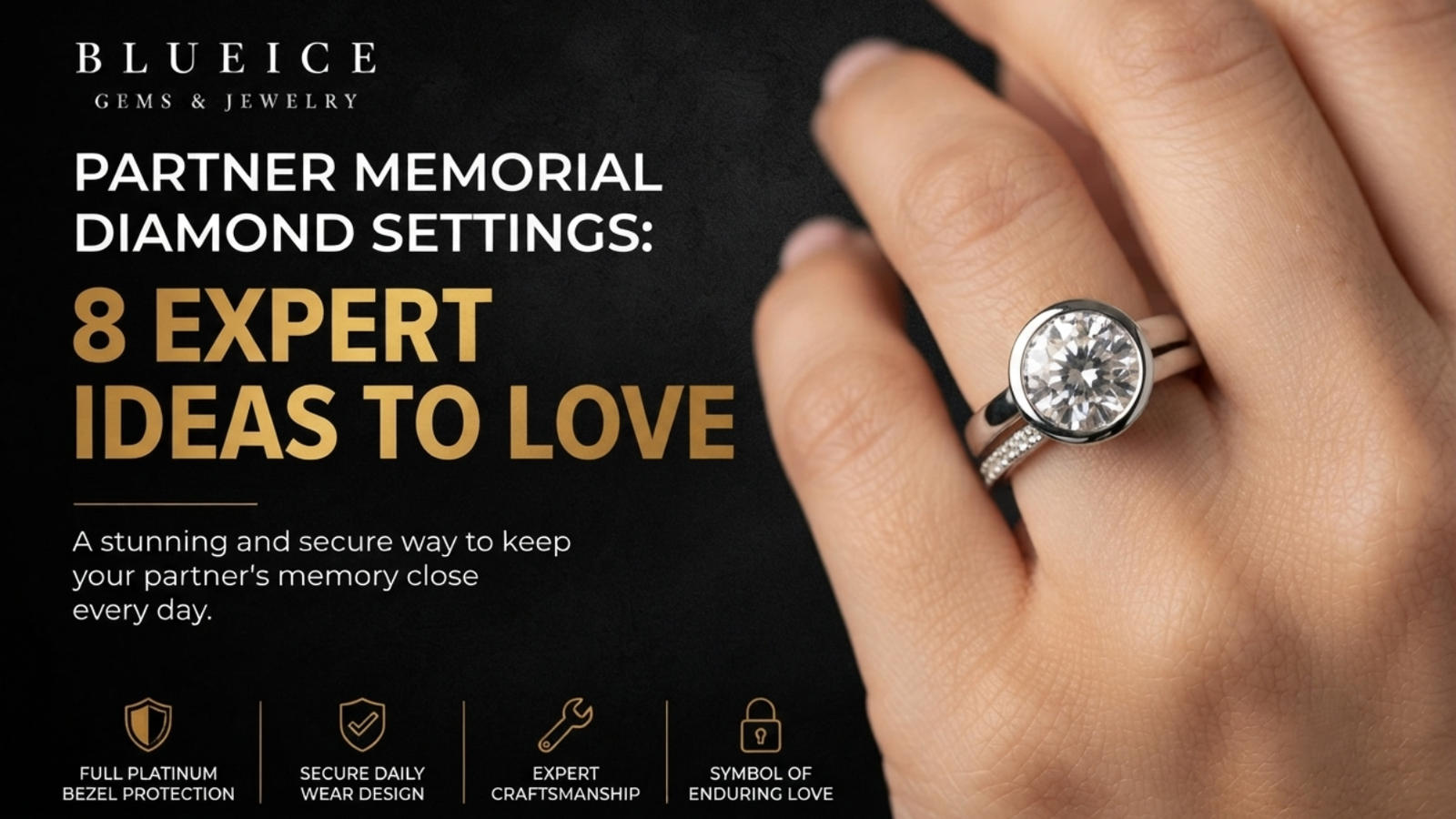
A memorial diamond in a full platinum bezel on a hand, the most protective of the partner memorial diamond settings for daily wear

Memorial Diamond Settings and Jewelry Ideas for a Partner

You already know you want to wear it. What nobody tells you then is that the stone is the durable half of the object and the setting is the half that fails. Partner memorial diamond settings should be chosen the way you would choose a mount for something that cannot be replaced: metal that deforms rather than wears away, a setting style that covers as much of the girdle as you can accept, and a jeweler who is told in writing what they are holding. The diamond is Mohs 10. Nothing around it is.

Memorial Diamond grows these stones, so this page is not disinterested. It assumes you have already decided on jewelry. The concept level tour of rings, pendants and keepsakes lives in partner memorial diamond ideas. What follows is the engineering underneath those ideas, which is where partner memorial diamond settings are actually decided.

The One Fact That Governs Everything Else

Diamond sits at 10 on the Mohs scale of mineral hardness, and that is why a memorial stone outlives everyone reading this. Hardness only describes resistance to scratching, though. It says nothing about toughness, and diamond has cleavage planes. A sharp strike at the wrong angle can chip a girdle that a lifetime of abrasion never would.

So there are two failure modes worth designing partner memorial diamond settings against, and only one of them involves the stone at all:

  • The stone leaves. A worn prong, a bent claw, a loosened bezel. Much the likelier of the two, and a property of the metal and the workmanship in partner memorial diamond settings rather than of the diamond.
  • The stone chips. Rare, but possible on an exposed girdle or a sharp corner in a princess or marquise cut, and not repairable without recutting to a smaller weight.

The reason to think hard about partner memorial diamond settings is not that the diamond is fragile. It is that the diamond is the only part of the assembly that cannot be remade, and every part holding it is consumable.

Which Metal Should Hold a Stone You Will Never Replace?

Metal is the decision most people make last and should make first. It sets how partner memorial diamond settings age, whether they can be altered, and how often a bench jeweler has to handle the stone.

MetalHow it wearsAging and upkeepCan it be resized or re tipped?What it does to a tinted stone
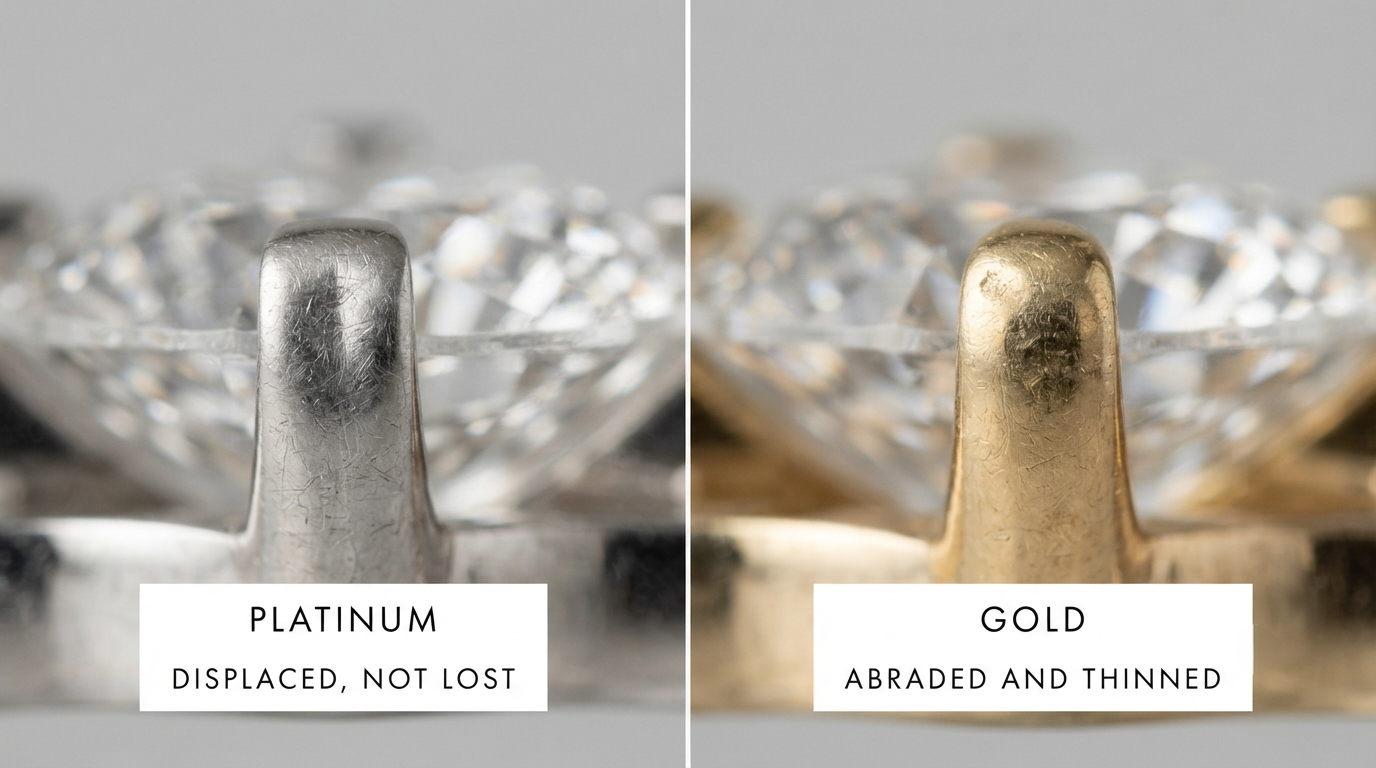
PlatinumDisplaces rather than abrades. A worn prong moves metal aside instead of losing itDevelops a matte patina; polishing restores shineYes, readily. The usual recommendation for prongs in partner memorial diamond settingsNeutral and cool; shows a tint honestly
18k yellow goldSofter than 14k; prongs thin faster in daily wearStable color, no plating to renewYes, by any competent benchWarms the stone; can make a light yellow read almost colorless
14k yellow goldHarder alloy, longer prong life than 18kStable color, minimal upkeepYesWarms, less than 18k
White goldWears as gold does, under a rhodium platePlating dulls and yellows; replating every one to three years is normalYes, though replating follows any bench workBright and cool while plated, warmer as the plate goes
Rose goldCopper content makes it hard wearingStable; deepens slightly over decadesYesFlatters warm stones; argues with blue
Sterling silverSoft; prongs deform under ordinary knocksTarnishes; needs frequent cleaningYes, but the softness does not changeCool toned, and the wrong choice regardless
Titanium, tungsten, ceramicExtremely hard, effectively wear proofAlmost no upkeepNo. Cannot be sized, and setting options are limitedNot a realistic carrier for an irreplaceable stone
Close macro of a worn platinum prong beside a worn gold prong, showing displacement against material loss

One label before you use that table: none of it is a published figure. It is general jewelry bench practice, how these metals behave at the bench, and how a tinted stone reads against them in ordinary light, and a bench jeweler may put it differently. Read the fourth column before the fifth. Among partner memorial diamond settings, the metals that cannot be resized or re tipped are the ones to rule out first, because this object has to follow hands that change over forty years.

Two notes decide most of these choices:

  • Platinum and 14k are the workhorse answers for partner memorial diamond settings. Platinum for prongs, because worn metal stays on the ring; 14k because it resists thinning better than 18k.
  • White gold is a subscription. Replating is cheap, but it is a recurring appointment for the life of the piece, and every appointment is another handling of the stone.

If the stone’s color is not settled, decide the two together. What to expect from memorial diamond colors for a partner explains why yellow gold tends to hide a warm tint and white metal to expose it. Again, this is general practice, not a measured figure.

Which Partner Memorial Diamond Settings Protect the Stone Best?

One trade off governs this whole list: every millimeter of metal protecting the girdle is a millimeter of stone you cannot see. The table runs from most protective to most exposed, an editorial ranking from general bench practice rather than a measured scale.

SettingHow much of the stone it coversProtection in daily wearWhat it costs youBest suited to
Full bezelA continuous rim around the whole girdleThe highest available; eliminates snaggingSide light; the stone can look smallerHands on work, healthcare, anyone who cannot remove a ring
Half bezelTwo opposing arcs of the girdleNearly bezel grade where covered, open elsewhereLess than a full bezel, and a cleaner lineThe compromise most people settle on
Flush or gypsySunk into the metal, table level with the surfaceVery high; nothing protrudesOnly the table shows; no side sparkleBroad bands, anything worn under gloves
Halo with a bezel centerThe girdle plus a ring of accent stonesHigh for the center; the accents need watchingComplexity, and more bench work near your stoneMaking a small stone read larger
Six prongSix narrow points on the girdleGood; losing one of six is survivableProngs snag on fabric and thin over timeRound brilliants
Four prongFour points on the girdleAdequate, but losing one of four is not survivableThe same snagging, less redundancyMaximum light and visibility
Tension or floatingAlmost nothing; held by pressure or a minimal cageThe lowest of the partner memorial diamond settings here, and rarely resizableHigh visual impactStones not worn daily
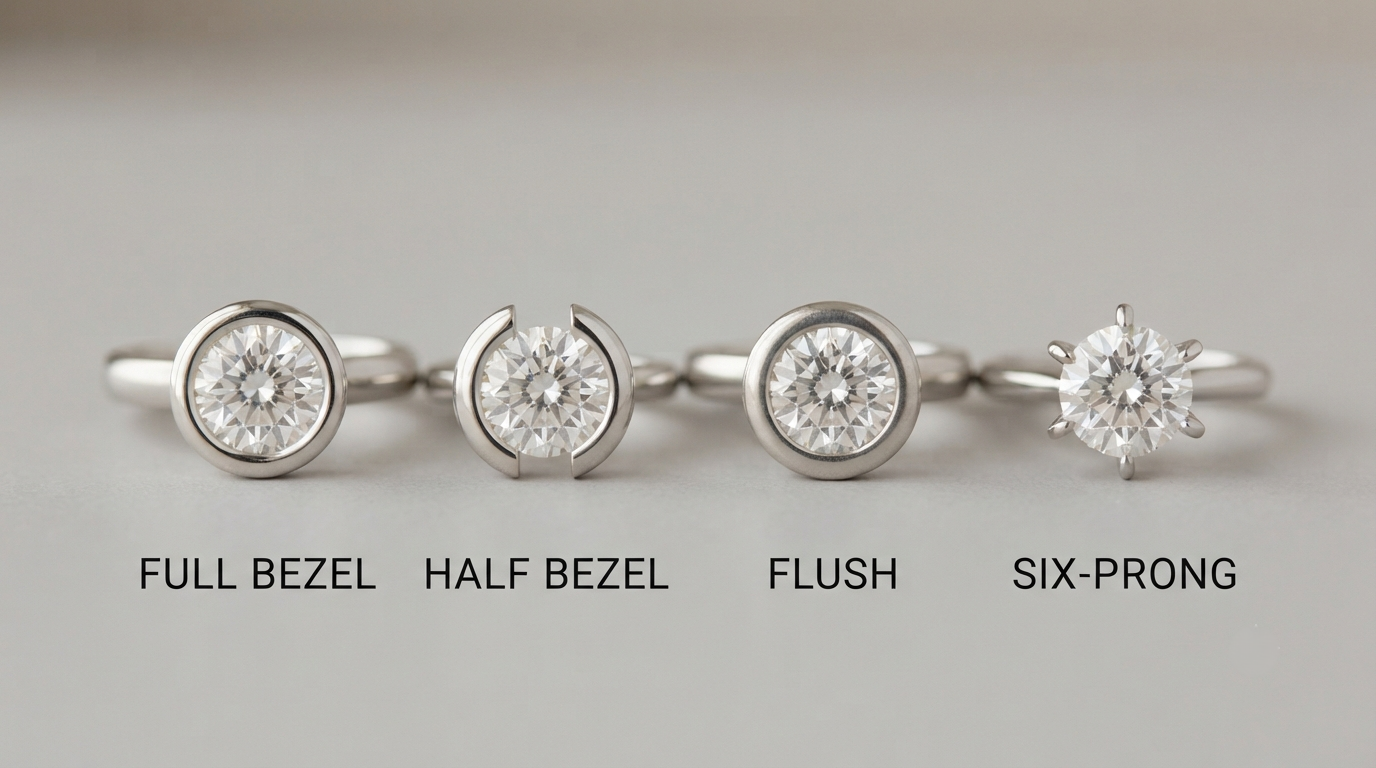
Four ring settings photographed side by side — full bezel, half bezel, flush and six-prong — ordered by how much of the girdle each covers

Rank your own life before you rank the list. Among partner memorial diamond settings, the bezel family keeps turning out to be the right answer for people who never take the piece off; prong settings are the ones that photograph best the week they arrive.

A pendant changes the arithmetic. A stone on a chain takes far less impact than one on a hand, so more exposed partner memorial diamond settings become defensible. The failure mode moves to the bail and the clasp. Specify a soldered jump ring and a clasp rated above the weight it carries, and have the chain checked as often as you would check prongs.

Can It Be Resized or Reset Later?

Usually. Whether partner memorial diamond settings can be altered later depends almost entirely on decisions taken at the start.

Rings get resized. Fingers change with age, weight, pregnancy, arthritis and heat. If a ring has to follow yours, partner memorial diamond settings need a plain, unset section at the bottom of the shank. A band set all the way round cannot be cut and rejoined without dismantling part of it.

Resetting is a different job. A stone set in a ring at forty may become a pendant at seventy, or may move into a new mount when the first one wears out. That is normal, and what makes it safe is procedural:

  • Get the stone’s measurements, and any grading report, at handover, and keep them apart from the piece. That is how you confirm the stone coming back is the stone that went in.
  • Photograph it in good light, top and side, before any bench work.
  • Ask for the stone to be unset before any torch work, not protected in place. Heat near a set diamond is the risk worth avoiding, and removal takes minutes.
  • Ask whether the work is done on site. Pieces sent to a trade workshop travel, and travel separates paperwork from stones.
  • Keep the original mount. It is part of the object’s history and costs nothing to store.

Rebuilding partner memorial diamond settings takes ordinary jewelry timelines, measured in weeks. That bears no relation to the 6 to 10 months the stone itself typically takes to grow, up to 12 for larger or specialty color stones, which how long a partner memorial diamond takes sets out in full.

What Does a Jeweler Need to Know Before Touching It?

That it is irreplaceable, and that they should say so back to you before they take it.

Be direct, because a jeweler handles hundreds of interchangeable stones and cannot know yours is not one of them. Partner memorial diamond settings are ordinary bench work; the stone in them is not, and the gap between those two facts is where accidents live.

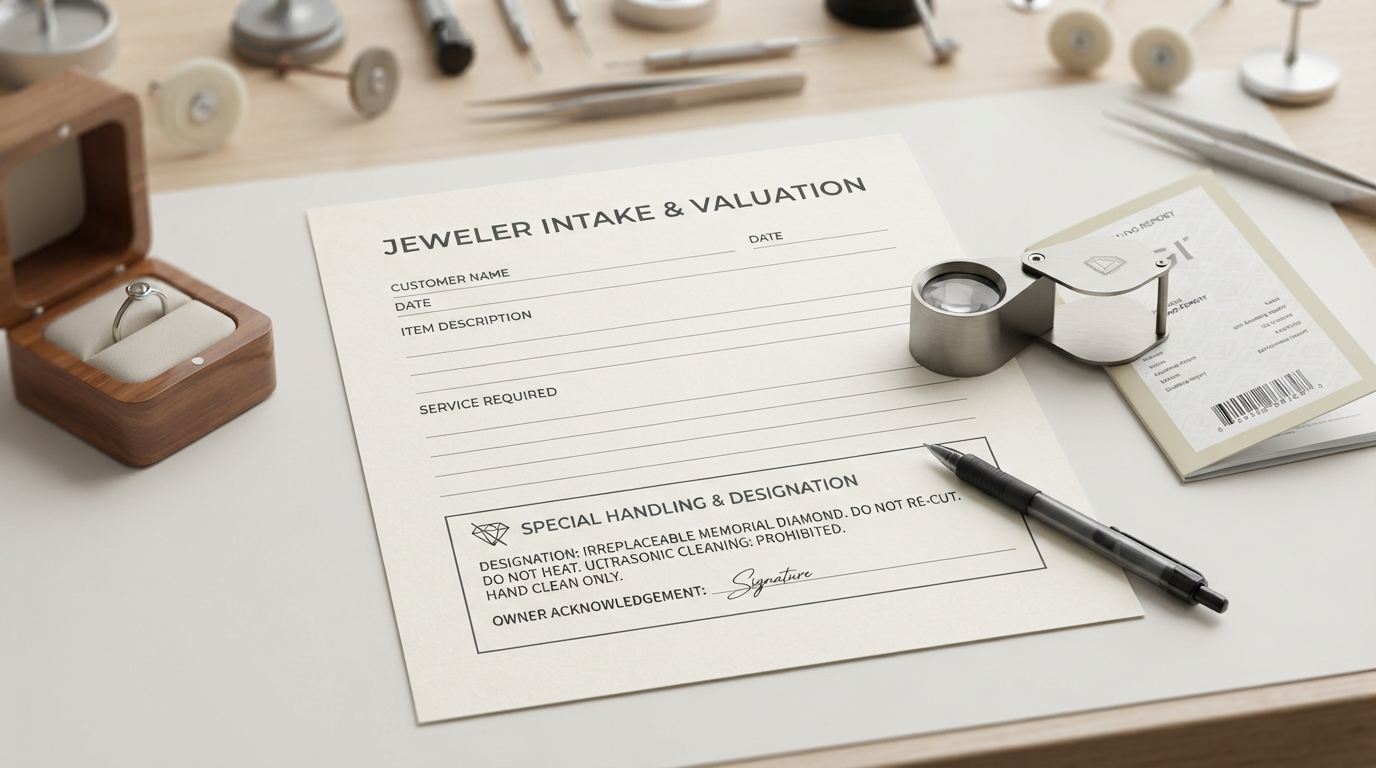
A jeweler's intake form on a bench with a loupe and a grading report, illustrating recording a stone as irreplaceable

Put the following in the intake paperwork, not in conversation:

  1. A written description of the stone, carat, cut, color, clarity, measurements, any report number.
  2. A statement that the stone is a memorial diamond and cannot be replaced. Ask for it on the job ticket, not merely acknowledged.
  3. No recutting, repolishing or laser inscription without written approval, which guards against a well meant “we tidied up the girdle for you”.
  4. Your instruction on ultrasonic and steam cleaning. Clarity across memorial stones typically runs SI2 to VVS, and stones with feathers or reaching inclusions are not automatically safe in either. Ask for hand cleaning if you would rather not find out.
  5. Who to call if something is found wrong before work starts rather than after.

Any bench that finds this fussy is telling you something useful for free, and any bench that writes it down is the one to hand your partner memorial diamond settings to.

How Do You Insure Something With No Replacement?

Carefully, and with a professional who is not a jewelry company. Insuring partner memorial diamond settings is straightforward; insuring what sits in them is not.

Insurance here runs into one honest problem: standard jewelry cover is written around replacement, and this stone cannot be replaced. A policy may pay a sum matching the appraised value of a comparable diamond, and that money buys a diamond not made from your partner. Know which of those you are buying before you pay a premium.

That is the limit of what a jeweler can usefully say. Agreed value policies, scheduled personal property riders, deductibles and how a claim settles are questions for a licensed insurance agent or broker, and the answers vary by insurer and by state.

What you can usefully prepare in advance:

  • An independent grading report, if you order one. Grading is optional, and insurers generally want a report because it puts the 4Cs on a recognized scale. The GIA’s explanation of the 4Cs covers the vocabulary any appraisal uses.
  • An appraisal for the piece as set, since the mount is valued separately, and partner memorial diamond settings in platinum are a line item of their own.
  • Photographs and the original invoice, stored off the premises rather than in the drawer with the box.
  • A note of what the piece is, because an adjuster reading “memorial diamond” needs context to handle a claim sensibly.

A word on cost, since it shapes what you insure: entry stones of roughly 0.10 to 0.25 ct run about $1,500 to $3,500 industry wide, 0.5 to 1 ct typically $5,000 to $15,000, and 2 ct and above from roughly $20,000 to $75,000 and beyond, before partner memorial diamond settings are added on top. Those are category wide figures rather than Memorial Diamond’s published prices, and what a partner memorial diamond costs breaks down what moves them.

Who Holds It After You?

This lands differently for partners than for anyone else, and it is worth answering early.

A piece of jewelry is personal property. It passes under a will, or under your state’s intestacy rules if there is none, and those rules are written around marriage and blood relationships. If your relationship was not legally recognized, the person you would want to have this may have no automatic claim. Partner memorial diamond settings holding a stone grown from someone’s remains are exactly the object families argue over later.

Three things close that gap, none of them expensive:

  • Name the piece specifically in a will, by description rather than category. “My platinum bezel ring set with the memorial diamond” leaves no room for interpretation.
  • Write down what it is and where the paperwork lives, so whoever opens the drawer understands the object.
  • Say it out loud to the people concerned, before it is relevant. How to talk to family about a partner memorial diamond covers that conversation, which is easier held once than litigated later.

The same reasoning runs the other way if more than one person wants a stone from the same source. Several mounts from one shared origin is a common arrangement, and whether more than one family member can have a diamond is worth settling before the first run rather than after the first ring.

Frequently Asked Questions

How often should the setting be checked?

Every six to twelve months for a ring worn daily, yearly for a pendant. A jeweler checks prong tension, wear at the claw tips and bezel security. Stones lost from partner memorial diamond settings are almost always lost to a prong nobody inspected.

Is a bezel really safer, or does it just look safer?

Genuinely safer. A bezel covers the girdle, removes protruding claws and cannot snag. It is the most protective of the common partner memorial diamond settings, and the trade is side light and a slightly smaller looking stone.

Can the stone go into an existing ring of my partner’s?

Often yes, and it is a meaningful thing to do. Have the old mount assessed first for metal fatigue and a thin shank, because existing partner memorial diamond settings may need rebuilding before carrying a stone you cannot replace.

Does the stone need special cleaning?

Warm water, mild soap and a soft brush handle almost everything. Ask before an ultrasonic or steam clean, since some inclusions respond badly to both. The metal in partner memorial diamond settings needs the attention, not the diamond.

Can I have it engraved?

The mount, yes. A date, a name, a few words inside a shank, on most partner memorial diamond settings. Laser inscription on the girdle of the stone itself is a separate question, raised with the grower before the stone is finished rather than after.

What if I want a completely different piece in twenty years?

Normal, and entirely possible. Stones move between mounts throughout their lives. Keep any report and the measurements, use a jeweler who unsets before applying heat, and partner memorial diamond settings can be rebuilt around the same stone as often as you like.

Final Thoughts on Partner Memorial Diamond Settings

The stone will be fine. It is harder than anything it will meet in an ordinary life. What needs attention is everything around it. Partner memorial diamond settings come down to four things: a metal that can be worked on, a setting that covers the girdle, a jeweler told in writing what they are holding, and a six monthly appointment that takes ten minutes.

Get those four right and partner memorial diamond settings stop being a risk and become what they should be: a design decision you can change your mind about in thirty years, with the same stone still in the middle of it.

Learn More About Partner Memorial Diamonds

Talk With Memorial Diamond

Setting decisions are reversible. That is the most reassuring sentence here, worth holding onto if you are choosing among partner memorial diamond settings while nothing else feels settled.

Three questions are worth asking any provider first. Ask whether the stone can be supplied loose. Ask what documentation comes with it, measurements, report, invoice, and whether it arrives with the stone. Ask which partner memorial diamond settings they will and will not build in house. memorialdiamond.us will answer those plainly, and so should anyone else.

Take as long as you need over the ring. The stone is not going anywhere.

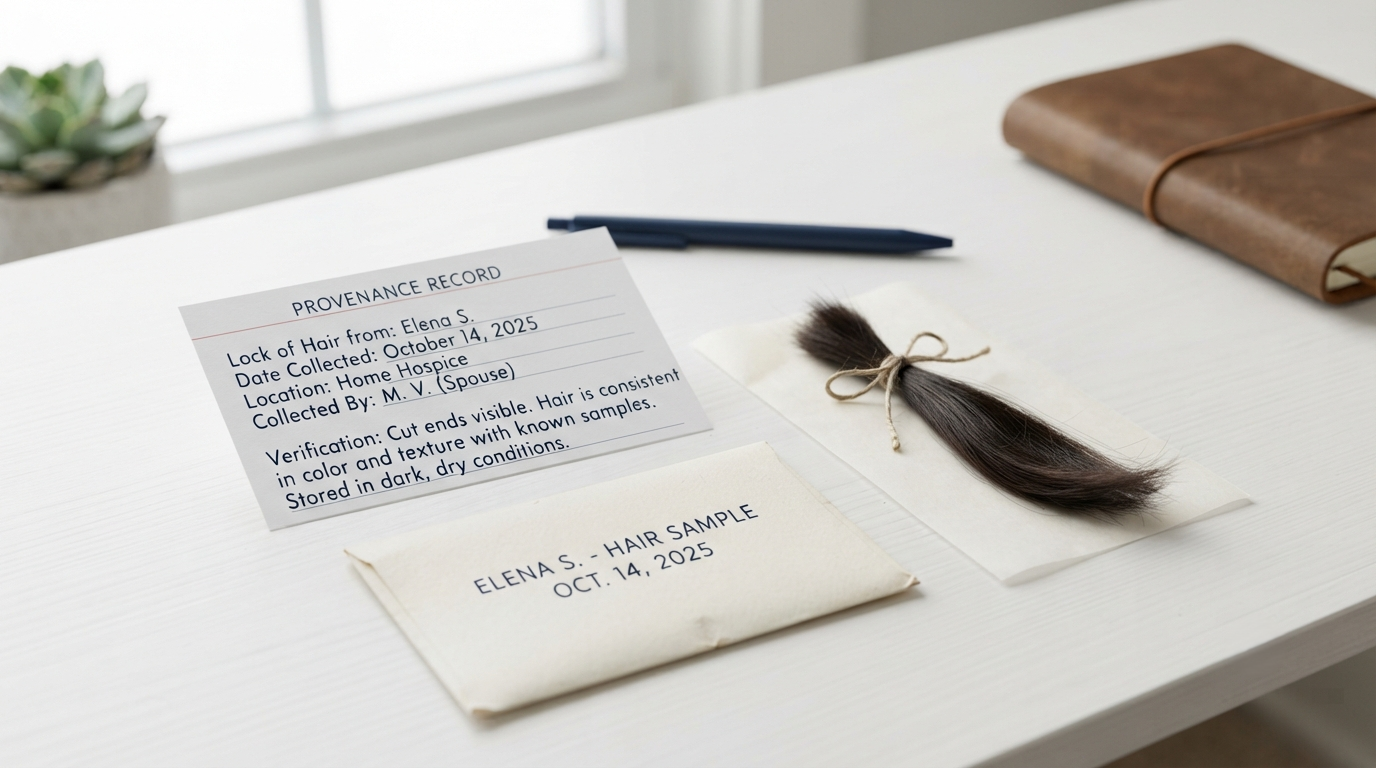
An unlabeled lock of hair in a paper envelope on a bedroom drawer, the household starting point of the partner hair diamond steps

Step by Step: Turning Your Partner’s Hair Into a Diamond

The first stage of this does not happen in a laboratory. It happens in a bedroom, a bathroom drawer, or a box a funeral director handed over in a paper bag. The partner hair diamond steps begin with a search and a verification, not a shipment, you have to locate a sample, establish it is genuinely your partner’s, and confirm it is in usable condition before a single laboratory stage becomes relevant. After that the technical route is shorter than most people expect, because hair is roughly 50% carbon by weight.

Memorial Diamond grows these stones, so this page has an interest in your reading it. Every number below is an industry wide band, not a requirement we publish.

The Household Half of the Partner Hair Diamond Steps

Almost every published account of the partner hair diamond steps opens where an envelope arrives at a facility. That is stage four of a real set of partner hair diamond steps.

Stages one through three of the partner hair diamond steps happen in a house, usually alone, usually on a weekday evening, and they are where things go wrong, not because they are difficult, but because nobody prepared you for them. A lock of hair is almost never collected with a label, a date, or a witness. It is cut quickly, by someone not thinking about provenance.

Which means the partner hair diamond steps open with three domestic questions: does a sample exist, is it definitely your partner’s, and has it survived in a condition a laboratory can work with. No provider’s brochure answers those.

The household half matters for a second reason. Hair requires no cremation, so this route stays open to partners whose partner was buried, or whose ashes someone else holds. That widens who can do this, and puts the burden of the early partner hair diamond steps on your ability to find and vouch for a sample.

Where an Unlabeled Sample Usually Turns Up

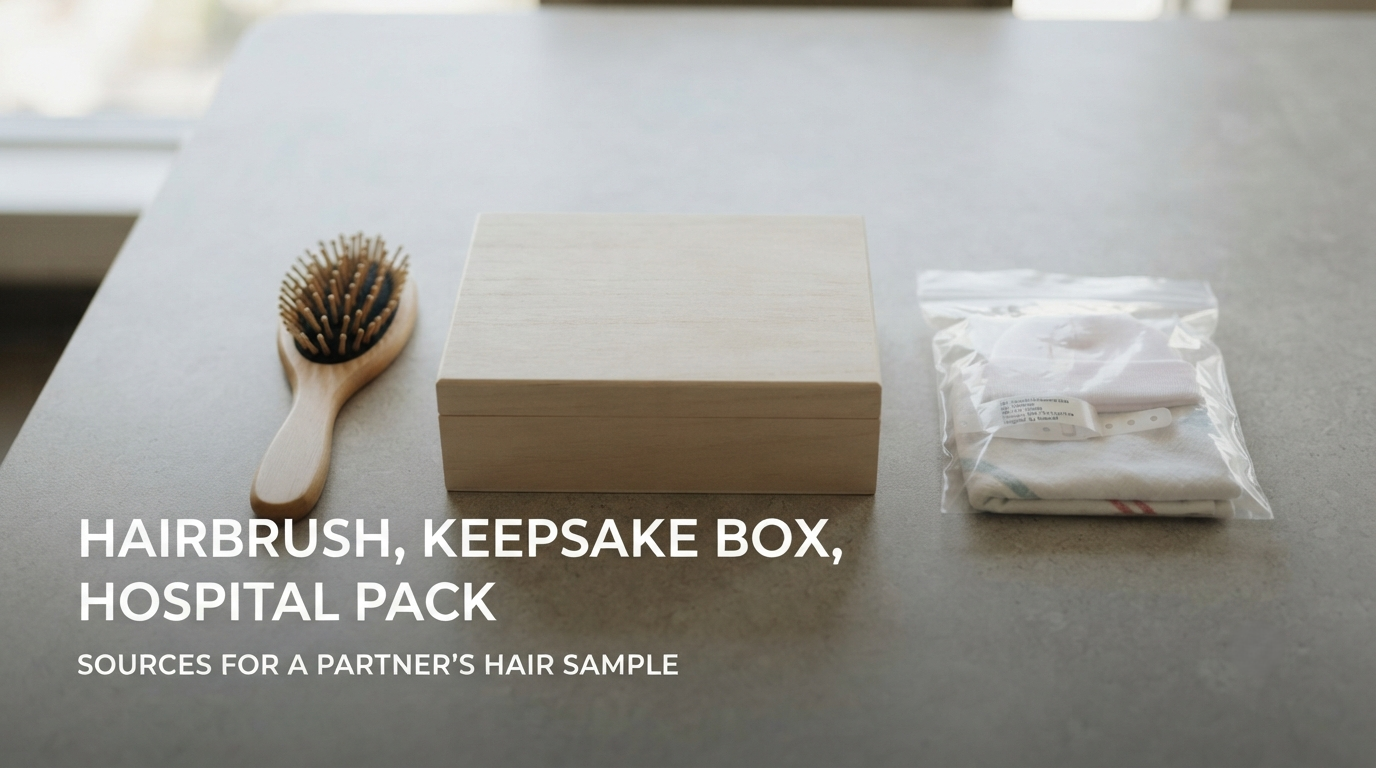
Before you conclude that nothing exists, work through the places hair survives without anyone intending it to, because the partner hair diamond steps cannot begin without one. The table below is a starting order, not a ranking of sentiment.

Where it turns upTypical conditionWhat to check firstRealistic usability
A cut lock in an envelope or keepsake boxDry, intact, usually one person’sWhether anything on the envelope records a date or who cut itHigh, this is the ideal case and the one the early partner hair diamond steps assume
A hairbrush or combLoose, tangled, shed rather than cutWhether anyone else used the brush; shed hair has no root sheathModerate, quantity is often adequate, provenance often is not
A hat, a pillow, a coat collarVery small quantity, loose fibersWhether you can gather enough in one place to weighLow to moderate, usually a supplement, not a sample
A hospital or hospice keepsake packCut, bagged, sometimes labeled with a name and dateThe label, immediately, this is the only common source that documents itselfHigh, and often overlooked because the bag was never opened
A locket, ring or mourning pieceSealed, possibly decades old, possibly not your partner’sWhether a jeweler can open it without destroying the settingVariable, worth a conversation first
A funeral director’s fileCut at the time of care, retained by policy in some placesWhether they still hold anything, most families never askWorth one call before you give up
A hairbrush, a keepsake box and a hospital keepsake pack laid out together on a table

Two notes on that table. A small lock of a few grams is the industry typical requirement, so quantity fails less often than provenance. And the last row is the one people skip: funeral homes sometimes retain a sample, and one call can end the search.

If the sample is in someone else’s house, that is a request rather than an obstacle. Asking for a few strands out of a keepsake box is a smaller ask than asking for a portion of ashes, and it is often granted by people who would refuse the larger one. How to raise this with a family who may not have acknowledged the relationship covers that conversation.

How Do You Verify Hair Nobody Labeled at the Time?

This is the stage the partner hair diamond steps are usually missing, and it is the one that keeps people awake.

Start with what is honest. You usually cannot prove a sample’s identity in a laboratory sense, and it is fair to ask any company directly whether they claim they can. What you can build is a defensible chain of reasoning before you commit anything, which is what verification means here.

  • Reconstruct the collection. Who cut it, where, and roughly when. A date you can place within a month beats a certainty you cannot explain.
  • Check for anyone else in the household with similar hair. This is the single most common source of doubt and the easiest one to rule in or out.
  • Look at the physical evidence. Cut ends suggest deliberate collection; irregular lengths suggest a brush.
  • Ask whoever else was present. A sibling, an adult child, a hospice nurse, somebody often remembers it better than you do.
  • Write down what you conclude, and why, before it is posted. If doubt surfaces in eight months, that note is what you will want.
A written note and a dated envelope beside a lock of hair, illustrating how provenance is documented at home

Providers can assess condition, quantity and suitability. Identity is a different question, and DNA verification is not generally offered on this route, so ask rather than assume: can you confirm whose hair this is, and if not, what does your documentation record instead? Until that answer exists in writing, verification is your own job inside the partner hair diamond steps, done before transfer, and documented the way you would document anything you get one chance at.

What Are the Partner Hair Diamond Steps Once a Sample Is Confirmed?

Seven partner hair diamond steps, and the last four are the same physics every memorial stone goes through.

  1. Locating a sample. The household search above, often the longest stage by elapsed time, and the only one with no fixed duration.
  2. Verifying provenance. Establishing, to your own satisfaction and in writing, that the sample is your partner’s.
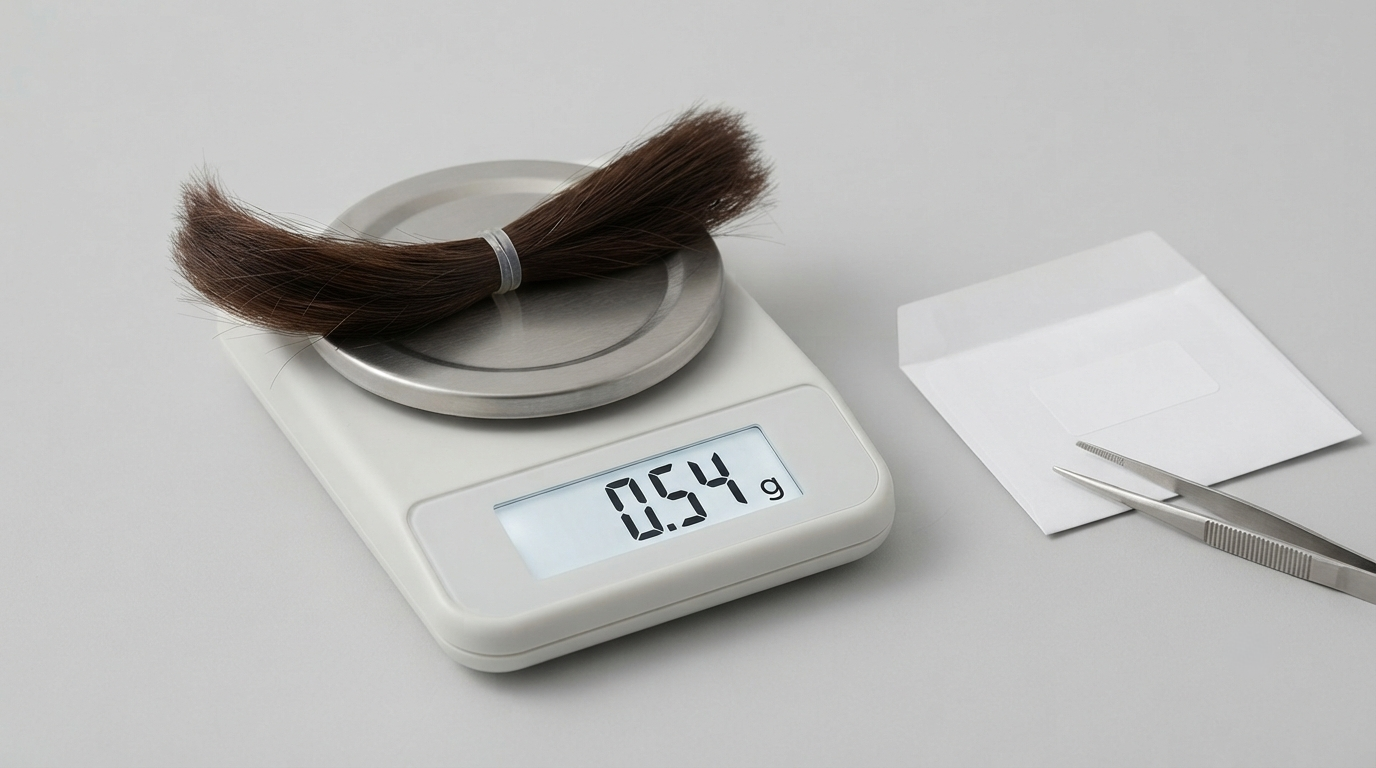
  3. Assessing condition and quantity. Industry typically a small lock, a few grams, is enough; condition matters more than mass.
  4. Documented transfer. The sample is sealed, labeled with an identifier, logged on arrival and weighed. Chain of custody paperwork begins here.
  5. Cleaning and purification. Product residue, dust and non carbon components of keratin are removed in a controlled, oxygen free process reaching roughly 99.9%+ carbon purity.
  6. Graphitization and growth. The purified carbon is taken to roughly 2,500 to 2,700°C to become graphite, blended with supplemental lab carbon, and held under roughly 6 to 8 GPa of pressure at 1,400 to 2,500°C inside an HPHT cell for weeks or months while a crystal accumulates.
  7. Cutting and polishing, then optional independent grading. The rough is shaped and assessed, typically landing in the SI2 to VVS clarity range, at Mohs 10 like any other diamond. Grading is ordered, not automatic.

One honesty point belongs inside that list rather than after it. The carbon recovered from a lock of hair does not fill a growth cell by itself; laboratory carbon makes up the balance. The roughly 10 to 15% figure you will see quoted for the personal share is an ash figure, industry sources put that band on carbon recovered from cremated remains, and no equivalent number is published for hair. What holds on either route is that the personal carbon is real, traceable through the chain of custody record, and a minority of the finished mass.

Ask what share your own sample is expected to contribute, in writing. What the partner hair diamond steps produce is a diamond a verifiable part of which is your partner, not a diamond that is only your partner. The longer account of how a stone is grown from a partner’s hair goes further into the chemistry.

A note on color, since the partner hair diamond steps settle it rather than let you choose it. Trace elements riding along with organic carbon set the tone: nitrogen leans yellow, boron leans blue, and only the absence of both produces something colorless. What color a stone grown from your partner’s hair tends to be treats that as a likelihood. The general physics behind HPHT and CVD growth sits under synthetic diamond.

What If the Sample Turns Out to Be Mixed?

Mixed samples are common and rarely fatal. They are also the reason stage three of the partner hair diamond steps exists as a separate stage.

A brush is the usual culprit: two people share a bathroom for years, one hairbrush lives on the shelf, and what you are holding is a blend. A keepsake envelope can be mixed too.

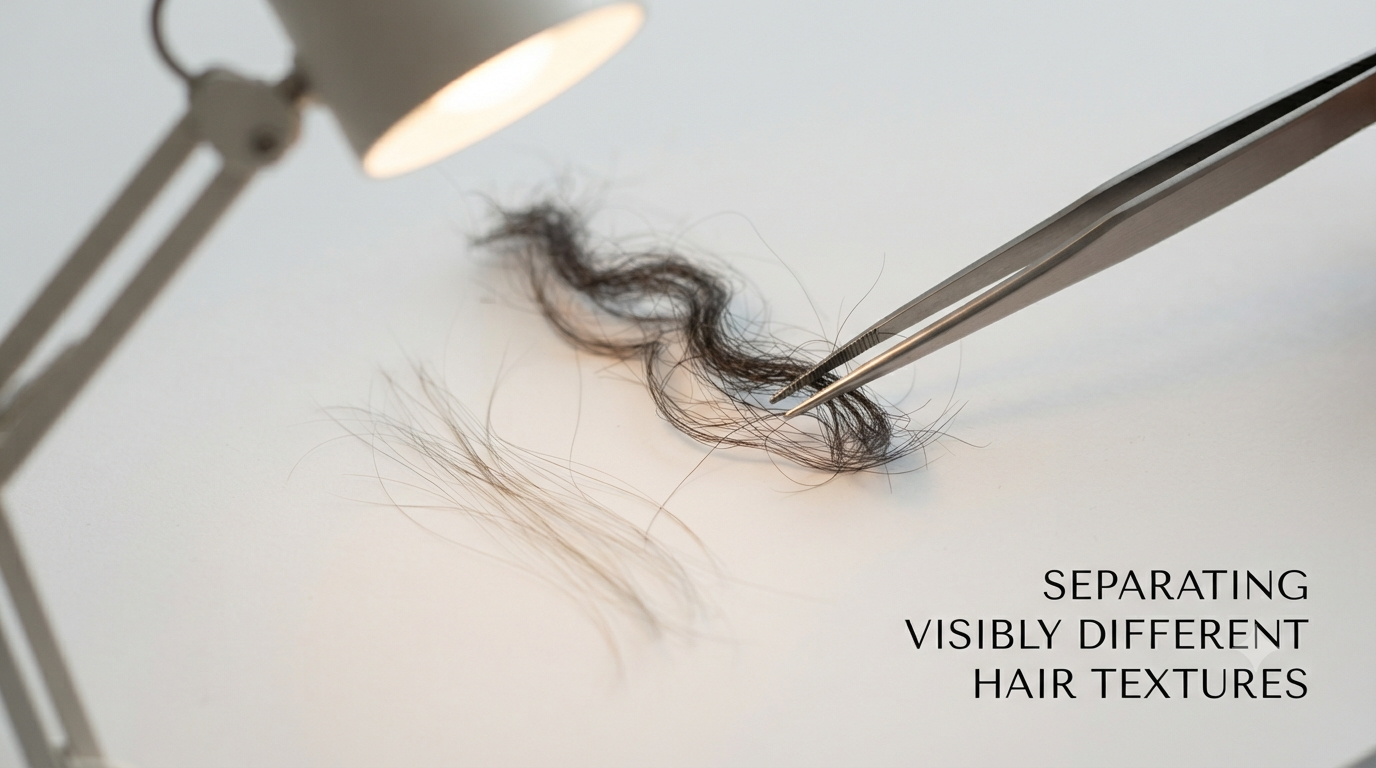
Two visibly different hair textures being separated with tweezers under a lamp

What the partner hair diamond steps do next depends on how mixed it is:

  • Visibly different hair, color, texture or length, can sometimes be separated by hand under good light, with patience and tweezers. Tedious, but it works.
  • Indistinguishable hair cannot be separated, and no laboratory process sorts it. The carbon is processed as one mass.
  • A mixed sample you send anyway is a decision, not an accident, and should be recorded as one. Some families are at peace with a stone grown partly from their own hair alongside their partner’s; others are not. Both are reasonable.
  • A small certain sample beats a larger uncertain one every time, given how little mass the partner hair diamond steps actually require.

Tell the provider what you know. A described mixed sample is a normal intake; an undisclosed one becomes a doubt you carry privately for years. This is also the point where the combined route using ashes as well as hair becomes worth reading, since it changes what the intake record has to account for.

When a Sample Is Too Degraded to Use

Degradation is less common than people fear, because hair is durable, but it happens, and it is better understood before a sample is posted than after.

What actually stalls the partner hair diamond steps: prolonged damp, visible mold, oily or chemical contamination, and years of caked product residue. What generally does not: age, dye, bleach, perming, or a lock that has sat in a drawer since 2009. Keratin is stable, and a dry dark drawer is close to ideal storage.

If a provider assesses a sample as unusable, the partner hair diamond steps have not ended. Three routes remain open:

  • A second sample from elsewhere, the triage table above exists precisely because most households hold more than one possible source.
  • A larger quantity of a marginal sample, if the issue is thin recovery rather than contamination.
  • The ashes route instead, if cremation took place and you have standing to ask for a portion.

That last option is worth a plain sentence about permissions, because it is not symmetrical with hair. Statutes in this area address cremated remains; they were not written about a lock in a drawer. In practice that makes hair you already keep the less obstructed of the two routes, without making it a closed question, belongings can pass into an estate, states take different positions, and hair kept in another household is something you raise with the person who keeps it.

Control over cremated remains varies by state too, and by whatever your partner set down in writing; where a relationship carried no legal recognition, a parent, an adult child or a former spouse may hold it. Where it matters, check rather than assume. That asymmetry is why the step by step for the ashes route starts with authority rather than with a search.

Why the Laboratory Half Is the Shorter Half

Here is the payoff for all that domestic work. Once a verified sample reaches a facility, the technical portion of the partner hair diamond steps is simpler than the ashes equivalent.

Keratin is a carbon rich protein, putting hair at roughly 50% carbon by weight. Ash is dominated by calcium phosphate instead, yielding only about 0.5% to 4%. So a few grams of hair carries what a few ounces of ash carries, and extraction has far less to strip away.

What it changes inside the partner hair diamond steps:

  • Less material moves. An envelope rather than a sealed jar, simplifying transfer and identification.
  • Purification is more direct. No mineral matrix dominates the mass; the process removes the non carbon fraction of a protein.
  • Nothing has to be divided. No urn is opened, and no arrangement anyone else made is touched.

What it does not change: the calendar. Growth time sets carat, not carbon supply, so the industry typical span of 6 to 10 months, up to around 12 for larger or specialty color stones, applies exactly as it does to ash. Sending more hair buys nothing on that clock. The finished stone is graded against the ordinary 4Cs any diamond is assessed on, and the full guide to a partner hair diamond sets the whole route out end to end.

Frequently Asked Questions

How can I be sure the lock in that envelope is my partner’s?

Usually you cannot prove it; the early partner hair diamond steps ask you to reason it out. Reconstruct who cut it and when, rule out anyone else in the household with similar hair, check whether the ends are cut or shed, and write your conclusion down.

Can a laboratory confirm whose hair it is before growing anything?

Ask rather than assume, because DNA verification is not generally offered on this route. Facilities assess condition, quantity and suitability for processing. In the partner hair diamond steps, identity rests on your own record and on chain of custody from intake onward, not on a test.

Two people’s hair ended up in the same envelope. Is that a problem?

Not necessarily, and mixed samples are routine in the partner hair diamond steps. Visibly different hair can often be separated by hand; indistinguishable hair cannot, and would be processed as one mass. Tell the provider either way, and have it recorded at intake.

What does “too degraded” actually mean for a hair sample?

Prolonged damp, mold, oily or chemical contamination, or heavy product residue will stall the partner hair diamond steps. Age alone is not degradation, and neither is dye, bleach or perming. A dry drawer preserves keratin extremely well, which is why decades old locks routinely pass assessment.

Who checks the sample first, me, or the provider?

Both, in that order, and the partner hair diamond steps assume it. You establish provenance, because only you can. The provider then assesses whether there is enough usable material and whether its condition suits processing. Ask whether that can happen from a photograph and a weight first.

If no sample survives verification, what comes next?

Search the other household sources before you abandon the partner hair diamond steps, including a call to the funeral home. If nothing usable exists, the ashes route remains open where cremation took place and you have standing to ask, a different sequence with a different first stage.

Final Thoughts on the Partner Hair Diamond Steps

The technical partner hair diamond steps are well understood and largely out of your hands. Purification, graphitization, growth, cutting: these happen on a schedule, competently, without you.

The stages that need you are the first three, and they happen at home with no instructions. Find a sample. Satisfy yourself about where it came from. Describe it honestly to whoever will process it. Those are the partner hair diamond steps that determine whether the rest is worth beginning, and they cost nothing but attention.

A last, practical point. Because the partner hair diamond steps need no cremation and very little mass, this route stays available long after other options have closed, after a burial, after a scattering, after a family took the urn.

Learn More About Partner Memorial Diamonds

Talk With Memorial Diamond

You can complete the hardest part of the partner hair diamond steps this weekend, without spending anything and without telling anyone: open the drawers, call the funeral home, and see what exists.

If something does, three written questions will tell you where you stand. Ask whether a sample can be pre assessed from a photograph and a weight before it is posted. Ask what happens to material the process does not consume. Ask how it is identified from intake to finished stone. memorialdiamond.us answers all three, and so should anyone else you approach.

Nothing in the partner hair diamond steps has to be decided quickly. A lock of hair in a dry drawer is in no hurry at all.

A small lock of hair beside an open paper envelope on a table, the irreplaceable sample behind most partner hair diamond questions

Questions to Ask Before Turning Your Partner’s Hair Into a Diamond

There is one envelope. Whatever is inside it, a lock cut at a hospital, a curl saved years ago, the strands still caught in a brush nobody could bring themselves to clean, there will never be a second one. The partner hair diamond questions that matter most are about provenance and irreplaceability: how a laboratory handles a sample nobody can independently identify, whether the condition of yours still works, and what “enough” means when running short is not survivable.

Memorial Diamond grows diamonds from hair, so treat this page as interested rather than neutral. Every figure here is an industry wide range, not a published requirement of ours. And the most important of the partner hair diamond questions has an answer you may not expect.

The Sample That Cannot Be Replaced

Hair is a far better carbon source than ash. Roughly half of a strand’s weight is carbon, built into keratin, against the 0.5% to 4% that cremated remains yield. That is why this route needs a small lock rather than a scoop, and why it works for someone who was buried.

But chemistry is not the constraint behind the partner hair diamond questions here. Scarcity is. Ashes exist in quantity and can usually be re portioned if a first attempt goes badly. A lock of hair is a fixed object with a fixed weight, sitting in a drawer, and once it is gone it is gone. That single asymmetry is what should reshape every conversation you have with a provider.

A lock of hair on a small digital scale reading in grams, showing how a sample is weighed before it is sent

It changes which partner hair diamond questions matter, and when you ask them. With hair, the assessment conversation has to happen before anything is posted, because a sample declared marginal after arrival is a sample already out of your hands. That is the practical spine of the partner hair diamond questions below: front load everything that could disqualify your sample, and accept no answer that begins with “send it and we’ll see.”

  • Weigh it first. A kitchen scale that reads to 0.1 g costs very little and tells you where you stand before anyone else knows.
  • Photograph it in the container it has lived in, including any tape, card, ribbon or plastic attached to it.
  • Write down what you know, roughly when it was cut, by whom, and how it has been stored since.
  • Ask for the provider’s minimum in grams, not in adjectives like “a small lock.”

How Would a Laboratory Know Whose Hair This Is?

This is the first of the partner hair diamond questions, and the honest answer surprises most people.

1. Can a provider verify that this sample is my partner’s?

Ask, and expect the answer to be no. Hair carries DNA in its root bulbs, but genetic testing is not something providers generally offer on this route, there would be nothing to test it against unless a reference sample exists, and the growth process itself, graphitization at roughly 2,500 to 2,700°C, then a press at 6 to 8 GPa, destroys every trace of biological material long before a crystal forms. A finished diamond cannot be tested afterwards to name anyone. Put it to the company in those words and see what comes back.

What a serious provider documents instead is a chain of custody beginning at receipt: this sample, logged under this reference, entered purification, and this carbon came out. That is a real and verifiable record. It simply starts at their door, not at your drawer.

So the truthful framing of one of the central partner hair diamond questions is this: the identity of the sample rests on your word, and the provider’s job is to make sure that whatever you sent is what they grew. A company that claims more than that is claiming something the physics does not allow.

2. What happens if the lock turns out to be mixed, or not theirs?

Expect nothing to flag it. Keratin from two people is chemically indistinguishable once purified to the 99.9% plus carbon the process requires, and separating or identifying sources is not what a purification and growth sequence is built to do, worth confirming with your provider rather than taking on trust. A brush sample that also holds a few of your own strands, or a child’s, will simply be carbon.

Whether that matters is one of the partner hair diamond questions only you can answer, and plenty of families conclude it does not, a brush two people shared is arguably a truer object than a clinical cut. But decide it now rather than discovering the ambiguity afterwards. If it does matter, a single clean lock with a known history beats a larger, vaguer sample.

This is also the point at which the partner hair diamond questions stop being technical. If nobody else can confirm what this is, your own record becomes the provenance. A dated note and a photograph taken today, kept with the paperwork, is worth more in twenty years than a memory.

Which Partner Hair Diamond Questions Are About the Sample’s Condition?

Two of the nine, and they are the partner hair diamond questions most often answered wrongly by well meaning guesswork.

3. The hair is old. Is it still usable?

Almost certainly, and this sits among the partner hair diamond questions where instinct misleads. Keratin is remarkably stable, hair survives for centuries in archaeological contexts, and a lock kept in a drawer for fifteen years has not lost its carbon. Age alone is not a disqualifier.

Storage is the real variable. Damp gives mold a foothold; adhesive tape, laminated cards and glued memorial books bond the hair to something that now has to be removed; loose strands may have picked up fibers. None of these is automatically fatal, and purification strips non carbon material anyway, but all are worth disclosing rather than hoping nobody notices.

4. Does dye, bleach or a treatment change anything?

Less than people fear, which makes this one of the partner hair diamond questions worth asking rather than assuming. Bleaching and permanent color alter the keratin cuticle, but they do not remove the carbon, and extraction strips out everything that is not carbon regardless. Heavily processed hair is generally still workable.

Hair thinned by illness or chemotherapy raises a volume issue rather than a viability one, fine, sparse strands weigh very little, so a visually generous lock may come in well under the gram figure a provider needs. Weigh it. The same goes for very short hair, where what looks like plenty on a card can be under a gram.

What you haveEffect on carbonEffect on viabilityDisclose when you ask
Lock kept loose in an envelope for yearsNone, keratin is stableGenerally fineHow long, and where it was stored
Hair taped to a card or laminatedNone to the hair itselfAdhesive must be removed firstThat tape or lamination is involved
Dyed, bleached or permedNone, purification removes the restGenerally fineThe treatment, so nothing is a surprise
Fine or chemotherapy thinnedNone per gramVolume is the risk, not chemistryThe actual weight in grams
Strands from a shared hairbrushNoneWorks, but sources cannot be separatedThat the sample may be mixed
Hair showing mold or damp damageReduced usable massAssessment needed before commitmentImmediately, with a photograph
A lock of hair taped to a keepsake memorial card, the kind of mounting that has to be removed before processing

The pattern across that table answers several of the partner hair diamond questions at once: chemistry is rarely the obstacle, and mass almost always is. If your sample fails, it will fail on a scale, not in a beaker. To see how the numbers work out, how much hair a partner memorial diamond actually needs sets out the typical bands.

What Does “Enough” Mean With No Second Sample?

A provider quoting “a small lock” is describing a comfortable case, not a threshold. Weight sits at the dead center of the partner hair diamond questions. For an irreplaceable sample, comfortable is not the number you need.

5. What is your minimum, in grams, and what is your preferred amount?

Ask for both, because they are not the same and the gap between them is where your risk lives. Industry wide, hair submissions typically run to a few grams, which sounds trivial until you weigh a thin lock of fine hair and find it at 0.6 g.

If you sit between the minimum and the preferred amount, you are not disqualified, you are in the band where the provider’s honesty matters most. Among the partner hair diamond questions this is the one to ask in writing, so the answer exists as text rather than as an encouraging phone call.

One lock of hair divided into two portions on a sheet of paper, illustrating sending part and keeping part

6. Will you assess the sample before I commit, and will you tell me plainly if it is marginal?

The answer you want is yes to both, with specifics. Some providers will look at a photograph and a stated weight and give a view. Some accept a few strands as a test portion. Some assess only on arrival, which for an irreplaceable sample is a materially worse offer.

Then ask the follow up that separates careful companies from confident ones: if it is marginal, will you say so and pause, or proceed and hope? Of all the partner hair diamond questions, this one most reliably reveals how a company behaves when things are not going well. The rest of the sequence from posting a lock to receiving a finished stone is comparatively predictable.

What Survives If the Run Fails?

Growth runs fail occasionally, and the partner hair diamond questions here are the least pleasant to ask. Crystals fracture, cells misbehave, and a stone can be lost in cutting. With ashes there is usually more material. With hair there is usually not.

7. If the sample is consumed and the run fails, what exists afterwards?

Ask this in the bluntest form you can manage, because the answer defines your actual exposure. Is the purified carbon recovered and re grown, or is it lost with the crystal? Is a second attempt made without further material? Is money returned when material cannot be?

There is no industry standard answer to these partner hair diamond questions, and different policies are all legitimate. What is not acceptable is vagueness. Of the nine partner hair diamond questions on this page, this is the one most often left unanswered: if a provider cannot describe what happens in the bad case, you are being asked to carry a risk nobody has quantified for you.

8. Can the sample be split, so that part of it stays with me?

Often, and it is the single most effective protection available to you. Sending half a lock and keeping half means a failure costs you a stone rather than the object itself. It also leaves a second family member able to commission their own stone later from the same source.

Ask whether the provider will work from a reduced portion and whether doing so changes the likely outcome. If your sample is large enough to split, splitting it converts the worst case from irreversible to merely disappointing, which is why it belongs among the partner hair diamond questions asked before the envelope is sealed, not after. Where more than one person wants a stone, the practicalities of sharing a single source are worth reading first.

The Partner Hair Diamond Questions About What a Certificate Asserts

Documents outlast the people who commissioned them, which is why the partner hair diamond questions end here. Read yours before it exists.

9. What, exactly, does the certificate claim about origin?

There are two documents and they do different work. A grading report, ideally from an independent laboratory, describes the finished stone, cut, color, clarity, carat, the same category of assessment any diamond receives. An origin or authenticity certificate describes the submission: that this diamond was grown from carbon extracted from material received under this reference on this date.

Notice what the second document can and cannot say, because this is one of the partner hair diamond questions a certificate answers on your behalf for the rest of its life. It can say material was received and tracked. It cannot say whose hair it was, because nobody at the laboratory was in your house when the lock was cut. Good wording reflects that honestly. Wording that implies genetic verification is overreaching, and it is fair to ask for a sample certificate before you commit.

Ask too about the proportion, and be careful with the number you have probably already read. The often quoted 10 to 15% band describes carbon recovered from cremated ashes; no equivalent share is published for hair, so no honest document can put a hair figure on it. What is true on either route is that laboratory carbon makes up the bulk of the charge so the crystal reaches a viable size, and that the personal carbon is a real, verifiable, permanent minority of the lattice rather than the whole of it.

So make it one of your partner hair diamond questions: what share is my sample expected to contribute, and how is that recorded? Any document or salesperson claiming the stone is wholly your partner is overstating what a grown diamond actually is, and a company comfortable overstating that will be comfortable overstating other things. That honesty test sits underneath all nine partner hair diamond questions on this page.

Frequently Asked Questions

Can a finished diamond be tested to prove whose hair it came from?

No. The growth process runs far above the temperature at which biological material survives, so nothing identifiable remains in the crystal. Treat any claim that a finished stone can be genetically matched to a person as a reason to ask a great many more questions.

Is hair from a hairbrush usable?

Physically, yes, brush strands are the same keratin as a cut lock. The caveat is that a shared brush may hold more than one person’s hair, and nothing in the process distinguishes them. Decide in advance whether that ambiguity sits comfortably with you.

Does the hair need roots attached?

No. The carbon is in the shaft, and roots add almost nothing to the mass. Root bulbs would matter for DNA testing, which providers do not generally offer on this route, so cut ends are perfectly workable.

My partner’s hair was gray. Does that change the stone?

No. Pigment is present in trace quantities and is removed during purification like everything else that is not carbon. A diamond’s color comes from trace elements at growth, nitrogen tending yellow, boron tending blue, neither present giving colorless.

Can I send more hair later if the first sample falls short?

Ask, because it depends entirely on where the run has reached. Once material is purified and committed to a growth cell, adding to it is usually not possible. Before that stage, some providers will accept a top up. Get the deadline in writing.

My partner was buried rather than cremated. Does hair still work?

Yes, and that is the point of this route. Hair needs no cremation at all, which is why it also suits families whose faith or wishes ruled cremation out, and why a lock saved during life is enough on its own.

Final Thoughts on Partner Hair Diamond Questions

Everything on this page comes back to one sentence: there is no second envelope. The chemistry is forgiving, the timeline is ordinary at six to ten months, and the finished stone is a real diamond by every measure. The only unrecoverable thing is the sample you start with, and that is what shapes the partner hair diamond questions.

Which is why the partner hair diamond questions worth asking are the ones that happen before postage, weight, condition, assessment, splitting, and what a provider does on a bad day. Asked in that order, they cost you an afternoon. Asked afterwards, some of them have no useful answer at all.

If a company answers all nine partner hair diamond questions plainly, you have learned something. If one of them produces a shrug, you have learned something more useful still, and you have learned it while the envelope is still in your drawer.

Learn More About Partner Hair Diamonds

Talk With Memorial Diamond

If you want the partner hair diamond questions above answered against your actual sample rather than in general, reach out to Memorial Diamond at memorialdiamond.us. Bring a weight in grams, a photograph of the lock as it currently sits, and an honest description of how it has been stored, including the parts you would rather not mention.

Nothing about the partner hair diamond questions needs deciding in a first conversation, and nothing should be posted before one. Ask what your sample would need to weigh, whether it can be split, and what happens on the day a run goes wrong.

A sealed ash container and a labeled hair envelope side by side on a table, the two parallel inputs to the partner ashes hair diamond steps

Step by Step: Turning Your Partner’s Ashes and Hair Into a Diamond

Two materials means two of almost everything, two assessments, two sets of permissions, two lines on an intake record, right up until the moment they stop being two things at all. The partner ashes hair diamond steps are best understood as two tracks running at different speeds that converge once, late, at the growth cell; before that point the ash and the hair are handled, judged and documented separately. Where they converge, and what happens if one track fails, is the whole of the decision making here.

Memorial Diamond grows these stones, so read this as an interested account. Figures given below are industry wide bands rather than requirements we publish.

The Partner Ashes Hair Diamond Steps Run on Two Tracks

The temptation with a dual source order is to picture one parcel going out and one stone coming back. That is not how the partner ashes hair diamond steps behave, and the model matters because it changes what you decide and when.

Ash and hair are chemically different problems. Cremated remains are dominated by calcium phosphate, with usable carbon at roughly 0.5% to 4% by weight. Hair is roughly 50% carbon, keratin being a carbon rich protein. A facility extracting carbon from each runs two recoveries with two yields and two failure modes.

So the partner ashes hair diamond steps carry a duplicate structure through their early stages: separate assessment, separate permission questions, separate identifiers, separate purification. Only after both have become purified carbon does a single decision, one growth charge, make them one object.

That convergence point is the useful thing to know. Everything before it can be staged, delayed or abandoned one track at a time. Everything after it is joint and final.

It also explains a question families ask late and should ask early: which contribution is larger in the finished stone. There is no answer, because once two purified carbons are weighed into one charge alongside lab grown carbon, no analysis distinguishes them. The only decision that controls the proportions is how much of each material you send, and the partner ashes hair diamond steps place it before intake rather than after.

Are the Two Sources Assessed Separately or Pooled?

Separately, and this is the most common misunderstanding about the partner ashes hair diamond steps.

Material requirements are normally stated per material rather than as a combined total, and the partner ashes hair diamond steps honor that separation throughout, though it is worth asking any provider to confirm it in those terms. The industry typical ash figure is a few tablespoons up to roughly 4 oz, about 100 g. The industry typical hair figure is a small lock, a few grams. Those are not two halves of one total. Sending half the ash figure and half the hair figure does not add up to a viable submission; each is assessed against its own threshold on its own terms.

StageWhat the ash track is doingWhat the hair track is doingAre they joined yet?
AssessmentWeighed against the ash requirement; storage condition reviewedWeighed against the hair requirement; provenance and condition reviewedNo, two separate judgments
PermissionRequires authority over the remains, which may rest with someone elseUsually a simpler question in practice where the sample is already in your own homeNo, two different questions entirely
IntakeLogged, weighed on arrival, given an identifierLogged, weighed on arrival, given its own identifierNo, ideally two records
PurificationMineral matrix stripped away; thin yield, large inputNon carbon fraction of keratin removed; rich yield, small inputNo, different recoveries
GraphitizationPurified carbon taken to roughly 2,500 to 2,700°CPurified carbon taken to the same temperature rangeUsually not, ask
Growth chargeCombined with the hair carbon and supplemental lab carbonCombined with the ash carbon and supplemental lab carbonYes, this is the convergence
Cutting, then optional independent gradingOne rough, one stone, one report if you order itOne rough, one stone, one report if you order itYes, permanently
Two intake sheets and two scales, each logging a different material against its own requirement

Read the right hand column as a cancellation map. Up to the growth charge, the partner ashes hair diamond steps are two projects that happen to share an order number. After it, they are one crystal and nothing distinguishes the contributions.

One qualification belongs inside the partner ashes hair diamond steps and applies to both tracks equally. Neither material supplies enough carbon to fill a growth cell on its own, so lab grown carbon makes up the bulk of the charge. The figure usually quoted for the personal share, roughly 10 to 15% of the finished stone, with some providers citing figures as low as 3%, is an ash route figure.

No published industry figure covers a blended ash and hair charge, and the partner ashes hair diamond steps do not create one. What two sources definitely do not do is double the personal share. If the proportion matters, ask what your particular submission is expected to contribute and ask for it in writing. Whether a dual source stone contains more of your partner is worth reading if that is the question underneath your question.

In What Order Do the Partner Ashes Hair Diamond Steps Run?

Seven partner ashes hair diamond steps, with the duplication concentrated in the first four.

  1. Separate assessment. Each material is judged against its own industry typical figure, quantity and condition for the ash, quantity, condition and provenance for the hair. Nothing is committed.
  2. Permissions, resolved per material. The hair is usually straightforward. The ash frequently is not, and that asymmetry is dealt with in its own section below.
  3. Staged commitment. You decide which material is released first, and whether the second is held back pending the first’s assessment result.
  4. Documented intake, twice. Each material arrives sealed and labeled, is weighed on receipt, and is logged against its own identifier.
  5. Purification, run separately. Each is heated in a controlled, oxygen free process to roughly 99.9%+ carbon purity, with very different amounts of material removed on each track.
  6. Graphitization and the growth charge. Purified carbon becomes graphite at roughly 2,500 to 2,700°C, the two contributions are weighed into one charge alongside supplemental lab carbon, and that charge sits under roughly 6 to 8 GPa at between 1,400 and 2,500°C in an HPHT cell until the crystal reaches size.
  7. Cutting and polishing, then optional independent grading. One rough is shaped and assessed, typically landing between SI2 and VVS clarity, at Mohs 10 like any diamond. Independent grading is ordered, not automatic.

Nothing in the partner ashes hair diamond steps speeds that up. Industry wide it runs 6 to 10 months once material is received, and nearer 12 where a stone is large or its color is a specialty, because carat is bought in growth time rather than carbon supply. Nor do two sources let you specify a color: trace elements decide it, with nitrogen leaning yellow and boron leaning blue, and a colorless stone requiring the absence of both. What color to expect from a combined submission treats that honestly. General background on the growth methods themselves sits under synthetic diamond.

Which Source Should Go First in the Partner Ashes Hair Diamond Steps?

Stage three is the only genuinely new decision the partner ashes hair diamond steps create, and it has a defensible default: release the hair first.

The reasoning is about exposure, not sentiment. The regulation here was drafted with cremated remains in mind, not with a keepsake envelope, and that is why hair you already hold usually meets fewer obstacles. Usually, not always: a person’s belongings can be drawn into an estate, the position differs state to state, and hair in someone else’s keeping is theirs to be consulted about.

Ash is a harder question again: it requires authority over cremated remains, and that authority is not automatic for a partner. Which state the cremation took place in decides the default, and it can be displaced by a will, by a disposition directive, or by an instruction signed at the funeral home. Where a relationship was never legally recognized, the person entitled to divide the remains may be a parent, an adult child, or a former spouse, and possession of the urn is not the same as entitlement to open it.

So the sequencing question is really a risk question:

  • Hair first tests the provider, the paperwork and the assessment process on the material that is usually easier to authorize, though where it matters, check rather than assume.
  • Ash first makes sense only where you hold clear authority and where the hair sample is doubtful, since it commits the material that cannot be recollected.
  • Both together is the fastest route and the least recoverable one, and it is a reasonable choice when both assessments have already come back positive.
  • Neither, yet is a real option. An assessment from a photograph, a weight and a description costs nothing and commits nothing.
A hair envelope being sealed for posting while a closed urn stays on the shelf behind it

Whichever order you choose, put the interval in writing. A provider expecting both materials within two weeks runs a different process from one content to hold a first submission for three months, and that difference only surfaces when you ask.

If the ash is held by someone who has not agreed, settle that before anything else in the partner ashes hair diamond steps moves. Asking for one measured portion out of a quantity counted in pounds is a smaller request than it feels like from your side of it, and it is granted more often than partners expect. How to open that conversation is a post in itself.

If One Source Fails Assessment, What Happens to the Other?

In the partner ashes hair diamond steps this is the scenario that makes staged commitment worth an extra week, and it is not rare.

A hair sample can fail on provenance, mixed with someone else’s, impossible to place, or on condition, if it has been damp or contaminated. Ash can fail on quantity, if what you hold is a keepsake share rather than a cremation’s worth, or on permission.

What the partner ashes hair diamond steps do next depends on when the failure surfaces:

  • Before either material ships. Nothing is lost. The order becomes a single source order, and the partner ashes hair diamond steps collapse into the ashes only or hair only sequence with no material consumed.
  • After the first material has shipped but before the growth charge. The surviving track continues. Ask, in writing and in advance, whether the provider will proceed single source at the same carat rather than canceling.
  • After the growth charge. There is nothing to separate. Both contributions are in one crystal.
An origin certificate and an independent grading report laid side by side, showing which document records the source materials

The practical instruction is short: do not release the second material until the first has cleared assessment, unless you are content to proceed on one source alone. That single sentence is most of the value of understanding the partner ashes hair diamond steps as two tracks.

There is also an outcome worth naming because families arrive at it and are glad they did. Where both materials clear but you want them kept distinct, some providers will grow two stones rather than one, one from each source, rather than merging the charge. Whether more than one stone can come from a shared starting material covers that ground.

What the Intake Record Should Say About Both Materials

Paperwork is where the partner ashes hair diamond steps quietly go wrong, because most documentation is designed around one material.

Ask what the record will say before you send anything. A record built for a single submission names a weight and a date, and a second material arriving later can end up as a note in a margin rather than a logged item. Years afterwards, that margin note is the difference between a documented dual source stone and a stone you remember being dual source.

What the partner ashes hair diamond steps should produce on paper:

  • Two intake entries, each with its own identifier, received date, and weight on arrival.
  • Each material named explicitly, “cremated remains” and “hair”, rather than a single line reading “personal carbon” or “client material”.
  • A record of which material was released when, which is what staged commitment is for.
  • A statement of what happens to unused material on each track, since the residues are different and the policies may be too.
  • A line on the authenticity or origin certificate naming both sources, which is the document that will outlive the paperwork around it.

That last one deserves a sentence of plain warning. An origin certificate is generally issued in house and documents chain of custody; a grading report is ideally independent and documents the stone’s own 4Cs, assessed on the same quality factors any diamond is graded against. They are different documents doing different jobs, and only one of them can record that two materials went in. Ask to see a sample of both before you commit. The complete guide to a combined partner diamond sets out the rest of the route around these stages.

Frequently Asked Questions

Are the two materials assessed as one submission or as two?

As two, and the partner ashes hair diamond steps keep them apart from the start. Each is measured against its own industry typical figure, a few tablespoons to roughly 4 oz of ash, a small lock of hair, and passing one does not offset falling short on the other.

Do the ashes and the hair have to arrive together?

No, and there is usually a good reason not to send them together. Staging the partner ashes hair diamond steps lets you see one assessment result before committing the second material, which is the only real protection a dual source order offers.

If one material is rejected at intake, what happens to the order?

Normally the surviving material continues alone, so the partner ashes hair diamond steps collapse to one track, but that is provider policy, not a rule. Confirm in writing, before shipping, whether they proceed on one source at the same carat or cancel.

At what stage do the two carbon sources actually meet?

At the growth charge, after both have been purified and graphitized. Before that point the partner ashes hair diamond steps run as two separate recoveries. After it, the contributions are indistinguishable and nothing can be separated out again.

Should the certificate record both materials by name?

Ask for it explicitly, because the partner ashes hair diamond steps do not guarantee it. An in house origin certificate is the document that can name cremated remains and hair as two logged inputs; an independent grading report covers the stone’s own quality and will not mention the source at all.

Can a second material be added once the first is in process?

Sometimes, if it arrives before the growth charge is assembled. After that the cell is loaded and the schedule is fixed. Ask for the cut off date in writing at the start rather than assuming a window exists later.

Final Thoughts on the Partner Ashes Hair Diamond Steps

A combined order is not a bigger order. It is two smaller ones, run in parallel, with a single irreversible junction late in the sequence.

Understood that way, the partner ashes hair diamond steps become much easier to manage. You stage the commitments rather than making one. You resolve the permission question on the ash while the hair is already being assessed. You keep two paper trails instead of trusting one. And you know precisely when the option to change course disappears, which is the growth charge and not a day before it.

What the partner ashes hair diamond steps will not do is make the stone more of your partner, arrive faster, or come out a chosen color. Those were never functions of how many materials went in. What two sources genuinely give you is a second route to the same stone when one route is closed, which, for a partner who may not control the ashes, is not a small thing.

Learn More About Combined Partner Memorial Diamonds

Talk With Memorial Diamond

Most of the partner ashes hair diamond steps can be settled in writing before any material leaves your house, and that is the order worth insisting on.

Three questions do the heavy lifting. Ask whether each material is assessed against its own figure, and whether both can be pre assessed from photographs and weights. Ask what happens to the order if one material fails and the other passes. Ask whether the origin certificate will name both sources by name. memorialdiamond.us will answer all three in writing, and so should any provider you are weighing up.

Until those answers exist, nothing needs to move. The urn stays where it is, the envelope stays in the drawer, and the partner ashes hair diamond steps wait as long as you need them to.

Wife memorial diamond with a sparkling diamond, elegant keepsake box, flowers, and framed couple photo on a luxury black and gold jewelry setting.

How Much Does a Wife Memorial Diamond Cost?

You are probably looking at a price band and trying to work out what the difference between two numbers actually consists of.

Industry wide in 2026, a wife memorial diamond cost falls in roughly three steps: about $1,500 to $3,500 at 0.10 to 0.25 carats, about $5,000 to $15,000 at 0.5 to 1 carat, and about $20,000 to $75,000 and upward at 2 carats and above. Those are figures for the loose stone. What moves you between the steps is not a better stone, it is a longer growth run and, sometimes, a color that had to be engineered.

Wife memorial diamond cost comparison: a loose champagne-toned memorial diamond beside a written quote on a kitchen table

What Does a Wife Memorial Diamond Cost at Each Step?

A wife memorial diamond cost is published in bands rather than figures, and the bands are not arbitrary. Each one corresponds to something that physically changes inside the press.

Price stepTypical caratWhat physically changesWhat to confirm is included
About $1,500 to $3,5000.10 to 0.25 ctThe shortest growth runs. The cell is loaded, held and opened in the least time the process allows, with the least opportunity for a run to driftWhether any grading report is included at all, and whether the stone arrives loose or mounted
About $5,000 to $15,0000.5 to 1 ctA materially longer run under continuous control, and the step at which color choice starts to move the figure independently of sizeWhich color band the quote assumes, and whether a change of color changes the price
About $20,000 to $75,000 and up2 ct and aboveA long, closely managed run where conditions must hold for far longer, and where the cost of a failed run is carried by a smaller number of stonesWhat happens to the figure if the finished carat lands under the target, and what documentation accompanies it

Read those as industry wide 2026 ranges for a loose, unset stone rather than any company’s quotation, and not as Memorial Diamond’s own published pricing, which does not yet exist. The wider memorial diamond pricing guide covers what drives cost across the whole category.

The useful way to read that table is left to right rather than top to bottom. A wife memorial diamond cost is not a scale of quality with your budget somewhere on it. Each step buys a specific physical difference, and the fourth column is what stops two quotes in the same band from describing different objects.

It is also worth saying that the first step is a real choice rather than a compromise. A 0.15 carat stone and a two carat stone are the same material, grown the same way, documented the same way, and worn by people who wanted different things. Where a wife memorial diamond cost lands says something about a budget and nothing else.

What Are You Actually Buying When You Pay for Carat?

Time. Almost entirely time, which is the single most useful sentence on any wife memorial diamond cost page.

Carat size in a memorial diamond is a function of how long the crystal grows in the press, not of how much material you supplied. A larger stone occupies tightly controlled equipment, an HPHT press running at roughly 6 to 8 GPa and 1,400 to 2,500°C, for longer, under conditions that must hold steady the whole time. That occupancy is the cost. It is also the reason the wife memorial diamond cost climbs steeply rather than proportionally: doubling the carat is not doubling a quantity of raw material, it is holding an expensive machine in a controlled state for considerably longer while the risk of losing the run accumulates.

This is where the most common and most expensive misunderstanding lives. Sending more of her ashes does not buy a larger stone, a cheaper stone, or a faster one. How much ash a wife memorial diamond needs sets out typical quantities, and the short version is that most of what a cremation produces stays with you regardless of what you order.

There is a related honesty point that belongs on a cost page more than anywhere else. No amount of money buys a stone made entirely of her. Whatever carbon is recovered from her ashes or her hair is purified and then brought up to volume with lab grown carbon, because no realistic portion of either contains enough carbon to fill a growth cell on its own. A bigger budget buys press time. It does not buy a larger personal fraction, and no price step changes that.

Carat is also the variable that sets the calendar, which is why the size decision and the wait decision are the same decision, how long a wife memorial diamond takes follows that through.

HPHT diamond press mid-growth-run with its control panel lit in a laboratory

Why Does Colorless Raise the Wife Memorial Diamond Cost?

Because colorless is not a color. It is an absence, and absences have to be engineered.

Diamond color comes from trace elements present while the crystal grows. Nitrogen reads yellow. Boron reads blue. A colorless stone requires neither to be present in any meaningful quantity, which is a harder specification than either of the others, because it is defined by what must not be there.

Now add where memorial carbon comes from. It begins in an organic, personal source rather than a clean synthetic feedstock, so trace elements are not an accident but an expectation. That is precisely why memorial diamonds trend toward yellow, blue and champagne tones in the first place. Getting to colorless means adding processing to exclude what the source material naturally brings with it, and across the industry that additional processing is what raises the wife memorial diamond cost at the same carat.

So the color lever runs backward from how jewelry pricing usually works. You are not paying extra for something added to the wife memorial diamond cost. You are paying for something removed. What color to expect from a memorial diamond for a wife covers the realistic range and why a forecast is not available in advance.

Post growth irradiation, offered by some providers to shift or intensify color toward red, pink, green or black, is a separate line again. It is additional work after the stone exists, and it should be quoted as such rather than assumed inside a band.

What a Wife Memorial Diamond Cost Quote Does Not Include

A quoted figure in this category almost always describes one object: a loose, unset stone. Four things are commonly priced separately across the industry, and each one can move a total meaningfully.

  • An independent grading report. A third party gemological laboratory documents the stone’s cut, color, clarity and carat against the same standards used for any diamond. It is not the same document as an in house origin or authenticity certificate, which records that the stone was grown from the carbon you submitted. Ask which of the two a quote includes, because “certification” is used for both.
  • Engraving, whether on a setting, a girdle, or the paperwork.
  • Fancy cuts and non standard shapes, with round generally the reference point a band assumes.
  • The jewelry setting itself, a ring, a pendant, earrings, or work on a piece you already own. This is the one families most often discover late. Ideas for rings, pendants and keepsakes covers what the options are, and settings for a wife memorial diamond covers how a piece actually holds a stone.

A wife memorial diamond cost quoted as a single number is therefore rarely the amount you will spend. That is not concealment; it is simply how the category prices a loose stone. But it does mean the only genuinely comparable question is which of the four items a given figure already covers, and in what order the rest arrive.

A third-party diamond grading report laid beside a separate origin and authenticity certificate

What a Higher Wife Memorial Diamond Cost Does Not Buy

Spending more changes some things and not others, and the distinction matters because the things a higher wife memorial diamond cost does not change are exactly the ones people assume it does.

What more money does changeWhat it does not change
Press time, and therefore finished caratThe personal fraction of the stone, a larger diamond does not contain proportionally more of her
The realistic color options open to you, colorless includedThe chemistry of the source material, or what trace elements it brought with it
The cut, the shape, and how the stone is finishedHardness or authenticity, every step is a real diamond, a 10 on the Mohs scale
The likelihood that a grading report is bundled rather than extraWhether an origin document exists, which is a separate question to ask outright
How long you wait, in the direction of longerWhether any of this had to be decided this year

The last row is the one worth sitting with. Nothing in the chemistry puts a clock on the decision: cremated remains are stable mineral matter, and a dry, sealed, labeled lock of hair does not expire. The exception is hair that has not been collected yet, which is the only part of this that can become unavailable.

An entry step stone and a two carat stone come out of the same extraction, the same purification, the same growth process, and the same documentation chain. The difference between them is press time. It is not authenticity, and the price step is not a measure of anything about your marriage.

Does Using Both Her Ashes and Her Hair Change the Cost?

Ask, because it varies, and ask how the wife memorial diamond cost is structured rather than only what it is.

The physical work is genuinely different when two materials are involved: ash and hair are purified on separate tracks, because what has to be stripped away differs, and the two outputs meet only in the growth cell. Whether that additional preparation is charged as a second processing item or absorbed into one fee is a policy question for whoever is quoting, not a fact of the category.

What does not change is the main driver. Across the industry, carat is what moves the figure, and source material is a much smaller input than size. So the useful phrasing when you ask is: does preparing a second material appear as its own line, and does it change the growth stage at all? The questions to ask before turning her ashes and hair into a diamond puts that alongside the rest of the combined order list.

What Happens to the Wife Memorial Diamond Cost If a Run Fails?

This is the question almost nobody asks before ordering, and it sits underneath every figure in the first table.

A growth run is a controlled process, not a guaranteed one. Conditions have to hold for weeks or months, and a run can end with a crystal that is smaller than intended, flawed in a way that will not cut, or unusable altogether. That risk is part of why the wife memorial diamond cost rises so steeply at the top step: the longer the run, the more there is to lose, and the fewer stones there are to carry the loss.

What happens next is entirely a matter of company policy, and it varies. Ask it directly, in writing, before you commit rather than afterward:

  • Is a failed run repeated at no additional charge, and how many times?
  • What happens to any of her material that was consumed in the failed run?
  • Does a stone that comes in under the target carat change the price, or the order?
  • How is the timeline restated, and when would you be told?

None of those has a category wide answer, and none of them should be assumed. A company with a clear written procedure is telling you something useful about how it prices; so is one that has not written it down yet.

How Do You Compare Two Wife Memorial Diamond Cost Quotes?

By making them describe the same object before you compare the numbers.

Two figures for a “0.75 carat memorial diamond” can differ by thousands and both be honest, because they are quoting different bundles. Before you put them side by side, settle five things in writing.

  1. Loose or set? A stone in a ring and a stone in a box are not the same purchase.
  2. Which color band does this assume? A quote built on a yellow or champagne stone and one built on colorless are not the same specification.
  3. Is an independent grading report inside the figure, or after it?
  4. Is an origin or authenticity document issued, and at what stage? This is the document that ties the stone to what you submitted, and it is worth naming explicitly rather than accepting “certification” as an answer.
  5. What is the figure conditional on? Specifically, what happens if the finished stone comes in under the target carat.

Only once both answer the same five questions is the wife memorial diamond cost difference between them a real difference. Until then you are comparing a stone to a stone plus report plus setting and calling one of them expensive.

Two more practical notes. Ask whether a written quote costs anything and how long the figure stands, and treat insurance coverage and any tax question as matters for a qualified professional rather than a jewelry company, both depend on your circumstances and where you live.

Frequently Asked Questions

How much does a wife memorial diamond cost in 2026?

Industry wide, a wife memorial diamond cost runs roughly $1,500 to $3,500 at 0.10 to 0.25 carats, $5,000 to $15,000 at 0.5 to 1 carat, and $20,000 to $75,000 or more above two carats. Those are loose stone ranges, not any single company’s published price.

Why does a bigger wife memorial diamond cost so much more?

Because carat is bought as growth time. A larger stone holds tightly controlled equipment in a steady state for considerably longer, and the risk of losing a run accumulates with it. The material you send is not what sets the size.

Does a colorless memorial diamond cost more than a yellow one?

Yes, industry wide, at the same carat. Yellow comes from nitrogen and blue from boron, and organic carbon brings trace elements with it, so colorless requires additional processing to exclude what the source naturally contains.

Is a hair diamond cheaper than an ashes diamond for a wife?

Not because of the material. Price across the industry is set mainly by carat, then color, cut and grading. Ask any provider directly whether source material changes their figure, since preparation differs even when the growth stage does not.

What is not included in a wife memorial diamond cost quote?

An independent grading report, engraving, fancy or non standard cuts, and the jewelry setting are all typically quoted separately from the loose stone. Ask which of the four a figure already covers before comparing it to another.

Does sending more of her ashes reduce what I pay?

No. Carat comes from press time rather than from the quantity submitted, so a larger portion neither lowers the figure nor produces a bigger stone. Providers set their own minimums, and most of the ashes stay with you either way.

Final Thoughts on Wife Memorial Diamond Cost

The number is real and it is not small, and nothing here is trying to talk you past it. But a wife memorial diamond cost is easier to hold once you can see what each step is actually made of: a longer run, a color defined by an absence, and a handful of items that were never inside the figure to begin with.

If you take one thing from this page, make it the fourth column of the first table. Two wife memorial diamond cost quotes only become comparable once both describe the same object, and that question costs nothing to ask.

Learn More About Wife Memorial Diamonds

Talk With Memorial Diamond

If a wife memorial diamond cost attached to your own circumstances would be more use than a band, Memorial Diamond is one of the companies to ask, memorialdiamond.us. Bring the five comparison questions with you; a quote that answers all five is worth more than a quote that is simply lower.

And if the honest answer today is that none of these steps is reachable, that is a complete answer. Her ashes are not on a clock, and neither is this decision.

partner ashes hair diamond questions

Questions to Ask Before Turning Your Partner’s Ashes and Hair Into a Diamond

You have two things, and they are not the same kind of thing. One sits in a container that still holds far more than any laboratory will ask for. The other is a single lock in an envelope, and there is no more of it anywhere in the world. The partner ashes hair diamond questions that actually decide how this goes are questions of reconciliation: whether each source is assessed on its own, which one is committed first, what happens when one fails and the other does not, and what the certificate ends up naming.

Memorial Diamond grows these stones, so read this page as an interested source rather than a neutral one. Figures below are industry wide bands, not our published requirements. And one of the partner ashes hair diamond questions has a reassuring answer: combining two sources does not change the diamond itself at all.

Two Sources, Two Different Risks

Start with why the partner ashes hair diamond questions are not two sets of single source questions stapled together. Cremated remains are mostly calcium phosphate, which is why the carbon a laboratory can recover from them sits somewhere between 0.5% and 4% of their weight. Hair runs at roughly 50% carbon, because keratin is a carbon rich protein. A few grams of hair can therefore carry more usable carbon than a generous scoop of ash.

That difference produces two entirely separate failure modes, which is the practical root of most partner ashes hair diamond questions. Ash fails quietly, at the yield stage, when a portion that looked ample gives up less carbon than expected. Hair fails at the scale, before anything else happens, when a lock that looked generous weighs under a gram.

A simple bar comparison showing roughly 0.5 to 4 percent carbon in cremated ash against roughly 50 percent in hair

They also differ in replaceability, and this is the asymmetry that should drive your planning:

  • Ash is usually re portionable. If a first portion underperforms, another can often be taken from the same container, assuming the person who authorized the first will authorize a second.
  • Hair is not. A lock is a fixed object with a fixed weight, and there will be no second one.
  • Ash may not be yours to divide. Authority over cremated remains is set state by state and by anything your partner left in writing, and for an unregistered relationship it can rest with a parent, an adult child or a former spouse.
  • Hair is usually the simpler question. What the law regulates here is cremated remains, not mementos, which is why hair you already keep is ordinarily the less obstructed route. It is not a free pass. An estate can take in a person’s belongings, states do not agree, and hair in another household is something to raise rather than assume. Verify it if the answer would change your plan.

Hold those four facts in mind and most of the partner ashes hair diamond questions below answer themselves in a particular direction.

Are Both Sources Assessed Before You Commit to Either?

This is where a combined submission either becomes safer than a single source one or considerably riskier, depending entirely on how the provider works. Among the partner ashes hair diamond questions, this one is the fork.

1. Will each source be weighed and evaluated separately?

Ask for two assessments, not one verdict: the first of the partner ashes hair diamond questions to put in writing. The chemistry, the risks and the thresholds are different for each material, so a single yes covering both tells you almost nothing about which of the two is actually carrying the submission.

What you want to hear is a stated weight for the ash, a stated weight for the hair, and a view on each against the provider’s own figures. Of all the partner ashes hair diamond questions, this is the one that most often gets a vague reply, and vagueness here means you will not learn which source was marginal until after both have gone. For the underlying numbers, how much ash and hair a partner memorial diamond actually needs sets out the typical bands for each.

2. Do you need both, or is one of them already sufficient?

This is one of the partner ashes hair diamond questions that saves people material they did not have to send. If the hair alone meets the threshold, sending ash as well is a choice about meaning rather than a technical necessity, and plenty of families make that choice deliberately, wanting both represented.

But it should be a decision, not a default. Ask plainly whether either source would suffice on its own. If the answer is that the hair carries the submission and the ash is supplementary, you may decide to keep the ash portion where it is.

Which Partner Ashes Hair Diamond Questions Are About Sequence?

Order matters more than most people expect, and these partner ashes hair diamond questions exist because the two materials are not equally recoverable.

3. Which source is committed first, and can one be held back?

In most processes each material is purified to roughly 99.9% carbon, converted to graphite at around 2,500 to 2,700°C, and only then loaded into a growth cell. That means there is a window during which the two carbon streams exist separately, and what a provider does in that window is worth knowing.

The protective arrangement, where a provider will allow it, is to commit the replaceable source first and hold the irreplaceable one until the first stage has gone well. Ash, which can usually be re portioned, is the natural candidate to go first. Hair, which cannot be replaced at all, is the natural candidate to hold. Whether a provider can work that way is among the partner ashes hair diamond questions most worth asking early, because it costs nothing to arrange in advance and cannot be arranged at all afterwards.

4. What happens if one source fails and the other is fine?

Get this answered before either leaves your house. Few partner ashes hair diamond questions age as badly. The table below sets out the four outcome combinations, plus two rows that turn on when the sources are blended, and the decision each one forces, so you can decide now rather than under pressure later.

Ash outcomeHair outcomeWhat you are left withSettle in advance
SufficientSufficientA normal combined submissionNothing further
SufficientUnder weightAsh carries the stone; hair may be returned or added anywayDo you still want the hair included, or kept intact?
Short yieldSufficientHair carries the stone; more ash may be requestedCan a second ash portion be authorized, and by whom?
Short yieldUnder weightNeither source is sufficient aloneIs combining them enough, and who decides?
EitherEither, after blendingBoth consumed in one failed runIs a re grow attempted from recovered carbon?
EitherEither, before blendingOnly the committed source is lostCan the uncommitted source be returned?
partner ashes hair diamond questions

The bottom two rows are the ones people skip, and they are the reason the sequencing question matters. Once two carbon streams are blended and loaded, a failed run takes both. Kept separate until the last moment, a failure takes only what was committed. What actually happens to each material inside the laboratory makes the timing of that decision much easier to picture.

The follow up: are the two carbon streams blended, or kept as separate batches?

Related but distinct, and it sits beneath several of the partner ashes hair diamond questions above. Some providers purify both materials and combine the carbon before growth. Some may be able to grow from one and hold the other. The answer determines everything in that table, and it is a straightforward operational fact any provider should be able to state.

Ask it as a process question rather than a preference, and ask when the point of no return falls. These are the partner ashes hair diamond questions with the shortest useful shelf life: after blending, none of them can be acted on.

Does Combining Two Sources Change the Finished Stone?

Here is the reassuring part of the partner ashes hair diamond questions, and it deserves stating flatly.

5. Is a two source diamond different from a single source one?

No. Once carbon is purified to 99.9% plus, its origin is no longer chemically legible. Carbon from keratin and carbon from cremated remains are the same element, entering the same lattice. The finished stone is a real diamond by every measure: 10 on the Mohs scale like any other, graded on the same four Cs GIA applies to every diamond, with clarity for memorial stones typically landing between SI2 and VVS.

A polished memorial diamond held in gemmological tweezers, a stone graded on the same four Cs as any other diamond

Color is worth a word, because it drives more partner ashes hair diamond questions than anything else and people assume blending must muddy it. It does not work that way. A diamond’s color comes from trace elements present during growth: nitrogen producing yellow tones, boron producing blue, the absence of both being what makes a stone colorless. Those traces come from whatever survives purification, so a combined submission can shift the odds slightly, but there is no blending effect that makes a two source stone look different in kind. What color to expect from a combined submission goes further into the mechanism.

One honest caveat belongs here, and it is the same one that applies to every memorial diamond. Sending two sources does not raise the proportion of your partner that ends up in the stone. The figure usually cited, something around 10 to 15% of a finished stone’s mass, with some providers citing as low as 3%, describes the ash route, and no published figure covers a blended ash and hair charge.

Laboratory carbon makes up the balance either way, so the crystal can reach a viable size. Ask what share your provider expects your own samples to contribute. A real and permanent part of your partner is in that lattice either way. Two sources means both are represented, not that the fraction doubles, and among the partner ashes hair diamond questions this is the one most often answered dishonestly by people selling something.

6. Will the certificate name both sources?

Ask to see the wording before you commit. Of the partner ashes hair diamond questions this is the quietest, and the certificate is the only place the combination is ever recorded. A stone made from two sources looks identical to one made from either, so the document is the entire distinction.

Good wording names both materials and the date each was received. Weaker wording refers only to “personal carbon” and leaves the specifics out, which is not dishonest but does erase exactly the thing you went to the trouble of doing. For a relationship that may not be documented elsewhere, that certificate may become the formal record that names you both, which is a reason to care about a sentence nobody else will ever read closely.

One Stone From Both, or Two Stones From One Each?

A fork in the road that is easy to miss, which is why it belongs among the partner ashes hair diamond questions: a quote will usually answer only the option you asked about.

7. Should this be one diamond or two?

One stone from both sources is a single object in which the two materials are permanently indistinguishable. That is the point, for many people. It is also, practically, one thing, which matters if more than one person may eventually want to inherit it, since a diamond cannot be divided.

Two stones, each from a single source, keeps the materials separate and gives you two objects. They will be smaller at the same total cost, because price scales steeply with carat, and each carries its own growth time. Neither answer is better. But deciding deliberately is far better than discovering at the certificate stage that you chose without noticing. If inheritance is part of your thinking, whether several people can have stones from the same source is the next thing to read.

8. If the ashes are contested, can the hair go ahead alone?

Yes, and of all the partner ashes hair diamond questions this one has the most useful answer. The hair route needs no cremation and no crematorium’s authorization file, so in practice a lock already in your own home does not usually raise the same custody question as a container of ashes. Check rather than assume, since personal effects can fall to an estate and that varies by state.

If authority over the remains rests with someone who has not agreed, or has not yet been asked, a hair only submission proceeds while that conversation continues, and ash can often be added to a later stone. Treat it as a live fallback, not a consolation. The ashes specific custody questions and the hair specific provenance questions cover each route in its own right.

The Partner Ashes Hair Diamond Questions About Cost and Time

The last of the partner ashes hair diamond questions, and the one with the most counterintuitive answer.

9. Does a two source submission cost more or take longer?

Growth time is set by the carat you choose, not by how many materials you sent. A stone takes what it takes: six to ten months across the industry, occasionally up to twelve for larger or specialty color stones, whether the carbon came from one source or two. Two intake and purification runs may add handling at the front end, so ask whether that is priced separately.

Ask the question in that shape: what does the second source add to the invoice, and what does it add to the calendar? A clear answer to both is easy for an organized provider to give. Money and months are the partner ashes hair diamond questions people ask first and should ask last. If you want the sequence laid out end to end before you ask, the step by step for a combined submission covers it.

Frequently Asked Questions

Do the two materials have to be sent at the same time?

Not necessarily, and sending them separately can be an advantage. Ask whether the provider will receive, log and assess one while the other stays with you. That is the arrangement that protects the irreplaceable source until the first stage has gone well.

Can we tell afterwards which carbon came from where?

No. After purification and growth the carbon is chemically the same element regardless of which sample it started in, and providers do not generally offer any test that separates it by origin, worth asking about directly rather than assuming either way. What records the combination is the paperwork, which is why the certificate wording is worth checking in advance.

Does adding hair make the stone more likely to be colorless?

Not reliably. Color depends on trace elements surviving purification, and while hair and ash carry different trace profiles, neither guarantees an outcome. Ask instead whether the provider offers a color choice and what that involves.

If we send both, can we still keep some of each?

Usually, and it is worth stating up front. Only a portion of the ashes is needed, and a lock can often be divided so part remains with you. Ask for both to be confirmed in writing before anything is posted.

Is a combined stone harder to insure or value?

It is valued like any other diamond, on cut, color, clarity and carat. An independent grading report, if you order one, is what an insurer will want, and the origin certificate is a separate document that speaks to provenance rather than market value.

Could a second diamond be made later from what is left?

Often, if material remains. Ash portions are frequently large enough to support more than one stone, and a divided lock leaves the option open. Ask before the first submission, because the answer may change what you send.

Final Thoughts on Partner Ashes Hair Diamond Questions

None of the partner ashes hair diamond questions here is about whether a combined diamond is worth having. It is about the fact that you are handing over two objects with different risks, different legal footing and, crucially, different chances of ever being replaced.

Asked in advance, the partner ashes hair diamond questions here mostly resolve into one instruction: protect the hair. Assess both separately, commit the ash first if a provider will allow it, keep the sources apart for as long as the process permits, and get the certificate wording before rather than after.

The stone itself will be a diamond like any other, identical in hardness, graded on the same scale, indistinguishable from a single source stone by any instrument. What the partner ashes hair diamond questions protect is not the stone. It is the envelope in the drawer that has to survive the process intact if anything goes wrong.

Learn More About Combined Partner Memorial Diamonds

Talk With Memorial Diamond

If you want the partner ashes hair diamond questions above answered for your two specific sources rather than in general, reach out to Memorial Diamond at memorialdiamond.us. Bring the weight of the ash portion you hold, the weight of the lock in grams, and any uncertainty about who controls the remains.

Ask for two assessments rather than one, ask whether the hair can be held back, and ask what the certificate would say. The partner ashes hair diamond questions cost nothing to put in an email. Nothing has to be decided in a first conversation, and nothing should be posted before one.

Partner ashes hair diamond color decision shown as two labeled parcels, one of cremated remains and one holding a lock of hair, on a kitchen table

What Color Will a Diamond Made From Your Partner’s Ashes and Hair Be?

Two parcels sitting on the same table raise a question that never comes up when there is only one: does sending both of them change what comes out?

It changes less than most people assume. A partner ashes hair diamond color still lands in yellow, champagne or blue far more often than in colorless, and combining two materials does not average them into a middle shade, does not hand the tone to whichever source is richer in carbon, and does not make the result any easier to forecast. Combining widens the list of things that could be in the growth cell. It does not narrow it.

Memorial Diamond grows stones from combined submissions and charges for them, so a commercial interest sits behind this page. Where the truthful answer is that nobody can know in advance, it says so.

Does a Partner Ashes Hair Diamond Color Average the Two Sources?

No. Averaging is a mixing metaphor borrowed from paint, and it does not describe how a partner ashes hair diamond color is arrived at.

Mix two tins of paint and you get a shade between them, because the pigment in each tin is the color. Nothing in a partner ashes hair diamond color works that way. Neither parcel arrives carrying a color. Both are reduced to elemental carbon at roughly 99.9% purity before growth begins, and whatever you sealed into each envelope, pale gray grit, dark hair, white hair, loses its appearance along with everything else that was not carbon.

Comparison graphic showing roughly 50 percent carbon by weight in hair against 0.5 to 4 percent in cremated remains

What survives is invisible and unweighable by you: trace quantities of elements that came through purification with the carbon. Those traces do not blend toward a midpoint. They are simply present together in one cell, and a partner ashes hair diamond color is decided by what the crystal incorporates as it forms around the seed.

So combining is co presence, not blending. No arithmetic turns “what ash would have given” and “what hair would have given” into a predictable third thing, and anyone offering you that arithmetic is describing paint.

Does One Source Dominate the Partner Ashes Hair Diamond Color?

One source usually dominates the recovered carbon. That is a fact about yield, and yield is a different property from a partner ashes hair diamond color.

The gap between the two materials is large and well documented. Hair runs at roughly 50% carbon by weight, keratin being a carbon rich protein. Cremated remains are mostly the calcium phosphate of bone, and usable carbon there accounts for somewhere around 0.5% to 4% of the weight. Weigh out equivalent samples and the hair hands a laboratory far more workable carbon than the ash does. None of that gap is a partner ashes hair diamond color gap.

It is tempting to read that as a steering wheel, more carbon from one source, therefore more influence over a partner ashes hair diamond color. The step does not hold. Trace element content is not proportional to carbon yield, and nothing published lets anyone predict which parcel arrives with more residual nitrogen.

There is a second reason dominance is the wrong frame. Whatever both parcels yield together still falls short of what a growth run consumes, so lab grown carbon is added to bring the charge up to working volume. Your partner’s own carbon is the minority component of the finished crystal either way.

The share usually quoted, roughly 10 to 15% of the finished mass, with some providers citing figures as low as 3%, describes the ash route specifically, and no published figure covers a blended ash and hair charge, so ask what share your provider expects yours to contribute. Two personal sources do not change the majority. They change which minority you are looking at, and they leave a partner ashes hair diamond color exactly where it stood.

How a combined submission is actually processed follows the two materials through separate preparation tracks to the point where they meet, which is the clearest way to see why neither one gets to be in charge.

Six Things Combining Does and Does Not Do to Color

These six cover almost every version of the question people arrive with. The middle column is the one worth reading slowly.

What people expect combining to doDoes it?What actually happensWhat that means for your order
Average the two sources into a middle shadeNoNeither material carries a color into the cell; purification reduces both to elemental carbon before anything growsStop hunting for a midpoint partner ashes hair diamond color: there is no midpoint
Let hair take the lead because it is carbon richOnly for yieldHair supplies more usable carbon than ash by a wide margin, but trace element content does not scale with carbon yieldChoose your materials on meaning and availability, never on an expected partner ashes hair diamond color
Narrow the range of likely outcomesNo, if anything the reverseA second source adds a second set of residual traces to the same cell rather than canceling the firstPlan for the partner ashes hair diamond color range a single source stone already has
Make the finished shade forecastableNoCombining changes nothing about the fact that no measurement at order time can name a shadeAgree a color family, not a shade
Show a visible seam, swirl or two tone effectNoA diamond is one continuous crystal lattice; it has no compartments for two feedstocks to occupy separatelyA partner ashes hair diamond color reads as one color, like any other stone
Change which color families you can specifyNoYellow, champagne, blue and engineered colorless are available from a combined submission exactly as from a single oneSpecify the family in the order document either way
Finished champagne memorial diamond photographed close up showing one continuous crystal with no seam or two-tone effect

Read down the second column and a pattern appears. Almost nothing about color changes when you send two materials instead of one. What changes is the preparation work, the paperwork, and sometimes the price, none of which is a partner ashes hair diamond color.

Does Combining Narrow the Range of Possible Outcomes?

No, and this is worth saying flatly because the opposite belief is intuitive and costs people real disappointment.

The intuition runs like this: two samples from one person ought to agree, agreement ought to mean consistency, and consistency ought to mean a tighter, safer partner ashes hair diamond color. The first link is where that chain parts company with the chemistry.

Color is not a property the two samples hold in common and then confirm. It is decided by what sits in the growth cell in parts per million while the crystal forms. A second organic source adds a second stream of residual material there, and whether it pushes warm, blue, or nowhere is not determined in advance. Two streams give a partner ashes hair diamond color no more certainty than one.

  • Nitrogen present while the crystal forms reads as yellow.
  • Boron present while the crystal forms reads as blue.
  • Both suppressed to nearly nothing is what colorless requires, which is why colorless is engineered rather than hoped for and sits above the tinted families on price at the same carat.

Nothing on that list has a “combined submission” clause. The finished object is a genuine lab grown diamond graded on the same terms as any other, and a partner ashes hair diamond color is described in the same vocabulary a jeweler would use for a stone with no personal history at all.

So the one thing to take from this section is the sentence most pages will not write down: combining does not make color more predictable. If a provider implies that two materials produce a more reliable result, ask what measurement supports it. There is not one in the public record.

What an ash source alone contributes to this question and what a lock of hair alone contributes each take the single source version on its own terms, and neither of them promises a forecast either.

Can You Ask for the Two Sources to Be Grown Separately Instead?

Yes, and it is worth knowing before you commit to one combined stone, because it is the only decision here that genuinely changes what you end up holding.

Two runs from two materials produce two stones, each with its own recovered carbon and its own growth conditions, which means two partner ashes hair diamond color results rather than one. You are no closer to predicting either, and you have doubled the number of shades you will meet.

Two memorial diamonds from separate growth runs side by side under neutral light, visibly different in tone

Expect the two partner ashes hair diamond color outcomes not to match. Separate runs are separate events, and reading a visible difference as a fault in one stone is the most common way this choice goes wrong. Do not assume any laboratory will undertake to match two stones across separate runs: ask before you order two.

Why families ask for it anyway comes down to a handful of practical reasons rather than color:

  • Two people, two stones. A combined stone cannot be divided later, and separate runs let two people each hold something.
  • Two different objects. A ring from one and a pendant from the other is a decision you can only make if there are two.
  • Different timing. The materials may not become available at the same moment, which matters a great deal in this cluster.
  • Keeping the sources distinct on paper. Some people want documentation that says this one is from the lock, that one is from the ashes.

The costs are real: two runs mean two prices, and a second stone is a second full growth period rather than an add on. Whether separate growth is offered at all is company policy rather than a fact about the category, ask directly. Whether more than one diamond can come from the same source covers the logistics side of that in full.

What Can You Put in Writing for a Combined Order?

Five things about a partner ashes hair diamond color, none of which requires you to know a shade, and all of which are cheaper to settle now than at delivery.

  1. Which partner ashes hair diamond color family is being grown toward, yellow, champagne, blue, or engineered colorless, written on the order rather than remembered from a call.
  2. How wide that family is allowed to be. The word “champagne” has to describe the same span of stones to the laboratory as it does to you, and the only way to find out is to make someone define it out loud.
  3. What happens if the finished stone sits outside that span. A re grow, a price adjustment, a conversation, or explicitly nothing. All four are workable positions. Silence is not.
  4. Whether both materials are confirmed as used, and in what document, this matters more on a combined order, because two parcels produce one stone.
  5. Whether an independent grading report is included, and which scale it applies, the language for a tinted stone and the language for a colorless one are not the same set of words.
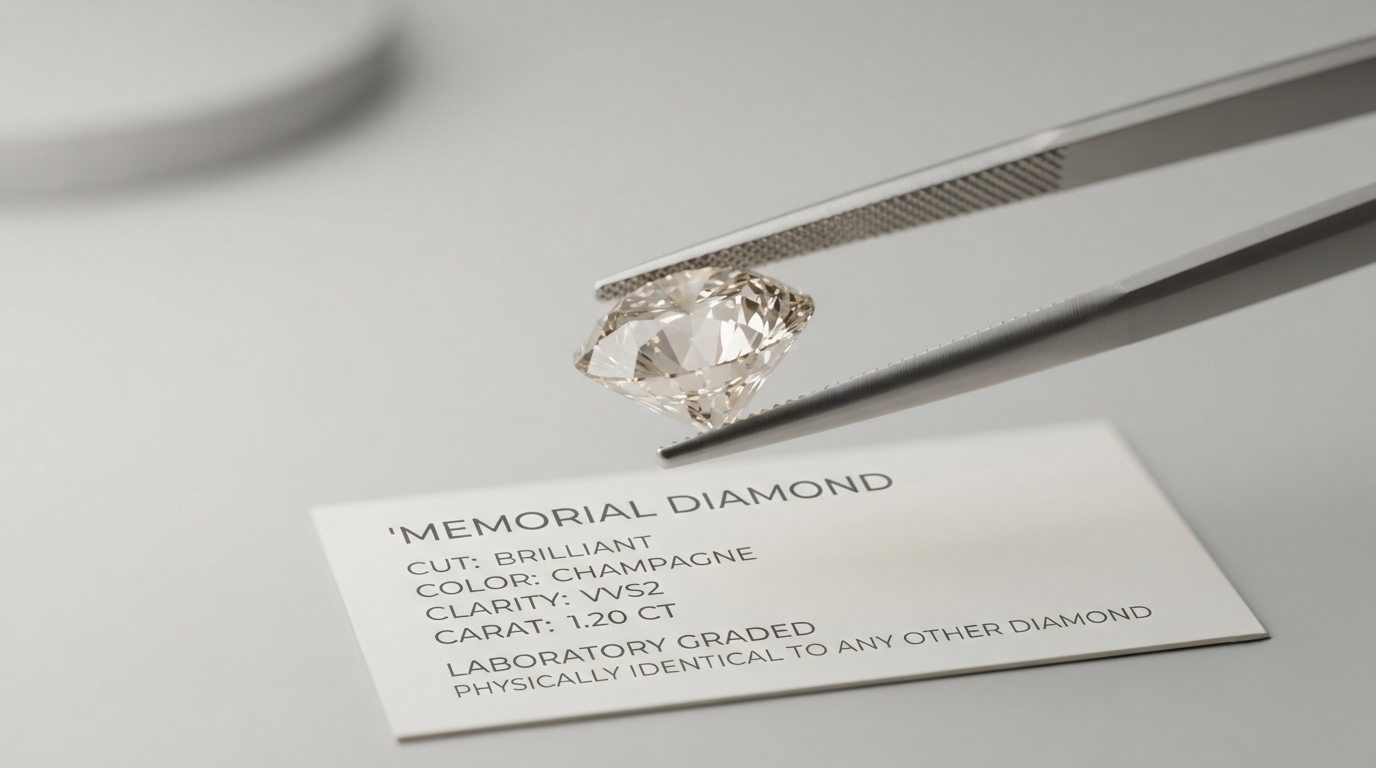
That fourth item has a trap in it. A report describing the cut, color, clarity and carat of the finished stone says nothing about what went into it, so it is not the document confirming both parcels were used. That is a separate piece of paper, and asking which one you are being offered is the most useful question on this list. The wider list worth putting to a provider before either parcel leaves your house goes well past color, and the complete guide to a combined submission sets out how the two tracks run side by side.

What If the Ashes and the Hair Are Held by Different People?

This is the situation a combined order runs into more often than any other, and it is not really a color question, but it decides whether there is a partner ashes hair diamond color to discuss at all.

A lock of hair is usually the material a partner already has, kept for years in a drawer or taken at the end. Ashes are different: they go to whoever the law and the paperwork point to, and where a relationship was not legally recognized, not acknowledged by their family, or not fully known, that person may not be you. No single national rule applies. The statute where you are governs, together with anything your partner put in writing, and the two can point different ways.

So a combined order can quietly require a second person’s agreement, where a hair only order often does not. Law in this area was built around cremated remains, not around a keepsake in a drawer, so in day to day practice hair you already hold tends to raise fewer obstacles. Treat that as a pattern rather than a rule: belongings can pass into an estate, states differ, and hair kept by another person is theirs to be asked about. That is worth knowing before a partner ashes hair diamond color family is chosen, before a quote is accepted, and certainly before money changes hands.
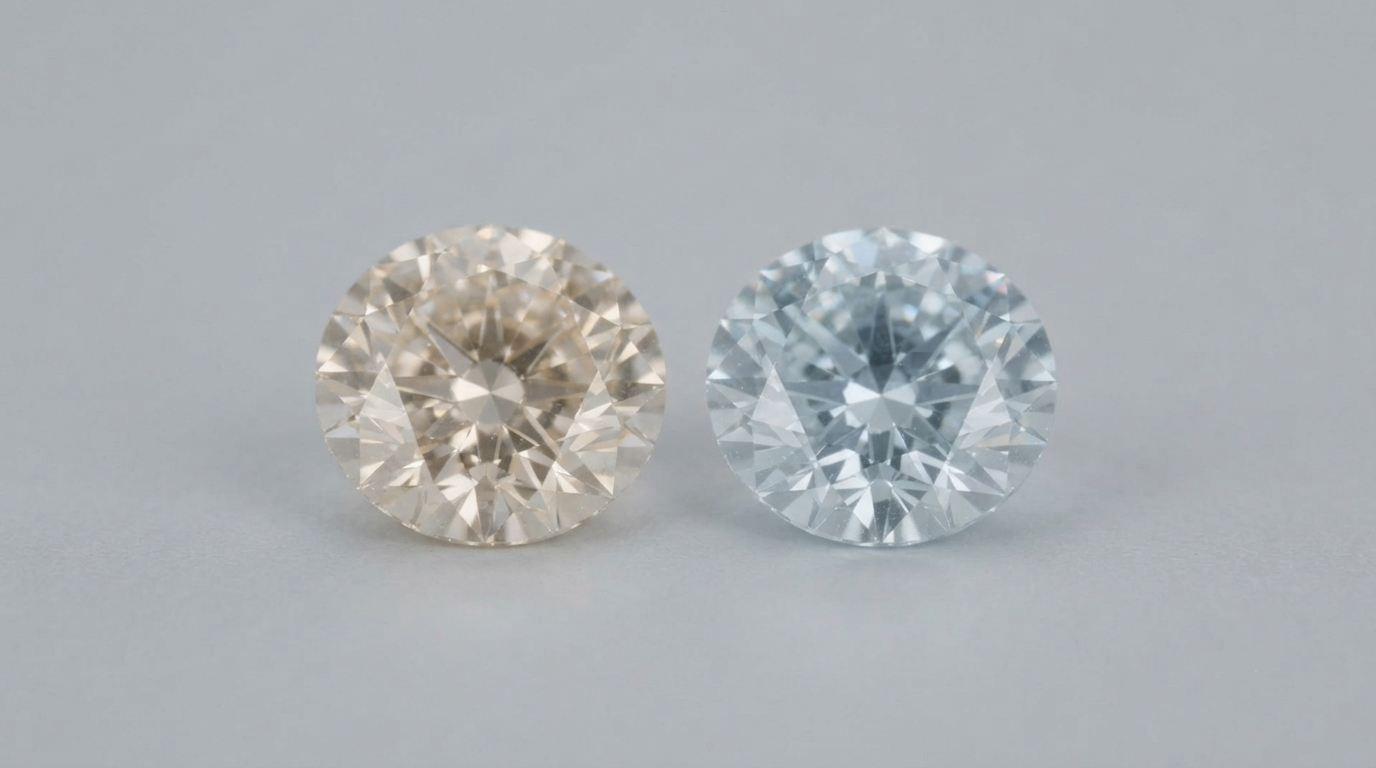
If the ashes sit with someone who would say yes but has not been asked, ask before you order, how to raise this with family covers the conversation itself. If the answer is no, or silence, a hair only stone is a complete object rather than a consolation prize, and it lands in the same partner ashes hair diamond color territory.

You do not need anyone’s permission to ask a provider what is realistic from what you actually hold. That conversation commits you to nothing at all.

Frequently Asked Questions

Will a combined stone be a blend of what each material would have produced alone?

No. Neither material carries a color into the growth cell, so there is nothing to blend. Both are reduced to elemental carbon, and a partner ashes hair diamond color is set by trace elements measured in parts per million.

Does sending both make a partner ashes hair diamond color more certain?

No. Combining does not make color more predictable, and a second organic source adds a second set of residual traces rather than canceling the first. Plan for the same broad range a single source stone has.

Will a partner ashes hair diamond color show where the hair ends and the ashes begin?

Not at all. A diamond is one continuous crystal lattice with no internal compartments, so a combined stone has no seam, no swirl and no two tone effect. It reads as a single color.

Can a combined submission still produce a colorless stone?

Yes. Colorless requires nitrogen and boron alike to be suppressed to nearly nothing, which takes additional laboratory processing and costs meaningfully more at the same carat. Two source materials neither help nor hinder that.

If we grow two separate stones, will they match?

Treat matching as unlikely. Separate runs have their own conditions and their own recovered carbon, so a visible difference between the two is the expected result rather than a defect in either stone.

Does the ratio between ashes and hair affect the partner ashes hair diamond color?

Ask the provider what ratios they work with, but do not expect the ratio to be a color lever. Trace element content does not scale with carbon yield, and no published figure supports predicting tone from proportions.

Final Thoughts on Partner Ashes Hair Diamond Color

Sending both materials is a decision about what the stone is made from, not about what it will look like. The two get confused constantly because they arrive in the same conversation.

Hold them apart and a partner ashes hair diamond color becomes manageable: the same known edges, the same three mechanisms and the same unforecastable middle as any other memorial stone. What a combined order genuinely adds to the partner ashes hair diamond color question is a second preparation track, a second thing to confirm on paper, and sometimes a second person who needs asking.

And if two stones would serve you better than one, that option exists and is worth raising early, provided you go into it expecting two different partner ashes hair diamond color results rather than a matched pair.

Learn More About Partner Memorial Diamonds

Talk With Memorial Diamond

Two parcels on a table deserve better than a guess. Which families are open to you, what engineered colorless would involve, and how a partner ashes hair diamond color gets written onto an order are all answerable, and the answers belong on paper before either parcel is posted. Reach out to memorialdiamond.us and ask, no material needs to leave your house for that.