
You have already had a version of this conversation at three in the morning, and it goes badly. The conversation about a partner memorial diamond goes better when the ask is narrow, specific and answerable, one small portion, named in advance, raised before anything has been arranged, and when it is held separately from the older, harder conversation about the relationship itself. Keeping those two apart is the technique. It will not make anyone say yes.
Memorial Diamond grows these stones, so this page has an interest in the outcome. It is written for the reader whose position is weakest when a family talks about a partner memorial diamond: someone who may not be the legal next of kin, whose relationship may never have been recognized, and who may be raising it with people who do not know there was one.
Table of Contents
Who Do You Tell First About a Partner Memorial Diamond?
Not the person you are closest to. Not the person most likely to agree. The person who holds legal authority over the remains. Every other conversation about a partner memorial diamond is downstream.
That sounds cold and it is the kindest order available: everyone else’s view is advisory, theirs is decisive. Going to a sympathetic sibling first feels easier and builds a coalition, which is what makes a decision maker dig in. If you do not know who holds authority, a funeral director will usually say, at no cost. It follows state law and anything your partner put in writing, so there is no general rule to look up.
| Who | What you are actually asking them for | Why they come in this order | If they say no |
|---|---|---|---|
| Whoever holds legal authority over the remains | Permission to set aside a small portion | Their answer is the only one that settles anything about a partner memorial diamond | Nothing proceeds, and every other conversation becomes optional |
| Anyone who would be hurt to hear it second hand | Nothing. You are telling, not asking | Hearing about a partner memorial diamond late is its own injury, separate from the decision | Nothing changes about the material, but it costs you something |
| Adult children, if any | Usually nothing formal, sometimes a veto in practice | They often carry more weight with the decision maker than you | Worth knowing before, not after |
| Everyone else | Nothing at all | Consulting people who do not decide invites a vote | They were never deciding |

Two rules make the table work. Talk to people one at a time, a group produces a position, an individual an answer. And never announce it to a room. An announcement about a partner memorial diamond sounds like a decision already taken.
When Should You Raise It?
Before material moves, and before money is spent. Those are the two deadlines governing any conversation about a partner memorial diamond, and they are not the same deadline.
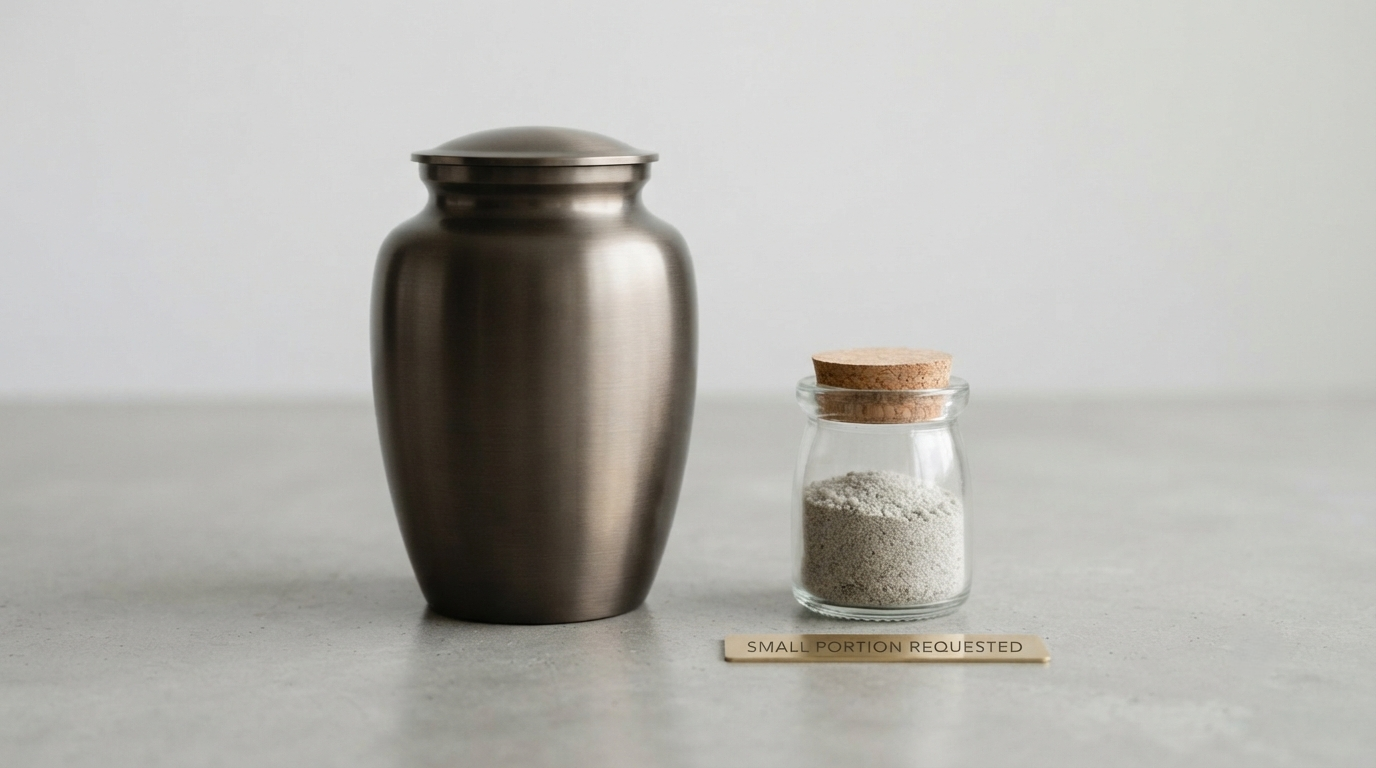
Once ashes have been divided, posted, scattered or interred, the conversation changes character. A request becomes a disclosure. Even people who would have said yes hear a completed act as something done around them, and the resentment outlives the argument. If a scattering is booked or a niche is paid for, raise it now and say the date is why, people accept urgency far better than surprise.
Money is a second deadline for a separate reason. A deposit turns a request into pressure. Nobody should be told about a partner memorial diamond in a sentence that also mentions what you already paid.
On timing after a death there is no correct interval, only two bad ones. Do not raise it at the funeral, where nobody can hear a new idea. Do not wait so long that the ashes are already settled somewhere. Between those, later usually beats sooner, except that disposition runs on its own timetable, and nothing about a partner memorial diamond makes it wait for you.
What Does the Ask Actually Sound Like?
Short. The ask about a partner memorial diamond should be far shorter than you think, and it should have a number in it.
The fear you are speaking into is almost never about diamonds. It is that you are asking for all of it, or for the part already promised elsewhere. Numbers do the work reassurance cannot:
- Name the quantity. Industry wide, a stone takes between a few tablespoons and roughly 4 oz, about 100 g, of cremated remains. How much ash a partner memorial diamond actually takes explains why.
- Name what stays. A cremation is measured in pounds. Whatever was planned for the rest still happens.
- Name the timeline. Typically 6 to 10 months from receipt, up to 12 for larger stones. Nothing happens next week, and saying so lowers the temperature.
- Name what you are not asking to change. The plot, the service, the scattering date, the urn on somebody’s shelf.
- Offer them one, if you mean it. More than one stone can come from a shared source, and whether several people can each have a diamond is the most effective thing to put on the table when a conversation about a partner memorial diamond stalls.
Then stop talking. The instinct is to follow the ask with the science, carbon, presses, purification, but science answers the second question about a partner memorial diamond, never the first. If they want it they will ask, and whether a memorial diamond is really made from a person’s ashes is better sent afterwards.
One more thing belongs in any honest ask about a partner memorial diamond: the stone is not made entirely of your partner. What is recovered gets combined with lab grown carbon until there is enough of it to work with. Where ash is the source, published figures place that fraction near 10 to 15% of the finished stone, and some cite as little as 3%; nothing comparable is published for hair or for a blended charge. Ask a provider what share your own sample will contribute. Better they hear it from you than discover it later and feel misled.
How Do You Keep This Separate From the Relationship?
By refusing, politely and repeatedly, to let one conversation become the other.
This is what makes a partner’s version different. A parent asking for a portion of a child’s ashes is having one conversation. A partner asking a family that never acknowledged the relationship is having two at once, and the second is older, angrier and unwinnable in one sitting. Everything said about a partner memorial diamond in that room is heard through it.
| What they say | What is often underneath it | A reply that does not escalate |
|---|---|---|
| “That’s not what the family does” | An objection to you, phrased as one to the method | “I understand. Can I ask separately, just about the portion?” |
| “It’s morbid” | Unfamiliarity with the category | “It’s more common than it was. Can I send you something to read?” |
| “You weren’t really family” | The relationship conversation, arriving early | “I don’t want that conversation today. I’m only asking about the ashes.” |
| “We already decided” | A decision made without you, not reopenable in public | “I know. I’m not asking to change it. Only about a portion of what’s left.” |
| “Why do you need an object?” | A real question, asked badly | “I want something I can keep. That’s all.” |
Three habits hold the line. Say the ask in one sentence and let silence work. Do not defend the relationship inside the request, because a defense turns a portion of ashes into a verdict on whether you were allowed to grieve. And name the split out loud when it comes, “that’s a separate conversation, and I’d like to have it, just not today”, which is not a trick but an accurate description of what is happening.
Accept a yes that arrives without acknowledgment. Permission to take a portion is not a ruling on the relationship. A grudging yes about a partner memorial diamond is still a yes, and the stone does not know how it was granted.
What If You Hold No Legal Standing?
Then say so to yourself, clearly, before you say it to anyone else.
Authority over cremated remains is set by state law, and by whatever your partner left in writing: a will, a disposition directive, an instruction lodged with a funeral home. Where a relationship was legally recognized this is usually straightforward. Where it was not, the remains may belong legally to a parent, an adult child, a sibling or an earlier spouse, whatever the shared history. No decision you make on your own about a partner memorial diamond can set material aside, and you cannot compel anyone.
What is still available to you:
- Ask the funeral home who holds authority. Do it early, before the cremation if you can, because afterwards it is harder to act on.
- Ask whether anything was left in writing, and whether anybody has read it rather than recalled it.
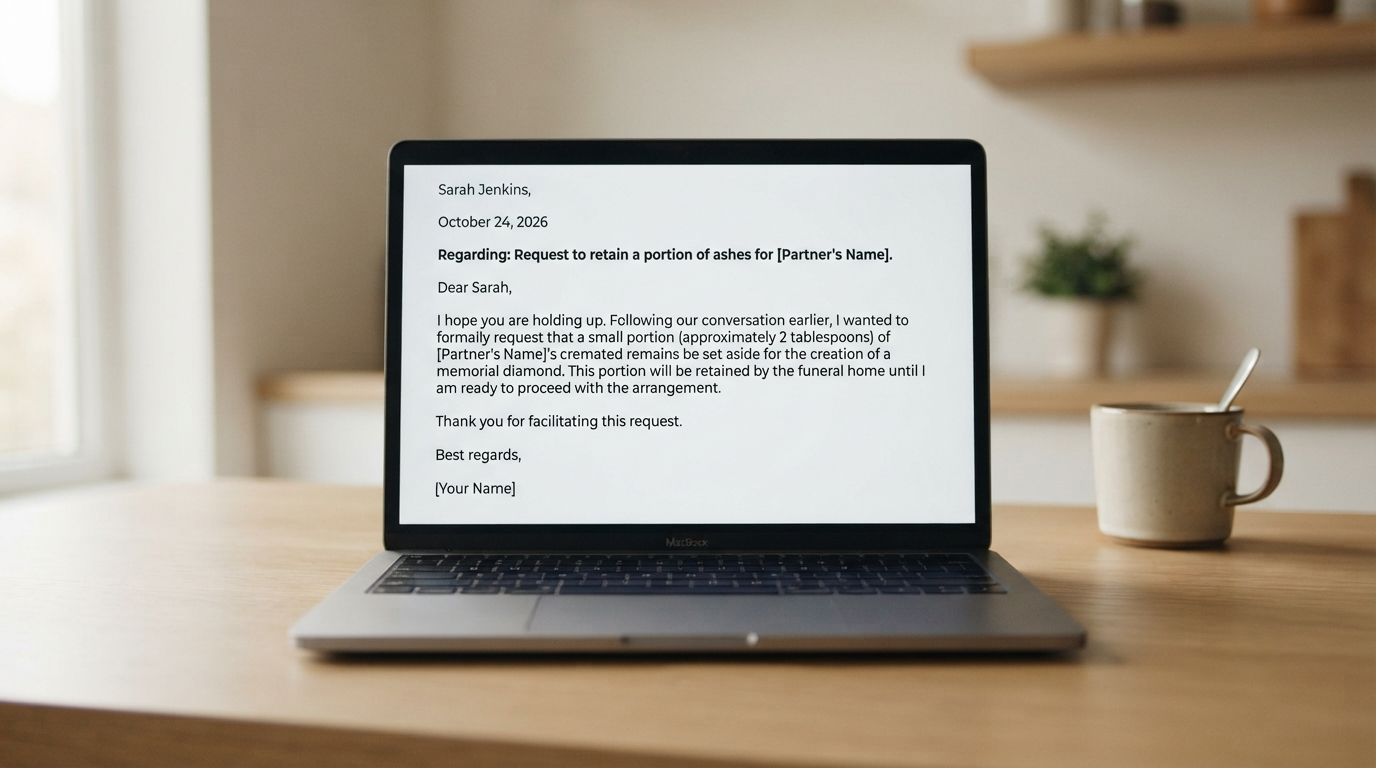
- Make the request in writing. A short, calm email about a partner memorial diamond survives being forwarded, misquoted and reread six months later. A conversation does not.
- Ask for a portion, not for a say. You are not asking to co decide the disposition, only for one specific, small thing.
- Consider hair instead. The route most often missed. Hair is roughly 50% carbon by weight, needs no cremation, and may already be in your house, on a brush, in a hat, in an envelope. The law here speaks to cremated remains rather than to keepsakes, which is why hair you already hold tends to be the less obstructed route, though belongings can be drawn into an estate, states differ, and hair kept by someone else is something you ask about, not something you decide.
That last point deserves its own sentence, because it reframes the whole question about a partner memorial diamond for people with no standing: if the material you need has never been in anyone else’s custody, the practical question is usually a far simpler one, but where it matters, check rather than assume.
What If the Answer About a Partner Memorial Diamond Is No?
It is a real answer. Treat it as one.
The useful next step is establishing which kind of no it is, and that takes one question. “Is that a no for now, or a no altogether?” Grief runs on different clocks, and an answer six weeks after a death is often not the one the same person gives two years later. Ask once, accept what you get, and do not ask again that month.
To leave a door open without pushing on it:
- Ask what would change it. Sometimes the objection is specific and solvable, a fear that the whole urn goes away, a belief that the stone is fake, a worry about cost nobody wanted to raise.
- Offer the shared version once. People refuse things they feel excluded from, and a stone each changes the request.
- Leave it in writing and leave it alone. A short note saying you would still like to, and will not raise it again unless they do, ages best.
- Do not escalate. There is no second person to appeal to, and going over someone’s head turns a maybe into a permanent no.
And the honest ending, unsoftened: sometimes the answer stays no. If it does, what you have is what is already in your house, photographs, handwriting, a coat, the hairbrush. A memorial diamond set against a traditional urn is worth reading because neither option is the better one, and a family keeping an urn intact has made a complete and reasonable choice.
What If They Never Knew About the Relationship?
Then you are delivering two pieces of news in one sentence, and the second will not be heard.
Think hard about whether the diamond belongs in that conversation. If the relationship is the news, let it be the only news. Tell them, let it settle, and raise the question about a partner memorial diamond weeks or months later as a separate request. Asked together, the portion becomes evidence in an argument about who your partner was. Asked apart, it is only a request about ashes.
If the timetable will not allow that, if a scattering is days away, say the sequencing out loud: that you know this is a great deal at once, what the relationship was in one sentence, and then the narrow ask about a partner memorial diamond. People are often better at this than expected, and sometimes they are not. Do not walk in believing it will go well. Walk in having decided what you will do either way.
There is a third option people overlook. You are allowed not to tell anyone, if the material you need is hair that was always yours. That is not deception. It is a decision about a partner memorial diamond that, in practice, usually involves nobody else, and for readers with no standing and no acknowledgment it is sometimes the only route open.
Frequently Asked Questions
Should I speak to a provider before or after I speak to the family?
Before, for information, and never in a way that commits money. Knowing the real quantity and timeline makes a conversation about a partner memorial diamond concrete rather than theoretical. A deposit paid first turns a request into pressure.
Can they stop me if the ashes are already in my possession?
Possession and authority are not the same thing, and the answer varies by state and by what was left in writing. Holding an urn does not always mean you may divide it for a partner memorial diamond. Ask a funeral director or a lawyer before acting, not after.
What if the family is split down the middle?
Work out who actually decides and talk only to that person. A divided family produces a debate, and a debate about a partner memorial diamond rarely produces permission. Others can be told once something is agreed.
Do I have to tell them what the portion is for?
Nothing obliges you to. But explained requests are granted more often than unexplained ones, and a truth kept quiet about a partner memorial diamond has a way of surfacing later at the worst possible moment.
How long should I wait after the funeral?
There is no right interval, only the constraint that ashes may be settled on a timetable you do not control. If nothing is scheduled, a few weeks is kinder than a few days for a conversation about a partner memorial diamond. If something is scheduled, raise it this week.
They want one too, and I cannot afford two. What do I say?
Say exactly that. Industry wide ranges are public, roughly $1,500 to $3,500 at entry sizes, $5,000 to $15,000 for 0.5 to 1 ct, so what a partner memorial diamond costs is a better answer than an evasion.
Final Thoughts on Talking to Family About a Partner Memorial Diamond
Nothing here guarantees an outcome, and anything promising one would be a lie. Some of these conversations go well. Some reopen an argument that was never settled, and you will have raised it knowingly.
What you control is the shape of the ask. Seven things, in this order:
- Go to whoever decides, not whoever will agree.
- Raise it before anything moves, and before anything is paid.
- Ask one person at a time, never a room.
- Put a number in the ask, say how small the portion is.
- Say what stays: the plot, the service, the date, the urn.
- Do not defend the relationship inside the request.
- Take the answer you are given, the one decision about a partner memorial diamond you get to make alone, however the rest of it goes.
Learn More About Partner Memorial Diamonds
- How Much Ash Do You Need for a Partner Memorial Diamond?
- Can More Than One Family Member Get a Diamond From the Same Partner’s Ashes?
- Partner Memorial Diamond vs. Traditional Urn: What to Know
- Questions to Ask Before Turning Your Partner’s Ashes Into a Diamond
- Choosing a Memorial Diamond for Your Partner: Where to Start
Talk With Memorial Diamond
If it would help to walk into that room with facts about a partner memorial diamond rather than adjectives, three do most of the work, and none commits you to anything.
Ask what quantity is actually needed, so you can name it. Ask what the timeline really is. Ask whether more than one stone can come from a single portion, because that answer changes more conversations about a partner memorial diamond than any other. memorialdiamond.us will answer all three without asking you to decide, and questions worth asking first covers the rest.
If sending someone a neutral explanation would help more than a company’s, the encyclopedia entry on memorial diamonds is a reasonable place to point them, and the NFDA’s 2025 cremation and burial report is worth having for anyone who thinks cremation itself is unusual.
Leave A Comment