How to Talk to Family About a Sister Memorial Diamond1

How to Talk to Family About a Sister Memorial Diamond

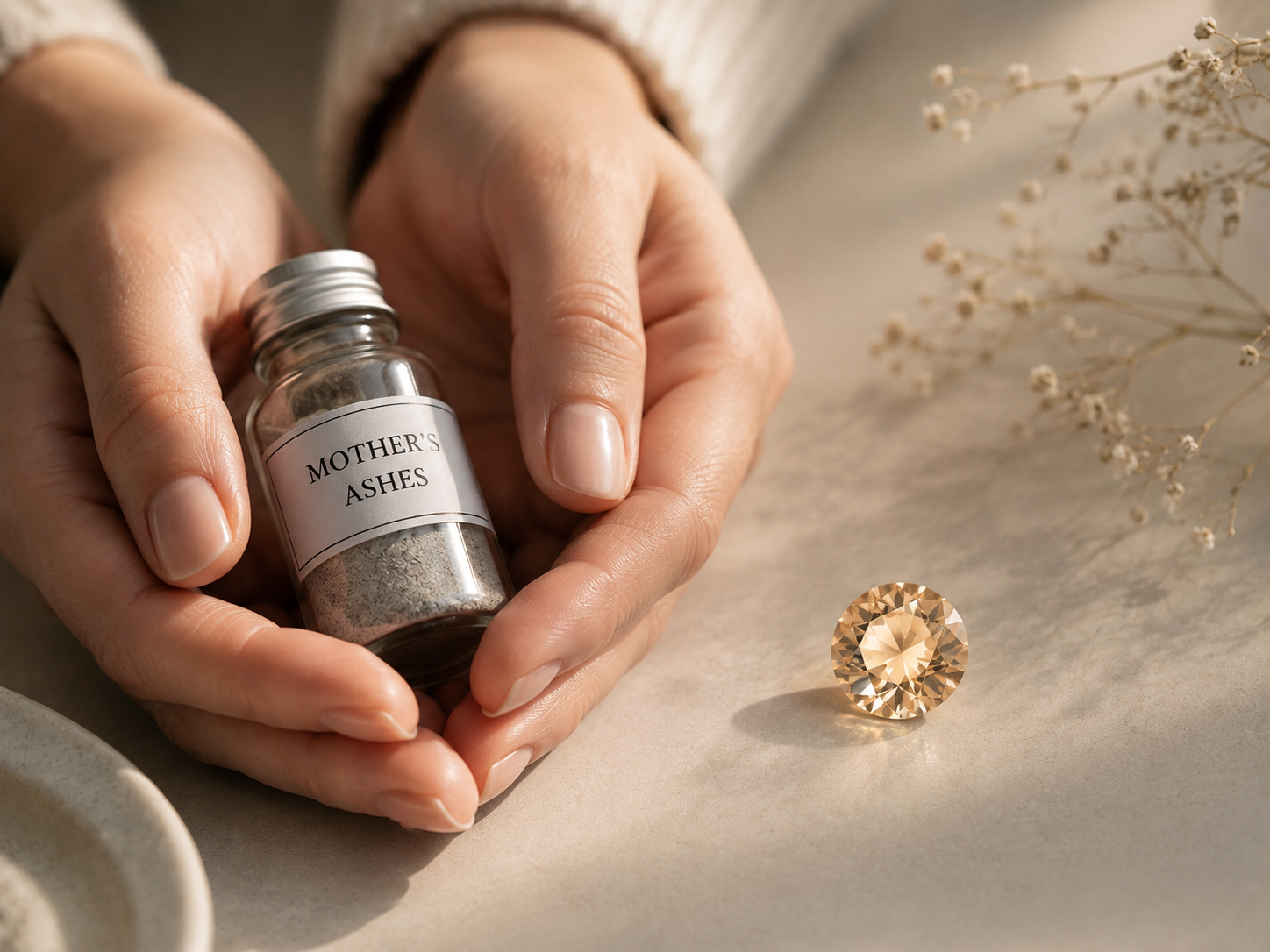
Raising the idea with her family can feel harder than deciding you want it. The first conversation about a sister memorial diamond is usually with whoever has authority over her remains, and that is often not a sibling. Start there, explain why it matters to you, ask for something small and specific, such as a few tablespoons of ashes or a lock of hair, share the provider’s custody paperwork, and write down what everyone agrees.
about a sister memorial diamond

Why Does Talking About a Sister Memorial Diamond Involve So Many People?

When a sister dies, the people who loved her often fill several roles. She may have had a spouse or partner, children, living parents, and brothers and sisters of her own, including half siblings, step siblings or adopted siblings. Each of them may feel a claim on how she is remembered, and none of those claims cancels another.

A memorial diamond also involves her physical remains. A provider needs a portion of her ashes or some of her hair, and that material has to be released by someone with the right to release it. That is why a decision about a sister memorial diamond rarely belongs to one person alone.

None of this means your wish counts for less. It means the path to it runs through other people. If you are still at the beginning, our guide on where to begin with the whole decision explains the wider choices.

Who Has the Final Say Over Her Remains?

Authority over remains comes from state rules and from any wishes she put in writing, so there is no single national answer. Before any discussion about a sister memorial diamond, it helps to understand how your state approaches it. A typical default in many states starts with a spouse or registered partner, moves to adult children, then to parents, and reaches siblings after that.

States do not all use that default, and an agent she designated or a declaration she signed can change the situation. A sibling often is not the person who decides, but that does not leave you without a voice. Siblings can ask, offer and take part, and in some situations a sibling does hold authority.

A call to the funeral home or crematory is often enough to learn whose signature is on her cremation paperwork. If the picture is still unclear, a local attorney can explain how your state handles it.

If she left hair at home, in a brush or in a keepsake, those belongings can form part of her estate, and the rules differ from state to state. Speak with the executor or whoever holds authority before collecting it, so nobody feels something was taken without asking.

Who Might You Need to Talk With, and What Are They Weighing?

The people involved differ in every family. This table can help you think through each conversation about a sister memorial diamond before it happens. It is not a list of people you must approach.

PersonRole they may haveWhat they may be weighingA respectful way to begin
Her spouse or partnerCommonly first in many states, although rules varyTheir plans for her ashes and how public a memorial feelsAsk privately and early, and make clear that their decision matters
Her adult childrenCan hold authority in some states, especially if there is no spouseTheir own wish for a keepsake and protecting their parent’s memoryOffer to include them and ask what they would want
Her parentsMay hold authority or simply carry deep feelingsGrief, faith and possibly different views from each otherSpeak with each parent in the way that suits them
Other siblingsShare your relationship with herWhether they want a stone and what feels fairAsk what they want rather than assuming
Relatives with faith concernsMay or may not hold authority, but can be influentialTeachings on cremation and dividing remainsListen first and suggest speaking with their own faith leader
The executorManages her estate, including belongingsHair or jewelry that may belong to the estateCheck before collecting anything she owned

Thinking through these relationships can show you who to speak with first and who should hear the plan from you directly. Any conversation about a sister memorial diamond is easier when the people closest to the decision are not caught by surprise.

What Are Six Steps for Talking About a Sister Memorial Diamond?

No script fits every family, but a simple order helps. These six steps keep a talk about a sister memorial diamond focused and respectful.

  1. Find out who has authority. Ask the funeral home or crematory who signed the paperwork, or ask the family directly, before planning anything else.
  2. Choose a calm time. Avoid the funeral, the reading of a will, or a crowded holiday table.
  3. Lead with her, not the product. Explain what the idea means to you before describing how it works.
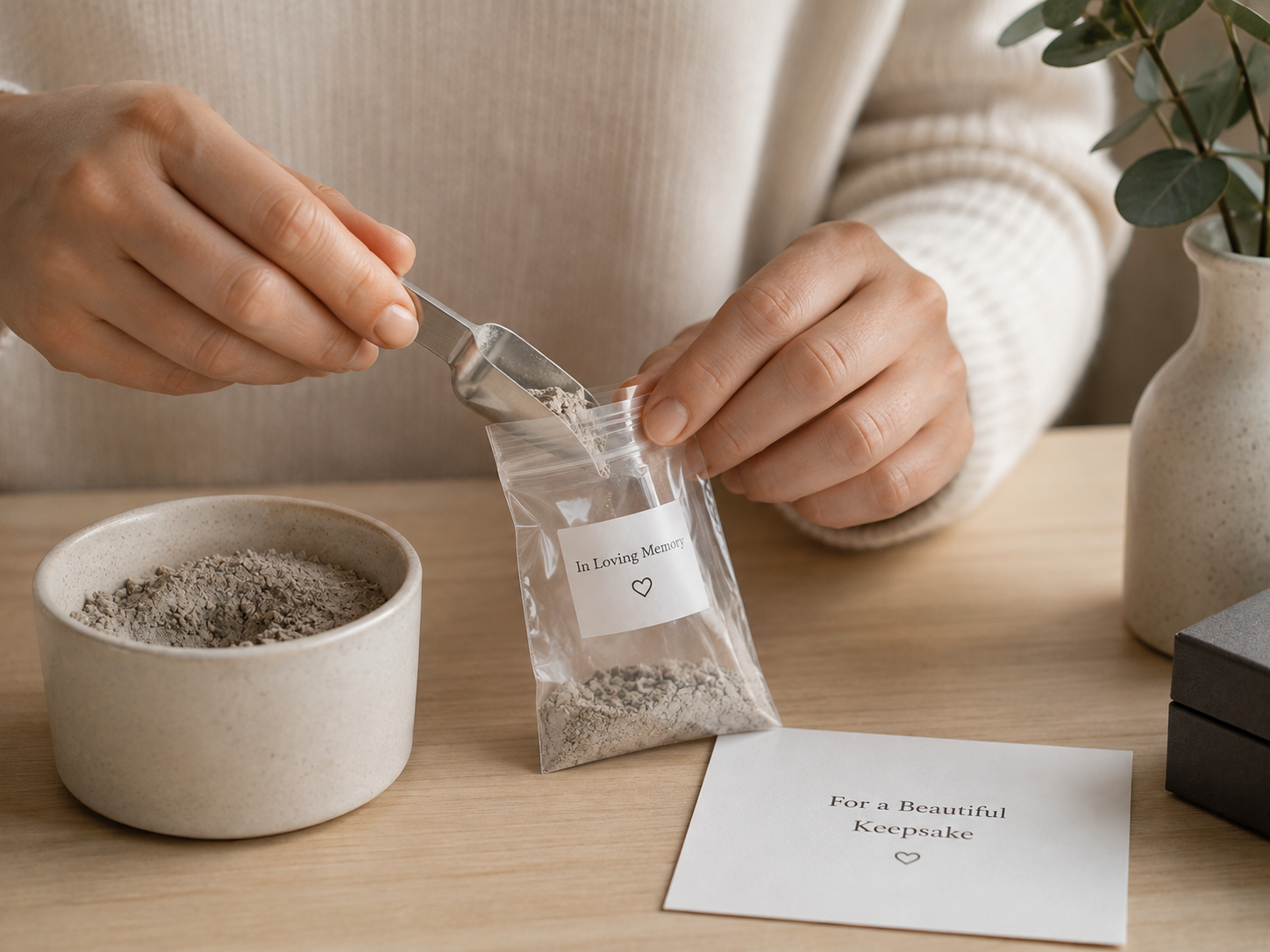
  4. Make a small, specific request. Ask whether a few tablespoons of ashes or a small lock of hair could be used rather than making a vague request for some of her remains.
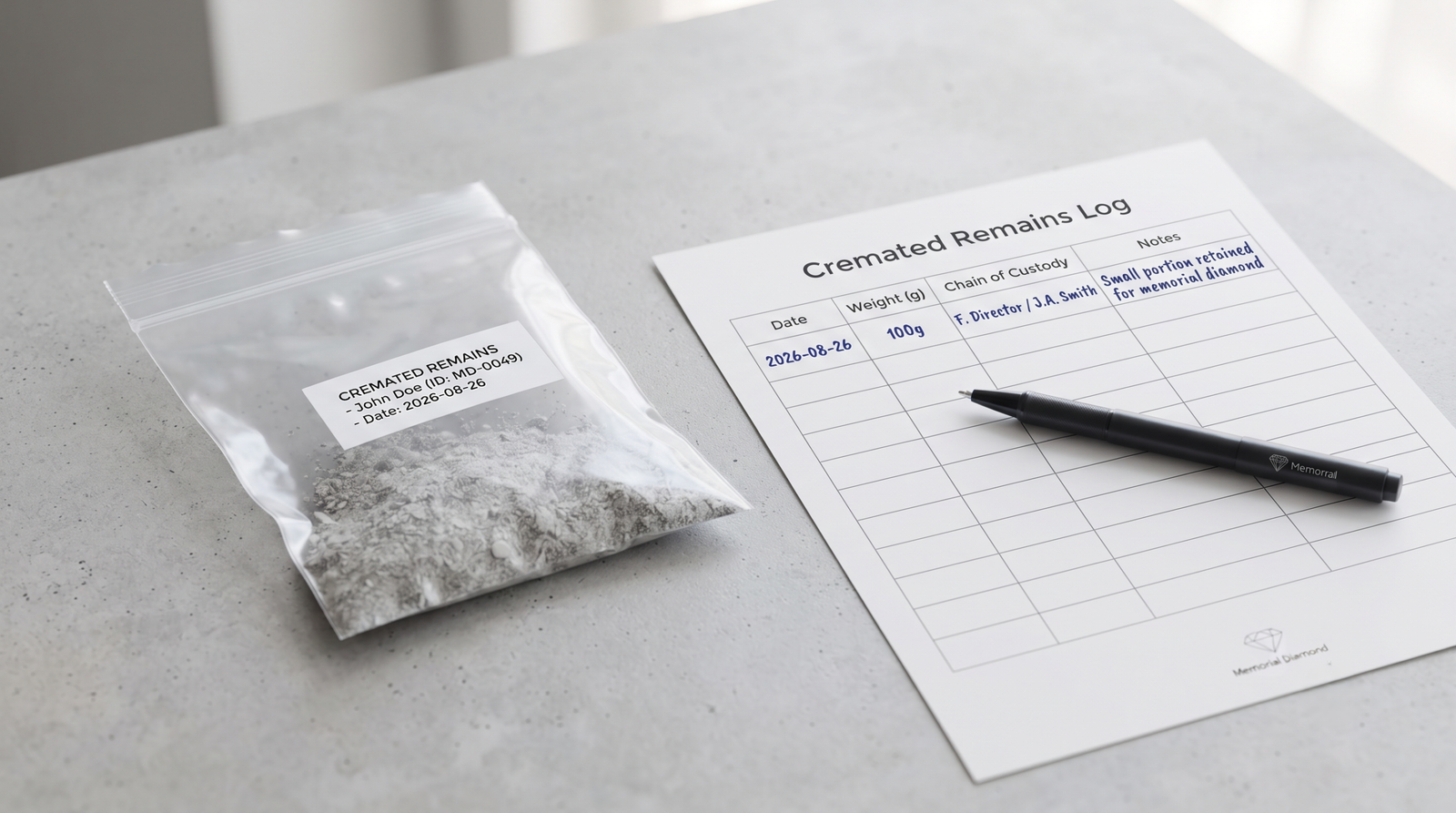
  5. Share the provider’s paperwork. Show how the material would be tracked, used and, where possible, returned.
  6. Write down what everyone agrees. Record who gave permission, what material was shared, who owns each stone and who pays.

Each step gives your family space to understand the idea and ask questions before making a decision.

When Should You Start Talking About a Sister Memorial Diamond?

There is rarely a perfect moment, but some moments are harder than others. The days around the funeral are full of logistics, and a new idea can feel like one more demand. Raising it during a dispute over belongings or a will can make it sound like another claim.

A memorial diamond typically takes six to ten months to complete once the provider receives the material, although the actual timeline depends on the provider and the order. The stone itself does not set a deadline for starting. If her ashes are going to be scattered, buried or placed in a niche, however, the conversation needs to happen before that. You can explain the timing clearly without pressuring anyone.

A private conversation, in person or by phone, often works better than a group message because it gives the other person room to react and think. A question about a sister memorial diamond dropped into a family group chat can force everyone to answer publicly before they have had time to consider it.

What Should You Say First About a Sister Memorial Diamond?

Start with her. A relative who hears that you want to make a diamond from her ashes may picture something they are not ready for. A relative who first hears that you are looking for a way to keep her close in everyday life can understand your feelings before considering the product.

Then explain the request clearly. You might say that you would like to ask whether a small portion of her ashes or a little of her hair could be set aside for a memorial stone. Explain that you will share information about how the material would be handled and documented.

Plain words in your own voice work better than a polished speech. Give your relative time to respond and do not expect an immediate answer.

Expect questions you cannot answer on the spot. Saying you will find out is better than guessing. Relatives with practical questions about a sister memorial diamond deserve accurate answers, and a wrong answer given to smooth the moment can damage trust later.

How Do You Answer the Question, Is It Really Her?

A skeptical relative may ask this first, and an honest answer is the most reassuring one. A memorial diamond is a real diamond grown in a laboratory, usually using a method also used for other lab grown diamonds. Carbon is extracted from ashes or hair, purified and used during the crystal growth process. Supplemental laboratory carbon may also be used to provide enough material for growth.

For ashes, usable carbon is only roughly 0.5 to 4 percent of the ash by weight. The share of the finished stone’s mass attributed to the person’s carbon varies by provider and process. Some providers cite figures around 10 to 15 percent, while others cite lower figures. Ask the provider to explain its process and what it can document for your order.

Hair contains a substantial amount of carbon by weight, but the finished stone’s precise carbon contribution depends on the process. Ask the provider directly rather than relying on a general estimate. Our article on whether a memorial diamond is really made from her ashes explains this subject in more detail.

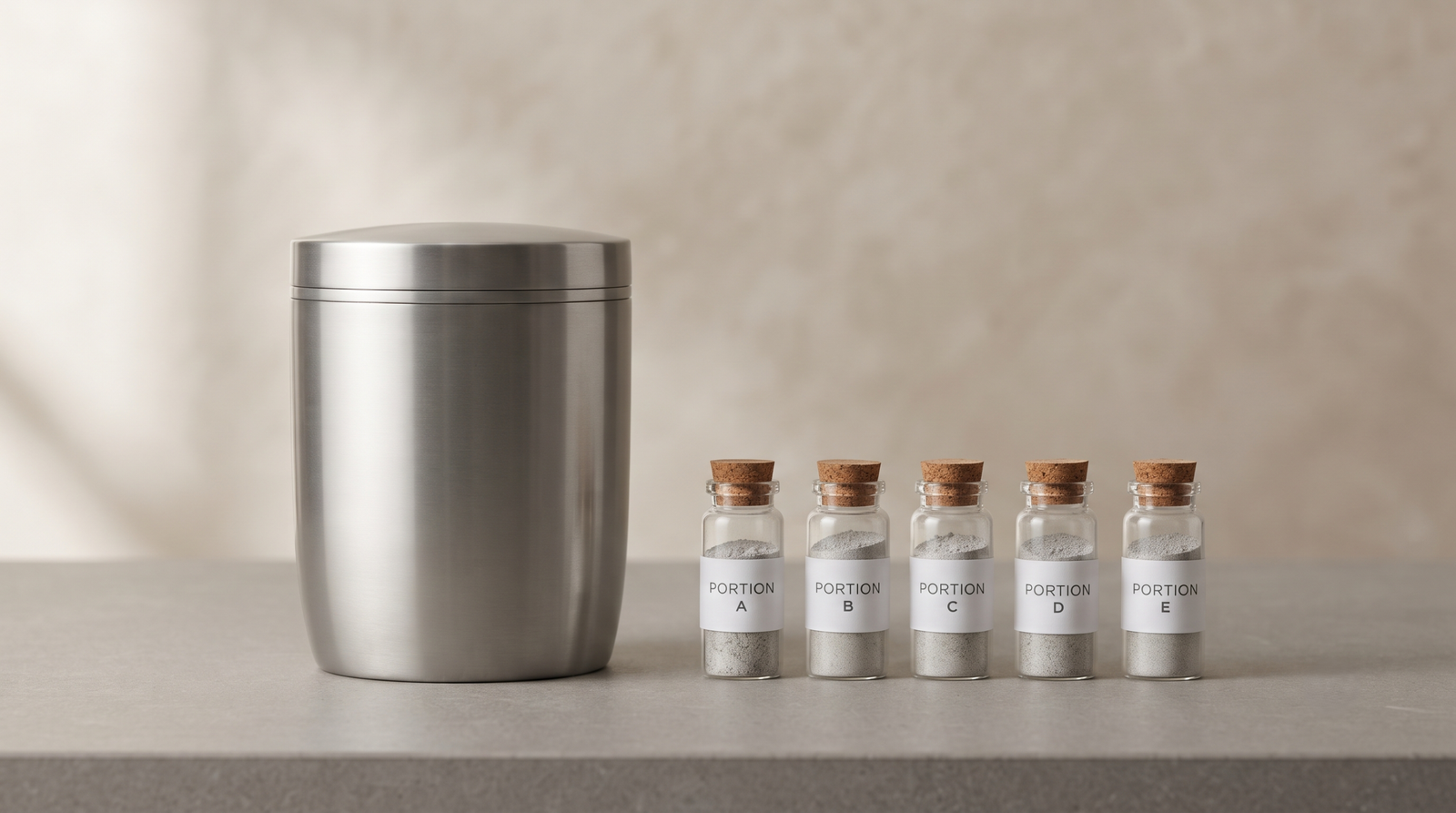
Relatives may also worry that a diamond would use most of her ashes. Providers often request an amount ranging from a few tablespoons to around four ounces, approximately 100 grams, although requirements vary. Hair based orders usually require a small lock or another specified amount.

That can leave most of her ashes available for whatever the family has already planned. Our guide to how much ash a sister’s stone usually needs explains the range to discuss before making a decision.

How Do You Talk With Parents Who Are Grieving Differently?

If both her parents are living, they may respond very differently. One may want a stone while the other finds the idea painful. They may be divorced or remarried, and she may have had a step parent who raised her. Treat each relationship on its own terms.

Speak to each parent separately if they are not on the same page, and avoid asking one to persuade the other. If a parent holds legal authority, their role generally depends on the rules that apply to the situation and any written wishes your sister left. If a parent does not hold that authority, they may still deserve to hear your thoughts before anything happens.

Resist comparing who is grieving more. A parent’s loss and a sibling’s loss are different experiences, and both deserve room. Conversations about a sister memorial diamond go better when everyone’s feelings are allowed to be real at the same time.

What If Other Siblings Want a Stone, or Do Not?
Siblings may each want a stone, want to share one, or want nothing to do with the idea. Every one of those choices is valid. One sibling who would rather keep a photograph and another who wants a ring are both remembering her.

Because only a portion of ashes or hair may be needed, more than one stone can sometimes be made from the same source. What is possible depends on the provider, the available material and the requirements for each order. Our guide to more than one relative receiving a diamond from her ashes explains how families can approach this question.

Be careful not to assume who counts as a sibling when discussing a sister memorial diamond. Half siblings, step siblings and adopted siblings may feel the same connection, and leaving someone out by accident can hurt more than an open disagreement.

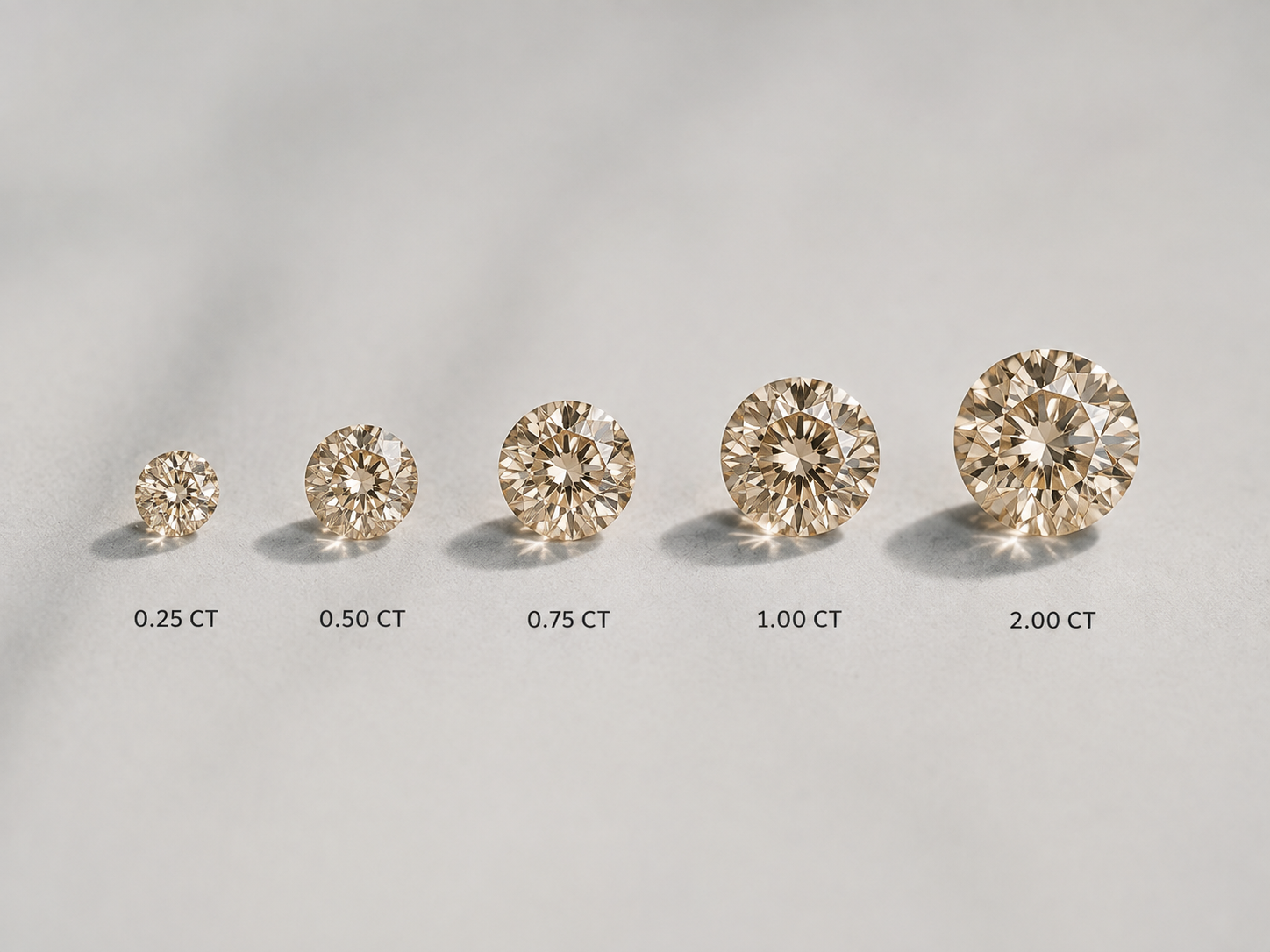
Cost belongs in the family conversation, too. As an illustrative industry range for 2026, smaller stones of roughly 0.10 to 0.25 carats may cost around $1,500 to $3,500. Settings, engraving and grading may cost extra. Prices vary by provider, size, color and other options, so request a written quote before agreeing to an order.

Decide early whether each person will pay for their own stone or whether costs will be shared. Clear expectations can prevent misunderstandings later.

How Do You Handle Faith Questions About a Sister Memorial Diamond?

Some relatives will have religious concerns about cremation, dividing remains or keeping remains at home. Practices differ by faith, denomination and individual faith leader. Religious teachings often address cremation and the care of ashes, while a family’s questions about memorial diamonds may require a conversation about those broader teachings.

Listen before responding, and do not try to argue anyone out of a belief. Suggest that the relative speak with their own faith leader, or offer to go with them. If cremation itself is the concern, a diamond grown from hair does not require cremation. That distinction may matter to some families. Our complete guide to a diamond grown from her hair explains how that option works.

Respecting a faith concern about a sister memorial diamond does not always mean dropping the idea. It may mean waiting, considering hair instead of ashes, or keeping the stone private. The right decision is one the family can approach with care and understanding.

What Can the Provider’s Paperwork Show Your Family?

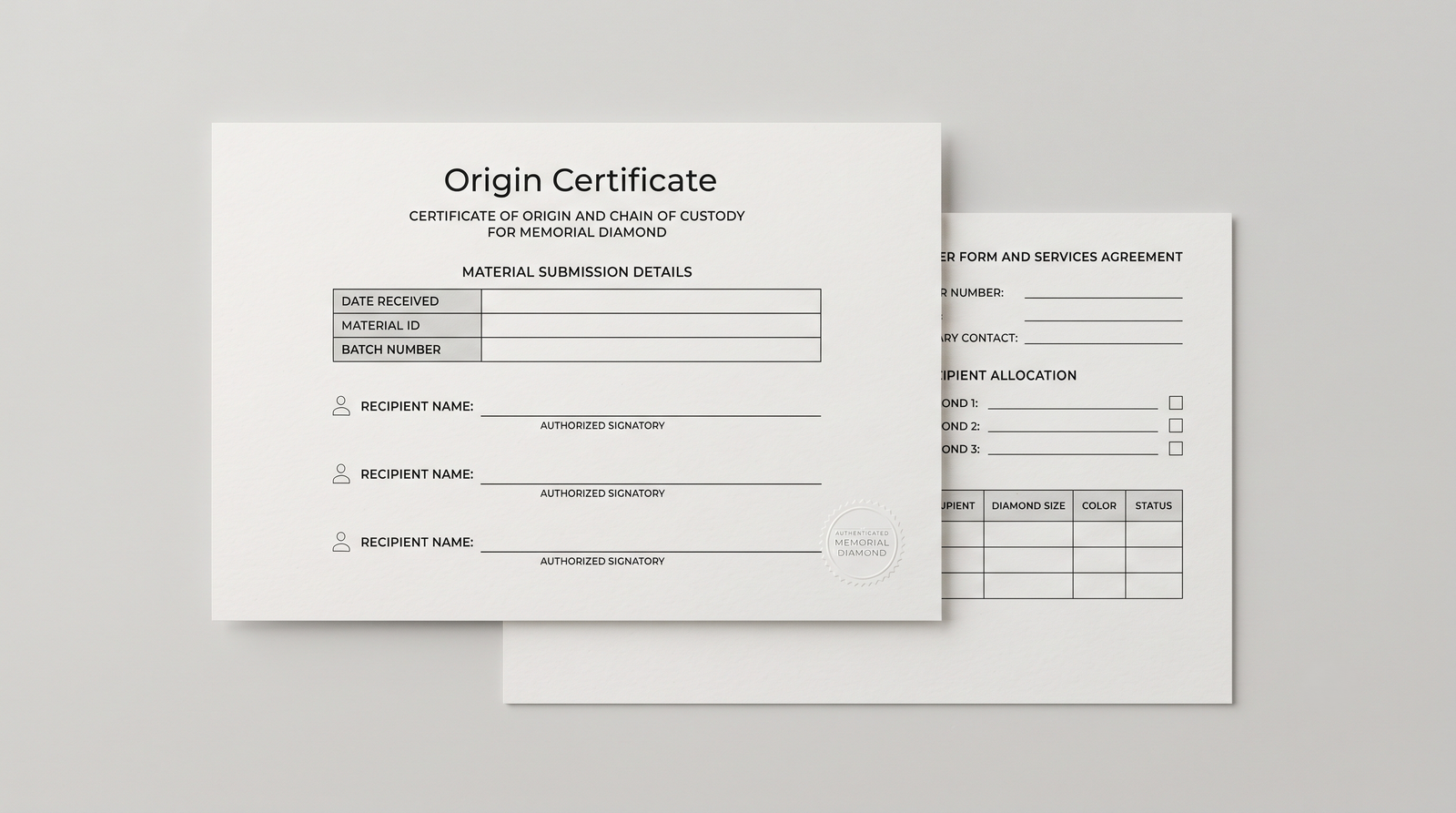
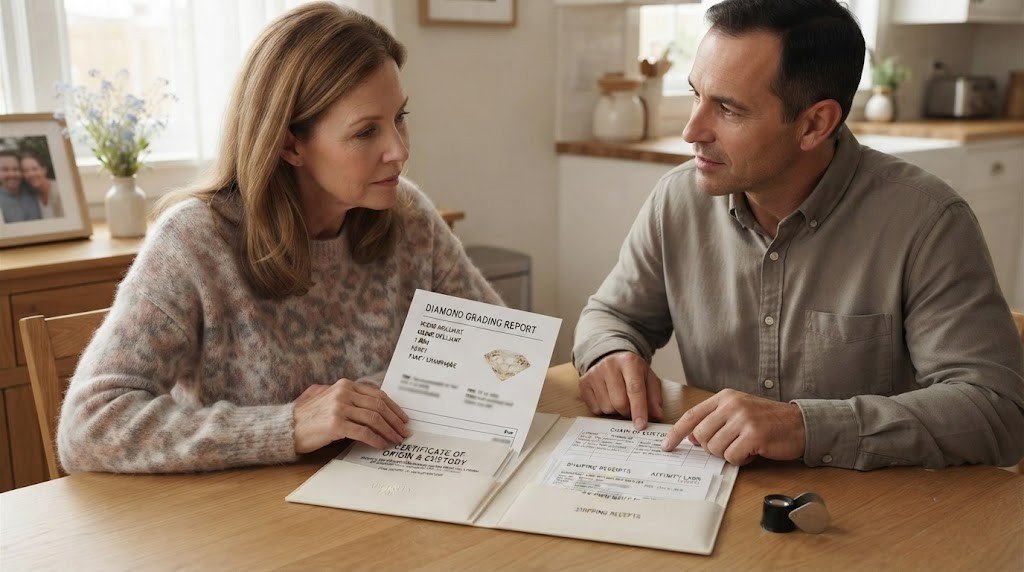
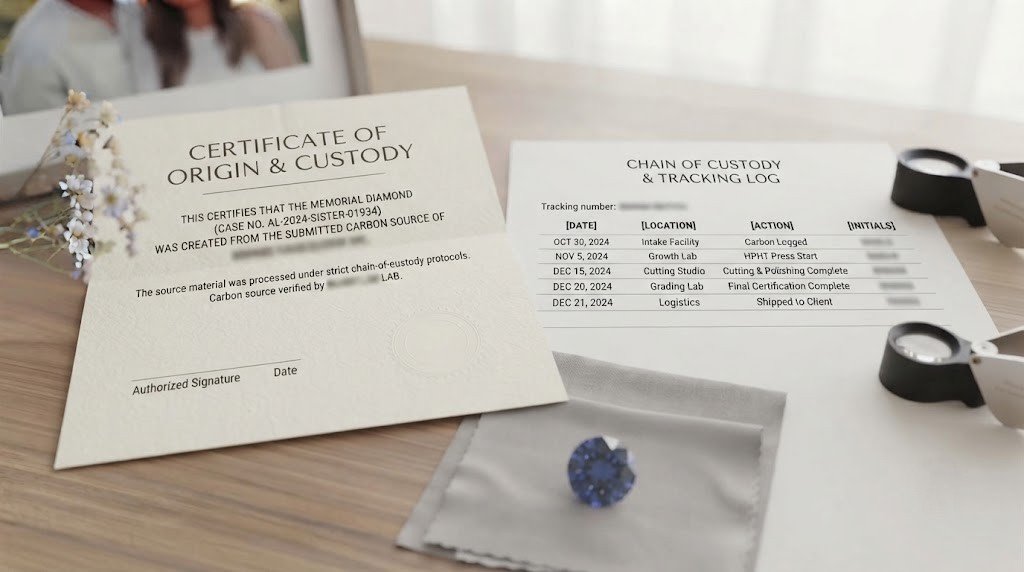
Handing over a portion of someone’s remains takes trust. Ask the provider how it tracks the material from arrival through the finished stone and what documentation it supplies. A certificate of origin or authenticity may record details about the diamond and its stated source. The exact documentation depends on the provider, so review it before committing.

Before the conversation, ask the provider to explain or send written answers to these questions.

  • How is the material labeled and tracked at each stage?
  • What happens to ashes or hair that are not used, and can unused material be returned?
  • What happens if the diamond does not grow as planned or is damaged during cutting?
  • What information appears on the origin certificate?
  • Is an independent grading report available, and what does it cover?

Our list of questions to ask a provider before sending her ashes covers more ground. Sharing written answers lets relatives read at their own pace. Clear documents can address concerns about a sister memorial diamond more effectively than reassurance offered in the moment.

What If the Answer About a Sister Memorial Diamond Is No or Not Yet?

A not yet is a real answer, and it may be temporary. Someone who cannot face the idea early on may feel differently later. Thank them for being honest and ask whether you may raise the subject again at a time they choose.

A firm no from the person with authority over her remains is harder to hear. It is fair to ask gently whether a particular part of the idea is the obstacle, such as using ashes, wearing jewelry, the cost or the timing. Sometimes a different approach, such as using hair or having another relative keep the stone, may address the concern. If it does not, respecting the answer can help protect your relationship.

If you believe a decision is unfair, a local attorney can explain the rules that apply in your state. Formal disputes over remains can place lasting strain on family relationships. Other ways of keeping her close remain possible whatever the answer. Our comparison of a memorial diamond and a traditional urn may help if the family prefers an urn.

How Do You Put Agreements About a Sister Memorial Diamond in Writing?

Writing things down is not a sign of mistrust. It protects everyone from remembering the same conversation differently years later. A short email that each person replies to can provide a useful record. Whether a more formal agreement is appropriate, especially when money or estate property is involved, is a question for a local attorney.

A written note should answer these questions.

  • Who gave permission for the material to be used?
  • What amount of ashes or hair was shared, and with whom?
  • How many stones will be made?
  • Who owns each stone?
  • Who will pay for the process, settings and any additional services?
  • What happens to unused material?
  • Who will keep the origin certificate and related paperwork?
  • If two people share a stone, where will it be kept and what happens to it later?

Keep copies with the provider’s paperwork, and consult a local attorney if estate questions are involved. An agreement about a sister memorial diamond written while everyone is calm is easier to understand and follow than one pieced together after a misunderstanding.
Frequently Asked Questions

Do I need permission to use my sister’s ashes for a diamond?

You will generally need agreement from whoever has authority over her remains. Who holds that authority depends on state rules and anything she put in writing. It may be a spouse, adult children or parents. The funeral home or crematory can help identify the person who signed the paperwork, and a local attorney can explain the applicable rules.

Can I ask for a lock of her hair instead of ashes?

Yes. Some families find this a gentler request. Hair does not require cremation, and providers typically request only a small amount. Hair she left at home may belong to her estate, so check with the executor or whoever has authority before collecting it.

What if her spouse and her parents disagree?

Where relatives disagree, the person with authority under the applicable rules and her written wishes generally has the deciding role. Speak with each side separately, avoid taking sides and explore an option everyone can accept, such as using a small portion of material or considering a hair based stone.

Should I contact a provider before telling the family?

Gathering information about a sister memorial diamond first is reasonable because it helps you answer questions accurately. Avoid committing to an order or sending material until the person with authority has agreed. This helps the family understand that the decision is not being made without them.

Can a relative who said no change their mind later?

Yes. Feelings about a sister memorial diamond can change over months or years. If ashes or hair are kept safely and the material remains suitable, it may be possible to use them later. Leave the conversation open, ask whether you may raise the idea again and let the relative choose when.

Who should keep the origin certificate if a stone is shared?

Agree on this in writing before the stone is made. The person who keeps the stone may hold the original certificate, while other family members keep copies. Keeping the documentation with the stone can be helpful if it is reset or passed down in the future.

Final Thoughts on Raising It With Her Family

The wish to carry something of your sister with you is ordinary and human, and so is the worry about how her family will feel about a sister memorial diamond. Neither makes you wrong for asking.

Go gently, ask clearly and accept that the answer may take time. Give your family accurate information, respect the person who has authority over her remains, and write down any agreement. A conversation handled with patience can help protect family relationships, whatever is decided in the end.

Learn More About Sister Memorial Diamonds

Talk With Memorial Diamond

If you are preparing to talk with family about a sister memorial diamond and want accurate answers to bring to that conversation, visit Memorial Diamond. Learn more about how memorial diamonds are made and what questions to ask before deciding, at a pace that suits you and your family.
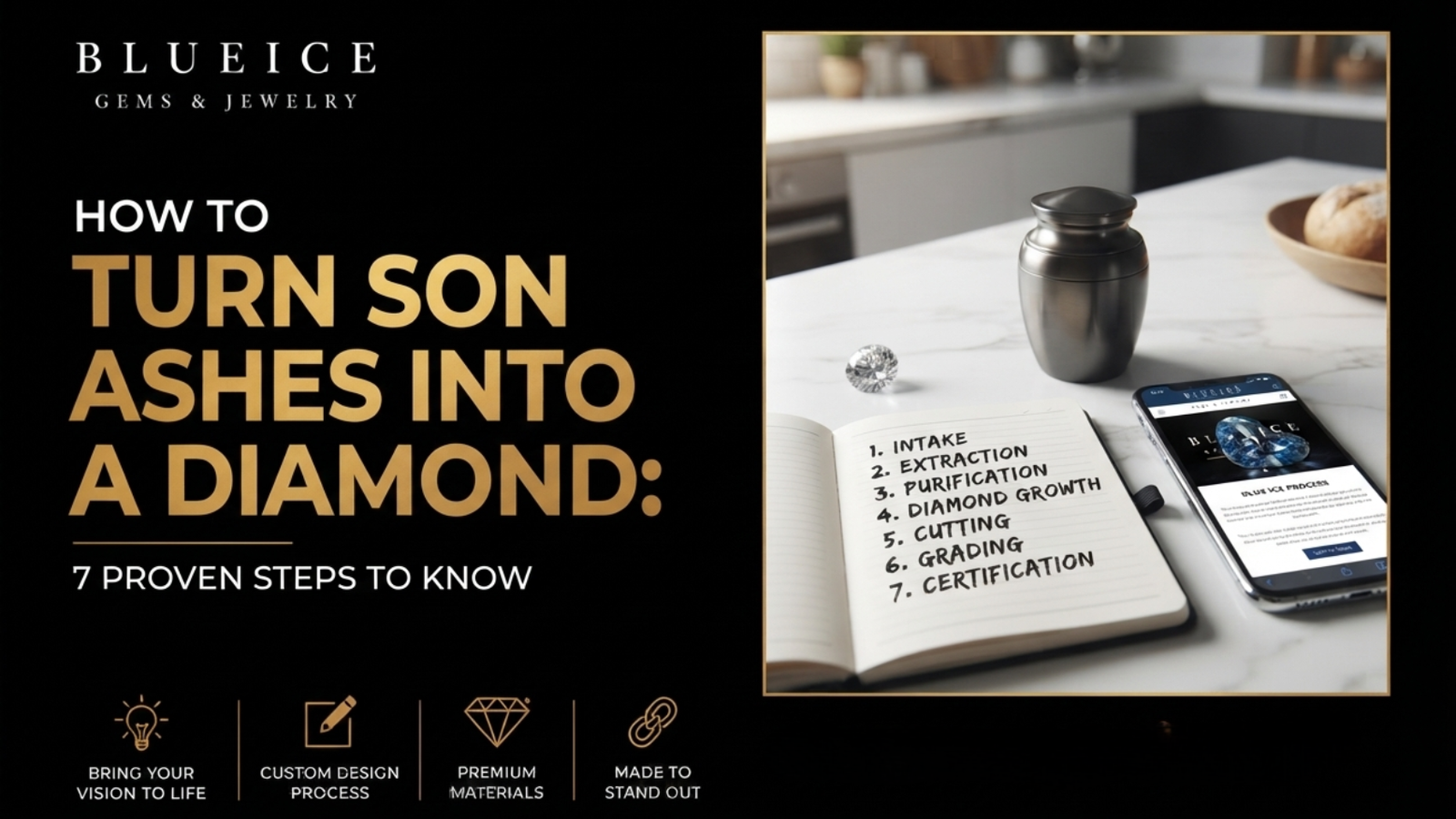
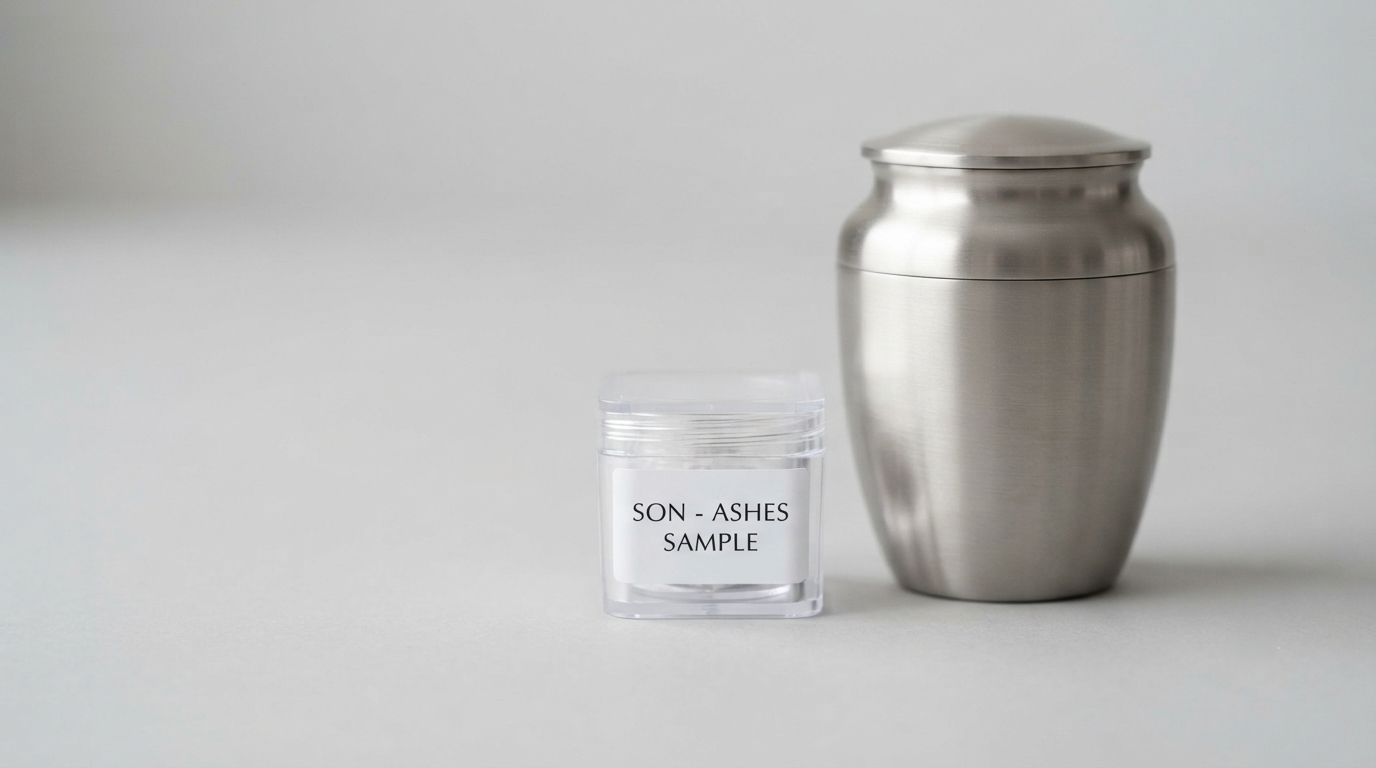
Turn son ashes into a diamond: a sealed keepsake container, a notebook with a numbered list, and a phone on a kitchen table

How to Turn Your Son’s Ashes Into a Diamond

Parents who contact us about this rarely open with a question about diamonds. They ask what the first phone call is, and whether making it commits them to anything.

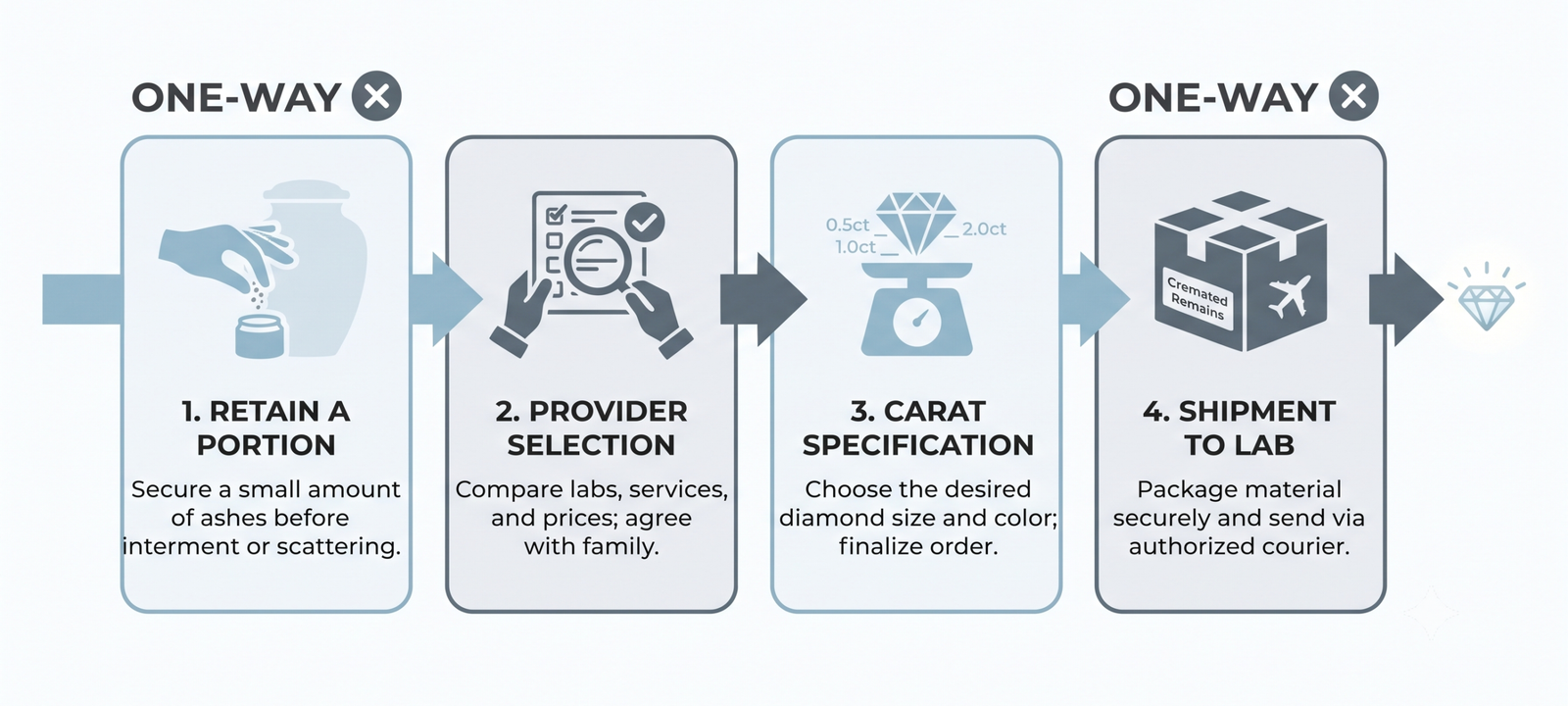
Families who turn son ashes into a diamond work through the same seven steps: confirm who holds legal control of the remains, settle the stone you want, separate a portion, industry typically a few tablespoons up to roughly 4 oz, and send it to a laboratory that returns a real lab grown diamond in about six to ten months. Of those seven steps, three cannot be undone.

Memorial Diamond grows memorial stones, so read our account of how to turn son ashes into a diamond knowing we have a commercial interest in it.

What Does It Take to Turn Son Ashes Into a Diamond?

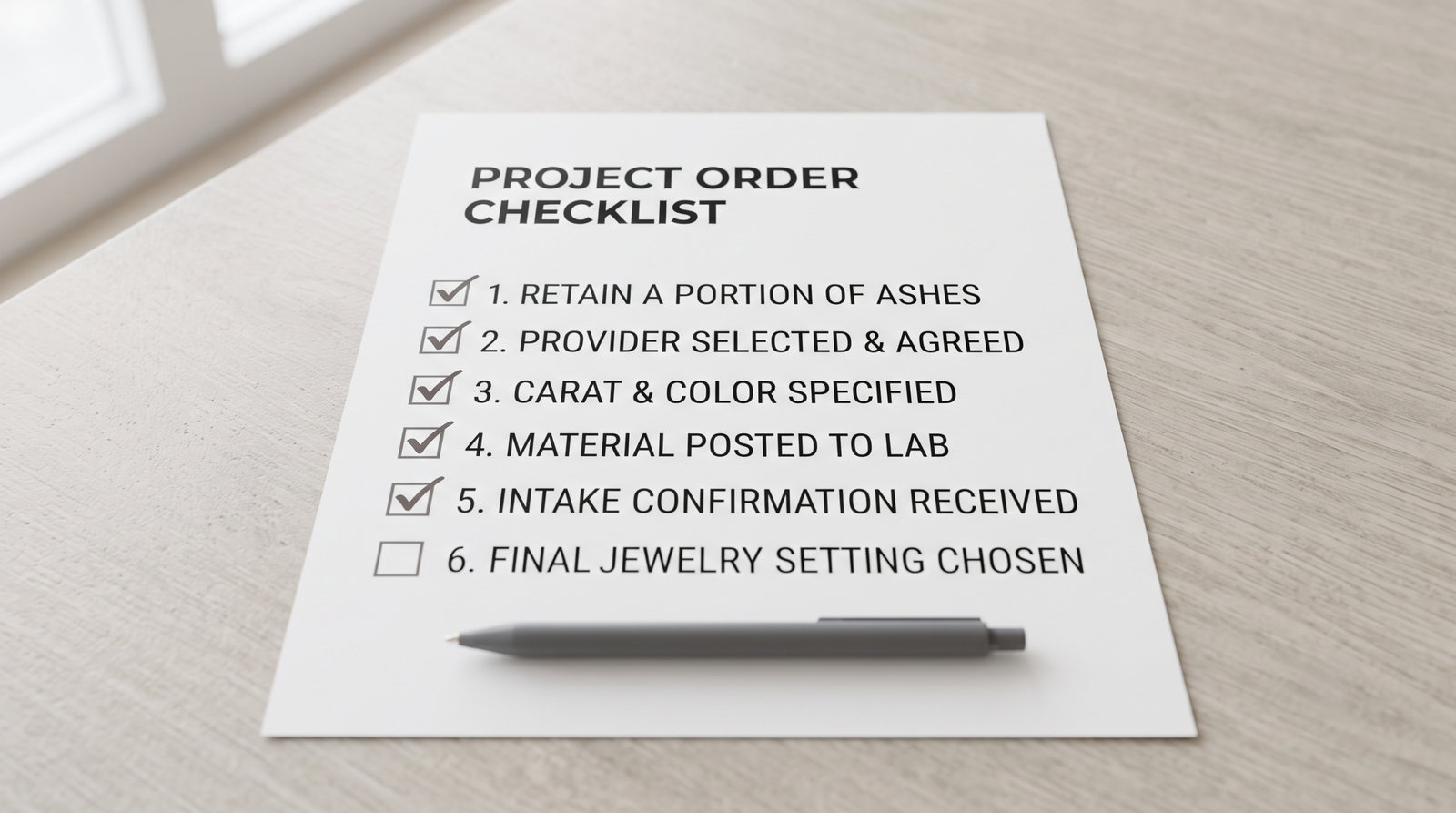
Seven steps, of which three commit you, and they are arranged so that everything reversible comes before the first of those three. None is technically demanding; the difficulty is entirely in the sequencing.

StepWhat is actually happeningReversible?
1Establishing who legally controls the remainsYes, finding out commits nothing
2Telling the people this affectsPartly; it cannot be unsaid
3Fixing the object, carat and color rangeYes, until material moves
4Separating a portion and authorizing the work to turn son ashes into a diamondNo
5Purification and graphitizationNo
6The growth run under pressureNo
7Cutting, optional independent grading, settingYes, late choices
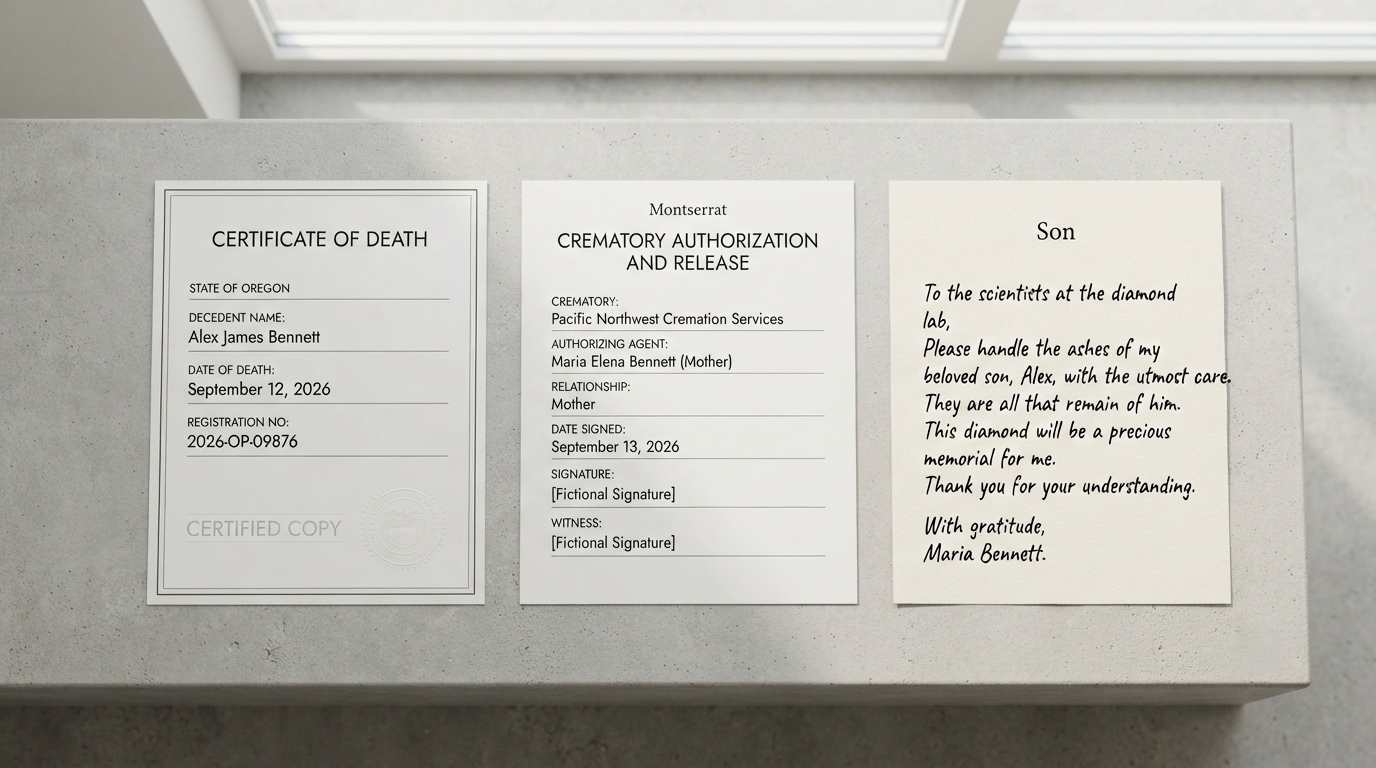
A death certificate, a crematory release form and a handwritten note laid out side by side

Read the last column first. Steps 4, 5 and 6 each consume material and shut a door behind you. Steps 1 to 3 exist so that everything needed to turn son ashes into a diamond is settled before step 4 begins.

If you have not settled whether to turn son ashes into a diamond at all, the guide that weighs it against the alternatives handles that decision.

Step 1: Who Actually Controls His Ashes Right Now?

This is the step that most often surprises parents. No single national rule decides who holds authority over a person’s remains. Each state sets its own order of priority, and a document your son left, a will, a disposition directive, a form naming an agent, can override it. Statutes broadly share one thing: a surviving spouse sits near the top and adult children often rank above parents. Whether your son was twenty two or fifty two, if he had a wife, a husband, a registered partner or children of his own, the standing needed to turn son ashes into a diamond may sit with them, not with you.

Establish it before money is spent. Three things to find out:

  • Where the ashes are, and who signed for them. The crematory records who authorized the cremation and who collected the remains; one call settles it.
  • Whether he left anything in writing. A directive, will clause or pre need form can change the answer entirely.
  • What your state’s priority order says. It varies, and assuming is how families discover mid process that someone was never asked.

If you and his other parent are no longer together, or are not of one mind, that does not stop anything by itself. It changes who has to be asked, and often means one of you does the legwork alone. A parent arranging this alone is common, and not a failure of anything.

If you do not hold authority and will not be given it, that is an answer rather than the end of it. A lock of hair already in your own house needs no cremation, and because the rules in this area attach to remains rather than to a keepsake in a drawer, it is usually the more straightforward question in practice, a lock of his hair instead is the route that often stays open when you cannot turn son ashes into a diamond.

Step 2: The Conversation That Comes Before Anything Is Opened

Other people have a stake in the ashes even where they hold no authority: his siblings, his partner, grandparents. Telling them comes before step 4, because the order decides how both go.

Raised in advance, a plan to turn son ashes into a diamond is a proposal, and a proposal can be answered. Raised afterwards, it is a disclosure about something already done, the only part of the sequence genuinely hard to repair.

Worth having ready:

  • How much you are proposing to use. Most families are surprised it is a portion, not all of it, and the objection often dissolves there.
  • What happens to the rest. Saying plainly that the urn stays, or the scattering goes ahead, removes the fear that this replaces an agreed plan.
  • Whether more than one stone is possible. If his sister or his partner would want one, that is easier to arrange now. Whether several family members can each have a diamond from the same ashes covers it.
  • That nothing is booked. At step 2, a decision to turn son ashes into a diamond is still only a conversation.

Some of these conversations end without agreement. Better to learn that now than with a container already open.

Step 3: Settle the Stone Before You Price Anything

Three things get fixed here: the object you want to hold, the carat it implies, and the color range you will accept. All three are free to change your mind about, which is why they precede the portion.

Start with the object. A ring worn daily, a pendant under a collar, a loose stone in a box, and a setting shared between two parents point at different sizes. Carat is bought, not determined by the ashes: size follows growth time in the press, so a larger portion does not produce a larger stone.

Color is narrowed, not chosen. Nitrogen in the growth cell pulls the crystal toward yellow and boron toward blue; a colorless stone is one where neither element was present in any quantity, which is why colorless has to be engineered and costs more. Ash is an organic source carrying trace elements of its own, so warm tones are ordinary rather than a fault. Ask what range a provider will put in writing before you turn son ashes into a diamond, what to expect from memorial diamond color sets out how wide it honestly runs.

Settle the provider here too. Six things to ask before you turn son ashes into a diamond: the exact minimum, and whether it is weight or volume; what container the material travels in; what documentation comes back at intake; what happens to material not consumed; what follows a failed growth run; and whether a later order can use material separated today.

Step 4: Separating the Portion, and Authorizing Its Use

Here is the first door that shuts in any plan to turn son ashes into a diamond. A portion separated, sealed and sent is committed, and material that enters a growth run is consumed by it.

So the question is not only whether the quantity is enough, but what it leaves you holding.

If you want to keep openThen set asideConfirm first
A second stone later, for a sibling or the other parentTwo provider minimums, stored separatelyWhether a later order can use material separated today
The scattering or interment already plannedThe minimum only, remainder sealed as it isThe stated minimum, so you take no more than needed
A share for his spouse, partner or childrenTheir portion separated before yoursWhat each person expects, before anything is opened
Simply not deciding yetA little over the minimum, labeledThat material separated in advance is still accepted when you turn son ashes into a diamond later
A small labeled container sealed beside a larger urn that has not been opened

Then the fact that makes restraint easy: ash is mostly the calcium phosphate of bone, with usable carbon at roughly 0.5% to 4% by weight. What is recovered is purified past 99.9% and made up with lab sourced carbon, because no household quantity of ash fills a growth cell alone. Industry figures for the ash route put his own carbon at around 10% to 15% of the finished stone’s mass, and some providers cite figures as low as 3%. Ask which end of that range a company works to. Parents who turn son ashes into a diamond and keep the remainder lose nothing: a doubled portion does not raise that share, enlarge the stone or shorten the wait.

Write down what you did, the date, the quantity, who was present, where the remainder sits. Nobody else records this step.

Step 5: Packing, Posting, and What to Confirm That Morning

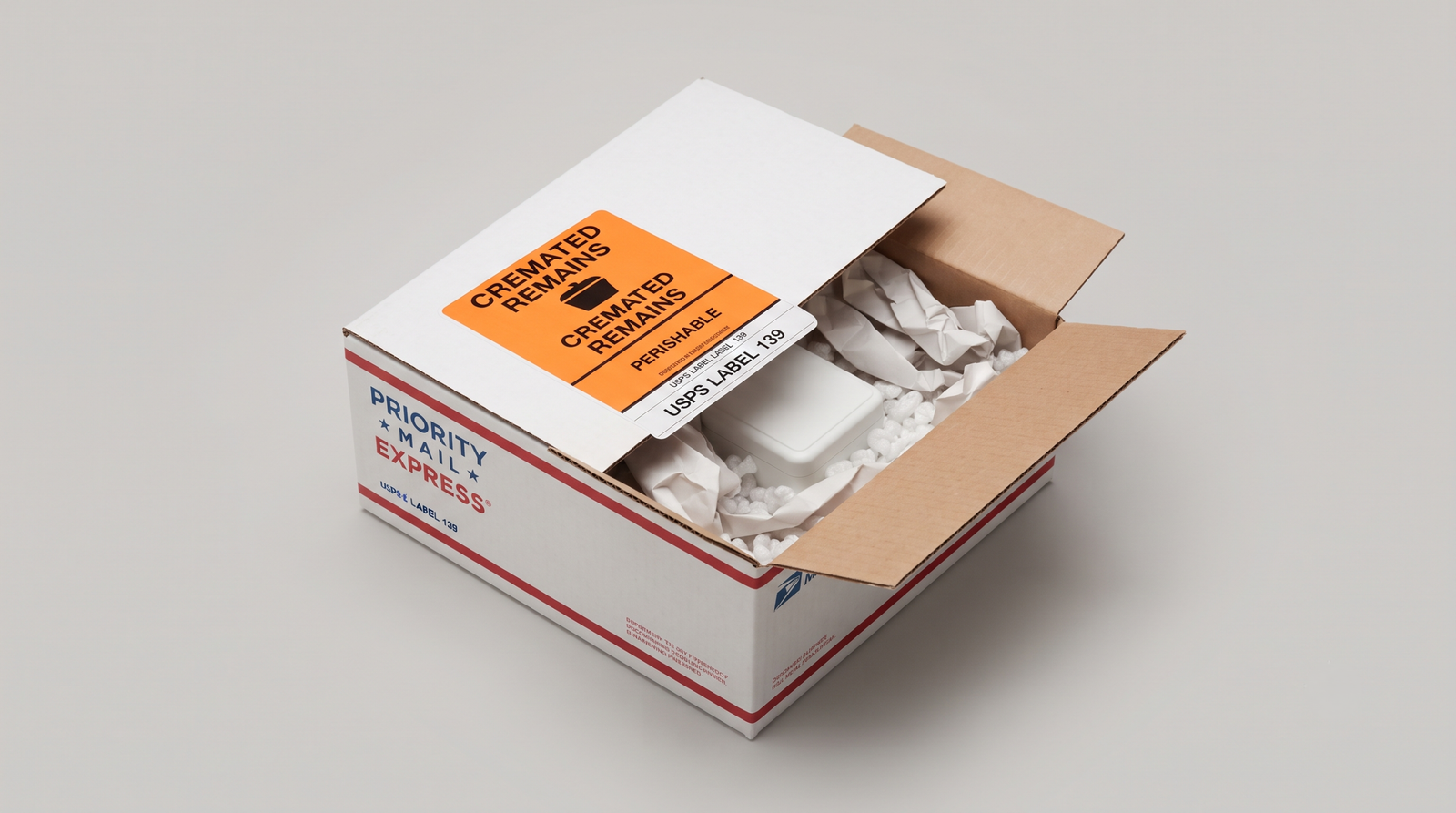
Shipping cremated remains is governed by whoever carries the parcel, and those policies vary by company and service class, and get revised without notice. So the calls belong on the morning of posting, not on the day you decided to turn son ashes into a diamond.

Four things settled before the parcel is addressed:

  • The container the laboratory expects, and whether one is supplied to you.
  • The carrier’s present rules on how the parcel is wrapped, marked and declared.
  • Whether handing the material to a funeral director instead alters any of that.
  • The tracking you hold, and what confirmation reaches you on arrival.

Sealing that container is the last physical act here that belongs to you rather than to a laboratory. Breaking the seal again, because a question went unasked, is the one avoidable mistake here.

Step 6: What Happens Inside the Laboratory

Once the portion is logged in, the work to turn son ashes into a diamond runs in three stages, and the second and third are the remaining points of no return.

Purification. The material is heated in a controlled, oxygen free chamber that strips away everything which is not carbon, leaving carbon at roughly 99.9% purity and above. Up to here it is still, physically, ash that has been refined.

Graphitization. Heated further, to around 2,500 to 2,700°C, that carbon becomes graphite, the feedstock a diamond press can use. This is the second door: after graphitization there is no ash to send back, because it is no longer ash in any recoverable sense.

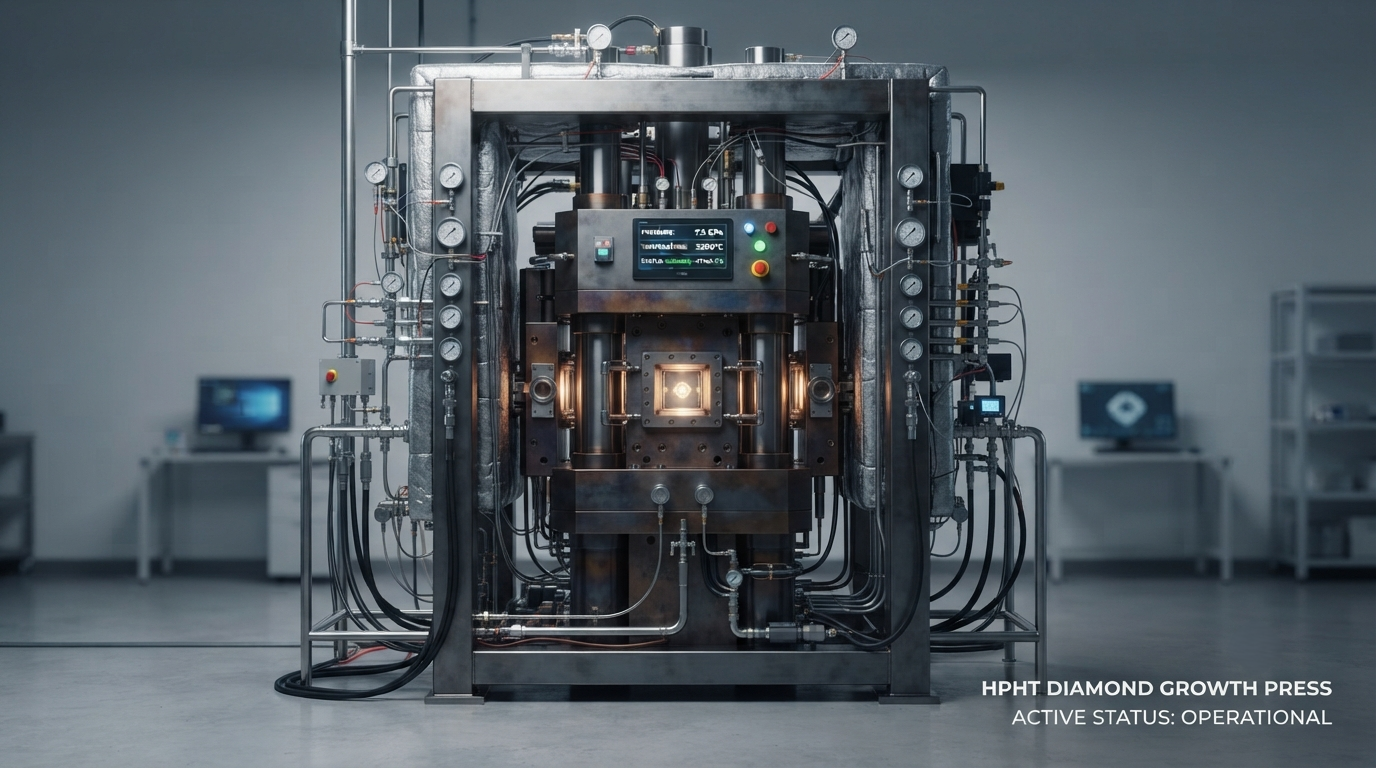
A high-pressure high-temperature press of the type used to grow lab diamonds, sealed and running

Growth. The graphite, blended with supplemental lab carbon to fill the cell, goes into a press with a tiny diamond seed. Roughly 6 to 8 GPa and temperatures of about 1,400 to 2,500°C reproduce mantle conditions, and the crystal grows over weeks to months. The same HPHT method serves the wider lab grown diamond industry.

Expect silence. A crystal growing in a sealed cell produces nothing to report for long stretches, which is not the same as nothing happening. Agree in advance what you will be told and when, because most of the months needed to turn son ashes into a diamond pass with nothing visible. How long the whole process takes breaks the months down.

Step 7: Cutting, Grading, and What Comes Back

The rough crystal is cut and polished into the shape you chose, and that shape can be revisited until cutting starts. Clarity typically lands between SI2 and VVS, and the result is a diamond in every measurable sense: 10 on the Mohs scale, with the optical behavior and grading criteria of any other.

Keep two documents distinct. Independent grading is optional rather than a standard stage, and it happens only if you order it. A grading report, ideally from an independent laboratory working to recognized 4Cs standards, describes the stone’s quality. A certificate of origin, usually issued in house, records that it was grown from your family’s carbon. A provider offering the second is not offering the first.

Setting comes last, long after the decisions that commit you to turn son ashes into a diamond are behind you, and it is reversible. A stone can be reset any number of times, so the ring chosen now is not a decision anyone is stuck with.

What Can You Still Change After Each Stage?

The sequence reads most usefully backwards: what is fixed at each point, and what is still yours to move.

Once this has happenedFixed from then onStill yours to change
Authority over the remains is confirmedNothingEverything, including whether to turn son ashes into a diamond at all
The family conversation has happenedThat they knowSize, color, provider, timing, whether you proceed
The portion is sealed and postedThat much material is committedCarat, color range, cut, setting, the order until growth begins
Graphitization is completeThe ash no longer exists as ashCut, shape, whether to order grading, engraving, setting
The growth run has finishedCarat and color are what they areCut, whether to order an independent grading report, setting, who eventually wears it

Most parents who turn son ashes into a diamond never need the last two rows. They matter because knowing where the doors are lets the earlier steps be taken slowly.

What Does It Cost to Turn Son Ashes Into a Diamond?

Price follows carat, and carat follows growth time. Industry wide in 2026, the smallest stones at roughly 0.10 to 0.25 ct are quoted around $1,500 to $3,500. The half carat to one carat band, where many orders land, runs between about $5,000 and $15,000. Past 2 ct and toward 5 ct or more, figures begin near $20,000 and extend beyond $75,000. Those are category wide ranges, not Memorial Diamond’s prices, which are not published.

Colorless costs meaningfully more than yellow, blue or champagne at the same size, and is one of the specification choices that moves what it costs to turn son ashes into a diamond. Grading reports, engraving, fancy cuts and the setting are quoted separately from the loose stone, so establish what a figure includes before comparing two. A fuller cost breakdown covers what moves the number. Get a written quote before you agree to turn son ashes into a diamond at any particular size.

Frequently Asked Questions About Turning a Son’s Ashes Into a Diamond

Do I need the death certificate or the cremation paperwork to start?

Providers generally require documentation identifying the remains and the person authorizing their use before they will turn son ashes into a diamond, usually a death certificate and the crematory’s paperwork. Ask what a company needs before separating anything.

His wife has the ashes. What do I ask her first?

Ask whether she would be open to a portion being used, before raising sizes or providers. If she holds authority, the decision to turn son ashes into a diamond is hers, and it lands better as a question than a formed plan.

My son’s father and I disagree about this. Can one of us proceed alone?

That depends on who holds authority under your state’s order of priority, and on anything your son left in writing, not on which parent feels more strongly. Establish the legal answer first, then decide whether to act on it.

Is there a point after which the laboratory can no longer send the ashes back?

Yes. Once purification and graphitization are complete, the material is no longer ash in any recoverable form, so a request to stop has to arrive before that stage. Ask where that line falls for any provider you ask to turn son ashes into a diamond.

Can his sister have a stone from the same portion?

If two of you want to turn son ashes into a diamond, the cleaner arrangement is two portions rather than one, each sized to the provider’s minimum and stored separately. Raise it before anything is separated, because splitting a portion already sent is rarely possible.

Does it matter that he was cremated years ago?

No. Cremated remains do not degrade in any way that affects carbon recovery, so you can turn son ashes into a diamond a decade after the cremation exactly as you could a month after it.

What if I do not want to divide his ashes at all?

Then keep them whole. Hair is roughly 50% carbon by weight, needs no cremation, and is usually a simpler question in practice than authority over remains, and it produces the same kind of stone, which is why parents unwilling to open the urn take that route.

Final Thoughts on What It Takes to Turn Son Ashes Into a Diamond

The plan to turn son ashes into a diamond contains three irreversible acts and four steps built to make sure you reach them already decided. Nothing else in it is fragile, and nothing else is urgent.

Take steps 1 through 3 as slowly as you need. Finding out who holds authority, telling the people it affects, and settling what you want to hold cost nothing and commit nothing. By the time a container is opened, the decision to turn son ashes into a diamond should already be behind you.

Learn More About Son Memorial Diamonds

Talk With Memorial Diamond

The best moment to ask us anything is while you are still inside the first three steps, before a container is opened, a portion measured or a parcel addressed.

Bring whatever you have, including very little. memorialdiamond.us is where to begin, and the six questions listed in step 3 make a reasonable agenda for a first conversation about how to turn son ashes into a diamond.

Two people sitting at a kitchen table in daylight, mid-conversation, illustrating how to talk to family about a partner memorial diamond

How to Talk to Family About a Partner Memorial Diamond

You have already had a version of this conversation at three in the morning, and it goes badly. The conversation about a partner memorial diamond goes better when the ask is narrow, specific and answerable, one small portion, named in advance, raised before anything has been arranged, and when it is held separately from the older, harder conversation about the relationship itself. Keeping those two apart is the technique. It will not make anyone say yes.

Memorial Diamond grows these stones, so this page has an interest in the outcome. It is written for the reader whose position is weakest when a family talks about a partner memorial diamond: someone who may not be the legal next of kin, whose relationship may never have been recognized, and who may be raising it with people who do not know there was one.

Who Do You Tell First About a Partner Memorial Diamond?

Not the person you are closest to. Not the person most likely to agree. The person who holds legal authority over the remains. Every other conversation about a partner memorial diamond is downstream.

That sounds cold and it is the kindest order available: everyone else’s view is advisory, theirs is decisive. Going to a sympathetic sibling first feels easier and builds a coalition, which is what makes a decision maker dig in. If you do not know who holds authority, a funeral director will usually say, at no cost. It follows state law and anything your partner put in writing, so there is no general rule to look up.

WhoWhat you are actually asking them forWhy they come in this orderIf they say no
Whoever holds legal authority over the remainsPermission to set aside a small portionTheir answer is the only one that settles anything about a partner memorial diamondNothing proceeds, and every other conversation becomes optional
Anyone who would be hurt to hear it second handNothing. You are telling, not askingHearing about a partner memorial diamond late is its own injury, separate from the decisionNothing changes about the material, but it costs you something
Adult children, if anyUsually nothing formal, sometimes a veto in practiceThey often carry more weight with the decision maker than youWorth knowing before, not after
Everyone elseNothing at allConsulting people who do not decide invites a voteThey were never deciding
A funeral director talking with a visitor across a desk, illustrating finding out who holds legal authority over remains

Two rules make the table work. Talk to people one at a time, a group produces a position, an individual an answer. And never announce it to a room. An announcement about a partner memorial diamond sounds like a decision already taken.

When Should You Raise It?

Before material moves, and before money is spent. Those are the two deadlines governing any conversation about a partner memorial diamond, and they are not the same deadline.

Once ashes have been divided, posted, scattered or interred, the conversation changes character. A request becomes a disclosure. Even people who would have said yes hear a completed act as something done around them, and the resentment outlives the argument. If a scattering is booked or a niche is paid for, raise it now and say the date is why, people accept urgency far better than surprise.

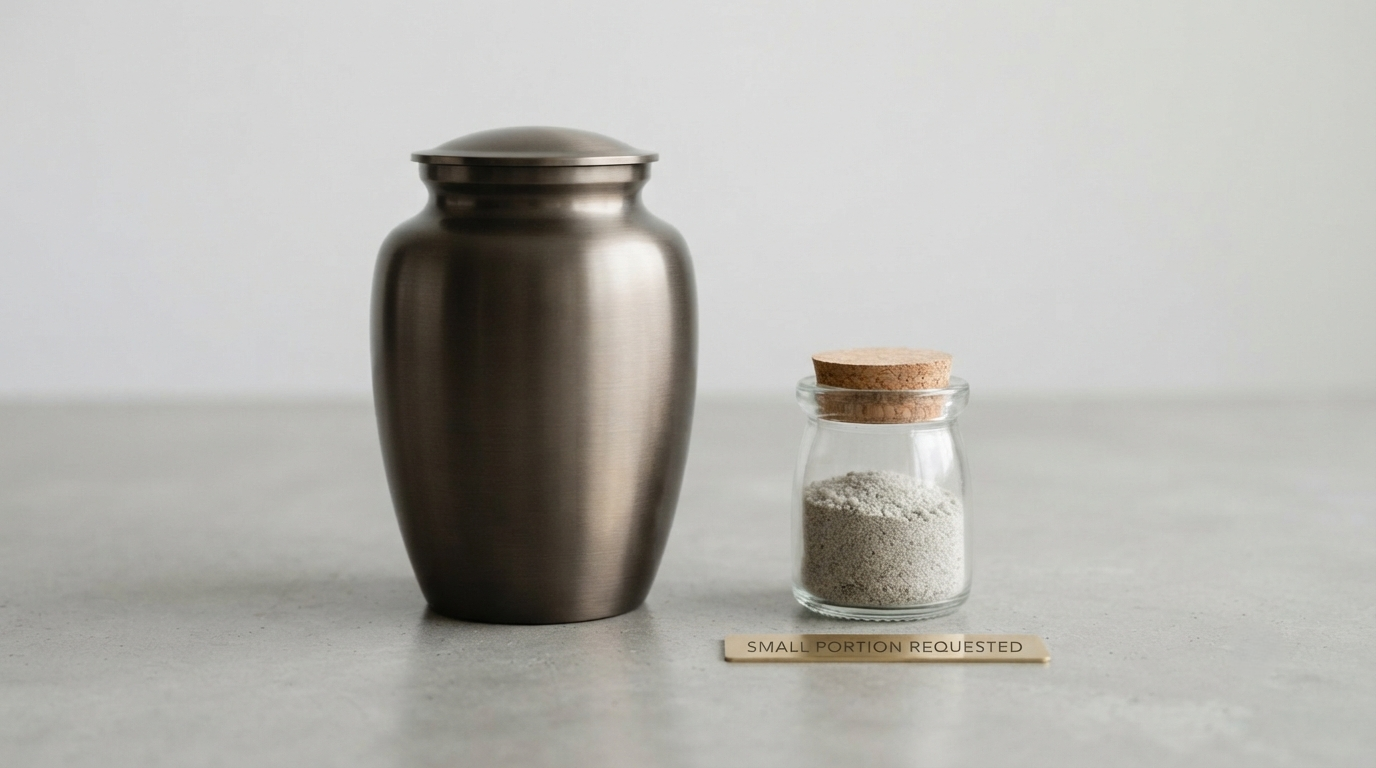
A few tablespoons of cremated remains in a small jar beside a full urn, showing the proportion actually being requested

Money is a second deadline for a separate reason. A deposit turns a request into pressure. Nobody should be told about a partner memorial diamond in a sentence that also mentions what you already paid.

On timing after a death there is no correct interval, only two bad ones. Do not raise it at the funeral, where nobody can hear a new idea. Do not wait so long that the ashes are already settled somewhere. Between those, later usually beats sooner, except that disposition runs on its own timetable, and nothing about a partner memorial diamond makes it wait for you.

What Does the Ask Actually Sound Like?

Short. The ask about a partner memorial diamond should be far shorter than you think, and it should have a number in it.

The fear you are speaking into is almost never about diamonds. It is that you are asking for all of it, or for the part already promised elsewhere. Numbers do the work reassurance cannot:

  • Name the quantity. Industry wide, a stone takes between a few tablespoons and roughly 4 oz, about 100 g, of cremated remains. How much ash a partner memorial diamond actually takes explains why.
  • Name what stays. A cremation is measured in pounds. Whatever was planned for the rest still happens.
  • Name the timeline. Typically 6 to 10 months from receipt, up to 12 for larger stones. Nothing happens next week, and saying so lowers the temperature.
  • Name what you are not asking to change. The plot, the service, the scattering date, the urn on somebody’s shelf.
  • Offer them one, if you mean it. More than one stone can come from a shared source, and whether several people can each have a diamond is the most effective thing to put on the table when a conversation about a partner memorial diamond stalls.

Then stop talking. The instinct is to follow the ask with the science, carbon, presses, purification, but science answers the second question about a partner memorial diamond, never the first. If they want it they will ask, and whether a memorial diamond is really made from a person’s ashes is better sent afterwards.

One more thing belongs in any honest ask about a partner memorial diamond: the stone is not made entirely of your partner. What is recovered gets combined with lab grown carbon until there is enough of it to work with. Where ash is the source, published figures place that fraction near 10 to 15% of the finished stone, and some cite as little as 3%; nothing comparable is published for hair or for a blended charge. Ask a provider what share your own sample will contribute. Better they hear it from you than discover it later and feel misled.

How Do You Keep This Separate From the Relationship?

By refusing, politely and repeatedly, to let one conversation become the other.

This is what makes a partner’s version different. A parent asking for a portion of a child’s ashes is having one conversation. A partner asking a family that never acknowledged the relationship is having two at once, and the second is older, angrier and unwinnable in one sitting. Everything said about a partner memorial diamond in that room is heard through it.

What they sayWhat is often underneath itA reply that does not escalate
“That’s not what the family does”An objection to you, phrased as one to the method“I understand. Can I ask separately, just about the portion?”
“It’s morbid”Unfamiliarity with the category“It’s more common than it was. Can I send you something to read?”
“You weren’t really family”The relationship conversation, arriving early“I don’t want that conversation today. I’m only asking about the ashes.”
“We already decided”A decision made without you, not reopenable in public“I know. I’m not asking to change it. Only about a portion of what’s left.”
“Why do you need an object?”A real question, asked badly“I want something I can keep. That’s all.”
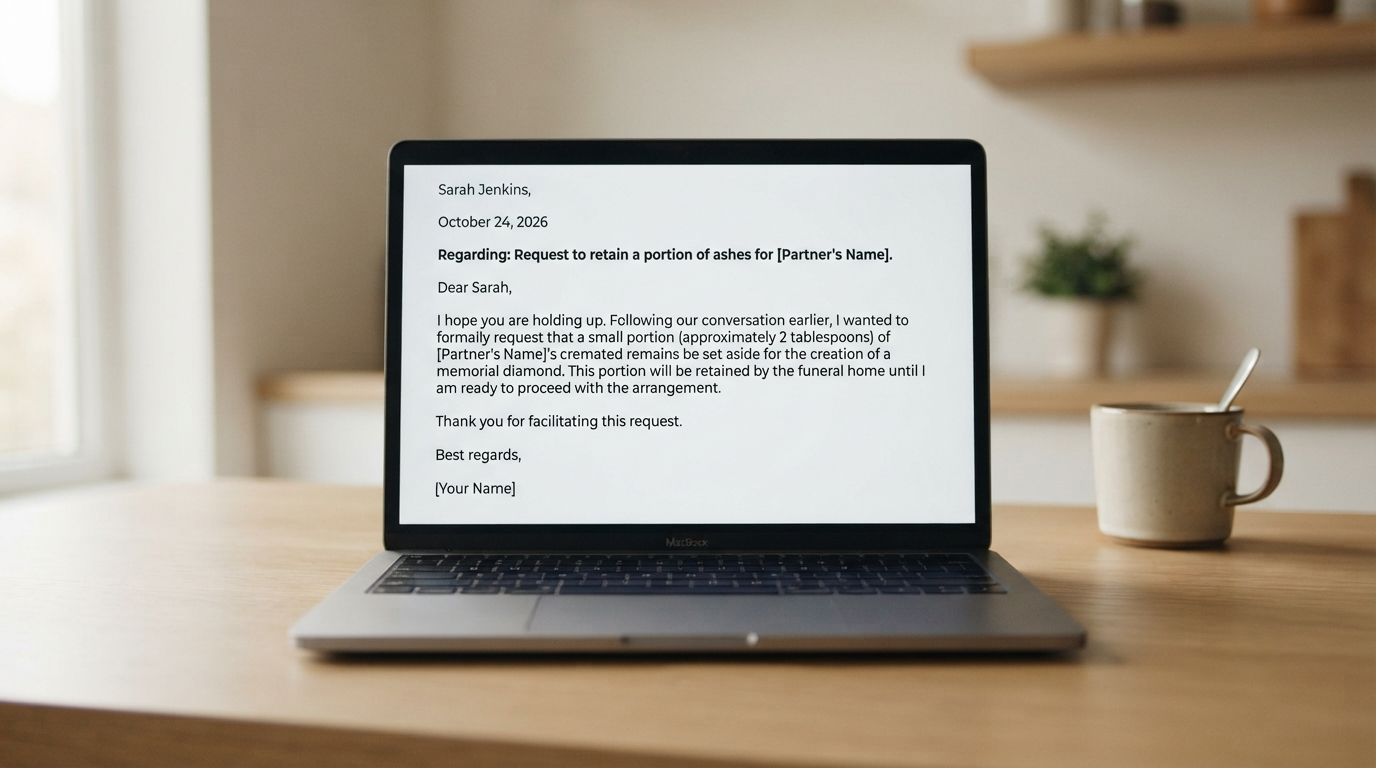
A short written request open on a laptop screen at a kitchen table, illustrating putting the ask in writing

Three habits hold the line. Say the ask in one sentence and let silence work. Do not defend the relationship inside the request, because a defense turns a portion of ashes into a verdict on whether you were allowed to grieve. And name the split out loud when it comes, “that’s a separate conversation, and I’d like to have it, just not today”, which is not a trick but an accurate description of what is happening.

Accept a yes that arrives without acknowledgment. Permission to take a portion is not a ruling on the relationship. A grudging yes about a partner memorial diamond is still a yes, and the stone does not know how it was granted.

Then say so to yourself, clearly, before you say it to anyone else.

Authority over cremated remains is set by state law, and by whatever your partner left in writing: a will, a disposition directive, an instruction lodged with a funeral home. Where a relationship was legally recognized this is usually straightforward. Where it was not, the remains may belong legally to a parent, an adult child, a sibling or an earlier spouse, whatever the shared history. No decision you make on your own about a partner memorial diamond can set material aside, and you cannot compel anyone.

What is still available to you:

  • Ask the funeral home who holds authority. Do it early, before the cremation if you can, because afterwards it is harder to act on.
  • Ask whether anything was left in writing, and whether anybody has read it rather than recalled it.
  • Make the request in writing. A short, calm email about a partner memorial diamond survives being forwarded, misquoted and reread six months later. A conversation does not.
  • Ask for a portion, not for a say. You are not asking to co decide the disposition, only for one specific, small thing.
  • Consider hair instead. The route most often missed. Hair is roughly 50% carbon by weight, needs no cremation, and may already be in your house, on a brush, in a hat, in an envelope. The law here speaks to cremated remains rather than to keepsakes, which is why hair you already hold tends to be the less obstructed route, though belongings can be drawn into an estate, states differ, and hair kept by someone else is something you ask about, not something you decide.

That last point deserves its own sentence, because it reframes the whole question about a partner memorial diamond for people with no standing: if the material you need has never been in anyone else’s custody, the practical question is usually a far simpler one, but where it matters, check rather than assume.

What If the Answer About a Partner Memorial Diamond Is No?

It is a real answer. Treat it as one.

The useful next step is establishing which kind of no it is, and that takes one question. “Is that a no for now, or a no altogether?” Grief runs on different clocks, and an answer six weeks after a death is often not the one the same person gives two years later. Ask once, accept what you get, and do not ask again that month.

To leave a door open without pushing on it:

  • Ask what would change it. Sometimes the objection is specific and solvable, a fear that the whole urn goes away, a belief that the stone is fake, a worry about cost nobody wanted to raise.
  • Offer the shared version once. People refuse things they feel excluded from, and a stone each changes the request.
  • Leave it in writing and leave it alone. A short note saying you would still like to, and will not raise it again unless they do, ages best.
  • Do not escalate. There is no second person to appeal to, and going over someone’s head turns a maybe into a permanent no.

And the honest ending, unsoftened: sometimes the answer stays no. If it does, what you have is what is already in your house, photographs, handwriting, a coat, the hairbrush. A memorial diamond set against a traditional urn is worth reading because neither option is the better one, and a family keeping an urn intact has made a complete and reasonable choice.

What If They Never Knew About the Relationship?

Then you are delivering two pieces of news in one sentence, and the second will not be heard.

Think hard about whether the diamond belongs in that conversation. If the relationship is the news, let it be the only news. Tell them, let it settle, and raise the question about a partner memorial diamond weeks or months later as a separate request. Asked together, the portion becomes evidence in an argument about who your partner was. Asked apart, it is only a request about ashes.

If the timetable will not allow that, if a scattering is days away, say the sequencing out loud: that you know this is a great deal at once, what the relationship was in one sentence, and then the narrow ask about a partner memorial diamond. People are often better at this than expected, and sometimes they are not. Do not walk in believing it will go well. Walk in having decided what you will do either way.

There is a third option people overlook. You are allowed not to tell anyone, if the material you need is hair that was always yours. That is not deception. It is a decision about a partner memorial diamond that, in practice, usually involves nobody else, and for readers with no standing and no acknowledgment it is sometimes the only route open.

Frequently Asked Questions

Should I speak to a provider before or after I speak to the family?

Before, for information, and never in a way that commits money. Knowing the real quantity and timeline makes a conversation about a partner memorial diamond concrete rather than theoretical. A deposit paid first turns a request into pressure.

Can they stop me if the ashes are already in my possession?

Possession and authority are not the same thing, and the answer varies by state and by what was left in writing. Holding an urn does not always mean you may divide it for a partner memorial diamond. Ask a funeral director or a lawyer before acting, not after.

What if the family is split down the middle?

Work out who actually decides and talk only to that person. A divided family produces a debate, and a debate about a partner memorial diamond rarely produces permission. Others can be told once something is agreed.

Do I have to tell them what the portion is for?

Nothing obliges you to. But explained requests are granted more often than unexplained ones, and a truth kept quiet about a partner memorial diamond has a way of surfacing later at the worst possible moment.

How long should I wait after the funeral?

There is no right interval, only the constraint that ashes may be settled on a timetable you do not control. If nothing is scheduled, a few weeks is kinder than a few days for a conversation about a partner memorial diamond. If something is scheduled, raise it this week.

They want one too, and I cannot afford two. What do I say?

Say exactly that. Industry wide ranges are public, roughly $1,500 to $3,500 at entry sizes, $5,000 to $15,000 for 0.5 to 1 ct, so what a partner memorial diamond costs is a better answer than an evasion.

Final Thoughts on Talking to Family About a Partner Memorial Diamond

Nothing here guarantees an outcome, and anything promising one would be a lie. Some of these conversations go well. Some reopen an argument that was never settled, and you will have raised it knowingly.

What you control is the shape of the ask. Seven things, in this order:

  1. Go to whoever decides, not whoever will agree.
  2. Raise it before anything moves, and before anything is paid.
  3. Ask one person at a time, never a room.
  4. Put a number in the ask, say how small the portion is.
  5. Say what stays: the plot, the service, the date, the urn.
  6. Do not defend the relationship inside the request.
  7. Take the answer you are given, the one decision about a partner memorial diamond you get to make alone, however the rest of it goes.

Learn More About Partner Memorial Diamonds

Talk With Memorial Diamond

If it would help to walk into that room with facts about a partner memorial diamond rather than adjectives, three do most of the work, and none commits you to anything.

Ask what quantity is actually needed, so you can name it. Ask what the timeline really is. Ask whether more than one stone can come from a single portion, because that answer changes more conversations about a partner memorial diamond than any other. memorialdiamond.us will answer all three without asking you to decide, and questions worth asking first covers the rest.

If sending someone a neutral explanation would help more than a company’s, the encyclopedia entry on memorial diamonds is a reasonable place to point them, and the NFDA’s 2025 cremation and burial report is worth having for anyone who thinks cremation itself is unusual.

Three finished memorial diamonds of slightly different tones on a pale surface, showing what sharing a partner memorial diamond between several people produces

Can More Than One Family Member Get a Diamond From the Same Partner’s Ashes?

It usually surfaces sideways, in a kitchen, after someone has already said yes to the idea. A sibling asks whether they could have one too. Sharing a partner memorial diamond across several people is usually possible, because only a small portion of what a family holds is ever used, but the material was never the hard part. The hard part is who has the standing to authorize it, and what everyone has agreed before anything is posted.

One disclosure up front: Memorial Diamond grows these stones, so treat this as a company describing its own category rather than a neutral referee. Every figure below is an industry wide band, not a published policy of ours.

Why One Portion Can Supply Several Stones

Start with the physical facts, because they are the reassuring end of this subject. Materially, sharing a partner memorial diamond is the easy part.

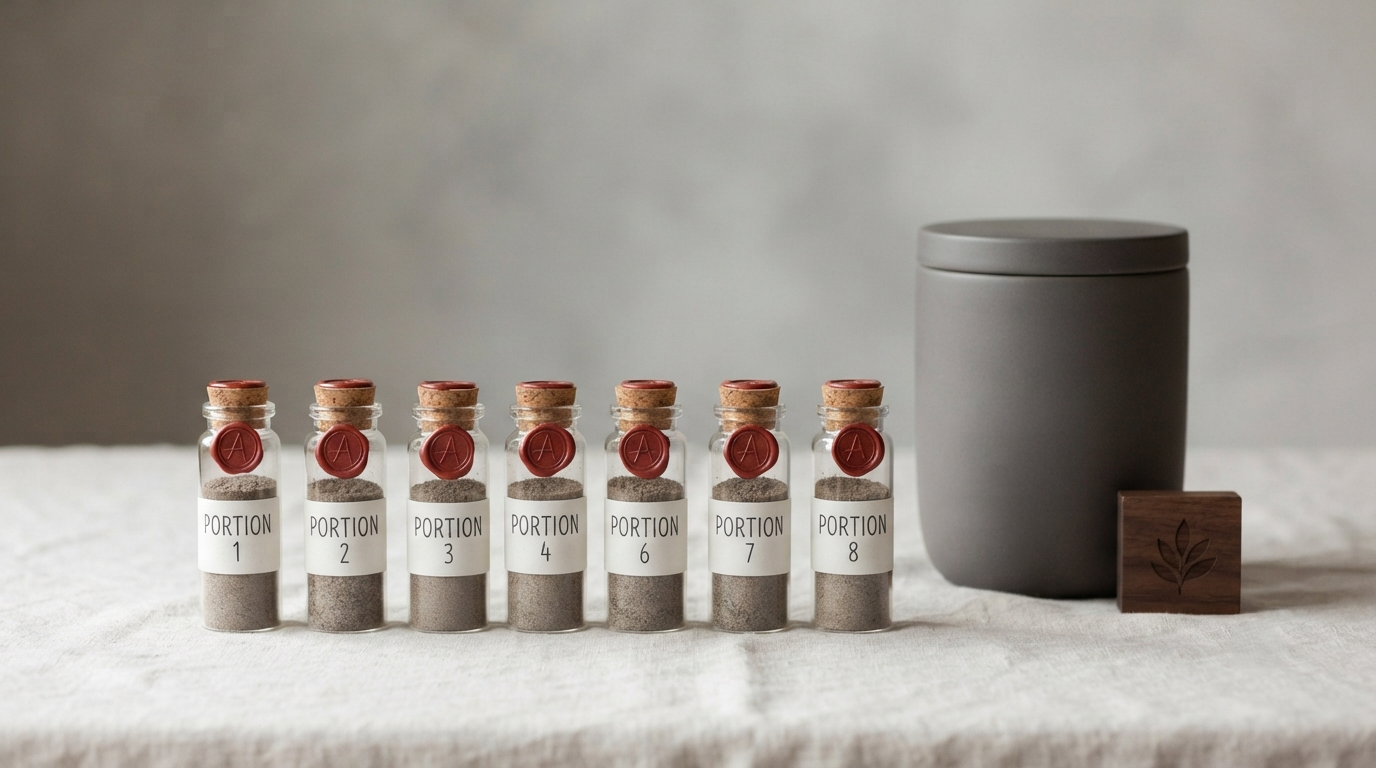
A cremation produces remains measured in pounds. What a laboratory asks for is measured in tablespoons, industry wide, somewhere between a few tablespoons and roughly 4 oz, about 100 g. That gap is what makes sharing a partner memorial diamond feasible at all. Several separate portions can be drawn from one urn and nothing visible changes in it. How much ash a single stone actually takes sets out the arithmetic behind that figure in full.

The reason the request is so small is that cremated remains are not a carbon source in any generous sense. They are overwhelmingly calcium phosphate, the mineral scaffolding of bone. By weight, only about 0.5% to 4% of ash is usable carbon. So each portion set aside for sharing a partner memorial diamond is a mineral sample from which a thin recovery of carbon will be pulled, purified to around 99.9%, and then blended with supplemental lab carbon to reach the volume a growth cell needs.

Several small sealed vials of cremated remains lined up beside a closed urn, each holding one portion

That blend is worth stating plainly rather than skipping. For the ash route, the industry figure for personal carbon is somewhere around 10% to 15% of a finished stone’s mass, and some providers cite as little as 3%. No comparable figure is published for hair. Nobody receives a diamond that is entirely the person, that is not how the chemistry works. What each person receives is a real diamond containing a real, traceable share of their carbon, which is a more defensible claim and, once you sit with it, not a smaller one.

Hair changes the arithmetic considerably. Hair is roughly 50% carbon by weight, and no cremation is involved at all, so a household that kept a lock has a second route into sharing a partner memorial diamond even where the ashes are out of reach. What a hair based submission requires covers the quantities, which are far smaller than most people assume.

Practical limits that do apply when sharing a partner memorial diamond:

  • Each stone needs its own portion. Portions are not subdivided after arrival, so sharing a partner memorial diamond means sending one portion per stone.
  • The number of stones is limited by what you hold, not by any rule about how many people may take part.
  • A partial share can still work. A keepsake urn’s worth is often enough for one stone, sometimes two.
  • Hair and ash are assessed separately, not pooled into a single total, if a family is drawing on both.

Who Actually Has Standing to Say Yes?

This is where sharing a partner memorial diamond stops being a logistics question, and it deserves a direct answer rather than a comforting one.

No nationwide rule decides who may authorize a division. State law does, and a written direction from your partner, a will, a disposition directive, a form signed at the funeral home, can displace whatever the default would otherwise have been. Legal recognition of the relationship usually keeps this simple. Without it, the entitled decision maker may turn out to be a former spouse, a sibling, an adult child, or a parent, whatever the living arrangements looked like, which is why sharing a partner memorial diamond so often turns on a document nobody has actually read.

Three people talking across a table with paperwork between them, discussing authority over a partner's remains

That matters more here than in almost any other question in this cluster. Sharing a partner memorial diamond means dividing remains between people, and the person who authorizes a division may not be you. It may be someone who never used the word “partner” about your relationship at all.

None of that makes it impossible. It changes the order of operations for sharing a partner memorial diamond:

  1. Establish who the law treats as the decision maker in the state where the cremation happened, a funeral director will usually say, at no charge.
  2. Find out what was left in writing, and whether anyone has actually read the document rather than recalled it.
  3. Ask the person with authority, which is a separate question from whether they are entitled, and frequently a warmer conversation than people brace for.
  4. Get the agreement on sharing a partner memorial diamond recorded, even as an email thread, before money moves or material is packed.

There is a quiet advantage in this particular request. A family reluctant to acknowledge a relationship is often far more willing to grant one small portion than to change anything about the main arrangement, and sharing a partner memorial diamond, framed as one each, can be easier for them to say yes to than a request made by you alone. It reads as inclusion rather than as a claim. How to open that conversation without it becoming a confrontation goes through the wording in detail.

Say the awkward part out loud too: this is irreversible. Once a portion has been set aside and processed, it does not come back. That is exactly why sharing a partner memorial diamond is worth slowing down over, even when everyone in the room is currently agreeing.

What to Settle Before Any Material Is Sent

Most of the regret in this subject comes from decisions that were assumed rather than agreed. Sharing a partner memorial diamond involves several people, several invoices, and a wait long enough for circumstances to change.

Settle these before sharing a partner memorial diamond goes any further, in writing, however informal:

  • How many stones, and for whom. Names, not “the family.” If someone is undecided, note that too.
  • Who pays for what. Each stone is bought separately, so a shared decision does not create a shared bill unless someone chooses to split one.
  • Who the provider’s point of contact is. One person, or the correspondence about sharing a partner memorial diamond fragments across a group and nobody knows what was approved.
  • What happens if someone withdraws after the portion has been sent but before the growth run begins.
  • What happens to material the process does not consume, and whether it returns by default. This is company policy rather than chemistry, so it varies and must be asked.
  • Whether anyone expects the stones to match, which is the single most common misunderstanding in sharing a partner memorial diamond and is addressed directly below.
  • Who physically receives the finished stones, and whether they are shipped separately or together.

One scheduling note that saves arguments: stones commissioned at different carats finish at different times. Industry typical timelines run 6 to 10 months from receipt, stretching toward 12 months for larger or specialty color stones. If three people order and one chooses a much larger stone, that person waits longest, which feels like unfairness if nobody said so in advance. How the timeline actually breaks down stage by stage is worth circulating to everyone involved before orders are placed.

Will the Stones Match Each Other?

No, and this is the expectation most worth correcting early when sharing a partner memorial diamond. Stones from one shared source are siblings, not twins.

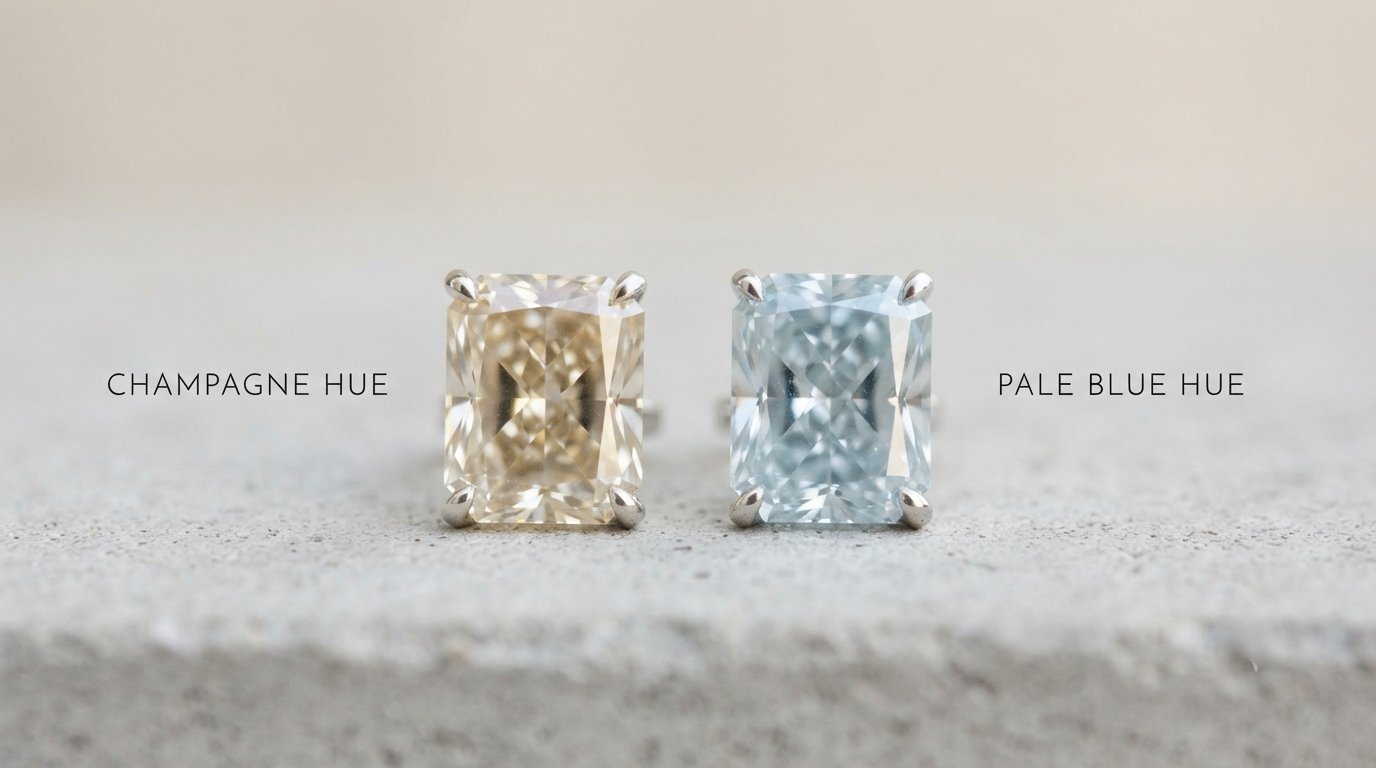
Each diamond is grown in its own run. Color in any diamond comes from trace elements present during crystal growth, nitrogen pushes toward yellow, boron toward blue, and the absence of both is what produces a colorless stone. Because personal carbon is an organic, uncontrolled feedstock, those traces vary between batches, which is precisely why memorial stones trend toward yellow, champagne and blue rather than colorless. The general reference on how these crystals are grown explains the mechanism; what color to expect from a partner’s carbon covers what that means in practice.

Clarity varies too, and it is the second surprise in sharing a partner memorial diamond. Memorial stones typically land somewhere in the SI2 to VVS range, graded against the same 4Cs as any other diamond. Two stones from one urn can differ in tone, in saturation, and in where their inclusions sit.

Two memorial diamonds side by side under daylight, one champagne and one faintly blue, showing that stones from one source do not match

Three ways families handle it when sharing a partner memorial diamond:

  • Accept the variation. Many people prefer it. Each stone is visibly its own thing rather than a set of copies.
  • Order the same carat and cut. Matching the specifications you can control narrows the visible difference even when color does not match.
  • Ask about color treatment. Post growth irradiation is sometimes used to shift a stone’s color, which can bring stones closer together. Ask whether it is offered at all, and what it costs, before assuming.

What no provider can honestly promise is a matched set produced on demand from one person’s carbon. If someone in your group is expecting that, better to find out now than at the unboxing.

How Much Does Sharing a Partner Memorial Diamond Cost?

Here is the part that changes plans. Sharing a partner memorial diamond does not divide a cost, it multiplies one. Each stone is an independent growth run, occupying its own press time, and is priced as its own purchase.

The bands below are industry typical figures for the category as a whole, not Memorial Diamond’s published pricing, and final cost turns on carat, color, cut, and whether you order an independent grading report:

Stones from one shared sourceIndustry typical entry tier, 0.10 to 0.25 ct eachIndustry typical mid tier, 0.5 to 1 ct each
One stoneroughly $1,500 to $3,500roughly $5,000 to $15,000
Two stonesroughly $3,000 to $7,000 combinedroughly $10,000 to $30,000 combined
Three stonesroughly $4,500 to $10,500 combinedroughly $15,000 to $45,000 combined
Larger or rare stones, any numberpriced individually; 2 to 5+ ct runs roughly $20,000 to $75,000+ eachNot applicable

Read that table as a caution rather than a quote. The useful takeaway for anyone sharing a partner memorial diamond is that a group of three at a modest carat frequently spends less, in total, than one person at a large carat, so the honest opening question for a group is not how many of us but what size each. Settings, engraving and any grading report are usually quoted separately from the stone, worth confirming. What drives the price of a single stone breaks down each variable.

Two cost realities catch groups out when sharing a partner memorial diamond:

  • Do not assume a discount for ordering together. Each stone is its own growth run, so ask whether any provider prices several differently, and do not build a budget on the answer being yes.
  • A smaller stone is not a lesser stone. An entry tier diamond carries the same proportion of personal carbon as a larger one; carat is bought from growth time, not from the amount of ash submitted.

When the Answer Is No, or Not Yet

Sometimes the person who decides about sharing a partner memorial diamond simply declines. Sometimes the ashes were scattered years ago. Sometimes the group cannot agree, and pressing it would cost more than the stones are worth.

Options that remain open when sharing a partner memorial diamond is off the table for now:

  • One stone, shared in a different way. A single diamond can be held by one person and worn at family occasions, or set in a piece designed to be passed on. Settings that can be changed or converted later matter more than usual when a stone is meant to move between people.
  • The hair route. If anyone kept a lock, no cremated remains are needed and the authority question over the urn does not arise in the same form.
  • Waiting. Cremated remains are stable and keep indefinitely. A family that says no this year is not saying no permanently, and nothing degrades while you wait.
  • Reading the full route first. The complete guide to a partner ashes diamond lays out every stage, which is often what an undecided relative actually needs before agreeing to anything.

Frequently Asked Questions

How many diamonds can realistically come from one person’s ashes?

It depends on how much you hold rather than on any fixed limit. With a full cremation’s remains, several stones are usually feasible, since each takes only a few tablespoons up to roughly 4 oz. With a keepsake portion, often one or two.

Can each person choose a different size and color?

Yes. Each stone is a separate order with its own carat, cut and color specification, its own invoice, and its own finish date. Sharing a partner memorial diamond does not mean sharing one set of choices.

Do all the stones have to be ordered at the same time?

No. A second stone can be commissioned later from the same held ashes, provided material remains. The catch is timing: prices and offerings shift, and a later stone will differ visibly from the first regardless.

My partner’s family controls the ashes and barely acknowledged me. What now?

Ask anyway, and ask for one small portion rather than a change to the main arrangement. Authority varies by state and by anything left in writing. A framing of one stone each is often easier for a reluctant family to accept.

Can a portion be taken from ashes that are already interred?

That becomes a cemetery permissions question, not a material one. Columbaria and cemeteries set their own rules for removing interred remains, and local law may add more. Ask the cemetery in writing before planning anything around it.

If we split the cost of one stone, who owns it?

Nothing about the process settles that, so settle it yourselves in writing before ordering. Joint purchases of a single irreplaceable object cause the most friction later. Agree now who holds it, who insures it, and what happens eventually.

Final Thoughts on Sharing a Partner Memorial Diamond

The material answer to sharing a partner memorial diamond is the easy one: yes, in almost every case, because the portion each stone needs is small enough that one urn can serve several people without visibly changing.

Six things sharing a partner memorial diamond comes down to, in the order they decide it:

  1. The material is rarely the constraint. A stone takes a few tablespoons up to roughly 4 oz; a cremation is measured in pounds.
  2. Each stone needs its own portion. Portions are not subdivided after they arrive.
  3. Standing decides it, not arithmetic. Authority varies by state and by anything left in writing.
  4. The stones will not match. Separate growth runs, separate results.
  5. Sharing multiplies the cost. Three stones is three prices, not one split three ways.
  6. It cannot be undone. Waiting costs nothing; remains are stable and keep indefinitely.

The rest of it is a conversation, and it is a conversation worth having slowly. Who has the standing to authorize a division. What everyone expects the finished stones to look like. Who is paying for what, and what happens if someone changes their mind in month seven. Handled in that order, sharing a partner memorial diamond usually turns out to be one of the less contested decisions a family makes in a difficult year, and occasionally the one that brings people who disagreed about everything else into one room.

Learn More About Partner Memorial Diamonds

Talk With Memorial Diamond

If your family is weighing sharing a partner memorial diamond and you want a straight answer about what is possible with the material you actually hold, reach out to Memorial Diamond at memorialdiamond.us. Bring the numbers, how much you have, how many people, what carat each has in mind.

Husband's ashes diamond: a small yellow-toned lab-grown memorial diamond beside a sealed, labelled portion of cremated remains

How to Turn Your Husband’s Ashes Into a Diamond

Every guide to this begins by telling you to ask whoever holds his remains to set a portion aside. If you were married to him, that person is usually you, and the container is usually in your house. To turn your husband’s ashes into a diamond, you set aside a small portion yourself, typically a few tablespoons up to about four ounces, send it to a laboratory, and receive a real lab grown husband’s ashes diamond back in roughly six to ten months. The step nobody prepares you for is the first one, because there is no funeral director standing between you and the urn.

Where Are His Ashes Right Now?

Everything below assumes his ashes are already in your home, which is where most requests for a husband’s ashes diamond begin. If they are not, your first step changes.

Where his ashes areYour actual first stepWho to ask
In your homeSet a portion aside yourselfNobody. This one is yours
Still with the funeral homeAsk them to hold a portion back before releaseThe funeral director. Whether they will separate, label, and hold it
Interred or in a nicheAsk what removal involves and whose consent it needsThe cemetery. Rules vary by state and by cemetery
Scattered, in whole or partAsk what remains, or consider a hair sample insteadWhoever scattered them. See the hair route

If a funeral home still holds them, ask about the deadline. Many release remains on a schedule, and a portion held back has to be requested before that date, not after.

Step 1: Decide How Much to Set Aside

Cremated remains are mostly calcium phosphate; usable carbon is roughly 0.5% to 4% by weight. That low yield is why providers of a husband’s ashes diamond ask for a measurable portion rather than a pinch, and why it is still a small fraction of a full cremation. Industry typical requests run from a few tablespoons to around four ounces, or about 100 grams.

Ask your chosen provider for their exact figure before you open the urn, and ask whether a second husband’s ashes diamond would need a second portion. If his children may want stones of their own, setting aside enough for all of them now saves reopening the container later. The quantity question is answered in detail in how much ash you need for a husband memorial diamond.

Step 2: Divide the Portion at Your Own Table

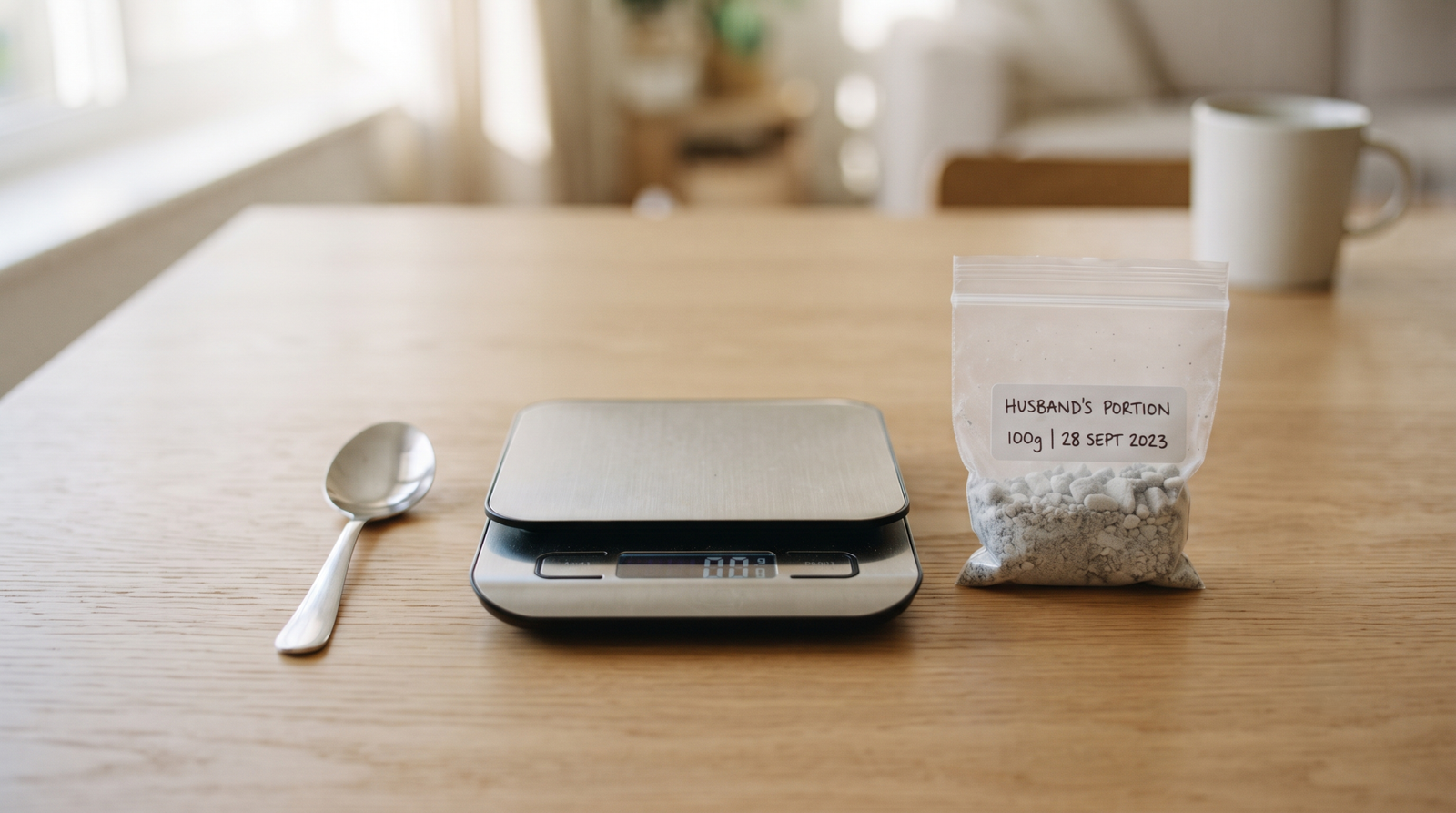
This is the job the guides to a husband’s ashes diamond skip. There is no ritual for it and no one to hand it to, so make it deliberate:

  1. Choose a time when you will not be interrupted, and decide whether you want someone with you.
  2. Lay out a clean surface, a kitchen scale, a new sealable bag or container, and a permanent marker.
  3. Open the urn and transfer the portion with a clean spoon. Do not sift or select; the remains are uniform.
  4. Weigh the portion, seal it, and label it with his name, the date, and the weight.
  5. Close the urn, and put the labelled portion somewhere it cannot be mistaken for anything else.
A kitchen scale, a clean spoon, and a sealed labelled bag laid out on a table before dividing cremated remains

Some people find this unbearable and ask a funeral home to do it for a fee. That is a reasonable choice. Some find it the first thing since the funeral that felt like theirs to do. Neither reaction is wrong.

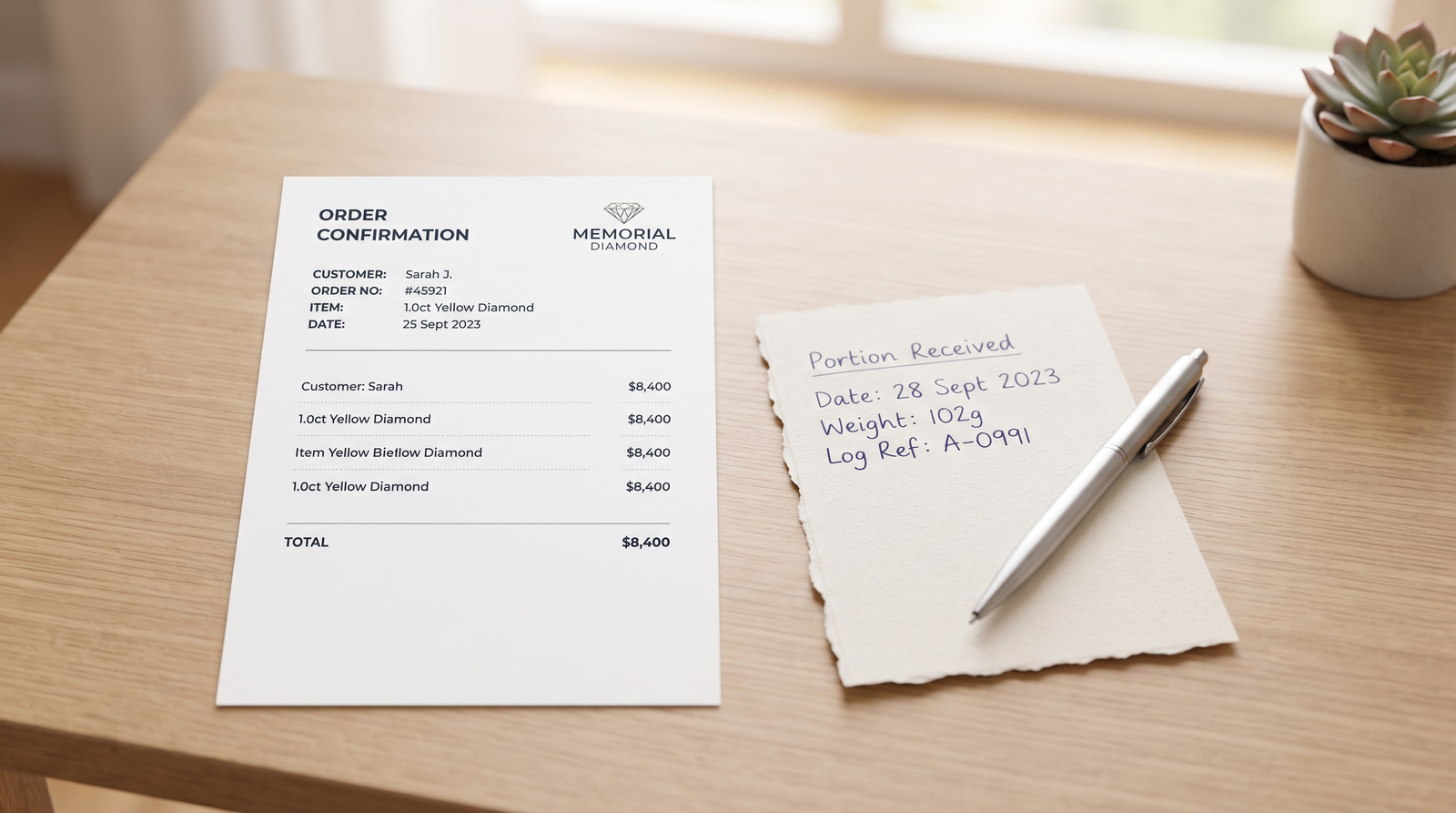
Step 3: Write Down What You Did

Once the portion leaves the urn, you are the only record that it existed. No funeral home logged it; no one else watched. Write down the date, the weight, and where the rest of his ashes are, and keep that note with the paperwork that comes back from the provider. A husband’s ashes diamond will eventually carry an origin document; your own note is the first entry in that chain.

handwritten-record-ashes-portion-date-weight

Step 4: Choose and Brief a Provider

Providers of a husband’s ashes diamond differ on method, minimums, and what they return to you. Before you send anything, settle these in writing:

  • Which growth method they use, and how HPHT and CVD diamond growth affects timeline and color.
  • What they record at intake: a weight, a photograph, an order reference.
  • What happens to any material not consumed by carbon extraction.
  • Whether the finished stone is graded by an independent laboratory, and by whom.
  • The carat size and color you are choosing, and the price for each, including any grading report or setting.

Color is worth understanding before you decide. Trace nitrogen produces yellow tones and boron produces blue; a colorless husband’s ashes diamond requires those elements to be excluded and typically costs more. Most memorial stones trend toward yellow, champagne, or blue. The full list of questions is in questions to ask before turning your husband’s ashes into a diamond.

Step 5: Send the Portion

Shipping rules for cremated remains vary by carrier and by country, so confirm the provider’s current instructions on the day rather than following a general rule. Most husband’s ashes diamond providers send a labelled collection kit. Photograph the sealed portion before it goes, keep the tracking number with your note from Step 3, and ask the provider to confirm receipt and the recorded weight.

An HPHT diamond growth press in a laboratory

Step 6: What Happens Once It Leaves You

From here the husband’s ashes diamond is the laboratory’s work. The portion is heated in a controlled, oxygen free process that removes the calcium phosphate and leaves carbon at roughly 99.9% purity. That carbon is converted to graphite at around 2,500 to 2,700°C, blended with laboratory carbon to reach the volume a viable crystal needs, and grown around a diamond seed for weeks to months. A gemologist then cuts and polishes the rough stone, and it is graded on the same cut, color, clarity, and carat scale as any diamond.

Growth time in the press, not the amount of ash you sent, determines carat size; the whole picture, including settings and family decisions, is in the husband ashes diamond guide. Industry wide, a husband’s ashes diamond takes six to ten months, sometimes twelve for larger or specialty color stones. The stage by stage version, including who holds the material at each point, is in how a memorial diamond is made from your husband’s ashes.

How Much of a Husband’s Ashes Diamond Is Actually Him?

Less than you might hope, and more than a symbol. The carbon recovered from his ashes typically makes up around 10% to 15% of the finished stone’s mass, with the rest being laboratory carbon needed to grow a crystal of usable size. Some providers cite lower figures for larger stones. A husband’s ashes diamond is physically made in part from him, and the origin document should say exactly that. Any provider claiming the stone is entirely his ashes is overstating the physics.

Frequently Asked Questions

Can I divide my husband’s ashes myself, or does a funeral home have to do it?

You can do it yourself. Once cremated remains are released to you, dividing them is a private decision, though customs and cemetery rules may apply if they are interred. Many funeral homes will separate and label a portion for a fee if you would rather not.

How much of his ashes do I need for a husband’s ashes diamond?

Industry typical requests run from a few tablespoons to about four ounces, roughly 100 grams. That is a small fraction of a full cremation, so the remainder can be interred, scattered, or kept as planned. Confirm the exact figure with your provider before opening the urn.

Is the diamond really made from his ashes?

Yes, in part. Carbon is extracted from the ashes, purified, and grown into the crystal; that personal carbon typically makes up around 10% to 15% of the stone, with laboratory carbon supplying the rest. The stone is physically made from him, not a keepsake with ashes sealed inside.

How long does it take to turn my husband’s ashes into a diamond?

Six to ten months from receipt of the ashes to a finished husband’s ashes diamond is typical industry wide, with larger or specialty color stones sometimes taking up to twelve months. The time is spent mainly in the growth press, and carat size is set by that growth time.

What color will a husband’s ashes diamond be?

Most memorial diamonds trend toward yellow, champagne, or blue because trace elements from an organic carbon source remain during growth. Colorless is achievable with additional processing at a higher cost. Some providers also offer post growth irradiation for red, pink, green, or black.

Can his children get diamonds from the same ashes?

Usually, yes. Because only a portion is used per husband’s ashes diamond, several diamonds can be grown from one shared source if enough remains. Decide early how many portions to set aside so the urn is opened once rather than repeatedly.

Final Thoughts on Turning Your Husband’s Ashes Into a Diamond

The laboratory part of a husband’s ashes diamond is slow, documented, and out of your hands. The part that is yours is the first afternoon: the scale, the spoon, the label, and the note only you can write. Do that part carefully, and everything that follows has a record to stand on.

Learn More About Husband Memorial Diamonds

Talk With Memorial Diamond

If his ashes are in your home and you are unsure whether a husband’s ashes diamond is right, or how much to set aside or how to send it, reach out to Memorial Diamond to talk through the first step before you open the urn.

One family member's hands holding a closed urn while three small lab-grown memorial diamonds sit on the table in front of it

More Than One Family Member, One Father: 7 Easy Answers

You can do the arithmetic in an afternoon. Three of you, a portion each, and the question of whether there is enough. Yes, more than one family member can have a diamond grown from the same father’s ashes, because a single stone uses only a small portion of a cremation’s remains. The quantity is not what settles it. What settles it is which one family member holds his ashes, whether that person is one of the people asking, and how many people the arrangement has to satisfy.

A note on where this comes from: Memorial Diamond makes memorial diamonds and would be one of the providers you might approach. Nothing on this page is written to steer that.

Which One Family Member Actually Controls His Ashes?

Cremated remains are generally released to the person who arranged and authorized the cremation, confirm locally rather than assuming. That is a name on a document: a surviving spouse, an executor, or whichever relative signed the paperwork at the funeral home. It may not be yours.

Two things are bundled inside the word control. The first is possession: one family member physically has the container. The second is authority over disposition: who decides what happens to the remains. In many jurisdictions that sits with a surviving spouse ahead of adult children, but it varies by state and can be displaced by written instructions he left.

Here is the asymmetry specific to a father. The people who want stones are not automatically the one family member with control. A widow holds the urn; three adult children want three diamonds. The arithmetic stays easy; the request still has to travel to the person who can say yes. Raising it with that person has its own shape: how to talk to family about a father memorial diamond handles it.

What the Material Allows

Industry practice puts one stone’s requirement between a few tablespoons and roughly 4 oz, about 100g, of cremated remains. A full cremation yields substantially more, so three or four portions is unremarkable, and the rest can still be interred, scattered or kept as intended. How much ash you need for a father memorial diamond covers the figures properly.

Be precise about what each portion becomes. Carbon recovered from ashes is refined to around 99.9% purity, but ash carries only about 0.5% to 4% carbon by weight, so one portion yields far less than the volume a growth cell has to be charged with; lab sourced carbon makes up the rest. Industry figures put the personal fraction at roughly 10% to 15% of a finished stone’s mass, a per stone figure, not a pooled one. Each stone is grown to the same ratio, so four stones do not divide him four ways. Every one of them is a real lab grown diamond, grown by the same HPHT or CVD method as any other.

Two consequences follow:

  • The stones will differ from each other. Color comes from trace elements present at growth, and separate growth runs are separate events: memorial diamond colors for a father covers how a color is specified before anyone sees it.
  • Four stones are four orders. Price follows the number of stones and the carat of each, not the volume of ash. What a father memorial diamond costs sets out the ranges.

Where the Friction Sits, Arrangement by Arrangement

Family arrangementWho controls the materialWhere the friction sits
Widow surviving, adult children of that marriageHis widow, who arranged the cremationThe children are asking for a portion of something in her house that is, to her, still his
Widow surviving, adult children of an earlier marriageHis widowWhether they are asking her or the estate, and whether anyone has established which
No surviving spouse, several adult children, one has the urnThe sibling it went home withPossession was an accident of who had space; it now reads as authority
No surviving spouse, an executor appointedThe executor, while the estate is openEstate timelines, and any written instruction, which may already settle it
Second marriage, adult step children on both sidesHis widow, then her executor“Family member” is the contested word; the count is settled before any stone is
A portion already retained by several relativesEach holder of a portionAlready decentralized; more than one family member may be able to order independently
Already interred, scattered, or committed to a booked dateNobody, once it is doneThe ash route is closed; hair, if any was kept, is a separate question

Read the middle column: in four of these seven rows, the one family member with control is not the one doing the asking. If your question is about supply, the answer is easy. If it is about permission, that is the harder half.

Small labeled sample containers beside a larger urn, each holding a measured portion of cremated remains

One Person Orders; Several People Receive

Even where four people each end up with a stone, the order usually sits with one named account holder: one submission of material, one chain of custody record, one counterparty making the decisions the laboratory needs. That structure works. It fails when people do not know they are inside it.

Whoever signs is the one family member a provider comes back to, on the laboratory’s timetable rather than the family’s, settling carat and color for each stone, carrying payment across all of them, and agreeing what happens if somebody withdraws after material has gone. Ask before ordering whether each recipient is named on the origin documentation, and what becomes of material submitted and not used. Questions to ask before turning your father’s ashes into a diamond collects the wider set.

Order paperwork and an origin certificate laid out with three named recipient lines

Frequently Asked Questions

My stepmother has his ashes and I have not raised it with her yet. Does that change what is possible?

Not what is physically possible: the quantity involved is small. It changes who the request goes to. She is the one family member holding the remains, so the practical answer is hers to give, whatever the wider family thinks.

Will retained ashes still be usable if we order a second stone years from now?

Cremated remains are chemically stable and do not degrade in ordinary storage, so a later order is workable in principle. Confirm storage and handling requirements with a provider rather than assuming a particular portion will be accepted.

If he left no instructions, can one family member decide alone?

They hold the material, so any request goes through them, and a provider would treat them as the customer. Whether they decide alone is then an arrangement inside the family: anyone who would want a say is better asked first.

Can one of us have a hair diamond while the others have ash diamonds?

Yes, where hair was kept. Hair is roughly 50% carbon against ash’s 0.5% to 4%, so far less material is needed, and it is a separate submission with its own order rather than a variation on the ash one.

Does more than one family member have to be on the contract?

Usually not; providers typically need one customer of record. Ask whether several recipients can be named on the origin certificate, and whether payment can be split across people, before anything is posted.

What if a sibling was never asked?

Another stone cannot fix it. If material remains and the holder agrees, a later stone can be grown; being left out of the decision is not recoverable the same way. Write down who was told, when, and what they said.

Final Thoughts on Sharing a Father’s Ashes Diamond

The supply question is the easy one, and most families settle it in a sentence. The harder one is that one family member holds his ashes and everyone else is asking. Get that conversation right, agree who signs and who receives, and the number of stones takes care of itself.

Learn More About Father Memorial Diamonds

Talk With Memorial Diamond

If several of you want a stone from the same ashes, the useful first conversation is about who holds them and who signs. Reach out to Memorial Diamond at memorialdiamond.us to talk through what one submission can become for more than one family member.

Desk with a phone, a notepad and a closed cremation urn set to one side, the notepad in use

Turn Your Father’s Ashes Into a Diamond: Order of Steps

The first practical act is not opening the urn. It is a phone call to whoever holds his remains or arranges what happens to them, asking that a small portion stay aside.

Turning your father’s ashes into a diamond takes four acts: retaining a portion, choosing a provider, specifying the carat, and posting the material. Only the first act has a deadline that cannot move, and that deadline often arrives before you know which provider you want.

This guide explains the correct order, why families often face the steps in the wrong sequence, and what you can still fix after the steps have already happened.

The Four Acts, and Which of Them Can Be Undone

The sensible order does not always match the order available to a family. The important question concerns which acts you can reverse.

ActPreconditionCost of doing it lateReversible?
Retain a portionAccess to the remains and no interment or scattering yetThe ashes route closesNo
Choose a providerYou know what you hold and what you want madeNone if the portion remains safeYes
Specify carat and colourThe provider’s options and intake rulesA growth run may follow a specification you later changeUsually, until the run starts
Post the materialProvider, specification, intake instructions, and order referenceThe material reaches a laboratory without a confirmed orderNo
Four-stage diagram showing retention, provider selection, carat specification and shipment, with the first and last stages marked one-way

The two one way acts sit at opposite ends of the sequence. The reversible decisions sit between them.

Carat affects the rest because a laboratory grows a memorial diamond to size inside a growth press. The laboratory does not cut a larger diamond down to your chosen size. Carat therefore affects growth time and cost. Read more about choosing a carat size before you make that decision.

The Retention Deadline Arrives Before the Provider Is Chosen

Here is where the sequence often breaks.

A committal, an interment into a shared plot, or an agreed scattering can happen within weeks of a death. After that event, the family cannot simply retain a portion from the ashes.

Choosing a provider can take much longer. You may need to compare intake rules, costs, production methods, grading, chain of custody, and family preferences.

The calendar therefore places an irreversible act before a slower decision.

The solution remains simple. Retention does not require a provider, price, carat, or colour. You can ask the funeral director to retain a portion before you decide which company will receive it.

The complete guide to a father ashes diamond explains the retention deadline and the wider process in more detail.

Can You Retain a Portion Before You Have Chosen a Provider?

Yes. Retaining a portion gives you time to make the commercial decisions later.

Retention concerns the physical material rather than a purchase. You need a sealed container, a clear label, and a written record.

Small sealed and labelled bag of cremated remains beside a handwritten record sheet and a pen

Quantity represents the decision that needs attention before you move on. Industry typical requirements range from a few tablespoons to roughly 4 oz, or about 100 grams. A full cremation produces much more material, so retaining a reasonable portion gives you room to choose later.

Read how much ash a father memorial diamond needs before you decide how much material to retain.

Record the following information when the portion leaves the main container:

  • Who separated the portion and the date of separation.
  • His full name exactly as it appears on the cremation paperwork.
  • The approximate quantity retained.
  • Where the portion remains stored.
  • Who knows about the retained portion.

This record gives your family a useful starting point for its own chain of custody. How providers track a loved one’s ashes explains the provider side of that process.

If several family members contribute money, agree in advance about who will own the finished diamond and who will hold it. Ownership can vary by jurisdiction and by the way the family places the order.

What Has to Be Settled Before the Package Leaves?

Posting the material creates the second one way act. Settle the important details before the package leaves your hands.

  • Choose a provider. Get its intake instructions in writing, including quantity, packaging, labelling, and delivery details.
  • Agree on the specification. Confirm carat and colour before the material travels so the laboratory receives it against an active order.
  • Record the order reference. Put the correct reference on the package so the provider can match the material with the correct file.
  • Ask about unused material. Confirm whether the provider returns unused material automatically or only after a request.

Some providers may accept material before the family finalises the carat. Others may require a complete specification first. Treat this as provider policy and ask before you send anything.

If you want a practical checklist of questions to settle before shipping, review your provider’s intake requirements and keep every answer with the order record.

USPS Priority Mail Express parcel carrying the required cremated-remains label, cushioning visible inside

Shipping Is Decided by Carrier Policy, Not by Law

Families often frame this as a legal question. The practical issue involves carrier rules.

Carrier policies can restrict individual customers from shipping cremated remains. The source material identifies UPS, FedEx, and DHL as carriers that bar cremated remains from shipment by individual customers, leaving USPS as the realistic direct domestic route under the described rules.

Always confirm the current requirements with the carrier before shipping because carrier policies can change.

Who is sending itAvailable routeWhat it adds to the sequence
A family member shipping domesticallyUSPS Priority Mail Express with the required cremated remains labelConfirm current packaging and service requirements before choosing the posting date
A funeral directorTheir own business shipping arrangementsOften simpler while the funeral director still holds the remains
Someone carrying the material personallyHand deliveryConfirm that the provider accepts public hand delivery and records receipt

USPS supplies a free Cremated Remains kit that customers can order online. Confirm current USPS requirements before you depend on the kit or your own packaging.

The source recommends checking whether your own sift proof and cushioned packaging qualifies, since waiting for a kit can add time. Photograph the sealed package and its label before it leaves, then tell the provider that the material is on its way.

For the broader legal question, read the legal position on turning ashes into a diamond.

If your father’s ashes have already gone into an interment or scattering, another material route may remain. Turning your father’s hair into a diamond does not require cremated remains.

What Can Be Fixed If the Acts Already Fell Out of Order?

Not every mistake closes the process. The outcome depends on what already happened.

What happenedWhat you can do now
The interment happened and nobody retained a portionThe ashes route closes. The hair route remains available if you have suitable hair.
You chose and paid a provider before telling the familyIf no material has moved, ask the provider whether you can pause the order.
You retained more material than you needKeep the surplus with the family unless the provider gives you another instruction.
You retained less than the provider’s stated minimumAsk whether the provider can work with a smaller quantity and a smaller carat.
You shipped the material before agreeing on a specificationAsk the provider whether it can place the material on an intake hold.
You set aside a portion years ago without recording itThe material may remain usable, but the provider may need additional documentation.
Printed checklist on a kitchen table with several lines ticked and one left blank

Do not assume that a provider can pause an order, accept a smaller quantity, or return unused material. Ask for its policy before relying on any of those options.

If the steps already happened in the wrong order, the right response starts with identifying exactly where the material sits now and what the provider has recorded.

What Happens Once the Parcel Is Out of Your Hands?

The sequence changes once the laboratory receives the parcel. The production clock starts from laboratory intake rather than the moment you hand the package to the carrier.

Ask the provider what its intake confirmation looks like and when you should expect it. Write down the date when the laboratory logs the material.

Industry production commonly takes 6 to 10 months from laboratory receipt. Large stones and specialty colours can take around 12 months. From the first decision through family discussions, shipping, laboratory production, grading, and jewellery setting, an 8 to 14 month journey can make sense.

Gloved technician logging a received sample into a laboratory intake record

Read how long a father memorial diamond takes for the timeline in more detail.

One important point deserves attention before you send the material. Cremated remains contain roughly 0.5% to 4% carbon by weight. The laboratory therefore blends purified personal carbon with supplemental laboratory carbon to reach the required feedstock volume. Industry information places the personal carbon contribution around 10% to 15% of the finished stone’s mass.

Sending more ash does not make the diamond larger or make the laboratory work faster. Carat depends on growth time.

Ask the provider how often it will update you during production and what milestones it will report.

Frequently Asked Questions

Which comes first, choosing a provider or asking for a portion to be held back?

Ask for the portion first. Retention carries the deadline that cannot move, and you do not need a provider, price, or specification to make that request. You can compare providers after you secure the material.

Can we send the portion before we have decided the carat?

Usually, you should settle the specification first because a laboratory sets up the growth run around the selected carat. Some providers may accept material while you decide. Ask about that policy before shipping.

Do we have to order the free USPS Cremated Remains kit before we can post?

USPS supplies a free Cremated Remains kit. Confirm current USPS rules before you decide whether you need that kit or whether your own approved packaging qualifies. Do not let a packaging assumption create an avoidable delay.

Can a funeral director post his ashes to the laboratory for us?

Often, a funeral director can arrange shipment through business shipping procedures. Ask the funeral director while they still hold the remains. This approach may simplify the process for a family that wants to retain a portion before release.

A portion was set aside years ago and nobody recorded what it was. Can it still be used?

The age of the material may not create the main problem. Documentation creates the larger question. Ask the provider what evidence it needs and reconstruct the history of the material as accurately as possible.

Does the growth clock start when we post the parcel or when the laboratory receives it?

The quoted production period starts at laboratory receipt. Shipping time, intake holds, specification changes, and documentation discussions sit outside that production period. Record the laboratory intake confirmation date.

Get the Sequence Right Before You Choose the Stone

The first question concerns the material, not the diamond. If an interment or scattering already has a date, ask for a portion to stay aside before the remains leave the funeral director’s control.

After that step, you can take your time. Compare providers, choose the carat, decide on colour, review the intake process, and settle the shipping requirements.

The important thing is to avoid turning a time sensitive retention decision into a purchase decision. Secure the option first. Make the rest of the decisions when you have enough information.

When you are ready to discuss the process, Memorial Diamond can help you understand the next steps.

turn-mothers-ashes-diamond

How to Turn Your Mother’s Ashes Into a Diamond | Step-by-Step Guide

Hands holding a small sealed container of cremated ashes beside a finished champagne-toned memorial diamond

The decision to turn your mother’s ashes into a diamond often comes before you know exactly how the process works.

You may already know that you want to create something lasting in her memory, but practical questions naturally follow. How much ash is needed? Which diamond size should you choose? Should you talk to your family first? How are cremated remains sent? And what happens while the diamond is being created?

Turning your mother’s ashes into a diamond generally follows a clear sequence. You choose the carat size and color, confirm how much material is required, discuss the decision with family, prepare the portion needed, arrange delivery or shipping, wait for the diamond to be created, and finally decide how you want the finished stone to be worn or kept.

One important detail surprises many families: carat size is often one of the first decisions you should make, not the last.

Step 1: Choose the Carat Size and Color

The size of your memorial diamond can influence the overall process, timeline, and planning.

Memorial diamonds are grown through a specialized laboratory process. Because of this, the size of the diamond is an important consideration before the growth process begins.

Before choosing, think about how you want to use the finished diamond.

A smaller stone may be meaningful as part of a delicate pendant or ring, while a larger diamond may become the central feature of a custom piece of memorial jewelry.

Color is another important decision. Memorial diamonds can appear in different colors depending on the materials and diamond-growing process.

To learn more about possible diamond colors, read What Color Will a Diamond Made From Your Mother’s Ashes Be?.

If you are unsure about diamond size, our guide on how to choose a carat size for a memorial diamond can help you compare your options.

Five memorial diamonds ranging from 0.25 to 2 carats laid out in size order on a pale gray surface

Step 2: Confirm How Much of Her Ashes You Need

Most people expect that a large amount of cremated remains is required. In many cases, only a portion may be needed, depending on the provider and the process used.

Before preparing anything, contact the memorial diamond provider and ask for the exact material requirement.

Important questions include:

  • How much material is required?
  • Should the amount be measured by weight or volume?
  • What happens to material that is not used?
  • Will any remaining portion be returned?
  • How is the material identified and tracked during the process?

If your mother’s ashes have already been divided between family members or some ashes have already been scattered, the remaining portion may still be sufficient. However, you should always confirm the exact requirement before making any arrangements.

For a more detailed explanation, read How Much Ash Do You Need for a Mother Memorial Diamond?.

Step 3: Talk to Your Family Before Dividing the Ashes

Before separating any portion of the ashes, it can be helpful to speak with close family members.

People can have different feelings about cremated remains and memorial keepsakes. While one family member may see a diamond as a beautiful way to preserve a connection, another may prefer to keep all of the ashes together.

Having a conversation first gives everyone an opportunity to share their thoughts.

You can begin by explaining the practical side of the decision, including how much material may be required and whether the family’s existing plans for the remaining ashes can still continue.

In some situations, more than one memorial diamond may be possible for different family members. You can learn more in our guide, Can More Than One Family Member Get a Diamond From the Same Mother’s Ashes?.

If you are unsure how to begin the conversation, read How to Talk to Family About a Mother Memorial Diamond.

Step 4: Prepare the Required Portion

Once you know the provider’s exact requirements and have discussed the decision with your family, the next step is preparing the required portion.

Follow the instructions provided by your memorial diamond company carefully.

A calm and organized approach can help:

  • Work on a clean, flat surface.
  • Prepare the receiving container before opening the original container.
  • Use clean and dry equipment.
  • Measure according to the provider’s instructions.
  • Seal and label the prepared portion carefully.
  • Return the remaining ashes to their original container.

If preparing the material yourself feels emotionally difficult, you may wish to ask a funeral professional for assistance.

Small scoop transferring a measured portion of cremated remains into a sealable bag on a clean table

Step 5: Arrange the Shipping or Delivery

Cremated remains cannot always be shipped in the same way as ordinary packages. Shipping requirements depend on the country, carrier, and destination.

Before sending anything, confirm the current requirements directly with both the memorial diamond provider and the shipping service.

Ask your provider:

  • Which shipping method should be used?
  • Do they provide a shipping kit?
  • What type of packaging is required?
  • Is documentation required?
  • How will the package be tracked?
  • How will you be notified when the material arrives?

For families in the United States, it is important to review the current guidance from USPS before shipping cremated remains, as carrier requirements can change.

Before sending the package, it can also be helpful to keep a record of the tracking information and confirm the provider’s process for acknowledging receipt.

International shipping can involve additional requirements, so always check the regulations that apply to both the sending and receiving countries.

Official USPS Priority Mail Express Cremated Remains box with a sealed sift-proof inner container beside it, prepared for shipping

Step 6: What Happens While the Diamond Is Being Created?

Once the material reaches the laboratory, it enters the memorial diamond creation process.

Although the exact process can vary between providers, the material generally goes through several stages before the finished diamond is ready.

These stages may include:

  1. Receiving and documenting the material.
  2. Extracting and preparing usable carbon.
  3. Processing the carbon for diamond growth.
  4. Growing a diamond crystal using specialized laboratory equipment.
  5. Cutting and polishing the diamond.
  6. Preparing documentation associated with the finished stone.

The overall timeline can vary depending on the requested carat size, color, laboratory process, and provider.

For a closer look at the science behind the process, read How a Memorial Diamond Is Made From Your Mother’s Ashes.

Before beginning the process, ask your provider how often you can expect updates and what stages of the journey you will be informed about.

Step 7: Decide How You Want to Keep or Wear the Diamond

When the memorial diamond is complete, you will need to decide how you want to keep it.

Some people choose to keep the diamond as a loose stone, while others have it set into a piece of jewelry that can be worn every day.

Popular options include:

  • Memorial diamond rings
  • Diamond pendants
  • Earrings
  • Custom family jewelry
  • Heirloom jewelry pieces

The setting you choose can become part of the meaning of the memorial itself. A simple pendant may feel personal and close to the heart, while a ring can become something you wear every day.

For inspiration, read Memorial Diamond Settings and Jewelry Ideas for a Mother.

Loose memorial diamond beside a pendant setting and a grading report on a jeweler's cloth

Frequently Asked Questions

Can I deliver my mother’s ashes in person instead of shipping them?

Some memorial diamond providers may allow personal delivery or drop-off. Availability depends on the company’s facilities and procedures, so contact the provider before making travel arrangements.

Do I need paperwork to send ashes?

Shipping requirements can vary depending on the carrier and location. Documentation may be required, so always confirm the current requirements before preparing a shipment.

What if my mother’s ashes were already divided among family members?

A divided portion may still be sufficient depending on the provider’s requirements. Confirm the exact amount needed before beginning the process.

What happens to ashes that are not used?

This depends on the provider’s policies and process. Before sending any material, ask how unused portions are handled, returned, and documented.

Does the whole family have to agree?

Every family’s circumstances are different. Even when family members have different opinions, having an open conversation before dividing the ashes can help avoid misunderstandings and ensure everyone’s wishes are respected.

A Meaningful Next Step

You do not need to make every decision immediately.

The first step can simply be learning about your options and talking with the people closest to you.

Think about the diamond size that feels meaningful, the color you prefer, how you may want to wear the finished stone, and what your family has planned for the remaining ashes.

For a broader overview of the entire process, read Mother Ashes Diamond: The Complete Guide.

Turning your mother’s ashes into a diamond is a deeply personal decision. Taking the time to understand each step can help you move forward with confidence and create a lasting memorial that feels meaningful to you and your family.