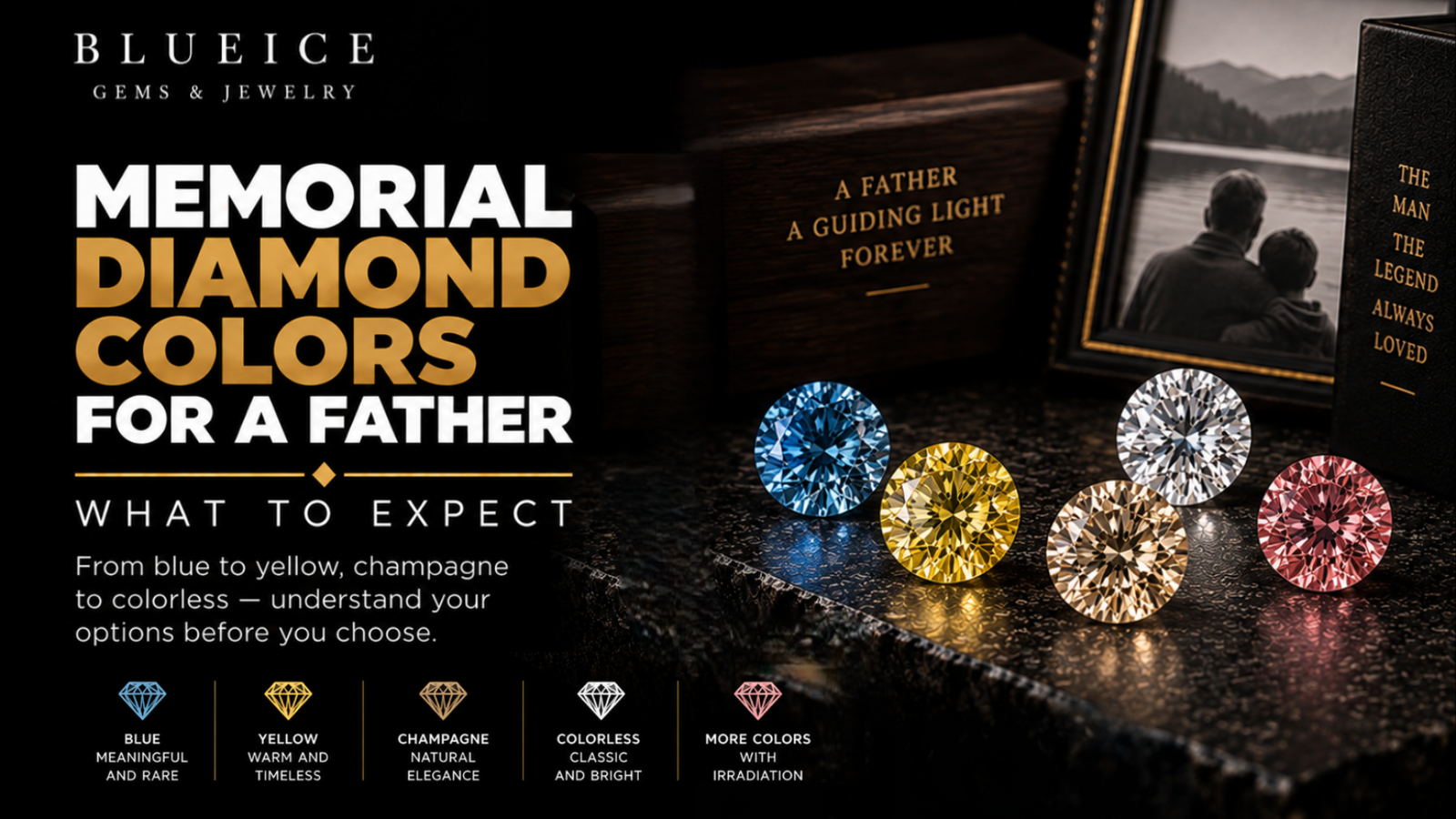
Memorial diamond colors for a father featuring blue, yellow, champagne, colorless, and pink diamonds with a father's keepsake box

Memorial Diamond Colors for a Father: What to Expect

The order form asks for a color months before there is anything to look at. So here is what memorial diamond colors for a father come down to: you can specify a color family, blue, yellow, champagne, colorless, or a color applied after growth, with an agreed range around it. What you cannot specify is a shade. Write the family and the range into the order, and settle who decides whether the finished stone sits inside it.

One disclosure first: Memorial Diamond grows and sells memorial diamonds, which makes us one of the providers this page tells you to pin down. Read the recourse section as something to put to us in writing as readily as to anyone else.
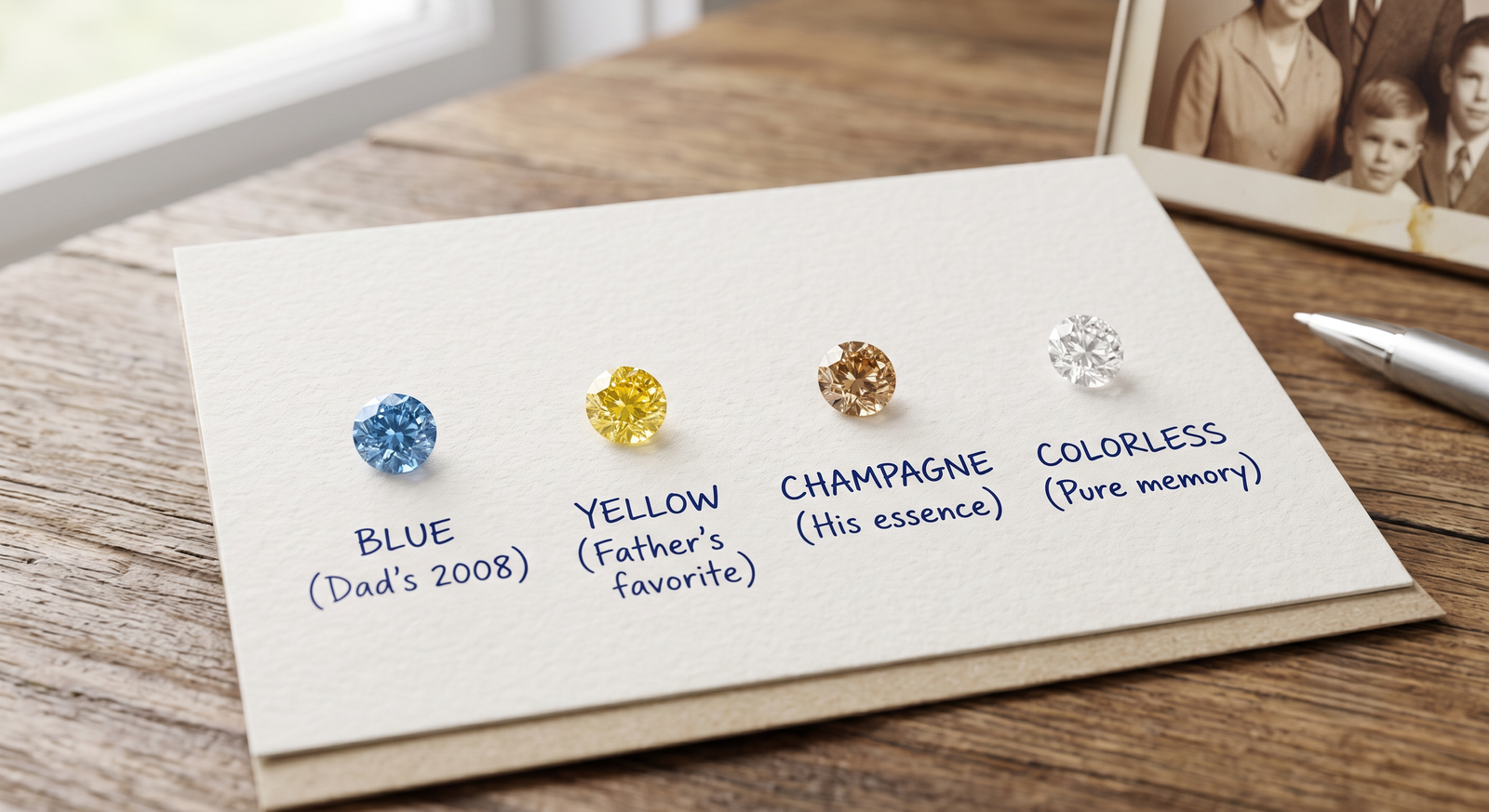
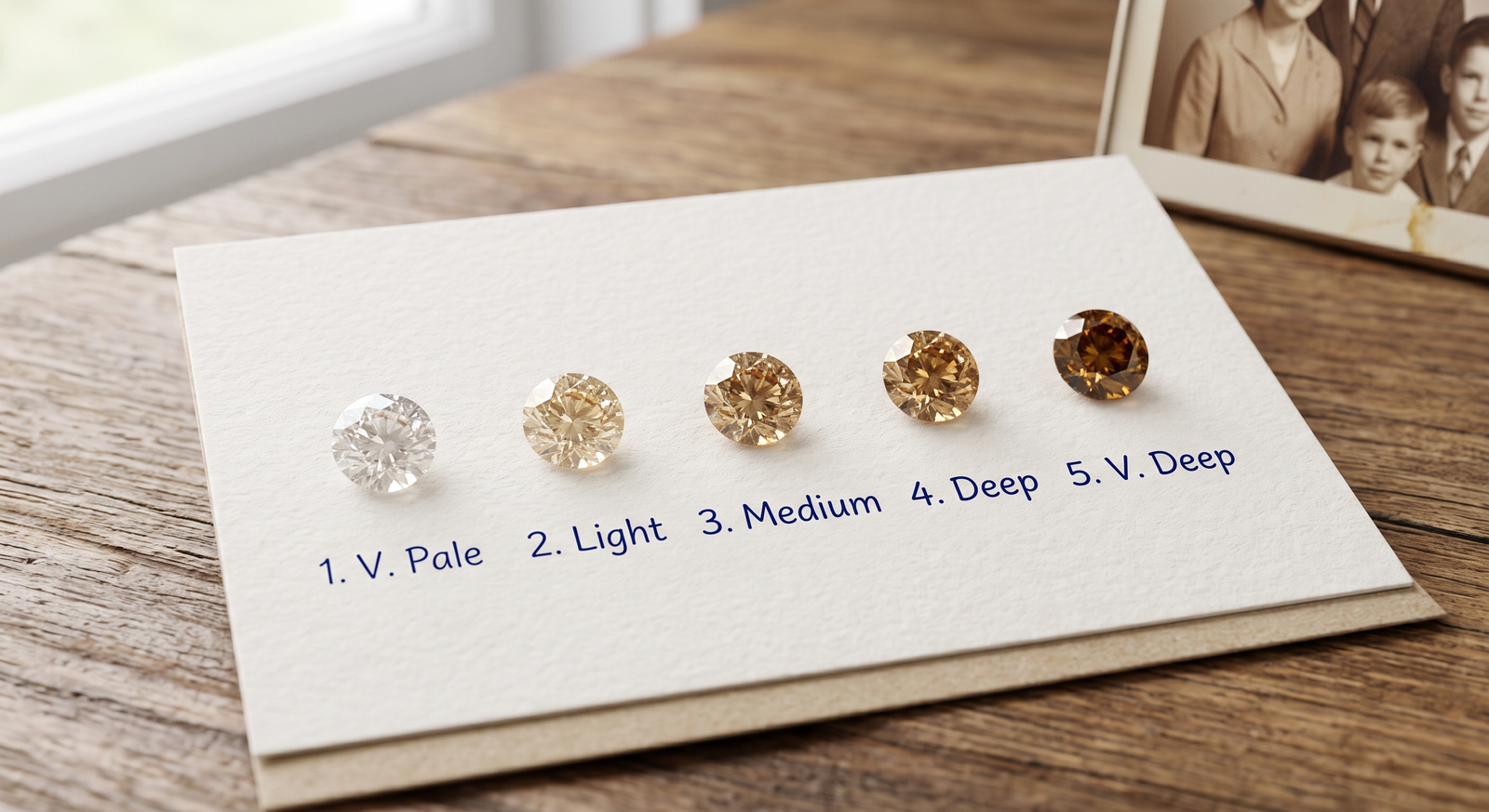
Memorial diamond colors: four small lab-grown stones in blue, yellow, champagne and colorless laid in a row on white card, each above a handwritten label

What Can You Actually Specify About Memorial Diamond Colors?

Memorial diamond colors are agreed in words, held for months, then checked once at the end against an object nobody has yet seen.

What you can specifyWhat you cannotWhat to put in writing
A color family, blue, yellow, champagne or colorlessWhich shade inside it arrivesThe family, plus the range you will accept
Whether the color is grown in or applied by irradiation afterwardsWhether an organic source cooperates first timeThat these are different products, and which you are buying
That the stone reads warm or coolThe exact depth of tone at the carat chosenThe carat and the color on one line, since a tint reads differently at different sizes
That a color grade appears on a grading reportWhat your eye will make of that gradeWhich laboratory grades it, on which scale, and that the report travels with the stone
That two stones ordered together carry one specificationThat two separately grown stones will matchThat you want a shared specification, not a matched pair
Who signs the finished color offThat everyone agrees at first sightThe named person who accepts or declines, and what follows
Five champagne-toned diamonds arranged from palest to deepest to show one color family's range

Which Memorial Diamond Colors Exist, and What Puts Them There

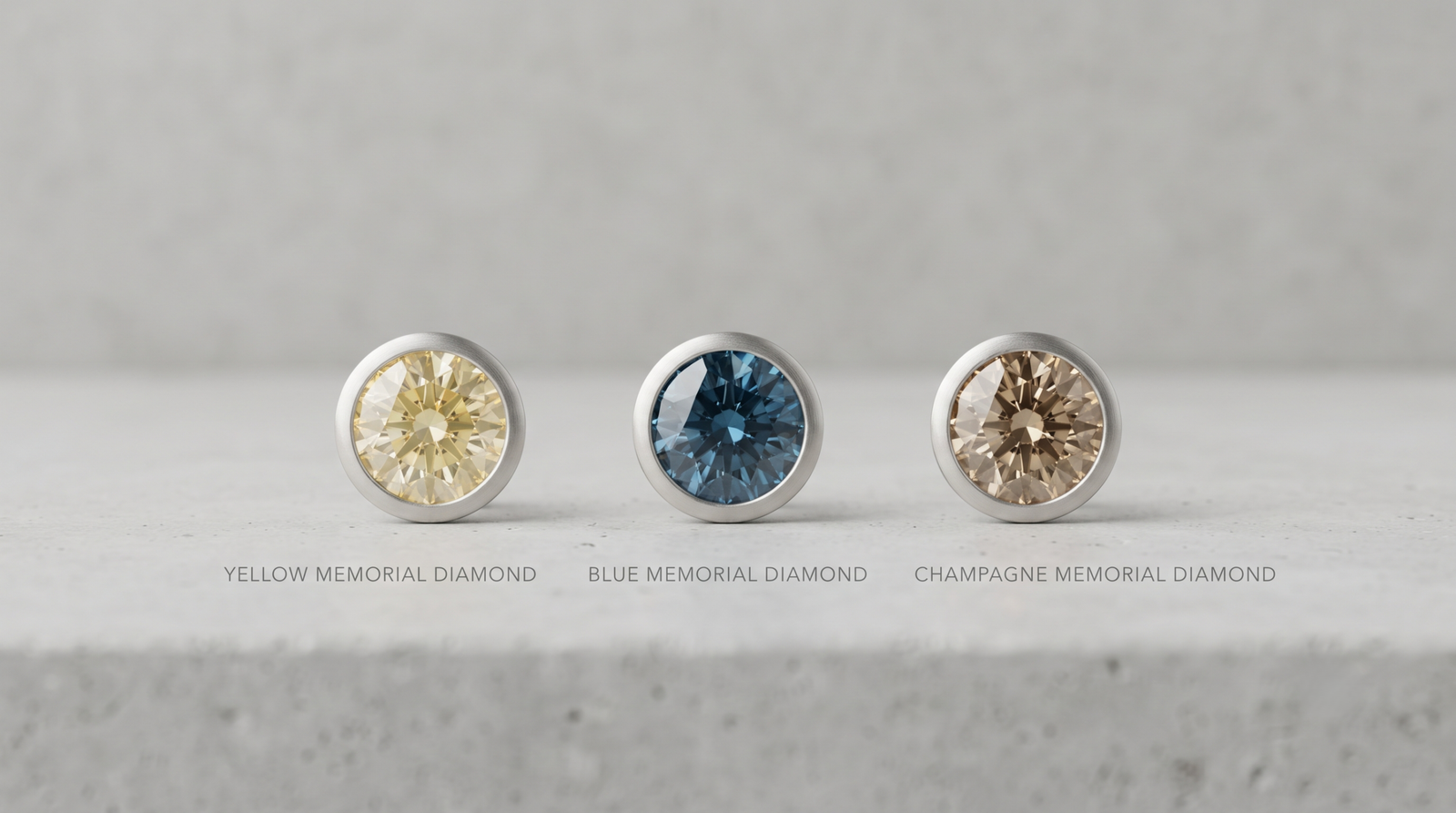
Color comes from trace elements present while the crystal grows. Boron produces blue. Nitrogen produces yellow. A colorless stone requires the near total absence of both which an industrial feedstock is manufactured to deliver, and which an organic source can reach only with additional processing to exclude those trace elements, at meaningfully higher cost. Some providers also offer post growth irradiation, applied to a finished crystal, for red, pink, green or black.

The memorial diamond colors you agree apply to a crystal only partly his. Carbon recovered from ash or hair is purified to around 99.9%, then combined with lab sourced carbon to reach the volume a growth run needs, the published figure for ash derived stones puts his share at roughly 10–15% of the finished mass, with no equivalent figure published for hair.

What a particular submission tends to produce is a separate question: the ashes version, the hair version, which also covers why the color his hair went has no bearing, and the combined version. Why memorial diamonds are rarely colorless has the chemistry.

A Color Word Is Not a Color Specification

“Champagne” is a family, not a shade, and so are “blue” and “yellow.” Each spans a range of grades, and stones at either end of that range are recognizably different objects under one word. Memorial diamond colors are described in family names because that is the honest level of precision before growth.

That matters because of when memorial diamond colors get named. You say it in month one, to someone who works with that color family routinely and has a working average in mind. Neither of you has said what would count as too pale or too dark. The missing half is the tolerance, the range nobody has written down, and the thing there is no agreed answer to point at when a box is opened eight months later.

Three things narrow it before the order is placed:

  • Ask what vocabulary the provider works in. A named grading scale, in house color names, sample stones, photographs, these are not equivalent, and the order should record which one it is judged against.
  • Ask to see the extremes rather than the middle. One representative image shows the average; the pale end and the deep end show what you are agreeing to.
  • Ask what carat those references were. A tint barely visible in a small stone is unmistakable in a larger one, so a reference at the wrong size is not a reference.

How Do You Write a Color Down So Two People Mean the Same Thing?
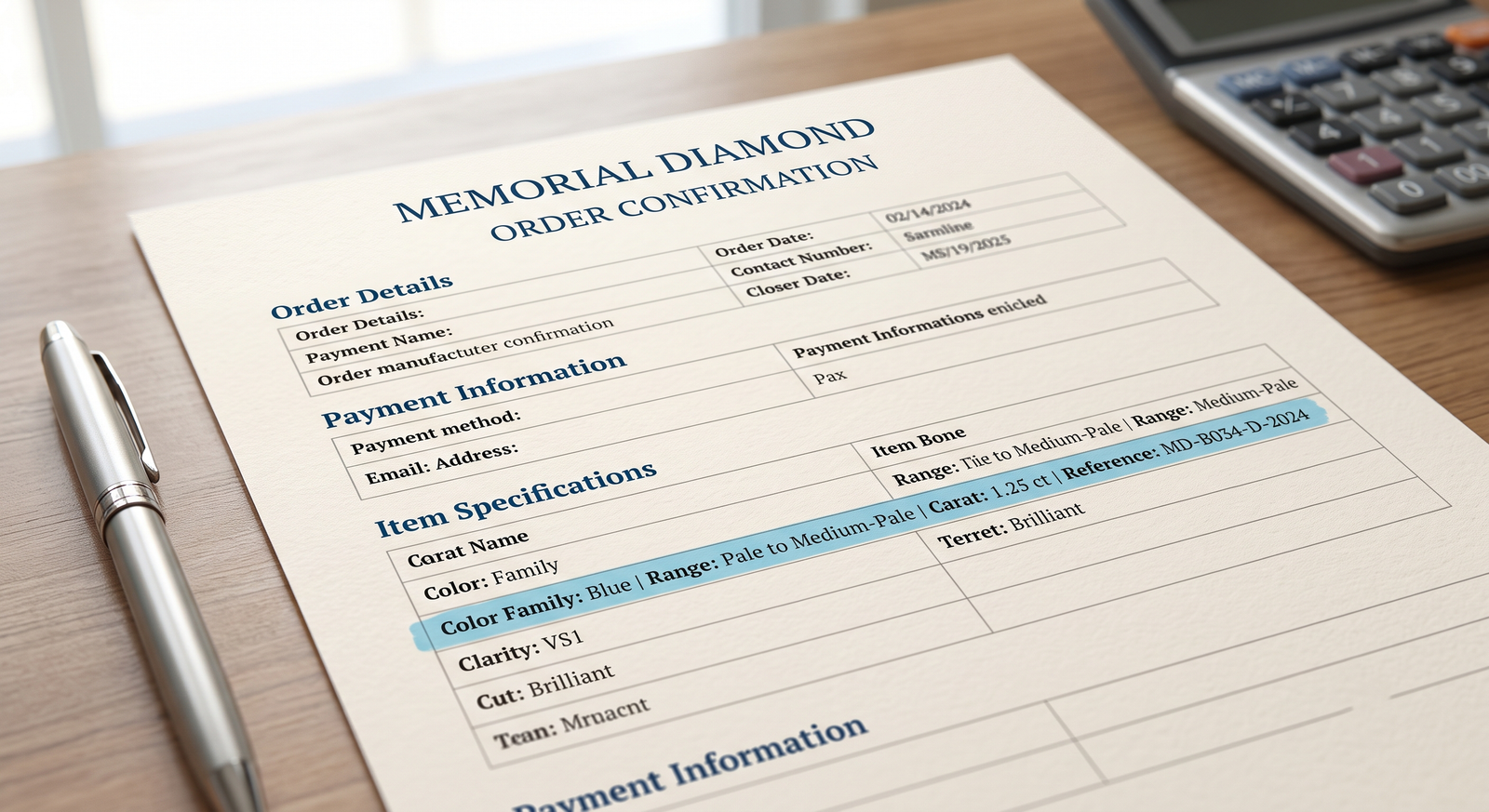
 An order confirmation with a single highlighted line naming color family, range, carat and reference

A line describing memorial diamond colors should survive being read by someone who was not in the conversation. Six things put memorial diamond colors in that state:

  1. The color family, in the provider’s vocabulary as well as your own words.
  2. The acceptable range, expressed the way that provider grades color.
  3. Whether the color is grown in or applied after growth, different products, priced differently.
  4. The reference being used, a named scale, a sample stone, a photograph, and who holds it.
  5. The carat it applies to, on the same line, because the two move together.
  6. The date, and the person on each side who agreed it.

Ask for that line to appear in the order confirmation itself, not only in the email thread that produced it.

What memorial diamond colors do to the price sits in what a father memorial diamond costs; what a setting metal does to the color you see sits in memorial diamond settings and jewelry ideas for a father.

What a Grading Report Says About Color, and What It Does Not

A grading report is the diamond’s own quality document: cut, color, clarity and carat, against a stated scale, ideally from an independent third party laboratory. It is not the in house origin certificate, which records whose carbon the stone was grown from and says nothing about how it looks. How memorial diamonds are graded and certified sets out what each establishes.

Three limits are worth knowing about how a report handles memorial diamond colors. It is issued after the stone exists, so it verifies rather than commissions. A grade is a band rather than a point, so two stones can share a grade and not look alike. And it is assessed under controlled conditions, not on a hand at a kitchen window, so a report and an eye can honestly disagree.

That makes the report a check on the memorial diamond colors you specified rather than a substitute for the specification. Ask early whether the stone is graded independently or in house, and on which scale.
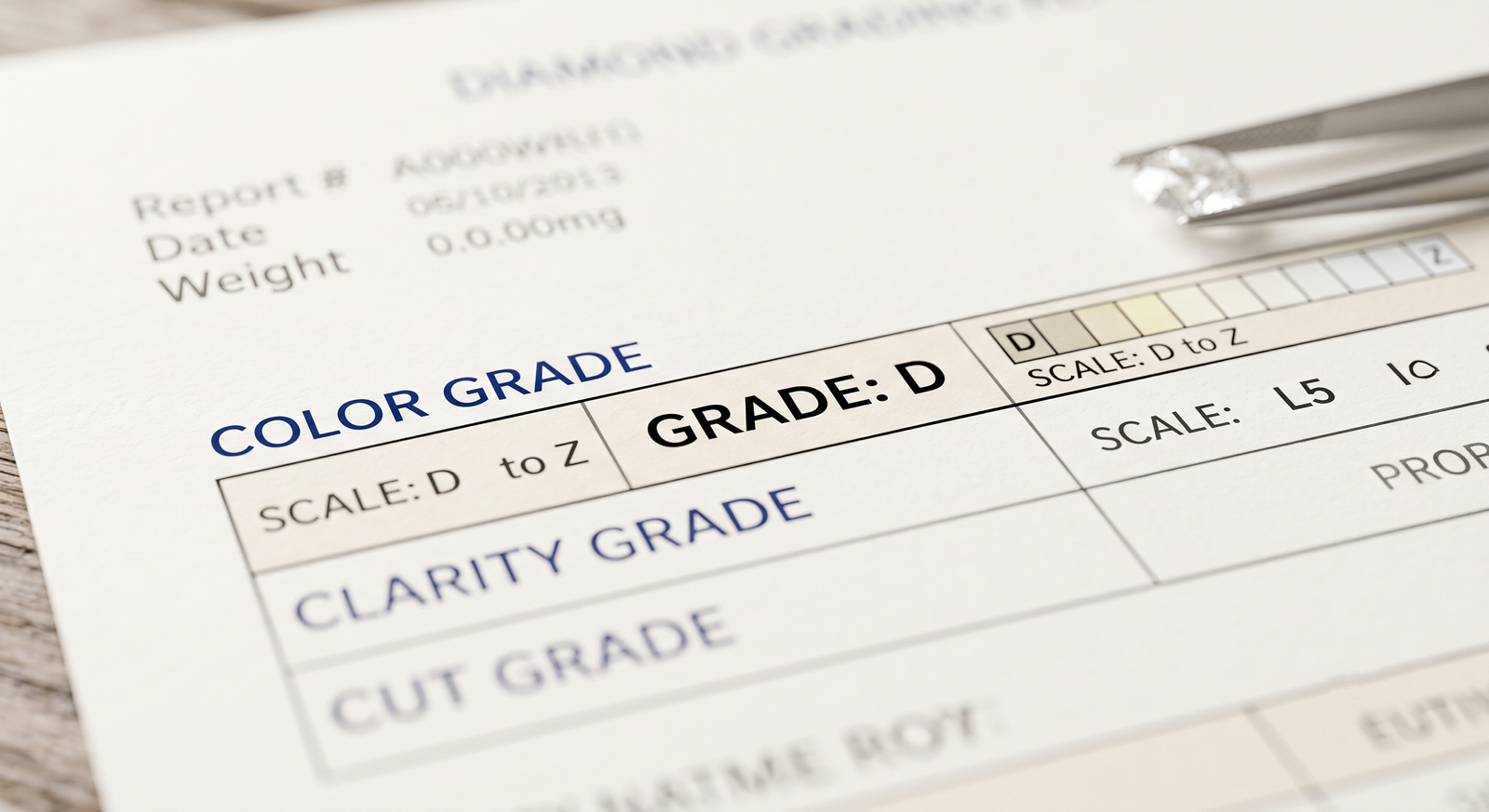
 Close-up of a diamond grading report with the color grade line in focus

What Should You Ask About Recourse?

Nothing published about this category establishes a standard procedure for a stone that arrives outside an agreed color range, no norm, no default remedy, no assumed sequence. Which is why it is worth asking before ordering, and treating the answer as a term of the order. Six questions for an email about memorial diamond colors:

  • Who judges whether the stone is inside the agreed range, you, the provider, or the report?
  • What happens if those three disagree, and who breaks the tie?
  • Is color reviewed before the rough is cut, and does the family see it?
  • Is any outcome available other than accepting the stone, and what is it?
  • If an outcome involves growing again, what does that mean for his material, is more needed, and where does the timeline restart?
  • How long do we have to raise it after the stone arrives?

Write the answers down beside the specification and the reference. No procedure is described here because none is settled, only that the answer is cheaper to obtain in month one than to look for in month ten. The wider question list for a father memorial diamond sorts the rest by who can answer them.
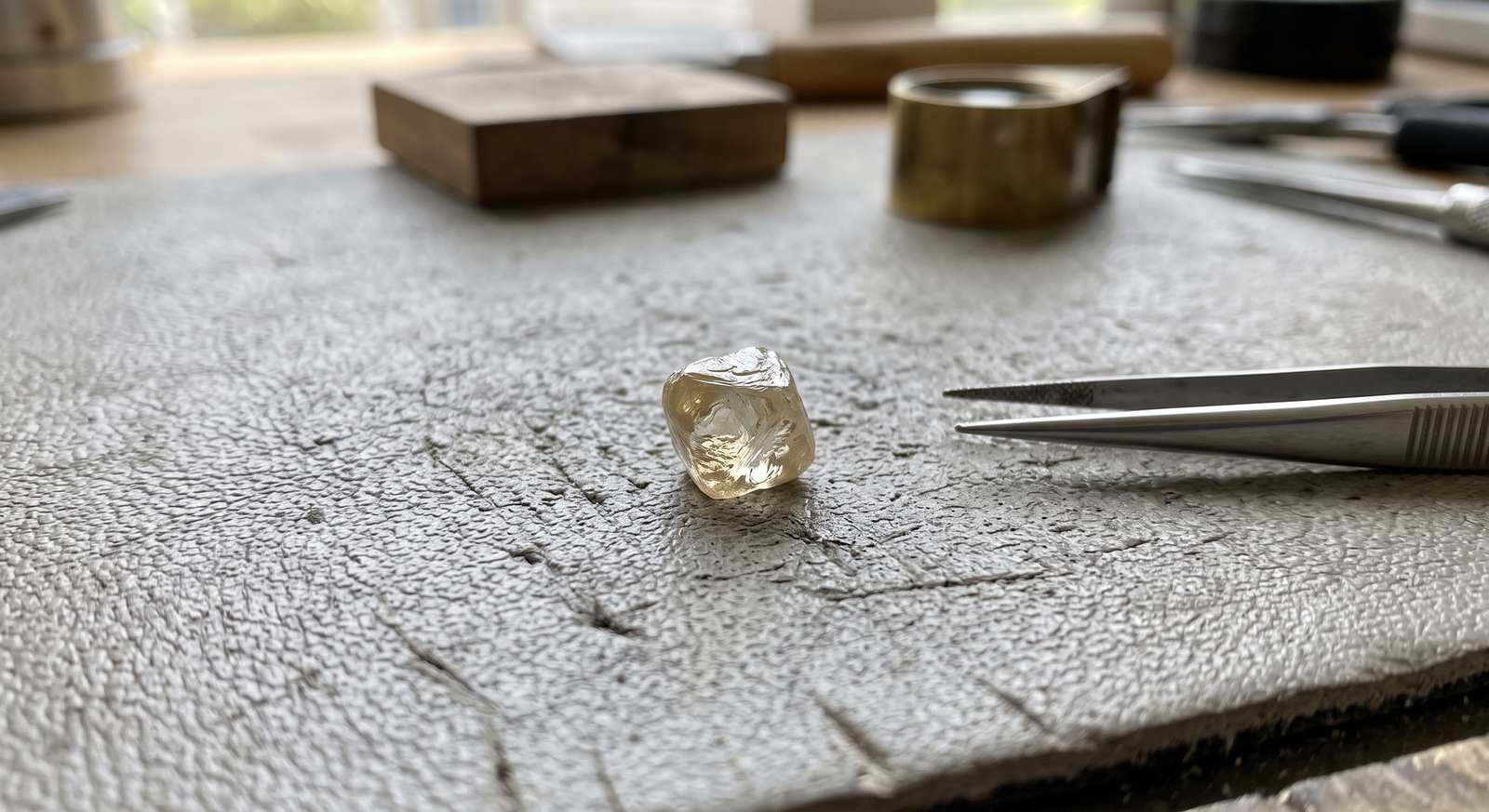
 Rough diamond crystal on a bench mat before cutting, showing its tint

Frequently Asked Questions

Is “champagne” a specification for memorial diamond colors?

Not on its own. It names a family of warm tones spanning several grades, so two people can use the word and picture different stones. It becomes a specification once the acceptable range and the reference are written beside it.

Should memorial diamond colors be agreed before the carat is settled?

Agree them together. The same tint reads differently at a quarter carat and at a carat and a half, so a color line that does not name its carat is only half written. Settle both on one line.

Who decides whether a finished stone is inside the agreed color range?

Ask before ordering, because nothing published about this category settles it. Establish whether the judgment rests with you, with the provider, or with an independent grading report, and what happens if the three disagree.

Can I ask to see a comparison stone before the color is signed off?

Ask. Whether a provider can show a comparable finished stone, a sample set or photographs varies by company, and it is worth knowing which your order is judged against. Record the reference agreed.

Does a grading report settle a disagreement about memorial diamond colors?

Only partly. A report records a color grade under controlled conditions on a stated scale, not how the stone reads in daylight in your hand. Agree in advance whether the grade or the eye governs.

Can two of us specify matching memorial diamond colors on separate orders?

You can specify the same family and range for both. Separate growth runs are separate events, so expect a family resemblance rather than a match. Say at the order that a shared specification is what you want.

Final Thoughts on Memorial Diamond Colors for a Father

With memorial diamond colors, the word is the easy part. The range, the reference, the carat it applies to, who signs it off and what happens if it lands outside, those take one email, and they are the difference between a specification and a hope. Write them down before the deposit. It costs nothing, delays nothing, and it is the leverage you have on a decision you cannot inspect until it is finished.

Learn More About Father Memorial Diamonds

Talk With Memorial Diamond

Reach out to Memorial Diamond at memorialdiamond.us to talk through which memorial diamond colors are realistic for his material, what a written specification looks like, and what to ask us, in writing, about what happens if the stone does not match it. The same questions are worth putting, in the same words, to anyone else you are weighing up.

Word count: 1,852 · Reading time: about 9 minutes
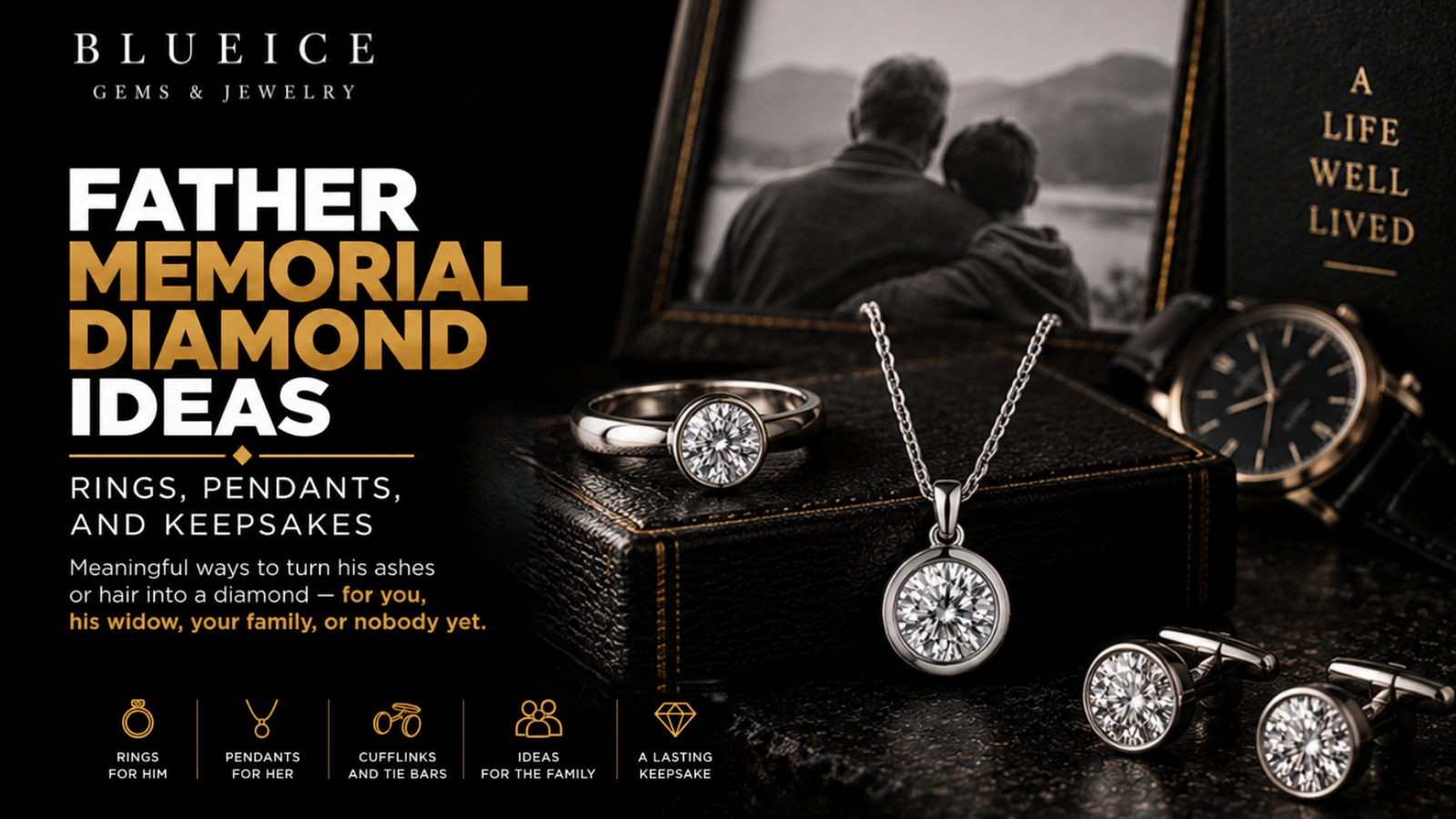
Father memorial diamond ideas featuring rings, pendants, cufflinks, a watch, and meaningful keepsakes

Father Memorial Diamond Ideas: Rings, Pendants, and Keepsakes

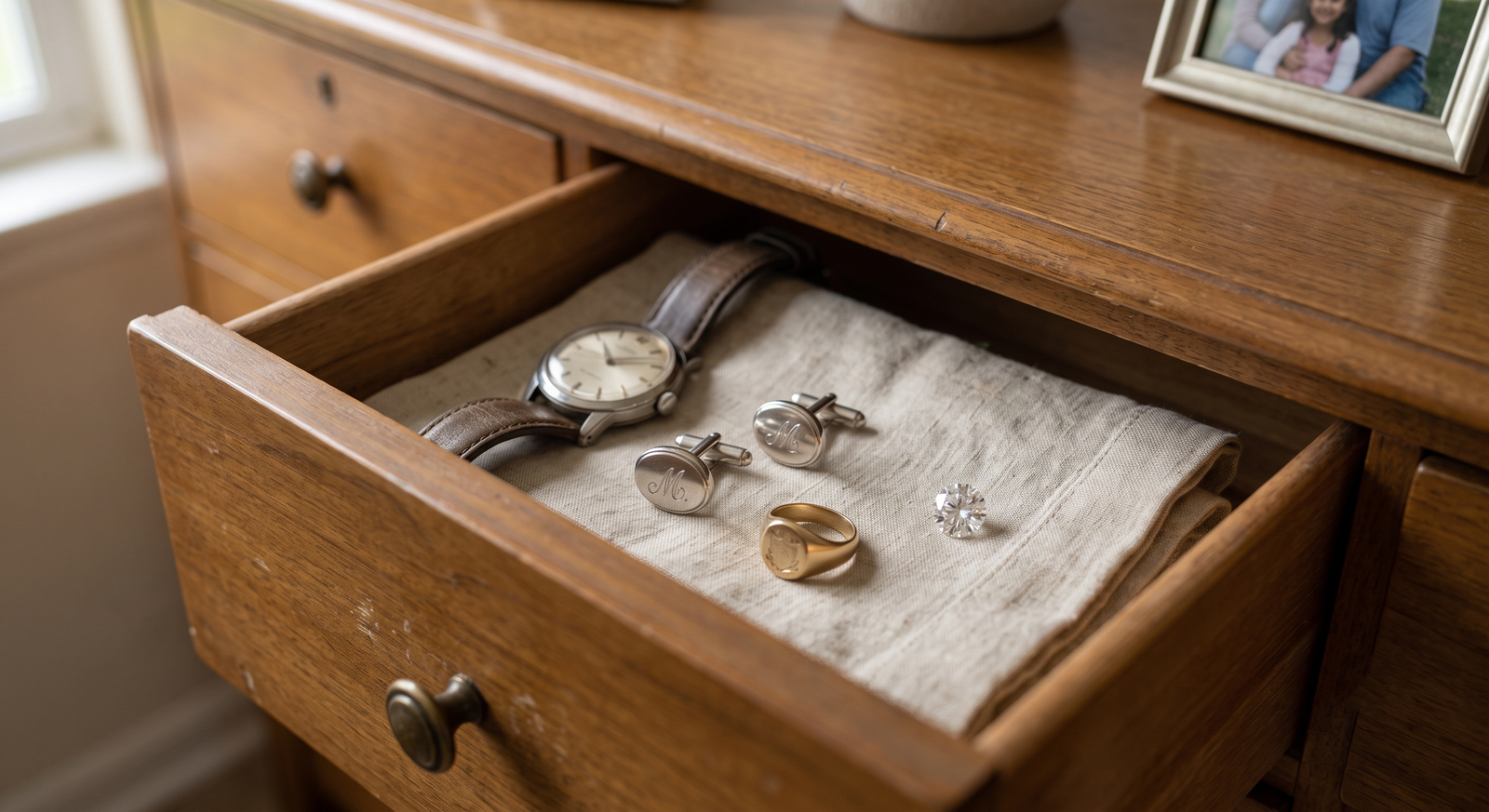
Somewhere in the house there is a drawer with his watch in it, a pair of cufflinks he wore twice, and a signet ring that fits nobody. Nobody wears any of it; nobody can throw it out either. The most useful father memorial diamond ideas start from that drawer, not from a catalog. A stone grown from his ashes or his hair can become a ring, a pendant, cufflinks, a tie bar, a stone set into something he used, several small stones, or nothing yet. The question that sorts that list is who it is for, not what it is. This page walks the five answers to that question, in order.

Where this comes from: Memorial Diamond grows memorial diamonds for a living, so read what follows as a maker’s list rather than an impartial survey of the field.

ather memorial diamond ideas: an open drawer holding a man's wristwatch, cufflinks and a signet ring, with a small loose lab-grown diamond beside them

Who Is the Stone Actually For?

Start there, because ordering a father’s stone and wearing it can easily fall to two different people, an adult child arranging one for a mother who would never have arranged it herself, or two siblings paying for a piece only one of them can wear. A piece chosen for somebody else has to survive their taste and their feelings about being handed something they did not ask for. Every one of the memorial diamond ideas here belongs to one row of the table below.

Who it is forFather memorial diamond ideas that suit themWhat to settle before ordering
YouA pendant, a plain ring, or a stone in something you already ownYour honest answer about whether you will wear it
His widow or partnerA pendant, or a stone added to a ring she wears dailyAsk her first, including whether she wants one. Altering her ring is her decision, not a surprise
Another adult childA small stone in a simple mount they can wear or shelve without commentWho it belongs to afterwards, and whether they want the obligation
The family jointlySeveral small stones, or one stone documented as an heirloomWhere it lives, who holds it, what happens at the next generation
Nobody yetThe stone loose in its case with its paperworkWhere it is kept, and who else knows it exists
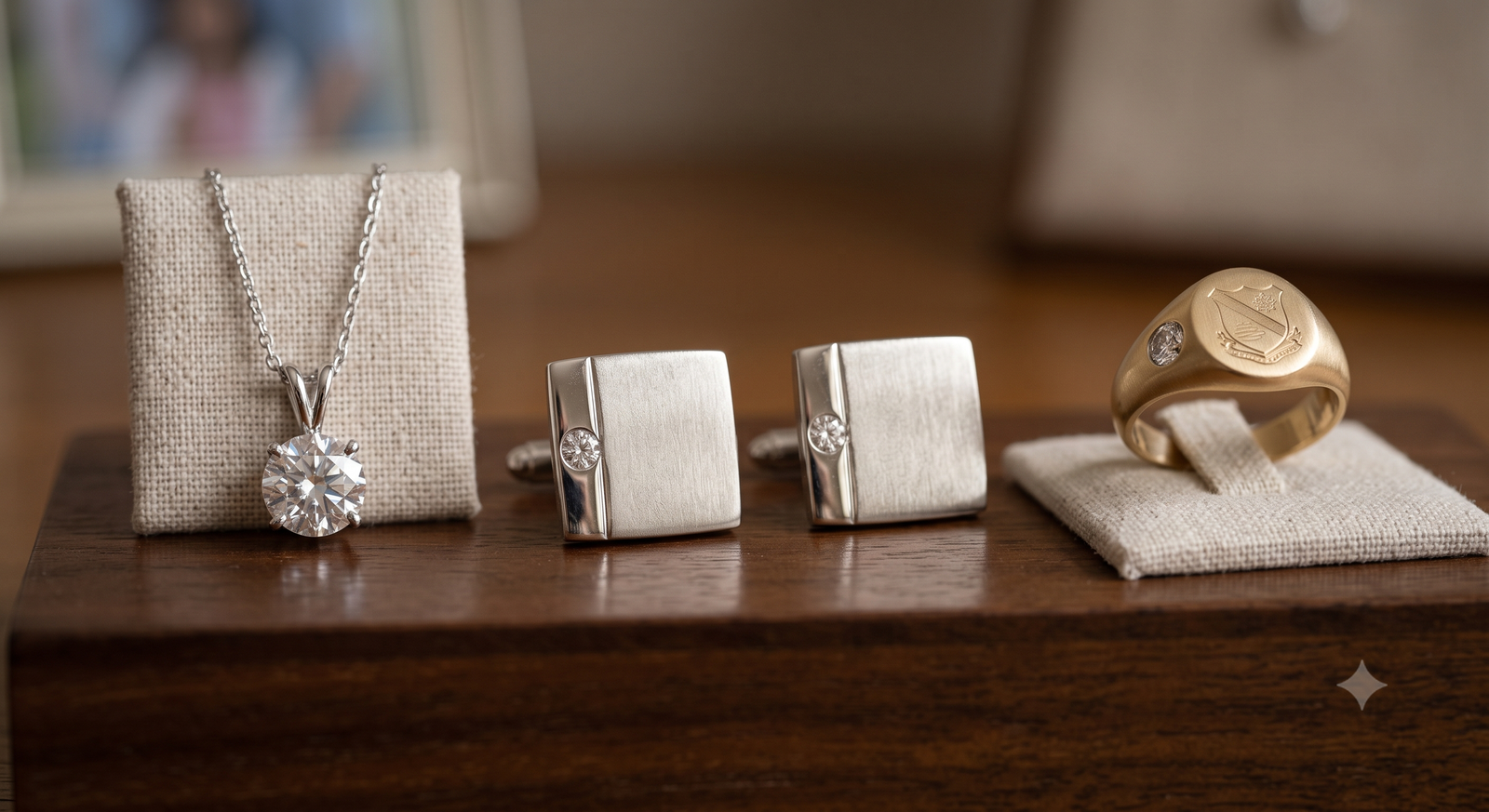
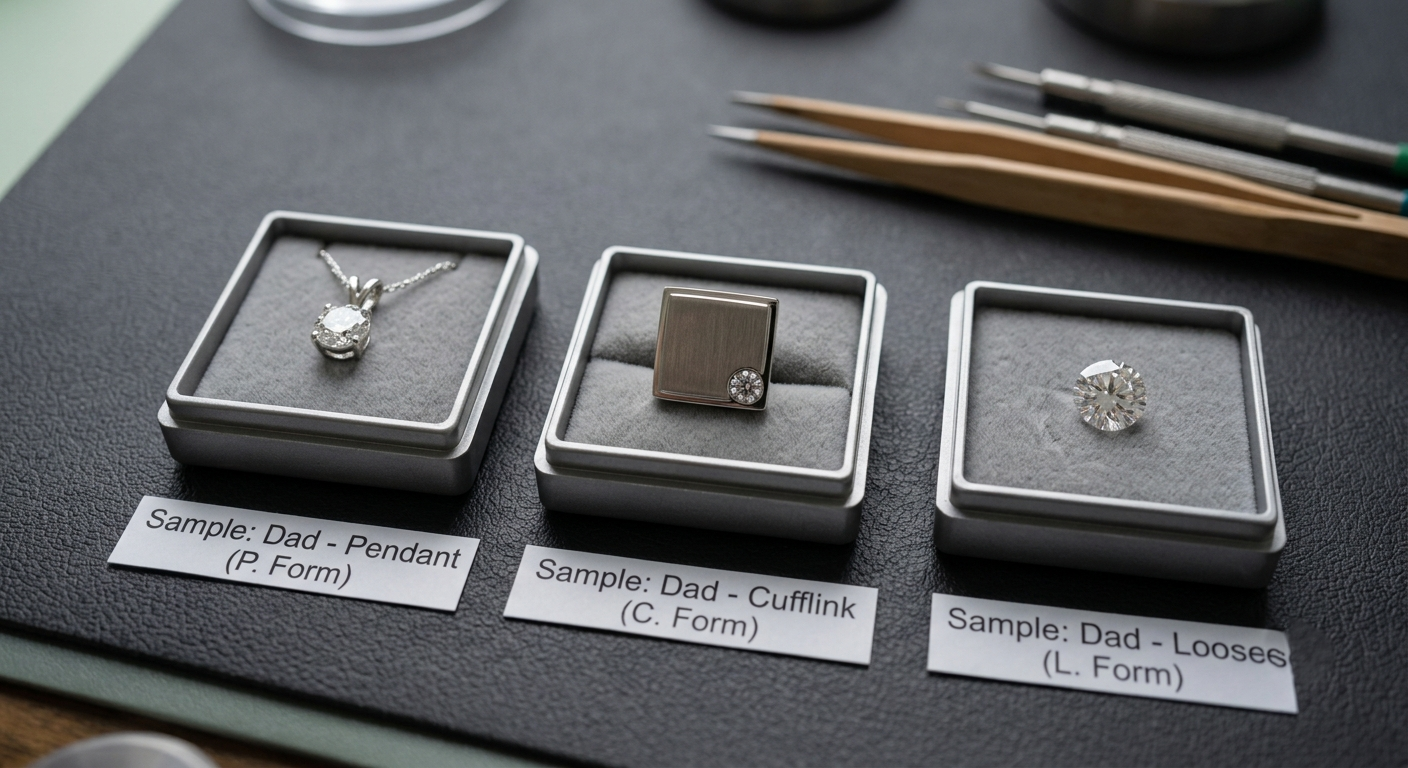
Memorial diamond shown three ways as a pendant, as a pair of cufflinks and set into a signet ring shoulder

One fact sits underneath every row. The stone in each of these pieces is grown from carbon drawn out of his ashes or hair, purified to about 99.9% and then brought up to a workable volume with lab sourced carbon, because a growth run needs more feedstock than a submitted portion supplies on its own. Industry figures put his own share at roughly 10–15% of the finished stone’s mass. A stone offered to you as entirely him is described wrongly. It is still a real diamond, the hardest known natural mineral, graded like any other, which is what makes every idea below workable.

The rule this page is built on: if the piece is for someone else, ask them before the order goes in, not when it arrives. How to raise it with a surviving parent is worked through in how to talk to family about a father memorial diamond.

Father Memorial Diamond Ideas for Something You Keep Yourself

The easiest category, because nobody else has to agree with you.

  • A pendant you put on and forget. It stays under a collar and needs no explaining.
  • A ring worn on a named day, his birthday, the anniversary, and kept in a box between.
  • Cufflinks or a tie bar, if the occasions that put you in a suit are the ones where he comes up.
  • The stone in the watch you wear, so the object you check all day is his too.
  • The stone loose, in a desk drawer. Wanting the stone and wanting to wear it are two different wants.

Which of those memorial diamond ideas actually keeps hold of a stone is a separate, mechanical question, and it belongs to memorial diamond settings and jewelry ideas for a father. This page is what to make; that one is how a piece holds it.

Ideas for a Piece Made for His Widow

Here the person ordering and the person receiving are two different people, which makes sequence matter more than design. The father memorial diamond ideas that work for a widow are the ones that leave her the most room.

  • A pendant. Of all the memorial diamond ideas for a widow, the least demanding thing to be given: worn daily, worn on his birthday, or kept in a drawer without anyone auditing which of the three.
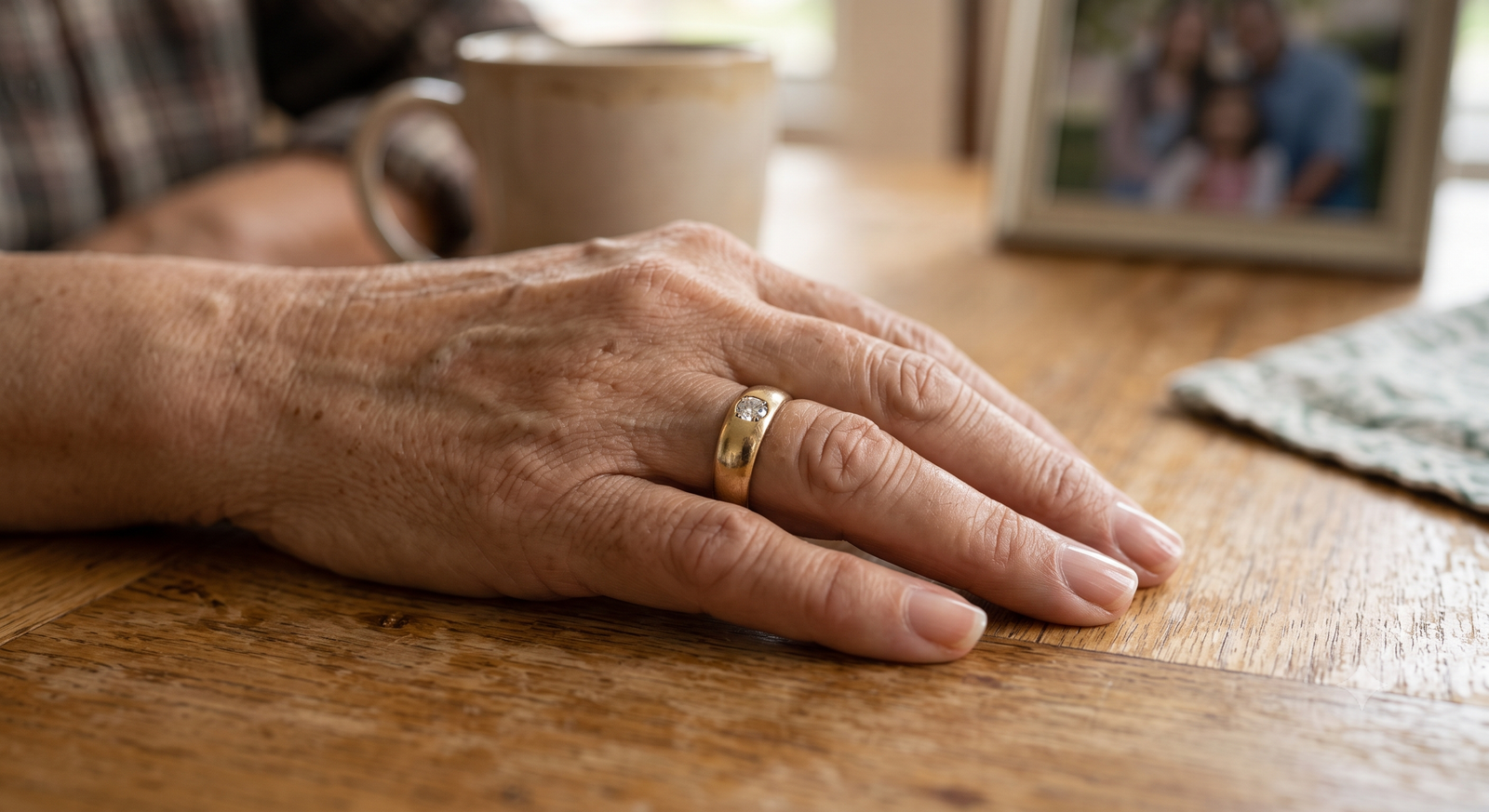
  • A stone added to a ring she already wears, an engagement ring, an eternity band, a dress ring she has had for decades. The metal is already hers; the stone is new.
  • A stone kept loose, handed over with its case and certificate, so the decision about a setting stays hers.

Two cautions on these memorial diamond ideas. Reworking a ring she wears every day is irreversible and is her call alone. And “she would like it” is a guess until she has been asked.

Putting the stone into a band he wore is a different idea, worked out in the father ashes diamond complete guide.

 Older woman's hand wearing a gold band with a small additional stone set beside the original

What If Neither of You Is a Jewelry Person?

Then the non jewelry options are the answer, not the consolation prize. Some of the people who want a father’s stone do not wear rings and never have, and a list of father memorial diamond ideas that runs pendant, ring, earrings, repeat is written for someone else.

Things that hold a stone without being jewelry:

  • A watch, case back, dial, or crown.
  • A signet ring, if he had one, the face keeps his initials, and the stone goes into the band beside it.
  • A pen, in the cap or the barrel end.
  • The handle of a knife, a fishing rod, a plane or a chisel he used.
  • The lid of the box his things are kept in, so the stone lives with the rest of him.

Non jewelry memorial diamond ideas need a second opinion, though. Whether a particular object can take a stone safely, whether there is depth behind a dial, whether opening a watch case ruins its seal, whether a handle can be drilled without splitting, is a jeweler’s or watchmaker’s assessment, not a design preference.

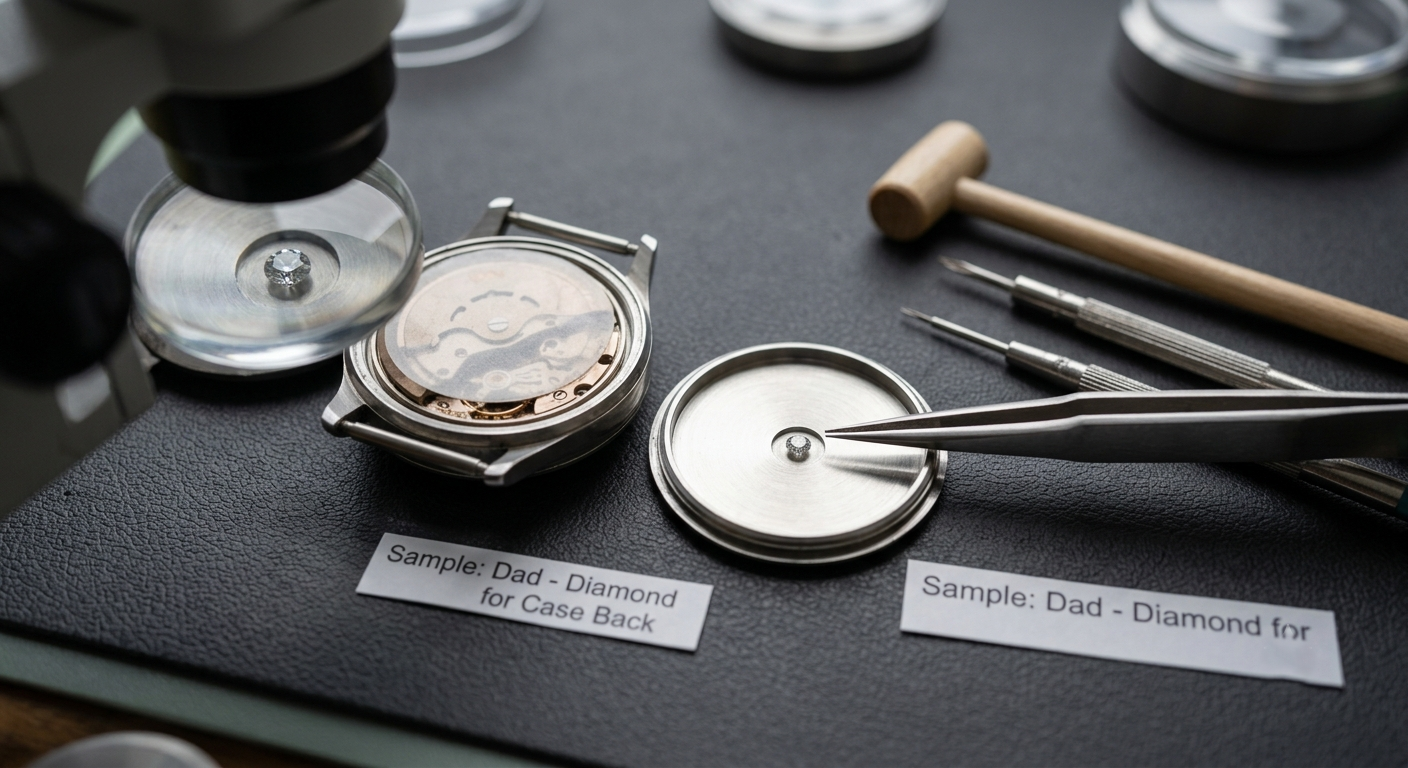
Watch case back opened on a bench mat with a small diamond positioned for mounting

Memorial Diamond Ideas the Family Shares

Because only a portion of the material is used, one submission can yield more than one stone, which changes what is worth making. The memorial diamond ideas below assume more than one person wants something.

  • One piece each, in whatever form that person uses, a pendant for one, cufflinks for another, a loose stone for the brother who wears nothing.
  • One piece, held by one person, with the occasion it passes on written down rather than left to be worked out (memorial diamonds as a family heirloom).
  • Several stones set into one object of his, a box lid or a clock case, so it stays in one house.

Whether several stones are possible, who has to agree, and whose name the order goes in are worked through in whether more than one family member can get a diamond from the same father’s ashes. They will not match closely, because color comes from trace elements present as each crystal grows (memorial diamond colors for a father).

Three memorial diamonds of slightly different tones, one hung as a pendant, one set in a cufflink and one loose in its case

What Does “For Nobody Yet” Honestly Mean?

A finished stone in its case, with its grading report and origin certificate, and no decision made about a setting. It is a legitimate outcome, not an unfinished one, and it is on every honest list of father memorial diamond ideas because a lot of families land there. It does require three things.

  1. A place it lives that is not a drawer somebody else will clear out.
  2. The paperwork with it. The origin certificate is the only thing that ties the stone to him. Nothing about the stone itself records where it came from.
  3. Somebody who knows it exists, and a line in a will if it is meant for a particular person eventually.

Among memorial diamond ideas, this is the only one with no design step at all, which is exactly its appeal. A stone in its case is not the part that degrades. What decays is other people’s knowledge of what it is.

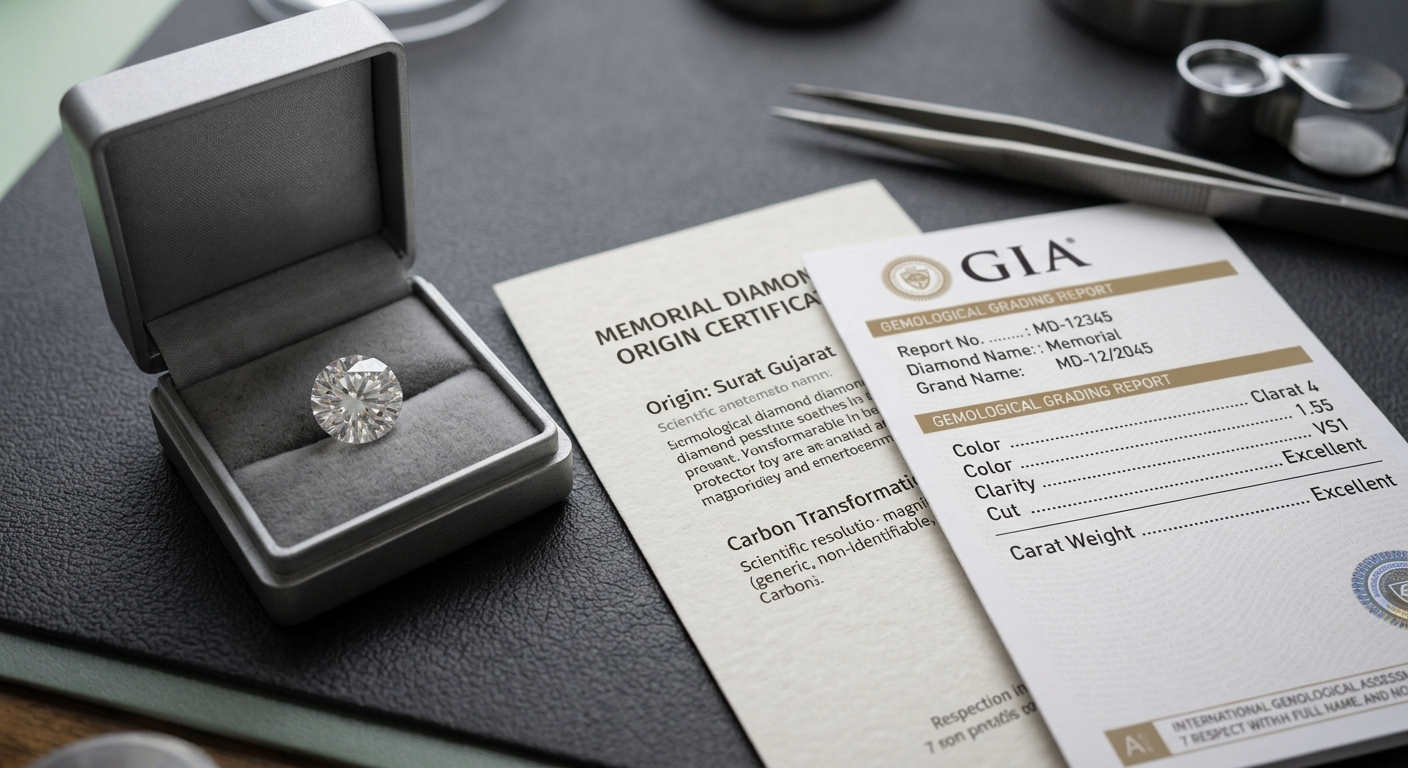
oose memorial diamond in a presentation case beside a folded grading report and origin certificate

Settle It Before You Order, Not After

Four things to say out loud before the order goes in, whichever of the father memorial diamond ideas above you land on.

  • Who the piece belongs to once it exists, rather than assumed.
  • Whether the recipient has agreed to receive it, and to keep it.
  • Whether an existing piece is being altered, and who else has an interest in it.
  • Whether anything is engraved, since words go on the metal rather than the stone (engraving and personalizing the setting).

To browse memorial diamond ideas by form rather than by recipient, the memorial diamond settings pillar lists what a stone can be put into.

Frequently Asked Questions

Can I order a father memorial diamond for my mother as a surprise?

Better offered than sprung. She may have her own intentions for his ashes, and a finished piece arriving unannounced asks her to react in front of the person who arranged it. Ask before the order goes in, not after.

What are the best father memorial diamond ideas for someone who never wears jewelry?

A watch with the stone set into the case back or dial, a signet ring, a pen, a money clip, a knife or tool handle, or a box lid. Whether a particular object can take a stone safely is a jeweler’s assessment, not a design preference.

Can his stone be set into the watch he wore?

Sometimes. It depends on the watch, whether there is depth behind the dial or case back, and whether opening it compromises water resistance or the movement. Price it with a watchmaker rather than assuming.

Who should the finished piece belong to if several of us paid for it?

Whoever you agree on before ordering, said plainly. Shared payment does not settle ownership by itself, and a piece that arrives with the question still open leaves it to be answered in front of everybody.

How long can a stone stay unset before it becomes a problem?

Indefinitely, as an object. The risk is the record rather than the stone: keep the origin certificate and grading report with it, and make sure one other person knows what it is and where.

Are there memorial diamond ideas that let two of us have pieces that match?

Not closely, if the stones come from separate growth runs, color varies with the trace elements present as each crystal grows. Ask whether two stones can be grown together, and design around the difference if they cannot.

Final Thoughts on Father Memorial Diamond Ideas

Decide who the stone is for, ask them if it is not you, and only then start on pendants and cufflinks and whether his watch could take it. If the honest answer is “I don’t know yet,” that is a real answer, and a stone in its case is where it waits. The father memorial diamond ideas that go wrong are almost never the wrong object. They are the right object handed to someone who was never asked.

Learn More About Father Memorial Diamonds

Talk With Memorial Diamond

If you have a person in mind and an object in the drawer, that is enough to start a conversation. Reach out to Memorial Diamond at memorialdiamond.us to talk through what is possible with his ashes or his hair, including the memorial diamond ideas on this page that need a jeweler’s judgment before they become a plan.

Choosing a memorial diamond for your father with an urn, ashes, and diamond in tweezers

Choosing a Memorial Diamond for Your Father: Where to Start

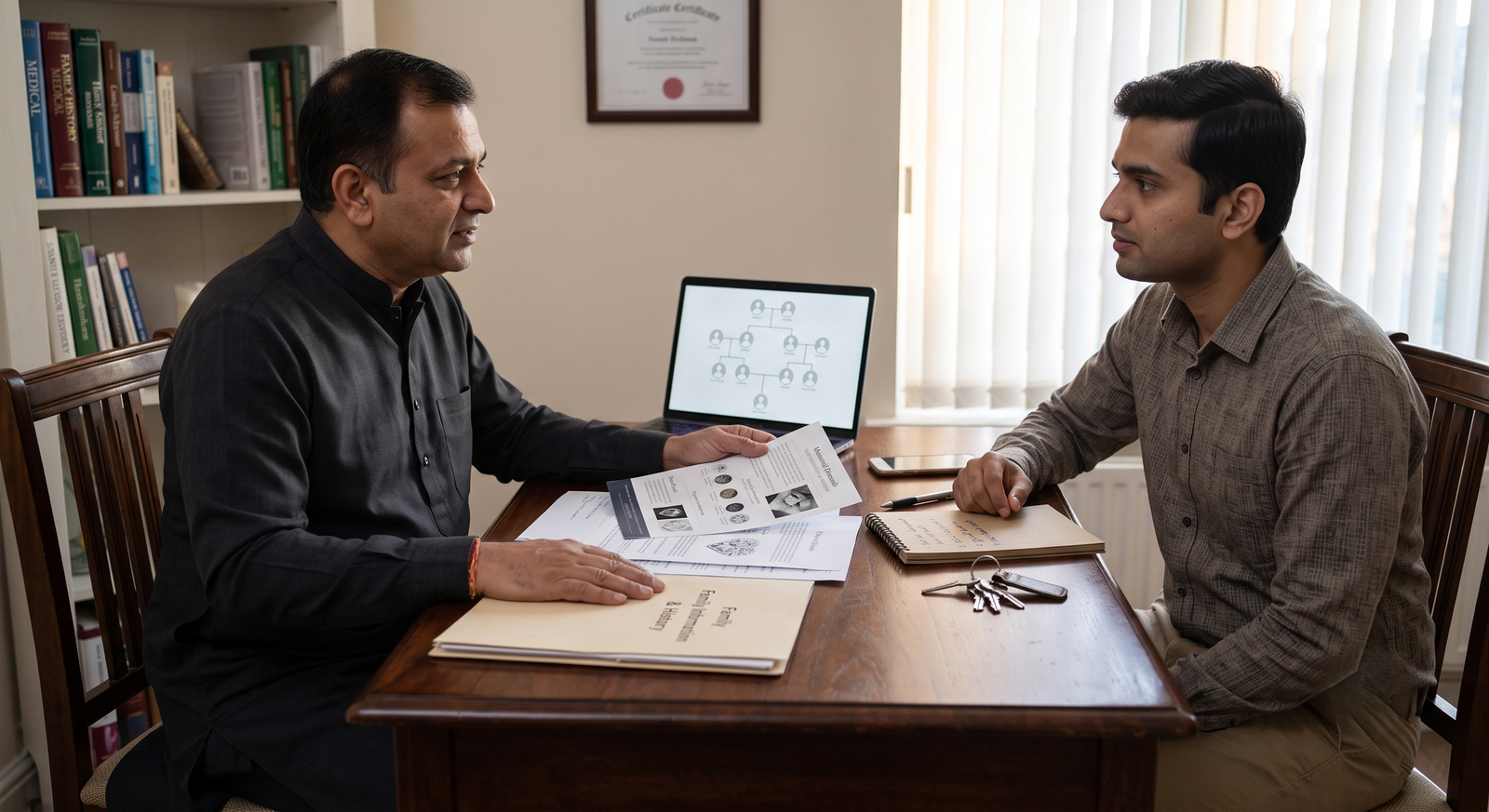
Somebody in the family has his ashes, and it may not be you. So choosing a memorial diamond for your father does not begin with a size, a color or a company. It begins with finding out four things: where his remains are and in whose keeping, whether an interment or scattering is already arranged, what his estate says about who decides, and whether a decision has already been taken and not announced. Those four answers set the boundaries; everything inside them can be chosen slowly.

A plain statement of interest: Memorial Diamond makes memorial diamonds, so nothing here is impartial counsel about whether to have one. It is written to be equally useful if you end up deciding against it.

 Choosing a memorial diamond for your father: a handwritten list of four questions on a notepad beside a phone and house keys on a kitchen table

What Do You Need to Find Out Before a Memorial Diamond for Your Father Is Your Decision?

Four things, and a diamond company can tell you none of them.

For a father, choice may not be the obstacle at all. Authority and access come first. Ashes are held by one person, released by the crematorium to one named person, and sometimes committed by arrangements made in the fortnight after the death. So treat this stage as information gathering: nothing below asks you to commit, spend, or tell anybody what you are considering.

One fact worth carrying into those conversations, because a relative will ask: a memorial diamond for your father, grown from ashes, is part him and part laboratory. His carbon is drawn out and purified to roughly 99.9%, but ash holds only about 0.5% to 4% carbon by weight, so the growth cell is filled out with carbon bought in.

Published figures for the industry place the personal fraction at 10% to 15% of an ash grown stone’s finished mass. The finished crystal is still a genuine lab grown diamond, grown by the same HPHT or CVD process as any other. Nobody can supply a stone made only of him, and that lands better said by you than discovered by somebody else.

The Four Things to Establish, and Who Can Tell You

Find outWho can tell youWhy it comes before choosing a memorial diamond for your father
Where his remains physically are, and in whose keepingThe crematorium or funeral home that released them, and whoever signedMaterial can only be sent by somebody who can reach it
Whether an interment, burial or scattering is already arrangedThe funeral director, the cemetery or columbarium office, and whoever booked itAn interment or scattering can close the ashes route; the hair route does not depend on it
Who is entitled to decideHis written instructions, the executor, and where unclear the attorney handling the estateWho may decide is set locally, and anything he set down in writing can shift it
Whether a decision has already been taken and not announcedOnly the person who took it, if that is his widow, only herWeeks of planning can be spent around a decision somebody quietly made months ago
A funeral director talking across a desk with an adult son, paperwork between them

Start With Whoever Has His Remains

The first step toward a memorial diamond for your father is a phone call. Call the crematorium or funeral home first, even if you think you know the answer.

Three questions cover it: who collected the remains, what was released and in what container, and whether anything is still held there. Funeral homes keep this on file.

Whoever signed for them is your first conversation, whether or not they are the person entitled to decide. That call is a request for information, not for the ashes: ask where he is, and do not ask for a portion on the same call. If you want to know what a laboratory actually receives before you raise a memorial diamond for your father with anyone, how a memorial diamond is made from your father’s ashes walks through it.

What Is Already Booked, Scattered or Interred

If an interment is already booked, this is the item that closes doors on a memorial diamond for your father.

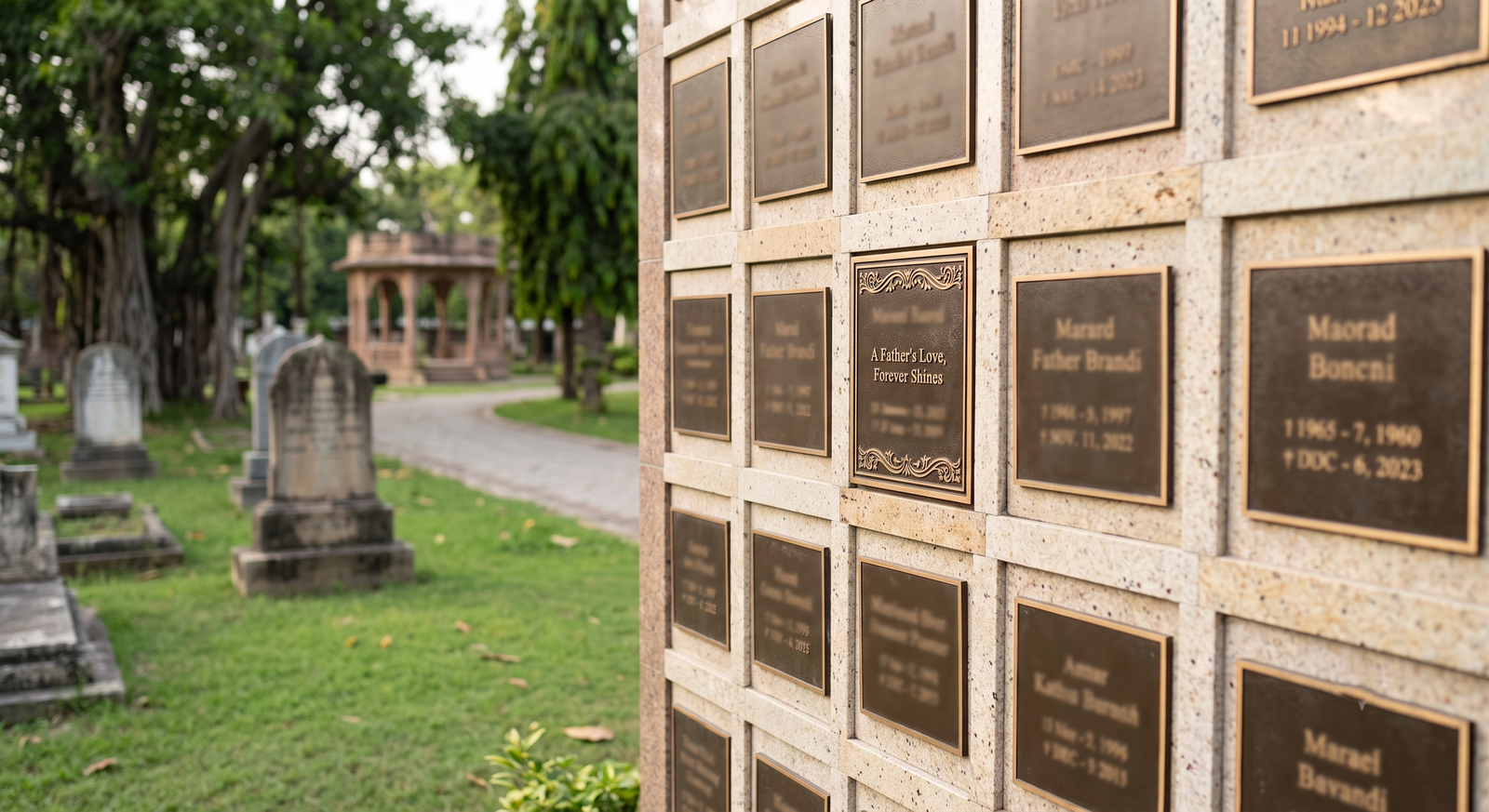
A committal at a national or service cemetery, a columbarium niche, a scattering date, a burial of the urn in a family grave, any of these may have been arranged in the weeks after the funeral and not mentioned since. Ask the funeral director, and the cemetery office directly rather than a relative’s memory.

If a portion is to be set aside, it has to happen before an interment. Where one has already taken place, ask the cemetery office whether anything may still be taken out: some sites allow it, some do not, and the law where the site sits governs as well. Do not assume either answer from the outside. If the urn is staying put regardless, what changes if the urn stays and a stone joins it is the more useful comparison.

A closed ashes route does not close the question of a memorial diamond for your father. Hair can be submitted whether or not there was a cremation, and a committal already made has no bearing on it, turning your father’s hair into a diamond covers that route, and how much hair is needed sets out the quantities.

A columbarium wall in cemetery grounds with a single niche plaque in focus

What the Estate Says About a Memorial Diamond for Your Father

Look for three documents before assuming anybody has a free hand: any written disposition instructions, a prepaid funeral or cremation contract, and the will.

Authority here is not uniform across the country: each jurisdiction sets its own order of priority, and a written direction from him can outrank it. The executor is the person to ask, and where the estate is with an attorney, they can say who is authorized.

At the ordering stage of a memorial diamond for your father, a provider will need one named customer on the account, so settle who that would be before anybody is asked to pay, whether more than one family member can have a diamond from the same ashes covers how those arrangements are put together.

Has Someone Already Decided and Not Said So?

Ask early: this is the cheapest thing on the list to find out and the most expensive to get wrong.

A surviving parent may have settled in her own mind what she wants done with his ashes, with or without a memorial diamond for your father in mind, and never raised it, not secrecy, just not a subject people volunteer over dinner. A sibling may have told the funeral director something on the day. An adult child abroad may assume the urn is coming to them.

None of that is necessarily final, but planning a memorial diamond for your father around an assumption is wasted effort. Opening that conversation is its own subject, how to talk to family about a father memorial diamond is written for it. This page only asks you to establish whether a decision exists.

What Can You Settle Without Asking Anybody?

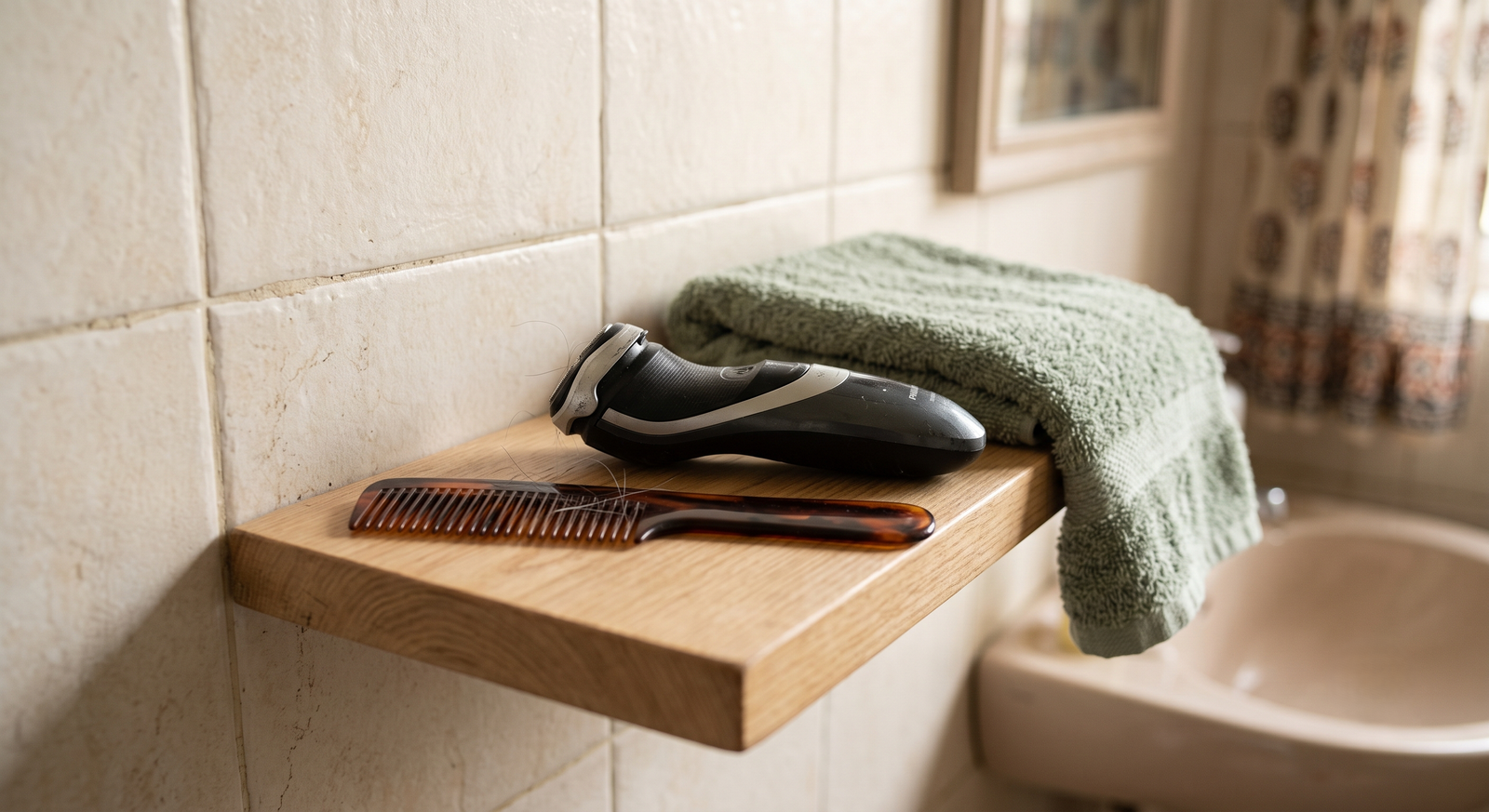
A man's comb and electric shaver on a bathroom shelf beside a folded towel

Several things about a memorial diamond for your father need nobody’s agreement:

  • Whether you want a memorial diamond for your father at all. Reading is not commitment; no material has to move for you to carry on.
  • Who the stone would be for, yourself, his widow, or something shared. That one answer later settles size, setting and most of the specification.
  • Roughly what you would spend on a memorial diamond for your father. Work from the number outwards; what a father memorial diamond costs sets out general 2026 industry ranges.
  • How long you are willing to wait, a real constraint if a date matters, how long a father memorial diamond takes covers production time.
  • Whether hair exists anywhere in the house. A shaver, a comb, a cap, a lock somebody kept. Looking closes nothing.
  • Which questions you will ask a provider, questions to ask before turning your father’s ashes into a diamond is the list, worth having written before the first call.

Establishing where his remains are, what is booked and who decides all need somebody else. Nothing in this list does, and working through it while you wait is how the early weeks of choosing a memorial diamond for your father stop feeling stuck.

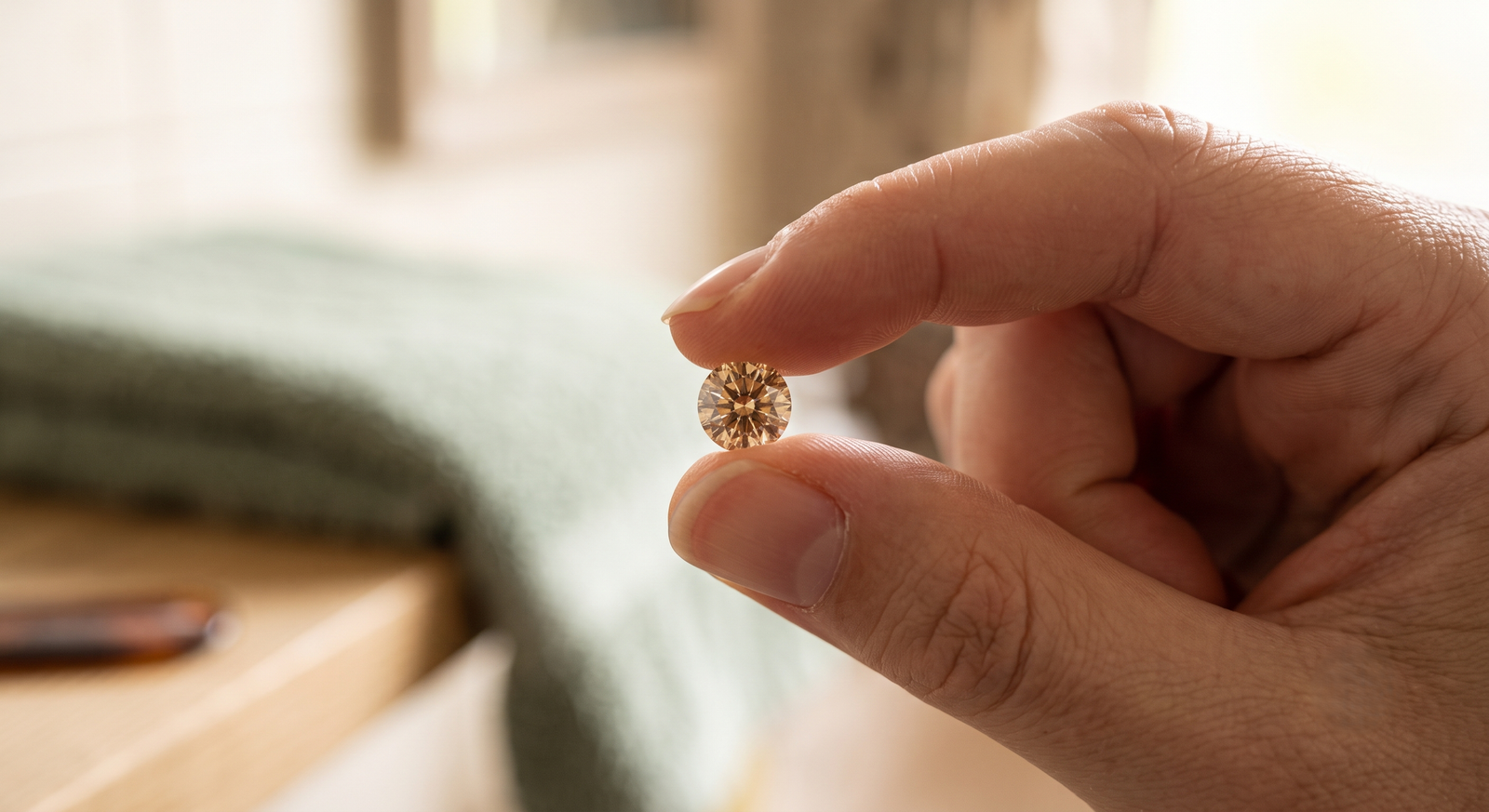
A small champagne-toned lab-grown memorial diamond held between finger and thumb in daylight

Frequently Asked Questions

Who is legally entitled to decide on a memorial diamond for your father?

Nobody, directly, the law governs his ashes, not the diamond. There is no single national answer on the ashes: each state sets its own rule, and a written instruction can take precedence over it. A surviving spouse or the named executor commonly holds the right; the funeral director or the estate’s attorney can confirm which applies.

The funeral home still has his ashes. Who are they allowed to release them to?

Typically the person named on the cremation authorization or their written nominee, but specifics vary by state and by the funeral home’s policy. Call them and ask what they hold, who signed, and what release requires.

Can I look into a memorial diamond for your father without committing to anything?

Yes. Every question on this page is a request for information from people who already hold the answer. Nothing has to be sent, paid for or announced, and learning a route is open does not oblige you to take it.

His will says nothing about his ashes. Does that change who decides?

It shifts the question onto your jurisdiction’s default order of priority, which the executor or an estate attorney can identify. Silence in a will is not an obstacle in itself, it means the law rather than the document decides.

He was buried rather than cremated. Is there anything left to look into?

Yes. The hair route needs no cremation, so a burial closes the ashes option without touching it. What matters is whether any hair was kept, in the house, or by a barber, a question for whoever cleared his things.

What should I have written down before I contact a provider about a memorial diamond for your father?

Who holds the remains, whether anything is booked, who is entitled to decide, who the stone is for, your rough budget, and any date that matters. Six lines on paper make the first conversation useful.

Final Thoughts on Choosing a Memorial Diamond for Your Father

Two calls change what is possible: the funeral home that carried out the cremation, and whoever signed for his remains. Ask what was released, to whom, and whether anything is already arranged. Write it down. Then read for whichever route those answers leave open. A memorial diamond for your father is a decision you can take slowly once you know what is yours to decide, and it may turn out that the most useful thing this page does is tell you that it isn’t.

Learn More About Father Memorial Diamonds

Talk With Memorial Diamond

When you have the four answers and want to talk through what they leave open, including the possibility that they leave nothing, reach out to Memorial Diamond at memorialdiamond.us. Bring the list, not a decision.

Word count: 1,944 · Reading time: about 10 minutes

How long it takes to make father memorial diamonds with a 6 to 10 month production timeline

How Long Does It Take to Make a Father Memorial Diamond?

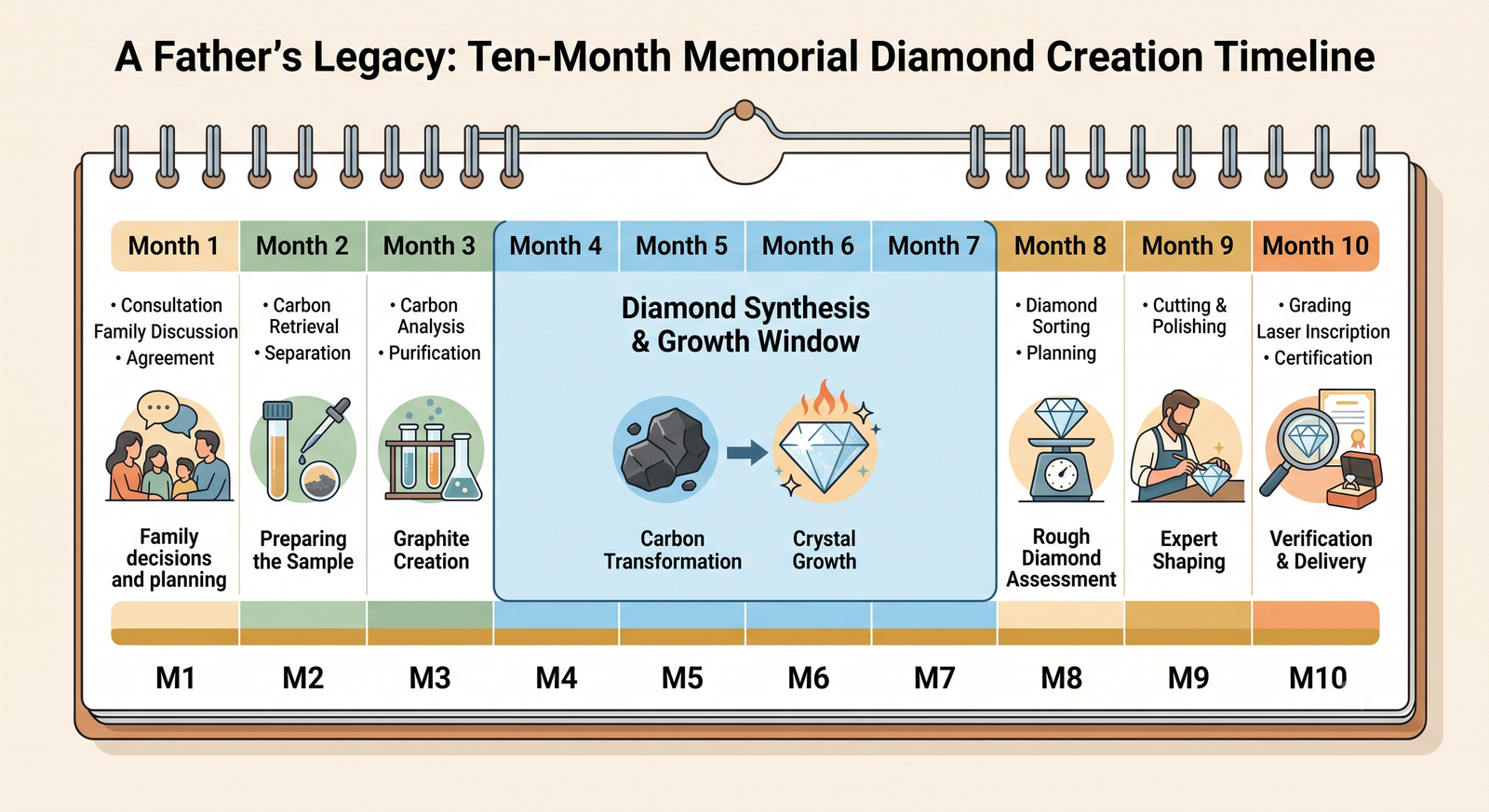
Ask two families who ordered in the same month and their answers can be months apart, and neither of them was told anything wrong. How long does it take to make father memorial diamonds? Industry wide, production typically runs 6 to 10 months from the laboratory’s intake, rising toward 12 months for stones over roughly 2 carats or in specialty colors. End to end, from the first conversation to a finished piece in your hand, a working estimate of around 8 to 14 months is reasonable, though that total is arithmetic rather than a published figure.

The interesting part of that range is where it comes from. The growth window is the most predictable stretch of the whole process to make father memorial diamonds. Most of the difference between one family finishing early and another finishing late happens either side of it.

Memorial Diamond is one of the companies that does this work. Read the checks below as ones to put to any provider, including us.

How long it takes to make father memorial diamonds: a ten-month wall calendar with the growth window marked in the middle and family decisions marked either side

How Long Does Each Part Actually Take?

The sourced industry figure is the production window: 6 to 10 months, measured from the point the laboratory logs the material in, and up to around 12 months for larger stones or treated colors. Size drives that window because carat is a function of growth time in the press rather than of how much material was submitted.

Around that sits everything else it takes to make father memorial diamonds, deciding, retrieving, shipping, grading, setting, which is where the 8 to 14 month working estimate comes from. It is arithmetic, not a service level. The complete guide to father ashes diamonds sets those phases out as a table and covers planning backwards from a date that matters.

This page is about the other question: not how long each phase takes to make father memorial diamonds, but what makes it longer or shorter than the average.

Where Does Most of the Variance Happen?

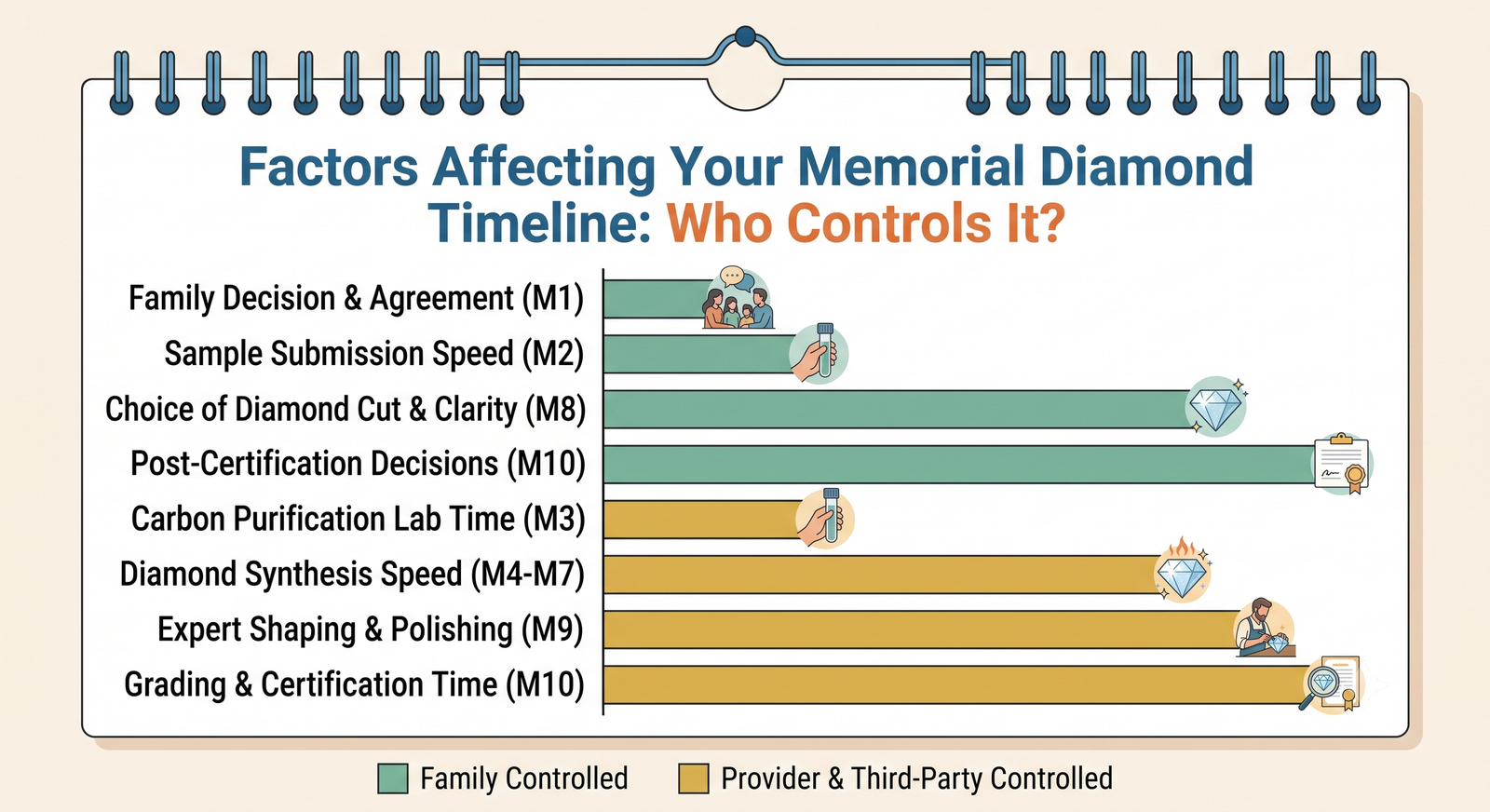
Before the laboratory sees anything, mostly, the time to make father memorial diamonds is decided largely outside the lab. The table below sorts what varies by who controls it.

What variesDirection and rough sizeWho controls it
Retrieving material, a retention request, a sibling holding the urn, a search for hairAdds days to several monthsYour family
Choosing a provider and getting answersAdds 1 to 6 weeksYour family, partly
The carat chosenMoves the growth window by months within the 6 to 12 rangeYour family
A treated or specialty colorAdds weeks to a couple of monthsProvider, once specified
A failed growth runAdds months, and is the largest single unplanned delayNobody
Grading, where an independent laboratory is usedAdds weeks after the stone is finishedA third party
Choosing a settingAdds nothing if decided early; weeks or months if decided lateYour family
A scheduled release or interment dateCompresses the front end, and cannot be movedA cemetery, a funeral home, or an estate
Simple bar chart of eight timeline factors, four colored for the family and four for providers and third parties

Read down the right hand column. Four of the eight sit with your family, which is why the most effective thing a family can do about how long it takes to make father memorial diamonds is make the early decisions early, including the one about the setting that rarely feels urgent.

What Is Genuinely Fixed When Labs Make Father Memorial Diamonds?

The laboratory stages used to make father memorial diamonds, and no amount of money changes them.

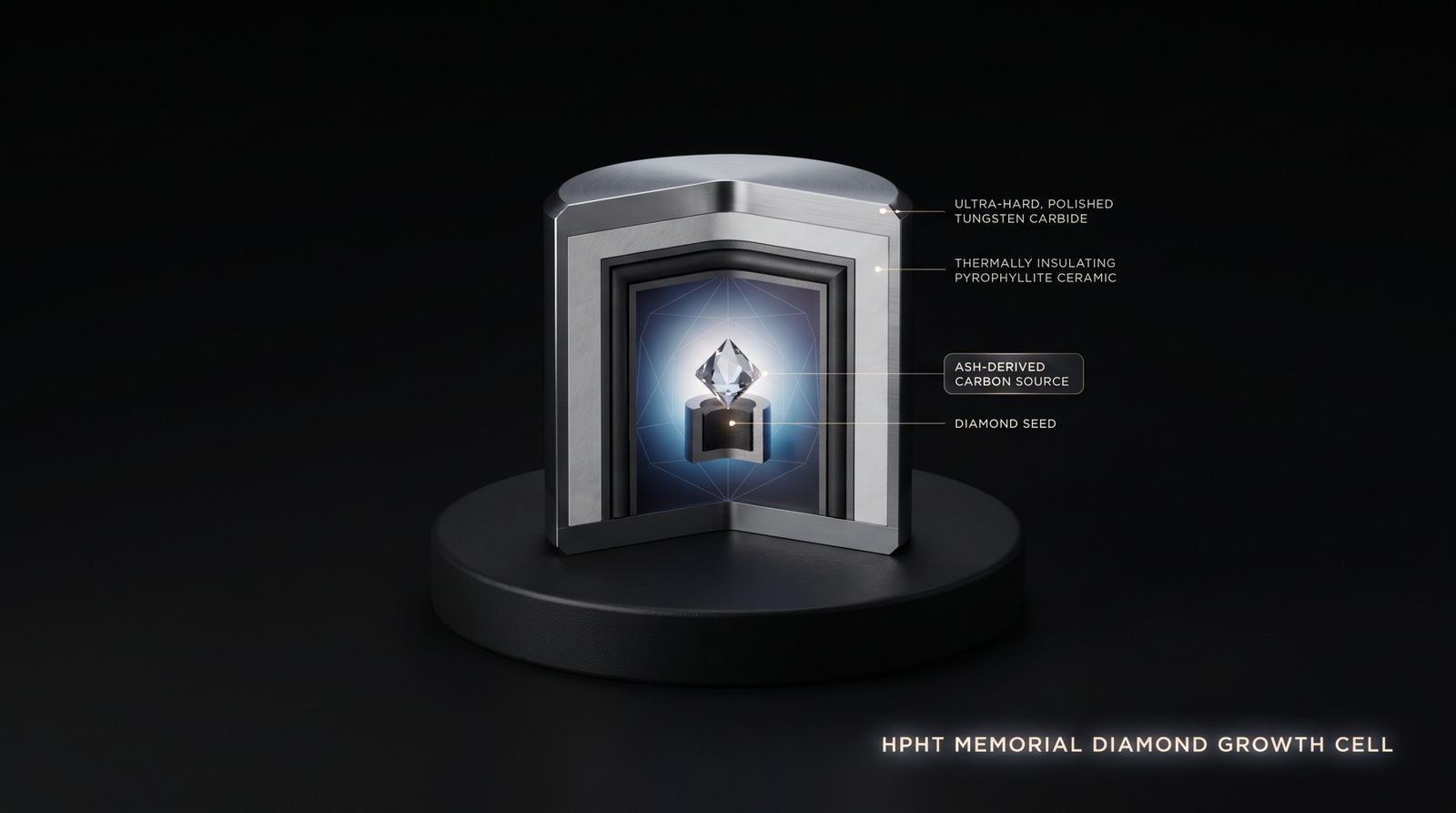
Extraction and purification take the weeks they take. Graphitization at roughly 2,500 to 2,700°C takes the days or weeks it takes. Growth in an HPHT cell at roughly 6 to 8 GPa and 1,400 to 2,500°C runs for weeks to months, and a growth run cannot be hurried without changing what comes out of it. Cutting and polishing is a gemologist’s bench work on an irreplaceable stone.

It is worth being clear about what those months are producing, because it shapes what the wait is for. The press is not growing a stone made of your father. It is growing a stone in which his carbon is a provable share, blended with lab grown carbon so there is enough feedstock for a growth run. That is the honest description of how labs make father memorial diamonds, it is the one to expect from any provider, and how a memorial diamond is made from your father’s ashes sets out the arithmetic behind it.

What that means practically: the carat decision is the timeline decision. A smaller stone finishes sooner because the press runs for less time, not because it moved up a list. Choosing a carat size is therefore worth thinking of as a two part choice, cost and calendar, rather than one. What a father memorial diamond costs covers the other half.

An HPHT press in a diamond laboratory with a growth-cycle timer visible, illustrating the fixed laboratory stages

Which Parts of the Schedule Aren’t Yours to Move?

Three situations put dates in the process to make father memorial diamonds that belong to somebody else. None of them lengthens the growth run; all of them can lengthen the total time to make father memorial diamonds.

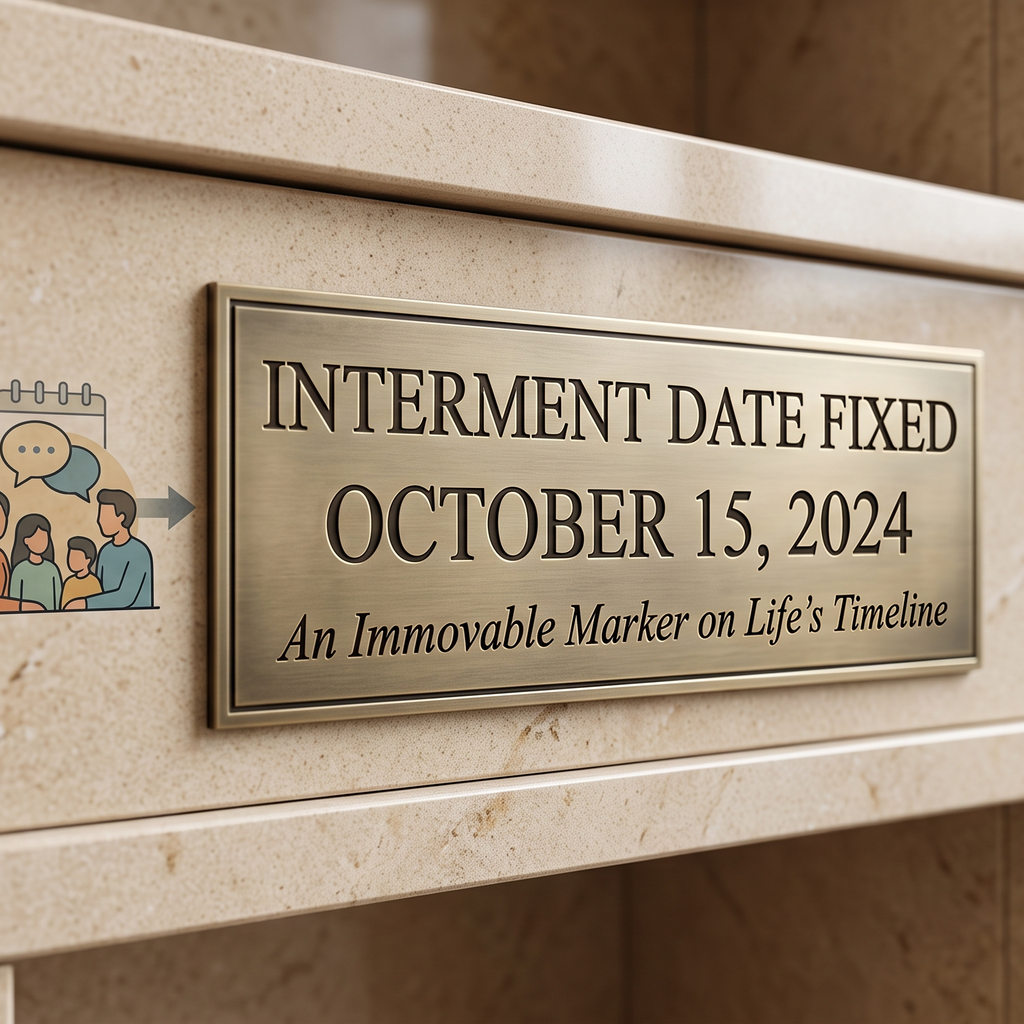
A national or service cemetery interment. The date is set against the cemetery’s calendar, and the funeral home may release his remains directly to it. A retained portion has to be separated before that release, so the front end of the process compresses into whatever window exists between the cremation and a date the family did not choose. Honoring military service with a memorial diamond covers how that timetable works.

A shared plot or a planned interment with a spouse. Where arrangements were made years earlier, a plot bought together, a niche reserved, there is often a date attached, and a date of that kind closes the ash route rather than delaying it.

An estate still being settled. Where a decision needs several people’s agreement, or an executor’s, the calendar belongs to that process rather than to the diamond.

None of these lengthens the production window. All three can lengthen the total, and the fix in each case is the same: find out the date early, because it is the only part of the schedule that is genuinely immovable.

A columbarium wall with an engraved date plate, illustrating an interment date the family cannot move

What Happens if a Growth Run Fails?

A failed run is the largest unplanned delay that can occur when labs make father memorial diamonds, and it is worth asking about rather than waiting to be told.

A growth run can fail, it is the one step in how labs make father memorial diamonds that carries real uncertainty, and where it does, the material and the months both have to be accounted for. What varies between providers is the procedure, whether a run is repeated, what happens to the material, whether the timeline restarts and who bears the cost. How a memorial diamond is made from your father’s ashes covers what a failure actually involves at the process level.

Ask the procedure question before ordering rather than after. It costs one line in an email and it is the difference between a setback and a shock.

What Should You Settle in the First Two Weeks?

Four of the eight rows in that table on how long it takes to make father memorial diamonds sit with your family, and all four can be worked through before a provider has even been chosen.

  • Find out whether a date exists, an interment, a scattering, a cemetery booking, and what it is. It is the only immovable thing on the list.
  • Establish who holds the material and how quickly it can be retrieved.
  • Settle the carat, since it is the timeline decision as much as the price one.
  • Choose the setting, or at least narrow it. It is easy to leave until the stone exists, and it is the easiest week to save.

None of that requires a provider, a deposit or a commitment. The step by step sequence sets out where each of these lands in the wider process to make father memorial diamonds, and grading, done to the standard 4Cs on a loose stone, is the reason the setting decision can wait until the end but should not.

Frequently Asked Questions

Is there a carat size above which the timeline changes significantly?

Around 2 carats is where the industry figures to make father memorial diamonds shift, with larger stones and specialty colors running toward 12 months rather than 6 to 10. Ask a provider where their own threshold sits before settling on a size.

How much of the total is our own decision making?

More than it looks, retrieving material, choosing a provider, specifying the stone and choosing a setting are all on your side of the line. None of it is urgent, but all of it is countable against the total.

Can the setting be made while the stone is still growing?

Worth asking. Where a setting can be prepared during the growth window, the finished stone can be set within weeks rather than months. Grading is normally done on a loose stone, so setting follows it, confirm that sequence with the provider.

Does grading add time after the stone is finished?

Where an independent third party laboratory is used, yes, grading is a queue at another organization, measured in weeks. Ask whether the quoted time to make father memorial diamonds includes it or ends before it.

What is the longest realistic total we should plan for?

Plan on the upper end of an 8 to 14 month estimate to make father memorial diamonds end to end, and treat anything faster as welcome rather than expected. For a large stone, a treated color, or a family that took months to retrieve material, longer is possible.

If we are slow at our end, does that cost us a place in a queue?

Ask, because it depends entirely on how a provider schedules the growth runs that make father memorial diamonds. Ask specifically whether a delay at your end changes anything about when yours is started, and get the answer in writing.

Final Thoughts on How Long It Takes to Make Father Memorial Diamonds

Half of what moves this timeline is already in your family’s hands, and none of it needs a provider chosen first. Find the date, find the material, pick a size, narrow the setting. The laboratory’s months are fixed and the third parties’ dates are immovable; everything between them is where a family’s attention actually shortens the wait to make father memorial diamonds.

Learn More About Father Memorial Diamonds

Talk With Memorial Diamond

Memorial Diamond can set out which stages carry firm figures and which carry estimates in the time it takes to make father memorial diamonds, and what updates arrive along the way. Start the part you control first; then reach out at memorialdiamond.us.

Father ashes and hair diamond in an even champagne tone, shown loose on a white card with no visible variation across the stone

What Color Will a Diamond Made From Your Father’s Ashes and Hair Be?

Two materials going into one stone invites a picture: a boundary, a swirl, two tones meeting somewhere in the middle. The stone that comes back has none of that.

A father ashes and hair diamond is a single crystal in a single color, most often yellow, champagne, or blue, or colorless with extra processing. It is not an average of an “ashes color” and a “hair color,” because neither material has one. Both materials are reduced to pigment free carbon before growth, and the stone’s color is set by trace nitrogen or boron in the growth cell, exactly as it would be for either material alone.

Memorial Diamond takes combined ashes and hair orders, so this is a seller explaining a seller’s product. That is the reason to read skeptically, and the reason it tries to earn the read.

What Does a Father Ashes and Hair Diamond Actually Look Like?

Like any other memorial diamond. One even tone throughout, no seam, no gradient, no visible sign that two sources were used. Under a loupe a gemologist will see inclusions and growth features the way they would in any lab grown stone, and nothing that says “ashes here, hair there.”

That is because the two materials stop being two materials before growth begins. Cremated remains go through extraction to remove calcium phosphate and everything else that is not carbon. Hair goes through extraction to remove the non carbon parts of keratin. Each ends as carbon at roughly 99.9% purity. Whatever the two materials contribute, supplemental lab carbon makes up the balance of the growth feedstock, and the finished crystal is genuinely, partially his rather than purely so.

Once blended and grown, every carbon atom in the lattice is the same element in the same structure, whichever container it came from. A father ashes and hair diamond therefore does not display separate visual sections for the two sources.

The three colors most families end up with, yellow, champagne, blue, and the one they can pay extra for, colorless, are the same four available for a father ashes and hair diamond as for any single source stone.

Why the Color Is Not an Average of the Two

An average needs two values to average. Neither ashes nor hair has a “color” in the sense that matters here.

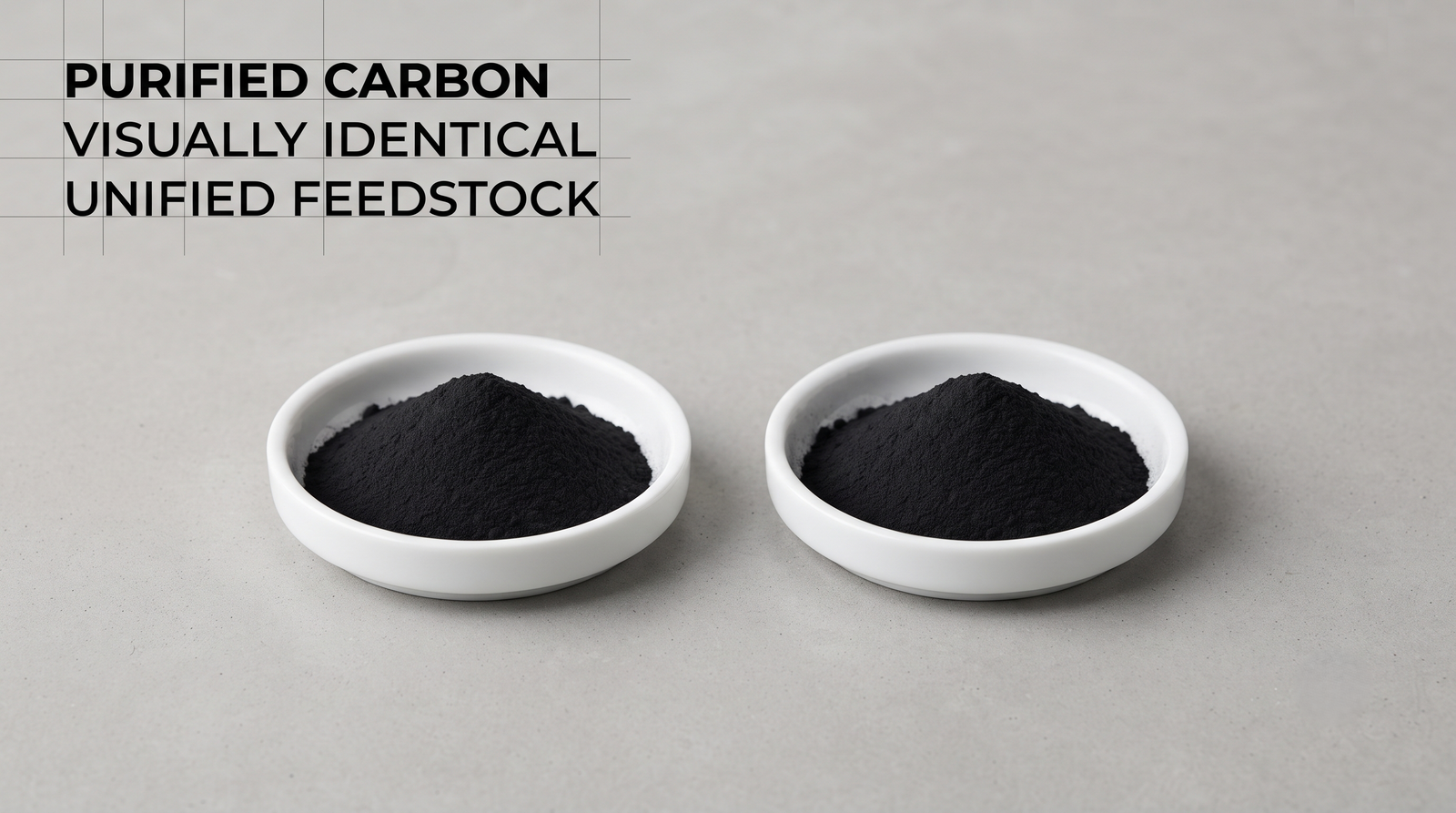
Ashes are gray because of minerals that are removed in extraction. Hair is brown or gray because of melanin, which is also removed. By the time either material is carbon, it is black powder with no pigment, and black carbon powder from ash and black carbon powder from hair are indistinguishable. There is nothing for the stone to split the difference between.

Two small dishes of purified black carbon powder side by side, visually identical

What sets the color is what was in the growth cell besides carbon: nitrogen tints yellow, boron tints blue, and neither gives colorless. Carbon recovered from organic sources tends to carry a little nitrogen along, which is why the whole category leans warm. A combined feedstock is not more or less prone to that than a single one; the chemistry does not know the carbon had two origins.

This means a father ashes and hair diamond does not become a mixture of two visible colors. The final color comes from the growth environment and trace elements rather than the original appearance of the ashes or hair.

For additional information about how diamond quality and grading work, see the GIA Diamond Quality Factors.

Which of the Two Actually Contributes More?
By carbon, hair, by a wide margin per gram. Hair is roughly 50% carbon by weight. Cremated remains yield somewhere between 0.5% and 4%. A lock the size of a fingertip can outweigh, in usable carbon, a considerably larger quantity of ash.

MaterialApproximate carbon yieldWhat that means in a combined order
HairAbout 50% by weightSmall samples yield a lot; usually the larger carbon contributor
AshesAbout 0.5% to 4% by weightLarger samples yield little; usually the smaller contributor
Lab carbonAdded to reach growth volumeMakes up the balance; the finished stone is typically 10% to 15% personal carbon or less

None of this shows in the color, and this is the point families sometimes want and cannot have: a father ashes and hair diamond does not come out “more hair colored” because more of its personal carbon came from hair.

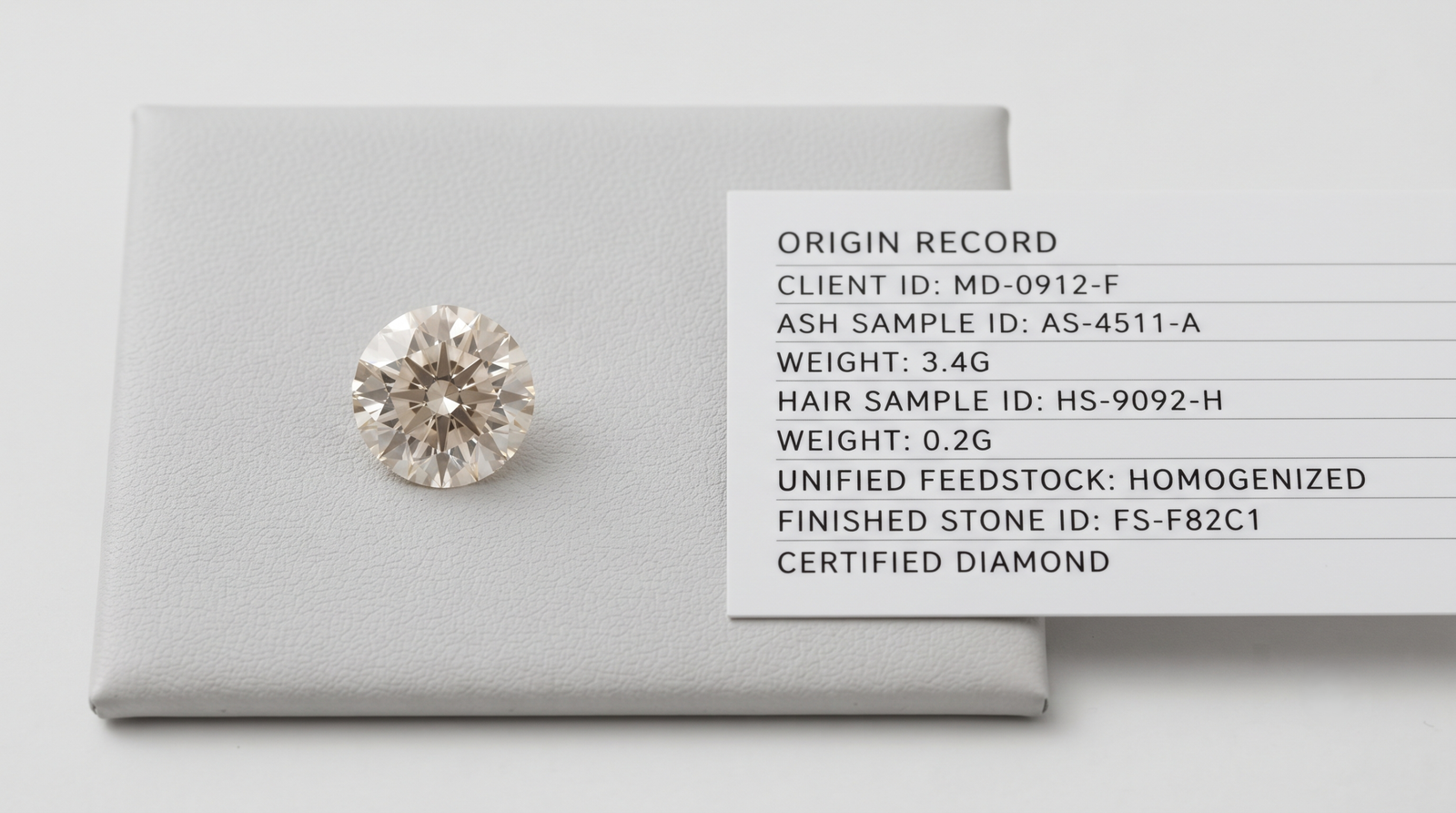
The contribution ratio lives in the provider’s records, if they itemize it, and nowhere else. Ask whether they do; it is a fair question and not every provider answers it the same way.

Printed origin record listing two sample IDs with weights, beside a finished stone

Does Combining Make the Shade Harder to Predict?

No harder than usual, and “usual” already includes some uncertainty. No provider can promise an exact tone before growth for any memorial diamond; trace element levels vary run to run, and two stones ordered as “yellow” can differ in depth.

Combining does not add to that variance in any meaningful way, because the feedstock is homogenized before it goes into the press.

What combining does add is a second record to check. If exact shade matters, such as a match to an existing family piece, or two sibling stones that need to sit together, say so before growth, and ask how the provider handles it.

Selection from a run is the usual method; guaranteed identical shade in advance is not something an honest provider offers.

The colors page for a father goes into what a provider’s color words do and do not promise.

What to Settle Before You Order

Three decisions, and none of them is about the ashes or the hair:

  1. Who keeps the stone and what it goes into. Metal shifts every tint: a yellow stone deepens in yellow gold and reads faintly off white against platinum, while blue and colorless hold steady in any setting. Decide the piece before the shade.
  2. Grown color or treated color. Yellow, champagne, blue, and colorless are grown; red, pink, green, and black are typically post growth irradiation. Ask which is which on the provider’s menu, and know that a treated color is a treatment, not a reflection of either material.
  3. What you want written down. For a combined order, ask whether the origin record itemizes each material’s contribution and whether the color is described using a standardized grading scale or the provider’s own words. A father ashes and hair diamond has two chains of custody; make sure the paperwork reflects both.

Frequently Asked Questions

Could the Stone Come Out Two Toned, or Show a Boundary?

No. The ash derived and hair derived carbons are blended into one feedstock before growth, and the crystal grows as a single, uniform lattice. There is no boundary because there is nothing left to mark one; a combined stone looks exactly like a single source stone of the same color.

Would Sending More of One and Less of the Other Change the Color?

No. The proportions change what the provider’s records say about contribution, not the tint. Color is set by trace nitrogen or boron in the growth cell, and the feedstock is homogenized before growth, so the ratio of ash carbon to hair carbon has no visible effect on a father ashes and hair diamond.

Does His Hair Color Affect It, If the Hair Went Gray?

No. Melanin, the pigment that makes hair brown, black, or red, is removed during carbon extraction along with everything else that is not carbon. Gray hair has less melanin, not less carbon, so a gray lock contributes the same pigment free carbon a dark one would.
Is a Combined Stone More Likely to Be Colorless?

No. A colorless crystal needs a growth cell free of nitrogen and boron, and keeping them out is a separate processing step whatever the carbon’s origin. Two organic sources neither help nor hurt that; if you want colorless, order it explicitly and expect it to cost more at the same carat.

Can Two Combined Stones for Two Siblings Be Matched?

Approximately, and only by asking before growth. Trace element levels vary between runs, so two stones ordered in the same color can differ slightly in depth. Providers who match siblings typically select from the same run; ask what the provider can and cannot promise in writing.

Does the Color Say Anything About Which Material Contributed More?

Nothing at all. Hair contributes far more carbon per gram than ashes, but that ratio is invisible in the finished stone. If knowing the contribution matters to you, it has to come from the provider’s origin record. Ask whether they itemize it, because a father ashes and hair diamond will not tell you by its shade.

Final Thoughts on the Color of a Father Ashes and Hair Diamond

The picture of two tones meeting is a natural one, and letting it go is part of understanding what the stone actually is.

A father ashes and hair diamond is one crystal, one color, grown from carbon that no longer remembers which container it arrived in.

The color will suit the ring or the pendant, or it will not, and that is decided by the metal and the person who wears it, not by the ashes, not by the lock.

Where the two sources still exist as two is in the paperwork, and that is worth asking for. The combined question about whether the diamond is really made from both sources is where that record is described.

Learn More About Father Memorial Diamonds

Talk With Memorial Diamond

If you are planning a combined order and want to know what color is realistic for the piece you have in mind, reach out to Memorial Diamond.

Ask which colors are grown and which are treated, and whether the origin record for a father ashes and hair diamond will itemize both materials.

Sealed portion of cremated ashes beside a small envelope of short hair clippings and a pale champagne memorial diamond on a dark linen surface

Father Ashes and Hair Diamond: The Complete Guide

The decision in front of you is probably not which material means more. It is whether the hair you found can contribute enough on its own. A father ashes and hair diamond is a genuine lab grown diamond grown from carbon extracted from both his cremated remains and his hair. The two materials follow separate purification routes before they join one feedstock for growth. Hair contains roughly 50% carbon by weight, while ash contains roughly 0.5% to 4%. That difference means a small amount of hair can contribute meaningful carbon when you combine both materials.

That is the practical reason this route can matter when the hair you found amounts to a beard trim, shaver contents, or a few short clippings rather than a complete lock.

The Decision Is Not Really Ashes or Hair

The two materials arrive under different conditions, and that difference creates the real decision. His ashes are usually easy to identify and measure because a container holds them. You can retain a portion while the family’s wider plan continues. His hair creates more uncertainty. You may have a complete lock, a childhood keepsake, or only a few short clippings.

If the hair you found cannot meet a hair only requirement, combining it with his ashes may still allow that material to contribute carbon. The two materials follow separate extraction routes, so each material contributes according to its own characteristics.

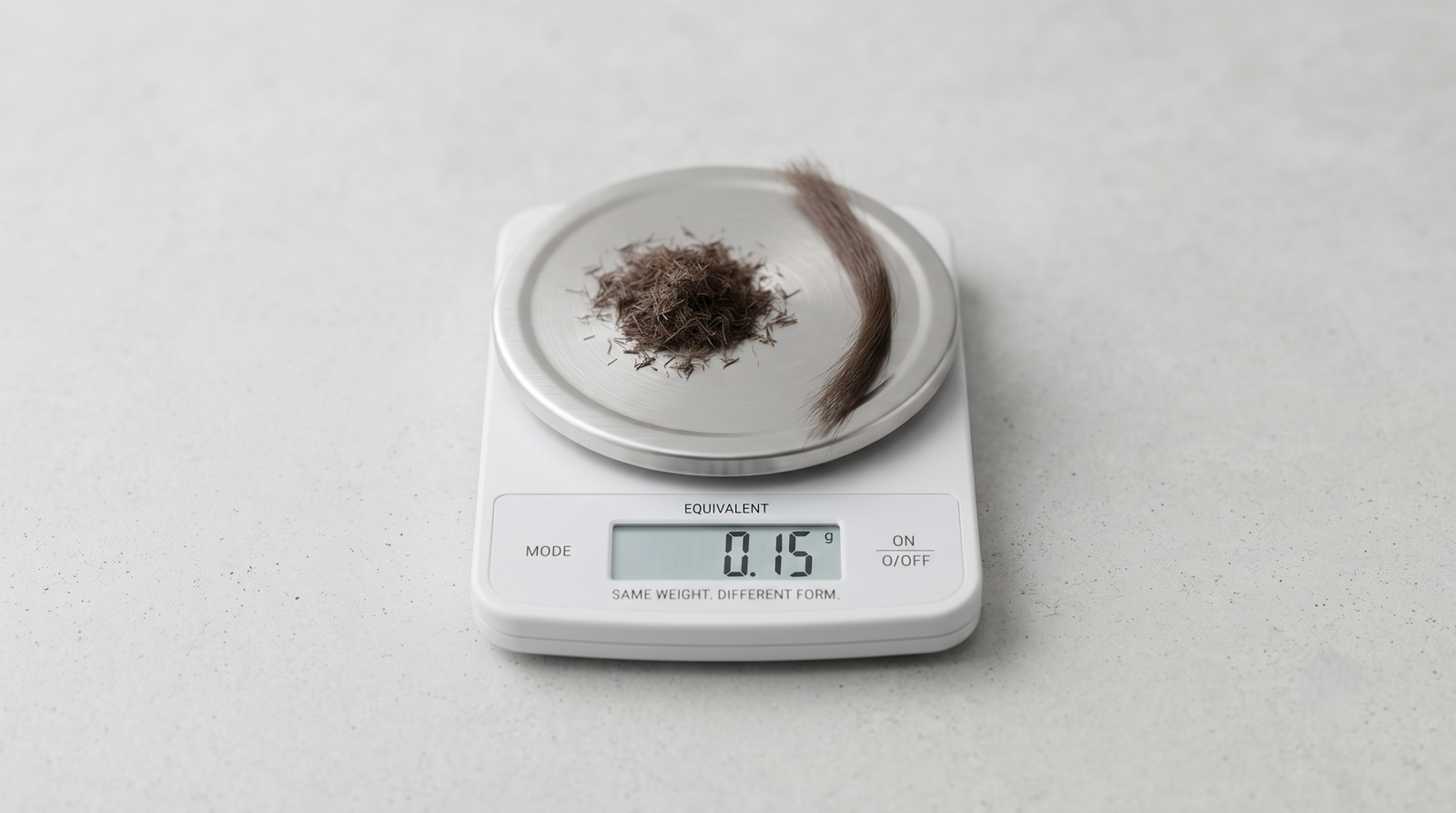
Small pile of short beard clippings on a jeweller's scale beside a longer lock of the same weight

One important rule deserves attention before you speak with a provider. Combining the materials does not automatically lower either material’s own minimum. A combined order does not turn two half portions into one qualifying portion. Ask for the ash minimum and the hair minimum as separate numbers.

For typical material quantities, read how much ash and hair you need for a father memorial diamond.

What you have of his hairWhat combining changesWhat remains open
A full kept lockHis ashes become a second carbon source while both individual routes remain possibleOrdinary provider and process questions
A beard trim or shaver clippingsHis hair contributes carbon without carrying the entire order aloneConfirm whether the provider accepts very short clippings
Hair from a shared brush or razorCombining does not establish whose hair the material containsProvenance and provider acceptance
A childhood keepsake lockA small keepsake can join his ashes instead of serving as the only materialWhether you want to use an irreplaceable keepsake

Why a Beard Trim Is the Real Reason to Combine

Combining makes particular sense when the hair you found is a beard trim rather than a long lock.

Beard, chest, and body hair contain keratin. From a carbon perspective, keratin provides the same basic material as scalp hair. Weight matters more than length. A short pile of beard clippings and a long lock with the same weight contain a comparable amount of carbon.

This distinction matters for fathers who experienced male pattern hair loss. A bald or thinning head does not automatically close the hair route. A beard trim, grooming cut, or other confirmed source may still provide usable material.

Chemistry does not create the main uncertainty here. Provider policy does. A provider may accept short clippings, or it may require a specific minimum. Ask for the answer in writing before you send the material.

Provenance also matters. Hair from a shared brush or razor may contain material from more than one person. No later laboratory step can tell you which person’s keratin entered the sample. The household must establish that history.

If you want to understand the hair only route, read the hair only guide for a father memorial diamond.

How Much of the Stone Is Actually Him?

Enough to make the connection real, but not enough to call the entire stone his carbon.

Cremated remains consist mainly of calcium phosphate, the mineral structure associated with bone. Usable carbon represents roughly 0.5% to 4% of ash by weight. Hair contains roughly 50% carbon by weight.

The laboratory purifies the recovered carbon to around 99.9% or higher before further processing. A diamond of meaningful size needs a workable feedstock volume, so the personal carbon joins supplemental laboratory carbon. Industry wide figures place ash derived personal carbon around 10% to 15% of the finished stone’s mass.

Adding hair can increase the personal carbon contribution, but it does not remove the need for supplemental carbon. The strongest description remains simple: carbon recovered from two different tissues becomes part of one diamond crystal.

For the broader explanation of the category, read what a memorial diamond is.

What Does a Lab Actually Do With Two Materials at Once?

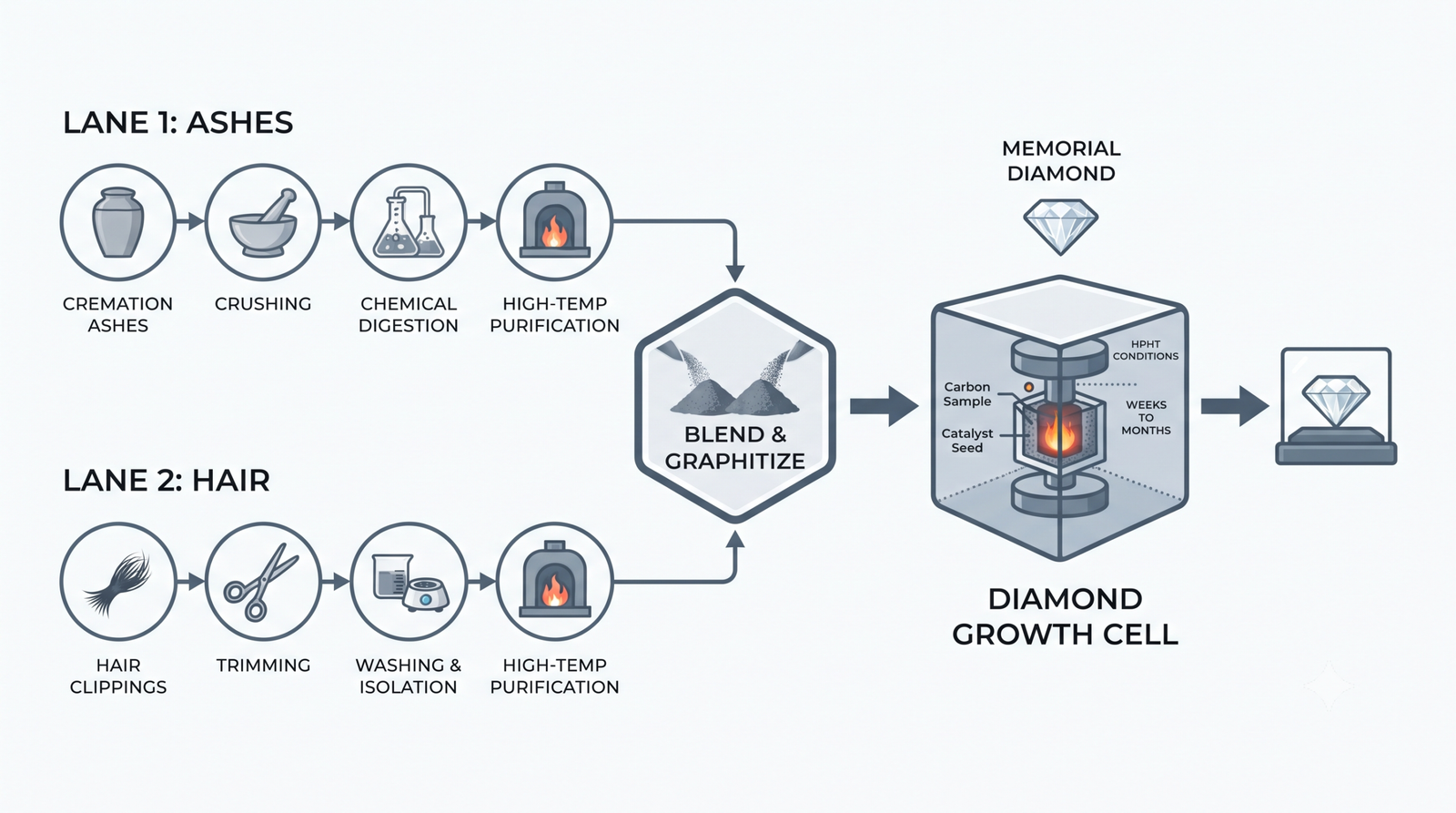
A combined order does not mean that the laboratory throws ashes and hair into the same treatment process. The two materials require separate preparation routes before they meet.

Ash contains bone minerals that require removal. Hair contains keratin and may contain treatment residues that require removal. The laboratory processes each material separately in a controlled oxygen free environment until it reaches the required carbon purity.

Diagram of two separate purification lanes for ashes and hair converging once into a single diamond growth cell

The purified carbon then undergoes graphitization at roughly 2,500 to 2,700°C. After that stage, the two graphite sources can meet in the feedstock used for diamond growth.

The growth stage can use an HPHT press around a diamond seed. Some providers use CVD instead. Industry information describes HPHT as the standard method for memorial work and CVD as a minority route.

Once both materials enter the same growth cell, the process creates one crystal. The finished stone receives one cut, one colour, one carat measurement, and one grading result.

What stays separateWhat follows for you
Two material intakesAsk how the provider records each material
Two arrival dates when you ship separatelyAsk how the provider handles the production clock
Two material minimumsNeither minimum automatically disappears because you combine materials
Two extraction yieldsAsk what happens if one material produces less usable carbon than expected
One merged feedstock and one growth runThe finished stone becomes one crystal with one grading result

Put the under yield question in writing before anything leaves your hands. Ask whether the provider pauses the order and consults you, requests additional material, or follows another procedure.

For the detailed process of turning both materials into a diamond, read how to turn your father’s ashes and hair into a diamond.

Combining Makes the Colour Less Predictable, Not More

That trade deserves a clear explanation.

Trace elements present during diamond growth influence colour. Boron can produce blue tones, while nitrogen can produce yellow tones. Colourless growth requires very low levels of those elements.

Memorial diamonds commonly show yellow, blue, and champagne tones because organic carbon sources can carry different trace element profiles. A combined order brings two personal organic sources into the same growth process. Each source can carry its own trace element profile, so the final colour can become less predictable.

Three lab-grown memorial diamonds in yellow, blue and champagne tones side by side under even daylight

No provider should promise an exact natural colour before growth. You can choose from the colour options that a provider offers, but the exact result depends on the growth conditions and available carbon.

Read what colour a diamond made from your father’s ashes and hair can be for more detail.

How Long Does It Take, and What Will It Cost?

Industry wide production commonly takes about 6 to 10 months from laboratory receipt of the material. Large stones and specialty colours can take longer, with some projects reaching around 12 months. From the first family decision through material collection, shipping, production, grading, and jewellery setting, an overall period of roughly 8 to 14 months can make sense.

Combining two materials does not automatically make the diamond larger or faster to grow. Carat depends on growth time inside the growth equipment rather than simply on how much personal material you provide.

Industry pricing in 2026 commonly falls around $1,500 to $3,500 for 0.10 to 0.25 carats, $5,000 to $15,000 for 0.5 to 1 carat, and $20,000 to $75,000 or more for 2 to 5 carats. These figures represent general industry ranges rather than Memorial Diamond pricing.

Carat, colour, cut, and grading can influence the price. A second material may also require another intake and purification process. Ask the provider whether it charges an additional fee for the second material.

For the cost factors behind a father memorial diamond, read what actually drives the cost of a father memorial diamond.

Settle These Before You Commit, in This Order

Settle thisWhy it sits here
Whether the provider accepts combined submissionsA negative answer changes the entire plan
Both material minimums separatelyYou need two numbers rather than one combined assumption
Whether his hair clears its own minimumIf it does not, ask whether the provider accepts it as a secondary contribution
What happens if the ash lane produces less carbon than expectedYou need to know when and how the provider will consult you
Whether both materials travel togetherSeparate shipments can affect the timing of the combined order
Carat and colourThese decisions can wait until the material and provider questions have clear answers
Small labelled sift-proof container being filled from a larger urn with a clean spoon on a plain surface

One deadline can override the normal order. If the family has scheduled an interment or scattering, retain the ash portion before that event. Once the ashes enter that final arrangement, the ashes route can close.

Read the ashes only guide for a father memorial diamond for the retention issue.

Frequently Asked Questions

What if the clippings we found weigh less than the stated hair minimum?

Combining does not automatically lower either material threshold. Ask for the hair minimum and ash minimum separately. Then ask whether the provider can accept a smaller hair quantity as a secondary contribution. Confirm the answer before you send anything.

Do we decide how much of each material goes in, or does the lab?

Ask the provider because no universal practice settles this question. The laboratory controls the blend it can process. Whether you can request a particular ratio or simply receive the laboratory’s final process depends on provider policy.

If his ashes yield less carbon than expected, does the order still go ahead?

Ask this before shipping. Cremated remains can produce different carbon yields. A provider may pause the order, request more material, or follow another procedure. The provider should explain its process before you commit the material.

Does using both materials cost more than using one?

Ask for the combined order as a clear line item. Industry pricing usually follows factors such as carat, colour, cut, and grading. A second material also creates another intake and purification stage, so the provider must confirm whether that adds a fee.

Could the two materials become two separate stones instead of one?

That depends on whether each material meets its own minimum without assistance. If both materials qualify independently, you can ask about two separate growth runs. That creates two stones, two reports, and potentially different colours.

Will the grading report record that two materials were used?

A grading report normally describes the finished diamond through characteristics such as carat, colour, clarity, and cut. After the materials merge, the finished crystal does not provide a simple way to identify which atom came from which source. Ask the provider how its chain of custody records the two materials.

Ask What Happens If His Hair Weighs Less Than They Need

This question can reveal how seriously a provider handles a combined order. Ask for the hair minimum, the ash minimum, and the procedure for a hair quantity that falls below the stated threshold.

A clear answer should give you specific numbers and a specific process. If the answer only says that the laboratory can work with the material without explaining the minimum or the next step, ask again.

You can also ask how the provider handles your father’s ashes and hair throughout intake, purification, growth, grading, and return. Those answers help you understand what happens to both materials once they leave your hands.

If you want to understand how a combined stone fits into the final jewellery piece, explore memorial diamond settings and jewellery ideas for a father.

Using His Ashes and Hair in One Memorial Diamond

A combined father memorial diamond can make sense when the ashes provide one source of personal carbon and the hair you found provides another. The strongest reason to consider the option often comes from the hair itself. A small beard trim or short clipping may not meet a hair only requirement, yet it can still represent a meaningful part of what you found.

The important step comes before you choose a carat or colour. Confirm that the provider accepts combined material. Then ask for the ash minimum and hair minimum separately. Confirm how the provider handles short hair, under yield, separate shipments, unused material, and the final records.

Once those questions have clear answers, you can decide whether using both materials in a single stone feels right for your family. The goal is not to use every material simply because you have it. The goal is to create a memorial that carries a genuine physical connection to your father and feels right for the people who will keep it.

Desk with a phone, a notepad and a closed cremation urn set to one side, the notepad in use

Turn Your Father’s Ashes Into a Diamond: Order of Steps

The first practical act is not opening the urn. It is a phone call to whoever holds his remains or arranges what happens to them, asking that a small portion stay aside.

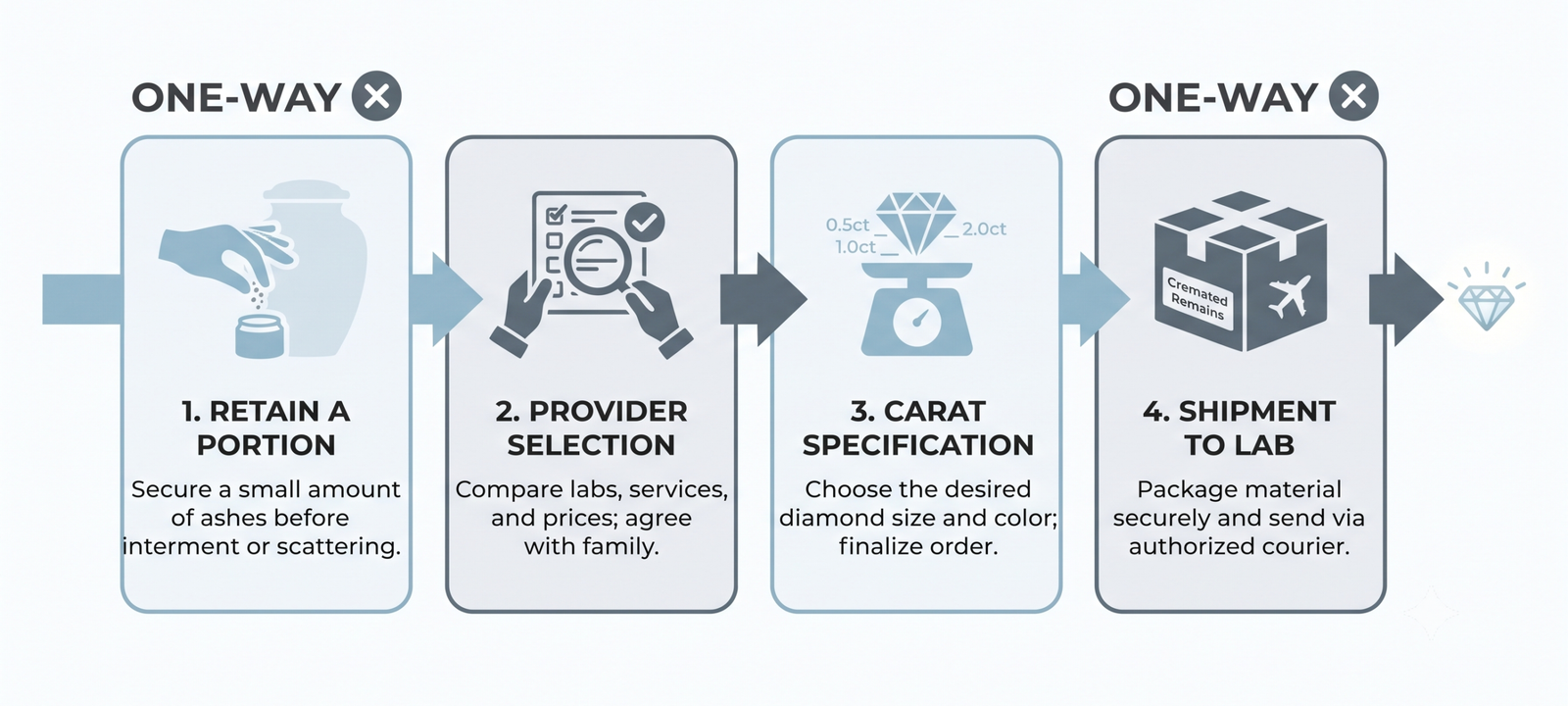
Turning your father’s ashes into a diamond takes four acts: retaining a portion, choosing a provider, specifying the carat, and posting the material. Only the first act has a deadline that cannot move, and that deadline often arrives before you know which provider you want.

This guide explains the correct order, why families often face the steps in the wrong sequence, and what you can still fix after the steps have already happened.

The Four Acts, and Which of Them Can Be Undone

The sensible order does not always match the order available to a family. The important question concerns which acts you can reverse.

ActPreconditionCost of doing it lateReversible?
Retain a portionAccess to the remains and no interment or scattering yetThe ashes route closesNo
Choose a providerYou know what you hold and what you want madeNone if the portion remains safeYes
Specify carat and colourThe provider’s options and intake rulesA growth run may follow a specification you later changeUsually, until the run starts
Post the materialProvider, specification, intake instructions, and order referenceThe material reaches a laboratory without a confirmed orderNo
Four-stage diagram showing retention, provider selection, carat specification and shipment, with the first and last stages marked one-way

The two one way acts sit at opposite ends of the sequence. The reversible decisions sit between them.

Carat affects the rest because a laboratory grows a memorial diamond to size inside a growth press. The laboratory does not cut a larger diamond down to your chosen size. Carat therefore affects growth time and cost. Read more about choosing a carat size before you make that decision.

The Retention Deadline Arrives Before the Provider Is Chosen

Here is where the sequence often breaks.

A committal, an interment into a shared plot, or an agreed scattering can happen within weeks of a death. After that event, the family cannot simply retain a portion from the ashes.

Choosing a provider can take much longer. You may need to compare intake rules, costs, production methods, grading, chain of custody, and family preferences.

The calendar therefore places an irreversible act before a slower decision.

The solution remains simple. Retention does not require a provider, price, carat, or colour. You can ask the funeral director to retain a portion before you decide which company will receive it.

The complete guide to a father ashes diamond explains the retention deadline and the wider process in more detail.

Can You Retain a Portion Before You Have Chosen a Provider?

Yes. Retaining a portion gives you time to make the commercial decisions later.

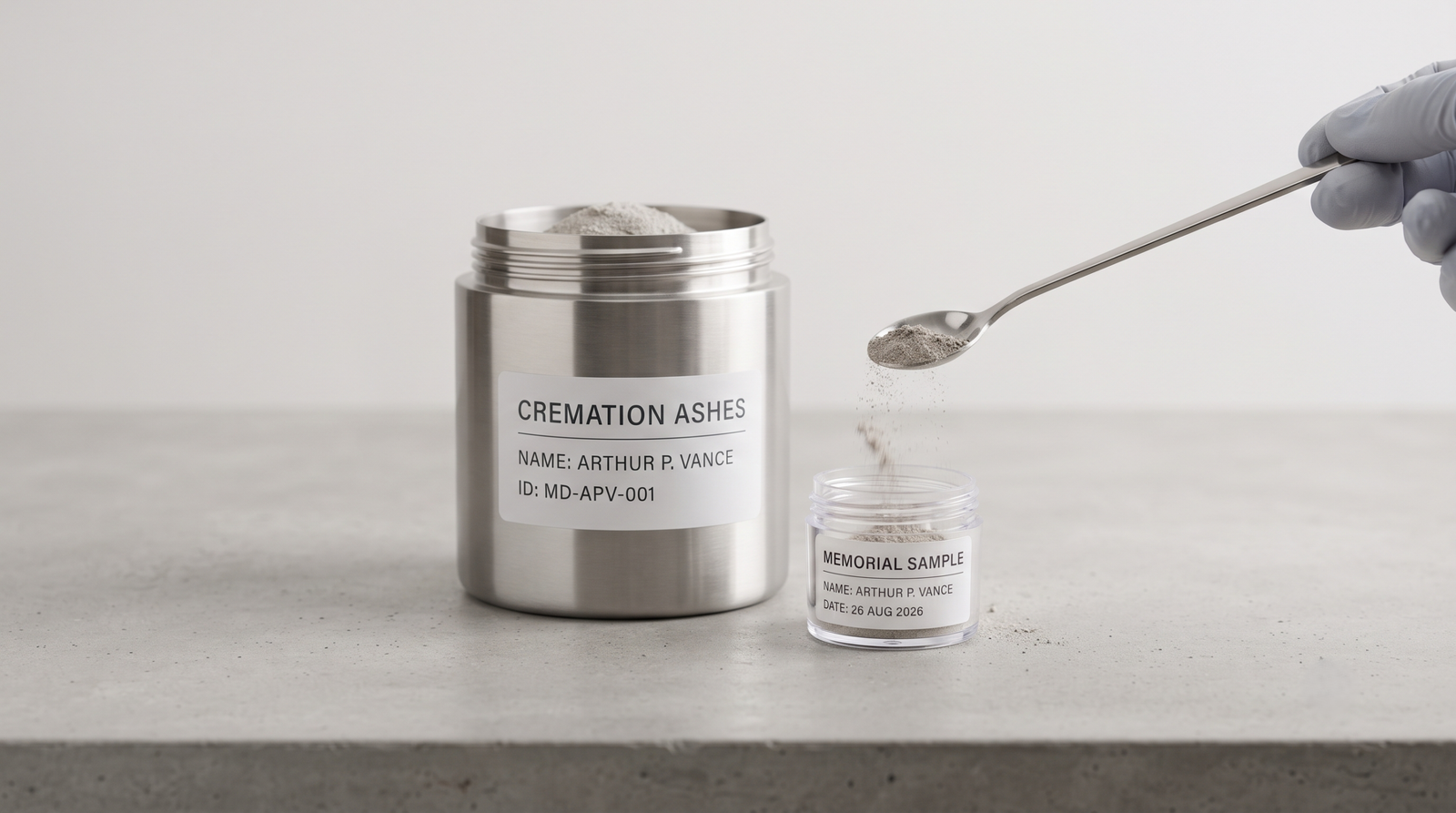
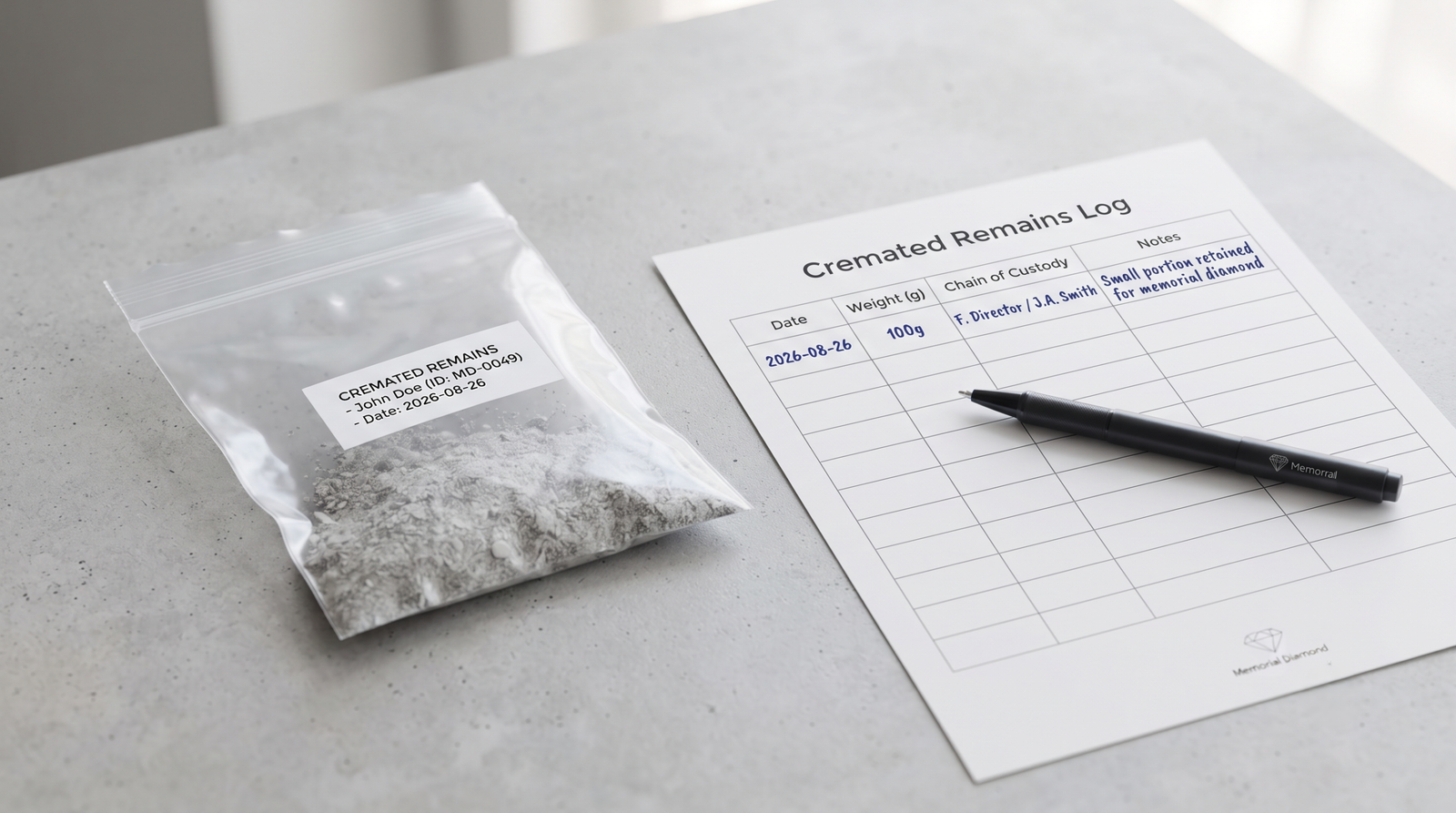
Retention concerns the physical material rather than a purchase. You need a sealed container, a clear label, and a written record.

Small sealed and labelled bag of cremated remains beside a handwritten record sheet and a pen

Quantity represents the decision that needs attention before you move on. Industry typical requirements range from a few tablespoons to roughly 4 oz, or about 100 grams. A full cremation produces much more material, so retaining a reasonable portion gives you room to choose later.

Read how much ash a father memorial diamond needs before you decide how much material to retain.

Record the following information when the portion leaves the main container:

  • Who separated the portion and the date of separation.
  • His full name exactly as it appears on the cremation paperwork.
  • The approximate quantity retained.
  • Where the portion remains stored.
  • Who knows about the retained portion.

This record gives your family a useful starting point for its own chain of custody. How providers track a loved one’s ashes explains the provider side of that process.

If several family members contribute money, agree in advance about who will own the finished diamond and who will hold it. Ownership can vary by jurisdiction and by the way the family places the order.

What Has to Be Settled Before the Package Leaves?

Posting the material creates the second one way act. Settle the important details before the package leaves your hands.

  • Choose a provider. Get its intake instructions in writing, including quantity, packaging, labelling, and delivery details.
  • Agree on the specification. Confirm carat and colour before the material travels so the laboratory receives it against an active order.
  • Record the order reference. Put the correct reference on the package so the provider can match the material with the correct file.
  • Ask about unused material. Confirm whether the provider returns unused material automatically or only after a request.

Some providers may accept material before the family finalises the carat. Others may require a complete specification first. Treat this as provider policy and ask before you send anything.

If you want a practical checklist of questions to settle before shipping, review your provider’s intake requirements and keep every answer with the order record.

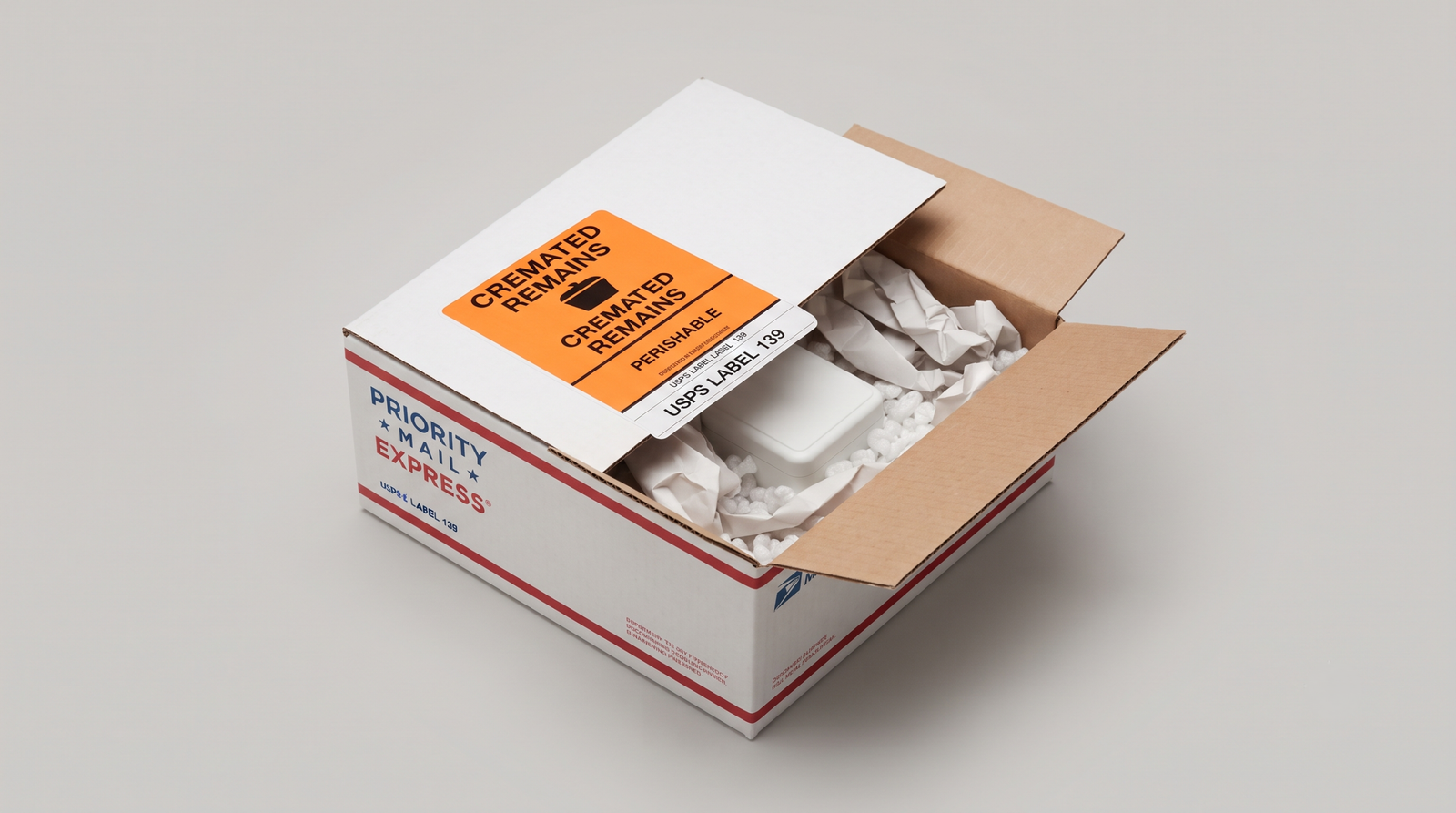
USPS Priority Mail Express parcel carrying the required cremated-remains label, cushioning visible inside

Shipping Is Decided by Carrier Policy, Not by Law

Families often frame this as a legal question. The practical issue involves carrier rules.

Carrier policies can restrict individual customers from shipping cremated remains. The source material identifies UPS, FedEx, and DHL as carriers that bar cremated remains from shipment by individual customers, leaving USPS as the realistic direct domestic route under the described rules.

Always confirm the current requirements with the carrier before shipping because carrier policies can change.

Who is sending itAvailable routeWhat it adds to the sequence
A family member shipping domesticallyUSPS Priority Mail Express with the required cremated remains labelConfirm current packaging and service requirements before choosing the posting date
A funeral directorTheir own business shipping arrangementsOften simpler while the funeral director still holds the remains
Someone carrying the material personallyHand deliveryConfirm that the provider accepts public hand delivery and records receipt

USPS supplies a free Cremated Remains kit that customers can order online. Confirm current USPS requirements before you depend on the kit or your own packaging.

The source recommends checking whether your own sift proof and cushioned packaging qualifies, since waiting for a kit can add time. Photograph the sealed package and its label before it leaves, then tell the provider that the material is on its way.

For the broader legal question, read the legal position on turning ashes into a diamond.

If your father’s ashes have already gone into an interment or scattering, another material route may remain. Turning your father’s hair into a diamond does not require cremated remains.

What Can Be Fixed If the Acts Already Fell Out of Order?

Not every mistake closes the process. The outcome depends on what already happened.

What happenedWhat you can do now
The interment happened and nobody retained a portionThe ashes route closes. The hair route remains available if you have suitable hair.
You chose and paid a provider before telling the familyIf no material has moved, ask the provider whether you can pause the order.
You retained more material than you needKeep the surplus with the family unless the provider gives you another instruction.
You retained less than the provider’s stated minimumAsk whether the provider can work with a smaller quantity and a smaller carat.
You shipped the material before agreeing on a specificationAsk the provider whether it can place the material on an intake hold.
You set aside a portion years ago without recording itThe material may remain usable, but the provider may need additional documentation.
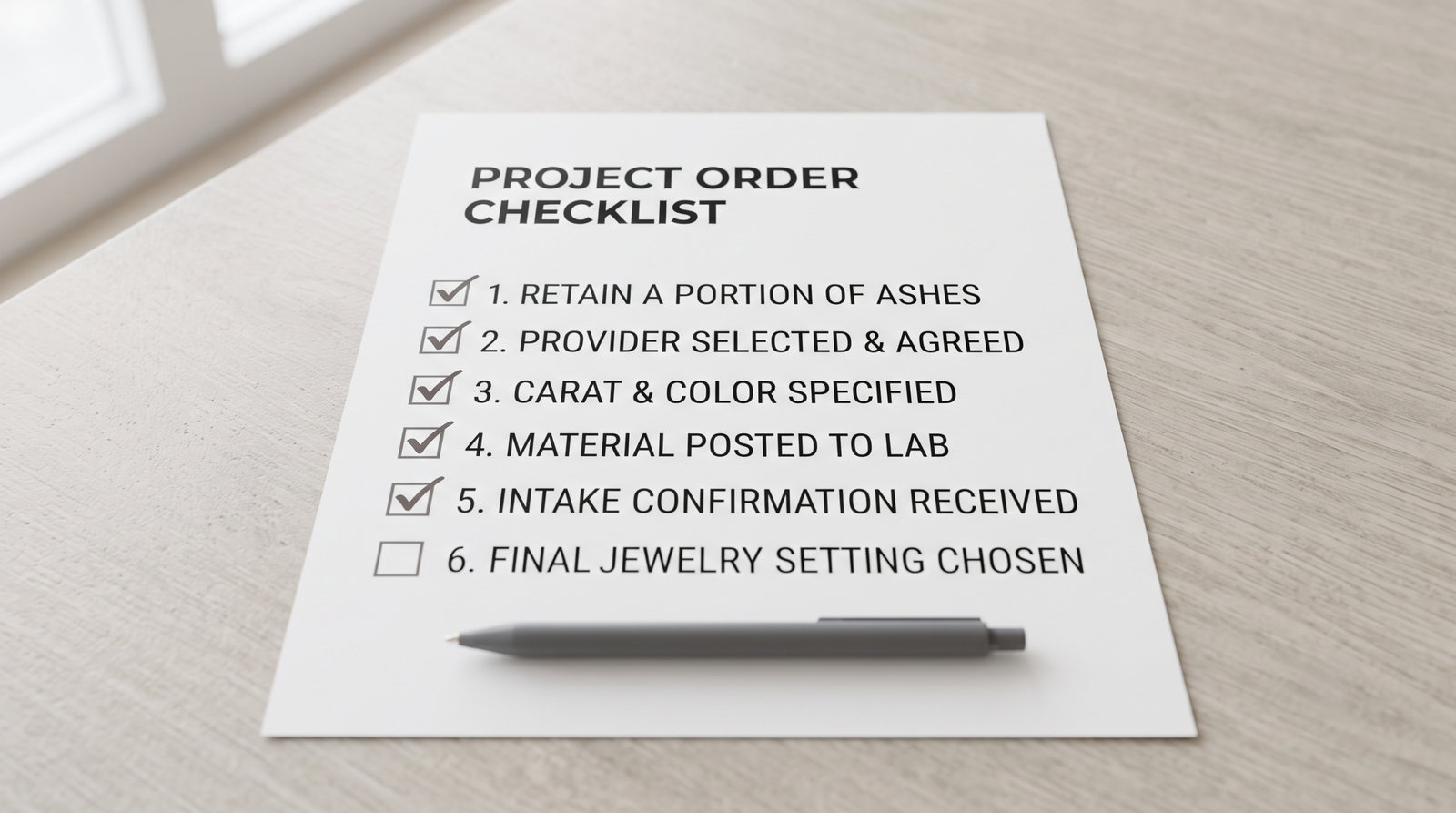
Printed checklist on a kitchen table with several lines ticked and one left blank

Do not assume that a provider can pause an order, accept a smaller quantity, or return unused material. Ask for its policy before relying on any of those options.

If the steps already happened in the wrong order, the right response starts with identifying exactly where the material sits now and what the provider has recorded.

What Happens Once the Parcel Is Out of Your Hands?

The sequence changes once the laboratory receives the parcel. The production clock starts from laboratory intake rather than the moment you hand the package to the carrier.

Ask the provider what its intake confirmation looks like and when you should expect it. Write down the date when the laboratory logs the material.

Industry production commonly takes 6 to 10 months from laboratory receipt. Large stones and specialty colours can take around 12 months. From the first decision through family discussions, shipping, laboratory production, grading, and jewellery setting, an 8 to 14 month journey can make sense.

Gloved technician logging a received sample into a laboratory intake record

Read how long a father memorial diamond takes for the timeline in more detail.

One important point deserves attention before you send the material. Cremated remains contain roughly 0.5% to 4% carbon by weight. The laboratory therefore blends purified personal carbon with supplemental laboratory carbon to reach the required feedstock volume. Industry information places the personal carbon contribution around 10% to 15% of the finished stone’s mass.

Sending more ash does not make the diamond larger or make the laboratory work faster. Carat depends on growth time.

Ask the provider how often it will update you during production and what milestones it will report.

Frequently Asked Questions

Which comes first, choosing a provider or asking for a portion to be held back?

Ask for the portion first. Retention carries the deadline that cannot move, and you do not need a provider, price, or specification to make that request. You can compare providers after you secure the material.

Can we send the portion before we have decided the carat?

Usually, you should settle the specification first because a laboratory sets up the growth run around the selected carat. Some providers may accept material while you decide. Ask about that policy before shipping.

Do we have to order the free USPS Cremated Remains kit before we can post?

USPS supplies a free Cremated Remains kit. Confirm current USPS rules before you decide whether you need that kit or whether your own approved packaging qualifies. Do not let a packaging assumption create an avoidable delay.

Can a funeral director post his ashes to the laboratory for us?

Often, a funeral director can arrange shipment through business shipping procedures. Ask the funeral director while they still hold the remains. This approach may simplify the process for a family that wants to retain a portion before release.

A portion was set aside years ago and nobody recorded what it was. Can it still be used?

The age of the material may not create the main problem. Documentation creates the larger question. Ask the provider what evidence it needs and reconstruct the history of the material as accurately as possible.

Does the growth clock start when we post the parcel or when the laboratory receives it?

The quoted production period starts at laboratory receipt. Shipping time, intake holds, specification changes, and documentation discussions sit outside that production period. Record the laboratory intake confirmation date.

Get the Sequence Right Before You Choose the Stone

The first question concerns the material, not the diamond. If an interment or scattering already has a date, ask for a portion to stay aside before the remains leave the funeral director’s control.

After that step, you can take your time. Compare providers, choose the carat, decide on colour, review the intake process, and settle the shipping requirements.

The important thing is to avoid turning a time sensitive retention decision into a purchase decision. Secure the option first. Make the rest of the decisions when you have enough information.

When you are ready to discuss the process, Memorial Diamond can help you understand the next steps.

Champagne-toned lab-grown memorial diamond grown from a father's cremated ashes, resting on a dark wooden surface in low daylight

Father Ashes Diamond: Complete Guide for Families

The container is probably still where someone put it. A shelf in the spare room, the back of a wardrobe, or the boot of a car nobody has finished unpacking.

A father ashes diamond gives that material another place to go. A laboratory grows a genuine lab grown diamond in part from carbon extracted from your father’s cremated remains. The finished diamond has the same crystal structure and hardness as other diamonds and can receive grading against the same four Cs.

Production typically takes six to ten months. The process uses only a small portion of a cremation.

That last fact matters more than it may seem. The rest of those ashes may already have a date attached to them. Establishing whether a date exists comes before choosing carat, colour, or cost.

Is There a Deadline on This Decision?

In principle, no. Cremated remains do not degrade in a way that affects carbon extraction. Ashes kept for twenty years can still provide material just as ashes kept for five weeks can.

In practice, one deadline can make the decision urgent.

If a portion of your father’s ashes will go into the ground, into a columbarium niche, or to a chosen scattering location on a specific date, the ashes stop being available after that event. An interment requires a formal disinterment process to reverse. A scattering cannot be undone.

Sealed cremation urn on a shelf at home ahead of a scheduled interment

When a father dies after a mother, the family may already have a plan. Perhaps they bought a shared plot decades ago. Although they chose a shared niche. Perhaps your parents selected a place where the family will scatter their ashes.

That plan does not need to compete with a memorial diamond. You only need to work backwards from the date and retain a small portion before the remains leave your control.

  • Find out whether a date exists. Ask whoever holds the remains and whoever arranges the interment. Those people may not be the same person.
  • Raise the subject before the date arrives. You can ask about retaining a portion rather than asking the family to give up his ashes. Read how to raise it with your family.
  • Retain the portion before release. Ask the funeral director about their procedure before the remains go to the cemetery, crematorium, or scattering location.
  • Let the original plan continue. A diamond and an interment or scattering do not need to become competing choices.

If the date has already passed, or your father had a burial rather than a cremation, the ashes route may no longer remain available. A hair based route can provide another option. Read the hair route that does not depend on cremation.

What Exactly Is a Father Ashes Diamond, and How Much of It Is Him?

A father ashes diamond is not a simulant or a diamond look alike stone. A laboratory grows a real diamond from purified carbon and supplemental laboratory carbon.

Diamond has a Mohs hardness of 10, the highest value on the Mohs scale. A lab grown memorial diamond has the same fundamental crystal structure and optical properties as other diamonds.

The important qualification concerns the amount of personal carbon.

Cremated remains consist mainly of calcium phosphate and other mineral material from bone. Carbon makes up a small share of the total ash. Industry information places the carbon content of cremated remains around 0.5% to 4% by weight.

The provider extracts that carbon and purifies it to roughly 99.9% carbon. The laboratory converts the purified carbon into graphite and blends it with supplemental laboratory carbon to reach the volume required for diamond growth.

Industry information places the personal carbon contribution at around 10% to 15% of the finished stone’s mass.

No honest provider should describe the finished stone as 100% your father. The accurate explanation carries more meaning. Carbon atoms that once formed part of his body become part of the crystal lattice of a genuine diamond.

For the broader explanation, read the complete guide to what a memorial diamond is.

How Much of His Ashes Does This Actually Take?

Industry typical requirements range from a few tablespoons to about 4 oz, roughly 100 grams.

A full cremation produces far more material than this amount, which allows the family to retain a portion for a diamond while continuing with an interment, scattering, or other memorial plan.

  1. Speak with the funeral director before release. Explain that you want to retain a portion for a memorial diamond and ask about the funeral home’s procedure.
  2. Use a clean, sealed and labelled container. Include your father’s full name and the cremation date and ask the funeral home to record the separation in its paperwork.
  3. Confirm the provider’s actual minimum. Industry ranges can guide your planning, but the provider’s requirement determines how much you should send.
  4. Ask about unused material. Find out whether the provider returns unused ashes or requires a specific request.

Memorial Diamond has not published its own material requirement in the supplied source. Treat the figures above as industry typical and confirm the actual requirement before measuring anything.

Read the step by step logistics of retaining, packaging, and sending a portion before you prepare the material.

The Ash Is Consumed Early in the Process

The process uses industrial chemistry and a chain of custody. The important practical question concerns the point at which the original ash no longer exists in its original form.

StageWhat happens to the materialIs the original material still intact?
Collection and loggingThe provider receives, weighs, and logs the ashes under a chain of custody reference.Yes
Extraction and purificationA controlled oxygen free process removes mineral material and leaves purified carbon.No
GraphitizationThe purified carbon reaches roughly 2,500 to 2,700°C and converts into graphite.No
GrowthThe graphite combines with supplemental laboratory carbon inside an HPHT growth system around a diamond seed.No
Cutting and polishingA gemologist cuts and polishes the rough crystal into the selected shape.No
Grading and certificationThe finished stone receives grading for cut, colour, clarity, and carat.No
Technician handling purified carbon extracted from cremated remains inside a laboratory furnace enclosure

Only the collection stage leaves the original material physically recoverable. Whether a provider can pause or return the material at that point depends on its own policy.

Ask about cancellation, unused material, failed growth runs, and chain of custody before you send anything.

One point deserves special attention. The amount of ash does not determine the finished carat size. Growth time determines the size of the diamond.

How Long Does the Whole Thing Take?

The six to ten month production period represents only the laboratory production stage. Your complete journey can take longer.

PhaseTypical duration
Deciding, discussing with family, and choosing a provider1 to 2 months
Retaining the portion and sending it to the laboratory2 to 4 weeks
Production from laboratory receipt to finished graded stone6 to 10 months
Setting the stone into jewellery2 to 6 weeks
Total from decision to wearing itRoughly 8 to 14 months
HPHT growth cell of the kind used to grow a memorial diamond from ash-derived carbon

Large stones and specialty colours can extend the production period. A stone around 2 carats or larger, or a specialty colour such as black, can push laboratory production toward 12 months.

If you hope to have the finished jewellery for a first anniversary or another meaningful date, work backwards from that date.

What Colour Will His Diamond Be?

Diamond colour comes from trace elements present during crystal growth.

Nitrogen can produce yellow. Boron can produce blue. A colourless stone requires the near total absence of both elements.

Because memorial diamond production uses carbon from an organic personal source, trace elements can remain present. That makes yellow, blue, and champagne or brown tones common outcomes.

Some providers also offer post growth irradiation for colours such as red, pink, green, or black.

No provider can honestly promise one exact natural shade before the stone grows. The source material and growth conditions influence the final colour.

Read what to expect from the colour of a diamond made from your father’s ashes for a more detailed explanation.

What Does a Father Ashes Diamond Cost?

The following figures represent general 2026 industry ranges rather than Memorial Diamond’s published prices.

Size tierTypical caratTypical industry price range
Entry0.10 to 0.25 caratsApproximately $1,500 to $3,500
Mid0.5 to 1 caratApproximately $5,000 to $15,000
Large or rare2 to 5 carats or moreApproximately $20,000 to $75,000 or more

Carat, colour, cut, and independent grading can affect the final price. A setting and engraving usually create additional costs.

Read what actually drives the cost of a father memorial diamond for a more detailed pricing breakdown.

A Military or Service Interment Leaves Less Slack

A military or service interment often follows its own ceremony, schedule, and custody process. The funeral home may release the remains directly to a national or service cemetery.

The practical consequence remains simple. Retain the portion before the funeral home releases the remains.

Ask the funeral director rather than waiting until the cemetery receives the ashes. Raise the subject early and explain exactly what you want to retain.

Read memorial diamonds for a veteran for more information about the service specific considerations.

The Stone Can Go Into a Ring He Already Wore

A finished father memorial diamond does not have to go into a completely new piece of jewellery.

If your father left a wedding band, signet ring, or another suitable piece, a jeweller may be able to set the finished diamond into something he already wore.

This approach can reduce the cost of commissioning a completely new piece. More importantly, it can give the finished memorial a direct connection to something that already belonged to him.

Memorial diamond set flush into a worn men's wedding band held in an open palm

The jeweller needs to examine the existing piece first. An older ring may have a worn shank or insufficient metal for a new seat. Cutting a new seat into a weak band could create another structural problem.

Because you cannot replace the memorial diamond if you lose it, choose security over appearance when the two conflict.

Read settings and jewellery options for a father memorial diamond before selecting the final design.

What Should You Decide, and in What Order?

Some decisions have deadlines. Others can wait.

  1. Find out whether a date exists for the rest of his ashes. This decision comes first because an interment or scattering can close the ashes route.
  2. Decide who needs to participate. Consider whoever holds the remains, whoever arranges the interment, and anyone whose plans will change.
  3. Choose the material. You may consider ashes, hair, or both together when your provider accepts the relevant route.
  4. Choose the carat. Carat affects both production time and most of the cost.
  5. Choose colour and cut. Consider whether a specialty colour justifies additional time and cost.
  6. Ask the provider the difficult questions. Discuss chain of custody, unused material, HPHT or CVD growth, independent grading, failed growth runs, cancellation, and timelines.

The first two decisions carry the most urgency. The remaining decisions can take the time you need.

Frequently Asked Questions

How soon before a scheduled interment do we need to decide?

Raise the subject before the funeral home releases the remains to the cemetery or the person carrying out the scattering. Ask the funeral director when that release will happen.

You do not need to commit to a provider immediately. Retaining a portion can keep the option open while your family continues with the rest of its plans.

Can a funeral home hold back a portion of his ashes?

Ask the funeral director in writing before release. Ask about their procedure for separating, labelling, and documenting the portion.

Once an urn reaches a cemetery, the conversation becomes considerably more difficult.

Can we still bury or scatter the rest of his ashes?

Yes. A memorial diamond generally uses only a portion of the cremated remains. Industry typical requirements range from a few tablespoons to around 4 oz.

The family can therefore continue with an interment, scattering, or other plan for the remaining ashes.

What if his ashes have already been interred or scattered?

The ashes route may have closed, but a hair based route can remain available. Hair contains roughly 50% carbon by weight and does not require cremation.

A lock of hair, beard trim, or barber cut can provide another material route when the provider accepts it.

Will the stone be a real diamond or a substitute?

A memorial diamond is a real lab grown diamond. It has the same fundamental crystal structure, a Mohs hardness of 10, and the optical properties associated with diamond.

Lab grown describes where the diamond grows. It does not describe a substitute material.

Can the diamond go into a ring he already owned?

Often, yes. A jeweller needs to inspect the existing ring before cutting a seat for the new stone.

The jeweller should check the shank, the available metal, the condition of the ring, and the security of the final setting.

Can more than one family member have a stone from the same ashes?

Often, yes. Each stone uses only a portion of the available material, so one submission can potentially support multiple stones.

Ask your provider whether it accepts multiple stones from one submission. Ordering them together can avoid repeating the retention and shipping process years later.

Each stone grows independently, so stones from the same source can still differ in colour and clarity.

Ask the Funeral Director Before the Remains Are Released

If an interment or scattering is approaching, one phone call can matter more than another month of research.

Find out whether a date exists. Ask the funeral director about the procedure for retaining a portion. Then let the rest of your family’s plan continue exactly as arranged.

Once you secure the material, you can take your time with the rest. Decide on the carat, colour, cut, and whether the finished stone should go into a new piece or something your father already wore.

When you are ready, bring those decisions and your provider questions to Memorial Diamond.