faq

Daughter Memorial Diamond FAQ: Everything Families Ask

Anyone who lands on a page like this may be holding a dozen questions at once, and a few of them can feel strange to say out loud. A daughter memorial diamond is a real lab grown diamond grown partly from carbon recovered from her ashes or hair and usually blended with lab carbon; it generally takes six to ten months and costs from about $1,500 into five figures, depending on size and color.
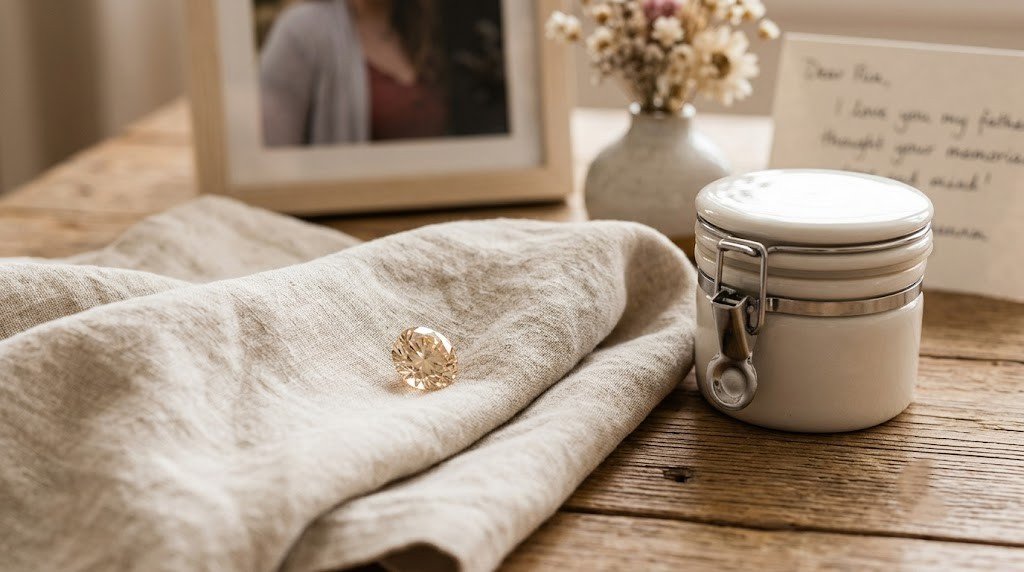
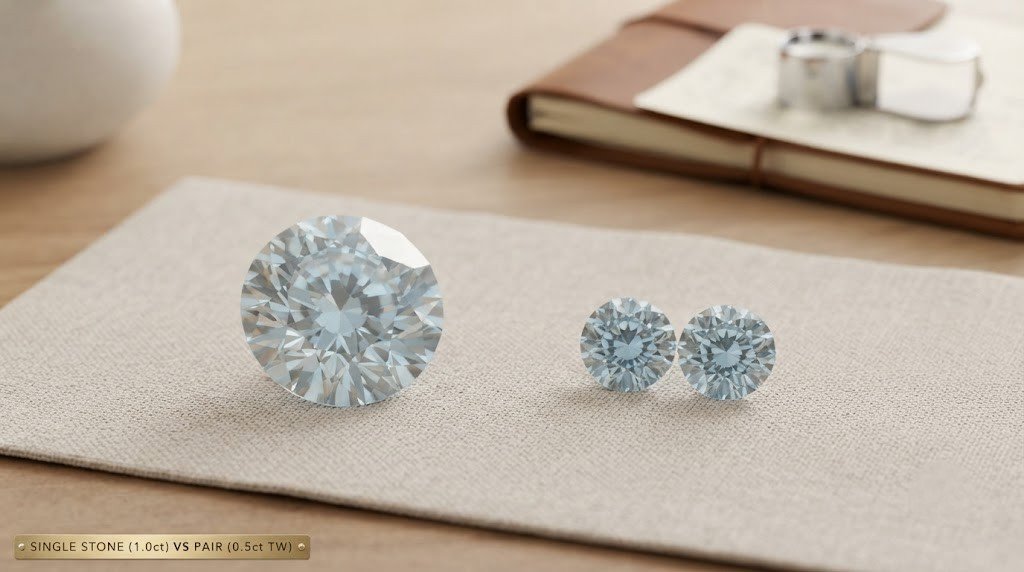
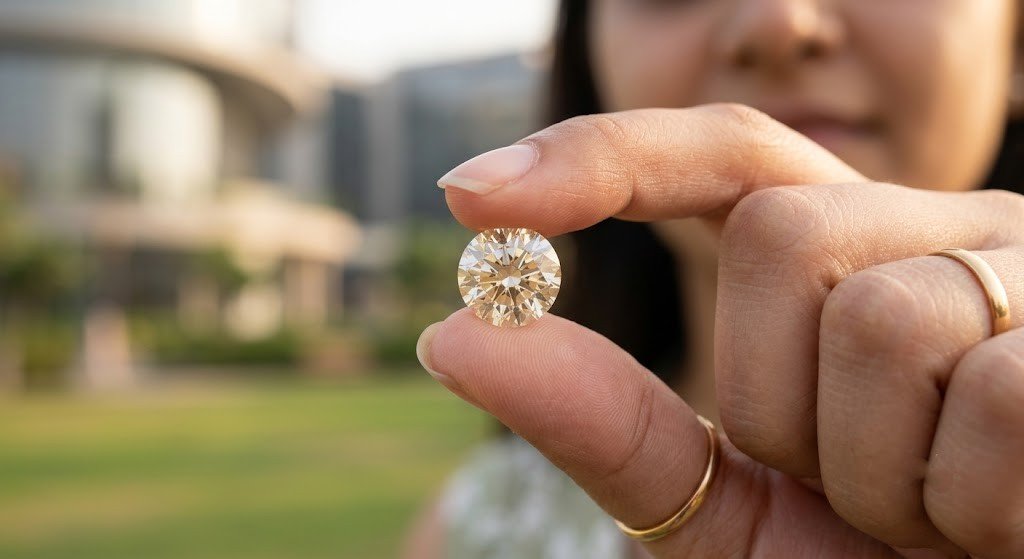
 A daughter memorial diamond in champagne tone resting on a folded linen cloth beside a small sealed keepsake container

What Is a Daughter Memorial Diamond, Exactly?

It is a diamond in every physical sense. A daughter memorial diamond shares its crystal structure, its hardness and its optical behavior with a stone mined from the earth; what sets it apart is where part of its carbon came from. It is grown in a laboratory by the same methods as other lab grown diamonds, and the memorial diamond category has a documented history of its own.

It is not glass, resin or a simulant with ash suspended inside. Those keepsakes exist too, and some families treasure them, but they are different objects. A daughter memorial diamond is a crystal a gemologist would examine with the same instruments used on any stone in a jeweler’s case.

Each row of this table has a fuller answer in its own section of this page.

QuestionThe Short Answer
What is it made from?Carbon recovered from her ashes or hair, typically blended with lab sourced carbon
How long does it take?Typically 6 to 10 months; up to about 12 for large or specialty color stones
What does it cost?Roughly $1,500 at the smallest sizes, rising past $75,000 for the largest
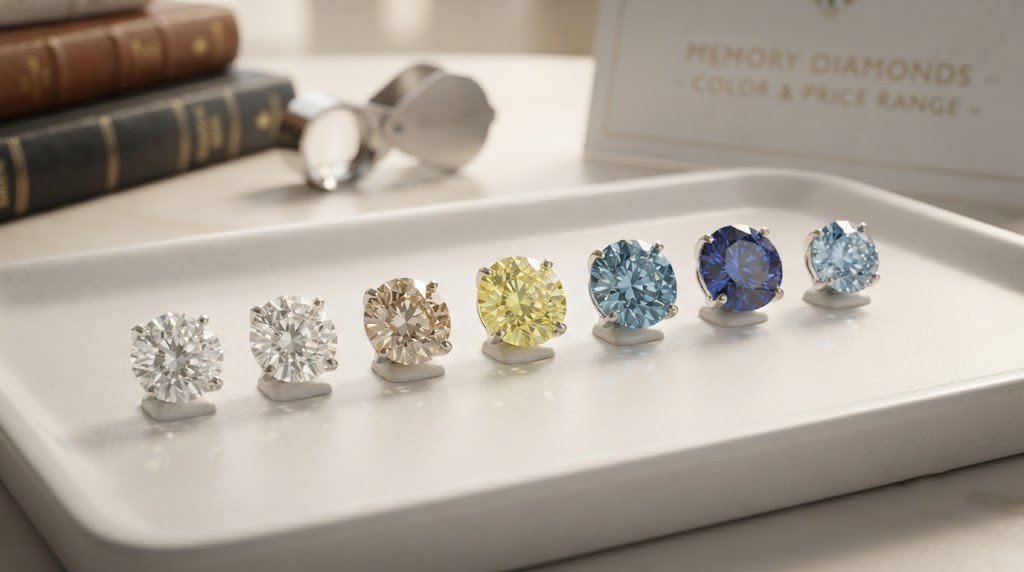
What color will it be?Usually yellow, blue or champagne; colorless costs more; the exact tone cannot be selected
How durable is it?10 on the Mohs hardness scale, the same as any diamond
Can there be more than one?Often, since only a portion of the material is used

If her ashes are your starting point, the complete guide to turning a daughter’s ashes into a diamond walks through that route in far more depth.

Is the Stone Really Made From Her?

Yes, in part, and the “in part” deserves a plain explanation rather than a soft one.

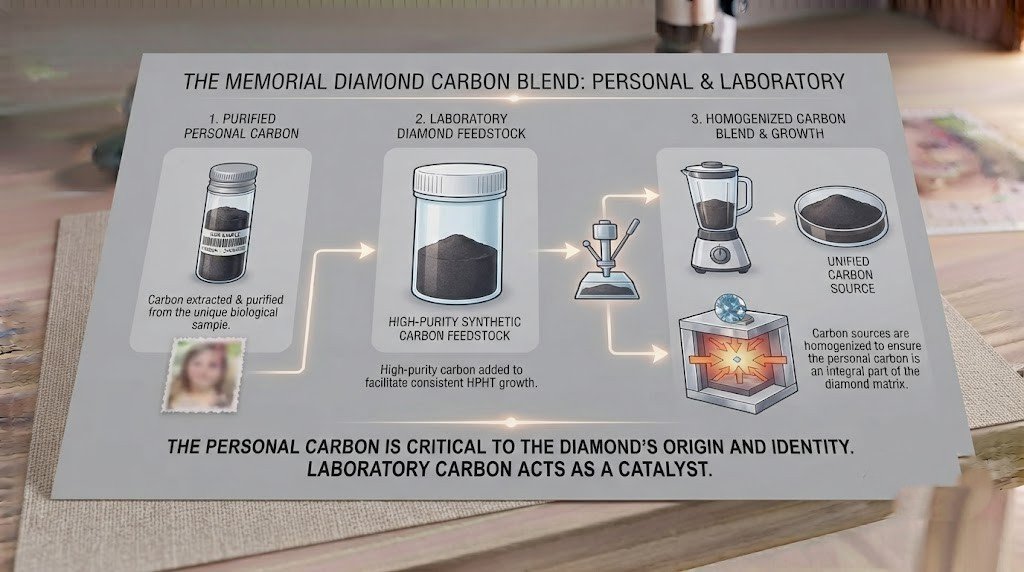
Cremated remains are mostly calcium phosphate, the mineral that gives bone its structure. Usable carbon is a small fraction, roughly 0.5% to 4% of the ash by weight. A laboratory extracts that carbon, purifies it, and typically blends it with lab sourced carbon so there is enough volume to grow a stone. On the ash route, the personal carbon in a daughter memorial diamond usually ends up around 10% to 15% of the finished diamond’s mass, and some providers cite figures as low as 3%.

Hair is a different material. It is about 50% carbon by weight, so far less is needed, and no cremation is involved at all. What does not exist is a published industry figure for how much of a finished stone grown from hair, or from a blend of ashes and hair, is personal carbon. If you are weighing either route, ask the provider for their figure in writing. How the hair route works for a daughter is explained on its own page.

So a daughter memorial diamond is not made entirely of her carbon, and any company implying otherwise has overstated the chemistry. What is true is quieter and still remarkable: a real, traceable portion of her own carbon sits inside the crystal lattice, permanently. For some parents, that is the whole point.

How Much of Her Ashes or Hair Is Needed?

A daughter memorial diamond needs less material than people tend to imagine. Requirements vary by provider, but as a general industry guide:

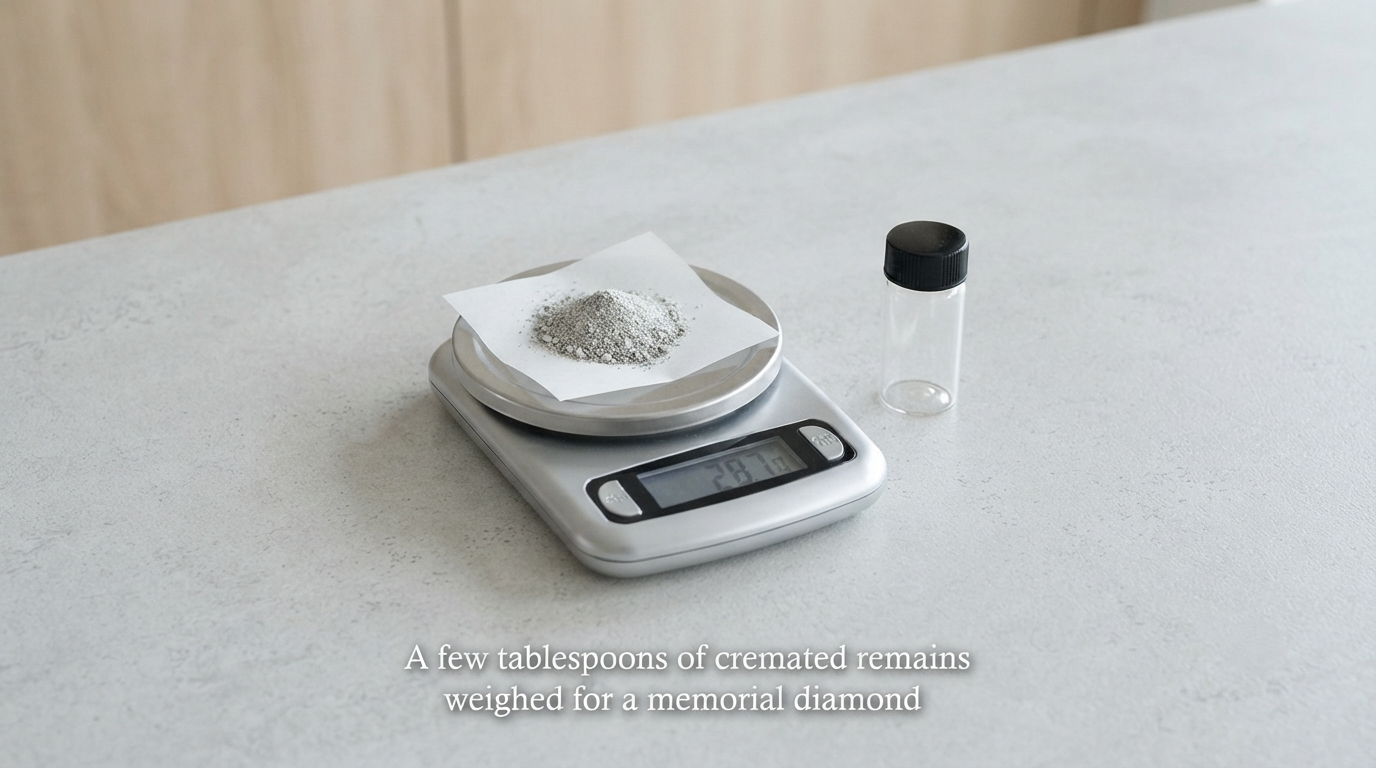
  • Ashes: anywhere from a few tablespoons up to roughly 4 ounces, about 100 grams, a small fraction of what a cremation returns
  • Hair: a small lock, often only a few grams, because hair carries so much more carbon than ash does
  • Ashes and hair together: smaller amounts of each, with the split decided by the provider

The rest of her ashes can stay exactly where you meant them to stay. An urn on a shelf, a scattering somewhere she loved, or a burial plot can all remain part of your plans. Choosing a daughter memorial diamond does not have to change any of those plans, because the laboratory only needs a portion.

Quantity does not set size, either. Sending more ash does not produce a bigger stone; carat weight depends on how long the crystal is grown, and that is something you choose when you order.

If the hair you have was kept at home, such as a lock saved after a haircut or strands gathered from her brush, ask the provider what condition and amount they accept. Her belongings may also form part of her estate, and the rules on who decides about them vary by state, so a word with whoever is handling her affairs is sensible before anything is mailed.

Who Has the Authority to Decide on a Daughter Memorial Diamond?

Before a daughter memorial diamond can be ordered, someone has to authorize releasing a portion of her ashes, and that question catches some parents off guard.

Authority over a person’s remains is set by state law, and it can be changed by anything she put in writing. A spouse or partner of hers, or her own adult children, may rank ahead of her parents in directing what happens to her ashes. In other situations the parents hold it, sometimes jointly. There is no single national rule, and the answer says nothing about who loved her most.

Families arrive at this in every possible shape. Parents may be separated and see things differently. One parent may be arranging everything alone while the other keeps a distance. Her partner may welcome the idea or want more time. Brothers, sisters and grandparents may feel strongly without holding any formal say.

Start by asking the funeral home or crematory who signed the original cremation authorization; that person may hold, or know who holds, the right to release a portion. Then ask the provider whose signature they require and what they do when relatives disagree. If things are tangled, a short consultation with an estate attorney in her state can help clarify it.

Raising a daughter memorial diamond with whoever holds that authority, before you contact a laboratory, tends to spare everyone a good deal of strain later.

How Is a Daughter Memorial Diamond Made?

In seven stages, though only one or two are visible from the outside:

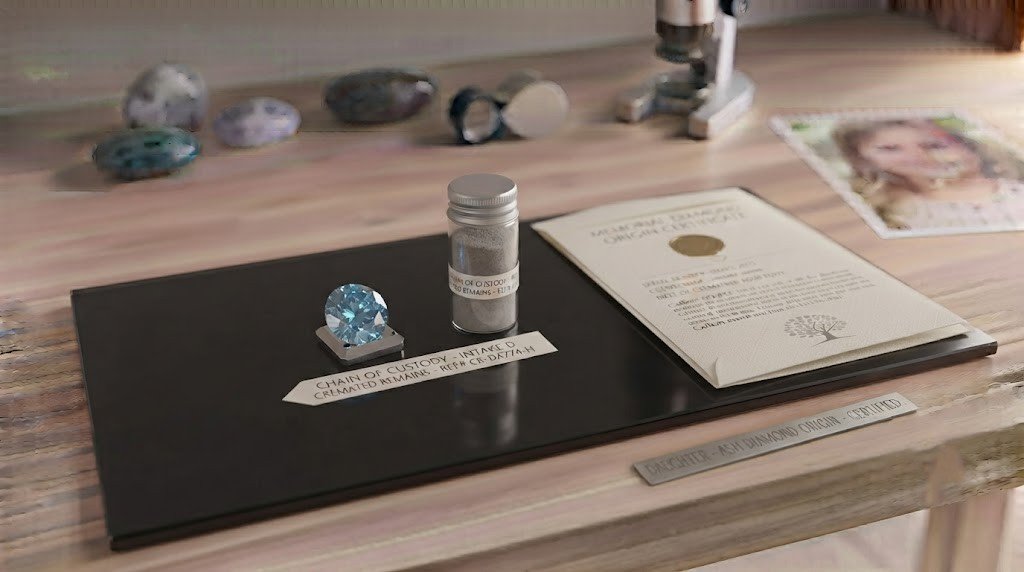
  1. Collection and custody. Her ashes or hair arrive and are logged under a tracking reference that follows them through every handover.
  2. Extraction and purification. The material is heated in an oxygen free, multi stage process that strips out everything except carbon, reaching roughly 99.9% purity or higher.
  3. Graphitization. The purified carbon is heated again, to around 2,500 to 2,700°C, and converted into graphite, the feedstock a growth press uses.
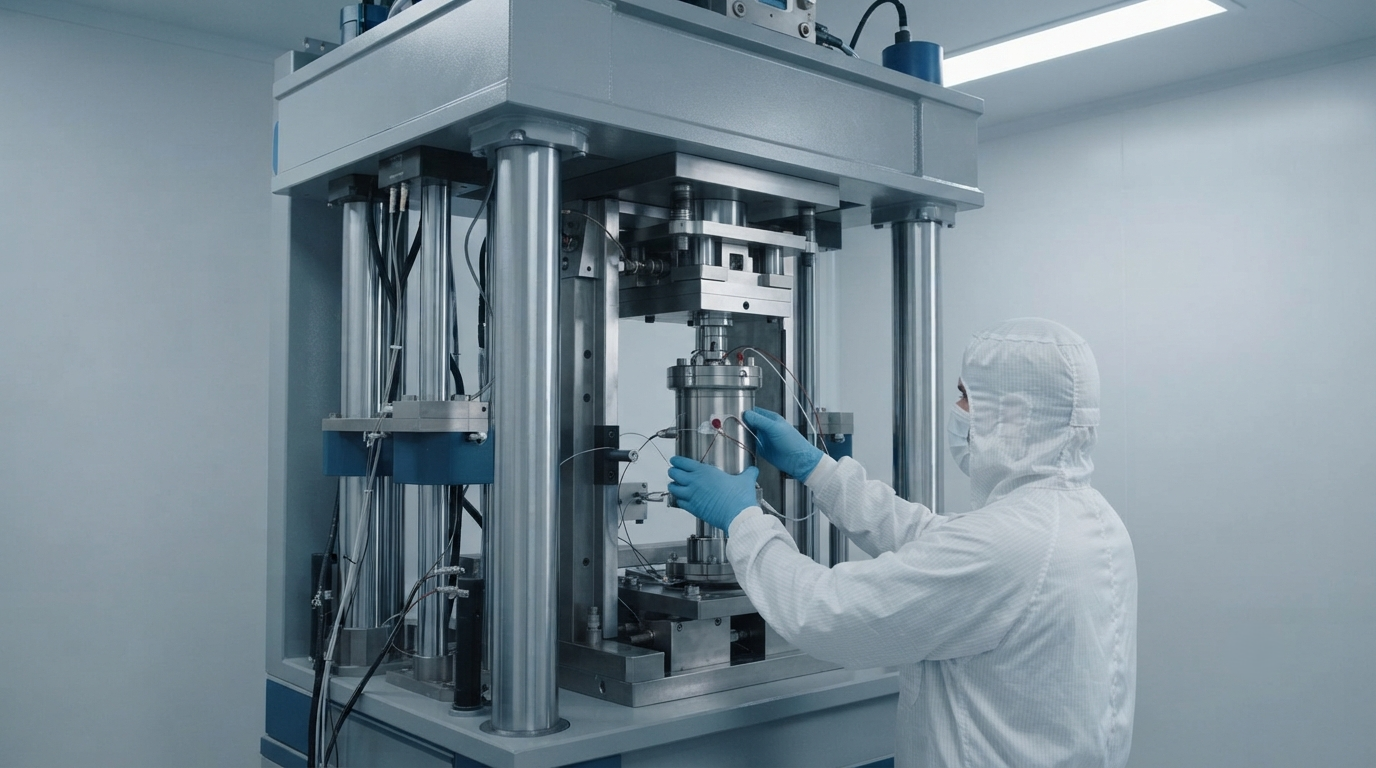
  4. Growth. In the HPHT method, which most memorial providers use, the graphite is typically blended with supplemental lab carbon and placed with a tiny diamond seed under roughly 6 to 8 GPa of pressure at 1,400 to 2,500°C. A minority of providers use CVD instead.
  5. Cutting and polishing. A cutter shapes the rough crystal into a round, cushion, oval or other shape.
  6. Optional irradiation. Some providers offer a post growth treatment that shifts color. It is a choice some families make, never a required stage.
  7. Grading. The finished stone may be graded; an independent report is usually optional and billed separately.

Growth takes the longest, measured in weeks to months. The first stage can feel the most fraught, because it is where the material leaves the family’s hands. The full chemistry of how her ashes become a diamond goes through each step in more detail.

Every daughter memorial diamond passes through the same physics, whichever company grows it. What differs between providers is care, tracking and candor about what happens at each stage.

How Long Does the Whole Process Take?

Across the industry, a daughter memorial diamond takes six to ten months from the day the laboratory receives her material to the day a finished stone is ready. Stones over about two carats, and specialty colors, can stretch toward twelve.

Those months are not spread evenly. Intake and paperwork take days or weeks. Purification and graphitization move fairly quickly. Growth is the long stretch, and it is long on purpose, because carat weight follows growth time rather than the amount of ash or hair sent. Cutting, any optional treatment, grading and setting each add their own time at the end.

If a particular date matters, such as her birthday, an anniversary or a family gathering, tell the provider at the very start. A reputable one will say honestly whether it is achievable and will not commit to a delivery date it cannot control. Ask what kind of updates arrive during the quiet months, too, and whom to call if several weeks pass without word.

What fills each month of the timeline is laid out for anyone planning around a date. A daughter memorial diamond is not a fast purchase, and for some families the waiting becomes part of remembering her rather than an obstacle to it.
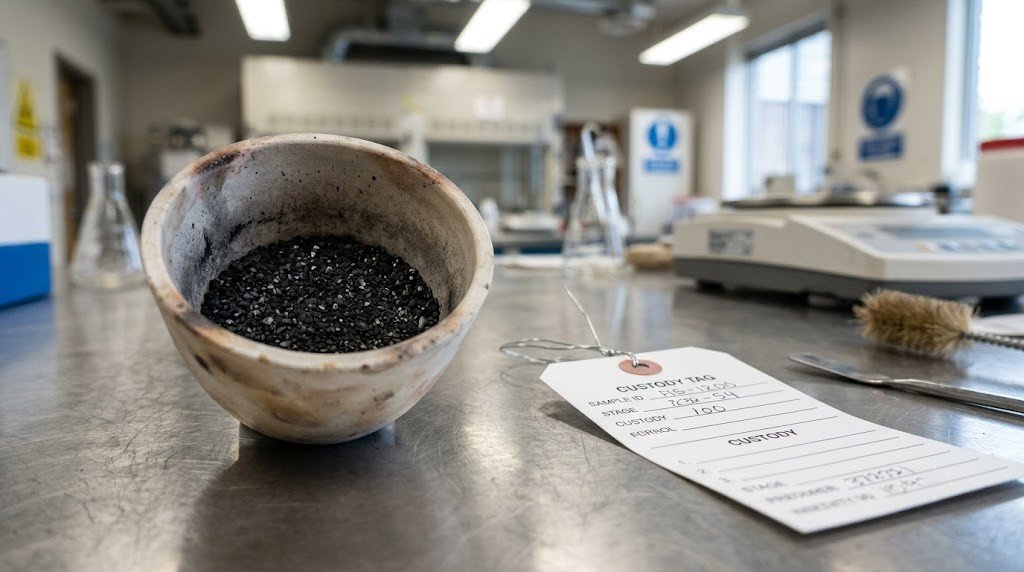
 Laboratory crucible of purified carbon beside a labeled custody tag on a steel bench

What Color Will a Daughter Memorial Diamond Be?

Color in any diamond comes from trace elements present while the crystal forms. Nitrogen tints a stone yellow. Boron tints it blue. A colorless result requires the near absence of both.

Because the carbon in a daughter memorial diamond comes partly from a person rather than from a controlled industrial feedstock, trace elements are normal. That is why these stones lean toward yellow, blue and champagne tones. Colorless is achievable, but it needs additional processing to keep those elements out and costs meaningfully more. Some providers also offer post growth irradiation for other colors, such as red, green or black.

What nobody can do is select the exact shade, match it to her eyes or a favorite color, or predict it from her ashes or hair. Hair does not yield a lighter or narrower range than ash, and no color is more fitting for a daughter than any other. What to expect from the color, in detail has its own page.

How Much Does a Daughter Memorial Diamond Cost?

Price depends mostly on carat weight and color, then on cut, grading and setting. These are general 2026 industry ranges, not any single company’s prices:

SizeTypical Industry RangeWhat Usually Moves the Price
0.10 to 0.25 ctAbout $1,500 to $3,500Color, cut style, whether grading is added
0.5 to 1 ctAbout $5,000 to $15,000Colorless costs meaningfully more than yellow, blue or champagne
2 to 5+ ctAbout $20,000 to $75,000+Longer growth time, specialty colors, independent grading

A quote often covers the loose stone only. Independent grading, engraving, fancy cuts and a setting are commonly priced separately, and insured return shipping sometimes is too.

Ask for the full figure in writing, plus the payment schedule and the refund terms if your family decides to stop partway. If more than one relative wants a stone, each daughter memorial diamond is priced on its own, so a family plan can add up quickly. What moves the number up or down is broken down tier by tier.

A small stone carries the same origin as a large one. Size changes the price, not what the diamond is.

Can Several Family Members Each Have a Stone?

Often, yes. Because each stone uses only a portion of her ashes or hair, one source can frequently supply more than one. Her parents, her brothers and sisters, her grandparents, her partner or her own children may each want something to hold.

A few things make it smoother:

  • Decide who wants a stone before anything is sent, so the provider can plan material for every order together.
  • Ask whether one shipment can supply several growth runs or whether each needs its own portion.
  • Agree whether the stones should match in size and cut or reflect each person’s own choices.
  • Remember that each daughter memorial diamond is priced as a separate order.

Stones grown from the same source may not match in color, since trace elements and growth conditions can differ from one run to the next. Some relatives find that meaningful; either way, say it aloud before orders are placed. How families share one source between several stones covers the practical detail.

What Kinds of Jewelry Can It Become?

A daughter memorial diamond can become anything a mined or lab grown diamond can: a ring, pendant, earrings, a bracelet, cufflinks, a tie bar, a brooch, or a loose stone kept in a small case and brought out on particular days. Some parents want something to wear every day; others want an object to keep rather than wear.

Choose for the person who will wear it and the life they lead, not for any idea of what suits a daughter’s memory. A parent who gardens or works with their hands may want a low profile bezel setting that guards the stone’s edge; someone who wears jewelry only on occasions may prefer something more open. Diamond rates 10 on the Mohs hardness scale, the top of it, yet a sharp knock at the wrong angle can still chip an edge, so the setting matters.

Some families have a daughter memorial diamond appraised once it is set and add it to a home insurance policy or a separate jewelry rider. An insurance agent can explain what that involves for you.

What Paperwork Should Come Back With a Daughter Memorial Diamond?

Two documents tend to arrive with a daughter memorial diamond, and they are easily confused because they do different jobs.

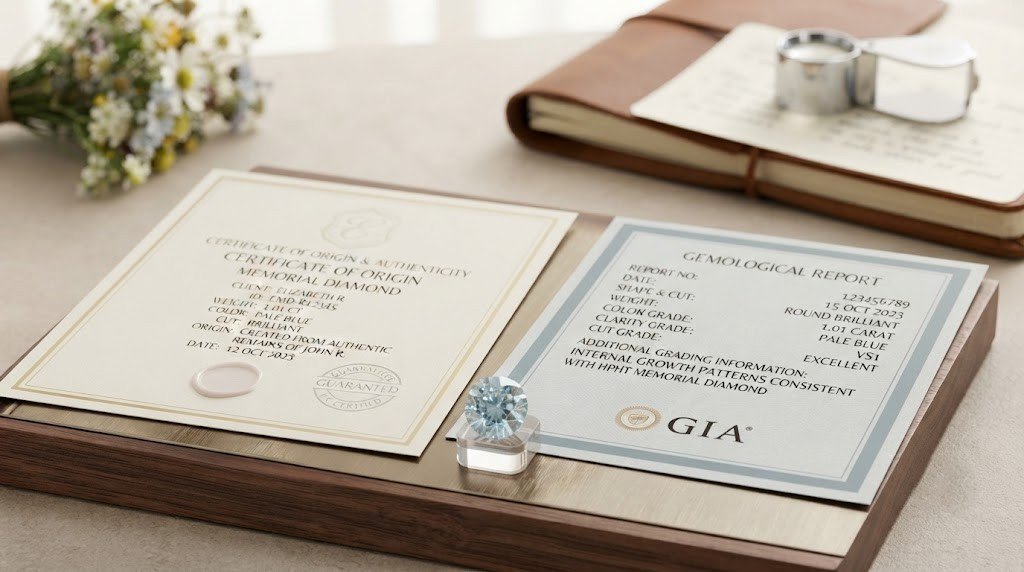
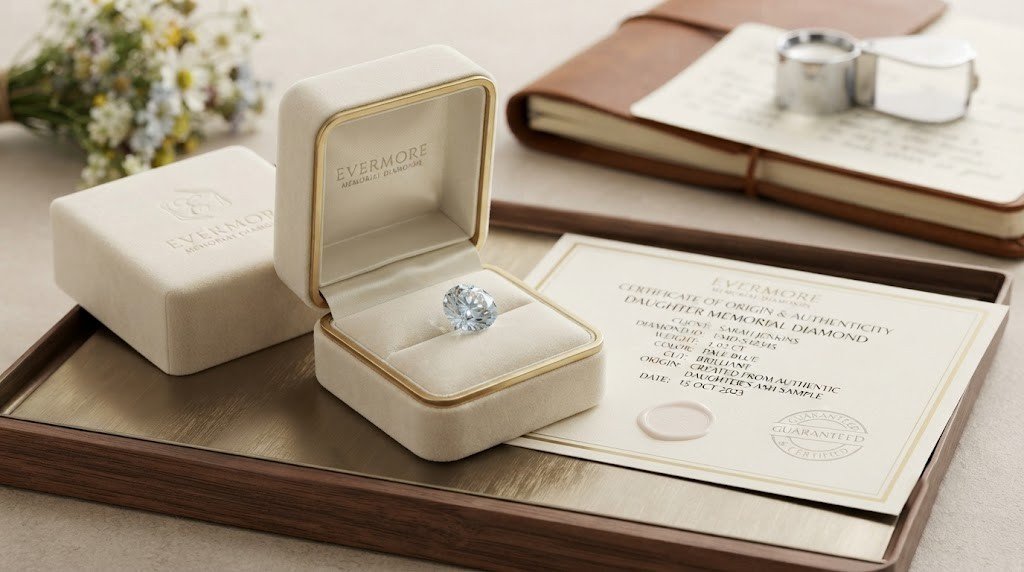
An authenticity or origin certificate is usually issued in house by the provider. It records provenance: that this stone was grown from the material your family sent. Think of it as the final page of the custody record.

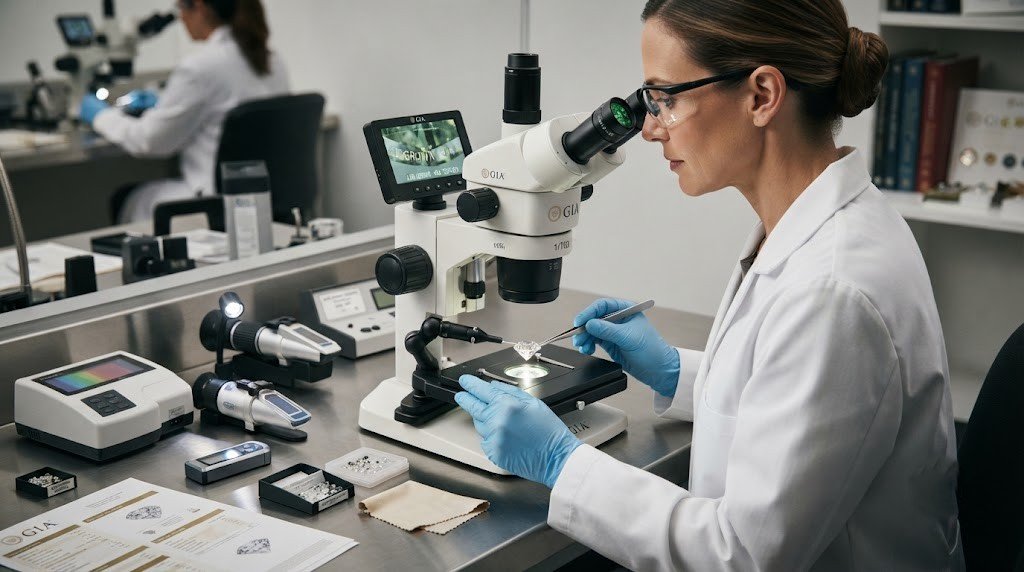
A grading report describes the stone itself, using the cut, color, clarity and carat standards gemologists apply to every diamond. When it comes from an independent gemological laboratory, it is a third party assessment rather than the provider’s own description. Across this industry an independent report is usually optional and costs extra, and it says nothing about origin. Typical clarity for memorial stones lands between SI2 and VVS.

Alongside those, ask for an itemized invoice, any custody log the provider keeps, written disclosure if the color was treated, and an appraisal if you plan to insure it. A daughter memorial diamond with a clear paper trail is far simpler to insure, resize, reset or pass on later.
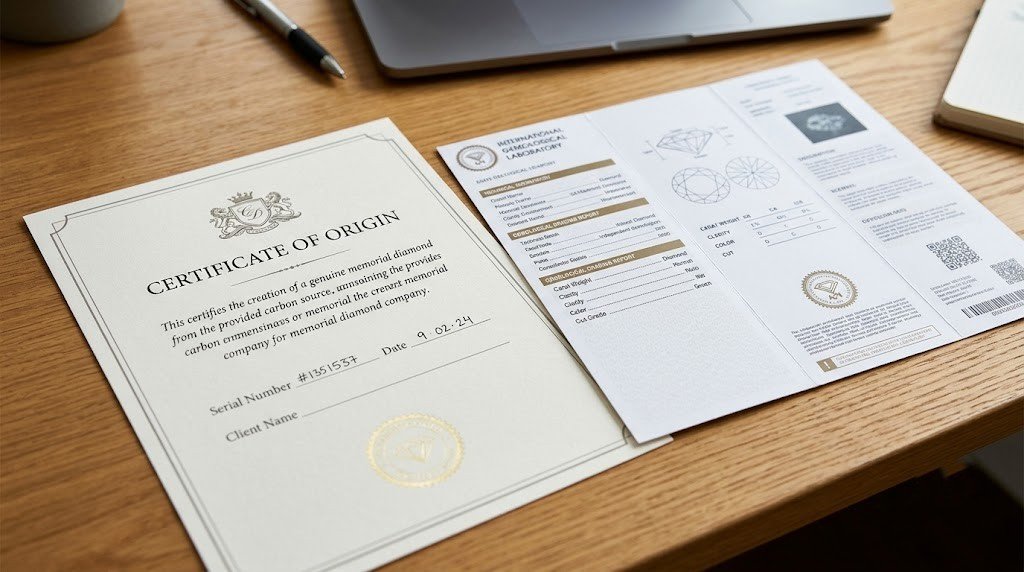
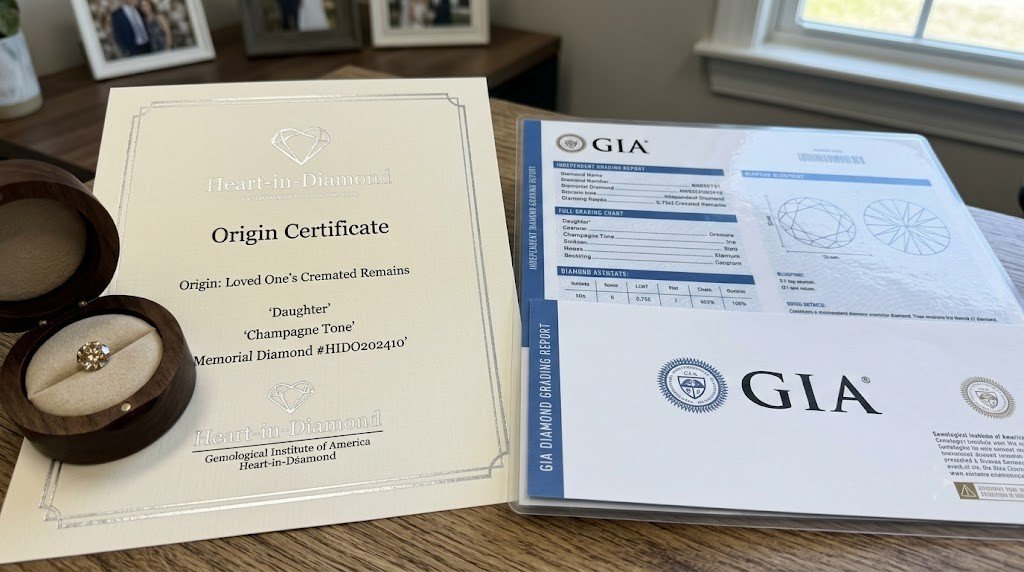
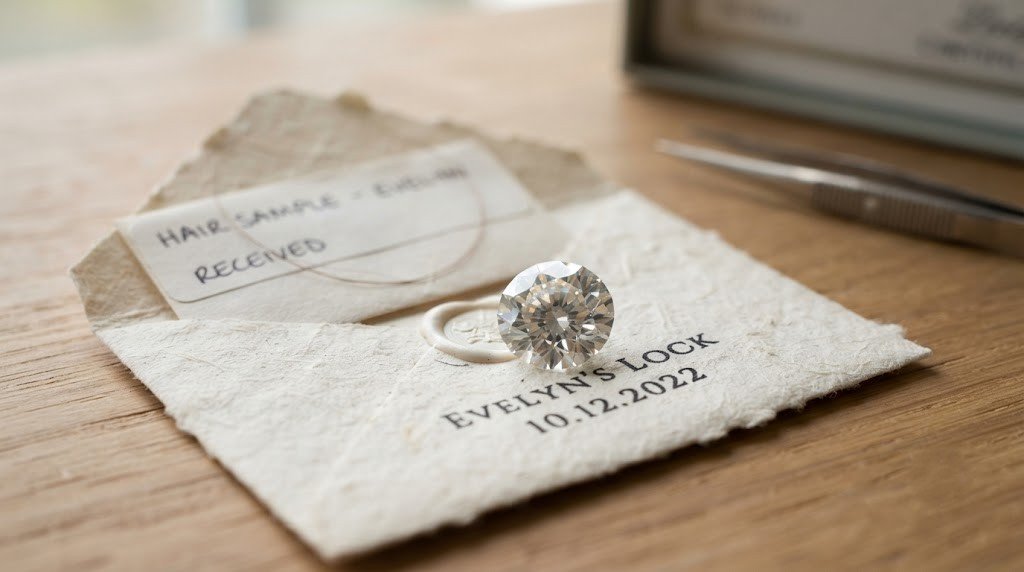
An in-house origin certificate placed next to an independent gemological grading report on a desk

How Do You Choose a Provider You Can Trust?

By how specifically they answer, not by how warmly. What separates one company from another is whether a direct question gets a number, a written term or only a reassurance.

Before committing to a daughter memorial diamond, send the same short list to two or three providers by email and compare the replies:

  1. What percentage of the finished stone will be her carbon, and what is the supplemental carbon?
  2. How is her material tracked, and is it ever processed alongside another family’s?
  3. Which documents come back, who issues them, and is independent grading included?
  4. What is the full price, including grading, cutting, setting and shipping?
  5. What happens if a growth run fails or the stone fractures while being cut?
  6. Whose authorization do you need, and how do you handle relatives who disagree?

A daughter memorial diamond is a long commitment made at a hard time, and taking a few weeks over this choice is entirely reasonable. Where to begin when choosing a memorial diamond for your daughter sets out the first decisions in order.

Frequently Asked Questions

Can a Daughter Memorial Diamond Be Made Years After She Was Cremated?

Yes. Cremated remains are largely mineral and change little in storage, so ashes kept in an urn for years can still be used, and the same generally holds for hair stored dry. Ask the provider about their own requirements, but time since her passing is seldom the obstacle.

What If She Was Buried and We Have No Ashes?

Hair can still make a daughter memorial diamond possible in that case. A lock kept from a haircut, or hair saved from a brush or keepsake, may be enough. Check the provider’s requirements, and remember her belongings may form part of her estate, with rules that vary by state.

Do We Need to Send All of Her Ashes?

No. Laboratories typically ask for somewhere between a few tablespoons and about four ounces, a small fraction of the whole. The remaining ashes can stay in an urn, be scattered or be buried exactly as your family planned.

Can We Order One Stone Now and Another Later?

Sometimes. It depends on whether material remains and on the provider’s policy for storing or returning unused portions. If a second stone is even a possibility, say so before the first order, so a portion can be set aside.

Can Her Name Be Inscribed on the Diamond Itself?

Some providers offer laser inscription on the girdle, the thin outer edge of the stone, usually as an extra. Ask how many characters fit, whether a date can be added, and whether the inscription is recorded on the paperwork as well.

Is a Memorial Diamond as Durable as Other Diamonds?

Yes. It rates 10 on the Mohs hardness scale, like any diamond, and resists scratching from everyday wear. It can still chip if struck hard at an edge, so a protective setting is worth considering for something worn daily.

Does Choosing a Diamond Mean Giving Up an Urn or a Burial?

Not at all. Because only a portion is needed, a daughter memorial diamond can sit alongside an urn, a scattering or a burial. Combining them is a perfectly valid choice, and none of those options cancels the others.

Final Thoughts on a Daughter Memorial Diamond

Nobody reads a page like this for pleasure. You came with questions you probably never expected to ask, and some of the answers are more technical than anything about her deserves to be.

The facts about a daughter memorial diamond still matter, because they are what let you trust the people you hand her ashes or hair to. A real portion of her carbon, an honest percentage, a clear record of custody, a believable schedule and a price you understand: those are the foundations. Everything else, the shape, the setting, who wears it and when, is yours to decide slowly, and to change your mind about.

There is no deadline on any of it, and no obligation to do it at all.

Learn More About Daughter Memorial Diamonds

Talk With Memorial Diamond

If you would rather talk a daughter memorial diamond through with a person, that is a perfectly good place to start. Memorial Diamond can be reached at memorialdiamond.us to talk through what is possible with her ashes or hair, at whatever pace suits your family. Reaching out carries no obligation of any kind.
Daughter Ashes Hair Diamond Questions: 9 Calm, Expert Checks

Questions to Ask Before Turning Your Daughter’s Ashes and Hair Into a Diamond

Choosing to use both her ashes and a lock of her hair can feel like keeping more of your daughter together in one place, and that instinct deserves careful handling. The daughter ashes hair diamond questions that matter most cover who must consent for each material, how ash and hair are labeled and tracked apart, when they are combined, what the paperwork records, and what a provider will commit to in writing, because no finished stone percentage is published for a blend.

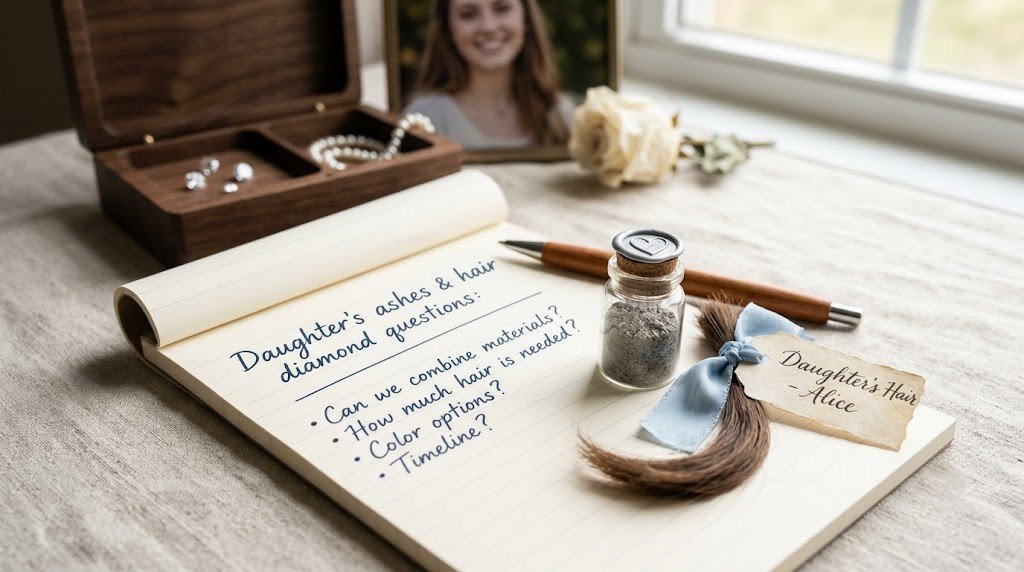
Daughter ashes hair diamond questions on a notepad beside a small sealed ash container and a labeled lock of hair

Why Does a Blended Stone Need Its Own Daughter Ashes Hair Diamond Questions?

Because two materials mean two of almost everything: two consent paths, two custody records that must meet at exactly one point, two purification routes, and one finished stone whose paperwork has to account for all of it.

Ash is mostly calcium phosphate, the mineral structure of bone, with only about 0.5% to 4% usable carbon by weight. Hair is roughly 50% carbon, because it is built largely from keratin. Families choose to combine them for many reasons: the ashes are what remains of her, while the hair may be a lock a parent, partner or sibling kept for years. Memorial diamonds as a category have grown up around both materials, but blending them is a specific request, and not every provider handles it the same way.

That is why the daughter ashes hair diamond questions below go beyond what you would ask for either material alone. Each targets the place where two inputs become one stone, because that is where records can become unclear.

What Are the 9 Daughter Ashes Hair Diamond Questions to Send?

Nine questions cover the ground that matters: authority, quantity, shipping, custody, content, color, documents, price and terms. Send them as one numbered email to every provider you are considering.

#QuestionWhat a Full Answer Protects
1Whose consent do you need for her ashes, and whose for her hair?Both materials, if different relatives hold them
2How much of each do you need, and should they arrive together or separately?The ash and hair your family keeps at home
3Does each material get its own identifier, linked to one order?Traceability before the two are combined
4Are ash and hair purified separately, and at what stage are they combined?A clear record of the moment they meet
5In what proportion will ash carbon and hair carbon be combined, and will you record it?Knowing what was actually blended
6What will you state in writing about how much of the finished stone is her carbon?Honesty where no published figure exists
7What happens if one material proves unsuitable or yields too little?Your right to decide the next step
8Does blending change the price, timeline or any color or size expectation?A quote with no surprises
9What will the documents say about both sources, and what comes back unused?The stone’s permanent record, and her remaining ash and hair

If a reply treats your daughter ashes hair diamond questions as one generic order, ask again, specifically about questions 3 to 6. Those four are what make a blend different.

Possibly two different people, a point that is easy to miss in a blended order. Authority over her ashes follows state law and any written wishes she left. Depending on the state, a spouse, partner or adult child of hers may come ahead of her parents in that order. Her hair is a separate matter. It may sit with a different relative entirely, and personal belongings can form part of her estate, under rules that also vary by state. Hair kept at home is not automatically free of anyone else’s say.

So the opening daughter ashes hair diamond questions should ask whose signature the provider needs for each material, and whether one signature can cover both. Then check that against your own family. A parent arranging this alone, separated parents who each hold something of hers, or a partner who saved a lock can all be easier to resolve before shipping than afterward.

Include daughter ashes hair diamond questions about disagreement too: what does the provider do if one relative objects after the materials arrive? If authority is unclear, a local attorney can explain how your state treats remains and belongings.

How Much of Each Material, and Should They Travel Together?

Across the industry, ash requests typically range from a few tablespoons up to roughly 4 ounces, about 100 grams, while hair requests are usually a small lock or a few grams. Those are general figures, not any provider’s fixed rule. How much ash and hair a blend usually needs varies by company, so ask each one for its own numbers.

Then ask how the two should travel. Some providers may want ash and hair in one insured parcel, each sealed in its own labeled inner container; others may prefer separate shipments. Either works if the instructions are precise; improvising does not. Asking separate daughter ashes hair diamond questions for each material keeps that clear.

Daughter ashes hair diamond questions about transit belong in writing too: what container for each material, how each should be labeled, who insures the parcel and for what value, and whether you will receive a dated confirmation that both arrived intact. Photograph both sealed containers before you close the box.

Which Daughter Ashes Hair Diamond Questions Test Two Chains of Custody?

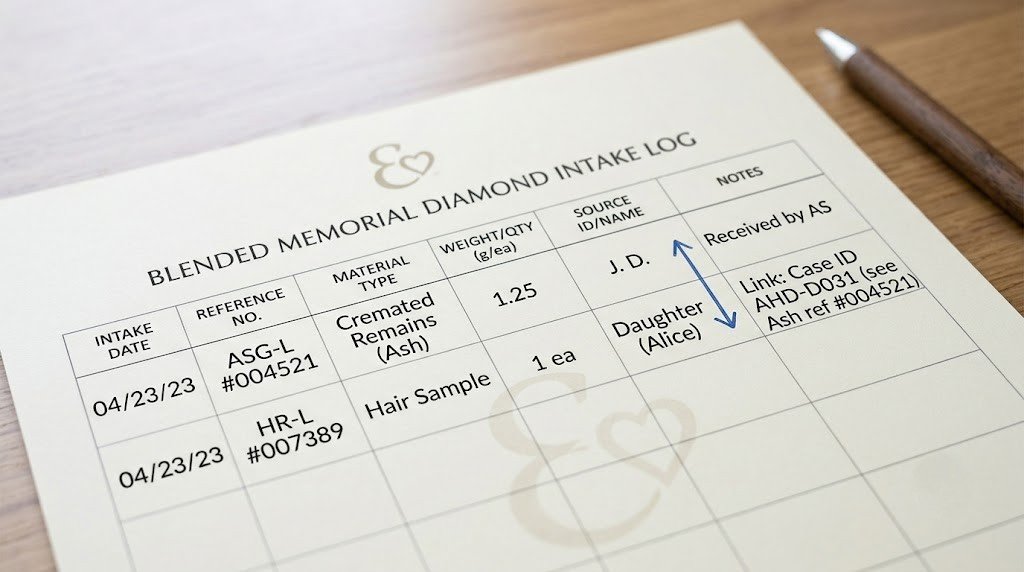
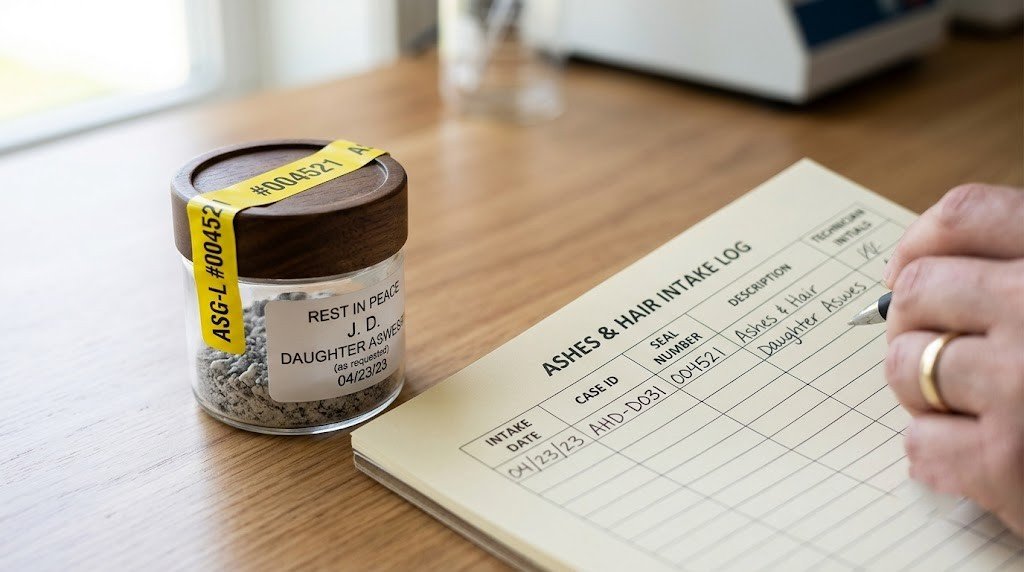
An intake log sheet with two linked reference numbers, one for ash and one for hair

With a single material, custody is a line. With two, it is a pair of lines that must join cleanly. Ask the provider to describe its record for each of these points:

  • Arrival: separate identifiers for the ash and the hair, both linked to one order number
  • Extraction: whether each material is processed on its own, never in a batch with other families’ material
  • Purification: a log entry for each material as it reaches purified carbon
  • Combination: a dated record of when ash carbon and hair carbon were combined, by whom, and in what proportion
  • Growth and cutting: one growth cell for her carbon, with the order number carried through to the finished stone

The combination entry is easy to overlook, yet it is the one that matters most in a blend. Without it, nothing on paper shows that both materials reached the press.

These daughter ashes hair diamond questions are reasonable for any provider that offers blending. A company that does this regularly should be able to describe its logging in a short paragraph.

When and How Are Ash and Hair Combined?

Ash and hair start in very different chemical states, so the early stages usually differ even when the end point is the same. Across the industry, the general sequence looks like this:

  1. Separate intake of ash and hair, each logged on arrival.
  2. Separate extraction and purification, each material heated without oxygen until what remains is about 99.9% carbon or purer.
  3. Combination of the two purified carbons, at a stage each provider should name.
  4. Graphitization at around 2,500 to 2,700°C.
  5. Growth, in most cases by HPHT, with pressure of roughly 6 to 8 GPa and temperatures of roughly 1,400 to 2,500°C, and less often by CVD, with supplemental laboratory carbon typically blended in.
  6. Cutting, polishing and optional irradiation, which some providers offer and none require.
  7. Grading, with an independent report usually optional and extra.

Whether combination happens before or after graphitization varies, so add it to your daughter ashes hair diamond questions. How a stone is made from her ashes and hair explains these stages at greater length.

How Much of a Blended Stone Is Really Her Carbon?

This is the hardest of the daughter ashes hair diamond questions to get a straight answer to, partly because the honest answer is that no standard figure exists.

Recovered carbon is commonly put at roughly 10% to 15% of a finished stone’s mass when the source is ash alone, with some providers citing as little as 3%. That is an ash figure only. No finished stone percentage is published for hair, and none is published for a blend of ash and hair. Hair’s higher carbon content may give a provider more of her carbon to work with, yet supplemental laboratory carbon is still typically blended in.

So split this into two daughter ashes hair diamond questions. In what proportion will ash carbon and hair carbon be combined? And what will the provider state in writing about how much of the finished diamond is her carbon, and how is that worked out? Whether a blended stone is really made from her ashes and hair is a fair thing to ask any seller.

Be cautious of any reply calling the stone pure. The accurate account, that real carbon from both her ashes and her hair is part of the crystal, is meaningful as it stands.

What If One Material Falls Short?

A blend depends on two inputs, so it has two ways to stall: the hair may prove unsuitable, or the ash may yield less usable carbon than expected. The time to agree on what happens next is before anything ships, through daughter ashes hair diamond questions written for exactly that case.

Ask the provider to set out your options in writing. Can the order continue with one material only, and will the paperwork then say so plainly? Can you send more of either? Is there a refund or a price change if the blend is abandoned? Who makes that call, and will you be asked before any change is made?

Daughter ashes hair diamond questions about shortfall protect something specific: your family’s original intention. If the point of the stone was to carry both her ashes and her hair, you should never discover afterward that it quietly became one or the other.

Which Daughter Ashes Hair Diamond Questions Cover Color and Size?

Color is set during growth by trace elements. Nitrogen tends toward yellow, boron toward blue, and a colorless stone needs both to be absent, which calls for additional processing and usually a higher price. In practice, memorial stones lean toward yellow, blue and champagne. Combining ash with hair does not make the shade any more predictable: no provider can choose, match or forecast a color from either material, or from both together. What color a blended stone may be covers the reasons in more detail.

Ask which ranges are likely, what a colorless stone adds to the price, and whether post growth irradiation for red, green or black is offered and noted on the documents.

Size is a separate decision. Carat weights on offer generally run from around 0.10 to 5 or more, set by how long the crystal is allowed to grow rather than by the amount of ash or hair supplied. Clarity typically falls between SI2 and VVS. Add these daughter ashes hair diamond questions to the same email so the replies can be read together.

Which Daughter Ashes Hair Diamond Questions Cover the Documents?

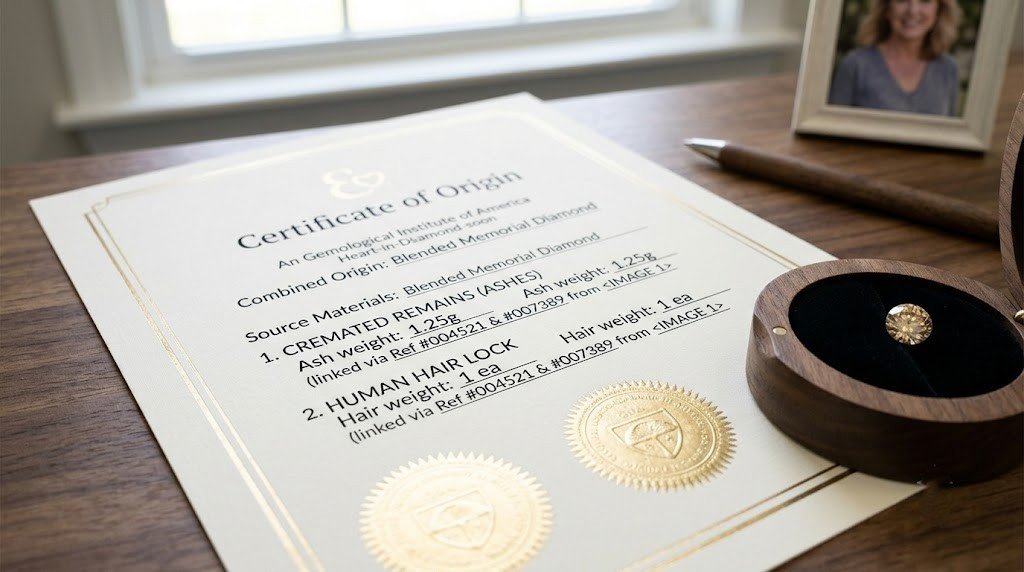
An origin certificate listing both ashes and hair as source materials beside a loose champagne-toned diamond

Two kinds of document matter. An origin or authenticity certificate, usually issued in house, records where the carbon came from. A grading report, ideally from an independent gemological laboratory, describes cut, color, clarity and carat weight; it is generally optional and billed separately, and it says nothing about origin.

For a blend, the origin certificate carries more weight than usual. Ask whether it names both ashes and hair as sources, whether it records the proportion in which they were combined, and whether it references the identifiers issued at intake. Ask for a specimen with another family’s details removed, and whether you approve the wording before her name is printed.

Keep the certificate together with the provider’s replies to your daughter ashes hair diamond questions. A sibling or grandparent may one day want to know exactly what the stone contains, and that combined record is the only full answer.

Which Daughter Ashes Hair Diamond Questions Cover Price and Timing?

General 2026 industry ranges, not any single company’s prices, run roughly $1,500 to $3,500 for about 0.10 to 0.25 carats, $5,000 to $15,000 for 0.5 to 1 carat with colorless costing more, and $20,000 to $75,000 or more for stones from 2 carats upward. Grading, engraving, fancy cuts and settings are usually extra. What moves a daughter memorial diamond’s price is worth reading before quotes arrive.

Among your daughter ashes hair diamond questions, ask whether processing two materials adds a fee, since providers differ, and request an itemized total showing what is refundable at each stage.

On timing, six to ten months from receipt of material is typical industry wide, stretching to about twelve months for stones over two carats or specialty colors. Ask whether separate purification of ash and hair adds time, what date the estimate counts from, and how often you will hear from the provider during the long middle stretch.

What If Several Relatives Want a Stone Too?

Several relatives, perhaps her siblings, grandparents, partner or adult children, may each hope for a stone of their own, and some may want ash only, hair only, or both. Because each stone uses only a portion of the material, several can often be grown from what a family holds. Dividing her ashes and hair among several diamonds brings its own planning decisions.

For blended orders specifically, ask how the provider divides limited hair across several stones, whether each stone’s documents state its own sources, and whose consent each additional order needs. A small lock may stretch only so far, so these daughter ashes hair diamond questions are best asked before anyone’s expectations are set.

What Happens to Unused Ash and Hair?

Both materials may come back in different amounts, or not at all. Ask what the provider does with surplus ash and with surplus hair, separately, because policies can differ between the two. Some return unused material, some retain it, and some dispose of it respectfully.

If you want either returned, say so in writing before shipping, and include daughter ashes hair diamond questions about how each will be packed and insured on the way home. The full order of steps for a blended stone shows where those decisions usually fall.

How Should You Read the Replies?

Lay the replies side by side. A complete answer to your daughter ashes hair diamond questions will usually:

  • name separate identifiers for ash and hair, and the point at which they merge
  • state a combining proportion, or explain plainly why it cannot
  • decline to publish a finished stone percentage for a blend while saying what it will put in writing instead
  • describe what happens if one material falls short, in contract language
  • show a sample certificate that lists both sources

A reply missing several of these is incomplete rather than necessarily careless. Ask again, by number.

Frequently Asked Questions

Can Ashes and Hair Really Be Combined in One Diamond?

Yes, some providers offer it. Those that do typically purify each material first and combine the carbon later, at a stage that varies. Use your daughter ashes hair diamond questions to confirm whether a company blends, at which stage, and how that moment is recorded.

What Percentage of a Blended Stone Is Her Carbon?

No published finished stone percentage exists for a blend of ash and hair. The commonly quoted 10% to 15% figure applies to ashes alone. Ask each provider what it will state in writing for her stone and how it calculates that figure.

Does Adding Hair Make the Color More Predictable?

No. Trace elements present during growth, mainly nitrogen and boron, decide the shade, so it cannot be chosen, matched or forecast from ash, hair or the two combined. Yellow, blue and champagne tones are the usual results either way.

Sometimes. Authority over her ashes follows state law and her written wishes, while hair may be part of her estate or held by another relative. Ask the provider what it requires, and include that among your daughter ashes hair diamond questions.

Should Ash and Hair Be Shipped in the Same Parcel?

Follow the provider’s instructions exactly. Some may accept both together in separately sealed, labeled inner containers; others may want separate shipments. Either way, ask for insurance details and a dated confirmation that each material arrived.

What If Her Hair Turns Out to Be Unsuitable?

Agree on the answer before shipping. Ask whether the order can continue with ash alone, whether the paperwork would then say so, and whether the price changes. You should be asked before any change, never told afterward.

Is a Blended Stone More Expensive Than an Ash Only One?

It depends on the provider. Some may charge for processing two materials, others may not. Daughter ashes hair diamond questions about price should request an itemized quote showing any blending fee separately from the stone, grading and setting.

Final Thoughts on Asking Before You Blend Her Ashes and Hair

A blended stone asks a provider to keep two promises at once, and to prove later that it kept both. The daughter ashes hair diamond questions on this page are about making that proof possible: separate tracking, a recorded moment of combination, honest wording about how much is her, and documents that name both sources.

If you can only ask a few, ask who must consent for each material, how the combination is logged, what will be stated in writing about her share of the stone, and what happens if one material falls short. Once those answers are clear, you can let the rest go. The complete guide to daughter ashes and hair diamonds remains there for the wider picture.

Learn More About Blending Her Ashes and Hair

Talk With Memorial Diamond

A blended order raises more daughter ashes hair diamond questions than most, and talking them through can help. Memorial Diamond is at memorialdiamond.us when you want to ask about consent, tracking or paperwork for both materials, with no expectation that you decide anything yet.

Daughter Ashes Diamond Questions 11 Asked With Expert Care

Questions to Ask Before Turning Your Daughter’s Ashes Into a Diamond

Deciding to send part of your daughter’s ashes to a laboratory can feel like signing a document you have not been allowed to read yet. The daughter ashes diamond questions worth settling first cover who has authority to release her remains, how much is needed, how that portion is tracked, what share of the finished stone is genuinely her carbon, which documents come back, and what happens if something fails. Ask each one in writing, before anything is packed.

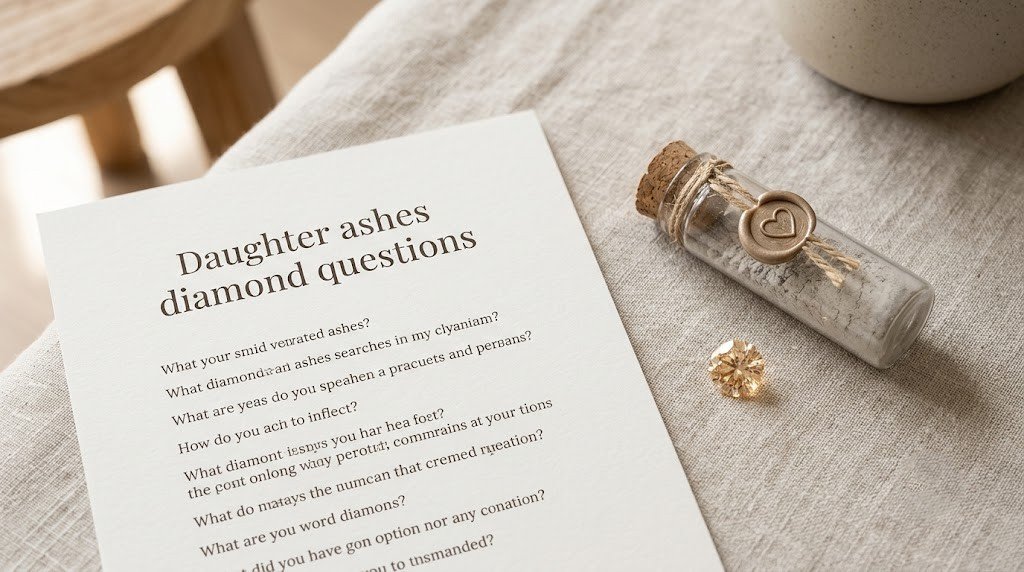
| Daughter ashes diamond questions printed on a sheet beside a small sealed ash container and a loose champagne-toned stone

Why Ask Daughter Ashes Diamond Questions Before Choosing a Provider?

Because the order matters. Once her ashes sit in a laboratory’s intake room, every answer you receive describes something that has already happened. Before you mail anything, every answer is still a choice.

A memorial diamond provider is part jeweler, part laboratory and part custodian, and you cannot watch a laboratory or a custodian at work. The only evidence available is what a company will commit to in writing, which is why the daughter ashes diamond questions on this page are phrased so each can be answered with a fact, a number or a document.

Practices differ between providers, and no website shows you which operations are careful. Putting identical daughter ashes diamond questions to two or three companies, then reading the replies side by side, is the fairest test. None of it needs to happen quickly; her ashes are safe where they are now.

What Are the 11 Daughter Ashes Diamond Questions to Put in Writing?

Eleven questions cover the ground that matters: authority, quantity, shipping, custody, content, color, documents, price and terms. Paste them into one email so every provider answers the same list in the same order.

#Question to SendWhat a Complete Answer Includes
1Whose written authorization do you need before accepting her ashes?Named signatories and the form required
2How much of her ashes do you need, and what happens to any you do not use?A quantity range; return or disposal of the rest
3How should her ashes be shipped, and who insures them in transit?Carrier, packing kit, declared value
4What identifier is assigned to her portion, and will you confirm receipt?A reference number and a dated confirmation
5Is her material ever processed alongside another family’s?A plain yes or no
6Roughly what share of the finished stone’s mass will be her carbon?A percentage stated as specific to ashes
7What supplemental carbon is added, and from where?The source of the laboratory carbon
8Which colors are plausible, and do you offer or disclose irradiation?Likely ranges and how treatment is recorded
9Which document proves origin, and is independent grading extra?Who issues each document, plus a sample
10What is the full price, and what is billed separately?Every line item and the payment schedule
11What do your terms say about delays, failed growth, damage and cancellation?The clause itself, in plain language

If a provider answers only some of these daughter ashes diamond questions, the gaps tell you something too. Reply asking for the rest.

 A numbered tamper-evident seal on a small ash container next to an intake log sheet

Who Has Authority to Release Your Daughter’s Ashes?

Start here, because a provider cannot proceed without it, and families are sometimes surprised by the answer.

The right to decide what happens to a person’s remains is set by state law, and what she put in writing can change it. If your daughter had a spouse or partner, or adult children of her own, one of them may hold that authority ahead of her parents, depending on the state and her written wishes. None of this measures anyone’s love for her; it is a paperwork question with a local answer.

So the first of your daughter ashes diamond questions should ask which signature the company needs and what proof it accepts. If you are not sure who holds authority, the funeral home that handled her cremation may be able to tell you whose name is on file, and a local attorney can confirm what your state requires.

Families arrive here in many shapes. Parents may be together or separated; one may be arranging this alone; her partner and her parents may each already hold part of her ashes. Say so early, and include daughter ashes diamond questions about how the provider handles disagreement and whether it needs consent from everyone with a claim.

How Much of Her Ashes Does a Diamond Need?

Usually less than you might imagine. Across the industry, requests typically range from a few tablespoons up to roughly 4 ounces, or about 100 grams, a small fraction of a full cremation. The rest can stay in her urn, be scattered, or be interred as planned. How much ash different providers ask for varies, so treat any figure you read as provider specific.

Two daughter ashes diamond questions belong in this part of your email. First, what exactly is the minimum and maximum this company accepts, and does sending more change anything? It should not change the size of the diamond, because carat weight follows from how long the crystal grows rather than from how much ash went in. Second, what happens to the portion that is not used? Some providers return it, some retain it, and some dispose of it respectfully. Know which before you measure anything out, and if several relatives hope to keep some of her ashes, settle that division before you ship.

How Should Her Ashes Travel, and Who Is Responsible in Transit?

Shipping is easy to overlook when everything else feels heavier. Ask whether the provider sends a packing kit, what container and seal it expects, and which carrier it wants used. Carriers set their own rules for cremated remains, so the instructions should name a specific method.

Then ask who insures the parcel in each direction, for what declared value, and whether hand delivery is possible. Finally, add daughter ashes diamond questions about arrival: a dated confirmation of receipt, ideally with a photograph of the sealed container as it was opened, is a reasonable request.

Which Daughter Ashes Diamond Questions Test the Chain of Custody?

Chain of custody is the record that connects what you sent to what comes back. Ask the provider to describe it stage by stage, as if you were following her ashes through the building:

  • Intake: what identifier is attached, and whether it is physical, such as a numbered seal or tag, or only a database entry
  • Extraction and purification: whether her material is processed on its own or in a batch with other families’ material
  • Graphitization and growth: whether one growth cell holds one family’s carbon, and how that cell is labeled
  • Cutting and polishing: how the rough crystal keeps its identifier once it leaves the press
  • Dispatch: what document travels with the stone, and whether its reference matches the one issued at intake

Ask how many signed handovers a single order generates, and whether you may see them. These daughter ashes diamond questions can feel accusatory to write. They are not; any provider handling human remains should expect them.

How Much of the Finished Diamond Is Really Her?

Of all the daughter ashes diamond questions, this one can be the hardest to type. Cremated remains are mostly calcium phosphate, the mineral part of bone, and usable carbon makes up only about 0.5% to 4% of ash by weight. That carbon is extracted, purified, and typically blended with laboratory sourced carbon so there is enough material to grow a stone.

Across the industry, the share of a finished stone that comes from recovered ash carbon is usually put at about 10% to 15% by mass, with a few providers quoting numbers nearer 3%. That range applies to ashes specifically. Put it among your daughter ashes diamond questions: what figure will each company state for her stone, in writing, and how does it arrive at that number? Whether the stone is really made from her ashes is a fair thing to wonder, and the honest answer is yes, in part.

Be cautious if a reply claims the stone contains nothing but her carbon, or calls it pure. The accurate version, a measurable portion of her own carbon locked permanently into the crystal, is the one to hold a provider to.

What Happens to Her Ashes at Each Stage?

Knowing the sequence helps you write sharper daughter ashes diamond questions, because each stage carries its own point of risk. The industry general process runs like this:

  1. Receipt and logging under a chain of custody record.
  2. Extraction and purification, heating in controlled, oxygen free conditions until the carbon reaches roughly 99.9% purity or better.
  3. Graphitization, converting that carbon to graphite at around 2,500 to 2,700°C.
  4. Growth, where the press method known as HPHT dominates. The cell is held near 6 to 8 GPa of pressure and somewhere between 1,400 and 2,500°C, while a minority of laboratories use CVD instead. Supplemental laboratory carbon is typically added to the feedstock here.
  5. Cutting and polishing into the shape you chose.
  6. Optional irradiation, offered by some providers to shift color, and never a required step.
  7. Grading, where an independent report is usually optional and priced separately.

Ask which growth method the company uses and where delays most often occur. A fuller account of how the diamond is made explains the chemistry in plain terms.

Which Daughter Ashes Diamond Questions Cover Color and Size?

A stone’s tint is fixed by whatever trace elements are around during growth: nitrogen leans it yellow, boron leans it blue, and a colorless result needs both kept out, which takes extra processing and usually costs more. Because the carbon came from a person rather than a controlled industrial source, memorial stones tend toward yellow, blue and champagne tones.

No provider can choose, match or predict a shade from her ashes, so be wary of any reply that promises one. Ask instead which ranges are likely, what colorless costs, and whether irradiation for red, green or black stones is offered and recorded on the paperwork. What color a stone from her ashes may turn out is covered in more depth separately.

Size works differently. Memorial stones are generally offered from about 0.10 carats to 5 carats or more, and carat weight depends on growth time rather than ash quantity. Clarity typically falls between SI2 and VVS. Keep these daughter ashes diamond questions together in one email so the answers line up.

Which Daughter Ashes Diamond Questions Concern the Paperwork?

An in-house origin certificate placed next to an independent diamond grading report

Two documents are easy to mix up. An origin or authenticity certificate, usually issued in house, records that this stone was grown from the material your family sent. A grading report, ideally from an independent gemological laboratory, describes the stone’s cut, color, clarity and carat as it would for any diamond. One speaks to provenance, the other to quality.

Ask which documents are included, who issues each, whether independent grading costs extra, and whether you approve the wording before her name is printed. Keep every document with the email thread that preceded it; your daughter ashes diamond questions and their answers become part of the stone’s record.

What Will It Cost Once Everything Is Counted?

Across the industry in 2026, general ranges look roughly like this. They are not any single company’s prices:

Carat RangeTypical Industry RangeNotes
0.10 to 0.25 ctAbout $1,500 to $3,500Entry tier
0.5 to 1 ctAbout $5,000 to $15,000Colorless costs more at the same size
2 to 5+ ctAbout $20,000 to $75,000+Longer growth, often a longer wait

Grading, engraving, fancy cuts and settings are usually priced on top of the loose stone. Ask for a total that names each item, the deposit, and what happens to money already paid if you stop. What moves the price up or down is worth understanding before you compare quotes.

Price can be the easiest topic to raise, which makes these daughter ashes diamond questions a useful warm up for the harder ones.

How Long Will You Wait, and What Contact Should You Expect?

Industry wide, a memorial diamond typically takes six to ten months from the day material arrives, and up to about twelve for stones over two carats or for specialty colors. Ask the provider for its own estimate and the date it counts from: payment, shipment or receipt. Where those months go is easier to accept once you can see the stages.

Then ask about the quiet stretch, when weeks pass with nothing to report. Will someone write at fixed points? Can you call a named person? Will you hear promptly if a cycle restarts? Daughter ashes diamond questions about communication look minor on paper, yet they shape how the waiting feels.

What If Other Relatives Want a Stone From Her Ashes Too?

Her siblings, grandparents, partner or adult children may each hope for something to wear. Because only a portion of ashes goes into each stone, several diamonds can often be grown from the same family supply. Sharing her ashes across more than one diamond raises its own planning points.

Ask whether the provider handles multiple orders from one shipment, whether pricing differs, how each stone’s paperwork tells it apart, and who must authorize each order. If more than one stone is likely, add these daughter ashes diamond questions to the shared email from the start.

Which Daughter Ashes Diamond Questions Cover Failure and Refunds?

A growth cycle can fail, a rough crystal can crack on the cutting wheel, and a parcel can be delayed or misrouted. Contracts exist for exactly these moments, so read the relevant clause before you sign.

Ask, in writing: if a growth cycle fails, is it repeated, and at whose cost? If no usable material remains, what are your options? If the stone is damaged while being cut, will it be regrown, recut smaller, or refunded? What does cancellation cost before growth begins, and after? Request the clause itself rather than a summary of it.

An honest reply may be uncomfortable, because no refund replaces her ashes, yet that is a better sign than a promise that problems never happen. Send daughter ashes diamond questions about failure while you are calm.

How Do You Compare the Replies You Get?

Read the answers side by side and look for precision rather than warmth; every provider sounds kind on the phone. When reviewing replies to your daughter ashes diamond questions, mark any answer that:

  • replaces a number with an adjective such as significant amount of her carbon
  • promises an outcome nobody controls, such as an exact color
  • describes a certificate without naming its issuer
  • summarizes a contract term instead of quoting it

None of these proves anything on its own; each simply means you ask again. A clear follow up reply to your daughter ashes diamond questions earns more trust than a smooth first answer.

Frequently Asked Questions

Who Should Send the Questions, Me or the Person With Authority?

Either of you can write, but the provider will eventually need the authorized person’s signature. If that is her spouse, partner or adult child rather than you, involving them early keeps daughter ashes diamond questions about consent from stalling the order later.

Is It Reasonable to Ask How Much of the Stone Is Her Carbon?

Yes. For ashes, recovered carbon typically makes up roughly 10% to 15% of the finished stone’s mass, and some providers cite as little as 3%. A provider that will not state its own figure in writing has still given you a useful answer.

Can I Keep Most of Her Ashes if We Go Ahead?

In most cases, yes. Industry requests tend to range from a few tablespoons to about 4 ounces, a small share of a full cremation. Confirm the provider’s exact amount, and what happens to any unused portion, before you divide anything.

Does Sending More Ash Make a Bigger Diamond?

No. Carat size depends on how long the crystal grows, not on how much ash arrives. Extra ash does not speed the process or enlarge the stone, so ask the provider for its stated quantity rather than sending more as a precaution.

Should Every Provider Get the Same List?

Yes. Send identical daughter ashes diamond questions to two or three companies and compare the replies line by line. Differences in precision, documents offered and contract wording show up far more clearly when each company has answered exactly the same thing.

What If Her Parents Disagree About Doing This?

Tell the provider early, and include daughter ashes diamond questions about its consent policy. Some require only the authorized person’s signature; others want agreement from everyone with a claim. Its answer, with your state’s rules, helps you decide whether to pause or proceed.

Can We Ask for Her Ashes Back if We Change Our Minds?

Ask before shipping. Return terms vary widely and are set by the agreement you sign, so confirm in writing whether unused ashes can come back, at what cost, and at which stage that stops being possible.

Final Thoughts on Asking Before You Send Her Ashes

No checklist makes this decision feel light. What the daughter ashes diamond questions can do is shrink the space where something might happen without your knowledge.

If time or energy runs short, keep four daughter ashes diamond questions: who must sign, what share of the stone is her carbon, whether her material is ever processed with anyone else’s, and what the contract says when something fails. Those four carry most of the risk.

Once the answers hold up, it is fine to stop researching. The complete guide to daughter ashes diamonds will still be there if new questions surface later.

Learn More About Daughter Ashes Diamonds

Talk With Memorial Diamond

Some families find daughter ashes diamond questions easier to work through in conversation. Memorial Diamond is reachable at memorialdiamond.us; ask anything on this list, at whatever pace suits your family; nothing about that conversation binds you to an order.

Turn Daughter Ashes 7 Expert Choices, Gently Explained

How to Turn Your Daughter’s Ashes Into a Diamond

Most families reach this idea slowly, often months after the service, sitting with an urn and a question they are not sure how to phrase. To turn daughter ashes into a diamond, you make seven decisions in a sensible order: who can authorize it, which provider to trust, what stone to request, how to take a portion from the urn, how to send it, which finishing options to accept, and what becomes of anything unused. After that, a laboratory typically needs six to ten months.

This page is about the choices involved in deciding how to turn daughter ashes into a diamond, and the mistakes that tend to sit beside each of them. It is written for the adults making the arrangements, whether she was a small girl, a teenager or a grown woman with a life of her own.

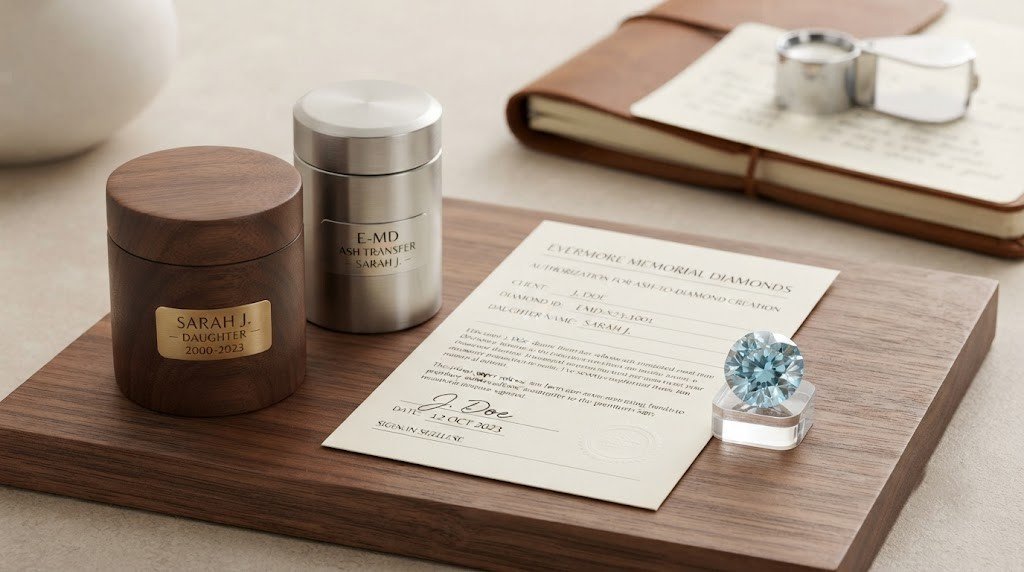
How to turn daughter ashes into a diamond: a sealed transfer container, a signed release form and a finished memorial stone on a table

What Decisions Come Up When You Turn Daughter Ashes Into a Diamond?

Seven, and when you turn daughter ashes into a diamond the order matters more than any single one. Each choice narrows the next, so a family that settles them front to back rarely has to undo anything.

NumberDecisionWhy it sits hereThe usual pitfall
1Who can authorize the releaseNothing else can proceed without itAssuming a parent automatically signs
2Which provider to useIts terms shape every later stepChoosing on tone rather than written answers
3Carat, color and cutThese set price and waiting timeExpecting a guaranteed color
4Taking a portion from the urnQuantity must match the provider’s figureSending too little and stalling the order
5Sending the ashesThe formal handover pointPaperwork traveling separately from the parcel
6Finishing choicesCut, optional treatment, optional gradingConfusing a grading report with an origin certificate
7Unused materialDecided before anything leaves homeNever asking, then wondering later

When families set out to turn daughter ashes into a diamond, the first two decisions carry most of the risk. The middle three are practical and quick. The last two feel minor until a family discovers it did not ask about them.

If you want the strict numbered sequence rather than the reasoning behind each choice, the step by step order for a daughter’s ashes lays it out stage by stage. What follows here is the thinking a family does before it is ready to turn daughter ashes into a stone at all.

Who Has the Authority to Turn Daughter Ashes Into a Diamond?

It depends on your state, her circumstances and anything she put in writing, and it is not always her parents. Settle it before you contact any provider or make plans to turn daughter ashes into a stone, because the release form is the one document nobody can sign on someone else’s behalf.

Each state sets its own order of priority for who controls a person’s remains, and there is no single national rule. If your daughter was an adult, a husband, wife or registered partner may rank ahead of you. So may her own grown children. A directive, a will provision or a prearranged plan she left can override the default order entirely.

Where she died young, the decision usually falls to her parents, but how the rules treat two parents who disagree still varies from state to state. Parents who are separated or divorced sometimes need both signatures; sometimes only one. The funeral home that handled the cremation generally knows how this works locally, and a short call to an attorney can confirm it.

Two things are worth saying plainly. Families are not always in agreement about this, and that does not make anyone wrong. One parent arranging everything alone is also common, and nothing about the process assumes a united household.

The pitfall is timing. A family that decides to turn daughter ashes into a diamond and only then learns that her spouse holds the authority may lose weeks waiting on a signature that could have been requested on day one.

How Do You Vet a Provider Before You Commit?

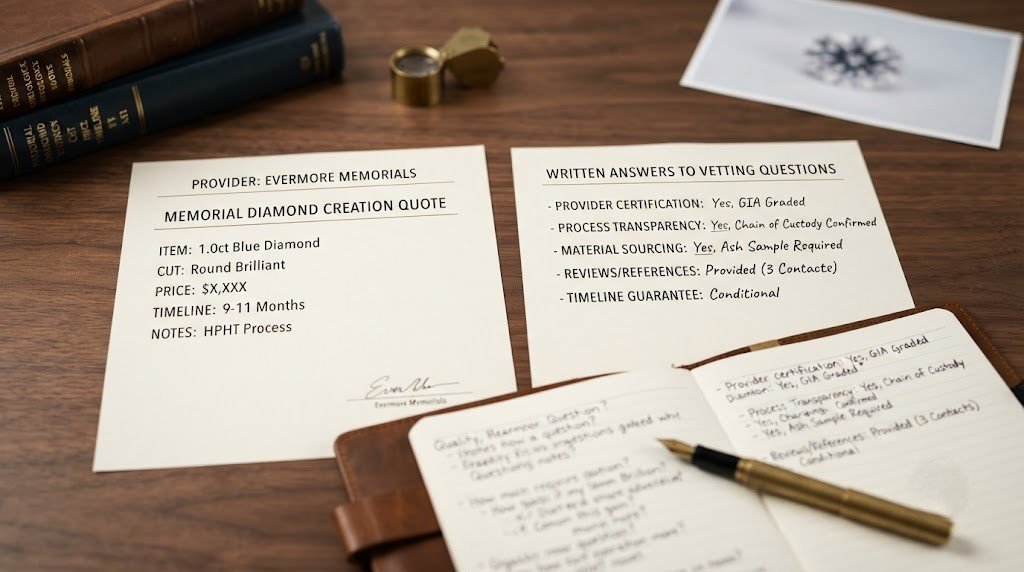
A printed provider quote and a list of written answers laid beside a notebook and pen | Stock acceptable

By what it will confirm in writing, not by how its website makes you feel. Gentle language costs nothing to produce; specific written answers are what separate one company from another.

Before you agree to let anyone turn daughter ashes into a stone, ask each provider you are considering for these answers by email:

  • The exact quantity of ash it needs, stated as a number
  • What document links the finished stone to your specific submission
  • Whether the growth happens in house or at a partner laboratory
  • What happens if a growth run fails, and whether that costs you anything
  • Its cancellation terms once material has been received
  • Whether unused ash is returned, held or disposed of, and how

A company that answers all six plainly is showing you how it will behave during the months it takes to turn daughter ashes into a finished diamond. Evasion at this stage rarely improves later.

Keep the quote and the answers together; months later, when you want to check what was promised before you turn daughter ashes over for good, you will be glad of it. The complete guide to a daughter ashes diamond covers the wider background if you are still deciding whether this is right for your family.

Which Carat, Color and Cut Should You Ask For?

Choose these before you turn daughter ashes over to a laboratory, because they fix both the price and the length of the wait. Of the three, carat has the biggest effect on each.

Memorial stones are generally offered from about a tenth of a carat up to five carats and beyond. A larger stone is not produced by sending more ash; it is produced by keeping the crystal in the press for longer. So if you plan to turn daughter ashes into something substantial, expect the calendar and the invoice to stretch together.

Color is only partly yours to choose when you turn daughter ashes into a diamond. Trace elements present while the crystal grows decide much of it: nitrogen tends to give yellow, boron tends to give blue, and a truly colorless stone needs almost none of either, which is why it usually costs more. Because the carbon comes from a personal, organic source, warm and blue tones are common. Even a carefully purified starting material does not make the outcome predictable, so treat any color as a likely result rather than a promise. What color a stone from her ashes is likely to be explains this in more depth.

Choose a color for your own reasons, never simply because she was a daughter. Some families pick a shade tied to something she loved, whether that was the ocean, a team, a season or nothing anyone else would guess; others simply accept whatever the chemistry produces.

Cut is the most familiar choice: round, princess, cushion, oval or emerald. Clarity usually lands between SI2 and VVS.

How Is a Portion Taken From the Urn?

Carefully, over a tray, in good light, and ideally with someone else in the room. Only a small share is needed to turn daughter ashes into a diamond; the industry typical request runs from a few tablespoons up to roughly 4 oz, or about 100 grams.

Most providers send a collection kit with a sealed container, a scoop and labels. If the urn is sealed or difficult to open, a funeral home can often open it, measure the portion and reseal it. There is no expectation that a parent must do this personally, and many choose not to.

Cremated remains are mostly bone mineral, closer to coarse sand than powder. Work slowly, check the quantity against the provider’s written figure, and photograph the sealed container before it is packed.

The pitfall here is quantity. A parcel that arrives short of what the laboratory needs pauses everything while a second portion is arranged. How much ash a daughter memorial diamond needs covers the figures and what they mean for the rest of the urn, and it is worth reading before you decide how to turn daughter ashes into a stone of any size.

What Is the Safest Way to Send Her Ashes?

Tracked, insured, and with the provider’s paperwork inside the parcel rather than following it. Take the courier option the provider recommends; this is the one part of the effort to turn daughter ashes into a diamond where saving a few dollars is not worth the worry.

Keep the tracking number handy, and do not assume the parcel arrived until the laboratory confirms it in writing.

That receipt is the handover point. Everything before it was yours to manage; everything after it belongs to the laboratory’s chain of custody process, which is the document trail showing that the stone grew from your submission and nobody else’s. Ask to see a sample of that paperwork before you agree to turn daughter ashes into a stone, not after. Whether the stone is really made from her ashes explains what that trail can and cannot prove.

Which Finishing Choices Come Back to You?

 An origin certificate and a separate independent grading report placed side by side with a loose diamond

Usually three, and they arrive together once a rough crystal exists. This is the only point in the waiting months that asks anything of you.

The first is confirming the cut. A gemologist shapes and polishes the rough, and a careful provider will tell you if the crystal would suit a different shape better than the one you chose.

The second is irradiation. When you turn daughter ashes into a diamond, you may be offered post growth treatment that can produce red, pink, green or black stones. It is optional, it adds cost, and many families decline it because they would rather keep the color the stone grew with.

The third is independent grading, which is also optional. A third party gemological laboratory can assess the finished stone against the standard cut, color, clarity and carat measures used for any diamond. That report describes quality. It is a different document from the origin or authenticity certificate issued by the provider, which records that the stone came from your specific submission. Knowing the difference before you turn daughter ashes into a stone saves confusion when the paperwork arrives.

What Happens to the Ashes That Are Not Used?

Ask before you agree to turn daughter ashes into a diamond, because policies genuinely differ. Some providers return unused material, some hold it for a period, and some dispose of it respectfully unless told otherwise.

Extraction consumes only part of what you send, and families sometimes assume leftovers come back automatically. If returning them is important to you, get that commitment in writing alongside the quote.

It is also worth deciding what happens to the rest of the urn. Most of her ashes stay with you, so burial, scattering, keeping them at home or dividing them among relatives all remain open. A diamond is one way to hold on to a part of her; it does not need to replace anything else the family has planned. Some families also add a lock of her hair, and combining her ashes and hair in one stone covers that route.

How Long Does It Take, and What Does It Cost, to Turn Daughter Ashes Into a Finished Stone?

Across the industry, expect six to ten months from the day material is received, and up to twelve for larger stones or specialty colors. The decisions you make yourself rarely take more than a few weeks; almost all of the calendar is laboratory time.

During that stretch the ash is heated without oxygen to strip away the calcium phosphate, since usable carbon makes up only around 0.5% to 4% of ash by weight. What remains is purified to about 99.9% carbon or better, converted to graphite at roughly 2,500 to 2,700°C, and grown in a press at about 6 to 8 GPa and 1,400 to 2,500°C. That high pressure method, one of the two used for lab grown diamond generally, is standard for memorial stones; a minority of providers use vapor deposition instead. How the stone is made from her ashes walks through the science properly.

Stone sizeGeneral 2026 industry range
0.10 to 0.25 carat$1,500 to $3,500
0.5 to 1 carat$5,000 to $15,000
2 carats and above$20,000 to $75,000 or more

These are general 2026 industry ranges rather than any one company’s rates. Settings, engraving, fancy cuts and an optional grading report are normally priced separately, and colorless typically costs more than a yellow or blue stone of the same size.

What Mistakes Should You Avoid Before You Turn Daughter Ashes Into a Stone?

Most problems families meet when they turn daughter ashes into a diamond are administrative rather than scientific. The ones that catch families most often are predictable, which makes them easy to prevent:

  • Starting with the provider instead of the signature. Confirm who holds authority first; everything else waits on it.
  • Accepting verbal answers. Quantities, cancellation terms and unused material policies belong in writing.
  • Expecting a fixed color. Chemistry has a vote, and no provider can guarantee the outcome.
  • Sending more ash to get a bigger stone. Size comes from growth time, not quantity.
  • Mixing up the two certificates. An origin document and a grading report do different jobs.
  • Skipping the family conversation. Other relatives may want a stone too, and one submission can often serve several.

None of these is a disaster on its own. Together they account for most of the delays and disappointments families describe when they look back on the months it took to turn daughter ashes into something they could hold.

Frequently Asked Questions

Is it too late to turn daughter ashes into a diamond years after the cremation?

No. Cremated remains are mineral and chemically stable, so time alone does not rule anything out. When you first contact a provider, mention how long the ashes have been stored and in what kind of container, since storage conditions can matter more than the number of years. Ask them to confirm in writing that the material is suitable before you send it.

How much of the finished diamond is actually her?

On the ash route, personal carbon typically makes up about 10% to 15% of the finished stone’s mass, and some providers publish figures as low as 3%. The rest is supplemental lab carbon added so the crystal can reach a workable size. The stone is still grown in part from her own carbon, which is the honest and meaningful claim; nobody can truthfully promise a stone that is entirely her.

Do we need to send all of her ashes?

No. Providers typically ask for somewhere between a few tablespoons and about 4 oz, which is a small share of a full cremation. The remainder stays with the family for burial, scattering, an urn at home or dividing among relatives. Confirm the exact figure with your provider in writing so the parcel is neither short nor unnecessarily large.

Can her brothers and sisters each have a stone from the same ashes?

Often, yes, because each diamond uses only a portion of the remains. Each stone goes through its own growth run, so two or three diamonds mean separate timelines and separate prices. Ask whether one submission can cover several orders, and agree within the family who is arranging each one before anything is sent to the laboratory.

What if her other parent does not want to turn daughter ashes into a diamond?

Pause until the question of authority is clear. Depending on your state and her circumstances, one parent, both parents, or a spouse or adult child of hers may need to sign. A provider cannot resolve a family disagreement, and it is kinder to talk it through first. A funeral director or attorney can explain who holds the decision where you live.

Can we choose a color that meant something to her?

You can request one, but the result is not guaranteed. Nitrogen tends toward yellow and boron toward blue, and colorless stones need the absence of both, usually at extra cost. Optional irradiation can produce red, pink, green or black. Choose a shade for reasons tied to who she was, and treat the finished color as likely rather than certain.

Final Thoughts on Turning Her Ashes Into a Diamond

Seven decisions sounds like a great deal to ask of a family that is already carrying so much. In practice, most of them take an afternoon each, and two of them, authority and the choice of provider, account for nearly all of the risk.

Before you turn daughter ashes into a diamond, settle who signs, get the provider’s answers in writing, and ask about the unused ash before anything leaves your hands. The rest becomes a question of patience. When the stone does arrive, it carries a documented line back to her, at whatever age she was taken from you.

Learn More About Daughter Memorial Diamonds

Talk With Memorial Diamond

If you would rather talk the decisions through with a person, Memorial Diamond can be reached at memorialdiamond.us. Ask about authority, quantities, timelines or anything else it takes to turn daughter ashes into a stone. There is no obligation in asking, and no decision needs to be made on that first conversation.

urn Daughter Ashes and Hair 9 Proven Steps, Gently Guided

How to Turn Your Daughter’s Ashes and Hair Into a Diamond

Some families end up keeping two things for her: the ashes that came back from the crematory, and a lock of hair saved in an envelope or a small box. If you want to turn daughter ashes and hair into a single diamond, it can be done, but it rests on nine decisions taken roughly in order, beginning with whether your provider accepts both materials in one order.

The laboratory work that follows typically runs six to ten months.

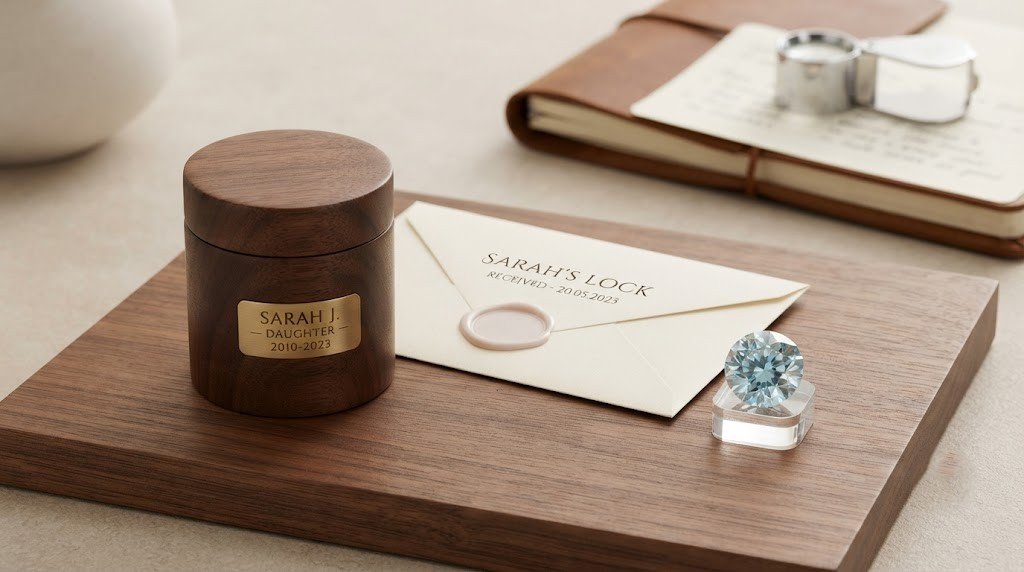
How to turn daughter ashes and hair into a diamond: a sealed ash container and a labeled hair envelope beside a finished blue-toned memorial stone

What Does It Take to Turn Daughter Ashes and Hair Into One Diamond?

Nine decisions, and most are made before anything leaves your home. The laboratory science barely changes between ash, hair, or both. What changes when you decide to turn daughter ashes and hair into one stone is the planning around it.

For the stage by stage mechanics once a parcel is on its way, the step by step walkthrough for ashes and hair picks up where these decisions end.

StepThe DecisionWho Is Involved
1Does the provider accept a blended submission?You and the provider
2Who can authorize releasing her ashes?Whoever holds authority
3Whose agreement is needed for her hair?Close family, case by case
4How much ash and hair to gatherYou
5Keeping and labeling them separatelyYou, perhaps a funeral home
6One combined stone or twoYou and family
7Carat, color and cutYou
8Sending bothYou and a courier
9Finishing choicesYou and the provider

Only the first three steps involve other people. Once those are settled, you can decide how to turn daughter ashes and hair into a finished stone at whatever pace feels manageable, whether that is weeks after her death or many years later.

Parents, partners, siblings, and adult children all arrange memorial diamonds, and your daughter may have been a little girl or a grown woman with a household of her own. The decisions hold at whatever age she died. What differs is who else has a say when you turn daughter ashes and hair into something permanent.

Step 1: Will a Provider Agree to Turn Daughter Ashes and Hair Into One Stone?

Not every provider offers this. Some laboratories grow each stone from one source material and will ask you to pick. Others accept a combined submission, extract carbon from each material separately, and blend the purified result into one growth charge.

Make the question specific and get the reply in writing: how exactly do they plan to turn daughter ashes and hair into one crystal, and what documentation links both materials to your order?

A few follow up questions can separate clear providers from unclear ones:

  • Is a combined stone priced differently from a single source stone of the same size?
  • If one material yields less carbon than expected, what happens next?
  • Will leftover ash and hair be returned, held for a later stone, or disposed of, and how?

Get that last answer before you send anything, since policies on unused material differ across the industry.

If the provider you prefer works from one source only, turning her ashes alone into a diamond and growing a stone from her hair alone each cover that route.

Step 2: Who Holds Authority Over Her Ashes?

Not automatically her parents. Who may decide about a person’s remains is fixed by each state’s own law, with no nationwide standard to fall back on.

A husband, wife, or registered partner is frequently at the top, and if your daughter left adult children, their say can come before yours as well.

Anything she put in writing can reshape that order, including a funeral directive, a clause in her will, or a plan arranged in advance with a funeral home.

So the person arranging the diamond is not always the one who signs. A mother or father may handle every detail and still need a partner’s signature, and learning that early is far gentler than learning it late.

Parents may see this differently, or one may be arranging it alone. If authority is unclear, the funeral home that handled the cremation usually knows how it works locally, and a brief call with an attorney can confirm it before you decide to turn daughter ashes and hair into a diamond.

Step 3: Whose Agreement Matters for Her Hair?

Usually fewer people’s than for her ashes, though the honest answer is not nobody’s. Rules on remains are written mostly with bodies and cremated remains in mind, and a lock kept at home often raises a simpler question in practice. Simpler is not the same as outside every rule.

A person’s belongings can form part of her estate, and how that applies varies by state. If your daughter had a spouse, a partner, or adult children, it is considerate, and sometimes necessary, to check that they are comfortable with her hair being used.

If the hair is in someone else’s keeping, using it is a conversation rather than a decision.

Many families cover both questions in one conversation. When you plan to turn daughter ashes and hair into one stone, a single written agreement naming both materials saves a second round of asking. Check that the provider’s own authorization form names both.

Step 4: How Much of Each Material Should You Gather?

Less than most families expect when they first plan to turn daughter ashes and hair into a diamond. Providers typically ask for between a few tablespoons and about 4 oz, roughly 100 g, of cremated remains, plus a small lock or a few grams of hair.

Requirements vary, so confirm the figures with your own provider.

MaterialIndustry Typical AmountWorth Knowing
Cremated remainsA few tablespoons to about 4 oz, approximately 100 gUsable carbon is only around 0.5 to 4 percent of ash by weight
HairA small lock, a few gramsRoughly half carbon by weight
PaperworkDeath or cremation certificate, ID, signed authorizationVaries by provider and state

Quantity does not decide size. Carat is set by growth time, so extra ash or a thicker lock will not buy a bigger diamond when you turn daughter ashes and hair into a stone. It only leaves more unused material.

How much ash and hair a daughter memorial diamond needs goes into the amounts more closely.

Hair from a brush, a saved braid, or a lock cut at the funeral home can all work. Note its source and any dye. Choosing to turn daughter ashes and hair into a diamond still leaves most of what you hold with you.

Step 5: Why Keep the Ashes and Hair Apart and Labeled?

Because a combined stone still begins as two materials, and the laboratory purifies each by its own route before blending. Keeping them apart protects the chain of custody, the record showing the finished stone grew from what you sent.

Before you turn daughter ashes and hair into one stone, a simple routine keeps them distinct:

  • Put the ash portion in the sealed container the provider or funeral home supplies.
  • Place the hair in a clean paper envelope, not plastic, and seal it.
  • Label each with her full name, the material, the date, and your order reference.
  • Photograph both, with labels visible, before packing.

Never mix the two yourself. Ash is mostly bone mineral and hair mostly protein, and a laboratory cannot cleanly separate them once combined at home.

Anyone ready to turn daughter ashes and hair into one stone should hand them over apart and let the laboratory do the blending.

If the urn is sealed, a funeral home can open it, portion out what is needed, and reseal it. Nobody has to do this alone, and asking a sibling or friend to sit with you is entirely reasonable.

Step 6: Is It Better to Turn Daughter Ashes and Hair Into One Stone or Two?

Neither is better in general. It depends on what the stone is meant to hold.

A combined stone blends carbon from both materials into one crystal. Two stones, one from ashes and one from hair, keep each source distinct.

One Combined StoneTwo Separate Stones
CostOne stone’s priceEach priced on its own
TimelineOne growth runTwo runs, possibly finishing apart
What It HoldsBoth materials togetherEach material in its own stone
SharingOne piece, kept or passed onTwo people can each keep one
Provider NeedsMust accept a blended submissionAny provider offering both routes

Some families decide to turn daughter ashes and hair into one stone because it gathers everything they saved into one object. Others prefer two because the materials came from different chapters of her life.

Sharing can also settle the decision. If her partner and her parents each want something, two stones, or two combined stones from one submission where allowed, may suit better.

The complete guide to a daughter ashes and hair diamond looks at these arrangements.

Unsure? Ask whether material can be reserved so you can turn daughter ashes and hair into a second stone later.

How to turn daughter ashes and hair into a diamond: a sealed ash container and a labeled hair envelope beside a finished blue-toned memorial stone

Step 7: Which Carat, Color and Cut Suit a Blended Stone?

Carat drives both price and wait. Memorial stones generally run from about 0.10 carat to beyond 5 carats, and larger sizes grow for longer.

Color is part choice and part chemistry. Nitrogen during growth pushes a crystal toward yellow, boron toward blue, and colorless needs close to none of either and usually costs more.

Adding hair does not make a stone automatically lighter, and a cleaner looking starting material does not make the shade predictable.

What color a diamond from her ashes and hair may be explains why.

Cut means the standard shapes, from round to emerald. Choose for how and by whom the stone will be worn or kept, not from any assumption about what a daughter should have.

Then comes the honest question of how much is her. On the ash route, providers commonly describe roughly 10 to 15 percent of a finished stone’s mass as personal carbon, with some as low as 3 percent.

For hair, or for a blended charge, nobody publishes a comparable figure for the finished stone. Hair’s roughly 50 percent carbon describes the input, not the diamond.

Before you turn daughter ashes and hair into a blended charge, ask the provider for its own figure and method in writing.

No memorial diamond is 100 percent personal carbon. Supplemental lab carbon makes up a growable volume around a real portion of hers.

Whether the stone is really made from her ashes and hair examines that claim closely.

Step 8: How Do You Send Both Materials Safely?

Tracked, insured where possible, with paperwork inside. Most providers send a kit with containers, labels, and often a prepaid courier label.

Pack the ash container and hair envelope so neither can open, include the signed authorization and intake form, and note the tracking number.

Rules on shipping cremated remains differ by carrier and country, so ask what the provider recommends.

Expect an acknowledgment confirming both materials arrived and were logged separately. This is where the plan to turn daughter ashes and hair into a diamond leaves your hands.

From there the work is the laboratory’s. Each material is purified to roughly 99.9 percent carbon or better, graphitized at around 2,500 to 2,700 degrees Celsius, and grown, usually by HPHT at about 6 to 8 GPa and 1,400 to 2,500 degrees Celsius, with a minority of providers using CVD.

How the laboratory grows a stone from her ashes and hair follows that science.

Step 9: Which Finishing Choices Come Back to You?

Usually three, once the rough crystal exists.

First, the cut is confirmed against what the rough can yield. A provider suggesting a different shape should explain why.

Second, color treatment. Some providers offer post growth irradiation for red, pink, green, or black. It is optional and priced separately, and many families leave the stone as it grew.

Third, independent grading. A third party report on cut, color, clarity, and carat is optional, and it differs from the provider’s certificate of origin, which traces the stone to your submission.

Memorial stones typically grade between SI2 and VVS in clarity.

The stone usually arrives loose. Diamond sits at 10 on the Mohs scale of mineral hardness, so it suits daily wear.

Ask again what became of any unused ash and hair once you turn daughter ashes and hair into a finished diamond.

 A loose memorial diamond in an open presentation box beside its certificate of origin

What Does It Cost to Turn Daughter Ashes and Hair Into a Diamond?

When you set out to turn daughter ashes and hair into a diamond, price follows the stone you choose, not the materials you send.

Six to ten months is the usual industry span from receipt, with larger stones or specialty colors sometimes taking up to twelve months.

These are general 2026 industry ranges, not any one company’s pricing:

  • About 0.10 to 0.25 carat: roughly $1,500 to $3,500
  • About 0.5 to 1 carat: roughly $5,000 to $15,000, with colorless costing noticeably more than yellow, blue, or champagne
  • About 2 to 5 plus carats: roughly $20,000 to $75,000 and upward
  • Extras: settings, engraving, fancy cuts, and an optional grading report are quoted separately

If you turn daughter ashes and hair into two stones rather than one, expect two prices and possibly two timelines.

Ask whether a combined submission carries any surcharge, and get the full quote in writing.

Frequently Asked Questions

Can I send her hair and ashes at different times?

Many providers can work with that, but ask first. A laboratory needs both materials in hand before it can begin to turn daughter ashes and hair into a crystal, so a late second parcel usually pauses the order.

Confirm how the two parcels are linked.

Does adding hair make the diamond lighter in color?

Not automatically. Color comes from trace elements such as nitrogen and boron present during growth, and neither ash nor hair guarantees a shade.

If a specific color matters when you turn daughter ashes and hair into a diamond, discuss colorless processing or optional irradiation beforehand.

How much of a combined stone actually comes from her?

No published finished stone percentage exists for a blended charge. The widely quoted 10 to 15 percent figure, with some providers citing 3 percent, applies to the ash route only.

Hair’s roughly 50 percent carbon describes the raw material. Ask your provider for its own estimate and method in writing.

What if my preferred provider only accepts one material?

Then you can choose which material to send, or ask another provider to turn daughter ashes and hair into one stone.

Some families send the ashes and keep the lock as it is. Others do the reverse, choosing by what they want the stone to hold.

Can hair from a hairbrush be used?

Often, yes, if enough can be gathered and it clearly came from her. Tell the provider its source, since brush hair may need cleaning and can include other people’s hair in a shared home.

A lock that was cut and kept is usually simpler.

Can her partner and her parents each have a stone from the same materials?

Frequently, because only a portion of the ashes and hair is used, and several stones can often come from one submission.

Whoever holds authority over her ashes should agree to the arrangement before you turn daughter ashes and hair into more than one stone.

Will the unused ashes and hair be sent back?

That depends on the provider, so ask before anything is shipped. Some return leftover material, some hold it for a possible future stone, and some dispose of it respectfully.

Ask which applies, how it is recorded, and whether the choice is yours.

Final Thoughts on Turning Her Ashes and Hair Into a Diamond

Nine steps look like a lot on paper. Most of the real effort sits in the first three: a provider that accepts both materials, and clarity on who needs to agree.

There is no deadline. Ashes and hair both keep indefinitely, and waiting a year, or ten, before you turn daughter ashes and hair into a diamond is as valid as starting next week.

Whatever you decide, what comes back is a real diamond with a documented line to her, made in part from carbon that was hers.

Learn More About Daughter Memorial Diamonds

Talk With Memorial Diamond

If you would rather talk it through with a person, Memorial Diamond can be reached at memorialdiamond.us to discuss how to turn daughter ashes and hair into one stone, or two, and what each step involves.

Asking carries no obligation, and there is no timetable to keep.

About a Son Memorial Diamond 7 Expert Answers, Gently Put

How to Talk to Family About a Son Memorial Diamond

The idea may have arrived quietly, late at night, and now it sits with you, unshared. Talking about a son memorial diamond with the rest of his family usually goes best when you raise it early, keep the ask small and specific, start with whoever holds authority over his remains, and make it clear that nothing has been decided yet.

Nobody has to agree on the first day, and a real conversation can take more than one sitting.

Two parents talking quietly at a kitchen table about a son memorial diamond, a small closed urn and a notebook between them

When Is the Right Time to Raise It?

Sooner than feels comfortable, but not in the first raw hours. The practical reason is that decisions about his remains tend to move on their own schedule. An urn gets chosen, a scattering gets planned, a burial plot gets paid for, and a family that learns about a son memorial diamond only after the ashes have been interred has far fewer options left.

That does not mean raising it at the funeral home during paperwork. A calmer moment, a few days after the service, gives people room to think rather than react.

There is no deadline in the process itself, which is worth knowing. Cremated remains are mineral and stay stable for years, so a family that needs six months, or two years, before anyone is ready to talk about a son memorial diamond loses nothing by waiting. The only real pressure comes from other plans for the ashes.

A useful test is simple: if his ashes are still together and nobody has committed to a final resting place, now is a reasonable time to raise the question about a son memorial diamond.

Who Needs to Hear About a Son Memorial Diamond First?

Start with whoever holds authority over his remains, because every other opinion about a son memorial diamond is advisory until that person agrees. It is often not the parent, and finding that out late can be painful.

Each state sets its own order of priority, and there is no single national rule. For a son who was married or in a registered partnership, his spouse or partner commonly ranks first. If he had adult children, they may come ahead of his parents. Anything he put in writing, such as a directive, a will provision, or a prepaid funeral arrangement, can override the usual order altogether.

So a parent may be the one who first thinks about a son memorial diamond and still not be the one who signs. Whether he was a teenager or a grown man with a household of his own changes who that signer is, and nobody should assume.

The funeral director who handled the cremation can usually tell you how the rules work where you live, and a brief call with an attorney can confirm it if the situation is complicated.

If the authority sits with his spouse, partner, or children, approach them as the people most directly bereaved, not as a hurdle. A spouse asked to decide about a son memorial diamond that his parents have proposed is being asked something large, and the request lands better with no expectation attached.

How Do You Open the Conversation?

 A short handwritten note and a pen resting on a table beside a cup of coffee

Plainly, briefly, and as a question rather than a plan. The aim is to share what you have learned about a son memorial diamond, not to win agreement, and people can tell the difference.

These are openers written in ordinary words. They are not scripts, and they are not meant to steer anyone. Change them until they sound like you:

  • “I’ve been reading about something and I’d like to tell you about it, but I don’t need an answer today.”
  • “Have you ever heard of a diamond grown partly from a person’s ashes? I keep thinking about it for him.”
  • “I want to ask you something about his ashes, and it’s fine if you want to say no.”
  • “Would you be open to hearing about a son memorial diamond, even just to know what it involves?”
  • “It would only use a small amount. The rest would stay exactly as we planned.”
  • “I don’t want to do anything with his ashes that you’re not comfortable with. Can we talk it through?”
  • “If it’s too soon, tell me, and I’ll bring it up again later or not at all.”

What helps after the opener is information, offered only when asked. Some relatives have never heard of a memorial diamond at all, and a neutral outside explanation such as the general overview of memorial diamonds as a category can answer whether the concept exists without making the conversation feel like a sales pitch.

What can go wrong is arriving with a provider already chosen and a price already quoted. That can turn a conversation about a son memorial diamond into a request for permission.

What If His Parents Are Not Together?

Then the conversation may happen twice, separately, and that is normal. Parents who divorced long ago, who are estranged, or who simply grieve very differently are common, and one parent arranging things alone is not unusual.

If you are one of two parents, consider speaking to his other parent before anyone else in your own household hears about a son memorial diamond. Learning about it secondhand, from a sibling or a new partner, can turn a manageable disagreement into a bitter one.

Where contact is strained, a short written note about a son memorial diamond can be easier than a call. Keep it factual: what the idea is, that only a portion of the ashes would be used, that you want their view, and that nothing happens without whoever holds authority.

They can read it alone and answer in their own time.

The other parent’s say may be limited by the same order of priority described above, and that can cut either way. Include them anyway. Being told is not the same as being asked.

How Do You Bring In Siblings, Grandparents and the Wider Family?

After the people with authority have had their say, and in smaller conversations rather than one big announcement.

His siblings often ask the most practical questions about a son memorial diamond: whether they could have a stone too, what it costs, and whether it changes the plan for the rest of his ashes.

How more than one family member can receive a stone is useful to review before they ask.

His grandparents may feel uneasy about a son memorial diamond at first. Patience helps more than persuasion, and some come around once they understand that the urn or grave they expected can still exist.

Aunts, uncles, and cousins usually need to hear about a son memorial diamond once it is decided, rather than be consulted. Telling them avoids any sense that something was done in secret.

Children in the family deserve a simple, honest explanation from an adult they trust. They need not be part of the decision about a son memorial diamond.

What Worries Come Up About a Son Memorial Diamond, and What Are the Honest Answers?

A lock of hair in a keepsake envelope next to two small loose memorial diamonds

Most concerns fall into a handful of patterns, and nearly all of them deserve a straight answer rather than reassurance. The table below sets out concerns families may raise about a son memorial diamond.

Concern You May HearAn Honest Answer
“It feels strange.”It can, and that is a fair reaction. Many families simply need time with the idea before deciding.
“I want to keep him whole.”Only a portion is used, typically a few tablespoons up to about 4 oz, roughly 100 g. The rest can stay together.
“Is any of it really him?”On the ash route, personal carbon is usually described as around 10 to 15 percent of the finished stone, with some providers publishing figures near 3 percent. The rest is supplemental lab carbon.
“It’s too expensive.”Industry prices run roughly $1,500 to $3,500 for the smallest stones and rise steeply with size. No one should feel pressured into a figure they cannot afford.
“What happens to whatever isn’t used?”Policies differ between providers. Ask in writing before anything is sent.
“It will take forever.”Typically six to ten months industry wide, with up to twelve months for larger or specialty color stones.
“Our faith may not allow it.”Views vary by tradition, denomination, and individual clergy. It is worth asking your own faith leader.
“Who gets to decide?”Whoever state rules and his own written wishes place first, which may be his spouse, partner, or adult children.

On cost, being specific helps. What families typically spend lays out the industry tiers, and a relative who says something is too expensive may be picturing a very different figure.

On whether any of it is really him, the honest answer matters more than the comforting one. A relative who later learns the stone was not all him may stop trusting everything else you said about a son memorial diamond.

How much of the stone actually comes from his ashes explains the science in plain terms.

What If Faith or Culture Is Part of the Hesitation?

Then take it seriously and do not argue with it. The source notes that religious teachings concerning cremation and the handling or dividing of ashes vary widely.

Some traditions object to cremation itself. Others accept cremation but prefer that ashes stay together in one resting place, and some have no objection at all. Within a single faith, clergy and congregations may answer differently.

If a grandparent or parent raises a religious concern about a son memorial diamond, the respectful step is to suggest asking their own faith leader together, rather than researching a counterargument.

Cultural expectations around mourning periods and ash rituals deserve the same respect even where no doctrine is involved.

Where the objection is to dividing ashes, hair offers a route that does not touch them. It is an option to mention, not a workaround to press on someone who has said no.

How Can Hair or a Shared Stone Change the Conversation?

Both can take the heat out of some common objections. Hair means the ashes need not be involved at all, and sharing means nobody has to be left out.

Hair. For relatives uneasy about a son memorial diamond because it would divide the ashes, hair is often the first thing to mention. A small lock, typically a few grams, is enough. Hair is roughly half carbon by weight, but that describes the input only. No equivalent finished stone percentage is published for hair, so ask any provider in writing.

Belongings can form part of an estate and rules vary by state, so check whose permission is appropriate before sending anything.

The complete guide to a son hair diamond covers this route in full.

Only a portion. For the ashes route, the amount a laboratory needs is small. The urn stays, the scattering goes ahead, and the burial can happen.

How much ash is actually needed gives the typical quantities.

Sharing. Because only part of the material is used, more than one stone can often be grown from the same source, one for each parent, or for a sibling and his spouse, each priced and timed separately.

When everyone who wants one can have one, the conversation about a son memorial diamond can shift from who decides to what each person would like.

A diamond does not replace anything, and how a memorial diamond compares with a traditional urn can help relatives who assume it is one or the other.

What Happens If the Family Cannot Agree?

Waiting is allowed. A decision about a son memorial diamond does not have to be made this month, and pushing through a disagreement can leave a wound that lasts longer than the decision itself.

If the person with authority says no when asked about a son memorial diamond, that is the answer for now. It may change in a year, or it may not.

Pressing, recruiting allies, or going around them can damage relationships the family may need for a long time.

If people are divided but not opposed, a few practical steps can help:

  • Ask a neutral person to explain the process. A funeral director has no stake in the outcome and may have fielded questions about memorial diamonds before.
  • Put the key facts about a son memorial diamond in writing so everyone reads the same information: quantity, cost range, timeline, and what happens to unused material.
  • Agree to revisit the question on a set date rather than arguing in circles.
  • Separate the questions. Whether to do it, who holds authority, and how many stones are three different conversations.

Questions worth asking any provider can double as a shared checklist, which moves the discussion from feelings about a son memorial diamond to facts everyone can check.

If you are still weighing whether to go ahead at all, where to start when choosing one may help you sort your own thinking before the next conversation.

If grief itself is what makes the conversation impossible, a grief counselor, faith leader, or support group can help with the harder conversations underneath this one.

Frequently Asked Questions

Do I need everyone’s agreement before ordering a son memorial diamond?

Not everyone’s, but you need the signature of whoever holds authority over his remains, which depends on state rules and anything he left in writing. His spouse, partner, or adult children may rank ahead of his parents. Beyond that person, wider agreement is not required, though it is usually worth seeking.

What should I say if a relative thinks the idea is strange?

Agree that it can feel unfamiliar, then offer plain facts if they want them: only a small portion of ashes is used, the rest stays as planned, and the stone is a real lab grown diamond. Then give them time. Many people need to sit with the idea before they can react to it.

How do I raise questions about a son memorial diamond with his spouse or partner?

Gently, privately, and as a question they are free to decline. They may be the person with authority and are among those most directly bereaved. Offer information rather than a plan, make clear nothing has been arranged, and let them choose whether and when to talk further.

Can his other parent and I each have our own stone?

Often, yes. Because only part of the ashes or hair is used, more than one stone can frequently be grown from the same source. Each is typically grown and priced on its own, with a separate timeline, so ask the provider in writing whether one submission can cover two stones.

What if my family’s religion discourages dividing ashes?

Traditions and individual clergy vary. Ask your own faith leader rather than assuming either way. If the concern is about dividing ashes, a diamond grown from hair may be worth mentioning since it does not involve the ashes at all.

Is it too late to talk about a son memorial diamond if his ashes were scattered?

If all the ashes were scattered or interred, the ash route may no longer be possible, but hair remains an option if any was kept. If some ashes were set aside, even a small amount may be enough. Ask a provider what quantity it typically requires before ruling anything out.

How long should we wait if family members are not ready?

As long as it takes. Cremated remains are stable for years, and the process has no deadline of its own. Agreeing on a time to revisit the question, perhaps a few months away, can take pressure off everyone without closing the door on the idea.

Final Thoughts on Talking About a Son Memorial Diamond

Most of the difficulty in talking about a son memorial diamond has nothing to do with diamonds. It comes from grief, from old family patterns, and from the fear that someone will be left out or overruled.

The approach that tends to work is simple, even if it is not easy. Find out who holds authority first. Offer the idea as a question. Share honest facts, especially about how little of his ashes is used and how much of the stone is really him. Let people say no, and let them change their minds later.

Whether he was a young boy or a man with a family of his own, the people who loved him will not all grieve the same way. A conversation about a son memorial diamond that leaves room for that difference can give everyone space to consider what they want, whatever is eventually decided.

Learn More About Son Memorial Diamonds

Talk With Memorial Diamond

If it would help to have plain answers about a son memorial diamond before you talk to his family, Memorial Diamond can be reached at memorialdiamond.us. You can ask about quantities, timing, and what happens to unused material, with no obligation and no pressure to decide.

Really Made From Daughter Hair 7 Expert, Reassuring Answers

Is a Memorial Diamond Really Made From Your Daughter’s Hair?

You may be holding a small envelope and doubting that anything so light could honestly become a gem. Asked plainly, is the stone really made from daughter hair? The answer is yes, in part: carbon from her hair is extracted, purified and grown into a genuine lab grown diamond, alongside supplemental laboratory carbon. What nobody can do is test the finished stone and point to her carbon inside it, so the proof you receive is a paper trail, and this page explains how to judge one.

A loose memorial diamond really made from daughter hair beside the small paper envelope the lock was sent in

Is a Diamond Really Made From Daughter Hair, or Is That Marketing?

It is a real process, and doubting it is sensible. The question usually arrives in its bluntest form, is this thing really made from daughter hair, or is it a nice story? It deserves a blunt reply.

Three statements are true together. Her carbon genuinely enters the crystal. The crystal is genuinely diamond. And the stone is not hair alone, because providers across the industry supplement personal carbon with laboratory carbon to reach a size worth growing.

Trouble starts when marketing keeps the first two statements and drops the third. A page promising a gem that is “100% her” describes something the physics does not allow. Any accurate account of a stone really made from daughter hair includes the blend.

Whether she was a little girl or a grown woman, the answer stays the same; what varies is how much you can verify, and that depends on the provider. The complete guide to a daughter hair diamond sets out the wider decision around it.

Why Is Hair Such a Rich Source of Carbon?

Hair is made mostly of keratin, a protein built on a carbon backbone, which puts it at roughly 50% carbon by weight. Cremated remains are a different substance altogether: mostly calcium phosphate, the mineral of bone, with usable carbon at only around 0.5% to 4% of their weight.

That contrast explains why so little is requested: typically a small lock or a few grams of hair, against a few tablespoons to about 4 oz of ash. A gem really made from daughter hair begins with material that is, gram for gram, far richer.

Hair also removes cremation from the picture. A family that chose burial, or whose tradition does not permit cremation, can still pursue a stone really made from daughter hair, provided some of her hair was kept somewhere.

Hold on to one distinction, though. The 50% figure describes what sits in the envelope, not how much of a diamond really made from daughter hair is hers. How much hair a laboratory typically asks for covers quantities and collection.

If Hair Is Half Carbon, Why Is Lab Carbon Added?

 A gemologist examining a lab-grown diamond under magnification at a testing bench

A growth cell needs a certain volume of graphite feedstock, and a lock of hair, even at half carbon, rarely supplies enough by itself. Providers therefore top up the purified personal carbon with supplemental laboratory carbon so the press can build a crystal of the size that was ordered.

The work runs in stages. Heating without oxygen drives off the non carbon parts of keratin and leaves carbon at about 99.9% purity or better. That carbon becomes graphite at roughly 2,500 to 2,700°C, then, blended with lab carbon, goes into an HPHT cell beside a tiny seed at around 6 to 8 GPa and 1,400 to 2,500°C; a minority of providers use CVD.

Carat weight is decided by time in the press, not by the weight of hair posted, so sending more does not produce a bigger or quicker stone.

In physical terms, then, a diamond really made from daughter hair is her carbon plus laboratory carbon locked into one continuous crystal lattice. How the stone is grown from her hair, stage by stage follows the material through each step in more depth.

What Share of a Stone Really Made From Daughter Hair Is Hers?

Nobody has published an answer for the share of a stone really made from daughter hair that is personal carbon. That is the honest position.

For cremated remains an industry figure does circulate: personal carbon is commonly put at around 10% to 15% of the finished stone, with some providers quoting less. That number belongs to ash. It was never established for hair, and lending it to a gem really made from daughter hair would be guesswork dressed up as fact. The final share hinges on stone size, recovery and each laboratory’s method. The same question asked about her ashes shows how differently the two routes are documented.

So the only figure worth relying on is one the provider commits to on paper. Ask what share they expect to be her carbon at your chosen carat, whether that is measured or estimated, and whether more hair changes it. Keep the reply.

A clear answer with its basis explained is a good sign. The ash figure repeated for something really made from daughter hair is not.

Can Any Test on the Finished Diamond Prove It Is Hers?

No. No test on the finished stone can show it was really made from daughter hair, or link it to any particular person. DNA does not survive purification, and carbon atoms carry no record of their source.

Gemological testing can identify a diamond as laboratory grown and can often tell the HPHT and CVD growth methods apart. That confirms a genuine grown diamond, nothing more.

This moves the whole question of trust from the stone to the process. Evidence that a gem is really made from daughter hair lives in records created while the work happens: the intake log, the custody trail through each stage, and the origin certificate at the end. If those records are thin, nothing done to the diamond afterward can make up for it.

An independent grading report answers a separate question: it describes quality. Only the chain of custody shows whether a diamond is really made from daughter hair.

Honest Claims Versus Overclaims: How Can You Tell Them Apart?

Most statements you will meet fall into one of two columns. The table below pairs common claims about a stone really made from daughter hair with the accurate version of each.

TopicThe overclaimThe honest version
Purity“100% her, nothing added”Her carbon blended with supplemental lab carbon
Her share of the stoneThe ash route 10% to 15% applied to hairNo published hair figure; the provider’s own estimate, in writing
Proof of origin“We can test the diamond to show it is her”No finished stone test identifies a person; trust rests on chain of custody
Hair’s carbon“Half the diamond is her, since hair is 50% carbon”50% describes the starting hair, not the finished stone
Color“Hair diamonds always come out lighter”Color follows trace elements during growth; nothing is guaranteed
Certificate“Fully certified,” with no detailIn house origin certificate named separately from optional independent grading
Size“Send more hair for a bigger stone”Carat is set by growth time, not by quantity sent

Warm language is fine. The test is whether each claim about a gem really made from daughter hair survives a polite follow up question.

Which Documents Should You Ask For?

Ask before anything is posted, and ask to see sample copies. A company confident that its stones are really made from daughter hair will happily show you what its paperwork looks like.

  • Written quote and terms: carat, color approach, price and expected timeline, stated as the company’s own estimate.
  • Intake confirmation: a record that the hair arrived, logged against a unique reference on the day it was received.
  • Chain of custody log: how the sample is labeled and tracked through purification, graphitization and growth, and whether it is processed on its own rather than beside other families’ material.
  • Personal carbon statement: the provider’s written estimate of her share of the finished stone, with how it was reached.
  • Origin or authenticity certificate: the in house document tying the finished diamond to your submission.
  • Independent grading report: a third party assessment of the stone’s quality, ordered separately if you want one.
  • Leftover material and failed run policy: what happens to unused hair, and what happens if a growth run does not succeed.

Before posting, photograph the hair and keep every email in one folder. A step by step outline of the hair route shows where each document appears.

What Red Flags Should Make You Pause?

None of these proves wrongdoing alone, but each weakens the case that a stone is really made from daughter hair.

  • A promise that the diamond is pure hair, or “entirely her.”
  • A percentage quoted for hair that turns out to be the ash route figure.
  • A claim that a lab can test whether the finished diamond is really made from daughter hair.
  • No written description of how your sample is labeled and kept separate.
  • The word “certificate” used without saying who issues it or what it covers.
  • Pressure to decide quickly, or discounts that vanish within days.
  • Silence on what becomes of hair that is not used.

Raising any of these is fair. A good provider explains; a poor one only reassures.

What About Hair That Is Old, Dyed or Chemically Treated?

Discuss it with the provider before sending, every time. Keratin is durable, so hair kept dry for many years may well remain workable, but only the laboratory can say how condition affects recovery for a stone really made from daughter hair.

Dye, bleach, perms, relaxers, henna and styling products all introduce other substances. Much of that may be driven off during purification, yet some treatments could reduce usable carbon or mean more hair is requested. Describe its approximate age, storage, any coloring or treatment, and whether brush hair is mixed with dust or other people’s strands.

Do not wash or tidy it first; cleaning can lose fine strands. If you hold very little, say so at the outset.

An accurate description helps more than a perfect sample. Turning her hair into a diamond, from collection to shipping covers the practical handling in more detail.

Who Should Agree Before Her Hair Is Sent?

That depends on your family and your state, so check rather than assume. Rules on who controls a person’s remains are set state by state, and there is no single national rule describing how they apply to hair kept at home.

Hair in your possession is often simpler than cremated remains, yet not automatically outside every rule: belongings can form part of an estate. Where your daughter had a spouse or partner, or adult children of her own, they may hold a stronger say than her parents, and anything she left in writing, a directive, a will provision or a pre arrangement, may shape what is appropriate.

Parents may disagree, or one may be arranging everything alone; both are common. If someone else holds the hair or an estate is unsettled, a funeral director or local attorney can help, and it keeps a stone really made from daughter hair from becoming a source of friction.

Does Hair Change the Color, Price or Timeline?

Several memorial diamonds in yellow, blue, champagne and colorless tones arranged in a row

Not in any predictable way. Diamond color is governed by trace elements in the growth chamber: nitrogen pulls the stone yellow, boron gives it a blue cast, and colorless requires that neither is present. A cleaner, carbon rich starting material does not make color predictable, and hair grown stones are not automatically lighter than ash grown ones. Colorless usually costs more, and irradiation to produce red, pink, green or black is optional. What color a diamond from her hair may turn out to be explores this closely.

Price follows carat and color rather than source material. As general 2026 industry ranges, not any single company’s rates:

  • About 0.10 to 0.25 ct: roughly $1,500 to $3,500
  • Half a carat to one carat: roughly $5,000 to $15,000
  • 2 ct to 5 ct and beyond: roughly $20,000 to $75,000 or more
  • Priced separately: settings, engraving, fancy cuts and an optional independent grading report against GIA’s cut, color, clarity and carat standards

Clarity typically lands between SI2 and VVS, and the usual wait is six to ten months, up to twelve for larger or specialty color stones. These are industry figures, not Memorial Diamond’s own, offered to help you read any quote for a diamond really made from daughter hair.

What Happens to the Hair That Is Not Used?

That depends on the provider, so ask before sending. Some return unused hair, some keep it for a possible second diamond, and some dispose of it. When what you hold is limited, that answer matters.

Ask too whether one submission could support more than one diamond. Two stones usually mean two growth runs and two prices. It is one more detail about a stone really made from daughter hair that belongs in writing.

Frequently Asked Questions

Is there any DNA in a diamond made from her hair?

No. Purification and graphitization at extremely high temperatures destroy DNA, and a finished diamond is carbon in a crystal lattice with nothing that identifies an individual. Whether a stone is really made from daughter hair is shown by the records kept during processing, not by any later test.

Could a provider substitute other carbon without anyone knowing?

A test on the finished stone could not reveal a substitution, so the custody record is what shows a diamond is really made from daughter hair. Ask how your sample is labeled, whether it is processed on its own, and which records you receive at each stage. Specific, detailed answers are your strongest protection.

How much hair does a laboratory usually need?

Typically a small lock or a few grams, often described as palm sized. Requirements vary between providers and with the stone you want, so confirm the exact amount before cutting or posting anything, particularly if the hair you hold is limited or means a great deal as it is.

Can hair from a hairbrush be used?

Often, if the provider accepts it. Hair gathered from a brush, comb or pillow still carries her carbon. Tell the provider where it came from, since dust, product residue or strands from other people in the household can affect how much usable material is recovered and whether a little more is needed.

Is a stone really made from daughter hair a genuine diamond?

Yes. It is a chemically genuine lab grown diamond with the same hardness and optical properties as a mined stone, not a simulant or resin. Testing will identify it as laboratory grown, which is an accurate description of how it formed rather than a mark against it.

Does it matter how many years ago the hair was cut?

Age alone is rarely the main concern, since keratin is durable. Storage conditions tend to matter more, because damp, mold or contamination can affect a sample. Tell the provider roughly when the hair was cut and how it has been kept, and let the laboratory judge whether it is workable.

Should every answer about a diamond really made from daughter hair be in writing?

Yes. Ask for the personal carbon estimate, the custody process, the certificate details, the failed run policy and the leftover hair policy by email or in the contract. Written answers are easier to compare between companies and far easier to rely on months later, when the finished stone arrives.

Final Thoughts on Whether the Diamond Is Truly Her Hair

The doubt that brought you here is fair. Her carbon is genuinely in the stone, the stone is genuinely diamond, and the proportion is a blend nobody has published for hair.

Nor can any test settle it after the fact. Whether a gem is really made from daughter hair is decided by how carefully the sample is handled and recorded from the day it arrives, which is why the paperwork deserves as much of your attention as the stone.

None of that is a reason to step back, only to ask specific questions about a stone really made from daughter hair and keep the answers. Whatever you decide, there is no deadline.

Learn More About Daughter Memorial Diamonds

Talk With Memorial Diamond

If you want a straight answer about the hair you have, Memorial Diamond is glad to talk. Reach out through memorialdiamond.us with questions about samples, paperwork, or how a stone really made from daughter hair is documented. There is no obligation in asking.

Really Made From Daughter Ashes 7 Proven Answers, Honestly

Is a Memorial Diamond Really Made From Your Daughter’s Ashes?

Doubt is a sensible reaction when someone offers to turn a portion of your daughter’s remains into a gemstone. So is a stone sold this way really made from daughter ashes? Yes, in part: carbon recovered from her cremated remains is purified and grown into the crystal, blended with laboratory carbon, and most industry descriptions put her share at roughly 10% to 15% of the finished diamond. What no one can do is prove that by testing the stone afterward, which is why the paperwork matters as much as the chemistry.

A loose blue-toned memorial diamond of the kind a family hopes is really made from daughter ashes, beside a small sealed ash container and its origin paperwork

Is a Stone Really Made From Daughter Ashes, or Is That a Sales Line?

It is a physical fact, not a metaphor, but a partial one. When a family asks whether a memorial stone is really made from daughter ashes, the accurate reply has two halves, and both deserve equal weight.

The first half: carbon atoms that were part of her body are extracted from the portion of ash you send, purified, converted to graphite and grown into the lattice of a real diamond. It is chemically identical to any other diamond.

The second half: those atoms are not the only carbon in the crystal. Cremated remains hold very little carbon, so laboratories top up the growth charge with carbon of their own. A stone really made from daughter ashes is therefore a stone made partly from her, and anyone claiming more is overstating it.

Neither half cancels the other. Families who learn how a stone is really made from daughter ashes usually find the honest version more meaningful, because it survives scrutiny. How a memorial diamond is made from her ashes walks through the laboratory stages in order.

How Much Carbon Is Left in Cremated Remains?

Very little. What comes back from a crematory is mostly bone mineral, chiefly calcium phosphate; much of the carbon in a living body leaves as gas during cremation itself.

Industry figures put the usable carbon remaining at somewhere between about 0.5% and 4% of the ash by weight. The spread depends on the individual and the cremation, and no provider can predict it in advance.

That one number explains nearly everything else about whether a diamond is really made from daughter ashes. A modest portion of ash at a few percent carbon yields fractions of a gram to a few grams of her carbon: enough to be genuinely present in a stone, rarely enough to grow one unaided.

It also explains why the quantity requested for a stone really made from daughter ashes is small. Most providers ask for somewhere between a few tablespoons and roughly 4 oz, around 100 grams, a fraction of what a full cremation returns. How much ash is needed for a daughter memorial diamond breaks those quantities down and explains what happens to the remainder.

Why Does a Laboratory Add Carbon of Its Own?

Because diamond growth needs a certain volume of feedstock, and a few grams of recovered carbon rarely meets it. Blending is driven by the physics, not a cost saving shortcut, and it is standard practice for a stone really made from daughter ashes.

As the industry describes it, the stages run like this:

  1. Extraction. The ash is heated in an oxygen free process that separates carbon from the minerals, reaching about 99.9% purity or better.
  2. Graphitization. The purified carbon is heated again, to roughly 2,500 to 2,700°C, and becomes graphite, the press’s feedstock.
  3. Blending. Her graphite is combined with supplemental laboratory carbon until there is enough for the size of stone chosen.
  4. Growth. Most providers use high pressure and high temperature, around 6 to 8 GPa and between 1,400 and 2,500°C, with a tiny diamond seed; a minority use chemical vapor deposition. Both methods are summarized in this overview of lab grown diamond production.
  5. Cutting and finishing. A gemologist shapes and polishes the rough crystal.

Once blended, her carbon and the laboratory’s are chemically indistinguishable and grow into the lattice together. A diamond really made from daughter ashes carries her atoms spread through the whole stone.

A simple diagram showing personal carbon blended with laboratory carbon before diamond growth

What Share of a Diamond Really Made From Daughter Ashes Is Hers?

On the ash route, the figure most often quoted is around 10% to 15% of the finished stone’s mass. Some providers publish figures as low as about 3%, and a few cite higher ones, depending on stone size and ash submitted.

A bigger diamond needs more total carbon while her portion stays roughly fixed, so her share shrinks as the stone grows.

StageWhat is presentHer carbon, roughly
Ash as sentMostly calcium phosphate and other mineralsAbout 0.5% to 4% of the ash by weight
After extractionPurified carbon, about 99.9%+All of it recovered from her remains
After blendingHer graphite plus laboratory graphiteDepends on stone size and yield
Finished stoneA single diamond crystalCommonly quoted at 10% to 15%; some cite as low as about 3%

The practical step is to ask for the figure in writing for your specific order. For a stone really made from daughter ashes, a written estimate of her share at the size you are choosing is the closest thing to a promise worth having, and you can hold it against the table above.

Can Testing Prove a Diamond Is Really Made From Daughter Ashes?

No, and this matters more than anything else here: no laboratory test on a finished diamond can identify whose carbon it contains.

Cremation destroys the DNA in remains, so there is nothing genetic to find. And carbon from one person is, for identification purposes, the same element as carbon from anyone else or from a laboratory supply. A gemologist can confirm a stone is a grown diamond and grade it, but none of that reveals the origin of its atoms.
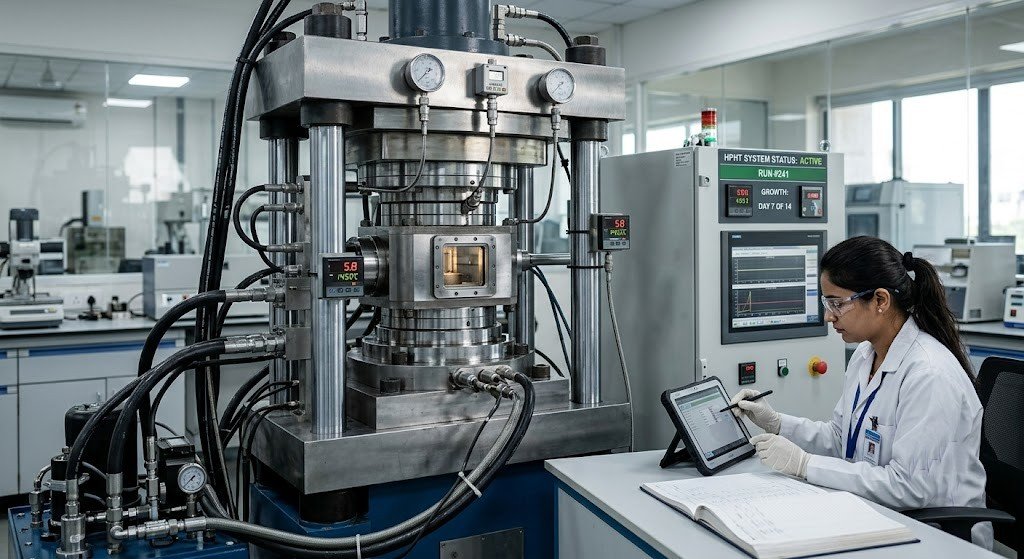
That can feel unsettling. It means whether a particular stone is really made from daughter ashes cannot be settled by examining the stone. It is settled, or not, by the record of what happened to her ashes from the moment they left your hands: who received them, how they were labeled, and whether they stayed separate at every stage. That record is called chain of custody documentation.

Which Documents Show a Stone Is Really Made From Daughter Ashes?

A set of records tracing her material from your hands to the finished stone. Ask for each by name.

  • A written order confirmation stating the quantity of ash required and the stone ordered.
  • A receiving record confirming arrival date, seal condition and intake weight.
  • A unique identifier assigned to her material and carried on every later record.
  • Process updates noting when extraction, graphitization and growth began for that identifier.
  • A written estimate of the personal carbon share for your order.
  • An origin or authenticity certificate linking the finished stone to the identifier and your submission.
  • A written answer on unused material: what is returned, stored or disposed of after extraction.

The origin certificate is usually issued in house, so its value depends on the records behind it; it is the paper trail, not the certificate alone, that shows a stone is really made from daughter ashes. An independent grading report is a separate, optional document describing quality rather than origin. How to turn your daughter’s ashes into a diamond covers when each record arrives in the wider process.

Honest Claims Versus Overclaims: How to Tell Them Apart

The quickest way to judge whether a stone offered to you is really made from daughter ashes is to listen to how the provider describes it. Honest language is specific and admits limits; overclaims are sweeping and leave nothing to check.

An honest provider saysAn overclaim sounds like
“Carbon recovered from her ashes is grown into the diamond alongside lab carbon.”“Your diamond is 100% her.”
“Expect around 10% to 15% of the stone to be her carbon; here is our estimate for your order.”“Every atom comes from your loved one.”
“No test on a finished diamond can identify a person; our custody records evidence origin.”“Our certificate scientifically proves it is her.”
“Color depends on trace elements; we cannot promise a specific shade.”“Her diamond will be the color that suits her.”
“Independent grading is available as an option.”“Every stone is certified,” with no detail about by whom.

The honest column is not less comforting. A family asking whether a stone is really made from daughter ashes gets a truthful yes from the left hand side and a promise that cannot be kept from the right.

 |A handwritten checklist of questions to ask a memorial diamond provider, next to a pen and envelope

What Red Flags Suggest a Provider Is Overpromising?

Most warning signs fall into three groups: purity claims, missing numbers and vague custody.

Purity claims. Any suggestion that a stone is entirely her carbon contradicts how the process works, however comforting it sounds.

Missing numbers. A provider that will not state in writing how much ash it needs, what share of the stone it expects to come from her, or what it does with leftovers is withholding exactly what you need to judge whether a stone is really made from daughter ashes.

Vague custody. Be wary of “your material is handled with care” with no description of how. A good provider can explain how a submission is labeled, logged, stored and tracked, and whether it is ever processed alongside another family’s. That record is the heart of whether a stone is really made from daughter ashes.

Smaller signals worth noticing:

  • Pressure to decide quickly, or a deadline tied to a discount
  • A certificate described as “scientific proof” of origin
  • No written policy on cancellation or on failed growth

How Do You Check a Stone Is Really Made From Daughter Ashes Before You Commit?

Ask in writing, compare answers, and keep everything. The goal is your own file of commitments before any of her remains leave your care.

Send each provider the same list: ash quantity, estimated personal carbon share for your size, how material is tracked, whether batches are ever combined, which documents you receive, what happens to unused ash, and cancellation terms.

Read the replies side by side. Specific numbers and named documents are a good sign; general reassurance is not. If a provider will show you a sample origin certificate or a blank custody log, the format tells you what is actually recorded about a stone really made from daughter ashes.

Keep copies of everything, including shipping receipts. The step by step guide to turning her ashes into a diamond shows where each of these checks falls in time.

Who Has the Right to Release Her Ashes?

It depends on your state, and it is not automatically her parents. There is no single national rule; each state sets its own order of priority over a person’s remains.

Marriage or a registered partnership usually puts that person at the head of the line, and children of hers who are grown can also take precedence over you. Should she have recorded her wishes in a directive, a will provision or a plan arranged ahead of time, those can displace the standard order.

Whatever her age, it is your state’s rule that decides. Parents do not always agree, and one parent arranging things alone is common; the funeral director who handled the cremation usually knows the local rule. Before any stone really made from daughter ashes is started, a trustworthy provider will ask for the signature of whoever holds that authority.

What Else Follows From the Real Numbers?

Once you accept that a stone really made from daughter ashes is partly her carbon, color, size and cost make more sense. The complete daughter ashes diamond guide covers each in depth.

Color. Nitrogen during growth gives yellow, boron gives blue, and colorless needs neither, which usually costs more. Cleaner starting carbon does not make the shade predictable. Irradiation for red, pink, green or black is optional. Choose a color for what it means to you, not by assumption. What color a diamond made from her ashes will be explores this further.

Size and time. Carat is set by growth time, not by how much ash you send. Stones run from about 0.10 to 5+ carats, typically taking 6 to 10 months, up to 12 for larger or specialty color stones.
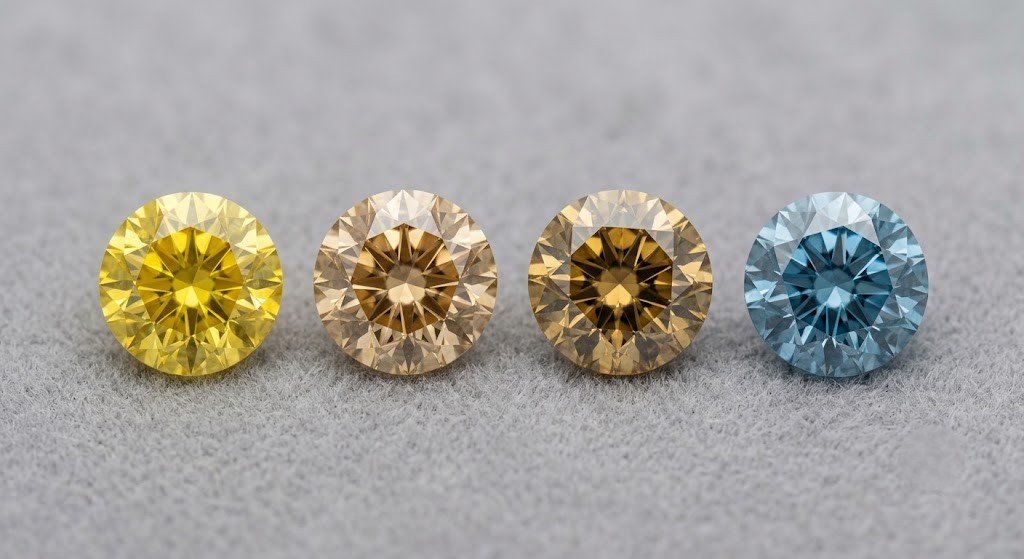
Cost. As general 2026 industry ranges, not any company’s price: roughly $1,500 to $3,500 for 0.10 to 0.25 carat, $5,000 to $15,000 for 0.5 to 1 carat, and $20,000 to $75,000+ for 2 to 5+ carats. Clarity usually falls between SI2 and VVS.

Hair instead. Hair is about half carbon by weight, though no finished stone share is published for it. Whether a memorial diamond is really made from her hair asks the same question of that route.

Frequently Asked Questions

Is a memorial diamond really made from daughter ashes, or only inspired by them?

Really made, in part. Carbon extracted from the portion of her ashes you send becomes part of the diamond’s crystal lattice alongside supplemental laboratory carbon. The stone is not a symbol or a coating; her atoms are physically present in it. Most industry descriptions put her share at roughly 10% to 15% of the finished mass, with some providers citing as little as 3%.

Could my daughter’s ashes be mixed up with someone else’s?

The risk depends on custody practices, so ask about them directly. A careful provider assigns a unique identifier to each submission, logs it on arrival, tracks it through every stage and never combines families’ material. Ask in writing whether batches are ever processed together and what records will show her material stayed separate throughout.

Why can’t a lab test the diamond to confirm the carbon is hers?

Because nothing identifying survives. Cremation destroys DNA, and a carbon atom from one person cannot be told apart from any other carbon atom for identification purposes. Testing can confirm a stone is a lab grown diamond and grade its quality, but not whether it is really made from daughter ashes. Origin rests on documented chain of custody instead.

Does sending more ash make more of the stone hers?

Not in a simple way. Extra ash can raise the amount of recoverable carbon, but the personal share also depends on how large a stone is grown, since bigger stones need more total carbon. Sending more does not shorten the wait or enlarge the diamond. Ask for an estimated share for the exact quantity and size you have in mind.

What happens to the ashes that are not used?

Policies differ, so ask before anything is sent. Leftover material may be sent back to you, kept by the provider for a set time, or disposed of respectfully once extraction is done, depending on the company. Only a small portion of a full cremation is usually requested, so the rest can stay in an urn, be scattered or be kept by family as planned. Get the answer in writing.

Is the origin certificate the same as a grading report?

No. An origin or authenticity certificate, usually issued in house, links the finished stone to the material you submitted. A grading report assesses cut, color, clarity and carat against the standard diamond quality factors, and having one done by an independent gemological laboratory is optional. The two answer different questions.

Is it still meaningful if only part of the stone is her carbon?

Many families find that it is, because the claim holds up when examined. A stone really made from daughter ashes exists because her carbon was recovered and grown into it, and that connection is real rather than symbolic. Whether a partial share feels like enough is personal, and a family can reasonably decide an urn, scattering or another keepsake suits them better.

Final Thoughts on Whether the Diamond Is Really Hers

Skepticism is not disloyalty. Asking whether a stone is really made from daughter ashes is one way families take care of her, and a good provider will welcome the question.

The honest answer is a qualified yes. A stone really made from daughter ashes holds a genuine portion of her carbon inside a real diamond, blended with laboratory material, and its origin rests on records rather than on any test of the stone. If those records are specific and consistent, you have good reason to believe what you hold. If they are vague, keep asking.

Learn More About Daughter Memorial Diamonds

Talk With Memorial Diamond

Memorial Diamond can be reached at memorialdiamond.us to talk through whether a stone really made from daughter ashes is right for your family, with no obligation.

Ash for a son memorial diamond measured into a small sealed transfer container beside a finished memorial stone

How Much Ash Do You Need for a Son Memorial Diamond?

Parents often brace themselves for a question far harder than the one they are actually being asked. The ash for a son memorial diamond is typically somewhere between a few tablespoons and roughly 4 oz, about 100 grams, which across the industry is usually only a small fraction of what a cremation produces. Requirements differ between companies, so the exact ash for a son memorial diamond your chosen laboratory wants is a question to put to them in writing before anything is opened or measured.

How Much Ash for a Son Memorial Diamond Is Usually Requested?

Industry wide, the quoted ash for a son memorial diamond runs from a few tablespoons up to roughly 4 oz, or about 100 grams. That is the general picture rather than any single company’s rule, and the ash for a son memorial diamond that one laboratory asks for may be noticeably different from what another wants.

For context, a full adult cremation generally produces several pounds of remains. Set against that, the ash for a son memorial diamond being requested is a modest portion, which is exactly why most families find the rest still available for whatever they had already planned.

What you are asking aboutThe industry typical answerWhere it varies
Minimum quantity usually requestedA few tablespoonsSome laboratories set a higher floor
Upper figure commonly quotedRoughly 4 oz, about 100 gramsLarger stones may prompt a larger request
Share of a full cremationA small fraction of the totalDepends on the individual cremation
Returned afterwardVaries by providerAsk whether unused material comes back
Effect on finished carat sizeNone, growth time sets sizeUniversal across the category
A few tablespoons of cremated remains weighed on a small kitchen scale next to a collection vial

Note the last row, because it undoes the assumption most parents arrive with. The ash for a son memorial diamond is a threshold to clear, not a dial to turn. The complete guide to a son ashes diamond sets the rest of the process around it.

Does Sending More Ash Make a Bigger Diamond?

No. This is the single most useful thing to understand before you handle an urn, and it saves a great deal of unnecessary anguish.

Carat size is a function of how long the crystal spends growing inside the press, not of how much ash for a son memorial diamond was submitted. A family that sends a full urn does not receive a larger stone, and does not receive it any sooner. The ash for a son memorial diamond only has to be enough to run the extraction successfully. Past that point, additional material has nowhere useful to go.

What actually determines size is a decision you make at the order stage, not the ash for a son memorial diamond in the envelope, and that decision sets the schedule. A larger stone means more months in the press, not more spoonfuls in the envelope.

So there is no hidden advantage in emptying the urn, and no disadvantage in keeping most of it. Sending the ash for a son memorial diamond that the laboratory asked for is the whole of the obligation. How his ashes become a diamond follows what happens to the material after it leaves you.

What Does a Few Tablespoons Actually Look Like?

Less than almost anyone pictures. A few tablespoons is roughly what would fit in a small jam jar, or in the hollow of two cupped hands, and it is worth having that image before you open anything, because the gap between the imagined amount and the real one is where most of the distress lives.

Cremated remains are heavier and coarser than the word “ashes” suggests. They are largely bone mineral, with a texture closer to coarse sand than to soot, so a given volume weighs more than you would guess from looking at it.

If you are sending by weight rather than volume, a kitchen scale is sufficient for the job. Most providers supply a container, a transfer kit and instructions, so measuring the ash for a son memorial diamond yourself may not even be necessary.

There is also no rule saying you have to do this part. Some parents ask a funeral director, a sibling or a friend to measure out the ash for a son memorial diamond instead, and that is an entirely reasonable request to make of someone.

How Much of the Finished Stone Is His Carbon?

Less than the sales language in this category sometimes implies, and the proportion does not rise with how much ash for a son memorial diamond you send.

Cremated remains are mostly calcium phosphate, the mineral structure of bone, and usable carbon amounts to roughly 0.5% to 4% of ash by weight, varying with the person and the cremation itself. So any portion of ash for a son memorial diamond yields only a little usable carbon relative to what it weighs. That recovered carbon is purified to about 99.9% or better, then blended with supplemental lab sourced carbon to reach the volume a growth run needs.

An HPHT diamond growth press with a sealed growth cell being loaded by a technician

On the ash route, the personal carbon recovered from cremated remains is generally described as making up somewhere around 10% to 15% of the finished stone’s mass. A few providers publish numbers as low as 3%, which shifts with the size of the stone and the amount sent. No stone is 100% him, and any company that says otherwise is overstating the physics.

That does not diminish what the object is. A real, traceable portion of his own carbon is built into the crystal lattice permanently, the stone exists because of him rather than merely in his memory. Whether the diamond is genuinely made from his ashes works through the verification side of that question.

What Happens to Everything You Keep?

Whatever you had already decided, in almost every case. Because the ash for a son memorial diamond is a fraction rather than the whole, the remainder stays available for burial, for scattering, for an urn at home, or for dividing among family.

That matters because cremation has become the majority choice in the United States, the national figures now put it above sixty percent, and many families have already made careful plans for where his remains will rest. A diamond does not have to displace any of that.

Some parents scatter at a place that mattered to him and keep a stone as well. Some inter most of the remains and commission from a small reserved portion. Some keep an urn on a shelf and wear the diamond daily. None of those is the correct answer, and none is a compromise of the others.

Ask your provider what happens to any ash for a son memorial diamond left over once extraction is complete. Policies genuinely differ, and whether unused ash comes back to you is worth knowing before you send it rather than afterward.

How Do You Take Ash for a Son Memorial Diamond Out of the Urn?

Carefully, and usually not alone. Most providers send a kit containing a sealed container, a scoop or funnel, labels and chain of custody paperwork, which makes measuring the ash for a son memorial diamond considerably less daunting than improvising with household items.

If the urn holding the ash for a son memorial diamond is sealed, do not force it. A funeral home will normally open and reseal an urn, and many will transfer a portion on your behalf. That is a routine request and worth making rather than working at a sealed lid at a kitchen table.

A provider's collection kit laid out with a sealed container, scoop, labels and chain-of-custody forms

Work on a flat surface with good light, over a tray or a sheet of paper so that nothing is lost. Cremated remains are often contained within an inner plastic bag inside the urn, which makes the transfer more manageable than families expect. Take it in stages if you need to; nobody is timing you, and there is no benefit to rushing a job you will only do once.

Label everything as you go, and keep the paperwork with the parcel. Chain of custody is how a laboratory can later document that the stone came from the ash for a son memorial diamond that you specifically sent. The step by step version of the whole process sets the sequence out in order.

Who Has the Right to Release His Ashes?

This is the practical question most likely to catch a parent off guard, and it is better raised early than discovered late.

Authority over a person’s remains generally follows a statutory order of priority that each state sets for itself. A surviving spouse or registered partner frequently holds it, and his own adult children may hold it ahead of his parents. Anything he set down in writing can change that order, and the detail is not uniform across the country.

In practice that means the person with authority is the one a laboratory will expect to sign for the ash for a son memorial diamond, even where a parent is the one doing all the arranging. If that is not you, the conversation to have is with them rather than with the provider.

It is also common for two parents to disagree about releasing ash for a son memorial diamond, or for one parent to be handling everything alone. Where the position is genuinely unclear, the funeral director who carried out the cremation will usually know how it works locally, and an attorney can confirm it. Whether more than one family member can have a stone covers the situation where several people each want one.

What If the Ashes Were Already Scattered or Interred?

Then the honest answer about ash for a son memorial diamond is that it depends on what is still accessible, and it is worth asking rather than assuming the door has closed.

Many families scatter most of the remains and keep a small quantity without ever planning to use it for anything in particular. If that describes you, there may already be enough ash for a son memorial diamond sitting in a keepsake urn or a sealed pouch.

Where nothing was kept, exhumation or recovery is rarely realistic, and no provider can promise otherwise. What is worth asking about instead is whether a lock of his hair exists anywhere, in a keepsake box, a baby book, a locket, since the hair route needs far less material and does not depend on cremation at all.

Some families send both, where both exist. A combined submission of ash and hair has its own quantity guidance, and it is a reasonable route where the reserved portion of ash is small.

Can More Than One Stone Come From the Same Portion?

Often, yes, and for families with several people who each want something, this is usually the more workable path.

Because only a portion of the remains is used in the first place, the ash for a son memorial diamond set aside can frequently support more than one growth run. Each stone still takes its own months in the press, so two diamonds generally means two schedules rather than one, and the cost is per stone.

There is a practical caution worth stating. Separate runs can produce visibly different results even from one shared submission, because conditions inside each growth cell vary. If matching stones matter to siblings or to two parents, raise that before commissioning rather than afterward.

Ask specifically how much additional ash for a son memorial diamond, if any, a second stone requires, and whether it can be grown from the same submission or needs a fresh one. That answer varies by provider and is worth having in writing.

What Does It Cost, and How Long Does It Take?

Neither figure is driven by how much ash for a son memorial diamond you send. Both are driven by the size of the stone you choose.

Across the category in 2026, and not as any one company’s published price: roughly $1,500 to $3,500 covers the 0.10 to 0.25 carat tier; roughly $5,000 to $15,000 covers half a carat to a full carat; and above two carats, figures start near $20,000 and can exceed $75,000. Colorless stones cost more than warm or blue ones of equal weight, while mountings, engraving, unusual cut shapes and an independent grading report are each priced on their own.

As for timing, the usual span across this industry runs from roughly six months to ten from the day material is received, stretching toward twelve for larger stones or specialty colors. Independent grading, where a family chooses to add it, assesses the same four quality factors applied to any diamond and is normally optional rather than standard.

What a son memorial diamond costs breaks those tiers down properly, including how the wait lengthens as the stone gets larger.

What Should You Ask Before You Measure Anything Out?

Get these answered before you open an urn, not after. Every one of them varies between providers, and none of them is an unreasonable question:

  1. Exactly how much ash for a son memorial diamond do you require, in grams or ounces?
  2. Do you supply a collection kit, and does it include chain of custody paperwork?
  3. Is unused material returned, and if so, when and how?
  4. What happens if the quantity I send turns out to be insufficient?
  5. Can a second stone be grown from the same submission later?
  6. What documentation will I receive linking the finished stone to what I sent?

If a provider is vague on any of these, that is information in itself. A company that handles remains properly will have clear, unhesitating answers, and will be willing to put them in an email rather than only saying them on a call.

One further point worth raising: ask whether the quantity of ash for a son memorial diamond changes at all with the carat size you select. The general position across the industry is that it does not, but a laboratory’s own answer is the one that governs your commission.

Frequently Asked Questions

Is a few tablespoons really enough?

Across the industry, yes, ash for a son memorial diamond typically starts around a few tablespoons and runs up to roughly 4 oz. Your provider’s own figure is what governs, so ask for it in writing before you measure or transfer anything.

Will sending the whole urn get me a larger stone faster?

No. Carat size depends on how long the crystal grows in the press, not on the quantity submitted, so a full urn produces neither a bigger diamond nor a shorter wait. Send the ash for a son memorial diamond that the laboratory actually asked for.

Can I keep the rest of his ashes?

Yes, and most families do. Because only a fraction is used, the remainder stays available for an urn, burial, scattering or division among relatives exactly as planned. Ask your provider separately whether unused material is returned after extraction.

What if the ashes are mixed with a pet’s or another person’s?

Tell the provider before sending anything. Policies on commingled remains vary, and this is a question of what that specific laboratory will accept rather than something with a single industry answer. Ask them directly and get the answer in writing.

Does it matter how long ago the cremation happened?

Ash for a son memorial diamond is mineral and chemically stable, so a long interval is not in itself an obstacle. Storage conditions and any contamination could still matter, so describe how and where the ashes have been kept when you first make contact.

Who has to sign for the ashes to be sent?

Usually whoever holds legal authority over his remains, which most states set by a statutory order of priority. A spouse, partner or his own adult children may rank ahead of parents, and written instructions can change it. Check locally.

Final Thoughts on How Much Ash a Memorial Diamond Needs

The part that surprises most parents is how small the answer is. Something that feels enormous to decide turns out to ask for a few spoonfuls, and nothing else.

It is worth sitting with that, because it means this is not an either or. The plot, the scattering place, the urn on the shelf, whatever you chose for him can stay exactly as it is, with a small reserved portion doing something different alongside it.

Ask the laboratory for its figure in writing, ask what comes back afterward, and then take that part slowly. The ash for a son memorial diamond is a measurement. What it becomes is not.

Learn More About Son Memorial Diamonds

Talk With Memorial Diamond

If you are standing in front of an urn trying to work out what is actually being asked of you, a straight answer helps more than a brochure does. Memorial Diamond can be reached at memorialdiamond.us to talk through quantities, paperwork and what happens to anything unused. There is no obligation attached to asking.

Partner ashes diamond complete guide featuring a memorial diamond, keepsake box and memorial urn

Partner Ashes Diamond: The Complete Guide

The word “partner” covers relationships that were never registered, never recognized by one family or both, or never fully known outside the two of you.

A partner ashes diamond is a real lab grown diamond, grown from carbon extracted out of a portion of your partner’s cremated remains, over six to ten months. The part that catches people out is not the science: it is standing, who is legally able to authorize what happens to the remains, which varies by state and by anything your partner left in writing, with no national rule.

A partner ashes diamond shown as a single loose polished stone held between finger and thumb in daylight

What Is a Partner Ashes Diamond, and What Is Actually in It?

A partner ashes diamond is a diamond in the full sense of the word, not a look alike, and not a capsule of ashes behind glass.

A partner ashes diamond is grown by the same method the wider lab grown industry uses, most commonly HPHT, which recreates conditions found deep in the Earth’s mantle at roughly 6 to 8 GPa and 1,400 to 2,500°C, around a tiny diamond seed. The general mechanics are described in the literature on high pressure high temperature and vapor deposition diamond growth. The stone that comes out has the same hardness, the same optical behavior and the same four grading factors as any other diamond. Nothing about a partner ashes diamond makes it a lesser stone.

What makes it a partner ashes diamond rather than an ordinary lab stone is the origin of some of its carbon. A cremation leaves the skeleton’s mineral framework behind, and that framework is calcium phosphate; the carbon worth recovering from it comes to roughly 0.5% to 4% of ash by weight, a figure that moves with the individual and with the cremation itself.

That fraction leads directly to the one honest qualification every family should hear before ordering. No growth run is filled by one person alone. The carbon recovered from your partner’s ashes is purified and then combined with lab grown carbon until there is enough feedstock to fill the cell, which is why the accurate description of a partner ashes diamond is a stone grown in part from them rather than a stone made entirely of them. Across the industry the personal fraction is usually put at somewhere around 10% to 15% of the finished stone’s mass.

That is a smaller number than most marketing around a partner ashes diamond implies, and a more defensible one, and it is worth knowing before a relative asks you about it. The doubt in full is handled in whether a memorial diamond is really made from your partner’s ashes.

Who Is Legally Able to Authorize a Partner Ashes Diamond?

This is the section that matters most in any partner ashes diamond decision, and the one most guides skip entirely.

There is no national rule. Authority over the disposition of a person’s remains in the United States is set state by state. The statutes differ in who ranks where, in what a written instruction can override, and in what happens when people at the same rank disagree. Anything that states one American answer is describing one state, or none.

In most states the priority order runs something like a legally recognized spouse or registered domestic partner first, then adult children, then parents, then siblings. A partner who was not married to them, and not registered in a state that provides for registration, may sit outside that list entirely, sometimes behind a parent who had not spoken to them in years, or a sibling who did not know the relationship existed.

That is not said to alarm anyone. It is said because the difficulty standing in front of a partner ashes diamond is procedural rather than personal, it is far easier to solve in the first week than the sixth, and three things genuinely change the picture.

  1. Anything your partner left in writing. A will clause, a disposition directive, a pre need arrangement, or, in states that provide for it, a formal appointment of an agent for remains. A written appointment is the single strongest thing that can exist here, and it is the first document to look for rather than the last.
  2. Whether your state recognizes a registered domestic partnership or civil union, and whether one exists. Recognition varies, and so does where a registered partner sits in the priority order.
  3. Whether whoever holds the statutory authority will agree. Where a parent or an adult child holds it, a partner ashes diamond becomes something to be asked for rather than decided, and the ask is much easier while the ashes are still with a funeral director than after they have been divided, interred or scattered.

Confirm your own state’s position with a lawyer or a funeral director if there is any chance of a dispute about a partner ashes diamond. This page is not legal advice and cannot be, the whole point is that the answer is local. The general shape of the question is covered in whether it is legal to turn ashes into a diamond.

If the answer is that the ashes route is closed to you, it is worth knowing that hair is a different material governed by a different set of facts. It needs no cremation, only a small lock, and it may already exist in a brush or an envelope in your own home. That route is covered in the complete guide to a partner hair diamond.

What to Do Early Rather Than Late

Almost everything about a partner ashes diamond gets harder with time, and none of these steps commits you to anything.

  • Find out who the remains were or will be released to, and write the name down. Funeral homes release to the person the statute points at. Knowing that name early tells you whether you are deciding or asking.
  • Ask whether a portion can be set aside now, before any interment, scattering or division. A partner ashes diamond typically uses only a fraction of a cremation, so setting a portion aside does not displace anyone else’s plans, but it has to happen before a date that may already be booked.
  • Look for anything written. A directive, a will clause, an agent appointment, a note. Ask the funeral director whether anything is on file; families often do not know what was lodged.
  • Put any agreement in writing, however informal. A text message saying a portion is being kept for you is worth having. This is not distrust; it is a record for a moment months away when people remember things differently.
  • Decide nothing about the partner ashes diamond itself yet, size, color, setting. Those decisions cost nothing to postpone and everything to rush. What cannot wait is the material.
  • If hair exists anywhere, a brush, a comb, an envelope, bag it and label it now. It costs nothing, it needs no cremation, and it keeps a second route open.

The full family side sequence of who to tell and when has its own treatment in how to talk to family about a partner memorial diamond, and the ordered version of the practical steps is in how to turn your partner’s ashes into a diamond.

How Is a Partner Ashes Diamond Actually Made?

A partner ashes diamond goes through seven stages, and only one of them is fast.

#StageWhat physically happensRoughly how long
1CollectionAshes are received and logged into a chain of custody record, which is the document trail linking your submission to the finished stoneDays
2Carbon extraction and purificationThe material is heated in a controlled, oxygen free, multi stage process that strips away calcium phosphate and everything else that is not carbon, reaching roughly 99.9%+ purityWeeks
3GraphitizationThe purified carbon is heated further, to roughly 2,500 to 2,700°C, and converted into graphite, the crystalline form a growth press can useDays to weeks
4GrowthGraphite, blended with supplemental lab carbon, sits in an HPHT cell with a diamond seed at roughly 6 to 8 GPa and 1,400 to 2,500°C while the crystal formsWeeks to months
5Cutting and polishingA gemologist cuts the rough crystal into the chosen shape. This is where carat weight is finally fixedDays to weeks
6Optional irradiationSome providers offer post growth treatment to shift or intensify color, producing red, pink, green or black stonesDays to weeks
7GradingThe finished stone is assessed against the standard four factors, ideally by an independent third party laboratoryWeeks
An HPHT growth press in a laboratory, with a technician recording a run | Stock acceptable short-term; a real growth-cell image is a genuine trust asset once available

Two things are worth carrying out of that table. Stage 4 is where a partner ashes diamond gets its size: carat is bought as growth time in the press, not as a larger scoop of ashes. And stages 2 and 3 are irreversible. Once the material has been purified and graphitized, it is carbon and nothing else, and no part of the original can be returned. Ask where that line sits in any provider’s process before you send anything. The stage by stage detail sits in how a memorial diamond is made from your partner’s ashes.

How Long Does a Partner Ashes Diamond Take?

A partner ashes diamond takes six to ten months across the industry, from receipt of material to a finished stone, with larger stones and specialty colors sometimes running to twelve.

The clock on a partner ashes diamond does not start when you decide. It starts when a laboratory receives the material, which means the weeks spent finding out who holds authority, or waiting for a family conversation to settle, cost you weeks rather than outcomes. That is worth knowing when someone tells you to hurry.

The wait is also not one wait. There is a short, busy, anxious stage at the front where things are being packed, sent and confirmed and you can act on them. Then there is a long, silent stage where nothing is asked of you and nothing visible happens, which most people find harder than they expect. Then there is a finishing stage with real decisions in it again, shape, and whether to have the stone set. The full breakdown is in how long a partner memorial diamond takes.

What Does a Partner Ashes Diamond Cost?

The price of a partner ashes diamond is driven by carat first, then by color, then by cut and by whether an independent grading report is included. These are general industry ranges for 2026 rather than any one company’s published prices.

TierTypical caratTypical industry rangeWhat is actually changing
EntryAbout 0.10 to 0.25 ctRoughly $1,500 to $3,500The shortest growth runs; the stone is small enough to read as a point of light rather than a gem
MidAbout 0.5 to 1 ctRoughly $5,000 to $15,000Substantially longer time in the press, and more process control; colorless costs meaningfully more than yellow, blue or champagne at the same size
Large or rareAbout 2 to 5+ ctRoughly $20,000 to $75,000+Long growth runs with a higher risk of an imperfect result, and specialty colors that add steps

Three things are commonly priced separately from a partner ashes diamond itself across the industry, and it is worth asking about each of them explicitly rather than assuming: an independent grading report, engraving, and the jewelry setting. Shipping and insurance on the outbound material are worth asking about too.

A partner ashes diamond is also one of the few purchases where paying more does not buy a faster result. A larger stone takes longer, not less time. The cost question in full is covered in how much a partner memorial diamond costs.

What Color Will It Be?

Nobody can tell you the color of a partner ashes diamond in advance, and any provider promising a precise shade is promising something the process does not deliver.

Tint is decided inside the growth cell, by whatever else happened to be in there alongside the carbon. Nitrogen at work in a forming crystal turns it yellow; boron turns it blue; colorless happens only where both have been kept out. A partner ashes diamond begins in an organic, personal, imperfect source rather than a clean synthetic feedstock, so those passengers come as standard, which is why memorial stones trend toward yellow, champagne, brown and blue rather than colorless, and why colorless costs more when it is achievable at all.

What you can do is settle a range rather than a point. Ask what shades this provider has actually produced from ash derived carbon, ask to see the palest and the deepest example of any named color, and decide in advance which end you would be content with. The forecasting question in full is in what color a diamond made from your partner’s ashes will be.

Memorial diamonds in yellow, champagne, brown and blue tones side by side under one light source

Settings and Who Will Know What It Is

Two practical points close out a partner ashes diamond order, and the second one is specific to this cluster.

A partner ashes diamond needs a mount chosen for survival rather than looks. A hand is the harshest environment a small stone ever lives in, and a raised setting finds every door frame and steering wheel. Diamond sits at 10 on the Mohs scale of mineral hardness and is not going to be scratched, but claws thin, bails open, and earrings are lost rather than broken. Ask what the piece has to survive before asking what it should look like. The options are set out in memorial diamond settings and jewelry ideas for a partner, and what gets recorded about a stone’s quality is explained in how gemologists assess cut, color, clarity and carat.

Write down what the stone is, somewhere outside the stone. This matters more when a relationship was not legally recognized or was not fully known, because the people who would ordinarily explain a piece of jewelry after your death may not be in a position to. An origin document, a grading report and a short signed note kept with them turn a partner ashes diamond from an unexplained ring into something whose story survives you. Say in that note who it is, what it is, and who you would want it to go to.

Frequently Asked Questions

Can I Get a Partner Ashes Diamond if We Were Not Married?

Possibly, but it depends on who holds authority over the remains, which varies by state and by anything your partner left in writing. There is no national rule. A written appointment of an agent for remains is the strongest thing that can exist here.

How Much of My Partner’s Ashes Does It Use?

Only a portion. A partner ashes diamond typically uses somewhere between a few tablespoons and around four ounces across the industry, rather than a full cremation. The rest can still be interred, scattered or kept exactly as planned, which answers a large share of family objections before they are raised.

Is a Partner Ashes Diamond a Real Diamond?

Yes. It is chemically and structurally a genuine diamond, grown by the same methods used across the lab grown industry, with the same hardness and the same grading factors. It is not a simulant, a resin or a diamond look stone.

What If My Partner’s Family Will Not Agree?

Then it becomes a request rather than a decision, and it is worth making that request early and in writing while the ashes are still with a funeral director. If the ashes route stays closed, hair is a separate material that needs no cremation at all.

Can More Than One Person Have a Stone From the Same Ashes?

Often, because each partner ashes diamond uses only a portion, so several can sometimes be grown from one shared source. That is far easier to agree before anything is submitted than to reopen afterward, so raise it at the start.

Can a Partner Ashes Diamond Be Made Years After the Cremation?

Yes. Cremated remains do not degrade in a way that rules this out, so ashes kept for years or decades can still be used. What matters is that they are genuinely the right remains and that whoever holds authority agrees to a portion being used.

What Happens to My Partner’s Ashes That Are Not Used?

They stay yours, or stay with whoever holds them, and every original plan for them remains available. A provider should be able to tell you exactly how much is required and confirm in writing what happens to any submitted material that is not consumed.

Final Thoughts on a Partner Ashes Diamond

Almost everything on this page is ordinary. The science is settled, the timeline is predictable, the cost shape is public, and the color is a range nobody can narrow to a point.

The part that is not ordinary is standing, and it is the part worth acting on first. Find out who can authorize a partner ashes diamond in your state, find out whether anything was written down, and ask for a portion to be set aside before a date arrives that closes the option. Everything else, size, shade, mount, engraving, can wait as long as you need it to.

Learn More About Partner Memorial Diamonds

Talk With Memorial Diamond

If you are still working out whether a partner ashes diamond is even available to you, that is a reasonable first question to ask out loud rather than research alone. Memorial Diamond can talk through what a provider would need and when, memorialdiamond.us.