
Doubt is a sensible reaction when someone offers to turn a portion of your daughter’s remains into a gemstone. So is a stone sold this way really made from daughter ashes? Yes, in part: carbon recovered from her cremated remains is purified and grown into the crystal, blended with laboratory carbon, and most industry descriptions put her share at roughly 10% to 15% of the finished diamond. What no one can do is prove that by testing the stone afterward, which is why the paperwork matters as much as the chemistry.
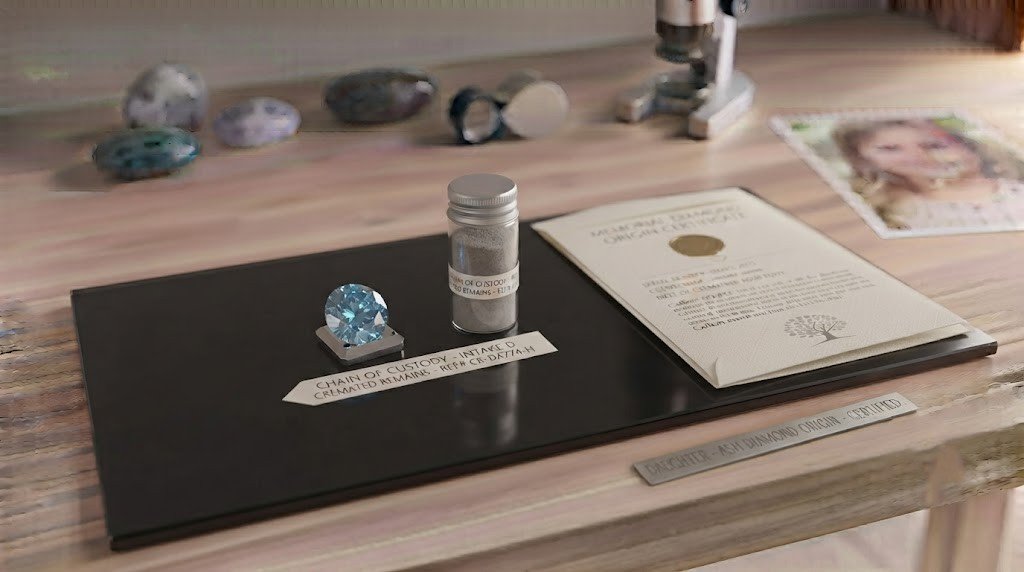
Table of Contents
Is a Stone Really Made From Daughter Ashes, or Is That a Sales Line?
It is a physical fact, not a metaphor, but a partial one. When a family asks whether a memorial stone is really made from daughter ashes, the accurate reply has two halves, and both deserve equal weight.
The first half: carbon atoms that were part of her body are extracted from the portion of ash you send, purified, converted to graphite and grown into the lattice of a real diamond. It is chemically identical to any other diamond.
The second half: those atoms are not the only carbon in the crystal. Cremated remains hold very little carbon, so laboratories top up the growth charge with carbon of their own. A stone really made from daughter ashes is therefore a stone made partly from her, and anyone claiming more is overstating it.
Neither half cancels the other. Families who learn how a stone is really made from daughter ashes usually find the honest version more meaningful, because it survives scrutiny. How a memorial diamond is made from her ashes walks through the laboratory stages in order.
How Much Carbon Is Left in Cremated Remains?
Very little. What comes back from a crematory is mostly bone mineral, chiefly calcium phosphate; much of the carbon in a living body leaves as gas during cremation itself.
Industry figures put the usable carbon remaining at somewhere between about 0.5% and 4% of the ash by weight. The spread depends on the individual and the cremation, and no provider can predict it in advance.
That one number explains nearly everything else about whether a diamond is really made from daughter ashes. A modest portion of ash at a few percent carbon yields fractions of a gram to a few grams of her carbon: enough to be genuinely present in a stone, rarely enough to grow one unaided.
It also explains why the quantity requested for a stone really made from daughter ashes is small. Most providers ask for somewhere between a few tablespoons and roughly 4 oz, around 100 grams, a fraction of what a full cremation returns. How much ash is needed for a daughter memorial diamond breaks those quantities down and explains what happens to the remainder.
Why Does a Laboratory Add Carbon of Its Own?
Because diamond growth needs a certain volume of feedstock, and a few grams of recovered carbon rarely meets it. Blending is driven by the physics, not a cost saving shortcut, and it is standard practice for a stone really made from daughter ashes.
As the industry describes it, the stages run like this:
- Extraction. The ash is heated in an oxygen free process that separates carbon from the minerals, reaching about 99.9% purity or better.
- Graphitization. The purified carbon is heated again, to roughly 2,500 to 2,700°C, and becomes graphite, the press’s feedstock.
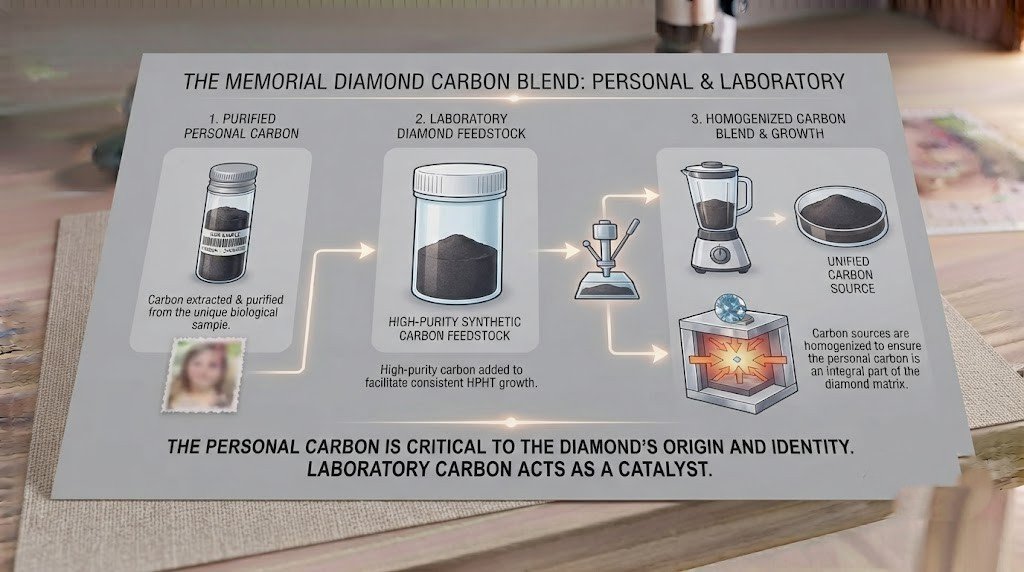
- Blending. Her graphite is combined with supplemental laboratory carbon until there is enough for the size of stone chosen.
- Growth. Most providers use high pressure and high temperature, around 6 to 8 GPa and between 1,400 and 2,500°C, with a tiny diamond seed; a minority use chemical vapor deposition. Both methods are summarized in this overview of lab grown diamond production.
- Cutting and finishing. A gemologist shapes and polishes the rough crystal.
Once blended, her carbon and the laboratory’s are chemically indistinguishable and grow into the lattice together. A diamond really made from daughter ashes carries her atoms spread through the whole stone.
What Share of a Diamond Really Made From Daughter Ashes Is Hers?
On the ash route, the figure most often quoted is around 10% to 15% of the finished stone’s mass. Some providers publish figures as low as about 3%, and a few cite higher ones, depending on stone size and ash submitted.
A bigger diamond needs more total carbon while her portion stays roughly fixed, so her share shrinks as the stone grows.
| Stage | What is present | Her carbon, roughly |
|---|---|---|
| Ash as sent | Mostly calcium phosphate and other minerals | About 0.5% to 4% of the ash by weight |
| After extraction | Purified carbon, about 99.9%+ | All of it recovered from her remains |
| After blending | Her graphite plus laboratory graphite | Depends on stone size and yield |
| Finished stone | A single diamond crystal | Commonly quoted at 10% to 15%; some cite as low as about 3% |
The practical step is to ask for the figure in writing for your specific order. For a stone really made from daughter ashes, a written estimate of her share at the size you are choosing is the closest thing to a promise worth having, and you can hold it against the table above.
Can Testing Prove a Diamond Is Really Made From Daughter Ashes?
No, and this matters more than anything else here: no laboratory test on a finished diamond can identify whose carbon it contains.
Cremation destroys the DNA in remains, so there is nothing genetic to find. And carbon from one person is, for identification purposes, the same element as carbon from anyone else or from a laboratory supply. A gemologist can confirm a stone is a grown diamond and grade it, but none of that reveals the origin of its atoms.
That can feel unsettling. It means whether a particular stone is really made from daughter ashes cannot be settled by examining the stone. It is settled, or not, by the record of what happened to her ashes from the moment they left your hands: who received them, how they were labeled, and whether they stayed separate at every stage. That record is called chain of custody documentation.
Which Documents Show a Stone Is Really Made From Daughter Ashes?
A set of records tracing her material from your hands to the finished stone. Ask for each by name.
- A written order confirmation stating the quantity of ash required and the stone ordered.
- A receiving record confirming arrival date, seal condition and intake weight.
- A unique identifier assigned to her material and carried on every later record.
- Process updates noting when extraction, graphitization and growth began for that identifier.
- A written estimate of the personal carbon share for your order.
- An origin or authenticity certificate linking the finished stone to the identifier and your submission.
- A written answer on unused material: what is returned, stored or disposed of after extraction.
The origin certificate is usually issued in house, so its value depends on the records behind it; it is the paper trail, not the certificate alone, that shows a stone is really made from daughter ashes. An independent grading report is a separate, optional document describing quality rather than origin. How to turn your daughter’s ashes into a diamond covers when each record arrives in the wider process.
Honest Claims Versus Overclaims: How to Tell Them Apart
The quickest way to judge whether a stone offered to you is really made from daughter ashes is to listen to how the provider describes it. Honest language is specific and admits limits; overclaims are sweeping and leave nothing to check.
| An honest provider says | An overclaim sounds like |
|---|---|
| “Carbon recovered from her ashes is grown into the diamond alongside lab carbon.” | “Your diamond is 100% her.” |
| “Expect around 10% to 15% of the stone to be her carbon; here is our estimate for your order.” | “Every atom comes from your loved one.” |
| “No test on a finished diamond can identify a person; our custody records evidence origin.” | “Our certificate scientifically proves it is her.” |
| “Color depends on trace elements; we cannot promise a specific shade.” | “Her diamond will be the color that suits her.” |
| “Independent grading is available as an option.” | “Every stone is certified,” with no detail about by whom. |
The honest column is not less comforting. A family asking whether a stone is really made from daughter ashes gets a truthful yes from the left hand side and a promise that cannot be kept from the right.
What Red Flags Suggest a Provider Is Overpromising?
Most warning signs fall into three groups: purity claims, missing numbers and vague custody.
Purity claims. Any suggestion that a stone is entirely her carbon contradicts how the process works, however comforting it sounds.
Missing numbers. A provider that will not state in writing how much ash it needs, what share of the stone it expects to come from her, or what it does with leftovers is withholding exactly what you need to judge whether a stone is really made from daughter ashes.
Vague custody. Be wary of “your material is handled with care” with no description of how. A good provider can explain how a submission is labeled, logged, stored and tracked, and whether it is ever processed alongside another family’s. That record is the heart of whether a stone is really made from daughter ashes.
Smaller signals worth noticing:
- Pressure to decide quickly, or a deadline tied to a discount
- A certificate described as “scientific proof” of origin
- No written policy on cancellation or on failed growth
How Do You Check a Stone Is Really Made From Daughter Ashes Before You Commit?
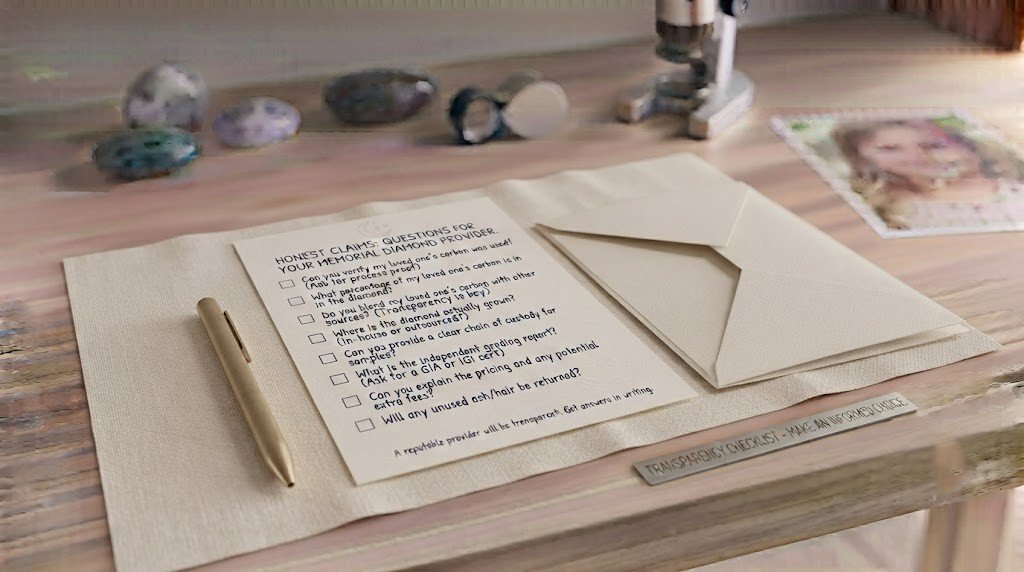
Ask in writing, compare answers, and keep everything. The goal is your own file of commitments before any of her remains leave your care.
Send each provider the same list: ash quantity, estimated personal carbon share for your size, how material is tracked, whether batches are ever combined, which documents you receive, what happens to unused ash, and cancellation terms.
Read the replies side by side. Specific numbers and named documents are a good sign; general reassurance is not. If a provider will show you a sample origin certificate or a blank custody log, the format tells you what is actually recorded about a stone really made from daughter ashes.
Keep copies of everything, including shipping receipts. The step by step guide to turning her ashes into a diamond shows where each of these checks falls in time.
Who Has the Right to Release Her Ashes?
It depends on your state, and it is not automatically her parents. There is no single national rule; each state sets its own order of priority over a person’s remains.
Marriage or a registered partnership usually puts that person at the head of the line, and children of hers who are grown can also take precedence over you. Should she have recorded her wishes in a directive, a will provision or a plan arranged ahead of time, those can displace the standard order.
Whatever her age, it is your state’s rule that decides. Parents do not always agree, and one parent arranging things alone is common; the funeral director who handled the cremation usually knows the local rule. Before any stone really made from daughter ashes is started, a trustworthy provider will ask for the signature of whoever holds that authority.
What Else Follows From the Real Numbers?
Once you accept that a stone really made from daughter ashes is partly her carbon, color, size and cost make more sense. The complete daughter ashes diamond guide covers each in depth.
Color. Nitrogen during growth gives yellow, boron gives blue, and colorless needs neither, which usually costs more. Cleaner starting carbon does not make the shade predictable. Irradiation for red, pink, green or black is optional. Choose a color for what it means to you, not by assumption. What color a diamond made from her ashes will be explores this further.
Size and time. Carat is set by growth time, not by how much ash you send. Stones run from about 0.10 to 5+ carats, typically taking 6 to 10 months, up to 12 for larger or specialty color stones.
Cost. As general 2026 industry ranges, not any company’s price: roughly $1,500 to $3,500 for 0.10 to 0.25 carat, $5,000 to $15,000 for 0.5 to 1 carat, and $20,000 to $75,000+ for 2 to 5+ carats. Clarity usually falls between SI2 and VVS.
Hair instead. Hair is about half carbon by weight, though no finished stone share is published for it. Whether a memorial diamond is really made from her hair asks the same question of that route.
Frequently Asked Questions
Is a memorial diamond really made from daughter ashes, or only inspired by them?
Really made, in part. Carbon extracted from the portion of her ashes you send becomes part of the diamond’s crystal lattice alongside supplemental laboratory carbon. The stone is not a symbol or a coating; her atoms are physically present in it. Most industry descriptions put her share at roughly 10% to 15% of the finished mass, with some providers citing as little as 3%.
Could my daughter’s ashes be mixed up with someone else’s?
The risk depends on custody practices, so ask about them directly. A careful provider assigns a unique identifier to each submission, logs it on arrival, tracks it through every stage and never combines families’ material. Ask in writing whether batches are ever processed together and what records will show her material stayed separate throughout.
Why can’t a lab test the diamond to confirm the carbon is hers?
Because nothing identifying survives. Cremation destroys DNA, and a carbon atom from one person cannot be told apart from any other carbon atom for identification purposes. Testing can confirm a stone is a lab grown diamond and grade its quality, but not whether it is really made from daughter ashes. Origin rests on documented chain of custody instead.
Does sending more ash make more of the stone hers?
Not in a simple way. Extra ash can raise the amount of recoverable carbon, but the personal share also depends on how large a stone is grown, since bigger stones need more total carbon. Sending more does not shorten the wait or enlarge the diamond. Ask for an estimated share for the exact quantity and size you have in mind.
What happens to the ashes that are not used?
Policies differ, so ask before anything is sent. Leftover material may be sent back to you, kept by the provider for a set time, or disposed of respectfully once extraction is done, depending on the company. Only a small portion of a full cremation is usually requested, so the rest can stay in an urn, be scattered or be kept by family as planned. Get the answer in writing.
Is the origin certificate the same as a grading report?
No. An origin or authenticity certificate, usually issued in house, links the finished stone to the material you submitted. A grading report assesses cut, color, clarity and carat against the standard diamond quality factors, and having one done by an independent gemological laboratory is optional. The two answer different questions.
Is it still meaningful if only part of the stone is her carbon?
Many families find that it is, because the claim holds up when examined. A stone really made from daughter ashes exists because her carbon was recovered and grown into it, and that connection is real rather than symbolic. Whether a partial share feels like enough is personal, and a family can reasonably decide an urn, scattering or another keepsake suits them better.
Final Thoughts on Whether the Diamond Is Really Hers
Skepticism is not disloyalty. Asking whether a stone is really made from daughter ashes is one way families take care of her, and a good provider will welcome the question.
The honest answer is a qualified yes. A stone really made from daughter ashes holds a genuine portion of her carbon inside a real diamond, blended with laboratory material, and its origin rests on records rather than on any test of the stone. If those records are specific and consistent, you have good reason to believe what you hold. If they are vague, keep asking.
Learn More About Daughter Memorial Diamonds
- The laboratory process behind a diamond from her ashes each stage, in order
- The complete guide to a daughter ashes diamond the whole picture in one place
- How much ash a daughter memorial diamond needs quantities and what stays behind
- Turning her ashes into a diamond, step by step where the custody checks fall
- What color to expect from her ashes trace elements and optional treatments
Talk With Memorial Diamond
Memorial Diamond can be reached at memorialdiamond.us to talk through whether a stone really made from daughter ashes is right for your family, with no obligation.
Leave A Comment