Ashes and Hair Into a Diamond

Step by Step: Turning Your Brother’s Ashes and Hair Into a Diamond

Some families hold two things that feel like him: a portion of his ashes and a lock of his hair, kept separately and both precious. The brother ashes hair diamond steps bring them together in a clear sequence: confirm consent for each material, check that a provider accepts a combined order, sign, send both with tracking, and let a lab grow and grade the stone, typically over 6 to 10 months.
brother ashes hair diamond steps

Table of Contents

What Are the Brother Ashes Hair Diamond Steps, in One Table?

Combining two materials adds a couple of checkpoints, so the brother ashes hair diamond steps run to eleven rows rather than the nine or ten of a single material order. The extra rows exist for a good reason: each material needs its own consent and its own careful packing. Print this table and use it as your master checklist.

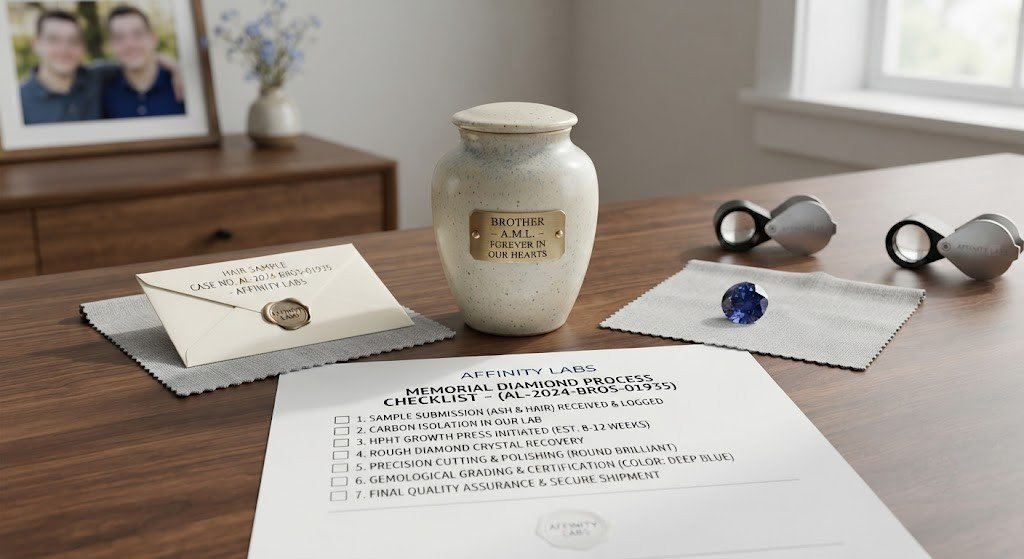
StepWhat happensWho is involvedWhat you needDocument that results
1Decide whether ashes and hair share one stone or become separate stonesYou and close familyA sense of what the family wantsA short written decision
2Establish whose decision the ashes areYou and his next of kin, with the funeral home if neededHis will, pre need plan, or named agent, if anySigned consent for the ashes portion
3Confirm who can release the hairYou and his estate representative or authority holderKnowing where the hair was keptWritten consent covering the hair
4Check that providers accept a combined orderYou and a few providersYour blend question sheetWritten confirmation, information packs, quotes
5Settle the stone’s specification and signYou and the provider you pickedBudget range and preferencesSigned order naming both materials
6Measure out the ashes portionWhoever holds authority, or crematory staffThe provider’s stated amountLabeled ashes container
7Prepare the hairYou or whoever holds the lockA small lock or a few gramsLabeled, sealed hair packet
8Send both materials by tracked serviceYou and a carrierPacking directions from the providerPostage receipt, tracking details, custody form covering both
9Lab logs both and extracts, purifies, and graphitizes the carbonIntake staff and techniciansNothing; the lab takes overReceipt confirmation naming both materials
10Growth in the press, then cutting and polishingLab team and gemologistPatienceProgress notes where offered
11Grading, certification, and the journey homeThe provider, an outside grading lab if chosen, a jeweler for settingAn address and your setting decisionOrigin certificate naming both sources, grading report, delivery record

Read down the right hand column and you’ll see why this format helps. Every one of the brother ashes hair diamond steps hands you a document, and with two materials in play, those documents are what keep the ashes and the hair traceable from your home to the finished stone.

For background on why some families combine both materials, the complete guide to a brother ashes hair diamond covers the reasoning and the science in depth.

What Should Be on Your Printable Prep List?

With two materials, it pays to gather everything before the first phone call. This list is built to print and tick; keep it inside the folder that will eventually hold every document the brother ashes hair diamond steps create.

  • Where each material is right now: the urn or container holding his ashes, and the envelope or box holding the hair.
  • Who holds authority over his remains, and who administers his estate, if those are different people.
  • Any written wishes he left, including a will, a pre need plan, or a named agent.
  • Funeral home or crematory contact details, in case they need to release or measure a portion.
  • Copies of cremation paperwork, if available, should a provider request them.
  • A blend question sheet asking how the provider combines ashes and hair and what records they issue.
  • A budget range for carat and color decisions.
  • Two labels and two clean, sealable containers, one for each material, unless the provider supplies them.
  • Time for a family conversation, since two materials can mean two sets of feelings.

Keep the ashes and hair apart until the provider tells you how to pack them. Mixing them yourself makes it harder for the lab to document each one during the later brother ashes hair diamond steps.

Steps 1 4: Which Brother Ashes Hair Diamond Steps Come First?

The first four brother ashes hair diamond steps are decisions and conversations. Nothing is shipped yet; instead, you’re making sure both materials are yours to send and that a provider can actually work with them together.

Step 1: Decide on One Combined Stone or Separate Stones

Start with the shape of the plan. Does the family want a single diamond grown from both materials, or one stone from his ashes and another from his hair? Neither is more correct. A combined stone holds both in one crystal, while separate stones can go to different relatives.

Talk it through with the people closest to him, and write down what you decide so the rest of the brother ashes hair diamond steps follow from it.

What goes in the folder: a short written note of the decision and who will receive the stone or stones.

Step 2: Confirm Who Holds Authority Over His Ashes

A sibling may not be the person who decides what happens to his ashes. That depends on the state. Siblings frequently rank behind a spouse or registered partner, adult children, and parents, and his own written wishes (a designated agent, a pre need plan, or a will) can reshape the order. If someone else holds authority, ask them, gently and directly, for a small portion. Settling this early keeps the brother ashes hair diamond steps from stalling later.

What goes in the folder: written consent from the authority holder covering the ashes portion.

Step 3: Confirm Who Can Release the Hair

Consent for ashes doesn’t automatically cover the hair. A lock kept at home or among his belongings may form part of his estate, with rules that vary by state, while a lock the funeral home trimmed generally comes back through the person with authority over his remains. The estate representative and the authority holder may be different people, so you might need two signatures.

Treat this as its own row among the brother ashes hair diamond steps, even if it feels like a formality.

What goes in the folder: written consent covering the hair.

Step 4: Check That Providers Accept a Combined Order

Not every provider handles ashes and hair together, so ask before anything else. How do they combine the two carbon sources? Do they need the same quantity of each as they would for a single material stone? Will the origin certificate name both? What happens to unused material, and what if growth fails? The set of brother ashes hair diamond questions is a good sheet to print for these calls, and the answers will shape the remaining brother ashes hair diamond steps.

What goes in the folder: each provider’s written confirmation that it accepts a combined order, plus information packs and quotes.

Steps 5 8: How Are Both Materials Prepared and Shipped?

These four brother ashes hair diamond steps move the plan from paper to parcel. Precision matters here, since two materials mean two sets of labels and one chain of custody that must account for both.

Step 5: Choose the Stone’s Details and Sign

Pick a carat size, a color direction, and a cut. Size depends on how long the diamond grows rather than on how much material you send, so carat is the choice that sets both price and schedule. Color comes from trace elements during growth: nitrogen tends toward yellow, boron toward blue, and colorless means excluding both. The exact shade can’t be forecast from either material; the guide to brother ashes hair diamond color explains the chemistry.

Signing is the point where the brother ashes hair diamond steps become a firm commitment. Before you sign, confirm the agreement names both materials and states the provider’s terms on shipping, unused material, and unsuccessful growth.

What goes in the folder: the signed order agreement listing ashes, hair, and the stone specification.

Step 6: Set Aside the Ashes Portion
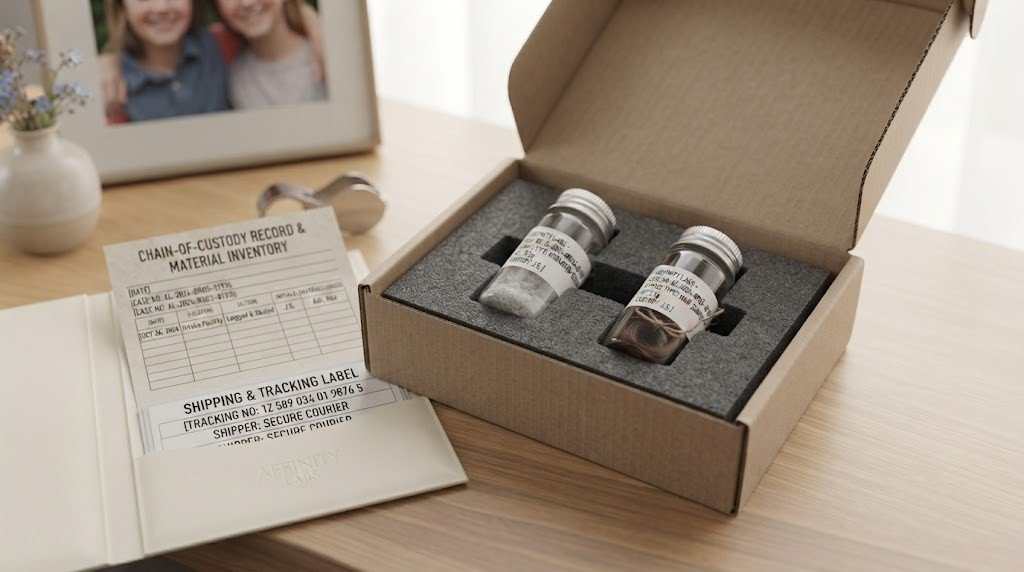
For a single material ashes stone, industry typical needs range from a few tablespoons up to about 4 oz (roughly 100 g); a combined order may differ, so follow the provider’s figure. Our breakdown of how much ash and hair a brother memorial diamond needs walks through each quantity side by side. The authority holder should release this portion or approve it in writing, just as at Step 2 of the brother ashes hair diamond steps.

What goes in the folder: a labeled, sealed container and, if requested, a copy of the cremation paperwork.

Step 7: Prepare the Hair

Step 7 is often the gentlest of the brother ashes hair diamond steps. Hair needs far less material: typically a small lock or a few grams. Ask the provider whether the hair should arrive exactly as kept or prepared in any way, then place it in its own clean, dry, sealed packet and label it clearly. Keep it physically separate from the ashes unless the provider says otherwise.

What goes in the folder: a note describing the hair’s source, and a photo of the labeled packet.

Step 8: Ship Both Materials With Tracking

Follow the provider’s packing instructions exactly, whether they want both items in one box or in separate shipments. Use a tracked service, keep every receipt, and photograph the sealed package. Rules for sending cremated remains are worth confirming before you pack, so ask the provider which carrier and service it recommends. Of all the brother ashes hair diamond steps, this is where a missing receipt would hurt most.

What goes in the folder: shipping receipt or receipts, tracking numbers, and a chain of custody form listing both materials.

Steps 9 11: Which Brother Ashes Hair Diamond Steps Take Place in the Lab?

Once the parcel arrives, the remaining brother ashes hair diamond steps are in the hands of lab staff. The science is the same as for a single material, applied to two inputs.

Step 9: The Lab Logs Both Materials and Extracts the Carbon

The provider should confirm receipt of both the ashes and the hair and assign references that tie each to your order. Ask whether each material gets its own reference number, since that detail carries through the rest of the brother ashes hair diamond steps.

The two materials carry very different amounts of carbon. Cremated remains are mostly calcium phosphate, with usable carbon at roughly 0.5% to 4% of ash by weight. Hair is about 50% carbon by weight, since it’s built from keratin. Each material is heated in a controlled, oxygen free, multi stage process to strip away everything that isn’t carbon, reaching roughly 99.9% purity or more, and the carbon is then converted to graphite at around 2,500 2,700°C.

What goes in the folder: a receipt confirmation that names both materials.

Step 10: The Diamond Is Grown, Cut, and Polished
Next, supplemental lab carbon is typically added to the graphite, and the mix is grown around a tiny diamond seed. HPHT, the industry standard method, squeezes the carbon at about 6 8 GPa while holding temperatures between 1,400 and 2,500°C; a minority of providers use CVD. Growth runs weeks to months. Wikipedia’s synthetic diamond article describes both techniques. A gemologist then cuts and polishes the crystal, and some providers offer optional irradiation for red, pink, green, or black tones.

How much of a blended stone is his? Honestly, no one publishes a finished stone percentage for hair or for combined stones. The commonly quoted 10 15% applies to ash derived carbon alone. The detailed process piece on a memorial diamond made from brother ashes and hair explores this further.

What goes in the folder: any progress notes the provider shares during these lab side brother ashes hair diamond steps.

Step 11: Grading, Certification, and Delivery

The last of the brother ashes hair diamond steps puts the final records in your hands:

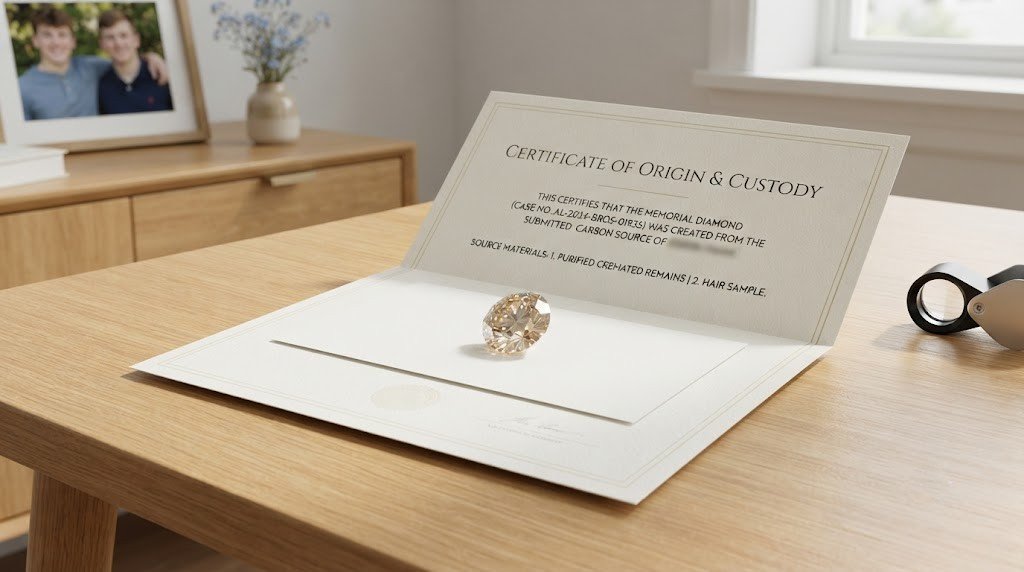
  • An origin certificate, usually issued in house, documenting that the stone was grown from the materials you submitted. Ask at Step 4 whether it will name both the ashes and the hair.
  • An independent grading report, if ordered, recording cut, color, clarity, and carat to standards such as GIA’s or IGI’s. See GIA’s overview of diamond quality factors for what each grade measures.

Memorial diamonds typically grade SI2 to VVS for clarity. Diamonds rate 10 on the Mohs hardness scale, though a hard knock can still chip one. Settings range widely, from a ring or pendant to earrings, a bracelet, or a loose stone in a case, whichever suits the person who will hold it.

What goes in the folder: the origin certificate, grading report if ordered, and delivery confirmation.

How Long Do the Brother Ashes Hair Diamond Steps Take, and What Is the Typical Cost?

Across the industry, completing the brother ashes hair diamond steps typically takes 6 to 10 months from the lab receiving the materials to the finished stone, and stones over roughly 2 carats or in specialty colors can run up to about 12 months. Expect a single overall estimate rather than a date for each step, because the carat you choose sets the growth period.

Price is driven by size and color. These are general 2026 industry ranges, not this brand’s pricing:

Size bandBroad industry priceNote
Roughly 0.10 0.25 ct1,500 3,500Entry level
0.5 1 ct5,000 15,000Colorless toward the higher end
2 5+ ct20,000 75,000+Longest growth

Independent grading, engraving, fancy cuts, and settings are commonly extra, and a combined order may carry its own pricing, so ask. The guide to brother memorial diamond cost goes deeper, and the narrative walk through of how you can turn brother ashes and hair into a diamond covers the same path as a story.

How Do You Keep Two Materials’ Paperwork Straight?

Two materials double the chance of a mix up, so file the records from the brother ashes hair diamond steps in a fixed order. Matching the folder to the eleven rows makes any missing page obvious:

  1. Written decision on one stone or several
  2. Consent covering the ashes
  3. Consent covering the hair
  4. Provider confirmation of combined orders, packs, and quotes
  5. Signed order naming both materials
  6. Ashes container label and cremation paperwork copy, if requested
  7. Hair source note and packet photo
  8. Shipping receipts, tracking, and chain of custody form
  9. Lab receipt confirmation for both materials
  10. Growth and cutting notes
  11. Origin certificate, grading report, and delivery confirmation

Scan it all once the stone is home. If any relative receives a stone from the same materials, pass along copies of the records for that diamond.

Where Do the Brother Ashes Hair Diamond Steps Tend to Slow Down?

A combined order has a few extra points where things can pause. Spotting them early keeps the brother ashes hair diamond steps on track.

  • Two consents, one missing. Ashes and hair may need sign off from different people.
  • A provider that doesn’t combine materials. Confirm at Step 4, before any money changes hands.
  • Unclear certificate wording. Ask whether the origin certificate will name both sources.
  • Packing confusion. Follow the provider’s instructions on one box or two.
  • Unwritten policies. Unused material and failed growth terms vary; get them on paper.
  • Expectations about size or color. Carat comes from growth time, and shade can’t be predicted from either material.

None of these should put you off. They’re simply questions worth settling before the parcel leaves home and the brother ashes hair diamond steps move into the lab.

Frequently Asked Questions

How many brother ashes hair diamond steps are there?

This checklist has eleven: deciding on one stone or several, two separate consents, confirming a combined order, signing, preparing ashes, preparing hair, shipping, lab intake and extraction, growth and cutting, then grading and delivery. Providers may group these differently.

Does every provider accept ashes and hair in one diamond?

Not necessarily. Whether a provider combines both materials, and how it documents each, varies. Ask early, get written confirmation, and check that the origin certificate will reference both the ashes and the hair before signing any order agreement.

Do I need separate permission for the ashes and the hair?

Often, yes. Who decides about his ashes depends on the state and on any written wishes he left, and siblings may not come first. Hair kept at home may belong to his estate, which also varies by state. Get written consent for each material.

How much of a combined diamond comes from my brother?

No finished stone percentage is published for hair or combined stones. The often quoted 10 to 15 percent describes ash derived carbon alone. What you can count on is that purified carbon from both materials is grown into the crystal, typically alongside supplemental lab carbon.

Should I mix the ashes and hair before sending them?

Not unless the provider asks you to. Keep each material in its own labeled container and ask how the lab wants them packed. Holding them apart until then makes each one easier to document and keeps the chain of custody clear.

Will combining hair with ashes change the diamond’s color?

Not predictably. Color depends on trace elements present during growth, with nitrogen producing yellow and boron producing blue. The exact shade cannot be forecast from ashes, hair, or a mix of both, and colorless stones need extra processing.

Final Thoughts on Turning Your Brother’s Ashes and Hair Into a Diamond

There is no deadline on any of this. His ashes and his hair will keep while the family talks, and a pause between rows is part of the brother ashes hair diamond steps, not a failure of them. When the stone does arrive, it can sit beside the urn, the photos, and the stories you already share, one more way of keeping him close.

Learn More About Each Stage of a Combined Order

Talk With Memorial Diamond

If you’re weighing whether to combine your brother’s ashes and hair, or you’d like help with any of the brother ashes hair diamond steps above, Memorial Diamond is here to talk it through. Reach out at memorialdiamond.us to explore what’s possible for your family.

Word count: 3,215 words · Reading time: about 16 minutes
Brother Ashes Hair Diamond Questions 22 Calm Expert Checks

Questions to Ask Before Turning Your Brother’s Ashes and Hair Into a Diamond

Wanting both his ashes and a lock of his hair in one stone can feel like trying to hold all of him at once. The brother ashes hair diamond questions that matter most cover three things: why you want both materials, who must agree to releasing each one, and how a provider combines, tracks, prices, and grows them, including what happens if one material falls short. The 22 below each come with the reason to ask and what a reassuring answer sounds like.

brother ashes hair diamond questions

Table of Contents

Why Do Brother Ashes Hair Diamond Questions Need Extra Care?

A combined stone involves two materials that reach you by different routes, carry different amounts of carbon, and may need agreement from different people. Cremated ashes hold only about 0.5 to 4 percent carbon by weight, while hair is roughly 50 percent carbon. A provider that accepts both has to explain how it handles each, and the brother ashes hair diamond questions you ask should test that explanation from start to finish.

A memorial diamond is a genuine lab grown diamond grown in part from a person’s own recovered carbon; the memorial diamond article on Wikipedia traces how the category developed. Policies on combining materials, returns, refunds, and failed growth belong to each provider and differ widely. This guide does not state any company’s terms, ours included.

What it does offer is a structured list of brother ashes hair diamond questions, arranged by who you ask. Before diving in, the brother ashes hair diamond complete guide explains the full process, which can make every answer below easier to judge.

Which Brother Ashes Hair Diamond Questions Should You Ask Yourself?

Start here, alone or with whoever you share this decision with. These three answers steer everything else.

1. Why do you want both materials rather than one?

Why it counts: For some people, including both feels more complete; for others, it is about honoring a particular memory tied to his hair. Knowing your reason helps you decide how firmly to insist on both if a provider suggests one material would be simpler.

A reassuring answer: A sentence that explains the choice to you, such as “the hair is from a time I want to remember, and the ashes are him now.” Clarity, not eloquence, is the goal.

2. Will this be one stone, or should several people receive one?

Why it counts: Since only part of each material is used, more than one stone may be possible from the same ashes and hair. Other siblings, parents, and anyone else close to him, including a partner or children if he had them, may each hope for a stone. The article on sharing a brother memorial diamond explores how families plan this together.

A reassuring answer: A shared list of who wants a stone, agreed before any material is divided.

3. What budget and how many months of waiting feel manageable?

Why it counts: Industry pricing for 2026 sits around $1,500 to $3,500 for roughly 0.10 to 0.25 carat, between $5,000 and $15,000 from half a carat to a full carat, and from $20,000 to beyond $75,000 once you reach 2 carats. Settings, grading, engraving, and fancy cuts are usually added on. Expect a typical wait of 6 to 10 months. The brother memorial diamond cost guide walks through each tier.

A reassuring answer: A firm upper figure that already allows for extras, and a sense that a wait of most of a year feels acceptable.

Which Brother Ashes Hair Diamond Questions Go to the People Who Decide?

With two materials, there may be two separate conversations. Approach both with patience, because the people involved are grieving too.

4. Who holds authority over his cremated remains?

Why it counts: Siblings frequently are not first in line. A spouse or registered partner, adult children, and parents commonly hold that role before siblings, but every state sets its own order, and if he named someone to decide or left instructions on paper, that can change who has the final word.

A reassuring answer: You know who decides, and whether anything he put in writing addresses his ashes. The funeral home or crematory that handled his care may be able to point you to the rules where you live.

5. Who has a say over his hair?

Why it counts: A lock saved at home or tucked among his belongings could be treated as belonging to his estate, and states differ on how that works. When a funeral home trimmed his hair, release generally goes through the person with authority over his remains. The person for the hair may or may not be the person for the ashes.

A reassuring answer: A clear picture of who is responsible for each material, and confirmation that both people are comfortable.

6. Would they each agree to release a small portion?

Why it counts: Providers typically ask for between a few tablespoons and about 4 oz (around 100 g) of ashes, and a small lock or a few grams of hair, though every provider sets its own minimum. The guide to how much ash and hair a brother memorial diamond needs explains these ranges.

A reassuring answer: Agreement for each material, the amounts written down, and ideally a brief signed note. If only one is offered, a single material stone is still a meaningful option.

7. How does the diamond fit with plans for the rest, and with faith?

Why it counts: Keeping an urn, burying the ashes, or scattering them are all valid choices that can continue alongside a diamond. No faith tradition has an official position on memorial diamonds specifically, and views on cremation and dividing remains differ between and within traditions.

A reassuring answer: A family plan everyone knows about, and a conversation with your own faith leader where faith matters to the family.

Which Brother Ashes Hair Diamond Questions Reveal How Both Are Combined?

This is where brother ashes hair diamond questions differ most from single material lists. Ask every provider these three directly.

8. Will both materials go into one stone, or into separate stones?

Why it counts: Some families picture a single diamond carrying carbon from both sources; others are happy with a matching pair. What a provider can offer is its own decision, so ask rather than assume.

A reassuring answer: A plain description of what the provider does with ashes and hair submitted together, and at what point in the process the carbon from each is brought together, if it is. Of all brother ashes hair diamond questions, this one shapes what you are actually ordering.

9. How much of each material is needed for a combined order?

Why it counts: A combined order may call for different amounts than either material alone. You may have plenty of ashes and very little hair, or the reverse.

A reassuring answer: Specific minimums for each material in a combined order, and a way to confirm your samples meet them before you pay.

10. If one material falls short, can the order continue with the other?

Why it counts: Hair in particular may be scarce. Knowing in advance whether a provider would proceed with ashes alone, or hair alone, prevents a painful surprise mid process.

A reassuring answer: A written explanation of the options if either sample proves insufficient, and whether you would be asked before anything changes. Keep this among the brother ashes hair diamond questions you ask by email.

Which Brother Ashes Hair Diamond Questions Protect Custody of Both Materials?

Chain of custody matters twice over with two materials. The questions here focus on the record that follows each sample.

11. Are the ashes and hair labeled and tracked separately?

Why it counts: After it arrives, each material has its carbon extracted, refined to about 99.9 percent purity, and converted to graphite near 2,500 to 2,700°C before growth, cutting, and grading, with several people handling it along the way. Separate records for each reduce the chance of confusion.

A reassuring answer: A described labeling system, a statement about whether samples are processed one family at a time, and a list of the records you receive.

12. Should the two materials be shipped together or apart?

Why it counts: Shipping rules for cremated remains and for hair are something to confirm with the provider before you pack, since it may want each sent a particular way. Who pays for and insures the shipment matters in both directions.

A reassuring answer: Written packing and shipping instructions for each material, plus clarity on insurance and cost.

13. What happens to the ashes and hair that are not used?

Why it counts: Leftover material may be precious to another relative. Return policies vary, and they may differ for ashes and hair.

A reassuring answer: A written promise about what is returned for each material, in what packaging, and roughly when.

How Much of the Diamond Will Be His Own Carbon?

The carbon conversation needs particular honesty with a combined stone, because the familiar figures do not stretch to cover a blend. Treat these brother ashes hair diamond questions as essential.

14. What share of the finished stone will be carbon from him?

Why it counts: For stones grown from ashes, carbon from the ashes typically makes up around 10 to 15 percent of the finished mass, with some providers citing figures near 3 percent. That is an ash figure only. No finished stone percentage has been published for hair or for ash and hair blends, so any provider quoting one should explain where it comes from. Among brother ashes hair diamond questions, this one calls for the most candor.

A reassuring answer: An honest estimate for your specific order, an open acknowledgment of what is uncertain, and no claim that the stone is purely him. To go deeper, see our honest look at how much of a combined stone truly comes from your brother.

15. Is lab carbon added, and which growth method is used?

Why it counts: Personal carbon is typically blended with lab sourced carbon so the crystal has enough material. Most providers grow memorial stones by high pressure, high temperature methods at about 6 to 8 GPa and 1,400 to 2,500°C; a minority use chemical vapor deposition.

A reassuring answer: A clear statement on blending and a named growth method, explained without hype.

Which Brother Ashes Hair Diamond Questions Clear Up Certificates and Grading?

Two separate documents usually accompany a memorial stone, and they answer different questions.

16. Will the origin certificate name both materials?

Why it counts: An origin or authenticity certificate is normally produced in house and links the finished diamond to what your family sent. With a combined order, you may want it to reflect both the ashes and the hair.

A reassuring answer: A sample certificate shown ahead of time, with its identifiers and how it ties back to the tracking records in question 11.

17. Will an independent lab grade the finished stone?

Why it counts: A grading report covers the diamond’s own cut, color, clarity, and carat, separate from its origin. Reputable providers commonly use independent labs that follow GIA standards; the GIA overview of diamond quality factors explains each grade. Memorial diamonds typically grade between SI2 and VVS for clarity.

A reassuring answer: The grading lab’s name, whether the report is included, and its cost if not.

Which Brother Ashes Hair Diamond Questions Cover Price, Failed Growth, and Refunds?

Practical brother ashes hair diamond questions about money and risk are easier to ask once, plainly, than to wonder about for months.

18. Does including both materials change the price?

Why it counts: Processing two materials may or may not cost more than one, depending on the provider. Color matters too: colorless stones typically cost more than blue, yellow, or champagne at the same size.

A reassuring answer: An itemized written quote that shows any combined material charge alongside the stone, color, cut, grading, setting, engraving, shipping, and tax.

19. If growth fails, which material would a second attempt use?

Why it counts: Every provider sets its own terms for a growth run that does not produce a usable stone. If a retry is ever needed, you will want to know whether it draws on extracted carbon already held, on unused ashes, or on hair that may be irreplaceable. Raise it with the other brother ashes hair diamond questions before you sign anything.

A reassuring answer: A written failed growth policy that names which material would be used, whether you would be consulted first, and any cost.

20. What is refundable if you stop partway?

Why it counts: Feelings and circumstances can change over many months. Once carbon has been extracted from either material, that step cannot be reversed.

A reassuring answer: A stage by stage refund outline and a description of what happens to both materials, or their carbon, if the order ends early.

Which Brother Ashes Hair Diamond Questions Cover Timing and Color?

The final pair covers the two things that often come to mind first: when the stone will arrive and how it will look.

21. How long will a combined stone take, and how will you be updated?

Why it counts: Industry timelines typically run 6 to 10 months, extending toward 12 for stones above about 2 carats or in specialty colors. Carat depends on growth time, not on how much material is sent. The brother memorial diamond timeline explains the reasons.

A reassuring answer: An estimate for the size and color you choose, and a clear description of how and when progress will be shared.

22. What color is likely for a stone grown from both?

Why it counts: Nitrogen pushes a diamond toward yellow and boron toward blue; colorless requires both to be excluded, which adds processing and cost. Memorial stones commonly come out yellow, blue, or champagne, and irradiation can produce red, pink, green, or black. Combining ashes and hair does not make the shade predictable in advance. See the guide to brother ashes hair diamond color for the chemistry.

A reassuring answer: An honest range of likely tones for your chosen option, without a promise of an exact shade.

How Do You Compare Answers to Brother Ashes Hair Diamond Questions?

After a few conversations, replies begin to merge. The table gives each provider its own column beside what a reassuring answer contains, so your brother ashes hair diamond questions and the replies stay in one place. Fill it in during or right after each call.

ThemeReassuring answer containsOption 1Option 2Option 3
One stone or separate stonesWhat they do with both materials, and when carbon is combined
Amount of each materialMinimums for a combined order, checked before payment
One material falls shortWritten options, and consultation before changes
Separate trackingLabels, single family processing, records provided
Shipping bothInstructions for each, insurance, cost
Unused materialWhat returns for each, how, and when
Carbon shareHonest estimate, uncertainty admitted
Lab carbon and methodBlending stated, method named
Origin certificateSample shown, both materials reflected
Independent gradingLab named, included or extra
Full priceItemized, combined material charge shown
Failed growthWhich material a retry uses, cost
RefundsStage by stage outline
Timing and colorEstimate for your choice, likely tones

To keep the comparison fair:

  • Put the same brother ashes hair diamond questions to every provider, in the same sequence.
  • Record whether each answer arrived in writing.
  • Flag any vague reply and follow up by email.
  • Share the finished table with the people who hold authority over his ashes and his hair.

Every one of these brother ashes hair diamond questions takes a little time to ask, and that time is well spent when both materials are irreplaceable.

Frequently Asked Questions

What are the most important brother ashes hair diamond questions to start with?

Begin with consent and combination: who must agree to releasing his ashes and his hair, whether the provider puts both into one stone, and what happens if either sample falls short. Those answers decide whether the rest of the conversation is worth having.

Do I need separate permission for his ashes and his hair?

Possibly. Ashes are released through whoever holds authority over his remains, while hair kept at home may form part of his estate, depending on state rules. The same person may cover both, but confirm each material with the right decision maker.

Does adding hair increase how much of the diamond is him?

Nobody can say precisely. Hair holds far more carbon by weight than ash, but no finished stone percentage has been published for hair or blends. Ask each provider how it estimates the share for your order, and expect honesty about uncertainty.

Can I ask brother ashes hair diamond questions before deciding on one material?

Yes. Asking early helps you compare a combined stone with an ashes only or hair only option. Answers about minimums, pricing, and failed growth often clarify which route suits your family and the materials you actually have.

What if the provider only accepts one of the two materials?

Then you can choose another provider, or proceed with whichever material it accepts. A stone grown from his ashes alone or his hair alone is still made in part from his own carbon and remains a meaningful memorial.

Should the rest of the family see answers to brother ashes hair diamond questions before ordering?

It usually helps. Sharing the completed comparison with relatives and with whoever holds authority keeps everyone informed, avoids misunderstandings about how much material is used, and makes planning several stones from the same ashes and hair simpler.

Final Thoughts on Asking About a Stone From Both

Bringing his ashes and hair together in one diamond is a tender idea, and it deserves an equally careful process. Each answer you collect to your brother ashes hair diamond questions makes the path a little clearer. Move at a pace that feels right, include the people who loved him, and choose a provider whose replies are honest about both what is possible and what is uncertain.

Learn More Before You Order a Combined Stone

Talk With Memorial Diamond

When you are ready to talk through any of these brother ashes hair diamond questions, we are glad to explain what is possible with your brother’s ashes and hair, without pressure and at your own pace. Reach out through memorialdiamond.us whenever it feels right.

Word count: 3,238 words · Reading time: about 16 minutes
Brother Ashes Diamond Questions 20 Expert Checks to Trust

Questions to Ask Before Turning Your Brother’s Ashes Into a Diamond

You may have a provider’s page open in one tab and a hundred unspoken worries in the next, wondering whether a diamond is the right way to keep your brother close. The most useful brother ashes diamond questions fall into three groups: what you want for yourself, what the person holding authority over his ashes will agree to, and what each provider will put in writing about custody, carbon, cost, timing, and color. Below are 20 of them, each with what a good answer sounds like.

brother ashes diamond questions

Table of Contents

Why Do Brother Ashes Diamond Questions Matter Before You Commit?

A memorial diamond is a real, lab grown diamond grown in part from carbon recovered from a portion of his cremated remains. It typically takes months, costs thousands of dollars, and involves sending something irreplaceable to a laboratory you have probably never visited. Asking careful brother ashes diamond questions is not a sign of distrust. It is how you make sure the stone you eventually hold is the one you were promised.

Every provider sets its own policies on custody, refunds, failed growth, and returned material, and those policies differ. Nothing in this guide describes any particular company’s terms, including ours. Instead, each question below explains why it matters and what a clear, honest answer tends to include, so you can judge the replies you get.

If you want the broader picture of how the process works before you start asking, the complete guide to a brother ashes diamond walks through it from start to finish. Keep a notebook or a shared document open as you read; the brother ashes diamond questions here work best when the answers are written down rather than remembered.

Which Brother Ashes Diamond Questions Should You Ask Yourself First?

Before you contact anyone, a few quiet brother ashes diamond questions are worth answering on your own. They shape every conversation that follows, and there are no wrong answers.

1. What do you want this diamond to be for?

Why it matters: A stone you plan to wear every day leads to different choices than one kept in a small box at home or set aside for a future generation. Size, setting, and budget all follow from this.

A good answer looks like: One plain sentence you could say aloud, such as “I want something I can wear on my hand” or “I want a stone for each of us to keep.”

2. Is this stone for you alone, or should others have one too?

Why it matters: Because a provider uses only a portion of the ashes, several stones from one shared source are often possible. Other relatives or close friends of his might each want one, and planning that together is easier than adding requests later. Our guide to sharing a brother memorial diamond looks at how families divide one source fairly.

A good answer looks like: A short list of names you intend to raise with the family before anything is ordered.

3. What can you comfortably spend, including the extras?

Why it matters: Industry pricing in 2026 runs roughly $1,500 to $3,500 for a small stone of about 0.10 to 0.25 carat, roughly $5,000 to $15,000 for 0.5 to 1 carat, and $20,000 to $75,000 or more for stones of 2 carats and up. Grading, engraving, fancy cuts, and settings are usually priced on top.

A good answer looks like: A ceiling figure that already includes a setting and a grading report, so a quote never surprises you. Our breakdown of brother memorial diamond cost covers the tiers in more depth.

4. Are you ready to wait, and to part with a small portion of his ashes?

Why it matters: Across the industry, the process typically takes 6 to 10 months, and larger or specialty color stones can stretch toward 12. It also means sending part of him away for that time, which can feel heavier than expected.

A good answer looks like: Honest comfort with both the wait and the separation, or a decision to pause until you feel ready. Waiting is always allowed.

Which Brother Ashes Diamond Questions Belong With Whoever Holds Authority?

The brother ashes diamond questions in this group are about other people, and they deserve the most care. As a sibling, you may not be the person with authority over his remains, and approaching the conversation gently protects relationships that matter long after the diamond arrives.

5. Who holds authority over his remains?

Why it matters: States draw up their own ranking of who decides about a person’s remains, and a brother or sister frequently sits further down it than a husband, wife, or registered partner, any grown children he had, or his parents. Instructions he signed while alive can override that default ranking.

A good answer looks like: The name of the person who decides, and a sense of whether any document from him says something about his ashes. If you are unsure, ask the funeral home that handled the cremation whether they can explain how it works where he died.

6. Would they be willing to set aside a small portion for a diamond?

Why it matters: A provider typically asks for somewhere between a few tablespoons and about 4 oz (roughly 100 g) of ashes, which is usually a small fraction of the total. Minimums vary by provider. The guide to how much ash a brother memorial diamond needs explains the range.

A good answer looks like: A clear yes, a clear amount, and ideally a short written note from the authority holder confirming the release. If the answer is no or not yet, his hair, if any was kept, may be a gentler alternative to raise, bearing in mind that hair kept at home or with his belongings may be part of his estate under rules that vary by state.

7. How does a diamond fit with plans for the rest of his ashes?

Why it matters: An urn on a shelf, a burial plot, or a scattering at a place he loved are all meaningful choices. A diamond does not replace any of them; it can sit alongside them.

A good answer looks like: A shared plan where the larger portion goes where the family intended and a small amount goes toward one or more stones, with everyone aware of both.

8. Are there faith or family traditions to respect?

Why it matters: Faith communities have spoken about cremation and about keeping or dividing ashes, but none has issued formal guidance on memorial diamonds as such. Views also differ inside a single tradition, from one congregation or teacher to the next.

A good answer looks like: Confirmation from the authority holder, and if relevant, a conversation with your own faith leader before anything is set aside.

Which Brother Ashes Diamond Questions Test a Provider’s Chain of Custody?

Chain of custody is the heart of trust in this process. Good brother ashes diamond questions about custody confirm the carbon in your stone came from him and no one else.

9. How will his ashes be identified and tracked from arrival to finished stone?

Why it matters: Between receipt, carbon extraction, purification, graphitization, growth, cutting, and grading, his material passes through several stages and several hands. Each handoff is a point where records matter, which makes this the broadest of the custody related brother ashes diamond questions.

A good answer looks like: Specific steps rather than reassurance: how his ashes are labeled on arrival, whether they are processed separately from other families’ material, what logs are kept at each stage, and which records you receive at the end.

10. How should the ashes be packed and sent, and who covers transit?

Why it matters: Not every carrier or service will accept cremated remains, and a provider may have its own packaging and labeling requirements. Ask what applies before anything is boxed up.

A good answer looks like: Written packing instructions, a named shipping method, and a clear statement of who pays for and insures the package in both directions.

11. What happens to any ashes that are not used?

Why it matters: If you send more than the provider needs, you will want to know whether the remainder comes back, when, and how. Policies on returned material differ.

A good answer looks like: A written commitment describing what is returned, in what container, and on what schedule, so nothing of his is left uncertain.

How Much of the Finished Stone Will Come From His Ashes?

Cremated remains are mostly calcium phosphate, the mineral structure of bone. Carbon makes up only about 0.5 to 4 percent of ash by weight, which is why honest answers to brother ashes diamond questions about carbon matter so much.

12. What share of the finished stone will be carbon recovered from his ashes?

Why it matters: Across the industry, carbon from ashes typically makes up around 10 to 15 percent of a finished stone’s mass, and some providers cite figures as low as about 3 percent. The diamond is genuinely made in part from him, but it is not made only from him, and no honest provider should say otherwise. Of all the brother ashes diamond questions you ask, this is where precision counts most.

A good answer looks like: A stated figure or range, an explanation of how it was estimated, and no use of words like “pure” or “entirely.” The article asking whether a memorial diamond is really made from your brother’s ashes explains the science behind that share.

13. Is supplemental lab carbon added, and will they tell you how much?

Why it matters: Personal carbon is typically blended with lab sourced carbon to reach the volume needed for growth. The purified blend, refined to roughly 99.9 percent carbon, is turned into graphite at about 2,500 to 2,700°C and grown under high pressure and high temperature, around 6 to 8 GPa and 1,400 to 2,500°C. The synthetic diamond entry on Wikipedia describes the HPHT and CVD growth methods in general terms.

A good answer looks like: A straightforward yes or no on blending, a description of the growth method, and a willingness to explain both without jargon.

What Should Brother Ashes Diamond Questions About Certificates Uncover?

Two different documents often get confused. Brother ashes diamond questions about paperwork should separate proof of origin from proof of quality.

14. What does the origin certificate document?

Why it matters: An origin or authenticity certificate is usually issued in house. It records that the stone was grown from your family’s submitted material and acts as the final link in the chain of custody.

A good answer looks like: A sample certificate you can see in advance, showing what identifiers it carries and how it connects to the tracking records described in question 9. Brother ashes diamond questions about paperwork are easiest to settle at this stage, before anything is sent.

15. Will an independent lab grade the stone, and is that report included?

Why it matters: A grading report describes the diamond’s own cut, color, clarity, and carat, separate from where its carbon came from. Reputable providers commonly have stones graded by an independent lab that references GIA standards, and the GIA’s guide to diamond quality factors explains what each grade means. Memorial diamond clarity typically lands between SI2 and VVS.

A good answer looks like: The name of the grading lab, whether the report is included or extra, and what it costs if extra.

Which Brother Ashes Diamond Questions Cover Price, Failure, and Cancellation?

Money conversations can feel awkward when grief is fresh. These brother ashes diamond questions let you have them once, clearly, and then set them aside.

16. What is the full price, itemized?

Why it matters: Of the brother ashes diamond questions about money, this one comes first, because the figure on a website often covers the loose stone only. Color choice matters too; colorless stones typically cost more than blue, yellow, or champagne tones at the same size.

A good answer looks like: A written quote listing the stone, color, cut, grading report, any setting, engraving, shipping, and taxes, with a total at the bottom.

17. What happens if growth fails or the result is not acceptable?

Why it matters: Diamond growth is a demanding process, and a provider should have a plan for a run that does not produce a usable stone.

A good answer looks like: Among brother ashes diamond questions, this one most deserves a reply on paper: a written policy covering whether growth is attempted again, whether more of his ashes would be needed, and what you pay, if anything, for a second attempt.

18. Can you cancel, and what is refunded at each stage?

Why it matters: Circumstances and feelings change over months. Once carbon has been extracted from his ashes, some steps cannot be reversed.

A good answer looks like: A stage by stage explanation of what is refundable, and what happens to his ashes or extracted carbon if you stop partway.

What Should You Ask About Timeline and Color?

The last two brother ashes diamond questions on this list concern two things that are easy to picture: when the stone arrives, and what it looks like.

19. How long will it take, and how will they keep you updated?

Why it matters: The industry typical range is 6 to 10 months, with stones over about 2 carats or in specialty colors taking up to around 12. Carat is set by how long the crystal grows, not by how much ash you send, so a larger quantity does not speed anything up. Our article on the brother memorial diamond timeline explains why.

A good answer looks like: An estimated range for your chosen size and color, plus a description of when and how you will hear about progress.

20. What color can you reasonably expect?

Why it matters: Nitrogen produces yellow, boron produces blue, and a colorless stone needs both kept out, which takes extra processing. Memorial stones naturally trend toward yellow, blue, and champagne. Red, pink, green, and black are possible through post growth irradiation where a provider offers it. Nobody can tell from his ashes beforehand precisely which tone will emerge. The guide to brother ashes diamond color covers this in detail.

A good answer looks like: An honest description of likely tones for the option you choose, with no promise of an exact shade.

How Can You Record Brother Ashes Diamond Questions and Answers Side by Side?

Answers blur together after a few calls. The table below gives you a place to write each provider’s reply next to what a solid answer usually includes. Fill in one column per company.

Question areaA solid answer usually includesProvider AProvider BProvider C
Custody and trackingLabeling on arrival, separate processing, records you receive
Shipping his ashesWritten packing steps, method, who insures each direction
Unused ashesWhat comes back, in what container, and when
Carbon shareA stated range and how it was estimated
Supplemental carbonPlain yes or no, and the growth method
Origin certificateA sample shown in advance
Independent gradingLab name, included or extra, cost
Full priceItemized written quote with a total
Failed growthWritten policy, extra material needed, cost
CancellationRefunds stage by stage, fate of his material
Timeline and updatesRange for your size and color, update schedule
ColorLikely tones, no exact promise

A few habits make the table more useful:

  • Ask every provider the same brother ashes diamond questions in the same order, so the answers line up.
  • Note whether each answer came in writing or only on a call.
  • Mark any reply that felt vague, and ask it a second time.
  • Store your written brother ashes diamond questions and the filled table together in one place.
  • Share the completed table with whoever holds authority over his ashes before deciding.

Taking the time to work through these brother ashes diamond questions with each company may feel slow. That slowness is a kindness to yourself, and to him.

Frequently Asked Questions

How many brother ashes diamond questions should I ask before choosing a provider?

Ask as many as you need to feel certain. The 20 here cover custody, carbon share, certificates, price, failed growth, unused ashes, cancellation, timing, and color. If any answer stays vague after a second request, treat that as useful information in itself.

Do I need anyone’s agreement before using my brother’s ashes?

Usually, yes. A sibling is often not the person with authority over his remains; a spouse, partner, adult children, or parents commonly come first, though states set the order differently and his written wishes can change it. Ask the authority holder kindly for a portion.

Is it rude to ask a provider so many brother ashes diamond questions?

Not at all. A provider asking you to trust it with his ashes should welcome careful questions and answer them plainly. Clear, patient replies are a good sign; hurried or evasive replies are worth noticing before you send anything irreplaceable.

Can I ask these questions before the ashes are released to me?

Yes, and it often helps. Gathering answers first lets you show the authority holder exactly how his ashes would be handled, how much is needed, and what comes back, which can make a respectful request easier to discuss together.

What if a provider will not put its answers in writing?

Written answers protect everyone, especially on refunds, failed growth, and returned ashes. If a company prefers to keep commitments verbal, ask once more and explain why it matters to you. If writing is still declined, weigh that carefully against other options.

Should siblings ask brother ashes diamond questions together or separately?

Together usually works better. One shared list of questions and one shared record of answers keeps everyone informed, avoids mixed messages to the authority holder, and makes it simpler to order several stones from the same portion of his ashes.

Final Thoughts on Asking Before You Begin

There is something steadying about writing brother ashes diamond questions down and waiting for real answers. It turns a decision that can feel enormous into a series of smaller, knowable things. You do not have to ask every question in one sitting, and you do not have to decide quickly. When the answers are clear, kind, and in writing, you will know you have found a process you can trust with him.

Learn More Before You Send His Ashes

Talk With Memorial Diamond

If you would like to run through any of these brother ashes diamond questions with someone, we are glad to listen and explain what is possible for your brother’s ashes, at whatever pace suits you. Reach out through memorialdiamond.us whenever you are ready.

Word count: 3,289 words · Reading time: about 16 minutes
Really Made From Daughter Ashes 7 Proven Answers, Honestly

Is a Memorial Diamond Really Made From Your Daughter’s Ashes?

Doubt is a sensible reaction when someone offers to turn a portion of your daughter’s remains into a gemstone. So is a stone sold this way really made from daughter ashes? Yes, in part: carbon recovered from her cremated remains is purified and grown into the crystal, blended with laboratory carbon, and most industry descriptions put her share at roughly 10% to 15% of the finished diamond. What no one can do is prove that by testing the stone afterward, which is why the paperwork matters as much as the chemistry.

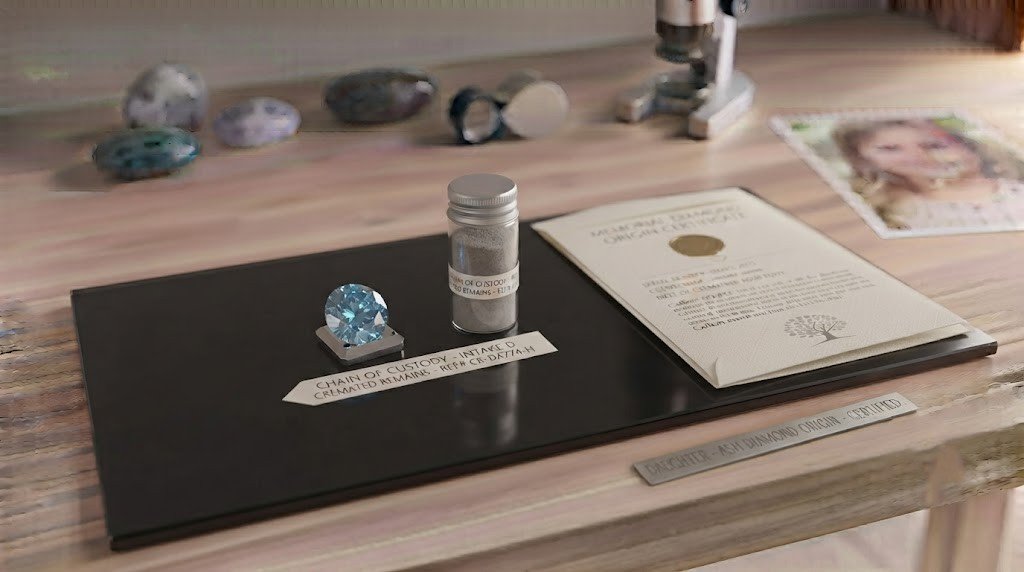
A loose blue-toned memorial diamond of the kind a family hopes is really made from daughter ashes, beside a small sealed ash container and its origin paperwork

Is a Stone Really Made From Daughter Ashes, or Is That a Sales Line?

It is a physical fact, not a metaphor, but a partial one. When a family asks whether a memorial stone is really made from daughter ashes, the accurate reply has two halves, and both deserve equal weight.

The first half: carbon atoms that were part of her body are extracted from the portion of ash you send, purified, converted to graphite and grown into the lattice of a real diamond. It is chemically identical to any other diamond.

The second half: those atoms are not the only carbon in the crystal. Cremated remains hold very little carbon, so laboratories top up the growth charge with carbon of their own. A stone really made from daughter ashes is therefore a stone made partly from her, and anyone claiming more is overstating it.

Neither half cancels the other. Families who learn how a stone is really made from daughter ashes usually find the honest version more meaningful, because it survives scrutiny. How a memorial diamond is made from her ashes walks through the laboratory stages in order.

How Much Carbon Is Left in Cremated Remains?

Very little. What comes back from a crematory is mostly bone mineral, chiefly calcium phosphate; much of the carbon in a living body leaves as gas during cremation itself.

Industry figures put the usable carbon remaining at somewhere between about 0.5% and 4% of the ash by weight. The spread depends on the individual and the cremation, and no provider can predict it in advance.

That one number explains nearly everything else about whether a diamond is really made from daughter ashes. A modest portion of ash at a few percent carbon yields fractions of a gram to a few grams of her carbon: enough to be genuinely present in a stone, rarely enough to grow one unaided.

It also explains why the quantity requested for a stone really made from daughter ashes is small. Most providers ask for somewhere between a few tablespoons and roughly 4 oz, around 100 grams, a fraction of what a full cremation returns. How much ash is needed for a daughter memorial diamond breaks those quantities down and explains what happens to the remainder.

Why Does a Laboratory Add Carbon of Its Own?

Because diamond growth needs a certain volume of feedstock, and a few grams of recovered carbon rarely meets it. Blending is driven by the physics, not a cost saving shortcut, and it is standard practice for a stone really made from daughter ashes.

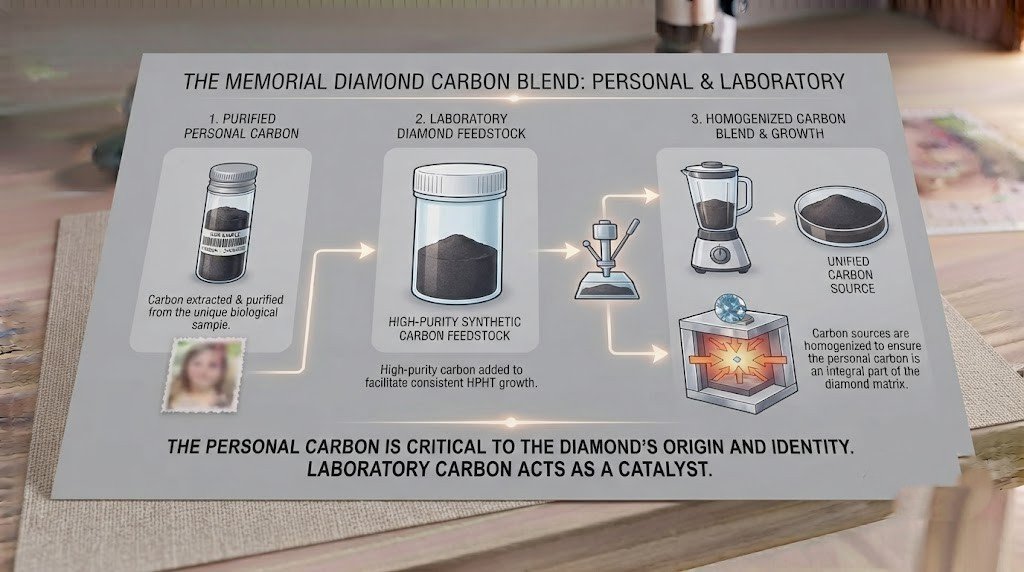
As the industry describes it, the stages run like this:

  1. Extraction. The ash is heated in an oxygen free process that separates carbon from the minerals, reaching about 99.9% purity or better.
  2. Graphitization. The purified carbon is heated again, to roughly 2,500 to 2,700°C, and becomes graphite, the press’s feedstock.
  3. Blending. Her graphite is combined with supplemental laboratory carbon until there is enough for the size of stone chosen.
  4. Growth. Most providers use high pressure and high temperature, around 6 to 8 GPa and between 1,400 and 2,500°C, with a tiny diamond seed; a minority use chemical vapor deposition. Both methods are summarized in this overview of lab grown diamond production.
  5. Cutting and finishing. A gemologist shapes and polishes the rough crystal.

Once blended, her carbon and the laboratory’s are chemically indistinguishable and grow into the lattice together. A diamond really made from daughter ashes carries her atoms spread through the whole stone.

A simple diagram showing personal carbon blended with laboratory carbon before diamond growth

What Share of a Diamond Really Made From Daughter Ashes Is Hers?

On the ash route, the figure most often quoted is around 10% to 15% of the finished stone’s mass. Some providers publish figures as low as about 3%, and a few cite higher ones, depending on stone size and ash submitted.

A bigger diamond needs more total carbon while her portion stays roughly fixed, so her share shrinks as the stone grows.

StageWhat is presentHer carbon, roughly
Ash as sentMostly calcium phosphate and other mineralsAbout 0.5% to 4% of the ash by weight
After extractionPurified carbon, about 99.9%+All of it recovered from her remains
After blendingHer graphite plus laboratory graphiteDepends on stone size and yield
Finished stoneA single diamond crystalCommonly quoted at 10% to 15%; some cite as low as about 3%

The practical step is to ask for the figure in writing for your specific order. For a stone really made from daughter ashes, a written estimate of her share at the size you are choosing is the closest thing to a promise worth having, and you can hold it against the table above.

Can Testing Prove a Diamond Is Really Made From Daughter Ashes?

No, and this matters more than anything else here: no laboratory test on a finished diamond can identify whose carbon it contains.

Cremation destroys the DNA in remains, so there is nothing genetic to find. And carbon from one person is, for identification purposes, the same element as carbon from anyone else or from a laboratory supply. A gemologist can confirm a stone is a grown diamond and grade it, but none of that reveals the origin of its atoms.

That can feel unsettling. It means whether a particular stone is really made from daughter ashes cannot be settled by examining the stone. It is settled, or not, by the record of what happened to her ashes from the moment they left your hands: who received them, how they were labeled, and whether they stayed separate at every stage. That record is called chain of custody documentation.

Which Documents Show a Stone Is Really Made From Daughter Ashes?

A set of records tracing her material from your hands to the finished stone. Ask for each by name.

  • A written order confirmation stating the quantity of ash required and the stone ordered.
  • A receiving record confirming arrival date, seal condition and intake weight.
  • A unique identifier assigned to her material and carried on every later record.
  • Process updates noting when extraction, graphitization and growth began for that identifier.
  • A written estimate of the personal carbon share for your order.
  • An origin or authenticity certificate linking the finished stone to the identifier and your submission.
  • A written answer on unused material: what is returned, stored or disposed of after extraction.

The origin certificate is usually issued in house, so its value depends on the records behind it; it is the paper trail, not the certificate alone, that shows a stone is really made from daughter ashes. An independent grading report is a separate, optional document describing quality rather than origin. How to turn your daughter’s ashes into a diamond covers when each record arrives in the wider process.

Honest Claims Versus Overclaims: How to Tell Them Apart

The quickest way to judge whether a stone offered to you is really made from daughter ashes is to listen to how the provider describes it. Honest language is specific and admits limits; overclaims are sweeping and leave nothing to check.

An honest provider saysAn overclaim sounds like
“Carbon recovered from her ashes is grown into the diamond alongside lab carbon.”“Your diamond is 100% her.”
“Expect around 10% to 15% of the stone to be her carbon; here is our estimate for your order.”“Every atom comes from your loved one.”
“No test on a finished diamond can identify a person; our custody records evidence origin.”“Our certificate scientifically proves it is her.”
“Color depends on trace elements; we cannot promise a specific shade.”“Her diamond will be the color that suits her.”
“Independent grading is available as an option.”“Every stone is certified,” with no detail about by whom.

The honest column is not less comforting. A family asking whether a stone is really made from daughter ashes gets a truthful yes from the left hand side and a promise that cannot be kept from the right.

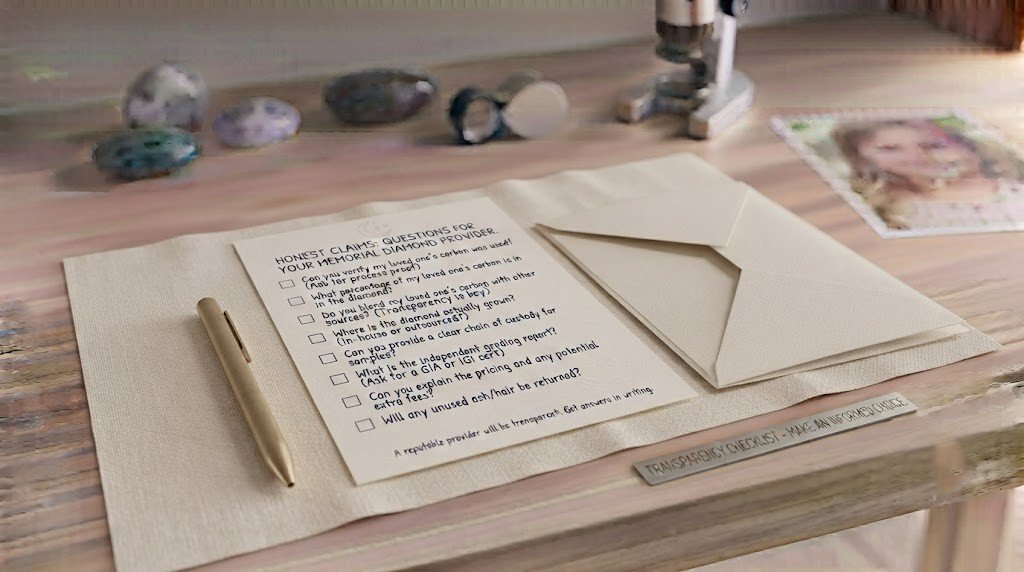
 |A handwritten checklist of questions to ask a memorial diamond provider, next to a pen and envelope

What Red Flags Suggest a Provider Is Overpromising?

Most warning signs fall into three groups: purity claims, missing numbers and vague custody.

Purity claims. Any suggestion that a stone is entirely her carbon contradicts how the process works, however comforting it sounds.

Missing numbers. A provider that will not state in writing how much ash it needs, what share of the stone it expects to come from her, or what it does with leftovers is withholding exactly what you need to judge whether a stone is really made from daughter ashes.

Vague custody. Be wary of “your material is handled with care” with no description of how. A good provider can explain how a submission is labeled, logged, stored and tracked, and whether it is ever processed alongside another family’s. That record is the heart of whether a stone is really made from daughter ashes.

Smaller signals worth noticing:

  • Pressure to decide quickly, or a deadline tied to a discount
  • A certificate described as “scientific proof” of origin
  • No written policy on cancellation or on failed growth

How Do You Check a Stone Is Really Made From Daughter Ashes Before You Commit?

Ask in writing, compare answers, and keep everything. The goal is your own file of commitments before any of her remains leave your care.

Send each provider the same list: ash quantity, estimated personal carbon share for your size, how material is tracked, whether batches are ever combined, which documents you receive, what happens to unused ash, and cancellation terms.

Read the replies side by side. Specific numbers and named documents are a good sign; general reassurance is not. If a provider will show you a sample origin certificate or a blank custody log, the format tells you what is actually recorded about a stone really made from daughter ashes.

Keep copies of everything, including shipping receipts. The step by step guide to turning her ashes into a diamond shows where each of these checks falls in time.

Who Has the Right to Release Her Ashes?

It depends on your state, and it is not automatically her parents. There is no single national rule; each state sets its own order of priority over a person’s remains.

Marriage or a registered partnership usually puts that person at the head of the line, and children of hers who are grown can also take precedence over you. Should she have recorded her wishes in a directive, a will provision or a plan arranged ahead of time, those can displace the standard order.

Whatever her age, it is your state’s rule that decides. Parents do not always agree, and one parent arranging things alone is common; the funeral director who handled the cremation usually knows the local rule. Before any stone really made from daughter ashes is started, a trustworthy provider will ask for the signature of whoever holds that authority.

What Else Follows From the Real Numbers?

Once you accept that a stone really made from daughter ashes is partly her carbon, color, size and cost make more sense. The complete daughter ashes diamond guide covers each in depth.

Color. Nitrogen during growth gives yellow, boron gives blue, and colorless needs neither, which usually costs more. Cleaner starting carbon does not make the shade predictable. Irradiation for red, pink, green or black is optional. Choose a color for what it means to you, not by assumption. What color a diamond made from her ashes will be explores this further.

Size and time. Carat is set by growth time, not by how much ash you send. Stones run from about 0.10 to 5+ carats, typically taking 6 to 10 months, up to 12 for larger or specialty color stones.

Cost. As general 2026 industry ranges, not any company’s price: roughly $1,500 to $3,500 for 0.10 to 0.25 carat, $5,000 to $15,000 for 0.5 to 1 carat, and $20,000 to $75,000+ for 2 to 5+ carats. Clarity usually falls between SI2 and VVS.

Hair instead. Hair is about half carbon by weight, though no finished stone share is published for it. Whether a memorial diamond is really made from her hair asks the same question of that route.

Frequently Asked Questions

Is a memorial diamond really made from daughter ashes, or only inspired by them?

Really made, in part. Carbon extracted from the portion of her ashes you send becomes part of the diamond’s crystal lattice alongside supplemental laboratory carbon. The stone is not a symbol or a coating; her atoms are physically present in it. Most industry descriptions put her share at roughly 10% to 15% of the finished mass, with some providers citing as little as 3%.

Could my daughter’s ashes be mixed up with someone else’s?

The risk depends on custody practices, so ask about them directly. A careful provider assigns a unique identifier to each submission, logs it on arrival, tracks it through every stage and never combines families’ material. Ask in writing whether batches are ever processed together and what records will show her material stayed separate throughout.

Why can’t a lab test the diamond to confirm the carbon is hers?

Because nothing identifying survives. Cremation destroys DNA, and a carbon atom from one person cannot be told apart from any other carbon atom for identification purposes. Testing can confirm a stone is a lab grown diamond and grade its quality, but not whether it is really made from daughter ashes. Origin rests on documented chain of custody instead.

Does sending more ash make more of the stone hers?

Not in a simple way. Extra ash can raise the amount of recoverable carbon, but the personal share also depends on how large a stone is grown, since bigger stones need more total carbon. Sending more does not shorten the wait or enlarge the diamond. Ask for an estimated share for the exact quantity and size you have in mind.

What happens to the ashes that are not used?

Policies differ, so ask before anything is sent. Leftover material may be sent back to you, kept by the provider for a set time, or disposed of respectfully once extraction is done, depending on the company. Only a small portion of a full cremation is usually requested, so the rest can stay in an urn, be scattered or be kept by family as planned. Get the answer in writing.

Is the origin certificate the same as a grading report?

No. An origin or authenticity certificate, usually issued in house, links the finished stone to the material you submitted. A grading report assesses cut, color, clarity and carat against the standard diamond quality factors, and having one done by an independent gemological laboratory is optional. The two answer different questions.

Is it still meaningful if only part of the stone is her carbon?

Many families find that it is, because the claim holds up when examined. A stone really made from daughter ashes exists because her carbon was recovered and grown into it, and that connection is real rather than symbolic. Whether a partial share feels like enough is personal, and a family can reasonably decide an urn, scattering or another keepsake suits them better.

Final Thoughts on Whether the Diamond Is Really Hers

Skepticism is not disloyalty. Asking whether a stone is really made from daughter ashes is one way families take care of her, and a good provider will welcome the question.

The honest answer is a qualified yes. A stone really made from daughter ashes holds a genuine portion of her carbon inside a real diamond, blended with laboratory material, and its origin rests on records rather than on any test of the stone. If those records are specific and consistent, you have good reason to believe what you hold. If they are vague, keep asking.

Learn More About Daughter Memorial Diamonds

Talk With Memorial Diamond

Memorial Diamond can be reached at memorialdiamond.us to talk through whether a stone really made from daughter ashes is right for your family, with no obligation.

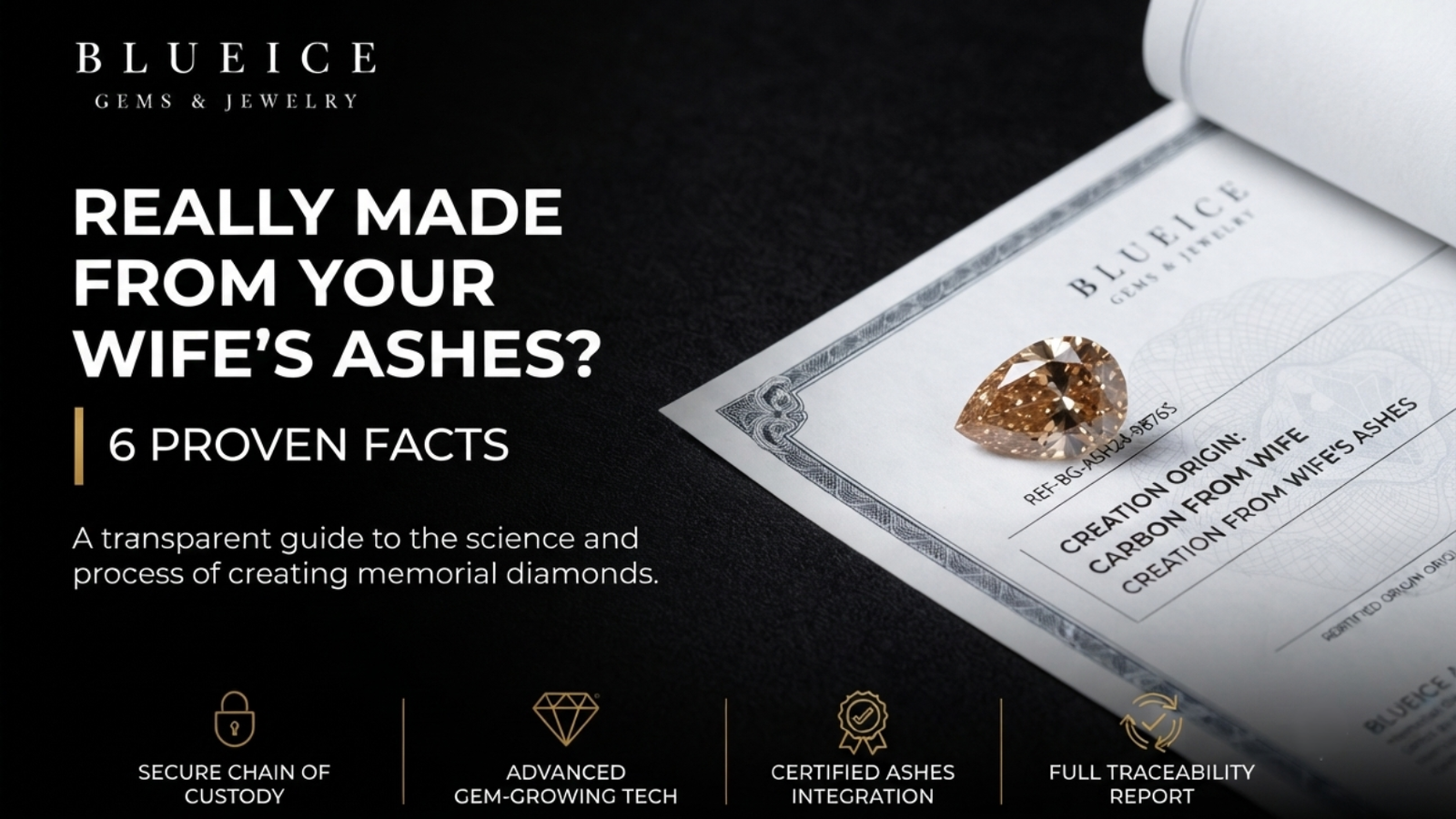
Really made from your wife's ashes: a small champagne-toned lab-grown memorial diamond resting on its reference-numbered origin certificate

Is a Memorial Diamond Really Made From Your Wife’s Ashes?

You are allowed to be skeptical. Somebody is asking you to hand over a portion of your wife’s ashes, wait most of a year, and accept a stone on their word that she is in it. A memorial diamond is really made from your wife’s ashes in part: carbon is extracted from a small amount of her cremated remains, purified, blended with lab sourced carbon to reach a workable volume, and grown into a genuine diamond in which her carbon typically makes up around 10 to 15% of the stone.

The Short Answer, and Why “In Part” Is the Honest Version

Ask whether a memorial diamond is really made from your wife’s ashes and you are asking two questions at once. The first is chemical: can a diamond be grown from cremated remains at all? The second is procedural: how do I know this stone came from her and not from a jar of industrial graphite?

The chemistry is settled and public. The procedure is where the trust lives. The table below is the whole argument, one claim per row.

Claim you will hearVerdictWhat the evidence is
“A diamond can be grown from cremated ashes.”TrueAshes hold roughly 0.5 to 4% usable carbon. The process is public for the whole memorial diamond category.
“The diamond is 100% her.”FalseHer carbon is blended with lab carbon; her share is typically around 10 to 15%. Anyone claiming total purity is wrong.
“It is really made from your wife’s ashes.”Partly true and that is the right claimA real, purified portion of her carbon is in the crystal lattice. “In part” is accurate; “entirely” is not.
“A lab test can prove it is her.”FalseNo test can identify whose carbon a diamond contains. The proof is procedural, not chemical.
“The custody record proves it.”True, if the record is real and specificA logged, traceable record from arrival to finished stone is the actual evidence.
“The grading report proves it came from her.”FalseA grading report proves quality: cut, color, clarity, carat. It says nothing about origin.

Six claims; the rest of this page takes them one at a time.

Fact 1 Is There Really Carbon in Her Ashes to Work With?

Yes, though less than most people assume, and that is the first thing a doubter gets right about a stone really made from your wife’s ashes.

Cremated remains are almost entirely calcium phosphate, the mineral structure of bone. Carbon, the only element a diamond is made of, survives as a small fraction: industry figures put usable carbon at roughly 0.5% to 4% of ash by weight, varying by person and by cremation.

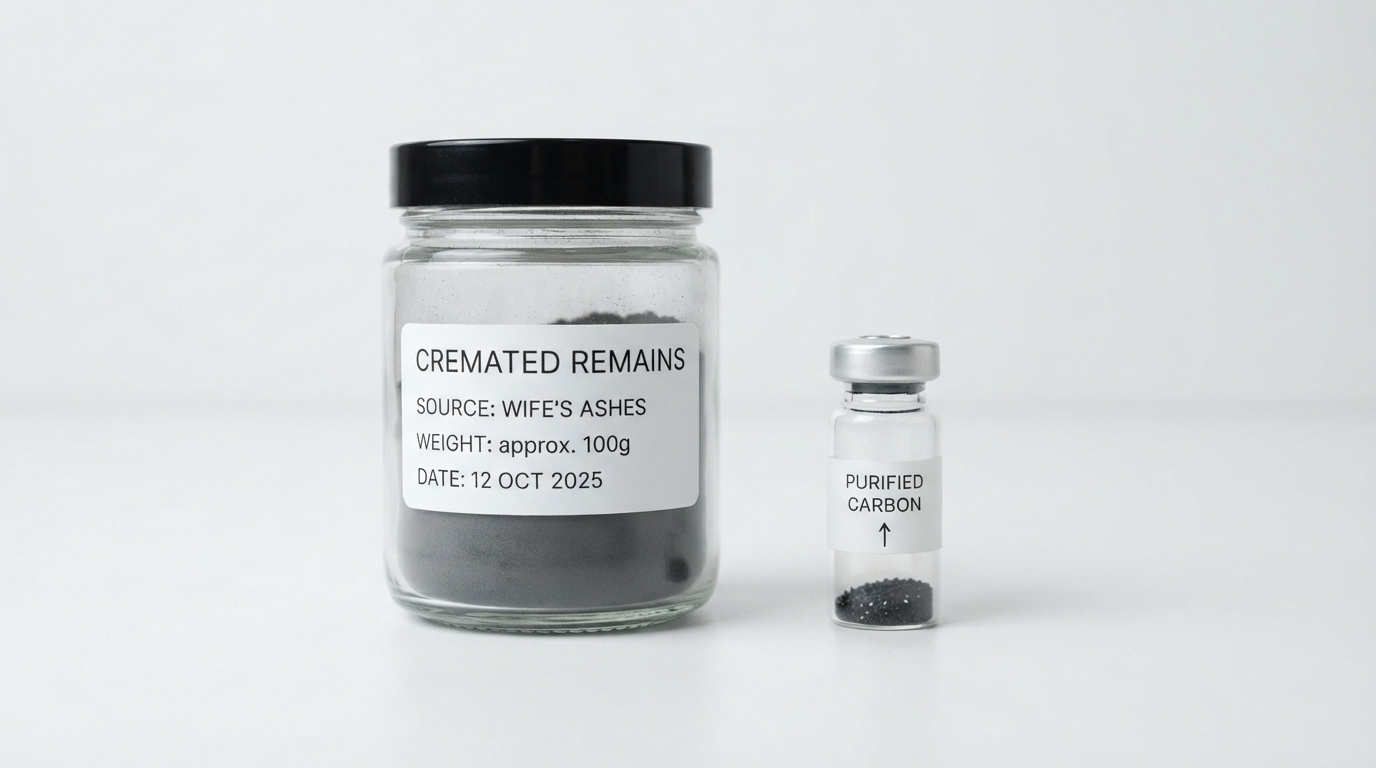
A labeled laboratory sample container of cremated ash beside a much smaller vial of purified carbon

That fraction is enough. A provider heats a portion of her ashes, typically a few tablespoons to around 4 oz, about 100 g, in a controlled, oxygen free, multi stage process that strips away the minerals and leaves carbon at 99.9%+ purity. That carbon is heated to roughly 2,500 to 2,700°C and converted into graphite, the feedstock a diamond press uses.

So the chemical premise behind a diamond really made from your wife’s ashes is not exotic: a small quantity of a common element, recovered from a material that is mostly something else. How a memorial diamond is made from your wife’s ashes walks through every stage in order; this page stays on the question of proof.

Fact 2 How Much of the Diamond Is Really Her?

This is the fact that makes the skeptic right to ask, and the one a good provider volunteers before you do.

The carbon recovered from a few tablespoons of ash is not enough, on its own, to grow a diamond of meaningful size, so the purified graphite is blended with lab sourced carbon. In the finished stone, the personal carbon from her ashes typically makes up around 10 to 15% of the mass. Some providers cite figures as low as 3%, others higher, depending on carat and how much ash was submitted. Three consequences follow for whether the stone is really made from your wife’s ashes in the sense you mean:

  • “100% her” is false wherever you read it. It describes physics that does not exist.
  • “In part” is not a loophole; it is the accurate description. A real, measurable portion of the carbon that was in her body is now locked in a crystal lattice. The diamond is really made from your wife’s ashes; it is not made only from them.
  • Sending more ash does not raise her share meaningfully. Carat is set by growth time in the press, not by material quantity. A provider who suggests a full urn will make the stone “more her” is wrong on two counts.

Ask the percentage question. A specific range with a reason means the provider understands what they are selling. “It’s all her” tells you something more useful than the percentage.

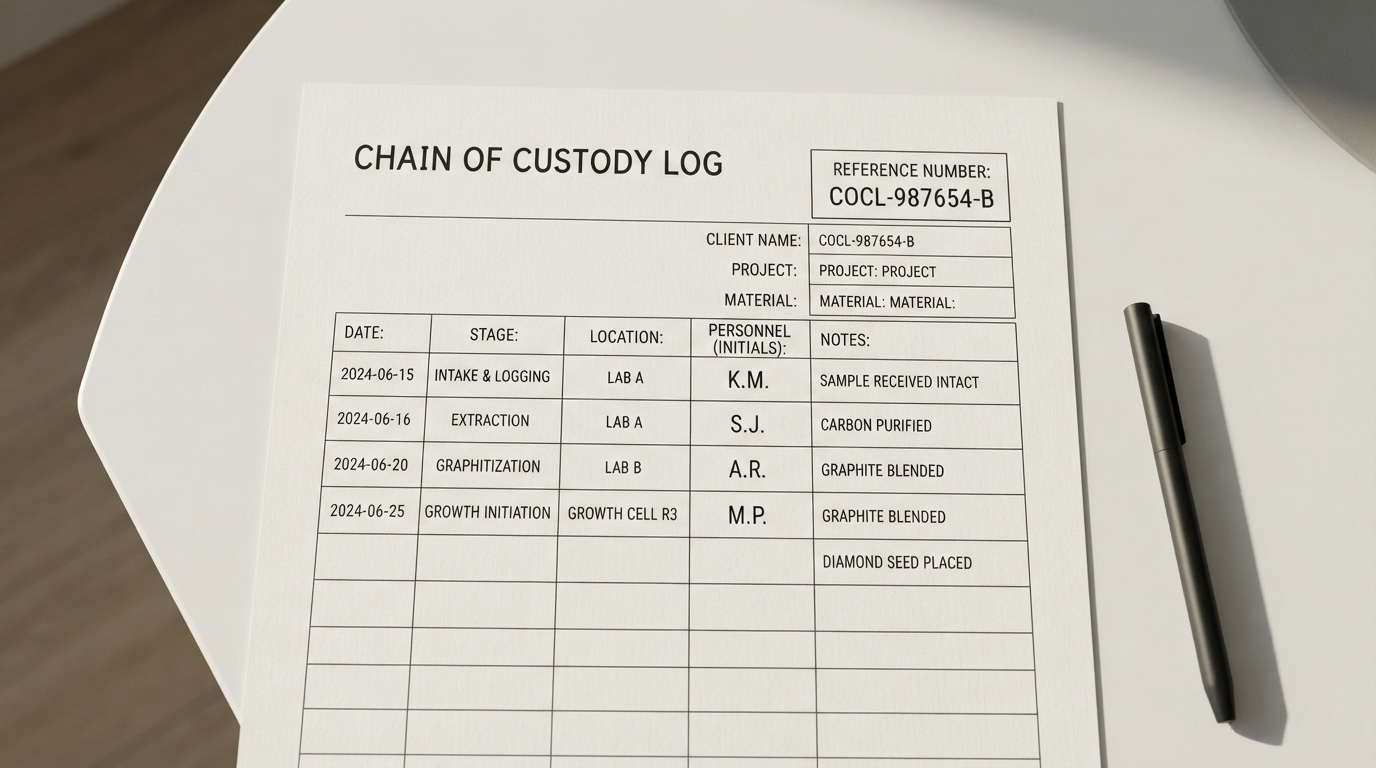
Fact 3 What Does a Chain of Custody Record Actually Prove?

Because no test can identify the carbon, the evidence that a stone is really made from your wife’s ashes is a paper trail.

A chain of custody record is a logged, traceable account of your submission from arrival to shipped diamond. In a reputable operation it looks like this:

A printed chain-of-custody log with a reference number, dated stage entries, and initials down the page
  1. Intake. Your submission is weighed, photographed, and assigned a unique reference the moment it is opened.
  2. Sealed transfer. The ash portion moves to extraction in a labeled, sealed container under that reference. Nothing is pooled with another family’s material.
  3. Extraction and purification. The carbon recovered is weighed and logged against the same reference.
  4. Graphitization and growth. The purified carbon and the growth cell it enters are logged under the reference, with dates.
  5. Cutting, grading, and return. Rough crystal and finished stone are tracked against the reference through to shipping.

What this proves: that an identified sample entered the process and an identified stone left it, with a documented link at every stage. What it does not prove: anything about the atoms themselves. A record is only as good as the provider keeping it, which is why you ask to see one. If a diamond is really made from your wife’s ashes, this record is the only place that fact is written down. Questions to ask before turning your wife’s ashes into a diamond turns it into a list you can read down the phone.

Fact 4 What Does an Origin Certificate Prove That a Grading Report Does Not?

Two documents arrive with a finished stone, and people routinely treat them as one. They prove different things, and only one speaks to whether the diamond is really made from your wife’s ashes.

DocumentWho issues itWhat it provesWhat it does not prove
Origin or authenticity certificateThe provider, in houseThat this specific stone was grown from this specific submission, the summary of the custody recordThe stone’s quality
Grading reportIdeally an independent gemological labThat the stone is a genuine diamond of a stated cut, color, clarity, and caratWhere the carbon came from, a grading lab has no way to know
An in-house origin certificate and an independent grading report laid side by side on a desk

The origin certificate is the provider’s attestation: this stone, this submission, this reference. It should carry your intake reference number, the material submitted, and the date. A certificate that only says “genuine memorial diamond” is a souvenir, not evidence that anything is really made from your wife’s ashes.

The grading report is about the diamond as a diamond. An independent lab applies the same cut, color, clarity, and carat standards to a memorial stone as to any other; typical memorial clarity lands between SI2 and VVS. It is silent on origin by design, and a provider who points to the grading report when you ask whether the diamond is really made from your wife’s ashes is answering a question you did not ask.

Fact 5 What Can You Verify Yourself, and What Can Nobody Verify?

Here is the line most articles blur, stated plainly.

What you can verify about a diamond really made from your wife’s ashes: that it is a real diamond. Any jeweler with a thermal or electrical tester can confirm it is diamond rather than a simulant. An independent lab can grade it and identify it as lab grown by the HPHT or CVD method described on the synthetic diamond page. You can also check that the documents match each other and your intake paperwork.

What nobody can verify: whose carbon is in it. A carbon atom from your wife’s ashes is identical to a carbon atom from a lab feedstock. There is no isotope test, DNA test, or spectroscopic signature that says “this carbon came from this person.” A diamond grown entirely from lab carbon and a diamond really made from your wife’s ashes would be indistinguishable to every instrument in existence.

That is no reason to distrust the category. It is a reason to be precise about where the proof lives: in procedure, the custody record, the reference numbered certificate, the provider’s willingness to show you both, not in chemistry. Anyone who says a test can settle whether a stone is really made from your wife’s ashes is mistaken or selling the test.

So the question to carry into every conversation is “show me the record.” A provider who has one will be relieved you asked. How to turn your wife’s ashes into a diamond puts the paperwork check at the receiving end of the process, where it belongs.

Fact 6 Which Red Flags Suggest a Provider Is Overstating?

A provider does not have to be dishonest to overstate; some repeat marketing they inherited. Either way, these signals mean the answer to “is it really made from your wife’s ashes” is being stretched:

  • “100% made from your loved one.” The most reliable red flag. It is chemically false, and a provider who leads with it will not be careful about the percentage that is true.
  • No specific percentage, or one that changes when you ask twice. A good answer is a range with a reason.
  • “Send as much as you can.” More ash does not make the stone bigger or more her.
  • Custody described but never shown. A brochure sentence instead of a sample record means the record may not be what the sentence implies.
  • An origin certificate with no reference number. A generic certificate proves nothing about your specific stone.
  • The grading report offered as proof of origin. It is proof of quality. Conflating the two is a misunderstanding or a redirection.
  • A guarantee that a test will confirm it is really made from your wife’s ashes. No such test exists.

None of the first six is disqualifying alone; two or three together are a pattern. The seventh is a plain falsehood, do not send anything irreplaceable to a provider who states it, whatever else they say about a stone really made from your wife’s ashes.

Why Does This Question Matter More for Ashes Than for Hair?

If you also hold a lock of her hair, the “is it really her” doubt is weaker on that side, and it is worth knowing why.

Hair is roughly 50% carbon by weight, built from keratin. Ashes are under 4% carbon. A hair submission supplies far more personal carbon per gram, so the question of whether there was enough of her barely arises. With ashes, the small carbon fraction is what makes the honesty point necessary: lab carbon has to do most of the volume, so the percentage has to be answered squarely before you can say a stone is really made from your wife’s ashes.

That does not make an ashes stone less real. It makes the proof more dependent on procedure. A diamond really made from your wife’s ashes is one whose provider will tell you, unprompted, how small her share is, because the alternative is a provider who will not.

The hair version of the same doubt, different chemistry, worries about dye and gray, the same procedural proof, is in whether a memorial diamond is really made from your wife’s hair. Both routes end at a stone that is genuinely, partly, provably her, with the proof on paper rather than in the atoms. Wife Ashes Diamond: The Complete Guide covers everything downstream, quantity, color, carat, cost, and timeline, once you are satisfied that the stone is really made from your wife’s ashes.

Frequently Asked Questions

Is a memorial diamond really made from your wife’s ashes, or is that marketing?

It is really made from your wife’s ashes in part. Carbon is extracted from a small portion of her cremated remains, purified, and grown into a genuine diamond. Her carbon typically makes up around 10 to 15% of the stone; the rest is lab sourced carbon added to reach a workable volume.

Can a lab test prove the diamond is really made from your wife’s ashes?

No. Carbon atoms carry no personal signature, so no chemical, isotopic, or gemological test can identify whose carbon a diamond contains. A jeweler can confirm it is a real diamond and a lab can grade it; proof of origin is procedural, the custody record and origin certificate.

What does “chain of custody” actually mean for her ashes?

A logged, traceable record following your submission under one reference number from intake through extraction, growth, cutting, and return, with no pooling with other families’ material. Ask to see a sample record; it is the only written evidence the stone is really made from your wife’s ashes.

Is the origin certificate the same as the grading report?

No. The origin certificate is issued by the provider and attests that this stone was grown from your specific submission. The grading report, ideally from an independent lab, documents cut, color, clarity, and carat and says nothing about origin. You want both.

Why is the personal carbon only 10 to 15% of the stone?

Because ashes are almost entirely calcium phosphate, with only about 0.5 to 4% usable carbon. The carbon recovered from a few tablespoons of ash is not enough to grow a meaningful stone alone, so it is blended with lab carbon. Some providers cite figures as low as 3% depending on carat.

Would sending more of her ashes make the diamond more her?

Not meaningfully. Carat is determined by growth time in the press, not by material quantity, and the blend ratio is set by the growth cell’s volume. Sending a full urn loses ashes you could have kept without making the stone any more really made from your wife’s ashes than it already is.

Is the doubt any different if I use her hair instead?

Yes, in one respect. Hair is roughly 50% carbon compared with under 4% for ashes, so far more personal carbon is available per gram and the “was there enough of her” question barely arises. The procedural proof, custody record and origin certificate, is the same for both.

Final Thoughts on Whether It Is Really Made From Your Wife’s Ashes

The skeptic in you is doing its job. A memorial diamond is really made from your wife’s ashes in the only sense physics allows, a small, purified, real portion of her carbon inside a genuine diamond, and no honest provider will tell you otherwise. You cannot prove it with an instrument. You can insist on a provider who states the percentage plainly, shows you the custody record, and issues a certificate tied to your reference number. Choose on those three things, and the stone you receive will be what it claims: really made from your wife’s ashes, entirely real, and honestly described.

Learn More About Wife Memorial Diamonds

Talk With Memorial Diamond

If you want to ask the three questions on this page, the percentage, the custody record, and the certificate wording, before any of her ashes leave the house, reach out to Memorial Diamond. Asking whether a stone is really made from your wife’s ashes before you send them is what a careful person does. There is no deadline.