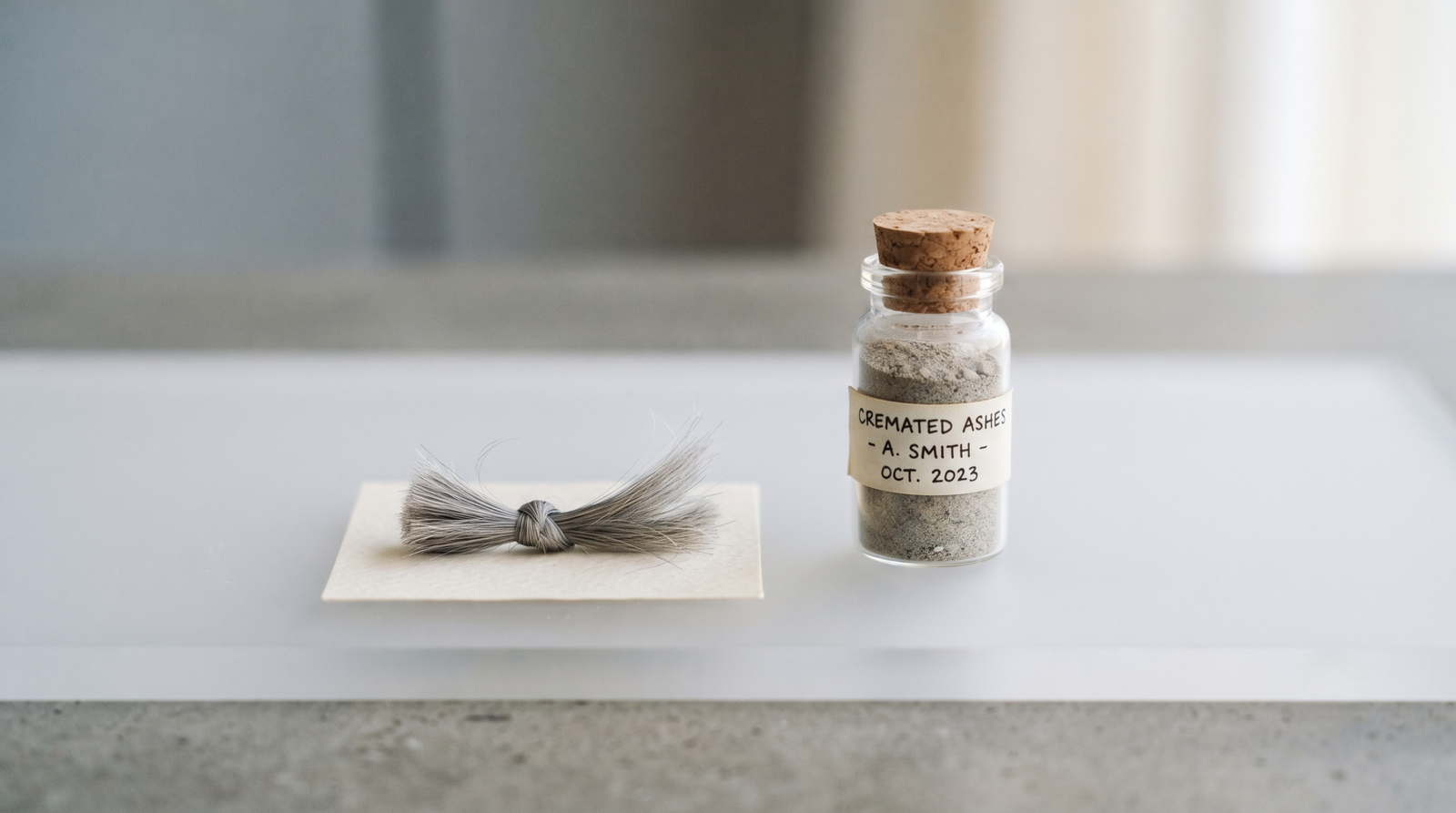
much ash and hair

How Much Ash and Hair Do You Need for a Father Memorial Diamond?

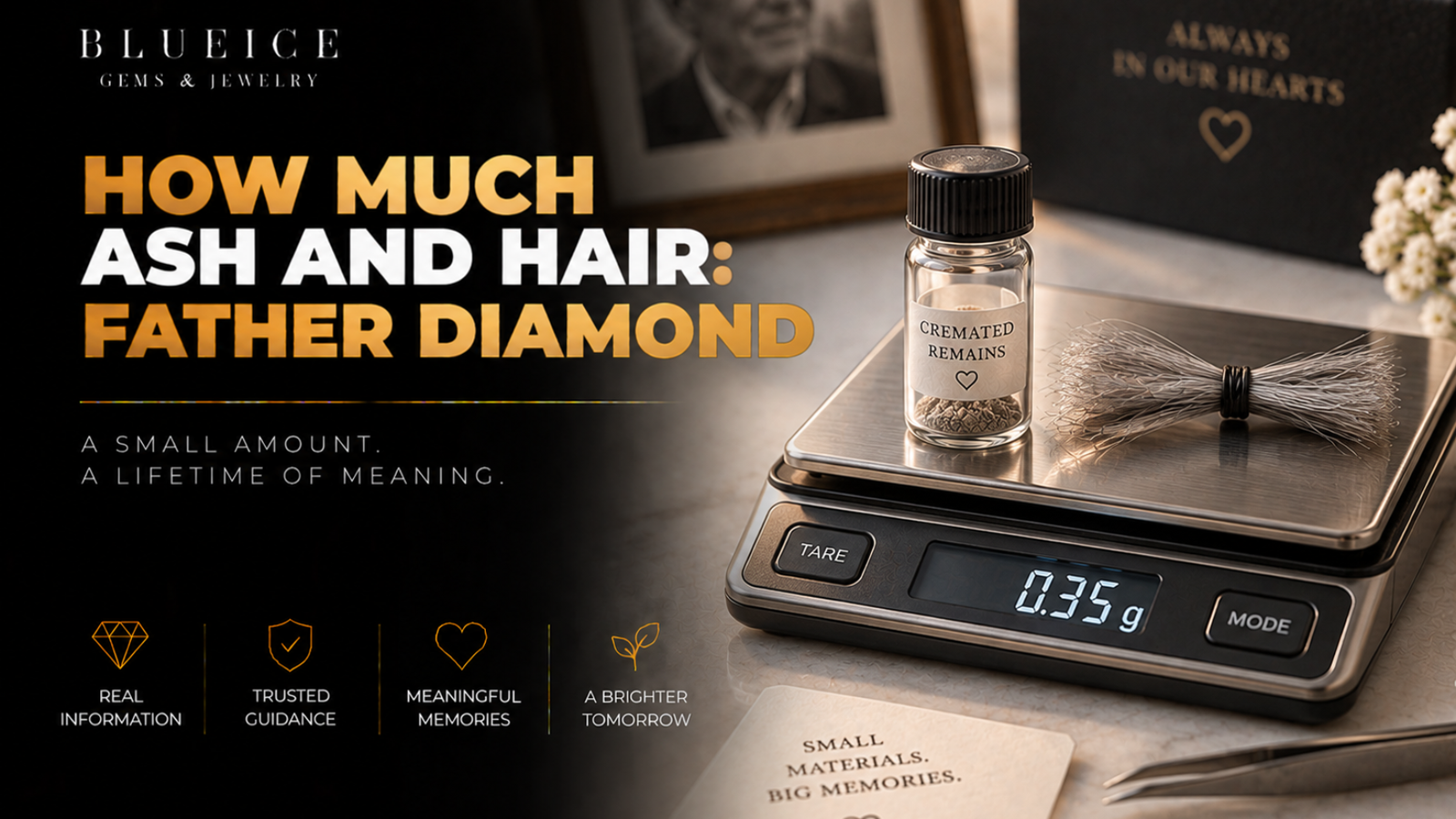
Of the two materials, there is usually one you have plenty of and one you are counting, and most people can say which before they finish reading the question. So how much ash and hair does a father memorial diamond need? Industry wide, plan on each material meeting its own figure in full: a few tablespoons up to roughly 4 oz (about 100 g) of cremated remains, and a few grams of hair, a palm sized lock. Ask before assuming that sending both lowers either number.

What matters far more than the figures is which side you are short of, because a shortfall in ashes and a shortfall in hair are not the same kind of problem. One is often recoverable. The other frequently is not.

Memorial Diamond is one of the companies that grows these stones; the questions below are meant for any of them, us included.

How Much Ash and Hair Does Each Material Have to Meet on Its Own?

The two figures for how much ash and how much hair are quoted in different units because the two materials are chemically nothing alike.

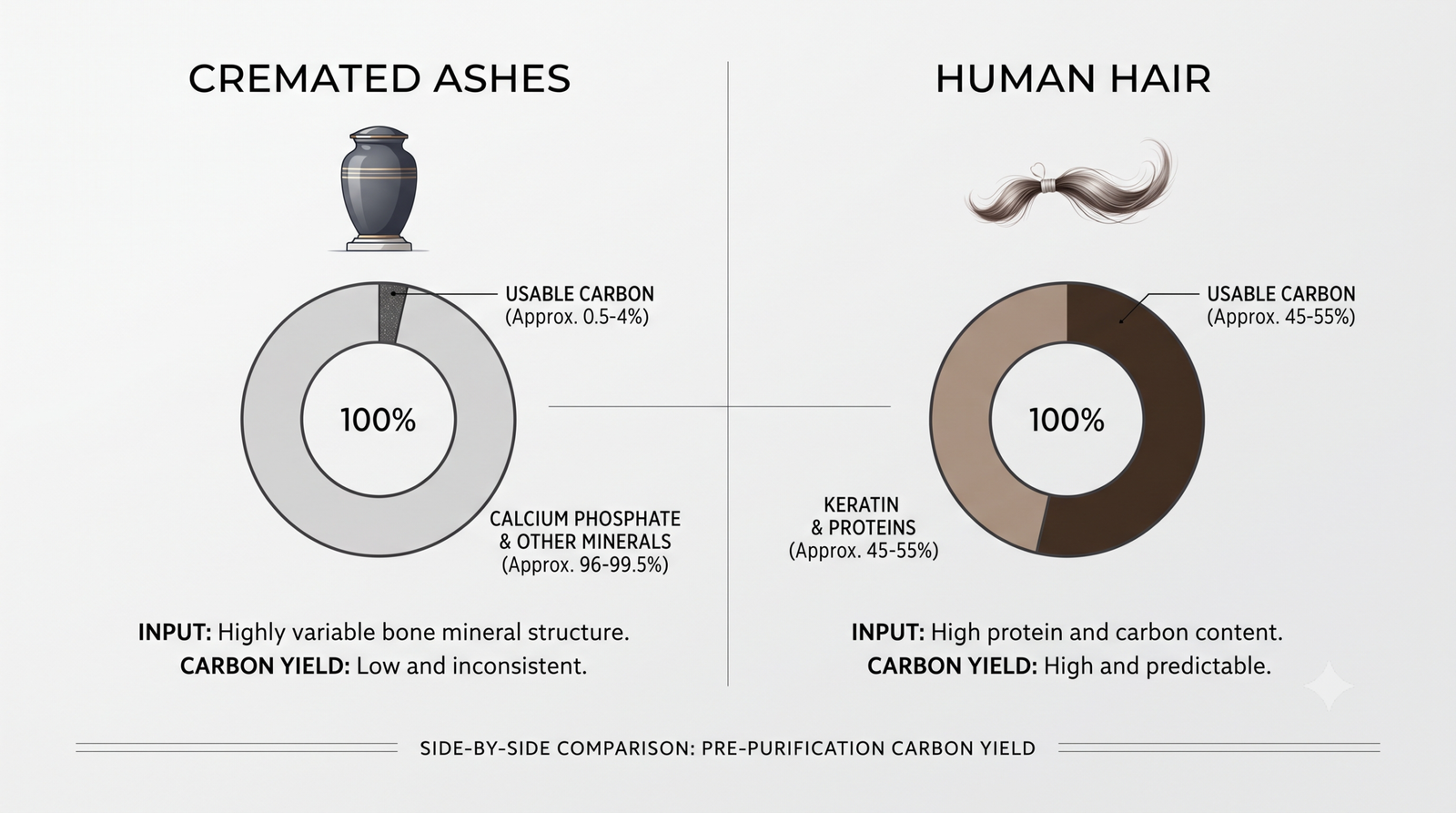
Cremated remains are dominated by calcium phosphate, the mineral structure of bone, with usable carbon at roughly 0.5% to 4% of ash by weight. That low yield is why how much ash you need is stated in tablespoons and ounces, and why a family submitting a portion still keeps most of what they have.

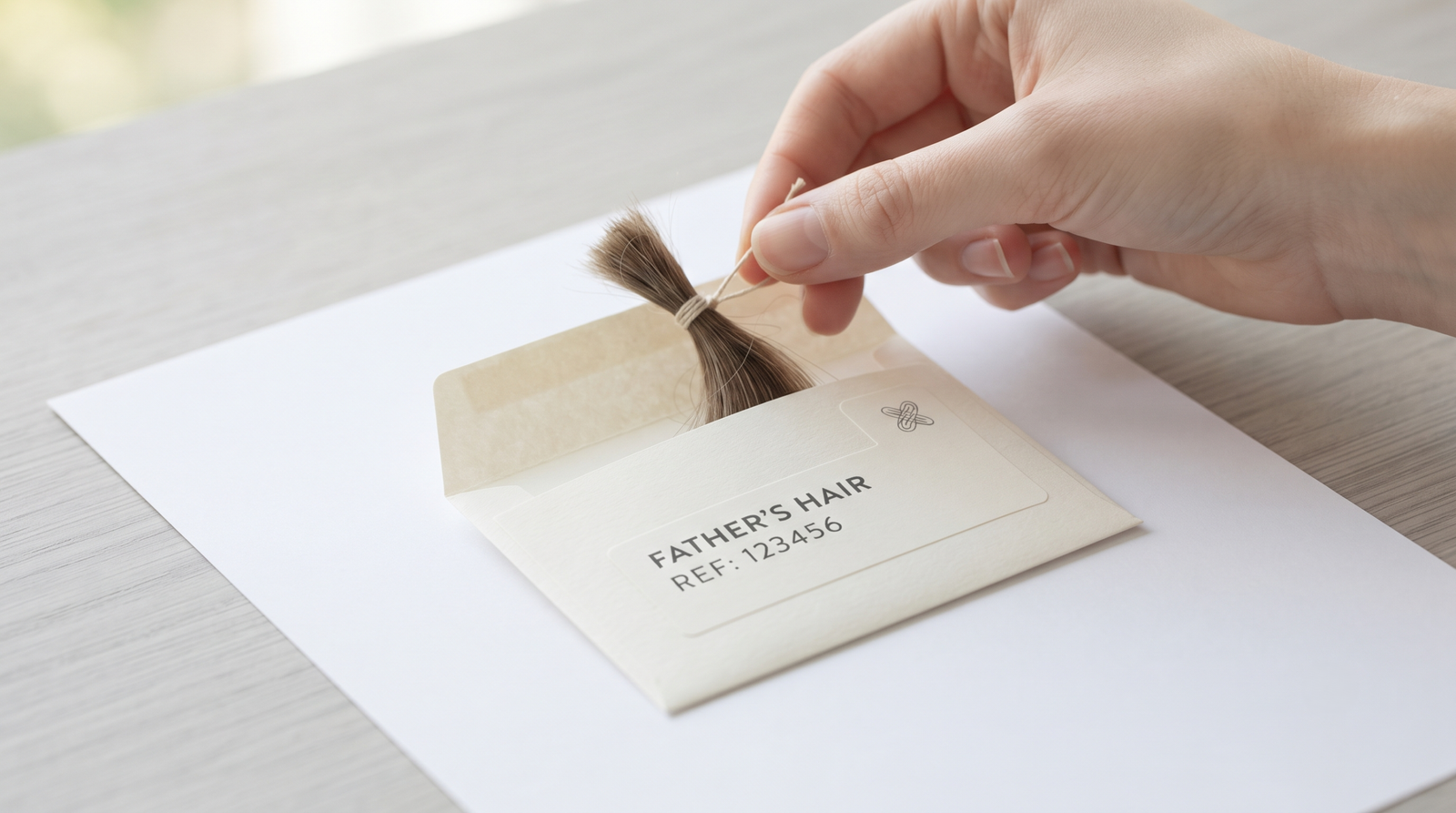
Hair is roughly 50% carbon by weight, built from keratin. That is why the hair requirement is stated in grams, and why hair works at all for a father who was buried rather than cremated.

Whichever material it came from, the recovered carbon is topped up with lab grown carbon before an HPHT growth run can use it. What each of the two contributes is a provable share of him rather than the whole stone, the honest framing, and the reason a claim of total purity should be treated as a warning sign.

Neither figure is standardized across the industry, and the individual numbers belong to the posts that own them: how much ash is needed and how much hair is needed each go into the specifics. This page is about what happens when you are holding both.

Should You Expect Combining to Lower Either Threshold?

Plan on no, and ask, how much ash and hair you need is set per material.

The reason to expect independence is that the two materials do not meet until late. Providers commonly describe preparing each separately, cleaning, extraction, purification to roughly 99.9% carbon, graphitization, with the two coming together only at the growth cell. On that description each material carries its own minimum, so how much ash and hair you need is two questions rather than one. The complete guide to father ashes and hair diamonds sets out where those lanes converge and why.

The consequence for planning is worth stating flatly: plan for both figures in full, and treat any flexibility a provider offers as a concession rather than an assumption. A family that plans on halves and discovers otherwise has often already divided something irreversible.

Why Are the Two Shortfalls Different Problems?

This is the distinction that actually decides what you do next, more than how much ash or hair sits in either container.

If you are short ofCan more usually be found?What finding out costsEffect on the other material’s requirement
His ashes, still in the family’s keepingUsually yes, a submission is typically a small fraction of a full cremationA phone call to whoever holds the urnNone
His ashes, already interred or scatteredUsually no, and disinterment is a legal and family matter rather than a practical oneA conversation with the cemetery or the executorNone, but this is often the point at which hair becomes the primary route
His hair, one sample onlyOften no. A lock is finite and does not replenishA scale and ten minutesNone
His hair, several possible sourcesSometimes, a comb, a razor, a hat, a barber’s clippingsA search, plus a provider’s acceptance policyNone

Read the table twice for the same reason it is laid out this way, however much ash and hair you are holding: the ash rows describe a problem with a phone number attached, and the hair rows describe a problem with an ending. That asymmetry should decide the order you do things in.
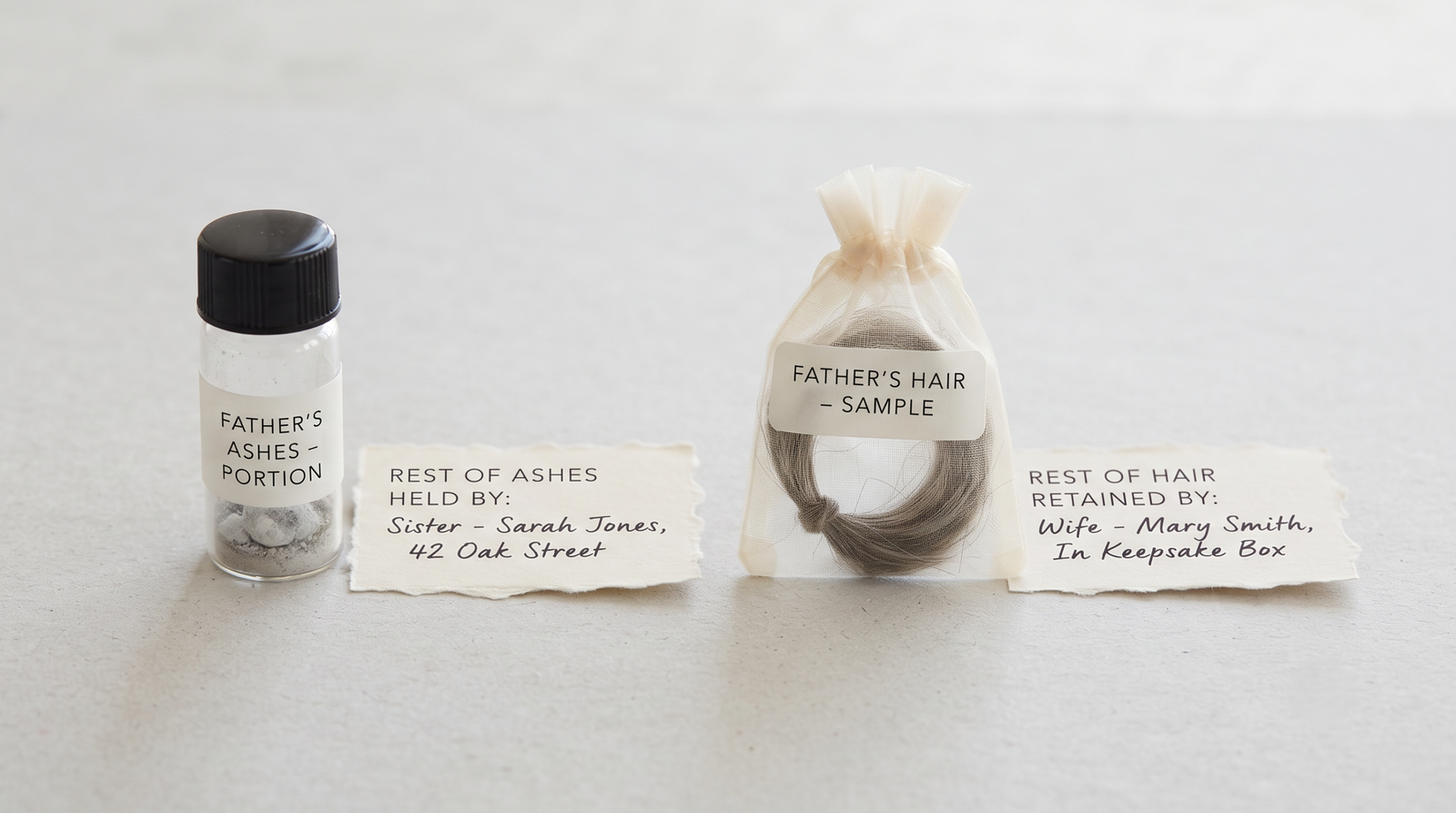
much ash

Before anything is divided, opened or cut, establish these four things:

  1. Who currently holds his ashes, and how much ash is actually there. This is often not the person who assumes they know.
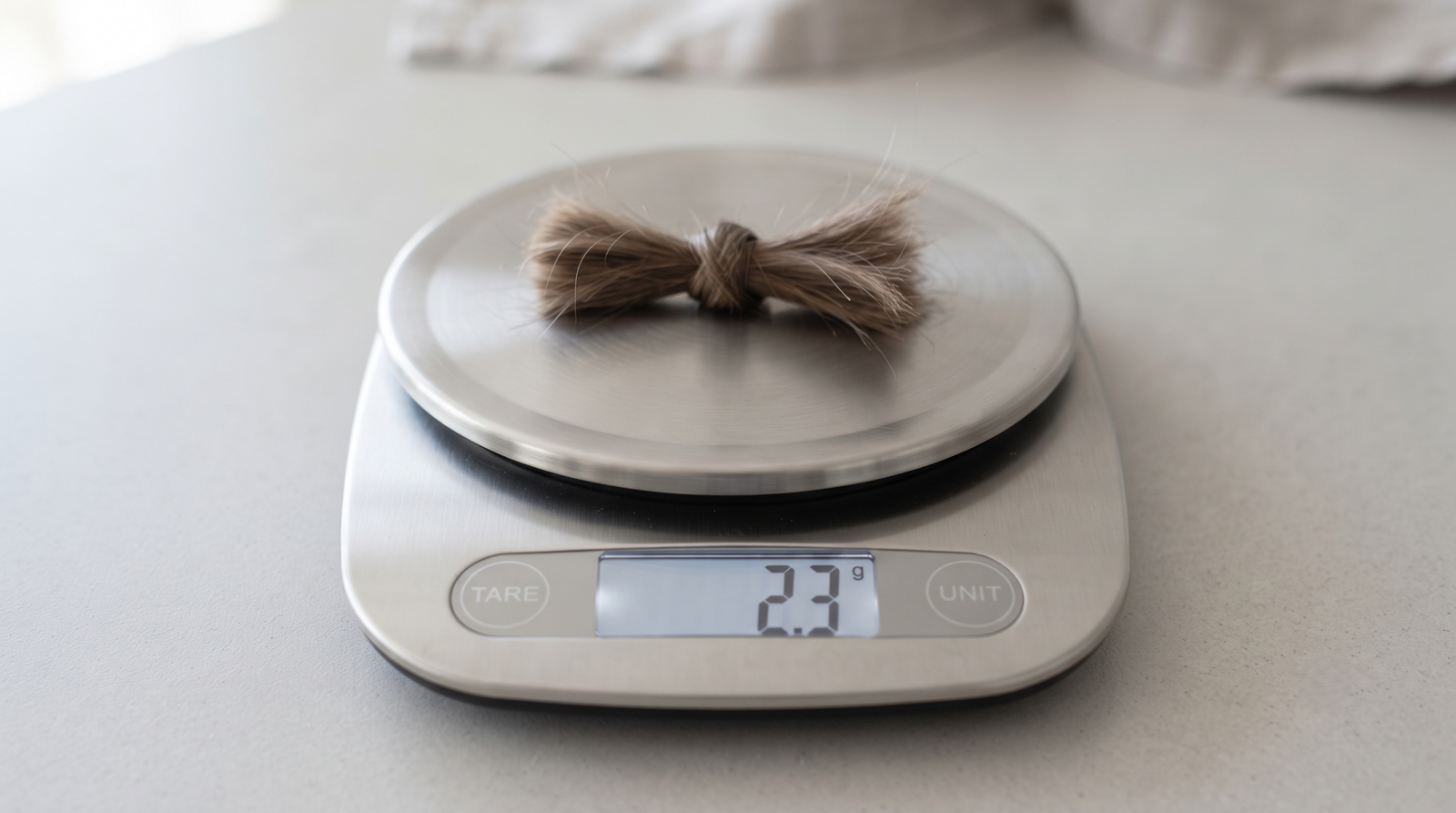
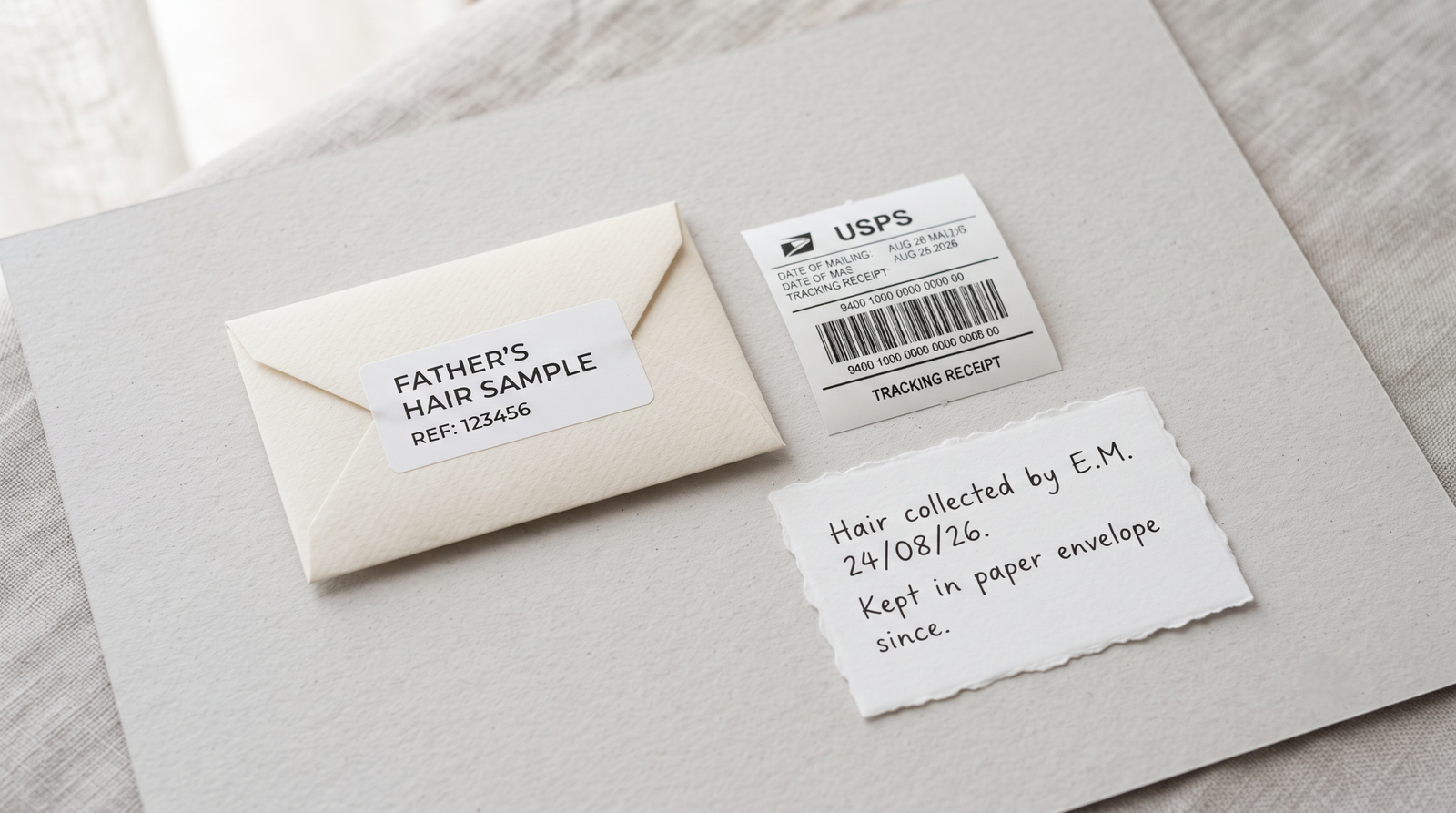
  2. What the hair sample weighs, on a scale that reads to a tenth of a gram, weighed in its container and subtracted.
  3. Whether any plan already exists for the remainder, a scattering, an interment, a shared plot, and whether it has a date.
  4. Whether the provider you are considering accepts combined submissions at all. It is not a given, and it is the question that makes the other three matter.

What Can Be Done if the Hair Falls Short?

Several things, in roughly this order of preference, and none of them depends on how much ash you have.

Look further before you conclude. Short clippings are not disqualified by being short, weight rather than length is what the process consumes, and the complete guide to father hair diamonds sets out where they tend to be found. Whether a given company accepts very short or mixed source clippings is a policy question that varies, so ask with a weight and a photograph rather than a description.

Ask whether a below minimum sample can be included as a supplementary contribution rather than as a lane of its own. Some providers may treat it that way; whether any given one does is not something the chemistry decides.

And if the answer is genuinely no, an ash only stone is not a lesser outcome. It is the longer established of the two routes, memorial diamonds were grown from cremated remains long before hair was offered, and the hair can stay exactly where it is. Keeping a lock is not a failed plan.

What Can Be Done if the Ashes Fall Short?

Often more than expected. How much ash a memorial diamond submission needs is a fraction of what a cremation produces, so a shortfall is more often a question of access than of how much ash exists, a sibling holding the urn, a portion already divided among family, a funeral home that still has a retained portion on file.

Where the remains have already been interred or scattered, the ash route may genuinely be closed, and that is the situation hair based options for loved ones who were not cremated exists to answer. A hair sample that seemed like an addition becomes the whole basis of the stone, and it works.

One thing that does not help either way: sending far more than the minimum. Carat size follows growth time in the press, not how much ash or hair arrived, so a fuller parcel buys nothing.

Which One Gets Assessed First?

Hair, in most cases, it is the material that can fail assessment, and assessing it is quick. How much ash you have rarely decides anything at this stage.

A hair sample can often be evaluated from a stated weight and a clear photograph before anything is posted, though whether a particular provider will pre assess on that basis is worth confirming rather than assuming. Ashes are more often assessed on arrival, by volume and weight at intake.
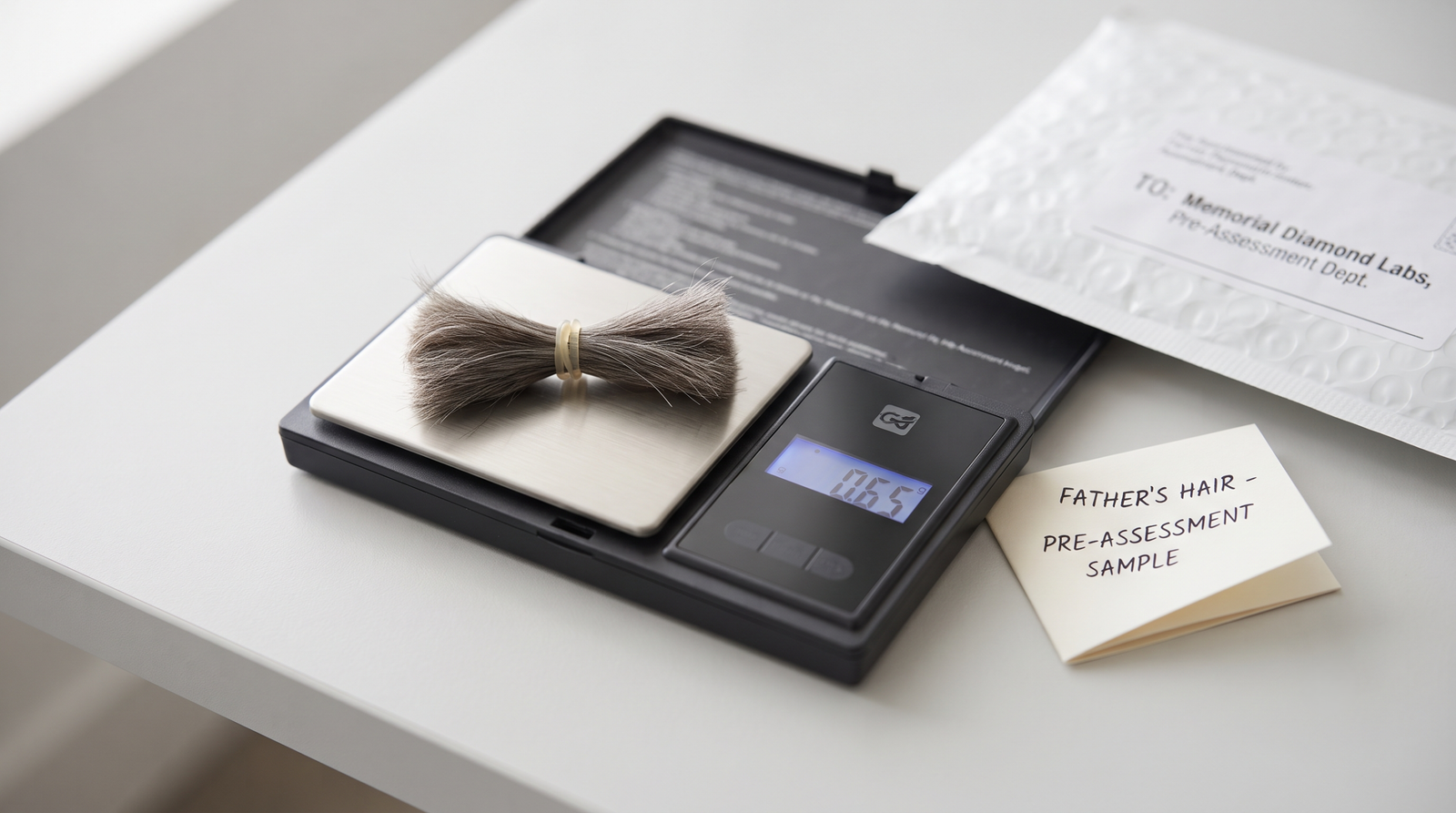
A lock of hair on a pocket scale photographed with the reading in frame, ready to send to a provider for pre-assessment

The practical order that follows: settle the hair question first, in writing, then decide how much ash to send, then choose the carat. Questions to ask before a combined order covers what else belongs in that first email, and the step by step sequence covers where each material goes afterwards.

Frequently Asked Questions

Which Material Should Be Assessed First?

Hair, generally, it is finite, it is the one that can be judged inadequate, and a weight and a photograph can often settle it before anything is posted. Ashes are more often assessed at intake, by weight and volume.

Do the Two Figures Change if We Want a Larger Stone?

Generally not. Carat is bought in growth time rather than in how much ash and hair you submit, so a larger stone usually means more months and more money rather than more material. Confirm it, since minimums vary between companies.

Should We Weigh His Ashes, or Is a Volume Measure Enough?

Ask which the provider works in. How much ash is required is quoted both ways across the industry, in tablespoons and in ounces, and a family measuring by volume against a figure stated by weight can send materially more or less than intended.

Who Weighs and Measures Each Material, Us or the Laboratory?

Both, at different points. Weighing the hair at home tells you whether to proceed; the laboratory records its own intake figures for chain of custody purposes. Ask for those intake figures to be reported back to you in writing.

Is There Any Point Sending Much Ash or Hair Beyond What the Figure Asks For?

Not for size or speed, those follow the growth run. A little margin above a stated minimum can be sensible where a sample is marginal, but sending everything you have puts material out of your hands for no gain.

Is There Any Advantage to Sending Both if Either One Alone Would Be Enough?

Not in size, speed or cost, those follow the carat and the growth run. The reason families combine is that both materials came from him and both were kept, which is a reason about meaning rather than about the process.

Final Thoughts on How Much Ash and Hair a Father Memorial Diamond Needs

Everything on this page turns on one piece of information that costs nothing to obtain: whether the constraint in your family is the ashes or the hair. Ten minutes with a scale and one phone call to whoever holds the urn will tell you how much ash and how much hair you are actually working with, and neither commits you to anything. The figures themselves are the easy part; knowing which side is short is what decides the order everything else happens in.
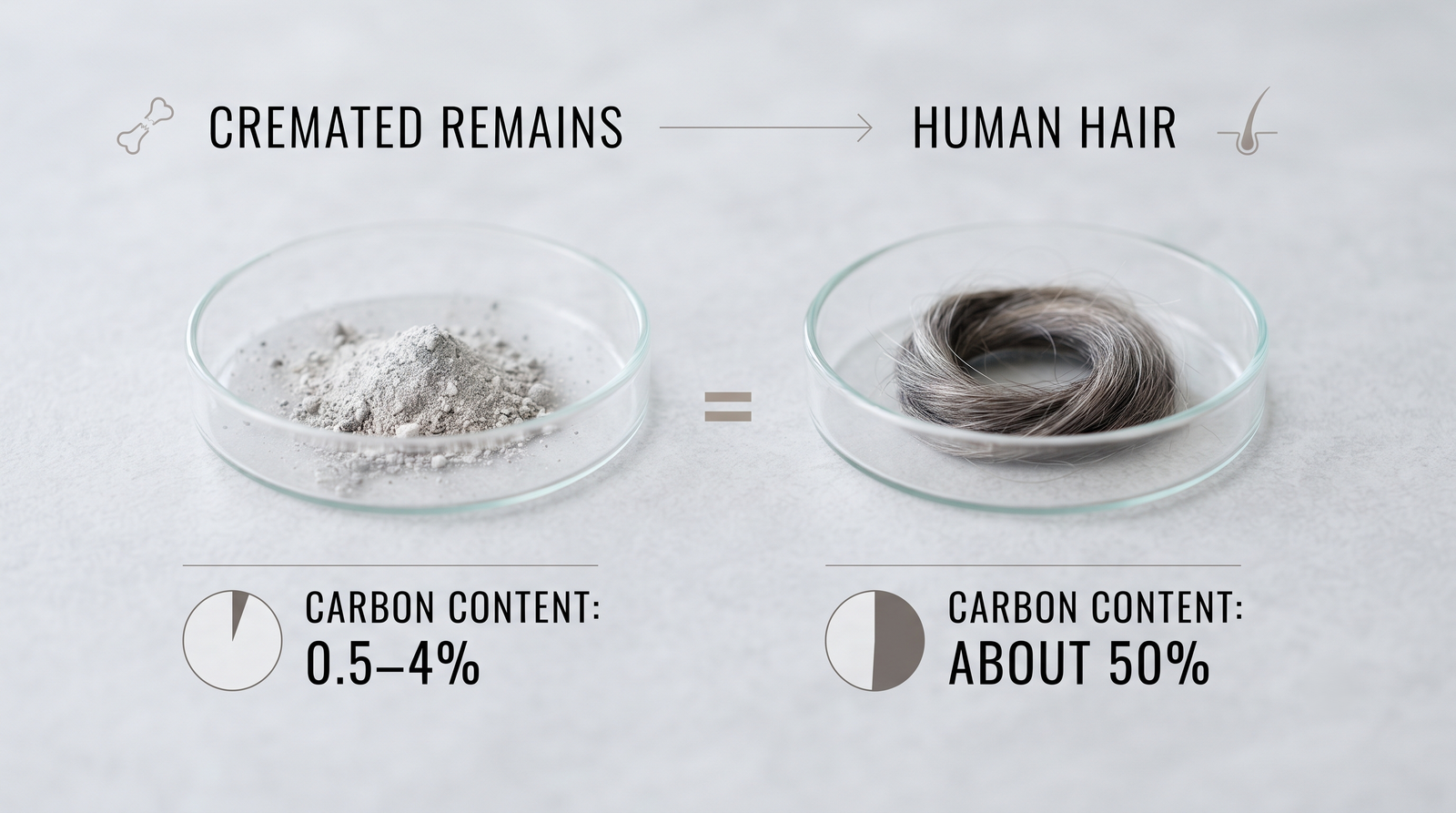
Side-by-side comparison of a dish of cremated remains and a coil of hair with their approximate carbon content noted, 0.5–4% against about 50%

Learn More About Father Memorial Diamonds

Talk With Memorial Diamond

Memorial Diamond can give you both figures for your father, how much ash and how much hair a combined stone would need, and say what happens if one of the two falls short. Nothing has to be opened, cut or posted to ask. Start at memorialdiamond.us.
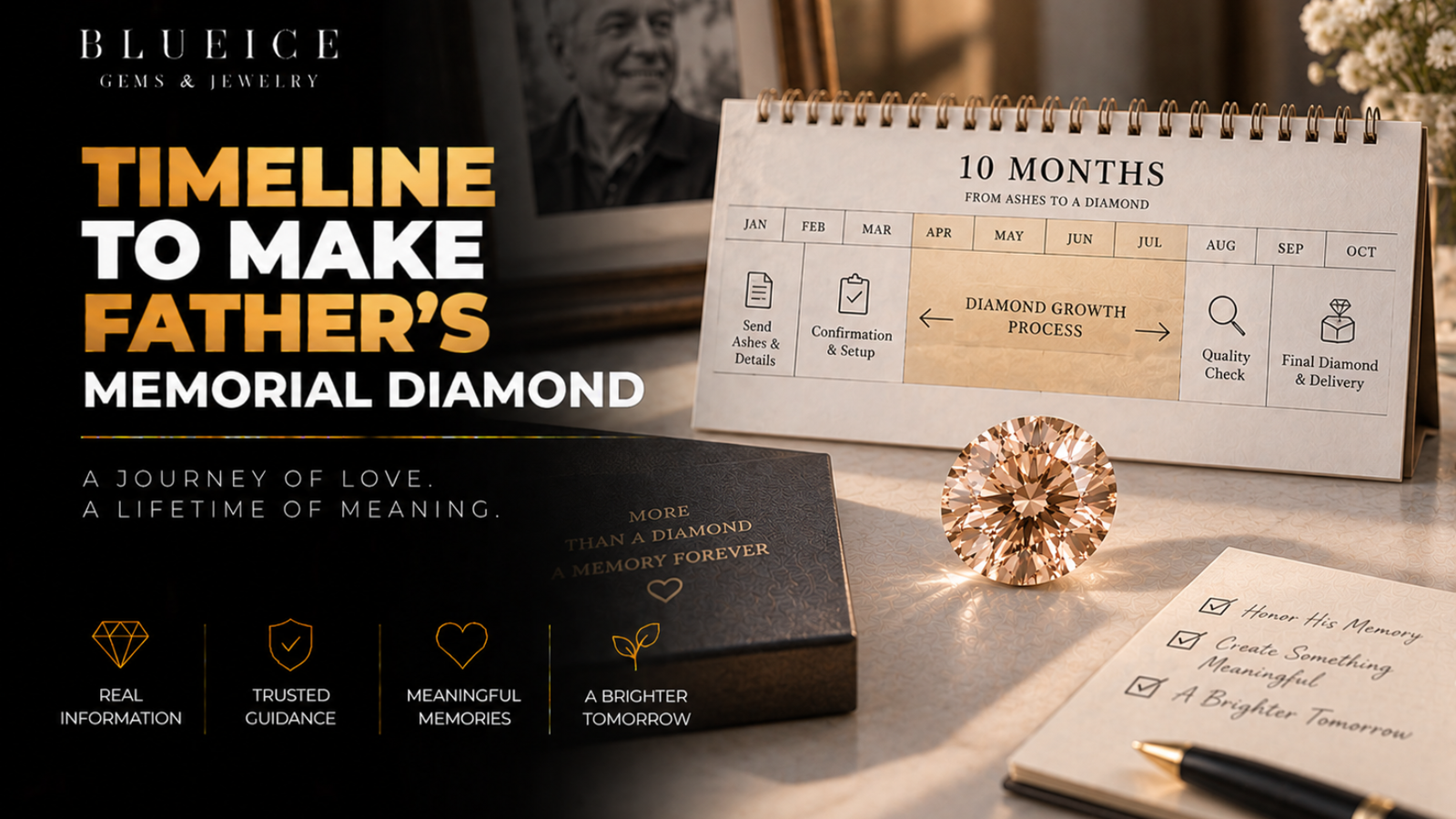
How long it takes to make father memorial diamonds: a ten-month wall calendar with the growth window marked in the middle and family decisions marked either side

How Long to Make Father Memorial Diamonds? 8 Reliable Answers

Ask two families who ordered in the same month and their answers can be months apart, and neither of them was told anything wrong. How long does it take to make father memorial diamonds? Industry wide, production typically runs 6 to 10 months from the laboratory’s intake, rising toward 12 months for stones over roughly 2 carats or in specialty colors. End to end, from the first conversation to a finished piece in your hand, a working estimate of around 8 to 14 months is reasonable, though that total is arithmetic rather than a published figure.

The interesting part of that range is where it comes from. The growth window is the most predictable stretch of the whole process to make father memorial diamonds. Most of the difference between one family finishing early and another finishing late happens either side of it.

Memorial Diamond is one of the companies that does this work. Read the checks below as ones to put to any provider, including us.

How Long Does Each Part Actually Take?

The sourced industry figure is the production window: 6 to 10 months, measured from the point the laboratory logs the material in, and up to around 12 months for larger stones or treated colors. Size drives that window because carat is a function of growth time in the press rather than of how much material was submitted.

Around that sits everything else it takes to make father memorial diamonds, deciding, retrieving, shipping, grading, setting, which is where the 8 to 14 month working estimate comes from. It is arithmetic, not a service level. The complete guide to father ashes diamonds sets those phases out as a table and covers planning backwards from a date that matters.

This page is about the other question: not how long each phase takes to make father memorial diamonds, but what makes it longer or shorter than the average.

Where Does Most of the Variance Happen?

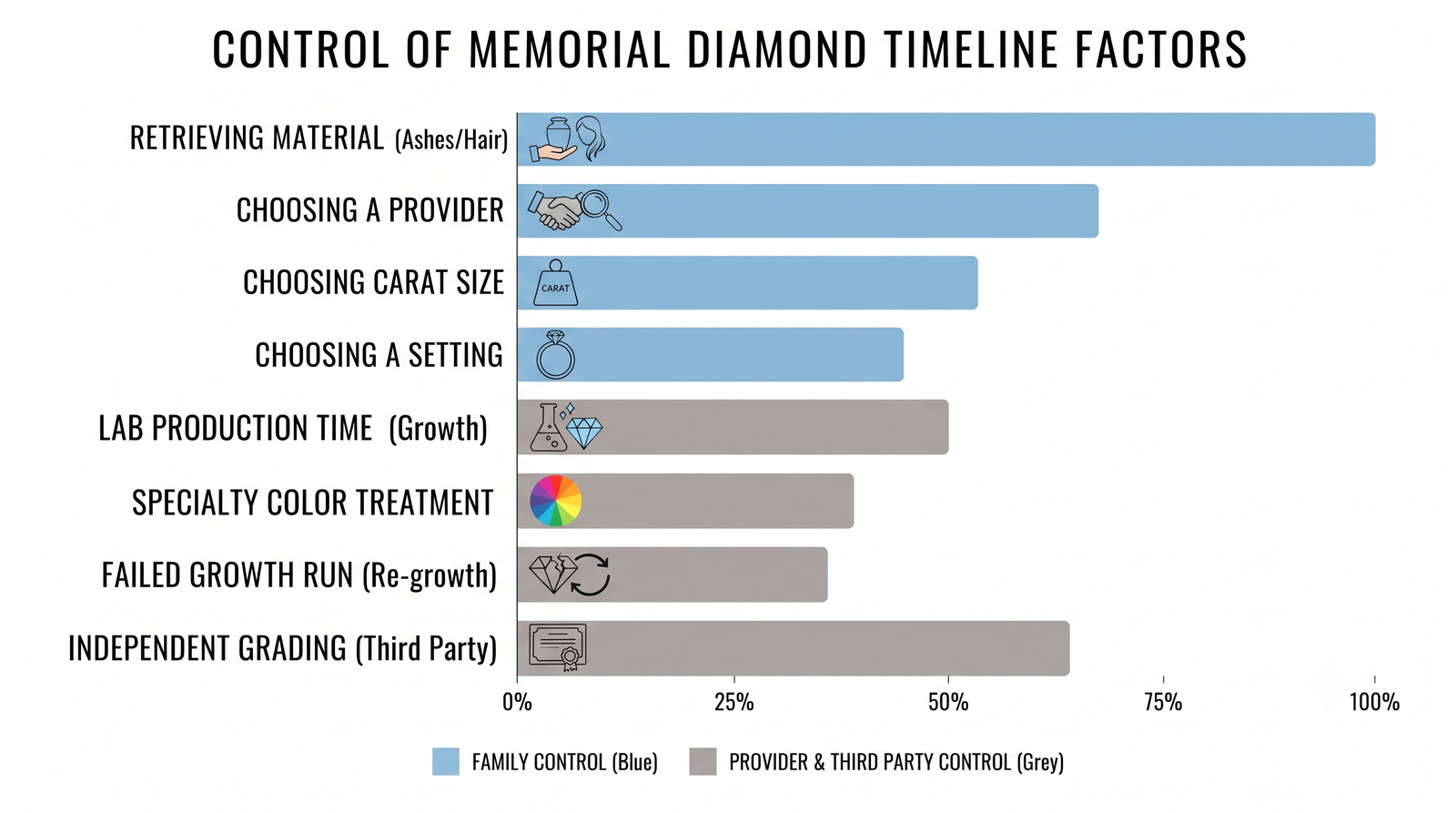
Before the laboratory sees anything, mostly, the time to make father memorial diamonds is decided largely outside the lab. The table below sorts what varies by who controls it.

What variesDirection and rough sizeWho controls it
Retrieving material, a retention request, a sibling holding the urn, a search for hairAdds days to several monthsYour family
Choosing a provider and getting answersAdds 1 to 6 weeksYour family, partly
The carat chosenMoves the growth window by months within the 6 to 12 rangeYour family
A treated or specialty colorAdds weeks to a couple of monthsProvider, once specified
A failed growth runAdds months, and is the largest single unplanned delayNobody
Grading, where an independent laboratory is usedAdds weeks after the stone is finishedA third party
Choosing a settingAdds nothing if decided early; weeks or months if decided lateYour family
A scheduled release or interment dateCompresses the front end, and cannot be movedA cemetery, a funeral home, or an estate
Simple bar chart of eight timeline factors, four colored for the family and four for providers and third parties

Read down the right hand column. Four of the eight sit with your family, which is why the most effective thing a family can do about how long it takes to make father memorial diamonds is make the early decisions early, including the one about the setting that rarely feels urgent.

What Is Genuinely Fixed When Labs Make Father Memorial Diamonds?

The laboratory stages used to make father memorial diamonds, and no amount of money changes them.

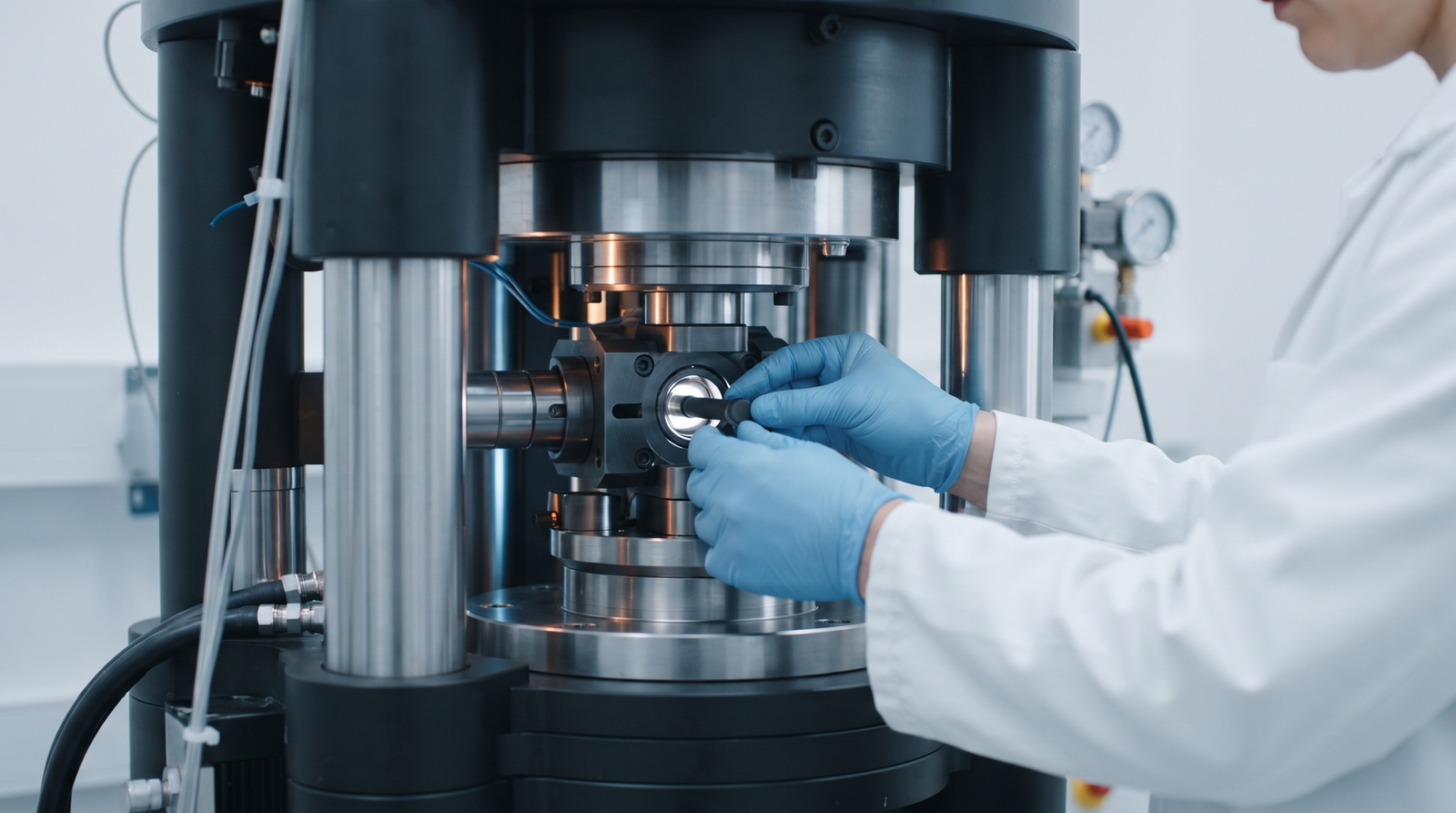
Extraction and purification take the weeks they take. Graphitization at roughly 2,500 to 2,700°C takes the days or weeks it takes. Growth in an HPHT cell at roughly 6 to 8 GPa and 1,400 to 2,500°C runs for weeks to months, and a growth run cannot be hurried without changing what comes out of it. Cutting and polishing is a gemologist’s bench work on an irreplaceable stone.

An HPHT press in a diamond laboratory with a growth-cycle timer visible, illustrating the fixed laboratory stages.

It is worth being clear about what those months are producing, because it shapes what the wait is for. The press is not growing a stone made of your father. It is growing a stone in which his carbon is a provable share, blended with lab grown carbon so there is enough feedstock for a growth run. That is the honest description of how labs make father memorial diamonds, it is the one to expect from any provider, and how a memorial diamond is made from your father’s ashes sets out the arithmetic behind it.

What that means practically: the carat decision is the timeline decision. A smaller stone finishes sooner because the press runs for less time, not because it moved up a list. Choosing a carat size is therefore worth thinking of as a two part choice, cost and calendar, rather than one. What a father memorial diamond costs covers the other half.

Which Parts of the Schedule Aren’t Yours to Move?

Three situations put dates in the process to make father memorial diamonds that belong to somebody else. None of them lengthens the growth run; all of them can lengthen the total time to make father memorial diamonds.

A national or service cemetery interment. The date is set against the cemetery’s calendar, and the funeral home may release his remains directly to it. A retained portion has to be separated before that release, so the front end of the process compresses into whatever window exists between the cremation and a date the family did not choose. Honoring military service with a memorial diamond covers how that timetable works.

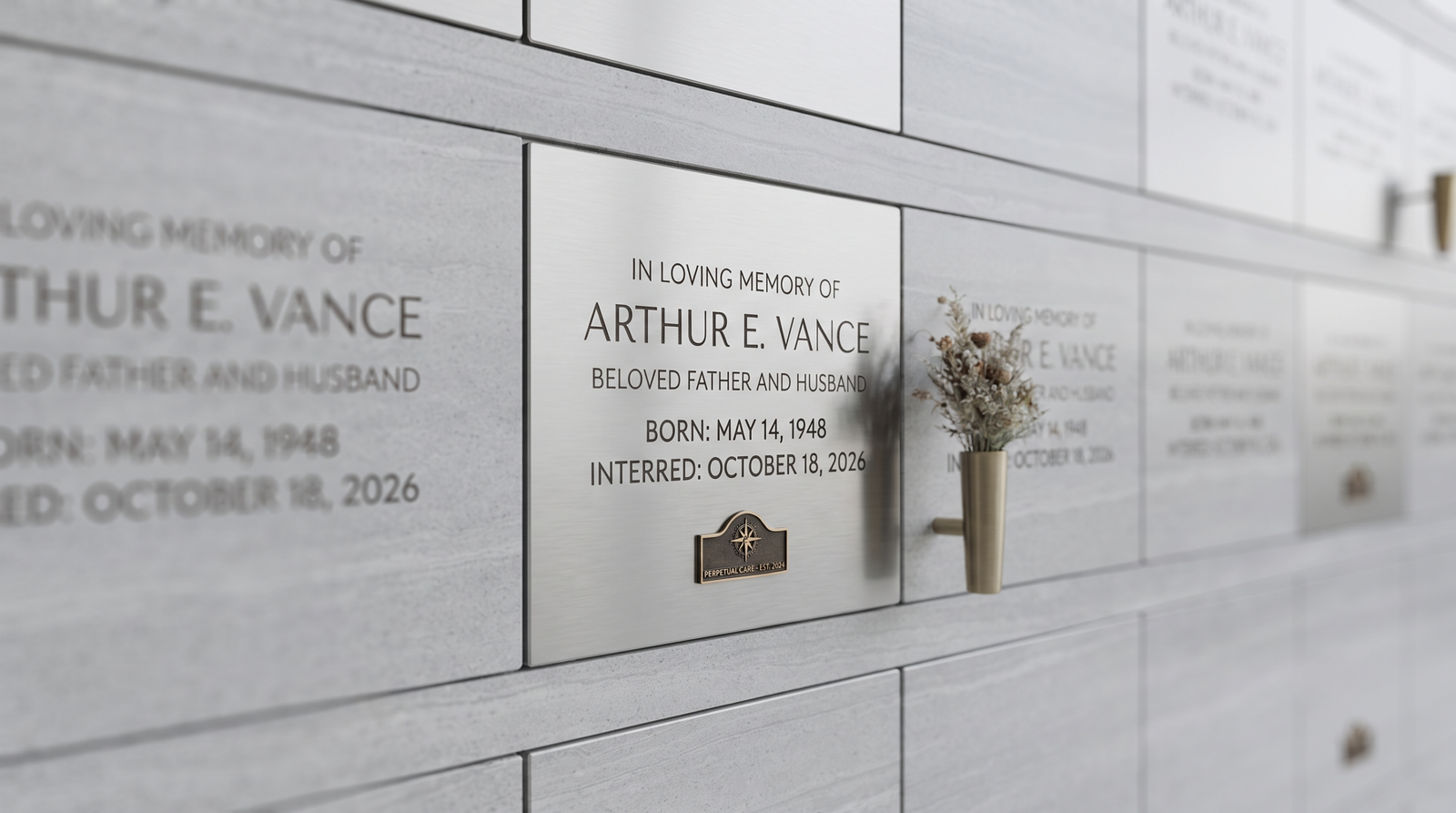
A columbarium wall with an engraved date plate, illustrating an interment date the family cannot move.

A shared plot or a planned interment with a spouse. Where arrangements were made years earlier, a plot bought together, a niche reserved, there is often a date attached, and a date of that kind closes the ash route rather than delaying it.

An estate still being settled. Where a decision needs several people’s agreement, or an executor’s, the calendar belongs to that process rather than to the diamond.

None of these lengthens the production window. All three can lengthen the total, and the fix in each case is the same: find out the date early, because it is the only part of the schedule that is genuinely immovable.

What Happens if a Growth Run Fails?

A failed run is the largest unplanned delay that can occur when labs make father memorial diamonds, and it is worth asking about rather than waiting to be told.

A growth run can fail, it is the one step in how labs make father memorial diamonds that carries real uncertainty, and where it does, the material and the months both have to be accounted for. What varies between providers is the procedure, whether a run is repeated, what happens to the material, whether the timeline restarts and who bears the cost. How a memorial diamond is made from your father’s ashes covers what a failure actually involves at the process level.

Ask the procedure question before ordering rather than after. It costs one line in an email and it is the difference between a setback and a shock.

What Should You Settle in the First Two Weeks?

Four of the eight rows in that table on how long it takes to make father memorial diamonds sit with your family, and all four can be worked through before a provider has even been chosen.

  • Find out whether a date exists, an interment, a scattering, a cemetery booking, and what it is. It is the only immovable thing on the list.
  • Establish who holds the material and how quickly it can be retrieved.
  • Settle the carat, since it is the timeline decision as much as the price one.
  • Choose the setting, or at least narrow it. It is easy to leave until the stone exists, and it is the easiest week to save.

None of that requires a provider, a deposit or a commitment. The step by step sequence sets out where each of these lands in the wider process to make father memorial diamonds, and grading, done to the standard 4Cs on a loose stone, is the reason the setting decision can wait until the end but should not.

Frequently Asked Questions

Is there a carat size above which the timeline changes significantly?

Around 2 carats is where the industry figures to make father memorial diamonds shift, with larger stones and specialty colors running toward 12 months rather than 6 to 10. Ask a provider where their own threshold sits before settling on a size.

How much of the total is our own decision making?

More than it looks, retrieving material, choosing a provider, specifying the stone and choosing a setting are all on your side of the line. None of it is urgent, but all of it is countable against the total.

Can the setting be made while the stone is still growing?

Worth asking. Where a setting can be prepared during the growth window, the finished stone can be set within weeks rather than months. Grading is normally done on a loose stone, so setting follows it, confirm that sequence with the provider.

Does grading add time after the stone is finished?

Where an independent third party laboratory is used, yes, grading is a queue at another organization, measured in weeks. Ask whether the quoted time to make father memorial diamonds includes it or ends before it.

What is the longest realistic total we should plan for?

Plan on the upper end of an 8 to 14 month estimate to make father memorial diamonds end to end, and treat anything faster as welcome rather than expected. For a large stone, a treated color, or a family that took months to retrieve material, longer is possible.

If we are slow at our end, does that cost us a place in a queue?

Ask, because it depends entirely on how a provider schedules the growth runs that make father memorial diamonds. Ask specifically whether a delay at your end changes anything about when yours is started, and get the answer in writing.

Final Thoughts on How Long It Takes to Make Father Memorial Diamonds

Half of what moves this timeline is already in your family’s hands, and none of it needs a provider chosen first. Find the date, find the material, pick a size, narrow the setting. The laboratory’s months are fixed and the third parties’ dates are immovable; everything between them is where a family’s attention actually shortens the wait to make father memorial diamonds.

Learn More About Father Memorial Diamonds

Talk With Memorial Diamond

Memorial Diamond can set out which stages carry firm figures and which carry estimates in the time it takes to make father memorial diamonds, and what updates arrive along the way. Start the part you control first; then reach out at memorialdiamond.us.

Father memorial diamond beside a small measured portion of cremated remains in a sealed glass vial, showing how little ash the process needs.

How Much Ash Do You Need for a Father Memorial Diamond?

Fathers tend to say what they want done with them, early, and usually more than once, so asking how much ash a father memorial diamond takes is really asking whether his plan and yours can both happen. The plain answer: industry wide, a father memorial diamond needs somewhere between a few tablespoons and roughly 4 oz (about 100 g) of cremated remains. That is a small fraction of what a cremation returns, and it is the same request whoever he was. What follows is about what that number leaves room for.

How Much Ash Does a Father Memorial Diamond Actually Use?

Across the industry, the requirement for a father memorial diamond runs from a few tablespoons at the low end to about 4 oz (100 g) at the high end. Each provider sets its own figure inside that band, so the number that governs your decision is the one your chosen provider publishes, not an average.

Why not less? Because ash is a demanding starting material. Cremated remains are almost entirely calcium phosphate, the mineral structure of bone, and usable carbon is only about 0.5% to 4% of ash by weight. Recovering a workable amount of carbon means starting with a spoonable quantity rather than a pinch.

Why not more? Because extra volume buys no carat and no speed. Once a growth cell has enough feedstock, size is a function of time under pressure. The diamond is grown in an HPHT growth cell, which is why the industry typical timeline for a father memorial diamond runs 6 to 10 months regardless of how full the container was.

One qualification belongs on every page in this category: his carbon does not fill that growth cell alone. It is blended with supplemental lab sourced carbon, and the personal fraction of a finished father memorial diamond typically lands around 10% to 15% of the stone’s mass. Some providers describe that fraction as varying with stone size and with how much ash was submitted, so before defaulting to the minimum, ask what quantity corresponds to what fraction at the carat you want. Any provider describing a stone as 100% him is describing something the physics does not allow.

Does a Larger Man Mean More Ash Is Needed?

No, and the arithmetic runs the other way.

The total volume of cremated remains scales with skeletal mass, so a tall or large framed man generally leaves more than a smaller person does. What a provider asks for does not scale with him. A few tablespoons to roughly 4 oz is the request for a father memorial diamond whoever the person was.

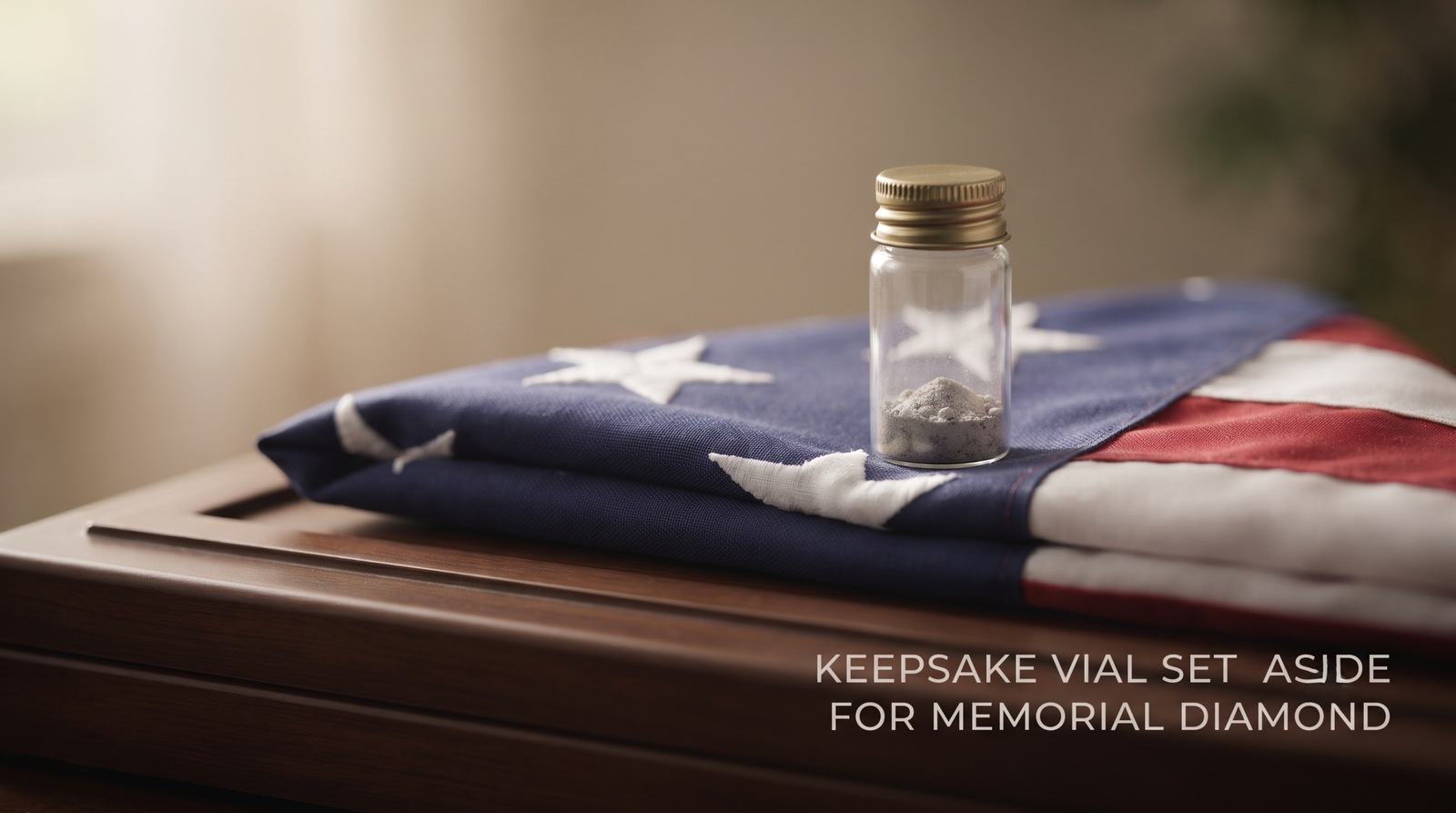
Small keepsake vial of ashes set aside before an interment, resting on a folded flag.

So for a larger father, the same request represents a smaller share of the whole. The proportion you hand over falls; the absolute quantity does not move.

What does vary, and is outside anyone’s control, is where his carbon yield falls inside the 0.5% to 4% band, individual chemistry and the specifics of the cremation both move it. That variation changes nothing about the amount you are asked to send.

Is a Father Memorial Diamond Still Possible if Plans Were Already Made?

This is what the quantity question is usually standing in for. Someone has already done something with the ashes, or promised to, and the real question is whether a father memorial diamond is still on the table.

What has already happenedIs the ashes route still open?What to do
Still in the container at homeYesThe requirement is a fraction of it; nothing else needs to change
A portion already kept back by the familyUsually, the range starts at a few tablespoonsDescribe honestly what you have and let a provider assess it before you commit
Divided among siblings alreadyYes, from one person’s share, or pooledAgree it before anyone opens anything a second time
Interred in a cemetery plot or columbarium nicheSometimes, a permitting question governed by state or local law and cemetery policyAsk the cemetery first, not the diamond provider; do not assume either answer
Buried with your mother, or in a family graveSame answer, with a family decision attached as well as an administrative oneTreat it as a conversation before it is an application
ScatteredNoThe hair route is the remaining option
Buried at seaNoThe hair route is the remaining option
He was buried rather than crematedNo ashes existHair, if any was kept, no cremation is involved in that route

Two situations come up often enough with fathers to deserve their own paragraph.

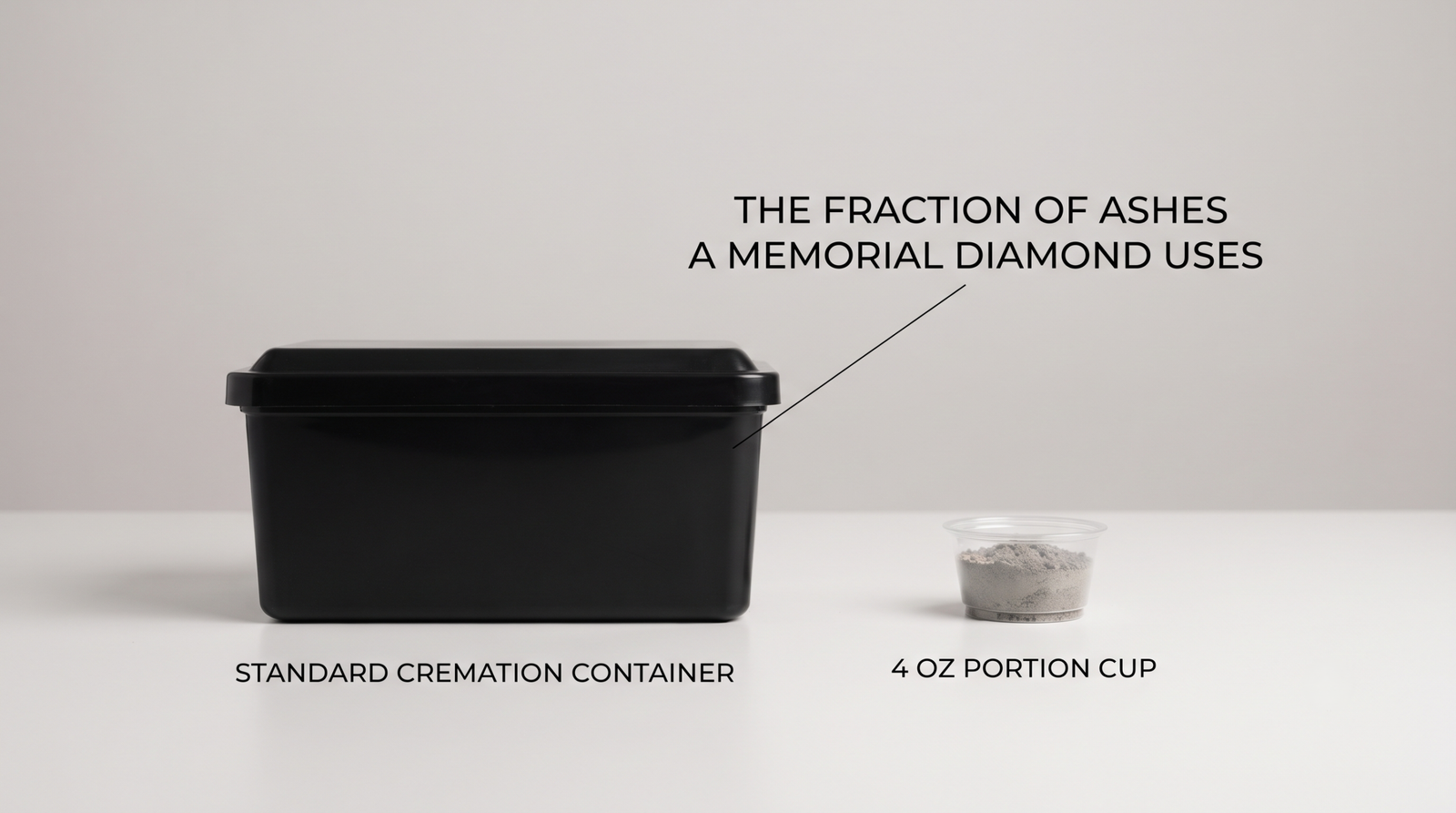
A standard cremation container next to a 4 oz portion cup, illustrating the fraction of ashes a memorial diamond uses.

When he died after your mother. A father who outlives his wife is often covered by a plan made years earlier, interment together, a shared plot, a scattering with a date already chosen. That plan is what closes the ashes route, and it is usually on a calendar. If the plan has not been carried out yet, setting aside a portion for a father memorial diamond beforehand is straightforward; retrieving one afterwards may not be.

When there is a military or service interment. Veterans’ cemeteries and honor guard services run on their own timetable and chain of custody. If a portion is going to be retained for a father memorial diamond, it has to be set aside before the funeral home releases the remains for interment, say so early, to the funeral director rather than the cemetery.

What if Only a Small Portion of His Ashes Was Kept?

Frequently still workable, and worth checking rather than assuming.

The requirement starts at a few tablespoons, so a small portion kept back years ago, after a scattering, after an interment, after siblings divided things, often sits inside the range for a father memorial diamond. It is easy to rule this out on a glance at a container, and much better to rule it out on an assessment.

Two things to do before deciding anything:

  1. Describe what you actually have. Roughly how much, how it has been stored, and what happened to the rest, then ask a provider to tell you whether it works.
  2. Ask before opening anything. Get the required quantity and the preferred container in writing first. A portion measured out against the wrong figure has to be measured out twice, and the second time is worse.

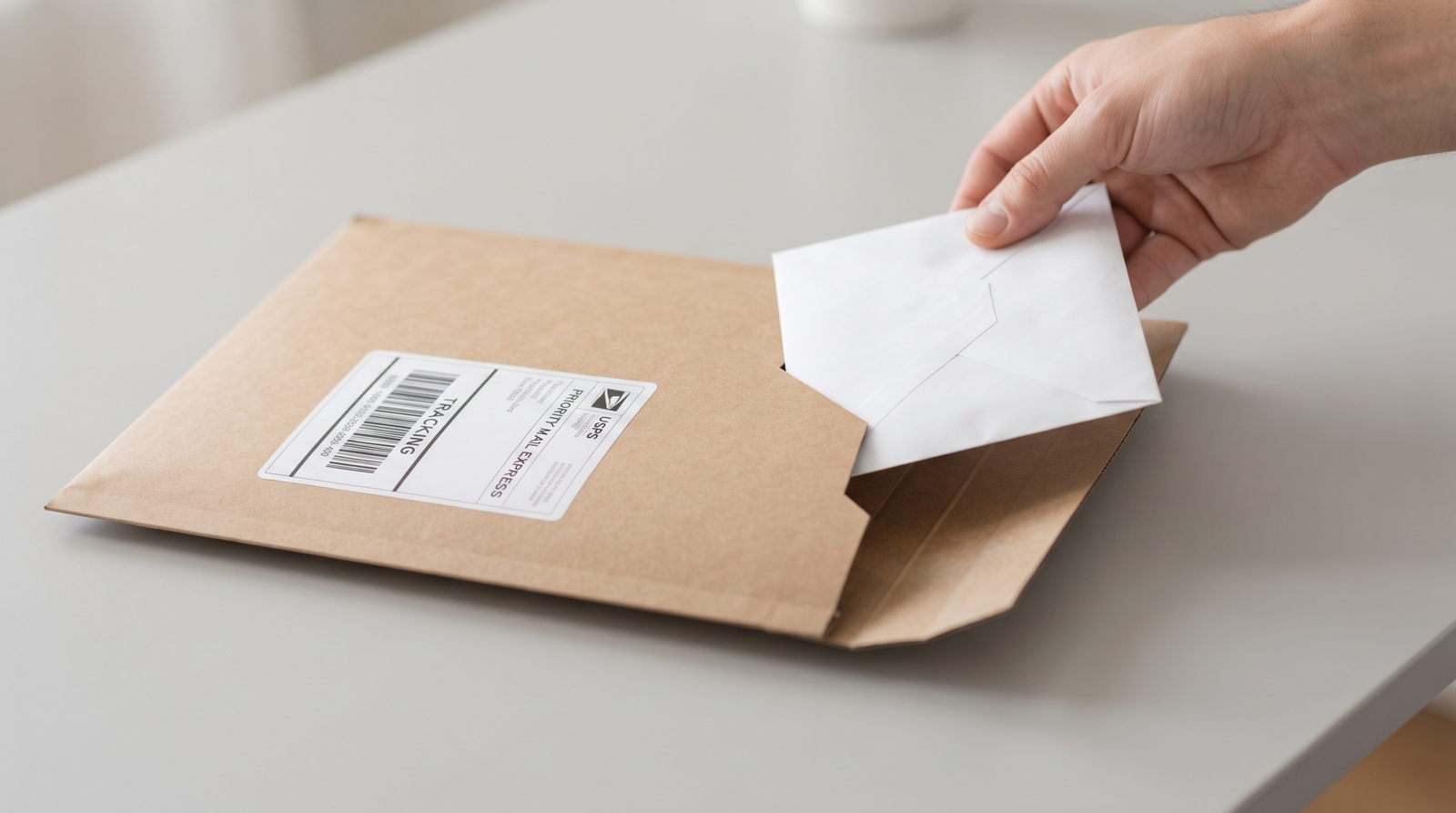
One practical note before anything is posted: in the US, cremated remains are accepted for mailing only by USPS Priority Mail Express in its official cremated remains packaging, and the major private carriers refuse them from individual shippers. Follow your provider’s shipping instructions rather than improvising at a courier counter.

If it turns out to be too little, that is a real answer rather than a closed door. Hair is roughly 50% carbon by weight, so a father memorial diamond grown from hair needs a fraction of the mass that ashes do, how much hair a father memorial diamond needs covers that route on its own.

Is There Enough Ash for More Than One Father Memorial Diamond?

Often, yes, and it is easier to settle now than later.

Because the requirement is a fraction of the whole, several family members can each receive a father memorial diamond from the same starting material. Each stone is grown separately, so color, cut and setting can differ from sibling to sibling, and separate runs mean the stones will carry a family resemblance rather than a match, which is worth saying out loud before anyone expects otherwise.

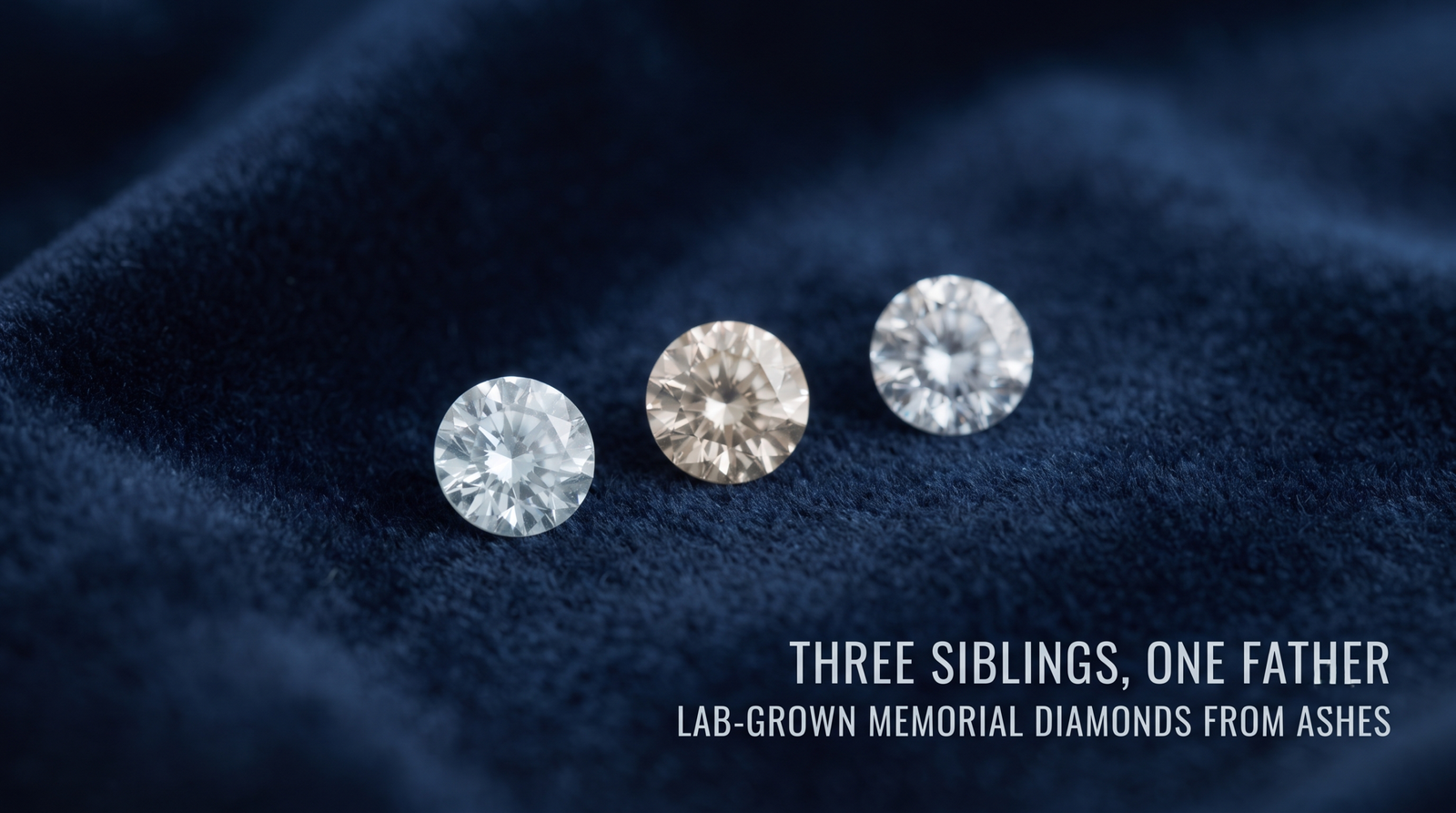
Three loose lab-grown memorial diamonds of slightly different tones on velvet, grown for three siblings from the same father's ashes.

Raise it before the first order. Agreeing on three stones once is simpler than going back to the same container a second and third time, and settling it early moves the conversation off the question of who ends up holding him, which is the one nobody in a family wants to have twice. Whether more than one family member can get a diamond from the same father’s ashes covers how families split the cost and the decision.

Frequently Asked Questions

Is a few tablespoons genuinely enough for a one carat father memorial diamond?

Usually. Requirements are set per provider rather than per carat, and carat comes from growth time rather than volume submitted. One caveat: some providers describe the personal carbon fraction as varying with stone size and quantity, so ask what quantity corresponds to what fraction at the size you want.

Do the ashes I don’t use come back to me?

Ask before sending and get the answer in writing, specifically whether unused remains return by default or only on request. Practice varies by provider and this is company policy rather than a legal guarantee, so treat vagueness on the point as a warning sign.

Can I use ashes from a cremation that happened decades ago?

Yes. Cremated remains are chemically stable mineral material and do not degrade sitting in a cupboard, so a container from the 1990s enters the process for a father memorial diamond the same way a recent one does.

Do surgical implants or hardware in his remains cause a problem?

No. Metal from joint replacements or surgical hardware is separated from remains after cremation, and anything still present is removed at intake rather than carried into carbon extraction. It does not affect the quantity you need to send.

Would sending more ash make the diamond bigger, or the color deeper?

Neither. Carat comes from growth time and color from trace elements present during growth. What extra material can move is the personal fraction, which some providers describe as varying with how much was submitted, so ask what quantity corresponds to what fraction, then decide.

Can I send ashes and hair together instead?

Yes, if both exist and the provider accepts combined submissions, though combining is not a way to bring either material under its own threshold. How much ash and hair a combined father memorial diamond needs covers how the two are assessed.

Final Thoughts on How Much Ash a Father Memorial Diamond Needs

None of this is urgent in the way it feels. Cremated remains do not change on a shelf, and the same few tablespoons will do the same work next spring that they would do this week.

The part worth doing now is the free part, and it happens before the container is opened: establish the required quantity, whether unused material comes back by default, and, if his ashes have already been divided, interred or scattered, whether what remains is workable at all. A father memorial diamond has never depended on how much of him you have. It depends on asking that question before anyone opens the lid.

Learn More About Father Memorial Diamonds

Talk With Memorial Diamond

If you are weighing this with a container in the house, or with a portion that was set aside years ago, the cheapest next step is a conversation, not an order. Reach out to Memorial Diamond to talk through what quantity would be needed for the stone you have in mind, whether what you have is workable, and what happens to anything unused. Nothing needs to be opened, measured or posted to ask. Start at memorialdiamond.us.

Diamond made from a father's ashes and hair: a single champagne-toned lab-grown memorial diamond on white

What Color Will a Diamond Made From Your Father’s Ashes and Hair Be?

If you are sending both his ashes and a lock of his hair, you have probably already pictured the stone and somewhere in that picture is a quiet question about whether the two will show. A diamond made from your father’s ashes and hair will be one uniform color, most often yellow, champagne or blue, and only rarely colorless. There is no two tone stone, no boundary, no marbling. Both materials become one batch of carbon before growth begins, so one crystal forms with one color. What combining changes is not the appearance. It is the arithmetic underneath it.

What Does a Diamond Made From Both Materials Actually Look Like?

Like a single source stone, because that is what it is.

His ashes and his hair are purified separately to roughly 99.9%+ carbon, then both pass through graphitization at around 2,500 to 2,700°C. At one step, immediately before or after that, depending on the provider, the two are combined with each other, and with supplemental lab sourced carbon, into one feedstock for one growth cell and one growth run. By the time anything is growing, there is no “ash carbon” and no “hair carbon.” There is carbon.

So a diamond made this way comes out of the press exactly as any memorial diamond does: one crystal, one color, graded on the same color scale gemologists use for every diamond. The sequence itself, collection, purification, growth, cutting, is walked through in how a memorial diamond is made from a father’s ashes and hair.

Why Isn’t the Color an Average of Ashes and Hair?

Because color is not a property either material brings with it. It is a property of the crystal that forms.

Boron pulls toward blue. Nitrogen pulls toward yellow. Both together, in different proportions, produce champagne and brown. Those elements ride into the growth cell on whatever feedstock is in it and then influence the whole crystal as it grows. They do not tint only “their” share of it. Two residue profiles enter one cell. One color comes out.

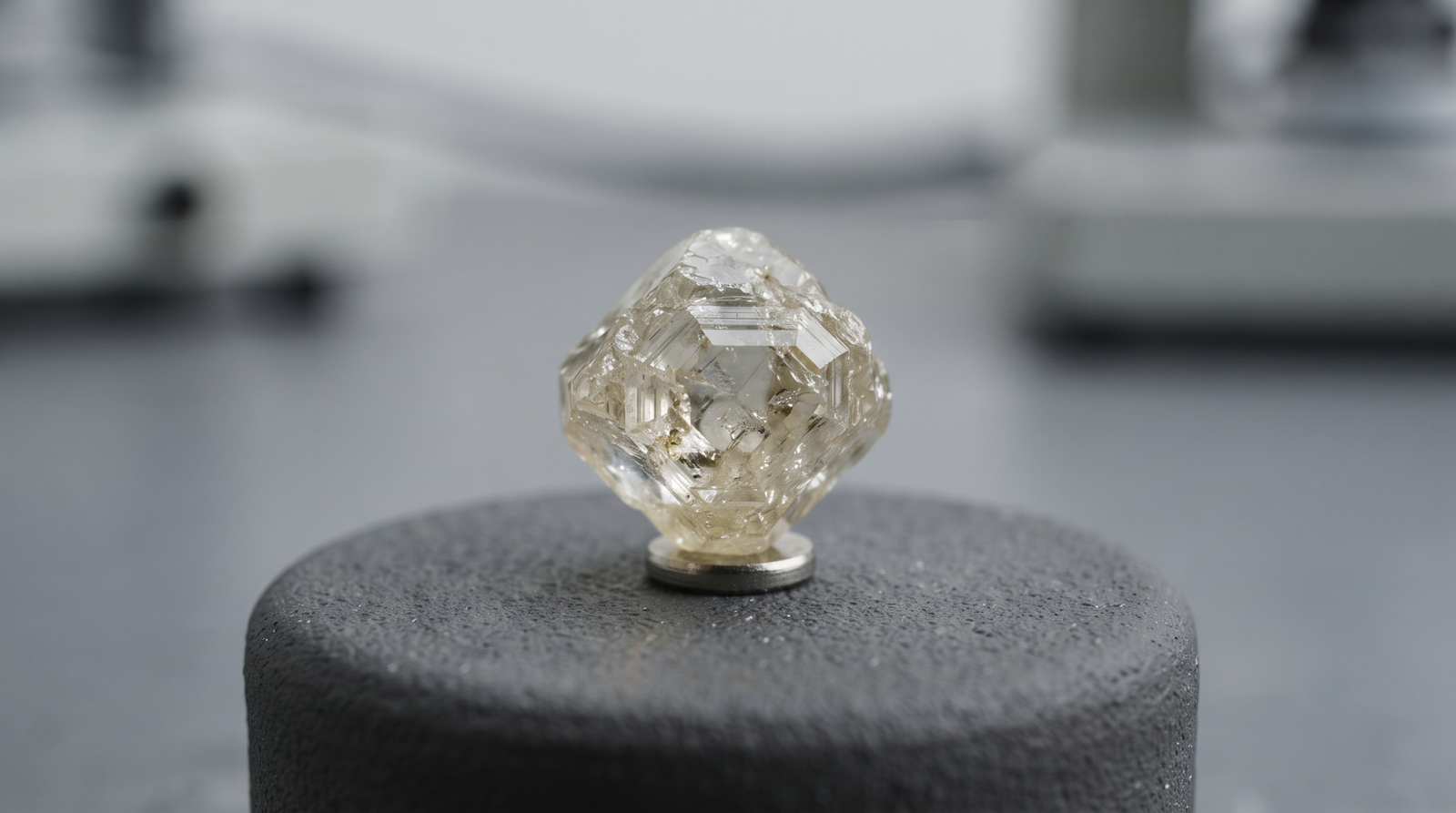
Rough lab-grown diamond crystal on a growth seed, photographed before cutting

This is also where the honest qualification belongs. His carbon, from both sources together, does not fill that cell. It is blended with supplemental lab sourced carbon, and the personal carbon is a minority of what grows. The industry’s published figure for ash derived stones is roughly 10 to 15% of the finished stone’s mass, varying with stone size and how much material was submitted. No comparable published figure exists for a combined order. Most of what grows is controlled synthetic carbon. Even so, the trace elements arriving on the personal minority are enough to pull a diamond made from real remains away from colorless, which is why the whole category trends the way it does.

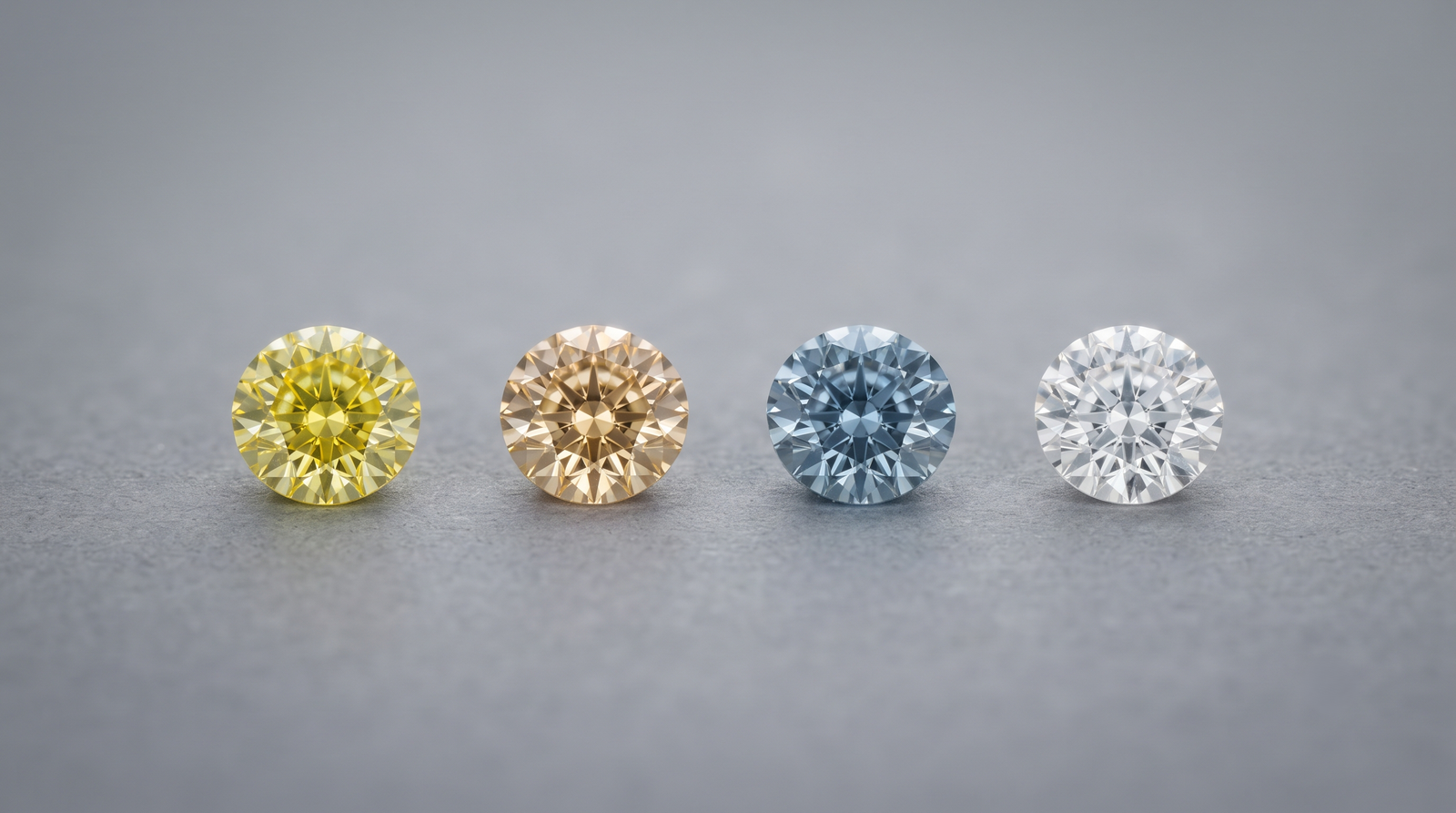
Which Five Colors Can You Expect?

Every diamond made from ashes, hair, or both lands somewhere in the same short range. Here is what each outcome means for a combined order.

ColorWhat produces itWhat it means for a diamond made from both
YellowNitrogen present during growthThe most common natural outcome. The two materials do not make it more or less likely.
Champagne / brownNitrogen and boron together, or nitrogen plus growth structure defectsFrequently what “we’ll let it be whatever it becomes” turns into.
BlueBoron present during growthPrized, but not orderable on demand from personal carbon alone. Treat it as a hope, not a spec.
ColorlessNear total exclusion of both nitrogen and boronAchievable, but requires additional processing and costs more at the same carat.
Red, pink, green, blackPost growth irradiation or treatment after the stone existsAn add on step some providers offer. It acts on the finished crystal, not on the ashes or hair.
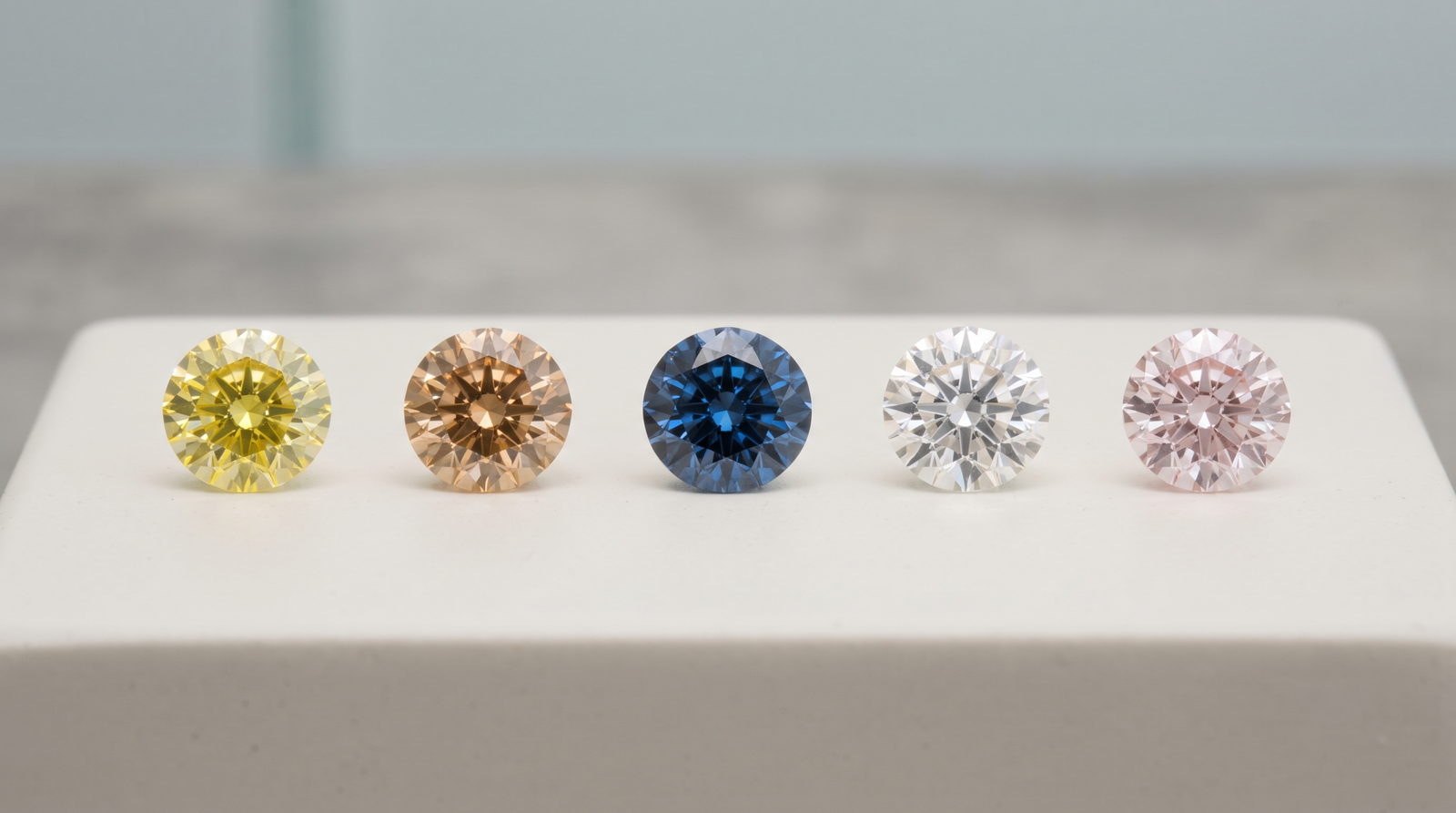
Five loose lab-grown diamonds in a row: yellow, champagne, blue, colorless, and pink

Two things follow from that table. First, the color you receive is chosen from a provider’s menu, not deduced from the materials. Second, the one color decision that genuinely changes the process, colorless, is the one that costs more and takes longer, because excluding trace elements is extra work, not less work. The broader explanation of why memorial diamonds are rarely colorless covers that chemistry for every relationship and material.

Which Material Contributes More to the Color?

Not the heavier parcel, necessarily. This is the part almost nobody expects.

Cremated remains are mostly calcium phosphate. Usable carbon is only around 0.5% to 4% of ash by weight. Hair is built from keratin and is roughly 50% carbon by weight. So a small lock of hair can contribute carbon on the same order as a much larger quantity of ash. A family that sends four ounces of ashes and a single palm sized lock has not necessarily sent “mostly ashes” in any sense a diamond made from them would show.

A small lock of grey hair beside a few tablespoons of cremated ashes in a labeled container

That matters for expectations in a specific way:

  • The ash derived carbon tends to carry more of the mineral and trace element residue that pulls color toward yellow and champagne.
  • The hair derived carbon is cleaner by proportion, but it enters the same cell and the same crystal. It does not carve out a paler region.
  • Neither source can be pointed to afterward. A diamond made from both is not “his ashes on one side, his hair on the other.” It is one lattice.

If you want to understand the quantities themselves before you decide on a size, how much ash and hair you need for a father memorial diamond is the right place to start.

What Should You Settle Before You Order?

Choosing the color of a diamond made from both materials adds no extra decisions. It adds two questions about the materials themselves. Sort these before you talk to a provider, and the color conversation becomes short.

  1. Are both materials confirmed usable? Hair treated heavily with dye or relaxer is sometimes declined by providers. Ashes from a very high temperature cremation can yield less carbon. Ask about both rather than assuming.
  2. Are you choosing a color, or accepting the natural outcome? Providers usually let you either specify a color from their menu or let the diamond made from them grow “as it comes.” The second is often the more affordable path.
  3. Does colorless matter enough to pay for it? At the same carat, a colorless diamond made from personal carbon costs meaningfully more than yellow, champagne or blue, because of the extra processing.
  4. Do you want treatment after growth? Red, pink, green or black stones come from a separate irradiation step on the finished crystal. Decide whether that fits what you had in mind.
  5. Who else in the family will see it? If siblings expect “his color,” agree together what that means, a chosen shade, or whatever the stone becomes.

A working list of questions to ask before turning a father’s ashes and hair into a diamond covers the non color questions alongside these.

Frequently Asked Questions

Will a diamond made from my father’s ashes and hair be two colors?

No. Both materials are purified and combined into one carbon feedstock before growth, so a single crystal forms with a single, uniform color. There is no visible boundary, no marbling, and nothing that indicates two sources once the stone is finished.

What color is most likely if I don’t choose one?

Yellow or champagne. Nitrogen is the most common trace element present during growth, and it produces yellow tones. Combined with other traces it shifts toward champagne and brown. Blue and colorless are less common as unrequested outcomes across the industry.

Can I get a blue diamond made from his ashes and hair?

Sometimes. Blue comes from boron present during growth, which providers can influence but cannot guarantee from personal carbon alone. Ask the provider directly what their process allows. Treat blue as an option on their menu, not something the materials decide.

Does adding hair make the stone whiter than ashes alone?

Not reliably. Hair derived carbon is cleaner by proportion, but it enters the same growth cell and the same lattice as the ash derived carbon, and trace elements affect the whole crystal. A colorless result comes from extra processing, not from mixing the materials.

Why does colorless cost more?

Because it requires excluding nitrogen and boron during growth, which is additional process control on top of the standard run. Across the industry, colorless stones cost meaningfully more than yellow, champagne or blue at the same carat weight.

Will the color change over the years?

No. The color of a diamond made this way is fixed at the point the crystal forms. It does not fade, deepen, or shift with wear, light, or time. A grading report records the color it has, and that is the color it keeps.

How is the color of a diamond made from both materials graded?

On the same GIA style scale as any diamond, D to Z for colorless to tinted stones, and “fancy” descriptors for stronger yellows, blues and other hues. Reputable providers have the finished stone graded by an independent third party lab rather than relying only on an in house certificate.

Final Thoughts on the Color of a Diamond Made From Both

Most families who send both materials are not looking for a two tone stone. They are making sure everything that is left of him goes into the one thing they will keep. The color that comes back, yellow, champagne, blue, or a colorless stone you paid a little more for, will not tell you which parcel did what, because a diamond made from both genuinely does not know. It was one run, one cell, one father. That is not a limitation of the process. It is the point of it.

Learn More About Father Memorial Diamonds

Talk With Memorial Diamond

If you have both his ashes and his hair and are not sure what to expect, that is a normal place to start. Reach out to Memorial Diamond to talk through what is possible for the materials you have, including which colors a provider can offer for a diamond made from both, which one is simply the natural outcome, and what a colorless stone would add to the cost.

Color diamond in a warm champagne tone beside a small lock of gray hair on a white surface

What Color Will a Diamond Made From Your Father’s Hair Be?

The lock you kept is probably not the color it was when you were small. That is usually where this question starts. The answer is that the color diamond his hair becomes is decided in the growth cell, not by the hair: a diamond made from your father’s hair will most often be yellow, champagne or blue, colorless is possible at a higher cost, and gray, white, black or thinning hair changes none of that.

Which means color is the one thing the lock cannot decide for you. You decide which color diamond to grow, on the order form, before anything is grown.

Does Your Father’s Hair Color Change the Color Diamond You Get?

No. White hair does not make a white diamond, black hair does not make a dark one, and a beard sample behaves exactly like a sample from his head.

Hair color is melanin, a pigment. Before any growth begins, the hair is heated in an oxygen free process that strips away everything that is not carbon, and the purified carbon is then converted to graphite at roughly 2,500 to 2,700°C. No pigment molecule survives that, which is why hair color never reaches the color diamond. What reaches the press is elemental carbon, and elemental carbon from white hair is indistinguishable from elemental carbon from anyone else’s.

Hair is roughly 50% carbon by weight, which is why a small lock is enough and why no cremation is involved. How a memorial diamond is made from your father’s hair walks through each stage.

What Actually Sets the Color of a Hair Diamond?

Trace elements present while the crystal grows. Boron in the growth cell produces blue. Nitrogen produces yellow. A colorless stone requires the near total absence of both, which is easy for a manufactured feedstock and harder for a personal, organic one.

Technician placing a graphite capsule into an HPHT diamond-growth press

His purified carbon is blended with supplemental lab sourced carbon to reach a workable volume, so the finished stone is not entirely one person, but the trace elements riding along with the personal carbon still steer the color of the whole crystal. That is why a color diamond in the yellow to blue range is the natural outcome of a hair source, and why colorless takes additional processing and additional cost.

The growth itself uses either an HPHT press or CVD deposition. Both lab growth methods are described here. The process takes weeks to months depending on the carat you order.

Which Color Diamond Can a Father’s Hair Become?

Industry typical outcomes, not a promise about any one stone. The five rows below are the honest color diamond menu for a hair source.

ColorWhere it comes fromWhat it means for youCost position (industry typical)
YellowNitrogen present during growthThe most common natural outcome of a hair sourceBottom of the band at a given carat
Champagne / brownSeveral trace elements acting togetherReads as a warm neutral; not caused by brown hairLevel with yellow at matching carat
BlueBoron present during growthA target the lab steers toward, not something the lock suppliesBanded with yellow and champagne, under colorless
Colorless / whiteNear total absence of boron and nitrogenAchievable; requires extra processingThe clear step up at the same carat
Red, pink, green, blackPost growth irradiation, after the crystal existsUnrelated to the hair; availability varies by providerQuoted as an add on; black or 2 ct+ can push toward 12 months

Once the stone is finished, a color diamond is graded on the same scale as any other diamond. How gemologists grade a diamond’s color, cut and clarity applies to a memorial stone too. The broader memorial diamond colors for a father post covers how each tone reads in different metals.

Four loose lab-grown diamonds in a row  yellow, champagne, blue and colorless on gray card

Does a Small or Old Hair Sample Limit the Color Diamond You Can Order?

No. A few grams, a palm sized lock, or what a barber swept up, is the industry typical amount, and the amount has no bearing on color. Neither does age: a lock his own mother kept from his first haircut and a sample cut last month yield the same carbon and the same color diamond options. How much hair you need for a father memorial diamond covers the quantity side.

Three things do matter, so write them down before you send anything:

  • The color you want. Name it explicitly on the order: yellow, champagne, blue or colorless, rather than leaving it to a default.
  • The carat. Growth time, not hair quantity, sets size, and size moves cost far more than color does.
  • Whether you want a grading report. Independent grading is the only way to confirm the finished color against what you ordered.

If you are choosing between sending hair, ashes, or both, a color diamond from your father’s ashes lands in the same range, and sending both does not widen it.

If Several of You Want a Stone, Will They Match?

Not automatically. Because so little hair is needed, one lock can often supply more than one diamond, but each is grown in its own run, and no two runs are identical.

If matching matters to you and your siblings, order the same color diamond explicitly on every stone, expect small shade differences within that color, and ask for independent grading so each stone’s color is documented. A slight difference is normal; it is not a sign that one stone got more of him. Whether more than one family member can have a diamond from the same father covers the sharing question in full.

Frequently Asked Questions

Will a Diamond From My Father’s Gray Hair Be Gray?

No. Gray and white hair have lost their pigment, and pigment is destroyed long before growth anyway. A color diamond made from gray hair comes out in the same yellow, champagne, blue or colorless range as one made from any other hair.

Can I Get a Colorless Diamond From His Hair?

Yes. Colorless requires excluding the boron and nitrogen that give hair diamonds their natural tint, which means extra processing and a higher price at the same carat. It is a choice you specify when ordering, not something the hair decides.

Does Dyed or Treated Hair Affect the Color?

Not the diamond’s color. Dye is pigment, and pigment does not survive purification. Whether a provider accepts chemically treated hair is a separate policy question, so ask before sending a sample.

Is Beard Hair Different From Head Hair for a Color Diamond?

No. Both are keratin at roughly 50% carbon, both are purified to elemental carbon, and both produce the same range of colors. If beard hair is what you have, it works.

Which Color Diamond Is the Most Common From Hair?

Yellow and champagne tones, because nitrogen and combined trace elements are the usual companions of organic carbon. Blue is steered toward deliberately, and colorless is the exception that costs more.

Can the Color Be Changed After the Diamond Is Grown?

Only by post growth irradiation, which some providers offer to turn a color diamond red, pink, green or black. It is quoted as an add on and cannot turn a tinted stone colorless. Colorless has to be grown that way.

Does the Color Say Anything About Who My Father Was?

No. Nothing molecular survives graphitization, so the color carries no information about him. Choose it as a color you want to look at, not as a message from the stone.

Final Thoughts on the Color of a Father’s Hair Diamond

The lock you kept will not tell you what color diamond it becomes, and that turns out to be a kindness. It hands the decision back to you. Whether his hair was dark or white, thick or almost gone, the carbon is the same, the color diamond menu is the same, and the choice is yours to make deliberately rather than something to wait for.

Learn More About Father Memorial Diamonds

Talk With Memorial Diamond

If you have a lock of his hair and a color in mind, or no idea yet which color diamond you want, reach out to Memorial Diamond to talk through what is possible from the sample you have. There is no obligation, and no wrong first question.

Three loose memorial diamonds in yellow, champagne and blue tones on a gray surface

What Color Will a Diamond Made From Your Father’s Ashes Be?

Most sons and daughters picture something clear and bright when they first imagine this stone, so it helps to know the answer early. The color diamond you can expect from your father’s cremated ashes is most often yellow, champagne or blue rather than colorless. That is because trace elements arrive with the carbon and tint the crystal as it grows. A colorless stone is achievable, but it needs extra processing and costs more at the same carat weight.

None of those four outcomes is a flaw. Which one you choose matters less than where the stone is going to live and who is going to look at it, and this page is built around that decision.

Why Is a Color Diamond From Ashes Rarely Colorless?

A diamond is carbon arranged in a crystal lattice. Any atom that is not carbon and slips into that lattice changes how the crystal handles light. Two do most of the work: nitrogen, which produces yellow, and boron, which produces blue. A diamond with neither present reads as colorless.

Cremated remains are mostly calcium phosphate, the mineral structure of bone. Carbon is a small fraction, usually somewhere between 0.5% and 4% of the ash by weight. Extracting and purifying that carbon to 99.9%+ is a multi stage, oxygen free heating process, and it removes almost everything else. Almost. The trace elements that ride along are exactly what gives a memorial stone its tint.

Because the personal carbon is blended with lab sourced carbon to reach a growable volume, your father’s carbon typically makes up around 10% to 15% of the finished stone by mass. Even at that share, the impurities it carries influence the whole crystal. That is the honest reason a color diamond grown from ashes leans yellow, champagne or blue, and why a colorless result takes deliberate extra work to exclude those elements.

Which 4 Shades Can a color diamond Made From His Ashes Actually Be?

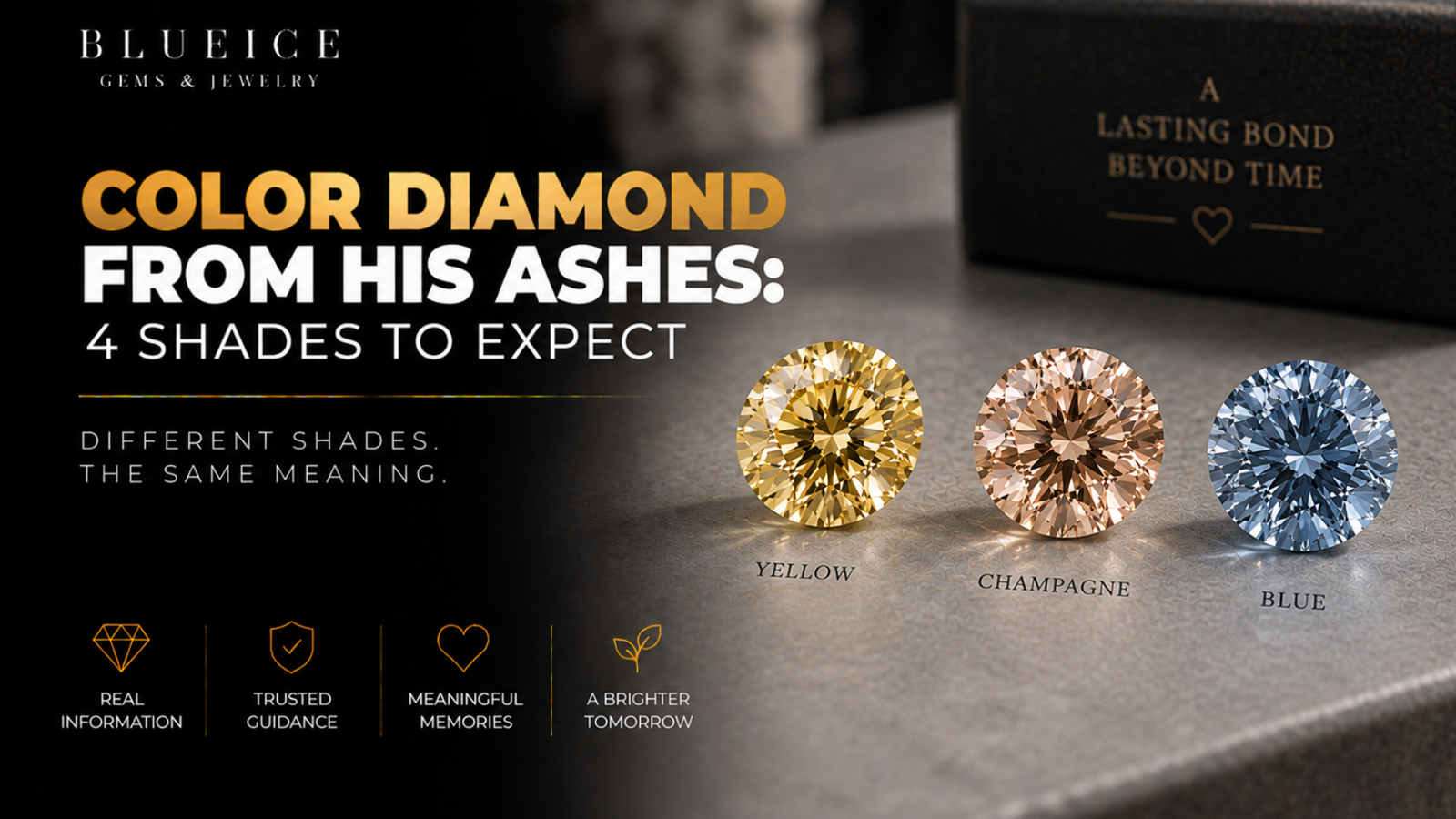
Providers grow memorial stones using the same HPHT and CVD methods used for any lab grown diamond, and four color diamond outcomes cover almost every ashes based order.

ShadeWhat puts it thereCost against the othersHow it tends to read once set
YellowNitrogen, the most common trace element in carbon from an organic sourceBaseline; usually the least additional processingWarm and bright; can look like a pale gold in yellow metal, and stands out sharply against white metal
ChampagneSeveral trace elements acting together, giving a brown to amber warmthSimilar to yellowThe subtlest of the four; easy to mistake for a colorless stone at a distance, richer up close
BlueBoron in the growth environmentTypically priced above yellow and champagneStays visually distinct in any metal; the shade most people can name from across a room
ColorlessThe near total absence of nitrogen and boron, which requires extra exclusion processingMeaningfully more than the three above at the same caratReads as a conventional white diamond; only the paperwork says where it came from

Red, pink, green and black are also offered by some providers, but those come from post growth irradiation rather than from anything in the ashes. Ask whether a color you are quoted is grown or treated, because the answer belongs on the grading report and in your own understanding of the stone. Prices for any of the four shades fall inside the general ranges that drive memorial diamond cost, and the fuller range of colors families choose for a father is covered separately.

Does the Color Say Anything About Your Father?

No, and it is worth saying plainly because families do wonder. A blue color diamond does not mean he was calm; a yellow color diamond does not mean he was warm. The trace elements that decide the color come from the chemistry of cremation and the carbon extraction, not from who he was.

Nothing molecular survives graphitization at roughly 2,500 to 2,700°C. What survives is carbon, some of it his, arranged into a crystal that exists because of him. The color is the signature of the process. The meaning is in the fact that a real, physical part of color diamond is in the lattice at all.

That is also why two stones grown from the same ashes in separate runs can come out in slightly different shades. Same source, same honesty, different batch.

Which Color Diamond Looks Right Once It Is Set?

This is the question the color chart cannot answer, and it is where most families should spend their thinking. The same stone looks different depending on the metal around it and the way it is held.

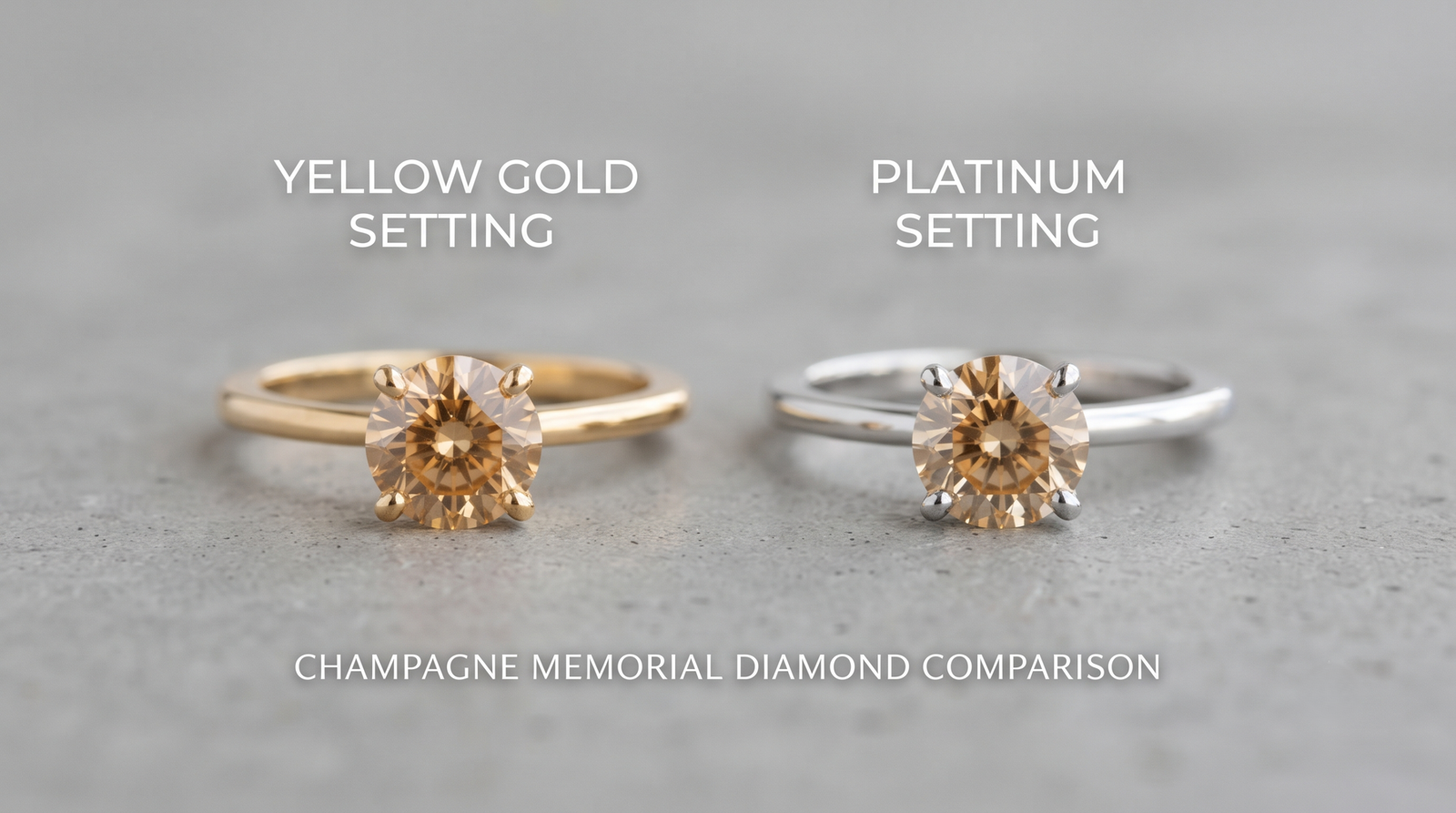
  • A warm stone, yellow or champagne color diamond loses definition in yellow gold and gains it against platinum or white gold, where the contrast makes the color read as deliberate.
  • A blue color diamond stays legible in any metal, which makes it the safest choice when the setting has not been decided yet.
  • A bezel setting shows more of a stone’s body color than a prong setting, because the metal frames the color instead of letting light through the sides.
  • A colorless stone disappears into a conventional setting, which is exactly what some families want and exactly what others do not.
The same champagne memorial diamond in a yellow gold setting and in a platinum setting side by side

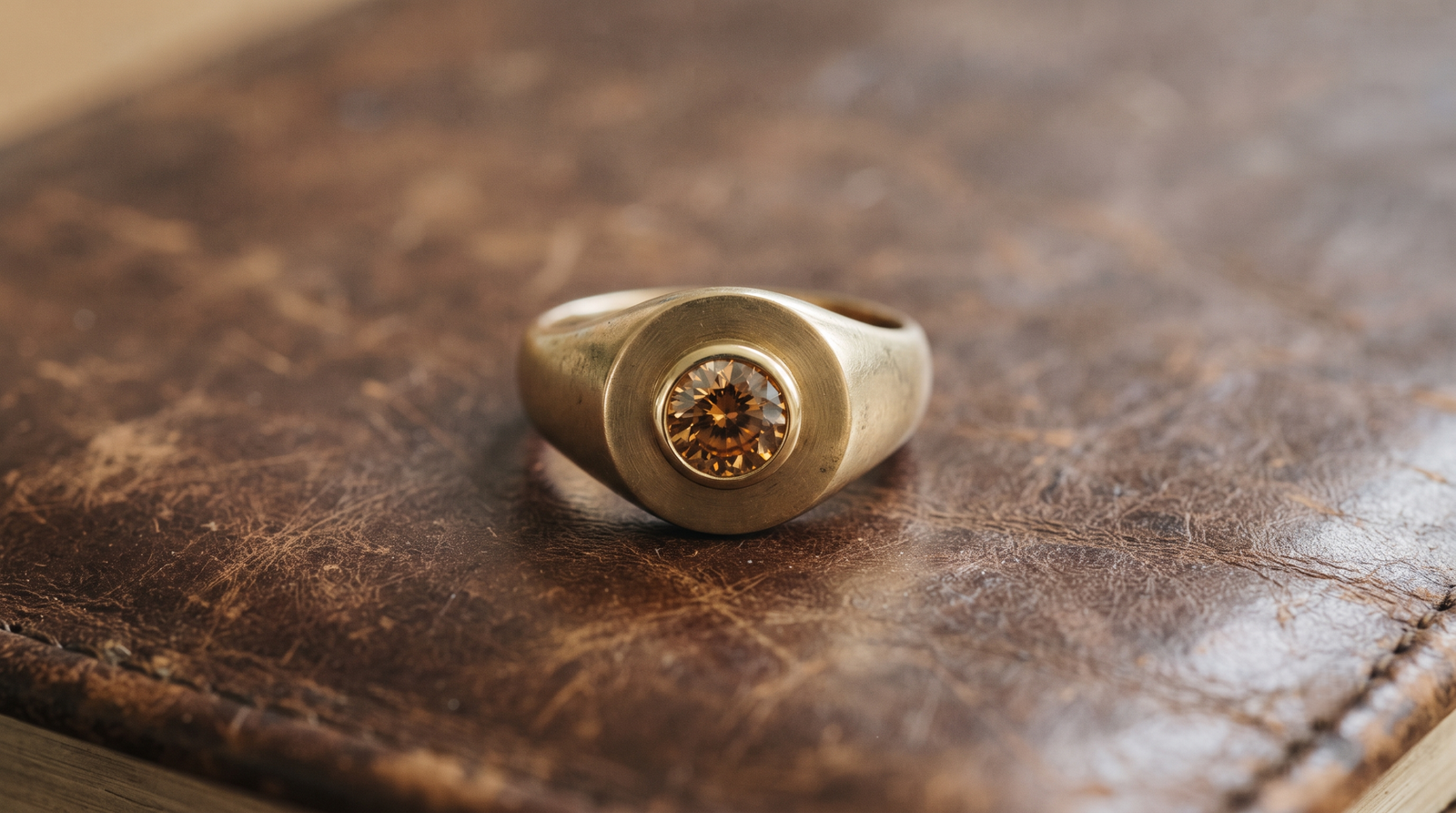
If your father never wore jewelry, the destination may not be a ring or pendant at all. Families set stones into a watch he wore for thirty years, a plain signet ring, a single cufflink, a pen or a flask. In those pieces a champagne or yellow color diamond usually looks more like him than a bright white one, because it does not read as jewelry first. The settings and jewelry ideas for a father and the father memorial diamond ideas pages cover the pieces themselves; the rule here is simpler. Decide the destination first, then the color.

What Should You Settle Before You Order?

Four things to get in writing before the ashes leave your hands, because the color diamond you receive is the one thing in this process that cannot be adjusted afterward without treatment.

  1. A color family, not a color word. “Blue” covers pale sky to deep sapphire. Ask the provider what range they will commit to and how they describe it.
  2. What happens if the stone comes out of range. Some providers re grow; some offer a credit; some offer nothing. Know which before you sign.
  3. Whether the color is grown or irradiated. Yellow, champagne, blue and colorless are grown. Red, pink, green and black are treated afterward, and a reputable provider will say so unprompted.
  4. Whether color appears on the grading report. Reputable providers have finished stones graded by an independent lab against the GIA color scale, and that report is your record of what you actually received. The grading and certification process explains what the report covers.
A memorial color diamond bezel-set into a plain signet ring on a worn leather surface

Frequently Asked Questions

Will the diamond be gray because his ashes are gray?

No. The gray of cremated remains is the calcium phosphate of bone, and it is removed during carbon purification. The finished stone is a real color diamond that takes its color from trace elements in the crystal, so it comes out yellow, champagne, blue or colorless, never ash gray.

Can I get a genuinely colorless diamond from my father’s ashes?

Yes. A colorless stone is achievable when the provider runs additional processing to exclude nitrogen and boron from the growth environment. It is the most expensive of the four common outcomes at any given carat weight, so ask for the price difference in writing before you decide.

Which color diamond is the safe choice if the setting is undecided?

Blue. It stays visually distinct in yellow gold, white gold and platinum alike, and it is the shade most people can identify at a glance. Yellow and champagne depend more on the metal around them, so they reward deciding the setting first.

Can the color be changed after the stone is grown?

Only by post growth irradiation, which some providers offer to shift a stone toward red, pink, green or black. The natural grown shade cannot be undone or lightened afterward, so settle the color family and the out of range remedy before the ashes are sent.

Does the color have to match anything he owned or wore?

No, and there is no convention that says it should. Some families match the metal of a watch or ring he already wore; others choose the shade they will enjoy looking at. The color says nothing about him, so the choice is entirely about the piece.

Will the color fade over the years?

No. Diamond is the hardest known natural mineral, and the trace elements responsible for a grown color are locked inside the crystal lattice. Yellow, champagne, blue and colorless stones hold their color indefinitely with ordinary care and cleaning.

Final Thoughts on the Color of a Diamond From Your Father’s Ashes

The first reaction to “it probably will not be clear” is often disappointment, and the second, a little later, is usually relief. A color diamond looks like what it is: something grown from a specific source, not bought off a tray. Whether that ends up yellow, champagne, blue or colorless is a decision you get to make with open eyes, once you know where it is going and who it is for. Look at real stones before you commit, and let the destination choose the color.

Learn More About Father Memorial Diamonds

Talk With Memorial Diamond

If you are weighing which color diamond fits the piece you have in mind, or you have not decided on the piece yet, reach out to Memorial Diamond to talk through what is possible for your father’s ashes. There is no rush and no right answer, only the one that suits him.

Visit memorialdiamond.us to start the conversation.

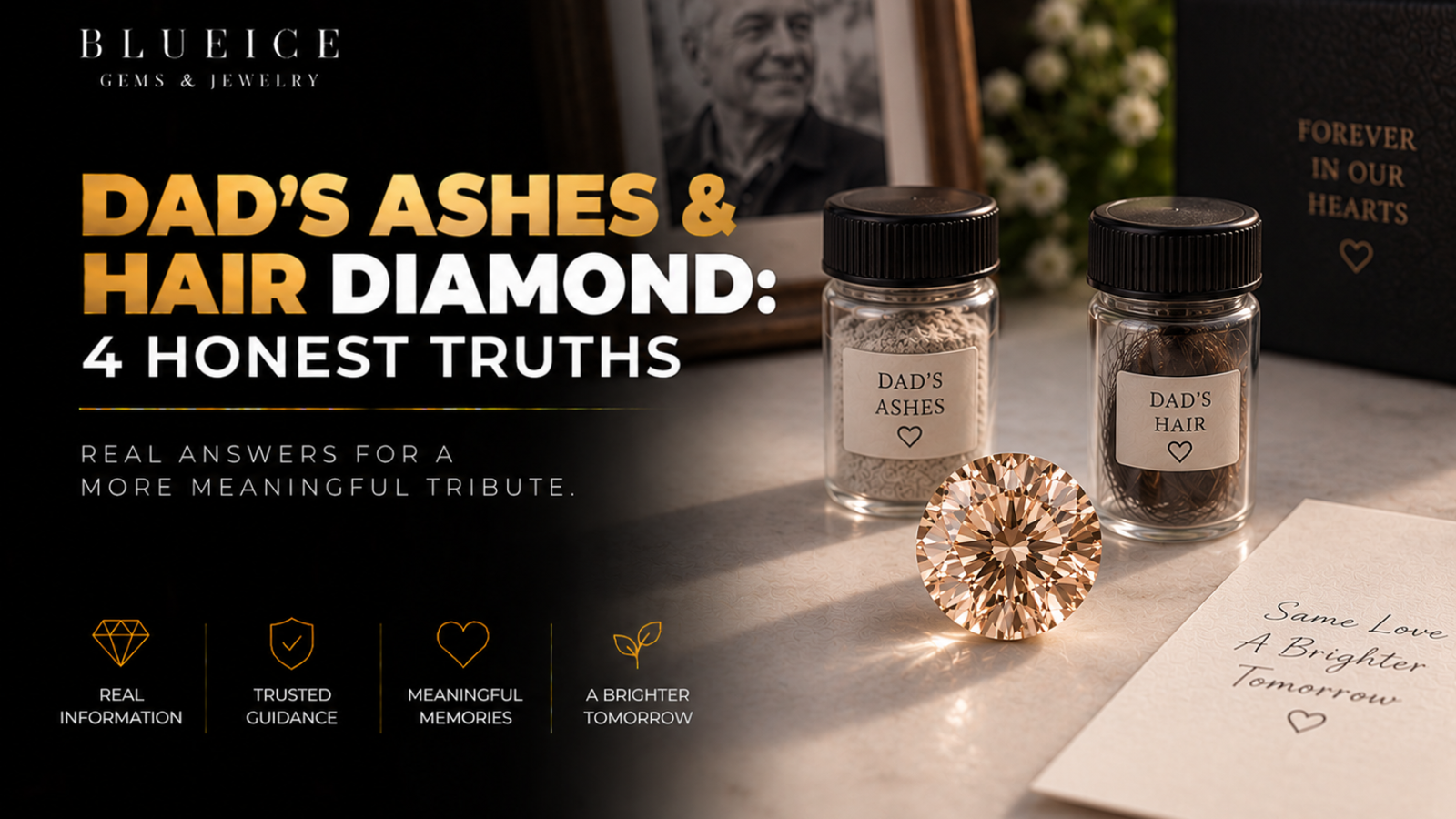
Memorial diamond made from a father's ashes and hair: a single champagne-toned lab-grown stone beside two small labeled sample containers

Is a Memorial Diamond Really Made From Your Father’s Ashes and Hair?

Two containers left the house, and one stone is coming back. If you are asking whether a memorial diamond made from your father’s ashes and hair really holds both, the answer is yes: carbon is extracted from each material separately, purified, blended together with lab sourced carbon, and grown into a single lab grown diamond. The personal carbon is a real, physical part of the crystal, though it is a minority of the finished stone’s mass, never all of it.

What the finished diamond cannot do is show you that both went in. Purified carbon from ash and purified carbon from hair are the same element in the same form. So the question worth asking about a memorial diamond made from both is not “did they really use both?” but “what can I see on paper that proves each one was handled?” That question has four answers, and they exist before the stone does.

Does a Memorial Diamond Made From Both Materials Really Contain Both?

Yes, assuming the provider did what it said. The two materials arrive with very different amounts of usable carbon in them, which is why they are processed on separate tracks before they ever meet.

Cremated ashesHair
What it is mostly made ofCalcium phosphate (the mineral of bone)Keratin, a carbon rich protein
Usable carbon by weightRoughly 0.5% to 4%Roughly 50%
Typical amount neededA few tablespoons to about 4 oz (100 g)A small lock, a few grams
Predictability of yieldLow; an eightfold published rangeHigh; a single published figure
Requires cremationYesNo
Side-by-side graphic comparing carbon yield from cremated ashes and from hair before purification

Each material is heated in a controlled, oxygen free process that strips away everything except carbon, reaching roughly 99.9% purity. The two purified carbons are then combined with each other and with supplemental lab sourced carbon, converted to graphite at roughly 2,500 to 2,700°C, and grown into one crystal in a single growth run using HPHT or CVD synthesis. In the finished stone, your father’s carbon is typically a minority share of the mass; no honest provider describes a memorial diamond made this way as 100% him. How the two materials are actually processed and merged walks the full sequence.

Why Can’t the Finished Stone Prove Both Were Used?

Because after purification there is no difference left to detect, and a memorial diamond made from two sources looks like any other.

Ash derived carbon and hair derived carbon are indistinguishable once they are graphite. There is no seam in the crystal, no two tone effect, no layer that came from one and a layer from the other, and no gemological test that recovers the ratio. A grading report from a laboratory such as the GIA documents cut, color, clarity, and carat; it cannot tell you where the carbon came from, or whether it came from two places.

That cuts both ways. A provider who claims the finished stone can be tested to confirm both inputs is claiming more than the science supports. A skeptical relative who says the stone “proves nothing” is, strictly, correct. Neither of them is talking about the evidence that does exist.

What Are the Four Things You Can Actually Verify?

The proof that both materials were used lives in the paperwork, not the stone. For a combined order, these four items are the ones to ask for, and any provider serious about chain of custody should be able to produce them:

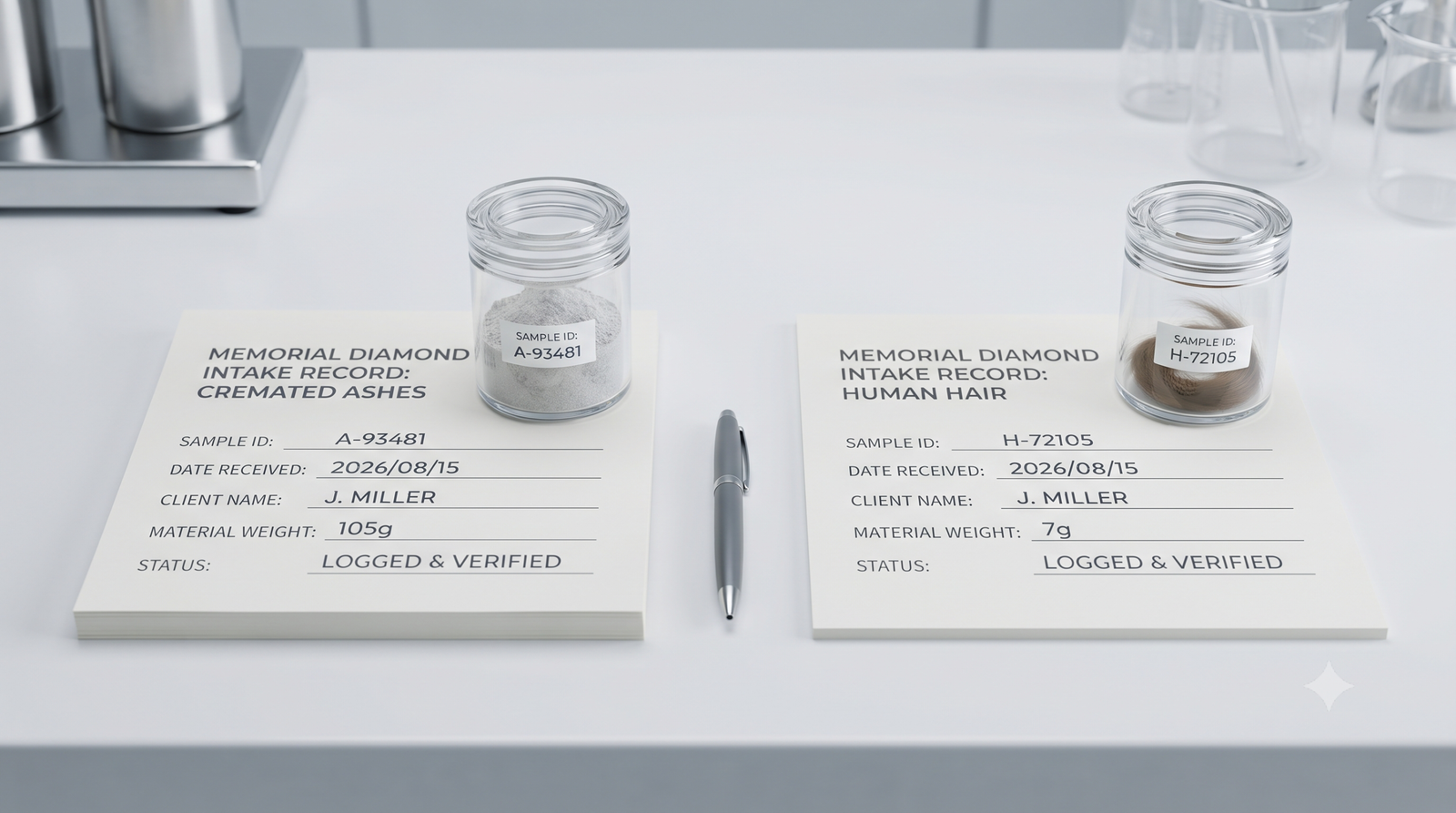
  1. Two separate intake records, one for the ashes and one for the hair, each with its own reference number, rather than a single line reading “father, combined.”
  2. A recorded carbon yield for each material before blending, so you know what each one contributed rather than a single blended total.
  3. A written shortfall procedure, stating in advance what happens if one material yields less than planned, and confirmation afterward that it was followed.
  4. Unused material returned separately, the remaining ashes and the remaining hair each coming back in its own container.
Two separate intake record sheets and sample containers, one for ashes and one for hair, on a lab bench

Those are documentary questions with checkable answers, and the good ones are answered before the parcel is sent, not after the stone arrives. A memorial diamond made from two materials is only as verifiable as the records kept on the way in. Questions to ask before turning your father’s ashes and hair into a diamond covers the wider conversation, and the single material versions of this question are answered in Is a memorial diamond really made from your father’s ashes? and Is a memorial diamond really made from your father’s hair?.

What Happens in the Window Before the Two Are Blended?

There is a moment in every memorial diamond made from two materials when the lab knows exactly what each material produced and nothing irreversible has happened yet. It sits after extraction and before blending, and it is the point a family never sees unless they asked about it.

Ash is the less predictable of the two inputs. Its carbon content is published as a range from 0.5% to 4% by weight, against a single published figure of about 50% for hair, so the ash portion is the one more likely to land somewhere other than where the plan assumed. When that happens, someone decides what to do: proceed with a smaller ash contribution, ask you for more material, or proceed on the hair plus additional lab carbon.

Those are three different outcomes, and the third one produces a stone the family will describe for the rest of their lives as made from his ashes and his hair. Nothing about that is sinister. It is a decision made inside a window you were not in, and the only way to be in the room is to have asked, in writing, what the procedure is before anything ships. How much ash and hair you need for a father memorial diamond explains what “enough” means for each material.

Frequently Asked Questions

Can a memorial diamond made from ashes and hair be tested to confirm it contains both?

No. Once both materials are purified to carbon and graphitized, they are chemically identical, and no gemological test can tell them apart or recover the ratio. Verification comes from intake records, per material yield figures, and returned material, not from the finished stone.

Does adding hair to my father’s ashes put more of him in the diamond?

Only marginally, depending on quantities. Hair contributes carbon far more efficiently than ash, so a lock can add meaningful personal carbon, but a memorial diamond made with both still needs supplemental lab carbon to reach a growable size. The personal share stays a minority of the mass either way.

Is the diamond a real diamond?

Yes. A memorial diamond made by HPHT or CVD is a genuine lab grown diamond with the same crystal structure and hardness as a mined one. Independent labs grade it on the same cut, color, clarity, and carat scale as any other diamond.

Why does the ash matter more than the hair for a combined order?

Because ash yield is unpredictable. Usable carbon in cremated remains ranges roughly eightfold, from 0.5% to 4% by weight, while hair sits near 50%. If one material falls short of plan, it is far more likely to be the ash, which is why a written shortfall procedure matters.

What should I ask for in writing before sending both materials?

Ask for separate intake records with individual reference numbers, a recorded yield for each material, the provider’s procedure if one material yields less than expected, and confirmation that unused ashes and hair come back separately. Get all four before shipping anything.

Will my father’s remaining ashes and hair come back?

Typically yes. Only a small portion of the ashes is needed, and only a lock of hair, so most providers return unused material. For a combined order, confirm they come back in separate containers so you know each one was handled on its own.

Final Thoughts on a Diamond Made From Both Ashes and Hair

The fear underneath “did they really use both?” is a fear of being told a story instead of the truth. The stone cannot settle that, and it was never going to. What can settle it is a provider willing to show you two intake records, two yields, one shortfall rule, and two containers coming home. If those exist, a memorial diamond made from both is what you were told it is, and you can stop asking the stone to prove something only paper can.

Learn More About Father Memorial Diamonds

Talk With Memorial Diamond

If you are holding both his ashes and a lock of his hair and want to know what a memorial diamond made from both would actually involve, and what you would be able to see in writing along the way, reach out to Memorial Diamond. Bring the four questions above; the conversation is better when you do.

Father ashes and hair diamond in an even champagne tone, shown loose on a white card with no visible variation across the stone

What Color Will a Diamond Made From Your Father’s Ashes and Hair Be?

Two materials going into one stone invites a picture: a boundary, a swirl, two tones meeting somewhere in the middle. The stone that comes back has none of that.

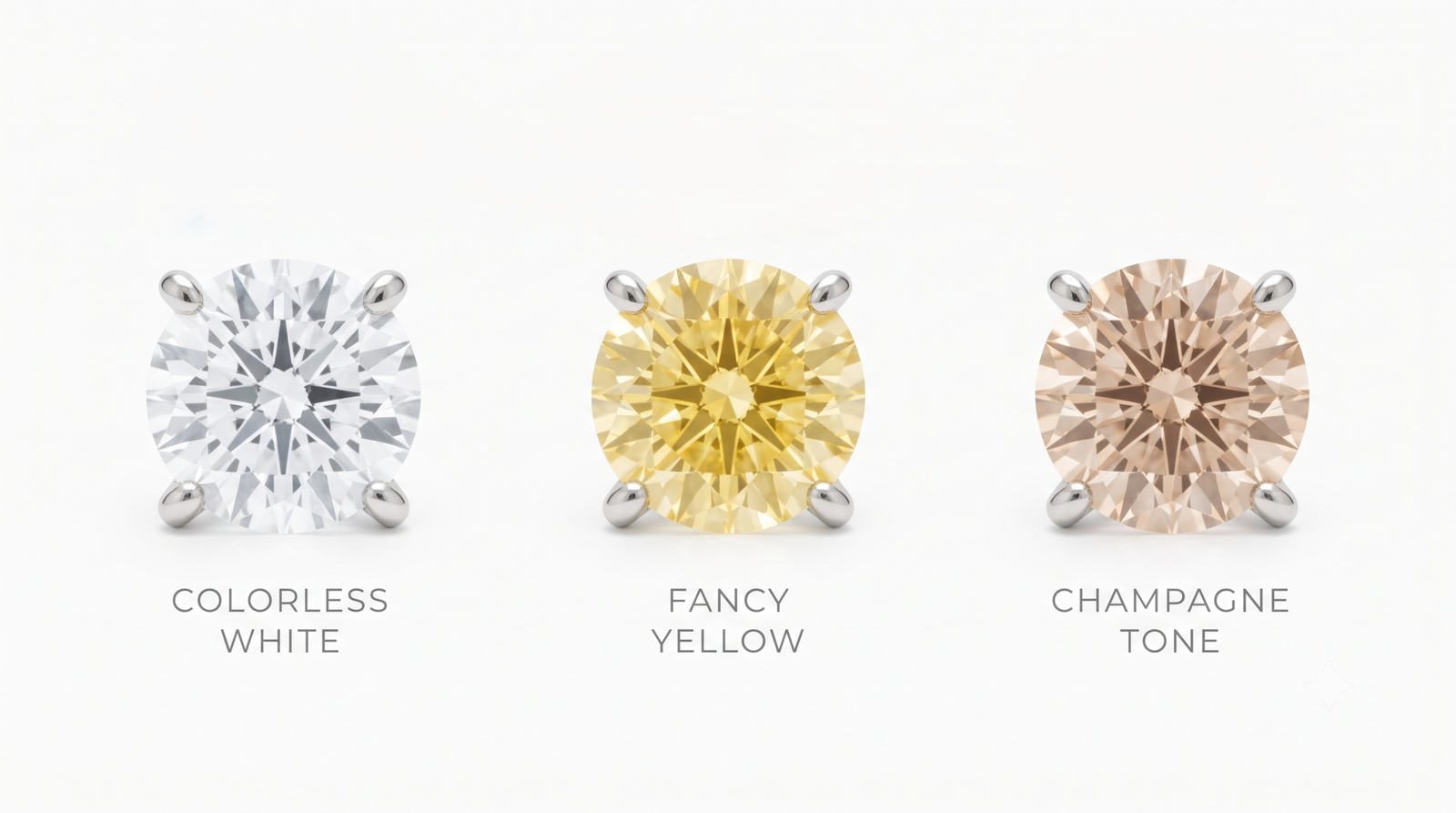
A father ashes and hair diamond is a single crystal in a single color, most often yellow, champagne, or blue, or colorless with extra processing. It is not an average of an “ashes color” and a “hair color,” because neither material has one. Both materials are reduced to pigment free carbon before growth, and the stone’s color is set by trace nitrogen or boron in the growth cell, exactly as it would be for either material alone.

Memorial Diamond takes combined ashes and hair orders, so this is a seller explaining a seller’s product. That is the reason to read skeptically, and the reason it tries to earn the read.

What Does a Father Ashes and Hair Diamond Actually Look Like?

Like any other memorial diamond. One even tone throughout, no seam, no gradient, no visible sign that two sources were used. Under a loupe a gemologist will see inclusions and growth features the way they would in any lab grown stone, and nothing that says “ashes here, hair there.”

That is because the two materials stop being two materials before growth begins. Cremated remains go through extraction to remove calcium phosphate and everything else that is not carbon. Hair goes through extraction to remove the non carbon parts of keratin. Each ends as carbon at roughly 99.9% purity. Whatever the two materials contribute, supplemental lab carbon makes up the balance of the growth feedstock, and the finished crystal is genuinely, partially his rather than purely so.

Once blended and grown, every carbon atom in the lattice is the same element in the same structure, whichever container it came from. A father ashes and hair diamond therefore does not display separate visual sections for the two sources.

The three colors most families end up with, yellow, champagne, blue, and the one they can pay extra for, colorless, are the same four available for a father ashes and hair diamond as for any single source stone.

Why the Color Is Not an Average of the Two

An average needs two values to average. Neither ashes nor hair has a “color” in the sense that matters here.

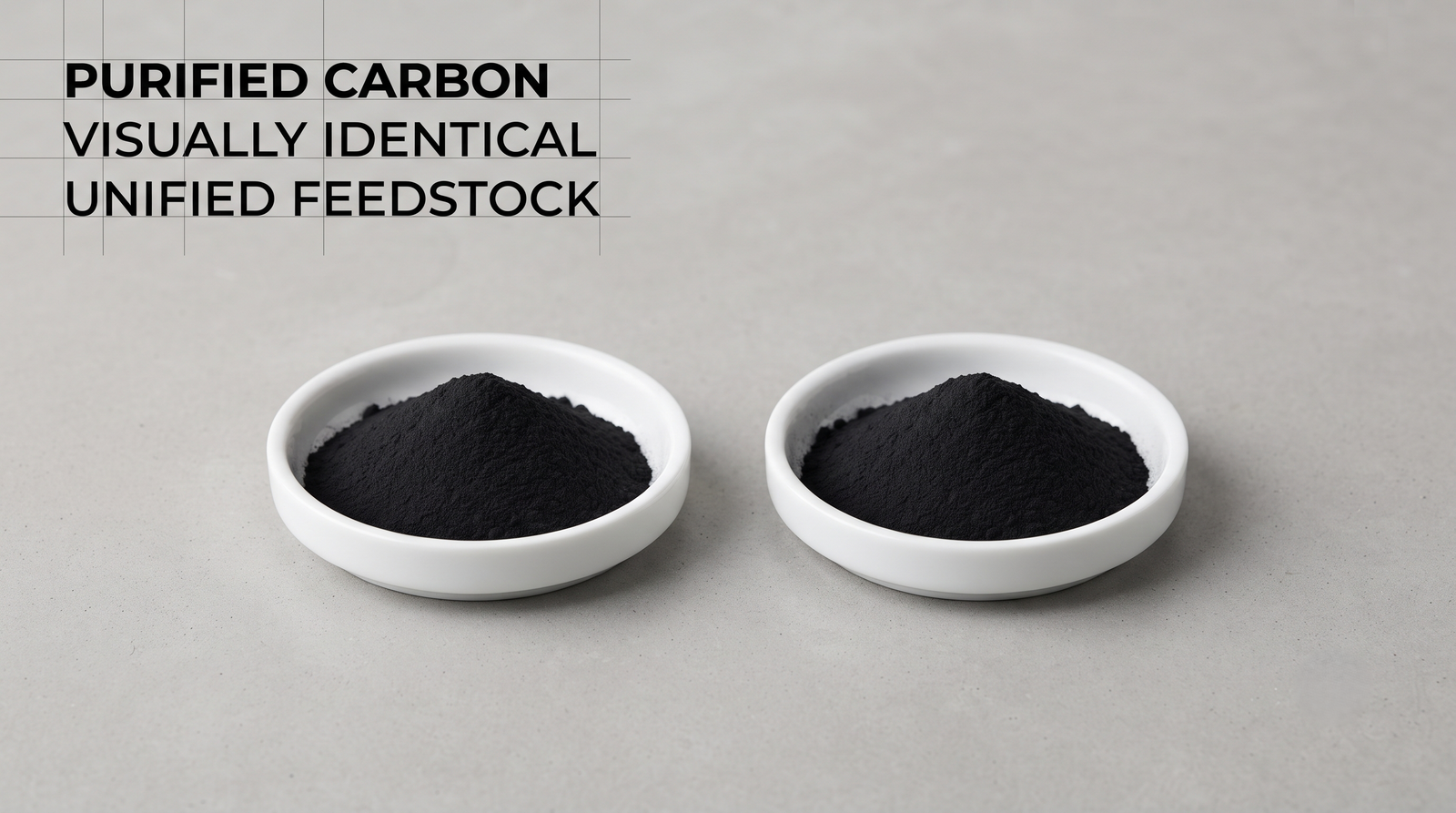
Ashes are gray because of minerals that are removed in extraction. Hair is brown or gray because of melanin, which is also removed. By the time either material is carbon, it is black powder with no pigment, and black carbon powder from ash and black carbon powder from hair are indistinguishable. There is nothing for the stone to split the difference between.

Two small dishes of purified black carbon powder side by side, visually identical

What sets the color is what was in the growth cell besides carbon: nitrogen tints yellow, boron tints blue, and neither gives colorless. Carbon recovered from organic sources tends to carry a little nitrogen along, which is why the whole category leans warm. A combined feedstock is not more or less prone to that than a single one; the chemistry does not know the carbon had two origins.

This means a father ashes and hair diamond does not become a mixture of two visible colors. The final color comes from the growth environment and trace elements rather than the original appearance of the ashes or hair.

For additional information about how diamond quality and grading work, see the GIA Diamond Quality Factors.

Which of the Two Actually Contributes More?

By carbon, hair, by a wide margin per gram. Hair is roughly 50% carbon by weight. Cremated remains yield somewhere between 0.5% and 4%. A lock the size of a fingertip can outweigh, in usable carbon, a considerably larger quantity of ash.

MaterialApproximate carbon yieldWhat that means in a combined order
HairAbout 50% by weightSmall samples yield a lot; usually the larger carbon contributor
AshesAbout 0.5% to 4% by weightLarger samples yield little; usually the smaller contributor
Lab carbonAdded to reach growth volumeMakes up the balance; the finished stone is typically 10% to 15% personal carbon or less

None of this shows in the color, and this is the point families sometimes want and cannot have: a father ashes and hair diamond does not come out “more hair colored” because more of its personal carbon came from hair.

The contribution ratio lives in the provider’s records, if they itemize it, and nowhere else. Ask whether they do; it is a fair question and not every provider answers it the same way.

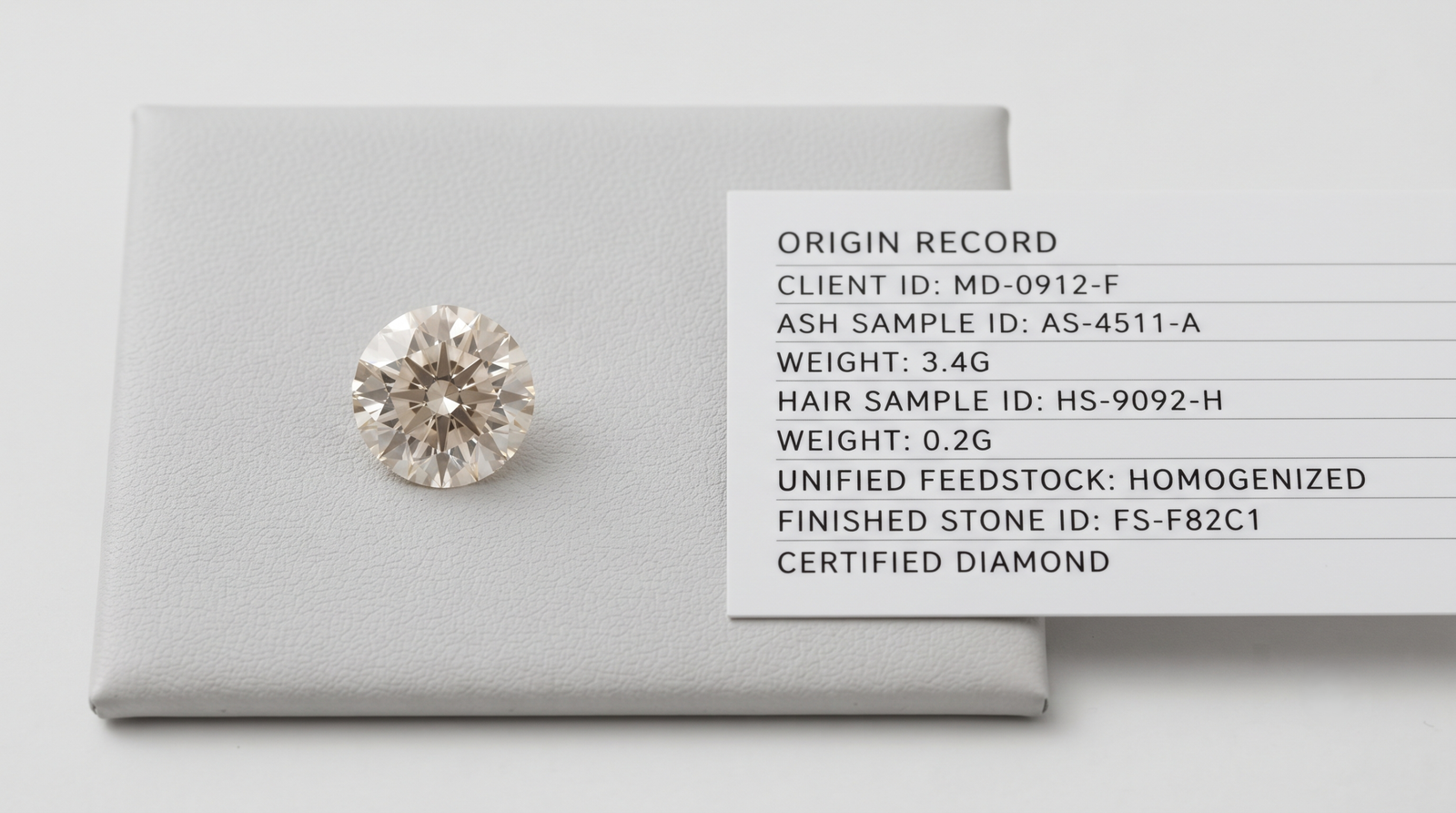
Printed origin record listing two sample IDs with weights, beside a finished stone

Does Combining Make the Shade Harder to Predict?

No harder than usual, and “usual” already includes some uncertainty. No provider can promise an exact tone before growth for any memorial diamond; trace element levels vary run to run, and two stones ordered as “yellow” can differ in depth.

Combining does not add to that variance in any meaningful way, because the feedstock is homogenized before it goes into the press.

What combining does add is a second record to check. If exact shade matters, such as a match to an existing family piece, or two sibling stones that need to sit together, say so before growth, and ask how the provider handles it.

Selection from a run is the usual method; guaranteed identical shade in advance is not something an honest provider offers.

The colors page for a father goes into what a provider’s color words do and do not promise.

What to Settle Before You Order

Three decisions, and none of them is about the ashes or the hair:

  1. Who keeps the stone and what it goes into. Metal shifts every tint: a yellow stone deepens in yellow gold and reads faintly off white against platinum, while blue and colorless hold steady in any setting. Decide the piece before the shade.
  2. Grown color or treated color. Yellow, champagne, blue, and colorless are grown; red, pink, green, and black are typically post growth irradiation. Ask which is which on the provider’s menu, and know that a treated color is a treatment, not a reflection of either material.
  3. What you want written down. For a combined order, ask whether the origin record itemizes each material’s contribution and whether the color is described using a standardized grading scale or the provider’s own words. A father ashes and hair diamond has two chains of custody; make sure the paperwork reflects both.

Frequently Asked Questions

Could the Stone Come Out Two Toned, or Show a Boundary?

No. The ash derived and hair derived carbons are blended into one feedstock before growth, and the crystal grows as a single, uniform lattice. There is no boundary because there is nothing left to mark one; a combined stone looks exactly like a single source stone of the same color.

Would Sending More of One and Less of the Other Change the Color?

No. The proportions change what the provider’s records say about contribution, not the tint. Color is set by trace nitrogen or boron in the growth cell, and the feedstock is homogenized before growth, so the ratio of ash carbon to hair carbon has no visible effect on a father ashes and hair diamond.

Does His Hair Color Affect It, If the Hair Went Gray?

No. Melanin, the pigment that makes hair brown, black, or red, is removed during carbon extraction along with everything else that is not carbon. Gray hair has less melanin, not less carbon, so a gray lock contributes the same pigment free carbon a dark one would.

Is a Combined Stone More Likely to Be Colorless?

No. A colorless crystal needs a growth cell free of nitrogen and boron, and keeping them out is a separate processing step whatever the carbon’s origin. Two organic sources neither help nor hurt that; if you want colorless, order it explicitly and expect it to cost more at the same carat.

Can Two Combined Stones for Two Siblings Be Matched?

Approximately, and only by asking before growth. Trace element levels vary between runs, so two stones ordered in the same color can differ slightly in depth. Providers who match siblings typically select from the same run; ask what the provider can and cannot promise in writing.

Does the Color Say Anything About Which Material Contributed More?

Nothing at all. Hair contributes far more carbon per gram than ashes, but that ratio is invisible in the finished stone. If knowing the contribution matters to you, it has to come from the provider’s origin record. Ask whether they itemize it, because a father ashes and hair diamond will not tell you by its shade.

Final Thoughts on the Color of a Father Ashes and Hair Diamond

The picture of two tones meeting is a natural one, and letting it go is part of understanding what the stone actually is.

A father ashes and hair diamond is one crystal, one color, grown from carbon that no longer remembers which container it arrived in.

The color will suit the ring or the pendant, or it will not, and that is decided by the metal and the person who wears it, not by the ashes, not by the lock.

Where the two sources still exist as two is in the paperwork, and that is worth asking for. The combined question about whether the diamond is really made from both sources is where that record is described.

Learn More About Father Memorial Diamonds

Talk With Memorial Diamond

If you are planning a combined order and want to know what color is realistic for the piece you have in mind, reach out to Memorial Diamond.

Ask which colors are grown and which are treated, and whether the origin record for a father ashes and hair diamond will itemize both materials.

Dog ashes diamond: close-up of a champagne-toned lab-grown diamond on a white background

Dog Ashes Diamond: The Complete Guide

There’s a particular kind of quiet that shows up in a house after a dog is gone, no click of nails on the floor, no waiting by the door at 5 o’clock. A dog ashes diamond is a real, lab grown diamond grown in part from a small portion of your dog’s actual cremated ashes, typically taking 6 to 10 months from the day the ashes are received to the day the finished stone comes back. It isn’t a symbol standing in for your dog. It’s a stone that physically exists, in part, because of them.

This guide walks through how that’s actually possible, what the process looks like start to finish, what it costs, what color to expect, and the questions worth asking before you commit to a provider.

What a Dog Ashes Diamond Actually Is

A dog ashes diamond is a genuine, chemically real lab grown diamond, not a simulant, not resin, not a “diamond look” stone made to resemble one. It’s grown using the same two methods used across the broader lab grown diamond industry: HPHT (High Pressure High Temperature), which recreates the pressure and heat found deep in the earth’s mantle to grow a crystal around a tiny seed, and CVD (Chemical Vapor Deposition), where carbon bearing gas is deposited layer by layer inside a vacuum chamber.

Most providers working with pet ashes use HPHT. Either way, the finished stone has the same hardness (a 10 on the Mohs scale, the hardest known natural mineral), the same optical properties, and the same 4Cs, cut, color, clarity, carat, as any other diamond on the market.

Where the Carbon in the Diamond Actually Comes From

This is the fact worth understanding before anything else, because it’s the one a skeptical reader (fairly) wants answered honestly. Cremated remains, a pet’s, just like a person’s, are made almost entirely of calcium phosphate, the mineral structure of bone. Carbon is only a small fraction of the total: industry figures put usable carbon at roughly 0.5% to 4% of ash by weight, depending on the animal and the cremation process itself.

That extracted carbon is purified and typically blended with additional lab sourced carbon to reach the volume needed to grow a diamond of meaningful size, the personal carbon recovered from your dog’s ashes usually makes up somewhere around 10 to 15% of the final stone’s mass, though this varies by provider and by how much ash was submitted.

No reputable provider should claim a memorial diamond is “100% pure” ashes with nothing else added, that isn’t how the physics works. The honest, still genuinely meaningful version is this: a real, verifiable portion of your dog’s own carbon is extracted, purified, and grown into the crystal lattice of a diamond that exists because of them. That’s not a lesser claim than “100% pure”, it’s the true one, and it holds up to scrutiny.

How the Process Works, Step by Step

StepWhat happens
1. CollectionAshes are received from you, with chain of custody tracking so your dog’s material stays identifiable throughout.
2. Carbon extraction & purificationThe ash is heated in a controlled, oxygen free process that strips away the calcium phosphate and other minerals, isolating carbon at roughly 99.9%+ purity.
3. GraphitizationThe purified carbon is heated further (to roughly 2,500 to 2,700°C) and converted into graphite, the feedstock diamond growth presses use.
4. Diamond growthThe graphite carbon, blended with supplemental lab carbon, is grown in an HPHT press (or CVD chamber) over a period of weeks to months. Growth time, not the amount of ash submitted, determines final carat size.
5. Cutting & polishingA gemologist cuts and polishes the rough diamond into its finished shape.
6. Grading & certificationThe finished stone is ideally graded by an independent third party gemological lab.
Gemologist examining a rough diamond crystal grown from purified ash-derived carbon under a loupe

If your dog’s fur was also kept, it can typically be used instead of or alongside ashes, see how a dog memorial diamond is made from fur for how that changes the process.

How Long It Takes

Across the industry, a dog ashes diamond typically takes 6 to 10 months from the day the ashes are received to the finished stone, with larger or specialty color stones sometimes taking up to 12 months. That’s because size is primarily a function of growth time inside the press, not how much ash you send in, submitting a full urn’s worth of ashes doesn’t produce a faster or automatically bigger diamond. Carat size is a choice you make, and that choice is what sets the timeline.

How Much Ash You Actually Need

Requirements vary by provider, but as a general guide, a dog ashes diamond typically needs somewhere between a few tablespoons and roughly 4 oz (about 100g) of cremated remains, usually only a small fraction of what comes back from cremation. That means most of your dog’s ashes can still be kept, scattered, or interred exactly as you’d already planned, you don’t have to choose between a diamond and everything else you wanted to do with their ashes. Because only a portion is used, more than one family member can often receive their own separate stone from the same shared ashes, worth raising early if more than one person in the family would want their own.

Ashes, Fur, or Both Which Should You Choose?

If you kept both your dog’s ashes and a lock of their fur, it’s worth knowing the two aren’t interchangeable in how they behave in the process, even though either one works. Fur is roughly 50% carbon by weight, built from keratin, a carbon rich protein, a dramatically higher proportion than ash’s 0.5% to 4%. That means a fur based diamond generally needs far less starting material, and fur can be used even if your dog wasn’t cremated at all, which matters if cremation wasn’t the route you chose or wasn’t possible.

Ashes remain the more common starting material simply because most dog owners do choose cremation, and because ashes are what’s left when fur wasn’t specifically saved beforehand. Neither material produces a “more real” diamond than the other, the honesty principle above, a genuine, verifiable, partial contribution of your dog’s own carbon, applies equally to both. If you have both, some providers can blend them into a single stone, ask directly whether that’s something a given provider offers, since it isn’t universal across the industry. See dog fur and ashes diamond: the complete guide if that combined option is what you’re actually weighing.

What Color Will the Diamond Be?

Diamond color comes from trace elements present during crystal growth, boron produces blue tones, nitrogen produces yellow tones, and the complete absence of both is needed for a colorless stone. Because the carbon in a dog ashes diamond comes from an organic, imperfect, personal source rather than a controlled synthetic feedstock, trace elements are common.

Side-by-side comparison of memorial diamonds in white, yellow, and champagne tones

That’s exactly why memorial diamonds naturally trend toward yellow, blue, and champagne or brown tones rather than colorless, and why your dog’s diamond, grown from material unique to them, is likely to come out with a color that’s genuinely its own. Colorless stones are achievable but require additional processing and typically cost more, some providers also offer post growth irradiation for red, pink, green, or black stones. See what color will a diamond made from your dog’s ashes be for a deeper look at what to expect.

What a Dog Ashes Diamond Costs

Pricing across the industry generally scales by carat size and color, since larger stones require significantly longer growth time:

  • Entry tier (~0.10 to 0.25 ct): roughly $1,500 to $3,500
  • Mid tier (0.5 to 1 ct): roughly $5,000 to $15,000, with colorless stones costing meaningfully more than blue, yellow, or champagne tones at the same size
  • Large/rare (2 to 5+ ct): roughly $20,000 to $75,000+
Dog ashes diamond set in a simple pendant on a chain

Common add ons, an independent grading report, engraving, fancy cuts, and jewelry settings like a pendant or ring, are typically priced separately from the loose stone itself. Final price always depends on carat, color, cut, and whether independent grading is included, so treat any number here as a starting point for the conversation rather than a quote.

Questions Worth Asking Before You Choose a Provider

Before you send your dog’s ashes anywhere, it’s worth getting clear, specific answers to a short list of practical questions, not because the answers should worry you, but because a provider that answers plainly is telling you something useful about how they operate:

  • How is chain of custody tracked once you receive our dog’s ashes?
  • Is the finished stone graded by an independent, third party lab, or only certified in house?
  • What happens to any ash that isn’t used?
  • What’s the realistic timeline for our specific carat size?
  • Can more than one diamond be grown from the same ashes, if more than one family member wants one?

Frequently Asked Questions

Is a dog ashes diamond really made from my dog’s ashes, or is that just marketing?

It’s real, but not in a “100% pure” sense, no reputable provider’s diamond is. A genuine, verifiable portion of the carbon extracted from your dog’s ashes (typically making up roughly 10 to 15% of the final stone) is grown into the crystal itself, blended with supplemental lab sourced carbon to reach a usable size.

How much of my dog’s ashes will I have left afterward?

Most providers only need a few tablespoons up to about 4 oz, so the large majority of your dog’s ashes typically remain for you to keep, scatter, or inter as you’d already planned.

Can I get more than one diamond made from my dog’s ashes?

Often, yes. Because only a portion of the ashes is used per stone, multiple family members can frequently each receive their own diamond from the same shared ashes, worth asking a provider about directly if this matters to you.

Will the diamond definitely be colorless?

Not necessarily, and that’s not a flaw. Trace elements naturally present in organic material like ash commonly produce yellow, blue, or champagne tones. A colorless stone is possible but requires extra processing and usually costs more.

How long will it actually take to get the diamond back?

Typically 6 to 10 months, occasionally up to 12 months for larger or specialty color stones. Growth time in the press, not how much ash you send, is what sets the timeline.

Is this the same as cremation jewelry, like an urn pendant with ashes inside it?

No, cremation jewelry holds a small amount of unaltered ash inside a sealed compartment. A dog ashes diamond is a real diamond grown from carbon extracted out of the ash itself, not the ash sitting inside a piece of jewelry.

What should I ask before choosing a provider?

At minimum: how chain of custody is tracked, whether grading is done independently or only in house, what happens to unused ash, and the realistic timeline for your chosen carat size, see the section above for the full list.

Final Thoughts on Dog Ashes Diamonds

A dog ashes diamond isn’t a replacement for your dog, and it isn’t trying to be. It’s a way of keeping something real and physical from a relationship that mattered, grown honestly, from an actual part of them, into something you can hold or wear for as long as you want to. Whatever you decide to do with the rest of their ashes, this doesn’t have to compete with that, it can simply sit alongside it.

Learn More About Dog Memorial Diamonds

Talk With Memorial Diamond

If you’re weighing a dog ashes diamond for your own dog, reach out to Memorial Diamond to talk through what’s possible with the ashes you have, there’s no obligation, and it’s a genuinely useful conversation to have even if you’re still deciding.

Hand holding a small folded paper envelope of hair on a wooden table, unopened

How to Turn Your Father’s Hair Into a Diamond

Somebody found an envelope. Maybe it came from a barber’s shop, a small pouch from a grooming kit, or the back of a drawer. You are holding it now, and you do not know whether what sits inside contains enough hair.

The direct answer is simple. Turning your father’s hair into a diamond requires no cremation, no death certificate, and no special courier. Hair contains roughly 50 percent carbon by weight. An industry typical requirement involves a small lock or a few grams. You can usually send hair through ordinary tracked mail.

Before you cut, divide, wash, or send anything, weigh what you have and confirm the provider’s minimum requirement in writing.

Does Hair Have the Same Shipping Restrictions as Ashes?

No, and this is one of the most useful things to understand before you begin.

Cremated remains involve regulated shipping requirements. UPS, FedEx, and DHL restrict individual shippers from sending cremated remains. Families who post cremated remains directly generally use USPS under the applicable service requirements, or they work through a funeral professional.

You can read the ashes version of this process for the specific differences.

Sealed paper envelope being placed inside a rigid cardboard mailer with a tracking label attached

Hair does not follow the same shipping rules. A lock of your father’s hair can travel through ordinary mail. You still need to protect it physically because loose strands can escape from a weak envelope during sorting.

Use a sealed paper inner envelope inside a rigid mailer. Add tracking so you can follow the delivery.

A lock of his hairHis cremated remains
Carrier restrictionsNo specific restriction for hairUPS, FedEx, and DHL restrict individual shippers. USPS provides the practical direct mailing route for families
PaperworkNo cremation paperwork requiredProviders may request cremation or death documentation

Hair therefore creates a different kind of responsibility. No external shipping process checks the contents for you. Your own handling, documentation, packaging, and tracking create the safeguards.

When What You Found Is Short, Sparse, or Not Clearly His

Weight matters more than length. Short clippings, beard hair, thinning hair, and other forms of hair can raise questions that you should settle before mailing anything.

The complete guide to a father hair diamond covers the broader question of which types of hair can work.

Small lock of hair on a digital kitchen scale showing a reading in grams

What if you are not completely sure the hair belonged to him?

Provenance matters. A shared hairbrush, razor, cap, or another household item can create uncertainty if more than one person used it.

A laboratory cannot separate mixed hair after you send it. The family needs to establish where the hair came from before posting it.

If you cannot establish the source with confidence, tell the provider during your enquiry. Do not wait until the laboratory receives the material.

What if you genuinely have too little hair?

Do not cut more hair before you understand the minimum. A smaller diamond generally requires less material, so how much hair a father memorial diamond needs can help you understand the relationship between material and size.

If ashes also exist, you can ask whether the provider accepts both materials. Sending his ashes and hair together explains that combined route.

Before posting anything, ask whether the provider will review a photograph and your stated weight and tell you what options you have. Some providers may offer this service, but you should confirm it rather than assume it.

Handling a Lock So It Stays Usable

Hair can remain usable for decades when you store it properly. Your goal should therefore focus on preserving what you already have.

  • Keep it whole and dry. Loose strands can disappear during handling, while moisture creates an unnecessary storage problem.
  • Do not wash it. Washing can send strands down the drain and does not provide a useful advantage because the purification process removes material that does not contribute the required carbon.
  • Use paper rather than sealed plastic. A paper envelope provides a practical storage option. A sealed plastic bag can trap moisture around the hair.
  • Do not divide it before you know the minimum. Splitting a small amount can leave you with too little material for your preferred diamond size.
  • Label the inner envelope. Include your father’s name and the provider reference number when the provider gives you one.
Tied lock of hair being placed into a labelled paper inner envelope over a sheet of white paper

Dyed, grey, treated, and long stored hair can remain chemically workable because the extraction process focuses on the carbon within the material. Hair colour does not determine the final diamond colour.

Building a Record When There Is No Cremation Paperwork

This represents one of the biggest practical differences between ashes and hair.

Ashes usually come with an institutional history. A crematorium can record the cremation, a funeral home can release the remains, and documentation can identify the person and date.

Hair does not automatically carry that same institutional record. You can therefore create your own record before sending it.

What ashes can have behind themWhat hair has behind itWhat you can create yourself
A cremation certificate and funeral home recordNo equivalent institutional recordA dated note naming your father, who collected the hair, when they collected it, where they found it, and who has held it since
Recorded weightsNo automatic weight recordYour own weight in grams and a photograph showing the hair on the scale
A regulated carrier recordOrdinary mailTracking information and delivery confirmation
Provider intake documentationProvider intake documentationWritten confirmation of what the provider received and its recorded weight

Keep copies of anything you place inside the package. Keep the tracking number and delivery confirmation with your records.

Handwritten dated note beside a labelled paper envelope and a tracking receipt

Also record the source of the hair with as much useful detail as you can. Instead of writing only “his hair,” write something such as “cut by the hospice nurse on 3 March and kept in the bedside drawer since.”

A detailed source note gives your family something concrete to refer to if questions arise years later.

If you want to understand the provider side of this process, read how companies track a loved one’s material through the process.

What Should You Ask Before You Post Anything?

Everything before the mailing can change. Once you send the hair, the process moves into another stage. Get the important answers in writing first.

  1. What is your minimum weight for the carat and colour I am considering?
  2. Will you assess a photograph and stated weight before I send anything?
  3. Do you accept short clippings, beard hair, or body hair?
  4. What happens if the material arrives underweight?
  5. Do you return unused hair, and if so, how?
  6. What reference number will you assign to the material?
  7. Will you confirm the weight received?

If your available hair sits close to the minimum, choosing a smaller diamond can make more sense than cutting additional hair. Questions worth asking before turning your father’s hair into a diamond covers additional questions about pricing, grading, and the overall process.

What Happens After the Hair Reaches the Lab?

The provider logs the material under its chain of custody. The laboratory then purifies the hair, converts the carbon into a suitable form, and grows the diamond around a diamond seed before cutting and grading the finished stone.

How a memorial diamond is made from your father’s hair explains the production stages in greater detail.

One important qualification belongs in any honest explanation of the process. Your father’s purified carbon combines with supplemental laboratory carbon to provide enough material for diamond growth. Industry information places the personal carbon contribution at roughly 10 to 15 percent of the finished stone’s mass.

The finished diamond therefore contains a real physical portion of his carbon. It does not consist entirely of his carbon.

Production commonly takes around 6 to 10 months from the laboratory receiving the hair. Larger or specialty colour stones can take longer, with some timelines reaching around 12 months. The complete journey from the first decision through production, delivery, and final jewellery work can reach roughly 8 to 14 months.

Growth time determines the carat size. Sending more hair does not automatically make the diamond larger or make the laboratory finish it faster.

The complete guide to memorial diamonds covers the broader process, material requirements, timing, and major decisions.

The finished diamond can arrive loose in a presentation box with its documentation. If your father left behind a wedding band, signet ring, or watch, you may want to ask a jeweller whether they can incorporate the memorial diamond into an existing piece. The jeweller can assess the individual item and explain whether the design can safely accommodate the stone.

Frequently Asked Questions

Do I need a death certificate or cremation paperwork to send hair?

No. Hair does not require cremation, so you do not need cremation paperwork simply to mail the hair. A provider may still request identifying information or its own documentation. You can also create a dated record that identifies your father and explains where the hair came from.

How do I document a lock when no cremation paperwork exists?

Create the record yourself. Write the date, your father’s name, who collected the hair, when and where they collected it, and who held it afterwards. Add the weight in grams, photograph the hair on the scale, and keep the provider’s confirmation of what arrived.

Should I wash the hair before I send it?

No. Washing can cause you to lose strands and does not provide a useful advantage. Keep the hair dry and whole. Place it in a paper envelope rather than a sealed plastic bag and follow the provider’s intake instructions.

Can I send part of the lock and keep the rest?

Wait until you know the provider’s minimum requirement. Dividing a small lock before confirming the required weight can leave you with too little material. Once you know the minimum, you can decide whether you want to keep some of the remaining hair.

Does mailing hair require special postage or a special carrier?

Hair does not carry the same shipping restrictions as cremated remains. You can generally use ordinary mail. A tracked service and rigid mailer can provide practical protection while the package travels.

Loose memorial diamond resting beside a worn gold wedding band on a jeweller's cloth

Put It on a Scale Before You Put It in the Post

None of this needs to happen immediately. Hair can remain usable on a shelf when you store it properly, so you have time to make a careful decision.

Your first step does not need to involve a purchase or a pair of scissors. Start with a scale, a photograph, and one question for the provider.

Is this enough for the diamond size I am considering, and can you confirm that before I send it?

Weigh the hair before you cut or divide anything. Record the result. Photograph it. Then ask the provider about the minimum requirement and the material they accept.

If you want to understand the full process before making that decision, explore the complete guide to memorial diamonds.

The envelope in your hand may contain the only hair you have from your father. Treat it accordingly.