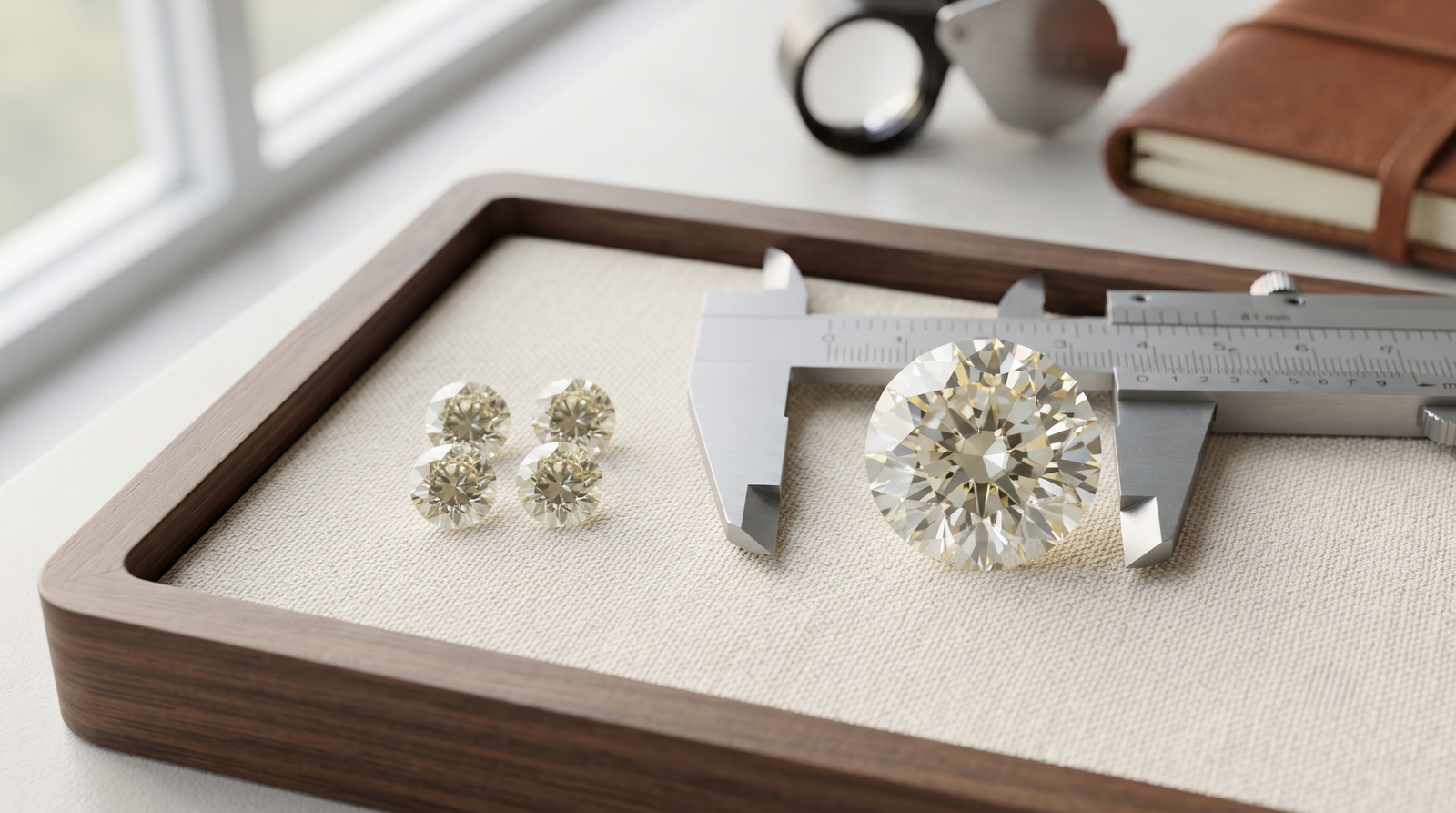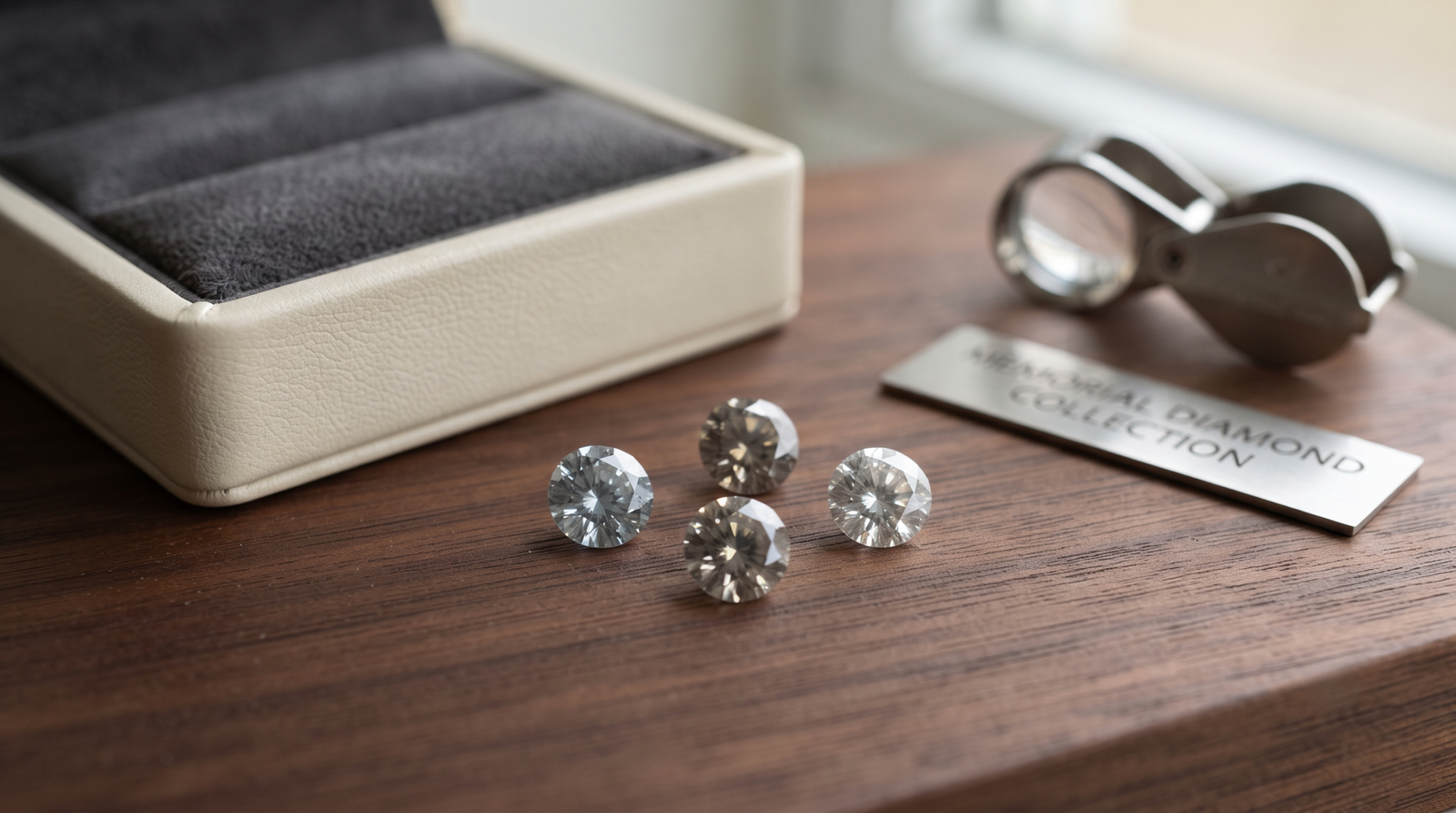
Three memorial diamonds of slightly different tones laid side by side on a neutral surface

Can More Than One Family Member Get a Diamond From the Same Mother’s Ashes?

Four stones grown from the same mother will not match each other. That is the fact worth having before anything else, because it is the one that causes trouble later. The answer to the question itself is yes, one portion of a mother’s cremated remains can usually supply several memorial diamonds, one for each family member who wants one, but each stone is grown in its own run, priced individually rather than divided, and will differ from its siblings in colour and character.

Is One Portion of Her Ashes Really Enough for Several Diamonds?

Usually, yes, and by a wide margin. A single memorial diamond typically needs somewhere between a few tablespoons and around 4 oz of cremated remains, which is a small fraction of a full cremation, so three or four stones still draw on a minority of a typical cremation. At the top of that range, though, four stones can mean the better part of a pound rather than a few ounces: ask for the per-stone figure and multiply it yourself before committing, as outlined under how much ash you need.

Two points that surprise people:

  • Each stone generally needs its own quantity of material. Four stones is not one portion split four ways; ask whether the provider requires four times the minimum or something less.
  • Sending more does not buy bigger stones. Each stone’s size is chosen when it is ordered, and sending less than the minimum means the order cannot proceed until more arrives.

Each stone is her carbon blended with supplemental lab carbon, typically around 10 to 15 percent personal carbon by mass across the industry. Several stones do not divide her between them, as each carries the same real fraction.

The same is broadly true of hair, with one important difference: a lock is finite in a way an urn usually is not, and dividing a small lock between two orders can leave neither viable, detailed further under how much hair you need.
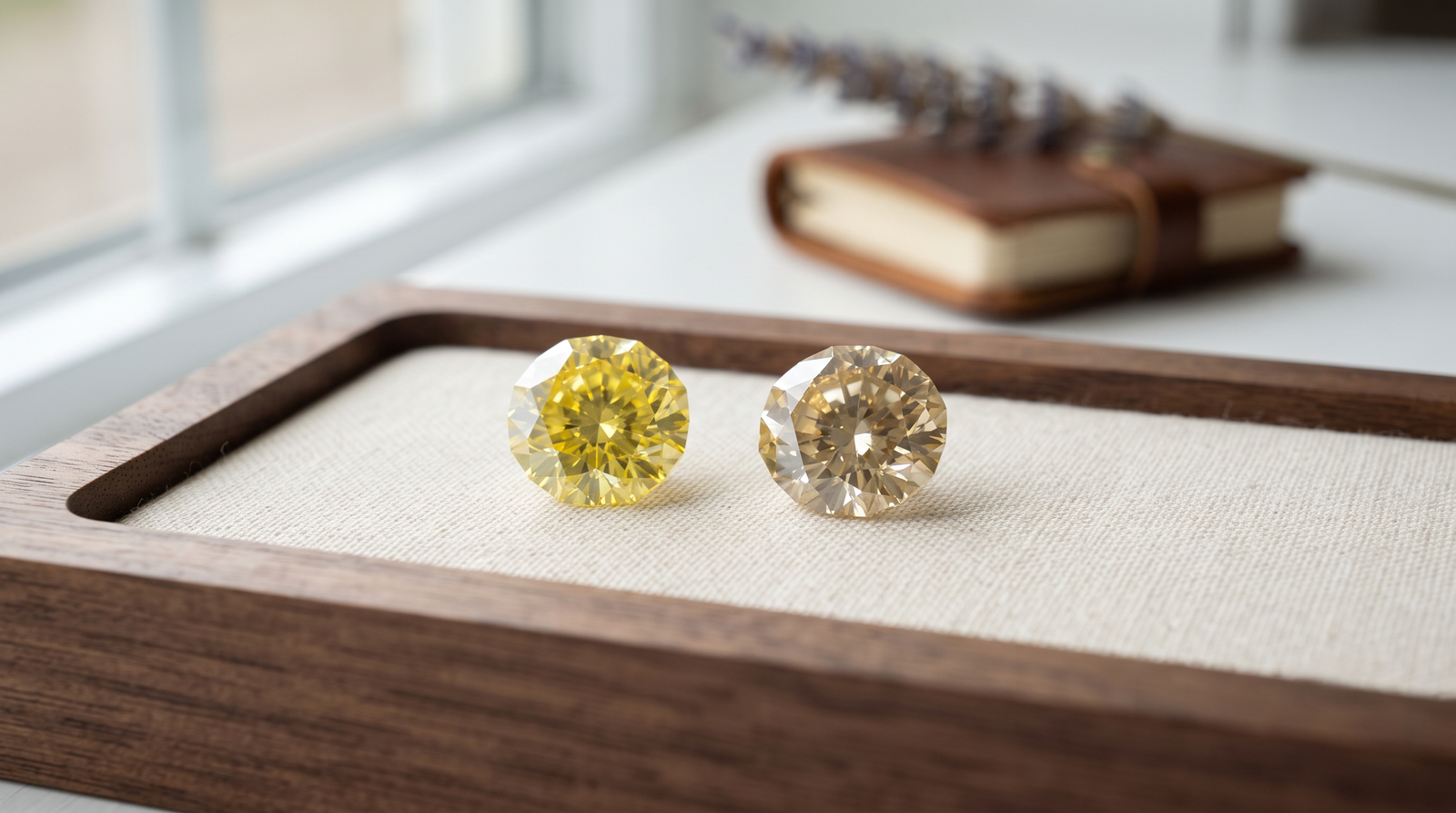
Two memorial diamonds from the same submission showing different yellow and champagne tones

Will the Stones Look the Same?

No, and this is worth saying to everyone involved before any money is spent.

Colour in a memorial diamond comes from trace elements carried in on an organic, personal carbon source, and those elements are neither evenly distributed nor precisely controllable. Two stones grown from the same submission, in separate runs, can come out visibly different in tone, explained under what color will a diamond from her ashes be.

They can also be deliberately different: some families choose different cuts or sizes for each person on purpose, which turns an unavoidable variation into an intended one. What causes friction is expecting a matched set and receiving four individuals.

What Does It Cost for Three or Four People?

Each stone is a separate commissioned growth run, so the cost is multiplied rather than shared.

ScenarioHow it is pricedPractical note
Four stones, same sizeFour times the single-stone price, broadlyAsk whether any multi-stone allowance exists, as it is a fair question
Four smaller stones instead of one largeConsiderably less than one large stone, in totalPrice rises steeply with carat, so four quarter-carats cost far less than one two-carat
One stone, shared ownershipOne priceRare in practice, because someone still has to hold it
Stones ordered years apartFull price each timeNothing about the first order reduces the second
Four quarter-carat stones beside one two-carat stone for scale

Entry-tier stones at 0.10 to 0.25 carats run roughly $750 and scale upwards, which is what makes several smaller stones a realistic option where one large one would not be, as reviewed under what a mother memorial diamond costs.

Should You Place One Order or Several?

One order, several stonesSeparate orders
Material handlingOne shipment, one intake, one custody recordEach person sends their own portion
TimelineAll finish togetherEach runs on its own clock
PaymentOne payer, usually reimbursedEach pays for their own
Family frictionConcentrated in one conversation upfrontSpread out, and easier for someone to opt out later
ConsistencyGrown in the same period, though still not matchingMore variation still

A single order is usually simpler, and its real advantage is that the ashes are handled and shipped once rather than three times.

What Should a Family Agree Before Ordering?

Six things, and none of them are about diamonds:

  • Who holds the ashes now, and who is authorising this. In many families that is one person, and the others are being consulted rather than deciding.
  • That the stones will differ. Say it out loud, before anyone pictures a matched set.
  • Who gets which, if the sizes or colours differ, decided in advance or by an agreed method rather than on the day they arrive.
  • Who pays for what, and whether one person is fronting the total.
  • What happens to the remaining ashes, since a memorial diamond uses a fraction and the original plan for the rest can proceed unchanged.
  • Whether anyone objects at all, keeping in mind that a no is allowed to stand, as discussed in how to talk to family about a mother memorial diamond.

Adult siblings talking across a kitchen table with documents between them

What If Someone Decides They Want One Later?

Usually possible, and worth planning for rather than treating as a problem. Cremated remains do not deteriorate, so a sibling who says no this year can say yes in five years, provided enough ashes were kept back.

Two things make that easier:

  • Keep more than you need. Retaining a documented portion for a possible future order costs nothing and removes the pressure to decide together.
  • Note what was used. A record of what was sent, when, and to whom makes a later order straightforward rather than archaeological.

Frequently Asked Questions

Do all the stones have to be ordered at the same time?

No. Later orders are ordinary orders, priced and grown the same way, and they can be placed years afterwards. What matters is that enough of her ashes were kept back, which is an argument for retaining a documented portion rather than sending everything at once.

Can each sibling send their own share of her ashes separately?

Usually yes, and it suits families where the ashes were already divided. Each shipment is its own intake with its own custody record, which is administratively cleaner even though it means several packages rather than one.

Is one large stone that gets passed down a better idea than several small ones?

Both work, and they answer different questions. One heirloom stone means one person holds it at a time, while several stones mean everyone has one now. Cost pushes toward several small ones, since price rises steeply with carat.

What if we cannot agree?

A memorial diamond uses a small fraction of a cremation, so it rarely has to be an all-or-nothing decision. One person can proceed with their portion while others keep theirs as they are. Where the disagreement is about the principle rather than the quantity, that is a family conversation rather than a logistics one.

Can several stones be made from her hair instead?

Sometimes, and it depends entirely on how much hair exists. A lock cannot be topped up the way an urn can, so dividing a small one between two orders risks leaving neither above the minimum. Ask before dividing anything.

Will the certificate say the stones came from the same person?

Ask what the wording is. An origin certificate documents that a stone was grown from material a family submitted, and whether it references a shared submission across several stones is a documentation question worth settling before ordering rather than after.
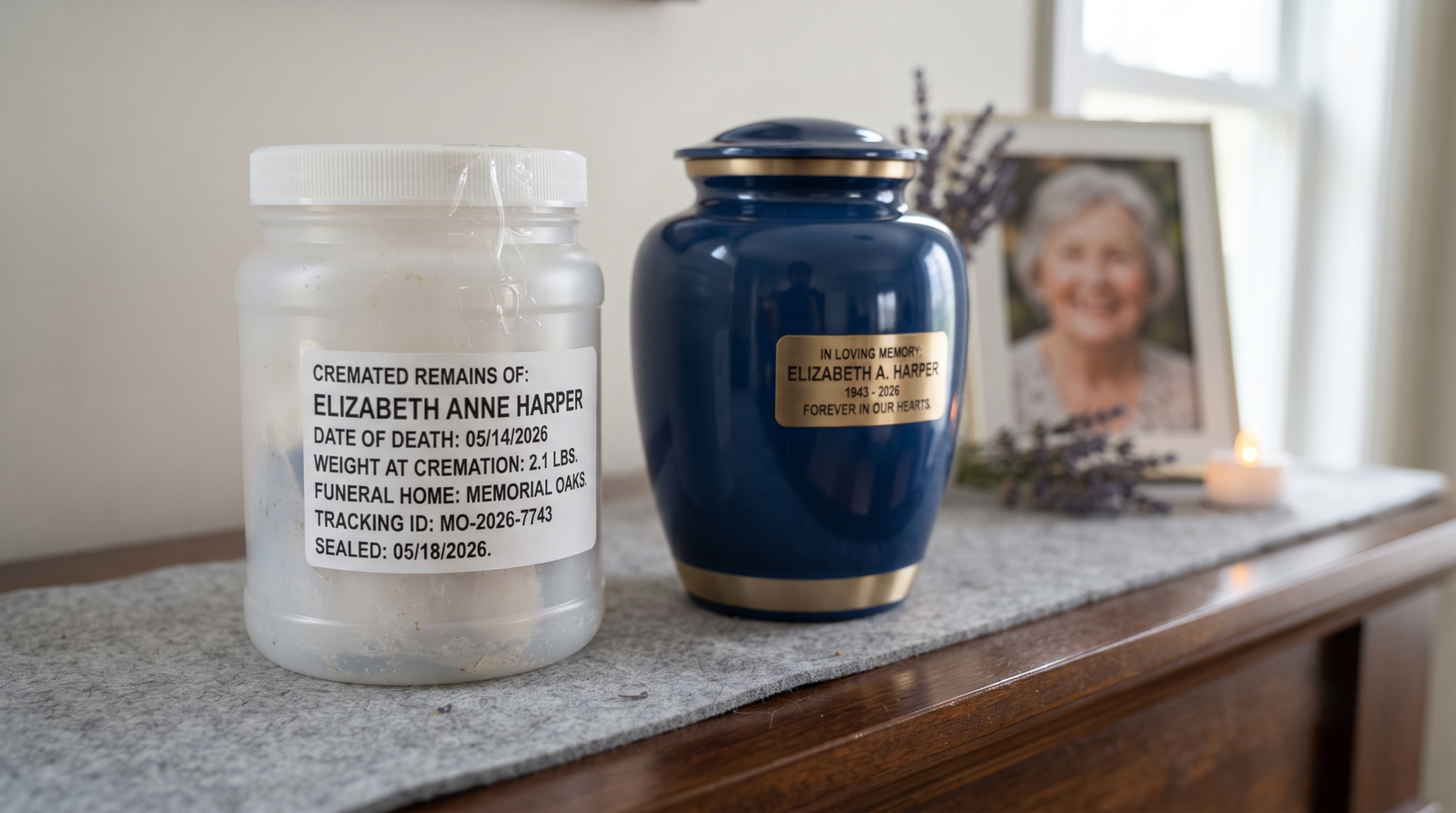
Labelled sealed container of cremated remains kept alongside an urn

Agree on the Differences First

The practical work here is not the ordering, which is straightforward. It is the twenty minutes beforehand in which a family agrees that the stones will differ, who gets which, and who is paying. Ask Memorial Diamond at memorialdiamond.us how many stones one submission can support and whether they are grown together or in sequence, then have the conversation with the answer in hand rather than without it.
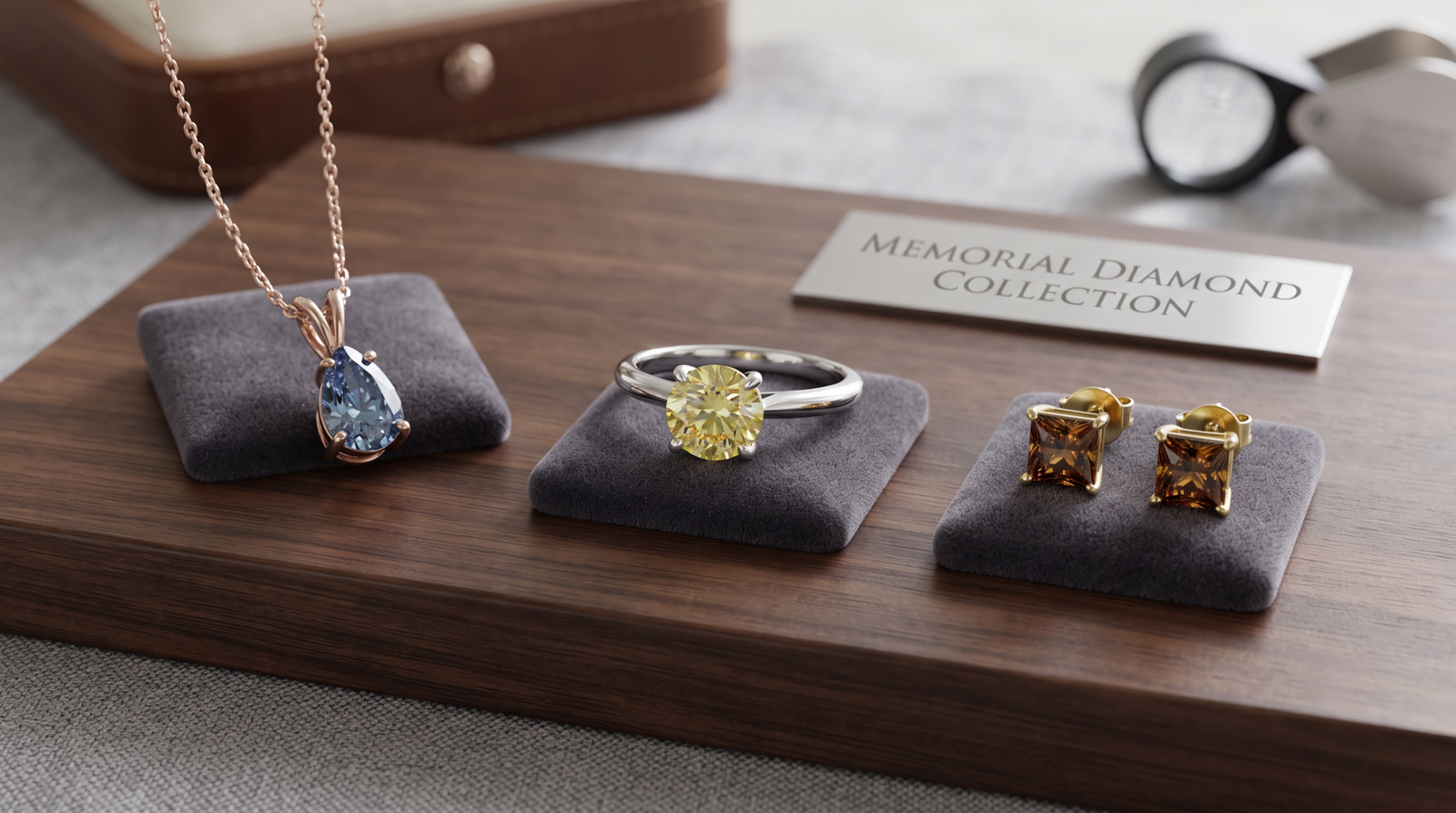
Loose memorial diamond in an open presentation case beside a pendant and a ring

Mother Memorial Diamond Ideas: Rings, Pendants, and Keepsakes

It arrives loose, in a box about the size of a matchbox, and it stays that way until somebody decides what it is for. The realistic options are a ring, a pendant, earrings, a stone set into a piece of her own jewellery, a loose stone kept in a case, or several smaller stones shared across a family. The question that sorts them is not taste; it is how often you will actually wear the piece, because daily wear, occasional wear, and never wearing it at all lead to three different objects.

What Are the Actual Options?

FormSuitsWorth knowing
PendantDaily wear, and the most forgiving optionSits under clothing, takes fewer knocks than a hand does
RingDaily wear, if the setting protects the stoneThe most exposed piece anyone owns; setting choice matters most here
EarringsOccasional wearTwo stones, ideally from one growth run, as separate runs will not match
Set into her own ring or broochAny frequencyCombines her metal and your stone, and needs a jeweller comfortable with resetting
Loose, in a caseNot wornEntirely legitimate, and reversible at any point
Several small stonesA familyPriced per stone rather than divided
Memorial diamond shown set as a pendant, a ring and a pair of earrings

How Often Will You Actually Wear It?

Be honest about this before choosing a form, because it decides almost everything downstream: setting style, metal, size, and whether the piece needs to survive washing up, gardening, and car doors.

Three patterns, and what each implies:

  • Every day: Prioritise protection over display. A stone worn daily meets more hazards in a month than an occasional piece meets in a decade.
  • A few times a year: Prioritise the appearance you want. Anniversaries, birthdays, and family occasions put a piece on for hours rather than years, making a more delicate setting reasonable.
  • Not at all, for now: A loose stone is not a failure to decide. It is a decision that stays open, and you can revisit the only one on this page without a jeweller.

The mechanics of choosing between setting styles, such as bezel against prong, metal choice, resizing, and security, belong in memorial diamond settings and jewellery ideas for a mother. What follows here is the ideas layer: what to make, rather than how to hold the stone.

Ideas for a Stone You Will Wear Every Day

  • A pendant on a chain you already own, so the piece joins your life rather than announcing itself.
  • A plain solitaire ring in a protective setting, which is the least fussy option and the one that ages best.
  • A stone set into a wedding or eternity band you already wear, which suits families who want it present without it being a separate thing to remember to put on.
  • Choose a signet or seal ring, if her side of the family had one, where you can set a memorial stone into a shoulder rather than the face.

For everyday wear, the practical questions are how the setting holds the stone and how easily a jeweller can resize or repair the piece years from now. What fails on a daily piece is never the diamond; it is a prong that catches or a shank worn thin after a decade.

Simple memorial diamond pendant worn at the neckline, under a collar

Ideas for a Stone Worn a Few Times a Year

  • A cocktail or dress ring in a design you would not wear daily.
  • Choose earrings, if you grew two stones in the same run. This is worth asking about at the point of order, because stones from separate runs will not match closely enough to pair.
  • A brooch, which suits a larger stone that would be uncomfortable to wear on a hand.
  • A locket or pendant that opens, pairing the stone with a photograph.

At this frequency a setting will outlast you without a single repair, which is why a more delicate design is a reasonable choice rather than a risk.

Ideas for a Stone That Will Not Be Worn at All

Not everyone wants to wear a memorial diamond, and there is nothing lesser about that.

  • A presentation case on a shelf, with the grading report and origin certificate kept alongside it.
  • A small display frame or dome, so the stone is visible rather than stored.
  • Set into an object rather than jewellery, such as a watch dial, a pen, or the lid of a box she owned.
  • Left loose and passed down with the paperwork as an heirloom that a later generation can decide about, as explored under memorial diamonds as a family heirloom.

None of this is permanent. A loose stone can be set decades later, and a set stone can be removed and reset. Resetting is routine jewellery work, and the only real constraint is that each change means a jeweller handling it again.

Can It Go Into a Piece of Her Own Jewellery?

Often, and it is worth considering early rather than late. Her engagement ring, a brooch she wore, or a locket that has been empty since she died can sometimes host the stone, so the metal she chose holds a stone grown in part from her own carbon.

Two practical cautions apply. First, a piece designed around a different stone may need real reworking to take a new one safely, which is a jeweller’s judgment rather than a given. Second, altering an heirloom is itself irreversible, so it is worth asking whoever else in the family has an interest in that piece before the work begins, as outlined in how to talk to family about a mother memorial diamond.

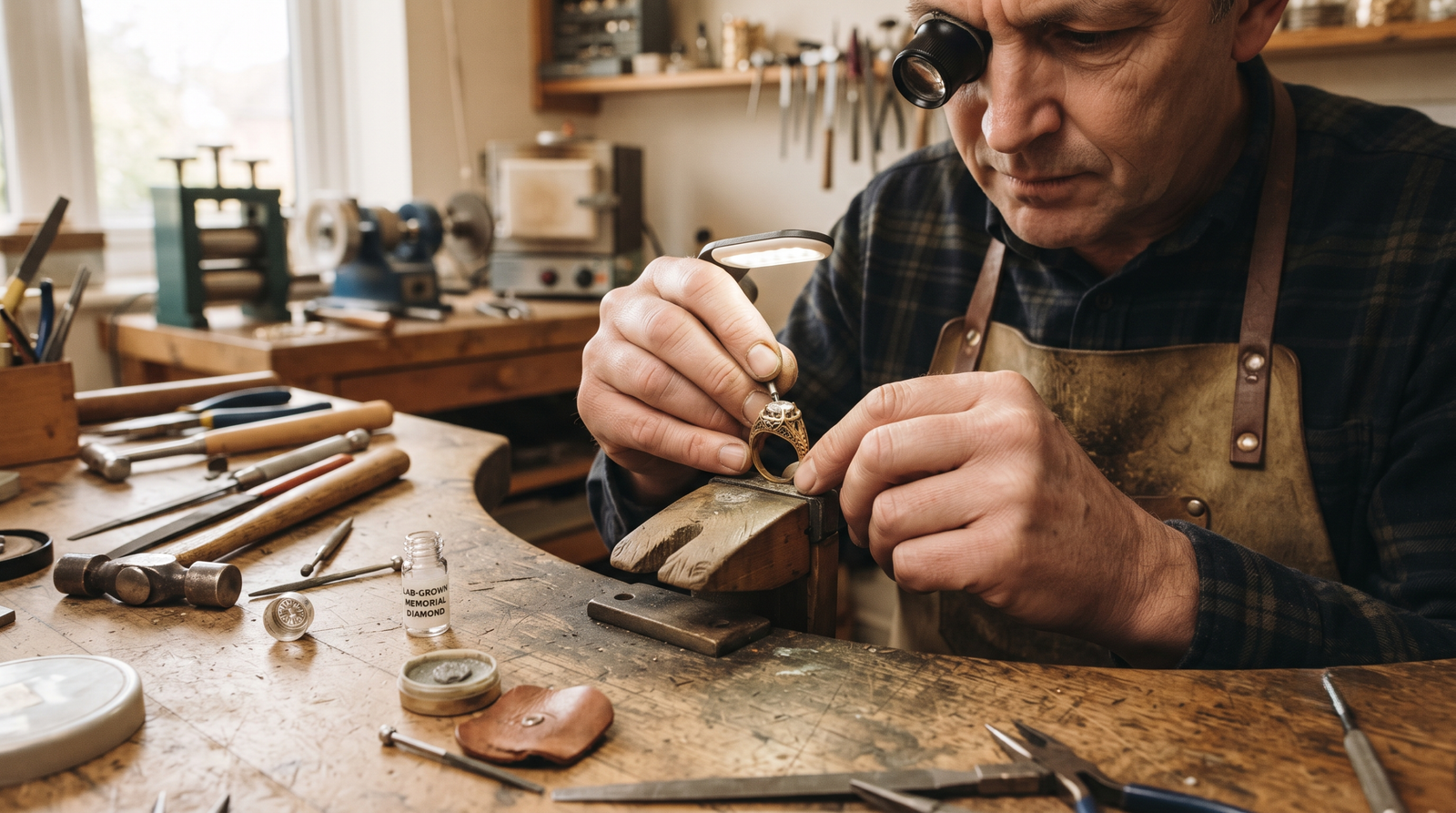
Jeweller resetting a stone into an older gold ring at a bench

Ideas When More Than One of You Wants Something

Several smaller stones from one submission is usually possible, and it changes what is worth making: four quarter carat stones suit four pendants better than they suit four rings. Each is grown from her carbon blended with supplemental lab carbon, typically around 10 to 15 percent personal carbon by mass across the industry, so several stones do not divide her between them.

Worth settling early is that the stones will not match each other exactly. Colour varies between growth runs, which follows from an organic carbon source rather than being a defect, as detailed under whether more than one family member can have one.

Frequently Asked Questions

Does the stone have to be set at all?

No. A memorial diamond is complete as a loose stone, and many families keep it that way for months or years while they decide. Nothing about the stone deteriorates in a case, and setting it later costs no more than setting it now.

What size stone works best for a pendant versus a ring?

Smaller stones read well on a pendant, where they sit close to the body and catch light against skin. Rings tend to want a little more presence and take more punishment, which is an argument for spending on the setting rather than on carat.

Can a memorial diamond be worn every day without damage?

Diamond is the hardest known material, at 10 on the Mohs scale, the same for a lab grown memorial stone as for a mined one, so the stone itself is not the fragile part. What fails on a daily worn ring is the setting, such as a bent prong or a worn shank, which is why setting choice matters more than stone choice for everyday pieces.

Is it strange to give one of these stones to someone outside the family?

It can be well received when the person has a genuine connection to her. What matters is asking rather than surprising, because a memorial piece carries an obligation to keep it, and that is worth offering rather than assigning.

Can the setting be engraved?

Yes, and it is one of the few places personal detail can go, since the stone itself carries no inscription. Her name, her dates, or a few words in her handwriting are all standard jeweller’s work, priced separately.

Four small memorial diamonds of slightly different tones laid out together

Decide How Often, Then Decide What

Start with the honest answer to how often you will wear it, and the list narrows to two or three options before a single design decision is made. If the honest answer is that you do not know yet, that is also a decision, and it is the one that costs nothing: a loose stone in a case is waiting, not unfinished. When you do want to talk sizes and shapes, connect with us at memorialdiamond.us to explore your path forward.

Calendar on a desk with a date circled, beside a small closed jewellery box

How Long Does It Take to Make a Mother Memorial Diamond?

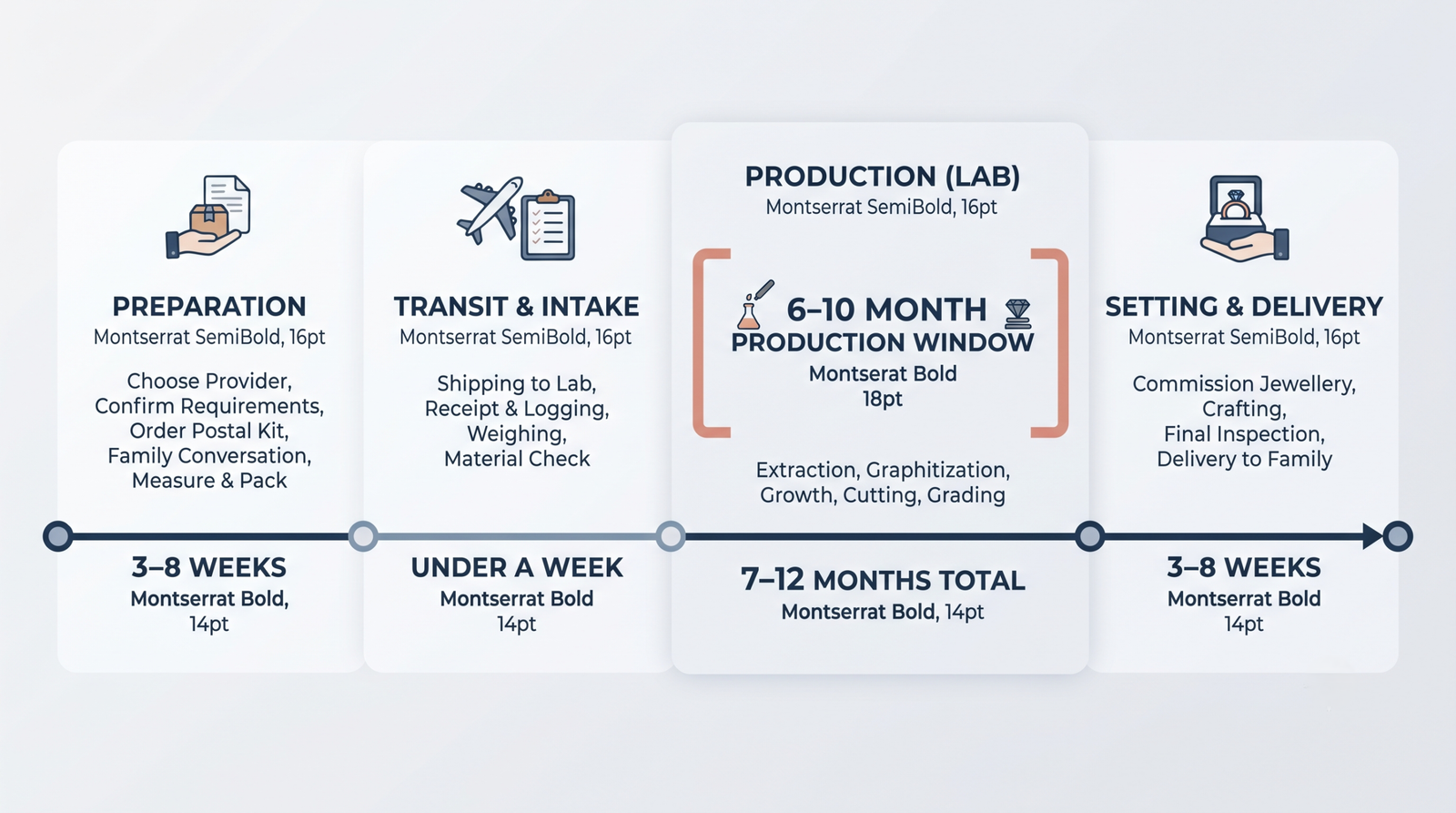
There is usually a date behind this question. A first anniversary, her birthday, a wedding you wanted to wear her to. The production answer is 6 to 10 months from the day a laboratory logs receipt of her ashes or hair, and up to about 12 months for stones over roughly 2 carats or specialty colours. However, the answer that matters for a date is longer: allow 8 to 14 months from the decision to wearing it, because preparation happens before the clock starts and setting happens after it stops.

How Long Does It Take, End to End?

The published 6 to 10 months covers one phase of three. The other two are yours.

PhaseWhat happensTypical durationRunning total
PreparationChoosing a provider, confirming requirements in writing, ordering the postal box, family conversations, measuring, and packing3 to 8 weeks3 to 8 weeks
Transit and intakeShipping, receipt, logging, and weighingUnder a week1 to 2 months
ProductionExtraction, graphitization, growth, cutting, and grading6 to 10 months, up to 12 for larger or specialty stones7 to 12 months
SettingCommissioning and crafting the jewellery piece3 to 8 weeks8 to 14 months
Four-phase timeline graphic from preparation through setting, showing where the 6–10 month production window sits inside it

The production window is the industry-typical figure and the only one of the four that a laboratory controls. The others are ordinary logistics, and they are where a family’s own delay usually hides. Eight months is the arithmetic floor of that table; plan nearer the top of the range, because none of the ordinary delays are built into it.

What Decides Whether It Is Six Months or Twelve?

Four things, and only the first two are large:

  • Carat: Size is a function of time in the press, so a two-carat stone is not a bigger version of a half-carat one, it is a longer one. This is the single largest lever on the calendar.
  • Colour: Specialty colours, including black and stones requiring post-growth treatment, extend the schedule at the finishing end.
  • Cut: Fancy shapes take longer at the wheel than a round brilliant, though this is measured in days rather than months.
  • Grading: Whether an independent grading report is included, which adds a lab’s own turnaround after the stone is finished.

Nothing on that list is about how much material you sent. A full urn does not produce a faster stone, or a larger one, as outlined under how much ash you need.

What Can and Cannot Be Sped Up?

Cannot: Growth. A diamond crystal forms at the rate it forms, and there is no expedited queue to buy into, because the wait is a physical process rather than a backlog.

Can: Everything around it. Ordering the postal box the day you decide rather than the week you ship, having the family conversation during transit rather than before it, sending both materials together rather than separately, and deciding the setting while the stone is still growing. Each of those saves real weeks, and together they are the difference between 9 months and 14.

One genuine trade exists: choosing a smaller carat shortens the growth run. If a date matters more than a size does, that is the only lever that moves the production window itself.

How Do You Work Backwards From a Date That Matters?

Take the date, subtract the setting, subtract production, and subtract preparation. In practice:

If you want to be wearing it byStart the conversation with a provider byHave the material with the lab by
A first anniversary 12 months awayNow, though this is tight for anything over 1 caratWithin 6 to 8 weeks
A date 14+ months awayWithin the next 3 monthsWithin 4 months
A date 6 months awayIt is unlikely for a grown stone of any sizeNot feasible for finished delivery
No fixed dateWhenever the questions are answeredWhenever you are ready

Two cautions are worth building in. First, the clock starts when the lab logs receipt, not when you decide. The point at which each stage begins and ends is mapped out in the step-by-step sequence. Second, add a month of slack: a growth run that has to be repeated, a lock that falls short of the minimum, or a postal box that takes longer to arrive than expected will each take back the buffer you did not build.

Hands marking dates on a wall calendar

If the date genuinely cannot move and the timeline will not reach it, the honest options are a smaller stone, a later date, or an unset stone worn on the day and set afterwards.

What Happens During the Months of Silence?

Most of the production window is a single long stage, growth, during which there is genuinely nothing to report. Families often read that silence as a problem when it is the process working as intended.

What you can reasonably expect, and should ask for at the outset:

  • Confirmation of receipt, naming the quantity received, within days of delivery.
  • A chain of custody reference you can quote when you want a status update.
  • A notification when growth begins, which is the real start of the long stretch.
  • A notification when cutting begins, which means weeks rather than months remain.

A month-by-month account of what is happening inside that quiet period is explored in the memorial diamond timeline.

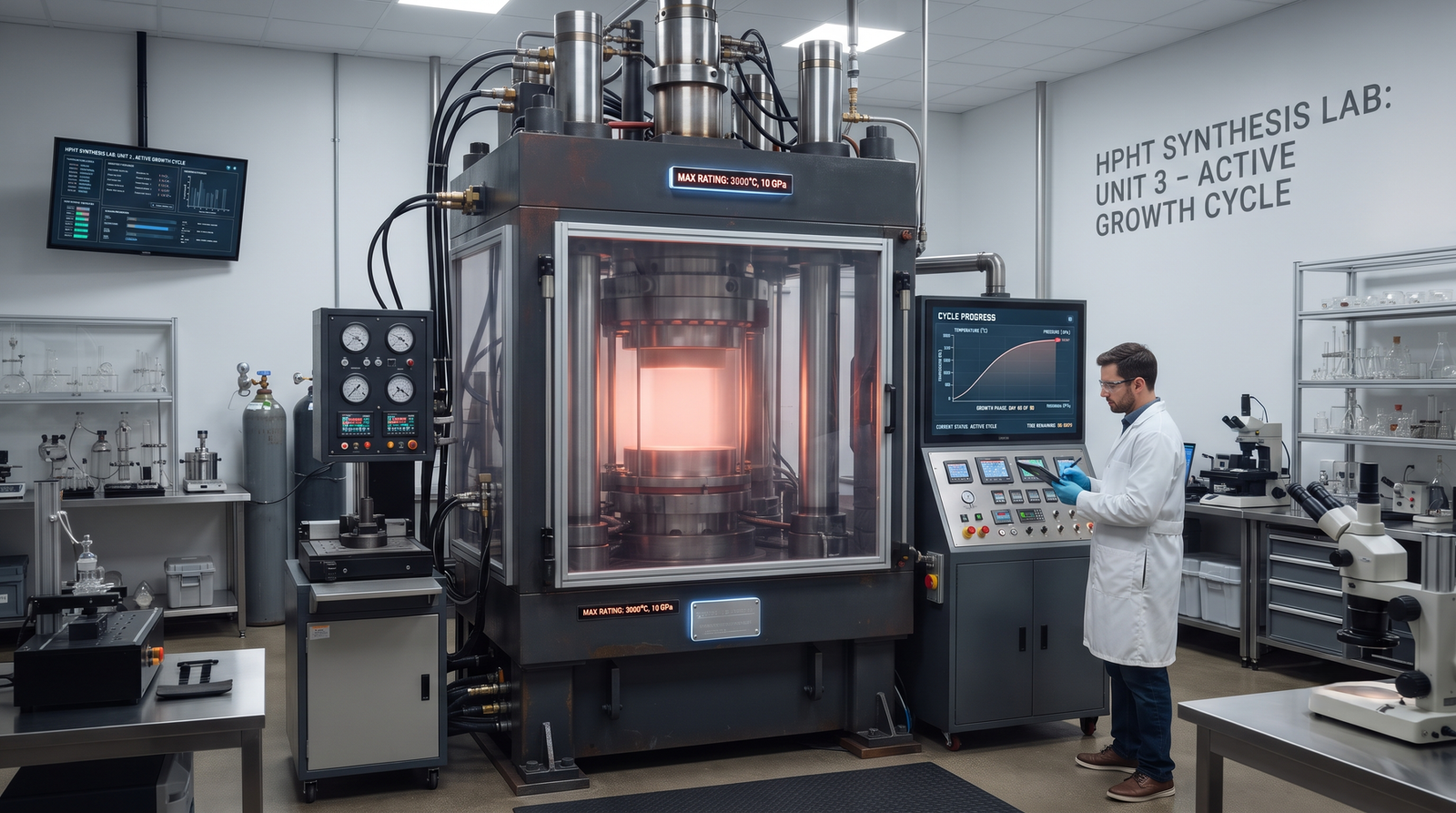
HPHT press running a growth cycle in a laboratory

Does a Hair Diamond Take Less Time Than an Ashes Diamond?

Slightly, at one stage only. Hair is roughly half carbon by weight, so purification has far less to strip away than it does with cremated remains, where carbon is a small fraction of the total. That saves time at extraction.

It does not shorten growth, which is the long stage, so the difference between a hair diamond and an ashes diamond is measured in days or a couple of weeks against a total measured in months, as detailed in how to turn your mother’s hair into a diamond.

Frequently Asked Questions

Why does a bigger diamond take longer if it is the same process?

Because carat is time. The crystal grows in the press for as long as the run lasts, so a larger stone means a longer run rather than a different method. That is also why size dictates what a mother memorial diamond costs.

Can I pay to have it made faster?

Generally no. Providers are selling a growth run, not a queue position, and there is no compression available in the press itself. The one real lever is choosing a smaller carat.

What if I need it for a funeral or memorial service?

It will not be ready. A grown diamond takes the better part of a year, so families planning around a service usually keep the ashes intact for now and start the process afterwards. Nothing about waiting reduces what is possible later.

How will I know it is actually progressing?

Ask for the chain of custody reference at intake and quote it when you check in. A provider should be able to say which stage the order currently sits at and roughly how long remains in it.

Does sending both ashes and hair make it take longer?

Only if they arrive on different days. The two are purified in parallel, so a combined order should track the slower material rather than the sum, but a growth cell cannot be loaded until both are ready, so a second package sets the finishing date, as explained under the combined sequence, step by step.

Is there any deadline on my side once I have decided?

No. Cremated remains and hair both keep indefinitely, so the decision has no expiry, which is worth knowing if the honest answer to a date is that this year’s timeline is out of reach.

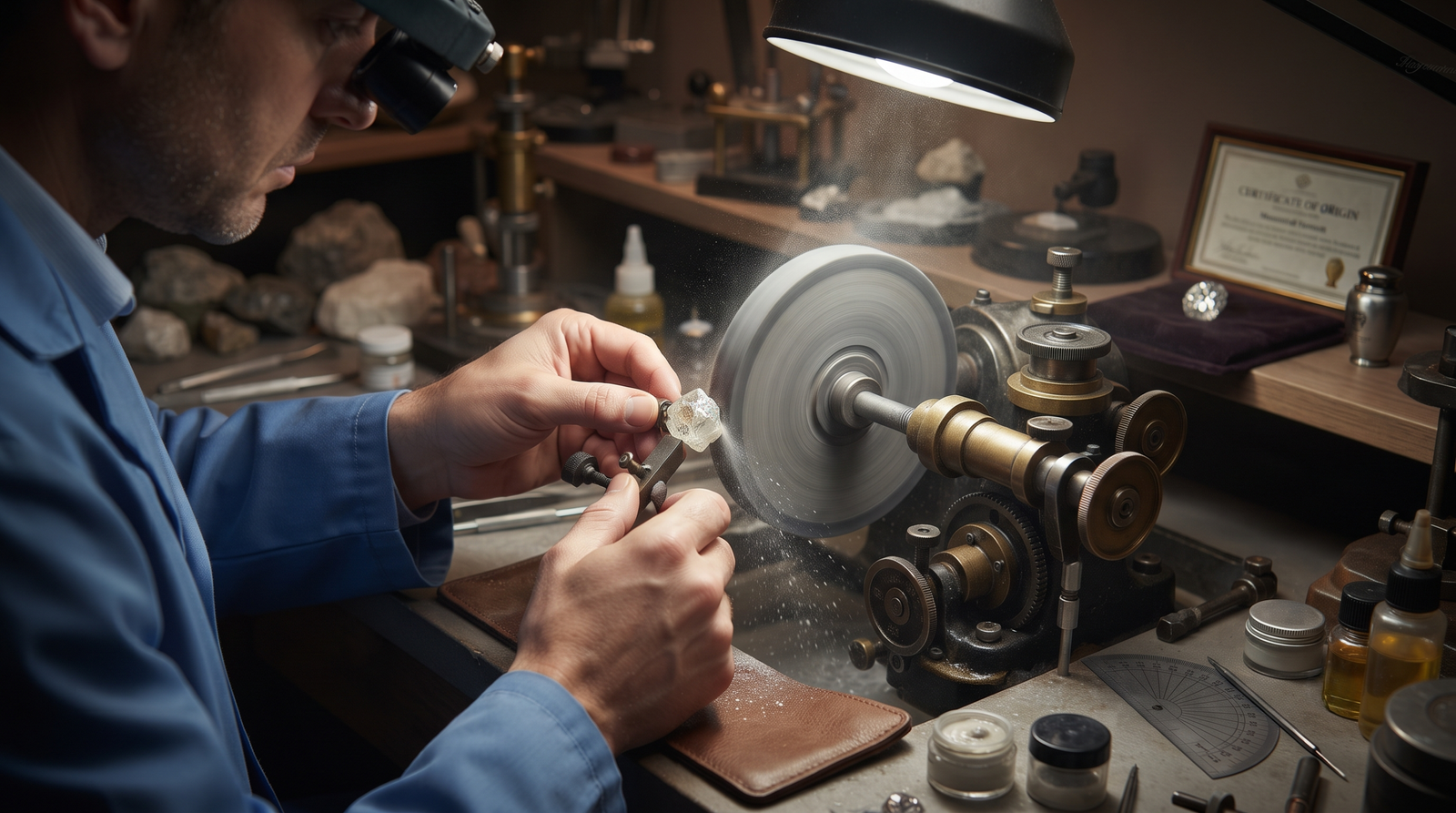
Gemologist cutting a rough memorial diamond at a polishing wheel

Count Backwards, Then Add a Month

If a date matters, work back from it: setting, then production, then preparation, then a month of slack. Then take the date itself to a provider rather than a vague sense of urgency. Memorial Diamond will say whether it is reachable at the size and colour you have in mind, and that is the answer that decides whether you change the size or change the date. Reach out to us at memorialdiamond.us to plan your timeline with confidence.

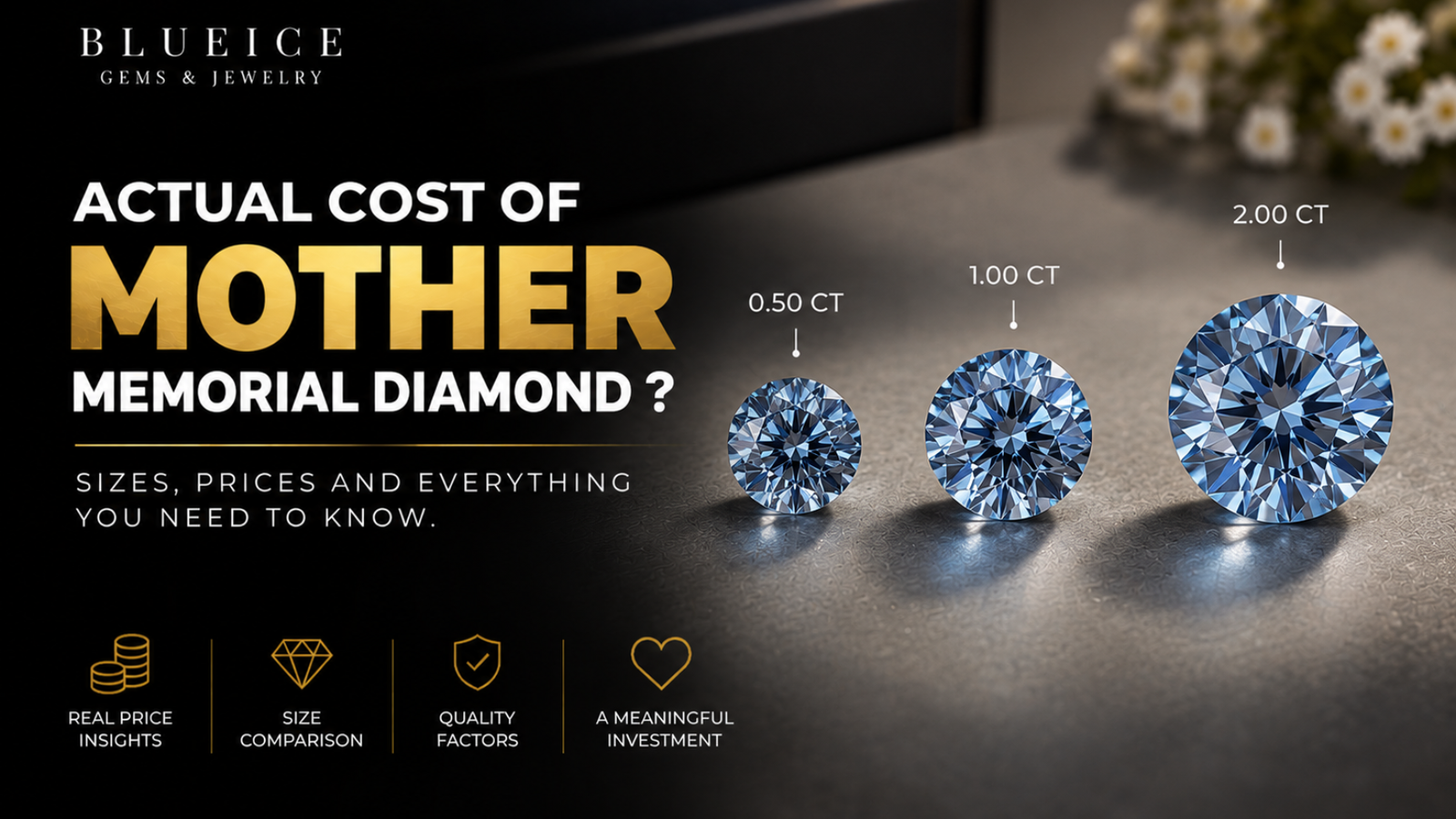
Loose memorial diamonds in three carat sizes arranged on a plain surface for scale

How Much Does a Mother Memorial Diamond Cost?

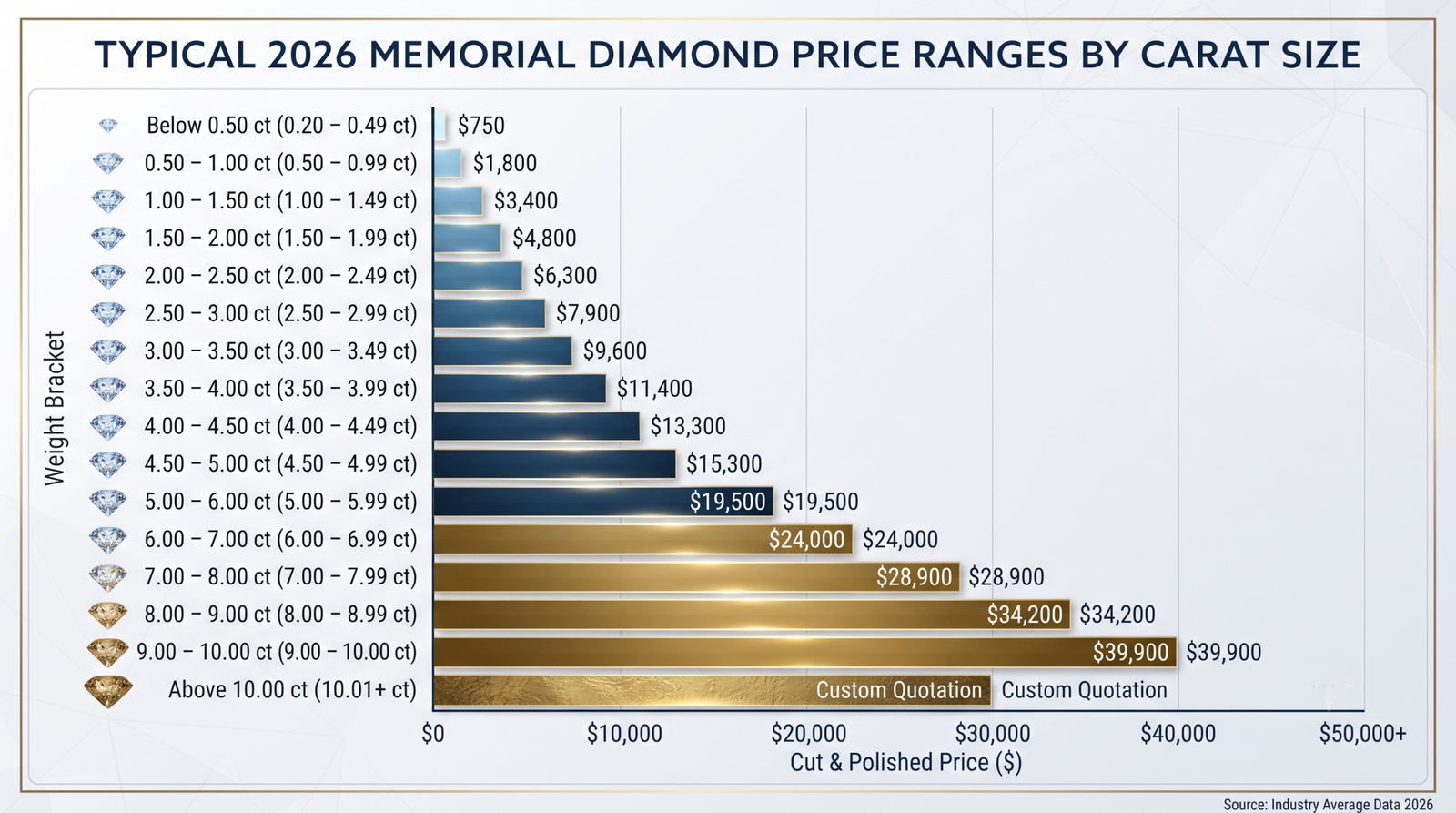
The number a provider quotes you is almost always for one object: a loose, unset stone in a box. At Memorial Diamond, our transparent pricing is based strictly on the finished cut and polished weight bracket, starting at $750 for stones below half a carat and scaling up to custom quotations for stones above 10 carats.

Memorial Diamond Pricing by Weight Bracket

Weight BracketCarat RangeCut and Polished Price
Below 0.50 ct0.20 – 0.49 ct$750
0.50 – 1.00 ct0.50 – 0.99 ct$1,800
1.00 – 1.50 ct1.00 – 1.49 ct$3,400
1.50 – 2.00 ct1.50 – 1.99 ct$4,800
2.00 – 2.50 ct2.00 – 2.49 ct$6,300
2.50 – 3.00 ct2.50 – 2.99 ct$7,900
3.00 – 3.50 ct3.00 – 3.49 ct$9,600
3.50 – 4.00 ct3.50 – 3.99 ct$11,400
4.00 – 4.50 ct4.00 – 4.49 ct$13,300
4.50 – 5.00 ct4.50 – 4.99 ct$15,300
5.00 – 6.00 ct5.00 – 5.99 ct$19,500
6.00 – 7.00 ct6.00 – 6.99 ct$24,000
7.00 – 8.00 ct7.00 – 7.99 ct$28,900
8.00 – 9.00 ct8.00 – 8.99 ct$34,200
9.00 – 10.00 ct9.00 – 10.00 ct$39,900
Above 10.00 ct10.01+ ctCustom Quotation

Price rises faster than size because carat is a function of growth time in the press, and longer runs mean more process control, more risk, and more machine time. A stone twice the size is not twice the price.

Chart of typical 2026 memorial diamond price ranges by carat size

What Actually Drives the Price?

Five variables shape the final investment, listed in roughly descending order of impact:

  • Carat: The dominant driver, setting both the schedule and the price, as detailed under how long a mother memorial diamond takes.
  • Colour: Colourless stones require additional chemical processing to exclude trace elements naturally present in organic carbon sources.
  • Cut: A round brilliant versus a fancy shape demands specialized craftsmanship.
  • Grading: Independent third-party reports verify the quality metrics of the finished diamond.
  • Setting: A ring, pendant, or pair of earrings represents a separate jewellery commission quoted independently from the loose stone.

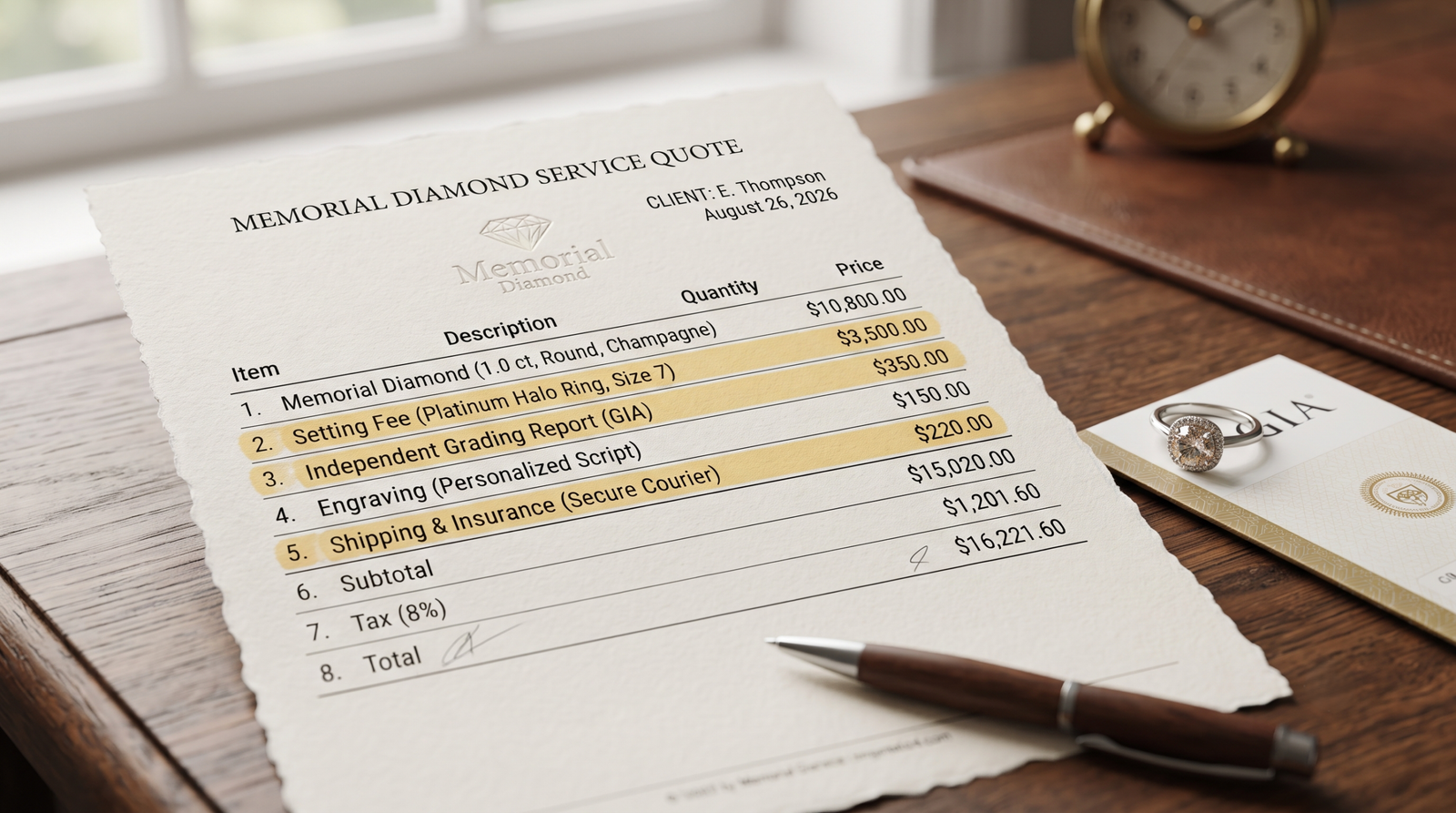
What Does the Quoted Price Usually Not Include?

This is where a budget can unexpected shift. Five items sit outside most base stone quotes:

ItemWhy it is separateWhen you find out
The settingIt is a jewellery commission, not part of the stoneOn delivery, if not before
Independent grading reportCommonly optional across the category, priced per stoneAt order, if requested
EngravingPriced by character or by pieceAt setting selection
Shipping her ashes to the labThe official USPS cremated remains service is a real costBefore you send anything
A second stone for a siblingPriced per stone, rather than divided (more than one family member from the same ashes)Usually after the first is ordered

Ask for the total cost including everything you intend to own, rather than the price of the stone alone. A full breakdown of where funds go across the category is available in the memorial diamond cost breakdown.

Itemised quote on a desk with setting, grading and shipping lines highlighted

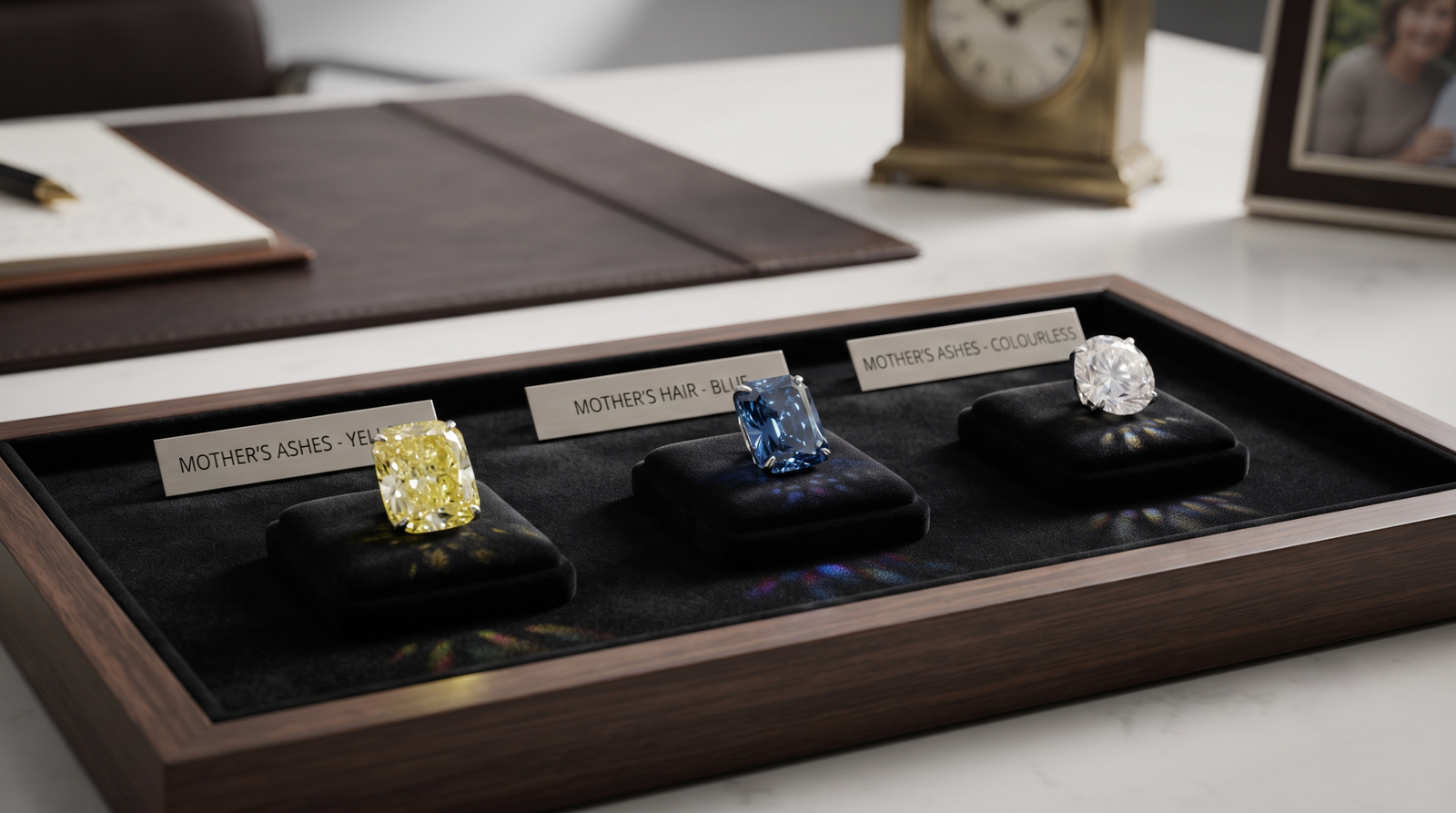
Why Does a Colourless Stone Cost More Than a Yellow or Blue One?

Colour in a diamond comes from trace elements present during growth: boron gives blue tones, while nitrogen gives yellow. An organic, personal carbon source arrives carrying these trace elements naturally. Producing a colourless stone means actively excluding those elements through additional processing steps during purification and growth.

The practical consequence is that the shades which come most naturally from your mother’s own material are the more accessible ones, explained fully under what color will a diamond from her ashes will be.

Yellow, blue and colourless memorial diamonds side by side

Does Sending More of Her Ashes or Hair Cost More?

No. The amount of material you send does not alter the price, nor does it dictate the final stone size growth time does. Sending a larger portion changes nothing about the stone, so there is no reason to send more than the minimum requested amount, as outlined in how much ash you need.

Does an Ashes Diamond Cost More Than a Hair Diamond?

Broadly, no. Pricing across the industry is quoted by carat, colour, and cut rather than by source material, and the growth stage dominating the cost is identical either way. While extraction work differs cremated remains carry far less carbon by weight than hair that initial laboratory phase represents a minor fraction of the overall process.

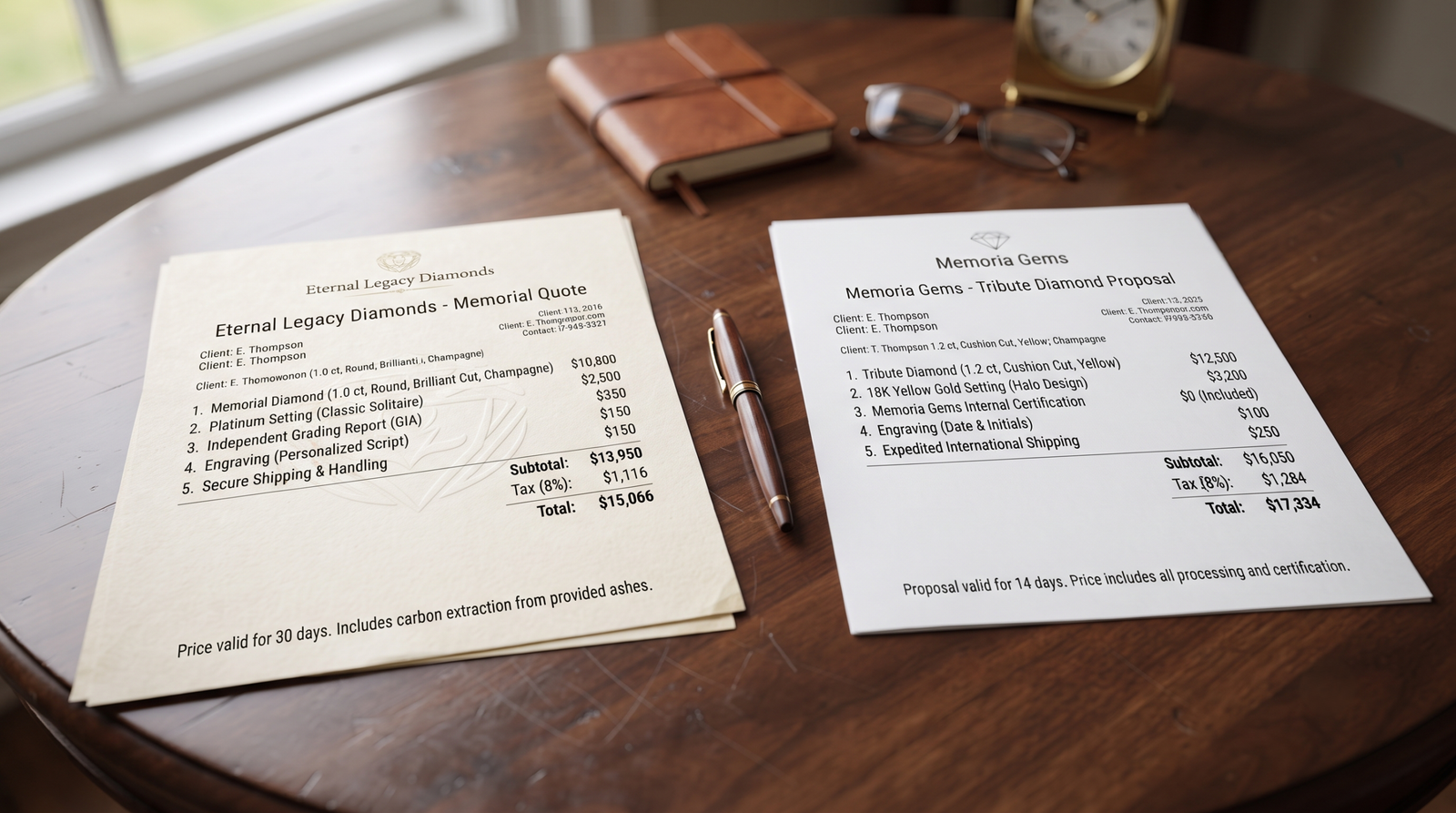
How Do You Compare Two Quotes Honestly?

Put both offers on the same footing before evaluating the numbers:

  • Confirm identical carat ranges, colours, and cuts.
  • Check whether independent grading reports are included.
  • Verify if jewellery settings are factored into the estimate.
  • Review return shipping policies for unused material.
  • Examine payment schedules and policies regarding growth run failures.

For a comprehensive checklist of provider questions, consult questions to ask before turning her ashes into a diamond.

Frequently Asked Questions

Is a memorial diamond more expensive than a mined diamond of the same size?

Not necessarily, and the comparison is less direct than it appears. A memorial diamond is priced as a commissioned growth run rather than a stone selected from pre-existing inventory, meaning the two markets behave independently.

Can the cost be spread over payments?

Payment plans exist across the category, and terms vary by provider. Treat specific APR terms, financing lengths, or approval conditions as details to confirm directly with your provider and lender rather than assume, as outlined under memorial diamond financing options.

What happens to the cost if a growth run fails?

Ask before ordering. Presses do occasionally produce unusable rough, and the vital question is whether a second run is made from remaining material and at whose expense. A transparent provider offers clear written terms.

Is a memorial diamond tax deductible as a funeral expense?

Generally no, because personal expenses are not usually deductible. Tax treatment depends on jurisdiction and individual circumstances, making this a question for an accountant rather than a jeweller.

Should I insure it once it arrives?

It is strongly worth asking your insurer. A memorial diamond is both a valuable asset and an irreplaceable keepsake, and standard contents insurance may treat it differently from ordinary retail jewellery. Speak to an agent about scheduled coverage.

Does a smaller stone mean a smaller portion of her carbon?

No. Personal carbon typically accounts for roughly 10 to 15 percent of a finished stone’s mass regardless of its final size, blended with supplemental lab carbon to fill the growth cell. A quarter carat stone represents an identical share of her material as a two-carat stone.

Two written quotes side by side on a table

Ask for the Total, Not the Stone

Before comparing any two figures, ask each provider what the quoted sum covers and what it omits: grading, settings, engraving, shipping, and returns. Memorial Diamond provides transparent pricing end to end, matching the size and colour you envision. Explore your options with us at memorialdiamond.us to build a tribute that includes everything you wish to hold.

Sealed ash container and a bound lock of hair on a table beside a written list of questions

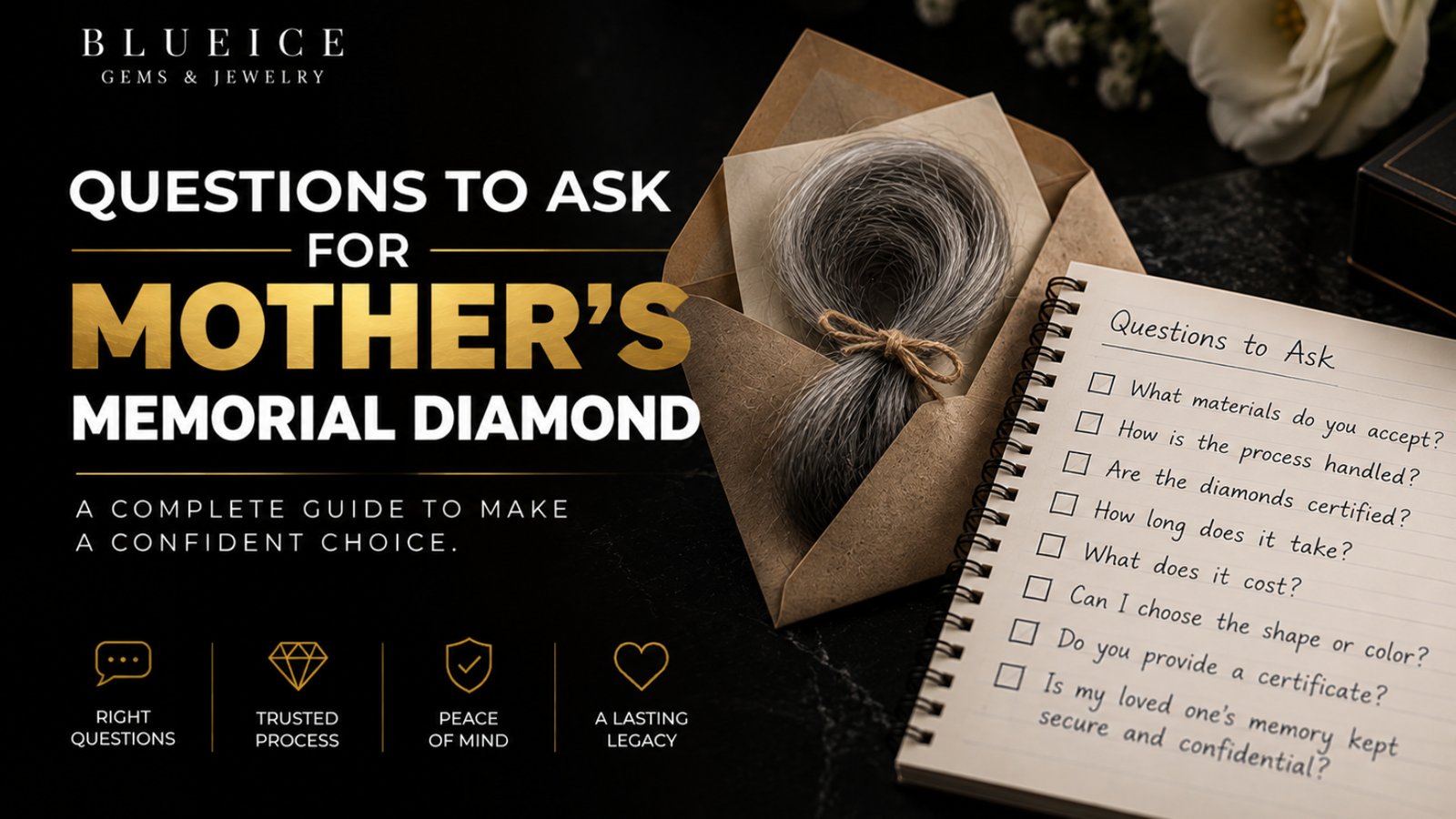
Questions to Ask Before Turning Your Mother’s Ashes and Hair Into a Diamond

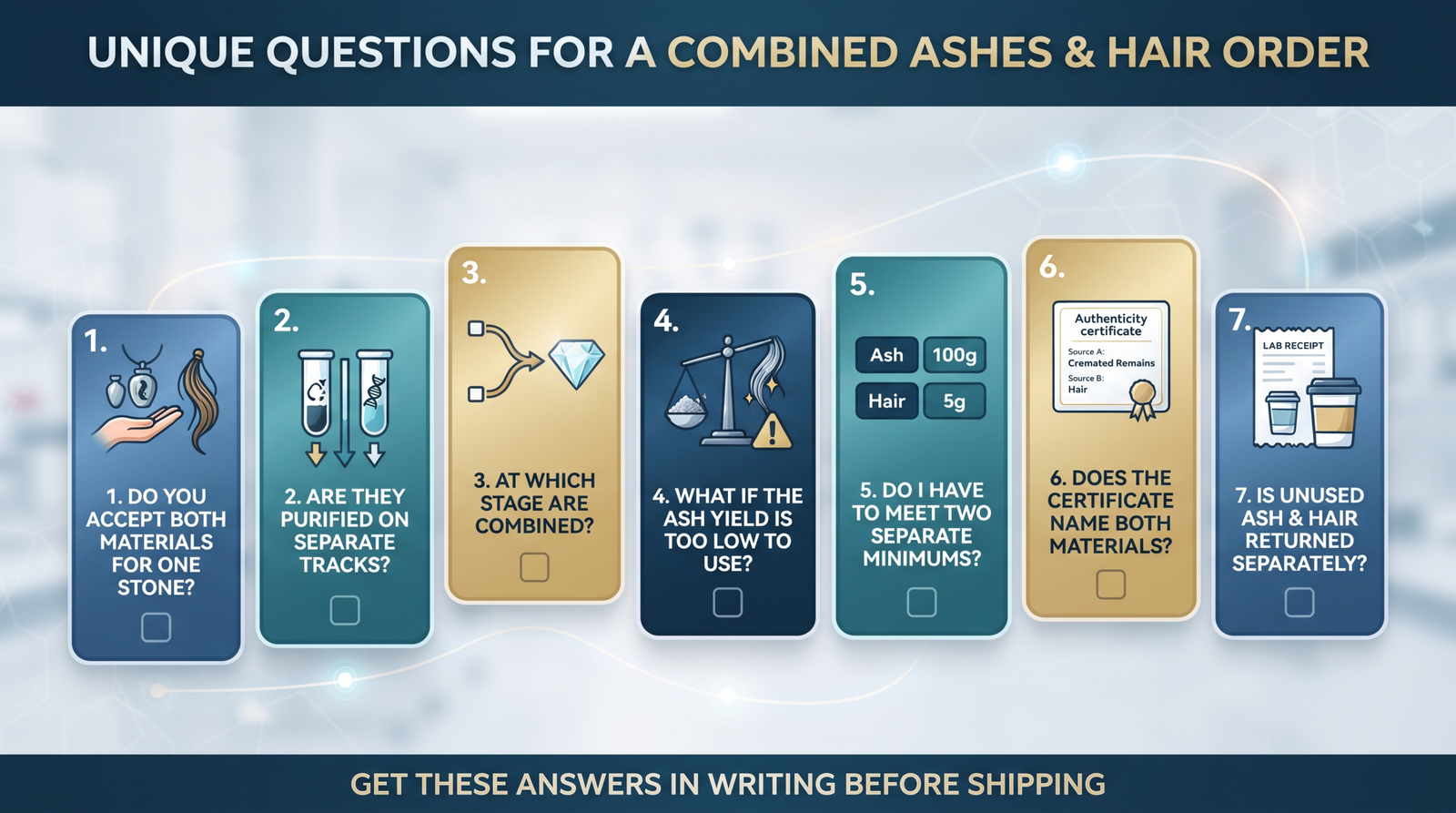
Some of the questions below have answers sitting on a provider’s website. Others may not, not because anyone is hiding anything, but because combining two materials is the less routine request, which makes this a conversation to have rather than a page to read. Submitting both her ashes and her hair raises seven questions that a single material order never raises, and three of them are load-bearing: whether companies offer a combined order at all, whether they purify the two materials separately, and what happens if the carbon recovered from her ashes comes back too low to use.

Which Questions Does a Combined Order Add?

Ask thisWhy it only arises hereWhat a real answer names
Do you accept both materials for one stone?Not universal, as some providers grow from one material per stoneA yes or no, plus whether two separate stones are the alternative
Are they purified on separate tracks?Ash and hair need different extraction workTwo processes, and the stage at which they merge
At which stage are they combined?It determines the last point anything is reversibleA named step, before growth
What if the ash yield is too low to use?Only matters when a second material could quietly cover itWhether you are told, and what your options are
Do I have to meet both minimums separately?Families assume combining lowers each oneTwo figures, not one
Does the certificate name both materials?A single line certificate cannot distinguish themWhat the document actually states
Is unused ash and unused hair returned separately?Two materials, two returnsTwo return records
Checklist graphic of the seven questions unique to a combined ashes-and-hair order

Do They Even Offer a Combined Order?

Start here, because everything downstream depends on it. A provider may grow one stone from one material as standard, and treat a combined submission as either an accepted variant, a bespoke arrangement, or something they decline.

If the answer is no, the useful follow up is whether two stones from the two materials are possible instead: one from her ashes, one from her hair. That is a genuinely different product with its own appeal, and it is the alternative that is easiest to overlook, as discussed in the complete guide to a combined mother diamond.

How Do They Actually Handle the Two Materials?

Three questions, in this order:

  • Do they log them separately on intake, with a reference each? Using one reference for two materials means you cannot independently account for the two halves afterwards.
  • Are they purified on separate tracks? They need to be. Cremated remains are mostly calcium phosphate with carbon as a small fraction of the weight, while hair is roughly half carbon. The work required is not the same.
  • At what point do they combine the materials? Ask for a named stage rather than a description of care. You can find the full sequence and the exact merge point mapped under where the two lanes merge, step by step.
Two laboratory purification setups running side by side

There is no useful follow up question after that point, and it is worth knowing why. Once both graphite batches are in one cell, nothing distinguishes them. Carbon carries no memory of the molecule it came from, which is why no test can later report a ratio, explained further under what actually happens on the lab bench.

Do I Have to Meet Two Separate Minimums?

Ask for the ash figure and the hair figure as two numbers, and ask directly whether sending both lets either fall below its own threshold.

The safe planning assumption is that it does not. Treat any reduction a provider offers as a concession they told you about, not a rule you assumed, as the section on how much of each you need details.. Families who assume otherwise discover it late, when a second shipment is the only remedy and the timeline has already moved.

What Does the Certificate Say, and What Comes Back?

Four things to establish before you ship:

  • Does the origin certificate state both materials, or does it say cremated remains and stop? Ask for the wording, not the reassurance.
  • Is each material logged, and returned, under its own record?
  • Is unused ash returned as ash, and unused hair returned identifiably?
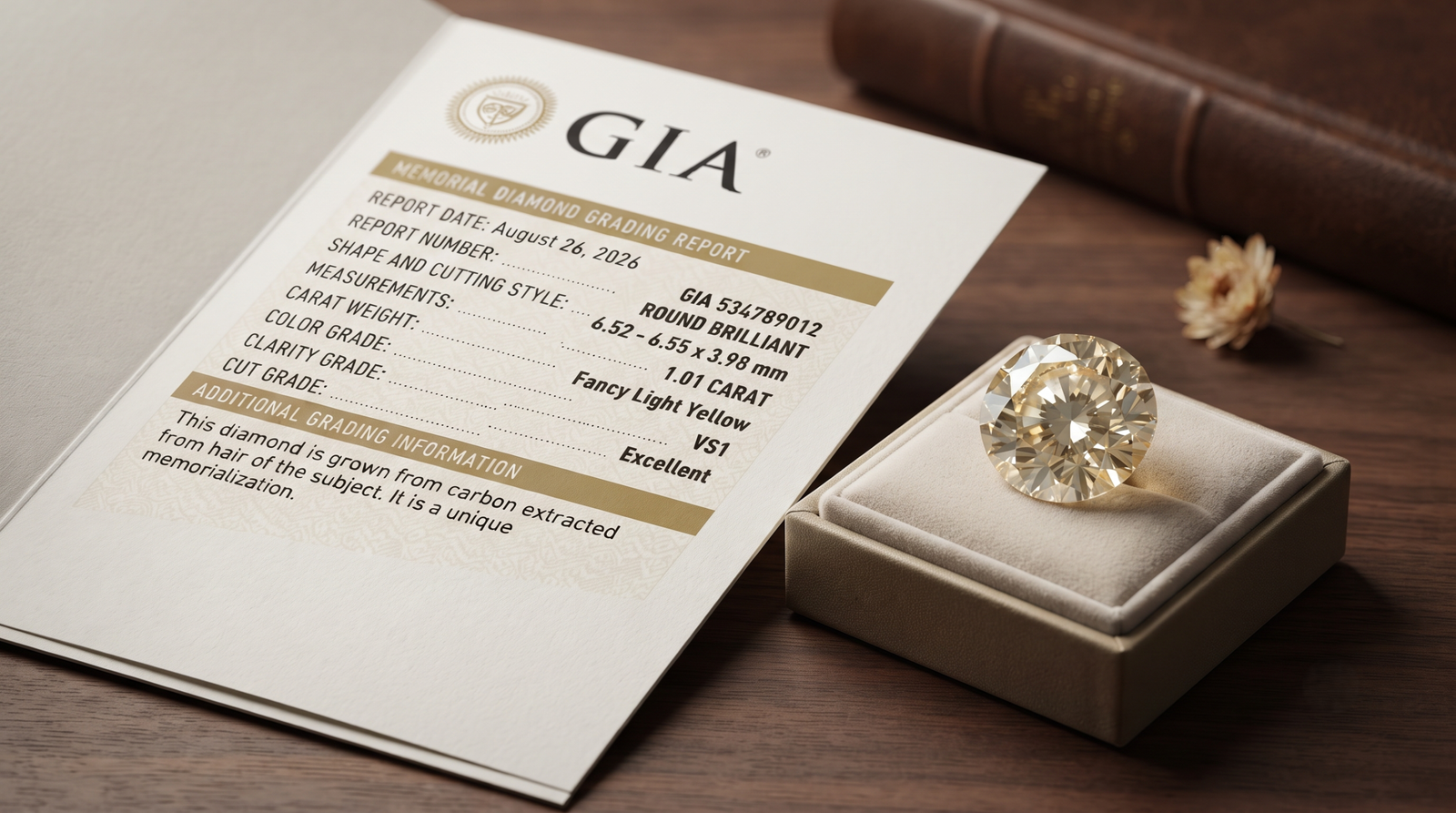
  • What does the grading report cover? It describes the stone’s own cut, colour, clarity and carat and says nothing about its origin, which is a separate document doing a separate job.

The section on whether a combined stone is really made from both addresses the wider point about what any of this can prove. For this conversation, the question is narrower: what will the paperwork you receive actually say.

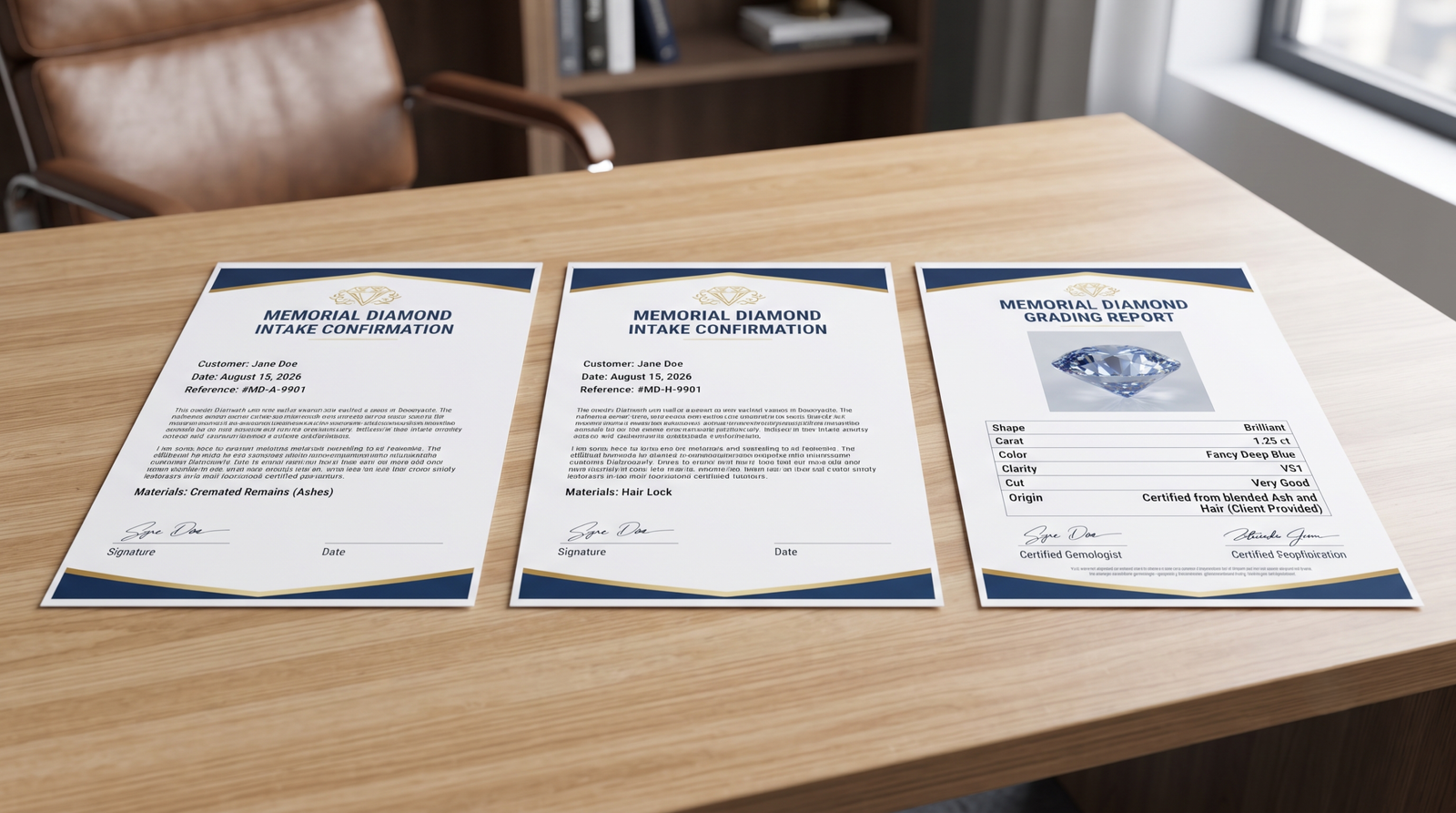
Two intake confirmations beside a single grading report on a desk

Does Sending Both Cost More, or Take Longer?

Ask both, and expect the honest answers to be small.

Memorial diamond costs are driven primarily by growth time and finishing, which remain unchanged. However, a combined order requires two purification runs instead of one, which requires real work.

Timeline: ask whether combining adds time at all, and what changes if the two materials arrive on different days rather than together. Those are two separate answers, and the second one is the one families are rarely given unprompted.

If a Provider Cannot Answer These

An unpublished answer is not a red flag. A provider who says no one has asked us that, let me confirm and come back to you in writing, is behaving correctly.

What matters is what arrives next. A written reply naming stages, two reference numbers, and a stated procedure for a low ash yield is a provider running two lanes. A warm reply that repeats the question in gentler words is a provider who may be running one lane and treating the second material as a courtesy.

Frequently Asked Questions

What is the single most important question on this page?

What happens if the carbon recovered from her ashes is too low to use. Hair is by far the richer carbon source, so a shortfall on the ash side could be covered without anything in the finished stone showing it. Ask whether you would be told, and what your options would be.

Should I ask these questions even if I am only considering sending both?

Yes. The answers determine whether combining is worth doing at all, and they are cheapest to get before any material is measured, cut or posted. Asking costs nothing and closes nothing.

Is there a question I should ask about which material dominates the stone?

You can ask what proportion of the finished stone is personal carbon, typically around 10 to 15 percent of the mass across the industry, blended with supplemental lab carbon. What no provider can give you is the split between her ashes and her hair within that fraction, because the two are indistinguishable after blending.

Do I ask the same questions if I want two separate stones instead of one?

Mostly not. Two stones means two ordinary single material orders running side by side, so the ashes list and the hair list apply as written and the combination questions disappear entirely.

How should I ask about a lock that might turn up later?

Ask whether hair can be added to an ashes order already in progress, and up to which stage. In practice the answer is usually yes until the growth cell is loaded, but the stage matters more than the yes.

What if the two answers I get contradict each other?

Ask for both in one written reply rather than across a call and an email. Contradictions between a salesperson’s answer and a written policy are worth surfacing before you ship, not after.

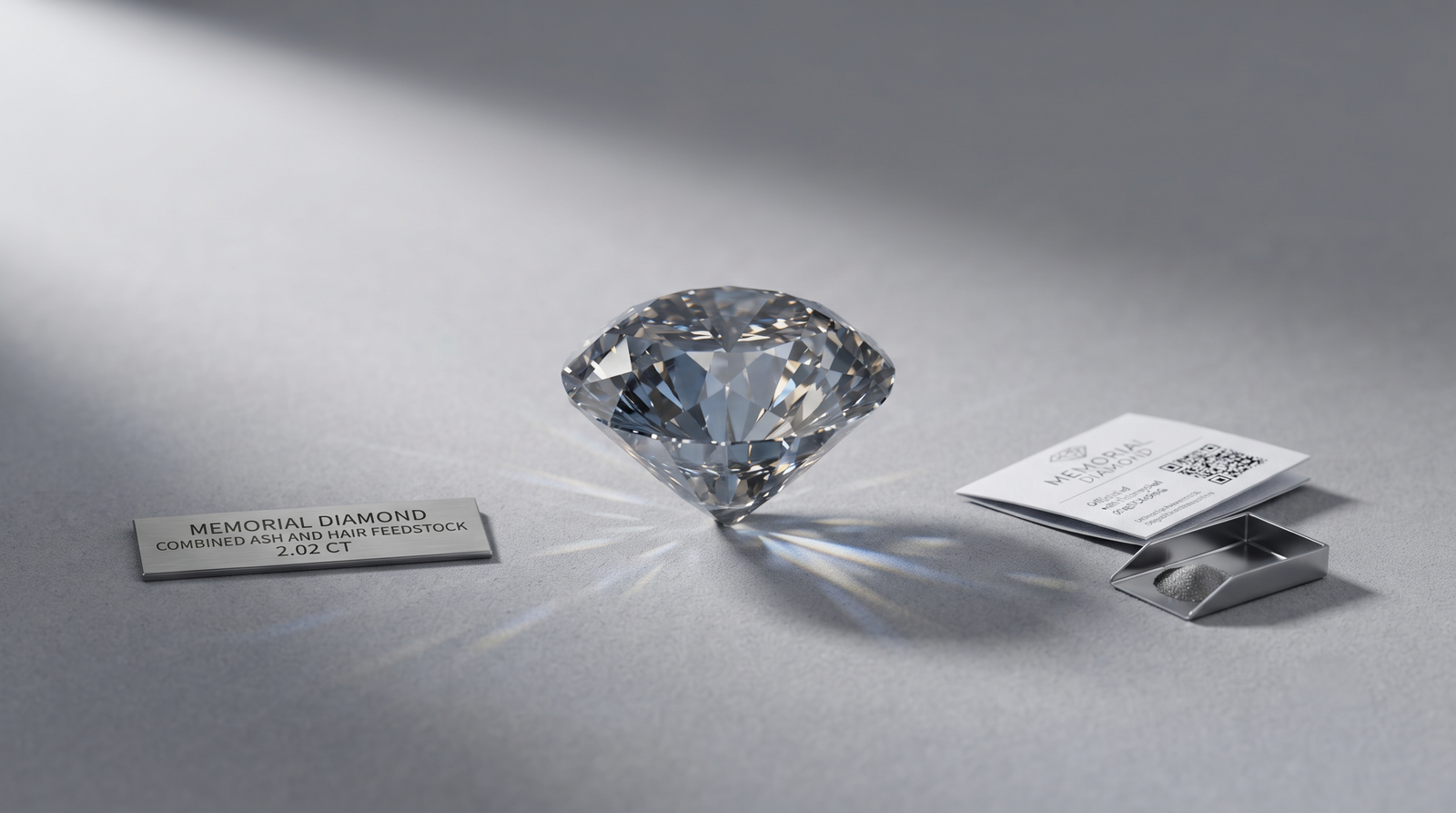
Finished memorial diamond grown from a combined feedstock, on a plain background

Ask for Both Halves in One Reply

The seven questions above fit in a single email, and asking them together makes the contradictions visible. Ask Memorial Diamond at memorialdiamond.us whether a combined submission of your mother’s ashes and hair is accepted, how the two are tracked and purified, and what happens if one of them yields less than expected, and ask for the answer in writing.

Bound lock of grey hair in an open paper envelope beside a written list of questions

Questions to Ask Before Turning Your Mother’s Hair Into a Diamond

A lock of your mother’s hair arrives at a laboratory with nothing behind it. No cremation certificate, no funeral home record, no third party who ever saw it, weighed it or signed for it. That single structural fact reshapes the question list: alongside the ordinary ones about carat and cost sit four questions that only exist because a lock is finite and undocumented: will you weigh it and confirm that in writing, what is your position on chemically treated hair, what are my options if it falls short of your minimum, and what happens to whatever you do not use.

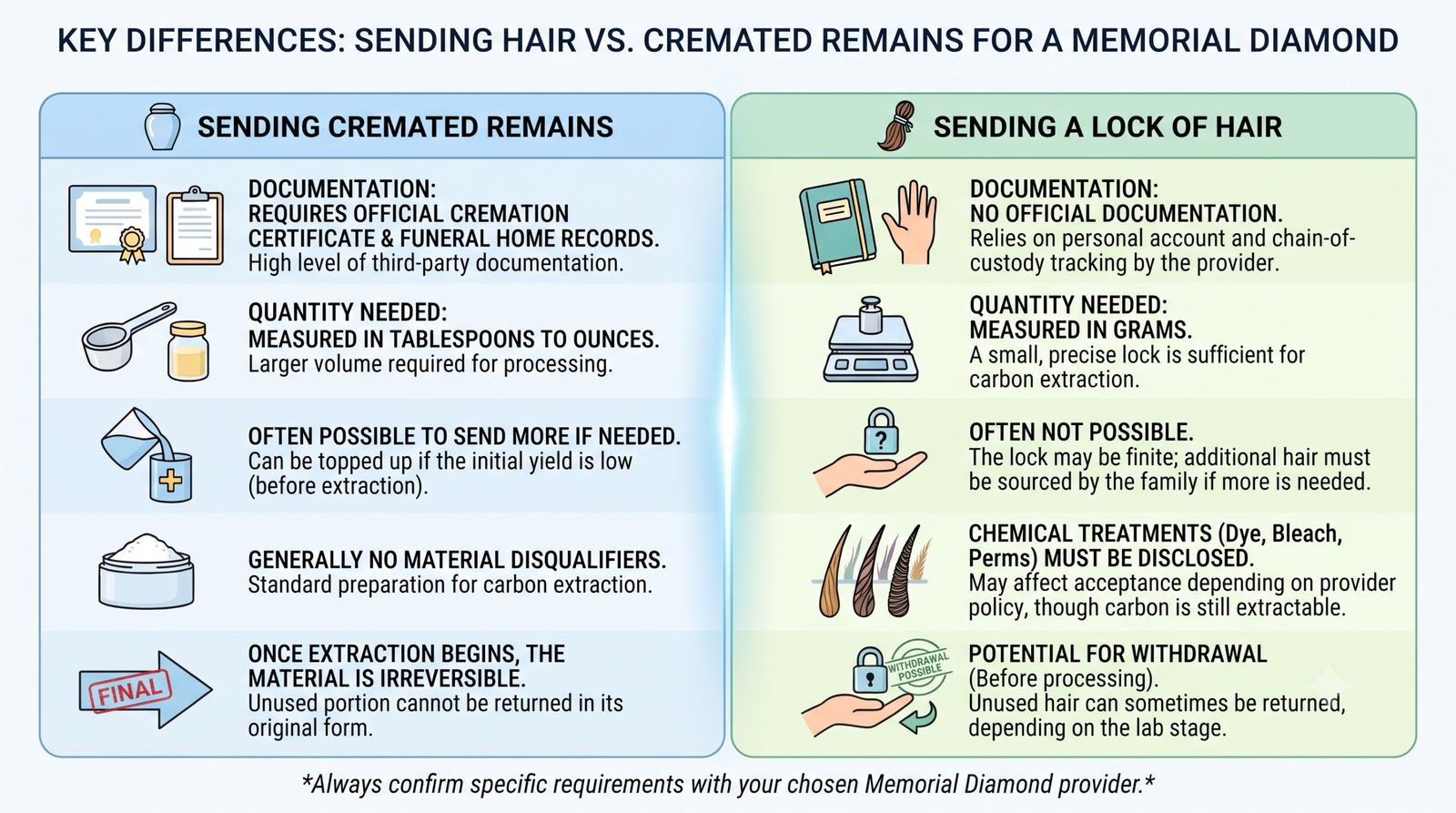
Why the Hair Questions Different From the Ashes Questions?

Both materials work. They fail differently, and the questions follow the failure modes.

ConcernWith cremated remainsWith a lock of hair
Can I send more later?Usually, until extraction beginsOften not: the lock may be all that exists
What documents the material?A cremation certificate and a funeral home recordNothing but your own account
How much is needed?Measured in tablespoons to ouncesA few grams, judged by weight rather than length
What can disqualify it?Rarely anythingChemical treatment, depending on provider policy
Is a top up possible?Yes, as a routine remedyOnly if more hair still exists somewhere

That table is why the ashes question list does not transfer unchanged.

Two-column comparison graphic of what differs between sending hair and sending cremated remains

Is What I Have Enough, and What If It Is Not?

Ask these before scissors, envelopes or payment enter the conversation:

  • What is your minimum, stated as a weight? A few grams is the industry typical answer, and weight is what matters because a short dense lock can outweigh a long fine one, as outlined under how much hair you need.
  • If I send you a photograph and a weight, will you tell me in advance whether it is sufficient? This is the single most useful question on the page, because it costs nothing and can be answered before anything is cut or posted.
  • If the lock turns out to be below your minimum after it arrives, what are my options? The answer families need is whether the order pauses, whether a smaller carat becomes possible, or whether the hair comes back.
  • Is hairbrush hair usable, and how do you treat it? Strands from a shared brush raise a provenance question a lab cannot resolve for you.
  • Can one lock be divided into two stones for two of us? This relates directly to options for more than one family member from the same material.

What Should You Ask About Dyed, Permed or Fragile Hair?

Ask this as two questions, because it has two answers.

The chemistry question: dye and bleach act on the hair shaft, and the carbon in keratin survives them. Nothing in the physics of purification is defeated by hair having been coloured.

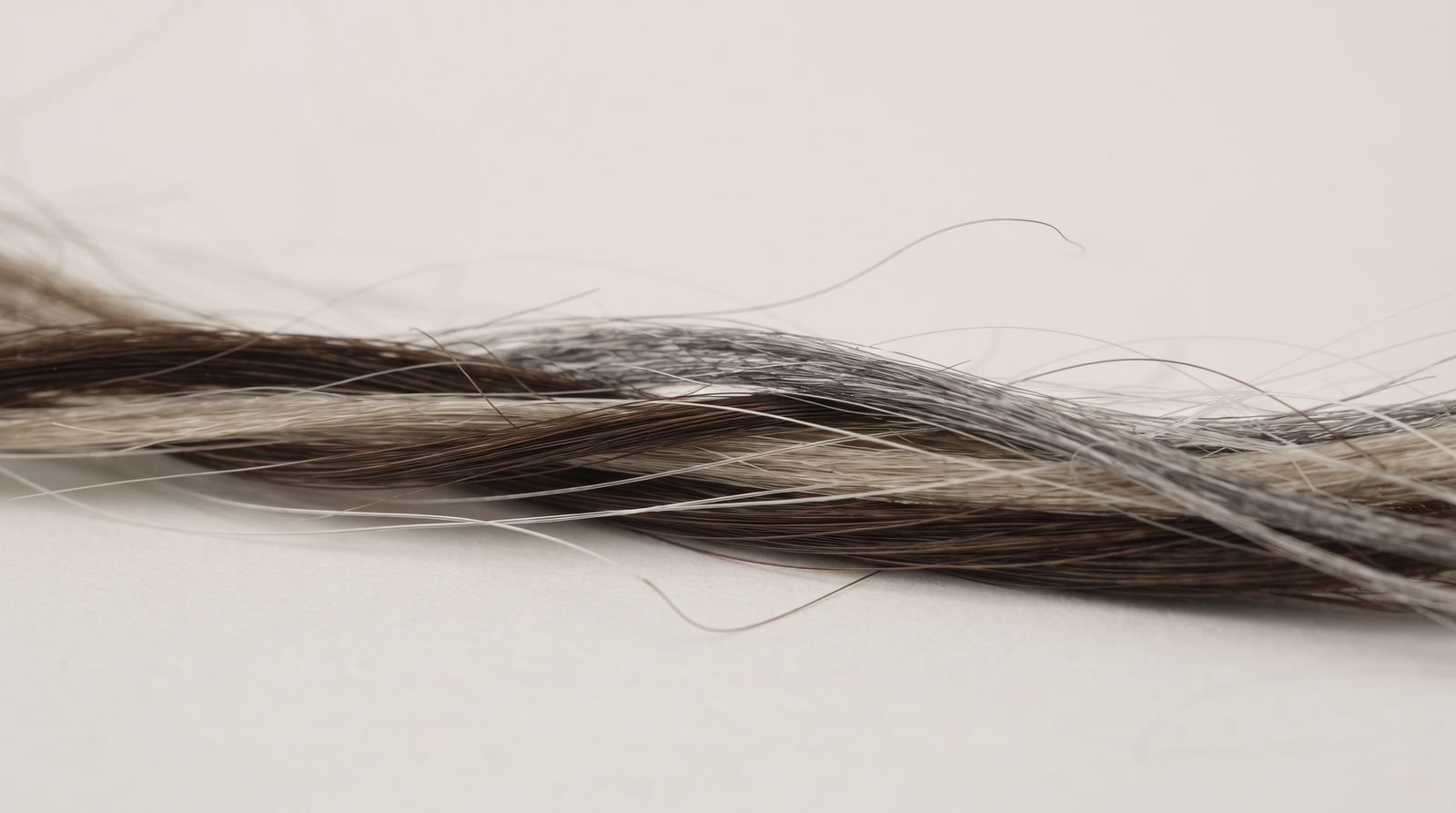
Close-up of coloured and grey strands on a plain surface

The policy question: whether a given provider accepts treated hair is a commercial and procedural decision, not a chemical one, and providers differ. Ask specifically about permanent colour, bleach, perms and chemically straightened hair, and ask whether it changes anything about the process or the price.

Related conditions worth naming directly rather than hoping they are covered: hair that regrew during or after chemotherapy, very fine or sparse hair, grey hair, and a lock that has been stored taped into a book or sealed in plastic for years and may be brittle.

Who Creates the Record, When Nothing Else Documents It?

With no paperwork behind a lock, the record has to be created, partly by you, partly by them.

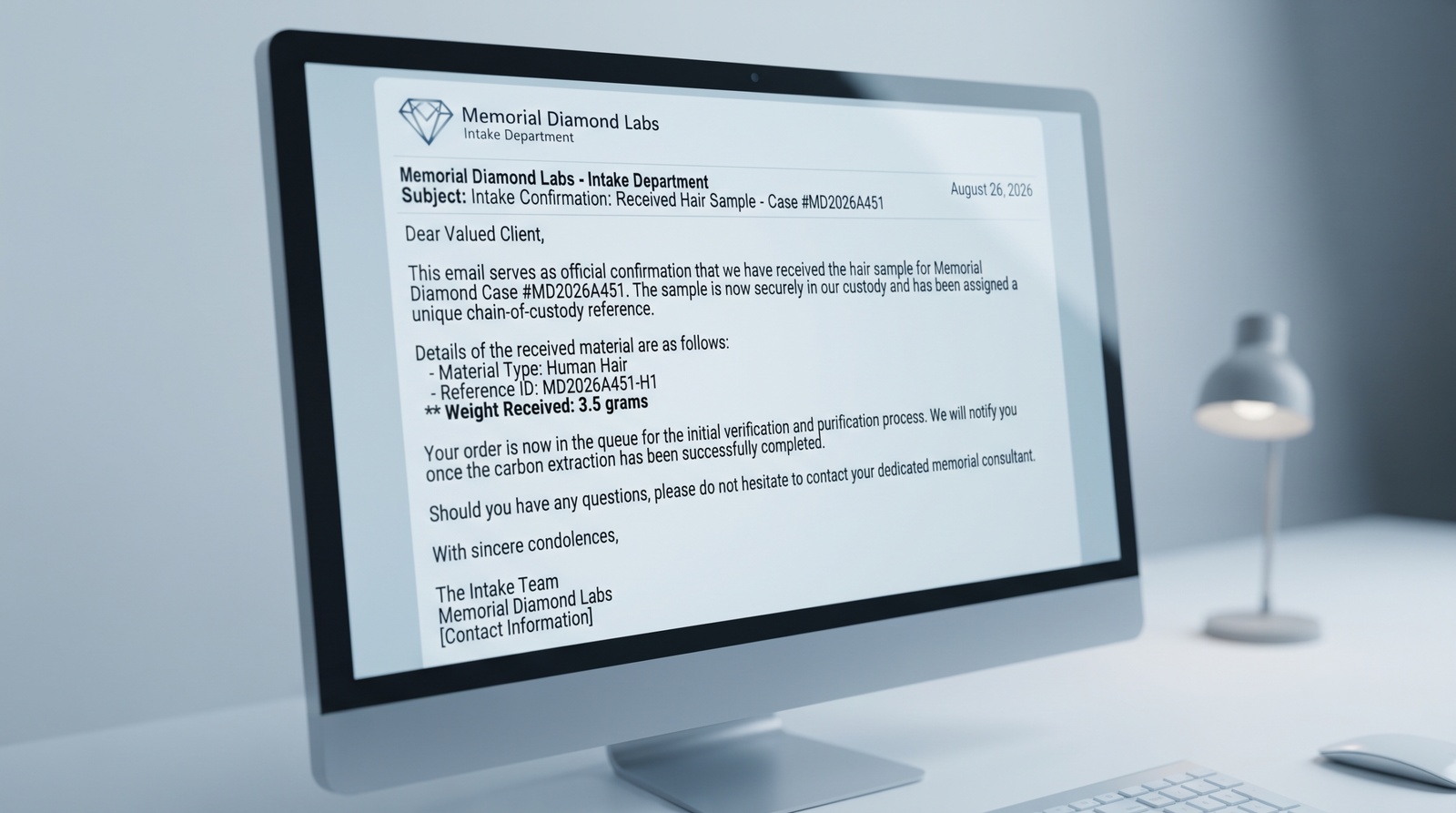
  • Will you weigh the hair on arrival and state the weight received in your confirmation? A confirmation that names a quantity is the only external record that will ever exist of what you sent.
  • What reference number is assigned, and can I quote it to ask where the order stands?
  • Is her hair kept physically separate from other clients’ material through purification, or batched?
  • What does your origin certificate actually state? Does it state that a stone was grown from material you supplied, or something stronger it cannot support? No consumer accessible test traces a finished diamond to a named person, which is why the honest answer to whether it is really her hair starts with your own records rather than theirs, explored further via the honest answer to is it really her hair.
Intake confirmation email stating the weight of hair received, on a screen

What Will the Stone Be Like, and What Comes Back?

  • What colour range is realistic? Her hair colour does not carry through. Pigment is a molecule, and no molecular structure survives graphitization at roughly 2500 to 2700 degrees Celsius, as detailed in what color will a diamond from her hair be.
  • What carat sizes are available, and what does each do to the timeline? The size of the lock does not affect the size of the stone, so ask what each carat option does to the schedule.
  • What proportion of the finished stone is her carbon? Hair is roughly half carbon by weight, far richer than cremated remains, but a growth cell still requires supplemental lab carbon. Nobody can honestly say 100 percent.
  • Is unused hair returned, and in what form? Ask whether it comes back identifiably or not at all.
  • What is included in the price? Loose stone, grading report, setting, and return shipping, which you can review under what a mother memorial diamond costs.

Which Answers Have to Arrive Before You Cut Anything?

Of everything above, three have to arrive before the scissors do:

  • The minimum weight, because it decides whether what you have is enough.
  • The treated hair policy, if her hair was coloured, because an acceptance rule you learn afterwards is an expensive one.
  • Whether a photograph and a weight can be assessed first, which is not one of the four questions above, because it costs nothing and commits nothing.

Everything else can be settled while the lock stays exactly where it is. Hair does not degrade on a useful timescale. Victorian mourning jewellery survives with the hair intact, which is a longer wait than any decision here requires.

Frequently Asked Questions

Can I ask a provider to assess the lock before I commit to anything?

Yes, and it is the most useful thing you can ask. A photograph beside a coin or ruler and a weight from a kitchen scale is usually enough for a provider to say whether the quantity works, before anything is cut, posted or paid for.

Should I ask whether her hair will be tested to confirm it is human hair?

It is worth asking what verification happens on intake, but expect a modest answer. Providers confirm material type and quantity. Nothing available to a consumer links a strand to a named individual, and a provider claiming otherwise is overstating.

What should I ask if the only hair I have came from her hairbrush?

Ask two things: whether brush hair meets their minimum by weight, and whether they have any requirement that hair be cut rather than shed. The provenance question, whether every strand is hers, is one only your household can answer.

Is it worth asking about insurance while the hair is in transit?

Yes. A lock is irreplaceable in a way ashes usually are not, so ask who bears the loss if a package goes missing, and whether they offer or require a tracked service.

What should I ask about withdrawing after I have sent it?

Ask what happens to the hair if you change your mind before work begins, and at which stage withdrawal stops being possible. With a finite lock this matters more than it does with ashes, because there is no second lock to fall back on.

Should I ask the same questions if I am sending ashes as well as hair?

Ask both sets, plus the ones specific to a combined order, chiefly what happens if one material yields less carbon than expected, and whether the two are purified separately, as outlined in questions to ask before turning your mother’s ashes and hair into a diamond.

Finished yellow-toned memorial diamond grown from hair, beside its grading report

The Lock Can Wait for the Answers

Nothing on this page requires you to open the envelope. Send the three blocking questions: the minimum weight, the position on treated hair, and whether a photograph and a weight can be assessed before anything is cut, and wait for the reply before the scissors come out. Memorial Diamond answers them at memorialdiamond.us.

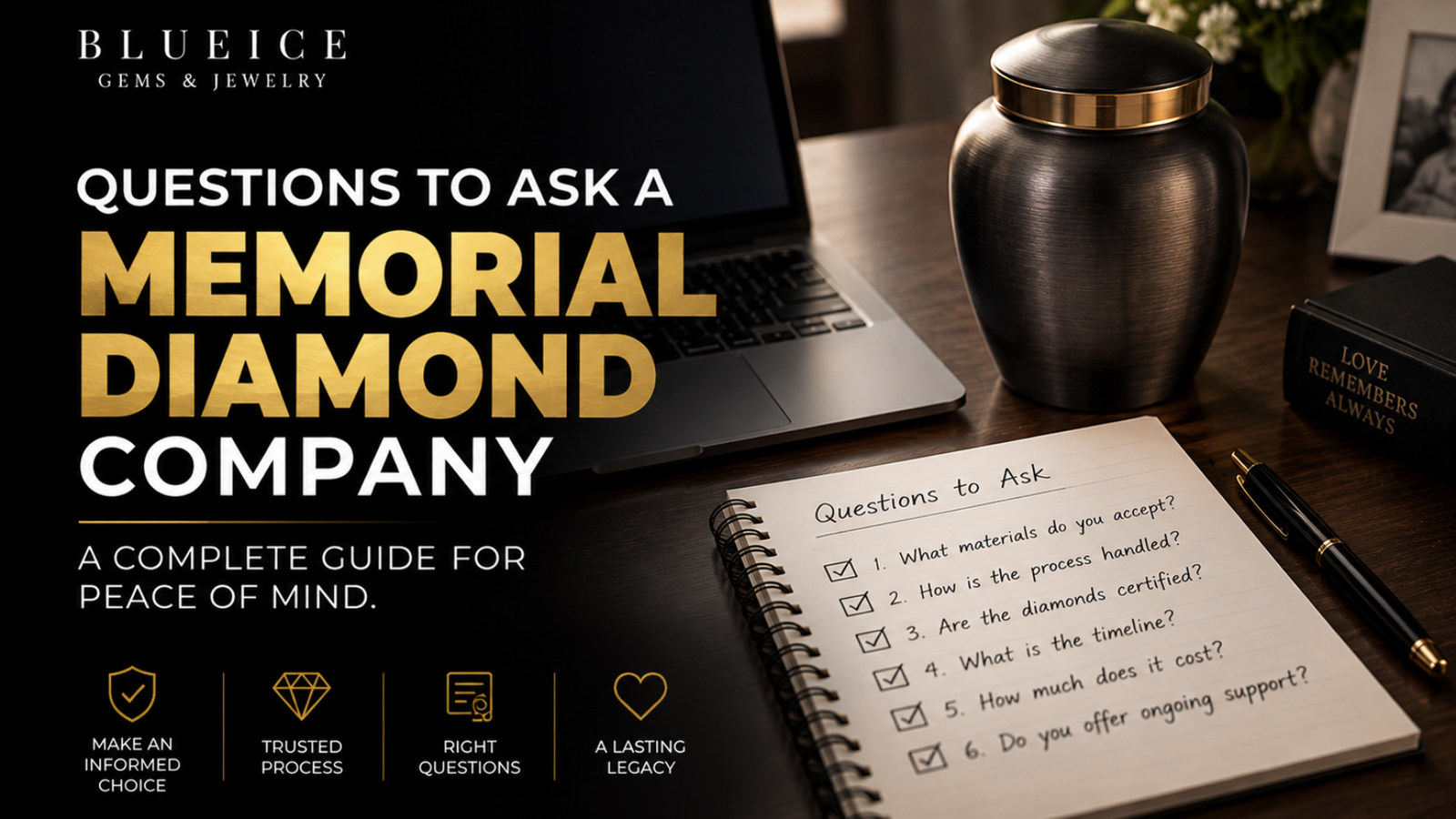
Handwritten list of questions on a notepad beside a laptop and a closed urn on a table

Questions to Ask Before Turning Your Mother’s Ashes Into a Diamond

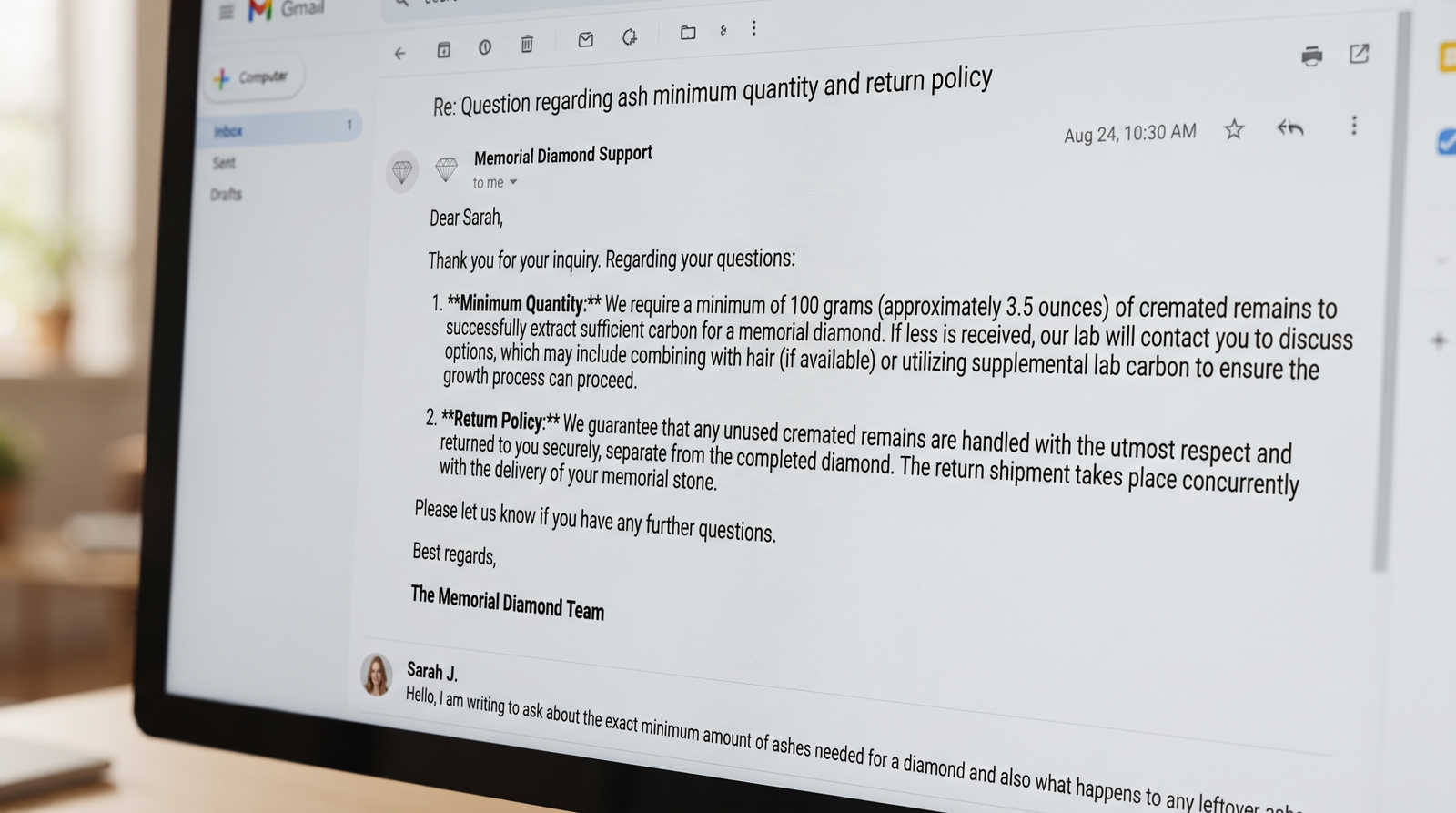
“Of course we return whatever we don’t use.”

That is a sentence, not a policy. It does not say how much, in what, when, or whether it comes back as ash. Before your mother’s ashes leave your house there are roughly a dozen questions worth asking, and four of them belong in writing: the minimum quantity, what is returned and when, what happens if the recovered carbon comes back low, and the point at which a specification can no longer be changed. The rest can be answered on a phone call.

Which Four Questions Belong in Writing?

An email reply is a record. A phone call is a memory of a record. These four are the ones where the difference will matter later.

Ask thisWhat a real answer containsWhat a non-answer sounds like
What is your minimum quantity of cremated remains, and what happens if I send less?A specific figure with a unit, plus the remedy, usually a second shipment“Just send what you’re comfortable with”
What comes back to me, in what form, and at what point?Unused ash named separately from the stone and the paperwork, with a stage attached“Everything is returned at the end”
What happens if the carbon recovered from her ashes is lower than expected?A named stage where it is discovered, and whether you are consulted before work continues“That very rarely happens”
Until what stage can I change carat, colour or cut?Three different stages, because the three close at different times“We’re flexible”

The first answer is a number, the second is a list, the third is a decision procedure, and the fourth is a set of deadlines. If any of the four comes back as a feeling, ask again.

Email thread on a screen showing a provider's written answer on minimum quantity and returns

What Should You Ask About Her Ashes Themselves?

  • How much do you need, and how should it measured? Industry practice ranges from a few tablespoons to around 4 oz, so the answer differs by provider, as detailed in how much ash you need.
  • Do the ashes need to come from the funeral home, or can I portion them myself?
  • Memorial diamond laboratories process cremated remains individually to guarantee complete physical separation; they never batch remains together.
  • Furthermore, age, damp storage, a previously scattered portion, or an urn that has been opened multiple times do not render ashes unusable, as technicians can refine almost any recovered carbon sample.
  • What identifier travels with them? A chain of custody reference you can quote back is the difference between tracking an order and asking how it is going.

Stone Should Be Like?

  • What carat sizes do you offer, and what does each add to the timeline? Size and schedule are the same question here, so ask for both in one answer.
  • What colour range is realistic from ashes, and is a colourless stone offered at all? Trace elements from an organic source push most memorial stones toward yellow, blue or champagne, explained fully under what color will a diamond from her ashes be.
  • What clarity should I expect? Somewhere in the SI2 to VVS band is typical across the category.
  • Is the growth done in-house or subcontracted, and where?
  • What proportion of the finished stone is her carbon? Any provider claiming 100 percent is claiming something the process cannot do. Supplemental lab carbon is required to fill a growth cell, and her own carbon is typically around 10 to 15 percent of the finished mass.

What Will the Paperwork Actually Prove?

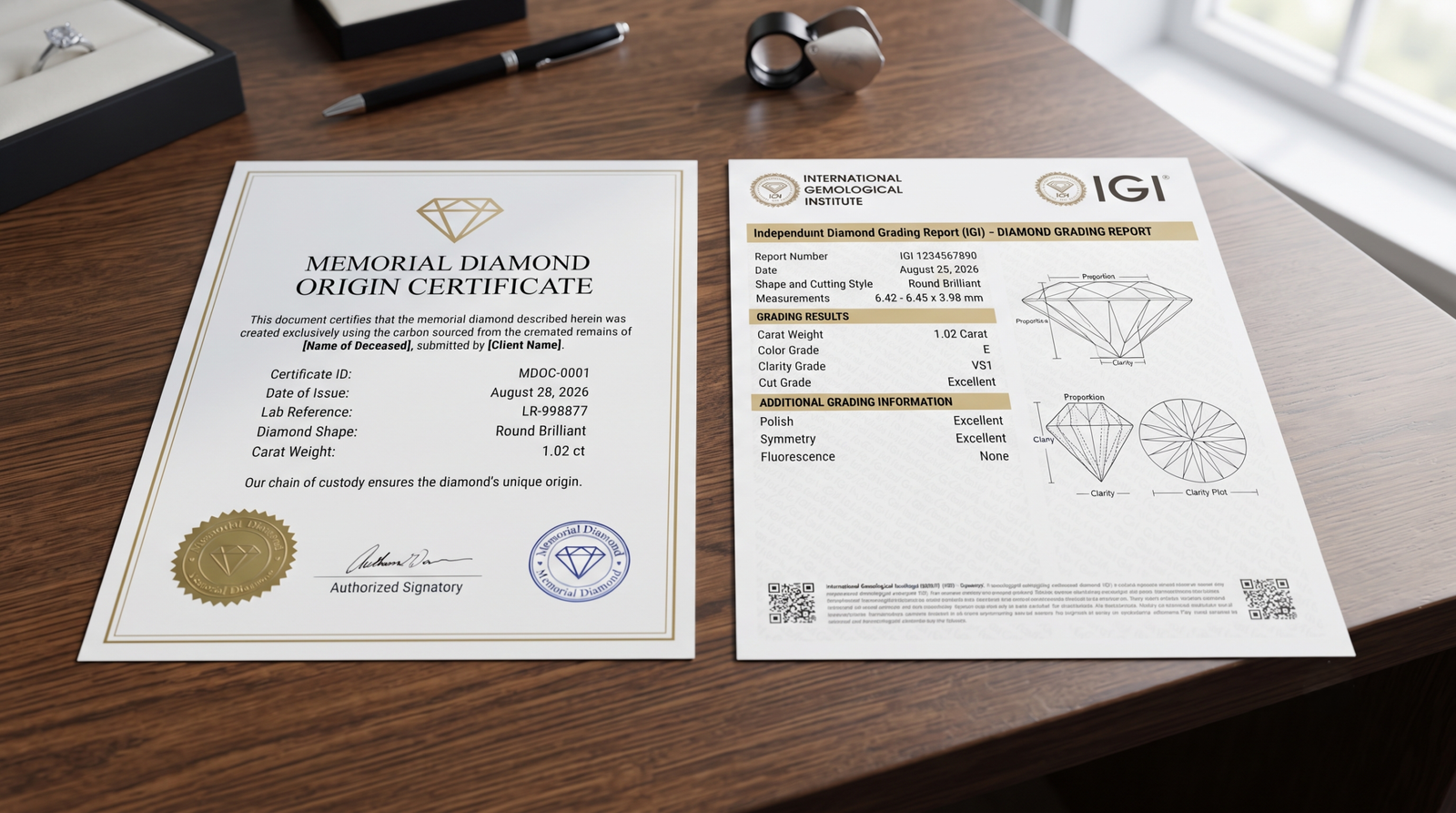
Two documents do two different jobs, and a provider should offer both without being pushed:

  • An origin or authenticity certificate: an in-house record that this stone was grown from your family’s submitted material.
  • A grading report: ideally from an independent third-party lab, describing the stone’s own cut, colour, clarity and carat.

Then ask the harder one: what does the origin certificate actually attest to, and who verified it? The honest answer is that it documents the provider’s own chain of custody, because no consumer accessible test can trace a finished diamond back to a named person, as discussed regarding whether a memorial diamond really made from your mother’s ashes. A provider who says that plainly is more trustworthy than one who implies the certificate proves more than it can.

An in-house origin certificate and an independent grading report side by side on a desk

What Happens If Something Goes Wrong?

  • What is included in the quoted price? Is it the loose stone only, and are the grading report, setting, engraving and return shipping extra, which you can review via what a mother memorial diamond costs?
  • What is the payment schedule, and how much is due before the material is processed?
  • What happens if the growth run fails? Presses do occasionally produce unusable rough. Ask whether a second run uses remaining material, and at whose cost.
  • What is the refund position at each stage? Before shipping, after intake, after extraction, after growth.
  • Who is liable while her ashes are in transit, and does that change if you use the provider’s own shipping arrangement?

How Do You Tell an Answer From a Reassurance?

Three tests, applied to anything you are told:

  • Does it contain a number or a stage? “Once cutting begins, which is the last stage” is an answer. “Toward the end” is not.
  • Does it survive one follow-up? Ask “and what happens if that doesn’t work?” A real policy has a next line. A reassurance repeats itself in warmer words.
  • Would they put it in an email? Anything a provider will not restate in writing is not yet a commitment, however kindly it was said on the phone.

None of this is about catching anyone out. A careful provider will be pleased to answer precisely. The point is that you only get one chance to ask before the material is irreversible.

Notepad with provider answers annotated beside a phone

What Do You Not Need to Decide Yet?

A short list, because families often stall on the wrong questions:

  • The setting. The stone arrives loose and can be set years later, as seen in memorial diamond settings and jewelry ideas.
  • Whether siblings each want one. That can be resolved after you know what a provider requires for multiple family members from the same ashes.
  • The exact shade. Colour is chosen within a realistic range, not picked from a chart.
  • Timing. Ashes do not deteriorate, and asking questions costs nothing and commits nothing.

Frequently Asked Questions

How many providers should I ask before choosing one?

Two or three is enough to see whether the answers agree. Where they differ sharply on minimum quantity, on what is returned, or on the proportion of personal carbon in the stone, the differences themselves are informative.

Is it rude to ask a provider what proportion of the stone is really my mother?

No, and a good provider expects it. The honest answer across the industry is that recovered personal carbon is typically around 10 to 15 percent of the finished stone’s mass, blended with supplemental lab carbon. A provider offended by the question is the wrong provider.

Should I ask these questions before or after I decide on a carat size?

Before. Carat drives the timeline and much of the price, so a provider’s answers on growth time and cost are more useful when you have not yet committed to a number you would then feel obliged to defend.

What if the provider will not put an answer in writing?

Treat it as the answer. There is no confidentiality reason a company cannot state its own minimum quantity or return policy in an email, and a refusal on those four points is a meaningful data point about how the rest will go.

Can I ask to visit or see the lab?

You can ask. Some providers in this category offer facility visits and some grow stones through partner facilities in other countries. Either can be legitimate; what matters is that the answer is straightforward rather than evasive.

Do I need to ask any of this if I am sending hair instead of ashes?

Some of it changes. A lock carries no cremation paperwork behind it and usually cannot be topped up, so the question set shifts toward provenance and handling rather than quantity and returns, covered under questions to ask before turning your mother’s hair into a diamond.

Send the List, Not the Ashes

The whole list above fits in one email, and sending it costs you nothing but the time to write it. Ask Memorial Diamond at memorialdiamond.us the four written questions first, minimum quantity, what returns and what happens on a low carbon yield and when each specification closes, and judge the reply by whether it contains numbers and stages.

Sealed container of cremated remains and a bound lock of hair side by side beside a finished memorial diamond

Step-by-Step: Turning Your Mother’s Ashes and Hair Into a Diamond

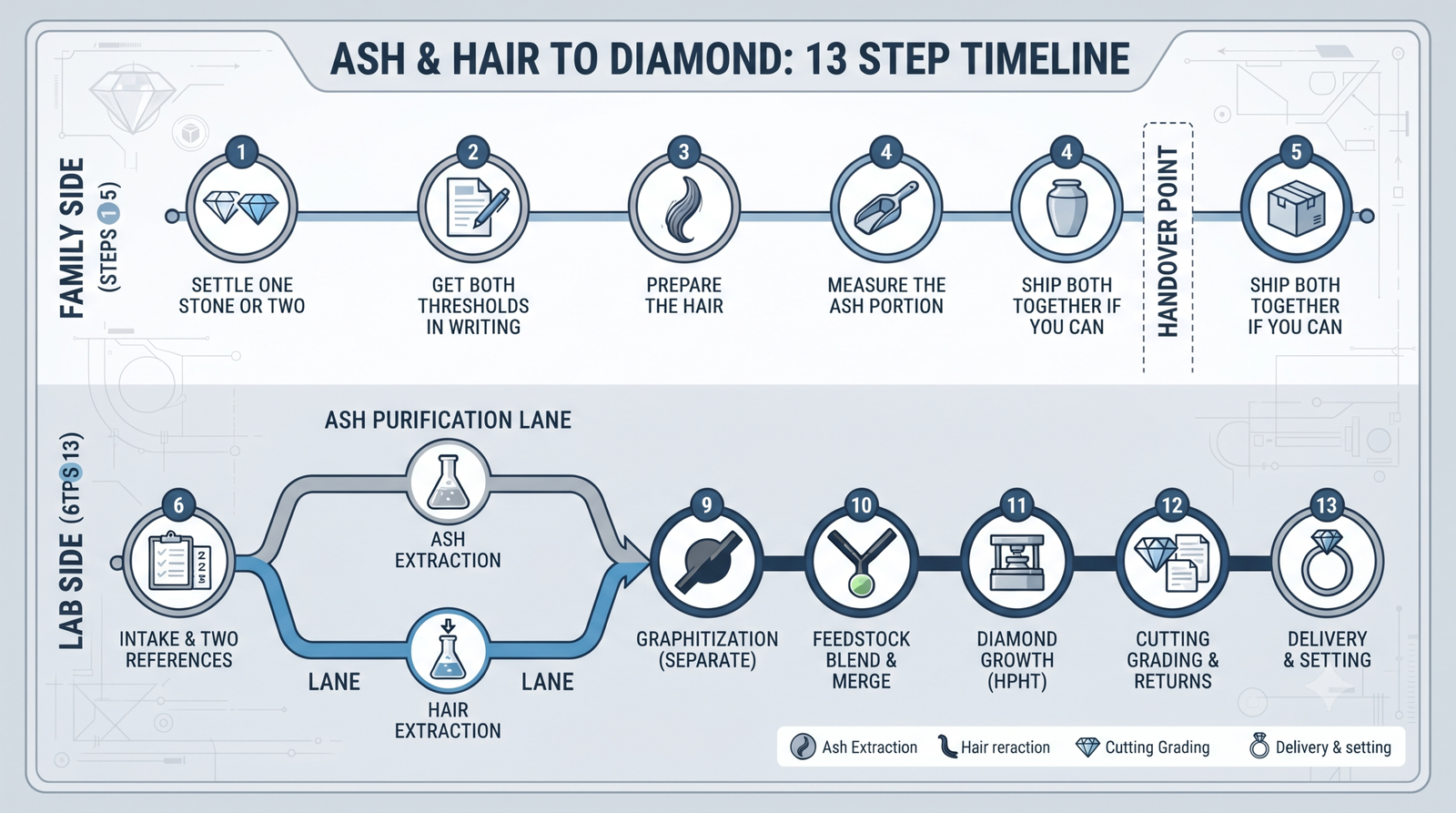
There is exactly one step in this whole sequence where your mother’s ashes and your mother’s hair are in the same place at the same time. Everything before it is two lanes running side by side; everything after it is one stone. The sequence runs to thirteen steps: five yours, eight the lab’s, handover at step five, and the two materials do not meet until step ten.

One correction worth having early: the six to ten month production window starts at intake, and if the two materials arrive on different days, it starts at the later one.

Where Do the Two Lanes Split, and Where Do They Merge?

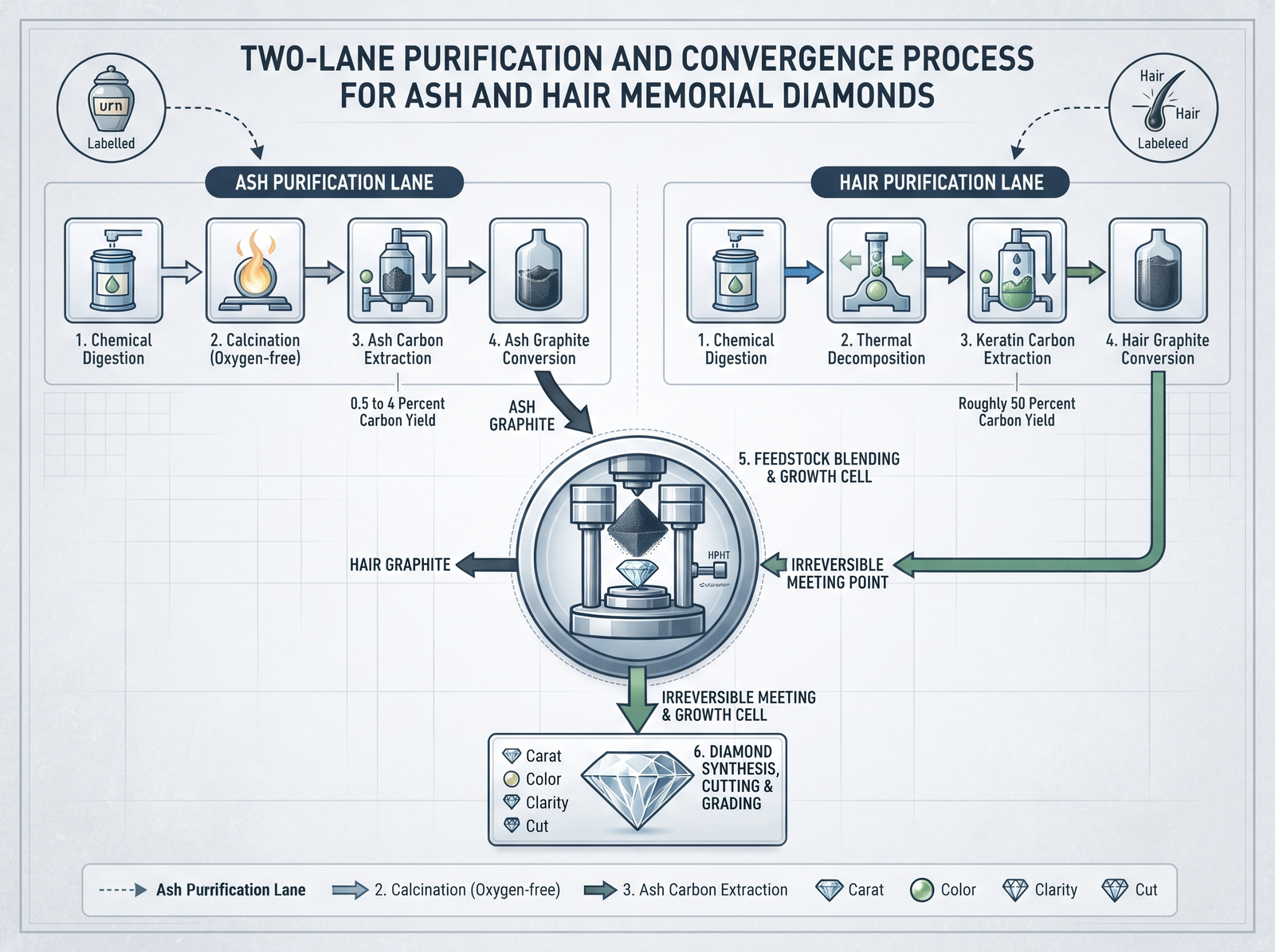
A combined order is not one process with an extra ingredient. It is two intake streams, two purification requirements and two sets of records that converge once, late, into a single growth cell.

StageAsh laneHair laneShared?
CollectionPortion measured from the urnLock cut or retrievedNo: separate containers
ShippingPostal rules for cremated remains govern the boxWould ship in an envelope on its ownOne box, strictest rule
IntakeWeighed, logged, own referenceWeighed, logged, own referenceNo: two references
ExtractionMinerals stripped from roughly 0.5 to 4 percent carbon by weightKeratin reduced from roughly 50 percent carbonNo: different tracks
GraphitizationTo graphiteTo graphiteNo: still separate
Feedstock blendingBoth, plus supplemental lab carbonBoth, plus supplemental lab carbonYes: step 10
Growth, cutting, gradingOne crystalOne crystalYes
Diagram of two parallel purification lanes for ashes and hair converging into a single diamond growth cell

Lab technicians extract carbon from the ashes and hair, purify it into graphite, and place it inside a high-pressure, high-temperature press to replicate natural diamond growth.

What Do You Need Ready Before Step One?

Two of these take days to arrive, so gather them first:

  • The ash portion and the lock, each with its own sealed, labelled inner container, never combined at home.
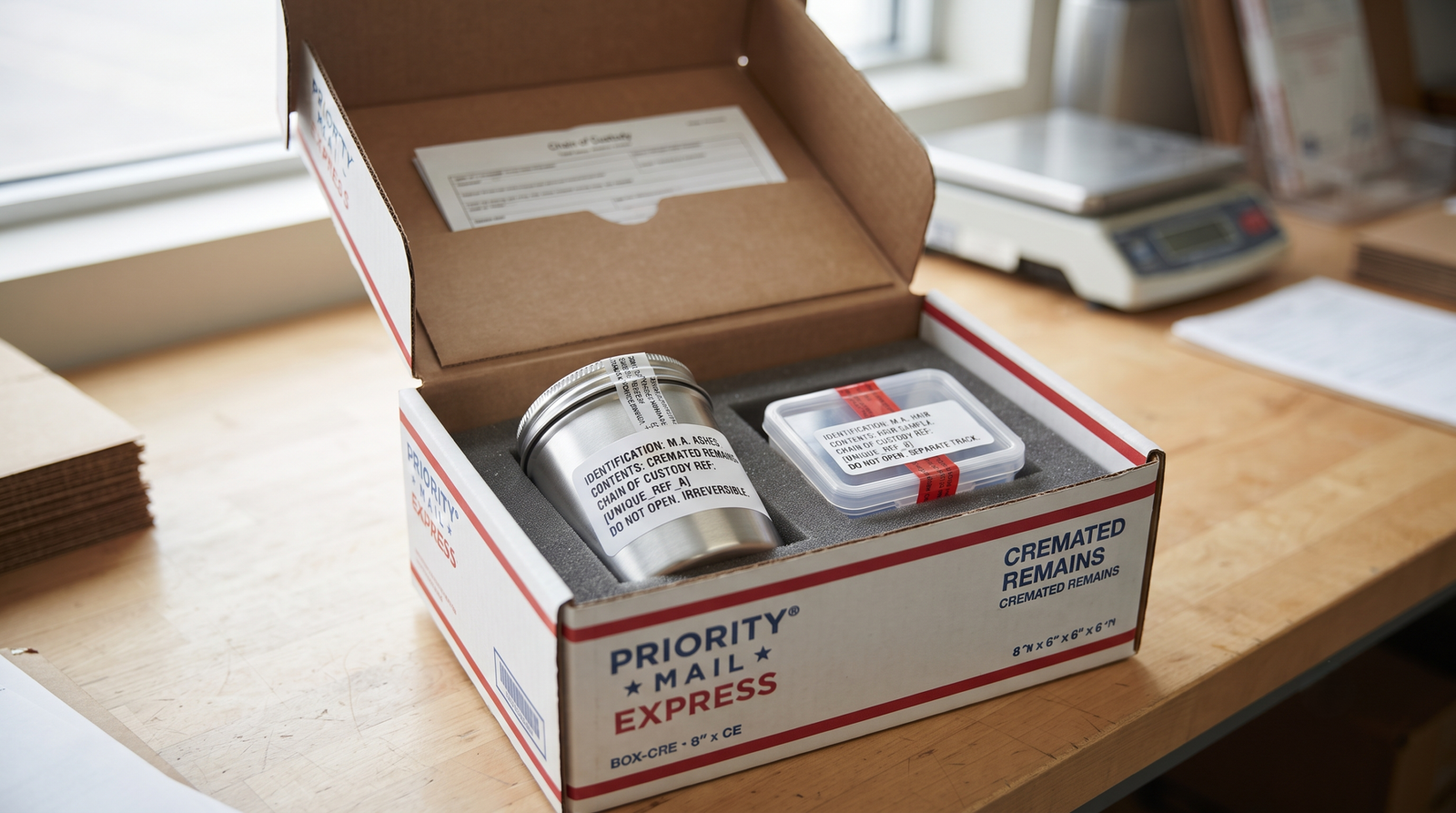
  • The official USPS Priority Mail Express Cremated Remains box, orderable only from the Postal Store online.
  • Written confirmation of both minimums: the ash figure and the hair figure, separately.
  • A written answer on combined orders specifically: are the two purified on separate tracks, what happens if one yields too little, and what comes back.
  • Somewhere to record two reference numbers, not one.

You place the remains inside one secure inner box, label two separate packages with strict compliance protocols, and follow exact shipping rules.

Steps 1 to 5: What Does Your Family Do?

Step 1: Settle one stone or two

Combining is a choice, not a requirement: the same two materials can grow one stone or two separate ones. That decision belongs at the front because it changes every step after it, and the reasoning behind it lives in the complete guide to a mother ashes and hair diamond.

Step 2: Get both thresholds in writing

Ask for the ash minimum and the hair minimum as two separate figures. Combining does not let either fall below its own threshold, how much ash and hair you need, assuming otherwise is what leads to a second shipment weeks later.

Step 3: Prepare the hair

Cut or retrieve the lock, bind it at one end, and store it in paper. Because the lock is all there is, you cannot top up hair later so place it first in the sequence, not last..

Step 4: Measure the ash portion and seal it

A clean dry spoon, a rigid sift proof inner container, a label. The portion is settled at the seal, not at the counter.

Step 5: Ship both together if you can

One box, two sealed containers, one tracking number, and a message telling the provider both are inside. Sending them together is the single easiest way to keep one clock instead of two.

Two labelled sealed inner containers packed in the official USPS Cremated Remains box

Step 5 Is the Handover, and Two Clocks Start, Not One

This is where both materials leave your hands at once. If they travel together, intake logs them on the same day and the production window runs from that date.

If they travel separately whether someone finds a lock three weeks after you post the ashes, or a provider asks for hair after knowing the ash yield the growth cell still waits. You cannot load the growth cell until you purify both lanes, which means the later arrival determines the finishing date, not the earlier one.Count from the second package, how long a mother memorial diamond takes.

Steps 6 to 13: What Does the Lab Do?

Step 6: Intake, and two reference numbers

Weigh and log each material under its own chain-of-custody reference, and ask for both. If you track a combined order under a single reference, you cannot independently account for its two halves.

Step 7: Ash extraction and purification

Oxygen free heating strips out the calcium phosphate that makes up most of cremated remains, leaving carbon at roughly 99.9 percent purity. Past this point, ash cannot come back as ash.

Step 8: Hair extraction and purification

The same objective, a shorter route: hair arrives roughly half carbon by weight, so there is far less to strip away. This lane typically clears first and then waits.

Step 9: Graphitization, still separately

Each purified carbon stream is heated to roughly 2500 to 2700 degrees Celsius and converted to graphite. Two batches, still identifiable as two.

Step 10: The merge

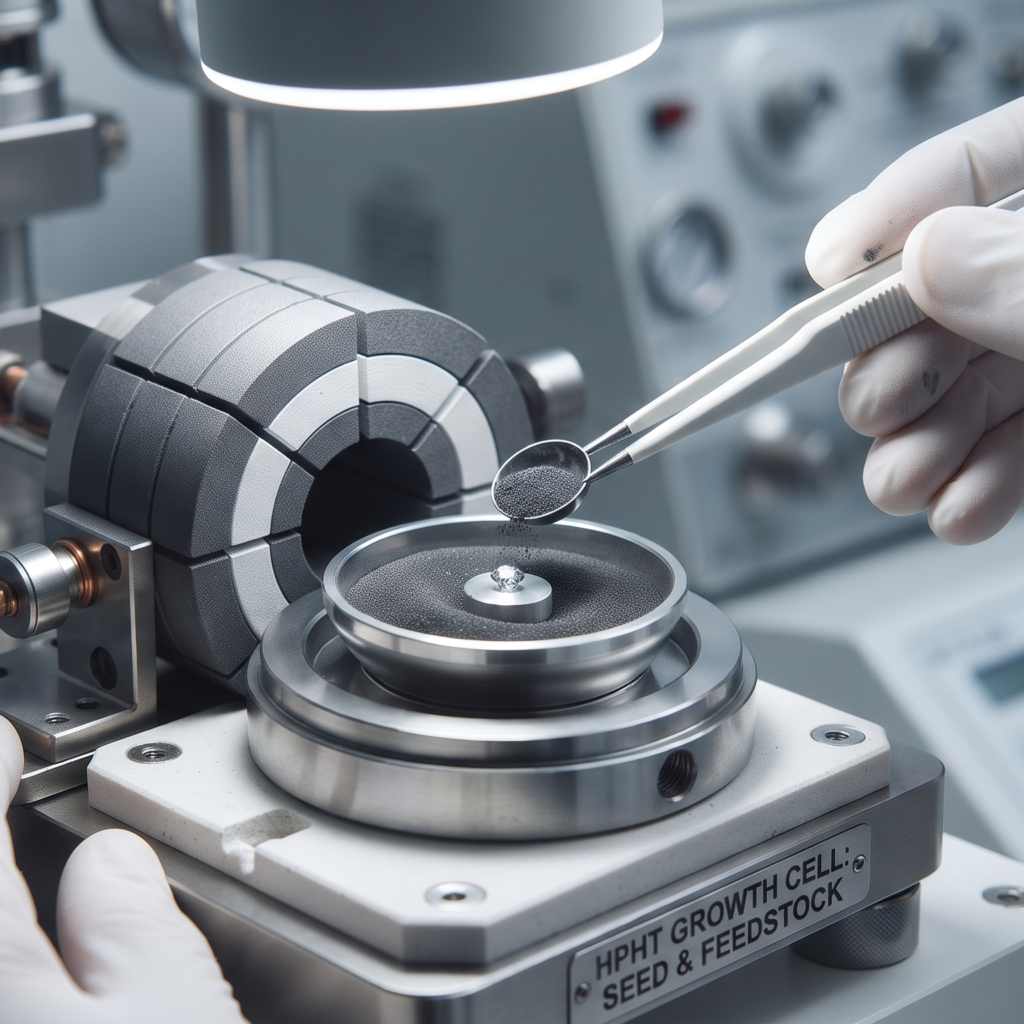
Both graphite batches, plus supplemental lab carbon, are combined into one growth cell. This is the irreversible meeting. After it, no analysis can separate her ashes from her hair, and no test can say which atom came from where. Her own carbon is typically around 10 to 15 percent of the finished stone’s mass across the industry, a real, physical fraction, and not the whole of it.

Graphite feedstock being loaded into an HPHT growth cell with a diamond seed

Step 11: Growth

Weeks to months in an HPHT press at roughly 6 to 8 GPa. Carat is a function of time in the press, so the size chosen at step 1 sets how long this stage runs.

Step 12: Cutting, grading and returns

The rough is cut and polished, then graded. On a combined order, ask for the return record to show both materials separately, unused ash and unused hair are two different things coming back.

Step 13: Delivery, and the setting

It arrives loose. What it becomes is the one decision with no deadline attached, settings and jewelry ideas.

How Long Does Each Step Take?

Durations below are reasoned estimates of ordinary practice, not published turnaround figures. Only the 6 to 10 month total is an industry wide figure.

StepWhoTypical durationWhat it settles
1. One stone or twoFamilyDaysThe shape of everything after
2. Both thresholds in writingFamilyA few daysNothing closes
3. Prepare the hairFamilyAn hourHair quantity, often permanently
4. Measure and seal the ashFamilyAbout 30 minutesAsh portion
5. Ship and handoverFamily to lab1 to 2 days transitCustody
6. Intake, two referencesLabDaysClock starts at the later arrival
7. Ash extractionLabWeeksAsh irreversible
8. Hair extractionLabDays to weeksHair irreversible
9. Graphitization, both lanesLabDays to weeksLast point both are separable
10. Feedstock mergeLabHoursThe two become one
11. GrowthLabWeeks to monthsCarat and colour
12. Cutting, grading, returnsLabWeeksCut shape
13. Delivery, then settingLab to familyWeeksNothing, the setting stays open
Steps 6 to 13 total6 to 10 monthsUp to 12 for stones over 2 carats
mother-ashes-hair-diamond-timeline-13-steps

What Happens If One Lane Fails?

The realistic failure is the ash lane: cremated remains vary, and a portion can yield less usable carbon than expected. Because that becomes visible at step 7, after the material is irreversible but before the merge at step 10, there is a genuine window in which a family can still be consulted.

Three things can happen in that window, and only one of them is good:

  • You are told, and choose: proceed with the hair carrying more of the load, send more ash, or pause the order.
  • The order proceeds quietly, with the hair covering the shortfall. Nothing in the finished stone would reveal it, since hair is the richer carbon source of the two.
  • The order pauses until you respond, which costs weeks but nothing else.

Ask, in writing and before you ship, which of those three is the provider’s standing policy. It is the most consequential question a combined order raises and the one least likely to be answered on a website, whether a combined stone is really made from both.

Frequently Asked Questions

If I post her ashes now and her hair next month, when does the six to ten months start?

At the later arrival, in practice. The growth cell cannot be loaded until both lanes are purified, so the second package sets the finishing date. Tell the provider a second shipment is coming so the first is held rather than processed alone.

Can hair still be added after the ashes have already been extracted?

Usually yes, up to the merge at step 10. The hair simply runs its own shorter lane and joins at blending. After the cell is loaded, adding anything means a new growth run rather than an addition to the existing one.

Which lane finishes first?

The hair lane, almost always. Roughly half of hair’s weight is carbon against a much smaller fraction of ash, so there is less to strip away. It then waits for the ash lane, which is why a combined order runs to the slower of the two, not the faster.

Is there a step where I could still switch to two separate stones instead of one?

Any point before step 10. Once both graphite batches go into the same cell they are one feedstock. Before that, the two lanes are still physically separate and a provider that offers both formats can usually redirect them.

Do I get one set of paperwork or two?

Ask for two intake records and two return records, and one grading report. The stone is one object, but the materials were two. A single combined record is the gap worth checking for, because it is the one that cannot be corrected after the fact.

Which is the last step where anything at all is reversible?

Step 10 for the materials, step 11 for carat and colour, step 12 for the cut. The setting is never closed, and can be changed decades later.

Ask Which Step the Merge Happens On

A provider who can tell you where step 10 sits in their own flow, and what happens at step 7 if the ash yields less than expected, is telling you they run two lanes rather than one. Put both questions in a single email and see which one comes back with a stage attached. Memorial Diamond will set out how a combined submission of your mother’s ashes and hair is tracked, purified and returned, asking commits you to nothing.