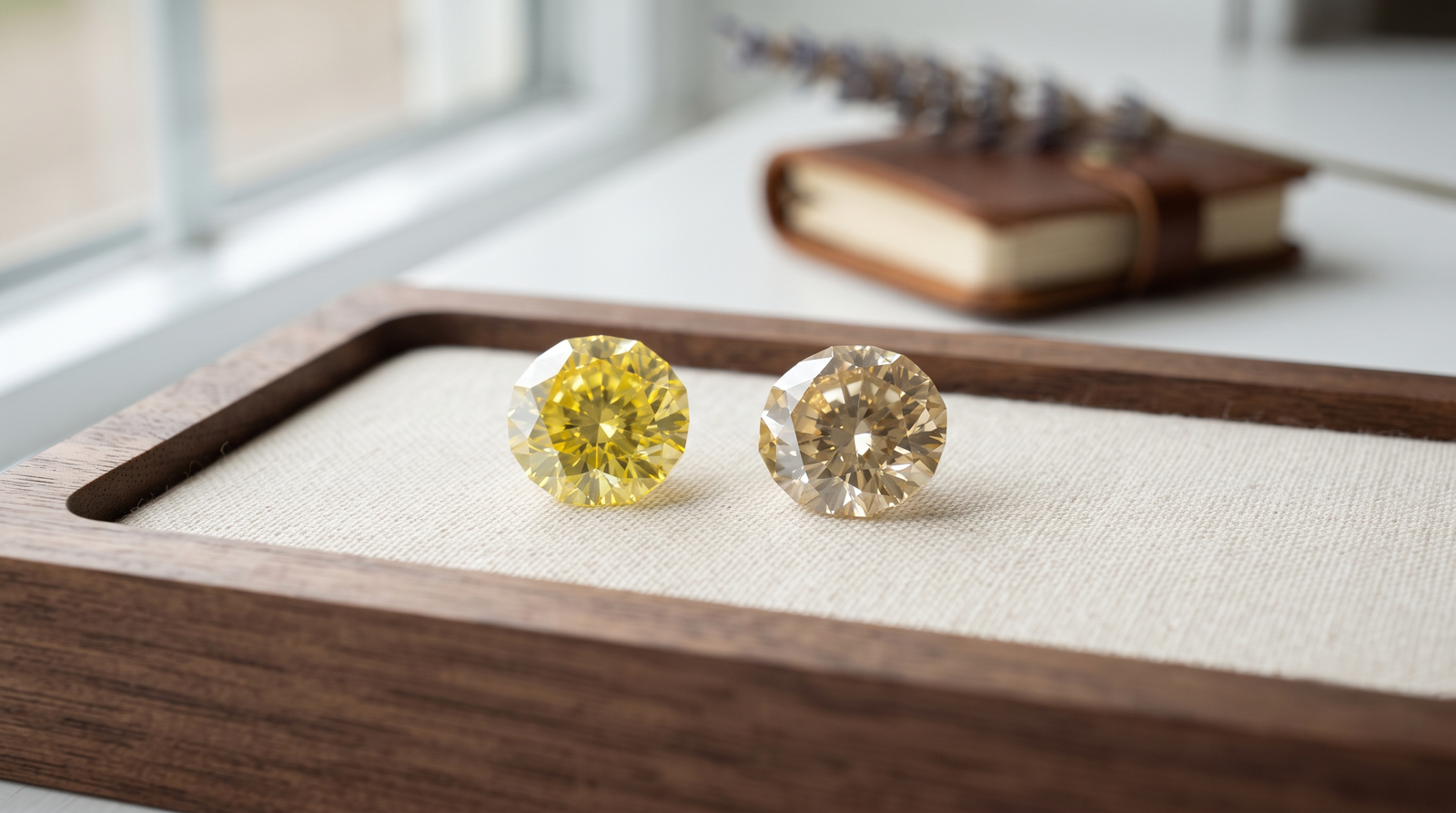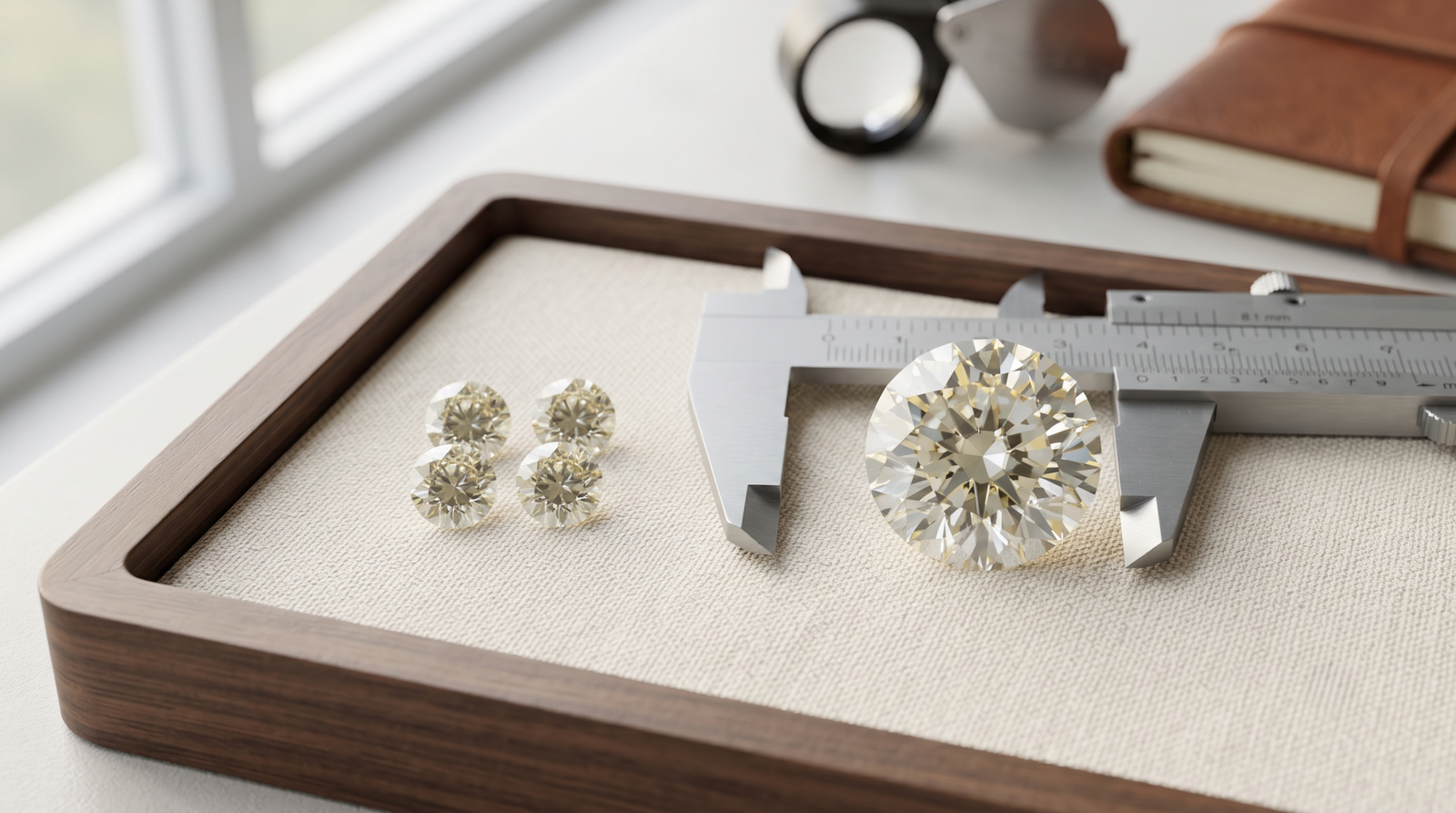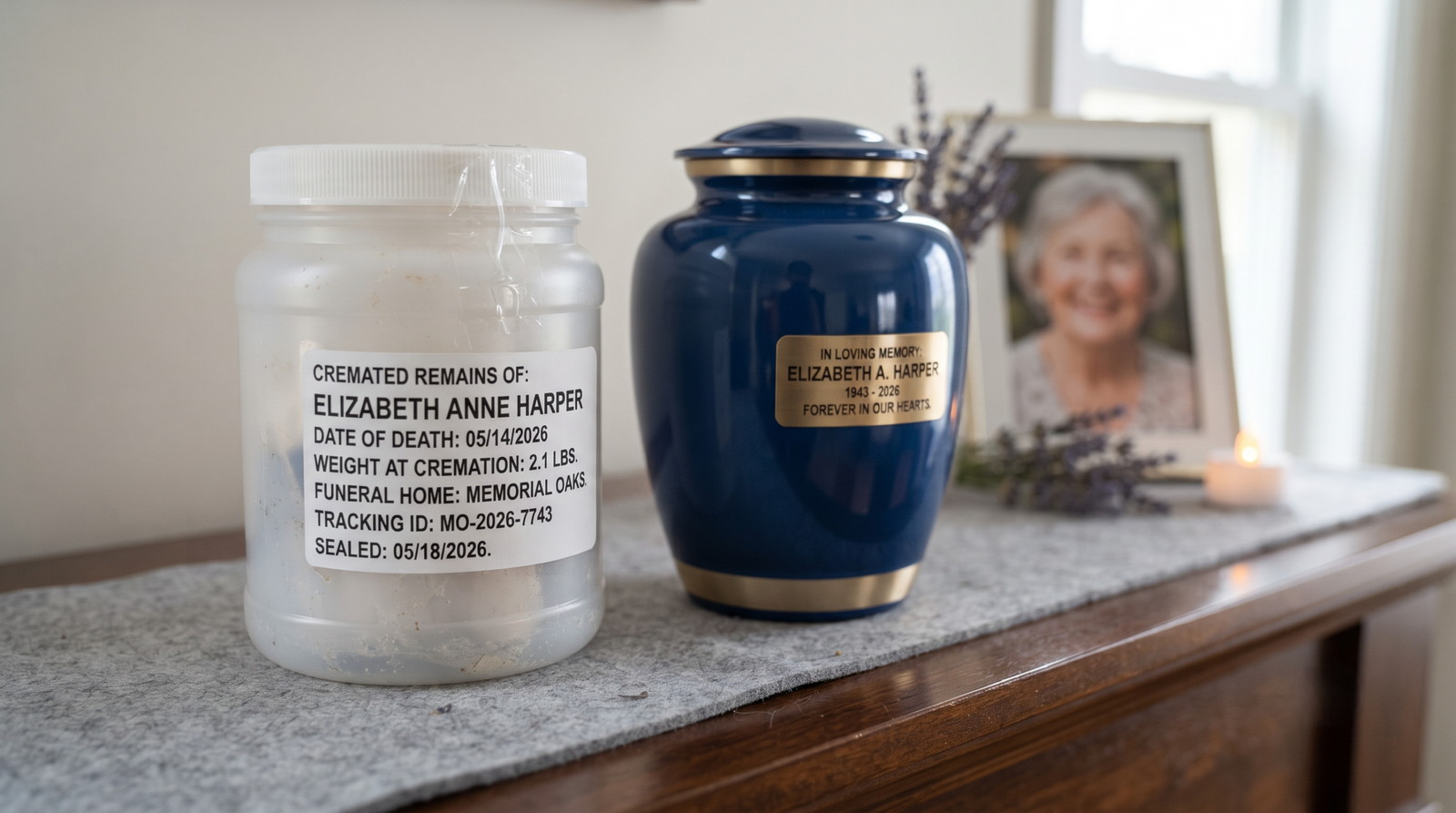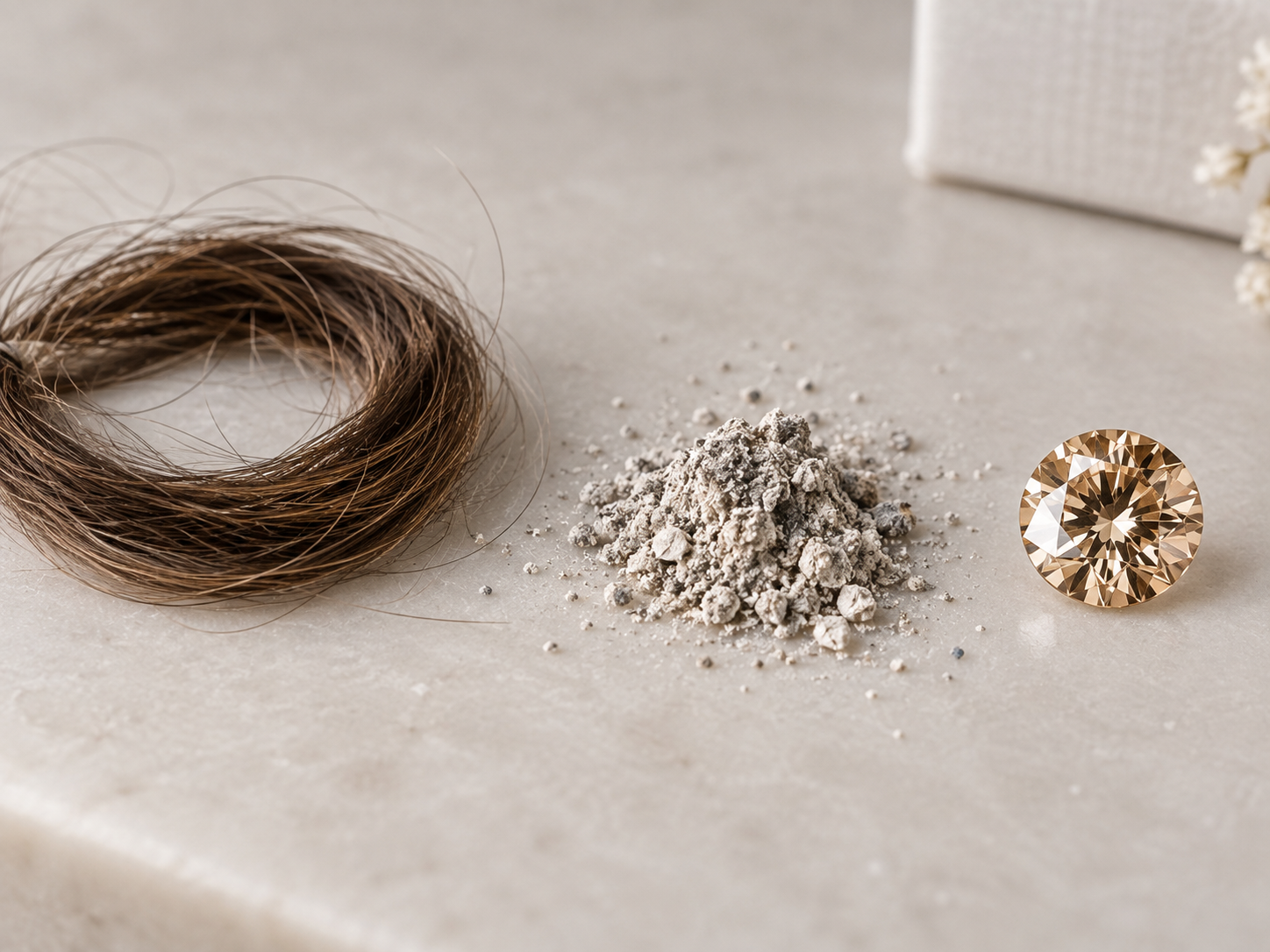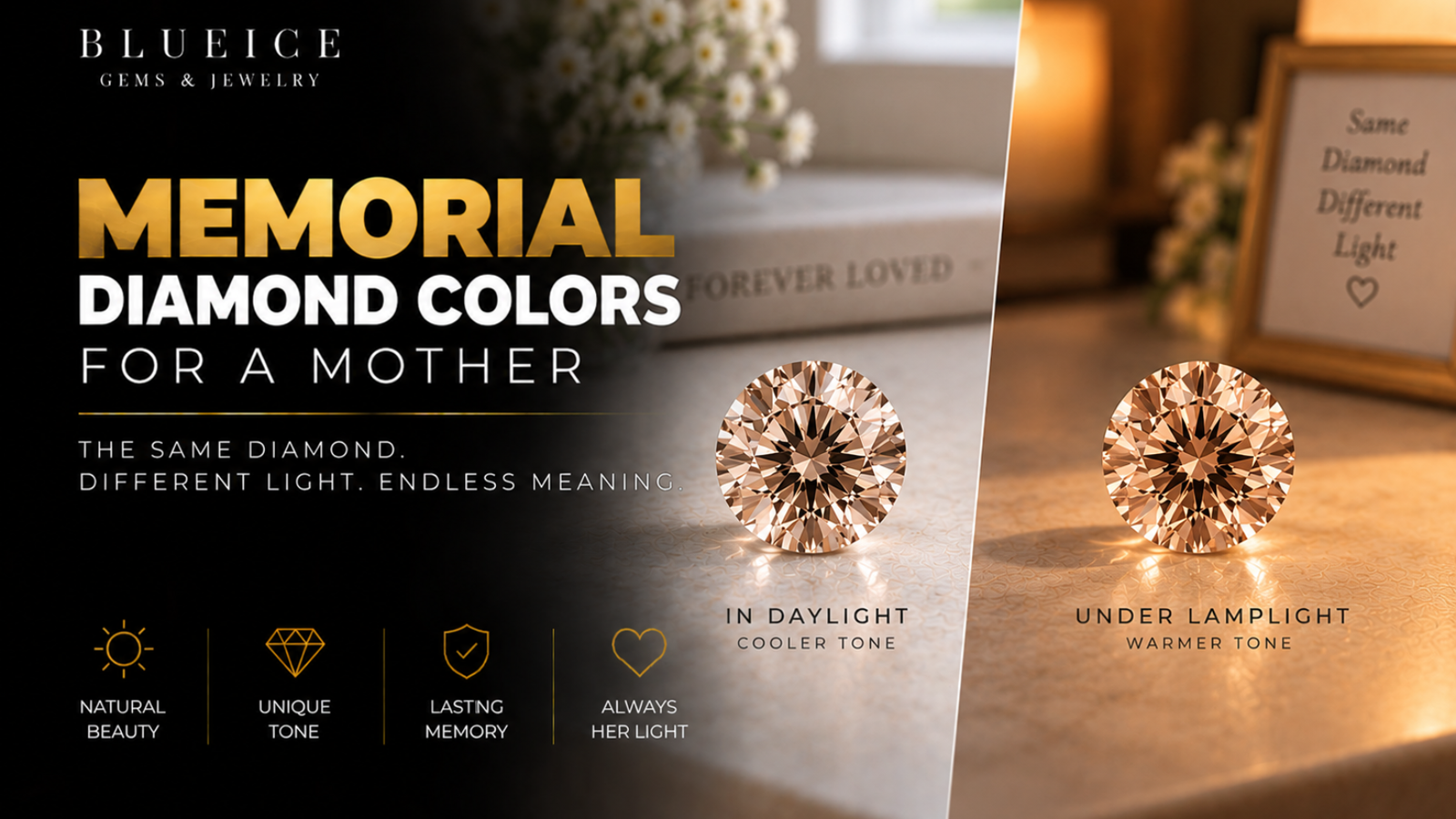
The same champagne-toned memorial diamond photographed twice side by side, once in cool daylight and once under warm lamplight

Memorial Diamond Colors for a Mother: What to Expect

Hold a champagne memorial diamond near a kitchen window and you may see a warm, faintly golden brown tone. Move the same diamond beneath a warm dining room lamp and the stone may appear more amber. The diamond stays exactly the same. The surrounding light changes how your eyes see its color.

When families explore memorial diamond colors for a mother, they usually want to know which colors exist, what creates each color, how much each option costs, and which color will continue to feel right years from now.

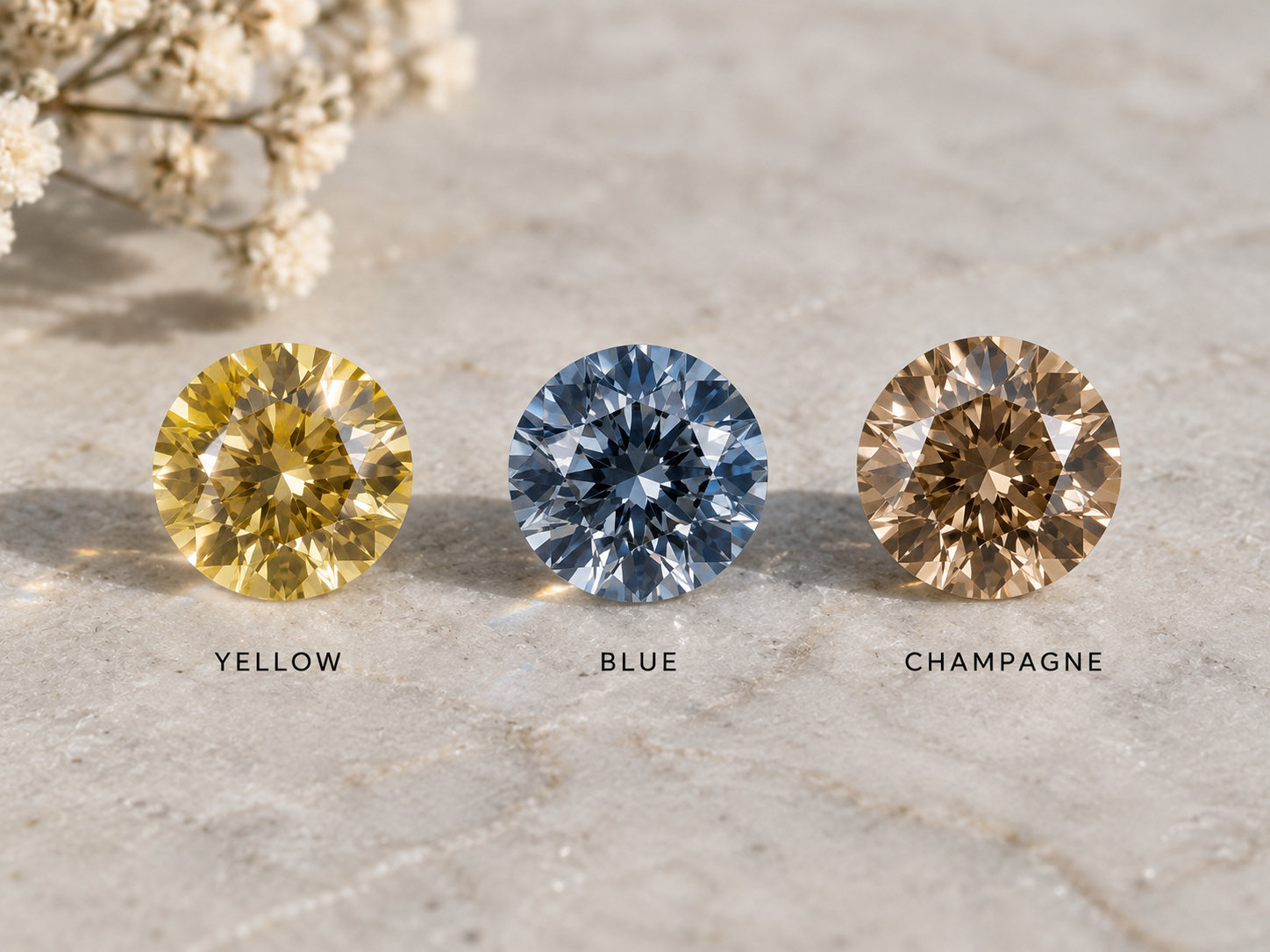
Memorial diamond colors generally fall into several groups. Yellow, blue, and champagne or brown represent common natural color outcomes. Colorless diamonds require the near total absence of the trace elements that create other colors and can cost more at the same carat size. Some providers also offer red, pink, green, or black through post growth irradiation.

This guide focuses on the colors you can consider when choosing a mother’s memorial diamond. If you want to understand what color a specific portion of her ashes or hair may produce, explore our guides about the ashes version, the hair version, and the version for both together.

Which Colors Can You Actually Choose From?

Five main color families give families the starting point for a memorial diamond. The crystal growth process determines the natural color through trace elements present during growth.

Nitrogen produces yellow. Boron produces blue. Champagne and brown tones can develop when an organic carbon source carries a mixture of trace elements. Colorless growth requires the near total absence of nitrogen and boron.
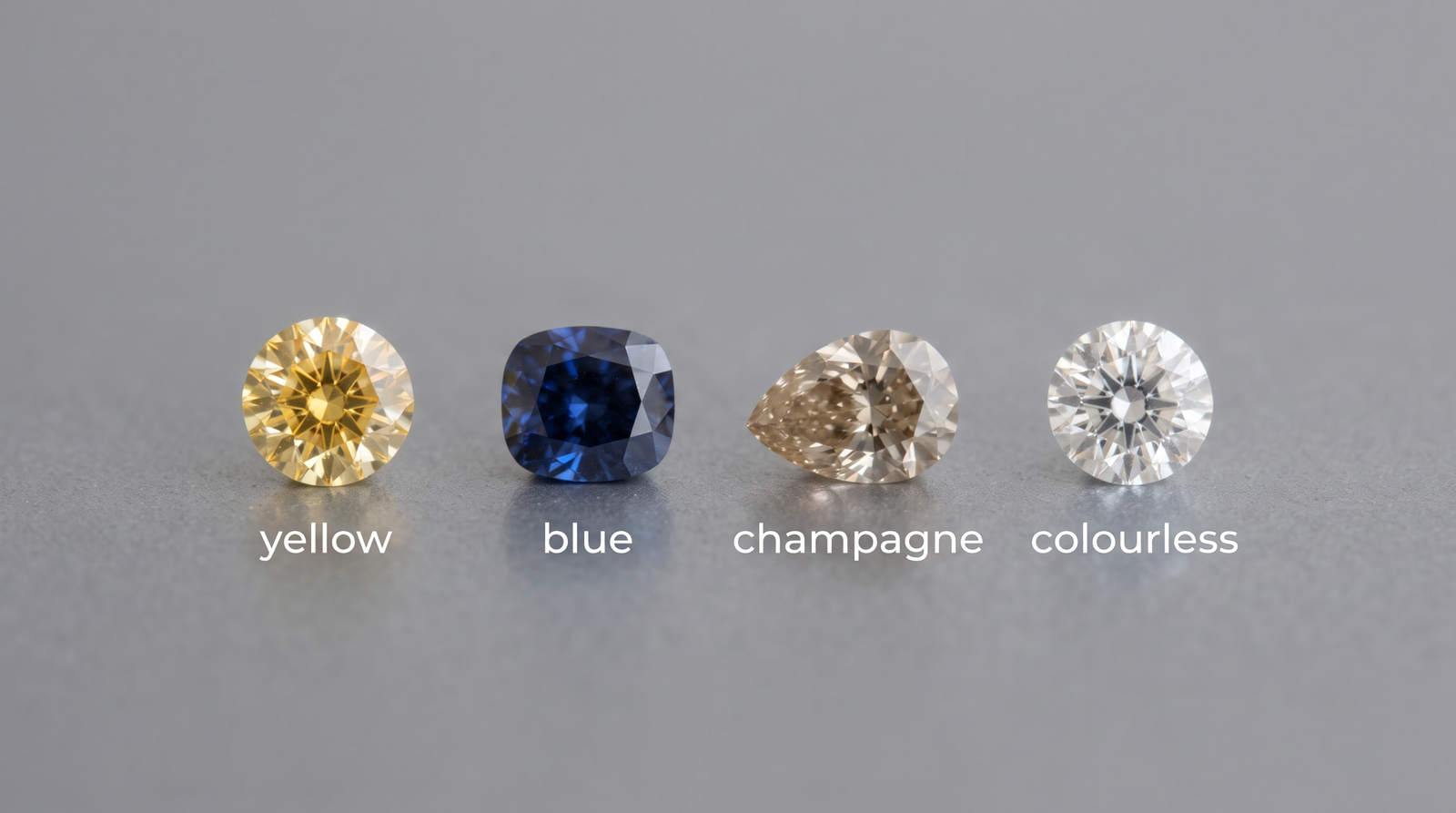
Four loose memorial diamonds in yellow, blue, champagne and colourless tones arranged in a row on a neutral grey surface

The carbon preparation also matters. Providers purify personal carbon and blend it with supplemental laboratory carbon to create the material needed for diamond growth. Industry information places the personal carbon contribution for ash derived stones at roughly 10 percent to 15 percent of the finished stone mass.

ColorWhat creates itRelative cost at the same caratAvailability
YellowNitrogen during growthLower price rangeStandard option
BlueBoron during growthLower price rangeStandard option
Champagne or brownA mixture of trace elements in an organic carbon sourceLower price rangeStandard option
Colorless or whiteNear total absence of nitrogen and boronMeaningfully higher than the three colors aboveConfirm availability at your chosen carat
Red, pink, green or blackPost growth irradiationAdditional treatment can increase the priceSome providers offer these colors

For a deeper explanation of why colorless memorial diamonds remain less common, read why memorial diamonds are rarely colorless.

What Does Post Growth Irradiation Do to Her Stone?

Post growth irradiation changes how a finished diamond absorbs light. It does not change what the crystal consists of.

Irradiation takes place after diamond growth. Controlled exposure alters color centers inside the crystal structure and can shift the appearance toward red, pink, green, or black.

The diamond remains a diamond. Its hardness remains 10 on the Mohs scale, the same hardness associated with other diamonds.

The treatment also creates an important documentation difference. A grading report can identify a treated color rather than presenting that color as the diamond’s original growth color.

Irradiation also does not change the personal carbon contribution. Providers establish that contribution during the material preparation and blending process before diamond growth begins.

If you consider an irradiated color, ask your provider how the treatment appears on the grading documentation and whether the provider offers any policy for future color changes.

Color Reads Differently as the Stone Gets Bigger

Body color appears through the depth of a diamond. As the stone grows, the same tint can become easier to see.

A subtle champagne tone may appear understated in a 0.25 carat stone and much more noticeable in a larger stone. Consider your preferred level of color before you choose the size.

  • If you want the color to stand out, a larger stone can make the tone easier to notice.
  • If you want the color to remain subtle, a smaller stone can create a quieter appearance.
  • If you want a colorless stone, the higher price can become more significant as the carat size increases.
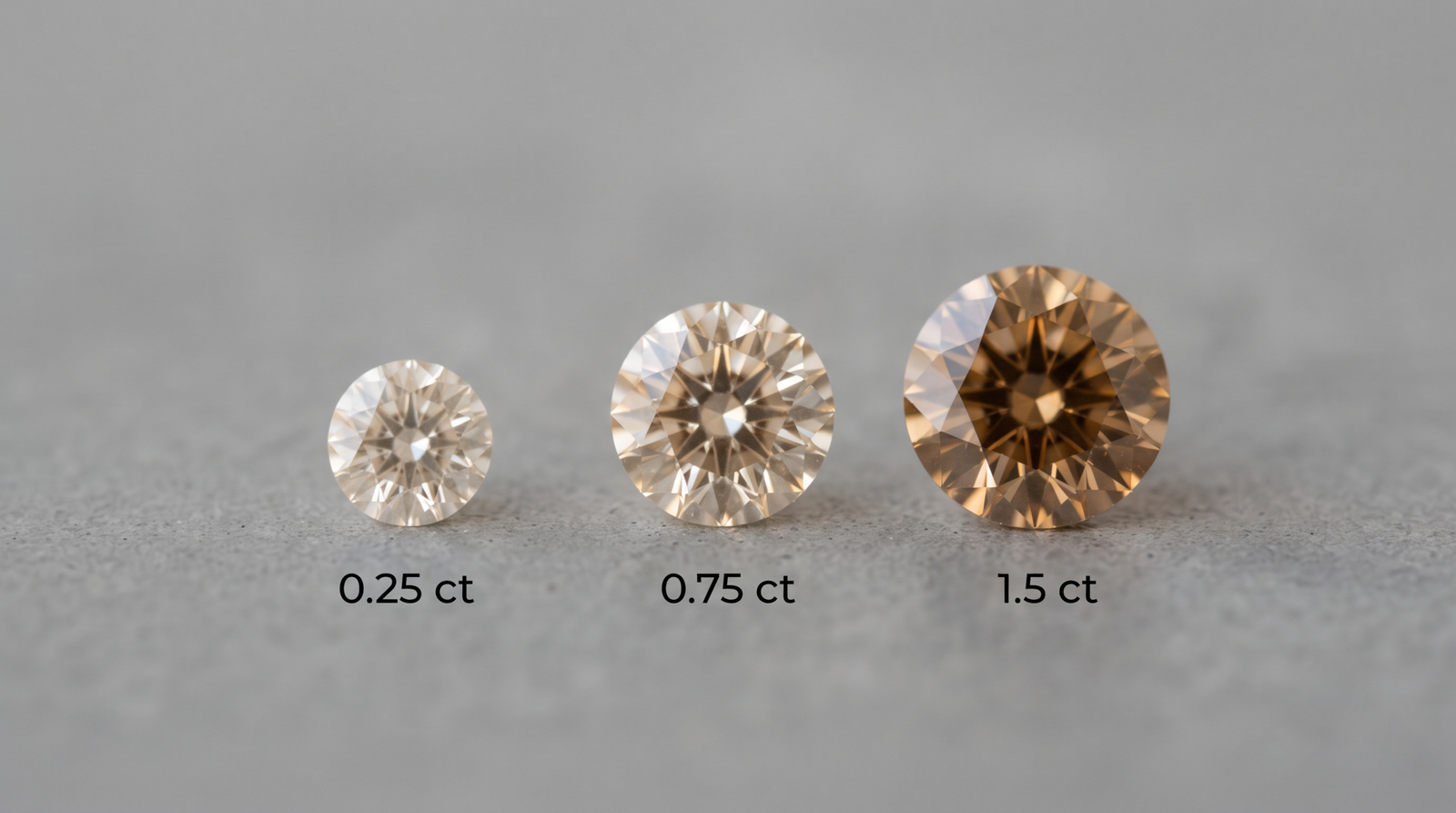
Three champagne memorial diamonds of increasing carat size photographed together, showing the tint reading more strongly as the stone grows

Carat size depends on diamond growth time rather than the amount of material you send. Read how to choose a carat size before you finalize the stone size.

Production commonly takes around 6 to 10 months from the laboratory receiving the material. Large stones and specialty colors can require up to 12 months. Your complete planning period can reach around 8 to 14 months when you include preparation, shipping, decisions, and jewelry work.

Read what actually drives the timeline for a closer look at each stage.

The Setting Metal Decides What You Actually See

The diamond keeps its own color, but the jewelry metal around it can change how your eyes perceive that color.

Yellow gold creates a warm combination with yellow and champagne stones. The similar tones can make the diamond color feel softer and more coordinated.

Platinum and white gold create a cooler contrast. That contrast can make a warm diamond appear more noticeable while making a near colorless stone appear whiter.

Rose gold can add another layer of warmth to a champagne diamond and can make the overall combination appear more pink.
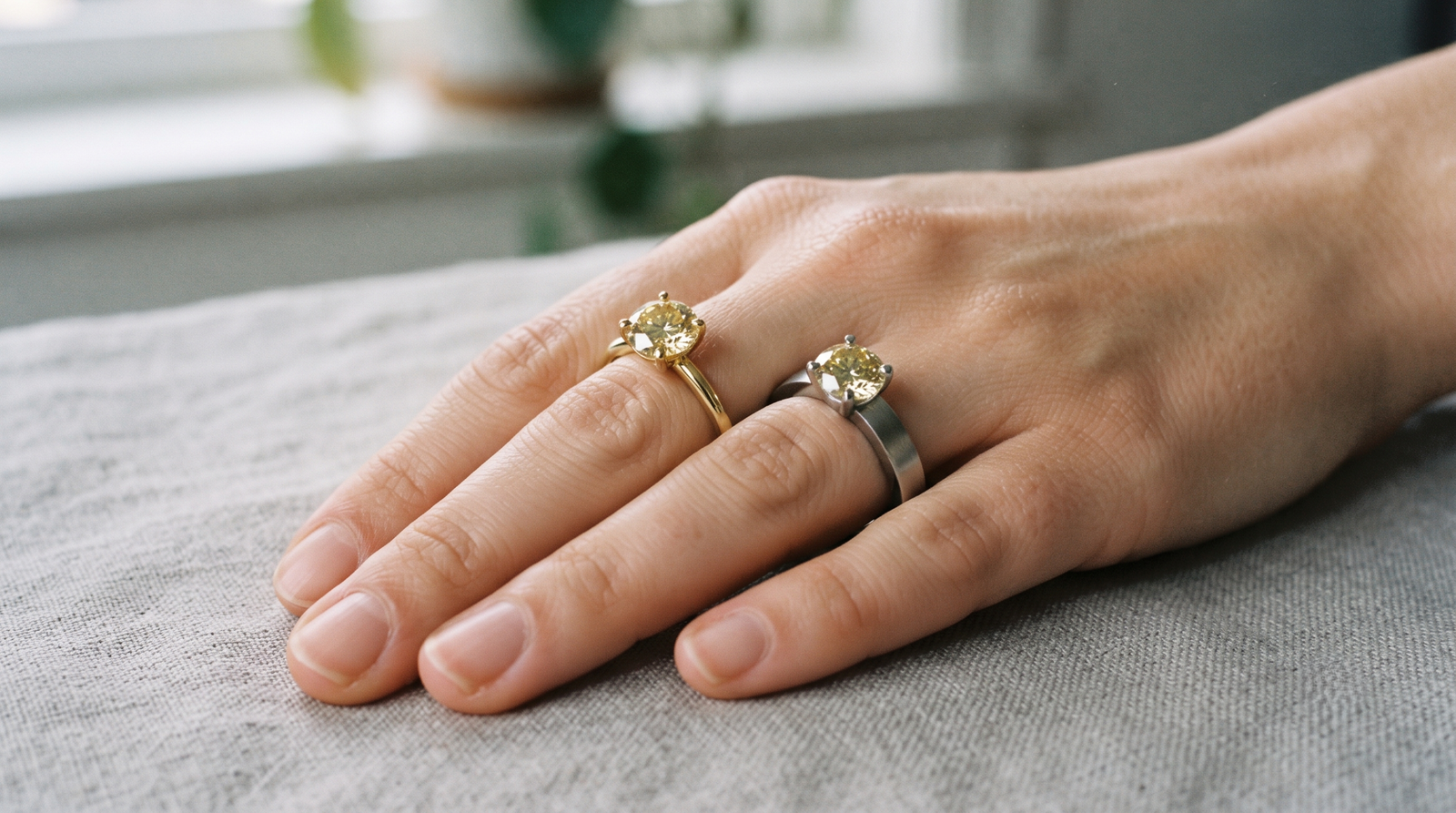
A yellow-toned memorial diamond shown set in yellow gold beside an identical stone set in platinum, on a hand

White gold commonly uses rhodium plating to create its bright white surface. Normal wear can reduce that plating and reveal the warmer metal underneath. A jeweler can restore the bright surface through replating.

For that reason, consider your jewelry metal at the same time as your diamond color. Explore settings and jewelry ideas for a mother’s stone before you make your final selection.

Ask to see your preferred diamond color against both warm and cool metals. That simple comparison can help you understand how the finished jewelry may look on your hand.

What Does Color Add to the Price?

Carat size usually creates the largest difference in price. Color then moves the price within the relevant carat range.

Industry pricing information for 2026 places a 0.10 to 0.25 carat memorial diamond around $1,500 to $3,500. A 0.5 to 1 carat stone can range around $5,000 to $15,000. A 2 to 5 carat stone can reach approximately $20,000 to $75,000 or more.

Colorless diamonds can cost meaningfully more than yellow, blue, or champagne diamonds at the same carat size. Irradiated colors can create another treatment cost.

Grading, engraving, fancy cuts, and jewelry settings can also add separate costs.

These figures represent general industry ranges rather than Memorial Diamond pricing. Always ask for the current price of your chosen carat and color combination.

Read what a mother memorial diamond actually costs for a deeper look at pricing.

How Do You Choose a Color You Will Still Like in Twenty Years?

Choose for the jewelry itself as well as the story behind it. A color can carry a beautiful connection to your mother, but you also want a stone that you genuinely enjoy wearing.

Blue may remind you of her love for the ocean. Yellow may remind you of her warmth. Champagne may match the jewelry she wore every day. Those personal connections can guide your decision, but your own style matters too.
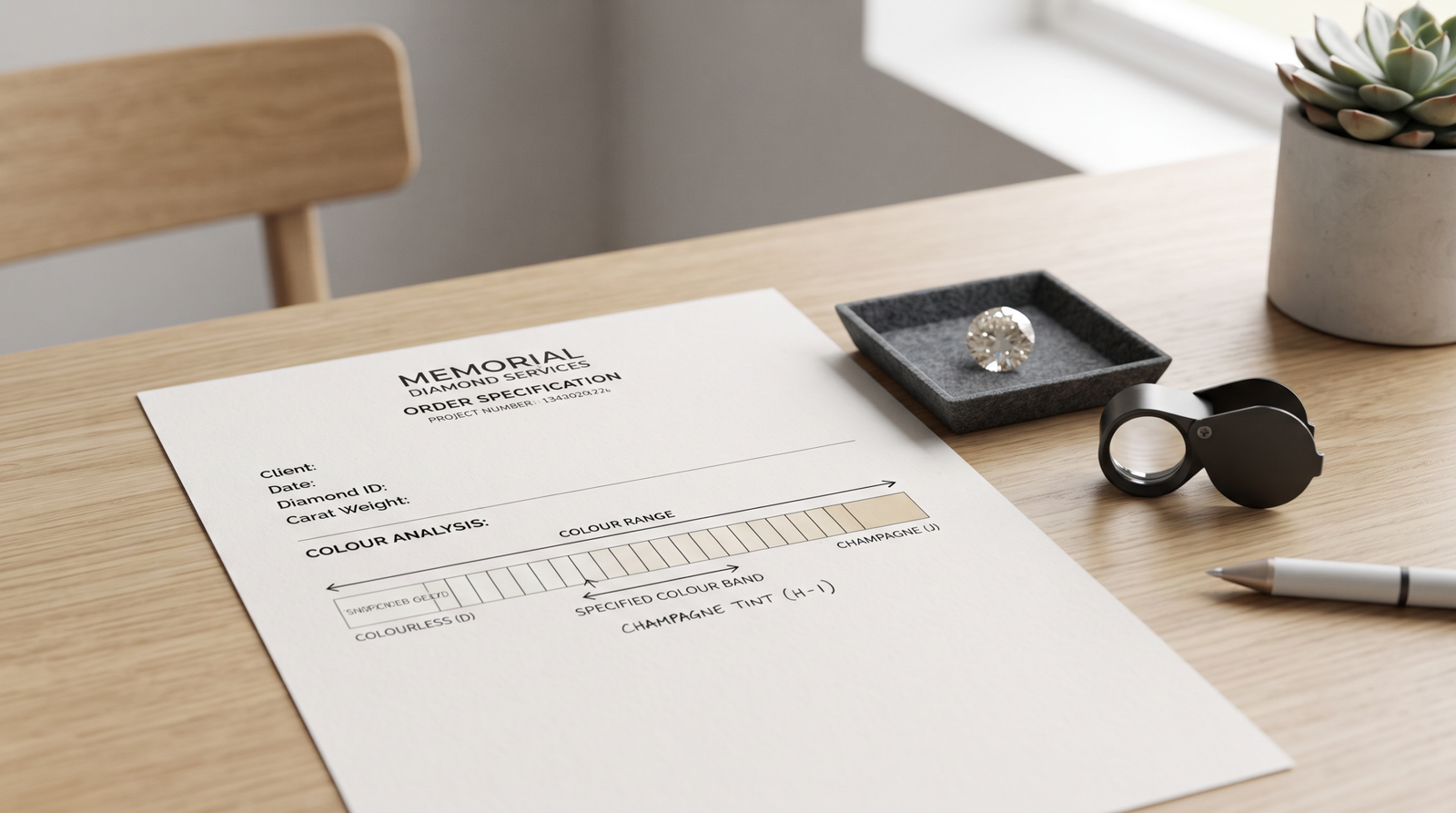
An order specification on a desk with a colour range noted beside a loose memorial diamond and a loupe

Look at What You Already Wear

Look at your everyday jewelry rather than a piece you wear only on special occasions. If you normally wear yellow gold, a yellow or champagne diamond may fit naturally into your collection.

If you prefer platinum or white gold, a blue or colorless diamond may complement your usual style.

Ask for a Color Family

Ask your provider to describe the expected color family rather than promising one exact shade.

Organic source material can create natural variation, so a provider cannot honestly promise one precise natural tone in advance. A clear color family with an agreed range gives you a more useful expectation.

Think About a Future Setting

You may eventually move your diamond from one piece of jewelry to another. A pendant today could become a ring years from now.

Consider how your chosen color will work with different jewelry styles. An unusual treated color may require more thought when you choose another setting in the future.

Think About the Person Who May Inherit It

Your memorial diamond may eventually become a family heirloom. Someone who receives it may never have met your mother.

Choose a stone that looks beautiful on its own while still carrying the personal meaning behind it. That approach can help the diamond remain meaningful across generations.

Frequently Asked Questions

Can I choose the color, or is one assigned to me?

You can choose from the colors your provider offers and specify your preference during the ordering process. You cannot expect a provider to guarantee one exact natural shade from organic source material. Ask for a realistic color family and an agreed tolerance instead.

Does a colorless memorial diamond mean less of her is in it?

No. The personal carbon contribution depends on the material preparation and blending process rather than the final color. Industry information places the personal carbon contribution for ash derived stones around 10 percent to 15 percent of the finished stone mass.

Colorless growth focuses on limiting nitrogen and boron. It does not remove the personal carbon contribution.

Is an irradiated pink or black stone still a real diamond?

Yes. Irradiation changes the color centers inside a diamond that already exists. The treatment does not turn the stone into another material, and the diamond retains its hardness.

Ask your provider how the treatment appears on the grading documentation.

Will the color fade over the years?

Diamond color comes from the crystal itself rather than a surface coating that ordinary wear can remove. Normal wear therefore does not fade the structural color.

If you choose an irradiated color, ask your jeweler about heat exposure during future repairs, resizing, or other jewelry work.

Can the color be changed after the stone is finished?

Irradiation can create color after diamond growth, so additional treatment can exist as a technical option. Whether your provider accepts a finished memorial diamond for another treatment depends on that provider’s policy.

Ask about this possibility before ordering if you think your color preference could change later.

Which color gives me the most stone for the money?

Yellow, blue, and champagne generally sit toward the lower part of the price range at the same carat size. Colorless diamonds can cost more at the same size. Irradiated colors can add another treatment charge.

Compare the complete price for your preferred carat and color combination rather than comparing color alone.

Does choosing a specialty color make the wait longer?

It can. Production commonly takes around 6 to 10 months from the laboratory receiving the material. Large stones and specialty colors can require additional time.

Ask your provider for the expected production period for your specific carat and color before ordering.

Pick the Color You Would Wear on an Ordinary Tuesday

Choosing a memorial diamond color becomes easier when you make the decisions in the right order.

Start with carat size because it affects your budget and how strongly the color may appear. Consider the jewelry metal alongside the color because the surrounding metal can change the way your eyes perceive the stone.

Then choose the color you would genuinely enjoy wearing on an ordinary day.

Ask your provider which colors they currently offer at your preferred carat size. Ask what color range they can realistically provide and whether they can record that range in your order documentation.

Your mother’s memorial diamond should feel meaningful when you first receive it and continue to feel right years later. Take the time to choose a color that connects with her memory while also fitting naturally into your own life.
Untitled (1568 x 1003 px) (2)

How a Memorial Diamond Is Made From Your Father’s Ashes

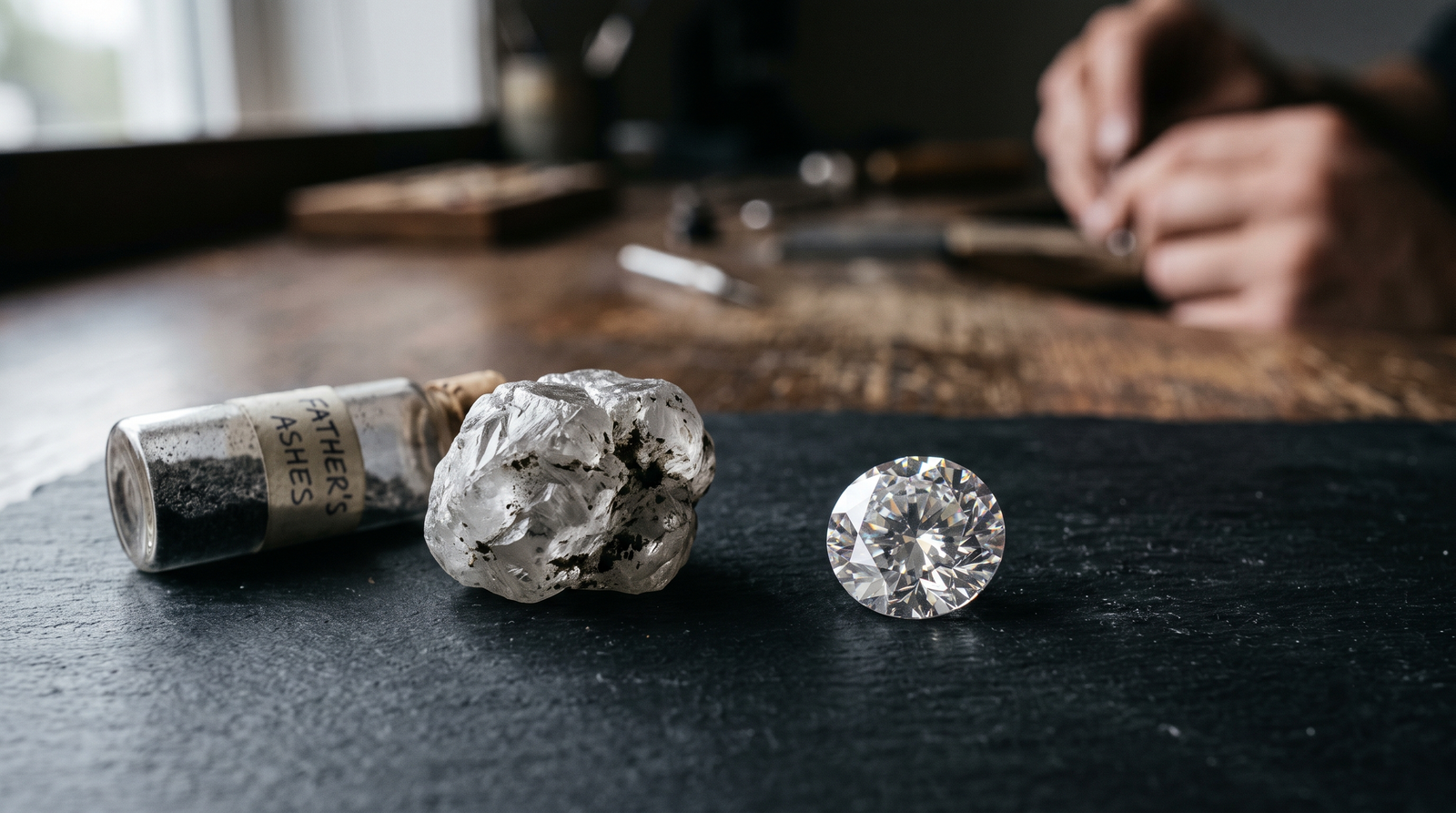
Rough diamond crystal grown from carbon extracted from cremated ashes beside the finished cut stone on a dark surfac

The container from the crematorium feels heavier than most people expect, and a paper identification tag usually seals the lid. Between that container and a finished, sparkling gemstone lies a sophisticated sequence of scientific procedures. If you want to understand how a memorial diamond is made from your father’s ashes, the short explanation runs simply: technicians heat a measured portion of his cremated remains in an oxygen-free furnace until pure carbon remains, convert that carbon into graphite, blend it with lab-grade carbon, and grow an authentic diamond crystal inside an extreme-pressure press.

Most importantly, understanding this journey requires seeing it as a process of refinement. Almost every single stage in the laboratory removes something. In fact, exactly one stage adds material.

In this article:

What Is Actually in the Cremation Container?

Cremated remains are not soft wood ash in the campfire sense. This single chemical fact defines every subsequent laboratory stage.
Instead, what comes back from a cremation consists overwhelmingly of calcium phosphate the resilient mineral scaffolding of bone left behind after intense heat drives off water and soft tissue. Carbon, the singular element required to grow a diamond, represents a minor component. Sourced industry figures place usable carbon at roughly 0.5% to 4% of total ash weight, depending on the individual and the cremation conditions.

Therefore, the laboratory’s opening objective focuses on separation rather than manufacturing. Technicians must extract a small fraction of carbon from several ounces of mineral powder and purify it thoroughly. How much ash a father memorial diamond needs directly reflects this chemical reality.

Which Stages Remove Something, and Which Stage Adds?

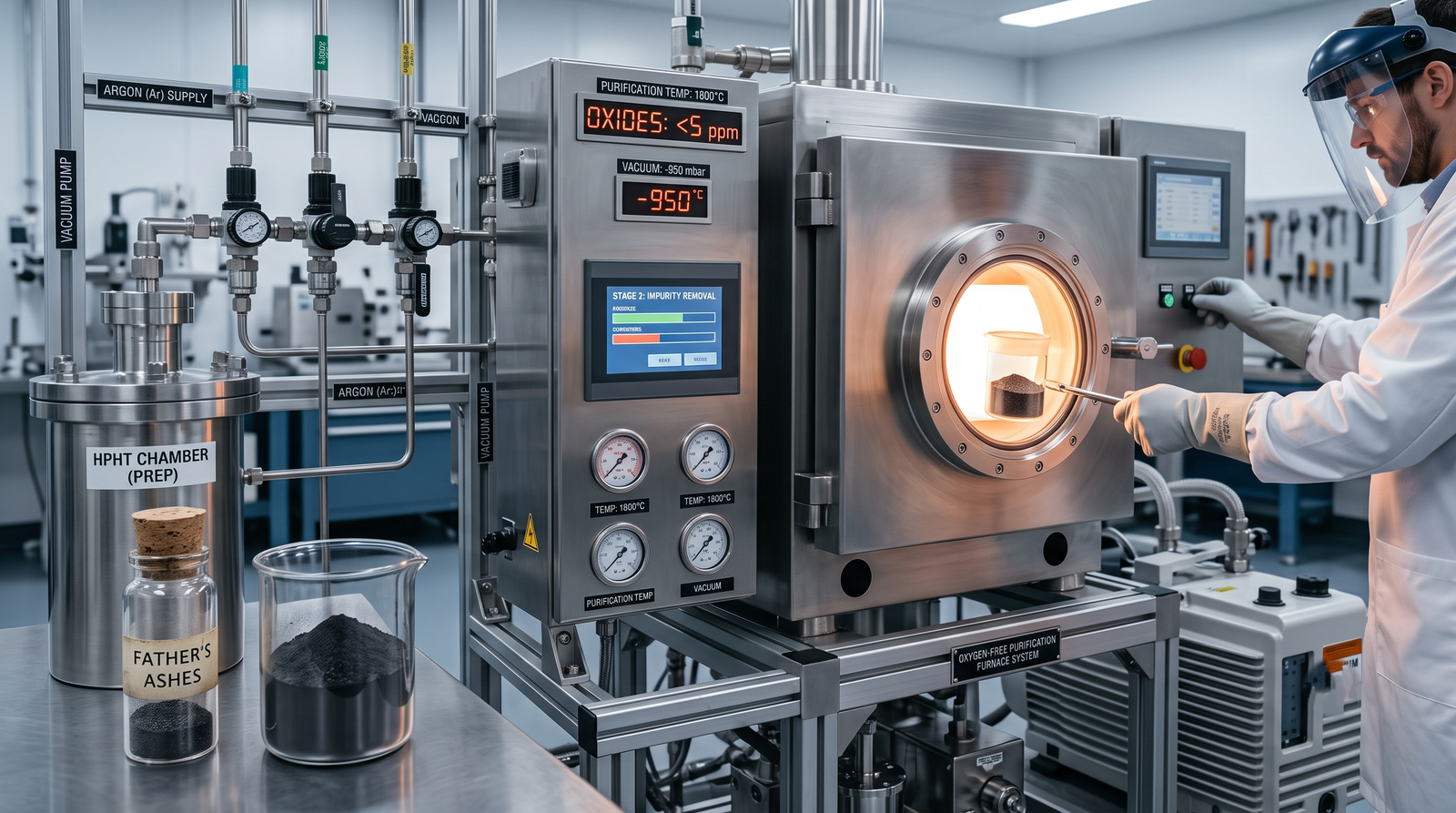
Sealed high-temperature furnace used to purify carbon extracted from cremated remains in an oxygen-free process

Reading the journey as a ledger of refinement makes the science easy to visualize, while clearly answering common family questions.

StageWhat Is Taken AwayWhat Carries Forward
Intake & InspectionNon-biological material: medical hardware, metal fragmentsA logged portion assigned to a unique chain-of-custody ID
Extraction & PurificationCalcium phosphate and bulk bone minerals via oxygen-free heatingElemental carbon at approximately 99.9%+ purity
GraphitizationRemaining molecular structure at 2,500–2,700°CPure graphite ready for the growth press
BlendingNothingHis graphite combined with supplemental lab carbon
Crystal GrowthNothingA raw, uncut rough diamond crystal
Cutting & PolishingRough diamond material and outer matrixThe faceted, brilliant finished gemstone
GradingNothingA documented report verifying cut, color, clarity, and carat

Blending represents the only additive step in the entire sequence. Consequently, no honest provider describes the finished crystal as being 100% composed of your father’s remains.

How Is His Carbon Separated From the Bone Mineral?

Ordinary open-air combustion cannot accomplish this separation because oxygen destroys the very element you want to preserve. If you heat carbon in open air, it binds with oxygen and escapes up the exhaust as carbon dioxide gas.

Therefore, technicians conduct extraction inside specialized, sealed, oxygen-free vacuum furnaces. This controlled heating cycle eliminates volatile minerals while preventing carbon loss, purifying the carbon to 99.9%+ purity.

Subsequently, high-temperature furnaces heat the purified sample to roughly 2,500–2,700°C to restructure it into graphite. Graphite and diamond share the identical element carbon but carry different atomic geometry. The growth press simply transforms one molecular lattice into the other.

Nothing molecular survives these extreme thermal thresholds. Instead, the process preserves elemental carbon atoms, which step forward as the building blocks for the new gemstone.

Why Is Lab Carbon Added to His?

Laboratories blend supplemental carbon purely to provide sufficient volume inside the growth cell.

Because cremation ashes yield between 0.5% and 4% carbon by weight, the recovered personal sample remains relatively small. A standard growth cell requires a specific volumetric baseline to operate effectively. Therefore, technicians combine his purified graphite with lab-grade graphite chemically identical in every atomic respect.

As a result, your father’s carbon typically comprises roughly 10% to 15% of the final gemstone’s mass. While the diamond is not 100% personal material, carbon atoms that physically composed his body become permanently locked inside the crystalline structure. The direct answer to whether a memorial diamond is really made from your father’s ashes provides the scientific backing when discussing the process with family members.

What Happens Inside the Growth Press?

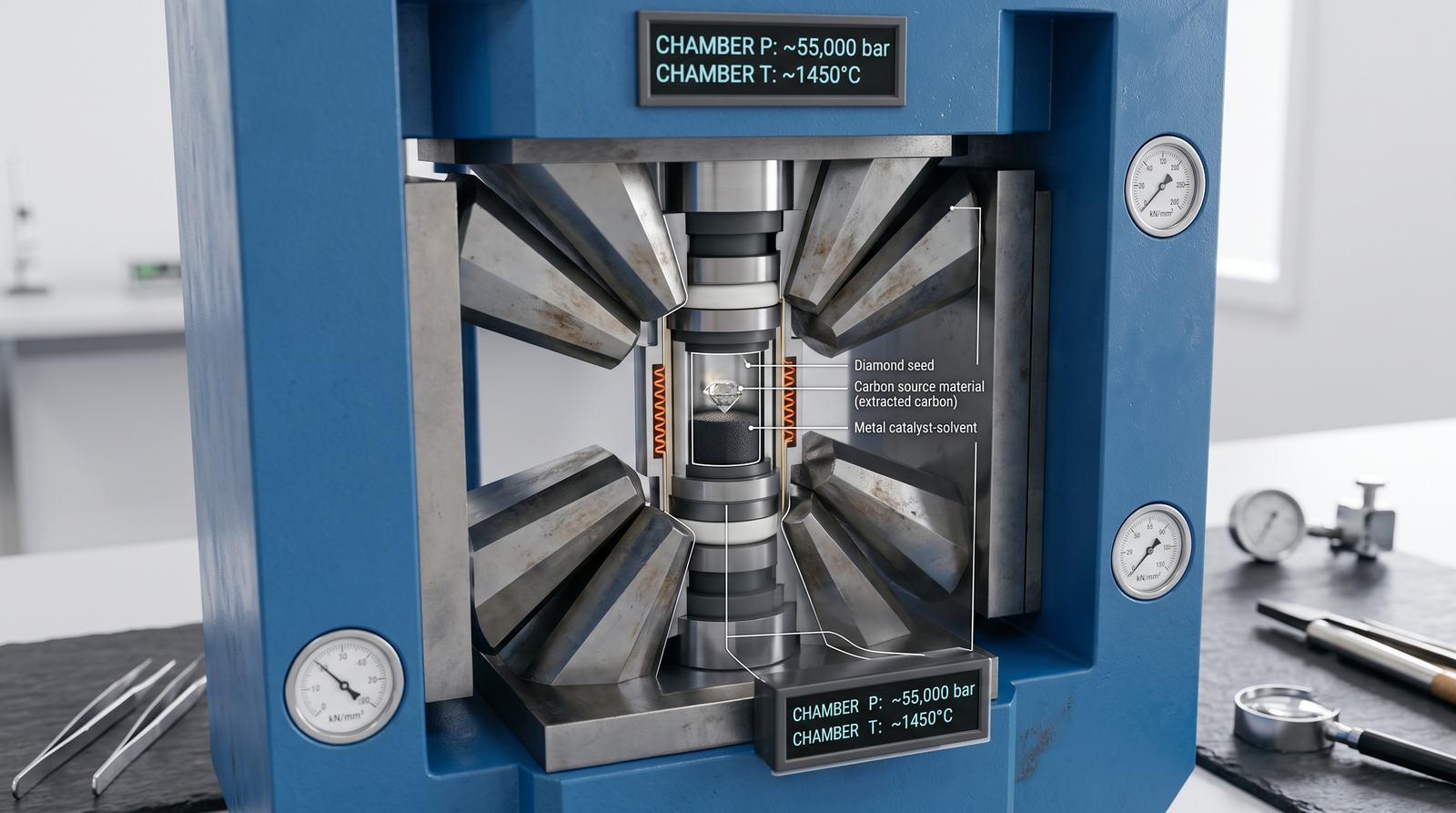
High pressure high temperature press with the growth cell that holds a diamond seed during crystal growth

The memorial diamond industry relies primarily on High Pressure High Temperature (HPHT) technology. Large multi-anvil presses (such as BARS or cubic presses) squeeze the core cell from multiple directions, maintaining conditions at roughly 6–8 GPa of pressure and 1,400–2,500°C to replicate Earth’s upper mantle.

Inside the growth core, technicians place a microscopic natural diamond seed. As heat liquifies the catalyst metal, carbon atoms migrate steadily toward the seed crystal and crystallize onto its lattice over weeks or months.

A smaller segment of the industry utilizes Chemical Vapor Deposition (CVD), where vacuum chambers deposit carbon gases onto flat substrates. While both routes yield authentic diamonds, HPHT remains the trusted benchmark for memorial stones. For a full technical comparison, explore how memorial diamonds are made, HPHT versus CVD.

Ultimately, growth duration determines carat size rather than the volume of ash supplied. Once the cell contains full feedstock, time under pressure dictates the final weight.

What Varies From One Father to the Next?

Two primary natural factors vary between individuals, and neither falls under human control:

  • Carbon Yield: Usable carbon varies across the 0.5% to 4% range due to individual bone density and the temperature profiles of the original cremation retort.
  • Trace Element Signatures: Although purification eliminates bulk minerals, microscopic trace elements (such as boron or nitrogen) carry through into the press. These natural elements influence whether his diamond develops yellow, blue, or champagne nuances.

Nevertheless, these natural variations do not alter the initial sample amount requested by the provider. For practical family logistics, how much ash a father memorial diamond needs explains sample sizes for men of different frames.

What Comes Back to You Besides the Stone?

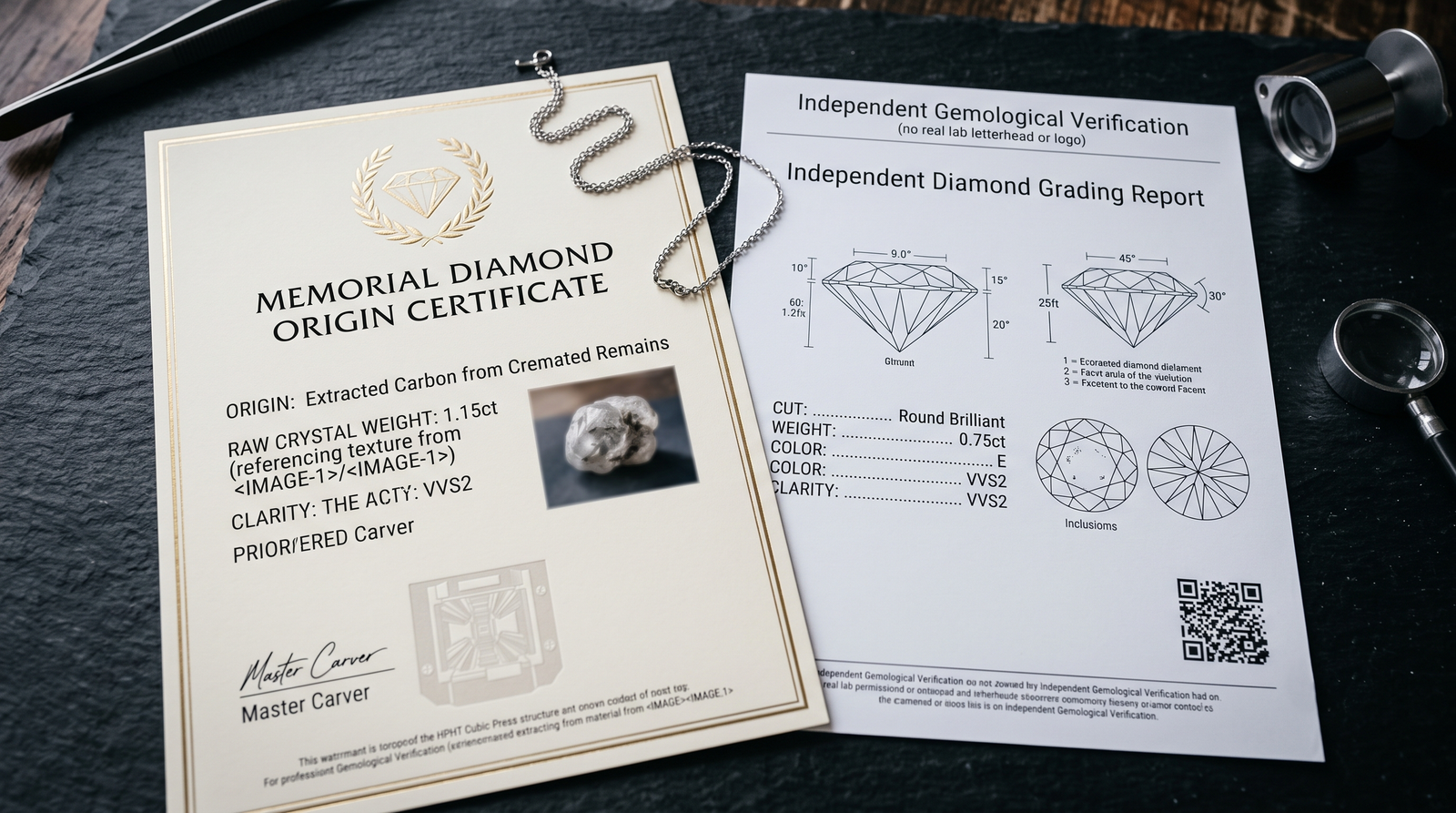
An in-house authenticity certificate and an independent diamond grading report laid side by side on a des

When the process concludes, your provider should return three essential items:

  1. An Origin Certificate: An in-house document confirming that the laboratory synthesized the diamond using your submitted tracking number.
  2. An Independent Grading Report: A formal assessment from a recognized gemological laboratory detailing cut, color, clarity (typically SI2 to VVS), and carat weight. How memorial diamonds are graded and certified explains why you should always request both documents.
  3. Unused Cremation Ashes: Because the extraction cycle consumes only a portion of the submitted material, ethical providers return all remaining ash.

When preparing to ship, remember that regulations from the United States Postal Service (USPS Pub 139) strictly mandate Priority Mail Express with official Cremated Remains labeling. For domestic shipping guidance, review what the reader’s side of the process looks like.

Frequently Asked Questions

Do metal implants or a pacemaker affect what the lab can use?

No. Funeral directors remove pacemakers prior to cremation, and processors separate joint replacement hardware afterward. Technicians filter out any remaining microscopic metal during the intake stage before chemical extraction begins.

He was cremated eight years ago. Does the delay change anything?

No. Cremated remains consist of stable mineral compounds that do not degrade over time. An ash sample preserved in an urn for years yields the exact same carbon as a recent cremation.

Will the lab tell me how much carbon it actually recovered from his ashes?

Yes, if you ask in advance. While laboratories do not publish recovered percentages on standard certificates, reputable providers will record and share exact yield weights upon written request.

Does the crematorium he was cremated at make a difference?

Only marginally. Retort operating temperatures affect where a sample lands within the standard 0.5% to 4% carbon range, but this minor variation does not prevent successful diamond growth.

What happens if a growth run fails partway through?

Growth runs occasionally stall. Therefore, verify beforehand whether your provider maintains backup material, covers the cost of a secondary run, and guarantees project completion in writing.

Can the lab run his ashes without adding any lab carbon at all?

No. A single ash sample cannot supply enough physical carbon volume to fill an HPHT growth cell safely. Consequently, blending supplemental carbon represents an industry-wide necessity.

Questions Worth Asking a Lab Directly

Understanding the science helps you ask targeted questions before entrusting your father’s ashes to a provider. Ask whether they manage growth in-house, what specific growth method they use, and how they secure chain-of-custody tracking.

If you also have a lock of hair, the hair version of this process provides an alternative starting point. For comprehensive pricing and timelines, the complete guide to a father ashes diamond brings together all essential details.

Untitled (1568 x 1003 px)

Step-by-Step: Turning Your Mother’s Hair Into a Diamond

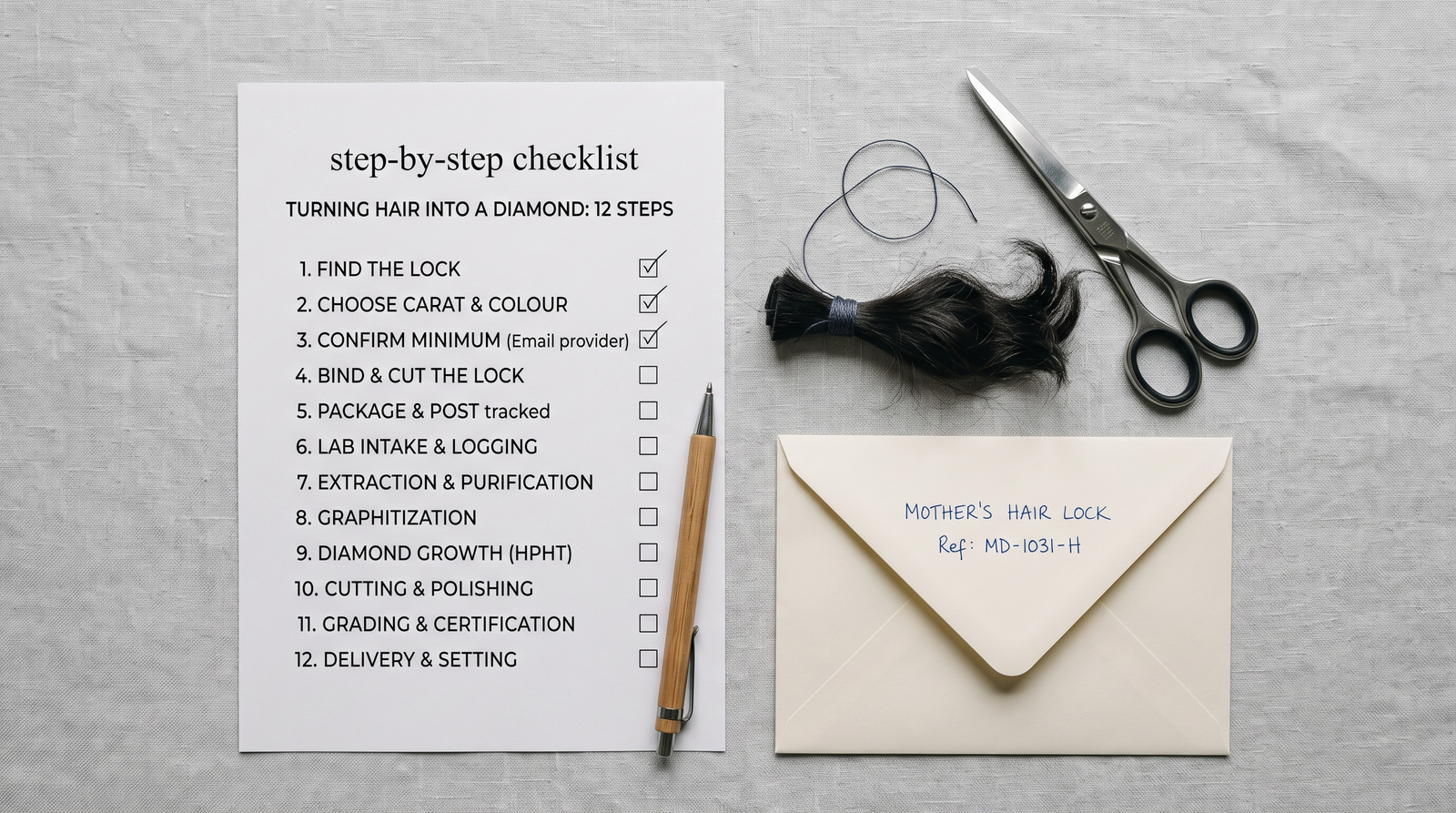
Here is the whole process as one numbered sequence: twelve steps from finding the lock to setting the finished stone, five of them yours and seven the lab’s, with the handover at step five. Industry-wide the lab half runs 6 to 10 months from the day your mother’s hair is received. No cremation is involved at any point, which is why this route stays open to families who buried their mother and to daughters whose mother is still alive.

Print it, work down it. For the reasoning rather than the order of operations, how to turn your mother’s hair into a diamond covers the same ground as prose.

Numbered checklist beside a thread-bound lock of hair, scissors, and a paper envelope on a linen surface

On this page:

What Do You Need Before You Start?

Short list, and most of it is already in the house.

  • The lock, or a plan for collecting one
  • Sharp scissors and a length of sewing thread to bind one end
  • A small paper envelope, not a plastic bag, inside a rigid mailer stiff enough not to fold in a sorting machine
  • Your provider’s written minimum for the carat you chose
  • A pen for her name and reference, and tracked postage ordinary mail class is fine

What you don’t need matters too: no special carrier, no official postal box, no cremation certificate, no service-class restriction. No carrier publishes a rule for human hair the way USPS publishes one for cremated remains an absence rather than a stated permission, so confirm with your provider and your carrier rather than assuming.

Steps 1–5: What Does Your Family Do?

Step 1 Find out whether a lock already exists

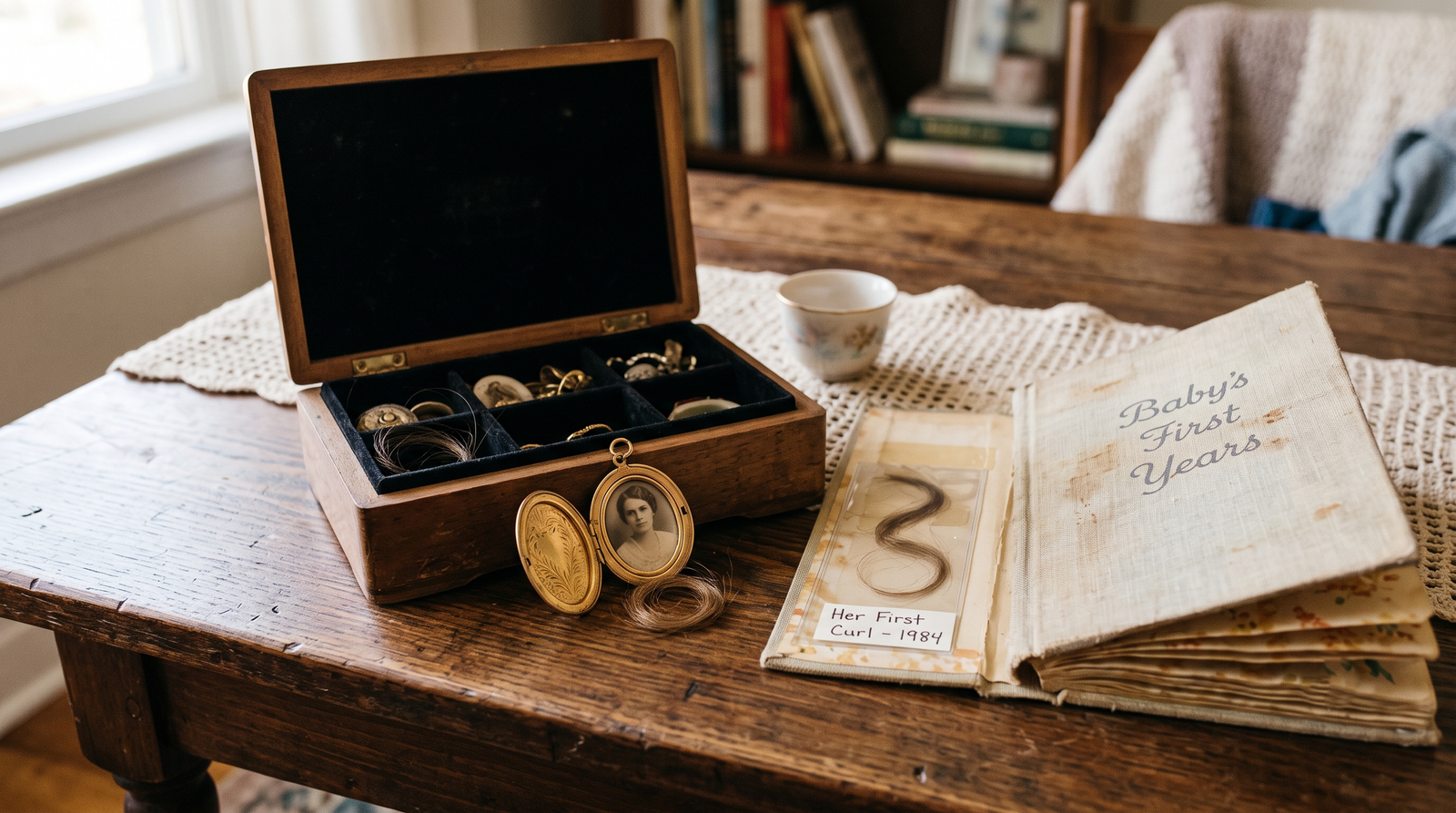
Start here: a lock you already have costs nothing, and one you have to take is irreversible. Saved hair turns up in a folded envelope in a jewelry box, taped into a baby book, inside a locket, or as a childhood braid. Hospice nurses and funeral directors often cut one unasked if either was involved, phone before assuming there is nothing.

Open jewelry box, a locket and a baby book on a table, showing the places a saved lock of hair is usually kept

Step 2 Choose carat and colour

Carat comes from growth time in the press, not from how much hair you send, so a bigger lock buys neither a bigger stone nor a faster one. Sizes run from about 0.10 carats to 5 and beyond, cost climbing steeply. Her own hair colour has no bearing on the stone’s see what colour to expect.

Step 3 Get the minimum in writing, for that carat

Ask your intended provider for the exact amount needed at the size you chose, by email. Industry-typical requirements are modest a small lock, a few grams, often called palm-sized because hair is roughly 50% carbon by weight. That is a range, not one company’s policy, and minimums shift with carat.

Step 4 Cut or gather the lock

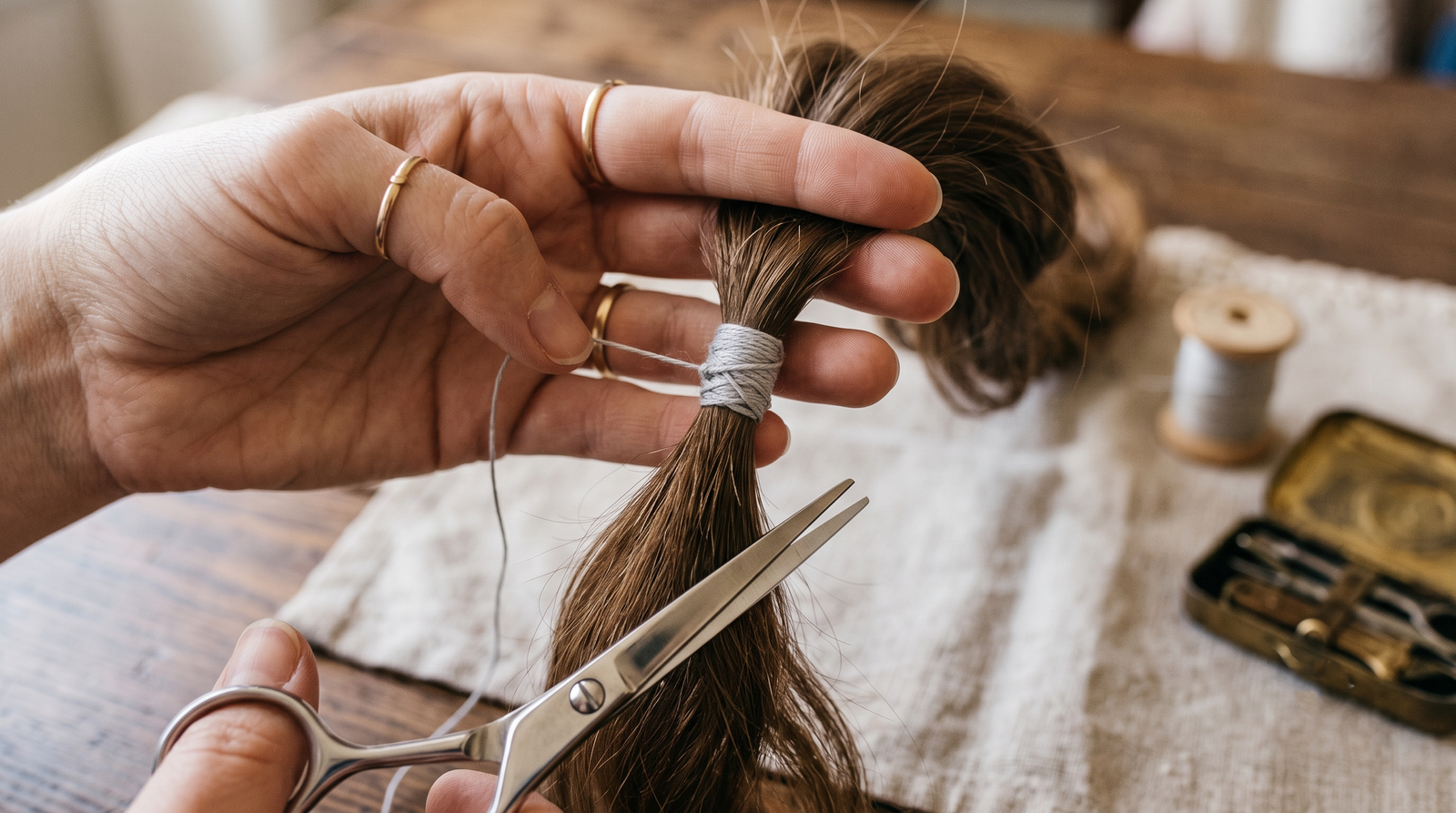
Bind one end with thread first, so it stays a lock rather than loose strands. Cut, don’t pull; take it from underneath at the nape, where the gap won’t show. Keep it whole. The root isn’t needed; the carbon is in the shaft.

Section of hair bound at one end with sewing thread just above the point where it will be cut

Step 5 Package it and post it

Hair into the sealed paper envelope, name and reference on that inner envelope rather than only the outer one, then into the rigid mailer with any provider forms. Post it tracked, and tell the provider it’s coming so receipt is logged the same day.

Horizontal timeline graphic showing five family steps, a handover marker at step five, and seven laboratory steps across six to ten months

Which Step Is the Point of No Return?

Step 4 the structural difference that matters most between the hair route and the ashes route.

With ashes, the irreversible moment comes late at the seal and the handover and if you send too little there is nearly always more ash. With hair it arrives a step earlier, at your own kitchen table: a saved lock is frequently the only one that will ever exist, and a cut that falls short cannot be topped up. So the ordering of steps 3 and 4 isn’t stylistic confirm the amount, then cut, and if the answer is borderline take a smaller carat rather than a bigger cut. Questions worth asking first and how much hair you need cover the rest.

Steps 6–12: What Does the Lab Do?

Step 6 Intake and chain-of-custody logging

Your lock is checked in, weighed against the requirement, and assigned a tracking reference that follows it through every later stage. Ask for it that trail is what supports the certificate of origin.

Step 7 Carbon extraction and purification

The hair is heated in a controlled, oxygen-free, multi-stage process that strips away the non-carbon components of keratin, reaching roughly 99.9%+ carbon purity. Dyed, permed, and grey hair are generally workable, since purification removes everything that isn’t carbon.

Step 8 Graphitization

The purified carbon is heated to roughly 2,500–2,700°C and converted into graphite the crystalline form a growth press uses as feedstock. How a memorial diamond is made from your mother’s hair covers steps 7 to 11 in far more depth.

Step 9 Diamond growth

The graphite, blended with supplemental lab carbon to reach the volume a growth cell needs, goes into an HPHT press with a tiny diamond seed at roughly 6–8 GPa and 1,400–2,500°C. Longest step by a wide margin: weeks to months, set by the carat chosen at step 2. Her carbon becomes a real, verifiable part of the crystal not all of it, and no honest provider claims 100%.

Step 10 Cutting and polishing

A gemologist cuts and polishes the rough crystal into the shape selected. Memorial diamonds trend toward yellow, blue, and champagne because organic carbon carries trace elements into the growth cell; a colour the run doesn’t produce naturally needs post-growth irradiation here, adding time.

Step 11 Grading, certification, and the return of unused hair

The stone is graded on cut, colour, clarity, and carat, ideally by an independent third-party lab, while an in-house origin certificate ties it to your family’s material. Hair the process didn’t consume should come back as standard practice, not on request. The two documents answer different questions: one grades the diamond, the other ties it to your mother.

Step 12 Delivery, then the setting

It arrives loose, in a box, usually smaller than you pictured. A loose stone isn’t wearable, so one decision remains: keep it loose, or set it a pendant, a ring, her own ring reset around it. Settings and jewelry ideas covers the trade-offs.

How Long Does Each Step Take?

Durations are industry-typical, not confirmed turnaround guarantees. Both halves of this column are estimates: providers publish the 6–10 month total, not the breakdown, and the family-side figures reflect ordinary domestic logistics.

StepWhoTypical duration
1. Find the lockFamilyAn afternoon to a few phone calls
2. Choose carat and colourFamilyHours to a week
3. Get the minimum in writingFamilyA few days
4. Cut or gather the lockFamilyAbout 10 minutes — and irreversible
5. Package and post — handoverFamily → lab1–3 days transit
6. Intake and custody loggingLabDays
7. Extraction and purificationLabWeeks
8. GraphitizationLabDays to weeks
9. Diamond growthLabWeeks to months the long one
10. Cutting and polishingLabWeeks
11. Grading, certification, returnsLabWeeks
12. Delivery and settingLab → familyWeeks, if you set it
Steps 6–12 total–6–10 months; up to 12 for stones over ~2 ct or specialty colours

The 6–10 months runs from receipt, not from step 1. For a particular anniversary, count backward from receipt at step 6, then add your own steps 1 to 5 on top of it.

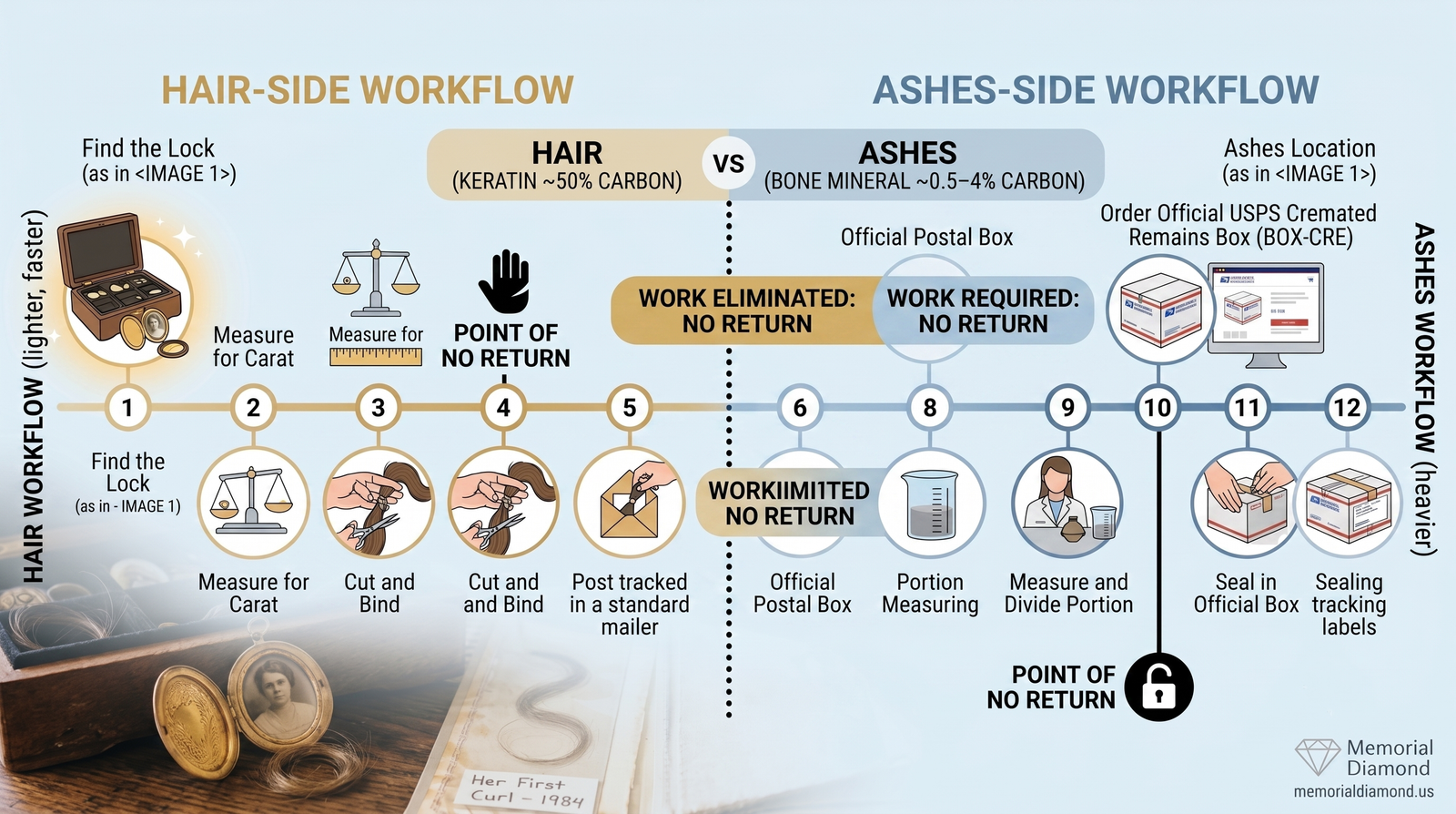
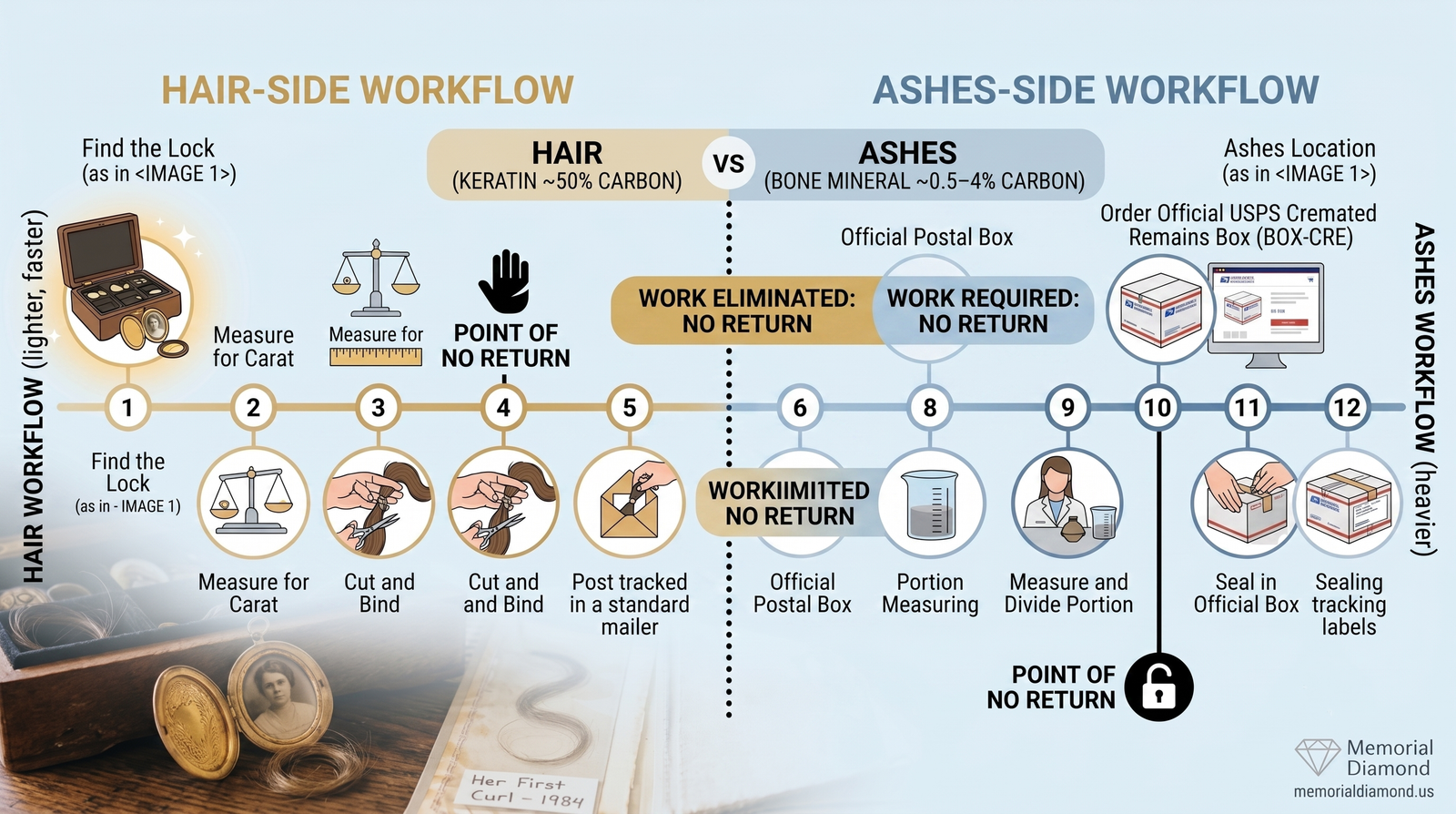
Where Does This Differ From the Ashes Sequence?

The lab half is identical from step 6 onward. The family half is genuinely lighter not in how many numbers it runs to, since the two posts group their steps differently, but in the work itself: hair removes three pieces of it and adds one.

  • Removed: ordering an official postal box. Cremated remains require the USPS Cremated Remains box, orderable online only, forcing days of delay before shipping is possible at all. Hair posts as ordinary mail.
  • Removed: measuring out a portion, and the family agreement gate. Nothing is divided a lock goes whole and where dividing a parent’s cremated remains usually needs everyone’s consent, a saved lock rarely carries the same weight.
  • Added: finding the lock at all. Ashes sit in a known place; hair has to be located, and sometimes doesn’t exist.
  • Moved: the point of no return. From the handover to the cut.

The same sequence for ashes runs the nine-step version, and the complete guide to a mother hair diamond covers treated hair and colour.

Side-by-side comparison of the hair and ashes family-side workflows, marking the postal box and portion-measuring work hair does not have and the point of no return in each

Frequently Asked Questions

Which step am I on if the lock has been in a drawer for twenty years?

Step 1 is done, so start at step 2. Age doesn’t degrade hair for this purpose keratin is stable, and a lock cut decades ago extracts the same as one cut last week.

Can I do step 4 before step 3?

Strongly advise against it. Confirming the minimum takes only a couple of days, while an insufficient cut may be unrecoverable if no second lock exists anywhere. If you have already cut, ask before posting rather than after.

Does the sequence change if my mother was buried rather than cremated?

No every step is identical, because no step involves cremation. That is the practical advantage of the hair route: it stays open to families who chose burial, and to those whose faith rules cremation out.

What if the lock turns out to be too small at step 6?

The lab should flag it at intake rather than growing a failed stone. Options are usually a smaller carat, or a second lock if one exists. Exactly why step 3 comes before step 4.

What if my mother is still living?

Then step 1 is a conversation instead of a search, and she can choose the carat at step 2 herself. Every step after that is unchanged, and she gets to see the finished stone.

Nothing You Do This Week Involves Scissors

Step 1 is a search of a jewelry box and step 3 is an email; between them they cost a few days and nothing else. The only step on this list that cannot be walked back is step 4, and it sits deliberately behind both of them which is the whole reason the sequence is ordered the way it is. If the search turns up nothing, or if the answer ends up being the lock left exactly where she put it, that is a whole answer too.

When you’re ready for step 3, reach out to Memorial Diamond at memorialdiamond.us and ask what amount is needed for the size you have in mind. Get it in writing first. Everything after that is reversible; the cut isn’t.

Untitled (1568 x 1003 px) (2)

How Much Ash and Hair Do You Need for a Mother Memorial Diamond?

An urn on one shelf, an envelope in a drawer, and one stone to be grown from both. Start from this: each material still has to meet its own threshold industry-typically a few tablespoons up to roughly 4 oz of ash, and a small lock or a few grams of hair. No published figure discounts either quantity for the presence of the other.

Plan for both figures in full, ask your provider before you divide or cut anything, and treat any reduction as a bonus rather than a starting point.

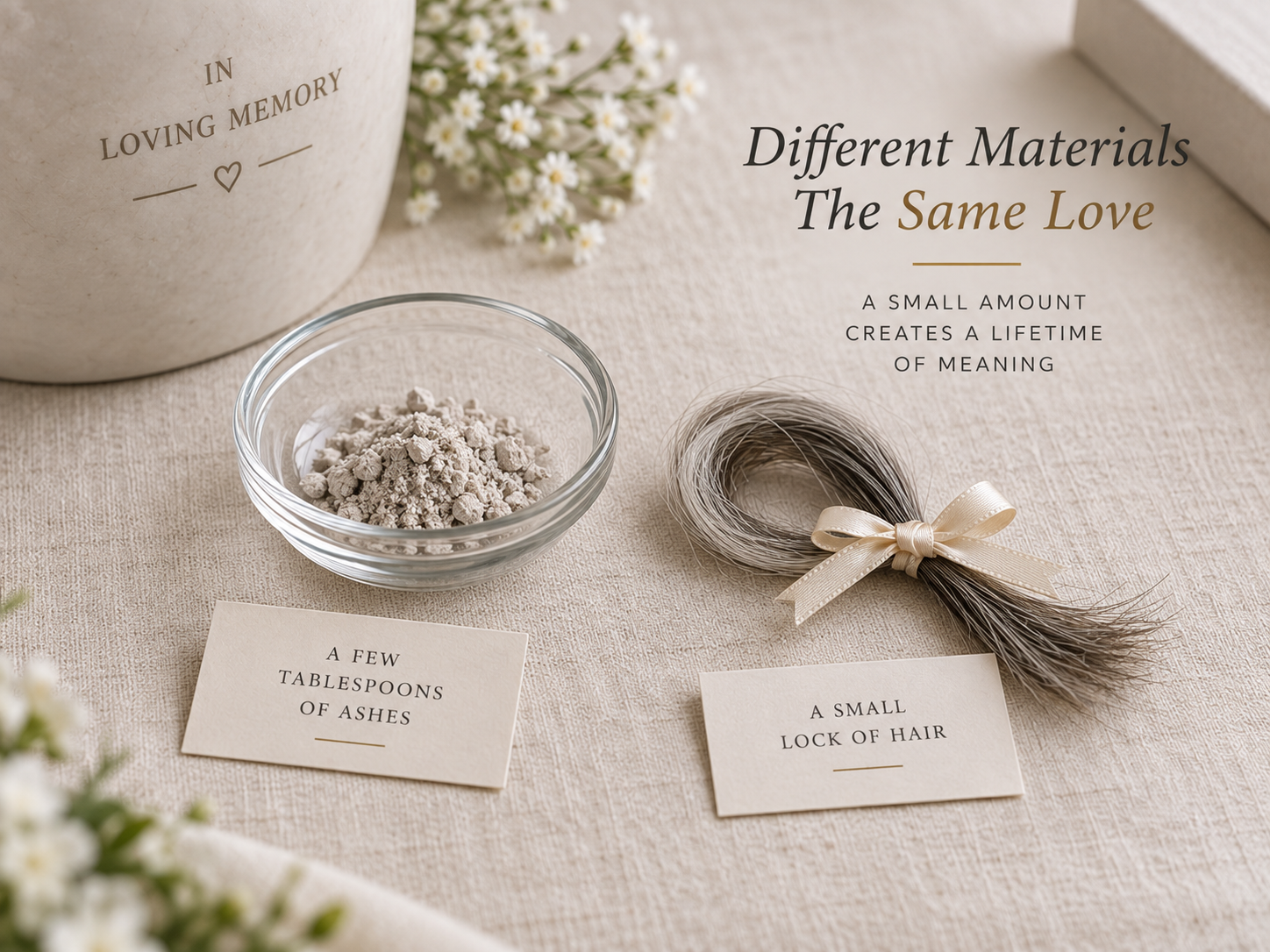
Small portion of cremated ashes in a glass dish beside a ribbon-tied lock of grey hair on a pale linen surface

On this page:

Does Sending Both Mean You Need Less of Each?

Don’t assume it. Two things are genuinely unsettled here, and a family planning around a guess can end up short.

The first is whether a given provider accepts a combined submission at all one stone grown from both an ash portion and a hair portion. The second is whether, if they do, either quantity drops because the other material is present. Neither has a published industry answer, and no number on this page or any other should be treated as one.

What is solid is the shape of the safe plan: assume each material has to arrive in the quantity it would need alone. If a provider then tells you a smaller ash portion works because hair is coming too, you have gained something. Plan it the other way and be wrong, and you have already opened an urn and cut a lock for nothing.

What Does Each Material Require on Its Own?

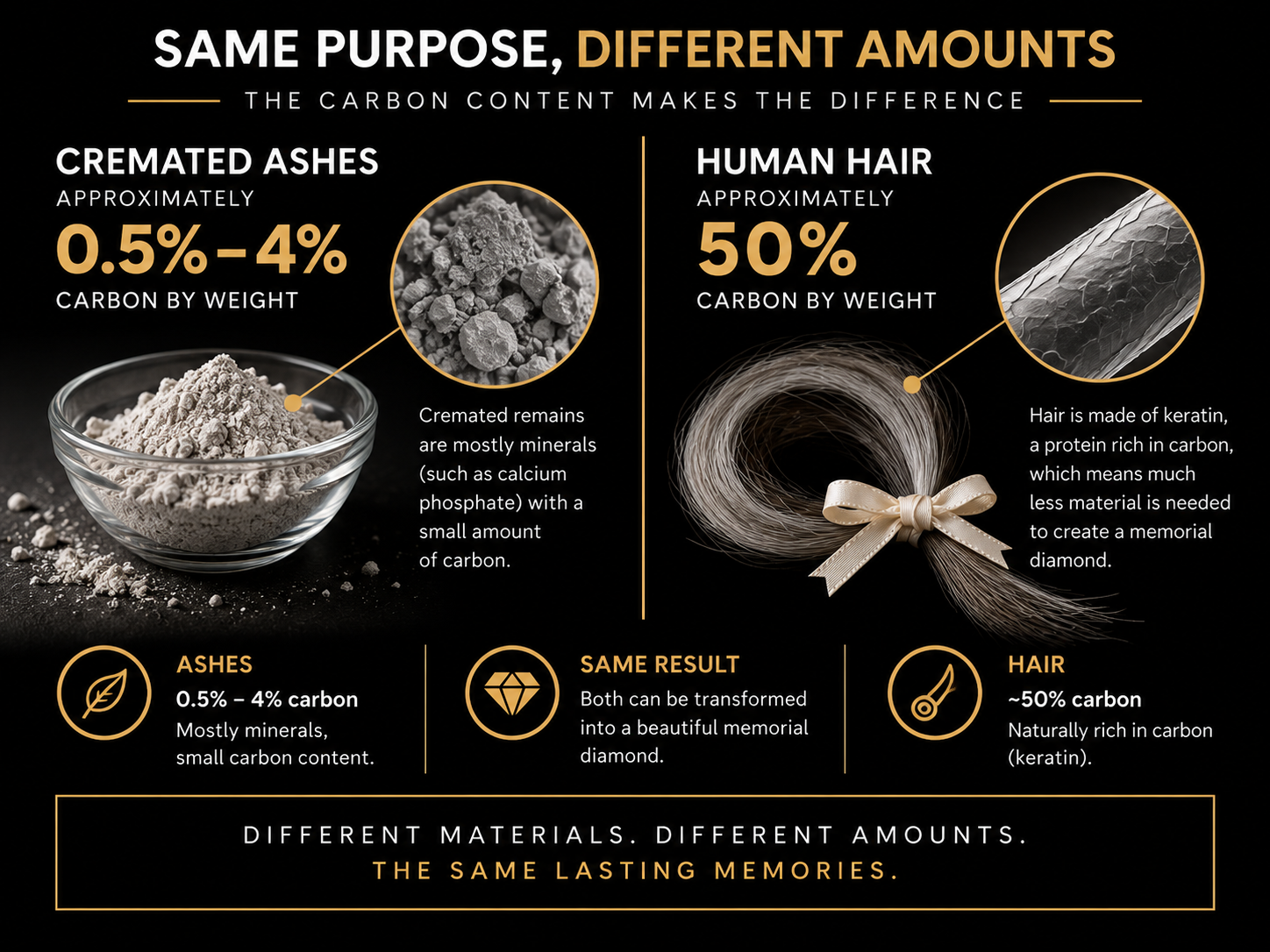
Comparison graphic showing ash at roughly 0.5 to 4 percent carbon beside hair at roughly 50 percent carbon by weight

These are the figures each path uses independently industry-typical ranges rather than any one company’s policy, and the numbers to plan against until a provider tells you otherwise in writing.

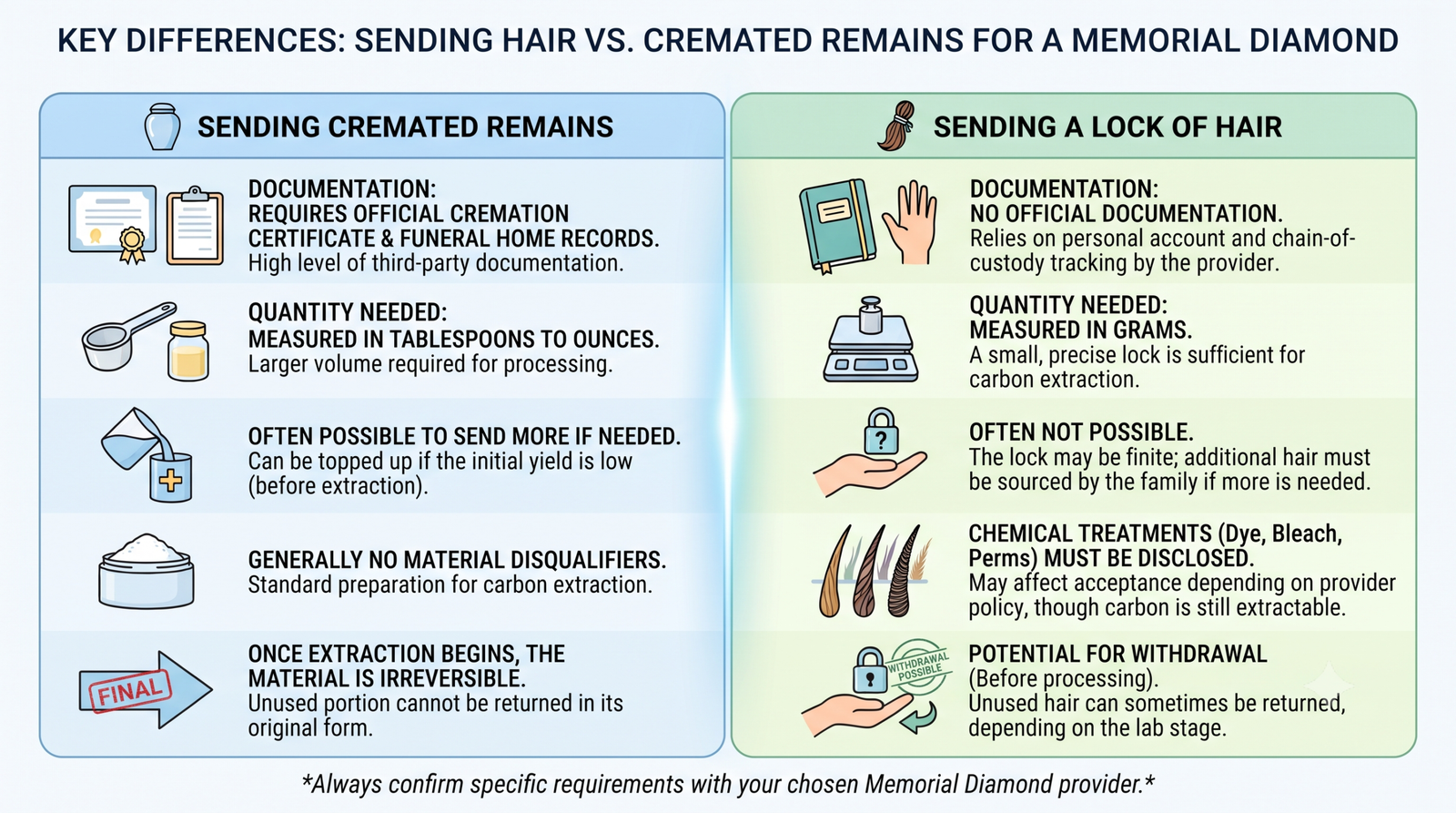
AttributeHer ashesHer hair
Typical quantity requestedA few tablespoons up to ~4 oz (~100g)A small lock or a few grams, often described as palm-sized
Carbon content of the material~0.5–4% by weight~50% by weight
What extraction has to removeCalcium phosphate and other bone mineralsThe non-carbon components of keratin
Cremation requiredYesNo
Where it usually comes fromAn urn, or a portion already set asideA lock kept from a haircut, an illness, or childhood
Does supplying the other reduce it?Not documented ask before you assumeNot documented ask before you assume

Ash gives up its carbon reluctantly because it is mostly bone mineral; hair gives it up readily because keratin is roughly half carbon by weight. How much ash a mother memorial diamond needs and how much hair it needs go deeper on each requirement.

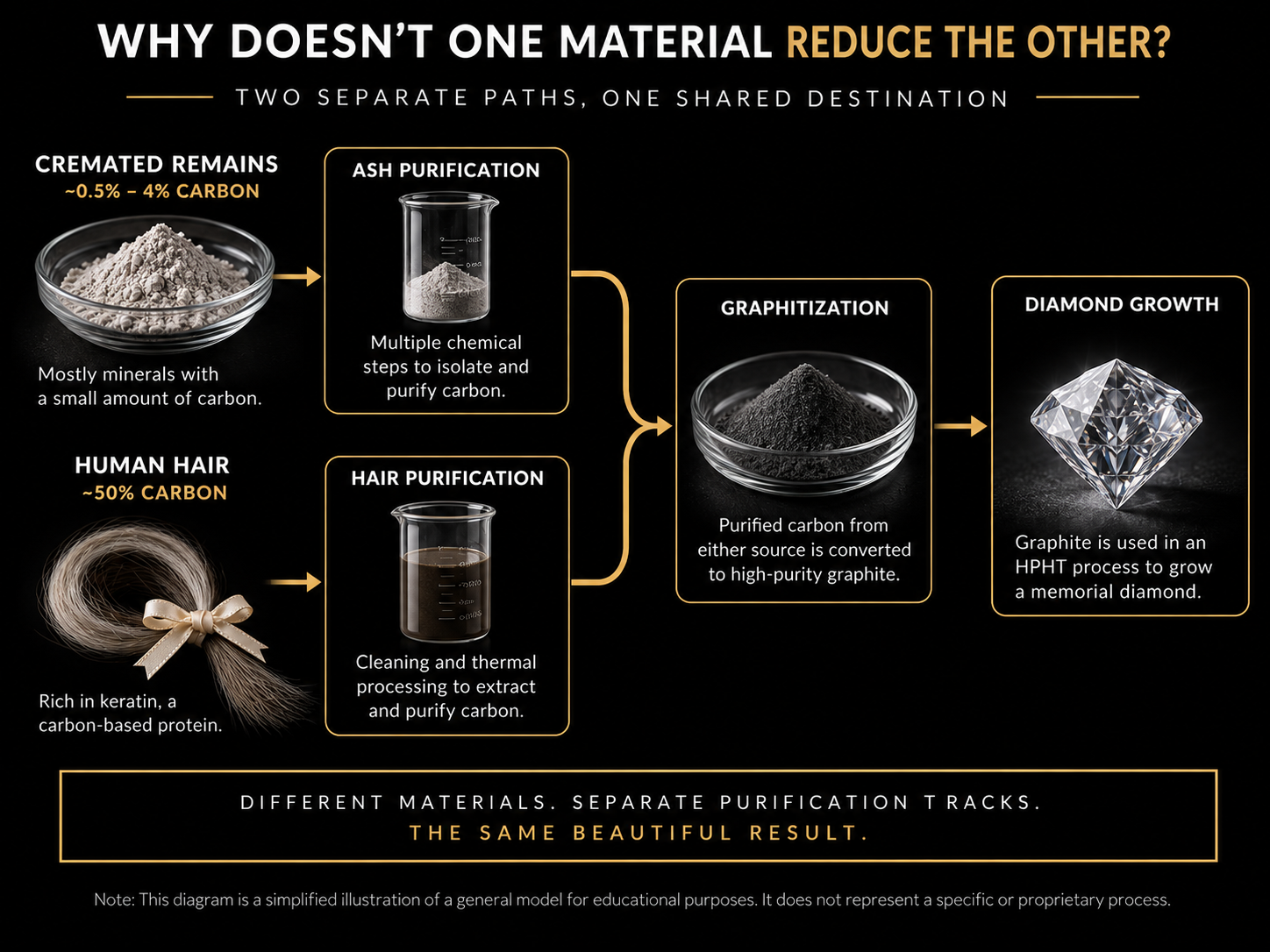
Why Doesn’t One Material Reduce the Other?

Diagram of two separate purification tracks  one for ash, one for hair  converging at graphitization before diamond growth

Because they are not interchangeable inputs arriving at the same door.

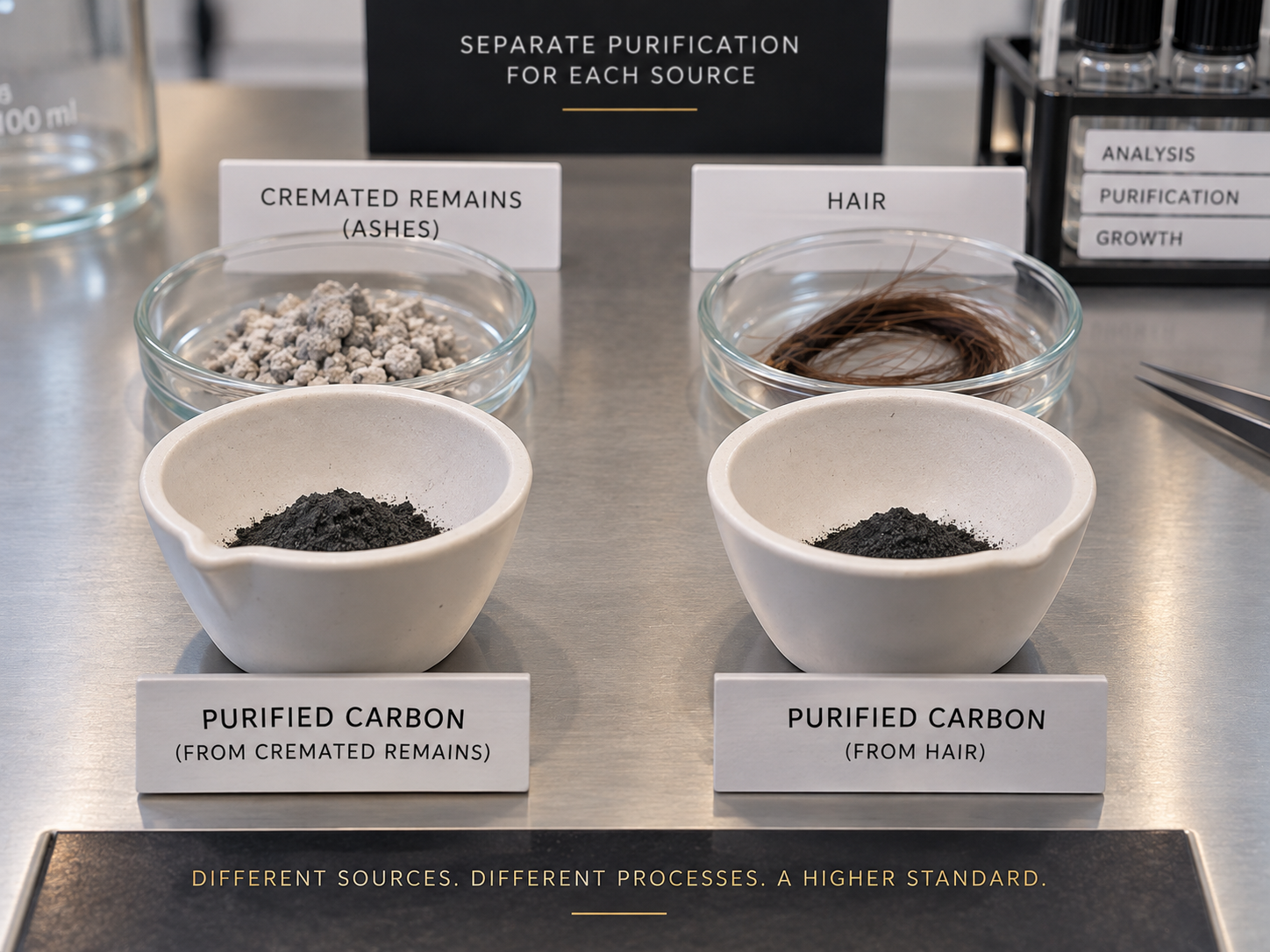
Purifying ash means stripping away a heavy mineral load calcium phosphate makes up almost all of cremated remains, and reaching roughly 99.9% carbon means removing all of it. Purifying hair means removing the non-carbon components of a protein. Different problems, different runs, and a batch of one does not cover a shortfall of the other.

The most defensible mental model is two separate purification tracks meeting later, when the recovered carbon is graphitized and loaded into a growth cell. That model is a reasoned inference rather than a documented standard put it to a provider as a direct question rather than assuming it.

Certain either way: whatever is recovered from both is still blended with lab-sourced carbon to reach the volume a growth cell needs. No memorial diamond is 100% the person, from one material or two. Whether a diamond is really made from her ashes and hair covers that honestly.

Does Sending Both Make a Bigger or Faster Diamond?

No. The press keeps its own schedule.

Carat size is set by how long a crystal grows under pressure industry-typically about 6 to 10 months for most stones, and up to roughly 12 for larger or specialty ones. Once the growth cell has enough feedstock to run, neither the quantity nor the variety of material shortens that clock or enlarges the result. Two materials do not double anything.

So the honest reason to send both is not size and not speed. Families do it because both things exist and both feel like her: ashes from the cremation, and a lock cut long before anyone was thinking about any of this. That needs no technical justification bolted on. Turning your mother’s ashes and hair into a diamond walks through what that order looks like.

One practical consequence is worth knowing. Because carat doesn’t depend on volume, a family with both materials often has enough for more than one stone a sibling each, or an ash-based stone and a hair-based stone kept separate rather than combined. Ask about that before assuming a single combined diamond is the only shape this can take.

What Should You Ask Before You Divide Anything?

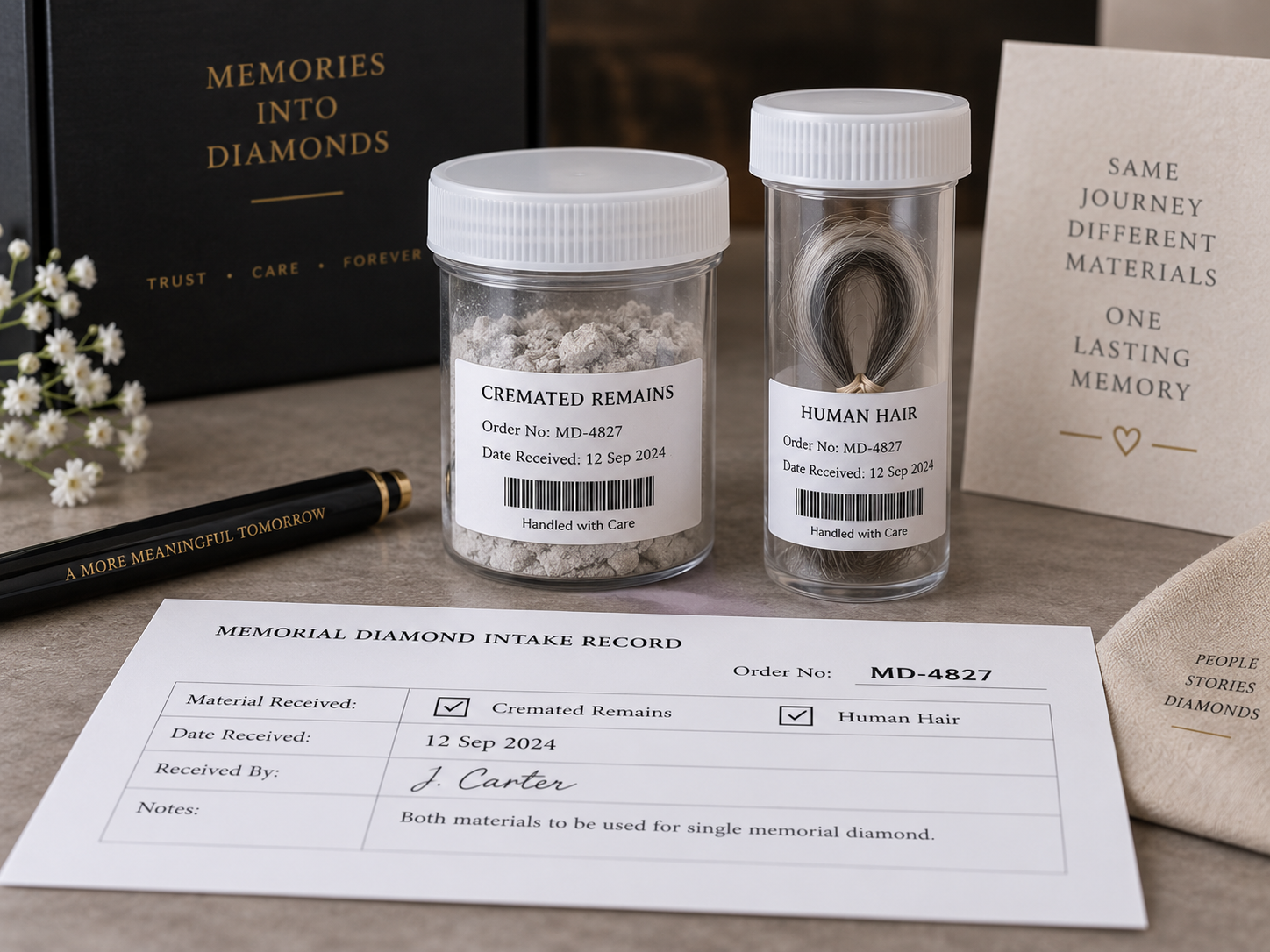
Two labeled intake containers, one holding cremated remains and one holding a lock of hair, logged against a single order reference

Every one of these is a question to answer before an urn is opened or a lock is cut.

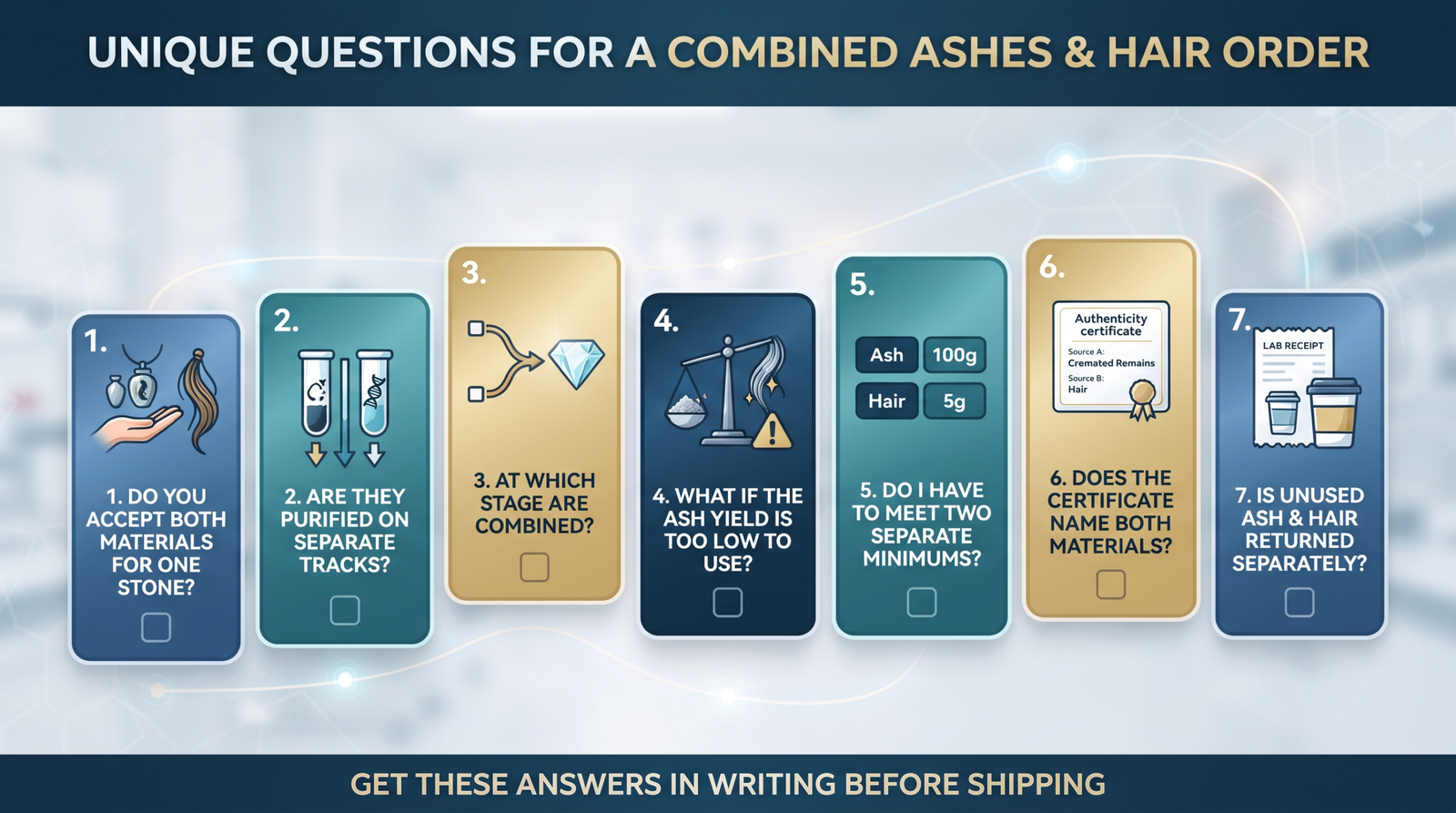
  1. Do you accept ashes and hair on the same order? Get a yes or no in writing before planning anything else. Some providers may treat these as separate products.
  2. If yes, does either quantity requirement change? Ask specifically whether the ash portion can be smaller because hair is included, and whether the hair requirement moves. Take “it depends” as a no until it is written down.
  3. Are they purified separately and then combined, or is one used as the primary source? This determines whether both materials genuinely end up in the stone or whether one is effectively a backup.
  4. If only one is ultimately used, which, and what happens to the other? Ask before, not after. The answer should be that unused material is returned by default.
  5. How is each material tracked? Two materials means two chains of custody meeting at one order number. Ask how they stay linked how companies track a loved one’s ashes sets out good practice.
  6. Could this be two stones instead of one? Worth asking even if it changes nothing, because it reframes the decision for a family with more than one person who wants something.
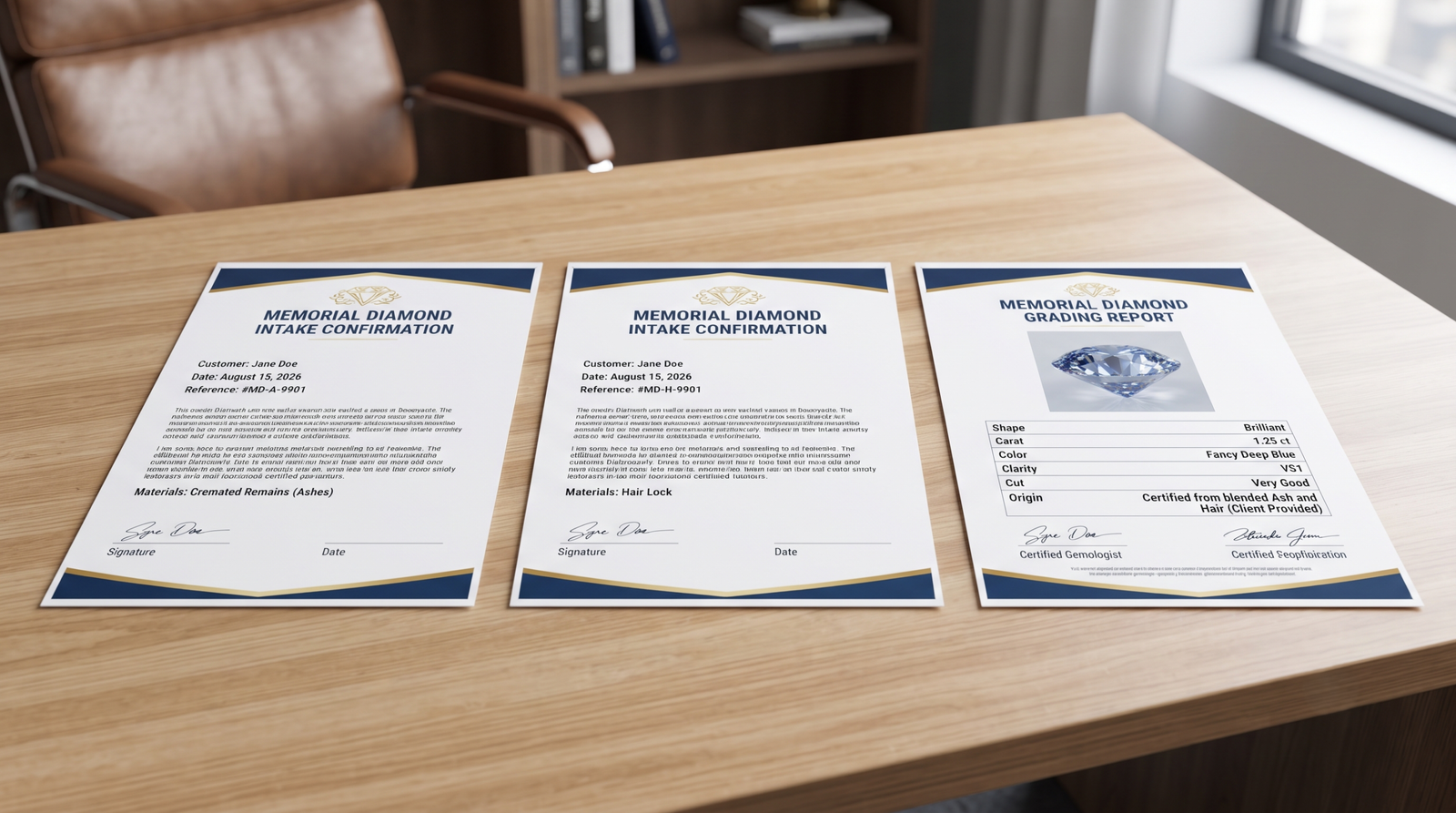
  7. What documentation arrives, and does it name both materials? An origin certificate mentioning only ashes, on a stone you supplied hair for, is a problem best discovered before ordering.

Ask all seven in one message. A provider who answers them plainly is telling you something useful; so is one who doesn’t.

Frequently Asked Questions

If I send hair too, can I send less of her ashes?

Possibly, but don’t plan on it. No published industry figure discounts one material for the presence of the other, so the safe plan is that each meets its own threshold. Ask your provider directly and get the answer in writing.

Will a diamond made from both be bigger than one made from ashes alone?

No. Two materials fill the same growth cell one would, and what happens next is measured in months rather than milligrams a combined stone reaches a given carat on exactly the schedule an ashes-only stone does.

Should I send both, or pick one?

Either is valid, and the decision is personal rather than technical. Some families combine them because both feel like her; others keep them separate so a sibling can have a hair-based stone. Ashes to diamond versus hair to diamond lays out the trade-offs.

Can I use hair if her ashes have already been scattered or interred?

Yes. Hair needs no cremation and no urn, so a kept lock works as a complete starting point on its own. That path stays open even when nothing else does including for a mother who was buried rather than cremated.

Do both materials show up on the certificate?

Ask before ordering. Documentation practice varies, and a certificate that records only one of two submitted materials is worth catching in advance. Request that both are named, and confirm what happens to anything unused.

Is it worth combining if a lock of hair is all I have?

There is no need to combine anything. A small lock of hair is a complete starting point by itself hair is roughly 50% carbon by weight, and no ash is required to make it work. Combining is an option, never a requirement.

Before You Open the Urn or Cut the Lock

Every question on this page can be answered before an urn is opened or a single strand is cut. That is the whole reason to ask them now rather than after the paperwork is reversible and the material is not.

Send them to Memorial Diamond at memorialdiamond.us before anything is divided, and ask what’s needed for each material, what comes back, and what the certificate will say. The complete guide to a mother ashes and hair diamond and what to ask before turning her ashes and hair into a diamond cover the rest.

An urn on one shelf, an envelope in a drawer, and one stone to be grown from both. Start from this: each material still has to meet its own threshold industry-typically a few tablespoons up to roughly 4 oz of ash, and a small lock or a few grams of hair. No published figure discounts either quantity for the presence of the other.

Plan for both figures in full, ask your provider before you divide or cut anything, and treat any reduction as a bonus rather than a starting point.

On this page:

Does Sending Both Mean You Need Less of Each?

Don’t assume it. Two things are genuinely unsettled here, and a family planning around a guess can end up short.

The first is whether a given provider accepts a combined submission at all one stone grown from both an ash portion and a hair portion. The second is whether, if they do, either quantity drops because the other material is present. Neither has a published industry answer, and no number on this page or any other should be treated as one.

What is solid is the shape of the safe plan: assume each material has to arrive in the quantity it would need alone. If a provider then tells you a smaller ash portion works because hair is coming too, you have gained something. Plan it the other way and be wrong, and you have already opened an urn and cut a lock for nothing.

What Does Each Material Require on Its Own?

These are the figures each path uses independently industry-typical ranges rather than any one company’s policy, and the numbers to plan against until a provider tells you otherwise in writing.

AttributeHer ashesHer hair
Typical quantity requestedA few tablespoons up to ~4 oz (~100g)A small lock or a few grams, often described as palm-sized
Carbon content of the material~0.5–4% by weight~50% by weight
What extraction has to removeCalcium phosphate and other bone mineralsThe non-carbon components of keratin
Cremation requiredYesNo
Where it usually comes fromAn urn, or a portion already set asideA lock kept from a haircut, an illness, or childhood
Does supplying the other reduce it?Not documented — ask before you assumeNot documented — ask before you assume

Ash gives up its carbon reluctantly because it is mostly bone mineral; hair gives it up readily because keratin is roughly half carbon by weight. How much ash a mother memorial diamond needs and how much hair it needs go deeper on each requirement.

Why Doesn’t One Material Reduce the Other?

Because they are not interchangeable inputs arriving at the same door.

Purifying ash means stripping away a heavy mineral load calcium phosphate makes up almost all of cremated remains, and reaching roughly 99.9% carbon means removing all of it. Purifying hair means removing the non-carbon components of a protein. Different problems, different runs, and a batch of one does not cover a shortfall of the other.

The most defensible mental model is two separate purification tracks meeting later, when the recovered carbon is graphitized and loaded into a growth cell. That model is a reasoned inference rather than a documented standard put it to a provider as a direct question rather than assuming it.

Certain either way: whatever is recovered from both is still blended with lab-sourced carbon to reach the volume a growth cell needs. No memorial diamond is 100% the person, from one material or two. Whether a diamond is really made from her ashes and hair covers that honestly.

Does Sending Both Make a Bigger or Faster Diamond?

No. The press keeps its own schedule.

Carat size is set by how long a crystal grows under pressure industry-typically about 6 to 10 months for most stones, and up to roughly 12 for larger or specialty ones. Once the growth cell has enough feedstock to run, neither the quantity nor the variety of material shortens that clock or enlarges the result. Two materials do not double anything.

So the honest reason to send both is not size and not speed. Families do it because both things exist and both feel like her: ashes from the cremation, and a lock cut long before anyone was thinking about any of this. That needs no technical justification bolted on. Turning your mother’s ashes and hair into a diamond walks through what that order looks like.

One practical consequence is worth knowing. Because carat doesn’t depend on volume, a family with both materials often has enough for more than one stone a sibling each, or an ash-based stone and a hair-based stone kept separate rather than combined. Ask about that before assuming a single combined diamond is the only shape this can take.

What Should You Ask Before You Divide Anything?

Every one of these is a question to answer before an urn is opened or a lock is cut.

  1. Do you accept ashes and hair on the same order? Get a yes or no in writing before planning anything else. Some providers may treat these as separate products.
  2. If yes, does either quantity requirement change? Ask specifically whether the ash portion can be smaller because hair is included, and whether the hair requirement moves. Take “it depends” as a no until it is written down.
  3. Are they purified separately and then combined, or is one used as the primary source? This determines whether both materials genuinely end up in the stone or whether one is effectively a backup.
  4. If only one is ultimately used, which, and what happens to the other? Ask before, not after. The answer should be that unused material is returned by default.
  5. How is each material tracked? Two materials means two chains of custody meeting at one order number. Ask how they stay linked how companies track a loved one’s ashes sets out good practice.
  6. Could this be two stones instead of one? Worth asking even if it changes nothing, because it reframes the decision for a family with more than one person who wants something.
  7. What documentation arrives, and does it name both materials? An origin certificate mentioning only ashes, on a stone you supplied hair for, is a problem best discovered before ordering.

Ask all seven in one message. A provider who answers them plainly is telling you something useful; so is one who doesn’t.

Frequently Asked Questions

If I send hair too, can I send less of her ashes?

Possibly, but don’t plan on it. No published industry figure discounts one material for the presence of the other, so the safe plan is that each meets its own threshold. Ask your provider directly and get the answer in writing.

Will a diamond made from both be bigger than one made from ashes alone?

No. Two materials fill the same growth cell one would, and what happens next is measured in months rather than milligrams a combined stone reaches a given carat on exactly the schedule an ashes-only stone does.

Should I send both, or pick one?

Either is valid, and the decision is personal rather than technical. Some families combine them because both feel like her; others keep them separate so a sibling can have a hair-based stone. Ashes to diamond versus hair to diamond lays out the trade-offs.

Can I use hair if her ashes have already been scattered or interred?

Yes. Hair needs no cremation and no urn, so a kept lock works as a complete starting point on its own. That path stays open even when nothing else does including for a mother who was buried rather than cremated.

Do both materials show up on the certificate?

Ask before ordering. Documentation practice varies, and a certificate that records only one of two submitted materials is worth catching in advance. Request that both are named, and confirm what happens to anything unused.

Is it worth combining if a lock of hair is all I have?

There is no need to combine anything. A small lock of hair is a complete starting point by itself hair is roughly 50% carbon by weight, and no ash is required to make it work. Combining is an option, never a requirement.

Before You Open the Urn or Cut the Lock

Every question on this page can be answered before an urn is opened or a single strand is cut. That is the whole reason to ask them now rather than after the paperwork is reversible and the material is not.

Send them to Memorial Diamond at memorialdiamond.us before anything is divided, and ask what’s needed for each material, what comes back, and what the certificate will say. The complete guide to a mother ashes and hair diamond and what to ask before turning her ashes and hair into a diamond cover the rest.

Ceramic urn on a shelf beside a small memorial diamond in an open case

Mother Memorial Diamond vs. Traditional Urn: What to Know

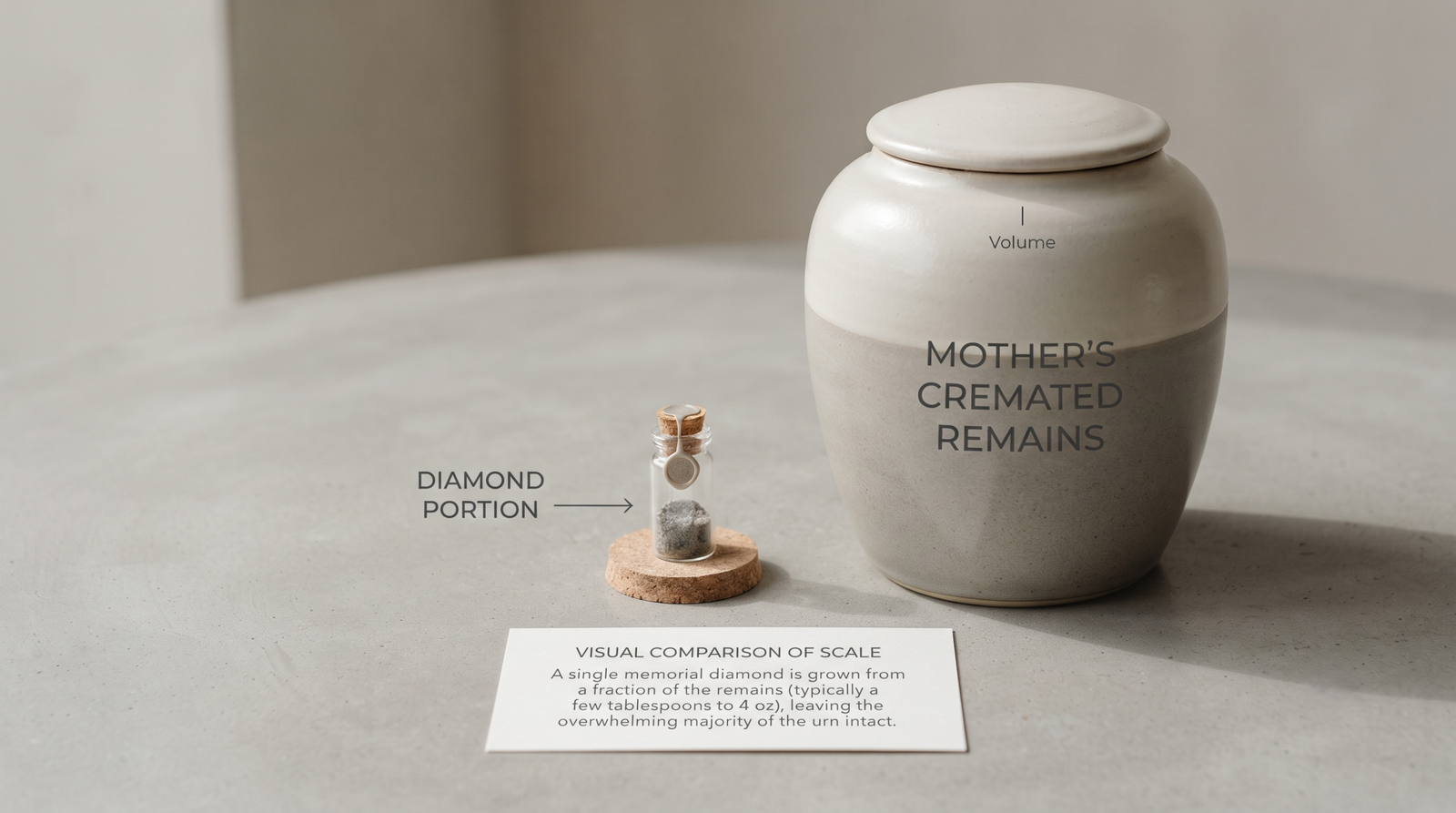
A memorial diamond is grown from a small fraction of a cremation, typically a few tablespoons to around 4 oz. That single number is why the comparison is so rarely an either/or choice: the urn on the shelf generally survives the decision intact.

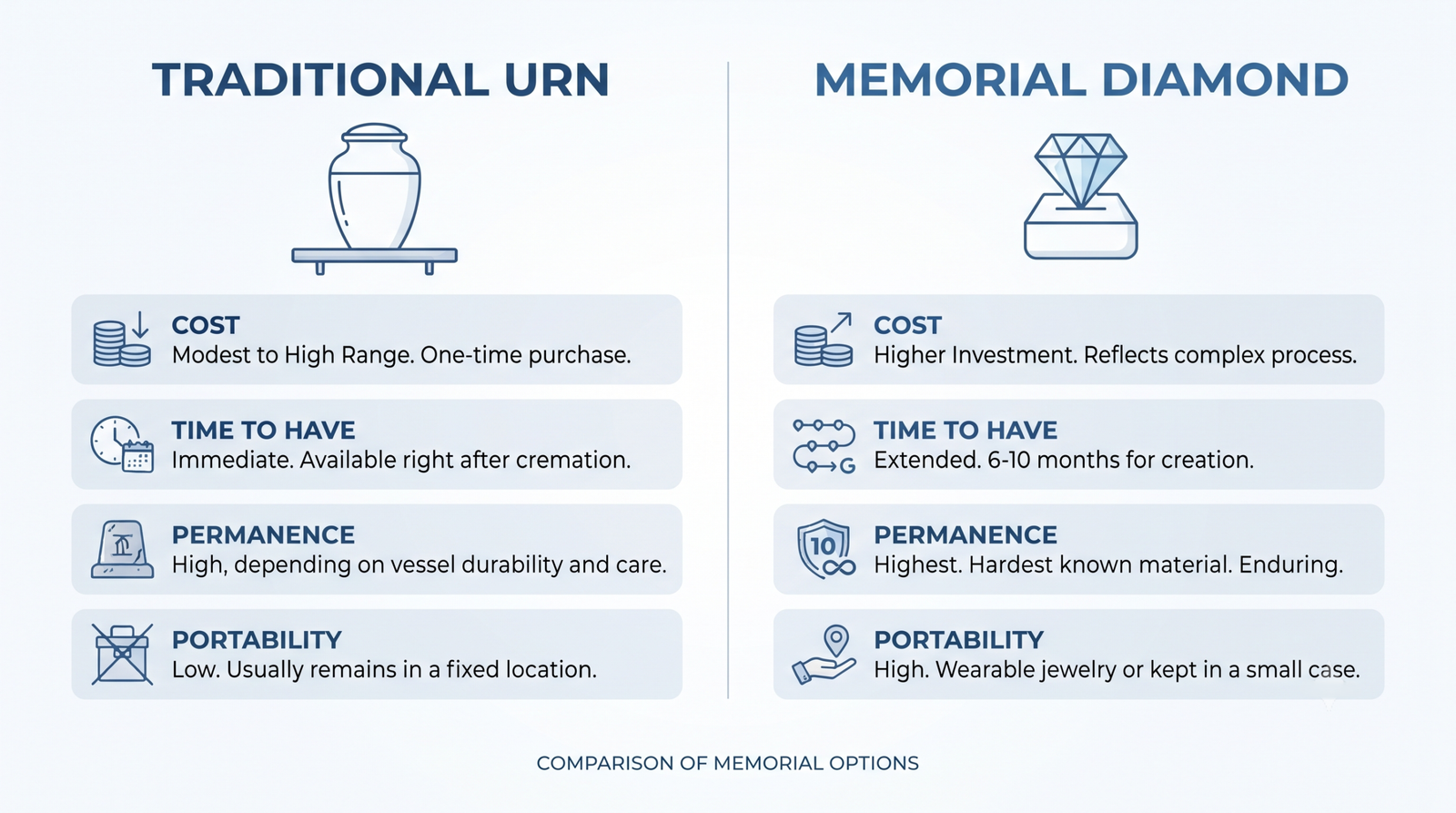
Where the two genuinely differ is in cost, time, portability, divisibility, and what happens to each in fifty years. An urn is immediate, inexpensive, whole, and reversible. A diamond takes the better part of a year, costs thousands, is wearable, and cannot be undone.

Disclosure: memorialdiamond.us is a company that makes memorial diamonds. This page compares two options honestly, including where an urn is the better answer, but it is not written by a neutral third party.

What Is Actually Being Compared?

A traditional urn holds the whole of a person’s cremated remains in one container in one place, such as a home, a columbarium niche, or a grave. It requires no further decision, costs comparatively little, and can be revisited because ashes can later be scattered, interred, divided, or used for something else.

A memorial diamond is a real lab grown diamond, chemically identical to any other diamond, grown in part from carbon extracted from a portion of those remains. It takes 6 to 10 months of production, costs thousands, and is portable and wearable. It is also irreversible, as the extracted carbon cannot become ash again, explained further under how a memorial diamond is made from your mother’s ashes.

How Do They Compare Directly?

Traditional urnMemorial diamond
How much of her it holdsAll of the remainsCarbon from a small portion; typically around 10 to 15 percent of the finished stone is her own carbon, blended with lab carbon
CostSubstantially less than a memorial diamond; urns span a wide range and are widely available at modest costRoughly $750 at entry weights and scaling upward depending on the bracket
Time to have itImmediate6 to 10 months of production, longer end to end
Where it livesA shelf, a niche, a graveWorn, carried, or kept in a case
Can several people have one?One object, one locationSeveral stones from one submission, usually
Reversible?Yes, can be scattered or interred laterNo, extraction is permanent
DurabilityDepends on the vessel and where it is keptHardest known material, 10 on the Mohs scale, the same as any mined diamond
Needs a decision from the next generation?Yes, eventuallyYes, but it is a jewellery decision rather than a remains decision
Requires cremation?YesNot if hair is used instead
Comparison graphic of an urn and a memorial diamond across cost, time, permanence and portability

Why Is This Rarely an Either/Or Choice?

Because the quantities do not conflict. A family that commissions a diamond from a few tablespoons of ashes still has the overwhelming majority of the cremation available for whatever they had planned: the urn on the shelf, the scattering at a place she loved, or interment beside her husband, as reviewed under how much ash you need.

That is the single most useful thing to know before weighing the two, and it dissolves most of the argument. The realistic decision is not urn or diamond; it is whether to also do this, using a portion, while everything else proceeds as planned.

The exception is a family whose ashes have already been fully scattered or interred. There, the question becomes whether any hair exists, since a hair based diamond needs no cremated remains at all, detailed under how to turn your mother’s hair into a diamond.

Small sealed container of cremated remains beside a mostly full urn, showing the scale of the portion used

When Is an Urn the Better Answer?

  • When the family wants her kept whole, in one place, undivided. That is a coherent and widely held position, not a failure of imagination.
  • When cost matters. An urn is affordable in a way a grown diamond is not, and there is no version of a memorial diamond that competes on price.
  • When a decision is needed now. A diamond cannot exist for months; a memorial service happens next week.
  • When there is disagreement. An urn keeps every option open, including a diamond later.
  • When the burial or columbarium arrangement is already settled and dividing the remains would unsettle it.

When Is a Diamond the Better Answer?

  • When more than one person wants something of her, and a single urn cannot be in several homes.
  • When someone wants her with them rather than in a room they visit.
  • When there was no cremation, and a lock of hair is what exists.
  • When an urn has become difficult to live with, as some families find a container of remains in the house harder than they expected, and a stone offers a different kind of presence.
  • When it is intended to outlast the arrangements. Vessels get moved, homes get sold, and niches get relocated, though a small stone is also far easier to lose than an urn, which makes this a trade rather than a straight advantage.
Memorial diamond kept with its origin certificate and grading report in a document folder

What Happens to Each in Fifty Years?

This dimension gets less attention than cost and time, and it is the one that only becomes visible later.

An urn eventually requires someone else to make a decision about it: a grandchild who inherits a container of a person they may not have met and must choose whether to keep it, inter it, or scatter it. That is not an argument against urns; it is simply the obligation that comes with them.

A diamond passes into the ordinary category of inherited jewellery, where the rules are already understood. It can be worn, kept, or passed on without anyone having to decide about remains, and its provenance travels with its paperwork, as explored under memorial diamonds as a family heirloom.

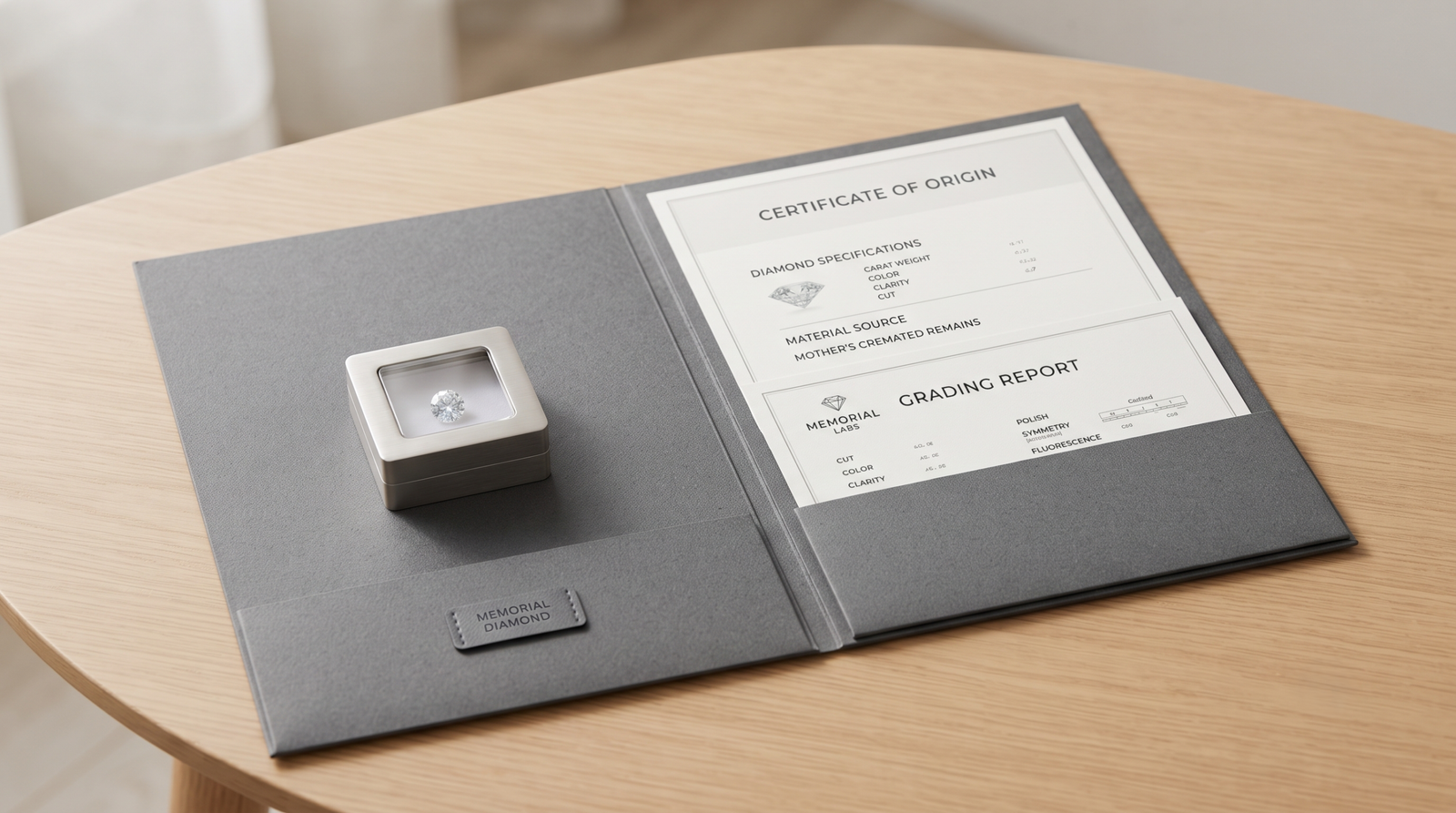
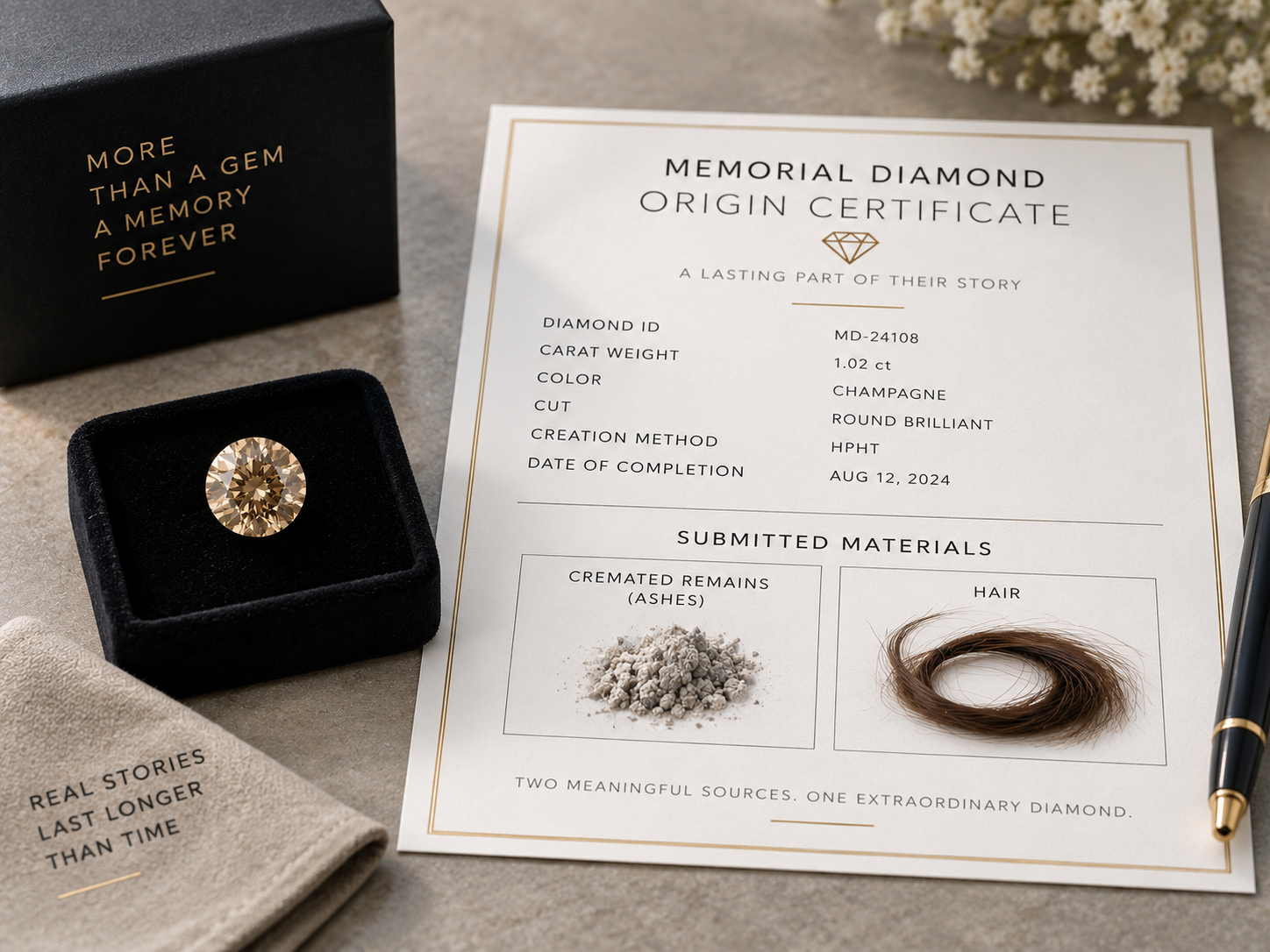
Both need someone to know what they are. A stone with no documentation is just a stone in fifty years, which is an argument for keeping the origin certificate and grading report with it.

Religious and Cultural Considerations

Worth naming honestly rather than skipping: no religious tradition has an official position on memorial diamonds specifically. What traditions address is cremation, and in some cases the dividing of ashes. Two of them bear directly on this particular comparison.

Catholic: Current guidance from the Vatican’s Dicastery for the Doctrine of the Faith permits cremation but directs that ashes be kept intact in a sacred, church approved place rather than divided among family or kept privately at home, with a narrow allowance for a “minimal part” under specific conditions. Whether that allowance extends to a memorial diamond is a question for your own parish.

Islamic: Cremation itself is considered impermissible across all major schools of Islamic thought in ordinary circumstances. That is why a hair based diamond, which requires no cremation at all, sits outside the objection entirely rather than needing to be reconciled with it.

Memorial diamond kept with its origin certificate and grading report in a document folder

Elsewhere the picture varies by movement, community, and individual clergy rather than by fixed rule. Orthodox and Conservative Judaism generally prohibit cremation while Reform Judaism does not. Hindu practice centres on cremation followed by immersion of ashes, with keeping a small portion described as an increasingly common practice rather than a doctrinal controversy. Buddhist traditions predominantly cremate and hold their own relic tradition, and teachers differ on how a memorial diamond sits with teaching on non attachment. Protestant and Evangelical traditions are generally neutral on method, with most mainline clergy raising no objection.

Where this matters to your family, the person to ask is your own clergy, not a jewellery company.

Frequently Asked Questions

Do I have to choose between keeping her ashes and having a diamond?

Almost never. A memorial diamond uses a small fraction of a cremation, so the remainder can still be kept in an urn, interred, or scattered exactly as planned. Families who assume it is all or nothing are usually deciding against something that was never required.

Is a diamond a more permanent memorial than an urn?

The stone is more durable. Diamond is the hardest known material, lab grown or mined. Whether that makes it a better memorial is a family’s judgment rather than a fact, and an urn kept carefully can last generations too.

Can we start with an urn and decide about a diamond later?

Yes. Cremated remains do not deteriorate, so a decision made in five years is exactly as available as one made now, provided the ashes have not been fully scattered or interred in the meantime.

Is it disrespectful to divide her ashes?

Views differ genuinely by faith, family, and person, and this is not a question a company should answer for you. What can be said factually is that dividing remains is common practice in many families and prohibited or discouraged in some traditions.

What if the ashes are already interred?

Then a hair based memorial diamond is the remaining route, if any hair was kept. It requires no cremated remains and no exhumation, which is also why it works for families where there was never a cremation at all.

Does a memorial diamond replace a grave or a place to visit?

Only if a family wants it to. Many keep both, and some deliberately keep the visiting place precisely because a wearable stone does a different job: it is with you rather than somewhere you go.

It Is Rarely One or the Other

The honest framing is not which one, but whether to add a portion to what you have already decided. If your family has settled on an urn, a niche, or a scattering, none of that has to change for a memorial diamond to be possible. The number that settles it is the quantity required for the size you have in mind. Get the details from us at memorialdiamond.us, then weigh it against what you actually hold.

Three memorial diamonds of slightly different tones laid side by side on a neutral surface

Can More Than One Family Member Get a Diamond From the Same Mother’s Ashes?

Four stones grown from the same mother will not match each other. That is the fact worth having before anything else, because it is the one that causes trouble later. The answer to the question itself is yes, one portion of a mother’s cremated remains can usually supply several memorial diamonds, one for each family member who wants one, but each stone is grown in its own run, priced individually rather than divided, and will differ from its siblings in colour and character.

Is One Portion of Her Ashes Really Enough for Several Diamonds?

Usually, yes, and by a wide margin. A single memorial diamond typically needs somewhere between a few tablespoons and around 4 oz of cremated remains, which is a small fraction of a full cremation, so three or four stones still draw on a minority of a typical cremation. At the top of that range, though, four stones can mean the better part of a pound rather than a few ounces: ask for the per-stone figure and multiply it yourself before committing, as outlined under how much ash you need.

Two points that surprise people:

  • Each stone generally needs its own quantity of material. Four stones is not one portion split four ways; ask whether the provider requires four times the minimum or something less.
  • Sending more does not buy bigger stones. Each stone’s size is chosen when it is ordered, and sending less than the minimum means the order cannot proceed until more arrives.

Each stone is her carbon blended with supplemental lab carbon, typically around 10 to 15 percent personal carbon by mass across the industry. Several stones do not divide her between them, as each carries the same real fraction.

The same is broadly true of hair, with one important difference: a lock is finite in a way an urn usually is not, and dividing a small lock between two orders can leave neither viable, detailed further under how much hair you need.

Two memorial diamonds from the same submission showing different yellow and champagne tones

Will the Stones Look the Same?

No, and this is worth saying to everyone involved before any money is spent.

Colour in a memorial diamond comes from trace elements carried in on an organic, personal carbon source, and those elements are neither evenly distributed nor precisely controllable. Two stones grown from the same submission, in separate runs, can come out visibly different in tone, explained under what color will a diamond from her ashes be.

They can also be deliberately different: some families choose different cuts or sizes for each person on purpose, which turns an unavoidable variation into an intended one. What causes friction is expecting a matched set and receiving four individuals.

What Does It Cost for Three or Four People?

Each stone is a separate commissioned growth run, so the cost is multiplied rather than shared.

ScenarioHow it is pricedPractical note
Four stones, same sizeFour times the single-stone price, broadlyAsk whether any multi-stone allowance exists, as it is a fair question
Four smaller stones instead of one largeConsiderably less than one large stone, in totalPrice rises steeply with carat, so four quarter-carats cost far less than one two-carat
One stone, shared ownershipOne priceRare in practice, because someone still has to hold it
Stones ordered years apartFull price each timeNothing about the first order reduces the second
Four quarter-carat stones beside one two-carat stone for scale

Entry-tier stones at 0.10 to 0.25 carats run roughly $750 and scale upwards, which is what makes several smaller stones a realistic option where one large one would not be, as reviewed under what a mother memorial diamond costs.

Should You Place One Order or Several?

One order, several stonesSeparate orders
Material handlingOne shipment, one intake, one custody recordEach person sends their own portion
TimelineAll finish togetherEach runs on its own clock
PaymentOne payer, usually reimbursedEach pays for their own
Family frictionConcentrated in one conversation upfrontSpread out, and easier for someone to opt out later
ConsistencyGrown in the same period, though still not matchingMore variation still

A single order is usually simpler, and its real advantage is that the ashes are handled and shipped once rather than three times.

What Should a Family Agree Before Ordering?

Six things, and none of them are about diamonds:

  • Who holds the ashes now, and who is authorising this. In many families that is one person, and the others are being consulted rather than deciding.
  • That the stones will differ. Say it out loud, before anyone pictures a matched set.
  • Who gets which, if the sizes or colours differ, decided in advance or by an agreed method rather than on the day they arrive.
  • Who pays for what, and whether one person is fronting the total.
  • What happens to the remaining ashes, since a memorial diamond uses a fraction and the original plan for the rest can proceed unchanged.
  • Whether anyone objects at all, keeping in mind that a no is allowed to stand, as discussed in how to talk to family about a mother memorial diamond.
Adult siblings talking across a kitchen table with documents between them

What If Someone Decides They Want One Later?

Usually possible, and worth planning for rather than treating as a problem. Cremated remains do not deteriorate, so a sibling who says no this year can say yes in five years, provided enough ashes were kept back.

Two things make that easier:

  • Keep more than you need. Retaining a documented portion for a possible future order costs nothing and removes the pressure to decide together.
  • Note what was used. A record of what was sent, when, and to whom makes a later order straightforward rather than archaeological.

Frequently Asked Questions

Do all the stones have to be ordered at the same time?

No. Later orders are ordinary orders, priced and grown the same way, and they can be placed years afterwards. What matters is that enough of her ashes were kept back, which is an argument for retaining a documented portion rather than sending everything at once.

Can each sibling send their own share of her ashes separately?

Usually yes, and it suits families where the ashes were already divided. Each shipment is its own intake with its own custody record, which is administratively cleaner even though it means several packages rather than one.

Is one large stone that gets passed down a better idea than several small ones?

Both work, and they answer different questions. One heirloom stone means one person holds it at a time, while several stones mean everyone has one now. Cost pushes toward several small ones, since price rises steeply with carat.

What if we cannot agree?

A memorial diamond uses a small fraction of a cremation, so it rarely has to be an all-or-nothing decision. One person can proceed with their portion while others keep theirs as they are. Where the disagreement is about the principle rather than the quantity, that is a family conversation rather than a logistics one.

Can several stones be made from her hair instead?

Sometimes, and it depends entirely on how much hair exists. A lock cannot be topped up the way an urn can, so dividing a small one between two orders risks leaving neither above the minimum. Ask before dividing anything.

Will the certificate say the stones came from the same person?

Ask what the wording is. An origin certificate documents that a stone was grown from material a family submitted, and whether it references a shared submission across several stones is a documentation question worth settling before ordering rather than after.

Labelled sealed container of cremated remains kept alongside an urn

Agree on the Differences First

The practical work here is not the ordering, which is straightforward. It is the twenty minutes beforehand in which a family agrees that the stones will differ, who gets which, and who is paying. Ask Memorial Diamond at memorialdiamond.us how many stones one submission can support and whether they are grown together or in sequence, then have the conversation with the answer in hand rather than without it.

how much hair you need

How Much Hair Do You Need for a Mother Memorial Diamond?

Most people reading this are holding something finite. An envelope from a bedside drawer. A braid tied with ribbon since 1974. A few strands a hospice nurse thought to save. There is no more of it, so the number matters in a way it doesn’t for a family with an urn.

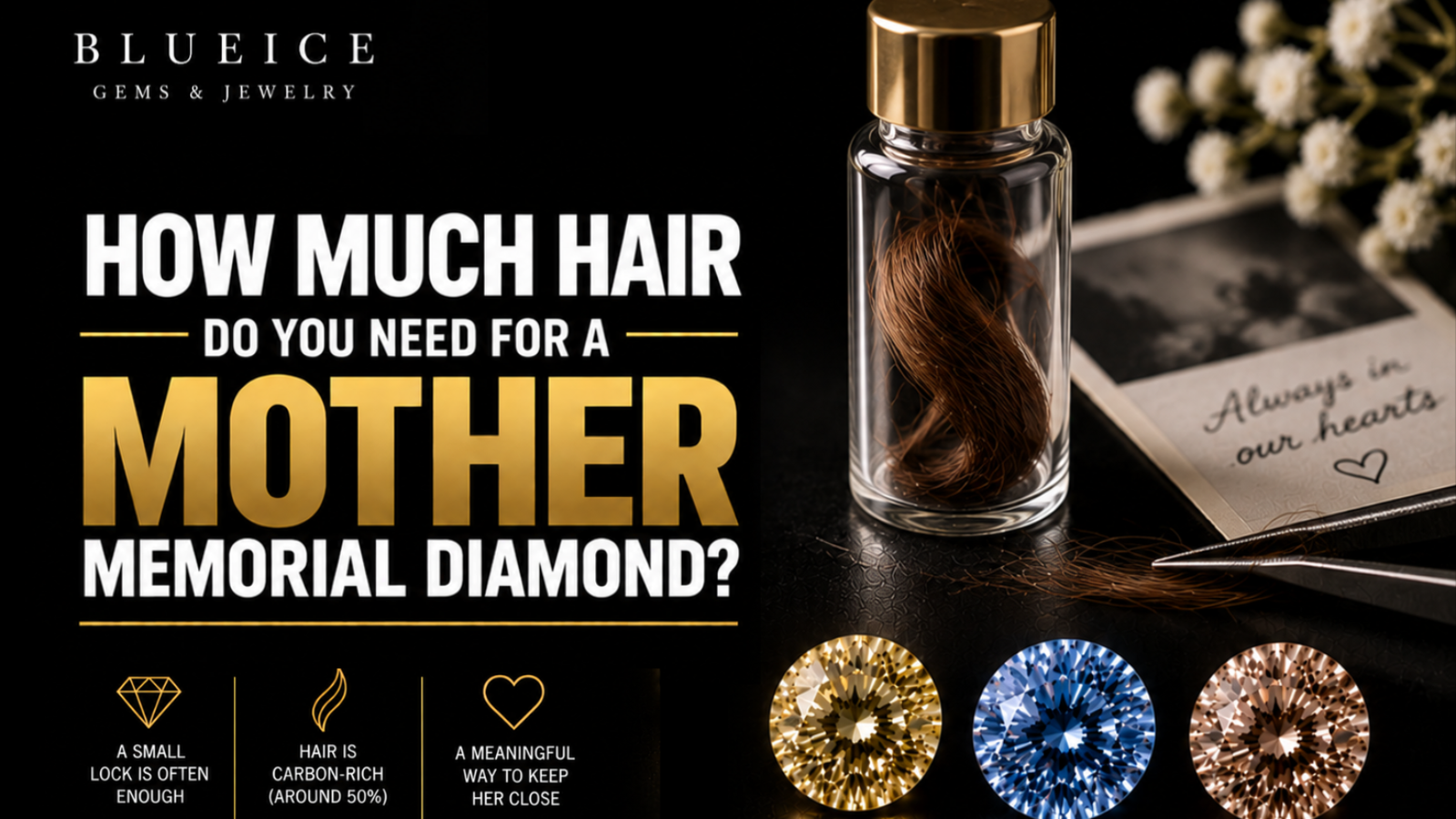
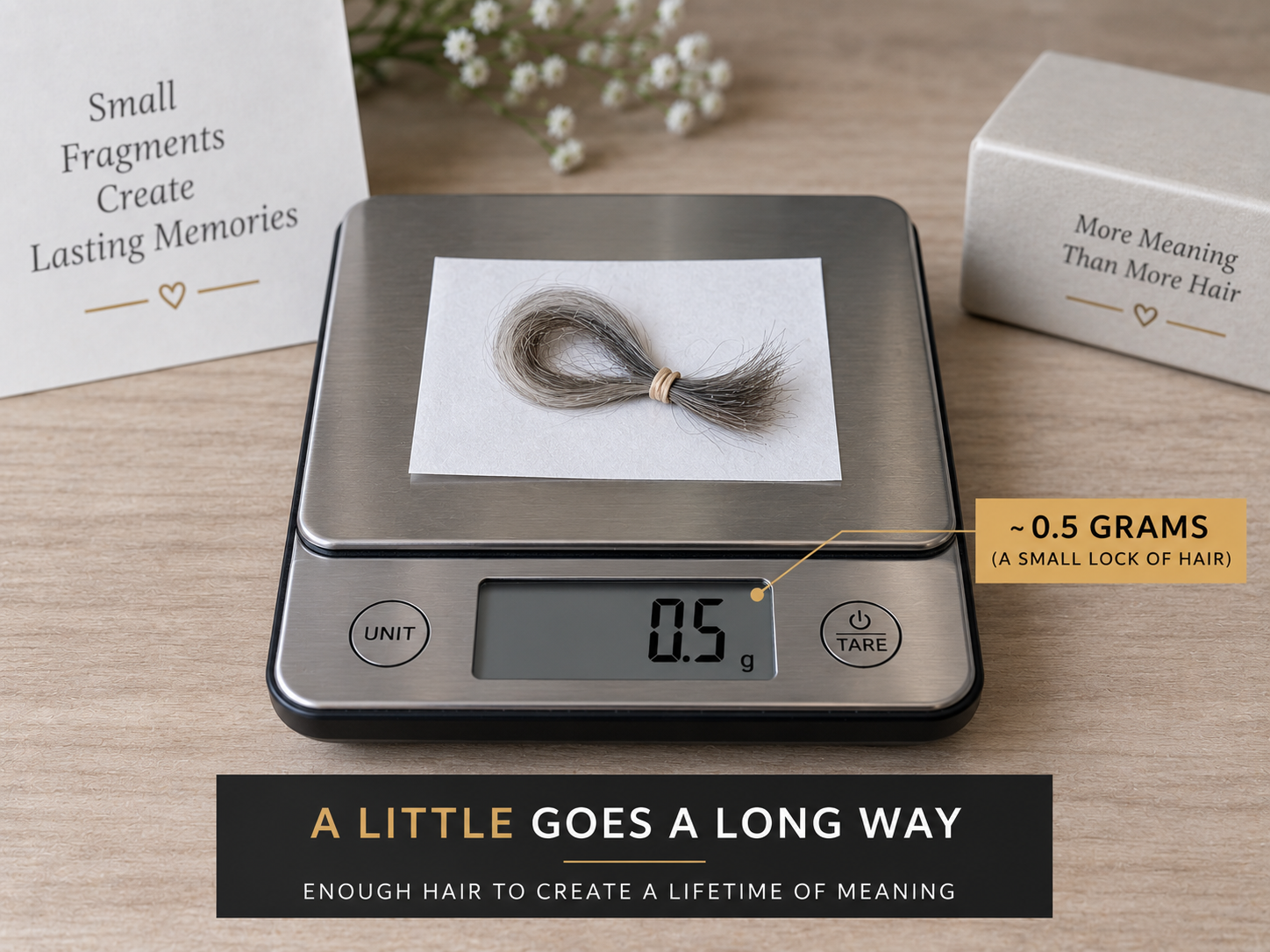
Industry-wide, a memorial diamond grown from hair takes a small lock or a few grams often described as palm-sized, or a few wisps.

That is genuinely all. Hair is roughly 50% carbon by weight, and no cremation is involved at any point, which is why the requirement is measured in grams.

Small lock of grey hair tied with a ribbon resting in an open palm beside a folded paper envelope

On This Page

How Little Hair Is Genuinely Enough?

A small lock. A few grams. Something you could close your hand around without effort.

Requirements vary between providers inside that band, so the figure that governs your decision is the one your provider gives you for your specific lock. But the band is small enough that most people who arrive here worried are, in fact, holding enough.

A small lock of hair on a square of paper being weighed on a digital kitchen scale reading in grams
What’s Being MeasuredIndustry-Typical FigureWhat It Means for the Lock in Your Hand
Hair a provider asks forA small lock or a few grams, often described as palm-sizedGrams, not ounces — no urn required, and none exists in most of these cases
Carbon content of hair~50% by weightKeratin is a carbon-rich protein, which is why so little goes so far
Cremation requiredNoneWorks for a mother who was buried, and for someone still living
Purity after extraction~99.9%+ carbonThe non-carbon components of keratin are stripped away
Carat sizes generally offered~0.10 ct to 5+ ctChosen when you order, not limited by the size of your lock
Growth time to reach that size~6–10 months, up to ~12 for large or specialty stonesThe only real lever on carat

One row deserves saying plainly rather than leaving in a table: more hair does not produce a larger diamond. Carat size is a function of weeks spent growing under pressure, and once the cell has enough feedstock to run, additional material changes nothing. A braid does not outrank a lock.

Her carbon is also blended with lab-sourced carbon to reach the volume a growth cell requires. No memorial diamond is 100% the person. If you are considering this process, it is worth understanding whether a memorial diamond is really made from your mother’s hair before you commit to any provider.

Why Does Hair Need Far Less Than Ashes?

Simple diagram showing hair at roughly fifty percent carbon by weight beside its keratin protein structure

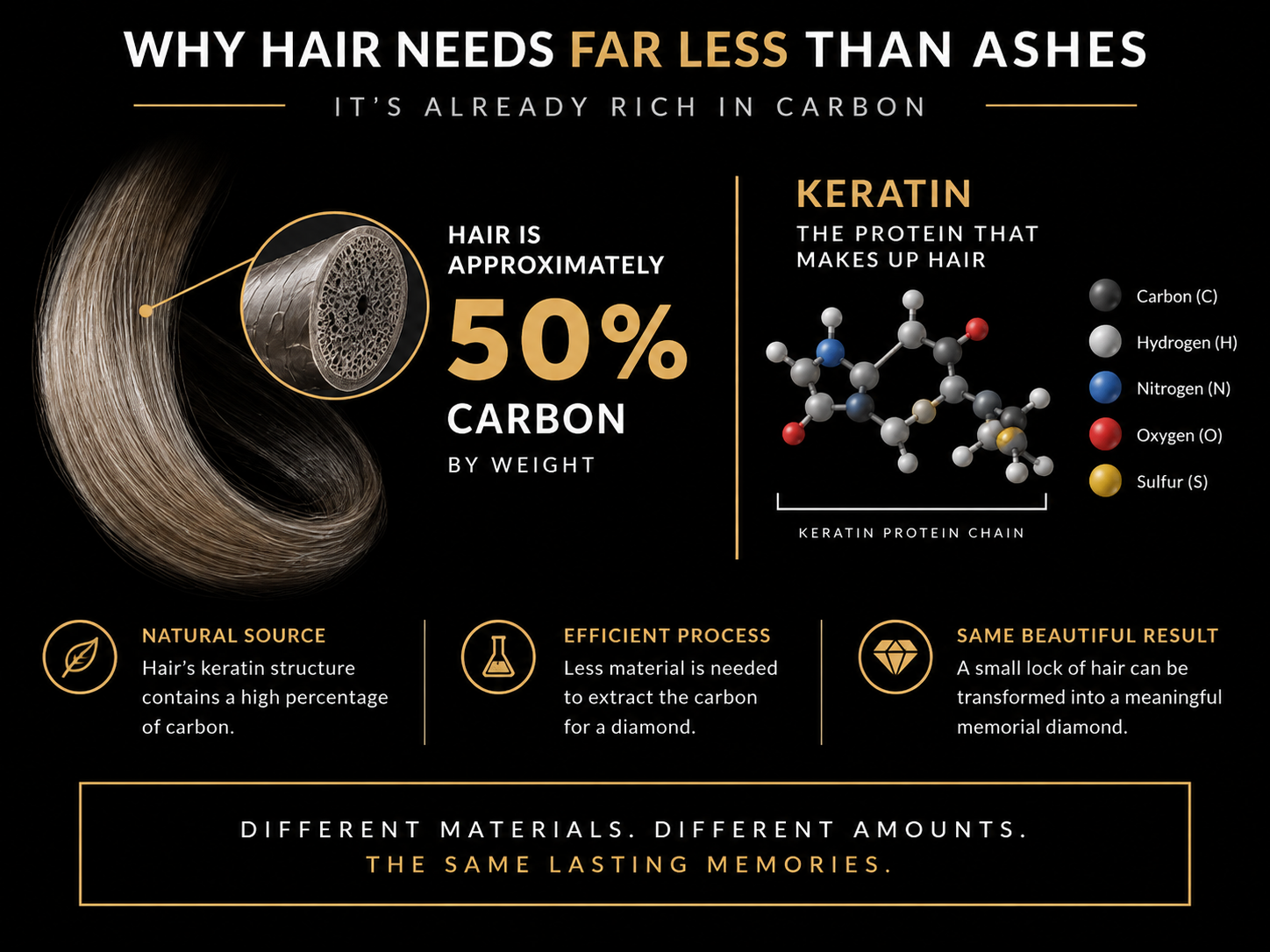
Because of what hair is made of. Hair is built from keratin, a carbon-rich protein, and comes out at roughly 50% carbon by weight. Cremated remains are a small fraction of that, which is why hair is measured in grams and ash in ounces.

It also means hair is the route that stays open when cremation never happened. A mother who was buried, a mother whose ashes were scattered years ago in a place nobody wrote down, or a mother whose remains a family is unwilling to divide for religious reasons — all may still have a hair-based option if a lock exists.

Hair-based options for a loved one who wasn’t cremated covers that ground, while ashes to diamond versus hair to diamond compares the two for anyone who has both.

How Do You Know if the Lock You Have Is Enough?

You ask, and you ask before you do anything to it. Judging a few grams by eye is unreliable in both directions.

Weigh it if you can. A digital kitchen scale reading to the gram costs very little and turns an anxious guess into a number a provider can answer against. Put the hair on a square of paper, tare the scale, and you have something concrete to put in an email.

Then photograph it beside something ordinary for scale a coin, a pen, or your own hand. A provider looking at a photograph can tell you far more than one reading the phrase “a small amount.”

And then the part that matters most:

  • Send it intact. Don’t divide it yourself. Cut the lock into what you think is the right portion and you may end up with two amounts that are each individually short. Let the provider take what they need from the whole.
  • Don’t trim, wash or tidy it. Hair needs no preparation, and handling it only risks losing strands.
  • Ask before you cut anything new. If more is genuinely needed and a source exists — a hairbrush, a second keepsake, or a hat you want to know before you go looking, not after.
  • Ask what happens to hair they don’t use. Confirm the provider’s policy on returning unused material before sending the lock.
  • Ask about treated hair specifically. Dyed, bleached, permed, or chemically straightened hair should be discussed with the provider rather than assumed to be accepted or rejected.

If the answer is that you don’t have enough, that is something you can act on and it arrives while the lock is still whole.

Does the Length of the Lock Matter, or the Weight?

Weight is what the process consumes. Length is what you can see, which is why a short lock causes far more worry than it should.

A dense lock of thick hair can weigh more than a long, fine wisp. Someone holding a short piece cut during chemotherapy, or a soft curl from a mother whose hair had thinned in her last year, can easily focus on the wrong dimension. Weighing the material, or simply asking the provider, beats estimating every time.

Carat size has nothing to do with either measurement. Choosing a carat size is a decision about budget, setting, and how you plan to wear it — a 0.25 ct stone and a 2 ct stone can start from the same small lock and differ primarily in how long they grow.

What About Hair That’s Been in a Drawer for Decades?

It is usually fine, and that surprises people.

Hair is stable, structural material. Kept dry and out of direct light, a lock from a childhood haircut in the 1960s, a strand saved from a wedding day, or hair collected during a final illness can remain as a keepsake for many years.

For an old keepsake, preserve its provenance carefully. Keep any ribbon, tag, or note that came with it, because that history may be more meaningful to your family than anything else surrounding the material. If the lock has been glued into a memory book or set into mourning jewelry, tell the provider rather than freeing it yourself.

For a mother who is still living, the same general quantity concept applies, and hair can simply be collected with her knowledge. Read what to ask before turning your mother’s hair into a diamond before making arrangements.

Frequently Asked Questions

Is one small lock really enough for a full-carat diamond?

Usually. A provider’s requirement is a threshold rather than a ration once the growth process has what it needs, additional growth time is what allows a larger stone to develop. A 0.25 ct and a 2 ct order can start from the same envelope.

Is there enough usable hair on a hairbrush?

Sometimes, but weigh it before you rely on it. A brush can be a possible source when no cut lock exists, although the amount recoverable varies significantly and providers differ on whether they accept it. Send a photograph and a weight when asking.

Will dyed, bleached or permed hair be accepted?

Ask the provider specifically rather than assuming. Hair treatments can affect how a provider handles submitted material, so getting the provider’s position in writing beforehand is better than discovering the answer at intake.

My mother was buried, not cremated. Can hair still work?

Yes. One of the advantages of a hair-based memorial diamond is that the process does not depend on cremated remains. A lock kept before or after a burial can provide starting material without requiring a family to disturb or exhume remains.

Should I split the lock and keep half?

Send it whole and ask the provider what material they require and what happens to anything unused. Dividing it yourself can create unnecessary uncertainty about whether either portion meets the provider’s requirement.

Does more hair make a bigger or faster diamond?

Neither. Sending a whole braid where a lock would do does not automatically create a larger or faster-grown diamond. Once sufficient material is available for the process, stone size is primarily associated with the selected growth schedule rather than simply sending more hair.

Before You Cut or Divide Anything

The lock in the envelope may be enough, and finding out costs nothing while it is still whole.

Before sending it, weigh the hair if possible, photograph it beside an ordinary object for scale, and ask the provider what quantity is required, what happens to unused material, whether treated hair is accepted, and what documentation or handling process applies.

For a broader overview, read The complete guide to a mother hair diamond or learn how a memorial diamond is made from her hair.

Sealed ash container and a bound lock of hair on a table beside a written list of questions

Questions to Ask Before Turning Your Mother’s Ashes and Hair Into a Diamond

Some of the questions below have answers sitting on a provider’s website. Others may not, not because anyone is hiding anything, but because combining two materials is the less routine request, which makes this a conversation to have rather than a page to read. Submitting both her ashes and her hair raises seven questions that a single material order never raises, and three of them are load-bearing: whether companies offer a combined order at all, whether they purify the two materials separately, and what happens if the carbon recovered from her ashes comes back too low to use.

Which Questions Does a Combined Order Add?

Ask thisWhy it only arises hereWhat a real answer names
Do you accept both materials for one stone?Not universal, as some providers grow from one material per stoneA yes or no, plus whether two separate stones are the alternative
Are they purified on separate tracks?Ash and hair need different extraction workTwo processes, and the stage at which they merge
At which stage are they combined?It determines the last point anything is reversibleA named step, before growth
What if the ash yield is too low to use?Only matters when a second material could quietly cover itWhether you are told, and what your options are
Do I have to meet both minimums separately?Families assume combining lowers each oneTwo figures, not one
Does the certificate name both materials?A single line certificate cannot distinguish themWhat the document actually states
Is unused ash and unused hair returned separately?Two materials, two returnsTwo return records
Checklist graphic of the seven questions unique to a combined ashes-and-hair order

Do They Even Offer a Combined Order?

Start here, because everything downstream depends on it. A provider may grow one stone from one material as standard, and treat a combined submission as either an accepted variant, a bespoke arrangement, or something they decline.

If the answer is no, the useful follow up is whether two stones from the two materials are possible instead: one from her ashes, one from her hair. That is a genuinely different product with its own appeal, and it is the alternative that is easiest to overlook, as discussed in the complete guide to a combined mother diamond.

How Do They Actually Handle the Two Materials?

Three questions, in this order:

  • Do they log them separately on intake, with a reference each? Using one reference for two materials means you cannot independently account for the two halves afterwards.
  • Are they purified on separate tracks? They need to be. Cremated remains are mostly calcium phosphate with carbon as a small fraction of the weight, while hair is roughly half carbon. The work required is not the same.
  • At what point do they combine the materials? Ask for a named stage rather than a description of care. You can find the full sequence and the exact merge point mapped under where the two lanes merge, step by step.
Two laboratory purification setups running side by side

There is no useful follow up question after that point, and it is worth knowing why. Once both graphite batches are in one cell, nothing distinguishes them. Carbon carries no memory of the molecule it came from, which is why no test can later report a ratio, explained further under what actually happens on the lab bench.

Do I Have to Meet Two Separate Minimums?

Ask for the ash figure and the hair figure as two numbers, and ask directly whether sending both lets either fall below its own threshold.

The safe planning assumption is that it does not. Treat any reduction a provider offers as a concession they told you about, not a rule you assumed, as the section on how much of each you need details.. Families who assume otherwise discover it late, when a second shipment is the only remedy and the timeline has already moved.

What Does the Certificate Say, and What Comes Back?

Four things to establish before you ship:

  • Does the origin certificate state both materials, or does it say cremated remains and stop? Ask for the wording, not the reassurance.
  • Is each material logged, and returned, under its own record?
  • Is unused ash returned as ash, and unused hair returned identifiably?
  • What does the grading report cover? It describes the stone’s own cut, colour, clarity and carat and says nothing about its origin, which is a separate document doing a separate job.

The section on whether a combined stone is really made from both addresses the wider point about what any of this can prove. For this conversation, the question is narrower: what will the paperwork you receive actually say.

Two intake confirmations beside a single grading report on a desk

Does Sending Both Cost More, or Take Longer?

Ask both, and expect the honest answers to be small.

Memorial diamond costs are driven primarily by growth time and finishing, which remain unchanged. However, a combined order requires two purification runs instead of one, which requires real work.

Timeline: ask whether combining adds time at all, and what changes if the two materials arrive on different days rather than together. Those are two separate answers, and the second one is the one families are rarely given unprompted.

If a Provider Cannot Answer These

An unpublished answer is not a red flag. A provider who says no one has asked us that, let me confirm and come back to you in writing, is behaving correctly.

What matters is what arrives next. A written reply naming stages, two reference numbers, and a stated procedure for a low ash yield is a provider running two lanes. A warm reply that repeats the question in gentler words is a provider who may be running one lane and treating the second material as a courtesy.

Frequently Asked Questions

What is the single most important question on this page?

What happens if the carbon recovered from her ashes is too low to use. Hair is by far the richer carbon source, so a shortfall on the ash side could be covered without anything in the finished stone showing it. Ask whether you would be told, and what your options would be.

Should I ask these questions even if I am only considering sending both?

Yes. The answers determine whether combining is worth doing at all, and they are cheapest to get before any material is measured, cut or posted. Asking costs nothing and closes nothing.

Is there a question I should ask about which material dominates the stone?

You can ask what proportion of the finished stone is personal carbon, typically around 10 to 15 percent of the mass across the industry, blended with supplemental lab carbon. What no provider can give you is the split between her ashes and her hair within that fraction, because the two are indistinguishable after blending.

Do I ask the same questions if I want two separate stones instead of one?

Mostly not. Two stones means two ordinary single material orders running side by side, so the ashes list and the hair list apply as written and the combination questions disappear entirely.

How should I ask about a lock that might turn up later?

Ask whether hair can be added to an ashes order already in progress, and up to which stage. In practice the answer is usually yes until the growth cell is loaded, but the stage matters more than the yes.

What if the two answers I get contradict each other?

Ask for both in one written reply rather than across a call and an email. Contradictions between a salesperson’s answer and a written policy are worth surfacing before you ship, not after.

Finished memorial diamond grown from a combined feedstock, on a plain background

Ask for Both Halves in One Reply

The seven questions above fit in a single email, and asking them together makes the contradictions visible. Ask Memorial Diamond at memorialdiamond.us whether a combined submission of your mother’s ashes and hair is accepted, how the two are tracked and purified, and what happens if one of them yields less than expected, and ask for the answer in writing.

Bound lock of grey hair in an open paper envelope beside a written list of questions

Questions to Ask Before Turning Your Mother’s Hair Into a Diamond

A lock of your mother’s hair arrives at a laboratory with nothing behind it. No cremation certificate, no funeral home record, no third party who ever saw it, weighed it or signed for it. That single structural fact reshapes the question list: alongside the ordinary ones about carat and cost sit four questions that only exist because a lock is finite and undocumented: will you weigh it and confirm that in writing, what is your position on chemically treated hair, what are my options if it falls short of your minimum, and what happens to whatever you do not use.

Why the Hair Questions Different From the Ashes Questions?

Both materials work. They fail differently, and the questions follow the failure modes.

ConcernWith cremated remainsWith a lock of hair
Can I send more later?Usually, until extraction beginsOften not: the lock may be all that exists
What documents the material?A cremation certificate and a funeral home recordNothing but your own account
How much is needed?Measured in tablespoons to ouncesA few grams, judged by weight rather than length
What can disqualify it?Rarely anythingChemical treatment, depending on provider policy
Is a top up possible?Yes, as a routine remedyOnly if more hair still exists somewhere

That table is why the ashes question list does not transfer unchanged.

Two-column comparison graphic of what differs between sending hair and sending cremated remains

Is What I Have Enough, and What If It Is Not?

Ask these before scissors, envelopes or payment enter the conversation:

  • What is your minimum, stated as a weight? A few grams is the industry typical answer, and weight is what matters because a short dense lock can outweigh a long fine one, as outlined under how much hair you need.
  • If I send you a photograph and a weight, will you tell me in advance whether it is sufficient? This is the single most useful question on the page, because it costs nothing and can be answered before anything is cut or posted.
  • If the lock turns out to be below your minimum after it arrives, what are my options? The answer families need is whether the order pauses, whether a smaller carat becomes possible, or whether the hair comes back.
  • Is hairbrush hair usable, and how do you treat it? Strands from a shared brush raise a provenance question a lab cannot resolve for you.
  • Can one lock be divided into two stones for two of us? This relates directly to options for more than one family member from the same material.

What Should You Ask About Dyed, Permed or Fragile Hair?

Ask this as two questions, because it has two answers.

The chemistry question: dye and bleach act on the hair shaft, and the carbon in keratin survives them. Nothing in the physics of purification is defeated by hair having been coloured.

Close-up of coloured and grey strands on a plain surface

The policy question: whether a given provider accepts treated hair is a commercial and procedural decision, not a chemical one, and providers differ. Ask specifically about permanent colour, bleach, perms and chemically straightened hair, and ask whether it changes anything about the process or the price.

Related conditions worth naming directly rather than hoping they are covered: hair that regrew during or after chemotherapy, very fine or sparse hair, grey hair, and a lock that has been stored taped into a book or sealed in plastic for years and may be brittle.

Who Creates the Record, When Nothing Else Documents It?

With no paperwork behind a lock, the record has to be created, partly by you, partly by them.

  • Will you weigh the hair on arrival and state the weight received in your confirmation? A confirmation that names a quantity is the only external record that will ever exist of what you sent.
  • What reference number is assigned, and can I quote it to ask where the order stands?
  • Is her hair kept physically separate from other clients’ material through purification, or batched?
  • What does your origin certificate actually state? Does it state that a stone was grown from material you supplied, or something stronger it cannot support? No consumer accessible test traces a finished diamond to a named person, which is why the honest answer to whether it is really her hair starts with your own records rather than theirs, explored further via the honest answer to is it really her hair.
Intake confirmation email stating the weight of hair received, on a screen

What Will the Stone Be Like, and What Comes Back?

  • What colour range is realistic? Her hair colour does not carry through. Pigment is a molecule, and no molecular structure survives graphitization at roughly 2500 to 2700 degrees Celsius, as detailed in what color will a diamond from her hair be.
  • What carat sizes are available, and what does each do to the timeline? The size of the lock does not affect the size of the stone, so ask what each carat option does to the schedule.
  • What proportion of the finished stone is her carbon? Hair is roughly half carbon by weight, far richer than cremated remains, but a growth cell still requires supplemental lab carbon. Nobody can honestly say 100 percent.
  • Is unused hair returned, and in what form? Ask whether it comes back identifiably or not at all.
  • What is included in the price? Loose stone, grading report, setting, and return shipping, which you can review under what a mother memorial diamond costs.

Which Answers Have to Arrive Before You Cut Anything?

Of everything above, three have to arrive before the scissors do:

  • The minimum weight, because it decides whether what you have is enough.
  • The treated hair policy, if her hair was coloured, because an acceptance rule you learn afterwards is an expensive one.
  • Whether a photograph and a weight can be assessed first, which is not one of the four questions above, because it costs nothing and commits nothing.

Everything else can be settled while the lock stays exactly where it is. Hair does not degrade on a useful timescale. Victorian mourning jewellery survives with the hair intact, which is a longer wait than any decision here requires.

Frequently Asked Questions

Can I ask a provider to assess the lock before I commit to anything?

Yes, and it is the most useful thing you can ask. A photograph beside a coin or ruler and a weight from a kitchen scale is usually enough for a provider to say whether the quantity works, before anything is cut, posted or paid for.

Should I ask whether her hair will be tested to confirm it is human hair?

It is worth asking what verification happens on intake, but expect a modest answer. Providers confirm material type and quantity. Nothing available to a consumer links a strand to a named individual, and a provider claiming otherwise is overstating.

What should I ask if the only hair I have came from her hairbrush?

Ask two things: whether brush hair meets their minimum by weight, and whether they have any requirement that hair be cut rather than shed. The provenance question, whether every strand is hers, is one only your household can answer.

Is it worth asking about insurance while the hair is in transit?

Yes. A lock is irreplaceable in a way ashes usually are not, so ask who bears the loss if a package goes missing, and whether they offer or require a tracked service.

What should I ask about withdrawing after I have sent it?

Ask what happens to the hair if you change your mind before work begins, and at which stage withdrawal stops being possible. With a finite lock this matters more than it does with ashes, because there is no second lock to fall back on.

Should I ask the same questions if I am sending ashes as well as hair?

Ask both sets, plus the ones specific to a combined order, chiefly what happens if one material yields less carbon than expected, and whether the two are purified separately, as outlined in questions to ask before turning your mother’s ashes and hair into a diamond.

Finished yellow-toned memorial diamond grown from hair, beside its grading report

The Lock Can Wait for the Answers

Nothing on this page requires you to open the envelope. Send the three blocking questions: the minimum weight, the position on treated hair, and whether a photograph and a weight can be assessed before anything is cut, and wait for the reply before the scissors come out. Memorial Diamond answers them at memorialdiamond.us.

Untitled (1568 x 1003 px)

What Color Will a Diamond Made From Your Mother’s Ashes and Hair Be?

Two containers, two chains of custody, two different purification requirements, one growth cell. That is what a combined order is underneath the paperwork, and it changes the color question in a way neither single-source version covers.

A diamond grown from your mother’s ashes and hair together will sit in the same range as one grown from either alone most likely yellow, blue, or champagne rather than colorless. What changes is confidence. Two source materials with different histories make the final shade less forecastable, not more controllable.

That is not a warning against sending both. It is the actual trade being made, and it is a fair one as long as nobody promised you a specific shade on the way in.

On This Page

What Color Should You Expect If You Send Both?

The same color family either material produces on its own.

Diamond color comes from trace elements present while the crystal grows. Nitrogen produces yellow tones. Boron produces blue. Colorless demands the near-total absence of both, which is a high bar for any organic source.

Because part of the carbon in any memorial diamond comes from an organic, imperfect, personal source rather than all of it coming from a controlled synthetic feedstock, trace elements are common and memorial diamonds as a category trend toward yellow, blue, and champagne/brown accordingly. Colorless is achievable with additional processing, and costs more.

Adding a second source does not move the stone outside that range, and there is no documented “blended” color that combining ashes and hair reliably produces.

For more information about why memorial diamonds are rarely colorless, read our article on why memorial diamonds are rarely colorless.

Why Does Sending Both Make the Color Less Predictable?

Because the two materials arrive with genuinely different chemistry behind them.

Cremated remains are dominated by calcium phosphate, the mineral structure of bone, with usable carbon at roughly 0.5% to 4% of ash by weight and they have been through a cremation before anyone touched them. Hair is keratin, roughly 50% carbon by weight, with no mineral load of that kind and no cremation anywhere in its history.

Both are purified to about 99.9%+ carbon before growth, and that purification is excellent rather than absolute. Whatever survives is at most a tenth of a percent of each recovered stream and that residue is exactly where color comes from. Two feedstocks means two such residues, each with its own trace-element signature, meeting in one process.

Neither stream fills a growth cell on its own, so both are blended with supplemental lab-sourced carbon to reach a workable volume. Her carbon is the minority ingredient either way; for ash-derived stones the industry puts the personal fraction at roughly 10–15% of the finished stone’s mass.

That does not cancel the point above, because a trace element influences the color of the whole crystal rather than its own share of it a minority fraction is still enough to steer the result. It does mean an accurate description of a combined stone lists her ashes, her hair, and the lab carbon that filled the rest of the cell.

The practical effect is a wider band of normal. A provider aiming at champagne from a single source is holding fewer variables steady than one aiming at champagne from two. That is a reason to ask what variation counts as acceptable on your order not a reason to expect a bad stone.

To understand the process in more detail, read how a memorial diamond is made from your mother’s ashes and hair.

Does the Lab Combine Them, or Grow Two Separate Stones?

This is the question to put to a provider directly, because the answer changes what color even means for your order and because the industry does not handle it uniformly.

Three arrangements are possible in principle:

  • Combined feedstock. Ashes and hair are purified on separate tracks, since they need different treatment, and the resulting carbon is combined before growth. One stone, one color.
  • Separate stones. Each material grows its own diamond. Two stones, two independent color outcomes which will not necessarily match, even ordered in the same color.
  • Not offered at all. Some providers accept one material per order and will say so.

Ask which of the three you are buying before you send anything. Ask, too, whether the origin documentation will name both materials an authenticity or origin certificate is the record that both went in, and it is worth confirming it says so.

For more information, read how memorial diamonds are graded and certified.

What Colors Are on the Table, and What Does Sending Both Change?

The following describes industry-typical outcomes and industry-typical cost relationships, not a fixed price list or a promise about a specific stone.

ColorWhat Causes ItWhat Sending Both ChangesCost Note
YellowNitrogen present during growthNothing about availability a standard outcome from either source and from bothTypically at the lower end of the range at a given carat
BlueBoron present during growthNothing about availability; widely offered either wayGenerally below colorless at matching size
Champagne / BrownSeveral trace elements acting together rather than oneAsk what shade band counts as normal this is where defining acceptable variation is particularly usefulTypically comparable with yellow at the same carat
Colorless / WhiteThe near-complete absence of both boron and nitrogenAdding a second organic feedstock does not make trace-element exclusion easier. It remains the hardest targetMeaningfully higher than yellow, blue, or champagne at the same size
Red, Pink, Green, BlackPost-growth irradiation, applied after the crystal already existsThe source material matters less because irradiation happens after growthAn additional treatment; larger or black stones can require longer timelines

What Are You Actually Trading?

Completeness for predictability.

Sending both means the stone contains carbon from her remains and from her hair, alongside the lab carbon that fills out the growth cell the fullest version of the thing that is actually available if completeness is what you are after.

It does not buy you more control over the result. If a precise shade matters more to you than including both, a single source is the more controllable order. If including both matters more, accept a wider color band and say so out loud at order time.

Neither choice is the better one; they answer different questions.

Five Questions to Ask Before You Commit

  1. Do you accept ashes and hair on one order, and how do you process them? Ask whether the material is combined, grown separately, or not accepted together.
  2. Am I buying a named color or a color family? Ask what variation is normal for a combined order specifically.
  3. What happens if the finished stone lands outside that band? Settle the remedy in writing at order time, not after delivery.
  4. Will the origin certificate name both materials? Get that confirmed in writing.
  5. What happens to whichever material isn’t used? Confirm the provider’s policy for unused material before sending anything.

None of this commits all of her. Only a small fraction of either material is used, so burial, scattering, or keeping an urn all remain open alongside it.

For material requirements, read how much ash and hair you actually need for a mother memorial diamond.

Frequently Asked Questions

Will the diamond be a blend of two colors, or two-toned?

No. A finished diamond is graded with a single body color, not a mixture of two. Combining her ashes and her hair produces one stone with one color, drawn from the trace elements present during growth rather than from either material’s appearance.

Does sending both improve my chances of a colorless stone?

No, and it works slightly against you. Colorless requires excluding boron and nitrogen almost entirely, and a second organic feedstock adds trace elements to the process rather than removing them. Colorless remains achievable, with additional processing and higher cost.

Can I get one diamond from her ashes and another from her hair?

Often yes, since only a portion of either material is used. Expect two independent color outcomes rather than a matched pair — separate growth runs are separate events, so treat a family resemblance as the realistic goal.

Does sending both make the diamond larger?

No. Carat size is determined by growth time in the press, not by how much material is submitted. Sending both changes what is in the stone, not how big it is or how quickly it arrives.

Does her hair color influence the result if I send hair too?

No. Pigment does not survive purification to 99.9%+ carbon, so grey, dyed, or red hair has no bearing on the finished color. That holds whether the hair goes in alone or alongside her ashes.

Do all providers accept both materials together?

No. Ashes and hair need different purification handling, and not every provider takes them on one order. Confirm it directly before assuming, and confirm which of the possible arrangements they use.

Before You Decide

Order of operations matters here more than the color choice itself. Find out first how a given provider handles two materials on one order combined feedstock, separate stones, or not at all because a combined order that turns out to be two diamonds is a different purchase from one that turns out to be a single crystal.

Color only means something once you know which of those you are buying.

Then, if sending both is what feels right, send both, and go in expecting a color family rather than a specific shade.

For comparison, read the ashes-only version of this question and the hair-only version.

If you are still deciding between the two sources, read Ashes to Diamond vs. Hair to Diamond: Which Should You Choose?.

For the broader process, timeline, and cost discussion, see Mother Ashes and Hair Diamond: The Complete Guide.