
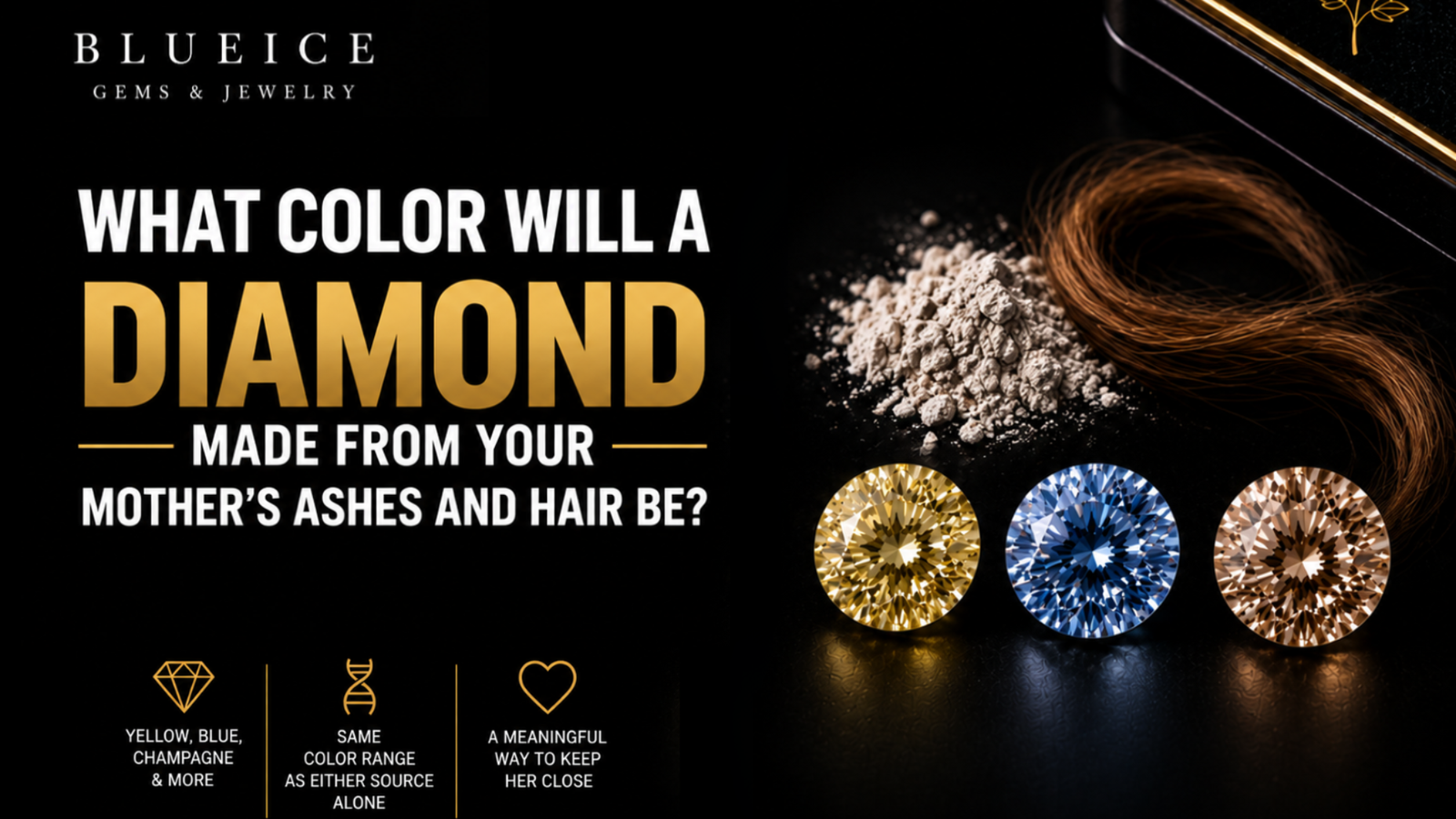
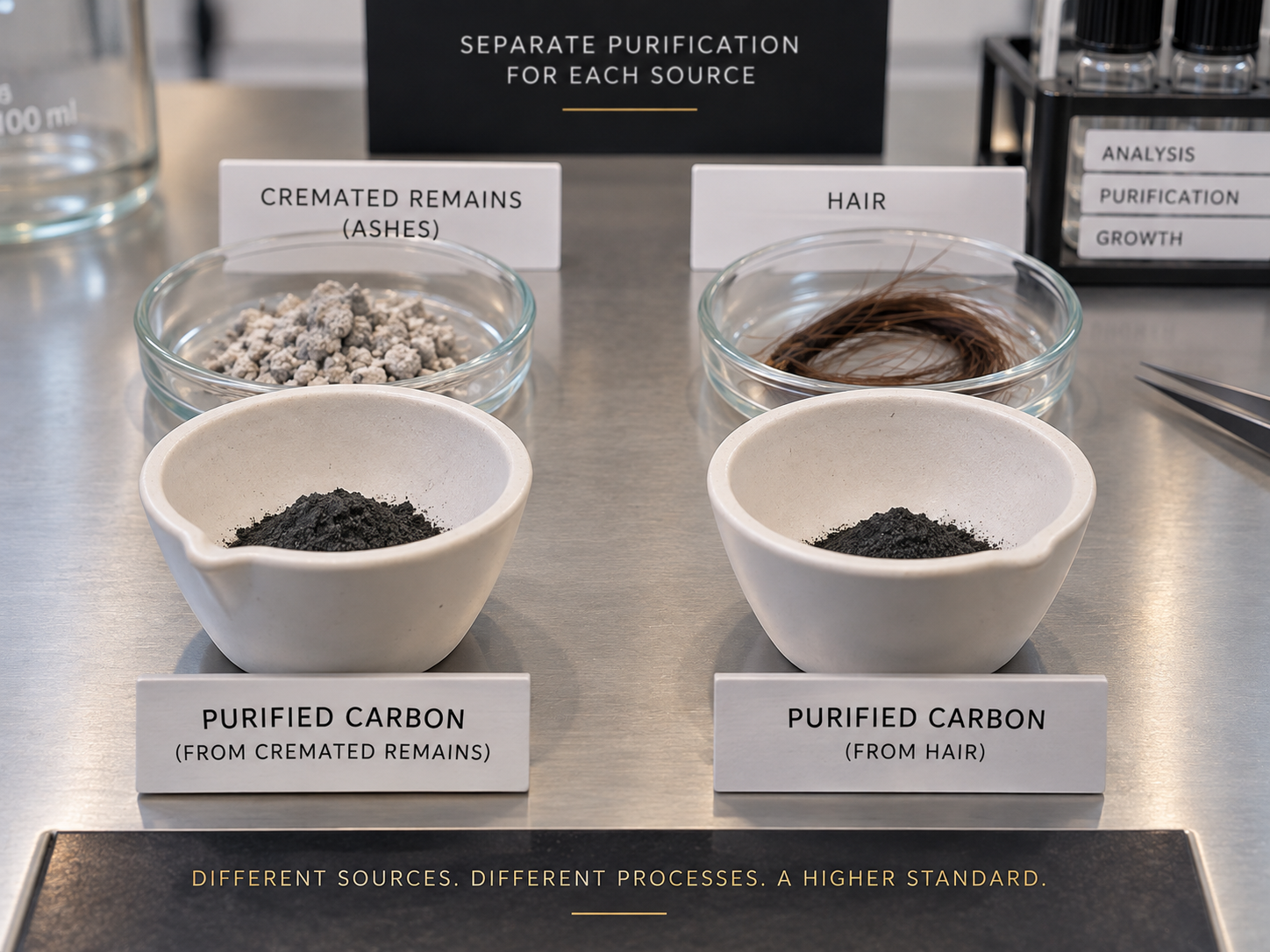
Two containers, two chains of custody, two different purification requirements, one growth cell. That is what a combined order is underneath the paperwork, and it changes the color question in a way neither single-source version covers.
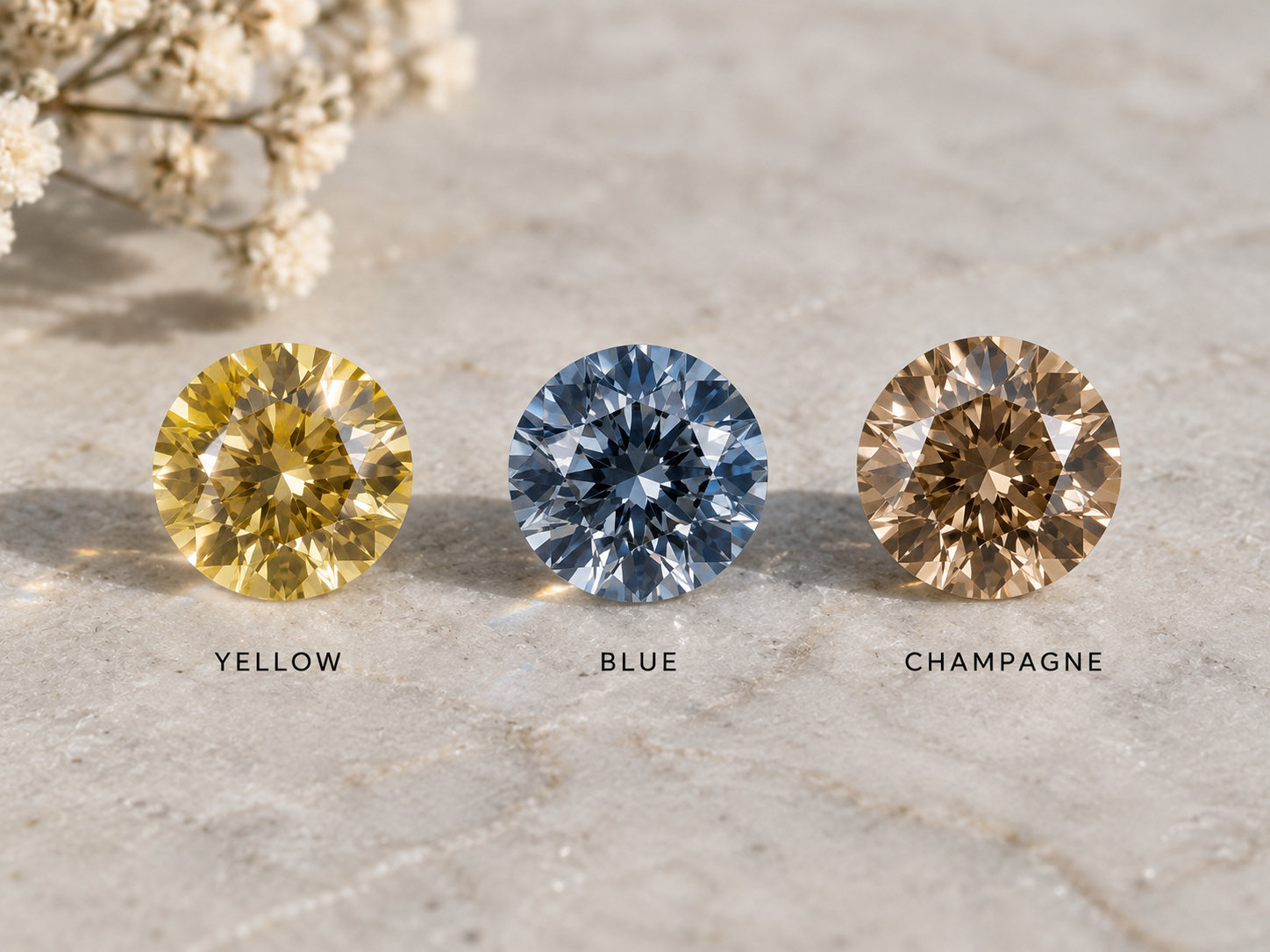
A diamond grown from your mother’s ashes and hair together will sit in the same range as one grown from either alone most likely yellow, blue, or champagne rather than colorless. What changes is confidence. Two source materials with different histories make the final shade less forecastable, not more controllable.
That is not a warning against sending both. It is the actual trade being made, and it is a fair one as long as nobody promised you a specific shade on the way in.
On This Page
- What to Expect If You Send Both
- Why Two Sources Means Less Predictability
- Whether the Lab Combines Them
- The Colors on the Table
- What You’re Actually Trading
- Frequently Asked Questions
What Color Should You Expect If You Send Both?
The same color family either material produces on its own.
Diamond color comes from trace elements present while the crystal grows. Nitrogen produces yellow tones. Boron produces blue. Colorless demands the near-total absence of both, which is a high bar for any organic source.
Because part of the carbon in any memorial diamond comes from an organic, imperfect, personal source rather than all of it coming from a controlled synthetic feedstock, trace elements are common and memorial diamonds as a category trend toward yellow, blue, and champagne/brown accordingly. Colorless is achievable with additional processing, and costs more.
Adding a second source does not move the stone outside that range, and there is no documented “blended” color that combining ashes and hair reliably produces.
For more information about why memorial diamonds are rarely colorless, read our article on why memorial diamonds are rarely colorless.
Why Does Sending Both Make the Color Less Predictable?
Because the two materials arrive with genuinely different chemistry behind them.
Cremated remains are dominated by calcium phosphate, the mineral structure of bone, with usable carbon at roughly 0.5% to 4% of ash by weight and they have been through a cremation before anyone touched them. Hair is keratin, roughly 50% carbon by weight, with no mineral load of that kind and no cremation anywhere in its history.
Both are purified to about 99.9%+ carbon before growth, and that purification is excellent rather than absolute. Whatever survives is at most a tenth of a percent of each recovered stream and that residue is exactly where color comes from. Two feedstocks means two such residues, each with its own trace-element signature, meeting in one process.
Neither stream fills a growth cell on its own, so both are blended with supplemental lab-sourced carbon to reach a workable volume. Her carbon is the minority ingredient either way; for ash-derived stones the industry puts the personal fraction at roughly 10–15% of the finished stone’s mass.
That does not cancel the point above, because a trace element influences the color of the whole crystal rather than its own share of it a minority fraction is still enough to steer the result. It does mean an accurate description of a combined stone lists her ashes, her hair, and the lab carbon that filled the rest of the cell.
The practical effect is a wider band of normal. A provider aiming at champagne from a single source is holding fewer variables steady than one aiming at champagne from two. That is a reason to ask what variation counts as acceptable on your order not a reason to expect a bad stone.
To understand the process in more detail, read how a memorial diamond is made from your mother’s ashes and hair.
Does the Lab Combine Them, or Grow Two Separate Stones?
This is the question to put to a provider directly, because the answer changes what color even means for your order and because the industry does not handle it uniformly.
Three arrangements are possible in principle:
- Combined feedstock. Ashes and hair are purified on separate tracks, since they need different treatment, and the resulting carbon is combined before growth. One stone, one color.
- Separate stones. Each material grows its own diamond. Two stones, two independent color outcomes which will not necessarily match, even ordered in the same color.
- Not offered at all. Some providers accept one material per order and will say so.
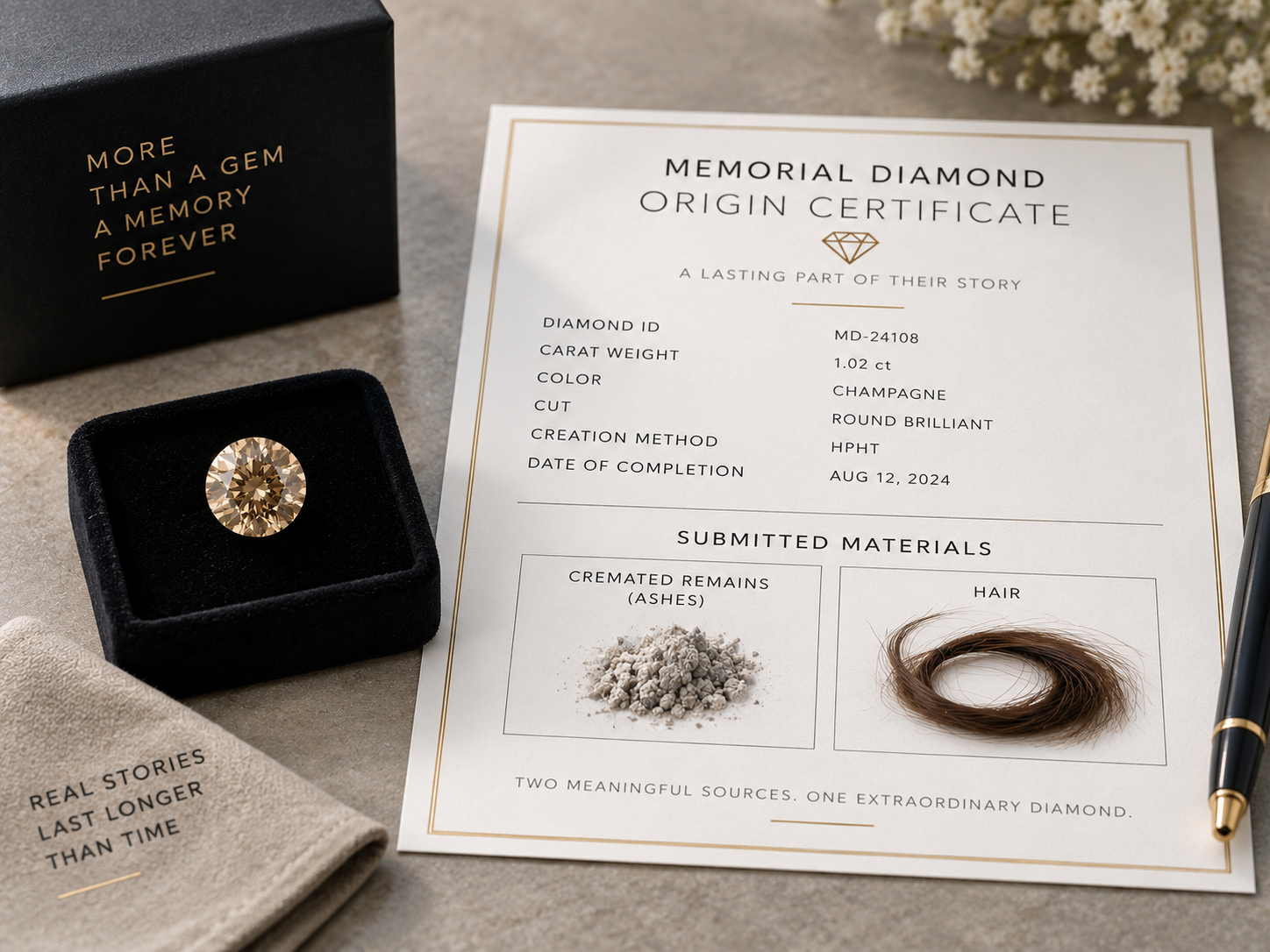
Ask which of the three you are buying before you send anything. Ask, too, whether the origin documentation will name both materials an authenticity or origin certificate is the record that both went in, and it is worth confirming it says so.
For more information, read how memorial diamonds are graded and certified.
What Colors Are on the Table, and What Does Sending Both Change?
The following describes industry-typical outcomes and industry-typical cost relationships, not a fixed price list or a promise about a specific stone.
| Color | What Causes It | What Sending Both Changes | Cost Note |
|---|---|---|---|
| Yellow | Nitrogen present during growth | Nothing about availability a standard outcome from either source and from both | Typically at the lower end of the range at a given carat |
| Blue | Boron present during growth | Nothing about availability; widely offered either way | Generally below colorless at matching size |
| Champagne / Brown | Several trace elements acting together rather than one | Ask what shade band counts as normal this is where defining acceptable variation is particularly useful | Typically comparable with yellow at the same carat |
| Colorless / White | The near-complete absence of both boron and nitrogen | Adding a second organic feedstock does not make trace-element exclusion easier. It remains the hardest target | Meaningfully higher than yellow, blue, or champagne at the same size |
| Red, Pink, Green, Black | Post-growth irradiation, applied after the crystal already exists | The source material matters less because irradiation happens after growth | An additional treatment; larger or black stones can require longer timelines |
What Are You Actually Trading?
Completeness for predictability.
Sending both means the stone contains carbon from her remains and from her hair, alongside the lab carbon that fills out the growth cell the fullest version of the thing that is actually available if completeness is what you are after.
It does not buy you more control over the result. If a precise shade matters more to you than including both, a single source is the more controllable order. If including both matters more, accept a wider color band and say so out loud at order time.
Neither choice is the better one; they answer different questions.
Five Questions to Ask Before You Commit
- Do you accept ashes and hair on one order, and how do you process them? Ask whether the material is combined, grown separately, or not accepted together.
- Am I buying a named color or a color family? Ask what variation is normal for a combined order specifically.
- What happens if the finished stone lands outside that band? Settle the remedy in writing at order time, not after delivery.
- Will the origin certificate name both materials? Get that confirmed in writing.
- What happens to whichever material isn’t used? Confirm the provider’s policy for unused material before sending anything.
None of this commits all of her. Only a small fraction of either material is used, so burial, scattering, or keeping an urn all remain open alongside it.
For material requirements, read how much ash and hair you actually need for a mother memorial diamond.
Frequently Asked Questions
Will the diamond be a blend of two colors, or two-toned?
No. A finished diamond is graded with a single body color, not a mixture of two. Combining her ashes and her hair produces one stone with one color, drawn from the trace elements present during growth rather than from either material’s appearance.
Does sending both improve my chances of a colorless stone?
No, and it works slightly against you. Colorless requires excluding boron and nitrogen almost entirely, and a second organic feedstock adds trace elements to the process rather than removing them. Colorless remains achievable, with additional processing and higher cost.
Can I get one diamond from her ashes and another from her hair?
Often yes, since only a portion of either material is used. Expect two independent color outcomes rather than a matched pair — separate growth runs are separate events, so treat a family resemblance as the realistic goal.
Does sending both make the diamond larger?
No. Carat size is determined by growth time in the press, not by how much material is submitted. Sending both changes what is in the stone, not how big it is or how quickly it arrives.
Does her hair color influence the result if I send hair too?
No. Pigment does not survive purification to 99.9%+ carbon, so grey, dyed, or red hair has no bearing on the finished color. That holds whether the hair goes in alone or alongside her ashes.
Do all providers accept both materials together?
No. Ashes and hair need different purification handling, and not every provider takes them on one order. Confirm it directly before assuming, and confirm which of the possible arrangements they use.
Before You Decide
Order of operations matters here more than the color choice itself. Find out first how a given provider handles two materials on one order combined feedstock, separate stones, or not at all because a combined order that turns out to be two diamonds is a different purchase from one that turns out to be a single crystal.
Color only means something once you know which of those you are buying.
Then, if sending both is what feels right, send both, and go in expecting a color family rather than a specific shade.
For comparison, read the ashes-only version of this question and the hair-only version.
If you are still deciding between the two sources, read Ashes to Diamond vs. Hair to Diamond: Which Should You Choose?.
For the broader process, timeline, and cost discussion, see Mother Ashes and Hair Diamond: The Complete Guide.