Sister Memorial Diamond FAQ Everything Families Ask

Sister Memorial Diamond FAQ: Everything Families Ask

A hair brush on sister memorial diamond her dresser, a braid saved from a haircut years ago, a lock someone thought to keep: any of these small things may be where a diamond begins. The sister hair diamond steps begin with finding her hair and agreeing, with whoever has a say over her belongings, how it will be used. You then send a small lock to a provider, settle size and color, and wait roughly 6–10 months while the lab purifies, grows, cuts, and grades the stone. No cremation is needed.
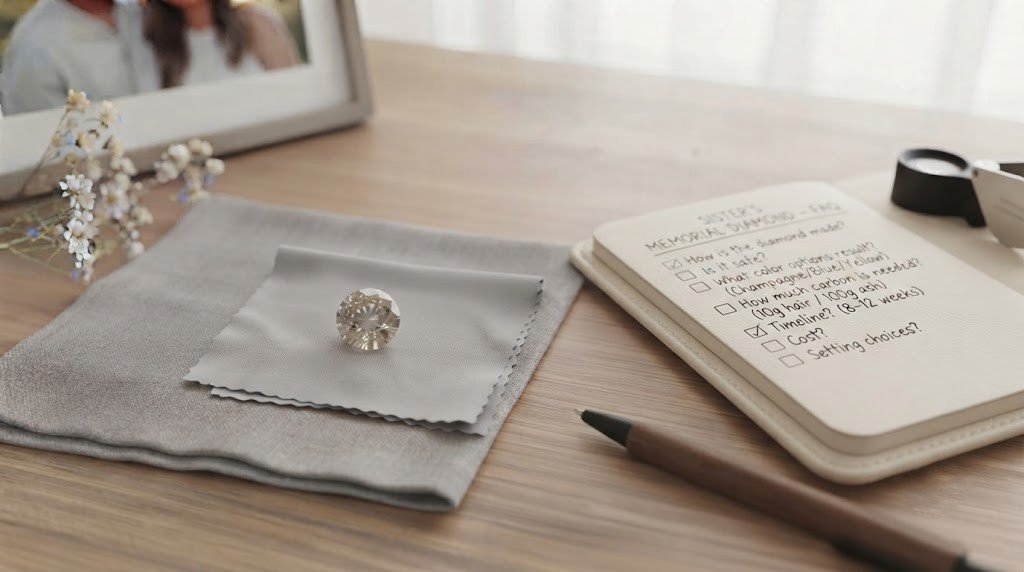
sister memorial diamond

How Do the Sister Hair Diamond Steps Differ From the Ash Route?

Hair changes the order of things. Because hair is roughly 50% carbon by weight, a small lock or a few grams is typically enough, and nothing about the process depends on cremation. That means the sister hair diamond steps can begin whether she was cremated or buried, and whether she passed last month or a decade ago, provided some of her hair was kept.

It also changes the paperwork. There is no portion of remains to request, but hair left among her things can form part of her estate, so a conversation with whoever is handling it still belongs near the start. If you are weighing both materials, the ash checklist shows how different the opening stages become.

Here are all ten sister hair diamond steps in one view:

StepWhat you doWho’s involvedWhat you hold afterwardTiming
1Talk it over with familyYou, other siblings, close relativesNotes on who knows and how they feelYour own pace
2Search for her hairYou and anyone who may have kept someA list of where hair was foundYour own pace
3Check who has a say over her belongingsExecutor or whoever handles her estateA written note agreeing to the useDepends on the estate
4Gather and protect the hairYouLabeled, sealed envelopes and photosYour own pace
5Choose a provider and get answers in writingYou and any co-fundersWritten answers and a dated quoteAs long as you need
6Settle carat, color, cut, and budgetYou and any co-fundersA signed order confirmationAs long as you need
7Send the hair and confirm intakeYou, carrier, providerTracking number and intake IDCarrier-dependent; lab clock starts
8Purification and graphitizationProvider’s labAn update, if offeredAsk your provider
9Growth, cutting, and gradingProvider’s lab, optional outside graderOrigin certificate, optional grading reportGrowth takes weeks to months
10Receive, inspect, and keep or set the stoneYou, a jeweler, your insurerThe stone and a complete fileYour own pace

Where Might Her Hair Be, and Who Decides How It Is Used?

Step 1: Talk it over with family

The first of the sister hair diamond steps is a conversation, not a search. Before you go looking, say the idea out loud to the people closest to her. A relative may have kept a lock from her childhood that you never knew about. Another sibling, whether full, half-, step-, or adopted, may want a stone too, or may prefer that her hair stay exactly where it is.

Before you move on: you know who else cares about her hair and whether anyone holds some already.

Step 2: Search for her hair

Of all the sister hair diamond steps, this one is the most personal, and it can take longer than expected. Places worth checking include:

  • a hairbrush or comb she used regularly
  • a braid, ponytail, or lock saved after a haircut
  • a keepsake envelope a relative tucked away
  • a lock a funeral home clipped before services, if anyone asked for one

If services have not yet happened, it may be possible to ask the funeral director to clip a small lock now; policies differ, and the request may need to come from whoever holds authority over her remains. Brushes can be harder, since they may hold other people’s hair; acceptance varies by provider, so ask before relying on one.

Before you move on: you have a written list of every source you found and who currently has it.

Step 3: Check who has a say over her belongings

This is the point in the sister hair diamond steps where permission matters most. Hair kept in her home can count as part of her estate, and the rules vary by state. Speak with the executor, or whoever holds authority over her affairs, before taking hair from among her things. The conversation may be brief, but a written note avoids misunderstandings later.

Before you move on: you hold a dated note or email agreeing that her hair may be used for a memorial diamond.

How Should You Gather and Protect Her Hair?

Step 4: Gather and protect the hair

Careful handling here protects every later stage of the sister hair diamond steps, so touch the hair as little as possible. Place it, dry and untreated, in a clean paper envelope or the bag your provider supplies, and keep each source separate. Label every envelope with where the hair came from and the date you gathered it, then photograph each one.

Requested amounts are provider-variable, typically a small lock or a few grams. The post on how much hair providers usually ask for covers this in detail. Sending more will not make the stone larger or faster, because growth time sets carat size. If you have very little, ask whether the provider uses all of it before you send everything.

Before you move on: each envelope is sealed, labeled, and photographed, and you know exactly what you are sending.

Which Details Should You Settle With a Provider First?

Step 5: Choose a provider and get answers in writing

These sister hair diamond steps go more smoothly when every answer is written down. A fuller set of hair-specific provider questions exists, but cover at least these:

  • Do you accept hair from a brush, or only cut locks?
  • How is her hair tracked from arrival to finished stone?
  • Is her carbon blended with supplemental lab carbon, and what share of the stone do you expect it to make up?
  • If the stone cracks while it is being cut, or a growth run does not succeed, what do you do next, and at whose cost?
  • Do you send back hair you did not use, store it, or dispose of it?

Before you move on: every answer exists in an email or document, alongside a dated quote.

Step 6: Settle carat, color, cut, and budget

Size is the choice in the sister hair diamond steps that most shapes cost and time. A stone meant for a slim pendant or small ring, around 0.100.25 ct, sits at roughly $1,500$3,500 in 2026 industry pricing. Moving up to half a carat or a full carat lifts that to roughly $5,000$15,000, and asking for colorless at that size pushes it meaningfully higher than a yellow, blue, or champagne stone. A larger stone of 25+ ct runs roughly $20,000$75,000+.

Those are category-wide figures rather than anything Memorial Diamond has published. Budget separately for grading, engraving, a fancy cut, or a setting, since providers usually quote those on top.

Color comes from trace elements during growth: nitrogen gives yellow, boron gives blue, and colorless needs the absence of both. There is no basis for expecting hair to give a lighter or more predictable shade than ash, and no shade says anything about who she was.

Before you move on: you have a signed order confirmation, and if more than one person is paying, ownership of the stone is agreed in writing.

Which Sister Hair Diamond Steps Happen Once Her Hair Reaches the Lab?
Step 7: Send the hair and confirm intake

Ship with signature tracking, using whatever method your provider specifies for this stage of the sister hair diamond steps. Wait for an email confirming arrival and assigning an intake or batch ID. The 610 month clock for the remaining sister hair diamond steps typically starts at this point.

Before you move on: the intake ID is filed with your order confirmation and the estate note.

Step 8: Purification and graphitization

Hair is built from keratin, a carbon-rich protein. The lab heats it in an oxygen-free, multi-stage process that removes the non-carbon components, reaching roughly 99.9% carbon purity or higher. The carbon is then heated to roughly 2,5002,700°C and converted to graphite, which a growth press can use. For a closer look, read what the lab does with her hair, in more depth.

Providers commonly blend personal carbon with supplemental lab carbon to reach the volume a stone needs. There is no published percentage for how much of a hair-grown stone’s mass comes from the hair itself, so ask your provider what it expects for your order.

Before you move on: you have the provider’s own description of how her carbon is used, in writing.

Step 9: Growth, cutting, and grading

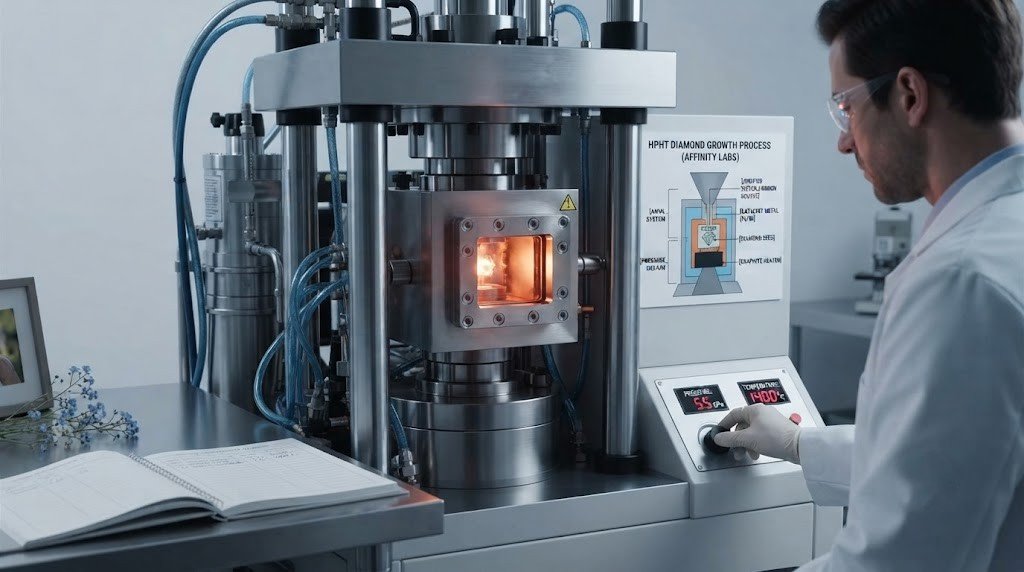
These are the longest of the sister hair diamond steps. The usual method is HPHT: a press squeezes the graphite at roughly 68 GPa while holding it somewhere between 1,400 and 2,500°C, and a diamond crystal forms on a small seed. A minority of providers use CVD instead. Growth takes weeks to months, and the carat you chose, not the amount of hair, sets the duration. A gemologist then cuts and polishes the rough crystal; some providers offer disclosed post-growth irradiation for red, pink, green, or black.

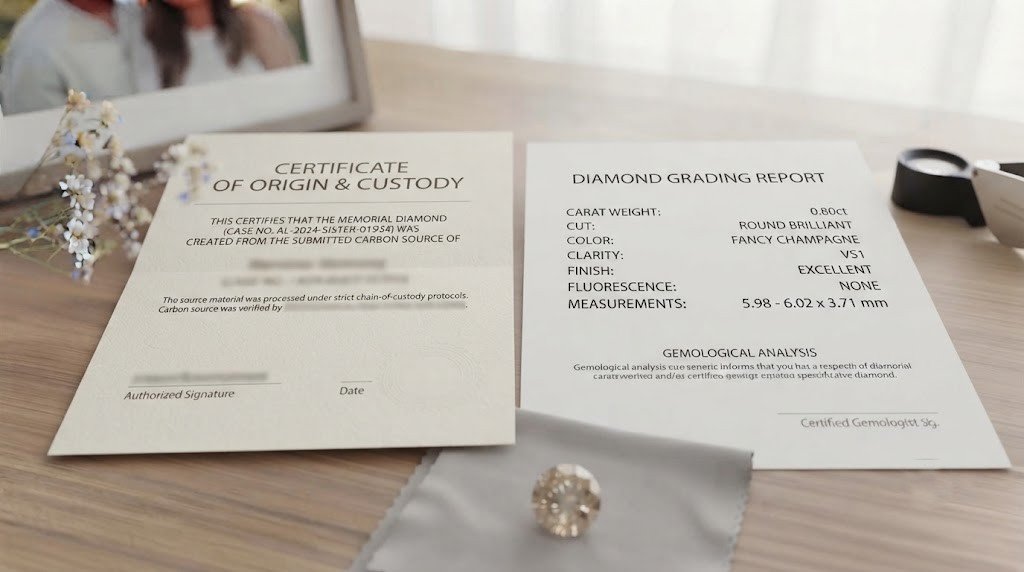
You may receive two documents. An origin certificate, usually issued in-house, ties the stone to her submitted hair. An independent grading report, usually optional and extra, describes cut, color, clarity, and carat, most often against the 4Cs as GIA defines them, sometimes against IGI’s. Memorial clarity typically falls between SI2 and VVS.

Before you move on: you know what the provider would do if a growth cycle failed or the stone fractured in cutting.

What Should You Check When the Stone Comes Home?

Step 10: Receive, inspect, and keep or set the stone

The last of the sister hair diamond steps happens in your hands. Check the stone against the origin certificate and your order confirmation: carat, color, shape, and any inscription.

Diamonds sit at 10 on the Mohs hardness scale, yet a sharp knock can still chip one, so a protective setting is worth discussing with a jeweler. Whether and how it can be insured is a question for your insurer.

Before you move on: your paper trail is complete, and you know whether any unused hair is coming back.
How Long Do the Sister Hair Diamond Steps Take From Start to Finish?

The honest answer has two parts. The steps before shipping run on your family’s timetable, with no clock attached. The lab portion is where the industry figure applies: from the day her hair arrives, expect about six to ten months, and closer to a year for a stone above roughly 2 ct or in a specialty color.

How those months divide between purification, growth, and cutting is something each provider schedules in its own way, so ask yours for a stage-by-stage estimate rather than relying on a general one.

PhaseWhere the sister hair diamond steps standYour one task in this phase
Before shippingSteps 14: talk, search, estate check, gatherGet the estate note in writing
Ordering and intakeSteps 57: provider, order, shippingFile the intake ID
Early lab workStep 8: purification and graphitizationAsk for an update if none arrives
The long middleStep 9: growth in the pressKeep the failure policy handy
FinishingStep 9: cutting, polishing, gradingDecide on independent grading
DeliveryStep 10: receiving and settingCheck every detail against your order

Unless you are asking a funeral home to keep a lock before services, hair needs nothing from a crematory or funeral home, so the early sister hair diamond steps can move entirely at your family’s pace.

What Paper Trail Should the Sister Hair Diamond Steps Leave You?

By the time the stone arrives, these sister hair diamond steps should have left you with a folder you could hand to a relative years from now:

  • Your list of where her hair was found and who had it (Step 2)
  • The dated note from the executor or estate contact (Step 3)
  • Photos of each labeled envelope (Step 4)
  • The provider’s written answers and quote (Step 5)
  • The signed order confirmation (Step 6)
  • Tracking number and intake receipt (Step 7)
  • The provider’s written description of how her carbon is used (Step 8)
  • Origin certificate and, if ordered, an independent grading report (Step 9)
  • Any appraisal or insurance note (Step 10)

Keep one set with the stone and a copy somewhere separate, so the record of the sister hair diamond steps outlives any single drawer.

What Can’t the Sister Hair Diamond Steps Promise?

An honest checklist names its limits. Following every one of the sister hair diamond steps carefully still will not:

  • Tell you exactly how much of the stone is her. No published finished-stone figure exists for hair, and the ash percentages often quoted elsewhere do not transfer.
  • Let you choose color from the hair itself. Trace elements during growth decide the shade, not her hair color.
  • Speed things up with more hair. Growth time, set by carat, is the limit.
  • Ensure the first growth cycle succeeds. Ask what happens if it does not.

If she was also cremated and you would like both materials in one stone, combining her hair with a portion of ashes adds coordination but follows a similar path. The conversational guide to turning her hair into a diamond suits readers who want the story rather than the checklist, and the complete guide to hair diamonds for a sister covers the wider picture.

Frequently Asked Questions

Can I follow these steps if she was buried rather than cremated?

Yes, provided some of her hair was kept, whether a lock clipped before the burial or hair left among her belongings. Hair needs no cremation, so the sister hair diamond steps work the same either way. Check with her estate contact before using hair from her home.

Will hair from her hairbrush work?

It may. Brushes can hold other people’s hair, and providers differ on whether they accept brush hair or only cut locks. Describe the source honestly when you ask, and if you also have a saved lock, mention both so the provider can advise.

Should I wash or trim her hair before sending it?

Hold off on washing, trimming, or treating it until your provider tells you what it wants. At this stage of the sister hair diamond steps, send it dry and as you found it, in a clean paper envelope or the provider’s bag, each source labeled.

Is a lock that was cut many years ago still usable?

Each provider decides for itself whether saved hair is usable. Describe its age, how it has been stored, and roughly how much there is when you ask. If it has been kept dry and sealed, say so, since that detail helps a provider judge it.

What if another relative has the only lock of her hair?

Ask whether they would share a small part; a few grams is typically all a provider asks for once the sister hair diamond steps reach the lab. Keeping the whole lock is their choice to make. If it came from her estate, the executor may need to agree.

Will any of her hair come back after the stone is made?

That depends on the provider and on how much you send. Ask before shipping whether unused hair is returned, and get the answer in writing. If you have only a little, keep a few strands back before the sister hair diamond steps begin.

Final Thoughts on Turning Your Sister’s Hair Into a Diamond

There is something quietly hopeful in the fact that hair, one of the most ordinary things a person leaves behind, carries enough of her carbon to begin a diamond. The sister hair diamond steps exist so that hope rests on something solid: agreement from the right people, careful handling, and paper you can keep.

None of the sister hair diamond steps has a deadline. Look for her hair when you feel ready, and move to the next step only when the last checkpoint feels settled.

Learn More About Sister Memorial Diamonds

Talk With Memorial Diamond

If you have found some of her hair and are wondering what comes next, or you are still deciding whether to look, reach out to Memorial Diamond at memorialdiamond.us. We are happy to talk through the sister hair diamond steps with you and what may be possible with what she left.
A polished memorial diamond held in fingertips beside a closed keepsake urn, the finished result of a partner memorial diamond

Partner Memorial Diamond FAQ: Everything Families Ask

People rarely arrive at this page with one tidy question. They arrive with twelve, half of them unspoken, and a suspicion that some of them sound foolish. A partner memorial diamond is a real lab grown diamond containing carbon recovered from your partner’s cremated ashes or from their hair, blended with supplemental lab carbon so the crystal reaches a viable size. For the ash route, industry figures put the personal share at roughly 10% to 15% of the finished stone, and some providers cite figures as low as 3%; for hair, no equivalent percentage is published at all. Nothing below assumes you already know any of this.

Memorial Diamond grows these stones, which makes this an interested source rather than a neutral one. So the figures here are industry wide bands rather than our published policy, and the awkward answers are given as plainly as the easy ones.

What a Partner Memorial Diamond Actually Is

Start with the physical object, because most of the confusion downstream comes from a fuzzy idea of what is being made.

It is a diamond. Not a simulant, not resin with ash suspended in it, not a “diamond look” stone. It is grown by the same two methods the wider lab grown industry uses, HPHT, which reproduces mantle conditions at roughly 6 to 8 GPa and 1,400 to 2,500°C, and CVD, which builds a crystal layer by layer from carbon bearing gas. Most providers use HPHT. Either way a partner memorial diamond comes out at 10 on the Mohs scale and is graded on the same four Cs as any other diamond.

A partner memorial diamond differs from an ordinary lab grown stone in exactly one respect: where part of its carbon came from. Carbon is recovered from cremated remains or from hair, purified to roughly 99.9%, converted to graphite, and used as feedstock in the growth cell alongside supplemental lab sourced carbon.

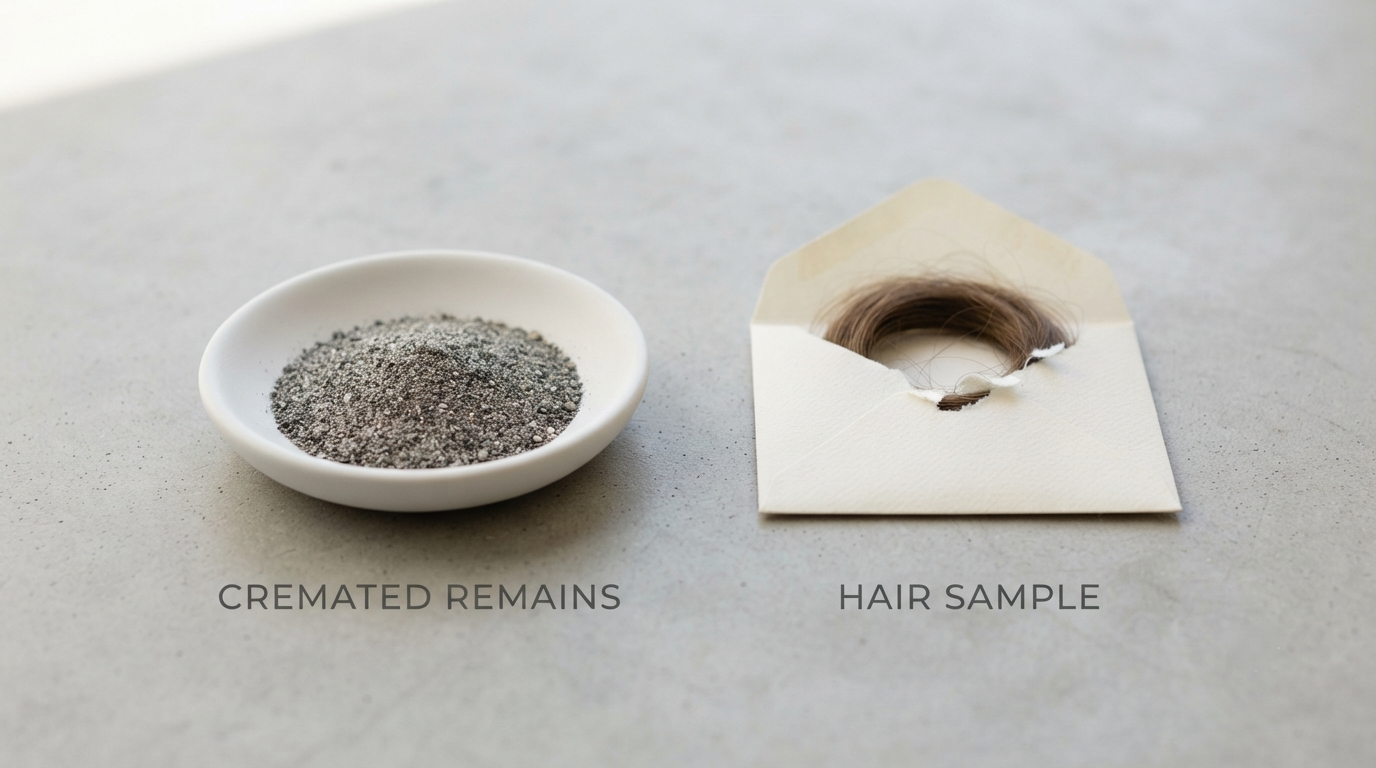
A small dish of cremated ashes beside a lock of hair in an envelope, the two source materials compared

The size of that personal share is the number worth sitting with, and it needs stating carefully rather than loosely. Industry figures for the ash route put it at roughly 10% to 15% of the finished mass, and some providers cite figures as low as 3%. For hair there is no equivalent published percentage, only the fact that hair is around 50% carbon by weight, so far less starting material is needed. Anyone quoting a single number that covers both routes is quoting something nobody publishes.

What that rules out is simple. A partner memorial diamond sold as made entirely of a person is advertising something the chemistry does not permit. What is true is stranger and better: atoms that were physically part of your partner are locked inside a crystal lattice, permanently, and the stone exists because they did. Ask any provider what share your own submission is expected to contribute, and ask for that answer in writing. Whether a partner memorial diamond is really made from your partner’s ashes takes that question apart properly, and the general category background is worth five minutes if this is entirely new to you.

Two routes exist, and they are genuinely different:

  • Ashes. Cremated remains are mostly calcium phosphate, so usable carbon is only about 0.5% to 4% by weight. That thin yield is why providers ask for a portion measured in spoonfuls, typically a few tablespoons up to roughly 4 oz, about 100 g.
  • Hair. Keratin is roughly 50% carbon, so a small lock of a few grams does the work of a much larger portion of ash. Crucially, hair needs no cremation at all, which keeps the option open for a partner who was buried.

The two routes combine. A submission of ashes and hair together is assessed against each material’s own figures rather than pooled into one total, which matters if you hold a little of each rather than enough of either. The hair route on its own terms is worth reading if cremation never happened.

Who Is Allowed to Authorize a Partner Memorial Diamond?

This is the question the rest of the internet answers badly for partners, so it gets its own section rather than a line in the FAQ.

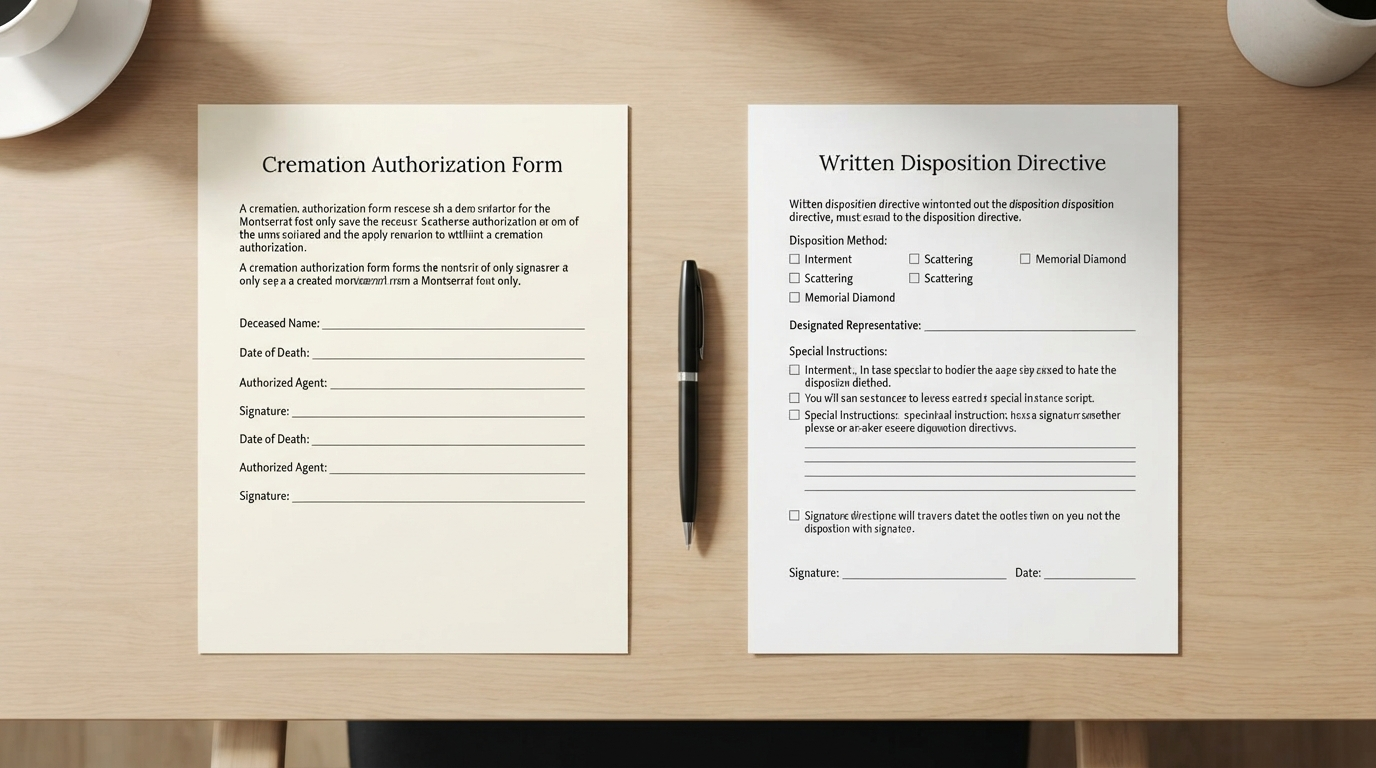
There is no single national rule here. Each state writes its own, and paperwork your partner signed while alive can reorder the result on top of that: a will, a disposition directive, a pre need contract with a funeral home, or the authorization someone gave to release the body for cremation. If the relationship was recognized in law, the holder of that authority is normally obvious. If it was not, no marriage, no civil partnership, perhaps a family that never quite said the word out loud, the legal decision may belong to your partner’s mother, to an adult child, to a brother, or to a spouse from a marriage long dissolved.

Say it plainly: you may not be the person who can release the material for a partner memorial diamond, and finding that out before money moves is very much cheaper than finding out afterwards.

A cremation authorization form and a written disposition directive on a desk, the documents that decide who controls remains

The practical sequence is short:

  • Ask the funeral director who signed the cremation authorization. It is a two minute call, it costs nothing, and that name is very often the person holding control.
  • Find out what was left in writing, and whether anyone has read the document rather than remembered its gist.
  • Ask the holder for a portion, not for the arrangements. A request for a few tablespoons, leaving every existing plan untouched, is a far smaller ask than it feels like, and it is granted more often than people expect.

How to open that conversation covers what to say and what not to lead with. If you are at the very start of all this, where to begin sets out which decisions are urgent and which are not.

What If the Answer Is No, or Not Yet?

Refusal happens often enough that leaving it out would be dishonest, and it is rarely as final on paper as it sounds on the day.

If the person holding authority refuses a partner memorial diamond, three things usually remain true. Hair, if any was kept, is ordinarily the less obstructed route: what the law regulates here is cremated remains, and a lock that has sat in your own house was never inside that frame. Read that as how things tend to work, not as a settled legal position, belongings can be drawn into an estate, states differ, and hair in another person’s keeping is something to ask about.

Confirm it wherever the answer matters. A refusal given in the first month is a different object from a refusal given in the ninth, because the person refusing is also exhausted and also grieving. And a narrower ask frequently succeeds where a broad one failed: not “I would like to have a diamond made,” but “may I have a few tablespoons set aside.”

If the answer stays no, the ashes route closes and the idea of a partner memorial diamond does not. Hair requires no cremation and no portion of anything anyone else is holding, and where the sample is already in your own keeping it is usually the simpler path, worth checking rather than assuming, but rarely the obstacle the ash question is. It is also worth raising the possibility that more than one person receives a stone, several diamonds from one shared source turns a request into something a family benefits from collectively, which is often what restarts a stalled conversation.

How Does the Process Run, Stage by Stage?

Seven stages, most of which happen without you. The wait is long and mostly silent, which is worth knowing in advance so the silence does not read as a problem.

StageWhat happensRoughly how long
1. CollectionAshes or hair are received and logged against chain of custody documentationDays
2. Carbon extractionEverything that is not carbon is stripped away in a controlled, oxygen free processWeeks
3. PurificationThe recovered carbon is refined to roughly 99.9%+ purityWeeks
4. GraphitizationPurified carbon is heated to about 2,500 to 2,700°C and converted into graphiteWeeks
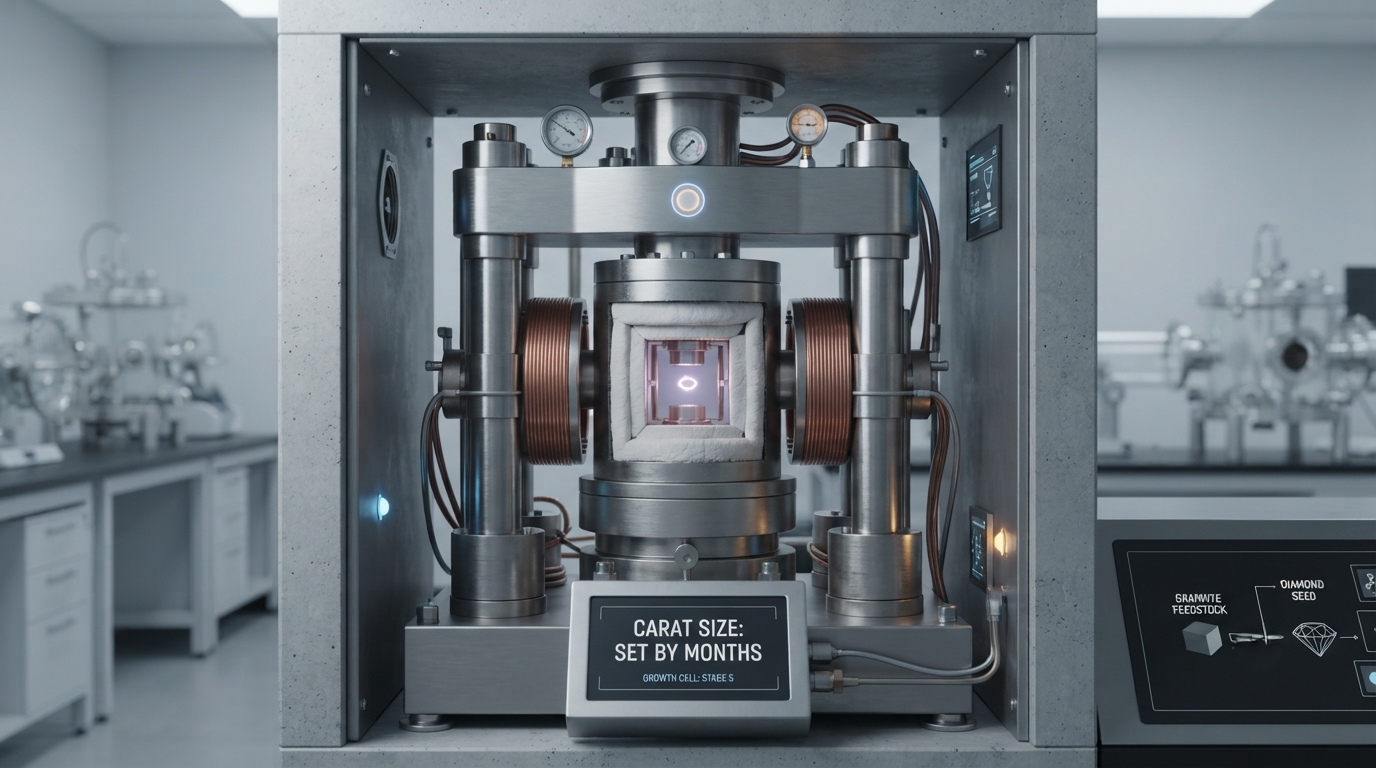
5. GrowthGraphite plus supplemental lab carbon is grown around a seed in an HPHT cellWeeks to months, this is where carat is decided
6. Cutting and polishingA gemologist shapes the rough into the finished stoneWeeks
7. Grading and returnOptional independent grading, then the stone comes homeWeeks
An HPHT growth cell in a laboratory, the stage where carat size is set by months of growth time

Nothing in stages two through five asks anything of you, and most providers go quiet through them. The silence is normal rather than a warning sign, though it is entirely reasonable to ask at the outset how often you will be updated and by whom.

End to end, the industry typical span for a partner memorial diamond is 6 to 10 months, reaching around 12 months for larger or specialty color stones. The reason is stage 5: carat is a function of time in the press, not of how much ash or hair you sent. A full urn does not buy a bigger stone or a faster one. The timeline in detail shows where each month goes, and the full ashes route walks the same seven stages at greater length.

What Does a Partner Memorial Diamond Cost?

Industry wide bands, not our published pricing, and they move with carat, color, cut and whether an independent grading report is included.

Think of it in three tiers. The smallest stones, a tenth to a quarter of a carat, sit in an industry band of about $1,500 to $3,500. A half carat through a full carat typically means $5,000 to $15,000, and a colorless stone at that weight costs noticeably more than a yellow, blue or champagne one. Above two carats the band runs from around $20,000 to $75,000 and higher. Settings, engraving, fancy cuts and grading reports are normally separate line items from the loose stone.

Two things worth knowing before you request a single quote. First, decide a carat you can actually afford, everything else prices off it, and a quote with no carat attached cannot be compared to anything. Second, budget for the back half: grading, cutting choices and a setting arrive months after the deposit, when the money often feels already spent. The full cost breakdown for a partner memorial diamond goes through each driver individually.

What Color Will It Be, and Can You Choose?

Partly, and less than the marketing photographs suggest.

Color in any diamond comes from trace elements present during growth. Nitrogen reads yellow. Boron reads blue. A colorless stone requires the near total absence of both. Because the feedstock for a partner memorial diamond comes from an organic, individual source rather than a sterile synthetic one, trace elements are ordinary, which is exactly why memorial stones trend toward yellow, blue and champagne rather than white, and why colorless versions require extra processing and cost more.

Some providers also offer post growth irradiation for red, pink, green or black. Clarity across the category typically lands in the SI2 to VVS range, and the finished stone is graded against the standard GIA 4Cs like any other. What color to expect gives the likelihoods honestly rather than as a menu.

What Does the Stone End Up Living In?

Later than people expect, and nothing forces the decision at the point of ordering.

A finished partner memorial diamond can sit loose in a box for years without coming to any harm, and plenty do, the idea that a partner memorial diamond has to become a ring is a jewelry industry assumption rather than a requirement. When you do want it set, rings, pendants and keepsake ideas for a partner memorial diamond covers the trade offs between a piece worn daily, a piece worn deliberately, and a stone that is never worn at all.

If you are weighing this against keeping an urn rather than against another piece of jewelry, the two options side by side treats both as complete answers, because they are.

Frequently Asked Questions

What exactly is a partner memorial diamond?

A real lab grown diamond grown partly from carbon recovered out of your partner’s cremated ashes or hair. It is chemically and optically a diamond, 10 on the Mohs scale. Industry figures put the personal carbon at roughly 10% to 15% on the ash route; no equivalent figure is published for hair.

Is it really made from my partner, or is that just marketing?

A partner memorial diamond is genuinely made in part from them. Carbon is extracted from the material you send, purified to roughly 99.9%, and grown into the crystal lattice itself. It is not the whole stone, and anyone claiming otherwise is overstating it. Both halves of that sentence are true.

How much ash or hair does it take?

Industry typical is a few tablespoons up to roughly 4 oz of ashes, or a small lock of hair weighing a few grams. Ash is only 0.5% to 4% carbon, hair around 50%, which is why the two quantities differ so sharply. Most of what you hold stays with you.

What color will the finished stone be?

Most likely yellow, blue or champagne. Nitrogen in the source carbon produces yellow tones, boron produces blue, and colorless requires the absence of both, harder and costlier with organic feedstock. Treat a partner memorial diamond’s color as a strong likelihood rather than a selection from a chart.

How long does a partner memorial diamond take?

Typically 6 to 10 months from receipt of material, stretching toward 12 months for larger or specialty color stones. The long stage is growth, because carat is bought with time in the press rather than with the amount of ash or hair submitted.

What does one cost?

A partner memorial diamond runs, industry wide, roughly $1,500 to $3,500 at 0.10 to 0.25 ct, around $5,000 to $15,000 at 0.5 to 1 ct, and $20,000 to $75,000 or more at 2 to 5+ ct. Colorless costs more than yellow or blue at equal size, and settings and grading reports are priced separately.

Who actually has the authority to approve this?

Legal control of the remains sits with one person, and who that is turns on state law and on anything your partner put in writing. If the relationship was not legally recognized, that person may be a parent, an adult child, or a former spouse rather than you. Establish it before spending anything.

Can several people each have a stone from the same ashes?

Usually yes, since only a small portion is used. Families commonly split one submission into several stones, or make separate submissions from a shared source. It is far easier to arrange before the portion is drawn than after.

What happens to the material that is not used?

That is company policy rather than chemistry, and it varies. Extraction leaves most of what arrives behind. Ask in writing whether the remainder returns by default, in what container, and how long after the stone is finished, before anything is posted.

My partner was buried. Is there any option?

Yes, if hair was kept or can still be obtained. Hair is around 50% carbon, requires no cremation, and a few grams is enough. A hairbrush, an envelope kept by a family member, or a lock taken at the hospital are all workable starting points.

Do I have to give up the urn to do this?

No. The portion required is a small fraction of a cremation, so an urn at home, an interment, a scattering and a stone can all come from the same remains. Nothing here requires you to cancel a plan that already exists.

What should I ask a provider before committing?

Ask whether their stated minimum is a received or a usable weight, what chain of custody documentation you receive, what happens to unused material, whether independent grading is included, and what the timeline is at your specific carat. Unhurried, specific answers matter more than photographs.

Final Thoughts on the Partner Memorial Diamond

Most of what people want to know about a partner memorial diamond turns out to be answerable in a sentence: it is a real diamond, a genuine portion of it came from your partner, it takes months rather than weeks, and it consumes far less material than anyone fears.

The question that does not resolve in a sentence is the one about standing, and it is the reason this page gives authority its own section rather than burying it. For partners whose relationship sat outside the legal categories, that question can decide everything, and it is answerable, usually with one phone call, long before any money is at stake.

Nothing on this page is an argument that a stone is better than an urn, a plot, or a scattering at a place that mattered. Those are complete answers on their own. This one simply happens to be an answer you can wear.

Learn More About Partner Memorial Diamonds

Talk With Memorial Diamond

There is no stage of this where asking a question obliges you to anything. If you have read this far and still have a question that is not above, it is almost certainly a reasonable one and almost certainly asked often.

The four worth putting to any provider, including us: what material is required and whether that figure is received or usable weight; what documentation proves the carbon came from your partner; what happens to material the process does not consume; and what a stone at your chosen carat takes in months. memorialdiamond.us will answer those in writing, and so should anyone else you are weighing up.

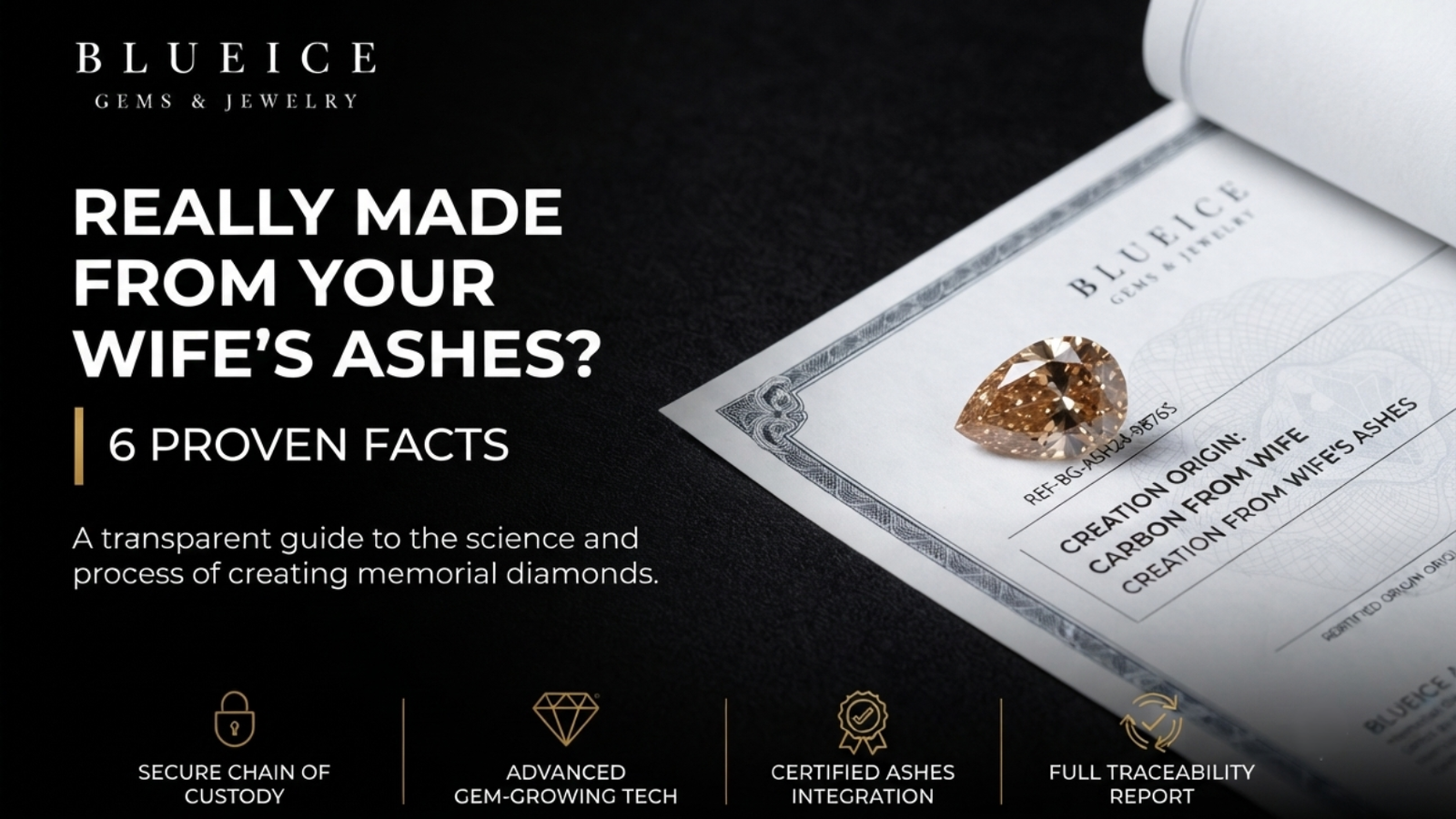
Really made from your wife's ashes: a small champagne-toned lab-grown memorial diamond resting on its reference-numbered origin certificate

Is a Memorial Diamond Really Made From Your Wife’s Ashes?

You are allowed to be skeptical. Somebody is asking you to hand over a portion of your wife’s ashes, wait most of a year, and accept a stone on their word that she is in it. A memorial diamond is really made from your wife’s ashes in part: carbon is extracted from a small amount of her cremated remains, purified, blended with lab sourced carbon to reach a workable volume, and grown into a genuine diamond in which her carbon typically makes up around 10 to 15% of the stone.

The Short Answer, and Why “In Part” Is the Honest Version

Ask whether a memorial diamond is really made from your wife’s ashes and you are asking two questions at once. The first is chemical: can a diamond be grown from cremated remains at all? The second is procedural: how do I know this stone came from her and not from a jar of industrial graphite?

The chemistry is settled and public. The procedure is where the trust lives. The table below is the whole argument, one claim per row.

Claim you will hearVerdictWhat the evidence is
“A diamond can be grown from cremated ashes.”TrueAshes hold roughly 0.5 to 4% usable carbon. The process is public for the whole memorial diamond category.
“The diamond is 100% her.”FalseHer carbon is blended with lab carbon; her share is typically around 10 to 15%. Anyone claiming total purity is wrong.
“It is really made from your wife’s ashes.”Partly true and that is the right claimA real, purified portion of her carbon is in the crystal lattice. “In part” is accurate; “entirely” is not.
“A lab test can prove it is her.”FalseNo test can identify whose carbon a diamond contains. The proof is procedural, not chemical.
“The custody record proves it.”True, if the record is real and specificA logged, traceable record from arrival to finished stone is the actual evidence.
“The grading report proves it came from her.”FalseA grading report proves quality: cut, color, clarity, carat. It says nothing about origin.

Six claims; the rest of this page takes them one at a time.

Fact 1 Is There Really Carbon in Her Ashes to Work With?

Yes, though less than most people assume, and that is the first thing a doubter gets right about a stone really made from your wife’s ashes.

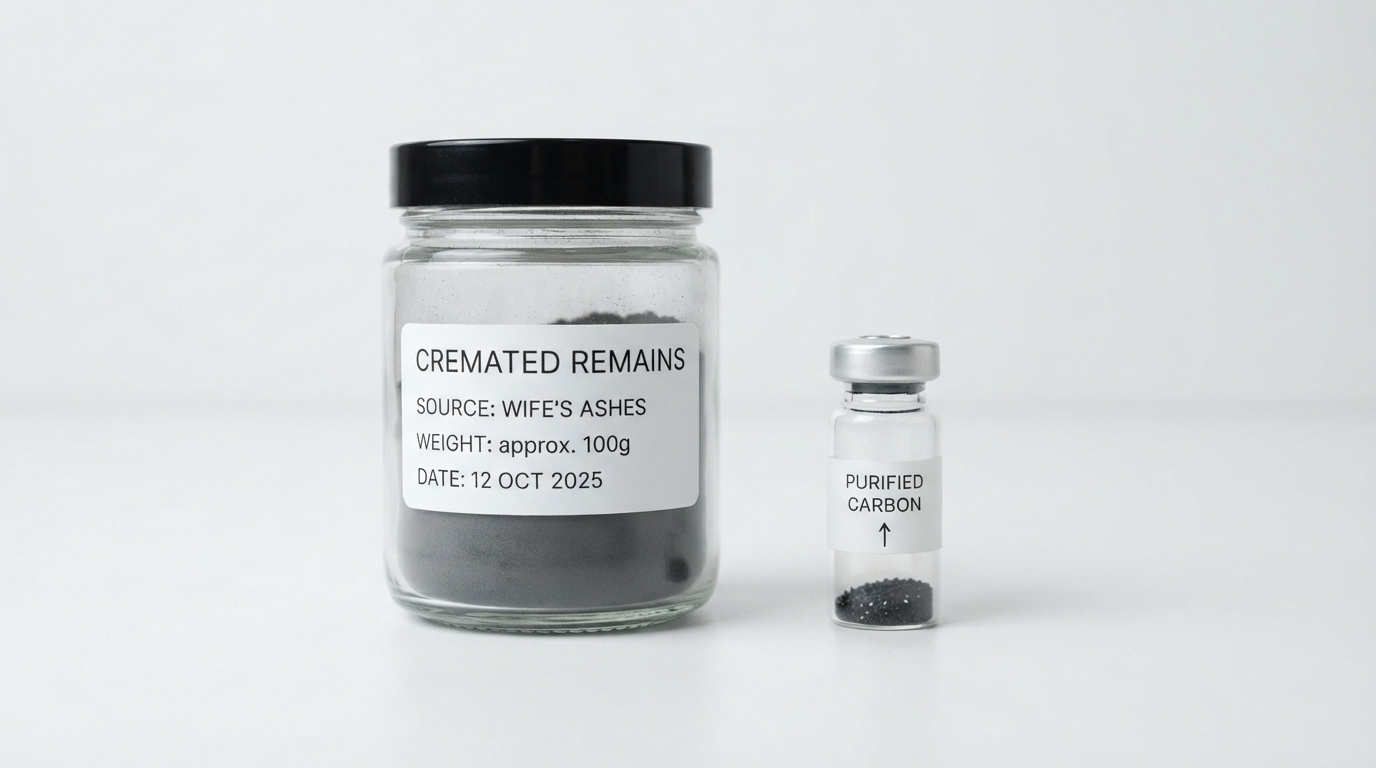
Cremated remains are almost entirely calcium phosphate, the mineral structure of bone. Carbon, the only element a diamond is made of, survives as a small fraction: industry figures put usable carbon at roughly 0.5% to 4% of ash by weight, varying by person and by cremation.

A labeled laboratory sample container of cremated ash beside a much smaller vial of purified carbon

That fraction is enough. A provider heats a portion of her ashes, typically a few tablespoons to around 4 oz, about 100 g, in a controlled, oxygen free, multi stage process that strips away the minerals and leaves carbon at 99.9%+ purity. That carbon is heated to roughly 2,500 to 2,700°C and converted into graphite, the feedstock a diamond press uses.

So the chemical premise behind a diamond really made from your wife’s ashes is not exotic: a small quantity of a common element, recovered from a material that is mostly something else. How a memorial diamond is made from your wife’s ashes walks through every stage in order; this page stays on the question of proof.

Fact 2 How Much of the Diamond Is Really Her?

This is the fact that makes the skeptic right to ask, and the one a good provider volunteers before you do.

The carbon recovered from a few tablespoons of ash is not enough, on its own, to grow a diamond of meaningful size, so the purified graphite is blended with lab sourced carbon. In the finished stone, the personal carbon from her ashes typically makes up around 10 to 15% of the mass. Some providers cite figures as low as 3%, others higher, depending on carat and how much ash was submitted. Three consequences follow for whether the stone is really made from your wife’s ashes in the sense you mean:

  • “100% her” is false wherever you read it. It describes physics that does not exist.
  • “In part” is not a loophole; it is the accurate description. A real, measurable portion of the carbon that was in her body is now locked in a crystal lattice. The diamond is really made from your wife’s ashes; it is not made only from them.
  • Sending more ash does not raise her share meaningfully. Carat is set by growth time in the press, not by material quantity. A provider who suggests a full urn will make the stone “more her” is wrong on two counts.

Ask the percentage question. A specific range with a reason means the provider understands what they are selling. “It’s all her” tells you something more useful than the percentage.

Fact 3 What Does a Chain of Custody Record Actually Prove?

Because no test can identify the carbon, the evidence that a stone is really made from your wife’s ashes is a paper trail.

A chain of custody record is a logged, traceable account of your submission from arrival to shipped diamond. In a reputable operation it looks like this:

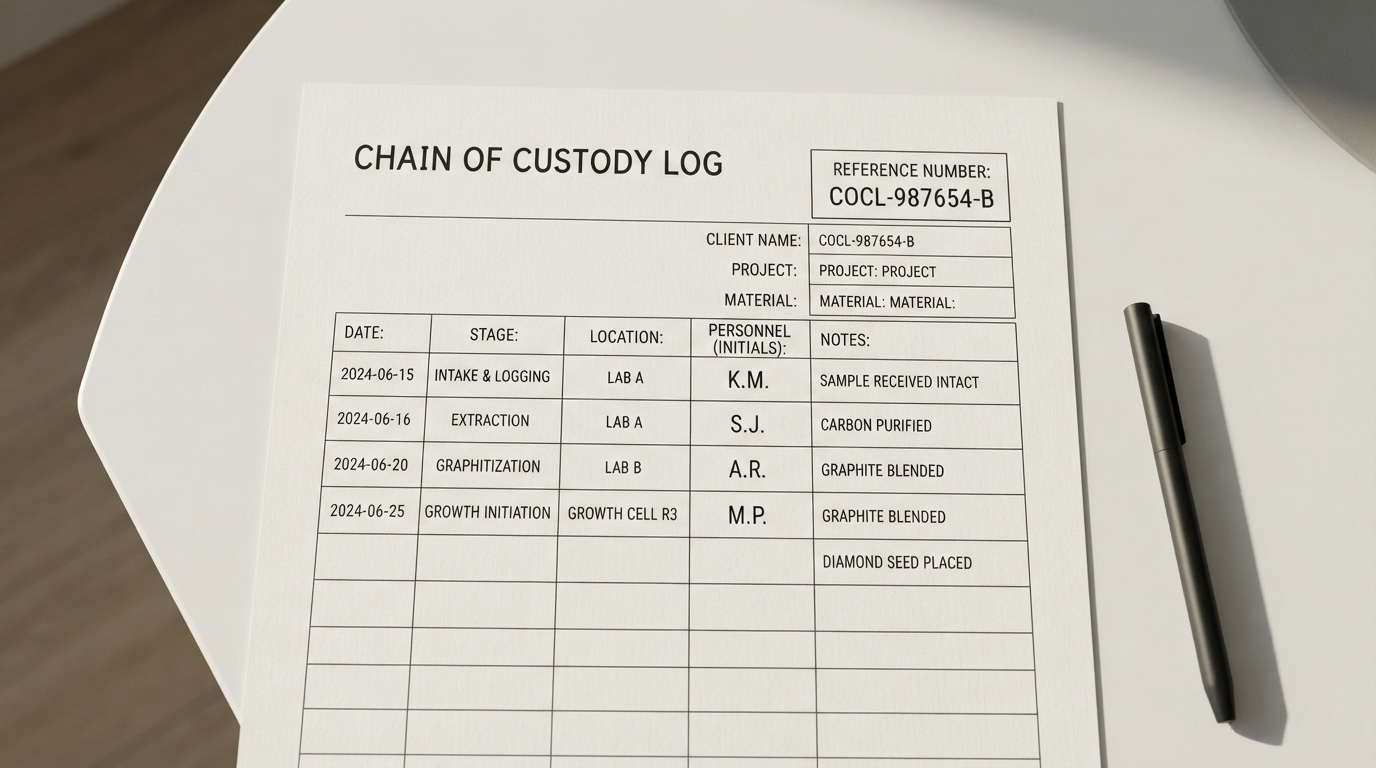
A printed chain-of-custody log with a reference number, dated stage entries, and initials down the page
  1. Intake. Your submission is weighed, photographed, and assigned a unique reference the moment it is opened.
  2. Sealed transfer. The ash portion moves to extraction in a labeled, sealed container under that reference. Nothing is pooled with another family’s material.
  3. Extraction and purification. The carbon recovered is weighed and logged against the same reference.
  4. Graphitization and growth. The purified carbon and the growth cell it enters are logged under the reference, with dates.
  5. Cutting, grading, and return. Rough crystal and finished stone are tracked against the reference through to shipping.

What this proves: that an identified sample entered the process and an identified stone left it, with a documented link at every stage. What it does not prove: anything about the atoms themselves. A record is only as good as the provider keeping it, which is why you ask to see one. If a diamond is really made from your wife’s ashes, this record is the only place that fact is written down. Questions to ask before turning your wife’s ashes into a diamond turns it into a list you can read down the phone.

Fact 4 What Does an Origin Certificate Prove That a Grading Report Does Not?

Two documents arrive with a finished stone, and people routinely treat them as one. They prove different things, and only one speaks to whether the diamond is really made from your wife’s ashes.

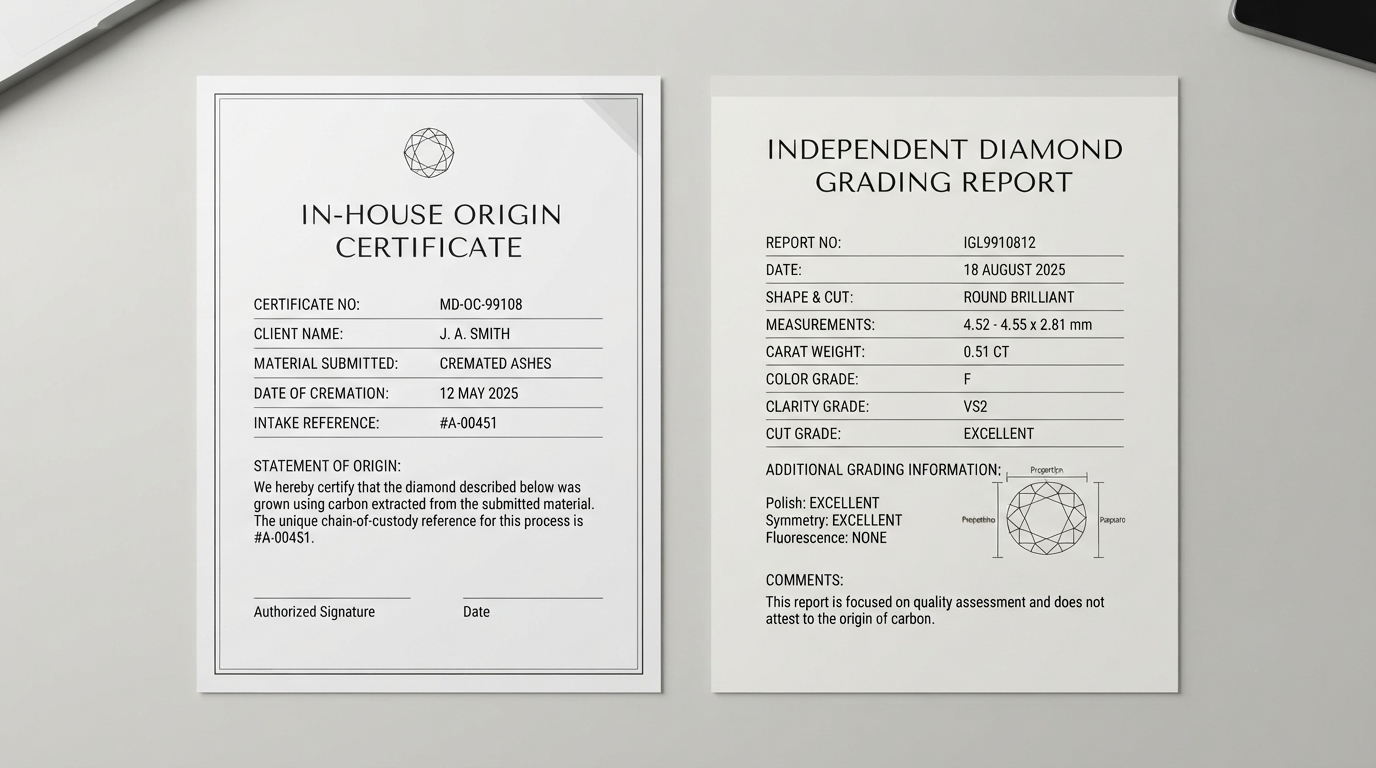
DocumentWho issues itWhat it provesWhat it does not prove
Origin or authenticity certificateThe provider, in houseThat this specific stone was grown from this specific submission, the summary of the custody recordThe stone’s quality
Grading reportIdeally an independent gemological labThat the stone is a genuine diamond of a stated cut, color, clarity, and caratWhere the carbon came from, a grading lab has no way to know
An in-house origin certificate and an independent grading report laid side by side on a desk

The origin certificate is the provider’s attestation: this stone, this submission, this reference. It should carry your intake reference number, the material submitted, and the date. A certificate that only says “genuine memorial diamond” is a souvenir, not evidence that anything is really made from your wife’s ashes.

The grading report is about the diamond as a diamond. An independent lab applies the same cut, color, clarity, and carat standards to a memorial stone as to any other; typical memorial clarity lands between SI2 and VVS. It is silent on origin by design, and a provider who points to the grading report when you ask whether the diamond is really made from your wife’s ashes is answering a question you did not ask.

Fact 5 What Can You Verify Yourself, and What Can Nobody Verify?

Here is the line most articles blur, stated plainly.

What you can verify about a diamond really made from your wife’s ashes: that it is a real diamond. Any jeweler with a thermal or electrical tester can confirm it is diamond rather than a simulant. An independent lab can grade it and identify it as lab grown by the HPHT or CVD method described on the synthetic diamond page. You can also check that the documents match each other and your intake paperwork.

What nobody can verify: whose carbon is in it. A carbon atom from your wife’s ashes is identical to a carbon atom from a lab feedstock. There is no isotope test, DNA test, or spectroscopic signature that says “this carbon came from this person.” A diamond grown entirely from lab carbon and a diamond really made from your wife’s ashes would be indistinguishable to every instrument in existence.

That is no reason to distrust the category. It is a reason to be precise about where the proof lives: in procedure, the custody record, the reference numbered certificate, the provider’s willingness to show you both, not in chemistry. Anyone who says a test can settle whether a stone is really made from your wife’s ashes is mistaken or selling the test.

So the question to carry into every conversation is “show me the record.” A provider who has one will be relieved you asked. How to turn your wife’s ashes into a diamond puts the paperwork check at the receiving end of the process, where it belongs.

Fact 6 Which Red Flags Suggest a Provider Is Overstating?

A provider does not have to be dishonest to overstate; some repeat marketing they inherited. Either way, these signals mean the answer to “is it really made from your wife’s ashes” is being stretched:

  • “100% made from your loved one.” The most reliable red flag. It is chemically false, and a provider who leads with it will not be careful about the percentage that is true.
  • No specific percentage, or one that changes when you ask twice. A good answer is a range with a reason.
  • “Send as much as you can.” More ash does not make the stone bigger or more her.
  • Custody described but never shown. A brochure sentence instead of a sample record means the record may not be what the sentence implies.
  • An origin certificate with no reference number. A generic certificate proves nothing about your specific stone.
  • The grading report offered as proof of origin. It is proof of quality. Conflating the two is a misunderstanding or a redirection.
  • A guarantee that a test will confirm it is really made from your wife’s ashes. No such test exists.

None of the first six is disqualifying alone; two or three together are a pattern. The seventh is a plain falsehood, do not send anything irreplaceable to a provider who states it, whatever else they say about a stone really made from your wife’s ashes.

Why Does This Question Matter More for Ashes Than for Hair?

If you also hold a lock of her hair, the “is it really her” doubt is weaker on that side, and it is worth knowing why.

Hair is roughly 50% carbon by weight, built from keratin. Ashes are under 4% carbon. A hair submission supplies far more personal carbon per gram, so the question of whether there was enough of her barely arises. With ashes, the small carbon fraction is what makes the honesty point necessary: lab carbon has to do most of the volume, so the percentage has to be answered squarely before you can say a stone is really made from your wife’s ashes.

That does not make an ashes stone less real. It makes the proof more dependent on procedure. A diamond really made from your wife’s ashes is one whose provider will tell you, unprompted, how small her share is, because the alternative is a provider who will not.

The hair version of the same doubt, different chemistry, worries about dye and gray, the same procedural proof, is in whether a memorial diamond is really made from your wife’s hair. Both routes end at a stone that is genuinely, partly, provably her, with the proof on paper rather than in the atoms. Wife Ashes Diamond: The Complete Guide covers everything downstream, quantity, color, carat, cost, and timeline, once you are satisfied that the stone is really made from your wife’s ashes.

Frequently Asked Questions

Is a memorial diamond really made from your wife’s ashes, or is that marketing?

It is really made from your wife’s ashes in part. Carbon is extracted from a small portion of her cremated remains, purified, and grown into a genuine diamond. Her carbon typically makes up around 10 to 15% of the stone; the rest is lab sourced carbon added to reach a workable volume.

Can a lab test prove the diamond is really made from your wife’s ashes?

No. Carbon atoms carry no personal signature, so no chemical, isotopic, or gemological test can identify whose carbon a diamond contains. A jeweler can confirm it is a real diamond and a lab can grade it; proof of origin is procedural, the custody record and origin certificate.

What does “chain of custody” actually mean for her ashes?

A logged, traceable record following your submission under one reference number from intake through extraction, growth, cutting, and return, with no pooling with other families’ material. Ask to see a sample record; it is the only written evidence the stone is really made from your wife’s ashes.

Is the origin certificate the same as the grading report?

No. The origin certificate is issued by the provider and attests that this stone was grown from your specific submission. The grading report, ideally from an independent lab, documents cut, color, clarity, and carat and says nothing about origin. You want both.

Why is the personal carbon only 10 to 15% of the stone?

Because ashes are almost entirely calcium phosphate, with only about 0.5 to 4% usable carbon. The carbon recovered from a few tablespoons of ash is not enough to grow a meaningful stone alone, so it is blended with lab carbon. Some providers cite figures as low as 3% depending on carat.

Would sending more of her ashes make the diamond more her?

Not meaningfully. Carat is determined by growth time in the press, not by material quantity, and the blend ratio is set by the growth cell’s volume. Sending a full urn loses ashes you could have kept without making the stone any more really made from your wife’s ashes than it already is.

Is the doubt any different if I use her hair instead?

Yes, in one respect. Hair is roughly 50% carbon compared with under 4% for ashes, so far more personal carbon is available per gram and the “was there enough of her” question barely arises. The procedural proof, custody record and origin certificate, is the same for both.

Final Thoughts on Whether It Is Really Made From Your Wife’s Ashes

The skeptic in you is doing its job. A memorial diamond is really made from your wife’s ashes in the only sense physics allows, a small, purified, real portion of her carbon inside a genuine diamond, and no honest provider will tell you otherwise. You cannot prove it with an instrument. You can insist on a provider who states the percentage plainly, shows you the custody record, and issues a certificate tied to your reference number. Choose on those three things, and the stone you receive will be what it claims: really made from your wife’s ashes, entirely real, and honestly described.

Learn More About Wife Memorial Diamonds

Talk With Memorial Diamond

If you want to ask the three questions on this page, the percentage, the custody record, and the certificate wording, before any of her ashes leave the house, reach out to Memorial Diamond. Asking whether a stone is really made from your wife’s ashes before you send them is what a careful person does. There is no deadline.

Loose champagne-toned memorial diamond beside a notebook of handwritten questions on a kitchen table

Mother Memorial Diamond FAQ: Everything Families Ask

Choosing a mother memorial diamond can bring many questions. Families often want to know whether the diamond is genuine, what it may look like, how much material they need to provide, how much the process costs, how long production takes, and whether several family members can receive their own diamond.

Families also ask questions that deserve more attention. What happens if a growth run fails? Can you change your mind after sending ashes or hair? Does unused material come back? Who owns the diamond when several people contribute? What happens to the order if the person who placed it dies before completion?

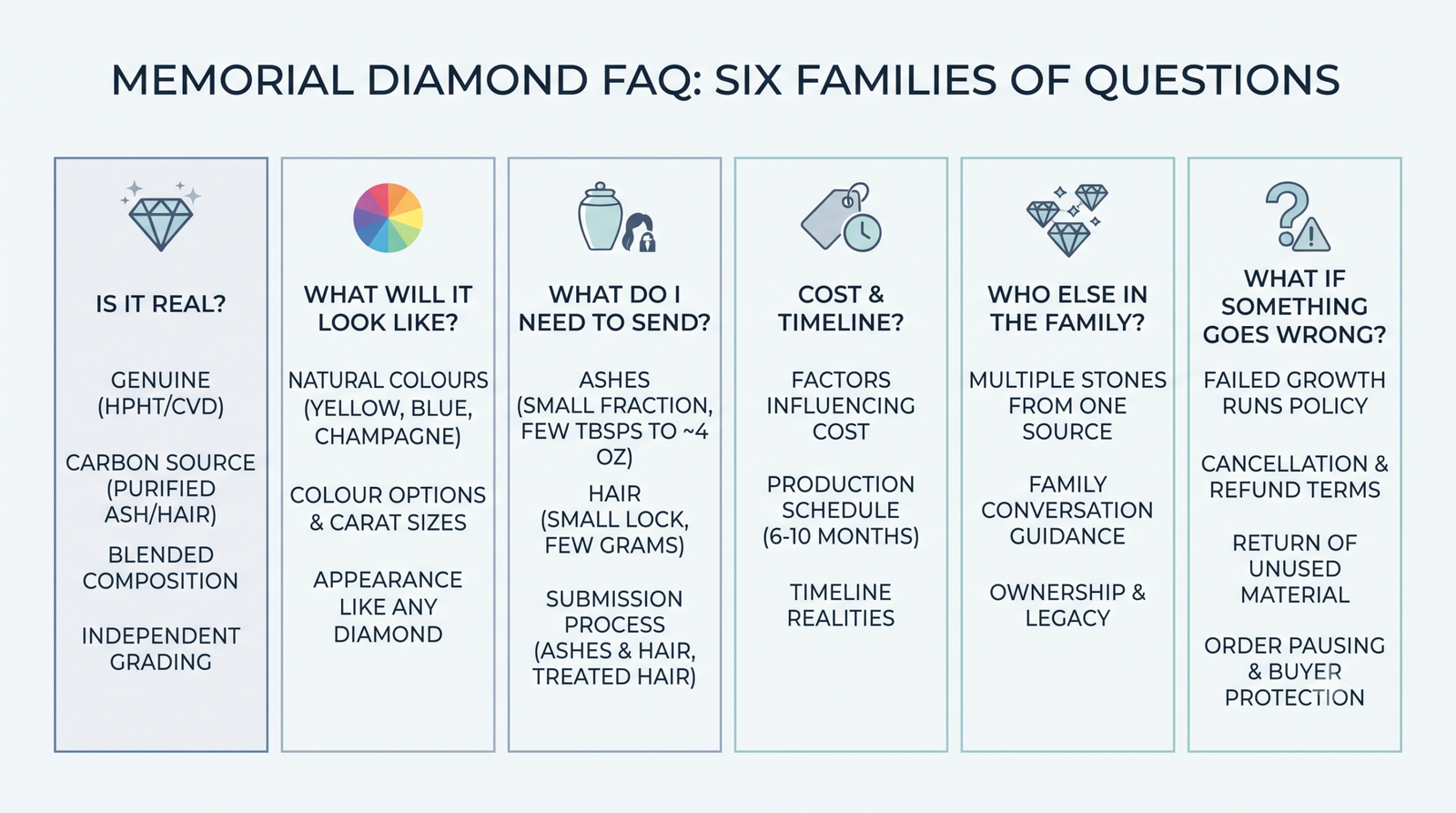
This guide groups the most common questions into six areas so you can find clear answers quickly.

The Six Main Question Groups

Question groupShort answer
Is it real?A mother memorial diamond uses the lab grown diamond process and can contain purified carbon from her ashes or hair.
What will it look like?Many memorial diamonds develop yellow, blue, or champagne tones rather than appearing completely colorless.
What do I need to send?Providers commonly request a small portion of ashes or a small lock of hair.
What does it cost and how long does it take?Industry pricing varies greatly by carat and color, while production commonly takes several months.
Can several family members have one?One source can often provide material for more than one diamond.
What happens if something goes wrong?Providers set their own policies for failed growth runs, cancellation, unused material, and other situations.
Diagram grouping common memorial diamond questions into six families, from "is it real" through "what if something goes wrong"

Is a Mother Memorial Diamond Really a Diamond?

Is it a real diamond or a look alike stone?

It is a real diamond. Memorial diamond providers use the same fundamental laboratory diamond methods that produce other lab grown diamonds. The industry uses HPHT, which stands for high pressure high temperature, and some providers use CVD, which stands for chemical vapor deposition.

The finished stone has the chemical and optical characteristics of diamond. Diamond reaches 10 on the Mohs hardness scale, and laboratories can evaluate it through the same four Cs used for other diamonds.

Is it really made from my mother’s ashes or hair?

Providers extract carbon from the submitted material, purify it, convert it into a suitable carbon form, and use it during diamond growth. The personal carbon becomes part of the crystal growth process.

The process does not mean that the finished diamond contains only carbon from your mother. Providers typically combine personal carbon with supplemental laboratory carbon because the growth process requires a workable quantity of material.

How much of the finished diamond comes from her?

The personal carbon represents a real portion of the finished stone. Industry information places the typical personal carbon contribution around 10 percent to 15 percent of the finished stone mass, although the figure can vary by provider, stone size, and the amount of submitted material.

This distinction matters when you evaluate memorial diamond claims. A provider should explain the role of personal carbon clearly rather than suggest that the entire stone consists only of carbon from your mother.

Is it legal to turn ashes into a diamond?

Families can generally choose different ways to handle cremated remains, but the exact requirements can depend on location and circumstances. Funeral homes, memorial diamond providers, shipping services, and border authorities may require specific documents when remains travel between countries.

Ask your provider about the paperwork and chain of custody before you send any material. For detailed legal considerations, read the legal question in more detail.

Will the diamond have a grading report?

Ask the provider which independent gemological laboratory will evaluate the finished diamond. Industry references commonly discuss laboratories such as GIA and IGI. A provider may also issue an internal certificate that connects the finished diamond with the submitted material.

An independent grading report and an internal certificate serve different purposes. Ask whether your order includes both and request the name of the grading laboratory before you commit.

What Will Her Diamond Actually Look Like?

What color will a mother memorial diamond have?

Many memorial diamonds do not appear completely colorless. Trace elements associated with organic carbon can influence the final color. Nitrogen can contribute to yellow tones, while boron can contribute to blue tones.

Some memorial diamonds develop champagne tones. The source material influences the result, so a provider cannot promise an exact naturally occurring shade before growth.

For a deeper explanation, read what color a diamond made from her ashes will be.

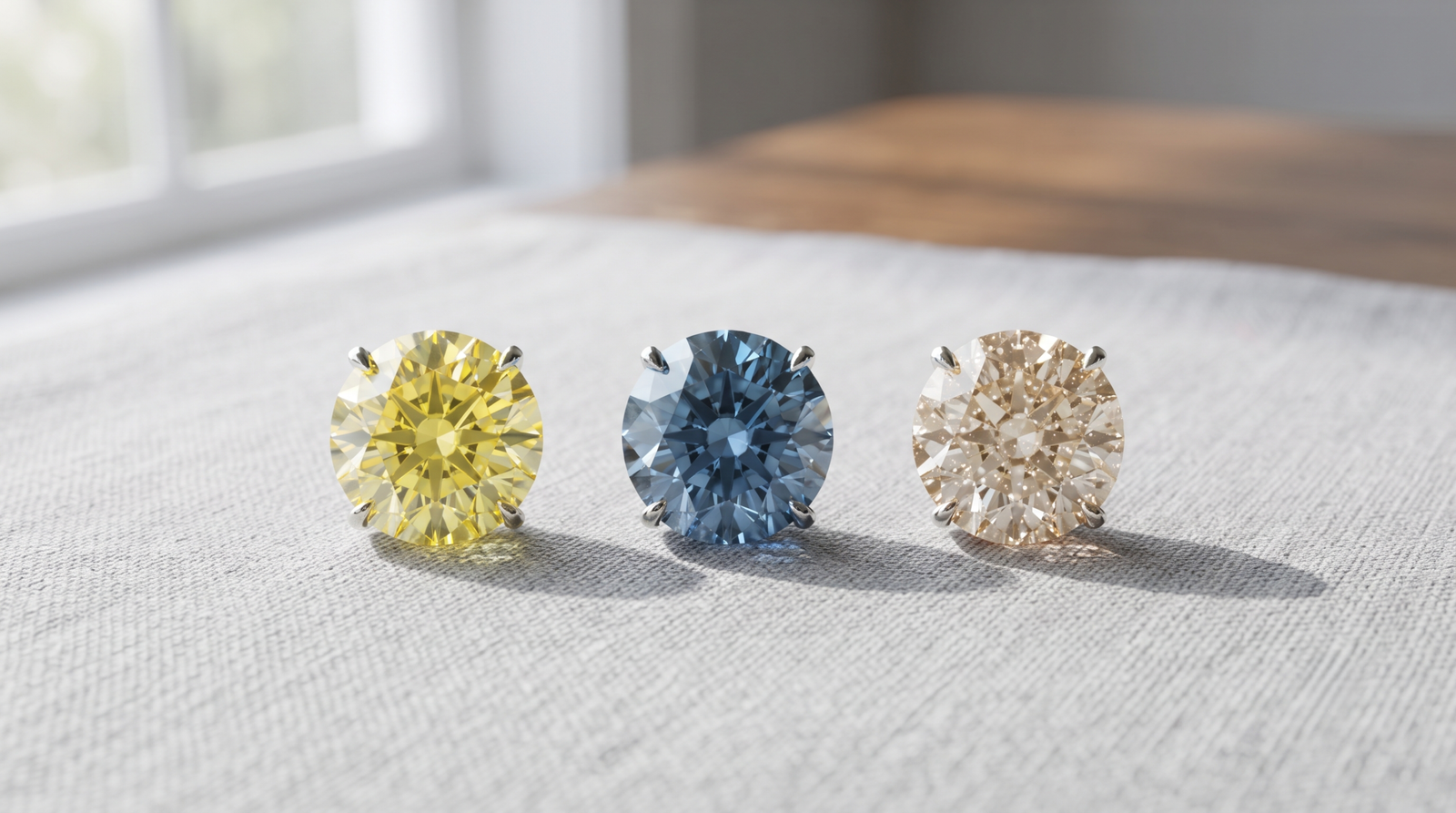
Three memorial diamonds in yellow, blue and champagne tones photographed side by side in daylight

Can I choose the color?

You may have some color choices, depending on the provider and the available process. Colorless diamonds can cost more at the same carat size. Some providers also offer treatments that can create colors such as red, pink, green, or black after growth.

You cannot reliably request an exact natural shade because the source material influences the result. Read which colors are actually offered and what each costs before choosing.

What carat sizes can a memorial diamond reach?

Memorial diamond providers offer a wide range of sizes. Industry references place the range around 0.10 carats through 5 carats and beyond.

The amount of ashes does not directly determine the final carat size. Growth time plays a major role in determining the size of the finished crystal, which also makes carat one of the main factors that influences price and production time.

Read how to choose a carat size if you need help deciding what size suits your needs.

Can people tell that it is a memorial diamond?

A finished memorial diamond looks like a diamond with the same color and cut. Nothing on the stone itself announces its origin.

Families can make the meaning more visible through the jewelry setting, an engraving, or the story they choose to share. Explore settings and jewelry ideas and engraving options for ways to personalize the piece.

What Do I Need to Send?

How much of my mother’s ashes do I need?

Industry typical requirements range from a few tablespoons to around 4 ounces of ashes, depending on the provider and the order. This amount represents only a small portion of a full cremation.

You do not need to surrender an entire urn for a memorial diamond. Families can often keep the remaining ashes for an urn, interment, scattering, or another memorial plan.

Read how much ash you actually need before preparing your material.

How much of her hair do I need?

Hair requires much less material than ashes. Hair contains a higher proportion of carbon by weight, while cremated remains contain a much smaller carbon percentage.

Providers commonly request a small lock or a few grams of hair. Weight matters more than length. Keep the hair whole and dry, and follow your provider’s packaging instructions before shipping it.

Learn how much hair you need for the process.

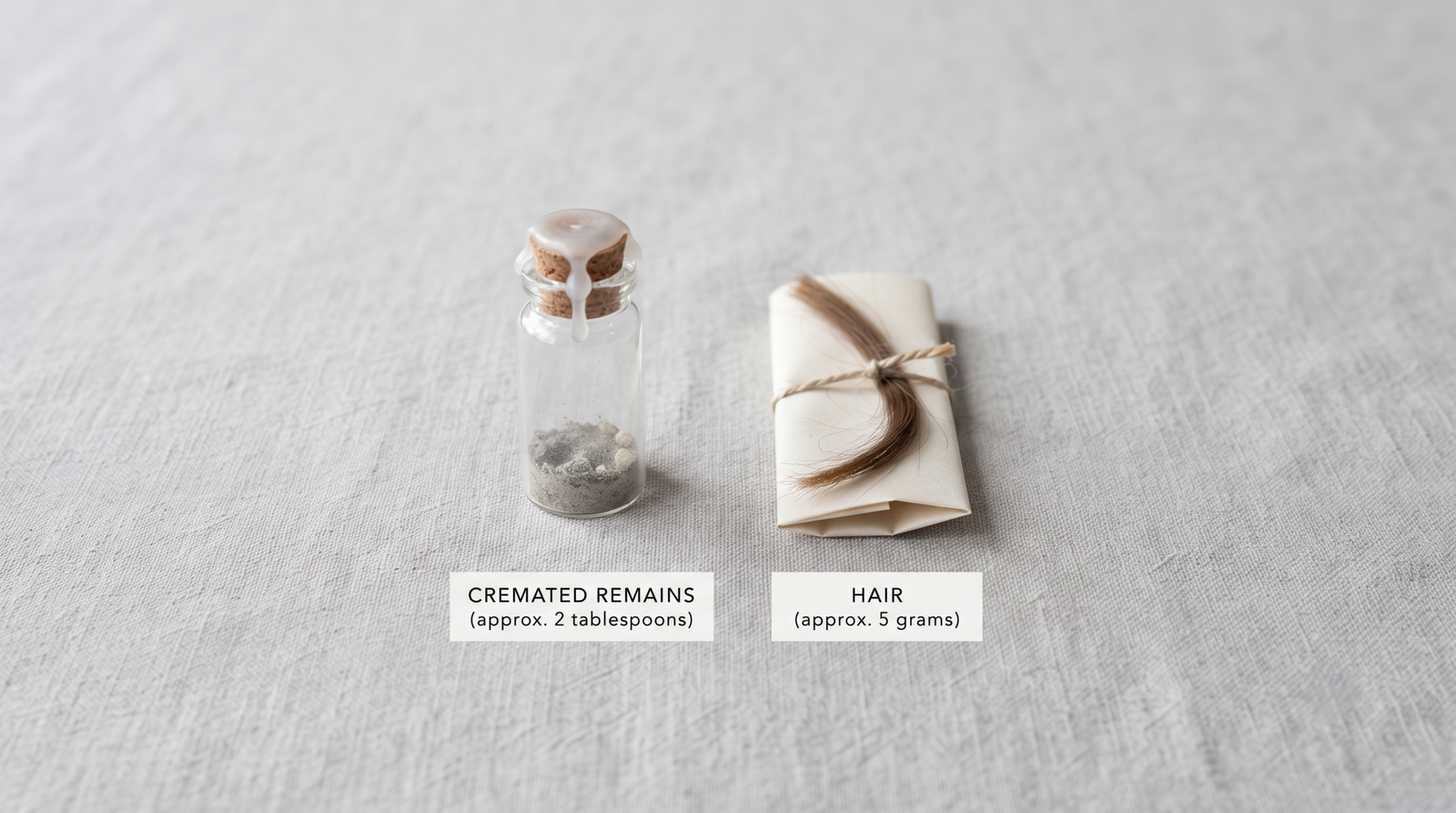
Small sealed container of cremated remains beside a lock of hair wrapped in paper, showing how little material is required

What if my mother was buried or we already scattered her ashes?

Hair may provide another option if you have a lock that you kept while she was alive. A small lock stored in a keepsake box, locket, baby book, or jewelry box may provide enough material for the process.

If you have no ashes and no preserved hair, you may not have a material route available for a memorial diamond. Read the hair route from start to finish to understand how this option works.

Can I send ashes and hair together?

Some providers may accept both ashes and hair, but you should confirm this before sending anything. The two materials require separate extraction steps before the provider combines the resulting carbon during the growth process.

Combining materials can also make the final color less predictable. Read the combined route explained before choosing this approach.

Can dyed, permed, or gray hair still work?

The extraction process reduces hair to carbon, so the original hair color does not remain in the finished diamond. Dye, bleach, perm treatments, and natural pigment do not determine the visible hair color of the finished stone.

Provider acceptance policies can differ, especially when hair has undergone heavy chemical treatment. Ask your provider before you send treated hair.

What Does It Cost and How Long Does It Take?

How much does a mother memorial diamond cost?

Industry pricing in 2026 varies significantly according to carat size and color. Smaller stones around 0.10 to 0.25 carats can fall around $1,500 to $3,500. Half carat to one carat stones can range around $5,000 to $15,000. Stones around 2 to 5 carats can reach $20,000 to $75,000 or more.

Color can also affect the price. Colorless diamonds can cost more at the same size. Jewelry settings, engraving, and grading may add separate costs.

These figures represent category ranges rather than BlueiceGems pricing. Read what a mother memorial diamond costs and explore the 2026 pricing picture across the category.

How long does the whole process take?

Production commonly takes around 6 to 10 months after a laboratory receives and logs the material. Large stones or specialty colors can require up to 12 months.

The complete journey can take longer because families need time to make decisions, prepare material, arrange shipping, complete production, receive the diamond, and choose the final jewelry setting. An overall period of around 8 to 14 months can provide a realistic planning window.

Read the timeline broken down for a closer look at the process.

Does sending more ashes make the diamond bigger?

No. The amount of submitted ashes does not directly determine the carat size. The growth process determines the size of the finished crystal.

Sending an entire urn does not automatically produce a larger diamond or shorten the production period. Providers typically need only a portion of the available material.

For the complete process, read the step by step version of this decision.

Can Several Family Members Have a Diamond?

Can several family members each have their own diamond?

Often, yes. One source can often provide enough material for more than one diamond because each stone uses only a portion of the available material.

Each diamond still requires its own growth process and pricing. If you decide to add another diamond later, the provider may need to begin another growth run, which can create another production period.

Read whether more than one family member can have one before placing an order.

Who should I tell before using my mother’s ashes?

Start with the people who hold the remains, the people your mother named in her wishes, and anyone who may have a legitimate role in decisions about the remaining ashes.

Explain how much material the process requires. A small portion may feel easier for family members to understand than the idea of using an entire urn.

If you expect disagreement, read how to have that conversation.

Who owns the diamond when several people pay for it?

Do not assume that everyone who contributes money automatically receives ownership rights. Ownership can depend on the jurisdiction and the way the order was placed.

When several family members contribute, write down the arrangement before ordering. Decide who owns the finished diamond, who holds it, and what should happen to it later.

Read how families can pass a memorial diamond down.

What Happens If Something Goes Wrong?

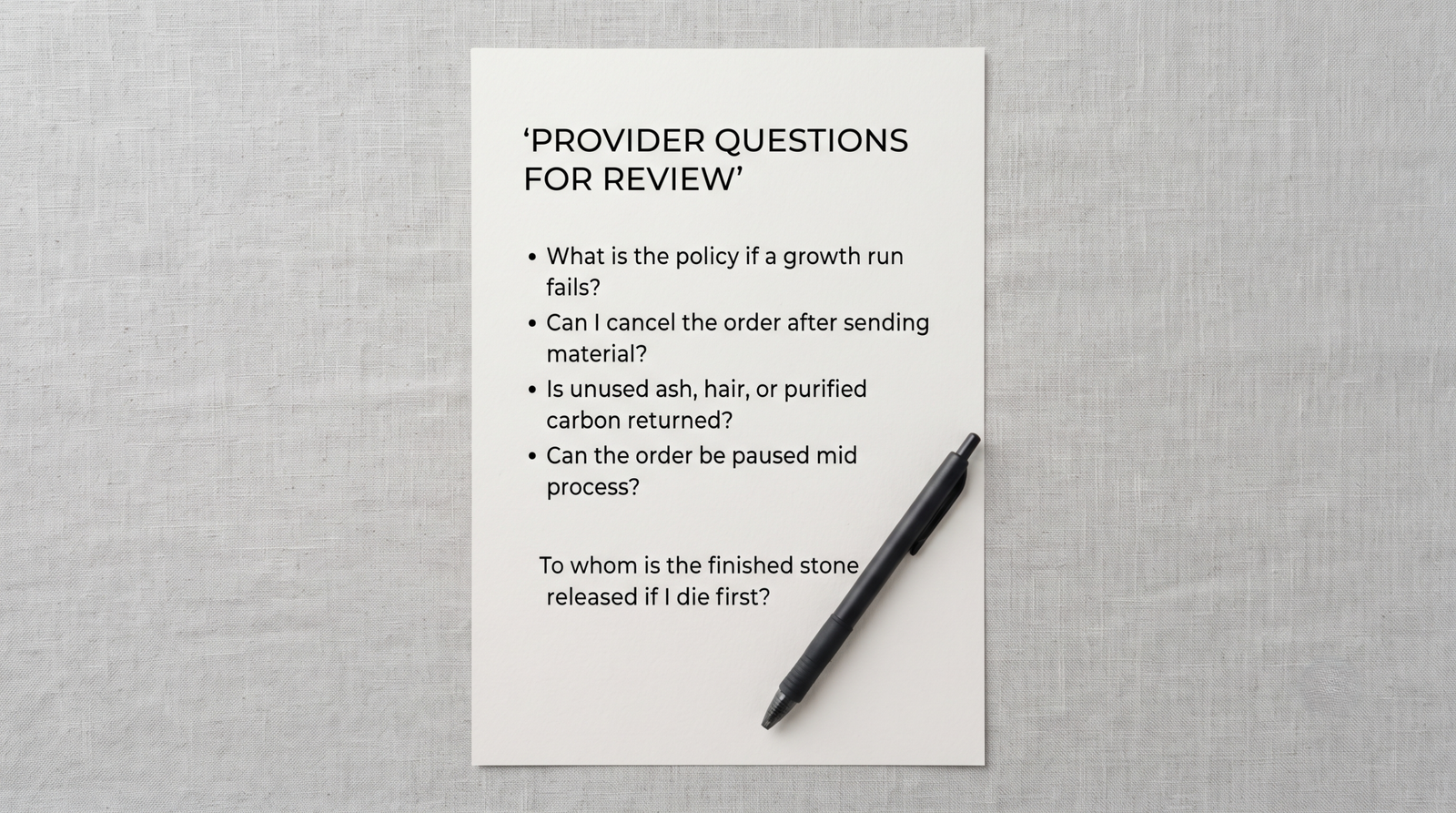
This section deserves special attention because providers do not share one universal policy for every situation. Ask your provider for written answers before you send ashes or hair.

Question to askWhat you need to know
What happens if the growth run fails?Ask whether the provider will run the material again, request additional material, offer another specification, or provide a refund.
Can I cancel after sending material?Ask when cancellation becomes impossible and what material the provider can return before that point.
Do I receive unused material?Ask separately about unused ashes or hair and unused purified carbon.
Can the order pause?Ask whether the provider can pause production if your family needs time to resolve a disagreement.
Who receives the diamond if I die before completion?Ask whether the provider can record another named contact and what documentation an estate would need.

What happens if the growth run fails?

A growth run can fail or produce a diamond that does not meet the agreed specification. Providers can handle these situations differently.

Ask whether the provider will use remaining material for another growth run, request additional material, refund your payment, or offer another solution. Get the answer in writing before you send your material.

Read the return and guarantee policies to look for.

Printed list of provider questions with a pen resting on it, ready to send

Can I change my mind after sending my mother’s ashes or hair?

Ask this question before you ship anything. The extraction process changes the original material, and a provider may reach a point where the material cannot return in its original form.

Ask exactly when cancellation stops being possible and what the provider can return before that stage.

Do I get unused material back?

Ask two separate questions. First, ask what happens to ashes or hair that the provider does not need. Second, ask what happens to purified carbon that the provider extracts but does not use.

These materials can follow different handling procedures. Request a written commitment and ask the provider to connect the material to its chain of custody documentation.

Learn how chain of custody works.

What if another family member objects after the order starts?

Ask whether the provider can pause an order rather than cancel it. Also ask whether the provider can return material during a dispute.

Discuss these possibilities before you place the order. A family conversation can become much harder after the provider begins processing the material.

Can I change the jewelry setting later?

Yes. A jeweler can often move a memorial diamond into another safe setting later. You may choose a pendant today and a ring years from now.

Recutting requires more care because the jeweler removes material from the diamond. Recutting can reduce the carat weight, so consider that decision carefully when the diamond carries irreplaceable personal meaning.

What happens if the person who placed the order dies before the diamond finishes?

Production can take many months, so discuss this possibility before placing the order. Ask the provider who can receive the finished diamond, what documents an estate must provide, and whether you can name another contact when you begin the order.

Frequently Asked Questions

How do I explain a memorial diamond to a young child?

Use simple and physical language. You can explain that a small part of Granny’s ashes helped create a diamond through a process that uses heat and pressure. A child can connect the explanation with the physical diamond more easily than with an abstract idea.

Can I arrange a memorial diamond before someone dies?

Yes. Hair can provide an option without cremation. A family can preserve a lock of hair while a loved one lives and keep it for future use.

Planning ahead can also prevent the ashes route from disappearing after scattering or interment.

Are lab grown memorial diamonds better for the environment than mined diamonds?

Memorial diamonds avoid the mining process, but diamond growth requires energy. The environmental impact therefore depends partly on the energy source that powers the growth equipment.

Ask your provider about its energy sources instead of relying only on general claims about lab grown diamonds.

What happens to the memorial diamond after I die?

You can decide what happens to it. A memorial diamond functions as personal property, so you can include clear instructions in your estate planning.

Because the diamond may carry unique personal meaning, name it specifically rather than placing it inside a general reference to jewelry.

I have not decided anything yet. Where should I start?

Start with the material rather than the diamond catalogue. Determine what you have available and whether any upcoming decision could close one of your options.

You can decide the color, cut, setting, and provider after you understand your material options. Read where to start when choosing a memorial diamond for your mother.

Ask the One Question That Is Holding You Back

You do not need to answer every question today. Most families have one or two concerns that matter more than everything else.

Maybe you want to know what color your mother’s diamond may have. Maybe you need to understand how much ash or hair you should provide. Perhaps your biggest concern involves cost, production time, family approval, unused material, or what happens if the growth run fails.

Write down that question in your own words and ask your provider for a direct answer. Ask for provider policies in writing when the answer depends on the company’s process rather than on diamond science.

A thoughtful memorial decision starts with clear information. When you understand the material requirements, expected appearance, cost factors, production timeline, family considerations, and provider policies, you can move forward at your own pace.

For a broader introduction, explore the complete guide to memorial diamonds.

mother hair dimond

Is a Memorial Diamond Really Made From Your Mother’s Ashes and Hair?

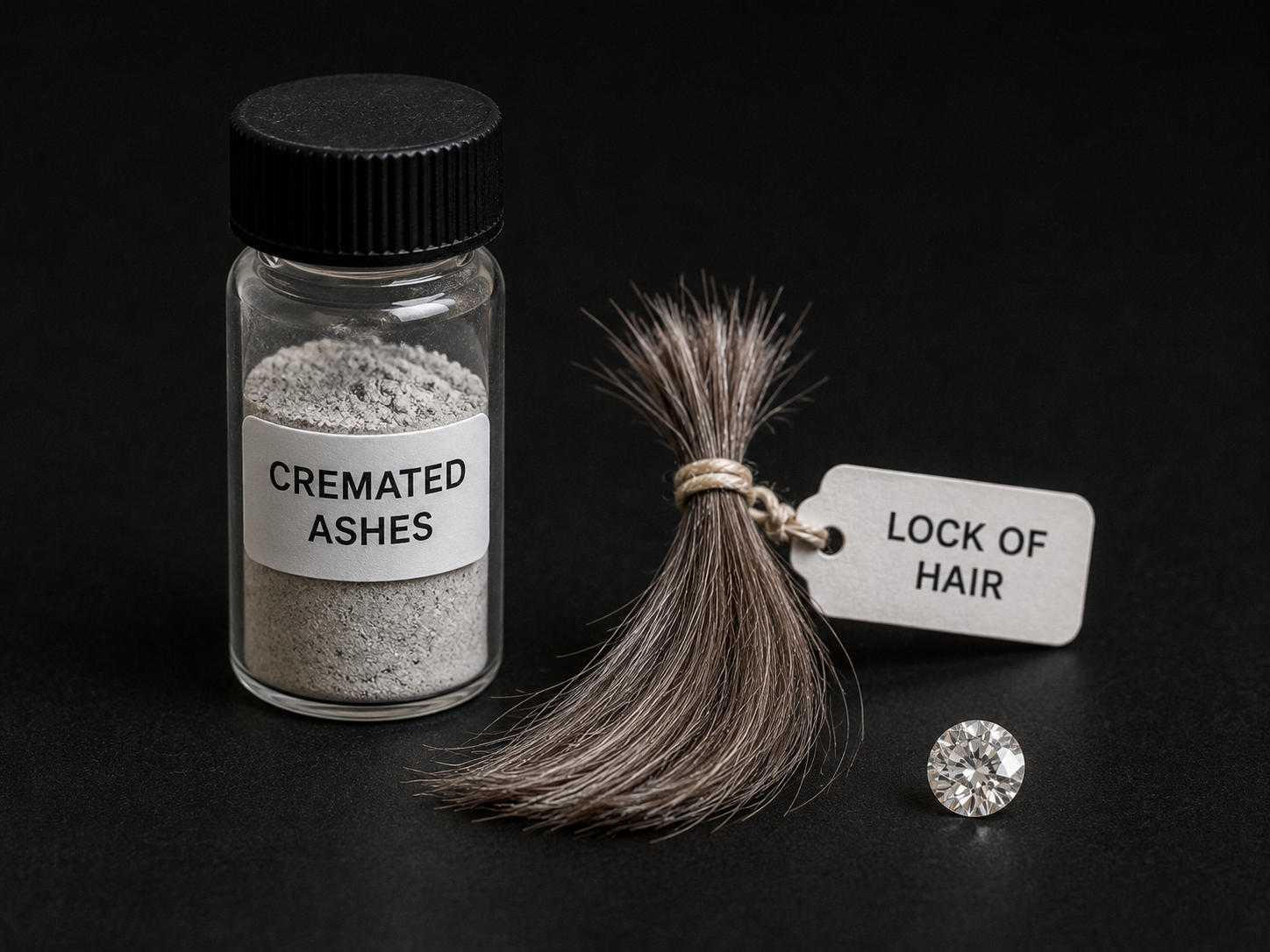
Sending both is usually a decision made by not deciding. The ashes were what you had, the lock of hair was what you kept, and separating them felt wrong. Both can go into one stone that part is straightforward. The harder answer is that once the diamond is cut, nothing about it can tell you whether her ashes contributed anything at all. Hair runs roughly 50% carbon by weight; cremated remains, 0.5% to 4%. A stone grown from the hair alone would look, test, and grade identically.

A labeled vial of cremated ashes and a tied lock of hair side by side beside a loose lab-grown memorial diamond

If You Send Both Her Ashes and Her Hair, Are Both Really Used?

They can be. Whether they were is a question the finished stone cannot answer, and it is worth saying that plainly rather than letting a certificate imply otherwise.

Purified carbon carries no signature of what it came from. Carbon extracted from her hair and carbon extracted from her ashes are, once purified to roughly 99.9%, the same substance and so is the lab-sourced carbon blended in alongside them to fill the growth cell. That last point surprises families: a combined stone contains carbon from three places, not two. No memorial diamond is 100% anyone, and a provider claiming otherwise is overselling a real thing.

So a family that sends both has handed over the one submission where a shortcut is invisible. That is not an accusation. It is the reason this page exists, and the reason the questions further down are worth asking before anything ships.

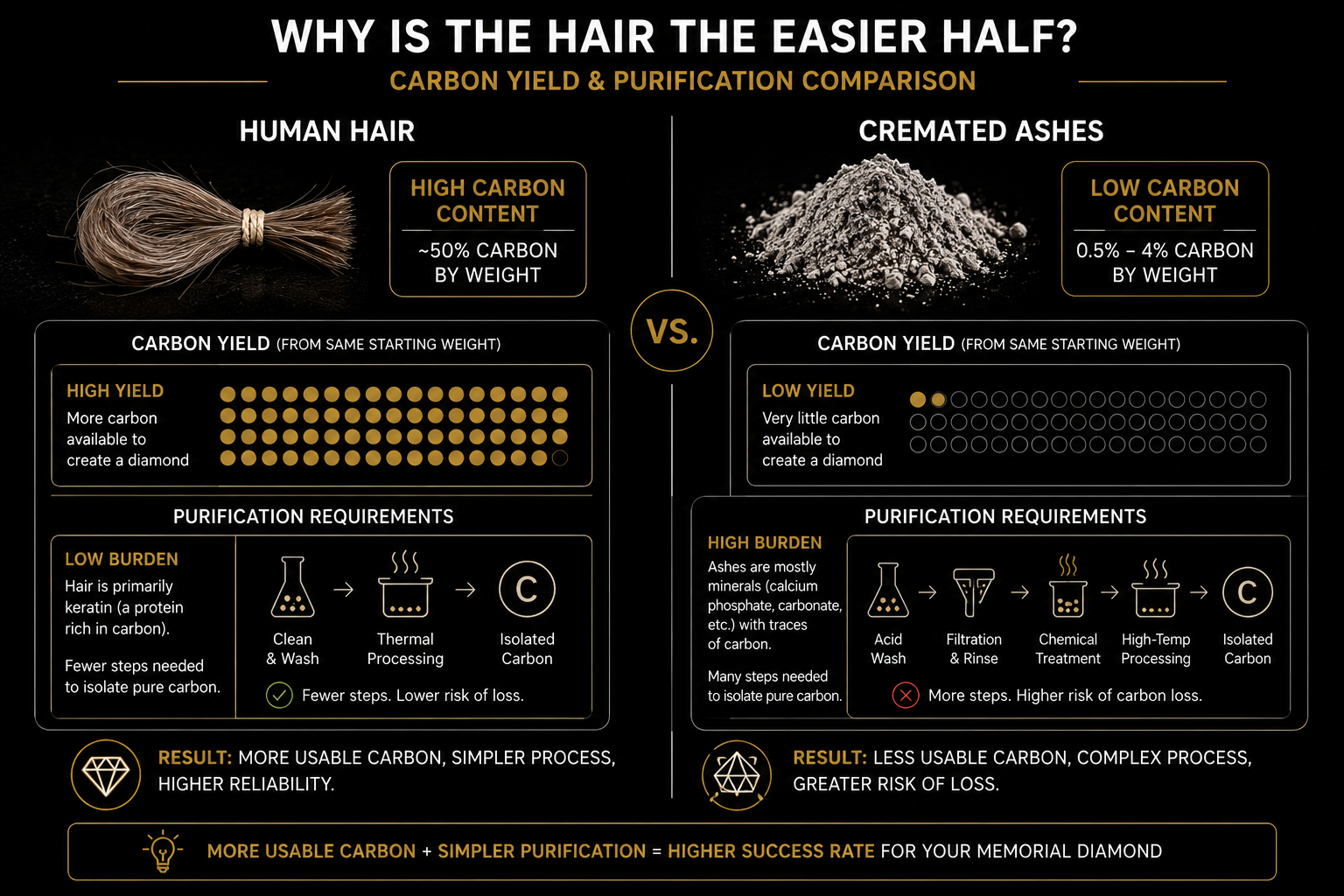
Why Is the Hair the Easier Half?

Because it asks less of the lab at every stage, which is precisely what creates the incentive worth watching.

Her HairHer Ashes
Carbon content~50% by weight~0.5–4% by weight
Amount typically requestedA small lock, a few gramsA few tablespoons up to about 4 oz
What purification must strip outThe non-carbon components of keratinCalcium phosphate and other bone minerals
Usable carbon per gram submittedHighLow
Diagram comparing carbon yield and purification requirements for hair and cremated ashes

A few grams of hair can yield more usable carbon than several ounces of ash, and it gets there through a less demanding purification. Neither material is difficult in isolation how the lab handles a combined submission walks through both tracks but if one of the two were quietly dropped, the hair is not the one that would go.

That asymmetry is also why choosing between ashes and hair is a real decision rather than a formality, and why sending both should be a deliberate choice rather than a default.

Does Combining Them Change the Stone Itself?

In two ways, and neither is the one families expect.

It does not make the diamond bigger. Carat is set by growth time in the press, not by how much carbon went in, so doubling the source material doesn’t double anything. Submitting both her ashes and her hair buys meaning, not size.

It does plausibly affect color. Diamond color comes from trace elements present during growth nitrogen produces yellow tones, boron produces blue, and the absence of both is required for a colorless stone. Ash and hair carry different trace-element profiles, ash with a mineral load that hair has none of, so a combined feedstock is a less predictable starting point than either alone. No provider can promise a specific color in advance from any organic source, and a combined submission is the case where that caveat has the most force.

What Would Real Documentation for a Combined Order Show?

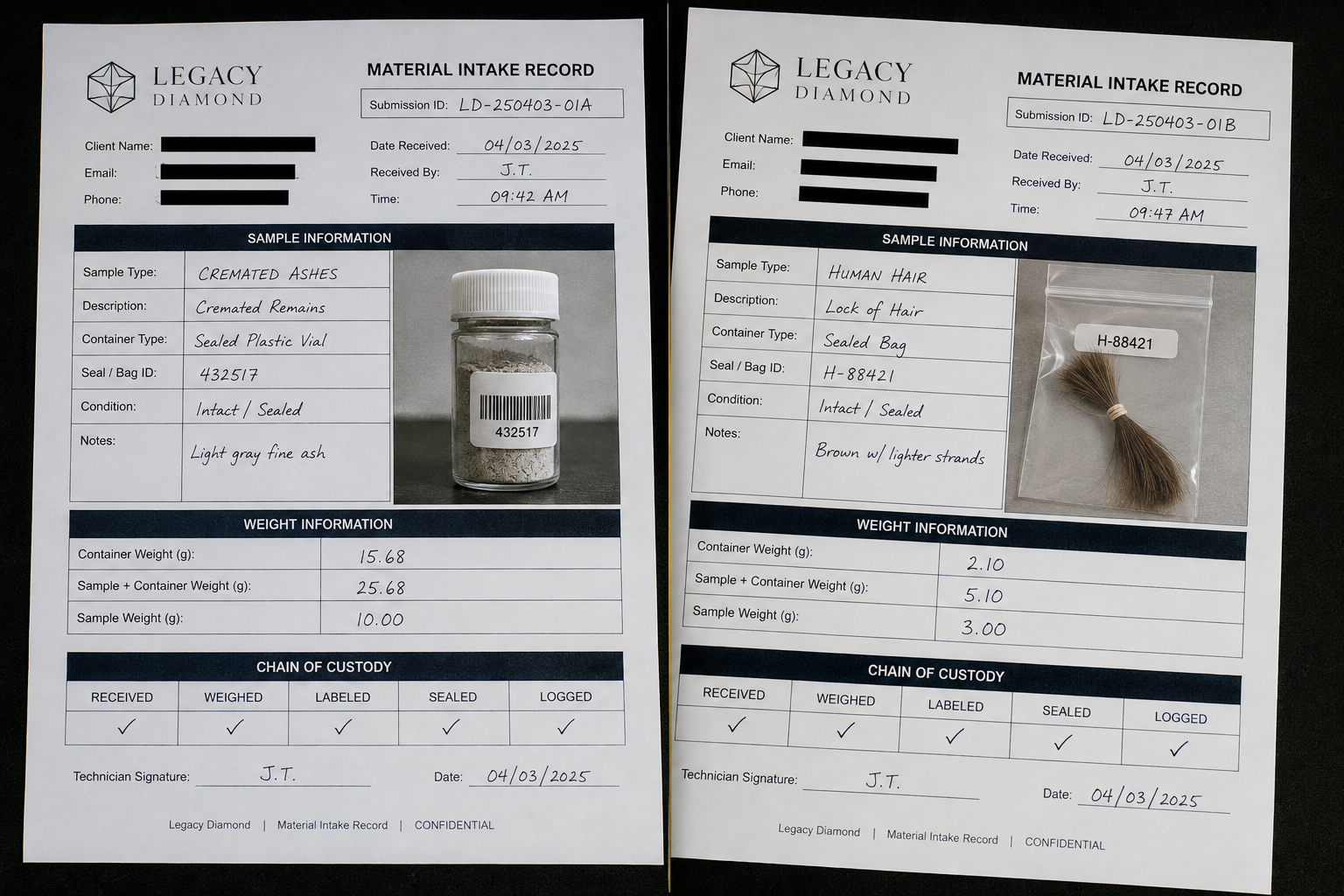
Two separate intake records for a single memorial diamond order, one logging cremated ashes and one logging a lock of hair

A single certificate saying “grown from the submitted remains of [your mother]” is not evidence that both materials were used. It is evidence that both were received. Four things separate a real record from a reassuring one.

What to Ask ForWhat It Should ShowWhy a Combined Order Needs It
Two intake referencesAshes and hair logged separately on arrival, each with its own reference and recorded quantityOne order-level number can’t demonstrate that both materials arrived, or in what amount
Two purification recordsA separate extraction record per material, each with the carbon yield it producedThis is where a low or failed ash yield would become visible
A stated combination pointThe stage where the two purified outputs are combinedWithout it, “we used both” describes an intention rather than a process
A return record for eachUnused ash and unused hair accounted for separatelyMaterial returned as one lot tells you nothing about which was drawn on

Underneath all four sits the same thing that underpins any memorial diamond: the chain of custody a provider keeps from intake onward. A combined order simply needs two of them, running in parallel. And an independent grading report, valuable as it is, speaks only to cut, color, clarity, and carat never to origin.

Which Questions Should You Ask About an Ashes-and-Hair Submission?

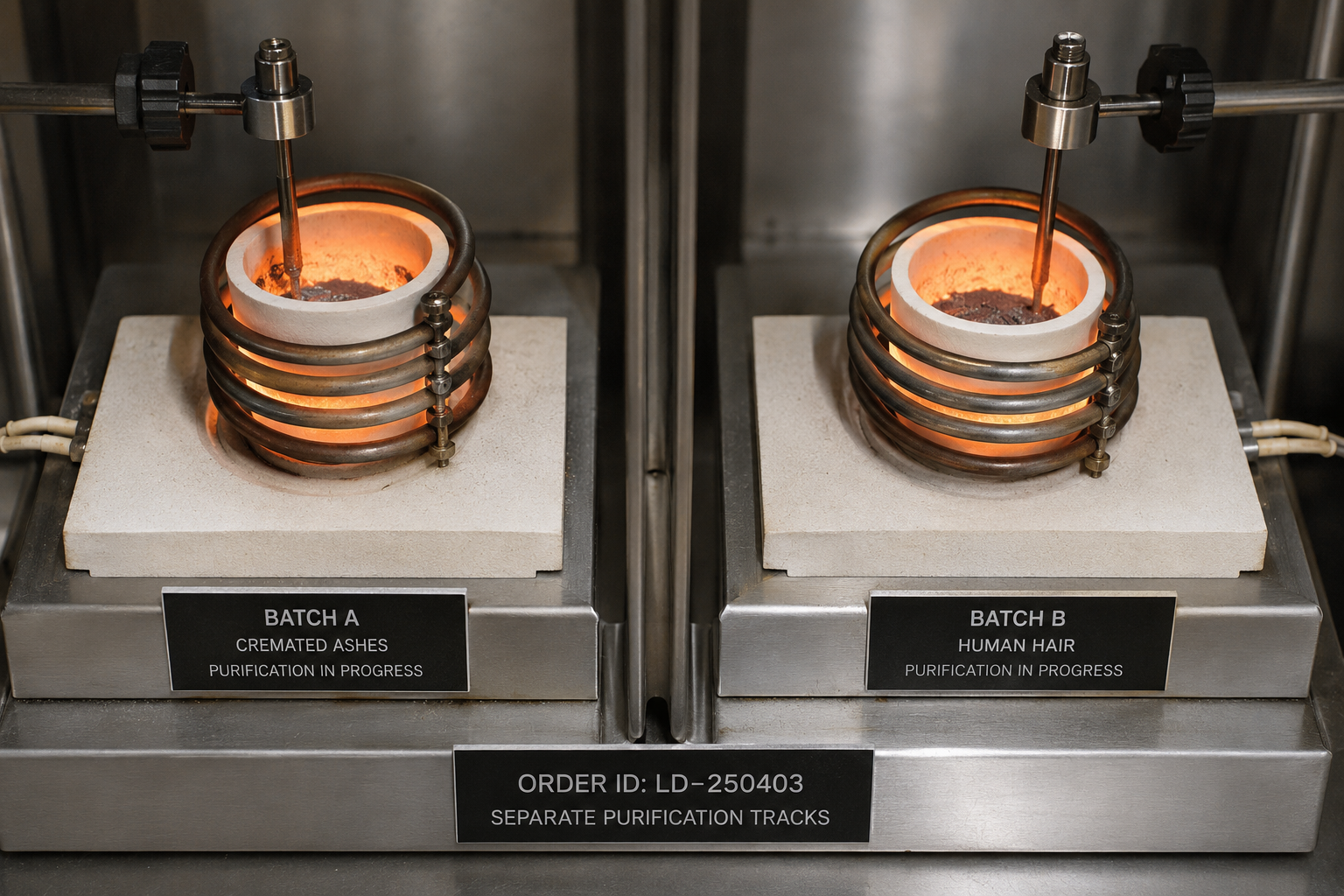
Two laboratory crucibles running separate carbon purification batches for one memorial diamond order

Five questions, all specific to sending two materials. The third is the one that matters most.

  1. Are the ashes and the hair purified separately, or processed together in a single run? Ask which, and ask for the answer in writing.

A fuller checklist before turning your mother’s ashes and hair into a diamond goes wider, and the complete guide to a mother ashes and hair diamond covers timeline, color, and cost.

Frequently Asked Questions

Can a lab tell me how much of the stone came from her ashes versus her hair?

Only from its own extraction records, never from the stone. After purification the two outputs are indistinguishable, so the yield figures logged during each run are the only place that ratio exists. Ask whether you can see them.

Is there any real advantage to sending both?

Not technically hair alone would usually supply the carbon comfortably, and ashes alone works too. The advantage is entirely about meaning: some families don’t want to choose between what was returned to them and what they kept.

What happens if the carbon recovered from her ashes is too low to use?

Technically, the stone can still be grown from the hair alone a defensible decision, and an indefensible one to make silently. Ask in advance whether you would be told, and get that commitment in writing before either material ships.

Do the two materials have to be sent at the same time?

Ask the provider. Separate purification tracks may allow staggered submission, but a combined order usually needs both materials in hand before growth begins. Confirm before mailing anything on a partial timeline.

What if I have her ashes but never kept any hair?

Then it’s an ashes-only stone, which is a complete starting point on its own. Whether a diamond is really made from her ashes covers that case, including the percentages that apply to it.

Could combining them change what color the diamond turns out?

Possibly. Color comes from trace elements present during growth, and ash carries a mineral load that hair doesn’t, so a mixed feedstock is less predictable than either alone. No provider can promise a color in advance.

Before You Send Anything

A combined order asks a provider to do two things carefully instead of one, and only their records can show whether they did.

So if you send both, send them into a process built to account for both. Ask the five questions above and notice which ones get a specific answer including from us. Reach out to Memorial Diamond at memorialdiamond.us and ask what documentation a combined submission produces. The same question about her hair alone has a shorter answer.