
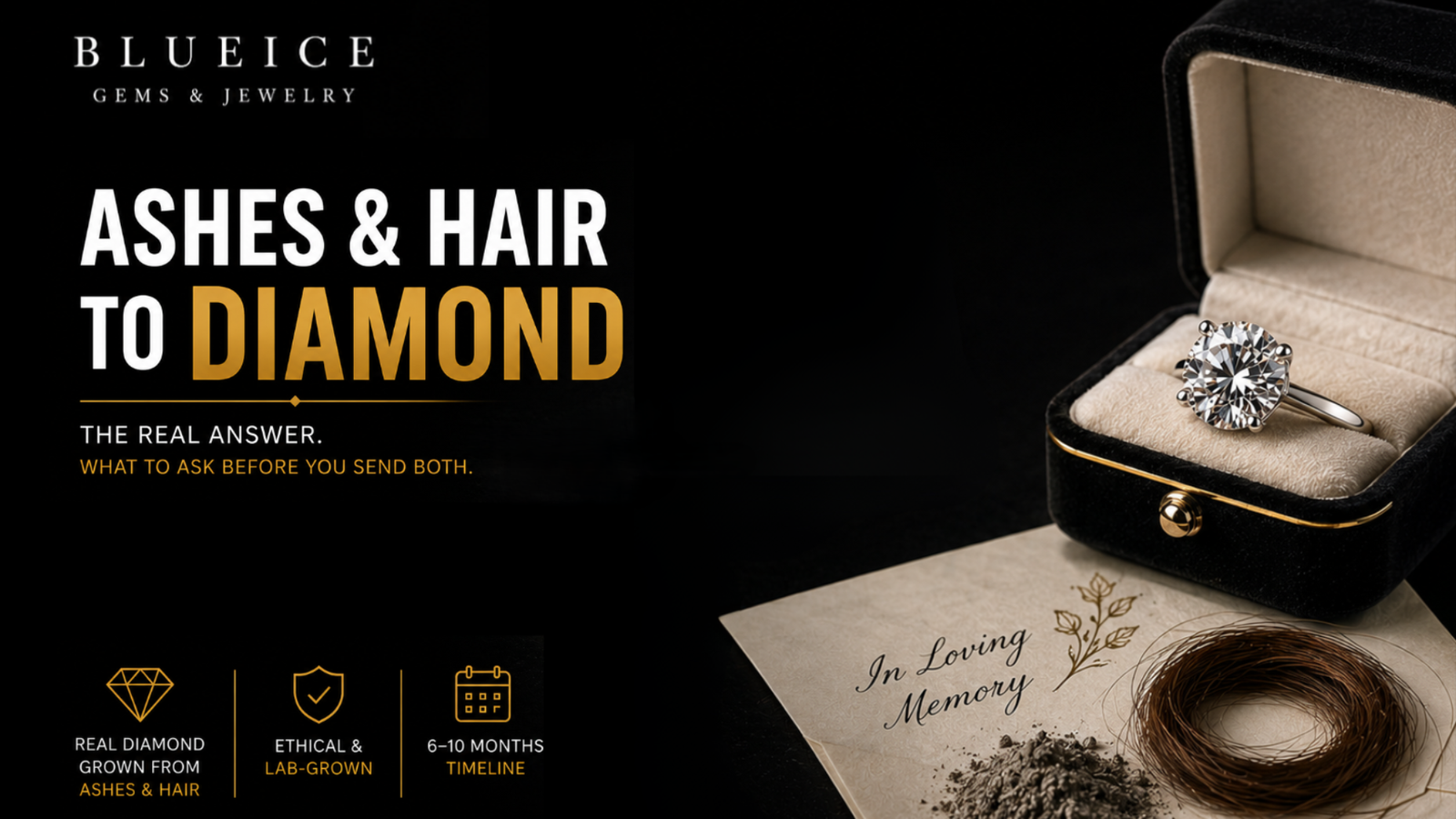
Sending both is usually a decision made by not deciding. The ashes were what you had, the lock of hair was what you kept, and separating them felt wrong. Both can go into one stone that part is straightforward. The harder answer is that once the diamond is cut, nothing about it can tell you whether her ashes contributed anything at all. Hair runs roughly 50% carbon by weight; cremated remains, 0.5% to 4%. A stone grown from the hair alone would look, test, and grade identically.
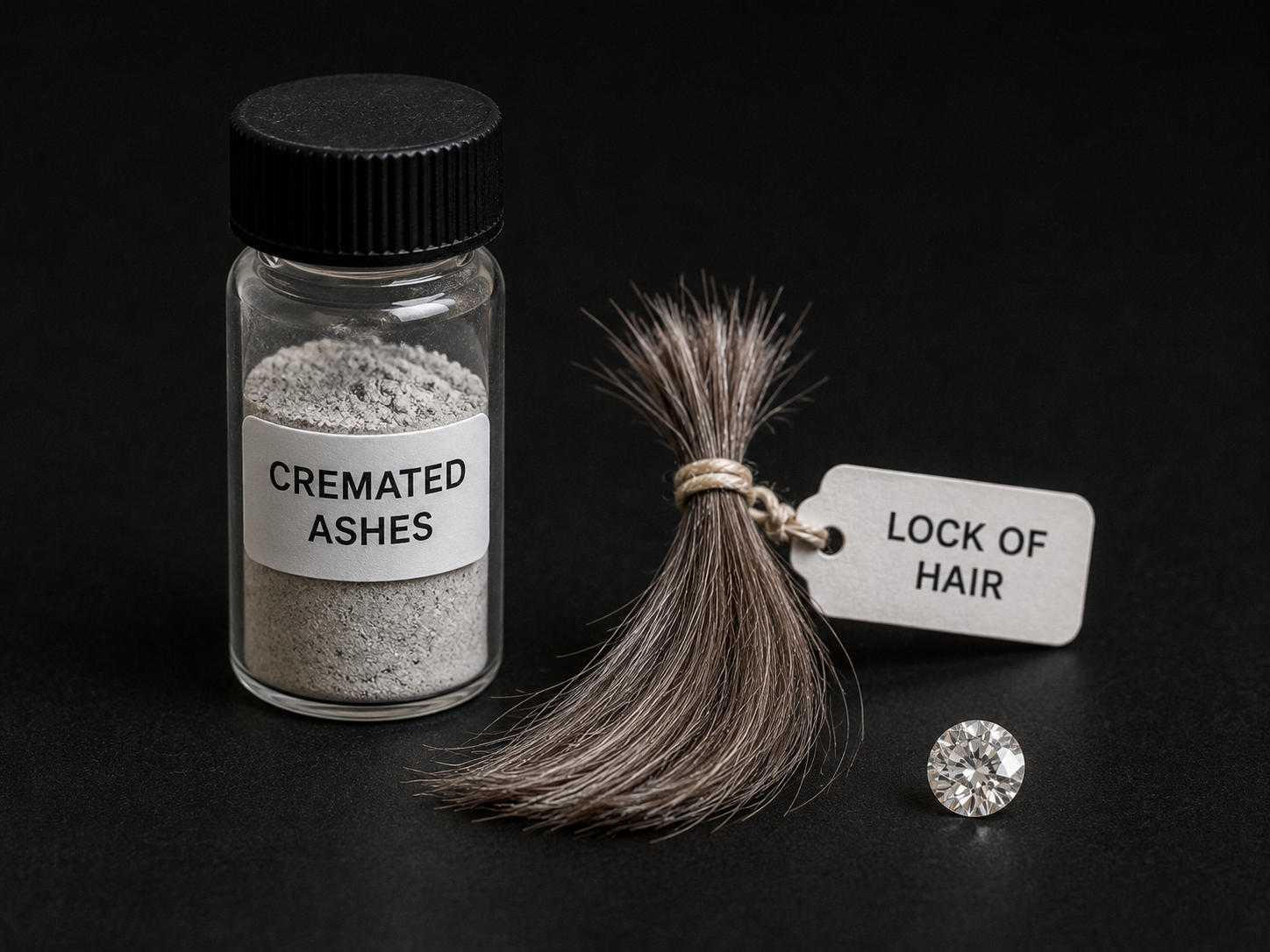
If You Send Both Her Ashes and Her Hair, Are Both Really Used?
They can be. Whether they were is a question the finished stone cannot answer, and it is worth saying that plainly rather than letting a certificate imply otherwise.
Purified carbon carries no signature of what it came from. Carbon extracted from her hair and carbon extracted from her ashes are, once purified to roughly 99.9%, the same substance and so is the lab-sourced carbon blended in alongside them to fill the growth cell. That last point surprises families: a combined stone contains carbon from three places, not two. No memorial diamond is 100% anyone, and a provider claiming otherwise is overselling a real thing.
So a family that sends both has handed over the one submission where a shortcut is invisible. That is not an accusation. It is the reason this page exists, and the reason the questions further down are worth asking before anything ships.
Why Is the Hair the Easier Half?
Because it asks less of the lab at every stage, which is precisely what creates the incentive worth watching.
| Her Hair | Her Ashes | |
|---|---|---|
| Carbon content | ~50% by weight | ~0.5–4% by weight |
| Amount typically requested | A small lock, a few grams | A few tablespoons up to about 4 oz |
| What purification must strip out | The non-carbon components of keratin | Calcium phosphate and other bone minerals |
| Usable carbon per gram submitted | High | Low |
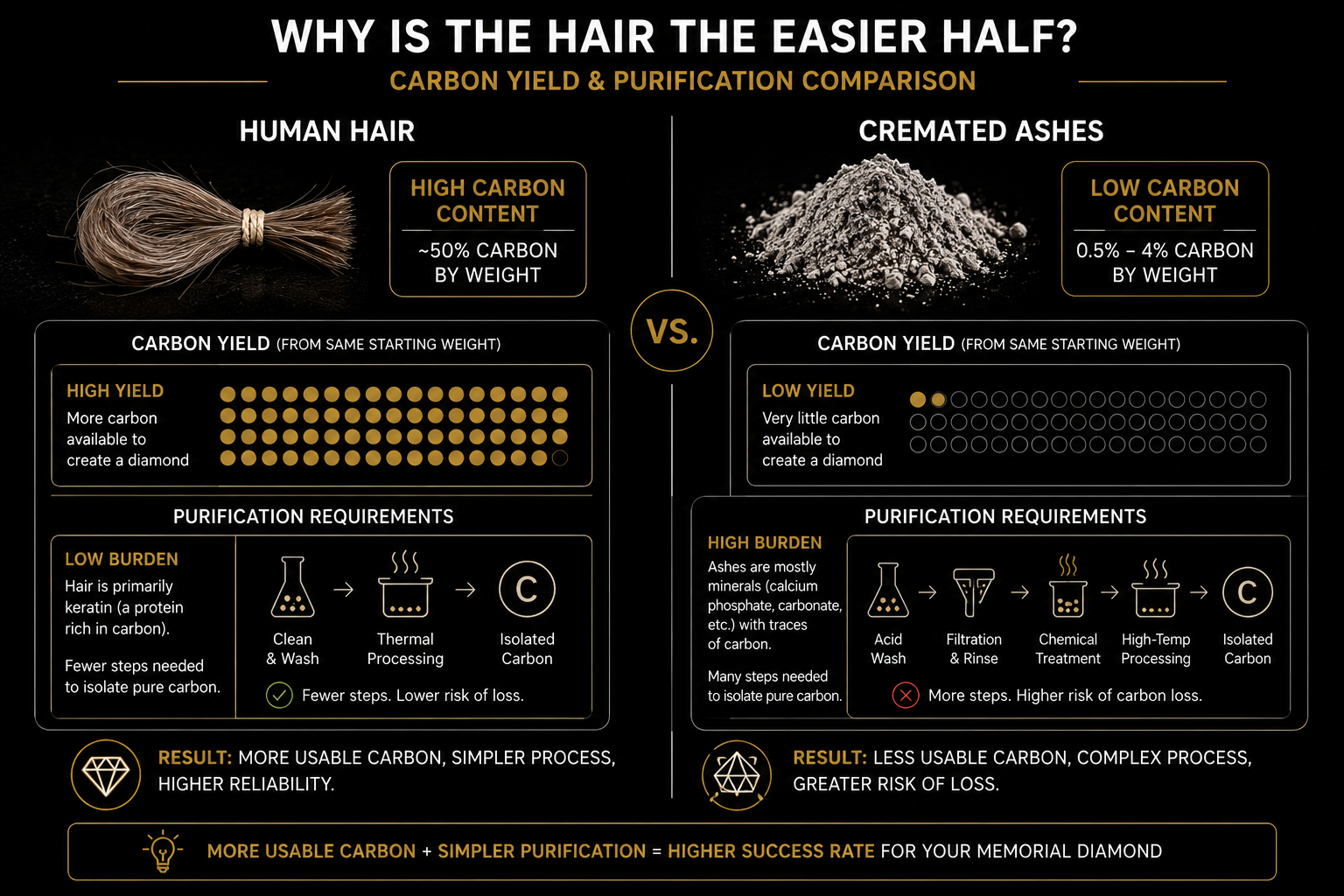
A few grams of hair can yield more usable carbon than several ounces of ash, and it gets there through a less demanding purification. Neither material is difficult in isolation how the lab handles a combined submission walks through both tracks but if one of the two were quietly dropped, the hair is not the one that would go.
That asymmetry is also why choosing between ashes and hair is a real decision rather than a formality, and why sending both should be a deliberate choice rather than a default.
Does Combining Them Change the Stone Itself?
In two ways, and neither is the one families expect.
It does not make the diamond bigger. Carat is set by growth time in the press, not by how much carbon went in, so doubling the source material doesn’t double anything. Submitting both her ashes and her hair buys meaning, not size.
It does plausibly affect color. Diamond color comes from trace elements present during growth nitrogen produces yellow tones, boron produces blue, and the absence of both is required for a colorless stone. Ash and hair carry different trace-element profiles, ash with a mineral load that hair has none of, so a combined feedstock is a less predictable starting point than either alone. No provider can promise a specific color in advance from any organic source, and a combined submission is the case where that caveat has the most force.
What Would Real Documentation for a Combined Order Show?
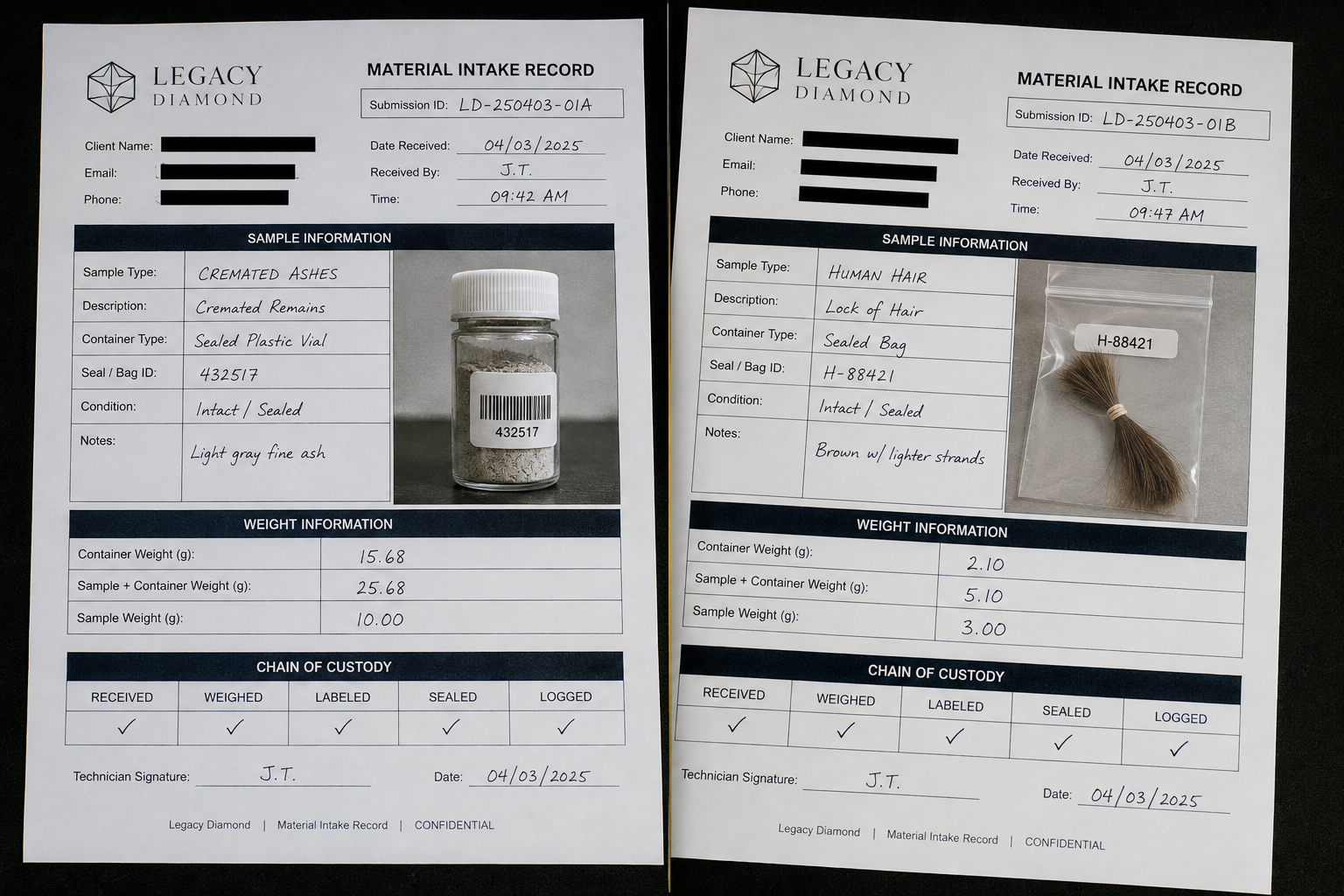
A single certificate saying “grown from the submitted remains of [your mother]” is not evidence that both materials were used. It is evidence that both were received. Four things separate a real record from a reassuring one.
| What to Ask For | What It Should Show | Why a Combined Order Needs It |
|---|---|---|
| Two intake references | Ashes and hair logged separately on arrival, each with its own reference and recorded quantity | One order-level number can’t demonstrate that both materials arrived, or in what amount |
| Two purification records | A separate extraction record per material, each with the carbon yield it produced | This is where a low or failed ash yield would become visible |
| A stated combination point | The stage where the two purified outputs are combined | Without it, “we used both” describes an intention rather than a process |
| A return record for each | Unused ash and unused hair accounted for separately | Material returned as one lot tells you nothing about which was drawn on |
Underneath all four sits the same thing that underpins any memorial diamond: the chain of custody a provider keeps from intake onward. A combined order simply needs two of them, running in parallel. And an independent grading report, valuable as it is, speaks only to cut, color, clarity, and carat never to origin.
Which Questions Should You Ask About an Ashes-and-Hair Submission?
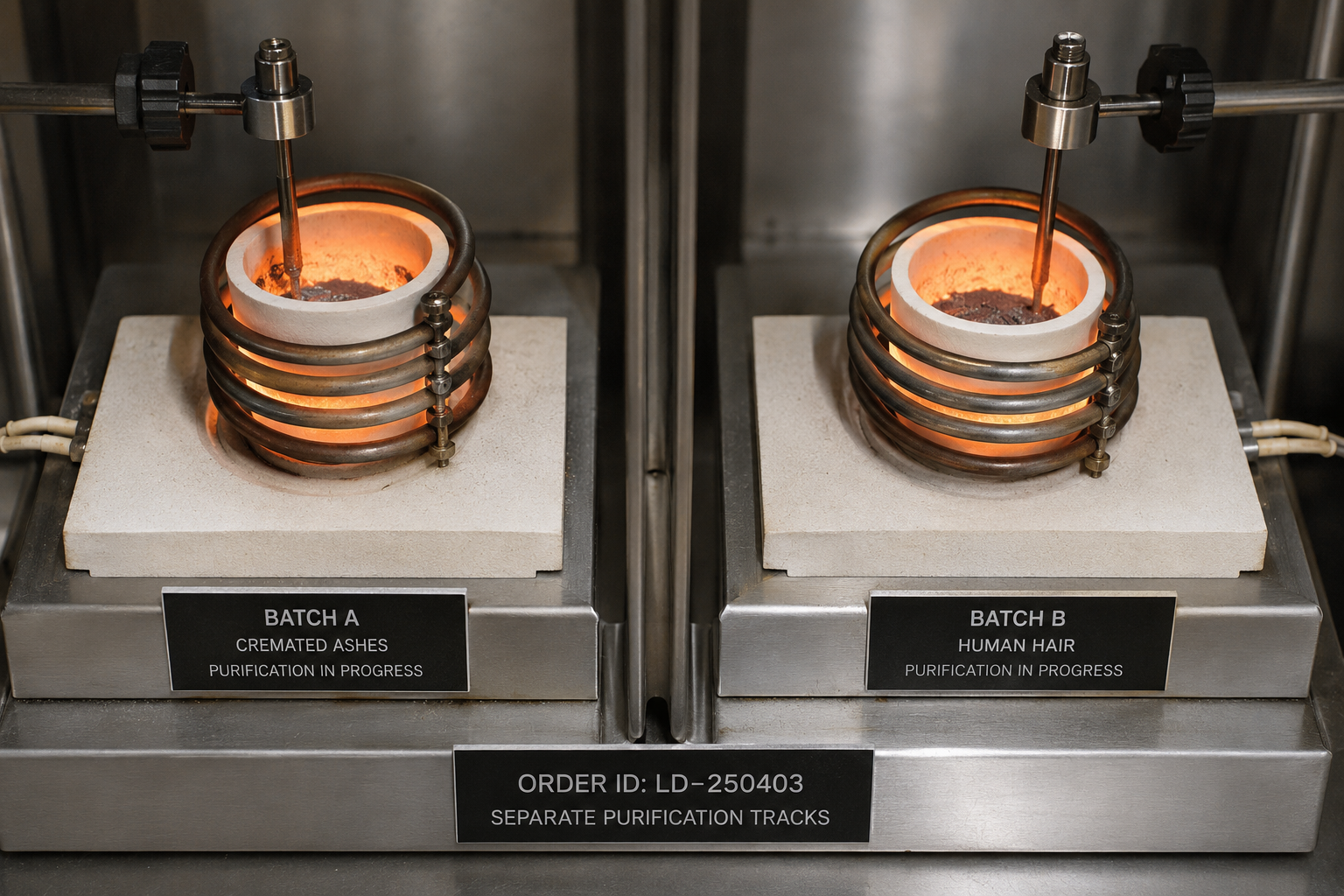
Five questions, all specific to sending two materials. The third is the one that matters most.
- Are the ashes and the hair purified separately, or processed together in a single run? Ask which, and ask for the answer in writing.
A fuller checklist before turning your mother’s ashes and hair into a diamond goes wider, and the complete guide to a mother ashes and hair diamond covers timeline, color, and cost.
Frequently Asked Questions
Can a lab tell me how much of the stone came from her ashes versus her hair?
Only from its own extraction records, never from the stone. After purification the two outputs are indistinguishable, so the yield figures logged during each run are the only place that ratio exists. Ask whether you can see them.
Is there any real advantage to sending both?
Not technically hair alone would usually supply the carbon comfortably, and ashes alone works too. The advantage is entirely about meaning: some families don’t want to choose between what was returned to them and what they kept.
What happens if the carbon recovered from her ashes is too low to use?
Technically, the stone can still be grown from the hair alone a defensible decision, and an indefensible one to make silently. Ask in advance whether you would be told, and get that commitment in writing before either material ships.
Do the two materials have to be sent at the same time?
Ask the provider. Separate purification tracks may allow staggered submission, but a combined order usually needs both materials in hand before growth begins. Confirm before mailing anything on a partial timeline.
What if I have her ashes but never kept any hair?
Then it’s an ashes-only stone, which is a complete starting point on its own. Whether a diamond is really made from her ashes covers that case, including the percentages that apply to it.
Could combining them change what color the diamond turns out?
Possibly. Color comes from trace elements present during growth, and ash carries a mineral load that hair doesn’t, so a mixed feedstock is less predictable than either alone. No provider can promise a color in advance.
Before You Send Anything
A combined order asks a provider to do two things carefully instead of one, and only their records can show whether they did.
So if you send both, send them into a process built to account for both. Ask the five questions above and notice which ones get a specific answer including from us. Reach out to Memorial Diamond at memorialdiamond.us and ask what documentation a combined submission produces. The same question about her hair alone has a shorter answer.