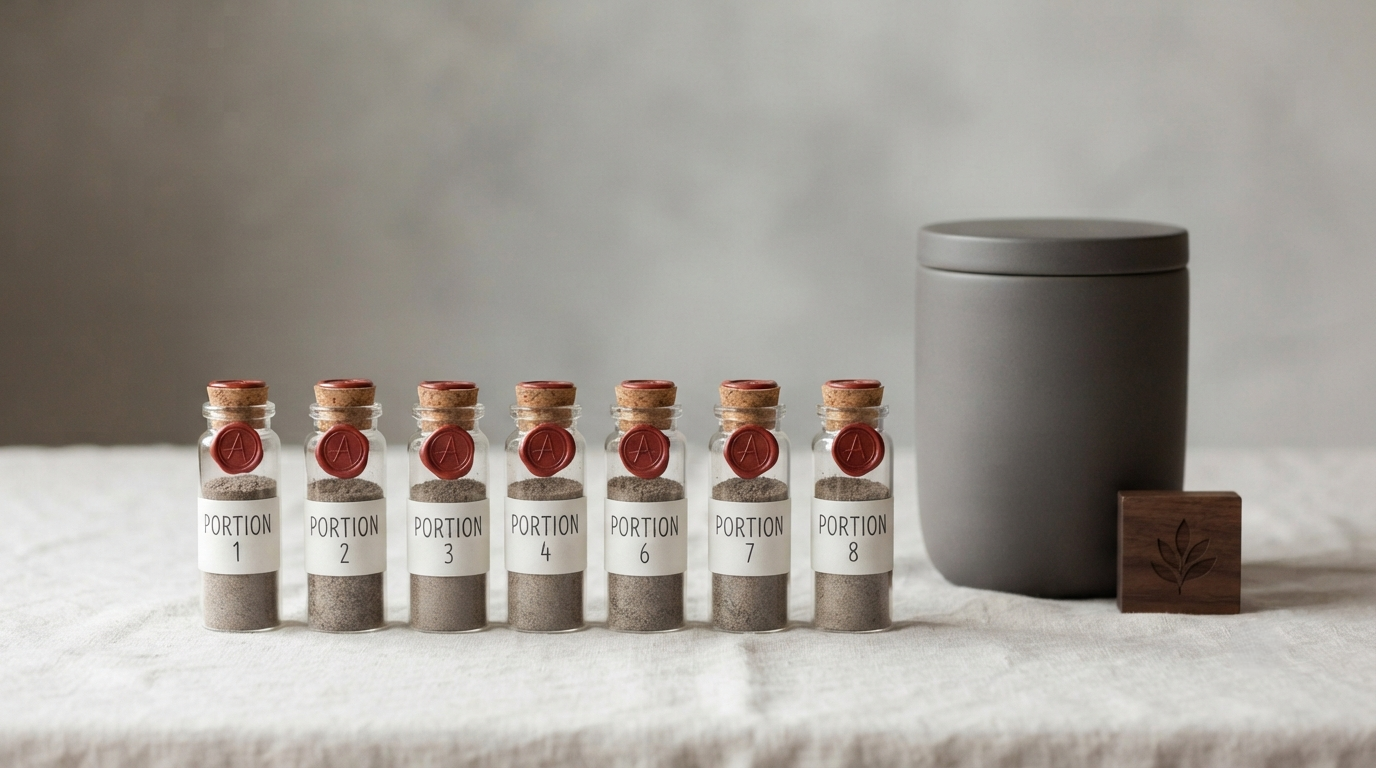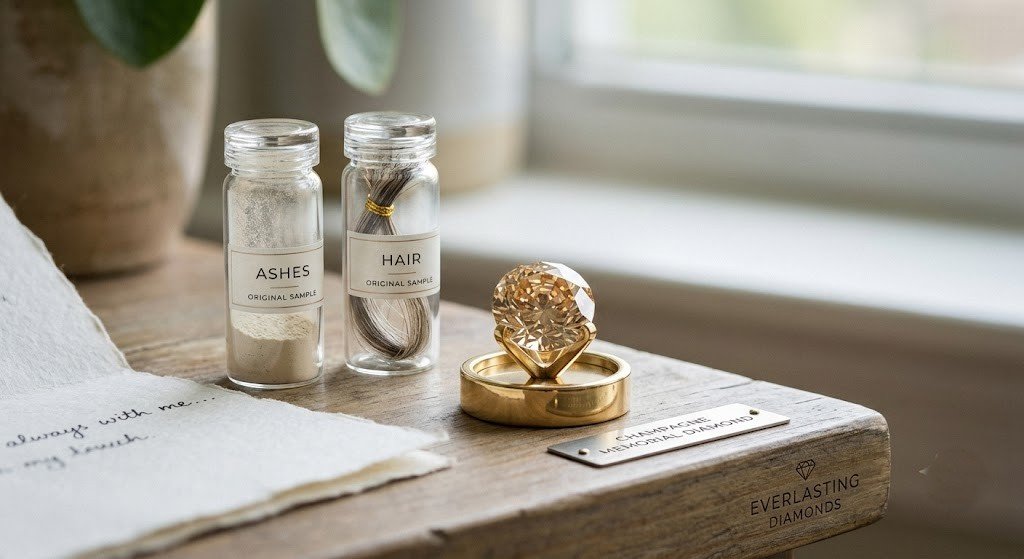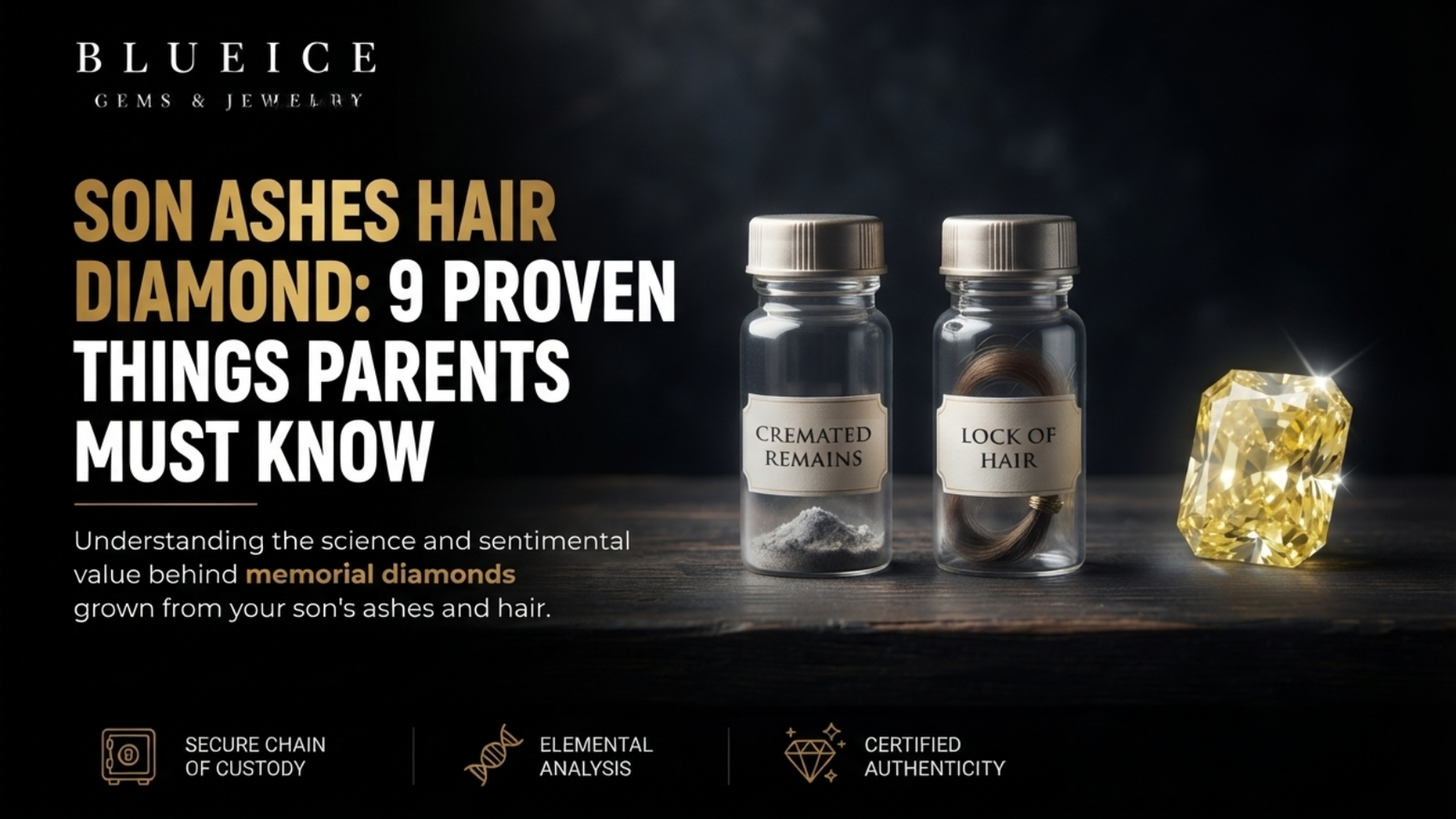
Two separately labeled containers side by side on a table, one holding cremated remains and one a small lock of hair, the two materials a son ashes hair diamond is grown from

Son Ashes and Hair Diamond: The Complete Guide

Two containers, and in a great many families, not in the same house.

A son ashes hair diamond is one lab grown stone whose carbon comes from two sources: a portion of your son’s cremated remains and a sample of his hair. Combining them does not double anything. It does not enlarge the part of the stone that is him, it does not make the color easier to predict, and it does not yield two stones. What it changes is where the carbon came from, two different points in one life instead of one.

Memorial Diamond makes memorial stones, so this is a page with a commercial interest behind it. Treat every figure here as an industry wide band rather than a quote, and put these questions to us as readily as to anyone else.

This guide is written for the version of a son ashes hair diamond that comes up most often in practice: a parent holding an envelope of hair kept from years ago, and someone else, frequently his spouse or his own adult children, holding the ashes.

What a Son Ashes Hair Diamond Actually Changes

Start here, because most of the reasons families give for wanting a son ashes hair diamond turn out to be reasons the process cannot deliver on, and the one real reason usually goes unnamed.

What parents expect combining to doWhat a son ashes hair diamond actually does
Make the stone more genuinely himNothing. The personal share of the crystal is unchanged
Produce a larger stoneNothing. Carat is bought in weeks under pressure, not in feedstock
Make the color more certainNothing, and arguably the reverse, see below
Produce two stones instead of oneNo. One submission grows one stone unless you order two
Shorten the waitNo. If anything it lengthens it, because growth waits on the later parcel
Change which part of his life the carbon came fromYes. This is the only thing on this list that is real
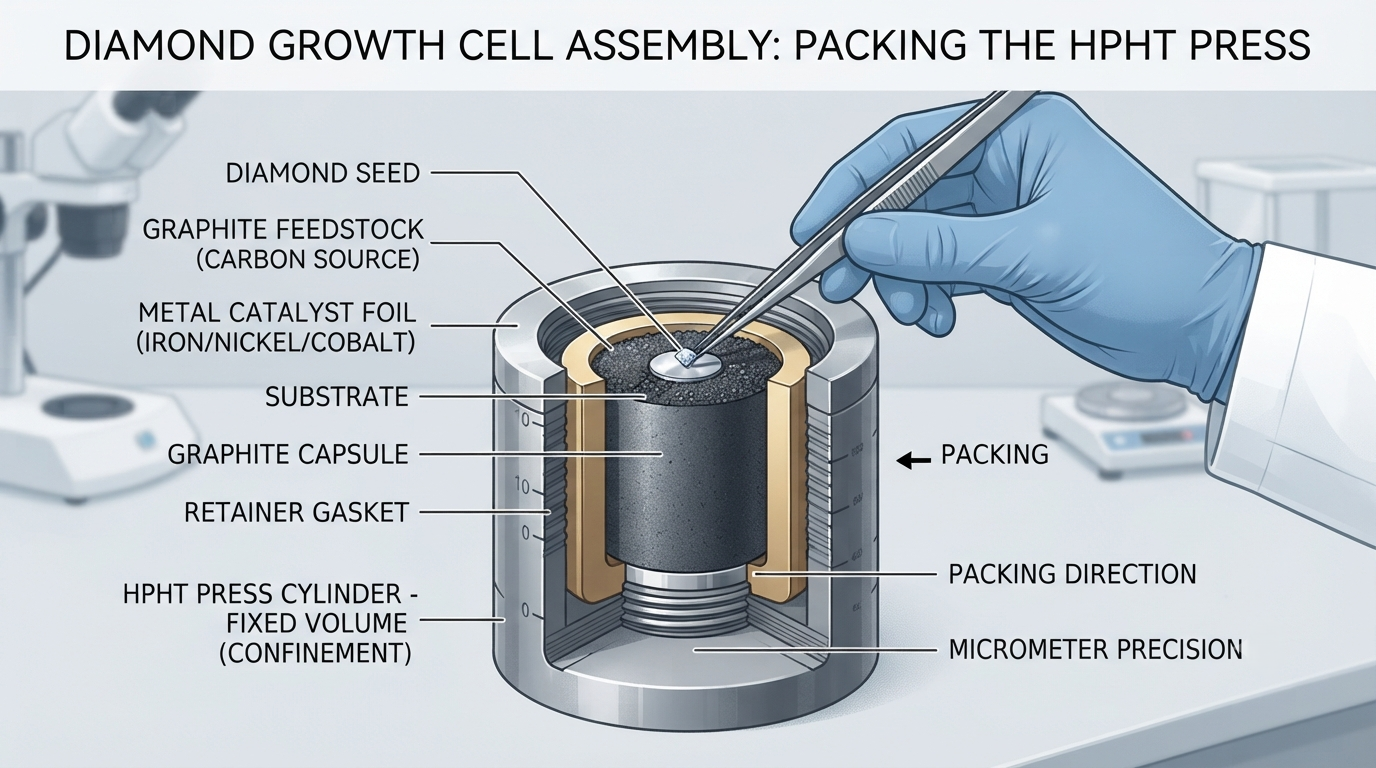
A diamond growth cell being packed with graphite feedstock around a seed, showing the fixed volume a press requires

That last row is not a consolation prize. For a lot of parents it is precisely the point: the ashes are from the end of his life and the hair is very often from somewhere much earlier, and a son ashes hair diamond is the only arrangement that puts both into one object. Whether your son was six or sixty when he died, those two materials come from two different men in a sense, and holding them in one stone is a real thing to want.

What it is not is a way to get more. Everything below explains why, in the order the questions usually arrive.

Does a Son Ashes Hair Diamond Contain More of Him?

No, and the arithmetic behind a son ashes hair diamond is worth seeing rather than being told.

A growth cell holds a fixed quantity of carbon. That quantity is decided by the carat you ordered and by the physics of the press, and it does not move because two parcels arrived instead of one. Whatever your materials yield after purification is topped up to that fixed quantity with laboratory carbon. The 10% to 15% personal share usually quoted across the industry is published for the ash route, and no published figure covers a blended charge of ash and hair, so ask a provider what share your two parcels will actually contribute. What the arithmetic does say plainly is that two materials divide whatever that share is between them rather than enlarging it.

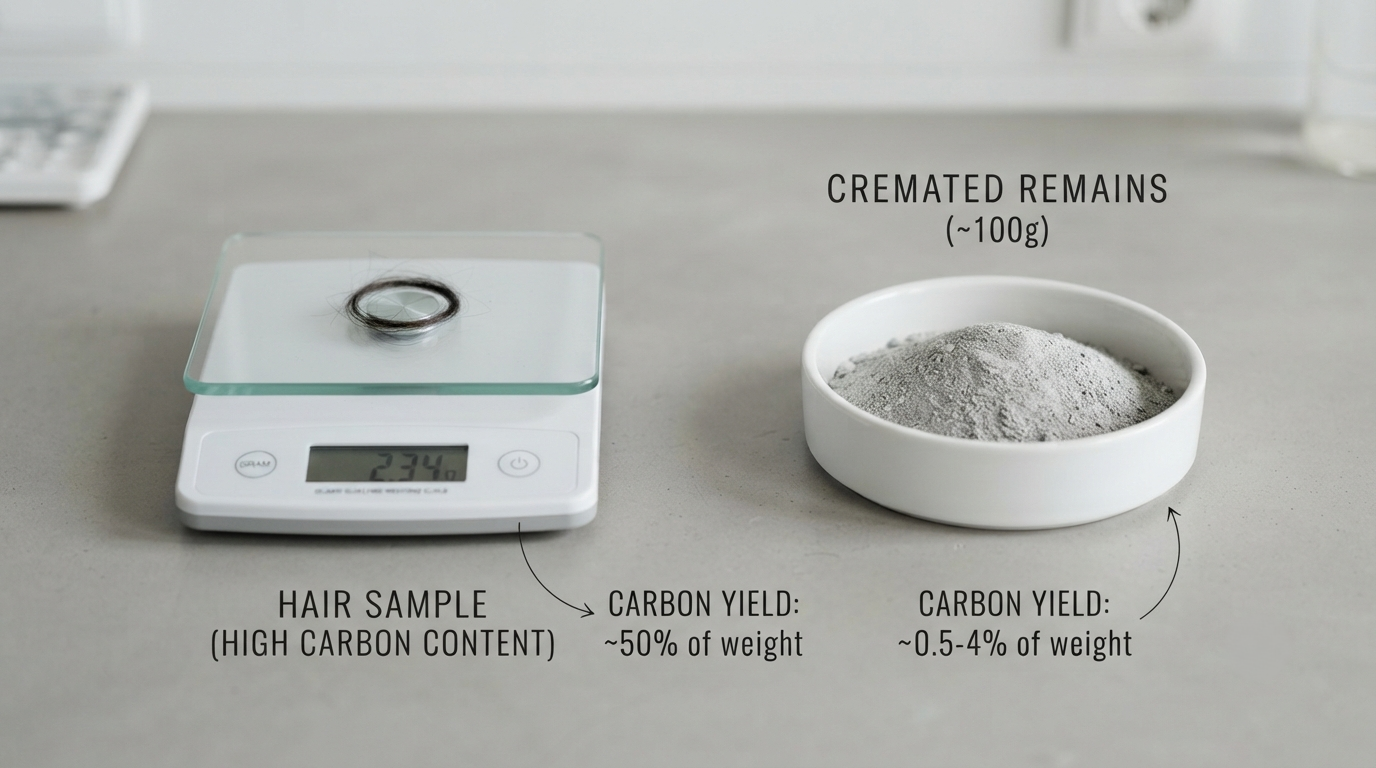
There is a second piece of arithmetic in a son ashes hair diamond that nobody mentions, and it surprises people.

MaterialCarbon by weightTypical amount sentLikely contribution to the personal share
Cremated remainsAbout 0.5% to 4%A few tablespoons up to about 4 oz, approximately 100 gSmaller than its bulk suggests
HairAbout 50%A small lock, a few gramsOften larger than its size suggests
A few grams of hair on a gram scale beside a larger dish of cremated remains, illustrating the difference in carbon content

So in a son ashes hair diamond, the envelope of hair that weighs almost nothing may well contribute more carbon than the far heavier portion of ash. That is not a reason to send less ash or more hair. It is a reason to stop thinking of the two as halves of anything, the stone has no halves, no seam, and no recoverable ratio, and no test on earth will ever separate one source from the other once both have been purified to carbon.

If you want either pathway on its own terms, the complete guide to a son ashes diamond and the complete guide to a son hair diamond each run a single route from decision to finished stone.

Does a Son Ashes Hair Diamond Have a More Predictable Color?

It does not, and there is a case that a son ashes hair diamond makes the result slightly harder to reason about.

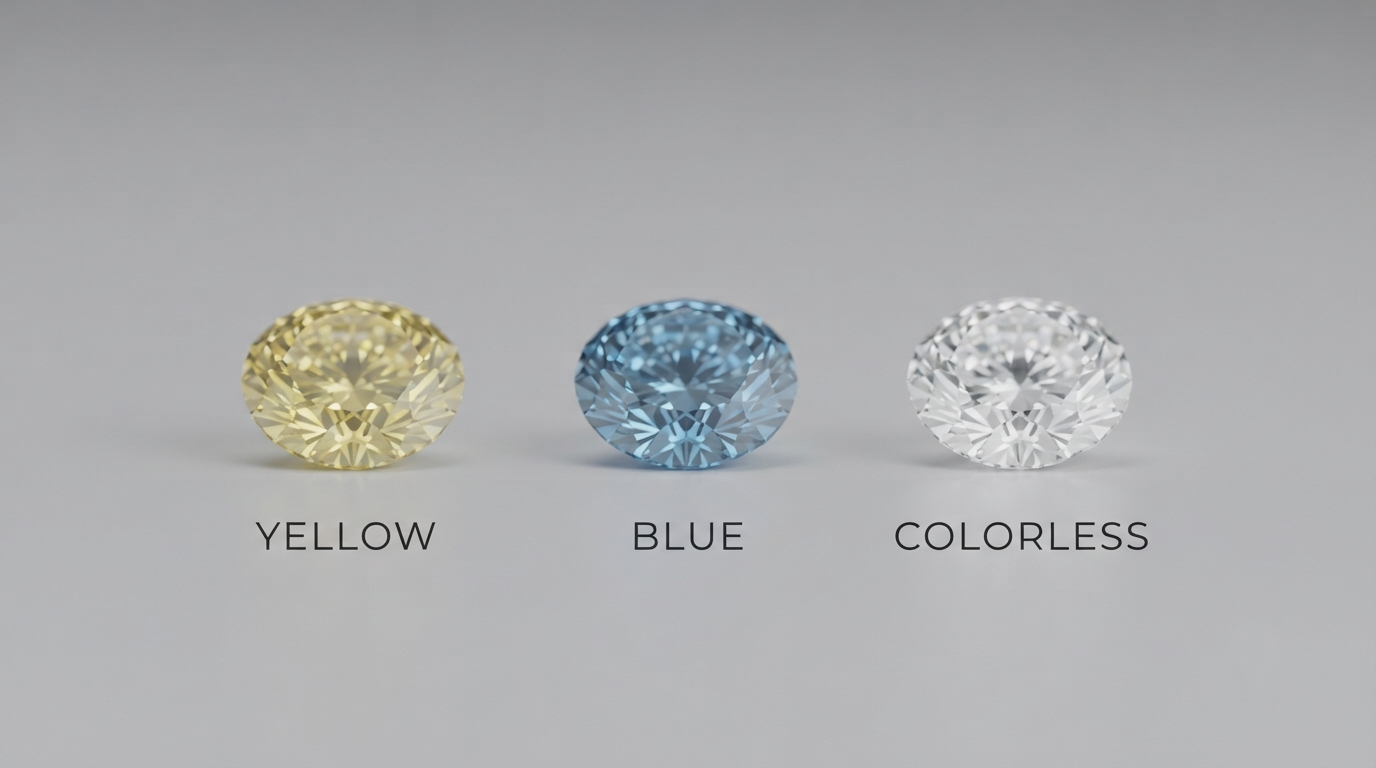
Color in a grown diamond comes from whichever trace elements are sitting in the cell as the crystal forms. Nitrogen present in that mix reads as yellow. Boron reads as blue. Colorless is the awkward one, because it is not an addition but a subtraction, what you get when both are very nearly absent, which has to be engineered and is the reason colorless generally carries a premium rather than a discount. Clarity across the category typically falls between SI2 and VVS, and the cut, color, clarity and carat framework grades a memorial stone on the ordinary scale.

Both of your materials are organic, both arrive carrying their own trace elements, and both are indistinguishable by the time growth starts. The practical consequence for a son ashes hair diamond is this: if the finished stone comes out warmer or cooler than you hoped, there is nothing to attribute it to and nobody to ask. With one material you at least have a single variable. With two you have a blend that was already inseparable before the press closed.

One more expectation worth putting down gently. Parents sometimes hope that hair kept from early in his life will somehow show, a lighter cast, a warmer tone, something visible. It will not. Everything that gave hair its color is stripped at the purification stage, long before anything crystallizes. What carries over is carbon, and carbon has no memory of what it used to be part of.

What you can do is pin the range down in advance:

  • Ask for the committed color range in writing, before growth begins rather than after.
  • Ask what the remedy is if the stone lands outside it.
  • Ask whether the quote assumes a tinted stone or a colorless one, the gap between those two is not small.

When the Hair and the Ashes Are Held by Different People

This is the situation this guide exists for, and for a son ashes hair diamond it is common rather than unusual.

Authority over a person’s remains is set by state law, not by any national rule, and anything your son left in writing can rearrange it. Within that framework a surviving spouse, and then his adult children, commonly rank ahead of parents, which means the ashes may be entirely lawfully in someone else’s keeping while the hair has been in your drawer for thirty years. A lock cut long before he died was generally never part of the remains anyone had authority over. One of your two materials sits inside that legal question; the other, usually, never did.

That asymmetry gives a son ashes hair diamond its practical shape.

Who holds whatCan you proceed alone?What to ask for
You hold hair; someone else holds the ashesYes, with hair aloneA small portion of ash, framed as a request that changes nothing else
You hold bothYesNothing from anyone, though telling people is still a choice worth making deliberately
Someone else holds bothNoA cutting or a portion, asked for directly and early
Two parents hold one material eachOnly with both agreeingAn honest conversation before anything is ordered

The single most useful thing to understand about a son ashes hair diamond is that it needs two yeses, and the hair only route needs one. If asking for a portion of ash would cost you a relationship, or reopen something that has only just settled, it is entirely reasonable to grow a stone from hair alone and say nothing more about it. Nothing about that is a lesser version.

Where you do want to ask, ask small and ask early. A few tablespoons is a request that leaves an interment, a scattering, or an urn on a shelf exactly as they were, and it is granted far more often than parents brace for, partly because it is so obviously not a challenge to anyone’s arrangements.

Two people talking across a table with funeral paperwork between them, illustrating a conversation about who holds authority over remains

The other split is closer in. Parents are not always in agreement, and are not always in contact. One may hold the envelope and the other may be the one who wants the stone; one may be arranging this alone and paying for it alone. There is no rule that a son ashes hair diamond has to be a joint decision. There is also no rule that it has to be disclosed. Deciding which of those you are doing before anyone asks is easier than deciding it mid conversation. If more than one person may eventually want a stone, whether several can come from the same source is worth reading before anything is divided.

What Happens If the Two Parcels Arrive Months Apart?

Growth on a son ashes hair diamond generally waits for whichever parcel arrives last, which means the clock most families are counting has not started yet.

That matters more for a son ashes hair diamond than for any single material order, because the two materials are so often in different hands and on different timetables. A permission conversation can take a season. An envelope can take an afternoon.

SituationEffect on the scheduleWhat to ask before you send
Both parcels sent togetherThe quoted window starts at intakeWhether each is logged separately, with its own weight and reference
Hair now, ash laterGrowth waits for the ashHow the first parcel is stored meanwhile, and for how long
Ash now, hair laterGrowth waits for the hairThe same, plus whether there is a deadline after which it is returned
One parcel never arrivesDepends entirely on provider policyWhether the order can convert to a single material stone, and at what cost

That last row is the one to settle in advance rather than discover. If you send hair while you are still asking for ashes, you want to know now what happens if the answer turns out to be no. Ask whether a son ashes hair diamond order can simply become a hair order, whether that changes the price, and whether anything you have already paid moves with it.

One more request worth making at the start: ask for two intake records rather than one. Two dates, two weights, two references. Once both materials are purified and loaded together, nothing distinguishes them again, so the paperwork made at intake is the only record that will ever exist of what went in. What a combined submission requires of each material covers the quantities in more detail.

Timeline and Cost of a Son Ashes Hair Diamond

Across the industry, production runs roughly 6 to 10 months from receipt of material to a finished stone, and toward twelve months for a large carat or a specialty color. For a son ashes hair diamond, read “receipt” as the arrival of the second parcel, not the first.

Those months cover laboratory work alone. They do not cover the part that comes before, which in this cluster is often much longer, the asking, the waiting to be ready, the agreeing or not agreeing among people who are all grieving differently.

Memorial Diamond does not publish prices, and the bands below are not a rate card. They describe where the category sits in 2026, and their honest use is as a way of checking what a quote has quietly left out.

Industry bandCarat it usually buysConfirm whether this covers
About $1,500 to $3,5000.10 to 0.25 ctIs grading quoted separately?
About $5,000 to $15,0000.5 to 1 ctGrading, engraving, and any non round cut
About $20,000 to $75,000+2 to 5+ ctThose, plus mounting and a valuation for insurance

Two materials do not move a son ashes hair diamond into a different band. Carat drives the number, then color, then cut, then what is bundled in. There is one question specific to combining that is still worth asking directly: whether a second intake adds anything to the quote, given that it is measurably more handling. Some providers charge for it and some do not, and it is easier to ask than to assume. How a memorial diamond quote is built takes the line items apart, and the memorial diamond category as a whole is worth a look if this is all new.

Nine Things to Settle Before You Order a Son Ashes Hair Diamond

None of these describes what any particular company does. They are nine things to have answered about a son ashes hair diamond, in writing, before either parcel leaves the house.

  1. Who holds authority over the ashes, confirmed from what your son left in writing or from the funeral home, not assumed from who has the container.
  2. The minimum for each material separately, and whether those figures are received weights or weights still usable after processing.
  3. Whether two intake records are kept, two dates, two weights, two references, sent to you as they happen.
  4. What happens if only one parcel ever arrives, and whether the order can convert to a single material stone.
  5. How a first parcel is stored while the second is outstanding, and whether there is a limit on how long it will be held.
  6. What happens to material the process does not consume, for each parcel separately.
  7. The committed color range, and the remedy if the finished stone falls outside it.
  8. Whether two intakes change the price, and whether an independent grading report is included or extra.
  9. Whether a second stone could be grown later from what remains, if a sibling or his own family may want one.

A provider who answers all nine plainly has told you what you needed. One who answers warmly but in general terms has told you something as well.

If you are still weighing the two routes against each other, turning your son’s ashes into a diamond and turning your son’s hair into a diamond each walk one pathway step by step.

Frequently Asked Questions

Does sending both materials mean we get two stones?

No. One submission grows one stone, whatever went into it. If two people each want a stone, that is two orders with two growth runs and two sets of months, say so at the start rather than after, because the material has to be divided before anything is sent.

My son’s wife has the ashes and I have his hair. Can I start with the hair?

Yes. Where the sample has been in your own keeping all along, the hair route usually sidesteps the authority question in practice, since the rules here attach to remains rather than to a keepsake in a drawer, check rather than assume if anything about that is unclear. A son ashes hair diamond can wait until, or unless, the conversation about the ashes happens. Starting with hair does not close the door on asking later.

Will the hair from early in his life show up in the stone somehow?

No. Purification strips everything that gave hair its color before growth begins, so nothing about its origin survives visually. What a son ashes hair diamond carries is carbon from two moments in his life, not a visible trace of either.

Do both parcels have to travel in the same box?

No, and they are handled as separate jobs regardless. Send them together if it is simple, but the real question is what happens in between, ask how the first is stored and for how long, since growth generally waits for the second.

If one material yields less than expected, does the other make it up?

Effectively yes, because both are topped up with laboratory carbon to the fixed volume a growth cell needs. That is also why a son ashes hair diamond does not contain a larger personal share than a single material stone, the total is set by the carat, not by what you sent.

Could his ashes and his hair go into separate stones instead?

Often, if each meets its own minimum. Two stones from two materials is a different order from one combined stone, and it costs two stones’ worth of months and money. Ask before dividing anything, and decide deliberately rather than by default.

Final Thoughts on a Son Ashes Hair Diamond

Strip away what combining cannot do, and one thing is left standing, which is the thing that was probably true from the beginning: the ashes are from the end and the hair is very likely from long before it, and a son ashes hair diamond is the only object that holds both.

That is worth doing. A son ashes hair diamond is not worth doing under a misunderstanding about what it buys, no extra fraction of him, no surer color, no larger stone, and one more permission to obtain than the simpler route needs.

So decide what you are actually after with a son ashes hair diamond. If it is both materials together, the work ahead is a conversation and two parcels. If the conversation is not one you can have right now, the hair alone makes a stone that is no less his, and it can be arranged this month or in five years. Neither answer is the wrong one, and neither has an expiry date.

Learn More About Son Memorial Diamonds

Talk With Memorial Diamond

Nothing here asks you to commit to anything, and the first conversation costs nothing but an email.

If you are considering a son ashes hair diamond, the useful opening message has four things in it: roughly how much hair you have, whether you hold the ashes or someone else does, whether the two might arrive months apart, and what carat you have in mind. That is enough for anyone to tell you what is possible and what it would take.

Ask in the same message what becomes of material the process does not use, whether two intakes change the quote, and what the order turns into if only one parcel ever arrives. memorialdiamond.us will put all three in writing with nothing owed either way, and so should anyone else on your list.

If the ashes are not yours to send, ask that question first and the rest afterwards. The envelope in the drawer is not going anywhere while you do.
A small measured portion of cremated remains in a glass dish beside a closed urn, showing how little ash a son ashes diamond requires

Son Ashes Diamond: The Complete Guide

Somewhere in your house there is a container, and near it there is a decision nobody ever prepared you to make.

A son ashes diamond is a real, lab grown diamond grown from carbon recovered out of your son’s cremated remains. It takes a portion rather than the whole: carbon makes up only about 0.5% to 4% of ash by weight, so what a laboratory can actually work from is a fraction of a fraction, and nearly everything you are holding now stays exactly where it is.

Memorial Diamond grows these stones, so this page comes from a company with something to sell. Every number below is an industry wide band, not our published figure, and you should put the same questions to us that you would put to anyone else.

This guide takes the son ashes diamond route end to end, what is recoverable, what stays with the family, how the work is done, how long it runs, what color to expect, what it costs, and the one question that has to be settled before any of the rest of it matters.

What a Son Ashes Diamond Is, in Plain Terms

Take the simplest question first, because families ask it in a lowered voice as though it were rude. Yes, it is a diamond.

A son ashes diamond is carbon locked into the cubic lattice that makes a diamond a diamond. It is not resin with ash suspended in it, not a coated stone, not a simulant with a certificate attached. The method is high pressure and high temperature, the same HPHT growth used across the lab grown diamond trade, running at roughly 6 to 8 GPa and somewhere between 1,400°C and 2,500°C. What comes out is scratched by nothing softer than another diamond and can be cut, set, appraised and insured like any stone on any counter. The cut, color, clarity and carat framework gemologists use is applied to it without modification.

Now the part a page like this owes you early, because a page that hides it until the end is not being straight. A son ashes diamond is not made entirely of your son, and no honest description of this category claims otherwise.

A growth cell holds a fixed volume of carbon, set by the carat ordered and by the physics of the press. Whatever the submission yields after purification is topped up with laboratory carbon before growth begins. Industry figures for the ash route usually cite that personal share at 10% to 15% of the finished stone by mass, and some providers cite figures as low as 3%. Those atoms are genuinely in the lattice, genuinely came out of your son, and are genuinely a minority of what you will be wearing. Both halves of that sentence are true and neither cancels the other.

How Much Ash Does a Son Ashes Diamond Actually Use?

Less than almost anyone expects, and the reason is chemistry rather than mercy.

Cremated remains are mostly calcium phosphate, bone mineral, not carbon. Only about 0.5% to 4% of ash by weight is carbon a laboratory can recover and use. That is why the industry typical request sits where it does, and why it sounds larger than it needs to be.

FigureIndustry typical bandWhat it means for a son ashes diamond
Carbon content of cremated remainsAbout 0.5% to 4% by weightThe only fraction of the ash that can become a stone
Portion usually requestedA few tablespoons up to about 4 oz, approximately 100 gSized as insurance against a thin yield, not as a price of entry
Personal carbon in the finished stoneAbout 10% to 15% of its mass, the figure cited for the ash route; some providers cite as low as 3%Real and physically present, not the whole crystal
What a larger carat changesGrowth time in the pressNot the size of the portion you are asked to send
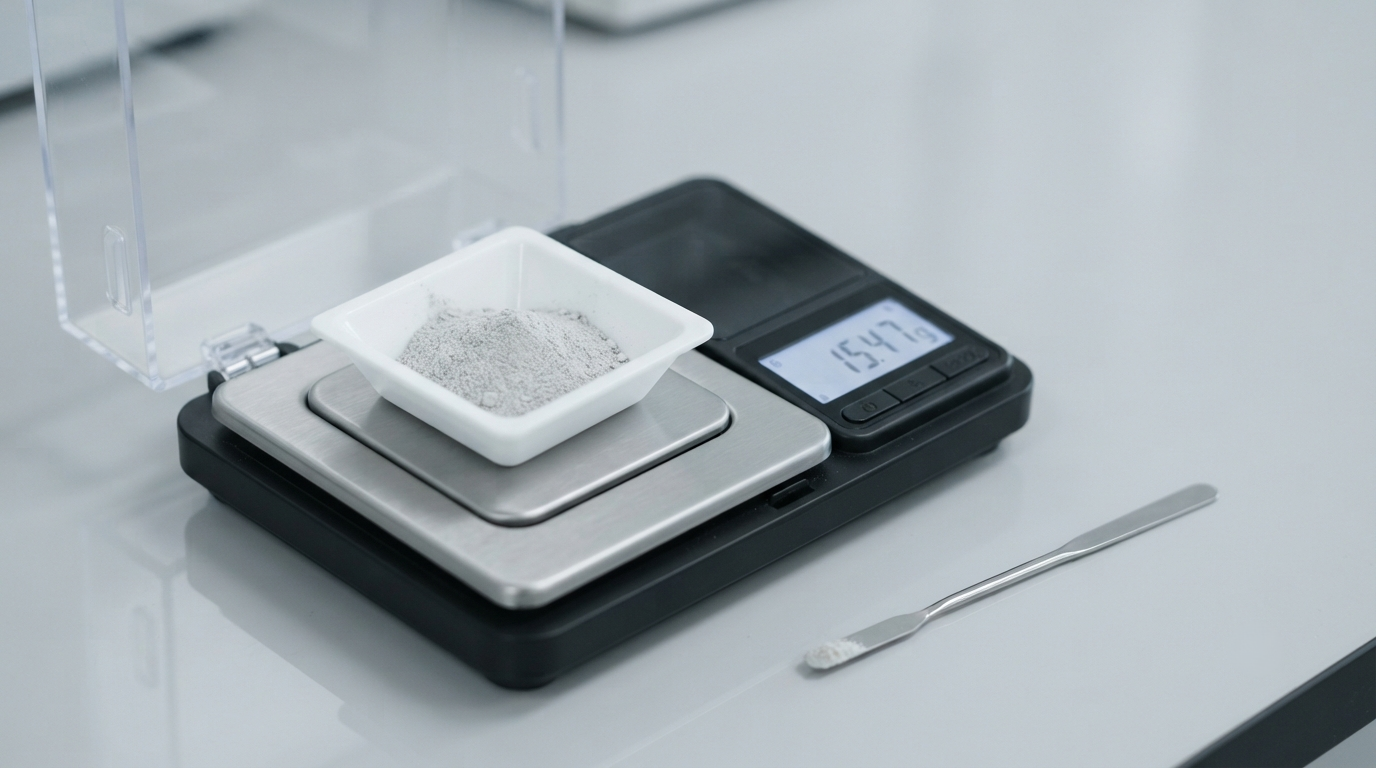
Cremated remains on a laboratory weighing dish beside a digital gram scale

Read the last row twice, because it undoes an assumption almost every parent arrives with. Ordering a bigger stone does not mean handing over more of him. Carat is bought in weeks under pressure, not in spoonfuls. A one carat son ashes diamond and a quarter carat one can start from portions of much the same size.

Which leaves the thing that actually matters here: whatever you decide, the great majority of what you hold does not move. An interment can still happen. A scattering he asked for can still happen. A shared urn can stay on the shelf it has been on. A son ashes diamond is a portion set aside, not a substitute for the arrangements you have already made.

If you want the quantity question on its own, the step by step walkthrough of turning your son’s ashes into a diamond handles measuring and packing in more detail than belongs on a page this wide.

Who Has the Authority to Say Yes?

This is the section to read before any other, and it is the one most guides bury.

If your son had a spouse, a registered domestic partner, or adult children of his own, the legal right to direct what happens to his remains may rest with them and not with you. Across most of the United States the order of priority runs through next of kin, and a surviving spouse, then adult children, commonly sits ahead of parents in that order. But the order is written state by state rather than nationally, and anything your son himself left in writing, from a will to a signed cremation authorization, can reorder it completely.

So the honest position is this: you may hold the ashes and still not be the person whose signature releases a portion of them, or you may be exactly that person and not know it yet. Both are common. Neither is a verdict on how much you loved him.

Two people reading funeral paperwork across a kitchen table, illustrating a conversation about who holds authority over remains

There is no national rule to look up, so find out locally. A funeral director who handled the cremation can usually tell you in one phone call who signed what, and that call costs nothing. Where authority sits with your son’s spouse or children, a son ashes diamond becomes a request rather than a decision, and requests of this particular kind are granted far more often than parents fear, because what is being asked for is small and changes nothing else that was planned.

A second version of this question is quieter and just as real. Parents are not always in agreement, and are not always in contact. One parent may be arranging this alone, paying for it alone, and unsure whether to raise it with the other at all. What helps is deciding in advance which conversation you are willing to have and which you are not, so the answer is ready when it comes. Whether more than one family member can each have a stone from the same ashes is often the practical shape that conversation takes.

If the ashes were interred or scattered years ago, that becomes a permissions question rather than a chemistry one. Cemeteries and columbaria set their own rules about removing interred remains, and state or local law may add more on top. Ask the cemetery directly, in writing, before assuming the answer either way.

From the Shelf to the Finished Stone

Six stages turn a portion of ash into a son ashes diamond, and only one of them is fast. Knowing the sequence makes the months feel less like silence.

StageWhat is happeningTypical share of the wait
Intake and loggingThe portion is weighed, given a reference, and recordedDays
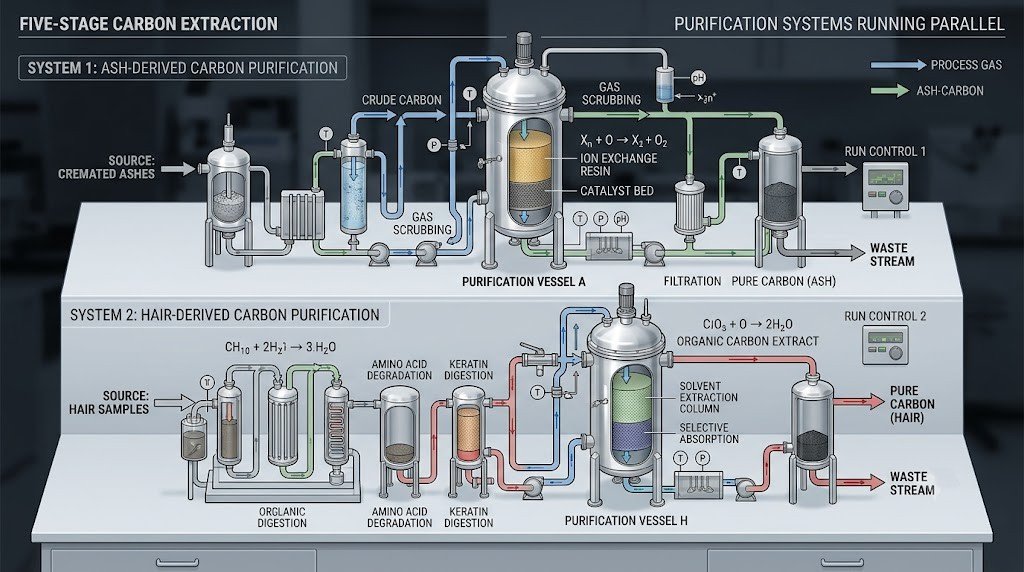
Carbon extraction and purificationCarbon is separated from bone mineral and driven toward 99.9% or higher purityWeeks
GraphitizationPurified carbon is converted to graphite at roughly 2,500°C to 2,700°CDays to weeks
GrowthGraphite plus lab carbon grows around a seed at 6 to 8 GPa and 1,400°C to 2,500°CWeeks to months, this is where carat comes from
Cutting and polishingThe rough crystal is cut to the shape chosenWeeks
Optional grading and settingIndependent grading if you order it, then mounting if you have ordered jewelryWeeks

Two things in that table are worth pulling out.

The first is that every piece of evidence a son ashes diamond can ever carry is created in the top three rows. Once purified carbon goes into the cell, nothing about its origin is recoverable by any test. So the intake weight, the reference number and the date are not paperwork, they are the whole record, and they should reach you when they happen rather than in a summary afterwards.

The second is that the growth row is the only one you control, and you control it by choosing a carat. Everything above and below it runs at roughly the same pace regardless of what you ordered.

How Long Does a Son Ashes Diamond Take?

Industry wide, production runs about 6 to 10 months from the day material is received to a finished stone, stretching toward twelve months for a large carat or a specialty color.

That figure covers the laboratory work on a son ashes diamond only. It does not include the part that comes first, which for most families is longer: the months of not being ready, of raising it with people who may not want to hear it, of putting the brochure in a drawer and taking it out again. Nobody’s clock starts when the website says it does.

Three practical notes about the wait:

  • The clock starts at receipt, not at order. If you are sending from another state or another country, the transit and intake time sits before the quoted window rather than inside it.
  • Bigger stones wait longer. A son ashes diamond around 2 ct or above can push the schedule out by months, because the press time is the schedule.
  • Ask what happens if it fails. Growth runs do not always produce what was intended. Ask, before you send, what a provider does when a run comes out unusable, and whether a second attempt uses new material.

There is no urgency built into any of this from the material’s side. Cremated remains are chemically stable and do not spoil. Waiting a year to decide costs you nothing, and the timeline written out stage by stage covers what is happening during each month if the silence is the hard part.

What Color Will a Son Ashes Diamond Be?

Honestly: a son ashes diamond lands within a range, and not precisely.

Color in any diamond comes from trace elements sitting in the crystal while it forms. Nitrogen present in the growth cell pushes the stone toward yellow. Boron pushes it toward blue. Colorless is not a third ingredient, it is what is left when both are almost entirely absent, which has to be engineered rather than added, and is the reason colorless usually costs more than a tinted stone rather than less.

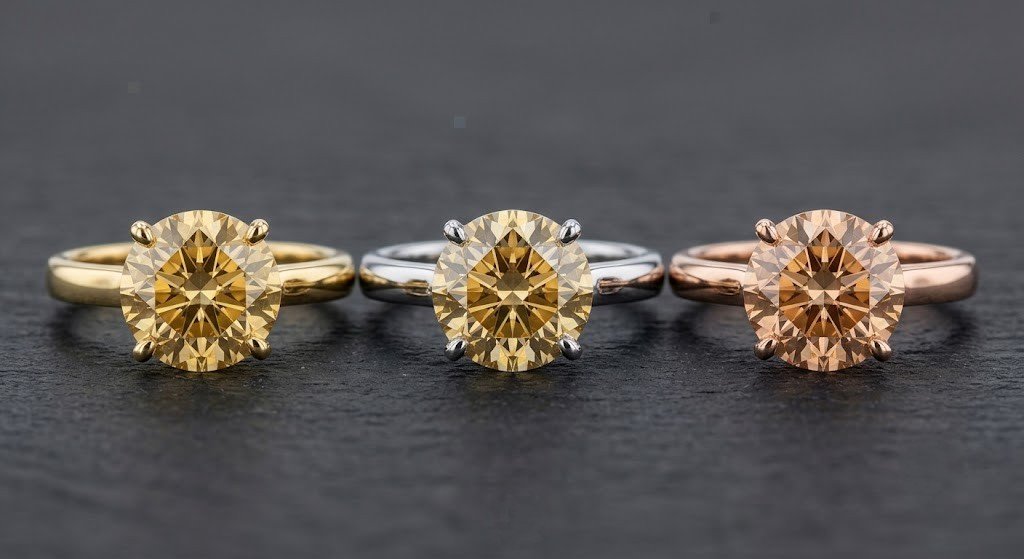
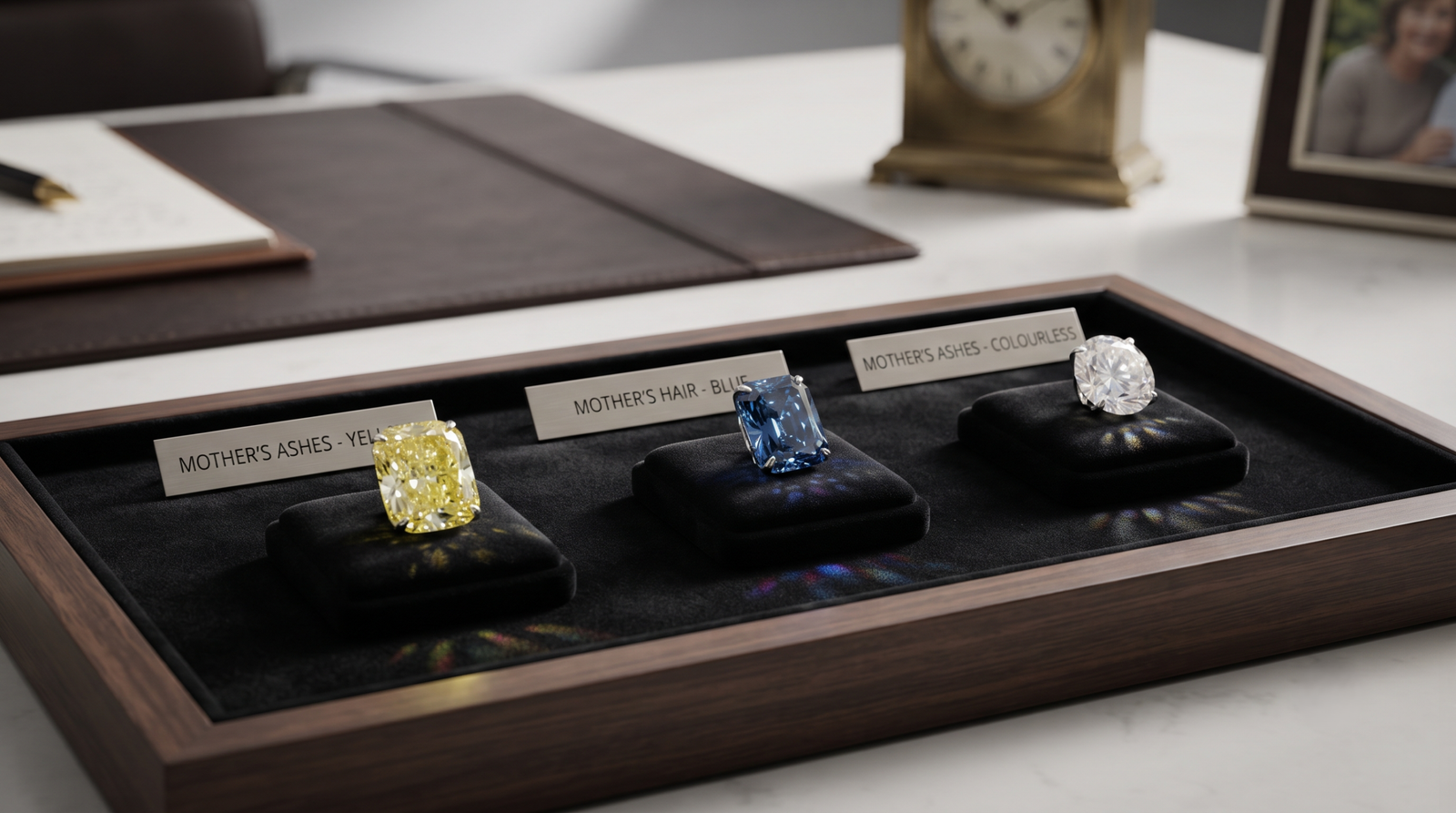
Three loose lab-grown diamonds shown side by side in yellow, blue and colorless to illustrate the trace-element range

Because cremated remains are organic and variable, the trace element profile arriving with any given submission is not identical to the next one. A provider can steer toward a target and can narrow the band, but a son ashes diamond is not a paint chip and nobody can hand you an exact shade in advance. Clarity behaves similarly, the range across the category typically runs from SI2 up to VVS.

What you can do is make the range explicit before growth begins:

  • Ask what color range the provider will commit to in writing, not in conversation.
  • Ask what happens if the finished stone lands outside it, remake, refund, or neither.
  • Ask whether the price you have been quoted assumes a tinted stone or a colorless one, because the gap between those two is not small.

What color to expect from a memorial diamond goes further into how wide the honest range really is.

What a Son Ashes Diamond Costs

Memorial Diamond does not publish a price list for a son ashes diamond, and the bands below are not one. They are where the category sits across the industry in 2026, and they are useful mainly as a way to read whether a quote you have been given is complete.

Industry bandCarat it usually buysWhat to make anyone confirm is included
About $1,500 to $3,5000.10 to 0.25 ctWhether an independent grading report is priced on top
About $5,000 to $15,0000.5 to 1 ctGrading, plus whether a fancy cut or engraving is extra
About $20,000 to $75,000+2 to 5+ ctAll of the above, plus the setting and an insurance appraisal

What moves a son ashes diamond up or down those bands is carat first, then color, then cut, then whether grading and a setting are inside the number or outside it. The source material does not move the price: what a carat buys is time in the press, not a larger portion of him. If a quote seems to vary with the material rather than the carat, ask what that difference is for.

One question is worth more than a price comparison: ask what the quote does not cover. A number that looks lower than everyone else’s is sometimes a stone without a grading report, without a setting, and without return shipping. How a memorial diamond quote is actually built breaks the line items apart.

Nine Things to Settle Before Anything Is Sent

Not a description of what any company does. Nine things to get answered about a son ashes diamond, in writing, before a portion leaves your house.

  1. Who holds legal authority over the remains, confirmed with the funeral home or from what your son left in writing, not assumed from who has the container.
  2. How much is being asked for, and whether that is a received weight or a usable weight after processing. Those are different numbers.
  3. What happens to material the process does not consume, returned, retained, or destroyed. Get this before you send, not after.
  4. Whether the intake record reaches you at intake, date, weight, reference number, sent the day the parcel arrives.
  5. Whether growth happens in house or is subcontracted, and how custody is documented at that handover if it is.
  6. What color range is committed to, and what the remedy is if the stone falls outside it.
  7. Whether an independent grading report is included in the price or added to it.
  8. What happens if a growth run fails, second attempt, new material required, or refund.
  9. Whether more than one stone can come from the same portion, if siblings or a surviving spouse may want one later. Deciding this in advance is far easier than revisiting it in a year.

A provider who answers all nine plainly has told you something. One who answers warmly and generally has also told you something, and it is worth hearing.

Frequently Asked Questions

Do we have to decide before the cremation happens?

No. Cremated remains are stable and do not deteriorate on a shelf, so a son ashes diamond can be arranged months or years later just as well. The only decision that is genuinely time sensitive is not scattering the whole of what you have.
Our son’s wife holds the ashes. Can we still do this?

Ask her rather than assume. Where a surviving spouse holds authority, which varies by state and by anything he put in writing, a son ashes diamond becomes a request for one small portion, which changes nothing else that was arranged and is granted more often than parents expect.

He was buried rather than cremated. Is there any route for us?

Yes, and it does not involve the grave. Hair is roughly 50% carbon and requires no cremation at all, so a diamond grown from his hair is the open door for families where cremation was never part of it.

Can his brother and sister each have one from the same ashes?

Often, if each portion still meets the stated minimum on its own. Ask before dividing anything, because splitting one barely sufficient portion into three is how a workable submission stops being one. Each son ashes diamond is grown separately and each takes its own months.

Does it matter how long the ashes have been in the house?

Age is not the issue, storage is. If the container has been opened many times, or has sat somewhere damp, say so plainly when you request an assessment of a son ashes diamond. Providers would far rather know in advance than find out at intake.

Can we send hair as well as ashes?

Yes, and the combined route has its own guide. Sending both does not enlarge the personal fraction of the stone or make the color more predictable, it means the carbon comes from two different points in his life rather than one.

Final Thoughts on a Son Ashes Diamond

The chemistry of a son ashes diamond turns out to be the easy part. A small portion, a long wait, a stone that is partly him and partly not, and a color nobody can promise you in advance.

What is harder, and what this guide has tried not to smooth over, is that a son ashes diamond often sits behind a question about permission, whose signature, whose agreement, whose turn to be asked. That question has an answer, usually a faster one than the dread around it suggests. One call to the funeral director. One conversation with his spouse or his children. One honest exchange with the other parent, or a decision not to have it yet.

Settle that, and everything else on this page becomes logistics. Nothing here needs to be decided this month, or this year. The container is not going anywhere while you think.

Learn More About Son Memorial Diamonds

Talk With Memorial Diamond

Nothing on this page asks you to commit to anything, and there is no version of this where hurrying helps.

If it would be useful to know what a son ashes diamond would mean in your particular situation, start with three questions rather than a quote: what portion is required and whether that figure is a received or a usable weight; what becomes of the part the process does not consume; and how many months the carat you are picturing would actually need. memorialdiamond.us answers all three with nothing to sign, and so does any provider worth using.

If the authority question is still open, ask that one first and everything else second. The urn stays where it is in the meantime.

Three finished memorial diamonds of slightly different tones on a pale surface, showing what sharing a partner memorial diamond between several people produces

Can More Than One Family Member Get a Diamond From the Same Partner’s Ashes?

It usually surfaces sideways, in a kitchen, after someone has already said yes to the idea. A sibling asks whether they could have one too. Sharing a partner memorial diamond across several people is usually possible, because only a small portion of what a family holds is ever used, but the material was never the hard part. The hard part is who has the standing to authorize it, and what everyone has agreed before anything is posted.

One disclosure up front: Memorial Diamond grows these stones, so treat this as a company describing its own category rather than a neutral referee. Every figure below is an industry wide band, not a published policy of ours.

Why One Portion Can Supply Several Stones

Start with the physical facts, because they are the reassuring end of this subject. Materially, sharing a partner memorial diamond is the easy part.

A cremation produces remains measured in pounds. What a laboratory asks for is measured in tablespoons, industry wide, somewhere between a few tablespoons and roughly 4 oz, about 100 g. That gap is what makes sharing a partner memorial diamond feasible at all. Several separate portions can be drawn from one urn and nothing visible changes in it. How much ash a single stone actually takes sets out the arithmetic behind that figure in full.

The reason the request is so small is that cremated remains are not a carbon source in any generous sense. They are overwhelmingly calcium phosphate, the mineral scaffolding of bone. By weight, only about 0.5% to 4% of ash is usable carbon. So each portion set aside for sharing a partner memorial diamond is a mineral sample from which a thin recovery of carbon will be pulled, purified to around 99.9%, and then blended with supplemental lab carbon to reach the volume a growth cell needs.

Several small sealed vials of cremated remains lined up beside a closed urn, each holding one portion

That blend is worth stating plainly rather than skipping. For the ash route, the industry figure for personal carbon is somewhere around 10% to 15% of a finished stone’s mass, and some providers cite as little as 3%. No comparable figure is published for hair. Nobody receives a diamond that is entirely the person, that is not how the chemistry works. What each person receives is a real diamond containing a real, traceable share of their carbon, which is a more defensible claim and, once you sit with it, not a smaller one.

Hair changes the arithmetic considerably. Hair is roughly 50% carbon by weight, and no cremation is involved at all, so a household that kept a lock has a second route into sharing a partner memorial diamond even where the ashes are out of reach. What a hair based submission requires covers the quantities, which are far smaller than most people assume.

Practical limits that do apply when sharing a partner memorial diamond:

  • Each stone needs its own portion. Portions are not subdivided after arrival, so sharing a partner memorial diamond means sending one portion per stone.
  • The number of stones is limited by what you hold, not by any rule about how many people may take part.
  • A partial share can still work. A keepsake urn’s worth is often enough for one stone, sometimes two.
  • Hair and ash are assessed separately, not pooled into a single total, if a family is drawing on both.

Who Actually Has Standing to Say Yes?

This is where sharing a partner memorial diamond stops being a logistics question, and it deserves a direct answer rather than a comforting one.

No nationwide rule decides who may authorize a division. State law does, and a written direction from your partner, a will, a disposition directive, a form signed at the funeral home, can displace whatever the default would otherwise have been. Legal recognition of the relationship usually keeps this simple. Without it, the entitled decision maker may turn out to be a former spouse, a sibling, an adult child, or a parent, whatever the living arrangements looked like, which is why sharing a partner memorial diamond so often turns on a document nobody has actually read.

Three people talking across a table with paperwork between them, discussing authority over a partner's remains

That matters more here than in almost any other question in this cluster. Sharing a partner memorial diamond means dividing remains between people, and the person who authorizes a division may not be you. It may be someone who never used the word “partner” about your relationship at all.

None of that makes it impossible. It changes the order of operations for sharing a partner memorial diamond:

  1. Establish who the law treats as the decision maker in the state where the cremation happened, a funeral director will usually say, at no charge.
  2. Find out what was left in writing, and whether anyone has actually read the document rather than recalled it.
  3. Ask the person with authority, which is a separate question from whether they are entitled, and frequently a warmer conversation than people brace for.
  4. Get the agreement on sharing a partner memorial diamond recorded, even as an email thread, before money moves or material is packed.

There is a quiet advantage in this particular request. A family reluctant to acknowledge a relationship is often far more willing to grant one small portion than to change anything about the main arrangement, and sharing a partner memorial diamond, framed as one each, can be easier for them to say yes to than a request made by you alone. It reads as inclusion rather than as a claim. How to open that conversation without it becoming a confrontation goes through the wording in detail.

Say the awkward part out loud too: this is irreversible. Once a portion has been set aside and processed, it does not come back. That is exactly why sharing a partner memorial diamond is worth slowing down over, even when everyone in the room is currently agreeing.

What to Settle Before Any Material Is Sent

Most of the regret in this subject comes from decisions that were assumed rather than agreed. Sharing a partner memorial diamond involves several people, several invoices, and a wait long enough for circumstances to change.

Settle these before sharing a partner memorial diamond goes any further, in writing, however informal:

  • How many stones, and for whom. Names, not “the family.” If someone is undecided, note that too.
  • Who pays for what. Each stone is bought separately, so a shared decision does not create a shared bill unless someone chooses to split one.
  • Who the provider’s point of contact is. One person, or the correspondence about sharing a partner memorial diamond fragments across a group and nobody knows what was approved.
  • What happens if someone withdraws after the portion has been sent but before the growth run begins.
  • What happens to material the process does not consume, and whether it returns by default. This is company policy rather than chemistry, so it varies and must be asked.
  • Whether anyone expects the stones to match, which is the single most common misunderstanding in sharing a partner memorial diamond and is addressed directly below.
  • Who physically receives the finished stones, and whether they are shipped separately or together.

One scheduling note that saves arguments: stones commissioned at different carats finish at different times. Industry typical timelines run 6 to 10 months from receipt, stretching toward 12 months for larger or specialty color stones. If three people order and one chooses a much larger stone, that person waits longest, which feels like unfairness if nobody said so in advance. How the timeline actually breaks down stage by stage is worth circulating to everyone involved before orders are placed.

Will the Stones Match Each Other?

No, and this is the expectation most worth correcting early when sharing a partner memorial diamond. Stones from one shared source are siblings, not twins.

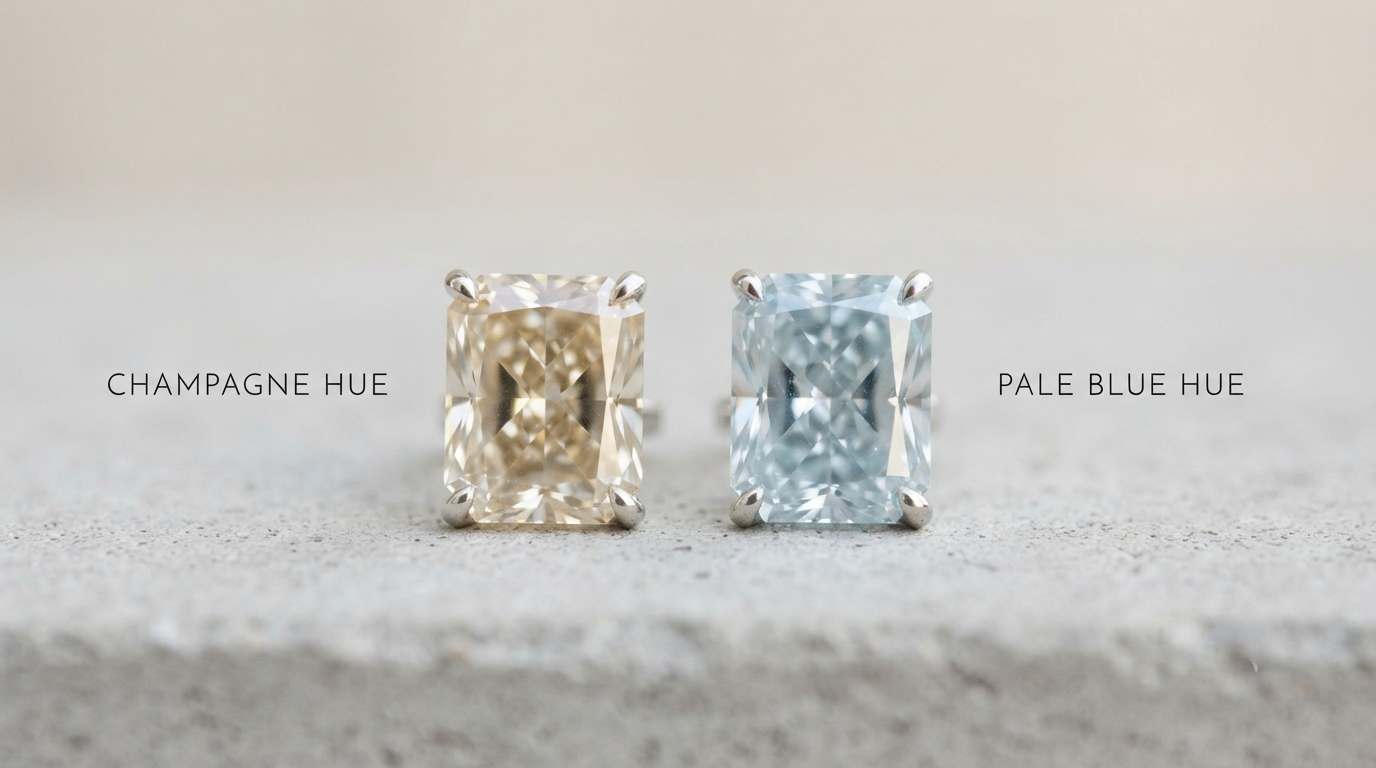
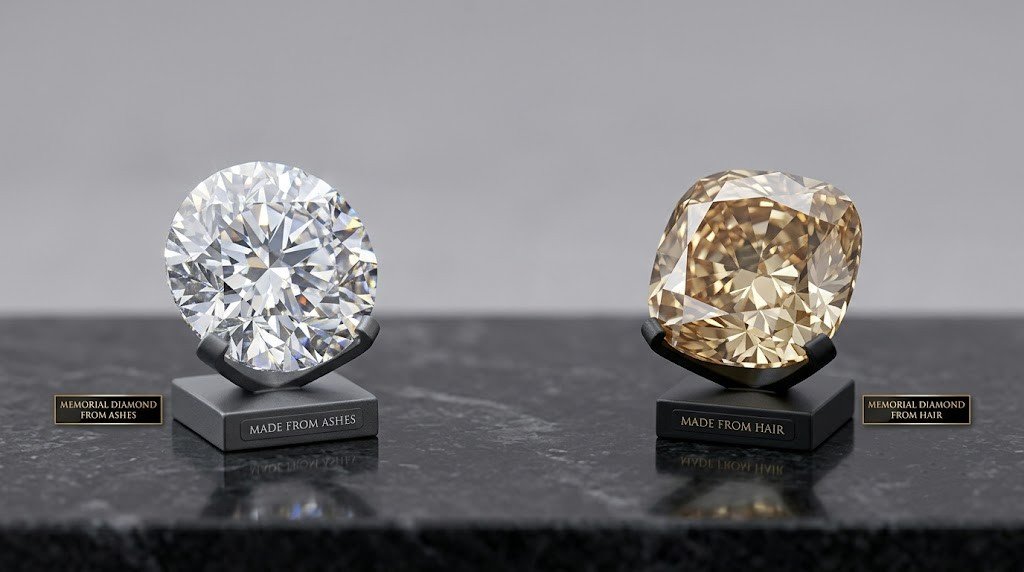
Each diamond is grown in its own run. Color in any diamond comes from trace elements present during crystal growth, nitrogen pushes toward yellow, boron toward blue, and the absence of both is what produces a colorless stone. Because personal carbon is an organic, uncontrolled feedstock, those traces vary between batches, which is precisely why memorial stones trend toward yellow, champagne and blue rather than colorless. The general reference on how these crystals are grown explains the mechanism; what color to expect from a partner’s carbon covers what that means in practice.

Clarity varies too, and it is the second surprise in sharing a partner memorial diamond. Memorial stones typically land somewhere in the SI2 to VVS range, graded against the same 4Cs as any other diamond. Two stones from one urn can differ in tone, in saturation, and in where their inclusions sit.

Two memorial diamonds side by side under daylight, one champagne and one faintly blue, showing that stones from one source do not match

Three ways families handle it when sharing a partner memorial diamond:

  • Accept the variation. Many people prefer it. Each stone is visibly its own thing rather than a set of copies.
  • Order the same carat and cut. Matching the specifications you can control narrows the visible difference even when color does not match.
  • Ask about color treatment. Post growth irradiation is sometimes used to shift a stone’s color, which can bring stones closer together. Ask whether it is offered at all, and what it costs, before assuming.

What no provider can honestly promise is a matched set produced on demand from one person’s carbon. If someone in your group is expecting that, better to find out now than at the unboxing.

How Much Does Sharing a Partner Memorial Diamond Cost?

Here is the part that changes plans. Sharing a partner memorial diamond does not divide a cost, it multiplies one. Each stone is an independent growth run, occupying its own press time, and is priced as its own purchase.

The bands below are industry typical figures for the category as a whole, not Memorial Diamond’s published pricing, and final cost turns on carat, color, cut, and whether you order an independent grading report:

Stones from one shared sourceIndustry typical entry tier, 0.10 to 0.25 ct eachIndustry typical mid tier, 0.5 to 1 ct each
One stoneroughly $1,500 to $3,500roughly $5,000 to $15,000
Two stonesroughly $3,000 to $7,000 combinedroughly $10,000 to $30,000 combined
Three stonesroughly $4,500 to $10,500 combinedroughly $15,000 to $45,000 combined
Larger or rare stones, any numberpriced individually; 2 to 5+ ct runs roughly $20,000 to $75,000+ eachNot applicable

Read that table as a caution rather than a quote. The useful takeaway for anyone sharing a partner memorial diamond is that a group of three at a modest carat frequently spends less, in total, than one person at a large carat, so the honest opening question for a group is not how many of us but what size each. Settings, engraving and any grading report are usually quoted separately from the stone, worth confirming. What drives the price of a single stone breaks down each variable.

Two cost realities catch groups out when sharing a partner memorial diamond:

  • Do not assume a discount for ordering together. Each stone is its own growth run, so ask whether any provider prices several differently, and do not build a budget on the answer being yes.
  • A smaller stone is not a lesser stone. An entry tier diamond carries the same proportion of personal carbon as a larger one; carat is bought from growth time, not from the amount of ash submitted.

When the Answer Is No, or Not Yet

Sometimes the person who decides about sharing a partner memorial diamond simply declines. Sometimes the ashes were scattered years ago. Sometimes the group cannot agree, and pressing it would cost more than the stones are worth.

Options that remain open when sharing a partner memorial diamond is off the table for now:

  • One stone, shared in a different way. A single diamond can be held by one person and worn at family occasions, or set in a piece designed to be passed on. Settings that can be changed or converted later matter more than usual when a stone is meant to move between people.
  • The hair route. If anyone kept a lock, no cremated remains are needed and the authority question over the urn does not arise in the same form.
  • Waiting. Cremated remains are stable and keep indefinitely. A family that says no this year is not saying no permanently, and nothing degrades while you wait.
  • Reading the full route first. The complete guide to a partner ashes diamond lays out every stage, which is often what an undecided relative actually needs before agreeing to anything.

Frequently Asked Questions

How many diamonds can realistically come from one person’s ashes?

It depends on how much you hold rather than on any fixed limit. With a full cremation’s remains, several stones are usually feasible, since each takes only a few tablespoons up to roughly 4 oz. With a keepsake portion, often one or two.

Can each person choose a different size and color?

Yes. Each stone is a separate order with its own carat, cut and color specification, its own invoice, and its own finish date. Sharing a partner memorial diamond does not mean sharing one set of choices.

Do all the stones have to be ordered at the same time?

No. A second stone can be commissioned later from the same held ashes, provided material remains. The catch is timing: prices and offerings shift, and a later stone will differ visibly from the first regardless.

My partner’s family controls the ashes and barely acknowledged me. What now?

Ask anyway, and ask for one small portion rather than a change to the main arrangement. Authority varies by state and by anything left in writing. A framing of one stone each is often easier for a reluctant family to accept.

Can a portion be taken from ashes that are already interred?

That becomes a cemetery permissions question, not a material one. Columbaria and cemeteries set their own rules for removing interred remains, and local law may add more. Ask the cemetery in writing before planning anything around it.

If we split the cost of one stone, who owns it?

Nothing about the process settles that, so settle it yourselves in writing before ordering. Joint purchases of a single irreplaceable object cause the most friction later. Agree now who holds it, who insures it, and what happens eventually.

Final Thoughts on Sharing a Partner Memorial Diamond

The material answer to sharing a partner memorial diamond is the easy one: yes, in almost every case, because the portion each stone needs is small enough that one urn can serve several people without visibly changing.

Six things sharing a partner memorial diamond comes down to, in the order they decide it:

  1. The material is rarely the constraint. A stone takes a few tablespoons up to roughly 4 oz; a cremation is measured in pounds.
  2. Each stone needs its own portion. Portions are not subdivided after they arrive.
  3. Standing decides it, not arithmetic. Authority varies by state and by anything left in writing.
  4. The stones will not match. Separate growth runs, separate results.
  5. Sharing multiplies the cost. Three stones is three prices, not one split three ways.
  6. It cannot be undone. Waiting costs nothing; remains are stable and keep indefinitely.

The rest of it is a conversation, and it is a conversation worth having slowly. Who has the standing to authorize a division. What everyone expects the finished stones to look like. Who is paying for what, and what happens if someone changes their mind in month seven. Handled in that order, sharing a partner memorial diamond usually turns out to be one of the less contested decisions a family makes in a difficult year, and occasionally the one that brings people who disagreed about everything else into one room.

Learn More About Partner Memorial Diamonds

Talk With Memorial Diamond

If your family is weighing sharing a partner memorial diamond and you want a straight answer about what is possible with the material you actually hold, reach out to Memorial Diamond at memorialdiamond.us. Bring the numbers, how much you have, how many people, what carat each has in mind.

Wife memorial diamond with a sparkling diamond, elegant keepsake box, flowers, and framed couple photo on a luxury black and gold jewelry setting.

How Much Does a Wife Memorial Diamond Cost?

You are probably looking at a price band and trying to work out what the difference between two numbers actually consists of.

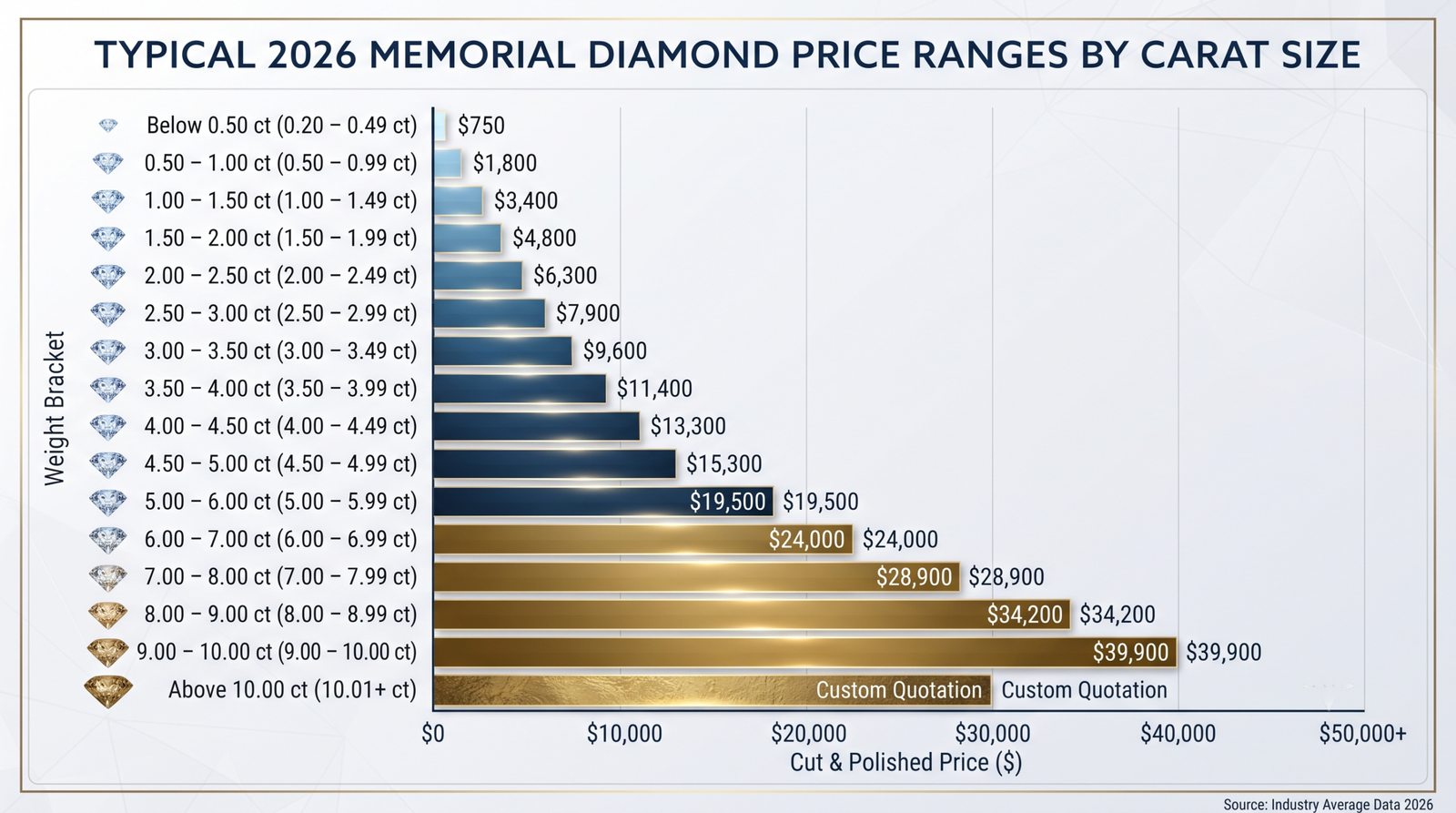
Industry wide in 2026, a wife memorial diamond cost falls in roughly three steps: about $1,500 to $3,500 at 0.10 to 0.25 carats, about $5,000 to $15,000 at 0.5 to 1 carat, and about $20,000 to $75,000 and upward at 2 carats and above. Those are figures for the loose stone. What moves you between the steps is not a better stone, it is a longer growth run and, sometimes, a color that had to be engineered.

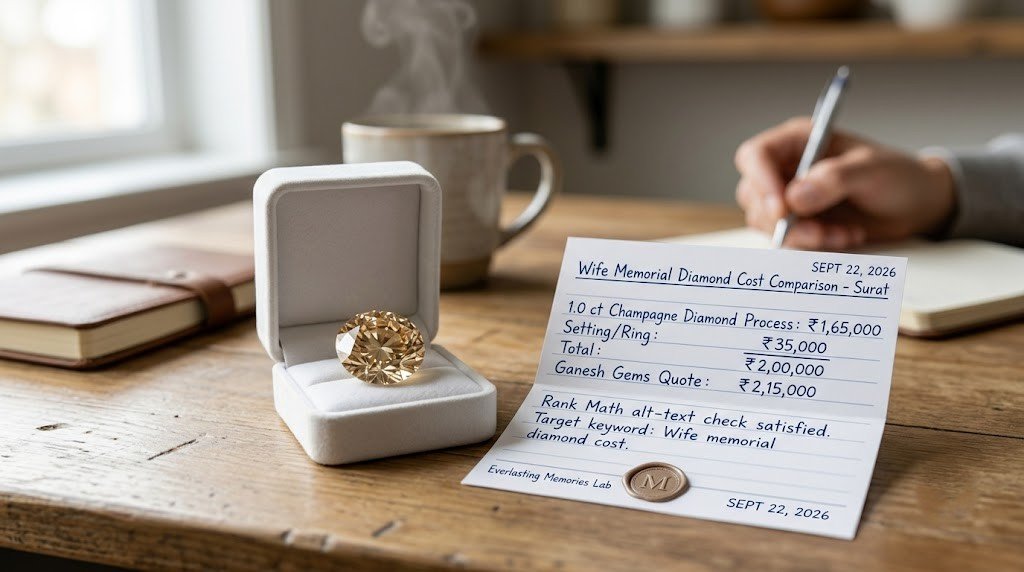
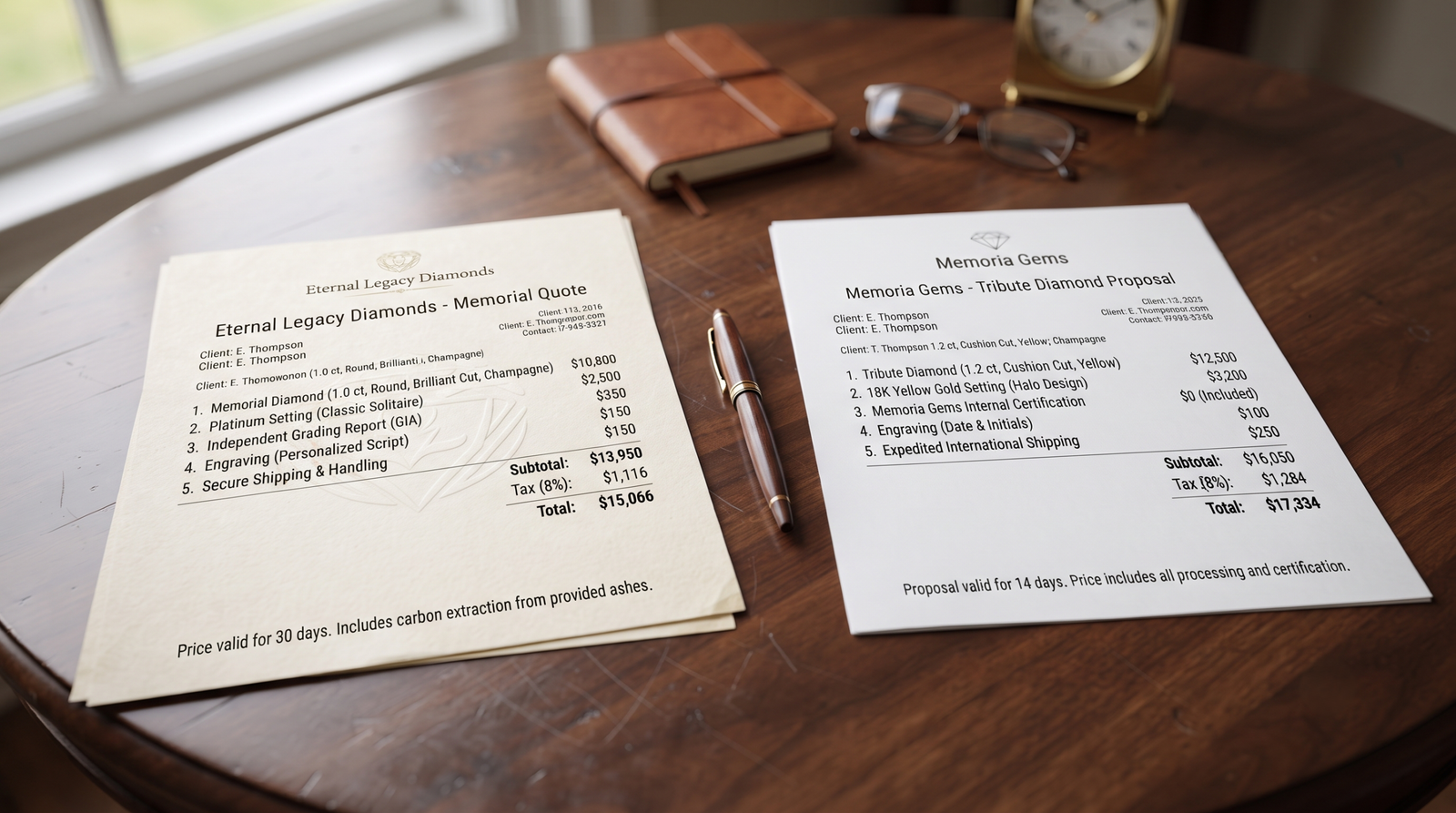
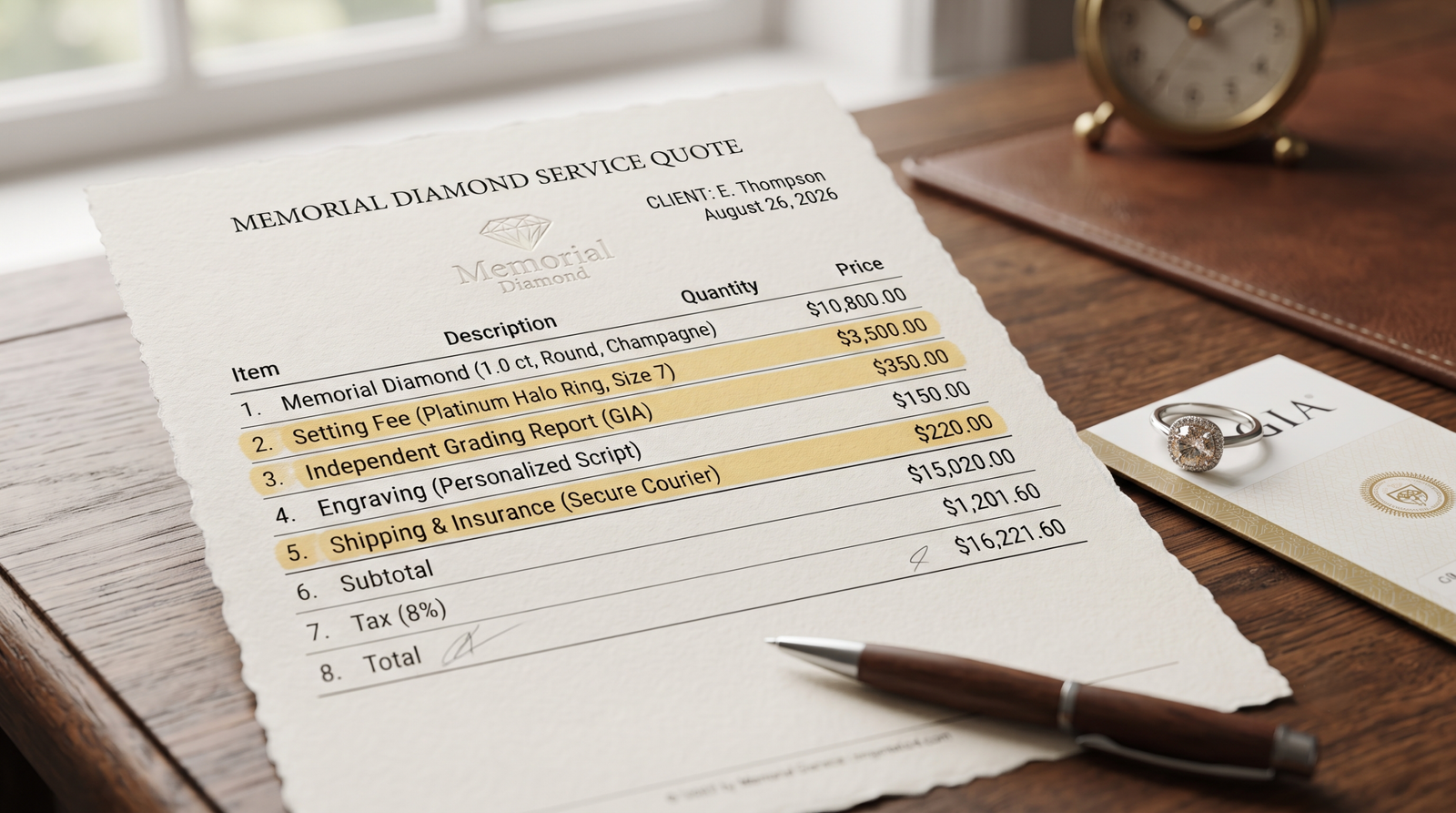
Wife memorial diamond cost comparison: a loose champagne-toned memorial diamond beside a written quote on a kitchen table

What Does a Wife Memorial Diamond Cost at Each Step?

A wife memorial diamond cost is published in bands rather than figures, and the bands are not arbitrary. Each one corresponds to something that physically changes inside the press.

Price stepTypical caratWhat physically changesWhat to confirm is included
About $1,500 to $3,5000.10 to 0.25 ctThe shortest growth runs. The cell is loaded, held and opened in the least time the process allows, with the least opportunity for a run to driftWhether any grading report is included at all, and whether the stone arrives loose or mounted
About $5,000 to $15,0000.5 to 1 ctA materially longer run under continuous control, and the step at which color choice starts to move the figure independently of sizeWhich color band the quote assumes, and whether a change of color changes the price
About $20,000 to $75,000 and up2 ct and aboveA long, closely managed run where conditions must hold for far longer, and where the cost of a failed run is carried by a smaller number of stonesWhat happens to the figure if the finished carat lands under the target, and what documentation accompanies it

Read those as industry wide 2026 ranges for a loose, unset stone rather than any company’s quotation, and not as Memorial Diamond’s own published pricing, which does not yet exist. The wider memorial diamond pricing guide covers what drives cost across the whole category.

The useful way to read that table is left to right rather than top to bottom. A wife memorial diamond cost is not a scale of quality with your budget somewhere on it. Each step buys a specific physical difference, and the fourth column is what stops two quotes in the same band from describing different objects.

It is also worth saying that the first step is a real choice rather than a compromise. A 0.15 carat stone and a two carat stone are the same material, grown the same way, documented the same way, and worn by people who wanted different things. Where a wife memorial diamond cost lands says something about a budget and nothing else.

What Are You Actually Buying When You Pay for Carat?

Time. Almost entirely time, which is the single most useful sentence on any wife memorial diamond cost page.

Carat size in a memorial diamond is a function of how long the crystal grows in the press, not of how much material you supplied. A larger stone occupies tightly controlled equipment, an HPHT press running at roughly 6 to 8 GPa and 1,400 to 2,500°C, for longer, under conditions that must hold steady the whole time. That occupancy is the cost. It is also the reason the wife memorial diamond cost climbs steeply rather than proportionally: doubling the carat is not doubling a quantity of raw material, it is holding an expensive machine in a controlled state for considerably longer while the risk of losing the run accumulates.

This is where the most common and most expensive misunderstanding lives. Sending more of her ashes does not buy a larger stone, a cheaper stone, or a faster one. How much ash a wife memorial diamond needs sets out typical quantities, and the short version is that most of what a cremation produces stays with you regardless of what you order.

There is a related honesty point that belongs on a cost page more than anywhere else. No amount of money buys a stone made entirely of her. Whatever carbon is recovered from her ashes or her hair is purified and then brought up to volume with lab grown carbon, because no realistic portion of either contains enough carbon to fill a growth cell on its own. A bigger budget buys press time. It does not buy a larger personal fraction, and no price step changes that.

Carat is also the variable that sets the calendar, which is why the size decision and the wait decision are the same decision, how long a wife memorial diamond takes follows that through.

HPHT diamond press mid-growth-run with its control panel lit in a laboratory

Why Does Colorless Raise the Wife Memorial Diamond Cost?

Because colorless is not a color. It is an absence, and absences have to be engineered.

Diamond color comes from trace elements present while the crystal grows. Nitrogen reads yellow. Boron reads blue. A colorless stone requires neither to be present in any meaningful quantity, which is a harder specification than either of the others, because it is defined by what must not be there.

Now add where memorial carbon comes from. It begins in an organic, personal source rather than a clean synthetic feedstock, so trace elements are not an accident but an expectation. That is precisely why memorial diamonds trend toward yellow, blue and champagne tones in the first place. Getting to colorless means adding processing to exclude what the source material naturally brings with it, and across the industry that additional processing is what raises the wife memorial diamond cost at the same carat.

So the color lever runs backward from how jewelry pricing usually works. You are not paying extra for something added to the wife memorial diamond cost. You are paying for something removed. What color to expect from a memorial diamond for a wife covers the realistic range and why a forecast is not available in advance.

Post growth irradiation, offered by some providers to shift or intensify color toward red, pink, green or black, is a separate line again. It is additional work after the stone exists, and it should be quoted as such rather than assumed inside a band.

What a Wife Memorial Diamond Cost Quote Does Not Include

A quoted figure in this category almost always describes one object: a loose, unset stone. Four things are commonly priced separately across the industry, and each one can move a total meaningfully.

  • An independent grading report. A third party gemological laboratory documents the stone’s cut, color, clarity and carat against the same standards used for any diamond. It is not the same document as an in house origin or authenticity certificate, which records that the stone was grown from the carbon you submitted. Ask which of the two a quote includes, because “certification” is used for both.
  • Engraving, whether on a setting, a girdle, or the paperwork.
  • Fancy cuts and non standard shapes, with round generally the reference point a band assumes.
  • The jewelry setting itself, a ring, a pendant, earrings, or work on a piece you already own. This is the one families most often discover late. Ideas for rings, pendants and keepsakes covers what the options are, and settings for a wife memorial diamond covers how a piece actually holds a stone.

A wife memorial diamond cost quoted as a single number is therefore rarely the amount you will spend. That is not concealment; it is simply how the category prices a loose stone. But it does mean the only genuinely comparable question is which of the four items a given figure already covers, and in what order the rest arrive.

A third-party diamond grading report laid beside a separate origin and authenticity certificate

What a Higher Wife Memorial Diamond Cost Does Not Buy

Spending more changes some things and not others, and the distinction matters because the things a higher wife memorial diamond cost does not change are exactly the ones people assume it does.

What more money does changeWhat it does not change
Press time, and therefore finished caratThe personal fraction of the stone, a larger diamond does not contain proportionally more of her
The realistic color options open to you, colorless includedThe chemistry of the source material, or what trace elements it brought with it
The cut, the shape, and how the stone is finishedHardness or authenticity, every step is a real diamond, a 10 on the Mohs scale
The likelihood that a grading report is bundled rather than extraWhether an origin document exists, which is a separate question to ask outright
How long you wait, in the direction of longerWhether any of this had to be decided this year

The last row is the one worth sitting with. Nothing in the chemistry puts a clock on the decision: cremated remains are stable mineral matter, and a dry, sealed, labeled lock of hair does not expire. The exception is hair that has not been collected yet, which is the only part of this that can become unavailable.

An entry step stone and a two carat stone come out of the same extraction, the same purification, the same growth process, and the same documentation chain. The difference between them is press time. It is not authenticity, and the price step is not a measure of anything about your marriage.

Does Using Both Her Ashes and Her Hair Change the Cost?

Ask, because it varies, and ask how the wife memorial diamond cost is structured rather than only what it is.

The physical work is genuinely different when two materials are involved: ash and hair are purified on separate tracks, because what has to be stripped away differs, and the two outputs meet only in the growth cell. Whether that additional preparation is charged as a second processing item or absorbed into one fee is a policy question for whoever is quoting, not a fact of the category.

What does not change is the main driver. Across the industry, carat is what moves the figure, and source material is a much smaller input than size. So the useful phrasing when you ask is: does preparing a second material appear as its own line, and does it change the growth stage at all? The questions to ask before turning her ashes and hair into a diamond puts that alongside the rest of the combined order list.

What Happens to the Wife Memorial Diamond Cost If a Run Fails?

This is the question almost nobody asks before ordering, and it sits underneath every figure in the first table.

A growth run is a controlled process, not a guaranteed one. Conditions have to hold for weeks or months, and a run can end with a crystal that is smaller than intended, flawed in a way that will not cut, or unusable altogether. That risk is part of why the wife memorial diamond cost rises so steeply at the top step: the longer the run, the more there is to lose, and the fewer stones there are to carry the loss.

What happens next is entirely a matter of company policy, and it varies. Ask it directly, in writing, before you commit rather than afterward:

  • Is a failed run repeated at no additional charge, and how many times?
  • What happens to any of her material that was consumed in the failed run?
  • Does a stone that comes in under the target carat change the price, or the order?
  • How is the timeline restated, and when would you be told?

None of those has a category wide answer, and none of them should be assumed. A company with a clear written procedure is telling you something useful about how it prices; so is one that has not written it down yet.

How Do You Compare Two Wife Memorial Diamond Cost Quotes?

By making them describe the same object before you compare the numbers.

Two figures for a “0.75 carat memorial diamond” can differ by thousands and both be honest, because they are quoting different bundles. Before you put them side by side, settle five things in writing.

  1. Loose or set? A stone in a ring and a stone in a box are not the same purchase.
  2. Which color band does this assume? A quote built on a yellow or champagne stone and one built on colorless are not the same specification.
  3. Is an independent grading report inside the figure, or after it?
  4. Is an origin or authenticity document issued, and at what stage? This is the document that ties the stone to what you submitted, and it is worth naming explicitly rather than accepting “certification” as an answer.
  5. What is the figure conditional on? Specifically, what happens if the finished stone comes in under the target carat.

Only once both answer the same five questions is the wife memorial diamond cost difference between them a real difference. Until then you are comparing a stone to a stone plus report plus setting and calling one of them expensive.

Two more practical notes. Ask whether a written quote costs anything and how long the figure stands, and treat insurance coverage and any tax question as matters for a qualified professional rather than a jewelry company, both depend on your circumstances and where you live.

Frequently Asked Questions

How much does a wife memorial diamond cost in 2026?

Industry wide, a wife memorial diamond cost runs roughly $1,500 to $3,500 at 0.10 to 0.25 carats, $5,000 to $15,000 at 0.5 to 1 carat, and $20,000 to $75,000 or more above two carats. Those are loose stone ranges, not any single company’s published price.

Why does a bigger wife memorial diamond cost so much more?

Because carat is bought as growth time. A larger stone holds tightly controlled equipment in a steady state for considerably longer, and the risk of losing a run accumulates with it. The material you send is not what sets the size.

Does a colorless memorial diamond cost more than a yellow one?

Yes, industry wide, at the same carat. Yellow comes from nitrogen and blue from boron, and organic carbon brings trace elements with it, so colorless requires additional processing to exclude what the source naturally contains.

Is a hair diamond cheaper than an ashes diamond for a wife?

Not because of the material. Price across the industry is set mainly by carat, then color, cut and grading. Ask any provider directly whether source material changes their figure, since preparation differs even when the growth stage does not.

What is not included in a wife memorial diamond cost quote?

An independent grading report, engraving, fancy or non standard cuts, and the jewelry setting are all typically quoted separately from the loose stone. Ask which of the four a figure already covers before comparing it to another.

Does sending more of her ashes reduce what I pay?

No. Carat comes from press time rather than from the quantity submitted, so a larger portion neither lowers the figure nor produces a bigger stone. Providers set their own minimums, and most of the ashes stay with you either way.

Final Thoughts on Wife Memorial Diamond Cost

The number is real and it is not small, and nothing here is trying to talk you past it. But a wife memorial diamond cost is easier to hold once you can see what each step is actually made of: a longer run, a color defined by an absence, and a handful of items that were never inside the figure to begin with.

If you take one thing from this page, make it the fourth column of the first table. Two wife memorial diamond cost quotes only become comparable once both describe the same object, and that question costs nothing to ask.

Learn More About Wife Memorial Diamonds

Talk With Memorial Diamond

If a wife memorial diamond cost attached to your own circumstances would be more use than a band, Memorial Diamond is one of the companies to ask, memorialdiamond.us. Bring the five comparison questions with you; a quote that answers all five is worth more than a quote that is simply lower.

And if the honest answer today is that none of these steps is reachable, that is a complete answer. Her ashes are not on a clock, and neither is this decision.

memorial-diamond-made-from-partner-ashes

How a Memorial Diamond Is Made From Your Partner’s Ashes

The paperwork runs out eventually, and then the decisions that are genuinely yours begin.

A memorial diamond made from partner ashes is real. The small fraction of carbon inside cremated remains, roughly 0.5% to 4% of ash by weight, is extracted, purified to around 99.9% carbon, converted to graphite at about 2,500 to 2,700°C, and grown into a diamond crystal under something like 6 to 8 GPa of pressure. Seven stages, typically six to ten months industry wide.

What follows is what physically happens to a memorial diamond made from partner ashes at each of those stages, and the part most descriptions skip, exactly where the step sits that cannot be taken back.

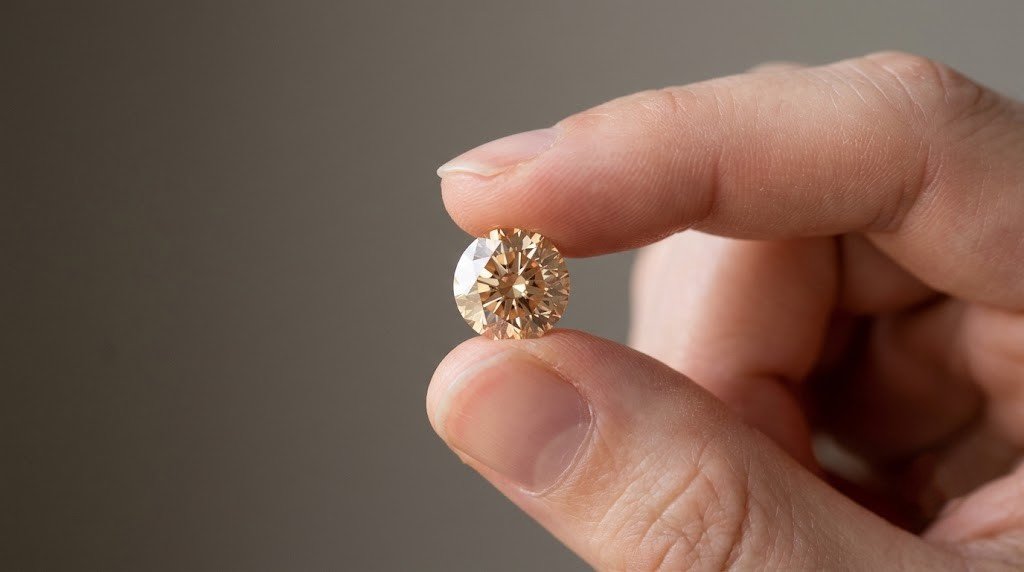
Champagne-toned lab-grown memorial diamond made from partner ashes, held between fingertips against a plain background

What Is Actually in the Ashes You Would Be Sending?

Cremated remains are not ash in the campfire sense. What survives a cremation is mostly bone mineral, calcium phosphate, ground to a uniform grit. The soft tissue, and with it most of the body’s carbon, leaves as gas during the cremation itself.

That is why every honest description of a diamond made from partner ashes starts with a percentage rather than a promise. Industry figures put the usable carbon in cremated remains at roughly 0.5% to 4% of the ash by weight, varying with the individual and with how the cremation was run. A few tablespoons of remains contain a genuinely small quantity of recoverable carbon, and that quantity is the raw material a diamond made from partner ashes has to be built from.

This single number explains almost everything else about the process. It explains why a lab asks for a measured portion rather than a pinch. It explains why the extraction stage is long and fussy. And it explains why a stone made from partner ashes is never grown from that carbon alone.

None of that makes the carbon less real. It was in your partner, and it was recovered from what remained of them. But knowing the scale now is better than finding it on a forum in month four.

The Seven Stages of a Memorial Diamond Made From Partner Ashes

The chain is the same across the industry, whatever the marketing language around it. A memorial diamond made from partner ashes passes through these seven stages, in this order.

1. Intake and identification. The portion of ashes arrives, is weighed, and is assigned an identifier that travels with the material through every later stage. Ask what that identifier is and how it is recorded. This is the document that ties the finished stone back to what you sent, and the backbone of any later claim that the stone was made from partner ashes rather than from something substituted along the way.

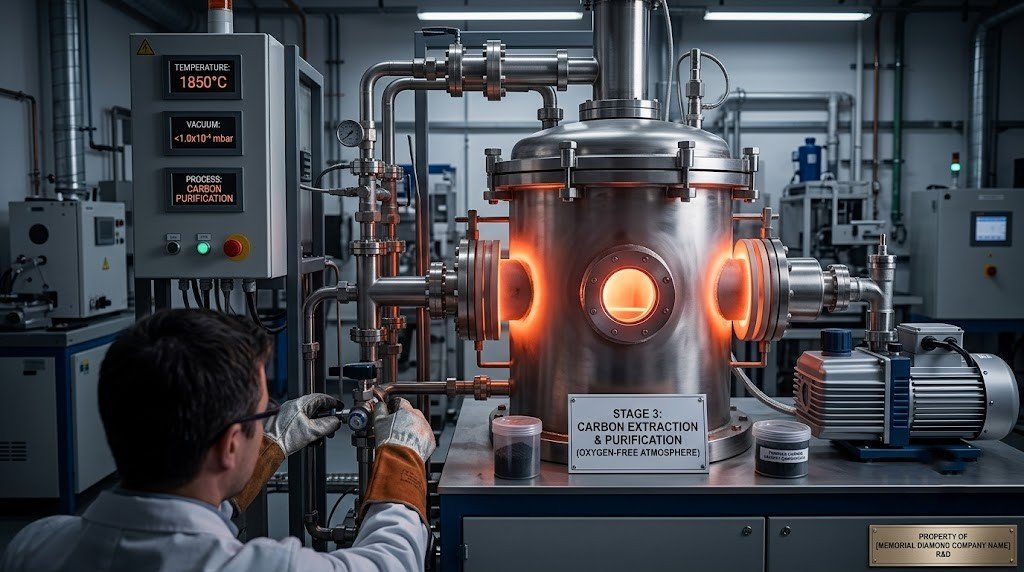
2. Carbon extraction. The remains are heated in a controlled, oxygen free environment so the carbon can be separated without simply burning away. Because a diamond made from partner ashes starts from a material that is only a few percent carbon by weight, this is the stage where most of the submitted mass is removed as mineral residue rather than kept.

3. Purification. The extracted carbon is refined through further stages until it reaches roughly 99.9% or higher carbon purity. Anything left behind at this stage, such as stray minerals or metals from an implant or a casket fitting, will otherwise show up as an inclusion or a color cast in the crystal.

4. Graphitization. The purified carbon is heated to roughly 2,500 to 2,700°C and rearranged into graphite, the crystalline form of carbon that a diamond press can actually use as feedstock. The material that goes into the press for a diamond made from partner ashes is graphite, not ash.

5. Growth. The graphite, combined with supplemental lab grown carbon, is loaded into an HPHT growth cell around a tiny diamond seed and held at roughly 6 to 8 GPa and 1,400 to 2,500°C for weeks to months. Carat size is a function of how long the cell runs, not how much ash you sent.

6. Cutting, polishing, and optional treatment. The rough crystal is cut and polished to a chosen shape. Some providers offer post growth irradiation to shift or intensify color. Ask whether that is being done and whether it will be disclosed on the paperwork.

7. Grading. The finished stone is measured against the same cut, color, clarity, and carat standards used for any diamond, ideally by an independent third party laboratory rather than in house. A stone made from partner ashes is assessed on exactly the same scale as any other diamond, with no separate or softer standard.

High-temperature oxygen-free furnace used to extract and purify carbon before graphitization

Where Is the Point of No Return?

This is the question worth sitting with. For a diamond made from partner ashes the honest answer is that there are two of them, one physical and one domestic, and the domestic one comes first.

The physical point of no return is the extraction furnace, stage two. Up to the moment that furnace is sealed, what a lab holds is still cremated remains. They can be weighed, sealed, and sent back. Once extraction begins, the calcium phosphate is separated off and the carbon is chemically committed. There is no process that reverses a diamond made from partner ashes back into ash. Everything after stage two, including purification, graphitization, growth, and cutting, is refinement of a decision already made.

The domestic point of no return is earlier and quieter. It is the afternoon you open the container and measure a portion out. That act is not reversible either, and it happens at a kitchen table rather than in a lab, usually without anyone present to say “are you sure.” A lab can return an unopened portion. Nobody can return the specific handful you scooped.

So the practical sequence is this. Decide who is involved and whether anyone else in your partner’s life would want to be asked before anything is divided. Decide the carat and the color, because those are cheap to change on paper and impossible to change once a growth run has started. Decide what happens to the ashes that are not used, since a diamond made from partner ashes typically consumes only a fraction of a full cremation. Then portion.

A third, softer boundary sits at stage five. Once the growth cell is sealed, the size you chose is the size that is growing, and changing your mind means starting over. Ask when the specification locks. That timing varies.

What You Can Still Change at Each Stage

StageWhat Is Physically HappeningReversible?What You Can Still Change
1. IntakePortion weighed, logged, identifiedYes. Unprocessed material can be returnedEverything, including carat, color, shape, and whether to proceed
2. ExtractionCarbon separated from bone mineralNo. This is the physical point of no returnCarat, color, shape, setting
3. PurificationCarbon refined to approximately 99.9% or higherNoCarat, color, shape, setting
4. GraphitizationCarbon converted to graphite at 2,500 to 2,700°CNoCarat and color, if not yet locked. Ask when the lock happens
5. GrowthCrystal built around a seed at 6 to 8 GPaNo. The run is committed once sealedShape, polish, setting, engraving
6. CuttingRough crystal shaped and polishedShape choices are one way once cutSetting, engraving, whether to set it at all
7. GradingIndependent assessment of the 4CsNot applicableNothing about the stone. Only what you do with it

Read that table as a calendar for a diamond made from partner ashes rather than as a warning. Nearly every decision that costs money or changes the stone’s appearance is open for the first two stages and closed after the fourth. It is a narrow window, earlier than most people expect.

Why Lab Carbon Is Added to a Diamond Made From Partner Ashes

No stone is grown from ash carbon alone, and any description that implies otherwise is describing something that does not exist. What comes out of purification is a small quantity of carbon, real and really your partner’s, which is then topped up with lab grown carbon until the growth cell holds the volume a crystal of the chosen size actually needs.

That is arithmetic, not a policy any one company invented. A gram or two of recovered carbon cannot become a one carat crystal, so the feedstock charge is made up to volume.

The framing that survives scrutiny is the accurate one. A diamond made from partner ashes is not a symbol of your partner and it is not a stone that is entirely them. It is a crystal that contains, verifiably, carbon that was part of a person, grown into a lattice that exists because they did. That claim holds up to a skeptical relative, a jeweler, and a gemologist, and it is the reason these stones are genuine diamonds rather than lookalikes. “One hundred percent pure” does not.

Every honest account of a diamond made from partner ashes carries that qualification somewhere in it. If a provider will not put the blend in writing, that is worth noticing. The honesty of the answer to this question is a reasonable proxy for how the rest of the work is done.

How Long Does Each Stage Take?

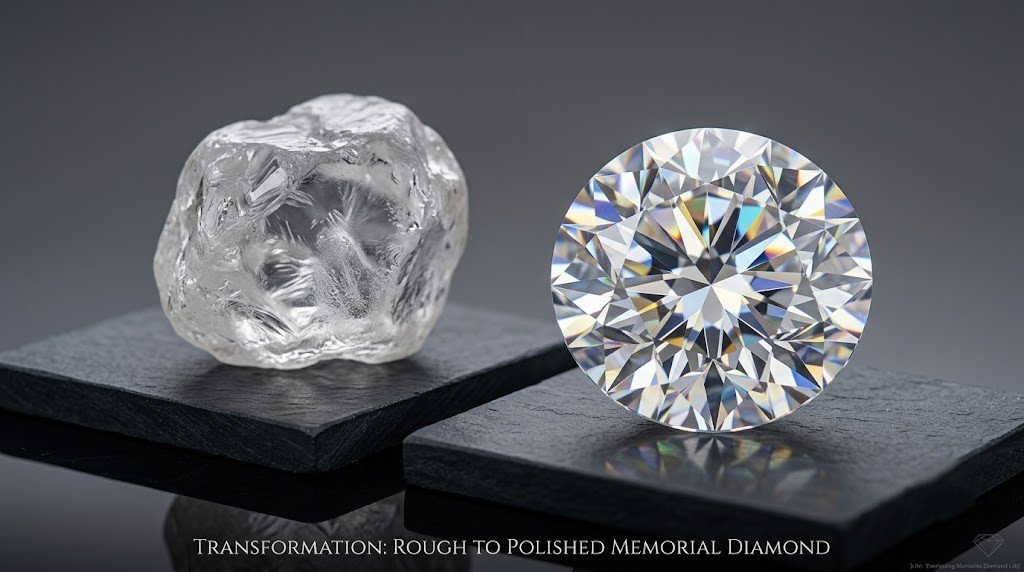
Rough memorial diamond crystal beside the same stone after cutting and polishing

Industry wide, the full sequence for a diamond made from partner ashes typically runs six to ten months, with larger stones or specialty colors sometimes reaching twelve. The stages are wildly uneven in length, which is why the wait feels longer than the number suggests.

Intake, extraction, purification, and graphitization are usually measured in weeks. Growth is the long part, with weeks to months in the press, because carat size is bought as time under pressure, not as a quantity of ash. Cutting, polishing, and grading add several more weeks, and an independent laboratory has its own queue.

Two things make a stone made from partner ashes take longer than a quoted range. One is size. Larger crystals need proportionally longer runs and are more likely to fail during a run and need restarting. The other is a color specification that requires the trace elements to be engineered out rather than accepted.

Ask for the stage you are currently in rather than a completion date. A provider that can tell you “purification finished, cell loading next week” is telling you something real. A provider that only repeats the original estimate is telling you nothing.

Can a Diamond Be Made From Partner Ashes Years Later?

Yes, and this is more common than the timing of most bereavement content suggests. Cremated remains do not decay, spoil, or lose their carbon on a shelf. A portion kept in a closet since 2014 is chemically the same material it was the week it came home, and a diamond made from partner ashes that have sat for a decade goes through the same seven stages as one started the month after the funeral.

That matters for a very ordinary reason. The first year after a death is a terrible time to make a permanent decision, and plenty of people only arrive at this question once the urgent part is over. Nothing has been lost by waiting.

There are two practical differences worth knowing. The first is contamination. Remains that have been transferred between containers, stored somewhere damp, or opened repeatedly can pick up material that was never part of your partner, and purification removes non carbon contaminants rather than sorting one person’s carbon from another’s. Ask what the intake check looks for, and mention the storage history honestly.

The second is interment. If the remains were buried, entombed, or scattered, a diamond made from partner ashes may no longer be open to you. Disinterment rules vary by state and by cemetery. Hair is worth asking about instead, since it needs no cremation and a lock kept in an envelope is frequently still usable.

One thing time does not change is standing. Whoever had authority over the remains still has it. Keeping the urn for eight years does not confer it.

What to Settle Before the Ashes Leave Your Hands

These are the items that become expensive or impossible to revisit once stage two begins.

  • Who has standing to authorize this. There is no single national rule here. The state you are in sets who may direct what happens to a person’s remains, and written instructions your partner left behind can move that authority somewhere else again. Being someone’s partner does not by itself put you in that position. Sort this before you divide anything. An order for a diamond made from partner ashes is far easier to place than to unpick.
  • Whether anyone else should be asked first. Not consulted, necessarily. Asked. This is a social decision with a physical deadline attached.
  • How much of the remains you are prepared to commit. Requirements vary by provider, but a memorial diamond typically uses only a fraction of a full cremation, which means the rest can still be buried, scattered, or kept exactly as planned.
  • Carat and color, chosen deliberately. Both are locked early and both drive cost and timeline more than anything else.
  • Whether a second stone might be wanted later. Growing two from one shared portion is usually far simpler than reopening the question in three years.
  • What documentation you want to exist. An identifier at intake, a record at each handover, and a clear statement of what is being returned to you at the end.

If you are still deciding between materials, it is worth knowing that hair does not require cremation at all and carries far more carbon by weight. It is a different route to the same kind of stone, and one that stays open even if the remains are already interred.

Frequently Asked Questions About a Memorial Diamond Made From Partner Ashes

How much of the finished stone is actually my partner?

A real but minority portion. A diamond made from partner ashes contains carbon recovered from the remains, purified and then combined with lab grown carbon to reach a workable volume, so the personal fraction is meaningful and verifiable rather than total. Ask for that split in writing.

Can the process be stopped once the ashes have been sent?

Until extraction begins, yes. Unprocessed remains can be returned. After the extraction furnace is sealed, the carbon is chemically committed and nothing reverses it. That stage is the true point of no return, and it comes early.

Does sending more ashes make a bigger diamond?

No. The size of a diamond made from partner ashes is set by how long the crystal grows in the press, not by how much material you submitted. Sending a full urn does not produce a larger stone or a faster result. It only commits more of the remains.

What color will it be?

Most stones made from partner ashes trend yellow, blue, or champagne, because nitrogen and boron traces come with an organic carbon source. Colorless requires engineering both out and typically costs more. Nobody can forecast a precise shade in advance.

Will it be certified as a real diamond?

A memorial diamond is chemically and optically a genuine diamond and can be graded on the same 4Cs as any other. Ask whether grading is done by an independent third party laboratory and whether that report is included or priced separately.

Can two people each have a stone from the same ashes?

Often yes, because only a portion of the remains is used for any one stone. Deciding that before submitting is far easier than revisiting it later, when a second portion may mean opening the container again.

Final Thoughts on a Memorial Diamond Made From Partner Ashes

The chain that produces a memorial diamond made from partner ashes is genuinely impressive, but it is not the part that matters most on the day you have to choose. What matters is knowing that the reversible part of this is short, that it sits at the beginning, and that the decisions inside it are yours to take slowly.

Ask the percentage question. Ask when the specification locks. Ask what comes back to you at the end. A provider comfortable answering all three plainly is showing you something more useful than any photograph of a finished stone.

Learn More About Partner Memorial Diamonds

Talk With Memorial Diamond

If you want to understand what is possible with the ashes you have, reach out to Memorial Diamond and ask about the process, the documentation, and the timeline before committing to anything. Nothing here has to be rushed.

: Memorial diamond made from partner ashes and hair, featuring a diamond, cremated ashes, and a lock of hair.

How a Memorial Diamond Is Made From Your Partner’s Ashes and Hair

Some people end up with both because of how the year went, a lock kept early, a portion of remains later.

A memorial diamond made from partner ashes and hair is not one process. Each material is purified on its own track, ash to recover the 0.5% to 4% carbon it holds, hair to recover roughly half its weight in carbon, and each is graphitized separately at about 2,500 to 2,700°C. The two tracks meet only when both charges enter a single HPHT growth cell at roughly 6 to 8 GPa. Five stages in total.

That meeting point is the whole story of a memorial diamond made from partner ashes and hair. Everything that can be separately evidenced about the two materials happens before it, and nothing can be after.

Single champagne-toned memorial diamond made from partner ashes and hair, photographed beside two small sealed sample containers

Why Two Materials Means Two Separate Tracks

Ash and hair are not the same chemical problem, and nothing in the making of a diamond made from partner ashes and hair pretends they are.

Cremated remains are mostly calcium phosphate, which is bone mineral. The usable carbon inside that comes to roughly 0.5% to 4% of ash by weight, which means extraction is a long subtraction. Most of what you send is removed as mineral residue. Hair is keratin, roughly 50% carbon by weight, so extraction there is comparatively quick and far less lossy.

Two materials with yields that differ by more than an order of magnitude cannot be purified in the same vessel on the same settings. So a memorial diamond made from partner ashes and hair begins as two parallel operations that happen to be running for the same person, and for the same stone, at the same time.

That is not a complication to be apologized for. It is the reason a diamond made from partner ashes and hair can have its two materials separately weighed, separately logged, and separately accounted for right up to the moment they are combined. This provides more evidence, not less, than a single material stone can offer.

The Five Stages of a Memorial Diamond Made From Partner Ashes and Hair

1. Two intakes. The portion of ashes and the lock of hair arrive and are logged independently. This means separate weights, separate identifiers, and ideally separate dated photographs. Ask for two records rather than one combined receipt. This is where a diamond made from partner ashes and hair gains the documentation that makes it different from a single source stone.

2. Two purifications. Each material is heated in a controlled, oxygen free process that strips away everything that is not carbon, reaching roughly 99.9% or higher purity. The ash track loses the overwhelming majority of its submitted mass. The hair track loses roughly half. Two batches of purified carbon come out, still separate. At this stage a diamond made from partner ashes and hair still has two independently verifiable histories.

3. Two graphitizations. Each purified batch is heated to about 2,500 to 2,700°C and converted into graphite, the feedstock form a diamond press can use. There are now two graphite charges, still distinguishable because they are still in different containers, not because anything about them is chemically different.

4. One growth cell. Both charges, combined with supplemental lab grown carbon, are loaded into a single HPHT growth cell around a tiny diamond seed and held at roughly 6 to 8 GPa and 1,400 to 2,500°C for weeks to months. This is the convergence point, and it is the only one.

5. One stone, cut and graded. The rough crystal is cut and polished, then assessed against the same cut, color, clarity, and carat standards used for any diamond, ideally by an independent third party laboratory. One stone comes out. A diamond made from partner ashes and hair has no ash half and no hair half.

Where Do the Two Tracks Actually Converge?

For a diamond made from partner ashes and hair, convergence happens at stage four. Both graphite charges are weighed into the growth cell alongside the supplemental lab carbon, and the cell is sealed.

Up to that moment, everything is separable. Two weights at intake. Two purification runs with two batch records. Two graphite charges sitting in two containers with two identifiers. A memorial diamond made from partner ashes and hair has, at that point, a paper trail with two distinct branches, each traceable back to a different material and a different day.

The instant the cell is sealed and pressurized, those branches end. Carbon purified from ash and carbon purified from hair are the same element in the same form. Graphite is graphite, whatever it used to be part of. They do not layer, settle, or occupy separate regions of the crystal. They dissolve into the same molten metal flux and deposit onto the same seed, atom by atom, in no particular order.

StageAsh TrackHair TrackWhat Can Be Separately Evidenced
1. IntakePortion weighed, logged, identifiedLock weighed, logged, identifiedTwo weights, two dates, two identifiers
2. PurificationLong subtraction. Most mass removed as mineralShorter run. Roughly half the mass retainedTwo batch records, two yields
3. GraphitizationAsh derived carbon to graphite at 2,500 to 2,700°CHair derived carbon to graphite at 2,500 to 2,700°CTwo charges, two container records
4. Growth CellCharge loaded with lab carbonCharge loaded with lab carbonNothing after this point. The cell is sealed.
5. Cutting and GradingOne stoneOne stoneThe stone’s own 4Cs, and nothing about origin
two separate purification vessels processing ash-derived and hair-derived carbon on parallel runs


After Convergence, Can Anyone Tell the Two Apart?

No. This is the part of a diamond made from partner ashes and hair worth stating plainly, because a reader who suspects it and is never told clearly may assume the worst.

Once both charges are in the growth cell, no test performed on the finished diamond can identify which carbon came from the ashes, which came from the hair, and which came from the supplemental lab feedstock. A grading report will not show it. A gemologist with a loupe will not see it. There is no analysis of a diamond made from partner ashes and hair that separates the sources, because after purification there is nothing left to separate. There are only carbon atoms, chemically identical regardless of what they used to be part of.

That also means nobody can verify a stated proportion after the fact. If a stone is described as using both, the honest meaning of that statement is that both entered the process and both are recorded as having done so. It does not mean both are measurable in the finished crystal.

Two consequences follow for anyone considering a diamond made from partner ashes and hair, and they are the practical reason to read this before starting rather than after.

The first is that the value of the two track structure in a diamond made from partner ashes and hair is entirely upstream. Insist on the separate records while the tracks are still separate, because the window closes at stage four and does not reopen.

The second is that any provider claiming to demonstrate the split in a finished stone is claiming something that is not physically available. That is a useful test of how the rest of their answers should be read.

So What Can Be Documented About a Diamond Made From Partner Ashes and Hair?

Quite a lot, as long as you ask for it in the right window. What can be documented is every fact created before the cell was sealed.

  • Two intake records, each with its own date, weight, identifier, and ideally a photograph of the material as received.
  • Two purification batch records, tying each identifier to a specific run rather than to a general statement that material was processed.
  • Two graphitization records, confirming both charges existed as separate feedstock before loading.
  • A cell loading record naming both identifiers and the supplemental lab carbon added. This is the single most important document for a memorial diamond made from partner ashes and hair, because it is the last one that mentions two sources.
  • An origin or authenticity document that names both submissions explicitly, rather than referring vaguely to submitted material.
  • A grading report, which describes the stone’s quality and says nothing at all about origin. The two documents answer different questions and neither substitutes for the other.

Neither track yields the volume a growth run consumes, not separately and not added together. Both purified batches are made up with lab grown carbon before the cell is sealed, which means the personal carbon in a diamond made from partner ashes and hair is real, traceable to two named submissions, and still a minority of the crystal’s mass. Any description that implies otherwise is describing a stone that does not exist.

Does Using Both Materials Change the Stone Itself?

Not in a way anyone can see, and it is better to know that now.

Color. Trace elements drive color. Nitrogen can contribute toward yellow, boron can contribute toward blue, and colorless material requires the absence of both. Both ash and hair are organic sources that bring trace elements with them, so a memorial diamond made from partner ashes and hair sits in the same realistic range as a single material stone. Yellow, blue, or champagne are possible, while colorless material can require more process control and typically costs more. Nobody can forecast a precise shade from either material or from the combination.

Size. For a diamond made from partner ashes and hair, carat is bought as growth time, not as quantity of material. Submitting two materials instead of one does not produce a larger stone, and does not shorten the run.

Timeline. Industry wide, the whole sequence typically runs six to ten months, sometimes twelve for larger or specialty color stones. Two purification tracks can add a little at the front end if they are run sequentially rather than in parallel. The press is where almost all of the months live, and the press does not care how many sources fed it.

Quality. A diamond made from partner ashes and hair is graded on exactly the same 4Cs as any other stone. There is no separate scale, no allowance, and no penalty.

Can the Two Tracks Become Two Separate Stones Instead?

Two finished memorial diamonds of similar size displayed separately rather than set together

Yes, and this is the option most people do not realize they have until someone says it out loud.

If the two materials never enter the same growth cell, they never converge. This means they stay separately evidenced permanently. An ash grown stone and a hair grown stone, each with its own intake record, its own batch history, and its own origin document, preserve a distinction that a diamond made from partner ashes and hair gives up at stage four by design.

There are real trade offs, and they run in both directions.

  • Two stones cost more than one. Each needs its own growth run, and growth time is the dominant cost in every memorial diamond. Two half carat stones will not cost what one half carat stone costs.
  • Two stones take the same time, not twice as long, if the runs happen in parallel. Sequential runs would change that answer considerably.
  • Two stones can go to two people. This is often the deciding factor. One stone has to live somewhere. Two can be shared without anyone having to give anything up.
  • One stone concentrates everything. For many people that is precisely the point, and the loss of separability is a price they are glad to pay.
  • You can also do one of each and keep the rest. A memorial diamond typically uses only a portion of the available material, so choosing one route now rarely forecloses the other later.

The question to sit with is not which option is more meaningful. Both follow the same physics. The question is whether the distinction between the two materials is something you want to be able to point at in ten years. If it is, a diamond made from partner ashes and hair is the wrong shape for it, and two stones are the right one. If it is not, one stone is simpler and cheaper.

Why Families Choose Both Anyway

Knowing that the combination is invisible in the finished stone does not make a diamond made from partner ashes and hair pointless, and it is worth being clear about why.

The reason for a diamond made from partner ashes and hair is usually circumstantial rather than symbolic. A lock of hair was kept at some point, from a haircut before an illness, from a hospital stay, or from a drawer nobody had cleared. A portion of ashes became available later. Using both is less a decision than an acknowledgment that both exist and neither felt right to leave out.

Sometimes it is about standing. Who controls a person’s remains is settled state by state rather than by any nationwide statute, and a written direction left by your partner can shift it again on top of that. The standing does not attach to a partner as a matter of course, and it attaches least reliably where the relationship had no recognition in law or was not known to everyone. Hair may be the material you can act on without permission. Ashes may become available only later, or only partly. A diamond made from partner ashes and hair sometimes reflects that sequence rather than a plan.

And sometimes it is simply that the two materials represent different periods, one from when your partner was alive, one from after. That is a real reason. It does not need to be measurable in the crystal to be true.

What matters is that the reason is yours, and that the record describes what actually happened.

Frequently Asked Questions About a Memorial Diamond Made From Partner Ashes and Hair

Are the ashes and hair processed together?

No. In a diamond made from partner ashes and hair, each material is purified and graphitized on its own track, because their carbon yields differ by more than an order of magnitude. The two only meet when both graphite charges are loaded into a single growth cell.

Can a lab prove both materials were used?

Not from the finished stone. Proof exists only as records created before the growth cell was sealed. These include two intake logs, two batch records, and a cell loading document naming both identifiers. Ask for those specifically.

Can I choose the proportion of each material?

You can specify how much of each is submitted and have those weights recorded. What you cannot do is verify a proportion in the finished crystal, because purified carbon carries no marker of its origin.

Does using both materials make the diamond more genuinely my partner’s?

Not measurably. A diamond made from partner ashes and hair draws real personal carbon from both sources, and both are blended with lab grown carbon to reach a viable volume. What changes is the documentation, which traces two submissions instead of one.

Will it cost more than a single material stone?

A diamond made from partner ashes and hair can add process steps, and some providers price that separately. Size, color, and whether an independent grading report is included drive cost far more than the number of source materials.

What if one material turns out to be unusable?

Ask what happens before you send anything, whether the run proceeds on the remaining material, whether you are told first, and what is recorded. This is a question to settle in advance, not one to discover partway through.

Final Thoughts on a Memorial Diamond Made From Partner Ashes and Hair

The honest shape of a memorial diamond made from partner ashes and hair is two lines that run parallel for four fifths of their length and then become one line permanently. Almost everything you might want proven about the two materials is provable while those lines are apart, and none of it is provable afterward.

So the useful work happens early. Two records at intake, two batch records, and one loading record that names them both. Ask for those while asking still changes something. After the cell is sealed, the only honest answer anyone can give you about which carbon came from where is that the paperwork says so, which is a good answer, provided the paperwork exists.

Learn More About Partner Memorial Diamonds

Talk With Memorial Diamond

If you have both materials and want to understand how each would be handled, reach out to Memorial Diamond and ask what gets recorded at each intake and what the cell loading document will say. Those are the questions worth asking while the two tracks are still separate.

Memorial diamond colors for a wife, showing a champagne-toned memorial diamond ring with yellow, champagne, blue, and colorless diamond color options.

Memorial Diamond Colors for a Wife: What to Expect

Memorial diamond colors for a wife shown on a champagne-toned ring worn on a hand in ordinary window daylight

Why Do Memorial Diamond Colors for a Wife Lean Warm Rather Than Colorless?

Three trace elements decide almost everything about memorial diamond colors for a wife. Nitrogen in the growing crystal reads as yellow. Boron reads as blue. A diamond reads as colorless only when neither is present at all colorless is an absence, not an ingredient, which is why colorless sits at the far end of the memorial diamond colors for a wife that families are actually offered.

That single fact explains the whole category. The memorial diamond colors for a wife that families are most often handed sit in the yellow, champagne, and brown band, with blue appearing less often, because the feedstock did not begin life as a clean synthetic powder. It began as a person, and organic material brings trace elements along with it.

Her carbon also does not make the whole crystal by itself. What is recovered from the ashes is purified and then loaded into the growth cell alongside lab-grown carbon, because a growth run needs more feedstock than any personal source supplies. Ash is roughly 0.5% to 4% carbon by weight to begin with, which is why the volume has to be made up. That blending does not wash out the trace elements, so the memorial diamond colors for a wife that result still come from an organic starting point.

None of that predicts a specific shade, and this page does not try to. Forecasting is a different question, answered in what color a diamond made from her ashes will be and in the hair version of the same question. The broader category picture sits in why memorial diamonds are rarely colorless.

What is left over, once forecasting is handed off, is the part nobody prepares you for: memorial diamond colors for a wife do not behave like paint chips. They move. Not the stone the stone is fixed the moment it comes out of the press but what you see when you look at it.

What Changes Between the Photograph and Your Hand?

A product photograph does not record a stone. It records what one lighting rig did to a stone on one afternoon. That gap matters more for memorial diamond colors for a wife than for anything in a shop window, because you are being asked to picture an object that does not exist yet.

A stone shot for a website is usually sitting in a lightbox: diffuse, even, color-corrected light, a white or black background chosen to flatter, and a lens close enough to make a five-millimeter object fill a laptop screen. None of those conditions exist in your kitchen. So the memorial diamond colors for a wife that you saw on a screen were accurate and also not transferable.

Scale changes. A half-carat round stone is about five millimeters across. On a product page it is nine hundred pixels wide. Color reads more intensely at nine hundred pixels than at five millimeters, and memorial diamond colors for a wife are usually first judged at the larger of those two sizes.

Background changes. A lightbox background is neutral by design; your hand is not. Skin is warm, and a warm background pushes a warm stone warmer and makes a near-colorless stone look less white than it did against white card. Memorial diamond colors for a wife are almost always seen against skin in the end.

Light changes, constantly. This is the big one, and it does more to memorial diamond colors for a wife than the other two put together.

Worth asking for, then, rather than a better photograph: the same stone photographed twice under two named light sources, and one frame with a hand in it for scale. How a memorial diamond is made from her ashes covers what happens before that frame is ever shot

The same loose memorial diamond shown twice, once magnified in a lightbox and once at actual size between finger and thumb

Why Does the Stone Look Different in the Kitchen Than at the Bedside?

No. This is the most useful physical fact on the page about memorial diamond colors for a wife, because it is the one that surprises people after delivery rather than before.

Grading happens under controlled laboratory lighting, chosen because it does not vary. That is what makes a grade comparable, and also what makes it unlike your house. Real rooms are full of light with a color temperature, and that temperature pushes a stone around. Six lights cover almost every room a piece will be worn in, and memorial diamond colors for a wife behave differently in each of them. Memorial diamond colors for a wife are not a single reading; they are a range across the lights you actually live in.

Light you actually live inWhat it does to a warm stoneWhat it does to a near-colorless stoneWhere you meet it
Warm incandescent or 2700K bulbDeepens the yellow or champagne; honey and amber notes come forwardLends a faint warmth it does not have on paperBedside lamps, living rooms, most older fittings
Cool LED around 5000KThins the warmth; champagne can read almost grayReads cleanest and whitest hereKitchens, bathrooms, task lighting, car interiors
North-facing indirect daylightThe most neutral reading you will get at homeReads close to its graded positionA window seat on an overcast day
Direct sunlightBrightness swamps tone; the stone looks paler and more sparkling than it isLooks whiter still; contrast hides everythingOutdoors, mid-morning, on the back of your hand
Candlelight or very low lightStrongly warm; even a blue stone loses its coolnessPicks up the warmest cast it will ever showDinner, evenings, anywhere with one soft source
Fluorescent tube or screen glowSlightly green-cool; warm stones look muddierCan look faintly gray rather than whiteOffices, supermarkets, a face lit by a monitor

The same stone can be honey-warm at a bedside lamp and almost pale under the kitchen downlights four hours later, and neither reading is the wrong one. Memorial diamond colors for a wife are a band, not a point.

The practical consequence is small and it works: do not settle your impression of the memorial diamond colors for a wife on the first evening. Give it a week of ordinary use instead worn to work, sat under a lamp, taken outside once. You are mapping a band, not reaching a verdict.

How Much Does the Metal Around It Change the Color?

More than most people expect, and in two different ways at once. Metal is the second half of what governs memorial diamond colors for a wife once the stone exists.

The first way is contrast. Set a warm stone in white metal and the eye compares the two: the stone looks warmer than it did loose, because there is something colder next to it. Set the same stone in yellow gold and the contrast collapses — the warmth stops looking like a property of the stone and starts looking like a property of the whole piece.

The second way is reflection. A diamond is transparent, and light that reaches it off the mount comes back out carrying some of the mount with it. A yellow gold basket under a near-colorless stone can lend it a faint warmth that no grading report would ever record. That is not a fault in the stone or the setting; it is what happens when you put a clear object on a colored one, and it is why memorial diamond colors for a wife are partly a jewelry decision rather than purely a laboratory one.

How much metal touches the stone matters too. A bezel wraps the girdle in a continuous rim and puts a great deal of metal against the stone; four slim prongs put very little. So two identical stones, one bezel-set in yellow gold and one prong-set in platinum, will not read as the same memorial diamond colors for a wife, even with identical grading lines.

  • Yellow gold flatters a warm stone and warms a near-colorless one. It is the forgiving choice if the shade is unknown.
  • Rose gold does the same thing more strongly, and pushes champagne toward a pinkish brown.
  • White gold is almost always rhodium plated. Rhodium is bright white and wears off over years, so the piece can read cooler when new and warmer once the plating thins and then cooler again after replating.
  • Platinum is naturally white, does not need plating, and holds its reading for decades.
  • A band she already wore has already decided this question for you, which is a reason to talk about the stone’s shade before the stone exists rather than afterward.

Which mount holds the stone, and how much of it touches, belongs to the wife memorial diamond settings question rather than this one.

What Colorless Actually Costs, and Why

Colorless is expensive because of what it is defined as, and it is the one point on the scale of memorial diamond colors for a wife that cannot be reached by adding anything.

Every other shade is something present. Colorless is two things absent no nitrogen, no boron which means it cannot be added at the end. It has to be engineered out at the front, with tighter control over the feedstock and the growth environment, and that shows up industry-wide as a meaningfully higher price at the same carat weight rather than as a surcharge on a line item. How gemologists assess and record that position is set out in the four factors used to grade any diamond, and the way those factors are recorded is covered in how memorial diamonds are graded and certified.

Some providers also offer post-growth irradiation to produce red, pink, green, or black stones. That is color added after growth rather than grown in, and it is worth knowing which of the two you are being offered when a color is named, because they are different processes with different implications for the report. Both routes appear in conversations about memorial diamond colors for a wife, often without the difference being spelled out. The mechanics of growth itself are described in the general literature on high-pressure high-temperature and vapor-deposition diamond growth.

Where that lands on an invoice belongs to what a wife memorial diamond costs. The color point to carry forward is narrower: when someone quotes a price difference between shades of memorial diamond colors for a wife, the difference is describing how hard the absence was to achieve, not how rare the color is.

Deciding the Metal Before You Know the Stone

Here is the sequencing problem nobody warns families about. The stone takes months. The setting is usually chosen alongside or before it. So most people pick a metal for memorial diamond colors for a wife that do not yet exist.

There are five sensible ways to handle that, and none of them requires knowing the shade in advance. All five are ways of keeping a decision about memorial diamond colors for a wife open for as long as possible.

  1. Ask whether the stone can be returned loose and set later. If it can, the whole problem disappears: you see the shade, then you choose the metal. Ask what that adds in time, and who does the setting.
  2. If the metal has to be chosen first, choose the forgiving one. Yellow gold sits well with almost anything the growth cell is likely to produce. It is the low-regret answer when the shade is genuinely unknown.
  3. Ask whether any white gold in the design is rhodium plated. Plating is not a flaw, but it means the piece drifts in appearance and is then restored, on a cycle, for as long as it is worn.
  4. Ask to see the stone against a physical metal sample before anything is set. A sample card of yellow, white, and rose beside the actual stone settles the question of memorial diamond colors for a wife in ten seconds, where a rendering cannot settle it at all.
  5. If it is going into a band she already wore, treat the metal as fixed and talk about the stone instead. That constraint is worth naming early rather than late.

None of the five requires you to guess a shade. All five simply buy time.

Living With a Color Nobody Could Forecast

The stone does not change after it leaves the press. What changes is how practiced you are at looking at it, which is the last thing worth saying about memorial diamond colors for a wife.

For the first weeks you will check the color constantly, and every light will feel like new information. After that it settles into being simply what the stone looks like. That is not a loss of interest; it is the ordinary way a worn object stops being an event, and memorial diamond colors for a wife stop being news faster than people expect.

Strangers will ask about it, too a jeweler cleaning it, a colleague who notices it, someone at a till who likes the look of it. You are never obliged to reach for the grading language in those moments, and in practice a plain description lands better than a technical one.

And a color arriving that you did not pick is not a defect. It is the direct consequence of the thing that makes the stone worth having: the carbon came from a person rather than a controlled feedstock, and people are not uniform. The whole decision, from material to finished piece, is laid out in the complete guide to a wife ashes diamond.

A white gold band photographed showing rhodium plating worn thin on the underside | Stock acceptable; the worn area must be visible or the image makes no point

Frequently Asked Questions

What are the most common memorial diamond colors for a wife?

Yellow, champagne, and brown tones are the usual range for memorial diamond colors for a wife, with blue appearing less often and colorless least of all. Nitrogen present during growth reads yellow, boron reads blue, and a colorless stone requires the absence of both.

Can I choose the color before the stone is grown?

Some providers offer named color options, so you may be able to state a target. Ask what that name has meant for memorial diamond colors for a wife in finished stones, and whether the color is grown in or added afterward by irradiation.

Why do memorial diamond colors for a wife look different in photographs?

Product photographs are taken in diffuse, color-corrected lightbox conditions against neutral backgrounds, at magnifications that make a five-millimeter stone fill a screen. Your hand is warm, your rooms are not color-corrected, and scale alone changes how strongly a tone reads.

Does the metal the stone is set in really change its color?

Yes, in two ways. White metal makes a warm stone look warmer by contrast, and a colored mount reflects light back through a transparent stone. A bezel touches far more of the stone than four slim prongs, so it transfers more.

Will the color of the stone fade or change over time?

No. Memorial diamond colors for a wife come from trace elements locked in the crystal lattice during growth, and they are permanent. What can change is the setting around it rhodium plating on white gold wears and is replaced, which alters how the stone reads.

What if the color that arrives is not the one I pictured?

Give it a full week before concluding anything, since one evening under one lamp is not enough to judge by. Then fall back on what you settled about metal, and on the fact that memorial diamond colors for a wife come from a person rather than a catalog.

Final Thoughts on Memorial Diamond Colors for a Wife

The honest summary is that memorial diamond colors for a wife cannot be promised and can be prepared for. The shade is decided in the growth cell by trace elements nobody controls precisely. What you see afterward is decided by light and by metal, and both of those are yours to choose, ask about, and settle before anything is cut or set.

So do the small things early: two lights, a hand for scale, and a straight answer about what the mount will actually touch.

Learn More About Wife Memorial Diamonds

Talk With Memorial Diamond

If a shade has been named to you and you want it turned into something you can actually picture, Memorial Diamond is one place to have that conversation memorialdiamond.us.

Father memorial diamond cost price ranges and key factors that determine the price

How Much Does a Father Memorial Diamond Cost?

Father memorial diamond cost: a printed eight-line quote beside a loose lab-grown diamond and a plain ring mount

This is often the question a family asks second and worries about first, sometimes with a funeral already paid for and nobody wanting to be the one who raises money. So what does a father memorial diamond cost? Across the industry in 2026, roughly $1,500 to $3,500 at 0.10 to 0.25 carats, $5,000 to $15,000 at 0.5 to 1 carat, and $20,000 to $75,000 and upward at 2 to 5+ carats, figures for the loose stone alone, with the final number depending on carat, color, cut, and whether an independent grading report is included.

Those are industry wide ranges rather than Memorial Diamond’s own pricing, which is not yet published. The complete guide to father ashes diamonds sets the tiers out as a table, and the wider 2026 pricing guide covers what drives cost across the whole category. This page is about the father memorial diamond cost quote itself, what belongs in it, and when each part of it is actually paid.

Memorial Diamond is a company in this category; apply the checks below to our quote as strictly as to anyone’s.

What Does a Complete Father Memorial Diamond Cost Quote Contain?

A father memorial diamond cost quote is commonly for one object: a loose, unset stone in a box. Everything that turns that into something you can wear, insure and pass on sits somewhere else on the paperwork, or nowhere on it yet.

Line itemInside the quoted price?What decides it
The loose stoneYes, this is usually what a quote meansCarat, above all
ColorVaries; treated colors are often a premiumWhether the color is achievable from his carbon or requires post growth treatment
Cut and shapeOften included; fancy cuts frequently notThe shape chosen
Independent grading reportOften separateWhether an independent laboratory grades the stone, or it is documented in house
Setting, ring, pendant, earringsTypically separateMetal, design, and whether stones are being matched
EngravingSeparateLength and method
Shipping and insured transitSometimes separate, in both directionsDistance and declared value
Resizing, repair or resetting laterSeparate, and often years laterWear, changed circumstances, a piece being passed on
Three loose lab-grown diamonds of roughly 0.25, 0.5 and 1 carat side by side on a scale card, showing why carat drives cost

Ask for all eight named at the first conversation, even where several come back as “not applicable yet.” A father memorial diamond cost quote that names eight lines and prices four is more useful than one that names one and prices one, because the four unpriced lines are the ones that arrive later.

Why Does Carat Decide More Than Everything Else Combined?

Size is a function of growth time in the press, a larger stone occupies expensive, tightly controlled HPHT equipment for longer, with more that can go wrong. That is why father memorial diamond cost scales steeply with size, and why a larger stone takes longer as well as costing more, the same variable drives both.

Color is the second lever on father memorial diamond cost, and it runs in the direction people least expect, colorless is the expensive option rather than the default. What colors to expect for a father’s memorial diamond covers the range and the relative costs; choosing a carat size is worth reading before a number is settled rather than after.

Is Setting the Stone Into Something He Owned Its Own Line?

Yes, and it is a real one. Whether a wedding band he wore for forty years, a signet ring or a watch can take a stone at all is covered in the complete guide to father ashes diamonds. What belongs here is the cost consequence.

A modification is a jeweler’s assessment before it is a quote, and that assessment usually carries a fee of its own, ask before booking one. It is therefore a separate line from the setting line above it, and the two numbers are not comparable: one prices work on an irreplaceable object, the other does not.

Book the assessment early rather than at the end. It can be done while the stone is still growing, and it answers whether that line of the father memorial diamond cost exists at all long before the money conversation reaches it. Memorial diamond settings and jewelry ideas for a father covers the alternatives if the answer turns out to be no.

Jeweler examining a worn plain wedding band under a loupe to assess whether it can take a stone |

What Changes When He Is the Second Parent?

Where this arrives after a mother’s death rather than before it, sometimes years after, the father memorial diamond cost question comes with history attached.

Matching is a specification, not a discount on father memorial diamond cost. Where a stone already exists for a mother and a family wants a comparable one, matching color and cut is a request that can constrain the growth run. Ask what matching involves and whether it moves the father memorial diamond cost or the timeline, rather than assuming it does either.

A second stone means a second growth run. Because size is bought in press time, ask whether two stones are priced close to two singles or whether anything is genuinely shared. Whether more than one family member can get a diamond from the same father’s ashes covers how families divide that decision.

The money conversation is happening alongside an estate, and sometimes between siblings rather than inside one household. Agreeing who pays for what before a quote arrives turns that quote into a decision rather than an argument.

When Does Each Part of It Get Paid?

A wall calendar spanning ten months with five payment points marked from deposit to setting

The eight lines of a father memorial diamond cost do not arrive together, and the gap between the first payment and the last can run most of a year. Roughly, and worth confirming against whatever a provider actually offers:

  • At the order, commonly a deposit against the stone. Ask what proportion, and ask what it commits you to.
  • Before or during growth, the balance on the stone itself, on whatever schedule is agreed.
  • After the stone is finished, grading, if it is charged separately, and the setting.
  • At the end, engraving, insured transit, and any modification work on an existing piece.
  • Years later, resizing, repair, resetting when a piece changes hands.

Two things are worth having in writing at the start rather than in month nine: what is refundable, and up to which point, and whether a quote has a stated validity period. Neither is an awkward question. How long a father memorial diamond takes covers where each of these payments lands on the calendar.

Three Things That Probably Don’t Change the Price, Ask Anyway

Three things commonly expected to move father memorial diamond cost, each of which is worth putting to a provider directly rather than assuming.

  • How much material is sent. Sending a full urn rather than the required portion does not produce a larger, better or faster stone. Carat is bought in growth time. And because the recovered carbon is blended with lab grown carbon before any growth run, a bigger parcel does not buy a bigger share of him either, what a memorial diamond carries is a provable portion, never the whole.
  • Which material is used. Ask whether source material affects price; nothing about the growth run itself suggests it should, and what differs most between the ashes and hair routes is what the family does beforehand.
  • Whether one material or two. A combined order still produces one stone from one growth run. Ask whether preparing a second material carries a charge, but there is no second stone being paid for.

Frequently Asked Questions

Why is the range in father memorial diamond cost between the tiers so wide?

Because carat, color, cut and whether an independent grading report is included all move independently, and companies differ in what a quoted figure covers. A single price only becomes meaningful once those four are specified in writing.

Are two stones for two children cheaper than two separate orders?

Ask rather than assume, father memorial diamond cost is per growth run. Each stone occupies its own press time, so any saving comes from shared handling and documentation rather than from the stones themselves, and there may be none at all.

Does a memorial diamond cost more than an ordinary lab grown diamond of the same size?

There is no published comparison to cite for father memorial diamond cost against a standard stone, but memorial stones carry extraction, purification and chain of custody work that a standard lab grown stone does not, and the growth runs are individually handled. Any difference sits in the process.

Can a quote be held while we decide?

Ask at the point the quote arrives rather than later. There is no reason to rush this decision, and a stated validity period on a father memorial diamond cost quote is a fair thing to expect in writing.

Is the money conversation different when siblings are splitting it?

Practically, yes, the father memorial diamond cost is one number but the payers are several. Ask whether a provider can take payment from more than one person against a single order; that is a billing policy question, and agreeing the split between yourselves first makes the answer easier to act on.

What happens to the cost if the finished stone isn’t what was specified?

Ask before ordering what the procedure is if color, clarity or carat comes out differently from what was agreed, and what the remedy is. It is an uncomfortable question that is far easier asked in month one than in month ten.

Final Thoughts on What a Father Memorial Diamond Costs

A father memorial diamond cost quote is not a price until you know what it excludes. Ask for all eight lines named at the first conversation, ask what is refundable and until when, and ask how long the figure stands. On the wider money question, financing and payment plan options covers how these purchases are commonly structured. Anything to do with insurance or tax treatment is worth confirming with a qualified professional, an insurance agent or an accountant, rather than with a jewelry company, since both depend on your own circumstances and jurisdiction.

Learn More About Father Memorial Diamonds

Talk With Memorial Diamond

Memorial Diamond can talk through what a stone for your father would involve, what sits inside a father memorial diamond cost quote and what sits outside it, when each part is paid, and what documentation arrives with the stone. Start at memorialdiamond.us.

Father memorial diamond cost: a printed eight-line quote beside a loose lab-grown diamond and a plain ring mount

How Much Does a Father Memorial Diamond Cost?

How Much Does a Father Memorial Diamond Cost?

This is often the question a family asks second and worries about first, sometimes with a funeral already paid for and nobody wanting to be the one who raises money. So what does a father memorial diamond cost? Across the industry in 2026, roughly $1,500 to $3,500 at 0.10 to 0.25 carats, $5,000 to $15,000 at 0.5 to 1 carat, and $20,000 to $75,000 and upward at 2 to 5+ carats, figures for the loose stone alone, with the final number depending on carat, color, cut, and whether an independent grading report is included.

Those are industry wide ranges rather than Memorial Diamond’s own pricing, which is not yet published. The complete guide to father ashes diamonds sets the tiers out as a table, and the wider 2026 pricing guide covers what drives cost across the whole category. This page is about the father memorial diamond cost quote itself, what belongs in it, and when each part of it is actually paid.

Memorial Diamond is a company in this category; apply the checks below to our quote as strictly as to anyone’s.

What Does a Complete Father Memorial Diamond Cost Quote Contain?

A father memorial diamond cost quote is commonly for one object: a loose, unset stone in a box. Everything that turns that into something you can wear, insure and pass on sits somewhere else on the paperwork, or nowhere on it yet.

Line itemInside the quoted price?What decides it
The loose stoneYes, this is usually what a quote meansCarat, above all
ColorVaries; treated colors are often a premiumWhether the color is achievable from his carbon or requires post growth treatment
Cut and shapeOften included; fancy cuts frequently notThe shape chosen
Independent grading reportOften separateWhether an independent laboratory grades the stone, or it is documented in house
Setting, ring, pendant, earringsTypically separateMetal, design, and whether stones are being matched
EngravingSeparateLength and method
Shipping and insured transitSometimes separate, in both directionsDistance and declared value
Resizing, repair or resetting laterSeparate, and often years laterWear, changed circumstances, a piece being passed on
Three loose lab-grown diamonds of roughly 0.25, 0.5 and 1 carat side by side on a scale card, showing why carat drives cost

Ask for all eight named at the first conversation, even where several come back as “not applicable yet.” A father memorial diamond cost quote that names eight lines and prices four is more useful than one that names one and prices one, because the four unpriced lines are the ones that arrive later.

Why Does Carat Decide More Than Everything Else Combined?

Size is a function of growth time in the press, a larger stone occupies expensive, tightly controlled HPHT equipment for longer, with more that can go wrong. That is why father memorial diamond cost scales steeply with size, and why a larger stone takes longer as well as costing more, the same variable drives both.

Color is the second lever on father memorial diamond cost, and it runs in the direction people least expect, colorless is the expensive option rather than the default. What colors to expect for a father’s memorial diamond covers the range and the relative costs; choosing a carat size is worth reading before a number is settled rather than after.

Is Setting the Stone Into Something He Owned Its Own Line?

Yes, and it is a real one. Whether a wedding band he wore for forty years, a signet ring or a watch can take a stone at all is covered in the complete guide to father ashes diamonds. What belongs here is the cost consequence.

A modification is a jeweler’s assessment before it is a quote, and that assessment usually carries a fee of its own, ask before booking one. It is therefore a separate line from the setting line above it, and the two numbers are not comparable: one prices work on an irreplaceable object, the other does not.

Jeweler examining a worn plain wedding band under a loupe to assess whether it can take a stone

Book the assessment early rather than at the end. It can be done while the stone is still growing, and it answers whether that line of the father memorial diamond cost exists at all long before the money conversation reaches it. Memorial diamond settings and jewelry ideas for a father covers the alternatives if the answer turns out to be no.

What Changes When He Is the Second Parent?

Where this arrives after a mother’s death rather than before it, sometimes years after, the father memorial diamond cost question comes with history attached.

Matching is a specification, not a discount on father memorial diamond cost. Where a stone already exists for a mother and a family wants a comparable one, matching color and cut is a request that can constrain the growth run. Ask what matching involves and whether it moves the father memorial diamond cost or the timeline, rather than assuming it does either.

A second stone means a second growth run. Because size is bought in press time, ask whether two stones are priced close to two singles or whether anything is genuinely shared. Whether more than one family member can get a diamond from the same father’s ashes covers how families divide that decision.

The money conversation is happening alongside an estate, and sometimes between siblings rather than inside one household. Agreeing who pays for what before a quote arrives turns that quote into a decision rather than an argument.

When Does Each Part of It Get Paid?

The eight lines of a father memorial diamond cost do not arrive together, and the gap between the first payment and the last can run most of a year. Roughly, and worth confirming against whatever a provider actually offers:

  • At the order, commonly a deposit against the stone. Ask what proportion, and ask what it commits you to.
  • Before or during growth, the balance on the stone itself, on whatever schedule is agreed.
  • After the stone is finished, grading, if it is charged separately, and the setting.
  • At the end, engraving, insured transit, and any modification work on an existing piece.
  • Years later, resizing, repair, resetting when a piece changes hands.
A wall calendar spanning ten months with five payment points marked from deposit to setting

Two things are worth having in writing at the start rather than in month nine: what is refundable, and up to which point, and whether a quote has a stated validity period. Neither is an awkward question. How long a father memorial diamond takes covers where each of these payments lands on the calendar.

Three Things That Probably Don’t Change the Price: Ask Anyway

Three things commonly expected to move father memorial diamond cost, each of which is worth putting to a provider directly rather than assuming.

  • How much material is sent. Sending a full urn rather than the required portion does not produce a larger, better or faster stone. Carat is bought in growth time. And because the recovered carbon is blended with lab grown carbon before any growth run, a bigger parcel does not buy a bigger share of him either, what a memorial diamond carries is a provable portion, never the whole.
  • Which material is used. Ask whether source material affects price; nothing about the growth run itself suggests it should, and what differs most between the ashes and hair routes is what the family does beforehand.
  • Whether one material or two. A combined order still produces one stone from one growth run. Ask whether preparing a second material carries a charge, but there is no second stone being paid for.

Frequently Asked Questions

Why is the range in father memorial diamond cost between the tiers so wide?

Because carat, color, cut and whether an independent grading report is included all move independently, and companies differ in what a quoted figure covers. A single price only becomes meaningful once those four are specified in writing.

Are two stones for two children cheaper than two separate orders?

Ask rather than assume, father memorial diamond cost is per growth run. Each stone occupies its own press time, so any saving comes from shared handling and documentation rather than from the stones themselves, and there may be none at all.

Does a memorial diamond cost more than an ordinary lab grown diamond of the same size?

There is no published comparison to cite for father memorial diamond cost against a standard stone, but memorial stones carry extraction, purification and chain of custody work that a standard lab grown stone does not, and the growth runs are individually handled. Any difference sits in the process.

Can a quote be held while we decide?

Ask at the point the quote arrives rather than later. There is no reason to rush this decision, and a stated validity period on a father memorial diamond cost quote is a fair thing to expect in writing.

Is the money conversation different when siblings are splitting it?

Practically, yes, the father memorial diamond cost is one number but the payers are several. Ask whether a provider can take payment from more than one person against a single order; that is a billing policy question, and agreeing the split between yourselves first makes the answer easier to act on.

What happens to the cost if the finished stone isn’t what was specified?

Ask before ordering what the procedure is if color, clarity or carat comes out differently from what was agreed, and what the remedy is. It is an uncomfortable question that is far easier asked in month one than in month ten.

Final Thoughts on What a Father Memorial Diamond Costs

A father memorial diamond cost quote is not a price until you know what it excludes. Ask for all eight lines named at the first conversation, ask what is refundable and until when, and ask how long the figure stands. On the wider money question, financing and payment plan options covers how these purchases are commonly structured. Anything to do with insurance or tax treatment is worth confirming with a qualified professional, an insurance agent or an accountant, rather than with a jewelry company, since both depend on your own circumstances and jurisdiction.

Learn More About Father Memorial Diamonds

Talk With Memorial Diamond

Memorial Diamond can talk through what a stone for your father would involve, what sits inside a father memorial diamond cost quote and what sits outside it, when each part is paid, and what documentation arrives with the stone. Start at memorialdiamond.us.

Loose memorial diamonds in three carat sizes arranged on a plain surface for scale

How Much Does a Mother Memorial Diamond Cost?

The number a provider quotes you is almost always for one object: a loose, unset stone in a box. At Memorial Diamond, our transparent pricing is based strictly on the finished cut and polished weight bracket, starting at $750 for stones below half a carat and scaling up to custom quotations for stones above 10 carats.

Memorial Diamond Pricing by Weight Bracket

Weight BracketCarat RangeCut and Polished Price
Below 0.50 ct0.20 – 0.49 ct$750
0.50 – 1.00 ct0.50 – 0.99 ct$1,800
1.00 – 1.50 ct1.00 – 1.49 ct$3,400
1.50 – 2.00 ct1.50 – 1.99 ct$4,800
2.00 – 2.50 ct2.00 – 2.49 ct$6,300
2.50 – 3.00 ct2.50 – 2.99 ct$7,900
3.00 – 3.50 ct3.00 – 3.49 ct$9,600
3.50 – 4.00 ct3.50 – 3.99 ct$11,400
4.00 – 4.50 ct4.00 – 4.49 ct$13,300
4.50 – 5.00 ct4.50 – 4.99 ct$15,300
5.00 – 6.00 ct5.00 – 5.99 ct$19,500
6.00 – 7.00 ct6.00 – 6.99 ct$24,000
7.00 – 8.00 ct7.00 – 7.99 ct$28,900
8.00 – 9.00 ct8.00 – 8.99 ct$34,200
9.00 – 10.00 ct9.00 – 10.00 ct$39,900
Above 10.00 ct10.01+ ctCustom Quotation

Price rises faster than size because carat is a function of growth time in the press, and longer runs mean more process control, more risk, and more machine time. A stone twice the size is not twice the price.

Chart of typical 2026 memorial diamond price ranges by carat size

What Actually Drives the Price?

Five variables shape the final investment, listed in roughly descending order of impact:

  • Carat: The dominant driver, setting both the schedule and the price, as detailed under how long a mother memorial diamond takes.
  • Colour: Colourless stones require additional chemical processing to exclude trace elements naturally present in organic carbon sources.
  • Cut: A round brilliant versus a fancy shape demands specialized craftsmanship.
  • Grading: Independent third-party reports verify the quality metrics of the finished diamond.
  • Setting: A ring, pendant, or pair of earrings represents a separate jewellery commission quoted independently from the loose stone.

What Does the Quoted Price Usually Not Include?

This is where a budget can unexpected shift. Five items sit outside most base stone quotes:

ItemWhy it is separateWhen you find out
The settingIt is a jewellery commission, not part of the stoneOn delivery, if not before
Independent grading reportCommonly optional across the category, priced per stoneAt order, if requested
EngravingPriced by character or by pieceAt setting selection
Shipping her ashes to the labThe official USPS cremated remains service is a real costBefore you send anything
A second stone for a siblingPriced per stone, rather than divided (more than one family member from the same ashes)Usually after the first is ordered

Ask for the total cost including everything you intend to own, rather than the price of the stone alone. A full breakdown of where funds go across the category is available in the memorial diamond cost breakdown.

Itemised quote on a desk with setting, grading and shipping lines highlighted

Why Does a Colourless Stone Cost More Than a Yellow or Blue One?

Colour in a diamond comes from trace elements present during growth: boron gives blue tones, while nitrogen gives yellow. An organic, personal carbon source arrives carrying these trace elements naturally. Producing a colourless stone means actively excluding those elements through additional processing steps during purification and growth.

The practical consequence is that the shades which come most naturally from your mother’s own material are the more accessible ones, explained fully under what color will a diamond from her ashes will be.

Yellow, blue and colourless memorial diamonds side by side

Does Sending More of Her Ashes or Hair Cost More?

No. The amount of material you send does not alter the price, nor does it dictate the final stone size growth time does. Sending a larger portion changes nothing about the stone, so there is no reason to send more than the minimum requested amount, as outlined in how much ash you need.

Does an Ashes Diamond Cost More Than a Hair Diamond?

Broadly, no. Pricing across the industry is quoted by carat, colour, and cut rather than by source material, and the growth stage dominating the cost is identical either way. While extraction work differs cremated remains carry far less carbon by weight than hair that initial laboratory phase represents a minor fraction of the overall process.

How Do You Compare Two Quotes Honestly?

Put both offers on the same footing before evaluating the numbers:

  • Confirm identical carat ranges, colours, and cuts.
  • Check whether independent grading reports are included.
  • Verify if jewellery settings are factored into the estimate.
  • Review return shipping policies for unused material.
  • Examine payment schedules and policies regarding growth run failures.

For a comprehensive checklist of provider questions, consult questions to ask before turning her ashes into a diamond.

Frequently Asked Questions

Is a memorial diamond more expensive than a mined diamond of the same size?

Not necessarily, and the comparison is less direct than it appears. A memorial diamond is priced as a commissioned growth run rather than a stone selected from pre-existing inventory, meaning the two markets behave independently.

Can the cost be spread over payments?

Payment plans exist across the category, and terms vary by provider. Treat specific APR terms, financing lengths, or approval conditions as details to confirm directly with your provider and lender rather than assume, as outlined under memorial diamond financing options.

What happens to the cost if a growth run fails?

Ask before ordering. Presses do occasionally produce unusable rough, and the vital question is whether a second run is made from remaining material and at whose expense. A transparent provider offers clear written terms.

Is a memorial diamond tax deductible as a funeral expense?

Generally no, because personal expenses are not usually deductible. Tax treatment depends on jurisdiction and individual circumstances, making this a question for an accountant rather than a jeweller.

Should I insure it once it arrives?

It is strongly worth asking your insurer. A memorial diamond is both a valuable asset and an irreplaceable keepsake, and standard contents insurance may treat it differently from ordinary retail jewellery. Speak to an agent about scheduled coverage.

Does a smaller stone mean a smaller portion of her carbon?

No. Personal carbon typically accounts for roughly 10 to 15 percent of a finished stone’s mass regardless of its final size, blended with supplemental lab carbon to fill the growth cell. A quarter carat stone represents an identical share of her material as a two-carat stone.

Two written quotes side by side on a table

Ask for the Total, Not the Stone

Before comparing any two figures, ask each provider what the quoted sum covers and what it omits: grading, settings, engraving, shipping, and returns. Memorial Diamond provides transparent pricing end to end, matching the size and colour you envision. Explore your options with us at memorialdiamond.us to build a tribute that includes everything you wish to hold.